CMYK
Tuesday, 4 February, 2020 I 9 Jamadi-ul-Sani, 1441 I Rs 19.00 I Vol X No 216 I 16 Pages I Islamabad Edition
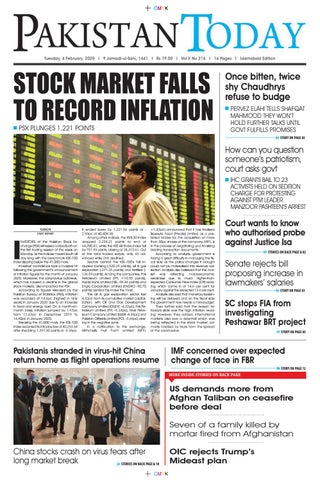
Stock market fallS to record inflation g
Once bitten, twice shy Chaudhrys refuse to budge g
pSX plungeS 1,221 poIntS
pervez elAHI tellS SHAfqAt MAHMood tHey won’t Hold furtHer tAlkS untIl govt fulfIllS proMISeS STORY ON PAGE 03
How can you question someone’s patriotism, court asks govt g
KARACHI STAFF REPORT
i
nveStorS of the pakistan Stock exchange (pSX) witnessed a bloodbath on the first trading session of the week on Monday, as the indices moved south all day long with the benchmark kSe-100 Index slipping below the 41,000 mark. Investors’ confidence took a massive hit following the government’s announcement of inflation figures for the month of January 2020. Moreover, the coronavirus outbreak, which has caused a decline in the global stock markets, also impacted the pSX. According to figures released by the pakistan bureau of Statistics (pbS), inflation was recorded at 14.6pc (highest in nine years) in January 2020 due to an increase in food and energy cost. on a month-onmonth basis, inflation jumped by 1.97pc from 12.63pc in december 2019 to 14.60pc in January 2020. breaking the 41,000 mark, the kSe-100 Index recorded its intraday low at 40,233.64 after shedding 1,397.30 points or -3.36pc.
It ended lower by 1,221.56 points at 2.93pc at 40,409.38. Among other indices, the kMI-30 Index dropped 2,294.21 points to end at 64,780.81, while the kSe All Share Index fell by 751.93 points, closing at 28,315.61. out of the total traded scripts, only 43 advanced while 269 declined. Sectors behind the kSe-100’s fall included banking (-320.29 points), oil & gas exploration (-271.25 points) and fertiliser (136.59 points). Among the companies, pak petroleum limited (ppl -110.55 points), Habib bank limited (Hbl -96.86 points) and engro Corporation limited (engro -90.70 points) dented the index the most. the oil & gas exploration sector lost 4.52pc from its cumulative market capitalization, with oil and gas development Company limited (ogdC -4.22pc), pak petroleum limited (ppl -5.33pc), Mari petroleum Company limited (MArI -4.35pc) and pakistan oilfields limited (pol -3.66pc) closing in the negative zone. In a notification to the exchange, Mithchells fruit farm limited (Mffl
+1.43pc) announced that it has finalised bioexyte food (private) limited as a preferred bidder for the acquisition of more than 30pc shares of the company. Mffl is in the process of negotiating and finalising bidding transaction documents. According to analysts, government is facing a great difficulty in managing the fiscal side as the policy changes it brought could not be materialised into revenue collection. Analysts also believed that the market was reflecting macroeconomic weakness due to much higher-thanexpected Consumer price Index (CpI) reading, which came in at 14.6 per cent for January against the expected 13.6 per cent. Analysts also said that monetary loosening will be delayed and on the fiscal side the government now needs a mini-budget. they further said that the reason for today's slide was the high inflation reading. However, they added, international markets also saw a downfall which was being reflected in the stock market, primarily backed by fears from the spread of the coronavirus.
Pakistanis stranded in virus-hit China return home as flight operations resume
IHC grAntS bAIl to 23 ACtIvIStS Held on SedItIon CHArge for proteStIng AgAInSt ptM leAder MAnzoor pASHteen’S ArreSt
Court wants to know who authorised probe against Justice Isa STORIES ON BACK PAGE & 02
Senate rejects bill proposing increase in lawmakers’ salaries STORY ON PAGE 03
SC stops FIA from investigating Peshawar BRT project STORY ON PAGE 03
IMF concerned over expected change of face in FBR STORY ON PAGE 12 more inside stories on back pake
US demands more from Afghan Taliban on ceasefire before deal Seven of a family killed by mortar fired from Afghanistan
China stocks crash on virus fears after long market break STORIES ON BACK PAGE & 10 CMYK
OIC rejects Trump’s Mideast plan
Tuesday, 4 February, 2020
02 NEWS
How CAn you quesTion soMeone’s PATRioTisM, CouRT Asks govT ISLAMABAD
T
STAFF REPORT
HE Islamabad High Court (IHC) on Monday granted post-arrest bail to activists who had been detained for protesting against the arrest of Pashtun Tahafuz Movement (PTM) leader Manzoor Pashteen. IHC Chief Justice Athar Minallah heard the plea and granted bail to 23 activists belonging to PTM and Awami Workers Party (AWP). At the outset of the hearing, the Islamabad deputy commissioner and deputy inspector general of police informed the court that Section 124-A (sedition) of the Pakistan Penal Code had been deleted from the First Information Report (FIR) against the activists. Instead, the investigating officer has added Section 7 of the Anti-Terrorism Act (ATA), 1997, in the case against them, the IHC was told. The IHC in its written order noted that, “A plain reading of the FIR shows
IHC GRANTS BAIL TO 23 ACTIVISTS HELD ON SEDITION CHARGE FOR PROTESTING AGAINST PTM LEADER MANZOOR PASHTEEN’S ARREST that the offences mentioned therein are, prima facie, not attracted. There is also no material on the record in support of the assertions made in the FIR.” The court also observed that Additional District and Sessions Judge Mohammad Sohail, who had last week declined to grant post-arrest bail to the PTM activists saying prima facie it was a terrorism case, “appears to have exceeded jurisdiction by making observations [regarding terrorism …] without having regard to the recently enunciated law by the august Supreme Court regarding scope of the Anti-Terrorism Act, 1997”. “Moreover, the observations recorded by the learned judge are not in consonance with the principles of fair trial,” the order said. During the hear-
ing, Justice Minallah expressed his displeasure at the Islamabad police chief’s absence from the court. “We did not expect this of your government. You are the representative of the state here, it is the state’s job to protect its people,” Justice Minallah said to the deputy commissioner while adding that the government should admit if they are in the wrong. “We will get to the bottom of this case. How could you question someone’s patriotism? Do you think constitutional courts will shut their eyes on a matter like this?” the chief justice remarked while giving the deputy commissioner a week’s time to consult the Islamabad IGP and come up with a report on the incident.
The chief justice had, on Saturday, sought an explanation from the capital police and the district administration for invoking the offence of sedition against these protesters. The court had also ordered the Islamabad deputy commissioner and the police chief to produce the complete record related to the arrest of the activists on Feb 3 (today). The counsel for the petitioners — Ammar Rashid and others — had contended before the chief justice that “the case has been registered against the petitioners on the basis of mala fide”. He had also questioned the order issued by the additional district and sessions court dismissing the post-arrest bail petitions of the detained activists, saying it was “arbitrary and not in consonance with the settled principles of law”. Terming the district court’s decision a serious miscarriage of justice, the counsel also said invoking offence of sedition against unarmed peaceful citizens was misuse of authority. The hearing was adjourned until February 11.
Court acquits ex-PM Raja Pervez Ashraf in illegal recruitment case LAHORE: An accountability court on Monday acquitted former prime minister Raja Pervez Ashraf in a case related to illegal recruitment in the GEPCO. Judge Amjad Nazir Chaudhry accepted the request for the dismissal of the case, which had been filed recently after the government introduced amendments to the NAB law through a presidential ordinance. NAB had filed a reference against the former premier in 2016 for recruiting 437 people illegally to the authority in his capacity as minister for water and power. According to the NAB prosecutor, individuals who had not even applied were given jobs, merit was ignored and appointments had been made on a political basis. The recruitment had also violated the policy of written examinations and domicile, NAB had alleged. The reference had nominated, along with Ashraf, former Pakistan Electric Power Company (PEPCO) managing director Tahir Basharat Cheema, former secretary for ministry of water and power Shahid Rafi, former director Board of Governors PEPCO Mohammad Saleem Arif, Malik Mohammad Razi Abbas, and Wazir Ali Bhayo, former PEPCO chief Mohammad Ibrahim Majoka and former director HR Hashmat Ali Kazmi. STAFF REPORT
IHC annuls notification dismissing CCP chairperson Vadiyya Khalil ISLAMABAD STAFF REPORT
The Islamabad High Court (IHC) on Monday annulled a government notification dismissing Competition Commission of Pakistan (CCP) Chairperson Vadiyya Khalil. IHC revoked another notification issued by the government to dismiss Muhammad Saleem and Dr Shehzad Ansari, two other members of the commission. The high court directed both members to resume their services. IHC Judge Miangul Hassan Aurangzeb announced the verdict, stating that the government cannot dismiss officials without following the prescribed rules and procedures. Khalil and other members of the commission who were dismissed had challenged the Finance Division’s notification which was issued on October 15, 2018. The division’s decision came after the federal cabinet’s approval on October 4, 2018. Khalil was appointed as the commission’s chairperson on October 14, 2017, for a term of three years. Ansari, Saleem were appointed on December 4, 2017 for a period of three years. The Pakistan Tehreek-e-Insaf (PTI) led government’s then minister for information and broadcasting Fawad Chaudhry had said that Khalil and other members of the commission had been appointed illegally. Chaudhry had said that it had been de-
cided to remove several high-level officials in banks and government departments as according to a Supreme Court decision, only the cabinet could appoint directors and heads of departments. This role had been unlawfully delegated to Ishaq Dar, the thenfinance minister, by the previous PML-N government. The officials dismissed from their posts include Saeed Ahmed, the president of National Bank of Pakistan; Tahira Raza, the president of First Women Bank; Syed Talat Mehmood, the president of Zarai Taraqiati Bank Limited; and Ehsanul Haq Khan, the president of SME Bank. Besides, four other officials appointed during the PML-N’s tenure were also removed including Jameel Ahmed, the deputy governor of State Bank; Shamsul Hassan, the deputy governor of State Bank; Khalil, Saleem and Ansar of CCP.
SC wants Punjab to shut down 56 govt companies ISLAMABAD STAFF REPORT
The Punjab government has decided to shut down “unnecessary” companies opened during previous tenures. Punjab Advocate General Sardar Ahmed Jamal Sukhera informed the Supreme Court (SC) about this decision during a hearing on Monday. But Chief Justice Gulzar Ahmed asked why they weren’t shutting down all 56 companies. He said the Punjab government is starting to operate like the East India Company. Will the government implement its own laws through these companies, he asked. Justice Ahmed was hearing a case filed by NAB on irregularities in these 56 companies. He said there was once a company named the East India Company. And what did it end up doing, he asked in court. Is the
CMYK
Punjab government starting the same thing, he asked. He said the Punjab government has been granted enough time to shut down the companies. “Now solve the problem.” The companies aren’t able to deliver, he said, adding that the government must do its own work. Some people hadn’t returned their salaries and bonuses despite the court order. The NAB prosecutor-general told the court that a reference would be filed against those people. The advocate-general said the Punjab chief minister has set up a steering committee. The public is benefitting from 37 of these companies, he said, adding that there are some legal questions which the steering committee will cooperate with the court on. Justice Ijazul Ahsan said the Punjab government must first look over the NAB report and submit a reply. The hearing was adjourned for a month.
Tuesday, 4 February, 2020
NEWS
onCe BiTTen, TwiCe sHy CHAudHRys Refuse To Budge PERVEZ ELAHI TELLS SHAFQAT MAHMOOD THEY WON’T HOLD FURTHER TALKS UNTIL GOVT FULFILLS PROMISES ISLAMABAD
T
MIAN ABRAR
HE gulf between the ruling Pakistan Tehreek-e-Insaf (PTI) and its coalition partner, the Pakistan Muslim LeagueQuaid (PML-Q), is widening as the Chaudhry brothers have expressed anger over the recent decisions of Prime Minister Imran Khan, including the formation of new dialogue committees to engage the allied parties. On Monday, the newly-constituted committee of the federal government comprising Federal Minister for Education and Professional Training Shafqat Mahmood, Punjab Chief Minister Usman Buzdar and Punjab Governor Chaudhry Mohammad Sarwar met a delegation of the PML-Q led by Punjab Assembly Speaker Pervez Elahi, but it failed to convince the allied party to hold talks. Sources said that Mahmood held a separate one-on-one meeting with Elahi and conveyed him a message of Prime Minister Imran Khan. However, the PML-Q leader told the minister that further dialogues would not be possible until the implementation of the recommendations tabled by the previous dialogue committee comprising Jahangir Tareen and Pervez Khattak.
PUNJAB ASSEMBLY SPEAKER WARMS UP TO PML-N LEADERSHIP AS TIES WITH PTI, BUZDAR DETERIORATE
Elahi told Mahmood that he will prefer to hold a direct meeting with PM Imran, sources said, adding that the schedule of the next round of talks has not been finalised yet. On Sunday, the PML-Q had demanded the PTI-led federal government to start implementation on the negotiated matters. Sources in both the parties told Pakistan Today, on condition of anonymity, that although Pervez Elahi is considering expanding relations with the Pakistan Muslim League-Nawaz (PML-N), Chaudhry Shujaat Hussain has advised him against taking any extreme measure. “The major problem in an alliance between the PML-Q and PML-N is the acrimony between Elahi and Shehbaz Sharif. Moreover, the second-tier leadership of the PML-N has always been out to destroy the Chaudhrys of Gujrat, hence any alliance between the two parties looks like a distant dream. However, nothing can be ruled out in politics,” said a source in PML-Q. The source said that Punjab CM Usman Buzdar was concerned about the widening gulf between the PTI and PMLQ as any extreme move may jeopardise his position. According to the source, the prime minister has been briefed on the developments taking place in Punjab where Elahi has been providing a ‘friendly envi-
Asif urges govt to handle kashmir issue with sincerity, seriousness Pakistan Muslim League-Nawaz (PML-N) leader Khawaja Asif on Monday expressed disappointment over the way Pakistan’s concerns over the humanitarian situation in Indian Occupied Kashmir (IOK) were addressed by the world and said that the issue should be pursued with utmost sincerity and seriousness instead of politics. Speaking on the floor of the lower house, the former foreign minister said that it was a massive failure for the nucleararmed country that no other country other than Turkey, Malaysia and China voiced their support for Pakistan. “Kashmir is the jugular vein of Pakistan and the government should take concrete steps to help the Kashmiris,” he said, adding that Indian forces have turned the valley into the world’s largest prison. NEWS DESK
eCP seeks reply from Talpur in plea seeking her disqualification ISLAMABAD: The Election Commission of Pakistan (ECP) on Monday restored a plea seeking the disqualification of PPP Co-chairman Asif Ali Zardari’s sister and MPA Faryal Talpur. A five-member bench, headed by CEC Sikandar Sultan Raja, led the proceedings into a case from the PTI lawmaker Arsalan Taj seeking Talpur’s disqualification under Article 62(f) of the Constitution as she failed to declare the details of her assets before the election commission. STAFF REPORT
ronment’ to the opposition leaders. “Elahi continued the recent Punjab Assembly session summoned on the opposition’s requisition for over a week which is unprecedented in parliamentary history,” the source said, adding that “for this session, he issued production orders for Opposition Leader Hamza Shehbaz and ensured his presence in the House”. “Moreover, Hamza was provided all facilities in the opposition leader’s chambers where he freely interacted with party lawmakers and friends,” the source added. The source said that the premier had also been informed that Elahi also gave more time to the opposition lawmakers during the recent session where they severely criticised the chief minister over his ‘poor performance’ and the government’s ‘failure’ to control wheat and flour prices. “Elahi also ignored the treasury members’ protests for giving more time to the opposition,” the source said. Tensions between the coalition partners started to increase after the removal of former Punjab chief secretary Yousaf Nasim Khokhar and worsened after the PM Imran’s refusal to include Moonis Elahi in the federal cabinet. The source claimed that another reason for discord between the two sides was a recent raid by Punjab Food
Authority on a factory reportedly owned by Moonis Elahi’s father-in-law. “Elahi protested against the factory raid during direct contact with CM Buzdar, but the latter refused to move against PFA. Elahi retaliated by accepting a requisition for an assembly session moved by the PML-N lawmakers despite the fact that at least 45 of them had been suspended by the Election Commission of Pakistan (ECP) for failing to submit their asset details,” the source said. The source further said that Elahi also summoned Punjab Inspector General of Police (IGP) Shoaib Dastageer on a privilege motion, which angered Buzdar who directed the IGP not to obey such orders. “Buzdar reportedly also telephoned Elahi and conveyed his reservations on the issue,” the source added. The ruling coalition has a marginal majority in the Punjab Assembly. In the House of 371 members, Buzdar needed 185.5 to get elected as chief minister while he was polled 186 votes. In Punjab Assembly, the ruling coalition has 186 members led by the PTI which has 171 members while the PML-Q has 10 lawmakers, four lawmakers are independents while one member is from the Rahey Haq Party. The PML-N has 165 lawmakers while the Pakistan People’s Party Parliamentarians (PPPP) has seven members. Chaudhry Nisar has yet not taken oath while Chaudhry Kashif of the PML-N from Bahawalnagar has been disqualified in a fake degree case. On the other hand, the PML-N would also be in a fix if it wants to get its nominee elected as the chief minister. With its 164 number after the disqualification of Chaudhry Kashif, the PML-N would require the support of another 22 lawmakers. Even then, the new chief minister would be in a very weak position.
Senate rejects bill proposing increase in lawmakers’ salaries ISLAMABAD STAFF REPORT
The Senate on Monday rejected a bill proposing a two-fold increase in the salaries of parliamentarians after 16 lawmakers voted in its favour and 29 against it following an intense debate with special focus on the economic situation of the country. The Senate will now hold a debate on whether the proposed law classifies as a money bill, in which case, it would be sent to the NA. During Monday’s sitting, the bill, which proposes increments for lawmakers, along with additional perks, was opposed by the ruling PTI and the two main opposition parties, the PPP and the PML-N who cited the country’s weak economy as the reason for their stance. However, the MQM-P and PkMAP declared their support for the bill.
Speaking on the floor of the House, PPP’s Senator Sherry Rehman said that role of the parliament is to fight for the people and given how bad the economic situation is, it would be “tone-deaf of the lawmakers to take a pay raise”. She also said that her party would reject the bill because they have always worked for the interests of the most downtrodden segment of society. She further said that while the matter is important and some lawmakers find it difficult to make ends meet as their salaries are the lowest in the region, but the issue should be picked up at another time. Senators belonging to the ruling PTI also declared their opposition to the bill during the debate as the country’s economic situation did not allow them to accept a pay raise. Senator Faisal Javed said that lawmakers’ salaries would be increased once the country’s economic situa-
tion improves. He said that the timing is not right. “The prime minister has not increased his own salary so the parliamentarians should also get by,” he added. Azam Swati also expressed his opposition to the bill, saying that despite an economic slowdown, their salaries were not decreased. MQM-P’s Barrister Mohammad Ali Saif, however, supported the bill and said that those who do not wish to take extra money are free to donate it either back to the government or a suitable charity. PkMAP Senator Usman Khan Kakar said that there were some senators who supported the bill but were playing politics on the issue. Emphasising the need for increasing salaries, he said that parliamentarians were paid less than a BPS-17 officer. Responding to Swati’s speech, he said that “people like him can afford the expenses of the entire parliament”.
03
imran reaches Malaysia on two-day visit KUALA LUMPUR: Prime Minister Imran Khan on Monday arrived in Kuala Lumpur on a two-day official visit to the country on the invitation of Malaysian Prime Minister Mahathir Mohamad. The premier was received by Malaysia’s Minister for Defence Mohamad Sabu and senior officials of the Malaysian government upon his arrival at Bunga Raya Complex, Kuala Lumpur International Airport. According to the Prime Minister’s Office, Foreign Minister Shah Mahmood Qureshi, Federal Minister for Planning, Development and Special Initiatives Asad Umar, Commerce Adviser Abdul Razak Dawood and Foreign Secretary Sohail Mahmood are accompanying the prime minister. Imran is expected to hold a meeting with the Malaysian prime minister followed by delegation-level talks. The two will also be present at the signing ceremonies of important agreements between the two countries and have a joint press stakeout, said a press release issued by the Foreign Office, The prime minister will also address an event organised by the Institute of Strategic and International Studies in Malaysia. The two-day visit will provide the countries the opportunity to review the full spectrum of bilateral relations and will reaffirm Pakistan’s resolve to forge a robust economic relationship with Malaysia, the statement read. It added that in his interactions, Prime Minister Imran will share his vision for Pakistan and underline the country’s positive contribution to regional and international peace and security. “He [Imran] will also highlight human rights violations in occupied Kashmir, emphasise the importance of averting risks to regional peace and stability posed by Indian belligerence, and underscore the importance of a peaceful resolution for the Kashmir dispute,” the statement said. STAFF REPORT
iHC seeks nAB’s reply on bail pleas of Abbasi, Ahsan iqbal ISLAMABAD: The Islamabad High Court (IHC) on Monday sought a reply from the National Accountability Bureau (NAB) on bail pleas of Pakistan Muslim League-Nawaz (PML-N) leaders Shahid Khaqan Abbasi and Ahsan Iqbal. According to details, Chief Justice of IHC Athar Minallah adjourned the hearing regarding bails of the PML-N senior leaders for a week. Abbasi was taken into NAB custody on July 18, 2019, in the liquefied natural gas (LNG) scandal. As the minister for petroleum and natural resources at that time, he has been accused of granting contract on LNG to a favourite company. On the other hand, NAB arrested Ahsan Iqbal on December 23 over his involvement in embezzlement of Narowal Sports City project funds. The anti-graft watchdog body alleged that Iqbal had illegally initiated a project of Rs3 billion in Narowal, causing a loss worth billions to the national exchequer. STAFF REPORT
SC stops FIA from investigating Peshawar BRT project ISLAMABAD STAFF REPORT
The Supreme Court (SC) on Monday barred the Federal Investigation Agency (FIA) from probing alleged irregularities in the Peshawar Bus Rapid Transit (BRT) project. The decision was announced by a three-member bench of the apex court,
headed by Justice Umar Ata Bandial, on a petition filed by the Khyber Pakhtunkhwa government, challenging a Peshawar High Court (PHC) order from November 2019, directing the FIA to conduct an inquiry into different aspects of the PTI government’s flagship project. Additionally, the apex court sought details of the total cost as well as details
regarding the completion of the project. “What is the initial cost of the BRT? What was the initial date for the completion of the project? When will it be finished?” Justice Bandial inquired. “Is there even a date for the completion of the project?” asked Justice Mazhar Alam Khan Miankhel. During the proceedings, the KP government’s lawyer alleged that the
PHC had issued its verdict without any reasoning. “The PHC had given a verdict which the petitioner had not even requested,” the lawyer claimed. While the top court stopped the FIA from investigating the project, the KP government said the new date for the completion of the Peshawar BRT is July 31 of this year.
04 ISLAMABAD
Tuesday, 4 February 2020
WEATHER UPDATES TUESDAY
130C 040C
WEDNESDAY
170C 040C
THURSDAY
170C 060C
FRIDAY
180C 040C
‘Pakistan to continue support of Kashmiris’ right to self-determination at all forums’ ISLAMABAD STAFF REPORT
PESHAWAR: Children search for useful items in a roadside garbage dump. PPI
KP govt lets almost 100Pc of funds for merged districts go to waste ISLAMABAD AZIZ BUNERI
K
HyBEr Pakhtunkhwa's (KP) government has failed to utilise the Annual Development Budget (ADB) allocated for merged districts of the fiscal year of 2019-20, documents available with Pakistan Today have revealed. The documents point out that at least 14 departments remained lax and negligent in their jobs as not a single penny meant for development works of seven tribal districts in the province was utilised whereas the rest of the departments have spent only six and a half per cent of the ADB since July 2019. The aforementioned 14 departments include Excise and Taxation (E&T), Food, Industry and Commodities, Information, Labour, Law and Justice, Minerals, Welfare, Science and Technol-
ogy and Transport. There is no development work in conflict challenged areas since integration into KP even though the provincial government had extended all its departments to merged districts. It seems that most government offices are focusing solely on staff salaries rather than carrying and launching development projects reflected in the budget. According to officials of the Finance Ministry, a certain portion of the budget was released for all departments and more will be issued on the utilisation of the current budget. They said that, for the first time in history, the KP government presented a budget of rs83 billion for development work in tribal districts, out of which rs72 billion had been promised by the federal government while the remaining rs11 billion came from the KP government itself. Experts believe that incompetence and incapa-
bility of the concerned government officials, as well as lack of facilities such as offices in these areas, are the main reasons for non-utilisation of funds. responding to a question regarding this belief, Chief Minister's (CM) Advisor for Tribal Districts Ajmal Wazir said that the first six months of the current Fy were spent on activation and streamlining government departments, however, now things are on track. "We will carry out development work in tribal districts at a high pace now," he added. Similarly, Finance Minister Timur Saleem Jhagra also gave assurances saying that both the premier and CM are focused on uplifting tribal districts. "In 10 years, more than rs1,200 billion will be spent in tribal districts, enhancing the living standard of people living there," he promised.
SW tribesmen’s protest for compensation continues on eighth day WANA INP
Tribesmen of South Waziristan district of Khyber Pakhtunkhwa (KP) continued protest demonstration in favour of their demands on the eighth consecutive day on Monday. A large number of tribesmen be-
longing to Mehsud tribe marched from FC Ground to Deputy Commissioner (DC) office and staged protest demonstration. Addressing the protestors, tribal elders Badshahi Khan Mahsood, Shah Faisal Ghazi, Sherpao Advocate Mahsood and Saeed Anwar Mahsood said that they have been protesting
for last eight days but neither the district administration held dialogues with them nor any step was taken to address their genuine issues. They also criticised the government for loathsome attitude towards tribesmen and turning deaf ears towards fulfilling their demands. The protesting tribesmen warned
of taking to Peshawar and Islamabad to hold protest demonstrations if their demands remain unaddressed. It is worth mentioning here that Mehsud tribes of South Waziristan district have been protesting in FC Ground since 27 January over prolonged delay in survey of damaged houses and compensating the affectees.
National Assembly Speaker Asad Qaiser has said that the Indian government had deprived its citizens specially the people of Kashmir from their right of Identity through legal means. He said by revoking Articles 370 and 35A from the Indian Constitution, the Kashmiri people have been deprived of their legitimate right of identity. He said the worst lockdown of history has been ongoing in the entire valley for the last 182 days, the entire Kashmiri leadership was in prison and media is also strictly banned to suppress the voice of the Kashmiri people. The Speaker expressed these views while addressing a ceremony organized by the Private Schools Association in connection with Kashmir Solidarity Day here at F-9 Park, Islamabad on Monday. The Speaker said the people and Parliament of Pakistan had always stood with the people of Kashmir and will continue moral, diplomatic and political support to them till the logical end of the Kashmir issue. He said atrocities of Indian Armed Forces on the Kashmiri people would be raised at global and regional forums. He said the people of Kashmir were compelled to live miserable life in extreme winter due to the ongoing lockdown in valley as they were deprived of all basic necessities of life, including food, medicine and fuel. He stressed upon world community to take immediate notice of the ongoing situation in occupied Kashmir and pressurized India for the immediate end of the ongoing lockdown in the valley. He said the only option to solve the problem of Kashmir was plebiscite in the held valley according to the UN Security Council resolutions. Asad Qaisar said that Pakistan's parliament had always stood with the people of Kashmir and forcefully highlighted the Kashmir issue at all the parliamentary forums. He said two days will be allotted to discuss the latest situation in occupied Kashmir in the current session of the National Assembly and in light of that debate, a unanimous resolution will be adopted against the lockdown and Indian atrocities in the valley. He called upon the Pakistani nation and media to actively participate in Kashmir solidarity day to express solidarity with their Kashmiri brethren. Earlier, the Speaker also participated in the walk to express the solidarity with people of Kashmir. The Federal Minister for Kashmir and Gilgit Baltistan Ali Amin Khan Gandapur also accompanied him. The walk was attended by the students of the private schools of Islamabad, the teachers, civil society, media representatives and the political leadership of Azad Jammu and Kashmir. Later, the Speaker also inaugurated the paintings exhibition of Indian atrocities on Kashmiri people at the Quaid-eAwan, F-9 Park Islamabad.
As many as 27 lives lost in 15 militant attacks last month: report ISLAMABAD STAFF REPORT
Following a historical pattern of a rise in violence at the beginning of the year, January 2020, repeated that pattern as the number of militant attacks and the resultant deaths increased in the first month of the new calendar year when compared to last month of the previous calendar year. This was stated in the monthly security assessment report issued by the Pakistan Institute for Conflict and Security Studies (PICSS). The institute is an Islamabad-based independent think tank. The PICSS report noted that as many as 15 militant attacks were recorded in January this year in which 27 people were killed and 60 others were injured. In the first month of the last year (2019), PICSS had recorded 19 militant attacks in which 41 people were killed and 52 were injured. Out of the 15 attacks in January 2020, five were reported from Khyber-
Pakhtunkhwa (K-P) — excluding the erstwhile federally administered tribal areas (Fata), where three people were killed and 12 others were injured. In the newly-merged tribal districts (NMTDs), three militant attacks were witnessed in which at least one security official killed and three others injured. Balochistan witnessed four militant attacks in which 19 people were killed and 37 others were injured. A further two militant attacks were reported from Punjab, in which three people were killed and eight others were injured. Sindh saw one militant attack in which one person was killed. In the previous month, December 2019, 11 militant attacks were reported from across the country in which 12 people were killed and 26 others were injured. Thus, January witnessed an increase of 36 per cent in the number of attacks which resulted in a 125 per cent increase in the number of deaths and 131 per cent increase in injuries, when compared with December.
Among these 15 militant attacks, a third were incidents of targeted killings in which eight people were killed, including four civilians, three security forces personnel and a militant. As many as five others were also injured, including four civilians and a security official.
CMYK
The month witnessed just one suicide attack in which 16 people, including 14 civilians, were killed and 19 others were injured. Four improvised explosive devices (IED)-based attacks were also witnessed during the month which caused three
deaths and injuries to 24 others. There were also four grenade attacks which caused injuries to 12 people. Mainly civilians were at the receiving end in a majority of these attacks. A mortar attack was also reported which caused no human loss. An increase in counter-terrorism action from security forces was also observed in January as 16 security operations were monitored in which 20 suspected militants were killed and 19 others were apprehended. As many as two security forces personnel lost their lives and another was injured in these operations. December had witnessed nine security forces actions in which seven people including four militants were killed three others were injured while 13 suspects were apprehended. Explaining the cycle of increase in violence in January, the report suggested that perhaps the turn of the year was a time for militants to demonstrate new commitment or an attempt to seek financial resources or maybe both.
Tuesday, 4 February, 2020
Govt HiGHLiGHted KaSHMir iSSue tHrouGH effeCtive dipLoMaCy: dr firdouS ISLAMABAD
S
STAFF REPORT
PECIAL Assistant to Prime Minister (SAPM) on Information Dr Firdous Ashiq Awan has said that the government has successfully internationalized the core issue of Kashmir through effective diplomacy. She said the Kashmir is an integral part of Pakistan and we will continue political, moral and diplomatic support to the Kashmiri brethren till their freedom. She said this while addressing an event of launching ceremony of special songs "Jannat Na Jalaoo" and "Ay Khuda" on the eve of Kashmir Solidarity Day by Radio Pakistan here on Monday. Dr Firdous said Radio Pakistan is working effectively to defend the ideological boundaries of Pakistan and its role in this regard always re-
mained commendable. She said Radio Pakistan played a vital role in every critical juncture and supported the nation both in the conditions of peace and war. Appreciating the release of two songs by Radio Pakistan in expressing solidarity with Kashmiris on eve of Kashmir Solidarity Day, she said these songs will help the world to understand the real situation of Indian atrocities in Occupied Kashmir. She said these are also real emotions of the 220 million people of Pakistan in support of the Kashmiris' movement. The event was attended by DG PBC Samina Waqar, Director News Abdul Hadi and other high officials of Radio Pakistan. She said the Radio Pakistan is a symbol of our political and social values of Pakistan. She said that Radio Pakistan has introduced new trends in the world of broadcasting. Commenting on Kashmir movement, Dr Fir-
dous said the Kashmiris are fighting for their political, religious and cultural rights and they rendered unprecedented sacrifices in this regard. She said Radio Pakistan has played an important role in highlighting the just struggle of Kashmiris. She also appreciated Pakistan Television to visualize these songs released by Radio Pakistan to make it more resonate. She said Radio in only the medium which has access in Occupied Kashmir as there is no reach of other medium in the held valley. Earlier, speaking on the occasion, Information Secretary Akbar Durrani said that Radio Pakistan has a bright history in disseminating credible news and broadcasting historic themed Dramas. He said these songs are a reflective of the support of Pakistani nation with their Kashmiri brethren. He said Kashmir issue is an unfinished agenda and it must be resolved as per aspirations of Kashmiris according to the UNSC resolutions.
Why we express solidarity with oppressed Kashmiris MUHAMMAD RAZA MALIK GENESIS OF THE SOLIDARITY DAY: Pakistanis, at home and abroad, have been observing the Kashmir Solidarity Day on 5th February, every year since 1991, to renew the pledge to continue their all-out support to their Kashmiri brethren who are engaged in a peaceful struggle to secure their inalienable right to self-determination. The background of the day is that the people of Indian occupied Kashmir intensified their struggle for securing their right to self-determination in 1989 and the mass movement gave sleepless nights to the Indian rulers. In a bid to crush this popular movement, India dismissed the government of Farooq Abdullah and appointed Jagmohan Malhotra, who was notorious for his anti-Muslim bias, as the Governor of the territory on January 19, 1990. Soon after the appointment of new governor, a reign of terror was unleashed in occupied Kashmir and
on the night of January 20, Indian troops molested several women in Srinagar during house raids. As the word about the molestation of the women spread in the morning, thousands of people took to the streets in the city to protest against the brutal action of the troops. The Indian forces opened indiscriminate fire on the protesters in Gaw Kadal area of the city, killing over 50 people and injuring hundreds of others. The massacre caused resentment in Pakistan and the ensuing 5th February was declared as a solidarity day all across the country. Since then, every year, the day is being observed to express oneness with the oppressed people of occupied Kashmir at the state level. On this public holiday in Pakistan, seminars, conferences and demonstrations are organised to highlight important aspects of the Kashmir dispute and the gross human rights abuses being committed by Indian troops in occupied Kashmir. The overseas Pakistanis and Kashmiris arrange special events
in world capitals to remind the international community that resolution of the dispute is imperative for ensuring peace in South Asia. This year, the day is being observed in the backdrop of India’s illegal and unconstitutional move of scraping special status of occupied Kashmir and annexing it on August 05, 2019. India put the territory under military siege and internet gag which was continuing even after months when this write-up was written. HISTORY OF KASHMIR DISPUTE: It is a fact that India illegally occupied the territory of Jammu and Kashmir by landing its troops in Srinagar on October 27 in 1947 in gross violation of the Partition Plan of the Indian Subcontinent and the wishes of the Kashmiri people. According to the Partition Plan in 1947, the Indian British Colony was to be divided into two sovereign states of India and Pakistan. Hindumajority areas were to form India while Muslim-majority areas of Western provinces and East Bengal
were to form Pakistan. As per the understanding of the Partition Plan, the Princely States were given the choice to accede either to Pakistan or to India, keeping in view their geographic and demographic considerations. Being a Muslim-majority State with 87% Muslim population, Kashmir had a natural tendency to accede to Pakistan. But, India occupied the territory by claiming signing of controversial Instrument of Accession with Hindu ruler of Kashmir, Maharaja Hari Singh. The people of Jammu and Kashmir never accepted India’s illegal occupation of their soil and they have been struggling to liberate it from the Indian yoke. Their liberation struggle forced India to seek the help of the world community to settle the Kashmir dispute. Sensing a humiliating defeat to its forces, India approached the UN Security Council on January 1, 1948. The writer is working as Senior Editor at Kashmir Media Service, Islamabad, and can be reached at razamalik849@yahoo.com
Imran Farooq’s widow confirms meeting husband's alleged killers Shumaila Farooq, widow of slain Muttahida Qaumi Movement (MQM) leader Dr Imran Farooq, on Monday told an Islamabad anti-terrorism court (ATC) that she had met two former members of the MQM’s student wing who were in London to allegedly kill her husband. Shumaila provided her witness statement from London’s Hendon Magistrates’ Court via video link. She confirmed meeting accused Mohsin Ali Syed and Kashif Khan Kamran, who had allegedly approached her husband introducing themselves as Dr Farooq’s ‘fans and followers’. A team of Scotland Yard officers has been in Islamabad for a week to facilitate the trial taking place in both London and Pakistan after the UK and Pakistan decided to cooperate and the UK sent the entire murder case file to Pakistan for the trial of the murder plotters. Shumaila Imran confirmed in her statement that her husband did not suspect that Mohsin Ali Syed and his accomplice were intending to harm him. She gave her full account of the events that led to the killing of her husband. NEWS DESK
CMYK
NEWS
05
LHC decision on special court against Musharraf challenged in SC ISLAMABAD STAFF REPORT
The Lahore High Court (LHC) verdict against the special court in Musharraf case was challenged in the Supreme Court on Monday. A bench of the high court had granted a petition of former president Pervez Musharraf on January 13 and declared formation of special court to hear high treason case against him as unlawful. Justice Mazahar Ali Akbar Naqvi had announced the court verdict. Petitioner Taufiq Asif, a former president of the high court’s Rawalpindi Bar, has challenged the LHC decision. The petitioner has pleaded the Supreme Court to declare the verdict of the high court as ‘unconstitutional’ and thus null and void. The petition argues that the petition against the special court was out of the jurisdiction of the Lahore High Court. The Article VI of the constitution was also not interpreted properly in the verdict, according to the petition. “The high court could not question the supreme court’s decision about conducting the trial in absence of the accused,” the petition said. The court in its verdict had said that the Article VI could not be enforced from the back date. The bench also expunged clause (ix) of the Criminal Law Special Court (Amendment) Act 1976. The petition filed in the high court said that the constitution of a special court for hearing the case against Pervez Musharraf was unconstitutional. The petition pleaded the high court to declare the constitution of the special court and its proceedings as unlawful. The Lahore High Court on January 13 granted the petition and declared the special court as unlawful. Musharraf had been sentenced to death by a special court on December 17, 2019, after six years of hearing the case, which was filed against him by the previous PML-N government after it assumed office in 2013.
Tuesday, 4 February, 2020
06 WORLD VIEW
atlantiC
o
The downfall of The RepUblIcan paRTy
PeTer Wehner
N Friday, Republicans in the United States Senate— with the exception of Mitt Romney and Susan Collins—voted to prevent John Bolton, Donald Trump’s former national security adviser, from testifying in the impeachment trial of the president. The reason they did so is undeniable: They did not want to hear from the most credible fact witness of all, one whose account would further implicate the president in his corrupt scheme—his “drug deal,” in Bolton’s words—to pressure the Ukrainian government to open an investigation to harm Trump’s main political opponent. Republicans, from beginning to end, sought not to ensure that justice be done or truth be revealed. Instead, they sought to ensure that Trump not be removed from office under any circumstances, defending him at all costs. The job of Senate Republicans was to make their acquittal of the president as quick and painless for them as possible. In this particular case, facts and evidence—reality—were viewed as grave threats, which is why they had to be buried. This is simply the latest act in an unfolding political drama, one in which the party of Lincoln and Reagan has now become, in every meaningful sense, the party of Trump. The point I want to make is a somewhat different one, which is that Trump’s takeover of the GOP has happened not because he is widely loved or admired by Republican lawmakers but because he is feared; not because most of the people in the Republican Senate Conference aspire to be like him, but because they are too timid to challenge him. From a certain perspective, their timidity is understandable. They know that to publicly chal-
TO SEE MEN AND WOMEN WHO HAD A POSITIVE VISION BEATEN DOWN AND BROKEN BY TRUMP IS A POIGNANT THING lenge Trump—to call out his ethical transgressions, cruelty, and indecency even as they support his policies—invites impassioned attacks from Trump supporters and, in some cases, a primary challenge. No one likes to be under attack, particularly by the base of one’s own party, and no one wants to lose a job. Moreover, they will argue, they must defend the president in public so they can have influence in private. They have also convinced themselves that they are essential to the project of repairing the Republican Party post-Trump, and that this requires that they not be viewed as disloyal to Trump while he’s serving as president. “What good does it do to attack Trump?” they will ask. He won’t change his ways, and they will only weaken themselves in the process. (Many of them are happy to attack Trump in private conversations, citing, chapter and verse, things he has said or done that alarm them, showing that they both know better and are playing a cynical game.) That, at least, is the story they tell themselves. Some of what they say is worth taking into account. But what they don’t tell themselves, probably because it would be too psychologically shattering, is that they have become fully complicit in a corrupt enterprise called the Trump presidency. (Romney is the rare exception.) They are defending actions they know are wrong and that, if they had been done by a Democratic president, they would be outraged by. More than that, they are validating Trump’s approach to politics—the hyper-aggression, the lawlessness, the mendacity, the
shamelessness—and therefore guaranteeing imitators. It also happens that their influence on the president is far smaller than they tell themselves. They have made concession after concession after concession, justifying each one along the way. Then you look back at the road they’ve traveled, and it’s breathtaking. Donald Trump has changed them far more than they have changed Donald Trump. In 1991, when Václav Havel received the Sonning Prize for contributions to European civilization, he spoke about those “who are starting to lose their battle with the temptations of power.” It is an insidious thing, Havel warned, to become captive to the perks of power. Politicians, he said, soon learn how easy it is to justify staying in power even as they give up bits of their soul in the process. It is easier than they think, he said, to get “morally tainted.” “Politics is an area of human endeavor that places greater stress on moral sensitivity,” Havel concluded, “on the ability to reflect critically on oneself, on genuine responsibility, on taste and tact, on the capacity to empathize with others, on a sense of moderation, on humility. It is a job for modest people, for people who cannot be deceived.” To see men and women who in other spheres of their lives are admirable, who got into politics because they believed it was a noble profession and had a positive vision for the Republican Party, beaten down and broken by Trump is a poignant thing. Their weakness and servility, their vassalage to such a fundamentally corrupt man, is
dispiriting to those of us who not only lament the injury Trump is inflicting on the nation as a whole but who still care about the Republican Party and worry that conservatism is in the process of being subsumed into angry, ethnic populism. What Republicans who have rallied behind Trump don’t fully grasp yet is the toxic effect he’s had on the younger generation, and on college-educated, suburban, and nonwhite voters. (Trump is wildly popular among blue-collar and rural voters, who are shrinking as a percentage of the voting population.) The damage done by Trump won’t be limited in its reach. He has imperiled the future of the party he leads. And those who think the GOP will simply snap back to the best of what it was pre-Trump—who think the worst elements of Trumpism will vanish once he leaves the White House—are kidding themselves. Those who fell in line behind Trump have empowered him (and his many acolytes and media propagandists) to redefine much of conservatism and the principles that once informed the Republican Party. I don’t think that is what they intended, but that is what they have helped achieve. Few things in life are permanent, most of all in the realm of politics. The fight for the future of the Republican Party, post-Trump, will be an intense one. Those of us who are conservatives and those on the center-right who believe the soul of GOP is still worth fighting for will not go gently into the good night. But for now, Donald Trump has an iron grip on the Republican Party—and Republican lawmakers who privately lament what he has done have publicly enabled what he has done. PETER WEHNER is a contributing writer at The Atlantic, a senior fellow at the Ethics and Public Policy Center, and Egan visiting professor at Duke University.
‘Deal of the century’ or ‘slap of the century’
ProjeCt syndiCate daoUd KUTTaB
US President Donald Trump has unveiled a sweeping Middle East peace plan that his administration claims will end decades of Israeli-Palestinian conflict by offering concessions to both sides. But even the optics of the announcement — with Trump standing beside Israel’s caretaker prime minister, Benjamin Netanyahu, and no Palestinian anywhere to be seen — revealed just how disingenuous that claim is. Effective peace negotiations require a perfectly calibrated interchange between process and content. In the case of Trump’s peace plan, the process was clearly a sham. It is not just that no Palestinian leader attended the announcement; none has been invited to the White House since Trump — the leader of the most proIsraeli U.S. administration in history — moved the U.S. embassy in Israel to Jerusalem, in May 2018.
By contrast, Netanyahu has made five trips to the United States since Trump took office, including to seize this latest opportunity to gloat. Underscoring his contempt for the group with whom he supposedly wants to make peace, Netanyahu refused so much as to utter the word “Palestinians” during the initial Oval Office meeting. But Netanyahu does not need to be nearby for the Trump administration to work in his interests and those of his right-wing backers. Within the U.S., the supposed “peace process” has been directed by Christian Zionists, such as Vice President Mike Pence and Secretary of State Mike Pompeo, and Jewish Zionists — most notably Trump’s son-in-law Jared Kushner and, until last September, former Trump Organization lawyer Jason Greenblatt. All of these figures — as well as the U.S. ambassador to Israel, David Friedman — publicly support Israeli settlement building in the occupied West Bank and violations of Palestinian human rights, such as the right to self-determination. So biased was the process that Palestinian President Mahmoud Abbas rejected the deal sight unseen. His instincts were right: The plan’s content shamelessly advances Israeli interests and goals at the expense of the Palestinians. The Trump administration’s plan would establish a disjointed Palestinian para-state surrounded largely by Israel, which would be permitted to
annex all of the settlements it has built since the June 1967 war, as well as the Jordan Valley — a step for which it is already laying the groundwork. Jerusalem would remain Israel’s undivided capital, with the Palestinian capital located in the suburbs east of the city. Far from the “deal of the century” that Trump has repeatedly promised, this is — in Abbas’s words — the “slap of the century.” It ignores decades of negotiations, as well as concerted efforts by Arab neighbors such as Jordan and Egypt, to encourage moderation. But the Palestinians are not the only losers from Trump’s kowtowing to Israel. It is hard to see how this approach benefits the U.S. Already, the Trump administration has handed one political gift after another to Israel, including moving the U.S. embassy from Tel Aviv to Jerusalem, ordering the closure of the Palestine Liberation Organization office in Washington and declaring that Israel’s settlements in the West Bank do not violate international law. It has also defunded the United Nations Relief and Works Agency (dedicated to supporting and advocating for Palestinians displaced by Israel’s creation in 1948), and suspended support for hospitals in East Jerusalem that provide critical care to Palestinians. And what has the U.S. gotten in return for all of this? Absolutely nothing. As the New York Times columnist Thomas Friedman suggested, Trump seems to be little more than
Netanyahu’s “chump.” The unveiling of the new peace deal was surely intended to consolidate Trump’s right-wing Christian Zionist base, giving him a political boost as his impeachment trial unfolds in the Senate. And it will do the same for Netanyahu, who has endured two deadlocked elections and three failed attempts at forming a government in recent months — and was formally indicted on corruption charges just hours before the White House event. Make no mistake: what the Trump administration has put forward is not a courageous plan for permanent peace but a shameless ploy to violate international law, Palestinian human rights and basic principles of fairness. Yes, this may deliver a short-term political boost to Trump and Netanyahu. But Palestinians will never accept it. The plan’s supporters will try to portray Palestinians’ rejection of Trump’s plan as tantamount to a rejection of peace. We must not let them. Palestinians, along with Arab countries, remain committed to a two-state solution along the 1967 borders and a just resolution to the Palestinian refugee problem. That is a viable basis for a just, honestly negotiated and mutually acceptable peace settlement. Trump’s plan is a sham. Daoud Kuttab is a Palestinian journalist and a former professor of journalism at Princeton University.
Understanding India’s biggest massacre Counter Currents MohaMMed Mirza
While speaking on the contentious Citizenship Amendment Act (CAA) with a neighbor of mine who hails from Zaheerabad, Telangana as in almost every discussion on CAA we ended up discussing the documents issue. He started telling this story of how his family escaped from Zaheerabad when ordinary farmers took up arms and unleashed violence on Muslims. I was taken aback by this comment of his. I have read about this massacre but never came across anyone who had escaped the violence first hand. He said that his family had to escape with whatever they could get hold of, many of their family’s documents were lost in the process. These documents could have proved handy in proving his citizenship at a time when the Indian government is set to take on a mammoth task of creating a register of all Indian citizens based on documents that they produce. I came home and discussed it with my father, who astonishingly had his own family story of escaping the massacre themselves. His maternal grandfather hailed from Warangal and moved to Hyderabad in the months following Operation Polo. Operation Polo is deemed as one of the Indian military’s biggest successes. After all, they overcame the forces of what was the richest princely state of India, Hyderabad. The ruler of Hyderabad called the Nizam had armed forces that largely comprised of undertrained razakars. After all, the Nizam’s empire was built on culture and wealth generation through agriculture and trade rather than military might. In 1948, right after Operation Polo or “police action” as many refer to it the massacre began. A BBC report termed it as “India’s Hidden Massacre”. This massacre of genocidal numbers wasn’t done by the army alone, the blame lay on the rural folk who unleashed violence. Some defenders of it claim that it was a natural venting reaction to the oppressive feudal rule. It was anything but that as in the days to follow it wasn’t just the feudal lords who came face to face with the brutalities, it was the common folk who in fact faced the brunt of it as mostly Hindu led paramilitary groups took up arms. The horror stories reached the leaders of the then Congress-led government and Nehru commissioned a fact-finding committee. This committee comprised of people from different faiths and the leader of it was a Hindu congressman, Pandit Sunderlal. The Sunderlal committee visited the affected towns and villages and collected first-hand reports from the ground. The report carrying his name was not published then or in the decades to follow. This massacre was covered up by successive governments as well. So well in fact that today even many who live in Hyderabad don’t know that a massacre of such proportions took place. Indians were treated with bits and pieces of this report over the years. The full copy, however, stayed away from public eyes. However, after years of being kept under wraps a copy of the report was obtained by historian Sunil Purushotham from the University of Cambridge. It made some startling revelations and was subsequently published in a BBC report. The “conservative” estimate of the death toll that this report puts up is 27 to 40 thousand. The worst affected districts according to the report are Nanded, Bidar, Osmanaabad and Gulbarga. The report goes on to mention that the army too was either complacent or actively took part in the looting and burning of Muslim owned properties. It didn’t stop there they were even reported to have shot Muslim men in cold blood. On the contrary the report also mentioned that the Indian army protected the persecuted Muslims in many instances. The death toll that the report mentions, however, has been contested. Historian William Dalrymple in his book the Age of Kali estimates that as many as “200,000 Hyderabadi Muslims were slaughtered.” If this is true, it amounts to almost one in every five adult Muslim males considering the population of the Hyderabad state before Operation Polo. Today, as I walk through the streets of Hyderabad there are no signs of the massacre. It is almost as if it never happened. From the educated to the not so educated this part of Hyderabad’s history is not known to most. It has become one of India’s best-guarded secrets. In fact, you can even get through a bachelor’s degree in Indian history without having to learn about this massacre. For the common man in Hyderabad that still has remnants of the Nizam’s era dotted all over, the story of the massacre only lies in tales of the elderly few who lived through that time. As of today hardly any of the perpetrators of this massacre either in the Indian army or the Hindu led paramilitary were indicted. Mohammed Mirza is a Middle East-based journalist.
Tuesday, 4 February, 2020
FOREIGN NEWS 07
Turkey hiTs back afTer syrian shells kill Turkish Troops ANKARA/ISTANBUL
T
AGENCIES
URkEY said on Monday it struck dozens of Syrian government targets after five of its soldiers were killed in northwest Syria’s Idlib region, an incident that could test ties between Moscow and Ankara. President Tayyip Erdogan said initial indications showed 30-35 Syrians were “neutralised” in Turkey’s response to what it called intense shelling of its soldiers in Idlib, the last major Syrian rebel stronghold after nearly nine years of war. Turkey has reinforced Idlib, which lies just across its southern border with Syria, in a challenge to Damascus and its Russian backers. Erdogan said Turkey had told Russian counterparts “they need to stand aside” in the escalating conflict, in which Ankara and Moscow back opposing sides. Russia’s Defense Ministry said Turkish military units came under fire overnight after moving within Idlib without notifying Russia, contradicting Ankara’s claim that it coordinated movements. Syrian President Bashar al-Assad’s forces, backed by Russian air power, have made large advances in Idlib, prompting Turkey to warn it may launch a military operation there unless
the fighting is halted. Rebels fighting to oust Assad, some of whom have been backed by Turkey, have also launched counter-attacks against the territorial gains by Assad’s forces. “We have responded in kind to these attacks and will continue to do so, whether it is with our artillery or mortars,” Erdogan told reporters in Istanbul. “We are determined to continue our operations for the security of our country, people and our brothers in Idlib,” he said before a flight to kiev. “Those who question our determination will soon understand they made a mistake.” A Turkish security official told Reuters the shelling that killed the sol-
recording shows iran knew immediately it had shot down plane, says Zelenskiy KIEV/DUBAI: A leaked audio recording of an Iranian pilot talking to the control tower in Tehran shows that Iran knew immediately it had shot down a Ukrainian airliner last month, Ukraine’s president Volodymyr Zelenskiy said. On the recording, which was played on a Ukrainian television station late on Sunday, the pilot of another plane apparently in the air at the time when Iran shot down Ukraine International Airways flight 752 can be heard saying: “Is this an active area? There’s lights like a missile.” Tehran blamed the Ukrainian authorities for leaking what it described as confidential evidence, and said it would no longer share material with Ukraine from the investigation into the crash. All 176 people aboard the flight were killed when the plane crashed shortly after takeoff en route from Tehran to kiev on Jan. 8. After denying blame for three days, Iran acknowledged shooting it down, saying it done so by mistake while under high alert, hours after it had fired at US targets in retaliation for a US strike that killed an Iranian general. In a television interview, Zelenskiy said the leaked audio “proves that the Iranian side knew from the start that our plane had been hit by a missile”. “He says that ‘it seems to me that a missile is flying’, he says it in both Persian and English, everything is fixed there,” Zelenskiy said. The Iranian official in charge of accident investigations at Iran’s Civil Aviation Organisation criticised Ukraine for releasing the recording. “The technical investigation team of the Ukrainian airline crash, in a strange move, published the secret audio file of the communications of a pilot of a plane that was flying at the same time as the Ukrainian plane,” Hassan Rezaifar said, according to the semi-official Mehr news agency. “This action by the Ukrainians led to us not sharing any more evidence with them.” In the recording, a pilot for Aseman, an Iranian airline, can be heard radioing the control tower that he has seen what he believes is a missile. “Is this an active area? There’s lights like a missile. Is there anything?” the pilot says. “Nothing has been reported to us. What’s the light like?” the controller replies. The pilot says: “It’s the light of a missile.” The control tower can be heard trying and failing to raise the Ukrainian airliner on the radio. The pilot of the Iranian plane then says he has seen “an explosion. In a very big way, we saw it. I really don’t know what it was.” AGENCIES
diers occurred in the area of Saraqeb, a town 15 km (9 miles) to the east of Idlib city. Saraqeb lies at the junction of two main roads that Damascus seeks to fully control. “Following the developments in Idlib in recent weeks, serious support was provided over the weekend to the troops, equipment and vehicles in the region,” the official said. Turkey, which already hosts 3.6 million refugees from Syria, fears a fresh wave of migrants from Idlib. It has 12 military observation posts around the region, set up under a 2017 agreement with Russia and Iran. Several of them have since been surrounded by advancing Syrian gov-
britain to toughen terrorism rules after london attack
ernment forces. A spokesman for Erdogan’s Ak Party said on Monday Turkey will view Syrian government forces around its posts as “targets”. Erdogan accuses Russia of violating a 2017 “de-escalation” agreement to reduce fighting in the region, a charge Moscow denied on Friday. REINFORCEMENTS: “Units of Turkish troops made movements inside the de-escalation zone … without notifying the Russian side, and came under fire from Syrian government forces on terrorists in the area to the west of Saraqib,” Russia’s defense ministry said. The Syrian Observatory, a Ukbased war monitor, said 13 members of the Syrian government forces were killed in Turkish shelling, even while a Syrian state TV correspondent said there had been no casualties among its government forces. On Sunday the Observatory said some 320 Turkish trucks and military vehicles entered Idlib at kafr Lusin crossing on Sunday, much more than usual, and went south. Turkey’s defense ministry said Syrian shelling was carried out against its reinforcements, which were meant to prevent clashes in Idlib, despite prior coordination of their positions. Erdogan said if talks between diplomats and generals fail to get results he will contact Russian President Vladimir Putin directly to try to resolve the situation.
Medical flights start from Yemen's Sanaa in diplomatic breakthrough DUBAI AGENCIES
Flights carrying patients needing urgent medical attention began from the Yemeni capital Sanaa on Monday, the World Health Organisation (WHO) said, a long-sought confidence-building measure in diplomatic efforts to end the five-year war. Sixteen passengers left on the first flight to Amman in Jordan, which took 18 months of negotiations to arrange, WHO representative in Sanaa Altaf Musani said. “The majority of the patients are women and children who suffer from conditions such as aggressive forms of cancer and brain tumors, or who need organ transplants and reconstructive surgeries,” the WHO said on Twitter. Supervised by the United Nations and WHO, the flights from Sanaa will go to Amman and Cairo in Egypt. “It is hoped these flights will en-
able the opening of regular medical ‘bridge’ flights for sick patients,” said aid organization the Norwegian Refugee Council (NRC). “There is no justification for punishing very sick civilians by blocking them from accessing medical treatment.” Yemen has been mired in conflict since the Iran-aligned Houthis ousted the government of President Abd Rabbu Mansour Hadi from Sanaa in late 2014. A Saudi-led military coalition intervened in 2015 to try to restore Hadi. Although the Houthis control Sanaa airport, access is restricted by the coalition, which controls the air space. The airport has been closed to civilian flights since 2015 and only UN planes can land there currently, meaning thousands of people needing to travel abroad for medical attention have not been able to leave. Re-opening the airport has been a major aim of UN-led peace talks
LONDON: British Prime Minister (PM) Boris Johnson will set out tougher rules on releasing people convicted of terrorism offences after an Islamist attacker injured two people in a stabbing spree days after he was set free half way through his prison term. Sudesh Amman, jailed in 2018 for possession of terrorist documents and disseminating terrorist publications, was shot dead by police on Sunday after he went on the rampage with a stolen 10-inch (25 cm) knife on a busy London street. Amman had previously praised the Islamic State militant group, shared an online al Qaeda magazine and encouraged his girlfriend to behead her parents. Johnson said the government would announce fundamental changes in dealing with people convicted of terrorism offences. “Those measures will build upon the actions we have already put in place,” said his interior minister, Priti Patel. She said there would be legislation to end the early release from prison of counterterrorism offenders. “It is right that these individuals are kept behind bars,” Patel said. British politicians have repeatedly discussed tougher rules on terrorism, calls that increased after a former convict killed two people and wounded three more before police shot him dead near London Bridge in November. Johnson said that since that attack, the government had “moved quickly to introduce a package of measures to strengthen every element of our response to terrorism – including longer prison AGENCIES
rape accused bJp leader, who counteraccused victim of extortion, gets bail NEWS DESK
and a key demand of the Houthi administration. The medical flights were the result of months of negotiations and the project had received an “extraordinary” amount of diplomatic support, UN Yemen Envoy Martin Griffiths said in an address to the Security Council last month. The United Nations has been trying to re-launch political negotiations to end the war. Separately, Riyadh has been holding informal talks with the Houthis since late September about de-escalation. Griffiths held last-minute talks with Houthi authorities on Sunday regarding the plans, a diplomatic source said, adding that about 60 patients and relatives are expected to leave on flights this week. Mohammed Ali al-Houthi, head of the Houthis’ Supreme Revolutionary Committee, said 32,000 people are registered on medical evacuation lists.
The Allahabad High Court (AHC) in the Indian city of Prayagraj, formerly known as Allahabad, on Monday granted bail to former minister and ruling Bharatiya Janata Party (BJP) leader Swami Chinmayanand in the rape case of a law student, Hindustan Times reported. The woman was a student of the Chinmayanand-controlled Swami Shukdevanand Law College in Uttar Pradesh state. She had come forward in September last year and accused the BJP leader of raping and exploiting her for over a year. Chinmayanand was subsequently booked under Sections 376C (sexual intercourse by a person or persons taking advantage of their official position), 354 D (stalking), 342 (wrongful confinement) and 506 (criminal intimidation) of the Indian Penal Code. The case is being investigated by a Special Investigation Team (SIT) formed on the directions of the Indian Supreme Court. Almost a month after being accused of sexual misconduct, Chinmanayand was arrested in Shahjahanpur on Sept 20 last year. Five days after his arrest, the BJP had said in September last year that Chinmayanand was no longer with the party.
In death, Iran's Soleimani bequeaths perilous dilemma for Iraq BAGHDAD AGENCIES
A month after a U.S. missile killed him, Qassem Soleimani looms as large over Iraq’s fractured democracy as he ever did alive. The death of the Iranian general removed a shrewd guiding hand on the pro-Tehran Shi’ite militias who revered him, setting off a menacing new instability in Iraq’s fragile political arena. Now the shadowy power structure he helped to build — a state above the state made up of Iraq’s formal institutions — risks colliding ever more bloodily with a powerful youth-led anti-Iranian protest movement. That in turn poses a quandary for Iraq’s leaders, torn by a choice between Iranian tutelage and meeting the demands of a generation seeking an end to Iran’s dominance. They know that if they tilt too far towards Tehran they risk worse political turmoil and Iraq written off as a failed state, analysts and diplomats say. “There is mounting Iraqi determination to reject the increasing Iranian influence and this is what we are seeing in the protests,” said a prominent Iranaligned Shi’ite party leader, who declined to be identified. “The Iranians should review their policies if they want to build good relations with Iraq.” While Soleimani’s death weakens Iran, it also
leaves a damaging security vacuum in Iraq because the veteran commander held final sway over Tehran’s Iraqi paramilitary forces. Analysts and diplomats fear the absence of his seasoned leadership, and his ability to dial militias up and down, could result in an Iraq with the paramilitary equivalent of a Frankenstein’s monster on the loose. One of the most powerful Iraqi paramilitary leaders, Abu Mahdi al-Muhandis, a close Soleimani confidant, died in the same U.S. drone strike on Jan. 3.
Fear and uncertainty among his fellow militia chieftains has sent many of them into hiding, changing residence and even phone numbers. “Even Soleimani and Muhandis found it hard at times to keep kataib Hezbollah (the militia founded by Muhandis) under control and there’s now a stronger possibility they might act on their own,” says one Western envoy to Baghdad. In Iraq, months-long protests against political elites and their Iranian patrons continue, having forced the resignation of the prime minister, an important position of formal power alongside the 329-seat parliament and the president. But the protests have made no change to the pro-Iranian paramilitary groups. Estimated to number up to 160,000 men in total, these groups are built around a core of militias founded, trained, armed and ideologically loyal to Iran. PROXY WAR ON IRAQI SOIL: Some of those militias have abused their increased power to shoot dozens of demonstrators, whose protests against corruption and incompetence have won the endorsement of Grand Ayatollah Ali al-Sistani, Iraq’s paramount religious authority. “The militias became monsters, greedy and too powerful to handle,” says a senior politician with long experience of trying to govern Iraq. “They extorted money from businesses, they wanted their share from everything, even forcing the government to give their loyalists jobs and state contracts.”
Tuesday, 4 February, 2020
08 COMMENT
FAQs about the Muslim marriage
Bandying around sedition charges
Addressing them on a fundamental level
Under a seat-of-the-pants governance
O
n Monday the Islamabad High Court bailed out 23 protesters held on sedition charges for launching a protest rally in the city. Those arrested included a number of political activists, including some highly educated academics with a strong social and political commitment. It was an orderly protest. none shouted slogans against the state and none advocated violence. The court reprimanded the Deputy Commissioner maintaining that the government should have the honesty to admit if they are wrong. The court asked how could the administration question someone’s patriotism. This shows that the courts are still free despite devious attempts to pressurize them. Article 124-A of the Pakistan Penal Court (PPC), dealing with sedition, is a repressive remnant of the Colonial era with an aim to curb the freedom struggle. Thousands of political activists and prominent leaders were arrested under it by the colonial authorities over decades. Sedition charges however failed to stem the tide of popular unrest leading to the independence of the subcontinent. It is ironical that an arcane relic of the colonial period should still be on the law book of a free country. There is a need on the part of the Parliament to thoroughly review and update or delete 124-A. The black law is founded on the misconceived notion that people are obligated to feel affection towards the government or else be punished. The vagueness in its text has also allowed the sedition charge to be misused against political and rights activists and those exercising or demanding their constitutional rights. no movement, struggle or protest, even if its demands are offensive or distasteful to some should be considered seditious as long as it remains peaceful. Declaring such views as seditious would suggest that instead of maturing as a democracy the country is regressing. It is an irony that law abiding protestors are booked on sedition charges while attempts are not being made by the agencies of the state to bring former General Pervez Musharraf to Pakistan despite having been sentenced by the court for committing high treason. Instead important people in the echelons of power insist on Musharraf being innocent.
Controlling prices And the IMF
A
new line of defence against harsh criticism over its performance has been formulated by the government recently: blame it on the ‘mafias’. Since it has spent fifteen months at the helm of things, the argument that ‘more time is required’ simply is not cutting it anymore. It was Prime Minister Imran Khan who first started throwing around, quite liberally, the theory that price hikes were being orchestrated by “mafias and hoarders”. Minister for Planning Development and Reforms Asad Umar repeated the same recently as well. There have always been organized groups of people who try to manipulate the forces of demand and supply, especially in the case of essential food items, in order to make a quick buck. These socalled ‘mafias’ are therefore neither the only nor the primary reason for the rise in prices; there are other external factors at play that have caused some serious damage to the economy and continues to do so and the reason not much is said about those variables is that the government has little to no control over them. Take the Rupee-Dollar parity for example; it is under the SBP’s discretion where the dollar rate goes and the top two posts at the central bank are filled by ex-IMF employees. Much of the rise in prices is attributable to rupee appreciation. Then there are non-negotiable IMF conditionalities, the most damaging of which is the continuous rise in power tariffs. A tax revenue target of Rs 5.23 trillion (revised down from Rs 5.5 trillion) is also to blame as the government has increased existing taxes and introduced new ones as well, dealing a severe blow to disposable incomes of households and bottom lines of businesses. Yet, revenue targets are being consistently missed as there was a shortfall of about Rs385bn in the first seven months of the current fiscal against a target of Rs2.79 trillion. An IMF mission that is currently in Pakistan to review progress and approve the release of a second tranche of the $6 billion facility would not be very happy with the latest revenue figures. Perhaps it’s time the PTI stop playing the blame game, accept its mistakes and get to work to provide much needed relief to the masses. There only so much that the people can endure before they take matters into their own hands; an outcome of the government’s poor performance that no one wants to witness.
Dedicated to the legacy of the late Hameed Nizami
Arif Nizami Editor Aziz-ud-Din Ahmad
Umar Aziz
Asher John
Joint Editor
Executive Editor
Deputy Editor
Lahore – Ph: 042-36300938, 042-36375965
I
haSaN aFTaB SaEED
Y
OU have doubtlessly heard or asked these questions at one time or another: Why a Muslim man may take a Christian wife, but a Muslim woman is not permitted a Christian husband? Why a man is allowed to have multiple wives simultaneously, but a woman isn’t permitted to have more than one husband at a time? Why can a husband simply divorce his wife, whereas a wife must ask for a divorce? Why is Islam against intimacy between unmarried folks when there is no aggrieved party? What is Islam’s issue with same-sex relations? Of course, people have been answering these (and similar) questions for a very long time, but often it’s a case of answering each question by employing an argument that sounds reasonable enough for the purpose, but which either falls apart on a more careful scrutiny or contradicts another argument used to answer some other question. The key to avoiding this endless muddle is to first understand the Quranic concept of marriage. Because once the Muslim marriage is understood in principle, the rest is simply its application to various situations. For starters, marriage in Islam is an institution, which results in the fundamental unit of society: the household. In Islam, marriage is only between a man and a woman, where the two parties complement each other to start and sustain a family. Human beings take notoriously long to become independent, and in advanced years they become frail again; and a home that provides shelter and a conducive environment is crucial. The husband is the head
Why can’t a Muslim woman marry a Chrisof the family and is responsible to put food on the table and take care of the bills. With this re- tian man? Well, the leadership of a Muslim sponsibility on his shoulders, he also has the household can’t be handed over to a non-Musauthority over his wife. (Mind you, and it can’t lim, that’s why. That a Muslim man can have a be emphasized enough, we are talking about Christian wife is also a concession considering husbands and wives, and not men and women that Christians are people of the Book; but that in general as is often misunderstood.) The wife is as far as the Quran is prepared to go – there is supposed to sign the contract in complete is no permission to marry polytheist and atheist knowledge of the above. Of course, she always women. Why can’t a woman take two husbands has the freedom to leave the marriage. But at a time? Because, by definition, both would while in it, she must recognize the husband as have authority over her and that is not workable. Why must the wife the head of the family. ask the husband (or the The Quran recognizes court, if needed) for a dithe significance and need vorce whereas a husband of intimacy apart from the The task of summarizing can simply divorce his purely biological function wife? Well, the same of procreation (‘Your the Quranic concept of could be said about any wives are an apparel for you; and you an apparel marriage being taken care institution of the world, the person in aufor them’ [2:187]), but it of, it’s time to address the where thority has differing levlimits this intimacy strictly els of rights from other to that between husband questions listed in the members. and wife. There’s no conbeginning. Why must there As for same-sex relacept of casual or free sex tions, the Quran proscribes in Islam. As far as Islam is be a head of the family to them as it does any other concerned then, the diskind outside marriage. By tinction is simply between start with? Well, no defining marriage solely as permissible relations institution can function a contract between a man (those inside marriage) and forbidden ones (anywithout a hierarchy and a and a woman, and allowing intimacy strictly bething outside it). head at the top – the tween married couples, The task of summaintimacy outside marrizing the Quranic conslogans of some Marxists any riage – be it heterosexual, cept of marriage being homosexual, premarital, taken care of, it’s time to and dreamy youths – is forbidden. address the questions notwithstanding. Marriage extramarital It’s as simple as that. listed in the beginning. The instructions reWhy must there be a head is no exception. garding how to deal with of the family to start a wife who insists on with? Well, no institution openly rebelling against can function without a hiher husband’s authority erarchy and a head at the top – the slogans of some Marxists and dreamy while staying in marriage (the latter half of youths notwithstanding. Marriage is no excep- verse 4:34) are also best understood considertion. One could argue that it’s the wife that ing the definition of the institution of marriage should be in-charge (instead of the husband) but in Islam. The author has addressed this last the position that both should be ‘equal’ is not matter in detail in the past in these very pages. sustainable. One of the two parties, therefore, Interested parties are invited to look that up in had to be given financial responsibility as well the archives. as the authority, and God has decided to give it Hasan Aftab Saeed is a connoisseur of music, to men. It’s a safe bet that had it been the other way around, some would have found that too literature, and food (but not drinks). He can be reached at www.facebook.com/hasanaftabsaeed discriminatory and unjust.
Saviors and liberators Ours is a history rife with saviors and messiahs, failing us one after the other
Shah Nawaz Mohal
F
OR those who haven’t read Samuel Beckett’s ‘Waiting for Godot’, let me summarize the play as best as I can. It is a tale of boredom incarnate where Vladimir and Estragon wait for an entity named Godot. Master Godot, however, has other plans and is not zealous enough to grace the duo with a visit. Godot, who never shows up perpetuates hope in the futility-filled, dull lives of Vladimir and Estragon as they keep on living and longing for someone who will save them and offer them something that will end the circle they are condemned to. They both believe that Godot will sort their existences out, not in bits and pieces, but in entirety. In a nutshell, Vladimir and Estragon thought that Godot-The Wise will unknot all that is twisted and tangled. We are a nation of Vladimirs and Estragons. And we all await our favourite Godots. need I remind you; we have a very long and varied history with them. Most of them were a corrupt, idiotic bunch that plundered our lot and proved to be zilch but ‘false’ Godots who delivered nothing. Then there were military dictators who de-
Karachi – Ph: 021-35381208-9
I
livered what they promised and also threw in what they didn’t. During their sway the economy boomed (Google it if in doubt) and the corruption was banished from all walks of life (no need to Google this, take my word for it). The Godot Ayub was tall, dark and handsome enough that even JFK envied him who realized in time that friends should not be masters or vice versa. Godot Yahya, well; it isn’t fair and judicious to be critical of so short a reign. Godot Zia, the third Godot brought down the empire of Communism with all its vodka and ‘warm water’ designs. He crippled the commies before being ‘whooshed’ in mid-air by everybody-knows-who. We, the gallant people of Pakistan, yearn for Godots like a chain smoker craves for a second cigarette even before finishing the first one. Resultantly, when we get our desired Godot and since familiarity breeds contempt, we finish him and start hankering after another. Enough playful banter; before embarking on the journey of improving all that ails our society; it is about time that we admit one thing about ourselves. We are eternally-bored folks. Our never-ending boredom calls for continuous spectacle be made of our Godots, sooner rather than later. We like them, be them chosen or those who came without asking first, to be humiliated, hanged, executed or assassinated. Our ennui-dictated attitude with the one in power is ravenous and unforgivable as we want to build Rome, Lahore, Kot Addu, Mianwali, Sukkur, nowshera, Kala Bagh Dam, universities in every tehsil, hospitals in every village and English medium schools for every fifty households in a single day. Democracy, let us never forget, is a system of government that promises a scheme which relies on perpetuity of policies rather than ample charisma of personalities. no matter how mighty the leader, democracy is more colossal,
Islamabad – Ph: 051-2204545
I
Web: www.pakistantoday.com.pk
I
more enduring than that person. Churchill died, Lincoln got assassinated, JFK was shot in the head. Their respective nations mourned their beloved leaders and moved forward with lesser mortals as their replacements. Personalities are mortal. Principles are not and when the cult mistakes one for the other, all hell breaks loose. Many among us English speaking folks consider majority of populace as ‘jahil ganwaar loog’ (illiterate, ignorant masses). The question we better ask ourselves is, ‘Who are we fooling?’ These folks vote not because they have no conscience, they vote because they’ve sold their conscience. They sell their vote to get a petty job for a relative, they sell it for patronage, and they sell it to make sure that when they get caught they’ll be set free by their representative. Make no mistake; Pakistanis are a politically conscious lot. They may be divided along many ethnic, linguistic or geographic lines but they know who they are electing and why they are electing him. They are neither oblivious of who they vote for nor hoodwinked into voting the sterile politico to corridors of power. They have their priorities. They know their priorities. They strive to protect their priorities. Then why do they complain? Well, one needs something to complain about, something to cry foul about, something to blame for all that went wrong. What better subject than the person in power to criticize and condemn. We crave for liberators. When we get them, or rather once we get them, boredom sinks in. And then what we do is discard them and start our search anew. The circle never stops or halts. Our march continues… Shah Nawaz Mohal is a law graduate and journalist based in Islamabad. He can be reached at mshahnawazmohal@gmail.com.
Email: editorial@pakistantoday.com.pk
Tuesday, 4 February, 2020
COMMENT 09 Editor’s mail
Send your letters to: Letters to Editor, Pakistan Today, 4-Shaarey Fatima Jinnah, Lahore, Pakistan. E-mail: letters@pakistantoday.com.pk Letters should be addressed to Pakistan Today exclusively
The youth betrayed THE PTI is a ruling party which has most of its support base in the youth, but it has been unfair with it’s own youth after coming into power. In current situation when we look around, we find youth in more of a crisis than ever before. As PTI government excluded the educational budget then Higher Education Commission HEC has cut few educational stipends of universities. Similarly universities are extending the amount of fees due to having low budgets, which is also affecting PTI’s youth. On the other hand Chinese government is excluding the number of scholarships for Pakistani students due to slow working of CPEC projects. And PM khan’s promise of jobs is also not looking to be fulfilled. But according to some Traders and Economists 1 million people lost their jobs during this PTI government and 4 million became poor. Meanwhile It is requested Prime Minster Khan to please don’t disappoint your youth as they are behind your party’s rise. SyED TAHIr rASHDI Karachi
Falling out of favour Lebanese and Iraqi protests confront Iran’s ambitions
washington watch Dr JaMES J zogBy
W
HILE popular protests in Iraq and Lebanon have been clearly directed at corruption and worsening economic conditions, there is another factor that should not be ignored – widespread frustration with the role played by Iran and its allied militias in both countries. This Lebanese and Iraqi concern with Iran’s use of sectarian groups to pursue its regional ambitions is a new development. In my 2013 book, Looking at Iran, I noted the rise and fall of Iran in Arab public opinion. What our polling at Zogby Research Services (ZRS) had found was that while in 2006 Iran had extremely high favorable ratings in every Arab country in which we surveyed (ranging from 65% to 85%), over the next six years, those positive numbers slid downward (to well under 40%) everywhere except in Iraq and Lebanon. In both countries, Iran’s favorable ratings remained quite high (in the 60% range). Since then, the descending trajectory in overall Arab attitudes toward Iran has continued, but with an added development. In our 2019 survey of Arab public opinion, we find
that Lebanese and Iraqis now also have concerns with Iran. Let’s look at what’s behind these numbers. Back in 2006 and early 2008, Iran was riding high in the Arab world. The bloody US invasion and occupation of Iraq and Israel’s assault on Lebanon not only created widespread outrage across the Arab World, also they played into Iran’s hands creating an opportunity for the “Islamic Republic” to promote itself as the leader of the “resistance to the West.” They mocked other Arab countries for not standing up to the US and Israel. This bump in Arab World’s support for Iran began to erode later in 2008 when their Lebanese ally, Hezbollah, turned its weapons on domestic Lebanese opponents. Far from being the leader of the resistance, Iran appeared to be more interested into promoting sectarian strife to serve their own interests. The “nail in the coffin” for Iran’s favorable ratings in the Arab World came a few years later, when Iran forcefully sided with Bashar al Assad in Syria’s bloody civil war and recruited sectarian militias from across the region to fight in support of the Assad regime. Even with this, Lebanese and Iraqi attitudes toward Iran stayed positive, in part because the still fresh wounds inflicted on both countries by the US (in Iraq) and Israel (in Lebanon) posed a greater threat than Iran’s meddling. In the years that followed, the drop in Iran’s ratings continued across the Arab World as Iran’s fingerprints were increasingly seen in events in Iraq, Syria, Lebanon, and Yemen. And when Iranian leaders actively boasted about them having a foothold in several Arab capitals, the Arab public began to see Iran more as a selfserving meddlesome troublemaker than a leader of the resistance. By 2018, still with the exception of Iraq and Lebanon, the highest favorable rating in any of the other Arab countries polled was 20% in Jordan (down from 70% in 2006) and the lowest was Egypt at less than 5% (down from 2006’s almost 90%). In Lebanon and Iraq, Iran’s favorable rating was still 60%. A some-
what concerning finding in these polls was the clear sectarian split in attitudes toward Iran in countries with populations of both Sunni and Shi’a sects sizable enough to measure. This, of course, would account for the much higher ratings Iran received in Lebanon and Iraq, but a similar split was noticeable in some Gulf countries, as well. When we conducted our polling in 2019 we noticed a dramatic change in attitudes toward Iran in Lebanon and Iraq. We asked respondents to identify and rank which areas of Iranian policy were of the greatest concern to them. Of the nine areas mentioned, almost six in ten Lebanese identified Iran’s involvement in their country as their greatest concern. Seven in ten Iraqis also stated that they were concerned with Iran’s involvement in their country. Most significant was the fact that almost one-half of Shi’a Iraqis and over a third of Lebanese Shi’a were among those who agreed that their greatest concern with Iran was its involvement in their countries. So, it was not surprising that when mass demonstrations broke out in Iraq and Lebanon, that Iran would be one of the targets of the protesters’ wrath. This doesn’t diminish the protesters’ concern with the dire economic situation, since our polling in both countries makes clear respondents’ deep dissatisfaction with their current situation and even less optimism that it will change in the future. nor does this new frustration with Iran, mean that Lebanese and Iraqis are now feeling closer to the US – since attitudes toward the US in both countries can best described as “lukewarm.” What it does mean is that the days were Iran and its allied militias could operate with impunity are over. When these pro-Iranian militias were mobilized to violently attack protesters in Lebanon or to shoot and kill hundreds of young people in Iraq, Iran’s agenda became clear and its fate was sealed in both countries. Dr James J Zogby is President, Arab American Institute.
A strong economy ACCORDInG to Buddha a man should first direct himself in a way he should go, and only then should he instruct others. This means that we first have to put our deeds in place and fix ourselves before preaching to others. As in planes they say, help yourself first before helping others. That also suggests that a person must first stand strong before deciding to lead others out of a problem. Unfortunately, in our country every person worth a name without knowing or giving roadmap pretends himself to the be savior of the declining economy. Wish our leaders could learn from Goethe’s saying that a man who believes he can do without world deceives himself, but the one who believe world can’t do without him is still more mistaken. Our ruling class from all sectors and the elite services failed to setup a system which could meet demands of every segment of society. Things only move when people resort to sit-ins and violence, direct or implied. It is imperative for us as a nation to realize that without a robust economy, neither democracy nor any kind of theocracy can bring prosperity. In the end in the modern world, bombs, jingoism, and rhetoric doesn’t take a nation far. We all must work together toward developing a strong economy. The government must sit with opposition to develop policies that encourage investment. Enough of beating the drum of corruption by past governments and assigning blames. It is now time for action. They must work to show what they can do to change things around. Similarly, all sectors of society must put in their best effort to make the economy strong. Only then will we be able to stand strong and be heard in the global scene. rAJA SHAFAATuLLAH Islamabad
Injustice with students THE sudden decision of the education department of conducting 8th grade annual examination in education board has surprised the students and teachers of private schools. It has been almost two months that the 8th classes have begun and we have almost covered half of our textbooks. It is strange and shocking when suddenly we are asked to change our textbooks for the annual examination. However , to this notification, we 8th graders are totally depressed of having wasted our two months whereas our preparation went all in vain. The education department no doubt, has failed to give our due rights. It is confusing that why were we not informed before the starting of our classes? Why everyone is silent and not taking any action over this? What can students do and how can they cover the other textbooks for the annual examination’s preparation. On the other hand, purchasing new textbooks is not affordable for all of us . There too are poor students studying. The textbooks that they bought in great expense are now further not going to be taught. Is the education department really doing good for us ? We students need justice and want our elders to raise voice for us . SAHAr AbDuL KArIM Turba
Pat on the back IT is pretty interesting to see new Zealand withdrawing the controversial racist Africa and Middle East refugee policy. And this is the best way forward and way to go! It has been said that the media houses have played a very important role in annihilating the whole controversy around the policy. The so-called discriminatory refugee policy seems to have been following very hard rules against migrant people from regions like Asia. We are all human beings and any bias against humanity should be resisted and protested with the help of media and people. On my personal and professional facets, I have been tirelessly encouraging equal treatment among people from all walks of life in my native areas like Tiruchendur, Korkai, Tuticorin, Tirunelveli, Kanyakumari in Tamil nadu and in my professional areas like Coimbatore, Chennai, Hyderabad, Bangalore, Mumbai and both my mother and father have often given me advice on such beautiful facets. Countries like new Zealand shall take beautiful lessons from the continent Asia mixed with festivals and family values to create beautiful cultural traditions among all. P SENTHIL SArAvANA DurAI Mumbai
Tuesday, 4 February, 2020
10 FOREIGN NEWS
china sTocks crash on virus fears afTer long markeT break BEIJING
c
AGENCIES
HINESE stocks crashed on Monday with some major shares quickly falling by the maximum daily limit as the country’s investors got their first chance in more than a week to react to the spiralling coronavirus outbreak. The benchmark Shanghai Composite Index dived 8.73 per cent, or 259.83 points, to open at 2,716.70. The Shenzhen Composite Index, which tracks stocks on China’s second exchange, sank 8.99pc, or 158.02 points, to 1,598.80. The scale of the plunge was remarkable even by the standards of China’s notoriously volatile share markets, indicating deep concern over the viral outbreak’s economic impact. The yuan also weakened by nearly 1.5pc to around 7.00 to the dollar. But in Hong kong, the benchmark Hang Seng Index edged up 0.17pc, or 43.59 points, to 26,356.22 in the first few minutes. Markets in the world’s secondbiggest economy had closed on January 24 for the annual Lunar New Year holiday, but since then the viral epidemic that started in Wuhan has spread around the
world. Global concern has dragged down stocks and major corporate names have frozen or scaled back their Chinese operations, threatening the global supply chain as so many of the world’s products are manufactured in China. ‘LARGE’ ECONOMIC IMPACT: China’s central bank said Sunday it would pump 1.2 trillion yuan ($173 billion) into the economy on Monday to help limit market losses. “Investors will release their emotions at first and then make further decisions
based on the epidemic situation and the potential stimulus measures rolled out by the government,” Zhang Qi, an analyst with Haitong Securities, said before the open. “Whether the spread of the epidemic is effectively contained, and how much of a toll it takes on the economy are stressful for investors.” Travel and tourism shares plummeted after China curbed domestic travel to slow the virus and a growing list of foreign countries and airlines halted or reduced travel links with China.
China International Travel Service quickly fell by the maximum 10pc allowed, to 73.80 yuan. Individual Chinese stocks are limited to a 10pc daily move in either direction to limit volatility, after which trading in those shares is suspended. Foxconn Industrial Internet, an arm of Taiwanese tech giant Foxconn, also fell by the daily limit to 18.00 yuan. Foxconn had said last week it is keep-
china says us creaTing, spreading fear afTer virus ouTbreak BEIJING: The United States has taken actions that create and spread fear following a coronavirus outbreak in China, instead of offering any significant assistance, the Chinese foreign ministry said on Monday. The United States was the first nation to suggest partial withdrawal of its embassy staff, and the first to impose a ban on Chinese travellers said ministry spokeswoman Hua Chunying. “All it has done could only create and spread fear, which is a bad example,” Hua told an online news briefing, adding that China hoped countries would make judgments and responses that were reasonable, calm and
based on science. The United States began evacuating US citizens from the central Chinese city of Wuhan, where the virus is believed to have first emerged late last year, on Jan 28. The World Health Organisation (WHO) on Jan 30 declared the accelerating outbreak a global emergency. On the same day, the US State Department raised its travel advisory for China. “It is precisely developed countries like the United States with strong epidemic prevention capabilities and facilities that have taken the lead in imposing excessive restrictions contrary to WHO recommendations,” Hua said. AGENCIES
ing its Chinese factories closed until midFebruary, potentially affecting global supply chains for tech companies that rely on it for everything from Apple’s iPhones to flat-screen TVs and laptops. Markets had been scheduled to reopen on Friday after the week-long Lunar New Year holiday, but that was extended by the government to buy time in the fight against the virus. China Southern Airlines fell 2.99pc to 4.22 yuan, and China Eastern Airlines lost 2.51pc to 3.49 yuan. Consumer bellwether kweichou Moutai, the world’s largest distiller and whose fiery liquor is a favoured Lunar New Year gift, fell 4.26pc to 1,007.99 yuan. The People’s Bank of China (PBOC) said its market intervention was aimed at maintaining “reasonable and abundant liquidity” in the banking system, as well as a stable currency market, during the epidemic. China’s economy is expected to take a clear hit from the crisis, which has brought industrial regions grinding to a halt. “The near-term impact on Chinese GDP growth is likely to be large,” Oxford Economics said in a research note.
Next Brexit battle begins over future ties Shut out of WHO, Taiwan faces flight bans, delays in virus updates china says good communicaTion wiTh Taiwan on coronavirus
TAIPEI AGENCIES
Shut out of the World Health Organization, Taiwan faces a dual problem in battling the threat of a new coronavirus: it is being included as a high-risk area as part of China but is unable to get epidemic information firsthand. Taiwan is denied membership of most international bodies including the WHO, a UN agency, due to the objections of China, which considers the island a Chinese province with no right to participate unless it accepts it is part of China, something Taiwan’s fiercely democratic government will not do. Taiwan has long complained about China belittling it on the international stage and forcing foreign governments and companies to refer to it as part of China. Now, with the virus biting, Taiwan says this policy means it has become collateral damage. It has only 10 coronavirus cases compared with more than 17,000 in China, but the WHO is lumping it together with China. The consequences surfaced at the weekend when Taiwan said its largest airline, China Airlines, had been included in an Italian ban on flights from China because the WHO lists Taiwan under China, where the virus originated, as part of a high-risk area. Bob Chen, the head of the Taiwan foreign ministry’s Department of International Organisations, said it had complained repeatedly to the WHO. “But to date, the WHO’s secretariat’s attitude has been very hard-line,” he said on Sunday. “It’s very obvious that under China’s pressure they can’t show flexibility.” However, the WHO, while still listing Taiwan as part of China, now refers to it as “Taipei”, rather than “Taiwan, China” as it did in initial situation reports, Chen said. “It’s a small
GENEVA: China told the World Health Organization (WHO) on Monday that it had shared full information on coronavirus with authorities in Taiwan, where there have been 10 confirmed cases, and that channels of communication across the straits were “unblocked”. The Beijing government is sincere in resolving Taiwan’s concerns on the virus and “measures taken are positive”, China’s delegate Li Song told the WHO’s executive board in Geneva. But Li denounced what he called Taiwan’s authorities “lies and excuses” related to its inability to attend WHO meetings, where the island regarded by Beijing as a renegade province is represented by the mainland – under WHO rules. Earlier, WHO director-general Tedros Adhanom Ghebreyesus said that China was using “the right strategy” to combat the virus, but did not refer to the Taiwan controversy. “It is time (for the world) to prepare based on the opportunity created now, which is low spread or slow spread” abroad,” Tedros said. AGENCIES
change, but from our perspective, it’s still far from enough. The biggest problem is they are still putting us under China.” In a rare diplomatic success, Taiwan managed on Saturday to get Vietnam to lift its ban on flights to the island. China Airlines says its Rome flights remain suspended as Taiwan pressed Italy for them to be resumed. ‘LIMITED’ INFORMATION: China has denied seeking to make life difficult for Taiwan, saying it can get information from the WHO in a timely way. “Taiwan compatriots are our own flesh and blood, and if they encounter difficulties overseas, we are willing to provide strong support,” foreign ministry spokeswoman Hua Chunying said on Monday, responding to a question on Italy’s flight ban. But the WHO is for sovereign states and Taiwan can only take part under the “one China” principle, she added. Procedures need to be changed as existing WHO channels provide only limited information, said Wang Liang-yu, Taiwan’s de facto ambassador in Geneva, where the WHO is based. “The WHO should not hint that bilateral channels are enough to replace international cooperation,” she told Reuters. The WHO says it is collaborating closely with Taiwan through a 2005 legal instrument on health reporting requirements, the International Health Regulations.
LONDON/BRUSSELS AGENCIES
The EU and Britain will set the stage for Brexit’s next bruising chapter on Monday, laying down their vision and red lines for a post-divorce future following the Uk’s dramatic exit from the bloc. After three years of fractious divorce talks, the next phase is promising to be just as bitter with a combative Prime Minister Boris Johnson insisting his country has nothing to prove to the EU now its 47-year membership of the bloc is at an end. The colliding visions of EU-Uk relations will need to be hammered out at an unprecedented pace with Johnson having flatly refused to extend the negotiating period beyond the end of this year. Until then, Britain has agreed to abide by the rules of EU membership but failing a deal, the two sides would fall on the most barebones of relationships causing big shocks to the cross-channel economy. BRITAIN IS ‘BETTER’: Europe’s chief negotiator Michel Barnier will propose his vision for a new foundation for ties in Brussels, with trade the most pressing issue, while Johnson will make his case in a speech in London. According to the Prime Minister’s office, Johnson will come out swinging against the EU, saying that Britain has no more reason to meet EU standards on the environment or labor rights than the EU has to meet British ones. “The Uk will maintain the highest standards in these areas –- better, in many respects, than those of the EU –- without the compulsion of a treaty and it is vital to stress this now,” Johnson will say. Brussels has repeatedly warned Britain that trade ties will depend on how closely London adheres to EU standards — what is known as maintaining the level playing field. “There will be two conditions which will be very clear in this trade agreement: we want an agreement on fisheries, which will be difficult, on
CMYK
reciprocal access to waters and markets for British and French fishermen,” Barnier told French broadcaster LCI on Sunday. “And at the same time, in this trade agreement, we want an agreement on the level playing field,” he added. But Johnson’s government, ignoring the fears of big business, has promised to break away from any edicts by Brussels. This would deliver the “independence” promised by Brexiteers and leave the way open for Britain to seal ambitious trade deals across the globe, most notably with the United States. “We’re not going to be aligning with EU rules, that’s not on the negotiating table… it is not even in the negotiating room,” British Foreign Minister Dominic Raab told the BBC. “But we’ll want to cooperate and we expect the EU to follow through on their commitment to a Canada-style free trade agreement,” he earlier told Sky News. This refers to the EU’s trade deal with Canada that Europeans consider acceptable for the Uk on tariffs and quotas, but too weak on provisions to guarantee fair trade. ‘NATIONALISTIC RHETORIC’: British media said London was angered that the EU is beholden to an arbitration process to guarantee fair trade that went beyond similar clauses in trade accords with other countries. Britain is especially angry that the provision would involve the European Court of Justice, the EU’s highest court that became a rallying symbol of EU over-reach for pro-Brexiteers. Irish Prime Minister Leo Varadkar urged Britain against repeating past mistakes by insisting on “rigid red lines” that “makes it hard to come to an agreement”. London should “tone down the kind of nationalistic rhetoric”, he said. Barnier’s negotiating mandate will be discussed and approved by the EU’s 27 member states later this month with direct trade talks with London to begin in early March.
Tuesday, 4 February, 2020
buSinESS 11
Gas pRiCe Hike on aGenda as eCC meeTs TodaY
CORPORATE CORNER
ISLAMABAD LAHORE: The employees of Carrefour (Majid Al Futtaim) volunteered to engage with over 300 cancer patients and survivors at Shaukat Khanum Memorial Cancer Hospital & Research Centre during the hospital’s Annual Children’s Mela. P r E S S r E l E A S E
KARACHI: National Bank of Pakistan (NBP) conducted Hajj-2020 Balloting to select 25 employees (5 executives up to VP, 10 officers up to Grade-I and 10 clerical/nonclerical staff) for performance of Hajj on the bank’s expenses. NBP President/CEO Arif Usmani presided over the balloting ceremony. P r E S S r E l E A S E
ISLAMABAD: Faysal Bank and Shaukat Khanum Memorial Cancer Hospital & Research Center held a lucky draw at former’s head office to announce the names of five lucky customers who have won Umrah packages. PrESS rElEASE
T
AHMAD AHMADANI
hE federal cabinet's Economic Coordination Committee (ECC), which is scheduled to hold a meeting tomorrow (Tuesday), is likely to approve the creation of a digital media wing in the Ministry of Information and Broadcasting. According to sources, the ECC meeting, to be chaired by Adviser to Prime Minister on Finance and Revenue Dr Abdul hafeez Shaikh, would take up an eight-point agenda in the upcoming meeting. Sharing the details of the ECC agenda, sources said besides giving approval to a digital media wing in the Ministry of Information and Broadcasting, the ECC is also likely
VIS reaffirms OGDCL’s entity ratings at ‘AAA/A-1+’ BUSINESS DESK VIS Credit Rating Company Limited (VIS) has reaffirmed entity ratings of Oil & Gas Development Company Limited (OGDCL) at ‘AAA/A-1+’ (Triple A/A-One Plus). The medium to long-term rating of ‘AAA’ denotes highest credit quality, with negligible risk factors, being only slightly more than for risk-free debt of the government. The short-term rating of ‘A-1+’ denotes highest certainty of timely payment, liquidity factors are outstanding and safety is just below risk free short-term obligations of government. Outlook on the assigned ratings is ‘Stable’. The assigned ratings of OGDCL incorporate its ownership structure with majority
‘Operational challenges’: Qatar Airways suspends flights to China KARACHI: BankIslami recently won four prestigious awards at the National Forum for Environment & Health. The categories included Biodiversity, Employee Engagement and Volunteering, Education and Scholarship and Green Energy. P r E S S r E l E A S E
to take a decision on an Interior Ministry summary regarding a technical supplementary grant for payment of compensation to the victims of a suicide attack at District Courts F-8. Islamabad. The attack happened on 3rd March 2014. Sources further informed that the ECC is expected to approve a hike in gas prices for the financial year 2019-20. The Oil and Gas Regulatory Authority (Ogra) had earlier proposed a 214pc hike in gas prices. The ECC had postponed the approved hike in gas prices during the last meeting. As per sources, the ECC would also take up an interior ministry's summary regarding the transfer of funds to the Ministry of Defence as technical support grant (logistical support) for the maintenance of Cessna aircraft. Similarly,
Qatar Airways has taken the decision to suspend flights to mainland China from Monday (3 February) until further notice due to significant operational challenges caused by entry restrictions imposed by several countries. According to a statement issued by the airline, "An ongoing review of operations will be conducted weekly with the intention to reinstate the flights as soon as the restrictions are lifted." As many Qatar Airways crew members have recently travelled to mainland China,
shares held by the government. The low business risk of the company emanates from its robust margins, providing considerable cushion against volatility in international oil prices. During FY19, OGDCL registered healthy growth in revenue and profits, driven largely by higher LPG production, considerable increase in the average realized price of hydrocarbons and rupee depreciation. The ratings also take into account low financial risk profile, emanating from debt-free capital structure and strong liquidity indicators. Despite rising trend in industry-wide inter-corporate debt, the Company continues to manage its capital expenditure requirements through internal cash flows.
these restrictions prevent the airline from scheduling crew on certain routes, limiting the airline's ability to maintain scheduled operations elsewhere. As a result, the airline has no alternative but to unfortunately suspend its flights to mainland China from 3 February. Qatar Airways Group Chief Executive Akbar Al Baker, said, “We have been placed in a challenging operational situation where the airline cannot continue with its global operations as a result of these restrictions on anyone who has visited China. If we continue operations, the significant numbers of the crew who would have travelled to China would be limited to operate on certain flights, reducing our operational effectiveness. We will immediately resume our operations to China once the governmental restrictions are lifted.” BUSINESS DESK
SAPM stresses on alternative energy resources LAHORE: The inauguration ceremony of 1st IGI Life Vitality Super League 2020, organized by Nine Sports, was held at Aligarh Ground. Former Pakistan Captain Aamer Sohail, IGI Life Business Development GM Azhar Piracha and Silkbank Head of Marketing and PR Hamid Mirza were the leading dignitaries of the event. PrESS rElEASE
ISLAMABAD: Special Assistant to Prime Minister (SAPM) on Petroleum Nadeem Babar on Monday stressed the need to take practical measures to produce cheap energy in the country through alternative resources of energy, including biomass and waste etc. Speaking as the chief guest at the Bio-Clean Fuels Conference held at the Oil and Gas Development Company Limited (OGDCL)’s auditorium, he said clean fuels (biofuels) could become the main fuel source for energy production in the next 10 years. “Old techniques and methods of producing energy should be discarded as inexpensive energy production can help overcome the circular debt,” Babar said, adding that the developed countries were producing inexpensive electricity through biomass and waste. AHMAD AHMADANI
ECC is likely to approve 8pc exemption on minimum income tax for National Telecommunication Corporation. Sources said a summary of the Earthquake Reconstruction Authority would also be tabled in the meeting to seek approval for the conversion of loan into grant in the name of Government of Azad Jammu and Kashmir being the beneficiary of the loan. According to sources, a presentation prepared by National Food Security and Research on 'the comprehensive policy for the enhancement of cotton production in the country' would also be tabled in the meeting. They said the Commerce Division would seek an amendment in SRO l92(l)/2019 dated 11-02-2019, extending regulatory duty exemption to the export-oriented units.
FFC reduces urea price by Rs300 per bag Fauji Fertiliser Company (FFC) has reduced its urea price by Rs300 per bag, effective from 28 January 2020. “The benefit of cut in Gas Infrastructure Development Cess (GIDC) by the Government of Pakistan has been immediately passed on to the farmers,” a statement issued by the company reads. “This considerable reduction in urea prices has provided much-needed benefit to the farming sector which plays a vital role in the national economy & food security, as it employs 42pc of the total labour force.” “As urea is the most consumed fertiliser in Pakistan, the reduction in its price is expected to provide relief and strength to the impoverished agriculture sector of Pakistan,” the statement concluded. BUSINESS DESK
Tractor production falls 35pc in 1HFY20 ISLAMABAD APP
The manufacturing of farm tractors in the country decreased by 35.84 per cent to 16,661 units during the first six months of the current financial year (FY20), as against the production of 25,969 units in the corresponding period of last year. During the period under review, the production of trucks also witnessed a declining trend, as it went down from 3,751 units last year to 1,729 units during the period under review, showing a decline of 53.90pc. According to latest data released by the Pakistan Automobile Manufacturing Association (PAMA) on Monday, the output of buses plunged to 326 units in the first half of FY20 from 515 units last year (-36.69pc). The manufacturing of motorcycles and three-wheelers in the country dropped 11.5pc to 809,607 units during the period under review from 914,860 units a year earlier. Meanwhile, the manufacturing of pickups decreased by 38.05pc to 7,797 units from 12,587 units last year, whereas 2,094 units of LCVs, vans, and jeeps were manufactured during the first half of FY20 as compared to 3,926 units during the same period last year (-46.66pc). Furthermore, the production of passenger cars also posted a record decline of 46.37pc, as it plunged to 60,860 units from 113,494 units last year.
SECP amends rules to ensure investor protection ISLAMABAD STAFF rEPOrT
The Securities and Exchange Commission of Pakistan (SECP), in a bid to minimize custody risks and safeguard investors, has approved amendments to the Securities Brokers (Licensing and Operations) Regulations, 2016. The commission has finalized the amendments in the light of comprehensive consultations with all stakeholders. The amended regulations introduced categorization of securities brokers with enhanced measures for investor protection through safe custody of their assets, improved governance standards in brokerage industry, transparency and risk management.
The move will help address repeated broker custody defaults the country’s market had witnessed in the past which shattered the investor confidence and market integrity. The regulations also catalyze migration to an effective risk-based compliance culture and a shift from the traditional way of regulating brokers alike resulting in over regulating smaller brokers. A concept paper proposing to introduce the new broker regime, based on global benchmarks was first released in April 2019. Numerous extensive consultative sessions were organized by SECP with the stakeholders including brokers based in all stock exchanges of the country, central depository, clearing company, and mutual
fund industry etc. Taking into consideration valid suggestions of the stakeholders, a revised concept note was issued for public consultation in November 2019. That was followed by more meetings with the stakeholders in November-December 2019. Subsequently, the draft regulations were made public for consultation on January 10, 2020. During the period, the SECP chairman and commissioner also met with the board of directors of the stock exchange and held discussion sessions with brokers of Karachi, Lahore and Islamabad regions. Presently, contrary to global benchmarks, all brokerage houses retain custody of investor assets and are subject to the same compliance requirements re-
gardless of their size or capacity, thus making it difficult for many brokers to comply with the law and ensure adequate investor protection. Brokers will now be categorized according to their net worth and governance requirements into three categories, namely Trading & Clearing broker (T&C), Trading & Self-Clearing (TSC) and Trading Only (TO). T&C and TSC categories will be allowed to retain custody of client assets, whereas, TO broker would only have custody of its proprietary book, directors and sponsors and their close relatives. TO broker will therefore operate with significantly reduced compliance requirements. Net worth requirement for TO brokers have also been reduced from Rs35 mil-
lion to Rs15 million. As compared to most regional and global markets, Pakistan’s capital market has a very narrow investor base. One of the reasons is that insufficiently capitalized brokers have lacked capacity to spread their branch network. These weak brokers also lack internal controls, compliance procedures, and infrastructure and governance standards. This was evidenced particularly when implementing AML/FATF requirements which require intermediaries to have comprehensive protocols to curtail money laundering and terrorism financing risks. The new broker regime is expected to bridge the regulatory compliance gap while increasing commercial viability of brokerage industry.
Tuesday, 4 February, 2020
12 buSinESS Urea sales likely to register 67pc drop in January LAHORE: Urea sales in Pakistan are likely to fall by 67 per cent to 187,000 tonnes YoY in January 2020, as compared to the sales of 564,000 tonnes in January 2019. On a month-onmonth basis, urea sales are also expected to plunge by 86pc in Jan 2020 as compared to Dec 2019. Sunny Kumar, a research analyst at Topline Research, said in a report issued on Monday that they believed a decrease in urea sales was largely due to pre-buying by dealers and farmers in the month of December 2019 (+89pc YoY and 253pc MoM) in anticipation of higher urea prices, as the government was expected to increase local consumer gas prices. The report stated that the application of urea had generally been on the higher side as well, due to a greater price differential between urea and diammonium phosphate (DAP), a water-soluble fertiliser. Kumar, in his report, mentioned that although the government is yet to notify an increase in gas prices, it has reduced the Gas Infrastructure Development Cess (GIDC), which has resulted in reducing urea prices by Rs160-300 per bag. According to the report, urea production in January is expected to decline by 13pc YoY to 400,000 tonnes mainly due to shutdown of plants based on RLNG (Fatima Fertiliser and Agritech). "This is likely to take closing inventory of urea to around 417,000 tonnes." According to Topline's report, urea sales of Fauji Fertiliser Limited (FFC) are likely to decline by 62pc YoY to 74,000 tonnes in January this year, while that of Engro Fertilisers Limited (EFERT) are expected to drop by 55pc YoY to 73,000 tonnes. With regard to DAP sales, Fauji Fertiliser Bin Qasim (FFBL) and FFC are anticipated to record sales of 19,000 tonnes and 3,000 tonnes respectively, followed by EFERT's sales of 1,000 tonnes in January this year. The DAP’s closing inventory is expected to clock in at around 580,000 tonnes during January. HASSAN NAQVI
Germany keen to enhance trade with pakistan: envoy 'twO GermAn DeLeGAtIOnS wILL SOOn VISIt pAkIStAn tO expLOre buSIneSS COLLAbOrAtIOnS' ISLAMABAD: German Ambassador to Pakistan Bernhard Schlagheck said on Monday that two delegations from water and sanitation as well as agriculture sectors of his country would visit Pakistan soon to explore business collaborations with their Pakistani counterparts. he said Pak-German bilateral trade volume was worth over 3 billion euros with the trade balance in the favour of Pakistan, adding that Germany wanted to further enhance its trade relations with Pakistan. Interacting with the business community at the Islamabad Chamber of Commerce & Industry (ICCI), Schlagheck said Pakistan was mostly exporting textiles, leather products and surgical instruments to Germany and that it could further diversify its export products to enhance bilateral trade. The ambassador was hopeful that Pakistan would get good news regarding extension in the GSP Plus status from the European Union (EU), as that would further improve the country's exports. "Over 280 Pakistani companies participated in the heimtextil 2020 International Trade Fair held recently in Frankfurt (Germany), which was record participation. The companies of both countries should actively participate in each other's trade fairs to further enhance bilateral trade and business relations," he added. Speaking on the occasion, ICCI President Muhammad Ahmed Waheed apprised the German envoy about possible business and investment opportunities in Pakistan. he said German investors should come to Pakistan with their advanced technology to produce value-added products that could boost Pakistan's exports. Waheed said Pakistan provided easy access to the Central Asian countries while CPEC offered great potential to foreign investors, stressing the German investors to take benefit of these opportunities by investing in Pakistan. he said IT and pharmaceutical sectors were other potential areas for mutual cooperation between the two countries. Founder Group Chairman Mian Akram Farid said German auto companies should explore setting up manufacturing plants in Pakistan as its quality vehicles could find a good market in Pakistan. STAFF rEPOrT
imF ConCeRned oveR expeCTed CHanGe oF FaCe in FBR OffICIALS feAr ‘ChAnGe In fbr ADmIn mAy further reDuCe reVenue COLLeCtIOn’ ISLAMABAD
a
GHUlAM ABBAS
S the government is reportedly looking for the next chairman of Federal Board of Revenue (FBR) after Shabbar Zaidi went on "an indefinite leave" due to health issues, the visiting team of International Monetary Fund (IMF) has reportedly raised its concerns over the change of face in the revenue board. On Monday, the first day of IMF delegation in Pakistan, two meetings were held at the FBR and Ministry of Finance. In the introductory session of the first phase of talks, the IMF delegation met Adviser to PM on Finance Dr Abdul hafeez Sheikh, State Bank of Pakistan Governor Reza Baqir and Acting FBR Chairperson Nosheen Javed. According to details, the IMF officials feared a further fall in revenue collection as a result of major change in the FBR administration, as Shabbar Zaidi was "performing well in terms of increasing revenue and introducing reforms". As per the sources, the delegates said that the IMF was pinning its hopes on Shabbar Zaidi to meet the ambitious revenue target for the fiscal year 2019-2020. The IMF officials also expressed their concerns over not taking them into confidence on any transition in FBR which may affect the entire
Imf DeLeGAteS nOt hAppy wIth DeLAy In the AppOIntmentS Of fInAnCIAL ADVISerS fOr SALe Of LISteD pubLIC entItIeS
momentum of tax collection, sources added. Although the existing FBR chairman has gone on leave on medical grounds, the reasons have not convinced many in the Finance Division. "The interference of Dr Abdul hafeez Shaikh in FBR's affairs and his behaviour during a recent meeting at FBR had made Zaidi highly dejected. The reshuffling of customs' officers by the finance secretary without taking Zaidi into confidence was also one of the reasons which forced the chairman to part his way with the board," claimed an FBR official on the condition of anonymity. Apart from issues related to FBR, the visiting IMF team also asked the Ministry of Finance about the expected mini-budget, as reports in media related to the supplementary budget "had surprised the Fund". The IMF team was surprised to know that the preparation related to the mini-budget was at an advanced stage, as the law ministry was already consulted for the same, insiders claimed. They said the IMF delegation was also not satisfied over the privatization process, noting that the government was yet to appoint liquidators and financial advisers for sale of listed public entities. As per agreed terms, financial advisers should have been appointed by the start of the second review of the IMF programme. The Fund, however, was quite satisfied over the performance of the government on the external side, especially the position of reserves at the
State Bank of Pakistan. Talking to media persons after the meeting in Islamabad, the finance adviser said his government has taken prudent measures to control inflation, adding that Pakistani rupee has stabilized, whereas funding for the Ehsas Kifalat programme has doubled. “In order to control inflation, the government did not borrow money from SBP, besides minimizing budget deficit by reducing unnecessary expenditures.” Urging the provinces to play their role in controlling inflation, he said that hoarding and profiteering issues must be resolved through administrative measures. To a question, he said that the prices of food items that of fresh vegetables increased due to seasonal changes and hoped that the prices would come down in days to come. The adviser said that due to peace and stability in the country, investors from across the world were coming to Pakistan as they wanted to avail huge opportunities offered by the country. The IMF staff team is currently in Pakistan to evaluate the implementation of economic targets agreed by Pakistan under the $6-billion Extended Fund Facility. On the completion of the first review of Pakistan's economic performance in December 2019, the IMF had acknowledged that Pakistan's reform programme was on track and already producing results.
Cotton arrival shows 20pc decline LAHORE HASSAN NAQVI
As many as 8.487 million cotton bales reached the ginning industries across the country from Jan 15 till February 1, as compared to 10.6 million bales reaching the ginning industries during the same period last year. According to figures shared by the Pakistan Cotton Ginners' Association (PCGA), a yearly shortfall of 2.18 million cotton bales was recorded during the period under review, which was equivalent to a decrease of 19.98pc. In Punjab, 5.04 million bales reached the ginning industries as of February 1, which was 22.39pc less than the cotton bales reaching the ginning industries during the same period in 2019 (6.46 million bales). Similarly, during the period under review, as many as 3.472 million bales reached the ginning industries of Sindh, as against 4.144 million bales reaching the ginning industries during the same period last year, registering a decline of 16.21pc. "A total of 8.421 million knots
of cotton were produced from cotton bales that reached the ginning industries across the country," a PCGA official told this scribe. According to figures, out of 8.421 million cotton knots, the textile sector purchased 7.632 million knots, while exporters purchased 0.058 million of the same. Trading Corporation (TCP) did not purchase cotton knots during
the cotton season 2019-20. Around 134 ginning industries were operational in the country, out of which 119 ginning industries were operational in Punjab, which produced 4.953 million cotton knots. Talking to Profit, an agriculture department official said that one of the reasons for behind the decrease in the number of cotton bales reach-
ing the ginning factories was that cotton production areas across the country were declining rapidly since 2011. Sharing the official figures, he said in 2011, cotton production area was 2.86 million hectares, which decreased to 2.68 million hectares in 2018 and further to 2.48 million hectares in 2019. "Cotton yield decreased from 815kgs per hectare in 2011 to 687kgs per hectare in 2018 and 550kgs per hectare in 2019," he added. When asked about the reasons for the decrease in production area and yield, he said that lack of research by the cotton research institutions was one of the main reasons, besides farmers moving to other cash crops. Agreeing with him, a spinning miller from central Punjab said that the government needed to introduce incentive schemes those farmers who produce better quality cotton. "It will encourage other farmers to switch to cotton." he said the government should also take measures to curtail crop encroachment in cotton areas.
Finance ministry seeks to calm inflation fears ISLAMABAD STAFF rEPOrT
The outcome of stabilized policies, agriculture sector interventions, rigorous monitoring at federal and provincial levels and favourable weather will bring in better results in easing out inflation and sustain the economy towards growth and productivity in the days to come. “Adverse effects of pre-monsoon rains on wheat crop, disruption of the supply chain of essential items due to harsh winter and thick fog, delay in harvest and arrival of crop in the market and lower production of vegetables, including tomato in Sindh, led to higher food inflation. “however, change of weather and better supply of potatoes, tomatoes and onions should result in smooth supply and decrease price pressure,” the Finance
‘ChAnGe Of weAther AnD better SuppLy Of VeGetAbLeS ShOuLD DeCreASe prICe preSSure’ Division said in an official statement issued on Monday. The division noted that another factor contributing to higher inflation was the global price impact, as an increase of 43.9pc in palm oil, 12.8pc in soybean oil and 16.6pc in crude oil prices was witnessed in December 2019, as against their comparative prices in December 2018. Downward trajectory in crude oil in the market would result in downward pattern in domestic prices in coming months, the Finance Division predicted. “While the above factors are likely to ease inflation, the government has also taken several relief measures to pro-
tect the vulnerable from the price-hike. These measures include provision of subsidy to the Utility Stores Corporation (USC) on five essential items, for which Rs7 billion has been transferred to the Ministry of Industries and Production (MoIP); Rs141 billion already released so far for low-end consumers using less than 300 units of electricity in a month; and PM’s Ehsaas program with doubled social safety net allocation of Rs190 billion from Rs100 billion. “Of the Rs24 billion allocated as gas subsidy, an amount of Rs12 billion has so far been released, while Rs1,000 per family have been given to 5.1 million fami-
lies as a special transfer in August 2019.” Similarly, the division stated, a Rs5,000 quarterly tranche was paid to 4.3 million poor families in December 2019. Under the Kifalat programme, it added, monthly stipends of Rs2,000 per month would be given to 4.5 million families from February 1 while a million new beneficiaries would be added to the programme in the next five months with a monthly transfer of Rs2,000. “Other measures are 50,000 undergraduate scholarships; Rs750 for boys and Rs1,000 for girls, quarterly stipends for three million primary school-going children; record allocation of Rs152 billion for merged FATA districts; and reduced GST on LPG to 10pc from 17pc. The finance ministry said that the government has also devised a strategy to control and ease out the impact of in-
flation through a host of policy measures which include the Economic Coordination Committee (ECC)’s permission to import 0.3 million tonnes of wheat; zero borrowing by the government from SBP in current FY; reduction in fiscal deficit; monetary tightening and demand compression by austerity; complete restriction on supplementary grants; price monitoring cells in the Ministry of National Food Security & Research (MoNFSR) to check price-hike of essential food items etc. “Other measures include a network of cheap bazaars and expansion in utility store outlets; cheaper roti with a subsidy of Rs1.5 billion for public tandoors; monitoring of display of price list by the provincial governments, and measures to control cartelization and undue profiteering," the statement concluded.
Some more About Hum Style AwArdS 2020 Alkaram Studio Opens After much has been published about who won, who lost and who wore what in 4th Hum Style Awards, here we are with a few highlights of the show which made it different from of all its precursors. By KauKaB Jahan
APPEARANCE OF SAJAL ALI AND AHAD RAZA MIR
ADNAN SIDDIQUI’S INTRODUCTORY SPEECH
AYESHA OMAR AWARD ACCEPTANCE SPEECH
It was first time the couple appeared at any public event after their engagement last year. Clad in black off shoulder gown with her hair keep straight, Sajal was looking more confident and content as she also gets mature with time along with her professional progress and having the man of her dream by her side. Ahad on the other hand is still a quiet and a shy guy but seems responsible to handle his work and a marital life ahead. Accompanying with his parents, Asif Raza Mir and Samra to the event, this star celebrity family was the main highlight of the night.
Adnan Siddiqui has once gained his stardom because of his acting excellence in drama serial Mere Pass Tum Ho. Already internationally famed; he presented a satirical piece the beginning of the show in which he took a grip on from entertainment stars to political personalities. He even didn’t spare the prime minister of Pakistan, Imran Khan. Talking about concern on deteriorating condition of media and showbiz industry, and showing a cold shoulder from government, he quoted a famous writer who said it for this specific situation, “Our PM doesn’t have his own business that is why he doesn’t want it to be hold by anybody else.” All those present in hall clapped and applauded whole heartedly. There remained a political touch in the script overall evening despite being an entertainment show.
Ayesha Omar on winning the achievement award for ‘Style Icon’ said that she and her siblings were raised by her mother single handed when her father died in his youth. She recalled how she wanted to have all new and trendy clothes but was only able to get the second hand clothes from cousins because of their tight financial condition. “My mother was adamant to spend whatever money she has on the education and health of her children rather than other luxuries. I studied, worked hard and today I can wear all those clothes and have other luxuries of life, I once wished for.”
MAHNOOR BALOCH
PAKISTANI SONGS
LESSER STARS
Another notable thing was the inclusion of Pakistani songs for the performances of the night. Every performance was choreographed on Pakistani music whether it is an electrifying tribute by Ahsan Khan and Sara Loren to old classic tunes of our films by Ahmed Rushdi, Runa Laila, Naheed Akhter and A Nayyar, Zara Noor’s classic number on the OSTs of Deewar-e-Shab and Ranjha Ranjha Kerdi, Urwa Hocane and Farhan Saeed filmi dance on Noori and Dharak Bharak from Superstar, or Abrar-ul-Haq’s lip syncing on his old songs and new offering Chamkeeli.
It is a fact that the red carpet of HSA2020 was designed very exclusively when it comes to the lights and enormity, but all that could not make it to be occupied with the vivacity of glitterati which was supposed to be present in the events like these. The last three Hum Style Awards saw the who’s and whose from the industry. The reason which quickly comes to mind is as most of the actors are busy in shoots of their films and because of the tight schedules of shooting (and also not so well financial conditions of industry) they could not off a day to show up on the event.
The big surprise of the night was the presence of timeless beauty of our entertainment industry Mahnoor Baloch. This is first time that the diva has graced the red carpet of any of Hum Network’s event. Wearing a green and blue silk sari with a beautiful velvet blouse, she literally stole the show with her still youthful and acquitted looks.
NOMINATION OF BILAL ASHRAF
HOLLYWOOD BOLLYWOOD
Another surprise, though it already came when the nominations of Most Stylish Actor Film Male were announced, was the absence of Bilal Ashraf from the said list, as he was the lead of most earning and critically acclaimed film of Hum Network of last year, Superstar. He created his new style by working on his physique and looks. We don’t discuss it further as there was a jury for selecting the nominees and we should respect their decisions.
its new store
Alkaram has now launched its new store in F10 Markaz, Islamabad. The new Alkaram store follows the brand’s drive to deliver a more diverse and compelling shopping experience with Alkaram men, Alkaram women, Alkaram kids, Alkaram Home and MAK wear all at under one roof. Speaking at the launch event, Alkaram Studio’s Head of Commercial, Khurram Koraishy said, “Alkaram is a well-known name in the fashion world, and we want to continue providing our consumers with the best of experiences. We’re keen on continuing to transform the in-store experience for customers and are looking forward to showcasing our products.” Alkaram also has a winter clearance sale going on and have announced up to 50% discounts on its products. Alkaram Studio has been providing the finest quality fabric, and it has stayed true to its name in the fashion industry. About Alkaram Building on the strength of Alkaram Textiles, the concept was created for customers to experience the depth, range, and creativity of the Alkaram product portfolio. From fashion fabrics and apparel for Men, Women, and Kids, to Home Textiles and home-ware needs, Alkaram Studio offers a complete creative concept where customers can realize their dreams and aspirations. Alkaram Studio is a perfect haven for aesthetically-inclined women, who can bring their style language to life with fashion fabrics, ready-to-wear lines, and stunning accessories from our stores.
SPECTACULAR STAGE This year, the stage for HSA2020 was more gigantic than last three awards. It was designed with a huge backdrop and side wings , which were changing according to the theme of performance. Honestly, it was not less than anything, which we see in any Bollywood awards show.
Vanessa Bryant Speaks Out On Death of Kobe Bryant And Daughter
Kajol, daughter Nysa make a pretty picture. See them together
Vanessa Bryant speaks out for the first time on the death of her husband, 41-year-old NBA star Kobe Bryant, and their 13-year-old daughter, Gianna Maria Onore. Kobe and GiGi died Sunday in a helicopter crash on their way to a basketball game that also saw the lives of seven other people lost. The cause of the accident is still under investigation, though it has been said heavy fog may have been a factor. "My girls and I want to thank the millions of people who’ve shown support and love during this horrific time," Vanessa Bryant posted on Instagram Wednesday. "Thank you for all the prayers. We definitely need them. We are completely devastated by the sudden loss of my adoring husband, Kobe — the amazing father of our children; and my beautiful, sweet Gianna — a loving, thoughtful, and wonderful daughter, and amazing sister to Natalia, Bianka, and Capri." Vanessa added: "We are also devastated for the families who lost their loved ones on Sunday, and we share in their grief intimately.
Actor Kajol is quite active on social media and routinely posts pictures of herself. Every once in a while, she does put out a picture of her children too, like she did recently when she shared a picture with her teenaged daughter, Nysa. Posting it, she wrote: “On the Mumbai roads after so long with my baby .... #sunshinyday #daughterlove”. While Kajol looks happy in white, it is Nysa in yellow with her hair left loose who catches the eye. Dressed in a simple blue jeans and yellow top and in a makeup-free face, she looks rather sweet, sitting by her mother’s side in a car. Kajol, who starred in this year’s blockbuster Tanhaji: The Unsung Warrior as Savitri Bai, has signed up for a short film Devi. On Saturday, she had shared a picture with the team of Devi and written: “With one set of my work #Devi‘s . Who make me look good feel good and share my love for coffee each and everyday come rain or shine. Challenging @madhuridixitnene @renukash710 and @iamsonalibendre to the #Devi challenge.
CMYK
Ranbir Kapoor and Alia Bhatt wear masks as they visit Rishi Kapoor in Delhi hospital with Neetu Kapoor Ranbir Kapoor and Alia Bhatt flew to Delhi recently to visit the former’s father and veteran actor Rishi Kapoor, who was hospitalised in the capital for an infection. In videos shared online by a fan club, the couple was seen wearing masks as they accompanied Neetu Kapoor to the hospital. When PTI reached out to Rishi for a health update, he reassured them that it was nothing serious. “I have had an infection which I am getting treated. Nothing dramatic. Pollution got me, I guess,” he said. Just last week, Ranbir was seen wearing a mask at the airport, amid the ongoing coronavirus outbreak. He told the paparazzi, “Soon everyone will wear it.” The coronavirus outbreak is believed to have originated in the Chinese city of Wuhan, and the death toll in China has now risen to 361 on Monday, with more than 17,000 people infected across the country.
Tuesday, 4 February, 2020
14 SPORTS
The greaTesT: Djokovic Takes aim aT FeDerer's slams, ranking recorD Melbourne
n
Agencies
ovak Djokovic put Roger Federer on notice as he won his 17th Grand Slam title at the Australian Open and warned he was going all-out for the Swiss's record of 20 -- and his mark for weeks as world number one. Djokovic, who came through a midmatch slump to win his eighth title in Melbourne, is relentlessly totting up the victories that could soon end the debate over who's the greatest in history. The five-set victory over Dominic Thiem was his eighth in eight finals in Melbourne, putting him alongside Federer and Nadal as the only men to win the same Slam eight times. It makes Djokovic, 32, the first man in the Open era, and only the second in history, to win Grand Slam titles in three different decades -- and as a not-insignificant bonus, returns him to world number one. In an ominous sign for his rivals, the Serb has started the year unbeaten with Wimbledon, the French Open, the Tokyo Olympics and the US Open all lying in front of him as tantalising opportunities. He is clear-sighted about his goals: overtaking Nadal's 19 Major titles and
Federer's 20 to become the all-time Grand Slam king, and outdoing the Swiss master's record 310 weeks in the top ranking. Djokovic has so far clocked up 276 weeks as number one and could pass second-placed Pete Sampras's 286 in April, and Federer's 310 on October 5. "Obviously at this stage of my career, Grand Slams are the ones I value the most. They are the ones I prioritise," said Djokovic, adding "there's a lot of history
on the line". "Grand Slams are one of the main reasons why I am still competing and still playing full season, trying to obviously get the historic number one (record). That's the other big goal," he said. HUGE WIN: With five Major titles in just over two years, and unbeaten by Nadal and Federer at the Grand Slams since 2014, there's no question who's
Size doesn't matter, new man Kyrgios-Five things we learnt at Australian Open Melbourne Agencies
Five things we learned from the Australian Open, the season's first Grand Slam, where Novak Djokovic won the men's title and Sofia Kenin was crowned women's champion: BIG THREE STAND FIRM : Every season Novak Djokovic, Rafael Nadal and Roger Federer face a stronger challenge from younger players, and every season they're able to withstand it. Dominic Thiem pushed Djokovic all the way in Sunday's five-set final, but the Serb ultimately prevailed to join Nadal and Federer as players who have won one of the Major titles eight times. Djokovic's victory made it 13 Grand Slams in a row won by the unshakeable trio. FEDERER'S RESILIENCE: You don't become one of the best players of all time by talent alone,
but Federer's fighting spirit has perhaps gone unappreciated until now. The Swiss great looked out for the count at 4-8 down in a nailbiting fifth-set super tiebreaker against John Millman in the third round, but found a way back. The 20-time Grand Slam champion then miraculously saved seven match points in fighting past Tennys Sandgren. He was hampered by injury in losing in the semi-finals to Novak Djokovic, but quitting was never on the cards. The 38-year-old has never retired in more than 1,500 matches, and he was not about to give up that proud record. SERENA MAY NEVER REACH 24: Serena Williams said she would be back on the practice court the day after her shock third-round defeat to China's 27th seed Wang Qiang. The 38-year-old American also said she will not give up her pursuit of a record-equalling 24th Grand Slam title.
now the leading member of the Big Three. The latest rankings tell the story at the top of men's tennis: Djokovic is number one, Nadal, one year older at 33, is second and 38-year-old Federer is a relatively distant third. Seven-time Major winner Mats Wilander said Djokovic's win in Melbourne sets a marker for a year in which he could sweep all before him. "At the end of the year, we could have two players on 20 or two on 19 or even more because Novak can win all four," he said. "This is a huge win for him going forwards. A loss here would have been very difficult to get confidence and come back. "But the door is open for him to start climbing through it and talk about being the greatest ever." As he jets out of Melbourne, his name etched yet again on the Norman Brookes Challenge Cup, Djokovic warned that his confidence and expectations were soaring. "I'm super-happy with the way I started the season. It kind of sets the tone for the rest of the year," he said. "To start off the season with a Grand Slam win significantly boosts your confidence and your expectations are quite high for the rest of the season.
But her early exit raises fresh doubts that she will ever get there. Her last Grand Slam title came in Melbourne three years ago and a growing number of younger rivals are agitating behind her. The eventual Australian Open champion, Sofia Kenin, is just 21 and after winning her first Grand Slam title she leapfrogged Williams as America's number one. LITTL'UNS WALK TALL: There was a striking difference between Kenin and Garbine Muguruza when they hugged at the end of the women's final. Two-time Grand Slam champion Muguruza stands 6ft (1.8 metres) tall, but Kenin is a comparatively short 5ft 7ins. That meant nothing on Saturday when Kenin roared back from a set down to win her maiden Grand Slam title. Of the last four women's Grand Slam winners -- Ashleigh Barty, Simona Halep, Bianca Andreescu and now Kenin -- Kenin is the tallest. Barty, the world number one, is 5ft 5ins. "Size doesn't really matter. Just matters how tough you are and mental toughness," said Kenin. KYRGIOS CAPTURES HEARTS: The 24-yearold Australian has long been derided as the enfant terrible of tennis, a hugely gifted player who seemed destined -- and determined -- to waste his talent. But at his home Grand Slam he transformed perceptions and was feted as something of a hero in Australia. It was partly because of his gutsy performances in reaching the fourth round -- losing in four close sets to Rafael Nadal -- but also because he spearheaded fundraising efforts for victims of Australia's deadly bushfires.
state of the nation: Trump misplaces kansas city chiefs US President Donald Trump drew scorn and laughter on social media Sunday after placing the Kansas City Chiefs in the wrong state following their Super Bowl victory. Trump said the Chiefs had made Kansas State proud, but the team actually hails from neighbouring Missouri. "Congratulations to the Kansas City Chiefs on a great game, and a fantastic comeback, under immense pressure," he tweeted. "You represented the Great State of Kansas and, in fact, the entire USA, so very well. Our Country is PROUD OF YOU!". He later deleted the tweet, and replaced it with one naming the correct state. Reaction online was swift -- and not too polite -- towards a commander-inchief who has a troublesome history with maps. "It's Missouri you stone cold idiot," responded a former US senator from the state, Claire McCaskill. Lauren Arthur, a current Missouri state senator, tweeted: "Wrong state. Best stay out of things you don't understand, like the Heart of America." "Can't believe the Deep State put Kansas City in MISSOURI just to embarrass Trump," another user added. The gaffe follows Trump's secretary of state Mike Pompeo asking a reporter last week to place Ukraine on a map. "This tweet comes amid an ongoing news cycle where Trump's Secretary of State - who is very prominently from Kansas - claimed a reporter couldn't find something on a map," one journalist noted. Others referenced "Sharpiegate", when during Hurricane Dorian in September last year Trump said the storm would "most likely" sweep Alabama -and produced a doctored weather map to support his claim. The storm did not reach Alabama. "Someone quickly take the Sharpie... out of Trump's hands before he redraws the map of Kansas," tweeted writer and television producer Bryan Behar, referring to the brand of pen. Greg Krieg, a CNN politics reporter, tweeted: "Tomorrow: Trump waves around a map in Oval Office showing that Kansas City is, in fact, in Kansas." Agencies
African players in Europe: Salah double moves Liverpool closer to title Egypt forward Mohamed Salah's double helped Liverpool equal Manchester City's record of 20 consecutive Premier League wins and move Jurgen Klopp's side ever closer to the title. Here is a look at some of the key performances from Africans playing in Europe: ENGLAND MOHAMED SALAH (Liverpool): The Egypt forward scored twice in Saturday's 4-0 win over Southampton at Anfield as the runaway leaders took another step towards winning their first English title since 1990. With Jurgen Klopp's side leading through goals from Alex OxladeChamberlain and Jordan Henderson, Salah struck in the 71st minute from Henderson's pass. He scored again from close-range in stoppage-time to make it 42 games unbeaten for Liverpool in the league. Liverpool have equalled Manchester City's record of 20 consecutive Premier League home wins and only Bill Shankly's Liverpool team in 1972 had a longer winning streak on home soil in English top-flight history. PIERRE-EMERICK AUBAYEYANG (ARSENAL): The Gabon striker endured a rare off-day against Burnley as the Gunners were held to a 0-0 draw at Turf Moor. Aubameyang had seven goals in
four previous games against Burnley, but he couldn't break the deadlock this time. In his first game back from suspension, he failed to beat Burnley keeper Nick Pope with a chip, then headed wide from Alexandre Lacazette's cross. MBWANA SAMATTA (Aston Villa): The Tanzania striker marked his Premier League debut with a goal but couldn't stop his team suffering a damaging 2-1 loss at fellow strugglers Bournemouth on Saturday. Having joined from Belgian club Genk in January, Samatta was making only his second appearance for Villa and he netted in the 70th minute after being named in the starting line-up. With Villa trailing 2-0, Samatta rose to head home from Keinan Davis's deflected shot, making the 27-year-old the first Tanzanian to score in the Premier League. SPAIN Nigeria's Kenneth Omeruo scored his first goal for Leganes on Sunday to help his team to a surprise 2-1 win at home to Real Sociedad in La Liga. Omeruo grabbed the equaliser with a guided finish into the bottom corner at Butarque, where he was making his 15th league appearance alongside compatriot Chidozie Awaziem in defence. France OPA NGUETTE/HABIB DIALLO
(METZ): Metz duo Opa Nguette and Habib Diallo combined to score their side's three goals in a 3-1 victory over Saint-Etienne on Sunday. Senegalese midfielder Nguette has now netted four times in Ligue 1 this term after grabbing a double, while his compatriot Diallo is fourth in the scoring charts with 12 goals. MAMA BALDE (DIJON): BissauGuinean international Mama Balde scored twice as Dijon claimed a crucial 30 win against fellow strugglers Brest on Saturday. The 24-year-old now has four goals in his last four league matches. ITALY JEREMIE BOGA (Sassuolo): Ivorian midfielder Boga's handball threw rivals Roma a lifeline with Jordan Veretout converting the penalty from the spot. But Boga immediately hit back to make amends, cutting inside to rifle in a superb fourth goal for a 4-2 win, his side's first ever in the top flight over the capital side. It was the 23year-old former Chelsea player's sixth league goal this season for Sassuolo, twice his tally for the 2018-2019 campaign. BOBBY ADEKANYE (Lazio): Nigerian Bobby Adekanye came on after the break for just his third league appearance with the 20-year-old former Liverpool youngster tapping in his first Serie A goal to complete a 5-1 rout of rock bottom
CMYK
SPAL for third-placed Lazio. GERMANY BOTE 'RIDLE' BAKU (MAINZ): The 21-year-old German-born midfielder – who is eligible for both Democratic Republic of the Congo and Germany at international level – had a golden chance in the second half to bring Mainz within one goal of the German champions but fired
wide in Bayern's 3-1 win. Achraf Hakimi (Borussia Dortmund): The Real Madrid loanee had a quiet game in Dortmund's 5-0 win over Union Berlin, the Moroccan found out of position on more than one occasion – and was substituted in the 64th minute and cut an obviously frustrated figure on the sideline.
Tuesday, 4 February, 2020
SPORTS 15
BanglaDesh’s Tamim Tunes up For TesT wiTh recorD Triple Ton Dhaka
T
Agencies
AMIM Iqbal warmed up for his Test comeback with a triple century Sunday -- the highest firstclass score ever recorded on Bangladeshi soil. The left-hander became only the second Bangladeshi to score a triple ton while smashing an unbeaten 334 for East Zone against Central in the Bangladesh Cricket League. He overtook former Under-19 teammate Roqibul Hasan's 313, before surpassing Sri Lankan Kumar Sangakkara's 319 -against Bangladesh in a Test match in 2014 -- to also chalk up the highest individual innings in Bangladesh. "This is really a special feeling. Everyone has a dream, but I never thought that it would come in this match," Tamim told reporters after his innings. "Scoring 300 is always difficult against any opposition at any level. If it was easy, you would see someone scoring 300 every month. Tamim could not have timed his record innings better, as he is preparing to return to Test cricket after skipping Bangladesh’s previous three matches,
against Afghanistan and India. He took a break from international cricket after a dip in form, and also opted out in November to be with his expectant wife.Bangladesh's top run-scorer in all three formats, Tamim struggled at the Bangladesh’s Tamim tunes up for Test with record triple tonWorld Cup in England last year scoring just 235 runs in eight innings at an average of 29.37. He was later made interim captain for a three-match one-day series in Sri Lanka in the absence of injured skipper Mashrafe Mortaza, but the leadership role failed to bring out his best and he scored just 21 runs in three matches as Bangladesh lost 3-0. Tamim, named in the Bangladesh squad for the first Test against Pakistan in Rawalpindi from February 7-11, returned to domestic first-class cricket to prepare for the top flight. "The wicket was very good. There was no spin and the wicket didn’t behave differently," he said. Tamim was given a guard of honour by his teammates as he returned to the dressing room, and the Bangladesh Cricket Board also hosted a small ceremony to celebrate his knock.
Back in blue for England as post-World Cup era begins Cape Town Agencies
And so the cycle begins again. This is where the long, hard road to 2023 gets underway: in the shadow of Table Mountain, in the wake of an arduous Test campaign, with white-ball focuses drifting from 50 to 20 overs, as England and South Africa resume the format that brought them such contrasting emotions at the 2019 World Cup, already more than half a year ago. With apologies to the hosts, whose own new beginnings we will get to in a moment, there's only one place to start this latest journey: with that finish, by the barest of all margins, in the final to end all finals at Lord's last July. On an unforgettable afternoon, England's maiden World Cup victory was delivered amid a heady cocktail of grit, skill and (let's not beat around the bush…) brazen good fortune. But no matter how slender the difference between triumph and disaster may have been, the upshot was a resounding "mission accomplished": for
the ECB, whose pivot to white-ball cricket in 2015 reaped the richest of rewards; for the captain, Eoin Morgan, in whose indomitable image the team had been forged, and for a battle-hardened squad, who held their nerve as the pressures of a once-in-a-lifetime home campaign threatened to choke their ambitions. But that was then. Now the challenge is to park everything that's gone before, and begin the ascent all over … or at least sketch a rough route towards an ascent, while simultaneously redoubling a long-neglected focus on the Test squad's fortunes, and crafting a bish-bash-bosh outfit that is capable of challenging for consecutive T20 World Cups in Australia this winter, and in India the year after that. Suffice to say, it promises to be a somewhat more erratic process than the defiantly linear route plotted out from 2015-19. Morgan himself will be 36 by 2023, and quite possibly sated by two more ICC campaigns in the interim, while the vast majority of the men who carried England to glory last summer will be north of 30 too. That in itself needn't be a bar to glory - Aus-
tralia's 2007 World Cup-winners are a case in point - but the eternal tug-of-war between youth and experience is sure to come to the fore in the interim. And then there's South Africa … a team, like England, that have had more than their fair share of World Cup heartbreak over the years, but who chose the summer of 2019 to finally strike rockbottom. But whereas in previous tournaments, there were rain rules and all-time epic showdowns with which to mitigate their shortcomings, this time the excuses ran dry, as an unready and distracted squad crashed out at the group stage, effectively in the first week of competition after a trio of defeats against England, Bangladesh and India. And so South Africa's new era begins with Quinton de Kock installed at the helm, and with the likes of Dale Steyn and Chris Morris overlooked, a reaction perhaps to the passive squad selections that contributed to the team's malaise at the World Cup. However, with the future of Faf du Plessis still to be decided, and AB de Villiers once again intimating his desire to be involved at the T20 World Cup, there's a sense of impermanence to South Africa's top order, and one that's not simply related to the length of time they might spend at the crease. That said, Rassie van der Dussen is a player whose form is in the ascendancy, following his 98 in the Johannesburg Test, while David Miller, who turned 30 this year, knows that this could be a make-or-break season if he is to convert a South Africa career that has been promising for too long.
injury rules rohit sharma out of remainder of nZ tour WELLINGTON: India have suffered a big setback ahead of the ODI and Test series against New Zealand, with Rohit Sharma ruled out of the remainder of the tour because of a calf injury. The injury took place when Sharma, leading India with Virat Kohli rested, was batting in the fifth and final T20I in Mount Maunganui on Sunday. He was on 54 at the time, and was treated on the field by the team's physio, but opted to continue batting. He hit a six, off Ish Sodhi, but was forced to retire hurt soon after, having reached 60. Sharma is one of the primary openers across formats for India, and the selectors are likely to look for his replacement(s) in the India A contingent, which is currently playing a four-day series against New Zealand A with the likes of Prithvi Shaw and Shubman Gill in their ranks. The three-match ODI series against New Zealand starts on Wednesday in Hamilton, followed by matches in Auckland and Mount Maunganui. The final leg of the Indian tour, comprising two Tests, will commence on February 21 in Wellington and move to Christchurch, where the second Tests starts on February 29. Sharma will rue the timing of the injury, coming as it did at an important moment in his career. He was on the verge of making the Test debut in 2010, but an ankle injury on the morning of the Test in Nagpur pushed back that moment by three years. Two years back, Sharma acknowledged that he had to make peace with himself and just cash in as and when opportunities came, without worrying about Test selection anymore. Agencies
Indian, Pakistani players go about their business, blinkers on lahore Agencies
Potchefstroom's Sports Village. It was Australia's base when they won the 2003 World Cup. That's where the Spain football team was based when they won the 2010 World Cup. It's the residence of choice for elite South African athletes who wish to train away from the hustle and bustle of the city. The facilities are state-of-the-art and the buffets are calorie-counted. It's also where India and Pakistan are camped at the moment, ahead of their Under-19 World Cup semi-final. The two teams met in the 2018 semifinal as well, in New Zealand, where Pakistan's players didn't miss a single chance to spend time with Rahul Dravid, India's then coach, and pick his brains. This time, though, feels different. While "it's just another game" and "we don't focus on the opponent" ring out from every corner, it does seem like the two sets of players are on edge. Take Yashasvi Jaiswal, India's lefthand opener. When asked where he thinks the game will be decided, the usually chatty Jaiswal says, "I don't want to tell you that." For Haider Ali, the Pakistan opening batsman who Ian Bishop has called "the next Babar Azam", a simple question about
what's been most attractive about India's playing style so far draws a similarly guarded response: "I'll tell you after the game. How can I tell you right now?" A senior team support staffer, sensing the stress, asks Haider to answer the question if he can. "India's top order," he says in his second take. The mood is completely different where the two other semi-finalists, staying at the same hotel, are concerned. The Bangladesh players are to be seen by the
swimming pool, waving to the New Zealand boys who are passing by. At the table-tennis room, one group of Bangladesh boys wait patiently for the New Zealanders to finish their game before they get a go. The India and Pakistan teams have no time for such frivolity. After their training session, Rohail Nazir, the Pakistan captain, and batsman Arish Ali Khan were lounging near the pool, telling this correspondent about their
CMYK
daytrip to Sun City. They were cracking jokes about their other team-mates, being the teenaged boys they are. Laughter rang out, fist-bumps were exchanged, but in a matter of a second, things changed. In the distance were the Indian trio of Shubhang Hegde, Siddhesh Veer and Ravi Bishnoi, carrying their laundry baskets from the lobby to their rooms. Nazir and Arish stopped talking, waiting for them to pass, before resuming the conversation. But the flow of the chat never really got back, and we went our separate paths soon. Nazir had revealed that, earlier in the day, he had tried to chat with some of the India boys at breakfast. While he was sandwiched between two India boys in the queue for the food, he said he had looked and smiled at some of them. But, according to him, he received nothing in return. Is it fair to read too much into this? Perhaps not, but it had affected Nazir for sure. Later, as the sun began to set, at the north end of the swimming pool stood a few Indian players talking to each other, on the south end were the Pakistan players. In between, the great divide. Closer to dinner time, the Pakistan players congregated near the reception which is very tiny, by the way - to head out to honour an invitation from a local resi-
dent, while members of the Indian team sat in the sofas. Both sets stared intently at the TV screen that was showing the Tottenham Hotspur v Manchester City game. One Pakistan player asked another, "Yeh kaun se teams hain [which teams are these)? It was, maybe, simpler to stare at the TV screen than to allow your eyes to wonder around the lobby. It's a well-established fact that the Indians prefer to tread on the side of caution while choosing their words, especially during a world event. No other side is under as much of the spotlight as they are, after all. They were stoic most of the way, resembling men on a mission, focusing on the goal of defending their World Cup crown. For them, the Pakistan game is simply a stepping stone towards the ultimate objective, and that was evident in the way went about their day, blinkers on, not letting anything distract them. Such non-interactions will keep taking place till the teams walk out for Tuesday's toss, but one hopes that goes away once the contest ends. Results are one thing, rivalries are another, but there are fewer sights in world cricket that warm the cockles of our hearts than Indian and Pakistan players smiling together, talking to each other in a mix of Hindi and Urdu, shutting out all the noise outside.
Tuesday, 4 February, 2020
NEWS
PakISTanIS STranded In vIruS-hIT ChIna reTurn hOMe aS flIghT OPeraTIOnS reSuMe CHINESE ENVOY SAYS NO PERSON IS ALLOWED TO LEAVE CHINA WITHOUT SPENDING 14 DAYS IN QUARANTINE ISLAMABAD
P
STAFF REPORT
AKISTAN nationals, who were stranded in China amid the deadly coronavirus outbreak, returned home on Monday, a day after flight operations resumed between Islamabad and Beijing. A total of three flights carrying 143 passengers arrived by noon. Two flights came directly from China while one came from Doha, Qatar. Speaking at a press conference later in the day, Special Assistant to Prime Minister on Health Dr Zafar Mirza clarified that none of the passengers that arrived in the country were suspected to have coronavirus or needed to be kept under observation. Addressing a press conference alongside Chinese envoy Yao Jing, Mirza highlighted that no citizen, whether Chinese or Pakistani, is allowed to leave China without spending a 14-day “disease-free period”. “This measure […] has protected the people of our country. The flights that arrived today carried both Pakistani and Chinese citizens who were screened according to the protocol in place. “We had them [the passengers] sign our special health declaration forms. Therefore, the overall situation [regarding coronavirus] is satisfactory,” he added. Meanwhile, the Chinese ambassador thanked Pakistan for extending their unwavering support to the country during this difficult time.
He explained that so far people leaving China are being screened over a 14day period. However, nobody from Hubei province or the city of Wuhan, ground zero for the outbreak, had been allowed to travel domestically or internationally. “Right now we are not encouraging Chinese citizens to travel abroad,” he said. He added that the Chinese citizens
Seven Of a faMIly kIlled aS MOrTar fIred frOM afghanISTan hITS hOuSe In PakISTan KHAR: A mortar shell fired from Afghanistan hit a house in a border village in the Khyber Pakhtunkhwa province on Sunday, killing seven people who were members of the same family, officials said. “The mortar fired from Afghanistan hit the house of local villager Fazal Ghani. He along with his wife and five other members of the family died on spot,” senior police official Gulzar Khan told AFP. The dead included three women, three children and the head of the family. The incident took place in Batwaar Bangro village, some 50 kilometre from Khar, the main town of Bajaur tribal district. Khan said police and rescue officials helped the villagers retrieve dead bodies when they reached the site. “The house (was) completely destroyed in the attack,” Khan said. Anwar ul Haq, a senior government official in the area, confirmed the incident and the death toll and said the mortar was fired from Kunar province, across the border in Afghanistan. Haq said the mortar collapsed the roof of the house, killing the family members. Islamabad this week briefly closed the Torkham border crossing after a mortar fired from Afghanistan landed in Pakistan. All seven tribal districts in Pakistan were once a focal point in the global war on terror but were brought under the control of Pakistani authorities after the passage of legislation in 2018 backed by major political parties. Security has improved in the region in recent years, with the army carrying out multiple operations there. Terrorist attacks in Pakistan from across the border with Afghanistan have also decreased. AGENCIES
traveling to Pakistan are being traced and monitored by the respective embassies and companies. FLIGHT OPERATIONS RESUME BETWEEN PAK, CHINA: Earlier in the day, the first, a Qatar Airlines flight, arrived from Doha, carrying 40 students. The second flight, a China Southern Airlines flight CZ6007, brought 69 passengers including 57 Pakistanis and 12 Chinese. The flight included members of a group of Pakistani students and community members stranded in Ürümqi due to the suspension of flights in the wake of the new coronavirus outbreak in China.
They were earlier granted an 11-day visa extension by Chinese authorities. The third flight, carrying 86 passengers, also arrived at the Islamabad International Airport, directly from China. According to aviation officials, a checkup for coronavirus was conducted during which passengers were detained for an hour-and-a-half. All the passengers were tested for the virus before being allowed to return home. The test results will be sent to the National Institute of Health (NIH) in Islamabad. Until then, all the passengers will be “kept under observation,” officials added. Pakistan — a day after the World Health Organisation (WHO) declared the epidemic a global health emergency — on Friday halted all flights to and from China with immediate effect till Feb 2. On Sunday, Senior Joint Secretary of aviation Abdul Sattar Khokhar told Reuters: “We are resuming flight operations with China; a China Southern Airlines flight with 145 passengers on board will land at 9:00 AM at Islamabad International Airport on Monday.”
China opens virus hospital, steadies markets as toll jumps above 360 BEIJING: China sent medical workers and equipment to a newly built hospital, infused cash into financial markets and further restricted people’s movement in sweeping new steps on Monday to contain a rapidly spreading virus and its escalating impact. China’s updated figures of 361 deaths and 2,829 new cases over the last 24 hours, bringing the Chinese total to 17,205 cases, come as other countries continued evacuating citizens from hardest-hit Hubei province and restricted travel by Chinese or people who recently travelled in the country. The World Health Organization said the number of cases will keep growing because tests are pending on thousands of suspected cases. Reopening of schools was also delayed to keep the virus from spreading further in Hubei, where the 1,000-bed hospital in the provincial capital Wuhan was completed in just 10 days. A second hospital with 1,500 beds will open within days. Restrictions were tightened still further in one city by allowing only one family member to venture out to buy supplies every other day. Medical teams from the People’s Liberation Army were arriving in Wuhan to relieve overwhelmed health workers and to work at the new hospital, located in the countryside far from the city center. Its prefabricated wards, where patients began arriving by late morning, are equipped with state-of-the-art medical equipment and ventilation systems. Leading Chinese epidemiologist Zhong Nanshan said additional hospital space was crucial to stopping the spread of new infections. “The lack of hospital rooms forced sick people to return home, which is extremely dangerous. So having additional (beds) available is a great improvement,” Zhong told state broadcaster CCTV. Zhong played a major role in overcoming China’s 2002-2003 outbreak of Sars, a coronavirus from the same family as the current pathogen. In a sign of the economic toll of the outbreak, China’s Shanghai Composite index plunged 8.7% when it reopened on Monday following the Lunar New Year holiday. It steadied later on the central bank’s moves to inject cash. “We are fully confident in and capable of minimizing the epidemic’s impact on economy,” said Lian Weiliang, deputy chief of the National Development and Reform Commission, at a news conference in Beijing. AGENCIES
WASHINGTON AGENCIES
US Secretary of State Mike Pompeo on Monday demanded “demonstrable evidence” from the Taliban that they can and will reduce violence before signing a deal that would lead to Afghanistan peace talks and a withdrawal of American troops from the country. Speaking at a news conference in neighboring Uzbekistan, Pompeo said a deal is close but that they have been close before and failed because the Taliban were unable to demonstrate seriousness. He said more work remains to be done so that peace talks can get started. “We’re working on a peace and reconciliation plan, putting the commas in the right place, getting the sentences right,” he said. “We got close once before to having an agreement: a piece of paper that we mutually executed and the Taliban were unable to demonstrate either their will or capacity or both to deliver on a reduction in violence.” “So, what we are demanding now is demonstrable evidence of their will and capacity to reduce violence, to take down the threat, so the inter-Afghan
OIC rejects Trump's Mideast plan JEDDAH AGENCIES
The Organisation of Islamic Cooperation (OIC) on Monday rejected United States President Donald Trump’s plan for the Middle East, calling on its 57 member states not to help implement it. The panIslamic body, which represents more than 1.5 billion Muslims worldwide, “rejects this US-Israeli plan, as it does not meet the minimum aspirations and legitimate rights of the Palestinian people, and contradicts the terms of reference of the peace process,” it said in a statement. It called on “all member states not (to) deal with this plan or cooperate with the US Administration efforts to enforce it in any way or form”. Last week, Trump had confounded predictions and proposed a “two-state” solution to the decades-long conflict, which envisages Israel and a future Palestinian state living alongside each other, with conditions. The plan would see a Palestinian state with its capital in “eastern Jerusalem”, though in an area cut off from much of the city by an Israeli military barrier. The plan unveiled by Trump would allow the Palestinians to establish a capital on the outskirts of east Jerusalem but would leave most of the city under Israeli control. It also envisages a Palestinian state in parts of the West Bank, but would allow Israel to annex its settlements in the occupied territory. The plan was rejected by Palestinian President Mahmoud Abbas, who called it a “slap of the century” and promised to “take it to the dustbin of history”. On Saturday, the Palestinian Authority cut off all ties with the US and Israel including those relating to security. The plan prompted a lukewarm response from Europe and the United Nations, and a furious rebuke from key Muslim countries who denounced it as a betrayal of the Palestinians. Turkish President Recep Tayyip Erdogan lambasted the plan as “absolutely unacceptable”, while Pakistan called for a “two-state solution, as enshrined in the relevant Security Council and General Assembly Resolutions”.
us demands more from afghan Taliban on ceasefire before deal PomPeo says Taliban musT give ‘demonsTrable evidence’ They will reduce violence talks … will have a less violent context,” he said. “We’re hopeful we can achieve that but we’re not there yet, and work certainly remains.” Pompeo’s comments came just two days after US peace envoy Zalmay Khalilzad arrived in Kabul and told Afghan President Ashraf Ghani there has been “no notable progress” in talks with the Taliban. However, Khalilzad said he was hopeful of reaching an understanding with them on a reduction of hostilities, without offering any time frame. Khalilzad had been in Pakistan last week to rally support for getting an
agreement with the Taliban to reduce their attacks, as the first step towards a peace agreement to end 18 years of war in neighboring Afghanistan. Earlier, the Taliban said they offered Khalilzad a 10-day ceasefire window in which to sign a peace agreement that would be followed by intra-Afghan negotiations. Khalilzad was appointed by the White House in 2018 to find a negotiated end to Afghanistan’s war that would allow the United States to bring home its estimated 13,000 soldiers and end its longest military engagement.
He has held multiple rounds of talks with the Taliban in the state of Qatar where the militant group maintains a political office. Talks in recent weeks have focused on finding a way to reduce hostilities and bring both sides in the conflict to the negotiating table. Until now the Taliban have refused to talk to Afghan President Ghani’s government. Ghani has also been unable to agree on a negotiating team with Abdullah Abdullah who is currently his partner in Afghanistan’s so-called Unity Government. Abdullah accuses the president of foiling efforts at peace by imposing new conditions on talks. Ghani and Abdullah were the leading contenders in last September’s presidential polls. The voting was mired in controversy and is still without a final result.
Court wants to know who authorised probe against Justice Isa ISLAMABAD: The Supreme Court (SC) on Monday asked Attorney General Anwar Mansoor Khan that under which law the government officials made the reference against Justice Qazi Faez Isa public and who authorised the Asset Recovery Unit to inquire against the apex court judge. A 10-member larger bench of the apex court, headed by Justice Umar Ata Bandial and comprising Justice Maqbool Baqar, Justice Manzoor Ahmad Malik, Justice Faisal Arab, Justice Mazhar Alam Khan Miankhel, Justice Sajjad Ali Shah, Justice Syed Mansoor Ali Shah, Justice Munib Akhtar, Justice Yahya Afridi and Justice Qazi Muhammad Amin Ahmed, heard the case re-
garding proceedings of the Supreme Judicial Council (SJC) against Justice Isa. The reference filed against Justice Isa alleges that he acquired three properties in London on lease in the name of his wife and children between 2011 and 2015, but did not disclose them in his wealth returns. During the course of proceedings, the attorney general submitted a report about Justice Isa’s wife and said that she stated that she was filing returns in Karachi while her husband had stated that his income was not taxable, so he did not file returns. Justice Isa’s wife requested for transfer of record from Islamabad to Karachi, he added. He said that she had filed online returns in 2012 and 2013 but the Federal
Published by Arif Nizami at Plot # 7, Al-Baber Centre, F/8 Markaz, Islamabad. Ph: 051-2204545. Email: newsroom@pakistantoday.com.pk
CMYK
Board of Revenue (FBR) issued notice to her for not filing tax returns after 2015. The attorney general said that the record of her tax returns had been sent to Karachi and she was also informed about the FBR report. Justice Umar Ata Bandial asked the attorney general when he would commence his arguments. The attorney general requested the court to grant him time to prepare the case. Justice Umar Ata Bandial asked who gave the authority to the Asset Recovery Unit to inquire against the apex court judge. He asked under what law government officials made the reference public. The case was then adjourned for two weeks. APP