CMYK
Saturday, 4 April, 2020 I 10 Shaban, 1441 I Rs 20.00 I Vol X No 276 I 12 Pages I Islamabad Edition
‘ECONOMY STIMULATION’
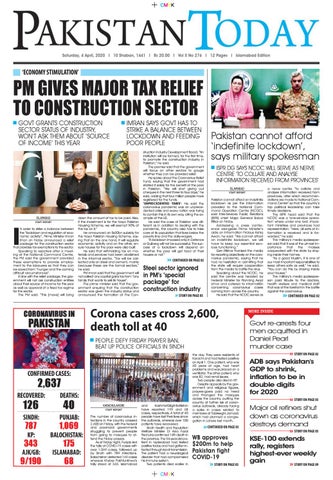
PM gives Major tax relief to construction sector g
govt grants constructIon sector status of Industry, won’t ask them about ‘source of Income’ thIs year
ISLAMABAD staff report
i
n order to strike a balance between the “lockdown and regulation of economic activity”, Prime minister Imran khan on friday announced a relief package for the construction sector that provides tax exemptions to the sector. speaking to reporters after a meeting of the national command centre, the Pm said the government provided these exemptions to provide employment to the labourers so that they can be saved from “hunger and the coming difficult circumstances”. In line with the relief package, the government will not ask construction entities about their source of income for this year as well as approval of a fixed tax regime for the sector. the Pm said: “this [move] will bring
g
Imran says govt has to strIke a balance between lockdown and feedIng Poor PeoPle
down the amount of tax to be paid. also, if the investment is for the naya Pakistan housing scheme, we will exempt 90% of the tax on it.” he announced an rs30bn subsidy for the naya Pakistan housing scheme, saying that on the one hand, it will regulate economic activity and on the other, ensure houses for the poor were also built. he said that withholding tax on materials and services had been abolished in the informal sector. “tax will be collected only on steel and cement, mainly because these are the formal sectors,” he said. Pm Imran said that the government will not collect any capital gains tax from “any family that wants to sell its house”. the prime minister said that the government ensuring that the construction sector was given the industry status and announced the formation of the con-
coronavirus in
Pakistan
struction Industry development board. “an institution will be formed, for the first time, to promote the construction industry in Pakistan,” he said. the premier said that the government will focus on other sectors to gauge whether they can be provided relief. he spoke about the coronavirus relief fund, saying that the government had started it solely for the benefit of the poor in Pakistan. “we will start giving out cheques in the next three to four days,” he said, adding that four million people have registered for the funds. ‘UNPRECEDENTED TIMES’: he said the coronavirus pandemic was an unprecedented crisis and every nation was trying to contain this in its own way, citing the example of the us. he said the case of Pakistan was different as in addition to dealing with the pandemic, the country also has to take care of its population that lives below the poverty line and the daily-wagers. “a lockdown imposed only in defence or gulberg will not be successful. the success of a lockdown will depend on whether the poor will get food at their houses or not.”
CONTINUED ON PAGE 02
Steel sector ignored in PM’s ‘special package’ for construction industry STORY ON PAGE 05
2,637
SINDH:
787
DEATHS:
40
PUNJAB:
1,069
KP:
BALOCHISTAN:
AJK/GB:
ISLAMABAD:
343 9/190
175 68
IsPr dg says ncoc wIll serve as nerve centre ‘to collate and analyse InformatIon receIved from ProvInces’ ISLAMABAD staff report
Pakistan cannot afford an indefinite lockdown as per the information provided to the national command operation centre (ncoc), said Inter-sevices Public relations (IsPr) chief major general babar Ifitkar on friday. addressing a press conference alongside Prime minister ’s aide on Information firdous ashiq awan, he said: “we cannot afford an indefinite lockdown, we will have to keep our essential services functioning.” gen Iftikhar thanked the media for reporting objectively on the coronavirus pandemic, saying that he had no hesitation in admitting that the state will require cooperation from the media to battle the virus. speaking about the ncoc, he said the centre was headed by federal minister for Planning asad umar and catered to informati0n concerning coronavirus cases coming from across the country. he said that the ncoc serves as
PeoPle defy frIday Prayer ban, beat uP PolIce offIcIals In sIndh
CONFIRMED CASES:
126
g
Corona cases cross 2,600, death toll at 40 g
RECOVERED:
Pakistan cannot afford ‘indefinite lockdown’, says military spokesman
KARACHI/LAHORE staff report
the number of coronavirus infections in the country crossed 2,600 on friday, with the federal and provincial governments struggling to prevent people from going to mosques to attend the friday prayers. as of friday night, Punjab led the tally of covId-19 cases with over 1,069 cases, followed up by sindh with 789 infections. balochistan detected 169 cases whereas khyber Pakhtunkhwa’s tally stood at 343. Islamabad
and kashmir/gilgit-baltistan have reported 199 and 68 cases, respectively. a total of 40 people have lost their lives since the outbreak, whereas over 100 patients have recovered. sindh health and Population welfare minister dr azra fazal Pechuho confirmed 14th death in the province. the 54-year-old patient in hyderabad had tested positive today and had gotten infected through local transmission. the patient had a neurological disorder that had compromised his immune system. two patients died earlier in
CMYK
the day. they were residents of karachi and had tested positive on april 1. one patient, who was 60 years of age, had heart problems and was placed on a ventilator. the other patient, who was 82, had renal issues. two people also died in kP. despite appeals by the government and religious figures, prayers-goers paid no heed and thronged the mosques across the country, putting the country at further risk of coronavirus outbreak, already facing a spike in cases related to members of tableeghi Jamaat, which had planned a congregation in lahore last month.
CONTINUED ON PAGE 03
a nerve centre “to collate and analyse information received from provinces, after which recommendations are made to national command centre” so that the country’s top political leadership can take timely decisions. the IsPr head said that the ncoc was a ‘one-window operation’ where under one roof, important ministries and provinces had representation. “here, all sorts of information is received and is forwarded,” he said. the military’s media spokesperson said that it was of the utmost importance that the masses cooperated with the state by staying inside their homes. “as a good muslim, it is one of our most important responsibilities to keep others safe as well,” he said. “you can do this by staying inside your houses.” the military’s media spokesperson paid tribute to the doctors, health workers and medical staff that was at the forefront in the battle against the coronavirus.
CONTINUED ON PAGE 02
more inside
govt re-arrests four men acquitted in daniel Pearl murder case STORY ON PAGE 02
ADB says Pakistan's GDP to shrink, inflation to be in double digits for 2020 STORY ON PAGE 03
major oil refiners shut down as coronavirus destroys demand STORY ON PAGE 05
WB approves $200m to help Pakistan fight COVID-19 STORY ON PAGE 03
KSE-100 extends rally, registers highest-ever weekly gain STORY ON PAGE 09
02
Saturday, 4 April, 2020
NEWS
Govt rE-arrEsts four MEn acquittEd in daniEl PEarl MurdEr casE AHMED OMAR SHEIKH AND THREE OTHERS HAVE BEEN DETAINED IN PRISON FOR THREE MONTHS KaraChI
a
STAFF REPORT
UTHORITIES ordered on Friday four men, including a British militant, convicted of the 2002 murder of American journalist Daniel Pearl, to be detained for three months despite a lower court’s ruling to overturn their convictions. On Thursday, the Sindh High Court (SHC) had acquitted the four, including Briton Ahmed Omar Saeed Sheikh, who was sentenced to death in 2002 for masterminding Pearl’s murder. The other three were sentenced to life. Wall Street Journal (WSJ) reporter Pearl, 38, was investigating militants in the city of Karachi, the capital of Sindh, after the September 11, 2001, attacks on the
United States when he was kidnapped in January 2002. He was beheaded weeks later. The Sindh Home Department issued the order to arrest and detain the four before they were released from prison. “The government of Sindh has sufficient reason that Ahmed Omar Sheikh and Fahad Nasim Ahmed, Syed Salman Saqib, Sheikh Muhammad Adil be arrested and detained for a period of three months from the date of arrest (April 2, 2020),” a top official of the department said in the order. The official cited concern that the released men may act “against the interest of the country”. The law to keep them in detention is one that the government has often used to keep high-profile suspects, particularly militants, in custody after being unable to successfully prosecute them in court. The US denounced Thursday’s court
PM forms body to protect media industry ISLAMABAD: Prime Minister Imran Khan on Friday constituted a five-member committee for the protection of media workers and the media industry. The decision to form the committee was taken after the Pakistan Broadcasters Association wrote a letter to the prime minister. Senior aides of the prime minister which include Firdous Ashiq Awan, Shahzad Akbar, and Federal Education Minister Shafqat Mahmood are members of the committee. The other two members of the committee comprise Shahbaz Gill and the federal information secretary. The committee will be responsible to review the recommendations put forth by the PBA and resolve the association’s issues. PM Imran said that media was playing a crucial role in the fight against the coronavirus. The prime minister said that the government will do all it can to protect media workers and the industry. PM thAnkS FAceBook coo For SuPPort AMID coVID-19: Prime Minister Imran Khan Friday thanked Facebook Chief Operating Officer (COO) Sheryl Sandberg for the support and working together for a common cause to improve the lives for millions and remarkable work her team is doing during COVID-19 pandemic. In her message to Prime Minister Imran Khan on his official Facebook page Imran Khan (official), Sheryl Sandberg had thanked and appreciated him saying; “Thank you for your partnership. I am so glad we are working together to provide timely, accurate information and help people fight the coronavirus in Pakistan.” In his response Prime Minister Imran Khan responded saying; “I am glad we are working for a common cause to improve lives for millions. APP
FEDERAL GOVT ASKS SINDH GOVT TO CONSULT AGP FOR FILING APPEAL AGAINST SHC DECISION
acquittal of the four, with the top US diplomat for South Asia writing on Twitter that it was “an affront to victims of terrorism everywhere”. The re-arrest of the four gives the government time to put together a legal appeal against their acquittal. A senior government law officer told Reuters that the state would appeal against the SHC’s Thursday ruling, which the US welcomed. “We welcome Pakistan’s decision to appeal the verdict,” acting US As-
ISLaMaBaD STAFF REPORT
The Attorney General for Pakistan (AGP) on Friday proposed the release of the under-trial prisoners (UTPs) accused of minor crimes in view of coronavirus outbreak in the country. In a written proposal to the Supreme Court, AGP Khalid Javed Khan said that in the wake of the pandemic, the apex court has been called upon to exercise its power under Articles 184(3) and 187 in dealing with the matters relating to the prisoners in jails all over Pakistan. He submitted this response to a five-member hearing a petition filed against March 20 order of the Islamabad High Court (IHC) for release of the UTPs. The proposal said the accused persons charged for offences under non-prohibitory clauses or under vagrancy law or offences carrying less than three years sentence may be considered for bail. He said the benefit should not extend in cases involving abuse/vio-
sistant Secretary of State for South and Central Asian Affairs Alice Wells said. Meanwhile, in an official statement, the Federal Ministry of Interior said that the federal government has asked the Sindh government of Sindh to dedicate its best resources in the pursuance of appeal before Supreme Court of Pakistan. “Government of Sindh has been advised to consult Attorney General for Pakistan in the matter as well. In the meantime, all the accused in the said case have been arrested and detained under Section 3(1) of the West Pakistan Maintenance of Public Order Ordinance, 1960 for a period of 3 months pending filing of the appeal in the apex court”. It added that the Pakistani government is committed to following the due process under the laws of the country to bring terrorists to task.
Govt proposes release of UTPs held for minor crimes lent acts against children and women, but persons suffering from ailments or physical or mental disability may be considered. The AGP also proposed that the benefit should be extended to the UTPs who are 55-year-old or older and then to other male UTPs provided there is no history of past convictions. The benefit should also be extended to all women and juvenile UTPs. The AGP proposed that bail in these cases may be extended on personal bonds. Some categories of convicted persons may be considered for release by the provincial governments under
ISLaMaBaD APP
The registrar of the Pakistan Medical and Dental Council (PMDC) on Friday filed another petition seeking contempt of court proceeding against the Health Ministry for barring him from entering
the office despite a court order. The petitioner, Dr Hafeezuddin, named health secretary, Islamabad deputy commissioner and other officials of the ministry as respondents in the case. He stated that the ministry’s officials forcibly removed him from his office on March 30.
Coronavirus, Pakistan and Punjab Time seems to have frozen into one moment. In that moment is the world hurdled in collective stupefaction. In the last one month, there appeared on the global consciousness a coronavirus shaped reality in its deadly enormity that with the calm assurance of inevitability slunk into countries that prided themselves on their strategic, political, economic, and social power. The devastation continues unabated. Traditional rules of game are inapplicable. The world with its billionaires and scientists and nuclear powers and medical geniuses and spaceships is at its wits’ end as the number of coronavirus cases multiply every day. Coronavirus will end someday, there is no debate about that. When that will happen, human beings are unable to give a deadline. That day, humankind would be sitting in a corner, stunned to its tenuous core, at the unquantifiable loss in ways that defies all known codes of reckoning. In the last one hundred years, in the life of almost all inhabitants, even the oldest living ones, the world has not seen anything like this pandemic. One coronavirus is the concern of the entire humankind. A deadly virus has united a world that is uneven, increasingly divided, rigid in its paranoias and xenophobia. One virus has moved across the world flouting every known protocol of cross-continental travel. April 1. The number of countries with coronavirus cases is 178. The number of confirmed cases is 846,000. The number of dead is 41,000. The number of undetected cases, I fear, has the capability to unleash more destruction. Healthcare systems of the most advanced, in every way, countries, are overwhelmed. The USA, with its
181,099 cases, has a predictable lead even in a global pandemic. China, Italy, the UK, France and Spain stagger under the huge number of their dead. The pain of all these countries is shared in a global virtual solidarity. In the hospitals of the world’s biggest powers, patients line every part of the emergency rooms, and new portions turned into coronavirus centres. The dead, on some days, lie with the living, covered in white cloth, shrouded in black body bags. The medical staff, the biggest heroes of humanity today, work more than the capability of their bodies, minds and hearts. Sometimes, they cry; sometimes, they break down; sometimes they seem to have an emotional breakdown. But they don’t give up. They go on helping the sick; they do their best to provide the best treatment. In Pakistan, there is a belated but growing realisation of the deadliness of a pandemic that devoid of any discriminatory pathogen attacks everyone. From prime ministers to princes, celebrities to the very rich, COVID-19’s victims are varied and everywhere. Pakistan, in a lockdown, is aware of that. A resource-scarce country with an emaciated healthcare system is doing its best to combat a virus that has harmed with the speed unimaginable in the world of 2020. Pakistan’s coronavirus system is not without flaws. Much more needs to be done. Many more tests are required to get the real number of cases. The lockdown must be stricter. More masks, PPE and ventilators are an immediate requirement. Quarantine centres and specialised hospitals have been established; enhanced medical and other vigilance would improve the process of treatment. Addition to medical staff would be a great help in management of an increasing number of cases.
Section 401 Code of Criminal Procedure (CrPC). Convicts who have otherwise completed their sentences but remain in jail on account of non-payment of fine/monetary penalty and women/juvenile convicts who have completed 75% of their sentence and have no history of past convictions can be released. “Similarly convicts whose remaining term in jail is six months or less provided that the offence was not that of violence against women or children and women/juvenile who were sentenced to a term of one year or less might also be bailed out.” The petitioner alleged that the respondents had violated the Islamabad High Court (IHC) decision regarding the opening of his office at the PMDC in violation of the contempt of court. The PMDC guards were also removed from the premises, he said He prayed the court to initiate contempt of court proceeding against local administration and ministry’s officials for not allowing him to enter the office. It may be mentioned here that IHC had ordered the ministry to immediately de-seal the PMDC office and allow the registrar to sit in his office.
Every effort is being made to streamline the system. The number of confirmed cases in Pakistan on April 1 is 1,717. The number of dead is 21. The strength of the leadership of an economically weak country is best tested in the time of a crisis, this one underscored with unprecedented global devastation. Prime Minister Imran Khan of Pakistan, fully aware of the financial and infrastructural limitations of his country, is doing his best to do multiple things. The most important of that is his constant communication with the terrified nation through his addresses and media interactions. In an unprecedented situation, new strategies replace standard protocols; what matters is the strength of intention and will. Khan is unambiguous about one aspect: his unflinching empathy and concern for the wellbeing of the underprivileged. All the steps taken by his government in the time of coronavirus are reflective of his concern for the common Pakistani, the aam aadmi. Pakistan’s prime minister wishes all Pakistanis to be safe and healthy, but those whose lives are turned upside down in a government-enforced lockdown are Khan’s constant worry, his top priority. In a televised address, Khan said: “25 percent of Pakistanis cannot afford to eat two times a day … If we shut down the cities… we save them from corona[virus] at one end, but they will die from hunger on the other side … Pakistan does not have the conditions that are in the United States or Europe. Our country has grave poverty.” Pakistan does not have the first world conditions, but Pakistan has a prime minister whose signature characteristic is his empathy for the poor, the invisible of Pakistan. On March 24, Khan announced Rs 1.2 trillion relief package “to support the poor and help local industry to offset negative impact of the coronavirus outbreak” in Pakistan. On March 31, Prime Minister Khan announced the formation of the Corona Relief Tiger Force, stating, “If we cannot provide food to the people of the
CMYK
ISLAMABAD: A man self-immolated outside Prime Minister’s House on Friday. According to Islamabad Deputy Commissioner Hamza Shafqaat, the man was “mentally disturbed”. He said that the deceased, identified as Faisal Mehmood, was a resident of Murree and was mentally unstable and a drug addict. The claim about Mehmood’s mental health could not be independently verified. A First Information Report (FIR) had been registered against Mehmood last year for allegedly attempting to abuse a minor girl and he had been declared an absconder in December 2019, the Islamabad deputy commissioner said. Before setting himself on fire, the man said that he did not trust the Rawalpindi police which was why he was taking this step. Shafqaat added that the man had some medical problems as well and had recently visited Polyclinic Hospital. STAFF REPORT
Pakistan cannot afford ‘indefinite lockdown’, says military spokesman ConTInueD froM page 01
RELIEF WON’T BE EXTENDED TO PRISONERS ACCUSED OF VIOLENT ACTS AGAINST MINORS, WOMEN
PMDC registrar seeks contempt proceedings against Health Ministry
By Mehr Tarar
Man commits self-immolation outside PM House
“I pay special tribute to doctors, paramedics, security personnel, on the frontlines of the battle against COVID-19 virus. I also thank ulema for their role,” he said. Firdous told reporters that the prime minister has decided that the information ministry, along with the DG ISPR, will coordinate and brief the media on the coronavirus situation. She said that a strategy will be developed to coordinate with the media.
‘Economy stimulation’: PM gives major tax relief to construction sector ConTInueD froM page 01 He cited China’s example, saying that authorities had locked down Wuhan but that measure had been successful as the government had provided food to people at their doorsteps. Speaking about the difference between the state and provinces in tackling the coronavirus pandemic, PM Imran said that he didn’t want to force provinces to do anything after the 18th Amendment had been passed. Imran said that it wasn’t possible for anyone to predict whether the coronavirus will take a turn for the good or the worse. “We, as a nation, will fight [this disease] but no one can say what will happen in the next two to three weeks,” he said. In response to a question about the need to unify the nation, the prime minister said that Pakistanis stood together whenever they were faced with a calamity. “I only have reservations against people who use calamities to hide their corruption. This will not happen,” he said.
country, then this lockdown will not be successful.” The young of the Pakistan, passionate and empathetic, compassionate and focused, will help Khan in his fight against coronavirus, ensuring that no one sleeps hungry in a locked down Pakistan. Khan’s reluctance, despite scathing criticism from the opposition parties and media, to impose a full lockdown was validated when Indian Prime Minister Narendra Modi’s 21-day full lockdown “triggered a massive exodus of migrant labourers and wage workers,” leaving “many fearful for what comes next.” On March 29, Modi said in his monthly radio address, “I apologise to the people of the country because of inconvenience caused to them. I specially apologise to the poor and financially weaker sections who would be probably thinking that what kind of a Prime Minister is Modi.” Pakistan’s prime minister is aware of the unsustainability and impracticality of a full lockdown. He is assuring maximum relief in the present lockdown. His advice is prevention through social distancing, self-isolation, and recovery through a timely treatment. Following in Khan’s footsteps is the government of Chief Minister Usman Buzdar who recently announced a relief package of Rs 10 billion stating, "The Government of Punjab will make sure that the poor and the daily wage earners are not left alone in their time of need.” On March 31, Buzdar announced one-month additional salary for medical staff engaged in treatment of coronavirus. The information on the number of cases in Punjab is regularly updated on Chief Minister Buzdar’s Twitter account. Under Chief Minister Buzdar’s supervision, Lahore Expo Centre, in the record time of nine days have been converted into a 1000-bed coronavirus field hospital. Mehr Tarar is the focal person for English print media to Punjab information minister
Saturday, 4 April, 2020
ADB sAys PAkIstAn's GDP to shrInk, InflAtIon to Be In DouBle DIGIts for 2020 iSLamaBad
P
STAFF REPORT
AKISTAN’S GDP growth rate will shrink to 2.6% from 3.3%, while inflation will remain around 11.5% for 2020, the Asian Development Bank (ADB) projects in its latest report released on Friday. The Asian Development Outlook (ADO) 2020 report noted that Pakistan, compared to other South Asia countries, will “struggle this year with double-digit inflation”, which is expected to clock in around 11.5% compared to 6.8% in 2019. The report said that the inflation would be fueled by escalating food prices, scheduled hikes to utility rates, and domestic currency depreciation. “Inflation is projected to accelerate to 11.5% in FY2020, reflecting a sharp rise in food prices in the first part of the fiscal year and a 9.8% drop in the value of the local currency against the US dollar in the first 7 months of FY2020,” said a
press release issued by ADB. “Leaving aside external upheaval, growth in Pakistan will slow as agriculture stagnates, notably affecting cotton output, and as stabilisation efforts constrain domestic demand,” said the report. However, ADB noted that the “intended correction of macroeconomic imbalances” in the country may restore confidence in the economy and bring later benefits. Therefore, it has forecast that the country’s GDP will rise to 3.2% in 2021. ADB noted that agriculture is expected to see slow growth in fiscal year (FY) 2020 as the worst locust infestation in over two decades damages harvests of cotton, wheat, and other major crops. It expects modest growth in some export-oriented industries, such as textiles and leather. But, large-scale manufacturing, which provides over half of industrial production, will likely to contract, as it did in the first half of FY2020. ADB also stated that the current coronavirus outbreak will also pose an
‘Incompetent’ Imran to failed to utilise health budget, says Marriyum LAHORE: Pakistan Muslim League-Nawaz (PML-N) Information Secretary Information Marriyum Aurangzeb slammed Prime Minister Imran Khan for zero utilisation of the Rs11 billion federal health budget, saying the action exposed Imran’s incapacity, inability and nonseriousness towards public healthcare. In a statement on Friday, Marriyum said that majority of this Rs11 billion was allocated to the running schemes started by PML-N which Imran could not even complete. She said: “Imran wants to damn the hospitals of Islamabad down the same hellhole where he dumped the hospitals of KPK for the past 7 years.” The former minister said that this clueless government could not even spend a single penny on the upgradation of the Basic Health Units (BHU) in the federal capital in spite of available resources. He could not even run the PIMS and Polyclinics of Islamabad or improve and upgrade them, buy the equipment required, she said and added that these hospitals also cater to patients from the surrounding areas of the capital. The patients after experiencing the “revolution” of KPK hospitals also turn to Islamabad, she added. “For the entire year this government was snoozing and busy doing nothing and all this money will become overdue and delinquent in June which is just one month away. How can Imran explain this utter incompetence and failure. Rs 1 billion allocated for epidemics which is crucial in the times of the current pandemic, was not utilized as well. Had Imran utilized the funds allocated for Central health Establishment, he could have used them for research to fight covid19”, she said. STAFF REPORT
Corona cases cross 2,600, death toll at 40 Continued from page 01 The meeting was postponed but by then hundreds of people had already arrived at the premises and they stayed on. Ahead of Friday congregations, Sindh went on a complete lockdown to discourage the public gatherings, with police deployed outside mosques and public intersections. “Governments have to make difficult and painful decisions for the greater good of the public,” said Syed Nasir Hussain Shah, Sindh’s minister for local bodies and information. In the greater interest of saving lives, a decision to restrict the prayer congregations at mosques has been taken following a meeting of clerics from all schools of thought. However, people who wanted to offer Friday prayer didn’t pay heed to what the government was saying, which led to some ugly scenes. In Karachi’s Liaquatabad region, police and prayer-goers clashed outside a mosque when people forced that they would offer the prayer in the basement of the Ghousia Masjid. When the police intercepted them, a brawl resulted. Two policemen on duty were beaten up by the people. A bigger contingent of police took control of the situation and also registered a case against the prayer leader.
additional downside risk to growth prospects as it will further dampen consumer demand, exporters, businesses and industries. The State Bank of Pakistan, the central bank, raised its policy interest rate by a cumulative 575 basis points to 12.25% at the end of FY2019 to counter inflationary pressures. Following the decline in global oil prices and expected sluggish demand under COVID-19, the State Bank of Pakistan reduced it in two steps to 11.00% in March 2020. However, the bank noted that inflation rate would come down to single-digit figures in 2021 to 8.3%, as the SBP will have to account for this in its next monetary policy decision to increase credit to the private sector and boost economic activity. The current account deficit is expected to continue narrowing to 2.8% of the gross domestic product in FY2020 based on the reduction in trade deficit resulting from exchange rate depreciation and the imposition of regulatory duties to contain import demand, the ADB report noted.
The report noted that the present macroeconomic challenges facing Pakistan underscore the importance of further strengthening social protection, health, education systems, and providing much-needed relief to the most vulnerable families. “Pakistan's strong and decisive policy measures have started to yield positive results in reversing macroeconomic imbalances and narrowing current account deficits,” said ADB Country Director for Pakistan Xiaohong Yang. The ADB representative for Pakistan stated that Pakistan's economy is in better shape than before but emphasised that the country needs to work together to tackle the new challenges posed by COVID-19 — including uncertain short-term growth prospects — and its related socio-economic repercussions. “The government’s emergency package and extensive use of Ehsaas will be vital to blunting the detrimental impacts of the pandemic, particularly on the poor and vulnerable,” said the country director.
Shehbaz says imperative to provide protection to medics PML-N STARTS DISTRIBUTION OF OVER 100,000 KITS TO COMBAT CORONAVIRUS PANDEMIC LaHore STAFF REPORT
Pakistan Muslim League-Nawaz (PML-N) President Shehbaz Sharif on Friday said it was imperative to ensure the protection of the doctors and health workers in times of a medical crisis, as his party started a drive to distribute protective kits among people. He said the lives of the entire nation depend on the lives and wellbeing of the medical practitioners, adding the PML-N will not abandon the nation amid the pandemic and will fight alongside them. “The true measures, however, against the outbreak can only be taken by people
through precautions,” he said, adding the people can win this fight with caution, discipline, and cooperation. According to a PML-N statement, “Over 100,000 kits containing masks, sanitizers, soaps, and an instruction manual were being distributed among the people to arm the nation against coronavirus. This kit will also work as a guideline for the people and spread mass awareness regarding the pandemic.” Shehbaz lauded the volunteers who have been selflessly working for the people to help them fight against the coronavirus. He said laborers and daily-wagers are the ones worst hit by the epidemic. The PML-N chief ex-
pressed great grief over the reports of suicides being committed over financial shortcomings. He said suicides indicate the helplessness being faced by the people and prayed for God’s help under these testing times.
Imran slams BJP leader over racist remarks neWS deSK Prime Minister Imran Khan on Friday slammed Bharatiya Janata Party’s (BJP) Dr Subramanian Swamy over his racist remarks about Muslims. The premier took to microblogging website Twitter and compared BJP’s leadership openly spewing hate against Muslims to the Nazis speaking about the Jews. In an interview, the top leader of the ruling BJP party Swamy said any country with more than 30 per cent of Muslims, is in danger. “We know where the Muslim population is large and there’s always trouble. Because the Islamic ideology says so. If Muslims become more
than 30%, that country is in danger.” When journalist Isobel Yeung said his comments sounded like language of hatred, the BJP leader responded, “It is easy to call this hatred. I am being kind to them by not letting them enter India.” When Yeung questions him about equality in India, Swamy said Muslims are not an equal category. ‘There is no such thing as equal rights. Muslims are not in an equal category.” India on Wednesday approved “Jammu and Kashmir Reorganization Order 2020” that would give non Kashmiris the right to become permanent residents of the valley. The move comes nearly eight months after India unilaterally re-
voked the special status of Occupied Jammu and Kashmir (IOJK), bringing Pakistan and India on the verge of a war. Under the new law, those who have resided for a period of 15 years in the IOJK or studied for a period of seven years and appeared in class 10/12 examinations in educational institutions located in the region are now eligible to become permanent residents. Pakistan, which is a party to the dispute, on Thursday reacted sharply to the move and termed it as yet another attempt by “fascist Modi government” to change the demographics of the only Muslim majority area under Indian control.
NEWS
Corona lockdown: Afghan refugees await help as unhCr falters iSLamaBad STAFF REPORT
Rather than shifting its focus on providing food ration to the besieged Afghan refugees in lockdown, the United Nations High Commissioner for Refugees has announced the top-up of mobile cards for 3,000 Outreach Volunteers and community mobilizers across the country to strengthen effective digital communication. “Amid these challenging times, arranging large group discussions in the community is not only risky but not permitted. To help overcome this, UNHCR announced the top-up of mobile cards for 3,000 Outreach Volunteers and community mobilizers across the country to strengthen effective digital communication,” said a press release issued here on Friday. It merits mention that Minister of State for SAFRON Shehryar Afridi had written a letter to UNHCR, asking it to immediately divert their funds towards relief efforts to the Afghan refugees, as most of them are daily wage workers who lost their jobs after the lockdown. The Pakistani government has requested the UNHCR to contribute to rationing for the Afghan refugees, particularly those living in 52 camps across the country. “It is earnestly requested that keeping in view of our national policies and our commitment to Afghan refugees, the provisioning for essential rations/food supplies during the lockdown period be arranged on an urgent basis,” Afridi said in a letter to UNHCR. “Pakistan is playing a role, but this is a gigantic challenge to provide food and rations to the refugees. It is high time for the UN and the prosperous world to come forward to meet the food and other requirements of Afghan refugees, whose majority is daily wagers,” Afridi told Anadolu news agency. “Around 80% of the world’s total refugees are being hosted by countries like Turkey, Pakistan, Iran and Bangladesh,” Afridi noted. “Now it’s the duty of the prosperous First World to join hands with us to meet their basic requirements at this critical juncture.” Iain Hall, the UNHCR’s deputy representative in Pakistan, said the agency was in contact with all of the relevant ministries to provide assistance regarding health, water and sanitation and risk communication to the Afghan refugees in this trying time. He acknowledged that the agency was not providing rations to the Afghan refugees but had dispatched medical supplies and sanitation products in support of refugees and host communities across the country. “We are in constant contact with the government and doing whatever we can to support the government’s response to the COVID-19 pandemic,” Hall told Anadolu. He said neither the government nor the agency had “prioritized” any section of Pakistani society to provide aid. “All the people in Pakistani society, including the Afghan refugees, are equal to us. There is no discrimination either from our part or from the government,” he said, adding the agency had recently donated five ambulances to the Khyber Pakhtunkhwa government to support its fight against the coronavirus outbreak. However, it seems as if the UNHCR has no plans to provide relief to the Afghan refugees. “The Outreach Volunteers and community mobilizers are Afghan refugees who help disseminate information within their communities. They also carry out important advocacy with the local authorities and service providers,” the statement said. UNHCR supports around 2,200 Outreach Volunteers and some 800 community mobilizers in Pakistan. Outreach Volunteers, community organizers as well as elders and Shuras are all an integral part of UNHCR’s community-based approach, which ensures that refugees play a role in responding to situations that affect their lives. “The role of Outreach Volunteers in Pakistan is especially instrumental at this time in ensuring that government information on COVID-19 is effectively disseminated through digital channels,” said the Deputy Representative of UNHCR in Pakistan, Iain Hall. He noted that this is a one-time mobile top-up of Rs1,000 per person. The UN Refugee Agency supports the Government of Pakistan’s surveillance, preparedness and response plans, which include refugees.
WB approves $200m to help Pakistan fight COVID-19 PROJECT TO STRENGTHEN COUNTRY’S CAPACITY TO DETECT AND MONITOR DISEASE, IMPROVE HEALTHCARE SYSTEM iSLamaBad STAFF REPORT
The World Bank on Friday approved a $200 million package to help Pakistan take effective and timely action to respond to the COVID-19 pandemic by strengthening its national healthcare system and mitigating socioeconomic disruptions. This support will also draw an extra $38 million from eight existing projects for urgently needed medical equipment and supplies, said a press statement issued here. While focusing on the COVID-19 preparedness and emergency response in the
health sector, the Pandemic Response Effectiveness Project (PREP) will also help the poor and vulnerable cope with the immediate impact of the pandemic through social protection measures, food rations, and remote learning education. “The World Bank is ramping up its support to Pakistan and its people to fight the spread of COVID-19 in the country,” said Illango Patchamuthu, World Bank Country Director for Pakistan. “PREP will help strengthen the country’s capacity to detect and monitor the disease. In addition, it will also make available resources to support cash transfer
03
through existing arrangements to the poor and vulnerable. We will continue to partner with federal and provincial governments to ensure effective implementation during these testing times.” The PREP will help establish quarantine facilities in collaboration with public and private hospitals and also supply equipment to hospitals, including ventilators and Personal Protection Equipment for doctors and paramedics. The project will benefit infected people, at-risk populations, medical and emergency personnel, service providers in medical and testing facilities (both public and private), and national and provincial departments of health. The project is financed from the International Development Association (IDA), the World Bank’s concessional credit window for developing countries, in the amount of $200 million, of which $100 million are provided through the World Bank Group’s COVID-19
Fast-Track Facility. The extra $38 million financing is repurposed from existing projects and will support federal and provincial governments in purchasing necessary equipment and supplies. Procurement is underway and some equipment and supplies have arrived and being put to service. The World Bank Group is rolling out a $14 billion fast-track package to strengthen the COVID-19 response in developing countries and shorten the time to recovery. The immediate response includes financing, policy advice and technical assistance to help countries cope with the health and economic impacts of the pandemic. The IFC is providing $8 billion in financing to help private companies affected by the pandemic and preserve jobs. IBRD and IDA are making an initial US$6 billion available for the health-response. As countries need broader support, the World Bank Group will deploy up to $160 billion over 15 months to protect the poor and vulnerable, support businesses, and bolster economic recovery.
04 ISLAMABAD
Saturday, 4 April, 2020
WEATHER UPDATES FRIDAY
280C
150C
SATURDAY
250C
140C
SUNDAY
270C
150C
PRAyER TimingS FAJR SUNRISE
ZUHR
ASR MAGHRIB ISHA
4:30
12:18
3:52
5:55
6:29
7:54
KP cabinet decides to increase coronavirus testing caPacity to 10,000 PESHAWAR
t
STAFF REPORT
HE Khyber Pakhtunkhwa (KP) cabinet on Friday decided to enhance the diagnostic testing capacity of infectious coronavirus from 300 to 1,500 per day by next week and subsequently take it to 10,000 with support of private hospitals and laboratories across the province. Addressing the media, Adviser to Chief Minister on Information Ajmal Wazir said that Chief Minister Mahmood Khan specially directed the concerned departments to increase the testing capacity of coronavirus to 1,500 to 2,000 per day by the next week on emergency basis. The chief minister further directed that the testing capacity be enhanced to 10,000 with the help of private labs and hospitals. He also directed the officials to take steps on
war footing and extend the testing facility in all districts of the province. He directed the release of additional funds to DHOs and MSOs to enhance the coronavirus testing capacity and health facilities for patients. The cabinet decided to improve health facilities by allowing purchase of more ventilators and by appointing backup staff in the health department to deal with any emergency in case the virus spreads. It was informed on the occasion that over 1,200 doctors have already been appointed on contract basis while 2,000 would be appointed through the Public Service Commission. It was further told that paramedic staff and other staff would be inducted on walk-in interview basis and the cabinet also gave approval to policy in this regard. The cabinet discussed lockdown situation and precautionary measures in the wake of the pandemic and expressed satisfaction
on the effective measures as 151 coronavirus patients have been discharged from quarantine centres in Dera Ismail Khan district and being sent to their respective areas. The cabinet was informed that there was no shortage of wheat or flour in the province and 165,000 tonnes of wheat stock in KP. Wazir maintained that the government was committed to facilitating the masses and bringing reforms in the health sector. The cabinet decided that supply of 5,000 tons of wheat would continue from Punjab and in case of any shortage more wheat would be procured from local farmers soon after harvesting season and in extreme condition it could be bought from PASCO or to be imported. The cabinet was told that under the KP government relief package, 243,000 families would be given Rs6,000 assistance for next three months in first phase under provincial relief package and around Rs6,000 per
month would be given under the federal government’s relief package. Minister for Health Taimur Salim Jhagra gave a detailed briefing to the cabinet on the outspread of corona disease and said that till date the number of positive cases were 311 while nine died till April 2, adding that the urban population in Peshawar, Kohat, Mardan, DI Khan and other cities was more vulnerable to be affected by corona disease due to dense population. On the occasion, the CM underlined the need for more precautionary measures and implementation of government policy in letter and spirit to contain the spread of the virus. The KP health minister told cabinet that due to effective lockdown no coronavirus case was reported from Chitral and Kohistan. The cabinet discussed issue of Tablighi Jamaat and the CM issued directives to give
special care and assistance to 5,300 members of Tablighi Jamaat in the province, out which 300 are foreigners and 70 per cent belongs to other provinces, Wazir said. The CM said that members of Tablighi Jamaat were guests and the government had directed the district administrations, health and relief departments to take good care of these people as they were serving the cause of religion. The provincial cabinet approved exemption in various taxes, Wazir said and added that 2 per cent tax would be charged on sale and purchase of property while construction industry would also be given special concession in taxes. The cabinet also approved purchase of essential medical equipment such as ventilators, masks and gloves. Wazir once again reiterated the need for adopting preventive measures especially in urban areas to contain spread of virus.
President urges urgent blood donations for thalassemia patients
KP govt directed to complete recruitment process of employees in 6 months ISLAMABAD APP
ISLAMABAD
The Supreme Court (SC) on Friday directed the Khyber Pakhtunkhwa (KP) government to complete recruitment process of employees in six months. A two-member bench of the apex court comprising Chief Justice of Pakistan (CJP) Gulzar Ahmed and Justice Ijazul Ahsan heard the case. During the course of proceedings, the court directed the provincial government to recruit all employees of BPS-11 and above through KP Public Service Commission. The court also said that the affected parties could be re-appointed by the commission. The court said that employees who did not fall under the KP Employment Regulations Act, 2018, were not eligible to be permanent. Until new recruits were in place, existing employees would continue to serve in those positions, it added. The court also expressed annoyance over KP additional advocate general (AAG) for filing time barred petition. The chief justice said that the KP government had made a habit that every petition would be filed late. He directed the KP AAG to submit affidavit of the KP chief minister. He directed the affidavit of the chief minister should be included in all time barred petition. The court would issue directions in time barred petitions after reviewing the chief minister affidavit. Justice Ijazul Ahsan said it was always pretended that the copy of the decision was not received timely. The AAG said that this case was not decided on merit. He added that the KP Employees Regularisation Act, 2009, had been applied in this case. According to the 2018 Act, only employees of relevant projects would be permanent but not all other employees, he added. The chief justice asked whether employees were not part of the projects according to the act. The counsel for the employees said they were not part of the staff but now the decision had come and the order had been placed. Justice Ijazul Ahsan said the employees could be regular if the relevant projects were changed.
APP
PESHAWAR: Citizens offer congregational Friday prayers at a mosque despite the government’s directives against assembly of more than five people in wake of the coronavirus cases. PPI
IHC dismisses plea against hotels’ conversion into quarantine centres ISLAMABAD STAFF REPORT
The Islamabad High Court (IHC) on Friday dismissed a plea assailing National Disaster Management Authority’s (NDMA) directives about conversion of three/four stars hotels into quarantine centres in the prevailing situation. Representing petitioners, including Hotel Margala, Islamabad, before the court, Advocate Sikandar Bashir Mohammand contended that NDMA’s orders about vacation of the hotels was infringement of fundamental rights of his clients. After hearing arguments of the counsel in the matter, the singlemember bench of Chief Justice Athar
Minallah made it clear that federal government has taken several measures to prevent the spread of coronavirus. Terming the prevailing circumstances as an extraordinary situation, the chief justice said that it is settled law that the interest of public at large prevails over individual rights, adding the learned counsel, despite his able assistance, was not able to satisfy the court that the jurisdiction under Article 199 of the Constitution ought to be exercised in the prevailing exceptional circumstances. Dismissing the petitions, the CJ said that the court cannot exercise its discretionary jurisdiction in this matter of public interest saying, “It will inevitably amount to interference with the
Residents urge capital’s administration to implement approved rate list ISLAMABAD APP
The residents of federal capital urged the Islamabad Capital Territory (ICT) administration to implement the approved rate list by Islamabad Market Committee (IMC) of fruits and vegetables as the shopkeepers were charging extra prices on every item. During the visit to various fruit and vegetable shops in the markets of federal capital and adjacent housing societies of Islamabad, the vendors were found violating the rate lists provided by the IMC on daily basis.
The residents said that the administration should take steps for implementing the rate list in true letter and spirit and penalize the violators to curb the menace of self-imposed inflation by the fruits and vegetables vendors. The IMC has fixed the price of apples Kala Kulo Irani at Rs182/149 per kg but the shopkeepers charging Rs200-250 per kg. The rate of Pakistani banana on the list was Rs98/79 per dozen but the market price was about Rs130. Similarly, guava price was Rs75/60 per kg but the market rates was around Rs120, strawberry rate was Rs120/94 per kg while the vendors charging
Rs210, kinnow special price was Rs149/116 per dozen while the market rate was Rs 220 per dozen. Vegetables were also being sold at exorbitant prices. According to the IMC approved rate list, onion price was Rs65/55 per kg while its market price was Rs85, tomato was Rs24/21 per kg while its market price was Rs48, lemon price was Rs88/77 per kg while its market price was Rs110 per kg, peas are Rs51/42 per kg while it was sold at Rs80. Hassan Talal, a businessman who was purchasing vegetables from a shop in Soan Gardens, said that shopkeepers
measures taken by the Authority and the federal government to meet the challenges that have arisen due to the extraordinary circumstances”. While expressing satisfaction over exercising restraint in the current matter, the bench said, “It cannot be ruled out that interference by this court with the decisions of the authority and the federal government, may risk jeopardizing the interests of public at large and their fundamental rights.” However, the chief justice observed, “In case the petitioner hotel suffers loss, it would not be without remedy because in such an eventuality remedies available under the law can be resorted to later”. would not even listen to if their attention was drawn towards difference in prices written on the IMC approved rate list. He said that low income person cannot even think to purchase fruits as the rates of fruits and vegetables were so high. When contacted, an official in ICT administration said that committees headed by a magistrate have been formed in Islamabad to conduct surprise visits to different sectors and check prices of the commodities. Meanwhile, Islamabad Market Committee has announced price list of vegetables and fruits for the markets of the federal capital and asked the people to lodge complaints against the profiteers and hoarders. The spokesman requested all of the individuals to observe this checklist and inform the authorities at 051-4867762; 051-9108084 in case of any grievance towards the shopkeepers.
President Dr Arif Alvi on Friday called for urgent blood donations to fulfill the needs of Thalassemia patients in the country who faced shortage of blood supplies due to lockdown amid Coronavirus pandemic. During his visit to Pakistan Thalassemia Centre in F-9 Park, the President said motivation of volunteer donors during the ongoing situation was important to save the lives of Thalassemic children that solely depended on regular blood transfusion. Thalassemia is an inherited blood disorder characterized by decreased production of hemoglobin and thus needs regular blood transfusion from a healthy person. President Alvi urged upon adults particularly students to come forward and join the noble cause of life-saving and donate blood at their nearest collection centres set up across the country.He said suspension of inter-city transport also affected the treatment of children who came from far-flung areas. In this regard, the President said, he contacted health ministers of Punjab and Sindh and urged them to search for blood donors and arrange supplies for the Thalassemia patients.
cop involved in drug peddling busted, 16kg narcotics seized RAWALPINDI APP
Rawalpindi police, during its ongoing drive against narcotics and anti-social elements, Friday arrested a police man allegedly involved in drug-trafficking and recovered a huge quantity of charas from his possession. According to a police spokesman, a team of PS New Town, headed by Station House Officer (SHO) Mirza Javed Iqbal intercepted a vehicle and recovered 15 kg 908 grams of charas that was tactfully concealed in different parts of the vehicle besides arrested a policeman identified as Azhar Sheikh. The police had registered a case against the accused under the relevant act while further investigation was underway. City Police Officer, Muhammad Ahsan Younas appreciated the performance of the police adding drugs business must be discouraged. He said strict action would be taken against those who were found in this illegal activity, the spokesman said.
Saturday, 4 April, 2020
Major oIl refIners shuT down as CoronavIrus desTroys deMand ISLAMABAD
a
AHMAD AHMADANI
NUMBER of refineries in the country are either curtailing operations or shutting down entirely as oil demand declines in the wake of the coronavirus pandemic. According to sources, so far the National Refinery Limited (NRL), Attock Refinery Limited (ARL) and Byco Refinery have either closed down or curtailed their operations as Oil Marketing Companies (OMCs), despite efforts of the Ministry of Energy Ministry, have not made any significant product uplift. Even OMCs have not uplifted their committed volumes and failed to place demands for April, 2020. Earlier, the ministry, in a meeting held on March 16 with the country's oil refiners, had assured the POL products' uplift by OMCs. And the government imposed a ban on OMCs for importing petrol from April
onward and ordered them to lift petrol from local refineries in the wake of massive cut in the demand primarily because of the countrywide lockdown. The Byco Refinery, in a letter to the Director General (Oil) Petroleum Division, stated despite all efforts, no product uplift had been made by OMCs up till now. Therefore, in view of zero off-take from the refinery, the management had decided to put the plant on cold circulation till the normalisation of demand and supply situation. “We would like to request you to advise OMCs to uplift their committed volumes and place their demand for April enabling us to finalise our production plan accordingly,” reads Byco’s letter. Sources say after the National Refinery Limited (NRL) shutdown, the Attock Refinery Limited (ARL) has closed its main unit (that refines 26,000 barrels per day crude oil) and its top management also sensitised Secretary Petroleum Division Main Asad Hayaud Din about
ICT allows mobile banking merchants to operate for another 5 days ISLAMABAD STAFF REPORT
In a bid to facilitate the general public, particularly those who remit money to their native areas after receiving salaries, the Islamabad Capital Territory (ICT) administration has allowed mobile banking merchants to operate for another five days (up till April 7). The extension has been made keeping in view the difficulties faced by the government employees and the private sector workers as the operational time was limited to three hours only. The earlier directive made on March 30 expired on Thursday April 2, but a large number of requests were received by the deputy commissioner office that government employees, especially those executing security and law & order duties, were unable to take time to visit the mobile banking merchant as they were operating from 12:00 pm to 04:00 pm only in Islamabad territory. “There are a number of police personnel who belong to other provinces. Similarly, rangers and other army personnel remit money at the start of every month after receiving salaries to their families residing in native areas,” said an officer of the ICT administration. The notification for the extension of this service has also allowed the money changers as well as the mobile banking merchants to operate their businesses at usual working hours that are from 9am to 8pm.
OMCs' lackluster response. However, according to a letter the refinery, which had earlier closed its two small units, has made those (units) partially operational to refine crude oil of 12,000-13,000 barrels per day for the next two to three days after which crude oil storage would also top up and a complete shutdown of the refinery is imminent. And if it happens, the letter further states, oil fields will be choked if crude oil from the said fields is not lifted and more importantly this will also squeeze the gas supply from the said oilfields in Potohar Northern region. The letter also reminds the Petroleum Division’s secretary about the video conference held on March 26, 2020 on the issue of products’ uplift and crude receipt crisis at ARL. The letter also apprise the top men of the Petroleum Division that despite the assurance given during the meeting there has been hardly any improvement in products’ uplift from ARL. Except APL,
no other OMCs have improved any significant product from us. The ARL’s top management, in another letter dated March 30 to Secretary Petroleum Division Mr Main Asad Hayaud Din, had informed that OMCs have not uplifted the POL products from the refinery, which is why the top management was left with no other option but to close down its main unit. However, just to cater for the heavy crude oil produced from the Potohar/Northern region, the company would be partially operating for the next few days after which its crude storages would also top up and a complete shutdown of the refinery is imminent, said the letter. The government has allowed the PakArab Refinery (PARCO) to run its operations which were earlier shut down. But it is understandable that PARCO will run its plant at its minimum capacity owing to a decline in the demand of POL products in the country amid the COVID-19 outbreak in the country.
Govt striving to resolve liquidity issues faced by industries: Dawood ISLAMABAD APP
Adviser to Prime Minister on Commerce and Textile Abdul Razak Dawood said on Friday that the government has offered up to Rs100 billion to support the industrial sector amid the current challenging situation created by COVID-19 pandemic. “We are continuously in contact with all major industrial sectors, including textiles and construction. After taking all stakeholders on board, the government will give incentives to the priority areas of industrial sector for revival in current critical situation," Razaq Dawood said while talking to a media agency. The government was striving to resolve the liquidity issue of industrial sector, he said, adding that payments of Drawback of Local Taxes and Levies (DLTL), which were pending since 2009, would be expedited. The adviser said the government would pay technology upgradation fund worth Rs30 billion to the industrial sector in order to help it come out of the current challenges. He informed a total of Rs47 billion would be paid to the textiles sector in coming 100 days to support the major export sector of the country. Replying to a question, he said the government would pay all the refunds, including a Rs200 billion package to
compensate the industrial sector, in the upcoming budget 2020-21. He said that this package would be paid at faster pace to the industries, adding that all the stakeholders were on board with the government to evolve joint strategy to resolve all the issues of industrial sector. The adviser said the refund of Rs100 billion for the business community was part of the government commitment to ensure facilitation of the business community in this challenging situation. Meanwhile, Federation of Pakistan Chambers of Commerce and Industry (FPCCI) President Mian Anjum Nisar has hailed the Rs100 billion package offered by the government. But he said the government should take preventive measures and develop a robust strategy to protect the pace of economic and trade progress in wake of global economic slowdown, as apprehended by leading research organizations after COVID-19 outbreak. Nisar feared Pakistan’s exports to the potential market of Europe Union (EU) would be hit the hardest due to the global slowdown. EU was the second biggest trade destination for Pakistan after a Generalized Schemes of Preferences (GSP-Plus) was offered by the former in 2013. “The government must conduct studies/research to find alternate markets and to mitigate the economic
Cement consumption falls 16.7pc in March ISLAMABAD STAFF REPORT
As coronavirus outbreak is starting to take its toll on various sectors of the economy, the domestic consumption of cement has declined by 16.7 per cent in March 2020. According to the data released by the All Pakistan Cement Manufacturers Association (APCMA), the industry despatched 3.721 million tonnes of cement in March, which was 14.26pc less than the despatches of 4.340 million tonnes during the corresponding month of last year. The pressure was heavier from the domestic market where the uptake was reduced to little less than 3.2 million tonnes from 3.8 million tonnes in March 2019. Exports though inched up from 0.482 million tonnes last in March 2019 to 0.507 million tonnes in March. Increase in exports should be viewed with a huge loss of Indian market. Exports to India have remained zero this fiscal, while last year during the first nine months, Pakistan exported 0.716 million tonnes of cement to India. North based mills despatched 2.749 million tonnes locally, which was almost 10.48pc lower than the dispatches of 3.017 million tonnes during the corresponding month of last fiscal. As per recent trends, exports from the North based mills also decreased in March 2020 by 18.85pc to 0.107 million tonnes, from 0.132 million tonnes in March 2019. The Southern region of the country reported a de-
cline in domestic despatches by 40.96pc, as it fell from 0.787 million tonnes in March 2019 to 0.464 million tonnes in March 2020, whereas exports registered a rise of 14.32pc to 0.401 million tonnes last month, as compared to 0.351 million tonnes in March 2019. Furthermore, cement industry experts opined that “In the wake of the lockdown extended till April 14, which means that the economic activities would remain further subdued. The industry is hoping to get some relief package from the government as managing despatches is becoming extremely difficult with each passing day.” The prime minister’s incentive package for the construction industry will help to increase the cement consumption in the country. However, the cement industry is expecting reduction in the federal excise duty, which is already very high in the region. Moreover, industry experts also added that the additional government levies slapped on the industry in this year and the electricity rate should also be reduced. The APCMA’s spokesman added that, “Overall in the first nine months of this fiscal the industry managed to dispatch 37.035 million tonnes of cement that is 7.06pc higher than 34.593 million tonnes of the commodity despatches during July-March 2018-19.” The domestic consumption during this period amounted to little over more than 30 million tonnes, while the exports amounted to 6.5 million tonnes. The domestic cement dispatches increased during this period by 3.82pc percent only, while the cement exports registered a rise of 25.63pc.
changes after coronavirus.” Former FPCCI president Engr Daroo Khan also welcomed the package announced by the government and said that proper mechanism was required to disburse this package according the needs for different industries. He suggested that the government engage all stakeholders to resolve the current evolving challenge. Islamabad Chamber of Commerce and Industries (ICCI) President Muhammad Ahmed Waheed said that his chamber was fully engage in consultation with government to avert the virus-related challenges. “The business community of the twin city welcomes the Rs100 billion package offered by the government for industrial sector.” Moreover, Karachi Chamber of Commerce and Industries President Agha Shahab Ahmed Khan also appreciated the government for mitigating the current challenge. He said that his chamber and business community from all over the country was committed to supporting the government in current evolving situation. President Peshawar Chamber of Commerce and Industry Engr. Maqsood Anwar Pervaiz said that business community of Khyber Pukhtunkhwa also stands with the government and lauded Rs100 billion package announced by the government.
NEWS
05
steel sector ignored in PM’s ‘special package’ for construction industry ISLAMABAD GHULAM ABBAS
While announcing a “special package” for the construction industry on Friday, Prime Minister Imran Khan completely ignored the steel sector, which is considered by many as the backbone of the construction industry. Expressing serious concerns over this “ignorance”, the Pakistan Association of Large Steel Producers (PALSP) said that the entire package would be meaningless in case the main sector is ignored. In a statement issued soon after the announcement of the package, PALSP claimed that it was shocked to know that despite repeated requests made by the sector amid crisis caused by coronavirus, the government had ignored the steel sector in the package. “There can be no construction without steel, so it is needless to say now that the focus needs to be aimed at enabling the steel sector to support construction activities,” the association said. “Since Pakistani steel industry is already witnessing a major downturn, the current lockdown has created a situation where steel companies are defaulting and are close to bankruptcy.” According to the association, the steel sector, which provides material to the construction sector, should be allowed to operate across the country. “If steel mills and shops remain closed, how will construction sites operate?” it asked. The steel industry has demanded the State Bank of Pakistan to provide one-time interest free loans to steel manufacturing entities for a period of 6 months to help create liquidity in the sector. “There is no recovery of trade receivables and taking on additional debt at high interest rates in a sector that is struggling is not a viable option.” According to PALSP, turnover tax U/S 113 for industry should be reduced to 0pc from 1.5pc for manufacturers and downstream retailers/traders. This will ensure documentation and will provide some cash flow relief to an industry that is already making losses this year. PALSP is a group of large, integrated and documented steel manufacturers that cumulatively represent 2.9 million tonnes of annual capacity, or 61pc of Pakistan's primary steel capacity.
Trade deficit shrinks 26pc in 3Qfy20 ISLAMABAD: The country’s trade deficit witnessed a significant reduction in the first three quarters of the current financial year (FY20), as it declined by 26.45 per cent as compared to the corresponding period of last year. During the period under review, the country’s exports registered about 2.23pc growth, whereas imports reduced by 14.42pc, according to latest data released by the Pakistan Bureau of Statistics (PBS). Exports witnessed an increase of 2.23pc to reach $17.451 billion, as against the exports of $17.071 billion in the same period of last year. However, the country’s imports recorded a significant decrease of 14.42pc, from $40.679 billion in the first three quarters of FY19 to $34.814 billion during the same period of FY20. Based on figures, the trade deficit during the period under review was recorded at $17.363, as against the deficit of $23.608 last year, showing a decline of 26.45pc. On year-on-year basis, exports from the country decreased by 8.46pc during March 2020 as against exports in the same month of last year. APP
Saturday, 4 April, 2020
06 COMMENT
We call it panic, the world calls it preparedness
Taking a leap of faith Will it really preserve lives or profit certain industries?
C
heRIShING the dream of constructing five million houses and providing 10 million jobs, the construction sector has always been near Prime Minister Imran Khan’s heart. Soon after he took over as PM he was led to believe by the builders’ lobby that if large-scale construction was initiated, about 40 industries would in one way or another benefit. Mr Khan promised to provide the construction sector the status of an industry, to qualify for facilities enjoyed by industries, long before the coronavirus became an issue in the world. Development of industry, especially the construction industry, is no doubt bound to create jobs. None of the construction work will however start to provide jobs instantly. This will require lifting of travel restrictions and dispensing with social distancing and other precautionary measures recommended by the government to the general public. This could endanger the lives of construction workers. In case it led to a spurt in coronavirus incidence, it would hurt the entire country. The announcement would no doubt be welcomed by the big builders in the country and those in other countries thinking to invest in Pakistan, who would be the foremost beneficiaries of the announcement. They construct houses for those who fall between the two categories of society that is, well-to-do and super rich. Owning a house of their own during the PTI’s tenure would remain a pipedream for the five million who were promised a house. The interest rate would make houses constructed under the Naya Pakistan housing Scheme out of their reach. With a general shrinkage of demand inside and outside the country, there is little possibility of industrial expansion in Pakistan due to the PM’s package. The Prime Minister has specially mentioned the construction of roads and infrastructure. except for the roads inside private housing societies, public roads in the country are all financed by the government and not the private sector. Building highways, motorways, bridges and underpasses will no doubt create jobs, as they did under the previous governments, but Mr Khan’s critics would accuse him of doing something for which he had been condemning his forerunners. Many would remind him of his priorities, like hospitals, universities, colleges and schools, the construction of which too would create jobs.
Responses to previous crises will help
Shazia hariS
I
T was a warm day of July 2015 in hawaii, when we Fellows of the Crisis Management Course at APCSS role-played handling of a health epidemic with potential to be pandemic in South Asian Region. To our utter surprise we as crisis managers had to communicate with Border Control Forces, the health Minister, National Security Officers, the Police, the Fire Department, the Finance Ministry, the Military officials of the affected country and its neighbors, and above all the Prime Minister along with his bureaucracy, and the border security of neighborly countries. “What the heck had we to do with all these stiff collar people”, we thought. We were the national crisis management team to deal with crisis-specific stuff only, but now with Covid-19 termed a pandemic by the WhO, it all seems so true! The mock-up opened avenues unknown to us, making us realize how close knitted disaster management is to human and international security. It did enable us to realize that making consented decisions an all-inclusive approach taking all stakeholders on board, is the answer to hindrances, both human and situational in crises. At the policymaking level understanding the importance of information dissemination and risk communication as a safety weapon, like a missile in war, is absolutely vital. The first coronavirus case was reported on 26 February in Karachi. The evidence suggest the source was imported not indigenous, and now we have reports of cases being transmitted within communities, which is alarming as economic factors and inability to earn a living might be a precipitating factor for political unrest starting from the lowest income earning population. Today, with infected cases crossing, 2400 Pakistan needs to realize that earthquake 2005 was an eye opener for the world as a whole, but as it was restricted to Pakistan, the world rushed for help. Covid-19 has affected the whole world, made health systems collapse and left corpses to pick so the inter-
The Daniel Pearl decision The government needs to win the appeal
T
he US State Department reaction to the Sind high Court decision overturning the life sentences of three of the co—accused in the Daniel Pearl kidnapping-cum-murder case, and the death sentence of the main accused, Ahmad Omar Sheikh, is instructive. Assistant Secretary for South Asia Alice Wells said the verdict was an affront to the victims of terrorism everywhere. That it is a criticism of the ShC shows that the USA does not respect the Pakistani judiciary, but it also shows that the acquittal could well become another hot-button issue, like the Mumbai attacks, which led to Pakistan being besmirched with the label of being a sponsor of terrorism. It should be remembered that a court has to go on the evidence and testimony before it, so while Ms Wells’ criticism may be seen as uncalled-for, it should not be forgotten that the prosecution was probably inefficient. With all the accused due to be released because of time already served (Mr Sheikh has been in jail since 2002), the Sindh Government has issued a three-month detention order, as they may do something against the interests of the country. With the Financial Action Task Force breathing down Pakistan’s neck, the government should have realized that it could not afford to lose this case. This should inspire the government to prosecute the case vigorously before the Supreme Court. There was enough evidence presented to the trial court for it to decide on a conviction. however, that evidence has not been found sufficient by the ShC. That this case has the potential to explode in the face of the country while it is undergoing an existential crisis is not supposed to be a consideration for any court. however, it is for the government. Any case should be prosecuted vigorously, but if there have been any lacunae left in this, it is for the government to realize that it must cover them in the appeal to the Supreme Court. At the moment, Mr Pearl’s murder remains unsolved. This should be unacceptable for the government and it must ginger up its law enforcement machinery to ensure that the guilty are brought to justice.
The dearth of labour pinches Dr rajkumar Singh
T
he 21-days coronavirus lockdown announced by the Indian Prime Minister Narendra Modi will have a long-term effect on the agriculture sector and other earnings in rural India. During the 2019–20 coronavirus pandemic, the term lockdown was used for actions related to mass quarantines. Lockdowns can limit movements or activities in a community while allowing most organizations to function normally, or limit movements or activities such that only organizations supplying basic needs and services can function normally. however, the nationwide lockdown has entrenched the economic system. The agriculture sector is facing a lot of trouble with labourers and movement of goods. even as agriculture produce is exempted from lockdown directives being an essential commodity, the sector is facing other internal problems. From earlier too, the Indian agriculture sector, which suffered recently due to uneven monsoon, will face another hit due to disruptions from the coronavirus. As Rabi harvest season approaches, farmers worry about their standing crops. Farmers growing wheat, mustard and pulses have already complained about their crops being damage due to untimely and heavy rainfall recently. This led to farmers fixing their crops, but amid the coronavirus lockdown most of the labourers available fled to their homes. As the restriction on movement of goods continues amid the lockdown, the farmers are likely to feel the pinch in their income. The government has also received reports on potatoes lying harvested in fields due to a shortage of labour to bag them. Most of the laborers, hailing from Bihar, Jharkhand and Uttar Pradesh, have returned to their hometowns due to the fear of coronavirus. Moreover, farmers fear for the sowing of the summer season crop as the shops selling seeds, fertilizers and other vital inputs are closed. Besides, farm machines like combine harvesters lie stranded on highways with no one to operate them. A lockdown is an emergency protocol that usually prevents people or information from leaving an
Arif Nizami Editor Umar Aziz
Asher John
Joint Editor
Executive Editor
Deputy Editor
Lahore – Ph: 042-36300938, 042-36375965
The good thing is the plan refers to Center of Disease Control which has updated Travel details warnings and awareness, meaning all relevant departments are well synchronized. Can we learn and implement by replicating an already good plan making changes suited to our cultural and social needs? have we spelled out a COVID-19 strategy for government and private office employees knowing most of the lower staff comes to work by bus? Other examples are of John hopkins University giving public access to its live database worldwide, the Royal College of Obstetricians recommending social distancing for pregnant women, while chemical and biological journals are tracking the virus plasma to hinder its growth. All this has gone open-source, so a world of knowledge is right there to take, learn and prevent the disease, but you need a team for that. Do we have a database and names of experts of disaster managers in the country? Where are the trained teams who handled earthquake 2005? Do we know past strategies and policies, tried and tested for previous disasters stacked somewhere in stores? Or are we reinventing the wheel? If so will COVID-19 wait? A tried and tested cluster approach must be taken with short-, medium- and long-term goals. Clusters could include, health, Livelihood, Security, Water and Power, Sanitation, Risk Communication Awareness and Community engagement, Gender and Vulnerable Groups (including women and children stranded in jails), economic Revival and Stability, Agriculture and Research and Knowledge Management (not medical, but from a human behavior and change perspective). On War footing each Cluster should prepare action plans with short-, medium- and long-term measures while a research group has to back them up with latest research and the media should be made partner in Crisis Management. In a crisis no one person is Aristotle and it’s OK to build a team and learn, that’s how we converted the adversity into opportunity in past and only group approach involving all stake holders is the answer, you don’t need to hire people to trace experts already working in government. We need to get going, the sooner we realize this, the better it will be for Pakistan. Shazia Haris is Fellow of the Asia Pacific Center for Security Studies Hawaii on Crisis Management
Impact of preventive lockdown in India
Dedicated to the legacy of the late Hameed Nizami
Aziz-ud-Din Ahmad
national help scenario might not be the same as in 2005. A recent analysis by Foreign Policy argues that Covid-19 might be a precipitating factor for political unrest in economically weak states as the world is facing its own economic crisis. The report warns that with main aid providers busy in their own countries, there is serious risk that economically weak states may face debt, deaths, mass unemployment and political unrest due to economic collapse leading to toppling governments around the world. With the Army now actively participating, we are hopeful to get real data which is necessary for further planning. Keeping in view the unknown nature of this virus and its ability to adapt and change, we cannot purely depend on kneejerk reactions but must understand that this virus is amongst us and here to stay for a while. With rapid growth capability, remaining dormant in many, thus infecting others without the host knowing he or she is a carrier and likely relapse of cured population after months, it poses a unique challenge to think innovatively keeping in view the cultural, social and economic fabric of our society. Are we ready for the future? Comparing our reaction versus the world’s, we saw while the Australian Government took a fairly aggressive approach, making the National Response Strategy keeping the worst-case scenario in mind, saying it was better to be prepared that to avoid fear as we are attacked by an entity we do not know much about, we on the other hand focused on not scaring the masses, thus no proactive awareness campaigns were seen initially. The world made nearly 100 academic journals’, societies’, institutes’, and companies’ data on COVID-19 available free of cost available, for the outbreak’s duration. I wonder how many of us took advantage of this research covering social, economic, psychological and political impacts of the pandemic and sharing input with policy makers to make consented and long-term decisions? Unfortunately we are still stuck at fight-alone mode. Another example, as the virus could affect employees, NASA charted out a four-stage response plan for Civil Servants. Using a predictive model for disease, each stage caters for severity and frequency of spread and discusses a four-point agenda from access to center, health and safety of employees, meetings and events and travel of employees so that even if the situation gets really bad, work does not suffer.
I
Karachi – Ph: 021-35381208-9
I
area. The protocol can usually only be initiated by someone in authority. Lockdowns can also be used to protect people inside a facility or, for example, a computing system, from a threat or other external event. Of buildings, a drill lockdown usually means doors leading outside are locked such that no person may enter or exit. A full lockdown usually means people must stay where they are and may not enter or exit a building or rooms within it. If people are in a hallway, they should go to the nearest safe, enclosed room. A preventive lockdown is a preemptive action plan implemented to address an unusual scenario or a weakness in system to preempt any danger and ensure the safety and security of people, organisation and system. The focus for preventive actions is to avoid dangers and risks arising from nonconformance to the normal circumstances, but often includes improvements in efficiency. Preventive lockdowns are preemptive lockdowns to mitigate risk. Most organisations plan for the emergency lockdowns, but not for other situations which might quickly degrade to dangerous levels. These protocols must be based on the type of threat, and should be kept simple and short for quick learning and implementation, and flexible enough to handle several scenarios. This allows administrators more options are easier to use in various scenarios. For example, in case of a loud scene by a parent or an unarmed petty thief being chased by the police through a school playground, this flexible procedure allows school administrators the flexibility to implement a more limited lockdown while teaching continues, eliminating need for complete lockdown, disruption and delays in resumption of teaching, and so on. The consequences of not having procedures to implement such lockdowns is that the situation might quickly escalate to the loss of lives. emergency lockdowns are implemented when there is imminent threat to, or risk of injury to, humans. Simple procedures can be easily taught with periodic lockdown drills instead of lengthy training. Coronavirus lockdown has impacted the supply chain of agricultural commodities by taking a toll on the loading and unloading of agricultural produce. Also, the lockdown has hampered the movement of trucks carrying essential commodities. Several coldstorage and warehouse owners complained of the dearth of laborers. Unwillingness to work fearing police beating, many labourers are staying home or leaving for their hometown. The distribution breakdown
Islamabad – Ph: 051-2204545
I
Web: www.pakistantoday.com.pk
I
is more evident than in production. hence, the government must pass transparent guidelines on local administration levels. Also, the lockdown causing labourers going back to villages can cause a sudden rise in rural unemployment levels. Further, the poultry, fisheries and buffalo meat sectors are facing challenges due to rumors about COVID-19 and meat consumption. In all, the clampdown has caused disruption and will eventually lead to a dip in farmers’ income. With the coronavirus influencing all sectors, its ripple effects will have an impact on a dairy industry already battered by years of depressed prices. The handwriting is there that we will probably see a downturn in commodity prices, including dairy. They finally saw a few good months of prices that were on the rebound, but now they are likely headed back down. The unprecedented number of shutdowns of schools and businesses, movement restrictions, and quarantines are not a good sign for dairy. While it’s speculation at present, dairy may not be a high priority, which may mean a demand slowdown. A second factor will be the health and well-being of sector employees. As countries affected by the coronavirus try to control its spread, market and public reactions have sent ripple effects to people in agriculture and the food business. With people limiting travel and hunkering down due to COVID-19 fears, businesses like restaurants, hotels, resorts and airlines have felt immediate effects that will bleed into the food and agriculture sectors. Commodity markets, including livestock, dairy, grain and oilseeds, have already taken a hit. If people are not going out to eat, demand will soften for products such as cream, butter, higherpriced cuts of meat and other food items usually consumed at restaurants. Though dairy farmers will benefit in the short term from lower feed prices, it will be more than offset by the drop in dairy prices. The recent plunge in the livestock market also indicates worries of declining demand. With energy markets also taking a hit, farmers could expect less expensive fuel heading into spring planting, and if demand for agricultural goods slows, the need for diesel and propane may also decline. Dr Rajkumar Singh is head of the political science department, B.N. Mandal Unversity, Madhepura, Bihar, India. He can be reached at: rajkumarsinghpg@gmail.com
Email: editorial@pakistantoday.com.pk
Saturday, 4 April, 2020
COMMENT 07 Editor’s mail Send your letters to: Letters to Editor, Pakistan Today, 4-Shaarey Fatima Jinnah, Lahore, Pakistan. E-mail: letters@pakistantoday.com.pk Letters should be addressed to Pakistan Today exclusively
Coronavirus and water crisis in Pakistan DifferenT strategies for reducing the spread of the new coronavirus has emerged in different countries. But the one that has cut through everywhere is simple and can be done by anyone: “Wash your hands with water and soap for at least 20 seconds.” This advice takes plentiful safe water for granted, Pakistan is facing a serious water crisis. The country is rapidly moving from being classified as water “stressed” to water “scarce”—and with its annual water availability fall below 1,000 cubic metres per person, it may in fact have already crossed this doorstep. Pakistan could “run dry” by 2025 as its water shortage is reaching an alarming level .How can we save water in this tough situation? Turning-off the tap during 20 seconds of handwashing, 2 litres of water can be saved and a family of five individuals would save 100 litres per day. save water as much as you can because every drop of water counts. SEhRISh KhAN Lahore
Unpaid teachers
The spirit of Riasat-e-Madina The PM needs to live it, not just preach it Opposition leaders are elected representatives statesmen. To be the galvanizing and unifying of the people and deserve respect. in parliamentary force– an imperative to boost morale of nations democracy the importance of the Opposition caught in such uncertain and challenging situations. i was among those who voted for imran Leader cannot be undermined as he is akin to a shadow prime minister. You can dislike your op- Khan in the last general elections, thinking like many others that he ponents with a passion must be given a chance. but you cannot wish Also, there was this opthem away or walk timism that he would away from them. There bring a genuine change is a pattern to imran Integrity, commitment, and for the better. But Khan’s avoidance of encompetence and good sadly one sees that the counter with the OppoPTi’s much trumpeted sition leaders. One intentions do not give to any slogan of change has wonders if it stems from translated into more of his sheer contempt for leader the license to sit on a the same. And even them or his awkwardhigh pedestal, damning others. worse as now we are ness. Perhaps he is too literally left with petty embarrassed to face Ultimately actions, not words, QUDSSIA AKHLAQUE change in our pockets! them given the abuses Bad mouthing and he has been hurling at count. Better to live the spirit of blaming opposition parthem, blaming them for Riasat e Madinah than preach it, ties for all the troubles rime minsTer imran Khan did it virtually all the ills we face will not take us again! Last week he walked out on the faced by Pakistan. After Mr. Prime Minister far. The fact is that opposition leaders during a video con- all, the Pm has spared imran Khan does not ference to discuss the intensifying no opportunity to demohave all saints sitting in Coronavirus crisis in Pakistan. it was nize and ridicule the ophis Cabinet. His team– leaders, their first interaction since the outbreak of this position novel infectious disease and expectations were branding them all as corrupt, thugs and plunder- of the new and the recycled– leaves much to be high. However, the Prime minister said his bit ers. Whatever it may be, such an attitude is unbe- desired. regarding key opposition leaders, imran and left abruptly without hearing what leaders coming of a leader who holds the highest office Khan’s constant refrain has been: “Main nahi chhoroon ga inhain (i will not spare them)” as if in the country. of other key political parties had to say. At this critical juncture the government and it is his personal battle. He should let the law folironically the Prime minister sought input from the parliamentary leaders in his opening re- opposition should be sitting together to cobble a low its course and move ahead. The country needs someone capable of permarks, declaring: “i want that we should win this joint strategy to meet the mounting Covid-19 war collectively…when we win this war, it will challenge. Opposition leaders in a mature and forming his own responsibilities as head of the be the victory of Pakistan, all provinces and all wise move had offered their unconditional sup- government, not a vigilante superhero. Pakistan cannot afford a Prime minister so the political parties.” And then killing this positive port to the government, setting aside all differspirit he had canvassed moments ago, the Prime ences and grievances. But regrettably our Prime unbending, bitter and angry. imran Khan as a minister took off on a solo flight and disappeared minister did not even bother to stay back to lis- role model for a large population of the country’s from the screen. He went through the customary ten to the party leaders. His sudden discourteous youth should be sowing seeds of tolerance, acmotion of showing up for the meeting convened exit from the video conference smacked of arro- commodation, respect and humility; not venom, gance and was against the spirit of Riasat-e- revenge and contempt. He certainly does not by the national Assembly speaker Asad Qaiser. want to leave a legacy of this culture of abuse, mr. Khan started on a good note, made the Madinah that he so passionately advocates. it showed lack of political acumen if not conceit and hate that has thrived since the PTi politically correct statement but failed to walk the downright disdain for staged its dharna. talk as he has often done The way to nobility is not arrogance but huthe other elected reprein the past. Taking ofmility. ego and anger breed negative energy that sentatives of Pakistan. fence at the Pm’s impoit is extremely un- only leads to friction. There is dignity and peace lite behavior shahbaz At this critical juncture fortunate that Pakistan’s in restraint. Ultimately it is in humility that there sharif, the PmL-n Prime minister is still so is honour, respect and grace. President and also the the government and imran Khan’s political opponents often comconsumed by contempt Opposition Leader in for the opposition party plain that his ego is bigger than the cause that the the national Assembly, opposition should be sitting leaders. As the Prime PTi stands for. And one tends to endorse this view. and Pakistan Peoples together to cobble a joint minister the onus is on ego being constantly fed on anger and arrogance Party Chairman Bilawal him to take along the op- is bound to end in self-humiliation and destruction. Bhutto both walked strategy to meet the mounting integrity, commitment, competence and position, and to show away from the video some magnanimity. He good intentions do not give to any leader the liconference. Later, when Covid-19 challenge. Opposition should inspire confi- cense to sit on a high pedestal, damning others. confronted by anchordence that as Pakistan’s Ultimately actions, not words, count. Better to person Asma shirazi, a leaders in a mature and wise chief executive he can live the spirit of Riasat e Madinah than preach member of the cabinet move had offered their lead the country in the it, mr. Prime minister. defended the Pm saying i end here with a saying of Hazrat Ali (A.s) that current crisis with sagache had hundreds of unconditional support to the ity and prudence. This is i came across recently in Nahj al-Balagha (Peak of things to do! He had litno time to be a lone eloquence), hoping that it will sink in where it tle to say when government, setting aside all ranger or to get even should. “no eminence is greater than to adopt humpromptly reminded that differences and grievances with political opponents bleness; nothing is more respectable than forgivejust a day earlier the Pm who are willing to col- ness and forbearance; no support and defence are had spent four hours inlaborate. it would be stronger than consultation and counsel.” teracting with anchorself-defeating to doubt persons. Qudssia Akhlaque is a senior journalist and The point here is that it was a scheduled their intentions as we are all in this crisis together a freelance columnist based in Islamabad. She meeting and what could have been a more press- and united we can come out of it as one nation. Leaders of countries particularly in times of can be reached at qudssia@hotmail.com ing matter at that time than the matter of fighting Twitter: @qudssiaakhlaque crisis need to rise above party politics to act as Coronavirus.
P
THe schools in the sindh have been closed since after the first case reported in the country of coronavirus. But there are many teachers like me who are working in private schools, and are still waiting for their salaries. The school’s management has declined to pay the salaries for the month of march and giving the excuses like- the students didn’t pay them the fees of the month of march and will release the salaries the moment they think they are in a position to do so. Through the column of your esteemed newspaper, i want the education department authorities to look into the issue and all the private schools teachers should be paid on time. RABIA KhAN Karachi
Mental health in quarantine THe self isolation or quarantine can go from bad to worst but for these days it is important to be in quarantine due to the spreading of virus. People in this hard time are suffering from mental health which may include anxiety, depression and insomnia. As , they do not have anything to do but only to stay home and watch some series. Watching netflix is not always a good sign. it has its own disorders as well. Government should sign up “work from home” to every individual to better get rid of mental health. minority of people are signed up but the majority needs to be a part of this as well. They need to get pay for households and for their own usage as well. RAMEEN AThER Islamabad
Good news for Karachites As the coronavirus pandemic creates panic across the country, Karachi has witnessed a drastic drop in the city’s crime rate this week. This certainly has come as a surprise for many in the metropolis when they got the news. According to details shared by the local authorities, the crime rate in sindh’s capital has decreased by 60% due to the lockdown imposed to prevent the spread of the coronavirus. moreover, as police, rangers and army guard are on the roads of the city, the incidents of motorcycles, cars and other valuables robberies have also decreased. in the past, between 60 and 55 motorcycles and 35 to 40 cars were stolen from the city daily. The number has now decreased to 20 only. A policeman even said that there was no report of any car robbery in the city during the last eight days. People are happy with the better law and order situation in the city where high crime rates have always been an issue. many of them took to Twitter and shared their excitement and pleasure over the latest development. Provincial Chief minister sindh also recently extended the lockdown period in sindh. it is now being anticipated that at least the security situation in Karachi will remain the same even if there is no improvement in the pandemic. NIMRA hAQUE Karachi
Food availability AfTer every passing hour, the virus is increasing through person to person. nearly 1800 cases have been reported in all part of Pakistan with certain deaths so far. The lock down action is suppose to save people from COViD-19, shutting down all the business and work lot. But by shutting ,people are facing so many problems they could not get proper food and household items. majority of the lower class are struggling to get rations, which has been reported till now but no action taken. This is playing a huge role on people’s life, as they are not getting excessive rashan. By doing so,most of citizen are struggling and are panic. As ramadan comes close, ration has to be distributed among all needy people. RAMEEN AThER Islamabad
Covid-19 misinformation As there is a buzz of Covid-19 in half of the world, a second crucial battle must be simultaneously fought to end another menacing phenomenon is misinformation. At a time, where fear and panic of virus are on the rise, there, mobile phone and social media users are being constantly bombarded with misinformation; and a great many people, sharing unverified claims on social media, are aggrandizing the issue. However, being responsible citizens of Pakistan, the former must address their fears and queries by using legitimate source of information; and the most reliable source of information is WHO (World Health Organization). KAMLESh BANSARI Sujawal
Saturday, 4 April, 2020
08 WORLD VIEW
Can ameriCa trust the taliban to prevent another 9/11? A DANGEROUS ASYMMETRY LIES AT THE HEART OF THE AFGHAN PEACE DEAL
THERE IS AMPLE EVIDENCE THE TALIBAN INTERPRET ‘THREATS’ TO THE UNITED STATES IN WAYS THAT DIVERGE FROM WASHINGTON’S OWN SECURITY PERCEPTIONS
THE CLOSER THE UNITED STATES GETS TO HAVING NO BOOTS ON THE GROUND, THE LESS PLAUSIBLE AN AMERICAN RETURN IN FORCE BECOMES Foreign AFFAirs
F
DaviD Petraeus anD vance serchuk
or nearly 20 years, the U.S. intervention in Afghanistan has been sustained by a single, vital national interest: the clear and present danger of another September 11–like attack emerging from this region of the world, absent constant efforts to thwart it. To this end, U.S. strategy has been threefold: deploying American and allied forces to Afghanistan to conduct sensitive counterterrorism missions there and in neighboring parts of Pakistan; training and enabling Afghan partner forces to assume the bulk of responsibility for security inside their country; and backing a friendly government in Kabul that has permitted international forces to operate from its territory against Islamist extremism. This strategy has been costly and unsatisfying—but also reasonably successful. It enabled the United States to eliminate the al Qaeda camps that flourished in Afghanistan under the Taliban prior to its ouster from power in late 2001, and equally important, it has kept that extremist infrastructure from being reestablished. When terrorists attempted to rebuild their networks in the nearby tribal areas of northwest Pakistan in the mid2000s, the United States was able to smash them there, too, from its Afghan bases. And it was out of Afghanistan that the operation against osama bin Laden in his Abbottabad hideout was launched in May 2011. More recently, the U.S. footprint in Afghanistan again proved its value when an Islamic State (ISIS) affiliate emerged on the Afghanistan-Pakistan frontier and attempted to raise the black flag of the caliphate there. It likewise has been pummelled. rather than a safe haven for extremists to plot devastating strikes on the United States and its allies, in other words, Afghanistan over the last two decades became an outpost from which the United States and its allies could project power against the terrorists. The U.S.-Taliban agreement, signed on February 29, now proposes to jettison this approach. It is, in essence, a wager that the United States can still achieve the same strategic ends in Afghanistan, but by radically different means. rather than sustaining an American presence in coalition with like-minded Afghans, the deal seeks to make the Taliban itself into a principal guarantor of U.S. counterterrorism interests. In doing so, the agreement holds out the tantalizing prospect of transforming Afghanistan from a problem that will require the perpetual military management of the United States into one that can be solved politically, once and for all. But the risks presented by this gamble are huge, and the signs from the deal’s early aftermath—continued Taliban attacks and an Afghan government in disarray— are not encouraging. Most worrying, there is a fundamental asymmetry at the heart of the agreement, such that the more Washington implements its obligations under the deal, the less constrained the Taliban will be to keep its own.
THE HEART OF THE DEAL: Analysis of the U.S.Taliban deal so far has focused mostly on the immediate obstacles to its implementation. Already, key aspects of the accord have stalled—prompting Secretary of State Mike Pompeo to embark on a diplomatic rescue mission last week to restore momentum to the peace process, flying first to Kabul and then to Doha, Qatar, where the Taliban leadership is headquartered. Among the challenges that have arisen, the agreement decreed March 10 as the date by which an “intraAfghan dialogue” was supposed to kick off—meant to bring together for the first time the Taliban, the internationally recognized Afghan government, and other representatives of Afghan society in direct negotiations to end the conflict. That deadline has since come and gone, with the Taliban and the Afghan leadership in Kabul locked in a dispute over the terms of a prisoner release that the U.S.-Taliban agreement established should precede the intra-Afghan meeting but that was never agreed to by the Afghan government itself—having been excluded from the U.S.-Taliban talks at the insurgents’ insistence. Levels of violence, meanwhile, have begun to creep up across Afghanistan, following the expiration of a partial cease-fire that provided a brief but hopeful respite from fighting in the week before the U.S.-Taliban deal was unveiled. Even more vexing for Washington—and the principal focus of Pompeo’s trip—is the bitter power struggle playing out inside the Afghan state, threatening its collapse from within. Incumbent President Ashraf Ghani
and his top opponent in last September’s presidential election, Abdullah Abdullah, have both declared themselves the winner of that contest and, after holding dueling inauguration ceremonies earlier this month, are now moving to form parallel administrations. Despite Pompeo’s personal efforts to broker a compromise between the two rivals, the top U.S. diplomat left the region empty-handed and is now threatening coercive measures to force a resolution, including the withholding of $1 billion in aid to Afghanistan. Although the feud is ultimately likely to prove surmountable, it is a preview of just how challenging it will be to achieve any kind of reconciliation between the Taliban and its opponents, when the latter can barely reconcile among themselves. For the United States, however, the strategic implications of the Taliban agreement extend far beyond the internal Afghan intrigues it must overcome. For all its complexities, the U.S.-Taliban agreement is at its core a simple tradeoff. on the one hand, the United States has promised that all foreign forces, including its own, will withdraw from Afghanistan within 14 months. As an initial down payment toward that commitment, approximately one-third of the coalition troops presently deployed there will depart over the next 135 days—a drawdown that has already begun. The Taliban, on the other hand, has sworn to prevent “any group or individual” from using Afghan territory to threaten the security of the United States and its allies. In exchange for the U.S. military and its international partners leaving Afghanistan, in other words, the Taliban will guard against the conditions that compelled those foreign forces to deploy there in the first place. This structure presents an obvious asymmetry. Determining if thousands of uniformed military personnel have exited Afghanistan is relatively straightforward. Assessing the Taliban’s compliance with its counterterrorism commitments, by contrast, entails much greater nuance and complexity. To begin with, do the United States and the Taliban have a common definition of exactly what “groups and individuals” constitute a threat to the security of the United States and its allies? The text makes a fleeting reference to al Qaeda but otherwise does not explicitly name the entities that the Taliban is now obligated to keep off Afghan soil. Nor does it lay out a process by which the two parties are to reach consensus about the identity of such bad actors. Does the restriction, for instance, extend to other U.S.-designated foreign terrorist organizations? What about UN-sanctioned extremists? Given the multiplicity of jihadist factions operating in the Afghanistan-Pakistan theater, as well as the Taliban’s long-standing ties to most of them, glossing over these details now would seem like an invitation to crisis later. Compounding this danger, there is ample evidence the Taliban interprets “threats” to the United States in ways that diverge from Washington’s own security perceptions. In an interview last autumn, for example, the Taliban spokesman refused to acknowledge that al Qaeda was, in fact, the perpetrator of the September 11 attacks. More recently, deputy Taliban leader Sirajuddin Haqqani—whose eponymous branch of the insurgency is especially notorious for close cooperation with transnational jihadists—argued in a New York Times opinion piece that fears of Afghanistan once again becoming a safe haven for precisely such groups were “inflated” and the “politically motivated exaggerations by the warmongering players.” THE MORE YOU GO, THE LESS YOU KNOW: There are also elementary reasons to doubt the Taliban’s good faith in signing the accord. As recently as January, UN investigators assessed that al Qaeda’s relations with the Taliban continued to be “close and mutually beneficial,” and there has been no reporting to suggest this has changed. Even in announcing the deal with the United States, the Taliban notably refrained from renouncing al Qaeda, much less committing to cooperate with Washington against the international terror network. reportedly, the insurgent leadership has no intention of actually sticking to its counterterrorism promises. How, then, will the United States know if the Taliban is cheating? Since insurgent interactions with al Qaeda are almost certain to be clandestine, at least at first, detecting violations of the deal will be a test of U.S. intelligence gathering. Yet it is precisely these capabilities that are likely to degrade as the United States leaves Afghanistan. In this respect, the more completely Washington fulfills its part of the Taliban agreement, the less certain it may become as to whether the insurgents are upholding theirs.
THE MORE COMPLETELY WASHINGTON FULFILLS ITS PART OF THE TALIBAN AGREEMENT, THE LESS CERTAIN IT MAY BECOME AS TO WHETHER THE INSURGENTS ARE UPHOLDING THEIRS
Then there is the matter of how violations of the deal, when they inevitably arise, are to be dealt with. Here, too, the text of the agreement is silent. Will Washington notify the Taliban leadership that one of its members has been detected aiding or otherwise working with a banned individual or group? To share such intelligence with any degree of precision could risk compromising the sources and methods that were used to collect it. Calling out the insurgents for violations of the agreement might thus end up instructing them on how to subvert it more effectively. Yet absent some sort of reporting mechanism, the Taliban can reasonably protest that it has no way of answering the allegation, much less trying to correct it. When indications of Taliban misconduct do occur, furthermore, they are unlikely to be clear-cut. on the contrary, intelligence in such cases is invariably ambiguous and susceptible to competing interpretations. How will the administration of U.S. President Donald Trump react, for instance, if it receives reports of ongoing Taliban collusion with al Qaeda on Afghan soil—but only with low or moderate confidence? Getting such assessments right is also invariably a time-intensive process, making the rapid timetable for withdrawal codified by the agreement difficult to square with the methodical analysis required to justify it. For a preview of how vexing and drawn-out these determinations can prove, consider the years of wrenching debate within the U.S. government over the extent and nature of dealings between the Pakistani intelligence service and the Taliban. It seems a reasonable bet that conclusions about the nature of the Taliban’s relationship with al Qaeda in the wake of its agreement will likewise resist swift or definitive resolution. The United States’ tortured experience with Islamabad suggests another cautionary lesson relevant to the Taliban deal: namely, the tendency of U.S. decision-makers, once invested in a relationship or policy, to downplay or disregard information that threatens to upend it. In this respect, it is all too easy to imagine reports of Taliban breaches of the peace accord being written off as the work of rogue factions—an interpretation the Taliban’s own leadership will presumably encourage. AN IMBALANCE OF FORCES: In the final calculus, the most important incentive to compel Taliban compliance with the agreement is likely to be the cost its leadership concludes Washington is prepared to impose if the group is caught double-dealing. The United States’ strongest leverage in this respect is the threat that it will suspend or reverse the drawdown of troops and go back on the battlefield offensive. Yet the Taliban may calculate the Trump administration is unlikely to take such a draconian and politically contentious step, especially in response to minor or ambiguous violations of the deal. Moreover, the closer the United States gets to having no boots on the ground, the less plausible an American return in force becomes—and therefore the less reason the Taliban will have to play by the rules. This in turn points to a final asymmetry in the agreement. After the United States has fulfilled its part of the accord and completely exited Afghanistan, the cost for Washington to reverse itself—which is to say, to reinvade the country—will be extraordinarily high. Consequently, there is no “snapback” that will restore the military status quo ante in response to Taliban malfeasance once the United States’ armed forces are gone. Moreover, in Yemen, Libya, or Somalia, the United States can launch punishing drone strikes and special operations raids from its bases in neighboring countries or from littoral waters, but landlocked Afghanistan presents a unique set of logistical challenges for Pentagon planners. Simply put, it is much harder to sustain an effective “offshore” counterterrorism strategy in a country that doesn’t have a coastline. Most of Afghanistan’s immediate neighbors are also implausible hosts for U.S. forces. Even if a willing patron were found in the region, the United States will have succeeded only in swapping its long-term military presence from one Central Asian country to another, likely less favorable one. The Taliban, on the other hand, will enjoy considerably more leeway on its side of the deal. To begin with, the agreement’s principal counterterrorism prohibitions apply to Afghan soil alone; it contains no evident bar on Taliban interactions with extremists in Pakistan, where most such collaboration in recent years has taken place. More fundamentally, there is nothing in the agreement that compels the Taliban to make an irrevocable break with transnational terrorists. rather, it is easy to imagine how the insurgents could calibrate their relation-
ship with al Qaeda and other radicals, paring it back over the months ahead as the United States draws down, only to reverse themselves after the American exit is complete. In this respect, there is an obvious danger the framework could provide the Taliban with permanent relief from U.S. military pressure in exchange for what proves to be only temporary restraint in its behavior. Should the Taliban revert to its old ways, Washington may also find that it doesn’t have much of an Afghan counterterrorism partner to fall back upon. Under the terms of the U.S. agreement with the insurgents, all foreign military troops, including trainers and advisers for the Afghan army, are required to leave the country in 14 months—regardless of whether the intra-Afghan talks have succeeded or stalemated. Consequently, the Taliban’s deal with Washington would seem to give the group little incentive to bargain seriously with the internationally recognized government in Kabul, since its opponent’s position will grow progressively weaker as the deadline for international withdrawal approaches. rather than setting the stage for a difficult intra-Afghan compromise, then, the deal implicitly appears to anticipate the endgame the insurgents themselves have consistently articulated since 2001: a Taliban reconquest of the country. TIME FOR OVERSIGHT: The Trump administration has indicated that the verification and enforcement of the Taliban agreement are governed by a pair of annexes that it negotiated in parallel with the deal itself. These protocols have been classified, so their contents are, somewhat incongruously, known to the Taliban but unavailable for the American public to review. Members of Congress do have the authority to access these documents, however, and must now undertake rigorous oversight of both their substance and the wider strategic concept into which they fit. In particular, what mechanisms do they put in place and how will they function in practice? Do they provide sufficient safeguards for the United States’ indispensable national security requirements in Afghanistan and regionally? In addition to scrutinizing the internal workings of the Taliban deal, Congress should consider legislative action in response to it. For instance, it could mandate a National Intelligence Estimate on whether the Taliban has in fact ceased cooperation with al Qaeda, as required by its agreement with Washington, as well as with any other group that the U.S. intelligence community characterizes as a threat to the security of the United States or its allies. Congress could also order quarterly reporting by the intelligence community that assesses the impact of proposed force reductions on its capacity to determine the Taliban’s compliance with the deal. For some, such technical nuances are beside the point. After almost two decades of entanglement in Afghanistan, they argue, a deal with the Taliban is worth the risk as long as it provides a plausible path for U.S. troops to come home. The alternative policy—endless war for Americans and Afghans alike—is neither militarily nor fiscally sustainable. That is an understandable instinct. Yet Americans should not delude themselves into thinking that Afghanistan will somehow stabilize itself or vanish from the world stage absent U.S. involvement there or that the United States can disassociate itself from the chaos that its retreat is likely to unleash—with consequences for international security that are as catastrophic as they are foreseeable. More broadly, history suggests that capitulation in the name of peace rarely succeeds in either curbing an adversary’s ambitions or moderating its behavior—at least not for long. The United States first sent its military to Afghanistan to end the terrorist sanctuary that developed there under the Taliban and culminated in cataclysm. Before it withdraws, Washington must make sure appropriately robust and reliable arrangements are in place to prevent this danger from reemerging. It is, at present, far from clear that the Trump administration’s deal with the Taliban meets that standard. DAVID PETRAEUS served as Director of the CIA, Commander of Coalition Forces in Iraq and Afghanistan, and Commander of the U.S. Central Command. He is now Chairman of the KKR Global Institute and a Partner at KKR. VANCE SERCHUK is Executive Director of the KKR Global Institute and an Adjunct Senior Fellow at the Center for a New American Security. He previously served as Foreign Policy Adviser to Senator Joseph Lieberman (I-Conn.).
Saturday, 4 April, 2020
BUSINESS 09
CORPORATE CORNER PtcL signs Mou with gulberg greens for provision of ict services ISLAMABAD: Pakistan Telecommunication Company Limited (PTCL) has signed a Memorandum of Understanding (MoU) with Gulberg Greens Islamabad for provision of Information Communication Technology (ICT) services and infrastructure in the society. The signatories included PTCL Chief Business Operations Officer Muhammad Shehzad Yousuf and Intelligence Bureau Employees Cooperative Housing Society (IBECHS) Secretary Shujaatullah Qureshi. PTCL and IBECHS endeavor to transform Gulberg Greens into a smart city base, where the residents will be able to enjoy hi-speed, unlimited internet & bandwidth, crystal clear voice and Smart TV services with quality content. On the occasion, Shehzad Yousuf said, “PTCL is committed to contribute towards the society by providing a robust ICT infrastructure and seamless services to the citizens in line with Prime Minister’s vision of a Digital Pakistan.” PRESS RElEASE
Punjab textile millers seek exemption from lockdown LAHORE HASSAN NAQVI
The All Pakistan Textile Mills Association (APTMA)Punjab on Friday urged the provincial government to exempt textile mills from the ongoing lockdown, subject to compliance with the Standard Operating Procedures (SOPs) already prescribed by the government in respect of other exempted industries and businesses. APTMA, in its letter written to Punjab Industries, Commerce and Investment Minister Mian Muhammad Aslam Iqbal, stated that lockdown imposed in Punjab on March 23 has resulted in abrupt closure of all offices, cessation of production and manufacturing operations, as well as stoppage of supplies both from domestic and foreign markets. The letter further highlighted that the current lockdown also does not permit manufacturing of goods meant for shipment to overseas destinations. "This situation is fraught with risks of cancellation of valuable export orders, causing colossal losses to the country's economy." APTMA stated that in order to honour the commitment of export orders, there is an urgent need to allow production and transportation of goods that are exclusively meant for export purposes. "Presently, divisional commissioners are empowered to allow manufacturing operations on a case-to-case basis, subject to compliance with certain harsh conditions, including testing of certain percentage of employees on a daily basis which make the permission almost redundant in most of the cases," the association noted. "The procedure in vogue is not only very cumbersome but also prone to inordinate delays." It may be noted that the Khyber Pakhtunkhwa government on March 31 had granted general exemption to the textile export industry keeping in view the importance of foreign exchange in the country's economic viability. Similarly, the Sindh government on March 24 had formed a committee to resolve the issues of export oriented units on a day-to-day basis. "To ensure smooth operations of Punjab export industry and to bring it at par with Sindh and KP, the Punjab government may also exempt textile units from the ongoing lockdown," the APTMA letter read.
Airlift services to remain suspended till 30th LAHORE: Bus sharing service Airlift has said that its services will continue to remain suspended till April 30, 2020. The announcement was made in a note issued to its users on Friday. “Our teams are closely monitoring the situation and will be keeping you updated with any changes as more information becomes available,” the note said. Airlift had initially suspended all operations on March 18, 2020 until April 6, 2020, to flatten the curve of the COVID-19 outbreak in Pakistan. “This decision comes from Airlift’s commitment to putting the safety of its customers, pilots and teammates ahead of other considerations. Our team would like to take this opportunity to advise our passenger community to avoid crowded places, including buses. Crowded places in closed settings create a high-risk environment for contracting the COVID-19 virus. As a responsible organization, Airlift encourages passengers to adopt alternative modes of transport,” the initial statement had said. STAFF REPORT
PM's suPPort PAckAge for construction industry receives Mixed resPonse LAHORE
t
HASSAN NAQVI
HE relief package announced by Prime Minister Imran Khan for the construction sector has received a mixed response from industrialists and economic experts. Announcing the package on Friday, the premier said that all those investing in the construction sector would not be asked about the source of income while withholding tax on all construction material, except for cement and iron, has been waived. Talking to Pakistan Today, Maple Leaf Cement Factory Limited Chief Executive Officer (CEO) Sayeed Tariq Saigol said that it is heartening to see the prime minister’s package for the construction industry, especially in these difficult times “when we are fighting for lives as well as our economic future”. He, however, pointed out that the cement sector in Pakistan is taxed higher than in any other sector and this hampers the industry’s growth. “I hope that in the upcoming budget, the government will look to rationalise the taxes on the industry and bring them at par with global standards,” Saigol said. Meanwhile, tax consultant and economic expert Dr Ikramul Haq noted that Prime Minister Imran had declared construction sector as an industry and it will be opened after the 14 April (after lockdown) so that
daily wagers could get work. He further noted that the PM had also announced the establishment of the Construction Industrial Board for its promotion. “For investors in construction, no question will be asked about the source of investment, while fixed income tax on a per yard basis is restored which was withdrawn earlier,” he explained. Dr Haq stated for those who would invest in Naya Pakistan Housing Scheme, 90pc of fixed tax would be waived, whereas there wold be no capital gain tax on selling a house. “Punjab and KP have reduced sales tax on services as well as other taxes like Capital Value Tax, stamp duty, registration fee etc. Sindh may also do the same.” He said that all the industries for construction would also be opened and these actions would help workers. “The point he missed was to place the condition that beneficiaries will not only give employment to skilled and unskilled labour but also ensure for them health insurance out of extraordinary tax benefits offered,” Dr Haq opined. He said that the impact of having a vibrant real estate, housing and construction industry would certainly support downstream industries too, especially in terms of creating jobs and its spiral cascading impact. The tax consultant added that the critics may say that in Pakistan, most wealthy people invest in real
FBR directs field officers to expedite ST refund process ISLAMABAD SHAHZAD PARACHA
The Federal Board of Revenue (FBR) has directed all its field chief commissioners to process sales tax refund claims on an urgent basis. In a written correspondence with field formations, the central tax department of the country has asked field officers to process refund claims immediately and sanction the admissible amount to the refund claimants as per the law. "Currently, huge amounts of ST refund claims are pending for replication/processing in each Regional Tax Office (RTO) and Large Taxpayer Unit (LTU).
In this emergency situation, businesses and industries need liquidity to pay salaries to their employees and the prime minister has also announced a relief package for the industry, which includes tax refunds of Rs100 billion to the industrial sector," the FBR stated. The board directed all Chief Commissioners Inland Revenue (CCIRs) to monitor the process in order to maintain transparency and fairness. A compliance report in this regard will be furnished to member IR-operations on daily basis on format such as total claims processed, refund claimed and sanctioned amount, the letter reads.
It is pertinent to mention that the government on Thursday cleared Rs52 billion in GST refunds to the industry (other than the export industry), and released Rs10 billion to the export industry through the FASTER system and Rs 15 billion in duty drawback payments. The government has also released Rs20.5 billion under the DLTL scheme. According to the Ministry of Finance, during (Jul-Mar) of FY20, the government has so far released Rs163 billion in tax refunds to industry (under GST and income tax), which is a 61.4pc more than Rs101 billion released in (Jul-Mar) of FY19 last year.
Chemical manufacturers urge govt to facilitate clearance of goods LAHORE STAFF REPORT
Pakistan Chemical Manufacturers Association (PCMA) Chairman Abrar Ahmad has urged Prime Minister Imran Khan and Adviser to PM on Commerce Abdul Razzak Dawood to issue clear instructions to the concerned authorities regarding a 15-day extension in "free time" at ports and terminals so as to facilitate the importers' cash flow as well as timely clearance of imported goods. Ahmad complained that the ports and shipping authorities were not complying with the Federal Board of Revenue’s direction to extend the free period for importers to another 15 days in view of the prevalent corona crisis in the country. "Owing to lockdowns imposed after the virus outbreak, chemical manufacturers are unable to lift their imported raw materials from the ports," he deplored.
Meanwhile, PCMA Secretary General Iqbal Kidwai recalled that the FBR, on behalf of the government, had written a letter [dated March 31] to all heads of ports and shipping lines, informing that Pakistan was currently faced with massive challenges in shape of coronavirus spread, market lockdowns and restricted movements. "The time duration to lift cargo from ports has exceeded free time as allowed to the importers under normal course of business. Therefore, the FBR, in the aforementioned letter, had advised not to receive demurrage and detention charges from the importers for a period of 15 days in addition to the free time already allowed by the port authorities,” he stated. Kidwai lamented that ports and shipping authorities were paying no heed to the directions issued by the FBR under an agreement with the apex body of the business community, i.e. the Federation of Pakistan Chamber of Commerce and Industry.
estate and construction to park their untaxed money, therefore, they will be the real beneficiaries. “But the employment they will generate and goods and services they buy will kick-start the economy that is the need of the hour,” the economic expert said. Many also say in such times their governments, instead of forgoing taxes, tend to invest more infrastructure projects, creating jobs, training people to develop capability and capacity and encourage SME business segments and offer generous incentives for those who can invest in creating jobs. “However, they must realise that the government has no money to invest in any infrastructure projects,” Dr Haq said. Meanwhile, Pakistan Association of Large Steel Producers (PALSP) Secretary General Syed Wajid Iqbal Bukhari said the steel industry is the backbone of the construction sector, “but the package announced by the PM has zero benefit for the steel sector”. “If the steel industry shuts down there will be no construction industry,” Bukhari said, adding that the government must address the genuine concerns of the steel industry. He demanded that the government to reduce interest rate to 5pc and that interest on all banking loans should not be accrued for the period of the lockdown. “Minimum turnover tax should be reduced to zero per cent for manufacturing entities and their downstream retailers/traders,” Bukhari said.
tech companies lay off employees, decrease salaries as uncertainty looms LAHORE STAFF REPORT
Prominent software houses and tech companies have decreased the size of their workforce as well as reduced the salaries of their existing staff as the future of business and economy remains uncertain amid a global lockdown to contain COVID-19. On March 31, San Francisco-based KeepTruckin, which has offices in Lahore and Islamabad, announced laying off 349 of its employees (18pc of its total global workforce) owing to a decrease in customer activity in its North America operations. In a letter to its employees, the company further announced reducing salaries by up to 10pc for its workforce earning over $50,000 per year whereas two co-founders took a 50pc pay cut and CEO Shoaib Makani announcing that he would not be taking any salary at all until the crisis was over. On the same day, Karachi-based software firm Cubix terminated the services of at least 50 of its employees citing COVID-19 lockdowns. The decision was taken in an "emergency meeting" with the employees. It has been observed some companies were downsizing their workforce to keep up with the overall operations, while others were implementing across the board pay cuts to avoid layoffs. For instance, Karachi-based TPS implemented pay cuts to keep employees from losing their jobs in these difficult times. Similarly, Lahore-based NorthBay Solutions has announced 25pc pay cuts, whereas Zameen.com has reportedly opted for 10pc pay cuts. A day ago, prominent software company NetSol Technologies announced that it was laying off several employees, besides cutting the salaries by 20-30pc across the board. “In order for the company to stay relevant, the management has decided to reduce the company’s expenses, effective from 1st of April, 2020. It will be implementing a pay cut on employees making more than Rs150,000. A very limited number of resources making less than Rs150,000 might get a salary cut as well,” stated the company in an internal email sent to employees.
KSE-100 extends rally, registers highest-ever weekly gain KARACHI ARIBA SHAHID
The stock market extended its rally on Friday, with the benchmark KSE-100 settling higher by 839.12 points at 31,621.79 points. Among other indices, the KMI-30 Index gained 1,910.14 points to close at 49,722.53, while the KSE All Share Index accumulated 526.39 points, ending at 22,515.59. Of total traded shares, 205 advanced and 89 declined. Friday’s rise in the benchmark index's value meant that the KSE-100 accumulated 3,512 points during the outgoing week -highest-ever jump in the exchange's history.
In terms of percentage, the index rose 12.5pc during the outgoing week -- highest since 18 February 2000, when the market had risen by 13.7pc. "Low valuations, relaxations, government's relief package, and lower than expected impact of coronavirus outbreak" were the reasons that Sami Tariq, Head of Research and Business Development at Arif Habib Limited, cited behind PSX's upward trajectory. Tariq predicted that "cement and steel are expected to benefit from the construction package, whereas E&P sector will benefit from the recent increase in international oil prices from its lows".
According to Shahrukh Saleem, Equity Analyst at AKD, "The market rebounded due to a variety of factors which included i) recovery in oil prices; news report suggest there is a meeting among global oil producers on Monday and production cuts are expected to be under discussion, ii) restrictions being eased for several industries in KP and Punjab leading to resumption of production, and iii) expectations of a construction package which is being linked with increased demand for construction materials including cement." Industry expert Adnaan Shaikh stated, "After losing nearly a quarter of its value, falling 23pc in March 2020 (worst month
since the 2008-09 crisis), selling has exhausted for now and punters are keen on taking bets given the government is providing various stimulus and relief packages to key industries, such as the anticipation of a construction package boosting cements. This is further heightened due to the hopes of an OPEC deal." However, Naushad Chamdia, CEO of Standard Capital, believed that market players took the recent "plunge in the PSX" as an opportunity. He said the KSE-100 at 27,000 became very attractive on fundamental valuations in the aftermath of the coronavirus factor. "From investors' perspective, the down-
side was only marginal i.e. 10pc-15pc, but upside was massive. Hence high net worth investors bought heavily at lower levels and made a big sweep in a few days given a surge in construction material companies especially where the PM relief package was much awaited, along with the sudden decrease in SBP policy rate," he added. Talking to Profit about sectors, he opined, "Cement companies close to dam locations performed better by hitting upper circuits at the exchange. E&P also rebounded on attractive valuations even after WTI resided at $20/bbl due to Dollar denominated wellhead prices. HNI took huge advantage of attractive valuations."
Saturday, 4 April, 2020
10 FOREIGN NEWS
WHO urges Middle east tO act quickly tO cOntain cOrOnavirus CAIRO
n
AGENCIES
UMBER of cases nearly doubles in a week in region with health systems eroded by conflict in several nations. Middle Eastern governments must act quickly to limit the spread of the coronavirus as cases in the region have risen to nearly 60,000 - almost double the tally of a week earlier, the World Health Organisation (WHO) warned. "New cases have been reported in some of the most vulnerable countries with fragile health systems," Ahmed al-Mandhari, WHO's director for the Eastern Mediterranean region, which includes Pakistan and Afghanistan as well as MENA countries, said on Thursday. "Even in countries with stronger health systems, we have seen a worrying spike in the numbers of cases and deaths reported," al-Mandhari said in a statement. Outside of Iran, which has reported more than 50,000 cases, coronavirus numbers have been relatively low in the Middle
East and North Africa compared to Europe, the United States and Asia. But health officials fear cases of the highly contagious respiratory illness, COVID-19, are under-reported. They say many countries with weak governments and health systems eroded by conflict will struggle to cope. "I cannot stress enough the urgency of the situation," said al-Mandhari. "The increasing numbers of cases show that transmission is rapidly occurring at local and community levels. We still have a window of opportunity, but this window is slowly closing day by day," he added. The total number of cases in the region has risen to 58,168 from 32,442 on March 26, the WHO said, on a day when global COVID19 cases crossed the one million mark. To date, 1,016,534 people have been infected globally, with 53,179 deaths. YEMEN'S HUMANITARIAN CATASTROPHE: One of the countries worst affected by conflict is Yemen, where the World Bank (WB) said on Thursday it would provide $26.9m in emergency fund-
ing to help the WHO and local authorities improve capacity for detecting, containing and treating the coronavirus. Yemen has not confirmed any coronavirus cases but is seen as especially vulnerable because a five-year civil war has brought its health system to the brink of col-
Google data shines light on whether coronavirus lockdowns worldwide are working OAKLAND AGENCIES
Alphabet Inc’s Google has published charts showing how the coronavirus has brought hard-hit Italy to a standstill, led to runs on grocery stores around the world and prompted a stark drop in going-out between Mardi Gras and St. Patrick’s Day. The analysis of location data from billions of Google users’ phones is the largest public dataset available to help health authorities assess if people are abiding with shelter-in-place and similar orders issued across the world to rein in the virus. The company released reports for 131 countries with charts that compare traffic from Feb. 16 to March 29 to retail and recreational venues, train and bus stations, grocery stores and workplaces with a five-week period earlier this year. Google said it published the reports to avoid any confusion about what it was providing to authorities, given the global debate that has emerged about balancing privacy-invasive location tracking with the need to prevent further outbreaks. The data often correlated with the severity of outbreaks and the harshness and breadth of orders imposed by governments. Italy and Spain, two of the hardest-hit countries, both saw visits to retail and recreation locations such as restaurants and movie theaters plunge 94%. The United Kingdom, France and Philippines had declines of more than 80% while India, which went into a sudden 21-day lockdown on March 25, was also notable at 77%. In the United States, where state responses have varied greatly, and in Australia, where good weather initially prompted many people to go the beach
before social distancing measures were ratcheted up, the drops were less steep at under 50%. In contrast, in Japan and Sweden, where authorities have not imposed harsh restrictions, visits to retail and recreation sites fell by roughly only a quarter. While in South Korea, which has successfully contained a large outbreak through aggressive testing and contact tracing, the decline was just 19%. The data also underscore some challenges authorities have faced in keeping people apart. Grocery store visits surged in Singapore, the United Kingdom and elsewhere as travel restrictions were set to go into place. Visits to parks spiked in March in some San Francisco Bay Area counties under lockdown in California, forcing
them to later put the sites off limits. The data also underscores how the mood of people around the world has shifted. In New Orleans, during its annual Mardi Gras celebrations Feb.16-25, which has with hindsight been criticized for helping spread the virus, there were off-the-chart increases in traffic to transit stations, parks and businesses. But three weeks later in Dublin, heart of St. Patrick’s holiday celebrations, traffic was down at retail and recreational venues as the country ordered big events canceled. Within countries, there were wide gaps in behavior by region. California, which was the first in the U.S. with a statewide lockdown, cut visits to retail and recreation locations by half. In New York state, the slide in such visits was
lapse and has created one of the worst manmade humanitarian disasters in the world. The country has already been struggling with overlapping infectious diseases including cholera, diphtheria and dengue fever, and large numbers of people have been displaced in the ongoing conflict.
gradual as officials waited to impose strict curbs but they eventually fell 62%. By contrast, Arkansas, one of the few states without a sweeping lockdown, had the smallest decline at 29%. The coronavirus has infected more than 1 million people globally, and COVID-19, the respiratory illness it causes, has killed 52,000, according to a Reuters tally. There were no reports for China and Iran, where Google services are blocked. BALANCING PRIVACY: Data in Google’s reports come from users who enabled Google’s “Location History” feature on their devices. The company said it adopted technical measures to ensure that no individual could be identified through the new reports. “These reports have been developed to be helpful while adhering to our stringent privacy protocols and policies,” Dr. Karen DeSalvo, chief health officer for Google Health and Jen Fitzpatrick, senior vice president for Google Geo, wrote in a blog post. China, Singapore, South Korea and other countries have asked residents to use apps and other technology to track their compliance with quarantines, but privacy activists argue such measures can compromise individual liberties. Infectious disease specialists have said analyzing travel across groups by age, income and other demographics could help shape public service announcements. Google, which infers demographics from users’ internet use as well as some data given when signing up to Google services, said it was not reporting demographic information. The company said, though, it was open to including additional information and countries in follow-up reports. Google said consultations with officials in the U.S. and the World Health Organization helped inform the data shared. The company declined to comment on whether it has received any legal requests to share more detailed data to help with efforts to tackle the pandemic.
after recovery, Prince charles opens new field hospital to battle coronavirus LONDON AGENCIES
After recovering from the coronavirus, Britain’s Prince Charles opened a new hospital in London on Friday, having thousands of extra beds for patients with the virus. The hospital was built in just nine days in a huge conference centre. The Nightingale Hospital, which will initially provide up to 500 beds equipped with ventilators and oxygen, will eventually be able to treat about 4,000 patients. It has been created in the Excel Exhibition Centre in London’s Docklands. Built with help from the military, it is the first of six new temporary hospitals to be set up across the country to cope with the outbreak. So far, 2,921 people who have tested positive for COVID-19 in Britain have died. Heir-to-thethrone Charles opened the hospital by video link from his home in Scotland in a first for the British royal family, who usually carry out such engagements in person. He said the hospital was an example of “how the impossible could be made possible”. “It is without doubt a spectacular and almost unbelievable feat of work,” he said. “To convert one of the largest national conference centres into a field hospital ... is quite frankly incredible.” The prince, 71, himself only came out of seven days of self-isolation this week after testing positive for the virus. “I was one of the lucky ones to have COVID19 relatively mildly,” he said. “But for some it will be a much harder journey. I am therefore so relieved that everyone can now have the reassurance that they will receive all the technical care they may need and every chance to return to a normal life.” The Excel Centre, with more than 900,000 sq feet (83,000 sq metres) of exhibition space, normally hosts events for industries like defence, travel and property. During the 2012 London Olympics it was used for boxing, fencing and weightlifting. The temporary hospitals are been built to prevent Britain’s stretched National Health Service from being overwhelmed by an influx of patients, with the number of those requiring treatment expected to peak in the next few weeks.
Coronavirus pandemic could have been prevented, says Noam Chomsky AGENCIES The coronavirus crisis could have been prevented because there was enough information available to the world, according to Noam Chomsky, who has warned that once the pandemic is over, two critical challenges will remain - the threats of nuclear war and global warming. Speaking from his office in self-isolation to Croatian philosopher and author Srecko Horvat, the celebrated 91-year-old US linguist offered a stark perspective on how the pandemic has been managed by different countries. "This coronavirus pandemic could have been prevented, the information was there to prevent it. In fact, it was well-known in October 2019, just before the outbreak, there was a large-scale simulation in the United States - possible pandemic of this
kind," he said, referring to an exercise - titled Event 201 - hosted by the Johns Hopkins Center for Health Security in partnership with the World Economic Forum and the Bill & Melinda Gates Foundation. "Nothing was done. The crisis was then made worse by the treachery of the political systems that didn't pay attention to the information that they were aware of. "On December 31, China informed the World Health Organization (WHO) of pneumonia-like symptoms with unknown origins. A week later, some Chinese scientists identified a coronavirus. Furthermore, they sequenced it and provided information to the world. By then, virologists and others who were bothering to read WHO reports knew that there was a coronavirus and knew that had to deal with it. Did they do anything? Well yes, some did.
"China, South Korea, Taiwan, Singapore began to do something, and they have sort of pretty much seemed to have contained at least the first surge of the crisis."He explained that the way the West prepared for the crisis differed between countries. "In Europe, to some extent, it's happened. Germany ... did have spare diagnostic capacity and was able to act in a highly selfish fashion, not helping others but for itself at least, to evident reasonable containment. "Other countries just ignored it. The worst was the United Kingdom and the worst of all was the United States. "One day [US President Donald Trump] says, 'There is no crisis, it's just like flu.' The next day, 'It's a terrible crisis and I knew it all along.' The next day, 'We have to go back to the business, because I have to win the election'. The idea that the world is in these
CMYK
About 24 million of its population of 29 million need humanitarian assistance. There are no doctors in 18 percent of the country's districts, most healthcare workers have not been paid for at least two years, and COVID19 testing kits are available for just 600 people, according to the World Bank. "The epidemic does pose unique public health risks in Yemen … given the already weak health system and the high vulnerability among the population," said Marina Wes, the bank's country director. Meanwhile, the United Nations warned on Friday that health care facilities in war-torn Libya - another vulnerable country ravaged by conflict - were already fragile as the country recorded its first death from the virus. The UN-recognised, Tripoli-based Government of National Accord (GNA), which controls the west of the country, has officially recorded 10 cases of the virus in Libya. "The ongoing conflict has severely impacted the country's health system and medical services, which have limited financial resources and face shortages of basic equipment and medicines," UNHCR spokesman Babar Baloch said. He particularly called for the release of hundreds of asylum seekers and refugees held by Libyan authorities in detention centres, saying they are "particularly vulnerable and exposed, given often poor sanitation facilities, limited health services and overcrowded conditions".
hands is shocking." The US has the world's highest number of infections at almost 250,000 cases, while more than 6,000 have died with the virus. Globally, there are more than a million cases across at least 180 countries, and more than 53,000 people have died of COVID-19 since the start of the pandemic, which has origins in China. Describing the US president as a "sociopathic buffoon", Chomsky said while the coronavirus was serious, "it's worth recalling that there is a much greater horror approach-
ing. We are racing to the edge of disaster, far worse than anything that's happened in human history. "Donald Trump and his minions are in the lead in racing to the abyss. In fact there are two immense threats that we're facing - one is the growing threat of nuclear war ... and the other of course is the growing threat of global warming." While the coronavirus can have "terrifying consequences, there will be recovery", said Chomsky, while regarding the other threats, "there won't be recovery, it's finished". He also blasted Trump for continuing punishing sanctions on Iran, a country which is struggling to contain the virus with more than 3,000 deaths, as a way to make people suffer bitterly. "When the US imposes devastating sanctions - it's the only country that can do that, everyone has to follow ... the master. Or else they are kicked out the financial system," said Chomsky. The conversation with Horvat took place online on March 28 as part of a series by Democracy in Europe Movement 2025, a political party launched by Greece's former Finance Minister Yanis Varoufakis, to discuss the world after the pandemic.
Saturday, 4 April, 2020
SPORTS 11
Play yoUr ParT, healTh minisTer Tells Premier leagUe sTars LONDON
P
AGENCIES
REMIER League soccer players need to take a pay cut and “play their part” as Britain battles the coronavirus pandemic, health minister Matt Hancock said on Thursday. Players’ wages, with the game’s biggest stars paid far more per week than the average Briton earns in years, have become a hot topic after some clubs furloughed non-playing employees under a government job retention scheme. One parliamentary committee head earlier called for a windfall tax on clubs who failed to tackle the “obscene situation”. “I think everybody needs to play their part in this national effort and that means Premier League footballers too,”
Hancock said, highlighting the sacrifices made by National Health service workers who had caught the disease and died. “The first thing that Premier League footballers can do is make a contribution, take a pay cut.” Julian Knight, a member for the ruling Conservative party who chairs the Department for Digital, Culture, Media & Sport (DCMS) Committee, wrote to finance minister Rishi Sunak urging action. “We are facing an obscene situation where top players who aren’t working are continuing to see hundreds of thousands of pounds roll in each week while the staff who keep the clubs going are losing wages,” he said. “If the Premier League isn’t going to act to resolve this crisis then the Government must step in by imposing a significant financial penalty on clubs to reimburse those hit
Dortmund stadium to be used as medical centre in virus crisis AGENCIES Germany's biggest football stadium, Borussia Dortmund's Signal-Iduna-Park, is to be partially transformed into a medical centre to help treat patients during the coronavirus pandemic, the German Bundesliga club announced Friday. "Our stadium is a symbol of the city... its technical, infrastructural and spatial set-up make it the ideal place to help people who are potentially infected," said club directors Hans-Joachim Watzke and Carsten Cramer in a statement. Dortmund said they had transformed the north stand of the 81,000capacity stadium -- the one opposite the famous "Yellow Wall" -- into a treatment centre in collaboration with a local medical association. The centre will provide check-ups, issue prescription medicines and even offer initial treatment for those diagnosed with COVID-19. It will be available only to those who are showing symptoms of the disease, and will be open daily from 12 noon to 4.00 pm. "In this way, possible chains of infection can also be broken by avoiding contact to other patients, doctors and staff in the individual doctor's surgeries," the club said. "It's obviously strange at first to go to a football stadium when you have fever and breathing difficulties, but we actually do have optimal conditions here," said Dirk Spelmeyer, chairman of the local Association of Statutory Health Insurance Physicians (KVWL). He added that the stadium would relieve pressure on the other specialised coronavirus treatment centre in the north of the city. The Signal-Iduna-Park is the second major European stadium to be used in the fight against the virus, after Spanish giants Real Madrid offered their Santiago Bernabeu -another 81,000-seater -- to store medical equipment.
hardest in the pocket.” Knight set a Tuesday deadline for clubs to “do the right thing...or face the consequences”. Professional football in England has been suspended until April 30, at the earliest, due to the pandemic with some top- flight clubs putting non-playing staff on leave. PUBLIC SENTIMENT: Sky News reported that senior figures wanted the Premier League’s 20 clubs to agree to a blanket wage cut of up to 25% at a meeting to be held by video conference on Friday. That, however, was only one of a range of options for wages which were due to be discussed, Sky added. The PFA players’ union said it hoped to reach an agreement with the Premier League and was aware of the public sentiment. “However, our current position is that — as businesses — if clubs can afford to pay
their players and staff, they should,” it added. The PFA said players did not want to see club staff treated unfairly and recognised “any use of the government’s support schemes without genuine financial need is detrimental to the wider society”. It added, however, that “in instances where clubs have the resources to pay all staff, the benefit of players paying non-playing staff salaries will only serve the business of the club’s shareholders”. Norwich City said their players and management had agreed to donate a percent-
age of their salaries, amounting to more than 200,000 pounds ($247,000), to help those affected by the virus. “As a group of players, we wanted to stand up and do our bit,” captain Grant Hanley told the club website. The managers of Bournemouth and Brighton & Hove Albion have also taken voluntary three-month pay cuts. Others, such as last season’s losing Champions League finalists Tottenham Hotspur who imposed a 20% pay cut on 550 non-playing staff, have said they hoped players would end up “doing their bit”.
Players must 'share financial burden' during virus: PFA
AGENCIES The Professional Footballers' Association insist they are aware players must "share the financial burden" during the coronavirus as the row over wage cuts for Premier League stars mounted on Thursday. The British Government's Health Secretary Matt Hancock called on topflight players to take a pay cut after several clubs placed non-playing staff on furlough. Hancock said Premier League players should "make a contribution, take a pay cut and play their part". The English season is suspended until at least April 30 due to the pandemic and there is little chance of a return to action for some while after that. The optics of top stars, many on
multi-million pound contracts, being fully paid during the crisis are bad for the PFA and the Premier League, especially with Tottenham, Newcastle and Norwich all using the government's job retention furlough scheme to save money. Pressure is mounting on players to accept wage cuts or deferrals, with talks on-going between the PFA, the Premier League and the English Football League. The matter is expected to be debated again on Friday at a meeting of English football's major stakeholders. The players' union hinted at a resolution as they said in a statement: "We fully accept that players will have to be flexible and share the financial burden of the Covid-19 outbreak in order to secure the long-term future of their own
club and indeed the wider game. "Our advice going out to players at this point reflects that expectation." Bournemouth manager Eddie Howe and his Brighton counterpart Graham Potter have agreed to wage cuts in the last two days, along with other senior staff at those clubs. Players and management staff at Championship leaders Leeds have agreed to defer wages. Former Tottenham striker Gary Lineker on Thursday criticised his old club for using the furlough scheme and the PFA added that clubs should only be doing so if it is absolutely necessary. "We are aware of the public sentiment that the players should pay nonplaying staff's salaries. However, our current position is that - as businesses - if clubs can afford to pay their players and staff, they should," the statement said. "The players we have spoken to recognise that the non-playing staff are a vital part of their club and they do not want to see club staff furloughed unfairly. "Any use of the government's support schemes without genuine financial need is detrimental to the wider society." Hancock's demand followed comments by his Conservative colleague Julian Knight, who is chair of the Digital, Culture, Media and Sport committee. Knight has told Premier League chief executive Richard Masters that clubs who furlough non-playing staff but do not impose cuts on player wages should be subjected to a windfall tax if they do not change approach by April 7.
UEFA warn clubs risk Champions League exclusion if seasons are not completed
AGENCIES UEFA and Europe's top clubs have stated their determination that the current football season should be played to a conclusion and threatened that teams may be excluded from the next Champions League if their domestic competitions are ended prematurely. In a joint letter released late on Thursday, UEFA, the European Club Association (ECA), and the European Leagues body representing nearly a thousand clubs in 29 countries, said that they were working on the possibility of playing on into July and August if need be.
The Champions League and Europa League -- both of which are frozen in the last-16 stage -- could be completed once the domestic seasons are finished, and "stopping competitions should really be the last resort after acknowledging that no calendar alternative would allow to conclude the season." The joint response came after the Belgian Pro League announced on Thursday that it recommended declaring the season over with the present table accepted as final. It is the first European league to take such a measure, although more could follow. That means Club Brugge would in theory go straight into the next Champions League group stage, but UEFA, the ECA and the European Leagues indicated that they may be barred from continental competition if the Belgian league decision is finalised. "It is of paramount importance that even a disruptive event like this epidemic does not prevent our competitions from being decided on the field, in accordance with their rules and that all sporting titles are awarded on the basis of results," the joint letter said. NOT JUSTIFIED: "We are confident that football can restart in the months to come –- with conditions that will be dictated by public authorities -- and believe that any decision of abandoning domestic competitions is, at this stage, premature and not justified. "Since participation in UEFA club competitions is de-
CMYK
termined by the sporting result achieved at the end of a full domestic competition, a premature termination would cast doubts about the fulfilment of such condition." The letter concluded: "UEFA reserves the right to assess the entitlement of clubs to be admitted to the 2020/21 UEFA club competitions." The Belgian Pro League said it had had "constructive" discussions with UEFA on Friday morning in which it "contested any approach which would force a league to continue in the current health crisis". It has called for a "varied approach" based on the specifics of individual leagues and countries. UEFA has set up two working groups to devise a way for European football to get out of the crisis caused by the coronavirus pandemic. One is tasked with looking at the legal and financial consequences of the crisis, while the other is devising a new match calendar. UEFA and the clubs have set themselves a mid-May target for deciding on the most viable option for completing the season. There have been calls in other countries for this season to be declared null and void, but any option which rules out completing this season could have serious consequences for leagues reliant on huge television deals and who could find themselves having to reimburse broadcasters if remaining matches are not played.
Townsend hits out at UK health minister for 'blaming' footballers AGENCIES Crystal Palace's Andros Townsend has accused the British government's Health Secretary of "deflecting blame" onto footballers after Matt Hancock said they should take a pay cut during the coronavirus crisis. Tottenham, Newcastle, Norwich and Bournemouth have said they will use a government scheme to guarantee 80 percent of salaries for non-playing staff up to a maximum of £2,500 ($3,100, 2,850 euros) per month. Such moves have prompted angry responses from politicians given no cuts have so far been agreed for high-earning players. Citing the "ultimate sacrifice" made by staff in Britain's National Health Service who had died from the coronavirus while treating patients, Hancock called for players, in some cases earning hundreds of thousands of pounds a week, to take a pay cut. He said: "I think the first thing that Premier League footballers can do is make a contribution, take a pay cut and play their part." 'EASY TARGET': Talks between the Professional Footballers' Association (PFA) and clubs over pay cuts are ongoing, with the PFA insisting Thursday they are aware their members "must share the financial burden". But Townsend said footballers, many of whom have already made significant charitable donations during the crisis, were an "easy target" for ministers. "Football is trying to do a lot of good," he told Talksport radio on Friday. "To wake up yesterday and see footballers being painted as villains was a bit of a surprise. "The Health Secretary, deflecting blame onto footballers. I don't think that is right. His job is the responsibility for NHS workers. "NHS workers have been underpaid for years. Only 2,000 of them have been able to be tested for coronavirus. "He (Hancock) is coming out and deflecting onto the easy targets, the footballers, and that doesn't sit right with me." The Eagles winger accepted, however, that footballers had a role to play at a time of economic hardship. "We are in a very privileged position," he said. "The community effectively pay our wages. At a time like this we need to give back." Townsend added he agreed with the PFA's position that if clubs can afford to continue to pay their non-playing staff without furloughing, then they should. "If the players end up agreeing to a pay cut or deferral and a few days later the PFA find out that these clubs can continue to pay nonplaying staff and are choosing not to, then who benefits?" he said. "The NHS are not benefiting, these heroes are not benefiting."
Saturday, 4 April, 2020
NEWS
Global virus cases top a million, deaths surpass 50,000
India’s coronavirus lockdown hits poor, tests Modi’s support NEW DELHI AGENCIES
PARIS
t
AGENCIES
HE number of confirmed coronavirus cases around the world soared past one million on Thursday and deaths topped 50,000 as Europe reeled from the pandemic and the United States reported the highest daily death toll so far of any country. Despite more than half the planet imposing some form of lockdown, the virus claimed thousands more lives, with the US, Spain and Britain seeing the highest number of daily fatalities yet. And it continued to wreak havoc on the global economy, with the US announcing a record 6.65 million workers filed for unemployment benefits last week and Spain reporting its biggest monthly increase in jobless claims ever. COVID-19 is currently spreading the most rapidly in the United States, where there have been 243,453 infections and 5,926 deaths, according to a tally by Johns Hopkins University. The US saw 1,169 deaths in 24 hours, the highest one-day toll recorded in any country since the global pandemic began. The grim record was previously held by Italy, where 969 people died on March 27. The pandemic disrupted the US election calendar as the Democratic Party announced it was postponing its convention to choose a November opponent for President Donald Trump from July 1316 to August 17. Trump described the US unemployment figures as “terrible” but predicted rosily that “when this is over… we’re going to have boom times.” The US president also said he had
taken a second virus test and the result came back negative. Around 85 percent of Americans are under some form of stay-at-home order, but there have been warnings of a potentially staggering US death toll, and disaster response agency FEMA asked the American military for 100,000 body bags on Thursday. In New York, the epicenter of the US outbreak, Mayor Bill de Blasio urged residents to cover their faces when outside and Vice President Mike Pence said there would be a recommendation on the use of masks by the general public in the next few days. Also in the US, a virus-hit cruise ship, the Zaandam, which has dozens of ill passengers and crew on board, was finally allowed to dock in Florida after being stranded at sea for weeks. Since emerging in China in December, COVID-19 has infected at least 1,013,157 people — including over half a million in Europe — and claimed 52,983 lives, according Johns Hopkins University. Italy, the hardest-hit country in terms of deaths, has 115,242 reported cases and 13,915 deaths while Spain has 110,238 cases and 10,003 fatalities. The number of actual infections is believed to be higher since many countries are only testing severe cases or patients requiring hospitalization. ‘SLOWDOWN’ IN SPAIN: Europe has been at the center of the crisis for weeks, but there have been signs that the epidemic could be approaching its peak there. Spain and Britain saw record numbers of new deaths in the past 24 hours — 950 and 569 respectively.
France recorded 471 hospital deaths, down from the previous day, but also announced a new figure of 884 deaths in old people’s homes since the epidemic began. Italy registered 760 new deaths, with its numbers continuing to fall, and Spain said the rate of new infections continued a downward trend. “The data show the curve has stabilized” and the epidemic has entered a “slowdown” phase, Spanish Health Minister Salvador Illa said. The virus has chiefly affected the elderly and those with pre-existing medical conditions, but recent cases have highlighted it can kill people of all ages. In Britain, Prime Minister Boris Johnson vowed to “massively increase testing” as his health minister said the aim was 100,000 tests a day within weeks. Johnson, speaking from self-isolation, has come in for criticism of his government’s failure to provide widespread screening, particularly for frontline health workers. In Russia, President Vladimir Putin extended paid non-working days until the end of April as the number of confirmed cases jumped by more than a quarter on Thursday to 3,548 with 30 deaths. Most of the Russian population is on lockdown, with Moscow in particular facing tough isolation rules. CURFEW IN THAILAND: Thailand became the latest country to impose strict lockdown measures with the introduction of a curfew from Friday, pushing the number of people in confinement to 3.9 billion, or half the world’s population. The virus and the measures taken to contain it have raised fears of the worst global economic downturn since the Great Depression of the 1930s.
Ravi Prasad Gupta, a worker at a pipe plant in the western Indian state of Gujarat, for years proudly supported Prime Minister Narendra Modi and his promise to usher in “good days” for millions of impoverished labourers. But Modi on March 24 announced a three-week lockdown to fight the coronavirus, which meant Gupta lost his job and so decided to head home, first by train and then on foot. “I voted for Modi in all the elections but now I’m very sure that he works only for the big people and not for a man like me,” Gupta told Reuters in the northern town of Lucknow where he was getting on a truck for the next leg of his journey home. The shutdown has dealt a body blow to India’s neediest, many of whom have long backed Modi, the 69-year old son of a tea seller whose Hindu nationalist administration was first elected in 2014. Thousands of desperate day labourers like Gupta have walked hundreds of miles home – and more than 20 have reportedly died on the way. In slums, anxious families are low on food, while homeless shelters are overflowing. Modi says the lockdown is necessary to avert a humanitarian calamity in India, where healthcare has long been weak and millions live in crowded, unsanitary conditions. The country has reported more than 2,000 coronavirus cases and 56 deaths but many health experts are bracing for a surge of infections despite the government’s efforts. Modi has apologised to the poor and two days after announcing the lockdown, his government unveiled a $23 billion economic plan to hand out cash and food. Government critics say the shutdown was poorly planned, and that authorities are now scrambling to contain its fallout instead of focusing on the coronavirus. Rivals also accuse Modi of being tonedeaf to the suffering of the poor and of seeking to polish his image with the crisis. ‘KNOW YOURSELF’: During a radio address on Sunday, Modi encouraged Indians cooped up at home to reach out to childhood friends on social media, dust off old musical instruments and introspect. “Don’t go out but go inside,” said Modi. “Try to know yourself.” He has also shared some cartoon videos called “Yoga with Modi” for keeping fit, and encouraged people to watch them on a special Modi app. He has also created a relief fund – PMCARES – sidelining a decades-old traditional prime ministerial aid fund. “Why the self-aggrandizing name, PMCARES? Must a colossal national tragedy
also be (mis)used to enhance the cult of personality?” historian Ramachandra Guha, a Modi critic, said on Twitter. The Prime Minister’s Office did not respond to requests for comment. Shaina NC, an official with the ruling Bharatiya Janata Party, said criticism of the lockdown was unwarranted and authorities were providing food and shelter to those in need. “There is bound to be a little hardship when a decision such as this is taken,” she said. “Prime Minister Modi is popular and continues to be so, but I don’t think he is looking for a certificate of popularity at this juncture.” Some state governments blame Modi’s top-down management style for what they see as the chaotic implementation of the shutdown, which has complicated operations for e-commerce, medical device makers and farmers. “Did the prime minister talk to any of the state governments before unilaterally announcing it? No,” said Bhupesh Baghel, the chief minister of opposition-ruled Chhattisgarh state. If given proper notice, he said, Chhattisgarh could have stocked up on essentials and coordinated with neighbouring states. ‘NOT ANTICIPATED’: Two central government officials dealing with the shutdown said Modi’s administration had not expected it to trigger the exodus of migrant workers. “This was not anticipated, perhaps the time was too short,” said one, referring to the advance notice, who declined to be identified as he is not authorised to speak to media. Modi said on Thursday the lockdown would end in phases, amid fears there could be a second wave of infections. To be sure, Modi remains India’s most popular politician and some of his supporters are blaming others for the problems. “Modi is 100% right. He should extend the lockdown. It’s because of middlemen that we are not getting food,” said unemployed labourer Prahlad Kushwaha, 45, as he cooked flatbread in an idled textile mill in Mumbai. More than 80% of Indians said the government was handling the coronavirus pandemic well, according to a survey by the CVoter polling agency conducted days after the shutdown began, but largely before the migrant exodus dominated headlines. Political analysts say it is too soon to say how the lockdown will affect Modi – especially with the opposition in disarray. Voters have in the past been fairly forgiving of Modi, said Sadanand Dhume, a fellow at the Washington-based American Enterprise Institute, citing the government’s 2016 ban of big bank notes, which triggered chaos but failed to significantly dent Modi’s popularity. “This is the first game in a five-set match. It could go either way,” said Dhume.
Coronavirus may spread through normal breathing: US scientists NEW YORK AGENCIES
The new coronavirus might spread through the air via normal breathing and speaking, a top United States scientist said Friday as the government was poised to recommend the use of face masks for everyone. Anthony Fauci, head of infectious diseases at the National Institutes of Health, told Fox News the guidance on masks would be changed “because of some recent information that the virus can actually be spread even when people just speak, as opposed to coughing and sneezing.” As it stands, the official advice is that only sick people need to cover their faces, as well as those caring for them at home. Fauci’s comments come after the National Academy of Sciences (NAS) sent a letter to the White House on April 1 that summarised recent research on the subject. It said that though the research isn’t yet conclusive, “the results of available studies are consistent with aerosolisation of virus
from normal breathing.” Until now, US health agencies have said that the primary pathway of transmission is respiratory droplets, about one millimeter in diameter, expelled by sick people when they sneeze or cough. These quickly fall to the ground around a meter away. But if the virus can be suspended in the ultrafine mist we expel when we exhale, in other words an aerosol, it becomes much harder to prevent its spread, which in turn is an argument in favor of everyone covering their faces. A recent NIH funded study published in the New England Journal of Medicine found that the SARS-CoV-2 virus could become an aerosol and remain airborne for up to three hours. This triggered a debate even as critics said the findings were overblown because the team behind the study used a medical device called a nebuliser to deliberately create a viral mist and argued this would not occur naturally. The NAS letter pointed to preliminary research by the University of Nebraska Medical
Center that found the genetic code of the SARS-CoV-2 virus, its RNA, were found in hard to reach areas of patients’ isolation rooms. The NAS scientists also pointed to two other studies – both not yet peer reviewed – from Hong Kong and from mainland China. The Hong Kong researchers collected
viral samples from patients with the coronavirus and other viral respiratory illnesses, and gave some of the patients face masks. The masks reduced the detection of both droplets and aerosols for coronavirus patients. The Chinese paper on the other hand raised concerns that personal protective gear
Published by Arif Nizami at Plot # 7, Al-Baber Centre, F/8 Markaz, Islamabad. Ph: 051-2204545. Email: newsroom@pakistantoday.com.pk
used by health care workers could itself be a source of airborne virus. The team studied hospitals in Wuhan and found that there were two major areas where the virus was aerosolised: the bathrooms of patients, and rooms where medical staff removed their protective gear. This may be because doffing protective gear causes the particles to get re-suspended in the air. Even if these particles are not of breathable size, they could settle on people’s hands and bodies, the NAS panel said. So far, the World Health Organisation (WHO) has been more cautious on the airborne threat. In an analysis published on March 29, it wrote that aerosol transmission was only known to occur during particular medical treatments that required assisted breathing. On the recent preliminary research, such as the University of Nebraska’s paper, the WHO cautioned that the detection of the virus’ genetic code in patient’s rooms did not necessarily amount to viable amounts of the pathogen that could be transmitted onward.