CMYK
Wednesday, 26 February, 2020 I 01 Rajab, 1441 I Rs 19.00 I Vol X No 238 I 16 Pages I Islamabad Edition
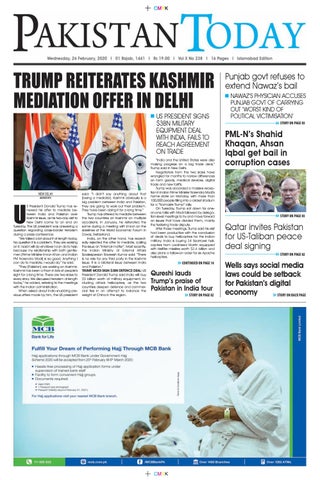
Trump reiTeraTes Kashmir mediaTion offer in delhi g
NEW DELHI agencies
u
S President donald Trump has renewed his offer to mediate between india and Pakistan over kashmir issue, as his two-day visit to New delhi came to an end on Tuesday. The US president was answering a question regarding cross-border terrorism during a press conference. “we talked a lot about it at length today. No question it is a problem. They are working on it. i said i will do whatever i can do to help because my relationship with both gentlemen [Prime minister imran khan and indian Pm Narendra modi] is so good. anything i can do to mediate, i would do,” he said. “They [Pakistan] are working on kashmir. kashmir has been a thorn in lots of people’s sight for a long time. There are two sides to every story. we discussed terrorism at length today,” he added, referring to the meetings with the indian administration. when asked about india snubbing previous offers made by him, the US president
said: “i didn’t say anything about that [being a mediator]. kashmir obviously is a big problem between india and Pakistan, they are going to work out their problem. They have been doing it for a long time.” Trump has offered to mediate between the two countries on kashmir on multiple occasions. in january, he reiterated the same during a meeting with imran on the sidelines of the world economic forum in davos, Switzerland. india, on the other hand, has repeatedly rejected the offer to mediate, calling the issue an “internal matter”. most recently, the indian ministry of external affairs Spokesperson raveesh kumar said: “There is no role for any third party in the kashmir issue. it is a bilateral issue between india and Pakistan.” TRUMP, MODI SIGN $3BN DEFENCE DEAL: US President donald Trump said india will buy $3 billion worth of military equipment, including attack helicopters, as the two countries deepen defence and commercial ties in an attempt to balance the weight of china in the region.
US PreSideNT SigNS $3bN miliTary eQUiPmeNT deal wiTh iNdia, failS To reach agreemeNT oN Trade
“india and the United States were also making progress on a big trade deal,” Trump said in New delhi. Negotiators from the two sides have wrangled for months to narrow differences on farm goods, medical devices, digital trade and new tariffs. Trump was accorded a massive reception in indian Prime minister Narendra modi’s home state on monday, with more than 100,000 people filling into a cricket stadium for a “Namaste Trump” rally. on Tuesday, Trump sat down for oneon-one talks with modi followed by delegation-level meetings to try and move forward on issues that have divided them, mainly the festering trade dispute. after those meetings, Trump said his visit had been productive with the conclusion of deals to buy helicopters for the indian military. india is buying 24 Seahawk helicopters from lockheed martin equipped with hellfire missiles worth $2.6 billion and also plans a follow-on order for six apache helicopters.
CONTINUED ON PAGE 14
Qureshi lauds Trump’s praise of Pakistan in India tour STORY ON PAGE 02
CMYK
Punjab govt refuses to extend Nawaz’s bail g
Nawaz’S PhySiciaN accUSeS PUNjab govT of carryiNg oUT ‘worST kiNd of PoliTical vicTimiSaTioN’ STORY ON PAGE 03
PML-N’s Shahid Khaqan, Ahsan Iqbal get bail in corruption cases
STORY ON PAGE 03
Qatar invites Pakistan for US-Taliban peace deal signing STORY ON PAGE 02
Wells says social media laws could be setback for Pakistan’s digital economy STORY ON BACK PAGE
CMYK Wednesday, 26 February, 2020
02 NEWS
QaTar InvITes PaKIsTan for Us-TalIban Peace Deal sIgnIng ISLAMABAD
Q
STAFF REPORT
ATAr on Tuesday invited Pakistan to the signing of the USTaliban peace deal set to take place on February 29. Last week, the US and the Taliban announced they were set to sign a historic agreement in Doha, Qatar, on Saturday, that would pave the way to ending America’s longest war. During a meeting, Qatari Ambassador to Pakistan Saqr bin Mubarak Al-Mansouri, on behalf of the Qatari government, extended an invitation to Foreign Minister Shah Mahmood Qureshi. Qureshi said Pakistan and Qatar had both played a “pivotal role” in the Afghan reconciliation process.
He welcomed the peace deal and said Pakistan had always held the view that there was no military solution to the Afghan conflict, adding that now the world was accepting this stance. Qureshi expressed confidence that the peace deal would lead to intra-Afghan dialogue. The foreign minister had on Saturday said Pakistan played its role and “fulfilled all promises” with America after reports of the US-Taliban deal emerged. Qureshi went on to say now it was the responsibility of the Afghan government to take the peace process forward. He said Pakistan wanted to see the formation of an inclusive delegation for advancing towards the intra-Afghan dialogue. “My experience shows that the people of Afghanistan want peace. It is now up to
their elite whether they take forward the peace efforts or waste it by indulging in power games. All responsibility will be on them [the Afghan government] and not on Pakistan,” the foreign minister had said. US-TALIBAN AGREEMENT: The US and the Taliban are set to sign a historic agreement that would pave the way to ending America’s longest war, the bitter foes announced on Friday, hours after Kabul said a week-long partial truce across Afghanistan would kick off over the weekend. If the so-called “reduction in violence” holds, it would mark a major turning point in the grueling conflict and set the conditions for a deal that could, ultimately, pull US troops out after more than 18 years and launch Afghanistan into an uncertain future.
Both US Secretary of State Mike Pompeo and the Taliban issued statements saying they had agreed to sign the accord on Feb 29 in Doha, following the one-week partial truce. “Upon successful implementation of
Imran 'under a lot of pressure' over sugar crisis, says Tareen NEWS DESK Pakistan Tehreek-e-Insaf (PTI) senior leader Jahangir Khan Tareen has said that Prime Minister Imran Khan was “under a lot of pressure” because of allegations that members from his party were involved in the sugar price hike across the country. “There are people that keep insisting that it [sugar price hike] is because of me and a couple of other party members and that he was not getting an inquiry done. So it is a welcome step and everything will come out in the open because of it,” Tareen said in an interview with a private media outlet late Monday night. “They should go to the farmers, ask them how much money they are getting, assess the situation,” he added. Tareen, who is amongst the key players in the sugar production industry, dismissed reports that he or other sugar mill owners were involved in hoarding the commodity that led to an exponential increase in prices all over the country. “Sugar mill owners cannot afford to hoard sugar, they do not have the money to do it,” Tareen said. “This inquiry committee that the prime minister has set up is very welcome. It will be good, the committee can look at facts and decide what happened, once and for all,” he added.
Prime Minister Imran Khan has constituted a three-member committee to probe the recent countrywide hike in sugar prices. According to a document issued by the Prime Minister’s Office (PMO), the committee will comprise the Federal Investigation Agency’s (FIA) Director General Bashir Memon, a representative of the Intelligence Bureau not below grade 20/21, and the Punjab AntiCorruption Establishment (ACE) Director General Gohar Nafees. The committee “will also identify and fix responsibility, if any, on any individual/officer/organisation, including any purported benefit to a private party, besides suggesting a way forward for the future course of action.” When asked if the formation of the committee meant that Imran Khan was not trusting him anymore, Tareen said: “I don’t think it’s like that — but that is my own opinion — you should ask Imran Khan directly about this, because when he
says it I’m sure you will trust [his word] more.” PARTY DIVISIONS UNFORTUNATE: Answering a question regarding Punjab Chief Minister Usman Buzdar, Tareen said that while he took time to adjust to his role, “Buzdar is now starting to do well.” “Look, the prime minister decided that in Punjab, I will bring in someone new, someone who is not affiliated with any group, so that he is not under the influence of anyone, “He [Buzdar] was new [on the job] and it took him a while to adjust [to his role]. Now I believe that Buzdar sahab’s capacity has been built a lot more.” “He has admitted that it took him time to adjust.” After much insistence for an answer on the host’s part, Tareen admitted that he is now “satisfied with the party’s performance in Punjab”. “It is unfortunate that there are divisions in the party — and this is a fact, there is no point in not admitting it — and these should not exist, but they do. Everyone is not on the same page. “When there are divisions and factions anywhere, running a country, or even a company, becomes difficult,” he said. When asked if these divisions exist because everyone is pursuing “their own core agenda, and Imran Khan is not a disciplinarian,” Tareen said that there “should
be more discipline in the party”. “People should not be allowed to shoot off their mouths. And when there is discipline in the party,[the party’s] work will improve a lot.” When asked what kind of discipline he is talking about, Tareen said “There needs to be some kind of discipline. People should be told that everyone needs to be on one team and if you cannot be a team player, then you should not be in the team.” Answering a question regarding the need for Imran Khan to appoint a chief of staff, Tareen said: “A chief of staff is an essential hire for any prime minister. And if one is hired, [things] would be a lot better.” When asked if he would be interested in becoming the chief of staff if the position is offered to him, Tareen said: “I cannot be, due to the ‘travesty of justice’ that occurred, I will not be able to hold that position. Earlier on the show, Tareen said that he and Minister for Foreign Affairs Shah Mahmood Qureshi had talked things out and now they “do not have any differences”. “Differences had come between us [in the past couple of years], but we go too far back — we used to play squash together as young boys — so we talked things out and we do not have any differences now,” the PTI leader said. However, the PTI leader did admit that there is an “anti-JKT (Jahangir Khan Tareen) camp” in the party.
this understanding, signing of the US-Taliban agreement is expected to move forward,” Pompeo said, adding that negotiations between the Taliban and the Afghan government would “start soon thereafter”.
Manzoor Pashteen released from DI Khan jail NEWS DESK Pashtun Tahaffuz Movement (PTM) chief Manzoor Pashteen was released on Tuesday after spending 30 days in Dera Ismail Khan jail. “A total of eight cases were registered against Pashteen in DI Khan and Tank districts. After completing the necessary legal formalities, Pashteen was released from jail,” a lawyer who represented Pashteen told a local media outlet. A large number of PTM workers turned out to receive Pashteen. Speaking to party workers, Pashteen thanked his supporters for showing up. “We are not among those who are scared by jails. We will stand by all those who will stand for humanity. “We have risen up against slavery. We will rebel against all forms of repression to fight in humanity’s favour,” he said. Pashteen was arrested in a case registered against him at DI Khan’s City Police Station under sections 506 (punishment for criminal intimidation), 153-A (promoting enmity between different groups), 120-B (punishment of criminal conspiracy), 124 (sedition), and 123-A (condemning the creation of the country and advocating the abolishment of its sovereignty) of the Pakistan Penal Code.
Qureshi lauds Trump's praise of Pakistan in India tour ISLAMABAD STAFF REPORT
Foreign Minister Shah Mahmood Qureshi on Tuesday hailed President Trump’s statement during his visit to India in which he said that the US has a “very good relationship” with Pakistan. A day earlier, US President Donald Trump, while addressing a packed rally in Ahmedabad after his arrival in India on Monday, said the United States has “a very good relationship” with Pakistan. “US and India are committed to stopping terrorists and fight their ideology. For this reason, since taking office, my administration is working in a very positive way with Pakistan to crack down on terrorist organisations and militants which operate on the Pakistani border,” Trump had said. In a statement released by the foreign minister’s spokesperson, Qureshi said that Trump remark about Pakistan was “extraordinary and its importance cannot be denied”. “Trump wants peace and stability in the region and has asked India to play a positive role in the area and extend a hand for promoting peace and stability in the region.” The foreign minister said that this will only be possible when the Kashmir issue is solved. “The current Indian government has further complicated an already complicated problem. India’s measures of Aug 5 have affected the identity of Kashmir and broken it into several parts. “Kashmir has been under lockdown for 206 days. How can things
CMYK
progress in these conditions?” he questioned. “Pakistan’s stance on the disturbance caused by the Citizenship Amendment Act in India can be seen by what is happening in Delhi. “If conditions worsen, the void of peace in the region can affect the whole world.” The minister added that India needs to “review its behavior and policy”. Qureshi said Trump “made it clear that Pakistan is a partner of peace in the war against terrorism”. He added that the progress Pakistan has made to defeat terrorism is exemplary. “Pakistan’s role in the Afghan peace process is there for the world to see … and Pakistan’s role in the region is being commended. “The Pakistan which India deemed to be a ‘problem’ is now being seen by the world as a ‘solution’.” He congratulated the “people of Pakistan, the armed forces and the political leadership for the positive change” and said that before [our] government came into power, relations between the US and Pakistan were “cold” and Pakistan was considered a problem.
CMYK Wednesday, 26 February, 2020
NEWS
PunjAB govt refuSeS to extend nAwAz'S BAiL SAYS THERE’S ‘NO LEGAL, MORAL OR MEDICAL BASIS WITHOUT ANY CONCRETE PROOF’ FOR FURTHER EXTENSION OF EX-PM’S BAIL LAHORE
P
STAFF REPORT
UNJAB Law Minister Raja Basharat on Tuesday announced that the provincial cabinet had decided not to further extend the medical bail granted to former prime minister Nawaz Sharif, who is currently in London for treatment. Addressing a press conference alongside Health Minister Yasmin Rashid and Information Minister Fayyazul Hassan Chohan, Basharat said: “The committee has decided that Nawaz Sharif’s bail can’t be extended further.” He explained that the initial court order said the former premier was granted bail for eight weeks by the Islamabad High Court (IHC) on October 29, 2019, but said that “a further eight weeks had passed since then as discussions were underway”. “Till a decision by the Punjab government, this bail was to be automatically extended, therefore it was extended for 16 weeks,” he said. After the passage of 16 weeks,
Basharat said the provincial government wanted to be informed about developments regarding Nawaz’s health on the basis of which a decision to extend his bail could be made. Earlier, the IHC had directed Nawaz to seek the Punjab government’s permission for further relief if required. “Till today he (Nawaz) has not been admitted to any hospital in London,” Basharat said, adding that nothing specific had been shared with the government regarding the PML-N supremo’s health and the matter had been “lingering on”. He said the Punjab cabinet had decided that there was “no legal, moral or medical basis without any concrete proof” for further extension of Nawaz’s bail. Basharat said the Punjab government would now share its decision with the federal government, which will decide upon the matter. Following the Punjab government’s announcement, PML-N senior leader Rana Sanaullah said they will challenge the decision in the high court following discussions. NAWAZ’S PHYSICIAN RE-
NAWAZ’S PHYSICIAN ACCUSES PUNJAB GOVT OF CARRYING OUT ‘WORST KIND OF POLITICAL VICTIMISATION’ JECTS GOVT’S CLAIM: Meanwhile, Dr Adnan, personal physician of Nawaz, rejected the government’s claim that the family has not submitted fresh medical reports to the committee. In a series of tweets, Dr Adnan claimed that the government’s decision to not extend his patient’s bail was based on ill-intent. He tweeted: “Former PM #NawazSharif through legal counsel & myself submitted time & again all relevant & concerned medical documents to Govt of Punjab & Honourable High Court. Medical reports were all-inclusive & conclusive formally notarised, attested & verified.” In an accompanying tweet, he claimed: “Unfortunately the Govt of Punjab unilaterally took a decision which has no basis, logic or sound reasoning. Even worse, through aides, the government is conveying false & baseless information via media. This is worse kind of political victimisation!” EXTENSION IN NAWAZ’S TIME ABROAD: Amid bickering between the ruling PTI and PML-N, Nawaz reached London for medical
treatment on November 19, 2019. Nawaz was granted bail by the IHC on humanitarian grounds, in the Al Azizia case earlier this month. He also obtained bail in the ongoing Chaudhry Sugar Mills (CSM) case, in which he is a suspect, from the Lahore High Court. On December 23, he sought an extension in his stay abroad on the expiry of the fourweek period granted by the LHC. Following his request, the Punjab government constituted a four-member committee to decide on it and sought fresh medical reports to make an “informed decision”. In January, a picture of Nawaz at a London restaurant along with some members of his family had surfaced on social media, raising questions about the condition of the former premier’s health. Following this, on January 15, the Punjab government had rejected Nawaz’s medical reports which had been submitted on December 23. Once again on January 30, the Punjab government asked Nawaz to submit fresh medical reports so that a decision on his request seeking more time abroad could be made.
SC orders to fix Gen Musharraf’s plea before three-judge bench ISLAMABAD STAFF REPORT
The Supreme Court (SC) on Tuesday directed its registrar office to fix, in open court, a plea by former president General (r) Pervez Musharraf challenging the registrar’s decision to not entertain his plea against the special court’s high treason verdict. During an in-chamber hearing, Musharraf’s counsel Salman Safdar appeared to present arguments. However, Justice Umar Ata Bandial fixed the matter to be heard by a three-member bench. In December 2019, an SC-constituted special bench had sentenced Musharraf to death in absentia under Article 6 of the Constitution for the imposition of a state of emergency in 2007. A month later, the former army chief approached the apex court seeking to overturn the high treason verdict. But the RO returned Musharraf’s plea after raising an objection under Supreme Court Rules 1980 that says a convict has to surrender to the authorities before filing an appeal. Interestingly, Musharraf filed the appeal in the apex court even though a three-judge bench of the Lahore High Court (LHC) has already declared unconstitutional the filing of high treason case against him, formation of the Special Court as well as its proceedings, leading to the abolition of the death penalty handed down to him on December 17. The appeal stated that Musharraf’s health declined significantly requiring specialised treatment abroad and he was given permission and approval of the court to leave the country on medical grounds. Former president’s attorney Salman Safdar, while filing the appeal, stated that the requirement of surrendering Musharraf is not applicable owing to his health condition. It also mentioned that the former military dictator tried to return to Pakistan but
was unable to because of his deteriorating health. The petition also stated that the former president ‘deserves’ that his appeal is entertained and heard by the Supreme Court.
SHCBA moveS SC AgAinSt LHC'S deCiSion in muSHArrAf CASe KARACHI: The Sindh High Court Bar Association (SHCBA) on Tuesday challenged the Lahore High Court’s decision in Pervez Musharraf treason case pleading that the formation of special court was lawful. The SHCBA, in its petition, requested the Supreme Court to reinstate the decision to award Musharraf the death penalty, and stated that the high court did not have any authority to hear the petition against the constitution special court. The petition further argued that the LHC did not examine the facts and law properly, neither did the high court give any importance to the evidence presented by the prosecution. Last month, the LHC, in its decision, had termed the formation of a special court hearing the Musharraf treason case as unconstitutional, and ruled that the amended Article 6 of the Constitution, under which Musharraf had been found guilty, could not be applied in the case ‘ex post facto’ (retrospectively). Article 6 of the Constitution was modified through the 18th Amendment in 2010, while the case against Musharraf concerned events that happened before that. STAFF REPORT
CMYK
03
PML-N's Shahid Khaqan, Ahsan Iqbal get bail in corruption cases ISLAMABAD: A two-member bench of the Islamabad High Court (IHC) on Tuesday granted bails to former prime minister Shahid Khaqan Abbasi and Ahsan Iqbal in separate cases. Abbasi was granted bail in the Liquified Natural Gas (LNG) case while Iqbal was granted bail in the Narowal Sports City corruption case. The court directed that Abbasi and Iqbal be released after submission of surety bonds of Rs10 million each. In its written orders, the court said that the investigation officer may “impose such conditions as he deems appropriate” to secure cooperation and presence of the petitioners during their respective inquiries. The hearings were presided over by IHC Chief Justice Athar Minallah and Justice Lubna Saleem Pervez. Chief Justice Minallah, during the hearing of the former premier’s bail petition in the LNG corruption case, remarked that the government took a grant from another country (United States) for help, and the country itself hired a firm. “Public funds were not used for the project; USAID funds were used instead … Public Procurement Regulatory Authority rules are not applicable in this case.” He questioned the National Accountability Bureau (NAB) prosecutor about whether the foreign ministry had been asked about USAID. The prosecutor informed the court that the watchdog was acquiring records from the ministry. He further said that Abbasi had purchased LNG at expensive rates. The chief justice then questioned the prosecutor whether NAB had researched if any company could be given the terminal’s contract at cheaper rates. Referring to a letter submitted by the antigraft watchdog, Justice Minallah remarked that NAB cannot mention a company providing services at a cheaper rate if it did not participate in the bidding. The investigation officer (IO) also read out a statement from Abid Saeed, former secretary of petroleum, which stated that he had prepared the summary on Abbasi’s instructions for awarding the contract. At this, the chief justice remarked that NAB had forgiven the former secretary after taking his statement on a summary from five years ago. The chief justice also told the IO that “these are your powers which we are talking about”. Abbasi has been in jail for over 200 days. He was arrested by NAB in connection with an inquiry into the LNG terminal contract. STAFF REPORT
04 ISLAMABAD
Wednesday, 26 February 2020
WEATHER UPDATES WEDNESDAY
250C 130C
THURSDAY
260C 140C
FRIDAY
200C 130C
KP cabinet aPProves seven sPecial children courts PESHAWAR APP
t
HE Khyber Pakhtunkhwa Cabinet with Chief Minister Mahmood Khan in chair here Tuesday approved setting up of seven special children courts one each for every division and regularization of services of 9,618 special police officers (SPOs). Briefing reporters about cabinet decision, Information Minister Shaukat Yousafzai said the services of all those SPOs who served on contract or fixed pay under Regularization of Services Act 2019 till August 2019, would be regularized. He said KP Govt had already given extension in services of SPOs from January 2020 to June 30, 2020, therefore, a total of 9618 SPOs would be regularized from July 1, 2020 that would cost Rs2726.393 million to provincial kitty. The Information Minister said the cabinet also approved establishment of seven child courts for speedy trial of children related cases. For this purpose, new vacancies for seven Additional District and Session Judge (AD&SJ BS 20) were approved that would cost additional Rs50 million. The Cabinet also approved up-gradation of status of judicial locks at Tank, Swabi, Nowshera and Malakand as sub jail besides a new judicial lock for Bisham Shangla to be look after by the prison department. The appointment of District and Session Judge, Rajab Ali as anti-terrorism court judge Buner has been approved besides a district scrutiny
and clearance committee led by the respective Deputy Commissioners of the merged districts. Representation has been given to heads of concerned departments, additional deputy commissioners and officers of law enforcement agencies not less than the post of Lt Colonel and elected senators, MNAs and MPAs would also be invited in the committee meeting for speedy development of merged areas. He said development process in 20 sectors have been started in merged areas under Phase-I of the mega Accelerated Implementation Program with annual development outlay of Rs 59 billion for three years and for this purpose Rs 29 billion were already released after approval of 78 different schemes. The cabinet also approved integrated water resource management strategy for effective management of water resources for agriculture and humans’ consumption. Under this strategy, water council and water commission would be setup under the supervision of Chief Minister and Additional Chief Secretary respectively. The cabinet also approved extension in reconstruction project started for permanent settlement of the temporarily displaced people of the merged areas up to June 30, 2021 to complete all the communication, roads, education, laboratories and medical centers projects on time. The Minister said International Fund for Agriculture Development (IFAD) has showed willingness to make investment in projects related to alleviation of poverty and improvement in socioeconomic lives of people in rural areas and for this
purpose Rural Economic Transformation Project (REPT) has been prepared on which USD 100 million would be spent including provision of USD 50 million by IFAD in KP. The cabinet also approved cancellation of KP Delimitation Local Council Act 2015, the Minister said, adding duties of delimitations of constituencies were handed over to Election Commission of Pakistan by Federal Government under Election Act 2017 in light of the orders of Supreme Court. Therefore, Local Council Act 2015 was found ineffective. The cabinet formally approved name of Zafar Ali Shah as Director General, Peshawar Development Authority, KP Model by-laws to regulate establishment of Public and Commercial Swimming Pool and Rs 35 million for Chitral-Awan-Bamborat Road, Chitral Garma Chesma Road, Chitral Boni Mastooj-Shandoor Road and Rs30 million for repair, maintenance and clearance of snow from these roads for promotion of tourism and provide quality traveling facilities to people. The cabinet approved setting up of RESCUE 1122 Training Academy at Shah Kus Khyber district and provision of Rs1190 million for it. The minister said Rs13532.292 million were approved for compensation of losses of shopkeepers and petrol pumps etc. of North Waziristan in line of the recommendations of special committee under revised expenditure head to help them on financial fronts, adding Rs4404.973 million were already distributed among affected people of Miranshah Bazaar.
SATURDAY
160C 120C
dolphin Force shoots two bikers dead for 'firing when asked to stop' RAWALPINDI STAFF REPORT
The Dolphin Force gunned down two bikers who resorted to "firing when asked to stop" here in the city's Morgah area, a Rawalpindi Police spokesperson said Tuesday. Both motorists, however, died later. The spokesperson said that officers of the elite security unit — set up to deal with street crime — had signalled the motorcyclists to stop but they opened fire instead. The officials then shot them in retaliatory fire, during which they were injured. Both suspects were immediately shifted to the hospital where they succumbed to their injuries, the spokesperson said, adding that they had both been identified. Rawalpindi Police further claimed that both men were involved in multiple cases of murder and robbery.
Firing incident claims five lives in Jhelum
ISLAMABAD APP
Five persons, including a woman and three minors, were killed after unidentified persons opened fire on a car near Mangla bridge in Jehlum on Tuesday. According to rescue sources, the incident occurred near the jurisdiction of Mangla police station. The bodies were shifted to the District Headquarters hospital Jhelum for postmortem.
ABBOTTABAD: A beautiful view of the fields of Abbottabad as spring arrives. OnlinE
PTI govt has set new example of transparency: Sania Nishtar ISLAMABAD APP
Special Assistant to Prime Minister on Poverty Alleviation and Social Safety Dr Sania Nishtar Tuesday said that transparency was the top most priority of PTI government as the federal government in the leadership of Prime Minister Imran Khan promoted merit and transparency in all development projects including Ehsaas programme. Zero-tolerance policy has been adopted against corruption resulting
in transparency in government departments and improvement in public service delivery, besides improving the country’s image globally, she said while speaking at a private news channel. The selection of beneficiaries under the ‘Ehsaas programme’ would be made in a transparent manner and no political or personal affiliation would affect or interfere in the process. She also invited researchers and private institutions to come forward and collaborate with the government
for the uplift of the poor and marginalized segments of the society. She hoped that the Ehsaas programme would bring the deserving segments of society out of the poverty trap soon. Ehsaas is a highly transparent and merit-based programme, she said, adding that the most marginalized segments of the society from the most neglected areas of the country were selected to get registered in different programmes under the umbrella of Ehsaas programme. She assured the
programme was free of any political or financial influence. The selection of the beneficiaries is purely merit-based and it has been ensured that the financial assistance is given to the deserving people only, she mentioned. Furthermore, she said, on the initial level, the Ehsaas Amdan programme is being launched in 375 union councils of 23 poorest districts of all the four provinces of the country and women are the focus of the programme.
3 killed, 7 injured as passenger jeep falls into ravine ISLAMABAD APP
Three passengers were killed and seven others sustained injuries when a jeep fell into a ravine in the Tor Ghar area of Mansehra district early Tuesday morning. According to police sources, the incident took place when the driver of a passenger jeep lost control over his vehicle at a difficult road turn on way from Chinda to Thakot early this morning. As a result, two children and a woman were killed while seven others received serious injuries. The injured were shifted to a local hospital for medical assistance out of which three critically injured were referred to THQ hospital Bagram.
Alternative dispute resolution need of the hour: moot ISLAMABAD STAFF REPORT
The ADR Initiative held its first certification ceremony for the ADR ODR International Civil Commercial Mediation Course on Feb 21, wherein speakers agreed that the alternative dispute resolution was the way forward for fair and speedy justice. They presented its first batch of mediators with certifications from ADR ODR International which signifies that they are now CMC (UK) and SIMI (Singapore) Accredited Mediators. The chief guest was Justice (r) Fazal Karim and other guests included Judge Shoaib Anwar Qureshi, senior instructor from the Punjab Judicial Academy and Umair Tamim, head of projects, Active Citizens, from the British Council. The ceremony began with a short seminar by the Punjab Judicial Academy where Judge Qureshi presented his views on ADR in Pakistan and called it the need of the hour. He enlightened the audience about the current The Punjab Alternate Dispute Resolution Act 2019 and what responsibilities it places on the Pakistani legal system. He praised the ADR initiative’s work in the direction that was needed to help the current situation. Umair Tamim shared the vision and history of their project, Active Citizens, a youth-empower-
ing initiative designed to train the youth to give back to their communities. The head of the project suggested the potential to combine the vision of the ADR Initiative and the Active Citizens which could lead to a future where youth would be trained in conflict management from an early age. This could lead to a greater understanding of dispute resolution among the next generations leading to a future where there is less backlog in the courts due to community-level dispute resolution. The chief guest of the ceremony was someone who understood ADR better than most people in Pakistan. Justice (r) Fazal Karim highlighted what
CMYK
ADR can do for the justice system of the country and how the constitution accounts for fair and speedy justice. There are four constitutional provisions that support and promote ADR. These provisions pertain to eradicating all forms of exploitation including those in the legal system (Article 3), right to a fair trial (Article 10), fundamental human right of equality (Article 25) and promotion of social justice (Article 57). He went on to elaborate on these points and endorsed the need for speedy and efficient justice which should be available for the masses and saw ADRi as the way forward. The ceremony ended with the founder of ADR Initiative, Syed Akbar Hussain, thanking the audience and the graduating students of the Mediation Course. He emphasised that they were the first batch of UK accredited mediators in Pakistan and thus pioneers of a new way of thinking who believe in ending conflict constructively and efficiently. He talked about the opportunities and upcoming projects of the ADR Initiative where more awareness campaigns, courses, and centres were a work in progress. For the initiative of raising awareness and producing more accredited and UK qualified mediators, the next Civil Commercial Mediation Course will begin in Islamabad on April 17-21 and registrations have already opened.
Wednesday, 26 February, 2020
Literacy rate improves in punjab: aser report LAHORE
p
STAFF REPORT
unjab has witnessed an improvement in literacy; however, 48 per cent children aged between three to five years and 9 per cent children aged between six to 16 years still remain out of school, the rural Punjab Annual Status of Education Report (ASER), 2019 survey revealed on Tuesday. In contrast, the survey in seven urban centres across Punjab provided the relief of knowing that 97 per cent of children in those areas are being formally educated. The report, which is a product of Pakistan’s largest annual citizen-led household based ASER Survey, was released by Punjab Minister for School Education Dr Murad Rass during at event at which Standing Committee on Education Chairperson Ayesha Nawaz, UNICEF’s education specialist Rubina Nadeem, Member of Provincial Assembly (MPA) Uzma Kardar, Quaid-e-Azam Academy Director General (DG) Amtul Qadoos, Punjab Additional Secretary Literacy Bashir Ahmed Goraiya, media experts and others participated. There was a unanimous consensus
for urgent actions to be taken for a future based on an educated Pakistan to halt the protracted devaluing of its social capital. Around 3,000 volunteer citizens visited 35 districts in 1,031 villages to implement the ASER survey from 20,677 households and 51,952 children aged between three to 16 years. For the year 2019, the ASER rural survey assessed 43,293 children of five to 16 year age cohort in Urdu, English, and arithmetic competencies mapped to Grade 2 curriculum and textbooks. Over the years, the survey results highlight a decline in the number of children going to private sector schools; 28 per cent children of age 6
to 16 were enrolled in private schools in 2019 as compared to 37 per cent in 2014. This shift to public schools increased enrolment shares from 63 per cent to 72 per cent. According to the rural report, student competencies in learning have also improved. About 75 per cent of children from the fifth grade can now read text in Urdu while 71 per cent of them managed to read English sentences meant for students in the second grade. Similarly, arithmetic learning levels have also improved since 2018; 82 per cent of fifth grade children could do a two-digit division pegged at second grade curriculum.
NEWS Overall, 85 per cent of the children enrolled in grade 5 in all urban districts surveyed in the province can read a story in their local language, 84 per cent can read sentences in English while 78 per cent can do division. The report also highlights school functioning in all districts in Punjab. Teachers’ attendance was reported at 89 per cent in government schools and 90 per cent in private schools. Whilst private school teachers were reported to have better qualifications at graduate levels, 40 per cent, compared to 26 per cent in government schools; however, for MA/MSC qualifications of public primary school teachers, 62 per cent were reported to be higher than private sector teachers which stood at 28 per cent. Furthermore, school facilities in the government sector have also been made better as 97 per cent government primary schools now have boundarywalls as compared to 93 per cent private primary schools, functional toilets are available in 94 per cent public and 89 per cent private primary schools. The survey also included a health and disability section in which teachers were asked questions pertaining to Children with Disabilities (CWDs) and appropriate facilities in their respective schools. Overall, 22.4 per cent of the surveyed government schools reported having children with disabilities, compared to 18.1 per cent private schools. Of the types of disability prevalence in schools, the highest reported was physical, 36.90 per cent, followed by behavioral, 15.18 per cent and hearing, 11.31 per cent.
Court asks NAB to respond on ex-PM Ashraf's 'Imran mafia' can't hide wrongdoings through tweets: Marriyum bail plea in Karkey case ISLAMABAD STAFF REPORT
An accountability court on Tuesday sought response from the National Accountability Bureau (NAB) on a plea filed by former prime minister Raja Pervez Ashraf seeking acquittal in the Karkey Rental Power reference. Accountability Court II Judge Azam Khan conducted the hearing on the reference. At the outset of the hearing, the employees of the power company took the stance that an agreement had been signed with the gov-
ernment that no action would be taken against them. On this, the court directed their counsel to move a formal petition in this regard. The court also sought a reply from NAB on the request of the company’s employees till Mar 6. Meanwhile, the NAB could not file its reply in acquittal pleas of Pervez Ashraf and other accused in the same case. The court directed the anti-graft body to submit its comments till March 12. It may be mentioned that the acquittal petition had been moved by the accused under fresh amendments in NAB Ordinance.
LAHORE: Pakistan Muslim League-Nawaz (PML-N) spokesperson Marriyum Aurangzeb on Tuesday said that the “Imran mafia” cannot hide its wrongdoings by posting tweets and staging dramas. Reacting to Prime Minister Imran Khan’s statement, Aurangzeb said: “It does not matter whether you tweet in the morning, in the afternoon or night, a lie remains a lie”. “Prices of edible items, especially vegetables, have significantly increased as a result of Imran mafia’s focus on inflation. The prices have been hiked deliberately and are not artificial to run [Imran Khan’s] Bani Gala house and to construct [his] Zaman Park residence,” she remarked. Earlier, Prime Minister Imran had on Monday tweeted: “As a result of Govt focus on price control, a substantial decrease in prices, especially in vegetable prices, can be observed now. STAFF REPORT
05
Ex-army chief Gen Beg blames CIA for Zia’s plane crash NEWS DESK Former army chief General (r) Mirza Aslam Beg says the US intelligence agency is responsible for the 1988 plane crash that killed then president and army chief Ziaul Haq, US ambassador Arnold Lewis Raphel and other military officials. Zia, one of the most powerful Pakistani heads of state, was killed on August 17, 1988 after the C-130 plane carrying him and other Pakistani and US officials crashed just outside Bahawalpur. In an interview, Beg told Anadolu news agency that the plane crash was not an accident, but sabotage. The former military chief said he believes that the US Central Intelligence Agency (CIA) was involved in the sabotage. According to Gen (r) Beg, an internal inquiry conducted by the military intelligence when he was the army chief also raised suspicion about the role of the CIA in the plane crash. Ijazul Haq, Zia’s son and a former Pakistani minister, believes that Gen (r) Beg and former national security adviser Maj Gen (r) Mahmood Ali Durrani were also involved in the conspiracy to bring down Zia’s plane. Durrani and Beg, however, dismissed Ijazul Haq’s accusations. Beg said that he held the elections and handed over the government to the elected officials after Zia’s plane crash. He asked that if he were involved in a conspiracy, did it benefit him? Durrani said that he disagrees with both Beg and Ijazul Haq and doesn’t believe in the sabotage theory. Durrani, who was heading the Multan division that hosted Zia in Bahawalpur, said that the plane crash was just an “accident” that took place due to a “technical fault”. Ijazul Haq also claimed that Durrani had called his father 16 times to convince him to fly to Bahawalpur. Durrani has denied the accusation and said he spoke with General (r) Haq twice before his visit to Bahawalpur.
PM Imran accepts media adviser Iftikhar Durrani's resignation ISLAMABAD STAFF REPORT
Special Assistant to Prime Minister on Media Iftikhar Durrani was formally removed from his post on Tuesday after Prime Minister Imran Khan accepted his resignation nearly two months after sacking him. Media reports had emerged in December last year, claiming that Durrani has been sacked from his post. The reports further suggested that following his removal, Durrani’s name has also been struck off the cabinet list. However, when contacted, Durrani had said he has not received any information about his removal. Durrani had played a key role in the representation of the ruling Pakistan Tehreek-e-Insaf (PTI) during the infamous Panama case, and FATA elections. During the July 2018 general elections, he had actively participated in the campaign for gathering the support of the public for the party. Previously, he had served as an advisor on communication in the Education Department to the Khyber Pakhtunkhwa government in 2013 Earlier in November last year, Advisor to the Prime Minister on Media Affairs Yousuf Baig Mirza had stepped down from his post.
CMYK
Wednesday, 26 February, 2020
06 WORLD VIEW
inDia’s meDia is failing in its Democratic Duty INDIA RANKS SO BADLY FOR PRESS FREEDOM BECAUSE MUCH OF THE MEDIA HAS SIMPLY STOPPED DOING ITS JOB al Jazeera
t
SIddHARtH VARAdARAjAn
HE protests in India against the Citizenship Amendment Act (CAA), which grants a fast track to citizenship for certain religious-minority immigrants, have underlined the importance of not just the democratic process, which includes the right to peaceful protest, but also the role of the media in covering the government’s response to the protesters. I work as a journalist in India and am happy and proud to be part of what I regard as a free press in the country. The website I helped found four years ago, The Wire, shines a critical light - a pretty harsh one - on the government, on politics and on big business. And there are others like us. Sure, the politicians and ministers and captains of industry do not like what we do and have made their displeasure known in various ways; but show me a democracy where the government loves the media and chances are the media is not doing its job. So why is it then that India - a country with a free press and an independent judiciary - does so badly on global indices measuring media freedom? In 2019, the country slipped two places down to 140 out of 180 in the World Press Freedom index compiled by Reporters Without Borders. How do we reconcile the fact that there is a constitution, laws guaranteeing press freedom, and media platforms fiercely doing their job, with India’s falling rank?
What has happened over the past few years is that a major section of the media has crossed over to the dark side. Without being formally censored or compelled by other means to comply with official diktats, these media houses have simply stopped doing their job. They have stopped asking difficult questions about the government and its policies. They are in awe of Prime Minister Narendra Modi and his senior ministers and are reluctant to be critical of them. Many, sadly, have become mouthpieces of official propaganda. Some do not think twice about promoting religious polarisation and even hatred in pursuit of the political agenda of the ruling Bharatiya Janata Party (BJP). There is also a major section of the media which is reluctant to be seen rocking the boat mainly because their proprietors have business interests that could be jeopardised. It is commonplace for governments at the central and state level to use official advertising as a lever of influence on the media. But there is also a darker side: With most investigative agencies functioning at the beck and call of ruling politicians, proprietors fear becoming the target of a vendetta if their reporters are seen as taking on the establishment. For those of us still willing to do our job, there are indirect financial pressures, of course, but also legal tactics aimed at silencing critical coverage. Defamation laws are misused to embroil editors and reporters in frivolous cases that can take us years to shake off. At one time, The Wire was facing 14 defamation suits filed by governing party politicians and their family members, businessmen and even a godman - a high-profile guru - known to be close to
the establishment. Total damages currently being sought in these bogus cases against us run to over one billion dollars. In the past few months, the government has sought new ways to get a grip on the country’s scrappy digital media. It has announced new restrictions on foreign investment in digital media, including approval on a case-by-case basis, and is also proposing to introduce a compulsory registration process for news and current affairs websites. A new tactic, which affects not just media freedom but the freedom of speech and communication of ordinary citizens, is the imposition of bans on the usage of the internet and social media. In Indian held Kashmir, a “temporary” ban on social media has lasted more than 200 days now. Broadband internet remains banned and limited data internet access was permitted after a twomonth hiatus but only for low-speed access to “whitelisted” sites. The latest assault on freedom of speech is the
government’s decision to charge Kashmiris who access the internet via VPNs under the draconian Unlawful Activities (Prevention) Act. Given the growing interface between social media and news media, this clampdown can only have a further chilling effect on press freedom. While the media in India has always had to contend with unfriendly politicians in the past, they could, with the exception of the 1975-1977 Emergency, at least count on the support of the country’s judges if the going got tough. What makes the current phase so dangerous is both the Modi government’s level of intolerance and the reluctance of the courts to defend free speech and press freedom. The press freedom we have in India should no longer be taken for granted. And it is only if we use our freedom - fiercely and fearlessly - that we can stave off future assaults on it. Siddharth Varadarajan is a founding editor of The Wire in New Delhi.
Why Afghanistan is America’s greatest strategic disaster
foreign Policy MICHAEL HIRSH
Way back in January 2002, a few weeks after the Taliban fled terrified from Kabul, Kandahar, and other major cities, I went to Afghanistan to report on the aftermath. In just seven weeks, the world’s lone superpower had pounded Afghanistan’s Islamist occupiers into the ground, literally, with B-52s dropping massive laser-targeted bombs that seemed, to the hapless Taliban, to come from nowhere. It was the moment that “the nineteenth century met the twenty-first century,” an ebullient Defense Secretary Donald Rumsfeld later wrote. As I drove around, there wasn’t a Taliban fighter in sight, and the country seemed to lay wide open, practically begging the Americans to occupy it. What’s keeping the peace? I asked the warlords I met. Pretty much the same answer came back over and over, often preceded by a gap-toothed grin: “B-52 justice,” said one man, pointing upward. Eighteen bloody years later, the conventional wisdom in Washington is that Afghanistan was always destined to be a failure. When Secretary of State Mike Pompeo tweeted Friday that the United States had reached “an understanding with the Taliban on a significant reduction in violence across #Afghanistan” and announced that peace talks would soon begin in earnest, almost no one complained about the relegitimization of the Taliban, who will now have a powerful voice in ruling the country and may even take it over again. After all, it was inevitable, wasn’t it? No, in fact, it wasn’t, and some very smart strategists will tell you so. But you certainly won’t hear that from the many columnists, pundits, and scholars who blindly supported the diversion into Iraq—the main reason for the disaster of Afghanistan— and to this day can’t admit that they became what President George W. Bush’s former spokesman Scott McClellan called “complicit enablers” in possibly the worst strategic misdirection in American history. Yet some military historians and thinkers, including David Kilcullen, the author of a new book called The Dragons and the Snakes: How the Rest Learned to Fight the West, argue persuasively that Afghanistan—while it never was going to be easy—was a winnable conflict. At the very least, Washington could have stabilized the country with far less investment of time, money, and blood, had it simply paid attention. “People say we took our eye off the ball. But we didn’t
even realize there was a ball,” Kilcullen, a career soldier who served in both Iraq and Afghanistan and was chief strategist for counterterrorism coordination at the State Department, said in an interview. Around the time the Taliban were beginning to creep back down from their mountainous hiding places in the fall of 2003 to consolidate the Quetta Shura, the Taliban leaders’ council across the border in Pakistan, the Bush administration was in panic mode some 1,400 miles away in Iraq. U.S. troops there were fighting an insurgency the Bush administration failed to anticipate, after no weapons of mass destruction or links to Osama bin Laden—that is, to 9/11—ever materialized. Rumsfeld, who had blithely decided to keep what he called a “small footprint” in Afghanistan because he didn’t like the idea of nation-building (his boss, Bush, had campaigned against it in 2000) was by then paying Afghanistan no mind at all. The Afghans I met, meanwhile, were desperate for foreign intervention, knowing the consequences of U.S. withdrawal in the previous era, when Washington funded the mujahideen against the Soviets and then simply left (and the Taliban moved in). As Ismail Qasimyar, the head of the Loya Jirga commission, told me when I was there, Afghans saw that “a window of opportunity had been opened for them” and that Afghanistan was now “a baby of the international community.” “Everybody knows who the real muscle is,” Sayed Hamed Gailani, the son and spokesman for a powerful warlord in the south, Pir Gailani, said at the time. “I want the Americans here as much as possible to give me back my country.” The moment was ripe, because just about every nonTaliban warlord was open for business to the CIA—happy to work with the Americans in exchange for payoffs. “The Taliban were scattered. Many of them went home,” Kilcullen said. “Gradually they went to Pakistan and formed the Quetta Shura. By 2004 the insurgency begins, and it starts to get really bad by 2005. If we hadn’t invaded Iraq when things started to go bad, and in the early phase had a much more engaged political stance in Afghanistan … but it was basically ignored until [Barack] Obama got elected.” And by the time President Obama and his team debated what to do in the early 2010s, matters may have gone too far, especially after the Taliban took the city of Kunduz in 2015, surging back to threaten the urban areas and the Kabul government itself. Indeed, what gets lost in discussions of the now-infamous “Afghanistan Papers”—the not-so-secret Pentagon history of the 18-year Afghan war revealed by the Washington Post late last year—is that Afghanistan was never just one long continuous history. Instead the conflict had at least two distinct phases: one in which the United States under Bush diverted most of its resources and energy elsewhere, sending even critical stabilizing U.S. forces like Pashto- and Dari-speaking special ops units to Iraq, and a second phase in which Washington abruptly awakened to the Taliban’s return and recklessly threw money and troops at a problem that had already metastasized out of control. “The Bush administration made three fundamental early errors in Afghanistan,” said James Dobbins, who
served as Bush’s first envoy to post-Taliban Afghanistan and later lamented to me that Washington had turned Afghanistan into “the most under-resourced nation-building effort in history.” “First was believing that a devastated country with no national army or police could secure its territory and population unaided,” Dobbins said in an email Friday. “Second was the failure to engage those elements of the Taliban, including its top leadership, that were prepared to lay down their arms. “Third was not understanding that while Pakistan had ceased supporting the Taliban government after 9/11, it had not ceased to support the Taliban movement. By the time these failings were rectified the Taliban had regrouped, rearmed and, operating from Pakistan, projected a large scale insurgency back into Afghanistan.” Recalcitrance from neighboring Pakistan was critical to the Taliban’s return. But much evidence suggests that the abrupt shift into Iraq also disillusioned the Pakistanis, who until then had been successfully strong-armed by Washington into containing the Taliban somewhat, as well as hunting al-Qaeda terrorists. Pakistan helped, for instance, in the capture of 9/11 mastermind Khalid Shaikh Mohammed in Rawalpindi in March 2003. But sensing that Washington was going to leave the region to its own devices, Islamabad reverted to past practices, setting up the Taliban once again as an Islamist ally. In an interview with me in the mid 2000s, Mahmud Ali Durrani, then Pakistan’s ambassador to the United States, said that just as Bush was about to invade Iraq, “al-Qaeda was almost destroyed in an operational sense. But then al-Qaeda got a vacuum in Afghanistan [as U.S. focus wandered]. And they got a motivational area in Iraq. Al-Qaeda rejuvenated.” All of which suggests, Kilcullen said, that the so-called war on terror that began with 9/11 may well have resulted in the worst strategic mistake made by any major world leader since Adolf Hitler decided, on the cusp of total victory over Europe and Great Britain, to turn and invade the Soviet Union—a decision that most historians agree cost the Nazi dictator World War II. “Hitler thinks England was just going to fall on its own, and then he launches into what he thinks is going to be a cakewalk” against the Soviet Union, Kilcullen said. “That is literally what happened to us with Afghanistan and Iraq. While the battle of Tora Bora [the mountain redoubt where a fleeing bin Laden was said to be holed up] was still going on, the Bush administration was already starting the planning process for Iraq.” Worse, America’s worst enemies have used the nearly two decades since 9/11 and America’s initial invasion of Afghanistan—a moment when U.S. power, manifested as “B-52 justice,” still inspired awe—to learn innumerable asymmetric techniques, including IEDs and the use of small, spread-out cells that began in Iraq, Kilcullen said. “In 1991 the Gulf War showed everyone how not to fight us, but the 2003 invasion of Iraq showed everybody how to fight us.” Michael Hirsh is a senior correspondent and deputy news editor at Foreign Policy.
Delhi’s Day of shame Times of india The rioting and communal violence set off in North East Delhi on Sunday and Monday during clashes between those supporting and opposing the Citizenship (Amendment) Act marks another monumental failure on the part of Delhi Police. Tensions have been brewing since December when the CAA was enacted in Parliament and the election campaign in Delhi was hotting up. Even as the peaceful Shaheen Bagh protests continue, violence has erupted at Daryaganj, Seelampur, Jafrabad and on the JNU campus. The widespread perception that the police act in a partisan manner have also not helped. The North-East Delhi violence is particularly galling coming at a time when the Capital was gearing up to welcome the US president and his delegation. The intelligence failure needs fixing of culpability. The Union home ministry which supervises the Delhi Police must crack the whip. Commissioner of Police Amulya Patnaik, who recently was awarded an undeserved extension, must go. Delhi’s political parties have a role to play in restoring peace. Chief minister Arvind Kejriwal has expressed helplessness but there are several things he can do like visiting the affected communities, forming peace committees and probing policing failures. With anti-CAANRC protests raging across India, it also serves a warning to the Centre on the utility of persevering with a patently discriminatory law.
Wednesday, 26 February 2020
FOREIGN NEWS 07
gerMAny tightens cArnivAl security After driver with 'deAd' expression injures VOLKMARSEN
g
AGENCIES
erMANY increased security at some carnival processions on Tuesday after a local man plowed his car into a parade in the western German town of Volkmarsen, injuring around 60 people, including at least 18 children. The incident on Monday shook Germans still struggling to take in last week’s racist gun attack on two bars in the town of Hanau which left 11 people dead. The driver was detained at the carnival on suspicion of attempted homicide and was being treated for his own injuries. An emergency responder said bystanders had punched the man while he tried to choke her as she leaned into the car to remove the key. “He didn’t say a word. He looked at you empty and dead and seemed so satisfied,” Lea-Sophie Schloemer told Welt television. “It was really unnerving how satisfied he seemed.” The prosecutors’ spokesman said the driver had not yet been in a fit state to be questioned, but was not drunk at the time of the incident. Initial tests for alcohol were negative but that was not a final assessment and there were as yet no results from the drug test. The motive was still unclear. “We
are investigating all possibilities,” he said. He said earlier there was no sign the investigation would be handed to national prosecutors, suggesting they did not see a political motive. While some carnival processions in the state of Hesse, home to Volkmarsen, were canceled, others were due to take place in the region on Tuesday. A police spokesman said security would be intensified. rose Monday is the height of the carnival season in Catholic areas of Germany, especially in the rhineland where tens of thousands of people dress up, drink alcohol and line the streets to
watch decorated floats that often mock public figures. Prosecutors said there was no concrete reason to think the risk of attacks at parades had increased, but they urged organizers to review their security arrangements and adjust them if necessary. Security at public events in Germany has been tightened since a Tunisian man with Islamist militant ties plowed a truck into a Christmas market in Berlin in 2016, killing 12 people. He was later shot dead by Italian police after fleeing. LIFE-THREATENING INJURIES: A police spokesman said he could not rule out that some of the injured in
Assange tried to call White House, Hillary Clinton over data dump, his lawyer says LONDON AGENCIES
Julian Assange tried to contact Hillary Clinton and the White House when he realized that unredacted US diplomatic cables given to WikiLeaks were about to be dumped on the internet, his lawyer told his London extradition hearing on Tuesday. Assange is being sought by the United States on 18 counts of hacking US government computers and an espionage offense, having allegedly conspired with Chelsea Manning, then a US soldier known as Bradley Manning, to leak hundreds of thousands of secret documents by WikiLeaks almost a decade ago. On Monday, the lawyer representing the United States told the hearing that Assange, 48, was wanted for crimes that had endangered people in Iraq, Iran
and Afghanistan who had helped the West, some of whom later disappeared. US authorities say his actions in recklessly publishing unredacted classified diplomatic cables put informants, dissidents, journalists and human rights activists at risk of torture, abuse or
death. Outlining part of his defense, Assange’s lawyer Mark Summers said allegations that he had helped Manning to break a government password, had encouraged the theft of secret data and knowingly put lives in danger were
‘AssAnge stripped nAked And hAndcuffed’ LONDON AGENCIES Julian Assange was stripped naked twice and handcuffed 11 times coming and going from court, the WikiLeaks founder’s lawyer told his US extradition hearing in London on Tuesday. Assange faces charges under the US Espionage Act for the 2010 release of a trove of files detailing the realities of US military campaigns in Afghanistan and Iraq. “Yesterday, Mr Assange was handcuffed 11 times, stripped naked twice at Belmarsh and put in five separate holding cells,” his lawyer Edward Fitzgerald said on Tuesday. He warned that Assange’s treatment could “impinge on these proceedings” and asked judge Vanessa Baraitser to give “an indication to prison authorities” that the regime should be relaxed.
Volkmarsen were in a life-threatening condition. Police had detained the driver, a 29-year-old German from the town who had been driving a silver Mercedes car, and he would appear before an investigating magistrate as soon as his condition allowed, state prosecutors said. “There are so far no indications of politically-motivated criminality,” Bild newspaper cited an investigator as saying. “But we think that the perpetrator acted with intent, and that psychological problems may have played a role,” the investigator added. Prosecutors confirmed that a second man had been detained at the scene on Monday and was accused of filming the incident. The spokesman said prosecutors were investigating whether the man had links to the driver, including checking phone records. The street where the incident happened in the center of the small town was still cordoned off by police on Tuesday and several stores in the area were closed. residents were in shock. “It’s terrible. I don’t know how somebody could do this, especially to children,” said 58-year-old rainer Bellmann. Locals told reuters that police had searched two homes in the town, including one apartment near to the scene that a police officer said was the home of relatives of the man. “lies, lies and more lies”. He told London’s Woolwich Crown Court that WikiLeaks had received documents from Manning in April 2010. He then made a deal with a number of newspapers, including the New York Times, Britain’s Guardian and Germany’s Der Spiegel, to begin releasing redacted parts of the 250,000 cables in November that year. A witness from Der Spiegel said the US State Department had been involved in suggesting redactions in conference calls, Summers said. However, a password that allowed access to the full unredacted material was published in a book by a Guardian reporter about WikiLeaks in February 2011. In August, another German newspaper reported it had discovered the password and it had access to the archive. PEOPLE’S LIVES ‘AT RISK’:Summers said Assange attempted to warn the U.S. government, calling the White House and attempting to speak to thenSecretary of State Clinton, saying “unless we do something, people’s lives are put at risk”. Summers said the State Department had responded by suggesting that Assange call back “in a couple of hours”.
china sentences swedish bookseller gui Minhai to 10 years jail BEIJING: China has sentenced Swedish book publisher Gui Minhai to 10 years in prison on charges of illegally providing intelligence abroad and claimed him as a citizen, prompting Stockholm to call for his release in a case that has rattled diplomatic relations. Gui, one of five Hong Kongbased booksellers known for publishing salacious titles about China’s political leaders, was snatched by authorities while on a train to Beijing in February 2018, the second time he disappeared into mainland custody. A court in the eastern city of Ningbo said Chinese-born Gui was sentenced Monday to 10 years in jail, and claimed he had also voluntarily reinstated his Chinese citizenship in 2018. Since Beijing does not recognise dual citizenship, “China, according to law, only recognises him as a Chinese citizen”, foreign ministry spokesman Zhao Lijian said Tuesday. AGENCIES
iran’s deputy health minister tests positive for coronavirus TEHRAN: Iran’s deputy health minister has tested positive for the new coronavirus amid a major outbreak in the country which has seen 15 people die as a result, Aljazeera News reported on Tuesday. Iraj Harirchi coughed occasionally and appeared to be sweating during a news conference in Tehran on Monday with government spokesman Ali rabiei. In a video broadcast on state television, the deputy minister put on a brave face as he admitted he was infected. “I too have been infected with coronavirus,” Harirchi said in the video apparently shot by himself. “I had a fever as of last night and my preliminary test was positive around midnight,” he said. “I’ve isolated myself in a place since. A few minutes ago, I was told that my final test was final, and now I am starting medication.” An Iranian parliamentarian representing Tehran has also tested positive. “My corona test is positive … I don’t have a lot of hope of continuing life in this world,” Mahmoud Sadeghi wrote on Twitter. AGENCIES
Last Soviet marshal and 1991 coup plotter Yazov dies MOSCOW AGENCIES
The last marshal of the Soviet Union Dmitry Yazov, who was a key player in the political turmoil that precipitated the collapse of the USSr, died in Moscow on Tuesday aged 95. Yazov, who was then the Soviet Union’s highest ranking military official, played a central role in the 1991 attempted coup against Mikhail Gorbachev and in the bloody repression of pro-independence uprisings in Lithuania. Yet he remained a revered figure in russia and was awarded military decorations by both russian President Vladimir Putin and Defence Minister Sergei Shoigu. “He was and will remain a legend,” Shoigu said in a statement quoted by russian news agencies, describing Yazov as “a brave, decisive fighter, wise, and a responsible commander.” The defence ministry said Yazov died following a “serious and prolonged illness”. Defence minister of the Soviet Union between 1987 and 1991, Yazov participated in the August 1991 coup attempt against Gorbachev. The coup failed and its leaders were arrested three days later but the attempted overthrow heralded the collapse of the
Soviet Union, which was finally dissolved in December 1991. Yazov was released from prison in 1993 and granted amnesty in 1994. His death leaves just one leader of the failed coup still alive, Oleg Baklanov, a member of the Communist Party’s central committee. Last year, Lithuania convicted Yazov in absentia along with more than 60 former Soviet officers for war crimes during a 1991 anti-Soviet uprising. Fourteen people were killed and hundreds injured in a crackdown on protests. OVERSAW CRACKDOWNS: “It took very long but he finally was given a proper verdict when he was charged and convicted,” Lithuania’s first post-Communist leader Vytautas Landsbergis told AFP on Tuesday. russia’s foreign ministry slammed the 10-year jail term handed down by Lithuanian judges and accused the Baltic country of “falsifying obvious facts”. Yazov was also defence minster during crackdowns on pro-independence demonstrations in Azerbaijan in January 1990, which saw Soviet troops firing into crowds of protesters in Baku, killing hundreds. Born in the Omsk region of Siberia in 1924, Yazov was a veteran of World War II and was injured twice. He wrote a number of books on military
strategy and history. On February 4, Shoigu awarded Yazov the “For Merit to the Fatherland” award for his work with veterans.
He was also decorated by Putin with the Order of Honor in 2004 and again on his 90th birthday with the Order Alexander Nevsky. “We are
proud to have you with us… and hope that you will continue to support us, to support young soldiers in their service to the fatherland,” Putin said.
Wednesday, 26 February, 2020
08 COMMENT New AGP enters a minefield Onerous task of clearing the legal mess
C
oming within days of his appointment as the new Attorney general of Pakistan (AgP), Barrister Khalid Javed Khan’s remarks would be widely welcomed by all who stand for good governance and rule of law. He has made it clear that he would not plead the government’s case against mr Justice Faez isa on account of conflict of interest. He has defined the AgP’s sphere clearly and emphasized its autonomy. this implies that he would not allow anyone, particularly the Law ministry, to try to step into his turf. He seems to be bent upon letting none under him bend the rules or bypass legal procedures. He has also vowed to make the rule of law, the supremacy of the Constitution and the independence of judiciary his top priorities. the Law ministry under the Pti is highly politicized and does not hesitate to take recourse to questionable means to achieve its desired ends. the way material was collected by the Law ministry to get mr Justice Faez isa sentenced involved cloak and dagger activities. if the former AgP is to be believed, he was used by the Law ministry luminaries to embarrass the supreme Court only to be turned into a fall guy after the attempt misfired. the fancy footwork undertaken by the Law ministry to rescue former military ruler musharraf from the clutches of law included denotifying the original prosecution team and then taking recourse to delaying the trial and then the announcement of verdict by the special court. the mission undertaken by Barrister Khan is by no means a walk in the park. Appearing to be an independent-minded person who also happens to be a stickler for legal and constitutional accuracy, the new AgP is bound to ruffle many feathers. those trained to achieve desired objectives by all means, whether straight or devious, are likely to be up against him. Attempts are already afoot to appoint pliable law officers without his consent. the new AgP has however resisted the move firmly. His demand for complete autonomy for his office is the first step in the right direction. All who stand for strong and politically neutral institutions would wish him godspeed in his quest for the Holy grail.
Price control Mafias still at it?
P
rime minister imran Khan has been under immense pressure to reduce the prices of basic food items that have risen recently to unmaintainable levels. Last month the prices of wheat and sugar skyrocketed, sounding alarms that there was a shortage in the market. the government insisted that supply was adequate, leading to the conclusion that hoarders were jacking up prices to make a profit. mr Khan concurred with this rationale, calling the price manipulators ‘mafias’, vowing to take them on and dismantling them. the FiA was tasked with probing the crisis to identify the responsible parties. the report presented by the FiA to the Pm and his cabinet was quickly rejected, making one wonder whose names were in the report, especially at a time when speculation was rife that at least two senior Pti leaders were involved. An updated report is now awaited that, according to the government’s spokesperson, will be made public. if the Pm has already made up his mind as to what sort of report he expects the FiA to furnish, then the investigation leading to a ‘crackdown’ on ‘mafias’ is quite pointless. mr Khan has however, claimed victory in this battle, stating in a tweet yesterday that vegetable prices had ‘substantially decreased’. the reality is that most of this reduction is due to seasonal variations rather than a result of the Pm’s ‘efforts’ to control prices. meanwhile, sugar and wheat flour remain more expensive than they were during the previous government’s tenure. these increases in food prices also have to do with inflation, currently at an all-time high of 14.6 percent and by some estimates even more than that. Consecutive hikes in energy prices and rupee depreciation have contributed to inflationary pressures, all of which are imF conditionalities that have to be met to secure each tranche of the $6 billion eFF programme. if the recent negotiations with the imF team are any indication, the Pti government has realized that any further hikes in energy prices would be disastrous and is trying to persuade the imF to ease up on that condition for the time being. the Pti’s overreliance on the application of cosmetic remedies to serious issues has stopped working, and clearly there is concern about where prices are headed in the near future and how to control them.
Dedicated to the legacy of the late Hameed Nizami
Arif Nizami Editor Aziz-ud-Din Ahmad
Umar Aziz
Asher John
Joint Editor
Executive Editor
Deputy Editor
Lahore – Ph: 042-36300938, 042-36375965
I
The moral devastation of the continued occupation The Israeli occupation does not satisfy any ethical theory Dr Alon Ben-Meir
I
srAeL’s occupation of the West Bank defies the moral principle behind the creation of the state. Contrary to Prime minister netanyahu’s assertion, the occupation erodes rather than buttresses israel’s national security and cannot be justified on either security or moral grounds. trump’s “deal of the century” amounts to perpetuating the occupation, to israel’s detriment. Unless israel embraces a new moral path and ends the occupation, no one can prevent it from unravelling from within only to become a pariah state that has lost its soul. there are four ethical theories—Kantian, utilitarian, virtue-based, and religious—that demonstrate the lack of moral foundation in trump’s peace plan. the first is deontological ethics, propounded by immanuel Kant. According to it, consequences are irrelevant to the moral rightness or wrongness of an action; what matters is whether the action is for duty or out of respect for the moral law. Kant provided several formulations of what he calls the categorical imperative; what matter most are his first two formulations. the first is that morality requires us to act only on what we can universalize. is the israeli occupation a policy that can be universalized to pass this test? Clearly no; the policy of occupation requires israel to exempt itself from moral and political norms that the international community recognizes (and which protect israel itself). israel is making an exception of itself, as in effect israel is saying: ‘We don’t have to live by the same rules as others.’ this is evident from israel denying the Palestinians’ right to self-determination because of national security, even though achieving absolute security would invariably render the Palestinians absolutely vulnerable. israel continues to usurp Palestinian land, thereby violating international agreements it signed. israel is thus clearly defying the first formulation of the categorical imperative, which requires honouring agreements. israel has a policy of breaking its agreements to serve its self-interest. By maintaining the occupation, israel is flouting the moral law while expecting the Palestinians to uphold those norms. the second formulation is to never treat an-
other person merely as a means, but always also as an end. that is, each of us possesses intrinsic worth which implies we must respect the inherent dignity of each individual. israel is treating Palestinians who are under occupation as objects rather than persons who can rationally consent to the way they are being treated. israel is coercing the Palestinians physically and psychologically by denying them human rights, through, for example, administrative detention, night raids, and expulsion, thereby robbing them of their dignity and denying them their autonomy. the second moral theory is Utilitarianism, formulated by Jeremy Bentham and John stuart mill. Unlike Kantianism, it places all emphasis on the consequences of actions, stating an action is morally right if it produces the greatest good for the greatest number. the moral evaluation of any policy depends on whether it maximizes utility. Utilitarianism agrees with Kant on one fundamental point, which is that morality prohibits making an exception of oneself. For obvious reasons, governments give greater priority to their own people. But does the occupation maximize the security and well-being of all israelis? Despite israel taking extraordinary measures for security, the occupation is in fact undermining it, as evident from the repeated bloody clashes, which have intensified since the unveiling of the peace plan, and the costly state of readiness that israel must maintain. moreover, if israel were to extend its moral considerations beyond its own people to include the Palestinians, then the policy of occupation fails even more acutely. While israel resorts to utilitarian arguments to justify its treatment of the Palestinians, it reveals the classic pitfall of utilitarian thinking. it ultimately does not provide sufficient protection and respect for human rights. the theory of virtue ethics, best advocated by Aristotle, says an act is moral if done because of its virtuousness. Virtue ethics is not primarily about codifying and applying moral principles, but developing the character from which moral actions arise. in this context, the israeli occupation, while adversely affecting the Palestinians, is also morally corrupting israelis themselves and has massive adverse repercussions on israel’s moral standing. the occupation is not educating israeli youth towards moral virtues, but hardening their hearts as they can live with mistreatment of Palestinians.
The dilemma of regulating social media Regulating without oppressing is tough PirzADA AurAng zAiB
T
He power of social media has shown itself in the last decade, as not only has it become the most powerful platform for freedom of speech and expression but its reach and impact is unprecedented. However, although these social media platforms define our information ecosystem, they have remained unchecked and unregulated for the most part. As various governments around the world grapple with regulating social media, it seems increasingly likely the question is not whether social media will face government intervention, but just how consequential those interventions will be.ng realization of the need to regulate the social media platforms thus to weed out any negative use of the social media forum by means of promoting hate speech, terrorist activities, fake and false news amongst others. Facebook Ceo mark Zuckerberg, speaking at the munich security Conference in germany, called for more regulation of harmful online content, but such regulation must encode democratic and open values, thus not be used to stifle individual expression. thus the focus is to effectively create a balance between regulating social media platforms and avoiding infringing on the individual right to information and free speech. in this background, the government of Pakistan has also taken steps to provide for a mechanism to cut the social cost of media platforms and in such attempt the federal government has notified set of rules to regulate the contents of social media platforms titled ‘Citizen Protection [Against online Harm] rules 2020’. the rules have been framed under sections 35, 27, 48 and 51 of the Prevention of electronic Crimes Act, 2016, read with section 54 and 57 of the Pakistan telecommunication [re-organization] Act 1996. the rules provide for a stringent mechanism to regulate the illegal content on social platforms. rule 3 calls for the establishment of an office of national Coordinator, within 15 days from the commencement of the rules. Amongst his many Karachi – Ph: 021-35381208-9
I
functions, he would have be responsible for engaging with social media companies on behalf of the federal government and may direct the concerned officials from those social media companies to appear before it to discuss any aspect related to the operation of the online system. rule 4 obliges the social media companies to disable, suspend or remove, such online content, which the Authority consider to be in contravention to any rules, regulations, act or law framed. in ordinary course, such measure is to be taken within 24 hours from intimation by the Authority and in case of emergency within six hours. Further, rule 4 holds that the permissibility of any online content by the national Coordinator/Authority under the relevant rules and law shall take precedence over any community standards or rules or community guidelines devised by a social media Company. rule 5 requires all social media companies operating in Pakistan to get themselves registered with the Authority within three months; to establish permanent registered office in islamabad, with physical address; to appoint a focal person based in Pakistan to coordinate with the national Coordinator; to establish one or more database servers in Pakistan within 12 months from the date of publication of these rules. rule 6 bounds the social media Companies to provide any information, data, content, sub-content, contained in any information system owned by the Companies, to the investigation Agencies, as may be required by them. in case the social media Company fails or refuses to abide by the provision of these rules, rule 7 empowers the national Coordinator to block the entire online system or social media Application owned and controlled by such social media company and may also levy a fine up to rs 50 million. the Company will have the right to file a representation within two weeks of the date of its blocking before a committee constituted by the federal government, and the committee will take a decision within three months. rule 8 provides for a mechanism for filing of complaints against unlawful content as defined under the rules. these rules have been approved by the Fed-
Islamabad – Ph: 051-2204545
I
Web: www.pakistantoday.com.pk
I
As such, the occupation violates virtue ethics because it creates an environment which degrades israelis’ moral substance. thus they continue to transgress without any sense of moral culpability. A certain israeli perspective (the settlement movement) says the occupation engenders such virtues as national solidarity, social cohesiveness, loyalty, courage, and perseverance. this may appear superficially true, but occupation is tearing the social and political fabric apart and undermining the conditions for moral virtues. Finally, the religious moral theory says morality is acting in accordance with what divinity commands. there are two basic theories, both of which can be traced back to Plato’s Euthyphro where socrates raises the question: “…whether the pious or holy is beloved by the gods because it is holy, or holy because it is beloved of the gods.” there is the divine command theory, which says what makes an action moral is that god commands it and nothing else. the second theory is that god commands us to do what is right because it is right. in other words, morality precedes god’s will and is irreducible to divine command. the usurpation of Palestinian land may appear defensible by it because if god requires any actions, then by definition they are moral. Another problem is that, as the philosopher gottfried Leibniz observed, it turns god into a kind of tyrant: “For why praise him for what he has done, if he would be equally praiseworthy for doing just the opposite?” turning to the theory that god commands us to do good because it is good, it means any action must derive its moral worth independently of god’s will. israeli policy towards Palestinians has to be morally justifiable without reference to some divine mandate. We have already examined, however briefly, israel’s policy and found it fails to meet the basic requirement of these theories. therefore, it lacks independent moral justification. israel’s perpetual occupation, which trump’s plan will certainly lead to, cannot be defended on moral or national security grounds. israel can prevail over any of its enemies foreseeably, but is drowning in moral corruption the continued occupation only deepens. it is that— the enemy from within— that poses israel’s greatest danger. Dr Alon Ben-Meir is a professor of international relations at the Centre for Global Affairs at NYU. He teaches courses on international negotiation and Middle Eastern studies. alon@alonben-meir.com
eral Cabinet in secrecy without any practical discussion or consultation with the stakeholders, which is the bedrock of the democratic process and consequently there has been severe criticism from both the civil society and media alike. the Committee to Protect Journalists has demanded that the Pakistan government should immediately roll back the set of social media regulatory measures, passed in complete secrecy, without due consultation with the concerned stakeholders, including civil society and media. it has been referred to as an attempt to further restrict space of free discourse in Pakistan. Likewise the establishment of office of the national Coordinator has been viewed as an attempt to centralize the control of digital information expression thereof. similarly, from bare perusal of the rules, it is evident that the rules may face strict judicial scrutiny on multiple fronts. it may be argued that the rules are in violation to the fundamental right of freedom of speech as enshrined in Article 19 of the Constitution of Pakistan and the mechanism provided in the rules goes above and beyond the level of reasonable restrictions. Furthermore, the powers and authority given to the national Coordinator appears to be unrestricted and arbitrary in nature thus going against the very fundamentals of general law. Also, unconditional and unilateral access to the personal information/data of a social media user to the investigation agencies under rule 6 of the rules raises concern regarding the breach of privacy of that individual. similarly, many of the powers granted under the rules are over and above the powers granted under the parent statues, thus void under the principles of delegation under law. the promotion of responsible content moderation is in fact the ultimate goal towards which any regulatory mechanism should strive for however, the distinction must be drawn between regulating and controlling the social media platforms and the aforesaid rules rather tilt towards the latter rather than the former. that may be why the Prime minister ordered the rules not be enforced, and why the islamabad High Court has taken cognizance of petitions against them. Pirzada Aurang Zaib is a Barrister-at-Law from the Hon’ble Society of Lincoln’s Inn. He is based in Lahore and is a partner at Ibrahim & Ibrahim-Barristers and Legal Consultants. He tweets @pirzada_
Email: editorial@pakistantoday.com.pk
Wednesday, 26 February, 2020
COMMENT 09 Editor’s mail
Send your letters to: Letters to Editor, Pakistan Today, 4-Shaarey Fatima Jinnah, Lahore, Pakistan. E-mail: letters@pakistantoday.com.pk Letters should be addressed to Pakistan Today exclusively
Make Punjabi the medium of instruction again
Mitigating the impact of climate change Planting more and more trees is the approach needed
Malik MuhaMMad ashraf
P
rime minister imran Khan, while inaugurating the tree plantation campaign in mianwali, announced restoration of the Kundian forest through massive plantation during the next four years under the 10 billion tsunami project. reportedly, out of 19,271 acres of land on which the forest was raised before Partition, 5222 acres have been turned into barren land over the years due to the felling of trees by the people and inaction by the successive governments which demonstrated criminal negligence in this regard. The initiative to revive the forest deserves unqualified appreciation as forest and trees are the best weapon to mitigate the impact of climate change. Climate change is the biggest challenge facing humanity in the modern era. Pakistan is seventh in the list of ten countries which have been badly affected by climate change. memories of the devastating flash floods of 2010 still haunt those who suffered due to that cataclysmic phenomenon. environment scientist believe that if greenhouse gas emissions are not reduced or controlled, global temperatures might register a rise between 1.1 to 6.5˚C by the end of the 21st century with all the accompanying cataclysmic consequences for the entire humanity. The major contributors to global warming are the USA, China, russia, the UK, Germany, Australia, Canada, Japan and South Korea. it was therefore incumbent upon the countries responsible for emission of heat-trapping gases into the atmosphere leading to global warming and consequent climate change, not only to address this issue seriously but also help the developing nations in coping with the consequences of global warming. it was in the backdrop of this realization that the countries of the world signed a treaty known as the United Nations Framework Convention on Climate Change in 1992 committing themselves to work collectively to limit average global temperature increases and the resultant climate change and to cope with whatever impacts were inevitable. realizing the inadequacy of the emission reduction provision in the convention, another agreement known as the Kyoto Protocol, which legally bound the developed countries to observe emission reduction targets, was concluded in 1997. The third protocol was signed in Paris in
December 2015 which was signed by 195 coun- tions. The banning of single-use polythene tries. But it is regrettable that the bigger nations bags, initially in islamabad to be followed responsible for global warming have not shown throughout the country, is a very imaginative the required commitment in fulfilling their ob- step in regards to ensuring a clean environment. The national roadmap sets strategic prioriligations and some even have preferred to pull out of the internationally negotiated agree- ties ranging from reforms required for an enments. The USA has renounced both the Koy- abling environment to effective implementation oto Protocol and the Paris Agreement, and some approaches with appropriate monitoring and reother countries including Australia, the USA, porting mechanisms. The CGPm rightly lays Japan, New Zealand, Belarus, iceland, Kaza- emphasis on collaboration and institutional khstan, Norway, Switzerland and russia have strengthening by sharing the human and other also remained reluctant to commit to the targets resources. it is envisaged as a people-led initiative, therefore all of its strategic actions are peoset in the protocols. The developing countries have not been ple-centered. However, the planting of ten billion trees given any binding targets, but they are still under the obligation to reduce their emissions. known as the ‘Ten Billion Tree Tsunami ProThe proposed action to be taken by the devel- gramme’ is the flagship initiative of the Clean oped and developing countries under the treaty and Green Pakistan movement. The magniinclude support for renewable energy, improv- tude and scope of this initiative is undoubtedly unprecedented, ing energy efficiency and which reflects the real reducing deforestation. concern and commitSome of the actions proment of the government posed at the international moots can be undertaken The focus of the effort for in dealing with the issues related to climate by the respective governthe successful change and a clean enviments by changing the energy production mix implementation of the Clean ronment. it envisages transition towards an enand also putting in place and Green Pakistan vironmentally resilient policies to prevent deforPakistan by mainstreamestation but it is an issue Movement is also on ing notions of adaptation which requires the involvement of the entire creating awareness among and mitigation through ecologically targeted inisociety. That necessitates the masses about tiatives covering inefforts to create awareness about the seriousenvironmental issues and creasing the area under forests and biodiversity ness of the issue among seeking their cooperation conservation. the masses, motivating The remedy to mitithem to refrain from cutgate the impact of cliting trees and joining the mate change national effort to plant undoubtedly lies in planting more and more trees wherever it was feasible to do so. Pakistan is the fifth country in the world to trees. Unfortunately the area under forests in have created a separate ministry of Climate Pakistan is only five percent of the total land Change and also carried out legislation for the mass whereas according to global standards it establishment of a Climate Change Council and should be more than 20 percent. There is therea Climate Change Authority. it has formulated fore an imperative need to run a persistent new Forest and Wildlife Policies besides setting awareness campaign to educate the masses up a Global Change impact Study Centre, the about the impact of climate change and their research arm of the ministry. But in spite of the contribution to the national effort including recreation of the necessary infrastructure, no real fraining from cutting trees. Since the subject now relates to the provinces they also need to commitment came forth. However it is encouraging to note that the extend full cooperation to the federal governPTi government, realizing the imperative of mit- ment by taking appropriate steps in line with igating the impact of climate change, has made the policy framework enunciated by it. The focus of the effort for the successful an unprecedented commitment in the form of the Clean and Green Pakistan movement (CGPm) implementation of the Clean and Green Pakwhich aims at creating an enabling environment istan movement is also on creating awareness that underpins a healthy atmosphere. it has among the masses about environmental issues surely raised the bar with regard to saving Pak- and seeking their cooperation. The media has a istan from the adverse impact of climate change very vital role in creating awareness, motivating and turning it into a vibrant and developed entity the people to plant trees voluntarily as well as on the global map. The Clean and Green Pak- highlighting the significance of other compoistan movement builds on five pillars with a nents of the programme. For this purpose all the focus on behavioral change and institutional media outlets including the print media must try strengthening. These pillars include Plantation; to dilate on subjects related to environment and Solid Waste management; Liquid Waste and climate change on regular basis. it is a vital national cause requiring collaborative efforts by Hygiene; Total Sanitation and Safe Water. Since its launching, a significant number of all the segments of the society. initiatives have been taken at both the federal Malik Muhammad Ashraf is an academic. and provincial levels through the engagement of government, civil society and private institu- He can be contacted at: ashpak10@gmail.com.
i strongly condemn the declaration of Urdu as the medium of instruction by murad ras, the minister of education for the Government of Punjab. i demand the immediate reversal of this highly unjust decision. While declaring his decision, the minister referred to a so-called survey report in which majority of educationists, parents, and students voted in favour of Urdu. Accepting the right of education in one's own language, the worthy minister categorically denied the existence of Punjabi language in Punjab and very clearly mentioned Urdu as a language of Punjab. He was of the view that Punjabi is not a sole representative language of Punjab because there are small lingual units in Punjab speaking different languages. He blatantly showed his total unawareness about the fact that every widely-spoken language has a considerable lot of dialects and this kind of diversity does not affect the oneness of a language. To reject the Punjabi and swap it with Urdu as the mother language of Punjab is not only an open disgrace to the twelve crore Punjabis whose mother tongue is Punjabi, but it is also an infringement of the basic human rights related to the language of a person or a nation. He perhaps does not know that despite all such intrigues, Punjabi is the most widely spoken language of Pakistan. According to Census 2017 report in Punjab, Punjabi is the mother tongue of 75 % of the population, whereas 20 % of the population Saraiki as their mother language which is actually the multani dialect of Punjabi . We find ourselves unable to understand what bars the government to grant the right of education to Punjabis in their own language when the constitution of Pakistan and the manifesto of UNeSCO also grant the right of education in one's own language. We strongly believe that without making Punjabi the language of instruction in schools, neither the quality of education can be improved nor the literacy rate increased. We demand the immediate repeal of the decision of making Urdu the medium of instruction and the institution of Punjabi as the language of education in Punjab. it is also to be noted that the worthy Lahore High Court has also given the verdict in favour of Punjabi on 12 Feb 2019 and has issued orders to the government to make necessary arrangements for the implementation of this decision. But how deplorable it is that instead of implementing the verdict of the worthy High Court, the government went its own way in contempt of the court. TAriq JATALA Lahore
Success is not about good grades i am a student of Sir Syed University. This letter is addressed to all parents. everyone is creative in their own way but 75% of the students ignore their creativity in childhood due to high pressure to get good grades. Another thing stifling them is wishes of the parents who force their children to be what the parents want, having no concern for their child’s interests. Nowadays students do not actually learn to achieve knowledge, they only learn to get a good CGPA. most of the students come to the institute just for attendance, because it carries some marks. even students with good grades are not creative most of the time. They just manage to get good marks because their focus is not to gain knowledge but to get good marks. Why most students’ first priority is getting high percentages may be because they are forced by their parents or guardians. Stressed students attempt suicide because they have no choice. i request all parents to please don’t force their children and be kind to them. Thomson edison said “A piece of paper cannot decide my future.” WAqAS AkbEr karachi
An Incomplete College iN 2010, construction of a college began in Hoshab. Nine years later, it still hasn’t been completed. The funds for this college have been eaten up by the construction who were assigned the responsibility of construction. They have left the college incomplete. The residents of the area are quite poor and cannot afford to visit other cities like Turbat and Karachi for their education. i would like to request the Cm of Balochistan to take urgent notice of this and hold accountable the party responsible for construction. We need a college in Hoshab. WAriS HASiL Hoshab
The Netflix effect THe Netflix effect is when a new series catapults an unknown actor to fame overnight, a result of millions of people binge watching a show. it’s a move towards more convenient, personalized content. The success of Netflix shows that consumers want products that are easy to use to match their preferences. it is changing how consumers view content. Before Netflix, consumers went to the movies or DVDs and watched whatever was on live TV. Now, consumers can stream content instantly to any device, anywhere. They’re no longer tied to the TV and forced to sit through commercials. Netflix has a huge impact on Television and cable industry because it is in direct competition with traditional media. Since 2013, Netflix has been creating its own original content that puts it in direct competition. For every show Netflix creates, it’s taking away viewers from a traditional show on network Television. Film and TV industries have to adjust their processes and content to keep up with Netflix. Maryam Noor Lalazar
Wednesday, 26 February 2020
10 FOREIGN NEWS
WHO WArns Of pAndemic risk After virus peAks in cHinA BEIJING
t
AGENCIES
he new coronavirus has peaked in China but could still grow into a pandemic, the World Health Organization (WHO) has warned, as infections mushroom in other countries. Financial markets have gone into a tailspin after grim news of deaths and outbreaks in the Middle East, Europe and Asia, even as the Chinese epicenter appeared to be calming, with the death toll at its lowest for three weeks. But the situation is worsening in other countries, with more than 2,000 cases and 30 deaths reported abroad, prompting a raft of restrictions on travelers from infected nations. South Korea, Italy and Iran have logged particularly sharp increases in infections and deaths, while several countries in the Middle East reported their first
cases of the novel coronavirus. But WHO chief Tedros Adhanom Ghebreyes insisted the virus could still be contained, praising China’s drastic quarantine measures in several cities for helping to prevent an even bigger spread. “For the moment we are not witnessing the uncontained global spread of this virus and we are not witnessing largescale deaths,” Tedros told reporters in Geneva. He added, however, that countries should be “doing everything we can to prepare for a potential pandemic.” The term “pandemic” is used to describe an illness that spreads across numerous communities. SOUTH KOREA HOTSPOT: South Korea, which has the largest number of cases outside China, reported 60 more infections and one more fatality on Tuesday, raising its death toll to eight and total patients to nearly 900. South Korea’s outbreak has centered around a religious sect in Daegu, the
country’s fourth-largest city. The country is on its highest “red” alert. As part of the containment efforts, school holidays were extended nationally while the 2.5 million people of Daegu were told to remain indoors. The US Centers for Disease Control raised its caution level to warn Americans against “all nonessential travel to South Korea”. Italy, which has reported seven deaths and over 200 cases, has locked down 11 towns, while upcoming football matches in its Serie A and the Europa League will be played behind closed doors. With police manning checkpoints to enforce a blockade, Prime Minister Giuseppe Conte has said that residents could face weeks of lockdown. IRAN FEARS: The disease — officially known as COVID-19 — spread to new countries including Afghanistan, Bahrain, Iraq, Kuwait and Oman. At least 12 people have died in Iran, the highest toll outside China.
But there were concerns the situation might be worse than officially acknowledged. The semi-official ILNA news agency quoted one local lawmaker in hard-hit Qom — a religious center — who said 50 people had died there. The Iranian government denied the report and pledged transparency. Even so, authorities have only reported 64 infections in Iran, an unusually small number that would mean an extremely high mortality rate. Michael Ryan, head of WHO’s health emergencies program, said a team from the UN agency would be arriving in Iran
on Tuesday. But he cautioned against drawing any conclusions about the mortality rate. Iran “may only be detecting severe cases” because the epidemic was still at an early stage, he said. Several countries have taken measures to prevent arrivals from Iran. CHINA PEAK: In China, 508 new cases were reported, with all but nine at the epicenter in central Hubei province. Although that was up from 409 on Monday it was much lower than new infections being reported just a week ago. China’s death toll reached 2,663 on Tuesday after 71 more people died.
European stocks extend losses on fear of virus pandemic PARIS AGENCIES
European stock markets fell further on Tuesday but declines in midday trading were far less than during a major selloff a day earlier. World equities suffered dizzying declines Monday, sparked by fears that the COVID-19 outbreak could derail the global economy. More deaths and a surge in new coronavirus cases in Iran, Italy, Japan and South Korea has fanned fears of a pandemic. Tokyo’s main stocks index closed Tuesday with a hefty 3.3-percent loss as traders caught up with global markets after a Japanese public holiday Monday. Other Asian equity markets recovered a bit meanwhile, with increases in Hong Kong and Seoul. After rebounding early on Tuesday, major European markets then headed lower once again, although with much
less momentum compared with their losses of between 3.0 and 4.0 percent the day before. “Equity markets in Europe enjoyed a rebound in early trading in the wake of yesterday’s bloodbath of a session, but the positive move was short-lived,”
said CMC Markets UK analyst David Madden. “The brutal losses endured yesterday coaxed a few buyers out of the woodwork, but given that equity benchmarks are back in the red suggests that sentiment is still sour. “The coronavirus crisis in Italy re-
mains at the forefront of traders’ minds,” Madden added. Italy has seen a serious jump in cases — from six to 229 since Friday — and now has the biggest number of confirmed infections in Europe. News at the weekend that COVID19 was now spreading and claiming lives far beyond China sparked Monday’s market rout, with Wall Street’s Dow index suffering its worst day in two years. The rapid spread abroad came as the World Health Organization said the epidemic had peaked at its epicentre in China, where it has killed more than 2,600 people and infected more than 77,000 others. But the situation has worsened elsewhere with nearly 2,700 other cases and more than 40 deaths globally, prompting restrictions on travellers from infected nations, the cancellation of football matches and national efforts to isolate suspected carriers.
Micro-pollution ravaging China and South Asia BEIJING/NEW DELHI/LAHORE AGENCIES
Nearly 90 percent of the 200 cities beset by the world’s highest levels of deadly micro-pollution are in China and India, with most of the rest in Pakistan and Indonesia, researchers reported Tuesday. Taking population into account, Bangladesh emerged as the country with the worst so-called PM2.5 pollution, followed by Pakistan, Mongolia, Afghanistan and India, according to the 2019 World Air Quality Report, jointly released by IQAir Group and Greenpeace. China ranks 11th. Particulate matter of 2.5 microns or less in diameter — roughly 1/30 the width of a human hair — is the most dangerous type of airborne pollution. Microscopic flecks are small enough to enter the bloodstream via the respiratory system, leading to asthma, lung cancer and heart disease. Among the world’s megacities of 10 million or more people, the most PM2.5-toxic in 2019 was the Indian capital New Delhi, followed by Lahore in Pakistan, Dhaka in Bangladesh, Kolkata in India, Linyi and Tianjin in China, and Jakarta, Indonesia. Next on the list were Wuhan — epicentre of the new coronavirus outbreak — along with Chengdu and Beijing. The IQAir report is based on data from nearly 5,000 cities worldwide. Most of the seven million premature deaths attributed by the World Health Organization (WHO) to air pollution are caused by PM2.5 particles, which originate in sandstorms, agriculture, industry, wildfires and especially the burning of fossil fuels. “Air pollution is the world’s leading environmental health threat,” said IQAir CEO Frank Hammes. “Ninety percent of the global population is breathing unsafe air.” China’s average urban PM2.5 concentration dropped 20 percent in 2018 and 2019, but last year it still counted 117 of the 200 most polluted cities in the world. All but two percent of China’s cities exceeded WHO guidelines for PM2.5 levels, while 53 percent exceeded less stringent national safety limits. LESS DATA FROM AFRICA:
The UN says PM2.5 density should not top 25 microgrammes per cubic metre (25 mcg/m3) of air in any 24-hour period. China has set the bar at 35 mcg/m3. More than a million premature deaths in China each year are caused by air pollution, according to the WHO. Recent calculations put the toll at up to twice that figure. Across a large swathe of northern India and north-central China, meeting WHO standards year-round for PM2.5 pollution would increase life expectancy up to six or seven years, according to the Air Quality Life Index, developed by researchers at the Energy Policy Institute of Chicago. In India, small particle pollution exceeds WHO limits by 500 percent, even if air pollution in general declined significantly last year, with 98 percent of cities monitored showing improvements. Among the club of 36 rich OECD nations, South Korea was the most polluted for PM2.5, counting 105 of the worst 1,000 cities on the index. In Europe,
Poland and Italy count 39 and 31 cities, respectively, in this tranche. Other parts of the world such as Africa and the Middle East lacked data. “What cannot be measured cannot be managed,” Hammes said. “Africa, a continent of 1.3 billion people, currently has less than 100 monitoring stations that make PM2.5 data available to the public in realtime.” As of 2018, China alone had more than 1,000 such stations in 200 cities. Climate change has begun to amplify the health risk of PM2.5 pollution, especially through more intense forest fires and sandstorms made worse by spreading desertification, the report found. Global warming and PM2.5 also have the same primary driver: the burning of coal, oil and gas. While the link with lung cancer was well established, a recent study showed that most excess deaths from air pollution are caused by heart attacks, strokes and other types of cardiovascular disease.
CMYK
Arctic 'doomsday vault' stocks up on more food seeds TROMSO AGENCIES
An Arctic “doomsday vault” is set Tuesday to receive 60,000 samples of seeds from around the world as the biggest global crop reserve stocks up for a global catastrophe. The seeds are to be deposited in the vault inside a mountain near Longyearbyen on Spitsbergen Island in Norway’s Svalbard archipelago, about 1,000 kilometres (600 miles) from the North Pole. “As the pace of climate change and biodiversity loss increases, there is new urgency surrounding efforts to save food crops at risk of extinction,” said Stefan Schmitz, who manages the reserve as head of the Crop Trust. “The large scope of today’s seed deposit reflects worldwide concern about the impacts of climate change and biodiversity loss on food production,” Schmitz added. “But more importantly it demonstrates a growing global commitment –- from the institutions and countries that have made deposits today and indeed the world –- to the conservation and use of the crop diversity that is crucial for farmers in their efforts to adapt to changing growing conditions,” he said. Common as well as wilder varieties of grains are being sent by institutions in countries as diverse as Brazil, the United States, Germany, Morocco, Mali, Israel and Mongolia. The latest shipment will bring to around 1.05 million the number of seed varieties placed in three underground alcoves which form the vault, known also as Noah’s Ark. Aimed at safeguarding biodiversity in the face of climate change, wars and other natural and man-made disasters, the seed bank has the capacity to hold up to 4.5 million batches, or twice the number of crop varieties believed to exist in the world today. It was launched in 2008 with financing from Norway. Its usefulness was spotlighted during Syria’s civil war when researchers were able in 2015 to retrieve from the vault duplicates of grains lost in the destruction of Aleppo. The countries and institutions that deposit seeds in the vault retain ownership over them and can retrieve them when necessary. Paradoxically, the vault was itself hit by climate change. In 2016, water seeped into the vault’s tunnel entrance due to permafrost melting as Arctic temperatures climbed unusually high.
Wednesday, 26 February, 2020
BUSINESS 11
APTMA To TAkE uP PowER TARiff iSSuE wiTh PM iMRAn TodAy
CORPORATE CORNER
LAHORE
LAHORE: Akhuwat hosted Australian High Commission’s delegation at its head office in Township. First Secretary (Political) Michelle Sullivan, Third Secretary Jeven Nadanakumar and Prof Samina Yaseen, Director Centre for Muslim States and Societies at The University of Western Australia, met the Akhuwat family. PRESS RELEASE
LAHORE: BASF Managing Director Faisal Akhtar and Regional Technical Service Manager ChangKyu Seo inaugurate BASF’s booth at the Pakistan Auto Show 2020. P RE SS REL EA SE
HASSAN NAQVI
P
RIME Minister Imran Khan is likely to meet textile millers and office-bearers of the All Pakistan Textile Mills Association (APTMA) on Wednesday (today), sources at the PM Office confirmed on Tuesday. Sources said that APTMA Group Leader Gohar Ijaz would be leading the delegation that would meet the PM. The delegation would comprise APTMA Chairman Dr Amanullah Kassim, APTMA Punjab Chairman Adil Bashir, leading textile millers and other officebearers of the association. During the meeting with the premier, the retrospective charging of power tariff arrears from January 1, 2019, over and above the competitive rate of 7.5cents/kWh will be discussed in detail along with long-term textile policy and other issues faced by the export-oriented sector. Sources said the APTMA delegation would also inform the prime minister about the competitive energy pricing at which the regional competitors are getting electricity and how the textile sectors exports increased in the last one year or
so when the government was providing electricity at a competitive rate of 7.5cents/kWh. Sources said that they would further apprise Imran Khan of the misinformation communicated to him reportedly by Power Minister Omar Ayub Khan and Special Assistant to PM on Petroleum Nadeem Babar that they are ready to provide and already providing electricity at the competitive rate of Rs7.5cents/kWh and the additional surcharges are added to the bills following court orders. Sources said in reality, Power Division wrote a letter to all power distribution companies on January 13, 2020 to charge additional surcharges arrears to exports-oriented sector from January 1, 2019 with retrospective effect despite PM’s clear instructions to provide electricity at competitive rate of 7.5cents/kWh and also in contrast to the federal cabinet’s decision. “There is no existence of any such court order in which it has asked to charge power tariff arrears to export-oriented sector over and above the competitive price of Rs7.5cents/kWh. So, these are all lies and rumours,” the sources said, adding that the Power Division is trying to save its skin from the mismanagement and its failure to recover line losses etc.
MARKET WEEKLY
Bears keep control as index drops 285 points LAHORE: TPL Trakker has partnered with Eat Mubarak to power their app with TPL Maps, a business segment of TPL Trakker and Pakistan’s first digital mapping service. P R E S S R E L E A S E
Engro wins UNGC Sustainability Award for second consecutive year KARACHI: In recognition of promoting UNGC Principles and Sustainable Development Goals, Engro Corporation has won the first prize for “Living the UN Global Compact Business Sustainability Award 2019″ in the Large National Category, for the second year in a row. The award was presented at the Business Sustainability Moot and Living the Global Compact Best Practices Sustainability Award ceremony, organized by Global Compact Network Pakistan. Sharing his thoughts on receiving the award, Favad Soomro, Head of Engro Foundation, said, “It is a matter of great honour for Engro to win the UNGC award for second year in a row. The company stands committed to upholding the UNGC principles and maximizing its social and economic impact for a more prosperous Pakistan.” P R E S S R E L E A S E
Nestlé Pakistan declared SDG Champion LAHORE: Nestlé Pakistan has won the first prize for ‘Living the Global Compact Best Practices Sustainability Award 2019’, in the category of multinational companies and declared the Sustainable Development Goal (SDG) Champion at the business sustainability moot and award ceremony, hosted by the UN Global Compact Network Pakistan. “It is an honour to be recognised by UNGC for the fourth time in a row. This not only shows Nestlé’s commitment and dedication to the SDGs but also motivates us further to continue our mission in line with UNGC principles,” said Waqar Ahmad, Head of Corporate Affairs, Nestlé Pakistan on the occasion. P R E S S R E L E A S E
KARACHI STAFF REPORT
Bearish trend continued at the Pakistan Stock Exchange (PSX) on Tuesday, with the benchmark KSE-100 index falling below the 39,000-mark. Foreign investors offloaded equities worth $3.03 million on Monday. Gaining 104.02 points, the KSE-100 Index touched its intraday high at 39,247.75 during the initial trading hours. However, failing to sustain the gains, the index touched its intraday low at 38,693.02 after losing 450.71 points. It finally settled lower by 285.28 points at 38,858.45. Among other indices, the KMI-30 Index plunged 343.75 points to close at 61,171.80, while the KSE All Share Index lost 229.32 points, ending at 27,018.98. The overall trading volumes shrank from 144.28 million in the previous session to 124.35 million, with Unity Foods Limited (UNITY +2.11pc), The Bank of Punjab (BOP +0.40pc) and Hascol Petroleum Limited (HASCOL +0.52pc) leading the volume chart. The scrips had exchanged 10.03 mil-
lion, 9.16 million and 8.65 million shares, respectively. Sectors that painted the KSE-100 Index red included banking (-115.70 points), oil & gas exploration (-81.34 points) and fertiliser (-46.95 points). Among the companies, United Bank Limited (UBL -53.87 points), Pak Petroleum Limited (PPL -51.58 points) and Engro Corporation Limited (ENGRO 48.93 points) dented the index the most. On the financial side, Hub Power Company Limited (HUBC -1.29pc) declared its financial performance for the second quarter of FY20. Despite 62pc increase in its gross profit, the company's earnings per share shrank from Rs1.28 to Rs1.10. Its cumulative EPS for the first two quarters was recorded at Rs2.34. Meanwhile, Pak Petroleum Limited (PPL -2.89pc) announced that the company's revenue increased by 7.53pc in 2QFY20. Exploration cost inflated by 85pc, finance cost surged by 91pc while 'other income; declined by 68pc. The company posted an EPS of Rs9.02 (2QFY19: Rs11.41). In a notification to the exchange, HiTech Lubricants Limited (HTL+0.70) announced that it has been granted permission by the Oil and Gas Regulatory Authority (OGRA) to proceed to apply/acquire no objection certificates (NOCs) from concerned departments to set up 35 retail outlets in khyber pakhtunkhwa with instructions that retails sales can only be started after completion of necessary storage infrastructure, third-party inspector report confirming that the storage/depots at Nowshera meets OGRA's notified technical standards.
It is highly likely that after the meeting with the APTMA’s delegation, Imran Khan would ask the Ministry of Energy (Power Division) to withdraw its letter written to power distribution companies to charge additional surcharges over and above the competitive rate of Rs7.5cents/kWh, the sources said. The premier also said on Monday that provision of electricity to the domestic and industrial consumers at reasonable rates was among the top priorities of his government. During the meeting, the APTMA delegation would also request the prime minister to approve the long-term textile policy on urgent basis as it is hampering the exports of the country because they want clarity on part of the government to take exports orders etc. “Uniform rates of energy including electricity at 7.5cents/kWh and gas at $6.5/mmBtu for next 10 years along with long-term textile policy would help Pakistan in achieving the target of $50 billion exports in next 10 years,” a textile miller who would be part of the delegation added. He added that the export-oriented sector is hopeful that the premier would resolve all the issues faced by the industry including the provision of electricity at competitive price of 7.5cents/kWh.
Govt committed to timely privatisation of SME Bank, Pak Reinsurance ISLAMABAD: Adviser to Prime Minister on Finance and Revenue Dr Abdul Hafeez Shaikh on Tuesday chaired a meeting of the Cabinet Committee on Privatization (CCOP) at the Cabinet Division, where he was given an update on the government's privatization programme. The committee was informed that the privatization process of the SME Bank Limited and Pak Reinsurance Co Ltd (up to 20pc divestment) was moving ahead in a relatively faster manner and that the process in this regard would be completed within the required timeframe. On the revival of Pakistan Steel Mills, the CCOP directed the Privatization Commission to complete all the standard requirements in a regular but expeditious manner. The commission was further asked to update the government on any issues that may surface in the smooth running of the process. On a proposal to privatize Guddu Power Plant (747 MW), the Ministry of Privatization briefed that they have received expressions of interest (EoIs) from financial advisers in this regard and that the parties have already been shortlisted for issuance of the request for proposals. Other issues related to the transaction were also discussed. CCOP directed that there was a need for further discussion on the project between NEPRA, Power Division and ministries of finance and privatization. CCOP directed the commission to come up with a joint proposal in the next meeting so that the transaction process could be completed within the stipulated timeframe. For divestment of shares in the Oil and Gas Development Authority (OGDCL), CCOP directed that the matter required further deliberation. The commission directed all the relevant stakeholders, including the Ministry of Energy, to come up with a presentation on the proposal in the next meeting. ONLINE
Competing telecom operators integrate mobile financial platforms Jazz, Telenor CollaboraTe To ensure reliable, borderless serviCes To CusTomers ISLAMABAD SYEDA MASOOMA
Jazz and Telenor, two of the biggest mobile telecommunication service providers in Pakistan, have joined hands with each other's microfinance banks to facilitate their respective customers. As per details, Jazz has partnered with Telenor Microfinance Bank while Telenor Pakistan has partnered with JazzCash keeping in view recent developments in the digital ecosystem and to ensure the provision of services for more fluid customer experiences. According to a joint press release issued in this regard on Tuesday, "The partnership's aim is to enable a digital ecosystem for consumers to enhance their ability to manage financial and mobile communications needs by providing reli-
able, border-less services." Following this direct integration among the entities, the Easypaisa App could be used to purchase Jazz airtime while JazzCash mobile application could be used to purchase Telenor Pakistan’s bundles. "Jazz bundles will also be available on the Easypaisa App in the future." This is a first of its kind deal between the two players and is a welcome development, given that the digital world is moving forward at a rapid pace and there is a need to leverage digital channels to make it as easy as possible for customers to choose what service they should use. Jazz Chief Operating Officer Asif Aziz said, "Our priority is to promote consumer choice and improve access to high-quality digital financial services, particularly for underserved households.
This partnership with Easypaisa is a vital step towards this mandate of ours. Collaborating with a competing mobile payments provider shows our willingness to build a border-less payments ecosystem, which shall help build a more open, interoperable payments system in the future.” Speaking on the development, Telenor Pakistan Marketing Director Umair Mohsin said, “We always have customers at the core of our business and our priority is to bring convenience and feasibility to them at their fingertips. Through this partnership with JazzCash, we are enhancing the user experience to be more inclusive of what our industry has to offer while providing a wider gateway towards financial inclusion. In this era of digitalization, we are reducing boundaries and enabling our customers through integrated touchpoints.” Khurram Malik, Head of Easypaisa commented on the partnership, “Easypaisa is transforming the way users perform financial transactions. We aim to digitize user experience by building a
digital ecosystem that allows them to enjoy convenient payment options. This partnership with Jazz is another step in that direction. We will continue to bring more brands and service providers under the Easypaisa umbrella to create diverse opportunities as well as provide ease to consumers”. The deal between two competing mobile operators and financial services provides an insight into the benefits that technology offers. Such alliances and interoperability allow these two players to deliver on many of their promises, including enhanced efficiencies and better cus-
tomer experience. As per PTA indicators, Jazz holds 36.55pc of telecommunication market share followed by Telenor Pakistan with 27.68pc. EasyPaisa was launched in partenrship with Tameer Microfinance Bank Limited in 2009, while JazzCash came into formation in 2012 in partnership with Mobilink Microfinance Bank. As per a newsletter issued by the State Bank of Pakistan at the close of 2018, the two branchless banking services were competing head-to-head, with Mobilink at approximately 47pc and Telenor at 41pc share of active accounts.
Wednesday, 26 February, 2020
12 business Govt urged to help clear import consignments from China KARACHI
State Life inSuranCe CorP headLeSS for two monthS, na body toLd
PPI
ISLAMABAD
SITE Association of Industry Patron Zubair Motiwala on Tuesday appealed to the government to allow early clearance of imports consignments containing dyes and chemicals from China. “Pakistan’s imports from China are around $12 billion and most of those comprise dyes and chemicals, which are basic raw material for the textile sector and the biggest foreign exchange earning sector in Pakistan,” Motiwala said in a statement. He said the prices of raw material were jacking up due to stuck up consignments at the Chinese ports, while other alternative suppliers such as Korea, Taiwan and India had either stopped supplying or were quoting 30 to 35pc higher prices. “Our members complain that it is becoming difficult for them to continue with the production activities due to shortage of raw material, while prices in the local market have gone up by 50 to 100pc,” he added. Motiwala further said in such a scenario, an opportunity of an increase in exports had now become the question of survival for the local textile industries. “Everyone is talking about increasing exports from the country, but the fact is that production cannot be undertaken in the absence of raw material.” “Value-added textile sector requires ample quantity of dyes and chemicals to complete processing and finishing of fabric. It is obvious that no one keeps the inventory for more than one or two months due to cash flow constraints as large amount of exporters is stuck in the sales tax refunds,” he added. Motiwala appealed to the prime minister, the finance adviser and the commerce minister to take urgent measures and direct Pakistani Embassy and Consulate in China to get consignments cleared. He feared if the situation prevailed, other countries would increase raw material prices further. Motiwala also urged the government to immediately withdraw all the levies and front loading with immediate effect so that there should be minimum burden on cost escalation on the products, which were being sold earlier to this crisis.
GHULAM ABBAS
China keen to upgrade Pakistan’s agri infrastructure: envoy ISLAMABAD APP
Ambassador of China to Pakistan Yao Jing on Tuesday stressed the need to materialise the understanding between Chinese Academy of Agriculture Sciences and Pakistan Agriculture Research Council (PARC) so as to improve the production of rice, sugarcane, cotton, vegetable and livestock using modern technologies. The Chinese envoy was talking to PARC Chairman Dr Muhammad Azeem Khan. The meeting was held to discuss agricultural cooperation between the two countries under the ChinaPakistan Economic Corridor. The ambassador informed that a locust expert team would soon arrive in Pakistan and visit the affected areas to assess the requirements. The PARC chairman discussed the possible measures for locust control, keeping in view the environmental aspects of pesticides. They also discussed capacity building at national level both for the scientists and technicians to improve agricultural production and ensure poverty alleviation. During the meeting, Pak-China experts exchanged agricultural information and discussed areas of mutual interests to accelerate the development of Pakistan's agricultural sector.
a
parliamentary committee on Tuesday was surprised to know that an important national organisation, State Life Insurance Corporation (SLIC), was headless for the past two months. During a meeting of the National Assembly's Standing Committee on Commerce, it was revealed by the SLIC officials that despite two advertisements for the post of SLIC chairman, the position was still lying vacant. The officials informed that "no one in the corporation was given an acting or additional charge" in the absence of the chairman. Committee Chairman Naveed Qamar questioned the officials about the affairs of the government entity, which holds businesses worth billions and has massive assets. Both the commerce ministry and SLIC officials were found clueless regarding the absence of SLIC's head. However, the official claimed that a summary to give additional charge to someone in the corporation was pending with the federal cabinet. As per new rules, the federal cabinet was the only authority that could give additional charge of the key post of government organizations, the MoC officials informed. Later, the committee directed the ministry to resolve the issue immediately as the absence of SLIC chairman was hampering the organization's business. Meanwhile, the committee also discussed matters regarding the termination of daily wagers at SLIC. The committee was informed that SLIC had decided to make new recruitments in the organisation. "SLIC will publish 590 vacancies for the recruitment of new employees, and 152 daily wa-
gers who were terminated earlier would be considered on a priority basis (they will be given an extra 5pc marks)." The committee recommended that terminated employees having one-year service should be considered as a special case. Earlier, the NA body discussed budgetary proposals of the Ministry of Commerce pertaining to Public Sector Development Programme (PSDP) for the Financial Year 2020-2021. Giving a briefing on the proposed PSDP 2020-21, the additional secretary said that remodeling of Peshawar and Quetta expo centres and expansion of Karachi Expo Centre have been proposed for required funds. He also briefed the committee about the new
schemes regarding the remodeling of Karachi Expo Centre (II & III). Furthermore, the committee discussed new steps taken by the government to enhance the domestic exports to Finland. The additional secretary informed that Pakistani exports to Finland have been declining for the past many years. The committee took a serious notice on the reply furnished by the Ministry of Commerce to the National Assembly with reference to starred question no. 50, wherein the ministry had mentioned that exports to Finland had increased up to 15pc during 2018. The NA committee directed the ministry to probe into the matter and fix responsibility against the concerned officers for providing incorrect information to the parliament.
‘TRADE ENHANCEMENT’
US commerce secretary to reach Pakistan today ISLAMABAD GHULAM ABBAS
United States Commerce Secretary Wilbur Ross will reach Pakistan today (Tuesday) to discuss ways and means to further enhance trade ties with Islamabad. The visit by a senior US official follows the recent signing of $3 billion worth defence deal between the US and India during President Trump’s visit to New Delhi. According to the officials of the Ministry of Commerce (MoC), the homework for the US Commerce Secretary’s visit has been completed. During a meeting of the Senate’s Standing Committee on Commerce on Tuesday, Additional Secretary Commerce Javed Akbar informed that various options to enhance bilateral trade would be discussed during Wednesday’s meeting. According to the MoC, Pakistan would ask the US to convene the meeting of the Trade and
Investment Framework Agreement (TIFA) Council to move forward seriously on a number of issues. “Although, like other countries, there is already a GSP plus facility for Pakistan in the US, but new steps could be taken for getting maximum benefit of the trade preferential facility,” said the officials. An official from the MoC said the ministry was trying to opt the model of joint ventures on the pattern of Egypt and some African countries to enhance trade ties with biggest economies like the US. Similar options would be discussed during the scheduled meetings with the senior US official, he added. According to the ministry’s officials, Ross is accompanying President Donald Trump during his visit to India and he would fly to Pakistan tomorrow for his few hours stay. The US official would hold meetings with
Prime Minister Imran Khan, PM’s Adviser on Finance and Revenue Dr Abdul Hafeez Shaikh, Special Assistant to the PM on Petroleum Nadeem Babar and PM’s Adviser on Commerce, Industries, Production and Investment Abdul Razak Dawood. According to sources, the last meeting of TIFA was held in May 2019 in which both sides had discussed ways to improve access to products, such as agricultural goods and medicines, in each other’s markets. Pakistan had been keen to explore potential trade concessions as it could import more US cotton in return for preferential US market access for its apparel exports, they added. A Preferential Trade Agreement (FTA) could be a long-term goal because of complexity involved in the process, sources further said, and added that the TIFA framework provided an institutional mechanism to carry forward those discussions and come up with new ideas.
Recent slide in global oil prices will benefit Pakistan’s economy KARACHI ARIBA SHAHID
As the number of coronavirus cases rose outside China, oil slid more than five per cent at its session low, falling into bear market territory, amidst fear regarding a slowdown in the global economy. With the virus still present in Chinathe world largest importer and consumer of oil- and dampened oil demand, WTI, Brent and Arab light went down by 15.8pc, 16.3pc and 14.5pc respectively in the last two months or so. As the situation is getting worse with the outbreak spreading across South Korea, Italy, Iran, Afghanistan, and Israel, the Organisation of the Oil Exporting Countries (OPEC) has lowered its oil demand by 230,000 bpd, while the US Energy Information Administration revised down its forecast regarding global oil demand by 378,000 bpd. With all eyes on the OPEC+, Adnan Sheikh AVP Research at Pak Kuwait Investment Management Company said, “OPEC may have underestimated the impact of coronavirus in their initial estimates of reduction in demand by 230k
bpd for 2020. Given that both IEA and IEA have estimated much larger numbers, we will have to wait and see how OPEC+ responds in terms of additional cuts” Until last week, crude oil prices received support over expectations that OPEC and its allies could implement further supply cuts when they meet in early March. However there is an air of uncertainty regarding Russia agreeing to such a plan. In a report on Coronavirus’ impact on oil prices, Tahir Abbas from Arif Habib Limited said, “We believe oil prices in the short term will be dependent on the virus updates from China including new registered cases and death tolls. Moreover, the spread of the virus to other countries and measures for combat are also expected to influence oil prices.” MACRO ECONOMY: As per the report, lower oil prices bear positive news for the macro-economy as it will lead to lower inflationary pressure and may result in monetary easing. Abbas further quantifies that for every $5/bbl decrease in oil price, our base case inflation (11.6pc for FY20) will be contained by 23 bps. As for global pol-
icy rates, decline in oil prices holds the potential to push for a wave of monetary easing which could be seen as positive for Pakistan as it could raise Eurobond and Sukuks from the international markets. As for trade, Abbas says for every $5/bbl downward movement in oil prices, there will be an annualized impact of around $1.1 billion on Pakistani imports, which may lead to further reduction in current account deficit (CAD). KASB Securities Managing Director Arsalan Soomro said Pakistan imported $14 billion worth of energy imports and that a $10 decline would lead to $22.5bn/saving per year. “Thus it gives cushion to your currency and improves your foreign exchange reserves.” As per Hamza Kamal, an analyst at AKD Securities, “The government may also take this opportunity to jack up revenue from petroleum as done in the past in 2015-2016s.” INDUSTRIAL OUTLOOK: The downward movement in oil prices is being seen as negative for the exploration and production (E&P) sector. Tahir Abbas says the earnings of local E&P companies would be hit between 2
to 7pc on an annualized basis. “Oil marketing companies are likely to witness a one-time inventory loss, while refineries are likely to witness inventory losses which may be offset by an increase in margins owing to the possibility of crude oil prices declining more than final product prices.” Hamza Kamal added that from industrial perspective, many captive power plants had shifted from gas to furnace oil (FO) recently. “If oil price continues to remain under pressure, power production by these plants on FO would become more attractive.” However, there is consensus among analysts that declining oil prices will have positive impact on the power, cement and steel sectors as lower fuel costs and furnace oil costs can prop up profitability. Shahrukh Saleem, an investment analyst at AKD Securities, was of the view that declining oil prices would result in a decrease in the cost of captive power generation for some players in the cement sector. In addition, it is expected that the automobile sector would witness better margins considering how steel prices are declining alongside oil prices, added.
In addition, as on a whole, KASB’s Soomro believed, “The private sector's cost of production comes down in the form of cheaper fuel/LNG rates and transportation costs thereby, increasing their profitability and creating space for repayment of loan and giving rise to expansionary plans. For the masses, it's a quick transfer of wealth in reduced fuel expenses, gas and utilities expenses and is a feel-good factor in the purchasing power.” POST VIRUS IMPACT: Analysts believe that the impact of coronavirus on crude oil demand could be limited. Saudi Aramaco Chief Executive Officer Amin Nasser, while speaking to Reuters, said, “We think this is short term and I am confident that in the second half of the year there is going to be an improvement on the demand side, especially from China.” Meanwhile, oil recovered some of its losses on Tuesday after a biggest drop witnessed over the past seven weeks as investors attempted to gauge the impact the virus would have on the economy, along with the response that was likely to be triggered by producers.
“The Legend Of MauLa JaTT TO hiT cineMas On eid uL fiTr 2020” 7th Sky Entertainment’s Muqaddar took Twitter by Storm By Rohama Riaz
T
hE most anticipated film of Pakistani cinema “The Legend of Maula Jatt” will be finally coming to the big screens this Eid ul Fitr. The film is a joint collaboration between Ammara hikmat and Bilal Lashari under Encyclomedia and Lashari films produced in association with AAA Motion Pictures. The film has been hotly anticipated for a while now and was due to be released last year. After many legal hurdles the film faced in the past, it will finally be seeing the light of the day this May.The magnum opus directed by Bilal Lashari, is one of the most ambitious projects of Pakistani cinema featuring Fawad Khan, Mahira Khan, humaima Malick and hamza Ali Abbasi in lead roles. The film also stars eminent names of the Pakistani entertainment industry like Ali Azmat, Shafqat Cheema and Nayyer Ejaz. The unprecedented movie buzz is not only due to it’s stellar cast but also because the movie aims to bring a contemporary take to the cult screen characters
of Maula Jatt and Noori Nath. Said to be the country's most expensive production to date, the movie is set to become not only a production marvel in Pakistani cinema but will take the fighting style unique to the east, into the international arena of cinematic grandeur. Ammara hikmat, the executive producer behind the film, had already dropped a hint on social media about the near future release for the movie amidst various speculations. Now that the film is in final stages of post production, this announcement puts an end to all such rumours. “It was a really ambitious project, so naturally we met a lot of challenges and the film took longer than we expected, to release. however, the film is in final stages of post production and will be in cinemas on Eid.” Said hikmat. The Screenplay of the film is by Bilal Lashari, dialogues by the Legendary writer of Maula Jatt 1979, Nasir Adeeb and story has been penned by Bilal Lashari and Nasir Adeeb. The highly anticipated movie will release in cinemas this Eid ul Fitr.
One of the most anticipated dramas of this year was 7th Sky Entertainment’s “Muqaddar”- that brought back everyone’s favorite Faysal Qureshi on our TV screens. With so much content on-air at the moment, what really set this drama apart was the unique storyline, something that we haven’t watched on our TV screens yet. After the first episode went on-air, fans took on social media to share their appreciation for the fantastic storyline and acting by the ensemble cast. The drama stars Faysal Qureshi as Sardar Saif-urRehman, who is a feudal lord, and Madiha Imam as Raima, an RJ, who is a strong-headed and ambitious girl. The first episode does quite an excellent job of giving an introduction into the story, without it being boring or a drag. As Raima meets Sardar, and the story starts unfolding in front of the audience, fans were seen tweeting about the drama. We can surely anticipate from the tweets that they were loving the episode! So, from the looks of it, Muqaddar is set to be the next big thing on our TV screens, and we wouldn’t be surprised, as it has all the elements of a perfect drama. We can’t wait to watch what would happen next in the story and are looking forward to another exciting episode next week!
SOME VIKING CHIEFS WERE BURIED INSIDE THEIR SHIPS.
ALL APES LAUGH WHEN THEY ARE TICKLED.
HOLLYWOOD BOLLYWOOD
SPOTTED HYENAS CAN DIGEST SKIN AND BONES.
Harvey had breakfast from five star Prithviraj: Manushi Chhillar draws her character Inside Shahid Kapoor’s birthday party hotel before judgement, will now be Sanyogita, says she ‘roars like a lioness’ with wife Mira Rajput, dad Pankaj Kapur thrown into jail with ‘basement smell’ Miss World 2017 Manushi Chhillar, who is making her Bolly- Bollywood star Shahid Kapoor, who turns 39 on Tuesday, rang harvey Weinstein’s day began with expensive coffee and Acqua Panna mineral water at a breakfast meeting with his lawyers in a Four Seasons hotel near Manhattan’s criminal courts. It was due to end at New York’s violence-plagued Rikers Island jail complex, where the former hollywood film producer was ordered to await sentencing after a jury found him guilty on Monday of raping one woman and sexually assaulting another. Weinstein, however, was re-routed for unspecified reasons to Manhattan’s Bellevue hospital, which has a special ward for treating jail inmates, and presumably will be moved to Rikers once “he no longer needs to be in a hospital,” his spokesman, Juda Engelmayer, told Reuters. Other news outlets, including Variety, reported the onetime movie mogul had complained of chest pains or heart palpitations. his lawyers had asked that Weinstein, 67, be sent to the jail’s North Infirmary Command.
wood debut opposite actor Akshay Kumar in Prithviraj, has said she has been doodling for some time now and her latest Instagram post gives us further peak into her character Sanyogita. Sharing a picture of herself posing with the doodle she made recently, Manushi wrote on Instagram, “Taking the director’s instruction with me wherever I go. #Sanyogita #Prithviraj #TerminalChhillar.” It shows a doodle of a princess and has the text “roar like a lioness” written on it, with ‘Sanyogita’ written on top. Chandraprakash Dwivedi has directed Prithivraj. he has earlier made popular show Chanakya that aired on Doordarshan in the 90s and the recent Sunny Deol film, Assi Ghat, among other projects. “I have been into doodling for some time now and it’s something that I do to explore my creative side whenever I get a chance. I travel with a cute blackboard and chalks to the sets and in the breaks, I like to doodle,” Manushi told IANS.
CMYK
in his birthday with family members in Chandigarh and a video from the private celebrations has surfaced online and the Kabir Singh star is seen cutting a cake in the presence of his family. The video that has surfaced online shows Shahid cutting a three-deck cake as his wife Mira Rajput stands beside him. While Shahid is wearing a casual black and white hoodie, Mira is dressed in black top paired with black and white striped jacket and matching pants. Pankaj Kapur can also be seen clapping as Shahid blows the candles and proceeds to cut the cake. Earlier in the day, Mira took to social media to wish the “love” of her life. Mira took to her Instagram Stories, where she shared an adorable photograph of herself along with Shahid. In the image, the two are seen smiling at the camera. Mira captioned the image: “happy birthday to the love of my life.” Actor Ishaan Khatter, Shahid’s younger brother also wished him on Instagram and wrote, “OG. Mere #bademiya. happy budddayyyy bhaijaaaaaaan.”
Wednesday, 26 February, 2020
14 NEWS Pakistan clears $93.5m to settle decades-old trade disPute with russia iSLaMaBad
P
GHULAM ABBAS
AKISTAN has finally paid an amount of $93.5 million to Russia to settle the longstanding trade dispute, which had disturbed trade ties between the two countries for four decades. The dispute resolution was likely to help improve trade ties between Pakistan and Russia, an official of the Ministry of Commerce (MoC) said on Tuesday. According to Additional Secretary MoCJaved Akbar, the payment of $93.5 million against the Russian exporters’ claims pending since the disintegration of the Soviet Union would now pave the way for billions of dollars investments by Russian investors
in Pakistan. He said the dispute, among other impediments, was the major hurdle in boosting trade ties with Russia, adding Russian investors were now taking interest in various sectors in Pakistan. Earlier last year, the government had authorised its Ambassador to Russia to sign the deal. Under the agreement, the Pakistani government was bound to return $93.5 million to Russia within 90 days of the signing and clear pending exporters’ claims to the tune of $23.8 million as per the settlement agreements reached on October 6, 2016 and December 27, 2017. The efforts to sign the deal with Russia were initiated by the previous government of PML-N and were materialised by the incumbent regime. Moscow had earlier conveyed to Islamabad that it would invest $8 bil-
lion in Pakistan’s energy sector and the Pakistan Steel Mills. But according to the Russian laws, the country cannot invest in countries with which it has disputes. The deal will now enable Russia to invest in different sectors in Pakistan. During the 3rd Pakistan-Russia
Rs385m fraud surfaces in NBP’s Abbottabad branches iSLaMaBad SHAHZAD PARACHA
The cashiers of National Bank of Pakistan’s (NBP) Khanaspur, Ayubia, and Khaira Gali branches were involved in a fraud of Rs385 million. Sources said that they committed the crime in connivance of branch managers and while a rough estimate of the amount has been given, there is a possibility that a larger sum was involved as the high-up are currently investigating the scam. One person named Najam Shah, who was involved in the scam, has been arrested while another accused named Sardar Janghair is on the run. Upon their visit to Khair Gali branch, the inspection team of the bank learned that there was no connectivity system in place, keys were being mishandled, and the cashier was not aware of any financial irregularities in SAP GL. When the team checked the B-52 balance which coincided with the cash in vault, it was revealed that the branch balance witnessed a sudden increase after December 31, 2019.
The team found out that the branch manager and officials did not produce day books or vouchers for inspection. In addition to this, they learned that the adjustment accounts of the branch were repeatedly debited with large amounts which remained outstanding for long periods. Moreover, the team learned that there were large amounts in the parking accounts from where credit was given to accounts in the Ayubia branch. The team estimated that the total misappropriation at Khairgali branch was Rs245 million (Rs146 million in cash in hand and Rs98 million in adjusting account). In its report, the team stated that it was evident that the branch manager of Khaira Gali collaborated with Ayubia branch manager and repeatedly made entries against each other for the scam. Similarly, on their visit to the Khanaspur branch, the team learned that dual control was not practiced, no cash books were written and B-52 was written only in the past two months. The team also learned that the cash balance witnessed a sudden increase after October 2019, leading to speculation that the
Inter-Governmental Commission meeting held in Moscow from November 28-30 in 2015, both sides had initiated an agreement between the two governments, wherein Islamabad agreed to return $93.5 million within 90 days of the signing of the agreement.
cash was requisitioned from the Murree branch. They found out that branch manager made huge payments to Bilal Khan (4072742520) and Ayaz Khan (4072742535) without any cheques. Sources said that the adjusting accounts were repeatedly adjusted to make everything look normal. Sources added that 13 bags of gold ornaments were found in the cash vaults while as per ZREP045, 15 gold finance limits were outstanding in branch books. The team also learned that there was a total misappropriation of Rs190 million (Rs119 million in cash in hand and Rs20 million in adjusting account) According to sources, the branch manager admitted to making all entries to adjusting account and cash in hand in collaboration with the manager of Khaira Gali branch. Sources said that since assuming office, NBP President Arif Usmani has issued a number of circulars in order to implement reforms through contractual employees. They said that this has seriously affected the working of the bank, which is why such cases have been emerging.When contacted, NBP Spokesperson Ibn-e-Hasan said, “The bank has initiated an internal investigation and recovery efforts are underway.” “The bank is dealing with the case as per law and is also reviewing its internal SoPs to further strengthen its systems to avoid such incidents in the future,” he added.
Trump reiterates Kashmir mediation offer in Delhi Continued on page 01 India is modernising its military to narrow the gap with China and has increasingly turned to the United States over traditional supplier, Russia. Trump said the two countries were also making progress on a trade deal, which had been an area of growing friction between them. “Our teams have made tremendous progress on a comprehensive trade agreement and I’m optimistic we can reach a deal that will be of great importance to both countries,” said Trump in remarks made alongside Modi. The two countries had initially planned to produce a “mini deal”, but that proved elusive. Instead, both sides are now aiming for a bigger package, including possibly a free trade agreement. Trump said he also discussed with Modi, whom he called his “dear friend”, the importance of a secure 5G telecoms network in India, ahead of a planned airwaves auction by the country. The United States has banned Huawei, arguing
the use of its kit creates the potential for espionage by China — a claim denied by Huawei and Beijing — but India, where telecoms companies have long used network gear from the Chinese firm, is yet to make a call. Trump described Monday’s rally in Ahmedabad and again praised Modi and spoke of the size of the crowd, claiming there were “thousands of people outside trying to get in […] I would even imagine they were there more for you than for me, I would hope so,” he told Modi. “The people love you […] every time I mentioned your name, they would cheer.” In New Delhi, Trump was given a formal state welcome on Tuesday at the red sandstone presidential palace with a 21-cannon gun salute and a redcoated honour guard on horseback on a smoggy day. HUG GETS TIGHTER: India is one of the few big countries in the world where Trump’s personal approval rating is above 50 per cent and Trump’s trip has got wall-to-wall coverage with commentators saying he had hit all the right notes on his first
official visit to the world’s biggest democracy. They were also effusive in their praise for Modi for pulling off a spectacular reception for Trump. “Modi-Trump hug gets tighter,” ran a headline in the Times of India.But in a sign of the underlying political tensions in India, violent protests broke out in Delhi on Monday over a new citizenship law that critics say discriminates against Muslims and is a further attempt to undermine the secular foundations of India’s democracy. They say the law is part of a pattern of divisiveness being followed by Modi’s Hindu nationalist Bharatiya Janata Party. At least 7 people were killed and about 150 injured in the clashes that took place in another part of the capital, away from the centre of the city where Modi is hosting Trump. In his speech on Monday, Trump extolled India’s rise as a stable and prosperous democracy as one of the achievements of the century. “You have done it as a tolerant country. And you have done it as a great, free country,” he said.
Govt to focus on socioeconomic growth now: Pm ISLAMABAD: Prime Minister Imran Khan on Tuesday said as the previous year remained challenging in terms of stabilizing the economy, the government was now focusing on socioeconomic growth. On the economic front, Pakistan had now been acknowledged by the international investment community as an attractive destination for business and long-term investment, he observed. The premier was talking to a delegation of foreign investors who called on him at the PM Office. The delegation was led by Head of Strategist FIM Partners Matthew Vogei. Adviser to the Prime Minister on Commerce Abdul RazakDawood, Adviser to the Prime Minister on Finance Dr Abdul Hafeez Shaikh and Governor State Bank Syed Reza Baqir were also present.Highlighting that Pakistan had climbed up 28 places in the World Bank's recent ease-of-doing-business (EODB) report, the prime minister said Pakistan was a land of unlimited opportunities with significant youth bulge, and offered ideal opportunities in various sectors. He said the government was also focusing on skills development for employment generation, which would in turn help in alleviating poverty. APP
Punjab govt launches property tax portal LAHORE: The Punjab government launched on Tuesday the property tax portal to enable the citizens to have an online access to their property record. Addressing the launching ceremony at a local hotel, Punjab Minister for Excise, Taxation and Narcotics Control (ET&NC) Hafiz Mumtaz Ahmed, the minister said the property tax portal would facilitate the citizens in getting their property record corrected/changed with one click. He said scanned copies of relevant property documents and pictures of the property could also be uploaded on the web portal as a proof. The citizens could also know about their property tax through the portal, the minister added. Ahmed further said the entire information about respective properties would be available on the portal and the citizens could also manage themselves the property tax related requirements. APP
British doctors appear reluctant to declare nawaz 'seriously' ill: Fawad neWS deSK Minister for Science and Technology Fawad Chaudhry on Tuesday said that British doctors were reluctant to declare former prime minister Nawaz Sharif “seriously ill”. In a tweet, the federal minister questioned: “Why haven’t Sharif’s medical reports been sent from the United Kingdom?” He said, “Apparently the only reason was that the tests conducted in the United Kingdom were different from the medical tests done in Pakistan and the British doctors were reluctant to declare Nawaz Sharif seriously ill”. “It means that the medical tests conducted by the Punjab government were questionable. In these circumstances, the Punjab government should initiate an inquiry to investigate the matter”.
PM approves PCCC restructuring for strengthening research iSLaMaBad APP
Aiming to strengthen research in the cotton sector, the federal government decided on Tuesday to give autonomy to the Pakistan Central Cotton Committee (PCCC) through its restructuring and effective private sector representation. The decision was taken during a high-level meeting presided over by Prime Minister Imran Khan here regarding the revival of cotton. After the restructuring, the PCCC would consist of senior representatives of the ministries of the National Food Security and Textile, cotton commissioners, provincial secretaries for agriculture, four representatives of textile sector, two representatives of cotton ginners, represen-
tatives of cotton traders, two representatives of seed producers, four representatives of farmers, one expert and the chief executive. The meeting was given a detailed briefing on the current situation of cotton in the country, challenges faced by the cotton sector, problems about the production cost, matters relating to the research institution and seed sector, and a future strategy to save the cotton crop from the challenges of insecticides such as white fly and pink boll worm. The meeting decided to bring in reforms in the seed sector and make the process of seeds’ approval easy and faster. It also approved the strategy to control the insecticides which hurt the cotton crop. In order to make the PCCC an effective institution, the government and
APTMA reached a complete agreement on the issue of Cotton Cess, ensuring the provision of required financial resources to the committee. The government also decided to establish a Research Endow Fund for the PCCC. The meeting approved a timelines based roadmap and all other measures for improvement in the research sector, including amendment in the Cotton Cess Act 1923, removing the shortage of skilled manpower and establishing Research Endowment. In order to introduce transgenic technology, the meeting also decided to form a high-level Cotton Technology Steering Committee. In that regard an Executive Committee led by the Secretary National Food Security would present its recom-
CMYK
mendations to the prime minister. For the resolution of issues among the federal and provincial governments pertaining to seeds, the meeting decided to establish a committee comprising representatives of the federal and provincial governments. The committee was tasked to resolve all matters till March 31. The meeting also gave its nod to a mechanism for fast and easy approval of seed varieties. It approved essential measures regarding the cotton season 2020. For the assessment of indicative cotton price, the meeting decided to establish a committee comprising the secretaries of the National Food Security, Finance, Commerce and Textile, and other private sector stakeholders (APTMA, ginners and farmers), which
would present its recommendations before the start of cotton season 2020. The representatives of APTMA, KissanIttehad, seed sector and other relevant people expressed their complete satisfaction over the approval of roadmap for the revival of cotton sector and assured their full support for the government’s efforts. The prime minister expressed his satisfaction over the agreement among all the stakeholders for the revival of cotton and utilization of the country’s full potential and capacity, saying the revival of cotton would benefit the growers and textile sector, which in turn would bring in economic improvement in the country. The prime minister said the objective of government’s National Agriculture Emergency Programme was to ensure the promotion of technology and enhance productivity by addressing the challenges faced by agriculture sector.
Wednesday, 26 February, 2020
SPortS 15
Nayeem hasaN, taijul islam sPiN baNGladesh to iNNiNGs wiN Dhaka
N
Agencies
AyEEM Hasan spun Bangladesh to a massive victory in the one-off Test in Mirpur, taking 5 for 82 in Zimbabwe's second innings to give him a match haul of 9 for 152 and secure victory for the hosts by an innings and 106 runs. Hasan was well supported by Taijul Islam, the pair bowling in tandem for much of the day as dark, heavy clouds and the odd spot of drizzle enveloped the ground. Islam picked up four wickets of his own, removing No. 10 Charlton Tshuma to end the game before tea. The visitors started the day two wickets down, and their slim prospects of saving the game were almost immediately dented when opener Kevin Kasuza was squared up by one from Islam that spun across him, taking the shoulder of the bat and landing in the lap of Mohammad Mithun at second slip. Faced with the unlikely prospect of a two-day battle for survival, with rain around and the possibility of a curtailed game, Zimbabwe's top order might have been expected to dig in defensively, but their tactic was precisely the opposite. Whatever the thinking was behind their aggressive intent, the execution was lacking and a succession of batsmen fell to at-
MATCH SCHEDULE karaChi kiNGs
Bangladesh 560 for 6 declared (Rahim 203*, Haque 132) tacking beat Zimbabwe 265 (Ervine as eh roi ta sl 107, Hasan 4-70, Jayed 4-71) t h a t w e r e and 189 (Ervine 43, Hasan pouched 5-82, Islam 4-78) by an at deep square leg, innings and 106 midwicket, runs mid-on and deep mid-off. The close-in fielders around the bat were not needed at all, despite the conditions and the quality of the spinners on show. As Zimbabwe's senior batsman, Brendan Taylor's was the prized wicket for Bangladesh, and he gifted it to them when he top-edged a bold sweep in Hasan's very first over of
the morning. And the shots kept on coming. Sikandar Raza whipped Hasan through square leg with a onehanded sweep early in his innings, while Craig Ervine was even more proactive, repeatedly stepping out to hit Hasan over the top. Raza raised the fifty stand by powering Islam well over long-on for his first six, the runs in their partnership having flowed at close to five an over, while Ervine raced into the 40s at virtually a run a ball. But Hasan kept probing, and might have removed Zimbabwe's captain had Liton Das been able to complete a stumping opportunity 15 minutes before the lunch interval. Drawn out of his crease, Ervine was beaten by the turn and bounce, but so was Das, the ball rearing up to hit
him on the shoulder. The error wasn't a costly one. Moments before the break, Raza tapped Islam towards point and the batting pair chanced a quick single. But Mominul Haque was onto the ball in a flash, hurling in a direct hit to catch Ervine short of his ground: the first time Ervine has been run-out in this format, coming in a situation where quick runs were distinctly not at a premium. While Timycen Maruma held up an end and kept the scoreboard ticking over with some bristling strokeplay, Bangladesh chipped away at the other end. Raza aimed a pull at Islam but didn't keep it down, Mushfiqur Rahim leaping up from his position at midwicket to hold onto the chance.
No ‘official complaint’ over alleged PSL ball-tampering: PCB Lahore Agencies
Peshawar Zalmi will have no case to answer for alleged ball-tampering during their game against Quetta Gladiators, after the PCB confirmed that Quetta had failed to formally make a complaint. Quetta captain Sarfaraz Ahmed's claim they had reported what they perceived as ball-tampering by Peshawar has been refuted by the PCB, who in a press release stated Quetta had not filed the complaint through the "correctly stated procedure". Following the conclusion of the match between Quetta and Peshawar on Saturday, Sarfaraz said his side believed Peshawar had altered the condition of the ball, and they were taking the matter up with the match referee and the PCB. "As far as ball-tampering is concerned, we have followed the protocols of [the] PCB and submitted our report on the matter," he said. Team manager Nabeel Hashmi, who was with Sarfaraz at the press conference, appeared to clarify the comment, suggesting a formal complaint had not been made. The procedure to file a formal complaint was never followed though. Quetta wrote their com-
plaint on the match evaluation form, which is not the platform to lodge formal complaints. Instead, the PCB pointed out, "all Reports must be completed on Form "Rep 1" (or such other form as may be made available for such purpose by the PSL from time to time). All Reports must be signed and dated by the person lodging the Report."
That needed to be done within 48 hours of the conclusion of the game, which Peshawar won by six wickets. With that time having now lapsed, the window of opportunity available to Quetta to make a complaint has closed. "The Pakistan Cricket Board today confirmed match referee Roshan Mahanama has not received an official complaint from Quetta Gladiators against Peshawar Zalmi for changing the condition of the ball..." the PCB media release said. The PCB made clear they will not recognise Sarfaraz's public comments as an official complaint, and were not happy with the manner in which Quetta had handled the matter. "We are aware that a statement on changing the condition of the ball has been made without providing any concrete evidence or lodging a formal complaint through the correctly stated procedure," Wasim Khan, the PCB CEO, said. "In this case, this should have been submitted to the match referee by 6pm on Monday, 24 February. Such irresponsible statements without formal follow-up will only effect the integrity of the event and cast doubts on international cricketers, and, as such, I request the players to use caution and show responsibility."
VS 7:00PM MULTAN
Peshawar Zalmi
mushfiqur rahim CoNtraCt-bouNd to Play iN PakistaN: bCb Chief Dhaka: BCB president Nazmul Hassan has told Mushfiqur Rahim that he was contract-bound to travel to Pakistan for the one-off ODI and second Test in Karachi - the last leg of a three-part tour - in April, saying that players must "think about the country, and not about themselves"."We are expecting that he would go," Hassan said at a press conference in Mirpur on Tuesday afternoon. "Not only him, but every contracted player should go. Players have to think about the country, and not just themselves. This is what I personally feel. "The country comes before everything else. Everyone should keep it in mind. We will remind them that the contracted players must play as they are told, when selected. It never occurred to me that one has to tell them this, too." Mushfiqur had refused to travel with the rest of the team for the first two legs, saying in January that his family was worried about his safety, but might not have a say in the matter anymore. It's a bit of a change of stance on the part of Hassan, who had said before the tour that players could choose whether to travel to Pakistan or not and that the board would respect the players' decision. "Let me say it simply: we also had fears about security, but now that we have played, and even someone from his family has played [brother-in-law Mahmudullah], will the family only cry about him but not when something happens to Riyad," Hassan said. "He should hear about Pakistan from Riyad or his other team-mates. "But look, I will not force anyone to go to Pakistan, so he should definitely go if he has spoken to the others." The ODI is scheduled for April 3, with the Test beginning on April 5. Pakistan had won the first Test, in Rawalpindi, by an innings and 44 runs. Agencies
Steven Gillespie and Paul O Brien, coaches from Liverpool FC Academy with the 12 coaches of Karachi United Football Club at the Train the Trainer sessions held in Dubai. pr
Nida Dar using BBL experience to prepare Pakistan for T20 World Cup Lahore Agencies
Allrounder Nida Dar has wasted no time in putting her experience of the WBBL to good use as Pakistan prepare to begin their T20 World Cup campaign.Dar became the first Pakistan player to appear in the competition as part of the Sydney Thunder side in this year's tournament, where she had 11 matches, claiming 13 wickets at 16.92 - the best average in the team - and an economy rate 6.87. In a young Pakistan side, Dar was always going to be a vital component of their T20 World Cup campaign - a tournament where they have never got out of the first round - but that inside knowledge of Australian conditions has made her a go-to person as the squad gets ready
to face West Indies in Canberra. "As a senior player I need to share everything I have," she said. "All my team-mates are always asking me about the BBL experience and Australian conditions. I have given a lot of tips and things to try. The girls are very keen to learn everything because some of them are very new and it's their first experience in Australia. What we need to do is gel as a unit." As her team-mates are now doing, Dar spent the WBBL trying to take in as much as she could from the experience of mixing with some of the best players in the game and a group of elite coaches. However, despite the information collected during her stint early in the season, Dar believes conditions for the World Cup have altered after a long, hot summer followed by recent heavy rain - es-
CMYK
pecially on the east coast - which also impacted a preparation camp Pakistan had in Queensland. "The main thing I focused on was what could I grab from here, the experience from different coaches and ideas from different people," she said. "I had experienced players with me, Rachael Haynes, Shabnim Ismail, Rachel Priest so there were different ideas from different players and the experience I took from the BBL was very nice. But now after so much rain the conditions have changed." Ultimately, West Indies were comfortable winners against Thailand in their opening game although they did have some nervous moments early the chase when they slipped to 27 for 3. Pakistan know what to expect from a side that
likes to hit boundaries and will be preying on that eagerness to put bat to ball. "We know the strengths of West Indies, they are power hitters, and want to show their skills all the time, so we need to be very strong with our nerves," Dar said. "Variation could be helpful for us and it's these kinds of things that we can learn, maybe West Indies are trying to hit hard a lot, but maybe against us they will try to rotate the strike." Pakistan are the last team to get their World Cup underway - Australia, India and Sri Lanka have already played twice - but have spent the time wisely trying to gain as much insight as they can from the early matches that have unfolded. Dar is confident Pakistan's spin attack, of which she is a key element, will be able to have a significant say in the tournament.
Wednesday, 26 February, 2020
NEWS
DEAtH toll risEs to 13 As clAsHEs in nEw DElHi ovEr citizEnsHip lAw rAGE on NEW DELHI
A
AGENCIES
S clashes that broke out on Monday over India’s Citizenship Amendment Act (CAA) continued for a second day in New Delhi, the death toll from the violence rose to 13 on Tuesday. The clashes between groups that have been demonstrating for and against the CAA also left more than 150 people injured. The riots — the deadliest violence in the city since protests against the new citizenship law began over two months ago — came as US President Donald Trump was in India on a two-day official visit. Trump and Prime Minister Narendra Modi met for talks on Tuesday at a venue located a few miles away from where the clashes occurred. According to reports, angry mobs threw stones and petrol bombs at Muslim homes in Kabir Nagar, near Maujpur. Journalists were also attacked and many were forced to delete pictures and videos from their phones, the publication added. The report added that Delhi Chief Minister Arvind Kejriwal had said he had a “positive meeting” with Home Minister Amit Shah regarding the riots in the Indian capital. Speaking to the media, he maintained that police were outnumbered and were unable to take action as they did not have orders to do so. Stone-pelting and arson have continued in the Ghonda area, close to Maujpur. Across the locality, reporters saw broken and burnt vehicles, burnt
Gujranwala, Faisalabad among five most polluted cities in world NEWS DESK
shops and vehicles still on fire. There were some police standing at the edge of the Hindu-majority area, but did not intervene when vehicles were burning, the publication said. Eyewitnesses said the violence continued overnight, and several shops were broken. “There was stone pelting in the area early this morning also,” a resident was quoted as saying. The clashes erupted in a northeastern district of the city between thousands of people demonstrating for and against the new citizenship law. Tensions in parts of the city remained high on Tuesday with schools remaining shut in some areas amid news reports of fresh clashes. At least five metro stations in the city were closed. Deputy Chief Minister Manish
Sisodia tweeted that schools in the capital’s northeast would be shut on Tuesday and exams postponed. Police used tear gas and smoke grenades but struggled to disperse the stone-throwing crowds that tore down metal barricades and set vehicles and a petrol pump alight. One police constable was killed, a police official told Reuters, declining to be named since he wasn’t authorised to speak to media. A fire department official told Reuters that its teams were responding to reports of at least eight separate cases of arson on Tuesday, linked to fresh protests in the city. One department vehicle was also torched by protesters on Monday, and a small number of firemen were injured in the violence, he added.
Imran vows not to burden consumers with higher utility bills PREMIER PUTS HIS WEIGHT BEHIND LAW MINISTER IN JUSTICE ISA CASE, SAYS GOVT BACKS HIS STEPS IN THE CONSTITUTIONAL AMBIT ISLAMABAD STAFF REPORT
Prime Minister Imran Khan on Tuesday reiterated the government’s firm resolve for not burdening the consumers with increased utility bills by keeping the electricity and gas tariffs stable through out-of-box methods. Briefing the media about the decisions of the federal cabinet, Special Assistant to Prime Minister on Information and Broadcasting Dr Firdous Ashiq Awan said that the previous governments adopted anti-people policies by not passing on the power and gas generation cost to the consumers. Moreover, the Pakistan Muslim League-Nawaz (PML-N) regime did not increase the tariffs in the wake of Panama Papers case and 2018 for being the election year, she added. The prime minister, while chairing the cabinet meeting, advised the
Ministry of Energy not to offset the power and gas generation cost by increasing their tariffs and instead find a way out by preparing a mechanism to revamp the obsolete structure of power sector, she added. Dr Firdous said that the cabinet deliberated on the challenges related to the transmission lines, which could not bear the load of over 18,000MW, whereas in summer demands crossed 26,000MW, causing disruption in the power distribution system. Moreover, the cabinet expressed the determination to hold the power pilferers accountable, besides the use of the latest digital technology to control line losses and theft. It was informed that some 58,387 FIRs [First Information Report] were registered against the power thieves in 2019. The SAPM said that the subsidised rate of Rs5.35 per unit for the
Greta meets Malala: Young activists pictured together in Oxford NEWS DESK Teen climate activist Greta Thunberg met Nobel Peace Prize winner Malala Yousafzai at Britain’s University of Oxford on Tuesday and posed for a photo together. Yousafzai, widely known by her first name, Malala, is a student at the University of Oxford. The 22-year-old posted a photo on Instagram of herself and Thunberg sitting on a bench with their arms around each other, with a caption “Thank you, @gretathunberg” and a heart emoji. In a tweet, Malala said Thunberg is “the only friend I’d skip school for”. Thunberg, 17, is in the United Kingdom to join a school strike in Bristol on Friday.
agriculture sector and for consumers using less than 300 units would continue as Rs162 billion had been allocated in the budget for the purpose. She said that Special Assistant to Prime Minister on Poverty Alleviation and Social Safety Dr Sania Nishtar briefed the cabinet about five pro-poor programmes launched under the PM’s Ehsaas Programme. The patronisation of poor segments of the society by the government was a step towards realisation of the dream of state of Medina, she added. Dr Firdous said that Minister for Education and Technical Training Shafqat Mehmood presented the Pakistan National Education Plan 2020, which was approved by the cabinet after a thorough debate. A unified curriculum would be introduced in all the educational institutional institutions, including religious seminaries whose students
CHAOS ENSUES: The violence on Monday began just as Trump began his maiden visit to India. At a press conference early on Tuesday, Delhi Chief Minister Arvind Kejriwal appealed for people to maintain peace. “Whatever problems people have can be resolved peacefully,” he said. “Violence will not help find a solution.” India’s Home Minister Amit Shah is expected to meet Kejriwal and police officials on Tuesday afternoon to discuss the situation. India’s capital has been a hotbed of protests against the new Citizenship Amendment Act (CAA), which eases the path of non-Muslims from three neighbouring Muslim-dominated countries to gain Indian citizenship. would be brought to the mainstream by providing them modern education facilities, she added. Comprehensive education policy would be prepared to enroll 22 million out of school children, she further said. The special assistant said that the curriculum for grades one to five had been sent to National Curriculum Council whereas that of grades six to eight had been prepared, which would be presented at a national conference next month for approval. Under the new educational policy, she said, mother languages would also be integrated into the curriculum. After 70 years, the students of Darase-Nizami would also benefit from information technology, she added. She said that under the Hunarmand Pakistan Programme, 170,000 students would be empowered through technical training as industries, and small and medium enterprises would be involved in the youth’s career counseling process. Dr Firdous said that the government had decided to announce about 50,000 scholarships for the undergraduates. In the context of Justice Qazi Faez Isa’s case, she said, the prime minister expressed complete support for Law Minister Dr Farogh Naseem and appreciated his services while assuring him that the government fully backs his steps in the constitutional and legal ambit.
A recent report by IQAir AirVisual has revealed that six of Pakistan’s cities are among the 30 most polluted cities in the world. Gujranwala and Faisalabad are included in the top five, ranking 3rd and 4th, respectively. They had average AQI levels of 105.3 and 104.6 for 2019. The AQI is an index for reporting daily air quality. According to the US Environmental Protection Agency, an AQI below 50 is considered good, while levels above 100 are deemed unhealthy. The remaining cities in Pakistan included in the list are Lahore’s Raiwind at 8th, Lahore 12th, Muridke 27th, and Peshawar 37th. The number one polluted city, according to the report, is Ghaziabad in India, followed by Hotan in China. Twenty-four of the 50 most polluted cities are in India. The report says: “Until recently, there was no government monitoring in Pakistan. The data provided in this report comes from low-cost sensors operated by engaged individuals and non-governmental organisations.” It adds that nearly 22% of premature deaths in Pakistan can be linked to air pollution. Air pollution has emerged as the most pressing environmental health risk for the world, said the report’s authors. The WHO estimates around seven million premature deaths a year are cause by air pollution, while 92% of the world’s population breathes toxic air.
Egypt's ex-president Hosni Mubarak dead at 91 CAIRO AGENCIES
Egypt’s former long-time president Hosni Mubarak died Tuesday at age 91 at Cairo’s Galaa military hospital, his family and state TV said. His son Alaa Mubarak tweeted that “this morning my father, president Mubarak, passed away”. Mubarak’s brother-inlaw, General Mounir Thabet, told AFP that the family was at the hospital and that the presidential office would organise the funeral. Mubarak had long been battling an illness and recently been admitted to an intensive care unit. He took power in 1981, following the assassination of former president Anwar al-Sadat, and remained head of state for three decades. He was overthrown after three weeks of mass protests that started on January 25, 2011. His toppling came amid mounting popular anger triggered partly by rampant police brutality and by 2010 parliamentary elections which were widely slammed as rigged. Mubarak faced multiple charges after his overthrow, including over the deaths of protesters in 2011 and corruption. After years of protracted trials and legal proceedings, he was acquitted on most charges.
Wells says social media laws could be setback for Pakistan’s digital economy WASHINGTON AGENCIES
US top diplomat for South Asia Alice Wells has expressed concerns over the Pakistan Tehreek-e-Insaf’s (PTI) government’s new social media policy, saying “new restrictions could be a setback to freedom of expression and development of digital economy”. The new law – Citizens Protec-
tion (Against Online Harm) Rules, 2020 – requires all social media companies including YouTube, Facebook, Twitter and TikTok to register within three months and establish their offices in Islamabad. They will have to create a data server in Pakistan within a year and block any account or prevent or remove any content that “violates or affects the religious, cultural, ethnic or national security
sensitivities of Pakistan” and is “involved in spreading of fake news or defamation”. It will be the government’s prerogative to identify objectionable content to the social media platforms to be taken down. In case of failure to comply within 15 days, it will have the power to suspend digital media companies’ services or impose a fine worth up to Rs500 million.
Published by Arif Nizami at Plot # 7, Al-Baber Centre, F/8 Markaz, Islamabad. Ph: 051-2204545. Email: newsroom@pakistantoday.com.pk
CMYK
The new rules have sparked a controversy with many claiming that the Prime Minister Imran Khan-led government would use it as a tool to stifle criticism of its policies under the premise of national security. “Unfortunate if Pakistan discourages foreign investors & stifles domestic innovation in such a dynamic sector. Encourage discussion w/[with] stakeholders,” said Wells in a tweet from her official handle on Tuesday. Initially, the government defended its social media policy maintaining that the new laws amid at protecting citizens from online harms and later decided to review it policy amid the outcry.