CMYK
Saturday, 25 January, 2020 I 29 Jamadi-ul-Awwal, 1441 I Rs 19.00 I Vol X No 206 I 16 Pages I Islamabad Edition
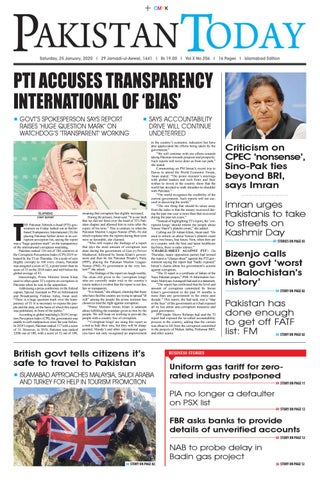
PTI accuses TransParency InTernaTIonal of ‘bIas’ g
Govt’S SpokeSperSon SayS report raiSeS ‘huGe queStion mark’ on watchdoG’S ‘tranSparent’ workinG
ISLAMABAD
T
staff report
he Pakistan Tehreek-e-Insaf (PTI) government on Friday lashed out at Berlinbased Transparency International (TI) for placing Pakistan further down in its corruption perception list, saying the report was a “huge question mark” on the transparency of the international corruption watchdog. Pakistan ranked 120 out of 180 countries in the Corruption Perceptions Index (CPI) 2019 released by the TI on Thursday. On a scale of zero (highly corrupt) to 100 (very clean), Pakistan was assigned a score of 32, a point lower than its score of 33 on the 2018 index and well below the global average of 43. Interestingly, Prime Minister Imran Khan used to often quote TI’s reports on corruption in Pakistan when he was in the opposition. Addressing a press conference in the federal capital, Special Assistant to PM on Information and Broadcasting Firdous Ashiq Awan said: “There is a huge question mark over the transparency of TI. It is necessary to expose the people and the data, on the basis of which this report was published, in front of the public.” According to global watchdog’s 2019 Corruption Perception Index (CPI), the government was unable to curb malpractices since the year before. In 2018’s report, Pakistan ranked 117 with a score of 33. however, in 2019, Pakistan was ranked 120th out of 180, with a score of 32 out of 100,
g
meaning that corruption has slightly increased. During the presser, Awan said: “It is our fault that we did not fawn over the head of TI’s Pakistan chapter and allowed him to retire after the expiry of his term.” This is contrary to what the Pakistan Muslim League-Nawaz (PML-N) did which explains why the reports during their term were so favorable, she claimed. “Who will respect the findings of a report that says the most amount of corruption was done during the government of Gen (r) Pervez Musharraf, followed by Imran Khan’s government and then by the Pakistan People’s Party (PPP), placing the Pakistan Muslim LeagueNawaz (PML-N) government at the very bottom?” she asked. “The findings of the report are laugh-worthy. The clean chit given to the ‘corruption kings’ who are currently under trial in the country’s courts makes it evident that the report is not fair, fair or transparent. “It is biased,” she alleged, claiming that those who have fled the country are trying to spread “ill will” among the people the prime minister has chosen to lead the fight against corruption. “Prime Minister Imran Khan is adamant about fulfilling the mandate given to him by the people. We will keep on working to provide the people with a country free of corruption. “‘Corruption kings’ are using this report as a tool to hide their sins, but they will be disappointed. Moody’s and other international agencies have not only recognised an improvement
SayS accountability drive will continue undeterred in the country’s economic indicators but have also appreciated the efforts being taken by the government.” “We will continue with our efforts towards taking Pakistan towards progress and prosperity. Such reports will never deter us from our path,” she stated. Commenting on PM Imran’s recent trip to Davos to attend the World economic Forum, Awan stated: “The prime minister’s meetings with global leaders and tech firms and their wishes to invest in the country show that the world has decided to walk shoulder-to-shoulder with Pakistan.” “The world recognises the credibility of the current government. Such reports will not succeed in deceiving the world.” “The one thing that should be taken away from the index is that the money recovered during the past one year is more than that recovered during the past ten years.” “Instead of highlighting TI’s report, the ‘corruption kings’ should inform the people about Nawaz Sharif’s platelet count,” she added. Calling our Dr Adnan Khan, Awan said: “he used to inform us about Nawaz’s platelet count every two hours, four hours. Now, when they are in a country with the best and latest healthcare facilities, there is radio silence.” ‘CHARGE-SHEET AGAINST PTI’: On Thursday, major opposition parties had termed the report a “charge-sheet” against the PTI government saying the report had “badly exposed” Imran’s claims about his government’s actions against corruption. “The TI report is a certificate of failure of the Naya Pakistan project,” PML-N Information Secretary Marriyum Aurangzeb had said in a statement. “The report has confirmed that the level and amount of corruption committed by Imran Khan’s government in the past 16 months is more than any government in the entire past decade.” This report, she had said, was a “slap in the face” of the government as it had exposed all its lies about anti-corruption measures and good governance. PPP leader Sherry Rehman had said the TI report had exposed the so-called accountability process in the country, adding that the curtain was about to lift from the corruption committed in the projects of Malam Jabba, Peshawar BRT, and other scams.
British govt tells citizens it’s safe to travel to Pakistan g
iSlamabad approacheS malaySia, Saudi arabia and turkey for help in touriSm promotion
Criticism on CPEC ‘nonsense’, Sino-Pak ties beyond BRI, says Imran imran urges pakistanis to take to streets on kashmir day STORIES ON PAGE 03
Bizenjo calls own govt ‘worst in Balochistan’s history’ STORY ON PAGE 02
pakistan has done enough to get off fatf list: fm STORY ON PAGE 02
business stories
Uniform gas tariff for zerorated industry postponed STORY ON PAGE 11
pia no longer a defaulter on pSX list STORY ON PAGE 12
FBR asks banks to provide details of unverified accounts STORY ON PAGE 12
nab to probe delay in badin gas project STORY ON PAGE 02
STORY ON PAGE 12
Saturday, 25 January, 2020
02 NEWS
BrItIsh govt tells CItIzeNs It’s sAFe to trAvel to PAKIstAN isLAMABAD
I
ISLAMABAD APPROACHES MALAYSIA, SAUDI ARABIA AND TURKEY FOR HELP IN TOURISM PROMOTION
Staff RepoRt
N a major breakthrough, the United Kingdom (UK) has changed its travel advisory for its citizens to reflect the improved security situation in Pakistan as Britons are allowed for travel by road to the North of Pakistan as well as the Kalash and Bamboret Valleys. The announcement is the result of a comprehensive review of UK travel advice for Pakistan, based on a wide-ranging assessment of the country’s security situation. This is the first major update in the travel advice since 2015. The improved security situation allowed for the return of British Airways to Pakistan in June 2019 and the visit by The Duke and Duchess of Cambridge in October 2019. Among other changes, the advice now allows for travel by road to the North of Pakistan as well as the Kalash and Bamboret Valleys. Dr Christian Turner, British High Commissioner to Pakistan said that following his arrival in Pakistan in December 2019, he had made this review of the travel advice a priority. “It is great credit to the hard work of the Government of Pakistan in delivering improved security over the past five years. I am delighted that British nationals will be able to see more of what Pakistan has to offer,’’ he added. The UK Foreign and Commonwealth Office (FCO) provides travel ad-
vice based on objective information to help British Nationals make better informed decisions about foreign travel. The new travel advice for Pakistan reduces the section of the Karakoram Highway where the FCO advises against all travel to the area between Mansehra and Chilas alone (previous travel advice covered the full route from Islamabad to Gilgit). Travellers may bypass this section by taking the alternative route through the Kaghan Valley and Babusar Pass. The FCO no longer advises against all but essential travel to the Kalesh and
BA speaker calls own govt ‘worst in Balochistan’s history’ QUETTA: Balochistan Assembly Speaker Abdul Qudus Bizenjo submitted a privilege motion on Friday against his party members, including Chief Minister Jam Kamal Khan, provincial Finance Minister Zahoor Buledi and Senator Sarfaraz Bugti. Bizenjo’s motion stated that the chief minister’s remarks about him were unnecessary and had hurt him. He said that almost all members of the Balochistan Awami Party (BAP) were unhappy with the government, calling for the formation of another one that consisted of all parties. “Tabdeeli [change] will come in Balochistan,” he said. “A government comprising all political parties should be formed in the province.” The speaker said that he would try to bring about a change from the party within. “The party is not finished,” he said, saying that a name for the candidate of chief minister will be finalised at the appropriate time. “Chief Minister Jam Kamal is a nice man but he cannot take decisions,” he said. Staff RepoRt
Bamboret Valleys. The FCO advises against all travel to most of Balochistan including the city of Quetta. This is except for the southern coast of Balochistan, including the city of Gwadar, where the FCO advises against all but essential travel. Like all FCO travel advice, these changes are based on security assessments, which are kept under constant review. In 2018, there were an estimated 484,000 visits by British nationals to Pakistan. There are 22 weekly direct flights to the UK.
WITH A LITTLE HELP FROM FRIENDS: Pakistan is holding talks with Saudi Arabia, Turkey and Malaysia to bolster tourism, said Foreign Minister Shah Mahmood Qureshi on Friday, a few hours after the UK announced it had eased travel restrictions for British nationals aiming to visit Pakistan. The UK made a major change to its travel advice regarding Pakistan, telling its nationals following a “wide-ranging assessment” that they could now “travel by road to the North of Pakistan as well as the Kalesh and Bamboret Valleys”. FM Qureshi said credit for the change in the UK’s travel advisory goes to the entire nation and its armed forces. “Change in Britain’s travel advisory is a major progress,” he said. “I have spoken to the British foreign minister and we have also held talks with President Trump about it.” The foreign minister expressed the hope that Saudi Arabia, Turkey and Malaysia would help Pakistan in promoting tourism, saying that Islamabad was already in talks with the three countries about tourism investment. “Prime Minister Imran has requested Crown Prince Mohammed bin Salman to help Pakistan by investing in its tourism,” he said. Speaking about the Financial Action Task Force (FATF) development, Qureshi said Pakistan will be taken out of the grey list if the case was heard on its merit.
Pakistan has done enough to get off FATF list: FM News Desk Foreign Minister Shah Mahmood Qureshi on Friday said Pakistan has been largely compliant with the requirements of the Financial Action Task Force (FATF) and that country should in principle be taken off the grey list. The statement came ahead of the FATF review in February: the antimoney laundering watchdog will decide whether or not to keep Pakistan on the grey list. Speaking in Multan, Qureshi said the FATF members appreciated the efforts made by Pakistan during its recent meeting in Beijing. “We presented all of the practical steps we have taken in the past 10 months in front of the member nations. And I am delighted to say that everyone, except India, was happy
with the progress we have achieved,” he added. He said India has remained hostile to Pakistan and not only the country wanted Pakistan to remain on the grey list, it even wanted to push Pakistan to the blacklist. “With this response in view, I hope that all the other FATF members will keep the issue from getting politicised in the upcoming February
meeting in France,” he added. “Pakistan’s image is being enhanced with other countries, as was evident through Prime Minister Imran’s various exchanges with world leaders at the World Economic Forum in Davos,” he added. On the other hand, The Economist, a top international publication has used the word ‘intolerant’ with India’s name in their cover story. He also mentioned that the United Kingdom’s decision to soften its travel advisory for Pakistan is a huge step forward in making the country a tourist attraction. “Japan had already done this [improve its advisory]. The United Nations has also termed Pakistan a family-friendly country. With these improvements, we will see Pakistan emerge as a top tourist spot in the year 2020,” Qureshi said.
NAB to collaborate with FBI, NCA to eliminate corruption ISLAMABAD: The National Accountability Bureau (NAB) has decided to sign an agreement with the US’ Federal Bureau of Investigation (FBI) and UK’s National Crime Agency (NCA) in a bid to eliminate the menace of corruption in Pakistan. According to sources, a draft, prepared by the Ministry of Law and Justice, has been dispatched to the two watchdogs. The documents to contact World Bank and Malaysian AntiCorruption Commission (MACC) are also being finalised for the exchange of information to end corruption. The sources further said that copies of the draft will soon be presented before the federal cabinet. The decision came after Transparency International had expressed satisfaction over the actions of the NAB to eliminate corruption and stated that the anti-graft watchdog performed well under its current chairman Justice (r) Javed Iqbal. According to the report, the Bureau was rejuvenated after it took various initiatives, including adopting the combined investigation team (CIT) system, in order to have collective wisdom in the conduct of inquiries or investigations on merit. The anti-graft agency has collected Rs153 billion from corrupt elements and filed 530 references and its overall conviction ratio in the accountability courts is about 70 percent, the statement noted. Transparency International further outlined recommendations “to end corruption and restore trust in politics” and stated: “it is imperative to prevent opportunities for political corruption and to foster the integrity of political systems.” Staff RepoRt
Women lawmakers to be inducted into KP cabinet PESHAWAR: In a significant development, the Khyber Pakhtunkhwa cabinet is expected to have its first female member after a year and a half into the government. According to reports emerged on Friday, the provincial government has decided to induct at least three female lawmakers into the cabinet upon special directives of Prime Minister Imran Khan, who, according to his aides, has always envisioned gender equality. Sources familiar to the development further said that the female members will be given portfolios of adviser and full minister. A female legislator from the erstwhile tribal areas is also among the members, likely to be make their way to the provincial cabinet. Reportedly, MPAs including Maliha Akbar, Ayesha Bano, Ayesha Naeem, Momina Basit and Neta Mehsud have been nominated for the abovementioned purpose. Pakistan Tehreek-e-Insaf’s (PTI) central leadership is making efforts for the inclusion of the women members, however, the number of lawmakers is yet to be announced. It had emerged last year as well that the PTI government is eyeing its first female cabinet member during the second tenure in the province. Staff RepoRt
Thousands of houbara bustards falling prey to Arab royals AgeNcies Even as Houbara bustard has been declared globally a protective species of birds, thousands of them have fallen to the hunting expeditions of Arab royals and their wealthy friends in Pakistan over the past few months, claimed official sources. Official sources said that since the commencement of hunting season in November, the central government has issued 50 licenses through the foreign ministry to Arab royals form Saudi Arabia, United Arab Emirates (UAE), Qatar, Bahrain, and others. The hunting season will end in February. In search of warm weather and food, migratory birds including rare species start to swarm Pakistani planes and its lakes every year in winter to avoid freezing temperatures in their primary abode in Siberia. The houbara species is officially known as MacQueen’s bustard or Asian bustard. According to government sources, the latest license was issued to Maj Gen Sheikh Ahmad bin Rashid Al-Maktoum, deputy chief of police and general security of Dubai, who is also a member of the ruling family. He was issued a license last week that allows him to hunt birds in the Thar desert of southern Sindh
province for hunting houbara bustard. A permit, issued for 10 days, allows an individual to hunt up to 100 birds during the hunting season. “Officially, the foreign dignitaries have so far hunted 2000-3000 birds, mainly houbara bustards since November”, a senior foreign ministry official told Anadolu Agency requesting, not to be named as he was not allowed to speak to media on the issue. Locals officials, however, say the numbers are much more, as hunters do not always comply with the quota allocated to them by the government. Bhagwandas, a Karachi-based journalist who regularly writes on wildlife-related issues, especially houbara bustard hunting, says that the numbers of birds killed by the hunters always remains just a guess. “The official figures of hunted birds are prepared by a low-ranking wildlife officer who is supposed to be with the hunting party to ensure the implementations of the license conditions. But practically, he cannot even enter the camping site. He simply fills up the paper as per figures provided by the hunters themselves,” he told Anadolu Agency. When contacted by Anadolu Agency, a senior official of the Pakistan chapter of World Wildlife Fund (WWF) for Nature, refused to comment on the issue. ” We avoid commenting on the issue because of cer-
tain reasons,” he said. Foreign Office spokesperson, Aisha Farooqui, despite repeated reminders, did not respond to the questions sent to her by Anadolu Agency to get the government version and the exact number of hunted birds. Earlier this month, local media reported that Crown Prince of Abu Dhabi Mohammed bin Zayed Al Nahyan was on a hunting expedition in the northeastern Rahimyar Khan district. In 2015, the Governor of Saudi Arabia’s Tabuk province, Fahd bin Sultan bin Abdul Aziz, — had sparked a row, when an official report leaked to the local media stated that his entourage had hunted 2,100 houbara bustard, which was 20 times more than the quota allocated to him. Trained falcons are also employed for hunting the endangered bird which is found in the south, southwestern and northeastern Pakistan. Arab royals frequently visit Pakistan at the invitation of local politicians and government officials, who arrange hunting safaris. The sprawling deserts of Thar and Cholistan are the favorite hunting spots for the Arab hunters. Some argue the hunting activities of the wealthy Arab Sheikhs contribute to employment opportunities and improvement in local infrastructure. In Rahimyar Khan district in the Punjab province, the Arab royals have constructed hospitals,
CMYK
roads, and other facilities. The city even has an international airport known as Shaikh Zayed bin Sultan Al Nahyan Airpor- because of the hunting expeditions. “They (hunters) do contribute to the local development, especially in terms of construction of hospitals, mosques, and other infrastructure. The locals get jobs during the season. But hunting an endangered bird cannot be justified in the name of gets jobs and development works. In the long run, it imbalances the ecological system and hence has long term effects on the local economy as well,” said Bhagwandas.
Saturday, 25 January, 2020
NEWS
CrItICIsM oN CPeC ‘NoNseNse’, sINo-PAK tIes BeyoND BrI: PM
P
News Desk
RIME MINISTER Imran Khan has rejected the notion that Beijing’s Belt and Road Initiative was a debt trap for Pakistan and termed the critcisim against the China-Pakistan Economic Corridor as ‘nonsense’. Speaking to CNBC along the sidelines of the World Economic Forum 2020 (WEF) in Davos, the premier underscored Islamabad’s gratefulness to China’s help. He said Pakistan had “hit rock bottom” when the “Chinese came to help us with the BRI and then CPEC.” “We’re really glad the Chinese came and rescued us,” he said and added that the money pumped in by China is “barely five or six per cent” of the country’s total loans. “This is nonsense that China indebted us,” he asserted. He added that China had in fact helped with investment and also provided an opportunity to attract more investment. “We’ve created these special economic zones where we are giving special concessions to industries.” PM Imran said Sino-Pak ties were beyond BRI. “There is also technology transfer under CPEC. Especially in agriculture because Chinese technology is much better. Our productivity is very low. They are also developing skills centres in Pakistan,” he said. “They’re really helping us,” he continued. “We’re grateful.” TRUMP MEDIATION: When asked about the possible role of US President Donald Trump to curtain Narendra Modi-led government’s anti-minority rhetoric in India, PM Imran said he believed Kashmir to be a far more serious problem that the world realised. Shedding light on the Occupied Jammu and Kashmir situation, the premier highlighted that eight million people were under siege since August 5 when the Modi government revoked IOJ&K’s autonomy.
“I say it’s a serious situation because I’m worried it would spill over… already their army chief has given a statement that the Pakistani side of Kashmir belongs to India.” “These are two nuclear-armed countries,” he stressed. “That’s why I want Trump – head of the most powerful country in the world – to intervene right now.” He said the United Nations came into being to resolve conflicts. Elaborating on the possible course the international community can take to contain the situation, the premier said the UN and UN Security Council should act as deterrents and “stop this nonsense”. “India passed two legislations that have alarmed 200 million Muslims in India,” he continued. He added that the ongoing protests in India were joined by non-Muslims including minorities and intellectuals because “they realise where this is headed”. Responding to host Hadley Gamble’s question if the situation in India was on the same lines of Uighurs in China, Imran pointed out that New Delhi had already passed an Act that deregistered 200 million people in Assaam. “And because two million out of those were Hindus, the Bharatya Janata Party (BJP) legislated Citizens Amendment Act 2019.” “Is this leading to genocide?” asked Gamble. “In Kashmir, I am scared,” said Imran. “It’s a disputed territory between Pakistan and India – confirmed by UN resolutions that add that a Kashmiri referendum could decide who they want to join. “Now the disputed territory has been annexed by India,” he continued. “They are trying to change the demography of Kashmir – which is a war crime according to the fourth Geneva Convention.” Reflecting on the estranged ties between Washington and Islamabad, Imran blamed former military dictator General (r) Pervez Musharraf’s over ambitiousness. “Why did the ties between Pakistan’s security forces and the US suffer? I did not want Pakistan to become
a part of the war on terror post 9/11 because Pakistan had nothing to with it. There was no Pakistani involved, the al Qaeda were in Afghanistan. I felt why are we going in this war?” “Initially,” he continued. “There was this romance because Musharraf was fighting US’ war. After a while when he could not deliver – and he could not deliver. He should never have promised he could deliver what was beyond him.” “He could not win the war in Afghanistan for the Americans,” he asserted. “No one could.” But they kept asking him, he added. “And he [Musharraf] kept promising. So that’s where the mistrust began.” Imran emphasised that this time things were different. “This time it’s based on common objectives – on the fact that I always believed there was no military solution in Afghanistan and Trump shares the idea.” The premier said that he and Trump were both working towards a peace process. “We’re trying our best. It’s not easy – its 19 years of turmoil. But it is the only way.” Imran said he was convinced the Afghan Taliban and the Afghan government could work out a political settlement if they sit on a negotiating table. STABILISING ECONOMY: Elaborating on the first year of his govern-
ment, Imran said it was spent on stabilising the economy. “We inherited a bankrupt economy with huge fiscal and current account deficit… Our currency lost value – but fortunately, it stablised without any government support and found its market value. Imran said the market sentiment had improved. “It’s the highest in one year while foreign direct investment (FDI) increased 200% in one year.” The premier said the country was headed in the right direction. “[We are headed] towards an export-led growth rather than a consumption or import-led growth. Which is why we had the imbalance and had to go to the International Monetary Fund (IMF).” Imran said the tough economic decisions are the only way to get out of the 30-year cycle to rely on IMF loans. “I feel we are on the right track,” he explained. “The only thing is that people are hurting because of the measures we’ve taken.” Imran said now that the economy had been stablised, the government was concentrating on growth and creating employment. Responding to a question regarding business community’s reservsations, Imran said the people he held responsible for corruption was “always the political elite”. “If the political elite is clean then there won’t be chronic capitalism. The problem in Pakistan was that we had two political houses that competed in syphoning off money out of the country.” Imran stressed that the system fails because of a corrupt political leadership. “It’s not the business community I blamed. In fact, this is the first government to go out of its way to promote industrialisation since the 1960s.” The premier reiterated Pakistan Tehreek-e-Insaf government’s commitment to eradicating anti-profit making policies. “Making money was considered a crime… now we are doing everything possible for people to make profit.” He said it was important to make profit if the country wanted to attract investment.
COAS inaugurates state-of-art electronic warfare testing lab in KP RAwALPiNDi Staff RepoRt
Army chief General Qamar Bajwa on Friday inaugurated state-of-the-art Electronic Warfare (EW) and Ground Surveillance Radar (GSR) testing laboratories in Khyber Pakhtunkhwa, the military said. The ceremony was held during his visit to the National Radio Telecommunication Corporation (NRTC), an Information Communication Technology (ICT) & electronic equipment manufacturer and solution providers to public and private sectors, in Haripur. General Bajwa lauded the role and unrelenting ef-
forts made by NRTC during the last three years, and assured his full support in its “innovative initiatives”. Separately, Japan’s Senior Deputy Minister for Foreign Affairs, Kanasugi Kenji called on General Qamar Bajwa at the General Headquarters in Rawalpindi. “During the meeting matters of mutual interest, overall regional situation and bilateral cooperation in various fields were discussed,” according to the military’s media wing. The Japanese minister appreciated Pakistan’s contributions for conflict prevention in the region, and pledged to keep working for better relations between the two countries.
03
PM Imran returns after attending Davos summit ISLAMABAD: Prime Minister Imran Khan arrived in Islamabad on Friday after the conclusion of his three-day official visit to Switzerland where he participated in the World Economic Forum’s (WEF) annual session. The prime minister, in his keynote address at the WEF’s special session, highlighted his vision of Pakistan as an emerging economy and shared his views on current issues of regional and international importance. On sidelines, Imran Khan held meetings with world leaders including US President Donald Trump, German Chancellor Angela Merkel, Azerbaijan President Ilham Aliyev, Singapore Prime Minister Lee Hsien and European Union Parliament President David Sassoli. He also met International Monetary Fund (IMF) President Kristanline Georgieva, Asian Development Bank President Masatsugu Asakua and WEF Executive Chairman Prof. Dr Klaus Schwab. The prime minister also met corporate heads of several leading and discussed prospects of collaboration particularly in Pakistan’s information technology, communications and other sectors. In the domain of information technology, he held meetings with CEO YouTube Susan Wojcicki, CEO Facebook Sheryl Sandberg, CEO Siemens Joe Kaeser, Chairman Calik Holding Ahmet Calik, CEO SAP software company Christian Klein, Chairperson Telenor and Director General GSMA mobile operating company Mats Ganyrd. In an interview with CNBC’s Hadley Gamble, Imran Khan highlighted Pakistan’s stance on important issues. Staff RepoRt
PM urges Pakistanis to take to streets on Kashmir Day Prime Minister Imran Khan has called upon Pakistanis living in the country and abroad to take to the streets on February 5, Kashmir Day, in support of the people of Indian Occupied Kashmir (IOK), who have been living under a complete lockdown since August 5 when New Delhi revoked the valley’s semi-autonomous status. He made the appeal a day after Foreign Minster Shah Mahmood Qureshi announced a vigorous campaign to effectively highlight the Kashmir cause. “I want Pakistanis at home and abroad to come out on 5th Feb in support of the 8 million Kashmiris who have been besieged by 900k Indian soldiers for almost 6 months by the fascist racist Modi regime,” the premier tweeted on Friday. The foreign minister had announced that the government would initiate the Kashmir campaign from January 25, which will continue till February 5 to express the solidarity with the “oppressed” people of the occupied valley. As part of the initiative, PM Imran would address the AJK legislative assembly, as well as a public gathering in Muzaffarabad on Kashmir Day. NewS DeSk
Sikandar Sultan Raja notified as Chief Election Commission isLAMABAD Staff RepoRt
The government on Friday notified Sikandar Sultan Raja as the Chief Election Commission (CEC) for a five-year term. A notification issued by the Ministry of Parliamentary Affairs said President Arif Alvi green-lighted the appointment under Article 213 and 215 read with Article 48 of the Constitution. In another notification, the president
also confirmed the appointment of Nasir Durrani and Shah Mohammad Jatoi as members of the Election Commission of Pakistan from Sindh and Balochistan, respectively. The appointments come in light of the November 2, 2019, order issued by the Islamabad High Court (IHC). On August 22, President Arif Alvi appointed Khalid Mehmood Siddiqui as ECP member for Sindh and Munir Ahmed Kakar for Balochistan against the positions vacated by Soomro and Baloch, from the
two provinces. However, both of them were denied the oath. In November, the Islamabad High Court (IHC) suspended the notification of their appointment on a petition from PML-N MNAs Murtaza Javed Abbasi and Dr Nisar Cheema. On January 15, the Islamabad High Court had granted 10 more days to the government to finalise the ECP appointments.’ The Constitution mandates that when the ECP positions fall vacant, they must be filled within 45 days by the gov-
ernment in consultation with the opposition, but the talks between the two sides remained deadlocked as they rejected each other’s nominations. Raja was nominated for the CEC post by Prime Minister Imran Khan, who withdrew his previous three names to break the impasse in the committee. Three more names on the table were from Opposition Leader in National Assembly Shehbaz Sharif. Imran floated the names of retired bureaucrats, Jameel Ahmed, Fazal Abbas
Maken and Sikandar Sultan Raja, in an effort to reach elusive consensus with the opposition. The opposition had refused to support his three earlier nominations — Babar Yaqoob Fateh, Arif Khan and Fazal Abbas Maken. The opposition was pushing for its nominees for the CEC post, Nasir Mahmood Khosa, Jalil Abbas Jilani, and Akhlaq Ahmad Tarar – none of whom could win government’s endorsement. The PPP had proposed the name of former attorney general Irfan Qadir.
04 ISLAMABAD
Saturday, 25 January 2020
WEATHER UPDATES SATURDAY
160C 060C
SUNDAY
180C 050C
MONDAY
190C 020C
12 BOttleD water BraNDs DeClareD UNsafe ISLAMABAD
P
APP
AKISTAN Council for Research in Water Resources (PCRWR) in its water quality monitoring report from October-December, 2019 has declared 12 bottled water brands as unsafe. According to the monitoring report, 102 samples of Mineral/Bottled water brands have been collected from Islamabad, Karachi, Multan, Lahore, Peshawar, Bahawalpur, Tando Jam, Quetta, Faisalabad, Sialkot and Muzaffarabad. The task of monitoring and improving the quality of bottled water was given to PCRWR by Ministry of Science and Technology. PCRWR monitor the quality of mineral/bottled water brands quarterly and publicize the results. Comparison of analytical findings with permissible limits of Pakistan Standards and Quality Control Authority (PSQCA) has revealed that six brands (i.e. Shukran, Droplet, Defence, Vinh, Aqua Ayolam and Livon) were found to be unsafe due to presence of higher levels of sodium ranging from 64-250 mg/L than PSQCA water quality standard for sodium (50 mg/L). Four brand (i.e. Blue Plus, Defence, Aqua Drop,
Aqua Ayolam and Stream) were found unsafe due to the presence of low level of pH. Whereas, the two brands (i.e. Karakorum Flow and Top Up) were found contaminated with bacteria and Livon with high level of fluoride. The poor quality of drinking water has forced a
large cross-section of citizens to buy bottled water. As a consequence of this expanding market a mushroom growth of bottled water industry in the country is witnessed during the last few years. However, many of the mineral/bottled water companies were found selling contaminated water.
NHA clears snow-covered Karakoram Highway for traffic PESHAWAR: National Highway Authority (NHA) has successfully completed its snow clearance operation on Karakoram Highway (N-35), a key route for entire Gilgit Baltistan region and opened it for all kinds of traffic. Similarly, the NHA has also removed snow from the North and South portal roads of Lowari Tunnel located on N-45 where an average 01:00 metre to 01:50 metre snow was recorded. The officers and staff of NHA and personnel of contractor of routine maintenance arranged snow removing machinery including bulldozers, graders and
tractors at affected sites and completed snow clearance operations on emergency basis. As result Lowari Tunnel and access roads have been opened for safe passage, says a press release. It said severe chill spell and heavy snowfall affected the SostKhunjerab section of the KKH. But now pragmatic steps were undertaken and the road was opened to all types of traffic. It is to recall that NHA is endeavouring hard to make its network trafficable in recent severe cold season, and to this effect all resources are being utilized in the best possible manner to facilitate the commuters. APP
Senior cops reshuffled ISLAMABAD: Chief Commissioner of Islamabad on Friday issued a notification for the transfer of high-level officers of the federal capital’s police. According to the notification, nine superintendent police (SPs) and one deputy superintendent police (DSP) have been transferred. SP Muhammad Haroon has been transferred from Counter-Terrorism Force (CTF) to the position of Additional Inspector General (AIG) General. Fazal Hameed has been appointed as Senior Superintendent Police (SSP) CTF who was previously performing duties as AIG General. Syed Zeeshan Haider appointed as SP DPD and Liaquat Hayat Khan was transferred to Special Branch from DPD. Muhammad Sarfaraz Virk was given charge of SP City Zone, Farooq Ahmed as SP CTF, Abdul Wahab as SP SSG, Abdul Razzak as SP AntiRiot Unit (ARU) and DSP Safeer Hussain Bhatti as SP Headquarters. STAFF REPORT
TUESDAY
210C 010C
Body cams to improve police accountability, says IG ISLAMABAD APP
Small body worn cameras have been placed on the uniforms of Islamabad police personnel to prevent increasing incidents of misbehavior with the citizens. In welcoming the proposal, the Inspector-General of Police and other officials in Islamabad Police thanked the present government's positive step for introducing this new technology with police personals and hoped these body cameras can provide evidence against allegations of misconduct and corruption. Inspector General of Islamabad Police talking to private news channel, said that these cameras can also record videos in dark night. He explained the camera will be attached to the shirt pocket of the of the officer and will record all interactions. The conversation clippings will then be submitted to the office of Zonal Superintendent of Police on daily basis. “The camera will also help police officials to coordinate better with the common people of the country,” he said. Initially, the police department has purchased 10 cameras by itself, however, they will soon be provided to patrolling officers and on-duty personnel in police station. Police official said conversations between police and citizens on at check points will be recorded through the cameras. During the next phase, modern cameras will also be part of the staff uniform in the police station. This step is being connected to the Safe City Project. Moreover, the cameras will also help in identification process of terrorists. official further said , “Body worn videos (BWV) will play a vital role in achieving this goal. It will become possible to have live coverage of incidents and those videos will also be used as evidence. The official also mentioned that people sometimes misbehave with officials at check posts and file complaints against them.
Ijaz urges UNODC to allocate funds for terrorism eradication ISLAMABAD APP
Minister for Interior Brig (R) Ijaz Ahmad Shah Friday urged United Nations Office on Drugs and Crime (UNODC) to allocate additional funds to sensitize the masses for terror eradication in the country. ‘Until and unless you motivate the society through education, it is not possible for the government to yield desired results,’ he said while addressing the launching ceremony of ‘Pakistan Terrorism Prevention Programme’, a project rolled out by the Interior Ministry in collaboration with the UNODC to curb the terrorism from the country. Some portion of funds should also be utilized on the rehabilitation of affectees of terrorism like law enforcement personnel, judges and their families. Shah assured his full cooperation to UNODC under the available resources. UNODC chief Masood Karimipour said the minister’s guidance in the project would play central role in execution of the project.
Govt efforts to revive ailing agri sector hailed ISLAMABAD STAFF REPORT
The Islamabad Women's Chamber of Commerce and Industry (IWCCI) on Friday lauded the initiatives of the government to revive the ailing agriculture sector which is the backbone of the economy. It also hailed the decision of the Prime Minister Imran Khan to provide relief of Rs40 billion to farmers by abolishing GIDC for fertilizer industry which will reduce the price of urea bag by Rs400. The government’s move to avoid a further hike in the price of natural gas is good for masses and the economy under the current set of circumstances, said Farida Rashid, President IWCCI. She said that the revival of the distressed agriculture sector will require a new agriculture policy designed according to the ground realities, necessary amendment in the Seed Act to
CMYK
depress sale of substandard seed, reducing the role of middlemen and loan sharks in the rural economy, and discouraging profiteers and hoarders. Farida Rashid said that the largest employment providing sector of agriculture is facing serious problems and it has become a threat to the economy and exports mandating an urgent bailout. She noted that the last year the growth rate of the agriculture sector remained below one percent while a collective decline in crop output was five percent. The situation will remain the same for the current year if a proper intervention by the government was delayed. The major cotton exporter country of Pakistan has become a net importer while four billion dollars will be needed to bridge the shortfall and keep the textile sector running that is the largest export earner and the secondlargest job provider in the country. She said that the twenty percent decline in
cotton output will reduce GDP by 0.5 percent which must be taken seriously. Sugarcane production is also not satisfactory while other crops are facing problems, she said, adding that amendment in Seed Act to end the sale of substandard seed will increase production, reduce the price of agricultural products and income of the farmers. She noted that the prices of agricultural products have increased beyond the capacity of the poor but it has not benefitted farmers as profits are finding their way in the pockets of hoarders. The farming community can only be bailed out of the clutches of loan sharks when banks start providing them affordable loans. She noted that the volume of the agricultural loans is increasing but its benefitting the owners of large holdings. The banks are focusing on only one province for loan disbursements while others are ignored which is hindering uniform development of this critical sector, she said.
Saturday, 25 January, 2020
Will try to get Zainab alert bill paSSed by Senate Soon: Umar ISLAMABAD
p
aPP
AKISTAN Tehreek-e-Insaf (PTI) lawmaker Asad Umar has said the government will make efforts for Zainab Bill to be passed in Senate at earliest. In a media statement, Asad Umar said Zainab bill will pave way for passing other related legislation. He announced that all political parties had voted in favour of the Zainab Alert Bill
when it was tabled in the National Assembly (NA). “We cannot imagine the pain suffered by her [Zainab] parents and now her name will become a law. We will also pass the same legislation in Khyber Pakhtunkhwa (KP). Such bills should also be passed in Sindh and all other assemblies.” “We want to ensure the protection of those children cannot protect themselves. A helpline system is being established to deal with such cases which will ensure immediate actions. It is not enough to only pass laws but also
making changes in the administrative structure. In accordance with our law and religion, the death sentence is given to the culprit involved in a murder.” “Political parties had opposed the death sentence. Even in the United States (US), the death sentence is pronounced over rape and murder.” Earlier on January 10, the National Assembly had unanimously passed the Zainab Alert bill introduced by NA’s Standing Committee on Human Rights which defines the law for the response
Burden of proof always placed on prosecution, says SC ISLAMABAD Staff RePoRt
The Supreme Court (SC) has emphasised that in a criminal case the burden of proof always lays on the prosecution. “Therefore, the court, in the first instance, is to discuss and assess the prosecution evidence, in order to arrive at the conclusion as to whether or not the prosecution has succeeded in proving the charge against the accused on the basis of its evidence,” says a 19-page ruling authored by outspoken judge Justice Syed Mansoor Ali Shah over the significance regarding Article 121, Qanun-e-Shahadat Order (QSO) and Section 342, Pakistan Code of Criminal Procedure (CrPC). The apex court, in its judgement of a murder case, says that in a case where the accused has not taken any specific plea, i.e. self-defence, grave and sudden provocation, etc. or has not produced any evidence in his defence, the court should decide the question of success or failure of the prosecution on the basis of the evidence presented by the prosecution alone. The judgement says that the burden shifts upon the accused under Article 121 of the QSO to prove his defence plea, only when a prima facie case is made out against him by the prosecution on the basis of its evidence. If the prosecution fails to prove its case against the accused, the question of shifting of burden on the accused does not arise, it adds. The top court held that if the prosecution fails to prove its case against the accused, the court can take into consideration the statement of the accused under Section 342 CrPC whether in favour of or against the accused; but it must take into consideration that statement in its entirety and cannot select and place reliance on the inculpatory (a statement which attributes liability on the person making such statement) part of the statement only. “In the last mentioned circumstance, the facts narrated by the accused in his statement under Section 342 CrPC are to be accepted without requiring their proof. The court, however, should examine the said facts in order to give due effect to them under the law. The object of such ex-
amination is to determine whether or not the facts narrated by the accused constitute an offence under the law or fit into any exception of the offence provided under the law,” the verdict says. The court also observed that an admission or confession made in statement under Section 342 CrPC, which is improbable or unbelievable, or is not consistent with the overall facts and circumstances of a case, do not have any probative value and thus it cannot be relied upon by the court to reach a conclusion. The court has highlighted significance of both provisions in this murder case. Ali Ahmad (the appellant) murdered his sister, Rabia Khalil and her paramour, Raheel Arif, in his own house in Toba Tek Singh, in the wee hours of the night (3am) on April 23, 2006. He was booked for offences punishable under Section 302 of the Pakistan Penal Code (PPC). After regular trial, he was convicted and sentenced to rigorous imprisonment for 10 years by the trial court. Upon appeal by the complainant, the high court set-aside the judgment of the trial court, and convicted the appellant under Section 302(b), PPC and sentenced him to imprisonment for life.The high court relied on its ruling in an earlier dispute (Ameer case), saying that it was the case of honour killing and not of grave and sudden provocation, without fully appreciating the difference between the two. The apex court, however, says that in case of honour killing the act of murder is well thought out, calculated and pre-mediated, while in case of grave and sudden provocation the act is committed on the spur of the moment with no prior deliberation or planning. It said that reliance by the high court on Ameer case was misplaced as the murder in that case was pre-meditated. “Our culture and social values reflected in the jurisprudence developed so far is that an act of illicit sex with a female family member of the offender is considered sufficient to cause provocation so grave and sudden that it would deprive the offender of the power of self-control,” says the apex court judgment. The Supreme Court, setting aside the high court order, restored the trial court judgment. It, however, revised the appellant’s sentence to 15 years.
Sherry says will not allow Senate to become a rubber stamp ISLAMABAD: Parliamentary leader of Pakistan People’s Party (PPP) in the Senate, Sherry Rehman on Friday said promulgating ordinances while the House is in session is bad practice and we have repeatedly said this. “We are not here to compete how many ordinances each government passed. There cannot be any legislation while the committees are being neglected,” she added. INP
Court green-lights airing of ‘Mere Pas Tum Ho’ finale in cinemas LAHORE Staff RePoRt
A local court on Friday rejected an application to stay the airing of final episode of television drama serial “Mere Pass Tum Ho”. Civil Judge Naila Ayub heard the application filed by the petitioner, Maham, in a pending suit against the drama. During the proceedings, the petitioner’s counsel requested the court to stay the airing of final episode of the drama as women were being ridiculed as a part of society in it. He added that the drama was against the injunctions of Islam. He then asked the court to restrain the channel from airing the last episode of the drama serial in cinemas across the country on Jan 25. However, a counsel on behalf of pro-
and recovery of missing children. The government and opposition have unanimously passed Zainab Alert bill which will pave the way to penalise culprits in crimes against children from 1014 years to life imprisonment. A helpline 1099 will be established under the law besides constitution of an agency to take immediate action after responding complaints about abduction, murder and rape of minor children, read the bill, adding that the officer will also get penalised over failure to respond within two hours.
duction team opposed the request. He argued that as per law, the court did not have the jurisdiction for hearing the matter. He submitted that if the petitioner had any grievance then she should approach the relevant forum. He submitted all the episodes of the drama had been broadcast and now the last episode was going to be aired in cinemas on Jan 25. He submitted that the provincial censor board had also issued clearance certificate to the drama, therefore, no case was made out. He submitted that there was no element which show that the drama was inappropriate for the society. Subsequently, the court dismissed application to stop the airing of final episode of the drama. The court also adjourned the suit for Feb 17, and sought written reply from the respondents.
CMYK
NEWS
05
Shehbaz calls out PM Imran over rude remarks against Rana Sana Opposition Leader in the National Assembly Shehbaz Sharif on Friday criticised the choice of words used by Prime Minister Imran Khan to describe Pakistan Muslim League-Nawaz (PML-N) Punjab President Rana Sanaullah Khan. Shehbaz, who is also the president of PMLN, said he condemned the rude remarks uttered by Prime Minister Imran. “I would not condone such language even if it is used against Imran Khan himself,” he added. Earlier in the day, Shehbaz Sharif, reacting to Transparency International’s report on 2019 Corruption Perceptions Index (CPI), said that corruption in the country increased in 2019 as compared to 2018. Talking to journalists, he said the country had improved its position on the graft perceptions index during the previous term of former premier Nawaz Sharif. NewS DeSk
Saturday, 25 January, 2020
06 WORLD VIEW
The new IranIan general To waTch PRIOR TO HIS APPOINTMENT AS SOLEIMANI’S SUCCESSOR AS QUDS FORCE CHIEF, QAANI WAS ONE OF SOLEIMANI’S KEY DEPUTIES RESPONSIBLE FOR THE QUDS FORCE’S ANSAR CORP, COVERING AFGHANISTAN, PAKISTAN AND CENTRAL ASIA ON BEHALF OF THE QUDS FORCE PoliTico
T
MAttHEw LEVitt
He US killing of Gen Qassem Soleimani earlier this month deprived Iran of one of its most singular leaders, and created new questions about Iran’s strategy of building and maintaining its power in the region. Without its charismatic and highprofile commander, would Iran be forced to retrench and pause? Or would it find new ways to lash out? Now the strategy is coming into view, and it gives a window into what Iran is doing—and what challenges the U.S. faces. Soleimani mattered because he headed the Quds Force, the external operations arm of Iran’s Islamic Revolutionary Guard Corps—a machine dedicated under Soleimani to pushing U.S. and other Western forces out of the region and ensuring Iran’s position as the regional superpower. To this end, Soleimani spearheaded Iran’s effort to build a network of proxies—effectively, a foreign legion of non-Iranian Shia militants beholden to Tehran—which he commanded in a very direct manner. He was difficult to replace, but Iran has begun the job. First was Gen. esmail Qaani, Soleimani’s deputy, who was quickly promoted to head the Quds Force in Soleimani’s stead. This week, Iran announced a new and potentially more telling promotion: The new Quds Force deputy commander will be Gen. Muhammad Hussein-Zada Hejazi, who most recently commanded the Quds Force’s Lebanon Corps, overseeing Iran’s ties to Hezbollah and the Quds Force activities throughout the Levant more broadly. The message behind Hejazi’s promotion is clear: Soleimani may be dead, but the Quds Force he led lives on, and is taking active measures to ensure it is able to continue pursuing the regional strategy he championed. Forced to rebuild the proxy management and command and control mechanisms that Soleimani once ran himself by force of personality and longtime connections, Iran is developing a new strategy to oversee what Supreme Leader Ali Khamenei described as “fighters without borders.” And the strategy comes down to this: Since no one commander can replace Soleimani, Iran’s proxy network will now be run by committee, with the Quds Force cobbling together a crew of its more senior and experienced managers to collectively fill the roles
Soleimani had taken on himself. Key leaders of Iranian proxy groups, especially Hezbollah’s Hassan Nasrallah, are sure to play major roles. But policymakers should pay especially close attention to personnel shifts and promotions within the Quds Force itself. In some ways, Soleimani proved to be Iran’s single point of failure; removing him from the equation left an oversized gap in Iran’s regional strategy. In the past few years prior to his death in a Jan. 3 drone strike, Soleimani became the public face of a previously secret organization running a network of covert proxy militant groups. In the wake of the Arab Spring, the Syrian civil war and the rise of the Islamic State in Syria and Iraq, Tehran saw an opportunity and tapped Soleimani to build up Iran’s regional proxy alliances. A charismatic leader, Soleimani developed a devoted following among Iranian proxy groups, including both their leaders and foot soldiers. Soleimani was a hands-on commander, playing direct and personal roles in key operations, establishing personal bonds with key militia commanders, and mediating between their sometimes banal disagreements over funding stream or prestige. Soleimani was uniquely qualified to play such a role, but his successor, esmail Qaani, is not. More bland bureaucrat than charismatic leader, Qaani is unlikely to be able to fill all the same roles and responsibilities as Soleimani. Perhaps the most critical area of operations for the Quds Force today is the Levant, and the appointment this week of the head of the Quds Force’s Lebanon Corps, also known as Department 2000, is therefore highly significant. Prior to his appointment as Soleimani’s successor as Quds Force chief, Qaani was one of Soleimani’s key deputies responsible for the Quds Force’s Ansar Corp, covering Afghanistan, Pakistan and Central Asia on behalf of the Quds Force. For all his exposure to Central Asia, Qaani lacked deep experience in the Arab world. When he was designated as a terrorist by the Treasury Department in 2012, it was in the context of his role as a logistician sending money and weapons to Hezbollah in Lebanon and Quds Force elements in Africa. Qaani reportedly does not speak Arabic and would not be well suited to be the Quds Force commander tasked with replacing Soleimani as point man for Iran’s intimate operational relationship with Iran’s proxies in Iraq, Yemen, and espe-
cially Syria and Lebanon. enter Hejazi, appointed Quds Force deputy commander this week. Hejazi boasts a long career in the Quds Force, which he reportedly joined at its founding in 1979. In 1980, Hejazi was reportedly among the IRGC forces— along with Soleimani and Qaani—dispatched to fight Iranian Kurdish groups in the north. Hejazi rose through the ranks, becoming deputy and later commander of the IRGC’s Basij Militia. He led the Basij militia for almost nine years, during which the Basij and vigilante groups it supported were implicated in a long list of human rights abuses. In September 2007, Hejazi was appointed IRGC chief of staff, and a month later the Treasury designated Hejazi a terrorist (along with Soleimani and other IRGC officials) for his role in Iran’s proliferation of weapons of mass destruction. Hejazi went on to hold several other senior military leadership positions, including deputy to the IRGC commander and deputy chief of staff of Iran’s armed forces. Hejazi also headed the IRGC’s Sarollah Corps in Tehran, which the Council of europe noted “played a central role in post-election crackdowns” in 2009. The Council further noted that Hejazi authored “a letter sent to the Ministry of Health on 26 June 2009 forbidding the disclosure of documents or medical records of anyone injured or hospitalized during post-election events, implying a cover up.” As a result, the european Union sanctioned Hejazi in 2011 for his role in human rights abuses in Iran.
As Iran’s regional strategy shifted toward more aggressive regional asymmetric warfare, Soleimani needed an experienced hand to oversee the Quds Force’s quickly expanding operations in the Levant. Hejazi next took over command of the Quds Force’s Department 2000, overseeing all Quds Force operations in the Levant. This includes not only Quds Force support to Hezbollah, but also its support of Palestinian terrorist groups like Hamas and the PFLP-GC. It is also responsible for overseeing Quds Support to the Assad regime in Syria. Against the backdrop of the chaos of the Syrian civil war, Iran decided around 2013 to ship precision-guided missiles, through Syria, to Hezbollah in Lebanon. Iran hoped these arms transfers would be concealed in the fog of the Syrian war, but Israeli airstrikes foiled some of these convoys and by early 2014 the press got wind of the Iranian missile program. According to Israeli authorities, at first the Iranian strategy involved shipping fully assembled precision guided missiles to Hezbollah, but then shifted gears and sought to smuggle missile parts that could then be assembled in Lebanon. In 2019, Hezbollah and the Quds Force upgraded the project by building manufacturing and conversion facilities in several locations throughout Lebanon, according to Israeli authorities; this included sending key Quds Force personnel to live and work in Lebanon, overseeing the day-to-day operations. In August 2019, the Israel Defense Forces publicly released details of this effort, including the names and photographs of three key
Quds Force operatives. Chief among these was Hejazi, who had moved to Lebanon along with his family to oversee the project. Iran’s Fars News does not dispute the Israeli account, saying that “in recent years [Gen. Hajazi] has also been field officer on one of the Axis of Resistance fronts.” The new decision to pull Hejazi back from Lebanon, where the precision guided missile project remains a Quds Force and Hezbollah priority, is a telling example of how Iran plans to try to fill Soleimani’s oversized shoes, keeping a priority on its efforts to arm and support militant groups in Lebanon and Syria. Another person to watch will be Gen. Abdel Reza Shahlai, currently the senior Quds Force officer in Yemen but someone with extensive command experience in Iraq as well. Shahlai was reportedly targeted in a separate operation in Yemen the same night Soleimani was killed, but he survived and went into hiding. Designated a terrorist by the Treasury for his role in a 2011 assassination plot targeting the Saudi ambassador in Washington, D.C., and the subject of a $15 million bounty from the State Department’s Rewards for Justice progam, Shahlai “has a long history of targeting Americans and U.S. allies globally,” according to the State Department. The promotion of an experienced old hand like Hejazi, who has both experience in the Levant and hard-line regime credentials at home, underscores the likelihood that the Quds Force’s marching orders are to press on with Soleimani’s aggressive regional campaign of asymmetric proxy warfare. Rather than retrenching, Iran is signaling that it’s likely to rely even more on the Quds Force’s “fighters without borders” as a means of exerting influence throughout the region. Speaking after Soleimani’s death, Hezbollah leader Hassan Nasrallah called on Iran’s proxies—the “Axis of Resistance,” as he called them—to step up operations to force US forces out of the region. America’s regional allies are also likely targets as Tehran seeks to raise the cost of siding with the United States and housing U.S. forces. For the residents of Iran’s neighbors abroad, the message is clear: Buckle up. Dr. Matthew Levitt is the FromerWexler fellow and director of the Reinhard program on counterterrorism and intelligence at the Washington Institute for Near East Policy. He is the author of Hezbollah: The Global Footprint of Lebanon’s Party of God.
SENATE REMOVAL OF TRUMP IS COMPLETELY POSSIBLE SUPPORT FOR TRUMP’S REMOVAL WAS AT 50% IN A FOX NEWS POLL LAST MONTH, AND STANDS AT 51% IN CNN’S LATEST POLL USA TodAy Scott Dworkin
There is a lot of talk about how there's no chance of impeached President Donald Trump getting removed. I’m here to tell you that there is absolutely, without a doubt, a chance this Senate could remove Trump from office. But it all starts with believing it can actually happen. Many Americans prefer settling before going to trial in a complicated legal matter, and that’s because anything can happen in court. That’s why Trump likes to settle, whether it's the $2 million penalty for his charitable frauds or $25 million for his fake university. If we don’t realize there is a real chance that he could be removed, we will not have the energy to get there. We all need to know and truly believe that if enough Americans speak out, he will be removed. People also said impeachment was impossible. Before that, they said we will never get a special prosecutor to investigate Trump’s Russian ties while under full GOP control. We will never win in Alabama, Kentucky or Virginia. We will never win back the House. All things Democrats succeeded at.
Today, people talk about the 2016 election results as if 2018 didn’t send a crystal clear signal across the country, one still motivating a massive resistance that is ready to march to the polls in 2020. NO GOP CHOICE BUT TO REMOVE TRUMP Republicans are already losing from almost every angle because their undying loyalty to one man — Trump — is more important to them than their oaths of fealty to the Constitution, their office or their constituents. But this group of Senate Republicans is the last bulwark in our constitutional system, and they are people, and the stakes here are a lot higher than getting a bunch of conservative judges. This is our time to be louder than we ever have been as a country. It’s time for us to make these GOP senators realize they have no choice but to convict Trump and remove him from office. Fewer than two dozen people stand between Trump and his removal, and that’s if all 100 senators are in the chamber. The Constitution says, "No person shall be convicted without the concurrence of two-thirds of the members present." That means Republican senators could literally walk out on Trump and tip the balance of the scales. A public airing of the complete body of evidence will centralize the truth around a single narrative, and
that’s exactly what this trial is doing. What we need to do is turn up the heat on Republicans to do the right thing. Tweets, letters, calls, office visits, protests, people questioning their public officials and demanding that these people do their job: Deliver impartial justice. And if they are immoral enough to still support Trump despite overwhelming sworn evidence, and the witnesses we are counting on to appear before the Senate, they will abandon him too if the pressure becomes too much and public opinion moves. President Richard Nixon was so popular that he won 49 states in 1972. But support for his removal was at nearly 50% by the summer of 1974, following months of extensive Senate hearings. They had laid out the case against Nixon, much like the abbreviated hearings late last year by the House Intelligence Committee. Public opinion now is similar: Support for Trump’s removal was at 50% in a Fox News poll last month, and stands at 51% in CNN’s latest poll. In Nixon’s case, it was his October 1973 purge of legal officials — the Saturday Night Massacre — that began to galvanize public opinion against him and led to his ouster a year later. Polling clearly indicates that public opinion turned on Trump after his plea to Ukraine, and bizarrely to his foe China, to conduct baseless investigations into the Bidens.
BLACK CLOUD OVER AN ELECTION When Nixon’s “smoking gun” tapes finally emerged, public support for removal grew to 57% — only 6 percentage points higher than support for Trump’s removal today. That’s what took down President Nixon. One final, key piece of evidence came out: the tapes. Nixon lost the battle for public opinion, and that made his position untenable. Support for removal rose, his approval ratings sank, and Senate Republicans saw the 1974 elections rushing toward them with Nixon’s black cloud over their party. The pressure was too much for the GOP to bear. Bringing the pressure to get there now, with Trump? That’s on us. Now is the time we need to push harder than ever for Republicans to step up to choose country over party. It has never been the job of former President Barack Obama or House Speaker Nancy Pelosi to get Trump out of office. It has always been on us. But it all starts with believing that removal can happen at this trial. Because if there’s one thing that Americans and resisters have collectively learned in the past five years, it's that anything can happen — and that surprises run in both directions. Scott Dworkin is an author and co-founder of The Democratic Coalition. He was a deputy director for the 2009 Presidential Inaugural Committee and the 2012 Democratic National Convention, and a senior adviser to the Draft Biden and Run Warren Run campaigns.
Saturday, 25 January, 2020
FOREIGN NEWS 07
‘No, No AMeRicA’: iRAqi pRoTesTeRs deMANd Us MiliTARY pUlloUT BAGHDAD
T
AGENCIES
HOUSANDS of Iraqis rallied at two central Baghdad intersections on Friday after a prominent cleric called for a “million strong” protest against the American military presence, following the U.S. killing of an Iranian general and an Iraqi militia chief. The initial march appeared not to gather further steam, however, largely dissipating after several hours. Some protesters headed to join separate antigovernment demonstrators at Baghdad’s Tahrir Square, and others boarded buses to go home. The march called by Moqtada al-Sadr aimed to press for a pullout of U.S. troops. Many anti-government protesters feared it could overshadow their separate, months-long demonstrations that have challenged Iran-backed Shi’ite groups’ grip on power. Iraq’s top Shi’ite Muslim cleric, Grand Ayatollah Ali al-Sistani, later called in his weekly sermon for political groups to form a new government as soon as possible to bring stability to the
country and enact reforms to improve Iraqis’ lives. Sadr, who commands a following of millions in vast Baghdad slums, opposes all foreign interference in Iraq but has recently aligned himself more closely with Iran, whose allies have dominated state institutions since a 2003 U.S.-led invasion. Sadr supported anti-government
protests when they began in October, but did not publicly urge his followers to join them. The demonstrations have since taken aim at all groups and figures that are part of the post-2003 system including Sadr, who although often considered an outsider is part of that system, commanding one of the two largest
blocs in parliament. Some lawmakers and protesters say the new, anti-U.S. element to public unrest distracts from the aim of toppling the corrupt political elite and could fuel more violence. Throngs of marchers started gathering early on Friday at al-Hurriya Square in central Baghdad and near around the city’s main university, Reuters witnesses said. Marchers avoided Tahrir square, symbol of mass protests against Iraq’ ruling elites. “We want them all out – America, Israel, and the corrupt politicians in government,” said Raed Abu Zahra, a health ministry worker from southern city of Samawa, who arrived by bus at night and stayed in Sadr City, a sprawling district of Baghdad controlled by the cleric’s followers. “We support the protests in Tahrir as well, but understand why Sadr held this protest here so it doesn’t take attention from theirs,” he added. Men and women marched waving the red, white and black national colors, and chanted slogans against the United States, which leads a military coalition against the Islamic State militants in Iraq and Syria.
Trump to unveil long-stalled Middle East peace plan ahead of Israeli leaders’ visit MIAMI/JERUSALEM AGENCIES
U.S. President Donald Trump said on Thursday he will release details of his long-delayed peace plan for the Middle East before Israeli Prime Minister Benjamin Netanyahu and his election rival Benny Gantz visit the White House next week. The political aspects of the peace initiative have been closely guarded. Only the economic proposals have been unveiled. Trump discussed the timing of the plan’s release with two architects of the plan, senior advisers Jared Kushner and Avi Berkowitz, on Air Force One while returning to Washington from Switzerland on Wednesday. Speaking to reporters on Air Force One en route to the Miami area for a political event, Trump said Palestinians might react negatively to his plan at first, but that “it’s actually very positive for them.” “It’s a great plan,” said Trump, who will meet with Netanyahu at the White House on Tuesday. “It’s a plan that really would work.” Vice President Mike Pence, on a visit to Jerusalem, extended an invitation to Netanyahu and Gantz to make the visit. It was not immediately clear whether Trump would meet the two leaders separately or together. The Trump Middle East peace proposal is a document, dozens of pages long, that addresses in detail the thorny political issues between Israel and the Palestinians, such as the status of
Jerusalem. U.S. officials made no mention of inviting the Palestinians, and Nabil Abu Rudeineh, a spokesman for Palestinian President Mahmoud Abbas, said: “We warn Israel and the U.S. administration not to cross any red lines.” Trump indicated his administration had spoken “briefly” to the Palestinians and would speak to them again “in a period of time.” Netanyahu said he had accepted the U.S. invitation. His office said he would fly to the United States on Sunday. A Gantz spokesman did not respond when asked whether Gantz had accepted Trump’s invitation. Netanyahu, a veteran right-wing Israeli leader, faces political and legal troubles at home – he is heading for his third election in less than a year, and was indicted on criminal charges in November. He denies any wrongdoing. Israeli political analysts viewed Trump’s invitation as a boost to Netanyahu, his right-wing ally. Netanyahu’s principal domestic political rival Gantz, a centrist former general, this week lifted his objection to having the peace plan be published before Israel’s March election. He had previously objected to it as interference in the vote. LONG-DELAYED PLAN: The launch of Trump’s plan to end the decades-long conflict between Israel and the Palestinians has been delayed numerous times over the last two years. A source familiar with the peace team’s thinking said bringing both Netanyahu and Gantz in on the details is
aimed at defusing any suggestion that Trump might be favoring one Israeli candidate over another. Trump is facing his own political clock, preoccupied with his bid for reelection in November, and could ill afford to wait for months for Israel to decide who its next prime minister will be, the source said. “If we waited we could be in the same position four months from now and never put out the plan,” the source said. The political proposal is the product of three years of work by Kushner, Berkowitz and former envoy Jason Greenblatt. Kushner proposed a $50 billion economic plan for the Middle East last July at a conference in Bahrain.
Kushner and Berkowitz had been scheduled to visit Israel and Saudi Arabia after attending the World Economic Conference in Davos, Switzerland, this week, but opted instead to discuss the issue with Trump on his flight home, the source said. Israeli-Palestinian peace talks collapsed in 2014 and Palestinians have called Trump’s proposal dead in the water, even before its publication, citing what they see as his pro-Israel policies. The Trump administration has reversed decades of U.S. policy on the conflict, refraining from endorsing the two-state solution – the longtime international formula which envisages a Palestinian state co-existing with Israel.
Myanmar already protecting Rohingya, ruling party says after world court’s order YANGON: Myanmar has put in place measures to protect Rohingya Muslims, a spokesman for the ruling party said on Friday, shrugging off an order from the International Court of Justice a day earlier to stop genocidal acts against the ethnic minority. The Hague-based court ordered Myanmar to protect the persecuted Rohingya against further atrocities and preserve evidence of alleged crimes, after mostly Muslim Gambia launched a lawsuit in November accusing Myanmar of genocide. “The government is already doing most of the orders,” Myo Nyunt, a spokesman for the ruling National League for Democracy, told Reuters by phone, without elaborating. “One more thing we need to do is submit reports,” he said, referring to one of several measures approved by the court requiring Myanmar to write regular summaries of its progress. But he said the civilian government, who rule jointly with the military in an awkward constitutional arrangement that reserves great powers for the commander-in-chief, could not control troops. “Under the current political circumstances, we have difficulties solving some issues – such as the (order) that the government must ensure its military or armed insurgents do not commit genocide or attempt to commit genocide against Rohingya or Bengali,” he said. More than 730,000 Rohingya fled western Rakhine state for neighboring Bangladesh in 2017 to escape a military-led crackdown that the U.N has said was executed with genocidal intent. Myanmar says the military campaign was a legitimate counter-insurgency operation launched in response to militant attacks on security forces. AGENCIES
Yemen’s frontline port struggles to fight deadly fever HODEIDAH: In the grounds of a bombedout building in the port that has become the main front of Yemen’s war, workers use a hose mounted to a truck to suck up a green, insect-filled expanse of stagnant rainwater, then shovel in soil to fill it, trying to save lives. The trash-strewn pools are perfect breeding grounds for the mosquito that spreads dengue fever, which aid workers say is killing people every day near the frontlines in Hodeidah. War has complicated efforts to fight the world’s fastest-spreading mosquito-borne virus, wrecked Yemen’s health system and public sanitation, and made an impoverished and displaced population more vulnerable to the disease. In a crowded children’s hospital, flies crawled over the eyes and mouths of children struggling to breathe under the pain caused by the virus. Walid Yahya Mansour sat with two family members; two others had stayed home, too sick to travel. “Dengue has been spreading fast,” he said. The World Health Organization (WHO) says the number of reported cases of dengue fever worldwide has increased sixfold from 2010-2016. It describes the disease as one of the top 10 global public health threats. Dengue causes fever, headache, vomiting and pain in the muscles and joints. A severe form can result in internal bleeding. There is no specific treatment and no widely available vaccine yet, although one is being trialled. AGENCIES
Absent Iran faces detente calls from worried West and Middle East DAVOS AGENCIES
Iranian foreign minister Javad Zarif skipped this year’s Davos, but Tehran was still a hot topic for many Western and Middle Eastern powers hoping for detente less than three weeks after the United States killed Iran’s top general. Zarif, normally a regular at the World Economic Forum, canceled on Monday, with his ministry citing program changes. Organizers of the annual gathering in the Swiss ski resort did not comment on the reason given. While Iran was absent from the corridors of the conference center, there was an urge for de-escalation among those present. Iraqi President Barham Salih said he had a productive conversation on Iran
with U.S. President Donald Trump, who made few public comments on the issue while in Davos, after signaling this month he was ready to de-escalate the situation. “We had a very candid conversation (about) the need for basically restraint, calming things down… This is not time for another conflict,” Salih said on Wednesday. Washington blamed Qaseem Soleimani, Iran’s top general, for masterminding attacks by Iran-aligned militias against U.S. forces in the region. His killing in a U.S. drone attack left regional analysts concerned it could spark a war. Iran responded to Soleimani’s killing by launching missiles at U.S. targets in Iraq, although it flagged that the attack was coming and no U.S. soldiers were killed. In Davos, Saudi Arabia’s Foreign
Minister Prince Faisal bin Farhan Al Saud told Reuters the kingdom was open to talks with Tehran and that “many countries” had offered to mediate. Riyadh has accused its arch-rival of attacking its oil facilities in September 2019, an attack that briefly knocked out half of Saudi’s oil production. Tehran denies any involvement. Saudi finance minister Mohammed al-Jadaan said Riyadh, which holds the G20 presidency role, was calling for dialogue. “If you look at history, we in this region have managed to weather through worse geopolitical situations, including actual, real wars,” he told Reuters. “We in Saudi have to focus on the economy and reform … We firmly believe the disputes can only be resolved by dialogue.”
Saturday, 25 January, 2020
08 COMMENT Now that the shoe is on the other foot Transparency International versus PTI
T
heRe are around half a dozen speeches by PM Imran Khan supporting Transparency International’s successive reports and maintaining that these were enough to substantiate his allegations of corruption against the PML(N) government. The TI Report 2019, ranking Pakistan 120th out of 180 countries on its corruption index, three spots down from 2018, shows that with the PTI in power, corruption is on the increase. This should have led the party’s bigwigs to hang their heads in shame. It appears however that the party brazenly employs one set of standards for itself, and another for its opponents. PM’s special Assistant Firdous Ashiq Awan has rejected the findings of the “managed” and “biased” report while PM’s special Assistant shahzad Akbar maintained that the report was based on mere perceptions rather than sold evidence. The report singles out two major factors that can ratchet up corruption levels. The role of big money in financing political parties is one, conflict of interest is another. Both factors have been widely noted in the case of the PTI. The way the PTI employed ruses to dodge enquiries in the foreign funding case for years indicated that the party did not want to reveal the names of its foreign funders. The media had pointed out the extraordinarily lavish spending incurred by PTI candidates in some of the constituencies won by the party. Businessmen have been named, both inside and outside the country, who have financed the party heavily. Naturally they expect benefits when the party is in power. Conflict of interest has been rampant within the party for years and is even more so now that it is in power. There is a need to heed to Transparency International’s suggestion that governments urgently address the corrupting role of big money over political system as it gains undue influence by financing political parties. Finally, PTI MPs will recommend their henchmen as ehsas programme beneficiaries, rejecting Dr sania Nishter’s reliance on NADRA’s database to determine the deserving. If setting aside merit in favour of cronyism is not corruption, what else is?
Bangladesh tour begins Apart from cricket, other matters demand attention from both countries
T
he tour by the Bangladesh team is welcome because it is taking place. It might well be another step on the path to Pakistan’s return to hosting international cricket, but the initial hesitation by the Bangladesh Cricket Board has led to a split Test series, with only one Test being played on this visit, the other being played when the Bangladesh team returns in April. The attempt by Bangladesh to show that Pakistan is still unsafe to visit probably has more to do with old politics rather than concerns with player safety, but the visit, as well as the preceding difficulty, should make us look at what is wrong between the two countries, and also at the commonalties which make the resumption of cricket ties an opportunity for the two countries to grow closer. The two counties have an unfortunate history, with Bangladesh being part of Pakistan until 1971, when it seceded after a bitter conflict. The wounds of that conflict are apparently not over, and trials, and even executions, of the Awami League’s political opponents, for war crimes then, have taken place as recently as 2016. Though it would make sense for these two countries, which are the two largest in south Asia after India, to cooperate, Indian influence in Bangladesh continues to play as malign a role as it did in the then province of east Pakistan. India’s role in the initial Bangladeshi resistance to visiting Pakistan is obvious. India is leading the campaign to paint Pakistan as unsafe, and is apparently not content with keeping its own team aloof, even on neutral venues. Apart from the kind of affinity which led the Muslims of Bengal to opt for joining Pakistan in 1947, Pakistan has the additional motive of increasing the resistance of smaller powers to Indian hegemony. At the moment, Bangladesh is exactly the kind of country Modi wants as an Indian neighbour, complaisant, no matter what India does. At the moment, while India tries to shift those rendered stateless into Bangladesh, Myanmar is also sending over Rohingya. Bangladesh and Pakistan have yet to solve the issue of displaced Pakistanis. The impending crises may make that look like a mere bagatelle. Pakistan should firm itself for the coming storm, and cricket might be a good place to start.
Dedicated to the legacy of the late Hameed Nizami
Arif Nizami Editor Aziz-ud-Din Ahmad
Umar Aziz
Asher John
Joint Editor
Executive Editor
Deputy Editor
Lahore – Ph: 042-36300938, 042-36375965
I
Killing Soleimani undermines global order How would Trump have reacted to Vice President Pence being assassinated?
Dr Alon Ben-Meir
T
hose who applaud the assassination of Iranian General Qassem soleimani seem to simply equate him to a terrorist who certainly deserved to meet his fate. The question here is not whether he deserved to be killed, but can his killing be equated to those of osama Bin Laden or Abu Bakr al-Baghdadi, the leaders of al-Qaeda and IsIs respectively? They were the leaders of ferocious terrorist groups, stateless, not associated with any international organization, nor were they recognized by a single country. The same cannot be said about General soleimani. Regardless of how vicious he was, he was a very high-ranking government official in Iran, second only to supreme Leader Ayatollah Ahmad Khamenei. There are scores of other heads of state who are as brutal as, if not more so than, soleimani; are we now going to assassinate these individuals or their deputies only because they are
ruthless leaders? Are Turkey’s President Recep erdogan, or Russia’s President Vladmir Putin, or China’s President Xi Jinping, or North Korea’s Kim Jong-il, or the Philippines’ President Rodrigo Duterte less ruthless than soleimani? These cruel leaders, who Us President Donald Trump openly admires, have committed unspeakable atrocities. Just imagine what would have happened if Iran attacked a convoy escorting Vice President Pence and killed him just as he boarded his car near Riyadh airport. how would Trump have reacted? I venture to say that for Trump, this would have been tantamount to a declaration of war, just as Tehran viewed the attack on soleimani. Trump would have retaliated in a massive way because an attack on a top Us official by an adversary would simply be unacceptable to both Republicans and Democrats alike. This begs the question as to what sort of global order we will have left if the leaders of one country eliminate the leaders of another simply because they deem them ruthless. Nothing but global chaos would ensue, destroying the very idea of an international order that governs the conduct of sovereign states toward one another. This would also defy the United Nations’ founding principles and make it extraordinarily difficult for the community of nations to work together to solve bilateral and multilateral problems to make the world a safer place. What is worse in the case of soleimani is that he was assassinated at this particular juncture on the order of Trump, which was intended to distract public attention from his political wounds and woes. Never mind that the Trump Administration produced no shred of evidence of an imminent danger; nevertheless, Trump gravely risked our national security strictly for his own personal political benefit. It is an election year, and he is now facing an impeachment trial in the senate on charges of abuse of power
and obstruction of Congress. If the past three years offer any indication, Trump would stop short of nothing, including obstruction of justice, cheating, lying, making misleading statements, threatening, bribing, and yes, killing foreign leaders, to get re-elected. The Ukraine debacle, which blew up in his face and those of his top political advisors, pales in comparison to the assassination of soleimani, which brought us to the verge of war with Iran— a war that would have made the Iraq war look like child’s play. A war with Iran would exact thousands of American casualties at an astronomical cost while plunging the Middle east in an unending violent conflict that would spare none of our friends and allies. Trump acted just like a dictator, and every single Republican member of Congress who demonstrates more loyalty to Trump than to the nation becomes complicit in his betrayal of the country. senators, as jurors in his impeachment trial, have the opportunity to convict him based on the overwhelming evidence that he abused his power and obstructed Congress. he must be stopped now because he is too dangerous and too reckless to be entrusted with national security and the well-being of the nation. The senators who exonerate him in his trial will be traitorous and will put themselves on trial come November. Under any circumstances, Trump will leave office as an impeached president who made the world much less safe by playing into the hands of America’s enemies. We and our allies will end up paying the price. Dr Alon Ben-Meir is a professor of international relations at the Centre for Global Affairs at NYU. He teaches courses on international negotiation and Middle Eastern studies. alon@alonben-meir.com
Knowing the perpetrators The rape problem should make us ask what’s wrong with our way of upbringing AreeBA TAyyAB
W
ITh the increased number of rapes and rape attempts in Pakistan, what we have failed to realize is the existence of the perpetrators and how they are formed in a society. We usually talk about how cruel they might be and how they should be punished, but we never ask how, in spite of an increasing number of rapes every year, the number is still increasing? As visual and vivid it gets on the media, still more cases are popping out. What is this sensation of fearlessness in the perpetrators? surprisingly, the answer to this question is not so simple. The stereotypical answers that we usually drive from a rape case is that ‘the rapist might be drunk’ or ‘someone paid him to do so’. But the psychology of the perpetrator is way more complex than this. As suggested by researchers of criminal psychology, “people who steal stuff also steal sex”. And the list of causes goes on. We usually have this perception that the perpetrators are somewhat silent, and they do not appear openly, but the research conducted in various universities of the UsA revealed that they can be ‘generalist’ or ‘specialist’. In a research conducted with the title “Are you a rapist?”, the researchers announced that those making a confession would remain anonymous. To their amazement, several people confessed, which left the team with a shock. These were people from different realms of life. Now they were two types mainly witnessed; one of which were people who thought that the victim were the ones responsible for such an attempt. The others were those who actually thought that they were responsible for the attempt and hence they somewhat stopped themselves. That is apart from the type who were the ones having hostile attitude towards women. Furthermore, narcissistic people are said to be involved in such attempts. Whatever the reason for the attempts, one must understand that they can be anywhere and there is no way to identify them. The question here arises, that in a society where rapists are on the loose and there are no actions taken against them by any departKarachi – Ph: 021-35381208-9
I
counseling. The government and civil activists ment, what will be the future? The answer is to save our present. There is no must come up with a public wellbeing prodoubt that the public has received enormous gramme where such initiatives of good parentshocks from the rape victims, but we cannot un- ing should be introduced in the rural and remote derestimate the fact that the rapists are products areas of Pakistan. Also, for the sake of a better of our society and of the upbringing that occurs in generation, issues like rape, harassment, and it. There is definitely a problem with the upbring- other criminal acts should be taught in universiing that is creating such problems in our society. ties so that the youth understands the gravity of If your boy is not able to see others as victims, the situation. It is important that we must eduthen this can be a great problem. We see so many cate our young ones about this social menace, parents always telling children to stay firm on or else we will have another generation crying their ground even when they are ones committing over the same issues. the mistake. This psychology of being right and Areeba Tayyab can be reached at perfect all the time creates an egoistic man who can turn out to be someone damaging others, areebasoahaail@gmail.com thinking that his violence has a ‘cause’. We also see people hiding or running away from situations, because in It is high time that we must change our Pakistan we believe that society and our method of upbringing from you can get away with anything as long as you are unthe most basic level. For that purpose, it is dercover or hidden. And sadly, we see so many essential that not just children, but parents criminals hiding for should also be a part of the counseling. The decades and finally making a confession only when government and civil activists must come up caught by the police. If we with a public wellbeing programme where try to highlight the root cause, we can see that in such initiatives of good parenting should be our society we discourage our children from confessintroduced in the rural and remote areas of ing or speaking the truth. Pakistan. Also, for the sake of a better We encourage our children to speak what we need to generation, issues like rape, harassment, and listen or what they ought to other criminal acts should be taught in say. such an upbringing is creating the type of perpeuniversities so that the youth understands the trator who attempt rapes and run away from it. gravity of the situation. It is important that we It is high time that we must educate our young ones about this must change our society and our method of upsocial menace, or else we will have another bringing from the most generation crying over the same issues basic level. For that purpose, it is essential that not just children, but parents should also be a part of the
Islamabad – Ph: 051-2204545
I
Web: www.pakistantoday.com.pk
I
Email: editorial@pakistantoday.com.pk
Saturday, 25 January, 2020
COMMENT 09 Editor’s mail
Send your letters to: Letters to Editor, Pakistan Today, 4-Shaarey Fatima Jinnah, Lahore, Pakistan. E-mail: letters@pakistantoday.com.pk Letters should be addressed to Pakistan Today exclusively
Unnecessary confusion ReCeNTLy entire Pakistan media is devoting its considerable time on the issue of whether Pakistan (its Government & Judiciary) should allow former PM Nawaz sharif (sentenced in a case) to go out of Pakistan (UK) for medical treatment. Pakistan should understand that Courts function on the basis of territorial jurisdictions. The bail bonds, securities, indemnity bonds etc are merely some assistance to Courts for ensuring the appearance of the accused / sentenced whenever Court wants him / her. But ultimately the last guarantee of such person’s appearance in Court is the arms of the state through which Court can enforce the appearance of such person in case he / she refuse to come to Court. These arms of state are Police / security forces of Pakistan, which functions and has power in the territory of Pakistan only and not in the territory of UK. Therefore it will be illegal on the part of Pakistan Government & Courts to allow Nawaz to go to UK without taking any assurance from the Government of UK or INTeRPoL that in case Nawaz defies Court order to appear before Court then they will ensure his appearance by handing-over Nawaz to Pakistan embassy in UK. HEM RAJ JAIN Shakopee
PTI and economy
How the Pakistan movement began Sir Syed and then Iqbal distrusted Congress Dr rAjkuMAr Singh
A
MoNG Muslim stalwarts sir syed Ahmed was first to look into the problems of the Muslim society and strive hard for a solution. he led the attack on hindu domination and asked the Muslims not to identify themselves with the hindus, to keep aloof from the Congress movement and instead to seek their salvation through cooperation with the British and through modern education. he had to fight on two fronts, to convince his own people to change, and against the British to adopt a more liberal attitude towards the Muslims. he clearly laid down his principles distinctly, which were two in number; to the Muslims he said that they should take to Western education, and to the British he said that the Muslims were not opposed to them; that they were not their enemies no longer; a review in their policy was called for; a reconciliation with the Muslims would be in their own interests; it would win the gratitude of the largest minority in the country who could play a balancing part in politics. Theme of his vision: sir syed gave new life to a dead society which, within a short period, regained its vigour and self-confidence. he urged the Muslims to believe that there was only one way left for survival, namely loyalism in politics and modernism in institutions. The Muslims were, in general, not aware how progressive the West was in intellectual pursuits in the economic sector, in military might and political shrewdness, and he urged them to know, learn, understand and then practice these arts. he went further and said that Christianity and Islam are both good religions, although Islam is better. he believed that there could be a reconciliation between Islam and other faiths, and was convinced that Muslims must study the modern world, including the physical sciences. For the interest of Indian Muslims, he formulated an educational scheme on the Western model and combined this with the basic teachings of Islam, more or less rationalistically interpreted. With the financial aid of the Muslim middle classes and support of the government he founded the Anglo-oriental College in 1877, which later became Aligarh Muslim University. The educational movements of sir syed had its impact on Bengali Muslims. It made them conscious of their backwardness compared to hindus. Towards the end of the 19th century and beginning of the 20th century, Muslims in Bengal also began to send their children to english schools and colleges, because they could at last realise that unless their children were educated in english, they would have no opening in government employment or other professions. Impact on British post-Mutiny: In the postMutiny phase it was due to his efforts that the British adopted a pro-Muslim attitude or rather became in favour of those elements among the Muslims who were opposed to the national movement. British policy towards them underwent a gradual change and became more favourable. This change was essentially due to the policy of balance and counterpoise which
the British Government had consistently pur- a mystic. Mohammed Ali Jinnah, the chief arsued. sir syed discouraged the Muslims in join- chitect of Pakistan, had traced the idea to Iqbal ing the national movement through the Indian and said, “The idea of Pakistan it is well known, National Congress, formed in 1885. Although originated in the brain of the late hazrat Allma he was not opposed to Congress because he Iqbal. he was the mouthpiece of the highest asconsidered it predominantly a hindu organisa- pirations of his people.” In the then prevailing tion; he opposed it because he thought it was situation, the dilemma for the Muslims was that politically too aggressive, and he wanted British if they went too far in cooperating with the hindus their distinctive way help and cooperation. he of life might be underwas in no way anti-hindu mined. But if they did not or communally sepaparticipate fully in the ratist. Repeatedly he emThe frustration of the building of the new naphasised that religious they ran the danger differences should have Muslim masses, and social tion, of remaining an isolated no political or national segment of the population significance. Later he as well as political which might be left bealso supported thw Musexperience of Sir Syed, hind as the hindus moved lim League, which was founded in 1906 to divert found a new meaning in Dr toward a modernised society and an industrialised the attention of the Mohammed Iqbal, a poet, an economy. Iqbal drew the younger generation of the Muslim community from Muslims. This new politintellectual and a this dilemma and in his ical party initially had Presidential address to the two principal objects: philosopher. The actual Muslim League convenloyalty to the British credit for conceiving the tion held in Allahabad in Government and the safeguarding of Muslim idea of Pakistan goes not to 1930, pleaded for a separate state for Muslims and interests. Sir Syed but to Sir said, “I would like to see The frustration of the Punjab, North-West Muslim masses, and soMohammed Iqbal in the true the Frontier Province, sind cial as well as political experience of sir syed, sense of the term. Sir Syed and Baluchistan, amalgainto a single state found a new meaning in had laid the foundation and mated self-government within Dr Mohammed Iqbal, a poet, an intellectual and a Iqbal raised the structure the British empire or without the British emphilosopher. The actual which was finally finished pire, the formation of a credit for conceiving the North-West idea of Pakistan goes not by Mohammed Ali Jinnah. consolidated Indian Muslim state apto sir syed but to sir Mopears to me to be the final hammed Iqbal in the true Iqbal was popular destiny of the Muslims at sense of the term. sir syed especially in the younger least the North-West had laid the foundation and Iqbal raised the strucgeneration, and began by India.” however, with the ture which was finally finwriting powerful nationalist change in the political sitished by Mohammed Ali uation, the increasing Jinnah. Iqbal was popular poems in Urdu and power of the Congress especially in the younger generation, and began by Persian. His popularity was and the humiliation of the League leadership on the writing powerful nationalno doubt due to the quality electoral front in which ist poems in Urdu and PerCongress governments sian. his popularity was of his poetry, but even were formed in a number no doubt due to the quality more so it was due to his of provinces, the idea of of his poetry, but even was revived and more so it was due to his having fulfilled a need when Pakistan made the basis of a new having fulfilled a need movement. Meanwhile, when the Muslim mind the Muslim mind was the currents of moderniwas searching for some searching for some anchor sation– education, conanchor to hold on to. The centration in urban areas, sensitive heart of the poet to hold on to. development of indigewas much touched by the nous literature– had indespicable conditions of fluenced the Muslims, the Muslims after the First World War. his intense love of Islam and the fail- raised their self-awareness as a community, ure of the Muslims to catch the right spirit of and, frustrated as they became with democratic Islam made him reflect deeply in order to recon- politics, accentuated their sense of isolation and separate identity. struct the true Islamic thought. Vision guided Iqbal and Jinnah: Thus, the Dr. Rajkumar Singh is head of the Politcal idea of a separate Muslim state flashed, for the first time, in Iqbal’s vision, was the by-product Science department, BNMU< Saharsa, Bihar, He can be reached at: of his sensitivity as a poet, discerning mind as a India. philosopher and his passionate love of Islam as rajkumarsinghpg@gmail.com
CALL it nostalgia or whatever, but to me it seems that in good old days people used to have limited needs and wants. In the pre-partition times, there was no media blitz and show-off was not the trait of masses. People used to live simple lives working hard to earn enough to meet their needs and to save some. Political leaders were more devoted, honest, and focused on their cause. similarly, workers were selfless and devoted. After creation of Pakistan, things started to change rapidly. It seems that after achieving our main goal of getting a country of our own, we lost our way. As if we did not have a purpose anymore. our politicians became power hungry, selfish, and vision less. Instead of working toward achieving a goal to make the country prosperous, they exploited public for self-serving purpose to satisfy their lust for power. Result was that we started to lag in economy, education, and health. our rulers instead of correcting their course, took the easier way of borrowing to finance their self-gratifying, often useless, projects. Whichever political party came to power, blamed the poor health of economy of past rulers and borrowed more to keep doing what the predecessors did. Beside dictatorial rules, the two mainstream political parties, PPP and PMLN ruled the country for a long time but failed to carve out methods to keep balance between income and expenditure leading the country into a downward spiral of debt trap. The PTI came on promise of change but very quickly fell into the same trap. They lacked experience and did not do proper planning to deal with economic issues of the country. Resultantly they find themselves in a economic and political quagmire, which they find difficult to get out of. RAJA SHAFAATULLAH Islamabad
Toxic air AIR pollution is the biggest issue in Pakistan. It is destroying the lives of the people in various ways. It is an environmental issue of Pakistan which is being rapidly. It is being through many crises, such as burning plastics,unlimited gases and industrializations. The motors and industries release dangerous gases like Carbon Monoxide, sulfur Dioxide and Chloride floor Carbon and Nitrogen oxide which are the main reason for air pollution on a large scale. In the same, the biggest city of Pakistan, Karachi which is affected in many ways by air pollution. According to a news report 22 per of deaths in Pakistan as just because of air pollution and its affections. It is a factory to produce various diseases like, Allergy, lung cancer, Asthma and many more are the results of air pollution. so the Government has to impose some various rules for this cause. ABIDA DIL JAN Turbat
Luxurious public PAKIsTANI drama “mere pass tum ho” is one of worthwatching drama series. It’s TRP rate is equal to an international drama “games of thrones”. only last two episodes are remaining of mere pass tum ho drama and will be available to watch in different cinemas of Pakistan on 25th of January. According to fresh reports “ the advance booking of cinemas for this drama are Rs 15 millions” When I heard the figure of 15 millions, I was astonished that our public is crying and protesting for price hike of Flour, sugar and different alimentas, but for their lavishness they spent 15 millions only for 2 episodes of a drama which can be watched free by the internet the next day. SAMEER UMRANI Karachi
Flour prices blooming IT was something common to hear that the price of petroleum increased, the price of gas increased, but know it came to the basic needs, such as meat, tomatos, dough and so on.similarly, the reports suggested that the government has decided to increase the price of all goods which the citizen use in their daily life.one of those basic needs is dough whose price is getting out of the reach of common man’s hands.Finally,I would like to remind our honorable Prime Minister Imran Khan about his promises that he made before coming in government that he will create easiness for Pakistanis. AzUM I-WELL Kech,Turbat
Saturday, 25 January, 2020
10 FOREIGN NEWS
Us pUshiNg iNdiA To bUY $5-6 billioN MoRe fARM goods To seAl TRAde deAl NEW DELHI
T
AGENCIES
HE United States wants India to buy at least another $5-6 billion worth of American farm goods if New Delhi wants to win reinstatement of a key U.S. trade concession and seal a wider pact, four sources familiar with the talks told Reuters. U.S. President Donald Trump cited trade barriers last year when removing India from its Generalized System of Preferences (GSP) program that allowed zero tariffs on $5.6 billion of exports to the United States. In retaliation, India slapped higher tariffs on more than two dozens U.S. products. Ahead of a Trump visit to New Delhi to meet Prime Minister Narendra Modi next month, negotiators on both sides are hammering out terms for a trade deal that would include New Delhi rolling back higher tariffs on some farm goods such as almonds, walnuts and apples, one of the sources said. Both governments had hoped to work out a limited trade deal last year, but struggled to reach an agreement. India’s commerce ministry and the U.S. Em-
Trump to sign UsMcA trade deal on Wednesday DORAL AGENCIES
U.S. President Donald Trump will sign a trade pact between the United States, Mexico and Canada on Wednesday during a ceremony at the White House, an administration official told Reuters on Thursday. Invitations had been sent out and the White House location would allow lawmakers from all over the country to attend, the official said. The ceremony is likely to take place while an impeachment trial against Trump proceeds on Capitol Hill. The official said Trump would be touting the pact after the signing during travel around the United States.“This is a major accomplishment for the president and he will be taking this on the road in the coming weeks,” the official said. Trump has made pursuing new trade deals a signature of his presidency and one of his key promises as a political candidate. The Republican president is running for reelection this year.The United States-Mexico-Canada Agreement (USMCA), which replaces NAFTA, still needs to be formally approved by Canada.The deal cannot take effect until it has been ratified by all three member nations. Last week, the U.S. Senate overwhelmingly approved the legislation, sending the measure to Trump for him to sign into law.
Italian watchdog launches non-compliance proceedings against Facebook
MILAN: Italy’s competition watchdog has launched proceedings against Facebook for non-compliance with a previous request it had made regarding improper commercial practices in the group’s treatment of user data, the agency said on Friday. The procedure could lead to a possible fine of up to 5 million euros ($5.6 million), it said in a statement.In November 2018 the watchdog ruled that Facebook had not informed users properly about the collection and use, for commercial reasons, of the data they release.It fined Facebook 5 million euros and asked it to publish an amending statement on the homepage of its website for Italy, on the Facebook app and on the personal page of each registered Italian user. On Friday the regulator said Facebook had not done so. AGENCIES
bassy in New Delhi did not respond to a request for comment. The office of the U.S. Trade Representative did not immediately respond outside regular business hours. While India has offered partial relief on medical device price caps that have hurt American pharma giants and a roll-back in tariffs on some U.S. goods, Trump’s team wants a sweetener of $5-6 billion in additional trade for U.S. goods to restore GSP privileges, three of the sources said. That demand was conveyed by the United States to India in late December, said two sources. As part of the negotiation, the U.S. wants India to increase imports of frozen poultry products, the first source said. The U.S. has already been pushing India to cut the high import taxes on poultry products. “The deal has to be agriculture focused, the U.S. is putting a number on everything (if India wants GSP back),” said one of the sources. The sources asked not to be named due to the sensitivity of the discussions. Other than the agriculture sector, the United States could be swayed if some of that additional revenue goes to its energy sector, said one of the sources. Indian oil minister Dharmendra Pradhan
this week said India was looking forward to extending its energy cooperation with the United States and other countries, but didn’t disclose any planned deals. Trump is likely to visit India in late February, in what would be his first visit to the South Asian nation since he took office three years ago. SMALLER CHINA-TYPE DEAL: India and the United States have built close political and security ties, but in recent years trade frictions have come to the fore. Trump has often named India as one of the countries with the highest tariffs in the world. Trump’s administration has also been upset with India’s decision to force foreign card networks to store more data locally and imposition of stringent e-commerce investment rules that impacted operations of Amazon.com Inc and Walmart’s Flipkart. A fifth Washington-based source with knowledge of the U.S. administration’s thinking said a U.S.-India trade deal would be far smaller than one the United States struck with China this month, but will “look basically the same”. China this month agreed to increase purchases of U.S. products and services by at least $200 billion over the next two years in exchange for the rolling
back of some tariffs, defusing an 18-month row that had hit global growth. “It will be challenging for the U.S. to see a reasonable agreement with India … without concessions on the trade gap. Given the recent deal with China, India has to follow suit,” said Samir Kapadia of Washington-based lobbying and advisory firm, The Vogel Group. Trade between United States and India stood at $142.6 billion in 2018, but Trump wants to reduce its $25.2 billion deficit with India. India has also offered the United States a commitment to increase purchases of almonds and apples and scrap an import tariff of 50% levied on HarleyDavidson motorcycles, the first source said. Trump has publicly said India’s high tariffs on such bikes was unacceptable.
European stocks climb as economic data fuels growth hopes LONDON AGENCIES
European shares on Friday were set to post their first daily gain this week on signs of a recovery ahead for growth, with easing worries over the coronavirus outbreak in China also emboldening investors. In some of the first glimpses of the health of the region’s economy this year, a Purchasing Managers’ Index (PMI) survey showed Germany’s private sector gaining momentum, with growth in services up and a pullback in manufacturing easing. PMI figures from Britain, meanwhile, showed the vast services sector returning to growth in January for the first time since August and a downturn in manufacturing slowing. And while euro zone-wide PMI showed business activity remaining weak there were some signs that the worst may be over. The broadly positive data helped the Euro STOXX 600 extend an early
advance, climbing 1.2% and heading towards its first day of gains this week. Indexes in Frankfurt and Paris gained 1.4% and 1.2% respectively, while London advanced 1.6%. Among individual shares, Bayer gained 2.3%, after a report on a possible out-of-court settlement at a U.S. jury trial over allegations that its weed-killer Roundup causes cancer. Wall Street futures also pointed to slim gains. “Sentiment among manufacturers is improving rapidly, meaning that expectations for a 2020 recovery are increasing,” ING economist Bert Colijn said of the euro zone. “We are expecting growth to very gradually pick up over the course of the year.” CORONAVIRUS: NOT YET A GLOBAL EMERGENCY? The data boosted a positive vibe in markets, where fears over the outbreak of a deadly coronavirus in China abated slightly after the World Health Organization designated it an emergency for China, but not yet for the rest of the world. The
virus has killed 26 people and infected more than 800. Chinese health authorities fear the infection rate could accelerate as hundreds of millions of people travel over the week-long Lunar New Year holiday, which began on Friday. MSCI’s world equity index, which tracks shares in 49 countries, gained 0.2%, with resilience among markets in Asia helping. There, MSCI’s broadest index of Asia-Pacific shares outside Japan rose 0.1% amid slow trade for the Chinese holiday. Financial markets in mainland China, Taiwan and South Korea were closed. “Markets are waiting to see whether or not (the coronavirus) has a material impact on growth, and that’s hard to judge at the moment,” said Neil Wilson, chief analyst at Market.com. Markets have reacted more calmly to the outbreak than was the case during the SARS epidemic in 2003, Wilson said, possibly because of greater information about its spread. SAFE HAVENS FALL: As investors made bets on riskier assets, safe havens
such as the Japanese yen and gold stepped back. The yen fell a sliver to 109.60 yen against the dollar, off twoweek highs of 109.26 touched on Thursday. Gold fell 0.3%. Still, underscoring the grave economic risks posed by any deepening of the crisis, the National Australia Bank estimated China’s GDP growth for the first quarter could be hit by around 1 percentage point by the virus outbreak. The Lunar New Year is a time of heavy consumption on travel, gifts and entertainment. “The impact on Chinese growth could be significant given the outbreak coincides with the Chinese New Year,” said Tapas Strickland, NAB’s director of economics in Sydney. In currency markets, the euro tumbled to a seven-week low against the dollar as the PMI data added to a broader market conviction that European Central Bank policymakers will maintain a loose monetary policy for the near future. The single currency was last at $1.1033. The European Central Bank had on Thursday left its policy rates unchanged, though President Christine Lagarde struck a slightly more dovish tone than some had expected.The British pound retreated, after initially strengthening, as some investors still expected an interest rate cut next week even though business surveys pointed to a post-election bounce in the UK economy.
US extradition battle over Huawei’s Meng ends first phase but Canada court fight continues VANCOUVER AGENCIES
The first phase of battle over whether Huawei Chief Financial Officer Meng Wanzhou should be extradited to the United States wrapped up on Thursday after four days, with lawyers for Meng challenging prosecution claims that her alleged actions are a crime in Canada. In a Vancouver courtroom, lawyers for Meng opposed the Canadian prosecutor’s arguments saying her alleged actions are not a crime in Canada because the charges of bank fraud are dependent on violating U.S. sanctions against Iran. Canada had no sanctions against Iran when the extradition process began. The judge said she would reserve her decision for a later date. Lawyers connected to the case expect a written judgment before April 27, when Meng is set to call evidence related to her arrest, which she alleges was improperly conducted. On Thursday, in their final arguments Meng’s lawyer, Scott Fenton, told the judge that the U.S. request to extradite Meng is “all and only about sanctions risk.” Fenton said that to side with the prosecution, and allow Meng to be extradited, would be an embarrassment to the Canadian judicial system. “The court is being embarrassed. There can be no fraud here because all risk to HSBC is based on underlying sanctions risk which cannot exist in Canada,” he told the judge. The United States has charged Meng with bank fraud, and accused her of misleading HSBC Holdings Plc about Huawei Technologies Co Ltd’s business in Iran. Court proceedings show the United States issued the arrest warrant, which Canada acted on in Decem-
ber 2018, because it believes Meng covered up attempts by Huawei-linked companies to sell equipment to Iran, breaking U.S. sanctions against the country. But Meng’s legal team argued that “double criminality,” is the central issue in this case. Under Canadian extradition laws, a person can only be extradited if the offense they are alleged to have committed in another country is also considered illegal in Canada. This is commonly called “double criminality.” Unlike the United States, Canada did not have sanctions against Iran at the time Canadian officials authorized the start of the extradition process, her lawyers have said. If the judge finds that double criminality has not been met, then Meng would be free. However, the prosecution could immediately appeal
CMYK
the decision. Legal experts have said it could be years before a final decision is reached due to appeals. ‘INHERENTLY POLITICAL’: Meng has said she is innocent and is fighting extradition. She entered court wearing a white polka dot dress with a longsleeved black top and stiletto heels that she has often favored during the trial. Meng’s lawyers acknowledge that between 2011 and 2016, Canada had economic sanctions against Iran, but that at the time the U.S. requested Meng for extradition, Canada had already done away with sanctions against Iran, “along with the rest of the civilized world.” The case is therefore inherently political because it is about whether Canada imports the U.S. sanctions law — a “political law” — and applies it to an extradition request, said Richard Peck, one of Meng’s lawyers. On Wednesday, prosecutors argued that Meng should be extradited on fraud charges, and that contrary to her defense argument, the case is not solely about violation of U.S. sanctions against Iran. They argued that the judge’s job was to “ensure that Canada doesn’t become a safe haven for fraudsters.” Meng, the daughter of Huawei’s billionaire founder Ren Zhengfei, remains free on bail in Canada, and has been living in a mansion in Vancouver’s exclusive Shaughnessy neighborhood. Meng’s legal team is currently only scheduled to call evidence in the last week of April, and a second phase of the trial, focusing on abuse of process and whether Canadian officials followed the law while arresting Meng, is set to begin in June. Closing arguments are expected in the last week of September and first week of October.
Saturday, 25 January, 2020
BUSINESS 11
Summary advocating uniform gaS tariff for zero-rated induStry poStponed
CORPORATE CORNER
LAHORE
e
ISLAMABAD: The Oil and Gas Development Company Limited (OGDCL) bagged three CSR awards in different categories, namely ‘Oil & Gas’, ‘CSR Projects’ & ‘Community Development Services’, at the 12th CSR Summit organized by National Forum for Environment and Health (NFEH). PRE S S R E l E A S E
HASSAN NAQVI
vEN after the introduction of regionally competitive gas price at $6.5/mmbtu (Rs1,000/mmbtu), the textile millers of Punjab are facing serious competitiveness issues from Khyber Pakhtunkhwa (KP) and Sindh, as textile industries of the latter two are getting natural gas at the tariff of Rs786/mmbtu from Sui Northern Gas Pipeline Limited (SNGPL) and Sui Southern Gas Company (SSGC). Recently, the Power Division moved a summary to the Economic Coordination Committee (ECC), seeking removal of gas price disparity amongst zero-rated industries of Punjab, KP and Sindh. It was recommended in the summary that from February 1st, gas should be provided to the zero-rated industry at a uniform rate of
$6.5/mmbtu regardless of location. According to sources, the ECC deliberated on the division's recommendations but deferred the matter till next meeting. An ECC member, on the condition of anonymity, informed this scribe that the committee is “actually waiting for the approval of the long-term textile policy” by Prime Minister Imran Khan. "That is why the summary was deferred after deliberations," he maintained. Sources believed that the summary regarding uniform gas prices should have been approved. "It is strange that we haven't approved it [summary] and ignored the fact that textile industry is the mainstay of our economy with 8.5pc share in GDP ($26.7 billion),” the ECC member said. “Out of the total, $17.1 billion is contributed by Punjab alone (64pc)." As per the figures available with this scribe, out of $13.5 billion of Pakistan’s textile exports, $8.6 billion was contributed by Punjab in 2019.
The domestic market value of Pakistan's textile sector was $13.2 billion – $8.4 billion from Punjab and remaining from KP and Sindh. When asked about the disparity in gas prices, APTMA Punjab's Senior vice Chairman Abdul Rahim Nasir explained that in Sindh and KP, textile units have the first right to benefit from natural resources (after the 18th amendment). "Despite regionally competitive gas pricing being an integral part of the PTI election manifesto, and an ECC decision in this regard in Sept 2018, the same is being availed only through court orders as the government is still refusing to implement it," APTMA Punjab vice Chairman Aamir Sheikh deplored. Sheikh highlighted that the uniform rate has only been applicable till June 2020, adding that no long-term policy or commitment has been made in this regard so far. “In the absence of long-term commitment, no one can plan to install new factories,” he stated.
Market Daily KARACHI: Silkbank’s Head of Alliances, Loyalty and New Initiatives Nouman Butt signs an agreement with Goto.com Business Strategy Director Sharjeel Shafiq. The partnership would provide Silkbank Credit Card customers to avail products on goto.com and convert their transactions into easy installment plans. PRESS RElEASE
ISLAMABAD: Federal Minister Shehryar Afridi inaugurates Apna Micrcofinance Bank’s Islamabad branch. P R E S S R E l E A S E
Stocks gain 126 points in volatile session KARACHI STAFF REPORT
Pakistan Stock Exchange (PSX) witnessed another volatile trading session on Friday, with the indices shifting sides before settling in the green. The benchmark KSE-100 index recorded its one week return at -1.23pc. On the economic front, Pakistan's liquid foreign exchange reserves increased by $147 million to $18,271 million (as on January 17, 2020). The reserves previously stood at $18,124 million (Jan 10). Net reserves held by the State Bank of Pakistan rose by 1.26pc while net reserves with commercial banks remained flat at $6,539.50 million. After a positive start to the day, the KSE-100 index dipped to intraday low at 42,250.56 after losing 256.39 points. The index oscillated in both
directions thereon and recorded its intraday high of 42,707.43 (+200.48 points). It closed higher by 126.08 points at 42,633.03. The KMI-30 Index gained 299.64 points to close at 68,956.76, while the KSE All Share Index jumped 0.25pc, concluding the day at 29,529.89. Out of the total traded scripts, 164 advanced and 141 declined. Sectors that brought stability to the index included cement (+40.93 points), oil & gas exploration (+29.08 points) and power generation & distribution (+18.50 points). Among the companies, Pak Petroleum Limited (PPL +42.14 points), Bank AL Habib Limited (BAHL +16.72 points) and Lucky Cement Limited (+15.60 points) remained the top positive contributors to the index. The overall market volumes contracted by 25pc and were recorded at 172.68 million. Maple
Leaf Cement Factory Limited (MLCF +2.71pc) topped the volume chart, followed by Al- Shaheer Corporation Limited Right Shares (+43.10pc) and Hascol Petroleum Limited (HASCOL +5.48pc). The scripts had exchanged 17.66 million, 14.03 million and 13.90 million shares, respectively. On the market front, Mari Petroleum Company Limited (MARI -0.17pc) reported its financial performance for the second quarter of FY20. The company’s revenue surged by 14pc YoY to Rs14.60 billion as compared to the same period last year. The company's finance income rose from Rs475.19 million to Rs1.38 billion, which helped improve its earnings per share from Rs44.35 last year to Rs54.61. The company’s cumulative EPS for the first two quarters of FY20 was recorded at Rs110.55.
Oil falls below $61, heads for MoC to hold Pak-Africa trade conference in Kenya weekly loss on China virus concerns THE TWO-DAY EVENT, WHICH WILL HOST DIGNITARIES LONDON: Oil extended losses on Friday to trade below $61 a barrel, heading for a weekly decline as concern that the coronavirus in China may spread, curbing travel and oil demand, outweighed the impact of cuts to supply. The virus has prompted the suspension of public transport in 10 Chinese cities. Health authorities fear the infection rate could accelerate over the Lunar New Year holiday this weekend, when millions of Chinese travel. Global benchmark Brent LCOc1 was down $1.13 to $60.91 by 1440 GMT. The contract is down over 6pc this week, its third consecutive weekly drop. US crude CLc1 slipped 93 cents to $54.66 and was also on course for a weekly decline. “One should be prepared for negative surprises when it comes to Chinese demand,” said Eugen Weinberg, analyst at Commerzbank. “The impact of this is all the greater because the restrictions are being imposed during the busiest travel season for the Chinese.” China is the world’s second-largest oil consumer so any slowdown in travel would
show up in demand forecasts. Offering some support for prices was the US Energy Information Administration’s latest weekly supply report, which on Thursday showed crude inventories fell 405,000 barrels in the week to Jan 17. But the upside for prices was limited. Oil inventories in the wider industrialised world are above the five-year average, according to OPEC figures, which analysts say is limiting the impact of supply losses. “Such is the bearish pressure that a raft of ongoing crude supply outages are not gaining much traction,” said analysts at JBC Energy in a report. Such outages include the shutdown this week of the bulk of oil supply in OPEC producer Libya. The prospect of further steps by the Organization of the Petroleum Exporting Countries and its allies, known as OPEC+, could still offer support. OPEC+ has been mostly limiting supply since 2017 and on Jan. 1 deepened a cut in output. Saudi Arabia’s energy minister said all options are open at the next OPEC+ meeting in March, including further cuts, Al Arabiya television reported on Thursday. AGENCIES
FROM 20 AFRICAN COUNTRIES, WILL COMMENCE FROM JAN 30 IN NAIROBI ISLAMABAD STAFF REPORT
Under the government's 'Look Africa Policy', the Ministry of Commerce would organise the Pakistan-Africa Trade Development Conference in Nairobi, Kenya, on January 30-31. According to a statement issued by the ministry, the conference would be first-of-its-kind, as over 200 delegates (officials and businessmen) from 20 African countries, arranged by Pakistan Missions abroad, would be gracing the occasion. The participating countries include Pakistan, Kenya, Algeria, Morocco, Tunisia, Libya, Egypt, Senegal, Nigeria, Ethiopia, Tanzania, Niger, South Africa, Zimbabwe, Sudan, Mauritius, Rwanda, Uganda, and Burundi. Adviser to PM on Commerce Abdul Razaq Dawood and Foreign
Minister Shah Mehmood Qureshi would lead the Pakistani delegation. The Kenyan foreign minister and trade minister have also confirmed their participation. Kenyan President Uhuru Kenyatta would inaugurate the conference. Over 100 leading Pakistani companies, belonging to textile and apparel, pharmaceuticals, agriculture (rice, sugar, wheat.), tractors & agricultural implements, banking and transportation, surgical instruments, leather & sports goods, light engineering and electronics, IT & software and cement & construction sectors, would be showcasing their products on the occasion. During the two-day conference, the Pakistani side would discuss with their African counterparts’ ways and means to enhance trade relations, develop banking and transportation
channels, improve engagement and connectivity and remove tariff and non-tariff barriers. A presentation on "business and investment opportunities in Pakistan" would also be given, followed by sectoral presentations by Pakistani businessmen and African trading blocs/countries. In addition, businessto-business, government-to-business and government-to-government meetings have also been arranged. It is pertinent to mention that Pakistan's trade with Africa remained stagnant at $3 billion per year from 2012-13 to 2016-17. However, it increased to $4.6 billion in 2018-19. As per the ministry, the main reason behind low trade volume had been the low level of engagement between Pakistan with Africa. “In order to enhance trade and increase outreach to major African economies, the MoC launched 'Look Africa Initiative', which envisaged various measures to enhance trade with Africa,” the ministry stated. “In 2019, the MoC had relocated six commercial sections from Europe to Africa, taking the total number to ten.”
PBC denounces govt’s ‘knee-jerk U-turns’ on economic policy KARACHI MEIRYUM AlI
The Pakistan Business Council (PBC) issued a strongly worded statement denouncing the government’s stance on surcharges and taxes, and dubbing its current economic policies nothing more than ‘knee-jerk U-turns’. “If not reversed, this threatens Pakistan’s exports and will discourage investment in capacity and capability,” the PBC said in a statement released on Thursday and tweeted on Friday. Established in 2005, PBC is a business policy advocacy platform made up
of 81 of Pakistan’s largest conglomerates and corporations. Earlier on January 1, 2019, the government had announced an all-inclusive tariff of 7.5 cents/KWh for five export sectors. “However, barely a year later on January 13, 2020, the energy ministry instructed power distribution companies (DISCOs) to charge add-ons and surcharges amounting to 70pc, raising the aggregate cost to 13 cents/KWh,” the PBC said. “To make matters worse, the add-ons and surcharges will apply retrospectively from January 1, 2019.” According to the council, this increased price of 13 cents stands in sharp
contrast to the much lower cost of power in India and Bangladesh (7-9 cents), and in China, (7.5-10 cents). “Why should exporters be encumbered by legacy, inefficiency and idle capacity costs of our poorly managed energy complex?” the PBC posited. “The 7.5 cents/KWh cost already included a margin of 5.27 cents to cover distribution and fixed costs.” In addition to the above taxes, the PBC also took issue with other ‘retrogressive’ government policies. First, the group pointed to the Finance Act 2019, which cut the tax credit on investment in plant and machinery in half,
for up to June 2020, and totally withdrew the credit for between July 2020 and June 2021. “This is worrisome since the investment level in Pakistan is half than that of Bangladesh and India,” the statement read. Second, the group pointed to the reduction in import duty on mobile phones. Noting that the import duty had been raised to encourage local production, leading to several investments, the PBC now said that their feasibility was in question. “This is not how import substitution is encouraged,” it maintained. The PBC reiterated its commitment to its policy of ‘Make-in-Pakistan’, which is to promote value-added exports, encour-
age import substitution and create jobs in the country. “Policy U-turns, especially with retrospective effect, run counter to these objectives,” the counsel argued. Instead, the PBC urged the government to review each of these U-turns, restore the competitiveness of Pakistan’s industry and promote investment. It also asked for a more holistic and long-term approach to policy. “Often policy reversals arise from the ministries working in silos. A prime example is chasing revenue to meet a ministry’s shortterm target, in the process sacrificing the long term health of business and economy, defeating the government’s objectives.”
Saturday, 25 January, 2020
12 BUSINESS naB to probe delay in Badin gas project ISLAMABAD AHMAD AHMADANI
The National Accountability Bureau (NAB) has initiated an inquiry against Director General Petroleum Concession (DGPC) Imran Ahmed for the delay in signing the agreement to inject gas from the Badin fields into the national transmission system, causing $50 million loss to the national kitty. Due to the DGPC’s failure to add 30 million cubic feet per day (MMCFD) gas from Badin Iv South Gas Fields, the country had to import gas to meet the demand that escalated due to the extreme cold weather. In its letter dated Jan 16, NAB asked the DGPC to provide details, along with reasons, that were still non-operational in spite of successful spudding. Sources had informed Pakistan Today that the country has allegedly suffered a loss of $50 million due to the “inefficiency and incompetence” of DPGC Imran Ahmed. They alleged the DGPC was facilitating the LNG import at the cost of the national exchequer. The delay in the signing of the agreement was attributed to differences over the price of the discovered gas. The company wanted an additional premium of $0.25 per MMBTU for gas fields production under the Marginal/Standard Gas Fields-Gas Pricing Criteria and Guidelines, 2013. The DGPC, however, has refused to give an additional premium.
1.2Bcf Lng being imported to plug deficit, Senate told ISLAMABAD STAFF REPORT
Energy Minister Omar Ayub Khan on Friday informed the Senate that the government was importing around 1.2 billion cubic feet (Bcf) Liquefied Natural Gas (LNG) to meet the shortfall. He told the upper house that the country's indigenous gas production stood at 3.5Bcf as against the demand of 7.5Bcf, and that the LNG import would help reduce the demand and supply gap. Responding to various supplementary questions, Khan said at present, gas was being allocated to the Sui Northern Gas Pipelines Limited (SNGPL) and the Sui Southern Gas Company (SSGC) on the basis of its discovery in the respective province. Further, he added, the companies had been directed to meet the requirements of domestic and commercial sectors. To a question, the minister said work on the Iran Pakistan Gas Pipeline (IPGP) project was stalled due to global sanctions on Iran. "Pakistan had completed the major project preparatory activities, including bankable feasibility study, detailed route survey, front-end engineering and design, installation of concrete markers on the entire route, initiation of land acquisition process and NOCs from the environmental authorities of Balochistan and Sindh," he maintained. Khan said recently, with the approval of the cabinet, Iran and Pakistan had signed an amended agreement to the Iran Pakistan gas sales purchase agreement (GSPA), allowing both sides a further period of five years to complete the project. However, any further progress would be linked to the lifting of US sanctions on Iran, he concluded.
agreement to deveLop raShakai economic zone Signed ISLAMABAD
a
STAFF REPORT
Chinese company has agreed to undertake development work at Rashakai Special Economic Zone (SEZ), Gwadar Pro App reported. In this regard, China Road and Bridge Corporation (CRBC) struck an agreement with Khyber Pakhtunkhwa Economic Zone Development Management Company (KPEZDMC) on Friday. Planning, Development and Special Initiatives Minister Asad Umar confirmed the signing of the agreement between the two side. “I want to share that the development agreement to establish SEZ at Rashakai has been signed,” he added. The minister said the government had prioritized its federal development programme through mid-year review, diverting Rs6.8 billion for the provision of electricity and gas at different SEZs under the China Pakistan Economic Corridor (CPEC).
KARACHI The Pakistan Stock Exchange (PSX) on Friday announced that it has removed Pakistan International Airline (PIA) from its defaulters' segment. The national flag carrier was placed on the list in October 2018 for failure to hold an annual meeting and submit a statement of audited accounts for the year ending December 2017. In May 2019, the PSX had further warned PIA to comply with financial disclosure laws in order to avert suspension of trading in its shares. The company was given until May 21, 2019, to avoid immediate suspension keeping investor interests in mind. On Friday, PSX announced that PIA has now rectified the regulatory clauses 5.11.1(c) & (d) of PSX Regulations, and "therefore its name has been lifted off the defaulters' segment of the exchange", with effect from Monday (January 27).
The KP government has already acquired 1,000 acres of land for Rashakai SEZ for first phase and wanted to acquire 2000 acres of land further for next phase. KPEZDMC has established Rashakai SEZ in Mardan district which is 57km away from Peshawar airport, 10km from railway station, 19km from dry port, 4km from motorway at Col Sher Khan Interchange at Motorway, 13km from highway, 13.6km away from city center, and 1,584km away from seaport of Karachi. Although, Pakistan and China had signed Memorandum of Understanding (MoU) for industrial cooperation on the eve of Joint Cooperation Committee (JCC)’s meeting held at Beijing by the end of 2018. The establishment of SEZ with successful model and relocation of industries from China will be the most critical part for Pakistan’s economy in the wake of dwindling exports and the country’s capability to generate the required exportable surplus to come out from the existing economic quagmire.
FBr asks banks to provide details of unverified accounts ISLAMABAD SHAHZAD PARACHA
The Federal Board of Revenue (FBR) has instructed the banks to provide the details of unverified accounts, sources revealed on Friday. The revenue board, through a letter to the banks, has sought the details of all unverified bank account details, including those without biometric verifications. According to sources, the banks were now compiling all necessary information to provide details to the tax department. Presently, the banks have information of around 54.7 million accounts, of which 85pc were verified.
“The FBR is now pursuing the details of remaining account holders,” a source privy to the development said. In November last year, the FBR and Pakistan Bankers Association (PBA) had signed an agreement under which the tax department would have access to real-time information of transactions made through the banking system. Initially, the banks were asked to provide information of financial transactions made during the first half of FY20. These details included cash withdrawal, deposits and payment through credit and debit cards. Through the latest step, FBR can now check the suspected undocumented money in the banking channels.
PRA registers over 15,000 businesses under STS
pia no longer a defaulter ARIBA SHAHID
He said under the Early Harvest Programme (EHP), projects valuing around $29 billion were either completed or nearing completion. Asad Umar said the Chinese side would install 300mw power plant at Gwadar, adding the additional electricity from the power plant would be added to the national grid. Earlier, Khyber Pakhtunkhwa Board of Investment and Trade (KP-BOIT) Chief Executive Officer Hassan Daud had said that the agreement signed between the two sides would pave the way for physical work on ground. Official sources said Pakistani authorities were expecting relocation of industries from China and so far more than two dozen Chinese units have shown interest to invest in Rashakai SEZ in form of standalone project or joint ventures with Pakistani counterparts. Investors from China and other countries could be lured to invest only if the state-of-theart infrastructure coupled with best regulatory environment was developed at Rashakai and other proposed SEZs, sources added.
LAHORE SHAHAB OMER
The registration of new businesses in Punjab under the Sales Tax on Services (STS) regime has posted a sharp increase during the first six months of the current fiscal (FY20), official statistics reveal. The Punjab Revenue Authority (PRA), in line with its broadening of tax base policy, registered more than 15,439 businesses under multiple services in the first half of FY19. Majority of the new businesses belonged to IT, food & beverage and courier sectors. With an increase in STS registrations, the total number of registrations have jumped to 78,000 during the period under review. According to the PRA’s figures, the STS registrations stood at 12,533 in FY19, while total registrations remained at 62,561. PRA, established in 2012, had registered 2,357 businesses in FY13. However, prominent growth
in tax expansion was witnessed in FY16 when PRA registered 15,767 services with total registrations reaching up to 38,910. The registration process had slowed down significantly in FY18 and FY19. Talking to this scribe, a PRA official confirmed that the new businesses were getting registered speedily in Punjab. “We are trying to meet our target of broadening the tax base and it’s likely to get more new registrations by the end of FY20.” PRA Chairman Zainul Abideen said despite an economic slowdown, the authority was performing well as it registered over 23 per cent revenue growth in the first six months of the ongoing fiscal year. Addressing a gathering at the Lahore Chamber of Commerce and Industry (LCCI), he said the provincial tax on services was already being collected through online banking channels while facilities of credit and debit cards would also be available soon.
textile millers asked to pay Qta arrears or face disconnections LAHORE HASSAN NAQVI
The All Pakistan Textile Mills Association (APTMA) on Friday informed that the power distributions companies (DISCOs) had issued the Quarterly Tariff Adjustments (QTA) arrears from July 2019, asking the millers to pay the arrears by January 25 (tomorrow) or face disconnections. According to APTMA, the Ministry of Energy (MoE) misguided Power Minister Omer Ayub Khan as well as the Lahore High Court (LHC) that the Supreme Court “had issued orders against the export-oriented industry and allowed DISCOs to charge QTA arrears from the export-oriented sector”. The textile millers rejected the ministry’s statement that the export-orientated industries had lost its case regarding QTA. The association said the Power Division quoted the SC’s judgment of Premier Paper and Board Mills on the question of QTA that had absolutely no connection with the export industry and was being misquoted. It added that according to the judgment of Justice Ayesha Malik of LHC, a stay was granted on the imposition or recovery of QTA till January 30. “APTMA requests the Power Division that it may instruct the DISCOs to honour the law,” the association said, urging the Power Division to tell DISCOs not to charge arrears till the next hearing on January 30. The association maintained that it would also take up the issue with Minister Omar Ayub Khan. Talking to Profit, APTMA Group Leader Gohar Ijaz said he was unable to understand the highhandedness of the MoE to charge QTA arrears from the export industry with retrospective effect and threatened with the disconnection of power supply in case of non-payment of arrears by tomorrow.
eU, China and 15 others agree temporary fix to WtO crisis BRUSSELS/DAVOS AGENCIES
The European Union, China and 15 other World Trade Organization members agreed on Friday to create a temporary mechanism to settle trade disputes after US action rendered the WTO incapable last month of acting as the umpire of global trade. The European Commission said the WTO members involved had agreed to preserve the WTO’s two-step dispute sys-
tem until the WTO’s own Appellate Body became operational again. Washington froze the Appellate Body, which acts as a supreme court for international trade, by blocking appointments for over two years. Two of the body’s three members came to the end of their terms in December, leaving it unable to issue rulings. Lower level three-person WTO “panels” will still advise on trade disputes, but such cases could be left in limbo without an appeals mechanism.
The EU had previously teamed up with Norway and Canada to form a separate appeals body that could resolve disputes. The other countries that signed up on Friday are Australia, Brazil, Chile, China, Colombia, Costa Rica, Guatemala, South Korea, Mexico, New Zealand, Panama, Singapore, Switzerland and Uruguay. While the United States is outside the group, US President Donald Trump, speaking in Davos on Wednesday, vowed “very dramatic” action for the Geneva-
based WTO. WTO Director General Roberto Azevedo did not address the temporary appeals system in a news conference in Davos on Friday, but said WTO members meeting there had discussed the tasks ahead, including fixing dispute settlement at the WTO. “There are options out there, we are trying to fix it, but we’re not there yet,” he said, adding that many papers and ideas had come forward. “I would say that I would be confi-
dent that more progress will be possible in the short term.” Azevedo said Trump had made it clear he wanted to see the WTO change and that he had been invited to Washington to discuss how deep such reform would be. An EU source said the bloc welcomed the fact that the Trump administration was engaging with the WTO, which many of its members believe needs to reform to reflect changes in the global economy, including the rise of China.
‘Pyar Ke Sadqay’ didn’t Air this Week and Fans are NOT Happy!
China owns all of the pandas in the world. They rent them out for about $1 million a year.
I
By Rohama Riaz
HOLLYWOOD BOLLYWOOD
F there was one thing we had been looking forward to the most this week, it was the Bilal Abbas Khan and Yumna Zaidi starrer “Pyar Ke Sadqay.” It wasn’t just us; social media had been ablaze with fans waiting to catch an eye of their favorite Bilal Abbas Khan on-screen as “Abdullah”; an exciting and unconventional new role that he has taken. Thursday came up, and fans couldn’t wait for the clocks to strike 8 pm so they could catch “Abdullah”; the goofy and cute nerd who has excited us about his role with just the teasers of “Pyar Ke Sadqay”! Though the drama was set to go on air on Thursday, it didn’t make it to our TV screens due to some technical issues, and we couldn’t have been more disappointed! Logging into twitter made us sure that we were not the only ones being let down by this news, and many of the avid fans showed their dismay on the popular site. The Cheekh famed Bilal Abbas Khan is coming in a completely unique role with ‘Pyar Ke Sadqay’, and we are so excited to watch him stir his magic on the screen once again. Though the drama didn’t air this week, it has left us in even more anticipation for its first episode to go on-air this coming Thursday! So, how will Bilal Abbas Khan manage to steal our hearts this time? We can’t wait to find out!
Black Mask Gay In 'Birds Of Prey' Confirms Ewan McGregor As has been rumored, the Black Mask is gay in Birds of Prey, as confirmed by the actor who plays the part, Ewan McGregor. Thursday night Variety caught up with Ewan McGregor and Chris Messina, who plays Zsasz, and asked if their characters are gay in the flick. "It's very complicated, "McGregor starts to say. "Their relationship is very much based... there's a want and a need in there for sure." Messina adds, "There's like a real love of anarchy. I think they..." "More than likely, yes," Ewan McGregor confirms as he and Messina laugh. Variety then states as the pair continue laughing: "More than likely?" and says "You heard it here first," with "You're like 'uh, oh Warner Bros. said we weren't supposed to say'..." The good news is that, again according to Randolph, that as a result of her leak, the d--- pic storyline has been removed, though that is presently unconfirmed.
Habib Paracha’s ‘The Last Full Measure’ All Set to Hit Cinemas in Pakistan The most anticipated war drama film “The Last Full Measure” would be hitting cinemas across Pakistan on 31st January 2020, making this the first time that a Hollywood film by a Pakistani Executive Producer would be released in Pakistan. Written and directed by Todd Robinson, the film stars Sebastian Stan, Christopher Plummer, William Hurt Ed Harris, and Samuel L. Jackson, among others. Habib Paracha is the executive producer behind the film, which narrates the true story of William Pitsenbarger, played by Jeremy Irvine, who is a war hero of the highest order, an Air Force medic who personally saved over sixty men. Talking about the film release, the excited producer, Habib Paracha said, "I am so thrilled for this movie to be released in Pakistan! I hope to leverage my learning from this project to showcase the stories of the heroes of our armed forces and show the Pakistani audience and the World at large the great sacrifices that the soldiers of our country have made towards being a peaceful, progressive and positive country in the World." Talking about the film release, CEO HKC Entertainment, Hammad Chaudhry, said, “We are glad to be bringing this exciting new story to cinemas across Pakistan. It is a real honor to be able to bring a movie produced by a Pakistani producer to audiences over here.” The Last Full Measure will be distributed locally by HKC Entertainment. “The Last Full Measure” marks as Habib Paracha’s fourth venture in Hollywood after ‘The Trust,’ ‘Terminal,’ and ‘Strive.’ One of the few Pakistani producers representing the country in Hollywood, Habib Paracha, has made a name for himself with critically acclaimed productions starring popular American actors including Nicholas Cage, Elijah Wood, Margot Robbie, Samuel L. Jackson, and many others.
In season two of The Joy of Painting, Bob Ross created a monochromatic landscape for a viewer who was worried that his color blindness would prevent him from being able to paint.
Bones found at Seymour Island indicate that at one time, 37 to 40 million years ago, penguins stood at a formidable 6 feet tall and weighed 250 pounds.
Star Wars Fans Want Kathleen Kennedy Fired Man says ‘not AB’ as Abhishek Bachchan shares first look as Bob Biswas, actor Star Wars fans take to social media to offer up that they want Kathleen Kennedy fired from LucasFilm following the big mess that says ‘this is ultimate compliment’ is the Ewan McGregor Obi-Wan Kenobi series on Disney Plus. Earlier saw it reported that Disney has placed the Kenobi preproduction on hold as it loses its head writer and that the scripts have been scrapped, with it reported Disney is now looking for a new writer and brand new scripts. The Kenobi series was recently announced this past Summer at the D23 Expo where Ewan McGregor made a surprise appearance, and most recently saw it thought that McGregor was prepping for a return to the Obi-Wan Kenobi role as he sported the mullet-look at the Golden Globes. Following the disappointments of the Disney Star Wars movies, particularly with The Last Jedi, and with the Disney Plus The Mandalorian series being so well-received, fans were really, really looking forward to the upcoming Kenobi series, which Disney reportedly fast-tracked and was supposed to start filming on as early as this July. "Kathleen Kennedy" is currently trending on Twitter as Star Wars fans voice their frustrations.
CMYK
Bollywood actor Abhishek Bachchan began the shooting of his upcoming Netflix film Bob Biswas and has shared a picture from the first shot of the project. Only Abhishek’s eyes are visible in the image where his face is covered with the clap denoting the film’s name for the shot. Shah Rukh Khan, who is producing the film, responded to the post saying he was having major FOMO (Fear of Missing out). “Lights. Camera. Nomoshkar! Shoot day one. #BobBiswas Here we go!! @IChitrangda @ghosh09 @iamsrk Produced by @gaurikhan @sujoy_g @_GauravVerma @RedChilliesEnt #BoundScript,” Abhishek wrote alongside a picture from the first shot of the film. Abhishek was overwhelmed when a fan said it wasn’t him in the picture. “That’s the ultimate compliment. Thank you,” Abhishek responded. “Missing being with u all. You in my city...will come and meet you soon. How do the kids say it...Major FOMO happening? Right?! Have a great shoot & enjoy the process,” SRK wrote in his post.
Saturday, 25 January, 2020
14 SPORTS
PAkistAn beAt bAngLAdesh by 5 wickets in first t20i in LAhore LAHORE
i
AGENCIES
T was neither pretty nor particularly engaging, but now isn’t the time for Pakistan to worry about that. They followed a disciplined bowling performance with a gritty chase spearheaded by the returning Shoaib Malik, after a second-ball duck for Babar Azam threatened to turn a straightforward task somewhat hairy. It sealed a five-wicket win for Pakistan, snapping a six-match losing streak in the format, and ensuring they hold on to their No. 1 T20I ranking for now. Malik’s unbeaten 45-ball 58 was the only halfcentury of the game, coming at something of a canter after Bangladesh spread the field through the middle overs, happy to concede singles that weren’t really theirs to give away, given the modesty of the total they were defending. Debutant Ahsan Ali, and towards the close Iftikhar Ahmed, gave him useful company, but with the asking rate never really allowed to rise above eight, Pakistan weren’t in any imminent danger. The bowlers were due thanks from the batsman for ensuring they never needed to get out of second gear. Shaheen Afridi began tightly, and Imad Wasim gave little away in the Powerplay after Bangladesh decided to bat on what looked, at the time, a belter of a surface. Though Tamim Iqbal and Mohammad Naim stuck around for 11 overs, the bowlers kept them on a leash throughout, and their opening partnership only produced 71 runs at 6.45 per over. Shadab Khan ensured the squeeze was maintained through the middle overs, and Bangladesh never got in a position to explode at the finish. A STRANGELY SUBDUED INNINGS: The caution Bangladesh displayed was surprising, particularly during the second half of the innings when it became clear wickets would no longer be a problem. While Pakistan’s tightness made it difficult
to score quickly, there was no evidence Bangladesh were ready to show any more ambition than the odd boundary off the loose ball, and it was only when Haris Rauf’s final over went for 13 that the innings run rate exceeded seven an over. For a team that preferred to deal in running between the wickets, there was a touch of tardiness there too. An ill-judged second run brought the first wicket when Tamim was found well short of his crease when Mohammad Rizwan whipped off the
time. Twice, they ended up scoring less than the 142 they needed in this game. When Babar fell second ball, tickling one to the keeper to record his first duck in T20Is, Pakistan looked in for a grind. Ahsan Ali appeared to possess the temperament that will please Misbah-ul-Haq, pouncing on any loose deliveries to relieve the pressure on Mohammad Hafeez at the other end. For his own part, Hafeez began brightly before closing his bat face a fraction early off a Mustafizur Rahman slower ball, sending a leading edge to cover point. At that point, Pakistan were 35 for 2 in five overs. BANGLADESH RELEASE THE PRESSURE: From that point, Mahmudullah may wonder if he allowed the game PAKISTAN to drift. The fields were spread out 142 FOR 5 (MALIK and the bowling notably defenalmost as if it were a plan to 58*, AHSAN 36, SHAFIUL sive, allow the batsmen to take as 2-27) BEAT BANGLADESH many singles as they pleased as long as the boundaries didn’t 141 FOR 5 (NAIM 43, come. From the middle of the TAMIM 39) BY FIVE sixth over to the fifth ball of the WICKETS 11th, when Ahsan holed out to longoff, Pakistan scored off 31 consecutive balls. Forty runs came off those 31 balls, and the asking rate dipped below seven with plenty of batting to follow. For at least one of the two men recalled, this could be the beginning of yet another redemption bails, and one of the few moments of genuine quality story. Malik, who ended up walking away with the in an otherwise uninspiring game came when Shadab Player-of-the-Match award, milked the Bangladesh ran all the way to long-on off his own bowling, and spinners, the visitors’ tactics playing right into his followed up with a direct hit on the turn to catch hands. With Ahsan gone, he quickly assumed Liton Das short of his ground. charge, keeping on top of the asking rate without PAKISTAN LOSE TWO IN POWERPLAY: Just once needing to play a shot in anger. The only time because the target was low didn’t mean Pakistan he took a risk, he was dropped at long-off following were set for a canter. They played three T20Is against a valiant effort on the boundary, and when the ball Sri Lanka on this ground three months ago, had to trickled away for four, he had brought up yet another chase targets of 166, 183 and 148, and fell short each half-century.
Manchester United fined for failing to control players
Arsenal boss Arteta urges Ceballos to prove his worth LONDON AGENCIES
Arsenal manager Mikel Arteta has urged Dani Ceballos to prove he is worth keeping after the on-loan Real Madrid midfielder was linked with a return to Spain. Ceballos joined Arsenal in August on a season-long loan, but he has struggled to make an impact and is reportedly keen to leave. The 23-year-old played in Spain’s most recent internationals but is said to be concerned about his chances of making the national squad for Euro 2020. Ceballos, who has scored just once in 17 appearances for Arsenal, was sidelined by a hamstring injury in November and is yet to feature since Arteta took charge. Speaking ahead of Monday’s FA Cup fourth round tie at Bournemouth, Arteta made it clear Ceballos will have to show his quality and desire on a consistent basis to get back in the
team. “I had a conversation with Dani. When I joined the club he wasn’t here. He was in Madrid because he was doing his rehab for over a month with the team that owns him,” Arteta told reporters on Friday. “I haven’t seen much of him because he only trained with us for a week or 10 days. “It’s very early to assess what I can or cannot do with him. I heard about all those things but I have nothing to comment. “He needs to get back to fitness and fight for his place like any other player. After that we will make a selection that is fair with what I see on the pitch.” Ceballos wasn’t the only Arsenal player linked with a move this week after Barcelona were connected with a potential bid for Pierre-Emerick Aubameyang to cover for the injured Luis Suarez. But Arteta rejected those rumours and pointed out the programme notes of the Gabon forward earlier this month which stated his happiness at the club.
LONDON: Manchester United were handed a 20,000 pounds ($26,288) fine on Friday for failing to control their players during last weekend’s 2-0 Premier League defeat at leaders Liverpool. The Football Association said United had accepted the standard penalty for such a breach of the rules. The incident occurred in the 26th minute of the clash at Anfield last Sunday when United players surrounded referee Craig Pawson. Roberto Firmino thought he had scored for Liverpool following a challenge on goalkeeper David de Gea by Virgil van Dijk but the goal was subsequently disallowed after a VAR review. De Gea was booked for his protests. AGENCIES
Lampard concerned by Abraham's ankle injury LONDON: Chelsea manager Frank Lampard is facing an anxious wait to learn how long England striker Tammy Abraham will be sidelined with his ankle injury. Lampard revealed Abraham will miss Saturday’s FA Cup fourth round tie at Hull after suffering the injury when he crashed into an advertising board during Tuesday’s 2-2 draw against Arsenal. The Blues face Leicester, Manchester United and Tottenham in a pivotal Premier League schedule in February. So Lampard is keeping his fingers crossed that Abraham, who has scored 15 goals in his breakthrough season, is back to fitness as quickly as possible. “The good news is he hasn’t fractured anything, but the other news is we still have to see how he develops,” Lampard told reporters on Friday. AGENCIES
CMYK
Williams, Osaka out, Federer survives as surprises rock Australian Open MELBOURNE AGENCIES
Serena Williams crashed out, 15-year-old Coco Gauff stunned Naomi Osaka and Roger Federer survived a five-set thriller as the form book went flying out of the window at the Australian Open on Friday. Men’s title-holder Novak Djokovic eased into the last 16 but elsewhere there were surprises all over Melbourne Park with Williams the biggest victim and Federer fighting back from 4-8 down in a fifthset tie-break with John Millman. Williams’ bid for a record-equalling 24th Grand Slam was shattered by the unlikely figure of China’s Wang Qiang, who triumphed in three tough sets — after winning just one game when they played at the US Open in September. Gauff then stepped up her giant-killing Melbourne debut as she ousted Japanese defending champion Osaka, 22, in dismissive style, winning 6-3, 6-4 in just 67 minutes to reach round four. “Oh my gosh. Two years ago I lost first round in the juniors and now I’m here — this is crazy,” said the teenager, who shocked Venus Williams in the first round. Federer came within a whisker of repeating his 2018 US Open upset by Millman as he was taken to five punishing sets
by the tough Australian. The 20-time Grand Slam champion was facing defeat in the super tie-breaker but he clawed back from 4-8 down to clinch his 100th win at the Australian Open. “Oh God, it was tough,” said Federer. “Thank God it was a super tie-breaker (10 points), otherwise I would have lost this ne. “It came down to the wire in the end.” ‘I MADE IT HAPPEN’: With Williams now 38, 23 years older than Gauff, the two players are at opposite ends of their careers. And with Williams’ close friend Caroline Wozniacki retiring on Friday, after defeat to Ons Jabeur, it looked like a changing of the guard in women’s tennis. But Williams, who has now had eight winless Grand Slams since returning from childbirth, said she hadn’t given up hope of matching Margaret Court’s 47-year-old record for Grand Slam titles. “I definitely do believe (I can equal it) or I wouldn’t be on tour,” said Williams. Williams was the bookies’ favourite to lift the trophy for the eighth time but she came unstuck against a determined Wang, who won 6-4, 6/7 (2/7), 7-5. Her defeat came just minutes after Denmark’s Wozniacki was knocked out by Tunisia’s Jabeur, bringing a tearful end to the former world number one’s final tournament before retiring.
Saturday, 25 January, 2020
kL rAhUL And shreyAs iyer hit fifties As indiA overPower new ZeALAnd AUCKLAND
t
AGENCIES
HE last time India and New Zealand met, in the World Cup semi-final last year, Martin Guptill pulled off a memorable direct hit to run MS Dhoni out and seal India’s fate. Six months on, in the T20I series opener against India at Eden Park, he pulled off a similarly memorable diving catch at deep midwicket to dismiss a wellset Virat Kohli for a 32-ball 45 in a chase of 204. On the night, though, it wasn’t enough as Shreyas Iyer finished the chase off in uber-cool fashion, with an over to spare, and put India 1-0 ahead in the fivematch T20I series. When Iyer had joined Manish Pandey, who had been picked ahead of a fit-again Rishabh Pant, India still needed 62 off 40 balls. Iyer took charge, making 48 in the unbroken stand with Pandey, and pressed on to a 26-ball half-century, thrilling the sea of blue in the stands. After New Zealand had been asked to bat earlier in the evening, Kane Williamson and Ross Taylor reeled off quicker fifties – off 25 balls each – and Colin Munro hit a relatively sedate half-century. When India batted, KL Rahul cracked a 27-ball 56 and Kohli almost got to the mark too, but it was Iyer’s contribution that proved decisive in a match that produced an aggregate of 407 for 9.
Jofra Archer ruled out of fourth test after recurrence of elbow injury JOHANNESBURG: Jofra Archer has been forced to pull out of England’s team for the final Test in South Africa after suffering a recurrence of elbow pain. Archer missed the previous two Tests after reporting pain in his right elbow. He had impressed in training over the last few days, however, and was set to play in Johannesburg. But, after bowling a few deliveries in warm-ups on Friday morning, he approached the team doctor and reported more soreness in the same area. As a result, the England management decided not to risk him in the game. Archer appeared to be in tears as team-mates consoled him. “Unfortunately Jofra has not been made available,” England captain, Joe Root, said at the toss. “We couldn’t guarantee he would get through the whole game. “It’s very disappointing for him. He’s worked very hard to try and get himself back.” AGENCIES
MUNRO FINDS A WAY DESPITE INDIA’S WELL-LAID PLANS: Munro thrives on width and if he’s denied that he struggles to put the ball away. Most teams have figured that out and try to cramp him for room. India followed a similar template against the left-handed opener on Friday and in addition to attacking his body, they routinely took pace off the ball and challenged him to clear the longish leg-side boundaries. After awkwardly dealing with a surfeit of short balls, Munro flitted around the crease, manufactured room for himself, and messed with the lines and lengths of
SPORTS 15
THE WILLIAMSON-TAYLOR BASH: In 2018, Simon Doull had questioned Williamson’s place in New Zealand T20I set up and on the eve of the series opener against India, his captaincy was questioned following the 3-0 shellacking across the Tasman, albeit in the longest format. And not too long ago, Taylor had been dropped from the New Zealand T20I side. But the two batsmen put on a breathtaking display of ball-striking during a 61-run fourth-wicket stand that came off a mere 34 balls. INDIA 204 FOR 4 Williamson was particularly brutal on (IYER 58*, RAHUL 56, Thakur, smashing him KOHLI 45, SODHI 2-36) BEAT for back-to-back NEW ZEALAND 203 FOR 5 slogged sixes in the 12th over. Yuzvendra (MUNRO 59, TAYLOR 54*, Chahal, who had been WILLIAMSON 51, JADEJA India’s attack. In the selected ahead of process, he opened up Kuldeep Yadav as New 1-18) BY SIX WICKETS gaps on the off side and Zealand had nine right-hanscored 23 of his 59 runs in the ders in their line-up, wasn’t arc between third man and mid-off. spared either. Williamson reHe clouted Shardul Thakur over mid-off arranged the legspinner’s figures in his last for six and then punched allrounder over when he nailed him for three fours in Shivam Dube through the same region for four balls. After Williamson eventually fell four. He contributed 44 in an 80-run open- to Chahal, Taylor took charge of the ining stand with Guptill off 47 balls, before nings and finished it in grand fashion. He Dube tricked Guptill with a 119kph cutter got his trademark down-on-one-knee and had him holing out in the eighth over. hockey swipe going and even dug deep Four overs later, Thakur finally executed into his reserves, dabbing Jadeja from the the plan and got rid of Munro with the stumps to the third-man boundary with the knuckle ball. back of his bat.
England bat against South Africa in final Test JOHANNESBURG AGENCIES
England captain Joe Root won the toss and chose to bat first in the fourth and final Test against South Africa at the Wanderers on Friday. Rain delayed the start of play by three hours and 20 minutes reducing the possible overs for the day to 65. England captain Joe Root, winning the toss for the fourth time in the series, said he had been influenced by his experience in the first Test at Centurion where he decided to bowl and England were beaten on a pitch which deteriorated. “There are already some cracks around,” he said. England, who have come back from defeat in that opening Test to lead the series 2-1, made one change to the side that won the third Test in Port Elizabeth by an innings and 53 runs, with Chris Woakes coming in for off-spinner Dominic Bess. Fast bowler Jofra Archer was not
considered after failing to recover sufficiently from an elbow injury. “We have five seamers,” said Root. “It was a very difficult decision. We couldn´t guarantee Jofra would get through the whole game. It´s very disappointing for him.” South Africa made three changes to
the side that capitulated in Port Elizabeth. Left-arm fast bowler Beuran Hendricks was selected to make his debut in place of the suspended Kagiso Rabada, while all-rounder Dwaine Pretorius replaced left-arm spinner Keshav Maharaj and batsman Temba Bavuma returned in place of Zubayr Hamza.
The ins and outs of Shoaib Malik's 20-year career Is Shoaib Malik a cat with nine lives? Is he the phoenix who rose from the ashes? Or, less kindly, is he the dog with a bone, unwilling to let go? Is he a legend, the only active international player from the previous century, a captain who led his side to within one shot of a World T20I title? What’s of little doubt is that Malik’s career is unique, arguably in the history of international cricket. There can’t be another player to have carried on as long as he has while fans, former players and journalists bicker away in the background about whether he’s good enough, or indeed if he’s ever been good enough. His start against Bangladesh today means he joins a club of just seven men to have played across four decades; he began his career in 1999. In the last 40 years, nobody but Sachin Tendulkar and Sanath Jayasuria have managed that. He has been discarded and called back so many times it’s easy to lose count. In fact, we did lose count. So we looked it up. Here lies the definitive list of all the times he has been dropped, and how he’s responded to each rejection. Definitive up till now, of course. Can anyone be sure this list won’t need updating? SINGER TRIANGULAR SERIES, 2000: The first time Malik got the Pakistan treatment. A young batting allrounder sent in at number nine, just above Arshad Khan, getting to bat just once and getting the boot. The offspin bowling didn’t set the tournament on fire, and with just two wickets and 28 runs to his name, Malik began a spell out of the team that lasted until another tri-series, in Sharjah against Sri Lanka and New Zealand. ICC CHAMPIONS TROPHY 2002:
By now, Malik was suddenly batting at number three; he arguably never nailed down a position in his entire career. He managed just one run in the game against Sri Lanka, and didn’t get to bat against Netherlands, when Shahid Afridi was sent in at number three instead. The bowling returns, again, were modest, just one wicket in 13 overs across two matches. He would continue to be overlooked until beyond the 2003 World Cup. LEFT OUT OF THE 2010 WORLD T20: Lots had happened by then, and Malik, still a young man, had been jaded by the circumstances in which the captaincy had been handed to him, in 2007, and the circumstances surrounding his sacking 18 months later, when the team management declared he had been a “loner”, and “aloof”. His bowling wasn’t as much a factor as it used to be in his early days, and after scoring 49 runs in three T20Is against England and Australia at the end of a prolonged slump with the bat, Malik was dropped from Pakistan’s defence of the World T20 in the West Indies. … AND THE 2011 WORLD CUP: The first time Malik’s career seriously began to go haywire. Following the World T20 snub, he was called back for the Asia Cup in 2010, and then went on to play in Pakistan’s “home” games against Australia in England, in all formats. Then, after the first two Tests against England, he was dropped once more, and spent 13 months out of the side, missing, among other things, the 2011 World Cup. It remains Malik’s longest spell out of the Pakistan side. ZIMBABWE COMEBACK, PART 1: Malik’s Test career was effectively done by now; he
CMYK
would only play three more, in 2015. In September 2011, he was called up for the limited-overs series against Zimbabwe; he only scored 34 runs in four innings. In 23 innings after his recall, he averaged 12.73, and crossed 30 just once. In the middle of that run, he was dropped for the ODIs against Australia in 2012, only playing the T20Is. He kept his place for the 2012 World T20 in Sri Lanka, however, but managed only a highest score of 28 in five innings, and a strike rate of 90.76. CHAMPIONS TROPHY 2013: It would be hard to blame Malik alone for Pakistan’s abomination of a campaign, but after being humbled in all three group games, they were out in full force looking for scapegoats. Malik, who had managed just 25 runs in 3 games, was a useful one, and he was out on his ear once more. WORLD T20, 2014: Malik would return for two T20Is against South Africa in November 2013, only to be dropped again. He marked his return at the World T20 in 2014, and 52 runs in four innings at a strike rate of exactly 100 saw him lose his place once more. He wouldn’t be back for another year, and missed yet another World Cup campaign.-AGENCIES
MELBOURNE STARS PLUCK OUT DILBAR HUSSAIN AS HARIS RAUF REPLACEMENT MELBOURNE AGENCIES
Melbourne Stars have signed another uncapped Pakistan quick Dilbar Hussain as an overseas replacement player for Haris Rauf ahead of Saturday’s BBL clash with Brisbane Heat. Rauf has left the Stars to play for Pakistan in a threematch T20I series against Bangladesh starting in Lahore on Friday. Rauf is a chance to return for the Stars first final on January 31 but Hussain has been signed as an overseas replacement in the interim. Hussain’s path to the BBL is as unique as Rauf’s. He is also part of the Lahore Qalandars development squad after previously working on agricultural land in his village near Faisalabad. He impressed Qalandars coach Aaqib Javed in his first hard ball game in Faisalabad in 2018 and toured Australia with the Qalandars development squad in the same year. “It was the first time Dilbar played hard-ball cricket, the first time he was in a proper cricket stadium, and he displayed great passion for the game,” Javed said.
Saturday, 25 January, 2020
NEWS
China shuts down transport, temples as virus death toll rises to 25
trump 'should be removed': impeachment trial WASHINGTON D.C Agencies
Lead House impeachment manager Adam Schiff called dramatically for the Senate to remove President Donald Trump from office Thursday, saying the US leader cannot be trusted to put the country’s interests ahead of his own. “The American people deserve a president they can count on, to put their interest first,” said Schiff. His impassioned words capped a long day in which Democrats detailed Trump’s illicit scheme to pressure Ukraine to help his 2020 reelection campaign. “You know, you can’t trust this president to do what is right for this country. You can trust he will do what’s right for Donald Trump,” Schiff added. “He’ll do it now. He’s done it before. He’ll do it for the next several months. He’ll do it in the election if he’s allowed to. This is why, if you find him guilty, you must find that he should be removed.” “Because right matters. And truth matters. Otherwise, we are lost.” ‘It is illegal’ As the 100 senators sat as jurors and millions of Americans watched on television, House impeachment managers mustered scores of videos, internal documents and extensive witness testimony to lay out a strong case that the US leader abused his powers. Schiff’s prosecution team detailed how Trump flagrantly undertook last year to force Kiev to help him tarnish his possible 2020 reelection rival, former vice president Joe Biden. “President Trump used the powers of his office to solicit a foreign nation to interfere in our elections for his own personal benefit,” House Judiciary Committee Chair Jerry Nadler told the chamber. “Since President George Washington took office in 1789, no president has abused his power in this way,” Nadler said. “The president has repeatedly, flagrantly, violated his oath… The president’s conduct is wrong. It is illegal. And it is dangerous.” ‘Unfair and corrupt’ Over nine hours the Democrats methodically dismantled Republican claims that Trump did nothing wrong. They left few doubts that Trump’s sole motivation in secretly freezing aid to Ukraine last July was to force Ukraine President Volodymyr Zelensky to announce one investigation into Biden and a second into an unsupported story that Kiev helped Democrats in the 2016 election. To puncture a key White House argument that the US constitution requires a specific crime to remove a president, they played old videos in which two of Trump’s closest defenders, Republican Senator Lindsey Graham and storied criminal defense attorney Alan Dershowitz, said that abuse of power itself is a clear impeachable offense. And they detailed the extensive role of Trump’s personal lawyer Rudy Giuliani in the scheme to pressure Zelensky, even while US intelligence and diplomatic chiefs disagreed with it.
BEIJING
C
Agencies
HINA stepped up measures to contain a virus which has killed 25 people and infected more than 800, with public transport suspensions in 10 cities, temples shutting, and the rapid construction of a new hospital to treat those infected. The World Health Organisation (WHO) on Thursday declared the new coronavirus an emergency for China but stopped short of declaring the epidemic of international concern. Health authorities fear the infection rate could accelerate over the Lunar New Year when hundreds of millions of Chinese travel at home and abroad during week-long holidays, which began on Friday. As of Thursday, there were 830 confirmed cases and 25 people had died, reported the National Health Commission. Most cases are in the central Chinese city of Wuhan, where the virus is believed to have originated in a market which traded in illegal wildlife. Preliminary research suggested that in the most recent stage of its evolution, the Wuhan virus was passed on to humans from snakes.
Wuhan, a city of 11 million people and a major transport hub, is in a virtual lockdown. Rail stations were shut, although trains were allowed to pass through the city, flights were suspended and there were checkpoints on main roads in and out of the city. Neighbouring Huanggang, a city of about 7 million people, has announced similar measures. Wuhan was building a new 1,000-bed hospital to treat those infected, the official Changjiang Daily reported on Friday. Building machinery, including 35 diggers and 10 bulldozers, arrived at the site on Thursday night, with the aim to get the new facility ready by Monday. Non-fatal cases have also been detected in Thailand, Vietnam, Singapore, Japan, South Korea, Taiwan and the United States, prompting several airlines to suspend flights to and from Wuhan. But WHO said on Thursday that it was a “bit too early” to consider the outbreak a “Public Health Emergency of International Concern”. Such a designation would have required countries to step up the international response. “Make no mistake, though, this is an emergency in China,” said WHO chief Tedros Adhanom Ghebreyesus. “It has not yet become a global health emergency. It may yet become one,” he said. The previously un-
known virus, which has no cure and can spread through respiratory transmission, has created alarm because there are a number of unknowns. It is too early to know just how dangerous it is and how easily it spreads. Symptoms include fever, difficulty breathing and coughing. Three research teams are to start work on developing potential vaccines, the Coalition for Epidemic Preparedness Innovations said. The plan is to have at least one potential vaccine in clinical trials by June. Some experts believe the new virus is not as dangerous as the 2002-03 Severe Acute Respiratory Syndrome (SARS) that killed nearly 800 people, and Middle East Respiratory Syndrome (MERS), which has killed more than 700 people since 2012. “I am not scared. It isn’t as serious as everyone is making out. I’ve come back from the United States and I don’t think it is that bad,” said a rail passenger told Reuters as he alighted a train at Macheng, the station just before Wuhan. Temples, forbidden city, rail stations shut Chinese health authorities have advised people to avoid crowds during the Lunar New Year holidays. A total of 10 cities in China’s central Hubei province have suspended some public transportation over the coronavirus outbreak, the Hubei Daily reported on Friday. Buses in cities of Chibi, Xiantao, Zhijiang, Qianjiang, Xianning, Huangshi and Enshi have suspended services. Ezhou city has shut its train stations. In Zhijiang city, all public venues have been shut down except hospitals, supermarkets, farmers’ market, gas stations and drug stores, said Hubei Daily. Indoor entertainment venues in Enshi city have also been shut down, it said. Some famous temples in China have closed due to the virus. Beijing’s Lama Temple, where people traditionally go to make offerings for the new year, will close from Friday. Haikou, capital of the southern resort island province of Hainan, is closing cultural and tourist facilities such as libraries and museums. Beijing cancelled large gatherings, including two Lunar New Year temple fairs, and closed the Forbidden City, the capital’s most famous tourist attraction, to visitors until further notice. In Wuhan residents thronged hospitals for medical checks and rushed to buy supplies, clearing out supermarket shelves and queuing for petrol. Hong Kong, which has two confirmed cases, is turning two-holiday camps into quarantine stations as a precaution. Taiwan has banned anyone from Wuhan from entering. The US State Department warned travellers to exercise increased caution in China as airports worldwide stepped up the screening of passengers arriving from the country.
6 killed in Germany shooting, suspect arrested Six people have been killed and several were injured in a shooting in the southwestern German town of Rot am See, police said on Friday. A suspect has been arrested and no further suspects are believed to be at large, Aalen police said. “According to my information, there were six dead and several injured,” police spokesman Rudolf Biehlmaier told German broadcaster n-tv. “We are working on the assumption that this was a single attacker,” he said. Biehlmaier said the initial information suggested the suspect, a German citizen, and one or more of the victims knew each other. Some of the victims belonged to the same family, he added. Rot am See is located about 170 kilometres (105 miles) northwest of Munich. Agencies
More evictions feared in India as citizenship law is enforced NEW DELHI Agencies
Days after nearly 200 homes were demolished in an informal settlement in the southern Indian city of Bengaluru, human rights groups and slum dwellers said they expected more such evictions as a new citizenship law is enforced in the country. Police and municipal officials said the homes were built illegally on state land, and that residents were undocumented migrants from Bangladesh. The residents said they were migrants from other Indian states, and that they were evicted without any notice. The Karnataka state high court has
prohibited further evictions, and asked the municipal corporation and the police to respond to its queries on the eviction by Jan. 29. Human rights groups said it was an outcome of tensions around India’s new citizenship law, which came into effect on Jan. 10 and lays out a path for citizenship for six religious minorities in neighboring mostly-Muslim countries – Pakistan, Afghanistan and Bangladesh. Critics say that the omission of Muslims is discriminatory, and that the Citizenship Amendment Act (CAA), as well as a planned National Register of Citizens (NRC), target poor Muslims and others who do not have sufficient documentation.
Migrant workers are particularly vulnerable, as they often live in informal settlements, said Isaac Selva, founder of Slum Jagatthu, a non-profit magazine on slum dwellers in Bangalore. “Bangalore is full of migrant workers, and a large number of daily wage workers tend to live in slums. Not everyone has ID papers,” he told the Thomson Reuters Foundation. “We think more such evictions will take place because of the CAA and NRC, because authorities are being told these people do not have a right to be here.” Nearly 2 million people – including Hindus – were left off a list of citizens released in Assam last year for failing to
have adequate documentation, after a years-long exercise to check illegal immigration from Bangladesh. On Wednesday, India’s top court gave Prime Minister Narendra Modi’s government four weeks to respond to 144 petitions challenging the constitutional validity of the Citizenship Amendment Act, which has ignited protests across the country. “A large majority of people living homeless and in informal settlements do not have government-issued documents,” said Shivani Chaudhry, executive director of non-profit Housing and Land Rights Network in Delhi. “The current climate in the country
Published by Arif Nizami at Plot # 7, Al-Baber Centre, F/8 Markaz, Islamabad. Ph: 051-2204545. Email: newsroom@pakistantoday.com.pk
CMYK
has fueled fears that the lack of adequate documents among large sections of India’s urban and rural poor could lead to evictions and destruction of their homes and property,” she said. The rapid growth of Indian cities, combined with unclear land ownership, has triggered the forced eviction of poorer communities over the last two decades, human rights groups say. At least 11 million people in India risk being uprooted from their homes and land as authorities build highways and airports and upgrade cities, according to HLRN, which said more than 200,000 people were forcefully evicted in 2018. There are no official figures on evictions.