CMYK
Thursday, 23 January, 2020 I 27 Jamadi-ul-Awwal, 1441 I Rs 19.00 I Vol X No 204 I 16 Pages I Islamabad Edition
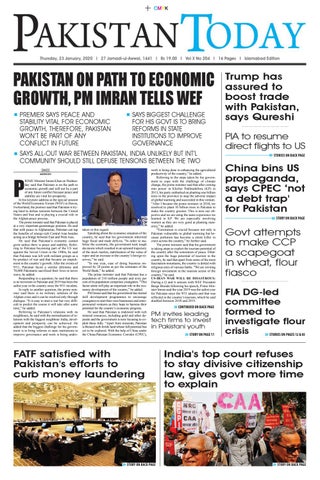
Pakistan on Path to economic growth, Pm imran tells weF g
g
Premier SayS Peace and Stability vital for economic growth, therefore, PakiStan won’t be Part of any conflict in future
g
SayS biggeSt challenge for hiS govt iS to bring reformS in State inStitutionS to imProve governance
SayS all-out war between PakiStan, india unlikely but int’l community Should Still defuSe tenSionS between the two DAVOS
P
agencies
rime minister imran Khan on Wednesday said that Pakistan is on the path to economic growth and will not be a part of any future conflict because peace and stability are vital for prosperity. in his keynote address at the special session of the World economic Forum (WeF) in Davos, Switzerland, the premier said that Pakistan is trying hard to defuse tensions between the United States and iran and is playing a crucial role in the Afghan peace process. The prime minister said that Pakistan is placed at a very important geostrategic position. He said that with peace in Afghanistan, Pakistan can tap the benefits of energy-rich Central Asia besides acting as a bridge between east and West Asia. He said that Pakistan’s economy cannot grow unless there is peace and stability. referring to Pakistan becoming part of the US war against the Soviet Union in the 1980s, he said that Pakistan was left with militant groups as a by-product of war and that became an impediment in the country’s growth. After the events of 9/11, Pakistan faced a similar dilemma and 70,000 Pakistanis sacrificed their lives in terror wave, he added. responding to a question, he said that there is no terrorism in Pakistan and 2019 has been the safest year in the country since the 9/11 incident. in reply to another question, the prime minister said there is no military solution of the Afghan crisis and it can be resolved only through dialogue. “it is easy to start a war but very difficult to predict the course it will take after some time,” he added. referring to Pakistan’s relations with its neighbours, he said with the normalisation of relations with the biggest neighbour india, development and prosperity can be achieved. He added that the biggest challenge for his government is to bring reforms in state institutions to improve governance and work is being under-
taken in this regard. Speaking about the economic situation of the country, he said that his government inherited huge fiscal and trade deficits. “in order to stabilise the economy, the government took tough decisions which resulted in an upward trajectory of the stock market, stabilisation of the value of rupee and an increase in the country’s foreign reserves,” he said. “in one year, ease of doing business improved by 28 points as per the estimates of the World Bank,” he added. The prime minister said that Pakistan has a population of 210 million people and sixty per cent of its population comprises youngsters. “This factor alone will play an important role in the economic development of the country,” he added. Pm imran said that his government has started skill development programmes to encourage youngsters to start their own businesses and entrepreneurial ventures as they hope to harness their potential for the country’s economic progress. He said that Pakistan is endowed with rich mineral resources, including gold and other deposits and the government is now focusing to exploit these fully. “Apart from minerals, Pakistan is blessed with fertile land whose full potential has yet to be explored. With the help of China under the China-Pakistan economic Corridor (CPeC),
work is being done in enhancing the agricultural productivity of the country,” he added. referring to the steps taken by his government to cope with the challenge of climate change, the prime minister said that after coming into power in Khyber Pakhtunkhwa (KP) in 2013, his party embarked on planting one billion trees in the province to stop the adverse impact of global warming and succeeded in this venture. “After i became the prime minister in 2018, we resolved to plant 10 billion trees in Pakistan to make the country greener. This is now our objective and we are using the same experience we learned in KP. We are especially involving women as they are very good at planting nurseries,” he added. “Forestation is crucial because not only is Pakistan vulnerable to global warming but because pollution has become a silent killer in cities across the country,” he further said. The prime minister said that his government is taking steps to exploit the tourism potential of the country after the restoration of peace. Dilating upon the huge potential of tourism in the country, he said that apart from some of the most fascination mountains, the country is dotted with religious sites of various faiths. “We are inviting foreign investment in the tourism sector of the country,” he said. US-IRAN WAR WILL BE DISASTROUS: During a Q and A session with WeF President Børge Brende following his speech, Prime minister imran said the year 2019 was the safest year for Pakistan since the 9/11 attacks and that was reflected in the country’s tourism, which he said doubled between 2018 and 2019.
CONTINUED ON BACK PAGE
Pm invites leading tech firms to invest in Pakistani youth
FATF satisfied with Pakistan's efforts to curb money laundering
STORY ON BACK PAGE
STORY ON PAGE 11
Trump has assured to boost trade with Pakistan, says Qureshi Pia to resume direct flights to uS STORIES ON BACK PAGE
China bins US propaganda, says CPEC ‘not a debt trap' for Pakistan STORY ON BACK PAGE
govt attempts to make ccP a scapegoat in wheat, flour fiasco FIA DG-led committee formed to investigate flour crisis STORIES ON PAGES 12 & 03
India's top court refuses to stay divisive citizenship law, gives govt more time to explain
STORY ON BACK PAGE
Thursday, 23 January, 2020
02 NEWS
SIndh RepoRtS fIRSt polIo caSe of 2020 GLOBAL VACCINE ALLIANCE PRAISES PAKISTAN’S EFFORTS FOR POLIO ‘ERADICATION’ KARACHI
t
STAFF REPORT
HE first polio case of the year in Sindh was confirmed by authorities on Wednesday. A sevenmonth-old girl from Sindh’s Tando Allahyar district contracted the poliovirus on January 7, said
the Emergency Operation Centre for Polio in Sindh. According to her parents, she had received three doses of the polio vaccine during campaigns and routine immunisation. The spokesperson for the EOC Sindh said the long gap in door to door campaigns in 2019 has created a large pool of vulnerable children. A polio case response
campaign was conducted in January in Sindh from January 13 to 20, and the national immunisation day will be held on February 17. Another is planned for April. In Balochistan, the victim was an 18month-old girl from Qilla Abdullah. She had received three doses of the polio vaccine. According to health authorities, her family used to live in Okara, Punjab earlier. The latest figures show that including last year’s cases, Khyber Pakhtunkhwa has reported 93 polio cases, Sindh 24, Balochistan 12 and Punjab eight. “The current risk to our children is very real and while it is our job to deliver
NAB challenges ex-PSO MD Imranul Haq’s bail in SC ISLAMABAD: The National Accountability Bureau (NAB) on Wednesday challenged the bail granted to former managing director PSO Sheikh Imranul Haq, in LNG case in Supreme Court. The accountability bureau has filed a petition in the apex court against the decision of Islamabad High Court granting bail to Imranul Haq, a former managing director of the PSO. The NAB has pleaded to the court to
declare the bail to Imranul Haq as void. The IHC verdict was against decisions of the Supreme Court in which the high court has ignored the parameters set by the apex court, the NAB argued in its petition. “There were no substantial grounds for granting bail to the accused,” the petition further argued. The high court had granted bail to Sheikh Imranul Haq over his petition in the LNG terminal case on November 26
last year. Former PM Shahid Khaqan Abbasi, Miftah Ismail, ex-PSO MD Imranul Haq and others are facing charges of corruption over awarding an LNG import contract allegedly at exorbitant rates in 2015, which caused a big loss to the national exchequer. NAB sources said that Abbasi, in 2013, had awarded an LNG import and distribution contract to the Elengy Terminal in violation of the PPRA rules and relevant laws. STAFF REPORT
these vaccines at the doorstep, caregivers must also step up and protect their children through vaccinations,” said the National EOC. Last year, 136 polio cases were reported across the country. PAKISTAN’S EFFORTS FOR POLIO ERADICATION LAUDED: Global Vaccine Alliance (Gavi) Chief Executive Officer Seth Berkley has acknowledged measures taken by the government of Pakistan for the eradication of poliovirus from the country. The appreciation comes during his meeting with Prime Minister Imran Khan on the sidelines of World Economic
Forum (WEF) in Davos on Wednesday, according to an official statement. Berkley also assured Gavi’s support and cooperation to PM Imran. The premier apprised the Gavi CEO of the government’s policy reforms for strengthening the health sector in Pakistan. He also appreciated continuous support extended by Gavi to Pakistan to protect children against deadly but preventable diseases. PM Imran said that Pakistan became the first country in the world to introduce typhoid vaccine in its Routine Immunisation schedule. He also highlighted the government’s efforts to eradicate polio from the country and to achieve the goal of Universal Immunisation Coverage. He further informed Berkley that the government was streamlining financing mechanism of Routine Immunisation programme.
Govt agrees to conditional release of lawyer detained on espionage charge ISLAMABAD STAFF REPORT
The Ministry of Defence on Wednesday assured the Supreme Court (SC) that Lt Col. (r) Inamur Rahim, a petitioner in multiple cases of allegedly missing persons, will be released when “certain conditions” are met. The assurance came during a hearing of a petition filed by the government against a Lahore High Court (LHC) ruling, issued earlier this month, in which Rahim’s detention was declared “illegal”. A threemember bench had ordered the lawyer be immediately released. Rahim, who is a lawyer and has fought court cases on behalf of the families of allegedly missing persons, had been picked up from his home in Rawalpindi by law enforcement agencies in December last year. On Jan 2, a representative of the Ministry of Defence the LHC that Rahim was in the custody of law enforcement agencies and “is currently being interrogated”. Subsequently, on Jan 9, The Rawalpindi bench of the LHC the deten-
tion against the law and directed authorities to set him free. Two days later, the federal government challenged the decision in the Supreme Court. During Wednesday’s proceedings, the attorney general told the court that Rahim was unwell and had been taken to the hospital multiple times. He said that the advocate will be released if his counsel agrees to surrender his passport and share his laptop’s password with the ministry. The attorney general further said that Rahim should also agree to not venture outside the twin cities of Islamabad and Rawalpindi. Rahim should also agree to “cooperate in the investigation”, the attorney general said. The retired colonel’s counsel reminded the court that Rahim had been under detention for more than a month but agreed to the defence ministry’s conditions for release. The court then directed Rahim’s counsel to surrender his passport and cooperate in the investigation, saying, “Government’s petition against Rahim’s release [order by LHC] will be heard on merit.” The hearing was adjourned for two weeks.
JI holds protest in Rawalpindi against inflation RAWALPINDI: The Jamaat-e-Islami on Wednesday launched a countrywide protest against skyrocketing inflation and unemployment by holding the first protest demonstration in Rawalpindi. Addressing the rally, JI chief Senator Sirajul Haq warned the government to reduce inflation or get ready to be sent home. “The government should reduce the prices of basic commodities or get ready to go home,” Siraj said. He added that demonstrations against price hike will be held in every city under the banner of the JI. He said that it seemed the only objective of this government was to suck the blood of the poor masses. He said those who created the shortage of flour and increased the price of sugar were all sitting in the power corridor. “How can the prime minister take action against his own colleagues?” he asked. Quoting the statements of Dr Ishrat Hussain and FBR chairman about bad governance and tax issues, he said the PTI government even failed to introduce reform in a single sector during past 16 months of its rule. He said the prime minister claims to turn the country into a Madina-like state had proved to be a joke and PTI government also proved itself the agent of the status quo. AGENCIES
Pakistan received Dh251m aid from UAE in 2019 ISLAMABAD STAFF REPORT
Pakistan has been a major beneficiary of aid provided by the United Arab Emirates (UAE), with grants amounting to Dh251 million last year, data from a UAE government report revealed on Wednesday. “The UAE distributed more than Dh28 billion in international aid last year. Pakistan was the eighth most supported nation with grants worth Dh251.10 million disbursed to the country, which is the highest in five years. The total foreign aid grants to Pakistan from the UAE have been Dh1.76 billion since 2013,” excerpts from an international aid report released earlier this month by the UAE Ministry of Foreign Affairs and International Cooperation in Abu Dhabi revealed. It added that the aid donated by the UAE exceeded United Nations (UN) recommendations for the sixth consecutive year, surpassing targets of 0.7 per cent of the gross national income (GNI) from donor countries. The Dh28.62 billion ($7.79 billion) figure amounts to 0.93 per cent of the UAE’s GNI of 2018.
CMYK
“UAE is a great and time-tested friend of Pakistan, particularly they are supporting Pakistan in the development sector and health,” Special Assistant to Prime Minister on Health Dr Zafar Mirza said in an interview with Arab News. Dr Mirza thanked the UAE for “their support in every field,” adding that the increased aid reflects “their trust in Pakistan.” “Under Prime Minister Imran Khan’s leadership, the UAE and Pakistan have become even closer which is evident from the frequency of bilateral visits at the leadership level,” he said. He further acknowledged the UAE’s support in the health sector, especially in helping Pakistan eradicate polio from the country. “They are our major partners in the polio eradication programme. I really appreciate the support provided by UAE in our fight against polio as in our recent campaign they have contributed a lot…,” Mirza said, adding that setting up of Basic Health Units (BHU) and small hospitals in remote areas of Pakistan and Azad Jammu and Kashmir (AJK) have also furthered the cause.
Thursday, 23 January, 2020
NEWS
SIndh, Kp wItneSS decReaSe In flouR pRIceS ISLAMABAD STAFF REPORT
With timely intervention by the federal government, prices of wheat and wheat flour have started coming down in the local markets all across the country, particularly in Sindh and Khyber Pakhtunkhwa. Talking to media persons on Wednesday, Food Security Commissioner in the Ministry of National Food Security and Research Dr Imtiaz Ali Gopang said the prices of flour declined by Rs6/kg in Sindh and Rs2/kg in Khyber Pakhtunkhwa. “The situation would further improve as the supply had gained momentum and prices of the commodity would further
fIa dG-led commIttee foRmed to InveStIGate flouR cRISIS ISLAMABAD: Prime Minister Imran Khan on Wednesday formed a committee to investigate the wheat shortage that has gripped the country in recent days. According to a notification, the fourmember committee will be headed by Federal Investigation Agency (FIA) Director General Wajid Zia, a representative of the Intelligence Bureau (IB), the director-general of Punjab AntiCorruption Establishment and any other member selected by the FIA DG. The committee, which has been asked to furnish its report by February 6, will ascertain the causes of the shortage, “circumstances leading to the wheat/ flour related controversy” and assess the future stock that led to “allowing export of wheat… and subsequent imposition of ban on exports”. The committee will also assess the management of wheat stocks within the federal and provincial governments as well as coordination among provinces. INP
come down to the pre-crisis level in the next couple of days,” he said. He said that a helpline had also been established at the Prime Minister’s Office to monitor the demand and supply situation and added that the provincial departments had been asked to submit a report on a daily basis. Over 4.144 million tonnes of wheat stocks were available in the country, he said adding Punjab had 2.519 million tonnes, Sindh 0.416 million tonnes, Khyber Pakhtunkhwa 0.0113 million tonnes and Pakistan Agriculture Storage and Supply Corporation (PASSCO) had wheat reserves of 1.204 million tonnes till today. The Food Security Commissioner informed that the Economic Coordination Committee of the Cabinet had directed the PASSCO to provide 400,000 tonnes of wheat to Sindh, 450,000 tonnes to Khyber Pakhtunkhwa, 50,000 tonnes to Balochistan from its stocks in order to keep the supply smooth and ensure adequate provision of flour in the markets. The provinces have already lifted about 400,000 tonnes of wheat out of allocated stocks and there were 700,000 tonnes of more wheat which was available for them, he said adding that inter-provincial movement of grains from Punjab to KP was also relaxed that was helping in smoothing demand and supply situations in the province. Replaying to a question regarding the government’s decision to import 300,000 tonnes wheat, he said that the cutoff date for the import was fixed at March 31 and after the date import would not be allowed. The imported wheat will be used as buffer stocks, he said adding that during the last season about 1.2 million tonnes of wheat output was affected due to rains in harvesting time. Looking into the climate changes and other factors, he said that the government has also decided to increase its procurement targets from 6 million tonnes to 8 million tonnes for keeping the strategic reserves in the country.
Zardari to be indicted on Feb 11 in fake accounts case ISLAMABAD STAFF REPORT
An accountability court (AC) on Wednesday postponed the indictment of former president and Pakistan People’s Party (PPP) Co-Chairman Asif Ali Zardari and his sister Faryal Talpur in the Park Lane and the money laundering references till February 11. The court also directed the National Accountability Bureau (NAB) to bring Omni Group’s head Anwar Majeed through air ambulance from Karachi and produce him before the court. AC-II Judge Azam Khan conducted the hearing. At the outset of the hearing, the judge asked the prosecution that where was Anwar Majeed, saying charges would be framed against the suspect at today’s hearing. Majeed’s lawyer, however, said that his client was in a Karachi hospital. The NAB pleaded that it had written to the National Accountability Bureau (NAB) headquarters for the provision of an air ambulance to produce the accused on the next date of hearing. The NAB investigation officer said that nonbailable arrest warrants had been issued against the four accused who were hiding abroad. The prosecutor said that the department had filed a reference against the accused and prayed the judge to indict the accused. Zardari’s counsel said that an indict-
ment couldn’t be made in any interim reference in accordance with the law. The NAB prosecutor said that the investigation had been completed related to the people who had been nominated in reference. The reference was filed after the conclusion of the investigation, he argued. Judge Azam Khan asked that if the charges would be framed again after the filing of a supplementary reference against the accused. The NAB officials further apprised the court that another accused Syed Hussain Faisal Jamot had become an approver in the case. Three other accused, including Kiran Aman, Noreen Sultan and Aslam Masood, had already become approvers. Meanwhile, the court also accepted a one-day exemption from hearing of former president Asif Ali Zardari as his lawyer informed the judge that he couldn’t attend the proceeding due to illness. His counsel Farouk H. Naek pleaded that the NAB had not shared the copies of supplementary reference against the accused so far. The court ordered the bureau to provide them the copies of reference. To a question of the judge, NAB prosecutor said that the process of a plea bargain of accused Zain Malik was pending with the bureau and added the NAB had summoned the accused in this regard. The judge asked the NAB official to inform the court regarding plea bargain of Zain Malik by the next hearing.
ISLAMABAD STAFF REPORT
Pakistan Television Corporation (PTV) has decided to increase the licence free of its operation thus putting the burden to their losses on the people who are already in the grip of multifaceted crises. As per the financial plan recommended by the Board of Directors (BoDs) of PTV, the license fee will be increased from Rs35 to Rs100.
03
PTV BoDs recommends increasing licence free from Rs35 to Rs100 The increase in PTV fees will be included in the bills of electricity consumers. The decision will put an additional burden of Rs20 billion on the public. Three marketing managers have been appointed to reduce the PTV
deficit. These marketing managers have suggested increasing PTV fees to reduce the losses. Prime Minister Imran Khan will be briefed on the increase in fees while the federal cabinet will make the final decision on the increase.
04 ISLAMABAD
Thursday, 23 January, 2020
WEATHER UPDATES THURSDAY
180C
020C
FRIDAY
180C 060C
SATURDAY
180C 050C
SUNDAY
190C
070C
21 childRen kidnaPPed and RaPed in caPital in 20 days ISLAMABAD
W
BILAL SABRI
HAT can be dubbed as an intense and alarming situation in the capital, as many as 21 cases of kidnap, including 16 cases of rape of female children and one case of a molested male child have been registered in the first twenty days of 2020 – a figure that raises many eyebrows. While more than 400 children were raped, molested and filmed in Punjab’s district Kasur during 2006 and 2014, rapists seem to have set their eyes on Islamabad now. The tall claims of Islamabad police about making the capital safer for citizens have proved fake after this shocking figure of kidnaps for rape emerged from the
police record itself. According to the details, three cases were registered in Sihala police station and two in Khanna police station whereas one case each was registered police stations, including Karachi Company, Goldra, Tarnol, Margallah, Shehzad Town, Abpara, Nilor, Koral, Kohsar, Industrial Area I-9, Bahra Kahu and Sabzi Mandi. The important fact here is that police have failed to nab any of the ‘unknown accused’ in rape cases and treat them as routine criminal matters involving petty crimes. Kidnap cases for rape and molestation are registered under section 364A for children and 365-B for a teenager of the PPC. These cases are registered after getting a medical report from the medico-legal officer of the government run-hospital after which it is established whether sexual abuse happened or not,
but even reports are not enough for the police to bat an eye over this issue. In one case, a 13-year-old boy was molested and filmed so he could be blackmailed into carrying out robberies and shoplifting for a gang that was previously accused of the same charges in the jurisdiction of Kohsar police. “Most rape and molestation cases after kidnap are difficult to investigate as the accused are unknown,” said a police IO requesting not to be named. It is pertinent to mention here that in 2018, a staggering 3,800 cases of sexual abuse of children were registered across Pakistan. Muhammad Ali, a family member of one victim, told Pakistan Today that police don’t seem to be making serious efforts in detaining accused rapists. “It is becoming a norm that neither will the police take any action nor will victims of
Punjab RangeRs dePloyment duRation in caPital ends ISLAMABAD: Punjab Rangers deployment duration in the federal capital Islamabad ended on Wednesday. According to details, despite passage of 24 hours, the concerned department has not yet decided about extending the deployment period of the Punjab Rangers. On the other hand, the paramilitary law enforcement officials said that they have not received any notification in this regard until now. It is to be mentioned here that the district administration had to resolve this matter till January 21. STAFF REPORT
rape get justice until the public comes out, blocks the roads, gathers media, and scream ourselves hoarse over the insufficient investigations…just like the family of 10-years-old Farishta did in Taramri Chowk (in 2019),” he said. It may be mentioned here that Farishta’s father, Muhamamd Nabi, had revealed that police had simply refused to register a case and treated him worse than animals when his daughter disappeared on May 15, 2019. Police officers told Nabi to sweep their offices and get food for Iftar, meanwhile, his child’s half rotten corpse appeared in Islamabad on May 20. It is an unfolded truth that the police always show reluctance to register cases of various types of abuse especially sexual abuse as it dents their image and would require them to work for money which is usually obtained easily through bribery.
Capital’s air quality recorded unhealthy ISLAMABAD APP
The air quality on Wednesday was recorded unhealthy due to cold, dry weather and increased vehicular emissions. Due to unhealthy air quality the people were advised to wear pollution masks and goggles (at day time) to prevent direct contact with the air pollutants as children, pregnant women and elderly were mostly at the risk during increased ratio of pollutants. The data of Pakistan Environmental Protection Agency (EPA) showed that air quality of the federal capital is unhealthy due to increased ratio of particulate matter of 2.5 microns (PM2.5) in it and other hazardous environmental pollutant. According to recent air quality report released by EPA, the particulate matter of 2.5 microns (PM2.5) had not only exceeded the National Environmental Quality Standards (NEQS) of 35 micrograms per meter cube (mg/m³) rather also the World Health Organization (WHO) fine particulate matter of 2.5 microns 24 hours mean of 20 micrograms per meter cube. The pollution level comprising particulate matter of 2.5 microns (PM2.5) has exceeded the permissible ratio of 35 micrograms per cubic meter (mg/m³) which was recorded 59.80 mg/m³, the highest in the federal capital. World Health Organization (WHO) in its reports of 2015 had claimed, air pollution to cause huge number of premature
CMYK
To take the police’s version of this crucial matter of increasing rape and molestation cases in the federal capital, repeated efforts were made to contact IGP Aamir Zulfiqar Khan, however, he did not respond to this scribe’s calls or messages. When contacted, Islamabad DIG Operations Waqar Ud Din remained tight-lipped and referred to Saddar SP Umar Khan for an official version. SP Umar Khan told Pakistan Today that all cases are being investigated with due attention and guaranteed that progress is being made in each case. “Previously, police used delaying tactics in registering these cases but now they register a case on the same day they receive an application,” he maintained. “Almost all the cases that occurred in 2019 have been traced or solved. Investigating child abuse cases are the top priority of Islamabad police,” he concluded.
deaths. PM2.5 had been found hazardous pollutant which could penetrate into human blood through lungs cells. According to the daily ambient air quality report of the federal capital by Pakistan-EPA, the 24 hours average ratio of nitrogen dioxide and Sulphur dioxide were 31.63 micrograms per cubic meter (mg/ m³) and 67.75 mg/m³ respectively against the respective National Environmental Quality Standards (NEQS) of 80 mg/m³ and 120mg/m³. The data was recorded by calibrated air quality monitors fixed at particular positions with proper readings. However, concentrations of PM2.5 during the day and evening times were recorded slightly high, whereas the overall ambient air quality of the federal capital was not healthier today. Any other data from any source presenting ambient air quality of Islamabad was neither verified nor approved by the PAK-EPA, the report said.
Thursday, 23 January, 2020
NEWS
05
EyEAuTomATE wins Aim sTArT-up compETiTion LAHORE
T
SHAHAB OMER
He Punjab Board of Investment and Trade (PBIT) on Wednesday organised the National Champions Pitch Competition in collaboration with the Annual Investment Meeting (AIM) under the United Arab emirates (UAe) Ministry of economy and NSpire-NeTSOL where start-ups from all over Pakistan participated. The 12 finalised companies for the competition included Agrimart, Ayeco, Dataworx, DFRSC, edtechworx, eyeAutomate, Hospital, LFD, OTOZ, SciScegza, Se drop, Tesjo, Tiksom and Walee, who were judged by the panel which including Huawei Deputy CeO Ahmad Bilal Sufi, Superior College Rector DrSumeraRehman, Buch International Hospital CeO YasirBucha, Kausar Group of Companies Director Shoaib Malik and Uber Public Policy Head Hassan Arshad The judges selected ‘eyeAutomate’ as the winner of the competition, according to the criteria set by AIM – Dubai and Ministry of economy – UAe. According to the details, the winner
would travel to attend AIM-2020 to pitch the business idea and compete with startups from 80+ countries in March 2020 whereas the trip would be fully funded by Aim-Dubai and all local startups can apply online to present their business. One of the points to be fulfilled according to the criteria includes a minimum turnover of $1,00,000 to $10,00,000 with less than fifty employees with a startup’s age between 2-7 years. PITB Director Marketing and Public Relations Fatima Ali Khan informed this scribe that PBIT had been working with AIM Dubai under the Ministry of economy-UAe for the past two years. “In March-2020, PBIT would be declared the official partner of AIM for which a formal MoU signing ceremony would take place during the event in Dubai. In continuation of the recently signed Framework Agreement with NeTSOL, PBIT and NSpire (NeTSOL) have collaborated to collectively host a National Competition for Start-ups under the title of ‘Punjab Goes Global’. “AIM organises an international event on investments, every year in Dubai. In coming March, AIM plans to host the mega event on March 24-26, 2020. One of the event verticals is the
‘AIM Start-up’ which is an international competition for entrepreneurs. In the event, Start-ups from 80+ countries would participate and pitch their business projects to a panel of judges. The winners would be given a cash prize and an opportunity to be mentored by industry experts for attracting investments/funding.” Speaking to Pakistan Today, PBIT
Sanjrani suggests increasing provincial seats in Senate ISLAMABAD: Senate Chairman Sadiq Sanjrani has proposed to maintain the numerical strength of the Senate by distributing the eight seats of erstwhile Federally Administered Tribal Areas (FATA) between the provinces. The total number of seats in the Senate is going to reduce to 96 from the existing 104 as eight FATA senators will retire after the tribal districts merger with Khyber Pakhtunkhwa province. However, Sanjrani has suggested equally increasing the number of general seats from each province from existing 23 to 25 – in a phased manner. STAFF REPORT
CMYK
CeO JahanzaibBurana said, “Under the Start-ups and entrepreneurship wing of transactions/investment advisory department, PBIT has been playing a vital role in strengthening the start-up ecosystem in Punjab. Till date, 100+ start-ups have been facilitated for investment advisory, business modelling and connections with domestic and international venture capitalists. We are also engaging the London
mayor and US consulate for such opportunities where Pakistani startups could get a fair chance to display their model in front of global audience and investors.” Punjab Secretary Industries Zaffar Iqbal while addressing the participants said that the Punjab government is already working to increase its capacity to provide training and further revenue related facilitates for our youth and startups.
Thursday, 23 January, 2020
06 WORLD VIEW
GanGs of BaGhdad
Modern War institute
I
JohN SPeNcer
passed a checkpoint manned by a group of young men armed with assault rifles. But they weren’t like the Iraqi soldiers at other checkpoints. They didn’t really wear uniforms, their bearing was distinctly un-military, and they looked mean. These guys are shady, I thought. One of them—the leader—sat at plastic table in front of a small coffee shop working to open pistachio nuts, slowly and methodically, almost like a grazing cow, yet still exuding extreme power. On the table lay a brandnew black Glock 9-millimeter pistol and a pile of saliva-soaked shells. He was dressed in a purple Adidas jumpsuit, which he probably chose because it was the standard apparel militia members and criminals in Baghdad, but also perhaps because it covered his large belly comfortably. Between the sinister-looking checkpoint guards and their leader, I couldn’t have imagined a scene more reminiscent of a gangster movie if I had tried. But this wasn’t a movie, and he wasn’t Tony Soprano. His name was Ahmed, and he and others like him were in many ways the hope of the US military in Iraq. It was 2008 and I was an Army infantry company commander charged with creating lasting security, governance, and stability in three neighborhoods of Baghdad containing more than seventy-five thousand residents. Ahmed was one of my five local strongmen that had the power to bring together and, more importantly, command small bands of men to stand checkpoint duties at every entrance in and out of the separate neighborhoods. In total there were thirteen checkpoints, each manned with roughly ten local men called “Sons of Iraq” by Iraqi and US officials. The ten men were split into three shifts for twenty-four-hour coverage. We armed them with AK-47 assault rifles, ammunition, and radios. These checkpoint guards were supposed to stop and search any vehicles coming into each of the different neighborhoods. We weren’t foolish. We knew they only searched cars while we were visiting the checkpoints. But the guards still served an important purpose: they maintained a degree of justice and order
THE US MILITARY HAS A HISTORY OF TRYING TO IMPOSE ITS POWER ON CITIES—IN SAIGON, PANAMA CITY, MOGADISHU, KABUL, AND BAGHDAD, FOR INSTANCE—TYPICALLY WITH MEDIOCRE RESULTS at the neighborhood level. They also kept outsiders out, something they could do easily and far better than US forces or even formal Iraqi security forces, with their far more intimate knowledge of who belonged and who did not. I went to visit these men almost every day. At the time, the leaders seemed like five mob bosses. Even reflecting on it many times in the years since, I can think of no better way to describe them. When I first met each of the mob bosses, I had definite reservations. They exuded power and demonstrated a clear apathy toward legitimate law and order. And yet, they provided a certain guarantee of this law and order, and most importantly, of security—even if they did so only out of self-interest. During my visits with them I witnessed the true local power structure. I listened to reports of bad men operating in other neighborhoods, but I also received real information on insurgents that could be submitted to my higher headquarters for action. These five men were also part of a broader network of shady individuals across Baghdad that gave us information when it benefited them. I didn’t fear them, but let’s just say if I came across any of them in any other context, I would know to keep my distance. We knew they were bad. But the mission was to provide lasting security and stability, and these men could do that. Every month, I would go meet the leaders and hand over the money for the guards’ monthly salaries, in US currency: three crisp hundred-dollar bills per guard. The leaders would, of course, take their cut of the salaries and distribute the money as they saw fit. At one point, my higher headquarters attempted to bypass that working system by having me and my soldiers run pay days and hand $300 to each checkpoint guard directly. We received reports that the guards left us and went straight to the bosses to submit their required cuts. I also frequently visited the police stations—ostensibly the legitimate guarantors of order in the three neighborhoods my company was responsible for. But police in Iraq aren’t like American police. They don’t patrol neighborhoods.
They expected locals to come to them to report a problem. They also knew that what went on in each neighborhood was managed by the local strongman. If they had a low-level problem, I even saw them go to these bosses for resolution. At the height of the American “surge” in Iraq, the US military employed more than a hundred thousand Sons of Iraq. Their origin story is usually told by pointing to Anbar province, where Sunni tribal leaders became disenchanted with al-Qaeda’s heavy-handed treatment of their people and formed bands of loyal family members as an armed resistance against the group. This, combined with an increase in American forces, is credited with the lowering of sectarian violence to acceptable levels in the province. Initially dubbed “Concerned Local Citizens,” they were later given the more heroic-sounding Sons of Iraq label, and the model was replicated elsewhere in the country, ultimately leading to claims that these groups were pivotal to achieving success in Iraq. This, however, was not the story of my Sons of Iraq. In the urban neighborhoods of Baghdad, traditional, tribal bases of power didn’t exert the same influence they did in Anbar. It was brute strength that earned power and gangs that exercised authority. I often asked the men on the checkpoints if they knew who their tribal leaders were. Without exception, they did not. But they feared the strongmen and respected the new lines of control that separated the different neighborhoods. Not only were they not motivated by an emergent Iraqi national identity or a desire to shed the yoke of transnational terrorist groups. These hired guns were also not good guys. Many had attacked US soldiers for profit. One of the five leaders had served time for emplacing improvised explosive devices on roads to target American and Iraq security forces. I had more than one conversation with my soldiers who knew some of these men might have had blood on their hands. But now they worked for us, I had to explain. And we needed them.Baghdad looked a lot more like Gangs of New York than Saving Private Ryan.
The world is now more urban than rural—and that trend is continuing rapidly. The United Nations estimates that 180,000 people move to a city every day. This, combined with continued global population growth, is projected to add 2.5 billion people to the world’s urban population by 2050, mostly to the developing world. Unfortunately, some cities unable to handle rapid growth in the developing world—such as Lagos, Nigeria, for example—have more than 70 percent of their populations living in slums. Globally, over one billion of the world’s seven billion humans live in slums. Many of these areas have effectively become self-governed criminal safe havens, like the favelas of Rio de Janeiro. While the world has become more urban, so has political violence, which is also now more prevalent in urban than rural areas. Guerrillas, revolutionaries, and terrorists increasingly choose to hide in urban terrain, where population density provides sanctuary from government observation and technology, access to millions for easy recruitment and use as human shields, and freedom to foment political dissent (often violently) against governments that struggle to provide even rudimentary services. And yet, the US military knows little about alternative power structures in cities and undertakes little planning for how they can be leveraged, despite our recent history in Iraq of—let’s call it what it is—working with gangs. I have written extensively and critically about the US military’s lack of attention to urban environments. There isn’t a single US military command, think tank, school, or training site solely dedicated to understanding large cities. That’s a problem, but it isn’t just the traditional “military” challenges cities pose or their physical complexity that we need to more closely examine and prepare for. It is also how power is wielded, often informally, on their streets and among their people. That’s why Gen. Stephen Townsend said in 2018 that the US Army needs a way to understand power all the way down to the neighborhood level. The US military has a history of trying to impose its power on cities—in
Saigon, Panama City, Mogadishu, Kabul, and Baghdad, for instance—typically with mediocre results. This approach would almost certainly fail in any of the world’s more than thirty megacities, those with over ten million residents. The power structures of the world’s major cities are as diverse as the cities themselves. Our military needs to be able to understand and work with both legitimate and illegitimate sources of power in urban areas. Just understanding host-nation political and military capabilities will not suffice. That might mean working with some unsavory characters, which is uncomfortable. But we needed those unsavory characters in Baghdad, and we will almost certainly need others elsewhere in the future to achieve objectives against insurgents, terrorists, transnational drug cartels, or any other belligerents threatening local security, regional stability, or US national-security interests. It’s natural to have moral qualms about these types of partners. There are even legal considerations at play: the “Leahy law” prohibits the United States from providing funding to any unit of a security force that has committed a “gross violation of human rights.” But of course, this principally applies to formal military units. And in any case, there’s a whole host of distasteful criminal activities that fall short of the threshold specified by the law. The US Army and Marine Corps’ most current urban-operations doctrine recognizes that working with illegitimate power sources of questionable character is sometimes required. Still, it only includes one line pertaining to that possibility, which states that “in unique circumstances, commanders identify and interact with the leadership of criminal organizations.” The unique may very well become the routine on the future urban battlefield. The five bosses and their crews manning checkpoints in the neighborhoods I was responsible for in Baghdad got results and increased security, so I had to accept that they were my partners. Soldiers in the future will need to do the same in order to accomplish US objectives. The world is moving to cities, and so is warfare. We need to adapt to that reality and prepare to leverage power, even in its illegitimate and criminal forms, in these complex operating environments. John W. Spencer is chair of urban warfare studies with the Modern War Institute at West Point and co-director of its Urban Warfare Project. He previously served as a fellow with the chief of staff of the Army’s Strategic Studies Group. The views expressed are those of the author and do not reflect the official position of the United States Military Academy, Department of the Army, or Department of Defense.
US investors concerned over India’s economic slowdown, social unrest and Modi’s disinterest COUNTRIES LIKE AUSTRALIA, BRITAIN, CHINA HAVE OFFICES ACROSS THE WORLD WITH THE SOLE MISSION TO BRING FDI. INDIA DOESN’T HAVE A GLOBAL INVESTMENT PROMOTION AGENCY Print NITIN PAI
Even if we ignore the fact that the Indian economy is in a severe slowdown, we should not forget even for a moment that India’s per capita GDP is around $2000, it needs to create around 2 crore jobs every year, and needs every little point of economic growth that it can get. So, in terms of the level of income, India is in the same league as Congo, East Timor, Nicaragua, and Nigeria. Two of India’s subcontinental neighbours, Maldives and Sri Lanka, are far ahead of us. At around $10,000, the average income in China is 400 per cent higher than India’s. Given our tax/GDP ratios, the Indian government’s combined expenditure on everything — including health, education, defence, rural development, and social welfare — is a paltry $300 per year. In other words, the Indian government can only spend less than a dollar a day per person from all the revenues it
raises. This is the main reason why India has poor quality government schools, too few government hospitals, terrible roads in cities, and generally unsatisfactory public services. If the per capita incomes were higher, the Indian government’s tax collections would be higher and it would be able to deliver better public services. Why is this relevant? Because a country with a low per capita income of $2000 ought to be looking for every possible way to raise economic growth and attract investment. So, the manner in which the Narendra Modi government treated an investor who committed to invest $1 billion into the Indian economy is just wrong, whatever its political undertones. In the global competition to attract foreign direct investment (FDI), India is not only competing with Bangladesh, Vietnam and China; it is competing with the developed world economies of the United States, Europe and Singapore. Giving a potential investor a cold shoulder not only discourages that investor, but also sends a negative signal to global investors. If
your per capita income is $60,000, perhaps you can afford such damage. At $2000, India simply cannot. Every investor and investment will encounter some opposition from some quarters of the economy. No company likes competitors with deep pockets. It should not surprise us that there are firms, individuals and political parties that do not like Amazon. Countries that ignore such protests and open their doors for foreign investors prosper. Countries that don’t — and India was among them before 1992 — don’t. FDI IS LINKED TO REPUTATION: Also, investors usually play up big numbers to attract public attention, while the reality might be different. We should not be surprised if Amazon’s billion-dollar investment commitment falls short. Yet, a credible investor who announces a huge commitment to India signals to others that India is a good place to put your money on. If investment commitments didn’t matter, what were the Vibrant Gujarat summits all about then? In fact, a lot of the FDI that flows
into India does so merely because of India’s reputation and track record. Unlike countries that receive many times more FDI than India, New Delhi doesn’t have a serious, professional, global investment promotion agency. Countries like Singapore, Australia, Britain, China and Switzerland have offices in all of the world’s financial and business hubs staffed with hundreds of specialists tasked with the singular mission of bringing more FDI into their country. Investment promotion is a hard sales job and countries have to do it to succeed in the marketplace for FDI. Contrary to what many in New Delhi believe, every investor has a lot of options. The bigger the investor, the greater the options. The costs of publicly rebuffing credible investors can be significant and hard to reverse. SEE THE GROUND REALITY: In my conversations with various investors in several United States cities over the past couple of weeks, I encountered near-universal concern over the economic slowdown, social unrest and Prime Minister Narendra Modi’s political disinterest in addressing either of these issues. The good news was that most investors were still positive about India and had seen good returns on their investment in recent times. The not-so-bad news was that almost everyone I spoke to were asking questions about the future. One emerging markets investor in the Bay Area told me that when they do not trust institutions to be independent
and competent, they begin to reduce their investment horizons. This means that while FDI inflows to a country will continue, the kind of companies, projects and sectors they will go into will change. India needs long-term investors who will help build its infrastructure, factories and development centres that can create jobs and the desirable kind of development. These investors create new winners and spread out the prosperity. But if investors decide that the longterm is too risky, they might go for short-term investment in existing companies, thereby narrowing the number of winners. Managing the socio-political consequences of this kind of development will be tricky. Despite the slowdown, India’s reputation of being a dynamic growth economy still weighs in its favour. Yet the uncalled-for controversy over Jeff Bezos is an opportunity for the Modi government to calmly reflect on the ground realities and the national interest. The ground reality is an average per capita income of $2000, over 20 crore young people who need jobs, and an economy that has slowed down to 5 per cent growth. The national interest is 8 per cent economic growth, which cannot be achieved without sustained growth in foreign investment. The author is the director of the Takshashila Institution, an independent centre for research and education in public policy.
Thursday, 23 January, 2020
FOREIGN NEWS 07
Iran tells europe not to follow us by undermInIng nuclear pact DUBAI
I
AGENCIES
RAN’S president told European powers on Wednesday not to copy the United States by undermining Tehran’s strained nuclear pact with world powers, and said Tehran would not seek nuclear weapons whether or not the deal survived. Britain, France and Germany launched a dispute mechanism in the 2015 nuclear deal this month, accusing Iran of violating the deal that has become increasingly frayed since Washington pulled out in 2018 and then reimposed sanctions on Tehran. The dispute mechanism could ultimately lead to the case being referred to the UN Security Council to restore UN sanctions. Iranian officials have threatened a range of steps if this should happen, including quitting the 2015 deal or even withdrawing from the 1968 NonProliferation Treaty (NPT), basis for global nuclear arms control since the
Cold War. Iran has gradually rolled back its commitments under the 2015 deal, arguing that it has a right to do so because European countries failed to
protect it from US sanctions. This month, the escalating crisis briefly flared into a military exchange between Iran and the United States.
Iranian President Hassan Rouhani said on his website President.Ir on Wednesday that the United States had made a mistake by quitting the 2015 pact. “Do you want to make the same mistake? … I am emphasizing that if the Europeans make a mistake and violate the deal, they will be responsible for the consequences of their actions.” US President Donald Trump says his “maximum pressure” campaign aims to drive Iran toward a broader deal that will further curb Tehran’s nuclear work, end its missile program and halt proxy wars in the Middle East. The three European powers have shown greater readiness to work toward what the British prime minister dubbed a “Trump deal”. France has said it might be time for a broader pact. “In the current context, France is determined that Iran never acquires a nuclear weapon, but also that we avoid all military escalation in the region,” French President Emmanuel Macron said during a trip to Israel.
militia ally of Iran's soleimani shot dead in southwest Iran DUBAI: Gunmen in Iran shot dead a commander of the hardline Basij militia who was an ally of Qassem Soleimani, the senior Revolutionary Guards commander killed in a US drone strike in Iraq, the official news agency IRNA reported on Wednesday. The Basij are under the command of the Guards, the most powerful and heavily armed security force in the Islamic Republic. IRNA said that Abdolhossein Mojaddami, a Basij commander in the city of Darkhovin in the southwestern province of Khuzestan, was shot on Tuesday in front of his home by two men riding a motorcycle. There was no immediate claim of responsibility for the attack, IRNA said. It described Mojaddami as one of the “defenders of the shrine”, a reference used to describe members of security forces who have fought in recent conflicts in Iraq or Syria. Soleimani, a general who oversaw Iran’s drive to extend its influence across the Middle East, was killed at Baghdad airport on Jan. 3, prompting Iran to fire missiles at US forces in Iraq in an escalation of their confrontation over Tehran’s nuclear program and broader security issues in the region. AGENCIES
Saudi dismisses reports MBS is behind hacking of Amazon chief’s phone
US confirms first case of China virus as death toll reaches six
RIYADH AGENCIES
WASHINGTON AGENCIES
The United States on Tuesday announced its first case of a new virus that has claimed six lives in China and sickened hundreds, joining countries around the world in ramping up measures to block its spread. The man, a US resident in his 30s who lives near Seattle, is in good condition, according to federal and state officials, and approached authorities himself after reading about the SARS-like infection in news reports. He is “currently hospitalised out of an abundance of precaution, and for short term monitoring, not because there was severe illness,” said Chris Spitters, a Washington state health official. “This is an evolving situation and again, we do expect additional patients in the US and globally,” added Nancy Messonier, a senior official at the Centers for Disease Control and Prevention (CDC). She stressed that the overall risk to Americans remained low. The man is originally from Wuhan and returned to the US on January 15, two days before health officials began screening passengers at major airports arriving from the central Chinese city, which is at the heart of the outbreak. The efforts are to be extended now to a total of five US airports. The patient lives alone and will be monitored in isolation for at least 48 more hours. The development came as countries intensified their efforts to stop the spread of the pathogen — known by its technical name 2019 Novel Coronavirus — as the number of cases surpassed 300, raising concerns in the middle of a major Chi-
nese holiday travel rush. Fears of a bigger outbreak rose after a prominent expert from China’s National Health Commission confirmed late on Monday that the virus can be passed between people. That conclusion is shared by the CDC, which said “person-to-person spread is occurring, although it’s unclear how easily the virus spreads between people.” The World Health Organisation (WHO) will hold an emergency meeting on Wednesday to determine whether to declare a rare global public health emergency over the disease, which has also been detected in Thailand, Japan and South Korea and Taiwan. Many experts believe the US case, while not surprising given the frequency of international flights, makes such a declaration all the more likely. Mark Woolhouse, a professor of infectious disease epidemiology at the University of Edinburgh, said more evidence was needed to determine if it spreads through the air or via close human-to-human contact. “It is important to stress that, though similar, it is not as severe an infection as its predecessor, the SARS coronavirus,” he added. HOLIDAY RUSH: Early on, many patients had some link to a Wuhan seafood market where live animals were sold, suggesting an animal-toperson spread. Hundreds of millions of people are criss crossing China this week in packed buses, trains and planes to celebrate the Lunar New Year with relatives. More than 80 new cases have been confirmed, bringing the total number of people hit by the virus in China to 315, with the vast majority in Hubei, the province where Wuhan lies, according to officials.
lam says govt forming independent committee to review HK situation DAVOS AGENCIES
Hong Kong leader Carrie Lam said on Wednesday that the government was about to announce the formation of an independent committee to study the situation in the city, which has been rocked by seven months of protests. Lam said during the annual meeting of the World Economic Forum in Davos that Chinese President Xi Jinping was committed to Hong Kong’s special status. She also appealed to what she called “violent protesters” not to destroy Hong Kong and said that nothing was more important to the city than the rule of law.
Saudi Arabia said on Wednesday that a media report that the Kingdom is behind the hacking of Amazon.com Inc founder Jeff Bezos’ phone was “absurd”. Bezos’ phone was hacked in 2018 after receiving a WhatsApp message that had been sent from the personal account of Saudi Crown Prince Mohammed bin Salman, The Guardian had reported on Tuesday, citing sources. The encrypted message from the number used by the crown prince is believed to have included a malicious file that infiltrated the phone Bezos had used and extracted large amounts of data within hours, the report said. The newspaper, while quoting “Saudi experts”, which include dissidents, said that the alleged hack may be a result of Bezos’ ownership of The Washington Post, which published articles written by slain journalist Jamal Khashoggi, which were critical of the Kingdom. The relationship between the Amazon chief executive and the Saudi government had soured since early last year after he alluded to Saudi Arabia’s displeasure at The Washington Post’s coverage of the murder of Khashoggi. The Guardian further said that the findings of a forensic analysis of Bezos’ phone have also been seen by United Nations special rapporteur Agnès Callamard, who has found enough evidence to approach Saudi
Arabia for an explanation over the matter. Callamard had also investigated Khashoggi’s murder and had found “credible evidence” to implicate the Saudi crown prince and other members of the Kingdom’s administration. Bezos’ security chief said at the time that Saudi had access to his phone and gained private information from it involving text messages between him and a former television anchor, who the National Enquirer tabloid newspaper said Bezos was dating. Saudi Arabia, however, maintained it had nothing to do with the leaked media reports or the alleged hacking of Bezos’ phone. “Recent media reports that suggest the Kingdom is behind hacking of Mr. Jeff Bezos’ phone are absurd. We call for an investigation on these claims so that we can have all the facts out,” Saudi’s United States embassy said in a message posted on Twitter. Amazon declined to comment.
Indian state to test facial recognition in polls as privacy fears mount NEW DELHI AGENCIES
The southern Indian state of Telangana will use facial recognition software in local elections on Wednesday, authorities said, the first such use of the technology in the country despite growing concerns about privacy and surveillance. Facial recognition software will be used to verify voters in 10 polling stations in the Medchai Malkajgiri district to “reduce impersonation cases”, the Telangana state election commission said in an online notification late last week. The privacy of voters will be protected, and their photographs will not be stored or used “for any other purpose”, according to the order. A negative result will not be grounds to deny voting rights to anyone, it said.
“Facial recognition is not fool-proof, and in this instance, misidentification can lead to disenfranchisement, which impinges on a core democratic right to vote,” said Raman Jit Singh Chima, Asia policy director at digital rights advocacy Access Now. “It is unclear what legal framework it is being used under, and how the data will be secured and used,” he said. Telangana’s move comes as facial recognition technology is being installed in airports, railway stations and cafes across India, and as the government prepares to roll out a nationwide system, likely to be the world’s biggest. Last month, the technology was used to screen crowds at a political rally for the first time, sparking fears that it was also being used to profile people at protests. Indian authorities have said the technology is needed to bolster a severely under-
policed country, and to stop criminals and find missing children. India’s Supreme Court, in a landmark ruling in 2017 on the national biometric identity card programme, said individual privacy is a fundamental right. Yet the ruling has not held back the rollout of facial recognition technology, according to digital rights activists who say its use is problematic without a data protection law. The Personal Data Protection Bill, introduced in parliament last month, empowers the government to ask a company to hand over anonymised personal data and other non-personal data. In Telangana, the technology is vital for tackling fraudulent voting, and voters will not have the option to opt out, said M. Ashok Kumar, secretary of the state’s election commission.
Thursday, 23 January, 2020
08 COMMENT
Remembering Martin Luther King, Jr.
President Trump meets PM Imran Khan Will the Big Brother keep the promise this time?
T
hIS being the election year in the USA, President Donald Trump urgently needs a peace agreement in Afghanistan that he could use as a trump card to win a second tenure. For this he needs Pakistan’s help to bring the Taliban on board. This explains why the President waxed effusive during his meeting with Prime Minister Imran Khan at Davos, calling him his friend and promising to speak to Indian Prime Minister Narendra Modi about the Kashmir issue. While keeping in mind that President Trump failed to fulfil a similar promise made six months back, one welcomes the reassurance to help resolve the Kashmir issue and end the tensions on the LoC. The Modi administration is already facing unprecedented criticism from international media, hr organisations and lawmakers on both sides of the Atlantic for keeping Indian-occupied Kashmir under siege for nearly six months and using repressive methods to put down protests in India against the Citizenship Amendment Act and the National register of Citizens. In case President Trump is really willing to put pressure on New Delhi, it might make a difference this time. But is he really willing to do what he says? While President Trump was all smiles, the State Department was critical of Pakistan for being a part of the CPeC. Acting as an undiplomatic ambassador, Assistant Secretary Alice Wells said things that can be interpreted as interference in Pakistan’s internal matters, an unfortunate tendency in the USA that has considerably contributed to its unpopularity in Pakistan. Defying facts and figures made public several times, she claimed Pakistan’s debt burden was growing due to the Chinese financing. She accused Pakistan of giving contracts related to CPeC to companies blacklisted by the World Bank. She also questioned the immunity from prosecution for the newly formed CPeC Authority. While the USA has shown unwillingness to fulfil Pakistan’s energy-cum-infrastructure needs, it is unhappy over China doing so. Pakistan no doubt needs to have good relations with the USA. But this must not be at the expense of friendly ties with the country’s time-tested ally, China. The CPeC has benefitted Pakistan a lot as it ended power shortages, created tens of thousands new jobs and brought megaChinese investments when no other country was willing to do so.
Wheat shortage Who has made a killing?
W
hoever is responsible for the wheat shortage, is responsible for a lot of misery. The jump in the price of the nation’s principle staple has not led to famine, but could easily do so. It should not be forgotten that, as recently as World War II, there was a terrible famine in Bengal. That was probably caused by exports of rice from India to the UK. That decision took place because the British government feared shortages for its fighting forces in the midst of a war. A similar reason seems to prevail at present, though the justification is not a war, but the greed of people also powerful enough to get permission to export wheat. The blame game between the central and Sindh governments seems to boil down to the export of what were actually buffer stocks. Wheat is harvested once a year in Pakistan, in rabi (the staple in Kharif being rice). At the time of harvest, when the new wheat arrives to the market, prices are at their lowest. Prices gradually rise until the new crop is due to arrive. They do not rise catastrophically, because the federal and provincial governments release wheat stocks to millers which they have purchased at the time of the harvest. It appears this buffer was exported. The government has taken a novel approach: it insists that there is no shortage. This is the line taken by the Planning Minister as well as the Food Security Minister. however, the very decision to import wheat, which was taken to calm the markets and bring down prices, shows that there is a serious problem. even before the wheat crisis is over, there is a sugar crisis looming. Though not a staple, sugar is the only sweetener available to people. Again, the cause is supposed to be an over-enthusiasm to export. It makes no sense to earn foreign exchange by exporting, only to spend that foreign exchange on importing wheat or sugar later. There are arising cries from all quarters for a thorough probe. The government should conduct one, so that if there are any persons in the government who connived at these shortages, they should be unmasked and punished. In this way, the government will show that it is as committed to good governance as it claims.
Dedicated to the legacy of the late Hameed Nizami
Arif Nizami Editor Aziz-ud-Din Ahmad
Umar Aziz
Asher John
Joint Editor
Executive Editor
Deputy Editor
Lahore – Ph: 042-36300938, 042-36375965
I
How the struggle for black freedom resonates with Palestinians Washington Watch dr JaMes J Zogby
T
hIrTy-TWo years ago this month, I was arrested sitting-in and blocking the entrance of the Israeli embassy in Washington, DC. The embassy was hosting an event that evening in honour of Martin Luther King Jr. Looking back at what we did that day, I’m confident that it was the right way to remember Dr King’s legacy. There were a number of concerns that prompted our protest. In the first place, we were in the beginnings of the first Palestinian Intifada– the mass protest movement which witnessed tens of thousands of young Palestinians, armed with nothing more than stones, confronting Israeli military occupation forces. In response to this youth protest and the nationwide Palestinian boycott of Israeli products that accompanied it, then Defense Minister yitzhak rabin cracked down using, what he termed, an “Iron Fist.” he imposed crippling curfews, demolished homes, expelled dozens of Palestinians, and ordered his troops to “break the arms” of the protesters “to teach them a lesson.” It was confounding that despite carrying out this brutal repression, the Israeli embassy, nevertheless, saw fit to celebrate Martin Luther King Day together with making an announcement that, in Israel, they were dedicating a Martin Luther King Street in Jerusalem. What rubbed salt into that wound was when, shortly before the event, I was informed by Israel Shahak, head of the Israeli League for Civil and human rights, that the century-old olive trees that Israel had planted along this street had been uprooted and stolen from Palestinian landowners by the Israeli occupation authorities. That was too much to bear. Because, at that time, I was serving as an appointed member of the Washington, DC, Martin
Luther King holiday Commission, I took my governors, and others seeking to maintain the old concerns to my fellow Commissioners and asked segregated order that King and his colleagues them to join me in a protest against what a num- sought to tear down. What we hoped for then, and still hope for, ber of them agreed was an Israeli insult to the legacy of Dr King and not in keeping with the is that King’s Day can be one in which we recall meaning of the day. Three other Commissioners our racist history, recall the sacrifices Dr King demonstrated and were arrested with me. The and so many others made in their efforts to bring banner we carried read, “Dr King Taught Non- needed change, and commit ourselves to using, violence and Justice, Not occupation and re- if necessary, the non-violent tools he used to pression.” After blocking the front gate of the fight injustice, poverty, and war. And surely King and his legacy are not to be embassy for a time, we were arrested, brought before a judge, charged and released. (Later the abused by those who practice the very policies he gave his life fighting to charges were dropped, end. That’s why I was since our demonstration proud of what we did 32 was determined to be a leyears ago today and why I gitimate expression of poSurely King and his believe that Dr King litical speech.) would have been proud of I mention this story legacy are not to be us too. and my pride in choosing abused by those who So this year, on Martin this way to commemorate Luther King Day, here are Dr King’s holiday bepractice the very some things to do. First cause, like many others make an effort to learn who fought for King’s policies he gave his life more about America back birthday to be celebrated fighting to end. That’s in the 1950s– the world as a national holiday, I which King gave his life have been concerned that why I was proud of what fighting to change. It almost from the first year, we did 32 years ago today would also be important to our celebrations didn’t do try to understand what has justice to the day, the man, and why I believe that Dr changed and what has not– or his legacy. Instead of and to assess the danger honouring the fierce King would have been that we may be backslidfighter for racial and ecoproud of us too ing in areas of racial and nomic justice, the critic of economic justice. Then US militarism and the corlook at the broader world ruption and greed of our and US foreign policy, and economic/political order, the King we have come to remember is a fuzzy understand how King would have dealt with the many challenges we are facing. And then finally and benign shadow of the original. It’s important to note that well over one-half pick one issue of economic, social, racial, enviof all Americans were not alive or living in the ronmental injustice and resolve to spend the year USA during King’s lifetime. They have no rec- fighting to bring justice where it is lacking. That, ollection of segregated lunch counters, of dogs I believe, is the way to honor Kin and fire hoses being turned on children simply Dr James J Zogby is President of the Arab protesting for equality. And they don’t remember the disgusting racist rhetoric used by senators, American Institute
Institutions are producing robots Our education system is failing our students Naveed abbas Maitlo
I
T is painful to note that our educational institutions don’t produce both intellectual and astute people. It is explicit and bitter truth that institutions are producing robots and artificial parrots. Critical analysis of things has been an alien perception for the young generation. Institutions have forcibly confined the potential of the students within a boundary. They do not think about the subjects adequately. They just read, read, and read. What they are inhaling they do not know appropriately, in the sense of being able to apply their knowledge to new situations. They cram the subjects they study to get appropriate marks in examinations. This memorising system is one of the misfortunes for minds. This crippling system has made our minds so rusty and corrupt that it is one of the reasons that we have only one Dr Abdul Qadeer Khan in Pakistan. our education system is no more a blessing for our minds any longer. It is entirely based on cramming and memorising the subjects. Consequently, we see robots in our institutions, not astute people. It is rightly believed that it is education which makes students think like scientists— be open minded, curious and especially, to doubt. This cramming and memorising business has taught the younger generation to run behind the grades and spurious success. This frame of mind is one of the reasons that we have not produced great scientists, good philosophers, or accomplished scholars for a long time. It is a misfortune that we take our nourishment in a system where the growth of the mind is confined to a certain area. We are not allowed to go behind the bush. We are like that lion who posssesses great potential but is confined in a cage and is taught that this is tour entire universe, and you cannot go beyond this. It is a misfortune that those who are responsible to carry out the nourishment of students seem to be abysmally competitive.
Karachi – Ph: 021-35381208-9
I
on 29 January 1986, the Centre of Basic were administered a surprise test composed enScience in Islamabad administered a test de- tirely of basic questions at the Matriculate and signed by the Nobel-Prize winning physicist Intermediate level. Although these teachers had named Samuel Ting. 120 students appeared been teaching at a much higher level to bachefrom all over Pakistan, who have got qualifica- lor’s and master’s classes, less than 10 percent tions ranging from MSc to MPhil to PhD, and of them were able to answer any of the questions. A closely similar test took the test. Interestwas administered in 1988 ingly, it was an open chalto fresh students, all of lenge for them. whom had obtained a first Students were alIn this cut-throat class in their master’s delowed to bring whatever grees and were applicants notes or books they competitive world, we for technical posts in the wanted to bring in order to pass the test. Five need productive people who Pakistan Atomic energy Commission. The results hours were given to the can become the pride of the were slightly, but not substudents for the test. This stantially, better. test was composed of 200 nation. We need those Along with the stuntquestions. It was needed institutions which produce ing of our youth, this dito give the right answer of vorce between education at least 160 questions anastute and intellectual and understanding is an swer to pass the test. Students who scored more graduates. It was one of the important reason why some countries are able to than 160 would be items in the manifesto of dominate others. Their edgranted admission to the ucation enables some to Massachusetts Institute of sitting Prime Minister Imran excel, and to think, Technology. The highest that he will pay more heed analyse and produce new recorded score was 113, ideas. This gives the imand the average score was to education. Then, it is pression that their educa70— a scant three points tion institutions are above that which a group high time for him to fulfil superior, and they attract of illiterates would have his promise and those few whose ability to attained, had they been althink has survived our edlowed to randomly tick bestow first priority to ucation system. off the answers. The aueducational institutions, the Therefore, in this cutthorities which had althroat competitive world, lowed the test to take earlier the better we need productive people place now sought to supwho can become the pride press its results, but the of the nation. We need cat was out of the bag. those institutions which Not a single student produce astute and intellectual graduates. It was passed the test. Moreover, a batch of physics teachers, all of one of the items in the manifesto of sitting Prime whom had master’s degrees and had been teach- Minister Imran that he will pay more heed to eding for several years in Pakistani colleges and ucation. Then, it is high time for him to fulfil his universities and who were due for refresher promise and bestow first priority to educational course at Quaid-e-Azam university in 1984, institutions, the earlier the better.
Islamabad – Ph: 051-2204545
I
Web: www.pakistantoday.com.pk
I
Email: editorial@pakistantoday.com.pk
Thursday, 23 January, 2020
COMMENT 09 Editor’s mail
Send your letters to: Letters to Editor, Pakistan Today, 4-Shaarey Fatima Jinnah, Lahore, Pakistan. E-mail: letters@pakistantoday.com.pk Letters should be addressed to Pakistan Today exclusively
GIDC abolition to increase price disparity in fertilizer sector
The noblest: Maryam Jamilah Remembering someone who followed the music that enchanted her letter said it is a fact that the normal standard of (may her soul rest in peace). According to her life was very much low than in the USA, her own words “my discovery of holy Quran was homeland, but she got a small thing in the Mus- tortuous and led through strange byways, but since the end of road was lim world, a sense which supremely worthwhile, I AryAM Jamilah (formerly Mar- made her fall in love with have never regretted my gret Marcus) was a native Ameri- it, which was the sense of experiences” can girl and was brought up in a freedom to follow her emShe came to Pakistan typical westernized culture. As a braced religion, which She was a true model for but never went back. She small child, she was fond of was the happiness she embraced Islam for the music, opera and symphonies. By chance she gained to do what she today’s girls and women love it and led her life acone day got to listen to Arabic music. Arabic wanted to, and this was and she could be called as cording to it. She was music left such a great impact on her that at the light within herself. an epitome of on her way, in the once the Western lost all of its appeal for her. a true postmodern woman truly courage, devotion and And I fancy this is where her journey began hellish torch, her fellow worthiness. She was a which led her all the way across the seven seas travelers tormented her who knew her rights and true model for today’s mentally, criticized her to her adoptive homeland of Pakistan. what to do and above all, girls and women and she She didn’t leave her parents in peace until for wearing hijab, for be called as a true her father finally took her to buy a stack of all doing and believing in she actually did what she could postmodern woman who the recordings for her gramophone, and it is a the Islamic stuff, and they had to. An American girl knew her rights and what bit strange but fascinating that out of all the all kept on asking the to do and above all, she recordings she fell in love with was the rendi- question that why an who got to the age of actually did what she had tion of Surah Maryam and she grew up to love American girl wanted to tilawat. It is very much engrossing that a girl wear hijab when she maturity in a westernized to. An American girl who got to the age of maturity not knowing Arabic found peace in tilawat but could wear an almost culture adopted Islam and in a westernized culture as I have said it was a mere start of her journey. complete body exposing Islam and started Well, she was asked this question and later on outfit in the USA, why started to follow it. She had adopted to follow it. She had to kept on answering it that “Allah guides whom she wanted to offer to teach herself to leave all teach herself to leave all he please”. So, this American girl, who was prayers when she could Western visions, idea born in 1934, turned Muslim in 1961 and this party, why on the earth her Western visions, idea her and philosophy behind. initiated a great offensive criticism on her and she turned a Muslim We should notice the her changed lifestyle. Soon she realized that she when she could be a and philosophy behin= contrast between her and couldn’t adopt this lifestyle, so for the sake of Christian or a Jew. To all a so-called modern girl of her religion and for the sake of light that was these questions she manPakistan today. She left embedded in her chest, she on the advice and aged to have a single anher home behind for the invitation of Jamaat Islami Amir Maulana Abul swer, that it was all for the love of Islam. She continued her journey sake of an adopted religion and our females are Ala Maududi decided to move to Pakistan. This is where her journey initiated in a true and many things happened to her but all she did leaving far behind the Islam they were born sense, as the ship in which she travelled to Pak- was to keep on moving. on her way, many re- with for the sake of that westernized culture. istan having stops in different parts of the Mus- markable and worth remembering events also She put on clothes for Islam she knew nothing lim world, and where she was keenly observing happened to her, motivating her to follow Islam. about and our girls in so-called modern areas of all the things. She said in the letter home that By the grace of the Almighty, she completed her Pakistan are gradually removing their clothes in when the ship arrived in Alexandria, she was des- journey, reached Pakistan safely, married the name of fashion. She forgot all her westernperate to have a glimpse of the Muslim world. yousuf Khan, lived a graceful life as the author ized philosophies because they were nothing for There in Muslim world nothing was different but of over 30 books and died peacefully in 2012 her but merely an obstacle in the path of her love for Islam, and our postmodern girls are making new philosophies in order to cast off their veils along with their abayas so they can wear tight-fitting clothes. She was a true MusWe should notice the contrast between her and a so-called lim and we are nothing but people with Muslim tags on us, having skin deep religion and wamodern girl of Pakistan today. She left her home behind for tered blood running down in our veins. the sake of an adopted religion and our females are leaving May the Almighty help us to remember that what we have in Pakistan and in Islam is somefar behind the Islam they were born with for the sake of that thing bigger than life. May he help us to rewesternized culture. She put on clothes for Islam she knew member that we have a reputation to uphold and a legacy in our blood may this venom of westnothing about and our girls in so-called modern areas of ernization which is trying to swallow Islamic teachings get wiped up altogether. Pakistan are gradually removing their clothes in the name of Because fashion. She forgot all her westernized philosophies because I Still See a hope In the Skin-Deep Love they were nothing for her but merely an obstacle in the path I still feel a Spark Somewhere of her love for Islam, and our postmodern girls are making In the ocean of Living Dead I Still Dream a Miracle of resurrection
aMaN NadeeM
M
new philosophies in order to cast off their veils along with their abayas so they can wear tight-fitting clothes.
Because I Still See a hope In the Watered Blood I still sense a Bit of Warmth
ThIS refers to the article published in Pakistan Today dated 21st January 2020 titled “GIDC abolition to increase price disparity in fertilizer sector” by Mr. hassan Naqvi. It is interesting to note that FFC is being maligned as the force behind abolition of GIDC. Without prejudice to anyone, the government had put on table the proposal to the fertilizer industry for GIDC reduction. FFC accepted it with the spirit to continue playing its positive role in the best interest of the country. The author himself acknowledges that the total reduction of GIDC would be passed on to the farmers through reduction in the fertilizer prices in equal proportion. The well-meaning move by the government has been twisted through creation of a fictitious scenario whereby in the end the price of fertilizer would return to its present level. The fact of the matter is that FFC had been absorbing the GIDC impact and would continue to absorb the impact through the reduction of GIDC. Natural Gas being the main raw material for fertilizer production, if its price is increased for fertilizer industry now or at any stage will have corresponding price impact for complete industry as per market dynamics. This would not be a novel situation and happens every time such change in price is implemented by the government. In either case, the beneficiary of GIDC reduction is the farmer or the government (i.e. public at large). The author has tried to complicate the subject through inclusion of the Gas Development Surcharge (GDS) deficit and increased revenues for the government. These are two distinct issues and combining them serves no purpose except to deliberately confuse the public and the farming community. It has been wrongly stated and attributed to FFC official in the article that “.........decreased rates will bring down competitors’ profit because they were selling fertilizer exclusive of GIDC”. The agreement reached on the GIDC issue is for the benefit of the farming community and to invigorate the agriculture sector. There is no intent of creating disharmony and disparity in competitors. Conclusion drawn by the author that FFC is sole beneficiary and proponent of the prospective GIDC reduction holds no ground. Authenticity of the content can be judged from the level of knowledge of the author about the subject that while addressing currently one of the most important issues in relation to agriculture sector he is focusing on FFC but does not know that it is not a corporation but stands for “Fauji Fertilizer Company” and at another instance, he refers to it as FCC. overall the article is an attempt to malign the company or is an effort to mislead public opinion either with ignorance or mala-fide intention. The author is invited to head office FFC so that he may be correctly briefed. however, FFC intends serving legal notice to the author. CoL ZAFAr FArooq Islamabad
Cinema of Pakistan DUrING the early 1970s, Pakistan was the world’s fourth largest producer of feature films. however, between 1977 and 2007, the film industry of Pakistan went into decline due to Islamization, strengthening of censorship laws, and an overall lack of quality. Throughout the 1980s and 1990s, the film industry went through several periods of ups and downs, a reflection of its dependency on state funding and incentives. By 2000, the film industry in Lahore had collapsed and saw a gradual shift of Pakistani actors, actresses, producers and filmmakers from Lahore to Karachi. By 2007, the wounds of Pakistan’s collapsed film industry began to heal and Karachi cemented itself as the center of Pakistani cinema. This was the time new generation producers stepped into the industry with short films with quality story lines, and new technology led to an explosion of alternative form of Pakistani cinema. It is unfortunate that Pakistani society has always remained short of adequate funds for quality film-making even though our country is teeming with immense talent and God-gifted aptitude. Currently, Lollywood film industry hardly produces three or four movies a year which are often funded by giant media groups like Geo and Ary. Presence of media training institutes and media studies is a prerequisite for development and growth of our film industry sector. Government should play a vital role in the revival of Pakistani cinema by providing funds to the film sector and encouraging and directing the promising institutes of our country to give gross weightage to media studies. Consequently, the process would be a thriving measure in generating skilled future directors and producers with innovative ideas and diversify the field of Pakistani cinema. The people of Pakistan have undoubtedly developed a taste for viewing Indian movies up till now and to counter this trend, our film industry should endeavor to carefully alter and efficiently entice the public’s eye and interests by producing quality movies. The estimated market size and growth of indian film industry is about to hit 3.7 billion US dollars by F.y. 2022. It is mine and every Pakistani citizen’s heartfelt desire that our film industry multiplies in its production of watch-worthy, entertaining movies and continues to pick up a profitable and prosperous pace for a successful way forward. The bottom line of my opinion is that via mutual efforts of government and concerned institutes, our industry may flourish and the undue attraction towards the Bollywood industry diminishes, assenting the image of Pakistani cinema at large. AAmnAh mAnSoor Lahore
Thursday, 23 January, 2020
10 FOREIGN NEWS
facIng economIc crIsIs, lebanon's government weIgHs optIons l BEIRUT
AGENCIES
EBANON’S Hezbollahbacked government will walk a political tightrope as it moves to urgently secure foreign funding to ward off financial collapse and could look to the International Monetary Fund (IMF) for assistance. Formed by the Iranian-backed Hezbollah and its allies, the cabinet faces an economic crisis at a time when Gulf states, who along with Washington label Hezbollah a terrorist group, appear no longer willing to bail out Lebanon. President Michel Aoun tasked the government at its first meeting on Wednesday with restoring international confidence which could unlock funding and ease a liquidity crunch that hit the Lebanese pound, fueled inflation and forced bank controls. A senior politician, Alain Aoun, told Reuters on Wednesday that an IMF program is an option for Lebanon depending on terms that should be bearable for the country and not trigger social unrest. Prime Minister Hassan Diab, whose cabinet took final shape as long-running protests against the country’s political elite continued on Tuesday, is backed by Hezbollah and allies including the Free Patriotic Movement (FPM) founded by President Aoun. Lebanon had been without effective government since Saad alHariri, the country’s main Sunni leader and a traditional ally of the West and Gulf states, quit as premier in October amid widespread protests against politicians who have led Lebanon into its worst cri-
sis since the 1975-90 war. Lebanon sovereign dollarbonds moved higher by as much as 1 cent on Wednesday with the formation of the new government after weeks of wrangling over portfolios. DELICATE MISSION: Lebanon, burdened with a public debt equivalent to about 150% of GDP, won pledges exceeding $11 billion at an international conference in April 2018 conditional on reforms that it has so far failed to implement. “Your mission is delicate,” Aoun’s office cited him as telling the cabinet. “It is necessary to work to tackle the economic situation, restore the confidence of the international community in Lebanese institutions and reassure the Lebanese about their future.” Diab has said his first trip abroad would be to the Gulf Arab region, but he will have his work cut out to reassure U.S.-allied rulers there who are concerned about Hezbollah’s rising influence in Beirut. The country’s banking association said on Wednesday it expected
the cabinet to put forward a clear economic and financial program, offering the banks’ support. Highlighting the challenges ahead, Finance Minister Ghazi Wazni told local media it was unlikely the Lebanese pound exchange rate to the U.S. dollar would “return to what it was” on the parallel market, referring to the official peg. Wazni had, after the cabinet was formed on Tuesday, described forthcoming foreign currency sovereign debt maturities as “a fireball”. Lebanon should restructure its Eurobonds, including a $1.2 billion Eurobond maturing in March, and secure a multi-billion dollar IMF bailout, its former labor minister Camille Abousleiman told Reuters. “I don’t see the logic of the system leaking $500 to $600 million out of Lebanon on the March payment when an actual restructuring of the Eurobonds is next to inevitable,” said Abousleiman, who drafted the legal framework for Lebanon’s bonds from the mid1990s onwards.
Wuhan virus compounds Hong Kong's economic woes BEIJING AGENCIES
The emergence of a SARS-like virus in China is the last thing Hong Kong’s struggling economy needs, analysts say, as the city reels from the twin storms of the global trade war and months of political unrest. The semi-autonomous financial hub is currently on high alert for any appearance of the new coronavirus, which first surfaced in the Chinese city of Wuhan and has since spread to the United States and around Asia. In 2003, nearly 300 people were killed in Hong Kong during an outbreak of Severe Acute Respiratory Syndrome (SARS), which also began on the mainland and hammered the city’s economy as tourists arrivals plunged. “We are on extreme high alert and preparing for the worst,” chief secretary Matthew Cheung told reporters on Tuesday. “We have not lowered our guard.” The timing could hardly be worse. Hong Kong has been tipped into a recession by the US-China trade war and months of seething pro-democracy protests that have upended its reputation for stability. On Monday, Moody’s downgraded Hong Kong’s credit rating, saying the government had failed to respond to the economic and political demands of protesters and that China’s increased influence was undermining the city’s once-vaunted institutions. A disease outbreak in the densely packed city would only add to current economic woes. “This is definitely the last thing Hong Kong people want to see,” said Jackson Wong, an asset management director at Amber Hill Capital Ltd. “The current situation will definitely remind investors about what we suffered in 2003 during the SARS outbreak in Hong Kong,” he added. SALT IN WOUNDS: Hong Kong’s stock market sank on Tuesday — with tourism-linked stocks leading the losses — after a top Chinese scientist said the Wuhan virus has now been found to pass between humans. The brewing crisis comes days before the Lunar New Year holiday, which sees hundreds of millions of people travel across China and overseas. The number of mainland Chinese travelling to Hong Kong has dropped dramatically since the anti-government protests began last summer, and there are fears the Wuhan virus will only make things worse for the battered tourist industry. “Hotel, catering and tourism have borne the brunt of the recession and now this situation is like rubbing salt into the wounds,” Dickie Wong, executive director of research at Kingston Securities, told AFP.
“It will deal a heavy blow to the city’s economic atmosphere. The impact of the political unrest sparked by the extradition bill (protests) has not yet ended.” Hong Kong’s health authorities are taking few chances in a bid to stave off a repeat of the SARS epidemic. Monitoring for people with fevers has been ramped up at the airport and local hospitals to include anyone coming from Hubei province, not just its capital city Wuhan. More than 100 people who have come back from the region and reported flu-like symptoms have been isolated and treated, although none have yet tested positive for the new strain. MORE PREPARED THAN SARS: But the spread of confirmed cases in multiple Chinese cities, including neighbouring Shenzhen, has put Hong Kong on edge with face masks rapidly selling out. Isolation wards and doctors are on standby. The SARS outbreak dramatically transformed Hong Kong into a place where the population is now far more conscious of contagion and hygiene standards.
Door handles and lift buttons in the city’s myriad skyscrapers are routinely sterilised multiple times a day, while an unguarded sneeze on the crowded subway can cause neighbouring commuters to scramble for distance. Surgical face masks are ubiquitous, not just in the winter flu season. Hong Kong’s difficulties in battling SARS were compounded by the veil of secrecy that surrounded the outbreak on the authoritarian mainland. But specialists who are prepping the city for any new outbreak say they have been encouraged by the transparency Chinese authorities have shown following the Wuhan outbreak. “The timescale of recognising, characterising, releasing and reporting information is a vast improvement from the time of SARS,” Gabriel Leung, dean of the University of Hong Kong’s medical school told reporters on Tuesday. “What did take months during the time of SARS is now compressed into a matter of weeks or days,” he added.
Trump revives trade battle with Europe with threat to cars WASHINGTON AGENCIES
US President Donald Trump, fresh from calling a trade truce with China, threatened on Wednesday to impose crippling tariffs on European autos unless the EU budges on a long-delayed deal. Trump, attending the Davos conclave as his dramatic Senate impeachment trial unfolds back home, revived an offensive against the European Union a day after dismissing climate campaigners as “prophets of doom”. Washington also took aim at European nations that are introducing a digital services tax against US technology giants such as Amazon, Facebook and Google, which stand accused of depriving governments of a fair share of their mammoth cross-border profits. “The European Union is tougher to deal with than anybody. They’ve taken advantage of our country for many years,” Trump told Fox Business News on the sidelines of the World Economic Forum in the Swiss Alps. “Ultimately, it will be very easy because if we can’t make a deal, we’ll have to put 25 percent tariffs on their cars,” he added. There was no immediate response from Germany, Europe’s biggest auto exporter. The price of high-end marques such as BMW and Audi risks spiralling beyond consideration for many American drivers if Trump goes through with the threat. But European Commission chief Ur-
sula von der Leyen emerged from a “very good conversation with” the president in Davos talking up the prospects of a deal covering trade, technology and energy. “We are expecting in a few weeks to have an agreement that we can sign together,” she said. Trump said his attention was turning to Europe after he sealed a ceasefire on trade with China this month. That cooled a destabilising tariffs war Trump ignited between the two biggest economies, after he took office vowing also to rewrite a North American accord and overhaul the World Trade Organization (WTO). “I wanted to wait till I finished China,
to be honest with you. I always like to be very transparent. I wanted to wait till I finished China. I didn’t want to go with China and Europe at the same time,” he said. ARBITRARILY PUTTING TAXES: The US and EU agreed to pursue a trade deal in July 2017 as a tentative truce after Trump had taken office and declared a war on America’s yawning trade deficits with the likes of China and Europe. Europe’s auto industry has remained outside a tit-for-tat tariffs round so far. But US Treasury Secretary Steven Mnuchin warned that would change if Europeans go through with the digital tax. “If people want to arbitrarily put taxes on our digital companies we will consider
putting taxes arbitrarily on car companies,” Mnuchin told a panel at the four-day meeting in Davos. Britain, however, said it would push through with its digital tax while continuing multilateral talks at the Organisation for Economic Co-operation and Development (OECD). “We plan to go ahead with our digital services tax in April,” said British finance minister Sajid Javid, emphasising that the legislation would “fall away” if there was an international solution. “It is a tax that is deliberately designed as a temporary tax,” he said. “This year could be the year of change. There is no agreement yet but I think we should all
focus on that and reach a deal this year.” Mnuchin emphasised the US was still involved in the OECD dialogue, but insisted that a digital tax was “discriminatory in nature”. France is also planning a digital tax and in response, Trump has threatened tariffs on French goods including wine. But he agreed with French President Emmanuel Macron in a phone call over the weekend to give more time to talks. French Finance Minister Bruno Le Maire told AFP in Davos that the presidents’ conversation had “helped calm things down” and “define a peaceful framework for negotiations”. But he stressed that the major digital companies would pay some kind of tax in France this year: either one agreed at the OECD or a unilateral levy already agreed by the French parliament. SOMETHING VERY DRAMATIC: Trump has meanwhile paralysed the WTO’s dispute settlement process by refusing to name new judges to the Genevabased body, arguing it is biased against the United States. The EU and others have had to resort to bilateral negotiations to resolve recurrent differences in trade, but Trump said he backed reform of the WTO. “I’ve had a dispute running with them for quite a while because our country hasn’t been treated fairly,” Trump said, speaking alongside WTO chief Roberto Azevedo. “We’re going to do something that I think will be very dramatic,” Trump told reporters.
Thursday, 23 January, 2020
busInEss 11
CORPORATE CORNER Indus Motor wins CSR Award 2020 KARACHI: Indus Motor Company (IMC) has won the Corporate Social Responsibility Award 2020, for its contribution towards sustainable development of society. Malik Ameen Aslam, Federal Minister and Adviser to Prime Minister of Pakistan for Climate Change, graced the event and handed over the prize shield to all recipients. IMC Chief Regulatory Officer Babar Salim Khan received the Award on behalf of the company. Commenting on the win, IMC Chief Executive Officer Ali Asghar Jamali said, “It is a moment of joy for us to be recognized again by NFEH. This honor that has been bestowed on us again goes a long way to show the commitment we have for our environment and society. We take pride at Indus Motors in our CSR initiatives and have always strived to set an example as a leader in corporate social responsibility.” press release
ISLAMABAD: Special Assistant to PM on Social Protection and Poverty Alleviation Dr Sania Nishtar witnesses the signing of an agreement between the Benazir Income Support Programme (BISP) and Gilgit Baltistan Health Department for the launch of Ehsaas Health and Nutrition Conditional Cash Transfer Programme across the province. p r e s s r e l e a s e
PM invites leading tech firMs to invest in Pakistani youth
P
BUSINESS DESK
RIME Minister Imran Khan on Wednesday met with several heads of digital and technology firms, including Christian Klein, the chief operating officer of SAP — a European software cooperation, Susan Wojcicki, CEO of YouTube and Joe Kaeser, CEO of Siemens. In the meeting held on the sidelines of the World Economic Forum (WEF), Klein "expressed SAP's commitment to train young software engineers in Germany and using them for software development in Pakistan", a tweet from the Prime Minister's office said. Klein made the comment after Prime Minister Imran offered SAP to establish software labs in Pakistan. Adviser on Finance Dr Abdul Hafeez Sheikh, Adviser on Commerce Abdul Razaq Dawood, Special Adviser to Prime Minister Syed Zulfiqar Abbas Bukhari, Special Adviser to Prime Minister Dr Moeed Yusuf and Ambassador at Large on Foreign Investment Ali Jehangir Siddiqui were also present in the meeting. PM Imran is in Davos to attend this year's WEF. Earlier today, he spoke at the Pakistan
IMRAN KHAN MEETS SAP CHIEF CHRISTIAN KLEIN, YOUTUBE CEO SUSAN WOJCICKI AND SIEMENS CHIEF JOE KAESER Strategy Dialogue, where he said that Pakistan was considered one of the most dangerous places in the world when his government took over but that "we had decided to partner with peace". This year marks the 50th anniversary of the WEF where political leaders, business executives, heads of international organisations and civil society representatives will deliberate on contemporary economic, geopolitical, social and environmental issues. ‘SKILLS TRAINING PROGRAMMES’: Joe Kaeser, CEO of Siemens, called on Prime Minister Imran Khan at Davos, on the sidelines of WEF. Adviser on Commerce Abdul Razaq Dawood, SAPM Syed Zulfiqar Abbas Bukhari, Ambassador at Large on Investments Ali Jehangir Siddiqui were also present. While appreciating the long association of
Siemens with Pakistan's energy sector, Prime Minister Imran stated that skills development of youth is among top priorities of the government. In this regard, the prime minister expressed his desire for Siemens to introduce high technology skills training programs for Pakistani engineers under the 'Hunarmand Jawan' programme. The prime minister emphasised that skills development will ultimately lead to employment generation and economic growth in the country. He also invited Siemens to support Pakistani universities. Prime Minister Imran also extended an invitation to the CEO of Siemens to visit Pakistan. ‘DIGITAL PLATFORMS’: Susan Wojcicki, CEO of YouTube also called on Prime Minister Imran Khan in Davos. SAPM Syed Zulfiqar Abbas Bukhari and Ambassador at large on Investments Ali Jehangir Siddiqui, Head of Digital Pakistan Tania Aidrus were also present during the exchange. According to a press release, discussions on utilising digital platforms for building Pakistan's image were held. The Pakistani entourage also discussed the possibilities of promoting tourism, education and attracting investment through digital platforms.
Ministers concerned over ‘duty-free’ cotton imports ISLAMABAD aHMaD aHMaDaNI
KARACHI: Western Union and MCB Bank have announced the launch of Western Union® money transfer services across over 1,400 MCB Bank branches in both major cities and remote areas of Pakistan. press release
ISLAMABAD: Descon Oxychem Limited and Tetra Pak Pakistan Limited have signed an Alliance Agreement to jointly market ASEPTOX 35 (Hydrogen Peroxide based product) which has been developed by Descon as per custom requirement of Tetra Pak.. press release
Members of the federal cabinet, while raising reservations over the government's decision to withdraw all regulatory/customs duties on the import of cotton, have feared that the decision would have an adverse impact on domestic cotton. Expressing serious concerns over the Economic Coordination Committee's earlier decision with regard to the waiver of all duties and taxes on cotton import, the cabinet members said that the decision would not only have a negative impact on the prices of domestic cotton but would also discourage cotton growers, who were already abandoning this crop and switching to more profitable alternatives. The members pointed out that cotton production has declined by around 20 per cent primarily because growers have shifted to switch sugarcane and wheat, which guarantee minimum support price. It is pertinent to mention that the ECC on Dec 30, 2019, had taken this decision in a meeting held under the chair of Adviser to PM on Finance and Revenue Dr Hafeez Shaikh. However, prior to making this decision effective, the Commerce Division had tabled the summary in a federal cabinet meeting to get its ratification over the decision.
According to available documents, the cabinet members suggested that the effective date for withdrawal of regulatory/customs duties on the cotton import be delayed by at least 215 days, allowing the growers to pick the remaining crop. Defending the summary, the division explained that the proposed withdrawal was not a departure from last year's policy. "As an incentive package for exporters, customs duty and sales tax are withdrawn in January/February, however, they are re-imposed in July/August to protect the local growers." The cabinet was also informed that almost 95pc of cotton crop had been picked and there would hardly be any further impact on prices than what had already occurred following the decision of ECC to allow withdrawal of duty with
effect from 15th January 2020. "The need to address the policy issues, which have resulted in the decline of cotton production, including poor quality of seeds and pesticide, delays in operationalizing of Plant Breeds Act, insurance etc., have also been emphasized [in the summary]," the division stated. It may be noted that the government had imposed one per cent customs duty along with 5pc sales tax on cotton import in 2014-15. Over the next few years, its import was made subject to 3pc regulatory duty, 2pc additional customs duty and 5pc sales tax. The duties were withdrawn in January/February 2017 while they were re-imposed in July-August of 2017. On October 4, 2019, the Cotton Crop Assessment Committee had projected cotton production at the end of the year would be 10.20 million bales as against the target of 15 million bales for the fiscal year 2019-20. The Commerce Division, in an apparent bid to fill the gap, proposed duty-free import of cotton. The ECC was informed that the bulk of cotton would be lifted from local farmers by January 1, 2020, and the proposed exemption would not adversely affect the interests of local farmers. Both the commerce and national food divisions gave assurance to ECC that imported cotton would facilitate textile exports which were showing an upward trend.
VIP culture on display at Horti Expo 2020 ISLAMABAD: A media briefing session was organized by Ignite to showcase the achievements of its flagship program DigiSkills; an online portal to give one million trainings in the future of work using technology. press release
LAHORE: METRO Pakistan Ltd in collaboration with Star Farm inaugurated the Star Farm Academy at its Canal Store in Lahore, with the vision of “Enhancing Skills for Better Tomorrow”. pres s r e l e a s e
KARACHI: Latif Kapadia Memorial Welfare Trust (LKMWT) continues its collaboration with the Hunar Foundation (THF) to safeguard the common ailments within the society by adapting precautionary measures and spreading awareness. p r e s s r e l e a s e
LAHORE HassaN NaQVI
A large number of people thronged the Pakistan Horti Expo 2020 here in Lahore at the Expo Center on Wednesday. The expo started at 9am but hundreds of visitors, including farmers, growers, distributors and consumers were not allowed to enter a section of the expo set up by Establishment of Model Farms Project (EMFP) till 3pm, with the explanation that they could not enter before the chief guest, Punjab’s Agriculture Minister Malik Nauman Langrial. The minister was scheduled to inaugurate the section that housed around 30-40 stalls by leading exporters and growers of citrus, potatoes as well as other seasonal vegetables and fruits. “I have been here since 9am and they are not allowing me to enter the stalls set up by EMFP as the minister has not reached,” a citrus grower from Sargodha said. “When would our leaders start taking agriculture and farmers seriously?” he asked, adding that it was such an important event but the minister was going to come at his convenience while the common
INAUGURATION OF A SECTION WAS STALLED TO LATE NOON OWING TO THE LATE ARRIVAL OF PUNJAB AGRI MINISTER MALIK NAUMAN LANGRIAL man lost precious time and energy. When this scribe tried to enter the said section at 10:30am, EMFP officials pointed towards other stalls and suggested returning at 11:30am, and then again at around 3pm for a proper viewing. On arrival, Langrial masked his punctuality issue by diving confidently into an address, affirming that the Horti Expo would prove to be an excellent platform for increasing the country’s agricultural exports. “The Pakistan Tehreek-e-Insaaf (PTI) govt is taking huge steps for the progress of the agriculture sector in Pakistan. Through the Horti Expo, we will be able to promote our agricultural goods and products at the international arena,” Langrial said. More than 3,000 progressive farmers along with importers, exporters, growers, wholesalers, distributors, retailers, input suppliers, associations and financial institutions both national and international attended the expo event participated
in the expo on the first day whereas 36 delegations from 11 countries, including Sri Lanka, Tajikistan, Germany, Bahrain, Qatar, Dubai, Saudi Arabia, Ukraine, Indonesia, Poland and Egypt were also present. AGRI STALLS: About 8-10 different species of potatoes, including Ruby, Cosmo, Sadaf, Pri-Red, Sahiwal White, Sahiwal Red, Sialkot White and Sialkot Red present at the expo attracted a large number of potato growers and consumers both national and international. “I have received five orders of Sadaf and Ruby potatoes at the expo today from Indonesia, China and Tajikistan and will be exporting potatoes to these countries now,” said Arif Rizvi, an exporter. One of the largest stalls at the expo, which was setup by the Indonesian embassy, having herbs, noodles, nuts and other goods from Indonesian businesses was also a hit with visitors; Indonesian imperial jasmine tea being the most purchased item.
“I just tried the jasmine tea and enjoyed the soothing and aromatic experience,” said Fizza Khan, a consumer. Further, around 20-30 stalls for various varieties of citrus, including Marrs Early, Salustina, Tarocco, Navelina, Moro Blood, Olinda Valencia, Fair Child, Freemont, Eureka Lemon, Lizbon, Masero Lemon were also set up by leading agri professionals from across the country. “Pakistan’s citrus is of high quality and taste; we look forward to engaging in citrus trade with Pakistan by importing it to our country,” said an international delegate from Germany. Traders from Gilgit Baltistan (GB) and northern areas also set up small dry fruit stalls where they were seen busy with consumers interested in dried apricots and walnuts the most. Leading fertilizer brands Fauji Fertilizer Company (FFC), Engro Fertilizer and Fatima Fertilizer also marked their presence by setting stalls that informed farmers about their products. Bank of Punjab and JS Bank discussed different installment and financing schemes aimed at supporting the agriculture sector. The expo will end on Thursday at 5pm.
Thursday, 23 January, 2020
12 busInEss MARKET DAILY kse-100 lands in red amid volatility KARACHI: The Pakistan Stock Exchange (PSX) witnessed another volatile trading session on Wednesday, as the indices changed directions all day long before closing in the negative zone. Foreign investors closed the preceding session (Tuesday) as net buyers, with a net inflow of $0.901 million. The KSE-100 Index marked its intraday low at 42,143.90 after losing 482.58 points. However, the cement sector came to the rescue in the latter half of the day, helping the index close slightly lower by 65.21 points at 42,561.27. Sectors that drove the index south included oil and gas (-70.75 points), oil and gas marketing (-36.10 points) and tobacco (-36.10 points). On the other hand, cement (+57.53 points), fertilizer (+33.23 points) and banking (+10.75 points) sectors remained the top positive contributors. Among the companies, the Oil and Gas Development Company Limited (OGDC 71.40 points), Pakistan Tobacco Company Limited (PAKT 21.72 points) and Dawood Hercules Corporation Limited (DAWH -16.55 points) dented the index the most, whereas Lucky Cement Limited (LUCK +42.20 points), Fauji Fertilizer Company Limited (FFC +20.36 points) and Engro Corporation Limited (ENGRO +17.60 points) ended as the top positive contributors. The KMI-30 Index closed lower by 145.10 points at 68,804.99, while the KSE All Share Index fell by 174.32 points, ending at 29,561.63. Out of the total traded shares, 125 advanced while 177 declined. The overall market volumes remained stable at 177.98 million. The Oil and Gas Development Company Limited (OGDC -3.37pc), Maple Leaf Cement Factory Limited (MLCF +2.02pc) and Unity Foods Limited (UNITY -3.91pc) turned out to be the volume leaders of the day, exchanging 19.24 million, 9.01 million and 8.51 million shares, respectively. On the market front, Attock Petroleum Limited (APL -5.05pc) sank to its lower circuit breaker following the declaration of its 2QFY20 financials. The company's sales remained stable while gross profit margin slipped from 2.5pc in the same period last year to 1.62pc. Earnings per share dropped by 36pc (2QFY19: Rs5.58, 2QFY20: Rs 3.57). Honda Atlas Cars (Pakistan) Limited (HCAR -0.53pc) is scheduled to declare its financials for the third quarter and nine months ended December 31, 2019, on Thursday (tomorrow). The company's market share has declined from 13.53pc in April 2019 to 8.85pc in December 2019. In the last quarter, it reported an EPS of Rs3.57, which was a fall of 51pc compared to the same period last year. The HCAR stock price has fallen from Rs316.39 in June 2018 to Rs132.65 in September 2019, a slump of 58pc. sTaFF repOrT
Pakistan seeks further cooperation with adB: hafeez shaikh ISLAMABAD: Pakistan looks forward to further strengthening its partnership with the Asian Development Bank (ADB) under its new President Masatsugu Asakawa, Adviser to Prime Minister on Finance and Revenue Dr Abdul Hafeez Shaikh said on Wednesday. Talking to media on the sidelines of the World Economic Forum (WEF) annual meeting at Davos, he said the PM had an excellent meeting with the new ADB president. He thanked the ADB for supporting Pakistan through various financing tools, which, according to him, had helped turn around the country's economy. "We are thankful to ADB for the special financing tools they have adopted to support Pakistan. This is an excellent partnership...they (ADB) has contributed significantly in turning around our economy," the adviser remarked. Speaking on the occasion, ADB President Masatsugu Asakawa said it was an honour for him to meet the Pakistani premier in his first official meeting after assuming the job. He said Pakistan had been a very good partner of the bank for last 50 years and was also one of its founding members. Asakawa said Pakistan and ADB had been maintaining a beautiful relationship for years. "When Pakistan entered into the International Monetary Fund (IMF)’s Programme last year, ADB too decided to support Pakistan’s reform agenda as much as possible including its agenda on monetary policy, fiscal policy and taxation issues," he maintained. app
kcr aMong toP govt Priorities ahead of china visit in aPril ISLAMABAD
a
GHUlaM aBBas
HEAD of the visit of the Chinese National Development and Reforms Commission (NDRC) in April, Pakistani authorities have sprung into action to get the Karachi Circular Railways project on track and held a series of meeting in Karachi and Islamabad to review the progress made so far. The NDRC will be visiting Pakistan in April 2020 to review the progress of the mega projects taken up by Pakistan under the China-Pakistan Economic Corridor (CPEC), with its focus on Social Sector Infrastructure Development and ML-I project. Two meetings were held in Karachi on Monday and Tuesday, wherein the authorities concerned huddled to evolve a consensus on projects in Sindh, particularly the KCR that was included in the CPEC project list in 2016 on the request of the Sindh government. These meetings were followed by a meeting chaired by Planning Minister Asad Umar, attended by the secretaries of Ministries of Planning, Finance, Economic Affairs Division, Communications and senior officials of the Planning Commission, on Wednesday. The minister was briefed on the issues linked to the project indicated by Sindh, such as lack of sovereign guarantees, encroachments etc. During the meeting, the minister was told that the PC-I of the KCR project was approved in October 2017 by the ECNEC [Executive Committee of National Economic Council] at a cost of US$ 1.97 billion, but the project had hit a snag due to lack of financing among other issues. Umar, however, assured its commitment to the project. He said that the federal government was fully committed to supporting the project in
consultation with China. He directed the Planning Division and EAD, with the help of the Chinese side, to initiate work for finalisation of the implementation mechanism. As per available documents, China was not ready to sign the framework agreement on KCR even though it agreed to include the mega project in the CPEC during the 6th Joint Coordination Committee (JCC) of the CPEC. But the project remained excluded in 7th and 8th JCC for want of the required documentation, feasibility studies, and approval from relevant forums. The project is part of the agenda during the 9th meeting of the JCC; however, due to a non-serious attitude of the government and still unresolved issues, both sides failed to sign an agreement. In November 2019, NDRC Vice Chairman Ning Jizhe had visited Pakistan along with a del-
egation for participation in the 9th JCC meeting. Apart from the KCR, the financing committee on ML-I constituted during the 9th JCC was working on financing terms and conditions and was likely to finalize its recommendation before the April visit. However, the finance ministry has yet to issue its sovereign guarantee for the project as is a case in projects involving international tenders and huge costs. The federal planning and development ministry also needs to approve the framework agreement of the KCR after which it will be formally included in the CPEC and there will be a financial close, following which international tenders will be invited for the project. However, after the International Monetary Fund (IMF) loaned $6bn to Pakistan, it seems the government will have to convince the IMF in this regard.
Govt attempts to make CCP a scapegoat in wheat, flour fiasco ISLAMABAD aHMaD aHMaDaNI
Despite the fact that the Competition Commission of Pakistan (CCP) had pointed out collusive practices in flour and sugar industries and had subsequently imposed a penalty on millers' association, the commission has earned Prime Minister Imran Khan's ire over the prevalent wheat fiasco in the country. According to sources, the CCP had already submitted its findings before the federal government regarding prevalent collusive practices in flour and sugar industries, including manipulation of flour and sugar prices by cartels, during December 2019. The CCP had informed the government that it had imposed a penalty of Rs75 million on Pakistan Flour Mills Association (PFMA) for fixing the price and quantity of wheat flour in violation of Section 4 of the Competition Act 2010. As per the commission, PFMA was "fixing prices of wheat flour" and
"sharing commercially sensitive information and strategic data". Upon this, the PM directed the concerned departments to take action against the hoarders, which, however, could not be implemented so far while the CCP reports remained ignored. On Monday, PM Imran Khan had expressed displeasure over the CCP's performance to check cartelization in flour millers and in this regard had directed the Finance Division to review the CCP's performance against pre-
scribed benchmarks. According to sources, the price of flour had started increasing from July 2019 onwards, but neither any provincial nor any federal department took the matter seriously. Sources claimed that it was CCP that took the lead in this regard and started probing the matter. They said that CCP had pointed out the poor system of wheat procurement and its supply, besides identifying bogus quota of flour mills.
They said that instead of taking action against flour millers, the CCP’s report has been dumped and the PM’s attention has been diverted to “unnecessary” factors behind wheat and flour crisis. "Few of the government people are trying hard to shift the blame of undue hike by making CCP a scapegoat in the ongoing wheat and flour fiasco," said sources. To avoid an undue increase in the price of flour in the future, industry sources said the government should itself fix the price of flour instead of negotiating with millers. Approximately 915 millers were involved in fixing the price of flour, which increased by Rs20 per kg during the last six months. It is pertinent to mention that Pakistan was the eighth biggest wheat producer in the world (2017/18), but owing to unsustainable losses incurred during the past few years, several mills in the country have closed down. In Khyber Pakhtunkhwa, the number has declined from 145 to 50.
NA body laments govt’s non-seriousness towards cybersecurity ISLAMABAD sYeDa MasOOMa
The National Assembly’s Standing Committee on Information Technology met on Wednesday to discuss cybersecurity and other related laws, but had to adjourn without any discussion in this regard due to the absence of representatives from the Ministry of Interior (MoI). The committee issued a note of displeasure and also decided to communicate the constant neglect by the MoI to the privilege committee in a formal complaint. The continuously delayed point of discussion was related to the capabilities of the IT ministry, Federal Investigation Agency (FIA), Pakistan Telecommunication Authority (PTA), and related authorities with respect to social media,
invasion of privacy, defamation, and smear campaigns etc. The standing issue to be raised during the meeting was that so far Pakistan had not become signatory to international covenants and agreements, such as MLAT, that enables the authorities to demand removal, blocking, or investigation of guilty parties of the above mentioned crime. The decision to sign or to refrain from these agreements rests with the MoI, and continued disregard by the officials concerned means that the standing committee continues to remain at a standstill. Several members of the parliament, including Makhdoom Zain Qureshi, Maiza Hameed, Naz Baloch and Kanwal Shauzab, showed their displeasure over the lack of concern by the ministry. Qureshi said, “It isn’t just in this com-
mittee, but the reactions and performance of the ministry have been lackluster in several instances…this committee needs to take a strict action to resolve that.” The committee then proceeded to discuss ‘The Electronic Transaction (Amendment) Bill 2019’ moved by MNA Syed Fakhar Imam. The bill mover gave a detailed description on the objectives he and other lawmakers hoped to achieve from the bill, which can be summarized to say that the parliament – members of the government that have been voted in by the general population – should have the right to oversee the laws being formulated instead of delegated legislations, (or SROs or ordinances). In response to this, Deputy Legislative Advisor from Ministry of Law Hassan Mehmood said while the parliament
might had the authority to oversee certain aspects of any given law, some issues required expertise and qualification of a professional instead of just a law maker’s general opinion. “With all due respect to the parliament members, if there is a case of transplant for instance, a medical expert holds more capabilities to understand the complications and repercussions of the law being made instead of the parliament members,” he said. Fakhar Imam said while delegated legislatures remained less democratic in nature, there were sound arguments on both sides of the matter and therefore it remained the choice of the MNAs to decide on the final course of action. The committee chair Ali Khan Jadoon, upon the suggestion of some
committee members, decided that the issue needed further debate and constituted a sub-committee to discuss the bill in concern. The new sub-committee will include Zain Qureshi as the convener, and MNAs Mahesh Kumar, Kanwal Shauzab and Sher Ali Arbab. The committee also discussed FIA’s role in registering and resolving complaints related to cybercrimes, to which the FIA Director General said the authority currently only employed 10 forensic experts but was in the process of hiring more experts. “Recently we have taken 407 new officers on board who are experts and possess educational qualifications in their respective fields, such as investigators, software and hardware experts, as well as forensics.”
5 Models who Made it Big!!!! Modeling is an extremely underrated career. Walking on the ramp or posing in the sweltering heat or freezing cold weather is considered a comparatively easier task. Comments like “Oh, anyone can do that”, “she looks so different without makeup”, “damn she is so skinny” can be typed comfortably from behind the keyboard but no one knows the real struggle and diligence that is being put forward by these talented and gorgeous women in order to produce a quality work. These are our favorite 5 models of 2019 that quickly made their names to the list of big brands and powerful campaigns and are moving forward in 2020 at an even faster pace. By Rohama Riaz
EMAN SULEMAN
SABA SARFRAZ
MUSHK KALEEM
The social media queen, known for being unapologetically honest, Eman Suleman achieved a successful career in a very short span. Not just in modeling, people have loved her acting skills in the series “Akhri Station” and her new film “Zindagi Tamasha is soon to be aired all across the country. Perfectly flaunting those short hair and quirky fashion sense, Eman Suleman has got a huge fan following on social media as well as real-world with her eccentric aura and an amazing sense of humor.
Walking the ramp so effortlessly, making her name to the biggest brands of Pakistan, Saba Sarfraz is going places. Eastern or western, she manages to rock every outfit with her magical aura and seamless talent. With her powerful expressions on the ramp and ability to carry any outfit with grace, she is likely to work her way up to the status of a supermodel real soon. Not only modeling, but she has also shown her immense talent in the field of acting as well. For her amazing skills and brilliant performances, there is a possibility that we further see her on TV screens in the coming year or so.
2019 has definitely been a successful year for the model from wining a LUX style award to walking at Milan Fashion Week. She also paved her way to L’Oreal Bridal Week as a showstopper for many notable designers and is expected to be the first choice of many designers in the future as well. With her distinct style statement and confident personality, Mushk has won over a huge following on the internet and has also been recently nominated in the category of “Rising Star” at Hum Style Awards 2020. Let’s see what the year 2020 brings for this bundle of talent.
KIRAN MALIK Despite being a mother and an entrepreneur, Kiran Malik has gracefully made her name in the world of the fashion industry. known for her powerful performance in Pinky Memsaab, Kiran Malik has earned great applause from the audience as well. Such a lethal combination affirms that she is a powerhouse and a complete package adjusting into every role with sheer talent and charm.
LEGO has a temperature-controlled underground vault in Denmark with nearly every set they've ever made.
ZARA ABID In a world where everyone is ready to buy and sell fairness creams, Zara Abid has set standards of talent that are beyond the idea of complexion. She has proved that the color of the skin is not a parameter to measure success and abilities. The fashion icon has become designers’ favorite with her cool and quirky style sense, strong impressions and pure hard work. In 2019, Zara was also nominated for the LUX style award in the category of the “model of the year”. For the coming year, this young and energetic woman is likely to be a part of some really big brands and fashion shows across the globe.
A reindeer's eyes change color through the seasons. They’re gold during the summer and blue in the winter.
HOLLYWOOD BOLLYWOOD
An avocado never ripens on the tree, so farmers can use trees as storage and keep avocados fresh for up to seven months.
Dune 'Will Blow People Away' As Footage Drops
J.J. Abrams Developing Justice League Dark Movie and TV Projects
Warner Bros. drops the first Dune footage with reactions landing online offering that the flick will blow people away, as it is being compared to Lord of the Rings and Star Wars. WB recently screened footage for select individuals where Twitter users and science-fiction author Brian Clement took to social media to offer their reaction, which is overwhelmingly positive, with it also speculated the Dune trailer will be released soon as the film gets released this November. Regarding what Brian Clemont has to say about Dune on Twitter, Clemont describes the cinematography as “beautiful” and further describes the footage as a mix of “grimy realism mixed with dreamy imagery.” In addition to the above, the Dune footage also includes small looks at Jason Momoa as Duncan Idaho, Stellan Skarsgard as Baron Harkonnen, Dave Bautista as Glossu 'Beast' Rabban is said to look "creepy," and that that the actor playing Kynes will be a surprise. The film gets released on November 20, 2020
J.J. Abrams and Bad Robot Productions are developing Justice League Dark projects that involve movies and television. Details are scarce on specifics but it is said various characters related to the Justice League Dark universe will be getting their own projects, which includes, in the comics, characters such as Constantine, Madame Xanadu, Deadman, Shade, the Changing Man, Zatanna, Swamp Thing, Andrew Bennett (a centuries old vampire), Black Orchid (a shapeshifter), Doctor Mist (a spy who worked for villain Felix Faust), Frankenstein, Pandora, Nightmare Nurse, Man Bat, Phantom Stranger, Doctor Fate and more. J.J. Abrams and Bad Robot recently signed a mega-deal with WarnerMedia back in September which will see Abrams and Bad Robot "create original projects for television, theatrical motion pictures, games and digital platforms." Abrams recently directed Star Wars: The Rise of Skywalker for Disney which has made over a billion dollars at the box office and is in talks with potential showrunners for his HBO epic scifi fantasy drama Demimonde.
CMYK
Arjun Kapoor channels his inner Joker in latest pic, Parineeti Chopra says ‘you behave like one too’ Actor Arjun Kapoor’s last film Panipat withered away with much fanfare, but that doesn’t mean Arjun doesn’t have appetite for more. On Wednesday, he took to Instagram to post a picture of himself as Joaquin Phoenix’s Joker. Sharing it, he wrote: “Mera naam JOKER.” The post showed his close shot of his face, using the Joker filter. The post garnered funny response with actor Parineeti Chopra saying, “Harkatein bhi (actions as well).” However, Ayushmann Khurrana full of praise and adding ‘clapping hands’ emojis, while Katrina Kaif said ‘awesome’. In Ashutosh Gowariker’s Panipat, Arjun played Sadashivrao Bhau, a commander of the Maratha army who took on the invading Afghan army, led by Ahmed Shah Abdali. Called the Third Battle of Panipat, it took place in 1761. The Marathas were defeated and their power declined thereafter. However, as their love story unfolds, their chemistry is quite convincing.”
Thursday, 23 January, 2020
14 SPORTS AUSTRALIAN OPEN
Fired-up Federer in ominous touch r
Serena says she was 'nowhere near' Coco Gauff's level at 15 Melbourne
Melbourne
Agencies
Agencies
Serena Williams said that she was "nowhere near" as good as 15-year-old Coco Gauff when she was that age as the American great reached the Australian Open third round Wednesday despite being far from her best. The 38-year-old, one short of Australian Margaret Court's all-time record of 24 Grand Slam titles, fought off a stubborn Tamara Zidansek 6-2, 6-3. Williams faces China's 27th seed Wang Qiang next and could meet her fellow American Gauff in the quarter-finals in Melbourne. The former world number one and Gauff -- touted as a possible long-term successor to Williams at the top of women's tennis -- spent some of the off-season together. Williams, sporting a pair of koalas painted on her nails in light of the devastation of Australia’s deadly bushfires, was mightily impressed by what she saw in "fighter" Gauff. "She's just impressive all-round, from her personality to the way she plays," said Williams, the top-earning female athlete in the world. "I think it's just all super-impressive. "I was nowhere near her level at 15 either on the court or off the court, not even close. "I know kids are growing up differ-
UTHLESS Swiss master Roger Federer Wednesday said he had "plenty left in the tank" as he kept intact his 20year record of reaching at least the third round of the Australian Open after crushing Serb Filip Krajinovic. The six-time champion first played at Melbourne Park in 2000 and has gone on to make the semi-finals or better on 14 occasions, with no exits before round three. The 38-year-old third seed dominated the 41st-ranked Krajinovic 6-1, 6-4, 6-1 on Rod Laver Arena, stretching his record over him to 4-0. Federer, who is bidding for a seventh title to match Novak Djokovic's record, and his first since 2018, came into the tournament without playing a warm-up event but has nevertheless looked ominous. "Very happy, been a great start to the season," he said as he moved a step closer to a 21st Grand Slam title. "I feel really relaxed on court. I've trained hard and you always hope it pays off." Asked if he felt sorry for Kraji-
novic, he replied: "I do feel a bit sorry, but you've got to take advantage of it." Over his two matches so far Federer has dropped just 13 games, and admitted he preferred easy early encounters rather than tough battles to preserve energy. "I prefer this much more than overcooked. As easy as it looks, there's always the effort, trying to extend the lead," he said. "Of course, it's not quite the same stress level if you're down a set or a
break or two sets, whatever it may be. I prefer it this way because you have always extra left in the tank if you need it." He faces a tougher assignment next against Australian John Millman, who beat him in four tough sets at the 2018 US Open. "He's fit like a fiddle. I've lost to him in the past... he's from this country so naturally also it's going to be different intensity. I think this is going to be a good test for me."
ent nowadays, so I'm not sure. But I was nowhere near as smart and eloquent as she is. "It's nice to see." Gauff turfed Serena's older sister Venus out in the first round in Melbourne, having done the same at Wimbledon last year. Venus turns 40 in June, but Serena said she will be the first to retire out of the two sisters. "Venus will outplay me, for sure, she loves tennis a lot," said Serena, who is in the twilight of her career but has given no hint that she plans to quit any time soon. "She works hard on it, just gets unlucky sometimes health-wise obviously." Williams was never in serious trouble against the 70th-ranked Slovenian Zidansek in their second round match at Rod Laver Arena. But the 22-year-old Zidansek put up resistance in the second set with Williams twice failing to break when 40-0 up on her stubborn opponent's serve.
New power serve sends Djokovic into Aussie Open round three
Barty breezes into next round at windswept Aussie Open
Sharapova’s career in balance after Melbourne humiliation
Melbourne: Defending champion Novak Djokovic credited a newly refined serve for his eight-game unbeaten streak this season after he romped past Japanese wildcard Tatsuma Ito to reach the Australian Open third round. The Serbian star gave up just seven games against the world number 146 in the 6-1, 6-4, 6-2 workout on Rod Laver Arena which lasted just 95 minutes. Djokovic has been taking tips from serving maestro Goran Ivanisevic and fired down 16 aces against Ito to extend his ominous run after winning six matches with Serbia at the ATP Cup. "My serve was working extremely well in first round and second round. That's something I worked on in the off-season," said Djokovic, who is gunning for a 17th Grand Slam title and his eighth in Melbourne. "That's one of the priorities I guess of the training sessions, trying to get that I think advantage of winning a lot of easy points on the first serve. Agencies
Melbourne: World number one Ashleigh Barty made light of windy conditions to reach the Australian Open third round in front of an adoring home crowd on Wednesday. The French Open champion took just 66 minutes to dismantle Slovenia's Polona Hercog, winning 6-1, 6-4 without dropping any service games at Rod Laver Arena. "A clean match today -- I'm really happy to get out of that one," said Barty, who needed three sets to see off Lesia Tsurenko in the first round. "It was very different end to end, I think the wind was a massive factor particularly with the new ball," she added. "Polona's got the ability to blow you off the court but once I got my opportunities I was able to take them." Barty, 23, reached the quarter-finals last year -- her best result at the Australian Open, which hasn't seen a home women's winner since Chris O'Neil in 1978.
Melbourne: Maria Sharapova burst onto the scene as a supremely gifted teenager and won five Grand Slams before serving a drugs ban, but at age 32 a persistent injury has now thrown her turbulent career into grave doubt. The Russian former world number one's ranking is set to dive below 350 after Tuesday's first-round defeat at the Australian Open. There have been suggestions that Sharapova could soon retire and she did little to dispel that notion following the straight-sets loss to the 19th seed Donna Vekic. Asked by AFP if she will be back in Melbourne again, she replied: "I don't know, I don't know. "It's tough for me to tell what's going to happen in 12 months' time." Sharapova, banned for 15 months for failing a drugs test at the 2016 Australian Open, also said that she did not know what her playing schedule will be in the weeks ahead. Agencies
Lampard says Chelsea have striking Laporte surprised to be back in action for Man City options if Abraham ruled out london Agencies
Frank Lampard says Chelsea can cope without leading scorer Tammy Abraham after the England striker suffered an ankle injury scare in Tuesday's 2-2 draw with 10-man Arsenal. Abraham hobbled off the Stamford Bridge turf at full-time as Chelsea failed to capitalise on old boy David Luiz's red card, thwarted by Hector Bellerin's late equaliser. Cesar Azpilicueta thought he had scrambled Chelsea to victory with a neat finish only to see Bellerin steal a share of the spoils, after Gabriel Martinelli's breakaway goal had cancelled out Jorginho's penalty. Abraham has 13 Premier League
goals for Chelsea in his breakthrough top-flight campaign with the Blues but boss Lampard was adamant his side could cope even if the England star faces a spell on the sidelines. Lampard said after the match that Abraham had had ice on his ankle but he was unaware of the severity of the injury. When asked if Chelsea could cope without Abraham, Lampard said: "Yes, yes, and we have the players there to do that. "I hope he's not (out for several weeks) but then if he is, then yes we do have the players." Chelsea boss Lampard refused to dampen down links with Paris Saint-Germain striker Edinson Cavani on Monday, and injury to Abraham could increase the Blues' need to recruit a striker in the January transfer window.
Manchester Agencies
Manchester City defender Aymeric Laporte admits he has returned from his serious knee injury earlier than he expected. The Frenchman was a surprise inclusion in Pep Guardiola's
CMYK
starting line-up against Sheffield United on Tuesday, having not been involved with the first team for almost five months. He required surgery after suffering a knee injury during City's home win against Brighton on August 31. Laporte's comeback in the 1-0 win for City at Bramall Lane lasted 78 minutes and he is now looking forward to the rest of the season. "Normally it would have been later but I spoke with the manager and tried today (Tuesday) and he told me I would play so I am very happy to be back as soon as possible and have minutes and help the team," said Laporte. "It was very important for me to try to be with the team, to be involved. It was a good test of fitness. The game was difficult because they are very strong, a good team." "It was difficult for me (being out), my team-mates see me suffering," he added. "But now I can help the team out and give my best." City have had problems at the back in Laporte's absence and his return helped City record their first clean sheet in any competition since December 29. After the match, Guardiola admitted his team had missed the 25-year-old and described him as the best left-sided central defender in the world.
Thursday, 23 January, 2020
SPORTS 15
AnGelo mAthews' century tAkes sri lAnkA into leAd
ottis Gibson named Bangladesh fast-bowling coach
harare
F
Agencies
OR the fifth time in as many sessions, Sri Lanka lost just one wicket and made steady progress in Harare. Through the course of the fourth morning, Angelo Mathews also completed a hard-fought, tenth Test ton, Dhananjaya de Silva made a fifty, and then Sri Lanka edged into the lead. With Niroshan Dickwella now settled at the crease after de Silva's dismissal, Sri Lanka will have their sights set on a hefty lead. The most likely route SRI to a result in what has been a slow-burning Test would be LANKA 370 FOR 5 for Sri Lanka to bat just (MATHEWS 129*, once, and bowl Zimbabwe out cheaply in the third inMENDIS 80, NYAUCHI 3-56) nings. The surface, Jarvis delivLEAD ZIMBABWE 358 though, has not shown any ered an earnest serious signs of wear yet. (ERVINE 85, spell as well, Yet again, debutant EMBULDENIYA 5-114) but the quicks Victor Nyauchi was Zimhad little support babwe's best bowler. He not BY 12 RUNS from the spinners, only claimed the wicket of de who were only occaSilva, who holed out trying to stroke sionally able to trouble the him aerially down the ground but also threatened Mathews' outside edge re- batsmen. Early in the day, de Silva had peatedly, with balls that were angled in, and straightening off the seam. His con- hogged the strike and swiftly moved trol was excellent again - he has now past 50, while Mathews laboured in bowled 29 overs in the innings and con- sight of his century, having been on 92 ceded only 56 runs. Senior seamer Kyle overnight. When Mathews was on 96,
dhaka Agencies
there was a good shout for lbw, when he shouldered arms to a Donald Tiripano ball that might just have shaved the top of off stump. Next over, when Mathews was on 98, Jarvis hit him on the helmet with a bouncer and thought he had had the batsman caught off his glove when the umpire appeared to be raising his arm. However, it turned out the umpire was just signalling a bouncer. Eventually, Mathews went to triple figures off the 272nd ball he faced, turning Jarvis into the legside for a single. He had hit seven fours and two
sixes in his innings, with only one of those boundaries coming off a seam bowler. De Silva was dismissed trying to raise the tempo - he had struck the previous ball for four through the covers but his replacement Dickwella made sure he batted securely through the rest of the session, rather than himself attempting to hit out. Mathews could have been out on 108 as well, when he offered a thick edge to the keeper, who failed to hold on to a very tough chance, off the bowling of Ainsley Ndlovu.
Bangladesh have appointed Ottis Gibson as their fast-bowling coach for the next two years. This will be Gibson's first international coaching role since his tenure as South Africa's head coach ended in August 2019. Before the South Africa stint, Gibson had served as West Indies coach as well as two terms as England's fastbowling coach, both highly successful. Gibson replaces Charl Langeveldt, who quit in December after less than five months in the role. He is now South Africa's bowling coach. BCB CEO Nizam Uddin Chowdhury said Gibson's inclusion wpuld strengthen the coaching team: "He brings in tremendous experience and has coached or played all over the world. He has also had the opportunity to observe Bangladesh cricket from close. I am sure he will be a very valuable addition to the Bangladesh team's coaching group." Gibson will join the team in Pakistan for the threematch T20I series that begins in Lahore on Friday. Gibson, who played two Tests and 15 ODIs for West Indies in the 1990s, became linked to the Bangladesh job after he had served as head coach of the BPL side Cumilla Warriors, which was directly managed by the BCB.
I was literally competing only with white players: Jonty Rhodes Johannesburg Agencies
dhawan replaced by shaw and samson for new Zealand tour MuMbai Agencies
Prithvi Shaw could be in line for an ODI debut in New Zealand having replaced the injured Shikhar Dhawan for the three-match series set to begin on February 5. Both teams play a five-match T20I series prior to that, for which Sanju Samson has been picked as the BCCI confirmed Dhawan, who was firstchoice opener before a grade two injury to his shoulder, will report to the National Cricket Academy in Bangalore for rehabilitation. Shaw, who made a Test century on debut in 2018, is already in New Zealand with the India A team and has been in excellent form. The 20-year old opener struck a compelling 150 against New Zealand A in a warm-up game on Sunday to follow a double-hundred for Mumbai in the Ranji Trophy. He did suffer a minor injury scare a few weeks ago, having fallen on his shoulder while fielding, but judging by that hundred in Lincoln, which included 22 fours and two sixes, there appears to be little discomfort. Shaw has been on an upward track since his return from doping violation in November 2019. His first innings back was a half-century which he celebrated by pointing at his back and then making a talking gesture. The BCCI, while imposing a back-dated sanction, said Shaw had accidentally taken a forbidden substance commonly found in cough syrups. Should he make it to the XI during this three-match series against New Zealand, he will make his ODI debut in the same place where he led India to the Under-19 World Cup title in 2017. Outside of his inclusion, India kept faith in the same squad that beat Australia 2-1 at home. Samson, meanwhile, has been on the fringes of national selection for several years.
Jonty Rhodes, the former South Africa batsman, has admitted that he might not have been picked to play for his country had it not been for white privilege. "I certainly benefited from the fact that I wasn't really competing with 50 per cent of the population," Rhodes said in a recent interaction with The Hindu, Deccan Herald and The New Indian Express in Bengaluru. "I literally was competing only with the white players. "You talk about white privilege and it raises a lot of heat and debate on social media but it is the case. I'm very aware of that. My cricketing statistics as a player were very average when I was selected. "If I was competing with the rest of the country then possibly I wouldn't have been picked. And I would not have been diving around the field." Rhodes was part of the first, mostly white generation of post-Apartheid South Africa internationals. The racial composition of the team has changed in the years since, with quotas coming into place for
players of colour. The current transformation target for the national team is for six players of colour, including two black Africans, to feature per match, averaged over a season. Rhodes is in full support of transformation quotas. "We in South Africa have a legacy of apartheid," he said. "How many generations does it take to address that? You still have disadvantaged communities based on race. So they might have political freedom but they don't have economic freedom." The process of transformation hasn't been straightforward, with several players, mostly white, giving up on playing for South Africa in order to take up lucrative Kolpak contracts in English county cricket. This has led to a depletion in the pool of talent and experience, particularly at domestic level, which may be one of the reasons behind South Africa's poor results over recent months. Since the start of 2019, they have lost a home Test series to Sri Lanka, failed to get past the league stage of the ODI World Cup in England, and suffered a 3-0 Test whitewash on their tour of India. They currently trail England 2-1 in a Test series at
home. Rugby has had a smoother ride with transformation, and a Springboks team led by Siya Kolisi, their first black captain, and featuring six players of colour, won last year's World Cup in Japan. Rhodes believes rugby has done a better job than cricket has of reaching out to disadvantaged communities in South Africa.
England confident ahead of fifth test against South Africa london Agencies
England, fresh from their crushing defeat of South Africa in the third Test, are looking strong favourites to claim a series-winning victory in the fourth and final match starting Thursday. South Africa are still struggling to come to terms with the magnitude of the innings defeat in Port Elizabeth that handed England an unbeatable 2-1 lead in the series. Their bowling attack's failure to test England and the fragility of their batting line-up were cruelly exposed over five days at St George's. Barely three weeks ago it seemed that South African cricket had turned a corner after a largely dismal 2019. But the home side's victory in the first Test proved illusory and since then convincing wins by England in the second and third Tests have seen the teams go in different directions.
Young players like Dom Sibley, Ollie Pope and Dom Bess have shown their quality for England, while more experienced players, notably world cricketer of the year Ben Stokes, have
CMYK
contributed to an impressive team effort. "We’re heading in the right direction," a confident England captain Joe Root said after the win in Port Elizabeth
on Monday. "We’ve got a group of players who are willing to learn and we're very clear on how we want to play." South Africa, by contrast, are beset with uncertainty. The 11 that played in the first Test looked a solid combination but the side’s struggles since then mean that all 15 players in the squad for the Johannesburg Test at the Wanderers have at least a theoretical chance of making the team. The loss through suspension of fast bowler Kagiso Rabada, the only black African to play in the first three Tests, has reduced their already limited options while at the same time complicated the debate about racial transformation. Batsman Temba Bavuma seems certain to play, probably at the expense of the struggling Zubayr Hamza, while all-rounder Andile Phehlukwayo could be a second black African in the lineup.
Thursday, 23 January, 2020
NEWS FATF satisfied with pakistan's efforts to curb money laundering BeiJinG STAFF REPORT
Financial Action Task Force’s (FATF) Working Group has expressed satisfaction on the progress report submitted by Pakistan, comprising its performance from October 2019 till January 2020 in compliance with the watchdog’s 27-point action plan to curb money laundering. A delegation led by Minister for Economic Affairs Division Hammad Azhar briefed the terror-finance watchdog in Beijing about the progress made by Pakistan. The delegation, comprises representatives from the National Counter Terrorism Authority (NACTA), Foreign Ministry, State Bank of Pakistan (SBP), Pakistan Customs, Interior Ministry and Financial Monitoring Unit, is currently in the Chinese capital to meet with the FATF. FATF reviewed Pakistan’s response to its arguments while Azhar gave a detailed briefing to the global body. The FATF authorities have been told that sanctions have been imposed on outlawed outfits. The delegation also informed it that case registrations for terror financing increased by 451 percent. Whereas, arrests in terms of terror financing increased by 677 percent and the process of giving penalties in such cases increased by 403 percent. As of December 2019, 827 cases of terror financing were registered, the Pakistani delegation informed the FATF. Thursday is the last day of talks between Pakistan and the FATF.
India falls to 51st position on democracy index, pakistan ranked 108th neW deLHi PPI
India slipped 10 places to 51st position in the 2019 Democracy Index’s global ranking, according to The Economist Intelligence Unit which cited “erosion of civil liberties” in the country as the primary cause for the downtrend. According to The Economic Times report, India’s overall score fell from 7.23 in 2018 to 6.90 in the index that provides a snapshot of the current state of democracy worldwide for 165 independent states and two territories. About India, the report said, the country dropped 10 places in the Democracy Index’s global ranking to 51st. The primary cause of democratic regression was the erosion of civil liberties in the country. The index is based on five categories — electoral process and pluralism; the functioning of government; political participation; political culture; and civil liberties. Based on their total score, the countries are classified as one of four types of regime: “full democracy” (scores greater than 8); flawed democracy — scores greater than 6 and less than or equal to 8; hybrid regime — scores greater than 4 and less than or equal to 6; authoritarian regime — scores less than or equal to 4. India was included in the “flawed democracy” category. Meanwhile, China’s score fell to 2.26 in the 2019 index, and the country is now ranked 153rd, close to the bottom of the global rankings.
Trump hAS ASSured To booST TrAde wITh pAkISTAn, SAyS QureShI iSLAMABAd
A
STAFF REPORT
day after the meeting between US President Donald Trump and Prime Minister Imran Khan, Foreign Minister Shah Mahmood Qureshi on Wednesday said that the US president assured the Pakistan premier of cooperation in trade and a US delegation would visit the country for the very same purpose. The foreign minister, however, did not specify the date of the potential visit. Speaking about the meeting, Qureshi said several “important issues” were discussed in the hour-long “productive” meeting between Trump and Prime Minister Imran. The foreign minister said he was also present during the meeting, which was attended by Trump’s “entire team”. The FM also disclosed that the US president will also visit Pakistan “soon”. However, during his meeting with Imran on Tuesday, Trump avoided the response to a question by a reporter whether he will “also visit Pakistan” when he makes a trip to India and responded that “we [Imran and Trump] are meeting right now. I wanted to say hello”. Trump said that from a relationship standpoint, the US and Pakistan “are getting along very well”. “We have never been closer to Pak-
FM QURESHI SAYS US PRESIDENT, TRADE DELEGATION WILL VISIT PAKISTAN ‘SOON’ istan than we are right now.” President Trump is expected to visit India on Feb 24 and 25 on his maiden visit as the head of a state. Qureshi said the premier informed Trump of measures taken by Pakistan to get off the Financial Action Task Force’s (FATF) grey list and also asked for US support on the matter. The premier also asked for improvements in the US travel advisory to Pakistan, Qureshi added. Prime Minister Imran also discussed the ongoing human rights violations in occupied Kashmir and Trump agreed that the “Kashmir dispute should have a solution”. TRUMP OFFERS MEDIATION FOR KASHMIR: Prime Minister Imran Khan on Tuesday reiterated his desire for mediation by the United States on the Kashmir issue between Pakistan and India. “The Pakistan-India conflict is a very big issue for us in Pakistan and we expect the US to play its part in de-escalating the tensions, because no other country can,” PM Imran said at the start of his meeting with President Donald Trump on the sidelines of World Economic Forum (WEF) in Davos.
This is the third meeting of the two leaders in less than a year amid reports that the US and Afghan Taliban are close to striking a peace deal after over yearlong painstaking process. “I would say we’ve never been closer than we are right now,” Trump said at the start of meeting with PM Imran. He said the two sides will discuss trade, but also the border issues,
Kashmir and India. “We’re talking about Kashmir […] if we can help, we certainly will be helping. We’ve been watching that and following it very, very closely,” said Trump. The premier, in turn, said: “Mr President, it is good to see you again. Yes, there are issues we want to talk about. The main issue is Afghanistan because it concerns the US and Pakistan. “Fortunately we are on the same page. Both of us are interested in peace there and an orderly transition in Afghanistan with talks with Taliban and the government.”
PIA to resume direct flights to US ISLAMABAD; Pakistan International Airlines (PIA) will resume direct flights to the United States from May “subject to TSA (US’ Transportation Security Administration) clearance”, the national flag carrier’s spokesperson said on Wednesday. The permission was granted after two years of negotiations between the US administration and the national airline, the spokesperson said. He added that initially, three flights a week will take off for New York, but the number will be increased with the passage of time. According to the official, the transport security authority of the US had conducted an audit of the security arrangements of the PIA fleet and at the airports, as they reviewed the flights that took off from Karachi and Islamabad. US homeland security had also visited Pakistan in this regard, he said. Owing to security concerns, the US did not allow any direct flight that originated at a Pakistani airport into its airspace. In October 2017, the PIA had discontinued its flights to the US because of rising operational costs and in a bid to cut losses it had been facing. STAFF REPORT
China bins US propaganda, says CPEC ‘not a debt trap' for Pakistan SAYS CPEC LOANS OF $5.8BN ACCOUNT FOR 5.3 PER CENT OF PAKISTAN’S TOTAL FOREIGN DEBT iSLAMABAd STAFF REPORT
A Chinese Embassy spokesperson said on Wednesday that the total loans for the China-Pakistan Economic Corridor (CPEC) projects were about $5.8 billion, which accounted for 5.3 per cent of Pakistan’s total foreign debt. The loans would be returned in 20-25 years with an interest rate of approximately 2pc, he added. The comments came from the Chinese Embassy official in response to the criticism of CPEC by US Assistant Secretary of South and Central Asian Affairs Alice Wells. “Having no burden on Pakistan, the repayments will start in 2021, with annual reimbursements of about $300 million,” the spokesman maintained. “As China has never forced other countries to pay debts,
it wouldn’t be making unreasonable demands on Pakistan.” Regarding the so-called debt controversy, the spokesman quoted the statistics of the State Bank of Pakistan (SBP), saying the total foreign debt of Pakistan was $110 billion and that the global lenders, including the Paris Club and the International Monetary Fund (IMF), were in fact the largest creditors of Pakistan. “The US keeps fabricating the so-called debt story, their mathematics is bad, and their intention is worse. We take strong exception to US interference into Pak-China relations and negative remarks on CPEC,” the spokesperson said. He continued that China would be happier to see the US develop its relationship with Pakistan, but it strongly opposed the US interference in the CPEC framework. “We noted that Alice Wells
AGENCIES
India’s Supreme Court declined calls to suspend the implementation of a new citizenship law on Wednesday, deciding that a constitutional bench of five judges was needed to hear all the challenges to legislation that critics say discriminates against Muslims. The court gave Prime Minister Narendra Modi’s government four weeks to respond to 144 petitions challenging the constitutional validity of the law which has ignited protests across the country. The law, which came into effect on January 10 after being passed by the parliament in December, lays out a path for citizenship for six religious minorities in neighbouring mostly-Muslim countries — Pakistan, Afghanistan and Bangladesh. Critics say that the omission of Muslims is discriminatory, and that basing the right to citizenship on reli-
Iran calls on Saudi Arabia to work together to resolve issues Iran said on Wednesday that Tehran and its regional rival Saudi Arabia should work together to overcome problems, the state news agency IRNA quoted Iranian president’s chief of staff Mahmoud Vaezi as saying. “The relations between Iran and its neighbour Saudi Arabia should not become like the relationship between Tehran and the United States … Tehran and Riyadh should work together to resolve their problems,” Vaezi said. For decades, Iran and Saudi Arabia have been involved in proxy wars across the Middle East from Syria to Yemen. NEWS DESK
Pakistan on path to economic growth, PM Imran tells WEF
India's top court refuses to stay divisive citizenship law, gives govt more time to explain neW deLHi
gave negative remarks on CPEC again. The comments hold nothing new, but the same cliché in her November 2019 speech, which has been repeatedly rejected by China and Pakistan. “However, the US side still ignores the facts and is obsessed with the story it made for CPEC,” the spokesperson said. He said, “Although you can never wake up a person who’s pretending to be asleep, we have to make our position clear and reject the negative propaganda by the US.” Highlighting the so far pace of work on CPEC projects, the spokesperson said China and Pakistan have been firmly committed to the principles of mutual consultation and cooperation for shared benefits. “Major progress has been achieved in the past 5 years, with 32 projects achieving early harvests,” he said, adding that China had significantly improved local transportation infrastructure and power supply, created over 75,000 jobs directly and contributed one to two per cent of the GDP growth in Pakistan.
continued on 01
gion violates the secular principles of India’s constitution. Opposition leaders, Muslim organisations and student groups had petitioned the court to hold off the implementation of the law until the challenges to the legislation were settled. But Chief Justice Sharad Arvind Bobde heading a three-bench panel told a packed courtroom that only a constitutional bench of five judges could rule on the matter and in the meantime gave the government more time to explain its stance. “We will give you four weeks to file a reply to all petitions,” Bobde told the government’s top lawyer, indicating that the next hearing will be held in late February. The government says the law is for the benefit of religious minorities such as Hindus, Sikhs and Christians who face persecution in India’s Muslim majority neighbours.
“Whatever terrorism now comes into Pakistan every now and then is from Afghanistan,” he said, stressing the importance of the Afghan peace process. In response to a question, he reiterated that a US-Iran conflict will be a “disaster” for Pakistan and the developing world.He said he had expressed the same fear during his meeting with Trump as well. When asked whether Trump had agreed with his concern, the prime minister responded: “He didn’t say anything.” ‘PAKISTAN-INDIA WAR UNLIKELY’: Prior to his keynote address, the prime minister, during an interview with the International Media Council in Devos, said that although it is unlikely that Pakistan and India would engage in an all-out war, it is necessary for the international community, including the UN and the US to prevent tensions between the nuclear-
Published by Arif Nizami at Plot # 7, Al-Baber Centre, F/8 Markaz, Islamabad. Ph: 051-2204545. Email: newsroom@pakistantoday.com.pk
CMYK
armed countries. The premier said he fears that India might attempt to raise tensions at the border in order to divert attention from domestic protests against two government measures that have been criticised as anti-Muslim. He demanded that UN observers be allowed along the LoC. “I just think that the path which India is going [on] is a disaster for India,” he said. Answering a question, he said his main concern is the “direction” in which India is going and that the sequence of events taking place in India bears “striking resemblance” to Nazi Germany. The premier is accompanied in Davos by Foreign Minister Shah Mehmood Qureshi, Adviser on Commerce Abdul Razaq Dawood, Special Assistant on National Security Mooed Yusuf, Special Assistant on Overseas Pakistanis Zulfiqar Abbas Bukhari, Adviser on Finance Dr Abdul Hafeez Sheikh and Ambassador at large for Investments Ali Jehangir Siddiqui.