CMYK
19 January, 2020 I 23 Jamadi-ul-Awwal, 1441 I Rs 27.00 I Vol X No 200 I 68 Pages I Islamabad Edition
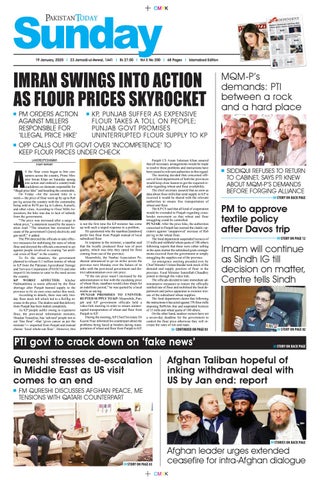
Imran swIngs Into actIon as flour prIces skyrocket g
g
pM orders Action kp, punjAb suFFer As expensive AgAinst Millers Flour tAkes A toll on people; responsible For punjAb govt proMises ‘illegAl price hike’ uninterrupted Flour supply to kp opp cAlls out pti govt over ‘incoMpetence’ to keep Flour prices under check g
LAHORE/PESHAWAR
a
staff report
s the flour crisis began to bite consumers across the country, Prime Minister Imran Khan on saturday sprang into action and ordered a countrywide crackdown on elements responsible for “illegal price hike” and hoarding the commodity. On Friday –for the second time in a week— the price of flour went up by up to Rs6 per kg across the country with the commodity being sold at Rs70 per kg in Lahore, Karachi, and other cities. According to Flour Mills Association, the hike was due to lack of subsidy from the government. “The price was increased after a surge in wheat price,” a statement issued by the association read. “The situation has worsened because of the government’s [new] electricity and gas tariff,” it added. The PM directed the officials to take effective measures for stabilising the rates of wheat flour and directed the officials concerned to act against people involved in creating “an artificial crisis of flour” in the country. To fix the situation, the government planned to release 0.1 million tonnes of wheat to KP from the Pakistan Agricultural storage and services Corporation (PAssCO) and also import 0.3m tonnes to cater to the need across the country. KP WORST AFFECTED: Khyber Pakhtunkhwa is worst affected by the flour shortage after Punjab banned supply to the province to fix its own crisis earlier this week. According to details, there was only twoday flour stock left which led to a Rs5/kg increase in the price. The dealers said that delivery from Punjab has been halted completely. As KP people suffer owing to expensive flour, the provincial information minister, shaukat Yousafzai, has ‘advised’ people not to eat ‘fine flour’ –that ‘gives cancer as per the minister’— imported from Punjab and instead choose ‘local whole-eat flour’. However, this
is not the first time the KP minister has come up with such a stupid response to a problem. He questioned why the naanbais [tandoors] prefer fine flour from Punjab instead of local subsidized flour. In response to the minister, a naanbai said that the locally produced flour was of poor quality, which was why they opted for flour coming from out of the province. Meanwhile, the Nanbai Association Peshawar announced to go on strike across the province next Monday over the failure of its talks with the provincial government and district administration over roti price. “If the roti price wasn’t increased by the administration in line with the escalating price of wheat flour, naanbais would close shops for an indefinite period,” he was quoted by a local media as saying. ‘PUNJAB PROMISES TO UNINTERRUPTED SUPPLY TO KP: Meanwhile, Punjab and KP government officials held a video-link meeting in order to ensure uninterrupted transportation of wheat and flour from Punjab to KP. During the meeting, KP Chief secretary Dr Kazim Niaz informed his counterpart about the problems being faced at borders during transportation of wheat and flour from Punjab to KP.
Punjab Cs Azam suleman Khan assured that all necessary arrangements would be made to resolve these problems and instructions have been issued to relevant authorities in this regard. The meeting decided that concerned officers of food departments of both the provinces would keep close liaison to get the required results regarding wheat and flour availability. The chief secretary assured that as soon as data about flour mills that send supply to KP is received it would be shared with the relevant authorities to ensure free transportation of wheat and flour. The KP Cs said that all kind of cooperation would be extended to Punjab regarding crossborder movement so that wheat and flour smuggling could be controlled. PUNJAB: After the price hike, the authorities concerned in Punjab has warned the chakki operators against ‘unapproved’ increase of Rs6 per kg in the wheat flour. The food department suspended licences of 15 mills and withheld wheat quota of 180 others following reports that these were either selling in the open market the subsidised grain consignments received from the government or simply smuggling the supplies out of the province. An emergency meeting presided over by Chief Minister Usman Buzdar took stock of the demand and supply position of flour in the province. Food Minister samiullah Chaudhry joined in through the video link. The officials decided to take immediate administrative measures to restore the officially notified rate of flour and mobilised the food department and police apparatus to monitor misuse of the subsidised wheat supplies. The food department claims that following the instructions it has acted against 376 flour mills imposing Rs90.6m fine and suspended licences of 15 mills and wheat quota of 180 others. On the other hand, tandoor owners have set a seven-day deadline for the government to control the flour price otherwise they will increase the rates of roti and naan.
CONTINUED ON PAGE 03
PTI govt to crack down on ‘fake news’ Qureshi stresses de-escalation in Middle East as US visit comes to an end g
MQM-p’s demands: pti between a rock and a hard place
g
siddiQui reFuses to return to cAbinet, sAys pti knew About MQM-p’s deMAnds beFore Forging AlliAnce STORY ON BACK PAGE
PM to approve textile policy after Davos trip STORY ON PAGE 12
imam will continue as sindh ig till decision on matter, centre tells sindh
STORY ON PAGE 02
STORY ON BACK PAGE
Afghan Taliban hopeful of inking withdrawal deal with US by Jan end: report
FM Qureshi discusses AFghAn peAce, Me tensions with QAtAri counterpArt
STORIES ON BACK PAGE
STORY ON PAGE 03
Afghan leader urges extended ceasefire for intra-Afghan dialogue CMYK
CMYK Sunday, 19 January, 2020
02 NEWS
‘iMAM will continuE AS Sindh ig till dEciSion on MAttEr’ ISLAMABAD
t
staff RepoRt
HE federal government on Saturday informed the Sindh government in writing that Dr Kaleem Imam will continue as the Sindh Inspector General of Police till the “competent authority” reaches a decision on the matter. On Thursday, the Sindh government wrote a letter to the Establishment Division seeking the IGP’s repatriation to the Centre, listing “compelling reasons” for the transfer. In a responding letter dated Jan 17, the Establishment Division said that the issue of repatriation of IGP Imam and the posting of his replacement, as requested by the Sindh government, is being taken up by the relevant authority and once a decision is reached on the issue, it will be shared with the provincial government. The letter said Imam will “continue to discharge his duties”, adding that the “look after charge of the post cannot be assigned to any additional inspector general of police by the province.” It is pertinent to mention here that one of the three names put forward by Sindh to replace IGP Imam is that of Dr Kamran Fazal, who is a grade-21 officer presently heading the Counter-Terrorism Department as its additional IG. “In case, the competent authority decides to transfer Dr Kaleem Iman (PSP/BS-21), PPO/IGP Sindh, a
Sindh PolicE conSPiring AgAinSt ProvinciAl govt, SAyS info MiniStEr KARACHI: Sindh Information Minister Saeed Ghani on Saturday alleged that some elements of Sindh police were involved in hatching conspiracies against the provincial government. Talking to reporters, Ghani said that Sindh IGP Dr Kaleem Imam has become controversial and any other person in his place would have resigned by now. A person who brings dishonor to the government should quit, he remarked. The PPP leader alleged that some people are plotting against Sindh government at the behest of IG Imam. Police officers should not support or oppose anyone. Those personnel who want to assist PTI should leave their job and join the party, he stressed. Ghani said that he is not afraid of cheap tactics by the opponents and affirmed that he is ready to face investigations regarding the allegations that have been leveled against him. The information minister said protests were staged during the PPP tenure against hike in petrol prices, but none of our allies held demonstrations against unemployment. The incompetent government of PTI surged the petroleum prices to highest level in history. staff RepoRt stop gap arrangement on any basis can only be made by the competent authority,” the letter read. It emerged on Friday that the Sindh government had approached the Centre with names of three senior police officers, asking it to appoint one of them as the new inspector general of police. Sindh Chief Minister Syed Murad Ali Shah had sent a letter to the Prime Minister’s Office on Thursday evening in which he proposed the names of Ghulam Qadir Thebo, Mushtaq Ahmed Mahar and Dr Kamran
Fazal for consideration. Meanwhile, private news channels reported that the federal government had reservations over the three candidates. They said that the federal government was considering names of Additional IG Motorway Police Dr Aftab Pathan, former Sindh IG AD Khowaja and former Karachi police chief Dr Amir Ahmed Shaikh for the top job. According to the police law, an IGP could be appointed after consultations between the federal government and the government of the said province.
Under-trial prisoners overcrowding jails, IHC told ISLAMABAD staff RepoRt
Under-trial prisoners constitute more than half of the prison population in all four provinces contributing to overcrowding in prisons, a report submitted to the Islamabad High Court (IHC) on Saturday said. On November 22, 2019, the IHC had constituted a commission to ensure civil liberties of prisoners. The court had converted the complaint of a convict, Khadim Hussain, into a petition that highlighted the negligence of the executive authorities which had caused damage to the complainant’s eyesight. On Saturday, Human Rights Minister Shireen Mazari presented in the court a report of the commission regarding jail reforms and the situation of prisoners. According to the report, an alarming 71 per cent of all prisoners in Khyber Pakhtunkhwa (KP) are yet to be convicted. The proportion is 70pc in Sindh, 55pc in Punjab and 59pc in Balochistan. “Even though these prisoners
have not yet been convicted of any offences they are languishing in prisons and contributing to overcrowding,” says the report. The report also sheds light on serious physical and mental ailments that the country’s prison population is suffering from. According to data provided by prison authorities in all four provinces which has been cited in the report, a total of 1,823 inmates are suffering from Hepatitis, 425 have HIV, 173 tuberculosis, 594 mental illnesses and 2,192 are suffering from other ailments. According to the document, almost half of the sanctioned posts of medical staff remain vacant in prisons across the country. “To worsen the situation, not every prison is equipped with medical and dental equipment and very few prisons have functioning labs and paramedical staff,” the report says, noting that prison authorities often fail to provide ambulances to transfer prisoners to hospitals in emergencies. It regrets that inmates continue to suffer violations of their rights inside prisons because they
Govt sacks four grade-17 officials named in BISP beneficiary list Four government officers named in the list of officers who had added their names to the list of beneficiaries of the Benazir Income Support Programme were dismissed on Saturday. The officers had added their names and the names of their wives to the list and had been taking money from the programme. The BISP is a federally-funded poverty reduction programme. It is working to lift people out of poverty. The officers dismissed include assistant directors of the programme in Dera Ismail Khan,
are “not adequately informed” of their rights at the time of sentencing. Presiding over the hearing, IHC Chief Justice Athar Minallah remarked that the authority to make arrests is being used “limitlessly”. “The Supreme Court has also said that you cannot misuse the authority to make arrests,” said Justice Minallah. Mazari told the court that they had also presented a plan to make separate cells for transgender persons. She said the government had formed a jail reforms committee consisting of Federal Law Minister Farogh Naseem and Barrister Ali Zafar, and that the report presented in court would also be shared with the government committee. During the proceedings, Justice Minallah said that it was the government’s responsibility to release a prisoner if he/she is severely ill. “The whole philosophy of Islam is that a human should be treated like a human,” remarked the chief justice, adding that Islam instructs that even if 100 guilty individuals are let go, one innocent individual should not be punished.
Muhammad Nauman and Shafiullah, and assistant directors of the programme in Abbottabad, Sabeel Khan and Fazzle Amin. Dr Sania Nishtar, the head of the BISP, tweeted that Rs440,196 has been recovered from them as a part of the Ehsaas Integrity and Ant-Corruption Drive. She also confirmed that the PPP’s central information secretary, Nafisa Shah was not on the list. On January 8, Dr Nishtar had confirmed that 2,543 officers of Grades 14 to 17 had included their names and those of their spouses in the list. The most cases were reported in Sindh, where 1,122 officers added their own names. In Balochistan, 741 officers included their names to the list, while 403 did it in Khyber Pakhtunkhwa and 137 in Punjab. News Desk
Marriyum criticises govt over shortage of wheat flour LAHORE staff RepoRt
AJK PM declares snow-affected region as calamity-hit areas MUZAFFARABAD staff RepoRt
Azad Jammu and Kashmir (AJK) Prime Minister Raja Farooq Haider has declared snow-affected areas of Neelum district, Leepa Valley and Bhedi area of Haveli district as calamity-hit areas. The government of Azad Kashmir (AJK) has nominated Commissioner Muzaffarabad as Relief Commissioner for the affected region under the Natural Calamities Act 1976, according to a statement. Prime Minister Raja Farooq Haider has directed the officials to plan relief operations in disaster-hit areas in view of the weather conditions. The land link with Leepa Valley and Bhedi area of district Haveli has been disrupted due to heavy rainfall, the prime minister said. Moreover, 13-year girl Sameena, who was injured in avalanche in Neelum Valley succumbed to her injuries soaring the death toll in the incident to 76. The relief operations in the affected area have been ongoing and military troops and other rescue teams have been engaged in relief and rescue work. The survivors of the natural disaster being provided food, tents, winter garments and other items of essential needs, officials said.
Pakistan Muslim League-Nawaz (PML-N) spokesperson Marriyum Aurangzeb on Saturday lashed out at the ruling Pakistan Tehreek-e-Insaf (PTI) for rising inflation in the country.In her talk to the media, she stated that in 16 months, gas tariffs have been raised by 250 percent, and the acute shortage of wheat flour was
tantamount to “worst incompetence” by the government. “In Imran Khan’s naya (new) Pakistan, do people eat from the almonries?” she asked, while expressing grave concerns about the shortage of wheat flour and closures of tandoors. She termed it “worst incompetence” by the government despite roti and naan prices of Rs15 and Rs20, respectively. “Mr Imran, if one person have
had committed suicide 16 months ago, then millions of poor people would have been saved from committing suicide,” she said, while claiming that after the destruction of poor people’s houses, shops, and businesses, they have been deprived of wheat flour as well. She asserted that the inflation has risen by 14 percent and the development has been halved, and asked: “Whom do you talk of providing relief daily?”
CM office releases expenditure details LAHORE app
The Chief Minister's office has released the details of expenditures spent during the current and previous governments for the renovation and maintenance of CM's residence at 7Club Road and his office on 8-Club Road. According to the spokesman, the building of 7-Club Road was decades old and after former chief ministers Manzoor Wattoo and Sardar Asif Nakai, the building had not been used as CM's residence. It was declared as an office in the first tenure of Shehbaz Sharif and remained neglected with very few staff in the tenure of former President Pervaiz Musharaf. Former chief minister Shahbaz Sharif merely used 7Club Road as his office. According to the spokesman, Usman Buzdar after holding the portfolio of Punjab Chief Minister started using 7-Club Road as his residence. The 7- Club Road building was in a dilapidated condition due to the negligence spanning over many decades, therefore, renovation and maintenance of this building was utmost necessary to make living place. During the last fiscal year 201819, Communication and Works De-
partment spent Rs.23 million on the repair and maintenance of 7- Club Road whereas only Rs.5.4 million were spent in the first six months of the current fiscal year for the purpose. The C&W Department spent Rs.23 million in the fiscal year 201617 and Rs.28.5 million in the fiscal year 2017-18 in the same head when CM was not residing there. The spokesman said that 7- Club Road was the only residence of Punjab Chief Minister Sardar Usman Buzdar, which has office and meeting rooms. Despite that, Usman Buzdar was residing in 7-Club Road, the expenditures made on this building were much less than the amount spent in the previous governments
CMYK
which reflected the austerity policy of PTI government. Following the austerity policy, only poshish of the furniture was made instead of purchasing new furniture. The spokesman also negated the purchase of luxurious furniture for the building. He maintained that Rs.53.8 million were spent in the year 2018-19 and Rs.20.4 million in the first six months of current fiscal year in the heads of entertainment or gifts. Whereas, Rs. 86 million were spent from the national exchequer in 2016-17 and Rs.89.9 million in 2017-18 in the same heads. He clarified that Chief Minister annexe was being used from 2004 as a VVIPs guest house and following the tradition the same used for the residence of Prime Minister, advisors and federal ministers. Only Rs. 9 lac were spent in last fiscal year in the head of crockery and in the first six months of current year Rs. one lac only was spent under the head. Whereas, Rs.9 lac were spent in the year 2016-17 and Rs.11 lac were spent for the purchasing of crockery in the year 2017-18. The funds utilized for all necessary expenditures were much lesser than the funds utilized during the previous tenures, the spokesman added.
Quetta hero gets PM's praise for saving over 100 lives Prime Minister Imran Khan on Saturday hailed Suleman Khan, a citizen who saved more than 100 people stranded in Quetta’s snow. “The whole nation is proud of Suleman Khan who showed great courage and selflessness to help people stranded in the snow,” tweeted the prime minister. The whole nation is proud of Suleman Khan who showed great courage and selflessness to help people stranded in the snow. https://t.co/S6ALeUzhur — Imran Khan (@ImranKhanPTI) January 18, 2020 News Desk
Shalimar Express escapes disaster A train driver’s skillful handling of the situation saved the day as the Shalimar Express averted a major accident Saturday when a railway line broke. The train was traveling from Lahore to Karachi when the incident occurred. A railway line between Sharshameer Station and Pakka Anna Station broke, putting the train in danger of getting derailed. Railway authorities confirmed that the passenger train driver used his skills to save the train from an accident. On the other hand, Railway Police said that there was a probability that someone deliberately put people’s lives at risk. The rail tracks were not broken rather, nut bolts of the Fishplate were loosened, which led to the incident, police said. News Desk
CMYK Sunday, 19 January, 2020
NEWS
QurEShi StrESSES dE-EScAlAtion in MiddlE EASt AS uS viSit coMES to An End WASHINGTON ageNcies
f
OREIGN Minister Shah Mahmood Qureshi has emphasised the need for de-escalation and dialogue to reduce tensions in the Middle East as he ended the final leg of his tri-state tour on Saturday. Qureshi has spent the week touring Iran, Saudi Arabia and the US on a diplomatic mission meant to defuse tensions between
Washington and Tehran, on the direction of Prime Minister Imran Khan. Tensions between Iran and the US have soared after the latter killed Iranian Gen Qassem Soleimani in a drone attack in Baghdad. Iran retaliated by a missile strike on a US military base in Iraq, in which 11 people were injured. During a meeting with United States National Security Adviser Robert O’Brien at the White House on Friday, Qureshi con-
veyed Pakistan’s concern that instability in the Middle East would affect the neighbourhood and the global economy. “He underscored Pakistan’s willingness to play its role for peace in the region,” a statement issued by the Foreign Office (FO) stated. The two discussed a range of issues, including the situation in the Middle East, human rights violations by the Indian authorities in occupied Kashmir, peace talks between the US government
and Afghan Taliban. Bilateral relations between US and Pakistan were also discussed. Qureshi reminded O’Brien of President Donald Trump’s offer to mediate between India and Pakistan to solve the Kashmir dispute which was made during Prime Minister Imran’s visit to the US last year. The foreign minister told the national security adviser about the human rights violations being committed in occupied Kashmir by the Indian authorities, follow-
UNSC realises situation in occupied Kashmir is grave, says Munir Akram Permanent Representative of Pakistan to the United Nations Ambassador Munir Akram has dismissed Indian claims that New Delhi has successfully scuttled efforts by Beijing and Islamabad to raise the longstanding Kashmir dispute before the United Nations Security Council (UNSC). In an interview with a private news channel, Akram said the UNSC on January 15, not only discussed the Kashmir issue but all members also acknowledged that the human rights situation in the scenic Himalayan region is grave. Indian Occupied Kashmir (IOK) has been under an interrupted curfew since August 5, 2019 when India unilaterally stripped the disputed territory of its special status by revoking Article 370 of its constitution. The ambassador said contrary to the Indian propaganda the world has realized the importance of Kashmir issue after a detailed briefing by the UN Military Observer Group in India and Pakistan (UNMOGIP) during the session. “India always tries to present distorted facts but this time around they were caught,” Akram said. He said all
the facts, including ongoing curfew in the IOK, human rights violation there and closure of internet and other services, were also discussed during the UNSC meeting. “Political situation in India is at a stage where they can’t even afford to allow international or local media to go in Kashmir.” Akram said Pakistan has continually highlighted the human right situation in the IOK and the Foreign Minister Shah Mehmood Qureshi has written letters to UN officials over situation in Kashmir. When India continued its oppressive policy, he said, Pakistan requested the UN to convene a second meeting of the UNSC, which was immediately accepted by the UNSC president. “This was the second UNSC meeting in less than six months to discuss the alarming human rights situation in Indian-occupied Kashmir. China has played a key role in convening the meeting. “In the meeting, UN Assistant Secretary-General for Political Affairs and the head of the military operations briefed the members on the political and human rights situation in Kashmir and the current
company via email purporting to be his partner, claiming that he’d died from a heart attack in Karachi, Pakistan”. Interestingly, Bukhari was already serving a seven-year jail sentence for other fraud charges. He was convicted of the latest insurance scam on Friday in the UK’s Inner London Crown Court and sentenced to five years and seven months in prison. The lead investigator, Acting Detective Sergeant Mike Monkton, said: “Not only did Bukhari try and fake his own death and steal hundreds of thousands of pounds from his insurer, he was also brazen enough to impersonate his partner in a bid to progress his claim. “If he’d been successful, he
and economic ties would help to strengthen relations between the two countries. He also reaffirmed Pakistan’s support for talks between Afghan Taliban and US in order to establish peace in Afghanistan. Pakistan’s ambassador to the US Asad Majeed and other officials of the Pakistani embassy saw Qureshi off on his departure. During his visit, he held meetings with UN Secretary General Antonio Guterres and the President of the UN General Assembly, Tijjani MuhammadBande in New York, where he conveyed Pakistan’s reservations over the situation in occupied Kashmir. The meetings came soon after the UN Security Council held a meeting on the Kashmir dispute on China’s request.
Imran swings into action as flour prices skyrocket cONTINUED FROM pAGE 01
situation at the Line of Control (LoC). “They briefed the council about the measures the Indian government has taken and how tensions have increased. Both the observers have quoted the UN’s reports on human rights violations to highlight the situation in the valley,” he said. Currently, the observers said, Pakistan is cooperating while India has not cooperated at all. Once they briefed the council, Akram revealed, all 15 members spoke on the issues highlighted and “several members expressed sympathy with us [Pakistan]” after analyzing Pakistan’s position in the matter. News Desk
Pakistani jailed for posing as wife, faking death in £1m insurance scam A British-Pakistani man was jailed after United Kingdom authorities caught him posing as his wife and faking his own death for a £1-million insurance scam. According to London Police’s insurance fraud department (IFED), Syed Bukhari, 39, “impersonated his female partner on the phone to try and fake his own death”, claiming that he had passed away following a heart attack in Karachi. To try and progress his claim, he “also used a bogus death certificate”, as well as a medical certificate mentioning the cause of death and a trust document. The London Police added that he “had initially contacted his insurance
ing New Delhi’s decision to strip the region of its special status in August last year. The foreign minister insisted that the Kashmiris should be given the right to self-determination in accordance with United Nations resolutions. Qureshi also recalled President Trump and Prime Minister Imran’s “shared vision for a broad-based and enduring partnership” between US and Pakistan and said that bilateral trade
03
would’ve benefited up to the sum of £999,999,” Monkton added. Investigators also discovered that there was no record of Bukhari being buried in the cemetery, the medical centre where he allegedly died did not exist, and a doctor from another hospital nearby said he never heard of such a facility. The British-Pakistani man was caught after a voice analysis expert tallied his voice and his fingerprints were found on the documents he submitted, coupled with the aforementioned evidence. Bukhari, regardless, denied the fraud and blamed it on his own partner. However, he later pleaded guilty at court. News Desk
CMYK
They threatened an increase in the prices of roti from Rs6 to 10 and of naan from Rs10 to Rs15. Naan-Roti Association president Aftab Aslam Gill has given a seven-day ultimatum to the government to control the wheat products’ prices otherwise they will be forced to shift the flour price hike onto their customers. Sindh and Balochistan are facing a shortage of flour and a subsequent increase in the price of the commodity.
Islamabad bar asks members to declare faith The Islamabad Bar Association (IBA) has directed its members to submit affidavits declaring their faith on the finality of Prophet Muhammad (PBUH) by the end of the ongoing month, failing which would lead to suspension of their membership from the lawyers’ group. A notification issued by IBA President Malik Zafar Khokhar and secretary Mirza Nabeel said that in view of the decision taken by the General Body on December 6, 2019, all members of the association have been asked to submit affidavits declaring their faith in the Finality of Prophet Muhammad (PBUH) to fulfill the requirement under the bar’s Amended Rules 2019. Those who fail to do so, it added, would have their membership suspended and names posted on noticeboard. Khokhar said the purpose of seeking affidavits was not the suspension of non-Muslim lawyers from the association but to identify the members of the Ahmadi community. He also ruled out the perception that through this notification they were targeting any lawyer from the side of their opponents. News Desk
The mill owners accused the provincial food department of creating a wheat crisis in provinces. CRITICISM: National Assembly Opposition Leader Mian Muhammad Shehbaz Sharif, who is in London for over a month now, slammed the surge in prices of wheat flour across Pakistan. The Pakistan Muslim League Nawaz (PML-N) president urged the government to reveal the truth on why Pakistan was facing a shortage of the basic food commodity.Shehbaz Sharif
had said that it was the right of the people to know what happened to wheat stocks of the country. Pakistan People’s Party (PPP) Chairman BilawalBhutto also denounced the hike in the prices and said that the government was too incompetent to provide relief to the people. He said the government warehouses were full of flour, but it was not unavailable to common people. He said the increase in flour prices twice this week was a testament to PTI’s incompetence.
04 ISLAMABAD
Sunday, 19 January, 2020
WEATHER UPDATES SUNDAY
150C
030C
MONDAY
160C
030C
TUESDAY
150C
050C
WEDNESDAY
100C
070C
QWP criticises ban Efforts of Chinese govt for raising Kashmir on transPortation of lockdown issue at UNSC lauded Wheat, flour to KP RAWALPINDI INP
PESHAWAR
P
APP
RoVINCIAL Chairman Qaumi Watan Party (QWP) Sikandar Hayat Khan Sherpao on Saturday termed unconstitutional the ban on the transportation of wheat flour to Khyber Pakhtunkhwa from Punjab. Addressing party workers here at Watan Kor, Sikandar Hayat Sherpaos said that KP produces more gas and electricity than its consumption and the surplus energy is supplied to the rest of the country particularly Punjab to run its industries adding that if one province had the right to have control over its resources then KP should also be allowed to exercise its authority over its own resources. Sikandar Sherpao said the move would trigger wheat flour crisis in the province at a time when the price of the commodity
had already registered a sharp increase due to its short supply. He added that the people were facing difficulty to buy wheat flour and other essential food items due to the rising inflation. The QWP leader said that the Pakistan Tehreek-e-Insaf rulers particularly the Punjab government should avoid taking such controversial steps as it could disturb the law and order situation. “This controversial step is not only against the spirit of the constitution, but would also damage federalism,” he feared, urging the government to dissuade from taking such measures that could plunge the country into a serious crisis. “Wheat flour is a staple food so its unavailability may not bode well for the rulers,” he remarked, adding that the government was duty bound to ensure the provision of the essential food items to the people at subsidized rates.
Syllabus of class 1 to 8 to be changed in Cantt areas RAWALPINDI APP
The Directorate of Federal Government Educational Institutions (FGEIs) Cantts/Garrisons has decided to change the syllabus from class 1st to 8th with effect from next academic session 2020-2021. According to a spokesman, the decision has been taken after a series of sessions held by committees of subject specialists and experts on curriculum review. He said that the curriculum of FGEIs from Class 1st to 8th will be in line with Federal Directorate of Education Islamabad textbooks following National Curriculum Framework 2017. For this purpose, various publishers
were approached for provision of books on subsidized rates, he said adding that publishers have shown their willingness to provide required books to the students by organizing book fairs in the schools after declaration of results. Publisher will provide free text books to the wards of martyrs and orphans student of class one to five, he informed. In this regard, the Directorate has issued instructions for publishers. Publishers of Textbooks (Classes I – VIII) will ensure that the contents, exercises, diagrams, maps etc are in accordance with National Curriculum Framework 2017. They have also been directed that the textbooks published by them will not have any traces of extremism, religiously conflicting and biased contents.
Speakers of a seminar on “Kashmir Lock Down and Jinnah’s Vision”, held here on Saturday under the auspices of Jinnah Iqbal South Asian Plus Forum have appreciated the efforts of Chinese government for raising the issue of Kashmir Lock Down in the United Nations Security Council and stressed the world nations to shoulder their responsibilities with regard to resolve the issue through relevant UNSC’s resolutions in a peace full way. Seminar was held at Jinnah Iqbal Education campus Rawalpindi with Former Senior Economic Advisor of World Bank Mr. Fateh M. Chaudhri in chair. Rana Abdul Baqi Chairman Jinnah Iqbal South Asian Forum, Prof. Aqeela Asif of Comsat University Islamabad, Dr. Sabahat Sajjad, Arsalan Akbar Abbasi and others spoke on various aspects of Kashmir Dispute in the backdrop of Jinnah’s visionary struggle to achieve Pakistan opposed by the Hindu Extremists. Students of Jinnah Iqbal Girls and Boys sections presented National Anthem and National Songs reflecting the aspirations of the people of occupied Kashmir demanding of the Indian government to quit Kashmir. Seminar was largely attended by Senior Citizens, Teachers, Women and Students. Chief Guest Fateh M Chaudhri said that Quaid-e-Azam Muhammad Ali Jinnah’s vision as builder of Pakistan not
only translated the ideals of Hakeem ul Ummat Dr Allama Muhammad Iqbal into reality but also told the world in unequivocal terms that Muslims of India are a separate nation in all respects, hence deserved a separate homeland in the districts and the princely states of India including the state of Jammu and Kashmir, where Muslims are in majority. Fateh Chaudhri said that the world leaders and the international human rights organizations must look into the plight of Kashmir population made hostage by the extremist Hindu government of BJP in league with RSS since more than 5 months. “The world leaders must act to pressurize Indian government to allow the people of Kashmir to exercise their right of self-determination as envisaged in the United Nations Security Council Resolutions. Fateh Chaudhri appreciated the mannerism through which the students of Jinnah Iqbal Education conducted themselves to highlight the Indian atrocities on innocent people of Kashmir. He mentioned that it was good to see that people of Pakistan stand united against Indian design in occupied Jammu & Kashmir. Rana Abdul Baqi, Chairman of Jinnah Iqbal South Asian Forum commended the effort of Chinese government for raising the issue of Kashmir Lock Down in the United Nations Security Council. He said that its time for the UN Security Council to lis-
Speakers call for imposing carbon emission tax to reduce health issues ISLAMABAD APP
Speakers at a seminar underlined the need of imposing carbon emission tax in order to reduce the health problems. They expressed these views at a seminar held here on “Road Safety in Islamabad” organized by the Department of Sociology Quaid-e-Azam University to raise the awareness and propose effective measures about the issue of road safety in Pakistan. The seminar was based on the findings of a research project on “Road Safety” to understand the attitude and behavior of commuters, funded by Higher Education Commission of Pakistan. Deputy Commissioner Islamabad Muhammad Hamza Shafqaat was the chief guest of the event. Dr. Muhammad Zaman, Chairman, Department of Sociology, QAU and principal investigator of the project on Road Safety shared the preliminary findings of the research survey. Dr Zaman highlighted the critical state of road safety in global and national perspective. Further, he proposed sustainable measures to counter this situation with the focus on effective licensing system, electronic surveillance, smart parking and effective legislation. Besides this he also proposed a Smart Public Transport System. He asserted there is need to impose carbon emission tax in order to reduce the health problems. Deputy Commissioner Hamza Shafqaat shared his views on the issue of road safety and existing initiatives taken to improve the situation of safer road. He praised the efforts of Department of Sociology and the role played in highlighting this issue. He also discussed the socio-cultural barriers at communal level in implementation of projects in which social scientists and youth can play a significant contribution. A joint collaborative initiative started between Deputy Commissioner Islamabad and Department of Sociology who offered a “Letter of Support” to Chairman to continue his work on “Road Safety in Islamabad”. He further proposed to engage the students of QAU in awareness activities and seminars to be carried by DC office ICT. He stressed that mutual collaboration is meaningful to better understand and deal with road safety challenges. Kamran Cheema, Additional Deputy Commissioner also added the efforts of the Islamabad Transport Authority to maintain the road safety. He highlighted how the ICT administration is facing problems in implantation of the law and orders on roads. He stressed that ICT administration will launch innovative solutions with the assistance of the universities Sociology Department of QAU. Dr Imran Sabir, Assistant professor at Sociology Department QAU presented closing remarks in which he thanked all of the guests and participants of the seminar.
CMYK
ten to the voice of sanity being raised by the international community against the Indian unprecedented atrocities on innocent people of Kashmir. Rana Abdul Baqi said that UN Security Council must implement the Security Council Resolutions by ordering both the government to hold plebiscite in Jammu and Kashmir allowing right of self-determination to the people of Kashmir. He appreciated Prime Minister Imran Khan’s assurance to UN Security Council for holding plebiscite in Azad Kashmir and said If India refused to act on the UN advice for implementing UN Security Council Resolutions then UN must allow the Kashmiri freedom seekers to form a government in exile of the Indian occupied Kashmir in Chinese territory of Tibet or in any European country. Rana Baqi said that both Pakistan and India are nuclear states and the Indian Army Chief should desist hurling threats to Pakistan for invading Azad Kashmir and the any incursion by India in Azad Kashmir will be self-destructive for India. Prof Aqeela Asif commended the vision of Quaid-i-Azam Muhammad Ali Jinnah who strongly pleaded the concept of two nation theory in the wake of stiff resistance by Hindu extremists. She mentioned that Quaid-iAzam Muhammad Ali Jinnah convincingly presented the Ideology of Pakistan on the basis of Islamic way of life to carve out Pakistan as an independent Muslim State.
Sunday, 19 January, 2020
NEWS LAHORE STAFF REPORT
a
n anti-narcotics court on Saturday reserved its decision over a petition of former Punjab law minister Rana Sanaullah seeking return of his vehicle. Pakistan Muslim League-nawaz (PML-n) Punjab president has filed a petition in the court praying to release his land cruiser vehicle on Supardari. His counsel argued in the court that Rana Sanaullah has acted against several outlawed groups as
Court reserves verdiCt on pLea of rana sanauLLah in drugs Case law minister and having threat to his life. He pleaded for return of the bullet-proof vehicle, which was presently in the custody of the Antinarcotics Force (AnF). AnF counsel while opposing the plea argued that Rana Sanaullah didn’t express any apprehension about threat to his life earlier.
A vehicle taken in custody in a drugs case could not be handed over on Supardari, AnF counsel argued. The term Supardari used in a sense when a defendant seeks release of his vehicle or other case property during the pendency of the case. The court adjourned further hearing of the case till February 08.
Rana Sanaullah was arrested last year in July by the AnF from the Islamabad-Lahore motorway near the Sukheki area. According to AnF spokesperson, drugs were recovered from the PML-n leader’s car. He was released on bail on Dec 26. His name has been put on the Exit Control List (ECL) in drug case.
Government to remove genuine reservations of allies: Dr Firdous LAHORE APP
Special Assistant to the Prime Minister (SAPM) on Information and Broadcasting, Dr Firdous Ashiq Awan said on Saturday that the government would remove all genuine reservations of its allies by adhering to the policy of consensus, consultation and reconciliation. Addressing ‘Meet the Press Programme’ here at Lahore Press Club, she said the elected PTI government was advancing further while taking along all the provincial governments, however, some political dwarfs and defeated elements were dreaming of toppling the government and mid-term election but they would face sheer disappointment as the PTI government would complete its constitutional term of five years. Dr Firdous Ashiq Awan said PTI was implementing its reform agenda by making effective legislation to abolish the obsolete system in the country. She warned those (public servants) obstructing the government’s way, saying that there would be zero tolerance on performance and public service delivery.
1,500 passengers stranded at Lahore airport after 7 flights delayed At least 1,500 passengers were stranded on Saturday after seven international flights were postponed at the Allama Iqbal International Airport. It included two PIA flights and the rest were international airlines. There were 12 flights scheduled on Saturday. Delays at the security check-in counters meant several passengers also missed their flights. Passengers of the other five flights were timely checked in after which they boarded their respective flights. The airport was reportedly short-staffed due to which it took longer to handle the passengers. PIA Spokesperson Abdullah Khan said the flights were postponed due to bad weather conditions. He also said excessive passengers made it difficult for the officials to complete the checking of all passengers on time. Some passengers also complained of the lack of facilities at the airport. NEWS DESK
Since political stability and economic stability were very much interlinked, the present government was ensuring both, citing that jeopardized economy left by the previous governments had now come out of ventilator and attained stability following the tough but timely and vital decisions by the PTI government, she elaborated. She said through economic stability, the government was providing maximum relief to masses. A crackdown had also been launched against flour millers, hoarders, profiteers and elements creating artificial price-hike to stabilize the prices of daily use items, she added. The government had taken various decisions to maintain its writ and such elements would be dealt with iron hand, and scope of Kisan Markets would be expanded to bring down the flour prices, she vowed. Dr Firdous called upon the media to play its role in pointing out those creating artificial price-hike, hoarders and cartels etc. People were being given subsidy on edibles including Ghee, flour, sugar and pulses at utility stores under Rs 6 billion relief package announced by the prime minister.
05
Sunday, 19 January, 2020
06 WORLD VIEW
The baTTle of 'resisTance' vs 'revoluTion' in The Middle easT THE CLASH BETWEEN THE 'RESISTANCE' AND 'REVOLUTIONARY' MOVEMENTS WILL DEFINE THE MIDDLE EAST IN THE FUTURE
al Jazeera
T
rAMI G KHourI
HE events surrounding the US assassination of Iranian Quds Force leader Major General Qassem Soleimani brought to the surface the two main ideological forces that now battle each other across the Middle East - the anti-imperial "resistance" of Iran and its Arab allies, and the freedom "revolution" of domestic protesters in the same lands. The first was reflected in the massive funeral processions in Arab and Iranian cities for Soleimani and his colleagues that were far bigger than the usual stateorganised propaganda protests. Such outpourings of grief and anger in Iran, Iraq, Lebanon and pockets elsewhere signify the central political dynamic - "resistance" in their view - which drives Iran and its allies, and shapes many regional developments. After a brief pause - from the shock of the assassinations, respect for the dead, widespread anti-American anger, fear of wider conflict, much rain, and Tehran's admission of its error in downing the Ukrainian civilian airliner - the second key regional dynamic reared its head again: popular demonstrations for freedom and democratic pluralism resumed across the
same lands (Iran, Iraq, Lebanon), where large crowds wept for Soleimani and vowed to stand up to the US and its allies. These two forces now battle to define the identity and policies of the Middle East for decades to come. "Resistance" (moqawama) is how many Arabs and Iranians fight back against the US, Israel and their conservative Arab allies like Saudi Arabia and the UAE. "Revolution" (thawra) for democratic freedoms, social justice, and pluralism that exploded in Arab countries and Iran since the 201011 uprisings is how determined ordinary citizens seek to remove the autocratic, incompetent or corrupt governments they blame for their deteriorating living conditions and denied rights. The two forces had coexisted in separate spheres for years, but they now openly clash head-on in Iran, Iraq, Syria and in Lebanon, as "resistance" troops try to beat down "revolutionary" protests by force. "Resistance", the oldest of the two forces, since the 1980s has defined the policies of Iran and its Arab strategic partners, notably Hezbollah, Hamas, Syria, Ansarullah (Houthis), People's Mobilisation Forces (PMFs) in Iraq and Syria, and other smaller groups. Nonviolent mainstream Islamists like the Muslim Brotherhood also "resist" Western and Israeli political and cultural threats to Arab-Islamic societies, as do nationalist and progressive groups across the region that share this wide tent. Since soon after the 1979 Islamic revolution, Iran has defined and implemented the core resistance strategy by building political and technical military
capabilities among its Arab allies. This allows it to conduct operations throughout the Middle East via its Arab partners and allies, who pester, fight or deter their common foes in neighbouring lands, before the battle reaches Iran itself. They all use Iran's asymmetrical warfare toolkit - including missiles, cyber capabilities, attack drones and communications/surveillance systems - to confront Israel (Hamas and Hezbollah) or conservative Arabs like Saudi Arabia and the UAE (the Houthis). General Soleimani's main mission was to develop this network of Iran's Arab allies. Arab critics, however, see this as Tehran's hegemonic export of its Islamic revolution in order to weave a web of capable puppets under its control. Soleimani was able to foster so many Arab allies because many Syrians, Lebanese, Iraqis, Yemenis and Palestinians had suffered badly from American, Israeli and conservative Arab policies of war and occupation; they were so weak and vulnerable that they willingly joined the Iranian-led, Islamist-driven movement as a self-preservation move. The self-proclaimed "resistance axis" ethos is to defy foreign threats and refuse to bow to American and Israeli demands, even at the cost of war or debilitating sanctions. Yet, Iran's nuclear deal with the US, UK, Germany, France, China and Russia, and Hezbollah's indirect agreements and ceasefires with Israel show the resistance powers' willingness to engage their foes politically, but only based on equal respect for the rights of all sides. Historians will determine whether "resistance" has been a heroic anti-impe-
rial success or a naive fantasy. Its advocates say it evicted Israel from South Lebanon and Gaza, achieved strategic deterrence between Hezbollah and Israel, compelled the United States and its partners to agree to the nuclear deal, allowed Iran to survive severe sanctions, saved the Assad government in Syria, beat back the ISIL threat, and now may be pushing the US out of Iraq. Critics say these gains have come at a brutal cost to Arabs and Iranians, leaving entire countries in economic and environmental collapse, in top-heavy autocracies that constrain liberties and human rights, and brutalise those who protest peacefully. Some also fear that the resistance culture promises them only a future of perpetual warfare and economic distress. The "revolutionary" protests underway have rocked the region in the past decade. They have been led by a young generation which has borne the brunt of economic mismanagement and the increasing authoritarianism of what they see as a corrupt political elite more concerned with self-enrichment than the wellbeing of its people. This generation has decided to rebel against regimes they view as largely illegitimate and propped up by outside forces, which due to their incompetence are unable to provide for the basic needs of their citizens. Millions have taken to the streets, defying violent crackdowns, and demanding reforms or total changes in governing systems. Arab and Iranian protesters want to have a say in government policies to protect civil rights and pursue social justice, and to end the existing crony
capitalist systems that have ravaged the middle class and spawned large-scale poverty and marginalisation. In doing so, some of these protest movements have come head-to-head with regimes supported by the US, Israel and its conservative Arab allies and others with regimes backed by Iran and its proxies. In the first case, they have been slandered as Islamists and extremists; in the second as US and Israeli collaborators. But many revolutionary protesters have been explicit about their opposition not only against inept and unjust rule at home, but also foreign interference from both the US and Iran. This sentiment was captured in a statement released on January 11 by protesting Iranian students at Amir Kabir (Polytechnic) University in Tehran, which said: "The only way out of our current predicament is the simultaneous rejection of both domestic despotism and imperial arrogance. We need a politics that doesn't merely claim security, freedom, and equality for a select group or class, but that understands these rights as inalienable and for all people." As the full universe of "resistance" unfurls at this historic moment across the Middle East, the banner that Islamists and Arab nationalists had claimed exclusively for their battle against American, Israeli and conservative Arab threats has now been joined by a homegrown domestic "resistance" by Arab and Iranian citizens who confront their own governments and demand freedom, equality and dignity. Rami G Khouri is a senior public policy fellow and journalism professor at the American University of Beirut.
Should US forces leave Iraq? Who represents India’s Muslims? Washington times GAry AnDErson
Iraq’s interim prime minister has asked the United States for a plan to withdraw its remaining forces from that country in retaliation to the Soleimani killing. The reaction from the United States has been measured. Secretary of State Mike Pompeo’s response has been that any U.S. delegation will discuss the right size for U.S. forces in Iraq. This could range from the present 5,000 to none. That is the correct diplomatic response because it will provide for a cooling off period for tempers on both sides to subside after the killing of a U.S. contractor in Iraq by an Iranian-backed militia and the retaliatory killing of Gen. Qassem Soleimani and a top militia leader by U.S. forces followed by the botched Iranian missile strike on two American bases. Like many people who think about national security issues, I’m of two minds regarding continued U.S. military presence in Iraq. The argument for staying is that our withdrawal would achieve one of Iran’s key objectives in the region at a time when we are punishing Iran for its bad behavior. The majority of Iraq’s Shiite parliamentarians are the creatures of Iranian-backed political parties and militias, and the session of Parliament that voted to demand for ousting U.S. forces was boycotted by Sunni and Kurd members — because they knew they would be outvoted anyway — claiming that the entire process was an Iranian orchestrated goat rope. A majority of Iraqi voters stayed away from the 2018 elections because they knew that the outcome was foreordained by corrupt Shiite elites. No Iraqi of any confession that I keep in contact with bothered to vote. Nationalism among Arabs — Sunni and Shia alike — remains strong in Iraq. This is particularly true of the veterans of the Iran-Iraq War who fought hard against Persian domination only to see Shiite opportunists sell their nation out to Iran after the Saddam Hussein regime was toppled in 2003. In addition, there is the fear of a resurgence of ISIS, particularly in the Sunni Triangle. The Sunnis remain distrustful of their nation’s Shiite-dominated security forces and particularly the Iranian-advised, government-sponsored militias that continue to terrorize the region. Many Sunnis view the American presence as a buffer between jihadist and Shia terror and as a modifying influence on the Iraqi military and police forces that they are advising.
However, there are also cogent arguments in favor of an American withdrawal. Continued U.S. presence against the wishes of the Iraqi government will be portrayed by America’s enemies in the world as an illegal occupation and further evidence of American imperialism. The anti-government protesters in Baghdad’s Tahir Square fear that the nation is becoming a battleground between competing foreign interests, and America Firsters among the president’s most fervent supporters oppose all foreign entanglements; this ironically puts them in bed with extreme leftists, such as Bernie Sanders, who reflexively assume that America is wrong in any of its foreign involvements. While U.S. military presence may help to modify the behavior of the Iraqi security forces, it can also be viewed in some quarters as helping Iran to prop up a corrupt and incompetent regime in Baghdad. There is also a belief that, should ISIS resurge in Iraq, U.S. forces can easily be redeployed from bases elsewhere in the region. Perhaps the strongest argument for a U.S. withdrawal is the possibility that a coalition of anti-Iran Sunni and Shiite Arabs — which represents the real majority in Iraq — will eventually put together an armed uprising against the Quislings now in power; that is a distinct possibility. The nightmare scenario would be American forces being caught between a legitimate uprising and a despised and corrupt government. At the present time, Mr. Pompeo’s action in taking a “go slow” approach to the Iraqi withdrawal request is prudent. Iraq’s government is in turmoil. The Tahir protesters cannot be ignored forever. Ayatollah Sistani, the Iranian-born chief Shiite cleric, has sided with the protesters, and the Green Zone political elites may simply decide that they don’t need another crisis. Mr. Pompeo should take the position that an American withdrawal will be contingent on Iranian Quds Force advisers leaving as well. If not, Iran will see an American ejection as a victory. Whatever happens Iran’s quasi-alliance with the present Iraqi government is becoming as much of an embarrassment to Tehran as the U.S.-Saudi alliance is to us. Iran’s leaders are being insulted and its consulates burned. If I were an Iranian strategist, I’d likely be asking; “With friends like these, who needs enemies?” Gary Anderson lectures on Alternative Analysis at George Washington University’s Elliott School of International Affairs. He has served as a civilian adviser in Iraq and Afghanistan.
THANKS TO CAA PROTESTS, WE NOW KNOW THE ANSWER
Print HILAL AHMED
The remarkable presence of Muslims in anti-CAA protests throughout India is a powerful, symbolic, and strategic assertion that counters aggressive Hindutva. It also signals the birth of a new ‘inclusive nationalism’ in India. Although this new, mass Muslim politics has not yet found any concrete formal shape, the violent and even brutal reaction of the Narendra Modi government towards Muslim protesters is itself a sign of its increasing political significance. This assertion comes after six years of near-silence of Indian Muslims in the face of a sustained propaganda to demonise the community. They didn’t react because they couldn’t re-imagine and flesh out the exact nature of the new Muslim political identity. Triple talaq and Babri Masjid had already lost their symbolic potentials for Muslims. But the new citizenship issue is different. It is linked to the very foundation of their political, and indeed social, existence. This has provoked them to assert themselves as Indians as well as Muslims – and thereby proposing a new inclusive definition of nationalism. But there are four new factors that are shaping this new Muslim politics and its stake in nationalism. PEOPLE’S MOVEMENTS: The Muslim protesters, it seems, draw inspiration from grassroots politics and people’s movements (such as those against displacement, or by Dalit/Adivasis, or farmers’ agitations) in two significant ways. First, they identify the Constitution as a legitimate political source to assert their citizenship status. The Constitution’s liberal values, especially the Preamble, are creatively interpreted to question the disruptive agenda of the government. Second, the Muslim protesters try hard to present the anti-CAA protest as a non-party political agitation. This con-
scious move helps them get rid of the established BJP versus Congress framework, and allows them to accommodate leaders such as Yogendra Yadav of Swaraj Abhiyan, Chandrashekhar Azad of Bhim Army, and Kanhaiya Kumar of Communist Party of India (CPI). In this sense, there is an attempt to give the anti-CAA movement an inclusive political character. A BELIEVABLE IDEA OF INDIA: Hindutva politics does not become the sole reference point for the Muslim protesters. They certainly reject the Hindutva-driven discourse of nationalism that has been the main intellectual source behind the CAA. But they do not want to reduce everything to Hindutva politics. Instead, they seem to question the reliability of the framework that has produced and mainstreamed the communal, anti-Muslim stereotypes in the last six years. The findings of the CSDS-NES survey 2019 are very relevant to elaborate on this point. An overwhelming majority of respondents support the argument that India does not belong only to Hindus. In fact, nearly 75 per cent Hindus reject the Hindutva propaganda that India is a natural Hindu homeland. On the other hand, only 6 per cent Muslims appear to have lost faith in the secular promise made by India’s Constitution. It shows that the media-driven Hindutva discourse cannot influence the fundamental political beliefs of common Indian citizens. POPULAR SYMBOLISM: The national symbols — the national anthem, the national flag, and even the Constitution — are not merely seen as intellectual resources by these Muslim protesters. They also use them as symbols of protest. This creative reinterpretation of national symbols is a relatively new phenomenon in Indian politics. The anti-corruption movement of 2011 was the first major political event when the official national symbols were recognised as legitimate sources of political agitation. The Muslim protesters, however, have expanded the scope of this symbolism, and by doing so, they have also staked their claim in inclusive nationalism. The photographs of B.R. Ambedkar and M.K. Gandhi are placed side by side
along with the copy of the Constitution; religious texts — Bhagavad Gita, Quran, Bible, and Guru Granth Sahib — are recited; havan is organised for communal harmony; and the national anthem is sung on the stairs of the historic Jama Masjid in Delhi. This creative re-articulating of symbolic nationalism takes us beyond the given imaginations of Muslim political identity. The Muslim community, which is often treated as religiously inwardlooking and politically untrustworthy (or siyasi), is reasserting its Muslim-ness as an inseparable part of the Indian identity. And precisely for this reason, creating a binary between Islamic belief and patriotism of Muslims is a communal, antinational agenda. (RE)PRESENTATION: The refined idea of political representation is the fourth important source of this new Muslim assertiveness. The protesters are not led by any particular Muslim organisation or individual. It is true that the All-India Majlis-e-Ittehadul Muslimeen (AIMIM) has been organising a number of protests against the CAA, and Muslim religious bodies such as Jamiat-Ulamae-Hind are also very critical of this law. But these established Muslim organisations have not been given any formal recognition by the protesters so far for two obvious reasons. First, Muslim protesters do not want to make the CAA a ‘Muslim issue’. They describe the anti-Muslim character of the CAA/NRC as an ‘attack on the spirit of the Constitution’ to expand the scope of this agitation. Second, they are also keen on redefining the idea of representation — “who represents Muslims?” The presence of Chandrashekhar Azad holding a copy of the Constitution with B.R. Ambedkar’s photo on it at Jama Masjid (a mosque otherwise known for its Shahi Imam’s fatwa politics) and Kanhaiya Kumar’s Azadi song at Shaheen Bagh underlines this new definition of Muslim political representation. Muslim protesters have made it clear that their political anxieties need not be represented exclusively by Muslim politicians. The author is a Fellow at the Nantes Institute of Advanced Studies, France (2019-2020) and Associate Professor, CSDS, New Delhi.
Sunday, 19 January, 2020
four south korean trekkers among seven missing in nepal avalanChe KATHMANDU
s
AGENCIES
EVEN trekkers, including four South Koreans, went missing in Nepal’s northwest Himalayan region after an avalanche hit their trail, local police and hiking officials said on Saturday. The area where the avalanche struck the group, which also included three local guides, is estimated to be about 150 km (93.21 miles) northwest of Nepali capital Kathmandu, according to the officials. The avalanche was triggered by heavy rain and snowfall, they said. “Four of our Korean clients, who were trekking in the Annapurna region are not in contact and are missing since an avalanche struck them on Friday,”
Sandesh Pandey, who runs the tour company which organized the hike, told Reuters. Mount Annapurna, in northwest Nepal, is the world’s tenth highest mountain at 8,091 meters (26,545 feet) and its base camp is popular with thousands of trekkers who visit annually. The three Nepali guides are also not reachable, said Mira Acharya, a tourism department official in Kathmandu. Four helicopters have been deployed for the search and rescue mission with police and local volunteers also looking for the trekkers, Acharya said, adding, however, that rough weather conditions were making the operation difficult. The incident comes as the annual trekking season in Nepal, home to eight of the world’s 14 highest mountain
peaks including Mount Everest, is drawing to a close. It could potentially dampen the mood for the Himalayan nation’s tourism industry, yet to recover from a devastating earthquake which killed nearly 9,000 people in 2015 including 18 climbers and their guides at the base camp of Mount Everest. Cash-strapped Nepal earns 4% of GDP through income from tourists. About 8% of the nearly 1.1 million tourists who visited the country in 2019 went hiking or mountain climbing, according to official estimates. Separately, four rescue helicopters on Saturday evacuated nearly 200 trekkers in the Annapurna region – about 140 of them foreigners – to safer locations, police said. Their nationalities are not yet known.
FOREIGN NEWS 07 Filipinos turn volcano's ash, plastic trash into bricks MANILA AGENCIES
Ash spewed by a Philippine volcano is being mixed with plastic waste to make bricks in an inventive response to the country’s persistent problems of pollution and frequent natural disasters. The Taal volcano burst into life nearly a week ago, sending towering dust columns into the sky and leaving nearby Binan city coated in fine grey powder. Environment officials did not just
clean up the mess but decided to combine the ash with sand, cement and discarded plastic to form about 5,000 bricks per day for local building projects. “Instead of just piling up the ashfall somewhere, we are able to turn it into something useful. And it includes plastics, too,” said city environmental officer Rodelio Lee. The Philippines faces a waste crisis, with a report last year saying it uses a “shocking” amount of single-use plastic, including nearly 60 billion throwaway sachets per year.
Sunday, 19 January, 2020
08 COMMENT
Foot in the mouth syndrome
Are all on the same page as usual? Consequences of government’s incompetence unfolding now
And boot lickers
P
M Imran Khan was accused of incompetence by his critics during the first year of his tenure. his supporters however defended him, maintaining that it was a false charge leveled by PtI haters. Within months some of the PtI’s allies also started leveling similar charges. the BNP-M complained to the PM about lack of progress on undertakings given by him. a few months later PML-Q, MQM-P and GDa also raised concerns about the PtI’s governance. the way PML-N leader Rana Sanaullah was taken into custody by the aNF and the role played by a federal minister in the episode was questioned in cabinet meeting. PtI allies are now openly complaining of bad governance both at the center and the provinces ruled by the PtI. among other things, the government has been charged of failure to bring corruption under control. Even PtI’s own legislators are now questioning the performance of the government. that they are speaking out publicly ignoring party forums indicates a growing perception that the party leadership is unwilling to listen to complaints regarding government’s failures. On Wednesday a PtI MNa claimed in the Na that at least 21 posts were sold by Pakistan Railways to applicants from his constituency charging Rs150,000 against each post. the same day, angry over Minister ali Zaidi’s insulting response to their call to attention notice in Na, three PtI MNas from Karachi rushed to the minister’s seat to lodge their protest and threatened to stage a walkout from the assembly. Now, Federal Minister for Science and technology Fawad Chaudhry has written a letter to the PM raising questions over the performance of Punjab Chief Minister Usman Buzdar and saying that the provincial government was giving a bad name to the ruling PtI due to its poor performance. What is more he has gone public over the charge. those supposedly on the same page with the PtI government must have been worried by its thoughtless policies that are hurting people badly. Despite pressures for a rise in the price of bread being exerted for months, a clueless government delayed the import of wheat causing suffering to millions living below poverty line.
Managing the muscle Police reforms are preferable to playing politics on appointments
W
hEN the PtI formed a government in KP in 2013 it promised to reform the province’s police into an exemplary force, a model for the rest to follow. It had a go at it, trying to streamline the FIR registration process while making police stations more accessible, but these were merely cosmetic changes at best, hardly what had been promised. During that time the party was highly critical of the Punjab Police under then CM Shahbaz Sharif, painting it as an overly politicised behemoth of a force full of thugs rather than policemen that rarely functioned properly. Now, after being in power in Punjab for close to two years perhaps there is a realisation that police reforms are easier said than done. So far, five different Inspector Generals (IG) have been appointed in the province and there have been multiple incustody suspect deaths. the appointment of the IG of any province is the prerogative of the Chief Minister and while there can be objections over the choice, it cannot be stopped. however, when such objections are given legal cover, as it happened in the case of former Sindh IG aD Khawja, who the PPP government of the time wanted to sack, the Supreme Court (SC) intervened and stopped it. although they eventually prevailed, it still took some doing. a similar set of circumstances are now brewing in the province where the PPP government wants to replace the current IG Sindh Police while the PtI, which is the second largest party in the Sindh assembly, is threatening legal action. Instead of opening new battlefronts perhaps it would be better that the debate is directed towards reforming the police rather than depoliticising it. the police, by virtue of having to report to elected representatives of the peoplem is bound to be politicised. the same setup is responsible for its oversight as well. Police officers have to follow orders, as long as they are legal orders. and this is where the change in culture is required, where better training and fear of dismissal and/or legal action discourage illegal practices that are prevalent across the country. that it is inefficient and untrustworthy is not a public perception, it’s a reality. to change this is, an overhauling of a stubborn system is required that will take years. Only an honest, long-term all-out effort will get the job done. there are no quick fixes here.
Dedicated to the legacy of the late Hameed Nizami
Arif Nizami Editor Aziz-ud-Din Ahmad
Umar Aziz
Asher John
Joint Editor
Executive Editor
Deputy Editor
Lahore – Ph: 042-36300938, 042-36375965
I
aRif Nizami
T
hE fact that the rank and file of the ruling PtI (Pakistan tehreek e Insaf) are afflicted by the foot in the mouth syndrome is well known by now. But the audacious ‘boot stunt’ perpetrated by federal minister Faisal Vawda in full view of a live tV audience the other day- even if judged in the backdrop of the low bar set by the Partytakes the cake. PEMRa (Pakistan Electronic Media authority), in unholy haste, slapped Kashif abbasi, the host of the controversial show, with a two months ban. But after a hue and cry raised by media bodies, especially the newly formed association of Electronic Media Editors and News Directors (aEMEND), an apology from the aRY News channel and the host anchor, the ban was promptly lifted. however, the erring minister was merely rapped on the knuckles by his boss the prime minister, forbidding him to appear on talk shows for merely two weeks. a patently rude Vawda brought a military boot to the show and insulted not only the military but also the guests, namely the PPP’s (Pakistan People’s Party) central Punjab president Qamar Zaman Kiara and PML-N’s (Pakistan Muslim League) senator Javed abbasi. the duo promptly walked out. But no apology was proffered to them either by the erring anchor or Mr Vawda who had implicitly accused them of being army boot lickers by supporting the recently passed Services Bill in the parliament. Mr abbasi is back in business while the minister for Water Resources still retains his free pass to insult his adversaries with impunity, displaying the crudest of manners. had he not enjoyed the blessings of the prime minister; he would have been summarily sacked.
this is not the first time (nor will be the last) when media persons got the wrong end of the stick from ruling party stalwarts. Mr Vawda and quite a few of his colleagues have a foul mouth while there are others amongst his flock who do not mind beating up media persons. For example, Mr Fawad Chaudhry has manged to earn an unsavoury reputation of beating up adversarial anchors at wedding parties. Sami Ibrahim and only recently Mubashir Lucman have been at the receiving end of his stick. the minister of Science and technology has the gift of the gab and does a reasonably good job of being omnipresent on the screen despite losing his job as Minster for Information to Firdous ashiq awan. he has not been reprimanded in the slightest for his uncouth behaviour. and why would he be? this is the kind of ethos prevalent in the corridors of power starting from the prime minister himself. the PtI chief, while in the opposition, used to laud the role of a free press. Many a times he criticised curbs on the media. Ironically in one of his speeches he claimed that only corrupt governments impose curbs on the media. But now the shoe is on the other foot (no pun intended). the media is portrayed as an arch villain in numerous cabinet meetings. Different measures to curb its freedom are openly suggested by the same ministers who love to be seen in different talk shows in the evenings. thankfully, owing largely to the resilience of a shrinking section of the media, a modicum of dissent still manages to find its way into print and to a lesser extent on some news channels. Nonetheless, the sycophants in the inner sanctum of the government keep on harping in front of the prime minister that the government is doing a reasonably good job but it is not being properly portrayed by the media. that is why a vast array of a motley crew of spokespersons are frequently briefed by Khan himself. the usual theme is to amplify the achievements of the government especially in the economic field. at the same time, the lack of progress is blamed on bad policies and alleged corruption of the PML-N and the PPP governments of the past. the fact that so far as the common man is concerned, there are hardly any achievements of the past one and a half years to crow about, is conveniently swept under the carpet. In one such recent meeting a spokesperson reportedly had the gumption to complain to the prime minster that it is no longer credible to blame the country’s present travails on the doorstep of previous governments performance or lack of it. But such candour gets lost in the cacophony of prevalent sycophantic narrative. It is also quite bizarre that the economic team itself
hardly holds any pressers or briefings. that is why making media the convenient scapegoat has become the norm rather than the exception. those ministers and spokespersons who castigate the opposition in the crudest of terms earn brownie points with the PM. that is why the likes of Vawda, Sheikh Rashid and Murad Saeed (to name only a few) the prime minister’s favourites. Khan seemingly feels comfortable in the company of super rich brats in his cabinet. If Khan did not approve of their consistently errant behaviour they would have been shunted out of the cabinet by now. they simply represent the virulently aggressive culture of the PtI. Interestingly no political party in the past has behaved in such a manner towards the media. however, there are chinks in the armour of the media as well. No one can condone the alacrity with which PEMRa banned Kashif abbasi without following proper procedure. But Mr abbasi and his management should be held accountable as well. Some questions beg an answer: why was Mr Vawda allowed to bring in a boot to the studio and place it in full view of the camera? Why didn’t the errant anchor, responsible for maintaining decorum in the studio not stop the unsavoury episode by immediately going off air or taking a break? In the absence of honest answers, a miasma of doubt will remain that it was a hatchet job enacted for the sake of better ratings. Or perhaps there was some other hidden agenda behind this. the more worrisome issue however remains; slowly but surely whittling away of media freedom. and such charades are not serving the cause of a free and unbiased media. the DG ISPR (Inter Services Public Relations) asif Ghafoor has been replaced with another major general, Babar Iftikhar. the outgoing military spokesman’s tenure was marred with increasing curbs, most of them hidden, on the media in the name of national security. For the sake of enlightened self-interest as well as the ubiquitous national interest, this tendency should be shunned by the DG designate. the ISPR must restrict itself to its mandated role rather than sticking its fingers in every pie. as it is, owing to the precarious security and regional situation, it has more than enough on its plate. a spokesperson should be, as much as possible, faceless rather than constantly endeavouring to be news himself. In this context using official and personal twitter handles to engage in polemics with journalists is highly undesirable as well. Arif Nizami is Editor, Pakistan today. He can be contacted at arifn51@hotmail.com
Of rampaging government ministers Faisal Vawda’s boot and Fawad Chaudhry’s slap
Rabia ahmed
W
hat exactly was PEMRa trying to achieve or say by banning Kashif abbasi and his television show rather than PtI Federal Minister for Water Resources Faisal Vawda, after the latter’s ‘vulgar/brash performance’ on Mr abbasi’s television talk show? Whatever was behind PEMRa’s reaction, it was almost certainly to do with the same boot, and with doing what the authorities are best at doing with boots. On the subject of rampaging government officials, there was also the incident just a few days earlier involving Fawad Chaudhry,
Karachi – Ph: 021-35381208-9
I
also a member of the PtI and currently the Federal Minister for Science and technology when, at a wedding, he slapped Mubashir Luqman, a television news anchor, accusing Luqman of defaming him in a video uploaded to Youtube. this is not the first time the Federal Minister for Science and technology has lost it. Some months earlier he slapped a journalist for making some other allegations against him. Whether or not his claims of being defamed are true, is beside the point. the point is that he, a senior member of government, assaulted a person, and has not as yet been pulled up for his actions. to excuse his behavior, Mr. Chaudhry said that he had no choice but to defend himself, that anyone would lose his cool in such circumstances. he said that being a politician was no reason for people to defame them as they wished, and that they (the politicians) had no other recourse to justice. Well, admitted it is a sad state of affairs, but it still does not allow anyone, in particular government officials who are expected to display more responsible behavior, to take the law into their own hands.
Islamabad – Ph: 051-2204545
I
It should also make these officials sympathise with the rank and file of citizenry which has no one looking to lick their boots and is therefore infinitely more open to such persecution. If Mr. Chaudhry feels there is no recourse to justice for him, a Federal Minister, what about the rest of us? What does he or his government plan to do about that? as far as one is aware, no action has been taken in the case of Mr Vawda as a result of any of his antics– since Mr. Vawda makes it a habit to flaunt boots as well as guns in public. On the last such occasion, the one with Mr abbasi, sense appears to have prevailed and PEMRa’s ban on Mr abbasi and his programme has been withdrawn, but Mr Vawda has been allowed to walk off without reprimand. Oh no, sorry, apparently the Prime Minister has banned him, the Federal Minister of Water Resources, from appearing on talk shows for all of two weeks. Stiff punishment. as for Mr Chaudhry, the Federal Minister for Science and technology, he has got clean off after attacking two persons, each time at a wedding. Shouldn’t he at
Web: www.pakistantoday.com.pk
I
the very least be banned from attending any more weddings? Not much of a punishment, that, but it could at least be a pretense of some kind of action taken against an act of arrogant hooliganism, instead of no action at all. Laws do exist in this country, to punish slander, theft, murder, corruption– all the usual list of criminal offences. But these offences do not just exist, they thrive. the worst thing to be in Pakistan is a poor man, or a person without ‘contacts’, and since the two generally go together, and since this is a third World country and most of its population is poor, it makes Pakistan not a very pleasant country to be a citizen of in general. and yet this government claims to be founding a state resembling Medina in its prime. Give us a break. It doesn’t take the Chaudhrys and the Vawdas of this world to prove that this is a laugh; the state of the minorities and the manipulation of justice at every step is more than enough to prove it. In a state with any claim to justice, no one is above the law. Is this how it is in Pakistan? Rabia Ahmed is a freelance columnist. Read more by her at http://rabia-ahmed.blogspot.com/
Email: editorial@pakistantoday.com.pk
Sunday, 19 January, 2020
COMMENT 09 Editor’s mail
Send your letters to: Letters to Editor, Pakistan today, 4-Shaarey Fatima Jinnah, Lahore, Pakistan. E-mail: letters@pakistantoday.com.pk Letters should be addressed to Pakistan today exclusively
Student fruit tree plantation drive I would like to request the Ministry of Science and technology to initiate a fruit tree plantation scheme for school children. Under the scheme, school children will have to plant a fruit tree sapling and then monitor it’s growth over the years. the program would be run by a group of trainers that would visit each school, where teachers and children would be trained in planting trees. the children will be provided with tree saplings and written instructions for parents to help their kids at home. Each child will plant a tree, install a label with name and date near the planted tree. the parents can help take pictures of planted tree with kids and upload them on a website or an app, which would also record the tree location. School children will get messages for uploading latest pictures of their tree after every 6 months. For this the children can receive free gifts, which may include fertilizer packs for their tree. the Government can also allow the dispensation of the CDM funds, which can help fund the gifts and maintenance of the program. Ensuring that only fruit trees are planted, the Government can also increase food production and improve food security over the years. ENGR SHAHRYAR KHAN BASEER Peshawar
Water tank mafia in Karachi
Deconstructing the icons of savagery An awareness revolution and the courage to demand
Candid Corner Raoof hasaN “Oh, tell me, who first declared, who first proclaimed that man only does nasty things because he does not know his own real interests. And, that, if he were enlightened, if his eyes were opened to his real normal interests, man would at once cease to do nasty things, would at once become good and noble because, being enlightened and understanding his real advantage, he would see his own advantage in the good and nothing else...Oh, the babe! Oh, the pure, innocent child! – Fyodor Dostoyevsky: “Notes from Underground”
H
IStORY books are replete with instances of man’s brutality to his own kind. the point that needs debating is whether he understood what he was doing and that it would be damaging his own cause and legacy? also, if he were aware of that, would he have acted any differently than how he did in the first instance? the chances are that, by and large, he would have been fully aware of his vile preoccupation, and the suffering and anguish it would cause to an incredibly large number of people as a consequence of his plundering pursuits. But, that didn’t dissuade him from his barbarity which is not consigned to olden times alone. this has been a consistent feature of human nature since times immemorial. What has changed are the methods and means of inflicting pain upon others, the bulk of whom would not bear even a shred of responsibility for what may have angered the perpetrators to deserve their ire. But history has continued to witness ever new human indulgences to achieve grandiose and perverted plans at the cost of even the right of survival of the impoverished, the marginalised and the afflicted communities. this
reality has not impacted the choice of course by the marauders for securing their vile ambitions and promoting their dreadful narratives, and those of the myriad beneficiary elite. If this is the way the world has been, will this also be the way the world shall remain? the very thought is harrowing. But it is something one cannot escape facing. Witnessing the mammoth destruction around and the untold suffering it continues to cause, it is a nightmare that follows us like a shadow– haunting in its appearance and lethal in its impact, material, emotional and psychological. at the root of it is the obsession of some with asserting their authority over others and lending permanence to their legacy. this ambition emanates from a flawed perception– that if people are subjugated, and if the spiral of their reaction is controlled, they would forever be rendered subservient, and they would forever defend the citadels of the conquering pillagers and the icons of their savagery, hiding behind masks of majesty. But, that is not how it happens, or it may ever happen. Centuries have passed. Civilisations have flourished and been eclipsed, but there is nothing known as permanent subjugation. there is nothing that would pass for perennial bondage of one set of people before another simply by the grossness of the latter’s barbarity, or getting a false history of achievements penned and promoted. None could describe this frailty more poignantly than t. S. Eliot in his remarkable poem “the Burial of the Dead”: What are the roots that clutch, what branches grow Out of this stony rubbish? Son of man, You cannot say, or guess, for you know only A heap of broken images, where the sun beats, And the dead tree gives no shelter, the cricket no relief, And the dry stone no sound of water. Only There is shadow under this red rock, (Come in under the shadow of this red rock), And I will show you something different from either Your shadow at morning striding behind you, Or your shadow at evening rising to meet you I will show you fear in a handful of dust. Stony rubbish, a heap of broken images, seeing fear in a handful of dust– this portraiture reflects the reality of our existence. a claim beyond that will not only be fickle, but would disintegrate the moment one is no more, or may even be weakened through the currents of time. this is the ultimate reality, the only reality that one lives by, and one is known by. the mighty have fallen so often that one shudders at the thought. Each one of
us is a shadow that is meant to pass. We have no substance, no permanent reality. We are but a tiny and insignificant speck on a vast and fathomless horizon reflecting the cycle of life. But there is another reality that exists among us and which we are witness to on a daily basis– a reality where one sees the truth being mauled incessantly and blatant lies wearing the apparel of legitimacy. there is this charade which is enacted every evening for endless hours on the television screens. this is the intellectual plunder which the impressionable people of the country are subjected to without a break, where a boot meant to cover the feet finds its way to the top of the table and sits there as a revered symbol of authority. this is as low as we can get. But, even this is digested by administering a mild reprimand and imposing a two-week ban on the errant one who is a sitting federal minister. Often we see established plunderers swearing on the holy book of their innocence, but they would not respond to allegations against them. the stress is on politicising their cases which are before the courts of (absence of) law. the plethora of evidence available is construed as garbage and political victimisation. Bails are equated with exoneration and not responding to notices is taken for a matter of right. there is no regret, no compunction and no shame. We live in an environment where the saintly would feel threatened as virtual outcasts. What have we come to? Will we continue to plunge, or will the spiral of degeneration which has put a stranglehold on us come to a stop? By the appearance of things, there is no prospect of any change that would usher in goodness and empathy. It is a world where the cruel and the dishonest rule the roost, and all others are mere hirelings meant to render a duty, and move on. this is not how countries prosper or societies blossom. this is not where the worthy and the deserving are assured a place by the state so that they could contribute to its welfare and create opportunities for the less fortunate. We work by a system which does not provide a place for those whom the state is obligated to support. In reality, they are the ones who are dumped in the pit to remain irrelevant. It is time to look up. It is time to stand up and be counted as one among the comity of people where no one is inferior to others, and no one deserves any less than others. What this country needs is an awareness revolution and the courage to demand what rightfully belongs to the people. Nothing less will do to demolish the icons of savagery. Raoof Hasan is a political and security strategist, and heads the Regional Peace Institute – an Islamabad-based think tank. He can be reached at: raoofhasan@hotmail.com; Twitter: @RaoofHasan
aCUtE water shortage in the port city has forced Karachiites to buy water tankers on excessive rates as the major water supplying organization in the city – Karachi Water and Sewerage Board (KW&SB) – has failed to provide water tankers on official rates. the long-standing water shortage has managed to become worse. Citizens are forced to depend on private water tanker services. . the private water tanker proprietors, taking advantage of this situation, charge Rs 5,000 for 1,000 gallons water, Rs 7,000 for 2,000 gallons and Rs 9,000 for 3,000 gallons despite the water rates fixed by the KW&SB as per the government’s official rates of Rs 1,000 for 1,000 gallons, Rs 1,300 for 2,000 gallons and Rs 1,700 for 3,000 gallons for residential consumers. Residents in every part of the city have complained that they are unable to obtain water through water supply and thus have been forced to purchase water from private tanker suppliers on high rates. TAHA KHAN Karachi
Repair the D Baloch Bridge! LIFE is more important than anything in this world, and there are a lot of lives under danger in turbat due to a broken bridge. D Baloch Bridge is the way of thousands of cars, buses, motorbikes, trucks, etc. this bridge is in a miserable condition. One can see the irons of the bridge very clearly, but no action is being taken. this is the only way for the students of turbat to go to their university which is situated on the other side of the city. Every day thousands of students have to risk their lives by passing this dangerous valley of death in the name of education. It’s a plea to the accountable authorities to awake from their stupor and take action to repair the bridge as soon as possible. AFROz BOLANI Turbat
whiteLies Apollo
For feedback, comments, suggestions and, most importantly, tips, contact us at whitelies@pakistantoday.com.pk
“I refuse to join a club that would have me as a member.” – Groucho Marx thE Lahore Gymkhana doesn’t seem to be too well behaved a club these days. Elections to the governing body are taking place and some of the members are taking it way too seriously. the sides seem to have adopted american campaigning techniques, some of which have only barely been introduced in the elections to the national and provincial assemblies in Pakistan, like pre-recorded phone messages and short ad films. It’s also led to quite the canvassing, with the elite equivalent of ‘biryani ki platein.’ Lavish dinners, not all of them dry. the sort that makes the electoral college wish these elections took place every year, not every three years. a little further away in Lahore, at the far more exclusive, and far less ostentatious, Punjab Club, elections are an extremely low key affair. this is a gentlemens’ club, good sirs, we don’t have that sort of thing here. apparently, simple canvassing is also not allowed there. ********* MaJOR General Babur Iftikhar hasn’t even taken over yet as the military’s spindoctor-in-chief and a slew of fake accounts have been created in his name. Presumably by the same smart alec online trolls that were the bane of his predecessor. the infantryman will realise what his artilleryman predecessor learnt: that they certainly didn’t prepare you for this sort of stuff at Kakul.
Sunday, 19 January, 2020
10 FOREIGN NEWS
China reports new virus Cases, raising ConCern globally before key holiday BEIJING
C
AGENCIES
HINA reported four more cases of pneumonia believed to be caused by a new coronavirus strain, causing rising concern globally that a disease which health officials do not yet fully understand could spread during a key holiday period. The new virus, which was discovered in the central Chinese city of Wuhan, belongs in the same large family of coronaviruses that includes Severe Acute Respiratory Syndrome (SARS), which killed nearly 800 people globally during a 2002/03 outbreak that also started in China. Though experts say the new virus does not appear to be as lethal as SARS, there is little known about its origins and how easily it can spread. Thailand and Japan have confirmed
new cases of the virus earlier this week, stoking worries globally as many of the 1.4 billion Chinese people will travel abroad during the Lunar New Year holidays that begin next week. Authorities around the world including in the United States, Thailand and South Korea have stepped up monitoring of travellers from Wuhan as part of their efforts to prevent the disease from spreading. The World Health Organization (WHO) has also warned that a wider outbreak is possible, though it has advised against any travel restrictions for China. The Wuhan Municipal Health Commission (WMHC) said on Saturday the four new individuals diagnosed with the new virus are in stable condition, adding it has confirmed 45 cases in the city as of Thursday. A day earlier, the commission confirmed the
death of a second patient. Nearly 50 people are now known to have been infected globally, but all of them either live in Wuhan or have travelled to the city. A report published by the London Imperial College’s MRC Centre for Global Infectious Disease Analysis said there are likely “substantially more cases” of the new coronavirus than currently announced by Wuhan authorities: its base scenario estimate is that there would be 1,723 cases showing the onset of related symptoms by January 12. The WMHC referred Reuters queries about the report to the National Health Commission (NHC) and the Hubei provincial government, but the NHC and the Hubei government did not immediately respond to Reuters requests for comment. Wuhan is the capital of Hubei province.
Floods, road closures in Australia as storms lash some bushfire-hit regions MELBOURNE AGENCIES
Parts of Australia’s east coast were hit by severe storms on Saturday, dousing some of the bushfires that have devastated the region for months but causing road closures and flash flooding. Fears of smoke from the fires disrupting the Australian Open tennis receded in Melbourne, where the main tournament was due to start on Monday. Despite the heavy rain, authorities were still battling nearly 100 blazes – part of the bushfires that have killed 29 people since September, destroyed more than 2,500 homes and scorched an area nearly one-third the size of Germany. Victoria, New South Wales and Queensland, three of the states most hit by drought and bushfires, are now dealing with rain bucketing down in several areas. Major highways were closed in Queens-
land on Saturday, with the state getting some of the heaviest rain Australia has seen for months, while power was cut in parts of New South Wales after a stormy night. “Heavy, intense rainfall has eased, but showers and thunderstorms still possible through the weekend,” the Bureau of Meteorology in Queensland said on Twitter on Saturday. Parts of Queensland’s south saw triple the monthly rainfall overnight. No major damage has been reported, although some residential areas were flooded and many of the state’s parks and tourist attractions were closed. New South Wales fire services welcomed the rain, which they said on Twitter would help to control the 75 fires burning in the state, of which 25 are yet to be contained. But, they also said that some firegrounds have not seen any rain yet. More benign storms were forecast for Victoria over the weekend, which has been hit this week already by severe storms and unhealthy smoke from the bushfires.
UK government plans light show to mark moment of Brexit LONDON AGENCIES
Prime Minister Boris Johnson’s Downing Street residence will be lit up with a countdown to Britain’s exit from the European Union on Jan. 31, as part of a light display to mark the moment of Brexit, the government said on Friday. Johnson had proposed a crowdfunding campaign to allow the Big Ben bell in parliament’s clock tower to sound even though it has been largely silent since 2017 while renovation work is carried out on the tower.
Members of the public have donated more than 200,000 pounds ($260,580) of the 500,000 pounds Johnson said it would cost for Big Ben to bong, but the government has now said parliamentary authorities do not believe they would be allowed to accept the money. “January 31st is a significant moment in our history as the United Kingdom leaves the EU and regains its independence,” Johnson’s office said in a statement setting out its plans to mark Brexit – a moment which will be celebrated by some and mourned by others in a country still divided on the issue.
Women spark outrage by driving in Beijing's Forbidden City BEIJING AGENCIES
One of China’s top historic attractions issued an apology after two women drove an SUV into the Forbidden City in Beijing and posed for pictures when it was meant to be closed to the public. Photos of the pair wearing sunglasses and standing in front of the luxury vehicle alone in a grand square usually packed with tourists quickly sparked outrage after they were posted on social media. The sprawling, nearly 600-year-old
former imperial palace in the centre of the Chinese capital says it welcomed 19 million visitors last year, all of whom had to enter on foot. In a statement the Unesco world heritage site, also known as the Palace Museum, confirmed that the incident happened on Monday, a day it is usually shut. “The Palace Museum is deeply shocked and sincerely apologises to the public,” it said late Friday on the Twitterlike platform Weibo, adding that it would “strictly manage and stop such actions” from taking place in future.
Sunday, 19 January, 2020
buSineSS 11
Myanmar, China ink deals to accelerate BRI NAYPYITAW AGENCIES
China and Myanmar inked dozens of deals on Saturday to speed up infrastructure projects in the Southeast Asian nation, as Beijing seeks to cement its hold over a neighbour increasingly isolated by the West. But no major new projects were agreed during the two-day visit by President Xi Jinping, the first of any Chinese leader in 19 years. Analysts said Myanmar was generally cautious of investments by Beijing and was also being careful ahead of elections later this year. Still, Xi and Myanmar leader Aung San Suu Kyi signed 33 agreements shoring up key projects that are part of the flagship Belt and Road Initiative, China’s vision of new trade routes described as a “21st century silk road”. They agreed to hasten implementation of the China Myanmar Economic Corridor, a giant infrastructure scheme worth billions of dollars, with agreements on railways linking southwestern China to the Indian Ocean, a deep sea-port in conflict-riven Rakhine state, a special economic zone on the border, and a new city project in the commercial capital of Yangon. They did not address a controversial $3.6 billion Beijing-backed mega dam, where work has been stalled since 2011, reflecting the contentiousness of Chinese investment in Myanmar, where many are uncomfortable with the sway Beijing has over its smaller neighbour. “While a large number of different agreements have been signed, there is no Big Bang here,” said Richard Horsey, a Yangon-based analyst with the International Crisis Group. “The overall impression is that Myanmar is being cautious about Chinese investment, especially ahead of elections planned later in the year, he said. “China will be hoping that this is an incremental step towards realizing its mega-infrastructure goals, and that further progress can be locked in over the coming months,” he said.
US-China trade deal to reduce global uncertainty, IMF chief says
PSX May SUSPend tRadIng In HWQS SHaReS LAHORE
t
HASSAN NAQVI
HE Pakistan Stock Exchange Limited (PSX) has asked Haseeb Waqas Sugar Mills Limited (HWQS), which was once the second-largest sugar mill of Punjab, to pay the annual listing fee of two years by February 10. The sugar manufacturer was already placed on the exchange's defaulters' list since November 11, 2019, for non-compliance of clause 5.11.1(e) of PSX regulations i.e. failure to pay the annual listing fee for two years. As per PSX notice no PSX /N-26, in case HWQS fails to rectify the default of clause 5.11.1(e) and or/take any corrective measures within the stipulated time, trading in shares of the company may be suspended. HWQS PROFILE: Haseeb Waqas Sugar Mills Limited was incorporated in Pakistan on 13 January 1992 as a public limited company under the Companies Ordinance, 1984. It was the secondlargest sugar mill at the time of its inception with an office in Lahore and a sugar mill plant at Nankana Sahib. HWQS was incorporated by Mian Ilyas Mehraj under the Chairmanship of Mian Mehraj Din. The owners of HWQS are relatives of former premier Mian Nawaz Sharif and former chief minister Shehbaz Sharif. But the past decade has been extremely depressive for HWQS as they failed to record a single
period with the positive bottom-line since 2012. 'POOR YIELD': An official at HWQS told this scribe that one of the major reasons of poor performance was the poor yield of sugarcane in the Nankana Sahib region, which was at 52kg per hectare, well under the average of 57kg per hectare across Punjab and the national average of around 60kg per hectare in recent years. In 2015, HWQS was amongst the three sugar mills that relocated to cotton crop districts (Muzaffargarh) in south Punjab. In September 2016, even after nine months of relocation, HWQS had failed to clear Rs180 million dues of the farmers. On September 11, 2017, the Lahore High Court ordered the relocation of HWQS sugar plant back to its original location from Muzaffargarh. In August 2018, HWQS challenged the LHC verdict in the Supreme Court (SC). On September 13, 2018, the SC rejected the plea of HWQS, prohibiting it from conducting any business in relation to or functioning as a sugar mill. On November 11, 2018, the SC reordered HWQS to remove its plant and machinery from its existing
position and relocate to its original location Nankana Sahib. Owing to the above-mentioned litigations, HWQS could not operate during the crushing season of 2018-19. OPERATIONAL PERFORMANCE: The company incurred a loss amounting to Rs336.997 million for the year ended September 2019 (Rs488.902 million in 2018), raising the cumulative losses to Rs3,543.694 million (Rs3,278.5 million in 2018). In addition, the company's current liabilities exceeded its current assets by Rs3,174.982 million (Rs2,795 million in 2018). In its annual report, the company mentioned: "We could not run the mill at its present location due to orders of the Supreme Court of Pakistan to shift the mill back to Nankana Sahib, which resulted in huge losses and severe financial crunch. "Furthermore, we are in default of bank loans and facing recovery suits filed by the financial institutions for the same." INDEPENDENT AUDITORS' REPORT: Independent auditors did not express any opinion on the financial statements of HWQS because they were unable to obtain sufficient and appropriate audit evidence to provide a basis for an opinion on the financial statements. "The HWQS management has no sufficient or comprehensive plan to start operations at either of the locations in the foreseeable future; it will not be able to overcome the existing financial and legal crisis," an independent auditor's report stated.
Lahore’s Mughalpura dry port to be operational next week
WASHINGTON AGENCIES
The newly signed China-US phase-one trade deal will reduce the uncertainty that has impeded global economic growth, International Monetary Fund (IMF) Managing Director Kristalina Georgieva said. "It is a welcoming sign that we now have the phase-one deal, sign in terms of reducing some of the uncertainty," Georgieva said at an event hosted by Peterson Institute for International Economics, a thinktank based in Washington D.C. The IMF chief said her organization is making some projections around the impact of more certainty, which will be shared on Monday as part of the World Economic Outlook to be released at the World Economic Forum in Davos, Switzerland. The multilateral lender expects the trade deal to support the growth of China's gross domestic product (GDP), Georgieva said. "It brings China in the parameters around the 6-percent growth for 2020, rather than below," she said. In October, Georgieva warned that trade tensions were "taking a toll" on global growth, at a time when the global economy was going through a "synchronized slowdown." According to the IMF's earlier calculation, the cumulative effect of the U.S.China trade conflict, provided no actions taken, could mean a loss of 0.8 percent of global GDP, or around 700 billion U.S. dollars by 2020. "What we are seeing now is that we've some reduction of this uncertainty, but it's not eliminated," Georgieva said. "We would see shrinkage of this negative impact, but not the eradication of this impact."
THE SUGAR MANUFACTURER WAS ALREADY PLACED ON THE DEFAULTERS LIST SINCE NOV 11TH 2019
LAHORE SHAHAB OMER
Railways Minister Sheikh Rasheed Ahmed announced on Saturday that Lahore's Mughalpura dry port, which remained closed for the last six years, would be opened next week for Karachi freight operations. He also said that from February 1st, coal loading and unloading would also be operational from Faisalabad. Speaking to media at the Railways headquarters, he said, "2020 is the year of freight. Previously, there were 7-8 freight trains which will soon be increased to 12-15. This year, we have a target to run 20 freight trains in the country." In addition, the minister said, the department
was also striving to run a shuttle train between Lahore and Gujranwala. "We wish that the project is inaugurated by Prime Minister Imran Khan during his upcoming address to the labourers of carriage factory." Sheikh Rasheed said that the Main Line-I (ML-I) project would revolutionise Pakistan Railways, adding that the purpose of China Pakistan Economic Corridor (CPEC) was to rehabilitate and revolutionise the country's railway tracks. "This dream is near completion…the tender process of this project will commence by March this year," the minister added. He said a number of PR employees would be retiring this year, owing to which the department would be in a position to provide 25,000 new jobs to masses. "Almost 100,000 jobs would be produced through CPEC projects." On a query, Rasheed said the department was increasing its earnings by bringing innovations in its system. "Last year, we had earned Rs8 billion, which was more than our target; this year, we will again surpass our target by earning Rs10 billion," the minister said. He maintained that the railways' employees were important to the department and when the stay order would be settled by the court, all temporary labour appointment (TLA) employees would be confirmed.
export of artificial jewellery declines 8pc in five months ISLAMABAD: The export of artificial jewellery plunged by 8.79 per cent during the first five months of the current fiscal year (FY20) as compared to the corresponding period of last year, according to data released by the Federal Bureau of Statistics (FBS). The export of artificial jewellery dropped from $2.503 million in July-November FY19 to $2.283 million in July-November FY20. However, on a year-on-year basis, the artificial jewellery exports registered an increase of 37.94pc in November 2019. Artificial jewellery exports during November 2019 were recorded at $0.669 million, as against the exports of $0.485 million in November 2018. On a month-on-month basis, the exports of artificial jewellery fell by 6.04pc during November 2019 as compared to the exports of $0.712 million in October 2019. It is pertinent to mention that the country's merchandise trade deficit plunged by 33.04pc during the first five months of the current fiscal year (2019-20) as compared to the corresponding months of last year. The trade deficit during JulyNovember FY20 was recorded at $ 9.668 billion, as against the deficit of $14.439 billion during July-November FY19. Exports during the period jumped slightly from $9.109 billion to $9.545 billion, whereas imports into the country witnessed 18.41pc decline, from $23.548 billion last year to $19.213 billion. APP
CDNS to be safeguarded against ill-gotten money, terror financing: MoF ISLAMABAD STAFF REPORT
The Finance Division, through the promulgation of National Savings Schemes (AML-CFT) Rules, 2019, has decided to engage an AML-CFT compliant bank to put in place the requirement and necessary training of employees of the Central Directorate of National Savings (CDNS). Accordingly, an Expression of Interest, in consultation with SBP, has been sought from the interested bank to conduct KYC (Know Your Customer) and another requirement of new as well as an existing client of the CDNS. “This will include the biometric verification and screening of potential clients in UN Proscribed Person List. All these screenings are meant to stop any ill-got-
ten money to become part of the financial system and to safeguard the valued investor from the menace of money laundering and terrorist financing,” said a statement issued by the Finance Division. Being a symbol of unshakable public trust, CDNS is one of the longstanding institutions in the country with a legacy of more than 140 years. National Savings is playing its pivotal role to inculcate the culture of savings, facilitate financial inclusion and extending social security net to the deserving sections of the society. Around 33 per cent of CDNS deposits are in welfare schemes which attribute around 2pc incremental rate of profit over and above other regular savings schemes. Currently, CDNS manages portfolio of Rs4,038 billion (as of Nov 2019) of
more than 7 million investors. National Savings Schemes (NSS) provide risk-free and competitive avenue to all segments of society especially the most vulnerable i.e. senior citizens, pensioners, widows, physically challenged persons and family members of martyred. It provides a non-inflationary and cost-effective borrowing to GoP to bridge the overall fiscal deficit which ultimately reduces dependency on external borrowing. 19pc of domestic debt consists of NSS while these deposits are equal to 28pc of total deposit of scheduled bank. One of the main challenges to CDNS was its manual operations, therefore, CDNS began its journey of automation in 2009 and successfully completed PSDPfunded Automation Project Phases I & II in 2013 and 2017. Through the project,
223 National Savings Centre (NSC) i.e. (60pc out of total 376) have been successfully automated. Automation of remaining 153 is in active process with the support of Department for International Development (DFID), UK. Meanwhile, the CDNS has upgraded its core business solution from decentralized to centralized architecture. As many 144 branches have already been shifted to upgraded solution where customer transaction time has significantly reduced. Also, the provision of Alternate Delivery Channels (ATM) is in final stages which will further improve the service delivery. Introduction of technology has provided the CDNS the opportunity to modernize its process which includes swift data reporting, reconciliation with other
departments, budgeting and forecasting, customer database etc. In this context, Asia Pacific Group in its recently published Mutual Evaluation Report (MER 2019), has pointed out a number of deficiencies on the part of CDNS in terms of compliance to FATF recommendations, which has negatively affected the overall grading of different recommendations especially the recommendations 10, 11, 12 and 15. The CDNS is committed to mitigating the deficiency to improve customer service delivery and to comply with the FATF recommendation to safeguard the interest of the investors. Banks under the supervision of SBP have already put in place all the required systems and KYC processes to comply with the FATF recommendation.
Sunday, 19 January, 2020
12 buSineSS
Pakistan spends $89m on import of insurance services ISLAMABAD APP
Pakistan spent $89.621 million to acquire foreign insurance services from various countries during the first four months of the financial year 2019-20, showing a decline of 3.62pc when compared with $92.990 million spent on the provision of such services during the corresponding period of last year, Pakistan Bureau of Statistics (PBS) reported on Saturday. During the period under review, the import of direct insurance services dipped by 17.18pc, from $26.010 in 4MFY19 to $21.541 million in 4MFY20. Among direct insurance services, the import of life insurance services dropped by 85.81pc, from $1.550 million to $0.220 million, while that of freight insurance services decreased by 40.93pc, from $12.410 million to $7.331 million. However, the import of other direct insurance services increased by 16.10pc, from $12.050 million to $13.990 million. Meanwhile, the import of auxiliary insurance services surged by 78.54pc, from $0.960 million to $1.714 million, whereas the import of reinsurance services witnessed a nominal increase of 0.52pc, from $66.020 million to $66.366 million. It is pertinent to mention that the services trade deficit of the country during the five months of FY20 decreased by 6.59pc as compared to the corresponding period of last year. During the July-November 2019-20 period, services exports grew by 2.95pc whereas imports reduced by 1.36pc. Services worth $2.165 billion were exported in 5MFY20 as compared the exports of $2.103 billion in the same period of last year. On the other hand, services’ imports into the country were recorded at $3.784 billion as against the imports of $3.836 billion last year.
PM IMRan to aPPRove teXtIle PolICy aFteR davoS tRIP LAHORE
P
HASSAN NAQVI
RIME Minister Imran Khan will approve the country's long-term textile policy upon his return from Davos, sources in the Ministry of Commerce and Prime Minister Secretariat confirmed on Saturday. PM Imran Khan would leave for a three-day trip to Switzerland where he would attend the World Economic Forum (WEF) on January 21. On the sidelines of the event, he would also invite foreign investors to take advantage of business opportunities currently available in Pakistan. "Once the PM is back from Davos, he will approve the longterm textile policy," a senior official at the MoC told this scribe. "It will be a huge breakthrough for the textile and export sectors of Pakistan; it will help us achieve the $50 billion export target by 2030." According to sources, Adviser to Prime Minister on Commerce Abdul Razak Dawood recently held
a detailed meeting with the officials of Task Force on Textile in Lahore to discuss the key features of the policy. Chairman of Task Force on Textile Ahsan Bashir, along with members Hamid Zaman, Aamir Fayyaz and Khuram Mukhtar, was also present on the occasion. The policy components, including energy, cotton, man-made fibre (MMF), dyes & chemicals, subsi-
dized credit, non-traditional markets, role of women, youth skills development & entrepreneurship programme, water tariff, duty-free import schemes, taxation, sales tax and rate of refund, sustainability, marketing, infrastructure, logistic performance, bankruptcy law and stock exchange listings for the textile sector were discussed in detail during the meeting. The Power Division's with-
drawal from providing electricity at regionally competitive rates of 7.5 cents/kWh to the export sector was also deliberated and it was decided that the issue would also be taken up with the prime minister and the relevant ministry. The participants further discussed the measures to be adopted to ensure its implementation once the textile policy approved. It is pertinent to mention that competitive energy pricing is one of the major components of the longterm textile policy, which is prepared by the task force in collaboration with all relevant stakeholders. PM Imran Khan, during his first 100 days of rule, had announced 7.5 cents/kWh (all-inclusive) electricity rate for the export-oriented sector. Following the PM’s orders, the Power Division provided electricity at the said rate owing to which the country’s exports increased by about 4 per cent in six months. "However, they [Power Division] are now backing off from the commitment made by the premier," a task force member told this scribe.
UK's Javid aims to double UK growth after Brexit LONDON AGENCIES
Finance Minister Sajid Javid is aiming to roughly double Britain’s underlying rate of economic growth after it leaves the European Union, but will not champion big manufacturing sectors that want to stick to EU rules. In an interview with the Financial Times before he travels to meet business leaders in Davos, Switzerland, Javid said Britain would not commit to sticking to EU rules in postBrexit trade talks - something many businesses want to ease cross-border checks. “There will not be alignment, we will not be a ruletaker, we will not be in the single market and we will not be in the customs union - and we will do this by the end of the year,” he said. The British Chambers of Commerce (BCC) said businesses were willing to be pragmatic about this approach to Brexit but added that the government needed to be clear about its plans. “Uncertainty around the extent of divergence risks firms moving their production elsewhere,” BCC co-executive director Claire Walker said. The opposition Labour Party said Javid’s plans amounted to right-wing ideology overriding common sense and that jobs in the motor industry and manufacturing were under threat. Prime Minister Boris Johnson has said there will be no extension to an 11-month window in which he hopes to negotiate a long-term trade agreement with the EU after Britain leaves on Jan. 31, despite the EU saying this is unrealistic. The Financial Times reported that Javid wanted to boost annual economic growth rates to the 2.75pc level seen in the second half of the 20th century through greater investment in skills training and physical infrastructure. Britain’s economy probably grew about 1.3pc last year, and the Bank of England estimates it will struggle to grow much faster over the long run due to reduced immigration and greater trade friction after Brexit. Javid will present his first budget on March 11 and said it would focus on “people and place”, part of the Conservative government’s efforts to reward traditionally Labour-supporting areas that backed it due to Brexit in Dec 12’s election.
KARACHI: A woman sells dry fruits at her roadside setup near Saddar area. PPI
Weekly inflation dips 0.18pc ISLAMABAD STAFF REPORT
The Sensitive Price Indicator (SPI)-based weekly inflation for the combined consumption group fell by 0.18 per cent for the week ended on January 16, as compared to the previous week of the said month. The SPI for the week under review in the above-mentioned group was recorded at 132.08 points against 132.32 points registered in the corresponding week, latest data released by the Pakistan Bureau of Statistics (PBS) revealed. The weekly SPI was 100 collected with base 2015-16 covering 17 urban centers and 51 essential items for all expenditure groups. The SPI for the lowest consumption group, up to Rs17,732, also witnessed a 0.43pc reduc-
tion, from 135.82 points last week to 135.23 points during the week under review. As compared to the corresponding week of last year, the SPI for the combined consumption group in the week under review witnessed an surge of 20.02pc, while for the lowest group, it increased by 18.76pc. Meanwhile, the SPI for the consumption groups from Rs17,733 to 22,888, from Rs22,889 to Rs29,517, Rs29,518 to Rs44,175 and above Rs44,175 per month plunged by 0.34pc, 0.23pc, 0.17pc and 0.13pc, respectively. During the week under review, average prices of seven items posted a decrease, while that of 27 items increased whereas there was no change in the prices of remaining 17 items. The prices of the commodities that recorded a decrease in their prices during the week under
review included tomatoes, LPG cylinder (11.67kg), onions, eggs (farm), potatoes, rice basmati, and sugar. The items which recorded an increase in their average prices included chicken (farm), bananas, wheat flour, washing soap, garlic, gur, pulses (masoor, moong, mash, gram) cooked beef, powder milk, long cloth, shirting, cigarettes, tea cup, beef, georgette, mutton, vegetable ghee, rice irr-6, toilet soap, cooking oil, mustard oil, firewood and vegetable ghee (2.5kg). The commodities with no change in their prices during the week under review were bread, milk fresh, curd, salt powder, chilly powder, tea, gents sandals, gents sponge, ladies sandal, electricity charges, gas charges, energy savers, marchbox, telephone calls, petrol (super), and hispeed diesel.
Australia's farmers count cost after bushfires wipe out livestock In the wake of ferocious bushfires that tore through Kangaroo Island, local farmer Rick Morris has endured the gruelling task of burying 400 sheep killed when most of his sprawling property went up in flames. "It puts it in perspective to say that we're one of the lucky ones," he said. Australia is reeling from bushfires that since September have claimed 28 lives, including two on Kangaroo Island, and razed 10 million hectares (25 million acres) of land -- an area larger than South Korea or Portugal. Vast swathes of the burned land were
used for grazing cattle and sheep, and officials believe the livestock toll exceeds 100,000 across Australia -- including at least 43,000 on Kangaroo Island alone, where farmers like Morris endured three blazes in just 10 days. "We faced the full wrath of Mother Nature," he told AFP at his 930-hectare (2,300-acre) farm. "The fire (swept) from the south side to the north side of the island and took no prisoners between... I'm amazed there were not more people killed." Faced with the scale of the disaster, Australia's army has deployed 3,000 sol-
diers to assist in bushfire-affected areas. Here, the defence force flew in firefighters from the mainland and dropped bales of hay from helicopters to farmers isolated by fires in the island's western reaches. Brigadier Damian Cantwell, the joint bushfire task force commander for South Australia state, said he foresaw a "long road ahead" for Kangaroo Island. "I've seen a level of destruction which is still surprising me now," he told AFP. "There's a lot of farmers that are in distress, a lot of community members are struggling, some families have lost everything, and they're struggling to find out
where they can move forward from here," he said. "There's no end date assigned to this mission, and it's very important that there's no sense of anyone... thinking about when this is going to end." PUSHED 'TO THE BRINK': Kangaroo Island's agriculture industry is worth Aus$150 million (US$100 million), and farming is the island's biggest employer. Local agronomist Daniel Pledge said farmers would need to buy extra feed for their livestock, pasture seed to restore burned paddocks and animals would be likely to conceive at lower rates due to stress
-- causing lasting impacts from the fires. "It's a snowball effect that we can't measure and we're very concerned for our local economy, to be honest," he told AFP. "And these effects could flow on for up to five years, for certain individuals. And that is a long time." The country's farmers had already been battered by a prolonged drought that has crippled water supplies in rural areas across the vast and arid continent's southeast. National Farmers' Federation president Fiona Simpson said they were increasingly under pressure across the country. AGENCIES
CMYK
13
Sunday, 19 January, 2020
AbdullAh NiAzi
The writer is a member of staff.
C
hRISTOpheR Tolkien will go down in the annals of fantasy literature as a venerable guardian, a steady steward and the custodian of the brilliant world that took shape in the mind of his father, the insurmountable J.R.R. Tolkien. But despite his role as a critic, and editor, and an author in his own right, the role he is destined to fall into is as the patron saint for the sons of great fathers. It is an age old question, if a father is great, can the child ever hope to measure up? ernest hemmingway’s children once begged their father to control his outrageous drinking habit, telling him they would suffer. his answer? No one ever asked about Shakespeare’s children. In his life time, J.R.R called Christopher his “first editor”. As a young child, he would point out inconsistency in the bed time stories
The patron saint of the sons of great fathers that his father would tell him, receiving a half penny for every one he was able to point out. Tolkien sr was a strange entry into the world of fiction publishing, especially in the yet to be established fantasy genre. he was a very serious academic, a professor of Anglo-Saxon at Oxford and the translator of the english language’s establishing epic text, Beowulf. If Christopher had not been so keen on his father’s brilliant tales and making them consisten, we might never have had the fantastical world of Middle earth. As he passes on into the Valinor and the undying lands to be reunited with his father, let us celebrate the scion of a great man, who lived up to the name. But let us also remind ourselves of the importance of the editor, the collector, the caretaker, the steward. Fantasy is important. It is there so we can feel and see and experience more than we could in this lifetime. As Tolkien’s successor, George RR Martin so brilliantly put, “The best fantasy is written in the language of
dreams. It is alive as dreams are alive, more real than real ... for a moment at least ... that long magic moment before we wake. Fantasy is silver and scarlet,
indigo and azure, obsidian veined with gold and lapis lazuli. Reality is plywood and plastic, done up in mud brown and olive drab. Fantasy tastes of habaneros and honey, cinnamon
and cloves, rare red meat and wines as sweet as summer. Reality is beans and tofu, and ashes at the end. Reality is the strip malls of Burbank, the smokestacks of Cleveland, a parking garage in Newark. Fantasy is the towers of Minas Tirith, the ancient stones of Gormenghast, the halls of Camelot. Fantasy flies on the wings of Icarus, reality on Southwest Airlines. Why do our dreams become so much smaller when they finally come true? We read fantasy to find the colors again, I think. To taste strong spices and hear the songs the sirens sang. There is something old and true in fantasy that speaks to something deep within us, to the child who dreamt that one day he would hunt the forests of the night, and feast beneath the hollow hills, and find a love to last forever somewhere south of Oz and north of Shangri-La. They can keep their heaven. When I die, I’d sooner go to middle earth.” May he find his father in Middle earth, and may we all find the magic in the everyday. g
A Mother ANd SoN, FleeiNg For their liveS over treAcherouS terrAiN The New York Times By Parul Sehgal
American Dirt By Jeanine Cummins 386 pages. Flatiron Books. $27.99.
t
he boy is in the bathroom when the first bullet comes whistling through the window. his mother pushes him into the shower stall, curves her body around his. They hear gunfire in the backyard, where the rest of the family has been celebrating a child’s birthday party. Sixteen people die that afternoon, murdered by the local drug cartel. The troubles for the survivors — Lydia and her son, Luca, who cower in the bathroom — are only just beginning. “American Dirt,” a new novel by Jeanine Cummins, has been positioned as a breakout hit of the year. The story of a mother and son’s desperate attempt to flee Mexico for America, it arrives on a gust of rapturous and demented praise — anointed “The Grapes of Wrath” for our time, “required reading for all Americans.” Allow me to take this one for the team. The motives of the book may be unimpeachable, but novels must be judged on execution, not intention. This peculiar book flounders and fails. Lydia’s husband, Sebastián, slain on the patio, was a reporter who once fearlessly pursued stories about the cartel, which controlled Acapulco. Los Jardineros, as they call themselves, have a taste for baroque punishments and are helmed by a charismatic kingpin. Lydia, meanwhile, ran a bookshop. her life was quiet, content and enlivened recently by a new friendship with a patron, an older man, devastatingly suave (or so we’re meant to believe), who shared her taste in books. Their bond was instant and deep. This stranger turns out to be the kingpin. Of course he does; everything follows as predictably as possible. When Sebastián publishes an exposé, the kingpin rewards him by slaughtering his family.
Lydia makes frantic plans to escape. She decides to disguise herself and Luca as migrants and escape to America, until she realizes this is no disguise: “She and Luca are actual migrants. That is what they are. And that simple fact, among all the other severe new realities of her life, knocks the breath clean out of her lungs. All her life she’s pitied those poor people. She’s donated money. She’s wondered with the sort of detached fascination of the comfortable elite how dire the conditions of their lives must be wherever they come from, that this is the better option.” It begins — a journey of 1,600 miles over 18 days. Sleepless, grieving, paranoid, seeing the cartel’s henchmen everywhere, Lydia schemes their way to La Bestia, the treacherous freight trains migrants use to travel the length of Mexico, and finds a coyote to lead them north. They take up with a street-smart boy carrying a disconcerting amount of cash, and two young women, sisters whose beauty becomes a harrowing liability. The ragtag family lurches forward. I was contractually bound to follow. There is a fair amount of action in the book — chases, disguises, one thuddingly obvious betrayal — but if you’re at all sensitive to language, your eye and ear will snag on the sentences. There are so many instances and varieties of awkward syntax I developed a taxonomy. There is subtext announced at booming volume. There are the strained similes (when Lydia finds she is unable to pray, “she believes it’s a divine kindness. Like a government furlough, God has deferred her nonessential agencies”). There are perplexing bird analogies (the beautiful sisters look at Lydia, “their expressions ranging like a quarrel of sparrows”; “Mami’s
cry, a shrill, corporeal thing, it bubbles out of her like a fully formed bird and it flies, but Mami doesn’t”). Then there are the real masterpieces, where the writing grows so lumpy and strange it sounds like nonsense poetry. I found myself flinching as I read, not from the perils the characters face, but from the mauling the english language receives. Lydia’s expression “is one Luca has never seen before, and he fears it might be permanent. It’s as if seven fishermen have cast their hooks into her from different directions and they’re all pulling at once. One from the eyebrow, one from the lip, another at the nose, one from the cheek.” Yes, of course. That expression. Why should this matter? you might ask (or Cummins might protest). Shouldn’t the story matter, her effort to individuate people portrayed as a “faceless brown mass” (her words)? In the book’s afterword, she agonizes about not being the right person to write the book (“I wished someone slightly browner than me would write it”) but decides that she has a moral obligation to the story. I’m of the persuasion that fiction necessarily, even rather beautifully, requires imagining an “other” of some kind. As the novelist hari Kunzru has argued, imagining ourselves into other lives and other subjectives is an act of ethical urgency. The caveat is to do this work of representation responsibly, and well. The journalist Katherine Boo, who wrote about a Mumbai slum in her National Book Awardwinning “Behind the Beautiful Forevers,” and has reported on poverty and disability, often speaks of the “earned fact” — the research necessary before making a claim. “Getting it right matters way more than whether you can make people
care,” she has said. Cummins has put in the research, as she describes in her afterword, and the scenes on La Bestia are vividly conjured. Still, the book feels conspicuously like the work of an outsider. The writer has a strange, excited fascination in commenting on gradients of brown skin: Characters are “berry-brown” or “tan as childhood” (no, I don’t know what that means either). In one scene, the sisters embrace and console each other: “Rebeca breathes deeply into Soledad’s neck, and her tears wet the soft brown curve of her sister’s skin.” In all my years of hugging my own sister, I don’t think I’ve ever thought, “here I am, hugging your brown neck.” Am I missing out? The real failures of the book, however, have little to do with the writer’s identity and everything to do with her abilities as a novelist. What thin creations these characters are — and how distorted they are by the stilted prose and characterizations. The heroes grow only more heroic, the villains more villainous. The children sound like tiny prophets. Occasionally there’s a flare of deeper, more subtle characterization, the way Luca, for example, experiences “an uncomfortable feeling of both thrill and dread” when he finally lays eyes on the other side of the border, or how, in the middle of the terror of escape, Lydia will still notice that her son needs a haircut. But does the book’s shallowness paradoxically explain the excitement surrounding it? The tortured sentences aside, “American Dirt” is enviably easy to read. It is determinedly apolitical. The deep roots of these forced migrations are never interrogated; the American reader can read without fear of uncomfortable self-reproach. It asks only for us to accept that “these people are people,” while giving us the saintly to root for and the barbarous to deplore — and then congratulating us for caring. g Follow Parul Sehgal on Twitter: @parul_sehgal.
Sunday, 19 January, 2020
14 SPORTS
Barty fights to title victory at adelaide international AdelAide
a
Agencies
SHLEIGH Barty ended a nine-year Australian home title drought on Saturday with a 6-2, 7-5 victory over Ukraine's Dayana Yastremska at the Adelaide International. The world number one became the first Aussie woman to lift a trophy on a home court since Jarmila Wolfe won Hobart in 2011. Barty beat 24th-ranked teenager Yastremska in 87 minutes at Memorial Drive to gain a boatload of confidence heading into Monday's start of the Australian Open in Melbourne, where she is top seed. She was presented the carved wood trophy by a painted Aboriginal elder who blessed with a chant it before it was handed over. "The best part about this week is I fought and scrapped my way through and got better and better in each situation, in each match," Barty said. "I just put myself in the position to play for another title, which is really exciting. It's been incredible to play at home... I can't wait to get started in Melbourne next week." Barty will take to the court at Rod Laver Arena on Monday night. "It's going to be exciting and a fresh tourna-
'no regrets' as Wozniacki embarks on swansong at australian open Melbourne Agencies
ment... I have to start with my clean slate for the Australian Open, I'm looking forward to that first round," she said. Barty won the opening set against her 19-year-old opponent, losing just two points on serve and breaking three times. After starting the second set with a break, the Australian momentarily lost her edge, dropping
serve for two all. But Barty kept up the pressure, earning three break points in the 11th game. One was enough after Yastremska put a backhand wide. The next game Barty earned three match points and took the title when her opponent sent a return long over the baseline.
Federer blasts lack of communication on Australian Open smog AdelAide Agencies
Roger Federer demanded better communication about air quality at the Australian Open Saturday after smoke from bushfires hit the tournament's build-up, as officials announced new guidelines on pollution. Federer, the 20-time Grand Slam champion, said a lack of information made matters worse for players who were forced to stay on the courts on Tuesday and Wednesday, when air quality in Melbourne was among the worst on the planet. Slovenian Dalila Jakupovic was forced to retire during qualifying after a distressing coughing fit, while Britain's Liam Broady claimed "multiple" players needed asthma medication. "I think communication is key from the tournament to the people, to the media, to the fans, to the players, because you do hear it's not safe to
be outside, keep your pets inside, close your windows," Federer said. "You have court calls, then you look at the haze and everything, it doesn't look good. How far are we from that threshold of playing, not playing?" World number six Stefanos Tsit-
sipas was another player who was troubled by the smog, saying he had difficulty breathing even after practising indoors in Melbourne. "I was coughing a lot, had troubles breathing for a couple of hours," Tsitsipas said Saturday, while Canadian young gun Denis Shapovalov
claimed "I wouldn't play" if conditions deteriorated during the tournament. "I'm 20 years old, I don't want to risk my life, risk my health being out there playing in this condition," he added. In the wake of the backlash, Australian Open organisers on Saturday unveiled a five-step air quality rating to determine when play should be halted, based on pollutants measured by monitoring stations throughout Melbourne Park. Play will be stopped if the particulate matter rating (PM2.5) -- the solid and liquid particles suspended in the air -- hits 200, or five on the air quality scale. Between 97 and 200 -- a four rating -- will trigger a discussion between medical staff and officials about halting play, with the match referee able to suspend a match if he sees fit. The rules will apply to all outside courts and the Grand Slam's three arenas with retractable roofs, where play will be halted until the roof is closed.
Caroline Wozniacki said Saturday that she has no regrets and it is "the right time" to walk away from tennis with the former number one set to retire after the Australian Open. But the Dane, whose only Grand Slam triumph came in Melbourne in 2018, admitted that she will be "a bit emotional" when the moment finally comes over the next fortnight. Wozniacki announced in December that she would retire from tennis to focus on other things, including starting a family with husband and former NBA star David Lee. "There's been a lot of thoughts. It's (retirement) been something I've been thinking about for a long time, for a while," the 29-year-old, now ranked 35 in the world, told media in Melbourne. "I just looked at my life, at my career, everything else, and I just had a look inside of myself and it felt right. It felt like the right time for many reasons." Wozniacki was diagnosed with rheumatoid arthritis in 2018 but says that has nothing to do with her decision to quit after the Australian Open, which begins on Monday. The Dane, who begins her final tournament against Kristie Ahn of the United States, added: "I've achieved a lot, I've given it my all. "Every single day I go out and I work so hard to stay at the top or to get back to the top, whatever it may be. "It doesn't feel the same. I still want to work hard, but I want to do something different." "Honestly, I'm leaving with no regrets at all because I've worked so hard my whole life, my whole career," Wozniacki added. CLIJSTERS WARNING: Wozniacki, who finished 2010 and 2011 on top of the rankings but had to wait until 2018 to finally win a Major, does not anticipate emulating Kim Clijsters, the former number one who is set to return to tennis seven years after retiring. The 36year-old Belgian will not be at the Australian Open, having delayed her comeback because of injury, and Wozniacki warned that returning after so long out will be tough. "I personally don't think so," Wozniacki said, asked if she expects Clijsters to challenge once more for Grand Slams. "She can prove me wrong. "I think tennis has changed in seven years. I don't think it's as easy -- I don't know if she thinks it's easy -- I know it's not as easy as it looks from the outside." Wozniacki played doubles with close friend Serena Williams last week at the Auckland Open, where they were beaten in the final. "It's probably the most fun I've had on court, we had a blast," she said. "We would pretend to talk tactics -- we really would talk about everything else," Wozniacki added, laughing. "Just went out there and had fun, enjoyed ourselves. "I'm so happy that I got to play with her before my career was done."
Five women to watch at the Australian Open tennis sports desk Serena Williams can make history at the Australian Open as she pursues a 24th Grand Slam singles title, which would equal Margaret Court's all-time record. But there are numerous threats to the American, especially from the new generation headed by Australia's world number one Ashleigh Barty and defending champion Naomi Osaka. AFP Sport picks out five women to watch in Melbourne. - SERENA WILLIAMS Will this be the moment when the American great finally makes it a 24th Grand Slam title? The 38-year-old Williams, now a mother, has been stuck on 23 major triumphs since winning the Australian Open in 2017 when she beat her sister Venus. Incredibly, Williams has lost her last four Slam finals, and each time failed to even win a set. Nevertheless, she is still a formidable presence and the woman to beat in Melbourne. Now in her fourth decade on the WTA Tour, Williams started the season well when she won in Auckland last week -- her 73rd tour victory, and her first since the 2017 Australian Open. - NAOMI OSAKA The 22-year-old hit the highs and the lows in 2019. When Osaka triumphed at last year's
Australian Open for her second Grand Slam title, she looked set to reign over the women's game. But the Japanese then endured a slump, exiting in the first round of Wimbledon and seeing her US Open defence fall flat. With her father standing in as her coach, Osaka roared back to the form that made her number one with back-to-back titles in Japan and China. In December she hired Belgian Wim Fissette as her coach -- her fourth in less than a year. ASHLEIGH BARTY Australia's world number one will enjoy strong backing from the home crowd in Melbourne, but whether she thrives or shrinks in the spotlight will be key to her chances. The 23-year-old, who once had a break from tennis and played professional cricket, won her maiden Grand Slam at the French Open in 2019. Barty surged to the top of the rankings in June and has stayed there ever since, and sealed a breakthrough year with victory at the season-ending WTA Finals. However, she lost to American qualifier Jennifer Brady in Brisbane last week in her first match of the year and the pressure to deliver for Australian fans will be immense. SIMONA HALEP The 28-year-old Halep will have to
dispel lingering doubts about her troublesome back. She is a former number one and twotime Grand Slam champion -- at Roland Garros in 2018 and then last year at Wimbledon, where she convincingly defeated Williams in the final, 6-2, 6-2. But Halep struggled towards the end of the year with her back, which has trou-
CMYK
bled her for several years. In December was voted WTA Fan Favorite for the third time in a row. COCO GAUFF Just 15, the American ploughed through qualifying and then stunned fivetime champion Venus Williams in the first round at Wimbledon last year, before going out in the fourth round to eventual
champion Halep. It was no fluke. Gauff went on to make the US Open third round and won her maiden title in Linz in her next tournament. At the end of 2018 she was ranked 686th in the world, but 12 months later had rocketed up to 68th. Expectations are high for this star in the making.
Sunday, 19 January, 2020
SPORTS 15
england turn screW after Ben stoKes, ollie PoPe hundreds port elizAbeth
o
Agencies
LLIE Pope scored a maiden Test hundred to follow the latest demonstration of Ben Stokes' immense value to the England cause as South Africa were backed into a corner in Port Elizabeth. The tone was set by England's fifthwicket pair during the morning session and followed up with some lower-order humpty, allowing Joe Root to declare having also un-declared - in pursuit of wickets amid the evening gloom at St George's Park. Although South Africa responded with their second consecutive fifty stand between openers Dean Elgar and Pieter Malan, there was time for Dom Bess to strike twice before the close. With plenty of runs in the bank, signs of spin from the surface and Mark Wood also pushing the speed gun up to 150kph/93mph, England walked off in the belief that they had the tools to crack the Test open in pursuit of a series lead. South Africa's day began badly with the news that Kagiso Rabada would miss the final Test of the series after accruing his latest ICC demerit point. Although Keshav Maharaj toiled admirably for a fivewicket haul - at a cost of 180 the most expensive for South Africa in Tests - they were left on the ropes by Stokes and Pope, before the late one-two combo from Bess. South Africa had reached 50 without loss when the early introduction of spin
coaxed an error from Malan, who tried to come down the pitch but only managed to chip a return catch. Zubayr Hamza then fenced unconvincingly at an over of short-and-nasty stuff from Wood, before falling in the next to Bess, popping to short leg via his inside edge. The return of the rain, which had earlier delayed the start by 45 minutes, presented South Africa with an escape route. The first part of the day saw England's middle order flex its muscles in a manner not seen for a long time. Once Stokes and Pope were done adding 203 the second-highest fifth-wicket stand for
England against South Africa in Tests the home bowlers had been thoroughly pounded into this unforgiving surface, but there was further pain to come as Sam Curran and Wood cut loose before the declaration. A total of 499 for 9 was England's highest since the 2017 Edgbaston Test against West Indies. There was nothing surprising about Stokes taking centre stage, however. Despite having to battle through at times on the first day, having survived numerous scratchy moments - including a tough chance to short leg on 10 - he resumed his innings in a more recognisably bullish
before Buttler chipped tamely frame of mind. Twice was SOUTH back to Maharaj. Pope surMaharaj battered on to the vived a close stumping grass banks at deep mid2 FOR 60 AFRICA chance off Maharaj on wicket, as Stokes accel(BESS 2-12) TRAIL 84, but Curran helped erated past his junior partner towards a ENGLAND 499 FOR 9 DEC take some of the prescracking along ninth Test hundred (POPE 135*, STOKES 117, tosure44off, off 50 and scoring (and third against three-quarters of the runs South Africa) during a MAHARAJ 5-180) BY during a stand worth 59. session that saw England 439 RUNS Suddenly Pope was score 111 runs without freed up once again, scooting loss. through the 90s to reach three figWhen he moved to 95, via another slog-sweep off the spinner, he be- ures in his sixth Test - at 22 and 15 days came only the seventh man in Test history the youngest Englishman to score a Test to have scored 4000 runs and taken 100 hundred since Alastair Cook. The landwickets. A few overs later, off his 174th mark achieved, he was able to have some ball, came a punch through the covers to fun against a tiring attack, bringing out the take him to three figures, the achievement uppercuts and reverse-ramps as England acknowledged with a crooked-fingered drove home their advantage; a glove besalute in recognition of his father, Ged, hind off Rabada on 106 going unnoticed who remains in hospital after being taken as South Africa began to unravel. Wood, too, geared up for his bowlill over Christmas. He had been ably supported by Pope, ing return after 11 months out of the who cut, pulled and drove with what is Test side by throwing the bat around to quickly becoming customary elan to move good effect, five times clearing the past 50 for the third time in as many Tests. ropes - although he was the beneficiary However, a ball after Stokes reached his of a bizarre episode on the way to 42 century, Pope was given out lbw off the from 23 balls. A slog against Rabada bowling of Dane Paterson; although a re- was taken at mid-on, with Root then view saved Pope and extended Paterson's signalling his men in, only for the umwait for a first wicket on debut, the reali- pires to review and find that the delivsation of what was at stake seemed to in- ery should have been called for a front-foot no-ball. Root gleefully reterrupt the England man's fluency. Pope spent 53 balls moving from 74 versed his call, with Wood extending into the 90s, losing Stokes and Jos Buttler their ninth-wicket happy-slap to 73 in in that time - the former giving Paterson 8.4 overs before Maharaj finally put a some relief by carving to backward point, stop to the antics.
Tamim Iqbal returns for Bangladesh's T20I tour of Pakistan dhAkA Agencies
McKenzie among Bangladesh coaches to withdraw from Pakistan tour lAhore Agencies
Five members of Bangladesh's coaching staff will not be going to the first leg of Bangladesh's tour of Pakistan later this month. According to BCB's cricket operations chairman Akram Khan, Neil McKenzie, the white-ball batting coach, is among those who have withdrawn alongside fielding coach Ryan Cook. The BCB preferred not to use Daniel Vettori, who is contracted to them as spin consultant, for such a short series. They didn't consider team analyst Shrinivaas Chandrasekaran either on account of his being an Indian citizen. The BCB didn't apply for visas for the two women's team coaches during their tour last year because they were Indian citizens as well, although, during the recently concluded series between Sri Lanka and Pakistan, several Indian nationals were part of the TV production that brought live pictures from the games in Lahore and Karachi. "[Strength and conditioning coach] Mario [Villavarayan] broke his hand recently while team analyst [Chandrasekaran] will be working with the team over Skype. McKenzie and fielding coach [Cook] will also not be going, while we haven't yet confirmed on our new bowling coach," Akram said. Russell Domingo will therefore only have physio Julian Calefato among the regular staff while Sohel Islam (fielding coach) and Tushar Kanti Howlader (strength and conditioning coach) will act as support. The BCB is in the middle of discussions with Ottis Gibson but if they cannot get him on board as bowling coach ahead of the Pakistan tour, they are likely to send Champaka Ramanayake who is already working for the BCB's development programmes.
Hasan Mahmud, the 20-year-old medium pacer, is the only brand-new face in Bangladesh's 15-man squad - which doesn't include veteran Mushfiqur Rahim, who opted out citing security concerns - for the threematch T20I series in Pakistan later this month. Mahmudullah will continue to lead the side, which has a few more changes from the one that lost 2-1 on the tour of India late last year. Abu Hider, Arafat Sunny Jr, Mosaddek Hossain and Taijul Islam have been left out, while Tamim Iqbal makes a comeback after last playing for Bangladesh in an ODI in Sri Lanka in July 2019. Offspinning allrounder Mahedi Hasan, batsman Najmul Hossain Shanto and Rubel Hossain have also been brought in. The three matches will take place in Lahore, on January 24, 25 and 27.
India, Australia to slug it out in series decider bengAluru Agencies
After losing four successive ODIs at home against Australia, India finally found a way to put up an above-par total and pull one back in Rajkot. As a result, with the ongoing series locked at 1-1, we will have a decider at the M Chinnaswamy Stadium, which usually rolls out belters. On the Rajkot pitch, an excellent one for batting, India looked like they might end at around 320, but KL Rahul's middle-order burst ensured that the hosts got closer to 350. Against West Indies in December last year, Rahul had cracked 102 off 104 balls, in Visakhapatnam in a must-win game for India, and led them to an above-par total. On Friday, he was also at it in a similar must-win clash, although from the middle order, against a stronger bowling attack. Rahul also showed off his fast hands behind the stumps, proving a versatile white-ball package. He will now return to his home ground, with the series up for grabs. The last time India played a lim-
ited-overs game at this venue, Rahul wasn't part of the action, in a T20I series decider against South Africa. Virat Kohli had challenged India to bat first there and while aiming for a big total, they lost their way and only got an underwhelming 134 for 9. India have become a more potent white-ball outfit since, but count Australia out at your own peril. They outthought and overpowered India in the ODI series opener in Mumbai and when Steven Smith and his "long-lost
CMYK
brother" Marnus Labuschange were in control in Rajkot, Australia did threaten to overhaul India's 340 for 6. On the bowling front, they have Adam Zampa, who seems to have Kohli's number, and although Mitchell Starc travelled for runs in the second match, Australia carry a well-rounded attack that can adapt to easy-paced, hitthrough-the line pitches. However, they will face a much stiffer challenge if they are to defend a target in dewy conditions in Bengaluru.
The Rajkot scorecard will tell you that Jasprit Bumrah managed just one wicket in 9.1 overs. It won't tell you that he bowled a sublime spell with the new ball, threatening both edges of Aaron Finch, in particular, and then returned to close out the match for India. The quick had a rather rusty return against Sri Lanka, but he showed signs of his best defending a total against Australia. Since that 43-ball 84 against India in Mohali last year, Ashton Turner's form has tailed off and his scores in India since read: 20, 0, 0, 0, 3* and 13. He's coming off a fairly quiet Big Bash stint too, where both Glenn Maxwell and Marcus Stoinis have been in top form. Ashton Agar, who is with the squad in India, and Dan Christian are also in the allrounders' mix and with a dodgy shoulder limiting his bowling, Turner needs a sizeable contribution with the bat to keep his spot. Shikhar Dhawan, who had been struck on the ribs while batting, is reportedly fit for the decider but there's still a cloud over Rohit Sharma's availability.
Sunday, 19 January, 2020
NEWS
MQM-P’s deMands: PTI beTween a rock and a hard Place MQM-P’S DEMAND OF REOPENING AND RECONSTRUCTION OF PARTY OFFICES, RECOVERY OF MISSING PERSONS A DIFFICULT TASK KARACHI/ISLAMABAD
T
staff REpoRt
HE Pakistan Tehreek-e-Insaf (PTI) and the Muttahida Qaumi Movement-Pakistan (MQM-P) on Saturday held another round of talks to iron out differences and convince Khalid Maqbool Siddiqui to return to the federal cabinet, but the dialogue remained inconclusive owing to the demands put forth by the junior coalition partner. The PTI delegation comprised senior party leader Jahangir Tareen, Federal Minister for Planning and Development Asad Umar, Federal Minister for Defence Pervez Khan Khattak, whereas the MQM-P was represented by senior leaders Amir Khan, Dr Khalid Maqbool Siddiqui, Kanwar Naveed Jamil, Khawaja Izharul Hasan, Aminul Haq and others. The relations between the two parties strained after the MQM-P chief and then IT minister Khalid Maqbool Siddiqui quit the cabinet, citing reservations over the non-fulfillment of commitments made during formation of the cabinet last year. Addressing a press conference following the meeting, Siddiqui, flanked by PTI leaders, said the talks were fruitful and claimed that “visible progress” was expected to take place in the next few days if the government responded positively to their demands. The MQM-P’s demands are the formation of a univer-
PTI LEADER SAYS PML-Q’S DEMAND OF MAKING MOONIS A FEDERAL MINISTER, APPOINTMENT OF SPECIFIC BUREAUCRATS IN FIVE DISTRICTS UNLIKELY TO BE FULFILLED
sity in Hyderabad; development budget for Hyderabad; implementation of a package of Rs162 billion for Karachi; and opening of MQM’s closed offices that were shut down after its founder Altaf Hussain’s infamous speech. “The PTI knew about the problems faced by Sindh, particularly Karachi before we joined hands with them to form the federal government,” he said, adding that the MQM-P had given the ruling party “unconditional support” during its time of need. The MQM-P convener said talks held with the PTI delegation were “encouraging” and added that the demands put forth by them were for the welfare of the people of Karachi and Sindh. He said these demands were not meant to benefit any individual or political party but the people in general. “The PTI is a witness to the demands we put forward before them and even you [reporters] may have the main points [of the demands] in your hands,” he said. Siddiqui also brought up his issues with the 18th Amendment during the presser and claimed that the legislation failed to provide any benefit to people of the province despite propagating the devolution of powers. He said as per the amendment the power has yet to be devolved to the district level. He said Sindh’s urban areas “are in the Intensive Care Unit” and those areas of the country should be taken care of by the government whose shopkeepers, traders and industrialists
were “fulfilling their responsibilities” and generating revenue. “Sindh’s urban areas need immediate relief,” he said. ‘NO MAGIC WAND’: Speaking about the MQM-P demands, PTI leader Khattak said the government does not have a “magic wand” to resolve the problems faced by the allied party at once and that it would need time to fulfill the demands. “We have invited them [MQM-P] to return to the federal cabinet. They are with us but MQM-P has to decide for themselves,” he said, adding that the talks were held in a cordial atmosphere. “It’s ultimately up to the party to decide whether it would return to the coalition or not,” he added. He rubbished the rumours that the MQM-P would break away with the PTI, saying: “We will spend five years together Insha’Allah.” Khattak said when the PTI had taken reins of the country in 2018, Pakistan was facing numerous problems, but Prime Minister Imran Khan lead the country out of the economic crisis. Though the Balochistan National Party-Mengal (BNP-M) and the Grand Democratic Alliance (GDA) have seemingly mended fences with the ruling PTI, the MQM-P has continued to ramp up pressure on the government. HERCULEAN TASK FOR PM IMRAN: Meanwhile, a PTI source told Pakistan Today’s Mian Abrar in Islamabad that though talks with coalition partners have made some breakthrough, it would be a herculean task for Prime
Minister Imran Khan to carry the coalition government forward. “There are grim chances for a longtime coalition as the smaller parties are arm-twisting the PTI for more share in power,” the source added. “Most of the demands made by the BNP-M and GDA are genuine and we are trying to address them, but some demands from the MQM-P and PML-Q cannot be fulfilled,” the source said. He said that the PML-Q leadership was asking for another ministry and a slot for parliamentary secretary which could be accommodated. “However, the PML-Q wants the ministerial position for Chaudhry Moonis Elahi, which is unacceptable since he is yet to be cleared by NAB.” “Prime Minister Imran Khan is willing to add a minister of state from PMLQ but the Chaudhrys are demanding the federal ministry for industries. They also want bureaucrats of their choice appointed in Gujrat, Chakwal, Mandi Bahauddin, Sargodha and Bahawalpur,” the source said, adding that conceding to this demand might upset PTI lawmakers elected from these five districts. The PTI leader said that PML-Q is also asking for another ministry and an advisory position in Punjab with full powers. The source said that the provision of development funds is another demand from allied parties but the prime minister wanted local governments to have autonomy in development projects.
FO summons Indian diplomat, protests 'mischievous' propaganda ISLAMABAD staff REpoRt
The Foreign Office (FO) on Saturday summoned a senior Indian diplomat for a second time in a month to dismiss New Delhi’s “mischievous” propaganda on religious minorities. India’s attempts of portraying “isolated and fabricated” incidents involving Pakistani citizens as minorities rights issues were rejected, said a statement issued by the FO. “It was underscored that such machinations cannot divert attention from the criticism the Indian government is facing for its own discriminatory policies against minorities and the ongoing state terrorism in Indian Occupied Jammu & Kashmir (IOJ&K),” it said. The statement further added that New Delhi was also conveyed that minorities in Pakistan enjoy full protec-
tions and rights under the Constitution. The FO also emphasised that the legal system of Pakistan is fully capable of protecting the rights of all
its citizens. Earlier this month, the FO had summoned Indian Indian Charge d’Affaires Gaurav Ahluwalia to con-
vey Pakistan’s strong rejection of baseless and fabricated allegations of mistreatment of the Sikh minority community in the country – particularly in the wake of a protest at Gurdwara Janam Asthan in Nankana Sahib. A man, identified as Imran, had incited a protest at a square in Nankana Sahib by giving communal colour to a personal dispute. The man has since been arrested and booked under antiterrorism act – a non-bailable offence. The Indian government and its jingoistic media, however, claimed that the protesters pelted stones at Gurdwara Nankana Sahib. In Saturday’s meeting, the FO urged the Indian authorities to refrain from “feigning concern for minorities elsewhere for narrow political agenda and to focus on putting their own house in order and ensure effective protection of Indian minorities, including from frequent incidents of mob lynching and repeated hate crimes against minorities.”
Govt to crack down on ‘fake news’ ISLAMABAD mEIRYUm aLI
Prime Minister Imran Khan on Saturday said that the government would act strictly against “fake news”, appointing former Punjab chief minister spokesperson Shahbaz Gill to spearhead the campaign to curb disinformation in the country. According to a PM Office statement, the meeting discussed the national challenges, the government’s measures to address the issues and role of media particularly social media in the modern era. The participants also deliberated over the opportunities for youth in the digital media sector, allied challenges and their resolution. Talking to the delegation, the prime minister said the country had come out of the toughest economic condition with the reduced fiscal deficit and revival of the investors’ confidence. He said after 1960, it was the incumbent government that had prioritized the industrial sector which would create job opportunities and grow the national economy. Discussing the PTI-led government’s strategy and initiatives regarding the growth of digital media, the prime minister said the medium had emerged as the most effective communication tool in this technological era. Even owing to the swift growth of digital media, the information flow knew no boundaries, he added. ‘NOT SCARED OF FATF’: Speaking about Pakistan’s placement on the Financial Action Task Force (FATF) grey list in 2018, the PM said the inclusion in the list was not a ‘danger’, but a ‘pressure tactic’ from [certain] groups. Pakistan must complete the FATF’s action plan by February 2020, and will remain on the grey list until then. When asked about his thoughts on the upcoming deadline, the Prime Minister dismissed the concerns and said that the deadline and the FATF were being used as a pressure tactic against Pakistan.
Afghan Taliban hopeful of inking withdrawal deal with US by Jan end: report The Afghan Taliban are hoping to sign a withdrawal agreement with Washington by the end of January and are prepared to “scale down” military operations ahead of signing the deal, said the group’s chief spokesman. The statement by Suhail Shaheen to a local daily comes as the group and the US held discussions in Doha this week, after insurgent sources told AFP they had offered to initiate a brief ceasefire. “We have agreed to scale down military operations in days leading up to the signing of the peace agreement with the United States,” Shaheen said. He added that the Taliban were “optimistic” a deal with Washington could be signed before the end of the month and that the reduction in fighting across the country would also include the targeting of Afghan forces. “It’s now a matter of days,” said the spokesman. agEncIEs
Afghan leader urges extended ceasefire for intra-Afghan dialogue ISLAMABAD mIan abRaR
Senior Northern Alliance leader and Deputy Chief Executive of Afghanistan, Mohammad Mohaqiq has welcomed the announcement made by the Afghan Taliban for a ‘brief ceasefire’ in the war to finalise dialogue with the US administration and urged an extended ceasefire to help intra-Afghan dialogue succeed. In an exclusive interview with Pakistan Today, the veteran Afghan leader Mohammad Mohaqiq, who himself commanded Hazara tribesmen to fight against Soviet occupation forces in the early 1980s, said that the ceasefire should not be confined to the agreement between the Taliban and the US forces. “The offer for a ceasefire or the promise of bringing down the graph of violence for some time will help facilitate talks between the Taliban and the United
States. So I personally welcome it. This is good because dialogue would help the Americans leave Afghanistan through a negotiated settlement,” said the Hazara leader. However, Mohaqiq said that this ceasefire should be extended to facilitate the intra-Afghan dialogue as it will create a very good environment for talks. “But even if the Taliban don’t agree to a ceasefire for intra-Afghan dialogue, we still are ready to talk. We would talk even if the fighting continues. But these are my own views,” he said. For the intra-Afghan dialogue, Mohaqiq floated the idea that delegation for holding talks with the Taliban should be comprehensive. “The delegation should include Afghan government; opposition parties; civil society; and women. Such a broader delegation can talk to the Taliban with more executive power. There should be guarantees for the implemen-
tation of these talks too,” he said. Mohaqiq said that dialogue could not sacrifice civil liberties being practiced in Afghanistan for the past two decades. “These values are recognised in the world and been practiced in Afghanistan for the last 18 years, including democracy, human rights, women’s rights, which are a part of our constitution,” the Afghan leader observed. Recalling good memories of working with Pakistan, Mohaqiq said Pakistan had played a very good and important role in the Afghan peace process in the past. “And we believe Pakistan will not spare anything to promote this peace process,” he maintained. Asked to comment on claims made by Afghan refugees minister Hussain Alemi Balkhi that the Afghan government had allocated thousands of acres of land for housing refugees returning from Pakistan, Mohaqiq said that there were
refugees returning from Pakistan, Iran, and even Europe. “So when they (refugees) return and see there is no shelter, they’re really disappointed. Even if we assume that the Afghan government has allocated some land for refugees, land alone can’t house the shelter-less. Moreover, the refugees need to eat and feed their families, besides security. If they don’t have shelter, they don’t have anything to eat or don’t feel secure, they will go back. So I think it’s a very difficult question to answer,” he asserted. Asked why results of Afghan presidential elections have not been announced despite lapse of five-long months, Mohaqiq said that there were lots of questions over the authenticity of elections in Afghanistan. “There are a lot of questions over Afghan polls. There are claims and counterclaims of systematic rigging going on
Published by Arif Nizami at Plot # 7, Al-Baber Centre, F/8 Markaz, Islamabad. Ph: 051-2204545. Email: newsroom@pakistantoday.com.pk
CMYK
for four to five months now. It seriously has brought the legitimacy of the whole process into question,” he said. Asked if his party was going to accept these results, Mohaqiq said that it had been decided that this time only those votes will be accepted which are processed through biometric devices to preserve the transparency of the process. “This decision was also announced by the Chief Election Commissioner. Like Pakistan, we also have the same system to count the vote immediately after the voting time. We are not going to accept any invalid vote which is not verified through biometric devices,” he said. He said Dr. Abdullah Abdullah has said that only those valuable votes processed through biometric machines, will be accepted. “So, if our team leader rejects these delayed results, we will stand by him,” concluded the Afghan leader.