CMYK
Saturday, 18 January, 2020 I 22 Jamadi-ul-Awwal, 1441 I Rs 19.00 I Vol X No 199 I 16 Pages I Islamabad Edition
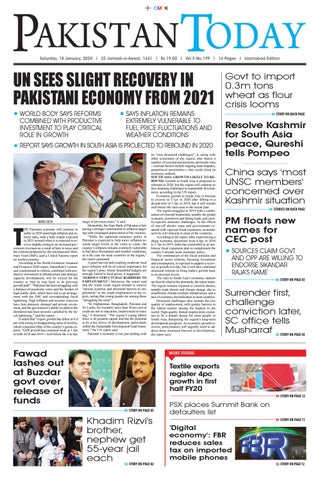
UN sees slight recovery iN PakistaNi ecoNomy from 2021 g
g
woRld body says RefoRms combined with pRoductive investment to play cRitical Role in gRowth
g
says inflation Remains extRemely vulneRable to fuel pRice fluctuations and weatheR conditions
RepoRt says gRowth in south asia is pRojected to Rebound in 2020
t
news desk
he Pakistani economy will continue to suffer in 2020 amid high inflation and interest rates, with a little respite expected in 2021 onward when it is expected to recover slightly owing to an increased government revenues as a result of hike in taxes and the reforms proposed by the International Monetary Fund (IMF), said a United Nations report on world economy. According to the World economic Situation and Prospects 2020 report, Islamabad’s “continued commitment to reform, combined with productive investment in infrastructure and strategic capacity development, will be critical for the country to find its way back to its previous growth path”. “Pakistan has been struggling with a balance-of-payments crisis and the burden of high public debt, which have led to an arrangement with the IMF and corresponding fiscal tightening. high inflation and security concerns have hurt domestic demand and private investment, and the government’s ability to address the slowdown has been severely curtailed by the fiscal tightening,” said the report. It noted that “export growth has fallen to 0.4 per cent owing to disappointing sales of textiles, which constitute 60pc of the country’s goods exports. “GDP growth has remained weak at 3.3pc in both 2018 and 2019 – well below the 4 to 6pc
range of previous years,” it said. Meanwhile, the State Bank of Pakistan is balancing a stronger commitment to inflation targeting with a managed depreciation of the currency. “While the tightened monetary policy in Pakistan is expected to help move inflation towards target levels in the years to come, the country’s inflation remains extremely vulnerable to fuel price fluctuations and weather conditions, as is the case for most countries in the region,” the report cautioned. A good harvest and resulting moderate food price inflation will be of critical importance for the region’s poor, whose household budgets are strongly linked to food prices, it suggested. ‘SERIOUS STRUCTURAL BARRIERS TO EMPLOYMENT’: Moreover, the report said that the South Asian region needed to remove “serious systemic and structural barriers to employment” to the youth employment in the region, noting that young people are among those “struggling the most”. “In Afghanistan, Bangladesh, Pakistan and Sri Lanka, for example, more than 30 per cent of youth are not in education, employment or training,” it disclosed. “The region’s young labour force is its greatest capital and has the potential to be a key driver of development, particularly within the Sustainable Development Goal framework,” the UN report said. Pakistan’s economy is not just dealing with
its “own structural challenges”, it, along with other economies of the region, also shares a number of external and domestic downside risks – external factors include ongoing trade disputes, geopolitical uncertainty— that could cloud its economic outlook. SOUTH ASIA GROWTH LIKELY TO REBOUND: Growth in South Asia is projected to rebound in 2020, but the region will continue to face daunting challenges to sustainable development, according to the UN report. economic growth in South Asia is forecast to recover to 5.1pc in 2020 after falling to a decade-low of 3.3pc in 2019, but it will remain well below the rates seen in the recent past. The region struggled in 2019 with a combination of external headwinds, notably the global economic slowdown and falling trade, and country-specific domestic challenges. As the effects of one-off shocks wane and governments respond with vigorous fiscal expansion, economic activity will rebound in most of the countries. According to the report, after experiencing a sharp economic slowdown from 6.8pc in 2018 to 5.7pc in 2019, India has committed to an ambitious fiscal expansion plan to complement the country’s already loose monetary policy. The combination of the fiscal stimulus and financial sector reforms, boosting investment and consumption, is expected to support a recovery in growth to 6.6pc, but it will take continued structural reforms to bring India’s growth back to its previous levels. The risks to South Asia’s economic outlook are heavily tilted to the downside, the report noted. The region remains exposed to external shocks, notably trade shocks and climate change, due to insufficient climate-resilient infrastructure and a lack of economic diversification in most countries. Structural challenges also include the low quality of employment, with gender barriers in the labour market among the highest in the world. high-quality formal employment continues to be a distant dream for most people in South Asia, hampering the region’s long-term development prospects. As economic growth recovers, policymakers will urgently need to address these structural barriers to development, the report says.
Fawad lashes out at Buzdar govt over release of funds
govt to import 0.3m tons wheat as flour crisis looms STORY ON BACK PAGE
Resolve Kashmir for South Asia peace, Qureshi tells Pompeo china says 'most unsc members' concerned over kashmir situation STORIES ON BACK PAGE
PM floats new names for CEC post g
souRces claim govt and opp aRe willing to endoRse sikandaR Raja’s name STORY ON PAGE 03
surrender first, challenge conviction later, sc office tells musharraf STORY ON PAGE 03
more inside
Textile exports register 4pc growth in first half FY20 STORY ON PAGE 12
STORY ON PAGE 05
khadim Rizvi's brother, nephew get 55-year jail each STORY ON PAGE 02
psx places summit bank on defaulters list STORY ON PAGE 11
'Digital economy': FBR reduces sales tax on imported mobile phones STORY ON PAGE 12
CMYK
02 NEWS
Saturday, 18 January, 2020
Khadim Rizvi’s bRotheR, nephew get 55-yeaR jail each RAWALPINDI
a
STAFF REPORT
N anti-terrorism court (ATC) on Friday handed 86 workers and supporters of the Tehreek-e-Labbaik Pakistan (TLP), including party chief Khadim Hussain Rizvi’s brother Ameer Hussain Rizvi and nephew Mohammad Ali, with a prison sentence of 55 years each in a case pertaining to rioting and resisting against the police. Additionally, the court ordered the convicts to collectively submit Rs12,925,000 and directed authorities to seize their moveable and immoveable assets. The court was hearing a case registered in September last year against TLP workers who held violent protests and clashed with the police over
the arrest of party chief Khadim Hussain Rizvi. Rizvi was taken into “protective custody” by police from Lahore amid his call for a grand protest against the Supreme Court decision to acquit Aasia Bibi – a Christian woman earlier condemned to death on blasphemy charges. After the counter-terrorism court’s verdict was announced late on Thursday night, the convicts were escorted to Attock jail in three vehicles by Elite Force officials. THE CASE: In 2018, soon after the news of his arrest spread, hundreds of activists of the two parties took to the streets and blocked many roads for traffic. A constable was seriously injured at Multan Road where the violent activists clashed with police. Following the unrest and severe clashes, contingents of paramilitary force Rangers reached
Lahore, taking control of the city’s major arteries. Prior to the agitation, a police officer said, hundreds of trained police commandos and personnel of the anti-riot force were dispatched to the Multan Road after the information that violent activists of the TLP had held a senior police officer — Iqbal Town SP Syed Ali — hostage along with his guards. The arrests came months after the party held a sit-in in Islamabad against a Supreme Court verdict acquitting Aasia Bibi in a blasphemy case. However, the government had insisted that the arrests had nothing to do with the sit-in. “The action was prompted by TLP’s refusal to withdraw its call for protest on November 25 [2018]. It’s to safeguard public life, property and order,” then information minister Fawad Chaudhry had shared on Twitter.
Medical board says can’t form opinion on ‘incomplete’ reports of Nawaz LAHORE
Sharifs get exemption from personal appearance in cases
STAFF REPORT
The medical board formed by the Punjab government on Friday rejected the medical reports of former prime minister Nawaz Sharif, saying they were incomplete. The medical board headed by Professor Dr Mahmood Ayaz stated that the documents submitted by Nawaz Sharif’s personal physician Dr Adnan Khan did not include his blood reports, his current platelets count and an update on his genetic test. Sources said that the medical board asked the government for fresh and complete medical reports regarding the health of the former premier, saying it could not comment on the incomplete reports of the Pakistan Muslim League-Nawaz (PML-N) supremo. On Wednesday, Amjad Pervaiz, counsel of the former prime minister, submitted the medical reports of his client in the Lahore High Court (LHC). According to the reports, the former prime minister is suffering from intracranial stenosis, a disease regarding the narrowing of the arteries inside the brain. The report further stated that after Sharif’s various scans, the doctors have recommended him for heart treatment and his condition is still critical. Sources said that the PML-N supremo’s health report is certified by the Pakistani High Commission in the UK. The report stated that Sharif
LAHORE: An accountability court on Friday granted exemption from appearance to Sharif brothers in multiple corruption/misuse of authority cases against them. According to details, former premier Nawaz Sharif’s medical report was submitted in the Chaudhry Sugar Mills case. Following which, the court granted him exemption from appearance. Defense counsel Amjad Pervez presented the medical report. “Nawaz Sharif is facing severe health issues including, heart, blood pressure and platelets issue,” he informed the court. The court also granted exemption from appearance to Shehbaz Sharif in the Ashiana-i-Iqbal Housing scheme and Ramzan Sugar Mills cases. The court also extended the judicial remand of Yousaf Abbas Sharif for 14 days in the Chaudhry Sugar Mills case. Hamza Shahbaz also received a 14-day extension in his remand in the Ramzan Sugar Mills and assets beyond income cases. Hearing a plea filed by Shehbaz’s family seeking to unfreeze their assets, the accountability court summoned the investigation officer of the case along with the relevant record and adjourned the hearing till Jan 31. STAFF REPORT should stay in Britain until his treatment. On Tuesday, the Punjab government raised several objections to a medical report attached with an appeal of former premier Nawaz Sharif to extend his bail period in the light of the Islamabad High Court’s (IHC) decision. The appeal was filed with the Home Department Punjab on Dec. 24. Thereby, the government has opposed stay of Sharif in London for medical treatment, and the home department has ordered the former premier to send his latest medical report. A medical board formed to consider the matter will then review the report and the decision to extend Sharif’s bail will be taken in accordance. On Dec. 30, a PET scan
FO slams Gen Rawat’s remarks on ‘de-radicalisation’ of Kashmiri children ISLAMABAD STAFF REPORT
The Ministry of Foreign Affairs on Friday condemned the “highly irresponsible remarks” made by Indian Chief of Defence Staff (CDS) General Bipin Rawat, terming them “the usual Indian bogey of terrorism”. According to a statement by the Foreign Office, the top Indian general had suggested putting young Kashmiri children in “deradicalisation camps” and sought to place Pakistan on the Financial Action Task Force (FATF) blacklist. “These remarks are reflective of the extremist mindset and bankrupt thinking that have evidently also permeated the state institutions of India,” said the FO spokesperson in a statement. The statement added that as a perpetrator of “unabated state-terrorism in the Indian Occupied Jammu & Kashmir (IOK)”, India is in no position to pontificate on the issue of terrorism. “The IOK has already been turned into the world’s largest prison camp with 8 million Kashmiris incarcerated there since August, 5, 2019. With over 900,000 Indian occupation forces perpetrating egregious violations of human rights,” read the statement.
CMYK
of Sharif was performed at a private clinic in London while he was accompanied by his personal physician Dr Adnan, son Hussain Nawaz, worker Nasir Butt and other officials. The court had directed Sharif to apply to the Punjab government for further relief under Section 401(2) of the Code of Criminal Procedure (CrCP), 1898. It was declared by the IHC that unless the provincial government decides the matter while taking up the application, and Sharif’s bail would remain intact until it is decided otherwise by the provincial authorities. According to the order of the court, Sharif may apply for the extension of bail to the Punjab government.
CMYK Saturday, 18 January, 2020
pm floats new names foR cec post ISLAMABAD
p
MIAN ABRAR
RIME Minister Imran Khan has nominated a new three-member panel for appointment as Chief Election Commissioner (CEC) of Pakistan to Leader of the Opposition Shehbaz Sharif in a bid to break the deadlock over the issue. In a letter written on January 15, the prime minister drew the attention of the opposition leader to his previous letter written on December 4, for consultation on appointment of the CEC as required under clause (2-A) of Article 213 of the constitution. “In order to have meaningful and result-oriented consultations and as another attempt to resolve this longstanding issue, I hereby propose the revised panel, comprising of following, for the appointment of the Chief Election Commissioner of Pakistan,”
read the letter. The nominees included former federal secretaries Jamil Ahmed, Fazal Abbas Mekan and Sikandar Sultan Raja. A source in the PML-N told Pakistan Today that Sikandar Sultan Raja could be the new choice of the government and the opposition. The source said that Shehbaz Sharif would soon be taking the leaders of Pakistan Muslim League-Nawaz (PML-N), Pakistan People’s Party (PPP) and other opposition parties into confidence over Raja’s nomination. A source in the federal government said that Chief Commissioner Islamabad Amir Ahmed Ali, who is a son of Saeed Mehdi and brother in law of Sikandar Sultan Raja, has played a key role in the nomination of Raja for the CEC slot. Meanwhile, Senate Standing Committee on Parliamentary Affairs on Friday discussed at length the deadlock over nomination of new
CEC owing to difference of opinion in this regard. Chaired by Senator Pervaiz Rashid, the meeting was also attended by Senator Sikandar Mandhro, Senator Brig (r) John Kenneth Williams, Senator Walid Iqbal, Senator Hilalur Rehman and senior officers from the Ministry of Parliamentary Affairs and ECP along with all concerned. The meeting also discussed the display of voters’ lists and procedures for correction in voters’ lists; promulgation of the ordinance; violations and impact. The committee was of the view that parliament cannot be overlooked in this matter and the best way to address this issue is through a mechanism set by parliament. The committee showed grave concern regarding women being disenfranchised from their right to vote in parts of the country. The members deplored the fact that almost 13 mil-
lion women voters have not been registered. The committee recommended that the Election Commission of Pakistan in collaboration with NADRA should revise its lists. It was stressed that the ECP and NADRA must reach out to women, especially in rural areas to bridge this gap keeping in view the record available with NADRA regarding family registration Certificate. While discussing the case study on Promulgation of Ordinance by the President of Pakistan in terms of Article 89, the committee was of the view that narrowing the ambit of Ordinance Promulgation through the constitutional amendments must be resorted to. It was asserted that as per the ruling of the Senate chief, it must be mandatory for all ordinances to be laid in parliament on the first day of Senate session.
Surrender first, challenge conviction later, SC office tells Musharraf ISLAMABAD
PBC to challenge LHC verdict in Musharraf treason plea
STAFF REPORT
The Supreme Court’s (SC) registrar on Friday rejected an appeal filed by former military strongman General (r) Pervez Musharraf challenging his conviction by a special court in the high treason case, saying the convict has to first surrender to the authorities before appealing the sentence. The Registrar Office refused to entertain the petition under Order XXIII Rule 8 of SC Rules 1980. Musharraf’s lawyer, meanwhile, said that he would challenge the registrar’s objection within 30 days. “I have already prepared my arguments in this regard,” Advocate Salman Safdar told reporters. Musharraf’s appeal is based on the verdict passed by Lahore High Court (LHC) Justice Sayyed Mazahar Ali Akbar Naqvi, which has declared the filing of a complaint on high treason charge against the former president unconstitutional and termed the formation of the special court as well as its proceedings “illegal”. The special court, comprising judges of three high courts, awarded the death sentence to Musharraf on Dec 17, with a dissenting note from one judge who said that instead of capital punishment, the former military ruler should’ve been awarded life imprisonment for imposing emergency and forcibly confining over 60 judges to
The Pakistan Bar Council (PBC) under its newly elected vice chairman, Abid Saqi has passed a resolution to challenge the recent verdict of Lahore High Court (LHC) that termed the constitution of special court in the high treason case against former president General (r) Pervez Musharraf as “unconstitutional.” The council deliberated upon the LHC’s recent verdict declaring formation of the special court as unconstitutional and stated that assumption of jurisdiction by the high court at such a stage was uncalled for. Abid Saqi was elected unopposed the vice chairman of PBC on Thursday after the election that was held at the PBC office, inside the Supreme Court building, and the meeting was chaired by Attorney General Anwar Mansoor. “From now on, there would be no strikes or demonstrations by lawyers,” the new chairman said. NEWS DESK their residences in 2007. In reaction to the ruling, army had said that the decision was “received with lot of pain and anguish by rank and file of Pakistan armed forces”. In his appeal, Musharraf alleged that the treason trial “suffered from interference and external pressures”. The plea argued that Musharraf did not receive a fair trial, and that Islamabad High Court’s guidelines to ensure a fair trial, were disregarded. The appeal also took strong exception to Paragraph 66 of the verdict, maintaining that desecration of a dead body was in contravention to the injunction of Islam, and violated human dignity. In the said paragraph, Justice Waqar Seth giving his minority view ruled, “We direct the Law
Enforcement Agencies to strive their level best to apprehend the fugitive/convict and to ensure that the punishment is inflicted as per law and if found dead, his corpse be dragged to the D-Chowk, Islamabad, Pakistan and be hanged for 3 days.” The appeal stated that the prosecution case suffered from an “admitted, noticeable and unexplained delay” of over five years from the date of the alleged offence, which could draw “adverse inferences”. “…if the alleged offence was so heinous and so apparent, why did the prosecuting agency delay the initiation of the investigation and subsequent trial for such a long period of time. This delay serves to be fatal to the prosecution case as it reeks of malice and unfairness.”
PM directs officials to release evidence of ‘corruption’ by Shehbaz, Maryam
Prime Minister Imran Khan on Friday directed officials to release the evidence of corruption gathered against Pakistan Muslim League-Nawaz (PML-N) President Shehbaz Sharif and his niece and the party’s vice president, Maryam Nawaz, a new report stated. In a meeting chaired by the premier, officials confirmed that the government would continue their ‘aggressive’ policy towards corrupt individuals. During the meeting, the media outlet reported that new developments in the Chaudhry Sugar Mills case were brought to
light and decision was made to disclose the information to the public. The prime minister said it is important for organisations to identify white-collar crimes, adding that the government will not compromise on any corruption scandals and will ensure a fair accountability process for all. “The nation should know the consequences for those responsible for destroying the economy,” he said. Earlier this week, the federal cabinet gave the nod to place names of PML-N leader Maryam Nawaz in the Exit Control List (ECL). A cabinet sub-committee had recommended the government to place Maryam on no-fly-list in Chaudhry Sugar Mills corruption case. Maryam, who has already been on ECL ever since she convicted in the Avenfield corruption reference in 2018, is also accused of money laundering. She was arrested by the anti-corruption watchdog on August 8, 2019 in a case pertaining to “shady business transactions” at CSM, where she is a major shareholder. Maryam was granted bail by the Lahore High Court (LHC) in November later that year. NEWS DESK
CMYK
NEWS
03
04 ISLAMABAD
Saturday, 18 January, 2020
WEATHER UPDATES SATURDAY
160C
020C
SUNDAY
160C 040C
MONDAY
170C 060C
TUESDAY
150C
040C
all StakeholderS to be engaged For protecting minoritieS From Forced converSionS ISLAMABAD
p
STAFF REPORT
ARlIAMENTARy Committee to Protect Minorities from Forced Conversions decided to engage with all the stakeholders and hold dialogue and consultative sessions with provincial governments, local and other relevant authorities to formulate solid recommendations to protect minorities from forced conversions. Chairman of the Committee Senator
Anwar ul Haq Kakar observed that the issue is more sensitive and complicated and the committee will explore all the aspects to get firsthand information about the matter. He said that the committee would be in a position to put forward some important recommendations with a period of six months. Members of the committee thoroughly debated the issue and agreed that the nature and sensitivity of the issue requires in-depth study and consideration. They approved TORs of the committee. The committee, in its mandate, has de-
Federal police fails to provide uniform to staffers ISLAMABAD: The government has abolished the old system of providing uniform to Islamabad police twice in a year, due to which officials are compelled to buy uniforms from their own pockets. A source on the condition of anonymity told this scribe the staff deputed on central store have distributed uniforms on the basis of personal likes and dislikes . At the time federal capital territory police comprise of some 12000 officials and government provides them uniforms after every six months but , in December the uniform was distributed among only some 2000 personnel and remaining staffers have been told that the uniforms were out of stock.The police officials are also coerced to go to store for getting uniform after leaving their jobs , so many times that they got exhausted and fed up that they often prefer to buy uniform from market instead of getting it from the government’s store . The store keepers often misbehave them and even use abusive language to the staffers longing for police uniforms. ONLINE
cided to review information, incidents, statistics and laws to enhance the protection of the minorities. The Committee decided to undertake visits to different provinces and hold meetings with provincial, districts, civil administration, police officials so as to create an integrated system of detection, reporting, vigilance and response concerning forced conversions. The Committee will collaborate and meet with human rights organizations around the world to establish best practices in light of cases.
Open public hearings and invitation to representatives of minorities groups, media and civil society organization so as to firm up concrete recommendations for strengthening legal and policy framework to stop forced conversions. To benefit from international experiences, the committee will undertake visits to foreign countries and meet government officials, parliamentary leaders, chairpersons of relevant parliamentary committees and study local laws, policy and legislations so as to incorporate practices
ICCI calls for establishment of furniture city in capital to promote exports ISLAMABAD ONLINE
Muhammad Ahmed Waheed, President, Islamabad Chamber of Commerce & Industry has called upon the government to establish furniture cities or furniture zones in Islamabad and in other major cities of the countries that would help in promoting exports of furniture products. He said Pakistan has huge potential to promote trade and exports of furniture products and government should address key issues of this industry for its better growth. He said this while addressing a delegation of Furniture Association Islamabad that visited ICCI led by its President Sheikh Javed Iqbal. All Pakistan Furniture Association President Taj Abbasi, Chairman
Zahid Hussain, President Anjuman-e-TijaranAjmal Baloch, President Super Market Malik Rab Nawaz, President G-11 Market Sheikh Awais, Khalid Chaudhry and others were present at the occasion. Muhammad Ahmed Waheedsaid that global furniture market was of billions of dollars, but Pakistan’s share in it was quite nominal and stressed that government should develop furniture cities across the country that would promote this industry and boost its exports. He assured that ICCI would cooperate with Furniture Association Islamabad in resolving their key issues. Speaking at the occasion, Sheikh Javed Iqbal, President, Furniture Association, Golra Road, Islamabad said that their market was
Four killed, two injured in Swat rooF collapSe ISLAMABAD: At least four of a family were killed and two others, including children, were seriously injured when the roof of a house crashed in Mingora Khuna Gul Swat district early on Friday. According to details, officials said that a dilapidated roof of a house collapsed after heavy rain and snow and six family members including women and children were asleep in the house were buried under the debris. Following the incident, all of them were taken out by rescue operation, however, four of them died on the spot, while two were in critical condition and admitted hospital for further treatment. Rescue sources said the injured and dead were shifted to Hospital immediately after the incident. APP
Traders support PM’s decision to curb hoarding, profiteering ISLAMABAD: The trading community supports the decision of Prime Minister Imran Khan to curb hoarding and profiteering to provide relief to the masses from price-hike, a business leader said Friday. The decisions of the PM to increase grant through BISP and move to reduce the price of urea by Rs400 per bag will also provide relief to the masses, said Shahid Rasheed Butt former President ICCI. He said that Government should initiate the process of new and effective legislation against profiteers and hoarders and consider setting up an effective Price Commission. He noted that market mechanism is not working properly resulting in market imperfection helping producers earn undue profits while masses are facing unprecedented inflation. Various interest groups are freely influencing prices to their advantage resulting in artificial price hike that has damaged the buying power of the masses and there seems no end to their miseries therefore strict actions must be taken. Shahid Rasheed Butt said that controlling prices of essentials and services will result in healthy prices, it will reduce poverty in the country and all stakeholders should benefit from it. He said that agriculture sector merits full attention as growers are not getting proper prices of their produce, masses are forced to pay very high prices while the major share of profit is going to middlemen. ONLINE
CMYK
located within Islamabad, but CDA was not owning it and problems were multiplying. He said that street lights were installed but connection was not provided to them due to which theft incidents at night were on the rise in their market. He said furniture traders were facing problems due to absence of rent control act in Islamabad and urged that government should arrange early passage of its amended bill from parliament for its promulgation. Ajmal Baloch, President, Anjuman-e-Tijaran Pakistan informed the participants about efforts of trade leaders to resolve tax issues of small traders and rent control act. He said that Prime Minister would soon announce tax measures for traders that would address their many concerns.
and tailor-made interventions in improving parliamentary oversight and response mechanism, procedures and modus operandi in dealing with such practices. The meeting was attended by Senators Dr. Sikandar Mandhro, Nauman Wazir Khattak, Sajjad Hussain Turi and by MNAs Jai Parkash, lal Chand, Dr. Darshan, Keshhoo Mal Kheeal Das, Shagufta Jumani, Ramesh lal, Naveed Aamir Jeeva and Ramesh Kumar besides Noor ul Haq Qadri Federal Minister for Religious Affairs.
rawalpindi man arrested over child pornography RAWALPINDI: Federal Investigation Agency’s (FIA) cybercrime wing has arrested a suspect in Rawalpindi on charges of being a child pornographer and possessing pornographic content. The arrest came after a raid at the suspect’s residence in the Dhamial area. Five objectionable videos were found stored on a cell phone with additional content recovered from USB and memory card that was seized. Reportedly, the suspect has confessed to the crime. He has been booked under Section 22 of the Prevention of Electronic Crimes Act, 2016. According to the law, if found guilty, the convict will be jailed for seven years and fined up to Rs1.2 million. The suspect has been remanded into the FIA’s custody for four days. He confessed that he used to lure children into his house’s basement, then record videos and sell them to porn websites. The suspect said that he used toys to attract children and would later blackmail them with their videos. He further revealed that he was working with his friend and the two started working together in March 2018. According to FIA official Mian Irfan, more people are involved in the heinous act and the agency is searching for them. Irfan assured that the agency’s technical team was tracking the people to whom the videos were sent. INP
Saturday, 18 January, 2020
Fawad lashes out at Buzdar govt over release oF Funds FEDERAL MINISTER CRITICISES CM’S DISCRETIONARY POWER OVER UPLIFT FUNDS ISLAMABAD
I
STAFF REPORT
N a surprise move, Minister for Science and Technology Fawad Chaudhry on Friday criticised the “availability of discretionary funds to chief ministers”, saying such a practice was “against public interest” and a violation of Article 140-A of the constitution. In a tweet, Fawad said that the problem was not with the Punjab government, but the way resources were being distributed. “The way federation distributes funds among provinces, the same way funds should be distributed among districts (of a province). [However] chief ministers act like monarchs which goes against the
public interest,” the minister stated. The tweets showed the displeasure of the federal minister with the Punjab government headed by Imran’s blue-eyed Usman Buzdar. According to the sources in Pakistan Tehreek-e-Insaf (PTI), Fawad took Chief Minister Buzdar to task during the core committee meeting of the party. He chided him, saying the party was under pressure due to the Punjab government’s poor performance. “Neither the political leadership in Punjab government is delivering nor the administrative side is performing any better. Out of Rs370 billion annual development budget of Punjab, only Rs77bn have been released till date,” the source quoted the minister as saying. He went on to say that the gov-
BUZDAR SAYS PUNJAB GOVT DOESN’T BELIEVE IN EXTRAVAGANT UTILISATION OF PUBLIC MONEY ernment was sitting on the funds instead of their proper utilisation that was adding fuel to people’s fury. According to the source, Prime Minister Imran Khan directed the Punjab government to issue funds and divert them to districts on an immediate basis. However, Buzdar took exception to Fawad’s outburst. “The Punjab government treats the exchequer as public property and the chief minister has ended the culture of extravagant spendings,” an official handout responded to the minister’s tirade. “We have controlled the leakages of funds to a certain extent as the past regimes had misused public funds. The government has saved millions of rupees in terms of security,” the statement added. A source in the PTI told Pak-
istan Today that the prime minister was unhappy with Fawad Chaudhry’s move of making his views on Punjab government public and the minister may face ire of the prime minister soon. Dr Salman Shah, an adviser to the chief minister on economic affairs, agreed with Fawad. He said the allocations to district governments should be made under the Provincial Finance Commission (PFC). “Obviously, allocations to local governments should be made through the PFC. Once the local councils are formed and a new local government system is made functional, then allocations would have to be made through the PFC. It is a principle of fiscal federalism that resources should be allocated based on a formula,” he said.
SC orders Punjab CS to explain status of 70 govt companies ISLAMABAD STAFF REPORT
The Supreme Court (SC) on Friday summoned the Punjab chief secretary to explain the status of 70 companies operating under various departments of the Punjab government. The bench, headed by Chief Justice of Pakistan (CJ) Gulzar Ahmed and comprising Justice Ijazul Ahsan and Justice Sajjad Ali Shah, issued this order while hearing a suo motu case initiated by former CJ Mian Saqib Nisar. The bench questioned as to whether the provincial government
could delegate its constitutional duty to private companies. It also asked as to whether these companies are still operational and if it is so then what work they are performing. Later, the court issued a written order in which it summoned Punjab chief secretary and Punjab advocate general to inform it about status of these companies. The order asked them to apprise it of the numbers of employees employed by these companies; allocation of funds to them; what precisely is being done with that funds and whether operation of the 70 companies is providing any benefit to the people of Punjab.
“No report has been submitted by the NAB [National Accountability Bureau] about the functioning of the 70 companies incorporated by the government of Punjab… “Such aspect has been deliberated in so many orders of this court but still no comprehensive report regarding the operation of these companies has been made available except for saying that 42 officers/ employees in these companies are those, who were government servants and are getting salary/ benefits of more than Rs300, 000 per month,” said the written order. The court also directed NAB prosecutor general to appear in person along with a comprehensive report on the companies. The order also asked NAB prosecutor general to point out all illegalities and suggest appropriate action in this regard. The court is expected to resume hearing of the case next month.
CMYK
NEWS
05
PM directs ministry to ensure uninterrupted funds for higher education sector ISLAMABAD: Prime Minister Imran Khan on Friday directed the Ministry of Finance to ensure an interrupted supply of funds for the higher education sector. Chairing a meeting on matters pertaining to the higher education sector, the prime minister said that despite the difficult economic situation of the country, the government will meet the financial needs of the higher education sector to ensure that the country’s youth is not deprived of quality education. “The government wants to make quality education accessible to the youth,” he said. Speaking about the curriculum, the premier said that the curriculum should enlighten the youth about Islamic values and Sufism. STAFF REPORT
Saturday, 18 January, 2020
06 WORLD VIEW
How would Israel attack Iran? WHILST THERE IS SCOPE FOR REGIONAL ASSISTANCE, BASED ON A MUTUAL DISTRUST FOR IRAN, IT IS LIKELY THAT THIS OPERATION WOULD BE DISCRETE AND REQUIRE PRE-APPROVAL FROM THE UNITED STATES
Wavell room
I
EHuD EIlAM
N July 2019 Iran announced it would break the Joint Comprehensive Plan of Action (JCPOA) by enriching more uranium than allowed under the agreement. If Iran gets closer to producing a nuclear weapon then the United States might stop this process by force. If not, then Israel might choose to attack Iran’s nuclear sites. This article explores how Israel could attack Iran’s nuclear sites if the country chose to do so. CAPABILITIES OF THE ISRAELI AIR FORCE The IAF has hundreds of aircraft, mostly fighter bombers such as F-15I, F16I and the new F- 35 which would spearhead any attack on Iran’s nuclear facilities. Those aircraft carry a variety of munitions, including the GBU-28 “bunker buster”. The F-35 has already been used in combat by Israel in Syria. The IAF also has several kinds of unmanned aerial vehicles (UAV), notably the Heron with a payload of 2,700kg, that could participate in the strike by gathering intelligence and attacking objectives. Whilst Israel has the capability, the core military problem is distance. Iran is more than 1,000 kilometres from Israel
and at the limits of the IAF’s capability. The IAF would need to support this attack with air to air refuelling tankers, tankers which are vulnerable to attack adding risk to the operation. Israeli air planners would need to consider trade offs for refuelling including how to avoid detection and recovery plans. One way of mitigating this problem would be by mounting, or supporting, the operation from countries closer to Iran in the Gulf States. REGIONAL ASSISTANCE AND ESCALATION Israel would have to choose which route to attack from. The shortest way from Israel to Iran goes through Jordan and Iraq and this seems the most likely route from a military perspective. Politically, however, it may tighten the alignment of Arab nations against Israel. Another path requires crossing Saudi Arabia. If Iran tries to gain a nuclear weapon, Saudi Arabia might allow Israeli aircraft to fly over its territory giving Israel more military options. Such cooperation, however, would likely escalate the situation and push the region into a greater crisis. In both scenarios, Iran might strike back at Gulf Arab states accusing them of assisting Israel. Iran’s response could involve launching cruise missiles and armed drones that can target Arab states, including critical sites such as Saudi oil infrastructure or escalating hybrid warfare efforts by using pro Iranian militias in Syria and Iraq. Iran has already demonstrated how damaging such attacks could be; On 14 September 2019 cruise
missiles and drones caused vast damage to Saudi oil facilities. There are wider risks of escalation as such a move could draw the United States in conflict. The present leadership of the United States, however, have demonstrated that they do not want to be drawn into a conflict in the Middle East. This should be a warning sign when considering this strike option. It creates uncertainty for Israel and the country should consider how to prevent such a scenario and if it needs international assistance at all. Whilst there is scope for regional assistance, based on a mutual distrust for Iran, it is likely that this operation would be discrete and require pre-approval from the United States. ELECTRONIC DECEPTION The Iranian Air Force is based on old aircraft such as F-14s and MIG-29, which are no match for Israel’s more modern fighters. As such, Iran will rely more on ground-based air defences, particularly the S-300 missile, to both deter any attack and defend against it. The IAF will have to neutralise Iranian air defences with a combination of cyber, electronic, and air attacks before launching to strike the nuclear facilities. The IAF will try to destroy Iran’s best fighters and anti-aircraft batteries off guard when their planes are on the ground and when antiaircraft batteries are not on high alert. This is a classic technique of air warfare made possible by a combination of stealth, deception, and electronic attack. The IAF has already proven the capa-
bility to do this by launching complex air operations into Syria, including neutralising air defences, in September 2007; against a similar air defence capability. Yet there are major differences between the two cases. Discrete assistance from the United States, particularly with electronic attack aircraft and air to air refueling, could also aid any strike into central Iran. Other kinds of deception might also be used. Politically, Israel may declare prior to the attack that they are not going to bomb Iran and spread false reports that the IAF doesn’t have the capability as part of an information operation. Military deception could also be easily achieved by launching multiple aircraft to overload Iranian intelligence systems. A combination of both seems the most likely. JERICHO MISSILES Alternatively, Israel could use its long-range Jericho surface-to-surface missiles. By using these missiles Israel can avoid launching any aircraft on a dangerous mission over Iran. However, the Jericho missiles carry less payload than an aircraft and are less accurate. Accuracy is likely to be crucial in attacking targets deep inside Iran. Due to the strength of the fortifications around some Iranian nuclear sites it is possible that Israel will not be able to reliably penetrate them with its bunker busting bombs. According to nonIsraeli sources, Israel has a nuclear weapon. With this in mind, Israel could, literally, consider the nuclear option to destroy Iran’s nuclear facilities. However, Israel is highly unlikely to
Who is Russia’s new prime minister?
Foreign Policy REID STANDISH AND AMY MACKINNON
When Russians woke up on Wednesday morning, most had likely never heard of Mikhail Mishustin, the head of the country’s tax service. But by the time they went to bed that night, Mishustin had been named as Russia’s new prime minister after a day that included a flurry of proposed changes to the constitution and a series of dramatic shake-ups that saw the government resign en masse. It was the first real inkling of the power transfer to come, with President Vladimir Putin set to reach his constitutionally imposed term limit in 2024. During his annual State of the Nation Address, Putin, who is on his fourth and technically final term as president, announced sweeping constitutional reforms that would redistribute some of the powers of the position to the parliament and State Council. Should Putin head the newly empowered State Council after stepping down, as some analysts expect, he could wield significant influence over whoever succeeds him as president. The resignation of Prime Minister Dmitry Medvedev and the announcement about Mishustin, a technocrat with little power base of his own, caught many analysts and Kremlin watchers by surprise. The 53-year-old bureaucrat became Russia’s newly appointed prime minister and Putin’s second-in-command as the country slowly enters a new period of political transition. WHO IS MISHUSTIN? It is unclear whether Mishustin is a temporary placeholder or could be groomed as a potential successor down the line. A largely anonymous figure, Mishustin enjoys a reputation in Russia’s business circles as one of the country’s most effective technocrats and earned rave reviews as the head of Russia’s Federal Tax Service. During his tenure, he helped modernize Russia’s notoriously inefficient and corrupt tax system, earning him the moniker “the taxman of the future” in a 2019 Financial Times profile. Like Putin, the new prime minister is a hockey fan and has been seen at matches with security services officials in Moscow. According to Bloomberg, Mishustin developed a relationship with Putin as a member of the president’s Night Hockey League, and he is also a member of the board of Russia’s Ice Hockey Federation. Mishustin is reportedly an en-
thusiastic composer who has written a number of songs for well-known Russian singers, according to the Russian financial newspaper Vedomosti. Married with three sons, Mishustin has few political accolades and worked in government roles related to tax collection since the early days of his career. Gennady Gudkov, a former opposition lawmaker, called the new prime minister “a new faceless functionary without ambition,” while Gleb Pavlovsky, a political analyst and former Putin advisor, told the Russian news agency Interfax that Mishustin is “a splendid bureaucrat, in the best sense of the word.” WHY WAS HE CHOSEN? While Putin’s selection of a relative unknown with no political base of his own caught many observers off guard, the desire to elevate someone who won’t erode the president’s own authority fits with Putin’s other moves on Wednesday to eliminate obstacles on the road to 2024. Mishustin appears well suited to deliver as prime minister where Medvedev failed, especially in terms of implementing the Kremlin’s so-called national projects: a massive public spending and infrastructure plan of $400 billion that was put forward by Putin after his reelection in 2018. While reducing poverty, economic expansion, and increasing population growth were central to his last presidential campaign, the government has so far failed to properly imple-
ment those measures. By appointing Mishustin, Putin is hoping that his new prime minister can live up to his reputation and wrestle Russia’s bureaucracy into delivering results on the national projects. Unlike other elites who may be looking to enshrine their own power base and promote their own ambitions during the political transition, Mishustin remains an inoffensive choice whom Putin is relying on to deliver economic progress and focus on the day-to-day work of turning the president’s proclamations into reality. WHERE DOES HE FIT INTO PUTIN’S PLAN? By selecting Mishustin, Putin is looking to learn from his past mistakes during his return to the presidency in 2012 and offer Russians change, while still maintaining his grip on power. Much of Putin’s State of the Nation speech on Wednesday focused on promises and measures to improve the lives of everyday Russians, and his choice of Mishustin as prime minister reflects the Kremlin’s concerns about declining standards of living in the country and negative public opinion toward the government. The booming oil prices and rising incomes that helped propel Putin’s popularity in the early days of his presidency have largely passed. Disposable incomes in Russia are still effectively below what they were in 2013, and the combination of Western sanctions and lower oil prices have helped dim the coun-
drop a nuclear weapon in Iran in order to prevent the latter from having one. The ramifications of using nuclear weapons are likely to be considered too politically dangerous. In such a scenario, Israel would lose the support of major powers undermining any future plans. This demonstrates the limits of Israel’s nuclear deterrence and highlights that Israel can use a nuclear weapon only if Iran has one and is about to attack. BOOTS ON THE GROUND Israel could also deploy some elements of their Special Forces to assist aircraft in targeting. Their mission would be to collect intelligence, to direct air strikes, recover air crews, and to neutralise key sites such as local headquarters. The difference in this scenario is distance; Israel would struggle to insert and recover such teams reliably. Despite the challenges and risks of attacking Iran, Israel has the capability to do so if they choose and if Iran produces a nuclear weapon. If they choose to, the attack is likely to use the tactics outlined in this article. Dr. Ehud Eilam has been dealing and studying Israel’s national security for more than 25 years. He served in the Israeli military and later on he worked for the Israeli Ministry of Defense, as a researcher. He has a Ph.D and he had published six books in the U.S / U.K. His latest book is: Containment in the Middle East, (University Press of Nebraska, 2019). He is a Senior Fellow in the Gold Institute for International Strategy.
HOW AN OBSCURE TAXMAN JUST BECAME PUTIN’S NO 2 try’s economic prospects. Malaise and backlash against the government have also grown. Last year saw the most sustained street protests in the country since demonstrations against Putin’s return to the presidency in 2011 and 2012. Polls have also shown that the public is growing distrustful of state television channels, and Putin has seen his popularity fall to 68 percent from 82 percent in April 2018, according to the Levada Center, an independent pollster based in Moscow. Medvedev, meanwhile, leaves his post as prime minister with a dismal 38 percent rating, according to the same poll. Through his low profile and experience with the country’s vast and cumbersome bureaucracy, Mishustin is now positioned to enact unfulfilled government policies and help quell socioeconomic discontent as Putin’s slow-motion power transfer winds toward 2024. Putin is betting that Mishustin’s pedigree of efficiency will help him deliver on policies and limit public dissatisfaction—thereby providing the smoothest transition for the Russian leader. As Andrei Kolesnikov, a senior fellow at the Carnegie Moscow Center, wrote, Putin is relying on Mishustin to modernize the Russian economy by building “a country that resembles the Federal Tax Service: with reports and inspections, security assets, and—where necessary—the digitalization of the entire country.” WHAT HAPPENS TO MEDVEDEV? As part of the shake-up, Prime Minister Medvedev resigned, leading his entire cabinet to stand down too. Medvedev served as president from 2008 to 2012, although he was largely regarded to be just keeping the seat warm for Putin’s return in 2012. U.S. diplomatic cables released by WikiLeaks in 2010 said that Medvedev “plays Robin to Putin’s Batman.” With Medvedev now set to become deputy head of Russia’s Security Council, he will continue to sit under Putin, who leads the body. A former law professor with a penchant for new technology, Medvedev sparked hopes of liberalization with his ascendancy to the presidency in 2008, but the few gains he made were largely rolled back when Putin returned to the throne. Medvedev’s image has also taken a battering in recent years as he has been used as a scapegoat for unpopular government decisions and been the target of investigations led by the anti-corruption campaigner Alexei Navalny, which sparked street protests across the country in 2017. As news broke on Wednesday of Medvedev’s resignation, an investigator at Navalny’s Anti-Corruption Foundation tweeted, “Dimon, where are you going, we weren’t finished with you yet,” using a diminutive form of Medvedev’s first name. Reid Standish is an Alfa fellow and Foreign Policy’s special correspondent covering Russia and Eurasia. He was formerly an associate editor. Amy Mackinnon is a staff writer at Foreign Policy.
Saturday, 18 January, 2020
FOREIGN NEWS 07
IraN waS Spooked by reportS of US f-35S wheN It dowNed aIrlINer: rUSSIaN fM Don’t turn plane crash into political issue, says iranian foreign ministry’s spokesperson MOSCOW
r
AGENCIES
USSIAN Foreign Minister Sergei Lavrov said on Friday that Iran’s accidental shooting down of a Ukrainian airliner last week occurred at a time when Tehran was spooked by reports of advanced United States stealth fighters in the area. “There were at least six [US] F-35 fighters in the air in the Iranian border
area [at the time]. This information has yet to be verified, but I’d like to underline the edginess that always accompanies such situations,” Lavrov said. Iran’s downing of Ukraine International Airlines flight 752, which killed all 176 people aboard, has created a crisis for the Islamic Republic’s clerical rulers who have faced days of protests after the Iranian military admitted it had shot down the plane accidentally. Lavrov, speaking at his annual news conference in Moscow, called the inci-
dent a human error and said he was not trying to excuse anyone for what happened. But he said it was important to understand the context and that the incident had occurred hours after an Iranian missile attack on US bases in Iraq, when Iranian forces were braced for some kind of US military retaliation. “There is information that the Iranians were expecting another attack from the United States after the strike but did not know what form it might take,” said Lavrov. ‘DON’T TURN PLANE CRASH INTO POLITICAL ISSUE’: All countries involved in the Ukrainian airliner crash in Iran should avoid turning it into a political issue, an Iranian Foreign Min-
istry spokesman said on Friday. “We request all sides not to make human issues, particularly this tragic accident, into an excuse for political gestures,” Abbas Mousavi was quoted as saying by the semi-official ISNA news agency. Five countries whose citizens died when Iran shot down the airliner last week said on Thursday that Tehran should pay compensation to families of the victims, and that the world was watching for its response. Mousavi said Iran had cooperated “beyond expectations” with countries whose citizens were killed in the crash, according to ISNA. Canada, Ukraine, Sweden, Afghanistan and Britain also said after a
meeting of officials in London that Iran should hold a “thorough, independent and transparent international investigation open to grieving nations”. Iran’s elite Revolutionary Guards admitted accidentally shooting down the Ukrainian airliner with a missile, killing all 176 aboard. Mousavi said it was “strange” that Canada’s foreign ministry had asked for consular access related to the crash, noting that almost all of the victims of the crash have been identified.
Foreign powers to push Libyan rivals for truce in Berlin BERLIN/TRIPOLI AGENCIES
Canadian, Uk ministers pay respects to victims of plane downed by Iran LONDON AGENCIES
Foreign ministers from Canada and Britain paid their respects on Thursday to those who died when Iran shot down an airliner last week, ahead of talks between the affected countries to discuss their response. Canada’s FrancoisPhilippe Champagne and Britain’s Dominic Raab, with the foreign ministers of Ukraine, Sweden and Afghanistan, each lit a candle to commemorate the victims at the Canadian High Commission in London, and paused for a moment of reflection before the meeting began. The five nations had citizens on the plane, which was downed on Jan. 8 shortly after it left Tehran en route to Kiev, and have formed an international response group to co-ordinate their next steps. Ukraine and Canada have raised the prospect of legal action against Iran. Iran admitted on Saturday it had shot down a Ukraine International Airlines plane in error, after initially denying it had a role in the incident. All 176 people aboard, including 57 Canadians, were killed. Most of those on Ukraine International Airlines flight 752 were Iranians or dual citizens, many of them students returning to their studies abroad or families on their way home after seeing relatives in Iran. Many of the victims were academics, researchers and students linked to 19 Canadian universities. BODIES OF ALL 11 UKRAINIANS IDENTIFIED: The bodies of all 11 Ukrainians who died in last week’s plane crash in Iran have been identified and will be transported back to Ukraine on Jan. 19, the interior ministry said in a statement to Reuters on Thursday. The five countries whose citizens died when Iran shot down a Ukrainian passenger plane have said Tehran should pay compensation to the families of the victims, saying the world is watching for its response.
france deploys radar system in Saudi arabia to ‘reassure’ kingdom PARIS: France has deployed a radar system on the eastern coast of Saudi Arabia to beef up its ally’s defenses after missile attacks on the kingdom’s oil infrastructure in September, French officials said. Paris has blamed Iran for carrying out the drone and missile attack, which crippled the world’s biggest oil processing facility in Saudi Arabia, and had promised to provide assistance to prevent a repeat of the incident. “In the Arabian Peninsula and Arab-Persian Gulf, where tensions are mounting, we have deployed in record time the Jaguar Task Force, which contributes to reassuring the Saudi kingdom,” President Emmanuel Macron said in a speech to the French military late on Thursday. The initiative had not been announced until now. The United States’ withdrawal in 2018 from Iran’s nuclear deal with world powers and the reimposition of U.S. sanctions has triggered an escalation in tensions over several months that briefly led to open conflict in January. French officials said a radar system as part of the Jaguar Task Force mission had been deployed on the eastern coast of Saudi Arabia facing the Gulf. AGENCIES
Germany and the United Nations will push rival Libyan camps and their foreign backers fighting over the capital to agree on Sunday to a truce and monitoring mechanism as first steps towards peace, diplomats and a draft communique said. But the meeting in Berlin at Chancellor Angela Merkel’s headquarters will not try to broker power-sharing between the eastern-based forces and the internationally-recognized government in Tripoli, said diplomats briefed on preparations. The summit will put pressure on Khalifa Haftar and his eastern Libyan National Army (LNA) to halt a nine-month offensive against Fayez al-Serraj’s government in the coastal capital after a week-long lull in fighting. About 140,000 people have been forced out of their homes. “I hope the war ends and we have our country back to live in peace,” said Aisha Ali Saleh, a mother-of-eight in an apartment on an abandoned building site with no power or running water. Haftar and Serraj are both due in Berlin – along with leaders of Russia, Turkey, Egypt and other Western and Arab powers – in the latest bid to stabilize the OPEC member nation in turmoil since the 2011 fall of strongman Muammar Gaddafi. Members of the transatlantic alliance NATO and Arab countries were instrumental in remov-
ing Gaddafi then, and foreign powers have again been the drivers of the aftermath, supplying drones, guns and ammunition to the factions. Haftar is backed by the United Arab Emirates (UAE), Egypt, Jordan, Sudanese and Chadian fighters, and most recently Russian mercenaries. France has also given some support. On the other side, Turkey has rushed to Serraj’s rescue by sending troops to balance out recent gains by Russian snipers. Hundreds of pro-Turkey fighters from Syria’s war have also been deployed, diplomats say. “Berlin is an opportunity to restart the political process and build on the pause in fighting,” said a Western diplomat. A six-page draft communique seen by Reuters calls for “credible, verifiable, sequenced and reciprocal steps” starting with a truce to be monitored by technical committees. That could involve beefing up the existing U.N. mission in Libya or deploying troops from Russia, Turkey or other states, the diplomats said. The draft vaguely mentioned long-delayed plans for elections and a national government, without any timeline, just calling for U.N.-led follow-up meetings. MIGRANTS AND MILITANTS: Russia’s Foreign Minister Sergei Lavrov urged Haftar and Serraj to come together in Berlin without adding conditions and blaming each other afterwards. “Relations between them
having fled bombing, syrian children learn to read in tent schools
are currently very tense, they don’t even want to be in the same room together,” he told reporters on Friday. Greek Foreign Minister Nikos Dendias met Haftar on Friday and urged him to adopt a “constructive spirit” in Berlin. Athens, which opposes a recent Turkey-Libya pact on Mediterranean sea boundaries, had wanted to participate in the summit. Chaos in Libya has made it a hub for human traffickers to ship migrants to Italy, while Islamist militants have also exploited the disorder. The latest conflict has not, however, disrupted oil output at about 1.2 million barrels per day. In the complex outside power-play, there was no indication that Egypt and the UAE, which see the former Gaddafi general Haftar as the best bet for stability, will end their support. But Western diplomats hope they have realized Haftar cannot take Tripoli and that a stalemate would give Turkey a foothold, which Cairo especially fears. Turkey-Egypt ties have been frosty since the Egyptian army in 2013 ousted Muslim Brotherhood president Mohammed Mursi, an ally of Turkish President Tayyip Erdogan. “The longer the war takes, the stronger the Turkish presence in Libya,” the diplomat said. Even if Haftar breached Tripoli defenses, he would still have to conquer Misrata, a power center in western Libya allied to Serraj and home to thousands of fighters.
Syria truce fails as Idlib civilians killed daily: UN GENEVA AGENCIES
AZAZ AGENCIES
Syrian teacher Ahmad al Hilal listens to his young pupils sitting on a mat reciting the Arabic alphabet in a makeshift school in a tent on the outskirts of a sprawling refugee camp city along the Turkish border. Many ran for their lives with their mothers under heavy aerial bombing by Syrian and Russian jets that paralyzed day-to-day life and damaged dozens of schools and hospitals. Now, already enduring the difficult winter conditions in the camp, where many tents get flooded, the children huddle on the floor, learning how to read with scraps of paper and pencils. “These kids suffer from illiteracy. They don’t read or write. They have no one to help them,” said Hilal, who teaches over 140 young Syrians in three tents scattered across several large overcrowded camps on the outskirts of the border town of Azaz. Women and children form a majority of
more than 350,000 people who have fled the renewed assault since December that has pushed deeper into the Syria’s oppositionrun bastion in the northwest, according to the United Nations. “We came here as refugees, there are no more schools because of the air strikes, so we haven’t been going to school but we’re studying in the camp here,” said 14-year-old pupil Khaled, who did not give a family name. Hilal was himself uprooted from his town of Abu Dahur in Idlib province after the army, backed by pro-Iranian militias seized it. “We bought some books and parts of the Koran and now teach them inside the camp,” said Hilal, 48, who was a teacher before the conflict that began almost nine years ago. The U.N. children’s agency UNICEF has warned that the war will leave a generation who have never enrolled in school, having a devastating toll on education, with 7,000 schools destroyed and about 2 million children out of class.
United Nations human rights chief Michelle Bachelet called on Friday for an immediate cessation of hostilities in Syria’s opposition-held Idlib province, saying the latest ceasefire attempt had yet again failed to protect civilians. Turkey, which for years has backed Syrian rebels fighting to oust President Bashar al-Assad, agreed a truce with Russia that was supposed to have taken hold in the bastion of 3 million people in the northwest earlier this month. But witnesses and insurgent sources said proAssad Russian and Syrian jets have been hitting the province in a renewed assault. Moscow denied bombing civilians. “It is deeply distressing that civilians are still being killed on a daily basis in missile strikes from both the air and ground,” Bachelet said in a statement. “This agreement – as with others in the past year – has yet again failed to protect civilians.” Her office received reports that air strikes resumed on Jan. 15, she said. Armed groups had also carried out deadly ground-based attacks. “People are still being killed, many people, on both sides of the divide,” U.N. human rights spokesman Jeremy Laurence told a news briefing. Since hostilities intensified in the socalled “de-escalation zone” in Idlib on April 29, U.N. monitors have verified incidents in which 1,506 civilians, including 293 women and 433 children, were killed, he said. Around 350,000 Syrians, mostly women and children, have fled Idlib since early December, and sought shelter in border areas near Turkey, the United Nations said on Thursday.
Saturday, 18 January, 2020
08 COMMENT
A miracle cure of brucella
NAB does it again It has just increased its credibility problem
T
He national Accountability Bureau (nAB) has greeted the recent amendments in the Ordinance governing by doing what it is accused of: going after opposition leaders, while whitewashing Pakistan Tehreek-einsaf (PTi) figures who have fallen foul of it. At its latest executive board meeting, nAB dropped its enquiry into PM’s Overseas Pakistanis Adviser Zulfi Bukhari, while opening an inquiry into ex-PMs nawaz Sharif and Yousaf Raza Gilani, and ex-President Asif Ali Zardari, for misusing the Toshakhana. Mr Bukhari was exonerated because there was insufficient evidence against him. He was investigated because he too appeared in the Panama Papers. Mian nawaz was disqualified from the national Assembly, and removed as PM, in connection with the Panama Papers. nAB claims to be an impartial organisation, but it is worth noting that this impartiality has operated in one direction only. it has been heard that there was not enough effort put into gathering the evidence against Mr Bukhari which would have been available in the UK. Another interesting thing has been that while Mr Bukhari has been let off, the same absence of evidence has not meant freedom for many Opposition stalwarts who have been languishing in jail without having their cases sent to court. Under the new changes in the nAB Ordinance, they could be freed because prosecutors would have their cases dismissed by the courts. The plea that the cases were filed under the previous law makes it essential for the law to include an explicit provision for existing cases, so that nAB is put out of its misery, and not forced to take to court cases for which it has no evidence. The purpose of nAB is the pursuit and prosecution of corruption, not the persecution of any group, such as businessmen or civil servants. Or opposition politicians. The whole matter reflects the problems of having amendments made by ordinance, rather than following normal parliamentary procedure. The government does have an opportunity coming up, as the nAB Ordinance amendments are due, which are to be made with opposition input. While the government got its required Army Act amendment through all right, it should not expect the opposition to cooperate like that on any nAB related legislation unless they too are fairly afforded the same relief the latter is currently enjoying.
The military and public relations The scope and limitations of ISPR
S
ince its inception in 1949, the iSPR has been the principal public relations and information outfit of the armed forces. it has been the official source of information regarding the appointments and transfers of senior personnel and awards given to them. it has reported on exercises, actions and operations conducted by army, air force and navy individually as well as jointly. The iSPR has also highlighted the violations of the ceasefire line and exposed the false claims of the indian Army. Over the years the iSPR has helped produce dramas and films to project the armed forces’ achievements in the battlefield and in countering foreign conspiracies. Some of the dramas and films were widely acclaimed while others met with a muted response as is the case with productions of the kind by mainstream film industry. As long as a body works in line with the mandate given to it, it invites little critical focus. The issue arises when it is seen to transcend its defined limits and invade other bodies’ turf. Maj Gen Asif Ghafoor was known for being energetic. This led him sometime to comment on constitutional provisions like the 18th Amendment which did not go well with the views of the opposition. Similarly he declared that the July 25 polls, that many opposition parties had described as rigged, were the most transparent in Pakistan’s history. Later during the so called Azadi March a statement by the DG iSPR led JUi(F) chief Maulana Fazlur Rehman to maintain that the army spokesman should not involve himself in politics. His preference to use his personal twitter handle rather than the official DGiSPR handle often led to unnecessary controversy as well. The outgoing DG iSPR wanted media to report according to his wishes. He not only expected this from Pakistani media and patriotic Pakistani reporters abroad, but also from foreign journalists whom he desired to “highlight improving peace and stability in Pakistan, which offers economic opportunities for foreign investors”. The desire sometime led to actions that elicited a strong response from the rights organisations, both at home and abroad, and the domestic journalist community at large. One expects the newly appointed DG iSPR to stay away from political controversies and avoid what is seen by many as a carrot-and-stick policy towards the media.
Dedicated to the legacy of the late Hameed Nizami
Arif Nizami Editor Aziz-ud-Din Ahmad
Umar Aziz
Asher John
Joint Editor
Executive Editor
Deputy Editor
Lahore – Ph: 042-36300938, 042-36375965
I
P
How brucellaphages can fight a deadly cattle disease
ArfAt YousAf shAheen
AKiSTAn, being an agricultural country, has a large livestock population, which is a vital sub-sector of agriculture, with a pivotal position in the overall economic strategy of Pakistan. The sector contributes around 21 percent to GDP, out of which the share of livestock and dairy sector is 60.54 percent. The share of the livestock sector in exports is about 13. in the FAO ranking, Pakistan is ranked at the second position in buffalo population and fourth in global livestock population. The sector has potential to grow rapidly but currently it is facing challenges such as infectious diseases, management issues and farm biosecurity. Among various infectious diseases, brucellosis is one of the top ranked bacterial diseases prevalent in developing countries. Bovine brucellosis is an economically significant bacterial disease having zoonotic potential globally and is mainly caused by Brucella abortus. it is a highly contagious chronic infectious disease in animals and is a major source of production loss to livestock owners, especially in developing countries, whose economics are largely dependent on livestock. This disease mainly affects cattle but it also affects other animals such as camels, water buffalo, bison, and elk. it causes abortions, retained placenta, infertility, orchitis and epididymitis, but its main effect is abortion in animals. The abortion rate in naive cattle is 30-80 percent. Brucellosis can be transmitted to people through direct contact with infected material from animals or indirectly by ingestion of contaminated dairy products. Once infected ruminants become chronic carriers though they are usually asymptomatic after their first abortion, and may shed the organism in the environment. Therefore, during subsequent pregnancies they continue to shed Brucella in milk as well as uterine secretions. Brucella also spreads through contaminated food and water. Various environmental factors, such as low temperatures, high humidity and no sunlight, favors survival of the bacteria in animal manures, dead fetal material, wool and hay, as well as equipment and clothes available in the vicinity of affected herds for several months. Brucella is tolerant to drying especially in the presence of organic material and can survive in soil. current use of antibiotics and vaccination
strategies are not optimal and only culling of positive animals is recommended to control the disease. culling of all Brucella-positive animals to eradicate the disease across the country is not practical due to limited resources and the high cost of dairy animals. WHO has recommended the use of smooth live vaccine (S19) and rough attenuated strain (RB51) for cattle, but both of these vaccines are not effective enough in controlling the disease. Further, being live vaccines, if injected in pregnant animals, they can cause abortions. Alternatively, bovine brucellosis could be controlled effectively using biological substances such as brucellaphages. The use of hostspecific bacteriophages has been promoted as a cost-effective and adaptable approach to control zoonotic bacteria like Brucella. Bacteriophages are viruses which exclusively infect bacteria. These viruses attack specific bacteria and kill them by replicating inside bacterial cells and are also called bacterial viruses. Some studies demonstrated presence of bacteriophages in almost every known bacterial species and thus they can be found from vast habitats. Bacteriophages are found to be an effective agent to control and treat many bacterial diseases. These bacterial viruses are very specific to their host which only target the specific bacteria without impacting human or animal cells. The phages use the metabolic machinery and genes of host bacteria and establish a lytic cycle for their own replication and ultimately kill the bacterial cells. Recently, phage therapy has emerged as an effective alternative to antibiotics as the irrational use of antibiotics has led to resistance all over the world. The first study has been conducted in Punjab, Pakistan. Brucella cells can be infected by lytic phages known as Brucellaphages. Bacteriophages have varied practical applications, so we did a basic study for physicochemical and molecular characterization of brucellaphages so as the indigenous isolates of brucellaphages may be available for future application in field. Brucellaphages were isolated from 50 slurry samples or semi-liquid mixtures of manure, collected from cattle farms. Procedures were developed and growth conditions were optimized for the isolation and propagation of lytic bacteriophages active against Brucella abortus. Seven samples were found positive in screening and two isolates
were confirmed for brucellaphages. Physicochemical characterization of brucellaphages showed that they can withstand temperature upto 60oc but when exposed to 70oc their viability decreased and beyond 70oc they were completely deactivated in one-hour exposure. They have stability at pH 7 to 9, but acidic pH of 2 to 4 can decrease the phage viability in one-hour exposure. evaluation of thermal stability and optimum pH conditions of brucellaphages are helpful to standardize the phage therapy as well as in food industry such as in pasteurized dairy products. extreme resistance to temperature is advantageous for brucellaphages to apply in field conditions to keep phages working in harsh conditions. Brucellaphages have considerable stability in fluorescent light and sunlight and it was observed that there is slight reduction in phage viability after one-hour exposure. However, ultraviolet light deactivated the phage within 15 minutes. consequently, it is indicated, sunlight would have some reduction effect on survival of brucellaphage, therefore there is a need to keep a check on phage survivability with contact time if applied in the environmental conditions. Treatment with chloroform, Sodium Dodecyl Sulphate, eDTA, Lysozyme, and Proteinase K inactivated phages in 15 minutes, while normal saline, RnAse and Trypsin had no effect on brucellaphages. Growing interest in using bacteriophages for the control of diseases requires exploring the most suitable long-term storage temperature of bacteriophages. Storage stability of tested brucellaphages revealed that they have maximum stability at 4oc as they retain their viability up to 12 months. However, freezing temperatures found not to be favorable for storage of phages as they lost their viability to 100 percent after a 12-month period at -80oc and 50 percent at -20oc. in conclusion, we offered a systematic approach for the isolation and propagation of brucellaphages. consequently, these brucellaphages can be used for the effective biocontrol of bovine brucellosis in fields to control the spread of brucellosis among dairy animals and also to reduce the economic losses due to this deadly disease of dairy sector. Arfat Yousaf Shaheen can be reached at: arfat37@yahoo.com
Sacking Muslim commanders MuhAMMAd AslAM AwAn
I
SLAM does not allow its followers the cult of personality. Khalid Bin Waleed was amongst the galaxy of generals who fought their whole life and in every battlefield, while praying before the Almighty to be granted martyrdom. But unfortunately his earnest desire could not be as he prayed. His whole life was devoted to islam and he fought countless battles for islam. it came to the knowledge of the caliph Umar (R.A) that a large number of Muslims believed that no battle could be won without the leadership of Khalid Bin Waleed. To dispel this assumption. Umar immediately ordered the removal of Khalid from the position of supreme commander, and after his removal from the premier position he fought as an ordinary soldier, still seeking martyrdom. By immediate removal of Khalid Bin Waleed from the top position, Umar proved that the victory is granted by the Almighty, and is not due to any personality. Khalid Bin Waleed did not make even a slightest insinuation that he had been the war supremo and would not fight as an ordinary soldier. Musa Bin nusayr fought his whole life for islam, but the then caliph Sulaiman ibn Abdul Malik called him back and suspended him, and put him in ignominy and kept him with his royal soldiers in a torn-up single dress. The renowned general, the conqueror of a vast territory, including western north Africa and Spain died as a destitute, but he did not disobey the caliph till his death. Karachi – Ph: 021-35381208-9
I
Turning the pages of history… Muhammad Bin Qasim is a third example of loyalty to the centralized command. He was assigned the task of kill Raja Dahar of Sindh and recover the detained Muslim girls and family of a Muslim Trader. He invaded Sindh and conquered it within a short span of time, recovered the detainees and sent them safely to the caliph. After the death of the caliph Waleed ibn Abdul Malik Abdul Malik, the new King Sulaiman ibn Abdul Malik directed the Muhammad Bin Qasim to get back hurriedly. The generals under the command of Muhammad Bin Qasim opined that he should defy the king because they knew beforehand that Sulaiman will kill Qasim as the caliph harboured venom against him, but he refused to defy the caliph and had to meet the same fate as Musa Bin nusayr. Muhammad Bin Qasim was fully aware of his ill-fate but he exhibited loyalty to the centralized command. For him defiance had the connotation of being a traitor and this was a stigma to the illustrious and proud commander. Khalid Bin Waleed, Musa Bin nusayr as well as Muhammad Bin Qasim had the authority and command enough to announce their own independence over their conquered territories but they were bound by the chain of command and for them defiance meant the disintegration of islamic unity. So long as the Muslims followed the spirit of islam, they were honoured and respected in the whole world, but as soon as they showed personal ego and disrespect to islamic Teachings,
Islamabad – Ph: 051-2204545
I
they got shattered and were destined to face ignominy. The Usmanli caliphate was torn into pieces because it was shorn of centralized unity. The renaissance of islam remained a dream for centuries and the Muslims even had to see subjugation for long span of time. islam abhors distinction and discrimination and the cult of personality. Distinction among persons is primarily based on taqwa, which is the extreme fear of the Almighty. The fear of the Almighty is the prime source of being successful in mundane life. There is no personality cult is islam. islam is the name of service to humanity, not self-aggrandizement. islam recognizes the services and seniority in the true spirit of transparency. To disturb the seniority chain has not been encouraged because it deprives the deserving one of his due right. constitution and law of the land are vulnerable to intrinsic changes to satiate one’s own whims or the hidden interests of a clique, but the sacred code of life– the divine constitution– bestowed by the Almighty is not changeable in any way. it is an unchangeable constitution till Doomsday and any attempt to change, alter or hold it in abeyance is a criminal attempt, a sin, leading the violators to Hell. Having a prima facie glimpse over the era when Muslims ruled over more than 2.2 million square miles, we would have established the undivided opinion that the ever longest state was built on the golden principles of islam. islam is
Web: www.pakistantoday.com.pk
I
a divine blessed religion preaching the principles of equality, peacefulness, tranquillity mercifulness and all-embracing; enveloping the downtrodden, helpless, forlorn, indigent and suppressed into its kind and blessed fold. islam teaches us that we should be too merciful to all human beings and protect the minorities living within its territorial ambit. islam is abhorrent of cruelty and injustice towards the humanity. Unfortunately some intransigent segments, who are ever incorrigible and antagonistic to state principles, exhibit a derogatory attitude towards humanity only to cause erosion to islam. State functionaries of Pakistan are bound to hold the islamic chain of command system in great respect, and digression and disrespect exhibited any way is an attempt tantamount to disintegrate the central unity. The augmentation of one’s own personality by extensions, or otherwise promoting one’s own interests, connote a severe blow to the transparent islamic system. To smoothly run the state affairs is the prerogative of the mandated party but they are required to ‘also’ observe the principles of islam in letter and spirit. Promotions must be under strict transparency and, although legitimate, the extensions must be discouraged because the right of seniority is disturbed and islam abhors the violation of one’s rights. The role of the state is just like that of a mother, and the mother never denies the rights to any one of her offspring, she upholds all in equal affection. Muhammad Aslam Awan can be reached at: mlkaslamawan@gmail.com
Email: editorial@pakistantoday.com.pk
Saturday, 18 January, 2020
COMMENT 09 Editor’s mail
Send your letters to: Letters to Editor, Pakistan Today, 4-Shaarey Fatima Jinnah, Lahore, Pakistan. E-mail: letters@pakistantoday.com.pk Letters should be addressed to Pakistan Today exclusively
The Kashmir dispute
Stepping back from the brink Papering over the mess Trump’s desire for political gains created
dr Alon Ben-Meir
P
ReSiDenT Donald Trump’s order to kill iran’s General Soleimani is one of the most reckless acts taken by a president, who once again has put his personal political interest above the nation’s security. certainly, Soleimani deserved to meet his bitter fate. He was behind the killing of hundreds of US soldiers in iraq while threatening and acting against US allies. However, killing him without considering the potentially dire regional repercussions and without a strategy, under the guise of national security concerns, is hard to fathom. Republican members of congress who praised the assassination of General Soleimani seem to be utterly blinded by their desire to see him eliminated. What will happen next, they seem to have no clue. Trump, who is fighting for his political life, appeared to have cared less about the horrifying consequences as long as he distracts public attention from his political woes. He made the decision to assassinate Soleimani seven months ago, but he gave the order now to serve his own self-interest, especially in this election year where he desperately needs a victory while awaiting an impeachment trial in the Senate. During the Senate briefing on iran led by Secretaries of State and Defense Pompeo and esper, and ciA Director Haspel, they produced no evidence that there was an imminent danger of an attack on four American embassies orchestrated by Soleimani, as Trump has claimed. in fact, esper said openly in a January 12 interview that he saw no evidence. Republican Senator Mike Lee labeled it as “probably the worst briefing i have seen, at least on a military issue…What i found so distressing about the briefing is one of the messages we received from the briefers was, ‘Do not debate, do not discuss the issue of the appropriateness of further military intervention against iran,’ and that if you do ‘You will be emboldening iran.’” now, having failed to produce evidence of imminent danger, the Trump Administration claims that the killing of Soleimani was part of a long-term deter-
rence strategy. The assassination itself has certainly emboldened iran’s resolve to continue its nefarious activities throughout the region, but even then, the measure Trump has taken to presumably make the US more secure has in fact done the complete opposite. it has created new mounting problems and multiple crises. Trump dangerously escalated the conflict with iran; severely compromised the USA’s geostrategic interest in the Middle east; intensified the iranian threat against our allies, especially israel; led iran to double down in its support of terrorist and Jihadist groups; badly wounded the USA’s relations with its european allies; deemed the USA untrustworthy by friends and foes; and pushed iran to annul much of the nuclear deal, all while impressively advancing its anti-ballistic missile technology. And contrary to Trump’s claim that he made the right decision for the sake of US security, 55 percent of voters in a USA Today survey released on January 9 saaid he made the USA less safe. And now we are still at the brink of war. iran has admitted the attack on the Asad air base in iraq, and initiated it to save face in the eyes of its public and demonstrate its possession of precision missiles and willingness to stand up to the USA. This retaliation was expected, but since iran wants to avoid an allout war, it was strategic and calculated to inflict the fewest US casualties, if any, to prevent a vicious cycle of retaliatory attacks which could get out of control and lead to a war. This, however, does not suggest that iran will stop its clandestine proxy operations— employing its well-trained militia in iraq, Yemen, and Syria to execute new attacks on US and allies’ targets in the region while maintaining deniability. Similarly, the clergy can also pressure hawks inside and outside the government to avoid any provocative acts against the USA. iran is patient and will carefully weigh its gains and losses before it takes the next step. Following iran’s attack on the Asad base, Trump has also shown restraint because he too wants to prevent an all-out war, knowing that even though the USA can win it singlehandedly, it will be the costliest victory in blood and treasure and certainly in political capital. The whole mess began when Trump withdrew from the iran deal. What did Trump think he could accomplish? Withdrawing from the deal without having any substitute, without consultation with the european signatories, and with re-imposing sanctions, especially when iran was in full compliance with all the deal’s provisions, is dangerously reckless— undermining our national security interests and jeopardizing the security of our allies in the region. The iran deal was not perfect, but the idea was to build on it, gradually normalize relations with iran, and prevent it
from acquiring nuclear weapons altogether as it works to become a constructive member of the community of nations. To resolve the crisis with iran, the USA must demonstrate a clear understanding of the iranian mindset. iran is a proud nation with a long and continuing rich history; it has huge natural and human resources, is the leader of the Shi-ite world, occupies one of the most geostrategic locations in the world, and wants to be respected. The iranians are not compulsive; they think strategically and are patient, consistent, and determined. The revocation of the iran deal simply reaffirms iran’s distrust of the USA, from the time the ciA toppled the Mosaddeq government in 1953 to the continuing sanctions, adversarial attitude, and the open call for regime change. Both Khamenei and Trump have their own respective domestic pressures to contend with and want to avoid war. The iranian public is becoming increasingly restive. They are back in streets demanding immediate economic relief. conversely, Trump calculated that further escalation of violent conflict with iran will erode rather than enhance his political prospects, and would make defeat in november all but certain. West european countries are extremely sensitive to any major escalation of violence, as it would lead to mounting casualties and destruction on all sides. iran can resort to a wide range of hostile measures, including disrupting oil supplies from Saudi Arabia and other Gulf states, by mining the Straits of Hormuz through which 21 million barrels per day (21 percent of global oil consumption) pass, resulting in a massive economic dislocation in the Middle east and europe in particular. The pause in hostilities offers a golden opportunity to begin a new process of mitigation. Germany, France, and Britain have already engagead the iranians in an effort to ease the tension between iran and the USA and create conditions conducive to direct USiran negotiations. By now, Trump must realize that iran cannot be bullied and the only way to prevent it from pursuing nuclear weapons is through dialogue. Regardless of how flawed Trump views the iran deal, it still provides the foundation for a new agreement, as many of its original provisions remain valid and can be built on. Other conflicting issues between the two sides, especially iran’s subversive activities, should be negotiated on a separate track. in some ways, both iran and the USA need to lick their wounds and begin a new chapter, however long and arduous it may be, because war is not and will never be an option. Dr Alon Ben-Meir is a professor of international relations at the Centre for Global Affairs at NYU. He teaches courses on international negotiation and Middle Eastern studies. alon@alonben-meir.com
i am 95 years old. i witnessed the freedom movement against the British empire. i had the opportunity to attend a few rallies by our beloved Quaid, Muhammad Ali Jinnah. i remember that once the Quaid e Azam visited Kashmir, which he considered to be the jugular vein of the to-be-created Pakistan. On his way back, the Quaid was to come to Rawalpindi. i was among the thousands of people who flocked to Brakahu to see their leader. People were overpowered by their emotions and nobody including the Quaid at that time had any doubt that the state of Kashmir would become a part of Pakistan, until india in connivance with the ruler of Kashmir backstabbed the people of the valley as well as Pakistan. The issue went to the United nations, where it was decided that the dispute would be settled in line with the wishes of the people of Kashmir. Seventy-two years, three wars, and countless deaths of innocent people later, the dispute seems even farther from any settlement. To make matters even worse, the re-elected PM of india, following his party’s extremist manifesto scrapped article 370 of indian constitution that gave Kashmir special status. He plans to divide the valley into three union territories Jammu, Ladakh, and Kashmir. if past behavior is any indication of the future, i am afraid for like in Gujrat when Modi was the cM, the Muslim majority of the Kashmir Valley is at risk of terrible atrocities at hands of Modi led fanatic india. Unfortunately, the international community seems restricted by its economic interests and is not doing anything to stop the imminent danger to eight million people of Kashmir valley. Our government is doing its best to highlight the issue and provide support to our Kashmiri brethren, but the international community seems oblivious to the plight of the Kashmiris. My heart bleeds to see that this is happening in the 21st century. i never imagined that this dispute would drag so long and would take a turn for the worst. i want to be a part of the rally/protest by the parliamentarians and the citizens to show solidarity with Kashmir, but my age and health frustrates my wishes. it is my wish that i see Kashmir liberated from the evil clutches of india soon. RAJA SHAFAATULLAH Islamabad
The weeping Amazon THe Amazon forest is on fire. Darkness in the form of light and heat has come to disturb the beauty of the forest. The forest has become a hell for the millions of species of living organisms. A lot of them, it is reasonable to presume, have died. i have come across many shattering videos of rotting animals. The black fumes of the fire have covered neighbouring areas. it is certainly not good for the health of the residents. it may lead to lung problems, issues in breathing, and even a heart attack. The President of Brazil Jair Bolsonaro should open his eyes and think about this beautiful forest. it is not merely a threat to the economy of the country but also it is explicit threat to living organisms. People should be made aware of the importance of forests. NAvEED ABBAS MAITLo Islamabad
Pak-Iran relations THe relationship between iran and Pakistan are too best. They have long lasting relations in their religion, traditions, culture, marriage and so on. They always helped one and another at the time of difficulties. They are working more for the promotion of their trade and their economy. in 23rd meeting of Pak-iran joint borders commission on Friday was discussed that they would make a better relations and stop the illegal supply of iranian materials like diesels, petrol and wanted to take measure steps for controlling terrorism in both sides of borders. This is ensured to facilitate the business trade and growing the activities to establish economic conditions. The brotherhood relations between Pakiran show their both borders. Both sides have to make their relationship strong. create more economic trades in both sides. SHAMEELA SALEH Turbat
Haris Rauf rocks AUSTRALiAn dangerous batsman and the Melbourne stars’ captain Glenn Maxwell praised and Admired his young team mate Haris Rauf for his hat-trick in the Big Bash League (BBL).Haris Rauf took a hat-trick in the BBL against Sydney Thunders on last Wednesday January 7.After the match, captain Glenn Maxwell narrated if Haris keeps performing like the same,so other teams would surely be fearful of him and we need that since we have not matched with some teams in the league yet, and they must feel the fear of great electric young fast bowler.We Pakistani fans are proud of him , and we wish he keeps performing the same in future as well. HAMMAL NAEEM Turbat
Gas troubles THiS calls for the attention of the concerned authorities that there is noticeable shortage in the provision of Gas in the winter season in homes particularly in the morning time, making the daily life difficult, especially for the school and college going students. They are unable to have their breakfast timely and/or the parents have to improvise wood and coals to prepare their breakfast. i am beseeching to the higher authorities kindly take strict/immediate action on concerned department and resolve it very soon. ZAMIR AHMED MEMoN Shikarpur
Saturday, 18 January, 2020
10 FOREIGN NEWS
MyaNMar preSIdeNt haIlS ‘hIStorIC’ vISIt aS ChINa’S XI arrIveS to faNfare YANGON
C
AGENCIES
HINESE President Xi Jinping flew into Myanmar on Friday for two days of talks to shore up massive infrastructure projects in the Southeast Asian nation isolated by the West over its treatment of the Rohingya Muslim minority. State counselor Aung San Suu Kyi greeted him with a handshake on the steps of the presidential palace after a ceremonial welcome by the president and a military marching band, on the first day of a two-day visit, Xi’s first as leader and
the first of any Chinese president in 19 years. Win Myint, the president, told reporters at the palace it was a “very historic and important trip”. Analysts say Xi will seek to reinvigorate stalled infrastructure projects central to his flagship Belt and Road Initiative described as a “21st century silk road”. The two countries have had a historically fraught relationship, with many in Myanmar suspicious of the tremendous sway China holds over its smaller neighbor, but have moved closer since the expulsion of the Rohingya in 2017 was met with international condemnation. More than 730,000 Rohingya were
forced to flee western Myanmar after a military crackdown the United Nations has said was executed with “genocidal intent”. China has defended the country on the global stage and is viewed as the biggest obstacle to a prosecution of its leaders at an international war crimes tribunal. China is the second biggest investor in Myanmar, behind only Singapore, data published by the World Bank shows. Myanmar’s exports to China, its largest trading partner, were worth $5.5 billion in 2018, while imports were worth $6.2 billion. Hundreds of school children and government staff lined the road from the airport on Friday, waving flags and chanting,
“Chinese president!” “May his health be good!” “China always helps our country when we are in crisis or when we face natural disasters,” said Aye Aye Mu, a local teacher. “They always support us and send donations to us.” But many in Myanmar view China warily and infrastructure projects have been deeply unpopular, uprooting thousands of villagers and wreaking environmental damage. Protesters plan to gather outside the Chinese embassy in
Trade deal no panacea for rocky US relations with China WASHINGTON/BEIJING AGENCIES
From Huawei to the South China Sea, deep political rifts between Beijing and Washington are set to persist, despite a trade relations breakthrough, as the United States pushes back against an increasingly powerful and assertive China. Relations between the world’s two largest economies have deteriorated sharply since U.S. President Donald Trump imposed punitive tariffs in 2018, igniting a trade war. “The broader, darkening picture is not going to be brightened much by this deal,” Bates Gill, an expert on Chinese security policy at Macquarie University in Sydney, said of the initial trade deal signed on Wednesday. This backdrop spans China’s militarization of the South China Sea; rising tensions over Taiwan, which Beijing claims as its own; U.S. criticism over human rights in Hong Kong and Xinjiang, and a backlash against telecoms gear provider Huawei. While the initial deal defuses an 18-month row that has hit global growth, experts say it is unlikely to provide much balm for broader frictions rooted in U.S. fears over an economically and technologically powerful China with a modernizing military. “We can see Phase 1 as an emergency treatment
to lower the temperature, but it has not addressed the fundamental problems,” said Wang Heng, a professor at the University of New South Wales in Sydney, who studies the China-U.S. economic relationship. HOSTILITY: Washington is increasingly alarmed about the security implications of Chinese technology, and has tightened its rules to keep better tabs on the acquisition of key technology by China, setting in motion changes to the global supply chain. “The Chinese leadership are not naive about this,” said Gill. “They are already making moves to be more autonomous and thinking about a future… in an environment of hostility.” The Trump administration put Chinese telecoms equipment giant Huawei Technologies Co [HWT.UL] on a trade blacklist on national security concerns in May, banning it from buying supplies from American firms without U.S. government approval. It has also taken measures to crimp exports of artificial intelligence software. New U.S. rules tightening scrutiny of foreign investment go into effect on Feb. 13, extending the powers of the Committee on Foreign Investment in the United States (CFIUS), which has increasingly flexed its muscle against Chinese firms. Intervention by CFIUS, which reviews mergers
and stock purchases to ensure they do not harm national security, has dramatically slowed Chinese investment in the United States. Chinese foreign direct investment into U.S. fell 90% to $1.9 billion in 2019 from its peak in 2016, according to Refinitiv data. The two countries are also at odds over Taiwan, which counts the United States as its biggest weapons supplier but which China sees as one of its provinces. Taiwan’s President Tsai Ing-wen was re-elected on Saturday, vowing not to submit to Chinese pressure or control. Tsai’s campaign was helped by seven months of anti-government protests in Hong Kong, which Beijing accuses Washington of helping to foment, eroding China’s case for a “one country, twosystems model” similar to Hong Kong’s for Taiwan. U.S. Army Secretary Ryan McCarthy said last week that China “will emerge as America’s strategic threat” and that the United States planned to deploy two task forces to the Pacific over the next two years capable of information, electronic, cyber and missile operations against Beijing. Treasury Secretary Steven Mnuchin told CNBC on Wednesday that the United States was concerned about other issues involving China but these should be dealt with separately. “You have to negotiate different pieces at different times,” he said.
Rain hits Australian fires, but blazes still rage CANBERRA AGENCIES
Heavy rain fell on bushfires in eastern Australia Friday for a second straight day, offering further relief from a months-long crisis, but dozens of blazes remained out of control. This week’s wet weather has given exhausted firefighters a major boost in battling unprecedented blazes that have been fuelled by climate change and drought. The fires have claimed 28 lives, scorched massive tracts of pristine forests and destroyed thousands of homes. Following months of hot and dry weather that have fuelled the fires, Friday saw the heaviest rainfalls in nearly a decade in some areas close to hotspots. “Rain has fallen across most fire grounds over the last 24 hours, which is great news,” said the Rural Fire Service of New South Wales, the eastern state where many of the worst blazes have raged. “Our fingers are crossed that this continues over the coming days.” However 30 fires were still out of control in New South Wales on Friday, unchanged from the previous day, the fire service reported. Dozens of other fires were also still burning in the southern state of Victoria. And the rain has completely missed Kangaroo Island, the nation’s third-biggest off the southern coast of the mainland that is famed for its pristine wilderness. Fires have devastated the national park on the island, wiping out much of its koala population and threatening to completely eradicate bird and other endemic marsupial species. Still, the prospect of more wet weather across eastern and southern Australia over the coming days offered further hope. Heavy rain is expected to continue throughout the weekend in New South Wales, expanding into other fire zones further south in the state and in Victoria. ANIMAL RESCUES: Roughly a billion animals are estimated to have died in the fires nationwide. With huge tracts of their habitats destroyed, environmental groups have warned the blazes could drive many species to extinction. Much attention has focused on Australia’s tree-dwelling koalas, with images of the cuddly-looking animals being rescued from
froM aUStralIaN bUShfIre aSheS, a CoMMUNIty rISeS IN SolIdarIty COBARGO: For two weeks, builder Rod Dunn has been living at a showground in a borrowed caravan, wearing an old coat donated by a friend. His house, car, sheds and work tools were wiped out by the ferocious New Year bushfires that swept through the Australian town of Cobargo, killing three of its residents and destroying dozens of homes, farms and vehicles. Though he has lost everything, he counts himself lucky. “We live in the best place in the world,” he said, nodding his head with certainty. “This has united people like you’d never have imagined.” Standing outside a shabby caravan with plastic chairs and dogs roaming around, Dunn recalls how a friend risked his life to rescue him from his blazing property, and how strangers from a town 70 km (43.5 miles) away gave him and his wife a tent to sleep in. “That tent saved us,” said Dunn, a 62-year-old with an unkempt white beard that reaches his chest. “I’m totally overwhelmed by what we’ve seen here, the generosity of mankind.” Wildfires on a massive scale have killed 29 people since September in Australia, fueled by record temperatures and tinder-dry conditions, turning swathes of farms and woodlands black, and blanketing the sky in haze. While residents of many of the fire-threatened towns and villages heeded advice to leave and head to evacuation centers elsewhere, Cobargo’s less than 1,000 people chose not to abandon their town. A handful of fleeing locals set up their caravans and tents at Cobargo’s showground, defying orders by police to move to designated locations outside the town in New South Wales state. ‘WE STAY AS A COMMUNITY’: Word quickly spread that a commune was forming. Caravans in tow, more evacuees arrived, among them farmers, some bringing horses. A kitchen, laundry facilities and a food bank were set up, and medics, a counsellor and a chaplain joined to support the displaced. Meetings were nightly and trucks rolled up daily, bringing water, food, animal feeds and huge hay bales for farms. “We made the call that we stay as a community,” said Tony Allen, a former mayor in the district. “We knew then that was a big risk, it’s breaking every rule in the book, but this is the way to do this. We keep the community together.” In Cobargo, a town known for its bookstores, century-old buildings and its annual folk festival, shops opened to accept donated goods, putting up signs that said “open to everyone” and offering clothes, linen, blankets and “free hugs”. AGENCIES
wildfires making world headlines. But on Friday morning, some koalas and other native animals at the Australia Reptile Park on the east coast of New South Wales had to be rescued from floodwaters. “This is incredible, just last week, we were having daily meetings to discuss the imminent threat of bushfires,” park director Tim Faulkner said. “Today, we’ve had the whole team out there, drenched, acting fast to secure the safety of our animals and defend the park from the onslaught of water. “We haven’t seen flooding like this at the park for over 15 years.” The heavy rain is being seen as a double-edged sword. CLIMATE ALARM: The fires have burnt roughly
10 million hectares (25 million acres) of land — an area larger than South Korea or Portugal. Their massive destruction is an example of the catastrophic impacts of climate change that the world will increasingly face, scientists have warned. The past decade was the hottest on record globally, the United Nations reported this week. Australia experienced its driest and hottest year on record in 2019, with its highest average maximum temperature of 41.9 degrees Celsius (107.4 degrees Fahrenheit) recorded in mid-December. Famed British naturalist and broadcaster David Attenborough warned this week the world was facing its “moment of crisis” on climate change and could not delay action any longer.
CMYK
Yangon on Saturday to oppose the “exploitation of natural resources” in Myanmar, including the $3.6 billion Myitsone hydropower dam project, which was suspended in 2011 but may be restarted. In one of the capital’s most popular teashops, 34-year-old Aung Ko Latt, a businessman, said Myanmar was not equipped to evaluate Chinese projects to make sure they meet international standards and benefit local communities.
Israeli surveillance software lawsuit goes behind closed doors TEL AVIV: An Israeli court on Thursday ordered closed-door hearings in Amnesty International’s legal bid to stop NSO Group exporting surveillance software, which rights groups say is used to spy on journalists and dissidents worldwide. A Tel Aviv District Court judge cited national security concerns when she banned the public and the media from court sessions, drawing quick condemnation from the campaign group. “It’s outrageous we have to be gagged,” Gil Naveh, an Amnesty spokesman, told reporters. Israel’s defence ministry – which asked for the court restrictions – and NSO declined to comment on Amnesty’s lawsuit, which could decide whether the government needs tougher oversight on cyber exports – a sector in which Israel is a world leader. Amnesty says governments have used the Israeli company’s cellphone hacking software, Pegasus, to crack down on activists across the world. A study by University of Toronto’s Citizen Lab has linked it to political surveillance in Mexico, the UAE and Saudi Arabia. NSO has said it only sells its technology to state and law enforcement agencies “to help them fight terrorism and serious crime”. Judge Rachel Barkai initially had said she would allow Amnesty’s arguments to be heard publicly but government lawyers argued it would then look as if the state was admitting to Amnesty’s accusations and Barkai changed her mind. AGENCIES
philippine volcano shows signs of calming, but danger remains MANILA: A Philippine volcano that has been spewing ash for days appeared to be calming down on Thursday, but seismologists said the danger of an eruption remained high and authorities warned evacuees not to return to their homes. Some residents took advantage of what they perceived as a lull in the activity of Taal, one of country’s most active and deadliest volcanoes, to return home even though a 14 kms (nine mile) exclusion zone remained in place. “We are analyzing what this seeming calm of the volcano means,” Maria Antonia Bornas, chief science research specialist at the Philippine Institute of Volcanology and Seismology (Phivolcs), told reporters. The lake inside Taal has dried up, Bornas said, which was to be expected since it began spewing lava fountains a day after it shot giant clouds of ash miles into the air on Sunday. Phivolcs said volcanic activity had “generally waned to weak emission of steamladen plumes”. Even so, it had recorded more than 100 tremors since Wednesday, meaning magma was still rising. More than 53,000 residents have abandoned their homes around Taal to take shelter in evacuation centers, but thousands more are refusing to leave or have already drifted back to check on their animals and possessions. Power has been restored in some areas in nearby Tagaytay city where business owners were cleaning away the ash and preparing to start trading again. AGENCIES
Saturday, 18 January, 2020
buSineSS 11
Big induStry contractS 5.9pc in fivE monthS
CORPORATE CORNER
ISLAMABAD
KARACHI: Iqra University, one of the leading educational institutes of the port city, has decided open a campus in Bahria Town. An agreement in this regard was signed on Friday between the top management of both organisations. PRESS RE L E A S E
ISLAMABAD: The Oil and Gas Development Company (OGDCL) management, as part of its CSR initiative, hands over a basic life support ambulance to Islamabad Traffic Police. PRESS REL E A S E
MARKET DAILY
KSE-100 gains 102 points amid volatile trading KARACHI: Investors of the Pakistan Stock Exchange (PSX) witnessed another volatile trading session on Friday, as the indices swayed both ways before settling in the green. The benchmark KSE-100 Index settled the week only 39.28 points (-0.09pc) lower than last Friday. On the economic front, Pakistan's total liquid foreign exchange reserves appreciated $39 million to $18,124 million (as on January 10, 2020). The reserves stood at $18,085 million a week earlier. Meanwhile, Foreign Direct Investment (FDI) in the country surged by $287 million to $487 million in December (+53pc YoY). China turned out to be the top investor, followed by Hong Kong, Japan, Malta and Korea (South). According to official data, the country's power sector received highest investments ($204.55 million), while communications, oil & gas exploration, electrical machinery and transport equipment sectors also attracted decent amounts. The KSE-100 Index began the session on a negative note, losing 47.60 points to record its intraday low at 43,017.50. However, the index changed its trajectory during the second half, ending higher by 102.68 points at 43,167.77. Other indices followed a similar pattern, with KSE-30 Index recording its intraday low at 19,928.35 after losing 36.5 points and the KMI-30 Index shedding 240.22 points to register its low at 69,863.67. However, following the prayer break, the KMI-30 Index closed higher by 172.53 points while the KSE-30 Index finished with a minor gain of 31.97 points. A total of 164 scrips advanced while 139 declined. The overall market volumes stood at 211.22 million. The Bank of Punjab (BOP -2.19pc) and TRG Pakistan Limited (TRG +1.31pc) remained the top traded scripts of the day, exchanging 27.82 million and 23.95 million shares, respectively. The commercial bank sector's market capitalization increased by 0.15pc; while that oil & gas exploration appreciated by 0.30pc; whereas textile composite sector saw a 1.75pc drop in its market capitalization. On the market front, Hinopak Motors Limited (HINO -2.12pc) has announced that its revenue declined by 20pc to Rs3.44 billion in the third quarter of FY20. The company reported a gross loss of Rs-40.61 million, however, a significant reduction in finance cost helped earnings per share improve from Rs-55.44 in the same period last year to Rs-38.71. STAFF REPORT
t
GHULAM ABBAS
HE large-scale manufacturing (LSM) output decreased by 5.9pc in the first five months (July-Nov) of the current fiscal year (FY20) compared to the same period of the previous fiscal. According to data released by the Pakistan Bureau of Statistics (PBS) on Friday, LSM contraction in November was recorded at 3.78pc as compared to October 2019, and 4.61pc when compared with November 2018. Economists say constant increase in the cost of energy, raw material and working capital due to the doubling of interest rate (13.25pc) affected the production costs as well as the profits of firms. During the period under review, LSM production increased in non-metallic mineral products and fertilizers, while it significantly decreased in food, beverages & tobacco, coke & petroleum products, pharmaceuticals, automobiles, iron & steel products and electronics. Data collected by the Oil Companies Ad-
ECONOMISTS TERM CONSTANT INCREASE IN COST OF ENERGY, RAW MATERIAL AND WORKING CAPITAL AS REASON BEHIND DECLINE IN LSM PRODUCTION visory Committee (OCAC) showed that 11 types of industries registered 0.80pc negative growth on average during the July-November FY20 period. The Ministry of Industries & Production, which monitors 15 industries, reported a 3.63pc decline while provincial bureaus reported 1.49pc contraction in 11 industries during the first five months of FY20. Sectors that posted growth on an annual basis included textile (+0.48pc), fertiliser (+8.04pc), non-metallic mineral (+1.91pc), leather products (+7.7pc), engineering (8.3pc),
rubber (1.6pc) and wood 60pc. On the other hand, industries that were producing eight major types of goods recorded a dip in their manufacturing during the period under review. The production of food, beverages and tobacco went down 6.57pc, coke and petroleum products by 12.19pc, pharmaceuticals 8.38pc, chemicals 5.46pc, automobiles 37.7pc, iron and steel products 13.82pc and electronics 16.22pc. According to industry sources, local investors were concerned over the government’s inaction towards the facilitation of industries that are barely surviving. They believed that the government’s measures to curb imports were in fact “encouraging the practices of under-invoicing and smuggling”. “In the local industries, sales are slowing down due to lack of demand. But the industries are still forced to increase rates due to cost-push inflation,” a source familiar with this matter said. “The central bank is stubbornly keeping the interest rates high to attract ‘hot money’ while the local businessmen cannot afford to operate on such high mark-up loans.”
PSX places Summit Bank on defaulters list ‘THE BANK HAD FAILED TO HOLD ITS ANNUAL GENERAL MEETING, BESIDES FAILING TO SUBMIT ITS ANNUAL AUDITED ACCOUNTS FOR 2018’ KARACHI MEIRYUM ALI
Pakistan Stock Exchange (PSX) has placed Summit Bank Ltd in the defaulters segment, with effect from Friday, January 17, 2020. In a PSX official notice No. PSX/N-66 dated Jan 16, the exchange said that Summit Bank had failed to hold its Annual General Meeting, and also failed to submit its Annual Audited Accounts for the year ending December 31, 2018. Under the PSX regulations 5.11.1 (c ) and (d), these two actions may lead to a listed company being put on the defaulter’s segment. The regulations are reprinted below: “(c) It has failed to hold its one Annual General Meeting as per law; Upon placement of such company on the Defaulters’ Segment, the Exchange shall only initiate actions under Regulation 5.11.2(a) and 5.11.2(b).” “(d) It has failed to submit its annual audited accounts for the immediately preceding financial year as per law; Upon
placement of such company on the Defaulters’ Segment, the Exchange shall only initiate actions under Regulation 5.11.2(a) and 5.11.2(b).” The National Clearing Company of Pakistan Limited (NCCPL) has also said that the bank will be excluded from the list of Securities Lending and Borrowing (SLB) Eligible Securities and Margin Eligible (MF) Eligible Securities. This is to go into effect from January 17, 2020, as well. As per Clauses 7A.3.5 and 7B.3.1.4 of the NCCPL Regulations: “Where a Security that has been quoted on the defaulter’s segment of the Exchange and notified to the Company, such Security shall not be eligible for trading in the SLB Market from the date it has been placed on the defaulter segment.” “Where a Security that have been quoted on the Defaulter segment of the Exchange and notified to the Company, such Security shall not be made available on MF Market from the date it has been placed on the defaulter segment.”
Summit Bank representatives could not be reached for comment regarding this news. 'INCREASED SCRUTINY' This most recent news is troubling for Summit Bank. The bank has been under increased scrutiny since it was mentioned in relation to the ongoing fake accounts case of 2018, involving former president Asif Ali Zardari and his sister Faryal Talpur. The fake accounts case involves alleged money laundering worth billions of rupees through 32 bank accounts, which were opened in five banks. Of those accounts, 15 were opened in Summit Bank. The bank was mentioned frequently in the Joint Investigation Team (JIT) report commissioned by the Supreme Court of Pakistan in 2018. The JIT report alleged that “kickbacks, land grabbing and large scale misappropriation of public funds” were placed in the fake accounts. The report also claimed: “In a nutshell, Summit Bank may be termed as a “Front Bank”, also known in local banking circles as “PROJECT WHITE”, raised to serve as money-laundering vehicle.” The National Accountability Bureau had previously arrested former Summit Bank president Hussain Lowai.
foreign investment in t-bills crosses $2.2 billion KARACHI MEIRYUM ALI
T-bills worth $536 million were bought by foriegn investors during the latest auction, it was learnt on Friday. According to the State Bank of Pakistan's data, the United Kingdom bought $457 million of T-bills, while the United States bought the same worth $80 million. As per the data, during thee July 2019-January 2020 period, foreign investment in T-Bills has reached $2.233 billion. Combined with foreign investment in Pakistan Investment Bonds (PIBs), at $24 million, this brings the total foreign investment in debt securities to $2.257 billion. The latest auction represents the first time that foreign investment in T-bills has crossed $500 million in a single session. The combination of higher SBP reserves (currently at a 21-month high), inflow of ‘hot money’ and the high policy rate of 13.25pc have led to some predicting a more confident and optimistic outlook for Pakistan. There is speculation that a policy rate cut might happen anytime from late January to within the next few months. It remains to be seen whether inflows will still remain high once the policy cut happens.
Subsidised rice crop tool scheme may end era of bone-breaking plantation LAHORE HASSAN NAQVI
The family of Allah Ditta in Mahmoodkot neighborhood of Atahra Hazari, Jhang, is longing to be lucky enough to win a rice transplanter in the upcoming lucky draw to save themselves from the dreading rice plantation in the upcoming season. "For generations, we have been doing this bone-breaking work to earn a livelihood," sighs Allah Ditta while chatting on the phone with this scribe. The family owns 15 acres, which is waterlogged – fit for rice cultivation. "I wish I could win the rice planter this time because paddy plantation in hot and humid months of June and July and wadding in knee-high water is an ordeal," he said. He is going to apply for the tools
under the Punjab Agriculture Department's scheme under which the department is presently receiving applications from rice farmers for the provision of machinery on subsidized rates from 18 districts of Punjab. These districts include Gujranwala, Gujrat, Sialkot, Mandi Bahauddin, Narowal, Hafizabad, Lahore, Kasur, Sheikhupura, Nankana Sahib, Faisalabad, Jhang, Chiniot, Bahawalnagar, and Okara. Rice farmers could collect forms from their district's respective assistant director agriculture, deputy director agriculture and divisional director agriculture offices and submit the applications by January 27. The applications for machinery on subsidized rates would be scrutinized till February 3, after which the lucky draw will be conducted on 20th February and the last date to book the equipment will be March 7.
The machinery that would be provided to the farmers includes Rice Transplanter (riding type), Rice Transplanter (walk after type), Nursery raising machine with 5000 plastic trays, Rotavator (watertight), Direct Seeding Rice (DSR) drill, Mould Bold Plough/Disc Plough and Knapsack Power sprayer. Talking to Profit, the Agriculture officer said that we are receiving a large number of applications from Hafizabad and Chiniot districts. The rice farmers could apply for one or all types of machinery depending on their needs. The eligibility criteria for applying for Disc Plough, Rotavator and other machinery that depend on the tractor would be given to a farmer who has a tractor in possession of a minimum of 50 horsepowers. The farmers will also have to give the undertaking that they will provide the ac-
quired subsidised machinery and agricultural equipment to other farmers on rent and also create a service point for farmers to ensure the provision of machinery on rent, the agriculture officer said. “The selected farmers will have to book the equipment with the pre-qualified firm within 15 days of the lucky draw,” an agriculture department official said. When asked which firms are prequalified for supplying equipment to the farmers, the official said, “The names of the firms are sent to the civil secretariat for approval and he can’t disclose them at the moment.” The agriculture department official said that the main purpose of providing this equipment to farmers on subsidised rates is to encourage them to use technology for improving their per acre yield from rice crops.
He added that farmers would also have to give this undertaking that for machinery worth more than Rs0.3 million they will install a department-approved tracking device. Talking to Profit, Abdul Razzaq, a rice farmer from Sargodha said that this subsidized equipment would be extremely beneficial for traditional farming of rice. “As it would save the labour cost of a farmer because previously the labourers used to sow each pre-germinated seedlings by hand but now they could use rice transplanters (walk after type and riding type) with minimum labor. Abbas Maken, a rice farmer from Sargodha told Profit that he is giving about Rs 5,000-6,000 per acre but after the provision of this machinery it will not only save his time but will also reduce his labour cost.
Saturday, 18 January, 2020
12 buSineSS govt aims to reduce fiscal deficit to 4pc, Senate told ISLAMABAD: Economic Affairs Minister Hammad Azhar has said the government has set a target of reducing the fiscal deficit to four percent in the next one or two years. Speaking in the Senate on Friday during Question Hour, he said the country’s fiscal deficit for the first quarter of the current financial year remained within the target as according to the IMF, the government over-performed in this area. He said the government took difficult decisions to save the country from default. “We retired over $10 billion dollars of debt in the first year which is the highest made by any government,” Hammad Azhar said, adding foreign exchange reserves are also on upward trajectory. He said revenue collection has also witnessed growth during the first half of current fiscal year and efforts are afoot to enhance non-tax revenue. The minister said the private sector will be provided with an enabling environment to create job opportunities for the youth. Hammad Azhar said the government has forecast to gradually reduce the debt to GDP ratio. For this purpose we will enhance our revenues and foreign exchange reserves besides cutting expenditures. The commerce and finance ministries and the State Bank of Pakistan are in consultation to revive the sick industrial units, he further said. He pointed out that the flawed policies of previous governments adversely damaged these units and added different proposals including the restructuring of their loans are being considered to revive them and enhance the exports. STAFF REPORT
china’s economic growth hits 30-year low amid trade war with uS
paKiStani ExportErS irKEd aS indonESia dElayS import quota ISLAMABAD
a
GHULAM ABBAS
S Indonesia delays the issuance of import quota for Pakistan, exporters have expressed concern over the unequal trade relationship between the two countries. Indonesia allocates import quota to various countries and Pakistan is no exception to this. Despite the fact that it imports palm oil worth $2 billion annually and exports goods worth just over $200 million, Pakistan receives no favour or concession from its trade partner. In a letter written to the Ministry of Commerce, the All Pakistan Fruit and Vegetable Exporters, Importers and Merchant Association (PFVA) said that usually the Indonesian government issues import quota for Pakistani kinnows in the first week of January but despite a lapse of two weeks, they are yet to hear from the country. The letter stated that the least the Indonesian government can do is issue the import quota on the given date. The association also requested the ministry to talk to the Indonesian government for abolishing the quota system because Pakistan can also do the same for palm oil. Last week, the Indonesian Counsel General Totok Prianamto claimed that they were relaxing taxes on 20 items under a trade agreement finalised between the two countries last year. Indonesia – Pakistan Preferential Trade Agreement (IP-PTA) was signed in 2012, however, it failed to help Pakistan's exports grow in the Indonesian market.
Despite the Preferential Trade Agreement (PTA), Pakistan's exports to Indonesia showed negative growth during post PTA period; the figures had come down to $141 million (2016-17) from $236 million (2011-12). However, 2017-18 proved to be a good year for Pakistan's exports which jumped to $296 million. The balance of trade is highly tilted in Indonesia’s favour. At the time of the signing of the PTA, the total volume of bilateral trade was $1.6 billion, which reached $2.8 billion in 2017-18. All the growth in bilateral trade was due to an increase in Indonesia's exports to Pakistan, which were at $1,720 million in 2013-14 and increased to $2,530 million in 2017-18.
The Ministry of Commerce took up this matter with Indonesia’s Ministry of Trade during review meetings of IP-PTA. Subsequently, three review meetings were held and Indonesia acknowledged concerns expressed by the Ministry of Commerce regarding adverse effects of IP-PTA on Pakistan's exports and finally agreed to unilaterally grant zero duty on 20 Pakistani products. Traditionally, Indonesia has been one of the leading export destinations for Pakistani kinnows. In the wake of these new tariff concessions, exporters of denim fabric, ethanol, towel, leather and home textile products were excited and eager to exploit the potential of Indonesian market.
'Digital economy': FBR reduces sales tax on imported mobile phones Official figures show that the world’s second-largest economy expanded by 6.1% in 2019 from the year before – the worst figure in 29 years. The country has faced weak domestic demand and the impact of the bitter trade war with the US. The government has been rolling out measures over the past two years in an attempt to boost growth. It comes after almost two years of trade tensions with the US – although hopes of a better relationship with America have seen improvements in manufacturing and business confidence data. This week Washington and Beijing signed a “phase one” trade deal. However, analysts remain unsure whether those recent gains will continue. In response to the lower growth rate, Beijing is now widely expected to roll out yet more stimulus measures. The government has used a combination of measures aimed at easing the slowdown, including tax cuts and allowing local governments to sell large amounts of bonds to fund their infrastructure programmes. The country’s banks have also been encouraged to lend more, especially to small firms. New loans in the local currency hit a record high of $2.44 trillion (£1.86tn) last year. So far the economy has been slow to pick up, with investment growth falling to record low levels. Historically, China has seen much stronger economic expansion, with the first decade of the 21st Century seeing double-digit percentage growth. But – although that 6.1% growth rate is China’s weakest expansion in almost three decades – it is much higher than other leading economies. The US central bank, for example, has forecast that the American economy will grow by around 2.2pc this year. As part of the phase one deal, China pledged to boost US imports by $200bn above 2017 levels and strengthen intellectual property rules. In exchange, the US agreed to halve some of the new tariffs it has imposed on Chinese products. Speaking in Washington, US President Donald Trump said the pact would be “transformative” for the American economy. AGENCIES
ISLAMABAD SHAHZAD PARACHA
The tax department has reduced sales tax on imported mobile phones from Rs1,320 to Rs200 per set. According to documents available with this scribe, FBR has reduced sales tax from Rs130 to Rs100 on imported mobile phone valuing up to $30 and from Rs1320 to Rs200 on phones valuing up to $100. “The purpose of chargeability of mobile phones is to promote the digital economy in the country.” The FBR has also introduced the definition of a ‘greenfield industry’. Under the new definition, the department has “included the lands which were not previously utilized for any commercial, industrial or manufacturing activity and are free from constraints” imposed by any prior work. It has also included lands which were “built without demolishing, revamping, renovating, upgrading, remodelling or modifying any existing structure, facility or plant”. However, such property would not be included in the definition that was established in Pakistan prior to commencement of the new business and is not part of an expansion project. Besides, the definition also includes any process or technology that has not earlier been used in Pakistan and is so approved by Engineering Development Board. Meanwhile, the FBR has enhanced the threshold of electricity consumption from Rs600,000 to Rs1,200,000 for retailers. The revenue board has also imposed penalties on those who will not integrate their systems with the FBR under the track and trace
(monitoring) system. FBR aims to strengthen online monitoring of the productions and retail sales by integrating such sectors with its online system of integration and also by introducing track and trace systems for real time recording of sale. Moreover, sales tax is levied on the basis of retail price on the items specified in the Third Schedule of the Act. “In order to ensure compliance in this respect, and to safeguard revenue associated therewith, its penalties have been provided along with the punitive actions by amending Section 33 of the Act.” FBR has also applied the penalty and other punitive measures for those people who were involved in routing their goods through AJK, GB and tribal areas. “The conveyances carrying goods supplied from tax areas shall be accompanied by such document in respect of the goods carried as may be prescribed under rules,” the document read. "The Section 73 (Manufacturers to sell goods to Registered Persons) of Act was amended to provide that a registered manufacturer shall make all taxable supplies to a person who has obtained registration under the Act, excluding supplies not exceeding a value of Rs100 million in a financial year and Rs10 million in a month, failing which the supplier shall not be entitled to claim credit adjustment or deduction of input tax attributable to such excess supplies to unregistered person." According to FBR, sales tax on imported cotton was enhanced from 5pc to 10pc to remove disparity between sales tax rates on imported and local cotton.
pakistan tobacco company appoints usman Zahur as cEo BUSINESS DESK Pakistan Tobacco Company Limited (PTC) has recently announced the appointment of Usman Zahur as its Managing Director and Chief Executive Officer. Prior to this assignment, Usman was the Area Marketing Director for South Asia Cluster comprising Pakistan, Sri Lanka, Myanmar, Afghanistan & Maldives. Usman, during his career with British American Tobacco (BAT), has worked on various positions in marketing within Pakistan, BAT Headquarters in London and in geographies like Europe, Africa, Japan, and Bangladesh. Usman has replaced Syed Javed Iqbal, who served as the MD and CEO of PTC for three years and has now been elevated to the role of Area Director, Middle East & South Asia, British American Tobacco.
Textile exports register 4pc growth in first half FY20 ISLAMABAD GHULAM ABBAS
Pakistan's textile and clothing exports increased four per cent to $6.90 billion during the first half of the current financial year (FY20), data released by Pakistan Bureau of Statistics revealed on Friday. The growth in textile and clothing exports helped increase the overall exports from the country by 3.14pc to $11.53 billion during the period under review. According to data, textile and clothing export proceeds were recorded at $1.14 billion in December, higher by 0.36pc when compared with exports worth $1.13 billion in the corresponding
month of last year. Product-wise details reveal that exports of knitwear increased by 7.59pc in value and 5.66pc in quantity, followed by 3.16pc (value) and 11.69pc (quantity) increase in bedwear. Foreign sales of readymade garments rose by 12.08pc in value and 32.37pc in volume while proceeds from towel only inched by a modest 0.22pc in value and 1.92pc in quantity. Meanwhile, export of cotton yarn dipped by 0.74pc, followed by cotton cloth by 3.7pc, yarn (other than cotton) by 1.67pc, and cotton carded by 72.22pc. However, the export of raw cotton was up by 9.06pc while that of art & silk surged by 13.22pc.
On the import side, the data revealed that import bill of petroleum group dipped 19.87pc to $6.14 billion during the first half of FY20, with the largest drop coming from crude oil at 26.99pc. In terms of quantity, petroleum imports fell by 14.5pc to 3.94 million tonnes. The import of liquefied natural gas was down 4.83pc whereas that of liquefied petroleum gas surged 33.85pc. The import of electric machinery jumped by 48.16pc to $1.305 billion during 1HFY20. However, the import of machinery related to agriculture, textile and construction declined. The overall transport group also witnessed a decrease of 44.45pc as im-
ports of motor vehicles (CBU) dipped by a massive 73.96pc during July-December FY20. In telecom sector, import of mobile handsets soared 69.25pc to $616.148 million while that of other apparatus plunged by 21.71pc to $228.509 million. The increase in the former was the result of crackdown on smuggling and doing away with free imports in baggage schemes. Food group imports fell by 13.48pc mainly due to the imposition of regulatory duties on proceeds. The decline was noted in imports of milk products, wheat, dry fruits, tea, soybean oil, palm oil, sugar, and pulses. On the flip side, import of spices increased by 5.49pc.
The overall food imports into the country declined by 8.29 per cent during the period under review. The total food imports into the country during the first seven months of the current year were recorded at $3464.490 million against the imports of $3777.472 million during the corresponding period of last fiscal year. The overall trade deficit during JulyDecember FY20 was recorded at $11.628 billion, as against the deficit of $16.771 billion during July-December FY19. Exports during the period increased from $11.181 billion to $11.535 billion, showing growth of 3.17pc, while imports into the country witnessed a decline of 17.13pc, from $27.952 billion to $23.163 billion.
SHarmeen Obaid-CHinOy releaSeS tHe tHird film frOm HOme1947 titled Zameen
H
OME1947 is a deeply personal exploration of the lives and stories of the millions that were displaced in 1947 during the creation of two new independent states, India and Pakistan.
SOC Films releases the third short-film from HOME1947 titled Zameen. Indeed, HOME1947 Series is a deeply personal exploration of the lives and stories of the millions that
were displaced in 1947 during the creation of two new independent states, India and Pakistan. With one foot in the world of his father and another in the world of his mother, the third film Zameen is a story of a refugee who found his home when he left a part of himself behind. HOME1947 is a series of 7 short films conceptualized and produced by SOC Films, which recreate the long-lost sights and sounds of what millions once called home and explores this world
not through the words of historians and politicians, but through the eyes of those who lived through it. Indeed, the HOME1947 Series was first premiered as part of the HOME1947 Exhibition at the Manchester International Festival in the UK followed by exhibitions in Mumbai [India], Lahore and Karachi. HOME1947 has been cocommissioned by the British Council in Pakistan in collaboration with the Manchester International Festival and Super Slow Way.
In 2016, a rogue bloodhound named Ludvine joined a half-marathon in Alabama. She ran the entire 13.1 miles and finished in 7th place.
Ramsha Khan shines bright in Badar Mehmood’s Ishqiya After hits like Khudparast, Kaisa Hai Naseeban & Shahrukh Ki Saaliyan in 2019, Ramsha Khan starts 2020 with a bang, playing the leading lady in Ishqiya - the upcoming project of director Badar Mehmood - of Balaa & Cheekh fame. Teasers for the drama came out this weekend, and have since been the talk of the town. Produced by Big Bang Entertainment, of Fahad Mustafa & Dr. Ali Kazmi, Ishqiya has been penned by Mohsin Ali, it
also features Feroze Khan, Gohar Rasheed and Hania Amir in pivotal roles along with Khan. "I had started by television career with Feroze (Khan) in Who Ik Pal, so it was great to be coming full circle sharing screen with him again, but this time we stand on opposing ends instead of romancing each other,” stated Ramsha Khan said about the leading man. “But what made this project special for me was getting Badar Mehmood to direct me.” Khan further added.
The Library of Congress regularly receives requests for books that don't exist. The most common is the President's Book of Secrets, from the 2007 movie, National Treasure: Book of Secrets.
HOLLYWOOD BOLLYWOOD
In 2014, Tinder made its first match on the continent of Antarctica. Not surprisingly, both parties involved were research scientists.
Taika Waititi Wanted For Star Wars Movie Spider-Man 3 Filming Locations It's being reported that Taika Waititi is being courted to direct Revealed; Kraven Possible
a new Star Wars movie for Disney. Details are slim with it said that the status of the talks is currently unknown, but the news shouldn't be all that surprising as Taika Waititi directed that stellar last episode for The Mandalorian Season 1 and provided the voice of the fan-favorite bounty hunter droid IG-11. It's also said it is unknown if Taika Waititi directing Star Wars has anything to do with the Star Wars project in development from Marvel Studios president Kevin Feige. Earlier also saw it reported that the new Disney Star Wars movies will come under the guidance of The Mandalorian creators John Favreau and Dave Filoni, but again, it's unknown if the involvement of Taika Waititi is a direct result of Favreau and Filoni, but obviously the connection is there. News of Taika Waititi on Star Wars also follows his latest film, JoJo Rabbit, having been nominated for six Oscar nominations, including Best Picture. Currently in the works for Disney Star Wars includes The Mandalorian Season 2, which airs this Fall on Disney Plus, and an Obi-Wan Kenobi series is happening which sees the return of Ewan McGregor.
The Spider-Man 3 filming locations and production schedule have become known which just may hint at the use of Kraven The Hunter in the film. Director Jon Watts will be filming Spider-Man 3 starting this July until around November of this year. The filming locations are said to include Atlanta, New York, Los Angeles, and Iceland. Marvel actually filmed scenes for Thor: The Dark World in Iceland and Disney filmed Star Wars: The Force Awakens there, with Warner Bros. also having filmed scenes for Batman Begins in the land of fire and ice. Regarding Spider-Man 3 and Iceland, it's thought it may have something to do with Kraven The Hunter who is rumored for the film. Over the Summer actually saw Jon Watts offer he would love to use Kraven. “Oh, I would love Kraven. It’s just the trick of how do you do Kraven in a movie?” Watts told Uproxx.
CMYK
Prabhas resumes shooting for next film, shares update on Facebook Actor Prabhas on Friday revealed that he has resumed shooting for his next yet-untitled Telugu project, which is currently dubbed Prabhas 20. Prabhas took to Facebook to share the update. He said he’s looking forward to having a fun schedule. Being directed by Radha Krishna Kumar, the film stars Pooja Hegde as the leading lady. Prabhas will be seen playing a palm reader. The project was officially launched a year ago in a ceremony in Hyderabad. To be predominantly shot abroad, the film was supposed to start rolling from November 2018 but had to be postponed due to Saaho, which couldn’t be wrapped up as planned on time. At the time of the launch, Prabhas took to Facebook and wrote that he’s quite excited about the project. Talking about the project, Radha Krishna had said a few months ago: “At the moment, all I can say is that it’s going to be a love story which will be shot on a lavish scale. We’ve finalised Europe where most of the shooting will happen.”
Saturday, 18 January, 2020
14 SPORTS
OlliE POPE, BEn StOkES lEad England figHtBack aftEr SOutH africa quickS cHiP away
t
agencieS
EST cricket can do funny things to your perception of time, and you can’t have the drama of fifth-day finishes such as the Cape Town Test without some longueurs in between. However, by any measure this was slow going as the series resumed in Port Elizabeth, with England puttering along in attritional conditions to give themselves a platform from which they will hope to dictate terms. As at Newlands, England’s toporder batsmen failed to capitalise on a series of good starts, with ‘s 44 the top score of a spit-and-sawdust sort of day. Without much in the way of assistance from the pitch, South Africa focused instead on bottling up the scoring, wheeling away to good effect as England lost 4 for 78 between the 31st and 65th overs, before an unbroken stand of 76 between and saw the tourists edge back on to the front foot. Pope shone in particular as the shadows lengthened on the Eastern Cape, showcasing the sort of strokeplay that has seen him compared to Ian Bell. The second new ball was dispatched to the ropes three times in as many deliveries from Anrich Nortje, Pope following up a whippy on drive with one crunched through the covers, and he skipped along in relatively carefree fashion compared to his colleagues. For South Africa, Kagiso Rabada claimed two wickets, despite twice being overlooked for new-ball duties and his roar of celebration at toppling Joe Root’s off stump said plenty about the arduous nature of bowling on such
a sluggish surface. All the pre-game talk about the wind assisting swing in Port Elizabeth seemed to have almost literally become a case of shooting the breeze, as the stultifying atmosphere left South Africa’s attack sweating hard for their successes. Faf du Plessis must have been grateful for the precision of his spinner, whose efforts from the Duckpond End at least allowed the South Africa captain to regularly rotate his seamers. Maharaj came on shortly before lunch and had figures of 30-1054-1 when the second new ball arrived during the evening session; he was unlucky not to have added to his sole success, too, finding appreciable turn from a surface that is predicted to become even drier over the coming days. It was du Plessis’ leg-theory tactics that brought South Africa their initial breakthroughs, and England then threatened to wander down a dead end as the runs dried up. Maharaj only conceded 18 runs from his 16 overs between lunch and tea, and his efforts in
Scottish midfielder Henderson heads for Empoli on loan
tying down Joe Denly - who faced 100 balls for the ninth time in 13 Test innings but once again could not turn that base into a significant score - resulted in a wicket shortly after tea. Denly’s attempt to cut a ball from middle and off stump was his undoing, though Maharaj had Quinton de Kock to thank after the wicketkeeper spotted that the ball had brushed pad fractionally before hitting the bat. Maharaj caused Stokes plenty of discomfort early in his innings, too, twice failing with reviews as the ball spun back in sharply from outside the left-hander’s off stump. Rabada then scythed through Root, with England’s captain left looking suspiciously at the pitch after playing back to a delivery that seemed to keep low, and that left Stokes carrying the weight of England expectations. Fresh from being awarded the Sir Garfield Sobers Trophy as the ICC’s player of the year, he cut a more workaday figure in compiling 38 from 86 balls - although the significance of his wicket was clear when South Africa
again turned to the DRS late in the day, only to lose the review after Vernon Philander’s delivery was shown to be missing off stump. Root’s decision to bat first was vindicated by a somnambulant morning session, during which Sibley and Crawley batted through with little drama - becoming the first England openers to reach lunch without being parted on day one of an overseas Test since Alastair Cook and Andrew Strauss in Barbados more than a decade ago. South Africa curiously chose not to hand Rabada the new ball but Philander and the debutant Dane Paterson found little in the way of assistance from a pedestrian St George’s Park deck. When Rabada did enter the attack, he caused a minor ripple as Crawley, perhaps spurred on by memories of their brief second-innings duel in Cape Town, twice played instinctive pulls shots that nearly came to grief. Sibley had looked the more composed of the two, as befitting a man who scored his maiden Test hundred 10 days ago. He took advantage of the extra pace provided by Nortje to score four of his five boundaries, including one well-timed clip through mid-on, but fell to Rabada after the lunch break when he was taken by the man place deliberately at backward square leg for a fend off the body. South Africa’s leg trap paid dividends again when Crawley was snapped up in a similar position by the diving Rassie van der Dussen, who clasped the ball gratefully after it had squirmed free from his initial onehanded attempt, sending England’s newest opener back six runs short of a first Test half-century.
Rabada ban triggers dispute ahead of fourth Test
Milan Agencies
agencieS
Serie A side Hellas Verona have loaned Scottish midfielder Liam Henderson to second-division Empoli, the club announced on Friday. The former Celtic and Hibernian player has made just four appearances this season after helping the club gain top flight promotion in the playoffs last June. Verona said that the 23-year-old will join Empoli “on a temporary basis” with the parent club having a right to reclaim their player. Former Scotland U21 international Henderson has made 35 appearances for Verona and scored three goals since moving north in 2018 from Serie B side Bari, who were demoted to the fourth tier after financial difficulties. He made a positive start to life in Serie A playing the entire game in a 1-1 draw against Bologna, becoming the first Scot to play in the Italian top flight since Graeme Souness with Sampdoria in 1986. But his last appearance was as a substitute in a 2-1 defeat to Inter Milan in the San Siro last November.
Kagiso Rabada was criticised by former West Indies fast bowling great Michael Holding and ex-England batsman Kevin Pietersen on Friday amid heated debate over the decision to ban him from the fourth and final Test against England. The South Africa fast bowler pleaded guilty to a level one breach of the International Cricket Council’s code of conduct because of the way he celebrated the dismissal of England captain Joe Root during the first day of the third Test at St George’s Park on Thursday. He was fined 15 percent of his match fee and handed one demerit point. As it was his fourth demerit point in a 24-month period he incurred an automatic one-match ban, ruling him out of next week’s fourth
Test in Johannesburg. “He has to learn,” said Holding, who was commentating for SuperSport television. “You can’t keep making the same mistakes. He has to remember he is damaging his team. South Africa without Rabada at the Wanderers -– that’s a big blow.” After bowling Root, Rabada charged down the pitch before celebrating with fists clenched almost within touching distance of the England captain. Rabada pleaded guilty to “using language, actions or gestures which disparage or could provoke an aggressive reaction from a batter upon his or her dismissal”. Fellow commentator Pietersen said the way Rabada got close to batsmen after dismissing them was unacceptable. However, former England captain Nasser Hussain defended Rabada. “Cricket has shot itself in
the foot,” Hussain told Sky Sports. “Was there any physical contact? Was there any sledging? A bowler showed some emotion. “I don’t think he made a mistake yesterday. He was foolish for someone on three demerit points to do that. I think we’re sanitising the game if we can’t have anything like that.” He said fans who had bought tickets to see Rabada bowl in the fourth Test would feal cheated. Another ex-England skipper Michael Vaughan also backed the South African bowler. “Rabada getting a one game ban for celebrating taking the wicket of the opponents best player is absolutely bonkers...” he tweeted. “Over rates & slow play nothing gets done ... Celebrate a wicket and you are banned ... The World is bloody nuts ...”
akmal says ‘hurt, heartbroken’ for not making t20i squad SportS DeSk Former Pakistan wicketkeeper-batsman Kamran Akmal on Friday said that he was “hurt and heartbroken” at being overlooked for the upcoming T20I series against Bangladesh. Akmal failed to make the national squad as chief selector and head coach Misbah-ul-Haq retained Mohammad Rizwan, who replaced former captain Sarfaraz Ahmed in the wicket-keeping department. Akmal, now 38, took to Twitter to express his frustration. “[I am ]hurt and heartbroken for not being considered for the team. “ he tweeted, adding that “I have really worked hard.”However, he vowed to not “give up, work harder and thanked “everyone who supported me”. It is pertinent to mention here that Akmal was the secondhighest score in Quaid-e-Azam Trophy 2019, piling up 906 runs at an average of 60.40.Having said that, his record in the National T20 Cup in October, was abysmal. In four matches of the tournament, he scored a total of 30 runs — 26 of which came in a single outing, meaning that he scored just four runs in the other three outings.
Pakistan unlikely to host asia cup because of india: BcB cEO SportS DeSk The Bangladesh Cricket Board’s (BCB’s) Chief Executive Officer (CEO) Nizamuddin Chowdhury has claimed that Pakistan is unlikely to host the Asia Cup because of India’s insistence on not touring the country. Nizamuddin claimed that there was no correlation between the Asia Cup and the Bangladesh tour of Pakistan amid speculations that the two countries had bartered the tournament to keep the series alive. “There is no relation between Asia Cup and the series. There was a discussion regarding the Asia Cup venue on the sideline of the meeting. Pakistan is the host of the tournament but they may not host it as India will not tour Pakistan,” Nizamuddin told reporters. The BCB CEO stated that Pakistan could try to hold some matches in neutral venues but the financial cost of the project would make this idea unrealistic. “Pakistan may give a proposal of hosting half of the matches in Pakistan and the matches of India could be hosted in Dubai or Malaysia. But it seems a little unrealistic as it will raise the cost and will make the tournament lengthy,” he said. Nizamuddin hinted at the possibility of holding the Asia Cup in Bangladesh in case the tournament cannot be played in Pakistan. “Of course, Pakistan will not want to see the Asia Cup not happening because they will then lose three million dollar. There will be a discussion about the venue on February during the ACC meeting.
Spanish driver Carlos Sainz wins Dakar Rally for third time agencieS Veteran Spanish driver Carlos Sainz won the Dakar Rally for the third time on Friday, finishing with a comfortable winning margin in the first running of the event in Saudi Arabia. The 57-year-old crossed the line in the 12th and final stage 6min 21sec ahead of nearest challenger and reigning champion Nasser al-Attiyah of Qatar, who had managed to cut Sainz’s lead to just 24 seconds on Tuesday but fell back after navigation blunders. “I feel very happy. There’s a lot of effort behind this. A lot of training, practice,” Sainz told the race’s website. “It has been a flat out rally since the
beginning. It was fantastic, a first time in Saudi Arabia, of course you can always improve but it was a fantastic effort,” he added. Asked about defending his title next year Sainz said: “It’s too early to think about it, let me enjoy this.” Sainz, the father of F1 driver Carlos Sainz Jr., seized control of the race from the third stage in his X-raid Mini. He has now won the Dakar with three different manufacturers, having previously triumphed with Volkswagen in 2010 and Peugeot in 2018. Stephane Peterhansel was third at 9min 58sec behind in his Mini. Both the Frenchman and Sainz won four stages in the marathon 12-day, 7,800-kilometre (4,800-mile) race. Ricky Brabec triumphed in the mo-
torbike section for Honda, becoming the first US rider to win the gruelling race. ‘Proud’ Alonso: Two-time Formula One champion Fernando Alonso finished 13th on his Dakar debut, nearly five hours behind the winner. Alonso came second in one stage but his first participation in the Dakar was a bruising affair as the 38-year-old Spaniard suffered a double rollover in the 10th stage after hitting a dune at an awkward angle. “I’m very proud about being here, it’s the toughest rally in the world, to finish on a first attempt is not easy but I had the best team around me,” Alonso said. “Eventually we were more competitive than what we thought at the beginning so that’s a bonus,” he added.
CMYK
Saturday, 18 January, 2020
kl raHul and kuldEEP yadav tHE gamEcHangErS aS india gO lEvEl
f
SportS DeSk
OR the second series in a row, India stayed alive having fallen 10 behind and lost the toss in the second, thanks again to batting full of intent that gave their bowlers a total they could defend. In doing so, they might even have found a solution to their biggest problem in ODI cricket post Yuvraj Singh: middle-order batting. India began the series looking to find space to squeeze in the top order. Instead, batting at No. 5 with that experiment lasting only one match, Rahul responded with a 52-ball 80 to take India to 340 after they threatened to end up with little over 300 despite fifties from and . India lost wickets in two braces, which reduced them to 198 for 3 and 280 for 5, but Rahul played a part in pulling India out of strife on both occasions. If it was ‘s analysis of 3 for 50 kept India in check, India’s spinners and rocked Australia in the middle overs with two big wickets each. Jadeja kept India in the contest with tight overs and wickets of Aaron Finch and Marnus Labuschagne, and Yadav ended the chase with the
strikes of Steven Smith and Alex Carey in the same over. It helped that there was no dew, something Kohli had predicted at the toss. Smith missed out on a hundred by two runs. He wasn’t the only man to fall in the 90s. Like the openers did in the must-win match against West Indies, it was Dhawan who made India’s intent clear with a 90ball 96. He started with a lovely straightdriven boundary first ball, and cared more about the team’s scoring rate than his century. He had scored 35 off the last 18 balls when he went to hit another boundary but managed a top edge to long leg off a Kane Richardson short ball. As he had done when setting up India’s win against Australia in the World Cup, it emerged he had batted on with a serious injury, this time a blow to the unprotected ribs. Intent was apparent from the other end too with Rohit Sharma not shying from hitting in the air early on in the innings. India raced to 55 for 0 in 10 overs, and kept the run rate around six despite Sharma’s fall to Zampa. This was despite Australia looking to attack, using up Pat Cummins’ seven overs in the first 17. Kohli made an effortless run-a-ball
start to his innings, but Dhawan found a bit of a lull with the run rate dropping below six after the 20th over. In the 25th over, Ashton Agar bowled two successive dots to Kohli, but he was in no mood to take risks this early. Dhawan, though, had decided this was time for him to go. A slog sweep, a reverse sweep, and India had found the momentum again. Dhawan’s wicket brought about a scratchy innings from Shreyas Iyer, pro-
the first time in the match, he mis-hit Zampa to long-off for a relay catch. Manish Pandey’s soft dismissal left Rahul with only Ravindra Jadeja as a recognised batting hand and six overs to go. Many a time India have gone wrong from there, but Rahul unfurled some attractive shots against the best bowlers Australia had to offer. The highlight was an inside-out flat six off Starc, who was consigned to his second-worst analysis in terms of runs conceded and his first wicketless match in 15 outings. The significance of Rahul’s innings shows in INDIA 340 FOR 6 how this was the first time since 2013 that (DHAWAN 96, RAHUL Indian batting at 5 80, KOHLI 78, ZAMPA 3-50) an or lower had scored a fifty at a strike rate of BEAT AUSTRALIA 304 over 150 when set2-58, JADEJA (SMITH 98, ting a target. Between YADAV 2065) BY two such efforts by India, 67 batsmen have 36 RUNS done it overall. The last man to do it for India was MS Dhoni. Rahul would further emulate Dhoni with a quick stumping to dismiss Finch. Before that, Jasprit Bumrah had put moted ahead of Rahul. It ended with an on a clinic with a kind of spell that doesugly hoick against a full Zampa delivery, n’t gets mentioned in the aftermath of an putting India under pressure. Australia ODI. There was no wicket taken but he looked to push on, going to their wicket- troubled Finch on both the inside and takers, but Kohli and Rahul hit two outside edge often. There were succesboundaries each off Cummins and sive maidens too. In between David Mitchell Starc’s overs. Rahul soon began Warner had fallen to a stunning catch by to dominate, scoring 42 in the 78-run Pandey. Yet such is the nature of ODIs partnership with Kohli. that Australia looked well on target with In the 44th over, when Kohli looked Finch and Smith adding 62 for the secto hit the next gear, hitting in the air for ond wicket.
Hafeez to quit int’l cricket after World T20 laHore Agencies
Pakistan all-around Mohammad Hafeez, who was recalled for the Bangladesh series yesterday, said that he will retire from international cricket after the Twenty20 World Cup later this year to end his career on a good note. The 38-year-old was Thursday recalled to Pakistan’s Twenty20 series against Bangladesh starting in Lahore from January 24. Hafeez has been one of Pakistan’s key players — in all three formats, as a top order batsman and a handy off-spinner — since making his debut during an England tour in 2003. But his career was dogged by questions over the legality of his bowling action, reported on three occasions during international matches. He was also banned from bowling for 12 months in 2015. Hafeez, dubbed the “professor” for his knowledge of the game, said he enjoyed playing for Pakistan. “It has been a privilege,” he told media. “I want to play the Twenty20
World Cup and then exit from Pakistan’s international team.” Hafeez retired from Tests in December 2018 after playing 55 Tests. He was more successful in limited over formats, scoring 6,614 runs and took 139 wickets in 218 one-day internationals. His last ODI was during the World Cup (50 overs) in England last year, and he has not been selected for that format since then.
His tally in 89 Twenty20 internationals stands at 54 wickets and 1,908 runs. “I have played 17 years for Pakistan and tried my level best. At times I missed my bowling,” said Hafeez, who also captained Pakistan in 29 Twenty20 internationals, winning 17 and losing 11 with one ending in a tie. The Twenty20 World Cup will be held in Australia in October-November this year.
First desert polo tournament launched at AlUla
alUla Agencies
Organized by the Royal Commission for AlUla (RCU) and in cooperation with the Saudi Polo Federation, the first ever AlUla desert polo championship was launched today. The two-day tournament begins during the events of the second season of the Winter at Tantora Festival. A group of the most prominent international polo players will be competing in the tournament including the founder of the La Dolfina Polo Team, 10-goal handicapped, Adolfo Cambiaso. Other notable players include David Stirling, Pablo Mac Donough, and Argentinian, Nacho Figueras.
Chief Executive Officer at RCU, Amr Al Madani, stated: “The Kingdom of Saudi Arabia seeks to preserve and protect the cultural heritage of AlUla while promoting its unique landscape. It is a city that is rich with anthropological findings, historical anecdotes, and a depth of civilization.” He added: “Hosting the Desert Polo Tournament during the Winter at Tantora Festival provides a global platform which will help define the value of a city rooted in the core of history. It is also a tribute to the regions great equestrian tradition and a big contribution towards achieving the goals of Vision 2030.” Amr Hussein Zidan, president of the Saudi Polo Federation, also commented: “AlUla
Desert Polo is not only a new concept; it is also the first official tournament organized by the Saudi Polo Federation. The organization was established in July 2018 as a means to develop the sport in the Kingdom, implement international best practices and help enthusiasts compete at elite levels of the competition.” AlUla is a perfect setting to launch the Desert Polo Tournament as it is characterized by its unique location and its great historical and cultural significance to the Kingdom and the world. The exceptional site of the city and its charming nature provides links to ancient civilizations and paints an accurate picture of past life, memories, and the stories of the long-gone dwellers of the old city. The Desert Polo Tournament is one of the major events taking place during the Winter at Tantora Festival. Over the course of 12 weeks, the festival will present a slew of activities that merge Eastern and Western culture embodying AlUla’s heritage as a meeting point for difference civilizations from around the world throughout history. Winter at Tantora Festival offers a wide range of diverse experiences that cater to all tastes from different walks of life. The festival, which began on Dec. 19, 2019, will continue till March 7. Guests this year will also have the unique opportunity to visit the historical heritage sites before they close to the public until October 2020. They will also be able to attend musical and artistic performances by some of the most respected artists in the Arab, and international, world. The AlUla Desert Polo Championship is sponsored by Amaala, Bentley and Richard Mille.
CMYK
SPORTS 15
titlE, nOt invinciBlE tag, tHE mOSt imPOrtant gOal fOr SalaH liverPool: Mohamed Salah says Liverpool’s focus is solely on ending a 30-year wait to win the Premier League title, rather than doing so by going the whole season unbeaten. Jurgen Klopp’s men have dropped just two points in 21 games to set a new record for Europe’s top five leagues of 61 points from a possible 63 to start the campaign. That has propelled the European champions into a 14-point lead over title holders Manchester City with a game in hand, but Salah insists the Reds are still taking their title challenge one game at a time ahead of Manchester United’s visit to Anfield on Sunday. “We don’t think about being unbeaten until the end of the season. If we do that, it would be great, but at the end of the day we just want to win the Premier League. That’s the most important thing,” Salah told Premier League Productions. “Unbeaten or not, it’s not necessary – we want to win the Premier League.” Liverpool could move a massive 30 points clear of United with victory on Sunday, but the Red Devils are the only side to take points off them this season after a 1-1 draw at Old Trafford in October. Salah missed that match through injury and is keen to make up for lost time in the clash between English football’s two most successful sides. “We need to win, we need to carry on in our way – the way we’ve been doing since the beginning of the season and since last year,” added the Egyptian. “Of course we know it’s big for the fans, for the city and for us. But at the end of the day, we play the game to win.” Agencies
timE tO dElivEr HaS arrivEd: ijaz aHmEd aHEad Of u-19 wc SportS DeSk Pakistan Under-19 head coach Ijaz Ahmed has said that his charges are ready for the 2020 ICC Under-19 Cricket World Cup, and urged his players to put on a show justifying their talent and training. Pakistan are to begin their campaign against Scotland on Sunday. Ahead of the tournament opener, the coach said that his charges are as ready as they can be. “These players have had a great camp at the NCA and they have been working hard since we have landed in South Africa. Now, the time to deliver has arrived,” Ijaz, a former hardhitting batsman for the senior team, is quoted as saying by the Pakistan Cricket Board (PCB) website. Ijaz said that he has set his team the target of topping Group C — not just because of qualification purposes but also to cut down on travel. “Our priority is to top our group and stay in the city as the team which finishes second would have to travel to Johannesburg,” he said. “We want to stay here, get totally familiarised with the conditions and progress to quarter-finals and beyond in Potchefstroom.” Ijaz admitted that the team’s bowling unit did struggle initially with conditions in South Africa but is now up to speed. “We played our first warm-up game a day after we arrived in the country. I feel the bowlers were a bit stiff and wayward in that game. In the second match our bowlers Amir Khan, Tahir Hussain, Aamir Ali and Abbas bowled well, support bowlers Fahad and Qasim Akram also delivered and we won the game,” he said. Ijaz appeared worried that his batsmen could be a bit rusty due to not being “challenged” enough in the warm-ups. “Our first game was against Nigeria and it was a straightforward game as we got them out for 109 runs. The batsmen were not challenged much. We also called back opener Haider Ali after he had scored a quickfire 50. It was almost a 10-wicket win for us,” he said.
Saturday, 18 January, 2020
NEWS
ReSolve KaShmIR foR SoUth aSIa peace, QUReShI tellS pompeo WASHINGTON
m
FM URGES US TO REMAIN INVOLVED IN AFGHANISTAN POST WITHDRAWAL
AGENCIES
INISTER for Foreign Affairs Shah Mahmood Qureshi on Friday told US Secretary of State Mike Pompeo that peace in South Asia could not be achieved until the Kashmir dispute is resolved in accordance with United Nations resolutions and through a plebiscite of eight million Kashmiris. Qureshi informed Pompeo about the ongoing human rights abuses in occupied Kashmir, saying people in the occupied region have been “kept confined” through a curfew imposed by New Delhi for the past five months, a Foreign Office statement said. Qureshi noted that a communications blackout in the valley remains in place in order “to conceal the facts from the world’s view”. “The dream of a ‘peaceful South Asia’ of the US and Pakistan cannot be realised until the Kashmir dispute is resolved in accordance with United Nations resolutions and through a plebiscite of eight million Kashmiris,” the FO quoted Qureshi as saying. Qureshi’s remarks come a day after the situation in occupied Kashmir was reviewed at a meeting of the UN Security Council. Matters concerning the Pakistan-US relationship, bilateral cooperation and the regional situation were also discussed in the meeting. During the talks, Qureshi briefed Pompeo about discussions held during his recent visits to Iran and Saudi Arabia. He said that Pakistan desires peace and stability and is determined to play its role to defuse prevailing tensions in the region, according to the FO statement. The foreign minister said it was due to Pakistan and the US’s joint efforts that the prospect of peace through a political settlement in Afghanistan is now on the horizon after four decades of conflict. “Pakistan is fulfilling this joint responsibility for the Afghan peace process with sincerity of intent,” he said. According to the FO, Pompeo appreciated Pakistan’s “sincere efforts” for the Afghan reconciliation and peace process and a peaceful neighbourhood. ‘US SHOULD REMAIN INVOLVED IN AFGHANISTAN’: Earlier, while speaking at the Center for Strategic and International Studies, Qureshi said the US must remain engaged in Afghanistan’s reconstruction even if it succeeds in withdrawing troops and ending the longest war of its history. Qureshi said: “Peace in Afghanistan is ultimately a shared responsibility and Pakistan […] alone cannot do all that is needed”. The foreign minister warned the US not to neglect Afghanistan, as was seen after 1989 when Soviet troops pulled out under pressure from guerrillas fighters backed by Washington and Islamabad. “Do not repeat the ’80s,” he said, adding: “Even if there is a successful agreement, challenges will remain there, so the United States and its friends and coalition partners will have to have a more responsible withdrawal.
“They should remain engaged — not to fight, but to rebuild.” Qureshi said he has seen a willingness from the Taliban to reduce the violence. “They are pragmatic and not foolish. They are also fatigued,” he said. Meanwhile, discussing the situation in occupied Kashmir, Qureshi said India’s ruling Bharatiya Janata Party (BJP) had “misled” the international community about the Pulwama incident and “construed Pak-
Taliban open to 10-day ceasefire with US, talks with Afghan govt: report SPOKESMAN SAYS TALKS BETWEEN THE TWO SIDES WERE ‘USEFUL’ AND WOULD CONTINUE FOR A FEW DAYS KABUL AGENCIES
Taliban will implement a 10-day ceasefire with US troops, a reduction in violence with Afghan forces and discussions with Afghan government officials if it reaches an agreement with US negotiators in talks in Doha, two sources said on Friday. If an agreement is reached, the move could revive hopes for a long-term solution to the conflict in Afghanistan. The news comes a day after Foreign Minister Shah Mehmood Qureshi said the Taliban have shown “a willingness” to reduce violence in wartorn Afghanistan after more than 18 years fighting the US, sparking speculation that a potential breakthrough in talks with the Americans may be near. Taliban and US negotiation teams met on Wednesday and Thursday to discuss the signing of a peace deal, according to a spokesman for the Taliban office in Doha, Qatar. The talks between the two sides were “useful” and would continue for a few days, the spokesman, Suhail Shaheen, said in a tweet early on Friday. The stop-start talks between Taliban militants and the United States to end the 18-year war in Afghanistan were called off in September of last year by US President Donald Trump after an American soldier was killed in an attack by the Taliban. Talks that had resumed after Trump visited US troops in Afghanistan in November were put on
11 US troops wounded in last week's Iran attack on Iraq base
istan’s desire for peace as its weakness”, adding that Pakistan only wants “peace for development”. QURESHI MEETS US CONGRESSMEN: Qureshi also held meetings with a host of US lawmakers from the US Senate Foreign Relations Committee on Thursday. The lawmakers included Senate Foreign Relations Committee Chairman Bob Menendez, chair of the Senate Foreign Relations Subcommittee Senator Mitt Romney, Senator Chris Murphy and Senator Jim Risch. Qureshi said he discussed Pakistan’s contribution to the Afghan peace process, recent tensions in the Middle East and India’s illegal lockdown in occupied Kashmir. “pause” again the following month after the Taliban launched a suicide attack on a US base outside Kabul killing two civilians. However, two sources close to the matter told Reuters on Wednesday that the Taliban’s top leadership had discussed and agreed to implement a 10day ceasefire with US troops once an agreement was signed with US officials in Doha, and “reduce” attacks against the Afghan government as well. A senior Taliban commander said: “The US wanted us to announce a ceasefire during the peace talks which we had rejected. Our shura (council) has agreed to a ceasefire the day the peace accord is signed.” Once an agreement for the ceasefire is in place, the Taliban and Afghan government could meet face to face in Germany, said the commander. Previously, the Taliban had refused to engage in talks with the Afghan government. “Our representatives have been meeting with the US negotiation team in Doha and they persistently demanded a ceasefire which we had declined due to some issues,” the Taliban commander said. “Now most of our reservations have been addressed.” Another source close to the talks confirmed the commander’s version of events. A date for the signing of the agreement with the US side has not been fixed, but the Taliban commander said he expected it to be “very soon”. Both sources asked not to be named due to the sensitivity of the matter. A US State Department spokeswoman declined to comment on the matter. The Pentagon referred queries to the State Department. Officials in the Afghan Presidential Palace said they were unaware of any deal. Violence in Afghanistan rose after the breakdown of talks in September of last year. The spike in attacks has led many to fear that the chances of a peace agreement had faded. The Taliban’s readiness to reduce violence revives odds of the peace process moving forward before the Taliban launches what is usually an annual spring offensive around early April.
Govt to import 0.3m tons wheat as flour crisis looms As the price of flour surged by Rs6 per kg on Friday, the government decided to import 0.3 tons of wheat in the year 2020 to tackle the situation. This was the second time the price of flour increased in the past few weeks. The first week of January saw an increase of Rs4 per kg whereas on Friday, the price of wheat went up by Rs6 per kg. As the public began critising the government for having to buy a 1kg bag of flour for Rs70, Punjab Chief Minister Usman Buzdar took notice of the situation and directed immediate stabilising measures. Meanwhile, the federal government also decided to release 0.1 million tons of wheat from the quota of Pakistan Agricultural Storage and Services Corporation (PASSCO). Prime Minister Imran Khan also tasked Pakistan Tehreeke-Insaf (PTI) senior leader Jahangir Khan Tareen and Federal Minister for Food Production Khusro Bakhtiar to find an immediate solution to this problem. Earlier in the day, the Pakistan Muslim LeagueNawaz (PML-N) tabled a resolution in the Punjab Assembly against increasing inflation. The party told the House that the prices of pulses, vegetables, chicken meat and flour have increased because the incumbent government has failed to implement official prices. NEWS DESK
Iran can take fight beyond its borders, Khamenei says in rare sermon DUBAI: The Revolutionary Guards can take their fight beyond Iran’s borders, the supreme leader said on Friday, responding to the U.S. killing of his country’s most prominent commander and to anti-government unrest at home over the downing of an airliner. In his first Friday prayers sermon in eight years, Ayatollah Ali Khamenei also told thousands of Iranians who chanted “Death to America!” that European powers could not be trusted in Iran’s nuclear standoff with Washington. Iran’s nuclear ambitions have been at the heart of a months-long crisis, which briefly erupted in January into tit-fortat military strikes between Iran and the United States. “Resistance must continue until the region is completely freed from the enemy’s tyranny,” Khamenei said, demanding that U.S. troops leave neighboring Iraq and the wider Middle East. Washington’s withdrawal in 2018 from Tehran’s nuclear deal with world powers and the reimposition of U.S. sanctions that have crippled Iran’s economy, led to the latest cycle of hostilities between Washington and Tehran, which have been at odds since the 1979 revolution toppled the U.S.-backed shah. AGENCIES
China says 'most UNSC members' concerned over Kashmir situation BEIJING AGENCIES
BAGHDAD: At least 11 American troops were injured in an Iranian attack on an Iraqi base where American soldiers were deployed, US Central Command said on Thursday, although the US military had previously maintained there were no casualties. “While no US service members were killed in the Jan 8 Iranian attack on Al Asad Airbase, several were treated for concussion symptoms from the blast and are still being assessed,” US Central Command spokesman Captain Bill Urban said in a statement. At the time of the attack, most of the 1,500 US soldiers at the base had been tucked away in bunkers, after advance warning from superiors. The strike caused significant material damage but no casualties, according to previous reports from the US military. US President Donald Trump also said on the morning following the volley that “no American were harmed in last night’s attack.” However, Urban said that “in the days following the attack, out of an abundance of caution, some service members were transported from Al Asad Air Base.” “At this time, eight individuals have been transported to Landstuhl, and three have been transported to Camp Arifjan,” he said, referring to Landstuhl Regional Medical Center in Germany and Camp Arifjan in Kuwait. In addition to the sprawling Ain Al Asad airbase in western Iraq, Iran’s missiles also targeted a base in Arbil, housing both American and other foreign troops deployed in a US-led coalition fighting the remnants of the militant Islamic State group. “When deemed fit for duty, the service members are expected to return to Iraq following the screening,” Urban said. AGENCIES
China on Friday said that “most members” of the UN Security Council (UNSC) have voiced concerns at the situation in Indian Occupied Jammu and Kashmir (IOJ&K), which remains under siege since the illegal revocation of its semi-autonomous constitutional status by the Hindu nationalist government of Prime Minister Narendra Modi in August last year. A closed-door meeting of the 15-member powerful council on Wednesday took up for discussion for a second time since August 5 the situation in IOJ&K at the request of China – much to the chagrin of India. Pakistan has welcomed the move which, it says, shows the chronic dispute remains on the global body’s agenda. “China’s position [on Kashmir dispute] is consistent and clear. This issue is a dispute left from history and should be properly resolved following the UN Charter, UNSC resolutions, and bilateral treaties and in a peaceful way,” Chinese Foreign Ministry spokesman Geng Shuang said at a media briefing in Beijing. “As requested by Pakistan, the Security Council reviewed the Kashmir issue on January 15. The Security Council members are concerned about the current situation and they called the relevant parties to observe the charter and resolve disputes peacefully, through political dialogue and exercise restraint and work on de-escalation,” The Press Trust of India quoted Geng as saying. Though the council did not officially reveal what transpired in the closed-door meeting on
IOJ&K, China shared details of the review with the media. The Indian media persons questioned that saying no other member of the council has said anything about the meeting. “Indeed the UNSC reviewed the Kashmir issue on January 15 and there was no statement. But China as a permanent member participated in the review meeting and what I said was in line
with the review. But if you think this is not true, then you can look at other sources,” the spokesperson said. In New Delhi, Ministry of External Affairs Spokesperson Raveesh Kumar claimed at a news briefing that the overwhelming majority of the UNSC was of view that it was not the right forum for such issues.
De-radicalisation camps operating in India, says Gen Rawat Indian Chief of Defence Staff (CDS) General Bipin Rawat has revealed that ‘de-radicalisation’ camps are operating in his country to counter radicalisation. According to NDTV, the Indian CDS spoke about de-radicalisation camps operating in India where Kashmiris who have been ‘radicalised’ can be isolated. Speaking at a panel discussion at the Raisina Dialogue, a conclave of global affairs being hosted in New Delhi, Gen Rawat maintained that the camps are important for his country at this point in time. “We can put an end to radicalisation if we target the right people. We have to address the ideology of radicalisation,” he said. The Indian CDS also shed light on young Kashmiris falling prey to radicalisation. He said that children as young as 10 years of age are being brainwashed and radicalised in Kashmir. “These people can still be isolated from radicalisation in a gradual way. But there are others who have completely been radicalised,” he said. “These people need to be taken out separately, possibly taken into some deradicalisation camps. We have de-radicalisation camps going on in our country,” he stated. He claimed that India’s nuclear-armed rival Pakistan, too, has such camps to counter the fallout of its own ‘propaganda’. “Let me tell you, Pakistan is doing the same. They have understood,” he said. This isn’t the first instance that the former Indian army chief has made unsubstantiated claims against Pakistan. Last year, he claimed that Azad Jammu and Kashmir was controlled by ‘terrorists’ at a time when the two countries were on the brink of war. India, the world’s largest democracy, has also come under scathing criticism – by its own populace as well as the global community – over the passage of a series of controversial laws. It includes the revocation of the special status of Indian Occupied Kashmir that has resulted in an information blockade in the besieged valley since August last year. NEWS DESK
Published by Arif Nizami at Plot # 7, Al-Baber Centre, F/8 Markaz, Islamabad. Ph: 051-2204545. Email: newsroom@pakistantoday.com.pk
CMYK