CMYK
Friday, 10 April, 2020 I 16 Shaban, 1441 I Rs 15.00 I Vol X No 282 I 12 Pages I Islamabad Edition
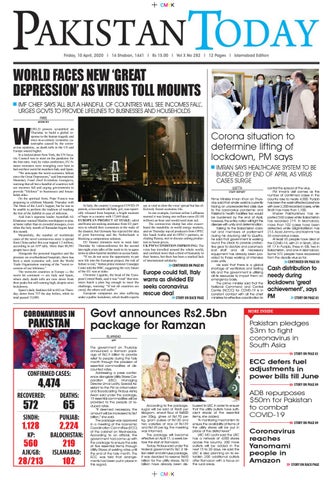
World faces neW ‘Great depression’ as virus toll mounts g
IMF ChIeF SAyS ‘All But A hAnDFul OF COuntrIeS wIll See InCOMeS FAll’, urgeS gOVtS tO PrOVIDe lIFelIneS tO BuSIneSSeS AnD hOuSehOlDS PARIS
W
aGENCIES
orld powers scrambled on Thursday to build a global response to the human tragedy and once-in-a-century economic catastrophe caused by the coronavirus epidemic, as death tolls in the US and Europe soared higher. In a locked-down New York, the UN Security Council was to meet on the pandemic for the first time. And, by video conference, EU finance ministers were wrangling over how to bail out their worst hit members Italy and Spain. “We anticipate the worst economic fallout since the Great depression,” said International Monetary Fund chief Kristalina Georgieva, warning that all but a handful of countries will see incomes fall and urging governments to provide “lifelines” to businesses and households alike. on the spiritual front, Pope Francis was preparing to celebrate Maundy Thursday with The Mass of the lord’s Supper, but he was to be unable to perform the tradition of washing the feet of the faithful in case of infection. And Iran’s supreme leader Ayatollah Ali Khamenei warned Muslim worshippers to pray at home rather than in crowded mosques, even when the holy month of ramadan begins later this month. Meanwhile, the number of worldwide cases of the novel coronavirus since it spread from China earlier this year topped 1.5 million, according to an AFP tally. More than 88,981 people have died. Alongside the personal tragedies and the pressure on overburdened hospitals, there has been a stark economic toll, with the World Trade organization warning of the “worst recession of our lifetimes.” The worst-hit countries in Europe — the worst hit continent — are Italy and Spain, where daily death tolls are now down from their peaks but still running high, despite strict lockdowns. Spain’s daily fatalities fell to 683 on Thursday, down from 757 the day before, while its total passed 15,000.
Corona situation to determine lifting of lockdown, PM says g
IMrAn SAyS heAlthCAre SySteM tO Be BurDeneD By enD OF APrIl AS VIruS CASeS Surge QUETTA Staff rEport
In Italy, the country’s youngest CoVId-19 patient, a two-month-old baby girl, was reportedly released from hospital, a bright moment of hope in a country with 17,669 dead. EUROPEAN PROJECT AT STAKE: adrid and rome are seeking assistance from EU partners to rebuild their economies in the wake of the disaster, but Germany has rejected the idea of joint borrowing and the Netherlands is blocking a compromise solution. EU finance ministers were to meet later Thursday by videoconference for the second late-night crisis talks of the week to try to agree terms to allow hard-hit members to access funds. “If we do not seize the opportunity to put new life into the European project, the risk of failure is real,” Italian prime minister Giuseppe Conte told the BBC, suggesting the very future of the EU was at stake. Christine lagarde, the head of the European Central Bank, said it was “vital” that ministers hatch a plan big enough to meet the challenge, warning: “If not all countries are cured, the others will suffer.” European companies are also suffering under a public lockdown, which health experts
coronavirus in
pakistan
say is vital to slow the virus’ spread but has effectively frozen economic life. In one example, German airline lufthansa warned it was losing one million euros ($1.08 million) an hour and would need state aid. The coronavirus slump has also exacerbated the instability in world energy markets, and on Thursday top oil producers from oPEC like Saudi Arabia and its oPEC+ partners, including russia, met to discuss cutting production to boost prices. UK PM’S CONDITION IMPROVING: The virus has travelled around the whole world, and confined more than a third of humanity to their homes, but there has been a marked lack of international solidarity.
CONTINUED ON PAGE 05
Europe could fall, Italy warns as divided EU seeks coronavirus rescue deal
STORY ON BACK PAGE
Prime Minister Imran Khan on thursday said that whole world is currently facing an unprecedented crisis due to the coronavirus pandemic and Pakistan’s health facilities too would be burdened by the end of April, however, the entire nation will fight this disease with unity and determination. talking to the Balochistan cabinet and members of parliament during his day-long visit to Quetta, he said that government is working round the clock to provide protective gear to doctors and paramedical staff and all necessary equipment has already been provided to those working at intensive care units. he said that there is a global shortage of ventilators and testing kits and the government is utilising all its resources to import them on emergency basis. the prime minister said that the national Command and Control Centre (nCCC) for COVID-19 is in constant contact with all the chief ministers for effective coordination to
Govt announces Rs2.5bn package for Ramzan ISLAMABAD app
CONFIRMED CASES:
4,474
RECOVERED:
572
SINDH:
1,128
DEATHS:
65
PUNJAB:
2,224
KP:
BALOCHISTAN:
AJK/GB:
ISLAMABAD:
560 28/213
219 102
the government on thursday announced a ramzan package of rs2.5 billion to provide relief to people during the holy month through the provision of essential commodities at discounted rates. Addressing a press conference alongside utility Stores Corporation (uSC) Managing Director umar lodhi, Special Assistant to the PM on Information and Broadcasting Firdous Ashiq Awan said under the package, 19 essential commodities will be provided to the people at reduced rates. “If deemed necessary, the amount will be increased to rs7 billion,” she said. the package was approved in a meeting of the economic Coordination Committee (eCC) of the cabinet on wednesday. According to an official, the government had come up with the package to ensure the sale of five essential items through utility Stores at existing rates until the end of the holy month. the eCC was told that arrangements had been put in place in this regard.
control the spread of the virus. PM Imran’s visit comes as the number of confirmed cases in the country rose to nearly 4,500. Punjab has been the worst-affected province with over 2,200 recorded cases, while Sindh has more than 1,100. Khyber Pakhtunkhwa has reported 560 cases while Balochistan has recorded 219. In Islamabad, more than 102 cases have been detected while gilgit-Baltistan has 213. Azad Jammu and Kashmir has 33 coronavirus cases. At least 65 people have died of the COVID-19, with 21 in Sindh, 20 in KP, 17 in Punjab, three in gB, two in Balochistan, and one in Islamabad. Some 572 people have recovered from the deadly virus so far.
CONTINUED ON PAGE 05
Cash distribution to needy during lockdowns ‘great achievement’, says PM STORY ON PAGE 03
more inside
Pakistan pledges $3m to fight coronavirus in South Asia STORY ON PAGE 03
ECC defers fuel adjustments in power bills till June STORY ON PAGE 09
According to the package, sugar will be sold at rs68 per kilogram, wheat flour at rs800 per 20kg, ghee at rs170 per kg, gram pulses at rs130 and two varieties of rice at rs139 and rs149 per kg, the meeting was informed. the package will become effective on April 17, a week before the start of ramazan. today, Firdous said under the federal government’s rs1.3 trillion relief and stimulus package, it was decided to reserve rs50 billion for the utility stores. rs10 billion have already been dis-
CMYK
bursed to uSC in order to ensure that the utility outlets have sufficient stocks of the essential items, she added. “A monitoring mechanism to ensure the availability of items at the utility stores will be put in place at the district level.” uSC MD lodhi said the uSC has a network of 4200 stores across the country. 200 more outlets will be added in the next 15 to 20 days. he said the uSC is also planning on to establish 200 additional outlets after ramazan with a focus on the rural areas.
ADB repurposes $50m for Pakistan to combat COVID-19 STORY ON PAGE 09
Coronavirus reaches Yanomami people in Amazon STORY ON BACK PAGE
02
Friday, 10 April, 2020
NEWS
IHC extenDS StAy OrDer fOr KPt CHIef remOveD By feDerAl mInISter PORT AND SHIPPING MINISTER ALI ZAIDI REMOVED JAMIL AKHTAR AFTER HE ALLEGEDLY REFUSED TO GRANT A CONTRACT FOR A MEGA PROJECT TO MINISTER’S BLUE-EYED COMPANY ISLAMABAD
t
STAFF REPORT
HE Islamabad High Court (IHC) on Thursday maintained its stay order till April 16, against the removal of Karachi Port Trust (KPT) Chairman Jameel Akhter from his post and sought reply from the Ministry of Maritime Affairs. Chief Justice Athar Minallah conducted the hearing on a petition moved by the KPT chairman against his removal by the ministry. At the outset of the hearing, Additional Attorney General Tariq Mehmood
Khokhar appeared before the bench on behalf of the federation and pleaded that there were two notifications for the appointment of the chairman. The appointment tenure was two year in accordance of first notification of 2017. The chief justice remarked that whether the federal minister concerned was authorised to interfere in the affairs of appointment. He further noted that it was an admitted fact that this appointment was made for a period of three years. The officials of the maritime ministry adopted the stance that Federal Minister Ali Zaidi had ordered for an audit into the department. Under which law this order
was given, retorted the IHC CJ. Justice Minallah said that the ministry was giving baseless arguments, adding that most of the cases of the National Accountability Bureau (NAB) were related to misuse of powers. He asked the ministry to review the matter. The court sought written comments from secretary ministry and federal minister pertaining to the matter and adjourned the hearing of the case till April 16. BACKGROUND: According to media reports, Federal Minister for Port and Shipping Ali Zaidi pushed for the removal of KPT Chairman Jamil Akhtar after the latter allegedly refused to grant a contract for a
mega project to the minister’s blue-eyed company. Speaking on a Din TV show, journalist Mumtaz Bhatti claimed that Zaidi wanted the former KPT chairman to award the contract to MIBT, a company owned by the friend of the shipping minister, for $70 million. Akhtar refused and told the minister that the contract will only be awarded via standard bidding procedure. However, in the bidding process, a company named RAMD made a bid of $13-15m for the same task which the MIBT had asked $70m for, he claimed. Subsequently, Zaidi allegedly got the finance director removed, but that didn’t work out. Eventually, Zaidi in connivance with a secretary and his ‘friend’ in Islamabad sent the chairman of the KPT packing. The federal government removed Akhtar from the post of the chairman on March 25 with immediate effect.
Pakistan expresses ‘deep concerns’ over lack of medical supplies in IOK ISLAMABAD STAFF REPORT
Pakistan on Thursday expressed “deep concerns” over the lack of medical supplies and assistance in Indian occupied Kashmir where over 170 cases of coronavirus and at least five fatalities from the pandemic have been reported so far. Speaking at the weekly press briefing, Foreign Office Spokesperson Aisha Farooqui said: “Voices from within India and around the world continue to condemn the inhuman oppression of the people of Jammu and Kashmir. She also recalled that “in a joint statement recently, six international human rights organisations underscored that measures to combat Covid-19 must respect human rights of every individual and urgently release all political prisoners, human rights defenders and all those arrested in occupied Kashmir after August 5, 2019.”
China says will stick with Pakistan through pandemic ISLAMABAD
“These organisations, in their joint statement also reminded India of its obligation under international law to ensure the physical and mental health and well-being of inmates,” she said. Farooqui also condemned the new domicile law introduced in the region under which a person who has resided in occupied Kashmir for 15 years will be able to call the territory his or her place of domicile. “The [law] is another illegal step by India to settle non-Kashmiris in the occupied valley by changing domicile laws. “At this moment of a global health crisis, [changing the law] is a particularly reprehensible act as it seeks to take advantage of the international community’s focus on the ongoing coronavirus pandemic and further advance the Bharatiya Janata Party’s sinister Hindutva agenda,” she said. REPATRIATING PAKISTAN NATIONALS: Speaking about bringing back Pakistanis from virus-hit countries, she said: “A comprehensive and phased plan for repatriation of our nationals in different countries has
Govt’s negligence caused coronavirus spread in Punjab NEWS DESK
STAFF REPORT
Amid in a surge in infections, China on Thursday reiterated a willingness to continue supporting Pakistan in the fight against COVID-19 pandemic. Foreign Minister Shah Mahmood Qureshi extended his wishes to the Chinese people for getting through adversity with resilience, stressing that countries around the world were following China’s model of recovery. Qureshi met Chinese Ambassador to Pakistan Yao Jing, who called on him in Islamabad and reviewed the latest situation arising out of the coronavirus. Yao said in the wake of the quickly spreading virus cases in Pakistan, China would continue its support for its “iron brother”. Qureshi congratulated the Chinese Ambassador and his government for successfully dealing with the pandemic. He thanked China for the assistance in this time of need, saying that the equipment given by China would build Pakistan’s capacity to fight against the virus. “It is most heartening to note that life in China has started to return to normal with most departments including transport becoming functional again,” he said. “China’s model of recovery is now being followed by countries all over the world.” Earlier, the foreign minister telephoned his Australian counterpart Marise Payne on Thursday and discussed with her the situation arising out of global pandemic and matters of mutual interests, Radio Pakistan reported. Qureshi apprised his Australian counterpart of the steps taken by Pakistan to contain the spread of the contagion. He pointed out that the developing countries were facing difficulties due to limited economic resources to cope with the challenge. Payne said that the Australian government had allocated A$130 billion for a job keepers programme, to save the country’s businesses from losses from the global pandemic. Qureshi appreciated the steps taken by Australia in the fight against COVID-19. He also lauded the steps taken by the Australian government for the wellbeing of Pakistani nationals, especially the students.
been made,” adding that under the plan, some 772 Pakistanis have returned through special flights operated by PIA in the past few days. “101 nationals from the United Arab Emirates, 40 from Doha, 170 from Bangkok, 194 from Istanbul, 128 from Tashkent, three from Tajikistan, and 136 from Baghdad returned to the country safely. She further said that plans for the repatriation of our nationals from other destinations are also under active consideration. “As this is a dynamic and evolving situation, these plans are being reviewed regularly,” Farooqui said. “Our two-member solidarity team from Beijing Embassy, comprising officers Junaid and Suleman who had volunteered to go to Wuhan and assist our students under the lockdown there, have now returned to Beijing following the lifting of travel restrictions in Wuhan after 76 days,” added the spokesperson. “We are immensely proud of them and recognise their commitment and dedication to serve the nation.”
Despite the government’s tall claims of effectively managing the pilgrims who returned to the country through the Taftan border, it has emerged that negligence in properly quarantining those who tested positive for coronavirus resulted in the spread of infection to those who had initially tested negative for the virus. According to a local news outlet, when the pilgrims reached Multan after spending 15 days in quarantine at Taftan, the district administration screened them for signs of infection and those who displayed symptoms of the virus were separated from others. Following repeated requests for the provision of testing kits, the kits were provided to the district administration, and after testing, 1,160 pilgrims who were initially suspected of being infected, were finally declared negative. However, before sending them to their respective districts, the deputy commissioner insisted on testing them once again, but the district administration was directed to conduct tests of only five per cent of them. These tests resulted in three more pilgrims testing positive for COVID-19. Later, on April 4, when the district administration arranged for them to be sent to their respective districts, orders came for testing everyone once again. The pilgrims, however, protested this decision and after expelling the staff from the quarantine centre, they locked their rooms. The district administration asked the police to control the situation, but upon their refusal, they had to call the army for negotiations. The pilgrims told the army officials that they had spent 15 days each in quarantine centres in Taftan and Multan and had been declared negative. Finally, both sides reached an agreement and their samples were collected and sent to a laboratory while the pilgrims were sent to their respective districts. Meanwhile, the provincial govern-
453 PILGRIMS SENT TO THEIR RESPECTIVE DISTRICTS TEST POSITIVE FOR CORONAVIRUS
ment also directed the administration of those districts to make proper arrangements for quarantining the pilgrims upon their arrival, but the latter expressed concerns over the lack of facilities for treating positive patients, and highlighted the possibility that those who initially tested negative might have become infected while travelling. These suspicions were confirmed when 453 pilgrims who previously tested negative for the virus were found to be infected after reaching their respective districts. Quoting DC Khattak, the report stated that the pilgrims were not sent to their homes after reaching their respective districts, rather they were quarantined as per policy. The report also revealed the other factors that allowed the virus to spread among the pilgrims. The police’s alleged refusal to perform their duties outside each block of the quarantine centre allowed the pilgrims to freely interact with each other. Similarly, the officials of the
CMYK
health department appeared to be reluctant to perform their duties inside the quarantine centre, leading to the deputy commissioner deploying his untrained staff, including volunteers of civil defence, to control the spread of the virus. Furthermore, the alleged refusal Nishtar Hospital to provide doctors and paramedics to serve inside the quarantine centre also deprived the pilgrims of proper medical attention. The report also stated that when Nishtar Medical University Vice Chancellor Dr Mustafa Kamal Pasha was also contacted for a comment on the abovementioned allegation, he told them their role was limited to conducting tests, whereas the primary and secondary health department was actually responsible for the quarantine centre. He also told the media outlet that they never refused to provide medical staff to the quarantine centre, rather they were never asked for such help.
Pakistan asks Afghanistan to hand over IS-Khorasan leader ISLAMABAD STAFF REPORT
Pakistan on Thursday asked Afghanistan to hand over Aslam Farooqi, leader Khorasan Province (ISKP) who was arrested last week, “for further investigations”. ISKP is a splinter group of the Islamic State of Iraq and Levant aka Daesh. Pakistan summoned the Ambassador of Afghanistan to Pakistan at the Foreign Office where he was “conveyed Pakistan’s views with regard to the arrest of ISIS-K leader, Aslam Farooqi, by the Afghan authorities on 5 April 2020”. “It was emphasized that Pakistan had been expressing its concerns over the activities of this group, which were clearly detrimental to Pakistan,” a statement by the foreign office read. “Pakistan’s position in this regard was being regularly shared with the Government of Afghanistan and others concerned. “It was underscored to the Ambassador that since Aslam Farooqi was involved in anti-Pakistan activities in Afghanistan, he should be handed over to Pakistan for further investigations,” it read further. Islamabad further emphasised that both sides should coordinate their measures in the fight against terrorism through the established mechanisms. A report by India Today had quoted Afghanistan’s NDS as claiming that Farooqi had ties with Pakistan’s premier intelligence agency, the Inter-Services Intelligence (ISI). The report also claimed that Farooqi enjoyed “close relations” to the Haqqani network and the Lashkar-e-Taiba (LeT).
British lawyer offers his services to Omar Sheikh in Daniel Pearl murder case Days after the government re-arrested Ahmed Omar Saeed Sheikh after his acquittal by the Sindh High Court (SHC) in the murder case of American journalist Daniel Pearl, Britain’s Queen’s Counsel Ali Naseem Bajwa on Thursday offered his services to the militant free of charge. Speaking to a local news outlet, Bajwa said that the way Sheikh’s case was handled and three other men, Fahad Nasim Ahmed, Syed Salman Saqib and Sheikh Muhammad Adil, treated, raises serious concerns about the justice system of the country, which appears to be at its very best and worst. He said that injustice anywhere is a threat to justice everywhere, and due process had not been observed in this case. “As a British-Pakistani QC, I am willing to join the fight to restore the high court’s decision, therefore, I have offered my services, free of charge, to any of the four men who may wish to have my assistance in the legal battles that lie ahead,” he added. He also said that putting aside that it took 18 years to bring about its resolution, the SHC’s decision on April 2 was a model of legal independence and good sense. He added that the court allowed Sheikh’s appeal and that of his three co-accused on the grounds that there was insufficient evidence of his being a party to Pearl’s murder, only a party to his kidnapping. “Sheikh’s death sentence was quashed and replaced by one of seven years’ imprisonment for the kidnapping offence; a term that he had long-since served. His release was expected to follow very shortly. The Pakistani courts had shown that justice can indeed be blind. Regrettably, the blindfold slipped within just 24 hours,” he said. Bajwa said that he has no doubt that the provincial government’s decision to issue orders to keep Sheikh and his co-accused in custody for at least 90 days on the grounds of ‘public safety’ was taken under pressure from external agencies. “That basis for their continued imprisonment is entirely fallacious unless one presumes that four men are guilty of murder, which in law they no longer are. Of course, the state can and will appeal the SHC’s judgement to the Supreme Court (SC). Inevitably, that process will be significantly delayed and the four men will be in custody for all of that time,” he added. He further said that this case is about much more than the fate of four men as “it confirms that there are significant systematic failures in Pakistan’s legal process, which must be challenged by international lawyers and human rights groups”. NEWS DESK
Friday, 10 April, 2020
Cash distriBution to needy during loCkdowns ‘great aChieveMent’: PM
P
NEWS DESK
RIME MINISTER Imran Khan on Thursday lauded the “historic” transfer of cash to the needy which aimed at reducing miseries of the masses amid a lockdown imposed to contain the spread of novel coronavirus, terming it a “great achievement” of his government. “Today saw the launch of the biggest cash distribution by any government in Pakistan’s history, directly to the most vulnerable and needy citizens in our society,” he said in a series of tweets. The premier also said that Rs144 billion will be distributed amongst 12 million families over the next two weeks. “This is a great achievement of our government to transfer cash to the needy in our society on such a massive scale across the country,” he said in another tweet.
Earlier in the day, he warned that the burden on the country’s healthcare system will increase by the end of April. While addressing the media in
Balochistan govt lying to you on anticorona measures, Mengal tells PM
Balochistan during his day-long trip, PM Imran said the federal government is trying to provide Personal Protective Equipment (PPE) to all doctors and medical
News staff to ensure their safety while treating COVID-19 patients. He also visited a corona quarantine centre at Bolan Medical College Hospital Quetta during. A day earlier, the premier had announced to distribute Rs12,000 stipend to each of the 12 million families across the country worst affected by the lockdown. “Rs12,000 will be given to each of the 12 million families from Thursday under ‘Ehsaas Programme,” Imran Khan on Wednesday told the media. On March 23, the Sindh government had announced a complete lockdown across the province. The next day – on March 24 – Punjab, Khyber-Pakhtunkhwa, Balochistan as well as Gilgit-Baltistan and AJK followed the suit. Premier Imran, however, on Thursday said that by April 14, provincial governments will apprise the federal government regarding various sectors and professions which can have restrictions eased to ensure “people can earn a livelihood”. “Daily wage workers in Balochistan can suffer more from the imposed lockdown than other parts of the country”.
People need to follow quarantine rules despite lower death rate: Mirza ISLAMABAD STAFF REPORT
Balochistan National Party-Mengal (BNP-M) chief Akhtar Mengal accused the Balochistan government of keeping Prime Minister Imran Khan in dark on his visit to Quetta’s Bolan Medical College. The prime minister visited a quarantine centre at the hospital earlier in the day where he was briefed by the provincial chief secretary about facilities provided to the coronavirus patients. He was also briefed about the steps authorities have taken to stem the virus’s spread in the province. Reacting to the visit, Mengal, an ally of the ruling Pakistan Tehreeke-Insaf (PTI) at the federa level, addressed a tweet to the PM, saying the premier was misled by the provincial government. “They’ve given you a complete false impression by taking you to BNC. On ground there is absolutely nothing. There are no testing kits or health facilities available in Quetta so one could imagine the situation in the interior.” Mengal, however, via a statement on Twitter, sought to warn the prime minister to not be misled by the government of Balochistan, which is chiefly ruled by the Balochistan Awami Party. “Govt of Balochistan has been completely negligent and is completely responsible for the spread of COV [COVID-19] throughout Pakistan,” he alleged. NEWS DESK
Prime Minister’s Special Assistant Zafar Mirza on Thursday said that the people shouldn’t start flouting the quarantine rules amid reports that the number of coronavirus deaths in Pakistan was relatively low compared to the experts’ estimations. “I am seeing reports on TV that Pakistan’s death rates are lower as compared to projections made through modelling. While it is true to some extent that Pakistan has lesser coronavirus cases and a lower death rate than projected by experts, it is not a reason for citizens to become lax,” he said at a news briefing in Islamabad. He said the restrictions imposed by the government on large gatherings and social contact had an effect on the infection rate “but if people think we don’t need those preventive measures and we don’t need social distancing, it would be a very big mistake”. Stressing the need for more prevention and responsibility, Mirza
‘DRAP GRANTS PERMISSION FOR CLINICAL TRIAL OF PLASMA THERAPY ON CORONAVIRUS PATIENTS’ warned that the country could see a sharp rise in the number of cases and deaths if people were not careful and started going out. Talking about the deaths he said that 73 per cent of COVID-19 deaths in the country were of people who had pre-existing health conditions, adding that 85pc of those who died from the virus were above the age of 50 while 78pc of them were males. Mirza added that the government was creating a mechanism to provide personal protection equipment (PPE) to health professionals in hospitals in such a way that shortage was not observed. He said the National Disaster and Management Authority (NDMA) after its calculations had provided PPEs, including N-95 masks, gowns and gloves to 152 hospitals for a week. These are the hospitals where most coronavirus patients would be brought, he added.
“We have a list of some 400 hospitals and all of them will be provided PPEs, and on a priority basis.” The PM’s aide on health said the government would facilitate firms wishing to manufacture ventilators locally through a committee formed under the Drug Regulatory Authority of Pakistan (DRAP). Through the committee, the firms’ applications would be processed as soon as possible so that production could be started in order to overcome shortage, he revealed. Mirza said that special permission had been granted by DRAP to begin the clinical trials of plasma therapy to treat patients of the novel coronavirus in Pakistan. He also announced that the drug regulatory body had allowed drug manufacturers to fast-track the refining of raw materials used to make chloroquine, a drug that health experts believe is partially effective in treating virus patients.
Pakistan pledges $3m to fight coronavirus in south asia ISLAMABAD STAFF REPORT
Pakistan has pledged $3 million to the South Asian Association of Regional Countries (SAARC) COVID-19 Emergency Fund to support efforts in the fight against coronavirus. “All proceeds of the Fund should be administered by the SAARC Secretariat and that the modalities for the Fund’s utilization should be finalised through consultations with the Member States as per the SAARC Charter,” said a statement on Thursday. Pakistan’s perspective in this regard was also conveyed during a telephone conversation between Foreign Secretary Sohail Mahmood and Secretary General SAARC Esala Ruwan Weerakoon. Being a founding member, Pakistan considers SAARC an important platform for regional cooperation. Pakistan remains committed to the SAARC process and will continue working with the Member States to strengthen regional cooperation. On Wednesday, Pakistan refused to participate in a SAARC virtual conference of trade officials, saying such meetings should have been led by the group’s secretariat instead of India. The meeting of trade officials from eight-member SAARC was convened to discuss the impact of COVID-19 in the region and how the forum could come up with a common strategy. “Being a founding member, Pakistan believed that SAARC provides an important platform for regional cooperation,” the statement issued by the Foreign Office had said. “Activities such as today’s trade officials’ video conference could only be effective if spearheaded by the SAARC secretariat. Since the secretariat was not part of today’s video conference, Pakistan chose not to participate,” FO Spokesperson Aisha Farooqui had explained. “At a time when the region is facing unprecedented challenges, all the available institutional frameworks must be optimally utilised,” she added.
Pia to repatriate Pakistanis stranded in asean countries KARACHI STAFF REPORT
Pakistan International Airlines (PIA) on Thursday announced additional flights to bring back those citizens that have been stranded in different countries including Southeast Asian states due to coronavirus. According to PIA spokesperson Abdullah Hafeez, one flight will head to Baku, Azerbaijan on April 11 and will bring back 125 Pakistani nationals. The second flight, he said, will head to Kuala Lumpur on April 11 and will bring back 175 Pakistanis stranded at the airport for the past 16 days. On April 13, another flight will head to Thailand to bring back 200 Pakistanis stranded in Bangkok, he stated.
Non-Muslim volunteers join fight against corona KARACHI AGENCIES
Wearing gloves, and face masks, a group of 15 volunteers huddle at a distance with each other, beside a stash of groceries in a large room in eastern district of Karachi. Among them is Sunil Harsi, one of the many Hindu volunteers who have joined hands with different relief agencies to provide rations, and sanitation products to lowincome masses amid a raging coronavirus outbreak that has put the country under a crippling lockdown. A grinding economic slowdown, a direct result of the global COVID-19 outbreak, has particularly hit nearly 25% of the country’s over 200 million population, which lives below poverty line. The country has reported a total of 60 deaths as the number of coronavirus cases have surpassed 4,200 as of Wednesday. Harsi, 32, a city councillor for Jamaat-eIslami, has actively been taking part in relief efforts carried out by the party’s charity wing
Al-Khidmat Foundation in Karachi’s eastern district for over a month. “I come here every day at noon to attend this meeting to chalk out the plan for the day. One day we collect and pack relief goods donated by philanthropists and distribute them on the next day,” Harsi said. He and his colleagues have been assigned to operate in two slums areas in Gulshan-e-Iqbal town, a middle-income bracket locality. For distribution of relief goods, they mostly use motorbikes or small vehicles to drive through the narrow streets of the slums. “We do not gather people on the streets to distribute rations in order to observe social distancing. We deliver rations at the doorsteps,” Harsi said, adding “I was born and raised in this area. Who’s needy and who’s not, I know very well”. INTERFAITH HARMONY: Adnan Sadiq, a young Christian volunteer, who too is part of the group, counts his involvement in the operation as a pride.
“I am proud to be part of this [relief campaign]. In this way, I am contributing something to the society, and my own community as well,” Sadiq, 22, who joined the relief activities two weeks ago, said. He gave credit to his Muslim friends for bringing him in. “I feel myself proud as I am not the one seeking help but I am helping others. It’s all because of my Muslim friends whose selfless efforts for the needy masses inspired me to join them,” he said. Around a dozen Christian and Hindu volunteers from his area, he said, were working with different charities. Seema Maheshwari, a human rights activist who too has been engaged in rations distribution among needy people in different parts of Karachi, thanked the Muslim community for assisting her efforts. “I started my efforts in collaboration with my family and some friends with limited resources. But soon, my Muslim friends and philanthropists joined hands with us,” Maheshwari, a Hindu by religion, said.
03
“I am really thankful to my Muslim brothers and sisters who have trusted my efforts, and provided us rations, and other essential goods for the poor masses,” she went on to say, adding several other Muslim philanthropists have assured her of their support. So far, Maheshwari has distributed rations among 250 families in different parts of the city. “We are distributing rations among needy Hindus, Christians, and even Muslims. It’s not about religion, race or community. It’s all about humanity,” she maintained. COMMUNITY LINK: The country’s tiny Sikh community is also contributing its share to provide relief to the low-income people, who have been badly hit by the economic meltdown, a direct result of the coronavirus outbreak. Pakistan Sikh Gurdwara Parbandhak Committee, an organisation that deals with religious affairs of the Sikh community in Pakistan, has already allotted portions at
scores of gurdwaras — worship places — as isolation cells for suspected coronavirus patients. In addition, according to Charanjeet Singh, a community leader, rations and cooked food were being distributed among needy people irrespective of their religious affiliation, in the gurdwaras in Karachi, Peshawar, Nanakana Sahib — the birthplace of of Baba Guru Nanak, the founder of their religion — and other districts. Haris and Sadiq also act as a link between their foundation and the respective communities. “I have also been appointed in-charge of rations distribution [by Al-Khidmat Foundation] among needy Hindus as I know my community more than anyone else,” Harsi said. “I have personally handed over rations to around 150 Hindu families at their doorsteps in my locality,” he added. Similarly, Sadiq has been assigned to collect the data and deliver rations to the needy Christian families in his area of operation. Hindus and Christians make up 4% and 3% of the total population of Muslim-majority Pakistan, respectively, whereas, the number of Sikhs in Pakistan is estimated between 30,000-40,000.
Friday, 10 April, 2020
04 ISLAMABAD
WEATHER UPDATES FRIDAY
290C
150C
SATURDAY
310C
170C
SUNDAY
330C
180C
Margalla MonKeys taKe to CapItal roads In searCH oF Food ISLAMABAD
M
APP
ONKEYS living in the federal capital’s lush green Margalla Hills National Park (MHNP) have descended to residential areas in search of food after the metropolis embraced a virtual lockdown due to coronavirus. Talking to APP, IWMB Assistant Director (AD) Sakhawat Ali said the residents of sectors F-6 and F-7 had com-
plained about monkeys entering local apartments. After the lockdown, he said, there was a decline in the number of visitors and hikers visiting MHNP where visitors used to feed the monkeys. “This is why people are forbidden to feed animals. Mot only will human-fed food item have bad impacts on their health but now they are here for more,” he added. Sakhawat mentioned that monkeys were not hostile to human beings rather but they do attack or become offensive when someone tries to hurt them.
He advised the masses to stay calm while encountering any monkey and keep food items well hidden. “People should also take care of their laundry hanged outside to dry. Monkeys have a habit of taking away clothes left outside if they find nothing in search of food,” he advised. He went on to mention that monkeys used to enter IWMB offices at the hiking trails and remove the lid of water tanks installed on the roofs. The IWMB official also mentioned that some people were acting selfish and
putting everyone at a risk by still visiting the trails, especially trail-3. He urged the masses to stay at home and practice social distancing to contain the outbreak of coronavirus. It merits mention here that other wildlife has been venturing into human territories after a complete lockdown in different countries across the world. Wild boars in Spain, pumas in Argentina, wild goats in the United Kingdom (UK) and elephants in India have been seen roaming in the streets.
PRAyER TImINgS FAJR SUNRISE
ZUHR
ASR MAGHRIB ISHA
4:18
12:04
4:39
5:41
6:28
7:52
Islamabad’s admin decides to reopen opds at public, private hospitals ISLAMABAD STAFF REPORT
The District administration in Islamabad on Thursday decided to resume out-patient departments (OPDs) services in the public and private hospitals across the federal capital that remained shut owing to preventive measures amid coronavirus pandemic. According to a handout issued today, closure of the OPDs in federal capital was creating problems for those eyeing treatment of diseases other than coronavirus. “The decision was made to facilitate the masses,” the order said adding that the hospitals would be bound to follow guidelines issued by the district administration. It is pertinent to mention here that the hospitals’ OPDs were shut down in the federal capital on March 24 due to coronavirus outbreak. According to sources, the out-patient services in Pakistan Institute of Management (PIMS), Poly Clinic Hospital, Federal General Hospital (FGH) and others would be resumed from tomorrow. The punishment for the violators has also been fixed in the ordinance.
distribution of relief for poor families under pM ehsaas programme begins in Kp PESHAWAR APP
ISLAMABAD: A deserted view of the under-construction Faisal Avenue underpass where work has been stalled due to lockdown. INP
USC launching mobile service from Friday in federal capital ISLAMABAD APP
Utility Stores Corporation (USC) Managing Director (MD) Umer Lodhi Thursday said the corporation was launching its well-equipped mobile van service on April 10 (Friday) in a bid to facilitate people with daily use commodities at their door steps. Addressing a news conference here along with Special Assistant to the Prime Minister on Information Dr Firdous Ashiq Awan, he said initially the service would be launched in federal capital and then it would be expanded the radius of its services to other cities of the country. He said this service would help people to get essential items of daily use on subsidized rates. Providing details about the relief package during lockdown due to coronavirus and the upcoming holy month of Ramazan, the USC MD said the prime minister
had announced special package to provide subsidy on five essential items, however, during Ramazan, the subsidy would be given on more items. He said irrespective of hike in price of wheat flour or sugar in the open market, the utility stores would provide wheat flour at the rate of Rs800 per 20 kg and sugar at Rs68 per kg. Further, he said ghee would be sold at Rs170 per kg while a subsidy of Rs15 to 25 per kg would be provided on all pulses and gram flour (Besan). Likewise a subsidy of Rs50 per kg would be given on tea and Rs30 per liter on milk, Rs25 per 1,500 ml bottle of beverages and Rs20 per 800 ml of beverages. He said according to the PM package a subsidy of Rs2.5 billion would be provided during the holy month of Ramazan, however, in case of increased demand, the subsidy would also be increased during the month so that the customers could get all the required items on subsidized rates. He pointed out that there was no shortage of any item
in the stores and they were fulfilling demand of the customers despite increase of sale by 5 to 10 times. He said the sale of utility stores had increased from Rs350 million per month a year ago to Rs8 billion during last month. He said during last three months total sale of the utility stores was recorded at Rs25 billion. He said sale target of the stores during the month of Ramazan was Rs30 billion. He informed that at present 4,200 stores were operational while by next 15 to 20 days 200 more stores would be added to the chain and after Ramazan 300 more stores would be opened in various parts of the country. Replying to a question, Umer Lodhi said after outbreak of coronavirus in the country, people were getting panic and they were buying more than their actual needs. Earlier the requirement of wheat flour at the USC outlets was 2,000 tons while now it had increased up to 7,000 to 8,000 tons of wheat flour. However, he said this requirement was also being fulfilled.
IHC to take up petition seeking prevention from bank loan installments on Friday
RDA distributes ration bags among poor
ISLAMABAD: Islamabad High Court (IHC) Chief Justice (CJ) Athar Minallah on Thursday directed the registrar office to convert a handwritten application into a court petition so that a case, seeking the prevention of debt collection from private banks during the lockdown, can be taken forward. The petition would be heard on Friday whereas the secretary finance, NDMA chairman and State Bank of Pakistan (SBP) governor are parties in the petition. According to the details, citizen Rafiq-ur-Rehman wrote a letter to the IHC Chief Justice stating that revenue was restricted due to the lockdown which makes paying back loans difficult. APP
Rawalpindi Development Authority (RDA) in collaboration with Turkish Non-Governmental Organization (NGO), IHH-NL Selami Yuksl, a Humanitarian Relief Foundation on Thursday organized a ceremony to distribute ration bags among poor and deserving citizens who are facing difficulties due to the lockdown. Turkish Ambassador to Pakistan Ihsan Mustafa Yurdakul, Deputy Commissioner Rawalpindi Capt. (R) Anwarul Haq, Chairman RDA Tariq Mehmood Murtaza, Director Admin and Finance, RDA Khalid Javed Goraya, General Secretary IHH-NL Ikhlaqur Rehman and others were present on the occasion. Turkish Ambassador while addressing the participants said that Coronavirus is pandemic due to which grave situation is being faced worldwide and it’s a difficult time for all including poor and deserving people. He said Pakistan and Turkey are two brotherly countries and their relationship is centuries old. Turkish people had a great love for the Pakistani brethren. Turkey would not leave Pakistan alone in
Kot Kat families trapped for a week after flash floods sweep away bridge TAnk: Hundreds of families of village Kot Kat have been trapped for one week after the under construction bridge of the village was swept away by flash floods. Talking to media persons on Thursday, residents of village Kot Kat Irfanullah, Kareem Khan, Amanullah and Naimat Khan noted that the only communication bridge of village Kot Kat, which was nearing its completion, was once again swept away by recent flash floods leaving hundreds of families of village Kot Kat trapped in village. INP
RAWALPINDI APP
this critical period. We will extend moral and financial support to the needy people of Pakistan. He further said, Turkish NGO, IHH-NL would continue to help poor and needy people of Pakistan. Deputy Commissioner Rawalpindi said, all out efforts were being made to prevent spread of Coronavirus. He expressed the hope that the situation would be improved soon in Pakistan as the government has taken solid step to prevent spread of the virus. He also thanked Turkish Ambassador for extending his support and help for the deserving people of Pakistan. Earlier in his welcome address Chairman RDA also thanked the Ambassador. He said, it’s a good gesture and noble cause as Turkish government has come forward to help deserving people of Pakistan. He said, Turkey and Pakistan were working together for the welfare of the needy people. He said the government of Pakistan Tehreek-e-Insaf was making all out efforts to improve the living standards of the people. Over 1000 ration bags were distributed among deserving citizens at different points including RDA Office, Pirwadahi, Dhok Hasso, Bhabra Bazar, Chittian Hattian, Landa Bazar and Naya Mohalla.
Advisor to the Chief Minister on Information and Public Relations Ajmal Wazir Thursday said that distribution of Rs12,000 among each poor family under Prime Minister Ehsaas program has been started in Khyber Pakhtunkhwa. He said the distribution of the relief amount to deserving poor families has been started at 01:00pm today and the people should visit to their respective distribution point after receiving message from 8171. Talking to media here, the adviser said all payments would be made online through the Information Management System to make it more transparent. The adviser said later on Rs12,000 will be given to each deserving family under KP Government relief package in two phases of Rs6,000 each. Around 2.2 million families have been identified in the province for relief package and to whom Rs12,000 would be paid under this program. He said 507 corona confirm cases across the province were reported while tests for 1,472 suspected patients came negative and 20 patients have been died so far from the corona virus. He said the entire nation witnessed the professional commitment of doctors, paramedics and nurses besides others health staff in this hour of need, adding that the whole nation was proud of them. He said the nation will always remember their services while the provincial government paid tribute and salutes to all these heroes. Ajmail Wazir said that Khyber Pakhtunkhwa (KP) Chief Minister (CM) Mahmood Khan in line with vision of Prime Minister Imran Khan was working day and night to monitor anti-Coronavirus relief efforts and protect people from pandemic.
Coronavirus-hit Bara Kahu de-sealed after drop in cases ISLAMABAD STAFF REPORT
The local authorities on Thursday de-sealed the Bara Kahu area in the federal capital that was closed due to an outbreak of coronavirus. According to the details, all the streets and mosques in the area have been opened after a decrease in the cases while the residents have also been permitted to go to their houses. In the second phase, authorities have decided to de-seal Shahzad Town. On the other hand, Pakistan reported 63 deaths from novel coronavirus while the total number of cases surged to 4,322 on Thursday at the time of the filing of this report. As many as 2,171 patients have tested positive for the virus in Punjab, 1,036 in Sindh, 560 in Khyber Pakhtunkhwa (KP), 213 in Gilgit-Baltistan (GB), 212 in Balochistan, 102 in Islamabad and 28 in Azad Kashmir. So far, 572 patients have recovered in the country while 25 are in critical condition.
sC rejects petition seeking appointment as junior clerk instead of peon ISLAMABAD: The Supreme Court on Thursday rejected the petition filed by Adnan Ahmed seeking appointment as junior clerk instead of Naib Qasid (peon). A two-member bench of the apex court comprising Chief Justice of Pakistan Gulzar Ahmed and Justice Ijaz Ul Ahsan heard the case. During the course of proceedings, the chief justice observed that it was a violation of merit that a son was recruited at the place of his father in case of the latter's death. The counsel for Adnan pleaded that his client was appointed as a peon despite being intermediate while a matriculate was recruited as a junior clerk. APP
Friday, 10 April, 2020
NEWS
MangO ExPORtERS FEaR REDUCED ShIPMEntS, lOwER PRICES aMID VIRUS lOCkDOwn LAHore
M
sHaHaB oMer
ANGO exporters fear the coronavirus outbreak and the prevailing lockdown may delay mango exports, which may result in reduced export volumes this year and lower prices in local markets, Pakistan Today has learnt. Umair Mushtaq, a business development manager at Roomi Food that deals in mango exports, told this scribe that the Covid-19 could affect the entire process involved in the mango procurement- harvesting, processing, and packing. “The big challenge is the non-availability of commercial flights to transport mangoes. Cargo planes/freighters are working but their cost of freight is three times more than the normal flights. Airline freight rates are very high in mango season and this restricts exporters to meet demand in importing countries and compete on price,” he noted. Mushtaq further said, “The mango season is expected to be better than last season. However, due
SBP reserves drop $463m to $10.7bn
said the company would like to see mangoes going to Italy, Spain, Greece, Russia, Ukraine, Poland and other countries in west. “We will love to see more and more mangoes going to China, Indonesia, Malaysia and other countries in east.” Another exporter from Multan, Muhammad Aslam says the Department of Plant Quarantine has set 20th May to start mango exports, but weather fluctuations usually lead to change in date with five to ten days every year. “I am not sure whether the date will be 10th or 20th of May,” he adds. “As far as exports are concerned, sea ports are open for shipments but lockdown is major issue everywhere. My potato containers were stopped in Colombo for almost 12 days,” Alsam said. “Similarly, we have sent potato containers to Dubai and containers have opened today because the perishable items cannot be stopped for a longer time.” According to Aslam, mango exports are expected to be up to 30pc less this year as compared to previous years and as a result the price of mango in local market will go down.
to the Covid-19 spread, exports may start off with a delay, may be in June 2020. This delay may result in an opportunity as fruit will attain good maturity around second week of June and shipments going at that time will be very fine-looking and ideal for export. Or due to Covid-19 exports may get more delayed, resulting in lower volumes exported this year. So we are in a 50-50 situation, cannot predict exactly what will happen and when export markets will open completely to accept Pakistani Mangoes.” “Last season more than 100,000 tons of mangoes were exported from Pakistan. Obviously targets this year were higher than 2019, Covid-19 might affect targets adversely, but nevertheless we are hopeful for best results this year,” he added. According to Mushtaq, they are the only exporters from Pakistan who export Vapor Heat Treated mangoes to Japan as Hot Water Dipped Treated mangoes go to South Korea, UK, and European countries. “Sorted and washed mangoes are exported to Arab Gulf States of Saudi Arabia, UAE, Oman, Qatar, Kuwait, Bahrain and other adjoining countries.” About new international markets, Mushtaq
KArACHI
KARACHI: Foreign exchange reserves held by the State Bank of Pakistan (SBP) decreased by $463 million to $10,722.5 million during the week ending April 3, 2020, according to data released by the central bank on Thursday. This decline is attributed primarily to the government’s external debt payments, which amounted to $465 million, the central bank said. Net foreign reserves held by commercial banks, however, marginally increased, from $6,201.9 million to $6,265.7million The total liquid foreign reserves held by the country dropped from $17,387.5 million to 16,988.2 million. staff report
Total gross divestment during April 2020 has reached $292 million, according to data released by the State Bank of Pakistan (SBP), in an expected trend of foreign outflows leaving the country that has continued unabated since late February 2020. Foreign investors divested $82 million of treasury bills (T-bills) on April 8, as per the Special Convertible Rupee Account (SCRA), which tracks inflows and outflows from foreign countries. Previously, foreign investors divested $73 million worth of T-bills on April 6. And on April 1, foreign investors divested $48 million worth of T-bills. The net investment in T-bills from July 2019 to date now amounts to $1.072 billion. The previous month of March had seen a significant amount of money leave the country. Total gross divestment during March 2020 reached $1.735 billion, which stood in sharp contrast to the net gross investment of $236 million in February. The preceding eight months had seen positive
inflows of varying amounts. Notable months include November 2019, which saw a monthly net investment in T-bills of $713 million, and January 2020, which recorded a monthly net investment of $1.413 billion. That came to an end in March, where foreign outflows, or ‘hot money’ began to leave the country just as quickly as they had poured in, mostly due to investor worry about the COVID-19 outbreak. The cumulative net investment in T-bills from July 2019 to March plummeted to $1.364 billion, after comfortably reaching $3.099 billion in February. Some analysts have said that the lower policy rate resulted in hot money leaving the economy. The SBP cut the policy rate by 75 basis points to 12.5pc on March 17, and then just one week later on March 24, by 150 basis points, from 12.5pc to 11pc. However, the State Bank of Pakistan has maintained that there has been a general ‘flight to safety’ due to the COVID-19 pandemic, that is not linked to whether the SBP significantly changed its policy rate or not.
Petro Division repatriates ‘attached Corona situation to determine lifting of officials’ to parent organisations ISLAMABAD The Petroleum Division has decided to repatriate the officers of various companies/attached departments working in its policy wing to their parent organisations. According to sources, the decision came as a number of officers belonging to oil & gas sector, exploration & production companies, distribution firms, refineries etc. have been working in the division allegedly “to protect/maximise the interests of their parent organizations”. Sources said the division has directed the concerned officials to take necessary action in this regard within three months and fill these slots with suitable candidates. Currently, sources claimed, the employees of PARCO, PSO, SNGPL, SSGC
etc. were illegally engaged in various departments of the Petroleum Division. Sharing the details one such official (working on an attachment basis), an insider informed that Hassan Mehmood of Mari Petroleum Limited was working in the division as a 'petroleum economist', wherein his duty was to fulfil certain official matters, including preparation of summaries for the federal cabinet’s economic coordination committee (ECC). He alleged that Hassan Mehmood made extensive foreign tours in the name of ‘training’ on the expenses of companies. “Posting of an officer of Mari Petroleum (an exploration & production company) in the Directorate General of Petroleum Concession was a great example of conflict of interest,” he maintained.
FBR proposes ‘electronic fiscal devices’ for integrated enterprises ISLAMABAD sHaHZaD paraCHa
The Federal Board of Revenue (FBR) has proposed the installation of electronic fiscal devices for integrated enterprises. The tax department on Thursday issued the draft of online integration of businesses, asking the likely to be affected people to submit their objections and suggestions within seven days. According to documents, integrated enterprises comprise businesses related to "restaurants, hotels, motels, guest houses, marriage halls, marquees, clubs (including race clubs), courier and cargo services, beauty parlours, clinics and slimming clinics, pedicure centres, medical practitioners and consultants, pathological laboratories,
Corporate Corner
ISLAMABAD: The recent partnership between Ufone and Pakistan Red Crescent Society has created a monumental impact. Within a week, over 10,000 volunteers have registered to become a part of PRCS volunteer programme. pr
KARACHI: In order to help the nation fight coronavirus pandemic, Dawlance has committed a generous donation to The Indus Hospital (TIH). pr
Foreign outflows reach $292m in April MeIrYUM aLI
aHMaD aHMaDaNI
05
medical diagnostic laboratories (X-rays, CT scan, MRI imaging), health clubs, photographers, accountants and pharmacies". "Registration is compulsory to start above stated business in eight big cities, including Karachi, Lahore, Islamabad, Multan and Peshawar," the FBR proposed. "It is also compulsory to install electronic fiscal devices and software for the online integration of businesses." As per the draft, a person shall notify the board through the computerized system of all establishments from which they intend to carry on business, and shall register each Point of Sale (POS) to activate the integration, duly providing the POS’ registration number, name of business, branch name, address, identification number and registration date.
lockdown, PM says ContInuteD froM pAge 01
VIRUS TO HIT BIG CITIES MORE: Noting that there is no patient in intensive care in Balochistan, he said that owing to its scattered population, the virus would have a less impact in the province, however, Quetta remains at risk because of its population. On the other hand, he said, the virus would have a greater impact in cities like Karachi, Lahore and Faisalabad. The premier said that the complete lockdown in Balochistan was badly affecting the province’s low-income groups as a number of people already lived under the poverty line. He added that every province would decide about the lockdown according to its situation on April 14. Earlier, during his day-long visit, PM Imran visited the quarantine centre at Bolan Medical College Hospital in Quetta. He was accompanied by Balochistan Chief Minister Jam Kamal Khan, National Assembly (NA) Deputy Speaker Qasim Khan Suri and Yar Muhammad Rind. The provincial chief secretary briefed the prime minister about the isolation ward and quarantine centre. The premier was also informed about the current situation in the province and the steps being taken by the provincial government to contain the spread of the virus. Balochistan Governor Justice (r) Aman Ullah Khan also met PM Imran during his visit.
KARACHI: With a high sense of corporate social responsibility, METRO Pakistan, under its programme ‘Care & Share’, is supporting the federal government in the fight against Covid-19 by donating 2,500 high quality full body protective suits. pr
Easypaisa joins hands with Zakat & Ushr dept to disburse Rs1.5bn KARACHI: Easypaisa has partnered with the Punjab government’s Zakat and Ushr Department to digitally disburse funds to those who are being affected by the lockdown amid the COVID-19 pandemic. The collaboration is aimed to disburse Zakat funds of Rs1.5 billion to more than 170,000 beneficiaries who need them the most during these trying times in a convenient and safe manner. Speaking on the development, Easypaisa President & CEO Mudassar Aqil said, “We are honoured to be the first bank designed to operate as a fintech to bring cutting edge technology solutions to the financial sector through our large digital platform Easypaisa. We will keep providing the Government of Pakistan our support in these difficult times.” press reLease
JS Bank deploys Rs110m fund for immediate COVID-19 response KARACHI: Responding to the unprecedented challenges faced by the nation due to coronavirus (COVID-19), JS Bank has established a Rs110-million fund in association with key partners to help address the impact of the pandemic during the month of April. The fund is based on a pledge matching initiative, wherein JS Bank equally matched all support pledges made by its partners, this fund is rooted in JS Bank’s philanthropic philosophy of collaborative efforts and will focus on addressing some of the immediate and long-term issues related to the pandemic. press reLease
Engro Fertilizers sets up quarantine facility, distributes ration bags KARACHI: As part of its ongoing efforts to support the district authorities and Daharki community amid coronavirus outbreak, Engro Fertilizers has converted its Technical Training College (TCC) into a 60-bed quarantine facility. “We welcome support from responsible companies like Engro Fertilizers. By dedicating the TCC as a quarantine facility, the company has once again shown its commitment to promote the welfare of Daharki community to deal with any eventuality”, said District Health Officer Dr Altaf. Further, Engro Fertilizers has also distributed 1500 ration bags among deserving families and daily wage earners in Daharki and surrounding areas. press reLease
World faces new ‘Great Depression’ as virus toll mounts ContInueD froM pAge 01 Thursday’s videoconference meeting of the UN Security Council will be the first on the crisis since it began. Led by Germany, nine of the council’s 10 non-permanent members requested the closed-door meeting last week, fed up with the body’s inaction over the unprecedented global crisis. Talks are moving in the right direction, diplomats said, and Washington is no longer insisting UN language refer to the virus as coming from China, which had infuriated Beijing. Despite the pandemic’s origins, the
United States is now the country hardest hit and UN host city New York is now America’s most infected. On Wednesday, for the second straight day, the US recorded nearly 2,000 deaths. There has also been a week of record tolls in Britain, where Prime Minister Boris Johnson spent a fourth night in intensive care, his condition said to be improving. “The prime minister had a good night and continues to improve in intensive care at St Thomas’ Hospital. He’s in good spirits,” a Downing Street spokesman said. PLAYING WITH FIRE: And the pandemic is marching into areas previously only lightly affected: in Africa, Ethiopia declared a state
of emergency and Liberia said it was locking down its capital Monrovia. The continent also faces vast economic damage, with the World Bank warning that sub-Saharan Africa could slip into its first recession in a quarter of a century. At the global level, the World Health Organization and US President Donald Trump are embroiled in an ugly war of words, with Trump accusing the UN body of “blowing it” and of being too close to China. WHO chief Tedros Adhanom Ghebreyesus urged unity at a time of global crisis, saying: “If you don’t want many more body bags, then you refrain from politicising it.” “It’s like playing with fire.”
Friday, 10 April, 2020
06 COMMENT
Sugarcoating the pill
Situation needs a leader, not a straggler Tigers, like other cats, can catch coronavirus
Will it be enough to reshuffle the deck?
A
FTER wasting weeks in hemming and hawing over the situation created by COVID-19, the PM has finally concluded that what he has in hand is a hot potato. He seems to believe now that the disease might not feel like mild flu, and much more is needed to deal with it than waiting for the approaching hot and dry weather or relying on the country’s sizeable youth force and people’s unlimited faith in the Almighty. While a few weeks earlier he took solace from the idea that only four to five percent of people would need to visit hospitals, he now fears that the existing facilities might fall short. It is not enough to suddenly wake up and say the virus situation can worsen in coming days. Instead of being told that there is problem ahead, what the people expect from a PM is to be told the way the government intends to tackle it. In case they are convinced that the remedy being suggested sounds sensible they would generally bite the bullet. The PM however is still trailing behind events without a plan. After taking lightly the advice to conduct mass tests for weeks, the government has belatedly decided to expand the tests from 3,000 to 25,000 a day by the end of the month, besides increasing the number of testing laboratories. The PM however still remains wedded to the idea that lockdowns are not practical because unlike China the government lacks the capacity to reach out to the millions who would become jobless. Political exigencies stop the PTI administration from using the local governments which are the most effective vehicle to locate and approach those in need of help. The PM however wants to make political capital out of coronavirus by deploying untrained youth carrying the party’s trademark of corona tigers, thus exposing them to disease. In regions like FATA having no Internet facility or far flung areas of Balochistan, KP or Sindh where many lack access to mobile phones, the only credible way to provide both funds or food is through local bodies. Most of all the people want the PM to play a leadership role rather than act as a straggler in the fight against coronavirus.
at Penpoint M a niaZi
I
T has generally been assumed that the recent Cabinet reshuffle has been designed to impose penalties on Cabinet members associated with the recent sugar shortage, but it can also be seen that the Prime Minister also used to opportunity to make other changes to the Cabinet which he had wanted to. At the same time as he took action, he made it sure that he emphasized the possibility of forgiveness. For one who laid such great emphasis on making the right selection choices, he is a surprisingly bad firer. Food Security Minister Makhdoom Khusro Bakhtiyar has been caught with his metaphorical pants down, with his fingers in the till. Among the companies that received a subsidy for exporting sugar was his brother’s company. Yet he has not been removed from the Cabinet. His portfolio has been changed. It was Food Security, which is all that remained of the former Food and Agriculture ministry after the post-18th Amendment transfer of powers to the provinces. That might explain why the Punjab Food Minister had to resign. However, the outgoing minister, Samiullah Chaudhry, has fingered the then federal Finance Minister, Asad Umar, as having said that permission for export need be granted. At the root of both shortages has been the export of both wheat and sugar, resulting in a shortage later. Sugar manufacturers were paid a subsidy to cover the difference between the local market price and the export price. The beneficiaries included not just a Cabinet member, but PM’s confidant Jahangir Tareen. Tareen had earlier been disqualified from the national Assembly over his ownership of an offshore company. Despite this disqualification, he has been given an under-the-table role in agriculture, in which has always been interested, advising on it or heading a task force for Punjab CMs as diverse as Shehbaz Sharif and Ch Pervez Elahi. It is interesting that he was interested in agriculture, for the trouble has been over the Food Security Ministry. It is worth noting that Makhdoom Khusro cannot be removed from the Cabinet. He did not start out at Food Security, having been shifted there from Planning and Development, the portfolio that went to Asad Umar when he returned to the Cabinet after seven months in exile after removal from the Finance Ministry. However, Makhdoom Khuso’s predecessor, Sahibzada Mahboob Sultan, has lost his job. However, perhaps he should not repine. It is not just Asad Umar that Imran has brought back. He had ensured a return for Azam Swati, who had been made to resign as Science and Technology Minister after his role in the sacking of the IGP Islamabad had been criticized by the Supreme Court. Swati was made Parliamentary Affairs Minister. He has now got a PM’s Adviser to look over his shoulder in the shape
Stopping one-upmanship The teleconference on regional trade just latest example
I
nDIA and Pakistan have become so used to their mutual confrontation that they have apparently refused to recognize the unprecedented challenge that is posed to both by the Covid-19 pandemic, and their establishments continue playing their games of oneupmanship irrespective of the dire need for cooperation that both need to come through the challenge with minimum damage. The latest evidence that the spirit of one-upmanship is alive and well was shown by Pakistan’s boycott of the teleconference of South Asian trade officials on the ground that it had been convened by India and did not involve the SAARC Secretariat. It was vociferously argued by India that the meeting flowed from the meeting of the heads of government, and that had not involved the SAARC Secretariat. There have also been Indian allegations of cross-border infiltration by Pakistani agents. It is almost as if the establishments will keep on playing their games until the pandemic kills them all. Though the moment of decision is still not yet upon them, it is only a matter of weeks before India and Pakistan will need help from each other in the pandemic. The establishment’s competitive priorities have led to spending priorities which have produced assets that are of no help in combating the pandemic. Both have ramshackle healthcare infrastructures woefully ill-equipped for the pandemic. The coronavirus is going to be unimpressed by nuclear weapons, submarines, jet fighters, missiles, or tanks or infantry. nor is it going to care about whether India scored one off Pakistan by having FATF blacklist it, or whether Pakistan had its case postponed some months. Because neither has spent enough on health, there will be a need to pool resources, with neither country experiencing the surge that is likely to come. As there is a difference in peaks, it is likely that Pakistan will experience a surge first, and thus equipment and healthcare professionals will be more pressingly needed here than in India. But it is possible that before the peak has died down, there will be a surge across the border. The pandemic is probably not permanent. Both countries must understand that these games should be suspended, for without cooperating at a human level, survival is not certain. And to play at one-upmanship, one needs to be alive.
Lockout for remote learning – The virtual classroom is not easy to set up Faran Khalid
A
n epidemic has forced a nationwide reckoning with the lack of internet connection available to areas and of devices for students. Pakistan came face to face with egregious problems of digital inequality. In a country dealing with a grim financial crisis, many dread steps to curb the coronavirus hit vulnerable people hard. Pakistan wobbles on the edge of deep-rooted disaster with the coronavirus epidemic. Where most of the countries, including Pakistan, shut down the schools, colleges, and universities, as Pakistan currently has the highest figure of coronavirus confirmed cases in South Asia after India, it climbed to 4,414; 63 people have died. Even before the pandemic lockdown, the estimated percentage of Internet users in Pakistan was 36.18 percent, concomitantly, the rest of the population don’t have access to the Internet while students were having difficulties in completing routine academic assignments— not to mention writing research papers. The outcomes of letting the disease spread further would be disastrous, so the government shut down all the schools, colleges and universities to fight the epidemic — this also dealt with the chaos in educational institutions. Later on, some of the universities declared that classes would be held virtually, as the government imposed a partial lockdown. If we look at this the right way, we can see can see have numerous advantages of a virtual classroom; Students can engage in discussions, quiz sessions, and in lectures without riding a bike, or by any using other transit, although without wasting credit hours in semesters. This also helps remove the anxiety from the university administration as well from students who are worrying about their semester, and these results
Dedicated to the legacy of the late Hameed Nizami
Arif Nizami Editor Aziz-ud-Din Ahmad
Umar Aziz
Asher John
Joint Editor
Executive Editor
Deputy Editor
Lahore – Ph: 042-36300938, 042-36375965
of Dr Babar Awan, who was brought back into the sions, but he has not been a member of either House, PM’s team after a long exile, since September 2018, and thus not a member of the Cabinet. However, he has been attending Cabinet meetwhen he had resigned after becoming subject to a nAB enquiry. He has been exonerated in that enquiry, ings with great regularity, and is even chairman of the and though he had returned to his old post, now a Economic Coordination Committee of the Cabinet. Another member of the economic team is PM’s Administer is there, where there had been none before. Second chances are not given by the Supreme viser Razzak Dawood, who has the Commerce portCourt, which means Mr Tareen is not going to enter folio, as well as Production. Industries was taken executive office again, but this is the second time he away from him to be given to Hammad Azhar, who has caused embarrassment to the PTI, which has so would have otherwise been turfed out of the Cabinet. The appointment of Dr Awan might be a re-asserfar condemned the alleged corruption of both the PML(n) and PPP governments. This whole affair has tion of this tendency, but it is a little odd that the manallowed Imran to induct Syed Fakhar Imam into the agement of parliamentary business should be in the Cabinet. Syed Fakhar returns to the Cabinet after a hands of someone who is not a member of Parliament. True, a minister of state, Ali long time, having previMuhammad Khan, had been ously been Law Minister in appointed earlier, thus ensurthe Cabinet formed by Mian ing that there would be somenawaz Sharif in 1990. As The PM does not just face the one to handle any emergency. that government fell in The main Cabinet 1993, that means he is back problem of what sort of spokesperson, Dr Firdous in office after almost 27 years. He had first held ofsecretariat he means to run, but Ashiq Awan, is a PM’s Special Assistant with the status fice as Minister for Local also of where to stop the buck. of a minister of state, and is Government and Rural Denot in Parliament. The govvelopment in the Ziaul Haq Responsibility rests on the ernment’s main pointman on government, a position to which he had been aphead of government, more so in the Covid-19 crisis, Dr Zafar Mirza, is also an unelected pointed in 1981 because he a presidential system, but there PM’s Special Assistant. That had been elected Chairman means that three of the inner of the Multan District Counis more built-in plausible members of the team hancil in 1979, but when he lost dling the Covid-19 crisis, the the chairmanship after deniability in a prime health in-charge, the chief Khanewal district was ministerial. Imran needs that official spokesperson and carved out of it (with Syed the person handling the Fakhar elected from there), deniability, precisely at the supreme legislative body, he resigned from the Cabiare responsible only to the net in 1983. same time as he needs to be PM, and not to Parliament. Syed Fakhar thus beThe PM may find this comes the second exfree of such crises so as to gratifying, as well as effiSpeaker in Imran’s Cabinet, tackle the Covid-19 crisis. cient, but that is not the conthe first being Dr Fehmida stitutional scheme. Under the Mirza. The national Assemparliamentary system, the bly has got an unprecePM might pick the team, but dented number of former Speakers, with Sardar Ayaz Sadiq also a member, but responsibility is supposed to be collective. Having an not likely to join the Cabinet, being an Opposition unelected (and unelectable) confidant say that he is being subjected to a conspiracy by the PM’s Principal stalwart. The return of Dr Awan also highlights a tendency Secretary, Azam Khan, does not just reflect disarray, of the present government, of a ‘presidential’ style of but the sort of goings-on at a Borgia court, not the government, where members of the Cabinet are backroom operations of a parliamentary government. The PM does not just face the problem of what picked from out of Parliament, appointed as in-charge of ministries, and are not found seats in Parliament. sort of secretariat he means to run, but also of where not since Shaukat Aziz was found a seat in to stop the buck. Responsibility rests on the head of Tharparkar so that he could become PM, has the na- government, more so in a presidential system, but tional Assembly been used for this purpose, but the there is more built-in plausible deniability in a prime Senate had frequently been, most memorably by the ministerial. Imran needs that deniability, precisely at PPP for Dr Hafeez Sheikh, which took him over from the same time as he needs to be free of such crises so the PML(Q) when it made him Finance Minister in as to tackle the Covid-19 crisis. 2013. He has been PM’s Adviser since last year, and has been in charge of the Finance and Revenue DiviThe writer is a member of staff.
I
Karachi – Ph: 021-35381208-9
I
are reassuring at a time like the COVID-19 outbreak; and all of them are private universities. In contrast, however, the reality contradicts, as the initial shift of other university students might have to face a semester break, which places a question mark on our eduvirtual classes has created a flurry and a furore. The savvy university systems that served con- cational infrastructure and inequality. This scramble is taking place in an ambience of nected populations seem to be adapting relatively sleekly with the new order of business. Concurrently, skepticism over how long the lockdown will last. Edsome of our regions that lack infrastructure and serve ucational institutions will need more advanced infrastructure— and new profoundly under the poverty technical staff— if it turns line, have given up altoout that a comprehensive ongether on remote learning. line infrastructure will be Still, universities are pursuLast but not least comes needed for the long haul. ing online classes through The Higher Education the virtual setup out of fear adjourning the digital divide Commission (HEC) should they might risking students’ future, while broadband-deand bringing all Pakistanis into take notice and forbid private universities from breakprived families cannot gain the modern age. This requires a ing off the semester, as the access to the Internet. classroom threatened Students are claiming momentous effort on the scale virtual students’ grades while a sethat the virtual classroom mester break also hurt stucreates an emotional remove of the federal projects which dents living in that makes it challenging to brought electricity to darkened Internet-deprived areas. have a back-and-forth disHEC peeks to the infrastruccussion between multiple regions of the USA during the ture given the desperate need people. There is complete in poor and rural areas; it pandemonium— everyone New Deal. And it will be would also be right to do just got panicked promptly. similarly worth the effort something about it— to It’s nearly impossible to conbring permanent broadband tribute thoughtful interpretainto homes for millions of tion without feeling like internet-deprived and supyou’re talking into a void. Students found it arduous to focus on a pixelated port students. Last but not least comes adjourning the digital divideo screen. The problem, too, is that webinars’ technology doesn’t truly live up to the hype. The vide and bringing all Pakistanis into the modern age. susurration of papers, background noise, wind, and This requires a momentous effort on the scale of the feedback are like herding cats. The virtual classroom federal projects which brought electricity to darkened (assuming one could get an adequate Internet connec- regions of the USA during the new Deal. And it will be similarly worth the effort. tion) threatened the student’s grades. Moreover, only a limited number of universities Faran Khalid is a freelance columnist managed to set up a virtual environment for students
Islamabad – Ph: 051-2204545
I
Web: www.pakistantoday.com.pk
I
Email: editorial@pakistantoday.com.pk
Friday, 10 April, 2020
COMMENT 07 Editor’s mail Send your letters to: Letters to Editor, Pakistan Today, 4-Shaarey Fatima Jinnah, Lahore, Pakistan. E-mail: letters@pakistantoday.com.pk Letters should be addressed to Pakistan Today exclusively
Effect of COVID-19 on Afghan peace process
China’s outreach to combat COVID-19 Now that it’s own battle is won, China wants to travel the Health Silk Road
sultan m hali
T
he COVID-19 pandemic is unprecedented and has ushered in hopes of collaboration in the face of adversity. An open letter to the US people from 100 Chinese scholars was published in The Diplomat on April 2, calling for global solidarity and cooperation to defeat COVID-19, a common enemy of humanity. The scholars wrote that the effort to overcome both the virus and its impact will be nothing short of a long-term and arduous global war, and countries should be working together, not complaining, fingerpointing, and blaming one another. China, like other countries affected, is a victim of the virus as is the USA, which is the leading economic world power. The group of 100 Chinese scholars representing diverse academic fields including philosophy, political science, economics, medicine, international relations, sociology, law, communication, military science, and technology chose to address the USA directly. The signatories to the letter also include a number of university professors from Wuhan. While their areas of expertise are diverse, as intellectuals, they appear to share a common desire to express their concerns about the well-being of all people in China, the USA, and every country on earth. having heard critical voices politicizing the COVID-19 pandemic, they opine that while facing the most dangerous infectious disease in a century, bickering and criticism neither helps China, the USA, nor the world, to curb the spread of the virus. The academics sermonize that political wrangling does nothing to contribute to the healthy development of Sino-US relations, nor will it help the people of the world to rationally and accurately understand and cope with the massive threat posed by the pandemic. The home truth the litterateurs make sink in is that the COVID-19 pandemic is a global public health crisis with a horrific scale not seen in generations; the effort to overcome both it and its impact will be nothing short of a long-term and arduous global war. They call upon two of the great countries on earth, China and the USA to cooperate to bring a more positive outcome for all humankind.
It is auspicious that the erudite authors high- America (Brazil, Argentina, Venezuela, Peru); the light that all countries must uphold solidarity and arc from east Asia to Southwest Asia; and europe. Key recipients in europe include Italy, cooperation to achieve the final victory and protect the life and health of all people across the France, Spain, Belgium, the Netherlands, Serbia globe. They hope for and welcome more such and Poland. But Italy, most of all, is a very sperational, calm and positive voices at this mo- cial case. The bulk of the support is in the form of donations. Some is trade– like millions of ment, especially from the US side. The learned scribes of the open letter hope masks sold to France (and the USA). Pakistan is that respecting science, cherishing life, and pro- one of the biggest recipients of China’s largesse tecting people from harm should be everyone’s under the “health Silk Road”. Scores of flights shared goals in the fight against COVID-19. are continuing to bring in much needed medical They comment that the COVID-19 outbreak in supplies from China to Pakistan. The supplies China is now basically under control. Since the comprise surgical masks, body suits, ventilators, virus first emerged in early January, the Chinese medical teams and even a field hospital. The people have made unimaginable efforts and sac- “health Silk Road” is not only flights from rifices to achieve hard-won results. The authors China to Karachi and Islamabad, but giant conexpress their gratitude for the support of the in- tainers are reaching Pakistan via the KKh, a part ternational community, including donations of CPeC from Khunjerab. It may be noted from American friends, during the most critical Khunjerab Pass remains closed from October to April due to snow, but it stage of the fight. They was specially opened to respect the epidemic let the medical supplies containment programs to Pakistan through. and policies impleThe international community The Chinese govmented by other counernment also donated tries according to their needs solidarity, cooperation, 25.5 tons of supplies to own national condiRussia including surgitions, and are willing to trust and science. These are cal masks and protective share their experiences our weapons to win the suits, which arrived in with other countries Moscow on April 2. and provide all availunprecedented “Battle of There is an interesting able assistance to them. fact of history, which At this stage of the Moscow” against the virus. must be retold to illuspandemic, the exact China stands ready to work trate the Chinese resolve source and origin of to win the war against COVID-19 remain unwith the world to further COVID-19. history will determined, but these remember how the Soviquestions are unimporenhance bilateral and global ets won the famous Battant and fingerpointing coordination and facilitate the tle of Moscow in 1941 is demeaning and hurtduring World War II. In ful to everyone. They UN and WHO’s work to the words of Chinese reiterate that they will Foreign Ministry respect the final deterovercome the pandemic as Spokesperson hua mination of scientists. Chunying, stated in her Like many other counsoon as possible. Humankind Regular Press Confertries, China is a victim will triumph through ence on April 3, 2020: of the virus, but also a “There is a saying by the success story in overenhancing cooperation Soviet Red Army to the coming it, and it is willeffect that ‘we cannot reing to work with people treat, because Moscow is of other countries to just behind us’ “. In the stop the spread of the face of the COVID-19 epidemic, the Chinese govpandemic. They sincerely hope to cooperate with the ernment never retreated, because behind it lay the international community, including intellectuals safety and health of 1.4 billion Chinese people. and experts from the USA that aspire to a With arduous efforts, China has won its “Battle of brighter future. They look forward to the time Moscow”. As UN Secretary-General Antonio when doctrines of international cooperation once Guterres said, “COVID-19 is the greatest test that again flourish around the world, and call on all we have faced together since the formation of the nations to work together in sincere cooperation United Nations”. The international community to defeat this common enemy of humanity. needs solidarity, cooperation, trust and science. hopefully, the world will soon be able to cele- These are our weapons to win the unprecedented “Battle of Moscow” against the virus. China brate the final victory over COVID-19! COVID-19 has expedited China to launch stands ready to work with the world to further enThe health Silk Road, which will run in parallel hance bilateral and global coordination and facilto the multiple overland Silk Road corridors and itate the UN and WhO’s work to overcome the the Maritime Silk Road. In a graphic demonstra- pandemic as soon as possible. humankind will trition of soft power, so far China has offered umph through enhancing cooperation. Covid-19-related equipment and medical help to Sultan M Hali is a retired Group Captain no fewer than 89 nations– and counting. That covers Africa (especially South Africa, and author of the book Defence & Diplomacy. Namibia and Kenya, with Alibaba in fact announc- Currently he is a columnist, analyst and TV talk ing it will send help to all African nations); Latin show host.
AFTeR many years the Afghan peace process concluded between the United states and the Taliban on february 29, 2020 in Doha. however, the peace process is in threat amid the outbreak of Covid19. The global pandemic spreads almost in 207 countries of the world. So far, Afghanistan has registered 444 cases of coronavirus and 14 deaths. While these numbers are low compared with countries like the USA,Italy,Spain and Iran. however, it is feared that cases may rise due to the return of refugees from Iran. Since last month, almost one lack of refugees traveled home with around 15,000 crossing on a daily basis in march, this may increase the number of coronavirus cases in Afghanistan. Additionally, four Nato service member who recently arrived in Afghanistan have tested positive for Coronavirus; this increase the danger of outbreak in the country, western allies may decide to pull their troops out ahead of the schedule set by the US-Taliban agreement, this create major security vacuum and encourage Taliban to break the agreement and escalate military campaign again. Moreover, the coronavirus outbreak may affect the intra-Afghan talks by foriegn mediators. Despite this critical situation, the Corona virus could help establish further forms of cooperation between Afghan government and Taliban. The USA and Qatar also provided facilities to them as a technical way to resolve prisoners release talks via skype. For this to happen, the Taliban must first accept the reality that the virus will spread all over Afghanistan and will affect all Afghans, regardless of faith, political allegiance and ethnicity. Therefore, there is a need of hour that the Taliban should maintain their reduction in violence and should respond to the world community for global ceasefire and ensure a level of stability in Afghanistan. On one side, Pakistan is doing its part by allowing the import of food and medicine to Afghanistan. On other side, there is a need that the world community should provide necessary aid to Afghanistan amid prevent Covid19 and keep save people and possibly capsizing the peace process too. BiLawaL aLi LakHo Shikarpur
Economic crises due to coronavirus The world is going through the worst pandemic as coronavirus is spreading quickly and the best precaution to avoid spreading of this deadly virus is to stay home and avoid social gatherings. Therefore, almost all the countries of the world imposed complete lockdown for the safety of their people. Due to which countries are going into economic crises. Pakistan may face an initial economic loss of 1.3trillions. This is because of the drastic reduction in services sector, including airline business and others, FBR’s revenue loss, massive decline in imports, exports, reduction in remittances, disruption in food supplies and other fronts. The FBR officials estimated almost 380billions revenue loss during the lockdown till June 2020. But people are still provided their basic needs, private and governments sectors giving the salaries, relief in utility bills and much more. Kindly follow the instructions during this lockdown. Stay at home. Don’t go out unnecessarily. Avoid gatherings with friends at home. SuMan FaHEEM, karachi
Lockdown and the environment The country’s lock down by means of government began on 25thMarch for the control of coronavirus. It has a great effect on the environment. As we all know ,the major cause of environmental pollution is of course the excessive use of automobiles, the roads usually seems jammed and then the release of smoke in air cause a enormous danger to human life but after the lock down system all the private and public transport ( buses, vans and rickshaws) has a huge role on the disturbance of environmental health as it releases smoke. In Pakistan majority of citizens suffer from lung problems due to bad breath, it is certain that the deaths are caused by unhealthy and poisoned air. But nowadays forecasters have seen an enormous change in weather. The air is healthy, clean and refreshing. This freshness gives a healthy life to our citizens. The level of toxic air has reduced due to the less amount of transport and factories being used while the healthy air is reaching the top. At the same time , the roads are smoothen up and clean. These roads do not have even a slight touch of garbage or any waste, which is also now a good point. This lock down is actually a good decision for making Pakistan clean and healthy along with getting rid of coronavirus. But it is also up to us how we treat it for the rest of our life. This purity may last until we spread it again. RaMEEn aTHER islamabad
Precautionary measures ON January 30th 2020 the World health Organization declared the Chines outbreak of Covid19 a public health emergency of global concern and also termed it an incurable virus. According to a research Covid is a virus very much similar to SARS (severe acute respiratory Syndrome) which also flared up in china in 2003. Another virus alike Corona Virus broke out a decade later in Saudi Arabia in 2012 called Middle east respiratory syndrome. It seems that we are not taking this global pandemic seriously which has unleashed havoc across the globe. Residents of rural areas in Sindh have turned a deaf ear over the instructions issued by Sindh Government. We have seen that well developed Countries like Spain, Italy, Germany and France are inept to deal with the disaster caused by Covid19. As compare to these well developed and well equipped countries the health sector of our country is incapacitated but despite of discrepancies our doctors, nurses and other paramedics are efficaciously carrying out their responsibilities and they deserve ardent appreciation. The ongoing circumstances demand us to cooperate with the government and follow the protocols set up by WhO which is to maintain social distancing, washing hands for at least 20 seconds and staying at home to do away with this global pandemic. ZainaB SHoBan kHowaJa & kaMRan kHaMiSo kHowaJa Sujawal
Friday, 10 April, 2020
08 WORLD VIEW
Is this virus fraud a killing How do you lift experiment for population control? a coronavirus JUST LIKE THE TYRANNICAL MEASURES PUT INTO PLACE AFTER THE 9/11 FALSE EVENT, THE LOCKDOWNS, MONEY PRINTING, BAILOUTS OF FAVORED lockdown? ask austria FLAG CORPORATIONS AND BANKS, AND TOTALITARIAN RESTRICTIONS AND AS BANK OF AMERICA’S ETHAN HARRIS PUT IT, THE LEAST EXPENSIVE SHUTDOWN FOR ONE’S ECONOMY IS A ‘QUICK, AIR-TIGHT’ ONE, RATHER THAN ONE THAT’S SLOW AND INDECISIVE
BLoomBeRG
w
LIOneL LaUrent
E are seeing glimmers of light at the end of the tunnel that is the COVID-19 crisis. China, where the pandemic first struck, had its first day with no new deaths to report. Europe’s worst-hit countries, Italy and Spain, are recording a slowing of their respective death tolls. And governments are now talking openly about lifting draconian lockdowns that have restricted movement for half of the world’s population, torpedoed economic activity and imposed a global recession. This is a big moment. The tunnel is a long one, though. The coronavirus outbreak hasn’t spread uniformly, and, in Europe, country-by-country lockdowns have been applied in haphazard ways. For now, only a handful of states are outlining plans to lift restrictions within days. The most confident public signals aren’t coming from countries with the most heavyhanded measures, such as Italy or Spain, or those taking a more lax stance, like Sweden (which is belatedly getting tougher). They’re coming from Austria and Denmark, which acted early relative to their coronavirus outbreaks and saw their infection rates come under control. Data compiled by Oxford University’s Blavatnik School of Government shows these two countries introduced lockdowns when they had fewer than 1,000 cases and almost no deaths. When France and Spain began theirs, their case count was closer to 10,000 and their death tolls were in the hundreds. If there’s a lesson to heed from the likes of Austria and Denmark — which were themselves following in China, Italy and Israel’s footsteps — it’s twofold. First, as Bank of America’s Ethan Harris put it last week, the least expensive shutdown for one’s economy is a “quick, air-tight” one, rather than one that’s slow and indecisive. And second, ending such a shutdown should be done very, very carefully.
It’s already clear that 9 million Austrians will not suddenly swarm the streets of Vienna or the mountains of Tyrol to toast and sing their liberation, “Sound of Music” style. Chancellor Sebastian Kurz has laid out his plan for a “stepby-step” re-opening next Tuesday, which is as cautious as it sounds. Everyone will have to wear a mask on public transport, in supermarkets and in the stores that are due to reopen. The resuscitation of the economy will happen in two-week phases, starting with small stores and parks, then bigger stores and malls, then restaurants and bars. Schools are going to remain closed for the time being. It’s a broadly similar story in Denmark. This speaks to the underlying fear that stalks life after lockdown: A potential flare-up in infections and deaths as the virus becomes free to mingle once again, overloading critical care facilities. It would be a nightmare if a country opened the floodgates only to shut them again a few days or weeks later. How long would Europeans’ support for being confined to their homes last if lockdowns ran through spring and summer, making partial unemployment potentially something more permanent? Enforcing a shutdown would be doubly hard the second time around. A phased recovery is calculated to avoid the possibility of that happening. And if no man is an island, so it goes for Austria, a small landlocked European Union country deeply integrated into the bloc’s single market. Some 70 percent of Austria’s foreign trade is with other EU members. There won’t be much victory in leap-frogging one’s closest partners given the trade disruptions that will remain; Austria’s border closures and travel bans will probably be the last measures lifted. That suggests energy still needs to be expended in backing more cooperation and resource pooling to fend off the coronavirus at the European level. So while the overall direction is positive, it could be months before post-lockdown life looks anything like normality for Austria or its neighbors. A vaccine is likely a year away, and Europe hasn’t ramped up its testing capacity enough to start sending people back to work without heavy-handed safety measures. Until then, though, Austrians can at least start planning their next trip to the park — to model the latest mask fashions. Lionel Laurent is a Bloomberg Opinion columnist covering Brussels. He previously worked at Reuters and Forbes.
LEGISLATION CREATED DUE TO THIS FALSE PANDEMIC, WILL NEVER GO AWAY LewRockweLL.com Gary D Barnett
“Well, maybe not death panels, exactly, but unless we start allocating health-care resources more prudently – rationing, by its proper name – the exploding cost of Medicare will swamp the federal budget.” (Steven Rattner–“Beyond Obamacare”. www.nytimes.com. September 16, 2012). The day has arrived when freedom has ceased to exist in this country. It still remains a state of mind for those in the masses that have little ability to think critically or to see the reality staring them in the face. This is symptomatic of a population in mental turmoil, this brought about by long-term indoctrination leading to mass ignorance and blind nationalism. The tyrants of all past history must be smiling as they look upon the United States today, a perfect totalitarian storm of two classes. One is the political elite and powerful, and the other is the rest of society; weak and dependent on their masters. Once any country’s people succumb to obedience, all that is left is slavery. A time has come when all are told where they may go, what they are allowed to do, what they may purchase, what medical care they may or may not receive, how long they must remain in home prisons, and soon they will be told they are required to vaccinate with poison delivered by partners of the criminal state. Control over the population is almost complete, as government is stripping all individuality by eliminating or controlling by force our culture, religion, and independent views and thought, in order to bring about a new order. This order will be a topdown controlling governing system, and one that relies on a frightened and obedient populace. Life as we have known it will cease to exist, as total control of every aspect of societal behavior and economy will be executed by the few while all others remain in a cage of oppression. It seems now that one of the underlying objectives of this fraudulent virus scare is to purposely eliminate the weakest among us, while using this manufactured virus as cover for a type of eugenic population control. The disabled, sick, and old are especially vulnerable to all the isolation, and the elimination of medical care that is inherent in the government’s so-called cure for the common cold. This will be a death knell to a particular sector of society. When this planned government takeover of the country runs its initial course, the number of dead from this purposely created response will be extreme, and the huge numbers of victims will not have died from any virus, but due to the murderous policies of government. The old and infirmed, those that succumb to psychological and physical stress, those that are legitimately dependent on caretakers, and the weak and unhealthy among us, will be decimated due to this hoax. Is that part of the plan? Do the ruling class and their fascist medical system seek the elimination of the weak as part of their desired agenda? Death from government measures in place now will not end when these brutal sanctions against us are temporarily lifted, they will continue to escalate as the damage done will not lessen, and future medical treatment will be forever altered and re-
stricted. This is criminal in every way imaginable, and those who would scoff at these valid accusations have not only become mentally crippled and blinded, but have lost their souls. This is a serious matter, and will adversely affect families across the country, whether now or later, and the lasting effects will be unconscionable. One must question insanity to find out whether it is truly a lack of control of mind, or is intentional behavior. Medical procedures have been halted. Elective and even required surgeries have been postponed or eliminated entirely. Heart attack victims now are not being accepted in hospitals if they can be resuscitated on site, and hospitals are basically closed to most all health problems other than certain claimed “coronavirus” cases. This is all being done by design, and is all due to government mandate. There are empty hospitals everywhere, but the truly sick are being left to die while critical care is abandoned. This is criminal behavior, but is being allowed and promoted due to the lies about a mystery virus. Shifting blame to a virus eliminates responsibility of government and the medical system, and leaves little recourse for those families harmed by these immoral practices. It is impossible to not understand the implications of these policies, and those implications are that many will die due the lack of medical care, all because of a calculated elimination of healthcare brought about by orders of government and medical care facilities. This insanity is intentional, and therefore all liability should fall on those responsible for not allowing life-saving care to those in need. In fact, any hospital refusing to treat patients in need should be held physically and economically responsible for all harm caused due to negligence. The death toll due to the plotted government response to the alleged Covid-19 outbreak will be massive, and much more than any so-called virus. This is the biggest con-game of all time, and is being perpetrated by governments intent on achieving sinister agendas; agendas based on gaining control of entire populations in advance of an economic collapse that is imminent. Just like the tyrannical measures put into place after the 9/11 false flag event, the lockdowns, money printing, bailouts of favored corporations and banks, and totalitarian restrictions and legislation created due to this false pandemic, will never go away. They will remain in place forever, and will be used at every opportunity necessary for the state to retain full and total control over every single American. This is a travesty that exposes the evil that is government, an evil unmatched in history. As mandated quarantines and isolation continue, more and more will die due to these measures. The death count due to the government and “health organization” rules and restrictions will continue to escalate, and as has been happening all along. Most of these deaths will be falsely blamed on this virus instead of the real causes. The death count due to government action during this hoax will be tremendous, and the old, sick, and helpless will continue to be intentionally sacrificed in the name of a lie. Gary D. Barnett is a retired investment professional living and writing in Lewistown, Montana.
How the coronavirus crisis has renewed the case for the welfare state RATHER THAN A BURDEN, THE WELFARE SYSTEM IS A FORM OF COLLECTIVE INSURANCE AGAINST LIFE’S HAZARDS
New StateSmaN GeOrGe eatOn
The NHS, former Conservative chancellor Nigel Lawson once observed, is “the closest thing the English have to a religion”. As the nation’s people congregate each Thursday at 8pm to hymn the health service, this description has rarely felt more apt. After the longest period of austerity in its history, the NHS is once more promised “whatever it needs”. Prussia was described as an army with a state; the UK currently resembles a health service with a state. The coronavirus pandemic is both a health crisis and an economic one; the NHS has borne the former, the wider welfare state is enduring the latter. Between 16 and 31 March, 950,000 people successfully applied for Universal Credit – ten times the usual fortnightly average. While successful applicants must still wait at least five weeks for
their first payment, the government has increased the standard UC allowance by £1,000 a year (a further £80 a month), raising benefits to their highest ever real-terms level. Until recently, unemployment benefit was worth no more than it was in the early 1990s, despite the economy having grown by 75 per cent since then. For decades, the political imperative has been to curb welfare spending. Those who had the temerity to claim benefits were depicted as “scroungers” (not “strivers”), “shirkers” (not “workers”), and “takers” (not “makers”). In his 2012 Conservative conference speech the then chancellor George Osborne declared: “Where is the fairness, we ask, for the shift-worker, leaving home in the dark hours of the early morning, who looks up at the closed blinds of their next-door neighbour sleeping off a life on benefits?” That the overwhelming majority of claimants had previously worked, or would soon work again, was apparently of no relevance. Such rhetoric was accompanied by punitive measures: working-age benefit increases (including for those in employment) were frozen so that payments no longer rose in line with the cost of living; total benefit payments were capped at £20,000 (or £23,000 in London), regardless of household size or
need; tax credits were limited to a maximum of two children; and claimants were routinely declared “fit for work” when they patently were not (2,380 people died between December 2011 and February 2014 after passing work capability assessments). The political condemnation of those who made use of the welfare state was successful in altering public perception. A 2013 study by Ipsos MORI found that people believed £24 out of every £100 spent on benefits was claimed fraudulently, a figure 34 times higher than the official estimate of 70p per £100. Nearly 30 per cent of people thought the state spent more on Jobseeker’s Allowance than on pensions when, in reality, 15 times more was spent on pensions. Mindful of such perceptions, Labour frequently echoed Conservative rhetoric and accepted welfare cuts. The party’s 2015 manifesto promised to maintain the household benefit cap, and to limit child benefit rises to 1 per cent for two years. Even Labour’s celebrated 2017 manifesto suggested the party would proceed with £7bn of the Conservatives’ planned £9bn welfare cuts. But as has now become clear, an adequate social security system is not merely optional but essential. It should not have taken the UK’s gravest crisis since the Second
World War for this truth to be reaffirmed. The welfare state has never been a burden on economic growth; rather it is a form of collective insurance against life’s hazards: ill-health, unemployment, disability and the death of a partner. In his imperishable work A Theory of Justice (1971), the US philosopher John Rawls imagined individuals behind a “veil of ignorance”, knowing nothing of their talents, their wealth or their class. In these circumstances, he suggested, they would adopt what Rawls called “the difference principle”: inequalities of wealth and income are only justified if they work to the advantage of all citizens, and specifically the poorest in society. Throughout the horrors of the pandemic, this thought experiment has recurred to me. Behind a veil of ignorance, who would not favour the protection of an expansive welfare state? (Or, indeed, a comprehensive lockdown.) The UK government has already extended the welfare state into new realms, vowing to pay 80 per cent of furloughed workers’ salaries up to £30,000 a year (£2,500 a month). Yet what is little known is that this apparent act of munificence was already the norm in parts of Europe. As the Independent’s policy correspondent Jon Stone has noted, in the Netherlands, citizens are paid 70 per cent of their previous salary for a maximum of 38 months (75 per cent for the first two), in Germany they receive 6067 per cent of their salary for a maximum of 24 months, and in France they are paid 57 per cent of their salary for 24-36 months.
“Nothing is so permanent as a temporary government programme,” Milton Friedman once acidly remarked. Crisis measures invariably shape the order that eventually follows. To endure the pandemic, and its aftershocks, the UK will require a permanently more resilient and generous welfare state. Even before Covid-19’s malign ascent, public opinion towards welfare had begun to reflect our better nature. The 2018 British Social Attitudes survey found that 56 per cent believed that cutting benefits “would damage too many people’s lives” – the highest figure since 2001. Faced with record food bank usage (the Trussell Trust distributed 1.6m emergency food parcels from April 2018 to March 2019), record levels of in-work poverty and a 165 per cent rise in rough sleeping in England since 2010, it is perhaps unsurprising that such progressive instincts are reasserting themselves. The 1918-19 “Spanish Flu”, one of the deadliest pandemics in human history, spurred the creation of the Swedish welfare state, one of the most egalitarian systems ever known. For Swedes, as with the English and the NHS, this model is a source of patriotic pride. The coronavirus pandemic, like its predecessors, is a salutary reminder of our shared humanity. Against such foes, the welfare state is our collective defence. Yet for decades, politicians competed to cut this resource. In a new era of crisis, we may yet hope that they instead compete to fulfil human needs. George Eaton is senior online editor of the New Statesman.
Friday, 10 April, 2020
BUSINESS 09
MARKET DAILY
Bulls regain control as KSE-100 accumulates 866 points KARACHI: Bulls helped the Pakistan Stock Exchange (PSX) recover losses accumulated in the previous session, with the benchmark KSE-100 Index crossing the 32,000-mark intraday. According to market analysts, optimism was witnessed following the International Monetary Fund’s decision to give Pakistan a ‘Rapid Financing Facility’ worth $1.4 billion to confront the COVID-19 shock. An analyst at Arif Habib Ltd said, “Positivity at PSX was due to a combination of factors, including a 5pc increase in the price of WTI Crude Oil, PIB yields trending below 9pc, and expectation of a further rate cut by the State Bank of Pakistan.” The KSE-100 Index began the session on a positive note, gaining 1,037.85 points to reach its intraday high at 32,009.12. It settled higher by 866.03 points at 31,837.30. Among other indices, the KMI-30 Index gathered 1,593.78 points to end at 50,524.25, while the KSE All Share Index accumulated 455.44 points, closing at 22,647.97. Of the total traded shares, 243 advanced and 57 declined. The overall trading volumes appreciated from 180.76 million in the last session to 205.15 million, with Hascol Petroleum Limited (HASCOL +3.34pc), Maple Leaf Cement Factory Limited (MLCF +3.85pc) and Unity Foods Limited (UNITY +0.28pc) topping the volume chart. The scrips had exchanged 20.40 million, 20.28 million and 11.78 million shares, respectively. Sectors that painted the KSE-100 Index green included banking (+201.41 points), oil & gas exploration (+150.18 points) and fertiliser (+102.14 points). Among the companies, Pak Petroleum Limited (PPL +52.20 points), Fauji Fertilizer Company Limited (FFC +49.43 points) and Oil and Gas Development Company Limited (OGDC +45.00 points) remained the top positive contributors. Adding 3.64pc to its cumulative market capitalization, the oil & gas exploration sector turned out to be the top gainer of the day, with Pak Petroleum Limited (PPL +4.17pc), Pakistan Oilfields Limited (POL +3.54pc), Oil and Gas Development Company Limited (OGDC +3.30pc) and Mari Petroleum Company Limited (MARI +2.93pc) ending with decent gains. On the financial side, Pakistan Telecommunication Company Limited (PTC +2.21pc) announced on Thursday that its profit margin declined from 26.47pc in the first quarter of FY19 to 19.35pc in 1QFY20. The company’s admin cost increased by 6.7pc while cost of sales surged by 8.49pc. PTC’s earnings per share dropped from Rs0.39 last year to Rs0.24. STAFF REPORT
HBL joins govt's Ehsaas programme to disburse Rs90bn BUSINESS DESK: HBL and Ehsaas have joined hands to enable the delivery of the Ehsaas Emergency Cash programme, the largest social safety net initiative in Pakistan’s history. This programme has been launched by the government to support the daily wagers and piece-rate workers affected by the lockdown in the country due to the coronavirus (COVID-19). HBL is leading this effort across Sindh, Balochistan, Punjab and Islamabad Capital Territory (ICT) in disbursing approximately Rs 90 billion to an estimated 7.5 million beneficiaries. Under the existing partnership, HBL is stepping up to support this initiative to provide emergency cash assistance with a disbursement of Rs12,000 per family. The HBL and Ehsaas are already partnering on the Kafaalat programme that benefits the most deserving women across the country. HBL, on a short notice, has stepped up to support the delivery of the emergency cash to the beneficiaries, in addition to the already 3 million Kafaalat beneficiaries. HBL is honoured to expand its partnership with Ehsaas, leveraging the transparent mechanism put in place jointly by Ehsaas and HBL, to play its part in the relief efforts that the government is undertaking to assist those affected by coronavirus. HBL fully supports the prime minister in this initiative and lauds the support given by the provincial governments for the programme. HBL is one of the two Ehsaas exclusive funds disbursement partners chosen to enable the payment of emergency cash. HBL President and CEO Muhammad Aurangzeb commented, "While the coronavirus crisis continues to develop and cause uncertainty to all of us, HBL is keenly aware of its duty to support Pakistan at this difficult time. Ehsaas Emergency Cash Programme brings together various programmes for poverty alleviation into a single platform while leveraging the role of the private sector and digital technologies. HBL’s national presence, largest distribution network, branchless banking platform HBL Konnect and investment in technology and talent, enables the bank to undertake this huge task."
ECC dEfERS fuEL adjuStmEntS in ELECtRiCity BiLLS tiLL junE 2020 ISLAMABAD
t
STAFF REPORT
HE Economic Coordination Committee (ECC) of the Cabinet on Thursday approved the deferment of monthly and quarterly fuel adjustments in electricity bills till June 2020. The ECC meeting, chaired by Adviser to Prime Minister on Finance and Revenue Dr Abdul Hafeez Shaikh, was informed that the deferment in fuel adjustments would have a total impact of Rs151 billion on the national exchequer. In total, the committee approved four technical supplementary grants for the current financial year. These included Rs160 million TSF for the Federal Public Service Commission, Rs1.7 billion TSF to achieve Sustainable Development Goals (SDGs) programme, Rs1.14 billion for Special Security Division (SSD- South) Phase-I, and Rs468.212 million for Special Communication Organization (SCO). A proposal was moved by the Power Division seeking funding to the power sector from the economic relief package in order to mitigate the effect of shortfall in the recoveries due to reduced demand of energy and late recoveries amid COVID-19 outbreak. On this, the ECC constituted a committee, comprising finance and power secretaries and Adviser to PM on Austerity and Institutional Reforms Dr Israt Hussain, to guage the impact of economic slowdown on the power sector and firm up the TORs that could assist in providing relief to the sector. Meanwhile, the ECC approved the appointment of valuator for Pakistan Energy Sukuk phase-II (Rs200 billion) as the company had already done an extensive exercise of valuation of multiple government assets. A Power Division request for a Syndicated Term Finance Facility of Rs100 billion was referred to finance secretary/PPRA chairman for fa-
cilitation on the matter. Moreover, the ECC approved the appointment of SNGPL managing director a member of the Price Negotiation Committee for TAPI (Turkmenistan, Afghanistan, Pakistan, Iran) Gas Pipeline Project. In order to cover up the losses incurred by Pakistan State Oil due to devaluation of Pakistani rupee, the ECC in principal agreed to a maximum of 60 days period for the adjustment of exchange gain or loss, w.e.f 1st March 2020, and directed the Power Division to resolve the issue in consultation with Finance Division. On a proposal of the Ministry of Energy regarding
liquidity requirements of Pakistan State Oil, which has huge outstanding receivables from different government sector organizations and is experiencing slow recoveries due to the ongoing pandemic, ECC directed the finance secretary to consult with Power Division and help in retirement of some of the PSO liabilities so as to run its business in this difficult situation. Approving a proposal of the Ministry of Maritime Affairs, the ECC allowed KPT Board Resolution to extend existing free period from 5 working days to 15 working days for cargo/containers, with effect from 25 March till 30 April.
ADB repurposes $50m for Pakistan to combat COVID-19 ISLAMABAD STAFF REPORT
The Asian Development Bank (ADB) has repurposed $50 million from Pakistan's National Disaster Risk Management Fund (NDRMF) to support the government's preventive and response efforts to fight the outbreak of the novel coronavirus disease (COVID-19) in the country. The funds, which form a part of ADB’s series of support for Pakistan’s fight against COVID-19, will help procure medical equipment and ensure adequete supplies to strengthen hospitals, diagnostic laboratories, isolation units, and other medical facilities in the country. The funds include the reallocation of $30 million of previously approved but unutilised resources from ADB to the NDRMF. "Following a request for emergency support from the Government of Pakistan, ADB swiftly processed a change in scope in its NDRMF project, enabling the repurposing and immediate use of these resources in the fight against COVID-19," said a statement issued by ADB. "In addition, the NDRMF has provided $20 million using capital gains
from its endowment fund financed by the ADB to support the government’s COVID-19 response." These funds complement the financing approved on April 2 by the World Bank under its Pandemic Response Effectiveness Project. “The outbreak of COVID-19 is a profound challenge for Pakistan and we are committed to providing flexible and timely support to help manage this crisis,” said ADB Country Director for Pakistan Xiaohong Yang. “This funding will immediately support Pak-
istan’s efforts to fight the pandemic and strengthen health care services for the poorest and most vulnerable groups—including the elderly, women, and children.” Apart from $50 million, ADB is mobilising existing technical assistance — Capacity Building of Disaster Risk Management Institutions — to provide training for at least 5,000 doctors, nurses, and technical staff working on the front lines in intensive care facilities. The grant will also provide additional technical capacity to the
government for planning and coordinating its COVID-19 response. Last month, the ADB approved $2.5 million in immediate response grant funding to help Pakistan purchase emergency medical supplies, personal protective equipment, diagnostic and laboratory supplies, and other equipment. This consisted of $2 million from ADB’s Asia Pacific Disaster Response Fund, and $500,000 for procurement of supplies through the UNICEF. The NDRMF was established in 2016 in partnership with ADB to provide support for disaster risk reduction and to invest in early warning systems and disaster preparedness projects in Pakistan. ADB provided the initial financing through a $200 million loan while the Government of Australia contributed a $3.4 million grant. In 2018, the Swiss Agency for Development provided a $1.5 million grant and technical assistance to support the NDRMF. In January 2020, an additional $5 million was committed to the fund by the Government of Norway. On March 18, the ADB announced an initial package of approximately $6.5 billion to address the immediate needs of its developing member countries as they respond to the COVID-19 pandemic.
Experts suggest duty-free import of sugar to curb cartelisation LAHORE HASSAN NAQVI
Economic experts have recommended the government to lift the ban on sugar imports (allow duty free imports) and let the market decide the commodity's price. They said that duty-free imports would not only help the country overcome the influence of sugar cartels, but would also help in mitigating the encroachment of sugarcane to cotton crop areas. According to sources, the inquiry commission report on sugar price hike was a major blow to the country’s influential ‘sugar mafia’, members of which had been ruling the roost for the last three decades.
They informed that this powerful sugar mafia has members in all political parties, and that they were mostly on the same page when it came to sugar cartelisation despite their political differences. "The mafia has had access to power corridors in all governments, utilsing which they had also established sugar mills in cotton belt areas during the last decade," informed an industry insider. Talking to Pakistan Today, Malik Ahsan Budh, an agriculturist from Muzaffargarh, said over the years, sugarcane has encroached upon the realm of cotton queen, causing severe losses to farmers as well the economy. Budh informed that sugarcane growers had capitalised on opportunities arising from
pest attacks that had ruined cotton crops for several successive years. He continued that the sugar mills had moved to south Punjab districts like Muzaffargarh, Rahim Yar Khan, Khanewal, Layyah and Rajanpur, promising ready cash to the farmers. “But after eliminating the cotton crop, the sugar mafia started exploiting the farmers.” He maintained that the entire ecosystem of cotton crop was disrupted by the sugarcane encroachment. "Now is the time we should start supporting cotton farmers by introducing regulations pertaining to pesticides, seeds and support prices etc.,” the agriculturist suggested. Sources said that the influence of sugar mill owners was not just limited to the indus-
try, as they had also penetrated in different segments of the economy. "In Pakistan, there are around 780 sugar hoarders, with some having a stock worth Rs10-15 billion every year," an insider said. "Apart from them (hoarders), every sugar mill has 150-250 commission agents who purchase sugarcane from farmers for peanuts and sell it to sugar mills." It has been observed that tor the last 30 years, regardless of the political party in power, the sugar mafia has somehow always managed to get lucrative subsidies. WHAT THE ECONOMISTS SAY: Talking to Pakistan Today, Economist Sakib Sherani maintained that sugarcane was an inefficient, water intensive crop not suited to Pakistan.
“It is grown largely at an expense of cotton, which can yield value addition via textile exports,” Sherani said. Meanwhile, leading economist Dr Nadeemul Haque said no policy or regulation was required as sugar was a commodity freely available in the world. “In Pakistan, all controls must be lifted. Let the market work and let some players die if the market wants them to die,” he said. Agreeing with them, economic expert Dr Ikramul Haq said that the country’s sugar policy must include that the government would never give any subsidy to sugar mills. He added the government should also incorporate that there would be no import duty on sugar import/export.
Friday, 10 April, 2020
10 FOREIGN NEWS
OPEC, alliES COnSidEr OUtPUt CUt aftEr PriCE CraSh MOSCOW
t
AGENCIES
OP crude producers will on Thursday hold a crucial teleconference to discuss a possible cut in output after a collapse in demand caused by the coronavirus and a damaging Saudi-Russia price war caused a crash in the market. The talks between OPEC and its al-
lies including Russia (OPEC+) along with key non-members is seen as the best chance to provide some muchneeded support to prices, which are wallowing around two-decade lows. The conference, scheduled for 1400 GMT on Thursday, is a critical focus for investors in a market that remains highly volatile, with experts warning that without concerted action — expectations are for a 10 million barrel-a-day cut — the
US Senate tells members to avoid Zoom over data security concerns WASHINGTON
commodity could suffer another painful sell-off. But hopes are that a deal can be done. Last week US President Donald Trump claimed Russia and Saudi Arabia would step back from their stand-off and agree to slash output. Then OPEC kingpin Saudi Arabia called for an urgent meeting of producers “to try to reach a fair deal” to “stabilise the oil market” following a phone call
Coronavirus pandemic poses big challenges for UN peacekeeping operations NEW YORK AGENCIES
AGENCIES
The United States Senate has told its members to not use Zoom’s video conferencing app due to data security concerns, the Financial Times reported on Thursday, even as the company attempts to stem a global backlash against its fast-growing app. Senators have been asked to find an alternative platform to use for remote working, the Financial Times reported citing a person who had seen the warning, adding that the Senate had stopped short of officially banning Zoom Video Communications Inc’s service. The use of Zoom has soared after political parties, corporate offices, schools, organisations and millions across the world started working from home after lockdowns were enforced to slow the spread of the coronavirus. However, the huge influx of users on its platform has raised concerns ranging from its lack of end-to-end encryption of meeting sessions, routing of traffic through China and “zoombombing,” when uninvited guests crash meetings. To address those concerns, the company has hired former Facebook security chief Alex Stamos as an adviser and formed an advisory board to look into its privacy and safety practices.
between its Crown Prince Mohammed bin Salman and Trump. And on Wednesday, Bloomberg News reported that Moscow said it is willing to cut its output by about 1.6 million barrels a day, or about 15 percent, smoothing the path towards a deal. “The extraordinary producing-countries meeting is the only hope on the horizon for the market that could prevent a total price collapse,” said Bjornar Tonhaugen, head of oil markets at Rystad Energy. Saudi Arabia will on Friday host a separate virtual gathering of energy ministers from the Group of 20 major economies in a similar bid to ensure “market stability”. Oil prices have slumped since the beginning of the year as the COVID-19 pandemic sends the planet into lockdown and brings the global economy to a virtual standstill. Compounding the problem, Riyadh and Moscow have both ramped up output in a bid to hold on to market share and undercut US shale producers. But Russian President Vladimir Putin said on Friday that Moscow was prepared to discuss a reduction of about 10 million barrels per day (bpd) in order to “balance the market” and curb oversupply. That is roughly equivalent to what Saudi Arabia and Russia both produced each day in February, according to OPEC data.
With 110,000 peacekeepers deployed in more than a dozen countries around a world now ravaged by the coronavirus, the United Nations faces twin challenges: keeping those soldiers safe and, more importantly, persuading governments not to bring them home. One fear is that of a “stampede effect,” in the words of one diplomat. Countries that have contributed peacekeepers “might have a legitimate concern to the effect of ‘I am not staying here’ or ‘I am not leaving my men here because if they get infected, they will not be well taken care of,'” the diplomat told AFP. The UN under-secretary general for peacekeeping operations, JeanPierre Lacroix, told AFP Wednesday that as of right now he had not received any requests to withdraw peacekeeping troops because of COVID-19. “It is more essential than ever to
press on with our collective commitment to peace,” he said. Preparing for the arrival of the virus in countries with UN bluehelmeted soldiers — and so as to avoid spreading the pathogen — on March 6 the UN stopped rotating its troops in and out of conflict zones where they are trying to keep the peace. This week the UN extended that new policy through June 30, and it now applies to all countries where UN peacekeepers are deployed. For weeks now, the isolation measures applied around the world for people found to be infected with the coronavirus are now also in force at camps where UN soldiers are housed. Precautions have also been taken with UN patrols so that soldiers do not infect each other or local people, UN officials say. Indeed, the organization is keenly aware that UN peacekeepers from Nepal that were deployed to Haiti after the devastating 2010
earthquake infected local people with cholera in an epidemic that went on to claim at least 10,000 lives. “We are making every possible effort to prevent our people from being vectors of contagion,” said Lacroix, citing strict hygiene rules and minimal physical contact with locals. As Africa — largely spared so far by the pandemic, unlike Europe and the US — awaits a hard hit in the next few weeks, the goal now for the UN is to keep operating on the continent, such as in Mali, the Central African Republic, South Sudan and the Democratic Republic of Congo. Measures taken against COVID19 have had an impact on the UN’s peacekeeping operations, a diplomat said on condition of anonymity. But these operations must continue, another diplomat said, predicting “total catastrophe if the operations collapse with the departure of UN troops.”
'Coronavirus ceasefire' in Yemen's long conflict begins ADEN AGENCIES
The Saudi-led coalition began a unilateral ceasefire in Yemen’s long war Thursday, saying it hoped the initiative to prevent coronavirus in the impoverished country would lead to a wider political solution. The Iran-backed Huthi rebels have not formally responded to the coalition’s declaration of a two-week pause in the five-year conflict that took effect from 0900 GMT. However, Yasser Al-Houri, secretary of the Huthis’ political council, poured cold water on the idea, saying that the Saudis “are dishonest and violate every truce they announce”. “The announcement of this truce is to evade the true national vision that offers real solutions,” he said, referring to a roadmap for peace that the rebels unveiled on Wednesday shortly before the Saudi offer. If the ceasefire does hold, it would be the first breakthrough since the warring parties agreed to a UN-brokered truce in the port city of Hodeida during talks in Sweden in late 2018. Saudi Arabia, which launched its military intervention to support Yemen’s internationally recognised government in March 2015, said Wednesday that the truce, which could be extended, could pave the way for a wider political solution. Officials indicated they are keen for a UN-sponsored face-to-face meeting with the rebels to achieve a permanent ceasefire. But hours before the announcement, the Huthis released a comprehensive document that called for a withdrawal of foreign troops and the end of the coalition’s blockade on Yemen’s land, sea and air ports.
Produce-rich argentina's exports ravaged by coronavirus
BUENOS AIRES: The United Nations has warned of an impending food shortage due to the coronavirus pandemic as major exporters such as Argentina find it increasingly difficult to sell their produce. Argentina is a land of plenty, producing cereals, vegetables, meat and fruit, all products that will always be in demand somewhere. And yet its export industry has been badly affected by the worldwide lockdown provoked by the virus, which the UN says could lead to global export restrictions. In 2019, Argentina was the largest exporter in the world of soy flour and soy bean oil, and third for corn. It’s also a major exporter of meat and vegetables. But those exports started to slump in January when the new coronavirus began spreading in China, a major trade partner. Raul Victores, who runs a livestock farm in Buenos Aires province, was one of those affected. At the start of the year “there was a lot of meat travelling (to China) when they said they weren’t happy with the prices,” Victores told AFP. AGENCIES
Is this the end of civilisation as we know it? PARIS AGENCIES
“The world will never be the same again,” has been the oft-repeated refrain since the coronavirus brought the global economy to a juddering halt. For many it has shown how fragile our civilisation is. The crisis has come as a new movement called “collapsology” — which warns of the possible collapse of our societies as we know them — is gaining ground. With climate change exposing how unsustainable the economic and social model based on fossil fuels is, they fear orthodox thinking may be speeding us to our doom. The theory first emerged from France’s Momentum Institute, and was popularised by a 2015 book, “How Everything Can Collapse”. Some of its supporters, like former French environment minister Yves Cochet, believe the coronavirus crisis is another sign of impending catastrophe. VIRUS DOMINO EFFECT? While the mathematician, who founded France’s Green party “still hesitates” about saying whether the virus will be the catalyst for a domino effect, he quoted the quip that
“it’s too early to say if it’s too late”. Yet Cochet — whose book “Before the Collapse” predicts a meltdown in the next decade — is convinced that the virus will lead to “a global economic crisis of greater severity than has been imagined”. The 74-year-old, who retired to France’s rural Brittany region so he could live more sustainably, is also worried about an impending “global disaster with lots of victims, both economic and otherwise”. “What is happening now is a symptom of a whole series of weaknesses,” warned Professor Yves Citton of Paris VIII University. “It isn’t the end of the world but a warning about something that has already been set in motion,” he told AFP, “a whole series of collapses that have begun”. The slide may be slow, said Jean-Marc Jancovici, who heads the Shift Project thinktank which aims to “free economics from carbon”. But “a little step has been taken (with the virus) that there is no going back on”, he argued. Pablo Servigne, the ecologist and agricultural engineer who co-wrote “How Everything Can Collapse”, has a more chilling take. “The big lesson of history… and of the Horsemen of the Apocalypse is that
pestilence, war and famine tend to follow in each others’ wake. We have a pandemic which could lead to another shock — wars, conflicts and famines,” he warned. “And famines will make us more vulnerable to other pandemics….” A CHANCE TO CHANGE: Grim as that prospect may be, influential philosopher and sociologist Bruno Latour said the crisis has give us a chance to imagine alternatives to
CMYK
neo-liberal capitalism. He warned on his blog that the world had “to make sure that, after the virus crisis, things don’t start again as they were before. “Let us take advantage of the forced suspension of most activities to take stock of those we would like to see discontinued and those that we would like to see developed.” The virus had also shown, he wrote in a piece for the AOC online daily, “that it is
possible in a few weeks to suspend a global economic system that until now everyone said was impossible to slow or adjust.” Servigne too can see a bright side, comparing the lockdown to someone “pulling the alarm signal on a train”, with states now intervening in social and economic policy in ways that have long been taboo. He was also “inspired by the way that nature has reacted as soon as we stopped our craziness” and taken back spaces freed up by our confinement. The good news from an environmental point of view, said Jancovici, was that “money is no longer a problem” for political leaders. “‘Need 500 billion? We will find it!'” he added. But the bailout and economic salvage plans that are being set in place should be as non-polluting as possible, Jancovici argued, adding that we had to use this chance to move towards a system not based on carbon. Nevertheless, he fears that “the only plan that will come to mind will be to continue as before to save jobs”. And it is not just down to governments. If the first thing people do when the lockdown ends is book a flight to get away from it all, Citton said, then we really will be sealing our own fate.
Friday, 10 April, 2020
SPORTS 11
ATP chief hoPing for rolAnd gArroS And clAy-coUrT SeASon in SePTember London
A
Agencies
TP chairman Andrea Gaudenzi said Thursday he hopes the claycourt season and French Open can be played in September as tennis scrambles to salvage a season in danger of being wiped out by the coronavirus pandemic. “If we manage to start again in August, we’ll save three Slams and six Masters 1000, otherwise the problems will increase tenfold,” Gaudenzi said in an interview with several Italian media outlets. “We are working on the hypothesis of four weeks on clay after the US Open, with Madrid and Rome before Roland Garros.” Tennis has been in lockdown since early last month and is not scheduled to return until July 13 at the earliest following the cancellation of Wimbledon for the first time since World War II. The decision to axe the sport’s oldest and most prestigious Grand Slam event followed the French Open’s unilateral
switch from its traditional May-June slot to September-October. Gaudenzi said no sanctions would be taken against Roland Garros for taking the decision alone to postpone. “Now we are working together,” Gaudenzi, 43, who took over as ATP chief in January, told Gazzetta Dello Sport. “Tennis needs unity, Paris acted out of fear, making a mistake. But they have
recognised this.” All this will depend on the virus which has killed more than 87,000 people and infected over 1.5 million with the United States and Europe hit hard. “We have made 50 versions of the calendar that we change day by day,” said Gaudenzi. “I am confident that the season in America can begin with the August Masters 1000 in Toronto and Cincinnati and then the US Open.
“In this way three Slams and six Masters 1000 would be played (there are also Shanghai and Bercy) and the season would be 70 percent safe. “Of course, if the whole American slot were to skip, the difficulties would increase tenfold.” LaST reSorT: Gaudenzi said the options were being examined in conjunction with the ATP Player Council including Roger Federer, Rafa Nadal and Novak Djokovic. He stressed it was hoped to maintain the ATP Finals, scheduled for London in November 15-22. “The 02 Arena is only available in the week already fixed. I don’t like closed doors, it’s the last resort.” To offset the blow to lower-ranked players and tournaments the ATP are also studying financial measures to help. “Our system is solid, it can last a year without tennis, but not more than,” the ATP chief warned. “(But) talking about August, September, November is all hypothetical, we can’t bang our heads against the wall for something that maybe won’t even happen, because we could even start next year.”
A month into lockdown, Serie A torn over return to action Turin Agencies
US Soccer gender discrimination lawsuit delayed New York: The trial date for the gender discrimination lawsuit brought by US women players against the US Soccer Federation has been pushed from May 5 to June 16. US District Judge Gary Klausner issued the order postponing the trial on Wednesday after both parties sought guidance on preparing in the face of the coronavirus pandemic. California governor Gavin Newsom has issued a statewide stay-at-home order in a bid to slow the spread of the virus. Klausner also pushed back a pretrial conference scheduled for April 20 to June 1. Players for the US women’s national team sued the federation last year alleging gender discrimination, demanding $66 million in back pay under the Equal Pay and the Civil Rights Act. They claim they have not been paid fairly compared to players on the men’s national team — a claim the federation has denied. US Soccer sparked outrage in March with language in a legal filing in the case that the job of playing on the men’s team required “greater skill based on speed and strength” than the women displayed, and that playing on the men’s team carried greater responsibility. After an outcry from US women stars and sponsors the federation apologized, and Carlos Cordeiro resigned as US Soccer president. Agencies
A month after Serie A last saw a ball kicked football-mad Italy is torn over whether to return to action or scrap the season as the coronavirus crisis continues to keep the nation on lockdown. Endless dates have been proposed from May, through to September and October, all depending “on when health conditions allow”. The Mediterranean country has been under siege since the COVID-19 disease took a grip on February 22, and no Serie A matches have been played March 9. In the midst of the health crisis which has claimed the lives of nearly 18,000 people, Italy’s top clubs have been at loggerheads over when is best to resume this season, if ever. The Lombardy region — home to Inter Milan and AC Milan — has recorded 9,722 deaths while the neighbouring Piedmont, the home region of champions Juventus has also been hard hit. Among the most vocal supporters of the season being scrapped are clubs located in the northern regions, such as Brescia and Torino. Brescia president Massimo Cellino warned last week his club, who are at the epicentre of Italy’s outbreak, were ready to forfeit their matches if the season resumes, saying that “returning to play is pure madness”. Brescia opted for a more conciliatory tone Wednesday, saying a statement: “The resumption of the
championship is a possibility that the club would like to avoid while respecting the sad reality of Brescia.” Torino president Urbano Cairo agreed: “In my opinion, the championship is over. The title will not be awarded.” But Lazio president Claudio Lotito, whose club are second, one point behind Juventus as they chase their first title in two decades, has been keen to return. Juve are also leaning towards a return to action as they target a ninth consecutive ‘Scudetto’. foreiGN PLaYerS reCaLLed: Italy’s sports minister Vincenzo Spadafora and Italian Football Federation (FIGC) chief Gabriele Gravina have already started to lay the groundwork for a return. Gravina met with members of the
FIGC medical commission on Wednesday to analyse the situation and draw up a protocol for a resumption of activities. “If and when we have the green light for a gradual restart, the world of football must be ready,” said Gravina. “Given the role that football plays in Italian society, I am convinced that we can make an important contribution to the whole country.” The date, however, remains uncertain although Gravina has considered several options. At present May 24 seems to be the earliest and June 7 the latest, with 13 rounds of games in some cases to be played through to mid-July. With those dates in mind clubs have started to recall foreign players who had left Italy and need to respect the two weeks quarantine on their return.
cricketers agree virus package to support game Cardiff: County cricketers will take “maximum reductions” in their salaries during April and May and have agreed to waive £1 million ($1.25 million) in prize money during the coronavirus crisis, the Professional Cricketers’ Association (PCA) announced on Wednesday. The county championship, comprising four-day matches, was due to start on Sunday but English cricket is shut down until at least May 28, with the expectation of further postponements. The PCA on Wednesday welcomed the collective player agreement, which covers an initial period of April and May. “Discussions between the PCA, ECB (England and Wales Cricket Board) and 18 first-class counties reached a conclusion today with all parties supporting an initial two-month agreement that will see maximum reductions to player salaries and relinquishing of domestic prize money,” the PCA said in a statement. The PCA has relinquished £1 million of the domestic player prize money for 2020 and players will also agree to be furloughed if asked to by their county. Champions Essex confirmed that the club’s playing staff, along with most nonplaying staff, had been placed on furlough. A number of other clubs including Yorkshire and Worcestershire had previously confirmed they would be using the government’s job retention scheme. PCA chairman Daryl Mitchell said: “The coronavirus pandemic will continue to put financial pressure on the game and this initial two-month agreement will support the game for the period of April and May. “We were due to start the county championship season on Sunday and sadly for us all that will not be the case. As a group of players, we will do everything we can to ensure that when cricket does return the sport is in a position to thrive.” The ECB last week announced a £61 million aid package in response to the “oncein-a-generation” challenge. Agencies
Video fitness tests for locked-down Pakistan players Lahore Agencies
There’s no cricket on the horizon, yet, for Pakistan’s players, but lockdown or no lockdown, they’ll have to keep their fitness levels up. That’s the message from the PCB, which will conduct fitness tests for over 200 of its contracted domestic and international players, via video link, on April 20 and 21. All cricket in Pakistan has been suspended since March 15 due to the COVID-19 (novel coronavirus) pandemic. Contracted players were due to undergo fitness tests on March 23 and 24, but they were also called off. That assessment will now take place in modified form, with the tests designed keeping in mind the restrictions on players’ movements with all grounds and PCB facilities shut. ESPNcricinfo understands that these restricted tests have been designed as a means of monitoring how players have been spending their time during the nation-wide lockdown. Pakistan’s coach and chief selector, and the trainer Yasir Malik sent out a message earlier this week reminding players of their fitness obligations. “To maintain your fitness level you need to be disciplined and keep working hard,” the message reads, in Urdu. “With all the limitations and lack of resources at the moment, we have chalked out this new fitness
battery with everyone given an equal opportunity. We have to make sure that we are giving our hundred percent. You have been informed well before time to make sure you are mentally and physically ready for it. All the tests will be carried out on video link by your team’s trainers.” Pakistan has six provincial teams, each of which has 32 contracted players - 16 each in the first and second XIs. The contracts, signed in August 2019, mandate that players maintain their fitness levels and undergo periodic assessments. During the tests on April 20 and 21, each provincial team’s trainer will assess their respective players, while the national-team trainer will assess the 19 centrally contracted Pakistan players. Each player will have to complete a number of fitness tasks - including timed sets of push-ups, sit-ups, chinups, burpees and Bulgarian squats - as well as have their weight measured. The message also confirmed that, if the situation allows for it, the next round of fitness assessments, scheduled to be held in the first week of June, will return to its conventional module, which includes gym, skinfold tests, running, and other outdoor assessments. Pakistan players have often been the subject of criticism over their lack of fitness, but during his time as head coach, Waqar Younis instilled a sense among his players that they need to raise their levels. His successor
CMYK
Mickey Arthur took that idea forward, and Misbah, since taking over the reins in September 2019, has sought to impose strict standards not just among the national-team
players but also in domestic cricket, with each provincial side required to monitor its players’ fitness levels on a quarterly basis.
Friday, 10 April, 2020
NEWS
EuropE Could fall, Italy warns as dIvIdEd Eu sEEks CoronavIrus rEsCuE dEal ROME AGENCIES
t
HE European Union (EU) faces an existential threat if it cannot come together to combat the coronavirus crisis, Italy said on Thursday as the divided bloc sought to salvage talks on a rescue package to aid battered economies. A deal has so far proved elusive amid fraught discussions between the more fiscally conservative north and the indebted south, which has been hit hard by the pandemic and is pushing for unprecedented measures like issuing joint EU debt. Sixteen hours of talks between EU finance ministers on a half-a-trillion-euro package collapsed on Wednesday. They were due to resume at 1500 GMT on Thursday to push for a deal to help governments, companies and individuals through a deep recession the pandemic is expected to cause in Europe this year. “It’s a big challenge to the existence of Europe,” Italy’s Prime Minister Giuseppe Conte told the BBC. “If Europe fails to come up with a monetary and financial policy adequate for the biggest challenge since World War II, not only Italians but European citizens will be deeply disappointed,” he said. For weeks, the EU has struggled to show a united front in the face of the pandemic, with the 27 member states squabbling over economic rescue plans, medical supplies and border curbs. France and Germany are pushing for a compromise to break the deadlock, but budget hawk Austria said that, while it was willing to make concessions, the contentious “euro bonds” remained a no-go for Vienna. “That is out of the question for us,” said Austrian Finance Minister Gernot Bluemel. A senior EU diplomat said the risk was growing that the finance ministers would just patch up divisions for the sake of announcing a deal, but would leave the key unresolved issues to national leaders. “There is a lot of pressure for an agreement today,” said the diplomat. “Germany and France are pushing for
China seeks to contain new coronavirus ‘silent carriers’ BEIJING AGENCIES
it. But it’s not easy … we may be heading for a formal agreement that doesn’t really solve much in practice.” STICKING POINTS: The package under discussion would bring the EU’s total fiscal response to the epidemic to 3.2 trillion euros, the biggest in the world. But it includes contentious elements that expose deep divisions among countries on sharing the financial burden of crises, bringing back bitter disputes and mistrust from the sovereign debt crisis of 2010-2012. Another problem is agreeing conditions under which euro zone governments could access cheap credit from the euro zone bailout fund, the European Stability Mechanism (ESM). Italy, and most other countries, is ready to accept very light conditions, but the Netherlands wants stricter rules, including country-specific economic criteria, which is politically unacceptable for Rome. “It’s important that we take this decision today on the 500 billion euros that is in discussion — that’s an incredibly large sum of money that we could use to help
a lot of people, especially in the hardest hit countries, Spain and Italy,” German Economy Minister Peter Altmaier said. Other elements of the package being discussed are more guarantees for the European Investment Bank to back up companies and a scheme to help subsidise wages across the bloc so that companies can cut work hours, not jobs. But a separate plan to finance the recovery, after the epidemic, raises more questions. France and the southerners want the money — possibly up to 3 per cent of EU GDP, or more than 400 billion euros — to be borrowed jointly on the market by all EU states. This is a red line for Germany, the Netherlands, Finland and Austria which strongly oppose joint debt issuance, even in such an emergency as the coronavirus pandemic. The ministers might end up side-stepping the problem by just mentioning the need for a recovery fund and asking the 27 national leaders of the bloc to decide on how to finance it.
Coronavirus reaches Yanomami people in Amazon RIO AGENCIES
Brazil said Wednesday a first case of the new coronavirus had been detected among the Yanomami people, an Amazon indigenous group known for its remoteness and its vulnerability to foreign diseases. “Today we confirmed a case (of the virus) among the Yanomami, which is very worrying,” Health Minister Luiz Henrique Mandetta told a news conference. “We have to be triply cautious with (indigenous) communities, especially the ones that have very little contact with the outside world.” The Yanomami patient, a 15-yearold boy, is being treated in the intensive care unit at a hospital in Boa Vista, the
capital of the northern state of Roraima, officials said. Brazil has now confirmed at least
seven coronavirus cases among the indigenous population, according to the newspaper Globo.
The first was a 20-year-old woman from the Kokama ethnic group who was confirmed positive a week ago. Brazil is home to an estimated 800,000 indigenous people from more than 300 ethnic groups. The Yanomami, who are known for their face paint and intricate piercings, number around 27,000. Largely isolated from the outside world until the mid-20th century, they were devastated by diseases such as measles and malaria in the 1970s. Indigenous peoples in the Amazon rainforest are particularly vulnerable to imported diseases, because they have been historically isolated from germs against which much of the world has developed immunity.
China took new measures on Wednesday to try to prevent asymptomatic “silent carriers” of the new coronavirus from causing a second wave of infections, as the country reported another modest rise in confirmed cases. Mainland China reported 63 new infections on Wednesday, up from 62 a day earlier, the National Health Commission said. Of those, 61 were travellers arriving from overseas, bringing the total number of confirmed cases in China to 81,865. While new infections have fallen from their peak in February after China locked down several cities and imposed strict travel restrictions, authorities have called for continued vigilance amid fears of a fresh resurgence of infections. Aside from curbing an influx of infected travellers from abroad, China’s other concern is managing asymptomatic people, or virus carriers who exhibit no clinical symptoms such as a fever or a cough. Liu said asymptomatic carriers posed little risk, but that people should continue to avoid crowded areas, maintain social distancing, wear masks and wash hands. “Scary, we need to keep safe. Some people are already getting slack, they don’t wear masks when going outside,” wrote a user posting under the name “Lu Ban of the Vast Desert”. China reported 56 new asymptomatic cases on Wednesday, bringing the total number of such cases to 657 since data for such infections were published daily from April 1. The State Council, or Cabinet, on Wednesday published new rules to manage asymptomatic coronavirus carriers, or what some state media described as “silent carriers” of the virus. Under the regulations, medical institutions must report detection of asymptomatic cases within two hours of their discovery. Local governments must then identify all known close contacts of the case within 24 hours. Asymptomatic patients will be quarantined collectively for 14 days, and will be counted as confirmed cases if they start to show symptoms. People who have had close contact with them must also be quarantined for two weeks. Earlier this week, a new function appeared on Tencent’s ubiquitous WeChat mobile platform allowing people to check if they have ever sat on trains and planes near an asymptomatic carrier who later became a confirmed case. The heightened sense of caution came as restrictions on outbound movement of people from Wuhan, capital of central Hubei province and epicentre of the outbreak in China, were lifted on Wednesday after a virtual lockdown of over two months. Easing was also evident elsewhere, as the commercial centre of Shanghai said it would begin reopening some schools from April 27.
Forensic analysis of wheat, sugar crises report to reveal more facts: President Alvi ISLAMABAD App
President Dr Arif Alvi on Thursday said the forensic analysis of the inquiry report on sugar and wheat crises, which was made public by Prime Minister Imran Khan a few days ago, would help reveal more facts. Speaking to a private TV channel, he said that holding any inquiry into the sugar and wheat crises and then making it public was very important, and depicted a very positive change in the traditional political mindset. The inquiry report also revealed the incompetence of the country’s procuring agencies, he added. Responding to a question about Jahangir Tareen’s role in bringing the elected representatives to the Pakistan Tehreek-eInsaf’s (PTI) fold, which led to the formation of PTI government, the president acknowledged his contribution, mentioning that at the end it was the party’s leadership, which attracted the people. President Alvi, in response to another
question, said that it does not matter whether it was parliamentary democracy or any other system, what mattered was a sincere, true and competent leadership, who could steer the country out of challenges. At the same time, he, however, was supportive of the Pakistan’s parliamentary democratic system. The president said that he did not see any danger for the PTI-led government. He also rejected the rumours of having received a summary from the prime minister for dissolving the National Assembly (NA), adding that the government should complete its five-year term. With reference to narrow majority of government in the parliament and non-cooperation of opposition parties in the legislation process, President Alvi said that it was the reason that ordinances were issued to run the affairs. In response to a question, he said that it was not easy to roll back the 18th Amendment politically. It was due to the 18th Amendment that the provinces, particularly Khyber Pakhtunkhwa (KP) had enhanced
their healthcare capacity and took active measures to deal with the COVID-19 pandemic, he added. He said that the instrument of cabinet was very important in decisionmaking as regular cabinet meetings during the present government were helping in taking important decisions. Responding to another question, the president said that corruption was a worldwide phenomenon, but its proportion in Pak-
istan was comparatively big. It was unfortunate that the people involved in loot and plunder of the national wealth were not punished and were still free, he added. He recalled that PM Imran took strict action against his own party’s members when he had come to know about their malpractice in the Senate elections. In response to a question, the president said that he regularly exchanges views with
Published by Arif Nizami at Plot # 7, Al-Baber Centre, F/8 Markaz, Islamabad. Ph: 051-2204545. Email: newsroom@pakistantoday.com.pk
the prime minister and is often consulted by the him on important matters not just because of his position but as a friend. Responding to another question, Dr Alvi said that he does not see any conspiracy behind the coronavirus pandemic. He expressed the hope that the people of Pakistan, after fighting and winning the war against COVID-19 with unity and resolve, would emerge as a great nation.