CMYK
Saturday, 28 March, 2020 I 03 Shaban, 1441 I Rs 20.00 I vol X no 269 I 12 Pages I Islamabad edition
Pakistan braces for ‘worst-case scenario’ g
g
PM IMrAn SAyS gOVt hAS nO IDeA ‘whAt SItuAtIOn wIll be lIke In twO weekS’
g
SAyS ‘COrOnA relIef tIgerS’ wIll helP gOVt PrOVIDe fOOD tO POOr PeOPle, MAP Out AffeCteD lOCAlItIeS
SAyS gOVt hAS lIfteD bAn On gOODS trAnSPOrt, nO ShOrtAge Of wheAt In COuntry
LAHORE/ISLAMABAD STAff REpoRT
country’s transport needs for this.” “Provinces are completing their targets and our aim is to not involve the private sector at this point. “we have developed a mechanism with all the provinces today under which a certain quantity will be bought from Sindh by Sindh government, Pasco and the private sector,” explained bakhtiar. the wheat will be brought to Punjab and delivered to kP as per the quantity determined, he said. “the ratio of wheat to wheat flour has been increased by 20 per cent. So the same amount of wheat will now yield more and better quality wheat flour.”
As coronavirus cases reached 1,321 across the country, Punjab on friday surpassed Sindh in the number of confirmed COVID-19 cases, recording 448 cases compared to 440 in Sindh. So far, at least nine people have died of coronavirus: in Punjab, four people have died from the virus— one in rawalpindi and three in lahore. by friday evening, Sindh and Punjab have detected 440 and 448 cases of coronavirus, respectively. balochistan and khyber Pakhtunkhwa have reported 133 and 180 cases so far, with gilgit-baltistan and Azad Jammu kashmir reporting 93 cases. In kP, Mardan has reported the highest number of cases at 79. Islamabad, that has already put few localities under a lockdown, has 27 cases so far. the district administration in Jhelum has sealed a village after a resident — who had recently travelled to the uk — died from Covid-19 two days ago, said police spokesperson Mohammad Adeel. All the residents of Mohrah Akkrah in Sohawa tehsil are being tested, he said. Despite the directives by the Sindh and balochistan government regarding a ban on congregational prayers, citizens flouted the orders and flocked mosques and other places of worship to offer their weekly prayers. According to a report, gatherings were seen at faizane-Medina — managed by a religious organisation Dawat-e-Islami, in hyderabad’s effendi town. A congregation was also reportedly held at a jamaat khana of the bohra community in burhani nagar in hyderabad. by the time the area’s SSP arrived, people had returned home. Police and rangers personnel were able to restrict congregations in other areas, however.
CONTINUED ON PAGE 03
CONTINUED ON PAGE 03
ISLAMABAD
P
STAff REpoRT
rIMe Minister Imran khan on friday said the government would set up a special youth force to help the authorities combat the COVID-19 pandemic as the government braced for the ‘worst-case scenario” in wake of the increasing number of positive cases in the country, which reached 1,321 in the evening. In a special briefing to journalists, PM Imran called upon volunteers to join the task force for which registration will begin on March 31. “If we want to lock down the country, we don’t have the infrastructure to get food to people’s homes,” he said alluding the lockdown by the Chinese government that had delivered food at homes during the curfew. “So I am announcing today, we are developing a special youth force. Preparations for this are in full swing. we will have a membership drive with the citizen’s portal,” said PM Imran. “the corona relief tigers will be sent all over Pakistan. we will map out where there is a spike in cases and these tigers will be sent to those areas to deliver essential supplies.” Speaking about the pandemic, he said it dramatically spread across the globe, with the united States emerging as the new epicentre. he said given the rise in cases across the world, the government was making preparation to be ready for any calamity. “no one can say today what the situation will be two weeks down the line,” he added.
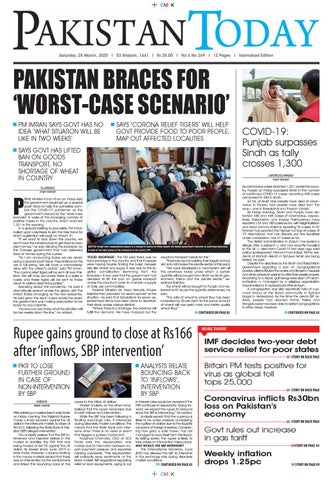
QUETTA: People offer congregational prayers at a mosque in Quetta on Friday despite the federal government’s direction to avoid large gatherings in wake of the rapid spread of the coronavirus in the country. PPI
‘Food ShoRtAGe’: the PM said there was no food shortage in the country and that if people were having trouble finding the basic necessities, like wheat and sugar, it was due to the logistics complication stemming from the lockdown. Imran said that the government had decided to lift the ban on goods transport across the country in order to maintain a supply of daily use commodities. federal Minister for food Security khusro bakhtiar then provided “an exact picture” of the situation. he said that tabulations for seven essential food items had been done to ascertain their stock across various districts. “where there is a shortage, the province will fulfill the demand. we have mapped out the
Rupee gains ground to close at Rs166 after ‘inflows, SBP intervention’ g
Pkr tO lOSe further grOunD In CASe Of nOn-InterVentIOn by SbP KARACHI ARIBA SHAHID
After suffering a massive loss in early trade on friday morning, the Pakistani rupee made a sharp recovery against the uS dollar in the interbank market, to close at rs166.5, following the State bank of Pakistan (SbP) alleged intervention. the analysts believe that the SbP intervened and injected dollars in the market to stabilise the Pkr that was being traded at rs170 against the uS dollar: its lowest since June 2019 in early trade. however, a source working in the money markets denied that there was an intervention by the central bank and linked the bouncing back of the
COVID-19: Punjab surpasses Sindh as tally crosses 1,300
g
rupee to the inflow of dollars. Market analysts, on the other hand, believe that the rupee recovered due to both inflows and intervention. while the SbP has been following a floating exchange rate, it intervenes during disorderly market conditions. this means that the State bank can intervene when there is no news or event that triggers a sudden movement. naushad Chamdia, CeO at SCS trade said the depreciation was mainly due to mismatch between import payment pressure and exporters holding proceeds. “this depreciation will indirectly sway sentiments at the stock market. SbP regulations regarding relief on loan repayments, aging & cut
AnAlyStS relAte bOunCIng bACk tO ‘InflOwS’, InterVentIOn by SbP
in interest rates would be reversed if the Pkr continues to depreciate. going forward, we expect the rupee to rebound since the SbP is intervening,” he added. Analysts expect that the currency is likely to be under pressure considering the outflow of dollars due to the liquidity concerns of foreign investors. Considering how gold, a safe haven, has not managed to save itself from this liquidity selling spree, the rupee is likely to lose unless an intervention takes place. Why Would the SBP InteRvene? the International Monetary fund (IMf) has allowed the SbP to intervene in the exchange rate during disorderly market conditions.
CONTINUED ON PAGE 03
CMYK
more inside
IMF decides two-year debt service relief for poor states STORY ON BACK PAGE
britain PM tests positive for virus as global toll tops 25,000 STORY ON BACK PAGE
Coronavirus inflicts Rs30bn loss on Pakistan's economy STORY ON BACK PAGE
govt rules out increase in gas tariff STORY ON PAGE 03
Weekly inflation drops 1.25pc
STORY ON PAGE 09
02
Saturday, 28 March, 2020
NEWS
nab files reference against ex-PM abbasi in Pso MD aPPointMent case SHEHBAZ SHARIF SLAMS ISSUANCE OF ARREST WARRANTS FOR ABBASI, SAYS ‘NAB-NIAZI ARE BUSY FIGHTING MEDIA AND OPP’ ISLAMABAD
t
STAFF REPORT
HE National Accountability Bureau (NAB) named former petroleum minister Shahid Khaqan Abbasi in a reference for allegedly appointing Sheikh Imranul Haq as the managing director of Pakistan State Oil (PSO) “in sheer violation of rules and regulations”. A statement released by NAB’s Karachi chapter on Friday said that non-bailable arrest warrants have been issued for the former prime minister as well as former petroleum secretary Arshad Mirza, who is also named in the reference. Furthermore, notices have been issued to Haq and and PSO’s former deputy MD of finance Yaqoob Suttar — the former deputy MD of finance at PSO. The accused have been ordered to appear before an accountability court on April 10. In 2018, NAB had presented a report in the Supreme Court, which said that “ev-
idences (sic) showed that the appointment of former PSO MD Sheikh Imranul Haq was illegal and was not made in a transparent manner”. The report further said that there was evidence that Haq had a conflict
Two doctors test positive for COVID-19 in Punjab LAHORE STAFF REPORT
Two doctors who were treating COVID-19 patients in Dera Ghazi Khan quarantine centre tested positive for coronavirus on Friday. According to Punjab Secretary for Primary Healthcare Muhammad Usman, both doctors were treating patients in the DG Khan Isolation ward. Dr Usama and Dr Saba, detected with COVID-19 have been kept in an isolation ward and are undergoing treatment, said
health secretary. He said that the condition of both doctors was out of danger. More than three billion people around the world were living under lockdown on Friday as governments stepped up their efforts against the coronavirus pandemic which has left more than 24,000 people dead. In Spain, the number of fatalities surpassed those of China, where the novel coronavirus first emerged three months ago, making it the hardest-hit nation after Italy.
Punjab to free 20,000 Prisoners over corona fears: rePort The Punjab government has decided to release almost 20,000 of its 46,000 prisoners amid the ongoing COVID-19 crisis, a private news channel reported on Friday. According to the report, jail superintendents — who have reached out to the courts to approve the bail of prisoners handed sentences of seven years or less — took this step in light of special instructions. The report stated that bail requests were also filed for prisoners jailed for petty crimes, as well as the elderly, or criminals over 60 years of age. Further,
those with sentences ranging from seven years to 25 were being determined on a case-by-case basis. In addition, bail requests were submitted for prisoners under trial for less serious crimes. Last week, Islamabad High Court (IHC) Chief Justice Athar Minallah had ordered for bails to be issued for prisoners facing trial for minor crimes in order to prevent the spread of the coronavirus. He made the decision while hearing a case of 1,362 incarcerated prisoners. NEWS DESK
of interest with the PSO due to an LNG agreement with his ex-employer (Engro Corporation). Haq had also “misused his authority” by promoting Sattar to the post of deputy
MD within a month of his joining, the report added. Abbasi and Haq are already named in another NAB reference in a multi-billionrupee case related to the award of a liquefied natural gas (LNG) import contract. Former finance minister Miftah Ismail is also named in the LNG case. Both Abbasi and Ismail were arrested in the LNG case last year and are currently out on bail. SHEHBAZ SLAMS WARRANTS: PML-N President Shehbaz Sharif condemned the issuing of non-bailable warrants against Abbasi, saying, “instead of fighting against the coronavirus, NABNiazi are busy fighting the media and opposition.” “On one hand, prisoners are being released and on the other hand, those who served the nation are being arrested,” Sharif said, adding that it was “not the time for political shows”. “[Governments in] the entire world are united to save their people. In Pakistan, the government’s priority is to send media and opposition members in jail.” Sharif further said that opposition was willing to work with the government “for the sake of the people but the government was spreading anarchy”.
KP sees 15-20pc hike in prices of basic commodities PESHAWAR AZIZ BUNERI
Due to the Khyber Pakhtunkhwa government’s coronavirus prevention lockdown across the province, the prices of basic commodities have increased by 10 to 15 per cent, increasing the financial burden on the public. Despite clear instructions from the provincial and federal governments, the district administration failed to control commodity prices amid the Covid-19 pandemic. In Peshawar, traders have increased the prices of pulses, flour, beef, sugarcane by Rs 20-30 per kilogramme without the approval of the district administration. On retail outlets, ghee price has been increased from Rs 170 per to Rs 190 per kg, Dal Mash has been increased from Rs25-30 per kg. Similarly, the price of sugar has also increased to Rs 90 per/kg– an increase of Rs10. Farid Khan, a resident of Peshawar, said that despite the vast availability of vegetables in Khyber Pakhtunkhwa, shopkeepers have increased prices by up to 20 per cent. He demanded the provincial government and district administration to take effective measures
to bring the prices down. Another citizen said that due to the incompetence of drug inspectors in Khyber Pakhtunkhwa, the prices of medicine have been raised by 40 percent. The citizen said that amid the coronavirus crises, the medical stores’ owners have devised their own rates of medicine while the government officials aren’t ready to take proper action. Citizens urged the government to direct the food department, district administration, and drug inspectors to perform duties diligently and take effective actions against the hoarders. Amin Khan, a Peshawar businessman, told Pakistan Today that the countrywide lockdowns have led to a rise in prices, as the free movement of goods across the country is stopped. He said that the prices have increased not only in Peshawar but across the country. Khan said that they’ve no other alternative but to increase the prices and asked the government to ensure a sufficient supply of daily use commodities to markets. When contacted, Peshawar Assistant Commissioner Sara Rahman said that she cannot provide an official statement in this regard.
'White flag' tribute paid to doctors fighting coronavirus in Pakistan Pakistanis across the country came out on their balconies, rooftops, parks and other public places at 6pm on Friday and waved white flags to honour the doctors, nurses, and paramedics — the nation’s heroes — battling the ongoing coronavirus pandemic. Singing and swaying to the tune of musician Jawad Ahmed’s “Humay Tumsay Pyar Hai [We Love You]”, people raised their flags to pay tribute to the medics who are working tirelessly throughout day and night to fight the pandemic, which has so far killed nine people in Pakistan and infected almost 1,300. Doctors and other paramedic staff have been at the forefront of the fight against the virus, which has, as of reporting time, infected over 552,000 people and left 25,000 others dead in 199 countries and territories since an outbreak in Wuhan, China, back in December 2019. Despite rain in Lahore, Rawalpindi and Islamabad, and Karachi, people — children and the elderly alike — took to their balconies and rooftops to honour the medics In Badin, young thalassemia patients waved flags, while women and children came out dressed in white and waving white flags in Ghotki’s Ubauro city. NEWS DESK
chinese doctors arriving on saturday to help Pakistan fight corona spread ISLAMABAD STAFF REPORT
A team of Chinese doctors will arrive in Pakistan on Saturday to help the country contain the spread of the coronavirus, Dr Zafar Mirza, Prime Minister Imran Khan’s special assistant on health, said Friday. The visiting doctors will review Pakistan’s measures against the coronavirus and provide the country technical assistance to prevent the spread of the virus. The virus has killed nine people in Pakistan and over 12,000 people are under treatment in the hospitals across the country. China, the first country-hit by coronavirus, has successfully brought the virus under control in recent days. On Friday, the Chinese health officials had announced 55 news cases in the country and 54 of them were foreign cases. China is already helping Pakistan with equipment, testing kits and face masks. The second shipment of equipment, announced by Alibaba Group’s co-founder Jack Ma had arrived in Pakistan Friday. The previous consignment contained 500,000 masks out of which 50,000 were N-95 masks.
Society will become more violent amid lockdown, fear experts ISLAMABAD MIAN ABRAR
Saima Aslam, a 23-year-old, is nursing her injuries after being assaulted by her husband for failing to bring money to meet the basic household needs. This is not a unique occurrence, as experts believe that a hike in domestic violence will be witnessed amid a lockdown in the country. According to a report, many women now find themselves forced to be confined and isolated with domestic abusers. China, after lockdown, saw official figures for domestic violence cases triple in February. The integral idea of social distancing, which is one of the best strategies to combat the virus, direct exposes women to domestic violence. Talking to Pakistan Today, Saima said she worked as a receptionist at an office of a private enterprise, but the company told that her services were no more required due to the temporary closure of the company’s head office in the wake of the coronavirus cases. “We have nothing to eat for the past
two days due to the lockdown. I can’t go out to work anywhere as the entire city is facing a lockdown. My husband is a junkie and he gets violent when I don’t give him money,” said Saima. She said due to the zero inflow of money, the household was starving for the past two days. “Since I failed to make the payment to the nearby shopkeeper, he has also refused to give me groceries.” Asked if anybody had offered her help, Saima said that due to the lockdown, nobody had taken notice of the violence and even if some did hear the scream, they did not bother fearing coronavirus. Asked if any government authorities had come for help, she said that the prime minister had announced a package of billions of rupees but that was mostly for the rich and poor classes. “Prime Minister has announced a package for importers, industrialists, farmers, peasants, and other segments, but there is nothing in the PM’s package for people from lower middle classes or the poor like me who don’t beg. There is a need for the rulers to understand that there are needy
and poor who don’t beg,” she said. INCREASED RISK OF VIOLENCE: Experts say that a continuous lockdown situation can lead to increased anxiety and depression in society. Dr Rizwan Taj, Associate Professor and the head of the psychiatry section at PIMS, said that lockdown will have a negative impact on people at large and may trigger domestic and other forms of violence. “Next two to three months are critical in this regard. If the lockdown situation extends, which I fear may be the case, the domestic violence will most probably be increased. He said that in lockdown, the life changes to a limited space and prolonged limits may have different impact on adults, kids and the young. “Stress of any kind leads to abuse and violence; there could be emotional abuse or physical,” he said, adding the lockdown will impact extroverts more. According to Dr Rizwan, any form of entertainment or some sort of religious activity can be a good distraction to beat the lockdown anxiety.
CMYK
Saturday, 28 March, 2020
IMF workInG 'exPedItIously' on PAkIstAn’s eMerGency loAn request ISLAMABAD
t
STAFF REPORT
HE International Monetary Fund (IMF) team is working “expeditiously” to respond to Pakistan’s request for financial assistance to fight the coronavirus. IMF Managing Director Kristalina Georgieva on Pakistan said the proposal may be considered by the IMF Executive Board “as soon as possible”. IMF didn’t mention the amount of this emergency loan, but two days ago Pakistan’s economic team told the media they are in talks with the monetary body for an emergency loan of $1.4b on soft terms. Georgieva says this emergency financing will allow the government to address additional and urgent balance of payments needs and support policies. This would make it possible to direct funds swiftly to Pakistan’s most affected sectors, including social protection, daily
wage earners, and the healthcare system, the IMF representative said in a state-
Govt rules out increase in gas tariff ISLAMABAD STAFF REPORT
Special Assistant to the Prime Minister on Information and Broadcasting Firdous Ashiq Awan on Friday ruled out any increase in gas tariff, saying the government will not put additional burden on gas consumers. In a video message after a meeting on the energy sector held under the chairmanship of Prime Minister Imran Khan, Firdous said the PM wanted steps to facilitate the gas consumers under recently announced economic relief package. It may be mentioned here that the government introduced Rs1.2 trillion package to mitigate the economic fallout of coronavirus pandemic. The meeting decided that reforms would be introduced in the gas sector to resolve the problems faced by the consumers, the SAPM said, adding the Economic Coordination Committee will take up the reforms issues in its meeting.
Pakistan braces for ‘worst-case scenario’
ment issued on Friday. “In parallel, the authorities have reaf-
firmed their commitment to the reform policies included in the current arrangement under the Extended Fund Facility,” the statement read. Other multilateral donors have also provided funds to fight the coronavirus pandemic and its economic implications. The World Bank has approved $1 billion and the Asian Development Bank has approved $1.5 billion. Pakistan will receive $300 million and $600 million immediately from WB and ADB respectively. The ADB will dispatch the remaining $900 million by June. The funds Pakistan is receiving now are only for the purpose of fighting COVID-19 and providing relief to the people who are suffering because of it. Next, Pakistan will also talk to these donors to provide budgetary support to deal with the economic implication of the coronavirus pandemic, which will hurt economic growth and lower the government’s tax collection.
SC says bail given as per law, not policy ISLAMABAD STAFF REPORT
The Supreme Court (SC) on Friday said that the courts grant bail in accordance with the law instead of any policy, as it dismissed a plea filed by an inmate who sought release due to a delay in his trial. Mir Masood Sattar, who is in jail for the past one year over his alleged involvement in corrupt practices, had approached the court for bail, citing a delay in his trial. The petitioner pleaded that as a matter of policy due to coronavirus, the high courts are granting bail to the accused prisoners in the offences wherein sentence is not more than 10 years. Upon this, the bench remarked that the courts grant bail in accordance with the law rather than any policy.
It may be noted here that the government has already expressed apprehensions over the Islamabad High Court (IHC) decision to grant bail to at least 400 under-trial prisoners. Justice Amin also questioned
whether Italy, France, and the US released all prisoners due to coronavirus. The apex court ordered the government to conduct full screening of all prisoners as a precautionary measure.
Lahore colony locked down after COVID-19 outbreak; govt denies LAHORE
COntInuED fROM PAgE 01
SHAHAB OMER
He said there was plentiful supply of wheat — 1.6 tonnes to be precise — currently available in the public sector. “Wheat harvest has begun in Sindh and will be done in the country’s northern regions as well, soon.” CORONA FUND: The government will also establish a corona fund in the coming week to attract donations so that it can look after the underprivileged during the lockdown. “Data on our daily wagers is being collected. We will also dispense funds from the Ehsas programme and then this fund will be an added source to help people buy essential items for their families,” he added. Labelling this an unprecedented initiative and putting stock in people’s charitable spirits, the prime minister said that Pakistanis donate like no other nation in the world. He recalled earthquakes and floods which had wreaked much damage in the country but put no dent in people’s willingness to help. “But what happened was there was a duplication of services. There were areas where there was a great amount of work done and some in which there was no one and people were left hungry,” said PM Imran. He said with the use of information technology and the Ehsas initiative, everyone who wishes to donate will be registered and will be able to see which areas need the most assistance. “Everyone will know who is doing what and where.” OVERSEAS PAKISTANI SHOULD DONATE: The premier acknowledged that in the backdrop of the crisis, Pakistan will see a drop in remittances and foreign exchange reserves will be impacted. To counter this, he said an account will be opened in State Bank of Pakistan, for which details will be provided on Monday or Tuesday. “Right now, the Pakistani people are most in need of donations from abroad. I want overseas Pakistanis to deposit their money here so pressure from our foreign exchange reserves is relieved,” said the prime minister. “This will be the fund that will pull the country out from these difficult times.”
Amid an increasing number of coronavirus cases in Punjab, especially Lahore, the Punjab government has reportedly put a residential area in the provincial capital under lockdown after “a massive increase in the COVID-19 cases” in the area. The government and police, however, denied sealing off the Imamia Colony. According to a resident, Malik Imran, the colony was sealed off by the police who directed the people not to leave their houses. He also claimed that death was also reported in the locality. Another man accused the health department of playing down the situation and said the government failed to screen people returning from Iran which led to the out-
break in the colony. “The health department is hiding the actual number of the cases,” he said, urging the higher-ups to take notice of the cases. According to an audio clip viral on social media, a purported sub-inspector stationed at Shahdara Police Station could be heard telling someone to stay away from Imamia Colony due to higher number of cases in the colony. As per the clip, a patient also died of the virus and at least 80 per cent people were infected in the colony. Shahdara Police denied this and said they didn’t seal the area, whereas the health secretary and his spokesperson remained unavailable despite many calls. Punjab government spokesperson Mussarat Jamsheed said it was all rumours. “All the areas are under observation and we are not hiding anything from the public, the official said, asking people not to panic.
STAFF REPORT
PIA officers slash salaries as coronavirus outbreak hurts airline's business
After Sindh and Balochistan, the Punjab government on Friday limited congregational prayers in a bid to curb the swiftly increasing cases of coronavirus in the country. The provincial government issued the notification after consulting religious scholars and health experts. According to a notification, only three to five mosque staff members (such as the imam and khateeb) are allowed to pray in the mosque. The move has been taken to curb the spread of the novel coronavirus in Pakistan. Earlier on Thursday, the Sindh government had announced ban congregational prayers in mosques, including Friday prayers, in the province till April 5. The decision was announced by the provincial spokesman Murtaza Wahab on his Twitter account. He said that the provincial government has taken a big decision placing a ban on congregational prayers at the mosques from masses. “The decision is taken after consulting all religious leaders hailing from different school of thoughts and medical experts,” he said.
The coronavirus has dented businesses around the world and airlines are no exception. The pandemic has so far claimed more than 26,000 deaths around the world and affected more than half a million people. The PIA is also feeling the heat from the lack of business these days as international flights have been suspended in the country and citizens quarantine themselves. In light of the above circumstances, the national flag carrier's CEO announced a 20% cut in his salary. Department chief officers have also slashed their salaries by 20% while managers have decided to cut theirs by 15%. Deputy managers have decided to slash their salaries by 10% and managers, by 8%. The airline's spokesperson said that the decision taken by the management was aimed at providing some cushion to the airline during the financial crunch it was going through due to the coronavirus outbreak. NEWS DESK
Punjab govt limits congregational prayers LAHORE
NEWS
03
nAB summons nawaz sharif on March 31 in Msr case LAHORE STAFF REPORT
The National Accountability Bureau (NAB) Lahore Region has sent summons to former prime minister Nawaz Sharif, asking him to appear in court in connection with a private property case filed against Editor-in-Chief of the Jang and Geo Media Group, Mir Shakilur Rahman. According to the notice sent to Nawaz at his London address, he is required to appear before the antigraft body’s joint investigation team (JIT) on March 31. NAB has launched a probe into the sale of private property dating back to 1986, a time when Nawaz was the chief minister of Punjab. Currently, Nawaz Sharif is in London seeking treatment for various illnesses.
Punjab surpasses All the residents of Mohrah Akkrah in Sohawa tehsil are being tested, he said. Despite the directives by the Sindh and Balochistan government regarding a ban on congregational prayers, citizens flouted the orders and flocked mosques and other places of worship to offer their weekly prayers. According to a report, gatherings were seen at Faizan-e-Medina — managed by a religious organisation Dawat-e-Islami, in Hyderabad’s Effendi Town. A congregation was also reportedly held at a jamaat khana of the Bohra community in Burhani Nagar in Hyderabad. By the time the area’s SSP arrived, people had returned home. Police and Rangers personnel were able to restrict congregations in other areas, however. Meanwhile, major shrines in Hyderabad, including Qadam Gah-iMaula Ali and Dargah Sakhi Abdul Wahab Shah Jillani — that are normally thronged by people — remained closed to visitors. GB GETS AID: The Chinese government handed over medical equipment and 10 tonnes of other goods to the Gilgit-Baltistan government to help it fight the coronavirus pandemic. GB Chief Minister Hafeezur Rehman personally received the aid at the Khunjerab border. The donated equipment includes five ventilators, 2,000 N95 masks, 200,000 face masks, 2,000 testing kits and 2,000 medical protective kits.
rupee gains ground COntInuED fROM PAgE 01 While there has been no such news that would trigger a loss of confidence in the rupee, the prime reason behind this change is foreigners liquidating their positions in T-bills considering the global demand for liquidity. This sell-off is primarily due to the safehaven status the US dollar has made for itself amid the COVID-19 crisis. Commenting on disorderly market conditions, the state bank governor said the bank looked at three things when intervening. One, the movement of the trade; the bid/ask spread and the distance, with the greater distance, the more the uncertainty; and the market supply and demand. On Wednesday, the State Bank of Pakistan (SBP) cut the policy rate by 150 basis points, from 12.5pc to 11pc. This follows a policy cut from just last Tuesday, where the SBP cut the policy rate from 13.25pc to 12pc. The policy rate cut can be seen as a reason for hot money leaving the country leading to the PKR depreciation.
04 ISLAMABAD PESHAWAR
T
STAFF REPORT
HE Khyber Pakhtunkhwa (KP) cabinet chaired by Chief Minister Mehmood Khan on Friday approved a relief package for 1.9 million families of the province and announced relief of Rs5 billion in provincial taxes. KP government spokesperson Ajmal Wazir told the media after cabinet meeting that details of the relief package would be disclosed soon, however, he added that it would be benefited for one third population of the province. The cabinet while extending closure date of educational institutes and public gatherings decided to keep all educational institutes and public places shut till May 31. Similarly, ban on public and private gatherings and ceremonies extended till April 30. The cabinet extended public holidays in the province from March 28 to April 5 and decided to suspend all tests and interviews for new appointments till May 31,
Saturday, 28 March, 2020
WEATHER UPDATES SATURDAY
200C
110C
SUNDAY
260C
120C
MONDAY
250C
190C
KP APPROVes RelIef PACKAge fOR 1.9M fAMIlIes, gIVes Rs5bN RelIef IN TAxes Ajmal said, adding that meanwhile all wholesale markets and religious events like Urs and festivals would not be held in the province till April 30. The cabinet also decided to keep markets shut till April 10, however courier services and money transfer shops would be exempted from this ban. The cabinet decided that inter and intra district transport services, OPDs at all district hospitals and dental services would remain suspended till April 5, he said. In order to control the coronavirus pandemic, the cabinet approved constitution of 500 rapid response teams to cope with any emergency. It was also decided that retired, students and other volunteers would be hired as back-up staff of health workers on daily wages. The cabinet approved Rs17.5 billion for
procurement of wheat to meet the demand of the province, Ajmal said and added that people would be allowed to do shopping on CNIC and for the purpose the data of Benazir Income Support Programme (BISP) would be utilised. The cabinet expressed satisfaction on overall measures taken so far in the province to overcome corona outbreak and also appreciated the cooperation of masses in this regard. The cabinet noted that lockdown bore positive results and several precious lives were protected from being infected or death. It emphasised upon the need of extending lockdown to keep the mortality figure minimum. The cabinet expressed apprehension on delay in taking precautionary measures by Italy government and expressed grief
over loss of many lives there due to coronavirus pandemic. It further observed that United States did not take the pandemic seriously due to which serious repercussions were emerging. The cabinet decided to engage private sector hospitals in testing of coronavirus disease and expressed resolve to adopt more precautionary measures for one more month to wipe out corona. The cabinet approved Rs8 billion supplementary grant with immediate release of Rs500 million for health department to purchase necessary equipment for all district hospitals to be exempted from KP Public Procurement Regulatory Authority. Ajmal said that the cabinet decided to set up fever clinic outside all public hospitals to control the spread of coronavirus.
PRAyER TImINgS FAJR SUNRISE
ZUHR
ASR MAGHRIB ISHA
4:38
12:13
4:39
6:02
6:25
7:49
The cabinet also approved SoPs for industrial estate and decided that all workers would be made bound to use sanitiser while entering or leaving the workplace. It also decided that owner of industrial units would make special arrangements for workers having fever, flu or cough to avoid outspread of coronavirus. The industrial units would arrange gloves and masks for their workers and would ensure a distance of at-least three feet among each worker. Similarly, the industrial units would arrange tissue papers for workers instead of cloth towel. The cabinet also decided that factory workers above the age of 50 and females would be given 15-day leave with pay and suspected corona workers would be shifted to quarantine centre. The owners of industrial units have been required to carry out disinfectant spray regularly in the factories and industrial units and also ensure cleanliness of washrooms. The owners of factories and industrial units would prominently put on display the SoPs in Urdu language with the factory premises.
31 confirmed COVID-19 cases reported in Rawalpindi RAWALPINDI APP
Three more persons were tested positive for coronavirus, raising the number of total confirmed cases to 31 in the Rawalpindi division. According to the data shared by the Directorate of Public Relations (DGPR) Punjab, total 13 confirmed corona cases were reported from Rawalpindi district,17 from Jehlum district, one from Attock district, and none from Chakwal district.
Residents of capital opt to pray at home ISLAMABAD APP
PESHAWAR: The Sunehri Masjid was closed by the authorities to prevent Friday congregational prayer amid a surge in coronavirus cases in the country. PPI
PTI MPA from Mardan infected with coronavirus PESHAWAR: Pakistan Tehreek-e-Insaf’s (PTI) Member of Provincial Assembly (MPA) Abdul Salam Afridi from Mardan has been infected with the coronavirus. The lawmaker remained in touch with the residents of Manga area of Mardan, where the first death due to the coronavirus was reported in the country. After his blood test confirmed him positive for the coronavirus, he quarantined himself at his home in Mardan, a press release said on Friday. Abdul Salam Afridi, in a video message, said that it was his responsibility to remain in touch with the people of his area during the time of crisis. APP
Coronavirus pandemic: Hospitals in capital put on high alert ISLAMABAD INP
All government hospitals in the federal capital have been put on alert regarding the deadly coronavirus, according to a notification issued on Friday. Pakistan Institute of Medical Sciences (PIMS), Polyclinic and other government-run hospitals will remain on a high till further notice alert in the wake of coronavirus that has already claimed 10 lives across the country. The Islamabad district administration had imposed partial lockdown in the capital city from March 25. In a notification, the district admin-
istration banned all kinds of public gatherings and ordered to shut markets, shopping malls, restaurants and private offices for an unidentified period. The authority suspended public transport in the capital city whereas Metro service will be available from 8:30 am to 10:30 am and 3:00 pm to 5:30 pm daily. Prime Minister Imran Khan on Thursday visited coronavirus isolation center in Islamabad, to inspect the arrangements. The isolation center consists of 50 bed facility for the coronavirus patients in the federal capital. Chairman National Disaster Management Authority (NDMA) Lieutenant
General Muhammad Afzal briefed the prime minister on the occasion. It must be noted that the number of deaths from the coronavirus rose to nine while 1,235 have been affected, according to the latest report released by the National Command and Control Center on coronavirus on Friday. The national dashboard, maintained by the federal ministry of health, reported that Sindh province has been affected more due to the virus, where the number of cases stands at 429, Punjab 408, Balochistan 131, KP 147, GilgitBaltistan (GB), 91, Islamabad 27 and two cases were reported in Azad Jammu and Kashmir (AJK).
SC orders to count termination tenure of 1995 sacked teachers of KP for only pension benefit ISLAMABAD APP
The Supreme Court (SC) on Friday ordered to ‘only add the termination time of Khyber Pakhtunkhwa’s (KP) PTC’s teachers’ in their service tenure so that they could receive the pension benefit. The bench, however, termed that the teachers would not entitle to receive salaries of their termination time rather service time would be counted just for pension benefits. A division bench headed by Chief Justice Gulzar Ahmed and comprising Justice Ijazul Ahsan conducted hearing on an appeal of KP Education Department
against Peshawar High Court's (PHC) decision to give all financial benefits to 1995 sacked teachers of KP. During the course of proceeding, the petitioners’ lawyer pleaded before the bench that different teachers were recruited in 1995 in KP Education Department but the same were terminated in 1997 while declaring the recruitment as political. The KP government’s counsel argued that the service tribunal had ordered to give all financial benefits to the employees at the time of their restoration. He said that several employees had been retired after restoration of their services. Justice Ijazul Ahsan remarked that the
salary was used to be paid against performing official duties by the employees in respective department. It was wrong if the service tribunal had ordered to give all financial benefits to the sacked employees, he observed. He remarked that the termination tenure of the employees would be counted only for the pension benefits. These persons were not entitled for the salary of the period during which they did not work. Meanwhile, the same bench served notices to respondents on another appeal of KP government challenging the verdict of PHC to give incentives to the employees of Bajaur Public School equal to the
government employees. Chief Justice Gulzar Ahmed noted that this appeal was moved 122 day late like others KP cases and remarked that the top court had adopted the strict stance against the time bar petitions. He remarked that no action was used to be taken against the people responsible for filing time bar cases by the government. The chief justice asked the lawyer that his department had to tell the reason that why this appeal was filed late. The lawyer pleaded that this case was related to the public interest, adding that employees of other agencies would also claim for the benefits if PHC’s decision was upheld.
Residents of the federal capital on Friday opted for prayers at their homes and only limited people turned up at mosques to offer Friday prayers due to the restricted movement in the wake of the coronavirus pandemic. A survey on Friday indicated that majority of the people opted to offer Zuhr prayers at their homes. Only few worshippers attended the Friday prayer at Faisal mosque, led by Maulana Ziaur Rehman. They maintained significant distance among themselves during the prayer. Urdu speech primarily focused on elaborating preventive measures to save people from the coronavirus. Prayers were offered immediately after Arabic sermon.
PDMA supplies 5,000 safety kits to district admins PESHAWAR STAFF REPORT
The Khyber Pakhtunkhwa (KP) Provincial Disaster Management Authority (PDMA) has supplied 5,000 safety kits to the district administrations and departments concerned, including health, for their workers who are on the front line in the fight against coronavirus in the province. The kits include suit masks, surgical caps, gloves and other lifesaving equipment, PDMA officials said in briefing to the media. About 10,000 more kits would be provided to the departments concerned soon, he said, adding the PDMA had already supplied 750 litres of sanitiser.
Three coronavirus cases reported from Nowshera PESHAWAR: The first three cases of coronavirus have been reported from Nowshera district on Friday. The spokesman of KP Relief and Resettlement Department in a statement said that three positive cases of coronavirus, two from Badrashi village and one in a Tablighi Jamaat member, Muhammad Yameen (55), were detected in Nowshera. The other two persons whose were tested positive are Zahid Khan (40) and Bilal Shah (22). The locked down of Badrashi village completed and teams were dispatched for collection of sampling. About 18 members of a Tablighi Jamaat accompanying Muhammad Yameen were quarantined yesterday. Further reports regarding the remaining people are awaited. APP
Saturday, 28 March, 2020
NEWS
YouNG ENGiNEErs crEATE VENTilATor sPliTTEr VAlVEs For coViD-19 PATiENTs
CORPORATE CORNER Engro Fertilizers leads community awareness drive against coronavirus
LAHORE
KARACHI: To protect the community from risk posed by coronavirus, Engro Fertilizers is leading a fumigation and disinfection drive with the district authorities in Daharki town and surrounding areas. Under this initiative launched last week, the company has cleaned and disinfected public places such as Tehsil hospital, railway station, bus stand, residential areas and markets. Further, Engro Fertilizers has also installed 40 hand wash points with awareness banners in different public areas. According to Engro Fertilizers Daharki Plant GM Aamir Aslam, “As a caring and responsible company, we have taken this initiative to promote hygiene and sanitation in the town so that the community can be protected against the Corona virus.” PRESS RElEASE
i
SHAHAB OMER
N order to overcome the shortage of ventilators during the COVID-19 pandemic, a group of volunteer engineers in Pakistan have designed a device that allows a single ventilator to support up to four patients at a time with the help of splitter valves. A group of volunteers from all over Pakistan joined hands to develop affordable solutions for fighting the ongoing pandemic. There are doctors, biomedical professionals, engineers, academics, resource mobilisers and people from all walks of life in this group of 100 members and they are being joined by other volunteers as well. These Pakistani professionals aim to use 3D printing to manufacture ventilators, valves and required equipment for combatting coronavirus. Dr Bilal Siddiqui (PhD) started this group and initially started putting things together with his students. Later, he started approaching other professionals to develop low cost ventilators, portable oxygen supplies, face masks and protection screens, respiratory valves, viral media tubes, non-contact thermometre and retrofitting existing vents to serve multiple patients. 24-year-old engineer Muhammad Abdullah Afzal is a graduate of University of Engineering and Technology (UET) Faisalabad Campus and is cur-
KARACHI: In light of WHO recommendations for social distancing to mitigate the spread of coronavirus, JS Bank has designated ‘safe distance markers’ for customers having to visit bank branches during these trying times. P R E S S R E l E A S E
rently based in Lahore. He decided to create splitter valves along with his team when he learned that doctors in countries where the pandemic is worse have to choose between patients because of a shortage of ventilators. “It does not cost much can be used to provide care to multiple patients at a time,” he said. He also said that it took the team about three to four days to prepare the value and they have already started supplying it to various hospitals in Lahore, including Sheikh Zayed, Mayo Hospital, Doctors Hospital and in other cities as well. “We have a whole team to receive queries and we soon follow
INP
Govt says no plan to ban newspapers, TV channels KARACHI: Unilever Pakistan has pledged Rs200 million towards coronavirus relief efforts in the country. The commitment includes wide-ranging measures to reduce the impact of the pandemic. P R E S S R E l E A S E
KARACHI: Techno has finally unpacked its most awaited ‘CAMON 15’ in a live broadcast event happened hosted by the talented Juggan Kazim. P R E S S R E l E A S E
ISLAMABAD AGENCIES
Federal Secretary Ministry of Information & Broadcasting Akbar Durrani said there was no proposal under consideration regarding a ban on newspapers or electronic media in the wake of the coronavirus pandemic. In a conversation with IMI news agency, the secretary said contrary to the reports, the newspapers do not spread coronavirus. “The importance of media increased immensely especially in the aftermath of the outbreak of COVID-19 because these were authentic sources of communicating accurate information to masses,” he added. He said that the media should launch a special campaign to create awareness among the masses concerning the coronavirus pandemic.
Ehsaas cash programme to benefit 3m people, says Sania AZIZ BUNERI
The government will provide assistance to around three million people, who have been affected due to the ongoing lockdown imposed in the country to curb the spread of coronavirus, under the Ehsaas Emergency Cash Programme. As per a BISP [Benazir Income Support Program] tweet, the individuals having income up to Rs 20,000 and are facing unemployment and financial problems after lockdown will be helped under the Ehsaas Programme through the National Socio-Economic Registry (NSER). An SMS campaign would be launched within two weeks to include the affected people in the Emergency Cash Programme who were not registered under the NSER. The applications received through SMS would be
up with their demands,” he added. “Shaukat Khanum Memorial Cancer Hospital and Research Centre (SKMCH&RC) has tested it but they are still holding meetings to formally approve its usage. Once they decide on it, they will inform us. I am hopeful that this will be approved because it is being used in many countries under emergency circumstances,” Afzal said. He said that saving lives is more important than certifications. “We have prepared comprehensive guidelines in consultation with international doctors who are in the country and we provide that guide along with the valves. Moreover, several papers have been written on these valves across the world,” he added. He further said that so far, they have received good feedback from a lot of hospitals. “Six of us are currently working on this project but people from across the country are joining us as well,” he added. It is worth mentioning here that a healthcare provider in South Carolina, United States, had also created a device that allowed a single ventilator to support up to four patients at a time for combatting COVID-19. The ventilation expansion splitter can be produced cheaply with a 3D printer. The valve is attached to the ventilator and splits out the oxygen to patients. It also allows the flow of oxygen to be adjusted and optimized for each person. It is only meant for use in emergency situations where access to a ventilator could be a life-and-death matter.
Steps taken by Pakistan to control COVID-19 not enough, says Chinese scholar BEIJING
ISLAMABAD
05
scrutinized by the district administrations concerned. Around 2.5 million affectees would be included in the programme through the SMS campaign, the tweet said. It may be mentioned that the Ehsaas Emergency Cash Programme has been approved for giving cash assistance to 10 million affectees, especially daily wage earners. The programme will benefit a total of 67 million people (given the household size). About Rs 12,000 will be given to each family as per decision. Under the programme, 4.5 million existing Ehsaas Kafaalat beneficiaries (all women) already getting Rs. 2,000 will also get extra Rs 1,000 emergency relief for the next four months. Special Assistant to the Prime Minister on Poverty Alleviation and Social Protection, Dr Sania Nishtar will do a press conference soon to explain how the “Ehsaas Emergency Cash and SMS program” will be implemented.
To block population flow is the most effective way to control the COVID-19 epidemic, said Chinese scholar Prof. Cheng Xizhong. However, the steps taken by the government of Pakistan to this effect are far from enough, he said in an article carried by Gwadar Pro App on Friday. According to Prof. Cheng, Pakistan is surrounded by the epidemic and is facing a very serious situation. It's hard to say what will happen if the most stringent prevention and control measures are not taken immediately. He appreciated that due to the increasing severity of the epidemic, the Pakistani government has al-
ready taken some measures to control the population flow. But still these measures are far from enough in controlling the rapid spread of the epidemic, he added. He viewed that Pakistan is one of the most populous countries in the world. The population density of Pakistan is higher than that of China. In China, there are 145 people per square kilometer and in Pakistan, there 256 people per square kilometer. Therefore, if the government of Pakistan do not take the most strict and most effective prevention and control measures immediately, the consequences will be unimaginable. At the moment of the serious epidemic, the Pakistani government seems uncertain about the closure of the cities. Prime Minister Imran
People have to be persuaded intellectually on restricting congregational prayers: Qureshi Foreign Minister Shah Mehmood Qureshi on Friday said people have to be persuaded intellectually on the issue of restricting congregational prayers at mosques. A notification issued by provincial governments early Friday stated that under Section (2) of The West Pakistan Epidemic Disease Act 1958, only three to five people, designated for Masjid [Mosque], would be allowed offer prayers in congregation and the general public would offer prayers at homes. “Merely taking out a notification would not resolve the issue of restricting congregational prayers at mosques,” FM Qureshi said. “People have to be convinced intellectually. All religious scholars also agreed that it should be avoided.” The foreign minister stressed that important decisions, including the safety of health workers, were made in yesterday’s meeting whereas steps were taken for better coordination between the federal and provincial governments. “[Testing] machines have been ordered in order to increase the testing capacity of coronavirus,” FM said. “Relevant authorities have been instructed to ensure undisrupted supply during the lockdown.” NEWS DESK
Promote hope, optimism to fight coronavirus, PEMRA tells TV channels ISLAMABAD: The Pakistan Electronic Media Regulatory Authority (PEMRA) doesn’t want television channels to create chaos among viewers when reporting on the coronavirus outbreak. In a follow-up advisory to television channels on how to cover the coronavirus, Pemra asked the media to “curtail fear syndrome” among the public and “promote hope and optimism” to combat the catastrophe. “Media houses should avoid creating undue hype and sensationalism by covering critical patients under treatment,” the Pemra advisory issued on Friday read. It said that if the media houses are not reporting from the hospitals, they must avoid showing any clip received from the public who witnessed the incident and recorded it on their mobile phone. It condemned the “reckless” reports on an incident in Mayo Hospital, Lahore involving mobile footage. STAFF REPORT
Khan said that it is really difficult to close the cities in Pakistan. If the cities are closed, a large number of people will starve to death. But, according to Prof. Cheng, the sharp deterioration of the epidemic may force the Pakistani government to finally decide to seal the cities, but by then it will be too late. In the short term, the closure of the cities certainly affects the economy and everyone's life, but if the cities are not closed, leading to a large-scale outbreak of the epidemic, the whole economy will be fatally hit for decades. By blocking the flow of population and keeping everyone at home as much as possible, we can effectively slow down the spread of the virus, he added.
AJK PM announces Nishan-e-Kashmir for GB doctor who died of coronavirus MUZAFFARABAD APP
Azad Jammu and Kashmir (AJK) Prime Minister Raja Farooq Haider on Friday announced the “Nishan-e-Kashmir” — the state’s highest official award — for Dr Usama Riaz of Gilgit-Baltistan (GB) for carrying out his duty to fight Covid19 at the cost of his life. “Dr Usama Shaheed has set an ever-lasting example of bravery and courage and he is the pride of not just his community and country but also of entire humanity,” said the AJK premier at a meeting held to review the overall situation. The meeting also paid rich tribute to the heroic services of medical workers. "The doctors and paramedical staff are the frontline soldiers of our fight against novel coronavirus and we are beholden to them in this regard," the prime minister remarked. He also announced a bonus equal to onemonth’s basic pay for doctors and paramedical staff across AJK from grade one to 20 in recognition of their bravery. He also vowed that the government would ensure their protection and equip them with personal protective gear. At the same meeting, Haider also directed all three divisional commissioners to take strict action against hoarders and profiteers through effective administrative measures to curb hoarding and profiteering across the state.
Saturday, 28 March, 2020
06 COMMENT
The 1962 and 1973 Constitutions compared
Delaying a crucial decision Allowing COVID-19 to spread all over the country
t
Dr rajkumar Singh
T
He founders of Pakistan had thought about the application of Islamic principles in the new state, but they were essentially Westernised secularists, who treated the Islamist parties as nuisances, to be placated with occasional concessions. However in both the 1962 and 1973 constitutions definite provisions were made to give the structure a pro-Islamic theme. Part X of the constitution of 1962 made a mandatory provision for the establishment of an Advisory council of Islamic Ideology. the council was to consist the number of members neither less than five nor more than 12, as the President decided. the members were to be appointed by the President on such terms and conditions as he might decide. the functions of the council were to make recommendations to the central Government and the Provincial Governments as to the means of enabling and encouraging the Muslims of Pakistan to order their lives in all respects in accordance with the principles and concepts of Islam and to advise the national Assembly, the Provincial Assembly and the President, or the Governor on any question referred to it. Further under Article 270 of the constitution, an Islamic Research Institute was provided whose members were to be appointed by the President. Its duty was to undertake Islamic research and instruction in Islam for the purpose of assisting in the reconstruction of Islamic society on a truly Islamic basis. Ideological themes of 1962 constitution: except for minorities such as Hindus and christians, the promulgation of the first constitution of Pakistan was a disappointing one. Ayub received most of the congratulations from his basic democrats who had much vested interest in the new system. Maulana Ghulamullah, who later became the Ulema to the President, said that he had not congratulated the President on the constitution and that the document left much to be desired from the Islamic standpoint. Undoubtedly, the President performed an act of courage in that he did not seek to appease the orthodox by providing that all laws should be in conformity with the Quran and Sunnah. Only the more or less universally accepted Islamic principles were made the yardstick for assessing the laws. the non-Muslims were in theory guaranteed the right to profess, practise, and even propagate their religion, though this clause caused some heartburning among the diehard supporters of
The government’s money woes The government must not mishandle at least this
Forced conversion
t
He inability of the PtI government to handle the coronavirus epidemic was best shown by the enormous mess that was made of the Friday congregations. they were shut by a provincial government notification, but on Friday morning, not earlier, so a large number of congregations went ahead. congregants were told that they should offer the sunnahs at home, and that there would be no congregations the coming Friday. the Punjab government, it seems, has developed a habit of copying the PPP Sindh government. the federal government is not much better, for there are increasing doubts about its ability to administer the lockdown and the accompanying relief to both workers and business, which is the only possible way to end the epidemic. though Rs 3000 a month has been proffered by the federal government, and though Prime Minister Imran Khan has announced the good step of giving affectees a lump sum advance of four months’ allowance, or Rs 12,000, the question of how the payments are to be made remains unsettled. Mr Khan has spoken of activating the youth, and it is to be hoped that the impression made by the average PtI supporter, which is of a brash social media troll, is corrected, and changed into one of caring and helpful persons. Another option would be that of contacting nGOs already in the welfare game. As the Sindh government has already done. the task is immense. Identifying the needy will be a problem. these are people without bank accounts, or even ID cards. even if identified, locating them will be another problem. Only then can they be paid. even if they have bank accounts, that will not help in giving them comestibles. the Benazir Income Support programme has been shown to be vulnerable to pilferage by government servants: exactly the sort of fraud the government must avoid, and to which this programme is most vulnerable. It will come under attack for the smallness of the help it is giving, and must avoid the infamy that defalcation will bring. the need is for speed, because by the time the government machinery creaks into action, it might well be too late.
Sheraz zaka
R
ecently the lahore high court issued a judgement on forced religious conversion. A christian girl, Muskan, 14, was a domestic worker in a family of Sargodha district. the girl’s parents were not allowed to meet her on the pretext that she had converted to Islam. Subsequently her mother nasira filed a habeas corpus petition for her recovery. Mr Justice tariq Salim Sheikh appointed me as amicus curiae to seek opinion on the case. the judge, after thorough research, issued a 27-page judgement stating that a child below 15 is not sui juris; hence cannot change religion for legal purposes on his or her own volition as the child lacks intelligence to form an opinion on such an issue. Secondly the child is presumed to have the father’s religion until he or she becomes sui juris after turning 15. It was further stated that a child under 15 cannot be employed as a domestic worker keeping in vew the Punjab Domestic Workers Act 2019. the judgement further stated that religious conversion is “the adoption of a set of beliefs identified with one particular religious denomination to the exclusion of others. thus “religious conversion” would be described as the abandoning of adherence to one denomination and affiliating with another. this might be from one to another denomination within the same religion, for example, from Baptist to catholic christianity or from Shia to Sunni Islam. “the freedom to religion lies at the heart of our democratic enterprise. Article 20 of the constitution of 1973 sanctifies it as a fundamental right. the Objectives Resolution, which is not only the preamble of the constitution but also forms part of its substantive provisions by virtue of Article 2A grants every citizen including minorities to profess and practice their religion freely and independently without undue interference by any other person belong to different religious denomination.” the judgement by Mr Justice Sheikh relied upon a suo motu case SMc no.1 of 2014 in which the Supreme court held that the freedom of religion must be construed liberally to include freedom of conscience, thought, expression, belief and faith. Freedom, individual autonomy and rationality characterize liberal democracies and the individual freedoms thus flowing from the freedom of religion
Dedicated to the legacy of the late Hameed Nizami
Arif Nizami Editor Aziz-ud-Din Ahmad
Umar Aziz
Asher John
Joint Editor
Executive Editor
Deputy Editor
Lahore – Ph: 042-36300938, 042-36375965
founded various government organisations for propagating Islamic teaching, encouraged the Arabic language and introduced the Quran into school curricula. Islam. christians, in particular, heaved a sigh of relief On 22 February 1974 Bhutto organised the historic on seeing the constitution as it put an end to the prac- Islamic Summit at lahore. He fulfilled the religious tice in some Karachi schools of compulsory christian demands before his hand was forced, and as one of religious instruction to non-christian pupils. It also his opponents remarked, “Mr. Bhutto is the biggest made it obligatory for all schools to provide for the maulana of them all. In fact he should be called teaching of the Quran and Islamiat for all Muslim stu- ‘Maulana larkanvi’ ”. dents. the Hindu population of West Pakistan praised In the latter part of his rule Bhutto began to work the constitution while the Hindus of the east mostly under pressure of the conservative forces to stay in refused to comment. It seemed that they were either power. It was clearly due to their influence that the indifferent or were with the mainstream of non-con- Ahmadiya community was declared in 1974 a nonformist opinion. Muslim minority. though Ahmadiya are settled all cementing of Islamic tenets in 1973: the 1973 over the world, they live mostly in Punjab. they also constitution was prepared in the background of the live in India peacefully with Hindus but the Gurdebacle of its eastern Wing, daspur district of Punjab resulting in the handing over (India) has been their headof power to Zulfikar Ali quarters since 1891. AhBhutto. His was the first madiyas also called elected government in the Qadianis, as their founder, He fulfilled the religious history of Pakistan. Under Mirza Ghulam Ahmed bedemands before his hand was this constitution vast fundalonged to Qadian near Gurmental rights were given to daspur. forced, and as one of his citizens without any distincthere was an incident at tion on the basis of sex, the Multan Railway station, opponents remarked, “Mr. caste, religion etc. In the which culimmnated in the sphere of religion, as mendemand that Ahmadis be Bhutto is the biggest maulana tioned in Part II, every citideclared non-Muslim. of them all. In fact he should be Bhutto was not a bigot and zen was free to profess, practise and propagate his the incident left an unpleascalled ‘Maulana Larkanvi’ ” religion. even religious deant taste in his mouth. the nomination and every sect question was thrown to the thereof were to have the national Assembly which right to establish, maintain overwhelmingly declared and manage its religious institutions. But like the them a non-Muslim minority. that was a decision 1962 constitution, sufficient Islamic provisions were that far more conservative political regimes had reinserted in Part IX. It provided that all existing laws sisted in the face of much greater pressure. As regard be brought in conformity with the injunctions of to fundamentalists, Bhutto adopted a policy of apIslam as laid down in the Holy Quran and Sunnah and peasement and in 1977, banned serving of alcohol, referred to as the injunctions of Islam. no law was to closed casinos and nightclubs, prohibited gambling be enacted repugnant to such injunctions. A council and all social activities as prescribed in Islam. Just to of Islamic Ideology was retained, but increased in stay in power he tried ‘Islamist tactics’ in a crude, mesize to between eight and 15, with functions, more or chanical fashion, giving clear preference to conserless the same as in the 1962 constitution. In the 1973 vative forces over democratic and secular principles. constitution it was specified that Islam would be the However, these steps failed to keep control over poststate religion, and the head of state a Muslim. election unrest in Pakistan and ultimately there was Despite the fact that Bhutto and his government a military take-over under Gen Ziaul Haq, the chief represented the people of Pakistan in a democratic of Army Staff, who assumed power on5 July 1977. way, within months of the assumption of the coming of the new dispensation, orthodox fundamentalists Dr Rajkumar Singh is head of the political scibegan to overpower the government. Within months ence department, B.N. Mandal Unversity, Madhepof taking power Bhutto allowed a record number to ura, Bihar, India. He can be reached at: go for Haj. He made Friday the weekly holiday, rajkumarsinghpg@gmail.com
The two contain similar Islamic provisions
He coronavirus is spreading all over the world like wildfire. Within weeks, the number of those infected in the Middle east, europe and the USA has skyrocketed. Important Muslim countries that include turkey, Iran, UAe and Saudi Arabia have taken strict and highly unusual measures to restrict the spread of the disease, foremost being putting restraints on religious gatherings that include prayers in mosques to stop these from turning into hatcheries of the virus. Since Friday March 20, Saudi Arabia has suspended the holding of daily prayers and the weekly Friday prayers inside mosques, including the Masjid-al-Haram in Mecca and the Masjid an-nabvi in Medina. turkey too has restricted prayers inside mosques, including the historic Blue Mosque in Istanbul. the doors of Masjid-Al-Aqsa in Jerusalem are also closed for payers. Iran has shut down Mashhad’s Imam Reza shrine and Qom’s Fatima Masumeh shrine among others. Disregarding the consensus in the Muslim world over the issue, the PtI government continues to shirk taking a clear and firm decision on the issue. While the Sindh government has restricted all religious gatherings for the time being with Balochistan following suit, the Federal Minister for Religious Affairs has declared that mosques will remain open across the country. He only expressed a desire for the number of people praying to be minimum, as a precautionary measure. the government is conducting a campaign persuading the people to stay at home and when forced to go out, to keep at least a two-metre distance from one another. Under the circumstances it should have simultaneously taken a firm decision regarding the religious gatherings also. collective prayers without social distancing, particularly the large Juma congregations, create an opportunity for physical contact between hundreds of thousands of people all over the country leading to multiplication of coronavirus patients. It was also necessary to stop the tablighi Jamaat gatherings and tablighi groups travelling to different locations in the country. the government had closed down educational institutions all over the country. to stem the tide of the pandemic it should have at the same time taken a similar decision regarding collective prayers inside the mosques as well as regarding the tablighi gatherings. the PtI government’s policy is characterized by hesitation and double talk.
I
Karachi – Ph: 021-35381208-9
I
not only on religious communities but also on every citizen. What this means is that every citizen can exercise this right to profess, practice and propagate his religious views even against the prevailing or dominant views of its own religious denomination or sect. In other words, neither the majority religious denommust not be curtailed by attributing an interpretation inations or sect nor the minority religious denominaof the right to religious belief and practice exclusively tion or sect can impose its religious will on the as a community-based freedom. citizen. therefore, not only does it protect religious the freedom to religion is guaranteed to “every denominations and sects against each other but procitizen” in the country irrespective of his age and tects every citizen against the imposition of religious whether he is a Muslim or non-Muslim. In that case, views by its own fellow co-believers. It needs to be the Supreme court explained: mentioned here that every citizen would necessarily “ Of all the Articles relating to the minorities’ include both males and females (Article 263), which rights, Article 20 is of prime significance. A close point needs emphasis considering the exclusion or reading of this provision would indicate that the free- subordination of women in relation to numerous dom to practice religion and manage religious insti- forms of religious practices.” tutions under this provision is multifaceted because: Some countries, including India, nepal, Myan(a) the right to religious mar and Bhutan, have enconscience conferred under acted anti-conversion laws. this Article does not make the legislatures in Pakistan any distinction between maand Sri lanka considered jority and minority or Musanti-conversion bills but did Some countries, including India, not pass them. In Pakistan lim and non-Muslim. It is in the nature of an equal ReliHindu council v. Pakistan Nepal, Myanmar and Bhutan, gious Protection clause conthrough Ministry of law the have enacted anti-conversion ferred on every citizen, every Supreme court observed religious denomination and that in Pakistan it was problaws. The legislatures in every sect thereof. this equal ably not required because religious protection clause is Article 20 guarantees suffiPakistan and Sri Lanka in the same nature as the cient protection. equal justice under the law considered anti-conversion the judgement further and equal protection under stated that children have bills but did not pass them. the law clauses conferred rights and liberties like under Articles 4 and 25. In adults but they are someother words, every absolute times restricted because of equality and there is no distheir vulnerability. the tinction among citizens, religious denominations and human rights law also focuses on them, particularly sects thereof, as far as the right to religious con- in respect of religious freedom. For this reference may science, is concerned. usefully be made to the Declaration on the elimination (b) the right to religious conscience is a funda- of All Forms of Intolerance and Discrimination Based mental right. It has not been subjected or subordi- on Religion or Belief (1981) and the convention on nated to any other provision of the constitution the Rights of the child (1989). So far as religious freebecause it is only subject to law, public order and dom is concerned, Article 5 of the said Declaration of morality and not to any religious clauses of the con- 1981 recognizes (a) the right of the parents or legal stitution. the very term law, public order and moral- guardians to bring up the child in their religion or beity has been used in nonreligious terms as the notion lief; and (b) right of the child to education in religion of law or public order or morality is not reducible to or belief, in accordance with the wishes of the parents the Islamic meanings of these terms. therefore, Arti- and the right not to be compelled to receive education cle 20 has a certain preeminence in the constitution against their wishes. this judgement would surely being only subject to the general restrictions of law, pave the way for development of jurisprudence in public order and morality, which three terms cannot Pakistan regarding forced conversion, safeguarding be interpreted or used in such a restrictive way as to the rights of minorities as well as forced labour. curtail the basic essence and meaning of the pre-eminent right to religious conscience. Sheraz Zaka can be contacted at (c) the right to profess and practice is conferred sheraz.zaka@gmail.com
Islamabad – Ph: 051-2204545
I
Web: www.pakistantoday.com.pk
I
Email: editorial@pakistantoday.com.pk
Saturday, 28 March, 2020
COMMENT 07 Editor’s mail Send your letters to: Letters to Editor, Pakistan Today, 4-Shaarey Fatima Jinnah, Lahore, Pakistan. E-mail: letters@pakistantoday.com.pk Letters should be addressed to Pakistan Today exclusively
Hajj delay SauDi aRaBia has told Pakistan not to prepare a Hajj agreement as the coronavirus continues to spread across the world. Saudi arabia Hajj minister Dr Saleh bin Taher Benten told the Pakistani government in a letter written on Thursday that there should be no agreement till the coronavirus situation is clear. He wrote that the Saudi government is taking measures to remain careful. The Saudi minister said the kingdom is closely monitoring the situation and will tell Pakistan about any updates relating to Hajj arrangements. ZAIYAN AHMED KHAN Karachi
Hoarding during Covid 19 a crisis brings out the best and worst in people. Excessive hoarding in grocery stores reveals the worst since many customers arriving later cannot buy the necessities they need. Don’t be fooled by the barren grocery store shelves , There’s plenty more food on the way. meat, dairy and produce groups as well as federal regulators say the country. has an ample amount of products in cold storage to handle the unexpected demand for food and household products. Thanking you, HAruM SHuJAuDDIN SIDDIQuI Karachi
2020: World War III is on… The pandemic is changing the world The ammunition to fight this unprecedented uSa, also battling with this health crisis, has war comprises not guns, tanks, precision bombs, flatly refused to ease sanctions, declaring: “Our missiles and fighter jets but ventilators, hospital policy of maximum pressure on the regime conbeds, face masks, protective gear, gloves, respi- tinues.” if the uSa can make peace with the Talrators and diagnostic kits among other medical iban, its once sworn enemy, why should easing curbs on iran, which is equipment. millions of in such a dire situation, these are needed. in this be so hard? war the best weapons in such global for self-defense are socrises, countries and cial distancing, self-isoWill there be a paradigm nations band together lation and hand shift of regional and global as one humanity, and hygiene. reach out to ease things it is a war of differpower centres? Will it lead for those in greater ent nature and with far need. Challenging as more serious ramificato more fragmentation in they may be, such tions than a conventimes to come or bridging times provide a trementional confrontation of dous opportunity to exhostile powers. The political differences and QUDSSIA AKHLAQUE hibit magnanimity, epicentre of this bizarre consideration, kindness war keeps shifting. divergences? Will there be a and compassion. From China it moved to umaniTy is caught in the middle Europe and now the Wounds in this war greater sense of community of this global scare, as if in the throes uSa has been preare more internal– and spirit of accommodation of a world war. it is like living in a dicted as becoming the emotional and psychodystopian film. The cause is not a next epicentre of the logical– for millions as a consequence of this conflict but a novel virus. The beastly contagion. The worstwho have been forced enemy is silent and invisible. The entire world hit countries since the into a no-exit situation colossal humanitarian is the battlefield and doctors, nurses and health outbreak of Covid-19, and feel trapped, socrisis? Finally, will the workers the frontline warriors. cially isolated and dubbed as a pandemic microsoft magnate Bill Gates stands vindi- by the World Health alone. The outcome: ultimate triumph be of cated. He had forewarned the world about this Organization (WHO) depression, anxiety, in his prophetic Ted Talk published in april on march 11, are italy, bankruptcy, economic human goodness and 2015, saying in so many words that the risk of China, Spain, iran and recession and above all resilience? Signs are that next global catastrophe was from “a highly in- France in terms of human lives lost. fectious virus rather than a war. not missiles but deaths and confirmed it is a war in which it will be microbes.” prisoners are being recases reported. World While nations across the globe were busy in- leaders have been reguleased, not taken into vesting in stockpiles of nuclear warheads and larly addressing their captivity. Courts and missiles for self-defense, they underestimated the respective nations to authorities in several vulnerability of mankind to other unseen threats. pacify them in these testing times and to inform countries have ordered that under-trial prisoners Consequently, humanity has been caught on the them of the measures taken on war-footing to involved in petty crimes be freed. The islamabad wrong foot. Bill Gates could see it coming as he fight this novel ‘enemy’. Some doing better than High Court in a welcome move last week orhad his eyes on where the world was headed. His others. Some remain shortsighted, like uS Pres- dered release of 1,362 such prisoners from aditalk was based on research and his prediction on ident Donald Trump with both eyes on the econ- ala Jail, Rawalpindi, as the fight against the circumstantial evidence but it was unheeded. omy. no one knows how long this war will last. Covid-19 pandemic continues. additionally, it as this war against Covid-19 rages on there However, one thing obvious: it is going to be a directed the islamabad police not to make, for are explosions and bombardments from dawn to game-changer that will redefine conventional foreseeable future, any more arrests of those indusk, not of bombs and wisdom and force a re- volved in minor offences. Reportedly this is in explosives but of inforview of national and in- line with the government’s national action plan mation. in this digital ternational laws and under the WHO’s declaration of ‘public emerage the social media priorities across the gency of international concern’. sites are inundated with no winners yet as Covid-19 covertly globe. No winners yet as Covid-19 information (and disinThe international spreads far and wide, pushing back a third of hucovertly spreads far and wide, formation) on Covidcommunity has been manity into lockdowns, shutdowns, slowdowns 19– from its genesis to urged by Pakistan and and curfew-like situations. China, where it pushing back a third of its spread to its containChina to lift sanctions started in December, seems to have some respite ment efforts. Precauimposed by the uSa on now, as does South Korea. humanity into lockdowns, tion and prevention, it is to be seen whether this once- in-a-ceniran to help it fight efshutdowns, slowdowns and clarity as well as confufectively the growing tury type of pandemic will lead to yet a newer sion! amid all this, threat of Covid-19. world order. Will there be a paradigm shift of recurfew-like situations. China, conspiracy mongers iranian President Has- gional and global power centres? Will it lead to have their own theories san Rouhani has also more fragmentation in times to come or bridging where it started in December, to float and the blame reached out to world political differences and divergences? Will there seems to have some respite game continues. The leaders including the be a greater sense of community and spirit of acuSa blaming China for un secretary General commodation as a consequence of this colossal now, as does South Korea. the origin of this war, to advocate Tehran’s le- humanitarian crisis? Finally, will the ultimate triand China pointing an gitimate case against umph be of human goodness and resilience? accusing finger at the these sanctions that Signs are that it will be. uSa. many are conhamper its efforts to vinced this is the start of biological warfare! So save precious human lives. according to statisQudssia Akhlaque is a senior journalist and it is a free-for-all in the battleground of our tics issued by Tehran, one person dies in iran a freelance columnist based in Islamabad. She global village that stands fragmented into islands from Covid-19 every 10 minutes and 50 others can be reached at qudssia@hotmail.com of isolated households. Twitter: @qudssiaakhlaque get infected every hour. it is shocking that the
H
Salute to doctors DOCTORS who are known as the second name of God, really contribute well to their name. in this time of danger where people are afraid of Covid19 to go outside. On the other side, they are out of their homes just for us and our nation. So we must contribute a bit to support and encourage them. it is the time to show our patriotism and unity for the country by implementing the instructions given by doctors. We can’t work like them but can show loyalty by holding white flag on the roofs of our homes today on march 27 exactly 6:00pm to encourage the legends. MEEr KHAN GHuLAM QADIr Karachi
Nature’s revenge? inDian Occupied Kashmir (iOK) was placed in a state of lockdown on 5th august 2019, after india abrogated articles 373 and 35a of its constitution, annexing Kashmir and ladakh illegally to its union territory. The muslims of iOK were brutalized and curfew as well as shutdown of communication facilities paralyzed them. as i am writing these lines, this lockdown has entered 231th consecutive days. Despite requests of restraints be and letup on the incarceration of the hapless Kashmiris by Pakistan, Turkey and malaysia, india remain deaf while the world continued to be obvious to the sad plight of the Kashmiris. nature has taken its revenge on the callousness of the world. Coronavirus or Covid-19, starting from Wuhan, China in December 2019, which was declared as a pandemic by the World Health Organization (WHO) on the 11th of march 2020, has caused over ten European countries to shut their orders while numerous are in the state of lockdown. italy is the worst hit followed by Spain, France, Germany and the uS. Covid-19 spreads rapidly and the world is in the middle of the worst pandemic in recent history. The death troll is rising in hundreds and the number of addicted cases now runs into millions. Sports fixtures have been cancelled, the Olympic Games 2020, scheduled to be held in Japan are facing the prospect of postponement while bars, gymnasium, Cinemas, educational institutions and other places of public congregation have been shut down. There is a possibility of curfew being imposed to restrict the movement of people. JAvErIYA KHAN Karachi
Trend of isolation HumanS are complicated species of the nature every person have its own perspective in order of dealing with trauma or miseries. World has mix plate of different folks mind sets. Some go into isolation and some likely to hibernate where some just go with the flow like they burry it all inside as nothing wrong happened. isolation is seen as the state of minimal contact with others instance living in own fantasy or meeting less people. Every of us have had been gone through this phase or some are suffering. People use to come over this stage at their “DaRK” by multiple of causes but not by their own willingness. Perhaps it’s good for acute patients health but its harming new generations as they are becoming the part of seclusion, they maybe physically contact but oftenly avoid to surrounded by people although are inhibited from doing so by factors such as depression, introversion, sorrow and grief leads person to feel vulnerable , needing some comfort. The main idea behind talking regarding is that how in isolation people recover instead of suppressing their emotions or by getting negative vibes in it. in this room of separation you might target both positivity and negativity according to ones situation. most ideas are born and lost in isolation!!. majority are surviving with social isolation which is spreading negativity all over. its time to be united so that we can fight as a nation. if we stay like this forever than in history we would be titled MISbAH JAvED Karachi
Panic and covid in this panic situation federal government is still doing politics upon COViD-19. Today when all party conference chairman of all parties came and attended on video link. But Pm ran after telling his point of view which was very shocking moment for whole nation and for media also. Chairman of Pakistan People’s Party bilawal Bhutto zardari said that we are ready to work together. and they are working together. But Pm’s attitude was not responsible today. He needs to improve himself. i think all parties should cooperate with each other and Pm should also behave maturely upon them. ANTHoNY SAHoTrA Larkana
Saturday, 28 March, 2020
08 WORLD VIEW
Winning the peace in afghanistan HOW COULD THE UNITED STATES WIN A WAR FOUGHT FOR EIGHTEEN YEARS WITH EIGHTEEN DIFFERENT COMMANDERS OF U.S. AND COALITION FORCES? EACH COMMANDER HAD A DIFFERENT VISION
AtlAntic council
U
Shuja Nawaz
S Secretary of State Mike Pompeo’s abortive mission to craft a stable coalition government in Kabul capable of holding peace talks with the Taliban raises fresh concerns about the absence of a clear U.S. strategy for exiting its endless war in Afghanistan. The United States lost the war and now risks losing the peace by adopting a transactional approach in dealing with the Afghans. Washington needs a comprehensive regional economic development plan to assure Afghans that it will remain engaged in their development and regional trade. That, rather than punitive actions, would incentivize good behavior on the part of Afghanistan and its neighbors, especially Pakistan. Iran also needs to be brought into the equation to help stabilize Western Afghanistan and allow the return all Afghan refugees over time. While there may be some positive signs about the moves toward a peaceful U.S. exit from Afghanistan, there are many more reasons to be concerned about the continuation of conflict within the country and its region. U.S. Special Representative Ambassador Zalmay Khalilzad has done well to cobble together a deal with the Taliban, but the more
important talks amongst the Afghans themselves remain elusive. The deal with the United States allowed the Taliban’s Sirajuddin Haqqani to camouflage himself as a peacenik in the pages of The New York Times while allowing U.S. President Donald J. Trump to check off another campaign promise: that he would end the United States “longest war,” even as he faces a tough reelection battle in a period of turmoil caused by the COVID 19 pandemic. But who will guarantee that we do not lose the peace that is meant to follow the February 29 Doha accord? Afghanistan resides in a tough neighborhood. For it to return to peace, it will need to create successful dialogues internally as well as with its neighbors, especially Pakistan, and buck the historical forces that have kept it imprisoned in conflict. It will also need to guarantee economic development and growth for its entire people, while preserving the economic and social gains that have been made in the past decade or so. Recall that neither Afghanistan nor key neighbors Iran and Pakistan signed the U.S.Taliban agreement that affects them. There may well be delays in the total U.S. withdrawal as the Taliban resile from some of their stated positions and as opportunities arise for interested third parties to try to sabotage the peace plan. Publicly setting a fourteen-month deadline may not work for the creation of a clean break from the past. It did not work for former U.S. President Barack Obama. In contrast, the Soviet Union Politburo decided in late 1986 to orchestrate a quiet planned withdrawal, two years later, but made no public
announcement of a departure. That example has now been ignored by two U.S. presidents, both of whom did not learn from history. Too much can go wrong in the interim. As the failed Pompeo mission to recreate an arranged marriage between Afghan opponents for the presidency indicates, something is already amiss. And the advantage has clearly shifted to the Taliban for now. For the U.S. gambit to succeed and for a stable Afghanistan to survive, the United States and its coalition partners must commit clearly and substantially to the stability and economic future of Afghanistan. One way of doing that is to work with both Afghanistan and Pakistan to help develop their contiguous territories straddling the Durand Line, productively employing women and the bulging youth share of Afghanistan’s expanding urban population. The challenge for any new Afghan government of national unity (including perhaps the Taliban) will be to end corruption, deliver economic progress, and attain a better understanding with their immediate neighbors in the region on common economic goals. The United States effectively lost the war when it went into Afghanistan without a clear and quick goal. It confused the initial aim of removing the Taliban regime to deny al-Qaeda a base with shifting objectives, including nation-building and defeating the Taliban insurgency, and relied, among other things, on poor understanding of Pakistan’s hedging doctrine. Eighteen years after the initial invasion of Afghanistan by six CIA teams and a U.S. Naval Task Force 58 under then Brigadier
General James Mattis, we are left with the detritus of a confused history. How could the United States win a war fought for eighteen years with eighteen different commanders of U.S. and coalition forces? Each commander had a different vision. Each promised that U.S. forces were “turning the corner.” Meanwhile Washington was fighting “ten wars” inside Afghanistan, as illustrated by a PowerPoint deck produced by the National Security Council’s Lt. General Doug Lute for the transition from the George W. Bush to the Obama White House and reflected also in the initial analyses of then Supreme Allied Commander Europe General James Jones and International Security Assistance Force (ISAF) commander General Stanley McChrystal. Fractured decision making produced uncertainty and gave sustenance to the Taliban’s efforts. This confusion also encouraged Pakistan to take an elastic view of its misalliance with the United States; to seek financial assistance and in return provide only measured help in the border region. All this while Islamabad retained ties to the Taliban as they represented the Pakhtun majority inside Afghanistan and shared tribal affiliations with the Pakhtuns that inhabited much of Pakistan’s own shared borderlands with Afghanistan. Recently, this same relationship allowed Pakistan to play a role in facilitating the U.S. exchanges with the Taliban. Ironically, Mullah Abdul Ghani Baradar, who was one of the leaders of the Taliban at these negotiations, was captured in Karachi by Pakistani police at the behest of the United States. He was released by Pakistan to help jumpstart the Doha peace talks. If the current cessation of fighting holds, the more difficult task will begin: to start a noisy internal Afghan dialogue between the newly certified government of President Ashraf Ghani, other regional and sectarian leaders, and the Taliban. New internal alliances may then emerge. Some allies may well be sacrificed in the process. But it will be critical for the United States to remain en-
gaged and act as a guarantor of the peace and the stable economic future of Afghanistan. This will help preserve the emerging modern Afghan society and protect and nurture the emancipated women and expanding urban youth groups who hold the key to its future. Threats to cut aid to Kabul have the opposite effect and only strengthen the Taliban. Equally difficult and important will be the crafting of an enlightened policy by Pakistan that allows Afghanistan to reach its own decisions without political engineering from across the Durand Line. Pakistan’s civil and military leadership should fully understand the dangers of an obscurantist Islamist regime in Kabul. Such an extreme regime could pose an existential threat to Pakistan itself by linking up with the Islamists inside Pakistan and fomenting unrest among the disaffected Pakhtun youth, who have felt disenfranchised by the political center. A challenge and an opportunity exist for the Afghan and Pakistani leadership to craft a coordinated economic plan for the border region to equalize opportunities and provide facilities for developing agriculture and manufacturing in reconstruction opportunity zones to employ their largely youthful population. An informed and patient U.S. involvement in this process and the infusion of targeted and graduated economic assistance, contingent on results and local ownership, is needed to give peace a real chance in Afghanistan and in the borderlands of Pakistan. Consistency and constancy are needed, rather than the whiplash inducing roller coaster relationship the United States had with both Pakistan and Afghanistan that produced decades of war and destruction, nor punitive U.S. measures and threats of sanctions. The people of the region deserve a much better future than the past that we thrust upon them with our half-baked experiments in governance and warfare. The United States did not win the military war in Afghanistan. It must now try to win the peace. Shuja Nawaz is distinguished fellow at the South Asia Center of the Atlantic Council. His latest book is The Battle for Pakistan: The Bitter U.S. Friendship and a Tough Neighborhood forthcoming from Rowman & Littlefield.
Coronavirus has not suspended politics – it has revealed the nature of power IN A LOCKDOWN, WE CAN SEE THE ESSENCE OF POLITICS IS STILL WHAT HOBBES DESCRIBED: SOME PEOPLE GET TO TELL OTHERS WHAT TO DO
GuArdiAn
W
DaviD RuNcimaN
E keep hearing that this is a war. Is it really? What helps to give the current crisis its wartime feel is the apparent absence of normal political argument. The prime minister goes on TV to issue a sombre statement to the nation about the curtailment of our liberties and the leader of the opposition offers nothing but support. Parliament, insofar as it is able to operate at all, appears to be merely going through the motions. People are stuck at home, and their fights are limited to the domestic sphere. There is talk of a government of national unity. Politics-as-usual has gone missing. But this is not the suspension of politics. It is the stripping away of one layer of political life to reveal something more raw underneath. In a democracy we tend to think of politics as a contest between different parties for our support. We focus on the who and the what of political life: who is after our votes, what they are offering us, who stands to benefit. We see elections as the way to settle these arguments. But the bigger questions in any democracy are always about the how: how will governments exercise the extraordinary powers we give them? And how will we respond when they do? These are the questions that have always preoccupied political theorists. But now they are not so theoretical. As the current crisis shows, the primary fact that underpins political existence is that some people get to tell others what to do. At the heart of all modern politics is a trade-off between personal liberty and collective choice. This is the Faustian bargain identified by the philosopher Thomas Hobbes in the middle of the 17th
century, when the country was being torn apart by a real civil war. As Hobbes knew, to exercise political rule is to have the power of life and death over citizens. The only reason we would possibly give anyone that power is because we believe it is the price we pay for our collective safety. But it also means that we are entrusting life-and-death decisions to people we cannot ultimately control. The primary risk is that those on the receiving end refuse to do what they are told. At that point, there are only two choices. Either people are forced to obey, using the coercive powers the state has at its disposal. Or politics breaks down altogether, which Hobbes argued was the outcome we should fear most of all. In a democracy, we have the luxury of waiting for the next election to punish political leaders for their mistakes. But that is scant consolation when matters of basic survival are at stake. Anyway, it’s not much of a punishment, relatively speaking. They might lose their jobs, though few politicians wind up destitute. We might lose our lives. The rawness of these choices is usually obscured by the democratic imperative to seek consensus. That has not gone away. The government is doing all it can to dress up its decisions in the language of commonsense advice. It says it is still trusting individuals to show sound judgment. But as the experience of other European countries shows, as the crisis deepens the stark realities become clearer. Just watch the footage of Italian mayors screaming at their constituents to stay at home. “Vote for me or the other lot get in” is routine democratic politics. “Do this or else” is raw democratic politics. At that point it doesn’t look so different from politics of any other kind. This crisis has revealed some other hard truths. National governments really matter, and it really matters which one you happen to find yourself under. Though the pandemic is a global phenomenon, and is being experienced similarly in many different places, the impact of the disease is greatly shaped
by decisions taken by individual governments. Different views about when to act and how far to go still mean that no two nations are having the same experience. At the end of it all we may get to see who was right and what was wrong. But for now, we are at the mercy of our national leaders. That is something else Hobbes warned about: there is no avoiding the element of arbitrariness at the heart of all politics. It is the arbitrariness of individual political judgment. Under a lockdown, democracies reveal what they have in common with other political regimes: here too politics is ultimately about power and order. But we are also getting to see some of the fundamental differences. It is not that democracies are nicer, kinder, gentler places. They may try to be, but in the end that doesn’t last. Democracies do, though, find it harder to make the really tough choices. Pre-emption – the ability to tackle a problem before it becomes acute – has never been a democratic strength. We
wait until we have no choice and then we adapt. That means democracies are always going to start off behind the curve of a disease like this one, though some are better at playing catch-up than others. Autocratic regimes such as China also find it hard to face up to crises until they have to – and, unlike democracies, they can suppress the bad news for longer if it suits them. But when action becomes unavoidable, they can go further. The Chinese lockdown succeeded in containing the disease through ruthless pre-emption. Democracies are capable of being equally ruthless – as they showed when prosecuting the total wars of the 20th century. But in a war, the enemy is right in front of you. During this pandemic the disease reveals where it has got to only in the daily litany of infections and deaths. Democratic politics becomes a kind of shadow boxing: the state doesn’t know which bodies are the really dangerous ones. Some democracies have managed to adapt faster: in South Korea the disease is being tamed by extensive tracing and widespread surveillance of possible carriers. But in that case, the regime had recent experience to draw on in its handling of the Mers outbreak of 2015, which also shaped the collective memory of its citizens. Israel may
also be doing a better job than many European countries – but it is a society already on a permanent warlike footing. It is easier to adapt when you have adapted already. It is much harder when you are making it up as you go along. In recent years, it has sometimes appeared that global politics is simply a choice between rival forms of technocracy. In China, it is a government of engineers backed up by a one-party state. In the west, it is the rule of economists and central bankers, operating within the constraints of a democratic system. This creates the impression that the real choices are technical judgments about how to run vast, complex economic and social systems. But in the last few weeks another reality has pushed through. The ultimate judgments are about how to use coercive power. These aren’t simply technical questions. Some arbitrariness is unavoidable. And the contest in the exercise of that power between democratic adaptability and autocratic ruthlessness will shape all of our futures. We are a long way from the frightening and violent world that Hobbes sought to escape nearly 400 years ago. But our political world is still one Hobbes would recognise. David Runciman is professor of politics at Cambridge University.
Saturday, 28 March, 2020
BUSINESS 09
SBP launches online portal for FX-related cases KARACHI MEIRYUM ALI
The State Bank of Pakistan has launched a Regulatory Approval System (RAS) for cases related to foreign exchange policy and operations, according to a statement issued on Friday. The system, which has been operational since March 24, is an online platform for banks to interact with the SBP, or the SBP‐Banking Services Corporation (SBP-BSC), for submission of cases and to receive regulatory decisions. These cases are handled by SBP's Exchange Policy Department (EPD), Foreign Exchange Operations Department (FEOD) and BSC. Using SBP's RAS, banks will electronically submit FX operationsrelated cases to the Foreign Exchange Operations Department (FEOD), with paper-based submission having been abolished. Similarly, forex policy-related cases pertaining to the Exchange Policy Department (EPD) will also be submitted electronically through SBP RAS. However, for EPD, manual submission of cases through surface mail will continue along with electronic submission for the time being. The main idea behind this system is to keep business customers updated about the status of their requests routed through banks, from the day it is received at the SBP. Customers will receive system‐generated update status reports at their email address provided by the bank, from the time of case submission till completion. Customers will also be able to check the updated status of their cases on SBP’s website anytime. According to the SBP, RAS is expected to conserve resources and bring efficiency by allowing timely FX‐regulatory approvals and replacing the paper-based submissions. “SBP RAS is a step towards digitalization intended to leverage technology for improving public service and promoting ease of doing business in the country,” the statement said.
Weekly inflation drops 1.25pc ISLAMABAD APP
The Sensitive Price Indicator (SPI)-based weekly inflation (as on March 26) for the combined consumption group witnessed a decrease of 1.25pc as compared to the previous week. The SPI for the week under review in the above mentioned category was recorded at 128.10 points as against 129.72 points registered in the previous week, according to data released by the Pakistan Bureau of Statistics (PBS). The weekly SPI, with base year 2015-16, covers 17 urban centres and 51 essential items for all expenditure groups. The SPI for the lowest consumption group, up to Rs17,732, witnessed a 0.22pc fall, from 133.69 points last week to 133.39 points during the week under review. As compared to the corresponding week of last year, the SPI for the combined consumption group in the week under review witnessed an increase of 11.86pc, while for the lowest group, it increased by 12.52pc. Meanwhile, the SPI for consumption groups from Rs17,733-Rs22,888, Rs22,889-Rs29,517, Rs.29,518Rs44,175 and above Rs44,175 per month also decreased by 0.51pc, 0.71pc, 1.00pc and 1.66pc, respectively. Out of the total 51 items, prices of five items increased, 19 items decreased while that of 27 items remained unchanged. The items that recorded a decrease in their average prices included chicken (-17.69pc), gur (-0.48pc), petrol (-13.31pc), diesel (-12.15pc) and LPG (-2.44pc). The joint impact of the drop in prices of these commodities contributed -1.74pc to the overall SPI for combined group (-1.25pc). On the other hand, commodities that recorded an increase in their average prices included eggs, pulse (gram, moong, mash), wheat flour, garlic, onions, bananas, bread, tomatoes, sugar, milk (fresh), potatoes, firewood, mustard oil, mutton, curd and vegetable ghee. Similarly, commodities that observed no change in their price included rice (basmati broken), rice (irri 6/9), beef, milk (powdered), cooking oil (tin), vegetable ghee (tin), salt, chillies, tea (packet), cooked beef, cooked daal, tea (prepared), cigarettes, long cloth, shirting, lawn, georgette, gents sandal, gents chappal, ladies sandal, electricity charges, gas charges, energy saver, washing soap, matchbox, telephone call and bath soap.
TelcoS call For eaSe in reSTricTionS aS lockdoWnS diSruPT ServiceS ISLAMABAD
a
GHULAM ABBAS
S the usage of internet has increased 15pc due to lockdowns imposed across the country, the service providers are finding it difficult to maintain smooth operations. According to industry sources, owing to the closure of franchises and restricted movements amid stringent intercity and intracity travel ban across the country, the internet service providers are finding it difficult to mobilize technical support teams responsible for business continuity. "Yesterday on Twitter, #ShameOnTelecomSector was trending with people demanding free data from local mobile operators. If mobile operators are finding it difficult to provide optimal data performance amidst a global pandemic and mitigating factors, is it wise [for people] to demand a free service, which will only end up choking networks?," a official telco official said. In response to the same hashtag, Jazz CEO Aamir Ibrahim said, "We are all working very hard to keep essential services like communications and the internet fully functional under this
lockdown. This is not easy work and requires everyone to be united." In another tweet, he mentioned, "We want to minimize the risk of an uncontrolled surge in internet traffic at a time when support teams cannot add additional capacity & are restricted in their movement. Our priority is to provide affordable internet to everyone in these difficult times." It may be noted that all four provincial governments have now imposed a lockdown (with some restricted movement) as a preventive measures to tackle the outbreak of coronavirus. In Sindh and Punjab, the latest orders have brought life to a complete standstill. With the exception of hospitals, pharmacies, some grocery stores and selected bank branches (reduced timings), all other facilities are closed. Police and Rangers are patrolling the streets round the clock to keep a strict check on people stepping out of their houses. Following the provincial governments, Islamabad District Administration has also suspended all activities, including public transport, public gatherings, shopping malls, restaurants, and public sector offices after the number of infected persons increased alarmingly. According to sources, the lock-
downs have prompted private companies to adopt a mandatory 'work from home' policy. With closure of schools and physical isolation becoming mandatory, telecommunication services, especially mobile internet, have become the only real source of entertainment and connectivity. Apart from the purposes mentioned above, mobile phones and social networking have also become important for the spead of COVID-19 awareness across the globe. Recently, Facebook and WhatsApp had partnered with international health organizations like WHO, UNICEF and UNDP to launch a WhatsApp Coronavirus Information Hub to offer actionable guidance, general tips and resources for the users across the globe to be well aware about the disease and hence limit the widespread rumours. To take advantage of these resources, it has become imperative for the masses to have an active telecom service. In Pakistan, the government, via Pakistan Telecommunications Authority (PTA) and some local telecom operators, is spreading voice and text-based awareness messaging over SMS and caller tunes.
MoC lauded for safeguarding textile sector amid corona crisis LAHORE HASSAN NAQVI
The textile industry on Friday lauded the timely measures taken by the Ministry of Commerce (MoC) in resolving its issues, including energy rates for both RLNG/Gas at $6.5MMBtu and 7.5cents/kWh (all-inclusive), amid the prevailing coronavirus crisis. All Pakistan Textile Mills Association (APTMA) Patron-inChief GoharIjaz, in his two separate letters to Adviser to Prime Minister on Commerce
Abdul Razzak Dawood and Commerce Secretary Sardar Ahmad Nawaz Sukehra, stated the textile industry has expressed its deepest gratitude for them and their team’s untiring, selfless and courageous work to keep the industry afloat. Ijaz said due to the ministry’s efforts, millions of workers had been protected under extremely dangerous and testing times owing to the COVID-19 spread. “This is because of the dedication shown by the minister and the secretary who understood the industry’s problems and released
Rs27 billion refunds dating back from 2009.” Ijaz noted that with the efforts of the commerce ministry, additional Rs100 billion refunds are in the process of disbursement, adding that a robust and practical five-year textile policy has been formulated and approved by Prime Minister Imran Khan. He lauded Dawood and Sukehra for regularly highlighting the sales tax refund issues at the highest forum. He also appreciated both for moratorium on debt and extension of facilities to indirect exporters.
CCoE for enhancement of oil storage capacity ISLAMABAD APP
The Cabinet Committee on Energy (CCoE) on Friday asked the concerned ministry to take necessary steps and enhance the national storage capacity of petroleum products. Planning, Development and Special Initiatives Minister Asad Umar chaired the meeting of CCoE that reviewed the progress of the Central Power Purchasing Authority (CPPA) on the introduction of a new competitive trading-based energy market. The committee was informed that various actions required for the development and introduction of new market system were being undertaken as per
the given timelines. The authority also briefed the CCOE on the next steps in the process. Emphasising the timely completion of the reform process, the committee directed the authority to ensure that inputs from all stakeholders including current participants in the energy market were received. The committee also directed the concerned authorities to regularly report the implementation progress on the introduction of competitive bilateral trading market system in Pakistan’s energy market. The CCoE was apprised that sufficient stocks of all petroleum products were available in the country, however, due to the pandemic; petroleum products have witnessed a sharp decline in demand.
Chemical manufacturers demand 5pc interest rate to arrest business losses LAHORE STAFF REPORT
The Pakistan Chemical Manufacturers Association (PCMA) has demanded the central bank to reduce the key interest rate to 5 per cent so that the industry can survive and compete with the neighboring countries. In a statement issued on Friday, association’s chairman Abrar Ahmad said the recent decrease in interest rate to 11pc would not help recover the ailing economy crippled with the growing uncertainty amid the coronavirus outbreak. The business community, he said, was expecting significant cut in the interest
rate in the current difficult times, but “the State Bank of Pakistan had reduced policy rate by only 1.5pc, which is not enough to revive the industry”. He, however, acknowledged the government for responding positively towards the suggestions floated by the business community in the prevailing crisis, saying that Adviser to Prime Minister on Commerce Abdul Razak Dawood is representing the industry’s case in a very effective manner. He said the minister had assured to take up all demands of the business community with the government, including a further reduction in the interest rate. The PCMA chairman welcomed the
stimulus package announced by Prime Minister Imran Khan and also hailed the decision of reducing prices of petroleum products by Rs15 per litre. He asked the government to also reduce prices of gas and electricity for commercial and industrial consumers and allow them to pay these bills in instalments so that businesses could cope with the current crisis. Ahmad further said many industrial units have made required payments of imported raw materials, but due to restrictions on transportation, their raw material has been lying at ports, while they have to pay banks mark up and de-
murrage charges. He demanded the government to order deferring the receipt of banks’ mark up and demurrages for at least six months so that businesses could be able to sail through the current difficult situation. He said it was difficult for businesses to meet domestic orders in the prevailing circumstances. The business community in general and the chemical industry in particular stand by the government in this tough time, Ahmad said, adding the overall industry would be able to sustain investment in case the key interest rate is brought down to 5-6pc.
PTA is also assisting the Ministry of National Health Services to send SMS alerts to those who have been in close proximity with people tested positive for the virus. However, despite repeated requests by the authoirty, the fedeand local governments have maintained a strict lockdown of telecom franchises, mobile retailers and mobile markets. It is pertinent to mention that mobile phone retailers are particularly instrumental in terms of bill payments, mobile balance top-ups, money transfer, utility bill payments and other secondary services, while telecom franchises are the go to places for customers who aren’t tech savvy and require technical assistance with their connections. "It would be great if the government could implement some effective measures to provide relief to the general public by allowing telecom franchises and mobile phone retailers to operate. This would not only ensure uninterrupted connectivity to the people but will also help them in remaining up to date with the latest happenings, as well as being connected with their loved ones across the globe," said an industry official .
MARKET DAILY
Stocks stage 842point comeback rally KARACHI STAFF REPORT
The Pakistan Stock Exchange (PSX) took a much needed breather on Friday, with the benchmark KSE-100 Index recovering some of the losses accumulated in the previous sessions. Analysts believe regulatory measures adopted by the State Bank of Pakistan (SBP) and Pakistan Banks' Association (PBA) with regard to margin on shares as collaterals, as well as relaxation in terms of classification of doubtful and bad debts on banks’ financial statements, helped boost the investors' confidence. "Resultantly, steel and cement stocks, which have the highest leverage among listed sectors, made a swift recovery," said an analyst at Arif Habib Ltd. "Better performance in regional markets also helped kick-start rally at PSX." Meanwhile, among other developments, Pakistan's liquid foreign exchange reserves declined by 3.40pc on a weekly basis and were recorded at $18,105 million (as on March 20). The reserves previously stood at $18,743 million (March 13). Gaining 1,005.89 points, the KSE-100 Index stormed past the 28,000-mark to its intraday high at 28,273.09. It closed higher by 842.37 points at 28,109.57. Among other indices, the KMI-30 Index appreciated 1,690.70 points to close at 43,055.24, while the KSE All Share Index gained 441.34 points, settling at 20,485.23. Out of the total traded shares, 198 advanced and 54 declined. The overall market volumes fell from 186.70 million in the previous session to 169.39 million, with K-Electric Limited (KEL 1.45pc), Unity Foods Limited (UNITY +5.72pc) and Hascol Petroleum Limited (HASCOL -0.36pc) leading the volume chart. The scripts had exchanged 41.17 million, 11.26 million and 10.47 million shares, respectively. Sectors that drove the KSE-100 Index north included fertilizer (+193.51 points), banking (+185.33 points) and cement sector (+126.00 points). Among the companies, Engro Corporation Limited (ENGRO +99.97 points), Hub Power Company Limited (HUBC +94.47 points) and MCB Bank Limited (MCB +78.25 points) added maximum points to the benchmark index. After adding 6.00pc in its cumulative market capitalization, the cement sector finished as the top gainer of the day. Lucky Cement Limited (LUCK +6.79pc), D G Khan Cement Company Limited (DGKC +6.87pc), Maple Leaf Cement Factory Limited (MLCF +7.47pc) and Bestway Cement Limited (BWCL +4.92pc) all accumulated decent gains. Moreover, in view of coronavirus outbreak and subsequent lockdown-like situation in the country, Gul Ahmed Textile Mills Limited (GATM +4.16pc), Honda Atlas Cars [Pakistan] Ltd (HCAR -1.99pc), Berger Paints Pakistan Ltd (BERG +7.50pc), Indus Motor Company Ltd (INDU+0.51pc) have announced a temporary closure of their operations.
Saturday, 28 March, 2020
10 FOREIGN NEWS
InDIa cuts rates as DIstress mounts across south asIa over coronavIrus NEW DELHI/MUMBAI
I
AGENCIES
NDIA’S central bank slashed interest rates in an emergency move on Friday to counter the economic fallout from the coronavirus pandemic after the federal government locked down the country in order to slow the spread of infections across the region. Prime Minister Narendra Modi has asked India’s 1.3 billion people to stay indoors for three weeks in the biggest lockdown anywhere, shutting down Asia’s third largest economy and leaving millions of economically vulnerable people without work. The Reserve Bank of India lowered the benchmark repo rate by 75 basis points to 4.40% after a video conference meeting of its monetary policy committee (MPC), which was brought forward to respond to the crisis. “Clearly a war effort has to be mounted and is being mounted to combat the virus, involving both conventional and unconventional measures in a continuously battle-ready mode,” RBI Governor Shaktikanta Das said. The move came a day after the federal government announced a $22.6 billion stimulus plan to ease the pain of the poor through direct cash transfers and food security measures. [L4N2BJ3C9] Even before the pandemic struck, India’s economy was struggling and growth has probably weakened to at least an eight-year low this quarter, and is likely to slow even more sharply in the next six months, according to a Reuters poll of economists. Modi, who has been under pressure to get growth going, applauded the inter-
est rate cut. “Today the RBI has taken giant steps to safeguard our economy from the impact of the Coronavirus. The announcements will improve liquidity, reduce cost of funds, help middle class and businesses,” he said in a tweet. India has reported 724 coronavirus cases, and 17 people have died, according to the health ministry, but there are fears that toll could easily overtake other
hard hit nations like the United States, China and Italy. Modi and international experts have said that India faces a tidal wave of infections if it doesn’t take tough steps. But, efforts to combat the spread of the virus are handicapped by limited medical facilities and inadequate supplies of testing kits, according to experts. India is hoping that if it can keep its people under lockdown until mid-April
it would be able stem transmission of the virus within communities. Officials say infections have been concentrated so far among people either coming from overseas or in contact with them. FALLOUT IN PAKISTAN, BANGLADESH: Other countries in South Asia, home to a fifth of the world’s population also signaled signs of distress, dragged into economic crisis by the fallout from the pandemic.
DUBAI AGENCIES
Malaysia announces $58bn stimulus package to cushion impact of coronavirus KUALA LUMPUR AGENCIES
Malaysia announced a stimulus package worth 250 billion ringgit ($58.28 billion) on Friday, its second in a month, to help cushion the economic blow from the coronavirus pandemic. The number of confirmed infections in Malaysia has doubled this week to over 2,000, the highest in Southeast Asia, with 23 deaths. The government has extended curbs on travel and movement until April 14 in an attempt to contain its spread. The new package includes a 25 billion ringgit direct fiscal injection by the
Dubai braces for financial hit as coronavirus batters vital tourism
government aimed at helping families and business owners weather the economic downturn caused by the coronavirus outbreak. “We are a nation at war with invisible forces. The situation we are now facing is unprecedented in history,” Prime Minister Muhyiddin Yassin said in a televised address. “This unprecedented situation, of course, requires unprecedented measures.” He said the stimulus package was mostly “one-off” measures and was designed to make sure the government’s finances remained sound over the medium term. “The government will ensure that the
china's auto industry wastes no time coaxing drivers back to showrooms after lockdown BEIJING AGENCIES
China’s auto industry has gone from zero to sixty in its post-pandemic campaign drive, with manufacturers and dealers quick to woo back lockdown-weary consumers through campaigns as unusual as a makeup-promoting personality touting car leasing. Social media celebrity Lipstick King urged millions of fans on a live-streamed shopping show to sign up to a lease deal for General Motors Co’s (GM.N) Cadillac CT4 compact sedan. “This colour has the sense of ‘I’m in charge’ independence,” he said, displaying a scale model of a chocolate-colored car. The plug is just one part of an eruption of promotional campaigns featuring steep discounts, cold-calling and gimmicks, from an industry obliterated by government restrictions on movement imposed in January to curb the spread of the novel coronavirus which in China has infected 81,000 people and caused 3,300 deaths. The economy shrank 21 per cent in January-February with sales in the world’s biggest vehicle market last month plunging 79pc. Retail sales of passenger cars dropped 45pc in the first three weeks of March, and the China Association of Automobile Manufacturers does not expect demand to normalise until the third quarter. The EV unit of Guangzhou Automobile Group Co Ltd (601238.SS) is even testing a system to perfume its Aion LX SUV with the aroma of traditional Chinese medicine.
fiscal current account is in surplus and does not use borrowings to fund operational expenditure,” he said, adding that fiscal consolidation measures would be needed in the medium term “to create fiscal space for the long term.” The new package largely includes one-off payments and discounts on utilities for people whose livelihoods have been affected by the pandemic, and to help small and medium-sized enterprises stay afloat and retain their staff. To ensure food security, the government has set aside 1 billion ringgit for a food security fund on top of continued aid to the agriculture sector to boost food production. The government will also set up a 50
billion ringgit loan scheme for larger companies, which will offer guarantees of up to 80% of the sum borrowed to shore up working capital in the corporate sector. About 128 billion ringgit will be spent on public welfare measures, with 100 billion used to support businesses. The package is in addition to a 20 billion ringgit stimulus plan announced last month. Muhyiddin said the government will also proceed with major projects included under the 2020 Budget, including the multi-billion dollar east coast rail line (ECRL), and 2 billion ringgit in infrastructure micro-projects scheduled to begin in April.
The sundecks on Dubai’s beaches lie empty, and red flags warn visitors away from the waterfront to protect the Middle East’s tourism hub against coronavirus. The infection is starting to deliver a painful blow to Dubai, one of the most visited cities globally, with some hotels closed and occupancy rates falling to less than 10pc in others. Hotels are working to protect remaining staff and guests, taking their temperature and giving them hand sanitiser. Restaurants have been reconfigured to space out dining tables. But hotel workers worry this slowdown is only the start of something more damaging, and while authorities have said beaches and pools will be closed for just two weeks, officials have indicated those restrictions could be renewed. The outbreak has also revived concerns about the emirate’s over-leveraged state coffers. Analysts and financial industry sources say it could force the state to seek a bailout similar to the one extended by oil-rich Abu Dhabi after a 2009 financial crisis. “We expect difficult times to last for months, probably the whole of 2020,” a manager at one of Dubai’s most renowned hotels told Reuters on condition his establishment not be identified. He was checking on a British family of three seated poolside, among the handful of guests still remaining at the 500-room establishment. The hotel put 300 employees on unpaid leave and shut its pool bar and beach club, after the pandemic hit global travel and led the United Arab Emirates to close most public venues. FLIGHTS HALTED: The hotel, which has reduced staffing to 20pc, is among hundreds of similar establishments facing similar strains in Dubai, where tourism accounts for more than 11pc of GDP and supports the retail, transport and construction sectors. The World Travel & Tourism Council said Dubai was the third largest city in the world in attracting direct international tourism spending, with $28 billion in 2019. More than 16 million tourists visited the city last year, the government said. State-owned Emirates airline, which posted 862 million dirhams ($234.70 million) in profits in the first half of 2019, halted passenger flights even before the UAE suspended all passenger flights, except evacuations trips, late on Tuesday. “In a scenario where these measures (to combat the virus) last for around three to four months ... it would knock around 5-6% off of Dubai’s GDP,” said James Swanston, MENA economist at Capital Economics. He said Dubai is the most vulnerable Middle East economy to coronavirus travel curbs and state firms could be forced into a debt restructuring or seek help from UAE capital Abu Dhabi. Dubai’s debt burden is at around $135 billion (125% of GDP), almost half due before end-2024, Capital Economics estimates. Abu Dhabi last year rolled over for a second time a $10 billion loan made to Dubai in the global credit crisis, which saw Dubai’s real estate market crash.
In China's Hubei, uncertainty, pessimism and hope as life resumes JINGZHOU AGENCIES
Li Yu is happy she sold six pieces of roasted corn on the day she reopened her stall after travel restrictions were lifted in Jingzhou, but she worries about the future of her business near the city’s ancient wall, a tourist attraction in Hubei province. Li was forced to close her stall in late January as part of Hubei’s lockdown to tackle the spreading coronavirus epidemic, only opening on Thursday as China began lifting curbs on the province amid a sharp fall in locally-transmitted virus cases. Li, 55, says business is at its worst in the seven years since she opened her stall. The Chinese Lunar New Year holiday in February is usually high season for Li, but the virus lockdowns killed that. In normal times she makes 4,000 yuan ($565.70) a month. The sale of six corn cobs would fetch around 12 yuan a paltry daily income. “The first half of the year is the season for the flowers to bloom. Many people come out here to admire the flowers, take pictures. It is supposed to be the peak period for us, but this year the coronavirus will definitely have a big im-
pact,” Li told Reuters on Thursday. For residents of Hubei, where the outbreak began late last year in its capital city of Wuhan, it has also left them to battle a stigma. “Just look, there are so few people. Those from outside (Hubei) will not travel here for holiday,” said Li. “Now Hubei in China is the hardest hit area, and no one dares to come. When
CMYK
they know you’re from Hubei they all keep away from you. They are scared.” On the day Reuters spoke to Li only two of seven stalls around her section of the ancient wall were open, on Friday all the stalls were closed, with just a handful of people strolling around. PESSIMISM AND HOPE: Chinese authorities have recently announced measures to try and get consumers spending
and visiting tourist attractions again, such as by handing out millions of yuan worth of discount vouchers. The government of Hubei, like others across the country, has also pledged to help tide over small businesses with policies such as value added tax exemptions. That is little solace for Zhou Yanjun. Her restaurant, a 10 minute walk from Jingzhou’s ancient wall, is required to remain shut until further notice, although she is still on the hook to pay rent. “Now we can only make food for ourselves to eat,” she said, as she prepared dinner for her family from her restaurant’s kitchen. “It’s going to be a very, very difficult year.” Others found comfort in the reopening of the Jingzhou city’s ancient wall tourist area. Friends Wang Jue and Xiao Man, both 25, met there on Wednesday for the first time since the lockdown was imposed two months ago. Wang was still waiting to get back to her job in Wuhan, which remains on lockdown until April 8, while Xiao said she was applying for jobs, though she had yet to hear back for any in recent weeks. Still, she was optimistic, Xiao said. “I hope everything can get back to normal soon.”
Saturday, 28 March, 2020
DelayeD Olympics will be a relief fOr spOnsOrs in current chaOs, experts say
t
AGENCIES
HE decision to postpone the Tokyo Olympics until 2021 will be welcomed by the sponsors who pay hundreds of millions to be associated with the event, British advertising veteran Martin Sorrell has told AFP. Faced with growing international pressure, the International Olympic Committee on Tuesday delayed the July 24-August 9 Games, a move never before seen in peacetime in the Olympics' 124-year history. Sorrell -- who founded advertising giant WPP and sits on the IOC's Communications Commission -- said delaying the Games was logical given the coronavirus pandemic and a resulting recession he compares only to that created by war. "The (local and international) sponsors would prefer next year in any case given the chaos that is going on at the moment," he said in a phone interview. "So this works out for both sets of sponsors." Sorrell, who left WPP in 2018, concedes there are hurdles to be overcome such as the availability of the venues and the timetable -- the IOC has left the door open to a spring Olympics -- but believes the "extremely competent" Japanese organisers would deal with those changes. But he foresaw the Games taking place
in more propitious financial times. "People ask me if this recession is different to others. I say there has been nothing like it before -- the only comparison is wartime," he said. "I have experienced several in my life, such as the oil slump of the 80s, the dotcom in 2001 and 2008. "Nothing has been as quick as this. There will be a fallout for some but there will be a recovery. "Q2 (the second quarter) will be very difficult this year, Q3 less so and Q4 better, so there will be some signs of recovery by the time the Games come round."
'OPTIMISM AND HOPE': The IOC's former head of marketing, Michael Payne, dismisses the belief in some quarters that IOC chief Thomas Bach and the organisers' ultimate decision was beholden to the wishes of their respective commercial partners. "Nothing could be further from the truth that the IOC decision-making process is driven by commercial partners," the 62year-old Irishman told AFP. "They would have been informed but not consulted. "However, the decision would have been 100% driven by sporting concerns."
Australia football body slashes sta as virus shutdown bites
AGENCIES Football Federation Australia sent home 70 percent of its staff Friday in a bid to survive the coronavirus pandemic, as other sports were locked in crisis talks on how best to weather the storm. Despite holding out to be one of the last competitions in the world still playing, the plug was finally pulled on the ALeague this week with soccer countrywide now at a standstill. FFA chief executive James Johnson said the shutdown would inevitably hit revenue streams hard, including national registration fees, broad-
cast money, sponsorship, and ticket sales. "So we have needed to adjust our operations to ensure that we can remain operational, forcing us to take the unfortunate decision to stand down approximately 70 percent of our workforce," he said. FFA employs around 100 people and while some were switched to part-time, others are going on paid leave when possible and "a number of staff members" were forced to take time off without pay. There was no mention of players taking pay cuts. Football is not Australia's most popular spectator sport, but more than two million people play the game and Johnson insisted it was only a "temporary stoppage". "We need a strong national governing body in place and a team ready and able to get back to work as soon as possible, as football will play an essential role in the recovery of our nation post COVID19," he added.While soccer was closing in on the end of its season, rugby league and Aussie Rules had just started theirs, and the financial fallout is likely to be worse. National Rugby League bosses had previously said it would be "catastrophic" to suspend the season and they have been huddled in talks this week.
Payne, who in nearly two decades at the IOC was widely credited with transforming its brand and finances by attracting vast sponsorship, said the IOC was less commercial than other sporting bodies. "The football leagues and Formula One are much more commercial entities even if the sums of money are much smaller," he said. "(American broadcaster) NBC do not have a seat at the table when host cities are decided." Becoming a so-called TOP (The Olympic Partner Programme established by the IOC in 1985), does not come cheap. The dozen current members, including Coca-Cola and General Electric, will have invested well over $100 million (91 million euros) each to become one of the main providers for the Tokyo Games. 'UNPRECEDENTED: Terrence Burns was an IOC marketing executive and is now executive vice-president of Global Sport for marketing and brand company Engine Shop, advising one of the TOP sponsors, insurance firm Allianz, on the strategic aspects of their IOC partnership. Burns, who since leaving the IOC has played a key role in five successful Olympic bid city campaigns, told AFP the postponement has caused little fuss because they will retain the 2020 Tokyo Games name despite being shifted into next year.
Badminton boss fires back at 'disappointing' virus criticism AGENCIES Badminton's top official has hit back at "very disappointing" criticism after the sport was accused of putting profits before players by allowing the All England Championship to go ahead during the coronavirus crisis. Badminton World Federation secretary general Thomas Lund insisted the decision to play the tournament, one of the biggest of the season, was based on the best advice at the time. Several players have condemned the staging of the All England two weeks ago, when it was one of the last sports events standing worldwide as the coronavirus pandemic advanced. According to reports, a member of Taiwan's team tested positive for the virus after returning from the tournament. Further events were suspended while the All England was still in progress. "It has been very disappointing to see some members of the badminton community speculate on the sincerity and motives of the BWF in this time of crisis," Lund said in an open letter.
"Our number one concern has always been the health and safety of all of our participants. "However, at the same time, we are deeply concerned about the cancellation of tournaments and the flow-on effect this has on elite players and coaches whereby they could now be in a position of temporary unemployment and loss of income." India's Saina Nehwal, a former world number one, claimed "financial reasons were given more importance", while India coach Pullela Gopichand called it the "wrong decision" to go ahead.
SPORTS 11
Djokovic donates one million euros to help serbia combat coronavirus Tennis world number one Novak Djokovic said Friday he was donating one million euros ($1.1 million) to help his native Serbia buy respirators and other gear to combat the coronavirus. The player was speaking in a video conference from the southern Spanish city of Marbella, where he and his family are currently hunkering down under nationwide lockdown orders. "Our donation is for the purchase of life-saving respirators and other sanitary equipment," said the tennis star. Normally based in Monaco, the family's stay in Spain is "a pure coincidence", according to his spokesperson. The 32-year-old said he was working on keeping a "positive spirit" and enjoying the family time with the tennis season thrown into chaos by the pandemic. The men's ATP and women's WTA Tours have been suspended until June 7, with the French Open postponed and Wimbledon facing possible postponement or even cancellation. "I don't remember spending so much time with my family since I became a father," added Djokovic, who declined to discuss tennis matters and told reporters he was passing time by reading a book on the "history of the Serbs". AGENCIES
man utd to offer refunds, season ticket delay to fans Manchester United will refund supporters if they have to play their remaining home games of the season behind closed doors or if they are scrapped due to the coronavirus pandemic. The deadline for season ticket renewals for next season has also been suspended, with no indication as to when the current campaign can re-start. English football has been suspended until April 30, but a meeting of Premier League clubs next week is expected to push that date further back. United would be one of the clubs worst affected should the 2019/20 season fail to be completed as they sit fifth in the Premier League, outside the Champions League places, and are still involved in the latter stages of the Europa League and FA Cup. However, Manchester City's two-season ban from European competition could allow their city rivals to qualify for the Champions League if it is upheld for next season. "The club fully supports the collective intent to complete the Premier League, FA Cup and the UEFA club competitions," United said in a statement on Friday. "However, if it were decided that games cannot be played, or needed to be played behind closed doors, Manchester United confirms it will offer season ticket holders either a pro-rata rebate against their season tickets for next year, or a pro-rata cash refund based on the number of games still to be played. AGENCIES
Lessons from China as coronavirus-hit football faces diďŹƒcult return AGENCIES With nagging concerns about coronavirus sweeping through teams and players scattered across the world, unable or hesitant to return, China is finding that restarting football is no simple matter. The problems faced by China, one of the first countries to suspend football and the epicentre of the pandemic, could be a glimpse into the future for other leagues called off around the world. The Chinese Super League (CSL) was a harbinger of the collapse of global sport when officials announced in January that the February 22 start date had been indefinitely postponed. Last week there were claims that with the peak of coronavirus -- which emerged in China in December -- seemingly over in the country, the CSL could start on April 18. May 2 was also mentioned. But then came the first confirmed coronavirus case in Chinese football, a Brazilian in the second tier, one of a wave of imported cases that has put China on alert for a second
virus emergency. And on Sunday former Manchester United midfielder Marouane Fellaini, now with Shandong Luneng, said he had tested positive, becoming the first known case in the CSL. On Thursday the respected Soccer News said the season has now been pushed back to late May or early June. However, tough government restrictions announced later Thursday that partially seal off China, reducing international flights and barring foreigners, throw even those dates into question. Suggestions that basketball, the other major sport in China, could restart in early April have also fizzled out, dealing a blow to government attempts to portray China as getting back to normal. "If more cases occur in the future, the date of the Chinese Super League restart will be postponed again," Soccer News warned. Both Fellaini -- one of the biggest names in Chinese football -- and Brazilian forward Dorielton tested positive for the coronavirus after returning from abroad. BAKAMBU'S BABY DILEMMA: For-
eign leagues suspended by coronavirus will be watching how the CSL fares in getting off the ground, but the lingering threat of infections is not the only barrier. Chinese teams are training for the new campaign but numerous foreign players and coaches are still in their home nations and face being locked out the country. Late Thursday, China slashed the num-
CMYK
ber of international flights and said that even foreigners with valid visas and resident permits will be blocked from entering after midnight Saturday. Some of the CSL's most expensive players, including the Brazilians Oscar, Hulk and Paulinho, face a race against time. With global travel badly disrupted, wealthier clubs could charter planes to fetch
their foreign stars. But it appears inevitable that some will miss the Saturday deadline. Those that do return will then need to go into isolation for a fortnight in case they are infected, adding another delay. They would then need time to get fit for the rigours of a condensed campaign. Congolese striker Cedric Bakambu gave an insight into the dilemmas players confront balancing their professional and personal obligations at a worrying time. The 28-year-old has been ordered back to CSL runners-up Beijing Guoan, which would mean leaving his heavily pregnant wife behind in France. Bakambu said that even though China is now considered safer than Europe, overseas players in China face the prospect of not seeing their families for several months if they go back -- he risks missing the birth of his second child. "Knowing that I must leave without knowing when I can come back to see my son and my wife, who is due to give birth in a month, this is what is most difficult to live with," he told L'Equipe.
Saturday, 28 March, 2020
NEWS
IMF DeCIDeS TwO-yeAR DebT SeRVICe RelIeF FOR pOOR STATeS FUND ANNOUNCES $1TR FOR MEMBER STATES AMID COVID-19 PANDEMIC ISLAMABAD
T
StAff rEport
HE International Monetary Fund (IMF) Executive Board on Friday decided to allow all member countries with per capita income below the World Bank’s operational threshold for concessional support to qualify for debt service relief for up to two years. According to a press statement, in direct response to the COVID-19 crisis, the IMF
SAARC nations vow to jointly fight COVID-19 NEW DELHI AGENCIES
Leading health professionals and officials from the South Asian Association for Regional Cooperation (SAARC) countries held a video conference late Thursday evening to carry forward collaboration in the joint fight against COVID-19 at the ground level, said an official statement issued on Friday. The SAARC member countries include Afghanistan, Bangladesh, Bhutan, India, the Maldives, Nepal, Pakistan and Sri Lanka. A wide range of issues relating to COVID-19 were discussed extensively with active and purposeful participation of all sides. India proposed to set up a shared “Electronic Platform” for all SAARC nations to share and exchange information, knowledge, expertise and best practices for jointly combating the COVID-19 pandemic. The “Electronic Platform” could also serve as a multipurpose vehicle to further discuss and conduct activities such as online training for emergency response personnel, knowledge partnerships, sharing of expertise in disease surveillance, including the corresponding software, and joint research for new diagnostic and therapeutic interventions for epidemic diseases, said the official statement. A considerable work is said to be already going into the creation of the Electronic Platform, said the official statement. The video conference was held as per the announcement made by Prime Minister Narendra Modi at the Video Conference of SAARC Leaders on March 15, that health professionals of all SAARC member states could hold a video conference to exchange views and ideas on jointly fighting the pandemic.
Board has adopted some immediate enhancements to its Catastrophe Containment and Relief Trust (CCRT) to enable the Fund to provide debt service relief for its poorest and most vulnerable members. The CCRT enables the IMF to deliver grants for debt relief benefitting eligible low-income countries in the wake of catastrophic natural disasters and major, fastspreading public health emergencies, says the statement. The COVID-19 outbreak and the associated global economic turmoil creates a critical need to support the Fund’s membership, including exceptional balance of payments support for the poorest members especially impacted by the pandemic. Well-targeted support will allow these countries to prioritize medical spending and health-related as well as other immediate
needs in the challenging economic environment, characterized by sharp declines in income, lost revenue and higher expenses. In that context, the IMF Executive Board has approved changes to the CCRT that expand the qualification criteria to better cover the circumstances created by a global pandemic and to focus on delivering support for the most immediate needs. IMF has also said that it stands ready to use its $1trillion financial capacity to support its member countries. International Monetary and Financial Committee (IMFC) Chair Lesetja Kganyago and IMF Managing Director Kristalina Georgieva said this in a joint statement issued here following Friday’s conference call of the IMFC. “We are in an unprecedented situation
where a global health pandemic has turned into an economic and financial crisis. With a sudden stop in economic activity, global output will contract in 2020. Member countries have already taken extraordinary actions to save lives and safeguard economic activity. But more is needed. Priority should be afforded to targeted fiscal support to vulnerable households and businesses to accelerate and strengthen the recovery in 2021,” said the statement. Although the greatest health impact has been in advanced economies, emerging market and developing countries, especially low-income countries, will be particularly hard hit by a combination of a health crisis, a sudden reversal of capital flows and, for some, a sharp drop in commodity prices, said the statement.
Britain PM tests positive for virus as global toll tops 25,000 LONDON AGENCIES
British Prime Minister Boris Johnson became the first major world leader to test positive for the coronavirus on Friday as Spain suffered its deadliest day yet in a pandemic that has now killed more than 25,000 people around the world. In a pair of grim milestones, an AFP tally showed the number of deaths hitting 25,066, most of them in Europe, and the United States overtook China as the country with the most coronavirus cases. Economies were reeling -- the head of the IMF said it was clear the world had entered a recession -- and Africa's business powerhouse South Africa became the latest nation to start life under lockdown as it reported its first COVID-19 deaths. Johnson, whose country has seen more than 14,000 declared coronavirus cases and 759 deaths, said he had developed mild symptoms over the previous 24 hours and was self-isolating after testing positive. Britain's Health Secretary Matt Hancock also tested positive with mild symptoms. Spain reported that its death toll had hit 4,858 after 769 people died in 24 hours, a record one-day figure. It was higher than the latest toll from hard-hit Italy, where experts said the epidemic could peak in the next few days but regional authorities warned the crisis was far from over.
The rate of new infections also appeared to be slowing in Spain, something officials cautiously described as "promising". Europe has suffered the brunt of the coronavirus crisis in recent weeks, with millions across the continent on lockdown and the streets of Paris, Rome and Madrid eerily empty. XI OFFERS HELP TO TRUMP: Chinese President Xi Jinping told US President Donald Trump during a phone call on Friday that he would have China’s support in fighting the coronavirus, as the US faces the prospect of becoming the next global epicentre of the pandemic. The US now has the most coronavirus cases of any country, with 84,946 infections and 1,259 deaths. Hospitals in cities like New York and New Orleans struggle to cope with the wave of patients. Xi’s offer of assistance came amid a long-running war of words between Beijing and Washington over various issues including the coronavirus
epidemic. Trump and some US officials have accused China of a lack of transparency on the virus, and Trump has at times called the coronavirus a “China virus” as it originated there, angering Beijing. In the call, Xi reiterated to Trump that China had been open and transparent about the epidemic, according to an account of the conversation published by the Chinese foreign ministry. Trump said on Twitter that he discussed the coronavirus outbreak “in great detail” with Xi. “China has been through much & has developed a strong understanding of the virus,” Trump said. “We are working closely together. Much respect!” he added. The World Health Organisation (WHO) has said the US, which saw 17,099 new coronavirus cases and 281 deaths in the past 24 hours, is expected to become the epicentre of the pandemic. ITALY RECORDS 919 DEATHS: Italy reported 919 new deaths from coronavirus, the highest number of fatalities any country has reported in the space of 24 hours since the outbreak began late last year. The total number of people who have died as a result of COVID-19 in Italy now stands at 9,134. Meanwhile, the number of people infected on Friday rose to 86,498, meaning Italy has now become the second country after the US to overtake China in terms of cases.
Coronavirus inflicts Rs30bn loss on Pakistan's economy LAHORE HASSAN NAQVI
The outbreak of novel coronavirus (Covid-19) has so far inflicted a loss of Rs30 billion on Pakistan's economy, Pakistan Today has learnt. "This figure might go up to Rs1.3 trillion or more in the next few months if the situation doesn’t improve or if we continue to impose lockdowns across the country," said economist Dr Qais Aslam while talking to this scribe. "Covid-19 can affect the employment of 10 million people in the next six months and you can well imagine the toll it’s going to take on income, employment, health and Gross Domestic Product (GDP) in a year's time." Meanwhile, renowned tax consultant Dr IkramulHaq said that in Pakistan, the economic toll of this outbreak would be substantial. "It will take years to recover from this jolt. For example, the banking industry is in profit and under the prevalentcircumstances, it is at the forefront in providing un-
interrupted seamless services. However, banks, like other service sector entities and businesses, are suffering immensely due to lockdowns and other economic difficulties." Dr Haq feared that due to slowdown caused by the virus, the banks would have to bear burden of more non-performing loans, deferred mark-up payments, lower capital gains or higher capital loss due to emerging stock market position, lower import and export business, higher operating cost and additional expenses to provide COVID-19free healthy and safe workplace, provision of free online services etc. "Exporters will suffer due to cancellation of orders as their clients are in those countries where supply chains are disrupted and there is contraction in demand," he opined. Dr Haq pointed out that nobody in Pakistan has highlighted till date what China has offered as a tax package to help domestic businesses hurt by the deadly corona outbreak. He said the Rs1.2 trillion relief package announced by the
PM was not only delayed but offered no meaningful tax incentives to the affectees of the outbreak. Agreeing with Dr Haq, leading industrialist Waleed Tariq Saigol said that the impact of COVID-19 on the country’s economy would be devastating. “Our exports are going to suffer badly because our trading partners are in a complete lockdown. The longer that continues, the greater the potential impact will be on export companies and their ability to service their loans.” He noted that in the West, governments were stepping in to facilitate the masses; the US Federal Reserve had stepped in to shore up the credit markets through an unprecedented rescue package for the entire economy. “But who will carry this burden in Pakistan? Just changing reserve requirements and loosening up provisioning regulations is not enough by any means. The government has to step up and literally save the private sector and ultimately the banking sector, which will bear the brunt of this pain,” Saigol said.
Published by Arif Nizami at Plot # 7, Al-Baber Centre, F/8 Markaz, Islamabad. Ph: 051-2204545. Email: newsroom@pakistantoday.com.pk
Many of these countries need help to strengthen their crisis response and restore jobs and growth, given foreign exchange liquidity shortages in emerging market economies and high debt burdens in many low-income countries, it added. Strong and coordinated policy actions, including at the multilateral level, are key to effectively resolve this global crisis. To this end, IMFC members welcomed the IMF’s expeditious efforts to support an exceptionally high number of countries requiring IMF emergency financing at the same time, as well as its close cooperation with other international financial institutions, especially the World Bank Group. The IMF stands ready to use its US$1 trillion financial capacity to support its member countries.
Afghan govt announces team for talks with Taliban KABUL AGENCIES
Afghanistan’s government announced a 21member team to negotiate with the Taliban, in a tentative sign of progress for the United Statesbrokered peace deal. The list announced late on Thursday by the country’s State Ministry of Peace was headed by Masoom Stanekzai, a former National Directorate of Security chief and supporter of President Ashraf Ghani, and included politicians, former officials and representatives of civil society. Five members were women. It was not immediately clear whether Ghani’s political rival Abdullah Abdullah would endorse the team selected, which diplomats have said would be vital given his camp’s strong influence in much of the country’s north and west. Following the selection of the government’s negotiators, the next step should be to convene talks with the Taliban as part of a process aimed at ending America’s longest war and bringing peace to Afghanistan. Abdullah’s spokesman said he could neither confirm or deny whether Abdullah supported the team. Two sources – one a diplomat in Kabul briefed on the matter and another a member of Abdullah’s team – speaking on condition of anonymity, said negotiations had been taking place and he was likely to support the delegation. The United States signed a troop withdrawal deal with the Taliban in February, but progress on moving to negotiations between the militant group and the Afghan government has been delayed, in part by the political feud between Ghani and Abdullah, who both claimed to be Afghanistan’s rightful leader following September’s disputed election.