In partnership with
Profit
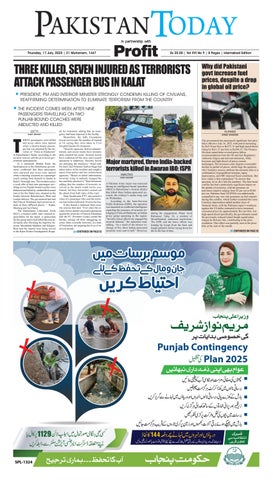
THREE KILLED, SEVEN INJURED AS TERRORISTS ATTACK PASSENGER BUS IN KALAT Thursday, 17 July, 2025 | 21 Muharram, 1447
g
g
Rs 20.00 | Vol XVI No 9 | 8 Pages | Islamabad Edition
PRESIDENT, PM AND INTERIOR MINISTER STRONGLY CONDEMN KILLING OF CIVILIANS, REAFFIRMING DETERMINATION TO ELIMINATE TERRORISM FROM THE COUNTRY
THE INCIDENT COMES WEEK AFTER NINE PASSENGERS TRAVELLING ON TWO PUNJAB-BOUND COACHES WERE ABDUCTED AND KILLED
T
QUETTA
Staff RepoRt
HREE passengers were killed and seven others were injured when a Quetta-bound passenger bus was attacked by the terrorists of “Finta al-Hindustan” in Balochistan’s Kalat, according to the security sources and the provincial government spokesperson. In a statement Shahid Rind, the Spokesperson to the Balochistan government, confirmed that three passengers were martyred and seven were injured when a shooting occurred on a passenger coach coming from Karachi to Quetta in Kalat’s Nemargh area. The incident comes a week after at least nine passengers travelling on two Punjab-bound coaches were abducted and killed by unidentified armed men in the Sur-Dakai area, situated on the border between Balochistan’s Zhob and Loralai districts. The government had said that Fitna al-Hindustan had carried out attacks at three different places — Kakat, Mastung and Sur-Dakai. The Balochistan Liberation Front (BLF), a banned outfit, later claimed responsibility for the attack. A spokesman for the group said it had killed the nine individuals after blocking the highway between Musakhail-Makhtar and Khajuri. Rind said the injured were being moved to the Kalat District Headquarters Hospi-
tal for treatment, adding that an emergency had been imposed at the facility. Meanwhile, the Edhi Foundation rescue service put the number of injured at 10, saying they were taken to Civil Hospital Quetta for treatment. “Security agencies, district administration, and rescue teams have immediately reached the scene. Security forces have cordoned off the area, and a search operation is underway. Security forces are pursuing the attackers,” Rind said. He said Chief Minister Sarfraz Bugti had taken notice of the incident and sought a report from police and law enforcement agencies. “Based on initial information, terrorists lying in ambush, stopped the bus and then attacked it,” Rind informed, adding that the number of terrorists involved in the attack could not be confirmed, but they (terrorists) carried out the attack from both sides of the road. State broadcaster PTV also posted a video of a passenger who said the terrorists had indiscriminately fired at the bus. It also shared a statement from security sources that said: “Ever since the security forces started successful operations against the terrorists of Fitna al-Hindustan and the FC (Frontier Corps) sealed the border, cutting off their smuggling income, these cowardly terrorists, in a state of frustration, are targeting the lives of innocent people.
CONTINUED ON PAGE 03
Why did Pakistani govt increase fuel prices, despite a drop in global oil price?
ISLAMABAD
ahmad ahmadani
Major martyred, three India-backed terrorists killed in Awaran IBO: ISPR RAWALPINDI
Staff RepoRt
A Pakistan Army major was martyred during an intelligence-based operation (IBO) in Balochistan’s Awaran district that killed three Indian-sponsored terrorists, the military’s media wing said on Wednesday. According to the Inter-Services Public Relations (ISPR), the operation was launched on confirmed intelligence regarding the presence of terrorists belonging to Fitna-al-Hindustan, an Indian proxy group operating in the region. “Security forces effectively engaged the terrorist hideout,” the statement read, adding, “As a result of the intense exchange of fire, three Indian-sponsored terrorists were sent to hell.” However,
during the engagement, Major Syed Rabnawaz Tariq, 34, a resident of Muzaffarabad, embraced martyrdom. The ISPR said the brave officer was leading his troops from the front and fought gallantly before laying down his life in the line of duty.
The government has announced significant fuel price hikes effective July 16, 2025, with petrol increasing by Rs5.36 per litre to Rs272.15 and high-speed diesel rising by Rs11.37 per litre to Rs284.35. The Finance Division stated these revised prices follow recommendations from the Oil and Gas Regulatory Authority (Ogra) and relevant ministries, while kerosene and light diesel oil prices remain unchanged. The increases come despite a noticeable decline in global oil prices, which begs the question, why? Industry sources attribute the domestic hike to a combination of geopolitical tensions, rupee depreciation, and IMF-imposed fiscal conditions. But how viable is that explanation? To answer that question, let us dive into the numbers. The Iran-Israel conflict has had a particularly significant impact on the global oil economy, with the premium on petroleum imports surging from $5 per ton to $9.06 per ton. Pakistan State Oil (PSO) was additionally compelled to pay war risk premiums on fuel imports during this conflict, which further escalated the costs. Currency depreciation added another layer of financial strain, with the Pakistani rupee’s weakness against the US dollar estimated to have increased consumer prices by approximately Rs2 per litre. For high-speed diesel specifically, the government raised the previously reduced inland freight equalisation margin by Rs4 per litre, contributing to the price escalation. This effect was partially seen in the price hike at the start of the month.
CONTINUED ON PAGE 03
02 NEWS
Thursday, 17 July, 2025 | ISLAMABAD
MOODY’S QUESTIONS PAKISTAN’S MISSED TAX TARGET, TRADE TALKS PROGRESS WITH US DURING RATING REVIEW: REPORT
M g
rAtinG AGenCy Also Probes exChAnGe rAte Control And fisCAl meAsures As PAKistAn seeKs uPGrAde in Credit rAtinG PROFIT
STAFF REPORT
OODY’S, the global credit rating agency, raised concerns regarding Pakistan’s failure to meet the target of increasing the tax-to-GDP ratio to 10.6% in the previous fiscal year, as the country sought a revision in its current credit rating. The Express Tribune reported that the agency also inquired about the progress of trade discussions with the United States and whether the central bank was still controlling imports and the exchange rate market, according to officials familiar
with the meeting details. The questions were raised during a session attended by Pakistan’s Finance Minister Muhammad Aurangzeb, Minister of State for Finance Bilal Kayani, and State Bank Governor Jameel Ahmad. The meeting was crucial for determining whether Pakistan will see an upgrade in its credit rating, which currently stands at Caa2 with a positive outlook. This rating, upgraded from Caa3 in August 2024, remains below investment grade, limiting Pakistan’s ability to enter international capital markets for debt raising. Officials noted that Moody’s questioned the impact of missing the tax-to-GDP ratio
target on this year’s fiscal targets. In response, Aurangzeb indicated that the Federal Board of Revenue (FBR) would provide further clarification on the issue. For the fiscal year 2024-25, the FBR collected Rs11.745 trillion in taxes, falling short of the Rs13 trillion target and achieving a tax-to-GDP ratio of just over 10.2%. During the meeting, Pakistan provided Moody’s with an overview of ongoing reforms, particularly efforts to enhance tax collection through technology and digitisation. The rating agency also sought updates on Pakistan’s trade talks with the United States. While the government did not share
full details, officials mentioned that negotiations on preferential trade access were progressing. Moody’s further asked about the government’s debt servicing plan, specifically
FBR authorises DCs and ACs to seize illicit cigarettes, extends anti-smuggling powers for LEAs until June 2026 g
frontier CorPs, rAnGers, PmsA, And CoAst GuArds Authorized to CombAt smuGGlinG in CollAborAtion with PAKistAn Customs PROFIT
STAFF REPORT
The Federal Board of Revenue (FBR) has authorised provincial officials, including deputy commissioners, assistant commissioners, and other revenue officers, to conduct raids on retail outlets, warehouses, and motor vehicles to seize illicit and smuggled cigarettes. According to media reports, the FBR issued SRO 1279(I) 2025, granting provincial tax officials the authority to en-
Fertilizer offtake increases 11% in June 2025, driven by nitrogen and potash growth PROFIT
STAFF REPORT
Pakistan’s overall nutrient offtake in June 2025 saw an 11% year-on-year increase, reaching 407 thousand tonnes, according to the latest fertiliser report from the National Fertiliser Development Centre (NFDC). Among major nutrients, nitrogen and potash offtake recorded notable increases of 15.7% and 41.2%, respectively. However, phosphate offtake declined by 6.7% compared to June 2024. The report highlights that urea off-take during June 2025 increased by 20.6%, reaching 582 thousand tonnes, driven by peak Kharif 2025 planting activity, better farmer incomes from higher crop prices, and increased loan disbursements through the Kissan Card scheme. On the other hand, DAP offtake decreased by 6.6%, totaling 115 thousand tonnes, reflecting the impact of higher DAP prices that limited farmers’ purchasing ability. In terms of domestic fertilizer production, total production in June 2025 was 790 thousand tonnes. Urea production amounted to 555 thousand tonnes, while DAP production was 75 thousand tonnes. The total imported supply was recorded at 128.7 thousand tonnes, mainly consisting of DAP and MOP. The total urea availability for June 2025 was 1,870 thousand tonnes, including both domestic production and leftover stock from May. After accounting for the offtake, the closing balance for urea stood at 1,278 thousand tonnes. For DAP, availability rose to 439 thousand tonnes, with a closing balance of 324 thousand tonnes after offtake. On the pricing front, domestic prices saw slight changes. The price of urea (sona) decreased by 0.5%, while DAP prices decreased by 1.3%. The average price of urea (sona) and DAP was Rs4,452 and Rs12,768 per 50 kg bag, respectively. Internationally, urea prices in China and the Middle East saw an upward trend, with prices ranging between $350–420 per tonne in China and $375–458 per tonne in the Middle East. DAP prices also increased in Morocco and China, reflecting higher international market costs.
force seizure actions under the Federal Excise Act, specifically concerning cigarettes. The designated officers, such as deputy commissioners, assistant commissioners, and their equivalents, will have the authority to seize counterfeit cigarettes and beverages that have been unlawfully produced or transported without paying the required excise duty. The items, along with the vehicles used for their transportation, will be confiscated. Seized cigarettes and beverages will be destroyed according to the prescribed
procedure, while the seized items will be transferred to the nearest Regional Tax Office for further action. The newly authorized officers are required to report any seizures within 48 hours through the FBR’s designated application. These reports will be forwarded to the Director General of Intelligence and Investigation for further handling. EXTENSION IN ANTI-SMUGGLING POWERS The FBR has also extended the antismuggling powers of various law enforce-
ment agencies (LEAs) until June 30, 2026, to strengthen efforts against smuggling activities across Pakistan. In a series of notifications issued on Tuesday, the FBR empowered the Frontier Corps Balochistan (North/South), Pakistan Rangers, Pakistan Maritime Security Agency (PMSA), and Pakistan Coast Guards (PCG) to actively tackle smuggling. These agencies will operate in coordination with Pakistan Customs officials to effectively combat illicit trade. The FBR also made amendments to several earlier notifications, clarifying the scope and limitations of the powers delegated to these LEAs in the fight against smuggling.
PTCL initiates pensioners’ data verification after Supreme Court upholds liability g
PAKistAn teleCommuniCAtion emPloyees trust will CAlCulAte PtCl’s reQuired Contribution in Pension fund After dAtA verifiCAtion PROFIT
STAFF REPORT
Pakistan Telecommunication Company Limited (PTCL) has started the process of verifying pensioners’ data following a Supreme Court decision that upheld the company’s financial responsibility for post-retirement benefits of its former employees. In a notice submitted to the Pakistan Stock Exchange (PSX) on Wednesday, PTCL confirmed it is now collecting and verifying data related to pensioners. Once verified, the information will be shared with the Pakistan Telecommunication Employees Trust (PTET) to calculate the company’s required contribution. The financial im-
pact will be reflected in PTCL’s statements after the completion of this exercise. “The Supreme Court of Pakistan on July 10, 2025 has disposed of the Company’s review petition concerning the pensionary benefits. The Apex Court verdict that the Government increases are admissible to the extent of civil servants, directed PTCL to acknowledge its continuing financial liability and accordingly reflect on its financial records in accordance with applicable accounting and corporate laws principles,” read the PTCL’s notice sent to the PSX. “This is a complex and time-consumng exercise,” PTCL stated, adding that the financial impact will be determined upon finalization of all relevant
records and data. PTCL assured its stakeholders that all necessary steps are being taken to ensure transparency and compliance following the apex court’s judgment. It is pertinent to mention here that a three-member bench of the Supreme Court has issued a detailed decision on more than 250 appeals and petitions. The apex court declared former employees of the PTCL as fully entitled to pension and directed the company to prepare a payment schedule within 90 days. According to the decision, financial problems do not give excuse to the institution from paying pension, PTCL should prepare a payment schedule to pensioners within 90 days.
KAPCO receives approval to sell gas turbines to Rizwan Steel for Rs800m g
Kot Addu Power ComPAny to disPose of GAs turbines Gt-3 And Gt-4 to rizwAn steel for rs800 million followinG shAreholder APProvAl PROFIT
STAFF REPORT
Kot Addu Power Company Limited (KAPCO) has received shareholder approval to sell its Gas Turbines GT-3 and GT4, along with associated components, to Rizwan Steel (Private) Limited for Rs800 million. The company disclosed the development in a notice to the Pakistan Stock Exchange (PSX) on Wednesday. KAPCO’s shareholders consented to the disposal of the plant and machinery, including the gas turbines and their components, as outlined in the statement of material facts. Shahab Qader Khan, KAPCO’s Chief Executive, and Adolf
Anthony Rath, the company secretary, have been authorized to carry out the necessary actions to finalize the transaction. This approval follows KAPCO’s recent signing of a TriPartite Power Purchase Agreement (TPPA) with the Central Power Purchasing Agency (Guarantee) Limited (CPPA-G) and the National Grid Company of Pakistan Limited. The agreement governs electricity sales from KAPCO’s power plant. KAPCO, incorporated on April 25, 1996, is a public limited company operating a multi-fuel fired power station in Kot Addu, Punjab. The company generates electricity with a nameplate capacity of 1,600 MW, which is sold to the Water and Power Development Authority (WAPDA) under a Power Purchase Agreement (PPA).
the average interest rate used to allocate Rs8.3 trillion for this year’s debt obligations. The government informed the agency that an average interest rate of 12% had been applied.
77 luxury vehicles, cash, gold, and 109 properties confiscated in Rs40b Kohistan corruption case
Confiscated vehicles include Porsche Taycan, Land Cruiser, Lexus, Fortuner, Hilux Revo, Mark X, BMW, Mercedes, Ford Mustang, and Audi models PROFIT
STAFF REPORT
Assets worth an estimated Rs25 billion have been recovered and frozen as part of the investigation, with the National Accountability Bureau (NAB) converting its inquiry into a formal investigation in the Rs40 billion Kohistan corruption case, The News reported. Among the seized assets is a luxury bungalow featured in a popular drama serial, as well as 77 high-end vehicles valued at Rs940 million. The vehicles include Porsche Taycan, Toyota Land Cruiser, Lexus, Fortuner, Hilux Revo, Mark X, BMW, Mercedes, Ford Mustang, and Audi models. NAB has also confiscated over Rs1 billion in cash and foreign currency, along with more than 3 kilograms of gold. Authorities have frozen Rs5 billion across 73 bank accounts and seized a wide range of immovable assets. The 109 properties recovered during the investigation include 4 farmhouses, 12 commercial plazas, 2 commercial plots, 30 houses, 12 shops and food courts, 25 flats and penthouses, and 175 kanals of agricultural land.
Auto industry seeks clarity on restrictions for ineligible individuals booking or purchasing vehicles under Finance Act 2025
fbr urged to define eligibility process to prevent delays in vehicle purchases and registrations PROFIT
STAFF REPORT
The auto industry is seeking clarity on the implementation of the Finance Act 2025, which has introduced restrictions on ineligible individuals from booking or purchasing motor vehicles starting July 1, 2025. According to a news report, the Pakistan Automotive Manufacturers Association (PAMA) has formally reached out to the Federal Board of Revenue (FBR) for clarification on the new regulations. According to PAMA, the law prevents ineligible persons from booking or purchasing motor vehicles, and any vehicle purchased by such individuals will not be registered by authorities. Key concerns raised by PAMA include unclear processes for determining eligibility. The law requires prospective buyers to obtain an eligibility certificate before booking a vehicle, but the procedure for issuing these certificates has yet to be defined. PAMA has suggested that the FBR develop an eligibility portal similar to the existing filer portal to streamline the process and avoid delays in vehicle bookings. The association also proposed that the eligibility criteria should exclude government bodies, including the federal, provincial, and local governments, as well as the armed forces and their departments.
Port Qasim Power Project seeks urgent funds to settle Rs480b dues to Chinese IPPs g
Port QAsim eleCtriC Power ComPAny reQuests finAnCe minister's intervention to resolve PAyment bACKloG AheAd of Prime minister’s beijinG visit PROFIT
STAFF REPORT
Port Qasim Electric Power Company Private Limited (PQEPC) has formally requested Finance Minister Senator Muhammad Aurangzeb to facilitate the release of funds to the Central Power Purchasing Agency– Guaranteed (CPPA-G) for payment to Chinese Independent Power Producers (IPPs), BR reported. The outstanding dues to Chinese IPPs currently stand at approximately Rs 480 bil-
lion, with part of this amount expected to be cleared before Prime Minister Shehbaz Sharif’s upcoming visit to Beijing, aiming to assure Chinese stakeholders. In a letter to the finance minister, PQEPC’s CEO, Wang Dongfang, highlighted the company’s consistent delivery of reliable and cost-effective electricity through the 1,320 MW Port Qasim CoalFired Power Project, a part of the ChinaPakistan Economic Corridor (CPEC), even during the COVID-19 pandemic. He further emphasized the project’s role in addressing
circular debt issues. As of June 30, 2025, the Port Qasim project’s total outstanding dues amounted to Rs 87.5 billion (approximately $308.2 million), with delays exceeding six months. Wang warned that these mounting dues had led to significant dissatisfaction among shareholders from China and Qatar, urging immediate government action to prevent further delays. He noted that PQEPC is legally entitled to suspend operations under the Power Purchase Agreement (PPA) due to non-payment, and failure to resolve the issue could
result in a breach of the Loan Agreement and default on Pakistan’s Sovereign Guarantee, which could harm the country’s financial credibility. Wang has called on the Finance Minister to coordinate with the relevant authorities to
expedite financial support to CPPA-G, ensuring timely payment to the Port Qasim project. The Finance Ministry usually releases Rs 5 billion per month to CPPA-G for energy payments to Chinese IPPs through an escrow account.
NEWS 03
Thursday, 17 July, 2025 | ISLAMABAD
PAC ORDERS INQUIRY INTO ADDITIONAL EXPENSES AND IRREGULARITIES IN PLANNING DIVISION, NLC PROJECTS
T g
curement. Audit officials reported that steel, initially contracted at Rs108,000 per tonne, was later procured at Rs298,000 per tonne. NLC officials defended the revised rates, stating they were board-approved and aligned with market trends. The committee also flagged procedural violations in extending a one-year contract with Faizan Steel to three years instead of two six-month extensions. The committee also reviewed the Bara Kahu Bypass project, which suffered a Rs2.47 billion loss due to contractual flaws. Initially estimated at Rs6.51 billion, the project ballooned to Rs8.82 billion. The Capital Development Authority (CDA) has yet to approve the additional cost, with NLC attributing the overrun to court stay orders and design changes. PAC members condemned NLC’s violation of Public Procurement Regulatory Authority (PPRA) rules and criticized its practice of awarding development projects without tendering at inflated costs, often 120% higher than standard estimates.
PUBLIC ACCOUNTS COMMITTEE SCRUTINIZES RS220 MILLION LAPSE IN PLANNING DIVISION BUDGET, RS3.2BN IRREGULARITIES IN NLC'S STEEL PROCUREMENT, AND COST OVERRUNS IN BARA KAHU BYPASS PROJECT PROFIT
stAff report
HE Public Accounts Committee (PAC) directed the Secretary of the Planning Division to conduct an inquiry into additional expenditures and submit a report within a month. PAC Chairman Junaid Akbar emphasized that the Planning Division should set an example for other ministries, Dawn reported.
PAC member Sanaullah Mastikhel expressed concerns about the withholding of development funds from lawmakers who did not compromise their integrity. The committee also examined a case regarding the lapse of Rs220 million from the Planning Division’s development budget, originally earmarked for an event that was canceled due to the Prime Minister’s absence. PAC members questioned the allocation of such a large sum for a single event, to
which Planning Secretary Awais Manzur Sumra clarified that the funds were intended for a social sector project meant to be inaugurated by the Prime Minister. MNAs Riaz Fatyana and Sanaullah Mastikhel raised objections over the poor planning within the Ministry, especially given that nearly 45% of the country’s population lives below the poverty line. The PAC also examined irregularities in the disbursement of Rs8.69 billion allocated for the census, revealing unaccounted left-
over funds. The committee ordered the collection of complete financial records from the remaining districts. Additionally, an audit found that 219 of the 126,000 tablets purchased for the census were untraceable. The Planning Secretary confirmed that only 24 devices remained missing, and the PAC decided to close the audit on that matter. In a separate session, the committee reviewed an audit report on the National Logistics Corporation (NLC), focusing on Rs3.2 billion in irregularities related to steel pro-
Three killed, seven injured as terrorists attack passenger bus in Kalat World Bank rates Punjab Affordable Housing Program progress as moderately satisfactory
Project sees steady implementation, with $24.54m disbursed to date, as it works to improve housing systems and supply in Punjab PROFIT
stAff report
The World Bank has rated the implementation progress of the $207.17 million “Punjab Affordable Housing Program” as moderately satisfactory. Approved in March 2022, the program aims to support the Punjab government in strengthening housing institutions and systems, while increasing the quantity and quality of affordable housing in the region. Project documents indicate that the cost has been revised from $200 million to $207.17 million. To date, $24.54 million has been disbursed for the project, with steady progress being made in its implementation. Several annual targets have been achieved, including the development of key systems like the Housing Market Information System, Project Management Information System, and Beneficiary Management Information System. The program has also established Location and Infrastructure Investment Criteria, while the revised Affordable Private Housing Scheme (APHS) Rules and Regulations have been approved. Additionally, a rapid housing assessment has been completed, and a more comprehensive housing assessment will be carried out as part of the development of the Punjab Affordable Housing Policy.
FBR sets new customs/export values for mangoes for ongoing season
New export values for fresh, pulp, and dry mangoes set at $800, $1000, and $1500 per metric ton respectively PROFIT
CONTINUED FROM PAGE 01
“One of the two reasons for terrorist attacks on passenger buses on highways is that they are soft targets. The second reason is that by carrying out such incidents, they want to divert the army and FC from the border and operation areas to these locations so that the terrorists can operate more easily in the border and operation areas.” PRESIDENT, PM AND INTERIOR MINISTER STRONGLY CONDEMN KILLING OF CIVILIANS IN KALAT President Asif Ali Zardari and Prime Minister Muhammad Shehbaz Sharif on Wednesday expressed their deep sorrow over the killing of innocent civilians in Balochistan’s Kalat district, who were attacked by the Indian-proxy terrorist group “Fitna al-Hindustan” on a Quetta-bound passenger bus traveling from Karachi. The president strongly condemned the incident and said that the act of targeting innocent civilians was highly condemnable and barbaric, adding that terrorists wanted to disrupt peace and stability in the province as they were the enemies of humanity.
The president and the prime minister expressed their condolences to the bereaved families and prayed for their patience and strength. The president and the prime minister also directed for immediate medical assistance to the injured. “The terrorists who harm the lives and property of innocent and unarmed civilians will have to pay a very heavy price,” PM Office Media Wing, in a press release, quoted the prime minister as saying. The president and the prime minister reaffirmed that the government and security forces were fully determined to eliminate terrorism from the country. “With the support of the nation, we will eradicate the cancer of terrorism from the country,” President Secretariat Press Wing, in a press release, quoted the president as saying. Interior Minister Mohsin Naqvi condemned the shooting in Kalat in a statement from his office, extending his condolences and assailing Fitna al-Hindustan—a term the government uses for terrorist organizations in Balochistan—for targeting civilians.
“The targeting of innocent passengers by Fitna al-Hindustan terrorists is a very cowardly act,” he was quoted as saying. “These terrorists are hatching a heinous conspiracy to sabotage peace by targeting soft targets. With the support of the nation, we will foil these conspiracies by Indiansponsored terrorists.” “The attack on the passenger coach in Qalat is a cowardly and despicable act of terrorism. The loss of precious lives is an irreparable tragedy. The terrorist organisations of Fitna al-Hindustan have previously carried out attacks based on identity, but now they are indiscriminately targeting civilians, which clearly shows that this war is against every ordinary Pakistani, and we will defeat it at all costs!” CM Bugti said in a post on X. National Assembly Speaker Ayaz Sadiq said that “terrorists of the Indian conspiracy are targeting peace and stability.” He said the cowardly attack was the “worst example of enmity against humanity”. “We will foil every conspiracy sponsored by India,” he said. Senate Chairman Yousuf Raza Gilani termed terrorists the “murderers of all hu-
Why did Pakistani govt increase fuel prices, despite a drop in global oil price? CONTINUED FROM PAGE 01
Meanwhile, the government’s options for keeping this price steady have been further constrained by International Monetary Fund (IMF) reform conditions. While officials considered reducing the petroleum levy to offset price pressures, the IMF rejected any flexibility in levy targets agreed under its program. Industry sources have confirmed, however, that there was no increase in the petroleum levy or other taxes on petroleum products in this pricing round. The current price structure already reveals a significant tax burden on consumers. For petrol, the ex-refinery price before duty stands at Rs153.41 per litre, with 10% customs duty adding Rs15.33. Additional costs include Rs8.89 for inland freight, Rs7.87 for the oil marketing company margin, Rs8.64 as dealer commission, Rs75.52 as petroleum levy, and Rs2.50 as climate support levy. The tax component totals Rs93.35 per litre, accounting for 34% of the final price. High-speed diesel follows a similar pattern, with an ex-refinery price before duty of Rs168.40 per litre and 10% customs duty of Rs16.40. Combined with inland freight, margins, and levies, the final price reaches Rs284.35 per litre, with taxes comprising Rs93.41 or 33% of the total cost. Other fuel prices include kerosene at Rs181.33 per litre with a petroleum levy of Rs18.95, light diesel oil at Rs167.76 per litre, and aviation fuels priced around Rs181.50 per litre including 18% GST. E-10 petrol is priced
at Rs269.65 per litre, where taxes make up 35% of the cost. Coming back to the question, why a second hike? “Even though international markets showed a downtrend in petroleum prices, the combined effect of the war premium, rupee depreciation, and IMF commitments has deprived Pakistani consumers of any significant relief,” commented a source familiar with the matter. The source commented that a delayed impact of global price changes in Pakistan reflects the government’s decision to split the price hikes rather than fully pass them through to consumers during its July 1st revision. Experts suggest this approach was driven by concerns over public perception, particularly following the poorly received budget the previous month. Moreover, the effect of a global price shock like a war cannot be immediately transferred in numbers due to procurement delays especially for a country like Pakistan that cannot afford to have a large enough strategic oil reserve. However, the fact remains that this domestic pricing strategy occurs against a backdrop of declining global oil prices, and is not great in terms of optics. In fact, Morgan Stanley analysts highlight a key paradox: “For all the seriousness and severity of the current conflict, oil prices are actually down about 20 percent relative to a year ago. This simply puts current conditions in a very different category than those other periods, be they the 1970s or more recently, Russia’s invasion of Ukraine that represented genuine oil price shocks.”
HUBCO announces $51m support for Thar-based coal projects PROFIT
Iran’s envoy to Pakistan ‘widely respected,’ FO says after FBI puts Moghadam on ‘most wanted list’ ISLAMABAD
stAff report
Pakistan’s Foreign Ministry on Wednesday stressed that Iran’s Ambassador to the country, Reza Amiri Moghadam, was “widely respected” after the United States Federal Bureau of Investigation (FBI) added him to its Most Wanted list for his alleged role in the 2007 disappearance and suspected abduction of retired FBI agent Robert A. “Bob” Levinson. “As far as Pakistan is concerned, the ambassador of Iran is widely respected for his role in the promotion of Pakistan-Iran relations,” FO spokesperson Shafqat Ali Khan stated while responding to media queries. “He is
entitled to all the privileges, immunities and respect due to [being an] ambassador, that too, from a friendly neighbouring country,” Shafqat highlighted. On Tuesday evening, the FBI’s Washington Field Office released ‘seeking information’ posters of three senior Iranian intelligence officials, whom it blamed for playing key roles in Levinson’s disappearance and in efforts to conceal Tehran’s alleged involvement. While Pakistani authorities have not been linked to the incident, the case now has a direct connection to Islamabad through Moghadam’s diplomatic posting. The FBI statement said Moghadam had previously headed the operations unit of Iran’s Ministry of Intelli-
US lawmakers warn Pakistan over transnational repression, hint at ‘possible sanctions WASHINGTON Agencies
The US Congress may soon urge President Donald Trump’s administration to consider imposing sanctions on countries that suppress religious freedom and violate human rights, Republican Congressman Christopher H. Smith suggested during a congressional hearing on Pakistan on Tuesday. “One of the biggest disappointments—regardless of who is in the White
House or at the State Department—is the absence of sanctions,” said Smith, who co-chairs the Tom Lantos Human Rights Commission (TLHRC). Smith recalled that the only individual ever sanctioned under US religious freedom laws was Indian Prime Minister Narendra Modi, following the 2002 Gujarat riots. “We are going to call on the Irfa office to consider imposing [sanctions]—especially in light of the terrible acts committed against people of various faiths,” he said.
The Irfa office, based at the State Department, enforces the International Religious Freedom Act, which authorizes the US government to designate and penalize countries that engage in or tolerate severe religious persecution. “That’s it. We’ve got 18 sanctions here, and we are going to impose them on you,” Smith declared during the hearing on Pakistan’s current political and human rights situation. Amnesty International’s advocacy director for Europe and Central Asia, Ben Linden; PTI leader Zulfi Bukhari; law
gence and Security (MOIS), adding that he reportedly oversaw agents operating across Europe during that time. Levinson arrived on Iran’s Kish Island on March 8, 2007 and went missing the following day. Notably, a 2013 Associated Press (AP) investigation revealed that Levinson had been sent on a spy mission by Central Intelligence Agency (CIA) analysts who had no authority to run such an operation. Levinson’s family had received a $2.5 million annuity from the CIA to stop a lawsuit revealing details of his work, AP reported. In 2020, after the US concluded that Levinson had passed away “some time ago,” Iran said he had left the country
firm Perseus Strategies’ Managing Director Jared Genser; and Afghanistan Impact Network founder Sadiq Amini provided their testimonies during the hearing. Although the TLHRC does not directly recommend sanctions, Smith’s remarks were widely seen as a signal that such measures may be under consideration if current trends persist. His Democratic counterpart, Congressman James McGovern, echoed the concern. “A vibrant Pakistani community in Massachusetts engages me all the time, and quite frankly, they are worried about the signals coming from our government right now,” he said. Speaking about the political climate in Pakistan, McGovern added: “They need to know that people are watching.
stAff report
Hub Power Company Limited (HUBCO), Pakistan’s largest Independent Power Producer (IPP), has disclosed its plans to provide up to $51 million in financial support for two of its key coal projects located in Thar, namely Thar Energy Limited (TEL) and ThalNova Power Thar (Private) Limited (TN). The company intends to extend Sponsor Support Contribution Letters of Credit (SSC LCs) for both projects to address funding requirements and potential shortfalls in debt servicing as the projects approach critical operational milestones. In a notice to the Pakistan Stock Exchange (PSX) on Wednesday, HUBCO outlined that the board has approved special resolutions to offer guarantees of up to $31 million for TEL, a 330MW coal-fired power plant in Thar Block II, and $20 million for TN, another 330MW coal-fired plant at the same location. Both projects fall under the 2015 Power Policy of the Government of Pakistan, which guarantees a 20% return on equity in USD terms.
stAff report
The Federal Board of Revenue (FBR) has revised the customs and export values for mangoes for the current season. According to a ruling issued by the Directorate of Valuation Lahore (Ruling 2 of 2025), the new export (FOB) values are set at $800 per metric ton for all types of fresh mangoes, $1000 per metric ton for mango pulp, and US$1500 per metric ton for dry mangoes. The FBR’s directive follows a consultation process with major stakeholders, including representatives from the All Pakistan Fruit & Vegetable Exporters, Importers & Merchants Association, as well as mango exporters. The Directorate of Customs Valuation Lahore conducted a thorough analysis, including a review of market trends, export data from the Pakistan Revenue Automation Ltd (PRAL), and documents submitted by stakeholders. The valuation exercise adhered to the provisions of Section 25(15) of the Customs Act 1969, ensuring that the determined export values reflect both national and international market conditions.
manity”. “Terrorists can never succeed in their nefarious objectives. The entire nation is united against terrorism.” Sindh Chief Minister Murad Ali Shah also condemned the incident. “Targeting innocent passengers is a very barbaric act. Terrorists are a plague on the nation’s soil,” he said, adding that it was necessary to eliminate such elements for the country’s prosperity. PPP Vice President Senator Sherry Rehman said targeting innocent and defenseless civilians was a “heinous act.” “The state must take decisive and robust action against terrorists. The entire nation and security institutions are united in the fight against terrorism … The government must bring terrorists and their facilitators to justice and deliver exemplary punishment,” she said. KP Chief Minister Ali Amin Gandapur and Punjab Chief Minister Maryam Nawaz also condemned the incident and expressed sorrow over the killing of innocent passengers. Terrorist attacks on civilians in Balochistan in current year In May this year, the government designated all terrorist organizations in Balochistan as Fitna-Al-Hindustan.
“long ago” and that Tehran had no knowledge of his whereabouts, rejecting claims by his family of him dying in Iranian custody. On the other hand, the Iranian foreign ministry’s website said, “Moghadam has worked as deputy of Iran’s Supreme National Security Council in foreign and international policy affairs.” Per the FBI, Moghadam was “suspected of supervising the operation that led to Levinson’s reported abduction and later taking part in the cover-up”. The FBI’s move comes amid heightened tensions between the US and Iran. Meanwhile, Iran’s parliament said the country should not resume nuclear negotiations with the US until preconditions are met, Reuters reported, citing Iranian state media. The US periodically sanctions Iran and companies involved in trading Iranian oil, with the latest such move made on July 9.
04 COMMENT
Is this the end of democracy?
Thursday, 17 July, 2025
That missed tax target
I
Moody’s goes in after the IMF
T was almost as if Moody’s, the credit rating agency, was acting as an agent of the IMF, as it asked the government what would be the effect of the government missing the IMF’s tax-to-GDP ratio. It has been speculated that the IMF functions as a credit rating agency, with the difference that it makes recommendations for action, something which Moody’s and the other major crediting rating agency, Standard & Poor, do not make, except in the roundabout fashion of indications as to what actions would get a favourable rating. One of the main reasons why countries like Pakistan court the rating agencies is that the rating they award will determine how much interest is charged the country on the international money markets, and how easy it is to raise the loan. Being on an IMF programme helps, for it means the country is not going to default. The rating is an estimate of how well the country is supposed to be able to service its debt. Pakistan was downgraded by Moody’s to Caa3 from Caa1, which was not very good itself. It was upgraded to Caa2 last August, with ‘positive’ outlook. Pakistan is now trying to get a further upgrade, presumably to Caa1, which would bring it back to where it was in October 2024. In comparison, Standard & Poor gave a CCC rating in August last, and said that its outlook was stable. Though Pakistan has claimed that it has achieved economic stability, that is only by the skin of its teeth. Even as Federal Finance Minister Muhammad Aurangzeb engaged with Moody’s virtually, PM’s Special Assistant for Industries and Production Haroon Akhtar Khan engaged with leaders of the business community to get them to call off the strike scheduled for July 19. That the Federation of Pakistan Chambers of Commerce and Industry agreed not to strike, but it only deferred it until the meeting of all its demands, they centre on the powers of taxmen to arrest alleged tax defaulters. In short the chambers are objecting to paying taxes, something which the IMF insists upon. Mr Aurangzeb has long insisted on engaging with the rating agencies, but gave the impression that this was distinct from the engagement with the IMF> Rating agencies have every right to do due diligence, but there seems to be the danger of falling in the trap of doing the IMF’s for it.
Facing pressures all over the world
T
ArslAn Mehndi nekokArA
HE year 1992 saw Francis Fukuyama declare that we were at “the end of history.” By defeating fascism and communism after the Cold War, he said that liberal democracy was not just a system of governance but also the pinnacle of human ideology. For a time, he seemed to be right. Eastern Europe embraced democratic reforms. In Latin America, juntas gave way to civilian governments. As the global economy opened up, the USA, full of confidence, became the model that everyone wanted to emulate. Over 30 years, that illusion has been dispelled. Democracy is not only in danger, but it is also in decline. In 2024, more than half of the world’s population cast ballots in a record election year, but the EIU’s Democracy Index showed yet another democratic downturn. By report, just 45 percent of people on the globe live in democracies, 39 percent in authoritarian regimes, and 15 percent in hybrid regimes that mix elements of authoritarianism with electoral democracy. This is not just a shift in the world; it is an ideological breakdown. Democracies are currently being destroyed from the inside out by elected autocrats, weaponized disinformation, shattered institutions, and public disinterest. The very institutions that previously ensured freedom, like elections, the media, and the courts, are now working against it. The thesis made by Steven Levitsky and Daniel Ziblatt in How Democracies Die is that the initial indications of democratic decline are often not coups but rather institutional degradation. Democratically elected leaders exploit the law to strengthen their hold on power, suppress dissent, and weaken checks and balances. Take India, which was formerly hailed as the world’s largest democracy. Under Prime Minister Narendra Modi, India has sunk into what scholars now call “electoral autocracy.” The free press has been silenced, and the targeting of the Muslim minority by the Citizenship Amendment Act, internet bans, and antiterror laws like the UAPA reveal a state that is growing increasingly illiberal while feigning democracy. The same has been done in Turkey by Recep Tayyip Erdogan. For almost two decades, he has used elections as a cover for an authoritarian consolidation. Erdogan was elected in 2023 in spite of harsh charges of voting suppression, judiciary manipulation, and media repression. Current reports by Reporters With-
Dedicated to the legacy of late Hameed Nizami
Arif Nizami (Late)
out Borders ranked it 151 out of 180 countries in terms of press freedom. The USA, which is a symbol of democratic stability, is also having difficulties. How fragile its institutions have become was made clear by the 6 January 2021 Capitol uprising. Donald Trump’s refusal to accept electoral defeat, his illogical charges of fraud, and the unwavering loyalty of millions to his anti-democratic rhetoric show that even advanced democracies can regress. A 2024 Gallup study found that only 28 percent of Americans think their government does what is right. This is not just polarization, but disintegration. Like Netanyahu’s Israel and Erdogan’s Turkey, The Washington Post warns that executive overreach and loyalty-driven appointments are increasingly changing US institutions. By comparing Trump’s increasing authoritarianism to Orban’s Hungary, The Guardian affirms that media and judiciary rights are being emphasized. The People versus Democracy is a book written by Yascha Mounk in which he analyses how populism threatens democratic systems and their liberal roots. Populist waves brought leaders like Viktor Orban in Hungary, Andres Manuel Lopez Obrador in Mexico, and Jair Bolsonaro in Brazil to power, only to erode human rights, weaken institutions, and consolidate power. Orban confidently calls Hungary an ‘‘illiberal democracy,’’ but it is seldom democratic in reality. The paradox of winning elections while undermining democracy is the populist trap. Voters cast ballots, but their choices are restricted, their media is silenced, and their courts are politicized. As Mounk warns, democracy may survive in name but not in reality. Steven Feldstein’s book, The Rise of Digital Repression, illustrates how autocracies have changed beyond merely being more aggressive. Chinese-made surveillance cameras, Israeli spyware like Pegasus, and AI-generated disinformation are all helping authoritarian governments suppress opposition more successfully than ever before. China’s “social credit” system, facial recognition technologies, and censorship algorithms have created a regime of near-total surveillance. But the danger isn’t limited to Beijing. These tools are being exported and used by regimes in Venezuela, Zimbabwe, and even some parts of Europe. Feldstein shows that democracy is losing the tech war not because of a lack of innovation but because of an erosion of ethical standards. The collapse of Fukuyama’s vision can also be seen in today’s confrontations (Russia-Ukraine, IranIsrael, Israel-Hamas) and many others. These con-
M. A. Niazi
Babar Nizami
Editor Pakistan Today
Editor Profit
T
The missing who went underground TAriq khAn TAreen
HE narrative built around the issue of “missing persons” in Balochistan is, in fact, part of a deep-rooted conspiracy— engineered with Indian backing and propagated by Fitna-e-Hindustan and its proxy organizations. Groups like the Baloch Yekjehti Committee (BYC), Baloch Activists Alliance Media (BAAM), Baloch Voice for Justice, and Voice for Baloch Missing Persons (VBMP) operate under the guise of human rights advocacy while actively defaming the state of Pakistan on social media and international forums. A recent case is that of Mohammad Naeem Satakzai, who was declared “missing” on 6 August 2024, but was later killed on 1 July 2025, in Mastung during a terrorist operation carried out by Fitna-e-Hindustan’s BLA. Despite claims from so-called human rights activists like Gulzadi Baloch and Yasir Baloch that Naeem was a missing person, the BLA itself later confirmed that he was responsible for targeting civilians— killing a 16-year-old boy and injuring eight others. Security forces, in a timely and effective response, neutralized him. Naeem Satakzai’s case illustrates a broader tactic by BYC and BLA: labeling terrorists as “missing persons” to gain public sympathy. However, many of these individuals are later found involved in violent activities and are either arrested or killed in counterterrorism operations.
ran Baloch had been abducted by security forces from Mashkay. However, the Baloch Liberation Front later declared him a member and even issued posters praising him as a hero. Their false narratives remain archived on social media platform X. 6. Eid Muhammad alias Shikari, a senior BLA commander since 2013, was declared “missing” by these groups, sparking protests. He was actually killed in a security operation in Narmuk, Kalat, on February 28. 7. In another incident, Engineer Zaheer Baloch was falsely reported by Mehrang Ghaffar to have been killed in a fake encounter in 2022. This sparked road blockades, protests, and venomous rhetoric against the state. The truth came to light when Zaheer returned from Iran and held a press conference revealing the facts of his arrest— discrediting the false narrative.
Additionally, several names once declared “missing” by Fitna-e-Hindustan’s supporters were later found involved in terror activities, or died in internal conflicts. Abdul Malik Baloch was one such example— BYC listed him as missing, but he was actually killed due to inter-
nal strife within BLA. Abdul Wadood Satakzai, Imtiaz Ahmed son of Raza Muhammad, and many others labeled as “innocent civilians” were later discovered in militant camps. The DG ISPR has repeatedly presented irrefutable evidence in briefings, exposing India’s direct involvement in sponsoring terrorism in Balochistan— financially, logistically, and through media influence. These propaganda networks are designed to create social media trends, access Western platforms, and defame Pakistan under the guise of human rights activism. It is no longer a secret: Fitna-e-Hindustan, BLA, BYC, and their supporters exploit the youth of Balochistan, dragging them into terrorism and violence. Their lies, hypocrisy, and double standards are now evident to the public. The story of Naeem Satakzai and countless others proves that the so-called “missing persons” narrative is merely a smokescreen to protect terrorists. Every new revelation about a so-called “missing person” now raises serious questions. As more names emerge with confirmed terrorist links, the reality behind this narrative becomes clearer. It is time we, as a nation, recognize these conspiracies, reject their false claims, and continue the path toward peace, development, and unity in Balochistan. The writer is a freelance columnist
SEVERAL OTHER SUCH CASES HAVE COME TO LIGHT:
1. Noor Zaman Baloch and Nadeem, who were killed during an attack on the Jaffer Express train, hailed from Turbat and Gwadar. Both were listed as “missing” by the BYC. 2. Hammal Fateh Baloch, involved in the attack on PC Hotel Gwadar, and Kareem Jan Baloch, whose sister admitted his affiliation with BLA, were similarly portrayed as victims by nationalist groups. 3. Jehanzeb Mengal alias Balach, a resident of Qadirabad in Noshki, was associated with BLA for two years. He was killed during an operation in Noshki on March 27, yet BYC included him in their “missing persons” list and launched a propaganda campaign. 4. In August 2024, during an operation in Lasbela, terrorist Tayyab Baloch alias Lala was killed. He had also been declared “forcibly disappeared” by BYC and Mama Qadeer. Despite an FIR being registered, it turned out that Tayyab was an active BLA member engaged in anti-state actions in the mountains. His family, deceived by propaganda, suffered the most— trapped in protests under the illusion of seeking justice. 5. Individuals like Mehrang Baloch and Sami Deen used social media to claim that Kam-
Arslan Mehndi Nekokara, Lecturer at GCUF Chiniot Campus, MPhil Political Science from Punjab University Lahore, Expertise in Global politics, Comparative Governments, World Constitutions, Political. Thoughts and theories. Email: mehndiarslan@gmail.com
Tyranny is fueled by both brutality and forgetfulness. We have to keep in mind that democracy is not inevitable. It requires constant struggle because it is not natural. If democracy dies in the 21st century, it may not be murdered but rather surrendered by the same people it was intended to empower.
Missing persons— just a cover Founding Editor
flicts expose the way in which authoritarian states exploit disarray to consolidate their rule, the manner in which international division weakens democratic solidarity, and the manner in which democracies compromise their values in the name of security. Israel was once seen as the only stable Middle Eastern democracy, but its fight with Iran and Hamas has sped up its illiberal turn. Only 48 percent of Jewish Israelis still believe democracy is the best system, down from 72 percent in 2013, according to the report of the Israel Democracy Institute, 2024. This is not the end of history. This is its violent return. Are we seeing democracy fading away slowly? Or is this just another tough time in its bumpy history? While this is undoubtedly a turning point because democracy is not coming to an end. It must adapt while retaining its basic principles in order to address modern issues such as economic inequality, fake news, and political divisions. If democratic systems can’t rebuild trust, protect our freedoms, and keep new tech in check, then elections and parliaments could just turn into empty gestures, with real power hidden behind a mask of legitimacy. As Snyder points out, tyranny is fueled by both brutality and forgetfulness. We have to keep in mind that democracy is not inevitable. It requires constant struggle because it is not natural. If democracy dies in the 21st century, it may not be murdered but rather surrendered by the same people it was intended to empower.
Editor’s mail
Send your letters to: Letters to Editor, Pakistan Today, 4-Shaarey Fatima Jinnah, Lahore, Pakistan. E-mail: letters@pakistantoday.com.pk Letters should be addressed to Pakistan Today exclusively
Stinking oversight
THE Karachi chapter of the Arts Council of Pakistan has earned a reasonable reputation as a place where arts and culture are allowed to flourish and thrive. This is definitely good for society at large, and those running the show deserve due acknowledgment. However, the job is apparently so hectic, time-consuming and stressful that the administration is unable to find the time or the focus to keep its washrooms clean. I recently had the misfortune of visiting the place after several years in connection with a fund-raising event for a charity hospital in Karachi’s Koohi Goth area. The programme, which also featured an Urdu theater play, lasted a few hours. Visiting the washrooms, as such, was an inevitability that could not be put on hold beyond a limit. To call the smell merely ‘foul’ would be a rank understatement. All sorts of adjectives hit my senses the moment I stepped in. Pungent, acrid, putrid, acerbic, stinking and many more; all blended into one ‘Arts Councilish’ odour. It was noxious to the point of being obnoxious. I am sure the cause of arts and culture can still be served with clean and fragrant washrooms. All that the administration has to do is to at least try. Once it does, it will be surprised to know that the two targets are not mutually exclusive. Just try. DR SYED SHAH TALHA IQBAL KARACHI
Karachi collapse
THE latest Economist Intelligence Unit’s Global Liveability Index has ranked Karachi 170th out of 173 cities. Sadly, this comes as no surprise to those of us who live here. I have travelled across Pakistan, and I can say with confidence that no other major city is in such a poor state. Karachi no longer feels like a city; it feels like a vast, neglected slum. Every day we deal with broken roads, garbage piling up, and water and electricity shortages. Despite all this, the Sindh government keeps making tall claims. But the truth is plain to see. The provincial government’s performance is all around us, and it is pathetic. Karachi has incredible potential, and its people are hardworking and resilient. We need serious action and real leadership before things get even worse. The recent Karachi ranking should be an eye-opener for the Sindh government. But I think this is something too much to ask. SAAD ALI KARACHI
Tax houdinis
It is no longer a secret: Fitna-e-Hindustan, BLA, BYC, and their supporters exploit the youth of Balochistan, dragging them into terrorism and violence. Their lies, hypocrisy, and double standards are now evident to the public. The story of Naeem Satakzai and countless others proves that the socalled „missing persons‰ narrative is merely a smokescreen to protect terrorists. Every new revelation about a so-called „missing person‰ now raises serious questions.
Lahore – Ph: 042-36300938, 042-36375965
I
Karachi – Ph: 021-32640318 I
Islamabad – Ph: 051-2204545
I
IRRESPECTIVE of which political party, or dictator, happens to be at the helm of affairs at any given point in time, the targets of political economy have always overruled economic imperatives. Those who have the muscle and the clout continue to evade taxes under state patronage. Beyond rhetoric, no government has ever done anything concrete to make the elite pay taxes. To fill the gap, all that the governments have ever done is to impose indirect taxes, which is a way of passing on the burden to those who survive from pay-cheque to pay-cheque, and those who afford nothing more than two square meals a day and some level of basic education for their children. All through the subsequent year, they hear the usual pep talk of the ruling elite that justice would be done the next year. After all, someone has to make a sacrifice, and it seems it is their destiny to be the nation’s sacrificial lambs. The lower and middle classes of the country must be prepared to make sacrifices for the nation so that our non-tax-paying elite continue to lead their luxurious lifestyles, be beneficiaries of subsidised land allotments, play golf and, of course, spend their vacations abroad. MALIK TARIQ ALI LAHORE
Web: www.pakistantoday.com.pk
I
Email: editorial@pakistantoday.com.pk
COMMENT 05
Trump and Netanyahu’s Bloody Path to ‘Peace’
Thursday, 17 July, 2025
Excluding Iran from Syria and Hamas from Gaza
T
Qamar Bashir
HESE are momentous times, not only for the region but for the shifting power dynamics of the world. On July 7 and 8, 2025, Israeli Prime Minister Benjamin Netanyahu and U.S. President Donald Trump convened in Washington, D.C., amid a rapidly evolving crisis. At the White House, flanked by their cabinets, both leaders addressed the media following back-to-back meetings where they discussed the ongoing war in Gaza, indirect ceasefire talks with Hamas, and their joint military action against Iran. The press conference that followed was revealing— not just for what was said, but for what was admitted, evaded, and conspicuously ignored. The Israeli Prime Minister, emboldened by US backing, described recent joint military actions in strikingly clinical language, declaring that Israel and the USA had “removed two tumours”— Iran and Hamas. These were not metaphors of diplomacy or deterrence; they were declarations of conquest, affirmations of a doctrine Netanyahu proudly called “peace through strength.” He praised the B-2 American pilots who dropped massive ordnance on Iran’s underground nuclear facility, and the Israeli soldiers who, in his words, “fought like lions” and “struck like lightning.” President Trump echoed these sentiments, confirming that the Atomic Energy Commission had verified the destruction of Iran’s nuclear infrastructure. “It is obliterated,” he stated, while adding, “They flew for 37 hours with zero problems... carrying the biggest bombs we’ve ever dropped on anybody— non-nuclear, and we want to keep it non-nuclear.” What was presented as
victory, however, was also a sobering admission of escalation. But while both leaders stood united in the language of military strength, they diverged sharply when the conversation turned to Iran’s future. Netanyahu maintained an aggressive stance, affirming that Israel would never tolerate the re-emergence of Iranian power in Syria or the region at large. Trump, however, struck a noticeably different chord. He praised the Iranian people as “very smart, energetic people” and reiterated his desire to lift sanctions “at the right time,” suggesting a path of economic reintegration rather than perpetual war. He spoke of Iran’s “great oil power” and its “potential for peace,” offering a glimpse of a strategy built on diplomacy rather than annihilation. This contrast revealed a fundamental divide between the two leaders: one seeking permanent suppression, the other seeking calculated engagement. Syria also emerged as a critical part of the broader plan. Netanyahu was clear that prior to their operations, “Iran was essentially running Syria.” Now, he claimed, “Iran is out of the picture.” President Trump reinforced this position, explaining that sanctions were lifted to give the post-Iranian Syrian government a chance to rebuild. “I met the new leader... I was very impressed,” he said, signalling US willingness to reconfigure the region— so long as Iran remained on the sidelines. This transformation of Syria from Iranian stronghold to Western-aligned state was offered as both a strategic victory and a sign of shifting alliances. But amid the triumphalism, the most conspicuous silence surrounded Gaza. President Trump spoke passionately about the tragedy unfolding in Ukraine, lamenting, “These are souls... it’s appalling, it’s unforgivable.” Yet when it came to the civilian
deaths in Gaza— where tens of thousands have been killed, injured, or displaced— he said nothing. No mention of the humanitarian catastrophe, the flattened hospitals, the water crisis, or the lost children. Not even a token expression of sorrow. This absence revealed a dangerous truth: that even amid international condemnation of Israel’s actions as collective punishment, ethnic cleansing, or genocide, the President of the United States dared not speak a word of dissent. This wasn’t just political— it was systemic. The silence was deafening. The contradictions deepened further when the issue of Hamas entered the discussion. On one hand, Netanyahu framed Hamas as a terrorist entity that must be eradicated completely. “We still have to finish the job in Gaza... eliminate and destroy Hamas’s military and governance capabilities,” he declared. And yet, in the same breath, he revealed that negotiations were ongoing. “We accepted a proposal that came from the mediators... I think that we’ve gotten closer to it.” This paradox defies logic. If Hamas has been militarily decapitated, why is Israel still negotiating with it? Why does Hamas still hold hostages? Why is it still dictating terms at the table? The answer lies in a reality neither leader wanted to fully admit: that despite two years of siege and destruction, despite the combined might of Israeli and US forces, Hamas still remains a central political and military actor. Netanyahu acknowledged that “on the way over here and on the way from here” discussions with Hamas and intermediaries continued. This was not a sign of weakness from Hamas— it was proof of endurance. That even after half of Gaza was reduced to rubble, Hamas still holds hostages, still retains command, and still holds diplomatic leverage, exposes the failure of Israel’s total war doctrine. Far from being eradicated, Hamas has become the de facto representative of the Gazan peo-
ple in any future settlement. What’s more telling is that the negotiations themselves are being shaped by the USA, Qatar, and other regional players, all of whom recognize Hamas as a negotiating partner. This tacit legitimacy undermines Netanyahu’s claims of destroying Hamas’s governance capacity. It affirms that any future framework for Gaza and the West Bank will, by necessity, involve Hamas— not just as a spoiler, but as a stakeholder. And if Hamas holds that space now, after facing the wrath of both Israel and the USA, it only underscores its strategic depth and societal roots in the Palestinian landscape. In the final moments of the press conference, Netanyahu was asked about declining US public support for Israel, especially among Democrats. He blamed it on “vilification and demonization on social media,” insisting, “Nothing defeats lies like the truth.” But the truth remains painfully visible. It is in the refugee camps, in the aerial
If there is one thing the summit achieved, it is clarity. The clarity that this is not a war to destroy Hamas. It is a war to redefine Palestine. And in doing so, the USA and Israel have made one thing clear to the world: power is the process, peace is the packaging. And the people· their pain, their dignity, their future· remain secondary to strategic calculus.
Nato dollars can be more persuasive than Putin’s propaganda There is no guarantee the US president’s impatience with Russia will last, but the Kremlin may come to regret testing his patience
B
GUARDIAN
rafael Behr
EFORE Donald Trump was a politician he was a property tycoon. Naturally, he thought he could fix the Ukraine war with a real-estate deal. In exchange for a ceasefire, Vladimir Putin would get to keep territory he had already seized. But before Putin was a politician he was a KGB agent who mourned the collapse of the Soviet Union. His idea of a fair solution begins with Ukraine’s total submission to an imperial Russian motherland. There is no evidence that Trump was ever appalled by that ambition or by atrocities committed in pursuit of it. But he does now declare himself “very unhappy” with the Russian president for intensifying hostilities in defiance of White House efforts to end the fighting. It isn’t the killing that upsets the US president, but the ingratitude. Trump was offering Putin a hefty slice of Ukraine (not that the land was his to give away) and all he wanted in return was grounds to boast of his credentials as a peacemaker. Russian refusal to trade on those terms makes the White House look impotent, which is a good way to rile a prickly potentate. The manifestation of that pique is an agreement to supply Ukraine with vital anti-missile defence systems and a threat to impose “severe” tariffs on Moscow if a ceasefire isn’t forthcoming within 50 days. That is long enough for Trump to revert to his old habit of indulging the Kremlin. Also, his deadlines are famously elastic. It would be premature to celebrate the US president’s recognition that Putin has been “bullshitting” him as a symptom of strategic enlightenment, still less an affirmation of solidarity with Ukraine. The president who this week spoke of Kyiv’s right to self-defence is the same one who only five months ago scorned Volodymyr Zelenskyy as the author of his nation’s misfortune and a trickster who beguiled Joe Biden into handing over precious US resources to a lost military cause. Favour denied and then bestowed can be withdrawn again. Such is the Trump way. The current position may be temporary. That doesn’t mean it lacks substance. The crucial change is that Zelenskyy and his European allies have convinced Trump that they are footing the bill for the war; that Ukrainian independence isn’t a rip-off. The first stage of that persuasion was the creation of a co-owned investment fund for the exploitation of minerals, oil and gas in postwar Ukraine. Washington’s 50% notional share of those resources was presented as “repayment” for military aid. Then came the commitment by Nato members to raise their annual defence budgets to 5% of national income within a decade. The alliance’s annual summit last month was choreographed almost exclusively to frame that pledge as a personal tribute to Trump. It wasn’t an edifying spectacle. Mark Rutte, the Nato secretary general, didn’t dignify his office by calling the US president “daddy”. But the show seems to have impressed its tar-
get audience. At his post-summit press conference, Trump spoke of European resolve with unusual warmth. That fondness was on display again this week in a broadcast from the White House, where Trump, with Rutte at his side, declared that “having a strong Europe is a very good thing”. He referred back to the “very successful” Nato summit, the 5% pledge and a new arrangement whereby missile defences badly needed by Ukraine – the uniquely effective Patriot system – will be bought on Kyiv’s behalf by its continental allies. Trump’s point was not that the cause is just but that the price is paid by someone else. (The shift in posture reflects a judgment that Europe is a better client than the Kremlin.) Nato dollars beat Putin’s bullshit. For now. That is a relief for Ukraine, but not much more. Patriots help provide cover for cities that have come under ferocious Russian bombardment, but they won’t much alter the balance of power on the wider battlefield. The Kremlin continues to eke out territorial gains at huge cost in casualties. Ukrainian forces continue to mount a heroic defence and sometimes pull off bravura feats of counterattack, but panache cannot resist sheer weight of population indefinitely. Putin’s plan is more arithmetic than strategy. He intends to keep feeding soldiers into the “meatgrinder”, as Russians call the front, until there aren’t enough Ukrainians left with the strength or weapons to fight back. That is why the economic front – especially sanctions that target Moscow’s ability to raise revenue from oil and gas exports – is so vital, and why Trump’s readiness to reinforce that effort, if sincere, would be truly significant. Putin might reasonably assume it is a bluff, or a passing whim. But the Russian president may also have overplayed his hand. He has less control over events than his biggest fans and most anxious detractors imagine. Kremlin propaganda cultivates the myth of the great and visionary leader bestriding history. That image is refracted through foreign lenses as the shadow of an omnipotent puppeteer, tugging at strings that pull down
western democracies. The truth is still sinister but more banal. Putin is the boss of bosses in a gangster kleptocracy where the security services are the paramount clan. Ultranationalist ideology and a personality cult around the president are embedded in all public discourse as tests of loyalty. Who really believes what is hard to know when the penalties for saying the wrong thing are severe. The economy is geared for total war from top to bottom, from industries that churn out munitions to the signing-on fees for volunteers and compensation payments to bereaved families that sustain remote regions where soldiering is the only work. Putin has repeatedly told Russians they are engaged in an existential struggle with the west, equivalent to resistance against Nazi invasion in 1941. If he now stopped the war in exchange for a percentage of eastern Ukraine, it wouldn’t be the victory he has promised. He has mobilised patriotic fervour to silence doubt about the wisdom of the struggle and the implicit payback is national glory. If the fighting ends on more desultory terms, he will face angry mothers whose sons died in vain. He will have to find civilian jobs for disillusioned veterans. Those are problems he would rather defer. It is easier to keep riding the conveyor of death than step off it for a deal like the one Trump has in mind – a deal, it must be emphasised, that is still grotesquely generous in rewarding unprovoked aggression. Putin’s reluctance to take that option is not the choice of a strategic mastermind, but nor was the fullscale invasion in February 2022. Plan A was to overrun Ukraine within days. The Russian president badly underestimated his adversary then. Plan B is slow butchery and patience, hoping the other side runs out of ammunition and will. Stringing Trump along may prove to have been another grave error of judgment. Ukraine and its more dependable allies must hope so, and press the advantage hard while it lasts. Rafael Behr is a Guardian columnist.
footage of destroyed neighborhoods, in the buried children and grieving mothers. It is in the contradictions between rhetoric and reality, between the promise of peace and the daily grind of occupation, siege, and military dominance. The Trump-Netanyahu meeting, though billed as a peace coordination summit, was something altogether different. It was a show of strategic triumphalism built on the ashes of diplomacy. It revealed a dual policy of war and negotiation— bombing one day, talking the next. It praised military supremacy while denying humanitarian suffering. It treated displacement as peace, and coercion as choice. It silenced Gaza while discussing Ukraine. It admitted the centrality of Hamas while vowing its extinction. It was a performance of contradictions, wrapped in ceremony, delivered with pride, and protected by silence. If there is one thing the summit achieved, it is clarity. The clarity that this is not a war to destroy Hamas. It is a war to redefine Palestine. And in doing so, the USA and Israel have made one thing clear to the world: power is the process, peace is the packaging. And the people— their pain, their dignity, their future— remain secondary to strategic calculus.
The writer retired as Press Secretary the President, and is former Press Minister at Embassy of Pakistan to France and former MD, Shalimar Recording & Broadcasting Company Limited
Afghans being sneaked in is nothing short of sinister In 2022, a British serviceman mistakenly leaked a list of 33,000 Afghans who had applied for safe haven in the UK
O
DAILY MAIL
F all those seeking refuge in Britain, few have a more powerful claim than Afghan interpreters and others who were in danger because they had the courage to serve with our military. They lived in constant fear of reprisals from the Taliban, who threatened to slaughter them ‘like dogs’. The Mail’s Betrayal of the Brave campaign passionately argued that the UK owed a moral debt to these brave men and their families and should give them sanctuary. As a result, countless lives were saved. But had ministers and civil servants not procrastinated for so long over who should qualify, all the translators and other staff might already be safely here. Then the latest calamitous Ministry of Defence data breach scandal would never have happened. In 2022, a British serviceman mistakenly leaked a list of 33,000 Afghans who had applied for safe haven in the UK. This made them and their families – a total of 100,000 people – prime targets for Taliban attacks. When the alarm was raised a year later, the then Tory government launched a highly clandestine mission to evacuate them to safety. In total, 23,900 are earmarked for rescue. Ministers agreed to spend a whopping £7billion of taxpayers’ cash. Of course, the MoD might have been right to pull out all the stops to save the lives of those put at risk by its own incompetence. However, this devastating error has led to thousands of Afghans being flown here who would not have been eligible for sanctuary. It’s also deeply concerning the MoD seems incapable of keeping information secure. Imagine such ineptitude in wartime. If confidential details on operations and troop movements fell into enemy clutches, it could have catastrophic consequences. But perhaps the worst aspect of this debacle is that having sneaked in huge numbers of Afghans, ministers have gone to extraordinary lengths to keep it secret from the country. It’s nothing short of sinister. After the database had been leaked, a draconian super-injunction was put in place in order to prevent the Press reporting the details and Parliament from debating them. The then government’s justification for this gagging order was that any publicity might help the Taliban wreak revenge. Yet wasn’t the real reason that ministers were desperate to hide from the public just how many Afghans were being brought into the country and the cost of the mission? A judge lifted the news blackout yesterday. But this sort of official secrecy, enabled by the Tories and Labour, is an affront to open justice, corrosive to democracy and has a chilling effect on free speech. Immigration policy is of huge concern to the public. It must be discussed openly – not concealed to avoid embarrassment.
06 NEWS
DEATH TOLL MOUNTS AS ANOTHER 51 KILLED IN GAZA
A
GAZA
news desk
T least 51 Palestinians have been killed across the Gaza Strip since dawn on Wednesday, including 21 individuals who died during a chaotic incident at an aid distribution center in southern Gaza. Medical sources confirmed to Al Jazeera that the casualties included 21 people who died in a stampede at a Global Humanitarian Foundation (GHF) facility in Khan Younis. The incident occurred when a large crowd of desperate civilians gathered for aid. Many victims died from being trampled or suffocated in the melee, according to Gaza’s Ministry of Health. The ministry disputed earlier claims by the GHF, which had alleged that “armed elements affiliated with Hamas” caused the chaos. The GHF also claimed that one of its US contractors had been threatened with a gun and that weapons were visible among the crowd. However, Palestinian authorities and witnesses strongly rejected this account, stating that the panic began after tear gas was fired at civilians who were already desperate for aid. Initially, the GHF reported 19 people trampled and one stabbed in the incident, but
Gaza’s Health Ministry later confirmed the deaths of 21 people, with 15 dying as a result of stampede and suffocation. The United Nations Human Rights Office (OHCHR) also reported a worsening humanitarian crisis, with daily casualties among children. “Ten children per day are losing one or both legs as a result of the conflict,” the OHCHR said. More than 134,000 people, including over 40,500 children, have sustained war-related injuries since the start of the conflict. OHCHR also warned that over 35,000 people are suffering from significant hearing loss due to explosions, highlighting longterm medical and psychological trauma for Gaza’s civilian population. In response to the ongoing conflict, the Israeli military announced the opening of the Magen Oz Corridor in southern Gaza, which divides the Khan Younis area into eastern and western zones. The 15km corridor connects to the Morag Corridor created in April. The Israeli military stated that the corridor is intended to increase pressure on Hamas and dismantle the remaining brigade operating in the area. However, humanitarian organizations have expressed concerns that this move could exacerbate civilian displacement and impede aid access.
Meanwhile, the Israeli Ministry of Defence has submitted a revised plan to Prime Minister Benjamin Netanyahu for a “humanitarian city” in southern Gaza. The new plan, estimated to cost 4 billion shekels ($1.2 billion), would house 600,000 displaced Palestinians in tents with access to water, food, and electricity.
The earlier version of the plan, proposed by Defence Minister Israel Katz, was reportedly rejected by Netanyahu as too costly and difficult to execute. Human rights organizations have condemned both versions of the plan, likening it to a forced relocation of Palestinians in a confined zone, drawing comparisons to a concentration camp.
Thursday, 17 July 2025 | ISLAMABAD
On the diplomatic front, indirect negotiations between Israel and Hamas in Doha, Qatar, have reportedly made “dramatic progress.” Israeli media sources claim that talks, which began on July 6, are aimed at securing a ceasefire and a prisoner exchange. The breakthrough came after Israeli Prime Minister Netanyahu and the Israeli Security Cabinet agreed to ease some of their demands, particularly regarding the military’s continued presence in Gaza. According to reports, the current framework includes a 60-day pause in Israeli operations, after which combat could resume. However, Netanyahu remains opposed to ending the war entirely. The conflict, which has been ongoing since October 2023, has led to nearly 58,500 Palestinian deaths, the majority of which are women and children. The bombardment has caused widespread destruction, including severe food shortages and the collapse of Gaza’s health infrastructure. The International Criminal Court has issued arrest warrants for Israeli Prime Minister Netanyahu and former Defence Minister Yoav Gallant, accusing them of war crimes and crimes against humanity in Gaza. Additionally, Israel is facing a genocide case at the International Court of Justice.
President Xi addresses Central Urban Work Conference, listing priorities for urban development BEIJING
stAff correspondent
Chinese President Xi Jinping laid out the overall requirements, key principles and priority tasks for urban work at a key conference held in Beijing from Monday to Tuesday. Xi, also general secretary of the Communist Party of China (CPC) Central Committee and chairman of the Central Military Commission, delivered an important speech at the Central Urban Work Conference, which was also attended by members of the Standing Committee of the Political Bureau of the CPC Central Committee Li Qiang, Zhao Leji, Wang Huning, Cai Qi, Ding Xuexiang and Li Xi. China, traditionally an agricultural country, has experienced accelerating urbanization since the launch of its reform and opening-up policy in the late 1970s. Over a decade ago, the country’s urban population surpassed its rural population. By 2024, permanent urban residents accounted for 67 percent of the total population. From 2013 to 2024, China created more than 150 million new urban jobs. The meeting said that since the Party’s 18th National
Congress in 2012, the CPC Central Committee has adhered to developing cities of the people, for the people, and by the people. Historic achievements have been made in urban development, it added. China’s urbanization is shifting from rapid growth to stable development, and urban development is shifting from a stage of large-scale expansion to one focused on improving the quality and efficiency of existing urban areas, it noted.
The meeting outlined the overall requirements for urban work at present and for the foreseeable future, including the construction of modern cities of the people that are innovative, desirable to live in, beautiful, resilient, culturally advanced, and smart, thereby forging a new path for urban modernization with Chinese characteristics. Greater emphasis must be placed on adopting a people-oriented approach, fostering distinctive features, enhancing governance capacity, and strengthening coordination, according to the meeting. At the meeting, key priorities for urban development were outlined, including optimizing the modern urban system, building vibrant cities powered by innovation, creating comfortable and convenient living environments, and promoting green, low-carbon, and aesthetically appealing urban spaces. The priorities also include enhancing urban safety and resilience, fostering cities that uphold moral integrity and social civility, and advancing the development of convenient, efficient and smart cities, the meeting said. The meeting emphasized that building modern cities for the people requires strengthening the overall leadership of the CPC over relevant work. Li Qiang delivered
3rd China International Supply Chain Expo: A leap towards global industrial sustainability BEIJING
stAff correspondent
The 3rd China International Supply Chain Expo (CISCE) is currently being held from July 16 to 20 in Beijing, organized by the China Council for the Promotion of International Trade (CCPIT) under the theme “Connecting the World for a Shared Future.” The event focuses six major supply chains—Advanced Manufacturing, Clean Energy, Smart Vehicles, Digital Technology, Healthy Living, and Green Agriculture—as well as a Supply Chain Service area. A total of 651 companies and organizations from 75 countries and regions are participating, showcasing new technologies, products, and services across the upstream, midstream, and downstream segments of each supply chain, with overseas exhibitors accounting for 35%. CEO of Nvidia Jensen Huang chats with an invited guest after the opening ceremony of the third China International Supply Chain Expo, at the China International Exhibition Center, in Beijing. CEO of Nvidia Jensen Huang chats with an invited
guest after the opening ceremony of the third China International Supply Chain Expo, at the China International Exhibition Center, in Beijing, July 16, 2025. Over 1,100 representatives from more than 100 countries, regions, and international organizations attended the opening ceremony, where the “Beijing Initiative” was jointly released by members of the international community and CCPIT.
The initiative calls for the global business community to maintain the stability of industrial and supply chains, support the multilateral trading system, and foster an open and cooperative international environment. The initiative also looks at the upholding of multilateralism, supporting the WTO-based trading framework to create a fair and predictable market, and dismantling barriers to trade and investment. Additionally, the initiative focuses on building green and sustainable supply chains by implementing the UN’s 2030 Agenda, adopting environmentally friendly practices, and advancing renewable energy cooperation. A key focus of the expo is on innovation, encouraging cooperation in emerging technologies like AI and quantum information to drive economic recovery and development. It advocates for the digital transformation of supply chains using technologies such as AI and IoT, promoting data connectivity and business integration. The Expo emphasizes the need for deeper global business collaboration, leveraging platforms like CISCE to enhance cooperation and optimize business environments, supporting both traditional and emerging industries.
Trump says Ukraine should not target Moscow amid missile supply row WASHINGTON Agencies
Donald Trump said Tuesday Ukraine should not target Moscow and that he had no plans to supply Kyiv with long-range missiles, following a report the US leader had encouraged President Volodymyr Zelensky to hit the Russian capital. The Financial Times reported that Trump had brought up a potential counteroffensive with Zelensky and even asked his Ukrainian counterpart whether he could hit Moscow, if Washington provided long-range weapons. Asked by reporters at the White House if Zelensky should target the Russian capital, Trump replied: “No, he shouldn’t target Moscow.” He was also asked if he was willing to supply Ukraine with long-range missiles and said: “No, we’re not looking to.” Citing two people familiar with the call, the Times reported that Trump spoke to Zelensky on July 4, a day after talks with Russian President Vladimir Putin. Trump also reportedly discussed sending Ukraine US-made ATACMS missiles, the Times said. Trump, who had vowed to end the Ukraine war within a day of returning to the White House, has said he is “disappointed” in Putin, who has kept attacking Ukraine as if the leaders’ telephone conversations “didn’t mean anything.” White House Press Secretary Karoline Leavitt played down the Times report, saying in a statement that the paper was “notorious for taking words wildly out of context to get clicks.” “President Trump was merely asking a question, not encouraging further killing,” she said. “He’s working tirelessly to stop the killing and end this war.”
Israel strikes key Syrian institutions in Damascus as Druze clashes continue DAMASCUS Agencies
An Israeli airstrike hit next to the presidential palace in Syria’s capital Damascus on Wednesday, according to a Reuters witness, after the Syrian defence ministry and military headquarters were also attacked. Earlier, Israeli strikes hit near the Syrian army and defence ministry headquarters in Damascus, the state-run Alekhbariya channel reported on Telegram, after Israel’s military said it stepped up attacks on the authorities with the declared aim of protecting the Druze minority from harm by government forces. AFP correspondents heard a loud explosion echoing throughout much of the capital, shortly after a first air strike had targeted the same building in the city centre. It marked the third day in a row that Israel has struck Syria where government security forces have clashed with local Druze fighters in the southern city of Sweida. Security sources from within the de-
fence ministry told Reuters that at least two drone strikes had hit the building and that officers were taking cover in the basement. State-owned Alekhbariya TV said the Israeli strike wounded two civilians.
NEWS 07
Thursday, 17 July 2025 | ISLAMABAD
CORPORATE CORNER
NBP Aitemaad Islamic branch inaugurated in DHA Phase-2 Karachi KARACHI
staff report
NBP Aitemaad Islamic Banking proudly unveiled the new premises of Islamic Banking Branch in DHA Phase-2 Karachi, catering to the diverse financial needs of the local business community while ensuring accessible and convenient banking services for the residents in the surrounding communities. By inaugurating this branch, NBP Aitemaad Islamic Banking reinforces its commitment to fostering economic growth and prosperity in the area. Mr. Rehmat Ali Hasnie, President & CEO NBP, Mr. Fouad Farrukh, SEVP & Group Chief, AIBG and Mr. Karim Akram Khan, SEVP & Group Chief, LCMG inaugurated the branch. Respected customers of the branch also graced the inauguration ceremony. The branch's opening signifies NBP Aitemaad Islamic Banking commitment towards the business community and providing exceptional banking services to all individuals.
Idara Rahimia Institute of Quranic Sciences chief Abdul Khaliq Raipuri to visit twin cities ISLAMABAD
staff report
Hazrat Mufti Abdul Khaliq Azad Raipuri, the Fifth Spiritual Successor of the Raipuri Seminary after Shah Saeed Raipuri and Director General of the Rahimia Institute of Quranic Sciences, Lahore, will be undertaking a five-day visit to Islamabad and Rawalpindi from 17 July 2025 to 22 July 2025. During this visit, Hazrat Aqdas will deliver lectures and address seminars at various universities and professional institutions on contemporary issues in the light of Quranic teachings. He will be based at the Rawalpindi Campus of the Rahimia Institute, where he will also lead the Juma congregation on Friday, 18 July 2025. This visit aims to promote greater un-
189 PUNJAB CITIES WILL BE BEAUTIFIED, DEVELOPED ON THE MODEL OF LAHORE, SAYS CM MARYAM
P
LAHORE
staff report
UNJAB Chief Minister Maryam Nawaz presided over a special meeting in which progress being made with regard to the Lahore Development Program (LDP) and Punjab Development Program (PDP) was reviewed. During the meeting, the Lahore Deputy Commissioner gave a detailed briefing on the progress of the Lahore Development Program. It was apprised in the meeting that out of 5,643 projects of Phase-I of the Lahore Development Program, 2,593
projects have been completed. Out of 3,705 projects of the Lahore Municipal Corporation, 2,274 projects have been completed. Out of 252 projects of WASA Lahore, 170 projects have also been completed. The meeting reviewed the progress of 1573 projects related to WASA projects. The Chief Minister directed to beautify newly constructed roads and streets, setting November 2025 as deadline for the completion of the Phase-I of Lahore Development Plan. “The participants were informed that 146 development projects of Allama Iqbal Town, Wagah and Aziz Bhatti Town have been in-
cluded in Phase-II of Lahore Development Program while a report on the construction, repair and rehabilitation projects of 189 cities under the Punjab Development Program was also submitted to Chief Minister Maryam Nawaz Sharif.
It was decided to give foremost priority to the most deteriorated streets and areas in the Punjab Development Program under Phase-I. On this occasion, it was also decided to launch development projects on a priority basis in 66 cities. Water tanks,
2nd Day of CDA’s commercial plots auction: 8 plots sold for a record Rs19.3b ISLAMABAD
staff report
The second day of the historic and successful open auction of CDA’s commercial plots was held at the Jinnah Convention Center, Islamabad. Chairman CDA and Chief Commissioner Islamabad, Muhammad Ali Randhawa, personally supervised the auction process of commercial plots in the Capital. Investors showed keen interest in purchasing various plots, with active participation in the open auction. So far, eight commercial plots have been auctioned for a total of Rs. 19.03 billion. According to details, on the second day of the auction, Plot No. 20 in the petrol pump category, located in I-14 Markaz, was sold for Rs. 1.64 billion. Similarly, Plot No. E-1 in F11/1 was auctioned for approximately Rs. 25.13 crore. Meanwhile, on the first day of the auction, Plot No. 13 in Blue Area (G-8) was sold for Rs. 7.24 billion, Plot No. 14 in Blue Area (G-8) for Rs. 4.16 billion, and Plot No. 12 in Blue Area (G-8) for Rs. 3.60 billion. Additionally, Plot No. 3-A in Sector I-14 was auctioned for approximately Rs. 74.932 crore, while Plot No. 3-B in I-14 Markaz was sold for Rs. 70.932 crore and Plot No. 10-A in I-14 Markaz for Rs. 66.932 crore. The grand open auction of commercial plots in Islam-
ISLAMABAD
abad and shops in Blue Area’s parking plaza organized by CDA, will continue until July 17. The overwhelming participation of investors in the auction is clear indication of their confidence and trust in CDA’s transparent and open Auction. Commercial plots and shops across various categories are being auctioned through open bidding in a fair and transparent manner. A total of 46 plots and shops have been offered for auction in this three-day event. Under the direction of Chairman CDA Muhammad Ali Randhawa, Member Estate Talat Mehmood, Member Finance Tahir Naeem, Member Engineering Syed Nafasat Raza, and Member Planning Dr. Khalid Hafiz personally supervised the open auction. Additionally, a committee headed by Member Finance Tahir Naeem has been formed, comprising DG Resource, DG Building Control, DG Law and other offi-
cers to oversee the whole process. Chairman CDA and Chief Commissioner Islamabad Muhammad Ali Randhawa alao visited the Investment Expo at the Jinnah Convention Center to engage with investors and the business community. Information stalls are set up by the Environment Wing, Resource & Planning Wing, MCI and the Sports & Culture Directorate which briefed Chairman CDA and the investors. Chairman CDA directed that maximum facilities be provided to investors and the business community. Chairman CDA directed that a facilitation team would guide investors at every step. He emphasized that the revenue generated from the auction would be spent on the development of Islamabad, including sector development, road infrastructure improvements and beautification projects, to help make Islamabad a model and exemplary city.
Huawei delegation visits PEC to strengthen collaboration in engineering, Technology ISLAMABAD
ISLAMABAD
staff report
The Command & Staff Conference of Pakistan Navy concluded at Naval Headquarters, Islamabad. The conference was chaired by Chief of the Naval Staff, Admiral Naveed Ashraf. During the conference, Chief of the Naval Chief underscored the importance of maintaining perpetual combat readiness to effectively counter both traditional and non-traditional threats in the maritime domain. He specifically appreciated PN's impregnable deterrence at sea during MARKA-E-HAQ highlighting the successful demonstration of its prowess and robust defence capabilities. Naval Chief commended PN's proactive measures in ensuring continuous flow of supplies through Sea Lanes of Communication (SLOCs) and uninterrupted operations at sea ports.
POF chairman Board 30th Junior National Table Tennis Championship 2025 concludes
KARACHI: (taff report) In Boys Under 19 title final Ahmed Sajid defeated Muhammad Abbas of Sindh with 11-06, 11-03 & 11-09. Championship held at the POF Sports Complex in Wah Cantt, concluded successfully with a grand closing ceremony. Maj Gen Muhammad Kashif Azad, HI(M), Director General Commercial POF, graced the closing ceremony. Over 200 athletes participated in the championship, representing 09 teams from across the country, including Punjab, Sindh, Balochistan, Khyber Pakhtunkhwa, Islamabad, POF, Army, WAPDA, and Onehub Pro. Pakistan Ordnance Factories (POF) hosted the prestigious event from July 11th to 14th, 2025, underlining its commitment to promote sports and fostering athletic excellence in Pakistan. Championship not only showcased table tennis talent but also reinforced POF’s broader mission to support youth development and encourage a vibrant sporting culture throughout the nation.
IESCO shows best performance in power sector based on results of Final Year 2024-25 staff report
A high-level delegation from Huawei, led by Deputy CEO Mr. Ahmed Bilal Masud, visited the Pakistan Engineering Council (PEC) and held a strategic meeting with Chairman PEC, Engr. Waseem Nazir, to explore opportunities for collaboration aimed at advancing Pakistan’s engineering and technology sectors. The Huawei delegation also included Mr. Tan Shuang, Director Commercial Sales, and Mr. Yu Lei, Platform CFO. From PEC team Additional Registrar Mr. Muhammad Sohail and Assistant Registrar Ms. Samar Naseem participated in the meeting and shared key insights into the Council’s ongoing initiatives. The discussion focused on several promising areas
of partnership, including: - Strengthening industry-academia linkages - Capacity building and training programs for young engineers - Promoting employment and internship opportunities - Integrating ICT into engineering standards and smart infrastructure development۔
KP's people await a dynamic and visionary leader like Maryam Nawaz: Azma Bokhari LAHORE
staff report
Punjab Minister for Information and Culture, Azma Bokhari, while addressing a press conference at DGPR, stated that those making noise about hardships in jail are enjoying extraordinary privileges. They have access to personal chefs, customised menus, and daily exercise routines. She remarked that the founder of the "Big Party" has become so powerless that he is now seen pleading for retweets of his tweets — a reflection not of politics but of sheer desperation. Commenting on the state of affairs in Khyber Pakhtunkhwa, Azma Bokhari said billion-rupee corruption scandals have become a daily occurrence and the public is deeply disappointed with the performance of CM Gandapur. She added that the people of KP now aspire for a visionary and action-oriented Chief Minister like Maryam Nawaz, who is delivering for Punjab. Highlighting Punjab's governance model, Bokhari announced the formation of the PERA Force—a special, independent task force established to eliminate encroachments, control artificial inflation, and combat hoarding. Launched two days ago in Lahore Division, the force comprises over 50,000 trained personnel, has its investigation cell, and will ensure transparent inquiry and accountability across Punjab. Referring to the recent controversial remarks by Salman Akram Raja regarding PTI’s Aliya Hamza, Bokhari criticised his tone, comparing it to that of an aggressive police officer rather than a composed legal analyst. She lamented that within PTI, dignity and influence appear to be confined to a select few women, such as Bushra Bibi, Farah Gogi, and Aleema Khan, while other members are reduced to social media sloganeers. Quoting recent survey results, Azma Bokhari said that 71% of the population in Punjab has expressed confidence in Chief Minister Maryam Nawaz, while KP citizens have themselves accused their provincial
Electric Supply Company (IESCO) has proved itself as the leading distribution company of the power sector based on excellent performance and unmatched results during the financial year 2024-2025. According to details given in report at the end of the financial year 2023-2024 Transmission and distribution losses were 8.75 % brought to 8.39 % at the end of the financial year 2024-2025. The collection of electricity bills which was 98.2 % during closing of the FY 2023-2024 have been recorded 100% by the end of FY 2024-2025. As a result of reduction in line losses and an increase in billing collection IESCO saved a handsome amount of Rs. 14.7 billion which is a remarkable achievement by IESCO formations. IESCO teams also ensured installation and timely billing of 0.2 million new electricity connection of different tariffs during said period. The Chairman IESCO Dr. Tahir Masood and IESCO board members have praised the outstanding performance of Chief Executive IESCO Muhammad Naeem Jan and all the officers and staff members especially field formations. They dedicated these results to tireless efforts of all formation of IESCO and said that these results have definitely been achieved due to an excellent teamwork and effective strategy.
PC Hospitality appoints Saqib Nazeer as Hotel Manager to Lead PC Legacy Hunza into a new era of excellence ISLAMABAD
staff report
staff report
Pakistan Navy command & staff conference concludes at Naval headquarters
drain disposal stations and trunk sewerage will be built in 66 cities of Punjab. The Chief Minister affirmed, “No city in Punjab will be deprived of the benefits of ongoing development programs. 189 cities will be beautified and developed on the model of Lahore across Punjab.” CM STRONGLY CONDEMNS FIRING ON PASSENGER BUS IN KALAT Meanwhile, Punjab Chief Maryam Nawaz Minister strongly condemned a firing incident on a passenger bus in Kalat. She has expressed deep grief and sorrow over the death of three passengers due to firing.
Pearl-Continental (PC) Hospitality, the hospitality division of Hashoo Group and one of Asia’s leading hospitality conglomerates, is proud to announce the appointment of Saqib Nazeer as the new Hotel Manager of PC Legacy Hunza. This strategic leadership move underscores Hashoo Group’s ongoing commitment to cultivating exceptional talent and delivering elevated guest experiences across its distinguished portfolio. Nestled in the heart of the majestic Karakoram range, PC Legacy Hunza seamlessly blends contemporary comfort with the region’s rich cultural heritage. As a flagship property under the Legacy Collection, the hotel invites discerning travellers to experience a unique blend of refined hospitality, stunning landscapes, authentic local cuisine, and immersive heritage where every detail reflects the timeless charm of Hunza. Saqib Nazeer brings with him over 30 years of distinguished hospitality experience and a proven track record in transforming hotel operations, executing successful pre-openings, and driving strategic growth. Since March 2022, he has led three consecutive seasonal operations in Skardu, spearheading major renovations, service enhancements, and expansion initiatives all while elevating guest experiences to international standards.
3,942 held, booty worth Rs976m recovered during swoop on criminal gangs LAHORE
staff report
government of rampant corruption. Speaking on the ongoing monsoon season, she expressed heartfelt condolences to the families of those who lost their lives due to the recent heavy rains recorded across multiple regions. She urged citizens to exercise caution around exposed electrical wiring and flooded areas. In Punjab, she noted, water drainage operations have been efficiently managed, with the Minister for Local Government and the MD WASA personally supervising field operations. Azma Bokhari also addressed the current inflationary pressures, acknowledging that rising fuel and electricity prices have caused distress among citizens. She clarified, however, that such decisions are never made willingly by any government and are a consequence of strict IMF conditionalities. “We pray for relief from this IMF program as soon as possible,” she said. She concluded by saying that peaceful protest is a constitutional right—as exemplified by Jamaat-e-Islami—but bringing weapons, slingshots, and marbles to protests in an attempt to incite violence is unacceptable and must be condemned.
Lahore Police was engaged in a full-scale crackdown against criminal gangs operating in the city. According to the spokesman Lahore Police, a total of 1,784 criminal gangs have been apprehended this year, resulting in the arrest of 3,942 gang members during various operations. The police have recovered stolen goods worth over Rs976.6 million, including 14 cars, 2,912 motorcycles, 100 other vehicles, 260 tolas of gold, 4,049 mobile phones and 51 laptops, the spokesman added. In this regard, Capital City Police Officer Bilal Siddique Kamyana stated that operations have been carried out against gangs involved in robbery, theft, burglary and other heinous crimes. The recovered vehicles, electronics and valuables are returned to their rightful owners through a laid down procedure, he said. The CCPO added that Lahore Police was fully committed to zero tolerance against criminal gangs. He asserted that intelligencebased operations against gangs involved in drug trafficking, gambling and burglary will be intensified. Highlighting the successes, the CCPO noted that significant progress has been made in curbing heinous crimes in the city.
PECA AMENDMENTS AIM TO PROTECT, NOT SUPPRESS FREE SPEECH: TARAR NEWS
F
ISLAMABAD
Staff RepoRt
EDERAL Information Minister Atta Tarar clarified on Wednesday that the recent amendments to the Prevention of Electronic Crimes Act (PECA) and the establishment of a new national agency are aimed at addressing rising digital threats rather than silencing free speech. Speaking in Islamabad, Tarar emphasized that the new legislation seeks to improve accountability in the online space and protect vulnerable communities, particularly women. His comments came in response to mounting concerns over freedom of expression, especially following a recent court ruling that suspended the ban on 27 YouTube channels operated by journalists and commentators. These channels had been blocked under PECA provisions after the newly formed
China to provide specialised policing training to Islamabad officers
National Cyber Crime Investigation Agency (NCCIA) accused them of spreading anti-state and defamatory content. “These laws are not meant to suppress free speech,” Tarar stated. “Even the best democracies maintain systems of justice and accountability.” He went on to explain that the primary objective of the legislation
ISLAMABAD
Staff RepoRt
Federal Interior Minister Mohsin Naqvi on Wednesday met with a delegation from the Beijing Police Department, led by Deputy Director General Gao Jianzan, to discuss enhancing cooperation between the Islamabad and Beijing police forces. The meeting resulted in an agreement for Islamabad Police officers to travel to Beijing for specialized training in modern policing methods, technology, and artificial intelligence. Minister Naqvi emphasized that this advanced training would significantly enhance the capabilities of Islamabad Police. He praised the well-equipped Beijing Police force and stressed the importance of learning from their expertise, especially in terms of technology integration and modern policing strategies. Additionally, the two sides discussed the provision of antiriot training for Islamabad Police and agreed on the necessity of timely information exchange to combat terrorism, organized crime, drug trafficking, and human smuggling.
Punjab law amend ensures salaries for CM, other top officials during leave ISLAMABAD
Staff RepoRt
A recent law passed by the Punjab Assembly guarantees that the Chief Minister of Punjab, ministers, the speaker, and the deputy speaker will continue to receive their full salaries even while on leave. The claim, which circulated on social media, has been confirmed as true. The Punjab Public Representatives’ Law Amendment Act 2025, which was passed on July 1, 2025, amends several previous laws regarding the salary entitlements of top provincial officials. Under the new law, these officials are entitled to receive their entire salary even if they are absent from sessions or on leave, a change from the prior rule that deducted a portion of their pay during such absences. Before the amendment, the chief minister and ministers faced significant salary reductions when on leave. For instance, the chief minister received only Rs39,000 (about 22% of their original salary) during leave.
is to make online spaces safer, especially for vulnerable communities at risk in society. Tarar also warned about the dangers posed by the misuse of social media, which he described as one of the most significant challenges in modern times. Referencing a report from the World Economic Forum, he noted that the spread
of fake news and propaganda on digital platforms represents a global threat. “Anyone can easily incite violence on these platforms,” he added. The minister acknowledged that all political parties share responsibility for the unchecked spread of misinformation online and called for a collective effort to promote responsible digital conduct. He pointed out the rapid expansion of social media and the shift from traditional print media to digital platforms, which he said had evolved with minimal oversight. Tarar also urged political leaders to use their social media platforms for constructive dialogue, highlighting issues such as gender discrimination and patriarchy. “While entertainment and fashion accounts attract millions of followers, social media should be used to address real social issues,” he concluded, advocating for a new framework to ensure digital platforms work for inclusive and meaningful discussions.
Ministries’ performance to be evaluated every two months, says PM Shehbaz ISLAMABAD
Staff RepoRt
Prime Minister Shehbaz Sharif said on Wednesday that the performance of ministries will be evaluated every two months following the determination of key performance indicators, noting that the ministries demonstrating strong performance will be commended, staterun media reported. Prime Minister Shehbaz Sharif was chairing a meeting of the federal cabinet in Islamabad, said a statement from the Prime Minister’s Office. “From this year, we will determine key performance indicators for the ministries to evaluate their performance every two months,” he said, emphasizing that enhancing ministries’ performance was ultimately about delivery and service to the nation. Expressing satisfaction over the stock market touching record levels this week, the prime minister said that the development reflected the positive business sentiment and that collective efforts were being made for the economic growth of the country. PM Shehbaz also expressed grief and sorrow over the loss of lives in recent monsoon rains across the country. He especially regretted the incident in
Swat, emphasising the need to take effective measures in the future to prevent such incidents. Monsoon rains in Pakistan have been linked to more than 110 deaths, including dozens of children, since they started in late June, according to government figures released on Monday. On Tuesday, President Asif Ali Zardari and PM Shehbaz reiterated their commitment to working together with each other for the country’s sake. “The meeting involved discussions on the country’s political, economic, and security situation. The state of law and order in the country and measures against terrorism were also discussed,” according to a press release by the Presidency.
Last week, PM Shehbaz said that transforming the outdated system into a modern, digital and effective governance model is among the government’s top priorities, as economic development and prosperity are not possible without modernising the system to meet contemporary demands. CABINET APPROVES 15PC INCREASE IN EOBI PENSIONS: The federal cabinet approved a 15 per cent increase in pensions provided by the Employees’ Old-Age Benefits Institution (EOBI), effective from January 1, 2025, on the recommendation of the Ministry of Overseas Pakistanis and Human Resource Development, the Associated Press of Pakistan reported. This increase will be funded from the institution’s own resources, according to APP. The prime minister directed the formation of a cabinet committee to introduce institutional reforms in EOBI. The committee will also deliberate on proposals to extend old-age benefits to the informal labour sector, including domestic workers, agricultural laborers, and other marginalized employment categories that have been previously overlooked. These reforms aim to ensure that workers in these neglected sectors receive their due rights.
LHC grants major relief to Parvez Elahi, suspends accountability court’s order RAWALPINDI
Staff RepoRt
The Lahore High Court Rawalpindi Bench on Wednesday granted significant relief to former Punjab Chief Minister Chaudhry Parvez Elahi by suspending a decision made by the accountability court in regard to the ongoing graft case against him. The two-member bench comprising Justice Shahram Sarwar and Justice Sajid Mehmood Sethi issued a notice to the National Accountability Bureau (NAB) during the hearing of Elahi’s writ petition. In its order, the bench suspended the accountability court’s ruling, which had previously dismissed Elahi’s application for exemption from personal ap-
pearances. The court also granted him relief by excusing him from appearing before the NAB court for future hearings in the case. Elahi, who is facing multiple charges in the graft case, was represented by advocates Sardar Abdul Razzaq Khan and Aamir Saeed Raan before the division bench of the Lahore High Court. During the hearing, Elahi’s lawyer argued that the former chief minister, a senior and elderly politician, is currently undergoing medical treatment in Lahore due to his poor health. The lawyer highlighted that the physical condition of Elahi made it difficult for him to appear before the NAB court on each hearing date. Furthermore, the lawyer stated that
the trial court had unlawfully rejected his request for exemption from personal appearances, which prompted the writ petition to the High Court. Justice Shahram Sarwar, one of the judges on the bench, questioned the NAB prosecutor regarding their objections to granting Elahi exemption from attending court. In response, the NAB prosecutor stated that Elahi’s illness was not severe enough to justify the relief sought by his defense team. Following the preliminary hearing, the court admitted the petition for regular proceedings. It suspended the accountability court’s earlier decision, which had mandated Elahi’s regular attendance at hearings, and issued notices to NAB for a detailed hearing on the matter.
Published by Asad Nizami at Plot # 7, Al-Baber Centre, F/8 Markaz, Islamabad, for PT Print (Pvt) Limited. Ph: 051-2204545. Email: newsroom@pakistantoday.com.pk
Thursday, 17 July, 2025
pRayeR timiNgS FAJR SUNRISE
ZUHR
ASR MAGHRIB ISHA
5:15
1:30
5:25
ECP updates reserved seats allocation: PML-N gains one, JUI-F loses minority seat 4:30
7:20
9:25
ISLAMABAD NewS DeSk
The Election Commission of Pakistan (ECP) on Wednesday released the updated list of reserved seats, confirming that both the Pakistan Muslim League-Nawaz (PML-N) and Jamiat Ulema-e-Islam-Fazl (JUI-F) have secured nine reserved seats for women in the Khyber Pakhtunkhwa (KP) Assembly. This update follows a decision taken by the electoral watchdog a day earlier. According to the latest allocation, the PML-N has gained one additional reserved seat for women, while the JUI-F has lost one. The Pakistan Peoples Party (PPP) has been allotted five reserved seats for women, a decrease of one compared to previous allocations. In addition to the changes in reserved women’s seats, the notification confirming the victory of JUI-F’s Gurpal Singh, a minority member, has been withdrawn. Similarly, the victory notifications for JUI-F’s Bilqis and PPP’s Sajida Begum have also been revoked. On the other hand, PML-N leader Syeda Sonia Hussain’s victory notification has been issued. A toss will be conducted between the Awami National Party (ANP) and PTI-Parliamentarians to decide the allocation of one remaining reserved seat. The updated distribution now sees the PML-N and JUI-F each holding nine reserved seats, the PPP holding five, and both the ANP and PTIParliamentarians receiving one reserved seat each. This marks a significant development in the ongoing allocation process, which has been subject to political debate and legal scrutiny.
PM lauds best possible arrangements during Muharram, ongoing rains ISLAMABAD
Staff RepoRt
Prime Minister Shehbaz Sharif on Wednesday commended the efforts of all provincial governments, the federal administration, as well as authorities in Azad Jammu and Kashmir (AJK) and Gilgit-Baltistan (GB) for making the best possible arrangements during Muharram. He also expressed gratitude to the law enforcement agencies and all stakeholders for maintaining law and order during the religious observances. Chairing the meeting of the federal cabinet here, the prime minister also spoke about disaster preparedness amid the ongoing monsoon season. He said he had chaired a highlevel meeting with the National Disaster Management Authority (NDMA) and Provincial Disaster Management Authorities (PDMAs) to ensure best arrangements. He commended the efforts of NDMA for making arrangements to cope with heavy rains in different parts of the country. He expressed sorrow over the loss of lives due to heavy rainfall in various parts of the country, specifically the tragic incident in Swat. He said it was an unfortunate incident and emphasized the need to learn lessons from it and implement measures to prevent similar tragedies in the future. On the economic front, PM Shehbaz expressed satisfaction over the recent positive trends in macroeconomic indicators. He reiterated his government’s focus on performance and service delivery, announcing that the performance of ministries would be evaluated every two months. “This message I want to make loud and clear—it is all about delivery and service to the nation,” the prime minister stressed. He added that ministries performing well will be acknowledged and appreciated, while those falling short will be held accountable and asked to explain. During the meeting, he also praised Federal Minister for Planning Ahsan Iqbal for his ministry’s effective utilization of development funds, noting that the development spending had reached over Rs 1 trillion under the Public Sector Development Programme (PSDP).