4 | Opinion
8 | Sports
ICE kidnaps another innocent
UTSA defeats Colorado State
Vol. 73, Issue 6
Est. 1981
September 29 - October 6, 2026
THE PAISANO
Independent Student Newspaper for the University of Texas at San Antonio Community @ThePaisano
@paisanomedia
@paisanosports
@paisanosports
paisano-online.com
Veteran reporter warns journalism is ‘under attack’
By Amanda Fuentes
P
Arts & Life Editor
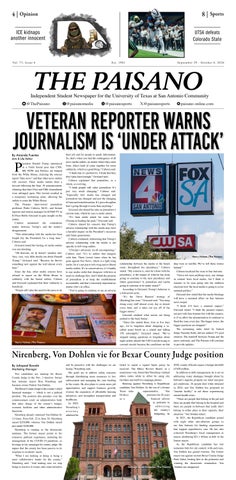
resident Donald Trump announced in a Truth Social post that CNN, MS NOW and Politico are banned from the White House, claiming the sources report “fake news” and that other news outlets will succeed. Three media outlets filed a lawsuit following the Sept. 18 announcement, claiming that their First and Fifth Amendment were infringed upon. This lawsuit resulted in a temporary restraining order, allowing the outlets to enter the White House. The Paisano interviewed journalism professor Pedro Cabrera, Ed.D., and former reporter and station manager for KTSM-TV in El Paso Hollis Grizzard to gain insight on the matter. Cabrera mentioned the contentious matter between Trump’s and the media’s disagreement. “This relationship with the media has been fought [by the President] for a long time,” Cabrera said. Grizzard stated the barring of media outlets was not shocking. “Oh heavens, no [it doesn’t surprise me]. Very, very, very little shocks me about Donald Trump,” Grizzard said. “Because he throws something new against the wall almost every hour.” Since the ban, other media sources have refused to report on the White House in solidarity with the barred outlets. Cabrera and Grizzard explained that their solidarity is beneficial. “People still value the need for the press to do
their job and for people to speak information. So, that’s when you had the contingency of all news media outlets, no matter where they came from, [they] kind of come together for some solidarity, which is a good thing,” Cabrera said. “I think that it’s productive. I think that they don’t play hard enough,” Grizzard said. Cabrera explained that journalism, as a whole, is evolving. “I think people still value journalism. It’s just very much changing,” Cabrera said. “Especially how media has changed and journalism has changed and just the changing of time and misinformation. It’s just a discipline that’s going through it more than anything.” Grizzard also shared his take on journalism’s current state, which he says is under attack. “It’s been under attack for some time, [Trump is] leading the pack,” Grizzard said. Cabrera shared his concern that Trump’s adverse relationship with the media may have a harmful impact on the President’s successor and future generations. Cabrera continued, elaborating that Trump’s adverse relationship with the media is not specific to left-wing outlets. “[Trump’s adversary is] all encompassing,” Cabrera said. “It’s to outlets that disagree with him. There [were] times when he has gone against Fox News, which is a right-wing outlet. So it’s not just to left-wing and to liberal media outlets. It’s to conservatives; it’s frankly to any media outlet that disagrees with him or tends to challenge him. And I think the purpose of journalism is to keep the establishment accountable, and that’s extremely important no matter who’s in office. “You’re going to continue to see an adverse
Henry Holmes /The Paisano
Henry Holmes /The Paisano
relationship between the media or the bench room, throughout his presidency,” Cabrera stated. “My concern is, once he’s done with his presidency, is the impact of what he has done going to continue to the next presidency and future generations? Is journalism and media going to continue to be under attack?” According to Grizzard, Trump’s behavior is a distraction tactic. “It’s the ‘Steve Bannon’ strategy of [flooding] the zone,” Grizzard said. “You keep doing crazy stuff almost every day or almost every hour, and it takes our eye off of the bigger stories.” Grizzard clarified what stories are being pushed to the back burner. “Since this started three, four or five days ago, we’ve forgotten about dropping a socalled smart bomb on a school and killing 150 schoolgirls,” Grizzard stated. “We’ve stopped asking questions or forgotten about eight sailors aboard the USS Lincoln trying to commit suicide because the conditions on that
ship were so terrible. We’ve left those stories behind.” Cabrera localized the issue to San Antonio. “I have not seen anything crazy, any change in content from local media, but I think it remains to be seen going into the midterm elections how the local media is going to cover national politics.” Grizzard also stated that the media blockage will have a minimal effect on San Antonio news output. “I think it’ll have a minimal impact,” Grizzard stated. “I think the greatest impact, not just with San Antonio but with the country, is if we allow the administration to continue to flood the zone every day. The bigger issues, the bigger questions are dropped.” The restraining order ruled by federal Judge Timothy Kelly did not address TV pool rotation. The standoff between Trump and the press continues, and The Paisano will continue to provide updates.
Nirenberg, Von Dohlen vie for Bexar County Judge position By Johnpaul Buwule Marketing Manager
Two candidates are running for Bexar County Judge in the Nov. 3 election: former San Antonio mayor Ron Nirenberg and business owner Patrick Von Dohlen. The Bexar County Judge is the county’s chief financial manager — which is not a judicial position. The position also presides over the commissioners court: an administrative body that takes charge of the county’s budget, oversees facilities and other administrative functions. Nirenberg already outraised Von Dohlen by 12 times. From Feb. 22 to June 30, Nirenberg raised $210,000, whereas Von Dohlen raised just under $188,000. Nirenberg is running as the democratic nominee. The former mayor points to his extensive political experience, including his management of the COVID-19 pandemic, as leverage in his campaign for county judge. He argues that the county has been passive in its response to residents’ needs. “What I am looking at doing is being a more collaborative leader for the county,” Nirenberg said. “And making sure we stop being so reactive to issues, take some initiative
and be proactive with the challenges we are facing,”Nirenberg said. His goals are to address safety concerns through distributing more resources to law enforcement and managing the case backlog in the courts. He also plans to create more job opportunities and support business growth; oversee the expansion of affordable housing initiatives; and strengthen transportation and healthcare. In 2025, Nirenberg’s attorney admitted he
failed to report a signed Spurs jersey he received. The Ethics Review Board, in a unanimous vote, found that Nirenberg violated ethics codes while in office by using city facilities and staff for campaign photos. Running against Nirenberg is Republican candidate Von Dohlen. As the son of a former Texas state representative, Von Dohlen positions his 28 years as a financial advisor as pertinent to addressing the county’s budgeting. In
Santiago Reyes Gonzalez /The Paisano
2028, county officials expect a budget shortfall of $28 million. In addition to debt management, he is set on addressing water shortages brought about by Edward’s Aquifer, property tax relief and poor jail conditions. 26 people died while detained in 2024, and Von Dohlen has proposed an “interim facility” to aid those experiencing mental health crises. “There are people that belong in the jail and there are people that belong in the hospital and there are people in-between that really don’t belong in either place in their capacity, their situation,” Von Dohlen stated. In 2023, the Republican candidate joined with eight other anti-abortion groups to sue San Antonio for funding organizations that support reproductive care. He has also criticized Nirenberg’s fiscal management as mayor, attributing $21.1 billion in debt to the former mayor. As the Republican candidate has lost numerous bids for city council, with each race, Von Dohlen has gained traction. The former mayor ran against current Bexar County Judge Peter Sakai, beating him in the primaries and winning the democratic nomination. Von Dohlen ran unopposed.
2 | n e w s@p a i sano-online.com
Se p te mb e r 2 9 - O c to b e r 6 , 2 0 2 6
NEWS
Ethnic, gender studies lose core designation DPS failed to send voters’ registration By Hazel Barksdale Contributor
Hundreds of courses focusing on ethnic and
gender studies across UT and Texas A&M
system schools have lost
their core curriculum
designations.
Henry Holmes /The Paisano
The development has been criticized by professors across the state who say the academic restructuring is politically motivated. These changes are the result of academic reviews conducted by the governing structures of each public university, in compliance with Senate Bill 37. The law was passed during the 89th legislature and directs public universities to reevaluate core curriculum courses to ensure that they are “foundational and fundamental” and “necessary to prepare students for civic and professional life.” Proponents of curriculum restructuring say that many of the courses currently offered are too narrowly focused and therefore should not fulfill core curriculum requirements. “The universities did a credible job in streamlining their various course listings of what most of us agreed could be described as somewhat bloated,” Texas A&M system regent Sam Torn said, according to the Texas Tribune. “There is still much work to be done in the near future … to reach our goal of fully preparing students for the modern world in which they will live.” At Texas A&M San Antonio, 76 courses will lose their core curriculum designation. This will leave the university with no core course options that focus specifically on women’s and gender studies. TAMUSA’s curriculum review was conducted by a committee that included faculty, community members and university leaders that were appointed by President Salvador Hector Ochoa. In a statement to the San Antonio Report, Associate Vice President for Marketing Adrian Jackson said that the curriculum changes “ensure
that the core curriculum remains focused on
providing students with a strong educational foundation.”
Across the state, many of the courses
losing their core status focus on racial, ethnic, gender, LGBTQ and climate studies. This has
prompted some faculty members to accuse
university leaders of caving to conservative political pressure.
“This is a political decision. You are
basically telling us now that the globalness that
[Texas A&M board of regents] once valued and said that it was going to protect is no longer a priority. …They’re going to basically
whitewash our programs,” Leonard Bright, a professor at Texas A&M College Station, said to the Texas Tribune.
As part of its curriculum review and
restructuring, UT Austin will eliminate four
majors: women’s and gender studies, African and
African
diaspora
studies,
Mexican
American and Latino/a studies and race, indigeneity and migration.
Maria Cotera, a professor of Mexican
American and Latina studies at UT Austin,
believes that the major eliminations are
intended to sabotage their department and provide justification to shut it down in the future.
“[We are] essentially digging our own graves
before we’re pushed into them,” she said to the Austin-American Statesman.
Students currently enrolled in the four
majors will be able to finish their degrees,
but the programs are not accepting any more students.
UT San Antonio has not announced any
changes to its core curriculum.
Lowering blood pressure can help defend brain against dementia, new study finds By Natalia Vázquez Felgueres Staff Writer Managing blood pressure can significantly improve brain health and reduce the progression of cognitive deterioration by nearly 40%, according to a new UT Health San Antonio study. Data from the City Health Dashboard states that an estimated 34.4% of adults in San Antonio experienced high blood pressure in 2023. Additionally, the World Health Organization reported that roughly 1.4 billion adults in 2024 experienced high blood pressure, serving as a major cause of premature death worldwide. While the cardiovascular complications of high blood pressure have been well researched, its direct relation to brain health was not clear until now. Led by principal investigator Mohamad Habes, Ph.D., the director of the neuroimaging core at the Glenn Biggs Institute for Alzheimer’s and Neurodegenerative Diseases, along with Sokratis Charisis, MD, a neurology fellow at Harvard University and a UT San Antonio graduate, the research team discovered that aggressive blood pressure management can drastically delay cerebral small vessel disease. The condition accounts for up to 25% of ischemic strokes and is the leading vascular contributor to cognitive decline and dementia, according to the study published in eClinicalMedicine. By conducting a post hoc analysis of the Systolic Blood Pressure Intervention Trial with hypertensive individuals aged 50 years or older without a history of diabetes or stroke, researchers were able to evaluate the relationship between improved systolic blood pressure control and SVD. The team found that regulating blood pressure numbers at 120 millimeters of mercury, rather than the usual
140, could alter the outcome of brain aging. This research builds upon earlier scientific foundations. A December 2025 study, archived by the National Library of Medicine, previously highlighted hypertension as a latent risk factor for cognitive impairment. Similarly, a February 2025 analysis by Harvard Health Publishing noted that a 120 mmHG target led to an 11% decrease in mild cognitive decline. However, UT Health’s multi-biomarker framework offers a much more extensive picture of the biological benefits. Dr. Charisis utilized a new formula meant to calculate how the combined effect of three major brain health markers –– periventricular white matter hyperintensities, white matter free water and basal ganglia perivascular spaces –– can be influenced by blood pressure.
“We found that the impact when all markers are considered together becomes more visible and easier to track compared to a single marker,” Habes said. Collectively, these indicators show a clear improvement in preventing fluid leaks, avoiding scar-like lesions and maintaining the brain waste clearance system. Even minor reductions provide significant benefits, with a systolic drop of 0-10 mmHG corresponding to a 21.2% decrease in SVD progression, while a 10-20 mmHG reduction resulting is a 26.3% benefit. “Prevention is important, slowing down brain aging is important and this study supports that,” Habes stated. The team plans to continue refining their framework and investigating the mechanisms that trigger dementia.
Henry Holmes /The Paisano
Sign outside the Glenn Biggs Institute for Alzhiemers & Neurodegenerative Diseases.
State of the City: Week of 9/29 By Kayla Nguyen Contributor Not subscribed to local news but still want to stay up-to-date on the happenings around town? Look no further. Highlighting notable stories from external San Antonio news sources, State of the City summarizes the most captivating news headlines of the week. This week’s topics range from wage fraud at a local sushi restaurant to developments of new construction on Interstate 410.
By Miguel Cruz Contributor Due to a glitch in the Texas Department of Public Safety online portal just weeks before the Oct. 5 midterm registration deadline, over 100,000 of Texas residents found their names missing from their local county’s active voter list. Reports indicate that the system glitch is impacting various counties such as Harris, Dallas and Bexar, creating significant backlogs for local election offices weeks before the registration deadline for midterm elections. Potentially tens of thousands statewide residents are affected by unprocessed or delayed voter records. Because county registrars are receiving these delayed records all at once, election workers are spending extra time to ensure all eligible voters appear on active rolls in time for the upcoming midterm elections. In response to the growing confusion, San Antonio and Bexar County leadership took to public platforms to address residents and clarify the processing situation. Mayor Gina Ortiz Jones shared key updates on X, reassuring the community. “The County has assured me that the 45K voter registration applications they received from DPS in the last 48 hours will be processed by the Oct 5th voter registration deadline,” Jones wrote. Jones also highlighted the large volume of residents needing to take action, adding, “Additionally, as of Wednesday afternoon, there are still 112K City voters on the state’s suspense list (~15%) meaning you need to confirm your address.” Local officials of the DPS continue to encourage residents to verify their registration status early to ensure any address or record issues can be resolved before the midterm registration deadline. Community organizers are actively hosting neighborhood workshops to walk concerned residents through the quick process of verifying their current registration. Voters whose records are on the state’s suspense list should confirm or update their address with their county voter registrar. Being on the suspension list does not automatically mean a person is ineligible to vote — eligible applicants can force the right to vote after completing the required Statement of Residence and other applicable election procedures. To manage the unprecedented sudden surge in applications, county election offices across Texas are authorizing overtime for staff and shifting additional personnel to voter registration processing. Local voting groups have also mobilized, offering free online tools and in-person assistance at community centers to help residents check their status. The election administration states that taking a few minutes to check official databases now will help prevent long lines and procedural delays on the voting day. To protect voters affected by the DPS processing delays, state election officials confirmed that individuals who submitted a voter-registration application through DPS before the deadline can still cast a provisional ballot if their name does not appear on the active county rolls. Election workers can cross-reference the DPS transaction history to verify eligibility, and qualified provisional ballots can then be counted. Residents can verify their registration status or resolve a suspended address status through official state channels, including the Texas Secretary of State Voter Portal and VoteTexas.gov.
Federal investigation fines Sushi Haya for wage fraud
5K unites San Antonio for Veterans
Construction begins along Interstate 410
Sushi Haya was charged with $81,000 in fraud after a federal investigation found the restaurant was operating an illegal tip pool that shared worker’s tips with company executives. The U.S. Department of Labor investigated Hongwei Sushi LLC, which operates Sushi Haya at 226 Bitter Road. They also found few employees were paid flat salaries and were not paid overtime premiums when working over 40 hours. The department recovered $81,308 in back wages for 33 employees and an estimate of $1,980 in civil penalties.
More than 1800 people gathered on the westside of San Antonio for Wounded Warrior Project’s Carry Forward 5k Fitness event on Sept. 26. The Carry Forward 5k unites the local community to support veterans, service members and their families. The event was held at Nelson W. Wolff Municipal Stadium. Participants of all ages walked and ran a 5-kilometer course while carrying a flag, weights or other participants. The fundraiser has been occurring annually in San Antonio since 2019.
The Texas Department of Public Transportation will begin new improvement construction on the southeast side. This project aims to address future growth and provide a boost to economic development. This will be the addition of a second diverging diamond interchange to help with mobility in this region. The department is investing $40 million to transform the two miles alongside I-37, a two mile stretch from SE Military Drive to Interstate 410. This project will have temporary nightly land closures with some daytime closures.
3 | o p i n i o n @p a isano-online.com
Se p te mb e r 2 9 - O c to b e r 6 , 2 0 2 6
OPINION
University dumps dinner UT San Antonio’s limited dining and nutrition options leave students with more to desire Editorial
D
eprived of energy, following exhausting lectures and walking under a blanket of heat, the student may choose not to eat. Their gradual starvation is not from a lack of options; afterall, their meal plan costs a small fortune. Rather, the various campus dining halls’ gut-destroying meals and remoteness, combined with additional, sparse dining choices restrict student nutrition and food security. The Roadrunner Café sucks. If not for its close proximity to Main Campus dormitories and meal plans being forced on residents, the long lines, limited seating and bad food would leave the café desolate. Its geographic isolation from the rest of the Main Campus makes this dining hall far too inconvenient for commuters to visit. For café goers looking for meal consistency, the ever-available pizza and burgers saturated in grease are a heart attack in waiting. Other food stands, such as True Balance and Plant Forward, offer hit-or-miss edibility. Unfortunately, the only way to make meal plans worthwhile is for sorry souls to suck it up and soldier through café sludge. Meal plans are divided into Rowdy and Roadrunner Plans, each offering a limited or unlimited number of meals, respectively. Plans vary on the amounts of currency, called dining dollars,
students are able to spend at other on-campus restaurants. Costing between $1,811.02-$2,098.97 per semester, Rowdy Plans could end up being more expensive than if they paid the upfront cost of each meal. Students who purchased
Catherine Salonga/ The Paisano
the top meal plan would be required to choke down about four meals per day, everyday, each semester to successfully mitigate its egregious cost. University-enforced price gouging is especially horrifying when 23% of undergraduates experience food insecurity. UT San Antonio should not worry about its profit margins when students are priced out of their next meal. Low-quality food also benefits the university, as students are further discouraged from using the meal service they paid for, padding UT San Antonio’s bottom line. Outside of the RRC, in the central Main Campus area, sits a plethora of fast food options: Panda Express, Chick-fil-A, The Den by Denny’s and Freshens, among others. Each option is either wildly unhealthy or has limited options with sufficient calories to count as a full meal. Even as it expands, the Downtown campus also fails to offer students much better. The Downtown Campus’ university-owned option, Rowdy’s Downtown Grill, even closes before 3 p.m. daily, far before many students leave campus. UT San Antonio dining cannot sustain the students it serves. Lacking nutrition and quality, students are forced to spend more from their limited budgets to feed themselves. Pour out last week’s slop and put the fries in the bag; ‘Runners need to eat.
Minion Rush’s sunset: Nostalgia, neglect, glacial death
Pai sano
he
Mobile games rarely go out with dignity. They limp along with dwindling engagement until the plug gets quietly pulled. A certain mobile game’s ending was the complete opposite, at least for a few days. Even so, the cause of death in mobile games can always stem from one major part, in-app purchases and their predatory practices. On Sep. 22, @MinionRushNews posted a screenshot on X hinting that the Minions-themed mobile game — Minion Rush — would be terminated after 13 years of service. Hours later, @ToonHive announced the alleged shutdown on X, reworded on their own, which garnered massive attention. X’s explore page would see the game’s shutdown unironically become a popular hot topic, with multiple reactions from devastated, nostalgia-blinded users. The #SAVEMINIONRUSH trend would thrive from this event with some users satirically posting school walkouts and others pleading for New York City Mayor Zohran Mamdani’s help.
clunkier user-interface and even veteran players having all of their progress and minion cosmetics deleted. The update was so horrendous that the r/minionrushfandom subreddit exploded into frustration. Even with the manipulative game design and angry playerbase set, EU regulators like Belgium never challenged the game’s tactics, since it does not use psychological tricks unlike other predatory mobile games like Monopoly GO!. But in the end, a cash grab milked-dry of content that uses the common dark pattern tactics in gaming mixed with a dead audience can result in pulling its own life support. So here is to Minion Rush sunsetting to delisted purgatory, with the spirits of children maxing out their parent’s credit cards for Minion skins. Godspeed, annoying yellow stinkers. /T
Graphic Artist
72 hours later, Minion Rush’s official social media and website confirmed its shutdown: delisted on Oct. 30, servers offline on Jan. 29, 2027. To be frank, it is not a death really worth mourning; more so an aggressive business model finally running out of kids to charge. Originally released alongside 2013’s “Despicable Me 2,” Minion Rush was just another typical endless-runner with its own gimmicks, boss fights and seasonal events. What allowed the game to thrive for years was its classic predatory monetization model, common in other free-to-play games. From virtual currency, randomized chance rewards and gamedefining cosmetics at $10-20 per minion, over a billion suckers would download this junk. The game would continue to add new content for years in the long run until May 2025, where the game would piss off their entire audience. Released as an “overhaul” update, the update gutted Minion Rush into a downgraded version of itself with extra currencies, a boatload of ads, pop-up promos and, to stick with the current trend of modern gaming, a battle pass. Even more unfair patches would be implemented with special modes and all boss fights cut, a
lla r
By Tre Torres
Vi
Commentary
ey dr Au
Ken Paxton mudslings, gets splattered Spams explode Commentary journal factories By Jennifer Rochester Distribution Manager
While many Millennials and Generation Z have grown tired of the status quo and political theatre leading up to major elections, mudslinging and digging up dirt is still a time-honored tradition that is nearly as old as the U.S. itself. Mudslinging is the act of saying insulting or unfair things about someone specifically for the purpose of damaging their reputation. This is a practice that politicians have engaged in for thousands of years to sway public opinion against an opponent — a tradition carried on into today’s political arena. The U.S. Senate race, featuring Democratic State Rep. James Talarico and Republican Attorney General Ken Paxton, is being closely followed throughout the country. Talarico’s ads include attacking Paxton as one of the most corrupt politicians who was impeached by his own political party. These claims are factual and based on real events. Talarico is now being endorsed by a former employee of Paxton, David Maxwell, on a televised campaign ad. Maxwell previously worked for Paxton and was a key witness in the Attorney General’s impeachment proceedings. In the opposing corner of the race’s proverbial boxing ring is Republican candidate Paxton. Ads aired by the Paxton campaign include an artificially generated deepfake of Talarico and advertisements portraying Talarico as a Christian who
defends transgender rights. While the deepfake is blatantly deceptive, these ads may actually be doing Talarico a favor. They are a compliment to Talarico’s reputation as an advocate for minorities. The Republican campaign’s pathetic attempt to dig up dirt on Talarico has nothing to show for it. They used AI to create a fake ad of Talarico reading a Bible since they could not find any real mud to throw at him. While the Republican Party nominated a candidate who blatantly commits crimes and gets away with them, it tries to use artificial intelligence and fake images to assassinate the character of Talarico. The Republican party is clueless or purposefully ignorant about what American voters want in their political leaders. Frankly, it is comical that the Republican party is terrified of voters using their voice to oust the party of criminals to the extent that they are trying to squash Talarico’s grassroots movement, exclusively funded by individual donors. Many of the attacks on voters rights and the redrawing of district lines have been the Republican’s effort to disenfranchise voters. Like a fairy-tale villain, the Republican party has become known for their corruption and for attempting to silence voters and its opposing politicians . They have aligned their party with criminals and pedophiles, and the only thing they are afraid of is a political campaign that does not take corporate money. The Republican party is grasping at straws as they desperately try to hold on to political power despite the fact that voters across the U.S. are polling largely in favor of democratic candidates.
Tre Torres/ The Paisano
Commentary By Sophia Cyamara Aguirre Assistant Opinion Editor
Protecting and cultivating a personal brand on social media is vital. One wrong post and human resources will be emailing the next day. Employers, recruiters, family members and random mutuals routinely check up on people’s Instagram accounts, looking for anything that elicits a pearl-clutching reaction. Whether it be a raunchy bikini pic or a questionable repost, people everywhere are able to form opinions on others, turning main pages into a permanent reflection of what people want others to think about them. Meet the spam account, the modern-day Finsta. The concept of a Finsta — short for “Fake Instagram” — emerged when users created secondary, private accounts catered to smaller groups of friends. Unlike a perfectly curated and high maintenance main profile, spams became safe spaces for posting random, messy, funny and emotionally vulnerable content, without the fear of curating a specific image. Posting a picture of an immaculate concert selfie is for the main, while the video of drunk karaoke at the afterparty is for the spam. The ability to separate the two target audiences allows people to still showcase their personalities online without running the risk of their grandmas getting a heart attack. Nobody cares about what is posted anymore. However, “Magic Mike” actor Channing Tatum does not agree. Earlier this month, an Instagram account called @bidness_nonya entered the spotlight of online conspiracy theorists who noticed that Tatum’s verified account was its only follower. The account had posted comments such as “here just for the hate” on posts of ex-fiancee Zoë Kravitz and her new fiance, Harry Styles, leading people to believe that Tatum was secretly behind the account. Tatum denied the theory, saying on his story that he “truly can’t believe y’all think this is what [he] is doing with [his] free time” and that he “only [has] one IG account.” Unlike a Finsta, a burner account is defined by its separation from the user’s identity. A burner is supposed to provide anonymity to help stalk exes. Yet, the moment someone finds a connection, digital detectives begin going through follower lists, reposts and likes as if they were forensic evidence pointing to something bigger than a heartbroken 46-year-old man. If anything, this controversy proves how badly people need a space outside of being performative. The fake portion of a Finsta is ironic considering how they reveal the most intimate aspects of a person more than their main ever could. Even in TikTok comment sections, the popular phrase “did the journal factory explode?”, has become a way to describe the push to keep emotional vulnerability private. This phrase is the internet’s way of asking some why they are suddenly treating their For You page as a public therapy session. Yet, ironically, social media obsesses over cringe content with creators such as Adamn Killa, who screams, dances and sings in public for the sake of creating shareable content. Maybe the spam account was never supposed to have the content that was meant to be hidden. Posting too much information notes and bad selfies can end up being the most genuine representation of who someone actually is. Perhaps all that Tatum needed was a journal or a good cry on Live. Maybe next time, he should just do it on his spam.
Se p te mb e r 2 9 - O c to b e r 6 , 2 0 2 6
4 | o p i n i o n @ p a isano-online.com
OPINION
ICE kidnaps another innocent in Austin Commentary By McKenzie Siller Staff Writer
Once again, the masked lap dog known as the U.S. Immigrations and Customs Enforcement have roped another innocent person into its reign of terror. ICE shot a man under an Austin overpass who was just trying to do his job. This whole case is naturally confusing and anger-inducing. Wilber Rafael Garces Perez does not deserve to be bound and chained while a bullet is lodged in his back. In North Austin on Sept. 20, Perez was on his way to drop off an order as a DoorDash driver when an ICE agent shot him three times, with one of the bullets hitting his torso. He was rushed to the hospital in a serious but stable condition, only to be later put into ICE custody. Conveniently, the ICE agent who shot Perez did not have his body camera on. His partner partially captured a clip of the aftermath. Perez said that while on delivery, an unmarked van was chasing him. When he tried to make a U-turn agents stopped him and threw him out of his car. This occurrence is strange because he
arrived in the U.S. legally as a Venezuelan national. DoorDash drivers are required to have legal documentation, such as a valid driver’s license and Social Security Number. A possible reason Perez would have been labeled as a non-citizen was because of a court summons he did not receive. According to his lawyer, he filed for a change of address, but his court summons were sent to Perez’s old residence. Perez, instead, was passed into the claws of ICE. There has been minimal contact between Perez and
Texas undermines student learning Commentary By Ethan Michlap Contributor
Texas is helping lead the nation’s culture war, and the effects can especially be felt at colleges. When Senate Bill 12 passed in 2025, it was aimed towards educators in K-12 public schools; it does not mention any restrictions for content applying to colleges. It states that parental rights related to schools “may not be infringed upon by any public elementary or secondary school or state governmental entity.” The wording of this bill is centered around the prohibition of coursework that discusses race, color, gender identity and sexuality targeted toward minors. Since parental rights end when an individual turns 18, the provisions of this bill are supposedly null and void in higher education. Yet, educators at UT San Antonio were presented with the “choice” of signing the Texas Education Agency’s new anti-diversity, equity and inclusion pact by Sept. 1, or face punitive measures. The Agency stated that this mandate’s new restrictions apply to only coursework, training and program requirements. However, the guidelines forced on Texas educators in university settings are based on a shaky legal framework and represent a blatant attempt to push conservative ideological conformity. Worse, the pact will stifle freedom of speech in colleges around the state, as the teaching of topics labeled as DEI by the bill such as the history of slavery in the U.S, or gender and sexuality courses, require educators to explore concepts that are inherently biased. Some of the prohibitions on topics include the idea that one race is superior to another, that an individual should be discriminated against
anyone else, since the shooting. The only form of contact his wife received was at the scene when he called to tell her he had been shot. Perez’s lawyer could not contact him for six hours after his detainment. At some point after his detention, Perez was able to access technology, where he made contact with the press, relaying that he was unable to move his arm and was not receiving proper medical attention.
This outreach resulted in the termination of his communication privileges and being thrown into an isolation room. An isolated room with a stiff-as-a-brick mattress is not a hospital bed. As if this whole situation could not get any worse, there is no reliable confirmation on how the chase after Perez’s car started in the first place. Perez was just a man trying to fulfill orders. He does not deserve to be another tally on ICE’s victims list.
Alejandra Garcia/ The Paisano
By Sofia Sharp Contributor
In the past few years, the phone epidemic has plagued the music industry at shows across all genres. Recently, though, there has been a shift towards ditching recording devices and enjoying music in real time. In particular, the punk and rock scenes have embraced this transition with open arms by encouraging crowd participation during songs. These shows have created a community where people can fully relish music at its core, something that is meant to be appreciated to the fullest in its existing moment. It is safe to say that the change from immersing oneself in a show to worrying about getting perfect angles of artists has done only a disservice to performers and fans. Bands and artists such as Turnstile, Die Spitz, Knocked Loose, Phoebe Bridgers and Bruno Mars have made efforts to combat this in various ways by getting their fans to put down the phone and appreciate what it means to fully live in the moment during a show. Some artists have decided to make their concerts completely phoneless by
Editorial Board
Audrey Villar | Editor-in-Chief Editor@paisano-online.com
Regan Williams | Managing Editor Manager@paisano-online.com Hallie Lott | News Editor News@paisano-online.com Henry Holmes | Opinion Editor Opinion@paisano-online.com Amanda Fuentes | Arts & Life Editor Arts@paisano-online.com Brad Millwater | Sports Editor Sports@paisano-online.com Cameron Carter | Web Editor Web@paisano-online.com Blue Mize | Photo Editor Photo@paisano-online.com Sarah Quintanilla | Graphic Editor Graphic@paisano-online.com Noor-E-Saher Ahmed | Multimedia Editor Multimedia@paisano-online.com Valentina Quintanilla | Magazine Editor Magazine@paisano-online.com Karis Vickers | Social Media Editor Socialmedia@paisano-online.com Jaclyn Banda | Business Manager Business@paisano-online.com Jennifer Rochester | Distribution Manager Distribution@paisano-online.com Emma Cavanaugh | Ads Manager Ads@paisano-online.com Johnpaul Buwule | Marketing Manager Marketing@paisano-online.com Eric Balderas | Copyediting Coordinator Copyediting@paisano-online.com
Assistant Editors Sophia Cyamara Aguirre | Assistant Opinion Editor
Staff
on the basis of race or sex and that slavery does not run counter to the U.S. values of liberty and equality. These ideas, on the surface, sound like something that everyone should disagree with, but they should be explored if students are expected to grasp exactly why they are damaging. For instance, barring teachers from exploring the history of institutional racism, including the lasting racial discrepancies caused by Jim Crow and redlining, only serves to enforce and legitimize ignorance. It is likely that the publishers of this document intended this effect. The TEA’s mandate mirrors similar actions taken by other universities such as Texas A&M, who are removing topics related to the LGBTQ+ community and studies of minority populations under the guise of eliminating “wokeness” from Texas schools. Texas A&M’s razing of “controversial” courses was done under pressure from conservative backlash rather than a state decree, yet the result is the same: classrooms become academically sterile, ideas are silenced for fear of upsetting politically charged state administrators and educators must choose between standing up for their own morals and facing punishment or suffering in silence. When a population’s government lays out restrictions on what can and cannot be discussed, the political and social competency of that population declines. Disagreements on content and culture should be had, as confrontation is a great motivator for social change. Yet, this anti-DEI pact circumvents that process entirely and places the job of fostering diverse perspectives and cultivating cultural awareness to a handful of bureaucrats trying to push an agenda. Where 78% of the student body at UT San Antonio belongs to a minority population as of 2025, the so-called anti-discriminatory goals will deter minority students and educators from discussing topics related to their own backgrounds. Educators must be allowed to do their jobs without limits on speech or content, and students must be given the freedom to question the world around them. The TEA should focus on tackling issues such as low reading proficiency within elementary schools or setting standards on the use of artificial intelligence in the classroom. Nobody needs yet another politically-charged restriction on course content.
Appreciating live concert music is so back Commentary
THE PAISANO
using Yondr Pouches — bags with magnetic locks — preventing fans from recording during the show. Others have encouraged their audiences to be hectic and energetic by crowd-surfing, moshing and stage-diving, making recording videos nearly impossible. These tactics force fans to let loose and have fun. Such methods are awesome avenues to urge the concert-goer to take a step away from their phone. Turnstile, one of the most popular bands in the current rock scene, has gained an immense amount of traction from their shows and festival sets; to put it plainly, their crowd looks very similar to Korn’s performance at Woodstock 1999, but minus the poop and crowd-crushing. Since the early 2010s, Turnstile has made it a point to have an audience that is constantly moving throughout their show. Due to the chaoticness their shows possess, the band decided to make it a focal point of their show to have a camera crew go through the crowd, showcasing fans enjoying their time at the concert; whatever that may entail. This reduces desire to record on phones, prompting fans to further enjoy the moment for what it is. In a time where everyone is so focused on themselves, events like concerts can remind people that it is much more enjoyable to get the most out of being part of the collective; “The people yearn for community.” To be able to connect with others on a personal level is a dying art but do not fret; it is coming back. Music is the most enjoyable in real time because listeners open themselves to appreciate all aspects of the music: the band, performers and audience.
Aidan Moreno/ The Paisano
Walid Iqbal | Staff Writer Daniel Luna | Staff Writer Rylan Renteria | Staff Writer McKenzie Siller | Staff Writer Natalia Vázquez Felgueres | Staff Writer Cooper Bryant | Staff Photographer Lou Huh | Staff Photographer Aidan Moreno | Staff Photographer Catherine Salonga | Graphic Artist Tre Torres | Graphic Artist Hazel Barksdale | Contributor Venus Cardenas | Contributor Miguel Cruz | Contributor Alejandra Garcia | Contributor Madison Gbenda | Contributor Ethan Michlap | Contributor Thea Muskievicz | Contributor Kayla Nguyen | Contributor Sofia Sharp | Contributor Skyler Rahimi | Contributor
Advisory Board Diane Abdo | Advisor Stefanie Arias | Advisor Corey Franco | Advisor John Helton | Advisor Mason Hickok | Advisor Jack Himelblau | Advisor Steven Kellman | Advisor Sandy Norman | Advisor Chloe Williams | Advisor Jasmine Williams | Advisor
Follow Our Social media
Instagram: paisanomedia Sports Instagram: Paisanosports X: Paisanosports TikTok: thepaisanoUTSA Youtube: ThePaisano The Editorial is the official opinion of The Paisano editorial board. Commentaries are the opinion of the individual writer. The Paisano is published by the Paisano Educational Trust, a non-profit, tax exempt, educational organization. The Paisano is operated by members of the Student Newspaper Association, a registered student organization. The Paisano is NOT sponsored, financed or endorsed by UT San Antonio. New issues are published every Tuesday during the fall and spring semesters, excluding holidays and exam periods. The Paisano is distributed on the UT San Antonio Main Campus. Additionally, The Paisano publications are distributed at the UT San Antonio Downtown Campus. All revenues are generated through advertising and donations. Advertising inquiries and donations should be directed to: 14526 Roadrunner Way Suite 101 San Antonio, TX 78249 Phone: (210) 690-9301 © 2026 The Paisano The University of Texas at San Antonio’s Handbook of Operating Procedures states in 5.03 that: The University of Texas at San Antonio (UTSA) will not exercise control over the format or content of Student Publications, but will regulate distribution on campus. Student Publications will be free of censorship and advance approval of copy, and their editors and managers are solely responsible for editorial and content policies and decisions.Editors and managers of Student Publications will not be subject to arbitrary suspension/ expulsion or removal from their positions within a Registered or Sponsored Student Organization (Student Organization) by the University because of student, faculty, administrative, or public disapproval of editorial policy or content. Student Organizations that distribute Student Publications are afforded the same rights and privileges as Student Organizations that do not distribute Student Publications.
The University of Texas at San Antonio assumes no responsibility for the contents of this publication. The opinions expressed herein are not necessarily those of The University of Texas System, UT San Antonio, or of UT San Antonio’s faculty, staff or students.
5 | a r t s@p a i sa n o-online.com
Se p te mb e r 2 9 - O c to b e r 6 , 2 0 2 6
ARTS & LIFE Built to spill Entrances By Thea Muskievicz Contributor
I
ndie rock heroes Built to Spill may have released their first album 30 years ago, but their performance at Paper Tiger this Thursday showed they have survived the test of time. Supported by Paul Schalda, their sprawling, shagged-out sound escaped the amber of ‘90s Boise, Idaho and collapsed a generational rift in an electrifying set. Schalda warmed up the crowd with a sound that sits somewhere between the Beatles, the Bee Gees and Tame Impala. Backed by two guitarists, two keyboardists and a bassist, they brought a dense energy to the venue in a daze of Mellotron and fuzzy Gibson. Schalda introduced a section of the set that included songs written as part of a family band he was once in, and they burst into a frenzy of staccato piano and overdriven guitar echoed by acoustic strings. Schalda later commented on touring with Built to Spill. “Doug is kind of one of the reasons I picked up the guitar; I heard ‘Perfect From Now On’ and I thought ‘oh, I want to do that,’” Schalda reminisced. Schalda and his backing band will perform with Built to Spill up until October, and they have an album coming out next year. Touring with a tight, stripped down rhythm section, frontman Doug Martsch was accompanied by bassist Melanie Radford and drummer Teresa Esguerra in condensing the band’s studio melange to its most raw, intimate bones. Their combined sound was less tender and twee, wailing along in indulgent, extended jam sections a-la
Aidan Moreno/The Paisano
J Mascis. Martsch, infamously understated, was dressed in a grey T-shirt and played a humble black single-coil Stratocaster — he engaged in little banter, letting the music speak for itself. As Martsch unspooled minutes of guitar solo with a pedalboard mounted at hip height, the band interlocked to create a well-practiced, dynamic, whammied shimmer. They spanned the noise of Sonic Youth, the squeal of Tom Morello and the sparse melodic solos of Neil Young as they weaved through a patchwork of influences. Martsch’s adolescent, earnest tenor contrasted sharply with the massive sound of his guitar as he casually stepped to the microphone between instrumental sections. Built to Spill’s consistent compositional voice was highlighted as new releases hung cohesively with anthems like “The Plan,” — the classic measure-long intro was instantly recognized by the crowd, who were echoing the streamof-consciousness lyrics only seconds after the song began. The band split into a tom-heavy bridge section and cut out simultaneously to let the amps warble for a second before slotting back together seamlessly. Just as the band’s membership spans generations, so too does its fanbase; the venue was populated by the Generation-Z indie kids who were born too late to see the band’s conception, their parents who heard them on college radio stations and everyone in between. San Antonian Abigail Asher commented on this phenomenon. “What I like about bands that have been around for a while is the demographics they bring in — there are like a lot of generations here,” Asher commented. Martsch’s Pavement-style fidelity, guitar prowess and pop sensibility have made Built to Spill a timeless mainstay and a template for bands like Modest Mouse and Death Cab for Cutie. By the end of the set, the crowd’s verdict was unanimous: when it comes to music like Built to Spill, there’s nothing wrong with love.
Lou Huh/The Paisano
Tech Lab Live illuminates modern, electronic artists
Mariachi brings vigor to first show of semester
By Skyler Rahimi
By Hallie Lott
Contributor Musicians looking to create modern and electronic music have an opportunity to share their work with the public. UT San Antonio School of Music offers an innovative video series, inspired by NPR’s Tiny Desk concerts, that allows students, faculty and alumni to showcase their talent in new-age music. The series allows musicians to use the School of Music’s tech lab and equipment to record live performances. Senior Events Manager Jared Davis partnered with marketing coordinator Joey Berrios to create Tech Lab Live, which made a dream from 2024 a reality. Musicians with outside-of-school bands gained the opportunity to share their music with the world. Davis offered information and background on the new-born series. “I used to work in AV, and we have done similar models like Tech Lab Live. NPR’s Tiny Desk Concert is also very similar. I think some of the faculty here, even before I was hired, have liked the idea of doing a tiny desk concert,” Davis explained. Tech Lab Live is run by a student organization: Stage, Lighting, Audio, Technology. SALT works in the tech lab on various stage and audio elements
ni
uinta
hQ Sara
he lla/T
no
a Pais
that weave together to create a performance. “I have a team of more than 10 students that do all the lights, backstage and everything for all our concerts. We have a student organization that just started this semester [SALT] and [Tech Lab Live] is going to be their sole responsibility,” Davis mentioned. Performance submissions for this semester opened in April and closed in May, so recordings for the first series have been completed. Davis revealed plans for the upcoming release. “We’re releasing it in October, so we’re going to have episodes and interviews that we release on our Youtube and Facebook. You’ll see an interview with the first artists and then
their release episode, then vice versa. So we have three [artists] each semester. That’ll live on our social media pages, so it’s pretty good exposure,” Davis clarified. While the school of music has traditionally focused on classical compositions, facilities like the tech lab allow for musicians to perform modern music. “The school of music has traditionally been mostly classical. 90% of all the concerts are traditional, classical, maybe some modern stuff and jazz. As far as pop and rock and R&B and more contemporary styles, they’re really under-represented,” Davis remarked. Davis explains the significance of such a space for musicians, giving them a new way to express their skills. “It’s kind of like seeing a different side of our students. If you go to our [social media] pages, you mostly see classical and some jazz stuff. Now there’s this other opportunity to see how students live their second musician life. It’s very different than what you would normally see,” Davis shared. It is clear that the push from students to learn more contemporary genres has been big. The Tech Lab and the video series are a response to that craving. “Students want to play electric guitar, and they want to rap and do things on their computer. They feel they have to do this in their free time. So we started a new degree plan: digital and commercial music. It’s much more focused on contemporary styles and much more production based,” Davis said. Students have the opportunity to play music with modern instruments and technology, a possibility that was previously unheard of. The music school’s classes for music production and the Tech Lab Live offer students the ability to both learn and gain exposure in contemporary and electronic music. Davis details what a submission for Tech Lab Live should look like. “It has to be original music, no singing covers. We encourage the use of technology because of the music Tech Lab. Any computer or electronics or things like that will boost your chance of getting selected. And in general, performance. Quality, originality, things like that.” Submissions for the spring 2027 semester are not open yet, but are planned to be announced within the next month.
News Editor Featuring violins, guitars, trumpets, a piano and a harp, Mariachi los Paisanos and Mariachi Juvenil de UTSA performed their first concert of the semester — a lively show for a hyped audience. Coming onstage before Mariachi los Paisanos, Mariachi Juvenil de UTSA’s highlight of the Sept. 22 show was their third song, “Fue Un Placer Conocerte,” featuring a masterful duet. At the start of the song, the piano crept in with a slow melody. The song quickly crescendoed into a joyous melody, with the Mariachi joining in, contributing a harmony of “la la la” to complement the male and female duet. Following Mariachi Juvenil de UTSA’s passionate performance, Mariachi los Paisanos took the stage with a chorus of cheers. Mariachi los Paisanos’ second song, “Cien Años,” was the defining performance of the night. Trumpets steered the melody in a slow start, allowing the singer’s high register to shine before the guitars and trumpets moved to a staccato beat halfway through the number. Violins guided the songs, with the strings adding a sickly sweet contrast against the thunder of trumpets and strum of guitars. The mariachi’s harp then introduced the third song, “Ya Lo Sé Que Tú Te Vas.” The Paisano interviewed a violinist from Mariachi los Paisanos, senior music marketing major Akemi Nunez Martinez, regarding the performance. “[The concert] felt really nice. I mean, we all did amazing. We pour our hearts and soul into [this performance], so it went really great,” Nunez Martinez expressed. “I mean we all were enjoying [ourselves] up there, which is the most important part.” Although the music is the key aspect of UTSA Mariachi, Nunez Martinez highlighted the relationship between the ensemble and the audience. Throughout the performance, the audience enthusiastically cheered in response to the performers, clapping and singing along to the music. “Everyone knows, if they’re a true diehard mariachi fan, they will know each word, all the words of each song,” Nunez Martinez shared. “It’s really great to connect with [the audience]. Especially here in San Antonio, the culture here is very diverse and it’s very proud in the Hispanic region. So, I just love the connection.” Speaking about the performance after the
show, Ensemble Director for UTSA Mariachi Michael Acevedo, M.M. was enthused by musicians performances in Mariachi los Paisanos’ first show of the semester. “I feel pretty awesome, just because I get to see them. Every time I pick songs and I hear them and I arrange them, I have a vision of what I feel like they’re going to sound like, and it’s always cool when they do sound like I envisioned them,” Acevedo gushed. “Today went kind of how I envisioned. So, I couldn’t ask for anything better.” Mariachi los Paisanos and Mariachi Junevil de UTSA ended the night with a joint performance of “A Mi Tierra.” The two Mariachis joined together with a unifying rendition that had the audience on their feet with a standing ovation at the end. UTSA Mariachi showed out for their first concert of the semester, flaunting their sensational mariachi skills for an eager audience. Anyone interested in experiencing the musical excellence of the UTSA Mariachi can watch their next performance on Nov. 23 from 7:30 8:30 p.m. in the UTSA Henry Holmes/ Recital The Paisano Hall.
6 | a r t s@ p a i sa n o-online.com
Se p te mb e r 2 9 - O c to b e r 6 , 2 0 2 6
ARTS & LIFE
Gerardo Gomez captures alluring deep-sea mysteries By Eric Balderas
Copyediting Coordinator The Gallery of Evolution in Paris, France, houses the world’s first plastinated giant squid on permanent display. It was there that UT San Antonio MFA student Gerardo Gomez rekindled his adoration for the elusive creature. This face-to-face encounter would be the driving force behind a series of paintings that explore Gomez’s relationship with one of the sea’s most enigmatic animals. The giant squid carries intense emotional significance for Gomez. As a young child, he scrawled a drawing of a giant squid within his bedroom; that image served as a premonition of his eventual reunitement with the creature in Paris so many years later. “As a child, I loved [giant squids] because I could learn everything about them, because there wasn’t much to learn. “[Giant squids] are incredibly vulnerable. Their skin can rip incredibly easily, but they’re the best at camouflage; they’re best at hiding; they’re the best at using their skin to communicate secrecy. So, I just resonate a lot
Nudity, TPUSA, Macklemore Bird On The Street Week of 9/29
By Lou Huh
Staff Photographer Summer is easing into fall and classes are beginning to kick up the pace, so Roadrunners are locking into their study routines and class schedules. In the meantime, many controversial topics captivate students. This week on Bird on the Street, The Paisano interviewed freshman physics major Sanai Moss, senior film and media major Amethyst Chagolla, freshman accounting major Rohan Sinha and junior construction science and management major Oliver Santos.
How do you feel about the Sydney Sweeney advertisement?
The internet is buzzing with debates on if Sweeny’s ad is ethical. While some ‘Runners argue that there is nothing wrong with the nudity as long as the intentions were pure, others refute that it was blatant objectification. “It’s ironic how the right stands for conservatism but as soon as an attractive woman sexualises herself, it’s considered okay. There are people on the internet bringing up other actresses like Anne Hathaway, for example, saying that she did the same, but hers was for high fashion, not for sports so the purpose and intention was completely different,” Moss asserted. “I think the ad is pretty provocative. It missed the mark and you get left more with the image of her rather than the actual ad,” Chagolla added.
What are your thoughts on the Turning Point debate?
With the recent anniversary of Charlie Kirk’s death, campus is ablaze with discussions about the controversial figure once again. Turning Point USA’s UT San Antonio chapter hosted a debate similar to Kirk’s before his assassination, sparking many cheers and boos from the captivated audience. “I honestly think that the debate is not productive at all. They are already aware of their target audience and are trying to do this for clout and content. It’s bringing more hate onto the campus which I think is unnecessary,” Chagolla commented. “A right wing debater is only as worthy as the attention you give them. I understand it’s tempting to go out and speak, but I see no point in doing that because that just gives him more publicity,” Sinha added.
What do you think about the Ed Sheeran and Macklemore controversy?
Another hot topic is the Ed Sheeran and Macklemore concert controversy. With Sheeran’s team removing Macklemore from his tour following the latter’s pro-Palestinian stance, students share their perspectives on the issue. “I’m really disappointed in Ed Sheeran, but I’m proud of Macklemore for using his platform to speak out against what’s wrong. I’m glad he and his team are receiving a lot of backlash,” Santos quoted. “He claims he is neutral but I think he only remains in that stance when it comes down to the genocide of people of color. He picked sides when it came down to the Ukraine and Russia war,” Moss commented.
What is your favorite student organization?
Student organizations are in full swing now, with tables occupying Main Campus showcasing their clubs and scouting for potential new members. “I’m not too involved in the campus yet because I’m still trying to explore my options but I’m getting into UTSA theatre and I think they’re the coolest. Go theatre,” Sinha cheered. “My favorite organization is the Hispanic Student Association and I’m actually an officer here. We are all inclusive and amazing so everyone should join,” Santos boasted. Have a question and want it answered by UT San Antonio students? Submit at bit.ly/4pdDfIP.
with altering myself to fit whatever box I put myself in that day. Because we all walk ourselves to where we end up, you can’t blame anybody for your position in life. Of course, sometimes you can,” Gomez asserted. One of Gomez’s various artworks centering the giant squid is “Violet Squid.” The painting places the creature atop an array of multicolored tiles, a burst of violet color breaking the monotony
Cooper Bryant/The Paisano of the squid’s gray flesh, heavily contrasting against the shimmerings of turquoise, bubblegum pink, coral and mint. “I just want to paint squids because I love them and they’re my connection to the natural world. If I’m gonna get up in arms about anything, it’s probably about preserving this beautiful world so that beautiful creatures can still live in it
with us,” Gomez asserted. Inspired by Gomez’s trip to the Amalfi Coast, “Velo” is a glimpse into a daydream. The painting centers a veiled statue standing upon a pedestal, its hand slightly outstretched as if reaching for assistance, while a weathered, Roman-inspired bust sits to the right of the figure. The piece depicts a walkway lined with miniature chess pieces dissolving into an unknown abyss. A wall of undulating shrubs and a lemon tree bearing ripe fruit sit on the right side of the piece. The terrace overlooks a vast, calm sea, while the sky above the subjects within the piece opens wide, adding an air of divinity. “As I’ve gotten older, I’m trying to still be just as ambitious while simplifying the need for communication. I really just want things to just work, when you see it. “I will never be able to capture how beautiful this place truly was, it is the most beautiful place in all of Europe they say,” Gomez maintained. Ultimately, Gomez views his art as a way to dissolve the viewer’s internal sense of shame. “I try to use my art to kill shame — I had a lot of [shame] growing up that held me back from being happy, held me back from being alive, present. So, with all of my paintings I try to allow people to pull themselves out of whatever moment they’re having and walk into a window of something else, for a little bit,” Gomez affirmed. The beating heart of Gomez’s oeuvre is his intense desire to break down walls of humiliation in both himself and the viewer. His work is the culmination of an artistic journey that was, from the very beginning, shameless.
Pink vintage shop fulfills thrift dreams By Madison Gbenda Contributor
When walking into Pink Dreams Vintage in downtown, the eclectic vibe of the store is immediately noticeable. The shop is cutesy and feminine in nature, filled with all things pink. The Paisano interviewed the owner who goes by the moniker of Pinkie. Pinkie shared her love for the color and its influence on the store. “I really really like pink. It’s my favorite color and I wanted my business to represent that,” Pinkie commented, fitting the store and its presentation. The shop does a great job of incorporating the pink aesthetic while maintaining an authentic vintage vibe. Many vintage Amanda Fuentes/ stores feel crowded or The Paisano have a lazy display style, but every detail in Pink Dreams Vintage is intentional. Pinkie is a perfect example of Generation Z’s keen eye and understanding that visual appeal is what brings customers in. Although the store appeals to a wide range of customers, Pinkie explained her main consumer base, which is mostly women and from time to time they bring their sidekick. “Most of my customer base is girls, but occasionally they will bring in their husbands and boyfriends who will also see something they like,” Pinkie shared. Since her clientele is primarily women, she makes an effort to support them by giving away free Plan B contraceptives. The store immediately enamors customers with a plethora
of rare items to look at. The store has a wide variety of clothes, purses, records and obscure toys. Pinkie’s items supply a limitless option of combinations for shoppers. One of the shop’s crafted sections was an old arrangement of photo sets on the table. “[The photo sets] are connected to my family heritage and other parts of San Antonio heritage. I found them and thought they would be a sort of cute decor that adds to the vintage vibe in the store but also having a part of my heritage within the store.” Latino history is sprinkled throughout the store. These were pictures of actual people and parts of a community’s history. Pinkie shared any expanding options she may have in the future. “If I do open another location, it would be in San Antonio, because I live here and it would be easier for me to handle the day to day operations as I do here.” Even though Pink Dreams Vintage is younger, having opened in 2023, it is still connected to San Antonio roots. From the vintage items to the old pictures and postcards, there are different parts of the past throughout the store. Pinkie’s dedication to her vision ultimately sets Pink Dreams Vintage apart from other secondhand stores. The plethora of pink, the way everything was meticulously displayed and the different intricate pieces of San Antonio history all made the atmosphere feel uniquely Pink Dreams . It shows how vintage can still connect with younger generations while keeping the past alive.
Overly Chromatic lives up to name By Amanda Fuentes
wanted to broaden our content. We wanted to do more videos
An ordinary Student Union room transforms into a chamber of glorious melodies as the Overly Chromatic A Cappella begins their practice with a perfectly harmonized warmup. The group performs this ritual every Tuesday and Thursday in accordance with their practice schedule. The tight-knit a cappella group began rehearsal in friendly conversation with one another, but once the practice commenced, the team swiftly turned from playful chatters to serious performers. Each team member knew exactly what to do when warmups began; they operated like a single entity. When observing the group, it is clear how dedicated they are to their craft, swapping constructive criticism with each other and taking it with dignity. The group was very outgoing, and, although spots on the team are only awarded after passing the final stage of tryouts, members jumped at the chance to welcome a visitor. The group split in half after warmups, with each side of the room practicing something different. The group spent practice dancing along to their own singing. Overly Chromatic A Cappella has a few officer positions to keep the organization running. Among those positions are the director and co-director. Directors run the practices and critique teammates when necessary. The directors had an encouraging approach to teaching, and they cheered along as the group sang, high-fiving each singer when the piece concluded. The group has recently garnered immense attention on social media for their outstanding singing and creative display of it. Multiple of their Instagram Reels have surpassed 100,000 views. Second year neuroscience major and Overly Chromatic A Cappella Vice President Jaden Turner attributed this newfound fame to the group’s recent dedication to posting. “We had a social media account a few years ago, but I would say we definitely wanted to be more consistent with it. We
singing videos as if we were in an actual music theater [as if]
Arts & Life Editor
of us singing in stairwells; we wanted to capture us doing were actual artists and people know us.
“The minute that we started posting more often [was] the
minute people started to ask more questions about who we are. They’re like, ‘Do ya’ll have auditions? Are you guys a singing
group? Are you just a friend group?’ So that kind of led us to be more strict in terms of social media. We want people to know who we are [and] establish what we do, what our purpose is,” Turner shared.
Turner also explained the sometimes nerve-wracking
audition process.
“Typically what we do is, there’s two phases of auditions.
The first phase is whenever [the auditioners] come up with two
songs of their own choice; it could be any genre, any song that
they want, and [perform] roughly 30 seconds [of] each, and it’s a cappella. You can’t have a backing track. So, the stakes
are a little bit high because you’re kind of naked in the crowd. You’re singing in front of a whole group of people, and you
don’t have a backing track to support you, but that’s the whole point of a cappella,” Turner assured.
Turner went on to explain the next phase.
“The second part of the audition process is us teaching the
new auditionees a song within our catalog,” Turner commented. The group looks for blendability along with singing skills,
Turner explained.
“We look for not only your singing ability, but also how well
you can be compatible with the other group members”
The team plans to host the same two-phased audition
process next semester. To keep up with the team, follow them on Instagram, @overlychromatic.
7 | sp o r t s@ p a i sano-online.com
SPORTS
Se p te mb e r 2 9 - O c to b e r 6 , 2 0 2 6
Rugby takes over Rec fields: UTSA loses battle to Baylor By Venus Cardenas
Blue Mize/The Paisano
Contributor
UTSA rugby performs a lineout against Baylor on Saturday at the Rec Field Complex.
UTSA rugby fell 42-33 to Baylor University on Saturday at the UTSA Rec Field Complex after the Roadrunners cut the Bears’ lead to four points in the second half. UTSA continued to battle after halftime and brought the score to 32-28, but Baylor responded and held onto its lead through the final stretch. The ‘Runners finished the game with a nine-point loss as they looked to build off their previous week’s performance, where they played against Rice University and lost by 45-26. “The half is definitely what I think was the turning point,” UTSA back Daniel Bar-Tal said. “As a team, we are able to turn it up. But in the last 10 minutes, we sort of lost it. We lost it and just made some simple mistakes.” The Roadrunners were outmatched by a physical Baylor team all game. UTSA players pointed to improved endurance and several explosive plays as positives from the contest, while the coaching staff emphasized the Bears’ experience and discipline.
“We had a couple of explosive plays,” UTSA player Dorian Moxley said. “We had really good endurance compared to last week, so we improved. We’re taking steps to get better.” Moxley also said UTSA showed better team chemistry than it did during the previous week’s game against Rice. A second-half push kept the Roadrunners within striking distance before Baylor pulled away. Coach Roland Aguilar said the team continued to fight despite falling behind and pointed to its response as something the team can build on moving forward. “They didn’t give up. That was a key thing,” Aguilar remarked. Baylor’s discipline also presented a challenge for UTSA. Coach Shane Robertson said the Bears’ understanding of the game made it difficult for the Roadrunners. Coach Pete Lewis identified UTSA’s mistakes as a major challenge, while Robertson said the team will continue emphasizing fitness and learning through practice. UTSA will next face the University of Houston on Saturday, Oct. 3 at the UTSA Rec Field Complex at 1 p.m.
Women’s basketball thrives in golden era of excellence By Walid Iqbal Staff Writer After two straight years of winning either the American Conference tournament or regular season, UTSA women’s basketball is looking to continue their period of success. UTSA achieved an 18-16 record last season, winning the American tournament and losing in the first round of the NCAA tournament to the University of Connecticut, who reached the Final Four. The Roadrunners are projected to reach similar, if not higher, levels of success in 2026-27. The Roadrunners finished the regular season with a 14-15 record, averaging 59.7 points per game and only allowing an average of 58.7 points defensively per game. Many of UTSA’s losses were due to a lackluster offense, which
ranked 293rd out of the total Division I teams. Injuries plagued the team and ultimately was a major cause of the unremarkable regular season record. During one stint, the Roadrunners were without all five of the starters from the American championshipwinning squad of the previous year. Sophomore forward Taylor Ross and freshman forward Sema Udo both missed the entire season, while senior guard and forward Maya Linton and junior forward Idara Udo missed a huge stretch at the start of the season. The team started a five-game win streak by defeating Rice University 61-52 in their final game of the regular season, ending the Owls’ 22-game win streak. The next four games in the streak constituted the American tournament where UTSA destroyed Rice to win the
conference title and secure UTSA’s first berth in an NCAA tournament since 2009. It would also mark the first time in program history that UTSA reached the postseason three years in a row. Head coach Karen Aston became the 15th coach ever to take three different programs to the NCAA tournament, stretching back to her previous stints at the University of North Carolina at Charlotte and the University of Texas at Austin. The 16th seed Roadrunners were set to face the number one seed UConn in the first round. The Huskies held a controlling 48-14 lead at the half, and although UTSA fought hard to make up the difference, UConn won the game 90-52. UConn embarked on a run to the Final Four, before losing to the
University of South Carolina in the national semifinals. Forward Cheyenne Rowe and senior point guard Erauana Hardaway, key seniors who both scored 13 points in the American title game, moved on to play professionally in Europe. Nine players return from last year, including three transfers coming from other Division I teams and four freshman recruits. This season is an opportunity to return to the NCAA tournament and maintain the ‘Runners’ control over the American Conference. UTSA women’s basketball begins their season on Nov. 6 against the University of Nevada, Las Vegas at the Thomas & Mack Center in Las Vegas, Nevada.
Rylan Renteria/The Paisano
UTSA women’s basketball huddles during the 90-52 loss to the University of Connecticut in 2026.
Ball Knowledge Spurs seek profit while ignoring community By Brad Millwater Sports Editor San Antonio sports thrive on the Spurs. The city’s only major professional sports franchise is a model for the rest of the sports world. The Spurs have won five championships since 1999 and hold the NBA’s second-best win-loss record since the league merged with the ABA in 1976. The city of San Antonio, however, always seems to lag behind the Spurs’ reputation. San Antonio lacks the large market audience that characterizes professional sports cities, ranking 24th out of 28 NBA cities. 75 miles away, booming Austin, Texas presents competition that stokes jealousy in San Antonio. Since the opening of Austin’s swanky Moody Center in 2022, the Spurs have been splitting their time between San Antonio and the rich brother up the road. The Spurs will play three home games in Austin in 2026-27. While Spurs Sports & Entertainment is making a sound business decision by expanding into a neighboring, lucrative market, the franchise is accelerating a process of disloyalty from fans who provide unconditional support for the team. As the Spurs profit from their Austin games, the franchise will expand further and further into wealthy territory. In the fifth rendition of the I-35 Series, the Spurs are bumping up their Austin presence from the regular two games to three. Businesses are not known to turn down money that is on the table — the question is where the Spurs will draw the line. Three games in Austin out of 41 home games may not seem like a big deal, but the Spurs are also playing two games abroad this season in Manchester, England and Paris, France. 12% of home games allotted to the Spurs will be played away from San Antonio. The Spurs have incrementally raised this number over
the last five seasons to avoid sudden shock, but the intention to gradually move away from San Antonio is clear. The increasing scarcity of games played in San Antonio will drive up ticket prices that are already soaring across the industry. The average price of a Spurs ticket was $141 last season, the 12th most expensive in the NBA. Attending a major sporting event has become a luxury reserved for the upper middle class and beyond, and the Spurs are compounding this effect by limiting games in San Antonio and creating more demand. The franchise owes cheap-seat fans, like the legendary Baseline Bums, for building culture and notoriety around the team, helping to keep the organization afloat during difficult financial times. Without devoted fans, any sports franchise is meaningless. Moving games to Austin and overseas markets emphasizes profit while further distancing the Spurs from people that have supported the team for decades. A sports franchise capitalizing on a nearby market is not a novel concept. From 1933 to 1994, the NFL’s Green Bay Packers played a portion of their games in much larger Milwaukee, 125 miles away. In 13 of those seasons, the franchise divided their home games evenly between the two cities. The team cites financial reasons for this split, but the visits to Milwaukee ceased when stadium upgrades to Green Bay’s Lambeau Field made it more lucrative to stay home. Well, the Spurs have a $1.3 billion stadium projected to open in 2031. Until then, the Spurs will gladly accept the reputation boost and monetary advantage of playing elsewhere. But when the Frost Bank Center becomes a memory and the sparkling new arena is ready to welcome fans, the Spurs need to leave Austin alone and serve the community that supports it.
8 | s p o r t s@p a i sano-online.com
Cooper Bryant/The Paisano
Se p te mb e r 2 9 - O c to b e r 6 , 2 0 2 6
SPORTS
Volleyball streaks through tourneys
Junior outside hitter Isabella Arroyave celebrates during UTSA’s 3-0 sweep of Gonzaga University on Sept. 10 (left); Freshman outside hitter Sydney Bryant secures a kill in UTSA’s 3-2 loss to Tulane University on Sept. 25 (middle); Coach Carol Price-Torok during UTSA’s match against Tulane (right).
By Walid Iqbal
U
Staff Writer TSA volleyball has consistently been overlooked in their conference, but this year, they have finally broken past all of the bars set for them. Since joining the American Conference, the Roadrunners were ranked seventh in both 2023 and 2024, then ninth in 2025’s preseason polls. The only player recognized for a preseason honor was right outside hitter Mia Soerensen in 2024 after her all-conference honor at the end of 2023. In the 2026 American Volleyball Preseason Coaches Poll, UTSA volleyball was projected to finish seventh in the league and had no representation in the All-Conference players list. Since then, the Roadrunners have destroyed all expectations for this season and posted an impressive 9-4 record, including its longest win streak since 2016. “Honestly, I look at the polls as a little bit of a crapshoot,” Ccoach Carol Price-Torok observed. “It’s hard because with the transfer portal and people that transfer in and all of those things, sometimes it’s hard to tell, you
know, how good a team can be or how good players are going to be.” UTSA volleyball was active in the transfer portal before the 2026 season. Some key transfers include senior setter Valeria Ortiz from Arkansas State University and freshman outside hitter Sydney Bryant from Vanderbilt University. Ortiz was the starting setter for Arkansas State and won the Sun Belt Conference. “[Head coach] Carol [Price-Torok] did a fantastic job in the transfer portal; she got me, she got Ortiz, MaKinsey, Alyssa,” Bryant stated. “By the end of this season and going into next season, there will definitely be some preseason All-Conference players.” The season started with the turbulent Razorback Invitational hosted by the University of Arkansas between Aug. 28-30, where the Roadrunners started the season 1-2. The team bounced back incredibly with eight straight wins. UTSA won their first home game against University of the Incarnate Word in the UTSA Invitational 3-2 before sweeping Tarleton State University 3-0. The following weekend, the Roadrunner Classic saw three powerful sweeps for the Roadrunners against Gonzaga
University, East Texas A&M University and Indiana University Indianapolis. The Flo Hyman Classic, hosted by the University of Houston, saw three more wins for the team. First a 3-1 win over Houston Christian University, then 3-1 over Houston and then a more competitive 3-2 win against rivals Texas State University. The win over Houston marked the first win over a Power Four conference opponent since 2018. The start of conference play was a close 3-2 loss to Tulane University at the Convocation Center. The second conference game against Florida Atlantic University with another tight 3-2 loss. Though the Roadrunners sit at 0-2 in conference play, they are hoping to make an impact in the following games. “People are thinking that we’re kind of middle of the pack, and that’s fine. We have to go out and earn people’s respect,” Price-Torok stated. Across the conference, UTSA currently holds third for highest hitting percentage with .255, fourth in opponent assists with a 10.55 average per set and third for opponent digs with a 12.34 average per set. Junior middle blocker Ledisi Kpea is tied for second in the
conference for blocks with an average of 1.18 per set, and Bryant holds fourth for kills with an average of 3.45 per set. Bryant also won the American Offensive Player of the Week in week three. “I am working really hard in practice to mix up my shots and just score in ways that are going to work in conference [games],” Byrant attested. “And a goal that I made for myself at the beginning of the year was to [average] at least double-digit kills.” This record represents a new era for UTSA volleyball. Before Price-Torok, the team was headed by Laura Neugebauer-Groff for 20 years, who led the team to four conference trophies and two appearances in the NCAA tournament. Since Neugebauer-Groff’s departure in 2021, Price-Torok has been rebuilding the team to fit her style of play. This season, Price-Torok finally ends the period of rebuilding and into a new era full of success. “There’s a lot of volleyball banners in this gym, and we want to continue to make our alumni proud,” Price-Torok affirmed. UTSA will face UNC Charlotte at 5 p.m. at the Halton Arena in Charlotte, North Carolina on Oct. 2.
UTSA downs Colorado State Defensive inconsistencies hinder UTSA’s potential in record-setting shootout By Brad Millwater Sports Editor SAN ANTONIO — The Alamodome crowd was still waking up while Colorado State University scored two touchdowns on its first two plays on Saturday morning. UTSA immediately nullified the 14-0 deficit by scoring five unanswered touchdowns in the first half. Six different Roadrunners scored eight touchdowns, and UTSA repeatedly fought off the Rams to win 59-45 in the highest combined scoring game in UTSA football history. The game was still up for grabs until late in the fourth quarter. After the Rams (2-2) scored a touchdown to trail 49-42, UTSA (31) faced a third down with five yards to go in their own territory. Senior quarterback Owen McCown escaped pressure on a scramble to his left and heaved a high-arcing prayer to senior wide receiver AJ Wilson, draped by coverage. Wilson inexplicably hauled in the one-handed catch for a 40-yard gain, and UTSA converted on a field goal attempt to push the fourthquarter lead to 10 points. The Rams again cut the lead to seven points with a field goal, but failed to grab the ensuing onside kick attempt to seal their defeat. “These guys just keep working,” head coach Jeff Traylor said. “They just keep doing their jobs. They’re fun to coach. We’ve got a lot to get better at, people. We’re not very good. We’ve got a lot to work on, but we’re freakin’ 3-1, working on it. It’s a whole lot better to coach football at 3-1.” UTSA quickly bounced back after a disastrous start, as Rams running back Mel Brown returned the opening kickoff 94 yards for a touchdown. After junior kicker Michael Petro missed a 44-yard field goal on UTSA’s first drive, the ‘Runners’ secondary allowed Rams wide receiver Terrence Smith to race through the defense uncovered and catch a 74yard touchdown pass on Colorado State’s first play on offense. UTSA trailed 14-0 after just one minute and 45 seconds of game time. “Yeah, I think it’s a little bit of a shock at first, but then the guys just don’t blink,” McCown declared. “We came right back out and executed on offense really well and ended up getting those seven points back on special teams, and the defense played good enough,
believe it or not, to keep us in the game and win the game.” The ‘Runners settled into the game with a 12-play touchdown drive and never looked back. On the five consecutive touchdown drives in the first half, five different ‘Runners found the end zone, including all three UTSA running backs. “It’s a nightmare handling all those personalities. They all want the ball, and they all deserve it, and there’s only one ball,” Traylor emphasized. “It’s a nightmare, but it’s a joy because there’s so many good players on our team. And as much as they want the ball, they block for each other incredibly well.” Trailing 35-21 at halftime, the Rams jumped out of the locker room after halftime to cut UTSA’s lead to seven points. Sophomore wide receiver Mekhi Anderson answered swiftly with an electric 100-yard kickoff return to regain the two-touchdown lead. Anderson snagged a receiving touchdown from McCown on the next drive to push the lead to 14 points once again. Anderson tied with junior running back A’Marion Peterson, each scoring two touchdowns on Saturday. McCown completed 20 of 30 passing attempts for 303 yards and three touchdowns with zero interceptions. UTSA displayed a balanced offense against the Rams, passing for 303 yards and rushing for 239 yards. After earning double-digit penalties in their first three games, UTSA played a completely clean first half with zero penalties. The ‘Runners finished with three flags, totaling 45 penalty yards. UTSA travels to Houston, Texas next Saturday to face Rice University at 6 p.m. at Rice Stadium in the ‘Runners’ first American Conference game of the season.
By Daniel Luna Staff Writer The first five minutes of the game against the Colorado State Rams struck a familiar sense of dread into the hearts of UTSA fans. A stunned Alamodome watched the Rams return the opening kickoff for a 94-yard touchdown. To add to the frightening start, the Rams’ first offensive snap was a 78-yard touchdown pass. Although the Roadrunners eventually came away with a win in a highscoring shootout, Saturday’s game showed the holes this team has yet to fill. The offense was put under unnecessary pressure to respond to a 14-point deficit in the first quarter and to continuously score on every possession as the game went on. For the past two seasons, the Roadrunners’ offense has kept UTSA in games. When offensive production stalls, a loss is all but guaranteed. Fans saw it multiple times last season where UTSA were either caught up in highstress shootouts or losing by multiple touchdowns. Inconsistent performances led to a long season of mediocrity for the Roadrunners. Any team’s success relies on consistent and dependable play from both sides of the ball. High scores, missed assignments and tough to watch sequences are inevitable in the world of college Cooper Bryant/ football — the The Paisano frequency of these miscues,
however, is controllable. Hats off to a Colorado State team that performed well with their backup quarterback. A Rams team that went 2-10 last season, in its first season with a new head coach, looked poised to challenge the Roadrunners head on at the Alamodome. UTSA’s defense held strong after the initial 14 points scored by the Rams. They held Colorado State scoreless until a touchdown late in the second quarter. Although the Rams’ offense shot themselves in the foot repeatedly with penalties, UTSA’s defense was able to capitalize on the Rams’ mistakes. This allowed the offense freedom to stick to their game plan and embark on a 35-0 scoring run. After the Rams cut the lead back down to seven points in the second half, the Roadrunner defense was bailed out by sophomore wide receiver Mekhi Anderson as he dusted Colorado State’s kickoff unit for a 100-yard return to extend the UTSA lead. In a perfect world, this would have been the knockout punch that secured UTSA a comfortable win. In reality, UTSA still had to play the rest of the game out. It seemed the defense didn’t get the message. Colorado State scored two touchdowns and a field goal that kept them within reach in the fourth quarter. UTSA’s defense did get the last hoorah as sophomore safety Joel Rodgers was able to pick off the Rams quarterback to call game. All is not lost for the Roadrunners, as games like Saturday’s make evident what needs to be cleaned up. The defense showed up in spurts but could not end Rams’ drives on third downs in the second half. Coach Jeff Traylor believes he has the personnel to have a successful season and as games continue to be played, the defense will address their issues and fill in the gaps. “Pack out the dome, come see our brand of football. As coach Traylor says, ‘We back,’’’ senior linebacker Darion White stated on Saturday. UTSA looks poised to reestablish the program as one of the prominent Group of Six teams in the nation. The Roadrunners are off to their best start through four games since 2021. If the defense can sharpen their play each week, the ‘Runners will play for more than a mediocre bowl trophy in December.