5 | Arts & Life
8 | Sports
Daddy satisfies coffee craving
I-35 trophy returns home
Vol. 73, Issue 4
Est. 1981
September 15 - September 22, 2026
THE PAISANO
Independent Student Newspaper for the University of Texas at San Antonio Community @ThePaisano
@paisanomedia
@paisanosports
@paisanosports
paisano-online.com
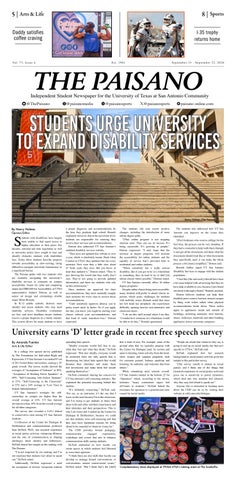
Students urge university to expand disability services
Henry Holmes /The Paisano
By Henry Holmes
S
Opinion Editor
tudents with disabilities have largely been unable to find equal access to higher education as their peers. For decades, national and state legislation as well as university policy have sought to ease and identify obstacles students with disabilities face. Today, these students describe progress towards accessibility as slow-moving, citing difficult-to-navigate university bureaucracy as a significant barrier. The Paisano spoke with two students who are currently navigating the university’s disability services to comment on campus accessibility: Junior AI, cyber and computing major and DREAM for Accessibility at UTSA representative Andrew Dotson, as well as senior art design and criminology double major Jillian Rounds. In K-12 public schools, districts must identify and assess students who may need disability services. Disability evaluations are free, and strict deadlines ensure students receive a proper diagnosis in a timely manner. This system allows for many students to have
a proper diagnosis and accommodations by the time they graduate high school. Rounds explained, however, that at the university level, students are responsible for ensuring they receive their services and accommodations. Dotson also addressed UT San Antonio’s outdated disability services website. “They have not updated this website in over a year, which is absolutely insane. Back when I started at UTSA, they updated that site every semester. Now were they a little slow about it? Yeah, yeah, they were. But you know, at least they updated it,” Dotson stated. “They’re just showing the world that they really don’t care. They’re not going to provide updated information, and there are students who rely on this information.” Once students are approved for their accommodations, they must manually reapply each semester for every class to receive those accommodations. “Until somebody approves [them], you’re pretty much stuck in limbo. So if you apply too late, you know you might be starting your classes without your accommodations, and that kind of sucks transition-wise,” Dotson expressed.
The students did note recent positive changes, including the introduction of more online degree paths. “[The] online program is not stopping anytime soon. They can see its success. It’s being successful. It’s growing in people,” Dotson expressed. “I only hope that the increase in degree programs will increase the accessibility for online students and the equality of service that’s provided both to residential and online students. “When somebody has a really serious disability, like if you got to be in a wheelchair or something, they do tend to try to shift [to] online classes where possible,” Dodson stated. UT San Antonio currently offers 16 online degree programs. Despite online classes being more accessible, many students still prefer to attend classes inperson, which poses challenges for students with mobility issues. Rounds noted that since her left hand has atrophied, she experiences difficulty opening heavier non-automatic and classroom doors. “I do see this stuff around where I am like, ‘I wonder how someone in a wheelchair would be able to do this,’” Rounds questioned.
The students also addressed how UT San Antonio can improve on the issues they identified. “[For] freshmen who went to college for the first time, the process can be very daunting. If they had a counselor to help walk them through it and get all the documents, tell them what the documents should look like or what documents they specifically need, it can make the whole process a lot [more] simplified,” Dotson said. Rounds further urged UT San Antonio Disability Services to engage with the student population. “I feel like [the university] should have been a bit more helpful with advertising that they do have help available to you, because I just found out about it through a friend,” Rounds asserted. Dotson believes students can help their disabled peers remove barriers around campus by filing work orders online when physical accommodations break down. These orders apply to appliances inside and outside of buildings, including automatic door buttons, chairs, walkways, handrails and other building appliances across university campuses.
University earns ‘D’ letter grade in recent free speech survey By Amanda Fuentes Arts & Life Editor
In a college free speech survey published by The Foundation for Individual Right and Expression, UT San Antonio was ranked 67 out of 261 United States universities, earning a ‘D’ grade overall. The survey results showed the averages of “Acceptance of Violence” at 30%, “Acceptance of Shutting Down Speakers” at 69%, “Self-Censoring with Fellow Students” at 23%, “Self-Censoring in the Classroom” at 27% and a 24% average in “Low Trust in School Administration.” UT San Antonio’s averages for selfcensorship on campus are higher than the overall average at 43%. UT San Antonio deviates less than 10% from the overall average for all other categories. The survey also revealed a 4.45:1 liberal to conservative ratio among UT San Antonio students. Co-Director of the Center for Dialogue & Deliberation and communications professor Sara DeTurk, Ph.D., has research experience in social justice activism, intergroup alliances and the role of communication in shaping ideologies about identity and differences. DeTurk shared her insight on the ranking with The Paisano. “I’m not surprised by our ranking, and I’m not surprised that students feel afraid to speak out,” DeTurk stated. Additionally, DeTurk expressed a need for acceptance of diverse viewpoints without
spreading hate speech. “Ideally everyone would feel free to say what they feel and what they think,” DeTurk expressed. “But also ideally, everyone would be protected from not only speech that is threatening, but [also] hate speech that would threaten their identities and make them feel unwelcome and make them feel unsafe speaking themselves.” DeTurk continued, sharing her concern for UT San Antonio’s self-censoring statistics. She explained the potential reasoning behind this statistic. “It’s definitely concerning,” DeTurk said. “For me, as an instructor, it’s the one that I focus on the most because I’m in the classroom, and I’m trying to get students to share their ideas with each other and their experiences and their identities and their perspectives. This is why Lori Louis and I started up the Center for Dialogue & Deliberation, because we could see that students were self-censoring and that they may have legitimate reasons for being afraid to be canceled or whatever it may be.” The CDD provides formal pedagogy, extracurricular engaged experiences, workshops and events that aim to enhance communication skills among students. DeTurk elaborated on how faculty can create spaces in which students feel liberated to voice their opinions. “I think there are also skills that faculty can develop to manage heated conversations or conversations around controversial issues,” DeTurk stated. “But I think that’s the [skill]
that is kind of easy. For example, some of the ground rules that we typically propose with the Center for Dialogue [are]: be curious and open to learning, listen actively from the heart, show respect and suspend judgment, look for common ground, balance speaking and listening, be authentic and welcome that from others.” While outranking most schools overall, UT San Antonio landed in the bottom 25 for “Openness” which, according to the survey, indicates “many contentious topics feel off-limits to students.” DeTurk linked the resistance for openness to a generational issue caused by social media.
“People are afraid that whatever they say is going to end up on social media, but that isn’t specific to UTSA,” DeTurk said. DeTurk explained how her research background in social justice activism gives her insight to this particular survey. “[The survey result] is related to social justice, and I think one of the things that [research experience in social justice activism] gives me is sensitivity to power dynamics, which feed into why students feel silenced, why they may feel afraid to speak out.” Anyone who is interested in learning more about the CDD can do so by visiting their website at colfa.utsa.edu/dialogue.
Melanie Melchor/The Paisano
Complementary items displayed at TPUSA-UTSA’s tabling event at The Sombrilla.
2 | n e w s@p a i sano-online.com
NEWS
Se p te mb e r 1 5 - Se p te mb e r 2 2 , 2 0 2 6
Mayor Jones discusses budget cuts amid $158 million deficit By Elia Naz Contributor Mayor Gina Ortiz Jones discussed key issues related to San Antonio’s budget deficit and public services at her most recent Mayoral Town Hall meeting in District 10 with Councilman Marc Whyte. Jones spoke out against the proposal to cut $940,000 from the San Antonio library, which would dissolve 39 positions. “Because what did we just see with this storm? That’s not just the library. What is that? That’s a cooling center, isn’t it? During the winter freeze, that’s also a heating center,” Jones said. “We have a literacy crisis in the country, and certainly in this community. So we are not going to defund the very things that are nice to have.” During the conversation about the San Antonio budget, Jones suggested taking money from Fiesta and reapportioning it for the library. Suggesting that this way San Antonio is able to prioritize their money into fundamental things that strongly benefit the community. “$700,000 in subsidies in the budget for Fiesta. I would take that. I would apply it to the library,” Jones stated. Jones also brought up the threats Gov. Greg Abbott made about a potential CPS funding
State of the City: Week of 9/15
cut during his Texas Gubernatorial campaign. Jones said that if the cut happens, San Antonio residents could face financial consequences. “On average, each year we get about $500 million from CPS into the general fund; that’s how much of a significant contributor they are,” Jones said. Jones explained that for a couple of years, the council signed a plan to establish the UT San Antonio School of Public Health. In its last fiscal year, the city gave $2 million to help develop the school. She noted that UT San Antonio’s operating budget is $975 million. With a budget that large, Jones speculated on whether they need the additional $2 million and whether that money could be reallocated to other public health sectors. “So that’s why folks want to extend it. I have said, I don’t support extending it. I think it’s done what it needs to do,” Jones said. Jones explained that the Midtown Tax Increment Reinvestment Zone was created decades ago to attract tourism. The TIRZ sets aside any increase in property tax generated by new developments within an area and reinvests it in the same district instead of sending it to the city general fund. Jones suggested that instead of allocating that money back into the district, they should return 12 million dollars to
Thunderstorm brings power outages to Bexar County
In East Bexar County, a severe weather storm has resulted in power outages. An estimated 1,900 residents were left without By Johnpaul Buwule power on Sept. 11. The storm produced Marketing Manager golfball-sized hail with damaging wind reaching up to 60 mph. Between Converse Not subscribed to local news but still want and Kirby, hail rained down on the East to stay up-to-date on the happenings around Side of San Antonio. Residents located town? Look no further. Highlighting notable in parts of downtown, Alamo Heights, stories from external San Antonio news sources, State of the City summarizes the most Kirby, China Grove, Lone Oak and St. captivating news headlines of the week. Topics Headwig received severe storm warnings. this week range from power outages in East The thunder storm dissipated around 10:55 Bexar County related to stormy weather to a p.m. and the weather storm app issued no hit-and-run car crash. further alerts.
Texas explores three-year bachelor’s degree programs By Hazel Barksdale Contributor
Gov. Greg Abbott ordered the Texas Higher Education Coordinating Board to form a working group to develop recommendations on creating accelerated three-year bachelor’s programs at Texas universities. In an Aug. 26 press release, Abbott cited improving the affordability of a college degree as the main reason for this direction. Abbott specifically directed the THECB to focus on developing accelerated degree paths in high-demand and high-paying fields like cybersecurity, information science and nursing. Accelerated degree plans would be offered at all public universities in the state and would require about 90 credit hours instead of the usual 120. Abbott maintains that shortening the required time to complete a degree would allow students to save money on education and living expenses for one year. He intends for the accelerated degree plans to emphasize preparing students for the workforce. “Higher education in Texas in particular will be more focused on outcomes for students, ensuring our students will be leaving with more than just a degree. They’re going to be leaving with a skill set that’s very valuable in our state,” Abbott said. Currently, the six-year completion rate for a bachelor’s degree at UT system universities is 71%. The six-year completion rate for UT San Antonio is 65%, including degrees awarded by UT San Antonio and transfer universities in Texas. Abbott’s proposal shortens the time required
no
ms /The Paisa
Baushah Ada
for a degree by eliminating free elective credits. But this may not be possible for all majors, as some degrees do not include free electives. For example, the electrical engineering major at UT San Antonio requires 93 credit hours of engineering and STEM-specific classes and prerequisites, not including the university core curriculum requirements. There are not 30 credit hours worth of electives to eliminate from that degree. Higher education officials have also expressed concern that majors requiring clinical or internship experience, such as nursing, may also prove challenging to fit into a span of three years. A growing number of states are developing three-year bachelor’s programs, but this trend is not universal. In June, Connecticut lawmakers rejected a proposal to allow their state’s public universities to offer three-year programs. Connecticut State Sen. Derek Slap, who voted against the proposal, expressed concern that shortening bachelor’s degree programs would make them less valuable. “Are students and society better off if things like electives, study abroad, capstone projects, other enrichment opportunities are all scuttled to join the workforce a little faster?” Slap said. The THECB’s recommendations are due to the governor’s office by Dec. 31. After that, state legislators will have to agree to make statutory changes before universities can implement three-year pathways. If all goes according to Abbott’s plan, accelerated programs could be available as soon as next fall.
the city General Fund. “When you live in our city, and if you live south of Highway 90, your life expectancy is 20 years lower than if you live north of Highway 90. You’ll have to excuse me if I don’t think the best use of our property taxes is an animal hospital at
the zoo. When we think about the best use of our property taxes and who gets and who goes without, we’ve got to prioritize differently,” Jones said. A Public Comment Session will be held at the Municipal Plaza Building on Sept. 16 from 5-7 p.m. Fill out the form at saspeakup.com/KU61620 to request to speak.
Melanie Melchor/The Paisano
Mayor Jones speaks at the District 10 Town Hall with Councilman Marc Whyte.
Quilt auction to support families across Alamo City
Student survives hit and run
The Greater San Antonio Quilt Guild will host an online auction to support its charitable giving. The organization’s mission, to expand and stimulate individual passion for quilting, has prompted them to auction off their material. The guild’s quilt auction works to support youth at Roy Maas Youth Alternative Service. RMYAS provides counseling services and resources to displaced youth in San Antonio. In addition to all proceeds accumulated through the auction, the guild gives over 75 quilts to the organization. The auction will run from Sept. 17-20.
As UT San Antonio Student Amythyst Delgado drove home on Highway 151, a white truck collided into her vehicle. The crash occurred on Sept. 3, and the impact of the collision caused her vehicle to crash into the car in front of her before hitting a guardrail. The student was able to crawl out of her car through the shattered passenger side window. The driver of the white truck sped off. However, Delgado reported suffering minimal injuries. SAPD are still on the hunt for the driver, and they believe that the white truck sustained damages in the crash.
3 | o p i n i o n @p a isano-online.com
Se p te mb e r 1 5 - Se p te mb e r 2 2 , 2 0 2 6
OPINION
d/ me o Ah isan r e a ah e P E-S Th or-
No
San Antonio fails its students
Editorial
T
he San Antonio metropolitan area boasts a higher education population of over 140,000, yet cannot scrape together a good enough idea to stop itself from floundering. As UT San Antonio continues to make history through its merger, research and ever-expanding campus, the city is setting records of its own — third in national poverty rankings and a $158 million budget deficit. With so much growth on the horizon, San Antonio must embrace its academic core to mend the economic and infrastructural damage that continue to permeate through the city. A city partnering with universities is not a new idea; universities, after all, exist as their own hubs of research, data and passion. Through opportunities such as UT San Antonio’s CityMester program or organizations like VOICES, students are constantly engaging with and aiding their communities. However, no matter how many times students weave through
San Antonio highways, they will never be able to stitch together the city on their own. San Antonio still remains one of the most segregated cities in the nation. Red lining has left large swaths of the population impoverished, a condition the city has not been able to remedy in over 100 years. With costs rising and an imploding budget, San Antonio cannot afford to swat away a helping hand. Houston and the University of Houston successfully addressed a similar economic disparity by establishing the Stimulating Urban Renewal Through Entrepreneurship program. The program groups business owners with students to create functioning business plans. The program effectively played a hand in launching or expanding 800 local businesses, leading to its adoption across multiple campuses. Although UT San Antonio opened a SURE program of its own in 2024, San Antonio does not operate as a community partner. Such a partnership should be trivial, especially since it happened before. In 2020, the city, university and local business
giants created the R&D League to address local issues. After four years of successful research, the initiative was abandoned and Mayor Gina Ortiz-Jones has proposed reducing city funding to the university — costly, short-sighted mistakes. Between one of the largest metropolitan student bodies in the nation and a blossoming businesses sector, San Antonio is well situated to become a research and development powerhouse. While it can be difficult to pair academic and municipal groups together, collaboration has consistently proven effective to enable a city to tap into university resources and expertise. Students are simultaneously able to provide much-needed ideas, while gaining valuable early-career experience themselves. Through its various programs, UT San Antonio has clearly expressed its desire to aid the city. If San Antonio wants to end the trend of heartbreaking records, it must swallow its pride and ask for help. The city will continue to grow regardless; the only choice is whether San Antonio will allow its poorest to benefit.
University paralyzes free speech rights Encourage 9/11 classroom empathy Commentary By Adam Theoderic
Commentary By Edmond Cartagena Staff Writer
Tragedies are inevitable. Yet, studies have shown that as time passes, the details of horrific events from the past are forgotten. This trend is problematic due to the popular belief that traumatic events are remembered to prevent them from happening again. Despite this trend, teachers need to keep the memory of 9/11 alive, well and accurate through lesson adjustments to fit the minds of youth. In this day and age, K-12 school teachers are struggling with how to teach the tragic event of 9/11 to Generations Z and Alpha — a class of students that never witnessed the direct repercussions of the gloomy September day in 2001. Students in schools view the attack on the Twin Towers as history rather than an event that occurred in their lifetimes. Instead of harboring respect for the lives lost, jokes about the event circulate online, essentially watering down the truth of the matter. It may be difficult for teachers who experienced 9/11 firsthand to teach this event to students who have never experienced mass tragedy. Many students feel that the attack was surreal, as two planes crashing into massive skyscrapers seems like something only witnessed in movies. This makes it challenging for young learners to accept the attacks as reality, even though some may have family members who experienced direct trauma as a result of the terrorism. In line with current teaching methods, the best way to teach students about 9/11 is to keep lessons on the topic concise, empathetic and factual. These students thrive by learning with interactive technology and by consuming short-form content; therefore, older methods of learning are hardly beneficial. Gen. Z and Alpha learn best in fast-paced environments, as they are digital pioneers who have access to a plethora of information through their tablets and cell phones. These students typically have open minds as well, making it important to teach lessons based on inclusivity. To help students learn about 9/11 from a serious perspective, they should be exposed to stories of people from different backgrounds who were deeply impacted by the event. Keeping intergenerational differences at the forefront will help educate new generations about 9/11 without desensitizing it. Furthermore, relating the attack to current tragedies such as school shootings, political unrest and violent racial inequity may also help shed light on the adverse effects of 9/11 that are permanently seared into the minds of all Americans who lived through its happening.
Contributor
The manner of which free speech is treated at UT San Antonio fosters contempt on both ends of the political spectrum, leaving each side equally dissatisfied. Though using the terms left and right oversimplify complex political ideologies, the division between these groups is apparent. Such strife comes from student’s inability to organize either due to individual reluctance or institutional policy. As a result, free speech at UT San Antonio is not particularly free or thoughtful. To start, UT San Antonio exhibits a free speech score of a “D” according to the Foundation for Individual Rights and Expression. A reason for the low score can be explained by how Texas handles free speech on campuses, especially pertaining to antisemitism. The failed of House Bill 2102 and the increasing difficultly that pro-Palestinian student activists face only exacerbates the discontent that the political left feels towards the federal government. As the proPalestine movement becomes increasingly associated with the Democratic platform, liberal students will get more pushback from federal institutions if they identify themselves as proPalestinian. T h i s pattern is especially concerning considering that UT San Antonio students tend to lean more to the left than right. A byproduct of this pattern is an obvious distrust in the institutions that propose, enact and enforce policies such as the ones that restrict pro-Palestinian activism on campus. This is not to say that the Palestinian question is the only question that defines one belief — ideology is much more complex. Thoughtful debate cannot happen due to the fact debate and protest behind America’s involvement with Israel
is simply not allowed to develop on both sides of the political equation, which leads to any nuanced opinions on campus being smothered in the crib of intellectual consciousness. Nuance can only come from questions that deserve it. However, when examined more closely, there is an underlying irony when both sides of the spectrum are juxtaposed to each other. A conservative student might want to express sympathy for the death of Charlie Kirk but fear exclusion from other students; a liberal student might try to organize awareness for the death of Gazan children and yet face consequences from UT San Antonio due to its policy on antisemitism. Both situations yield the same result: both sides are unable to organize effectively, stifling any sort of debate or solution. Students on the left feel like they cannot express their beliefs because of school policy, while students on the right feel as if they cannot express their beliefs due to social pressures. Therefore, UT San Antonio receives its F score for its political tolerance. The individual must accept the responsibility of political partisanship. Both sides need to understand the sobering reality that free speech is not done for the sake of free speech, and that protest is not done for the sake of protesting. The reality is that the First Amendment rights are there for the protection of the country’s freedom, and exercising them is meant to resolve national issues no matter how divisive or controversial they may be.
Amie Schneider/ The Paisano
Se p te mb e r 1 5 - Se p te mb e r 2 2 , 2 0 2 6
4 | o p i n i o n @ p a isano-online.com
OPINION
Texas A&M says no to woke
Fraternities lust for degradation
Commentary By McKenzie Siller Staff Writer
Commentary Noor-E-Saher Ahmed/ The Paisano
Academic studies took another hit when Texas A&M cut more than 250 classes from its core curriculum, claiming that the classes are “nonessential” and are “turning us against each other.” In reality, what is really turning the people against each other is the ignorance that has led to the elimination of these classes. Christian Collins, founder of Texas Youth Summit, stated that “These classes can still be taken as electives, but they should not be part of the core curriculum.” The courses being demoted include subjects pertaining to LGBTQ+ studies, ethnic studies and climate change. This deprioritization is a problem; these classes are now electives and nonrequirements for Texas A&M students to graduate. Unless interested enough to seek out on their own, students will not get the exposure to the realities of their fellow man. University officials are claiming that this is not a politically backed decision — they are just following the law. However, LGBTQ+ issues are inherently political. The ethnicity of other people and their culture has been political. The topic of climate change has been political. The moment Texas A&M decided these courses were unnecessary to fill the mandatory syllabus marked this as a political decision. Texas A&M is now harboring an environment of ignorance. It is bad enough that schools are stripping history books of substance, turning them into a collection of tales that frames Americans as the saviors. Now Texas A&M is continuing the lack of cultural information but in a different font. Making lectures that teach perspectives beyond that of the conservative worldview is a measly class to fill out schedules. Texas A&M is shifting focus from these classes and is white-washing their entire curriculum, while simultaneously setting students up for failure. Making valuable information about different communities non-essential for graduation. Texas A&M cut these classes under the guise that they were ensuring their curriculum prepared students for life post-graduation and the work force. However, the work force is a multi-cultural space. Having a general basic courtesy towards cultures different from a person’s own can greatly improve their working environment. It can enhance communication, lead to global awareness and foster creativity and innovation. Because Texas A&M has removed these courses, it has put students at a disadvantage. The university has condemned students to a career of hardship. Texas A&M ignorantly deleted classes that informed students of realities beyond their own, reducing them to nothing but a way to fill a slot in their school calendar. Texas A&M is continuing the growing trend of withholding education. Unless schools see the light, Texas A&M will not be the last.
Have something to say? Write a letter to the editor
THE PAISANO Editorial Board
Audrey Villar | Editor-in-Chief Editor@paisano-online.com
Regan Williams | Managing Editor
By Jacob Garcia
Manager@paisano-online.com
Contributor
If students like being hazed, ridiculed, tortured or punished for fun, or enjoy spending large amounts of money just to be accepted, they are in luck — that is what frats are all about. Fraternities are embarrassing in 2026; the whole idea of pledging to traditions and assimilation sounds excruciating, exhausting and, for lack of a better word, uninteresting. The cultural core of fraternities is to join a brotherhood, have common goals and values and to try to expand one’s social network. However, this generation is known to be more skillful, resourceful and independent. That being said, Generation Z holds a strong regard to their beliefs, identity and self representation. With this generation having fewer partiers and heavy drinkers, those that do like to party feel the need to be in a frat to have a good time. The percentage of fraternity enrollment went down by 15% to 60% across major U.S. fraternities, compared to 2016. The high expenses that go into joining a fraternity is another factor why many students do not see the value in being a brother, with costs averaging from $3,314-$8,815 per term. This price does not include the initial tuition. Money is of high value in this day-in-age, and students should try to save as much of it as possible to invest into their future. Students should not feel the need to wastefully spend on fraternities, when they have the vast technology to be a part of something online or some kind of club in school. The low Greek life membership continuing every year showcases the way this generation perceives these types of communities. However, it is very unlikely that Greek life will ever truly go away. Instead of finding a genuine or sincere community, connections or friends, a frat makes students pay for them, making them part of a tradition that they will one day grow out of. Maybe in the early 2000s, most students would be thrilled to join a frat, but with the help of the internet, students can gain insight into the reality of Greek life and explore other communities that can benefit their interest. Sometimes a pledge can even pay for friends to kill them. Just recently, on Feb. 2, an 18-year-old student at Northern Arizona University was killed due to a rush event. The rush event had taken place at a Delta Tau Delta off-campus housing where the group had been drinking leading up to the 18-year-old’s death. When the members of the frat were questioned, three members were accused and arrested later to be charged for his death. Not all frats succumb to this kind of lifestyle. However, the extremeness, the pledging, the financial cost as well as the overall idea can seem quite unwanted. Today, students can clearly see what kind of communities they should choose to leave behind or be a part of.
We encourage you to communicate with The Paisano through Letters to the Editor. These letters are a way to express your views about The Paisano’s content or UT San Antonio. Names can be withheld upon request.
Hallie Lott | News Editor News@paisano-online.com Henry Holmes | Opinion Editor Opinion@paisano-online.com Amanda Fuentes | Arts & Life Editor Arts@paisano-online.com Brad Millwater | Sports Editor Sports@paisano-online.com Cameron Carter | Web Editor Web@paisano-online.com Blue Mize | Photo Editor Photo@paisano-online.com Sarah Quintanilla | Graphic Editor Graphic@paisano-online.com Noor-E-Saher Ahmed | Multimedia Editor Multimedia@paisano-online.com Valentina Quintanilla | Magazine Editor Magazine@paisano-online.com Karis Vickers | Social Media Editor Socialmedia@paisano-online.com Jaclyn Banda | Business Manager Business@paisano-online.com Jennifer Rochester | Distribution Manager Distribution@paisano-online.com Emma Cavanaugh | Ads Manager Ads@paisano-online.com Johnpaul Buwule | Marketing Manager Marketing@paisano-online.com Eric Balderas | Copyediting Coordinator Copyediting@paisano-online.com
Staff Edmond Cartagena | Staff Writer Nalani Cox | Staff Writer Marisela Cruz | Staff Writer McKenzie Siller | Staff Writer Cooper Bryant | Staff Photographer Melanie Melchor | Staff Photographer Aiden Moreno | Staff Photographer Catherine Salonga | Graphic Artist Amie Schneider | Graphic Artist Tre Torres | Graphic Artist Baushah Adams | Contributor Hazel Barksdale | Contributor Daniel Cortez | Contributor Arnaldo Deane | Contributor Jacob Garcia | Contributor Lou Huh | Contributor Walid Iqbal | Contributor Venus Cardenas | Contributor Daniel Luna | Contributor Elia Naz | Contributor Brooke Rodriguez | Contributor Adam Theoderic | Contributor
Advisory Board Regan Williams/ The Paisano
Send your letters to opinion@paisano-online.com
Kirk: Counting or not counting bigotry Commentary By Walid Iqbal Contributor
Ar
Charles James Kirk is a household name. Most have seen the AI-generated images of Kirk’s face on someone else’s or childish “gotcha!” clips on social media. Since his assassination, many have held him up as a hero and martyr who fought for his beliefs. However, these unaware admirers neglect to actually delve into his divisive rhetoric: racism, sexism, ignorance and, ironically, political violence. Kirk was not a hero nor a martyr; he was a deplorable man who gained a following by preying on vulnerable populations. In 2016, Kirk founded the Professor Watchlist, an organization that encouraged students to publicly shame their teachers for their leftleaning stances. Many professors listed on this site received rape and death threats. This site was not taken down until Sept. 8 of this year, and professors continue to receive threats from their presence on the site. When President of Turning Point USA’s UT San Antonio chapter Madeline Crumling was asked about this project, she stated, “I can say as a conservative who has experienced professors targeting me personally for being a conservative, that something like that is actually beneficial to students.” Yes, the site used by radical extremists to target teachers for using their First Amendment right is actually beneficial to students because it helps them feel more validated in their bigoted ideas when there is no pushback or conflicting viewpoint. It is hard to think of a single way that such a deplorable movement could be beneficial to anyone, let alone students. Kirk and his team had also consistently advocated to suppress minority rights. He went as far to say that “We made a huge mistake when we passed the Civil Rights Act in the 1960s.” There could not possibly be a bigger sign of his lacking education and prideful ignorance than that. His argument asserted that the prohibition of discrimination based on race, color, religion, sex and national origin led to a “permanent DEI-type bureaucracy.” Kirk described Martin Luther King Jr. as a hero in 2015 and a civil rights icon in 2022. However, in December 2023, during Turning Point USA’s America Fest, Kirk declared that “MLK was awful. He’s not a good person. He said one good thing he actually didn’t believe.” This is an egregious interpretation of who King was. When Crumling was asked about Kirk’s callous description of King, she claimed that “Martin Luther King was a rapist. I promise you I’m not lying; If you look it up, he’s a rapist.” Well, King was not. This claim came during a time when FBI Director J. Edgar
Hoover was actively trying to discredit King and the rest of the civil rights movement. This evidence only exists on a single handwritten note on a memo. The president of TPUSA-UTSA spreading misinformation like this is deeply troubling and seems to be motivated only by Kirk’s distasteful words. This wilful ignorance is the exact thing Kirk fostered amongst his audience — that his word is the immutable truth. Kirk also took a strong stance against affirmative action, labelling it as “stealing a white person’s spot to be taken seriously.” However, studies continuously prove that students admitted by colleges using race-conscious admissions had higher graduation rates and higher lifetime earnings compared to those that did not. The Brookings Institution analysis on minority students and affirmative action proved that placing minority students in more selective schools does not actually affect their academic performance or graduation likelihood as Kirk and his cronies have liked to say. Any amount of research would have been enough for Kirk to know that affirmative action is not actually harming minority students. He did not bridge the gap as many Kirk-pologists claim, but rather, he decided to spread misinformation. Continue reading at paisano-online.com Cooper Bryant/ The Paisano
Diane Abdo | Advisor Stefanie Arias | Advisor Corey Franco | Advisor John Helton | Advisor Mason Hickok | Advisor Jack Himelblau | Advisor Steven Kellman | Advisor Sandy Norman | Advisor Chloe Williams | Advisor Jasmine Williams | Advisor
Follow Our Social media
Instagram: paisanomedia Sports Instagram: Paisanosports X: Paisanosports TikTok: thepaisanoUTSA Youtube: ThePaisano The Editorial is the official opinion of The Paisano editorial board. Commentaries are the opinion of the individual writer. The Paisano is published by the Paisano Educational Trust, a non-profit, tax exempt, educational organization. The Paisano is operated by members of the Student Newspaper Association, a registered UT San Antonio student organization. The Paisano is NOT sponsored, financed or endorsed by UT San Antonio. New issues are published every Tuesday during the fall and spring semesters, excluding holidays and exam periods. The Paisano is distributed on the UT San Antonio Main and Downtown Campuses. All revenues are generated through advertising and donations. Advertising inquiries and donations should be directed to: 14526 Roadrunner Way Suite 101 San Antonio, TX 78249 Phone: (210) 690-9301
na
D ldo
ne ea
/T h
isano ePa
© 2026 The Paisano The University of Texas at San Antonio’s Handbook of Operating Procedures states in 5.03 that: The University of Texas at San Antonio (UTSA) will not exercise control over the format or content of Student Publications, but will regulate distribution on campus. Student Publications will be free of censorship and advance approval of copy, and their editors and managers are solely responsible for editorial and content policies and decisions.Editors and managers of Student Publications will not be subject to arbitrary suspension/ expulsion or removal from their positions within a Registered or Sponsored Student Organization (Student Organization) by the University because of student, faculty, administrative, or public disapproval of editorial policy or content. Student Organizations that distribute Student Publications are afforded the same rights and privileges as Student Organizations that do not distribute Student Publications.
The University of Texas at San Antonio assumes no responsibility for the contents of this publication. The opinions expressed herein are not necessarily those of The University of Texas System, UT San Antonio, or of UT San Antonio’s faculty, staff or students.
5 | a r t s@p a i sa n o-online.com
Se p te mb e r 1 5 - Se p te mb e r 2 2 , 2 0 2 6
ARTS & LIFE Sombrilla hosts student super-s super-stars tars By Lou Huh
U
Contributor
TSA School of Music kicked off the new school year by showcasing their musical talents in the Sombrilla Plaza. The showcase was an opportunity for the concert band, jazz band and choir ensembles to showcase their piece “prism style.” Every subsection performed back to back, allowing the audience to get a glimpse of each ensemble. The show also allowed the music directors to meet new students and scout potential newcomers interested in joining the team. Director of Bands and Associate Professor of Music Ron Ellis, M.M. offered history on the event. “About seven or eight years ago, all of the school of music thought it would be a good idea to get the large ensembles together and do a free outdoor concert for the university to show everybody what we’ve been working on,” Ellis explained. The concert displayed the diverse programs offered by the school of music with
performances from the concert band, jazz band and choir, filling the plaza with mellow tunes. Hundreds of audience members, including family and friends of performers and even passing students gathered to view the first performance of the year. Freshman health and society major Athena Navarro detailed her first experience playing in the university’s concert band. “I really enjoy sitting in the middle of the arc and absorbing the sound of the band,” Navarro explained. “It is very pleasant to hear and it makes me feel like I’m part of something big.” Navarro explained that she has been part of a band and played the euphonium since the eighth grade. Her deep passion for playing paired with her years of band experience from eighth grade all the way through high school motivated her to join the concert band at UT San Antonio. Before her first big performance, Navarro expressed excitement rather than nervousness. Playing her instrument surrounded by fellow artists who share the same dream and passion allowed her to truly immerse in the joy of performing rather than doubt or fear. Junior global affairs major Isabella Carreon
voiced her pride and admiration for her best friend, who was performing in the show. “I came to watch my best friend perform, and I’m so proud of her,” Carreon admired. “I really liked the choir a lot as well, especially their first song, ‘The Alma Mater.’” Carreon also explained how the warmth a n d love in the atmosphere makes these performances a transcendent campus tradition every year. After their successful performance, the directors shared their concert and performance schedule for the semester. All students interested in immersing themselves in the musical excellence of UT San Antonio can watch the ensemble at one of their many performances, with the next one being at the recital hall featuring Tambores del Pueblo on Sept. 14th, 7:30 p.m.
Lou Huh/ The Paisano
Bikini Kill spews feminism at Levitation By Tre Torres
By Amanda Fuentes Arts & Life Editor
Daddy satisfies with coffee By Venus Cardenas Contributor
Caffeine Daddy is a coffee truck that has taken its own sensual twist on customer service. The San Antonio coffee spot is not operated by typical baristas. Instead, it is run by attractive, muscular young men in aprons for shirts. Right away, the daringly seductive concept makes the steamy caffeine truck stand out from a typical coffee run. When visitors arrive, there is a high probability you lose your train of thought when seeing these daddies. The most welcoming experience comes from the manager, or the Main Daddy. The Main Daddy, James Johnson ensures that customers feel welcome. The atmosphere is relaxed but complemented by an energetic feeling that matches the business’ spicy personality. Caffeine Daddy further highlights its provocative personality in its menu, which features suggestive drink labels like “Brown Sugar Papi,” “BBC” and “Cinnaballs,” which can be found on their Instagram and features. The names are sure to catch attention and inspire curiosity when viewing the menu. One of their most popular items, the “Easy White Chocolate,” mixes caramel and white chocolate. The coffee is divine and, honestly, better than Starbucks. The drink is sweet, but not overwhelming, tasting more like a treat than a regular cup of coffee. The presentation matches the raunchy personality of the business. Cups are decorated with provocative stickers, and customers drink from detailed penis-shaped straws, making the drinks even more satisfying. Customers, be warned that when asked “Do you want backshots?” the
daddies are referring to cold foam. T h i s m a y not be a question c o f f e e customers expect; however, moments like that are what set Caffeine Daddy apart from the average coffee truck. The sensual jokes go beyond drink names. Caffeine Daddy also offers pancake pops shaped like male genitalia on a stick. Prospective customers should come prepared to see the most cheeky, sexually enticing menu of their coffee-tasting career. Deviant humor is a key factor to the experience and Caffeine Daddy’s identity . Johnson explained more about his role as a caffeine daddy. “[Caffeine Daddy] said that they were hiring and they were looking for cute and muscles. And I was like, ‘I mean, we’ll see, I’ll go see what’s up.’ After day one, they were like, ‘So you want to be the lead barista?’ And I was like, ‘All right, bet,’” Johnson narrated. Johnson went on to discuss what Caffeine Daddy means to him. “The concept is different, but it’s not something you can’t get on a regular basis. It does bring people out, but the quality is what brings them back,” Johnson elaborated. Johnson wants everyone to feel welcomed into the shop, and he hopes to create a safe place where everyone feels comfortable with the staff. Caffeine Daddy finds its individuality in between humor and hospitality. Whether someone comes for the coffee, the atmosphere or simply to see what the hype is about, their experience will be as Cooper Bryant/ The Paisano memorable as that favorite exboyfriend. For anyone looking to switch up their usual coffee routine, Caffeine Daddy proves a little temptation is the perfect boost to get through the day. The menu may stimulate a giggle, the employees may catch a double take and the names may make one’s imagination lively, which is exactly what makes them daddy.
A sea of dyed hair and DIY outfits sat in front of the main Levitation stage in anticipation for the festival’s headliner: Bikini Kill. Levitation is an Austin-based alternative music festival. This year’s festivities were held Sept. 10-13. On the second night of the festival, the fanfavorite punk band Bikini Kill performed an energetic set. Frontwoman Kathleen Hanna took the stage in a glamorous pink, shimmery dress perfectly suited to her authoritative presence. Hanna, the queen of DIY, made the dress moments before the show. “I just made this in the f-cking mobile home,” Hanna exclaimed. “And if your best friend thinks you’re cool, you’re cool. You don’t need everyone to think you’re cool or to get what you do.” Hanna delivered a conversational performance, sharing childhood memories of creating music and silly anecdotes like how she used to think Stevie Nicks and Tom Petty were siblings. Hanna is tried and true to the punk scene. “I’m so happy to be an elder punk rock person up here playing songs with my friends that I still f-cking love, and this one is for all the other artists. Just keep going,” Hanna advised. The band then broke out into their iconic song “Feels Blind.” After the final lyrics of the punk classic, Hanna bestowed more wisdom upon the crowd. “I like to remind myself that I used to really be attracted to f-cking d-ckholes,” Hanna sighed. “You know? [They were] really competitive with me — jealous. And you can have that in best friends too, and then you’re like, ‘Jesus christ how long did you hate me for before I walked out the door?’ “But the thing that’s really cool is that as you grow and change and you have your friends to love and support you, you finally fall for the right group of friends and the right person, and it’s pretty beautiful. Getting old doesn’t suck you guys. It actually can be really really great.” Bikini Kill shows are safe spaces where everyone is encouraged to participate in the pit. “Look around you and see how much space you’re taking and make a mental note of it that a lot of people are more nervous to take up space than you are, so make room for the people behind you so they can see,” Hanna said as the crowd chanted the band’s iconic show rule “girls to the front.” Since the 90s, the “girls to the front” call has evolved into “freaks to the front” to encourage anyone who may feel discouraged from joining the pit. “We say freaks with a tone of pride and love and joy,” Hanna asserted. “Because being an outsider, you get to make your own f-cking rules, and then you get to break them and make new ones, and break them and make another one or whatever the f-ck you want. Because it’s our world and these motherf-ckers dont get to tell us who we are.” Before the show’s final song, Hanna brought Lira Mondal of
Sweeping Promises to the stage to accompany her in the show’s final feminist anthem: “Rebel Girl.” When Bikini Kill departed from the stage, the crowd was left in a catharsis, processing the excellence of the experience. Festival-goer Amani Ahmad appreciated the considerate energy from the crowd. “I feel like I’m used to people punching in the face and like getting injured [in the pit], but it was really respectful,” Ahmad said. Ahmad explained that Hanna’s “freaks to the front” chant lured her to the pit. “I went to the pit because of that. I feel like it was very empowering,” Ahmad shared. “And I feel like it got the crowd a lot looser and it got everyone excited, and I feel like that’s what everyone came here to see.” For many long-time fans, this experience followed years of anticipation. Christina Jarvis was among these fans. “I’ve been waiting to see Kathleen Hanna for more than half my life. To finally see her and Bikini Kill is amazing,” Jarvis explained. Being in Hanna’s presence was emotional for Jarvis. “I almost started crying. I might start crying right now. Then I felt bad because I’ve loved her since I was 15, and [I’ve] always heard that cry ‘girls to the front,’ and times have changed and it’s not just about ‘girls to the front,’ it is about non-binary [individuals], the ‘freaks.’ And there’s been so many f-cking moshpits in my life, and I’ve seen these cis-male sh-t heads do sh-tty things, so just [being surrounded by] people who are not cis-white males — it was worth it.” Erin Hartner accompanied Jarvis to the show, and shared a similar sentiment. “There aren’t a lot of spaces for us. I had one tonight, though,” Hartner expressed. Hanna and Bikini Kill’s empowerment can be felt far beyond their shows. Enjoying their music abroad from a festival setting ignites the same feelings of liberation that were experienced that night.
Abby Gonzalez/ Courtesy
6 | a r t s@ p a i sa n o-online.com
Se p te mb e r 1 5 - Se p te mb e r 2 2 , 2 0 2 6
ARTS & LIFE
Erin Carle transforms dreams into lucid artistic works By Melanie Melchor Staff Photographer
For Erin Carle, dreams are more than something that disappears at dawn; they serve as a source of imagery, self discovery and inspiration, shaping surrealist work that explores transformation, nature and the body and mind. Carle is a second-year master’s degree student at UT San Antonio, studying fine arts with a concentration in painting. Carle’s upbringing was entrenched in art; generations of women who shared a passion for creating surrounded Carle as a young girl. “My mom is an artist, and a lot of the women in my family have been artists, going back to my great-greatgrandmother, so it’s always been kind of a part of me,” Carle explained. Carle did
not immediately pursue painting and instead began ballet when she was three years old and explored other avenues of art. She received her attended ballet school throughout her youth. Bachelor of Fine Arts degree from Texas State “I think this idea of perfection comes up a University, with a concentration in painting. lot in my pieces,” Carle expressed. “I think that She originally was a graphic design major, definitely stems from the world of ballet.” believing this field would provide a practical While ballet is not at the forefront of her way to combine her creativity with a career. It work, it still influences some of her video did not take long for her to realize that this was projects, which explore movement and dance. not the path she wanted. Now, Carle is focused on “I quickly found that I hated surrealism, utilizing her dreams computers, and I did not want to access her subconscious. to do that,” Carle asserted. Her creative process However, painting begins before she even continued to draw her in. enters the studio. “I knew I loved “I have a little creating things, and I journal by my bed,” had this huge attraction Carle said. “I would to painting,” Carle wake up and write in explained. “I was like, it.” well, my parents might She records dreams, be upset about it, but I images, feelings and think I’m just going to phrases, sometimes try being an artist.” waking up in the Carle’s earlier work middle of the night to explored food, body scribble them down. image and the female From there, she experience — subjects searches through the that were influenced material for anything by her experiences as that sticks out to later Erin Carle/Courtesy a ballet dancer. She become the foundation
Swing Dance Society triple-steps beyond basics By Cameron Carter Web Editor
Two people dance together in Rec center.
By Daniel Cortez Contributor
Spoiler Warning A singular person can enter one’s life and completely consume it. They shape reality, actions and emotions. Defiance becomes suffocating, an insurmountable challenge even for adults. Children are the most susceptible to these kinds of people. Especially in the entertainment industry, safe guards fail, and for many child stars, childhood ends. Casper Kelly released “ B u d d y , ” starring Christin Milioti and Delaney Quinn, on Aug. 16. The eerie film is an entry in the mascot horror genre, which takes seemingly child-friendly characters and perverts them to deadly monsters. Kelly’s film parodies 90s kids’ shows, most notably “Barney.” The bright colors, anthropomorphic set pieces, catchy theme song and 4:3 aspect ratio deliver a nostalgic feeling that invites the audience to pretend that they are kids watching their
favorite show again. This false sense of safety and warmth is quickly flipped. Buddy charms the viewer into loving him before he ultimately betrays them. He controls the children’s world, lies and hurts those who defy him. He is an abuser. When Freddy, a child portrayed by Quinn, questions Buddy, the evil anthropomorphic character slowly reveals these abusive patterns. Buddy’s terror is unsettling, something the movie does not shy away from. Viewers can feel the fear of Freddy and the other children as they put the pieces together. Disillusionment is a motivating force seen in the children and Grace played by Milioti. The wide camera shots and the dull color form a muted, dark melancholic world. Grace questions her life as she spirals
Catherine Salonga /The Paisano
Cooper Bryant/ The Paisano
Warning: Buddy is coming
Catherine Salonga /The Paisano
Eyes closed, hands gently held by their lead, students follow the direction of their partner’s movements. A push or pull signals direction without words, the blind follow relying on subtle, physical cues. Break the trust and risk a stumble. The exercise, called “shopping cart,” opened Thursday’s meeting of the UT San Antonio Swing Dance Society, their second meeting of the fall semester. Senior political science major and club president Grace Rhodes demonstrated for lead during the meeting. “So [shopping cart is] a communication thing. It’s a trust thing, and it’s also a perspective thing,” Rhodes explained. “It gives leads and follows the opportunity to physically be in the shoes of the opposite position.” After rotating partners, students moved into the lesson, practicing foundational swing dance movements — rock step, inside turn and outside turn. Dancers stepped between open and closed positions throughout the meeting, rotating partners between each instruction. The lessons will progress throughout the semester, gradually introducing more difficult material. As president, Rhodes is the primary officer in charge of curriculum. “Right now we’re doing East Coast I. We’ll be doing a little bit of East Coast II and Lindy
[Hop] I, and then we’ll be offering a Charleston course,” Rhodes shared. Junior geoscience major and club treasurer Olivia Peck danced as Rhodes’ follow. Peck’s instruction addressed small variations and issues like a lead’s hand being positioned too low on a follow’s back, creating one of UT San Antonio’s most respectful groups of men. “We always emphasize that [swing dance] is not inherently romantic,” Peck highlighted. “You have to have that pillar of being comfortable before you can enjoy dancing.” At the end of the lesson, students gathered around the floor for the social dance. “I have two rules for the social dance circle. The first rule is it should not be silent. I need everybody to make noise. You can clap on the twos and fours. You can holler. You can cheer,” Rhodes gushed. “My second rule is that when somebody leaves the circle, we have to fill in that gap. We’re not going to leave any gaps for the energy to dissipate.” Ending meetings with the most exciting part leaves dancers wanting more. Luckily, the club has many upcoming events. The organization will host a karaoke social at 6 p.m. on Friday, Sept. 25 with a location to be announced on their social media. The club also joins social dances hosted by the San Antonio Swing Dance Society on the second Saturday of each month — the next is scheduled for 7 p.m. on Oct. 10 at Bright Coffee which students can attend for $5 with their student ID. Sophomore physics major and the club’s administrative officer Rachel Keller especially enjoys attending the social dances. “[At social dances] we get to meet many people who have been dancing for a long time, and you can learn so much from them. When I went to my first social dance, I was nervous and completely new to any kind of dancing,” Keller detailed. “[Other dancers] gently led me through the motions and in just one dance, I learned so much.” Students interested in joining are encouraged to start early in the semester when lessons are at their least complex. Questions should be directed through their main forms of communication: GroupMe and Instagram, @utsaswingdance.
of a painting. “I am picking out imagery, feelings and things, and then in my mind, I am creating these paintings,” Carle expressed. Unlike her previous approach to art, today, Carle does not begin with a predetermined message. Instead, she accepts symbolism as it comes and interprets its meaning afterwards. Carle’s process draws her towards themes of women, insects and human-nature hybrids. The praying mantis has become one of her newest muses, inspired partly by her fascination with the insect and the dreams she has about them. “They eat their mates,” Carle explained. “So I think they’re coming with this idea of toxicity, but also a very strong female presence.” For Carle, art is more than a finished product. It is a way to understand herself and work through her experiences.
into disillusion and isolation. She becomes increasingly sceptical of reality and notices anomalies around her house that only she can see. Her illusions are a reprieve from the horror of
Buddy and create a grounded fear of knowing something is wrong but being unable to explain it. These clues lead her to Buddy. As the children and supporting cast become more distant from Buddy, the film pivots into more adult themes.The once organized world becomes untamed, bright colors are replaced with darker counterparts. The viewer can see this loss of childhood innocence as the children delve into rebellion. It makes the audience laugh and reminds them that they are still kids. It is a hopeful situation, in which the children believe they can escape their abuser. Escape, however, is an illusion; Buddy is in control, becoming even more cruel and the audience feels just as helpless as the children. “Buddy” is a respectable horror movie that leaves viewers with more questions than answers, giving viewers mysteries to ponder and an experience to take home. Despite some predictable plot points, the film’s mystery is refreshing. The story is an allegory for child exploitation and tackles a heavy subject matter without the viewer noticing, until it is too late. This film is deeper than just horror, Buddy is not entirely fictional. He is a depiction of real, human flaws, and without films like this, the conversation dies. Now more than ever it is important to protect the youth from monsters. “Buddy” is in theaters until Thursday Sept. 17 and is awaiting a digital release.
Lira Mondal offers insight on Sweeping Promises tour By Daniel Luna Contributor
Sweeping Promises stopped in San Antonio on the fourth night of their tour for their new album, “You Say I Romanticize.” Concert-goer Rene Mendoza compared Sweeping Promises to legendary 90s bands. “I miss that sound,” Mendoza remarked when reminiscing about the 90’s punk-grunge scene, which included bands such as Pearl Jam and Nirvana. Mendoza thought Sweeping Promises captured an authentic punk sound without selling out. Caspa began their set with fiery energy and an angsty tune that warmed up the crowd. The small stage at the Paper Tiger offered an immersive experience, as the band performed in a more intimate space separated by a small platform from the audience. Caspa is a new, up-and-coming band in the San Antonio postpunk scene. They performed songs off their
recent album, “I Hate Caspa.” Sweeping Promises bassist and vocalist Lira Mondal provided insight into how the tour has been treating the band so far. “The tour has been great,” Mondal, reminiscing about the boisterous crowd, commented. Mondal explained that her favorite on-tour activity is visiting music and record stores with her bandmate Caufield Schung. Mondal added that Sweeping Promises’ music intends to “take a stand against a system that wants to oppress you.” UT San Antonio graduate student and concert-goer Amy Vester expressed love for Sweeping Promises. Vester She was happy when she found out they were performing in San Antonio and said she was glad to “Get out the house.” Vester attended the show with Nolan Vester, her brother, who was equally as excited to see Sweeping Promises performance.
After a short intermission, Guiding Light took the stage. The second band’s sound combines post-punk and German lyricism, creating a smash-hit combo. With the band playing together for three-years, their chemistry electrified the stage as they progressed through the set. Singer Elise Cook was playful and had a dynamic voice that flowed with the backing instrumentals. The guitar performance from John Morales whipped the audience’s ears, tight and fast and was complemented by sonic waves from bassist Rachel Kirk. Guiding Light’s set was powerful and just flat out fun to jam out to. While the headliners ignited the stage, the crowd danced and cheered abundantly. Before long, Sweeping Promises took the stage. The crowd packed in for their performance. Continue reading at paisano-online.com
Cooper Bryant/ The Paisano
Caufield Schnug plays guitar at Paper Tiger Sweeping Promises show on Sept. 12, 2026.
7 | sp o r t s@ p a i sano-online.com
SPORTS
Se p te mb e r 1 5 - Se p te mb e r 2 2 , 2 0 2 6
Soccer sends Cardinals home with 3-1 defeat Ball Knowledge Pittman tops UTSA coaching leaderboard with 68 career wins By Marisela Cruz Staff Writer SAN ANTONIO — UTSA soccer formally unveiled its 2025 NCAA tournament banner before a 3-1 victory over the University of the Incarnate Word at Park West Athletics Complex on Thursday. The Roadrunners (4-0-3) had two goal highlights in the first half. UTSA soccer obtained a corner kick at the end of the 19th minute that led to sophomore defender Sofia Peters’ opening goal. Peters’ header pushed the ball to land on target just a few feet inside the goalpost. In the 40th minute, Incarnate Word forward Atiana Lara committed a foul against the Roadrunners. Sophomore midfielder Leah Varela successfully converted the resulting penalty kick for her first career goal as a Roadrunner. The Cardinals followed shortly after this with their own goal from the penalty spot, keeping UTSA fighting into the second half. Coming back in the 80th minute, Peters maintained the Roadrunners’ control of the game with another goal, securing their fourth win of the season. “I was pretty happy with one,” Peters detailed. “But two always feels good. I knew if we went up by one more goal, my sister was going to get in. This is her first game back [medically] cleared. So I really wanted that for her.” Head coach Derek Pittman made history tonight securing his 68th UTSA win, surpassing former coach Steve Ballard for the most wins in UTSA soccer history. “It’s never been about me,” Pittman asserted. “It’s always been about our players and our staff and the people we surround ourselves with. When we got here in 2018, it wasn’t this. It may have been a little bit of my vision and what I knew we were capable of. I was fortunate to come up with so many amazing coaches and players.” The Cardinals did not shy away from playing physical on defense, knocking the ‘Runners off their balance throughout the game. UTSA soccer prevailed with 29 shots overall against Incarnate Word’s eight shots. Maintaining a strategic offensive tempo, the
Roadrunners’ footwork was impeccable at keeping the Cardinals on their toes. Junior midfielder Sabrina Taber and Cardinals defender Kiana Villa had an altercation during the 16th minute with both fighting for possession of the ball. Taber’s immaculate footwork
we’re definitely getting there and I’m super excited for that.” Coming into the second half, both teams made aggressive contact in attempts to gain possession. A yellow card was called against Cardinals defender Louise Coates for Melanie Melchor/The Paisano
By Brad Millwater Sports Editor
Sophomore midfielder Leah Varela prepares to take a penalty kick in UTSA’s 3-1 victory. while threading the ball between her feet kept it in her possession to hold Incarnate Word at arm’s length. “Just the other day we were working on driving down the line, especially me taking it down the left with my speed,” Taber detailed. “If I can keep possession of the ball that’s great, or kicking it off to get a throw in is what I keep in mind. I think we are building a lot as a program; we had a really big talk the other day about playing to our best ability. I think
grabbing sophomore forward Brooklyn Bailey by the shirt, one instance in a messy game with 13 fouls for the Cardinals and 14 for the Roadrunners. “A lot of positives from tonight, and [taking them] to next week as we have one more nonconference match against a very good Santa Clara team,” Pittman said. Santa Clara University will come down to the Park West Athletics Complex next Thursday at 7 p.m.
Men’s tennis welcomes new coach Castro By Nalani Cox Staff Writer The UTSA men’s tennis team is headed towards a new era with its seventh head coach, Nick Castro. UTSA’s Vice President for Intercollegiate Athletics Lisa Campos announced the news and expressed her excitement for the new pathway of the program. “I’m extremely excited to welcome Nick Castro as our next head men’s tennis coach. During this search, it became clear that Nick not only possesses the coaching expertise to elevate our program, but also a deep commitment to the values that define UTSA Athletics,” Campos stated. Castro shared the excitement and began the press conference by explaining why he decided to take this position. “When this opportunity came up, I thought it was a great opportunity for me to step into a role that historically has had great tennis in the past,” Castro explained. “The people here were incredible. That’s the number one thing when I came here, and I was doing my interview. I thought it was really important who I surround myself with and the people who are going to be supporting me, and that was a big attraction. I wanted to feel the support not just for myself, but for my family, and to feel like I can be successful here at this program.” Previously, Castro served as the assistant
LSU case is microcosm of college sports hypocrisy
men’s tennis coach for the United States Air Castro clearly set his vision for the team and Force Academy. His coaching helped guide the his desire to bring back a winning culture. team to nine wins in the 2025-26 season. Prior “Our vision at the end of the day is [that] to his coaching at Air Force, he was the head we want to win conference and we want to coach at IMG Academy in Bradenton, Florida, be competing against the best teams in the from 2021-23. He helped prepare young conference and so that’s our ultimate goal at athletes for college athletics and professional the end of the day,” Castro declared. careers. Castro and the ‘Runners successfully began “The big key takeaway is definitely the the season on Sept. 11-13 at the 2026 Jake structure [at Air Force]. It was very demanding Frederick Memorial Islander over there in terms of high expectations and Open in Corpus Christi, Texas. holding guys to high standards; I try to bring The team went 14-1 in open that here. In order to be a successful program, singles and four players won you got to have high standards and high their singles brackets. Junior expectations for the guys,” Castro voiced. Enzo Vargas and freshman Castro has made it clear that he will Gabriel Jalouneix won use his experiences coaching at Air their respective flights Force and professional athletes to in Corpus Christi. develop the team. He has goals of where the team can improve and how this will be achieved. “I think in general for the team I would like them to be a little Sarah bit more more aggressive,” Castro Quintanilla/ “This place has had emphasized. “I would like them to look The Paisano great success in the past,” to move forward more and finish points Castro said. “They won the at the net. With eight guys on the team conference a couple years everybody has a different type of identity back. They were ranked top on the court and everybody has different 40 in the country and they’re skill sets. For me it’s to maximize that a good team and historically player’s ability and do things well and continue to do it well and to build on that and they’re a great team. This program is destined build their player identity.” to be great and I know it can be.”
The absurdity of college athletics is at an all-time high. Once preserved as a bastion of amateur athletics, universities around the nation have flipped into minor league professional sports organizations. Since 2021, top studentathletes have been making millions of dollars while attending classes and obtaining degrees. The insistence of college powers to maintain a sanctity that no longer exists defies logic and will be impossible to sustain. Last week, a scandal erupted when two football players who had participated in NFL training camps attempted to join the roster of Louisiana State University. Both Dae’Quan Wright and Zxavian Harris signed NFL training camp contracts in the offseason, but were unable to find their way on official team rosters. LSU obtained approval from a local Louisiana state court in a case against the NCAA but simultaneously threatened its existence in the Southeastern Conference, as the conference powers organized to vote the school out. Eventually, LSU stood down and filled its remaining roster spots without Wright and Harris. Conferences should prevent athletes who have exhausted their five years of collegiate eligibility from readmittance into college athletics. However, in the LSU case, Wright and Harris simply attempted to make an NFL roster in training camp. Conferences had reason to uphold strict amateur regulations when there were no salaries being earned and paychecks doled out, but that underlying principle has died in the revenue-sharing era. The only difference between an NFL player and a college football player in 2026 is who signs their paycheck. The top earner in college football, University of Miami quarterback Darian Mensah, is making an estimated $6.5 million this season and colleges can pay a maximum of $20.5 million directly to its student-athletes. The NFL only has 32 teams and 53 players on each roster, while the top tier of the NCAA holds 138 teams with 105 players on each team. In such a vast and lucrative market, employees have a right to exhaust all their options and seek gainful employment wherever they can find it. The titanic American sports industry attracts athletes from all over the world. Many college football teams feature punters from Australia who seek better profits than they found in Australian rules football. In recent years, college basketball programs have benefited from an influx of former professional players from Europe. Collegiate conferences defend a nonsensical argument when they ban players for simply trying out for the NFL, but allow hundreds of players from foreign professional leagues. Conferences are rightfully invested in maintaining the athletic product that earns them millions of dollars. Allowing players like Wright and Harris to play for LSU would enhance the product, not detract from it. Collegiate powers like the SEC have a right to ban players who forgo their eligibility by declaring for the NFL draft, but banning athletes — employees of the university — for collecting a summer paycheck is hypocritical and autocratic.
Around the world: Australia, Germany, Spain UIW INvitational By Victor Romero Contributor
AFL action ramps up in Australia The semifinals concluded on Saturday in the Australian Football League. Patrick Doss helped the first-seeded Fremantle Football Club eke out a 120-106 victory against the fifth-seeded Geelong Football Club, recording four goals, 13 disposals and one tackle. Charlie Cameron led second-seeded Brisbane Lions to a dominant win over sixth-seeded Adelaide Football Club with five goals, 13 disposals and one tackle. Both of this weekend’s victors are set to face Sydney Swans and Hawthorn Football Club, respectively. The AFL will determine its championship match between the winners of the preliminary finals this upcoming weekend. Fans eagerly await the crowning of the 2026 AFL champion on Sept. 26.
Team USA golden again
Antonelli wins big in Spain
The 2026 FIBA Women’s Basketball World Cup in Germany came to a close on Sunday with Team USA winning its fifth consecutive gold medal. Team USA faced a hungry France squad, fighting for their country’s first ever gold medal. France came out swinging and commanded the lead for a majority of the first half. France hit timely threes at an eerily similar rate to Spain, who fought Team USA close in the semifinals. France desperately tried to hold their lead to no avail, as Team USA coasted to a victory after outscoring France 30-12 in the third quarter. Forward Breanna Stewart cemented herself into basketball history, becoming the first two-time Women’s World Cup Most Valuable Player. Spain won the bronze medal in a convincing 81-58 victory over Germany.
Team Mercedes’ Kimi Antonelli collected another first place trophy to his collection in the Spanish Grand Prix on Sunday. To mark the end of this week, audiences were given an exciting Formula One race at the debut of the “Madring” track in Madrid, Spain. Team McLaren’s Lando Norris spoiled a strong start, knocking himself from first to fifth after missing a pit entry on the 16th lap. Immediately pouncing on this opportunity, Ferrari’s Charles Leclerc took advantage of Norris’ misfire and held a firm grip on the lead until late in the race. Currently, Antonelli leads the Formula One World Drivers’ Championship standings by 81 points over his Mercedes teammate George Russell in second place with 211 points. Lewis Hamilton, Norris and Leclerc continue to fill out the top five. Tre Torres/The Paisano
By Hallie Lott News Editor
Melanie Melchor/ The Paisano
Read at paisano-online.com
8 | s p o r t s@ p a i sano-online.com
SPORTS
Se p te mb e r 1 5 - Se p te mb e r 2 2 , 2 0 2 6
Aidan Moreno/The Paisano
Rivalry Restored
Junior safety Cameron Upshaw Jr. evades a tackle from Texas State quarterback Brad Jackson after an interception in UTSA’s 31-26 victory over Texas State on Saturday, Sept. 12 at UFCU Stadium.
McCown’s late-game heroics earn football’s centennial victory, first 2-0 start in five seasons By Brad Millwater Sports Editor
S
AN MARCOS, Texas — Fans can protest no longer. For the first time in three years, UTSA football defeated its rival Texas State University. Senior quarterback Owen McCown and the Roadrunner offense executed a game-winning drive for the ages to steal the victory 31-26 on Saturday at UFCU Stadium. With San Antonio’s hope in his hands, McCown converted play after play to wrestle the game from Texas State’s grasp. Facing fourth down with five yards to go, McCown found junior wide receiver David Amador II to keep the drive alive. Several plays later, UTSA faced another fourth down but McCown did the work himself, scrambling for the first down. As UTSA marched into field goal range down by two points, a placekick was all that was needed to win the game. Junior running back Brandon
High Jr. didn’t like that idea. High bounced through the Bobcats defenders and scored a 25-yard game-winning touchdown to bring the rivalry trophy back to the 210. “It just means so much to our fans, to our alumni, to our city,” coach Jeff Traylor stated. “That’s two years that trophy hasn’t been in that spot in my office, and we haven’t put a damn thing in that spot. There’s a nice warm place for that [trophy] when it gets back home.” The final drive allowed the Roadrunners to celebrate much more than a single victory. Saturday marked UTSA’s 100th win as a football program. The victory gives UTSA its first 2-0 start to a season since 2021. UTSA had lost its last three road openers entering Saturday. “We didn’t make any excuses. It was a total team effort,” Traylor asserted. “Everybody expects it in the Alamodome, but for us to go and get it on the road? I told my staff, for the first time in two years, ‘This is a group that was
made to win in that environment.’” The game flipped on a seven-minute stretch at the start of the second half. Down 10 points, UTSA converted a fourth down in their own territory and then executed a stellar trick play for a touchdown pass. McCown connected with Amador in the backfield, and the wide receiver launched a 44-yard touchdown spiral to sophomore wide receiver Mekhi Anderson. On the ensuing Bobcats’ possession, junior safety Cameron Upshaw Jr. hauled in an interception and UTSA converted a field goal to tie the game. “The message [at halftime] was, ‘We’re only down 10,’” McCown stated. “We knew what we needed to do, just trust in one another. Ultimately, that’s what we did, and it showed the way we played in the second half.” UTSA scored on just one of its six drives in the first half. The Roadrunners raced out of the locker room to score on four out of five drives in the second half, totaling 24 points.
Before the final drive, Texas State’s multifaceted rushing attack gave the Roadrunner defense fits all game long. The Bobcats recorded 289 yards on the ground and averaged 5.8 yards per carry, compared to 140 rushing yards and 4.5 yards per carry for the Roadrunners. UTSA utilized the pass game more effectively than Texas State, with 258 receiving yards compared to 192 for the Bobcats. UTSA was only 3-15 on third downs, but astoundingly went 5-6 on fourth down attempts. Junior running back A’Marion Peterson and junior tight end Brandon Young Jr. both scored their second touchdowns of the season. McCown posted a final line of 214 passing yards and one touchdown with a 67% completion rate. UTSA travels to face the University of Texas at Austin next Saturday at 7 p.m. at Darrell K. Royal-Texas Memorial Stadium.
Hockey massacres Texas State in home opener turnaround By Sarah Quintanilla Graphic Editor SAN ANTONIO — UTSA hockey kickstarted the season with the battle of I-35 against Texas State University at the Ice & Golf Center at Northwoods. Despite UTSA losing 4-3 Friday, the team came out on top with a 7-2 victory Saturday night, claiming back its home rink.
Game One First Responder Night started at 7:30 p.m. The packed barn cheered for former team captain and founders Noah Dow and Joshua Lecomte as UTSA hockey announced their jersey retirements. USMC Veteran Magan Worth represented Operation O.F.F. D.U.T.Y. as a guest speaker to honor 9/11 first responders. Sophomore forward Jackson Stubblefield was sent to the penalty box two minutes into the game. Going back and forth with the puck, patience wore thin and several scuffles led to multiple UTSA 5-on-4 power plays throughout the period. Five minutes before the period ended, freshman defenseman Wesley Abron was sent to the penalty box for roughing and causing a Texas State player to bleed. In the 18th minute and during a Texas State 5-on-4 power play, senior forward Travis Sorce evened out the scoreboard to 1-1. “It was definitely a different level for sure, definitely a lot more physical out there,” freshman forward Henry Pinkerman, first time college player, reflected. “It felt good to get my feet going, get some more chemistry going with the guys.”
Three minutes into the second period, a fistfight broke out that led to a 4-on-4. After battling for the puck for five minutes, Stubblefield was sent to the penalty box, giving Texas State a 5-on-4 advantage. Sticks breaking and pucks flying violently through the rink elevated the tension, alternating 5-on4’s consistently until the end of the period. Brutal bodychecks from both teams caused the third period to start on a UTSA 5-on-4, where postgraduate defenseman Kyle Harris took the chance to score four minutes in. After a fistfight that caused a 4-on-4 in the 15th minute, Pinkerman evened out the scoreboard to 3-3. Texas State broke the tie during the five-minute overtime period, ending the game in 4-3. “I’m just happy the boys came back and we made it into a game,” head coach James Hiebert shared. “It was our first game together. I think they came out, they played hard. I thought we outplayed them, but we missed a few key chances. And you know, at the end of the day, that’s hockey. Sometimes you win, sometimes you lose, but I think we’re gonna come back tomorrow and we’re going to be going hard.”
Game Two Ten minutes of intense struggle for possession of the puck made UTSA and Texas State break out into a fight that caused a 5-on4 favoring Texas State. The entire first period was full of saucer passes, checks on the boards and scrums for the puck. Two minutes before the period ended, a Texas State player got into a fight with Sorce that caused a 5-on-3 favoring UTSA. Freshman forward Garrett
Brooke Rodriguez/The Paisano
UTSA hockey celebrating a goal in their 7-2 win over Texas State on Saturday in San Antonio. The third period started on a 5-on-4 favoring Morris opened the scoring with 57 seconds left Texas State. Danh scored the fifth goal of on the clock, ending the period 1-1. The second period started with a stick the game two minutes in. After 10 minutes breaking and a 5-on-4 favoring UTSA. of chasing after the puck and players getting Postgraduate goalkeeper Darryll Smith froze slammed into the boards, sophomore forward the puck multiple times throughout the period. Corey Deveraux buried the puck into the net Abron got a penalty for slashing, Harris and in the 13th minute. Shortly after, Pinkerman Sorce both scored on 5-on-4 power plays and followed suit, sniping UTSA’s seventh goal of the penalty box got visits from postgraduate the night. Frustrations from Texas State arose defenseman Jordan Nolan and freshman to the point of exploding into a huge brawl that forward Nathan Danh. Abron scored with two ended in Abron, Stubblefield and sophomore defenseman Justin Trevino victoriously skating minutes left, ending the second period 4-1. “It’s interesting with Texas State.” assistant into expulsion. The game ended the I-35 battle coach Malcom Pharr contemplated. “A lot of with a 7-2 on the scoreboard. “We just played like we didn’t want to lose.” these players, they all grew up together and they’ve known each other for a long time. Morris expressed. “We played the whole 60 Off the ice, they’re good friends a lot of them, minutes and we played hard. I mean, that’s the but on the ice or not, right? It’s a big rivalry game. We deserved to win yesterday.” UTSA will head to Shreveport, Louisiana to because they’ve known each other. They’ve grown up. They played against each other, so it face East Texas Baptist University at 7:00 p.m. on Friday at Hirsch Memorial Coliseum. makes it kind of fun.”