Vol. 73, Issue 1
A u g u s t 2 5 - Se p te mb e r 1 , 2 0 2 6
Est. 1981
THE PAISANO
Independent Student Newspaper for the University of Texas at San Antonio Community
@ThePaisano
@paisanomedia
@paisanosports
@paisanosports
/paisano-online.com
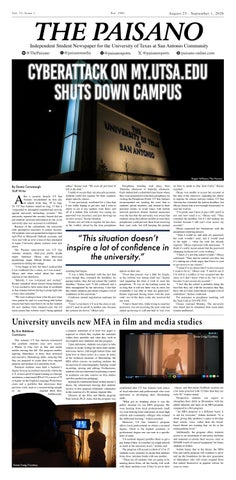
CYberATTACK on my.UTSA.edu shuts down Campus
Regan Williams/The Paisano
By Emma Cavanaugh
A
Staff Writer fter a security breach, UT San Antonio rescheduled its first day of school from Aug. 19 to Aug. 24. UT San Antonio stated on Aug. 17 that it “responded to attempted unauthorized activity against university technology systems.” The university reported the security breach did not put students’ personal information at risk, as no university data was accessed or exfiltrated. Because of the cyberattack, the university took preemptive measures to ensure security. All students were not permitted to login to their myUTSA or Microsoft Outlook accounts, and were met with an error screen if they attempted to login. University phone systems were also down. The Paisano interviewed two UT San Antonio students, third-year public health major Annlucia Okoye and third-year psychology major Allison Keiner, on their experiences during the outage. “I was happy at first, but then I realized that I was waitlisted [for a class], so I was scared,” Okoye said when asked about her initial reaction to the shutdown. “Initially, I was overjoyed and excited,” Keiner remarked about classes being delayed. “I was excited to have more time to acclimate to San Antonio before having to jump right into a busy class schedule.” “We were waiting to hear what the next steps were gonna be, and we were being told before classes had been canceled to be on the lookout for new updates from utsanews.edu, but for some reason that website wasn’t being updated
either,” Keiner said. “We were all just kind of left in the dark.” Unable to access their my.utsa.edu accounts, students could not register for their required, major-specific classes. “I was previously waitlisted for a class that I was really hoping to get into, and I went to check to see if any updates were there, and all of a sudden [the website] was saying my password was incorrect, and just showing me an error screen,” Keiner detailed. Keiner was not able to register for her class, as the waitlist closed by the time passphrase
Passphrase resetting took place from Thursday afternoon to Saturday afternoon. Each student had a scheduled time frame where they were permitted to reset their passphrase, by visiting the Passphrase Portal. UT San Antonio recommended not sending the reset link to students’ phone numbers, and instead to their personal emails, to avoid issues with mobile network operators. Keiner claimed annoyance over the fact that the university was aware that students using their phone number to reset their passphrases could prevent them from receiving their reset code, but still keeping the prompt
“This situation doesn’t inspire a lot of confidence in the university.” resetting had begun. “I was a little frustrated with the fact that even though they extended the deadlines for paying tuition, they did not extend the waitlist deadline,” Keiner said. “I felt confused, and a little unsupported by the university. I feel like this whole situation just doesn’t inspire a lot of confidence in the university.” Confusion around registration continues for Okoye. “I don’t even know if I’m in the class or not, and if I need to enroll in another one, because the systems are down,” Okoye said.
option on their site. “Even that process was a little bit finicky, as the website was timing itself out,” Keiner said regarding the hour it took to reset her paraphrase. “It was on the loading screen for so long that it told me there was an error, but eventually I was able to reset my password.” Keiner expressed having issues with the reset code; two of the three codes she received did not work. “I had a friend who, while trying to reset her password, was not receiving the reset code and ended up having to call and had to wait over
an hour to speak to [the Tech Café],” Keiner reported. Okoye was unable to access her account at the time of the interview, impeding her ability to register for classes and pay tuition. UT San Antonio has extended the tuition deadline, but Okoye claims that is not enough reassurance to ease her worries. “I’m pretty sure I have to pay a bill, and I’m not sure how much it is,” Okoye said. “They extended the deadline, but it’s still making me worried because I still can’t even access my account,” Okoye expressed her frustrations with the passphrase resetting process. “After I would try and reset my password, the code wouldn’t send, and it would send in the night — when the code has already expired,” Okoye expressed with annoyance. “I think it’s really inconvenient that the password changing [system] isn’t even working.” “I know it’s not [the school’s] fault,” Okoye confessed. “They had no control over this, but it’s making me a little angry that I have to wait to get access to my classes.” “I mean I’m in classes that I’m not even sure I want to be in,” Okoye said. “I need to see if I’m still in a waitlist, or was accepted into the class, so I don’t know what to do, but I can’t because I can’t access my account.” “I feel like the school is probably doing the best that they can with the resources that they have, but as I said, it just doesn’t inspire a lot of confidence,” Keiner confessed. For assistance in passphrase resetting, call the Tech Café at 210-458-5555. Classes resumed Monday. The university also stated that its scheduled final exam dates remain unaffected.
University unveils new MFA in film and media studies By Eric Balderas Contributor
This summer, UT San Antonio announced that graduate students may now receive a Master of Fine Arts in film and media studies starting this fall. The program enables aspiring filmmakers to hone their technical and narrative filmmaking skills, ensuring that they are prepared to create their own original projects and instruct at a university level. Potential students must hold a bachelor’s degree from an accredited university within the U.S. or have proof of equal training at a foreign institution, a minimum GPA of 3.0, a score of 79 or higher on the English Language Proficiency exam and a portfolio that showcases their previous work, such as a screenwriting sample or an original short film. Additionally,
Danie Craig/Courtesy
a purpose statement of at least two pages is required in which they explain the materials within their portfolio and what they wish to accomplish once admitted into the program. Upon admission, students can expect to take courses in script writing for short-form media, television shows, full-length feature films and learn how to direct actors in a scene. In terms of the technical elements of filmmaking, the MFA offers courses on teaching students the ins and outs of cinematography, lighting, sound recording, mixing and editing. Furthermore, students who are interested in pursuing a career in academia can take courses on film studies and film production pedagogy. Instead of a traditional hand-written master’s thesis, the educational training that students receive in this program ultimately culminates in the creation of a 20-minute original film. Director of the Film and Media program Paul Ardoin, Ph.D. states that the program was
Danie Craig/Courtesy
established after UT San Antonio took notice of local educators and professionals who were interested in developing their filmmaking skills. “What got us thinking about it was the public demand for [an MFA program]. We were hearing from local professionals [and] we were hearing from instructors at local high schools and community colleges who wanted the additional training,” Ardoin asserted. Moreover, UT San Antonio’s program allows local professionals to obtain a terminal degree, which is the highest academic or professional degree one can earn in a specific field of study. “[A terminal degree] qualifies them to get a pay bump if they’re a teacher [at a high school] or teach at the university level,” Ardoin said. The program will accept a cohort of 12 to 15 students every semester to ensure that students form close, intimate bonds with one another. “These are all students who are going to be making thesis films; all the faculty will work with these students even if they’re not in their
classes, and that means feedback sessions are a lot more practical with 12 films than they are with 30,” Ardoin stated. Prospective students can expect to strengthen their skills as filmmakers with the added intensity and rigor of an MFA program compared to a BA program. “An MFA program is a different beast; it is not for everyone,” Ardoin declared. “It is about giving [the students] a space to develop their artistic voice, rather than the broadbased liberal arts training that we do at the undergraduate level.” Additionally, the program offers students access to an assortment of university facilities and materials to ensure their success, such as $50,000 worth of insured equipment for future students to utilize. Ardoin hopes that in the future, the MFA film and media program will continue to grow and lay the foundation for the new generation of filmmakers who will create original films that embed themselves in popular culture for years to come.
2 | n e w s@p a i sano-online.com
NEWS
A u g u s t 2 5 - Se p te mb e r 1 , 2 0 2 6
Texas families battle 10 Commandments state Senate bill By Edmond Cartagena Staff Writer
As Texan parents send their children back to campus this fall, Senate Bill 10 impacts elementary and secondary schools across the state. SB10 requires Texas classrooms to display the 10 Commandments on a poster that is at least 16 by 20 inches, despite the controversy surrounding this legislation. The Senate bill is facing backlash from Texas families who do not agree with the display of this religious doctrine, which has led to the federal court case Nathan v. Alamo Heights Independent School District. The district court for the western district of Texas in San Antonio initially supported the case, but later the U.S. Court of Appeals for the Fifth Circuit reversed the decision. This decision led Rabbi Mara Nathan to seek help from the Supreme Court, where she and 15 other families are waiting to see if the highest court will overturn the appellate court’s decision. “As a rabbi and a public school parent, I am deeply concerned that S.B. 10 will impose another faith’s scripture on students for nearly every hour of the
school day,” Nathan stated. Another 15 diverse plaintiffs have expressed disdain towards SB10 during this case alongside Nathan. The families supporting Nathan come from a vast array of backgrounds, including people of Christian, Hindu and Jewish faiths and those who are nonreligious. One of the plaintiffs, Mara Richards-Bim, is a Baptist pastor whose daughter is in elementary school. In an article written by RichardsBim, she called attention to the fact that the 10 Commandments selected to display in classrooms are from the Protestant King James bible. “As a baptist pastor, I believe the Texas version of the Ten Commandments is sacrilegious,” Richards-Bim asserted. She furthered her point by expressing that SB10 strips people of what baptists such as herself call “soul freedom.” According to Richards-Bim, her religion believes that “faith is a personal choice to be made free from external pressures, including influence or coercion by the government.” Stone v. Graham, a 1980 court case, further complicates Nathan v. Alamo Heights Independent School District. The 1980 case involved Sydell Stone and other
parents in Kentucky who teamed up against the Superintendent of Public Instruction to prevent the 10 Commandments from being posted in the classroom. This decades-old case set a precedent that stated that “the preeminent purpose for posting the 10 Commandments on schoolroom walls is plainly religious in nature.” The ruling also mentioned that “the Ten Commandments are undeniably a sacred text in the Jewish and Christian faiths.” The Fifth Circuit’s dismissal of this
preceding court case has upset the families who have been impacted by this trial. The families participating in Nathan v. Alamo Heights Independent School District are waiting to see if their case will be heard by the Supreme Court. If their petition to overturn the decision is accepted, the court will move forward and determine if the families involved will receive the legal closure they are seeking.
Amie Schneider/The Paisano
San Antonio FY27 budget reckons with $158M deficit
UT Health study links liver health to metabolism
By Johnpaul Buwule
By Selasie Gifa-Johnson
Staff Writer
The City of San Antonio budget proposal for fiscal year 2027 is set to manage rising costs of city function along with the projected two-year $158 million deficit. Lower property tax revenue for the city and rising costs for maintaining and operating city functions, including roads and public safety, are factors that influenced the sizable budget shortfall. According to the budget proposal by City Manager Erik Walsh, San Antonio’s revenue is expected to grow by 2.3% while its expenses increase by 6.9% in FY27. The General Fund Revenue — the portion of funding that goes toward public services, such as libraries, street lights or homeless shelters — is expected to grow by 5.1%, while expenses will increase by 4.1% this upcoming fiscal year. Furthermore, over the past two years, the city did not collect property taxes to its full capacity, resulting in the financial strain it projects to experience. For FY26, the city is expected to bring in $473 million in property tax revenue. To remedy the two-year shortfall in revenue raised through taxes, the city will impose a hike in property taxes and fees. In comparison to FY26, property owners will see a 3.9% increase in property tax, rising from 54.159 cents to 56.288 cents per $100 of taxable value. Additionally, fees for solid waste, environmental, parks environmental and San Antonio Water System will increase in cost for maintenance. However, the property tax hike will not affect the 47% of residents who qualify for tax exemption on the premise that they are disabled or
Christopher Valdovinos/The Paisano
senior citizens. The proposal not only accounts for costs via fees and taxes but also through a reduction in civil positions. 101 civil positions will be cut, with newly created roles covering part of the layoffs. From April 1 to May 2, a budget survey inquiring about residents’ opinions on which issues they view as most important alongside their satisfaction levels revealed that homeless services, affordable housing, police services, streets and fire and emergency medical services were the top four issues residents deemed the most important, in listed order. In the General Fund, $30.8 million has been apportioned to homeless services and completion of the city’s homeless shelters. An additional $37.7 million will go towards affordable housing, supporting rental assistance, home repairs and down payment aid. The infrastructure budget would distribute $128 million to street maintenance and $12.8 million to building and repairing sidewalks. Moreover, the proposal plans on using capital budgeting — a plan outlining costs and revenue generated for long-term projects — of $7.3 million for neighborhood designs and street projects. For emergency services, the city will allocate $676.5 million for the police department and $451.2 million for the fire department. Through the Economic Development Incentive Fund, San Antonio will pour $5.6 million into economic investments. The General Fund is expected to accumulate $14.4 million by the end of 2027, and $30.4 million by FY28.
A recent study by Christopher Litwin, Ph.D., under Kevin Koronowski, Ph.D., at UT Health discovered that the liver’s internal clock plays an important role in the regulation of an individual’s metabolism within their body. Metabolism is colloquially used as a general term to refer to the rate at which the body processes food; however, the true definition is more complex. Metabolism involves a variety of organs, including the stomach, and complex chemical processes best summarized as the collection of interactions responsible for the breakdown of food and its utilization in the body. As such, there are many processes that occur in coordination with one another, and their timing is affected by one’s circadian rhythm which can be negatively impacted by irregular eating or sleeping habits. The chemical processes of human metabolism occur in organs such as the pancreas, intestines and liver; these organs rely on meals as cues. When a person’s circadian rhythm is disrupted, nutrients are used less efficiently, which can lead to weight gain along with other adverse health side effects. The findings from Litwin’s recent study highlight how the circadian rhythm of the liver is a key determining factor for the rate at which the body performs lipolysis — the breakdown of fat. The organs involved in metabolism use signaling molecules to communicate according to their circadian rhythms; one such molecule is a protein called
By Thea Muskievicz Not subscribed to local news but still want to stay up-to-date on the happenings around town? Look no further. Highlighting notable stories from external San Antonio news sources, State of the City summarizes the most captivating news headlines of the week. This week’s topics range from the renaming of Cesar E. Chávez Blvd to Victor Wembanyama’s new title.
endostatin, which was found to be a key influencer of metabolism. Researchers tracked the liver secretions from mice and narrowed down a list of hundreds of initial proteins to a more concise list that included the inhibitor protein endostatin. They continued by testing its function by disrupting the Bmal1 gene, an important molecular clock gene. They observed a resulting altered timing of endostatin release, which strongly suggested the release of this protein is linked to one’s circadian rhythm rather than random biochemical fluctuations. Additionally, when the researchers exposed fat cells to endostatin, they observed increased lipolysis, which occurred in accordance with a time-controlled shift toward a fasting state. Although this research is still in the preclinical phase, the results are promising for the field of chronotherapy: a method of administering treatments in alignment with the body’s circadian rhythm to maximize the efficiency of the treatment. “If endostatin, for example, was translated into the clinical setting and given as a drug during an active phase [instead of rest phase], there is a good chance it would not have the maximum therapeutic benefit. Considering the time of day could be important for translating treatments more broadly,” Koronowski asserted. With the valuable information gathered through the research reported in Litwin’s paper, Koronowski’s lab intends to continue investigating the functions of the hundreds of liver proteins they identified and potentially find the next GLP-1-type treatment to support weight loss.
Patrick Lopez/The Paisano
Courtesy/Christian Menefee
State of the City: Week of 8/18 Contributor
Staff Writer
City Council renames Cesar E. Chávez Blvd
Bexar County releases $2.6B budget proposal
Wembanyama named French team captain
Following rape allegations against Cesar E. Chávez — a political activist who championed farm workers’ rights — the San Antonio City Council held a unanimous vote on Thursday to revert Cesar E. Chávez Boulevard back to “Durango Boulevard.” This follows The New York Times investigation of Chávez’ allegations in March. This decision reverses a 2011 renaming intended to honor Chávez. Signage changes for the street, which will stretch across central downtown, are expected to cost $375,000.
The proposed $2.6 billion budget for fiscal year 2027, reduced from $2.8 billion last year, holds the tax rate steady despite a 1.3% decline in property value. The proposed budget includes minimal new capital spending, zero new net county department hires and expiration dates for positions funded by pandemic relief money. It does not include cost-of-living pay raises for county employees and also shifts $20 million from flood control to the general fund. County commissioners will hold a preliminary budget vote on Sept. 15.
Following a breakout NBA season, 22-year-old Victor Wembanyama of the San Antonio Spurs was named captain of the French national team on Wednesday. Head coach Frederic Fauthoux named Wembanyama’s “exemplary character [and] work ethic” as reasoning. Although this was“earlier than expected”; the choice was not rushed. The young star last played for team France in the 2024 Paris Olympics, where they received a silver medal against team USA. The team will compete in the 2027 Qatar World Cup.
3 | o p i n i o n @p a isano-online.com
A u g u s t 2 5 - Se p te mb e r 1 , 2 0 2 6
OPINION
Error 404: University not found UT San Antonio’s ongoing transparency failure places students, faculty at risk Editorial
G
iven the opportunity, UT San Antonio will opt to deprive students of information. The recent, nearly week-long disruption may not only be the greatest display of the university’s muteness but also represents a long-standing accountability failure when faced with an inconvenience. It remains unclear if the hack could have been prevented or if security faltered; however, when UT San Antonio refuses to share more than the bare minimum, it deliberately sacrifices student and faculty well-being. Students were first left to hope and pray during the Canvas hackings in May. The episode was largely out of the university’s hands, but at no point did UT San Antonio indicate what of its data had been accessed or was at risk. Canvas notably also failed to provide transparent information regarding the attack to the over 8,000 affected campuses, a factor the company rightly apologized for and believes “added to what was already a
Scholastic digital reckoning day Commentary By Melanie Melchor Contributor
In a world where technology is rapidly advancing, the human mind seems to be doing the opposite. Phones have become irreplaceable companions and are practically a direct extension of everyday life, alongside artificial intelligence, which has quickly become another tool used at work and school. Technology is supposed to make life easier, but convenience can turn into dependency. The issue is not technology automating work; rather, it is humans automating everyday life with technology.
challenging situation.” Vulnerable parties are not protected when information is withheld; responsibility is only dodged, a lesson Canvas learned the hard way.
Catherine Salonga/ The Paisano Humans are lazy by nature, a trait only enhanced by technology. Technology has become deeply embedded in the education system, and this dependency is especially obvious in the classroom. Writing an essay is a great way to waste three weeks of free time when typing the prompt into ChatGPT can generate a seemingly perfect assignment in 10 seconds. Overdependence on technology in the educational system causes a loss of academic integrity. Students are not actually absorbing material. In a 2026 Stanford study, early research suggests that many students perform better when AI assists them, but once AI is removed, students begin to struggle again. AI can complete academic work without providing the mental practice students need to learn. A big problem with overrelying on technology is the fragility of it all. One moment everything is working, then out of nowhere systems are shutting down and no one can change their passwords. On Aug. 18, classes at UT San Antonio were delayed after a cyberattack targeted technology
Keep local news alive Commentary By Emma Cavanaugh Staff Writer
Americans have suffered a great deal at greedy suits and ties’ behest. Texas news and media suffering the inevitable catalysis that all big conglomerates insist is predictable but not acceptable, as 90% of mainstream media in the U.S. is owned by six media moguls. Texans need local news.
Tre Torres/ The Paisano
An absence of robust local news allows corruption to flow freely through municipal and county government. Local news checks officials and keeps citizens informed. Without proper coverage of local happenings, voter turnout is lower, corruption flourishes and community dwindles. Local news availability has plummeted in Texas. Since 2002, the number of local journalists in the U.S. has dropped by more than 80%. Since 2005, Texas has lost roughly one-third of its newspapers. In the U.S., 2.5 newspapers are shutting down weekly and 1,800 communities have no local news outlet, making them news deserts. One-tenth of Texan counties are news deserts — 27 of 254 of the state’s counties no longer have a daily or weekly local newspaper. Many Texas news deserts need newspapers, as residents are often unable to access news through their phones or laptops due to a lack of high-speed internet access. Moreover, 90% of news deserts in the U.S. have no digitalnative startup to fill the local news gap, giving them little access to news relevant to their area. Major news corporations care more about their money-hungry agenda than the well-being of local communities. Texans need the coverage only local news can bring. Major news companies do not
Utsa.edu itself was then unavailable from Aug. 14-17 after the university responded to “unauthorized access” of its systems. When access was restored on Aug. 17, payment deadlines, waitlisting and registration had been altered for student convenience, with remaining services “expected to be restored later [that day] as technology services return[ed] to operation.” Despite the communicated confidence, university systems again
share the same invested interest in reporting on local school boards, police departments and city councils. Those who follow local news are more likely to vote in local elections, but when community information declines, civic engagement follows. Moreover, a lack of local news encourages polarization when citizens vote in municipal elections. If citizens only focus on national news, they vote with only their party in mind instead of voting to push for a greater local community. When individuals learn about their community, they vote for their community. Citizens are less likely to trust local government when they have less information about their own community, they have less knowledge about public officials and are less likely to seek out additional information about local officials and issues. In fact, 44% of Americans report difficulty getting information about their own neighborhood. The need for local news updates transcends partisan issues — crucial information is being lost because big corporations have helped erase local news stations.
“Texans need the coverage only local news can bring.” Many Americans believe that national elections are more important than local elections, but local elections are how citizens can make real change in their community and increase their quality of life. National news is not as interested in covering government corruption in Texas towns as much as Texans need the information. If Texans want a greater state, they need to learn about its troubles and vote for its betterment — not focus on what new, nasty comment Trump blurted. As much as big news corporations want Americans to believe that national news is most important, what affects individuals’ lives the most is what is happening in their backyard. Fight against media monopolization by following local news, supporting local journalists and staying informed about the local community.
systems, leaving students unable to pay tuition, find their schedules or access campus amenities. According to the U.S. Department of Education, over an 18-month span, school districts in the U.S. “face over five cyber incidents per week.” As cyberattacks increase, students face disruptions to classes and risk having their personal information exposed. Creating ‘disruptions to teaching, learning and critical business operations.’” Not only has technology impacted students cognitively, but it has also put a financial burden on lower-income students. Schools are switching over to web-based assignments, which place a financial penalty on lowerincome students
went dark, with UT San Antonio reporting blaming the same unauthorized access. From Aug.18-20, students needing to plan attendance were left to guess the second outage’s impact, knowing only that the first day was delayed. While access to utsa.edu has since been restored, students and faculty still have no way of assessing the future safety of their data. The university has faced two major technological disruptions this year — both during critical times in the semester — but has proposed zero preventative investments or contingencies. Failing to admit to the cause of the incidents further prevents students from understanding how secure their tuition and time are and eliminates the possibility of the university receiving outside assistance. University administration is the gatekeeper of information and improving security, regardless of how many individual problems the Tech Café bandages for students. This year has proven that hackings may be inevitable; UT San Antonio must decide how much damage it is willing to ignore to save face. who may not have access to the internet. Although some companies — such as Apple — have student discounts, $500 might not be in a student’s budget. With the rapid advancement of technology, students may struggle to keep up with prices and render their educational investments void. As technology becomes increasingly accessible in classrooms, students experience more negative effects than positive ones, as the current educational realm prioritizes pure convenience over knowledge.
Amie Schneider/
The Paisano
Big Bend construction: Ecological upheaval wake-up Commentary By Catherine Schmidt Contributor
The environment is dying — but that is old news. With crises flooding headlines, planet Earth has taken a backseat; the surprise and concern once felt for Mother Nature has waned. Despite rising temperatures, increasingly catastrophic natural disasters and dangerous air quality, only 2% of Texans named the environment as a top concern for the state. Consequently, political leaders get away with actions that blatantly devastate the Lone Star land — but when a beloved national park is in jeopardy, Texans draw the line. The news surrounding Big Bend National Park is hard to miss. The West Texas park, located along the border, is being gruesomely bulldozed to increase immigration surveillance and security. According to the U.S. Customs and Border Protection, the project will include 175 miles of “primary border barrier,” including roads, artificial lighting, cables, utility shelters and other invasive infrastructure that will disturb the existing environment. The government stops at nothing to execute its short-sighted vision of border security, even if that means waiving an alarming amount of critical environmental protections. Trump is no stranger to dismissing climate laws. In 2025, the Environmental Protection Agency announced 31 actions to reduce its regulations, posing severe consequences for the planet. However, the scale of immediate destruction at Big Bend is especially egregious. The area is home to diverse landscapes; there are more birds, bats, butterflies, ants, scorpions and
Regan Williams/ The Paisano
cacti species than any other national park, and the land boasts fossils dating back 150 million years. By introducing the CBP’s infrastructure, the ecosystem’s balance will be devastated. In addition to construction triggering habitat destruction, numerous residents will face negative effects if the park is destroyed. This issue transcends boundaries, with individuals from a variety of backgrounds expressing how the consequences affect tourism, archaeological sites, infrastructure, outdoor recreation and even religious land. Not only does the project threaten the park’s diverse wildlife, but it also disrupts the locals’ lives. The objections have — for now — proved to be successful, as the Trump administration temporarily halted construction to “listen to local leadership, community members and stakeholders,” according to the head of the CBP. As many as 33% of Americans are pessimistic about their ability to incite change in the nation, but the recent events at Big Bend prove that everyone has the ability to make a difference and protect the Earth. By protesting, contacting representatives, voting, petitioning and practicing civic engagement, Americans can show politicians that carelessness towards the environment will not be overlooked. Texans can no longer ignore the government’s unchecked disregard for nature. The national park’s potential downfall, and the resulting indignation, is an unmistakable reminder that the power to reconcile environmental damage is in the hands of the people.
A u g u s t 2 5 - Se p te mb e r 1 , 2 0 2 6
4 | o p i n i o n @ p a isano-online.com
OPINION
MTV’s 2026 VMA generational battle Commentary By Miguel Cruz Contributor
The 2026 MTV Video Music Awards are just around the corner, with nominees already announced in several major categories. The nominations for best music video of the year range from mediocre visual pieces to true art with significant win-potential. Videos such as “The Fate of Ophelia” by Taylor Swift shine for their production and creativity, while “hate that i made you love me” by Ariana Grande delivers a cinematic story about guilt and toxicity. The VMAs are a celebration of massive chart-toppers, iconic pop culture moments and fan-voted music across all genres. These features are especially notable for this year’s massive clash of pop royalty, historical milestones and the long-awaited return of the iconic fan-favorite categories. “Confessions II – The Film” by Madonna and “The Fate of Ophelia” rock the top nomination spots for video of the year, although both of these music videos are among the most criticized on the entry list. Some argue that Madonna’s music video is too sexual, featuring lasers from the dancers’ crotches. Some say Swift’s music video is largely padding that does not impress because the content in the main music video consisted of changing really fast as the other lyric videos. In contrast, other candidates such as “I Just Might” by Bruno Mars and “STORM” by GENER8ION, are clean concepts, with sharp
choreography and catchy production. While they are without sparking major controversies or critical reception, they do not have a wherewithal to win the award. Taylor Swift, Madonna and Bruno Mars are leading contenders for artist of the year for their numerous nominations this award season. There are also larger acts such as Sabrina Carpenter or Morgan Wallen who can still win. In the best songs of the year, BTS, who recently returned from military service and regrouped in Seoul in March, released new music, including the nominated song “SWIM.” The song has high odds to win this category because of its massive commercial success, stable Billboard chart run and fan engagement metrics. It outclasses almost every other nominee this season, and fans are betting for them to win the award. Lastly, but most importantly, are the nominations for “Best New Artist of the Year.” The category includes exciting artists such as Sienna Spiro who has made huge jumps this year with her breakthrough singles “NEED ME” and “Maybe” proving she possesses an advanced songwriting maturity well beyond her years. Giving her the award would honor artistic longevity and true vocal craftsmanship. Even though MTV is unfair to
THE PAISANO
real artists, people keep supporting repetitive, hyper-sexualized clickbait-y acts. Performers should not get attention for that, while artists like Taylor Swift deliver brilliant, highproduction videos with artistic references to Shakespeare. These awards are simply a loyalty contest for huge fanbases like BTS. True music should not rely on sexualization and repetition, but should be about creating a beautiful combination of notes that touches people’s hearts, not butts.
By Edmond Cartagena Staff Writer
Pay disparity has been an issue in the U.S. for decades. Not much has changed for the better in 2026, especially in Texas. Houstonian news station KPRC2 recently reported that Texas has the 14th highest CEO-to-employee wage gap in the nation. While wages for company CEOs dramatically increase, the average American employee
struggles to make ends meet with their disrespectfully low paychecks. Although Texas is known for being more affordable than states on the East and West coasts, the nation’s economy is suffering due to war, debt and intense inflation. Wage disparity also plays a large role in this crisis. The distribution of wages between employees and CEOs is what makes this a significant problem in the Lone Star State, where the minimum wage for workers is a measly $7.25 an hour. On the contrary, Tesla CEO Elon Musk made a whopping $132.3 billion in 2025 alone — approximately 2.5 million times the average pay of a Tesla employee. Tesla is not the only company playing a part in this injustice. Other companies in Texas have
Marisol Garcia Santana/ The Paisano
By Brad Millwater Sports Editor
The city of San Antonio is facing a $158 million budget deficit over the next two fiscal years. City staff are proposing the first property tax rate increase in 34 years to overcome this gap, but the budget solution cannot become the responsibility of San Antonio property owners. The city needs to cut services to avoid breaking a decades-old standard of property tax stability. The rate of inflation has become dizzying for American consumers. The price of everything, from gas to groceries, has skyrocketed and shows no signs of stopping. Even city utility companies such as San Antonio Water System and CPS Energy are insisting on increasing their rates in the near future. School districts including Northside ISD, San Antonio ISD and South San ISD are considering similar property tax hikes. For the city of San Antonio to compound this financial frustration would be a travesty. City Manager Erik Walsh wishes to raise property taxes by 3.9%, the highest increase possible without the requirement
of voter approval in an election. A boundary implemented to protect the wallets of citizens against government greed should not deliberately come so close to being breached. The last time property tax rates were touched was 34 years ago. Keep in mind that Walsh is an appointed official and is not directly accountable to voters. San Antonio’s city manager setting a precedent against local taxpayers with the maximum percentage possible without a public vote is egregious. City staff needs to take
Amie Schneider/ The Paisano
Regan Williams | Managing Editor Manager@paisano-online.com Hallie Lott | News Editor News@paisano-online.com Henry Holmes | Opinion Editor Opinion@paisano-online.com Amanda Fuentes | Arts & Life Editor Arts@paisano-online.com Brad Millwater | Sports Editor Sports@paisano-online.com
Blue Mize | Photo Editor Photo@paisano-online.com Sarah Quintanilla | Graphic Editor Graphic@paisano-online.com Valentina Quintanilla | Magazine Editor Magazine@paisano-online.com Karis Vickers | Social Media Editor Socialmedia@paisano-online.com Jaclyn Banda | Business Manager Business@paisano-online.com
Catherine Salonga/ The Paisano
also shown their greed when it comes to the CEO-to-standard employee wage gap. In the Lone Star State, CEOs were paid an average of $22.8 million in 2025, which is 21% higher than the year prior. Some more examples of top-earning companies in the state include Wingstop, Brinker International Restaurants and FirstCash Holdings pawn stores. The CEOs of these companies make exponentially more than their employees, while most of the field workers are thrust into stressful, highdemand service positions with little to no reward for their work. The growth of wage inequity is driven by a system that favors capitalism over hard work. Although inequality seems to be America’s undying agenda, many find it discouraging. The wage gap makes the so-called “American dream” unattainable for most citizens. No matter how hard average citizens work, their efforts are no match against an economy where the cost of living is rapidly increasing. A recently conducted survey showed that Texas home affordability is becoming a problem; meanwhile, there are companies stockpiling cash in the wallets of their CEOs. Wages earned by hard-working individuals versus the boatloads raked in by silent CEOs serve as a blatantly clear representation of classism in Texas. The underpaid middle and lower classes will suffer until the wage gap is shrunk. As Texans and other Americans wait for said gap to shrink — the wealthy, greeddriven CEOs will continue to flourish with their mountains of cash nearby.
SA City Council must protect taxpayers Commentary
Audrey Villar | Editor-in-Chief Editor@paisano-online.com
Cameron Carter | Web Editor Web@paisano-online.com
CEO wages solidify classism in Texas Commentary
Editorial Board
responsibility and cut services instead of using the coffers of property owners as a fallback. An alternative plan proposes affecting “police and fire overtime, library hours, and parks programming,” KSAT reported. The plan would cut 171 positions in the local government. That the council having to weigh property tax rate hikes and cutting city services is disappointing. However, impacting nonessential services and a handful of jobs is highly favorable over yet another increase on the bills of hundreds of thousands of citizens. The city’s proposed plan also includes a 4.4% property tax rate increase for the fiscal year of 2028. There could be a constant increase in property tax rates in future years if tax rates are affected now. The barrier will be shattered, and the principle of stability that has persisted since 1993 will soon be forgotten. Clearly, city staff want another pot to dip into whenever their decisions go awry. With the terrible state of the economy, the last thing San Antonio residents need is another monetary protection lost to the greed of city management. It is imperative that the city council prevents the city manager and his staff from establishing a never-ending cycle of increasing rates.
Staff Johnpaul Buwule | Staff Writer Edmond Cartagena | Staff Writer Emma Cavanaugh | Staff Writer Marisela Cruz | Staff Writer Selasie Gifa-Johnson | Staff Writer Yaretzi Medina | Staff Writer Rylan Renteria | Staff Writer Cooper Bryant | Staff Photographer Sarah Campos | Graphic Artist Catherine Salonga | Graphic Artist Amie Schneider | Graphic Artist Eric Balderas | Contributor Miguel Cruz | Contributor Aarien Foster | Contributor Marisol García Santana | Contributor Patrick Lopez | Contributor Melanie Melchor | Contributor Thea Muskievicz | Contributor Trevor Scallion | Contributor Catherine Schmidt | Contributor Katelyn Standford | Contributor Adrix Tankersly | Contributor Tre Torres | Contributor Christopher Valdovinos | Contributor Mya Villasana | Contributor
Advisory Board Diane Abdo | Advisor Stefanie Arias | Advisor Corey Franco | Advisor John Helton | Advisor Mason Hickok | Advisor Jack Himelblau | Advisor Steven Kellman | Advisor Sandy Norman | Advisor Chloe Williams | Advisor Jasmine Williams | Advisor
Follow Our Social media
Instagram: paisanomedia Sports Instagram: Paisanosports X: Paisanosports TikTok: thepaisanoUTSA Youtube: ThePaisano The Editorial is the official opinion of The Paisano editorial board. Commentaries are the opinion of the individual writer. The Paisano is published by the Paisano Educational Trust, a non-profit, tax exempt, educational organization. The Paisano is operated by members of the Student Newspaper Association, a registered student organization. The Paisano is NOT sponsored, financed or endorsed by UT San Antonio. New issues are published every Tuesday during the fall and spring semesters, excluding holidays and exam periods. The Paisano is distributed on the UT San Antonio Main Campus. Additionally, Paisano publications are distributed at a variety of off-campus locations, including Tri-point and a variety of apartment complexes near the UT San Antonio Main Campus. All revenues are generated through advertising and donations. Advertising inquiries and donations should be directed to: 14526 Roadrunner Way Suite 101 San Antonio, TX 78249 Phone: (210) 690-9301 © 2026 The Paisano The University of Texas at San Antonio’s Handbook of Operating Procedures states in 5.03 that: The University of Texas at San Antonio (UTSA) will not exercise control over the format or content of Student Publications, but will regulate distribution on campus. Student Publications will be free of censorship and advance approval of copy, and their editors and managers are solely responsible for editorial and content policies and decisions.Editors and managers of Student Publications will not be subject to arbitrary suspension/ expulsion or removal from their positions within a Registered or Sponsored Student Organization (Student Organization) by the University because of student, faculty, administrative, or public disapproval of editorial policy or content. Student Organizations that distribute Student Publications are afforded the same rights and privileges as Student Organizations that do not distribute Student Publications.
The University of Texas at San Antonio assumes no responsibility for the contents of this publication. The opinions expressed herein are not necessarily those of The University of Texas System, UT San Antonio, or of UT San Antonio’s faculty, staff or student.
5 | a r t s@p a i sa n o-online.com
ARTS & LIFE
A u g u s t 2 5 - Se p te mb e r 1 , 2 0 2 6
Sweet Pill ignites Paper Tiger By Thea Muskievicz
I
Contributor
t was about 10:30 p.m. when the audience caught the first glimpse of Sweet Pill vocalist Zayna Youssef’s neon green hair – except she was not playing with her band, but with opener Deux Visages’ eyeliner-strewn singer. Sweet Pill defies labels and tradition, borrowing from the complex arpeggios and timing of math rock infamy, the distinct vocal style of third-wave pop emo and the chugging bass of classic hardcore in a style Youssef once called “emo mutt.” Supported by opener Bike Routes, Philadelphia-based emo eclectics Sweet Pill played Paper Tiger last Friday as part of a nationwide tour in support of their sophomore album, “Still There’s a Glow.” As concert-goers milled around the venue bumming cigarettes and waiting in merch lines before the show commenced, many remarked on Sweet Pill’s allure as a female-fronted outfit. This is what attracted Texas A&M University student Sabrina Samaripas to the show. “Obviously [there are] male bands like Modern Baseball, Mom Jeans, stuff like that — but what are the female ones? I saw people talking about Sweet Pill, took a listen, and fell in love,” Samaripas shared. New Jersey sweethearts, Bike Routes, kicked off the evening with spidery and atmospheric drones that gave way to a thumping, poppymidwestern sound featuring punching guitars and vocal melodies reminiscent of indie mainstays like The Shins and The Postal Service. As vocalist David Osterhout pointedly
gestured and wandered on stage, the band slowly revealed soaring, pinched guitars and warm vocal harmonies in a performance that set the rollicking tone for the night. Bike Routes were followed by the dreamy, gritty pop trio Deux Visages for their first performance in San Antonio. The second act exploded on, showcasing comfortably rhythmic mathy guitars, heavy drums and rumbling Rickenbacker bass. Frontwoman Daphney Hanono was silhouetted, her voice occasionally venturing into falsetto as her melodies tensed against the booming rhythm section. Midway through the set, she let down a Courtney Loveesque mop of blonde hair and reminded the crowd of an upcoming November project. The lights dimmed as the highly anticipated main act took the stage, before illuminating vocalist Yossef’s neon green hair and overalls. Sweet Pill broke into their first song, ripping through the odd time signatures and contrasting dynamics that hallmark their mashed-up sound. Youssef was all gnashing teeth and wild eyes, rallying the crowd like they had no choice. The rhythm alternated between double-kick mayhem and tight, subdued patterns as they ripped through the most energetic tracks from their new album. The crowd did exactly as Youssef instructed, obeying as she parted the crowd with her hands, forming an arena of a mosh pit with a dizzying circumference. Next, she collapsed the bubble, and the band screamed into their next song. When a shoe was lost in the violent swirl, she quipped that “You would know if
you were missing a shoe.” Youssef invited a young fan on stage to finish singing one of their breakout hits, “Blood.” He was nervous at first; however, 15-year-old Fort Worth native Julian Martinez quickly found his voice. Martinez later remarked on his experience. “She pointed at me and I couldn’t believe it. I said one of the inside jokes during
the song and she smirked, and I think that’s when she knew it was me that should be up there.” Martinez ended his stint on stage with a spectacular dive that he said was an outlet no of “so much energy.” aisa P e h Youssef reminded nt/T r ya B r the crowd in a time pe Coo rife with division that, “You can stand for what you believe in,” — an outlook that echoes their new release’s mature lyricism. They ended with a destructive, implosive burst of energy and screams that crackled into nothing — a fitting end cap for the electric set. and a smile like honey Except it was not the end, because the crowd relentlessly demanded an encore, and Sweet that helps the medicine Pill delivered, with sparkling, spitting intensity go down.
Sarah Campos/The Paisano
Losing weekends in grief
By Mya Villasana Contributor
Phoebe Bridgers’ new album, “Lost Weekend” was released on Aug. 14. The release follows her 2020 album, “Punisher,” marking five years since fans have heard anything new from her. The album is deep and reflective, displaying themes of grief throughout. Many of the songs are reminiscent of the feeling of growing up, not wanting to grow up and the struggle of unchangeable circumstances.
of school, being alone and not having the confidence to be oneself, having to grow up and face reality in unforeseen ways. Compared to “Lost Boys,” which is about not wanting to grow up, “Kill me” feels more like having no choice but to grow up and face things that are difficult. “Lost Paradise” is an eerie interlude that slowly seeps in from the distance, before smoothly fading back out in the end. The distant sound fits the reflective feeling of the album. The song is a calm before the storm,
Katelyn Stanford/The Paisano The opening track, “The Outside,” starts with a futuristic tone, then transitions to a soft melody. The song depicts a dislocation that is heightened by a vocoder and a fingerpicked acoustic guitar vanishing into the background like static. The song feels distant, like trying to remember something but being unable to fully reach it. In contrast, “Lost Boys” is more upbeat and references Peter Pan, singing “Lost boys never grow up, never get old.” This is the perfect soundtrack for a fan to dance alone to in their bedroom on a Saturday night as the main character, ready to take on the world. For the grand finale, the track returns to a soft voice of not caring what the world thinks and never wanting to grow up like Peter Pan. This is the perfect track for anyone who wants to stay young forever and fears taking on the ominous world of adulthood. More gut-wrenching nostalgia follows with the next track, “Kill Me.” The song is slow and reminiscent of the first day
the last track before the album moves into something serious. The closing track, “Lost Weekend,” details Bridgers’grief of losing her dad and her journey grappling with the fact that he is never coming back. The lyric “He’s not coming back as a bird” exemplifies the common belief that dead loved ones are always there spiritually, a concept Bridgers struggles to believe. At the very end of the song the beat cuts out, leaving the audience to sit in nine seconds of silence. The ending feels empty, as if Bridgers has nothing left to say. “Lost Weekend” is definitely worth a listen. It is true to the indie folk genre, and if anyone is dealing with similar experiences, they can definitely relate to Bridgers’ lyrics and emotions. The different melodies and sounds within the album create the mood of each song, making the album feel personal and emotional.
Beautiful late-night wreck
By Johnpaul Buwule Staff Writer
This year’s Late Night at the Rec commenced with underwhelming numbers. The welcome event introduced newcomers to the Campus Recreation Center’s resources and amenities. The event’s rescheduling to Aug. 22 is what led to a weak turnout. Students noted that, in previous years, the event was littered with an enormous wave of attendees forming endless lines and clustering at club tables. This year, the event was more scant. Nonetheless, the few students who filled the Rec illuminated it with their enthusiastic vigor as they rambunctiously raced through obstacle courses, formed large groups peppering a volleyball or idiosyncratically grooved to line dance music. Late Night at the Rec still channeled a feeling of community, and the small numbers, as paradoxical as it may sound, elevated the event’s experience, acting as a distinctive way to make the space intimate. For club sports, the low turnout meant less visibility than previous years. Lauren Farmer, a third-year student and a member of the Women’s Club Lacrosse team, highlighted a stark contrast from previous years. “We got more recruitment last year,” Farmer said. “There was more publicity for the event last year, and there were a lot more numbers, and the time was just different. [the numbers] are much less this year.” The event showed off the various activities and opportunities the Rec has to offer — sand volleyball, club sports such as Quadball and, most importantly, inflatables. At the event’s core: exposure and offering UT San Antonio students the ability to engage in banter with one another — a reality reflected in the students’ competitive spirits while racing through the
inflatable obstacle courses. The joining of previously unacquainted individuals to play basketball or learn how to line dance were further proof of this goal becoming a reality. Junior psychology major Marlene Ledezma recounted her experience at the Rec, noting the childlike exhilaration and newfound friendships that came from playing in the inflatables. “I loved the obstacle course at my grown age,” Ledezma gushed. “Yes, we are in college, but it made me have so much fun. I felt like I was a kid again. I met two little twins, and they are so cute, and now they are my friends.” Third-year psychology major Tatiana Luna shared the same sentiment as Ledezma. “There are a lot of people,” Luna explained. “You’re gonna meet people as you come by, so I think this is a great place to come by to meet new friends.” To the left of the Rec entrance is the Outdoor Resources Center. At this center, students can rent out gear such as paddles, bikes, kayaks and more for free. Students can safely embark on outdoor excursions by using the safety equipment offered, such as backpacks or life jackets. Additionally, for $15 to $20, the rental space offers guided educational expeditions, in which students can learn more about the environment and engage in activities such as watercoloring. The trips include group transportation, food and gear. Although somewhat measly in turnout, Late Night at the Rec offered the familiar energizing experience students have enthusiastically immersed themselves in year after year. The experience proved a success for students who attended, walking away with new memories and connections.
Christopher Valdovinos/ The Paisano UT San Antonio students slide down the obstacle course at Late Night at the Rec.
6 | a r t s@ p a i sa n o-online.com
A u g u s t 2 5 - Se p te mb e r 1 , 2 0 2 6
ARTS & LIFE
Humble second-hand bookstore bunker supports library By Hallie Lott News Editor
Tucked inside the basement of the San Antonio Central Library sits a small bookshop packed to the brim with new and recycled books, comics, CDs and more marvelous media. The sound of shoes shuffling on the linoleum floor echoes off the tall bookshelves as customers find their next read. Despite its large, hidden setting, the homely atmosphere of Book Cellar draws in a packed crowd. First-time customer Michaela Thompson enjoyed the eclectic aspect of second-hand media. “You can kinda just walk around and get lost in [the store],” Thompson emphasized. “When it’s second-hand, it’s like, anything could be here, let me j u s t poke around like a little rat.”
Owned by Friends of the San Antonio Public Library, Book Cellar donates every cent of its profit to the library at the end of each year. Ben Durocher, manager of Book Cellar, emphasized the commitment the store has towards keeping the library system alive. “Pretty much everything we sell, [the Book Cellar’s] entire existence, is just to provide donations to the library, and keep the library system going,” Durocher professed. The volunteer-run store is dedicated to providing quality service to its patrons while fulfilling its goal of giving back to San Antonio’s public libraries. Another first-time customer, Alexandra Ruiz, highlighted the welcoming atmosphere of the shop. She noted that upon entering, she and her partner received a warm greeting. “My partner and I walked in and
were kind of just taking the place in, because it is quite big, and one of the volunteers noticed that,” Ruiz shared. “She came over very excited to tell us about the store. That was really awesome, just coming in and being noticed and welcomed.” Durocher also highlighted the volunteers as his favorite part of the job. “I’m the only paid employee. Everyone else here is [a] volunteer, and they’re dedicated. Some of them work three to five days a week of their free time because they also believe in [Book Cellar],” Durocher emphasized. “Working with people who are so dedicated and willing to sacrifice so much for a cause, it’s just really inspiring.” That dedication to the local library, and second-
hand shopping in general, is not only strong in volunteers, but customers as well. “There are so many things on this Earth that people have put so much work and time into that it feels disrespectful to keep buying something new when there’s so many books that there’s so much heart poured into them,” Thompson stated. “You know, why not [buy secondhand]? There’s nothing wrong with it.” Book Cellar offers customers the full second-hand book shopping experience, whilst guaranteeing excellent customer service and a commitment to giving back to the local community. Anyone searching for a way to thoughtfully spend their money can find a home in this local bookstore. Book Cellar is open Thursdays, Fridays, and Saturdays from 11 a.m. to 4 p.m. at 600 Soledad St. Volunteers are always welcome and can email inquiries to fosaplbkclrmanager@gmail. com.
Patrick A. Lopez/The Paisano
Still replaying ‘Blonde’ By Yaretzi Medina Staff Writer
Amie Schneider/The Paisano
A blonde-haired girl was retained in her seat by a seat belt riding up her neck. The girl’s hair was pulled behind her ears and her hands covered her face. Yet, her eyes were still visible — calm, but not blank. Captured in a single photograph, the girl set forth inspiration for Frank Ocean’s everlasting studio album “Blonde.” After a four-year drought, “Blonde” followed Ocean’s “channel ORANGE.” Ocean’s first studio album was a journey about love, privilege, sexuality and isolation framed as a television broadcast, but “Blonde” was incomparable. On August 1, 2016, a black-and-white livestream appeared on Ocean’s website — blonded. co — of a large, empty warehouse where he would periodically appear building parts of a staircase. Once the clock struck midnight, the livestream ended and Ocean released a 45-minute visual album titled “Endless.” All of this was done to complete his contractual obligations with Def Jam and Universal. 48-hours after the release of “Endless,” Ocean put out “Blonde” independently, accompanied by a magazine: “Boys Don’t Cry.” Ocean did not attend interviews and opted out of press campaigns for the album. “Blonde” led a shift in the music industry by changing how albums were released, discussed and experienced — all while articulating a one-hour tragic love story. Even with “Blonde’s” simplicity in guitar strums and keyboard loops, the album is oneof-one. Songs like “Be Yourself,” “Facebook Story” and “Futura Free” have sparse musical production and feel more conversational, whereas songs like “Nikes,” “Pink + White” and “Nights” include multi-layered, pitchshifting vocals and heavy vocal distortion. Even with the absence of the traditional R&B drums, “Blonde’s” reliance on fluidity and unconventional song forms has influenced production trends. In an interview with Revolt TV, SZA states, “When I’m in the studio, it hurts too much sometimes. Maybe that’s why I tap in
and pretend to be other people,” she shared. “That’s why I’m pretending to be you or pretending to be Frank [Ocean] or pretending to be Future because it’s easy. It’s easier to be me through their eyes than it is to sit with some of the really harsh things that I say about myself to myself.” “Blonde” explores themes of nostalgia, queerness, masculinity, family, grief and love. Ocean takes listeners into the world of emotional vulnerability as he recounts the events of his first true love. Tracks like “White Ferrari” prove that vulnerability can be quiet, abstract and fragmented. Similar diary-style writing — also used by SZA, Steve Lacy and Clairo — reflects popularly in artists today. After a decade of Ocean’s absence from the public eye, “Blonde” still stands timelessly and gracefully. Ocean’s fans listen to this album in sacred rituals, hosting listening parties and scraping together theories in hopes of his return to music. However, initial reviews of “Blonde” were not met with praise. Parker Kyln, a student of Drake University, wrote, “There are no great pop songs like ‘Thinkin Bout You’ or ‘Lost,’ nor are there any immediately devastating stories like ‘Bad Religion’ or ‘Forrest Gump.’” Now, “Blonde” is widely cited as one of the most influential albums of the 2010s, helping shape alternative R&B and pop music. Notably, “Blonde” was chosen as Pitchfork’s best album of the 2010s and holds number three in Genius’ community ranking. Listeners even go as far as to list the introspective album in academic writing and critical analyses. As of 2026, “Blonde” remains Ocean’s last album. Ten years after its release, the album’s emotional weight grows stronger and its influence has only become more apparent because of its dream-like structure that shields the album from feeling dated. “Blonde” reshaped music with its fluidity, pitchy vocals and amorphous song shapes. Perhaps the greatest testament to “Blonde’s” legacy is the album’s ability to remain present even with Ocean’s disappearance. It is possible that the truest way to sit with “Blonde” would be as Frank Ocean noted in “Seigfried” — striving to be “Less morose and more present.”
read online at paisano-online.com By Natalia Edwards
Contributor
Canceled First Day, Unexpected Free time, lingering questions Bird On The Street Week of 8/25
read online at paisano-online.com
By Jayden Woods
Catherine Salonga/ The Paisano
Contributor
Swinging into brand-new era
14530 ROADRUNNER WAY, SAN ANTONIO, TX 78249
utshaan’gsout
spo t!
YOUR FIRST DRINK = FREE
Show this ad to the bartender and claim one drink on us!
Valid for guests ages 21 and older only. Limit one (1) complimentary drink per person. Drink selection is That ock bartender’s discretion. e Blthe Offer expires September 30, 2026.
7
100 Pounds & Pated
Bar
Food Trucks
Trucks
to choose from!
MONDAY: CLOSED
Sippin’ Sundays: $10 mimosa bottles & Setup noon to 3pm then just $12 after 3pm
Taco Tuesdays: $2 tacos & $3 mini margs starting at 7p
Whiskey Wednesdays: Select whiskies $6
thirsty THURSDAYS:
$1 Beer NightMpowersYou.com with DJ Casanova (starts at 7p)
– THURSDAY: 3PM – 12AM HOURS OF TUESDAY FRIDAY: 3PM – 2AM NOON TILL 2AM OPERATION SATURDAY: SUNDAY: NOON TILL MIDNIGHT
STAY UP-TO-DATE WITH THE BLOCK SA
MPowersYou.com
@THEBLOCKSA
7 | sp o r t s@ p a i sano-online.com
SPORTS
Conference champions thrive on upwards momentum By Henry Holmes Opinion Editor After shocking the American Conference in 2025 — eliminating No. 3 University of Memphis and hoisting the conference trophy for the first time — UTSA soccer continues to show its grit early in the 2026 season. Coming into the fall, the Roadrunners have sought to build off of their historic 2025 playoff run, adding five players to the roster in July: freshman midfielder Olivia D’Ambrosia, Texas A&M transfer forward Shea Ryan, TCU transfer forward Sadie Paul, University of Houston transfer midfielder Sabrina Taber and UNT transfer goalkeeper Kylie Kissee. These five additions joined the previous six high school and four transfer recruitments from the spring offseason. “We’ve got more attacking personalities than we ever have in our program,” coach Derek Pittman observed. “[We] can be as dangerous as possible to score goals.” Pittman is also preparing the team for another NCAA tournament bid. “We’re gonna play Santa Clara this year, we’re gonna play Texas A&M next year, we’re gonna play Oklahoma next year,” Pittman explained. “We want to put ourselves in a position where our players believe that [against] anyone, anytime, we can match up and play really, really well.” So far, the ‘Runners have made that ambitious belief a reality. After drawing to Texas 1-1 in a preseason exhibition match, the ‘Runners kicked off the regular season at home with a 2-2 draw against rival Texas State. UTSA ferociously responded to both Bobcat goals with a score of its own. On Aug. 16, UTSA faced off against No. 6 TCU in Fort Worth, heading home with another astonishing 2-2 tie. With far less possession than the Horned Frogs and 13 fewer shots, the ‘Runners stared down the national
No. 6 and a 0-9 head-to-head record and didn’t blink. UTSA handily secured its first win of the season on Aug. 21 in a dominant display against Colorado College. The ‘Runners then followed their victory with a merciless 4-1 triumph against crosstown NCAA Division II competitors St. Mary’s University on Aug. 23. Since the graduation of the team’s top two point contributors — midfielder Zoë May and forward Michelle Polo — new offensive stars are finding their footing. Redshirt sophomore forward Ava Jackson has continued to shine, leading the team with three goals and one assist despite playing the fewest minutes out of any starter. Sophomore forward Brooklyn Bailey also amped up her offensive pressure, trumpeting 13 shots and four shots on goal in four games. Freshman midfielder Amelia Clark, however, is only beginning to light a fire with her spark. Throughout high school, Clark accumulated a high school record-breaking 58 goals and 40 assists and amassed countless accolades. Moving into collegiate play, Clark had produced only three shots in her first 120 minutes. Against St. Mary’s, Clark launched a shot from outside the penalty box to earn her first UTSA career goal, topping it off with an assist for the ‘Runners. “Clark is one of our best players on the ball,” Pittman reflected. “I think right now she’s really having to adjust defensively as far as what’s her defensive role.” Boasting an undefeated record, UTSA will face its next great trial against Santa Clara at home on Sept. 17. Santa Clara is ranked first in the Pacific Region, but the fortuitous ‘Runners have repeatedly buckled down against and bucked off supposedly insurmountable teams. UTSA is scheduled to play Texas Southern University on Thursday at 7:30 p.m. at the Park West Athletic Complex.
Cooper Bryant/The Paisano
A u g u s t 2 5 - Se p te mb e r 1 , 2 0 2 6
Sarah Quintanilla/The Paisano
Spurs strengthen roster for upcoming campaign By Adrix Tankersley Contributor After missing the playoffs for six consecutive seasons, few expected last year’s San Antonio Spurs to contend for a title. Following a masterful campaign from Victor Wembanyama and company last season, the Spurs finished as the second seed in a stacked Western Conference. Despite the entire roster having minimal playoff experience, San Antonio cruised to the NBA Finals. The Spurs seek to remain in title contention for many years to come, fully capitalizing on their impressive young core. This summer, San Antonio made great roster adjustments that will ensure their return to the NBA Finals. Ultimately, the Spurs fell to the New York Knicks in five games. The humiliating loss to the Knicks revealed some of the roster’s biggest weaknesses, especially a lack of frontcourt depth. Julian Champagnie started as a very undersized power forward for much of the playoffs. Small-ball lineups have seen decreased usage in the playoffs over the past few years, and judging by the Spurs’ Finals performance, they don’t work for San Antonio either. This summer featured numerous bigname wings available through either free agency or a trade, such as Rui Hachimura, Trey Murphy and even LeBron James. San Antonio eventually landed 34-year-old Tobias Harris, who averaged 18 points per game for the Detroit Pistons in last year’s playoffs. Harris brings vital experience and offensive
production to the Spurs. San Antonio signed Harris for two years on a $31 million deal. With multiple rookie contracts expiring in the near future, San Antonio is trying to retain salary flexibility. Over-committing on a role player at this stage would stunt the Spurs’ success over the next decade. The Spurs also utilized the draft to help improve the team’s depth for the upcoming campaign. The Spurs drafted Jayden Quaintance, a 6’10 center from the University of Kentucky, with the 20th pick. Most mock drafts predicted a team picking Quaintance much earlier, but due to several surgeries, he fell to a later spot. This is a great selection for the team, adding a young athletic center to eventually replace Luke Kornet as the backup big behind Victor Wembanyama. The team does expect Quaintance to miss a majority of the season due to surgery; he likely will not see much playing time come the playoffs in the spring. The Spurs also traded for the draft rights to Tarris Reed Jr. from the Denver Nuggets. Reed is a traditional center similar to Quaintance, but less injury-prone. San Antonio is clearly trying to build up their frontcourt depth to ease the load Wembanyama has to carry in the postseason. San Antonio is expected to remain at the top of the Western Conference for the coming years. The young core of Victor Wembanyama, Stephon Castle and Dylan Harper will only get better in the future. With a slightly upgraded roster, the Spurs remain title favorites going into the 2026-27 NBA season.
Freshman defender Lilli Denhardt protects the ball in UTSA’s game against Colorado College.
Volleyball strives to break streak of mediocre seasons By Regan Williams
cumulative statistics, knowing their losses-to-
Managing Editor
wins ratio, almost every other figure is just as
UTSA women’s volleyball continues the pursuit of its first winning season since 2019 after finishing 2025 with a 13-15 record. The team struggled to find its rhythm at the beginning of the previous season, starting off with three losses. In the Roadrunners’
suspected: below average, the only exceptions being their serving, defense and reception. Eight new players arrive in San Antonio for the 2026 season. The front row now includes two new middle blockers: junior Kansas City transfer Ledisi Kpea and junior Kansas State Rylan Renteria/The Paisano
Junior middle blocker Caroline Tredwell jumps for a spike in UTSA’s game against Stephen F. Austin on Aug. 29, 2025.
transfer MaKinsey Jones. Two outside hitters also joined the ‘Runners: freshman Sydney Bryant and freshman Logan McGinnis. Last season, UTSA averaged 1.942 blocks per set, lower than their opponents’ cumulative average of 2.365. UTSA’s 2025 season kills added up to 1,268, while their opponents had 1,317. Not only did their opponents have more kills, but UTSA had 560 errors compared to the opponents’ 524. A strong front row is vital for a team, and these statistics emphasize their weaknesses. With this new lineup, fans will be waiting to see if the new front row additions will improve these statistics. The other roster additions are junior Notre Dame transfer Alyssa Manitzas, sophomore Colorado State transfer Sydney Black and freshman Maddie Angelare, joining the Roadrunners as defensive strategists. Senior Arkansas State transfer Valeria Ortiz will be setting. The 2026 season started with scrimmages and exhibition matches in August. The ‘Runners’ next stop is the Razorback Invitational, at Barnhill Arena in Fayetteville, Arkansas, from Aug. 28-30. UTSA will face off against UT Arlington on Aug. 28 at 4 p.m. Last season, UTSA defeated UTA 3-0 in the first home game of the Roadrunner Classic tournament. The next day, UTSA will return at 5 p.m. to play against SIU Edwardsville. On the last day, UTSA will play against Arkansas
Aarien Foster/The Paisano
Volleyball huddles after surrendering a point against Tulsa on Sep. 29, 2025. at 1 p.m. After the invitationals, UTSA will play again on Sept. 3 at 11 a.m. for the UTSA Invitational at Convocation Center in San Antonio, where they will play against UIW. The last time UTSA and UIW went head to head was in September 2024; in that game, UTSA let go of a six-game win streak with UIW that spanned from 2018-2024 — losing a home game by 2-3. This September is the first time the Runners will go up against UIW with the majority of this team; fans will see if they can recover their winning streak or continue their new-found losing streak against them . The following match is the next day, Sept. 4 at 6 p.m. against Tarleton State. After the UTSA Invitational, the ‘Runners will be hosting the Roadrunner Classic and competing in the Flo Hyman Classic, hosted by the University of Houston.
8 | s p o r t s@ p a i sano-online.com
SPORTS Rylan Renteria/The Paisano
A u g u s t 2 5 - Se p te mb e r 1 , 2 0 2 6
Non-conference will make or break UTSA football By Henry Holmes Opinion Editor UTSA football is no stranger to tumultuous results early in the season. Continuing this trend will prove costly, as the team attempts to improve on its two-year record of 14-12. Between UTRGV, Texas State, Texas and Colorado State, the Roadrunners have set a thorough four-game non-conference stretch, the results of which will likely determine their success — or failure — in the 2026 season.
University of Texas Rio Grande Valley UTRGV stampeded into its inaugural 2025 season with a 9-3 overall record, falling only to Stephen F. Austin, Lamar and Southeastern. UTSA will be the Vaqueros’ first-ever NCAA Division I FBS opponent, but the betting spread tilts in the ‘Runners’ favor by only 3.5 points. Attendees at the “Navy Out” game should expect a competitive back-and-forth; though, a defensive lapse from the ‘Runners, akin to the early 2025 season, could spell defeat.
Texas State University UTSA hits the road for the Battle of I-35, looking to set the record straight against the Bobcats. The ‘Runners’ two-year losing streak against Texas State began with a historically devastating 49-10 defeat in 2024. While the 2025 game ended with a more digestible score of 43-36, by the time players walked off the field, Texas State had surgically clawed apart the Roadrunner defense. Coach Jeff Traylor can only hope he learned the right lessons from 2025.
University of Texas at Austin
coach TRaylor looks deep for answers to road woes By Brad Millwater Sports Editor
T
alking to Jeff Traylor during 2026 fall camp makes the gravity of the upcoming season readily apparent. Traylor breathed life into a stalling culture when he grabbed the reins of UTSA football seven years ago. Now, the consummate leader is faced with a similar stagnation, but with higher demands and under brighter lights. The biggest question pestering Traylor in 2026 is if his team can leave San Antonio and still get a win. Traylor confronts the issue head-on — with humor, even. “You know, ironically, our name is the Roadrunners, and we’ve been really bad on the road the last two years,” Traylor joked. Granted, the ‘Runners maintain an exceptional 10-2 mark at the Alamodome in the last two seasons. The record somersaults to 3-10 when facing opponents at their home sites. For Traylor, at the core of the issue lies a word that has permeated the program during his tenure: toughness. “We’re a bunch of guys that feel good when things are going good, but we don’t handle adversity very well, which is not what we’ve been about historically here as a team,” Traylor stated. The Triangle of Toughness is the philosophical lifeblood of UTSA football. A brand designed around crucial tenets such as “Selfless Perfect Effort,” “Integrity” and “Passion,” along with the three 210 area code digits, has been the focal point of Traylor’s tenure. Traylor expresses no hesitation in the heart of his message, but the shift in college sports from an amateur to a professional system requires the coach to reach his players at double-time speed. Star performers are now more likely than ever to leave Traylor’s program in favor of the highest bidder.
“We’ve kind of just slow-played it for years, knowing I was going to have Frank Harris all the way to the end. Knowing I was going to have Rashad Wisdom all the way to the end. Knowing that player would start taking over and teaching for me,” Traylor explained. “Well, the guys that would teach for me now, most of those guys are gone.” Traylor said he has made difficult staff decisions “everywhere in the building” to combat this identity issue. On top of that, Traylor assigned his players a bit of homework. During fall camp, each player created their own identity triangle with seven personal features and presented it in front of the entire team. The sides of the triangle correspond with each player’s heroes, history and highlights. A pause mechanism, or something each player does to calm himself down in the heat of battle, makes up the center. Next comes a favorite song and a Bible verse or quote. Rounding out the seven metrics is a one-word question: “Why?” “Young men don’t ever see importance to depth sometimes until older men explain and teach,” Traylor stated. “I’m just trying to help those guys see who they are. Why are they all the way they are?” The introspective exercise embodies the emphasis on teaching that Jeff Traylor has harnessed to propel his lifelong journey in football. The head coach has bachelor’s and master’s degrees in education from Stephen F. Austin State University, and both of his parents led careers in public school education. With just eight of his 22 starters from last season returning, Traylor’s skills in mentorship are vital now more than ever. “You’re either in a storm, coming out of a storm, or going into one,” Traylor declared. “A storm’s coming, so we’ve got to have a plan when that stuff hits.”
UTSA travels to face a true state powerhouse in Austin. The ‘Runners similarly face a two-loss streak against Texas, although victory appears more improbable against the NCAA’s preseason No. 4 pick. A more experienced fourth-year quarterback, Arch Manning, now helms the Texas offense, but all is not lost for UTSA. Each Roadrunner touchdown will bolster the university’s growing sports identity, while Texas scores will be another lecture for Traylor to take into American Conference play.
Colorado State University The following week, UTSA will head home for the Hispanic Heritage game against the Colorado State Rams. From their first match-up in 2015, all three Roadrunner results against Colorado State have been narrow and hard-fought. UTSA forced its first win against the Rams last year in a 17-16 nail-biter, led by two touchdowns from former star running back Robert Henry Jr. Despite the fierce competition in the previous three games, this exhibition is gearing up to be the most evenly fought nonconference game for the ‘Runners this year. Between losing 23 players to the transfer portal, signing 18 recruits in December and an offensive coordinator shake-up, it has yet to be fully seen whether UTSA can muster a puttogether, unified force. Highly competitive non-conference games are perfect for telling Traylor where his team stands — and where they fall. Rylan Renteria/ The Paisano
Senior offensive lineman Ben Rios in UTSA’s game against Army on Nov. 29, 2025.
Freshmen deliver decisive victory over crosstown rival By Marisela Cruz Staff Writer SAN ANTONIO — UTSA soccer cruised to a 4-1 victory over Saint Mary’s University on Sunday at Park West Athletics Complex, bolstered by crucial goals from three different freshmen. The Roadrunners moved to 3-0 against the Rattlers, with meetings in each of the last three seasons. One of the Roadrunners’ (2-0-2) new team captains secured the first goal of the game in the 12th minute. Sophomore forward Ava Jackson connected with the net, with assists from sophomore forward Brooklyn Bailey and sophomore midfielder Leah Varela. Just six minutes later, the Rattlers responded with a goal, slipping the ball past senior goalkeeper Jasmine Kessler’s outstretched hands at the top right corner of the net. With tensions high, the Roadrunners turned their focus to offensive control. “I think it was building off that momentum and just keep creating chances,” Jackson recalled. “We want to produce, either corners, set pieces, shots on target. We wanted to aim for 20 shots in this game.” Playing in the starting lineup again, junior midfielder Sabrina Taber had a significant defensive presence on the field. Taber was great at intercepting passes amongst the Rattlers and drove the ball into the opponent’s side of the field. Maintaining an aggressive presence and supporting both as a defender and an attacker, Taber is a player to keep an eye on. Freshman defender Lilli Denhardt broke the tie in the 38th minute, securing her first college career goal. With the help
of her fellow Roadrunners, sophomore midfielder Caroline Pelofski trapped the ball and connected with freshman midfielder Amelia Clark to support Denhardt’s goal. “That was awesome. I’ve been waiting for the moment,” Denhardt exclaimed about her first win of the season. “Not Trevor Scallion/ The Paisano
Freshman forward Dulci Binns in UTSA’s game against St. Mary’s on Aug. 23, 2026
many [freshmen] are starting out, so for us to get the opportunity to take advantage, get minutes, and get goals was a really great turnout.” The second half of the game saw two more freshmen scoring goals following Denhardt’s. In the 47th minute, Clark found the target to acquire the Roadrunners’ third goal of the game. No one was in Clark’s way — she recovered the ball in midfield, ran up and knocked it into the left corner of the net, untouched by the Rattlers. “What a goal,” coach Derek Pittman proudly recalled about Clark’s goal. “She pressed properly with the rest of the team and was at a great spot, and they put in Amelia Clark to do what she’s capable of doing. Taking people on and absolutely burying a shot outside of the 18-yard line.” With nine minutes left on the clock, freshman forward Dulci Binns closed out the game with the final goal. An assist from Valera allowed Binns to take the wide-open shot and drive it home for the Roadrunners. After Binns’ goal, all the ‘Runners on the field gathered in a huddle and bowed down to her as she spread out her arms in victory, soaking in her second win of the season. “We’ve had some really quality goals come out of a number of different players,” Pittman explained. “You can’t just focus on a player or two players. Just as soon as you get these two players figured out, they leave, and then two more come on asking new questions. It’s nice to have that depth.” The Roadrunners prepare to host Texas Southern University on Thursday at 7:30 p.m. at Park West Athletics Complex.