A hacker can get into your email account and divert your money into a different bank. Making the most of Negative Feedback It's Not Possible to Eliminate THE RISK OF INNOVATION
Here are a few tips that may be helpful.
Are you visionary who focuses on building a business that will thrive.
From the Editor
Hey Everyone,
Welcome to the 161st issue of the Aussie Painting Contractor Magazine.
The past month has certainly been a busy one.
Over the last couple of weeks, I've covered almost 4,000 kilometres, travelling through Cairns, Townsville, Airlie Beach, Mackay and Rockhampton, training 37 painting apprentices along the way.
People often ask me why I spend so much time on the road, and the answer is pretty simple. Apprentices in regional Queensland deserve the same opportunities as those in the major cities. If we want a stronger painting industry, we have to invest in the people coming through it, no matter where they live.
One of the highlights of the trip wasn't just being in the classroom. It was catching up with a number of apprentices I trained years ago who are now running their own painting businesses. Seeing them employ staff, build successful companies and give back to the industry is incredibly rewarding. It's a reminder that training isn't just about helping someone get a qualification—it's about helping shape the next generation of business owners and industry leaders.
This month's magazine also has a strong business focus. As we settle into the new financial year, there's no better time to review where your business is heading. Whether it's improving cash flow, strengthening your systems, protecting yourself from cyber threats, or simply making better business decisions, taking the time to work on your business rather than just in it can make a huge difference over the next 12 months.
As always, thank you to everyone who contributes to this magazine each month and to the businesses that continue to support the Aussie Painters Network. Because of your support, we're able to keep sharing ideas, promoting apprenticeships, and helping painting businesses build stronger futures.
CONTRIBUTORS
• Adrian R. Camilleri
• Christopher Carter.
• Leo Babauta
• Nigel Gorman
• Oliver Kay
• Peter Siminski
• Robert Bauman
• Sandra Price
EDITOR
Nigel Gorman
GRAPHIC DESIGNER
J. Anne Delgado
Til next month,
Nigel Gorman
Opinions and viewpoints expressed in the Aussie Painting Contractor Magazine do not necessarily represent those of the editor, staff or publisher or any Aussie Painters Network’s staff or related parties. The publisher, Aussie Painters Network and Aussie Painting Contractor Magazine personnel are not liable for any mistake, misprint or omission. Information contained in the Aussie Painting Contractor Magazine is intended to inform and illustrate and should not be taken as
legal or accounting advice. You should seek professional advice before making business related decisions. We are not liable for any
you August incur directly or indirectly as a result of
Cyber Risks for Tradies: Invoice Scams & Hacked Emails
When we think about security for a trades business, we often think about physical assets. Locking the toolboxes on the back of the ute, securing the site at knock-off and tracking your machinery.
For many years that was enough, but times have changed in a big way.
One of the biggest threats to your business now isn’t someone cutting the padlock on your trailer, it’s a hacker getting into your email account and diverting your money into a different bank account.
You don’t need to be a massive corporation to be a target. If you use a smartphone, send digital invoices, run Xero or manage payroll online, you are at risk.
Hackers aren’t just targeting the big corporate. they want a quick five or ten grand, and small to medium sized trades businesses are an easy mark.
The Threats Tradies Actually Face
The Australian Cyber Security Centre (ACSC) received over 84,700 cybercrime reports in FY2024-25, with small business losses averaging $56,600 per incident (up 14% year on year) according to the latest Cyber.gov.au Threat Report.
For tradies, the risk breaks down into three main categories:
• Invoice Fraud: A scammer intercepts your email, swaps your BSB on an invoice, and your client pays them instead of you. This is the single most common cyber claim type in Australia, making up 31% of all claims per 2026 data.
• Ransomware: Malware locks your files, drawings, quotes, and job records. Ransom demands averaged $269,000 per incident in 2025.
• Accounting platform compromise: Someone gets into your Xero or MYOB and redirects payments or steals client data. Typical claims regularly hit $45,000+.
The Invoice Hijack
This completely bypasses standard security systems because it relies on human error rather than system glitches.
Here is exactly how it plays out:
• The Invoice: You finish a job, send an invoice for $15,000, and email the PDF to the builder or homeowner.
• The Interception: A scammer who hacked your email password weeks ago has been watching your inbox. The moment you send the invoice, they intercept it.
• The Swap: They swap out your real BSB and account number for their own and forward the modified PDF to your client.
• The Payment: The client receives the email from your exact email address and makes payment, assuming that nothing is wrong.
• The Pain: Two weeks later you call the client chasing payment. They send you the receipt, and you realize the money has been paid into an account that isn’t yours.
This is an absolute nightmare scenario. The client paid the invoice they received, but you never got the cash. Getting those funds back from the bank is incredibly difficult once cleared, and it puts a massive strain on your cash flow and client relationships.
Locking Your Digital Toolbox
You wouldn’t leave your keys in the ignition of your ute while you walk into Bunnings. Leaving your business software unprotected is the exact same thing.
You can stop many of these attacks by implementing three straightforward habits:
• Turn on Two-Factor Authentication (2FA): Treat this as the padlock for your digital tools. Every major app, such Gmail, Xero, ServiceM8 etc. allows you to turn on 2FA. When you log in from a new device, it sends a code to your phone to prove it’s you. Sure it can by annoying, but it’s great protection.
• The verbal confirmation rule: If a supplier emails you claiming they’ve changed their bank details, or the details have changed on their latest invoice, do not transfer the money. Pick up the phone, dial their known number (not the number on the suspect email), and confirm it verbally with someone you know.
• Watch the text links: Scam texts pretending to be from Linkt about an unpaid toll, or Australia Post claiming a parcel can’t be delivered, are everywhere. Clicking these on your work phone can install malicious software that logs your keystrokes and steals banking passwords. If it looks weird, delete it immediately.
How the policy responds
A cyber policy doesn’t stop the scams, but it can deal with the financial consequences.
There are various cyber insurance policies available to tradies, and like any form of insurance, each has
their own quirks when it comes to the coverage.
The following is a generalisation of what may occur after a claim, but keep in mind that each policy may respond slightly differently depending on the quality of the coverage.
Incident Response
(The 24/7 Hotline)
This is the most immediately useful part. Many policies give you access to a panel of specialists around the clock. Within hours of calling, you have an IT forensic technician identifying and containing the breach, a lawyer advising on your obligations, and a PR consultant if clients need to be notified.
IT Forensics and System Restoration
The insurer pays forensic investigators to find the breach, remove malware, and restore your data. To put this in perspective, a business that refused to pay a ransom faced $80,000 in system restoration alone, plus $350,000 in business interruption. A $430,000 total bill. Without insurance, that would put most trades businesses into bankruptcy.
Business Interruption
If you can’t operate because your systems are down – meaning you can’t invoice, access job files, or run scheduling software – the policy pays lost income and extra costs during the recovery period. It typically covers 2–4 weeks of downtime, which is a realistic recovery window for an SME hit by ransomware.
Ransomware / Cyber Extortion
If criminals demand a ransom to unlock your files or threaten to publish stolen data, the policy can cover the ransom payment,
negotiation costs, and extortion management consultants.
Note: Since May 2025, businesses with a turnover above $3M must report ransomware payments to the ASD within 72 hours via ReportCyber. Many tradies will fall below this, but it’s worth knowing as you grow.
Notification Costs and Privacy Obligations
Under the Notifiable Data Breaches scheme, if you hold customer data (addresses, payment details, or email addresses) and it’s compromised, you may have a legal obligation to notify the OAIC and affected individuals. The policy covers legal advice, the cost of sending notifications, credit monitoring for affected customers, and regulatory response costs or fines where legally insurable.
Invoice Fraud / Social Engineering
This is the tradie-specific clause to scrutinise carefully. Many policies cover invoice fraud, but it is typically sub-limited. A $1,000,000 policy might only have $50,000 available for social engineering losses. If invoice fraud is your biggest exposure, you need to ensure your policy has a suitably large limit and check whether the policy requires a call-back verification procedure as a claims condition.
Third-Party Liability
If a client or supplier suffers a loss because your systems were the entry point, for example if a subcontractor’s details were stolen from your compromised system, the policy covers legal defence and damages claims against you.
The False Dilemma Between Being Frugal & Enjoying Life
There’s a mentality that says, “YOLO! I should spend now (instead of saving for later) and enjoy life!”
This usually reflects a false dilemma: I want to save money … but I also want to enjoy life now! It’s not an either/or situation.
(Btw, this is the same false dilemma as “work hard now or play now” — it’s not an either/or choice.)
Here’s the reason it’s a false dilemma: Saving money can be done while enjoying life. Living an amazing life doesn’t require spending much money beyond the necessities.
If you don’t believe me, try this experiment: Try going 3 months without spending anything but the necessities, but challenging yourself to enjoy life anyway.
Reading books (from the library) is free. Going for walks and hikes and enjoying nature is free. Spending time with amazing people can be free too. Journaling, playing chess, learning, meditating, working out, making healthy meals … all can be done without spending a lot.
Buying useless crap and eating out a lot and drinking a lot of alcohol — that’s not necessarily living.
Beyond free, enjoyable things you can do, there’s another important truth: lasting happiness and fulfillment don’t come from external sources. Those are fleeting.
Lasting fulfillment comes from the inside — by learning to enjoy life wherever you are. By learning to appreciate others, and feel connected to them. By learning to be vulnerable, curious, fascinated. By serving others, and being generous.
None of these require anything external. And if you cultivate this, the fulfillment you get is much more lasting than ordering something cool online. And it can’t be taken away from you.
Leo Babauta ZEN HABITS
Making the Most
Everyone enjoys hearing they're doing a great job. Positive feedback boosts confidence, motivates teams, and reminds us we're on the right track.
But what happens when the feedback isn't so positive?
Do you ignore it and hope the customer never contacts you again?
Do you put off reading the email because you know it's going to be uncomfortable?
Or do you see it for what it really is— valuable information that highlights opportunities to improve your business?
The reality is that negative feedback isn't something to fear. It's one of the most useful forms of customer insight you'll ever receive. While positive feedback tells you what to keep doing, negative feedback tells you what needs attention before more customers experience the same issue.
The most important part isn't that something went wrong—because mistakes, misunderstandings, and differing expectations happen in every business. What matters is how you respond.
Sometimes you've genuinely made an error. Other times, the customer simply has a different preference. For example, your standard practice may be to print reports double-sided to reduce paper usage, while a particular client prefers single-sided copies. Neither approach is inherently wrong, but understanding and accommodating that client's preference can significantly improve their experience.
When customers see that you've listened, acknowledged their concerns, and taken meaningful steps to resolve the issue, something remarkable can happen. Research has shown that customers who experience a problem that is resolved quickly and fairly can become just as loyal—or even more loyal—than customers who
never experienced a problem at all. This is often referred to as the service recovery effect. While it doesn't happen every time, handling complaints well can build trust and demonstrate that your business genuinely cares about its customers.
The key is to look beyond the individual complaint and ask yourself:
• Is this a one-off issue?
• Is it highlighting a weakness in one of our processes?
• Could other customers experience the same frustration without telling us?
For example, if multiple clients are contacting you asking for updates on their jobs, the real problem may not be your turnaround time—it may be a lack of communication. Most clients are happy to wait if they know what to expect. A simple acknowledgement when work is received, followed by an estimated completion date or periodic progress updates, can dramatically reduce uncertainty and improve customer satisfaction.
On the other hand, some feedback is unique to an individual client. In these cases, your systems should make it easy to record and communicate customer preferences. Could you include special instructions in your client records? Do you have a job checklist that highlights clientspecific requirements? Is there a process to ensure every team member can see these notes before work begins?
A healthy business culture doesn't view complaints as failures. It views them as feedback. Every concern raised is an opportunity to improve communication, refine processes, strengthen relationships, and deliver a better customer experience.
So don't be afraid of negative feedback. Welcome it, listen carefully, and respond thoughtfully. Your customers will remember not that everything always went perfectly, but that when something wasn't right, you cared enough to make it right.
How the Tradies QuickStart Advantage Program Helps Tradies Stay QBCC Compliant
Running a successful trade business isn't just about delivering quality workmanship it's also about maintaining strong financial management. For licensed painters and decorators in Queensland, meeting the Queensland Building and Construction Commission (QBCC) financial requirements is essential to protecting your licence and growing your business.
Unfortunately, many tradies spend their days on the tools and their evenings catching up on paperwork. Financial reports are often only reviewed when it's time to renew a QBCC licence or when the accountant asks for information. By then, small issues can become major compliance problems.
The Tradies QuickStart Advantage Program has been designed to change that.
Rather than treating accounting as an annual exercise, the program helps tradies build the financial systems, processes and habits needed to stay compliant all year round while making better business
decisions. The program includes financial forecasting and planning tailored specifically for trade businesses, helping owners understand their cash flow, profitability and future financial position.
Understanding QBCC Financial Requirements
The QBCC's financial requirements are designed to ensure licensed contractors remain financially viable and capable of completing the work they undertake.
To remain compliant, businesses need reliable financial information that accurately reflects their financial position. This includes maintaining accurate bookkeeping, producing timely financial reports and monitoring key financial indicators throughout the year.
Many compliance issues don't arise because a business is unprofitable—they occur because the financial information isn't available, isn't accurate or isn't reviewed regularly.
Building Strong
One of the priorities of the Tradies QuickStart Advantage Program is establishing the right systems to track your financials.
When these systems are in place, preparing financial reports to lodge with the QBCC becomes significantly easier and more reliable.
Better Bookkeeping means better compliance, many tradies only update their books every few months or just before BAS or tax time.
The QuickStart Advantage Program encourages regular bookkeeping so business owners always know where they stand financially.
Up-to-date bookkeeping allows you to:
• Monitor cash flow before it becomes a problem.
• Track business profitability.
• Reconcile bank accounts regularly.
• Keep payroll and superannuation records current.
• Produce accurate reports whenever they're needed.
Instead of scrambling before a QBCC reporting deadline, you'll already have the information available.
Forecasting Helps Prevent Compliance Problems
One of the unique aspects of the program is its focus on forecasting. Most trade businesses know how much work they've completed, but far fewer know what their financial position will look like in three, six or twelve months' time.
Forecasting allows business owners to:
• Plan for seasonal fluctuations.
• Understand future cash flow.
• Budget for equipment purchases.
• Prepare for hiring staff.
• Make informed business decisions before financial pressures develop.
Rather than reacting to problems, tradies can identify potential risks early and make adjustments before those issues affect profitability or compliance.
Real-Time Business Performance
The program also helps tradies understand the numbers that really matter.
Instead of waiting until the end of the financial year, participants learn how to regularly review:
• Revenue and gross profit.
• Labour costs.
• Overheads.
• Cash flow.
• Debtor collections.
• Business profitability.
Having this information readily available provides greater confidence when making decisions and reduces surprises throughout the year.
Preparing for Growth
As your painter and decorator business grows, your financial management becomes more complex.
"Hiring staff, purchasing additional vehicles, investing in equipment or taking on larger projects all affect the financial position of the business."
The Tradies QuickStart Advantage Program helps business owners understand the financial impact of these decisions before they commit, allowing them to grow sustainably while maintaining strong financial management practices.
More Than Just Compliance
While staying compliant with QBCC financial requirements is an important outcome, the benefits extend much further.
Businesses with organised accounting systems often experience:
• Better cash flow management.
• Faster invoicing and debt collection.
• Improved budgeting.
• Greater confidence when applying for finance.
• Reduced stress with QBCC reporting.
• More informed business decisions.
Good financial systems don't just help protect your licence—they help build a stronger, more profitable business.
Invest in Your Business Before Problems Arise
Too many tradies only seek financial advice when something has already gone wrong.
The Tradies QuickStart Advantage Program is designed to help business owners become proactive rather than reactive by putting the right systems in place from the beginning.
With practical guidance, better financial reporting and ongoing support, tradies can spend less time worrying about paperwork and more time focusing on running profitable projects and growing their business.
At Straight Talk Accounting & Tax, we developed the Tradies QuickStart Advantage Program because we understand the unique challenges faced by tradies.
Our goal is to simplify the business side of the trade industry, helping clients build strong financial foundations, stay compliant with QBCC requirements, and create businesses that are profitable, sustainable and positioned for long-term success.
Victorian Apprentice Wins Certificate of Excellence
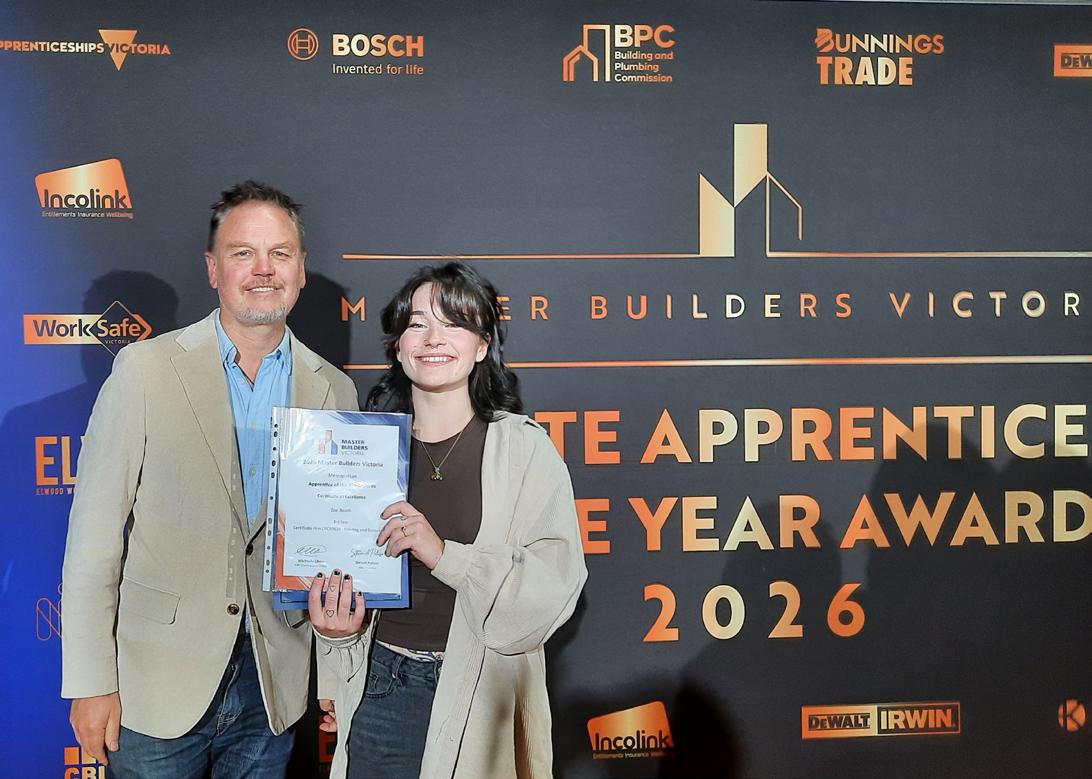
Earlier this year third year painting apprentice Zoe Booth won the Certificate of Excellence at the MBAV Apprentice of the Year Awards. Zoe is employed by Prestige Paint Works on the Mornington Peninsula, and is trained by the National Painting and Decorating Institute.
Her trainer Daniel Wurm says:
"Zoe has excelled academically and has outstanding creative talent. I nominated her for the award because not only did she apply herself to learning the theory and the technical side of the trade, but also because she showed genuine skill in colour matching, decorative finishes
and wallpapering. In addition, she did this despite suffering from a physical condition that often causes her pain, and despite losing a close family member during the apprenticeship."
Apprentices and employers who train with the National Painting and Decorating Institute are encouraged to choose electives that cater to their natural talents or employer needs. Zoe recently completed all the training side of her apprenticeship, and chose CPCCPD3032
Advanced Decorative Finishes as one of her electives. As part of this unit she designed and created a large scale mural from scratch.
"Not every apprentice has what it takes to do advanced decorative finishes, but Zoe has the right aptitude and skill-set to excel at this aspect of the trade. When I saw how quickly she mastered colour matching and decorative finishes I encouraged her to push herself by doing a large scale mural project.'
At the awards ceremony, which was held at Marvel Stadium in Docklands, Zoe accepted her award in front of over 400 people. She was able to share the special event with her family and friends, including her proud grandma, who made a special trip just for the event. Zoe and her friends got to rub shoulders and share the limelight with some of Victoria's best construction apprentices, and the who's who of the Victorian construction industry. They also got to meet AFL legend Matty Richardson, who was M.C. for the awards night. Uni-Pro Painting Equipment provided a prize pack of their new pro quality brushes.
"I'm really grateful to get this award, and I will continue my career by completing a Diploma in Interior Design after I finish my apprenticeship', says Zoe. "My phone has been running hot since I won the award with job offers from people in the industry. It's definitely opening up new opportunities for me."
Watch a video of Zoe creating the mural: Large Scale Mural Design
Daniel Wurm
TEL: +61 402312234
Making a big, life‑changing decision? 7 STEPS TO CONSIDER
Should you marry that person? Quit a steady career to retrain? Move across the country, away from ageing parents? Sit with any of these and watch your mind spin. You weigh what you’d gain against what you’d lose. You run the numbers. And still no answer arrives.
Big decisions do this to us. They are rare, life-shaping, and hard to undo, and they refuse to be solved like a sum.
Researchers recently used AI to analyse more than 100,000 real dilemmas posted online. They found choices pulled in dozens of directions at once, far from the tidy two or three variables we imagine. Big decisions are messier than they look.
I study how people make life’s biggest decisions. In research, I asked more than 600 people to describe their ten biggest decisions. Thousands more have since mapped their own choices in an ongoing study. Marriage, children, career changes, house purchases, and relocations come up again and again.
My study didn’t hand me a checklist you can use when faced with a big decision. But it did show what separates
the decisions people are later glad of from those they regretted. Read alongside the wider research, those factors fall into a rough order worth trying.
1. Choose, don’t drift
Start by admitting you are deciding. Many of us never quite choose our biggest paths. We move in with a partner to save on rent, sliding into a relationship rather than deciding on one. We take the job that happened to be offered. We stay in a city because leaving never quite comes up.
Bit by bit, life feels less like a choice than a current we floated along. A decision you never consciously make is one you cannot make well.
2. You’re choosing for a stranger
Standard guides tell you to list what you want. But a genuinely big decision is transformative. It changes the very person making the choice.
Parenthood, marriage, or a new career reshape your values, so the “you” on the far side may want different things than the “you” choosing now.
So don’t only ask what you want today. Ask who you want to become, and whether the experience itself is one worth having. And don’t assume the goal is happiness. Some big choices trade comfort for a richer, stranger life, and people choose them anyway. A good life can be interesting rather than easy.
3. Try before you commit
Resist the two-option trap: “take it or leave it”. Instead, run a “vanishing options” test: ask what you’d do if none of your current choices were allowed. New paths will appear – to wait a year, do it part-time first, rent before you buy.
Then, test what you can. No big choice allows a full dress rehearsal: living together isn’t marriage, a weekend with a niece isn’t parenthood. Sample the edges anyway. Take the secondment before you quit. Spend a month in the new city before the move. A rough taste beats a pure guess.
4. Borrow some hindsight
Ask people who know you, and people who have done the same thing you’re considering. In my
data, decisions made with more advice were judged more positively years later.
One catch: don’t tell them which way you’re leaning. Reveal your hunch and advisers tend to echo it back rather than test it. Ask first, share your view later. Other people’s hindsight is the closest thing you have to your own foresight.
5. Some things won’t add up
Now, the hard part. You will crave a single score, a spreadsheet that ranks each option. But the things that matter most share no common currency. How do you convert love into the same units as money? You can’t – and forcing them onto one scale just hides the trade-off you’re trying to discern.
So, stop trying to compute the odds. Instead, build a story. Weighing that move abroad, you can run the years forward – the work, the friendships, the life that might grow there – and choose the version you believe. When the sums can’t be done, a story is what’s left to act on.
6. When in doubt, leap
How do you choose between options that won’t rank? Watch your hesitation. In my data, the decisions people felt sure about were the ones they later judged well.
Confidence may act as a signal that you’ve searched enough –and when it won’t come, more spreadsheets rarely summon it. When you are truly on the fence, the odds favour the braver move.
American economist Steven Levitt had more than 20,000 people flip a coin over choices they were stuck on; those the coin pushed towards change were happier six months later. Staying can be right, but our thumb presses too hard on the status quo. Research suggests the road we regret longest is usually the one not taken.
7. Commit, then plan to be wrong
Make the call, then commit. A good decision is a good process; the outcome is never fully in your hands. So, build the process. Before you commit, run a “premortem” and a “backcast”. Picture it’s a year on and the choice has failed, and list why. Then, picture it’s gone brilliantly, and list why.
Together they show the risks to guard against and the upside to chase, while you can still act on both. Then set tripwires – the dates or warning signs that trigger a rethink – so a slow drift never hardens into a sunk cost.
The deciding is the point
The worst way to make life’s biggest decisions is to not quite make them. To slide into a marriage, a career, a city, then wake years later wondering who chose. So, choose. Even imperfectly. The deciding is the point.
Adrian R. Camilleri Associate Professor of Marketing, University of Technology Sydney
WASH WITHOUT WASTE
Easily
It's Not Possible to Eliminate THE RISK OF INNOVATION
One of the most often cited reasons for not embracing innovation is that it is too risky. Prototyping or testing often comes with a high cost. Combined with the cost of the time spent, this can all be rather high for an unknown outcome. There is no way to eliminate the risk in innovation, but there are ways to reduce it.
It's easy to understand the dilemma. A business owner doesn't want to put himself in a position to waste time or money, especially as the economy continues to climb out of the sinkhole that has existed for the last few years, and yet, businesses that don't innovate will suffer serious consequences, maybe damaging the company beyond repair. So what can be done if the risk of innovation cannot be eliminated?
Here are a few tips that may be helpful.
Clear up the Fuzzy Front End
Often, much of the time spent with innovation is in the stages that companies are more comfortable with, and definitely the more fun stages - developing prototypes, doing some R&D and testing. But, when companies have a new idea, and this is the starting point, there are tremendous risks already because the most important part of the process - clearing up the fuzzy front end has been left out.
Think of the fuzzy front end of innovation as eyes after a trip to the eye doctor - everything is blurry and it's impossible to make sense of anything because there is no way to bring clarity or focus.
Ideas start in the brain. This is a fact that cannot be denied, but it's what happens with the idea from the moment it is dreamed up that is important. At the very least, someone should write it on a sticky note, napkin, back of an envelope, or store it in a phone. To really be effective, get a little notebook that can be carried around in a pocket or purse.
Now, what would normally be next is to jump in and begin figuring out how to make this thing or implement this new process- whatever it is, companies are probably already in the "how does it work" stage. It's important to back up and ask a few key questions.
What Problem is Being Solved and for Whom?
There are two basic types of problems - big problems that don't happen very often, and small problems that happen all of the time. Which type are you solving, and for whom? It is important to write down what problem(s) this innovation solves and who is most interested in the solution.
If the problem cannot be identified, then this idea probably needs to be set aside for a later time. What was lost? Maybe thirty or so minutes of thinking about this - no cash changed hands, and hours upon hours were not wasted.
What Are the Financial Benefits/Drawbacks of this idea?
Recently, a group of top-notch innovators spent a day brainstorming and came up with some great ideas. At the end of the day, they voted on two that they were going to work on for a couple of weeks.
When they did "the math" on one of the ideas, the group quickly realized that changes needed to be made. The idea was going to net them a relatively small return - just over $500K and they knew they could do better. When they reworked the idea, the potential ROI increased by a factor of 10!
Doing "the math" involves:
• Examining how many potential customers there may be, as a whole
• How many of them can realistically be reached (through advertising, direct contact, etc.)?
• How many of those who can be reached will purchase?
• Is there a repurchase? (think vacuum cleaners - customers will repurchase in the form of bags, filters and belts)
If there is a repurchase, how much will each repurchase cost and how many times in a year will customers need to buy?
Take all of these factors into consideration when considering an idea. This could kill or advance an idea, depending on expectations and results.
Identify the Potential Roadblocks
Another key step to take to mitigate risk is to identify the potential roadblocks for the innovation. One step should almost always be finding out whether or not the customer is interested. There are dozens, if not more, examples of business leaders who were so committed to an idea, in spite of those around them saying it wouldn't fly. Ultimately, a lot of money is wasted until the leader discovers, in one way or another, that the market doesn't want the product.
Other roadblocks might be whether or not the materials needed can be obtained, if something is being manufactured. Technology could be a roadblock. Skilled employees could be a roadblock. There are thousands of possibilities - too many to mention here. The important thing is to identify them now.
Brainstorm with the innovation team to determine whether or not there is a work around for each roadblock. If so, work through it, if not, the idea may have to be shelved for a while.
In Summary
There are other steps that can be taken to mitigate risk, but if these three steps are taken, it would go a long way to clearing up that fuzzy front end, and, so far, there has been some brain work, but there has been very little spent, if any on prototypes, R&D or testing. It is possible that there may have to be a small expenditure if it helps to clear away a roadblock, but it will not be huge amounts of money in this phase. Sandra Price
CHECK OUT THE QBCC’s INDUSTRY SNAPSHOT
The QBCC’s Industry Snapshot provides valuable insights into Queensland’s building and construction industry, including licensing trends, demographic shifts and defect reporting— providing an understanding of industry dynamics, planning workforce development, and improving compliance and quality standards.
SOME NOTABLE CHANGES OVER THE PAST TWO YEARS INCLUDE:
GROWTH IN LICENSEES
• Total licensees under the QBCC Act increased by 6.3% from 96,908 in 2023 to 103,011 in 2025 (total licensees are more than 120,000 under all Acts regulated by the QBCC).
• The most notable increases were in the Brisbane region (+7.5%) and the Sunshine Coast region (+11.7%).
DEMOGRAPHIC SHIFTS
• The proportion of licensees aged under 30 years has slightly increased, indicating a modest rejuvenation of the workforce.
• A large portion of licensees remain over 60 years old, especially in key trades like plumbing, painting and carpentry, highlighting ongoing succession challenges.
DEFECT TRENDS
• Painting continues to top the list of reported defects.
• Driveways and paths defects have increased in frequency.
• The incidence of footing and slab defects has increased.
If you need a refresher on any of these defective work items, the QBCC’s standards and tolerances guide is a quick and easy reference for industry, licensees and home owners, based on recognised industry standards in Queensland.
The QBCC will publish the Industry Snapshot annually to ensure the building and construction industry is armed with current and reliable industry data.
Licensee feedback and suggestions are welcomed, so the QBCC can continue to evolve and provide the most accurate picture of the industry possible.
To read the full and latest version of the Industry Snapshot or find out more on the state of the industry please visit www.qbcc.qld.gov.au
What Does a Contract Lawyer Actually Do?
Contracts pop up everywhere in business. You could be hiring someone, signing on a new client, leasing an office/ factory/ warehouse or teaming up with another business, there’s usually a contract involved.
But do you really need a lawyer every time? And what does a contract lawyer actually do?
What exactly is a contract lawyer?
In plain English, a contract lawyer is someone who helps you with the legal side of your business agreements (contracts). That could mean anything from drafting a brand new contract, reviewing something you’ve been asked to sign, through to helping you sort out the details when you’re negotiating terms with a client, supplier, or contractor.
The lawyers main role is to make sure every contract you rely on is clear, fair, and legally correct. They look out for things like vague clauses, hidden risks, and terms that might come back and give you a nasty surprise. The aim is
to protect your business from the start so you don’t end up dealing with costly legal disputes in the future.
Contract lawyers work with all kinds of businesses such as new startups, tradies, agencies, consultants, franchisors, to name but a few. Whether it’s employment contracts, service agreements, or Terms and Conditions, they make sure your paperwork protects you.
Think of a contract lawyer as your legal bodyguard. They help you avoid deals gone wrong, confusing DIY templates, and that dreaded feeling when you realise you’ve agreed to something you didn’t fully understand.
How can they help your business?
Whether you’re running a small business or managing a growing team, having the right legal support behind your contracts can save you time, stress, and a whole lot of money. A contract lawyer gives you the confidence to enter into agreements knowing you’re
legally protected and not leaving anything to chance.
Here’s how they can help:
Write contracts that actually suit your business
Every business is different, and a one-size-fits-all template won’t always cut it. A contract lawyer can draft agreements that are tailored to how you operate, what you offer, and the way you want to work.
This includes things like:
• Contractor agreements and employment contracts
• Clear Terms and Conditions for your services or products
• Service and supplier agreements that protect your delivery timelines and payment terms
• Non-disclosure agreements (NDAs), intellectual property (IP) clauses, and more
These documents help set expectations early, reduce the risk of disputes, and give you something solid to fall back on if anything goes off track.
Review contracts before you sign
Been handed a contract to sign?
Before you put pen to paper (or click ‘accept’), it’s worth having a contract lawyer take a look. They can:
• Flag any vague or risky clauses
• Translate confusing legal jargon into plain English
• Recommend changes to make sure the terms are balanced and fair
It’s your chance to catch issues before they become obligations.
Negotiate better terms
Sometimes you know a contract doesn’t feel quite right, but you’re not sure how to push back. A contract lawyer can help you find a better middle ground. They’ll support you during negotiations, helping you get fairer terms without damaging the relationship with the other party.
This can be especially useful in:
• High-value deals
• Long-term supply or service contracts
• Joint ventures or partnerships
It’s about finding a win-win without leaving your business exposed.
Back you up when things go wrong
Even with the best planning, sometimes things don’t go to plan. Maybe a client hasn’t paid, a supplier hasn’t delivered, or someone’s broken the terms of your agreement.
This is where a contract lawyer steps in with practical advice on what to do next. They can:
• Send a formal letter of demand
• Help you enforce your rights under the contract
• Work towards a resolution either through negotiation or, if needed, legal action
Having a lawyer in your corner makes it clear you’re serious, and that you’re not going to be pushed around.
Do you always need one?
Not every contract needs a lawyer. If it’s something low-risk, shortterm, or fairly straightforward like a one-off agreement between two people who know each other well you might be okay handling it
yourself (even then, when there’s a fall out between close friends or relatives things can get very messy very quickly).
But as soon as the stakes go up, it’s smart to get a second opinion.
If the contract involves money, people, time commitments, intellectual property, or anything that could affect your business longterm, having a contract lawyer look it over can make a big difference. It’s a chance to catch things you might have missed, avoid misunderstandings, and make sure you’re not agreeing to something that could come back to bite you.
Sometimes, even if the contract looks fine on the surface, it might not fully protect you or it might be missing key terms that give you leverage if something goes wrong.
At the end of the day, it comes down to peace of mind. If you’re not 100% sure what you’re signing, or whether a contract has your back, that’s a good sign it’s time to bring in a lawyer.
A quick review now can save you a legal headache later.
Stay Open to POSSIBILITY
When people are considering a scary decision that requires them to step into the unknown, one of the biggest obstacles is our past experiences.
If you’ve failed or been hurt in the past, those experiences tend to hold a lot of weight and we let those failures dictate what we’re going to do in the future.
I’m here to invite you to stay open to new possibility, rather than let the past failures dictate what you’re going to do.
Let’s take my Fearless Mastery coaching cohorts as an example — maybe you’re considering joining, in order to free yourself of old patterns, to unlock new possibility, and to start to move something meaningful forward for yourself.
But maybe you’ve joined things in the past, and you didn’t stick to them as much as you were hoping you would. Maybe you paid good money but didn’t do the work to get the value out of the program you were hoping for.
That would be a painful memory … and as you consider whether or not to join Fearless Mastery, maybe that memory holds a lot of weight. You think, “Hmmm, maybe I better not waste my money again, I’ll probably just let myself down again.”
And so your past becomes a weight, holding you back from new possibility.
Consider whether you’ve been doing that lately — holding yourself back because of past failure.
Past experiences can be valuable, in that we can learn from them. We can try to see where we went wrong — what was going on under the surface — and use that information to grow. But instead, they often become weights, holding us back.
I’m here to invite you to let go of the past failures and painful experiences, and open yourself to new possibility. Let yourself create something new.
And if you’ve been considering joining Fearless Mastery … what would it be like to let go of your old fears and past experiences stopping you, and open to what could be?
Leo Babauta ZEN HABITS
The URACRYL 400 SERIES is a two-component, modified urethane acrylic system designed to impart exceptional durability, colour retention and chemical resistance to a variety of substrates across a range of industrial, commercial and heavy-duty environments.
The series is a unique offering in that it was designed from the bottom up to be applied by brush or roller, thus greatly expediting its application and helping avoid common issues usually encountered when applying such coatings to commercial buildings.
Another of the system’s pros is its ‘self recoatable’ formulation, which means it can be easily over painted in kind, making future maintenance efficient and cost-effective.
New Zealand’s biggest selling, architecturally specified specialist protective finish, the system features three levels of topcoat – semi-gloss (Uracryl 402), gloss (Uracryl 403) and low-sheen (Uracryl 404). The most popular of these being the 402 semi-gloss, reflecting the preferred shift to lower-sheen finishes.
Currently, the series is being largely specified for use on steel work in commercial situations where a highly durable, protective finish is required, and which can be easily customised to suit any colour scheme or choice.
The Uracryl 400 series is available in Resene’s full colour range and in small pack sizes with a 1-2 day turnaround in most cases.
www.resene.com.au
Strategic Entrepreneur Are you one?
Success in business is rarely the result of working the longest hours or staying the busiest. More often, it comes from making the right decisions at the right time. This is what separates a strategic entrepreneur from everyone else.
A strategic entrepreneur is a visionary who looks beyond today's tasks and focuses on building a business that will thrive tomorrow. They understand that every decision—from hiring employees and investing in technology to launching marketing campaigns and developing new products—should support a larger vision. Rather than reacting to every opportunity or challenge, they make calculated decisions based on careful planning, reliable data, and long-term objectives.
In contrast, tactical entrepreneurs often find themselves trapped in the daily demands of running a business. They are constantly busy implementing the latest marketing trend, responding to urgent problems, or chasing the newest business opportunity. While these activities may create the appearance of progress, they do not always contribute to meaningful growth. Without a clear strategy, businesses can easily lose focus, waste valuable resources, and struggle to achieve sustainable success.
What Makes a Strategic Entrepreneur?
Strategic entrepreneurs possess a mindset that goes beyond simply running a business—they build businesses designed for long-term growth and resilience.
They understand that success requires both vision and discipline.
A strategic entrepreneur:
• Thinks long-term while managing short-term priorities.
• Makes decisions based on facts, analysis, and measurable outcomes
rather than emotions.
• Focuses on high-impact activities that produce lasting results.
• Anticipates market trends and prepares for future opportunities and challenges.
• Continuously evaluates business performance instead of waiting for problems to arise.
• Invests in systems, technology, and people that improve efficiency and scalability.
• Encourages innovation while carefully managing risk.
• Learns from both successes and failures, using each experience to improve future decisions.
• Remains flexible, adapting strategies when market conditions or customer needs change.
Rather than asking, "What should I do today?" strategic entrepreneurs ask, "What actions today will create the greatest value for my business over the next year, three years, or even five years?"
Why Strategy Drives Faster Growth
Strategic entrepreneurs grow their businesses faster because they take the time to identify the smartest and most efficient path to achieving their goals. Every major initiative is aligned with a clear business strategy, ensuring that time, money, and effort are invested where they will generate the highest return.
Instead of constantly putting out fires, they build systems that prevent many fires from occurring in the first place. They delegate effectively, automate repetitive tasks, monitor key performance indicators, and regularly evaluate whether their current direction still supports their long-term vision.
This strategic approach creates several advantages:
• Better financial performance through informed decision-making.
• More effective marketing because campaigns are aligned with business objectives.
• Stronger customer relationships by continuously improving the customer experience.
• Greater team productivity through clear goals and accountability.
• Increased resilience during economic uncertainty or industry disruption.
• Sustainable growth that is built on solid foundations rather than short-term wins.
Make Strategic Planning a Habit
The good news is that becoming more strategic doesn't require extraordinary talent—it requires intentional habits.
One of the most valuable habits is scheduling dedicated time away from daily operations to review your business. At least once every quarter, block out an entire day solely for strategic planning.
Many entrepreneurs believe success comes from working harder. Strategic entrepreneurs know that success comes from working smarter. They recognize that constant activity is not the same as meaningful progress.
Instead of measuring success by how busy they are, they measure it by the results they achieve.
They understand that spending one day planning can save weeks of wasted effort. By stepping back to think strategically, they gain clarity, identify opportunities, minimize risks, and ensure that every action supports their broader vision.
As Stephen Covey famously described, they take time to "sharpen the saw." This investment in planning and reflection makes execution faster, more focused, and significantly more effective.
The Strategic Entrepreneur's Advantage
The most successful businesses are rarely built by chance. They are built by entrepreneurs who consistently think ahead, evaluate their progress, and adapt their strategies to changing circumstances.
Being a strategic entrepreneur means leading with purpose rather than reacting to pressure. It means making thoughtful decisions, staying focused on longterm goals, and creating systems that enable sustainable growth.
So, ask yourself:
Are you spending your days simply being busy, or are you intentionally building the business you envision?
The answer may determine not only how fast your business grows, but how successful and sustainable that growth becomes.
aussie painters network
How Do You Quote a Painting Job?
Quoting is one of the most important parts of running a successful painting business. In this video, we break down the process of creating accurate, professional quotes that win jobs and keep your business profitable.
Recruitment in the Painting & Decorating Industry
Finding and keeping the right people is one of the biggest challenges for painting and decorating businesses.
Smoko – What does it really Cost
Smoko isn’t just a break – it’s a tradition in the trades. In this video, we take a look at what smoko means on site, why it’s important, and the stories that come with it.
Baby boomers and millennials in business
These days, it’s inevitable that a diverse group of older and younger workers cross paths in business.
After all, the young, tech-savvy, socially conscious demographic known as Gen Y are currently the largest living generation, navigating the work force in record numbers. And the boomers may be retirement age, but that doesn’t mean they’re ready to stop working. Many baby boomers are choosing to enjoy “encore careers” – jobs that allow them to continue to apply their skills and experience to personally meaningful projects.
Here are a few ways to help these two groups work together, so your business benefits from their unique and complementary skills.
The best of two worlds
Millennials offer great potential to the businesses they work for. Young, tech-savvy and interested in making a difference in the world, Gen Y only lack one key trait: experience.
Boomers, on the other hand, know how the business world works, and many enjoy sharing their knowledge with younger colleagues. However, unlike millennials, they may be “stuck” doing things less efficiently, simply because they don’t adapt easily to new technologies.
With their distinctive skill sets, pairing up a young worker with an older employee can be mutually rewarding – and highly beneficial – if you know how to manage the relationship.
Partners – not protégés
Trust is the foundation of every good working relationship. Building trust among your younger and older workers can mean establishing a very different work dynamic than your older employees may be used to.
To avoid tension, avoid creating hierarchies at work. Even in a mentor-mentee relationship, it’s important that each person see themselves as an equal. That way, there’s no reason to feel embarrassed. No one is the boss; everyone is there to exchange knowledge and experience.
Communication is key
Being digital natives, Gen Y may prefer communicating with tweets, texts and instant messages; boomers, on the other hand, prefer a phone call, email or face time.
Moreover, older generations may be used to a more formal approach to communicating at work, particularly with management. They may interpret a more casual communication style – common among their Gen Y peers – as a lack of respect.
You can help bridge gaps in communication with weekly staff meetings. You might even consider creating a communication policy: group emails for important matters that affect everyone, and the communicator’s preferred form of communication for other matters.
Final tips
While you can’t necessarily influence how well any two employees work together – after all, there’s more to any working dynamic than generational tendencies – an awareness of how your staff work best and an attitude of flexibility can make a huge difference.
Find ways to support your employees as they nurture each other’s growth. When it comes to problem-solving, encourage your boomer staffers to help younger workers understand their reasons behind their decisions with examples based on their experience. Likewise, millennial staff should think about the best ways to teach their older colleagues, who are less comfortable with technology, how to use a new web tool or software.
With these tips in mind, you’ll be on your way to nurturing the skills and talents of all your workers – and creating a harmonious atmosphere for everyone.
Sandra Price
www.tradiebookkeepingsolutions.com.au
Workers are changing jobs less often.
Here’s why that matters for the economy...
The share of Australian workers who change employers in a given year has decreased a lot. In fact, this rate has more than halved since the 1970s, according to official statistics.
Why is this, and does it matter? We explored this in a recent paper. It turns out the decline is actually smaller and more recent than official statistics suggest.
Demographic change explains the decline in the years before the global financial crisis in 2008. In particular, young workers change jobs much more often than older people and the workforce is getting older.
However, there are several reasons for the more rapid decline since the financial crisis. Many of these are cause for concern. But it’s not all bad news.
Why is job mobility important?;
There is no ideal rate of job switching. However, the share of people changing jobs is often seen as an indicator of how dynamic the economy is. The Productivity Commission has also been focused on ways to make the economy more dynamic.
In a dynamic economy, productive firms emerge, innovate and compete strongly for workers, who follow new opportunities.
Moving from one firm to another can have several effects. New workers bring new ideas, they tend to be better-suited for the firms they move to and they receive pay rises they wouldn’t have received otherwise.
Job mobility is particularly beneficial for young workers beginning their careers.
Recent trends in job switching
Just before the global financial crisis, about one in nine workers switched jobs in the previous 12 months. By 2019, this fell to about one in 12.
Then came COVID. Many predicted large numbers of people would quit their jobs. Indeed, the share of people who changed jobs spiked in the years following the pandemic. There are many likely contributors to this. For example, COVID may have changed people’s priorities, including work-life balance expectations.
But the structure of our economy also changed, and less productive firms were no longer propped up by COVID-related government support.
Despite all this, the increase in job mobility was temporary. By 2025, job switching rates fell again, below the 2019 level, with only one in 13 workers now switching jobs.
COVID and job satisfaction
Part of this is good news. Job mobility is not always a good thing. Workers are much more likely to switch jobs if they don’t like the job they have.
The long-running Household, Income and Labour Dynamics Survey (HILDA) shows that job satisfaction has increased
considerably in recent years, and especially since COVID.
On average, survey respondents now report higher satisfaction with most aspects of their jobs than they did before COVID. In particular, increases in “overall” job satisfaction and satisfaction with job security seem to have reduced job switching over the whole period.
We estimate that rising job satisfaction reduced job mobility by almost one percentage point. This is substantial, but it’s not the main story.
Younger workers are switching less
The decline in job switching is largest among young workers. Using Australian Bureau of Statistics data, we show that the youngest (15 to 24-year-olds) switched jobs 43% less in 2025, compared to 2008.
This is a sharp contrast to the oldest workers, whose switching rate increased slightly. Even more striking is that older male workers
are changing jobs 21% more often now than they did in 2008.
This is consistent with earlier research showing worsening labour market outcomes for younger workers. One driver of this was the delayed retirement of older workers.
Similarly, there is evidence from the United States that when older workers retire later, younger workers change jobs less often. Given how beneficial job switching is for young workers, these results are concerning.
More subtly, declining opportunities for younger workers also stifle entrepreneurship.
Older workers tend to occupy key positions that are vital for developing the skills required for entrepreneurship. As the workforce ages, younger workers are less likely to hold such jobs, and they are less likely to become entrepreneurs. Since young people are the main drivers of innovation and entrepreneurialism, this further decreases the dynamism of the economy.
Younger workers in particular are changing jobs less often these days. Fly View Productions/ Getty Images
Competitive labour market
But the main determinant of job mobility is a dynamic labour market. There is evidence in the US that declining competition among companies is responsible for reducing job mobility. Lower rates of new businesses being formed and older firms closing down has also been documented in Australia
Australian evidence also shows that one in five workers may be bound by a non-compete clause, which can prevent them from changing jobs. This stifles healthy competition, and led to recent government changes to crack down on these clauses.
These factors point to an underlying issue that the Australian labour market is becoming less dynamic.
It’s no coincidence lower rates of job switching coincide with declining competition and productivity. We should see a continued focus on job mobility as a key economic indicator, and especially as a measure of labour market opportunities for young people.
Peter Siminski Professor of Economics, University of Technology Sydney
Christopher Carter PhD Candidate in Economics, University of Technology Sydney