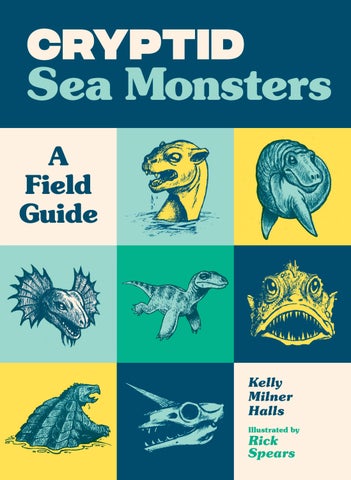
Cryptid Sea Monsters
CRYPTID
Sea Monsters Kelly Milner Halls Illustrated by
Rick C. Spears
Copyright © 2025 Kelly Milner Halls Illustrations copyright © 2025 Rick Spears All rights reserved. No portion of this book may be reproduced or utilized in any form, or by any electronic, mechanical, or other means, without the prior written permission of the publisher. Manufactured in China by Dream Color in March 2025 LITTLE BIGFOOT with colophon is a registered trademark of Blue Star Press, LLC 29 28 27 26 25
987654321
The authorized representative in the EU for product safety and compliance is Authorised Rep Compliance Ltd., Ground Floor, 71 Lower Baggot Street, Dublin D02 P593, Ireland. www.arccompliance.com Editors: Christy Cox and Avalon Radys Production editor: Peggy Gannon Designer: Tony Ong Library of Congress Cataloging-in-Publication Data Names: Halls, Kelly Milner, 1957- author. | Spears, Rick, illustrator. Title: Sea monsters : a field guide / Kelly Milner Halls ; illustrated by Rick C. Spears. Description: Seattle, WA : Sasquatch Books, [2025] | Audience: Ages 7 | Audience: Grades 2-3 | Summary: “Sea Monsters: A Field Guide profiles 50 different aquatic cryptid mysteries around the world. Identifiers: LCCN 2024041320 | ISBN 9781632175168 (paperback) Subjects: LCSH: Sea monsters--Juvenile literature. Classification: LCC QL89.2.S4 H35 2025 | DDC 591.77--dc23/eng/20250218 LC record available at https://lccn.loc.gov/2024041320 ISBN: 978-1-63217-516-8 Sasquatch Books 1325 Fourth Avenue, Suite 1025 Seattle, WA 98101 SasquatchBooks.com
This book is dedicated to all the kids who loved Cryptid Creatures. It’s also dedicated to Jhoskar, a young man I met at Warsaw Elementary in upstate New York. Promise kept, Jhoskar. I hope you love this one as much as you love Cryptid Creatures. –KMH
Dedicated to Darien, Georgia—the home of Altie—and all other communities that have come to embrace their local marine cryptids. May your legends live forever! — RS
CONTENTS ix
Introduction
Sea Monsters 3 6 10 15 17 22 27 30 35 40 42 45 49 52 57 60 63 66 69 72 76
Alkali Lake Monster Altamaha-ha Bear Lake Monster Beisht Kione Dhoo/Beast of Black Head Bessie Cadborosaurus Cape Ann Sea Serpent Champ/Gitaskog Chessie Cressie Edizgigantus Flathead Lake Monster/Flessie Ghostly Eel Gonakadet/Wasgo/ Sea Wolf Hippocamp Iliamna Lake Monster Inkanyamba Issie Kelpie/Water Horse Kraken Lagarfljót Serpent/ Lagarfljót Wyrm/Worm
80 84 87 90 95 98 102 107 111 115 118 121
125 129 133 137 141 144 147 151
Lake Chelan Dragon Lake Van Monster Lariosauro Loch Ness Monster Lusca Manipogo Memphre Mermaids/Mermen/ Merfolk Mishipeshu Monster of Black Water Monster of Ottawa River/Maple Monster of the Susquehanna/ Misiginebig/ Susquehanna Seal Monster Turtle of the Big Blue Pond Mugwump Nahuelito Oarfish Ogopogo Okoboji Raystown Ray Selma
153 156 159 163 167
Sharlie South Side Sea Monster Storsjöodjuret/Storsie Tahoe Tessie Trunko
171 175 179 182
UB-28 Sea Monster Wally White River Monster Yacumama
79
170
Centre for Fortean Zoology Loch Ness Monster x2 Royal Canadian Coins Ningyo, Japan’s Amazing Merman Weird Whales
190
Index
Sea Monster Extras 13 21 39 59
Making the Bear Lake Monster Movie Monster Babies with Bite Chessie, a Multicolored Sea Monster Holy Beasts
93 105 110
Appendices 188 189
Resources Glossary
Introduction Marine animals have been observed since the beginning of human history. But sightings were not recorded in writing until the people of Mesopotamia—the land now known as the Middle East—created an alphabet and words to record human experiences. Once the written word existed, water-based life forms were scientifically named and documented worldwide. Those animals were considered real. When people learned to build ships capable of oceanic voyages, those descriptions expanded. Early maps of the seas featured illustrations of strange animals seen in the water. Remember, a full 96.5 percent of the world’s geography exists under ocean waters, so the sightings were plentiful. Creatures we know well today—such as whales and sea lions—were mysterious then. And clear observations were not always possible. So our familiar favorites were once seen as monsters. Hundreds of marine animals have been scientifically confirmed—proven real. But others have remained a mystery. Fifty of those strange creatures are profiled in this book, thanks to careful research collected from reliable, journalistic sources. ix
Are all fifty real? It’s hard to be sure—for now. Over time, some will turn out to be real, just as whales and sea lions turned out to be real. And some will be proven fictional. Most will remain unknown possibilities until new evidence comes to light. So consider that as you read about these water-bound cryptid creatures. To guide you, we’ve created a reality rating. Will you agree with all of our ratings? Maybe not. But that’s okay. At this point, your guess is as good as ours. In fact, we celebrate your theories, even if they disagree with ours. We all love a good mystery. So dig in and let us know what you think. And keep your eyes open when you’re close to any body of water. You may be the one to prove these monsters really do exist.
Reality Ratings Until definitive information is available, each cryptid will be given a reality rating. «
Proven unreal
««
Leaning toward unreal
«««
Leaning toward real
««««
Proven real
x
INTRODUCTION
Sea Monsters
Adult
Alkali Lake Monster (AL- kuh- l ie)
F I RST R E P O RT E D
1 9 21
LO CAT I O N
N E B RAS KA , U N I T E D STAT E S
C RY P T I D T Y P E
L A K E M O N ST E R
R E A L I T Y RAT I N G
«««
FACTO I D : According to eyewitnesses, the Alkali Lake Monster has a foul smell you might detect even before you see it. E Y E WI T N E S S ACCO U N T: First reported in 1921, this
lake monster is known by three different names—the Alkali Lake Monster, the Walgren Lake Monster, and Giganticus brutervious. Six eyewitnesses stepped forward in 1922 to describe the creature. They said it was a twenty-foot-long reptilian Mermaid with scaly skin and razor-sharp teeth. Its roar was nearly deafening, and it had the power to project water ten to twelve feet in the air. A 1922 Hay Springs News article said the witnesses were trustworthy so the story must be true, and monster mania
3
spread. By 1923, new witnesses offered a new description—a forty-foot-long monster with a rhinoceros-like horn. The Hay Springs Investigation Association was formed to collect more evidence that same year. But when the lake’s owner demanded $4,000 for regular access to the shore, the association couldn’t afford the fee, and the search was halted. In 1962, writer Jack Reid wrote about the aquatic beast for Outdoor Nebraska. His description didn’t match earlier reports. Reid said it was a three-hundred-foot-long dragon with a gaping mouth and a thunderous roar. When the monster wags its tail, Reid wrote, “the ground shakes.” Hay Springs Mayor Richard McKay even said the monster ate cattle and scared local farmers in 2017. Most citizens aren’t sure what to think, but they celebrate every year with a parade and T-shirts featuring the creature’s image. There is even an Alkali Lake Monster costume on display at the Hay Springs Heritage Center and Museum. Local historian Mary Hansen says, “People saw something.” So she keeps an Alkali Lake Monster scrapbook just in case the stories turn out to be true.
4
CRYPTID SEA MONSTERS
Alkali Lake Monster skull
Baby
Altamaha-ha (a l- ta- m a - HA- h a )
F I RST R E P O RT E D
15 00s
LO CAT I O N
G EO RG I A , U N I T E D STAT E S
C RY P T I D T Y P E
R I V E R M O N ST E R
R EA L I T Y RAT I N G
««««
FAC TO I D : In the sixteenth century, French explorer Jacques Le Moyne set out to draw every animal living in the territory now known as Georgia. One of his sketches appears to be the Altamaha-ha. E Y E WI T N E S S ACCO U N T: If the Altamaha-ha is hiding in
Georgia, the Altamaha River is vast enough to keep its secrets. Nearly 140 miles long, most of the river flows far from populated areas until it meets the Atlantic Ocean near the city of Darien and St. Simons Island. Armor-plated sturgeon fish up to twenty-three feet long thrive in the river’s deepest waters. If the river has enough fish to feed a one-thousand-pound sturgeon, it could probably sustain a second large predator nicknamed Altie.
6