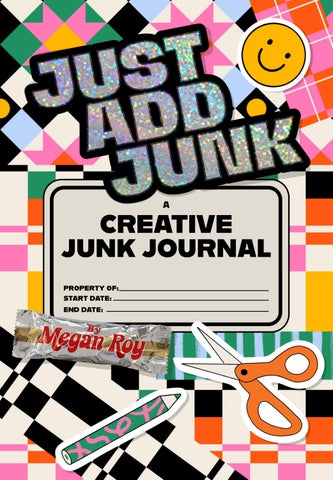
Just Add Junk
i
Just Add Junk A Creative Junk Journal for Scrap Collage & Mixed-Media Play By MEGAN ROY
Copyright © 2026 by Megan Roy Published by Blue Star Press PO Box 8835, Bend, OR 97708 contact@bluestarpress.com www.bluestarpress.com The authorized representative in the EU for product safety and compliance is Authorised Rep Compliance Ltd., Ground Floor, 71 Lower Baggot Street, Dublin, D02 P593, Ireland. www.arccompliance.com All rights reserved. No part of this publication may be reproduced or transmitted in any form or by any means, electronic or mechanical, including photocopy, recording, or any information storage and retrieval system, without permission in writing from the publisher. Written and illustrated by Megan Roy Design by Tony Ong Printed in China 10 9 8 7 6 5 4 3 2 1 ISBN: 9781969889165
iv
For people who still like to make things by hand. For people who save their stickers for a special occasion. For people who are tired of chasing digital algorithms. For people who believe perfection is overrated. For people who like their art to look worn, layered, and lived-in. For people who keep scraps of wrapping paper, birthday ribbons, old greeting cards, ticket stubs, and cookie fortunes, because they “might need them one day.” That day is here, babe. Grab your box of treasures because it’s time to make something spectacular. If you value art that’s tactile, imperfect, and clearly made by a human who was having a good time, you’re in the right place. This book is for you.
vi
What is JUNK JOURNALING, ANYWAY?
An officially unofficial definition of junk journaling: Junk journaling is kind of like scrapbooking, but more spontaneous. It’s less about what you make and more about how it feels to make it. It’s playful. Experimental. Imperfect on purpose. It starts with collecting junk—scraps of paper, receipts, fast food wrappers, product packaging, stickers, magazine clippings, postcards, etc. The bits and pieces from everyday life that would normally be discarded. Look around, you’ll start to see “junk” everywhere! Then you paste, tape, scribble, stick, tie, or otherwise attach that junk to your journal pages in a way that tells a story, explores a theme, or just feels good to make. There’s no right way to do it. There’s also no wrong way to do it. It’s art without the pressure to be impressive or meaningful. It’s creativity in its most unfiltered form. Anyone can do it, and that’s what makes it beautiful.
The Extremely Loose Rules of Junk Journaling* MISTAKES ARE ENCOURAGED: If something feels “wrong,” you’re probably
doing it right. USE WHAT YOU HAVE: Fancy supplies are optional. Junk is abundant. PERFECTION IS NOT INVITED: There is no room for overthinking or criticism
of our own creative performance. Got it?
1
LAYERS ARE YOUR FRIEND: Add more. Then add one more thing. YOU DON’T HAVE TO FINISH ANYTHING: Unfinished pages are still valid pages. RIP IT OUT IF YOU WANT: Tear, cut, fold, glue sideways. This book can handle
it and so can you. IF IT’S FUN, KEEP GOING: If it’s not? Skip it. Turn the page. Try again.
Take a break. *Rules may be broken, ignored, or replaced for any reason or no reason at all. I’m not the boss of you!
How to Use THIS BOOK A non-instruction manual: ❉
❉
❉ ❉
❉
❉
❉ ❉ ❉
Collect your junk fearlessly and unapologetically. When you feel ready, open your journal. You can start anywhere. The front. The middle. A page you flip to randomly. Follow your instincts! Some pages are blank on purpose. They’re waiting for your junk. Some pages include gentle prompts. Use them, ignore them, reinterpret them . . . whatever feels right. Some pages include stickers. Yes, you’re allowed to use them. All of them. Some pages are meant to be torn out (look for the perforated edge). Collage with them, trade them, destroy them lovingly. There is no timeline. There is no expectation to fill every page. There is no requirement to show anyone.
This journal can be: ❉ ❉ ❉ ❉
An experimental playground A creative warm-up A visual diary of sorts Something you haven’t even thought of yet
Just add junk. See what sticks. 2
Helpful, But Not Required Before Things Get Chunky The notes that follow are optional. They’re here for when your journal starts getting thick, unruly, or a little hard to manage—or when curiosity gets the better of you. You don’t need to read any of this to start junk journaling. You can skip ahead, make a mess, and come back later whenever it feels useful.
Binding Basics If your journal is starting to puff up, bulge, or refuse to close, you are doing it right. Junk journals get thick. Fast. That’s part of their charm, but it can also make them unwieldy. What follows are some ideas to de-stress your journal so it can keep growing without fighting you every step of the way. And remember, you’re not ruining anything by modifying your journal. You’re adapting it! Don’t be afraid to take things out and rearrange them. It’s all part of the process. SPINE FLEX: If your journal is starting to feel tight, gently flex the spine
every so often as you work. Open it slowly, press pages down lightly, and let the book relax. This won’t solve everything, but it helps reduce stress as the pages build up. BUILD YOUR PAGES STRATEGICALLY: Instead of stuffing every spread with
heavy layers, try mixing things up. Pair thick, layered pages with lighter ones, add junk in clusters rather than evenly across every page, or leave some pages emptier on purpose. REMOVE PAGES: You have my permission to tear pages out. You can
move them elsewhere. You can turn them into collage material. You can frame them and hang them on a wall. If the journal feels too tight, removing a few pages isn’t the end of the world.
3
ADD SUPPORT: When in doubt, add support. An elastic band or clip can be the
hero that keeps everything together. •
Elastic closures: Wrap a large elastic band around the entire journal to help support the binding while it’s closed.
•
Binder Clips: Clamp a binder clip or two on the edge to keep the pages shut tight.
UPGRADE THE BINDING: If your journal is really living its best life, you might
want to rebind it or reinforce it. A few beginner-friendly options: •
Ring binding: Carefully cut or tear the pages out, hole-punch them, and move them to binder rings.
•
Ribbon or string binding: Thread a ribbon or decorative string through the holes to give the book more flexibility (and make it pretty!).
Remember, you don’t have to make it perfect. You just need to hold it together.
Collecting JUNK Let’s get one thing out of the way: you don’t need more stuff in order to junk journal properly. Junk journaling isn’t about collecting everything. It’s about noticing what already passes through your hands and deciding what feels worth keeping.
Start with What Finds You The best junk usually shows up on its own. Things like: ❉ ❉
Receipts from days you remember Packaging that made you do a double take
4
❉
❉
Wrapping paper you stopped and looked closer at before you ripped it to shreds Cards, tags, notes, or inserts that felt personal
If you had a tiny moment of hesitation before throwing something away, that’s your cue. That’s junk.
What Counts as JUNK? If you’re wondering, “Does this count?” The answer is probably yes. But just to be sure, here’s a list you can consult. Check all that apply: ❉ ❉ ❉ ❉ ❉ ❉ ❉ ❉ ❉ ❉ ❉ ❉ ❉ ❉ ❉ ❉ ❉ ❉ ❉ ❉
Stickers you’ve been “saving for the right time” Used wrapping paper Old greeting cards (the front, the back, or the part you liked) Birthday ribbons, bows, twine, or curly plastic nonsense Ticket stubs, wristbands, receipts Packaging that was too cute to throw away Scrap paper with good vibes Photos you forgot you had Magazine pages, catalogs, junk mail, flyers you never asked for Notes, lists, or scribbles you found at the bottom of an old purse Paper that’s torn, wrinkled, stained, or has “seen some things” Labels, tags, inserts, instruction sheets, or warnings you ignored Coffee cup sleeves, napkins, coasters, or takeout artifacts Fabric scraps, thread, tissue paper, or mystery bits Things that make you go “why did I keep this?” Something flat Something weird Something sentimental Something completely meaningless Something you just found on the floor
If it fits on a page, pushes your serotonin button, or makes you pause for half a second . . . it’s junk. Congratulations.
5
When Deciding What to Keep, Ask Yourself: ❉ ❉
❉
❉ ❉ ❉ ❉
Do I like how this looks, even if I don’t know why? Does this feel interesting enough to hang on to for five more minutes? Would I be a little sad if I threw this away and then thought about it later? Does this have a good texture, color, edge, rip, or wrinkle? Could this be fun out of context? Does this feel like future me would enjoy rediscovering it? Am I overthinking this right now?
If you answered yes, maybe, or “ehhh, sure” to any of the above, keep it. If you answered no to all of them . . . you’re still allowed to keep it. This is not a courtroom. Trust your impulses, you creative little weirdo. Your journal will sort it all out later.
Make an “Everyday” Pile and a “Special Occasion” Pile If you find your junk is piling up quick, it might help to separate it into two categories: one for everyday scraps (receipts, paper bits, packaging), and one for special pieces you aren’t quite ready to use yet. (I’m looking at you, holographic sticker I found on the sidewalk.) Keep the everyday ones accessible so they’re easy to grab. We’ve included a few envelope pages in this journal for exactly that reason. Just don’t guard your “special occasion” pile forever. Remember, the point isn’t to save things—it’s to use them.
6
Junk Can Expire This part is important: If you’ve been saving something for a long time but it no longer excites you, you’re allowed to cut it up, give it away, or just chuck it in the trash. You don’t have to use something just because you’ve had it for a while. Editing your junk collection occasionally can be a very healthy habit! It’s okay to toss, recycle, or repurpose what isn’t serving you anymore. You gotta make room for the good stuff, after all.
TROUBLESHOOTING & ENCOURAGEMENT So here we are. Your journal is thick, scraps of paper are everywhere, and maybe you’ve got a little glue under your fingernails. Perfect. That’s exactly where you want to be. Even the most seasoned junk journalers hit bumps along the way. Here are some common “problems” (and gentle encouragements) to keep in mind: Problem: My pages are a mess. Good. Keep them messy. Messy pages mean you’re experimenting and living in the process. This isn’t a problem; it’s a gift. Problem: I don’t know what to add next. Flip through your scraps. Pick the first thing that catches your eye. Stick it. Scribble on it. Done. Or don’t add anything at all. Sometimes nothing is exactly what needs to be done. Problem: My journal is huge and won’t close. See the Binding Basics section for ideas. And if it still refuses to behave? That’s okay. It’s growing, just like you. Chunky equals loved!
7