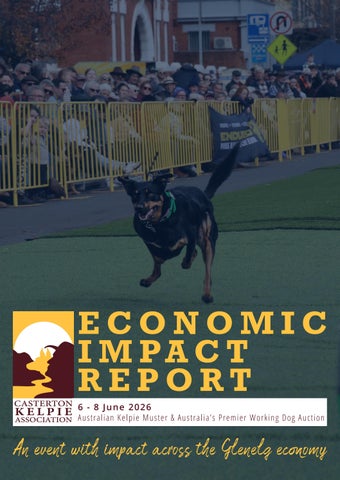
ECONOMIC I M PA C T REPORT 6 - 8 June 2026 Au s tr a l i a n K e l p i e M u s t e r & A u s t r a l i a ’ s P r e m i e r W o r k i n g Do g A u c t i o n
An event with impact across the Glenelg economy
At a glance
T H E I M PA C T
The Muster Makes An Impact
$1.57M – $2.00M
Indicative Direct Visitor Expenditure (DVE)*
8,250 - 10,480
44.64%
of visitation from outside Glenelg
+48.7%
increase in accommodation occupancy
estimated unique attendees
+$129,910 additional visitor expenditure independently observed
+38.5%
visitor spending compared with a non-event period
475,500
$
working dog auction turnover — reported separately
Localis estimates that between 8,250 and 10,480 unique people moved through the event area during the 2026 Australian Kelpie Muster, with 44.64% of visitation originating from outside the Glenelg Shire. Applying Council’s proposed visitor expenditure assumptions of $194 per non-local day visitor and $298 per overnight visitor-night, the Muster’s indicative Direct Visitor Expenditure is estimated at $1.57 million to $2.00 million. Independent transaction analysis recorded $467,360 in visitor expenditure, an increase of $129,910 against the nominated non-event comparison period. These findings provide supporting evidence of increased economic activity across the Glenelg region.
“
The 2026 Muster did more than attract a crowd. It brought visitors into the region, increased accommodation demand and generated measurable additional expenditure across the Glenelg economy.
Indicative DVE is a scenario based on Council-proposed visitor expenditure rates, informed by Victorian tourism benchmarks. The model assumes 58% of non-local visitors stay for two nights. Expenditure rates and visitor-stay assumptions require validation. See methodology.
was measured H OW I M PA C T
More than Attendance The 2026 economic assessment draws on several complementary datasets rather than relying solely on attendance estimates. Localis analysed anonymised mobility data, accommodation information supplied by major online travel partners and transaction data from a major credit/debit card provider. For its visitor-spending analysis, a visitor is defined as someone observed in the region who normally resides outside the Glenelg LGA. Local residents are excluded from the visitor-spending measure.
Visitors
Stay
Spend
Local Benefit
MOBILITY DATA
ACCOMMODATION DATA
TRANSACTION DATA
TOURISM BENCHMARKING
Who came and where they came from.
How demand changed during the event.
What visitor spending looked like within the Glenelg analysis area.
Current Victorian tourism expenditure averages were used to develop an indicative Direct Visitor Expenditure scenario.
Why use more than one measure? Victorian Government domestic tourism expenditure benchmarks were reviewed alongside the typical spending categories associated with regional event visitation. Council-proposed expenditure rates of $194 per day visitor and $298 per overnight visitor-night were then applied to develop an event-specific indicative Direct Visitor Expenditure scenario. Tourism Research Australia recognises that visitor expenditure extends beyond event admission and includes fuel, accommodation, takeaway and restaurant meals, groceries, beverages, shopping, gifts, souvenirs, entertainment and transport. For an event such as the Australian Kelpie Muster, these expenditure categories help illustrate how visitors contribute to businesses throughout Casterton and the wider Glenelg region. However, only expenditure appropriately attributable to the destination should be counted as regional visitor expenditure.([Tourism Research Australia][1])
Casterton Draws People In Independent mobility analysis estimated:
8,250–10,480 unique attendees Of these:
44.64%
came from outside Glenelg
That represents approximately:
3,683 - 4,678 non-local visitors
The Localis visitor-origin analysis identified visitors from metropolitan Melbourne, regional Victoria and interstate areas including Mount Gambier and Adelaide. Association visitor data further identified representation from six Australian states and territories, reinforcing the national draw of the Muster.
Almost one in every two people detected during the event period came from outside Glenelg.
$
1.57M - 2.00M $
INDICATIVE Direct Visitor Expenditure
Important methodology note > The Localis report records 58% accommodation occupancy during the Muster; it does not establish that 58% of non-local attendees stayed overnight. The 58% overnight visitor share is therefore currently an assumption used to model an indicative DVE scenario. It should be replaced with verified visitor-survey data when available.
How the estimate was calculated The Victorian Government’s domestic tourism results for the year ending June 2026, released on 30 September 2026, reported: 87.4 million domestic day trips generating $15.5 billion, equivalent to approximately $177 per day trip
86.5 million domestic visitor nights generating $23.5 billion, equivalent to approximately $272 per visitor night. ([Jobs and Skills Victoria][2])
For the Muster assessment, these provide the benchmarks: Visitor category
Council-proposed rate
Non-local day visitor
$194 per person
Non-local overnight visitor
$298 per person, per night
Assumed average overnight stay
2 nights
Overnight visitor expenditure per stay
$596
Indicative scenario
8,250–10,480 total attendance × 44.64% non-local visitation = 3,683 – 4,678 non-local visitors
For the current indicative scenario, 58% has been used as the assumed overnight visitor share, with an average stay of two nights. That produces: Calculation
Lower estimate
Upper estimate
Estimated unique attendees
8,250
10,480
Non-local visitors (44.64%)
3,683
4,678
Assumed overnight visitors (58%)
2,136
2,713
Assumed day visitors (42%)
1,547
1,965
$300,118
$381,210
Overnight expenditure × 2 nights × $298
$1,273,056
$1,616,948
Total indicative DVE
$1,573,174
$1,998,158
Day visitor expenditure × $194
Note: Visitor numbers have been rounded to the nearest whole person before calculating expenditure, ensuring consistency across the model.
$467,360
Independent transaction analysis provides evidence of increased visitor spending during the 2026 Australian Kelpie Muster.
visitor expenditure during the Muster
Localis recorded an estimated $467,360 in visitor expenditure during the nominated event period, compared with $337,450 during the comparison period.
versus
This represents an additional $129,910 in observed visitor expenditure, equivalent to an increase of 38.5%.
$337,450
The Localis transaction dataset captures spending through a participating credit/debit card provider and does not represent every transaction across the regional economy. Cash transactions, spending through other payment during the nominated providers and some online purchases may not be reflected in the observed non-event comparison period dataset. Difference:
+$129,910 +38.5%
Consequently, the Localis figure should not be interpreted as the total economic value of the event. It independently supports the finding that visitor spending increased, while the revised $1.57M–$2.00M figure provides a broader, assumption-based tourism expenditure scenario. The independently observed expenditure figures are reported separately from the modelled Direct Visitor Expenditure and are not combined, avoiding potential double counting.
INDEPENDENTLY
Observed Spending
Visitors didn’t just come - they stayed. 39% > 58% +48.7%
increase in average accommodation occupancy
Analysis of hotels, motels and short-term rentals across the Glenelg area indicates an increase in accommodation occupancy during the Australian Kelpie Muster compared with the nominated non-event period. This demonstrates the Muster’s capacity to generate accommodation demand beyond the event site. Overnight visitors can also support local hospitality, service stations, supermarkets and retail businesses during their stay. Under Council’s revised model, an overnight visitor is assumed to generate $298 per visitor-night, equivalent to $596 for a two-night stay. This figure represents total modelled visitor expenditure per night, including accommodation and other eligible tourism expenditure. Accommodation costs must not be added again separately.
When the Muster was on, visitor spending went up. SATURDAY
SUNDAY
MONDAY
$231,025
$147,916
$88,419
+$99,100
+$60,728
–$29,000
+75.1%
+69.7%
–24.7%
The Saturday and Sunday uplift totals $159,828, which supports the existing statement that the two main event days generated approximately $160,000 in additional spending relative to weekday benchmarks. The combined uplift of $130,828 is not a substitute for the $129,910 comparison-period uplift reported elsewhere. They use different comparison baselines. Interpretation The spending pattern aligns closely with the Muster’s major public programming. Saturday generated the strongest increase, followed by Sunday. Monday showed reduced spending relative to its benchmark as the event concluded and visitors departed.
The event’s two main days generated almost $160,000 in additional visitor spending. Saturday + Sunday:
$99,100 + $60,728 = $159,828 additional spend, relative to the weekday benchmarks.
ECONOMIC IMPACT
BEYOND Visitor Spend
The muster creates more than one kind of value WORKING DOG ECONOMY
$475,500 Auction turnover 59 dogs | 52 sold 88.1% clearance
Australia’s Premier Working Dog Auction generated $475,500 in reported sales during the 2026 event, demonstrating the Muster’s significance to Australia’s working dog and agricultural industries. This commercial activity generates economic opportunities for breeders, vendors and businesses associated with the working dog industry. Auction turnover is reported separately from Direct Visitor Expenditure because the destination of sale proceeds and their contribution to the local economy cannot be determined from turnover alone. ([Tourism Research Australia][3])
SUPPORTING LOCAL ECONOMY BEYOND VISITORS The 2026 Australian Kelpie Muster distributed approximately $10,000 in competition prize money and supported additional cash spending through market stalls, food vendors and merchandise sales. While total cash expenditure remains unverified, these activities contribute to the region’s economy. Prize money is reported separately from Direct Visitor Expenditure to avoid double counting.
REPEAT VISITATION
42.4%
“Been coming for 17 years.”
“Been attending for 14 years.” “We make the four-hour trip every year.”
Repeat visitation demonstrates that the Muster creates an enduring reason to return to Casterton, supporting destination recognition and long-term visitor relationships.
CASH EXPENDITURE
Cash transactions provide additional opportunities for local businesses, market stallholders and food vendors. As the total value of cash transactions has not been independently verified, no separate cash expenditure figure has been added to the economic impact estimate.
DESTINATION EXPOSURE
1.1M+ 144,746 34,200 social media views
viewers
page visits
57.6% new audience
National destination exposure that extends the Muster’s impact beyond those physically attending the event.
A proven regional draw The 2026 Australian Kelpie Muster continues to demonstrate its significance as a major regional event, attracting visitors to Casterton and generating economic activity across the Glenelg Shire. Independent mobility analysis estimated that between 8,250 and 10,480 unique attendees visited the event area, with 44.64% originating from outside the municipality. Using Council-proposed expenditure assumptions of $194 per non-local day visitor and $298 per overnight visitornight, the Muster’s indicative Direct Visitor Expenditure is estimated at: $1.57 million to $2.00 million. This revised model reflects the range of purchases commonly associated with regional tourism, including fuel, meals, accommodation, refreshments, shopping and other visitor expenditure. Independent Localis analysis identified a 38.5% increase in visitor expenditure against the nominated non-event period, with particularly strong increases recorded on Saturday and Sunday. The Muster also generated $475,500 in working dog auction turnover and approximately $10,000 in competition prize money, reported separately from visitor expenditure.
Together, these measures demonstrate that the Muster makes a meaningful contribution to regional tourism, supports local businesses and raises the national profile of Casterton as the birthplace of the Australian Kelpie. The visitor expenditure estimate remains subject to verification of the assumed overnight visitor share and expenditure rates. In 2022, the ABC reported that approximately 10,000 people attended the Australian Kelpie Muster, with the Association estimating that the event contributed approximately $1.7 million to the community. The revised 2026 expenditure scenario is broadly consistent with the scale of that historical estimate. However, differences in attendance methodology, expenditure assumptions and the treatment of local versus non-local spending mean the figures are not directly comparable. The 2022 estimate should therefore be treated as historical context rather than independent validation of the 2026 model.
REFERENCES
Localis (2026) Casterton Kelpie Muster 2026 – Event Report. Mobility, accommodation and transaction analysis commissioned for the 6–8 June 2026 event. Victorian Department of Jobs, Skills, Industry and Regions (2026). Domestic and Regional Tourism Research – Year Ending June 2026. Released 30 September 2026. Provides Victorian domestic tourism expenditure and visitation results. [Jobs and Skills Victoria] Tourism Research Australia. Regional Expenditure Methodology. Explains the classification and regional allocation of visitor spending, including fuel, accommodation, meals, shopping and other expenditure. [Tourism Research Australia] Tourism Research Australia (2026). Domestic Tourism Statistics Results – June 2026. Provides the supporting national and state tourism statistics and methodology. [Tourism Research Australia] State and Regional Tourism Satellite Accounts. Framework distinguishing visitor expenditure from direct, indirect and total economic contribution. ([Tourism Research Australia][3])
Glenelg Shire Council (2022): Annual Report 2021–2022. Records more than 10,000 visitors to the returning 2022 Australian Kelpie Muster. ([Glenelg Shire Council][5])
ABC Rural (2022) :Value of working dogs recognised as kelpie sells for $27k at Australian Kelpie Muster in Casterton.* Reports 10,000 attendees and the Association's historical estimate of approximately $1.7 million contributed to the community. ([ABC News][4])
The Muster brings people to Casterton. They stay. They spend. They return. And the benefit extends across Glenelg.