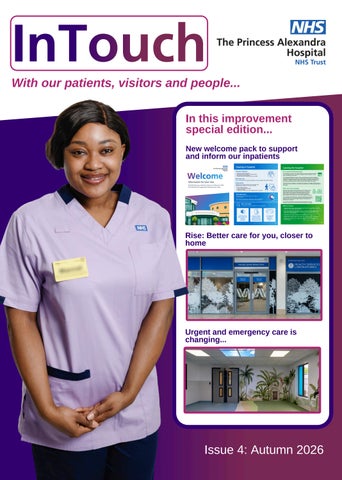
InTouch With our patients, visitors and people... In this improvement special edition... New welcome pack to support and inform our inpatients
Rise: Better care for you, closer to home
Urgent and emergency care is changing...
Issue 4: Autumn 2026
A warm welcome
In this edition...
Welcome to the fourth edition of our magazine, which focuses on the improvements we are making across PAHT to enhance patient experience, strengthen our services and shape the future of care in west Essex.
2
A warm welcome
You’ll find the latest results from the Care Quality Commission (CQC) Adult Inpatient Survey, an introduction to our new inpatient welcome pack, updates on our Rise strategy and the work underway to improve urgent and emergency care. We also look at an exciting new possibility for our hospital and what it could mean for our patients, colleagues and local communities.
3
Care Quality Commission (CQC) report and patient survey drive improvements
4
New welcome pack to support and inform our inpatients
5-6
Rise: Better care for you, closer to home
7-8
Urgent and emergency care is changing - and patients are seeing the difference
9
Bringing care closer to home - and shaping our hospital’s future
Thom Lafferty Chief Executive
10-11
Robotic surgery programme goes from strength to strength
Share your thoughts
12
Hospital staff reach new heights for dementia care
Tell us what you enjoy and what you’d like to see in future issues - from patient stories to health tips or behind-the-scenes updates.
13
Celebrating exceptional nursing care with the DAISY Awards®
Email your ideas to paht.communications@nhs.net we would love to hear from you. The best contributions will feature in the future.
14
The PAHT brain teaser: Crack the code and smoke free PAHT
15
Celebrating the people who make PAHT special and NHS Staff Survey
16
Stay connected
These stories reflect our continued commitment to listening, learning and making meaningful improvements. While there is more work to do, the progress highlighted in these pages demonstrates the dedication of our colleagues and our shared ambition to deliver the best possible care for every patient. Thank you to everyone who contributes to making PAHT a better place to receive care and to work. I hope you enjoy reading this edition and feel encouraged by the progress we are making. Best wishes
Contact us Switchboard 01279 44 44 55 Patient Advice and Liaison Service Email: paht.pals@nhs.net The Princess Alexandra Hospital Charity Email: paht.fundraising@nhs.net
2
Care Quality Commission (CQC) report and patient survey drive improvements The Care Quality Commission (CQC) published its Well-Led assessment of The Princess Alexandra Hospital NHS Trust (PAHT) in August, rating the Trust as requires improvement. Alongside this, the latest CQC Adult Inpatient Survey results show significant improvement in the experience of patients receiving inpatient care. We agree with the Well-Led findings and the need to respond with clear, sustained action. The report gives a balanced assessment, recognising visible and capable leaders, positive partnership working, progress on sustainability and the important role of our Patient Panel in bringing the patient voice into decision-making. It also highlights areas where further improvement is needed, including organisational culture, colleague engagement, equality, diversity and inclusion, speaking up, governance, learning from experience and the consistency of inpatient care. At the same time, the Adult Inpatient Survey results provide important evidence of improvement since the assessment period. Based on feedback from 422 people who received inpatient care at PAHT in 2025, patient experience scores were higher than the previous year for 40 of the 42 survey questions that could be compared, with no areas where scores declined. Patients continue to rate us highly for kindness and compassion, respect and dignity, cleanliness, privacy, pain control, confidence and trust in nurses, and being able to get help when needed. Between April 2025 and May 2026, our 18week Referral to Treatment performance increased to 66.8%, an improvement of 18 percentage points, while 4-hour Emergency Department performance rose to 78.2% in June 2026, almost 10 percentage points higher than the previous year. We have also achieved record levels of engagement in the NHS Staff Survey at 65%, delivered improvements across workforce metrics including training and appraisal, with much of our performance amongst the best in the East of England region, and delivered our 2025/26 financial position.
The Adult Inpatient Survey results are an important marker of progress and show that the changes being made across our Trust are starting to make a real difference for patients. Improvement in 40 of the 42 comparable questions, with no areas where scores declined, is significant. It reflects the focus and effort of teams across PAHT to listen, learn and improve care. We fully acknowledge the findings of the Well-Led report and the areas where we must improve. The report is clear about the work still needed on culture, governance, speaking up, learning and the consistency of inpatient care, and we are responding with clear, sustained action. We are not yet where we want to be in every area. Our focus now is on embedding improvement, acting on feedback, and making sure every patient feels informed, involved, listened to and supported. - Thom Lafferty, Chief Executive
As host provider for West Essex Place, we are also helping to lead work to move more care into community and neighbourhood settings, including our role as part of the Neighbourhood NHS Implementation Programme. We will continue to monitor progress through patient feedback, staff feedback, performance data and governance oversight to ensure improvements are embedded.
3
New welcome pack to support and inform our inpatients We have introduced a new welcome pack to give inpatients clear, practical information and reassurance throughout their hospital stay. Designed to help patients feel informed and supported, the pack brings together essential information about their care, everyday life on the ward and preparing to leave hospital safely. It focuses on topics that can make a significant difference to a patient’s experience and recovery, including getting a good night’s sleep, speaking up about pain or discomfort, staying active where it is safe to do so, and understanding what will happen before and after discharge. The pack also supports the Trust’s ‘Don’t put up with it, tell us’ campaign, encouraging patients and families to speak to staff if they need help, have a concern or feel that something is not right. It signposts further support, including Martha’s Rule and the Patient Advice and Liaison Service (PALS). The pack includes QR codes linking to further information and explains how patients can access support during their stay and after discharge. Please ask a member of the ward team if you have not received one. Alternative formats are available through the ward team. You are also encouraged to ask the nursing team if you would like assistance with the option of washing in the morning or evening. We know that coming into hospital can feel worrying, and clear information can make a real difference. Our new welcome pack is designed to help patients and their families know what to expect, feel more confident and play an active role in their care and recovery. “It covers some of the issues that matter most during a hospital stay, including rest and sleep, managing pain and preparing to leave hospital safely. Just as importantly, it reinforces our ‘Don’t put up with it, tell us’ message: if you need help, have a concern or feel something is not right, please speak to us. Our teams are here to listen, respond and support you - Jo Ward, Chief Nursing Officer (Interim)
Your feedback matters Your feedback helps us to make continuous improvements to patient care and experiences. Please take the time to complete the short survey by scanning the QR code with your phone camera and share your views. Thank you. If you are eligible, you will also be invited to take part in our inpatient survey following your stay.
4
Rise: Better care for you, closer to home Our five-year Rise strategy is focused on what matters most to patients: shorter waits, easier access to tests and treatment, and more services available closer to home. The health needs of our communities are changing. More people are living with long-term conditions, demand for care is increasing and not everyone has the same chance to live a healthy life. Some of our buildings and systems also need to improve. Launched in June 2026, Rise is our plan to meet these challenges and improve local healthcare between now and 2031.
Better spaces, safer care The new Children’s Emergency Department is a clear example of Rise in action. It has more space to assess and treat children promptly in surroundings designed around their needs. A dedicated mental health room also gives children and young people in crisis a calm, private and safe place away from the busy main waiting area.
What Rise means for patients Rise has three priorities. Rising Hope means supporting our staff so they can provide the best possible care. Rising Standards means making care safer, improving quality and reducing waits. Rising Communities means working with local people and partner organisations to provide more care near where people live. Together, these priorities are already leading to practical improvements. We are investing in our staff because skilled and supported teams provide better care. More pharmacists are qualified to prescribe medicines, so they can provide expert advice and help patients receive the right medication without unnecessary delay. They can also check for possible interactions, support the safe use of antibiotics and help prevent medication-related problems that could lead to readmission. Their involvement can make ward rounds more efficient and help patients return home safely as soon as they are ready. Respiratory teams have also completed extra training to strengthen care for people with breathing problems and tracheostomies.
Find out more about our strategy, launched in the summer 2026 edition of InTouch magazine, by scanning the QR code or visit: https://www.pah.nhs. uk/about/magazine/
5
Helping more patients get seen sooner Our specialist teams are changing the way services work so more patients can be seen sooner. Cardiology has introduced advanced pacemaker treatment locally and has been recognised for its expertise in managing heart rhythm conditions. Extra clinics, delivered with partner organisations, helped reduce one cardiology waiting list by 37.3% – 996 patients – in just nine weeks. .
Respiratory services are improving too. Between January and April 2026, 73 patients received care through the expanded service for people with fluid around the lungs. Over 20 weeks, two respiratory waiting lists fell by 71.9% and 78.8%. Diabetes and hormone services have made significant progress on waiting times. At the time measured, no patient had waited more than 52 weeks for treatment. Over 20 weeks, two waiting lists fell by 98.8% and 100%, helping hundreds of people move forward with their care. We are also making it easier for GPs and other healthcare professionals to get specialist advice and refer patients to the right service. People referred with blood in their urine can now have tests arranged sooner, cutting anxious waits and unnecessary hospital visits. If results are normal, some patients can receive reassurance and return to their GP’s care within around a week of referral.
Care closer to home Our St Margaret’s Community Diagnostic Centre (CDC) is an important part of bringing care closer to home. It will allow more people to have tests, scans and appointments away from the main hospital site. Cardiology and respiratory clinics are being developed there, and we are recruiting more staff to increase the number of tests available. New digestive health services will include a scan that checks for liver damage and a less invasive camera test through the nose. These changes are designed to improve access, reduce waits and, where appropriate, allow patients to have tests and receive answers on the same day. The services are planned to move into the second phase of the centre soon. We are also working with the Royal Free Hospital to develop more local clinics for people with high blood pressure in the lungs, giving patients a clearer route from tests and diagnosis to ongoing care. A new insulin pump service is being developed for adults with diabetes. The technology automatically adjusts insulin levels and can help people manage their condition more easily.
What happens next Rise is a five-year plan, and there is more to do. But patients are already seeing important changes: better facilities, shorter waits, more specialist care locally and staff with the skills to provide safer, more joined-up support. We will build on this progress, continue to listen to patients, families, local communities and colleagues, and be open about where further improvement is needed. Our aim is simple: better care today and a healthier future for everyone across west Essex.
6
Urgent and emergency care is changing and patients are seeing the difference Shorter waits, more same day care and better spaces for children and families are helping patients receive the right care sooner at The Princess Alexandra Hospital. When you come to an Emergency Department (ED), you want to know that you will be assessed quickly, treated safely and kept informed. Our teams are changing how urgent and emergency care is delivered to make that experience faster, clearer and more comfortable for patients and families. The results are beginning to show. In June 2026, 78.2% of patients attending the ED were admitted, transferred or discharged within four hours - almost 10 percentage points higher than a year earlier. For patients, that means more people moving through their care without an avoidable delay.
What does improved four-hour performance mean for you?
The four-hour standard tracks whether patients are admitted to hospital, transferred to another service or able to go home within four hours of arriving. It does not mean every patient will leave within four hours: people with the most urgent clinical needs are always prioritised, and some patients need longer for tests, treatment or specialist review. For you, good performance should feel like a joined-up journey: an early assessment, prompt tests and treatment, clear updates and a safe decision about what happens next. The improvement shows that more patients are benefiting from this approach, although teams know that waiting can still be difficult when the department is very busy.
A better emergency care environment for children
For parents and carers, bringing a child to hospital can be worrying. The newly refurbished Children’s Emergency Department (ED) has been designed to improve that experience. Located beside the main ED, it provides dedicated emergency care for babies, children and young people up to the age of 16. Brighter décor and additional space create a calmer, more welcoming setting, while the redesigned layout allows more young patients to be cared for with greater privacy. For families, this means a more appropriate place to wait, talk to clinicians and support their child throughout their care. There is also a purpose-built safe space with an en-suite bathroom for young people who arrive during a mental health crisis. It provides a quieter, more private environment where care can be delivered with dignity at a vulnerable time.
The newly refurbished Children’s Emergency Department is a real step forward in the care environment for our young patients and their families. - Thom Lafferty, Chief Executive
The newly refurbished Children’s ED.
7
Same day care: treatment without an unnecessary overnight stay
Some adults who come to ED need rapid tests, observation or treatment, but do not need a hospital bed overnight. Emergency Medicine Same Day Emergency Care (EMSDEC) gives those patients another route through urgent care, in a short-stay setting. If EMSDEC is right for you, the team can bring assessment, investigations, results, treatment and clinical review together in one visit. Where it is safe to do so, the aim is for you to complete your care and return home within eight hours avoiding an admission and recovering in familiar surroundings. The environment matters too, particularly when you are unwell and waiting for results. Recent improvements to the EMSDEC area and experience - including working with partner organisations to provide enhanced senior medical decision makers (registrars/GPs) and senior nurses are helping to improve patient safety, quality and experience. However, we know that much more needs to be done to provide the standard of environment patients should expect. Further improvements are planned to create a more suitable, welcoming and dignified space for patients to be monitored and treated.
What happens next?
These changes are designed around what patients tell us matter: receiving timely care, understanding what is happening, having privacy and dignity, and being treated in an environment that meets their needs. Better ED flow, dedicated facilities for children and enhanced same day care are helping make that possible. There is still more to do, and we know that not every patient yet experiences the timely, comfortable care they should. We are continuing to act on the areas identified by the Care Quality Commission (CQC) in their latest inspection, improve the EMSDEC environment and build on the progress already made across our urgent and emergency services. Our commitment is clear: to keep listening, keep improving - so that every patient receives the right care, in the right place, when they need it most.
Taking flight: A bird’s-eye view of PAH You may have spotted some unusual visitors flying above The Princess Alexandra Hospital (PAH) recently, but look a little closer and you’ll see they’re not quite what they seem! We have introduced kite-style bird deterrents on the hospital roof, designed to resemble birds in flight. These realistic-looking decoys may help discourage other birds from settling around the hospital buildings. Bird deterrents can be used to help manage the impact of birds around buildings and roofs, where nesting and droppings can create maintenance and cleaning challenges. It’s a simple but eye-catching addition to the hospital skyline, and a reminder of the different ways teams across PAHT work to look after our hospital environment. Next time you spot them soaring above PAH, you’ll know there’s something a little different flying overhead.
The kite-style bird deterrents at the main hospital.
8
Bringing care closer to home – and shaping our hospital’s future From blood tests on Harlow’s high street to new diagnostic facilities at St Margaret’s Hospital in Epping, care is moving closer to where people live – while creating new possibilities for the future of our hospital. The way we provide care is changing. Blood testing is now available in Harlow town centre, and new diagnostic facilities at St Margaret’s are giving patients more convenient access to services. Together, these developments are also opening up the possibility of redeveloping the existing hospital site as part of the New Hospital Programme.
A new possibility for our hospital
Our hospital estate is ageing and becoming increasingly difficult to maintain. Clinical and operational teams work tirelessly to improve services and performance, but outdated buildings can make delivering the best possible care harder than it should be. As part of the New Hospital Programme, we have started to explore an additional option; a preferred option: redeveloping our existing site. This is something we can now consider because more care will be provided in community settings, closer to the patient.
Neighbourhood health is already taking shape
While plans for the hospital’s future develop, neighbourhood health is already changing where patients receive some services. The aim is simple: offer more care closer to home, including health services on the high street and in the communities where people live. Two developments this year (2026) show that ambition becoming reality. St Margaret’s Community Diagnostic Centre (CDC) welcomed its first patient in March, offering more diagnostic tests closer to home. A month later, blood testing moved from the hospital to Harlow’s Harvey Centre, placing the service in the heart of the town. These milestones are part of a wider move towards more joined-up neighbourhood care, which is also planned to include a Women’s Health Hub and community ophthalmology services.
First patient at the new blood testing facility (top) and the CDC (bottom).
An emerging approach shows how redevelopment could happen in three phases, while artists’ impressions provide an early glimpse of how the site might look. This work is exploratory: redevelopment is an option being considered, not a confirmed decision.
Hospital redevelopment artist’s impressions.
9
Robotic surgery programme goes from strength to strength Our robotic surgery programme continues to grow, delivering excellent outcomes for patients while expanding the range of procedures available at the Trust. The robotic programme demonstrates how investment in innovation, workforce development and multidisciplinary collaboration can bring advanced surgical care closer to local patients while supporting the future sustainability of NHS surgical services.
Benefits of robotic surgery include: Shorter recovery times Reduced blood loss Shorter hospital stays Less post-operative pain Improved theatre efficiency Supporting wellbeing of surgeons with less physical strain and fatigue associated with conventional surgery Since the first robotic procedures were performed in 2024, the programme has grown to include eight trained surgeons across gynaecology, colorectal and general surgery. New procedures introduced in 2026 include robotic fundoplication, to treat gastroesophageal reflux disease in May, followed by splenectomy (spleen removal) in June. We are also developing the future NHS workforce through the appointment of our first Trainee Surgical Care Practitioner and robotic skills training for surgical trainees.
Robotic surgery: One patient’s story For Joe Horne, 43, from Ongar, Essex, robotic surgery offered the opportunity for a quicker recovery after he became the first patient at the Trust to undergo a robotic splenectomy. Joe, who lives with his partner, Janine, and their two daughters, Caitlyn and Becky, works as an engineer for Ford Motor Company. He discovered in late 2025 that he would need his spleen removed because of a condition called hereditary spherocytosis. The condition had caused his spleen to gradually enlarge over several years, eventually reaching a size that raised concerns about the risk of rupture.
The robotic surgery team before and during a procedure.
10
Joe said: “My initial concern was how the surgery would affect me and whether there could be any long-term issues.” Although he had heard of robotic surgery being used for minor operations, Joe was unaware that the technology could also be used for more complex procedures. His surgeon, Vardhini Vijay, discussed both robotic and traditional surgery with him, explaining the potential benefits of the robotic approach, including smaller incisions and a faster recovery. Joe was also reassured that, should any complications arise, the surgical team could convert to open surgery if necessary. “I was assured that there was a back-up plan should it be needed, which gave me confidence,” Joe said.
Feeling in safe hands
On the day of his operation, Joe met with the surgical team, who talked him through the procedure, explained the potential risks and outlined how these would be managed. “I was taken to a ward until around 11am, when I went down for surgery. Everybody was calm and relaxed, and I felt in safe hands.” Joe came round from surgery at around 3pm. The surgical team visited him shortly afterwards to check on his recovery and confirm that the operation had been successful, with no major complications. He stayed in hospital overnight and was discharged the following day. “I was surprised at how quickly I was able to go home. I had read that traditional spleen surgery could involve needing a drain and, in some cases, a hospital stay of up to a week.” It was only at his post-operative appointment that Joe discovered he had been the Trust’s first patient to undergo a robotic splenectomy. “I was surprised because everything had gone so smoothly that I had assumed it was a procedure the team had performed many times before.”
Recovering and getting back to everyday life
Joe’s recovery at home went well. He experienced some abdominal discomfort and reduced mobility during the first few weeks but gradually regained his strength. His appetite also returned within 48 hours of the operation. Now four months post-surgery, Joe says the experience has had a significant positive impact on his day-to-day life.
Vardhini Vijay, Surgeon (left), together with Joe Horne, patient (right). “My eating and sleeping habits have been the best they have been in years. I was surprised at how quickly I recovered, and I feel my recovery would have taken longer if I had undergone traditional surgery. My scar is small and neat, too. I’m now four months post-surgery and don’t have a single regret about having robotic surgery.
Advice for other patients
For anyone feeling anxious about undergoing robotic surgery, Joe’s advice is to talk openly with their surgical team and take the time to understand their options. “I would say that the surgical team would only recommend it if they were confident it would benefit you as a patient. “The surgeon went through the pros and cons of robotic surgery with me, and for me, the benefits far outweighed those of traditional surgery.” Joe’s experience highlights how advances in surgical technology can offer patients new treatment options, with the potential for smaller incisions, shorter hospital stays and a quicker return to everyday life.
11
Hospital staff reach new heights for dementia care Sometimes the best ideas begin with the simplest conversations. A chance corridor conversation between Dr Ganesh Arunachalam, Consultant Physician in Geriatric Medicine, and Dr Deb Ghosh, Consultant Gastroenterologist, sparked the idea of bringing colleagues together to climb Snowdon (Yr Wyddfa) while raising money for The Princess Alexandra Hospital (PAH) Charity’s dementia care fund. With little time to organise the challenge, they started with a modest fundraising target and just two prospective trekkers, but momentum quickly grew. Each fundraising milestone was surpassed, and before long the original pair had become a team of 16 PAHT colleagues preparing to take on the mountain together. On 19 September, after just a few weeks of preparation, the team set off for Snowdon. The weather was far from kind, making an already demanding climb even more challenging, but determination, encouragement and a strong sense of teamwork carried them through.
At the heart of the challenge was an important cause; how deeply dementia can affect patients and the families who care for them. The dementia care fund helps enhance the support available to people living with dementia, providing greater comfort, dignity and reassurance when it matters most. The generosity of supporters has been remarkable, and what began as a modest fundraising ambition has now raised more than £4,000 for the PAH Charity dementia care fund. For Ganesh and Deb, the experience has shown how a chance conversation, combined with the enthusiasm of colleagues and the support of the wider community, can grow into something far bigger than originally imagined.
Despite the conditions, the group successfully completed the trek together, turning what had begun as a simple idea into a memorable shared achievement.
Congratulations to all the members of the trekking team, and thanks to everyone who donated, encouraged and supported them along the way. From two colleagues with an idea to 16 colleagues on a mountain, the challenge became an achievement the whole PAHT community can celebrate.
How you can help
Stay connected
Every donation helps us provide the best possible care for everyone who needs it.
Follow us on social media to see the impact of your support, hear inspiring stories, and stay up to date with our latest news and events.
Together, we’re making a real difference. Scan the QR code to donate now or visit pah.nhs.uk/charity to explore other ways to get involved.
@paht_charity
The Princess Alexandra Hospitals Charity
12
Celebrating exceptional nursing care with the DAISY Awards®
Jovi (left) and Jo (right) at the award presentation. Two of our nurses have been recognised for their outstanding compassion, professionalism and dedication to patient care, after receiving the DAISY Award® for July and August 2026. Emily Appiah, Registered Nurse on Harvey Ward, received the July award, while Jovi Espinosa, Registered Nurse on Penn Ward, was named the August winner. Both nurses, who are from Harlow, were nominated by patients’ families in recognition of the difference they made during their loved ones’ hospital stays. Emily was nominated by a patient’s relative for combining outstanding professionalism with genuine compassion, kindness and emotional support. Her care made a significant difference to the patient’s recovery and overall hospital experience.
Emily (left) and Jo (right) at the award presentation. Jovi was nominated by a patient who praised the exceptional care, compassion and professionalism she demonstrated throughout their stay. Her warm and caring approach supported the patient’s recovery and left a lasting impression on both the patient and their family. Both nurses were surprised at work by Jo Ward, Chief Nursing Officer (Interim) at PAHT, who presented them with their awards in recognition of their dedication to patients and their families. As part of the DAISY Award® tradition, each winner received a certificate, pin badge, gift bag, a copy of their nomination and a hand-carved Healer’s Touch Sculpture from Zimbabwe, alongside cinnamon rolls.
Make your nomination today The DAISY Award® programme gives patients, families and colleagues the opportunity to honour nurses and midwives who go above and beyond to deliver high-quality care and make a lasting difference to people’s experiences. You can nominate a nurse or midwife at PAHT for a DAISY Award® by visiting www.pah.nhs.uk/daisy or scan the QR code.
13
The PAHT brain teaser: Crack the code Fancy a challenge? Put your puzzle-solving skills to the test with our PAHT-themed brain teaser and crack the secret message. Grab a pen, give it a go and see if you can solve it! Each letter has been shifted three places forwards through the alphabet to create the code below. To reveal the original message, move each letter three places backwards. For example, D becomes A. Your challenge: Decode the two-word message. Once complete, you can find the full answer on the back page.
ULVH VWUDWHJB
A reminder that this hospital is smoke free Smoking or vaping on the hospital site is illegal and a risk to the health and safety of patients, visitors and colleagues from second-hand smoke or vapour and the risk of fire. If you wish to smoke or vape, you must leave the boundary of the hospital site, including the car parks. As part of our commitment to a smoke-free NHS, our people will discuss smoking with our patients, and smokers using our services are offered stop smoking support. 14
Celebrating the people who make PAHT special This is Us Week 2026 brought colleagues together across PAHT to celebrate the people who make a difference to our patients, families and local communities every day.
This is Us
Week
2026
Throughout the week, colleagues took part in activities designed to bring people together, recognise their contributions and celebrate being part of the PAHT community. Members of the executive team visited wards, departments and sites to meet colleagues, say thank you and share some treats along the way. There was plenty to enjoy, with activities ranging from visits from Pets as Therapy to breakfasts, lunches and barbecues. Colleagues also had the opportunity to take time out and relax with acupressure massages and Tai Chi.
The week was a chance to recognise the dedication, kindness and teamwork that underpin the care we provide, while celebrating the people behind the services our patients rely on. A huge thank you to everyone who took part and helped make This is Us Week 2026 such a success. By supporting one another and working together, our people continue to make PAHT a place where patients receive great care and colleagues feel part of a shared community.
The NHS Staff Survey is open... We want to hear from our staff. The NHS Staff Survey is your opportunity to share your honest views and experiences of working at PAHT, helping us understand what is working well and where we need to improve. The survey is run independently by Picker, and all responses are anonymous, so you can feel confident in sharing your views openly. Managers and clinical leads are asked to ensure colleagues have protected time during working hours to complete the survey. Thank you for taking part. Your feedback matters and will help us make PAHT a better place to work for everyone.
15
Stay connected and follow us on social media
@princessalexandranhs @princessalexandranhs @NHSHarlow The Princess Alexandra Hospital NHS Trust Princess Alexandra Hospital NHS Trust Contact us with your thoughts, ideas and suggestions: paht.communications@nhs.net
The PAHT brain teaser answer: Rise strategy
16