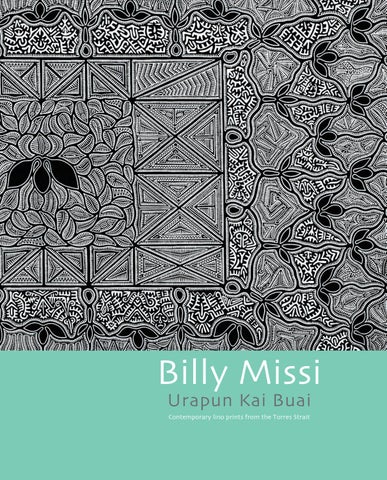
Billy Missi Urapun Kai Buai Contemporary lino prints from the Torres Strait
Zugubal The stars connect the skies with the horizon. The constellations are our orientation to the environment and surroundings, both land and sea.
Malu Ya At sea we are sensitive to seasonal changes. We come to expect certain animals during particular times. This is part of the knowledge learned about the seasons and the sea.
Sagulal Choreographed dances commemorate special occasions. With a sound like approaching thunder, the warup expresses the coming of the monsoon and the rain that brings new life.
Sapural As the wild trees bear fruit, the flying foxes gorge themselves, while flocking together in large numbers.
Buai Girelal Our learned protocols include the respect of family and humble gratitude towards acknowledging kinship.
Bathu Ya There are many resources and activities at the beach, both in the water and along the shore. There are dangers too: stonefish and stingrays; luckily bush medicine plants are also found there.
Mararm Ar Pui’ Iw Aidail Seasonal crops are associated with the coming of the rains. For ground and tree foods each type of seasonal rain is aligned with stages of cultivation.
Acknowledgments Cover image: Urapun Kai Buai This catalogue commemorates the major body of work created by Billy Missi for his solo exhibition Urapun Kai Buai. This publication has been generously supported by the Torres Strait Regional Authority and Arts Queensland. KickArts Contemporary Arts is a not for profit company limited by guarantee and is supported financially by Arts Queensland and the Australia Council for the Arts through the Visual Arts and Craft Strategy, an initiative of the Australian, State and Territory Governments. Sponsors and Partners: Torres Strait Regional Authority Arts Queensland Australia Council for the Arts Qantaslink Aero Tropics Boom Sherrin James Cook University, Cairns campus Publisher KickArts Contemporary Arts 96 Abbott Street Cairns QLD 4870 Australia Postal address: PO Box 6090 Cairns QLD 4870 Australia www.kickarts.org.au Telephone: 07 4050 9494 international telephone +61 7 4050 9494 info@kickarts.org.au
Contents KickArts Contemporary Arts Board Of Directors Mike Fordham, Chair Jenni Le Comte, Secretary Robyn Baker Jeneve Frizzo Robin Maxwell Billy Missi Roland Nancarrow Andrew Prowse Gayleen Toll Robert Willmet KickArts Contemporary Arts Staff Rae O’Connell, Director Beverley Mitchell, KickArts Shop Manager Linda Stuart, Administration Manager Amanda Page, Communications Officer Samantha Creyton, Program Officer
© KickArts Contemporary Arts 2008
Foreword - Toshie Kris
4
Introduction - Rae O’Connell
5
Beverley Mitchell - Kulba Yadail, Kaien Wakaine Thamam (old lyrics, new expressions)
6
Russell Milledge - Danalgaw Gidhal (stories about life)
8
ISBN 978-0-9803402-1-1
Zugubal
12
Language and Spelling Where possible this publication uses the language names provided by the artist. The spelling of Indigenous works and names varies. They generally appear in this publication according to conventions of accepted usage and authoritative sources.
Sagulal
16
Dimensions of works of art are given in millimetres (mm), height preceding width.
Malu Ya
22
Publication team Artist: Billy Missi Director and Editor: Rae O’Connell Curator: Russell Milledge Writers and contributors: John Toshie Kris, Russell Milledge, Beverley Mitchell, Rae O’Connell Design and production: Amanda Page Photography: David Campbell unless indicated otherwise Proof Reading: Ingrid Hoffmann
Sapural
26
Buai Girelal
30
Bathu Ya
36
Mararm Ar Pui’ lw Aidail
42
Billy Missi CV
54
Mualgau Minaral Artist Collective Postal address: Kubin Moa Island via Thursday Island Queensland 4875 Australia Telephone: 07 4069 4295 international telephone +61 7 4069 4295
Copyright KickArts Contemporary Arts, the artist and authors 2008. This work is copyright. Apart from any use as permitted under the Copyright Act 1968, no part may be reproduced without prior written permission from the publisher. No illustration in this publication may be reproduced without the permission of the copyright owners. Neither may information be stored electronically in any form whatsoever without such permission. Requests and enquiries concerning reproduction and rights should be address to the publisher. The views expressed are not necessarily those of the publisher.
Published in association with the exhibition Urapun Kai Buai held at KickArts Contemporary Arts March to June 2008
Printed by: GEON
2
KickArts is supported by the Visual Arts and Craft Strategy, an initiative of the Australian, State and Territory Governments.
3
Contemporary visual arts are an ideal medium utilised by Billy Missi to transmit kinship stories from the oral to the visual. The journey has been an adaptation of energy on the breath of the storyteller to a spark of illumination recorded as visual representation. Missi maintains that it has not been about choices as an artist primarily, but rather a responsibility that is passed on, inherited, through ancestral bloodlines. The urgency of transposing oral knowledge into the visual is to find engagement with contemporary generations who are influenced by the mass-media’s delivery of narratives.
Zenadh-Kes (Torres Strait)
The work of these Island printmakers constitutes a reawakening of traditional and sacred art in a fusion with contemporary mediums and practices.
1 Billy Missi interview with the author 7th March 2008, Brisbane. 2 The Pleistocene has been dated from 1.806 million (±5,000 years) to
11,550 years before present. 3 The evidence for this is through the archaeological discovery of ‘Lapita’
pottery shards recurring throughout Melanesia and Polynesia suggesting a single migratory ethnic population. 4 Billy Missi interview with the author 7th March 2008, Brisbane. 5 Billy Missi made a preference for the term ‘seafaring people’ to emphasise
a distinction between terminology used in Aboriginal Australia and mainland Papua New Guinea where the general term ‘saltwater people’ is used to distinguish from ‘bush people’, ‘highlanders’, ‘desert mob’ etc. Billy Missi, interview with the author 7th March 2008, Brisbane.
Bibliography Eseli, P 1998, Eseli’s notebook: translated from Kala Lagaw Ya into English, edited and annotated by Anna Shnukal and Rod Mitchell, with Yuriko Nagata, Aboriginal and Torres Strait Islander Studies Unit, University of Queensland, Brisbane. David, B and McNiven, I 2005, in Dennis Nona, Sesserae: The Works of Dennis Nona, Griffith Artworks, Brisbane. Horton, D (ed.) 1994, The Encyclopaedia of Aboriginal Australia: Aboriginal and Torres Strait Islander history, society and culture, Aboriginal Studies Press for the Australian Institute of Aboriginal and Torres Strait Islander Studies, Canberra. Flood, J 1989, Archaeology of the Dreamtime, William Collins Pty Ltd, Sydney. Wolanski, E 1990, A Review of the Physical Oceanography of Torres Strait, Proceedings of the Torres Strait Baseline Study Conference, Kewarra Beach, Cairns, Queensland 19 - 23 November 1990, accessed 9 March 2008. <www.gbrmpa.gov.au/__data/assets/pdf_file/0010/4141/ws016_ paper_07.pdf> Mosby, T 1998, Ilan Pasin: Torres Strait Art, Cairns Regional Gallery, Cairns. Meyer, A 1995, Oceanic Art, Volume I, Könemann, Köln. Dabb, G (not dated), A Short Guide to the Torres Strait Compromise, submission National Museum of Australia, accessed 9 March 2008. www.nma.gov.au/libraries/attachments/review/review_submissions/ mr_dabb/files/86/Mr_Dabb.pdf Robinson, B 2001, Torres Strait Islander Printmaking, National Gallery of Australia, accessed 26 February 2008. <http://www.printsandprintmaking.gov.au/catalogues/bibliography/135877/ robinson-brian-torres-strait-islander-printmaking.aspx> Thomas, N 1995, Oceanic Art, Thames and Hudson, Sydney.
10
11
Buai Girelal
Links This image is an expression on Trade, Language and Inter-marriage between Mugie Daudai (Papua New Guinea), Kie Daudaia (Australia) and our homeland. Trade once flowed throughout the Torres Strait region like a crawling snake leaving its tracks in time and its influence on the islands as we see today. Our people traded many things between the islands for many reasons, most were to the western province of PNG for they had bigger trees growing along their rivers to build dugout canoes and a larger land mass with many resources.
Links 2006 Linocut printed in black ink from one block paper: Arches BFK 300 GSM matrix size: 997 x 675 mm edition size: 90 publisher: KickArts printer: Theo Tremblay
Traders also came from as far as Cape York Peninsula’s East and West coasts, this meant that they had to connect and socialise with the Islanders to assist in navigation through our treacherous waters, speak the language and to help them understand when they’d reach their destination on the PNG coast, and vice versa for the Papuans heading to the mainland of Australia. During these connections many skills, methods and knowledge about survival were shared and adopted to our societal ways of living. Most of them were accepted by families in additional kinship, this is why some families on the islands have bloodlines to both Aboriginals and Papuans. This is also why we have a special “Treaty” in place between the Torres Strait and the Western Province, Papua New Guinea. Since the early 1900’s when pearl shells were discovered in this region, people from other ethnic groups (eg South Sea Islanders, Malaysians, Japanese etc.) have been attracted to the region to work and trade in this industry. This is how the Torres Strait became a multicultural society. The five vertical wave patterned lines represent the cluster groups affected in the region. The five horizontal patterned lines represent lines of kinship between islands. The two intricate areas on the top and bottom represent Papua New Guinea and Australia. Characters depict what was traded eg shells for chest pendants, parts of ceremonies that were adopted etc. The wavy line running horizontally represents the turbulent current which flows through the Straits from the Coral Sea to the Timor and Arafura Seas. All this is what makes our culture significant, living in the middle of two land masses and the waterways that link the Pacific Ocean to the Indian Ocean. All the aspects of those movements of so long ago have impacted on our lives and as a result we are all linked in many ways, therefore I title this piece “Links”. 34
35
Mararm Ar Pui’ Iw Aidail
Ari Sulam Ka (calling on the rain) The frogs call up to the rain spirits, who provide the water in preparation for new life in the cycle of nature. The work asks us to consider what it is that we should be asking for and to acknowledge the interconnected and dependent nature of survival. The rains mark the beginning of a new cycle, and it is at this time that if you ask for what you need, you will receive.
Ari Sulam Ka (calling on the rain) 2007 Linocut printed in black ink from one block paper: Hahnemüle 350gsm matrix size: 1005 x 1615 mm edition size: 35 publisher: KickArts printer: Theo Tremblay
While the rain signifies seasonal change, there are many types of rain, and they have different names. Ubarau Peoythurathai Ari is the light rain associated with Wongai, Malgui Ari is steady rain ideal for planting and Laga Sizarai Ari is the rain of the first monsoon for the season and is associated with very heavy downpours.
48
49
Billy Missi Urapun Kai Buai Contemporary lino prints from the Torres Strait