3 QUESTIONS with PAGE & TURNBULL
Federal Historic Tax Credits
Page&Turnbull’sJenHembree,FederalHistoricTaxCreditspecialist,andSarah Brummett,AIA,PreservationArchitectureStudioandWashington,DCofficeleader, shareinsightsonhowfederalhistorictaxcreditscanbegreatfinancialincentivesfor ownersanddevelopers.

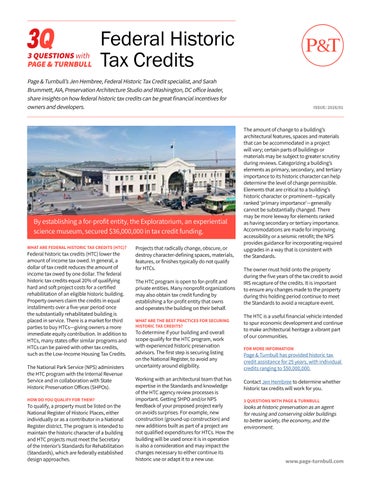
By establishing a for-profit entity, the Exploratorium, an experiential science museum, secured $36,000,000 in tax credit funding.
WHAT ARE FEDERAL HISTORIC TAX CREDITS (HTC)?
Federal historic tax credits (HTC) lower the amount of income tax owed. In general, a dollar of tax credit reduces the amount of income tax owed by one dollar. The federal historic tax credits equal 20% of qualifying hard and soft project costs for a certified rehabilitation of an eligible historic building. Property owners claim the credits in equal installments over a five-year period once the substantially rehabilitated building is placed in service. There is a market for third parties to buy HTCs—giving owners a more immediate equity contribution. In addition to HTCs, many states offer similar programs and HTCs can be paired with other tax credits, such as the Low-Income Housing Tax Credits.
The National Park Service (NPS) administers the HTC program with the Internal Revenue Service and in collaboration with State Historic Preservation Offices (SHPOs).
HOW DO YOU QUALIFY FOR THEM?
To qualify, a property must be listed on the National Register of Historic Places, either individually or as a contributor in a National Register district. The program is intended to maintain the historic character of a building and HTC projects must meet the Secretary of the Interior’s Standards for Rehabilitation (Standards), which are federally established design approaches.
Projects that radically change, obscure, or destroy character-defining spaces, materials, features, or finishes typically do not qualify for HTCs.
The HTC program is open to for-profit and private entities. Many nonprofit organizations may also obtain tax credit funding by establishing a for-profit entity that owns and operates the building on their behalf.
WHAT ARE THE BEST PRACTICES FOR SECURING HISTORIC TAX CREDITS?
To determine if your building and overall scope qualify for the HTC program, work with experienced historic preservation advisors. The first step is securing listing on the National Register, to avoid any uncertainty around eligibility.
Working with an architectural team that has expertise in the Standards and knowledge of the HTC agency review processes is important. Getting SHPO and/or NPS feedback of your proposed project early on avoids surprises. For example, new construction (ground-up construction) and new additions built as part of a project are not qualified expenditures for HTCs. How the building will be used once it is in operation is also a consideration and may impact the changes necessary to either continue its historic use or adapt it to a new use.
ISSUE: 2026/01
The amount of change to a building’s architectural features, spaces and materials that can be accommodated in a project will vary; certain parts of buildings or materials may be subject to greater scrutiny during reviews. Categorizing a building’s elements as primary, secondary, and tertiary importance to its historic character can help determine the level of change permissible. Elements that are critical to a building’s historic character or prominent—typically ranked ‘primary importance’—generally cannot be substantially changed. There may be more leeway for elements ranked as having secondary or tertiary importance. Accommodations are made for improving accessibility or a seismic retrofit; the NPS provides guidance for incorporating required upgrades in a way that is consistent with the Standards.
The owner must hold onto the property during the five years of the tax credit to avoid IRS recapture of the credits. It is important to ensure any changes made to the property during this holding period continue to meet the Standards to avoid a recapture event.
The HTC is a useful financial vehicle intended to spur economic development and continue to make architectural heritage a vibrant part of our communities.
FOR MORE INFORMATION
Page & Turnbull has provided historic tax credit assistance for 25 years, with individual credits ranging to $50,000,000.
Contact Jen Hembree to determine whether historic tax credits will work for you.
3 QUESTIONS WITH PAGE & TURNBULL looks at historic preservation as an agent forreusingandconservingolderbuildings to better society, the economy, and the environment.