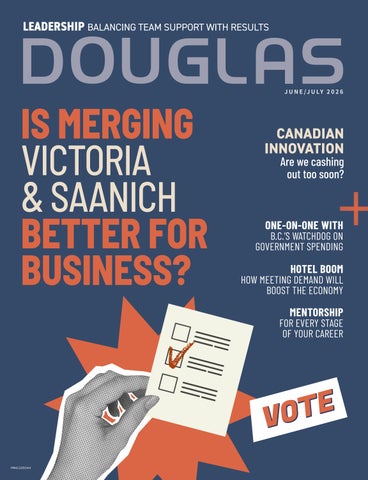
IS MERGING VICTORIA & SAANICH BETTER FOR BUSINESS?
Are we cashing out too soon?
ONE-ON-ONE WITH B.C.’S WATCHDOG ON GOVERNMENT SPENDING
HOTEL BOOM HOW MEETING DEMAND WILL BOOST THE ECONOMY MENTORSHIP FOR EVERY STAGE OF YOUR CAREER
FEATURES
Value for Money
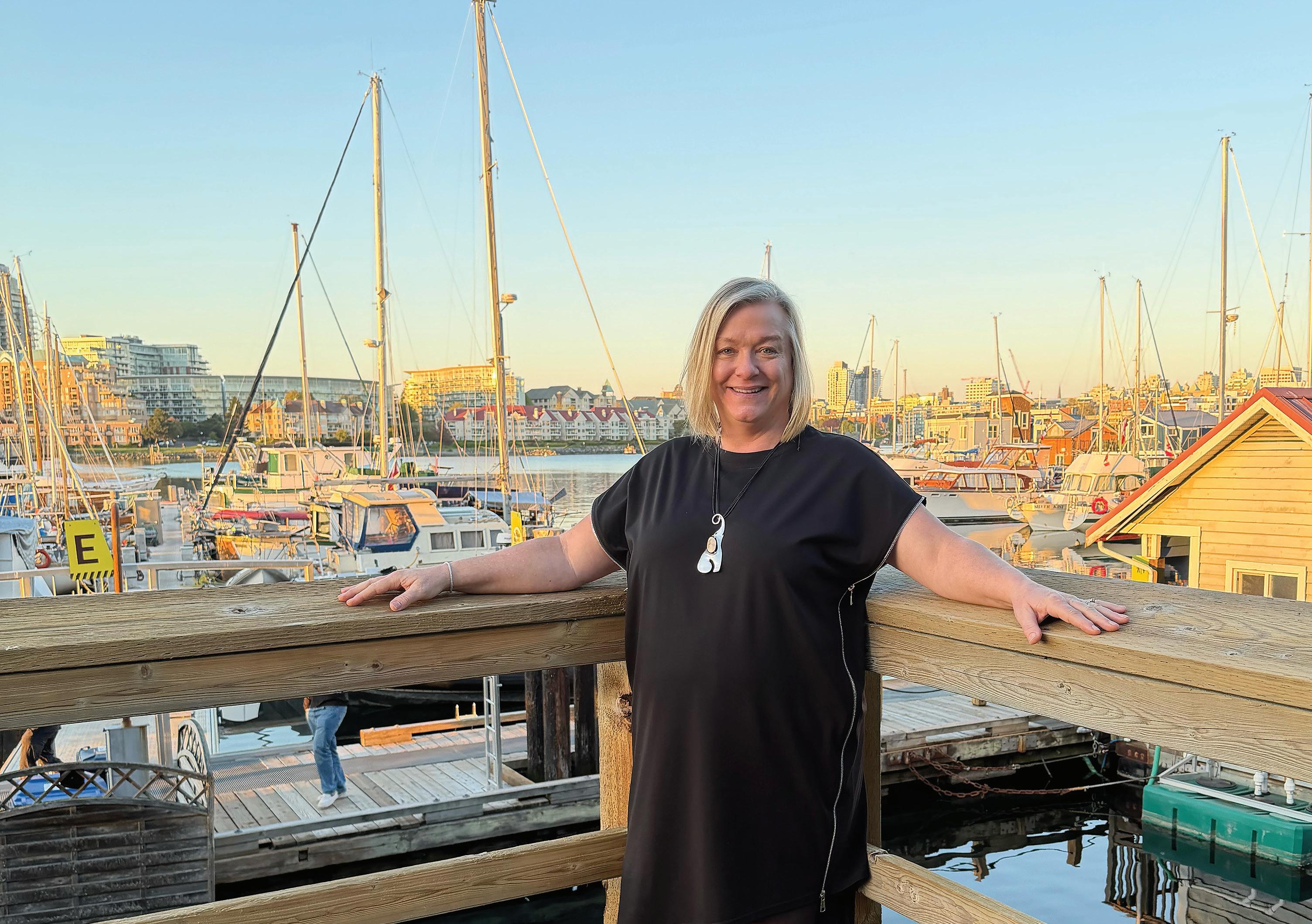
B.C. Auditor General Bridget Parrish on “auditing what the government DID with your taxes!” – with a smile.
BY DAVID LENNAM
18
Keeping it in Canada
Island companies work at getting better at holding onto their intellectual property in order to maximize its true value.
BY ROBYN QUINN
24
One City or Two?
Assessing the pros and cons of civic amalgamation, as Victoria and Saanich voters head to a referendum vote this fall.
BY ANDREW FINDLAY
Rooms for Recovery
Greater Victoria is reversing a nearly two-decadelong slide in hotel room supply with several new and proposed projects.
BY DIANE SELKIRK
36
When Mentorship Matters Most
Recognizing the signs that it’s the right time to seek career guidance from your peers and superiors. BY TAMMY SCHUSTER
DEPARTMENTS
5 LETTER FROM THE EDITOR
7 IN THE KNOW
Chimera Innovations’ prototype “real-time crop intelligence scout” flies over farmers’ fields in Central Saanich; Seacork Studio’s “sonic seaweed” proves itself as a sound-insulating building material; finances top the stress test for B.C. consumers; AIgenerated job applications slow hiring; PacifiCan’s part in local businesses pursuing defence and security contracts; unionized Victoria Uber drivers get a first contract. Plus: Douglas Reads; Corporate Calendar; and Douglas’s 20th birthday giveaway winner!
40 INTEL
40 WALKING THE MANAGER TIGHTROPE
The skill set needed to be an effective middle manager is changing, and the pressure to lead effectively in both directions has never been higher.
BY INGRID VAUGHAN
42 WHEN LEADERSHIP BECOMES THE BOTTLENECK
What to do when the organization you’ve helped build hits a wall.
BY CLEMENS RETTICH
44 LIFE + STYLE
You want to go fore-it on the links? We’ve got fashion in the bag. Career anxiety? There’s an app for that. A new lunch buffet’s bites that are just right.
46 DID YOU KNOW
Getting around town may be a challenge this summer, but we make it a little easier by rounding up the major roadwork projects.
Leading through the summer reset
BY THE TIME SUMMER ARRIVES, even the most ambitious workplaces start behaving a little differently. Meetings get shorter and less frequent, patios get busier and someone suggests a “quick nine holes” at 1 p.m. (for team building, obviously). The season has a way of revealing how organizations function once routines loosen and attention drifts toward long weekends and vacation countdowns. It’s not a bad thing.
That shift also makes summer an interesting test of leadership. Change rarely arrives at a convenient time, and good leaders know momentum cannot depend entirely on packed calendars and perfectly focused employees. Whether dealing with economic uncertainty, changing workplace expectations or just trying to keep people engaged when it’s 27°C outside, leadership can come down to connection and adaptability — even when half the office is mentally on a unicorn floaty on Shawnigan Lake.
When plans change and conditions shift, good judgment matters.
When plans change and conditions shift, good judgment matters. It’s the difference between knowing when to push through and when to ease back for the time being, so that people can enjoy the season.
Whether you’re joining the amalgamation conversation, rethinking how you lead your team, considering the value of mentorship or trying to balance supporting employees with pressure from above, the realities facing leaders right now look very different from one organization to the next.
Across Victoria, many organizations are continuing to evaluate how they operate, refining workplace culture, decision-making structures and day-to-day leadership. Change is happening at every level, and it’s usually not comfortable.
Summer offers a useful pause in the middle of it all. It’s a chance to slow down, reflect and reassess direction and remember that sometimes the best ideas materialize when you are nowhere near a boardroom.
PS The next issue of Douglas magazine is our official 20th Anniversary Issue — we hope you will celebrate along with us!!
— Tammy Schuster Douglas Editor editor@douglasmagazine.com
ADVERTISING CONSULTANTS Deana Brown, Jennifer Dean Van Tol, Cynthia Hanischuk, Brenda Knapik
ADVERTISING CO-ORDINATOR Rebecca Juetten
DIGITAL MEDIA SPECIALIST Lauren Ingle
EDITORIAL ASSISTANT Julien Johnston-Brew
FINANCIAL ANALYST Allison Villacis
CONTRIBUTING WRITERS Andrew Findlay, Julien Johnston-Brew, David Lennam, Robyn Quinn, Clemens Rettich, Tammy Schuster, Diane Selkirk, Ingrid Vaughan, Lionel Wild
Ideas and opinions expressed within this publication do not necessarily reflect the views of Page One Publishing Inc. or its affiliates; no official endorsement should be inferred. The publisher does not assume any responsibility for the contents of any advertisement and any and all representations or warranties made in such advertising are those of the advertiser and not the publisher. No part of this magazine may be reproduced, in all or part, in any form printed without the express written permission of the publisher. The publisher cannot be held responsible for unsolicited manuscripts and
Canadian Publications Mail Product Sales Agreement #41295544
Undeliverable mail should be directed to Page One Publishing Inc. 580 Ardersier Road, Victoria, B.C. V8Z 1C7
Douglas magazine is a registered trademark of Page One Publishing Inc.
ADVERTISE IN DOUGLAS! is a premium magazine dedicated to innovation, leadership and business lifestyle. Established in 2006, Douglas is the first choice for business leaders and achievers. Align your business with Douglas For more information or to request a media kit, please call us at 250.595.7243 or email us at marketinginfo@douglasmagazine.com.
ABOVE AND BEYOND
BY LIONEL
Startup company’s drone and ground module package a “real-time crop intelligence scout” for farmers.
WILD | PHOTO BY JEFFREY BOSDET
Sujith Mathew, founder and CEO of Chimera Innovation, flying his tech at Michell Farms.
Call it a high-tech detection device. That’s what Sujith Mathew does.
And what the 34-year-old founder and CEO of startup Chimera Innovation is doing now is developing this drone-adjacent technology for agriculture with potential applications in other sectors like industrial infrastructure and defence.
Mathew has been out in farmers’ fields in the Saanich Peninsula this year, test driving a drone — and in particular the “smart” ground module that directs it — high above several acres of strawberries.
From this vantage point, this “real-time crop intelligence scout” team analyzes RGB (red, green and blue) and multispectral visual data in order to detect any anomalies — canopy stress or diseased leaves, for example.
This is no mere “flying camera.”
“Stage 1, we transmit the multispectral imaging — that is how, across the crop, the morphology, [showing] how light reflects off of leaves. … There are vegetative indices that can actually be measured,” Mathew says of the information that is sent to and assessed by the ground-based, AI-endowed unit.
“Stage 2 is a really close inspection. Our drone descends from … our usual 100 feet, 200 feet up in the air, to around 10 feet in the air and takes really low-level images to get high-res imagery.”
Mathew then presents the results to the client — the farmer, who will make the call on the crop.
Mathew, who has worked with Michell Farms and Gobind Farms and earlier Field Five Farm, started building the prototype ground module last fall and had it ready for testing in March.
Why agriculture? Because it’s “visceral” for Mathew, in that immediate results are needed to save a crop. Once proven, he sees his early-detection technology being attractive to investors.
SEACORK STUDIO
From Seaweed to Soundproofing
A B.C. company uses non-native seaweed as a sound-insulating construction material.
BY JULIEN JOHNSTON-BREW
Bespeckled boards adorn one wall of a Centre for Ocean Applied Sustainable Technologies (COAST) meeting room, many engraved with oceanic motifs of a salmon, a heron and assorted seaweed, as well as one announcing the panels’ producer: Seacork Studio. These boards do more than soften the look of a stark wall — they also absorb the room’s noise.
“Most acoustic panels are pretty terrible for the planet,” says Eric Warner, Seacork’s director of operations. “They are very carbon intensive to manufacture and are very waste intensive as well.” To offset these impacts, Seacork has turned to seaweed to create acoustic panels with a positive environmental
impact. “It’s like a 98-percent reduction of carbon emissions, and it also stores carbon in the panel itself throughout its lifetime.”
Put A Cork in Carbon Emissions
The panels’ environmental advantage goes beyond the material itself and into how it’s sourced. A Vancouver Island supplier collects nonnative seaweed washed up along beaches, which is then shipped to Vancouver for processing. “A big part of our value proposition is to have a low-carbon product,” says Warner. “By producing panels in the same bioregion that our seaweed is from, it allows us to keep transport emissions really low.”
Once the panels near the
end of their lifespan, they can be composted or returned to Seacork and recycled into new panels. This, as well as Seacork’s other business practices, contributes to six of the 17 United Nations’ Sustainable Development Goals, among them: industry, innovation and infrastructure; sustainable cities and communities; responsible consumption and production; and climate action. “Seacork really started out of this idea of, ‘how do we create building materials that are not harmful for the planet?’ ” says Warner.
An Example for Others
Prior to the meeting room installation, the two organizations initially connected through COAST’s inaugural Pitchfest. Winners
Seacork Studio suspended 176 square feet of acoustic panels in a conversation space at Startupfest 2025 in Montreal.
FUTURE FUNDS
B.C. consumers feel less financial pressure today, but are concerned about tomorrow.
Financial stress in B.C. may be easing, but the underlying pressures appear to be shifting.
New data from FP Canada shows that 41 per cent of B.C consumers still rank money as their top stressor. If this comes as a surprise, the number is actually down from 46 per cent last year and below the national average. On the surface, that looks like progress — but the pressure is only moving, not disappearing.
Stress Index” — conducted by Leger, the largest Canadianowned market research and analytics company, in which just over 2,000 Canadians responded (with a margin of error of plus or minus 2.2 per cent, 19 times out of 20).
Across Canada, money continues to outpace other life stressors, health being 21 per cent, relationships 17 per cent and work and career at 15 per cent.
41% of B.C. consumers still rank money as their top stressor 43% of B.C. consumers say that saving for retirement is a major source of stress
of these pitchfests, which must be emerging blue economy businesses, receive a cash prize, upgraded COAST membership for a year and connections with potential investors.
“It’s really hard for the judges to pick,” says COAST executive director Jason Goldsworthy. Seacork founder Annie Dahan won the first competition in 2024. Though he wasn’t a judge himself, Goldsworthy says he was impressed by how attuned Dahan was to the panels’ market. “Unfortunately, when you deal with a lot of entrepreneurs or people who are into new innovations, they get caught up in the innovation and the technology and they don’t necessarily focus on who’s going to buy it.”
Goldsworthy adds: “The Seacork team has been a model for what we’re trying to do [at] COAST, and that is to find someone … bring them in, introduce them to the right people, get them some earlystage support, provide them access to their first commercial sale and watch them grow.”
The biggest shift is that consumers are now anxious about their retirement. In B.C., 43 per cent say that saving for retirement is a major source of stress, well above the national average of 36 per cent. That means the focus is changing from immediate bills to longterm security, which could be an important sign for financial institutions and employers.
The B.C. figures are part of FP’s broader national survey — its ninth annual “Financial
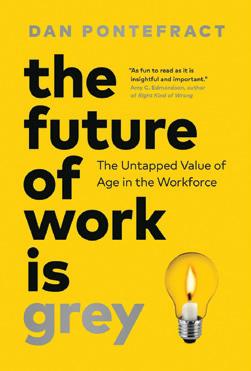
Canadian leadership strategist Dan Pontefract argues that an aging workforce is a competitive advantage in his sixth book, The Future of Work is Grey: The Untapped Value of Age in the Workplace. Drawing on global research, Pontefract urges leaders to rethink outdated assumptions and embrace multi-generational talent to help close skill gaps, drive innovation and build resilient organizations.
At the same time, behaviour is changing with 85 per cent of Canadians taking steps to regain control of their finances. In B.C., that translates to 39 per cent of the population saving more money, while 37 per cent are tracking spending and paying down debt.
For business leaders, results show that financial pressure is easing, but consumers are becoming more disciplined with their spending and more focused on their long-term stability.
39% of B.C. consumers are saving more money
37% of B.C. consumers are tracking spending and paying down debt
AI Slows Hiring Process
HR leaders say AI-generated applications are slowing recruitment.
If you’ve been wondering why you haven’t been receiving more callbacks, AI may be part of the problem. According to new research by talent and consulting firm Robert Half, 61 per cent of Canadian human resources leaders say AI-generated job applications are slowing down their hiring process, while 64 per cent of hiring managers report it’s harder to verify candidates’ skills when resumés are enhanced or written using artificial intelligence.
HR teams are feeling the strain, with nearly nine out of 10 reporting heavier workloads as application volumes climb and more time is spent checking authenticity. Employers have had to add extra screening steps, including longer application reviews, more interviews per candidate and revised job descriptions that limit the amount of generic AI-generated responses.
To manage this pressure, 63 per cent of organizations reported they are turning to staffing firms to help filter through the application process and verify candidate skills and authenticity.
“AI is influencing nearly every part of the hiring process,” says Koula Vasilopoulos, senior managing director at Robert Half Canada. “This research reinforces that technology works best when paired with human judgment, which remains essential for evaluating talent and keeping hiring decisions timely and on track.”
Eric Warner, as Seacork Studio’s director of operations, manages the company’s seaweed supply chain.
Innovation Meets the Wild West
The 2026 VIATEC Awards honour Victoria’s tech sector.
A little grit and a lot of glow. In early April, more than 500 people gathered for the Victoria Innovation, Advanced Technology and Entrepreneurship Council (VIATEC) awards under a Western Neon theme fusing West Coast grit with electric innovation. The evening celebrated companies, leaders and rising stars driving Victoria’s technology sector.
Fourteen awards recognizing organizations and individuals for their impact and leadership over the past year were presented. Congratulations to the 2026 VIATEC Award recipients.
2026 VIATEC AWARD RECIPIENTS
Company of the Year: Atreides Caseri
Growth Company of the Year: Puzzle Lab
Emerging Company of the Year: WikiSleep Social Impact Award: Synergy Enterprises
Employer of the Year: MarineLabs
Inclusion Champion: Text Groove Communications
Product of the Year: Eterio Realities (Fab Station)
Innovative Excellence – Software or Service: Archipelago
Innovative Excellence – Hardware: Azor Biotek
Colin Lennox Award for Technology Champion: Tobyn Sowden (Redbrick)
Leader of the Year: Christopher Moreno (MarineLabs)
Janet Baird Award for Community Champion: Dr. Karolina Valente (VoxCell)
Emerging Leader of the Year: Farrah Costo (FLT) VIATEC Member of the Year: MNP LLP
Investing in Defence Innovation
PacifiCan to support B.C. defence-focused commercial projects through to 2028 with repayable financial contributions.
Responding to global geopolitical turmoil and ongoing supply-chain instability, the federal government has committed to strengthening Canada’s defence industry in the interest of national sovereignty. As part of this push, the Regional Defence Investment Initiative (RDII) was launched to encourage small- and medium-sized incorporated businesses to pursue defence and security projects while boosting local economic development. Funding from this initiative is delivered by Regional Development Agencies across the country; in B.C., PacifiCan fills this role.
PacifiCan’s RDII, which closed
CORPORATE CALENDAR
applications in April, will distribute repayable contributions of $100,000 to $10 million from a pool of $67.5 million to selected commercial projects. These projects must be seeking funding from April 2026 to March 2028, and are expected to grow revenue and export sales, create Canadian jobs and develop defence technologies, products or services where applicable. The RDII is one of Canada’s efforts to achieve the Northern Atlantic Treaty Organization’s established target for allies to spend five per cent of gross domestic product on defence by 2035 (an increase from the two-per-cent spending target Canada achieved in March).
Interested in connecting with other businesses in Victoria? Here are some opportunities to engage.
JUNE 11 Greater Victoria Business Awards
Victoria Conference Centre
A recognition of outstanding businesses and business/community leaders, from startups to long-standing institutions, across 13 distinct categories. victoriachamber.ca
JUNE 15 Distinguished Entrepreneur of the Year Award
Victoria Conference Centre
A gala-style celebration of entrepreneurial excellence reflected in the lasting impacts of innovation, leadership and community contributions. uvic.ca/gustavson
JUNE 18 Impactful Leadership: The Essentials Series
Greater Victoria Chamber of Commerce
A training session focused on turning leadership skills into measurable business improvements for performance, retention and financial growth. victoriachamber.ca
JUNE 20 Brand Royalty Expo
Victoria Conference Centre
A luxury brand showcase of high-end products and services in areas such as fashion, travel, real estate, cars, wine, art, yachts and more. brandroyaltyexpo.com
JULY 16 Growing Relationships
Vancouver Island
Victoria Edelweiss Club
A business-to-business networking opportunity for retailers, producers and industry services within the cannabis industry. stratcann.com
JULY 22 + 26 Heart Tournament
Uplands Golf Club
A fundraising golf tournament supporting cardiac care at Royal Jubilee Hospital. The women’s event is on Wednesday and the men’s on Sunday. victoriahf.ca
The Regional Defence Investment Initiative helps get small- and medium-sized businesses involved in defence and security projects.
Fourteen awards were presented at the VIATEC soirée.
UNITED
Victoria’s unionized drivers are first in Canada to ratify.
Victoria just steered the gig economy into the fast lane. In a first-in-Canada move, more than 1,000 Uber drivers in the city have ratified a union contract, marking a shift in how app-based work is organized. As new members of the United Food and Commercial Workers (UFCW) Local 1518, Uber drivers have secured a collective agreement that brings them workplace regulation, protection and a stronger voice that has been long defined by independence.
This deal builds on their 2025 unionization, when Victoria became the first city in the country where Uber drivers successfully organized. It delivers real benefits including signing and quarterly bonuses, annual fee increases and a wellness fund for sick time and extended benefits.
It also sets clear rules for disputes with Uber, giving drivers a fair shot on issues like pay, ratings or deactivations. For the gig economy, Victoria is shifting into high gear.
DOUGLAS CELEBRATES
20th Birthday Giveaway Winner! Winner Alert!
Congratulations to Suzy Kirkland, the winner of the Douglas magazine 20th birthday giveaway! The winner received two round-trip Helijet tickets for two guests between Vancouver Harbour and Victoria Harbour OR Nanaimo Harbour, an approximate value of $1,998.
Thank you to all who entered!
Money Value for
B.C.’s new auditor general is opening the books on government spending, and she wants you to see the receipts.
BY DAVID LENNAM | PHOTO BY JEFFREY BOSDET
Bridget Parrish has only been B.C.’s auditor general since December — the first-ever internal hire for the job — but the 51-year-old is already touting high performance for the office that examines the way the government spends our tax dollars.
Easy to laugh, chatty, nay gregarious, the native Victorian quells a few of those clichés about boring accountants, heads buried in balance sheets.
Parrish, a University of Victoria graduate in commerce, is a CPA who cut her teeth on audits with a private Calgary firm before moving back to the Island. She spent the last decade with the AG’s office in the professional practices side of the job, designing the systems used to do the auditing. Now she’s in the big chair, leading a department of 135 employees in dozens of annual audits, sub audits, reviews and reports of anything that’s inside the government reporting entity (not only ministries, but Crown corporations like ICBC and BC Hydro). Billions of dollars, tens of thousands of financial activities.
“I’m learning all about all the different areas of government entities, what they do, what the different service lines are, what the risks are, where’s the revenue coming from, what’s it being used for? And what’s our approach? How are we going to audit it?”
Now, she’s putting every transaction to the test, following every dollar and showing people where it goes.
“I’m learning all about all the different areas of government entities, what they do, what the different service lines are, what the risks are, where’s the revenue coming from, what’s it being used for? And what’s our approach? How are we going to audit it?”
Douglas: Outside of the legislature, do you find that the AG’s role is misunderstood? How do you like to explain your job?
Parrish: Yes, people think I’m the attorney general and when I say I’m the auditor general they go like, “OK, you’re auditing the taxes.” No, I’m auditing what the government DID with your taxes. We’re looking at whether they actually account for the taxes that came in and spend it on what they said they’d spend it on and whether that was recorded correctly. That’s one side; the other side is looking at whether a program that money is earmarked for is carrying out its mandate. Is it doing what it’s supposed to be doing? The bureaucrats are always going to paint a rosy picture for the people at the top who are sending the mandate down, so it’s helpful to have an independent person go in and advise whether it really is that rosy.
Douglas: What kind of skills are essential to work in the AG’s office?
Parrish: The biggest is being able to learn quickly and to adapt to the situation. And you have to appreciate the mandate. The mandate is fantastic — serving the legislature to hold the government accountable is pretty exciting. A lot of people want to work here because of the mandate. They want to do something that feels meaningful.
Douglas: What part of the job holds your interest?
Parrish: The people I work with are super smart. People who are curious about why something is the way it is, people who like to solve puzzles. I like the work. I like to learn about how the ministry works and why they do it that way. Why does the money flow like that? Where did it come from? Where does it go? Why did it go there? How did it get there? And did it work? I like all those questions.
Douglas: What sort of things are you prioritizing in the next year or so?
Parrish: One of the things I’m looking at, as a routine, almost like a breadand-butter type of audit, are audits on procurements and grants because this is the government’s money going out, so let’s hope it’s going to the person who deserves it.
Douglas: Your office is about to do procurement audits on three school districts. What are you looking for?
Parrish: You want to know, regardless of what you’re procuring, what’s your process? How are you getting it done? I’m not so worried about that procurement you did yesterday, I’m more worried
about the 10 procurements you’re going to do next year. How do I know that they’re going to someone who deserved to get them and not to your brother-inlaw? We want to reduce the risk of fraud and make sure we get the best value for money.
Douglas: Looking at the year ahead, how do you know what to audit?
Parrish: I like to have balance across all the different sectors. I have on-sector teams that are going to bring me ideas that are in an area of significance in a sector that’s auditable. That’s another criteria. We’ve got to have a source of evidence. We’ve got to have someone who’s actually responsible that we can hold accountable. All those little pieces have to be in place before it’s actually going to be an audit. Otherwise it’s a book report.
Douglas: Are there red flags that catch your attention?
Parrish: Sometimes legislation comes in that isn’t harmonious with existing legislation, which can create a risk and that’s going to create an area where we want to focus. That sort of thing is quite common. We often get things from the public that are topics they think we should be looking at. You just have to be really careful with that because a lot of the time it’s very political. But sometimes we do get whistleblowers [whose anonymity is generally protected under the Public Interest Disclosure Act] from within the government telling us about something that isn’t working properly.
Douglas: You’re keen to get more eyes on what your office does and how the government works. How do you do that?
Parrish: We’re looking at different ways to reach people beyond traditional media, especially younger people, like [on] social media. I want to try and attract people who want to know more about how their province runs. When we do release an audit report, if there’s something where someone’s not doing what they ought to be doing there’s a group of people who care that they’re not and want the government to take action to fix that problem. Especially if it’s the government’s own decision to fix a problem and are not doing it.
Douglas: Is this the dream job for accountants?
Parrish: I think lots of accountants dream of being a partner in an accounting firm. But then lots of accountants go on to be CFOs for a venture that goes public and they get bought out and make a bajillion dollars. But it’s up there.
MAXIMUM EXPRESS COURIER, FREIGHT & LOGISTICS
Full speed ahead
For 22 years and counting, Maximum Express Courier, Freight & Logistics has been doing the heavy lifting, and the light lifting — and everything in between — serving businesses and individual customers across Vancouver Island, the Lower Mainland and farther. Founded in 2004 by Al Hasham, the company built its reputation on reliability, range and deep community roots.
Now it’s entering a new chapter. Rahim Khudabux, known around Victoria by the irresistible nickname “Rahim the Dream,” officially joined Al and the Maximum Express Courier team in June 2025. The two have history: Rahim drove Victoria and Vancouver runs for the company during his student years before he and Al co-founded a furniture business together. When succession came up, the choice was organic. As Al puts it, “We complement each other.” Al is standardsdriven, calmly authoritative and impeccably polished. Rahim brings a community-forward ease and warmth that is very much of his generation.
As this first-generation family business marches toward its second-generation, Rahim says, “My focus right now is updating and preparing our business for AI and new technology. How can we use AI as a tool to
In an industry where competitors are facing decisions to cut their teams in the name of efficiency, that distinction matters.
While leadership will eventually change, not much else will. The company will continue delivering everything from envelopes to pallets, boxes to signage, tires to beer kegs, via their fleet of small and large trucks operating out of Victoria and Vancouver, with national and international reach. One area growing quickly is their Liquor Distribution Branch pickup service, handling runs for restaurants, hotels and bars, so clients no longer need to dedicate
their own staff to the task. For those who need more than delivery, the company also offers storage, warehousing and a full pick, pack and deliver service for businesses that prefer not to operate their own warehouse.
As for the next five years, further expansion and fleet growth are on the horizon. “Our outlook is confident. We are excited for growth,” says Rahim. Maximum Express Courier, Freight & Logistics already runs pretty smooth. They are just getting it ready to go faster.
Call today for a free estimate on your shipping needs.
3-576
Avenue 250-721-3278 | maxcourier.com
Above : Al Hasham (left) and Rahim Khudabux
CHINOOK BUSINESS ADVISORY
Most people don’t realize that business brokers primarily help people with life decisions; the business is in support of those decisions. This is especially true of “main street” businesses, or owner-operated businesses. Folks are looking for a new chapter in their lives.
Victoria is home to many renowned businesses, and none are more uniquely so than Smoking Lily. For 28 years starting in 1996, Trish Tacoma worked to get her dream off the ground from 40-square-feet (think: a closet, really) on Johnson Street, which St. Evans Hattery currently occupies. Slowly, Trish developed a cult following, and her unique designs, “made with attitude and love,” continued to gain followers.
It was around that time that a young Aimee Halfyard was attending UVic for her undergraduate studies. Aimee quickly became enamoured with Smoking Lily’s unique clothing
and became a customer. As a lover of fashion and a hobby sewist who designed some of her own clothing, she appreciated the non-Parisian runway approach to fashion, exemplified by the Smoking Lily vibe. Aimee continued her education in other parts of the country but ultimately found herself living in Vancouver, where she works as an M&A lawyer. Watching other people change their lives through the purchase of a business got her thinking, “Wouldn’t it be cool to have my own business?” She had never stopped loving her sewing machine and creating her own looks to express herself, which further made her wonder, “Wouldn’t it be even better to have a business in the alternative fashion space?” So, Aimee snooped around and found our advertisement for a clothing manufacturing and design business. That’s when the “wouldn’t-its” wouldn’t stop coming, and Aimee responded to our ad, thinking, “Wouldn’t it be cool if this turned out to be Smoking Lily?”
After completing the non-disclosures and reviewing the presentation, Aimee excitedly requested a buyer-seller meeting.
Says Mike Lenz of Chinook Business Brokers, “I have attended hundreds of these meetings over the years, but the excitement, connection and pure joy that overflowed in this meeting were particularly special. Aimee has owned Smoking Lily for nearly two years now. Trish is thrilled with the quality human who is now at the helm of the Smoking Lily business, and we at Chinook are humbled and privileged to have played our small part.”
1824 Store Street, 2nd floor 250-812-0089 | chinookmabb.com
Sewn in the stars
Founder Trish Tacoma (left) and Aimee Halfyard, new owner of Smoking Lily
THINK LOCAL FIRST
Local isn’t a trend. It’s a strategy.
As president of Think Local First and founder of Carter Notary, Beverly Carter leads with the belief that strong local economies don’t happen by chance. They are built through intentional leadership and effort.
Across Greater Victoria, business leaders and consumers alike are rethinking where they spend. Recent research from the Business Development Bank of Canada found that more than half of Canadians are willing to pay more for Canadian products and services, yet many struggle to identify them. Here lies an opportunity.
If consumers are ready to support local, then it’s up to business leaders to make that choice visible, credible and compelling. This is what Think Local First does. “The opportunity isn’t convincing people to support local–it’s making it easy for them to do so,” says Carter.
After more than a decade with Think Local
First, Carter has seen what happens when businesses, organizations and non-profits are intentional in the momentum of economic resilience. Local collaboration strengthens supply chains, fuels job creation and keeps capital circulating within the region.
Think Local First has evolved into a strategic platform for businesses and organizations looking to differentiate, collaborate and compete more effectively in a changing market. While widely recognized for its strong sense of community, its purpose is firmly rooted in economic leadership.
As a business owner, Carter understands the realities of navigating growth, pricing pressure and competition in a market dominated by larger players. That perspective shapes how she leads, which is with a focus on practical action, meaningful partnerships and long-term impact.
Recognized recently as the Times Colonist 2025 Reader Award winner for Best Law
Office, Carter Notary has built its reputation on reliability, responsiveness and lasting relationships.
Carter believes the future of business in Greater Victoria will be defined by leaders who understand that local is not just a value but is a competitive strategy. Join her and become a TLF member. thinklocalvictoria.com
Beverly Carter, president, Think Local First and founder and owner of Carter Notary
KEEPING IT IN
CANADA
IS INTELLECTUAL PROPERTY THE ENGINE FOR VANCOUVER ISLAND’S NEXT ECONOMY, OR ARE WE CASHING OUT TOO SOON?
BY ROBYN QUINN
Vancouver Island companies are very good at inventing the future, but they sometimes struggle to stay on the ride. Too often, the only way for a company to move forward is to sell off its most valuable asset: its intellectual property (IP).
IP refers to “creations of the mind” and can include inventions, designs, copyrights, names, logos and patents, which have legal protection as intangible assets.
INDUSTRIALDESIGNS PATENTS
When it comes to IP in general, if the Island (and Canada) wants to capture more of the value it creates, it’s time to get better at playing the IP game.
Scaling Globally
From an unassuming base in Victoria, Archipelago Marine Research helped pioneer electronic monitoring systems that changed how commercial fisheries are watched and managed around the world. Instead of sending people out to count every fish, electronic monitoring (EM) uses cameras, sensors and smart software to produce reliable data on what’s being caught and where it’s going. For regulators and industry, that’s a big deal: better science, less paperwork and a fighting chance at sustainable fisheries.
In 2017, Archipelago signed a formal agreement with Marine Instruments, a Spanish marine-electronics company with a deep global footprint in the fishing industry. On paper, it looks like a classic win-win. Marine Instruments brings high-volume manufacturing, a worldwide sales presence and serious R&D capacity. Archipelago brings years of hands-on experience designing and implementing EM programs in every kind of fishery.
As part of the deal, key EM intellectual property was transferred from Archipelago to Marine Instruments so the technology could be refined, massproduced and deployed at scale. Archipelago, meanwhile, kept ownership and ongoing development of its EM Interpret data review software here in Victoria.
If you’re scoring this like a standard business case, it’s a success story. A Vancouver Island company develops valuable IP, attracts an international partner, closes a deal and sees its work used in fisheries around the world.
INDUSTRIALDESIGNS
TRADEMARKS
TRADESECRETSTRADEMARKS
INDUSTRIAL DESIGNS
INDUSTRIAL DESIGNS PATENTS
PATENTS
TRADESECRETS COPYRIGHT
The alliance improves capability, increases production and reduces costs for customers, a “big win for fisheries sustainability,” as Archipelago’s vice-president of monitoring technologies put it at the time in their joint press release.
But it also leaves us with an uncomfortable question we rarely ask out loud: When the core IP behind a made-in-Canada innovation moves into foreign hands, what’s the net benefit for Canada? We celebrate the cheque and the headlines. We talk less about who owns the technology 10 years later, where the next generation of jobs will be and whether Vancouver Island remains the brain of the operation or just the place where a really good idea happened to start.
When the World Wants Your Idea
If Archipelago shows how fisheries tech can travel, Victoria’s Aluula Composites proves the same is true for advanced materials. From a nondescript facility in an industrial park, the company’s engineers figured out how to tightly bond ultra-light polymer films into fabrics that are both incredibly strong and almost weightless — exactly what global brands see for potential not only in wind and water sports, but the growing defence industries.
INTELLECTUAL PROPERTY REFERS TO “CREATIONS OF THE MIND” AND CAN INCLUDE INVENTIONS, DESIGNS, COPYRIGHTS, NAMES, LOGOS AND PATENTS, WHICH HAVE LEGAL PROTECTION AS INTANGIBLE ASSETS.
TRADEMARKS
“We need to ensure that with scarce resources we are investing those resources into the assets that we believe are going to generate the best long-term value for ourselves, our shareholders and society generally.”
— Sage Berryman, president and CEO of Aluula Composites
That success created a familiar Canadian problem: how to scale. Turning a breakthrough fabric into a globally available ingredient takes serious capital, manufacturing partnerships and distribution muscle. Aluula listed on the TSX Venture Exchange and brought in institutional investors to fund that next phase, but the brand and its IP quickly found themselves in a much bigger conversation.
In 2024, as part of a strategic refocus, Aluula agreed to sell the Ocean Rodeo brand and its related design IP to U.K.based Bainbridge International, a long-time partner in the sails and marine fabrics world. The deal wasn’t a simple goodbye: It combined upfront cash with a three-year revenue-sharing agreement and minimum annual purchase commitments for Aluula’s materials.
“Tough choices are always necessary when running a business,” says Sage Berryman, president and CEO of Aluula Composites. “And we need to ensure that with scarce resources we are investing those resources into the assets that we believe are going to generate the best longterm value for ourselves, our shareholders and society generally.”
WHAT IS INTELLECTUAL PROPERTY?
Literary, artistic, dramatic or musical works, databases and software code
Novel, useful, nonobvious and appropriate subject matter
Any relevant information, materials, processes or databases
On paper, it’s a sophisticated IP strategy rather than a clean exit — the brand and some design rights move offshore, but the know-how and fabric production stay in Victoria, backed by a committed customer. Put beside Archipelago, you can see the pattern without having to squint. Vancouver Island companies keep producing IP that the world wants, but the growth story almost always involves foreign owners or partners with the capital and channels to scale it. Rather than asking whether those deals should happen at all, Berryman prefers to ask whether we’re structuring them in a way that leaves enough value, capability and control anchored here.
Building an IP Strategy
For health and deep-tech investor Brenda Irwin, intellectual property isn’t a legal footnote; it is the asset class. When she looks at a company, she starts from a simple reality: Venture capital returns come from a small number of big wins, and almost all of those wins are exits, most often mergers and acquisitions, not glossy IPOs. That lens changes how IP looks. A patent is not just protection; it is one of the main reasons a future buyer
Life of author + 70 years
Indefinite so long as the trademark is active. Registered trademarks require renewal every 10 years 15 years from filing date 20 years from filing date Indefinite
Upon creation in a tangible form
Registration or use Application to register prior to public disclosure
Application to register prior to public disclosure
Upon creation and kept secret
WHAT IS AN IP STRATEGIST?
• IP strategists sit between founders, investors and patent lawyers, translating business goals into an IP roadmap, managing budgets and updating the plan as the company pivots or scales.
• IP strategists treat your patents, trade secrets and data like a business portfolio rather than legal paperwork. They help decide what needs protection (and what doesn’t), where to file and when, so your IP spend lines up with real markets and growth plans rather than fears or assumptions.
• In a deep-tech startup, a good IP strategist can be the difference between a stack of patents that look impressive and a tight set of rights that genuinely scares competitors and attracts serious buyers.
will pay a premium for a startup. Founders may describe their mission or product; investors quietly map out which pieces of IP would make this company irresistible to a strategic acquirer five or 10 years down the road.
Irwin sees Canadian teams at both extremes. Some rush to file every idea they have, confusing the quantity of patents with quality of protection. Others hesitate to file at all because costs feel overwhelming, especially across multiple countries. The companies that get her attention treat IP as a focused “land grab” in the markets and use cases that matter most. They work with IP strategists, not just filing lawyers, to decide which inventions to protect, where and when. They understand that a tight cluster of well-chosen patents, trade secrets and data rights can create a moat that buyers will pay for, while scattershot filing in lowvalue markets just drains cash.
“Know-how is powerful but very hard to value until someone else wants it,” says Irwin. The job is to convert the right parts of that know-how into assets that will still matter when the company is big enough to attract serious suitors.
Mistakes that Erode Value
From Irwin’s vantage point, some of the most damaging IP decisions never show up in pitch decks. Early-stage companies
SATURDAY, JUNE 20, 2026
A one-day, immersive luxury brand expo bringing together an exclusive collection of high-end products and premium services. A carefully curated group of companies will present their offerings through: 11AM – 3PM
VANCOUVER
Founders need to be honest with themselves about what they are building: a company that will most likely be sold at some point, or one they hope to keep independent much longer.
sign NDAs and collaboration agreements with much larger firms and assume that paper will protect them. In reality, she notes, those counterparties often have legal budgets that dwarf the startup’s entire valuation. Those big companies count on the startups’ inability to resource a patent fight. Irwin says the scenario isn’t theoretical; she has witnessed it first hand.
Another recurring pattern: When cash gets tight, founders look to IP as an easy place to cut — delaying renewals, shrinking geographic coverage or deferring advice that could reposition their portfolio. Each of those decisions can quietly narrow the set of future buyers or depress the eventual price.
Irwin’s counsel is uncomfortable but clear. Founders need to be honest with themselves about what they are building: a company that will most likely be sold at some point, or one they hope to keep independent much longer. In both cases, investors are already thinking about IP as a key lever that unlocks value. The question is whether the people creating that IP are thinking about it with the same discipline.
Owning What You Create
Where Irwin zeros in on individual deals, Innovate BC president and CEO Peter Cowan analyzes the patterns across an entire economy. His starting point looks at decades when many Canadian companies
treated IP primarily as something you packaged up and sold, rather than as a strategic asset you build for the long term.
That shows up in behaviour. Too few founders think about what it would mean to grow an IP-rich company headquartered here; too many assume that if things go well, a foreign buyer will eventually take the whole thing off their hands. Cowan would like to see more teams at least explore alternatives, from licensing and joint ventures to growth capital that doesn’t automatically aim at a quick sale.
Changing Canada’s IP IQ
Cowan doesn’t blame individual entrepreneurs for choosing exits when IP is expensive and early-stage capital is scarce. Instead, he points to the system starting to adapt. Since the federal IP strategy launched in 2018, programs such as Elevate IP, IP Pathways and other Innovate BC initiatives have tried to raise the baseline level of IP literacy among startups, researchers and executives.
The idea is straightforward: Make sure more founders can get strategic IP advice
WHAT’S GETTING PATENTED IN B.C.?
Not all IP looks like a gadget. In the last year, B.C. innovators have been lining up patents around the invisible parts of their businesses and generating big benefits for Canada.
BIOTECH AND LIFE‑SCIENCES PLATFORMS: methods and formulations for drug delivery, peptide-based therapies, diagnostics and bioinformatics, often protected as processes and compositions rather than devices.
Ownership Rights Duration
Remains with original creator
Permission to use under specified conditions
Transferred to another party Fully transferred to use freely
AI AND DATA‑DRIVEN SOFTWARE: algorithms for prediction, optimization and pattern-finding in health, logistics, finance and climate tech, where the core asset is the trained model and data-handling method.
DIGITAL PROCESSES AND PLATFORMS: cloud architectures, security protocols and business-process innovations turning service models into protectable IP, especially in fintech and clean tech.
and cover the first, crucial filings in key jurisdictions without immediately giving up large chunks of equity or control. That includes courses designed for CEOs and senior researchers on how to think about ownership, licensing and data, not just how to fill out a patent form.
Most founders, Cowan notes, genuinely want to grow their business in Canada and create value here. But when the only affordable way to protect their IP involves investors who need to exit quickly, their choices narrow fast. Giving them better tools and support up front doesn’t guarantee that IP will stay in Canadian hands, but it does create more room for them to negotiate from a position of strength.
“Being acquired isn’t a bad thing,” Cowan says. But, he adds, the real problem is when exits are the only path on offer. In a free market, investors will always expect a return. The question for him is what benefit Canada gets in exchange when IP leaves.
What’s In It for Canada?
Cowan suggests thinking in terms of net benefit. A foreign acquisition that moves patents offshore might still deliver real value to Canada if the headquarters remain here, if leadership gains global experience and reinvests it in new ventures, or if the deal seeds a local cluster of suppliers and spinoffs. The trouble is that those outcomes are rarely part of the original conversation.
Shifting our IP culture, in Cowan’s view, means putting that net-benefit lens on every major transaction involving homegrown IP.
“We should not resist or second-guess transactions, but recognize they are part of a global economic reality. Realities which can be healthy if we maximize long-term value and capability they can create if decision-making and expertise are anchored here,” he says. “That, in turn, builds experienced local talent, seeds the next generation of startups and starts to turn the flywheel of globally competitive companies.”
Cowan is optimistic, “Exits will always be part of the IP story. The next chapter is about owning more of what we create, not just being great inventors.”
The Future of IP Strategy
What’s on the horizon for intellectual property? In a word, strategy. Identifying what to patent, where and when. Protecting trade secrets and industrial design and considering partnerships to generate long-term benefits for local innovators and Canada.
L to R: Ian Clark, Carmen Atwood, Grant Atwood
CITY OR TWO? ONE
Greater Victoria may be heading toward one of its most pivotal municipal decisions in decades.
If citizens in Victoria and Saanich vote in the fall to merge Greater Victoria’s two most populous municipalities, what would this new city be called? Vicnich? Saantoria?
New city naming may require some emotionally charged conversations, but it would be the least important of concerns. Amalgamating two cities, each with their own service departments, staff payroll and pay scale, elected mayor and council, bylaws and regulations, not to mention priorities and distinct sense of community, is not to be taken lightly.
Backing the Vote
Last summer, the Victoria-Saanich Citizens’ Assembly submitted a report to the
The debate over whether merging Victoria with Saanich will create greater efficiencies or more problems may well be decided by voters this fall.
BY ANDREW FINDLAY
Staff from the City of Victoria and the District of Saanich, with the support of the provincial government, have been working to craft a short question that will be on the local election ballot in both municipalities for the October 17 civic elections.
respective city councils that is overwhelmingly in support of putting amalgamation on the ballot in October when voters go to the polls in the next municipal elections.
Following 3,000 hours and eight months of expert presentations and discussions, 42 out of 48 assembly members concluded that joining the two cities would be good for business, managing development, transportation planning, climate-change mitigation and co-ordinating an array of municipal services from water and sewer to parks and recreation.
Overlapping Governments
The citizens’ assembly report was a long time coming. In 2018, residents in both municipalities gave their respective councils a mandate to dig into the pros and cons of merging. A citizens’ assembly, a demographic snapshot of randomly selected citizens, was
chosen as the method. However, the COVID-19 pandemic delayed the startup until fall 2024, with Saanich, Victoria and the provincial government sharing the $750,000 bill for consultant and other fees to run the citizens’ assembly.
Greater Victoria is made up of 13 neighbouring municipalities. The borders between some are so arbitrary and ambiguous that most commuters would have no idea where one ends and another begins. Reducing the number of municipal governments by joining cities is an idea that’s been tossed around for decades on
southern Vancouver Island.
That fragmentation extends to core services. Simplifying Greater Victoria’s policing is a perennial topic raised by amalgamation supporters. Currently Victoria and Esquimalt share a police department, while Saanich and Central Saanich each have their own police forces, as does Oak Bay with a population of 18,000. The RCMP serves the West Shore and other surrounding municipalities.
Saanich and Victoria residents now have the chance to vote “yes”’ or “no” to join their two cities. If the yes vote
prevails, it could set a template for future amalgamations in Greater Victoria. If the answer is no, then it’s business and government as usual.
Those in support believe amalgamation will result in streamlined and more efficient municipal government and services.
Detractors fear a loss of community identity and believe promised efficiencies are rarely realized long after the ink has dried and the ribbons have been cut.
Which is better is still a point of debate.
Is Bigger Actually Better?
Fabrizio Cross was a member of the citizens’ assembly and calls himself a civic-minded Victoria resident and politics junkie. He started the process with a “big government bad, small government good” mindset. It’s not surprising considering his background. Cross grew up on a Hornby Island family farm and was deeply involved in the Hornby Island Mountain Bike Association, land access issues and trail development and other community issues. The island’s unique, artsy and DIY culture breeds a strong sense of identity.
Fabrizio Cross, member of the citizens’ assembly
Despite this small-community pedigree, Cross emerged eight months later from the citizens’ assembly with a changed mind and belief that amalgamation is the right path forward for Victoria and Saanich.
“What kind of hit home for me is that we are not being represented at a provincial or national level in the way that we should be, compared to cities like Vancouver or Surrey or Hamilton or Ottawa,” Cross says.
Climate change mitigation is an area that he believes would benefit from amalgamation rather than two bordering What kind of hit home for me is that we are not being represented at a provincial or national level in the way that we should be, compared to cities like Vancouver or Surrey or Hamilton or Ottawa.”
cities pursuing different strategies. As an avid cyclist, he sees opportunities for better transportation planning.
“There’s a bike lane near my house that jogs over a couple of blocks when you hit the Saanich border because they weren’t planning that bike route together,” Cross says. “When you hit the Ptolemy border on Douglas Street, it ceases to be a bike and bus lane and becomes purely a bus lane. So, if you’re riding your bike there, cruising along, and everything’s cool, then you cross that line and, all of a sudden, the bus behind you is honking.”
The Benefits of Bigger
Some citizens’ assembly members raised concerns that if Saanich joins with Victoria, it means inheriting downtown Pandora Street problems.
John Wilson, CEO of Greater Victoria Chamber of Commerce, says it’s time to get beyond this narrow perspective and look at downtown Victoria for what it is: an entertainment, night life, arts and culture hub for the entire region.
“Chances are if people are going to a concert or a high-end restaurant, they’re coming to downtown,” Wilson says. “Yet we shoulder a disproportionate burden of the unhoused and toxic drug crisis.”
The Victoria chamber advocates for more than 1,400 Saanich and Victoria businesses and has been a longtime amalgamation booster. Wilson supports familiar pro-amalgamation arguments that say joining adjacent municipalities allows for streamlining of zoning, regulations, permitting and bylaws, is better for business and enables co-ordination of region-wide challenges like transportation planning, law enforcement and densification.
“We constantly hear from business and developers about their concerns about doing business in Victoria and Saanich,” Wilson says. “Business likes certainty and right now we don’t have that.”
He believes a bigger city would gain access to bigger pools of provincial and federal funding, including support for sustainability initiatives, transit expansion and housing and urban development. As it stands now, the City of Victoria is a small fish in a big pond, yet struggles with the same crises of urban poverty, affordability and soaring property taxes and leases that Toronto, Vancouver and other larger metropolitan centres face.
“Larger municipalities have more clout to apply for higher levels of funding,” Wilson says. “By virtue of our population, we don’t have a seat at some important tables.”
The Federation of Canadian Municipalities’ Big City Mayor’s Caucus
STAY IN THE KNOW
is a forum where leaders from Canada’s largest cities can collaborate on policy development and partner with the federal government on national and city-building initiatives. It is open to Canadian cities with populations of more than 100,000. Victoria, with a population of around 92,000, doesn’t get the invite.
The Path to the Ballot Box
Both the District of Saanich and the City of Victoria municipal governments say they are committed to the citizens’ assembly recommendations and letting voters decide on amalgamation in October.
In an emailed statement, the District of Saanich encouraged the public “to read the report to gain a better understanding of the process, what was included in the analysis and the Assembly’s recommendation.”
We’re not a big area, but we have 13 municipal governments. Amalgamation would allow for better regional planning for parks, development, policing, disaster response — so many things. I see this as an issue of good governance.”
James Legh, partner, Stevenson, Luchies & Legh
Once the provincial government approves moving the process forward, Saanich and Victoria will “collaborate on a ballot question,” the statement said.
James Legh is a lawyer who co-owned pubs in several Greater Victoria cities and is a partner in the firm Stevenson, Luchies & Legh with offices in Victoria, Sooke and Nanaimo. He sits on the board of Amalgamation Yes, a non-partisan group that helped push for the citizens’ assembly.
“We’re not a big area, but we have 13 municipal governments. Amalgamation would allow for better regional planning
for parks, development, policing, disaster response — so many things,” Legh says. “I see this as an issue of good governance.”
He hopes a Victoria-Saanich amalgamation will be the first of several in the region. Yet past amalgamations get mixed reviews and the concept itself has its fair share of detractors.
The Cost of Bigger
Patrick Condon, a longtime professor at UBC’s School of Community and Regional Planning, says that beyond financial matters, amalgamation has implications for the democratic process.
“Local democracy matters. It’s one’s most basic form of citizen control in a democracy,” he says.
Allison Habkirk is a municipal government consultant, registered planner, former District of North Saanich mayor and councillor.
She presented a report called “Big is Better or Small is Beautiful” to the Victoria-Saanich Citizen’s Assembly, a counterpoint that strikes at the core of the amalgamation debate.
Like UBC’s Condon, she fears the loss of democratic representation and local autonomy, and she cautions against viewing amalgamation as a quick fix for municipal and regional challenges.
“People are attracted to the simplicity of amalgamation. It’s like, yes of course, let’s do it. It’s going to be more efficient. But really the research doesn’t prove that out at all,” she says.
Habkirk says voters have to ask what exactly is amalgamation trying to fix? When regional co-operation makes sense for capital-intensive services like sewer, water and recreation, for example, Habkirk says the means for co-operation already exists through the two-tiered Capital Regional District and municipal government system.
According to Habkirk, the belief that amalgamation will result in a levelling up and equalization of services between the two cities is illusory.
“There’s a distinction between Saanich and Victoria. Saanich is all-in on recreation, both in terms of facilities and outdoor recreation,” she says. “Victoria barely has a swimming pool because they’ve invested their money in other things. I don’t fault them for that. It’s what they have chosen as a community to do. It’s their priorities, and that’s what they want to do. I like that about Greater Victoria.” CITY OF VICTORIA
EXAMPLES OF CORE MUNICIPAL SERVICES
Public Safety & Bylaw: Fire rescue services, bylaw enforcement (noise, property maintenance, zoning) and animal control.
Infrastructure & Utilities:
Road maintenance, snow removal, sanitary sewer/storm drains, water services and garbage/organics collection.
Planning & Development:
Building permits, inspections, zoning, urban planning and business licensing.
Parks & Recreation:
Maintenance of public parks, green spaces, recreation centres and community programs.
Administration & Finance:
Property tax collection, utility billing, city budgets, elections and archives.
A Mixed Track Record
Past amalgamations offer mixed lessons. In 1995, Matsqui and Abbotsford in the Fraser Valley merged into one city. Twenty years later, consulting firm Urban Systems took an impartial look at the results. In a report released in 2018, Urban Systems found that the costly harmonization of official community plans and zoning bylaws took two years to complete and resulted in processing delays for land use applications and building permits. Full administrative transition took two decades.
On the plus side, amalgamation resulted in “streamlined and better community planning” while economic development was made easier with only a single set of plans and regulations.
“The legacy … has been generally positive, and reference to preamalgamation rarely occurs,” the technical study concluded.
The big takeaway from the Urban Systems report is that it could be a generation before voters, businesses and developers see the benefits of amalgamation.
Toronto is a different story. The super amalgamation in 1998 of Toronto and six surrounding municipalities into a single megacity was considered a mixed success at best — when it came to co-ordination of services — but a mistake in terms of cost savings.
At the time, Ontario premier Mike Harris’s provincial government promised cost savings and efficiencies, reduced red tape and the elimination of 4,500 civil service jobs. Instead, the new city had to borrow $200 million to pay for transition costs and debt grew to $2.3 billion within a decade. The provincial government’s simultaneous downloading of social service responsibilities to Toronto didn’t help matters.
The Decision Ahead
The Victoria-Saanich Citizens’ Assembly’s Cross points out one of the elephants in the room: that city councillors may have a vested interest in maintaining the status quo.
He says he’s not hearing much chatter about amalgamation among politicians since the citizens’ assembly submitted its
report. That worries him.
“The fact is if amalgamation goes ahead, a bunch of city councillors will be competing for fewer seats. So, there is a self-interest piece that kind of gives them reason to pause and maybe not be out there championing the idea,” he says.
Amalgamation Yes’s Legh has been boosting amalgamation for three decades, almost since moving to Victoria from Winnipeg. However, the concept has been tossed around dinner tables and council chambers across Greater Victoria for much longer.
Legh says the citizens’ assembly may not have turned over every stone, but believes the process came to the right conclusion: Amalgamation would be a win for Victoria and Saanich.
“Put it this way: Do you think if we started over here that we’d create 13 cities in this little area?” he asks. “I don’t think so.”
In a region already operating as one city in many ways, voters may soon decide whether the current boundaries, as murky as they are, still work.
Transforming
For 25 years, we’ve been committed to helping reduce barriers to success through confidence-building services and personalized support for self-identified women. By empowering clients, volunteers, donors, and supporters alike, we continue to create meaningful impact throughout our community.
Johnson Street, Victoria
ROOMS RECOVERY for
Victoria’s hotel sector begins rebuilding after a decades-long, 2,000-room decline.
BY DIANE SELKIRK
Construction continues on an eight-storey, 167-room hotel taking shape behind the four-storey façade of the Duck’s Building, built in 1892 and named after former provincial finance minister and Victoria businessman
Simeon Duck.
JEFFREY BOSDET/DOUGLAS MAGAZINE
Victoria’s skyline is beginning to change. After nearly two decades of limited hotel development, cranes are once again reshaping the capital region, signalling what industry leaders hope is a long-awaited reversal of a sustained decline in accommodation capacity.
That shift is already visible on the ground. The 167-room Hyatt Centric is slated to open in 2028 within the historic Duck’s Building on Broad Street, preserving its 1890s-era façade, while the three-storey TownePlace Suites by Marriott at Victoria International Airport in Sidney opened in April.
For a city that’s lost more than 2,000 hotel rooms since the 1990s, the moment feels significant.
Victoria’s visitor economy has continued to grow, but hotel capacity has failed to keep pace. Now, a pipeline of new projects — combined with an industry-led push to streamline development approvals — is aimed at closing that gap.
A Decline in Accommodation Capacity
Victoria’s hotel shortage did not happen overnight. It has escalated gradually over decades as older properties were redeveloped or converted, while economic downturns and pandemic-era policies further reduced the number of rooms available to visitors — some temporarily, others permanently.
Today, Greater Victoria has roughly 4,500 hotel rooms, but that figure masks a long-term contraction in supply. Industry estimates suggest the region has lost a significant share of its hotel inventory since the mid-2010s, with well over 1,000 rooms removed or repurposed in the past decade alone.
Several high-profile properties illustrate the trend. Hotels such as the Capital City Centre, Paul’s Motor Inn and the Comfort Inn on Blanshard have closed or been redeveloped, while others — including Harbour Towers and the Q Hotel — have been acquired for residential conversion.
The result is a tourism economy in which demand has remained relatively strong, while available hotel accommodation has tightened — particularly during peak travel periods.
Demand Keeps Rising as Supply Falls
Despite this contraction, Victoria’s visitor economy has continued to grow steadily since the pandemic.
According to Destination Greater Victoria, visitation is up over four per cent this year,
while the number of major conferences has increased to about 30 annually.
“Both the tourism and conference sectors have continued to climb at a steady rate since the pandemic, even as the number of hotels has dwindled in the area,” says Paul Nursey, chief executive officer of Destination Greater Victoria.
That mismatch is now shaping business decisions across the sector. Hotels are operating in a constrained environment where demand often outstrips availability during peak periods. Conference organizers, in particular, are feeling the pressure.
“We are seeing increasing demand for conferences and events,” says Nursey. “But the ability to host large-scale events depends on having the room capacity to support them.”
While short-term rentals such as Airbnb have grown significantly in Greater Victoria — increasing by roughly 50 per cent annually from 2016 before peaking and later dropping to about 2,100 units currently, according to InsideAirbnb.com and a Capital Daily report — Nursey argues these properties have well-known limitations and are not a replacement for full-service hotels.
“Conference, business, sports and other big events won’t participate in short-term vacation rentals,” he says.
In practical terms, that means Victoria risks losing conventions and major events to competing cities with more available room inventory, particularly during high season when occupancy is already tight.
A Generational Window Opens
While the supply gap has been building
As shown in this artist’s rendering, the new Hyatt Centric Hotel, under construction by Chard with codeveloper Knightstone Hotel Group, will transform Broad Street.
The three-storey TownePlace Suites by Marriott at Victoria International Airport in Sidney opened in April, while the 167room Hyatt Centric is slated to open in 2028 within the historic Duck’s Building on Broad Street, preserving its 1890s-era façade.
HOTEL DEVELOPMENTS AND PROPOSALS
COMPLETED IN 2026
Victoria Airport Towneplace Suites by Marriott: The 129-room hotel near Victoria International Airport on Beacon Avenue West is open to guests.
UNDER CONSTRUCTION
Hyatt Centric Victoria Hotel: A 167-room, eight-storey hotel under construction at Broad and Johnson streets (Duck’s Building) in downtown Victoria, expected to open in 2028.
Langford TownePlace Suites by Marriott: A 103-unit, six-storey hotel under development in Langford, expected to open in 2027.
APPROVED
Montrose Wintergarden/Spire Hotel: a 20-storey high-rise hotel at Fort and Blanshard streets.
PROPOSED
1,580 INDIRECT HOTEL JOBS THE ADDITION OF 2,000 ROOMS WOULD GENERATE:
1,180 DIRECT HOTEL JOBS
$85M IN ANNUAL WAGES
for years, industry leaders argue that current market conditions have created a rare opening to address it.
A new report from the Greater Victoria Hotel Development Working Group suggests that shifts in the real estate market — combined with lower land costs and weaker demand for alternative development types such as office and residential — have created a “generational opportunity” for hotel construction.
“Market cycles favouring hotel development are infrequent and should be capitalized on with urgency,” the report states, warning that delay could mean missing a narrow window where projects are financially viable.
The working group estimates a supply gap of at least 2,000 hotel rooms over the next decade, with approximately 800 rooms that could be absorbed immediately if development conditions allow.
Bringing together Destination Greater Victoria, municipalities, provincial reps, lenders, developers, operators and First Nations economic arms, the working group is focused on reducing red tape in what remains a complex and capital-heavy sector.
“We haven’t built many hotels in the last 20 years, so some of that knowledge has been lost in the planning departments and other areas,” Nursey says.
780 Blanshard Street Project: A proposal by Reliance Properties to redevelop the former B.C. Power Commission building, with plans recently submitted to the city.
Colwood Waterfront Hotel: A potential hotel of up to 12 storeys is proposed within The Beachlands development on the former Colwood waterfront.
Holiday Inn Complex: A six-storey hotel proposed for the former Howard Johnson property at the 4600-block of Elk Lake Drive in the District of Saanich.
The Sandman Signature Hotel
Victoria: A proposed six-storey complex along the 2800-block of Douglas Street at Gorge Road East Hampton Inn by Hilton: A proposed hotel complex along the 600-block of Pandora Avenue at Government Street, on the site of the former Victoria Plaza Hotel.
6719 West Saanich Road: A mixeduse residential, retail and short-term rental proposal along the 6700-block of West Saanich Road at Keating Cross Road in Central Saanich.
The working group hopes to target fixes that help streamline the development process.
“To find solutions for simple things; like where a community bylaw conflicts with the brand standard of a major global brand,” Nursey says. “These are the types of issues that create friction and get in the way of business advancing.”
The First Wave of New Supply
After years of limited construction, Destination Greater Victoria says approximately 11 hotel proposals are now under consideration across the capital region.
Most fall within the 80- to 140-room range and are concentrated in limited-service, extended-stay and downtown full-service formats.
The momentum has not come without setbacks. One high-profile downtown project — the Montrose Apartments and two adjacent commercial properties known as the Wintergarden buildings — recently fell into receivership.
Still, several major developments remain in the planning or approval stages.
These include 780 Blanshard Street, a proposed 20-storey mixed-use hotel and residential complex; a 198-room Hampton Inn by Hilton on the 600 block of Pandora; and the 177-room Sandman Signature Hotel Victoria on the 2800 block of Douglas Street.
If approved, all would increase downtown capacity.
The projects reflect growing developer confidence in the sector, but they also underscore the ongoing challenges posed by
municipal approvals, zoning constraints and design requirements.
The working group report specifically identifies permitting complexity as a key barrier, recommending clearer guidance for developers, updated parking standards and more streamlined approval processes to reduce delays and redesign cycles.
Without those changes, stakeholders warn that favourable market conditions may still fail to translate into built supply.
The Economic Stakes
The push to rebuild Victoria’s hotel inventory is not simply a tourism story — it is a broader economic development issue.
According to working group projections, the addition of 2,000 net new hotel rooms would generate significant long-term benefits across the region, including approximately 1,180 direct hotel jobs, 1,580 indirect jobs in related industries and roughly $85 million in annual wages.
Visitor spending would rise by more than $100 million annually, while governments would benefit from an estimated $15.8 million in municipal tax revenue, $15.8 million in provincial tax revenue and $17.9 million in federal revenue each year.
There are also less quantifiable benefits.
Nursey notes that hotels often serve as anchors for surrounding small businesses, pointing to the commercial activity already emerging around the future Hyatt Centric site.
“We’re seeing storefronts being leased all around it, a year and a half before it’s open,” he says. “Entrepreneurs understand that
THE ADDITION OF 2,000 ROOMS WOULD GENERATE: $100M+ IN VISITOR
$15.8M IN MUNICIPAL TAX REVENUE ANNUALLY (ESTIMATED)
$15.8M IN PROVINCIAL TAX REVENUE ANNUALLY (ESTIMATED)
$17.9M IN FEDERAL REVENUE ANNUALLY (ESTIMATED)
The TownePlace Suites by Marriott, located just off the Pat Bay Highway and nestled between Beacon Avenue West and Stirling Way, provided a much-needed airport hotel when it opened this spring.
there’s going to be new customers at the door right away.”
Hotels can also revitalize neighbourhoods in ways short-term rentals cannot, by introducing community spaces such as plazas, rooftop patios and lobby gathering areas, while also providing venues for arts programming, culinary events and festivals.
Nursey also points to the sector’s role in addressing human trafficking risks — an area where hotels generally offer greater oversight and on-site accountability than short-term rental platforms.
A System Under Pressure
Despite the momentum, hotel development in the capital region remains complex. Projects often face layered approvals, design constraints and financial risks that make them harder to advance than other real estate sectors.
The working group outlines six broad recommendations to address these challenges, including targeted zoning changes, improved permitting timelines, better municipal technical support, First Nations partnership models, investment attraction strategies and incentives for hotel conversion or redevelopment.
The central theme is co-ordination. The report emphasizes that no single partner — municipal government, developer or tourism
body — can solve the supply gap alone. Instead, it calls for a regional approach that aligns land use planning, investment conditions and tourism strategy.
A Narrow Window for Change
For now, the hotel sector appears to be entering a rare alignment of conditions: rising demand, shifting real estate economics and renewed public-private co-ordination.
But industry leaders caution that these conditions may not last.
The underlying message of the working group report is urgency. Market cycles that favour hotel development do not remain open indefinitely, and delays in planning or approvals could push viable projects out of reach.
Greater Victoria’s challenge is no longer whether demand exists. It is whether the region can build fast enough — and collaboratively enough — to meet it.
As cranes rise over downtown Victoria and new hotels open at the city’s edges, the next decade will determine whether this moment becomes a turning point or a missed opportunity in a long-running supply gap.
For a city rebuilding its visitor economy, the answer will shape not just where people stay, but how Victoria competes in the decades ahead.
What should my next move be?
Am I ready for this new opportunity?
What matters most to me in my career?
When Mentorship Matters Most
Guidance matters at every stage of your career, but it’s not always obvious when you need it.
BY TAMMY SCHUSTER
During your career, you never really outgrow the need for guidance — you just need different kinds of it as your work evolves. Mentorship is not only for early-career professionals, nor is it constant advice giving or someone telling you what to do. Rather, it’s receiving a different perspective from someone who has already been in your shoes. It might be a case of realizing that the people around you now look to you for answers, but there’s no one you can easily turn to for guidance. The need for a mentor can arise at any stage of your career, and is often less obvious than you might expect. The key is knowing when it matters and recognizing the signs when it does.
WHEN YOU NEED A MENTOR
Much like therapy or coaching, mentorship may not be something you need all the time. But there are key times when it could make a meaningful difference as your career unfolds.
Early in Your Career
In the early stages, the need for a mentor is straightforward. You’re learning how to function in a professional environment, developing core skills and trying to understand expectations. A mentor can provide you with direction and help you avoid common missteps while accelerating your development.
Career Transitions
Whether it’s a move into a new role or a shift into a new industry, moments of change are prime opportunities for mentorship. You are stepping out of what you know into uncertainty, with higher expectations and less clarity. These transitions often require new ways of thinking and operating. A mentor who has experienced similar situations in their career can help you move through these shifts with more confidence.
How to Recognize the Signs
Knowing when you might need a mentor comes down to awareness. If any of the following feels oddly familiar, it might be time to seek out guidance.
You
You may be performing well but not growing in ways that feel meaningful to you. You might feel stuck or unsure about what comes next.
Career Plateaus
Mid-career professionals often encounter a different kind of uncertainty. Periods where growth slows, promotions are less frequent and decisions carry more weight. You may be performing well but not growing in ways that feel meaningful to you. You might feel stuck or unsure about what comes next. This is one of the most critical times to seek out mentorship. A mentor can help you reassess your path and identify any gaps. It might be uncomfortable, but this can help push you beyond complacency.
Leadership Roles
Perhaps you’re being considered for a leadership role but don’t feel fully prepared, or you’re managing people for the first time and realizing that your expertise isn’t translating into effective leadership. As you move into senior positions, the stakes rise and leave less room for error. You might find yourself in meetings where you are expected to make decisions rather than discuss or debate. With that decision-making authority comes a fewer number of people with whom you can speak freely. A mentor provides a
Feel Stuck
One of the clearest signs is a sense of stagnation even when you’re doing well. You are meeting expectations, but not really growing in ways that feel meaningful. Work feels repetitive or less challenging, you are disengaged and don’t know what your next step may be.
Your Questions Get Harder to Answer
As your responsibilities increase, so does the complexity of the decisions you’re making. If you find your questions no longer have clear answers within your immediate team or peer group, it may be time to seek an outside perspective beyond the limits of your current work environment.
You’re in Unfamiliar Territory
Whether you are leading a team for the first time, managing changes or switching to a new industry, unfamiliar situations often expose gaps that experience hasn’t yet filled. These are the moments where guidance matters the most.
You Want to Accelerate
Sometimes the signal is much more simple. You want to grow more quickly and intentionally than you currently are but you don’t know how. Mentorship, in this case, becomes more of a strategic tool to get you on course.
confidential space to explore doubts and give honest feedback, as well as help develop judgment and strategic thinking skills required at higher levels.
Rethinking Direction
At some points in your career, success alone may stop feeling like enough. Even when things are going well on paper, you may begin to question your direction or goals. When that happens, mentorship turns away from career advancement and toward alignment instead, taking a step back to reassess what matters and what you want the next phase of your career to look like. If you’ve ever found yourself wondering what the point is, that may be a sign that it’s time to seek out a mentor (more below on recognizing the signs).
Mentorship isn’t something you always need and it’s not something that looks the same at every stage of your career. But when the signs start to appear and you recognize them, it often helps to have a trusted guide who is a few steps ahead to help you find the answers to your questions.
You Second Guess Yourself
When self-doubt is showing up more frequently around important decisions, it could be a sign that you need some external guidance and reinforcement. Even seasoned leaders have moments where past experience is no longer a reliable guide.
You Lack a Sounding Board
If you don’t have someone you can speak to candidly who will challenge your thinking or offer honest feedback, you are making decisions in isolation. This is where mentorship becomes valuable.
RBCM_Make_Douglas_4.94" W x 4.7"
Ingrid Vaughan is the principal of Smart Leadership and founder of the Smart Leadership Academy. She is a certified reinvention practitioner, coaching businesses to thrive in uncertainty.
Walking the Management Tightrope
How to help mid-level managers balance between advocating for their teams and meeting leadership expectations.
Jason was promoted to a management role eight months ago. He’d been an outstanding team lead. He was reliable, respected and the kind of person his colleagues turned to when they needed support. His manager recognized his positive influence on the team and saw him as an emerging leader.
A few months in, something shifted. Jason’s team still liked him, but he could feel a distance growing. Sometimes they weren’t sure whether he was on their side. And while his manager appreciated Jason’s team relationships, he wanted more strategic thinking and less “protecting his people.” Jason was working harder than ever, but felt like no one was happy. He started wondering if he was the right person for this management role.
Jason wasn’t failing. He was just discovering something he didn’t realize was part of the job — walking the tightrope.
One of the most complex and crucial challenges managers face is balancing advocacy and support for their teams with alignment to organizational vision, goals and expectations. Leaders succeed when they embrace their role as translators, integrators and sense-makers. The key isn’t picking a side, it’s elevating the conversation between both. It’s demonstrating integrity in front of the team while creating value and alignment with the leaders.
A 2025 Korn Ferry survey found that 41 per cent of employees say their company has reduced the management layer (removing layers of middle management), and 37 per cent say that’s left them feeling directionless and unsupported.
In addition, a recent article published by the Non-Profit Alliance called “The Middle Manager Crisis Threatening Most Organizations’ Stability” indicates that today’s middle managers feel responsible to senior leaders while lacking the authority to make critical decisions, and are tasked with implementing change initiatives they had no voice in developing. And Deloitte’s 2025 research notes that 36 per cent of managers feel insufficiently prepared for the peoplemanagement parts of their role.
The middle manager isn’t disappearing, but the skill set required is changing fast and the pressure to lead effectively in both directions has never been higher. If you’re a middle manager struggling to walk the tightrope effectively, here are some skills that will grow your ability to lead both up and down.
Make it Your Job to Deeply Understand Both Sides
From leadership: Understand the bigger vision, goals and pressures senior leaders are navigating. Know the “why” behind strategic decisions. Make it your job to communicate this supportively to your team. “I know it could be challenging but let’s figure out the best way to do this together”; rather than “I don’t like it either, but we just have to suck it up and do it.”
From the team: Understand the day-to-day realities, obstacles and emotional climate of your people. Tune in to morale, workload and the tensions that don’t always get named out loud. Find opportunities to share legitimate concerns with leadership.
Advocate Without Being Adversarial
You can advocate for your team without becoming oppositional. Use data, observations and insights to influence change constructively, rather than creating or reinforcing, a line between “us” and “them.” In practice, this might look like: “I want to flag something I’m seeing on the ground that I think has performance implications. Can I walk you through it?” What isn’t effective is venting to your team about a decision you disagree with or going to leadership with a grievance instead of a perspective.
Hold Dual Accountability
Great leaders hold both the team and the organization accountable. That means calling out unproductive behaviours on the team directly and compassionately, even when it’s hard, and raising strategic blind spots to leadership, even when it’s risky.
Most middle managers avoid both. They
Supporting leadership development for middle managers may be the most important investment an organization can make.
let team dysfunction slide because confronting issues feels like hurting feelings. They stay quiet with leadership because speaking up feels dangerous. But silence in both directions has a cost. It erodes trust, masks real problems and eventually makes you complicit in outcomes you could have influenced. As leadership professor, researcher and commentator Brené Brown puts it: “Clear is kind. Unclear is unkind.” That applies as much to your conversations with leadership as it does to the ones with your team.
If you’re a senior leader recognizing that your middle manager isn’t as effective as you hoped they would be, the skills mentioned above provide you with a specific path for leadership training. Research consistently shows that seven out of 10 employees don’t leave jobs, they leave managers, and that an employee’s relationship with their manager is the most important factor in retention. The conclusion? Supporting leadership development for middle managers may be the most important investment an organization can make.
As you support them in increasing their competence and confidence you’ll see tangible results that will benefit both the team and your organization. Authority gets you compliance. Influence gets you commitment. The managers who walk this tightrope most effectively have stopped relying on their title to do the work and started investing in the relationships and credibility that make people want to follow them.
Jason eventually found his footing. Not by choosing a side, but by getting clear on his role. He started naming the tensions, building trust in both directions and showing up as the person in the room who could navigate the tightrope without falling down on either side. That’s what great middle managers do. They don’t make the tightrope disappear. They learn to walk it with intention and become the most valuable allies in the organization.
AHEAD OF THE CURVE
Clemens Rettich is an organizational consultant with Beaton Rettich Waters. Once and always a musician and an educator, he has spent over 30 years practising the art of management. Rettich also shares his passion for leadership and organizational behaviour with his students at the Peter. B. Gustavson School of Business at the University of Victoria.
When Leadership Becomes the Bottleneck
Real growth begins by redistributing decision-making power and building an organization that can think and act without you at the centre.
At least once in the lifetime of every organization, it hits a wall. As leaders, we eventually wake up to the reality that the organization is stuck. If we have any selfawareness as a leader, that realization is followed by another: “I am the log jam.” Whatever happens, happens through us. Taking a few days off requires a week to prepare and a week to recover. A reflective leader quickly sees the paradox: The very skills, energies and obsessions that got me here are now slowing us down.
The Paradox of Leadership
Many see that as a personal failing. But that is the final paradox: Our instinct to centre everything on ourselves, masked as humility and accountability, is actually part of the problem. We assuredly have a role; we are accountable. But the solution lies not “in me,” it lies “’between us.”
The path for change opens up with a single critical thought: I am not the organization
Power Grows When It’s Shared
The real work is structural, collective and integrative. It begins with a remap of what authority looks like in our organization, to distribute decision-making “between us.”
This is not a new idea. In the 1920s, the brilliant political scientist and leadership theorist Mary Parker Follett argued that authority is not a fixed quantity like the ubiquitous pie in distributive negotiation, where if you get more, I get less. Follett saw authority as a capacity that grows the more it is shared. Toyota built an entire operating system on this premise in the 1960s. Ricardo Semler tested it to its limits at Semco in Brazil through the 1970s and 80s. What these and many other pioneering leaders — including many here in B.C. — learn, is that when you distribute authority and decisions to the edges, you regain your sanity and gain an organization more capable, more resilient and fitter in an evolutionary sense.
“Leadership is not defined by the exercise of power [over] but by the capacity to increase the sense of power among those led. The most essential work of the leader is to create
more leaders.” — Mary Parker Follett, Creative Experience, 1924.
The Biology of Distributed Intelligence
Distributed intelligence has something biological about it. An expanded, more sensitive surface area, more points of contact with customers, suppliers and problems as they emerge, more intelligent reflexes.
It’s not about hierarchy or flatness. Those visual analogues are too static. It is more like a neural sphere: every point connected to every other by the shortest possible line. It is an organism packed with nerve endings and axons. To nurture that, certain things must be true inside the organization:
• Differences of perspective are valued.
• Conflict is metabolized as learning.
• Each person has the authority that exactly matches the requirements of their role.
To protect those values and to leverage them for distributed decision-making, we must make three further commitments.
1. Functional transparency: A shared understanding of where the organization is going, the role each person plays in getting there and the evidence of progress. Effective decisions require rich data.
2. Genuine integration: The heart is nothing like the brain, yet we need them both working together. The goal is not homogeneity; it is to see differences as vital to survival. Conflict has to be reimagined as necessary to learning, as the first signal that something new needs to emerge.
3. A radical realignment of authority with function: Every person must hold exactly the authority needed to execute their role without diverting decisions upward. If our heart required conscious instructions from the brain for every beat, we would be dead in minutes. Catalysing those three conditions in an organization requires a rethinking of how information and decisions flow across the org chart.
The real work is structural, collective and integrative. It begins with a remap of what authority looks like in our organization, to distribute decision-making “between us.”
From Idea to Practice Toyota called it the Andon — the signal that allows any worker to stop the line if they see a serious defect. It is a powerful embodiment of distributed intelligence: the person closest to the work has the authority necessary to protect the integrity of the whole.
Three B.C. businesses we work with illustrate the journey at different stages. A cabinet manufacturer has gone furthest: Employees own production schedules, processes and inventory, having complete authority within their functions. A steel fabricator is a few steps behind, introducing digital systems to give machine operators a live view upstream and downstream in the value chain. They require less and less oversight because the shop floor now has the information necessary to make better decisions. A lumber mill is getting started, first mapping how roles align with functions in the value stream before reflowing authority.
There is no fix-it recipe for breaking the “constraint of me” log jam. The resolution flows from a mindset built on two commitments: resituating ourselves and redistributing authority. We hold two things as true: that the organization can function without us at the centre, and that authority becomes more effective as it is developed in others.
Sweet Snob has reimagined the world of candy through a lens of British sophistication and uncompromising quality. Crafted from the finest ingredients, offer your clients a refined indulgence they will appreciate.
SWEETS FOR THE DISCERNING ECOSTAR AWARDS
GOLF but make it fashion
As a seasoned golfer you have dialed in your swing, upgraded your clubs and perfected your short game. But, until now, your golf bag still looks like everyone else’s. Golf bags have typically prioritized function over form (and how many black cherry White Claws you can fit in the side pocket), but a new Victoria brand is proving you don’t have to choose one over the other.
Pacific Sunday Golf, a new golf lifestyle brand, is changing how golf bags look and function on the course. Founded by local golfer, Realtor and designer Zamian Parsons (pictured right), the brand combines durable construction and built-in technology with fresh style, resulting in a product that does what no other golf bag has been able to manage: stay dry and look cool.
In a region where golfers brave heat, wind, rain and sometimes snow, most golf bags aren’t built for the elements. After three years of development, Parsons perfected an ultra-lightweight, waterproof bag made for four seasons of golfing. And its West Coast durability is only part of the solution. Each bag
With 16 golf courses in the Greater Victoria region, you will have plenty of places to show off your styling golf bag.
features a distinctive vintage varsity esthetic, with limited runs of just 100 per design, making it feel more streetwear drop than pro-shop staple.
The line includes co-ordinated accessories such as club covers, towels, bucket hats and cross-body bags to complete each collection.
Each bag also comes with an embedded NFC chip, allowing golfers to register their limited edition bag, create a profile and connect to a soon-to-be released app. Launching this summer, the Pacific Sunday platform will host a fantasy golf league tied to weekly PGA Tour events where players can draft teams, track results and compete with their Pacific Sunday community.
Golf bags retail at $380 and are available online at pacificsunday.ca and at local golf course pro shops including Gorge Vale Golf Club, Highland Pacific Golf, Just Add Golf, Storey Creek Golf Club and Cultus Lake Golf Club.
If your Sunday morning golf crew isn’t impressed with your backswing, they might be impressed with your golf bag.
Victoria entrepreneur brings a streetwear vibe to the fairway with limitededition golf bags designed for West Coast conditions.
Free to download (with premium subscriptions available) from the Apple App Store and Google Play Store.
POCKET THERAPY
Mental health management moves into the digital space.
If your current on-the-go mental health support hack consists of having a good cry and Googling your symptoms, it might be time to consider the world of mental health apps. Quick, accessible and convenient apps that you can deploy the second you begin experiencing anxiety, stress or panic.
The Rootd app, with over four million downloads (and a former Douglas magazine 10 to Watch winner), is here to help you using cognitive behavioural therapy techniques. Free to download (with premium subscriptions available) from the Apple App Store and Google Play Store, the app provides you with resources to help you in the moment.
The app’s signature feature, Rootr, is a big red “panic” button
that, once activated, will help you either face a panic attack head-on or provide on-demand comfort or reassurance.
Rootd also aims to provide education and understanding about where anxiety comes from, how our bodies and minds experience panic attacks and why they could be happening. It provides ideas you can try to help manage stress and anxiety, as well as featuring short-term relief in the form of calming games and breathing and visual exercises – all meant to soothe and restore a sense of wellbeing.
When you feel the sudden and unpredictable onset of those sensations, having a handy tool in your pocket to access can give solace to a restless mind.
All you can meet
A new downtown buffet restaurant gives teams the option to skip the menu debate and go straight for seconds.
There’s something about a team lunch that feels equal parts productivity hack and office escape. Downtown has a new option for this kind of group outing. The Driftwood Great Chinese Buffet has opened in the former Azumi Sushi space at Yates and Broad streets, bringing its signature all-you-can-eat Chinese food buffet to the city. Whether you like to pile it high, sample with caution or co-ordinate your food options by colour, the formula is familiar: a range of crowd-pleasers, comfort staples and endlessly replenished trays. Part of a Vancouver Island chain with six locations, including Nanaimo and Campbell River, the Driftwood offers variety, value and no-fuss dining. For teams, it’s a win-win –just grab a plate and go. It’s a casual, efficient and slightly self-indulgent workday ritual.
ROAD WORK AHEAD
The “fifth season” brings its own challenges for getting around.
BY JULIEN JOHNSTON-BREW
It’s that time of year when the conditions are right for construction crews to hit the streets in full force. And they are. If you’re done listening to your co-workers complain about bumper-to-bumper traffic downtown, we have an important update. We’ve compiled some prominent roadwork projects taking place throughout Greater Victoria over the next few months that could impact traffic and affect your commute to and from work. So take note, plan accordingly and join a roadwork support group (there’s a few already on Reddit).
Point Ellice Bridge also known as the Bay Street Bridge
Saanich Road from Oak Street to Short Street
Shelbourne Street from Garnet Road to Pear Street
Douglas Street from Pembroke Street to Discovery Street
Blanshard Street from Kings Road to Caledonia Avenue
Cedar Hill Road from McKenzie Avenue to Mortimer Street
Douglas Street from Saanich Road to Audley Street
Cook Street from Tolmie Avenue to Bay Street
Richmond Road from Newton Street to Bay Street
Main deck joint replacement that allows the bridge to adapt with temperature changes; 65-yearold drainage system improvements.
Sanitary sewer replacement. July 2026
New sewer pump station, paving, sidewalks and bike lanes. July 2026
End-of-life sewer lift station upgrades. Summer 2026
New paving, protected bike lanes and traffic signal; accessibility improvements. Summer 2026
End-of-life water main infrastructure replacement. September 2026 (begins July 2026)
Water main replacement. Fall 2026
New paving, crosswalks and protected bike lanes; accessibility and intersection improvements. Fall 2026
New paving and bike lanes; crosswalk, sidewalk, curb and bus stop improvements. Late 2026
Sources: City of Victoria, District of Saanich, Township of Esquimalt