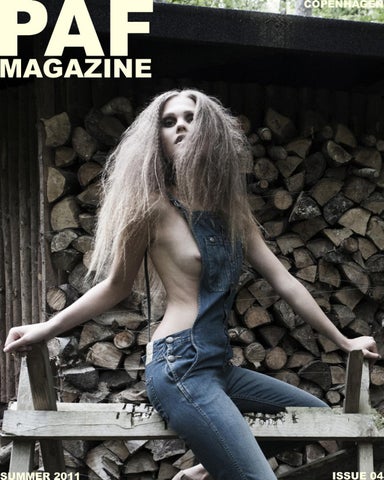
YOU CAN GET ACCESS TO ADDITIONAL MATERIAL LIKE BEHIND THE SCENE PHOTOS AND VIDEOS FROM DIFFERENT PAF PHOTO SHOOTINGS AT PATREON.COM/ PAFmagazine. YOU CAN ALSO GET YOUR NAME AND LINK TO YOUR FAVORITE SOCIAL MEDIA PLATFORM ON PAGE 2 IN PAFmagazine. BE A PAFpatron AND SPONSOR. HIT THE LINK BELOW
patreon.com/pafmagazine
editor MICHAEL MAXIMILLIAN HERMANSEN
CONTENTS SUMMER 2011
DANISH FINEST by FLEMMING LEITORP p. 004
YDE by MICHAEL MAXIMILLIAN HERMANSEN p. 016
THE HOUSE IN THE WOODS by MICHAEL MAXIMILLIAN HERMANSEN p. 046
S’NOB de NOBLESSE by MICHAEL MAXIMILLIAN HERMANSEN p. 068
NOIR by MICHAEL MAXIMILLIAN HERMANSEN p. 110
DISTORSION by MICHAEL MAXIMILLIAN HERMANSEN p. 140
CPH. VISION TREND SHOW by MICHAEL MAXIMILLIAN HERMANSEN p. 168
THE WORLD´S GREATEST CATWALK by MICHAEL MAXIMILLIAN HERMANSEN p. 186
DANISH FINEST
PHOTOGRAPHER: FLEMMING LEITORP / www.leitorp.com FASHION EDITOR: SARAH P. / www.sarahpaaschburg.dk MAKE-UP: SIDSEL MARIE BØG / www.hair-makeup.dk MODEL: FANNY K. RETOUCH: LIQUIT / www.liquit.dk
PHOTOS AND FASHION
DANISH ARCHITECT AND DESIGNER ARNE JACOBSEN (1902-1971) Arne Jacobsen was very productive both as an architect and as a designer. At the end of the 1950s Arne Jacobsen designed the SAS Royal Hotel in Copenhagen, and for that project the Egg™, the Swan™ (photo right), the Swan™-sofa and Series 3300™. Arne Jacobsen was and is an admired and outstanding designer. While the significance of Arne Jacobsen’s buildings was less appreciated, his furniture and other design work has become international heritage.
EXPLAIN AGAIN TO OUR VIEWERS: WHY ARE YOU DOING THIS?
PHOTO: ASIA PULKO / IHURTIAMINFASHION.COM
EATING HIS OWN FOOT WAS A DEFINING MOMENT IN HIS MODEL CAREER
PHOTO: MADE IN BRAZIL MAGAZINE / IHURTIAMINFASHION.COM
YDE PHOTOGRAPHER: MAXIMILLIAN-PHOTOGRAPHY.COM PHOTOGRAPHER´S ASSISTANT: MARKUS WIED DETHLEFSEN / MWIED.DK
COPENHAGEN FASHION WEEK Spring / Summer 2011
The Copenhagen based brand YDE was first launched in 2005, at which time Ole Yde won the Illum Design Award for his innovative and sophisticated creations. His collections aim at reincarnating the classic feminine beauty using top quality workmanship and material. Ole Yde continues his dream of attempting to bring back the gentle, strong and above all elegant woman. It is the recognition of her qualities that YDE seeks to bring forth, along with her need to redefine herself in a manner that agrees with modern ways of living.
HE COULD MAKE THEM OR BREAK THEM
PHOTO:
JAMES
BORT
/
IHURTIAMINFASHION.COM
PEOPLE LOOKING FOR THE FASHION TIT. WE SEE THEM ALL THE TIME.
PHOTO:
ELLE
MEXICO
/
IHURTIAMINFASHION.COM
THE HOUSE IN THE
WOODS INTERVIEW WITH DANISH ARCHITECT MADS KALTOFT BY MICHAEL MAXIMILLIAN HERMANSEN TRANSLATED BY ANNA CATHRINE BALLISAGER PHOTOGRAPHER: MICHAELHERMANSEN.COM FASHION EDITOR: REBECCA SPENCER SØLTOFT MAKE-UP ARTIST: MARIA ESPE HANSEN HAIR STYLISTS: ANGELICA SCHUBERT & LINE QUIST MODELS: FILIPPA / SWEDEN MODELS & PHILINE / SCOOP MODELS.
In connection with the Denim fashion shoot we borrowed an architectdesigned summer house in the area of Odsherred, Denmark. We have interviewed the architect about his thoughts on the design of the house.
Mads Kaltoft. Born July 9 1968 in Holbæk, Denmark. Education: Originally trained as a carpenter, an architectural technician and a constructing architect. Eventually educated as an architect at the The Royal Danish Academy of Fine Arts, Schools of Architecture, Design and Conservation. Co-founder of the company PREFAB together with business partner Allan Thorvaldsen, employee of the recognized Danish architectural firm Schmidt/Hammer/Lassen Architects. The construction of the house in the woods was a collaboration between Mads and his brother, Rasmus Kaltoft, who owns a firm of contractors, which builds everything from elaborate stage constructions for theaters to architect-designed summer houses. The two brothers and their families are co-owners of the house.
Mads Kaltoft
Shoes - H&M Swinsuit - H&M Necklace - Bjørg Denim jacket - Fishbone
MM: When did you decide to become an architect?
is incredibly rare!
MK: I think it was around the 8th or 9th grade.
MM: Which Danish architect is your favorite? – And why him/her?
MM: Why did you choose to become an architect? MK: It has something to do with being able to build and create things. That was something that caught my interest very early on. MM: Can you briefly give an outline of your educational background? MK: After the 9th grade I was apprenticed to a master carpenter in Odsherred. After finishing my training, I worked as skilled carpenter for three months before continuing my education by studying to become a constructing architect. When I finished my education as a constructing architect, I applied to the Copenhagen School of Architecture. After finishing my degree, I started working in a firm, owned by a head of department at the School of Architecture. Later on I worked as an assisting professor for five years while also working as an architect in a drawing office. MM: Why did you choose this rather long path to becoming an architect instead of the “normal” path which is to get a high school diploma before going to the School of Architecture? MK: That was due to some advice I got from my parents. It is always good to have some solid professional training to fall back on. And, besides, my uncle had followed approximately the same path. MM: You were brought up by parents who were both academics. Why, then, did you choose to become a craftsman? MK: My parents and I thought that it would be quite healthy to get out into the real world. That is exactly what happens when you work at a craftsmanship firm! MM: Who inspires you in your work as an architect? MK: A lot of different “modernists”, particularly Sverre Fehn, Richard Neutra and Souto de Moura! MM: Why those three in particular? MK: Their style of work is very down-to-earth while still containing great inventiveness and the ability to create a mode of identification for the audience. Also, all three of them have a keen sense of detail and material, which
MK: Jørn Utzon because of his work method and his always innovative approach to his craft! Jørn Utzon’s houses were always about the construction. The essential building units. Jørgen Utzon’s houses always express themselves through their constructing units. Take the opera house in Sidney for example. It basically only consists of two parts: a plateau and some covers. MM: Which building would you have liked to have designed, and why? MK: That is a difficult question to answer, but if I have to choose one, it has to be the 1001 buddahs’ temple in Kyoto! It is the epitome of wooden architecture, and it is impressive because of its size and its abundance of detail. MM: You are the co-founder of a company that produces and sells model houses. What are the thoughts behind that project? MK: It started with an interest in sustainability both with regards to materials and finances. We wanted to make a sound module-based building system, using wood as building material. Wood is one of my favorite materials to work with. MM: Why did you choose to design and build your own summer house together with your brother? MK: It was a quite natural thing to do, since we have always done things together, and since our various skills and abilities complement each other well. And furthermore, it is quite practical to share a summer house. That way it isn’t empty for long periods of time. MM: What thoughts and considerations did you have before starting to build the house? MK: I was especially inspired by the plot of land which was rather extraordinary. The plot of land is situated on the edge of a wood and slopes naturally from the main road to the bog. I knew right away what I wanted to do, namely establish a plateau, which spans the entire width of the land and then supply it with a cover of some kind. Continues...
MM: Is the design of the house inspired by a certain building tradition or school?
MM: Will this underpinning compromise the effect the house has, namely that it appears to be floating?
MK: Yes, I guess it is my interpretation of Richard Neutra’s modernism, which I was very inspired by at that time in 2006. Neutra interpreted the Japanese building tradition, the wooden architecture, with its distinct and recognizable elements, such as being able to read the connection and hierarchy between different building units.
MK: No, not at all. The underpinning will be placed far beneath the house, in the shade!
MM: Tell us a little about how the rooms have been divided in the house and the thoughts that went into making this decision. MK: The large terrace functions as a sort of entrance hall. From here you enter the house on the left. Here, one big, open room functions as both the kitchen and the living room, and at the end of this room you’ll find two bedrooms. If you turn right on the terrace you’ll find two guest rooms. MM: It isn’t exactly unusual to build summer houses made of wood in Denmark, but the house still looks a little bit different from the wooden summer houses that you normally see in Danish holiday areas. Can you tell us a little about the difference between your summer house and a more traditionally constructed Danish summer house? Which types of wood have you used, and what factors have you taken into consideration in making this decision? MK: All joists, pillars and fronts are made of Siberian larch wood, which can stand up to not being treated as long as it is exposed to plenty of air and has been freed from the soil. On the inside, the house has been clad with birch veneer – a natural choice since most of the trees in the area are birch trees. MM: I know you have had some problems with the foundations of the house. How did they arise? And how do you try to solve problems like that? MK: We have actually only noticed that the layer of joists that surrounds the kitchen and the bathroom bends a little downwards, and that is not exactly critical. We are considering making an underpinning near the middle of the house, which can support the joists.
MM: What projects are you working on at the moment? MK: I’m working on a very large project in Malmö, Sweden’s third largest city. The project is a group of buildings, consisting of a concert hall for symphonic music with room for 1,500 people, a conference center and a hotel with approximately 300 rooms. Also, I’m working on another project, building luxury homes in Oslo. MM: The fashion shoot we did at your house featured a lot of denim wear. When you, yourself, wear denim, what brands do you prefer? MK: I prefer Diesel and Lee, since they fit me well. MM: Most readers of PAF Magazine are girls and women. Most famous architects are men. Denmark would like to see itself as a pioneering country when it comes to equal rights for women. When will we see a female architect who achieves an international breakthrough? Can you mention a Danish or an international female architect that you find interesting, and that you think has the potential to have an international career? MK: It is difficult to predict an international breakthrough, but there are many good female architects. The most famous one in Denmark is Dorthe Mandrup. In Norway Kirstin Jarmund is widely recognized, and in Japan they have Kazayo Sejima, whose drawing office is responsible for designing the new Museum of Modern Art in New York! MM: One last question. We have to assume that most of our readers are interested in fashion. And lately we have observed artists and designers who move freely between different directions within the fields of art, culture and design. An excellent example of this is the Danish artist and designer Henrik Vibskov, who, among other things, experiment with architectural constructions as part of his fashion shows. Will we see you as a fashion designer one day? MK: Definitely! ;)
Ring - Bjørg Belt - Replay Shoes - H&M Necklace - Bjørg Denim shirt - Newyorker Jeans - jeans of Benetton
Jumpsuit - Hilfiger Denim Scarf used as belt - Gucci Necklace - Bjørg Sunglasses - Urban Outfitters
Overall - Levis Sandals - H&M Necklace - Bjørg
SOOOOO EXITED, WE’RE GRADUATING!!!
PHOTO:
GO
BACKSTAGE
BLOG
/
IHURTIAMINFASHION.COM
SHE WAS SICK OF YOUNG MEN WITH NO BODY HAIR AN CHARACTER.
PHOTO: FIASCO MAGAZINE / IHURTIAMINFASHION.COM
S’NOB de NOBLESSE Copenhagen Fashion Week spring / summer 2011
PHOTOGRAPHER: MAXIMILLIAN-PHOTOGRAPHY.COM PHOTOGRAPHER´S ASSISTANT: MARKUS WIED DETHLEFSEN / MWIED.DK
PAMPERED VANITY. BORINGLY P R E D I C TA B L E
PHOTO: MODEL LOVE TUMBLR / IHURTIAMINFASHION.COM
IN FASHION YOU WORK, IN FASHION YOU TRUST
PHOTO:
HARPER’S
BAZAAR
SPAIN
/
IHURTIAMINFASHION.COM
NOIR
COPENHAGEN FASHION WEEK
Spring / Summer 2011
PHOTOGRAPHER: MAXIMILLIAN-PHOTOGRAPHY.COM PHOTOGRAPHER´S ASSISTANT: MARKUS WIED DETHLEFSEN / MWIED.DK
SPRING / SUMMER 2011
WE HAD A LITTLE CHAT WITH SWEDISH MODEL FILIPPA, WHO IS ALSO BLOGGING ABOUT FASHION
Photos:
Beata Servin / beatacervin.se & Filippa. Name and age? Filippa, 17. Where do you live? I live in Southern Sweden, in Helsingborg. Just 20 minutes with ferryboat to Helsingør (Denmark). Why blogging? I love sharing my photos and inspirational taught’s with others. A blog is like your open diary, It is so fun to look back in the archives, for example if I want to know what I wore 2 years ago. Where do you usually shop when you are in Helsingborg, Göteborg, Malmö, Stockholm or Copenhagen? I like to shop in Malmö and Copenhagen. It is not so far from Helsingborg, but still far enough to find some unique shops. In Malmö I really like Zara, they are very good at creating nice clothes for a good price. In Copenhagen I like the store, Holy Golighty, where I bought my Balenciaga bag. The brand All Saints that you can find at Illum has also very nice clothes. I bought a really cool sequin skirt there last week. What swedish brand/designer couldn’t you live without? I love Filippa K. The clothes is somewhat simple, but there is also something unique about it. I have a Filippa K shirt that I wore almost every day during a period. What would you wear on the beach? This summer I wear my Vitamin A Swimsuit, Topshop shorts and Chloé sandals. I use my old Louis Vuitton bag as a beach bag. Where would you go, if you should spend your holiday in sweden? The best place
to spend your summer in Sweden is definitely in Båstad. Båstad is a very nice town located on the coast of Southern Sweden. I chill in my summerhouse, play volleyball at the beach or eat dinner at restaurant Sand. During week 28 the tennis tournament Swedish Open is held in Båstad, and it tends to be very much time for partying! Who is your favourite designer internationally? Phillip Lim! This Issue is mostly about Denmark and Danish design. Do you like any Danish designers? Yes! I really like Marlene Birger. She makes cute and elegant pieces (PAFmagazine attended the MB Fall/ Winter show 2011, so we will publish photos from that show in the Fall Issue). What should a guy wear in the summer? Simple and soft garment in basic colours. I love when a guy wears a nice white sweater that gives a contrast to the tan. Zadig et Voltaire does nice basic t-shirts and sweaters. Which model do you admire if any? I really admire the Swedish model Frida Gustavsson: www.flickr.com/photos/fixamao/4033598840 She is young, hot and have a great style! You can see her in the new book, Northern women in Chanel. Take a look at Filippa modelling for PAFmagazine in this Issue in the Fashion story “The House in the Woods”! Filippas Blog: fashionistagirl.devote.se
All Saints Sequin skirt
Tired after modeling for PAFmagazine
DISTOR
RTION
Distortion, IS a Celebration of Copenhagen Nightlife. IT was founded in 1998 - in Mantra, Tivoli, Copenhagen, as a one day festival celebrating Copenhagen’s rising clublife; In 2000, Distortion became a 5-day mobile party, going through one Copenhagen neighbourhood per day - with Final Party always being on the first Saturday of June.
IT’S ALWAYS DIRTY BUSINESS WHEN YOU WORK WITH A TODDLER FROM THE WAIST BELOW.
PHOTO: VIRGINE MAGAZINE / IHURTIAMINFASHION.COM
5% FASHION, 95% PASSION.
PHOTO: ADAMPHETAMINE ADDICTION / IHURTIAMINFASHION.COM
CPH. TREND SUMMER
VISION SHOW 2011
LAST TIME WE CHECKED WITH THE FASHION WORLD, BLACK PEOPLE WERE STILL CLEANING WHITE MAN’S FEET.
PHOTO: RESERVA / IHURTIAMINFASHION.COM
DON’T FUCK WITH DIETS, OR THEY WILL FUCK WITH YOU.
PHOTO: MARIE CLAIRE TURKEY / IHURTIAMINFASHION.COM
THE WORLD’S
CATW
S GREATEST
WALK PHOTOGRAPHER: MAXIMILLIAN-PHOTOGRAPHY.COM PHOTOGRAPHER´S ASSISTANT: MARKUS WIED DETHLEFSEN / MWIED.DK
A fashion event of unseen dimensions took place in Copenhagen on Saturday, August 14th 2010 at 3 PM as the culmination of S/S 2011 Copenhagen Fashion Week. It was called The World’s Greatest Catwalk. Helena Christensen, Denmark’s very own supermodel, accepted the role as patroness of the event and was opening the catwalk with a speech to the 100,000 spectators.
The World’s Greatest Catwalk took place on the pedestrian street in the centre of Copenhagen, Strøget. The street was transformed into one long runway where 220 models walked 1 mile (1.609 km) and beated the world record for the longest catwalk ever. The World’s Greatest Catwalk was being organized by Copenhagen Fashion Council, a group comprising Copenhagen Fashion Week and Dansk Fashion & Textile, as well as the four trade fairs Copenhagen International Fashion Fair (CIFF), Gallery, CPH Vision and Terminal 2.
To lift the practical and technical tasks of the project, the production company Stage 7 was in charge of the construction of the 1 mile long and pink runway, tribunes and scene, lighting, sound system and big screens broadcasted the event along the route. The design agency, Femmes Regionales, coordinated the show; the 220 models, the clothes from more than 500 Scandinavian brands as well as the teams of around 100 make-up artists and hair stylists from two of the industry’s true heavyweighters in professional make-up and hair care/styling; Max Factor and Wella.
Max Factor and Wella directed the looks for the event that presented the best of fall’s fashion for both women, men and children. Two of Denmark’s biggest names in fashion supported the initiative; Kopenhagen Fur, the world’s largest fur auction house and the leading provider of luxury fur, and Vero Moda, one of Europe’s largest clothing brands for young women. The project is furthermore supported by the Danish State, via The Branding Denmark Foundation.
VISIT PAFMAGAZINE ON FACEBOOK facebook.com/PAFmagazine
Kronborg. home of hamlet. 42 km north of Copenhagen
SOMETHING IS ROTTEN IN THE STATE OF DENMARK
PHOTO:
FASHION
COPIOUS
/
IHURTIAMINFASHION.COM
PAFmagazine
PAFmagazine
PhotosAndFashion
©