
Learning Cognitive Strategies and Tools for
PACIFIC LUTHERAN COLLEGE
Introduction PURPOSE
Successful learners understand that they have control over their own learning. They take an active role in improving how they study and how well they remember.
In the classroom, teachers create the conditions for learning by building a strong culture of thinking and supporting the development of key learner attributes. By engaging in thinking routines and classroom learning activities, students develop across the Four Pillars of Learning.
Students with a strong sense of agency approach learning as active participants. They use metacognition to plan, monitor and evaluate their progress. They manage their time and resources effectively and recognise how motivation and emotion can influence their learning.
This resource introduces evidence-informed study strategies, including spaced retrieval, dual coding and interleaving. These are evidence informed approaches to improve how information is encoded, stored and retrieved. They are based on findings from brain research and what we know about cognition.
The strategies in this book require effort and active thinking. This kind of challenge, known as desirable difficulty, helps to build strong, connected memories that can be accessed when needed.

1. What We Know About Learning And Remembering
Recall and forgetting
In its simplest form, memory can be understood as a three-step process:
Encoding: information must into the brain
Storage: information must stick in the brain
Retrieval: information must come back out of the brain

Once we stop accessing memories, they don’t simply disappear. Instead, the pathway we use to access them becomes harder to find.


Research on memory shows that when we don’t revisit learned information, we forget it quickly. On average, we forget around 70% of new information within 24 hours and after a week, we may remember as little as 20%.
The good news is, we can influence how well we remember things by re-establishing strong memory pathways. This requires active review of new information. The study strategies in this booklet rely on three key concepts:
1. Memory retrieval is constructive. Every time you retrieve a memory, it becomes deeper, stronger and the pathway is easier to access in the future.
2. Carefully spacing and scheduling retrieval practice has a powerful impact on long term memory.
3. When you combine words with visuals, you create more than one pathway to the same memory.
Retrieval
WHAT DOES COGNITIVE SCIENCE SAY ABOUT THE EFFECTIVENESS OF LEARNING TECHNIQUES?
Many students rely on familiar study approaches that feel productive but often lead to limited longterm learning. Research in cognitive science shows that not all study strategies are equally effective.
The utility of a learning strategy refers to the amount of learning gained relative to the time and effort invested. Strategies with higher utility lead to greater and more durable learning for the same amount of study time.

Cognitive and educational psychologists have systematically evaluated common learning techniques. The table below summarises these techniques, grouped into high, moderate and low utility categories, reflecting their overall effectiveness across a wide range of learners and learning tasks.

Strategies with higher utility lead to greater and more durable learning for the same amount of study time.
(spaced)
Self-testing or taking practice tests on material to be learned.
Implementing a schedule of practice that spreads out activities over time.
Explaining how new information is connected to prior knowledge, or explaining steps taken during problem solving.
Implementing a schedule of practice that mixes different kinds of problems, or a schedule of study that mixes different kinds of material, within a single study session.
Writing summaries of varying lengths from text being studied.
Marking potentially important information in learning materials when reading.
Restudying text material again after an initial reading.
Distributed Retrieval Practice
Key Concepts:
• Memory retrieval is constructive. Every time you retrieve a memory, it becomes deeper, stronger and easier to access in the future.
• Carefully spacing and scheduling retrieval practice has a powerful impact on long-term memory.
Put simply, retrieval is the way to form deep, lasting and accessible memories.
Rather than leaving retrieval until the end of the learning process, we should embed retrieval practice throughout learning. Each time we make the effort to retrieve a memory, we activate related knowledge and strengthen the association pathways connected to it. This is why frequent, low-stakes quizzes and revisiting content over time are so powerful.
It is important to check the accuracy of what we retrieve. Feedback matters, as it helps refine understanding and prevents incorrect or incomplete memories from becoming embedded in the association network.
When retrieval practice is distributed over multiple days, it creates more durable memory networks and makes future retrieval easier. With continued distributed practice, memories can be maintained by spacing retrieval sessions further and further apart.
Dual Coding
When you learn something new, your brain builds pathways to help you store and retrieve that information. If you rely on words alone, you are creating a single pathway. Dual coding helps you learn more effectively by deliberately building multiple pathways to the same idea.
When you combine words with visuals such as diagrams, sketches, timelines, symbols, or spatial layouts, you create more than one route to the same memory. These pathways
Key Concept:
When you combine words with visuals, you create more than one pathway to the same memory.
Dual coding is a learning strategy that involves combining words with visuals to understand and remember information more effectively.
Dual coding works because it builds multiple pathways to the same knowledge, making memories easier to store, retrieve and reconstruct.
are interconnected, so accessing one can help activate the others.
To strengthen your learning, aim to encode information in at least two ways. As you study, ask yourself: What could this look like? Turning explanations into images, drawing concepts, or pairing notes with visuals gives your brain more ways to store and retrieve the information later.

Dual Coding
Ebbinghaus, H. (1913). Memory: A contribution to experimental psychology (C. E. Bussenius & H. A. Ruger, Trans.). Teachers College, Columbia University. (Original work published 1885) Stimuli

Interleaving during revision leads to more reliable access to information in unpredictable situations.
Interleaving
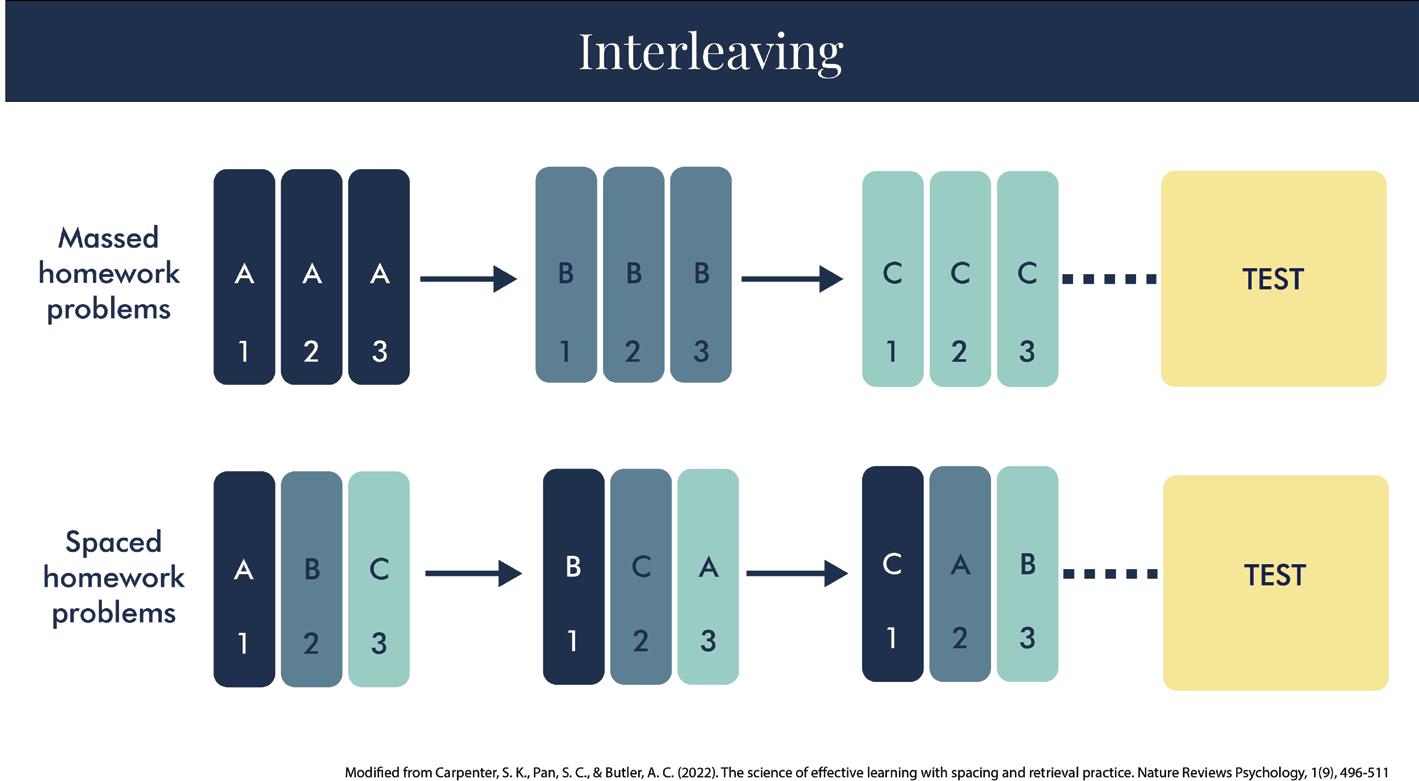
Interleaving is a learning strategy that mixes related ideas or skills during practice, helping the brain build flexible pathways that can be accessed in different situations.
While distributed retrieval practice strengthens memory over time, learners also need to be able to access knowledge flexibly. This is where interleaving becomes important.
As memories become stronger and more accessible through retrieval practice, how they are organised in the brain also matters. Once skills and understanding have been achieved, the brain begins to ‘chunk’ information into extended sequences for easy access.
While chunking can improve speed and efficiency, it can cause problems in exam situations, where high performance often
requires students to select and apply knowledge in response to unfamiliar problems.
To avoid overreliance on extended chunks of information, we use interleaving. Students need to be able to apply information, not memorise it. By mixing related concepts or skills rather than practising them in predictable blocks, interleaving prevents fixed sequences from forming.
Interleaving during revision leads to more reliable access to information in unpredictable situations. It increases intellectual agility, helping learners recognise what knowledge is relevant and apply it flexibly in novel contexts. For example, students who interleave mathematics concepts during exam study often demonstrate greater accuracy and adaptability on unseen problems.

Key Concept:
Carefully spacing and scheduling retrieval practice has a powerful impact on long-term memory.
2. Tools and Strategies:
Cornell Note Taking
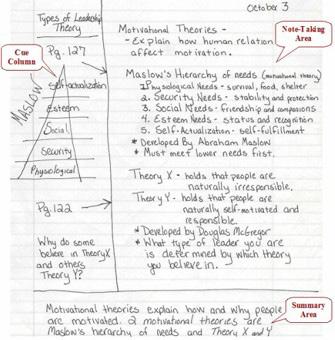
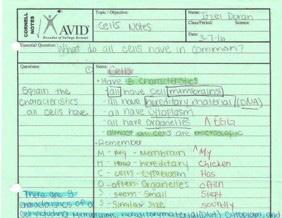
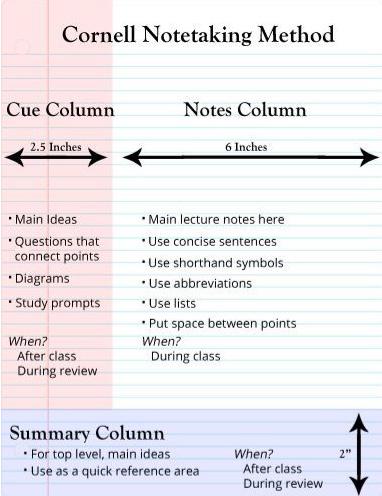
Cornell Note Taking is a note-taking strategy to organise your notes to help you actively process, review and remember information. By (1) taking notes, (2) sorting through your notes to identify key words, diagrams and questions to organise your notes and (3) writing a summary at the end, Cornell Note Taking helps with the active recall of information because your brain is required to ‘do something with the information’, creating deeper, stronger pathways to access the information and associated memories. The use of diagrams establishes multiple pathways to access information and activate interconnected memories.

Key Concept:
Steps: How to take Cornell Notes
1. Look at your study materials (e.g. textbook) and write key ideas, questions or prompts in the Cue Column.
2. For each of your key prompts, write concise notes.
3. Write a summary to review your learning.

When I’m watching a video, I use Cornell Notes to help me to think about my learning. On the right, I jot key ideas or prompts. On the left, I write questions I could test myself with. At the bottom, I summarise the big idea in my own words. This way, I’m not just copying - I’m checking and deepening my understanding.
• Memory retrieval is constructive. Every time you retrieve a memory, it becomes deeper, stronger and the pathway is easier to access in the future
Use Cornell notes to prepare for exams by revisiting key questions, retrieving main ideas from memory and refining understanding through summary and feedback.
Flashcards
Flashcards are one of the oldest and most reliable study techniques when they are used correctly. Effective flashcards are designed to prompt retrieval and provide immediate feedback.
Steps: How to use flashcards
1. To use flashcards well, write a free recall question on one side. This forces your brain to search for the required information and activates the constructive retrieval process, strengthening memory pathways.
2. On the other side, write the correct answer. Checking your response provides feedback, helping to refine understanding and preventing incorrect or incomplete memories from becoming embedded in your memory network.
3. Ask a learning partner to test you. When someone else controls the questions, you remove cues and shortcuts, making retrieval more effortful and strengthening the memory pathways even more. Immediate feedback from your partner helps correct mistakes and refine understanding.
Used regularly and spaced over time, flashcards are a powerful way to build strong, durable and accessible learning pathways.
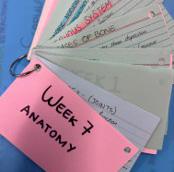

I won’t turn the card over until I’ve really tried to retrieve the answer. Struggling a bit here is good - that effort is strengthening the pathway. If I get this wrong, the feedback helps me fix the memory before it sticks.
Key Concepts:
• Memory retrieval is constructive. Every time you retrieve a memory, it becomes deeper, stronger and the pathway is easier to access in the future.
• When you combine words with visuals, you create more than one pathway to the same memory.

Use flashcards before exams to practise spaced retrieval, strengthen memory pathways and ensure knowledge can be accessed quickly and accurately under pressure.
Graphic Organisers
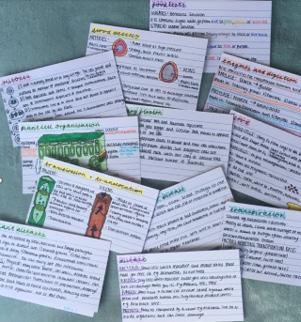
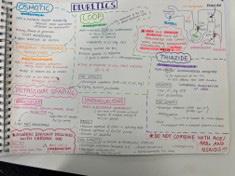
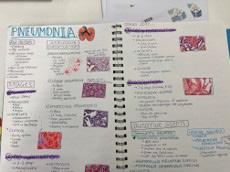
Graphic organisers strengthen learning by prompting retrieval of key ideas. They combine words with visuals, building multiple pathways that make memories deeper, stronger and easier to access over time.
Steps: How to Create a Graphic Organiser
1. Choose an organiser that suits your purpose. Start by deciding what you need to do (e.g. organise ideas, compare concepts, show relationships, sequence information). Visit the Pacific Metacognition Toolkit to see examples of different graphic organisers and select one that fits your learning goal.
2. Add key ideas or information. Place the main concept into the organiser. Then add important ideas, facts, or processes using words or short phrases rather than full sentences.
3. Organise and connect your thinking. Arrange information into categories, patterns, or sequences. Draw connections between ideas to show relationships such as cause and effect, similarities, differences, or hierarchies.
4. Dual code your learning. Strengthen memory pathways by adding visuals such as arrows, icons, symbols, diagrams, colour, or simple sketches alongside words.
5. Check, refine and add detail. Review your organiser and add missing information or clarify ideas (using a different colour if helpful). Make sure the organiser accurately represents your understanding.
By using dual coding regularly, you make your memories more durable and easier to access, especially when recall is difficult or when you are under pressure.


Key Concepts:
• Memory retrieval is constructive. Every time you retrieve a memory, it becomes deeper, stronger and the pathway is easier to access in the future.
• When you combine words with visuals, you create more than one pathway to the same memory.

I
Practise using graphic organisers to retrieve and reorganise ideas in new ways, strengthening flexible memory pathways that help you apply knowledge in unfamiliar exam questions.
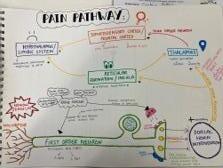
need to reorganise what I know in a new way… that’s strengthening flexible pathways. If I explore how all these ideas connect, I’ll be well prepared to access them differently in an exam. Also, If I can organise this information without notes, I’m ready to apply it in unfamiliar questions.
Brain Dump
When you combine words with visuals, you create more than one pathway to the same memory.
Brain Dumps can help identify gaps in our understanding - what we know and what need to learn. Writing down information activates memory retrieval, which strengthens understanding and ability to recall information later.
Key Concept:
• Memory retrieval is constructive. Every time you retrieve a memory, it becomes deeper, stronger and the pathway is easier to access in the future.

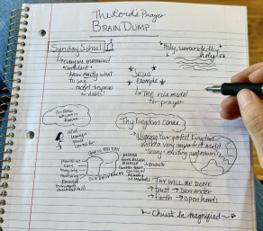
Steps: How to do a Brain Dump
1. On a blank piece of paper, write down everything you can think of for a particular topic.
2. Read over your notes and add in any information or details you missed (in a different colour).
3. Draw connections / dual code to build strong, durable and accessible learning pathways.
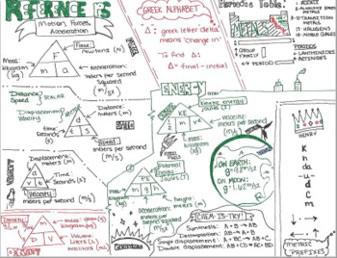
When I’m learning about an idea, I can use the brain dump strategy to organise my thoughts and ideas about a topic. When I write everything down and organise it, it helps me take control of my learning by reflecting on my knowledge. I can notice what I don’t really know or understand and set goals for learning. It also helps me remember later.
Before exams, use a brain dump to retrieve everything you know without cues, strengthening memory pathways and revealing gaps before you face unfamiliar questions.

Time Boxing

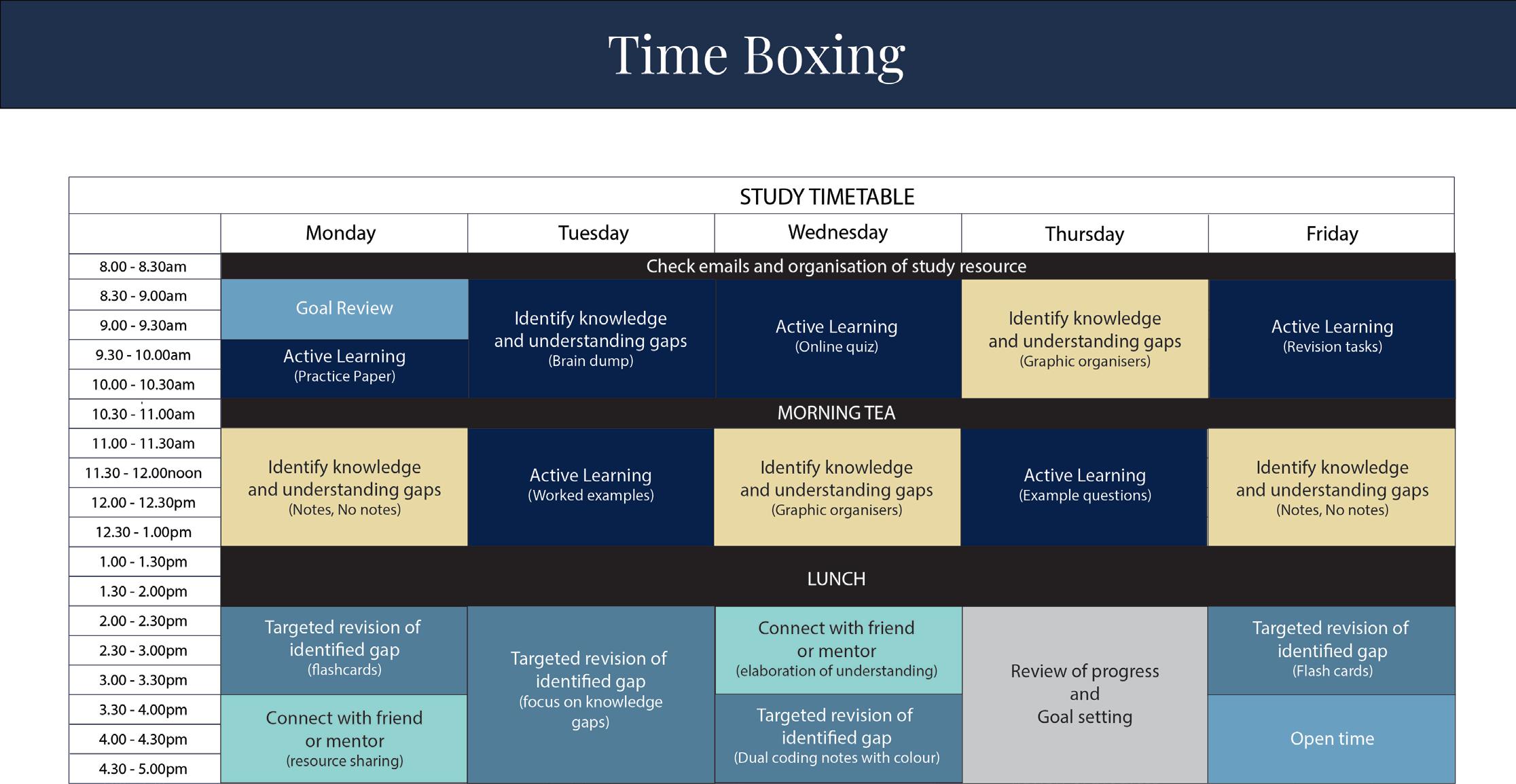
Timeboxing is a time management strategy where you allocate a fixed amount of time (a time box) to a specific activity. The aim is to work on the chosen task during the assigned period of time and stop when the time is up. Time boxing promotes high focus and efficiency, while reducing the likelihood of procrastination.


How to Start Timeboxing
1. Define Goals:
List your tasks and identify the top priorities.
2. Set Time Limits:
Assign a specific, realistic amount of time to each task.
3. Schedule:
Block these time frames on your calendar.
4. Execute & Stop:
Work only on that task during the slot and stop when the time expires.
When I have a lot of things I need to do/ cover, I can use time boxing to allocate a set time for each activity. This helps me plan out my time effectively and not feel so overwhelmed.
References
• Carpenter, S. K., Pan, S. C., & Butler, A. C. (2022). The science of effective learning with spacing and retrieval practice. Nature Reviews Psychology, 1(9), 496-511.
Dunlosky, J., Rawson, K. A., Marsh, E. J., Nathan, M. J., & Willingham, D. T. (2013). Improving Students’ Learning With Effective Learning Techniques: Promising Directions from Cognitive and Educational Psychology. Psychological Science in the Public Interest, 14(1), 4–58.
Ebbinghaus, H. (1885). Über das Gedächtnis. Leipzig: Dunker.
• Ebbinghaus, H. (1913). Memory: A contribution to experimental psychology. (H. A. Ruger & C. E. Bussenius, Trans.). Teachers College Press.
• Paivio, A. (1986). Mental representations: A dual coding approach. Oxford University Press.
Willingham, D. T., (2009). Why Don’t Students Like School? American Educator 33(1):4–13.

Also accessed:
• Barr, S. (2024). Educate to self regulate: Empowering learners for lifelong success. Amba Press.
Education Endowment Foundation. (2018). Metacognition and self-regulated learning: Guidance report.
• Horvath, J. C. (2019). Stop talking, start influencing: 12 insights from brain science to make your message stick. Exisle Publishing.
• https://www.edresearch.edu.au/summaries-explainers/ explainers/spacing-retrieval
https://www.edresearch.edu.au/summaries-explainers/ explainers/retention-and-recall