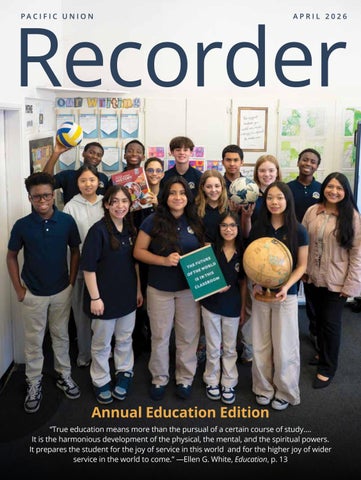
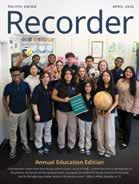
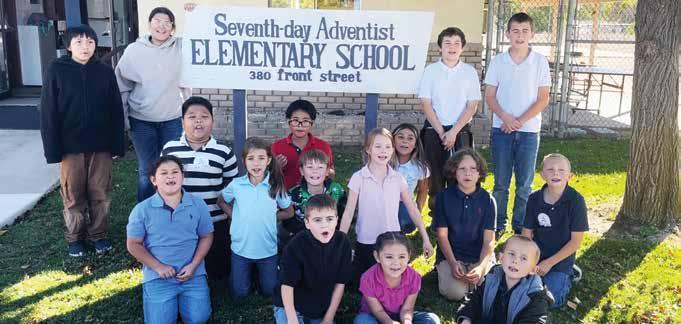
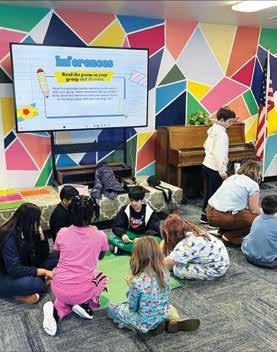
“True education means more than the pursual of a certain course of study.… It is the harmonious development of the physical, the mental, and the spiritual powers. It prepares the student for the joy of service in this world and for the higher joy of wider service in the world to come.” —Ellen G. White, Education, p. 13
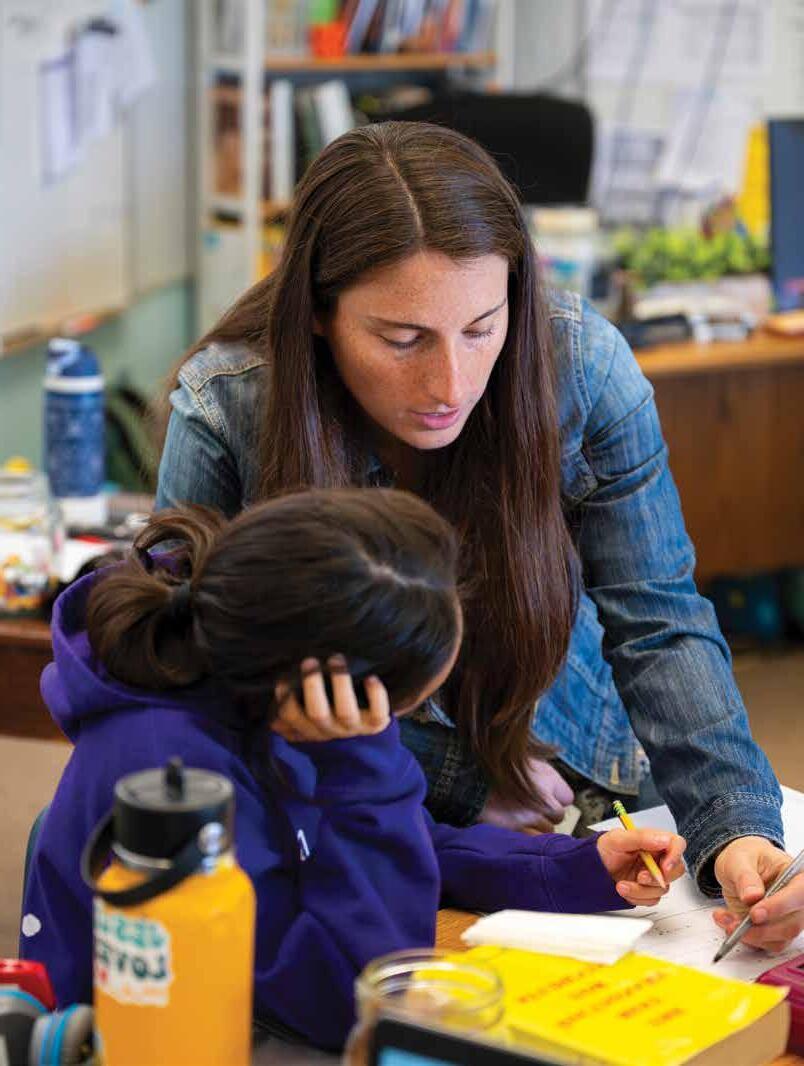
Every year, the Recorder pauses to reflect on one of the most important ministries of the Seventhday Adventist Church: education. This issue marks the ninth annual education issue of the Pacific Union Recorder, a tradition that reminds us that Adventist education is not simply a program of the church but part of its very mission. From the earliest days of the movement, Adventists understood that preparing young people for service in this world—and for citizenship in the next—required more than academic instruction. It required schools where faith, character, curiosity, and purpose could grow together. In this issue, readers will encounter stories of teachers who quietly shape lives, students whose gifts are nurtured and discovered, and institutions that continue a long legacy of Christ-centered learning. From elementary classrooms to our colleges and universities, Adventist education seeks to develop the whole person—mind, body, and spirit—while encouraging students to wrestle with life’s biggest questions and build a personal relationship with Christ. The stories that follow remind us that Adventist education is one of the church’s most enduring and transformative ministries. Generation after generation, it has helped form leaders, thinkers, servants, and disciples who carry their faith into every field of life.
Recorder
The Recorder is a monthly publication reaching approximately 76,000 Seventh-day Adventist homes in Arizona, California, Hawaii, Nevada, and Utah. Our mission is to inform, educate, and inspire our readers to action in all areas of ministry.
Publisher Ray Tetz
Editor Alberto Valenzuela
Design/Layout
Stephanie Leal • Alberto Valenzuela
Printing Pacific Press Publishing Association www.pacificpress.com
Adventist Health 916-742-0429
Kim Strobel strobeka@ah.org
Arizona 480-991-6777
Alexis Camacho ACamacho@azconference.org
Central California 559-347-3128
Bryan Bong bbong@cccsda.org
Hawaii 808-595-7591
Miguel Manzo communicationsdept@hawaiisda.com
Holbrook Indian School 928-524-6845 x109
Jacqui Reed jreed@hissda.org
La Sierra University 951-785-2000
Darla Tucker dmartint@lasierra.edu
Loma Linda 909-651-5925
Ansel Oliver anoliver@llu.edu
Nevada-Utah 775-322-6929
Michael Jenkins Jr. mjenkins@nevadautah.org
Northern California 916-886-5600
Laurie Trujillo
Laurie.Trujillo@nccsda.com
Pacific Union College 951-809-6777
Gene Edelbach gedelbach@puc.edu
Southeastern California 951-509-2258
Taji Saleem taji.saleem@seccsda.org
Southern California 818-546-8400
Lauren Lacson Llacson@sccsda.org
Editorial Correspondents
Postal Regs: The Pacific Union Recorder (ISSN 0744-6381), Volume 126, Number 4, is the official journal of the Pacific Union Conference of Seventh-day Adventists and is published monthly. Subscription rate: No charge to Pacific Union Adventist church members; $16 per year in U.S.; $20 foreign (U.S. funds); single copy, $2. POSTMASTER: Send address changes to: Circulation Department, Pacific Union Recorder, Box 5005, Westlake Village, CA 91359. Info@adventistfaith.com.
Teaching by Presence: The Formative Power of Christian Teachers
By Alberto Valenzuela
Idid not grow up thinking of education as theory. I experienced it first as presence. Long before I could articulate what a worldview was or what it meant to integrate faith and learning, I encountered teachers who simply were something: steady, attentive, patient, curious. Only much later did I realize that what they offered me had little to do with syllabi and everything to do with formation. They were shaping not only my thinking but also my posture toward life.
Christian teachers, at their best, do not merely instruct; they model a way of inhabiting the world. And children—especially children—are exquisitely tuned to this. They notice tone before content, consistency before correctness, and integrity before eloquence. What we call “education” often arrives quietly, through repeated exposure to how an adult listens, corrects, hopes, forgives, and perseveres.
Looking back, I realize that some of the most important lessons I received were never announced as lessons at all.
There is a phrase often attributed to Goethe that I think may be applied to Christian education: “There are only two lasting bequests we can hope to give our children. One of these is roots, the other, wings.”
Christian educators provide roots and give wings to their students. Wings without roots produce anxiety; roots without wings produce fear. Christian teachers, when they are faithful to their calling, hold both together.
I have come to believe that the order matters. The roots come first. They are formed through predictability, trust, and moral clarity. In classrooms where prayer is natural rather than forced, where Scripture is treated as a living text rather than a weapon, where mistakes are met with guidance rather than humiliation, children learn something essential: the world is not hostile. Or at least, not entirely so.
For many children, school is the first place where they test whether authority can be trusted. A Christian teacher who is firm without being cruel, who is principled without being rigid, can quietly teach that power does not have to be abusive. If that lesson is not taught well, it can take a lifetime to unlearn.
Only later do the wings come. Wings appear when a teacher notices something in a child that the child does not yet see—an aptitude, a sensitivity, a voice waiting to be used. Often the moment seems small at the time: an invitation to lead, to speak, to try. But
years later it reveals itself as a hinge in the story.
I know now that some teachers were lending me confidence before I had earned it, trusting me with responsibility before I knew what to do with it. That trust became a prophecy I spent years trying to fulfill.
Every school has a hidden curriculum. It is not written in lesson plans, but it is relentlessly taught. It answers questions children are always asking, even if silently: Who matters here? What happens when you fail? Is it safe to ask questions? Is faith something you perform or something you live?
Christian teachers shape this hidden curriculum more powerfully than they realize. Children learn whether belief is compatible with kindness by watching how teachers treat the difficult student. They learn whether truth is something to pursue or something to defend by how questions are handled. They learn whether God is patient by observing whether adults are.
I think now of how often my own understanding of God was mediated through the adults who spoke about Him. Long before theology made sense, character did. Faith that produced gentleness felt believable. Faith that produced fear did not.
This is why Christian education cannot survive on content alone. You can teach Bible classes perfectly
and still undermine the gospel if the atmosphere of the classroom contradicts it. Children are remarkably adept theologians in this way. They may not know the term, but they recognize dissonance immediately.
One of the most challenging things a teacher can do today is pay sustained attention.
Attention is not efficiency. It is not productivity. It is presence. When a teacher notices a child—really notices them—something foundational happens. The child learns that they are not invisible, not interchangeable, not merely one more body in a seat.
I have come to believe that attention is a moral act. To attend to someone is to affirm their worth without needing to justify it. In a culture shaped by speed and distraction, such attention feels almost extravagant.
Christian teachers, whether they intend to or not, model what it means to love one’s neighbor in ordinary time. They do it by remembering names, by noticing shifts in mood, by asking questions that are not on the test. These small acts accumulate. They become a memory children carry long after the rules of grammar or algebraic expressions fade.
I can still picture classrooms where I felt seen— and others where I did not. The difference shaped not only my academic confidence but my sense of self.
We live in a culture obsessed with outcomes. Education is increasingly justified in terms of measurable success: careers, salaries, credentials. None of these are unimportant. But Christian education, if it is to remain Christian, must resist allowing outcomes to replace formation as its primary goal.
The deeper question is not “What will this child become?” but “Who is this child becoming?”
Christian teachers live with this tension daily. They prepare students for exams and expectations they did not create, while quietly holding a longer horizon in view. They know that the most important qualities—wisdom, courage, compassion, faithfulness—do not appear neatly on transcripts.
Some of the most influential teachers in my life did not push me toward success as much as toward integrity. They wanted me to think carefully, speak honestly, and live attentively. They were less interested in impressing the world than in helping me stand upright within it.
Only later did I realize how rare that gift is.
In the end, Christian teaching is a form of witness. Not the loud, declarative kind, but the steady, embodied kind. It says: This way of life is
possible. Faith can be lived without fear. Learning can be an act of hope.
Children may forget what teachers say, but they rarely forget who teachers were to them. They remember how it felt to walk into the room. They remember whether they were trusted. They remember whether belief enlarged the world or shrank it.
I know this because I remember.
And perhaps that is the quiet miracle of Christian teachers: they participate in shaping lives they will never fully see, planting seeds whose growth they may never witness. They teach for futures they will not inhabit, trusting that presence, offered faithfully, is never wasted.
If education is, at its heart, another word for discipleship, then Christian teachers are doing sacred work—often without applause, often within limits. And yet, again and again, their influence outlives the classroom.
I am, in many ways, still living inside their lessons.
Alberto Valenzuela is the associate director of communication and community engagement for the Pacific Union Conference and editor of the Recorder
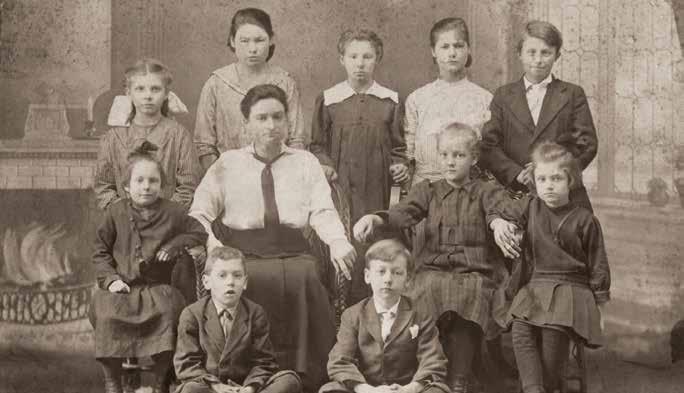
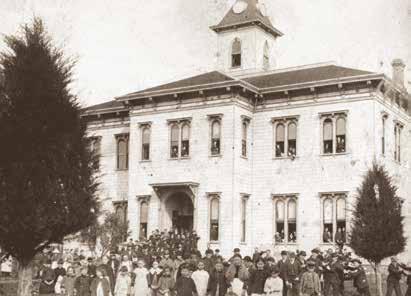
Students and their teacher at the Centralia Seventhday Adventist Church School about 1914-1915.
Students and their teacher at the Centralia Seventh-day Adventist Church School about 1916.
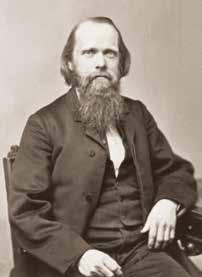
J.H. Waggoner
Pioneers in the West:
By the Recorder editorial staff
From Small Back Rooms to Becoming Part of the Largest Protestant Educational System
E“ducation? Why bother with that? We’re going to heaven!” That seems to have been the thinking of many early Adventists as they eagerly expected the imminent return of Jesus. Education was a long-term project, and that didn’t really seem valid anymore. As one example, W.H. Ball wrote in 1862 to James White at the Review and Herald, asking the question, “Bro. White: Is it right and consistent for us who believe with all our hearts in the immediate coming of the Lord, to seek to give our children an education? If so, should we send them to a district or town school, where they learn twice as much evil as good?”
James White replied to the first question, “The fact that Christ is very soon coming is no reason why the mind should not be improved. A welldisciplined and informed mind can best receive and cherish the sublime truths of the Second Advent.”1 In other words, even a strong belief in an imminent return of Christ does not negate the fundamental importance of good education!
White also rejected the idea that a soon second coming meant you should take your children out of school, answering Ball’s second question by stating, “Again, if children's minds are not elevated and occupied with harmless studies, they may be with things
which lead downward to vice. To take children from school, where they would receive some sort of discipline, and let them run in the streets, as some have done, to get a corrupt street education, is but little less than insanity.”2
In fact, White had previously written, “It is a fact that many who profess to be looking for Christ and the judgment, have greatly neglected their duty to their children. Some have thought that because Christ was so soon coming, they need not bestow much labor on their children. This is a grievous error.”3
It was James rather than Ellen White who had taken the lead on the subject. In 1857, he wrote a three-part series of articles on “Sabbath-Keepers’ Children,” recommending home-schooling or the use of a Sabbath-keeping teacher.4 Ellen White did not begin writing on education in the Review until 1871. However, once she did, she provided the philosophical and theological foundations for the expanding denominational education program.
But what has this to do with education in the West? It provides the background to what happened later, particularly in California. In a similar fashion to what had happened in the East, small one-
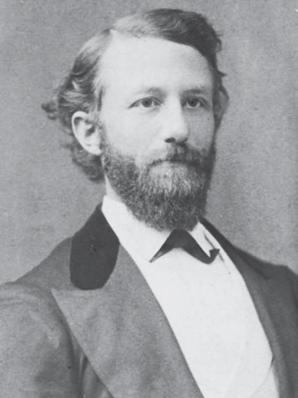
Sidney Brownsberger
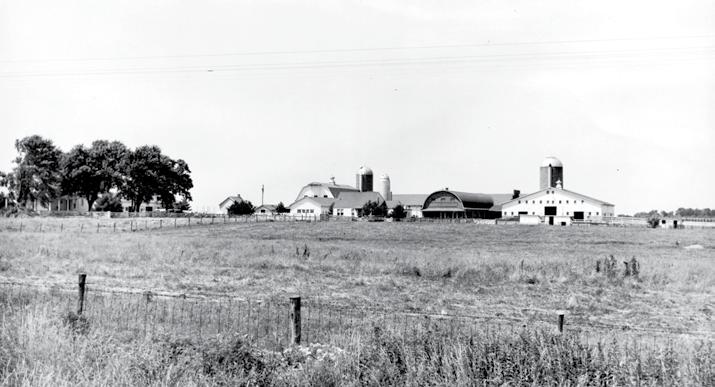
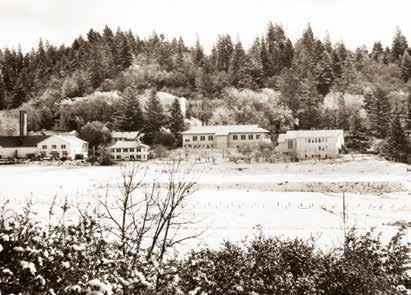
Sunnydale Academy farm
room schools developed as a necessity, without structure or organizational oversight. To help with this, the developing church worked to provide a better arrangement.
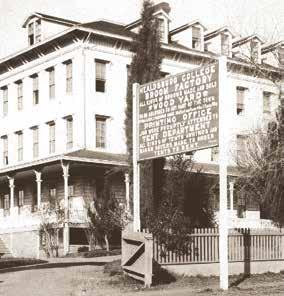
Adventist education in the West began in 1882. Healdsburg Academy was started by Sidney Brownsberger with 28 students ages 5 and up. It became Healdsburg College in 1899, and in 1909 it moved to Angwin and was re-named Pacific Union College. This was the way of ensuring an improved methodology for providing education.
Writing at the time when the Healdsburg school was begun, J.H. Waggoner, editor of the Signs of the Times, advocated in support of the importance of education in denominational work. He commented, “To work without education or culture on the plea that time is short, is as unwise as the calculation of the man who mowed his fields with a dull scythe because he had not time to grind it.”5
The first schools
So, for example, when some of the first elementary schools were begun in California, graduates from Healdsburg were called on to teach—for example Alma McKibbin,6 who taught at the Centralia school, which started in 1896. That same year, another elementary school was opened in San Pasqual, and the spread of elementary schools that developed thereafter in the West is
nothing short of amazing. Look at the list:
Oakland (1889), Palama Chinese School in Hawaii (1895), Fresno (1897), Garden Grove (1897), Hilo Chinese Mission School (1897), Los Angeles (1898), Phoenix (1899), Oakland (1899), San Diego (1899), Modesto (1902), Reno (1902), Armona (1904), Glendale (1907), Bethel Grammar School in Hawaii (1914), Alhambra (1933), Calexico Mission School (1938), Navajo Mission School at Holbrook (1946), San Gabriel Union School (1947), and many more.
Then there are more advanced schools, such as Fernando College (1902), Pacific Press Training School, Oakland (1905), Central California Intermediate School, Armona (1906), Northern California Intermediate School, Chico (1907), Fresno Intermediate School (1908), Western Normal Institute, Lodi (1908), Spanish (Latin) American Training School at Phoenix (1920).
And all the academies:
The Honolulu Anglo-Chinese Academy in Hawaii (1897), Arizona Intermediate Academy at Phoenix (1908), Phoenix Academy (1913), Loma Linda Academy (1920), Fresno Union Academy (1921), Hawaiian Mission Academy (1921), Glendale Academy (1921), La Sierra Academy (1922), Mountain View Academy (1922), Golden Gate Academy at Berkeley (1923), Los Angeles Academy (1923), Long Beach Academy (1924), Humboldt Academy (1926), Kern Academy at Shafter (1930), San Diego Academy (1930), Nevada-Utah Academy at Salt Lake City (1936), Modesto Union Academy (1937), Lynwood Academy (1938), Valencia Junior Academy (1944), Sacramento Junior Academy (1948), Newbury Park Academy (1948), Monterey Bay Academy (1949), San Pasqual Academy at
Escondido (1949), Thunderbird Academy at Scottsdale (1954), Sacramento Union Academy (1958), San Fernando Union Academy (1960), Orangewood Academy at Garden Grove (1961), Rio Lindo Academy at Healdsburg (1962), Bakersfield Academy (1968), and so on.7
How did this happen? Ciro Sepulveda observed, “In 1897 there were only 43 schools run by the Adventist Church with a total of 2,290 students enrolled. Three years later, in 1900, there were 246 schools and 7,400 students. The increase in schools and students soared. By 1920 there were 1,025 schools and 38,095 students.… During this period, elementary school teachers increased from 52 in 1897 to 250. Almost 200 new teachers appeared in three years, by a church with less than 70,000 members worldwide. What happened? Had the Adventist educational system found a magic tonic that unleashed staggering vitality?”8
He suggested three possible reasons for what he calls “The Spirit of 1897.” First there was the publication of Ellen White’s book, Special Testimonies on Education in 1897, which summarized her extensive views on what she termed “true education.” Then there was a reform of Battle Creek College in 1897, with a new administration embracing some of Ellen White’s ideas. At the same time there was also the work of Edson White on the boat Morning Star in the South that promoted the development of local schools.
Many of the new schools were simple oneroom affairs with a single teacher teaching all grades. While this may seem basic, it also provided definite advantages. Commenting in a later period, Ramona Trubey recalled her experience of being just one of five children in a one-room school: “I wouldn’t trade those days for anything. With only five
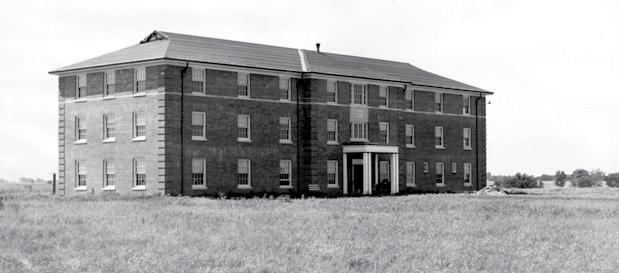
Sunnydale Academy main building from the front.
of us in school, we had a lot of one-on-one time with the teacher, which made it easy to get the help we needed to progress quickly.”9
Another student, Beth Nelson, remembering her experience in a one-room school, agreed. “My teacher was very spiritual and caring. She once said that she hoped that all of us would be in the Lord’s work someday. She was the only person that ever said anything like that. It made such an impression on me and led me to go into education and teach at church schools in Illinois and Wisconsin.”10
All the worldwide Adventist education system developed from those early days of small oneroom schools, like the one located in the back of the Centralia church where all classes were taught without books and the teacher wrote the lessons on the blackboard!
In Part 2 we will look at the colleges and universities, which really deserve their own stories.
1“Questions and Answers,” Review and Herald, Dec. 23, 1862, p. 29.
2“Questions and Answers,” p. 29.
3James White, “An Address to Those Who Are Interested in The Youth’s Instructor,” The Youth’s Instructor, Aug. 1852, p. 1.
4James White, “Sabbath-Keepers’ Children,” Review and Herald, Aug. 20, 1857, pp. 125-126; Aug. 27, 1857, pp. 133-134; Sept. 3, 1857, p. 141. 5J.H. Waggoner, “California Camp-Meeting,” Signs of the Times, Oct. 26, 1882, p. 474.
6For an account of her life and contribution to Adventist education, see article on pp. 20-23.
7For a list of current schools and academies, see https://paucedu. adventistfaith.com/tk12-schools.
8Ciro Sepulveda, “The Spirit of 1897: Reforming Adventist Education,” Spectrum Magazine, May 4, 2020, https://spectrummagazine.org/news/ spirit-1897-reforming-adventist-education/.
9Renee Coffee, “Are Adventist One-Room Schools Relics of the Past?” Adventist Review, March 5, 2022, https://adventistreview.org/commentary/ are-adventist-one-room-schools-relics-of-the-past/.
10Coffee, “Adventist One-Room Schools.”
A Foundation of Faith, Service, and Leadership
By Aimee Leukert
Dr. Monica Allen has worn many hats as a working professional: preschool teacher, public health practitioner, and professor at a state university. While her career path has wound around with several detours and pit stops, Monica has always been clear that wherever she was, whatever she was doing, she was called to a life of service. “That’s Adventist education,” she said emphatically. “Service was modeled for us not just at home but also at school.”
Neither of Monica’s parents were raised Seventh-day Adventist, but when Monica was young, they were converted and subsequently fully committed to the church. “My mother told me that the church loved us right in,” Monica recalled. While still new to the faith, her parents were adamant that their children would receive an Adventist education, regardless of cost. She attended first through third grade at Glenview Adventist School in Phoenix, Arizona, and then Los Angeles Union and San Fernando Valley Academy for the rest of her elementary and high school years.
When I talked with Monica about what I was writing on—the impact of Adventist education on our lives—she didn’t even really need to stop and think before speaking confidently. “I was taught that I was both valued and valuable in God’s eyes. Our teachers showed us every day that their work was one of ministry, of service. That not only influenced my own choice of career, but it also made me feel like I was something, someone of value. When you’re told and shown that every step of the way, it really changes who you are and the way in which you move through the world.”
Monica spoke about the safety net that she felt she always carried
around with her—the knowledge that there were people out there praying for her, for her choices, for her future. She remembered her academy teacher—who not only taught all four grades both English and history and set high standards for students in both subjects but also made a point of investing time and energy into each student outside of class. “She was our class sponsor and organized our senior trip to Hawaii—which was unheard of for that time!” On her graduation day, the teacher pulled Monica aside and said, “Monica—you’re a leader. I believe in you.” “That changed the trajectory of my life,” Monica said quietly. “The fact that she saw something in me, made it a point to say it out loud—that meant something.”
Monica continued her academic journey at Loma Linda University for a Master of Public Health and then University of California, Berkeley, where she was awarded the Chancellor’s Fellowship to earn her doctorate in Public Health. She has gone on to complete extraordinary things in her career, serving as director, coordinator, and health education manager for various multi-level agencies and community-focused organizations. “The foundation that was built for me through Adventist education has helped me believe that, by the grace of God, I am fully capable of working hard and learning and doing what is set before me.”
Currently, Monica is a full professor at San Jose State University and serves as the chair of the public health department. At a recent high school reunion, her former English and history teacher sought Monica out once more and said, “I knew you were going to be a very important person.” While Monica will humbly protest that descriptor, there is no denying that the investment of this teacher—and the whole of Adventist education— has helped her become who she is today.
Aimee Leukert is vice president for student and spiritual life at Pacific Union College.
Where Faith and Music Meet: The Education of Grace Oh
By Aimee Leukert
Grace Oh has played her violin all over the world, in cathedrals and amphitheaters and concert halls. But she also plays a mean clarinet— slightly unusual for a musician of her caliber. “My colleagues always laugh when they find out about that—they think it’s wild!” Grace chuckled. But that, in and of itself, is a beautiful by-product of Adventist education.
Grace began taking piano lessons at age 3 and violin at 5, following in the footsteps of her older brother and cousins. So when she started kindergarten at Glendale Adventist Academy (GAA) in Southern California, the music classes that were a part of the daily curriculum were a cinch for her. “We started with general music education—reading notes, learning to sight sing, clapping rhythms,” Grace
recalled. And while she took it for granted at the time, she realizes now what a gift it was to be a part of a system and community that valued and prioritized music. “The music education I received at GAA was truly invaluable during those formative years of my life. It absolutely set the course for how I approach music.”
As her technical and artistic skills developed, Grace could have transferred to a charter school or music conservatory—places that would have both allowed and expected her to focus fiercely on the violin, dedicating hours of practice a day to the art. This educational background is commonplace for many professional musicians.
But not only did Grace finish her high school years at GAA, she also chose to attend La Sierra University rather than any nationally renowned state university or school of music. “I began studying with Lynden Johnston Taylor in high school and knew that I wanted to continue working with him during my time as an undergraduate.” She was inspired to be in the company of a fellow Seventh-day Adventist who was doing exactly what she aspired to be—a professional orchestral musician. Dr. Taylor came from a similar background and understood both the pressure and allure of pursuing a career in the medical professions. “If it wasn’t for the mentorship I
received from Dr. Taylor, I might not have stayed the course or felt my goals were attainable.”
Besides the expert tutelage of her professor, Grace thrived in the small school environment that she found at La Sierra University. She received strong support from the music department faculty, as well as from professors in other departments and the administration. She also had a myriad of opportunities to play— in concerts, recitals, and alongside faculty in chamber ensembles. Each performance helped to hone her talent and enhance her self-confidence. After four years at La Sierra University, she won a full scholarship to the University of Michigan. “I knew that I had a lot of work to do still, but I also didn’t feel completely overwhelmed or out of my league. I could hold my own.”
Grace’s calendar is packed these days. As a freelance musician in Los Angeles, her gigs take her all over the place—from recording studios to the Hollywood Bowl—and she enjoys immensely the variety of performances, venues, and expectations. “I recently played in a symphonic concert that featured music by [Gustav] Mahler. That style of playing is very different from the jazz show I did two nights ago—different rhythms, different sounds.” Recording work stands in sharp contrast to those as well. “For that, you rely heavily on your
ability to sightread. There’s no time to prepare— you just have to walk in and do it.”
One look at her list of recent studio work (which includes Moana 2, Inside Out 2, Transformers, and Oppenheimer) and live performances (multiple instances under the baton of John Williams and Gustavo Dudamel), and it’s clear that Grace has found her way in the cutthroat world of professional musicians. “How did I do it? I don’t know.” Grace shook her head, brushing aside the accolades I began rattling off. But that’s actually it—Grace’s goal has always been to support everyone around her, to make music not at the expense of others but in tandem with others.
Her academy music teacher, Dr. Brenda Mohr, noted, “I recognized early on that Grace possessed a very special, God-given gift. Yet her musical excellence is only part of her story. Through her years in choir and band ensembles, Grace consistently demonstrated the character cultivated through Christian education—humility, graciousness, servant leadership, and a genuine care for others. She was always willing to support her fellow students and approached every opportunity, on and off the stage, with integrity and teamwork.” Adventist education instilled in her a work ethic and worldview that pushed her to do her best while being a part of a team and a process.
So what about that clarinet? Because GAA didn’t have a string ensemble, 10-year-old Grace chose to join band and learn the clarinet. She continued playing all the way through college, an experience that has only served to make her into a better, more well-rounded musician. Need more evidence? You can find Grace next playing for the Los Angeles Opera this spring.
Aimee Leukert is vice president for student and spiritual life at Pacific Union College.
From Classroom to Boardroom: Michelle Konn Rai’s Story
By Aimee Leukert
“We were raised with the foundational belief that our mission in life, the way in which we would have the biggest impact on those around us, was to do God’s work and serve others. That was it.”
Michelle Konn Rai
In her current role as chief communications and marketing officer for a health care plan in Southern California, Michelle Konn Rai finds herself uniquely positioned to develop and direct what 1.5 million members read, hear, and know about the company. It’s an enormous responsibility and one that Michelle does not take lightly. “We have the privilege of advocating for our members, making sure their voices aren’t lost or forgotten in the confusing landscape of healthcare in America.” Her team’s mission, she explained simply, is to humanize health care. “If we can reduce the red tape, ensure that they get quick responses from real people, and change interactions from merely transactional to relational—then we consider it a good day.”
This lens through which Michelle views leadership and service is quite directly a product of Adventist education. A child of the Hawaiian Islands, Michelle attended Hawaiian Mission Elementary, now called Ka Lama Iki, from kindergarten through eighth grade and then Hawaiian Mission Academy for her high school years. “We really cannot underestimate the value of teachers who care,” reflected Michelle. She listed off teacher after teacher who created for her this foundational understanding that teaching and mentoring are not just an exchange of material and information, they are an investment of love, care, and respect. “Our math teacher would pile half a dozen kids into his minivan after school—after a full day of teaching—and take us out to the beach to teach us how to waterski.” Another teacher allowed her to use his car to learn how to drive a stick shift. “He pulled up the brake, let me get in the driver’s seat, and said, “So
you start with your right foot,” she laughed, shaking her head, still in disbelief years later.
But more than sincere care for students both in and out of the classroom, Michelle described teachers who modeled a worldview of putting others first. “We were raised with the foundational belief that our mission in life, the way in which we would have the biggest impact on those around us, was to do God’s work and serve others. That was it.” She shared memorable experiences in academy, including visiting the elderly in nursing homes. “We sat beside their wheelchairs, held their hands, listened to them tell their stories or cry,” she remembered. And, she insisted, none of it was for service credit. “It was just what we were taught to do.”
The emphasis on service and consideration of others ties in neatly with the values of integrity and character—additional touchpoints of Adventist education, Michelle posits. She held leadership positions in student government and was involved with extracurricular programs, including varsity sports, music, and drama. “In everything we did, we were taught that, above all, character mattered most.” That tenet has carried her through adulthood and into her professional life, where her career goals have been achieved through a strong work ethic, care for others, and a high standard of excellence.
After working at her alma mater, Pacific Union College, for over two decades in roles including enrollment counselor, director of public relations, assistant professor in communications, and department chair, Michelle took a leap of faith and moved with her husband and family down to Southern California to tackle a new challenge. By all accounts, she seems to have done so with confidence, grace, and poise.
Aimee Leukert is vice president for student and spiritual life at Pacific Union College.
“I
Believe That God Can Use Me”
Rylan Heier’s eyes lit up as soon as he started talking about golf. “You want to know what I’d do if I had three free hours right now? I’d be out golfing,” he enthused. He described how he enjoyed tracking his own improvement and was forever trying to beat his last score.
Rylan seems comfortable crunching numbers and calculating statistics, utilizing those skills in the capstone project he’s completing this year. As a senior at PUC Preparatory School, Rylan was invited to work with Professor Aimee Wyrick, dean of the School of Sciences at PUC, to collect and record data on specimens found in different habitats around campus. He’s made three visits to each site so far, noted the prevalence and characteristics of various reptiles and amphibians, and has begun to write the final paper documenting his findings.
His love of the outdoors and ease around wildlife were nurtured at an early age. Growing up in Redding, California, Rylan said his family always had animals at home. “It was chickens and rabbits first,” he recalled. “And then I got involved in the 4-H program and showed market lambs and dairy cows.” He spoke about the process of raising and training animals. “It really teaches you patience and perseverance,” Rylan said thoughtfully. “You might not see any progress immediately, but four months later, the lamb that once shied away or balked at its halter is now following you around everywhere.”
Rylan started his sophomore year at PUC Prep when the Heiers moved to Angwin in 2023. He
By Aimee Leukert
settled in quickly to the new community, becoming a valuable member of the football, basketball, and volleyball teams. “Tournaments, ski trips, deep conversations with my friends,” he ticked off memories one after another, already sounding a little wistful at the thought of graduation on the horizon.
When I asked him about his faith and spiritual journey, he paused for a moment to carefully consider his answer. “My mom has been such a spiritual role model to me.” He shared how she truly exemplified to him a life of faith and commitment. “I always see her in the morning, reading her Bible, writing down notes in her journal—and I just think that’s a reflection of her heart, her desire to follow God.” He went on to talk about his own relationship with God and how he views prayer as an easy and open way to connect. “I pray throughout the day—often quick, often with my eyes open,” he laughed. “But I am always asking for God’s presence to be with me as I hang out with my friends or shoot a basket or take a test. It helps me feel centered and grounded and connected to Him.”
He’s close to deciding on both a college and a major, but he admits he hasn’t felt called to any particular career yet. Rylan’s voice grew quiet as we talked about his future. “I’m not worried about it. I believe that God can use me no matter what I end up doing. I can be a witness to people wherever I go. I can still be part of His will.”
Aimee Leukert is vice president for student and spiritual life at Pacific Union College.
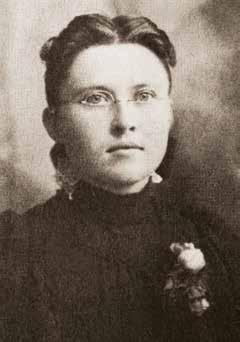
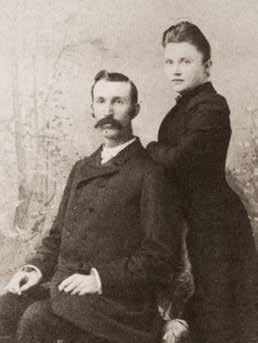
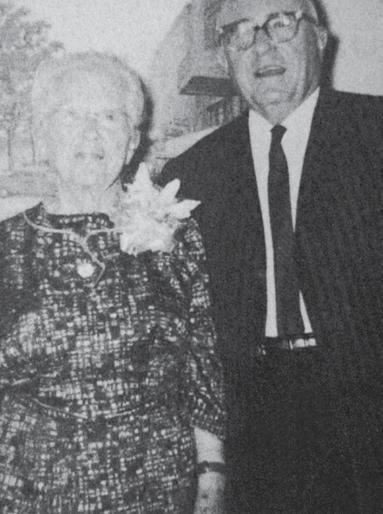
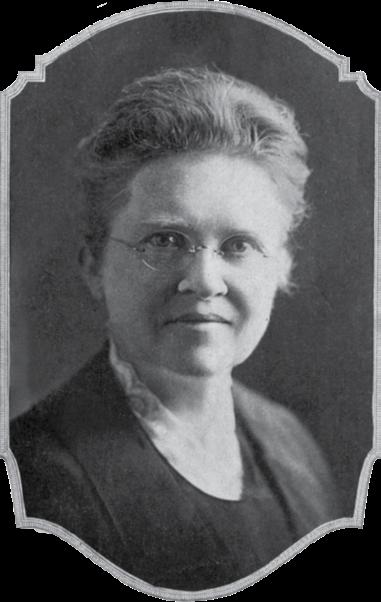
LEFT: Alma Estelle Baker. MIDDLE: Alma and Edwin McKibbin, shortly after their marriage in 1892. RIGHT: Alma and her brother, Alonzo Baker, on her 90th birthday.
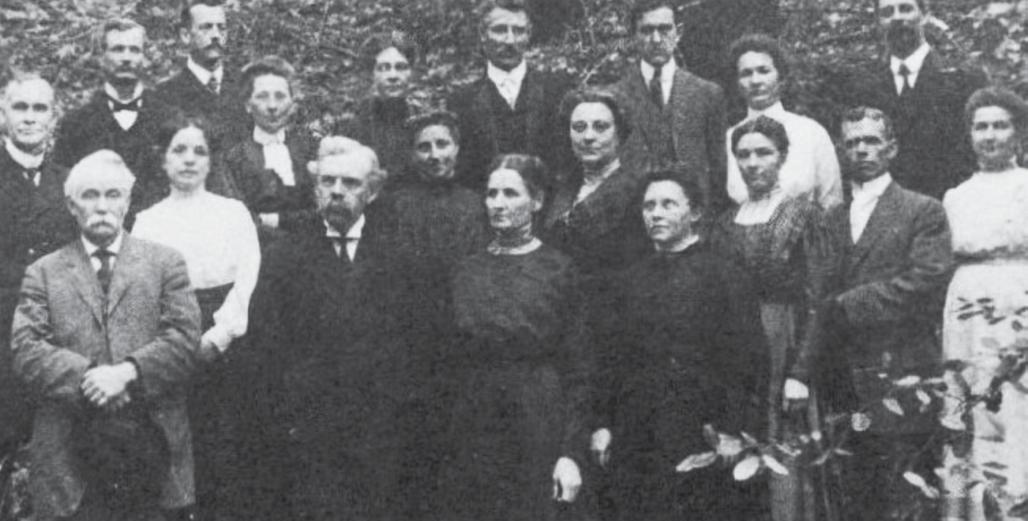
Alma Mckibbin, standing on the right in the front row, with Pacific Union College faculty, 1911-1912.
If you had visited Healdsburg College in the year 1889, you probably would have met a pleasant young lady of 18 years who was training to become a teacher. Alma Estelle Baker had been born in Webster County, Iowa, and she had come to California from her most recent home in Saguache, Colorado. She had only quite recently been baptized, along with her mother and grandmother. Her father was an ardent atheist who burned any Adventist books that were mailed to the home.
Alma took the teacher training course at Healdsburg and also signed up for Bible worker courses and tried her hand as a literature evangelist. While at Healdsburg she grew fond of another student, Edwin McKibbin. However, in her third year of studies, she fell seriously ill. She was so sick that the doctor attending her told the college president, W.C. Grainger, that she would die by morning.
Miraculously she survived, but her recovery was very slow. She stayed in the Graingers’ home for several weeks. Edwin, who had completed his course before her, was already working as a teacher at Healdsburg. He declared that he wanted to marry Alma, despite her illness and the fact that they were not actually engaged. So in 1892, after she first was presented with her diploma, Alma and Edwin were married in the living room of the Graingers’ home. Their “honeymoon” was a three-block trip to Edwin’s home—and she had to be carried there. She was
cared for by Edwin and his sister Marian.
Alma had been so ill, yet she was able to make a wonderful recovery after a prayer meeting that summer. But heartbreak arrived when Edwin contracted tuberculosis. That winter Alma taught Edwin’s classes. In 1894, the couple moved to Southern California with their baby son, Lorin, to stay with Edwin’s relatives while Alma worked. Tragically, baby Lorin died that same year at 11 months of age. Then, just two years later, Edwin also died.
Alma was left alone. She was just 25 years old. With no job and no money, she moved in with friends at San Pasqual in 1897. There she began teaching their children to read and started a home school in their parlor. Then she was asked to teach at the one-room school at Centralia, where she showed her real talent—teaching without books and writing every lesson on the blackboard. Why? The local members did not want the regular school textbooks because they included “myths and fairytales.” They wanted to follow Ellen White’s counsel that education should be Bible-based.
But as Alma herself said, “No other principle revealed to us occasioned so much perplexity and discussion as did this one. The Bible was to be the ‘groundwork and subject matter of education.’ What did these expressions mean, and how were they to be carried out?”1 She recalls, “I can remember… whenever the Review came, we tore off the wrapper
hastily, to see what Sister White said this week about this matter. Every church was discussing it. ‘Why,’ one would say to another, ‘Sister White has sent a testimony, and she says that we should have schools for all of our children from the first grade onward.’ And the next question would be, ‘How in the world are we to do it?’”2
While many Adventists recognized the importance of Ellen White’s counsel on education, Alma commented that “no group of educators or Conference officials made any effort to establish church schools on the Pacific Coast. The first schools were established by local churches, each acting independently of every other, and with no help or advice from any source except what the members read in the Review.”3
Without any practical resources, she had no choice but to develop them herself. Consequently, she taught from 8 a.m. to 6 p.m. daily and then returned to her unheated attic room to prepare lessons through the night for the following day. She was placed in charge of 35 students in grades one
through nine, with one student older than she was!
At the same time, there were many distractions and attempts to make her give up teaching in such a difficult situation. The unheated schoolroom’s walls were so open that the Santa Ana winds whistled right through, blowing so much sand over everything that the children couldn’t see to read. Alma’s landlady tried to discourage her, asking her every day if she really wanted to bother to continue. A doctor friend warned her about her failing health and urged her to come to his sanitarium. He said that once she was well, he would offer her employment. Another friend who was principal of the public school in Anaheim offered her a job in his school, stating that she would fail in teaching at a church school.
Despite such offers and objections, Alma was determined to keep her promise to teach for the whole school year. And she did, despite having to take time off after contracting double pneumonia. She returned to teach after the members pledged to take care of some of the problems by plastering the walls of the school room and providing a working stove. Sadly, this meant that they spent all of the money they would have used to pay her! So she subsisted on very little, eating mainly walnuts, the main local crop.
As she wrote, “The church schools began with nothing. We hadn’t a textbook.… If God was not in [this movement], do you think with such a beginning as that it ever could have succeeded? There wasn't a Bible lesson for a church school anywhere. I had to write them and teach them the next day.”4
After Alma finished in Centralia and returned to Healdsburg, M.E. Cady, the president-elect of the college, offered her a job teaching in the school, with the promise of providing teacher’s training at the same time. Unfortunately, when she arrived, Cady had to leave to take care of his move from Union College, and Alma was told she was to be the one to teach 11 other prospective teachers how
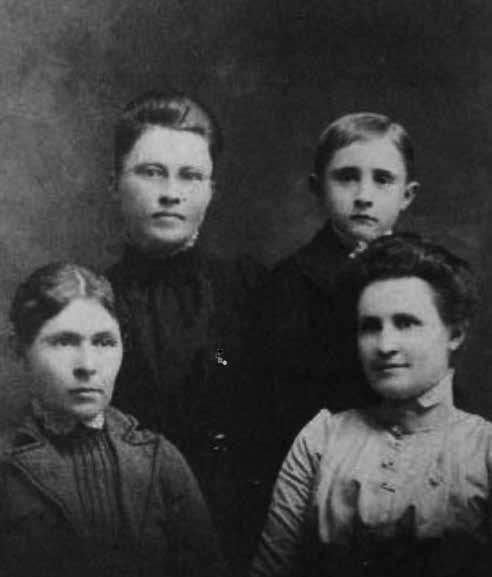
Back row: Alma and her brother, Lonnie (Alonzo).
Front row: Alma's mother, Estella Tucker Baker (left), and one of Alma's sisters.
to teach in a church school—because she was the only one who had had the experience of doing so! She wrote, “I am not a stranger to disappointment, but none was greater than this. I had a bad night, a very bad night. I learned a hard lesson. I learned not to expect human help, not to lean on others.” “I can see those eleven teachers… sitting there before me with their mouths open. They took in every word I said. And I’d go home and I’d say, ‘Lord. You’ll have to tell me what to teach them tomorrow; You know I don’t know.’”5
During a summer school for teachers in 1900, Alma worked with a committee that produced a small booklet called “Course of Study for Church Schools.” Then she worked on “Bible Lessons for the Church School,” which was printed in 1903. As she wrote, she had a visit from Ellen White, who was very interested in her project of writing Bible lessons for church schools. When she stated that she was having a hard time dealing with some parts of the Old Testament, Ellen White sent over some relevant books, together with her unpublished manuscript of Prophets and Kings. When Healdsburg closed in 1908, the local church lost many members, and Alma was asked to take over the services. She functioned as the local pastor and was given missionary credentials. Eventually she moved on to work at Pacific Union College.
In 1909, Pacific Press began publishing Alma’s Bible Lessons, a graded series of Bible
textbooks for elementary schools. From then on, many of the texts for Adventist schools were authored by Alma, and they were still being used in the 1950s.
But there’s more. In her time at Pacific Union College, she also cared for her bedridden mother and grandmother and her younger brother Lonnie (Alonzo L. Baker).
It is hard to imagine how she had the strength to do so much! Her work was truly a lifetime achievement.6 Alma achieved the grand old age of 103, having been given just hours to live when she was 21.
1Marie Louise Myers, Historical/Analytical Study of the Contributions of Alma E. McKibbin to the Seventh-Day Adventist Church School System (Ph.D. dissertation, Andrews University, 1992), p. 93, https://digitalcommons.andrews.edu/dissertations/593.
2Myers, p. 100.
3Myers, p. 106.
4Myers, p. 151.
5Myers, pp.155-156.
6For more on Alma McKibbin’s life, see Laura Wibberding, “McKibbin, Alma Estelle (Baker) (1871-1974),” https://encyclopedia.adventist.org/ article?id=AIPT.
Ellen G. White's home in Healdsburg, California, rented by Alma B. McKibbin. Alma is standing on the right. Her brother, Alonzo, is standing in front of their mother and beside their grandmother, who is in a wheelchair.
The Adventist Higher Ed Advantage:
Forming Faithful Disciples
By Christon Arthur
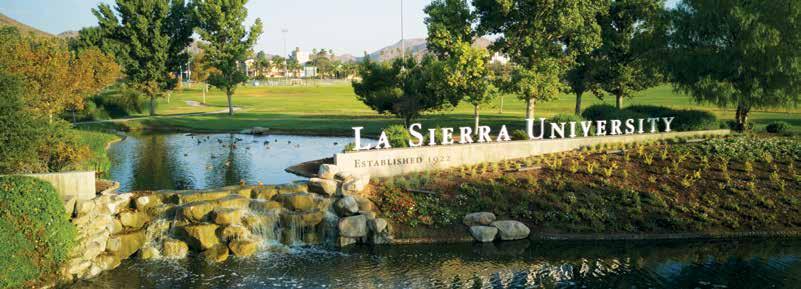
Alandmark study comparing Seventh-day Adventist alumni from Adventist colleges and universities in North America with those who attended non-Adventist institutions reveals that an Adventist education significantly strengthens the faith and spiritual commitment of Adventist young adults. Named the CollegeImpact Research Report, this survey was commissioned and released last year by the Association of Adventist Colleges and Universities.1
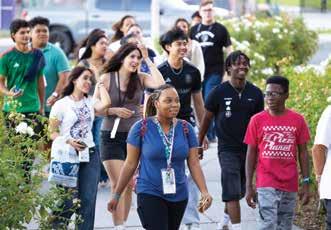
This research comes at a critical juncture for all of us in the Adventist higher ed space and validates what we know to be true—an Adventist education is truly transformational and helps students discern their calling. At La Sierra University, we see this impact every day. We witness students’ lives changing as they experience Christ-centered learning, nurturing friendships, engaged faculty, and a campus community committed to faith and service.
For example, Michelle Siboro, a lifelong Adventist, discovered a faith in Christ and a relevant Adventism that resonated with her when she enrolled and began participating in the spiritual life of the campus.2
Another student, Morgan Schmitz, came to La Sierra to study education, but a seed planted earlier in her life was nurtured through campus experiences. She accepted God’s call to ministry. Morgan is enrolled in the HMS Richards Divinity School and aims to become a pastor.
The whole-person focus and resulting positive outcomes of an Adventist education is noticed by external audiences. At La Sierra, this is evidenced in many ways, including through increased standing in rankings:
• US News & World Report (2026) ranks us #3 in the West for Social Mobility.
• The Wall Street Journal (2026) ranks us #35 nationally for Social Mobility.
• The Wall Street Journal (2026) ranks us nationally #196 Best University out of 584 schools. La Sierra is the only Adventist university in the top 400 and one of two Adventist universities on the list.
The CollegeImpact Research Report identified 31 core benefits, grouped into five major themes where La Sierra alumni, like those from our sister schools, consistently reported stronger outcomes than those who attended non-Adventist institutions.
For our churches and parents, these findings matter deeply. They show that La Sierra University and other Adventist higher ed spaces are not just places of learning, they are communities of discipleship.
Theme 1—Adventist education deepens faith and strengthens belief
The spiritual differences between Adventist-college alumni and Adventists who attended non-Adventist schools were striking:
• More worship engagement: 1.4 times greater
• On-campus worship opportunities: Nearly 2 times greater
• Deepened spirituality: Over 2 times greater
• Opportunities for spiritual development: Over 2 times greater
• Deeper understanding of Adventist beliefs: Over 2.5 times greater
• Shared faith values: Over 4 times greater
• Christ-centered learning: 8 times greater
These numbers show the powerful spiritual environment created on our campuses.
Theme 2—Adventist campuses produce stronger Christian friendships
Adventist-college alumni reported friendships that continue to anchor their spiritual lives long after graduation:
• Friends who strengthened their walk with Christ: Over 1.6 times greater
• Friends who attended worship together: Nearly 2 times greater
These peer relationships provide a support system that promotes faithfulness and ministry involvement.
Theme 3—Faculty serve as spiritual mentors and role models
• Values and ethics integrated in class: Over 1.6 times greater
• Personal interaction with professors: Over 1.6 times greater
• Engaged faculty interested in student success: Over 1.7 times greater
• Professors who knew students personally: Nearly 2 times greater, with alumni from SDA institutions stating that 92% of their professors knew their names
• Faculty who shaped their spiritual lives: Nearly 4.5 times greater
Professors serve not only as academic guides but as Christian mentors and role models.
Theme 4—Development of the whole person
The study found stronger outcomes among La Sierra alumni in areas such as:
• Development of the whole person: Nearly 1.5 times greater
• Helped students integrate their faith with other aspects of their lives: Over 2 times greater
Theme 5—Purpose, calling, and commitment
Perhaps most importantly for our congregations, La Sierra University alumni graduate with:
• Sense of purpose: Over 1.2 times greater
• Strong moral principles: Nearly 1.3 times greater
• Sense of God’s calling: Nearly 2 times greater
These are the future Sabbath School teachers, youth leaders, elders, deacons, musicians, teachers, pastors, missionaries, and servant-leaders in our churches.
A message for churches
This study demonstrates what many of us have witnessed for decades: An Adventist education is one of the most effective ministries of the Seventhday Adventist church for forming lifelong disciples of Jesus.
At La Sierra University, one of our core values as stated in our new strategic plan is to lead progressive, relevant Adventist Christianity with courage and humility. With this objective in front of us and with Christ as our foundation, we graduate students who will strengthen the future of Adventist congregations—one student at a time.
A message for parents
For parents seeking an education rooted in Scripture, strengthened by community, and aligned with God’s calling, the message of this study is unmistakable: An Adventist university provides a transformative educational experience—one that shapes students today and for eternity.
The investment is an eternal one. The investment has eternal implications. At La Sierra, we look forward to welcoming students home to our campus and to an Adventist education that offers opportunities for calling and transformation.
Christon Arthur is president of La Sierra University.
1For more information and a link to survey results, please visit https:// adventistcolleges.org/why-adventist/. 2Read Michelle’s story at this link: https://bit.ly/40GemKB.
From the Hill to the Harvest: PUC and the Making of Pioneers Who Served Church and Community
By Tuwan Ussery
Adventist education on the West Coast has played a formative role in shaping leaders whose influence extended far beyond the classroom. Pacific Union College and its predecessor, Healdsburg College, became places where African American students encountered rigorous academics, spiritual formation, and a vision of service that carried them into ministry, education, public service, culture, and social justice. Their stories reveal how Adventist education helped cultivate leadership during eras when racial barriers limited opportunity.
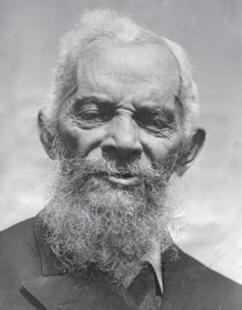
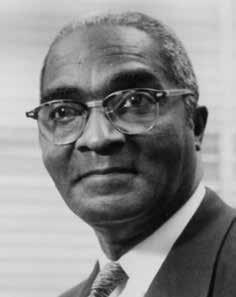
One of the most foundational figures in this legacy is Charles M. Kinny (1855–1951).
Born into slavery,
Kinny became an Adventist in 1878 and was later sponsored to study theology at Healdsburg College from 1883 to 1885. In 1889, he became the first African American ordained Seventh-day Adventist minister. Kinny’s ministry proved transformative. When he joined the denomination, there were fewer than 50 Black Adventists nationwide. By the time of his death, that number had grown to more than 25,000. His evangelistic work, church planting, and organizational leadership helped lay the groundwork for African American Adventism across the country—making PUC’s earliest history instrumental in shaping and preparing Charles M. Kinny for denominational work.
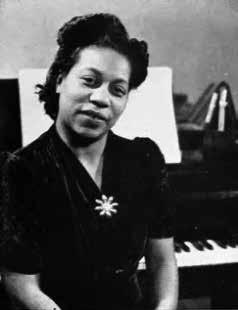
That same commitment to preparation and service is evident in the life of Mary Inez Lang Booth (1913-2010). Booth enrolled at PUC in 1933 and graduated in 1937 with a Bachelor of Arts in music. During her time at PUC, she was baptized and developed a deep faith that would shape every
dimension of her career. She went on to serve more than four decades at Oakwood College, becoming its first fulltime music teacher. Beyond the classroom, Booth founded the Oakwood Jail Band Ministry, which she led for over 50 years, using music as a tool for worship, rehabilitation, and hope among incarcerated individuals and their families. Her ministry exemplified how education at PUC nurtured her musical gifts and directed them toward a lifelong ministry of service and education.
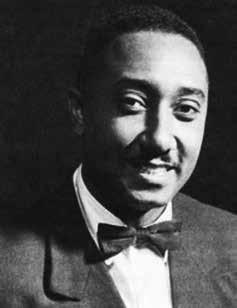
Another example is Eric Calvin Ward (1924–2004), who attended PUC from 1942 to 1946 and graduated second in his class with a Bachelor of Arts degree in theology. Ward later earned a master’s degree from Andrews University and served the church as a minister, educator, and administrator. His mentorship of younger pastors and leaders helped strengthen African American pastoral leadership within the denomination, extending PUC’s influence across generations of ministry.
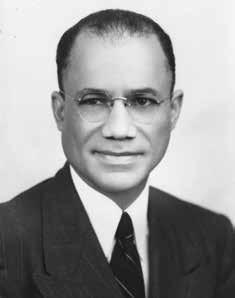
PUC also shaped leaders whose influence reached the highest levels of denominational administration. Frank L. Peterson Jr., class of 1916, was the first African American student to graduate from PUC. His long career included teaching, pastoral ministry, nine years as president of Oakwood College, and service as a vice president at the General Conference of Seventh-day Adventists. Peterson’s life demonstrated how PUC prepared African American leaders not only to serve but also to participate in denominational governance.
PUC’s legacy in shaping students also includes those whose faith compelled them toward social justice.
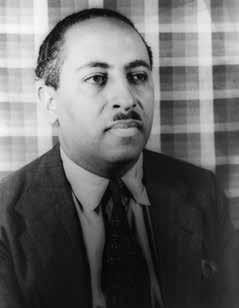
PUC’s impact was not limited to denominational work alone. Arna Wendell Bontemps (1902–1973), a 1923 graduate, studied English at PUC and wrote for the student newspaper before becoming a central figure in the Harlem Renaissance. As a poet, novelist, historian, and later head librarian at Fisk University, Bontemps preserved African American history and culture through works such as Black Thunder His life illustrates how Adventist education at PUC contributed to Black intellectual and cultural life well beyond denominational boundaries.
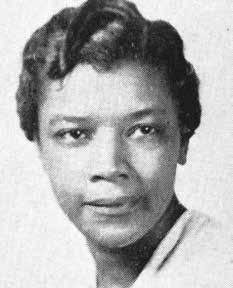
Similarly, Ruth Frazier Stafford, a 1938 PUC graduate, used her nursing education to serve communities across the country. She worked in hospitals from California to Chicago and Tennessee, taught
nursing at Oakwood University, and wrote regularly for Message Magazine. Stafford also coordinated the nursing program at Meharry Medical College, expanding access to professional healthcare education for African American students during a period of limited opportunity.
Owen Austin Troy Sr. (1899–1962) is a 1922 graduate of PUC who developed skills in preaching, music, and community engagement that shaped a lifetime of ministry. He planted churches, led urban congregations, and pioneered wholistic ministry that integrated evangelism with health education, music, and social service. His leadership included founding health clinics during the Great Depression, originating the Sweet Chariot Hour radio broadcast in 1942, and advocating for racial equity within the Pacific Union Conference. In 1952, Troy became the first Seventh-day Adventist to earn a Doctor of Theology from the University of Southern California, marking a historic academic achievement rooted in his PUC formation.
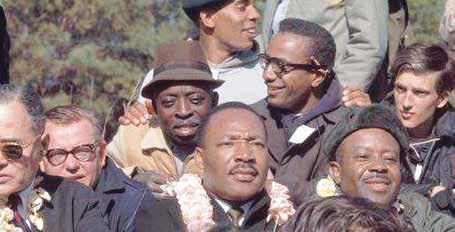
Their decision to march alongside Dr. Martin Luther King Jr. reflected a student-led commitment to civil rights and demonstrated how Adventist education at PUC inspired moral courage and witness during defining moments in the Civil Rights Movement.
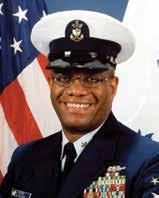
In more recent decades, this tradition has continued through Adventist pioneers such as Vincent W. Patton III, a PUC alumnus who earned a Bachelor of Arts in communications in 1976 while serving on active duty in the United States Coast Guard. Patton went on to become the eighth Master Chief Petty Officer of the Coast Guard, the first African American and African American Adventist selected for that senior enlisted role. His career reflects faith-informed leadership, national service, and a sustained commitment to education that was shaped at PUC.
PUC’s legacy in shaping students also includes those whose faith compelled them toward social justice. In 1965, Will Battles and Paul Cobb, students at PUC, traveled from California to Alabama to participate in the Selma to Montgomery March.
Together, these stories tell the influence of Adventist education at PUC, which has served not only as an academic institution but as a formative space where African American Adventist students were equipped to lead, serve, create, and challenge injustice. Their lives remind the church that Adventist education was instrumental in shaping pioneers who transformed both church and American society.
Tuwan White is an assistant professor of social work and psychology at Pacific Union College, where he also serves as service learning director and chief diversity officer. His writing and teaching focus on church history, politics, and justice.
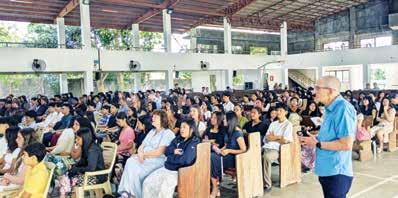
When Faith Boards First: Thunderbird Adventist Academy Students Serve in Puerto Rico
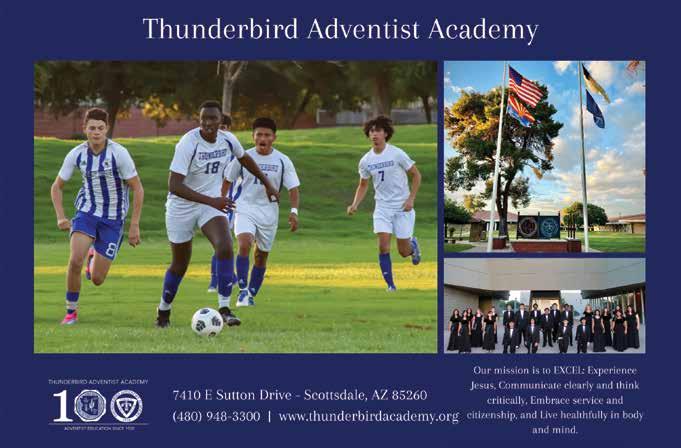
On the morning they were supposed to depart, everything pointed to cancellation. For the 47 students and sponsors from Thunderbird Adventist Academy, the long-anticipated mission trip to Puerto Rico appeared to be over before it began.
Airline notifications, industry alerts, and widespread flight disruptions left faculty and students wondering whether they would ever reach their destination.
Instead of sinking into despair, trip organizer and leader Dr. Lela Lewis called the group to prayer.
Parents, church members, and students began praying—early in the morning, throughout the day, and even while standing in line at the airport. With no guarantees and uncertainty looming, Lewis felt a strong impression: Go to the airport, don’t ask questions, don’t doubt, just go.
With no clear knowledge of what might happen, the group moved forward in faith. One by one, bags were checked and boarding passes were printed. The departure screens told a remarkable story—nearly every flight was canceled, yet the students’ flight remained. The group arrived safely in Puerto Rico, stepping directly into a week of intense service, learning, and spiritual growth.
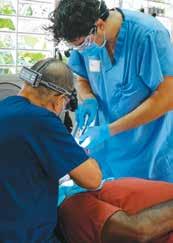
The trip's purpose extended beyond providing medical services and doing community outreach on the island.
Lewis emphasized that the experience was designed to help students understand that mission is not reserved for adulthood or professional ministry. “I truly believe that the more we let young people experience missions, the more they feel invested in the
church,” she shared. “They are the church right now— not sometime in the future.”
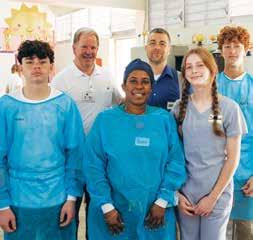
The outreach included medical and dental clinics, triage and pharmacy services, hospitality and logistics, children’s programs, mental health support, and community assistance. In many areas, access to consistent healthcare remains limited, leaving the local residents vulnerable.
For the students, the impact was deeply personal. Several students served in leadership and coordination roles across departments. One student coordinator described how chaotic the medical operations felt at times—but also how empowering it was to be trusted to make decisions and help solve problems in real time.
Another student shared that doctors and professionals listened to her directions during clinic operations. “They trusted me,” she said. The experience helped her realize that her voice and leadership mattered.
That sense of trust became a defining theme. “They weren’t afraid to give the reins to the young people,” one participant explained. “We were trusted to help lead.”
For many students, it was the first time they had been treated not simply as helpers but as essential members of the mission team.
In the pharmacy and triage areas, students welcomed patients, guided them through the process, and supported medical providers. One student summarized the experience simply: “I feel like we were able to touch a lot of people’s hearts through Jesus.”
PHOTOS:
A student helping in the women's health area admitted that she initially felt afraid and unprepared. At one point, she asked Lewis if she could be reassigned. Instead, she was encouraged to stay and push through. By the end of the day, her perspective had changed. She described how fear turned into purpose—and how learning to serve outside her comfort zone became one of the most meaningful lessons of the trip.
For some, the experience confirmed a calling. “I want to be a missionary doctor more than anything else,” one student said, after being invited by a patient to perform part of an exam so she could learn.
The same spirit of prayer that marked the beginning of the journey continued throughout the week when a critical patient logbook—required to move patients between departments—went missing. Students gathered into a circle and prayed. Within minutes, the book was found.
Students described it as one of many small but powerful reminders that God was present in every detail. “We saw miracle after miracle,” one student reflected.
Not all ministry happened inside clinic rooms.
While assisting with logistics, one student was stopped on the street by a woman urgently looking for a dentist. Although he was not part of the dental team, he guided her to the clinic location. Later that same day, she found him again—just to say thank you.
Students distributing food in the community were deeply affected when several people took multiple portions—uncertain when they would be able to eat again. The moment opened their eyes to the realities many families face every day.
For one student serving in the children’s area, the most meaningful experience came through a child. A young boy sat crying on the ground, unable to communicate clearly because of the language barrier and missing his mother, who was receiving medical care.
The student stayed with him, gently walking around the campus and reassuring him again and again that his mother would return. Eventually, the boy stopped crying and began playing and drawing.
Later, the student reflected, “This reminded me that Jesus never leaves us. As a matter of fact, He didn't leave us when we were on the trip; He proved to us that He was with us all the time. He proved to us that He was there by letting us go get on that plane.”
For Lewis, stories like these define the purpose of Adventist education. “When students are given real responsibility, they step up,” she said. “They take ownership.”
Beyond the clinics and programs, the trip created space for students to experience service as discipleship—to connect faith with action and compassion with leadership.
As students returned home, many expressed a shared desire to continue serving in their churches and communities. “This trip made me realize I want to be a medical missionary,” said one student, while another expressed, “This trip changed my life.”
Lewis recalled that on the way back, so many students were crying because they didn’t want to come home. “They didn't want to leave Puerto Rico. Not because it was fun and exciting, but because they wanted to be part of missions. They wanted to continue to be active and involved.”
The journey began with closed doors, unanswered questions, and a decision to trust God enough to show up at the airport.
It ended with renewed vision, deeper faith, and a generation of young people discovering that mission is not something they will do someday.
Instead, it is something they are called to live, right now.
By Alexis Camacho
Caring Hearts and Hands: Students in the Global Mission Field
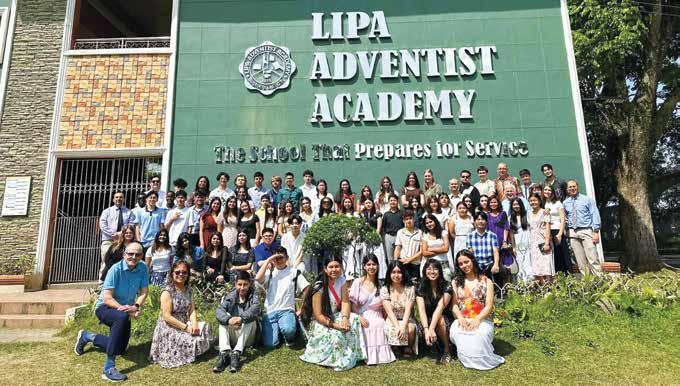
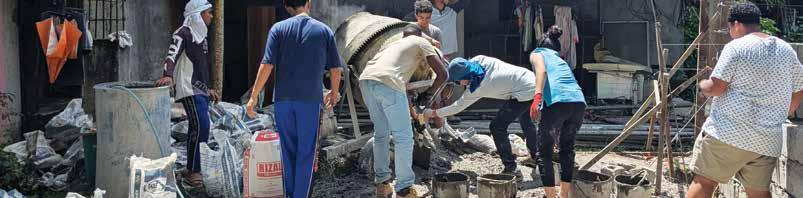
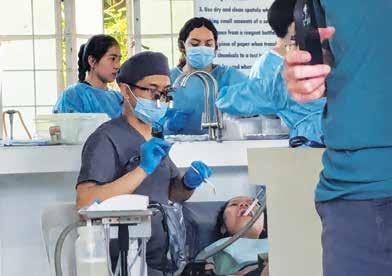
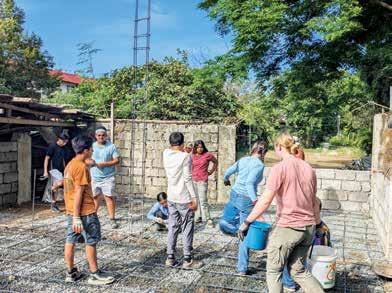
During spring break of last school year, March 17-27, 2025, the Central California Conference (CCC) Education Department was able to embark on its first-ever multi-school international mission trip. This trip, organized entirely by the CCC Education Department and its participating schools, was open to all students in grades 9-12. Through God’s grace, a total of 76 missionaries were able to serve the community of Lipa Adventist Academy, an Adventist school in the city of Lipa in the Philippines. Students from Armona Union Academy, Bakersfield Adventist Academy, Central Valley Christian Academy, Mountain View Academy, and Sierra View Junior Academy—as well as sponsors, a dental team, and CCC Education Department team members—
came together to assist in construction work on the campus in Lipa; to facilitate Sabbath School programs, chapels, and Vacation Bible School programs; and to provide dental care to community members.
On a daily basis, the CCC students and the Lipa students were able to connect as peers in a special way, creating an avenue through which both parties could share and experience different cultures with one another, with the love of their precious Savior Jesus Christ at the center of it all.
By the end of the trip, the students from both areas had cultivated deep and meaningful friendships. On the final evening together, the CCC student missionaries hosted a program they titled “Lipa Live!” as a way to bid
farewell to their new friends.
Lipa Adventist Academy’s student media team put together a thoughtful video full of highlights from the trip, which you can watch for yourselves by going to https://educate.cccadventist. org/lipa-mission-trip-2025.
Erik Borges, a key organizer of this mission trip and one of the CCC representatives present, recalled that the most inspiring thing was “seeing the students pitching in together to serve each other as well as the community in Lipa, learning to work with people they do not usually work with, and creating new relationships and skills. Then, after returning from the trip, seeing these students taking what they learned and putting it into practice at their local churches and communities.”
One of the students even went on to start a missionary club at his own church because of this trip!
This mission trip to the Philippines had such a positive response that another trip is planned for the 2025-26 school year. At the time of this article being written, the CCC Education Department is weeks away from its second multi-school mission trip. This time they are headed for Machaquilá, Guatemala. CCC student missionaries will once again be serving the local community through evangelistic programs (with speakers being trained by Pastor Christien Hodet from Bakersfield Central church), as well as construction, dental work, and this year including medical care! This year’s trip adds Fresno Adventist Academy to the roster, as well as a medical team and a larger dental team comprised of church and board members from around the conference.
Keep up to date with this excursion and more at https://educate.cccadventist.org/multi-schoolmission-trip.
By Mallory Schramm
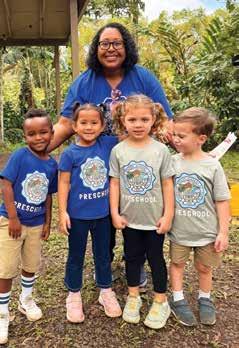
Ka Lama Iki Preschool: Where Faith, Love, and Learning Grow
Hawaiian Mission Academy Ka Lama Iki Preschool is part of a growing vision for Adventist education in Hawaii. Our preschool serves children ages 3, 4, and 5, providing a Christcentered foundation during the most formative early years. While the preschool initiative was already in development, God opened the door for me to return to Hawaii and step into the opportunity to build and lead Ka Lama Iki Preschool. My personal journey fuels my passion for this ministry.
During one of the most difficult seasons of my life, Adventist education was not part of my plan. I was a preschool teacher and a busy single mother; I was not attending an Adventist church and was unsure how I could provide private Christian education for my son. My pastor’s wife gently encouraged me to consider the Adventist preschool her son attended and to trust that God would make a way.
So I prayed, and He did.
I praise God for the support of our school family, church family, and dedicated board members who continue to help Ka Lama Iki Preschool grow.
God opened doors for my son to attend an Adventist preschool in Georgia. He thrived in an environment where he was known, loved, and nurtured spiritually and academically. I felt as though I was leaving him with family each day. Through the love of his teachers and the support of the church community, I began to see Christ in a tangible way.
As I asked God to draw me closer to Him, He placed people in my life who guided me toward a deeper relationship with Him and the Adventist Church. When my son was in first grade, I became a church member. A quiet prayer I once whispered, “Lord, I would love to teach in a place like this,” became reality. I began serving in Adventist education and eventually became the Early Childhood Director at the preschool my son had attended.
This February, Ka Lama Iki Preschool celebrated one year of serving our community. I praise God for the support of our school family, church family, and dedicated board members who continue to help Ka Lama Iki Preschool grow.
Each day, we hold close the invitation of Matthew 19:14, “Let the little children come to Me” (NKJV). This verse guides us as we create a safe, loving environment where our keiki (children) and ‘ohana (families) can come to know Jesus.
Adventist education has been a true blessing for my family, and I believe it can bless many more. There are meaningful ways to partner with and support our preschool as we continue to grow. I am honored to serve our keiki and ‘ohana and excited to see how God continues to lead Ka Lama Iki Preschool.
By Kathleen Velazquez
A Seventh-day Adventist Boarding Academy Serving Native American Youth Since 1946
Our Creator’s Temple
In last month’s issue we highlighted National Library Lover’s Month to bring attention to our literacy efforts on campus. We took advantage of another national awareness month, March, to bring attention to the importance of healthy food and overall nutrition.
At Holbrook Indian School (HIS), we dedicate our efforts to educating the whole person. Though we primarily focus on academics, we also understand the importance of nourishing the spirit of each student as well as their physical beings.
The Bible tells us in Psalm 139:14 that our bodies were created in a fearful (awe-inspiring) and wonderful way. Every organ, muscle, bone, sinew, and cell has a purposeful function to help keep us upright, alive, and healthy. When we take care of our body intentionally, it serves us well. When we are neglectful of its needs, it begins the process of breaking down.
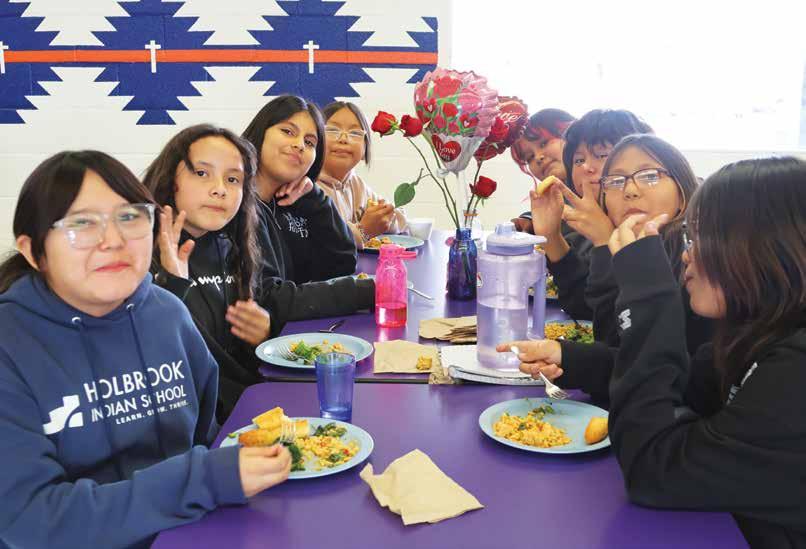
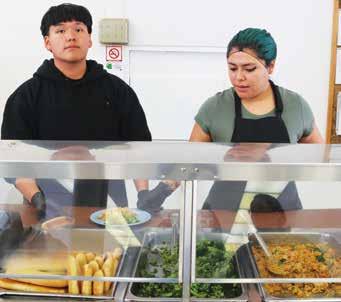
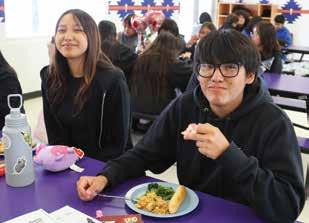
The cafeteria team at HIS strives to provide nutritious meals to our students while encouraging healthy eating habits.
In 2014, the Navajo Nation passed the Healthy Diné Nutrition Act. The purpose of this was to address the health issues of the high number of people affected by preventable diseases such as diabetes, cancer, heart disease, and obesity.
Dynamics such as unemployment, transportation barriers, poverty, and limited grocery stores in remote rural areas magnify the hurdle of healthy food access. For this reason, we work diligently at HIS to provide nutritious food during mealtimes. This includes produce from our very own gardens!
One of the benefits of having a farm on campus is that our cafeteria often buys produce from our own greenhouses and fields. Curly kale, salad, pumpkins, and melons are frequent menu items as a result. We are grateful that God has given us this opportunity and blessing to care for our students’ well-being in this way.
Having fresh vegetables and fruits at their fingertips—oftentimes items they have participated in
growing—gives our students a firsthand experience, allowing them to witness the process from farm to table and take pride in making healthier food choices.
Our love for our students drives us to nourish not only their minds but their bodies and spirits, too. We are grateful to our supporters and generous friends for helping us care for our students the way God intended: healthily.
By Kimberly Cruz
Holbrook Indian School (HIS) is a first- through twelfth-grade boarding academy operated by the Pacific Union Conference of the Seventh-day Adventist Church. HIS also manages a first- through eighth-grade day school on the Navajo reservation in Chinle, Arizona. Eighty-seven percent of funding comes from individuals who have a desire to support Native American ministries and Christian education. Your generosity makes a difference in the lives of our students, their families, and the communities they serve. Thank you for your support.
One of the biggest challenges patients have when they are admitted to a hospital is a certain loss of freedom.
They used to be at home with the freedom to eat what they wanted. They used to have a body that allowed them to go where they chose. They used to not be confined to a hospital bed that has become their new dwelling place.
Now, everything has changed. Illness or injury has robbed them of the freedom to be who they are used to being. The shackles of illness have robbed them of their joy.
But sometimes even the seemingly saddest cases of lost freedom don’t produce the outcome we might expect.
Recently I sat with a patient who was in her mid-20s and going through her second battle with aggressive cancer. The first time it was ovarian. This time there were tumors on her brain. She had been robbed of her freedom—robbed of her youth.
As I sat and visited with her, I was astounded to observe a wide smile on her face and joy radiating from her inner being. It was dumbfounding. This was not what I expected.
I asked her, “How are you coping with all these medical setbacks? It seems as if I’m sitting in the presence of somebody who is at the beach enjoying a relaxing vacation. I’m seeing peace.”
She responded, “You know what? I choose joy. I know that doesn’t make any sense, but I figure God has blessed me with 26 wonderful years, a loving family, and friends that are as close to me as my sisters. I’m truly blessed—and soon, I will be truly free.”
Joy
‘I Choose ‘
“I choose joy.” Wow.
I entered the room wanting to be some sort of a blessing. Instead, I left the room having been blessed.
Clinically trained chaplains at Adventist Health see and hear a lot of things. We hear deep, dark secrets. We receive tear-filled confessions. We sit with, pray over, and hold the hands of all kinds of patients going through all kinds of trials. This is what we are trained to do.
And sometimes, we walk into a room and are blessed with joy. Joy in the midst of trial. Joy in the midst of ruthless pain. Joy in a hospital bed. Joy-giving freedom.
“Consider it pure joy, my brothers and sisters, whenever you face trials of many kinds, because you know that the testing of your faith produces perseverance. Let perseverance finish its work so that you may be mature and complete, not lacking anything” (James 1:2-4, NIV).
By Mark Witas
“I entered the room wanting to be some sort of a blessing. Instead, I left the room having been blessed.”
Mark Witas
Zapara School Dean John Thomas Honored with Weniger Medallion
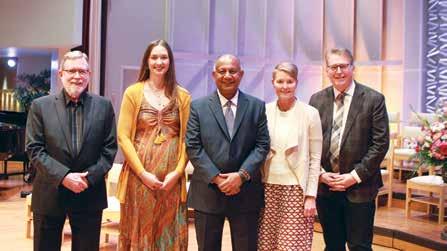
It was an improbable life journey that began with a miracle. John Thomas, dean of La Sierra University’s Zapara School of Business, recounted the story of his survival as an infant due to the intervention of a Seventh-day Adventist missionary doctor in 1958—it was one of three pivotal life moments he shared on Feb. 14 during his remarks as a recipient of a 2026 Weniger Society for Excellence medallion.
The prestigious award ceremony recognizes the impact of Adventist educators, ministers, those in the medical field, and others. The event has been held annually for the past 51 years by the Charles Elliott Weniger Society for Excellence. The awards are named for Weniger, a noted Adventist professor, seminary dean, and theologian who strove for excellence while exhibiting kindness and thoughtfulness.
The Weinger event also awards scholarships to students from the North American Division’s 12 Adventist universities and colleges. Luiza Triches Rodrigues this year represented La Sierra University, from which she earned a B.A. in psychology cum laude and where she serves as a graduate assistant basketball coach. She is earning a master’s degree in Marriage and Family Therapy.
Thomas was among four who received Weniger medallions on Feb. 14. He has led the Tom & Vi Zapara School of Business for 27 years, posting significant enrollment increases along the way. He has served as a member of La Sierra’s business faculty for 38 years and holds the Bashir Hasso Chair for Entrepreneurship and Political Economy. His initiatives include efforts to raise $18 million for the
state-of-the-art Zapara business school, which opened in 2013 with seed funds from its namesakes.
Thomas also initiated the international award-winning student Enactus team, formerly called Students In Free Enterprise, or SIFE, which won an unprecedented seven national trophies and two World Cups.
Thomas recalled the impact of medical products entrepreneurs Tom and Violet Zapara and the influence of a supportive friendship that transpired over more than 30 years, leading to the couple’s extensive support of the SIFE team and the business school.
He recounted a time of financial uncertainty and steep challenges as his wife, Kimberly, battled cancer while caring for two young children.
“Lucrative job offers came from the capital markets, and my faith in Adventist education was beginning to weaken,” Thomas said.
Clarity arrived through a student from Ghana whose family went into debt for his tuition. The student earned an MBA in accounting from La Sierra and passed the exam to become a Certified Public Accountant. He eventually paid off his debts and returned to Ghana to serve the Adventist church.
“Looking back now and connecting the dots, I see something greater at work,” Thomas said. “This, I believe is the power of Adventist education shaping lives, not merely for success but for service, linking one generation’s faithfulness to the next.”
By Darla Martin Tucker
Left to right, La Sierra University
President Emeritus and Weniger Society member Larry Geraty; Weniger Scholar Fellow Luiza Triches Rodrigues; Weniger medallion recipient, Zapara School of Business Dean John Thomas; La Sierra University Interim Provost Leslie Martin; La Sierra University Film & Television Chair Stew Harty.
Loma
Linda University School of Medicine Partners with Kettering Health for New Regional Campus
Student physicians at Loma Linda University School of Medicine can now complete their clinical years at Kettering Health through a newly established regional campus partnership. Students complete their first- and second-year studies in Loma Linda, California, before having the opportunity to continue their clinical training in Ohio. Through the agreement, medical students may select the Seventh-day Adventist healthcare system for their required third- and fourth-year clinical rotations as they pursue a Doctor of Medicine degree.
“Our partnership with Kettering Health reflects our shared commitment to whole person care and mission-driven medical education,” said Tamara Thomas, MD, dean of Loma Linda University School of Medicine. “Together, we are educating physicians who combine clinical excellence with compassion and service, while helping address critical physician workforce needs in the communities we serve.”
In January 2026, the State of Ohio formally recognized Kettering Health as an official regional campus for Loma Linda University School of Medicine
See
clinical training. The partnership reinforces a shared commitment to whole person care as a central component of accredited medical education.
The Loma Linda University School of Medicine–Kettering Health Campus expands clinical education across a broad range of patient care settings and communities. Students training at Kettering Health will follow the School of Medicine’s core curriculum and complete their education under the supervision of Kettering Health faculty physicians.
Regional campuses are increasingly common as medical schools and health systems collaborate to train the next generation of physicians.
Applicants and admitted students who are interested in completing their clinical years at a regional campus, including Kettering Health, may indicate their preference in their secondary application. Loma Linda University School of Medicine also operates a regional campus at AdventHealth Orlando.
By Hillary Angel
news and Health & Wellness stories from Loma Linda University Health at news.llu.edu.
PUC’s Graduate Degrees: Service Across Sectors
Over the past few years, Pacific Union College (PUC) has enthusiastically expanded its graduate degree programs in education, nursing, communication, and business, offering flexibility, small class sizes, experiential learning, and, most importantly, a Christian environment that empowers students with opportunities within the Seventh-day Adventist world and beyond.
Having offered the Master of Education program for some time, the college decided to broaden its offerings in other high-demand fields in an online setting, which has ultimately allowed PUC to expand its reach to more students in California and Hawaii. Currently, the M.Ed. degree is a summer-based program that exposes graduates to teaching skills and technological proficiency, scholarly research, and leadership development, while observing classroom trends and issues.
Dean of the School of Arts, Humanities, and Professions Milbert Mariano emphasized the need to reach students beyond PUC. “We are adding to our list of online graduate programs providing much-needed training for busy professionals who want to advance their careers through master's degrees,” he said.
To keep up with the high demand for nurses in the job market, PUC now offers a Master of Science in Nursing, a 100% online program that provides core, specialty, and practicum courses to students who already hold a BSN. Two areas of specialization within this program are Nursing Education and Nursing Leadership and Business Management, equipping graduates for roles in healthcare and academia, as well as for administrative roles in healthcare settings.
“Being an employee at the college and attending school for both my BSN and now my MSN, I have found that it has been an overall enjoyable and rewarding experience,” said Clinical Care Director Sandy Sargent. “Although I have been in a leadership role for many years, I am learning the theory behind many of the skills I am doing. It is great to be able to put a name to the different processes used to be a successful nurse and nurse manager. The professors' support, availability, and dedication to my success show through, as does their enthusiasm for the program. They really wanted every student to succeed.”
Other programs designed for the working professional are the Master of
Arts in Communication and the Master of Business Administration, both 100% online, which each offer three emphases and collaborate on one of those specializations: Strategic Communication.
Available in the M.A. in Communication are the Communication Research, Strategic Communication, and Health Communication emphases, as well as stackable certificates. The MBA degree offers specializations in Healthcare Administration, Management, and Strategic Communication—allowing students to gain mentorship and learn under the guidance of experienced, faith-based faculty members.
Tara Hargrove, chair of the Departments of Communication and World Languages, shared, “I am especially looking forward to more collaborations with other departments, institutions, and organizations. Courses are designed by industry professionals and faculty to include real-world experiences and applications, including a study tour experience—location pending! I love that this program is asynchronous and accessible for a wider range of students to add to their skill sets.”
Looking ahead, PUC is working to add online graduate and non-graduate programs not only to meet market needs but also to align with the college’s mission to Learn with Purpose, Rise in Faith, and Serve with Love.
By Marina Maher
Guiding Young Disciples
Fallon Adventist Christian School is a place where small moments grow into big miracles. When I arrived six years ago, the school had only six students—but even then, their energy, curiosity, and love for Jesus filled the classroom. Today, 20 students make up our vibrant little school, and for the first time in many years, we even have a waiting list. Their growth—academic, social, and spiritual—is a testament to what God can do in a nurturing, Christcentered environment.
One of the most beautiful qualities of a small school is the way students learn from one another. With kindergarten through eighth grade sharing the same learning space, older students naturally become mentors. When a younger child has a question or needs help, it is often an older student who steps in, patiently explaining, demonstrating, or encouraging. Research shows that peer learning strengthens understanding for both students, but watching it unfold daily is far more powerful than any statistic. The confidence in the older students and the joy in the younger ones tell the story best.
This year, as our school works through the accreditation process, the students continue to shine with resilience and enthusiasm. Despite the added structure, evaluations, and occasional disruptions, they greet each day with eagerness—ready for worship, ready for learning, ready for whatever God has in store. Whether we are in the classroom, on the playground, in the music room, or on a field trip, their sense of wonder keeps our school buzzing with life.
Faith is woven into everything our students do. Each morning they gather for worship and Bible
study, offering heartfelt prayers for the people and issues closest to their young hearts. They pray for sick relatives, for peace in their homes, for courage in difficult moments. Their prayers are honest and hopeful, revealing a trust in God that inspires everyone around them.
On the playground, their faith becomes action. I’ve watched them resolve conflicts by taking each other’s hands and praying for guidance. I’ve seen them comfort a friend who is sad, celebrate a classmate’s success, or invite someone who feels left out to join their game. These simple acts of kindness are the real indicators of their spiritual growth.
Through busy school days—filled with lessons, music, art, PE, projects, and the delightful noise of learning—our students remind us why Adventist education matters. They are growing not only in knowledge but in compassion, in leadership, and in their daily walk with Jesus.
When this school year comes to a close and I prepare to return to retirement, my heart will be full. Not because of what I have done but because of what God is doing in the lives of these children. Fallon Adventist Christian School is a special place, a mission field where students learn to love God, love others, and discover the purpose He has for them.
We are praying that God will soon send the right teacher to continue guiding these precious young people. They are the reason this school thrives and the reason its mission will continue—one child, one prayer, one small miracle at a time.
By Wanda Brimmer
Vegas Valley Sports
Vegas Valley Adventist Academy’s (VVAA) sports program has been a whirlwind of excitement this school year. We have participated in volleyball, soccer, and now basketball, equipping teams with essential lessons. Each sport has been an experience in and of itself. What our students have learned is unparalleled, including lessons on trust, sportsmanship, and becoming team players. These lessons have been paramount to each team’s success.
Early in this school year, students were able to join the volleyball team, after several years of absence in this sport at VVAA. The players relied on parent coaches Patricia Mancilla Torres and Pastor Pedro Pozo to ensure they became a team. Each student showed dedication, and this was evident in the results of each game.
VVAA has been the underdog in soccer for the past couple of years, but this year they went on to become league champions in the division. We are grateful to our coaches, parents Johanna Lopez and Alex Aviles, for their commitment and support. We salute our players for the dedication to the sport and for their focus on doing their best as a team. VVAA is also grateful to both the Aviles family and the Arranguez family for the gift of the uniforms for our team this school year. We are
Literacy Lab
Aproud of our students for exemplifying VVAA values on the field.
Basketball is always an exciting season. We are grateful that our VVAA gymnasium affords us the opportunity to host games at home. We are grateful to coach Pastor Mario Navarro for his dedication in working with our students and supporting them as they learn key skills and transform into a cohesive, dedicated team. We are grateful also to our parent coach George Eke for his support of the program. We are rooting for them as they go through the season.
VVAA is grateful beyond words that our students have the opportunity to experience the result of working together to achieve a common goal. We are grateful to our parents for their dedication to ensure their players are present at practices and games. We are grateful to have Mrs. Navarro as our athletic director, making sure things runs smoothly. It is our prayer at VVAA that these important lessons learned on the court and field will exemplify our H.E.A.R.T. values and will extend to everyday life beyond our school walls and into eternity.
By Dacyl Galicia-Silveira
cornerstone of Summit’s instructional model is the Literacy Lab, where educators utilize data-driven decision-making to inform instruction. Through regular assessment analysis, teachers identify student needs and strategically create targeted instructional groups. This responsive approach ensures that literacy instruction is differentiated, skill-specific, and aligned with individual student growth goals.
By Jen Ancel
“Every Monday through Thursday, the third- through eighth-graders go to Literacy Lab after first recess. At first, for me, I thought Literacy Lab was just a waste of time until we started learning about phonics, grammar, reading, and spelling. I can visibly see in myself that I have personally improved in Language Arts overall. I no longer see it as some boring school activity; I actually look forward to it.” Elise, 6th grade
Student Leaders Training Student Leaders
The Northern California Conference Youth Department recently hosted its annual Freshman-Sophomore Retreat at Leoni Meadows, bringing together 375 students from our schools. The weekend offered more than just activities—it was designed to help students deepen their understanding of the truth found in biblical stories and develop new tools to apply that truth in their daily lives.
Guiding the retreat was a dedicated team of 58 juniors and seniors who had completed a two-day training with the youth ministry team. Eddie Heinrich,
youth and young adult director, explained, “We guide these leaders on how to engage with the younger students from the very first day, creating a steady progression of intimacy and reflection. By Sunday, the goal is to have fostered real, meaningful connections.”
By the end of the weekend, students left equipped with not only a more in-depth understanding of the Bible but also strengthened skills and a renewed sense of purpose. Heinrich concluded, “Our hope is that they return to their schools ready to demonstrate what they’ve learned and model Christlike behavior with their classmates.”
By Ken Miller
Serving Families, Strengthening Lives: The Impact of Centro de Esperanza
Centro de Esperanza at the Hayward Spanish church was able to strengthen its services to families when additional support from an individual donor, through the Northern California Conference, made it possible to expand into a dedicated space. This expansion increased the ministry’s capacity, creating a welcoming and organized environment where practical assistance and Christ-centered care can be offered more consistently.
Growth has been intentional and steady. Building trust within vulnerable communities takes time, as does training volunteers and strengthening systems. In 2025, a bilingual Community Forum on Immigration welcomed 91 participants, with attorneys providing guidance on immigration processes and individual rights. At the conclusion, 300 “Know Your Rights” Red Cards were distributed, outlining constitutional protections and practical steps to take if questioned by immigration authorities.
Health education is emerging as a strong area of impact. In September, bilingual nutrition workshops reached 280 participants through partnerships with Alameda County and Kaiser Permanente, focusing on
disease prevention and family wellness. A December workshop on healthy eating and recipes served an additional 60 adults.
Food distribution remains the ministry’s most consistent outreach. Approximately 310 families receive groceries each Wednesday. Emergency financial assistance has supported urgent needs, and during the holiday season, 388 families received Thanksgiving baskets, while 350 families received $50 grocery gift cards in December.
Centro de Esperanza has also introduced
structured case management and referral services to assist families with access to utilities, public benefits, and healthcare. In its initial phase, five families received intensive support. While challenges remain—including community anxiety, limited funding, and volunteer capacity—the ministry continues to serve faithfully. Recently, seven baptisms marked spiritual growth alongside practical impact.
By Laurie Trujillo
Generosity Builds Classrooms and Community
Thanks to the generosity of a planned gift through the Northern California Conference, two transformative projects are making a lasting difference for students and schools across the conference—strengthening campuses, expanding meaningful opportunities, and investing in young people as they grow, learn, and prepare for lives of purpose.
One project expanded a multi-campus hybrid school. Sacramento Adventist Academy and El Dorado Adventist School partnered to pilot a hybrid learning model. Sacramento Academy offered its AlgebraI class to eighth-grade students, while El Dorado facilitated participation across campuses. The project included remodeled classrooms, electronic tools for live broadcasts, and other technological upgrades so students could learn together, even when they weren’t in the same building.
The program successfully launched, with one
class operating and five students completing Algebra I through the hybrid approach. Principals from both schools worked closely to manage the program and navigate potential issues. They are laying the groundwork for future growth.
The second project focused on improving student living spaces at Rio Lindo Academy. Seed funding allowed for the start of a dormitory room remodel, creating more welcoming spaces for boarding students. Nine dormitory rooms were renovated, providing students with a tangible improvement to their daily lives and reinforcing the school’s commitment to a supportive campus environment.
Though different in scope, both projects reflect a shared commitment to students. By improving how they learn and where they live, this support continues to strengthen the foundation of Adventist education across the conference.
By Laurie Trujillo
Calexico Mission: Finding Jesus on the Journey Home
Calexico Mission School
(CMS) is nestled along the border of California and Mexico in the Colorado Desert—a subdivision of the Sonoran Desert. With its campus located just 50 feet from the border fence, the school’s setting alone is striking. Yet the story worth sharing goes beyond geography and centers on a quiet but active community just across the border in the city of Mexicali.
Since the early 20th century, Chinese immigrants have settled in Mexicali, forming a vibrant community that has become an integral part of the city’s economy. Over more than a century, this community has grown and flourished, contributing through family-owned businesses and a well-known tradition of Chinese cuisine. In recent decades, this growth has been reflected at Calexico Mission School, where the number of Asian students has steadily increased year after year. Many of these students arrive at CMS with little to no prior knowledge of God or His love for them.
to attend classes, consistently arriving on time and actively participating in school sports and extracurricular activities.
The summer before his senior year, Chen chose to attend summer camp at Pine Springs Ranch. That year, a nearby fire forced the evacuation of all campers for safety. Unable to return home for several days, Chen was invited to stay with a teacher’s family until he could reunite with his own. During his stay, he prepared homemade meals for his hosts, treating them to delicious dishes and sharing his love of cooking.
During one of those dinners, as prayer was offered before the meal, his teacher asked Baining what he thought about Jesus. He responded honestly, saying he had never known much about God but adding simply, “I like Jesus.”
One such student is Baining Chen, who enrolled at CMS during his high school years. Encouraged by a cousin who had recently graduated from the school, Chen decided to attend. His family lived several hours away in Tijuana, which meant that during high school he largely cared for himself. Each day, he crossed the border
Chen went on to graduate from Calexico Mission School in 2019, continued his education, and has since completed a master's degree in business analytics. Today, he remains connected to his CMS school family and continues to grow in his understanding of God’s love—an ongoing journey shaped by faith, community, and compassion.
By Theresa Alvarez-Diaz
Chen takes a photo with principal Diaz and friends.
Blessing Bags and Grateful Hearts
During this past Thanksgiving season, the Desert Adventist Academy community chose to focus its outreach efforts close to home. Led by principal Melina Jimenez, students from transitional kindergarten through eighth grade came together to support individuals experiencing homelessness in their local area.
Students and families donated blankets, soap, bottled water, canned food, crackers, granola bars, toothbrushes, wipes, deodorant, scarves, and other essentials. Together, the school assembled more than 65 “blessing bags” filled with practical necessities and heartfelt care. Even after distributing bags throughout Thanksgiving break, there were enough supplies remaining to provide a full box of items to a local church that also serves the homeless community. As Jimenez reflected, it felt like “the two loaves and five fishes story,” as the donations seemed to multiply.
The project was intentionally hands-on. The students gathered around tables to create their own blessing bags. Once everyone had made one, students eagerly returned to assemble as many additional bags as possible until all the supplies were used. A parent added copies of Steps to Christ to include in each bag, offering spiritual encouragement alongside physical support. Before distribution, students prayed over the
completed bags, asking that they would bless those who received them.
In past years, the school participated in a Christmas shoebox initiative. This year, leaders felt impressed to make a difference locally. The response from the community was deeply meaningful. Jimenez, along with her children and several parents, distributed the bags during Thanksgiving break. One grateful recipient said, “Tell the children thank you for making a difference,” and even asked for a photo to be taken so his appreciation could be shared with the students. The outreach directly reflects the school’s mission of developing not only strong learners but caring leaders. Through this experience, students learned that compassion is more than a lesson; it is action. By putting empathy into practice, they discovered the joy of giving back and the impact that even small acts of kindness can have in their own community.
By Melina Jimenez & Jordyn Wright
LEFT: Students compile items for the care packages. RIGHT: Some of the items that were given to families.
Oakwood University President Visits Historic Church in Los Angeles
On the weekend when Gina Spivey-Brown, Ph.D., was inaugurated as the incoming president of Oakwood University, Lawrence S. Dorsey II, director of the Greater Los Angeles Region of the Southern California Conference (SCC), was introduced to her by a mutual friend.
“Immediately after I told her what I did, she asked me, ‘What can you do for us, for Oakwood University?’” he recalled. “For a minute I was thrown off, except I love that energy and questioning, and so I said, ‘Dr. Brown, I think that a visit from you out here would be beneficial, not just for those that attend or attended Oakwood University but for the Southern California Conference area to have a visit from the president of the school.”
It looked like the visit would land on Jan. 31, which could be a way to “anchor into Black History Month,” as
Dorsey put it. But a scheduling conflict led to a date of Feb. 7, and the visit took place at University church in Los Angeles.
“We are honored and blessed that Dr. Brown spent the first Sabbath on her first Black History Month of her first year as the 12th president—and first female president—of Oakwood University at a conference that is not a regional conference. She spent it here in the Southern California Conference,” Dorsey shared. The service was filled with praise, history, and a rich message from Spivey-Brown. After lunch came an opportunity for a Q&A in which prospective students could hear from Spivey-Brown on their questions. The visit was not only set in the context of Black History Month, but it also celebrated the 100-year anniversary of Black History Month.
“It’s a joy to be here at one of our Southern California Conference legacy churches, the University church,” SCC President John H. Cress shared. “And especially this month as we honor Black History Month. It’s such an honor because we’re able to remember the stories of faith that have shaped the whole church over many, many years.”
Spivey-Brown’s message, entitled “Dream Killers,” was rooted in the story of Joseph and encouraged attendees to keep their focus tight on God’s calling on their life, no matter the opposition. “Some of you have been discouraged, and you don’t believe that your dream can come up. And I’m here to tell you, God can answer your dream,” Spivey-Brown asserted. “God can do it for you.”
By Lauren Lacson
(Left to right): Lawrence S. Dorsey Sr., University church pastor; Bradford Newton, Pacific Union Conference president; Gina Spivey-Brown, Oakwood University president; John H. Cress, SCC president; Wayne Dunbar, SCC vice president for education; Lawrence S. Dorsey II, SCC Greater L.A. Region director; and Danny Chan, SCC executive secretary, were in attendance for this significant event.
LEFT: The day was filled with joyful worship. RIGHT: Spivey-Brown appeals to listeners as she prays that God will work in their lives.
Youth Ministries Teen Weekend
‘His Beloved’ Inspires Teens and Parents
Southern California Conference (SCC) Youth Ministries recently hosted a teen weekend with the theme “His Beloved” at White Memorial church, bringing together approximately 150 teens and parents for a weekend centered on faith, identity, and a closer walk with Jesus.
This annual event began in 2010 as the Teen Leadership Training (TLT) event held the last weekend in January and led by TLT coordinators Lynnette and Steve Clement. In 2022, the conference expanded its vision to include all teenagers, officially transitioning it into what is now known as the teen weekend event. In 2025, Resa Recalde became the TLT coordinator.
The weekend opened Friday evening with the first session, entitled “Valued by Him,” presented by Cindy Ramirez-Hui and Isai Ramirez. This session focused on identity, body image, insecurity, and selfworth. Worship, anchored by the theme song “I Am Your Beloved,” created a reflective, Christ-centered atmosphere.
Sabbath programming continued with the sermon “Known by Him,” which emphasized relationship with God and encouraged teens to recognize His personal care and unconditional love. Later, session two, entitled “Love Like Him,” highlighted relationship with others, teaching participants to reflect God’s love in their interactions with family, friends, and peers.
The weekend concluded with a meaningful commitment ceremony. One teen requested baptism, three requested Bible studies, and many others asked for prayer—for themselves, their families, and their
friends—and expressed a desire to grow closer to Jesus. “Our Pathfinder teens truly enjoyed Teen Weekend and felt very impacted by the experience,” said Danny Ramirez, the Pathfinder club director from West Covina church. “They especially loved playing the Christian version of Heads Up, which was fun while still faith centered. The praise team led our group in meaningful worship that set the spiritual tone for each service. The Q&A panel felt very relatable, and the messages from Pastors Isaí and Cindy Ramirez were exactly what our youth needed to hear. Overall, the West Covina Hills Pathfinder club loved the program, and we look forward to more weekends like this.”
The teen weekend highlighted the SCC Youth Ministries’ commitment to providing intentional faithbuilding experiences for teens and their families. The strong attendance, engaging programming, and heartfelt responses underscored the importance of spaces where young people and parents can worship, learn, and respond to God’s call together.
By Southern California Conference Youth Ministries
Pastors Cindy and Isaí present the Friday evening session, “Valued by Him.”
LEFT: Teens break out for small group prayer. RIGHT: Panel discussion on Sabbath.
Journeya to Excellence
ELEMENTARY SCHOOLS & ACADEMIES
Armona Union Academy (K-12) auaweb.com
Bakersfield Adventist Academy (K-12) bakersfieldacademy.org
Central Valley Christian Academy (K-12) cvcaonline.net
Chowchilla Adventist School chowchillaschool.org
Dinuba Junior Academy dinubaca.adventistschoolconnect.org
Valley View Children’s Center valleyviewchildrenscenter.com
Excellence for Eternity
STARTING STUDENTS ON THE RIGHT PATH FOR LIFE
Northern California Adventist Education
A Journey to Excellence
Bayside Adventist Christian School (510) 785-1313
Chico Oaks Adventist School (530) 342-5043
Clearlake SDA Christian School (707) 994-6356
Crescent City SDA School (707) 464-2738
Echo Ridge Christian School (530) 265-2057
El Dorado Adventist School (530) 622-3560
Feather River Adventist School (530) 533-8848
Foothills Adventist Elementary School (707) 963-3546
Galt Adventist Christian School (209) 745-3577
Hilltop Christian School & Preschool (925) 778-0214 (925) 779-9297
Lodi Academy (209) 368-2781
Lodi SDA Elementary School (209) 368-5341
Middletown Adventist School (707) 987-9147
Napa Christian Campus of Education (707) 255-5233
Orangevale SDA School & Kingdom Kids Christian Preschool (916) 988-4310
Pacific Union College Elementary School (707) 965-2459
Pacific Union College Preparatory School (707) 200-2648
Paradise Adventist Academy (530) 877-6540
Paradise Adventist Elementary School (530) 877-6540
Pine Hills Adventist Academy (530) 885-9447
Pleasant Hill Adventist Academy (925) 934-9261
Red Bluff Christian School (530) 527-1486
Redding Adventist Academy (530) 222-1018
Redwood Adventist Academy (707) 545-1697
Rio Lindo Adventist Academy (707) 431-5100
Sacramento Adventist Academy & Preschool (916) 481-2300
Tracy SDA Christian Elementary School (209) 835-6607
Ukiah Junior Academy (707) 462-6350
Vacaville Adventist Christian School (707) 448-2842
Westlake SDA School (707) 263-4607
Yreka Adventist Christian School (530) 842-7071
EARLY CHILDHOOD EDUCATION CENTERS
Adventist Education Simi Valley Preschool
Child Development Center of SFVA
Conejo Adventist Preschool
SBJA Discoveryland Child Care and Infant Center
lruka Yochien
Los Angeles Discoveryland Preschool
Three Angels’ Preschool and Infant Center
K-8 SCHOOLS
Adventist Education Simi Valley Adventist Union School
Antelope Valley Adventist School
Conejo Adventist Elementary
East Valley Adventist School
Linda Vista Adventist Elementary
Ridgecrest Adventist Elementary
South Bay Christian School
West Covina Hills Adventist School
K-10 SCHOOL
Los Angeles Adventist Elementary
K-12 SCHOOLS
Glendale Adventist Academy
San Fernando Valley Academy
San Gabriel Academy
9-12 BOARDING ACADEMY
Newbury Park Adventist Academy
The mission of the Southern California Conference Adventist school system is to glorify God through academic excellence in nurturing Christian environments. Here, students establish a lifelong friendship with Jesus Christ while preparing for a lifetime of devoted service to Him and to humanity. The system pursues this mission by educating for eternity.
Escondido Adventist Academy
Escondido Adventist Academy, a TK through 12th-grade school, provides a welcoming community in a small, nurturing environment.
Offerings include Advanced Placement courses, art, music, community/global missions, and a strong athletics program.
PO Box 910 • Holbrook, AZ 86025 2001 McClaws Rd. • Holbrook, AZ 86025 928-524-6845 (Ext. 109) • holbrookindianschool.org
Seventh-day Adventist Boarding Academy
Since 1946 Holbrook Indian School (HIS) is a first- through twelfth-grade Christian boarding school for Native American children and youth. Located in Holbrook, Arizona, just a few miles from the Navajo Nation, HIS serves indigenous youth from many tribes: Navajo, Hopi, Apache, Havasupai, Lakota, Pima, Crow, and Micmac, to name just a few.
•
•
•
Pleasant Hill Adventist Academy
Pleasant Hill Adventist Academy provides a quality, Christ-centered education that prepares students for college and for eternity. Located in the heart of the San Francisco Bay Area, we emphasize Christian values and service to others, following Christ’s example to inspire and transform lives. Our WASC-accredited program focuses on college readiness and success for life!
Vegas Valley Adventist Academy
Our classes are sized to allow one-on-one attention to specific areas of need and to motivate the student to think outside the box when approaching an assignment.
We offer classes ranging from K through 10th grade. The entire academic program is well-rounded and balanced, giving your child a great education.
We honor God by striving for academic excellence, character development, and positive relationships with our community and each other.
6059 W. Oakey Blvd. Las Vegas, Nevada 89146
(702) 871-7208 www.vvaa4u.org info@vvaa4u.org
Next Step Scholarships
Assisting families as they make educational decisions at key progression points in their student’s life
• Not limited to members of the Adventist Church
• For full-time enrolled kindergarten or ninth-grade students
• Nominated by the local conference education department
• Regardless of other scholarship funds or tuition assistance
• Based on submission of online essay-based application Application deadline: Varies by conference
$2,500 $1,000 to
Pray for the students and
and
teachers in our schools.
People’s educational experiences influence their lives in many ways. These experiences provide role models, inspiration, guidance in choosing a career, and relationships that may last a lifetime. And the right type of experience can provide a foundation for a successful adult life.
Seventh-day Adventist educator Aimee Leukert has witnessed the development of her own students into contributing members of society who themselves have become an inspiration to many around them. This book is a collection of stories from people who have built upon the foundation of their Adventist education and have thrived in their fields.
The Continuing Influence of Adventist Education
GRADUATE DEGREE
Online Campus
Our online campus* offers fully asynchronous graduate courses designed for working professionals. With a flexible schedule and multiple start dates throughout the year, you can learn at your own pace, on your own time.
Master of Business Administration
Master of Science in Nursing
Master of Communication
*Available in CA and HI
Angwin Campus
Our Angwin campus offers a Master of Education program designed to help educators deepen their teaching expertise and engage in meaningful scholarly research. Offered only during the summer, this flexible program can be completed over four to seven summers. Master of Education Visit puc.edu/graduate to learn more about earning your MBA, MEd , MSN , and MA from Pacific Union College!