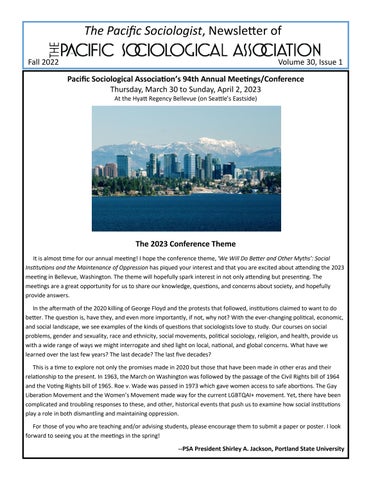
At the Hyatt Regency Bellevue (on Seattle’s Eastside)
The 2023 Conference Theme
It is almost time for our annual meeting! I hope the conference theme, ‘We Will Do Better and Other Myths’: Social Institutions and the Maintenance of Oppression has piqued your interest and that you are excited about attending the 2023 meeting in Bellevue, Washington. The theme will hopefully spark interest in not only attending but presenting. The meetings are a great opportunity for us to share our knowledge, questions, and concerns about society, and hopefully provide answers.
In the aftermath of the 2020 killing of George Floyd and the protests that followed, institutions claimed to want to do better. The question is, have they, and even more importantly, if not, why not? With the ever-changing political, economic, and social landscape, we see examples of the kinds of questions that sociologists love to study. Our courses on social problems, gender and sexuality, race and ethnicity, social movements, political sociology, religion, and health, provide us with a wide range of ways we might interrogate and shed light on local, national, and global concerns. What have we learned over the last few years? The last decade? The last five decades?
This is a time to explore not only the promises made in 2020 but those that have been made in other eras and their relationship to the present. In 1963, the March on Washington was followed by the passage of the Civil Rights bill of 1964 and the Voting Rights bill of 1965. Roe v. Wade was passed in 1973 which gave women access to safe abortions. The Gay Liberation Movement and the Women’s Movement made way for the current LGBTQAI+ movement. Yet, there have been complicated and troubling responses to these, and other, historical events that push us to examine how social institutions play a role in both dismantling and maintaining oppression.
For those of you who are teaching and/or advising students, please encourage them to submit a paper or poster. I look forward to seeing you at the meetings in the spring!
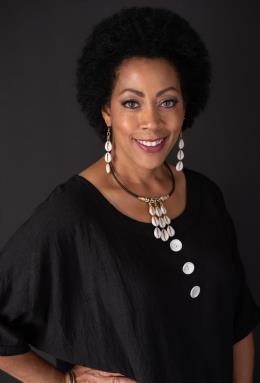
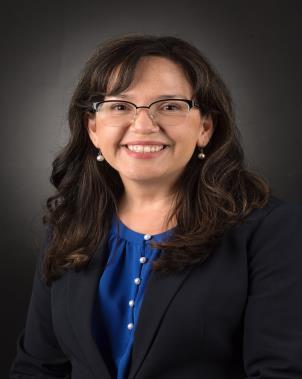
PSA President Shirley A. Jackson, Portland State University
PSA 2023: Bellevue, Washington
This year’s conference hotel, the Hyatt Regency in Bellevue Washington, provides conference attendees with a lovely venue. After our recent visit to Bellevue, we came away not wondering why Bellevue, but why not Bellevue? The hotel has beautiful conference rooms and a location that has something for everyone.
The Hyatt Regency is located near shopping across from and adjacent to the hotel. You will also find wonderful shops on nearby Main Street in Old Bellevue (we recommend you check out Fran’s Chocolates and then visit Whisk for cooking classes, cooking utensils, and gifts).
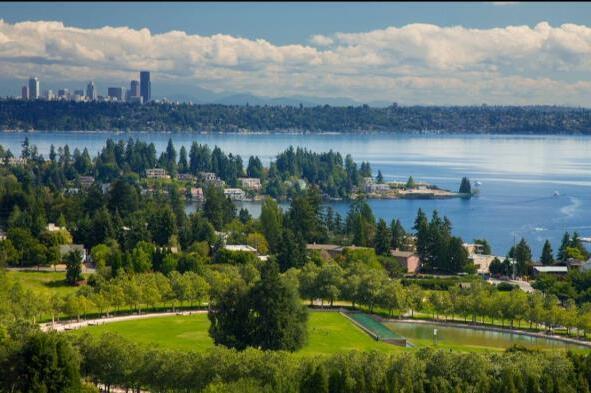
Looking for nightclubs, pubs, and restaurants? Bellevue has got you covered. The bars and restaurants on Main Street are worth noting as there are several to choose from. But if you are looking for something a little closer to the hotel, bars and entertainment can be accessed by the sky bridge connecting the Hyatt Regency to Lincoln Square. There you can find entertainment options that include The Lucky Strike video arcade and bowling alley, a movie theatre, and restaurants and bars. But if you are looking to get outside, Bellevue Downtown Park is an amazing place for runners and walkers and has a very large play area, Inspiration Playground, for children (one of the nicest and largest we had ever seen). If you are afraid of leaving your Peloton bicycle at home, the conference hotel has two as well as a large indoor pool in its gym.
There are multiple areas in which to congregate around the conference spaces and in the extensive lobby area. After all, the meetings are a time to network, see old friends, and make new ones. PSA encourages community-building, networking, and engagement throughout the program and event. We will maximize opportunities to enjoy complimentary on-site food and beverages at both large receptions and small gatherings for affinity groups.
With the Hyatt’s layout, décor, artwork, and spacious rooms, and what the city has to offer, we have no doubt you will find the 2023 PSA conference venue to be a very pleasant surprise.
We look forward to seeing you in Bellevue! You can find information about the conference hotel, transportation options, and more on the PSA website.
President Shirley A. Jackson and Program Chair Brianne Dávila
2023 Program Committee
Program Chair: Brianne Dávila, Cal Poly Pomona badavila@cpp.edu
Topical Area
Community-based & Applied Research
Urban Ethnography
Art, Culture, & Popular Culture
Race & Ethnicity
Race & Gender
Gender & Sexualities
Families
Social Inequalities
Regional Studies, Transnationalism, Globalization, & Development
Rural Sociology
Environmental Sociology
Education
Teaching Sociology and Marxist/Critical Theory
Anti-racist Pedagogy
Crime, Law, & Deviance
Medical Sociology, Health, & Reproductive Politics
Work, Labor, & Economics
Social Psychology
Immigration, Demography, & Social Change
Undergraduate Roundtables & Posters
Graduate Fair
Organizer
Janet Muñiz, CSU Long Beach
Duke Austin, CSU East Bay
Xuan Santos, CSU San Marcos
Lori Walkington, CSU, San Marcos
Marcia Hernandez, University of the Pacific
Miriam Abelson, Portland State University
Jessica Kizer, Pitzer College
Jelani Ince, University of Washington
José Collazo, CSU Channel Islands
Ryanne Pilgeram University of Idaho
Erik Johnson, Washington State University
Tanya Sanabria, CSU Los Angeles
Michel Estefan, UCSD
Uriel Serrano, UCSC
Valerie Jenness, UCI
Katie Daniels, Cal Poly Pomona
Hyeyoung Woo, Portland State University
Amanda Shigihara, CSU Sacramento
Louis Esparza, CSU Los Angeles
Robert Kettlitz, Hastings College
Kristy Shih CSU Long Beach
Program Chair Brianne Dávila, Cal Poly Pomona
President Shirley A. Jackson, Portland State University
2023 Conference Hotel and Location: Hyatt Regency Bellevue, Washington (Seattle’s Eastside)
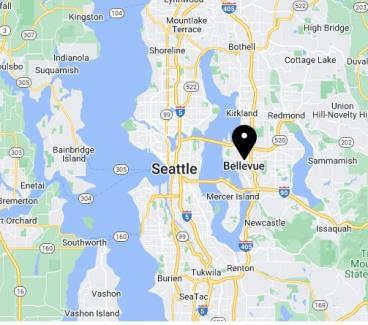
The 2023 conference will be in Bellevue, Washington (Seattle’s Eastside). The hotel in Bellevue is 17 miles from the Seattle/ Tacoma airport–about the same distance as from the airport to downtown Seattle. The hotel is about 10 miles east of downtown Seattle.
The PSA rate for rooms at the Hyatt Regency Bellevue is very good compared to their regular rates–book early, before our rooms sell out!
Book through this link, or call 1-800-233-1234 and ask for the Pacific Sociological Association/PSA rate (Group code G-PSAC).
Limited rooms at the PSA rate will be available for a few days before and after the conference, in case you want to stay longer.
One King or Double Queen bed room $169 (before taxes, fees) for single, double, triple, or quad occupancy
*There will be a very limited number of rooms for students only on Wednesday, Thursday, Friday, and Saturday nights at $159. Book through this link
Self-parking is available at the hotel for $32/day, with in and out privileges, and is complimentary on Friday and Saturday nights. Valet parking, also with in and out privilieges, is $42/day.
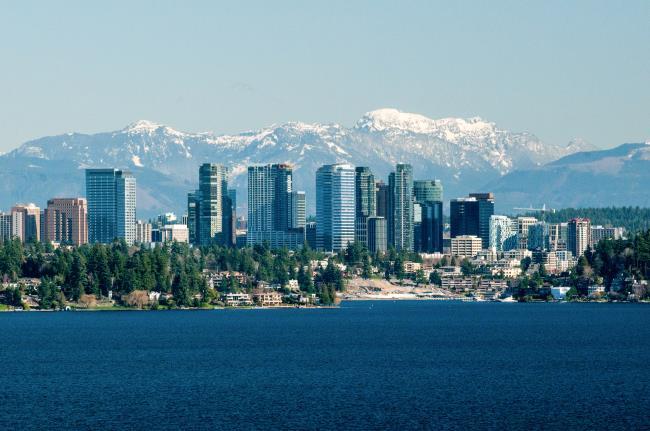
Bellevue became a suburban city in the 1950s, and retains an easy driving layout. Recently, with the growth of technology companies in particular, it has transformed into a small city with a dense highrise hotel, shopping, dining, and arts center while retaining lots of park and open space areas, including the shoreline. From most areas, there is a great view across the water to downtown Seattle.
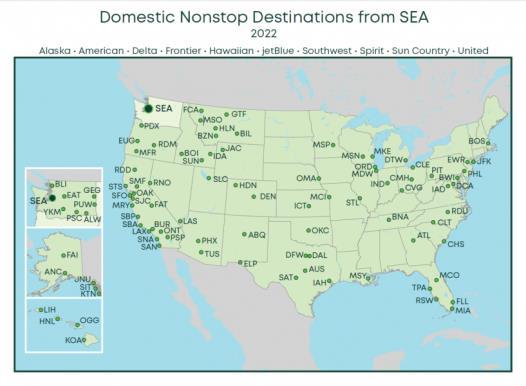
Many airlines fly domestically nonstop to/from the Seattle/ Tacoma airport.
Amtrak trains are also available to Seattle’s King Street Station.
Do You Need Childcare or Accessiblity Support to Attend the 2023 Conference?
PSA has allocated funds to support conference participants who need childcare or content accessibility supports. We need to hear from you what you need, so that we can plan appropriately. Please send your information to executivedirector@pacificsoc.org .
Possibilities for childcare include provision of onsite care by the hour, care at a nearby location, and reimbursement for childcare in your home community. We need advance information to arrange providers in or near the hotel, like how many children and their ages, and duration of care needed (how many hours and days).
We also need advance information in order to arrange supports for content accessibility, such as for hearing or vision needs.
Call for 2023 Awards Nominations
Except for the Distinguished Scholarship Award, the deadline for all 2023 awards nominations is February 1, 2023
The Distinguished Scholarship Award The Distinguished Scholarship Award is granted to sociologists from the Pacific region in recognition of major intellectual contributions embodied in a recently published book or series of at least three articles on a common theme. To be eligible for the 2023 award, a book or the most recent article in a series must have been published in 2021 or later. If a book has both a hardback and paperback copyright date and no significant changes have been made in the book between editions, the committee will consider the earlier copyright date as the one determining eligibility for the award. Nominations must be from individual members of the PSA; the Committee does not accept nominations from publishers. Edited books are not eligible for this award. The deadline for nominations is November 1, 2022. You will need to send three copies of the book; request mailing address when you submit nomination information. Send nominations to awards@pacificsoc.org
The Dean S. Dorn Distinguished Contributions to Teaching Award The Dean S. Dorn Distinguished Contributions to Teaching Award honors individuals whose distinctions as teachers have made a significant impact on how sociology is taught. It is typically given for contributions spanning several years or an entire career. Nominations for this award should be submitted in packet form and include the following information: 1) a summary statement of the nominee’s contributions to the teaching of sociology that may include, but is not limited to, honors and awards received by the nominee, publications or scholarly activity related to teaching/pedagogy, papers presented at national conferences on teaching/pedagogy, innovative approaches to teaching, a discussion of the nominee’s impact in disseminate knowledge, leadership in teaching, or mentoring students; 2) a current curriculum vitae; 3) a minimum of four letters of support — at least two from students and two from colleagues including the nominator’s letter; and 4) other supporting documents as deemed relevant (optional). Prior nominees are encouraged to re-submit updated materials. For the 2023 cycle, this award will be given by the PSA Committee on Teaching; send nominations to teaching.awards@pacificsoc.org
The Early Career Award for Innovation in Teaching Sociology The Early Career Award for Innovation in Teaching Sociology is designed to honor and encourage the work of assistant professors (untenured), graduate student lecturers, and lecturer faculty. "Early career" is defined as fewer than seven years of teaching experience. This award recognizes innovative and creative approaches to teaching and/or mentoring that advance equity with historically excluded communities. This includes approaches that challenge structural and institutional barriers, particularly those faced by historically excluded communities, and/or improve diversity, inclusivity, and equity with students from said communities. Application Requirements: (A) Statement of Nomination written by a colleague or an applicant (self-nomination). This statement should define, describe, and demonstrate the following: a situational context revolving around inequality, an innovation in teaching sociology to intervene in said context, and innovation's impact. (B) Two Letters of Support: At least one letter of support should be from a professional colleague, such as a staff member, a faculty member serving in an administrative role (e.g., department chair), or senior faculty member. It is encouraged that the second letter of suppport is authored by a student. (C) Current C.V. for the nominee. (D) Supplemental Material: Nominee or nominator should provide items that demonstrate (a) evidence of the innovation itself (e.g., examples of pedagogical practice, assignment) and (b) evidence of this innovation's success in advancing equity (e.g., student evaluations, peer teaching evaluations). For the 2023 cycle, this award will be given by the PSA Committee on Teaching; send nominations to teaching.awards@pacificsoc.org
The Distinguished Contribution to Sociological Praxis Award The Distinguished Contribution to Sociological Praxis Award honors sociological work in the Pacific region (whether by an academic or non-academic), that has made a positive impact on social and organizational institutions, improved organizational performance, contributed to community betterment, and/or eased human suffering. Nominations for this award should be submitted in packet form and include the following information: 1) a nominating letter that provides an overview of the nominee’s distinguished praxis contributions, which should make clear how the nominee’s work has made a positive impact and how the contributions are above and beyond typical professional service; 2) a minimum of two letters of support from individuals having direct knowledge of the nominee’s contribution to sociological praxis; 3) supporting documents, examples of which include, but are not limited to, presentations at scholarly conferences, published articles, reports, media materials, community documents, or grant/ contract proposals primarily authored by the nominee, that speak to this significant contribution. Prior nominees are
encouraged to re-submit updated materials. Send nominations to awards@pacificsoc.org
The Distinguished Contribution to Sociological Perspectives Award Each year, the Distinguished Contribution to Sociological Perspectives Award honors an outstanding article published in the most recent volume of Sociological Perspectives. To be eligible, the article must be worthy of special recognition for outstanding scholarship and contribution to the discipline. For the 2023 award, the article must have been published in 2022 (Vol. 65) For the 2023 awards cycle, awardee will be selected by the PSA Publications Committee.
The Distinguished Undergraduate Student Paper Award The Distinguished Undergraduate Student Paper Award recognizes an undergraduate student or students for a paper of high professional quality. This award includes a $200 honorarium and two nights of lodging at the conference hotel. To be eligible a paper must be: 1) worthy of special recognition for outstanding scholarship; 2) written by an undergraduate student or students in the Pacific region; 3) written or substantially revised in the last year; 4) presented at the upcoming PSA annual conference; and 5) in article format but not yet published (needs to meet the standards for a submission to Sociological Perspectives maximum 10,000 words or 40 pages, inclusive of all figures and graphs). Nominations for the award must include a copy of the paper, an abstract, and a minimum of one letter of support. Note: an individual faculty may nominate a maximum of 3 papers for this award. Send nominations to awards@pacificsoc.org
The Distinguished Graduate Student Paper Award The Distinguished Graduate Student Paper Award recognizes a graduate student or students for a paper of high professional quality. This award includes a $200 honorarium and two nights of lodging at the conference hotel. To be eligible a paper must be: 1) worthy of special recognition for outstanding scholarship; 2) written by a graduate student or students in the Pacific region; 3) written or substantially revised in the last year; 4) presented at the upcoming PSA annual conference; and 5) in article format but not yet published (needs to meet the standards for a submission to Sociological Perspectives maximum 10,000 words or 40 pages, inclusive of all figures and graphs). Nominations for the award must include a copy of the paper, an abstract, and a minimum of one letter of support. Send nominations to awards@pacificsoc.org
The Social Conscience Award The Pacific Sociological Association’s Social Conscience Award is given to a worthy community-based organization located in the city in which the PSA Annual meeting is held for 2023, this is Bellevue/ Seattle, Washington. This is a monetary award and honors a community organization that is engaged in providing a muchneeded social service in the community. The awardees will be selected by the Social Conscience Committee; send nominations to social.conscience@pacificsoc.org
PSA 2022 Award Recipients
Social Conscience Award: Sacramento Poor People’s Campaign: A National Call for Moral Revival
Early Career Award for Innovation in Teaching Sociology: Jeffrey Sacha, American River College
Distinguished Contribution to SociologicalPerspectivesAward: “No Choice but to be Essential: Expanding
Dimensions of Precarity During COVID-19”, by Lola Loustaunau, Lina Stepick, Ellen Scott, Larissa Petrucci, and Miriam Henifin, all of University of Oregon (2021:Issue 5, October)
Distinguished Scholarship Award: Matthew Clair, Stanford University, for PrivilegeandPunishment:HowRaceand ClassMatterinCriminalCourt(Princeton University Press, 2020)
Distinguished Scholarship Award, Honorable Mention: Brandon Andrew Robinson, University of California Riverside, for ComingOuttotheStreets:LGBTQYouthExperiencingHomelessness(UC Press, 2020)
Distinguished Contribution to Sociological Praxis Award: Maura Kelly, Portland State University
Distinguished Graduate Student Paper Award: Meghna Mukherjee, University of California Berkeley, for “Hamstrung by Hardship: The Clinic’s Role in Protecting Egg Donors’ Reproductive Labour in Kolkata, India”
PSA News and Announcements
Check www.pacificsoc.org for more announcements, including Calls for Papers and Employment Opportunities!
PSAAnnounces New Editors for Sociological Perspectives
PSA welcomes Dana Nakano, CSU Stanislaus, and Elizabeth Sowers, CSU Channel Islands, as the new editors for PSA’s official journal, Sociological Perspectives. Their term as editors will be from 2023 through 2025.
The journal's purpose is to advance research, theory, scholarship, and practice within sociology and related disciplines. Published six times a year, each issue of Sociological Perspectives (SP) offers 200 pages of timely articles spanning the breadth of sociological inquiry. Contributions by leading scholars typically address the ever-expanding body of knowledge about social processes related to economic, political, cultural and historical issues. SP’s Impact Factor (1.78 for 2021) in the Journal Citation Reports has climbed during the last few years.
PSA also thanks outgoing editors Bryan Sykes, UC Irvine, and Black Hawk Hancock, DePaul University, for their stewardship of the journal for the years 2020 through 2022.
More information about the journal: https://us.sagepub.com/en-us/nam/journal/sociological-perspectives#description
2022 Membership, Registration, and Annual Meeting/Conference Report
In 2022, participation fees were again (as in 2021) collected in one consolidated fee rather than separate membership and registration. Whereas participation in the 2021 all virtual conference was similar in number to pre-pandemic in-person conferences, the participation in 2022’s conference with three in-person days and on virtual day was significantly lower, at 684 total. Overall, the trend of gradually increasing participation by students compared to faculty continued, with students 57.5% of all participants.
Participation/Conference fee (including comped) 857 650 Observers 196 34 Total 1,057 (465 faculty/etc 44%; 592 students 56%) 684 (291 faculty/ etc 42.5%; 393 students 57.5%)
As for the 2021 all virtual conference, and as a replacement to the 2019 pilot of a $10 One Day Pass for non-presenting community college students and adjuncts, in 2022 a special $10 Observer fee was offered for students and adjunct faculty who were not presenting while all persons presenting needed to pay a regular participation fee. However, there were far fewer Observers in 2022; the in-person conference seemed to be harder to participate in despite the low fee availability, whereas in 2021 there were several large groups of Observers from specific schools because faculty organized them (and sometimes departments paid) for participation.
Participation by Status
In 2022, participation by Ph.D Students was a little lower (by proportion of students) compared to pre-pandemic 2019 and the 2021 virtual conference. Otherwise, participation rates by students of different levels were similar to the recent past.
The trend of low participation by part-time faculty continues; as part-time/contingent faculty continue to increase as a proportion of the overall faculty teaching sociology, PSA needs to consider how to support and encourage their participation.
Continues next page
However, there has also been some decline in participation rates by full-time university faculty; possible reasons for this should be explored.
Participation by Payment Category
In 2019, participation by faculty in the highest income bracket (then set as over $70,000/year) continued a trend of increasing, while participation by lower income faculty decreased. However, in 2021 and 2022 (with revised income brackets) this seems to have reversed.
Participation by Gender and Race/ethnicity
Although people who identify as women continue to be the largest known group, the number of participants for whom gender identity is not known is too large for the data to be very useful or reliable. The trend in recent years of an increase in participants
who report trans, nonbinary, gender nonconforming, or some other gender identity, particularly amongst students, continues, although the overall number and proportion remains small. This reminds us of the importance of considering needs of this group, such as encouraging general use of pronouns on badges and ensuring gender neutral restroom access.
Participants can select and/or write in multiple racial/ethnic identities, so percents do not add to 100, and numbers total to more than the total of participants. Although proportionally fewer students identified as of color in 2022 than in 2021 and 2019, fewer students also identified as white; because racial/ethnic identify is not know for 50% of students, the data does not allow for any clear analysis. Similarly, faculty/etc. participants who identified as of color seemed to be fairly similar to 2019 and 2021, but there was a decrease in faculty/etc. participants identifying as white, and racial/ethnic identity is not know for 34% of faculty/etc. The data does not show any clear difference in participation by persons of color when the conference is virtual compared to inperson or partially in-person/partially virtual.
Other Notes
The format of 3 days in-person and 1 day virtual, while a great effort to make it possible for people who could not attend inperson to present and conducted at very little cost to PSA, was not so successful. The Sunday virtual sessions had very little audience; in fact, there were fewer people using the conference app on that day (175) than on any of the in-person days (201 on Thursday, 234 on both Friday and Saturday). Further thought and experimentation will be needed to explore ways to facilitate virtual participation in the future.
Conference Income and Expenses
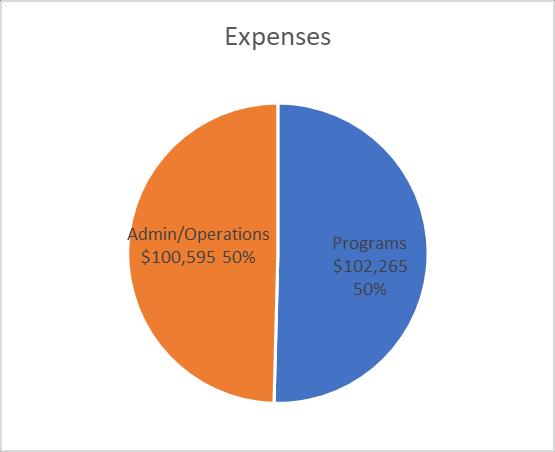
Expenses were up for 2022, while income from fees was down, resulting in a net cost of about $39,000. Although PSA did incur attrition (due to selling of less than 80% of the contracted sleeping rooms at the hotel), the ED was able to negotiate this down to a $2,000 penalty, so it did not end up being a significant added cost.
Conference Income and Expenses
Fiscal Year 2021-2022 Information
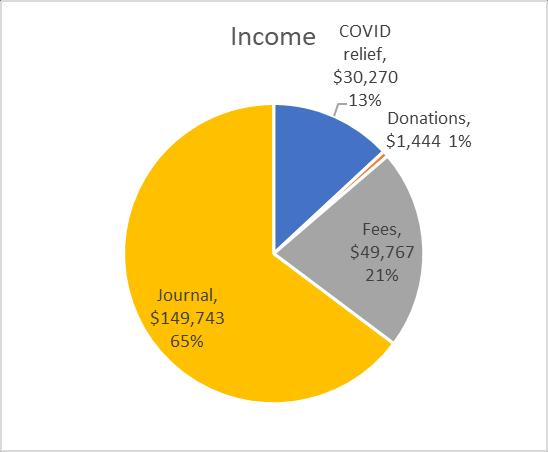
When all data for investments, including investment fees, is removed, income for the year was $231,832 and expenses $202,858, resulting in a net positive increase in funds of $28,974.
June 30, 2022 Financial Position
At the close of the 2021-2022 fiscal year, PSA had $605,239 in bank accounts ($591,447 in checking and $13,792 in endowment account).
At the close of the 2020-2021 fiscal year, PSA had $591,535 in bank accounts. The $28,974 increase in funds over the 20212022 fiscal year came not from usual income (donations, fees, royalties, etc.), but from the conversion (forgiveness) of a federal Paycheck Protection Program loan to a grant ($15,270) and receipt of a California COVID-relief Small Business Administration grant ($15,000). These special funds are no longer available. The 2022-2023 fiscal year may be financially more challenging for PSA, as expenses are rising with inflation, particularly the cost of holding the annual conference.
With the downturn in financial markets at the end of the fiscal year, the value of PSA’s investments dropped below the initial $250,000 invested, closing at a value of $231,701. Since then, PSA has made some adjustments in its investments to better weather the unpredictability of financial markets.
PSA 2022 Conference Satisfaction Survey
The survey was sent to the 678 persons who paid 2022 conference fees for whom there was a valid email address. Of these, 190 people (28%) started the survey and 170 people (25%) completed the entire survey.
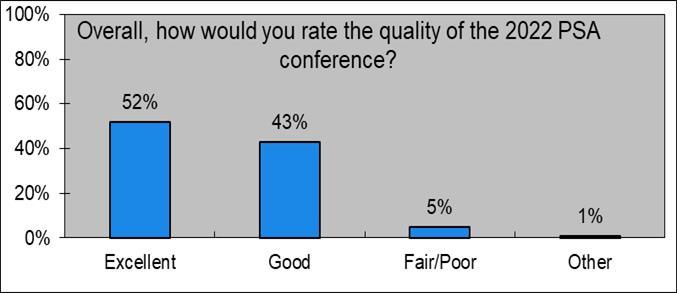
Overall Satisfaction and Comparison to Prior Conferences Half (52%) of respondents rated the conference as excellent, followed by 43% of respondents rating it as good, while 5% either rated it as fair/poor or wrote in a different response. Compared to the 2019 in-person conference, this shows some shift from excellent (62% in 2019) to good (35% in 2019), while the overall ratings of excellent and good combined are very similar. The results are almost the same as for the 2021 virtual conference (except that then 50% rated the conference as excellent).
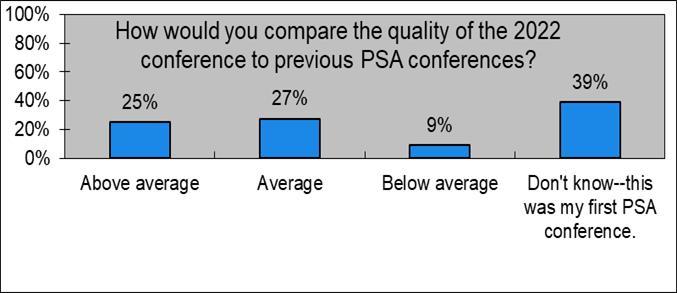
Asked to compare this conference to prior PSA conferences, 25% of respondents said it was above average, and 27% said it was average, while 9% said it was below average and 39% said it was their first PSA conference. These ratings are very similar to those for 2019, except that there was a small decrease in ‘above average’ and corresponding increase in ‘first PSA conference’. Compared to responses for the 2021 virtual conference, ratings for ‘above average’ were higher (21% in 2021).
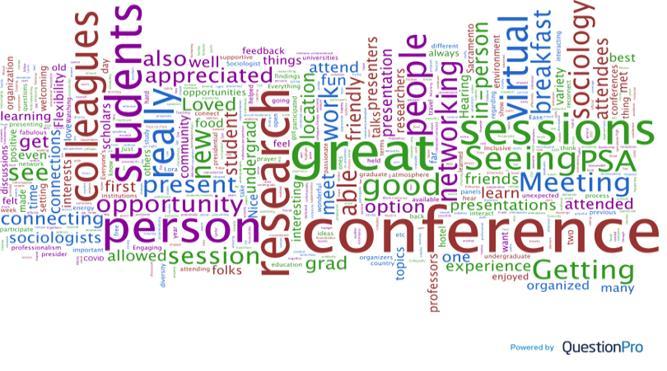
“Best Thing” As for prior recent PSA conferences, survey respondents’ comments to describe their “one best thing” about the conference mostly fell into five themes: socializing, networking, and intellectual community(70); sessions, presentations, and presenting (52); the conference location and local amenities (9); the inclusion and participation of students (25); and organizational factors (36). This year there was a lot of appreciation just for being able to meet in person, as well as the usual appreciation for PSA as a welcoming conference. In terms of organizational factors, appreciation was expressed for having the virtual option (9), as well as the free food and drinks, especially breakfast (12). Of note, two respondents said the smaller scale of the conference was a ‘best thing’ for them. Two respondents appreciated the offering of a prayer room and accommodations made for persons observing Ramadan. Four respondents offered specific thank you’s to the ED for her assistance to them in various ways. A few representative comments:
“The best thing about PSA 2022 was the openness and welcoming atmosphere of other attendees. I have never felt so welcomed at a conference before.”
“Just the right amount of attendees as we transition from a virtual conference to on in-person one. Due to the smaller size of attendees, I found that I interacted/connected more with colleagues and students than previous conferences.”
“Being a sociology student who is trying to decide how far I want to take my education it was nice to learn about the undergrad, grad related projects other individuals are working on. This sort of show and tell setting really gets the creative process going in my own mind regarding potentially choosing my own line of study.”
“I really liked the casual professionalism at the conference. Some conferences feel very ‘up-tight’ or stuffy, and I appreciated that there was a high level of professionalism, but it was balanced with a reasonable casualness that allowed the conference to be fun AND educational.”
“Having the virtual format remain an option was excellent. This saves time, money, reduced CO2 emissions, reduces COVID risks and is more inclusive to immune-compromised people.”
“Watching my students get excited about sociology and exploring their own interests.”
“As always, the strong sense of community and solidarity among attendees.”
Areas for Change or Improvement As for prior recent in-person conferences, survey respondents’ comments when asked to name one thing to change or improve about the conference fell into the following themes: issues with particular sessions or presentations or scheduling (32); “nothing” (18); the hotel location and area (12); the cost of hotel rooms/parking (3); a desire for more free food/drinks (20); who was present and presenting (11); and other factors (31).
As usual, comments about issues with sessions, presentations, and scheduling included sessions with too few or too many presenters (and especially with ‘no show’ presenters), too many sessions running at the same time (and so hard to choose which too attend), low audience, and issues with technology. Of the respondents who were not happy with the location of the conference, the most common comment was the current conditions in the downtown Sacramento area, where many shops have closed since COVID and the number of persons living on the streets has increased. Some respondents (5) said they would like more planned spaces/events for networking, particularly spaces organized for specific groups of participants. Respondents who commented about who was present/presenting mostly focused on the desire for more attendees (8), while two said there should be more ‘big name’ presenters, and one said Black and brown people were missing (and felt they had been excluded). In addition, respondents noted that there were issues with the signage and information about the gender neutral bathroom and awareness/ respectful useage of pronouns (5). Respondents also expressed dissatisfaction with various aspects of communication, particularly by ‘no show’ presenters and presiders/discussants (11). Three respondents felt masking and proof of COVID vaccination should have been required. Some respondents (5) felt the conference should have been more or all virtual/hybrid, while others (2) felt there should not have been any virtual component.
Attendance The 2022 conference included three days in-person (Thursday, Friday, Saturday) followed by all virtual sessions on Sunday. As reported by respondents, the average attendance on in-person days was 67% of respondents; Thursday was the lowest attended (60%), Friday the highest (75%), and Sunday in the middle (67%). Reported attendance at the Sunday virtual day was much lower (22%).
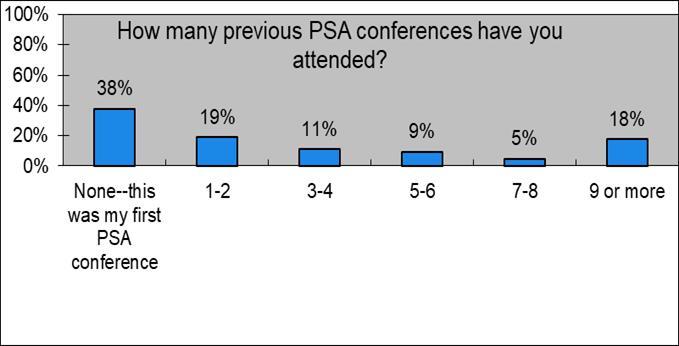
As usual, this was the first PSA conference attended by many respondents (38%), while 19% had attended 1 or 2 previous PSA conferences, and 18% were longtime PSA participants, having attended 9 or more conferences, with the remaining respondents in between.
Participation, Session Attendance, and Session Quality As usual, the most common roles that participants said they played at the conference were as presenters (76%) and audience members (60%), followed by Presider/Discussant (25%), Committee or Council Member (17%), Session Organizer (9%), and Faculty mentor/sponsor of students (13%).
Most respondents said they participated in only one session (59%), while 14% said they did not participate in any sessions, 17% participated in two sessions, 6% in three sessions, 2% in four sessions, and 3% in five or more sessions. This is very similar to recent years.
As audience members, 22% of respondents reported they attended 1-2 sessions, 27% 3-4 sessions, 21% 5-6 sessions, 9% 7-8 sessions, and 9% 9 or more sessions. In addition, 11% of respondents said they did not attend any sessions as audience members. The mean attendance was 3-4 sessions. This shows increased attendance as audience members over the 2021 virtual conference, but is still somewhat lower than in the last all in-person conference (2019), where the mean was attending 4-5 sessions.
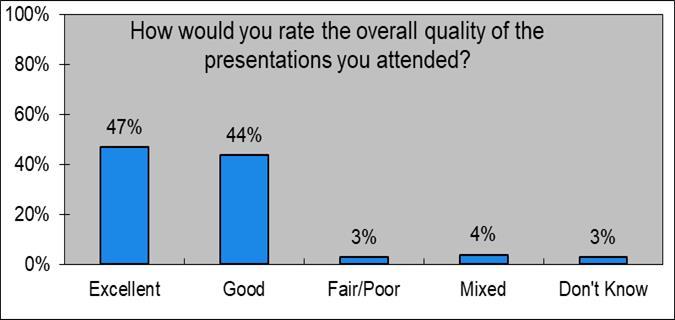
In 2021, there was a significant increase in the percentage of respondents who rated the presentations they attended as excellent (37% in 2019, 53% in 2021). This seemed to continue, as 47% of respondents in 2022 rated the presentations they attended as excellent, followed by 44% rating them as good.
Sacramento and the Conference Hotel Overall, respondents were very satisfied (51%) or somewhat satisfied (29%) with the location of the conference in Sacramento.Similarly, 59% of respondents said it was very easy for them to travel to Sacramento, while 39% said it was somewhat easy. Most respondents were very satisfied (58%) or somewhat satisfied (32%) with the local amenities, and most were very satisfied (74%) or somewhat satisfied (23%) with the meeting space in the hotel.
Almost two-thirds of respondents (65%) stayed at the conference hotel, and 85% of these used the special PSA rate. Respondents who stayed in the conference hotel were mostly very satisfied (63%) or somewhat satisfied (28%) with their guest rooms, and very satisfied (55%) or somewhat satisfied (27%) with hotel service and staff.
Anything to Add? At the end of the survey, respondents were asked if they wanted to add anything. Many respondents (25) wrote a general thank you or positive note, while a few (3) wrote a specific thank you to the ED, and a few more noted something specific they liked about the conference. Others shared about specific negative experiences they had at the conference, including being misgendered by Presiders/other presenters and difficulty finding the gender neutral restrooms (3), concern about the recent mass shooting nearby (2), and concern over a specific presentation in a Sexualities session where behaviors of mansplaining/and dynamics of male dominance over women were exhibited.
Virtual Format and Format for Future Conferences
Respondents were asked to rank their preference of format for future PSA conferences. The most common first choice was in-person only (57%), the most common second choice was to have both inperson and virtual components (53%), and the most common third choice was virtual only (81%). This shows a shift from responses after the 2021 virtual conference, when the most common first choice was a hybrid/some in-person and some virtual participation format.
Bellevue, 2023 Respondents were asked if they plan to attend the PSA 2023 conference in Bellevue, Washington. The largest group (49%) said “Yes”, while 42% said they don’t know, while 8% said they do not plan to attend The 8% who said “No” were asked the reason(s) they did not plan to attend; the most cited reasons were the various personal situations, the location, lack of funding, and the dates. Only one respondent selected COVID as their reason.
Fee Information for the 2023 Conference
PSA is again offering membership-only for persons who want to maintain their membership but do not plan to attend the conference, and a registration-only option for persons who are not presenting at the conference and want to attend without paying membership.
This year, there is a new special membership rate for Emerita/Emeritus and retired sociologists.
All persons who are presenting at the conference are required to pay both membership and registration fees. These two fees, membership and registration, will be offered as a combined purchase to make it easier for people to know they are all paid up and hopefully support their ability to get more of their fees covered by their institutions.
Fee payment page and new PSA member area will be open soon on the PSA website.
Officers and Council (Board of Directors)
President: Shirley Jackson, Portland State University Vice President: Ann Strahm, CSU Stanislaus
Council (Directors): Allison Hurst, Oregon State Elvia Ramirez, CSU Sacramento
Katy Pinto, CSU Dominguez Hills Jason Wollschleger, Whitworth University
Nella Van Dyke, UC Merced Christie Batson, University of Nevada Las Vegas
Graduate Student Representative: Mahindra Mohan Kumar, University of Oregon
Past President: Wendy Ng, CSU East Bay Past Vice President: Sharon Elise, CSU San Marcos
President-Elect: Alicia D. Bonaparte, Pitzer College Vice President-Elect: Celeste Atkins, University of Arizona
Officers:
Treasurer: Christine E. Bose, SUNY Albany & University of Washington
Treasurer-Elect: Daniel Morrison, Abilene Christian University
Secretary: Amy Leisenring, San Jose State University
PSA Staff: Lora Bristow, Executive Director P.O. Box 4161, Arcata CA 95521 executivedirector@pacificsoc.org www.pacificsoc.org
Thank You to Those Who Donated to PSA in 2021
Delaram Ahmadyveasi
Edelina Burciaga
Jose Collazo
Brianne Davila
Rhonda Dugan
Nelta Edwards
Shaafi Farooqi
Glenn Goodwin
Katja Guenther
Ross Haenfler
Linda Henderson
Jovidean Hinojosa
Mary Ippolito
Robert E. Kettlitz
Kathy Kuipers
Chioun Lee
Jason Leiker
Marisela Martinez-Cola
Lata Murti
Jodi O`Brien
Joshua Olsberg
Katy Pinto
Elvia Ramirez
Linda Rillorta
Guadalupe Rivera
Andy Lee Roth
Fall 2022 PSA Election Coming Soon
Preston Rudy
Norah Shultz
James Singer
Mona Swallow
Megan Thiele
Celeste Torres
Anthony Villarreal
Faye Wachs
Luis Zanartu
Cynthia Zhang
Donations totaled $1,220 to the PSA Endowment Fund.
If you paid 2022 fees, watch for your ballot to arrive via email (or mailed if you indicated you required this). As usual, PSA is fortunate to have great candidates. Please take a few minutes to cast your vote and help select the next PSA leadership.
Announcing The Pacific SociologicalAssociation’s 95thAnnual Meeting
Thursday, March 21 to Sunday, March 24, 2024 at the Marriott Mission Valley, San Diego
President Alicia Bonaparte, Pitzer College Vice President CelesteAtkins, University ofArizona
PSA Council (Governing Board) Actions
January 14, 2022, at Council (full Board) quarterly meeting by phone/internet conference:
• Approved last Minutes and appointed VP Elect Shirley A. Jackson to fill President-Elect position after resignation of former President Augustine Kposowa and plan to fill then vacant position of VP Elect by appointment by the board
• Discussion/setting of upper limit for editorial office support funding, and approved shifting some of the investment portfolio in bonds to stocks
• Discussion of COVID impact and protocols for 2022 conference
February 9, 2022, at Executive Committee meeting by phone/internet conference:
• Discussion of editor search
April 1, 2022, at Council (full Board) meeting by phone/internet conference:
• Plan B formulated for possible guest editor/special issue of journal if new editorial team not selected, ready to begin as ofJuly 1
• Position on masking at conference outlined
• ED letter to Council trial Executive Officer/Administrative Officer model not operational, need to further address issues; ED not willing to continue as sole employee in ED position/executive office
April 29, 2022, at Council (full Board) meeting by phone/internet conference:
• Approved last Minutes, recognized Treasurer Elect to be added as Signer to PSA financial accounts
• Investments Report, 2022 conference summary, and editor search update
• Formation of Executive Committee, Investment Committee for 2023-2023
• Discussion of status of Executive Officer/Administrative Officer split and next steps
May 26, 2022, at Executive Committee meeting by phone/internet conference:
• Approved Publications Committee request to extend terms from two to three years and expand committee to six members (two neweach year)
• Discussion of next steps on editor application, and approval of parameters for editorial agreement (to be followed up on by ED)
• Discussion of executive office staffing and restoration of ED salary until further actions (President working on EO/AO split)
August 19, 2022, at Council (full Board) quarterly meeting by phone/internet conference:
• Approved last Minutes
• Investments report; update on new editors
• President: No further work on EO/AO, but return to just ED model; working on proposal for Operational Handbook development via contracted labor coming soon
• 2023 fee structure discussed, but no decision made; poll of Council to be considered at Executive Committee meeting
• ED reports submitted but not discussed
August 29, 2022, at Executive Committee meeting by phone/internet conference:
• Approved last Executive Committee Minutes
• Discussion of Council poll and decision on 2023 fees; Emerita/Emeritus/Retired rate created
• ED asked Council to find replacement as soon as possible
September 16, 2022, at Emergency Council (full Board) meeting by phone/internet conference:
• Decision to form ad hoc committee to work on Operational Handbook (but no selection of members)
• Discussion of executive office staffing one ED or split EO/AO (prior to meeting, ED submitted resignation for 12/31/22 if not sooner)
October 7, 2022, at Council (full Board) quarterly meeting by phone/internet conference:
• 2021 ED evaluation approved; approval of idea of ‘exit interview’ with ED
• Discussion of position(s) to be posted, search process for executive office and possible temporary staffing
Special meeting of Council on staffing of executive office scheduled for December 1, 2022. Next regularly scheduled (quarterly) meeting of the PSA Council is January 13, 2023.
News from Other Organizations
Visit the PSA website, www.pacificsoc.org, for more announcements, including employment opportunities and calls for papers.
For more than 25 years, SSRN has assembled, disseminated, and promoted early scholarly contributions from researchers around the world, including nearly 8,500 professionals in sociology. Recently, SSRN has organized within its services a brand-new dedicated Sociology Research Network where https://www.ssrn.com/index.cfm/en/ sociologyrn/ professionals can:
• Submit working papers for dissemination to researchers throughout the world
• Meet and network with peers and colleagues, especially sustainability and environmental research researchers and analysts from leading American and international academic institutions
• Leverage shared experiences and expertise to foster the development and adoption of best practices
Identify opportunities for professional development and recognition.
In today’s competitive landscape, everybody is looking to grow professional visibility, measure research impact, and to find new ways to connect with colleagues who share similar research interests. SSRN boasts a global registered user community of 2.5 million, and 16 million working papers are downloaded annually.
SSRN is a FREE and OPEN-ACCESS resource – there is no charge to access the service, submit working papers (and view downloads and citations), or to download papers without limit. Go to https:// www.ssrn.com/index.cfm/en/ and follow the top menu SUBMIT A PAPER to get started.
For more information, please contact Brian St. Germain at bstgermain@ssrn.com.
ANNUAL MEETING The Society for the Study of Social Problems (SSSP) invites you to join us in Philadelphia, PA, August 18-20, 2023. The program theme selected by President Shirley A. Jackson is Same Problem, Different Day: Recognizing and Responding to Recurring Social Problems Registration will open in early 2023. For more information contact sssp@utk.edu
CALL FOR PAPERS The Society for the Study of Social Problems (SSSP) is accepting submissions for our 73rd Annual Meeting, to be held August 18-20, 2023, at the Sheraton Philadelphia Downtown Hotel in Philadelphia, PA. The program theme selected by President Shirley A. Jackson is Same Problem, Different Day: Recognizing and Responding to Recurring Social Problems. Papers or extended abstracts for presentations must be submitted via our online submission process no later than 11:59 p.m. (Eastern Time) on January 15, 2023 in order to be considered. For more information contact sssp@utk.edu
COMPETITIONS The Society for the Study of Social Problems (SSSP) is pleased to announce our 2023 Student Paper Competitions and Outstanding Scholarship Awards. In order to be considered for any of the Student Paper Competitions, applicants are required to submit their papers to a session through the Annual Meeting Call for Papers no later than 11:59 p.m. (Eastern Time) on January 15, 2023. Please note that students may only submit to one division and that each division has its own deadline and submission process. For more information contact sssp@utk.edu
FUNDING OPPORTUNITY The Society for the Study of Social Problems (SSSP) is soliciting applications for the 2023 Racial/Ethnic Minority Graduate Fellowship. Persons identified as either American Indian or Alaska Native, Arab/Middle Eastern/North African, Asian/Asian-American, Black/African American, Hispanic/Latinx, Native Hawaiian or Other Pacific Islander, or, including Deferred Action for Childhood Arrivals (DACA) from one of the aforementioned groups, accepted into an accredited doctoral program in any one of the social and/or behavioral sciences are invited to apply for the $15,000 fellowship. Two students will be funded. Online applications must be received in their entirety no later than 11:59 p.m. (Eastern Time) on February 1, 2023. All applicants must be a 2023 SSSP member at the time of their application. Contact Dr. Felicia Arriaga, Chair, Racial/ Ethnic Minority Graduate Fellowship Committee, with questions concerning the fellowship: felicia.arriaga@gmail.com
Have you checked out the Ethnographic Café?
Interviews, zoom meetings, photo essays and more! The Ethnographic Café is a place for ethnographers to meet across disciplines, generations, and countries. We gather to talk about all things ethnographic, from history, design, and method to analysis, writing and dissemination.