ENGLISH 6
The English 6 course centers around the grade level theme of wayfinding. As the first grade in their PRS experience, students begin to explore and establish their role in the PRS school community and their broader community outside of school Sixth graders read and write in a variety of genres to develop their critical thinking skills and begin to discern how best to share their ideas Major writing assignments through the year include writing a Hero's Journey myth, literary analysis on selected passages from the reading, a poetry portfolio, and an informative essay on a problem and solution Key texts include various myths from cultures around the world, The Boy Who Harnessed the Wind, Young Readers Edition, a selection of poetry, and their choice of a book club novel that connects to the theme of facing fears Students are introduced to Harkness and expected to participate in discussions
ENGLISH 7
The English 7 course explores the relationship between individuals and their community through reading, speaking, and written expression. Seventh graders write for a variety of purposes and audiences in order to develop their written voices Major writing assignments include descriptive vignettes, short stories, literary analysis, and scripts for a podcast. By learning to use different literary lenses for reading, students learn to reflect on themes through Harkness discussions, analyze narrative structure, support their inferences with textual evidence, and appreciate stylistic features of the texts Students also study vocabulary in context and elements of grammar and usage, focusing on how to apply these to improve diction, sentence structure, and punctuation Key texts include a selection of short stories, The House on Mango Street, Animal Farm, and The Graveyard Book Each trimester, students additionally read and respond to books of their choice, which they present to their classmates Frequent Harkness discussions over the reading assignments develop communication and critical thinking skills as students learn to listen attentively to others while speaking with more clarity and confidence about their ideas and thoughts
ENGLISH 8
The English 8 course examines the concept of how to balance the needs of the individual with the needs of the community through classical and contemporary literature as well as through non-fiction texts. The Writers' Workshop in English 8 reviews the fundamental skills learned in sixth and seventh grade and encourages students to independently explore writing for authentic purposes and authentic audiences. Through the Writers' Workshop, students continue to write narrative, informative, and argumentative compositions and develop their drafts through conferences with peers and teachers. By the end of the Writers' Workshop, eighth graders have developed their own Writer's Portfolio that incorporates an exploration into a variety of writing genres Through the reading of non-fiction texts, eighth graders develop media literacy skills and explore the theme of how information is created and accessed, as well as its effects on audiences Other key texts include Fahrenheit 451, Hotel on the Corner of Bitter and Sweet, and a selection of poetry Harkness discussions are incorporated throughout the course, and this enables students to arrive at more compelling insights, sharing their reactions, thoughts, and reflections while building on those shared by their peers
INNOVATIONS PAST AND PRESENT
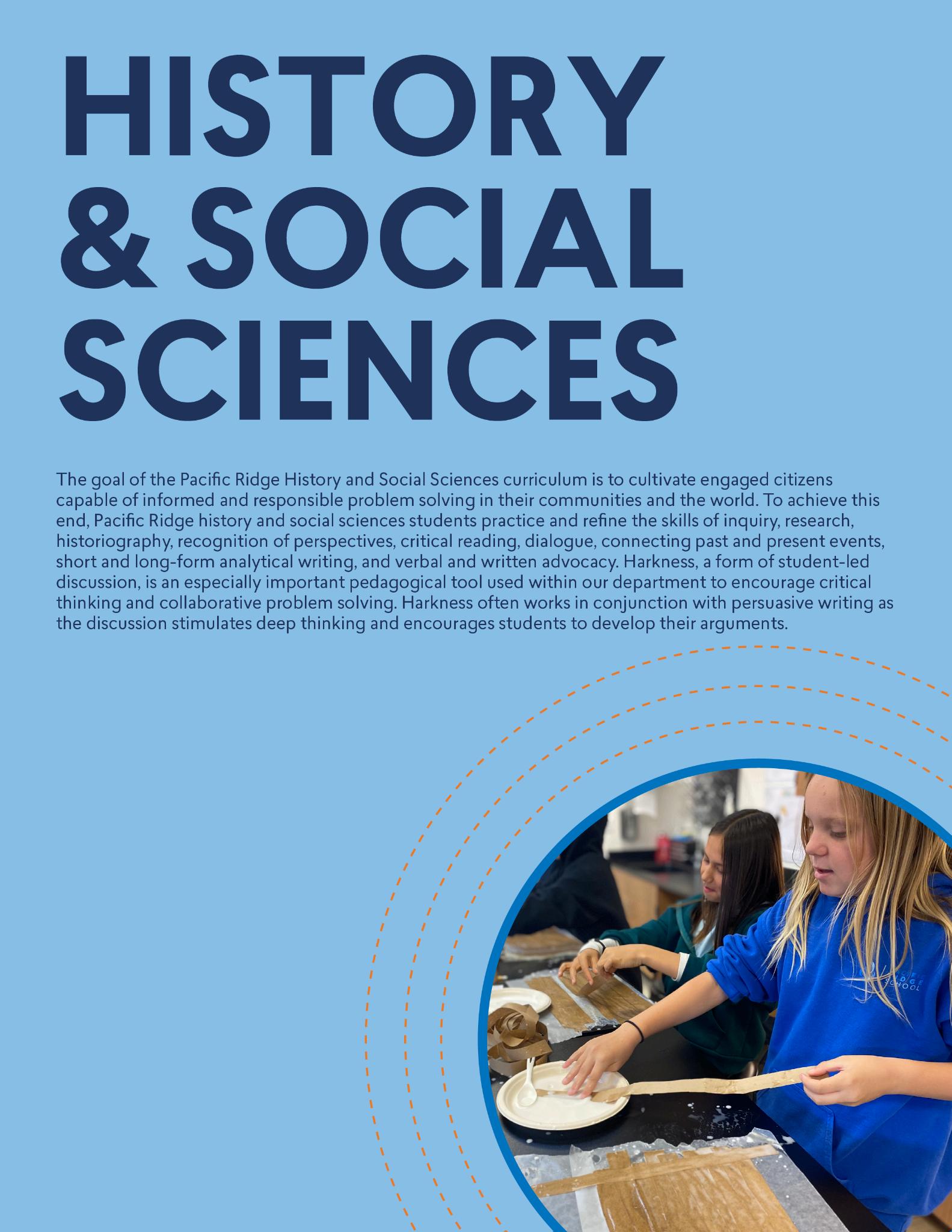
The Grade 6 History course examines the concept of wayfinding - finding one’s way as an individual, in communities, and as a global citizen - by looking at the ancient civilizations of Mesopotamia, Egypt, China, and India. Students specifically look at their own wayfinding in terms of how they made sense of their worlds and solved problems through innovation and community. Students also look at our school and local communities to explore problem solving and innovation in building community They explore the concept of wayfinding through a multi-subject integrated focus on trimester themes and guiding questions Gradelevel overarching questions are as follows. What is wayfinding and how does it serve a community? Where am I on my wayfinding journey? How can I recognize and honor the diverse journeys of others? What are our responsibilities to the community as we find our way within it? The course is organized thematically, with each trimester organized around central themes These overarching themes are: navigation, resources, and transportation and infrastructure A major focus of the year is developing and preparing students for the next level of learning by building the necessary skills for student success in areas such as collaboration, organization, study skills, and analytical thinking - along with listening and communication through Harkness discussion, presentation skills, and written work.
SOCIAL AND COMMUNITY STUDIES
In a complex modern world that includes many people, cultures, expectations, laws, and ever-changing borders, modern humans must strive to be productive local and global citizens By having students explore who they are and learn about people outside of their communities, the course aims to develop global citizens who are informed, empathetic, engaged, and civically-minded To facilitate this examination of human connectedness, students explore current and past events inside three thematic units. In the first trimester, students explore individual, community, and national identity. They seek to understand how identity defines people, how we humans view and interact with each other, and how identities have power and influence. We then move into a unit on geography, including human geography The second trimester covers the concepts of power and government Students examine what constitutes power in our society and the larger world, the different forms of government in the world today, and what happens when governments do not serve their citizens In the third trimester, students examine borders and boundaries They explore the differences between natural and man-made borders and boundaries, and the effects those have on the people living near them through case studies based on current situations. In their year-long pursuit of learning and growth, students develop important habits and skills, including self-reflection, organization, and analytical thinking, as well as self-expression skills developed through debate, writing, and Harkness discussions.
AMERICAN STUDIES
American Studies is an introduction to American history and government from 1492 to the present Organized by trimester, the first part of the year focuses on physical and human geography, the formation of the United States’ government, the responsibilities of citizenship, and the meaning of America’s founding ideals. The second trimester shifts to migration, beginning with a focus on sectionalism, the Civil War, and the impacts of this conflict on people, spotlighting specifically the Great Migration, a mass movement of people from the rural South to cities in the North and Midwest during the early 20th century. Relatedly, the students learn about the waves of immigration in the 1900s and the ways in which immigrants and their communities reshaped the nation.They also examine historical injustices, such as enslavement and discrimination, and investigate the ways in which the concept of equality is constantly evolving and social change has been sparked over time In the third trimester, students study conflict and social change, with a focus on WWII, its impact on the American homefront, and how that sparked the major changes that ensued Throughout the course of the year, students develop and improve their skills as writers, Harkness participants, group collaborators, presenters, critical thinkers, researchers, listeners, and debaters
MATH FOUNDATIONS
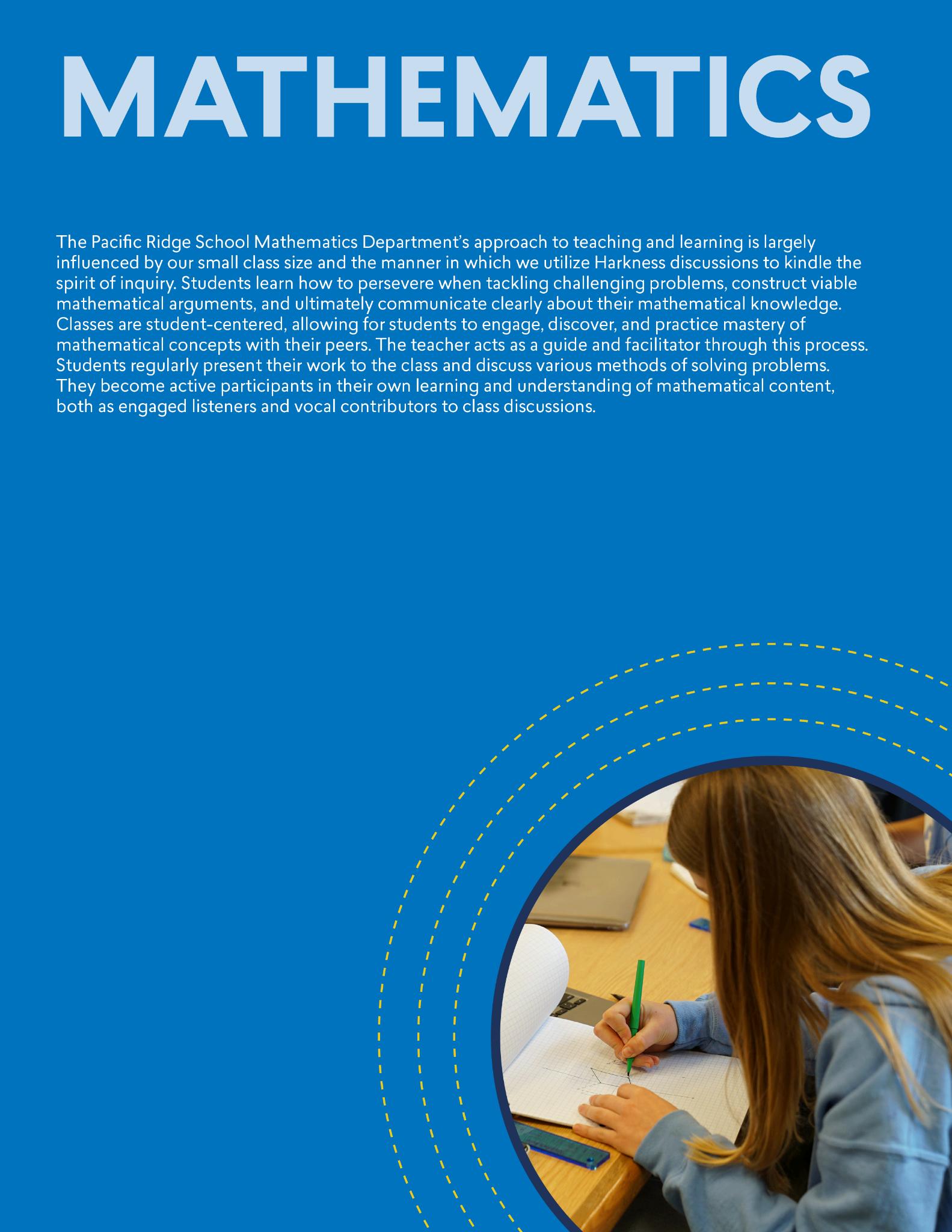
The Math Foundations course provides an introduction to Pacific Ridge School’s Mathematics Program, and requires students to work together with classmates to grapple with challenging problems. Students explore, discuss, and develop their mathematical understanding in the areas of: rates and ratios; rational numbers, including operations with fractions and negative numbers; expressions and equations; statistics and data representations; and geometric properties including surface area of 3-dimensional figures In addition to learning the required content, students begin to develop the study skills necessary to succeed in the PRS Math Program, which include organization, note-taking, self-assessment, and self-advocacy
INTRODUCTION TO ALGEBRA
Introduction to Algebra is a course designed to prepare students for more algebraic, problem-based mathematics in terms of both content and mindset This course incorporates three main curricular areas: problem solving, skills for algebra readiness, and understanding the relationships present in linear and non-linear models of data Problem solving is emphasized throughout the course to allow the students to evolve as critical thinkers and communicators To sharpen problem-solving skills, students work in groups on problem sets throughout the year They demonstrate their understanding and strategies used to solve these problems with in-class presentations and discussions. As students develop their problem-solving techniques, they also build their algebraic foundation in the following areas: simplifying/evaluating algebraic expressions using both the order of operations and the distributive property, solving multistep equations and inequalities, and representing linear functions with a graph, a table, and an equation Throughout the course, collaborative work is encouraged, as students work on honing their abilities to communicate problem-solving strategies.
After successful completion of this course, students will be prepared and recommended for either Algebra/Geometry 1 or Honors Algebra/Geometry 1
ALGEBRA / GEOMETRY 1
The first year of a three-year math sequence, this course helps students form a solid algebraic foundation while introducing several geometry concepts Students collaboratively discover key concepts, then practice mastery of skills both in class and independently at home, with emphasis on both analytical and mechanical skills The curriculum provides a study of number sense, while introducing linear functions and models. The study of linear functions is addressed from a multi-faceted point of view; namely, algebraically, graphically, numerically, and contextually Emphasis is placed on making connections between these facets. The course also explores systems of equations and inequalities. Coordinate geometry is integrated within topics, covering: midpoint and distance formula, Pythagorean Theorem, area, and rigid and nonrigid transformations Other major class objectives include developing perseverance to grapple with problems, using technology appropriately and strategically, constructing models, reasoning abstractly, learning to appreciate real-life applications of the concepts, and recognizing interdisciplinary connections
HONORS ALGEBRA / GEOMETRY 1
This is the first course in the honors math sequence Using a problem-centered approach to learning, this course includes all topics included in Algebra/Geometry 1 in addition to the study of absolute value functions and radicals. Students in this course examine the content in greater depth, emphasizing the connection between procedure, understanding, and application The pace of this course is demanding, and students are expected to engage in discussion about the topics, work together to solve challenging problems, build strong mathematical arguments using evidence to support their ideas, and make connections between concepts. Students begin to create a strong, well-developed algebraic and geometric foundation for their future math courses. They learn the skills to grapple with challenging problems, appropriately and strategically use technology, construct models, and reason abstractly. Students in this course should enjoy the rigor of problem-solving and feel comfortable being challenged
SCIENCE 6
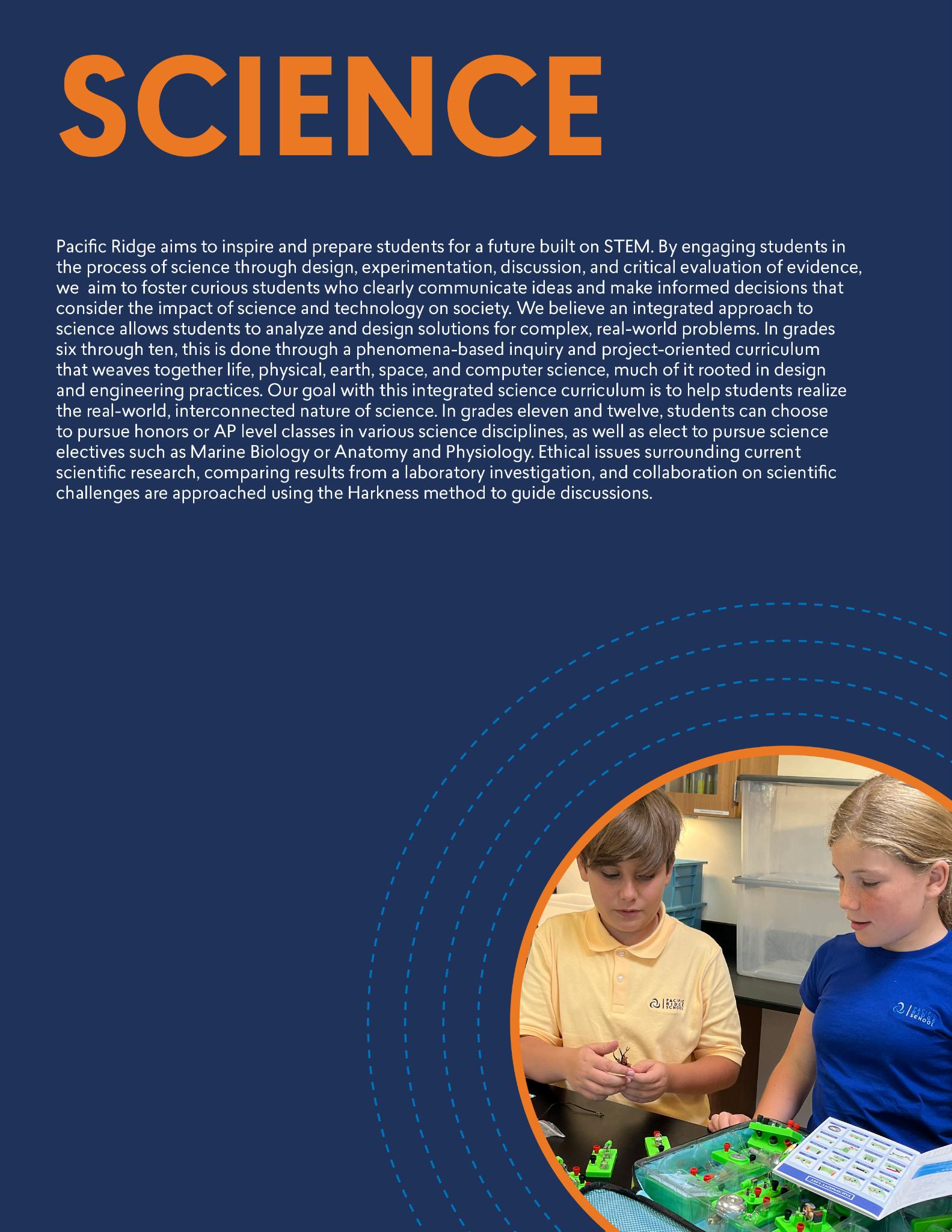
Science 6 focuses on the interaction between living systems and their physical environment This is an integrated science course that includes Life, Earth, and Physical Sciences Science 6 units focus on four main concepts: growth and development of organisms, energy and chemical processes, Earth’s systems and human impact on the environment Sixth grade students will learn how to read multiple scientific texts and synthesize their ideas. Through scientific investigation they learn how to ask questions, collect and analyze data, create models, work in teams and problem solve Students communicate their findings through discussions and written and oral presentations using scientific claims, supported by evidence
SCIENCE 7
Science 7 builds upon the skills introduced in Science 6 The course is framed around realworld phenomena and inquiry, focusing on skills and concepts that bring together the biological, physical, and earth sciences. Each unit of study begins with a question and culminates with an inquiry-based project or design challenge The year starts by engaging students in basic science skills while examining what it means to make a claim supported by evidence and how scientists gather that evidence through the experimentation process From there, students begin the study of neuroscience and complete an Arduino project looking at reaction time. During the second trimester, the course centers on the basic properties of matter and how they relate to issues like climate change Finally, students have the chance to look more broadly at atmospheric science and epidemiology to get a sense of how scientists study large, complex systems. Students use technology, engineering design, and scientific investigation to build the knowledge required to successfully answer our unit questions. As the second course in PRS’ core 6th-10th grade Science Program, Science 7 continues to build the skill and content foundations PRS students will need to prepare for both Science 8 and a strong science education
Science 8
Science 8 builds upon the skills and concepts learned in Science 7 Through hands-on activities and investigations, students explore the physics of moving objects, the chemistry of living things, and the biological processes that drive evolution by natural selection Throughout each unit of study, students are challenged to design solutions to real-world phenomena, as well as use evidence and reasoning to support a claim. The course requires that students are involved in problem solving, discussing, writing, reading, designing, building, analyzing, and experimenting. Computer-aided design (CAD), engineering design, and scientific inquiry are practiced and developed to ensure students are prepared to meet the challenges presented to them and also to prepare them for future science courses and STEM endeavors.
World Languages 6:
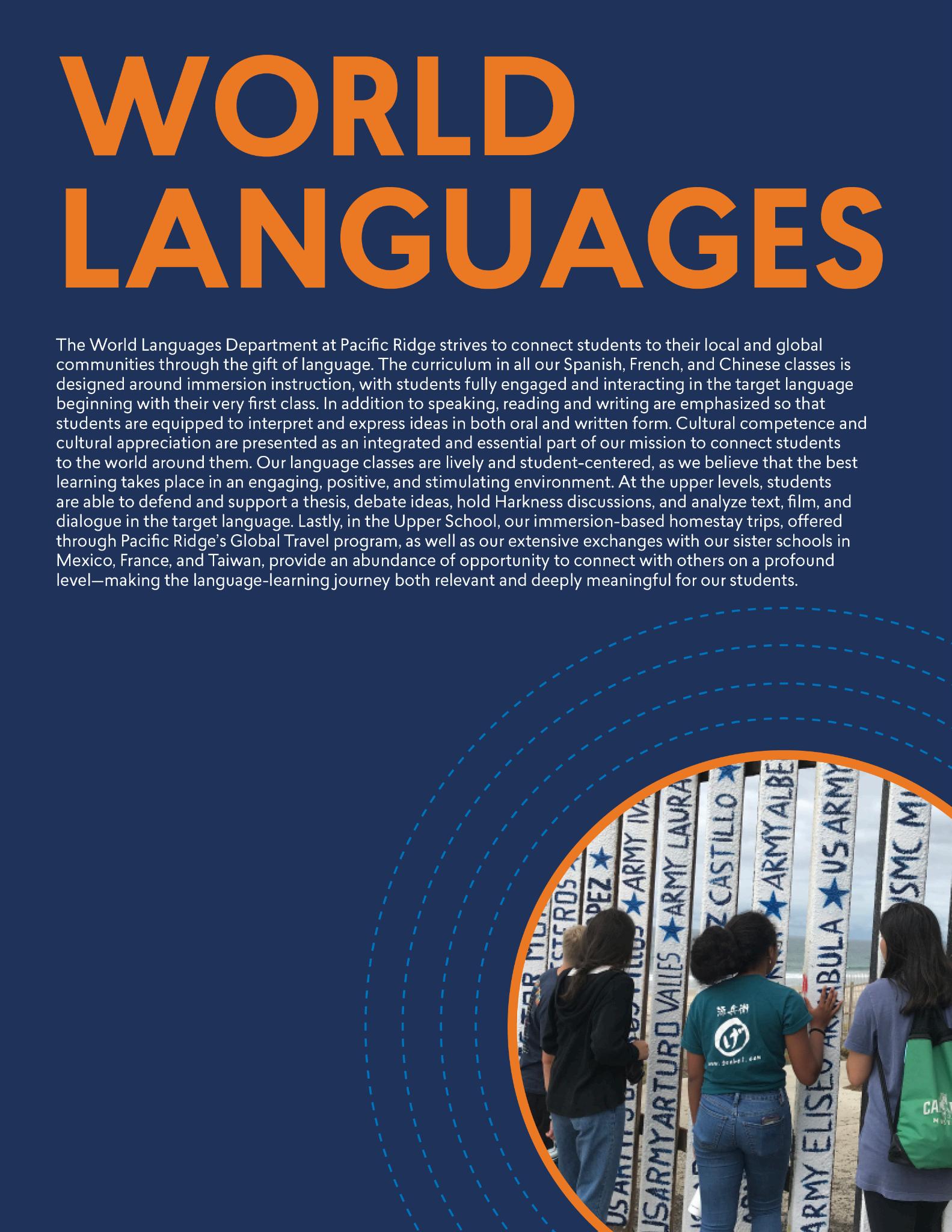
The course introduces students to three world languages and their cultures Each trimester students experience one of three languages: French, Spanish, and Chinese, so that they have exposure to each language by the end of the school year. Students learn in an immersion environment, interacting in the target language as they learn the basics of each language and develop the beginnings of cultural competency and appreciation. In collaboration with other grade-level departments, world language classes work on cross-disciplinary projects throughout the year After completing this language rotation, students will be able to make an informed decision as to which language they would like to continue studying in seventh grade and beyond
CHINESE A
Chinese A builds a strong foundation of Elementary Chinese, providing students with skills in basic grammar, vocabulary, idioms, phrases, and sentence patterns The students practice listening, speaking, reading, and writing on a daily basis. Each lesson focuses on a thematic topic which introduces everyday life experiences, such as exchanging greetings and asking for names, talking about family and friends, making a phone call, and discussing routines Written texts and discussion topics are related to school life, Chinese daily life, and culture Students learn to make comparisons between Chinese culture and American culture. By the conclusion of the course, students will be able to communicate using foundational grammatical structures, ask simple questions, participate in novice-level spontaneous conversations, and learn in an immersion-style classroom
CHINESE B
Chinese B is a continuation of the Chinese A course. It focuses on strengthening elementary-level skills in all four domains: speaking, listening, reading, and writing. Each lesson has a topic which introduces everyday life experiences, such as asking for an address, exchanging phone numbers, making and responding to a plan, having phone conversations, describing daily life routines and schedules, and ordering food at a Chinese restaurant Written texts and discussion topics are related to school life and Chinese daily life. Chinese culture is discussed in greater depth and is integrated into each unit. The course is student-centered, with numerous opportunities for students to be engaged in a more complex language environment through extensive, interactive classroom activities
FRENCH A
French A introduces students to the French language and French-speaking regions of the world. Students develop their oral and written expression by engaging in simple conversations and writing short paragraphs to express likes and dislikes, make requests, and obtain information Finally, students learn about Francophone culture through authentic French resources which include texts, course readers, videos and films. By the conclusion of the course, students will be able to communicate using foundational grammatical structures, ask simple questions, participate in novice-level spontaneous conversations, and learn in an immersion-style classroom.
FRENCH B
French B builds upon the reading, writing, listening, and speaking skills acquired in French A. The course places a strong emphasis on oral proficiency. Students refine their ability to describe, compare, and express ideas and emotions in past, present, and future tenses Students also write short paragraphs and read extracts from French and Francophone poetry, articles, and stories Finally, students continue to learn about Francophone culture through authentic French resources including texts, course readers, videos, and films The course provides numerous opportunities for the students to be engaged in a more complex language environment through interactive, student-centered classroom activities
SPANISH A
The Spanish A course is an introduction to the language and cultures of the Spanish-speaking world Students learn to use basic vocabulary to describe themselves and their communities, narrate in the present tense, and grow familiar with common grammatical structures Students use a variety of methods to get acquainted with the target cultures, and in the process, begin to compare these customs and traditions to their own. In this course, students read two short beginning-level novels in Spanish, practice their oral communication skills on a daily basis, and begin to transition from writing sentences to writing paragraphs The class is conducted increasingly in Spanish as the year progresses. By the conclusion of the course, students will be able to communicate using foundational grammatical structures, asking simple questions, participating in novice-level spontaneous conversations, and learning in an immersion-style classroom.
SPANISH B
In the Spanish B course, students build upon the reading, writing, listening and speaking skills acquired in Spanish A, while expanding and deepening their cultural awareness of the Spanish-speaking world. Students acquire several additional thematic vocabulary sets and more complex grammatical structures in both the present and preterite tenses As they continue upon their path toward greater fluency, students are encouraged to communicate exclusively in the target language. Daily immersion activities, collaborative group projects, and modified Harkness discussions provide an abundance of practice in order to reach this essential goal In this second year course, students read three short, intermediate-level novels in Spanish, develop their essay writing skills, and begin to comprehend, interpret, and produce oral language within a more advanced context Class is conducted in Spanish within a level-appropriate immersion environment.