21 minute read
University of the Pacific Presidential Prospectus

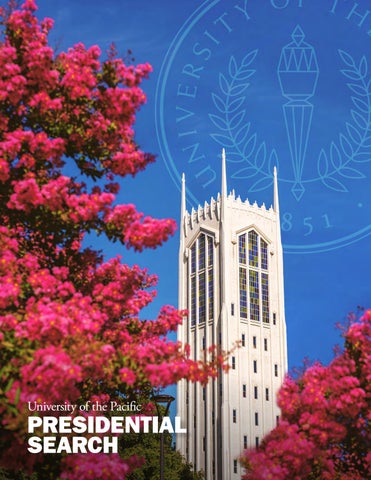
Burns Tower
UNIVERSITY OF THE PACIFIC
A leading Northern California university
University of the Pacific is a nationally ranked private university with three distinct campuses united under one common goal: to educate and prepare the leaders of tomorrow through intensive academic study, experiential learning and service to the community.
80+ Undergraduate Programs
11 Schools and Colleges
30 Graduate and Professional Programs
12 Accelerated Programs
The university's distinctive Northern California footprint includes its Stockton Campus in the heart of the state’s important agricultural region, widely recognized as one of the most beautiful campuses in the west; its San Francisco Campus, situated in the South of Market (SoMa) hub, the nexus of high-tech and finance, and home to the renowned Arthur A. Dugoni School of Dentistry and graduate programs in health care and technology; and the Sacramento Campus nearby the state capitol, home to the iconic McGeorge School of Law and graduate programs in health care, education, public policy, public administration and law. The student population is made up of more than 3,700 undergraduates and more than 2,800 graduate and professional students. Pacific students benefit from small class sizes with an average class size of 18, and a student–faculty ratio of 13:1

HISTORY AND OVERVIEW
University of the Pacific has been an innovator in higher education since its inception.
Pacific was established by pioneering Methodist ministers in 1851 as California’s first chartered institution of higher learning and became an independent institution in the 1960s. Originally located in Santa Clara, the university later moved to San Jose and, in 1924, moved to Stockton, making it the first private four-year university in the Central Valley. Pacific provided California with its first chartered medical school in 1858 (subsequently relocated to Stanford University), its first coeducational campus in 1871, and its first conservatory of music in 1878. It was the nation’s first to offer an undergraduate teacher corps program, the first to send an entire class to an overseas campus, the first to establish a Spanish-speaking inter-American college, and the first to offer a four-year graduation guarantee. This pioneering spirit led the university to expand into graduate and professional education in the 1950s, establishing the School of Pharmacy in 1955 and the Graduate School in 1956. It extended its footprint to San Francisco in 1962 with the acquisition of the College of Physicians and Surgeons, a school of dentistry founded in 1896. Pacific enlarged its footprint again in 1966 when it merged with the McGeorge School of Law located in Sacramento.
Pacific’s distinctive Northern California presence continues to grow: two of the three campuses now offer undergraduate, graduate and professional programs. Altogether, Pacific’s 11 schools and colleges offer 93 degree programs across the three campuses, with a third of these at the graduate and professional level. There are also four additional locations offering individual programs.
The Stockton Campus is the largest of the three campuses, offers the most diverse array of programs, and houses the majority of Pacific’s undergraduate students as well as several graduate and professional programs.
The San Francisco Campus relocated in July 2014 to a state-of-the-art facility designed to support the award-winning curriculum for the Dugoni School of Dentistry. The expansion in square footage enabled Pacific to diversify San Francisco’s educational offerings to include a Doctor of Audiology and master's degrees in data science and music therapy. In addition, it permitted the Stockton-based dental hygiene program to relocate to downtown San Francisco so students could learn alongside dentistry colleagues in the high-tech facility.
The Sacramento Campus was also recently diversified beyond the law degrees housed in the McGeorge School of Law. With declining demand for the JD degree, Pacific used available space to add a doctorate degree in education and master's degrees in education, public policy, public administration and physician assistant studies. The most recent addition to the Sacramento campus is a graduate degree in occupational therapy, with three more graduate health programs expected to launch soon. The university’s 11 centers and institutes are influential in shaping California law, policy and business development. Pacific also supports 25 clinics, ranging from oral health care to immigration counseling, that provide vital community services throughout Northern California. These institutes, centers and clinics are integral to students’ educational experiences, providing high impact applied learning opportunities while serving the surrounding communities.
The majority of programs at Pacific are delivered in a face-to-face format with some hybrid programs for graduate students and some fully online courses in summer. More than a dozen undergraduate programs and many professional programs are offered in an accelerated format that enables students to earn their degrees at a faster pace. Pacific’s learning environment also includes a breadth of co-curricular opportunities: more than 180 student clubs among the three campuses and a wealth of cultural, arts, sports, political, professional, spiritual, social and intellectual programs and events. A broad suite of educational and developmental services ranging from mental health to tutoring to comprehensive career services also support students’ wellbeing and academic success.
1851 Established as California’s first chartered institution of higher learning
1871 Became California's first coeducational campus
1878 Established California's first Conservatory of Music
1924 The campus relocated to Stockton by way of San Jose and Santa Clara
1955 Established the School of Pharmacy
1956 Established the Graduate School
1960 Became an independent institution
1962 Acquired the College of Physicians and Surgeons, a school of dentistry located in San Francisco
1964 Construction ended on the iconic Burns Tower
1966 Merged with the McGeorge School of Law in Sacramento
2014 Dugoni School of Dentistry moved to its state-of-theart facility in San Francisco


THE BOARD OF REGENTS
The Board of Regents is the governing body of the university, entrusted with final responsibility for the quality and integrity of the education provided. It selects the president, approves the purposes of the university, and ensures provision of adequate resources to support the university. The board protects the university from external pressures antithetical to academic freedom and to university autonomy or integrity.
The Board of Regents comprises a diverse set of experts, many of whom are alumni. The board has up to 35 members and strives to include graduates of all three campuses and professional schools.
Regents serve three-year terms and can be reappointed twice, for a total allowable three consecutive terms. Nominations for new regents are made by the board's Committee on Regents, which seeks a breadth of professional, educational, geographic and cultural backgrounds. To strengthen university relationships, the chair and chair-elect of the Academic Council, the president and president-elect of the Pacific Alumni Association and the president and vice president of the Associated Students of University of the Pacific (ASuop) are recognized as liaison representatives to the Board of Regents and are invited to represent their constituencies at regents meetings.
DIVERSITY

Diversity and inclusion are essential to the fulfillment of Pacific’s mission, and Pacific stands out among peers in serving an impressively diverse student body. More than 70 percent of undergraduates are non-Caucasian and Pacific is a non-majority Asian American and Native American Pacific Islander-Serving Institution (AANAPISI); 36 percent of undergraduates are Pell recipients and 16 percent are firstgeneration students. This demographic diversity is an integral feature of the Pacific learning experience and was recognized in the 2018 U.S. News & World Report rankings, where Pacific tied fifth for highest ethnic diversity among national private universities. Eightyfive percent of students come from California, with 35 other states and 25 foreign countries also represented.
RANKINGS
Pacific is recognized nationally for the high value it offers its students. Consistently, U.S. News & World Report names Pacific one of the 50 “best values” among national universities. According to the Equality of Opportunity Project (2017), Pacific ranked No. 8 in highest economic mobility rates among private nonprofit universities in the U.S. The 2018 White House College Scorecard reports that Pacific alumni salaries rank No. 3 in California compared to similar institutions and No. 12 overall among California’s colleges and universities. The Economist ranked Pacific in the 99th percentile and No. 12 overall as the Best-Value College in the U.S., and The Brookings Institution scored Pacific as 98 out of 100, in a tie nationally with 16 other institutions. On both rankings, Pacific emerged as the No. 3 best value in California.
The role of a Pacific education in contributing to social mobility is an important factor and, according to the 2016 Mobility Report Cards, Pacific ranks 17th nationally among selective private colleges and 99th among all colleges in the U.S. in the “chance a poor student has to become a rich adult.” Combined, Pacific’s impressive performance on a wide set of rankings affirms the value of a Pacific degree, outperforming peers and aspirant peers on numerous success measures. Complementing these national rankings, a survey of our 2018 baccalaureate graduates reveals that at six months after graduation, 90 percent were employed or accepted to graduate/professional school.
FINANCIAL PROFILE
The university has a solid financial foundation supported by strong reserves and growth in net assets over the past several years. The university's operating budget for the current fiscal year 2019 (July 2018–June 2019) is $263M (net of auxiliary revenues) and assumes a projected total revenue of $267M. The majority of the university's revenue is net tuition, which is projected to increase slightly for 2018–19.
Internal and external financial challenges have resulted in tighter budgets for all programs and administrative units throughout the university. The Pacific community is implementing a plan to reduce the base operating budget to create wider operating margins and to increase under-market salaries for faculty and staff. The university’s overall financial strength remains sound, and Pacific has received a Stable Moody’s A2 rating for the past several years.
FUNDRAISING
Pacific has experienced unprecedented expansion in fundraising with the bequest of a transformational $125 million estate gift in 2008 and distributed to Pacific in FY2014 from Robert and Jeannette Powell, who both served on the university’s Board of Regents. The gift established the Powell Match program which matches new or enhanced scholarship and academic program endowments on a 1:1 basis. The Powell Match program is the cornerstone of the university’s new comprehensive fundraising campaign, Leading with Purpose: The Campaign for University of the Pacific, which started in 2013 and publicly launched in October 2017. With a $300 million goal, the campaign represents the largest fundraising endeavor in the university’s history.
To date, more than $230 million has been committed in the campaign, including 260 Powell Matches. In the past decade, our endowment has grown by $300 million and nearly tripled in size, and in the last five years, $21 million in new academic program endowments have been established. Since the campaign began, the amount of endowed donor-funded scholarship distributions has more than tripled from $3.5 million to more than $10 million in 2019.
The Leading with Purpose campaign is guided by four principal priorities:

$120 million Academic programs of excellence and relevance: Pacific proactively adapts along with our landscape. Creating the very best academic programs for the needs of future citizen-leaders requires a combination of foresight, agility and a strong sense of civic purpose. Support will enhance key academic programs and boost Pacific students’ preparedness to lead in health care, law and other fastchanging fields.
$100 million Student access and success: This campaign enables students of all backgrounds to get the education — and educators — they need to thrive academically, professionally and personally.

$50 million Building communities: A Pacific education is community-minded. Students, faculty and staff prove every day that social and economic challenges can be answered when people are willing to listen to one another and work together. The Pacific ethos of service reverberates throughout our three-city campus and Northern California, and extends around the world.

$30 million Athletic achievement: This campaign will provide Pacific's scholar-athletes with the resources they need to be successful in the classroom and in competition, exemplifying the university’s values of performance, integrity and teamwork.

VALUES
The university’s values provide a common language for collaboration and shared goals, and represent what Pacific does best.
Academic Excellence We have high academic standards with a focus on teaching, scholarship and experiential learning. We invest in individualized attention and long-term relationships that build human potential.
Diversity and Inclusion We respect all individuals and embrace the richness that our diversity brings to us as an educational community. We recognize and honor differences, creativity and bridging what is distinct to create an inclusive environment.
Respect and Civility We demonstrate authentic respect for others and a willingness to engage in genuine discourse. We seek to establish common ground and ways to connect with others. We honor and value one another.
Community Engagement We are committed to learning from and enhancing our communities. We share a sense of purpose and pride in what we accomplish together.
Integrity and Accountability We demonstrate integrity in our actions. We strive to always do the right thing and hold ourselves and others accountable.
Student Centered Our students come first in everything we do. Student impact is an important consideration in every decision we make.

2018 Pacific at a glance
UNDERGRADUATE RACE/ETHNICITY
3,600 Undergraduate Students
Asian/Pacific Islander - 35.9%
White, non-Hispanic - 22.9%
Hispanic - 19.6%
International (NRA) - 7.4%
Multiethnic - 7.1%
Race/Ethnicity unknown - 3.4%
Black, non-Hispanic - 3.3%
Native American/Alaskan Native - < 1%
UNDERGRADUATE GENDER
54% Female - 46% Male
STUDENTS BY CLASS
Undergraduate - 3,600
Graduate - 1,125
Professional - 1,583
Total - 6,307
STUDENTS BY CAMPUS
Stockton - 4,924
Sacramento - 715
San Francisco - 668
Total - 6,307
Full-Time Instructional Faculty - 441
Part-Time Instructional Faculty - 404
Student-Faculty Ratio - 12:1
Average Class Size - 19
PACIFIC'S Schools and Colleges
1851 College of the Pacific. College of the Pacific The College of the Pacific is the oldest and largest academic unit, encompassing 18 departments and 29 majors in the natural sciences, social sciences, humanities and the fine and performing arts. Based upon its foundation of a rigorous liberal arts curriculum, the College champions experiential learning through undergraduate research and creative activity, fieldwork, internships and study abroad.
1878 Conservatory of Music. Conservatory Of Music Degree programs are offered in performance, composition, jazz, education, management, music therapy and history. Conservatory faculty artists/scholars provide a rigorous and supportive learning environment, and students have access to a recording studio, technology and composition labs.
1896 Arthur A. Dugoni School of Dentistry. The school is renamed the Arthur A. Dugoni School of Dentistry in 2004. Arthur A. Dugoni School of Dentistry Named in honor of its dean of 28 years, the Dugoni School is highly regarded for its humanistic model of education that respects the dignity of each individual and for innovation in dental curriculum, including comprehensive patient care and competency-based education. Its programs include an accelerated year-round pre-doctoral DDS program that enables students to complete four academic years of instruction in three calendar years and a high-demand Master of Physician Assistant Studies.
1924 McGeorge School of Law. McGeorge School of Law. McGeorge educates lawyers and legal professionals for large and small law firms, government agencies and corporate legal departments around the world. Master’s programs in public policy and public administration prepare graduates for careers in public service. McGeorge’s success is built on its distinguished faculty, high-quality students, committed and involved alumni, and state-of-the art classrooms and student facilities.
1924 Gladys L. Benerd School of Education. The School was renamed the Gladys L. Benerd School of Education in 1992. Gladys L. Benerd School of Education* Benerd School faculty prepare students for service in public and private education and learning-related professions in other sectors. The school provides programs for current educational professionals to expand their understanding, knowledge and skills and promote and engage in research leading to better education and learning.
1955 Thomas J. Long School of Pharmacy and Health Sciences. The School was renamed the Thomas J. Long School of Pharmacy and Health Sciences in 2001. Thomas J. Long School of Pharmacy and Health Sciences The school offers a three-year accelerated pharmacy program, provides speech-language pathology students early clinical experience, prepares highly trained audiologists and produces practice-ready physical therapists. A leadership focused, success-centered environment is emphasized for the school’s diverse student body. Students are empowered to succeed through meaningful, experiential learning in state-of-the-art laboratories.
1956 Graduate School. Graduate School Founded in 1956, the Graduate School collaborates with University of the Pacific’s academic schools and colleges to offer more than 30 master’s, doctoral, and graduate certificate programs, serving graduate students on Pacific’s three campuses. The school serves as the central, student-centered resource for graduate admission, education and services and works to promote and support the success and development of Pacific’s diverse graduate population.
1957 School of Engineering and Computer Science. School of Engineering and Computer Science The school empowers its students to solve problems by developing their own projects and working alongside professors on contemporary research. Faculty mentor students inside and outside of the classroom. With its distinguished cooperative education program, students also get to “learn and earn” through a paid professional internship, built into the curriculum, with one of the school’s 200-plus industry partners worldwide.
1972 University College. University College* University College was founded in 1972 to meet the needs of a growing number of adult learners returning to higher education to finish their bachelor’s degrees or seeking continuing education to advance their careers. Today the college remains committed to serving non-traditional students and working adults by offering degree completion programs, along with a full suite of continuing education and certificate programs for working adults and lifelong learners.
1977 Eberhardt School of Business. The school was renamed the Eberhardt School of Business in 1995. Eberhardt School of Business The Eberhardt School of Business was renamed in 1995 in recognition of the Eberhardt family’s endowed gifts. Fully accredited by the Association to Advance Collegiate Schools of Business, the school boasts a $3 million Eberhardt Student Investment Fund, a dedicated Career Management Center, stateof-the-art classroom technology, and experiential learning opportunities. The school offers leadership development and business resources through its Center for Business and Policy Research, Center for Entrepreneurship, Westgate Center for Leadership and Management Development and Institute for Family Business.
1987 School of International Studies. School of International Studies A school within College of the Pacific, the School of International Studies is devoted to the interdisciplinary study of international affairs. International, interdisciplinary and intercultural immersion, acquisition of at least one second language, and at least a semester of study abroad prepare students for a variety of professions in industry, government, not-for-profit organizations and educational institutions.
School of Integrated Health Professions. Set to launch in 2020, the School of Integrated Health Professions will house nine healthcare programs. Four of the nine will be new programs: Clinical Nutrition, Nursing, Occupational Therapy and Social Work. They will join five existing programs: Athletic Training, Audiology, Physical Therapy, Physician Assistant Studies and Speech-Language Pathology. The focus of the School of Integrated Health Professions is to prepare students for patient care across the lifespan with emphases in rehabilitation, mental/behavioral health and aging. The school will be located on the Sacramento campus, with existing programs located on all three campuses.
*The Gladys L. Benerd School of Education and University College will merge to form a new school focused on innovative educational programs with flexible pricing and delivery methods, including hybrid and online programs for working adults. Merging Benerd with University College will create a school that builds upon Pacific's reputation as an education leader and position the university to offer more innovative programs, designed to meet the needs of the growing numbers of non-traditional students. The merger is expected to be complete in 2020.

POSITION SUMMARY
The president is appointed by the Board of Regents and serves as the university’s chief executive officer responsible for setting the vision, strategy and related institutional goals and objectives. The president oversees the university’s administration and operations and implements the policies and procedures adopted by the Board of Regents.

The president will develop a strong leadership team and foster the university’s values and a culture that embraces diversity, equity and inclusion.

Pacific’s next president will be a collaborative leader who will build effective relationships and avenues of communication with key stakeholders internal and external to the university including students, faculty, staff, alumni, donors, business and community partners, legislative leaders and other influencers. In doing so, the president will spearhead the university’s efforts in setting an ambitious trajectory for Pacific’s future.

To be successful in this position, the next president will:
• Continue Pacific’s commitment to academic excellence and the liberal arts by setting high standards and measurable goals to ensure student success.
• Raise the visibility of the institution by working effectively with all stakeholders, including the Board of Regents; community and business leaders; educational institutions and organizations; alumni and donors; and the public.
• Continue efforts to improve and expand a high-quality experience for all students.
• Diversify and strengthen Pacific’s endowment through strong advocacy and the cultivation and solicitation of individuals, foundations and corporations.
• Promote and strengthen the organizational culture by fostering a shared sense of the university’s mission and goals among all constituents.
• Possess a strong financial acumen and experience developing and managing complex budgets and financial forecasting.
• Provide leadership to faculty, staff, administrators and other constituents in implementing the current and future strategic plans.
• Understand the role of technology and its importance in the evolution of higher education.
• Possess a demonstrated ability to address and bring closure to difficult or controversial issues and make timely and effective decisions.
• Be a skilled, persuasive and authentic speaker and presenter (or storyteller) who is adept at understanding the nuances of communicating effectively to a wide variety of constituencies.
• Possess an understanding of and commitment to shared governance.
• Have an engaging and charismatic personality.

OPPORTUNITIES AND CHALLENGES
The next president will have the opportunity to make an impact in several important areas:
Creating a Compelling Vision: Pacific’s next president will be a collaborative leader who will guide the university’s continued pursuit of academic excellence while maintaining its commitment to a student-centered learning experience and its dedication to student success. To do so, the president must engage Pacific’s myriad constituencies and stakeholders and lead these groups toward a shared vision for the future, one that creates new opportunities for academic distinction and ensures the continued success of all of Pacific’s students.
Student Recruitment and Programmatic Enhancement: The next president must ensure the progression, retention and successful graduation of students at Pacific. In their role, the president must have an effective implementation plan and steer the university’s future enrollment management, pricing and financial aid strategy. By leading the university in fulfilling its mission to make a profound impact on the lives of students, the president can have a significant effect on increasing enrollments.
Fundraising and Developing New Revenue Streams: Pacific’s next president must be a persuasive leader with the ability to communicate the university’s mission and ideals in a compelling way to inspire a broad spectrum of partners to invest in Pacific. They will work to secure additional resources and new revenue streams that will accelerate the university’s success in supporting its students, faculty, staff and communities.
Building and Strengthening the Academic Profile and Portfolio: As Pacific readies to launch a new School of Integrated Health Professions with high-demand doctoral, graduate and undergraduate programs (occupational therapy, nursing, nutrition and social work), the new president will maximize the opportunity to position Pacific as the premier leader in professional health programs building on the outstanding reputation of its pharmacy school, dental school and programs in audiology, physical therapy and speech language pathology. Additionally, the planned merger of Pacific’s School of Education and University College will provide the new president a strong platform for distinguishing Pacific’s reputation among its peers and competitors as an innovator and creator of market-responsive programs that will attract new cohorts of learners.

Ensure the Success of New Graduate and Professional Programs: In alignment with Pacific's strategic plan, the new president will support a major initiative to transform the liberal arts experience for students by leveraging the strengths in academics and student life with a focus on high-caliber experiential learning that prepares students to thrive in a knowledge-based economy.
Fostering a Dynamic and Collaborative Environment: The president will demonstrate highly effective leadership skills to build trust, collaboration, accountability and transparency. This requires an individual who values collegiality and diversity. They must be adept at empowering others and effectively delegating responsibility to the senior leadership team. The president will be a visible and highly interactive figure in setting a new standard for leadership and collegiality that leads to Pacific’s continued success.
Harnessing Pacific’s Collective Strength: With campuses in Sacramento, San Francisco and Stockton the next president will lead a multi-campus university that extols the distinct identity of each campus and a shared commitment to the values of teaching and academic excellence. The president will be entrusted with guiding Pacific’s efforts to highlight the unique attributes and offerings of each campus while capitalizing on the university’s shared identity to foster an institutional environment with a shared sense of mission, values and commitment to student success.
Advancing Pacific’s Diversity Efforts: Pacific is committed to diversity and fostering a culture where students, faculty, staff and community members can come together in a welcoming and supportive environment. The next president will play a crucial role in ensuring inclusive excellence across all Pacific campuses and strengthening institutional efforts dedicated to the success of a diverse faculty, staff and students.
Enhancing Community Engagement The next president will identify and expand new areas for increasing community involvement and developing partnerships externally in Sacramento, San Francisco and Stockton.

DESIRED QUALITIES AND CHARACTERISTICS
Leading candidates for the presidency will be visionary and inspirational leaders who possess the passion and determination to lead Pacific toward achieving new levels of excellence. This will require a personal commitment to the mission, values and culture of the university and an appreciation for the Pacific community at every level and on each campus.
The president will have exceptional communication and leadership skills coupled with the ability to develop highlyeffective teams and foster a culture of innovation and collegiality. The next president will possess a record of success driving a complex and dynamic organization that embraces excellence, community engagement and creative problem-solving.
Although a terminal degree and exceptional academic administrative experience are preferred, the Board of Regents also welcomes and encourages candidates who have achieved noteworthy success in their respective fields outside higher education to apply. These candidates must have demonstrated experience and a track record of success working in a complex, decentralized organizational structure where success is achieved in partnership and collaboration rather than solely through direct authority.

APPLICATION AND NOMINATION PROCESS
The Presidential Search Advisory Committee will begin reviewing applications immediately and will continue to accept applications and nominations until the position is filled. Applicants must submit a current curriculum vitae and a letter of interest describing relevant experience. Submission of materials via e-mail is strongly encouraged. Nomination letters should include the name, position, address and telephone number of the nominee. All nominations and applications will be handled in confidence.
Applications and letters of nomination should be submitted to: Alberto Pimentel, Managing Partner Email: apsearch@storbeckpimentel.com Refer to code “Pacific-President” in subject line
Storbeck/Pimentel & Associates 6512 Painter Avenue Whittier, CA 90601

Sacramento Campus | 3200 Fifth Avenue, Sacramento, California 95817
San Francisco Campus | 155 Fifth Street, San Francisco, California 94103
Stockton Campus | 3601 Pacific Avenue, Stockton, California 95211
Pacific.edu
University of the Pacific is an affirmative action and equal opportunity employer. All qualified applicants will receive consideration for employment without regard to race, color, religion, sex, sexual orientation, gender identity, gender expression, national origin, age, protected veteran or disabled status, or other legally protected characteristics.