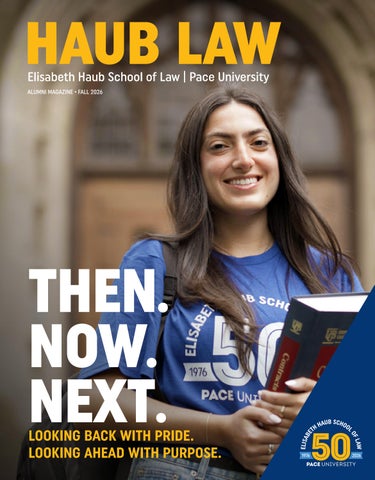
Elisabeth Haub School of Law | Pace University ALUMNI MAGAZINE • FALL 2026
THEN. NOW. NEXT.
LOOKING BACK WITH PRIDE. LOOKING AHEAD WITH PURPOSE.
DEAN
CONTRIBUTING WRITERS
Horace E. Anderson Jr.
Rex Bossert Bennett L. Gershman
ASSISTANT VICE PRESIDENT FOR ACADEMIC MARKETING COMMUNICATIONS
Rachael M. Silva DIRECTOR OF INSTITUTIONAL CONTENT AND ALUMNI ENGAGEMENT
Jessica Dubuss ’09 Managing Editor & Writer
DESIGN
Sarah Brooke Design PHOTOGRAPHY
Dmitriy Kalinin Studio Guy and a Girl Photography Jeffrey Fleisig Jörg Meyer Photography Bonnie Huie
Haub Law Alumni Magazine is published annually under the auspices of the Dean, and is distributed free of charge to alumni and friends of the Law School. PLEASE ADDRESS CORRESPONDENCE TO:
Elisabeth Haub School of Law at Pace University Alumni Communications 78 North Broadway, White Plains, NY 10603 plsalumni@law.pace.edu The content in this magazine reflects information available and/or verified at the time of publication in September 2026. Views expressed in this publication do not necessarily represent those of its staff or of Pace University. Pace University admits, and will continue to admit, students of any sex, gender or gender identity, race, color, religion, creed, age, disability, marital status, sexual orientation, veteran status, national and ethnic origin to all rights, privileges, programs, and activities generally accorded or made available to students at the School. It does not, and will not, discriminate on the basis of sex, gender or gender identity, race, color, religion, creed, age, disability, marital status, sexual orientation, veteran status, national and ethnic origin in the administration of its educational policies, admissions policies, scholarships and loan programs, and athletic and other school-administered programs. © Copyright 2026 by Elisabeth Haub School of Law
2
H A U B L AW A L U M N I M A G A Z I N E
ALUMNI MAGAZINE • FALL 2026
38
40 20
6
42
5 50TH ANNIVERSARY SPECIAL EVENTS CALENDAR
54
FROM THE DEAN
4
HAUB HEADLINES
26
New and noteworthy highlights from the past year
ON THE COVER
6 A LEGACY OF OPPORTUNITY
OF NOTE
30
Impressive student and recent grad accomplishments, featuring:
20 DECADES OF IMPACT FAR BEYOND THE CLASSROOM
Daniel Khieninson ’26 Anne Sekula ’28 Bianca Hayles ’27
23 FIVE DECADES OF DEANS
IN AND AROUND
24 A DECADE OF THE HAUB LEGACY
FACULTY
31 34 35
36
Photos from key events and distinguished lectures
42
Faculty and staff reflections and achievements, featuring: Professor Bennett L. Gershman Dean for Students Angie D’Agostino ’99
24
42 44
IN MEMORIAM
50
ALUMNI
52
Alumni class notes and profiles, featuring: Hon. Philip M. Halpern ’80 Hon. Linda S. Jamieson ’79 Anthony Tagliamonte ’01 and Brianna Tagliamonte ’26 Jordan Montoya ’17 Eric Paulk ’16 Lauren Pabon ’28 and Michael Pabon ’22 Pianpian Wang, LLM ’13, SJD ’24 James R. May, LLM ’91
FA L L 2 0 2 6
52 53 54 56 57 58 60 61
3
FROM THE DEAN While our campus has changed, our programs have grown, and the legal profession has evolved, the values that have defined this Law School since 1976 remain remarkably constant. From the very beginning, the Elisabeth Haub School of Law (then Pace Law School) has been guided by a belief that legal education should be rigorous, practical, and deeply connected to service. Generations of students have learned not only how to think like lawyers, but how to use the law to improve their communities, advance justice, and address society’s most pressing challenges. Those values come to life throughout the pages that follow. You’ll read about distinguished faculty whose scholarship continues to shape the law; longtime faculty and staff members whose reflections offer a firsthand perspective on the Law School’s remarkable journey; alumni whose careers have taken them from courtrooms and boardrooms to classrooms, government agencies, nonprofits, and communities around the world; and current students who are already building on that legacy. You’ll also meet families whose connections to the Law School span generations, illustrating how the Haub Law story continues to unfold with each new generation. Together, these stories tell a larger story—that of a Law School whose impact is measured not simply by years, rankings, or accomplishments, but by the people who carry its mission forward.
“ T OGETHER, THESE STORIES TELL A LARGER STORY—THAT OF A LAW SCHOOL WHOSE IMPACT IS MEASURED NOT SIMPLY BY YEARS, RANKINGS, OR ACCOMPLISHMENTS, BUT BY THE PEOPLE WHO CARRY ITS MISSION FORWARD.” HORACE E. ANDERSON JR.
Dear Alumni and Friends, This year, as the Elisabeth Haub School of Law celebrates its 50th anniversary, we have taken the opportunity not only to reflect on where we have been, but also to consider how far we have come, and where we are headed next. Throughout this magazine, you’ll notice a recurring theme of then and now. As we looked back through five decades of photographs, milestones, and memories, one thing became abundantly clear:
4
H A U B L AW A L U M N I M A G A Z I N E
This issue also reminds us that milestones are not merely opportunities to celebrate the past; they are invitations to imagine the future. Fifty years ago, this institution was founded with bold aspirations and an unwavering commitment to experiential legal education. Today, those same principles continue to define us as we prepare lawyers to lead in a rapidly changing profession, expand access to justice, strengthen our nationally recognized Environmental Law Program, and educate graduates ready to make meaningful contributions wherever their careers take them. No matter when you graduated, you remain an essential part of this story. Your achievements, mentorship, generosity, and continued engagement strengthen our community and ensure that the next generation of Haub Law students has the same opportunities that shaped so many of us.
Thank you for being part of this remarkable journey. As we celebrate our first fifty years, we do so with deep gratitude for all who helped build this institution—and with great optimism for everything that lies ahead. Sincerely,
HORACE E. ANDERSON JR. Dean, Elisabeth Haub School of Law
50TH ANNIVERSARY CALENDAR
SPECIAL EVENTS SEPTEMBER 14: 5:00 P.M.
50th Anniversary Tribute: Remembering Richard L. Ottinger This special tribute honors the extraordinary life, career, and enduring legacy of Dean Emeritus Richard L. Ottinger: environmental pioneer, dedicated public servant, leading scholar, and beloved teacher whose influence shaped the Law School and helped define modern environmental law. SEPTEMBER 24: 5:00 P.M.
Inaugural Morris E. Lasker Lecture on Correctional Justice Honor the legacy of Judge Morris E. Lasker, a pioneering advocate for the constitutional rights and dignity of incarcerated individuals. This inaugural lecture will be delivered by Professor Michael B. Mushlin, Professor of Law Emeritus, Elisabeth Haub School of Law. A reception will follow, featuring an exhibition and book launch for Breaking Point: When the Criminal Justice System Fails by acclaimed photographer Robin Dahlberg. OCTOBER 22: 6:00 P.M.
Pace Women’s Justice Center Annual Benefit Join Pace Women’s Justice Center as we celebrate 35 Years of Justice at our 2026 Annual Benefit. This special anniversary evening will honor Dean Angie D’Agostino and PWJC’s Pro Bono Volunteer Program for their extraordinary leadership, service, and commitment to survivors of abuse. Together, we’ll reflect on PWJC’s legacy while raising critical funds to ensure survivors of domestic violence, sexual assault, and elder abuse continue to receive the free legal services they need to build safer futures. OCTOBER 28: 4:30 P.M.
Back to the Future: Earth Law and the Next 50 Years of Environmental Law Ecocentric (Earth law) approaches increasingly manifest across a variety of legal and policy contexts suggesting that Earth law will shape the next generation of environmental law. Please join us for a panel discussion featuring leading scholars to examine emerging legal developments related to Earth law,including ecocide, the Rights of Nature, constitutional environmental rights, and Indigenous laws. APRIL 15–16, 2027
The Business of Health Law Workshop When Commerce Meets Care: Money, Health, and the Law The Elisabeth Haub School of Law presents the inaugural Business of Health Law Workshop, bringing together leading scholars from across the country to explore the intersection of health law and business law. This two-day workshop will examine how law shapes the financing, delivery, regulation, and future of health care through collaborative discussion and aims to promote the development of new scholarship to advance the field.
ALUMNI WEEKEND OCTOBER 23: 8:30 A.M.–5:00 P.M.
AI and the Law Conference Join members of the legal community for a day exploring the rapidly evolving role of artificial intelligence in the legal profession. Expert panels, keynote presentations, and hands-on workshops will provide practical insights into the legal, ethical, and technological issues shaping the future of law. OCTOBER 24: 12:00 P.M.–3:00 P.M.
Fall Fest Family Day Alumni and their families are invited back to the Law School campus to enjoy a fun-filled day of family-friendly activities, crafts, entertainment, food trucks, and more. Campus tours available. OCTOBER 24: 6:00 P.M.–9:00 P.M.
Alumni Reunion Dinner Celebrate our 50th anniversary and the 10-year milestone of our renaming to the Elisabeth Haub School of Law at our alumni reunion at Kanopi, atop The Opus, Westchester! OCTOBER 25: 11:00 A.M.–2:00 P.M.
Farewell Brunch Wrap up Alumni Weekend by joining your fellow alumni in the Tudor Room for brunch before parting ways.
Learn more and register:
LAW.PACE.EDU/50YEARS FA L L 2 0 2 6
5
6
H A U B L AW A L U M N I M A G A Z I N E
A Legacy of
OPPORTUNITY Since its founding a half century ago, Pace Law School, now the Elisabeth Haub School of Law, has stressed the importance of learning not just in the classroom, but outside of it as well. Five decades later, this core foundation has proven to be more relevant than ever as students successfully transition from law school to legal practice in today’s marketplace. No longer the new kid on the block among law schools, Haub Law has carved a unique and valuable place in legal education and is well poised to grow even stronger over the next 50 years.
FA L L 2 0 2 6
7
50 YEARS THE DRIVER BEHIND THE CREATION OF THE L AW SCHOOL WAS THEN PACE UNIVERSIT Y PRESIDENT DR. EDWARD MORTOL A .
An educational visionary, Dr. Mortola elevated Pace from a college to a university and from a school based in lower Manhattan to one that extended to Westchester County. His keen eye saw both a dearth of opportunities for talented local candidates to attend law school as well as a growing business community in need of skilled lawyers. Originally planned to be located on Pace University’s then-recently acquired Pleasantville campus, the School’s trustees had the foresight to search for space in White Plains, closer to the federal and state courthouses, the county seat, and the hub of the Westchester County legal and business communities. In 1975, Pace consolidated with the College of White Plains (formerly known as Good Counsel College), and the campus became the new home of Pace Law School. Dr. Mortola “was an extraordinary human being as well as an educational entrepreneur,” recalled the late Dean Emeritus Richard L. Ottinger. Dr. Mortola first hired Dean Ottinger as a faculty member in 1984, and he later served as dean from 1994-1999, passing away in 2026. Dean Ottinger said that Dr. Mortola “took a small school for accountants and created a full-blown university.” Archives housed in the University library, including transcripts of oral histories and carbon copies of the scores of letters that Dr. Mortola wrote to lawyers, judges, elected officials, and business leaders, reveal the effort, determination, and collective energy he and others harnessed in order to bring forward their idea. Pace’s first step, taken in the early 1970s, was to affiliate with New York Law School in lower Manhattan. Initially, the Pace trustees decided to pursue a formal merger. Dr. Mortola’s reminiscences, however, describe the relationship with NYLS’s trustees as “far from perfect,” enough to kill the plan and prompt a different approach. Pace would establish its own
1974
Founding and early faculty members pictured at an early Law School commencement ceremony
law school. In May of 1973, Pace officials presented their proposal to the Joint Conference on Legal Education in the State of New York. Acting on the advice of the Conference, they next petitioned the Board of Regents of the University of the State of New York and the State Education Department for an amendment to the School’s charter that would allow Pace to award law degrees. In a letter from 1974 sent to Joseph McGovern, Chancellor of the Board of Regents, Dr. Mortola emphasized the need for broader access to legal education. Drawing from a 1972 report of the American Bar Association’s Task Force on Professional Utilization, Dr. Mortola cited an increasing number of people taking the LSATs, a surge that was expected to continue. From the start, officials planned to locate the law school in Westchester County, to complement the new undergraduate campus in that area. By then, Pace officials were quite familiar with expansion
The New York Department of Education awards Pace University a charter for a law school
Edward J. Mortola, President of Pace University, writes to Judge Morris E. Lasker of the United States District Court: “A small, quality law school is being planned...to make unique and significant contributions to the University at large and to the Westchester community. Its graduates should be welcomed into the profession and into allied fields.”
8
H A U B L AW A L U M N I M A G A Z I N E
Robert B. Fleming is appointed the first official Dean of the Law School
1976
The Pace University School of Law officially opens its doors on the White Plains campus, welcoming 250 day and evening students
and the attendant growing pains, but creating a law school required a more complex effort than simply acquiring additional property. “There’s a whole different process in starting a law school, different from everything we had ever done before,” said Dr. Mortola in his oral history.
at that same meeting, showing the clear perception of a shortage of opportunities in New York to study law. Moving rapidly, school officials set a goal of welcoming 150 day and 100 evening students for the 1975-76 academic year.
To guide their efforts, the trustees engaged Dr. Michael H. Cardozo, past executive secretary of the American Association of Law Schools, to serve as a consultant. Next, Dr. Mortola gathered a group of 100 advisors from various facets of the Westchester community and tasked them with assessing the plan and discerning the best steps to take in response to local needs. They began with the most basic issues: should the school offer both full-time and part-time programs? Should there be an evening program? Dr. Mortola recalled the growing excitement as the group reviewed each issue: “Absolute, total enthusiasm. It was just remarkable. Westchester was eager and ready. The County Executive then, Al Del Bello; the Mayor, Al Del Vecchio; and the local officials were all enthusiastic about the law school.”
With limited time to prepare, Dr. Mortola hired a dean, Robert Fleming. Dean Fleming left a practice defending clients called before the House Un-American Activities Committee. His oral history reveals that he was drawn to Pace by what he described as “an exciting possibility.” As Dean Fleming hired faculty, librarians and administrative staff, the trustees altered their original plan to locate the law school on the Pleasantville campus. They looked instead for space in White Plains, closer to the federal and state courthouses, and the hub of the Westchester legal community. The result was the purchase of Preston Hall. It may seem surprising in light of today’s full campus, but Preston Hall was originally supposed to house the entire school. The main classroom would be the second floor space that currently serves as the faculty lounge. The library would be located in the Tudor Room, an adequate but limiting solution.
To establish adequate financial resources, the University earmarked more than $2.5 million in contributions from corporations and individuals in addition to seed funding from the University budget. While Dr. Mortola himself wasn’t a lawyer, his letter to the New York State Department of Education nonetheless built a strong closing argument: “There are funds. There are facilities available. There is leadership. There is genuine concern for quality. There are distinguished law professors and deans who have agreed to participate actively and authoritatively in faculty and staff selection and curriculum development. There is a remarkable degree of community support. There is a need for a school of law in this area which is so rapidly growing and lacks opportunity for the study of law. There is a greatly expanded and expanding corporate community that employs thousands of college graduates who cannot study law without giving up their positions unless a school of law is made available in Westchester County. We only lack the opportunity to begin.”
Charter Awarded A few weeks later, on April 26, 1974, the Department of Education awarded Pace University a charter for a law school. In its press release, the state noted the law school would help to meet the needs of the mid-Hudson region. The release also shared that Pace would be the first New York school outside of the city to offer a part-time program of legal education. Interestingly, the Department also granted law school charters to Yeshiva University and City University of New York
1978
The Environmental Law Program at Pace Law School is founded by Professor Nicholas A. Robinson
Law students and faculty establish the Pace Law Review, publishing the first issues in 1980
PROFESSOR EMERITUS JAY C. CARLISLE II “ In early days at Pace, I taught day and evening sections in Professional Responsibility, Negotiations and Civil Procedure. The Glass Building and other parts of the Law School had yet to be constructed. Preston Hall contained the entire school! I was one of the faculty advisors to the student published newspaper Hearsay. We had a large bar in the basement of Preston where students and faculty would meet, after classes, for liquid refreshments! The beautiful quad was a parking lot with spaces reserved for the deans. And, after forty years of teaching at the Law School, I am thrilled to see the success of so many of my former students, with many becoming state and federal court judges. I am careful to address all of them as ‘Your Honor’.” n
Construction is completed on the Joseph and Bessie Gerber Glass Law Center
1979
Pace Law School graduates its first class of law students
1981
The Alumni Association is established with representatives in 13 states
FA L L 2 0 2 6
9
50 YEARS According to Dr. Mortola’s account, a few years earlier, when Pace was still a college and Dr. Mortola was still pursuing a short-lived plan to establish a center for the study of law and society as a precursor to a law school, Mrs. Bessie Glass had tried to interest New York Law School in creating a new school to honor her late husband, Joseph Glass, one of its graduates. Mrs. Glass eventually pledged funds to construct what is now the Gerber Glass Law Center on the White Plains campus and purchase books to stock the shelves. When Pace Law School officially opened its doors, it did so as the first New York school outside of the city to offer a part-time program of legal education, and it remains the only law school in Westchester County. Mrs. Glass’s original plan included locating the proposed school on the Glass family property in Mount Kisco, in northern Westchester County. Finding the location unappealing for a Manhattan-based school, the trustees did not act on her proposal. Dr. Mortola was
PROFESSOR NICHOLAS A. ROBINSON
The Center for Environmental Legal Studies is established, now known as The Global Center for Environmental Legal Studies (GCELS)
Dean Fleming retires and Interim Dean Justice James D. Hopkins assumes leadership
10
The Dyson Distinguished Lecture is endowed by a gift from the Dyson Foundation
H A U B L AW A L U M N I M A G A Z I N E
As months unfolded, and Dr. Mortola set aside his plan for a center in favor of proceeding directly to the creation of a law school, Mrs. Glass set aside her insistence to locate a school in Mount Kisco. With the charter in hand and the purchase of the White Plains property, Mrs. Glass signed on to the project. She pledged $1 million to construct the Gerber Glass Law Center. She fulfilled her pledge with Tenneco stock, a gift that accrued an additional $37,000 before Pace liquidated the shares. The additional money went towards the purchase of books to stock the shelves.
Early Days Dean Fleming described the first day of classes as “a madhouse.” He had delayed the opening for two weeks but the extra time didn’t seem to matter. Both the day and evening programs were oversubscribed and people showed up to pay their deposits the same day they planned to attend their first class. The students reflected the anticipated demographic of people who had been waiting for this opportunity. In his oral history, Dean Fleming recalled that most were older than traditional law students and many were women. “I think that first year it was on the order of 35 to 40 percent women, which was an awful lot in ’76,” he recalled.
“ Environmental Law today is taught in virtually every law school in every country. When I was a law student, the field did not exist. The norms and tools at hand are necessary, but not yet sufficient, to cope with the accelerating crises of biodiversity loss, chemical pollution, and climate change. We shall need to advance accepted procedures, such as Environmental Impact Assessment, to avert further degradation of the natural systems that sustain our health. In coming years, our laws will increasingly be called upon to make a ‘just transition’ away from polluting to restoring Earth’s ecosystems. Environmental legal education is still in its formative stages.” n
1982
aware of her offer due to his affiliation with New York Law School during the time that Pace was considering making it part of Pace College. He asked if the trustees would mind if he went and talked with Mrs. Glass. With his original plan to create a center, Dr. Mortola thought the Mount Kisco property might be a suitable location. The two visited and, by all accounts, hit it off quite well. Mrs. Glass, however, held to her conviction to create a law school, not a center. Undeterred, Dr. Mortola made additional visits to Mount Kisco and also invited Mrs. Glass to join him for lunch at his office in the city.
University Distinguished Professor Bennett Gershman, who has been at the Law School from its founding, remembers a lively and productive semester that sometimes bordered on chaos. Pace shared the campus with the College of White Plains as well as the Good Counsel Catholic school community. Though the law school was housed in Preston Hall, he recalls that some of the nuns still lived on the fourth floor at that point. It was not unusual, he said, for them to cut through the building during the day, mixing in with the law students. The same energy and activity that had enticed Professor Gershman to join the faculty brought in other pioneers as well. The original team also included Ralph Stein, Josephine King, James DeMarco and Hervey
The Honorable Janet Johnson is named Dean of the School of Law. Serving for six years, she establishes the Law School’s first direct client representation legal clinic, John Jay Legal Services
1983
The Law School launches an LLM program in environmental law
1987
The Law School establishes two new clinics, the Environmental Litigation Clinic and the Barbara C. Salken Criminal Justice Clinic
Pace Energy Project (now known as the Pace Energy and Climate Center) is launched by Professor and former United States Congressman, Richard L. Ottinger
Johnson. “We were creating something that didn’t exist before,” recalled Professor Gershman, who alone among the original faculty continues to teach at the school. With applications pouring in, Dean Fleming expanded the faculty to meet the needs of the growing student body. In his oral history he said that he didn’t advertise; word circulated that there was a new law school and his box filled with resumes, a mix of both scholars and practicing attorneys. “I picked people who looked interesting,” said Dean Fleming, hiring people who had strong law school records and had gone on to acquire professional experience “at a high level.” Among these early hires was Professor Nicholas Robinson, who led one of the Law School’s most significant initiatives: a program focusing on Environmental Law, a new field at that time. Professor Robinson had previously served on the Legal Advisory Committee to the President’s Council on Environmental Quality, was writing a monthly column on environmental law in the New York Law Journal, and was among the few legal scholars to foresee how large and important the field would become.
Law School faculty and administration throughout the decades
Progress happened quickly at the Law School. By 1978, Pace Law students and faculty established the Pace Law Review, publishing the first issues two years later. Construction was completed on the Joseph and Bessie Gerber Glass Law Center in 1979, and the Law School graduated its first class of students that year.
“I agreed to come to Pace to begin one of our nation’s very first environmental law specializations,” recalled Professor Robinson. “The Dean endorsed my proposals, on the condition that I do all the work, so my first task was to recruit colleagues to join me. Thank goodness we found an extraordinary group: Dick Ottinger, Ann Powers, Jeff Miller, and John Nolon.” Their efforts produced an environmental law program that has consistently ranked among the best in the country, and has been ranked No. 1 by U.S. News and World Report a total of seven times and for the last six years running.
1988
The inaugural Blaine Sloan Lecture on International Law is held
Dean Janet Johnson resigns to return to teaching and Steven H. Goldberg succeeds her as Dean
1989
The James D. Hopkins Professor of Law, an endowed chair, is established
The National Environmental Law Moot Court Competition (NELMCC), one of the nation’s largest interschool moot court competitions, is founded, later renamed The Jeffrey G. Miller National Environmental Law Moot Court Competition
1990
The Philip B. Blank Memorial Lecture on Attorney Ethics is established
FA L L 2 0 2 6
11
50 YEARS
(left) Students in the Environmental Litigation Clinic (above) Professor John Nolon and Dean Emeritus Richard Ottinger with students
Quick Growth In just a few years, Pace had attracted a strong faculty and a growing student body. The Alumni Association was established in 1981 with representatives in 13 states. With this solid foundation in place, Dean Fleming retired in 1982. Justice James D. Hopkins of the New York State Supreme Court served as interim dean until 1983, when Dean Janet Johnson took office. One of the country’s few women law school deans, she brought a wealth of experience as a professor, a judge, as well as a practicing attorney, making her well suited to guide the new school through the next decade. Dean Johnson focused on providing a skills-based legal education, providing students with the opportunity to gain practical experience representing actual clients. She established Pace’s first direct client representation legal clinic, John Jay Legal Services. The same year, 1983, the LLM program in environmental law was launched as well.
“Pace students did not have a sense of entitlement because they were in law school, but a desire often in the face of odds against them, financial and otherwise, that they could capture the historic American dream of moving upwards in society by becoming lawyers engaged in promoting justice,” recalls Professor Emeritus James J. Fishman. “So many were also carrying the hopes of their families, who did not have the opportunity to attain professional status or possess great wealth. It gave me enormous respect for the many former students who have attained their goals, not to speak of the pleasure to read their successes.”
1991
The Institute of International Commercial Law is founded
1993
In 1987, Pace opened both the Barbara C. Salken Criminal Justice Clinic and the Environmental Litigation Clinic. Also that year, the Pace Energy Project (now known as the Pace Energy and Climate Center), the first center affiliated with Pace, was launched by Professor and former US Congressman Richard L. Ottinger.
The Land Use Law Center is established under the direction of Professor John Nolon
The Pace Women’s Justice Center (originally founded as the Battered Women’s Justice Center) is established by Governor Mario Cuomo in a joint partnership with the New York State Office for the Prevention of Domestic Violence (OPDV) and Pace University School of Law, under Dean Goldberg
12
H A U B L AW A L U M N I M A G A Z I N E
Professor Barbara Black is named interim dean and serves until June of 1994
Professor Richard Ottinger is appointed acting Dean in July and Dean in December
1994
The Law School establishes an International Program, led by Professor Gayl Westerman, and the LLM Program in Comparative Legal Studies is created
Professor—and later Dean—Ottinger once noted that this center, as well as later ones, “provide additional opportunities for our students to gain practical experience, of course. But they also expand the reputation of Pace because the work of the centers reaches beyond academia.” (Dean Ottinger continued to be a tremendous influence in the Law School community until his death. Additional information on his rich body of scholarship, achievements, honors, memberships, and more appears here.) Two years later, in 1989, the annual student-run National Environmental Law Moot Court Competition was launched, the most prestigious environmental moot in the country (later renamed The Jeffrey G. Miller National Environmental Law Moot Court Competition). Also, that year, Dean Janet Johnson resigned to return to teaching, and Steven H. Goldberg succeeded her as Dean. Dean Goldberg arrived at Pace on the cusp of the new decade, just as legal education entered a transformative era. “The bastion of what had existed was changing,” he later remarked. Also in 1989, attorney and educator Vanessa Merton joined the Law School as Associate Dean for clinical education, professor of law, and director of John Jay Legal Services, Inc. Professor Merton expanded the clinical program to include the Health Law Clinic, the Appellate Litigation Clinic, the Criminal Defense Clinic, the Wills and Advance Medical Directives Clinic, and the Prosecution of Domestic Violence Clinic. The Pace Institute of International Commercial Law was founded in 1991, as was the Pace Women’s Justice Center, which originally began as the Battered Women’s Justice Center. The Women’s Justice Center was established by Governor Mario Cuomo in a joint partnership with the New York State Office for the Prevention of Domestic Violence and the Law School, under the leadership and guidance of Dean Goldberg. The American Bar Association Section of Legal Education and Admissions to the Bar created a minor earthquake in 1992 with its MacCrate Report, which criticized the theoretical approach that had become prevalent in legal education. The report called for a more focused professional training to better prepare students for legal practice. “Of course, Pace was doing this already,” remarked Dean Goldberg. “The School had an amazingly good faculty for a school as young as it was
1995
The Law School holds its inaugural Law Leadership Awards Dinner
The Lloyd K. Garrison Lecture on Environmental Law is established
Pace becomes one of only 22 law schools nationwide at the time authorized to confer a research doctorate degree, the Doctor of Juridical Science (SJD) in Environmental Law
PROFESSOR LESLIE Y. GARFIELD TENZER
“When I arrived at what was then Pace Law School, it was an old convent and a newish library, sharing the grounds with the Pace undergraduate school. I’ve had the benefit of watching our campus transform into a full campus with a beautiful quad at its center, where the hum of student activity fills the grounds and hallways. Through all that change, the integrity, commitment, and enthusiasm of our students have stayed the same. And while our campus is truly beautiful, it is the students who make the Law School special.” n
PROFESSOR RANDOLPH M. MCLAUGHLIN
“I went into teaching in order to expose students to the value and rewards of civil rights practice. While I am a full-time law professor, I also maintain a selective civil rights caseload. Whenever possible I involve students in that work. My students have served as active members of a trial team, participating in the writing of briefs and sitting in the courtroom with the other attorneys. The opportunity to involve students in my firm’s cases as we pursue justice for our clients has been most fulfilling.” n
“I have taught at four law schools. What has always struck me about the Law School is the faculty’s collegiality and its student-centered focus. We believe in both encouraging faculty to produce cuttingedge scholarship and nurturing students to the extent we can in a law school. It has been both stimulating and a joy to be part of this community.” n
The Women’s Association of Law Students (WALS) at the Elisabeth Haub School of Law establishes the Pioneer of Justice and Equity Award
1996
PROFESSOR THOMAS M. MCDONNELL
1997
Professor Barbara Black creates the Securities Arbitration Clinic
The Law School’s summer The Investor Environmental Law Rights Clinic Externship Program in is established Washington, DC is established
FA L L 2 0 2 6
13
50 YEARS and a lot of the faculty had practical experience. They understood the practice of law.” To complement the array of practical opportunities available to its law students, Pace developed new skills classes, including an integrated writing program. Spearheaded by Professor—later Dean—Michelle Simon, the two-semester program combined legal writing instruction with a substantive course, and was taught by full-time, tenured faculty. Professor Simon described it as an innovative approach that concurrently taught legal doctrine along with analytical and writing skills, so as to accustom students to the practice of using doctrine to advance a client’s interest. The Land Use Law Center was established in 1993 under the direction of Professor John Nolon. The Center quickly established itself as a pioneering force in land use and sustainable development, helping communities address growth, environmental protection, housing, and climate resilience through innovative legal and policy solutions. Over the decades, the Center has trained thousands of local leaders, influenced land use policy nationwide, and strengthened the Law School’s reputation as a leader in environmental and land use law.
PROFESSOR EMILY GOLD WALDMAN “ Each year, we’ve had several Federal Judicial Honors Program students secure highly competitive federal or state clerkships, and have even had students clerk at the circuit level. Increasingly, federal judges are hiring clerks who are several years out of law school, and it’s been very exciting to have some of our FJHP alums go on to secure these positions a few years after graduation.” n
1998
The UN Environmental Diplomacy Practicum is established
The Federal Judicial Honors Program is created
14
Dean Ottinger retires as Dean and is succeeded by David S. Cohen
1999
H A U B L AW A L U M N I M A G A Z I N E
(left) An early photo of Dean Emerita and Professor Michelle Simon teaching (above) Law School faculty and stakeholders pictured in front of the construction site for the new classroom building
The 1990s marked a period of significant expansion for the Law School’s environmental law initiatives. In the mid-90s, Pace became one of only 22 law schools nationwide at that time authorized to confer a research doctorate degree, the Doctor of Juridical Science (SJD) in Environmental Law. It was also in 1993 that Professor Barbara Black was named interim dean, and served until June of the following year. Professor Ottinger was then appointed acting dean in July 1994, and dean in December. In 1994, the Law School established an International Program, led by Professor Gayl Westerman, and the LLM Program in Comparative Legal Studies was created. Alumni who were fortunate enough to participate in the program consistently recall the transformational experience of what became colloquially known as the “London Law Program” had on them as students. As the alumni numbers continued to grow, the Law School held its
The Gilbert and Sarah Kerlin Lecture on Environmental Law is established
The Law School establishes the Equal Justice America Disability Rights Clinic
Professor Nicholas A. Robinson is named the first Gilbert and Sarah Kerlin Distinguished Professor, made possible by the Kerlin Fund endowment
inaugural Law Leadership Awards Dinner in 1995, honoring individuals or organizations that have made outstanding contributions to the legal community, the Law School, or the practice of law with the Distinguished Service Award. To date, through sponsorships and a journal produced especially for the event, funds are raised that help to underwrite the Law School’s outstanding academic programs, faculty and students. In 1998, the Federal Judicial Honors Program was created. Currently, the Federal Judicial Honors Program selects 15-20 law students each year to build knowledge of, and to gain work experience in, the federal court judiciary, providing students with an inside look at the federal court system and in tandem preparing them to pursue a federal clerkship after law school. This program has allowed numerous law students to obtain federal clerkships in courts throughout the country. Also in 1998, the UN Environmental Diplomacy Practicum is established, and the first presentation of the precursor to the Elisabeth Haub Award for Environmental Law and Diplomacy took place. In 1999, Dean Ottinger retired, to be succeeded as dean by David S. Cohen. The Law School also established several new clinics before the decade had run its course: the Securities Arbitration Clinic, the Equal Justice America Disability Rights Clinic, and the Investor Rights Clinic. New Millennium At the start of the new millennium, a state-of-the-art, 27,000-squarefoot classroom building was opened—to be later dedicated in honor of Dean Richard L. Ottinger who brought it to fruition—and soon a flood of young, talented professors joined the faculty. “As a faculty candidate, Pace struck me as a place that simultaneously valued practical legal training, rigorous and engaged classroom teaching, service to the community, and a deep scholarly inquiry into complex questions about law and society,” recalled Professor Bridget Crawford, who was hired in 2003 after more than six years at Milbank, Tweed, Hadley & McCloy LLP. The next year, Dean Cohen hired then-Professor—now-Dean—Horace Anderson. “It was clear to me that Pace was a place where people who are passionate about teaching and who wanted to prepare the next generation of lawyers could experiment, try out ideas and develop new programs in service of that goal,” recalled Dean Anderson, who had been practicing intellectual property law at White & Case LLP.
2000
A state-of-the-art, 27,000-square-foot classroom building officially opens, the origins of which were put into motion by Richard Ottinger during his tenure as Dean
The New York State Judicial Institute opens on the Law School campus
2003
CATHY ALEXANDER, ASSISTANT DEAN FOR ENROLLMENT AND OPERATIONS “Over the past three decades, I have witnessed many different trends in law school applications. These trends have followed the traditional ups and downs influenced by economic conditions and political events. We have navigated through peaks and valleys shaped by historical occurrences such as 9/11, the post-2008 recession, the 2016 election, and the pandemic. The cycles from 2024 to 2026 have been among the most competitive in recent years and represent a high point for Haub Law, with the largest new student enrollment in our history. Throughout these twists and turns, the Law School has been strategic in its initiatives to attract highly qualified candidates from diverse backgrounds. Our variety of programs and flexible scheduling options have helped us remain competitive and responsive amid rising demographics of women and working professionals seeking a legal education. By investing in our academic strengths to align with students’ interests in practical, technological, and social justice-driven careers, we have maintained our competitiveness in legal education. Over time, I have learned that every application cycle is unique. What remains constant is our ability to connect with students, introduce them to our academic community, and ensure Haub Law is the right place to achieve their professional goals.” n
In a move that fostered closer ties with the state’s judiciary, the New York State Judicial Institute opened in 2003 on the law school campus. Following Dean Cohen’s five-year term, Stephen J. Friedman became law school dean in 2004. Three years later, when Dean Friedman was appointed president of Pace University, Professor Simon succeeded him as interim dean for a year, then served as dean from 2008–2014, leading the Law School into the next decade.
2004
The International Criminal Court (ICC) Moot Competition is established by the Law School
Stephen J. Friedman is appointed Dean of the Law School
The Goettel Prize for Faculty Scholarship is established
FA L L 2 0 2 6
15
50 YEARS “I was honored to become the Dean of the Law School,” said Dean Emerita Simon. “In many ways I grew up at Pace and the faculty, staff, and students were like family. My goal was to continue to raise our standards in the legal profession while maintaining our sense of community. I was able to accomplish those goals during turbulent economic times. The Law School continues to grow and accomplish great things, and I’m proud to be a part of its success.”
PROFESSOR ALEXANDER K.A. GREENAWALT
The Law School’s sterling faculty, its institutional flexibility and its practical approach to legal education have enabled it to navigate the most challenging era that law schools have experienced in decades. Pace elevated its ranking in both environmental law as well as its public interest law programs. It was eventually recognized by “National Jurist” magazine as the law school that had “the greatest consistent improvement” in employment rates over a five-year period. The growth continued during these years at the Law School, and in 2004, the annual International Criminal Court Moot Competition was also founded. In 2005, Professor Vanessa Merton founded the Pace Immigration Justice Clinic and served as its Executive Director until early 2024 when she passed away. It was in this same time that the Law School received the ABA Award for Distinguished Achievement in Environmental Law and Policy. The Brazil-American Institute for Law and Environment (BAILE) was also founded in the new decade. The Food Law Center, originally founded as the Pace-NRDC Food Law Initiative, was created during this time as well, growing out of a partnership between the Law School and the Natural Resources Defense Council. By its 40th anniversary in 2016, the Law School continued to leap forward. It reorganized its curriculum into a series of concentrations aligned with the main areas of legal practice, such as litigation, business law and criminal practice. These offer a more tailored course of study, along with opportunities for students to meet and talk with leading practitioners so they can learn the norms of practice and begin to develop professional networks. The School also added more clinics and in-the-field courses, including two new programs enabling students to spend their entire last semester in supervised practice.
“The Law School founded the ICC Moot in 2004, at a time when the International Criminal Court itself was just beginning, and there were no other competitions focused on its law and procedures,” said Professor Alexander K.A. Greenawalt, Faculty Director of the Moot. “Since then, both the Court and the competition have grown tremendously. What began here has evolved into a truly global program, culminating each year in The Hague with final rounds judged by ICC judges and legal officers. Today, we are proud to host qualifying rounds and to continue playing a central role in preparing students to engage with international criminal law at the highest level.” n
PROFESSOR AND VICE DEAN JILL I. GROSS “Over the past three decades, our law school has undergone a remarkable academic evolution—one defined not only by growth, but by a sustained commitment to excellence. We have dramatically expanded the quality, breadth, and depth of our curriculum, building programs that are intellectually rigorous, professionally relevant, and responsive to a rapidly changing legal landscape. I am most proud of the increase in experiential learning opportunities for students, as we have added an array of interesting clinics, externships, and simulation courses, as well as pioneered Skills Workshops focusing in on one lawyering skill at a time, to ensure our students will graduate practice-ready.” n
In May of 2016, Pace celebrated its fourth decade in grand style by announcing an extraordinary gift to the Law School from the family of
2005
The Immigration Justice Clinic is founded by Professor Vanessa Merton
16
The Law School receives the ABA Award for Distinguished Achievement in Environmental Law and Policy
The Nicholas Robinson Award for Distinguished Environmental Achievement is established
H A U B L AW A L U M N I M A G A Z I N E
Michelle S. Simon is appointed interim Dean, succeeding Stephen J. Friedman, who becomes president of Pace University
2007
2008
The Public Interest Law Center is created
Michelle S. Simon, a faculty member since 1985, is appointed Dean
The Brazil-American Institute for Law and Environment (BAILE) is founded
Theodore W. Kheel Center on the Resolution of Environmental Interest Disputes is established
the late environmentalist Elisabeth Haub, and by renaming the school in her honor. The gift established an endowment for the Law School, created new chairs for distinguished faculty, and funded a scholarship program for top students. At the time, the gift recognized four decades of exceptional legal education, a competitive student body, and a very successful body of alumni. The gift was instrumental in allowing the Law School to continue to innovate and stay ahead of the curve. The Food and Farm Business Law Clinic was created the following year, in 2017, and in the subsequent year, Professor Anderson was named interim dean. He was officially appointed dean in 2019. Dean Anderson expanded the Law School’s part-time JD program, called the FLEX JD program, with evening and weekend options for working professionals. Notably, in 2019, the Law School’s Environmental Law Program was recognized as #1 in the country for the first time by U.S. News and World Report, an honor and recognition that would continually repeat itself in the years to come. Resilience, Innovation, and Impact With the onset of the global COVID-19 pandemic, Pace University campuses were temporarily closed in March of 2020, and the Law School quickly developed and implemented innovative teaching methods, including school-wide remote learning. Many of the in-person events and programs were offered remotely, and the Environmental Law & Policy Hack Competition was established for the first time. The Pace community—faculty, and staff—proved their resiliency once again with the abrupt switch to remote learning. “Each and every person in our community faced this change with tremendous fortitude, flexibility, and determination,” said Dean Anderson. “Though we had to evolve to a new norm, the Law School did not miss a beat.”
Pace University confers the prestigious position of University Professor for the Environment on Professor Nicholas A. Robinson for his significant contribution to scholarship in the field of environmental law, both in the USA and abroad
2009
2011
The Pace Criminal Justice Institute is founded
The COVID-19 pandemic reshaped Commencement, as the Law School adapted its celebration with masked graduates and cardboard cutouts of Dean Anderson
Following the George Floyd tragedy in 2020, the Law School asked hard questions and had open and honest discussions concerning policing, systemic discrimination, structural racism, implicit bias, climate injustice, the lack of legal representation in the courts for many, and the race relations in this country. “We asked ourselves how we as lawyers can use the law as a tool to pursue social change,” said Dean Anderson. It was then that the Law School developed a social justice agenda, which included expanding our social justice curriculum, building on our longstanding work in many of our Centers, Clinics, and Institutes, and launched its enhanced Access to Justice Project (A2J) under the leadership of Dean Anderson.“ Pace A2J is designed to more actively engage students in learning about and contributing to real-world efforts to address the access to justice gap,” remarked Dean Anderson.
2012
Under the leadership of Dean Michelle Simon, the Pace Community Law Practice (PCLP) is established
The new modern classroom building, constructed while Richard Ottinger served as Dean, is dedicated as Richard Ottinger Hall in his honor
2013
Professor Jason J. Czarnezki is designated as the second Kerlin Distinguished Professor
The Haub Environmental Law Distinguished Junior Scholar Award is presented for the first time
FA L L 2 0 2 6
17
50 YEARS In response to the COVID-19 pandemic, the Law School’s fully virtual program in Health Law and Policy was created in 2021 to meet the increasing demand for legal education in the health care sector and in response to the increasing concern for equitable health policies. While the Law School had long offered robust training in health law and policy for both lawyers and students enrolled in its JD program, in creating this online program it responded to the evolving industry and expanded its Advanced Certificate in Health Law and Policy to accommodate practicing lawyers seeking flexible education, as well as health care professionals and administrators who require legal knowledge to adapt to industry changes. During this time period, the Sustainable Business Law Hub (“Hub”) was also launched to address global sustainability challenges through policy and research projects, relationships with the business community, and capacity building in private environmental governance. The launch of the Hub in 2021 was another example of the Law School’s innovative and future-thinking curriculum, continuing to differentiate it from other law schools. With the launch of the Hub also came the development of the Sustainable
(left) The Law School’s Trial Advocacy Team for the prestigious invite only Tournament of Champions Competition (above) The ribbon cutting for the Kenneth Chamberlain Sr. Social Justice Reading Room
Business Law Hub Advisory Board, comprised of faculty, staff, and alumni who are wellestablished in the field and also the Sustainable Business Law Student Scholars Program, a key component of the Hub in creating the next generation of sustainable business lawyers.
PROFESSOR JOSH GALPERIN, ASSOCIATE DEAN, ENVIRONMENTAL LAW PROGRAM “ The launch of the Sustainable Business Law Hub reflected the Law School’s commitment to anticipating where the profession is headed. By bringing together students, scholars, industry leaders, and policymakers, the Hub has helped prepare the first generation of lawyers specifically trained to address sustainability challenges through innovation, collaboration, and practical problem-solving.” n
2014
John R. Nolon is named University Distinguished Professor
The Neighborhood Justice Clinic is established
18
David Yassky is appointed Dean
The inaugural Future Environmental Law Professors Workshop is held
Continuing to respond to the needs of the Westchester legal community and beyond, in 2023, the Law School opened Westchester County’s first Legal Hand Call-in Center, in partnership with Legal Hand, Inc., an innovative communitybased service. Through the Law School’s partnership with Legal Hand, the Elisabeth Haub School of Law serves an important role as a resource for the community, while providing our students with an invaluable opportunity to understand and address access to justice issues. Throughout the decades, under the direction of Louis V. Fasulo, Professor of Trial Practice and Director of Advocacy Programs, the Law School’s trial advocacy program has grown in prestige and competitiveness,
The Food Law Center (originally the Pace-NRDC Food Law Initiative) is established with the Natural Resources Defense Council (NRDC)
2015
H A U B L AW A L U M N I M A G A Z I N E
The Maryland-Pace Environmental Law Alliance is created
2016
The Elisabeth Haub Award for Environmental Law and Diplomacy is established in its current form, carrying forward a tradition of environmental recognition dating to 1979
Pace Law School receives a historic gift from the family of environmental advocate Elisabeth Haub and is renamed the Elisabeth Haub School of Law
along with a corresponding rise in the rankings. The Trial Advocacy Program has earned a significant national reputation for transforming students into effective advocates and preparing them for rewarding careers outside of law school. During this time, the Advocacy Program also developed The Advocate’s Advantage, a blog dedicated to further education on advocacy and sharing resources. In 2024, the Law School dedicated the Nicholas A. Robinson Seminar Space, a tribute to the renowned Environmental Law Professor. The space houses a collection of his published work and showcases his achievements and accolades spanning over his distinguished career at the Law School. In 2025, during Pace University’s sixth annual social justice week, the Law School, in partnership with New York State Senate Majority Leader Andrea Stewart-Cousins and other dignitaries, honored the life and legacy of Kenneth Chamberlain Sr., a retired Marine and Westchester County corrections officer, with the dedication of the Kenneth Chamberlain Sr. Social Justice Reading Room. The new reading room, located within the Gerber Glass Law Center, is a permanent space designed to foster research, scholarship, and dialogue in the areas of justice, equity, and civil rights.
PROFESSOR KATRINA FISCHER KUH “The Law School pioneered the field of environmental law, and our program has continued to thrive by recognizing and developing expertise in new and emerging areas of environmental law practice. One of the great advantages of establishing one of the world’s first and strongest environmental law programs is the extraordinary network of Haub Law alumni practicing across the field—and, through our LLM programs and institutional partnerships, around the globe. We build on that strength by maintaining close connections among our alumni, students, and faculty, creating a dynamic support network that continues to enrich the program. Most of all, our Environmental Law Program is driven by an authentic purpose: to advance environmental law and strengthen protections for the environment. That purpose resonates throughout our community and continues to earn respect around the world.” n
And this year, 2026, the Law School celebrates its 50th anniversary, with great pride in its five decades of incredible growth and achievement. “In 50 short years, Haub Law has become an undeniable influence in the region, the nation, and even the world,” said Dean Anderson. “Our pioneering, top-ranked Environmental Law program has produced graduates and scholarship that have hastened the development and changed the face of the environmental movement. Our Trial Advocacy and Dispute Resolution programs are highly ranked nationally. The School’s growth over the past decades represents not merely a dramatic increase in the number of courses, clinics, institutes, programs and faculty members, but the development of a unique curricular balance between legal scholarship and practical training. We continue to recruit top faculty, generate top scholarship and establish leadingedge programs, resulting in attracting students who seek to make positive change as leaders and advocates of the future. We can say with confidence that the Law School’s next half-century will usher in new innovations and developments that we can only dream of now.” n
The Robert S. Tucker Prize for Prosecutorial Excellence is established with the generous support of distinguished alumnus Robert S. Tucker ‘96
2017
The Food and Farm Business Law Clinic is created
2018
Horace E. Anderson Jr. is named interim Dean of the Elisabeth Haub School of Law
PROFESSOR OF TRIAL PRACTICE LOUIS V. FASULO “As a proud member of the Class of 1983 and Director of Advocacy for nearly four decades, I never imagined that the Law School would become such a central and fulfilling part of my professional journey. What began as a commitment to hands-on legal training has grown into a nationally recognized advocacy program, consistently ranked among the top in the country. That success is rooted in the strength of our community—alumni who return as dedicated mentors, students who bring extraordinary grit, and faculty who are deeply committed to developing both skilled advocates and ethical leaders. Through Moot Court, Mock Trial, and Alternative Dispute Resolution, we have built more than a program—we have built a culture of excellence in advocacy and a shared commitment to justice. As we celebrate 50 years, I am incredibly proud of what we have accomplished together and the generations of advocates we continue to inspire.” n
The Law School’s Environmental Law Program is recognized as #1 in the country for the first time by U.S. News and World Report
2019
Horace E. Anderson Jr. is appointed Dean of the Law School
The Haub Law Emerging Scholar Award in Women, Gender & Law is established
The Law School expands its part-time JD program with evening/weekend options for working professionals
FA L L 2 0 2 6
19
50 YEARS
Decades of Impact
FAR BEYOND THE CLASSROOM Our Centers and Institutes have shaped policy, advanced justice, and created opportunities for students to engage directly with the issues defining our world. From environmental advocacy to criminal justice reform, these programs continue to extend the Elisabeth Haub School of Law’s impact far beyond the classroom. Global Center for Environmental Legal Studies (Founded in 1982) The GCELS anchors innovative and ongoing projects to develop necessary laws to address the world’s most pressing global environmental issues. The Center’s work is guided by the paramount need to ensure human rights and environmental justice for communities most affected by climate change and environmental degradation. Haub Law is one of only two law schools in the United States that is a voting member of the International Union for the Conservation of Nature (IUCN), the world’s oldest and largest global environmental network. “Under the leadership of Professor Achinthi Vithanage, GCELS led a delegation of students, alumni, and faculty to the IUCN World Conservation Congress, which was held in Abu Dhabi in October 2025. Since 2023, participants have prepared by researching, drafting, and building coalitions around policy motions. At the Congress, they engaged in real-world negotiations and advocacy, resulting in 10 adopted motions, demonstrating how legal education can extend beyond the classroom to prepare global advocates.” – Professor Smita Narula, Co-Director of GCELS and Haub Distinguished Professor of International Law
application. PECC works at all levels—local, state, regional, national, and international—to create scalable, inclusive, and lasting solutions. Through stakeholder engagement, collaborative research, and evidence-based advocacy, PECC helps build stronger policies and stronger communities. “I am honored to follow in the footsteps of our founder, Richard Ottinger, in working with student Energy and Climate Scholars to find solutions to the climate crisis, from right here in New York to international forums all over the world.” –Professor Michael Hamersky, Executive Director of PECC
Pace Women’s Justice Center (Founded in 1991)
(Founded in 1987)
Pace Women’s Justice Center (PWJC) serves victims and survivors of domestic violence, sexual assault, and elder abuse in Westchester and Putnam Counties. Based at the Elisabeth Haub School of Law, PWJC is made up of a staff of attorneys, paralegals, and staff members, assisting approximately 3,000 clients annually. The main office on the Law School campus houses a Walk-in Legal Clinic, with additional offices in White Plains, Yonkers, and New Rochelle Family Court Houses. PWJC also provides outreach and training, including free workshops, legal clinics, community education, and more. The Center’s mission is to pursue justice for victims of abuse.
For more than four decades, the Pace Energy and Climate Center (PECC) has been at the forefront of advancing clean energy solutions and environmental policy. Operating at the intersection of energy, climate, and the law, PECC engages government leaders and key stakeholders with rigorous legal and policy analysis, always grounded in real-world
“The Pace Women’s Justice Center is deeply rooted in the community of the Elisabeth Haub School of Law, and we are so very grateful for its support. Our partnership brings extraordinary students into this work; students who are not only developing their legal skills, but who are deeply committed to justice and advocacy. Their dedication,
Pace Energy and Climate Center
2020
The Elisabeth Haub School of Law Environmental Law & Policy Hack Competition is established
The Law School adapts to remote learning during the COVID-19 global pandemic, implementing innovative teaching methods
20
Bennett L. Gershman is named University Distinguished Professor
The Law School renames its new Representation in Mediation Clinic in honor of Amelia A. Gould after a generous donation from her estate
H A U B L AW A L U M N I M A G A Z I N E
The Law School launches its Access to Justice Project under the leadership of Dean Horace Anderson
2021
The Law School expands its program in Health Law and Policy to meet the increasing demand for legal education in the health care sector
Bridget J. Crawford is named University Distinguished Professor
compassion, and drive make a real difference in the lives of the clients we serve every day, and they represent the very best of what the next generation of lawyers can be.” –Cindy Kanusher, Executive Director of PWJC
Institute of International Commercial Law (Founded in 1991) The IICL promotes the commercial rule of law and access to justice by providing educational opportunities and online legal resources in international commercial law and dispute resolution. Its two flagship programs are the Willem C. Vis International Commercial Arbitration Moot, and the Contracts for the International Sale of Goods Database (CISG). “The Pace-IICL mission is to promote cross-border trade and the rule of law. The CISG Database maintains the largest collection of international legal materials on the CISG and, over time, has evolved into a premier legal ‘knowhow’ resource in the field of international commercial law and dispute resolution.” –Dr. Gizem Alper, CISG Database Editor
Land Use Law Center (Founded in 1993) A national leader, the Land Use Law Center is dedicated to fostering the development of sustainable communities and regions through the promotion of innovative land use strategies and collaborative decision-
The Investor Rights Clinic is renamed the Fairbridge Investor Rights Clinic with a generous gift of alumnus John Lettera ‘99
The Sustainable Business Law Hub is launched to address global sustainability challenges through policy and research projects, relationships with the business community, and capacity building in private environmental governance
2022
making techniques, as well as leadership training, research, education, and technical assistance. “We consider it our job to get our students as close as possible to the practice of Land Use Law and to the real life problems of society. With a strong curricular emphasis on real estate and environmental law, this orientation on what lawyers actually do creates an important balance in our land use program.” –Professor Emeritus John Nolon, Founder and Co-Counsel of the LULC
The Law School’s Trial Advocacy Team receives an invitation to compete in the prestigious Tournament of Champions Competition for the first time
The Elisabeth Haub School of Law is ranked #1 in the top 50 Environmental Policy Centers of Excellence across the globe by the journal of Environmental Policy and Law
FA L L 2 0 2 6
21
50 YEARS Brazil-American Institute for Law and Environment (Founded in 2008) The Institute, known as BAILE, is a non-profit research, teaching and policy center dedicated to building and fostering the relationship between the United States and Brazil in their shared goal of environmental protection and sustainable development. BAILE’s mission is to work to improve environmental protection and to foster more effective environmental laws through research, education, and advocacy. “BAILE runs programs for judges and lawyers in Brazil as well as partnering with various universities throughout Brazil. The mission is to collaborate on environmental issues of bilateral and global importance and to provide opportunities for students from both countries to study and work with their colleagues abroad.” –Professor David Cassuto, Director of BAILE
Pace Criminal Justice Institute (Founded in 2011) The Pace Criminal Justice Institute generates educational opportunities for students at Haub Law and promotes interdisciplinary collaboration between scholars, policymakers and practitioners in and outside the Law School community. Through lectures, colloquia and hands-on learning opportunities, we foster an environment that supports and encourages creative research, teaching, and discussion concerning the theory and practice of Criminal Law. The PCJI also provides timely and thoughtprovoking commentary on pressing issues in criminal law and procedure through its blog. “The Criminal Justice Institute was created as a think tank and laboratory for the New York criminal justice community of defense attorneys, prosecutors, judges, administrators, law students and faculty with the shared goal of ensuring a fair, efficient and ethical criminal justice system.” –Professor Lissa Griffin, Co-Founder of the Pace Criminal Justice Institute
Food Law Center (Founded in 2015) The Center supports the transition to a just and sustainable food system, by providing legal services and advocacy, scholarship, and student education. The Food and Farm Business Law Clinic addresses
2023
The Law School expands its wellness program with a dedicated Wellness Center space as part of its long-term commitment to addressing law students’ physical, mental, and social-emotional needs
The Law School opens Westchester County’s first Legal Hand Call-in Center, in partnership with Legal Hand, Inc., an innovative community-based service
22
H A U B L AW A L U M N I M A G A Z I N E
the unmet legal needs of farmers, food and beverage entrepreneurs, and nonprofit organizations to strengthen food sovereignty in disadvantaged communities, foster the growth of alternative models of food production and distribution, and promote the emergence of a more sustainable climate-friendly food system. “Our Food and Farm Business Clinic is thriving. Under the leadership of Professors Jonathan Brown and Jack Hornickel, the clinic serves a wide range of agricultural businesses and non-profits across New York State, and our students are getting hands on experience providing transactional legal services. Outside the clinic, our students are involved in the National Food Law Student Network, and we sent a large delegation of students and faculty to the network’s annual summit at Harvard Law School. We also have a growing cohort of alumni working on food and agriculture law across the country.” – Professor Margot Pollans, Faculty Director of the Food Law Center and Gilbert and Sarah Kerlin Distinguished Professor of Environmental Law
Sustainable Business Law Hub (Founded in 2021) The Sustainable Business Law Hub serves as an incubator space, student-training program, research endeavor, and think tank devoted to addressing global sustainability challenges through policy and research projects, relationships with the business community, and capacity building in private environmental governance. “Given how important sustainable business law is today, it may be hard to believe, but the Sustainable Business Law Hub is one of the first, if not the first, law school center to focus its attention on developing the next generation of sustainable business law leaders and supporting business leaders and entrepreneurs in their sustainability endeavors.” – Professor Josh Galperin, Associate Dean of Environmental Law Programs n
The Elisabeth Haub School of Law dedicates the Nicholas A. Robinson Seminar Space, a tribute to renowned Environmental Law Professor Nicholas A. Robinson, housing a collection of his published work, achievements, and accolades
2024
Five Decades of Deans
A LEGACY OF LEADERSHIP Building a law school requires vision. Sustaining and strengthening it requires leadership. Over the past 50 years, each dean has guided the Law School through moments of opportunity and uncertainty, responding to the challenges of the day while advancing a shared commitment to academic excellence, innovation, and service.
Robert B. Fleming 1976-1982
Steven H. Goldberg
Justice James D. Hopkins
Honorable Janet Johnson
1982-1983 (Interim Dean)
1983-1989
Barbara Black
Richard L. Ottinger
1989-1993
1993-1994 (Interim Dean)
David S. Cohen
Stephen J. Friedman
1999-2004
Michelle S. Simon 2007-2014 (Interim Dean 2007; Dean in 2008)
2004-2007
2025
David Yassky
Horace E. Anderson Jr.
2014-2018
2018-present (Interim Dean 2018; Dean 2019)
Professor Margot J. Pollans is designated as the third Kerlin Distinguished Professor
The Elisabeth Haub School of Law, in partnership with New York State Senate Majority Leader Andrea Stewart-Cousins and other dignitaries, dedicates the Kenneth Chamberlain Sr. Social Justice Reading Room, honoring the retired Marine and Westchester County corrections officer
1994-1999 (Interim Dean in July 1994; Dean in December 1994)
50 YEARS OF VISIONARY LEADERSHIP
The Elisabeth Haub School of Law is named to preLaw Magazine’s inaugural Justice & Opportunity Honor Roll, a national recognition highlighting law schools that demonstrate leadership in expanding access to legal education and strengthening pathways into the legal profession
2026
The Elisabeth Haub School of Law celebrates its 50th anniversary
FA L L 2 0 2 6
23
50 YEARS
A DECADE OF THE HAUB LEGACY When Pace University renamed its law school in honor of Elisabeth Haub in 2016, it celebrated more than a transformative partnership. It recognized a shared commitment to environmental stewardship, public service, and the belief that law can be a powerful force for protecting people and the planet. TEN YEARS L ATER, AS ELISABETH HAUB SCHOOL OF L AW MARKS THE 10TH ANNIVERSARY OF ITS NAMING DURING THE L AW SCHOOL’S 50TH ANNIVERSARY YEAR, THAT VISION CONTINUES TO GUIDE THE INSTITUTION AND INSPIRE ENVIRONMENTAL LEADERS ARO UND THE WORLD.
Elisabeth Haub devoted her life to conservation, environmental protection, and philanthropy. Long before sustainability became a global priority, she championed efforts to preserve natural resources and support organizations dedicated to environmental stewardship. Her commitment to protecting the natural world became a defining legacy—one that continues today through the work of her family and the institutions that bear her name.
global profile and reinforcing its role as one of the field’s most prestigious honors. The award celebrates individuals whose leadership demonstrates the values that defined Elisabeth Haub’s life: environmental stewardship, international cooperation, and a commitment to addressing complex global challenges. Through the award, the School continues to recognize those whose work advances environmental protection and inspires meaningful change around the world.
The decision to rename the Law School in her honor reflected a natural alignment between Elisabeth Haub’s values and Pace’s longstanding leadership in environmental law. For decades, the Law School has educated lawyers, policymakers, advocates, and scholars committed to addressing some of the world’s most pressing environmental challenges. The Haub name strengthened that connection and affirmed a shared belief that environmental protection and the rule of law are inseparable. In doing so, the Elisabeth Haub School of Law also became just one of two ABA-accredited law schools in the United States named solely in honor of a woman, an enduring recognition of Elisabeth Haub’s extraordinary legacy and leadership. One of the most enduring expressions of that legacy is the Elisabeth Haub Award for Environmental Law and Diplomacy. Established in 1979, the award has long recognized individuals whose work has advanced environmental protection through law, policy, and international cooperation. Over the years, recipients have included heads of state, diplomats, jurists, policymakers, scientists, and environmental advocates whose leadership has helped shape environmental governance on a global scale. Among its laureates are architects of the Paris Climate Agreement, leading climate activists, international negotiators, and United Nations experts whose work has shaped environmental law and policy around the world. In 2016, the award entered a new chapter when the Elisabeth Haub Foundation and Elisabeth Haub School of Law partnered to create the Elisabeth Haub Award for Environmental Law and Diplomacy in its current form. The collaboration united a distinguished tradition of environmental recognition with the Law School’s internationally respected environmental law program, further elevating the award’s
24
H A U B L AW A L U M N I M A G A Z I N E
The Haub family’s commitment to environmental stewardship and education remains as strong today as it was a decade ago. Steadfast friends and benefactors of Pace University, subsequent generations of the family have continued to advance Elisabeth Haub’s vision through philanthropy, environmental leadership, and support for educational opportunity. In 2026, Liliane and Christian Haub were recognized at Pace University’s Spirit of Pace Awards, which honor individuals whose professional achievements, service, and longstanding support have strengthened the University community. Their recognition reflects the enduring legacy of leadership and generosity that has connected the Haub family to Pace University for generations. Liliane Haub, who has served on Pace University’s Board of Trustees for more than ten years, has dedicated much of her career to environmental
conservation and sustainability initiatives around the world. Through leadership roles with organizations focused on conservation, environmental education, and land preservation, she has continued the family’s longstanding commitment to protecting the natural world. Christian Haub, Chief Executive Officer and Managing Partner of the Tengelmann Group, has carried forward the entrepreneurial and philanthropic traditions of a sixth-generation family enterprise while remaining deeply connected to the environmental values championed by his grandmother. In recent years, Liliane and Christian’s children have continued the family’s legacy through their own participation and support of the Law School, reflecting a multigenerational commitment to advancing legal education and environmental stewardship. As the Law School celebrates its 50th anniversary, the 10th anniversary of the Haub naming offers an opportunity to reflect not only on a remarkable partnership, but also on a legacy that continues to grow. From Elisabeth Haub’s pioneering environmental advocacy to the international impact of the Elisabeth Haub Award for Environmental Law and Diplomacy, and from the continued leadership of the Haub family to the students and scholars carrying that work forward, the Haub legacy remains a defining part of the School’s identity. A decade after the renaming, Elisabeth Haub’s vision continues to inspire action, foster innovation, and demonstrate the power of law to advance environmental protection and the public good. n
“ W E WANT TO CONTINUE THE LEGACY OF MY GRANDMOTHER, ELISABETH HAUB, WHO WAS A PIONEER IN ENVIRONMENTAL PROTECTION, AND ENDOWING THIS LAW SCHOOL IN HER NAME ENSURES HER VISION WILL CONTINUE TO IMPACT FUTURE GENERATIONS.” CHRISTIAN W. E. HAUB, 2016
FA L L 2 0 2 6
25
2026 HAUB HEADLINES New Directions in Environmental Law Conference Co-Hosted at Yale The Elisabeth Haub School of Law proudly co-hosted the 2025 New Directions in Environmental Law Conference (NDEL) at Yale Law School. Organized by students from Haub Law, Yale Law School, Yale School of the Environment, and Vermont Law and Graduate School, the conference brought together scholars, practitioners, and students to examine emerging issues in environmental law and policy. Haub Law faculty and students played key leadership roles as organizers, speakers, moderators, presenters, and reporters, reinforcing the School’s position as a national leader in environmental legal education.
38th Annual National Environmental Law Moot Court Competition Hosted Haub Law hosted the 38th Annual Jeffrey G. Miller National Environmental Law Moot Court Competition, welcoming teams from across the country for one of the nation’s premier environmental law advocacy competitions. Columbia Law School won the 2026 championship, while Haub Law students organized and managed the nationally recognized event.
Haub Law Named to preLaw Magazine’s Justice & Opportunity Honor Roll Haub Law was named to preLaw Magazine’s inaugural Justice & Opportunity Honor Roll, recognizing its commitment to expanding access to legal education through innovative programs, experiential learning, and student success initiatives.
26
H A U B L AW A L U M N I M A G A Z I N E
Land Use Law Center Hosts 24th Annual Sustainable Development Conference The Land Use Law Center hosted its 24th Annual Alfred B. DelBello Land Use and Sustainable Development Conference, bringing together attorneys, planners, government officials, and community leaders to explore innovative approaches to land use, housing, environmental protection, and sustainable development.
Haub Law Partners with Campaign for Greener Arbitrations North America Haub Law partnered with Campaign for Greener Arbitrations North America to advance sustainable practices in dispute resolution through research, education, and professional engagement. The event also marked the conclusion of the inaugural Greener Arbitration Writing Competition, which attracted submissions from around the world.
Kenneth Chamberlain Sr. Reading Room Dedicated Haub Law dedicated the Kenneth Chamberlain Sr. Reading Room, honoring his legacy and the ongoing pursuit of justice, equity, and accountability. The space serves as a lasting tribute and educational resource for future generations of students.
Prestigious 2025 Elisabeth Haub Award Presented John Knox and Elizabeth Mrema received the 2025 Elisabeth Haub Award for Environmental Law and Diplomacy in recognition of their extraordinary contributions to international environmental governance. Presented in New York City and broadcast globally, the award honors leaders whose work advances environmental protection through law and diplomacy.
2026 HAUB HEADLINES Lucy Lang Receives 2025 Tucker Prize Haub Law honored New York State Inspector General Lucy Lang with the 2025 Tucker Prize in recognition of her distinguished public service, ethical leadership, and commitment to justice.
Fourth Annual Profit & Purpose Sustainable Business Conference Held Haub Law partnered with the Westchester County Association to host its fourth annual Profit & Purpose Sustainable Business Conference, convening business, nonprofit, and government leaders to discuss climate change, sustainability, and ESG.
Third Annual Sustainable Business Law Scholars Workshop Convened
HISTORIC FINISH IN THE HAGUE The Law School’s International Criminal Court Moot Court team achieved the best finish in program history at the 2026 International Criminal Court Moot Court Competition, advancing to the semifinal round in The Hague, the Netherlands, and finishing among the top nine teams out of 94 representing 48 countries and territories. Building on last year’s appearance in The Hague, the team returned for a second consecutive year and surpassed every previous Haub Law finish in the prestigious international competition. Sophie Bacas (3L) also earned the Ben Ferencz Award for Best Speaker for the Prosecution, recognizing her as the competition’s top prosecution advocate. This year’s team included oralists Sophie Bacas (3L, Captain), Julia Jann (3L), and Sophia Querrazzi (2L), with research assistants Kayla Aranda (2L) and Jeanette Reatz (2L). The team was coached by International Criminal Court Moot Court alumni Brad Gorson ‘13, Kristen Carroll ‘14, and Priscilla Holloway ‘25.
Haub Law hosted its third annual Sustainable Business Law Scholars Workshop, bringing together leading scholars to present emerging research and advance dialogue at the intersection of business, sustainability, and ESG.
Twelfth Annual Future Environmental Law Professors Workshop Hosted Haub Law hosted the Twelfth Annual Future Environmental Law Professors Workshop, welcoming aspiring environmental law academics for mentorship, professional development, and collaboration with leading scholars.
The International Criminal Court Moot Court Competition has deep roots at Haub Law. The Law School established the competition in 2004—the first in the world devoted to the law and procedures of the International Criminal Court— and today continues that legacy by hosting the North American Regional Round each year, helping determine which US teams advance to the international competition in The Hague. “This team accomplished something truly extraordinary,” said Louis V. Fasulo, Professor of Trial Practice and Director of Advocacy Programs. “To advance to the semifinal round against the world’s top advocacy teams and earn one of the competition’s highest individual honors reflects the exceptional preparation, talent, and dedication of these students and their coaches. This latest accomplishment elevates our Advocacy Program to a new level, and we could not be prouder of what this team has achieved.”
FA L L 2 0 2 6
27
2026 HAUB HEADLINES Pace Women’s Justice Center Hosts 2025 Raising the Bar Benefit The Pace Women’s Justice Center hosted its 2025 Raising the Bar Benefit Concert, featuring Grammy Award-winning performers and supporters of the Center’s mission. The annual event raised critical funds to support legal services and advocacy for survivors of domestic violence, sexual assault, and elder abuse.
Feminist Legal Studies Roundtable Brings Together Leading Scholars Haub Law co-hosted a Feminist Legal Studies Roundtable, bringing together scholars from across the country to explore emerging issues relating to women, gender, and sexuality in the law. Through works-in-progress presentations and interdisciplinary dialogue, participants strengthened research and advanced understanding of equality, rights, and social justice.
Haub Law Hosts Justice for All Community Initiative Haub Law partnered with the federal courts to host the Justice for All Community Initiative, welcoming more than 100 high school students from across the tri-state area for an immersive introduction to legal education, civic engagement, and the judicial system. Through discussions with judges, legal leaders, faculty, and current law students, participants gained firsthand insight into the legal profession and the vital role of the courts in advancing justice. The initiative was made possible through the generous support of Project Pericles, whose sponsorship helped expand access to meaningful civic education opportunities for local students.
HAUB LAW RANKED #1 IN ENVIRONMENTAL LAW FOR SIXTH CONSECUTIVE YEAR The Elisabeth Haub School of Law was once again ranked the nation’s #1 Environmental Law program by U.S. News & World Report, marking the seventh time overall and sixth consecutive year that the School has earned the top distinction. The 2026 rankings also recognized several other Haub Law programs, including Trial Advocacy (#21), Dispute Resolution (#36), International Law (#56), Tax Law (#75), Health Law (#83), and the Part-Time Program (#43). Established in 1976, the Law School’s Environmental Law Program has built a global reputation through its distinguished faculty, innovative scholarship, extensive experiential learning opportunities, and influential centers and institutes. Students benefit from more than 40 environmental law courses, nationally recognized clinics, joint degree programs with the Yale School of the Environment, and opportunities through initiatives such as the Sustainable Business Law Hub, Environmental Law and Policy Hack Competition, and Future Environmental Law Professors Workshop. The ranking further affirms Haub Law’s longstanding leadership in preparing the next generation of environmental lawyers, policymakers, advocates, and changemakers.
“ O UR ENVIRONMENTAL LAW PROGRAM IS DEFINED BY BOTH RIGOROUS SCHOLARSHIP AND HANDS-ON EXPERIENCE. WE ARE PREPARING STUDENTS NOT ONLY TO UNDERSTAND THE LAW, BUT TO SHAPE IT.” KATRINA FISCHER KUH HAUB DISTINGUISHED PROFESSOR OF ENVIRONMENTAL L AW
28
H A U B L AW A L U M N I M A G A Z I N E
2026 HAUB HEADLINES Board of Visitors Welcomes
FOUR LEADING LEGAL PROFESSIONALS Sapna Palla ’98 is currently a partner with White & Case. Sapna concentrates her practice on Intellectual Property litigation matters and also has extensive experience with alternative dispute resolution. In addition, Sapna counsels and represents a variety of US and international clients regarding US intellectual property rights. Notably, she also counsels clients about patent law in Asia, including China and India. Sapna is an inaugural member of Judge Janet Bond Arterton’s Intellectual Property American Inns of Court. She has also served as adjunct professor at the Elisabeth Haub School of Law. She received her JD from Haub Law and her undergraduate degree from Pace University as well. Sapna has lived and studied in both India and Tanzania and she is fluent in Hindi and Marathi and conversant in French.
The Honorable Susan Cacace ’89 serves as the District Attorney of Westchester County, where her leadership is defined by her unwavering commitment to justice, public safety and community well-being. Judge Cacace began her distinguished legal career as an Assistant District Attorney in Westchester County. Following nearly 15 years as a prosecutor, Judge Cacace transitioned briefly into private practice alongside her husband before being elected as a Westchester County Court Judge in 2005. Judge Cacace earned her JD from Haub Law and her undergraduate degree from Pace University. She remains an active member of several professional organizations and she supports community initiatives through her involvement with the Yonkers Lions Club and the Enrico Fermi Scholarship Fund.
Jerome (“Jerry”) Abelman ’93 was appointed as Group General Counsel and Director, Legal and External Affairs in May 2015 after joining the British American Tobacco (BAT) Management Board as Director, Corporate and Regulatory Affairs in January 2015. After 11 years as General Counsel, Jerry retired at the end of 2025. Prior to his appointment to the Management Board, Jerry held various roles including Regional General Counsel, Asia-Pacific in Hong Kong and Area General Counsel, Australasia, in Sydney. Before joining BAT, Jerry was with the law firm Chadbourne & Parke LLP in New York and London. Jerry also served as a Non-Executive Director on the Board of Reynolds American, Inc. from February 2016 until July 2017 when it was acquired by the BAT Group. Jerry received his JD from Haub Law and his undergraduate degree from Tulane University.
Lauren C. Enea ’16 is a partner at Enea, Scanlan & Sirignano, LLP. She concentrates her practice on Wills, Trusts and Estates, Medicaid Planning, Special Needs Planning and Probate/Estate Administration. Lauren was appointed to the Executive Committee of the Westchester County Bar Association (WCBA) Trusts and Estates Section. She is also the co-chair of the WCBA New Lawyers Section, a member of the Board of Directors of the Columbian Lawyers Association of Westchester County, chair of the New York State Bar Association (NYSBA) Elder Law and Special Needs Section Publications Committee, and co-editor of the NYSBA Elder Law and Special Needs Section Journal. She serves on the Pace Women’s Justice Center’s Friends of Gail Advisory Board and is a board member of the Italian American Forum and Opengate Inc. She received her JD from Haub Law and her undergraduate degree from Quinnipiac University.
BOARD OF VISITORS OFFICERS
Kathleen Donelli ’85 BOARD OF VISITORS CO-CHAIR
Alfred E. Donnellan ’81 BOARD OF VISITORS CO-CHAIR
MEMBERS
Jerome Abelman ’93 Mayo Bartlett ’92 Brian Belowich ’99 Vernon Brown ’96 Hon. Susan Cacace ’89 Steven Chananie ’83 Jeffrey Delaney ’92 Amy Divino ’91 Lauren Enea ’16 Christopher Fisher ’94 Hon. Nadine Fontaine ’94 Susan Galvao ’93 Angela Giannini ’88 Peter Goodman ’86 Hon. Philip Halpern ’80 Jacqueline Hattar ’91 Paul Humphreys ’09 Hon. James Hyer ’05 Hon. Linda Jamieson ’79 John Lettera ’99 Caesar Lopez ’12 Shelley Mayer William Mooney ’92 Leslie Morioka ’93 Richard O’Rourke ’81 Felipe Paez ’96 Sapna Palla ’98 Joseph Pastore III ’91 Jerold Ruderman Paul Saunders Anthony Scarpino Jud Siebert ’85
FA L L 2 0 2 6
29
OF NOTE
GROWING WITH OUR STUDENTS Over the past five decades, the Elisabeth Haub School of Law’s commitment to student success has expanded beyond the classroom to embrace resilience, well-being, and lifelong professional fulfillment. The Law School has emerged as a leader in supporting students through its innovative Wellness Coaching Workshop. Since its launch in 2023, the eight-week program has helped students develop the habits, resilience, and self-awareness needed to thrive both in law school and throughout their legal careers. Developed through a partnership between recently retired Dean for Students and Campus Affairs Angie D’Agostino and Adjunct Professor Lauren H. Breslow, a nationally certified Health and Wellness Coach, the Workshop was designed to move beyond short-term wellness initiatives and provide students with practical, lasting tools for success. “Our aim was to create something deeper and more durable than a onetime program,” Dean D’Agostino explains. “We wanted students to leave with an awareness of their own personal well-being and concrete skills and tools they can carry with them not only through law school, but into their professional lives.” Grounded in evidence-based behavior change strategies, the Workshop emphasizes intentional reflection, goal-setting, accountability, and peer support. Students are encouraged to define well-being on their own terms and develop habits that support long-term success. “Wellness in this context isn’t about achieving perfection,” Professor Breslow, who leads the Workshop, explains. “It’s about cultivating self-compassion, making intentional choices, and building habits that support focus, motivation, and resilience over time.”
starts to boil over. As a food law attorney, that makes sense to me. You can’t cook the rest of the meal when one pot is spilling over and making a mess. That’s what burnout looks like. This workshop helped me realize that I have to turn the heat down sometimes, take a step back, and make sure I’m tending to everything on the stove. When we take care of ourselves, we show up more focused, compassionate, and effective for the people we serve.” Other student participants have echoed similar experiences. Christopher Hulbert credits the Workshop with helping him build practical strategies for managing stress and maintaining momentum. “The experience was amazing and eye-opening,” Christopher says. “What stood out was how practical everything was. From goal-setting frameworks, breathing techniques, and daily self-focus tools—it all helped me manage stress and build forward momentum.” He also emphasized the importance of addressing well-being early in legal careers.
As the Law School celebrates its 50th anniversary, the Workshop exemplifies the School’s commitment to preparing students not only for legal practice, but for sustainable and fulfilling careers.
“Lawyers are statistically at high risk for burnout and substance abuse,” he says. “This workshop offers students an outlet and a guide to build healthier habits before those patterns take hold.”
For alumna Gabriela Hasaj ’25, participation in the Workshop during her 3L year provided valuable perspective as she prepared to enter the profession.
For student James Robles, the Workshop provided a rare opportunity to slow down and reflect amid the pressures of law school.
“I wanted to be intentional about how I approached this next chapter rather than letting it happen to me,” Gabi explains. “I knew that having space for reflection and support would help me navigate that transition successfully.”
“Many students approach law school without fully understanding the toll it can take,” James explains. “Having time each week to slow down, reflect, and connect with others experiencing the same challenges was incredibly important.”
Throughout the program, she found the emphasis on accountability transformative.
“Breaking big goals into manageable steps helped me feel less overwhelmed,” he says. “This class changed my perspective and helped me believe I can become the lawyer and person that I want to be.”
“We reflected on our goals, how we show up for others, and how we show up for ourselves,” she says. “I left with a clearer understanding of my strengths and a practical roadmap for growth.”
As Professor Breslow observes, “When students recognize how much control they have over their habits and choices, it’s empowering and those mindset shifts extend far beyond law school.”
“I think law students and attorneys are exceptionally hard workers, often focused on solving other people’s problems and putting ours on the back burner,” shares Gabi. “We’re in the people business, and that can mean neglecting our own needs until we’re overwhelmed and the pot
As Haub Law enters its next 50 years, the Wellness Coaching Workshop stands as a reflection of the School’s enduring commitment to student success, innovation in legal education, and the development of resilient, well-rounded legal professionals. n
30
H A U B L AW A L U M N I M A G A Z I N E
OF NOTE
Daniel Khieninson ’26
THE ROAD TO THE COMMENCEMENT STAGE Daniel Khieninson ’26 distinguished himself as an exceptional student leader during his time at the Elisabeth Haub School of Law, earning recognition for his exemplary academic achievement and his commitment to the Law School community. In recognition of his accomplishments, Dan delivered the student address at the 2026 Commencement. Dan earned his undergraduate degree in biology from Fordham University and spent a year volunteering at a biological station in Costa Rica before law school. His longstanding interest in environmental issues and public service naturally led him to Haub Law, where he became deeply involved in the environmental and land use community. Dan served as a Research and Writing Editor for the Pace Environmental Law Review and as a 3L Land Use Scholar with the Land Use Law Center while in law school. He also participated in the Environmental Law Society, the Garden Club, and the Federal Judicial Honors Program (FJHP), an experience he describes as one of the most meaningful parts of his legal education. “One of my favorite experiences was participating in FJHP and getting to see the inner workings of the court system,” Dan shared. Another particularly rewarding experience came through his work mentoring junior associates on Law Review. “I really enjoyed helping guide junior associates through the drafting process and working with them to produce their best work,” he said. Throughout law school, Dan gained a variety of legal experiences across environmental, land use, and public interest law. He interned with Save the Sound, where he researched and drafted memoranda and briefs involving environmental litigation and administrative law matters. As a judicial intern in the United States District Court for the Southern District of New York, he gained firsthand exposure to federal litigation and courtroom proceedings. Dan also worked as a Summer Legal Researcher with the Law School’s Land Use Law Center, conducting research focused on local land use and zoning initiatives, with an emphasis on public health in the context of climate change.
In his last year of law school, Dan also served as a part-time Law Clerk with Snyder & Snyder, LLP. Following graduation and successful completion of the bar examination, he will join the firm as an associate, where he will continue working on land use, zoning, permitting, renewable energy, and environmental matters. Reflecting on his law school journey, Dan emphasized the relationships he built along the way. “My time in law school was both challenging and intellectually engaging,” he said. “While the courses were fascinating and the professors were exceptional, I am most grateful for the incredible people I met along the way. I am glad I chose Haub Law, proud of my fellow classmates, and excited to see what we all accomplish moving forward.” n
FA L L 2 0 2 6
31
OF NOTE
26 FROM THE CLASS OF ’26: WHAT’S NEXT? FROM PRIVATE PRACTICE TO PUBLIC SERVICE, THESE GRADUATES SHOWCASE THE VERSATILITY AND REACH OF A HAUB LAW EDUCATION.
32
Lucia Alaimo
Nolan Andrea
Benjamin J. Ashmore, II
Law Clerk Superior Court of New Jersey, Union County
Associate Cahill Gordon & Reindel LLP
Associate Gordon Rees Scully Mansukhani LLP
Sophie Coassin
Caroline Cuddy
Clare Murphy Farrelly
Oceans Legal Fellow Natural Resources Defense Counsel (NRDC)
Junior Associate Fenwick & West LLP
Mergers and Acquisitions State and Local Tax Associate PricewaterhouseCoopers (PwC)
Olivia J. Haemmerle
Julia Jann
Karina Lorraine Krul
Associate Marshall Dennehey
Assistant State’s Attorney Cook County State’s Attorney (Illinois)
Law Clerk Southern District of New York
Evi Lane Patterson
Emily Petermann
Associate Norton Rose Fulbright (Washington, DC)
Environment and Energy Associate Hodgson Russ LLP
Victoria Sawchuk
Isabelle Sonntag
Evan Stouber
Law Clerk Superior Court of New Jersey, Appellate Division
Law Clerk United States Bankruptcy Court, Southern District of New York
Judge Advocate United States Army
H A U B L AW A L U M N I M A G A Z I N E
Anabel Riggio Staff Attorney The Legal Aid Society Criminal Defense Practice
OF NOTE
Maiya Aubry
Brooke L. Burschlag
Sara E. Chazik
Assistant District Attorney Westchester District Attorney’s Office
Associate Fox Rothschild LLP
Associate Kaufman Borgeest & Ryan LLP
Reese Frisch
Jolisa J. Garcia
Emily-Elizabeth Grams
Assistant District Attorney Queens County District Attorney’s Office
Staff Attorney The Bronx Defenders
Associate Cole, Scott & Kissane (Florida)
Madeline Law
Hope E. Newkirk
Rebecca A. Parlante
Law Clerk Delaware Court of Chancery
Associate Bond, Schoeneck & King
Associate Wilmer Cutler Pickering Hale and Dorr LLP
Sidrah Saleem Law Clerk Superior Court of New Jersey
Cassidy Yelincic Associate Sidley Austin LLP
BY THE NUMBERS: CLASS OF 2026 EMPLOYMENT STATS
45.57% Law Firms
6.32%
8.02%
15.61% Judicial Clerkships
Business/ Industry
Public Interest
24.05% Government *Some employment titles may be pending admission to the bar FA L L 2 0 2 6
33
OF NOTE
Anne Sekula ’28
A PURPOSE-DRIVEN PIVOT A seasoned nonprofit leader, Anne Sekula ’28 is leveraging the FLEX JD program to pursue a longheld goal—using the law to advance policy, support communities, and create lasting change. For Anne Sekula, the decision to pursue a law degree was shaped by a lifetime of service, resilience, and a deep commitment to justice. Growing up on a dairy farm in rural Virginia as the youngest of seven girls, Anne was raised in a family that valued education and hard work. While most of her siblings became teachers and her mother put her own career on hold to raise seven children, education remained a priority. “I was always interested in justice, but didn’t think I could afford to attend law school,” Anne reflects. After college, Anne built a career rooted in service—first as a social worker supporting single mothers and children experiencing homelessness, and later in the nonprofit and philanthropic sectors. She went on to earn a Master’s in Education from Harvard and spent years working on issues ranging from education reform to workforce development and domestic violence. But over time, she found herself wanting to do more. “I became frustrated advocating for policy and public funding and seeing well-supported, evidence-based efforts fall off legislative and philanthropic agendas,” she explains. “I realized I didn’t have the specific skill set needed to move that work forward.” A move to New York presented the opportunity for a mid-career transition, and law school became the next step in her journey—one that would allow her to combine policy work with direct client advocacy and gain the legal tools needed to create lasting change. Haub Law’s FLEX JD program made that transition possible. At the time she applied, Anne was balancing a consulting practice, a busy family life, and significant geographic constraints. “I needed a program that gave me flexibility so I could continue working, parenting, and still spend time with my spouse— and sleep,” she says. “The Law School’s FLEX JD program allowed me to choose a mix of day and evening classes that fit my schedule, while still leaving room for family time and volunteer and research opportunities.” Since enrolling, Anne has found the program both rigorous and
34
H A U B L AW A L U M N I M A G A Z I N E
manageable. “I’ve been able to take just one fewer class each semester than my full-time peers, while still dedicating about 45 to 60 hours a week to school,” she notes. “In my second and third years, I’ve also been able to limit my time on campus to just a few days a week by combining day and evening classes. Pace has made that process very seamless.” Beyond the flexibility, Anne has fully embraced the academic and experiential opportunities available at Haub Law. She has participated in the Pace Women’s Justice Center Family Court Legal Program, gaining hands-on courtroom experience while supporting low-income clients navigating complex family law matters. She has also pursued internships aligned with her interests in public interest and reproductive justice law, including work with a law firm and as a policy analyst for a national association of governors. Anne also joined Pace Law Review during her 2L year and will serve as Editor-in-Chief in her final year, an achievement she sees as especially meaningful for part-time students. “We are committed to making Law Review flexible enough to accommodate part-time students so they also have the opportunity to pursue scholarly work within a busy schedule,” she says. In the classroom, Anne has found inspiration in faculty who bring real-world experience into their teaching. She notes that Professor Jessica Miles has been a particularly impactful mentor. “She had a long-term practice in family and domestic violence law and is writing the casebook on domestic violence now. Learning directly from her has been amazing.” Equally important has been the sense of community she has found among her peers, particularly through organizations like the Public Interest Law Students Organization and Older Wiser Law Students. For Anne, these connections reinforce a shared commitment to practical, community-centered lawyering. Looking ahead, Anne hopes to build a career in reproductive justice, combining policy development with litigation to support individuals, physicians, and organizations working to ensure access to care. “I hope to become involved in litigation supporting efforts to provide safe and accessible reproductive healthcare,” she says. At the same time, she remains deeply committed to public interest work more broadly, including supporting survivors of domestic violence through organizations like the Pace Women’s Justice Center. Reflecting on her journey, Anne offers simple but powerful advice: “You don’t need to wait 25 years to return to law school—but it’s never too late. And don’t shortcut the work. Read the cases, brief them, and build your understanding step by step.” For Anne, the FLEX JD program has made it possible to pursue a longheld goal while continuing to balance the many roles that define her life. In doing so, she is not only building a new career, but expanding the ways she can make a lasting impact. n
OF NOTE
Bianca Hayles ’27
GIVING BACK, MOVING FORWARD Long before she arrived at the Elisabeth Haub School of Law, Bianca Hayles ’27 knew she wanted to use the law to create meaningful change in her community. For Bianca Hayles, becoming a lawyer has never been just about building a career—it has always been about creating opportunities for others. As a first-generation college student, she earned her undergraduate degree in Political Science from John Jay College of Criminal Justice before gaining professional experience as a paralegal and Diversity, Equity, and Inclusion (DEI) professional. Now, as a full-time JD candidate at the Elisabeth Haub School of Law, she is building on that foundation with a clear goal: to become a powerful advocate and problem solver for those who need it most. “I want to be an amplifier, advocate, and problem solver within my community—using the law as a tool to create meaningful change,” she shares. “Growing up in South Jamaica, Queens, alongside my mother and my autistic brother, has shaped my perspective and deepened my commitment to making a positive impact,” Bianca explains. These experiences instilled in her a strong sense of responsibility and passion for justice early on. As a New York native who hopes to give back to the state where she grew up, and as someone who aspires to be a litigator, Bianca believes there is no better law school for her than Haub Law. “It has a nationally ranked advocacy program and professors who are making significant strides in the fight for access to justice,” she notes. “These reasons, along with the generous financial aid package I received, made Haub Law a perfect choice for me.” Since starting at the Law School, Bianca has fully embraced both the academic and experiential opportunities available to her. She has gained hands-on experience through internships, externships, and at a private law firm. Reflecting on her journey, she emphasizes the value of exploring different paths within the legal field. “I can confidently say that I have had a rich experiential learning experience, which has allowed me to sharpen my existing skills, develop new ones, and gain clarity about the type of attorney I would like to be.” Equally important to Bianca’s experience is the strong sense of community she has found at Haub Law. From faculty and staff to her peers, she describes an environment defined by support, connection, and genuine investment in student success. “There isn’t a day that goes by when I walk the halls of the Law School without feeling the love and support that surrounds me. I feel an overwhelming sense of connection. My peers bring me so much joy, laughter, and camaraderie, while my professors invest their time in getting to know me beyond the classroom. I wouldn’t trade my community here for anything.”
Institute’s New York Legal Education Opportunity Program, which helps bridge the gap for students who may not have access to mentorship within the legal profession while also introducing foundational concepts for first-year coursework. It was through this program that Bianca found an invaluable mentor in Visiting Assistant Professor Salihah Denman. “Her unwavering support and guidance have been essential as I navigate the challenges of being a first-generation Black law student. I frequently turn to her for advice as I tackle the complexities of this journey,” she shares. A dedicated student leader, Bianca has served as President of both the Black Law Students Association (BLSA) and the Public Interest Law Student Organization (PILSO), where she has worked to build community and create opportunities for her peers. Looking ahead, Bianca aspires to become a litigator while also establishing a nonprofit dedicated to supporting vulnerable youth in her community. Grounded in her own experiences and driven by a commitment to service, she is determined not only to succeed, but to uplift others along the way. “I have been fortunate to receive mentorship and kindness from individuals who recognized my potential, and I believe it’s my duty to give back and invest in the next generation.” n
“I HAVE BEEN FORTUNATE TO RECEIVE MENTORSHIP AND KINDNESS FROM INDIVIDUALS WHO RECOGNIZED MY POTENTIAL, AND I BELIEVE IT’S MY DUTY TO GIVE BACK AND INVEST IN THE NEXT GENERATION.” BIANCA HAYLES ’27
Prior to starting at Haub Law, Bianca participated in the Judicial
FA L L 2 0 2 6
35
IN AND AROUND
FIVE DECADES OF DISTINGUISHED VOICES FOR NEARLY 50 YEARS, THE ELISABETH HAUB SCHOOL OF LAW’S DISTINGUISHED LECTURE SERIES HAVE FOSTERED DIALOGUE ON THE MOST PRESSING ISSUES IN LAW, JUSTICE, ETHICS, AND THE ENVIRONMENT.
Dyson Distinguished Lecture
Established through the generosity of the Dyson Foundation and Charles H. Dyson, this distinguished lecture advances Haub Law’s educational mission by bringing leading legal scholars to campus to address important issues in law and public policy. First Lecture (1983): Harry W. Jones, Cardozo Professor Emeritus of Jurisprudence, Columbia University, “Precedent and Policy in Constitutional Law” Most Recent Lecture (2025): Michael C. Dorf, Robert S. Stevens Professor of Law at Cornell Law School, “Play in the Joints of the Religion Clauses and Law More Broadly”
2023
Blaine Sloan Lecture on International Law
Established in recognition of Professor F. Blaine Sloan’s contributions to international legal studies at Pace, the Sloan Lecture explores significant developments in international law and global governance. First Lecture (1988): F. Blaine Sloan, Professor Emeritus of International Law and Organization, Pace Law School, “The United Nations Charter as a Constitution” Most Recent Lecture (2025): Professor Ruth Okediji, the Jeremiah Smith, Jr. Professor of Law at Harvard Law School and Co-Director of Harvard University’s Berkman Klein Center for Internet & Society, “Progress and Progressive Intellectual Property Treaties: New Issues, New Actors” 2011
The James D. Hopkins Professor of Law
Created to honor Judge James D. Hopkins, who served as Interim Dean of the Law School, the Hopkins Professorship recognizes outstanding scholarship and teaching among Haub Law faculty. The Memorial Lecture is delivered by the faculty member holding the distinguished title. First Hopkins Professor (1989–1991): Maurice Rosenberg Current Hopkins Professor (2025–2027): Alexander K.A. Greenawalt
2008
36
H A U B L AW A L U M N I M A G A Z I N E
IN AND AROUND Philip B. Blank Memorial Lecture on Attorney Ethics
Established in memory of Associate Dean Philip B. Blank, the lecture honors his commitment to legal ethics and professional responsibility by bringing distinguished leaders in the field to the Law School. First Lecture (1990): The Honorable Guy J. Mangano, Presiding Justice, Appellate Division, 2d Dept Most Recent Lecture (2026): Tyler Maulsby, Deputy Managing Partner of Frankfurt Kurnit Klein and Selz PC, “Legal Ethics in the Age of Artificial Intelligence”
2023
Lloyd K. Garrison Lecture on Environmental Law
Named in honor of Lloyd K. Garrison, whose landmark advocacy helped preserve Storm King Mountain and helped establish the modern field of environmental law, this lecture celebrates leadership, innovation, and public service in environmental protection. First Lecture (1995): David Sive, Esq., Founding Partner, Sive, Paget & Riesel, Adjunct Professor of Law, Pace Law School, “The Litigation Process in the Development of Environmental Law” Most Recent Lecture (2026): Douglas Kysar, Joseph M. Field ’55 Professor of Law, Yale Law School, “Systems So Perfect: Alternative Proteins and the Dream of Abundance”
2010
Gilbert and Sarah Kerlin Lecture on Environmental Law
2013
The Kerlin Lecture reflects Haub Law’s longstanding leadership in environmental law and supports scholarship, teaching, and public engagement on critical environmental issues through the work of the Kerlin Distinguished Professor. Professor Nicholas A. Robinson, founder of Haub Law’s environmental programs, was named the first Gilbert and Sarah Kerlin Distinguished Professor in 1999, followed by Professor Jason J. Czarnezki as the second and Professor Margot J. Pollans as the third. First Lecture (2000): Carol Rose, Gordon Bradford Tweedy Professor of Law and Organization, Yale Law School, “Selling the Common Heritage? Commerce, Property and the Protection of the Environment” Most Recent Lecture (2025): Sambhav (Sam) Sankar, Senior Vice President of Programs at Earthjustice, “Suing the Government and Other Paths to Job Satisfaction: Dispatches from the Front Lines and Lessons from the Long Haul”
LOOKING FORWARD:
Inaugural
Morris E. Lasker LECTURE ON CORRECTIONAL JUSTICE THURSDAY, SEPTEMBER 24, 2026 | 5:00 P.M. Delivered by Professor Michael B. Mushlin Professor of Law Emeritus, Elisabeth Haub School of Law
FA L L 2 0 2 6
37
HONORING EXCELLENCE, THEN... Since 1995, the Law Leadership Awards Dinner has served as the Elisabeth Haub School of Law’s signature annual fundraising event, bringing together alumni, members of the legal profession, faculty, students, and friends of the Law School to celebrate distinguished alumni and rising leaders whose accomplishments reflect the values of Haub Law.
2009
The 2026 Dinner marked the kickoff of the Law School’s 50th anniversary year with a sold-out event that raised a record-breaking more than $500,000 in support of academic programs, faculty scholarship, and student opportunities. As part of the celebration, members of the Law School’s first graduating class—the Class of 1979—were recognized as pioneers who helped establish the foundation of what has become a nationally recognized institution. Over the past three decades, the Leadership Awards Dinner has evolved while remaining true to its mission of recognizing excellence, leadership, and service. In addition to honoring established leaders in the profession, the event now recognizes emerging alumni through the Shining Star Award, celebrating graduates whose early-career achievements demonstrate exceptional promise, professional accomplishment, and commitment to their communities.
2010
Then: Inaugural Distinguished Service Award Honorees (1995) • Cuddy & Feder • Wilson, Elser, Moskowitz, Edelman & Dicker Now: Distinguished Service Award Honorees (2026) • Robert T. Adams ’86, Mediator, National Arbitration and Mediation • Lisa A. Linsky ’84, Partner, McDermott Will & Schulte • Joseph A. Ruhl ’90, Regional President, Westchester County, Orange Bank & Trust Company Shining Star Award Recipients (2026)
2017
• Zachary Berliner ’18, Counsel, Environmental Law & Litigation Group, Lowenstein Sandler LLP • Liberta “Libby” Barcia ’22, Associate, Bleakley Platt & Schmidt, LLP • Eve Lincoln ’17, Town Justice, New Windsor, and Assistant County Attorney, Orange County Family Law Unit • Joshua Brachfeld ’23, Associate, Simpson Thacher & Bartlett LLP
2019
38
H A U B L AW A L U M N I M A G A Z I N E
IN AND AROUND
AND NOW!
FA L L 2 0 2 6
39
COMMENCEMENT NOW... During the Elisabeth Haub School of Law’s 50th anniversary year, the Law School welcomed the Class of 2026 into an alumni community that traces its roots to the inaugural class that entered in Fall 1976. The Honorable Francesca E. Connolly ’82 delivered the commencement address, encouraging graduates to lead with integrity and purpose, while Dean Horace E. Anderson Jr. presided over the ceremony. As the Law School reflects on five decades of preparing lawyers and leaders, the Class of 2026 represents the next chapter in that enduring legacy. WATCH THE 2026 COMMENCEMENT CEREMONY LAW.PACE.EDU/COMMENCEMENT
CLASS OF 2026:
FAST FACTS 261
Juris Doctor degrees including 59 students who completed Advanced Certificates, 5 students who earned a joint degree with Yale School of the Environment, and 1 student who earned a joint degree with the University for Peace. Of special note were 53 FLEX JD graduates, who completed their degrees while balancing law school alongside careers, families, and other responsibilities.
40
H A U B L AW A L U M N I M A G A Z I N E
18
Master of Laws degrees in Comparative Legal Studies
11
Master of Laws degrees in Environmental Law
1
Doctor of Juridical Science degree
IN AND AROUND
AND THEN!
1979
FA L L 2 0 2 6
41
FACULTY
Professor Bennett L. Gershman
MY FIFTY YEARS
I loved being a prosecutor. I was in charge of appeals and special prosecutions. I even had my picture on the front page of The New York Times. When we prosecuted corrupt cops, we were celebrities. But when we started investigating corrupt judges, New York’s governor and his political cronies fired my boss. His replacement said to me, “Ben, I’m not going to fire you. But I won’t give you anything to do.” So, as in Robert Frost’s famous poem, two roads faced me. One opened onto one of the most prestigious law firms in the city, where I could have made zillions of dollars. The other road could fulfill my fantasy from my first year in law school, when I was tyrannized by my Contracts professor, Robert Childres, who was revered or reviled, depending on who you asked. I idolized him. He’s the reason I chose the road to Pace Law School and became a professor there, for fifty years. Pace University was starting a new law school in White Plains, New York. Pace’s Empire included four campuses—Pace Plaza in lower Manhattan, Pleasantville, Briarcliff, and White Plains. I called the new dean, Bob Fleming. He heard of me. He invited me to lunch. It was July 1976. He hired me on the spot. Pace undergraduates filled most of the 16-acre campus, on the historic site of Sisters of the Divine Compassion and the Good Counsel church. I joked that situating a law school there would ensure the students would become good counsels. Preston Hall was my world. A large classroom on the second floor; the cafeteria and law library on the first floor; dean and faculty offices on the third floor; student dorms on the fourth (along with nuns from the monastery); and in the basement a beer pub we called the “Rat” (for Rathskeller, German for “Council’s Cellar”). A 4-year part-time evening program was added the following year to complement the full-time program. With my four colleagues—Hervey Johnson, Ralph Stein,
42
H A U B L AW A L U M N I M A G A Z I N E
Josephine King, and James DeMarco—we made the leap of faith to build a new school. I prepared for my first class the way I used to prepare when I crossexamined witnesses, only this time to question students. I was anxious but confident. My dear friend Mal Mannion, now a distinguished federal judge in Scranton, Pennsylvania, likes to regale listeners about his first day in my Criminal Law class, when I called on him, and commenced my Socratic interrogation. The case was about a young woman who moved to another state and was arrested because she failed to disclose a prior criminal conviction. Mal can recite my questions almost word for word. I like to think I made a modest contribution to his illustrious career. I used to make my students stand up when I called on them, by their last names. I’ve mellowed over the years. I still do the “Socratic Dance” (as Ralph Stein called it), and apparently, I still frighten some students. Dean Fleming believed I could become an excellent teacher and scholar but wondered whether I had the patience for faculty nonsense. Some unforgettable colleagues have passed away—Barbara Salken, Ralph Stein, Vanessa Merton, John Humbach. Some who have retired—Jay, Michael, Jim, Merrill—continue to support the school. I’ve also served under several outstanding deans—Janet Johnson, Michelle Simon, Dick Ottinger, and Horace Anderson—who, in different ways, saved the law school from extinction. And yes, there were two dean disasters. I remember when in prehistoric times to do research I needed to venture
FACULTY
down to the law library, say hi to Bardie Wolfe, or Nick Triffin, or Marie Newman, the best librarians ever, go to the stacks, retrieve a book, and then go to the copy room to reproduce a few pages. With the internet, it’s a lot easier.
“ I USED TO MAKE MY STUDENTS STAND UP WHEN I CALLED ON THEM, BY THEIR LAST NAMES. I’VE MELLOWED OVER THE YEARS. I STILL DO THE “SOCRATIC DANCE” (AS RALPH STEIN CALLED IT), AND APPARENTLY, I STILL FRIGHTEN SOME STUDENTS.”
Our prestigious environmental program is the brainchild of the great Nick Robinson, who conceived it, recruited terrific professors (Don Stever, Jeff Miller, John Nolon, Nancy Long, Ann Powers), and brought us the Elisabeth Haub gift. The law school really took off under the leadership of Dick Ottinger, who recently passed away. He solved intractable financial issues with the University, brought the Judicial Institute to the law school, built Ottinger Hall, and added the parking garage and E-House, all to better showcase our campus. The school went through various curricular permutations. Gayl Westerman accelerated our International Law specialty with the London program, the International Law Review, and with legendary Professor Willem Vis, designed the acclaimed Vis Moot Court competition in Vienna. We developed Tax Law and Health Law specialties, and under the leadership of Lou Fasulo became one of the top appellate and trial advocacy programs in the nation.
The school has always been a relatively small community, and from the beginning has been like a family. I’ve always felt that way. As with all families, we’ve had quarrels, battles, and crises. But we have overcome every threat, tolerated differences, and created an environment where students feel comfortable. Angie D’Agostino, for many years the Dean for Students, deserves kudos for that. Do I feel my fifty years? Not really. When I ran marathons, I used to run home from the Law School to the Upper West Side of Manhattan: south on Route 22 Post Road to East 233rd Street in the Bronx, down to Van Cortlandt Park, around the park to Broadway, down to Dyckman Street, onto the Riverside Drive pathway to my West 83rd Street apartment. It’s almost 26 miles! My brain continues to function, and I can stand up in class without teetering, or slumping into a chair. I still write a lot. The great French philosopher Albert Camus wrote, “I must write as I must swim. My body demands it.” I used to be much more outspoken in class, especially teaching Constitutional Law. Less today, concerned that a MAGA student might attack me. Navigating the current political craziness makes teaching race, speech, and fundamental rights much more difficult. I do my best.
University Distinguished Professor Bennett L. Gershman has been a professor of law at the Elisabeth Haub School of Law since its founding as the Pace Law School in 1976. Gershman has written four books, more than 75 articles in law journals, and hundreds of book reviews, essays, and op-ed pieces. His treatise, Prosecutorial Misconduct, has become a preeminent resource for scholars and practitioners seeking guidance on wrongful convictions. As a leading authority in the country on prosecutorial misconduct, Gershman is continuously called upon by the news media for his expertise. Professor Gershman was named a Pace University Distinguished Professor in 2020, the highest honor the University bestows upon faculty. Attesting to his teaching effectiveness, Gershman has received the Outstanding Professor of the Year award from graduating students eight times in the past 20 years. n
FA L L 2 0 2 6
43
FACULTY
Celebrating Dean Angie D’Agostino
THE HEART OF THE LAW SCHOOL A three-time Pace graduate, Dean D’Agostino first arrived on campus in 1982 as an undergraduate student at the College of White Plains, Pace University. “My mother graduated from Good Counsel College, and I received an academic scholarship to attend,” she recalled. Just a few years later, after graduating with her BA from Pace University in 1986, she joined the Law School staff as an Admissions Assistant—beginning a career that would span 40 years and leave a lasting impact on countless students, faculty, staff, and alumni. Over the years, Dean D’Agostino steadily rose through the ranks, serving in admissions and student affairs leadership before being appointed Dean for Students in 2000. In 2014, she assumed additional responsibilities overseeing campus affairs and residential life, managing everything from wellness initiatives and emergency response planning to scholarship oversight and student support services. Her extraordinary commitment to the Law School community has been recognized through numerous honors, including the Pace University Outstanding Contributor Award, the President’s Award for Excellence, the University Award for COVID Leadership, and the Student Bar Association Award for Service to Community. She was also honored with the Honorable Richard J. Daronco Lifetime Service Award from the Columbian Lawyers Association of Westchester County—recognition that reflects the profound impact she has had on both the Law School and the broader Westchester legal community. Yet despite the breadth of her responsibilities and accomplishments, colleagues and students alike consistently point to her humanity as the hallmark of her leadership. “I have tried to lead the Law School not by overseeing anyone or anything, but by taking care of those placed in my path,” Dean D’Agostino shared in her retirement announcement to students. “That is what I hope you take from me—celebrate one another, comfort one another when needed, and understand that this journey at the Law School binds us together.”
For four decades, Dean Angie D’Agostino has been a constant presence at the Elisabeth Haub School of Law: guiding students, shaping campus life, and helping define the Law School community. As she enters a well-deserved new chapter, her legacy is deeply intertwined with the Law School’s history and can be found in the generations of students, alumni, faculty, and staff whose lives she has touched. 44
H A U B L AW A L U M N I M A G A Z I N E
That philosophy has shaped every aspect of her work. While serving fulltime as Assistant Dean for Admissions, Dean D’Agostino enrolled in the Law School’s four-year evening program, earning her JD while balancing the demands of professional and academic life. “I entered the four-year evening program while serving as Assistant Dean to be able to advance my career in higher education,” she explained. “Having experienced the rigors of law school, especially as a part-time student, allowed me to meet students where they were in their journey and help them move forward.” In 1999, she graduated from the Law School with her JD, was admitted to the Second Department, and would ultimately complete an additional Pace degree, graduating in 2017 with her Master of Public Administration.
FACULTY
“ T HE LAW SCHOOL HAS NEVER SIMPLY BEEN A WORKPLACE TO ME; IT HAS BEEN MY HOME, MY COMMUNITY, AND MY FAMILY...” ANGIE D’AGOSTINO ’99
It was also during her time as a student at the Law School that she met her husband, Rocco Siconolfi (JD ’98). Together, they built a beautiful family while she devoted herself to supporting generations of law students. Family remains at the center of Dean D’Agostino’s life. Their daughter, Abby, a graduate of Bucknell University, will be graduating from NYU’s master’s program in Communicative Sciences and Disorders in December, and their son, Joseph, who has multiple disabilities, has profoundly shaped the family’s perspective on resilience and purpose. As Dean D’Agostino shared, he “shows us every day that a life filled with meaning doesn’t have to follow a conventional path.” Her experiences as both student and administrator gave her a unique understanding of the challenges students face and reinforced her belief that “service is grounded in faith, compassion, and humanity.” Over the course of her career, Dean D’Agostino has witnessed, and helped shape, significant changes at the Law School. She points to the institution’s growth in diversity, equity, and inclusion initiatives, its renewed commitment to wellness, and the reinstatement of the evening program as especially meaningful milestones. She has also played a central role in developing wellness programming, creating emergency response protocols, increasing scholarship opportunities, and supporting generations of students through moments of achievement, uncertainty, and crisis—including serving as Haub Law’s Campus COVID Lead during the pandemic. For many students, Dean D’Agostino, affectionately referred to as “Dean D.,” became more than an administrator. She became a mentor, advocate, and trusted source of support. Alumni frequently describe Dean D’Agostino as the person who helped them navigate some of the most difficult moments of law school and life. “If it wasn’t for you, I would not have survived law school,” one alumna shared. “Thank you for your human-centered kindness, strength, character, and ‘seeing’ me.” Another graduate recalled Dean D’Agostino’s “kindness, steady hand, and compassion,” particularly during the uncertainty and aftermath of the September 11 attacks, which coincided with the beginning of their first semester of law school.
Alumni also credit Dean D’Agostino with helping shape their decision to attend Pace and fostering the sense of community that defined their law school experience. One alumna reflected, “Your dedication, care and leadership are simply the best,” thanking Dean D’Agostino for going “above and beyond for so many students, faculty and alumni for so long.” “What an incredible run of service you have had at the Law School,” one student reflected. “Your regular engagement was an ongoing point of encouragement. Most of all, your kindness and deep connection to the school, the community, and your family was and will be a constant reminder about what is important.” Colleagues echo that sentiment. One longtime faculty member described her as “absolutely unmatched in her contributions to the Law School,” adding, “It is so hard to imagine the Law School without you— truly no less than a giant’s shoes to be filled.” Having retired this past summer, Dean D’Agostino reflects on what it means to have spent 40 of the Law School’s 50 years on campus. “I have been a part of this campus for 40 of the 50 years,” she said. “I have been trusted with student health and the ability to maintain and enhance the campus spaces.” Still, for Dean D’Agostino, the Law School was never simply a workplace. “The Law School has never simply been a workplace to me; it has been my home, my community, and my family,” she wrote to students. “I will carry the memories, friendships, and lessons from these 40 years with me always.” n
FA L L 2 0 2 6
45
FACULTY
Then and Now:
A TRADITION OF EXCELLENCE From a small founding faculty in 1976 to today’s internationally recognized scholars, advocates, and thought leaders, the Elisabeth Haub School of Law community has shaped legal education, influenced public policy, and advanced scholarship for five decades. These 2025-2026 highlights reflect a tradition of excellence that continues to define the Law School.
46
Dean Horace E. Anderson Jr. was honored by the Westchester County Board of Legislators during Caribbean American Heritage Month and received the Sadie Alumni Award for Excellence in Academics from the University of Pennsylvania Carey Law School’s Black Law Students Association.
Professor Margot J. Pollans was appointed the Gilbert and Sarah Kerlin Distinguished Professor of Environmental Law. She and Professor Noa Ben-Asher received a 2025 Dukeminier Award for Gender Regrets: Banning Abortion and GenderAffirming Care.
Professor Achinthi Vithanage received the 2025 Richard Ottinger Faculty Achievement Award and was recognized in the 2026 Lawdragon 500 Leading Environmental Lawyers guide.
Angie D’Agostino, Dean for Students and Campus Affairs, received the Honorable Richard J. Daronco Distinguished Service Award from the Columbian Lawyers Association of Westchester County.
Professor Alexander K.A. Greenawalt was appointed the James D. Hopkins Professor of Law for the 2025–2027 term.
Professor Emeritus Michael B. Mushlin received the John R. Dunne Champion of Justice Award from Prisoners’ Legal Services of New York.
Professor Amelia Wilson received the 2026 Faculty Award for Excellence in Teaching.
Cindy Kanusher, Executive Director of the Pace Women’s Justice Center, was honored with the Law School’s Women’s Association of Law Students 2026 Pioneer of Justice and Equality Award.
Professor Jessica Miles received the 2026 Barbara C. Salken Outstanding Professor of the Year Award for fulltime faculty, and Adjunct Professor Jared J. Hatcliffe received the award for adjunct faculty.
Professors Bridget Crawford and Josh Galperin received the 2025 Goettel Prize for Faculty Scholarship for their articles Taxing Sugar Babies (Minnesota Law Review) and Interpreting Congress (Wisconsin Law Review), respectively.
H A U B L AW A L U M N I M A G A Z I N E
FACULTY
LOOKING BACK, BY THE LATE RALPH M. STEIN In honor of our 50th anniversary, the following excerpt is taken from an article written by Professor Ralph M. Stein, a founding member of the Law School faculty. The article was originally published in 2002 in Hearsay, the Law School’s Student Newspaper. Despite the makeshift facilities and the uncertainty surrounding our launch, there was a palpable sense of purpose among faculty and students alike. We were building something from the ground up, and that shared mission created a bond that carried us through long hours, limited resources, and constant scrutiny from accreditation authorities. The first American Bar Association inspection was rigorous. Every aspect of the school—from curriculum and library holdings to faculty credentials and student support—was examined in detail. We were determined not simply to survive but to excel. Through extraordinary effort and teamwork, we achieved the fastest American Bar Association permanent accreditation possible at the time, a milestone that validated the risks we had taken. As the years passed, the law school expanded in faculty, facilities, and reputation. Programs developed that would eventually define the institution, including nationally recognized work in environmental law and land use. What began in borrowed rooms and improvised spaces evolved into a respected center for legal education in the Hudson Valley and beyond. Looking back over twenty-five years, I am struck most by the resilience and commitment of those early days. The faculty who took the leap, the students who trusted a brand-new institution, and the administrators who pressed forward despite obstacles all share in the school’s success. The challenges were real, but so were the triumphs—and they laid the foundation for everything that followed. Read the full article: LAW.PACE.EDU/50YEARS n
ADVANCING ENVIRONMENTAL LAW, A PERSONAL MEMOIR, BY PROFESSOR NICHOLAS A. ROBINSON The following excerpt is taken from a personal memoir authored in 2007 by University Professor for the Environment, Nick Robinson, who established the Law School’s Environmental Law Program. How did an unaccredited law school, admitting its first students in 1976, become renowned as a national and international leader in environmental education in less than three decades? What did Pace have to attract some of America’s brightest and best college graduates to pursue their careers in environmental law in White Plains? Why did Yale Law School’s Dean Anthony Kronman, in 1999, call Pace’s program one to which “other law schools look with admiration and envy…one of the best in the country, indeed the world…” Each generation of alumni intimately knows the answer to these questions, but through the lenses of their own student years. Like runners in a relay race, every three years since 1978, students and professors and staff built one of the world’s premier programs in environmental legal education. At graduation, each cohort of law students passes the responsibility on to the next cohort of students. Alumni are related to their law school forever, but, curious about what went to build environmental legal education at Pace in the 27 years when they were not students, they have asked me to tell the story. Here goes. Read the full article: LAW.PACE.EDU/50YEARS n
FA L L 2 0 2 6
47
FACULTY
Meet Our
NEWEST FACULTY MEMBERS Professor Jason J. Czarnezki The Elisabeth Haub School of Law welcomes Professor Jason J. Czarnezki back to its full-time faculty as Professor of Law and Faculty Director of Bar Strategy and Performance. Professor Czarnezki previously served in several leadership roles at Haub Law, helping guide the Environmental Law Program to its first-ever #1 national ranking in U.S. News & World Report, before serving as Dean of Chicago-Kent College of Law at Illinois Tech. His scholarship spans environmental law, natural resources law, sustainable business, food systems policy, global climate policy, and environmental governance, and he returns to play an important role in building the Law School’s emerging natural resources law and conservation initiative.
Professor Allison Pincus The Elisabeth Haub School of Law welcomes Professor Allison Pincus to its full-time faculty as Assistant Professor of Law. Drawing on experience in government, public policy, and legal practice, Professor Pincus will teach Civil Procedure, Housing Development and Discrimination, and Federal Courts. Her scholarship explores the role of law in advancing equitable and inclusive access to opportunity in housing and education, with a particular focus on how the nation’s housing crisis and systems of zoning and redlining have created and perpetuated barriers to opportunity and reinforced segregation and inequality.
Professor Sara Gonzalez-Rothi Visiting Assistant Professor Professor Gonzalez-Rothi joined the Haub Law faculty as a Visiting Assistant Professor of Environmental Law in 2025 for a two-year appointment. Professor Gonzalez-Rothi previously served in a variety of roles within the United States Senate and the Executive Office of the President, including as Senior Director for Water at the White House Council on Environmental Quality, where she led federal water policy initiatives. Her work and scholarship focus on water resources, environmental governance, and public policy.
Professor Sam Bookman Visiting Professor Professor Bookman served as a Visiting Professor for the Fall 2025 semester. A leading climate law scholar and practitioner, Professor Bookman previously served in senior legal and policy roles focused on climate and environmental issues. His teaching and scholarship explore climate governance, environmental regulation, and the role of law in addressing the climate crisis.
48
H A U B L AW A L U M N I M A G A Z I N E
Professor Philipp Schlüter The Elisabeth Haub School of Law welcomes Professor Philipp Schlüter to its full-time faculty as Assistant Professor of Law. Drawing on academic and professional experience in Germany and internationally, Professor Schlüter’s scholarship spans the core fields of private law, including contract, tort, property, and unjust enrichment, as well as civil procedure, remedies, and bankruptcy. His research examines the relationship between legal form and substantive outcomes, drawing on comparative law to explore how formalism and functionalism shape legal doctrine. Professor Schlüter will teach Commercial Law (Sales), Contracts, Civil Procedure, and Remedies.
2025-2026 HAUB VISITING SCHOLARS
Randall S. Abate
Monika Ehrman
Douglas Kysar
Marianne Engelman-Lado
Sam Bookman
Jim Salzman
Each academic year, the Haub Visiting Scholars Program brings leading environmental law scholars and practitioners to campus to engage with students and faculty through teaching, research, and scholarly collaboration. Funding for the Haub Visiting Scholars was made possible by a gift from the Haub family.
FACULTY
50 Years of
FACULTY WISDOM For five decades, Haub Law faculty have inspired generations of students. Here, several professors reflect on what has made teaching at the Law School meaningful and to share one lesson they hope students carry with them. TEACHING AT HAUB LAW
WHAT HAS MADE TEACHING AT HAUB LAW MEANINGFUL TO YOU? Professor Emily Gold Waldman Faculty member since 2006 “The students! In every class, they inspire me with their interest, enthusiasm, and drive to prepare for meaningful careers.”
Vice Dean for Academic Affairs and Professor Jill I. Gross Faculty member since 1999 “Teaching at Haub Law over the past 27 years has been the most rewarding aspect of my professional career. It is humbling and inspiring to watch students’ understanding of the law grow, and to see them apply what they learned to the practice of law during law school and beyond.”
Professor Emerita Margaret M. Flint Faculty member since 1999 “As Director of the Equal Justice America Disability Rights Clinic, I felt great satisfaction assisting students in making the transition from student to attorney while developing practical lawyering skills and providing critical legal services to persons with disabilities and their families.” WORDS OF WISDOM
WHAT’S ONE LESSON YOU’VE TRIED TO IMPART TO YOUR STUDENTS? Dean Emerita and Professor Michelle S. Simon Faculty member since 1985 “One of the most amazing aspects of the law is that it has a huge depth and breadth of opportunity. Never think that you are stuck using your degree in one way. If you are unhappy, think broadly and change your direction.”
Distinguished Professor Emeritus John R. Nolon Faculty member since 1988 “’The power of listening.’ Lawyers love to talk and, often, they speak before fully assessing the facts of a lawsuit or negotiation. Learn to ask “green light” questions that bring forth a fuller understanding of the interests involved and lead to better outcomes. Carry that approach with you throughout your career.”
Professor Shelby D. Green Faculty member since 1991 “Lawyers are democracy’s bulwark. We challenge those who would curtail rights and intrude on rules of fairness and civility. Be animated by this critical role.”
Professor Thomas M. McDonnell Faculty member since 2003 “Law school is not only challenging—it is also an opportunity. Use your time here, including your summers, to explore different areas of law and different forms of legal practice. Ask questions, seek advice, and take advantage of the many resources available to you.”
Associate Dean of the Environmental Law Program and Professor Josh Galperin Faculty member since 2021 “Be curious. Law isn’t about memorizing rules or using certain clever-sounding vocabulary. It is about asking questions, especially questioning yourself and your own assumptions.”
University Distinguished Professor Bridget J. Crawford Faculty member since 2003 “As lawyers, we take an oath to support the Constitution. Democracy and the rule of law are choices we have to make again and again.”
Professor Emeritus Michael B. Mushlin Faculty member since 1984 “If my students remember one lesson, I hope it is that justice is not an abstract ideal or a lofty word— it is something real that must be achieved every day. Justice cannot exist without competent, ethical, and dedicated lawyers committed to making it a reality.”
Professor Emerita Barbara L. Atwell Faculty member since 1986 “In addition to doing your best to competently serve your clients, remember to be kind, respect others, and to seek justice, always.”
Professor Leslie Y. Garfield Tenzer Faculty member since 1990 “A law degree is a powerful tool for change.” n
FA L L 2 0 2 6
49
IN MEMORIAM
REMEBERING THEIR LEGACIES Dean Emeritus Richard L. Ottinger 1929–2026 Dean Emeritus Richard L. Ottinger was an environmental pioneer, a dedicated public servant, a visionary scholar, and beloved teacher whose influence helped shape the Elisabeth Haub School of Law and the field of environmental law more broadly.
An early photo of Dean Emeritus Richard L. Ottinger
Dean Ottinger joined the Law School faculty in 1984 following an extraordinary career in public service, including sixteen years as a Member of Congress and his role as a co-founder of the Peace Corps. Over the course of his distinguished career, he brought to the Law School a unique blend of practical experience, academic insight, and a deep commitment to public purpose. He taught in the environmental law program and later served as Acting Dean and Dean, playing a transformative role in the Law School’s growth and development.
During his time at Pace, Dean Ottinger founded the Pace Energy Project—now the Pace Energy and Climate Center—and helped establish the Law School as a leader in environmental and energy law. His work advanced innovative approaches to renewable energy, environmental policy, and sustainability, leaving a lasting imprint on both the institution and the broader legal landscape. In 2013, the Law School’s classroom building, which he helped construct during his time as Dean, was officially dedicated as Richard L. Ottinger Hall. We were privileged to have Dean Ottinger as part of our community during a pivotal chapter in the Law School’s history. His vision, leadership, and unwavering commitment to public service and legal education continue to shape the institution he helped strengthen.
SEPTEMBER 14: 5:00 P.M.
50th Anniversary Tribute: Remembering Richard L. Ottinger Join us for a special tribute honoring the extraordinary life, career, and enduring legacy of Dean Emeritus Richard L. Ottinger. Learn more at: law.pace.edu/events
Professor John A. Humbach 1943–2025 Professor John A. Humbach was a cherished colleague and beloved teacher to generations of students at the Elisabeth Haub School of Law. Professor Humbach joined the Law School faculty in 1977—just one year after our founding—following prior teaching appointments at Fordham Law School and Brooklyn Law School, as well as practice in corporate and securities law on Wall Street. He served as Associate Dean for Academic Affairs from 1982 to 1990 and, over nearly five decades, taught a wide range of courses including Property; Professional Responsibility; Criminal Law and Writing; Contracts; Corporations; Land Use; and Law and Economics. His scholarship focused on property law and professional responsibility, as well as the implications of An early photo of Professor modern neuroscience for criminal law and justice. Over the course of his career, he was also actively John A. Humbach involved in numerous committees and organizations dedicated to land use, conservation, and economic development at the local, regional, and national levels. We were fortunate to have Professor Humbach as a member of our faculty for nearly five decades. His scholarship, intellect, and devotion to teaching left a lasting impression on generations of students, colleagues, and alumni.
50
H A U B L AW A L U M N I M A G A Z I N E
IN MEMORIAM
Stephen Brodsky ’82 Alumnus and former colleague Stephen Brodsky joined the University in 1982 after earning his JD from what was then Pace Law School. He spent nearly 40 years working tirelessly for Pace, 24 of them as University Counsel, working under six University presidents. He played an integral role in guiding Pace through defining moments, including the aftermath of September 11 and the COVID-19 pandemic. He was tremendously valued as a leader and colleague and also led a remarkable life outside of his professional accomplishments, with interests spanning music, photography, and more.
Gail Hintz ’92 Gail Hintz passed away on July 12, 2025. Gail was an environmental attorney for New York’s Department of Environmental Conservation, serving for over 20 years before retiring in 2014 due to health challenges. Gail was a very loyal and supportive Haub Law alumna.
Joseph Kendy Joseph Kendy joined the Law School faculty as an adjunct professor in 2020 to direct and teach the Corporate Externship program, and more recently he taught Mergers & Acquisitions. He also presented Haub Law continuing legal education programs. Professor Kendy led a distinguished career in law, from which our students greatly benefited. He was the founder and Managing Member of Kendy Law, LLC. Beyond his impressive professional accomplishments, Professor Kendy was deeply devoted to his students and his teaching. His passion for the law, his kindness, and his generosity of spirit have left a lasting impact on all who had the privilege of learning from him.
Dr. Laurence Loeb A renowned psychiatrist in Westchester County, Dr. Laurence Loeb served as an adjunct professor at the Elisabeth Haub School of Law, teaching Psychiatry and the Law and co-teaching Children and the Law with Professor Emeritus Merrill Sobie. Professor Sobie recalls him as a superb expert witness, a great conversationalist, a wonderful violinist, and more.
Sarah Moran-Lerch ’19 Sarah Moran-Lerch passed away on July 9, 2025. Sarah was described as someone with “a brilliant mind which was fostered throughout her life by both her independent thirst for knowledge and her education,” and someone who “distinguished herself as an exceptional student, an avid reader, and a person with a strong sense of community.”
Seth Smith ’81 Seth Smith, a graduate of both the Elisabeth Haub School of Law and Pace’s Lubin School of Business, passed away on June 13, 2025. Seth remained an active and involved alumnus, serving on the Pace University Alumni Board for 13 years.
FA L L 2 0 2 6
51
ALUMNI
Hon. Philip M. Halpern ’80:
STAYING THE COURSE
For the Honorable Philip M. Halpern ’80, a United States District Judge for the Southern District of New York, the path to the federal bench began not with a lifelong ambition to practice law, but with a pivotal decision at the end of college—and a law school just eight miles from the golf course where he worked. “I thought I was going to work in the golf industry,” he recalls. But a desire to continue his education, combined with the opening of a new law school in nearby White Plains, led him to enroll at what was then Pace Law.
Financial necessity also required him to balance academics with work. His law school experience reinforced a mindset that would define his career: discipline, resilience, and an unwavering commitment to improvement. “I realized that failing was not an option,” he says.
What he found was a small, close-knit academic environment that would profoundly shape his future. With only two classes of students enrolled at the time, students and faculty developed strong, personal connections. “We were a tight-knit group and very close to all of the professors,” he says.
After graduation, knowing that Judge Halpern aspired to clerk for a judge, Professor Carlisle took the extraordinary step of sending his résumé to then-Senior District Judge Irving Ben Cooper of the Southern District of New York. That single act set everything in motion. “That act of kindness and support… is what ultimately led to my judgeship today,” Judge Halpern reflects.
One of those relationships would prove especially significant. Professor Jay C. Carlisle II took Judge Halpern under his wing, hiring him as a research assistant and forging a mentorship that became a defining influence on his career. Reflecting on his time in law school, Judge Halpern recalls that learning to navigate the Socratic method was challenging, but pushed him to think analytically and articulate his reasoning with precision—skills that remain essential in his work on the bench.
After clerking for Judge Cooper, Judge Halpern knew he had found his calling. Observing the daily work of a federal judge confirmed his ambition to one day serve on the bench himself. That goal became reality on February 12, 2020, when the United States Senate voted 77–19 to confirm his nomination as a United States District Judge. Today, his work is both demanding and deeply rewarding. From presiding over complex legal matters to working closely with his law clerks, Judge Halpern approaches each day with the same focus and discipline that defined his early years. His connection to the Law School remains just as strong. He serves on the Board of Visitors and as an adjunct professor, and he has made a deliberate commitment to mentoring the next generation—regularly hiring Haub Law students and graduates as law clerks and interns. In fact, his current chambers are staffed entirely by Haub Law alumni and students. As he reflects on the Law School’s 50th anniversary, Judge Halpern takes particular pride in its evolution. “I have watched the Law School go from an unaccredited law school to becoming an institution and a major part of the legal community in the New York metropolitan area,” he says. For him, the Law School’s greatest strength lies in its students. He describes them as “smart, capable, humble, and extremely desirous of succeeding,” qualities he continues to see in those he mentors today. Looking ahead, he hopes Haub Law will continue to cultivate those values while adapting to a changing legal landscape, including the growing role of artificial intelligence in the profession. His advice to students and recent graduates reflects the principles that have guided his own career: “Be the most reliable lawyer in the room,” and never stop striving to improve. It’s a philosophy grounded in experience—and in a journey shaped by mentorship, hard work, and a willingness to seize opportunity when it appears. n
52
H A U B L AW A L U M N I M A G A Z I N E
ALUMNI
Hon. Linda S. Jamieson ’79:
FROM THE FIRST CLASS TO THE BENCH
A member of the Law School’s inaugural class, the Honorable Linda S. Jamieson ’79 has built a distinguished career on the very foundation she helped establish. Today, she serves as a New York Supreme Court Justice in the Commercial Division, where she works daily to resolve complex disputes efficiently and fairly. But when she first arrived at what was then known as Pace Law, the institution itself was still finding its footing. “We had no upperclassmen to guide us,” she recalls. “There was uncertainty, particularly about accreditation, but also a strong sense of unity.” That shared uncertainty helped foster a diligent work ethic and a collective commitment to the Law School’s success. Together with a deeply committed faculty, they created a culture rooted in hard work, collaboration, and belief in the Law School’s future. “It was a cohesive, hardworking community—both faculty and students— united by a shared goal,” she says. Justice Jamieson’s path to law was not predetermined. Initially planning to become a psychologist, she discovered her passion for the law through a business law course during her undergraduate studies. Encouraged by her professor and her father, she decided to pursue a legal career. The Law School, she notes, “in many ways…chose me,” after she received an unsolicited application and ultimately enrolled because of its location. At the Law School, she found both challenge and opportunity, with much time spent studying in a lower corner cubicle in the law library. Faculty members such as Professors Johnson, Gershman, Humbach, Carlisle, and Stein not only provided rigorous legal training but also offered mentorship and instilled confidence in their students, integral components for that first class. As a law student, Justice Jamieson recalls her early exposure to the practical aspects of law. She assisted a professor with filing a complaint and completed an externship at Westchester Legal Services. Those formative experiences gave her firsthand exposure to legal practice and courtroom advocacy. The Law School’s location and strong community connection also left a lasting impression. “Pace was—and continues to be—deeply connected to the community, with strong involvement in bar associations,” she shares. “This provided meaningful networking opportunities that were instrumental in my professional development.” After graduating in 1979, she joined a small general practice firm in Mount Vernon, handling a wide range of matters. That breadth of experience proved invaluable, shaping both her legal skill set and her long-term aspirations. “It inspired my eventual goal of serving on the bench,” she explains. That goal became reality when she was appointed by the Governor to fill a vacancy on the Family Court.
Throughout her career, Justice Jamieson has relied on one of the most important skills she developed during law school: critical thinking. “It allows me to identify and narrow the key issues in a case and focus on what matters most,” she says, a skill that remains essential in her current role. Even decades after graduation, her connection to the Law School remains strong. She serves on the Board of Visitors and its nominating committee, speaks at events, and returns regularly as a guest lecturer, continuing the cycle of mentorship that shaped her own experience. Two of her children are also Haub Law graduates. Among the many highlights of her career, one of the most meaningful came recently when she received the Justice James Hopkins Lifetime Achievement Award from the Westchester County Bar Association. “This recognition, named after a former dean of the Law School and a distinguished jurist, was especially meaningful as it acknowledged my contributions to the advancement of the rule of law and service to the community,” she shares. As the Law School marks its 50th anniversary, Justice Jamieson reflects on what it means to be part of its alumni community. “I am proud to be an alumna and deeply value the relationships I formed,” she says. She also points to what continues to distinguish Haub Law: its clinical programs, its nationally recognized environmental law program, and its enduring connection to the community. Asked to describe the Law School in three words, she responds: innovative, supportive, and enduring. Looking ahead, her hopes for the next 50 years are simple but ambitious: that Haub Law continues to grow in reputation and recognition, earning its place as “the exceptional institution that it is.” For current students and recent graduates, her advice is both personal and powerful: “Believe in yourself. Remember why you chose to attend law school and stay true to that vision. Your commitment to the rule of law and justice has the power to make the world a better place.” For Justice Jamieson, this is a message rooted in experience—and in a legacy that began with a group of students willing to take a chance on a new law school. Fifty years later, that leap of faith continues to shape the future of the law. n
FA L L 2 0 2 6
53
ALUMNI
Anthony Tagliamonte ’01 and Brianna Tagliamonte ’26
LIKE FATHER, LIKE DAUGHTER In a photograph taken more than two decades ago, Anthony Tagliamonte ’01 stands on the Elisabeth Haub School of Law campus, diploma in hand, holding his three-year-old daughter after his graduation ceremony. At the time, it was a proud family moment, one that captured the culmination of years of hard work, sacrifice, and determination. Today, that same daughter has graduated from Haub Law herself. For Brianna Tagliamonte ’26, the memory of her father’s graduation in 2001 is one of her earliest vivid recollections. “I remember seeing him walking in with his classmates and trying to follow him to his seat,” she recalls. What she could not yet understand was everything that moment represented: the early mornings, long workdays, late-night classes, and unwavering commitment that defined her father’s journey. Anthony’s path to law school was shaped by both family influence and life experience. Inspired by his grandfather, a lieutenant in the White Plains Police Department, he initially set out to pursue a career in law enforcement before ultimately deciding that law school was the path his grandfather would have encouraged. Years later, he enrolled in the Law School’s evening program, balancing the demands of school, work, and family life. “It was very challenging to go back to school at that time,” he reflects. But with the support of his wife, Sebastiana, and a close-knit community of classmates and faculty, he found both the strength and structure to succeed. That same sense of community is something both father and daughter share today. For Anthony, his classmates became like family, spending four nights a week together and supporting one another through the rigor of law school. For Brianna, as a 2026 graduate of the FLEX JD evening program, that same spirit remains. “My law cohort is one big family,” she says. “We all lift each other up and want to see each other succeed.” Though separated by more than two decades, their experiences at the Law School are strikingly similar. Both balanced full-time work with the demands of legal education. Both relied on the flexibility of the evening program to make law school possible. And both found not only an education, but also a community invested in their success. For Brianna, however, the decision to attend Haub Law was also deeply personal. “I always knew that I wanted to follow in my dad’s footsteps,”
54
H A U B L AW A L U M N I M A G A Z I N E
ALUMNI
“ I ALWAYS KNEW THAT I WANTED TO FOLLOW IN MY DAD’S FOOTSTEPS,” SHE SAYS. LIKE HER FATHER, SHE BEGAN HER CAREER IN MARKETING BEFORE REALIZING SHE WANTED SOMETHING MORE ALIGNED WITH HER STRENGTHS AND LONG-TERM GOALS. LAW SCHOOL, SHE FOUND, OFFERED THAT OPPORTUNITY. HER FATHER’S EXAMPLE MADE THE PATH FEEL BOTH POSSIBLE AND MEANINGFUL.” BRIANNA TAGLIAMONTE ’26
she says. Like her father, she began her career in marketing before realizing she wanted something more aligned with her strengths and long-term goals. Law school, she found, offered that opportunity. Her father’s example made the path feel both possible and meaningful. “Parents, if you are worried about going to law school and balancing young kids,” she reflects, “I have nothing but fond memories with my dad during his law school days.” What she remembers most is not the long hours he spent studying, but the time he made for her: weekly lunches, outings, and moments that left a lasting impression. “I admire my dad’s dedication and his ability to always make me his top priority,” she says. After graduating from law school and passing the bar in New York and Connecticut, Anthony began his legal career in private practice before ultimately transitioning to a corporate path in pursuit of greater work-life balance. For more than two decades, he has built a successful career in compliance, now serving as a Corporate Vice President at a Fortune 100 company—applying the legal foundation he developed at Haub Law across the securities and insurance industries. Meanwhile, Brianna’s legal journey is approaching its own milestone. While her experience has been shaped by a different time and a changing legal landscape, the core elements remain the same: hard work, sacrifice, and a commitment to growth. “Law school has challenged me to think critically, write with precision, and advocate with clarity,” she says. The connection between their experiences extends even further. Both had the opportunity to learn from esteemed faculty members such as Professor Randolph M. McLaughlin and the late Professor John Humbach, creating an academic overlap that bridges generations of Pace students. For Anthony, returning to campus years later with Brianna brought his journey full circle. Visiting the Law School campus as she considered applying, he was struck not only by how much the school had evolved— with expanded programs and strengthened clinical offerings—but also by how much had remained the same. “The campus still had the very familiar, welcoming atmosphere that I remembered,” he says.
As the Law School celebrates its 50th anniversary, stories like the Tagliamontes’ reflect the enduring impact of its mission—not only on individual careers, but across generations. This spring, that legacy was on display, as Anthony stood beside his daughter at commencement, not as a graduate this time, but as the proud parent who was able to hood his daughter as she received her law degree. For both of them, it marked not just the completion of Brianna’s journey, but the continuation of a story that began on the same campus more than 20 years ago—a true full-circle moment. n
FA L L 2 0 2 6
55
ALUMNI
Jordan Montoya ’17
ADVOCACY IN ACTION For Jordan Montoya ’17, Executive Director of Diversion & Transition at the New York City Mayor’s Office of Criminal Justice, the path to law was rooted in a desire to advocate for others. “I realized in high school that law school aligned with my strengths and gave me the ability to advocate for others,” Jordan shared. “As the son of an immigrant, the thought of being able to help others deeply resonated with me given my life experiences.” That sense of purpose led him to Haub Law, where a combination of proximity to home, a supportive campus environment, and strong clinical offerings made it the right choice. Jordan credits much of his positive experience at the Law School to his classmates, his involvement in the Latin American Law Students Association (LALSA), the Advocacy Program, and his participation in the Immigration Justice Clinic. Some of his most memorable moments came through hands-on learning. “Representing clients in immigration court, winning external advocacy competitions, and meeting my wife, 2017 alumna Angelica Cancel, were all defining experiences for me,” he said. He also points to the late Professor Vanessa Merton as a lasting influence. “Her passion and career path are still sources of inspiration and strength for me.” Jordan’s journey is one example of how Haub Law’s emphasis on experiential learning and advocacy continues to shape graduates who are prepared to lead in a wide range of legal and public service roles. Through his clinical work and advocacy training, Jordan developed critical skills that would shape his legal career. “Nothing prepares you better for handling clients or the public as a lawyer than doing it in the clinic,” he said. “Learning those skills in law school made practicing so much easier.” After graduating in 2017, Jordan began his career as an Assistant District Attorney in the Bronx District Attorney’s Office. The experience provided a foundation in courtroom advocacy and a deeper understanding of how the criminal legal system operates in practice. “Standing up in court on serious cases gave me the confidence that there wasn’t anything I couldn’t do,” he said. “If I could do that, I could do anything.”
56
H A U B L AW A L U M N I M A G A Z I N E
His work in immigration law during law school also shaped his perspective, particularly in understanding how criminal proceedings can have far-reaching consequences across systems. That realization ultimately led him to focus on criminal justice more broadly. Today, in his role with the New York City Mayor’s Office of Criminal Justice, Jordan works to improve the criminal justice system through collaboration and policy development. “My work is focused on improving the system while ensuring it remains fair and equitable,” he said. “It’s about finding ways to reduce the impact of the system while still maintaining public safety.” Reflecting on his time at Haub Law, Jordan notes that the ability to think critically and strategically has been one of the most valuable skills he developed. “Law school forces you to analyze information in a way most people don’t,” he said. “That way of thinking has been helpful throughout my career.” He also emphasizes the importance of community. During law school, he found support and motivation through classmates, professors, and alumni, relationships that continue to influence his career today. “Being part of LALSA made me feel like I wasn’t alone in my experience, both in the classroom and at home,” he said. Since graduating, Jordan has remained actively involved with the Law School, serving as a coach for the Advocacy Program and continuing to mentor students interested in careers in criminal law and public service. For current law students and recent graduates, his advice is to keep an open mind about career possibilities. “Law students often get pigeonholed into thinking there are only a few paths available,” he said. “I never imagined having the job I have now, but nothing I’ve done fits me more perfectly. Think broadly about your interests and search wide; there’s likely something out there you haven’t even considered that could be the perfect fit.” Looking back, Jordan’s own journey reflects the power of combining legal training with a broader vision for impact. It is a path that continues to evolve as he works to shape a more just and equitable system. As the Law School marks 50 years of educating lawyers, Jordan’s work in criminal justice reform reflects the broader legacy of Haub Law, preparing graduates not only to practice law, but to shape systems, influence policy, and serve the public in meaningful ways. n
ALUMNI
Eric Paulk ’16
AT THE INTERSECTION OF LAW, POLICY, AND COMMUNITY Growing up in Fitzgerald, Georgia, Eric Paulk witnessed firsthand how the War on Drugs and systemic inequities shaped Black communities like his own. Those experiences instilled in him a belief that the law has always been about more than statutes and courtrooms—it is about power, narrative, and the ability to create meaningful change. “Even as a young person, I could see how the justice system too often treated people not as individuals, but as statistics,” he reflects. That early awareness, combined with a fascination with the courtroom, would ultimately guide him toward a career rooted in advocacy. After graduating from Morehouse College, Eric initially explored a career in banking. But the questions that had followed him since childhood— about fairness, opportunity, and justice—remained. “I eventually realized that the work I felt most called to do required the tools of the law,” he says. Law school became not only a path to fulfill a long-held interest, but a way to gain the skills necessary to advocate for the communities that shaped him. Eric chose the Elisabeth Haub School of Law in part for its proximity to New York City, a place he saw as central to the intersection of law, policy, and culture. Studying in that environment broadened his understanding of how legal systems operate in real time and opened his eyes to the many ways lawyers can influence institutions and communities. Eric describes his experience at Haub Law as “deeply formative,” and one that challenged him intellectually while also expanding his understanding of what it means to practice law in service of communities. Professors Randolph M. McLaughlin and Debra Cohen, in particular, shaped his understanding of law as a tool for communitycentered advocacy. “They helped me see that the law should not exist only in courtrooms or textbooks—it must be connected to the everyday realities of the people it is meant to serve,” he explains. A defining moment came when he attended a vigil for Mohamed Bah, whose family was represented by his professors. “It was the first time I saw how legal advocacy could extend beyond the courtroom and into moments of collective grief, solidarity, and demands for accountability.” Throughout law school, Eric sought opportunities to explore the law from multiple angles. As an officer in the Black Law Students Association (BLSA), he helped create a space for mentorship and support among students navigating the profession. “BLSA became more than just a student organization—it was a place where we reminded each other that
we belonged in the profession,” he says. He also served as a Dean’s Scholar for Constitutional Law, competed on the Thurgood Marshall Moot Court Team, and gained hands-on experience through the Disability Rights Clinic and externships in both civil rights and corporate settings. “Looking back, what I appreciated most about my time at Haub Law was twofold: It was both the opportunity to explore different paths and the support of the Law School community, which came from many directions—faculty mentors, classmates, and administrators who made an effort to ensure students felt seen and supported,” shares Eric. “Moving between student leadership, academic mentorship, public service work, and corporate legal experience gave me a broader understanding of how the law operates across institutions and communities, and it helped prepare me for my career today. And the community relationships helped make law school feel less like an individual challenge and more like a shared journey.” After graduating, Eric began his career as the Tyron Garner Fellow at Lambda Legal, working at the intersection of race, sexuality, and HIV advocacy. That experience shaped the trajectory of his work, reinforcing the idea that lasting change requires more than litigation alone. “Meaningful change requires movement building, community partnership, and a willingness to meet people where they are,” he says. Eric was also a Soros Justice Fellow, an experience he describes as highly impactful. “The Soros Justice Fellowship deepened my practice Continued on page 59.
FA L L 2 0 2 6
57
ALUMNI
Lauren Pabon ’28 and Michael Pabon ’22
A SHARED FOUNDATION Law school was not just a personal decision for siblings Lauren Pabon ’28 and Michael “Mikey” Pabon ’22—it was a shared vision shaped by family, experience, and a deep-rooted drive to succeed. For Mikey, that vision began early. “I knew since I was a child,” he says. “My parents always told me I was good at arguing.” Encouraged from a young age—even to the point of his mother placing his face on the cover of a “New York’s Best Lawyers” publication as a teenager—he grew up with a clear sense of direction. Lauren’s path, while different, was equally intentional. Drawn to writing, public speaking, and the challenge of advocating for ideas she believed in, she found that law offered a natural intersection of her skills and interests. With the support of her parents and inspired in part by her brother’s experience, she saw law as a meaningful way to engage with real-world issues. Both ultimately found their way to the Elisabeth Haub School of Law. For Mikey, after attending a large undergraduate institution, he was drawn to the opportunity to be part of a smaller, more connected academic community. Lauren was drawn to the Law School’s strengths in environmental law, its hands-on learning opportunities, and its strong professional network, with her brother’s experience playing an important role as well. “Mikey had always spoken very highly of his experience at Pace,” Lauren says. “Hearing about the sense of community and how accessible the professors were made the decision easier.” Seeing firsthand the relationships he built, and the support system he found, helped her
58
H A U B L AW A L U M N I M A G A Z I N E
envision her own place within the Law School. For both siblings, that sense of community has been a defining part of their experience. Mikey recalls Haub Law as a place where connections extended beyond the classroom. “Some of my best friends today come from law school,” he says. “Faculty and staff all played such a pivotal role in my time there.” Even now, he makes a point to reconnect with familiar faces whenever he returns to campus. Lauren, too, has experienced that same supportive environment, particularly during the transition into her first year. While adjusting to the expectations of law school was initially challenging, she has found her footing through both her coursework and the relationships she has built. Courses like Contracts and Property have been especially meaningful, aligning closely with her interest in real estate law. After graduating in 2022, Mikey began his career in entertainment law. Although the work was exciting, he sought a more hands-on role—one that would allow him to develop his litigation skills and give back to his community. As a Bronx-born Puerto Rican, that calling led him to the Bronx District Attorney’s Office, where he served as an Assistant District Attorney before transitioning to his current role as Executive Agency Counsel for the New York City Business Integrity Commission. At the same time, he has continued to build something of his own. As the founder of MAP MGMT, he manages creative talent across music,
ALUMNI
“ M IKEY HAD ALWAYS SPOKEN VERY HIGHLY OF HIS EXPERIENCE AT PACE,” LAUREN SAYS. “HEARING ABOUT THE SENSE OF COMMUNITY AND HOW ACCESSIBLE THE PROFESSORS WERE MADE THE DECISION EASIER.” L AUREN PABON ’28
film, and television, bringing together his legal training with his lifelong passion for entertainment. “Law school taught me how to forge my own path,” he says. “Even when the path is far less traveled, you’ll find me sprinting in that direction.”
While Lauren is just beginning her legal journey, her goals are already clearly defined. A graduate of New York University with a degree in Real Estate, she plans to return to New York City after law school to practice in the field. Her interests lie at the intersection of law, development, and housing policy, an area shaped by her upbringing as a Puerto Rican woman raised in the Bronx. “I’ve seen firsthand how housing policy and development decisions can impact community stability,” she says. Her goal is not only to build a successful career in real estate law, but also to contribute to expanding access to affordable and sustainable housing.
Throughout their journeys, the siblings have remained a source of support and motivation for one another. Watching her brother’s dedication during law school inspired Lauren to approach her own studies with the same level of commitment. One of the most valuable pieces of advice he shared, she says, was to develop study habits that truly work for her. “Law school demands a great deal of self-discipline and adaptability,” she notes. For Mikey, seeing Lauren follow a similar path has been a source of pride. “I’m incredibly proud of Lauren and honored that I played a role in paving the way,” he says. As Lauren begins her legal journey and Mikey continues to build his own path, their shared experience reflects both a common foundation and a growing legacy within the Haub Law community. n
Eric Paulk ’16: At the Intersection of Law, Policy, and Community Continued from page 57.
in movement-building and policy reform,” he shares. He points to a defining phase of that work as his partnership with UCLA’s Williams Institute, where he helped apply rigorous social science research to HIV criminalization reform strategies. “This experience reinforced my belief that effective advocacy blends legal strategy with empirical evidence and community organizing.” Today, as Chief of Staff at ProGeorgia, Eric works at the intersection of law, policy, and civic engagement. His role involves strengthening a statewide coalition of grassroots organizations working to expand civic participation and build community power. While no two days are the same, his legal training remains central to his work. “Even though I’m not practicing law in the traditional sense, my legal education informs how I approach nearly everything I do,” he notes, from analyzing voting legislation to helping organizations navigate complex regulatory environments. “At its core, my work sits at the intersection of strategy, law, and community organizing—helping ensure that communities most often excluded from political power have the tools and infrastructure to participate fully in Georgia’s democracy.” Eric notes that Pace also helped strengthen his ability to communicate clearly and advocate effectively. It was experiences like moot court and working closely with professors and mentors that taught him how to present ideas, build arguments, and engage in thoughtful debate, which
are skills that translate directly into the coalition-building and strategic work he does now. “Just as important was learning that the law does not operate in isolation,” he says. “My law school experience gave me the tools to understand how legal systems intersect with communities, public policy, and social movements. That perspective continues to shape how I approach my work today, using legal training not just to interpret the law, but to help build strategies that advance justice and democratic participation.” Today, Eric feels a deep connection to Haub Law. From recruiting students at the Atlanta University Center to mentoring members of the Black Law Students Association, he is committed to creating pathways for the next generation. For him, the value of a legal education extends far beyond traditional practice. “The law has always been most powerful when it is used not just to interpret rules, but to expand possibility for the communities we serve,” he says. n
FA L L 2 0 2 6
59
ALUMNI
Pianpian Wang, LLM ’13, SJD ’24:
A GLOBAL JOURNEY
Pianpian Wang’s journey to the legal profession was not a straight line, but one shaped by curiosity, resilience, and a growing passion for environmental law on a global scale. academic work, but also by mentorship from leaders in the field. She was supervised by the late Dean Emeritus Richard Ottinger and supported by faculty including Professors Nicholas Robinson, Josh Galperin, and Achinthi Vithanage. “Every professor I had the privilege of learning from was not only an accomplished scholar and a wonderful teacher, but also deeply kind and committed to their students and work,” Pianpian shared. Through her involvement with the Pace Energy and Climate Center, she contributed to research on climate adaptation and mitigation, experiences that helped shape her long-term career goals and build a foundation for academic work. Today, Pianpian’s career reflects the intersection of practice, policy, and scholarship. She works as a Regulatory Affairs Manager at The Vita Coco Company, Inc. and is also a practicing lawyer in China, bringing a truly global perspective to her work. “My role focuses on ESG laws and sustainability regulations across multiple jurisdictions—including North America, the UK–EU, and the Asia-Pacific region—at a time when environmental compliance is becoming increasingly central to business operations,” she said. GROWING UP IN CHINA , PIANPIAN WANG INITIALLY ENVISIONED A FUTURE IN JOURNALISM. However, when
an alternate path became necessary, she turned to law, initially drawn in part by the portrayals she saw on television. While preparing for the Chinese bar exam, she discovered a deep appreciation for legal reasoning and analysis, which ultimately inspired her to pursue advanced legal studies. “I was drawn to Haub Law for its premier reputation and focus on climate law and policy,” shared Pianpian, who enrolled in the LLM program in 2011. She recalls learning during her studies in China how the early environmental movement in the United States helped shape modern environmental law. “There, I found a top-ranked program and a community aligned with my growing interests in sustainability and international environmental governance.” After completing her LLM in 2013, Pianpian began her professional career in New York City as a legal advisor at a consulting firm focused on climate mitigation projects and carbon markets. The role gave her valuable insight into how environmental policy operates in practice. After nearly seven years in practice, Pianpian felt the need to return to the academic environment that had first sparked her intellectual passion. In 2020, she returned to Haub Law to pursue an SJD, combining her professional experience with a renewed focus on research and scholarship. Her studies at the Law School were defined not only by rigorous
60
H A U B L AW A L U M N I M A G A Z I N E
A defining moment in her career came with the publication of her SJD dissertation as a book, Voluntary Environmental Programs in the U.S. and China. The work explores how governments, private industry, and civil society collaborate to address environmental challenges in two of the world’s most influential economies. This book provides the first comprehensive introduction to China’s experience with voluntary environmental initiatives and their impact on governance for Western audiences. “For me, this publication represents more than academic achievement—it demonstrates the powerful connection between research and real-world impact.” Throughout her journey, Pianpian has remained closely connected to the Law School community. She currently serves as an Energy and Democracy Fellow at the Pace Energy and Climate Center, giving back to the institution that supported her at every stage of her career. As the Law School celebrates its 50th anniversary, she reflects on what it means to be part of its global alumni network. “Being part of the Haub Law alumni community represents a connection to a place that shaped my values, deepened my passion for environmental law, and supported me through some of the most formative periods of my journey,” she said. “I feel fortunate to be part of a community committed to innovation and real-world impact. I am confident that the next 50 years at the Law School will continue to build on that foundation, strengthening a global community dedicated to advancing environmental progress.” n
ALUMNI
James R. May, LLM ’91:
A CONNECTION THAT ENDURES Professor James R. May, LLM ’91 (“Jimmy”) has long been a leader in environmental and human rights law, but his connection to the Elisabeth Haub School of Law began almost by chance. BEFORE L AW SCHOOL , JIMMY WORKED AS A NUCLEAR WEAPONS ENGINEER. “I went to law school on a whim,” he
recalls. That unconventional path ultimately led him to Haub Law, where he earned his LLM in Environmental Law in 1991 as the Feldshuh Fellow, graduating first in his class. The Law School first made a strong impression on him while he was a JD student at the University of Kansas competing in—and winning—the inaugural National Environmental Law Moot Court Competition. Haub Law also came highly recommended by one of his mentors. At Haub Law, Jimmy found an intellectual home. He describes his experience as “life-changing,” crediting professors such as Nicholas Robinson, Richard Ottinger, Jeffrey Miller, Nancy Long, David Wooley, Bill Slye, and others for helping shape his understanding of environmental law and society. “Haub Law invited me to think imaginatively and innovatively about law and society,” he says. “The community supported students and scholars alike in more ways than I can count.” As Feldshuh Fellow, Jimmy worked closely with faculty and students both inside and outside the classroom, experiences that helped prepare him for a career combining scholarship, advocacy, and teaching. He remembers law school as both challenging and exhilarating because of “the diversity of subjects taught.” Following graduation with his LLM, Jimmy joined Widener University as an Assistant Professor of Law, initially hired to teach Environmental Law and Torts. A pivotal moment came when he assumed leadership of an environmental law clinic that was set to close. “It changed my life,” he says. That opportunity launched a distinguished career in academia and pro bono public interest law focused on constitutional law, environmental rights, and human rights and dignity. Today, Jimmy is the Richard S. Righter Distinguished Professor of Law at Washburn University, where he serves as co-director of the Center for Resources, Energy and Environmental Law, and Emeritus Distinguished Professor of Law at Widener University, where he co-founded the world’s first Dignity Rights Program; founded the Environmental Rights Institute (at Delaware Law School); and founded the Widener Sustainability Initiative as the university’s first Chief Sustainability Officer. A former
federal civil litigator and appellate advocate, Jimmy has authored or edited more than 20 books and more than one hundred scholarly articles and book chapters. His work exploring the intersection of environmental protection, constitutional law, and human rights has earned national and international recognition, including the Elisabeth Haub Award for Environmental Law and Diplomacy and the Nicholas Robinson Award for Distinguished Environmental Achievement. Jimmy has remained deeply connected to the Law School over the decades. He has judged, coached, and spoken at the National Environmental Law Moot Court Competition, returned as both a Haub Visiting Scholar and a Visiting Professor, and collaborated with the Law School on programs, publications, and initiatives. In 2020 and again in 2023, he served as a Haub Visiting Scholar. In spring 2022, he joined the faculty as a Visiting Professor. Returning to Haub Law always feels meaningful for Jimmy. “I’m always honored to return to Haub Law and enjoy the company of so many friends and students there, and share so many wonderful memories,” he says. “Having the opportunity to share ideas with the Law School’s first-rate faculty, students, and staff in the service of improving outcomes in environmental law has been personally and professionally gratifying.” Jimmy is especially proud of his son, who further strengthened his Pace connection, graduating summa cum laude from Pace University with a BA in Musical Theatre in 2020. As the Law School celebrates its 50th anniversary, Jimmy says being part of the alumni community means being connected to an institution that “has helped change the world for the better.” He believes what distinguishes Haub Law is its willingness to lead by example and “forge new areas of the law, such as environmental and human rights, and public interest environmental litigation.” Looking ahead, his hopes for the next 50 years of Haub Law are succinct and characteristically thoughtful: “More good trouble.” Outside the classroom, Jimmy enjoys spending time with family, traveling, and music—a passion he showcased during law school while playing in the faculty-student band “The Recess Appointments” on several Earth Day celebrations, now one of his favorite law school memories. n
FA L L 2 0 2 6
61
ALUMNI
CLASS NOTES 1983
Harold E. Kaplan, BBA ’72, JD ’83, Florida Board Certified in Health Law (1995-2020), and also admitted in New York, was a Pisgah Legal Services (PLS) volunteer attorney at the Rutherford County Recovery Resource Fair. He was also a volunteer attorney at the NC Bar Association/Foundation, Legal Aid of North Carolina, and Pisgah Legal Services Ask A Lawyer – WNC Disaster Recovery Hotline. Harold is the principal of Kaplan Arbitration located in Fairview, North Carolina, which focuses exclusively on nationwide arbitration of health care and contract disputes and arbitration case consultation.
was sworn in as an elected director of the Westchester Women’s Bar Association and received the Diversity Achievement Award, along with co-chair Stephanie Melowsky, Esq. ’09.
1992
Steven Epstein ’92 was sworn in as a member of the Board of Directors of the National Association of Criminal Defense Lawyers.
1993
Teri Long ’93 spoke with students in the Pace University Pre-Law Society. Teri is Counsel in the New York office of Cadwalader, Wickersham & Taft LLP.
1994
Jerome Silber ’83 joined Tenor Legal as Senior Consulting Counsel.
1984
Judge William J. Giacomo ’84 was honored by the Westchester County Bar Foundation.
1991
Cleve Lisecki ’94 is teaching Federal Income Taxation of Individuals and Taxation of Business Entities as a Visiting Assistant Professor of Law at Washington and Lee University School of Law.
Mikelle Bliss ’99 joined Hinshaw & Culbertson LLP. Amy Haberman ’99 rejoined McCarter & English as a partner.
2000
Tuesday Muller-Mondi ’00, who most recently served as executive assistant district attorney for Special Victims and Pathways to Justice, has retired after 25 years of service in the Richmond County District Attorney’s Office.
2001
Basil Seggos ’01 was honored with Riverkeeper’s Big Fish Award at the 2025 Summer Splash Gala for his leadership in protecting New York’s environment and advancing bold climate and clean water initiatives. As the longestserving Commissioner of the New York State Department of Environmental Conservation, Basil helped shape landmark environmental policy. Faculty, alumni, and friends of the Law School were also in attendance to celebrate this milestone.
Magistrate Judge Kim Berg ’95 received the prestigious Betty Weinberg Ellerin Mentor Award from the Women’s Bar Association of the State of New York.
H A U B L AW A L U M N I M A G A Z I N E
2005
Mathew Varughese ’05 was appointed General Counsel and Secretary of New York University.
2006
Chioma Deere ’06, a Trusts & Estates lawyer at Schwartz Sladkus Reich Greenberg Atlas (SSRGA), was recognized at the 6th Annual International Career and Business Alliance (ICABA) Salutes Women of Impact event for her outstanding contributions as a legal professional and community advocate.
2008
Sara S. Price (Sheffield) ’08 was appointed to the 17th Judicial District Court.
2009
Donna Cook ’09 was promoted to partner at Kaufman Dolowich LLP.
1995
Jacqueline Hattar ’91 was appointed by the New York State Appellate Division, Second Judicial Department, as a member of the Committee on Character and Fitness for the Ninth Judicial District. She also
62
1999
Sean Dixon ’09, ’11, served as Vice Chair for ABA’s SEER for 2025-2026.
2013 2003
Neil Reynolds ’03, a 31-year veteran of the New Rochelle Police Department, has been appointed as the city’s new police commissioner.
Danielle Federico ’13 and her colleagues at CSG Law hosted several Haub Law environmental law students at a networking reception hosted by the firm at their Roseland, NJ office. The event brought together numerous members of the Haub
ALUMNI
Law community, CSG attorneys, and Law School alumni across a range of practice areas, offering students an opportunity to build professional connections and learn more about the firm’s work and career pathways.
Pianpian Wang LLM ’13, SJD ’24, has published a book, Voluntary Environmental Programs in the United States and China.
2014
Megan Harney ’14 was selected as one of The National LGBTQ+ Bar’s Best LGBTQ+ Lawyers Under 40 (40 Under 40). Megan is an Attorney with Metropolitan Public Defender, Community Law Division in Oregon.
2016
Eric Paulk ’16 has been named to Atlanta Magazine’s Atlanta 500 list for 2026, recognizing the most influential leaders shaping Atlanta’s civic, political, and nonprofit landscape. Eric serves as Chief of Staff at ProGeorgia, where he provides senior strategic leadership to one of the South’s largest statewide civic engagement infrastructures.
2017
Jordan R. Montoya ’17 spoke about his role as Executive Director of Diversion & Transition at the NYC Mayor’s Office of Criminal Justice, in a feature by Humans of NYC Criminal Justice.
2018
AnaVivian Escalante ’15 was named the incoming chief executive officer for Norwalk ACTS. Prior to that, she was the human services director for the city of Norwalk.
Michael Passalacqua ’20 was named Senior Adviser to the Chairman of the Commodity Futures Trading Commission, Michael Selig.
2022
Liberta Barcia ’22 was among a group of young professionals selected as 2026 Wunderkinds by 914INC Magazine, recognizing talented individuals under 35 from across the region for their professional accomplishments and community engagement.
2023
Barbara Ballan LLM ’23, SJD ‘24 was appointed as an Assistant Professor of Law (tenuretrack) at Florida International University’s College of Law.
Magnolia Joodi ’24 joined the firm of Gibbons P.C.
2025
Joe Budd LLM ’25 was named Deputy Director of the Wyoming Department of Agriculture (WDA).
Jeremy Perillo ’25 joined the New York office of Kennedys. During law school, Jeremy served as Productions Editor for the Pace International Law Review.
LET’S CONNECT!
Melissa Rodriguez ’14 has opened her own law firm, the Law Offices of Melissa Alexis Rodriguez, P.C., focusing on employment law and family law in NY and NJ.
2015
2020
Michael McConnell ’18 recently founded his own law office, The Law Office of Michael J. McConnell. He primarily practices criminal defense in Westchester County, Rockland County, and NYC. His other practice areas include personal injury and workers’ compensation.
2019
Kevin Bazur ’19 was honored by the New Jersey State Bar Association in recognition of his inspiring pro bono efforts.
Daniel Genossar ’23 joined Shapiro, Blasi, Wasserman & Hermann as an associate attorney.
2024
Kaylin Bridglall ’24 was honored at the annual Westchester County Bar Association dinner as the 2024-2026 Westchester County Bar Foundation Fellow.
Update us with your latest professional and personal news! law.pace.edu/ alumniupdates NEED HELP OR PREFER TO SUBMIT YOUR UPDATES BY EMAIL? Email Alumni Relations at plsalumni@ law.pace.edu
FA L L 2 0 2 6
63
ALUMNI
The Alumni Board:
A TRADITION OF SERVICE For decades, the Alumni Association Board of Directors has served as a vital link between the Law School and its graduates. Through leadership, mentorship, advocacy, and philanthropy, board members have strengthened the alumni community, supported students, and helped shape the Law School’s continued success. Joe Mazel ’97
Leanne Shofi ’94
Associate General Counsel & Unit Chief, FBI Office of the General Counsel Alumni Board Member since 1997
Special Counsel, Pastore LLC Alumni Board Member since 2018 Leanne Shofi has remained deeply connected to the Elisabeth Haub School of Law through her active service on the Alumni Board. Since joining the Board 2018, she has embraced the opportunity to engage with fellow alumni who share a commitment to supporting the Law School, its students, and the broader University community. For Leanne, the Alumni Association represents a vibrant and enduring network—one that not only strengthens the institution but also fosters meaningful, lasting relationships among its graduates. Her involvement has also allowed her to stay connected to the Law School’s continued growth and the many exciting developments taking place across both the Law School and the University.
A member since serving as Student Bar Association President and formally joining the Alumni Board upon graduation in 1997, Joe Mazel has remained dedicated to supporting the Law School, its students, and its alumni community. His continued engagement reflects a strong belief in giving back and the vital role alumni play in shaping the institution’s future. For Joe, alumni involvement extends far beyond financial support. Through his leadership of the Supreme Court Bar Admission Program for more than a decade, as well as his work leading mock interviews and participating in leadership searches, he has created meaningful opportunities for alumni to engage with the legal profession while helping steward the Law School’s continued growth.
“Staying connected to the Law School through the Alumni Association has provided a richness to my journey as an attorney far beyond what I would otherwise have had. Being part of the alumni community means remembering where I came from, giving back, and continuing to grow and learn from the diverse paths and experiences within our alumni community.”
“When I attended the admitted students reception back in 1994, I felt like I fit at the Law School—it is a feeling I still have today. The Law School prepared me well for my legal career, and I’ve always felt a responsibility to give back. Being part of the Alumni Association allows us to support the Law School not just through resources, but through our time and experience—and to help ensure it reaches its full potential for future generations.”
THROUGH THE YEARS...
2008
2009
2017
64
H A U B L AW A L U M N I M A G A Z I N E
2014
2026
ALUMNI
DEAR FELLOW ALUMNI, AS MEMBERS O F THE ELISABETH HAUB SCHOOL OF L AW FAMILY, WE ARE PART OF AN AMAZING L AW SCHOOL ALUMNI COMMUNIT Y. OUR 50TH ANNIVERSARY YEAR IS A WONDERFUL CELEBRATION OF OUR ACCOMPLISHMENTS, DEDICATION TO EXCELLENCE, STRONG INFLUENCE IN THE COUNTRY AND COMMUNIT Y, AND THE L ASTING BONDS THAT MAKE OUR ALUMNI COMMUNIT Y SO SPECIAL .
Over the past 50 years, legal education and the profession have evolved significantly and they continue to change around us. I am excited about the future and all that we will continue to achieve in the years ahead. We are advocating, shaping and reforming the law every day. We serve clients and organizations from all economic backgrounds and advance justice, lead organizations, mentor students and new attorneys, and support the rule of law. We are also utilizing our legal education in nonlegal roles, making a significant impact in various sectors, including government, entertainment, finance, and real estate. Some of us have also retired and remain active contributors to our school and alumni community. We share more than a degree—we share friendships, professors, mentors, memories, and a network that supports us throughout our lives and careers. As you reflect on your journey, whether you graduated recently or many years ago, I hope you take a moment to recognize your successes, both personally and professionally, and your hard work, resilience, and accomplishments. On behalf of the Alumni Association’s Board of Directors, thank you for the many ways you continue to support each other and Haub Law. Your time, encouragement, and engagement ensure that today’s students, future graduates, and alumni experience the same welcoming community that has meant so much to all of us. I am also very grateful to the dedicated members of the Alumni Association’s Board of Directors, who continue to volunteer their time and financial support to advance programs and activities for Haub Law students and our alumni, and to law firm sponsors and companies that have held wonderful networking events to strengthen our alumni and student community. As we celebrate this milestone year, I hope you find an opportunity to connect with one another, the Law School, and our Alumni Association. Join our LinkedIn Alumni Association page and other alumni groups to stay up-to-date on events and opportunities. The Alumni Association Board and I look forward to seeing you and continuing to build on the relationships that have defined our alumni community for the past 50 years. Warm regards, Jacqueline A. Parker, Esq. ’95 President, Alumni Association Board of Directors
ALUMNI ASSOCIATION BOARD OF DIRECTORS OFFICERS
MEMBERS
Jacqueline A. Parker ’95
Patricia Bisesto ’92
Connor Hilbie ’21
Diana Neeves ’16
ALUMNI ASSOCIATION PRESIDENT
Amanda Brody ’19
Christopher Kantor ’21
Hope Newkirk ’26
George Burns ’12
Daniel von Staats ’24
Ashley Kersting ’16
Gabriella Pereira ’24
Kayla Conti ’22
Michael Kremen ’08
Raymond Perez ’00
Elizabeth Cuccinello ’99
Hon. Carole Levy ’83 Director Emerita
Thomas Persico ’18
ALUMNI ASSOCIATION VICE PRESIDENT
George Haddad ’15 ALUMNI ASSOCIATION TREASURER
Shari Hochberg ’12 ALUMNI ASSOCIATION SECRETARY
Danielle Federico ’13 Michael Frankel ’03 James Garvey III ’80 Director Emeritus Lisa Gladwell ’10
Joseph Martin ’91 Director Emeritus Joseph Mazel ’97
Warne Goodman ’25
Mark Meeker, Dec. ’09 Director Emeritus
Ashley Han ’24
Gail Mulligan ’09
Delonie Plummer ’18 Vernessa Poole ’06 Cassia Schaeffer ’15 Leanne Shofi ’94 Neil Valsangkar ’07 Nicole Varisco ’10
FA L L 2 0 2 6
65
Celebrate Our Legacy.
HELP SHAPE OUR FUTURE. As you turn these pages, you’ve seen the people, milestones, and achievements that have defined the first 50 years of the Elisabeth Haub School of Law. That legacy was built by generations of alumni, faculty, students, and friends who believed in the power of legal education to change lives. Today, we look ahead with the same spirit of purpose and possibility. As we launch our next 50 years, we have ambitious goals, bold ideas, and a compelling vision for Haub Law’s next chapter. Together, we can all play a role in bringing that vision to life. Your generosity makes a difference. It helps ensure that future generations of Haub Law students have access to exceptional faculty, transformative opportunities, and an education that prepares them to lead with integrity and impact. We invite you to join us in shaping the future of Haub Law. Cindy Goldstein BBA ’77, JD ’81, and Leslie Morioka JD/MPA ’93 Co-Chairs, Meeting the Moment Campaign
Join Us in Shaping Our Future:
ALUMNI.PACE.EDU/HAUBLAW50 For more information or to discuss ways you can support the Elisabeth Haub School of Law, contact Brian Kearney, Senior Director of Development at bkearney@pace.edu.
66
H A U B L AW A L U M N I M A G A Z I N E
STAY CONNECTED There are many ways to stay connected and engaged with the Haub Law community. Connect with us
LAW.PACE.EDU/CONNECT VOLUNTEER
Mentor students, judge moot court competitions, serve on the Alumni Board, speak with student groups, or share other ways you’d like to get involved.
ATTEND EVENTS
Join us throughout the year to reconnect with classmates and network with fellow alumni, current students, faculty, staff, and friends of Haub Law— especially as we celebrate the Law School’s 50th anniversary during Alumni Weekend, October 23–25, 2026.
SHARE YOUR NEWS
Tell us about promotions, awards, publications, career moves, and personal milestones so we can celebrate your accomplishments and share your success with the Haub Law community.
GIVE BACK
Support scholarships, experiential learning, faculty excellence, and the future of Haub Law. You can also give back by hiring Haub Law students and alumni.
FA L L 2 0 2 6
67
JOIN US! ELISABETH HAUB SCHOOL OF LAW
ALUMNI WEEKEND
FRIDAY, OCTOBER 23–SUNDAY, OCTOBER 25, 2026 Alumni: Return to your alma mater for a milestone weekend celebrating 50 years since the founding of the Law School! Don’t miss this once-in-a-generation celebration and a chance to reconnect with classmates, former professors, and friends; reflect on how far we have come; and look ahead to Haub Law’s next 50 years. OCTOBER 23
AI and the Law Conference | 8:30 a.m. OCTOBER 24
Fall Fest Family Day | 12:00 p.m. Alumni Reunion Dinner | 6:00 p.m. OCTOBER 25:
Farewell Brunch | 11:00 a.m. Learn more and register:
LAW.PACE.EDU/50YEARS
68
H A U B L AW A L U M N I M A G A Z I N E
HAUB LAW ALUMNI MAGAZINE ELISABETH HAUB SCHOOL OF LAW | PACE UNIVERSITY 2026 | FALL