Volume 10 - Issue 2
August 2026
Falastin Staff Editor in Chief, Manar Hussein Copy Editor, Kelsey Smith and Vanessa Cruz Advisor, Rania Mustafa
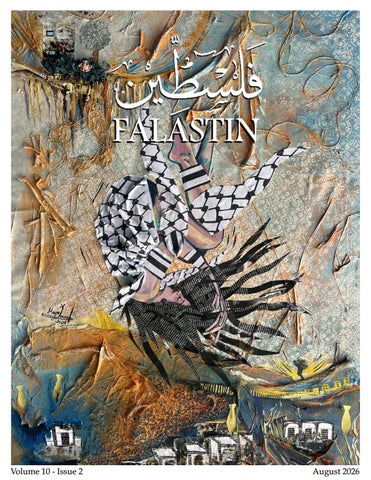
We would like to thank Maysa Yousef for providing this issue of Falastin with such moving cover art. Maysa Yousef is a contemporary visual artist from Gaza, Palestine with a degree in Nursing and Fine Arts (Painting and Photography) from Al-Aqsa University. Her artistic discipline range from drawing, photography, arabesque, graphics and contemporary arts as well as a leader of art workshops. Her art explores themes of war, human rights, and event commemoration. Maysa remains resilient and continues to create art even amongst the destruction.
973-253-6145 388 Lakeview Ave Clifton, NJ 07011
paccusa.org info@paccusa.org
Table of Contents 6.
why we don’t weep for the poets
7.
Wool & Home
8.
To Hide & Never Be Sought
12.
The Palestinian
14.
ماذا اقول
15.
Beneath the Palestinian Flag
18.
The Storm The Didn’t See Coming
21.
A Piece of Home Found at Saboon Maazeh
23.
Orphaned Love
26.
Invasive Canopy
27.
In My Homeland
28.
Growing Up With a Homeland You Know Through Stories
30.
Gaza Diary
31.
Fraternal Failure
32.
The Story of the Land Course Reflection
By Ibtisam Mohammad Abujad By Anonymous
By Sadeen Al Jallad By Jenna Jabr
ليىل عبده.د
By Ikram Gaber Khalil By Qamar Bazar
By Rania Mustafa By Fadi Basem
By Habiba Tayeh By Sama Shaheen
By Salma Azazmeh By Salaam
By Abdulkareem Juabeh By Layan Ahmed
Letter from the Editor in Chief Welcome to Falastin Volume 10, Issue 2, focusing on Palestinian Made, a theme rooted in the belief that to create as a Palestinian and for the Palestinian story is to resist erasure, and that to share the stories and art that remind us of where Palestine continues to appear is to be one step closer to the homeland. This collection is a celebration of makers beyond the page, from art painted in Gaza to a farm preserving traditions through practice, from transforming tatreez patterns into acrylic paint to planting poppies to remind us of the homeland. This issue is more than an archive of Palestine; it centers hands that make, knowledge we learn, and bearing witness to the ongoing genocide. Because Palestine is not only a land under occupation, it is a culture that refuses to be occupied out of existence. This work of preservation is not just art, but it is also a part of the ongoing education for the next generation. A course reflection by Layan Ahmed is included, from our new course offered this past spring titled The Story of the Land. This reflection models for us what it means to continue learning about Palestine beyond political analyses from a distance, offering instead a true decolonial view that includes a living, breathing reality told through the voices of people who know the land as a partnership of nature and man. Then we have a piece by Ikram Gaber Khalil titled “Beneath the Palestinian Flag,” and it’s this story that captures what the theme Palestinian Made was made to honor. So often, when we speak of Palestinian heritage, we are drawn to the tangible: the embroidery, the food, the art, the land itself. And while those things are vital, Ikram’s reflection reminds us that the most profound inheritance is not always made by hand; she redefines Palestinian Made not as a product, but as a people: parents who arrived with nothing yet built everything, who planted roots in foreign soil without ever uprooting their identity, who understood that to be Palestinian is to carry your homeland in your faith, your generosity, and your unwavering commitment to family. What moves us is how she traces the arc of that legacy, from a small produce market to street signs bearing the Palestinian flag, from her mother’s kitchen to a cookbook that preserves flavors and memories for generations to come. This is not a story of loss; it is a story of endurance. It shows that Palestine is not a place you leave behind; it is a people you become, a way of being in the world that transforms every space you enter. Ikram’s words are a testament to the fact that the most powerful creations are not objects, but the values and love passed down from those who came before us. This issue has taken us from the soil of ancestral villages to the streets of Paterson, from learning workshops where counter-memory is taught to the kitchens and farms that preserve the lineage. We have seen Palestine in a father’s hands carrying a child, in a mother’s measured spices, in the defiant poppies growing, and in the ways artists still paint amid a genocide, as we’ve seen with Maysa Yousef from Gaza. These pieces proclaim that Palestinians do not wait for permission to exist; they exist through every act of creation by them and for them. To the makers and the witnesses, thank you for reminding us that Palestine is not a memory; it is a living, breathing, ever-unfolding story. May we continue to make and to remember, and to rise until every Palestinian finds their way home. Until freedom from the river to the sea. In solidarity, Manar Hussein Editor-in-Chief of Falastin
4
Among Poppies Artwork by Kholoud Hammad
5
why we don’t weep for the poets By Ibtisam Mohammad Abujad while the ghasibeen thieve history when they pillage the poets draw forts and they protect their people and when everyone moves away, they stay they write stories so that children know Where was our home and where did ancestors go? How did we get here? Is there a day when Gazans won’t live in fear? mama, the mothers would ask their children don’t you see what the poet said if we leave our pasts, our future will be dead remember the olive tree, and sito, and the homes they weren’t rubble once, there were masajid with gold domes and the mu’athin would call us and we would oblige because we were together and there weren’t any sides the children would repeat this as if it was a nursery rhyme, time after time, until they were sleeping, no longer weeping they grow into young women and men they would read about the poets whose words weren’t bullets and jihad wasn’t violence not a job for the few justice never hides from view we see it in the elder women’s prayers when they bow heads on mats we see it in the sounds of children when they make their family laugh tomorrow when Ramadan comes there will be school books and fireside tales then, the bombs rain down frozen ice, they sting sharp, but talk nice covered faces from the shadows, they label the call when people become shadows staining the wall we do not weep for the poet but what if poets fall if we don’t tell the truth, painful, are there even poets at all?
The Sky Still Belongs to Us Artwork by Zaib Un Nisa we don’t weep for the poets because their words were bullets or were they the shelter protecting our people when showers of freezing rain inflicted pain soothing rhymes the sounds of cracking shells they were the armor that protected the boys who threw stones and the girls who made sand into broken bread and the women who would hide fedayeen under the bed we don’t weep for the poets because they know how to throw they target the colonizer with tsunamis and blow but are the tsunamis native to Palestine don’t we have hills that are hard to climb and the trenches buried deep beneath the village
6
Wool & Home By Anonymous Black Sheep feeds off burnt grass brittle in pesticides. Black Sheep holds its wool close to its skin like golden heirlooms received with pride. Dark hair with curly threads that take shape like constellations. Cool skies surrounding flocks with embroidered stories held high, all told by withering voices passing and passing and passing by. Black Sheep in a flock of white snow, grazing behind western white fences, on hills of blood and oil and bones. Black Sheep wander all the way home. Black Sheep call colorless sleepers back to where we are all from. “Come and dye your wool with sumac.” Fill your vision with stories written in crumbled stones. Tender sweet grasses of a borderless home.
We Will Always Return Artwork by Shahed Daabs
Guardians of Memory Artwork by Safaa Abueid
7
To Hide & Never Be Sought By Sadeen Al Jallad They had closed the town’s entrance with an earth mound. The only way to the hospital stood behind me, with a shovel spearing my back, and ferociously digging out the remains of my power. I was constrained to take a route I have been evading. “It looks like we have to pass my parents’ house,” I informed my wife, Hanady.
silence, I spoke. “You see…” I was dazed, and although I was in the only supermarket in town, I failed to foresee the probable encounter. “There is a mound blocking the entrance of the neighboring town…”. “Are you seriously explaining why you’re here?” she frowned. “Of course not!” I replied. “Let me give you a ride home” Fate lured me into its intolerant grip. The ride took less than ten minutes. My wife was very happy to see Nadia, they have been friends since childhood. For the first time in so long, the car brimmed with their overjoyed laughs.
“Why don’t we stop by instead?” She asked. “It has been a while since we last saw aunt Suad.” The echo of her joy hopped from wall to wall in the chambers of my distant mind, but the sharp thump of my quivering heart set the final decision. “Not today, we are already late.”
“Don’t you want to say hi to mom?” asked Nadia. Before entering the town, I thought that driving would be a dire obligation, that I would find myself accelerating, but the longing man I abandoned under the debris of the past arose at the sight of the quaint houses and familiar faces. He gleefully slowed me down, and walked me through the alleys.
Hanady reached for the buckle to unfasten her seatbelt. She intended to accept the abrupt invitation, but I instantly interrupted her unuttered response. “We are already late for Hanady’s hospital appointment”. I could not tell her about the malignant illness settling in Hanady’s body. “She has a flu.” She has stage two breast cancer, and it is settling and spreading in her body. Concealing the truth is appropriate sometimes. I wanted to flee. “Come on,” she pleaded. “It has been eight months since you last visited.”
I stopped by the local supermarket to get Hanady a cup of yogurt. She told me she got nauseous last time because she went to the session on an empty stomach. Vibrant boxes and shiny cans filled the racks. Such a sight would gladden aesthete eyes, but lamentably, the paradisiacal pathway commenced an inferno of alienation within me. I felt the smothering need to leave. I rushed to the fridge, and saw a familiar face. A sense of belonging was bestowed upon me, a person who speaks my language, a sibling who shared memories with me.
I surrendered. “Stay here,” I said to Hanady. I ploddingly walked towards the doorstep. My legs were begging earth to be swallowed whole. After father’s funeral, I centered all my quotidian choices and pivotal decisions around one single objective. I have been avoiding this undesired encounter by turning ordinary situations into excuses. “Mom has grown old.” Said Nadia as she walked me to the living room. “Her health worsened after dad’s death.”
I crossed paths with Nadia, my sister. It was not an impassioned reunion, we stood in front of each other for a few seconds, then to break the awkward
8
Continued on page 10
Sabr Artwork by Hiba Yassine
9
Nadia left me in the spacious embellished room, and went to the front yard to gab with her lifelong friend and pick tangerines. Mom was tranquilly sitting on the armchair with a spoon standing gracefully between her delicate fingers, and a plate of scrambled eggs nestling on her lap. She used to hate eggs, she deemed them inedible. She stared at me for a few minutes, but I was not saddened by her dull reaction. Decaying in her demented mind was an inevitable outcome, for my visits are brief and infrequent.
I did not respond to her, I could not. Dad’s name forcefully quietened all my attempts to think and explain. I furiously got into the car. She threw the bag of tangerines she picked through the open window. It hit my head, yet I didn’t scream. I wasn’t even angry. At that moment, my body solicited pain to redeem for its helplessness. “What terrible luck darling” Said Nadia to Hanady with a mournful laugh. “Spending your life with a lunatic must be exhausting.” She continued to pour her heart out into the empty air, having known it would later smother her. I left, and did not look behind.
“Nidal?” Confusedly, she asked. I was captured by the brute I hid from in every corner of my life. She called me by my father’s name. The tragedy possessed me, and I found myself reliving a dreadful day. Neither did dad die of old age, nor of a fatal disease. He was killed for harvesting the olives mothered by the tree my grandfather had planted. An Israeli soldier shot him in the head, and neglectfully left his corpse beneath the immortal leaves of the evergreen tree. A week after his funeral, I shaved my beard, and cut my hair shorter in an attempt to alter the reflection I see in the mirror, but it seems inexpungible. He still glares at my ineffectual brawny body with utter disappointment. My head is drenched in the blood of his guiltless hands. The human mind intrinsically assumes coherence, a result preceded by a concrete cause. He was harvesting olives. He was patiently allowing the tree to express its restful gratitude with his skillful fingers and welcoming palms. So, what caused such a ruthless murder? What unforgivable crime did he commit?
I glanced at my wife, and by her posture, I could tell she was offended. “What was that about?” she mumbled. “Enough!” I cried. At last, we arrived at the hospital. I desired to be spared after the unpleasant journey, so I refused to enter with Hanady. I decided to never stay with her during the chemo sessions, for I was sickened by her incomprehensible pessimism the first time I accompanied her. She kept talking about how terrible of a mother she is for weeping in front of our children when telling them about her condition. Our son failed his science test, she placed the blame on the rapacious tumor. She said it would have been different for him if she was present. She said she misses working at the press. She misses writing articles, and her colleagues. And regardless of the sweet words I besprinkle her heart with every morning, her hysterical fear of hair loss possesses her. It pains my fidelitous heart and exhausts her fragile body, this mistrust. She says that eventually, there will be no trace of her, nothing left. But she will survive, she definitely will. It is asserted by esteemed scientists and professional doctors. Her condition is not fatal, yet she panics about everything.
I rushed out the door without answering her, and although she asked why I was leaving, I chose not to look back, for I would have crumbled. “Where do you think you’re going?” exclaimed Nadia. She was bewildered by my reaction, as she was not there when the petrifying conversation began. “What were you expecting?” She unleashed a bawl that had been suppressed for too long.
10
I went to see my friend Saeed. I met him downtown after having a quarrel with my wife. He owns a small unadorned café, but there is vivid graffiti on the wall outside. We usually sit at the table in the corner, and have diverting discussions about work, people, memories and all sorts of uneventful tidings. He is a jolly man whose witty jokes would enlighten my darkest days. The café was in ruins when I arrived. Its entrance was carpeted in shards of glass. The windows were all shattered, and the chairs were deliberately thrown on the thorny floor. There was no one inside but Saeed. He was sitting on the battered brown chair, holding a calculator in his left hand, and a blue ball pen in his right. He was immersing himself in the muddled scribbles and unsolved equations on his notepad. In spite of the miserable state the place was in, I chose to enter.
“What happened?” I patted him on the back. “Zionists.” He dug his thumb in the pen cap. “It is probably the graffiti.” He smiled wanly. “Huh?” “Vandalism.” I looked out the broken window with the aim of finding pleasure amidst the inexplicable agony. There were three friends playing hide-and-seek in the playground facing the café. After several swift rounds, the little boy refrained from looking for a place to hide, instead, he stood behind the girl and the other boy with crossed arms as they were counting to ten. When they finished, they turned around, and were astonished by the sight of him. “There is nowhere to hide.” He shouted. “I even hid above the tree and you found me in no time.” “Just find somewhere to hide.” Said the girl mockingly. “Just find another way.” “You are everywhere.”
Wasala Artwork by Maysa Yousef, Gaza
11
The Palestinian By Jenna Jabr That thobe became the beginning of a tradition. Every time my grandmother travels to Palestine, she brings back another one for me. Each dress carries its own patterns and colors, its own quiet story stitched into the fabric. Over the years, my collection grew, and so did my curiosity. Slowly, those dresses began to mean something more. They made me ask questions about the villages my family came from, about the traditions Palestinian women preserved, and about the land that shaped our history. What began as a simple gift became a key to a deeper understanding of who I am. Identity is often described as something we are born with, but I have come to believe it’s something we build, stitch by stitch, moment by moment. That single moment set me on a path of learning, and I began to feel proud to say, “I am Palestinian.” But being Palestinian is not just about pride. In a world that works so hard to erase us, I learned that I have a responsibility to carry Palestine with me wherever I go. I respond to the forces that try to silence us with my voice, my art, and my commitment to preserving my heritage. Being Palestinian became my purpose. It was my duty to educate myself, to pass down our traditions to future generations, and to ensure that our culture is never forgotten.
The Palestinian Tatreez Photo Credit: Jenna Jabr The first time I held a Palestinian thobe in my hands, I was eight years old. My grandmother had just returned from Palestine, and the suitcase still smelled faintly of travel and the unfamiliar scent of a place I had never seen but somehow belonged to. She unfolded the dress slowly, letting the fabric spill across her lap. Red embroidery ran across the chest and sleeves in careful patterns, each stitch so small and precise. “This is for you,” she said.
My first thobe also introduced me to tatreez, the intricate embroidery that decorates Palestinian dresses. Tatreez symbolizes resistance, resilience, and identity. Each stitch carries the stories of Palestinian women, the strength of our ancestors, and the love we have for our homeland.
Before my grandparents left for their trip, my grandmother had asked me what I wanted her to bring back. I remember hesitating, searching for an answer I did not have. Palestine was something I had heard about in conversations between adults, in stories about family members and villages. It was a place my parents and grandparents loved deeply, yet to me it felt distant, more like a story than a real place.
For those of us living in the diaspora, tatreez has become a way of staying connected to our roots because it is a form of storytelling. When my grandmother saw how drawn I was to tatreez, she began handing down the pieces our family
12
had carefully preserved. One day, she gave me something I will always consider our greatest treasure: the only hand-stitched thobe in our family, sewn by my great-great-grandmother. Holding it felt like holding history. The stitches were not perfectly uniform, but that was what made them beautiful. Each one had been placed by her hands decades ago, long before I was born, long before my family scattered across different countries and continents. It seemed to carry patience, care, and love across generations. In that instant, I knew I wanted to create my own thobe one day. I imagined it being passed down through our family until it reached the hands of another girl who loved Palestine as deeply as I do. Over the years, I poured myself into my art, using tatreez as a way to preserve my identity. Thus far, my most cherished piece is an image of a Palestinian woman dressed proudly in her thobe. When I look at her, I see myself: a woman who is anchored by her roots and refuses to be erased. Choosing to create art that preserves my culture feels like a moral responsibility, and through every stitch, I carry Palestine with me.
Tatreez Photo Credit: Leena Hosien
me because before I left, she offered to teach me. In that moment, I felt an overwhelming joy. Through Hanan, I saw the long lineage of Palestinian women who have carried our culture forward through generations; women who refused to let their identity be erased, who protected it through craft, memory, and community. And suddenly, I understood that I was part of that lineage too.
I also learned that identity is not something we form alone. It’s shaped by the people around us: their stories, their struggles, and their love. One of the most important people in my journey has been Hanan Hamed. When I once visited her home, I felt like I had been transported to Palestine from the moment I stepped inside. Every wall was adorned with Palestinian arts and crafts, most of them handmade by Hanan herself. We sat together for hours as she shared her stories. She shared what it was like to grow up under occupation, describing the hardships that Palestinians face every day. She talked about weaving straw, stitching her own thobe, and teaching dabka to Palestinian youth. As I listened, I felt something stirring inside me. It was a deep longing to learn everything she described. The crafts, the stories, the traditions she carried so naturally felt like pieces of a life I wanted to understand more fully. Perhaps she could see that in
In the end, every path in my life seems to lead back to the same truth: being Palestinian is my identity and my purpose. It shapes how I approach ethical decisions, how I see myself socially, and how I engage with issues of community and inclusion. Through art, conversations, and reflection, I have learned that I am part of something much larger than myself. I am part of a people whose existence is resistance. As Mahmoud Darwish wrote, “On this land, we have what makes life worth living.” For me, what makes life worth living is the honor of being Palestinian and the responsibility of ensuring that our story is never forgotten.
13
ماذا أقول...
د .ليىل عبده
وهل ترى األرض تحيا دومنا مطر
النطِق ََمن قد خاَنَ ُُه ال ََكِلِ ُُم وهل يقوى عىل ِ يكتُب القل ُُم وهل بغري ِِمدا ٍٍد ُ
وهل تعو ُُد إىل املحزوِنِ بهجُتُ ُُه
وهل تعو ُُد إىل املحزوِنِ بهجُتُ ُُه
يصدُح ط ٌٌري وهو يف ٍ قفٍص وكيف ُ
وكيف ََمن شحبت عينا ُُه يبتس ُُم
اعٌف أبدًا ً ماذا أقول ،وجرحي ر ٌ
ٍ والَس ََق ُُم مستوحٍش ه ّّد ُُه اإلعيا ُُء َ وليس من ٍ أحٍد للجر ِِح ينتق ُُم
أقوُل فقد ع ََّز ُ ماذا ُ املقاُل
ياااا أ ََّمتي :يف فؤادي ألف ََمب ََك ََي ٍٍة ملن أبوح مبا ألقا ُُه من أ ٍٍمل أهي العواص ُُم وهي اليوم يقهرها
خبأُت ُها ،فلمن أشكو وأحتك ُُم ِلِ ََمن؟ و ََمن يشتفي يل منك يا أُملُ
أم التامثيل من منهم سيسمع يل
يّضطر ُُم ُُحّكّامها ،وأتون الحقد ّ
قالوا العروبة جئنا يك نو ّّحدها
إين أرى عجبًاً أن يسمع الصن ُُم
واالشرتاكية الغ ّّراء كم َشَ ِِقيت قالوا فلسطني ،جئنا يك نحررها
عهدًا ً علينا ،فأين العه ُُد والقس ُُم بها الجامه ُُري ،والباغون كم َنَ ِِعموا
وها هي ذي األحداث ماثل ٌٌة
ِ فليشهِد الله والتاريخ واألم ُُم
بغداد ،هاهي نادتهم فام سمعوا
جاءت تكّذّب ما قالوا وما زعموا
تُهم مبئزرها أم شهوة الحكم َلَ ّّف ُ
نداءها ،أنيا ٌٌم أم بهم صم ُُم
أم حبهم للكرايس استب ّّد بهم
فاستعذبوها وظنوا أنهم ََغ ِِنموا
أم نّفّذوا ما شاء سادُت ُهم
وما دروا أنهم بالعار قد ُُو ِِصموا َفَ ُُهم لسادتهم ما شئَتَهم خد ُُم
14
Beneath the Palestinian Flag By Ikram Gaber Khalil to own a business; it was to build a better life for their family. Through honesty, hard work, and treating every customer like family, that small market grew into something much bigger than they ever imagined. It became a place where people felt welcome, friendships were formed, and our community found a second home. Growing up, I watched my parents give even when they had very little themselves. They taught us to help others without expecting anything in return, to welcome everyone with kindness, and to remember that feeding someone is one of the greatest acts of love. Those lessons shaped every one of us. Beneath the Palestinian Flag Photo Credit: Ikram Gaber Khalil
Today, when I see everything my brothers have accomplished, I know my parents would be incredibly proud. They took the strong foundation our parents built and expanded it while staying true to the same values of honesty, integrity, respect, and service. The business has grown, but the heart behind it has never changed.
When I saw the theme Palestinian Made, I didn’t think about something made by hand. I thought about my parents, Mohammad Odeh Gaber and Halema Salama Gaber. Everything I am today began with them.
Each of us carries our parents’ legacy in a different way.
My parents were born and raised in Beit Anan, Palestine. They came to America carrying very little, but they brought something far more valuable than money. They brought their faith, their values, their work ethic, and their deep love for family and community.
My brothers continue growing the family business that began with my parents’ dream. I chose to preserve another part of our family’s heritage. After my mother, Halema Salama Gaber, passed away, I realized I didn’t just want to remember her recipes, I wanted to preserve them. That is why I wrote Sahtein Cooking from the Heart, preserving Palestinian flavors, empowering future generations.
Like so many Palestinians, they had to start over. They worked long days, made countless sacrifices, and never complained. They believed that if you worked hard, treated people with kindness, and trusted Allah, He would open doors.
Every recipe tells a story of our family, our culture, and the love she poured into every meal. She always told me, “If you cook from the heart, your food will
With determination and courage, they started a small produce market. Their dream wasn’t simply
15
Continued on next page
taste delicious.” Those words continue to guide me. One of the greatest honors our family has ever received was seeing the City of Paterson recognize my parents by naming streets after them. Even more meaningful, those street signs proudly display the Palestinian flag alongside their names. Every time I see them, I am reminded that although my parents built their lives in America, they never let go of their Palestinian identity. They carried Palestine with them, in their faith, their generosity, their work, and the way they cared for others. When I think about Palestinian Made, I don’t think about a product. I think about my parents. They built a business from the ground up. They built a community. They raised a family rooted in faith, compassion, and purpose. They taught us to work hard, to serve others, and to be proud of who we are and where we come from. Their greatest achievement wasn’t the produce market. It was the legacy they left behind in their children, grandchildren, and great-grandchildren. The seeds that Mohammad Odeh Gaber and Halema Salama Gaber planted continue to grow. They live on through my brothers, who continue expanding the family business, through my cookbook that preserves my mother’s recipes, and through every act of kindness, generosity, and service inspired by their example. Whenever I stand beneath those street signs and see the Palestinian flag flying beside their names, I am reminded that a person’s greatest legacy is not measured by what they own, but by the lives they touch. Beneath the Palestinian Flag Photo Credit: Ikram Gaber Khalil
That, to me, is what it truly means to be Palestinian Made.
16
Hills of Beit Anan Photo Credit: Barry Mahmoud
17
The Storm They Didn’t See Coming By Qamar Bazar
Abu Salem, Nablus Soap Factory Photo Credit: Tamara Habash A few weeks ago, I was scrolling through LinkedIn during a break between classes, half-eating a bagel and half-watching the clock for my next meeting. There was a post by someone I used to know, smiling in front of the Supreme Court, wearing a polished suit and holding a badge for some elite summer program. I froze. I should’ve been happy for her. I wasn’t. My first thought wasn’t Wow, she worked hard. Instead, it was I’m drowning. I closed the app, my heart racing. I had just finished preparing a lesson for my students as an Arabic instructor, had three papers due, and had an internship meeting that night. However, none of it seemed to matter.
more because if I stop even for a second, I’ll lose momentum and never catch up again. It’s like I’m running in a marathon I didn’t sign up for, but I can’t quit either. I want my parents to see who I’ve become and feel proud, but more than that, I want to be proud of myself.
That’s the part no one ever talks about: success never feels like enough because I’m not sure what “enough” is defined as. What does it mean to feel satisfied? Does it mean feeling proud? I got the interview. I got the job. I teach a class. Instead of feeling accomplished, I feel a sense of relief that I didn’t screw up. Then, pressure. Pressure to do
The ACHA’s Spring 2024 survey revealed that 76% of students experienced moderate to high stress in the past month. A 2025 meta-analysis across 30 studies involving 11,483 participants found a 62% prevalence of impostor syndrome among students and healthcare service providers. Unfortunately, we scroll through highlight reels online, forgetting they’re not the whole picture. We waste twenty-four
My inner voice is lying to me; it’s the threat that chains me back from going above and beyond. It repeats all the attractive words a boy might shout on the streets of Brooklyn, “gorgeous” or “hot,” but what does appearance mean with no confidence? Impostor syndrome convinces us that success is merely a matter of luck.
18
hours of our day comparing our insides to everyone else’s outsides.
I’ve learned that patience is the key to unlocking the doors I want to walk through. But waiting for confidence can mean postponing it forever. Day by day, you’ll build trust and come to comprehend that perhaps the goal isn’t to have it all figured out but to be selfless when you need to be.
Pause! What if impostor syndrome isn’t the issue? What if the actual problem isn’t how we feel but the way society or the environments we surround ourselves with make us feel like we don’t matter? Unless we’re overachieving and smiling for photos just to say, “We did it”? Now, I understand. We live in a world that praises perfection and rarely unravels its failures. Our discomfort makes us feel like we should be placed in a psych ward. But the illness within us is that we strive to fit in, even if everything is not okay.
I’ve realized I do this more than I want to admit. I tell myself it’s just motivation, but it’s the anxiety of falling behind, not being good enough, and wasting potential. I measure my worth by how busy I am; if I’m not doing everything, it feels like I’m doing nothing. That pressure comes from me pushing myself harder than anyone ever has because no one has my back the way I do.
Time for TikTok! There were many wedding videos of slow-motion twirls, hands covered in henna, and captions like “just married my best friend” or “found my naseeb” on my for you page. I paused on a girl dancing in a thobe and smiling. It reminded me of what others expected me to want, not because I wanted her life for myself.
I feel clueless, not knowing what I’m chasing. I’m trying to figure it out. Some days, I want to teach. On other days, I think about counseling and how badly I want to make a human impact that will make a difference. But nothing ever feels conclusive. Am I choosing this because I love it or because I don’t know what I love?
In Arab culture, there is a recurring theme, but this time it is marriage. Both of my ears have heard it all before; “3akoublk.” Marriage is scary. What if he mistakes my ambition for arrogance and asks me to shrink so he can feel bigger? What if he’s a serial killer like that actor Joe Goldberg from “You”?
Celebrating has always felt uncomfortable as if I’m wasting time. Stopping to say what I’ve done will only remind me of what I haven’t done yet. Even when I achieved something meaningful, like when I was hired as a Legal Tech Marketing Intern, I smiled for five minutes before my brain started sprinting: Okay, now what’s next? What comes after this?
I lay myself on my bed, staring at the ceiling. It’s my whole life, following the five stages of grief. That fear didn’t paralyze me. It ignited something. Who am I kidding? Of course, I want love. Who wouldn’t want to be cherished, to be treated like a princess? But not at the cost of losing myself. I’m worth more than a cigarette that gets lit up and later stomped on to turn off the smoke. I want my degree, my voice, my name built through the smell of sweat that not even deodorant can hide and the drip of it running down my forehead.
I’ve seen how quickly life moves and how easily it feels like the pace is beyond my reach. That’s why I don’t stop. I face the storm so that if another one hits, I’m prepared. Why do I wake up early and over-plan? Or apply even when I know I’m not ready? And even when I move, it still sometimes feels like the brakes are on. My poor engine. Lately, I’ve realized I’m not behind. Perhaps I haven’t let myself breathe enough to notice how far I’ve come. I mean, I’m working. I’m learning. I teach Arabic to kids who laugh and struggle and try, just like I do. I’m still showing up to life, even when it feels weighty.
Because if everything else falls apart, I need to know that I won’t. I’m not waiting to be chosen. I’m choosing myself first. That night became a shift in my life; it gave me direction. I was working towards a life I could call my own, a life where I could breathe and make choices without fear.
I must avoid comparing my life to other people’s highlight reels. Because what I have and am building is real, even if it’s not loud, shiny, or shared in a perfect post.
19
Continued on next page
Moonlight Artwork by Safiyyah Khan, age 11 I’ve accepted the reality that clarity isn’t my cup of tea. The story isn’t about having all your questions answered. It’s about discussing the confusion honestly and admitting I’m scared. It’s about showing up regardless.
love or sacrifices for granted. Someone who carried their dreams alongside her own. Someone who kept going because they did. But most importantly, this is about me. Because for so long, I’ve yearned to be ahead of every milestone I’ve earned with my knowledge. I’ve been waiting to feel like I’ve accomplished enough before permitting myself to feel happy, calm, or satisfied. But the real work is learning to maintain dignity amid the mess. I’m still worth celebrating, even here, doubtful and tired, figuring it out.
I’m learning that uncertainty doesn’t mean failure. It means I’m in motion. Even if it is messy, it’s proof of life. So, if I can’t always be proud, I can at least be present. Still, deep down, I want more than presence; I want purpose. I want to accumulate that moment when everything slows down, and I can tell myself, you made it through, not for a title, job, or even a degree, but for the resilience it took to keep going when I didn’t know where I was headed. I want to feel the significance of my work, not just a breath of relief that I didn’t fall behind, but a sense of fulfillment that I’ve built something steady with my own hands. I tell myself, I want guidance. But what I want is validation that all my hard work is leading somewhere.
I want a life that honors the effort, not just the outcome. A life where I can pause without guilt, where I feel the air without thinking about the next thing, and where I can look in the mirror and see someone full of potential. I hope my parents will look at me and see everything they dreamed possible reflected in me. But more than that, one day, I hope to sit still, proud, unshaken, free to rest without fear. A reminder to you: we aren’t supposed to have the code cracked once. Everything takes time and is beautiful in its timing.
I want my parents to see it too. To know that everything they gave up, the hours my father worked, the hopes they folded into me like letters, the miles they traveled from overseas to America, the money they spent on my tuition, even when it meant sacrificing their comfort, wasn’t disregarded. I want them to see someone who didn’t take their
Until then, I’m the storm they didn’t see coming: relentless, unleashed, and unstoppable.
20
A Piece of Home Found at Saboon Maazeh By Rania Mustafa The best part of my job is meeting people. That’s how I ended up at Saboon Maazeh in the first place.
York. I couldn’t stop talking about it when we got home.
My cousin Lana Mustafa, a local urban farmer herself (and founder of Roots of Resilience - an organization that helps support Palestinian Farmers), told me about an inspiring Palestinian farmer doing amazing things and said I had to meet her. So I did.
A month later, I went back. This time with my mom and my sisters, who’d just returned from Palestine themselves. They walked onto that land still carrying it with them, in a way, and you could see it. We cut Mlokhia, guessed the name of the plants, and picked tomatoes together. We sat in on the soap workshop and learned how olive oil and lye, given enough time and patience, turn into something you can hold in your hand.
A little about Joy Youwakim: she runs Saboon Maazeh, a farm and soap workshop dedicated to preserving SWANA heritage. She grows heirloom seeds endangered by the ecocide in Palestine, seeds she sends to the Palestine Heirloom Seed Library and to Buzurna Juzurna Library in Lebanon. She teaches soap-making workshops and hosts mlukhiyye and tomato pick-your-own every Saturday from mid-July to mid-September. Joy is a soil scientist, a farmer, and a soap maker, and she’s working to build a soap museum and educational farm heritage site right here in the Lower Hudson Valley.
One of the khaltos who joined us brought a homecooked meal to share, laid it all out right there on the farm, and for a few hours it felt like we’d been transported into the fields of Palestine.
As PACC, we set up two trips to Joy’s farm that summer, and the rest is history. The first trip, I brought my husband, my kids, and my in-laws. I figured it’d be a nice outing, nothing more than that. Then we got there. Mlukhiyye growing in neat rows. Tomatoes heavy on the vine, ready to pick. Joy walked us through it all, pointing out which seeds came from where, which ones were disappearing because of what’s happening to Palestinian land, which ones she was fighting to keep alive. I’m a fala7a. The land is always my way home. Walking through that field with my kids, watching them reach out and touch the mlukhiyye leaves, I felt a kind of peace I only feel when I’m on Palestinian soil; except I wasn’t on Palestinian soil. I was in New
PACC Trip to Saboon Maazeh Photo Credit: Joy Youwakim
21
My Lost Home Installation Photo Credit: Mohammed Musallam
22
Orphaned Love By Fadi Basem
Portrait of A Family in Gaza Artwork by Jude Muhsen I used to wake up early since I was 14. I would go to the bathroom, say my prayers, and make my breakfast. My breakfast consisted of tea with mint, a plate of fried eggplants, two boiled eggs, and two slices of toasted bread. It went for around $2 back then. Now, that would cost you!
sleeping and the walls are just pieces of cloth,” I added. “The connection is better in the early hours of the day, and you need to make eye contact when talking to your mother,” she added, tugging the blanket from above me.
Since the war began, I have not gotten up before 6 a.m. The day before yesterday, I was awakened by a phone - my mother talking to her brother.
“Sorry, Mom. Forgive me. You know how the war affects our behaviour,” I murmured.
“You’d better call him later,” I said, pulling the thin blanket over me. “You know the neighbours are
“Oh God, Fadi makes jokes in the first moments of waking up,” she replied, grinding her teeth.
23
Continued on next page
“Okay, get up; the long line is waiting for you to fill the gallons,” she said, trying to sting me with her words. We laughed. I took my phone to see the latest updates on social media. The first notification that popped up at the top of the screen was from Ehab. It was a message that read: “Good morning, it’s Ehab. Just checking on you. Tell me you’re fine.” I didn’t remember who Ehab was, so I entered his profile, hoping to find a picture that could save me from embarrassment. His profile picture was just a meme of a cartoon character. After replying, I asked him to remind me who he was. “I am Ehab with long red hair combed to the right. You taught me at Abdel Fattah School,” he sent back, sounding disappointed. “The one who sat next to the right wall of the class.” Ehab? He was a little boy with long, thin red hair combed to the right and only a NIKE tick marked on his boot and shirt. I used to let my students introduce themselves and mention things they were interested in. I remember when it was his turn to introduce himself. He stood up, adjusted his shirt, and gave a toothless smile. “My name is Ehab. I am 14 years old. I love my mother very much. I really love her. I love you. And that is all,” he said, sitting down with a smile stuck on his face. “Oh, thank you! To love your mother is something no one can question because she is your mother. But how can you express such love in just minutes of meeting someone?” I asked. His reply was that he loved English and its teachers.
tomatoes,” as she called them. She used to check his level and marks monthly, and I appreciated that. “Oh! Good morning, Ehab. I know you! How are you?” I replied. “I hope you’re doing well.” “I am fine. You know war has reached all of us. I lost,” he said, leaving his sentence unfinished. The three dots kept appearing in the chat, indicating he was writing more. I expected him to say that he lost his house or other personal belongings because 90% of people have lost those things. The three dots vanished, and a message appeared: “I lost my mother, father, and two brothers, with the house destroyed over them.” He concluded with a full stop. A tear dropped onto the screen as I read the phrase “my mother.” It reminded me of the first time I met Ehab, when he told me how much he loved his mom. I tried to reply, but words failed me. What could I write? Two minutes of silence passed; no words came to mind. “Do not be sorry. It’s okay,” he added, sensing my struggle for words. After 15 minutes of texting, I ended the chat by saying: “Do not hesitate to ask for help if you need it.” “All I need is to see the end of this war so that we can meet again,” he replied. Instead of strengthening him, he tried to strengthen me. Finally, we need to stop this war. If not for us, let it be for the children and mothers. Nothing is good about war except for its ending. So we have to put a finishing line on this genocide now and forever.
At 7 p.m., Ehab’s mother called me and asked me to take care of him. She wanted me to choose a suitable place for him away from bad friends or “bad
24
EXpulsion Artwork by Mohamed El Matmari
25
Invasive Canopy By Habiba Tayeh They offer nothing to the soil but the weight of their own expansion. It is an emerald shroud, feeding on the light of others, growing on destruction, while the world debates the ‘ethics’ of the scythe.
Within the botanical world, there is a kind of plant that destroys for its own growth. It starts with a whisper of green seeking a foothold. Now, permission isn’t a language it masters; hence, it starts eating up everything in its way. A vain belief lingers that it only craves and hungers for trees we never liked, or that it will eventually know where to stop.
And thus; until a collective movement is launched against that entity that should be considered a shared enemy, but is somehow overlooked due to greed, egocentrism, and worldly interests, all are and will be condemned to suffer.
However, invasive species and parasites have no recognition of borders or limits.
Poppies Artwork by Noor El-Sherbeini
26
In My Homeland By Sama Shaheen In my homeland, we do not fear the betrayal of a lover, or the treachery of a friend. We fear growing old before twenty.
with our souls for a loaf of bread. But we do not fear death, for we no longer love life, or find a way toward it!
We fear a shell that pulls you from the door of life into hell! We fear our living details being assassinated, until we become objects moving upon the earth. We fear, while waiting for a birth certificate, that a death certificate may come first! We fear loss for those sleeping in cradles. We fear our lives being wasted between fleeing missiles, and surviving beneath shelling. We fear destruction while searching
During the War Photo Credit: Maysa Yousef, Gaza
27
Growing Up With a Homeland You Know Through Stories By Salma Azazmeh
In all my life, I’ve always seen my friends travel back to their homelands for the summertime. And when they get back, I hear about the crazy adventures they went through, the childhood memories they recollect every time they walk through the halls of their childhood home.
The one about how Palestine was safe and a place where laughter filled the streets. The one about the memories in Palestine, not just the pain. Because for you to grieve something, you need to understand what you are grieving and how important these little moments were, and how horrible it is that they were stolen from us.
But, my personal favorite part of the stories they tell me was how nothing could compare to the feeling of being home.
So yes, the history of Palestine is so important. But the memories of Palestine make you understand just how important it is. Because, Palestine wasn’t always a place of war and genocide.
I was always envious of the way their faces lit up and their eyes sparkled whenever they talked about how great it was being in the land that raised them all their lives. I felt a sense of longing, an ache in my heart that never truly left.
It was also a place where people called it home. And one day, I hope to visit my homeland and make memories too.
All I know about my country was just stories I’ve been told, about the history and grief we Palestinian people went through. Stories about how resilient we are and how important it is to know who you are and where you are from. These stories made me into who I am today, and I will never forget them. Although, there were some stories missing. Forgotten ones in the midst of the war and history lessons. The ones that are filled with memories and laughter. The one about my grandma running around in her childhood home with her mother chasing her and giggling loudly. The one about my grandma and her siblings running around in the fields, picking fruits from the trees, getting full just by figs and apples, and coming home with juice covered fingers.
Press Artwork by Andrea Stokes
28
Martyrs and Witnesses - Nature bears witness to all Artwork by Jude Muhsen
29
Gaza Diary By Salaam Yesterday, at exactly 5:30 p.m., a familiar emptiness weighed on me, as if boredom had become a cruel companion, shadowing every step I take. I decided to leave the tent, to walk through the dark streets, seeking solace in the whispers of the wind, sharing my burdens with the silent night. Of course, I could not leave without my phone, for in these times of war, a single call could bring unforeseen danger.
selling glowing balls, radiant with colors that seem to defy the darkness surrounding us. Instinctively, I approached, mesmerized by their light, a rare glimmer of hope I hadn’t felt in years. The vendor quoted five dollars. Relief washed over me – it was attainable, a small joy after months of hardship and suffering that I’d love traces in our hearts and our home. I paid without hesitation, grasping the glowing sphere, as if it contained fragments of forgotten happiness.
My little son protested loudly, insisting I leave my phone behind, so he could watch YouTube. Our usual argument erupted, voices clashing in the quiet of the tent, until my mother intervened, offering a compromise he could borrow her phone, allowing me to step outside unburdened. Reluctantly, I handed it over, and finally, I was free to breathe in the streets beyond our fragile walls.
Walking down the street, I felt transformed, a child again despite my twenty-seven years. The ball pulsed in my hands, a fragile beacon of light, attracting the curious gazes of passersby. Yet their stares mattered little; for the first time in a long while, I felt an unburdened joy, a fleeting escape from the reality that binds us.
As I wandered for half an hour, lost in the dim glow of the city, a small stall caught my eye. A vendor was
Overlook Artwork by Mohamed El Matmari
30
Fraternal Failure
By Abdulkareem Juabe Our grandfather mocked our father, “What are you to do with only one son and four daughters?” I was born to fulfill the purpose of an old man’s cane — Yet I have grown to love his name; For you’re bound to the same syllables. Brothers born on 84 and 02, You were an adult the moment I opened my eyes, Changed my diapers and laughed at my cries. When we visit our old house at Eid, I catch a glimpse of your room, Where I used to sit on your leg in front of the PC. We watched music clips that starred the women on your posters, They’re still singing in the headphones you bought me as I grew older. I keep returning in my dreams to when I was a child on your shoulders, Browsing CDs in the video store, pointing at films I was too young for. And I wake up in a bed wet with nostalgia and shame — Because for twenty-three years my weight has stayed the same, I never outgrew your shoulders. You were a school-kid throwing stones at tanks, Yet I run away from the checkpoint’s soldiers.
MY HEART (Acrylic on Flag) Photo Credit: Marguerite Dabaie
31
The Story of the Land Course Reflection By Layan Ahmed The Story of the Land is one of the most enlightening classes I have ever enrolled in. The class has enabled me to learn about the history of Palestine in relation to the lives of the people themselves, from their memories and narratives. One of the many lessons that stood out in my mind was the notion of countermemory. With the help of Dr. Rosemary Sayigh’s research on Nakba and oral history, we learned that history is truly about the memory of people. Hearing the testimonies of the survivors and the stories pertaining to Deir Yassin made me understand that personal memories keep alive the things that would otherwise get lost in history. Furthermore, my understanding of Jerusalem and the ways through which the history of a place could be read from architecture and the layout of a city became much clearer after reading a text by Rashid Khalidi. I learned how various communities and governments influenced the city of Jerusalem through history. The Old City, Al-Aqsa Mosque, Bab al-Khalil, and the Moroccan
Quarter were a few of the sites which taught me the links between politics, identity, and geography. The demolition of the Moroccan Quarter in 1967 also came as a big surprise for me. Another significant aspect of the course was identity. We talked about how identity can be formed through such aspects as religion, nationality, race, class, and coloniality. The works of Edward Said and Frantz Fanon that were explored in class made me realize how important it is to analyze the issue of history and power relations in terms of identity formation. The concepts are particularly useful as I continue exploring my Palestinian identity. In summary, the lessons learned from this course are that it is important to recall history since it will make one realize the concept of justice, identity, and belonging. This course has made me realize that history is not all about facts but also about people and their stories. This is an excellent course that I would recommend anyone interested in history, politics, architecture, and social justice to take.
Growing Poppies Photo Credit: Joy Youwakim
32
Beit Anan Photo Credit: Barry Mahmoud
33
. Would you like to see your advertisement next? Contact us now!
www.paccusa.org
388 Lakeview Ave, Clifton, NJ 07011
34
35
1107 Main Street Paterson, NJ 07503 (973) 925-4475 (973) 925-4405 (973) 925-4474
info@eagletaxnj.com
36
MUJTABA CLINIC PRIMARY CARE
I URGENT I WEIGHT LOSS PRIMARY CARE
WEIGHT LOSS URGENT CARE & & SICK VISITS PHYSICAL EXAMS CLIFTON & PATERSON
& WORK PHYSICALS SCHOOL & & TRT MEN ’ S HEALTH & MEN’S
Walk-Ins Welcome Same-Day Appointments CALL NOW: 973-200-2430
WOMEN ’ S HEALTH WOMEN’S
CLIFTON OFFICE
PATERSON OFFICE
QUEENS, NY OFFICE
859 Clifton Ave Clifton, NJ 07013
624–628 Main St Paterson, NJ 07503
104-26 Roosevelt Ave Queens, NY 11368
www.mujtabaclinic.com
37
LOOKING TO SELL OR BUY A HOUSE? WANT TO INVEST IN PROPERTIES? INTERESTED IN STARTING YOUR CAREER IN REAL ESTATE?
38
39
26
40