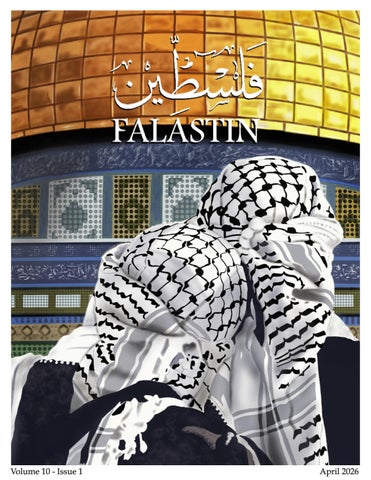
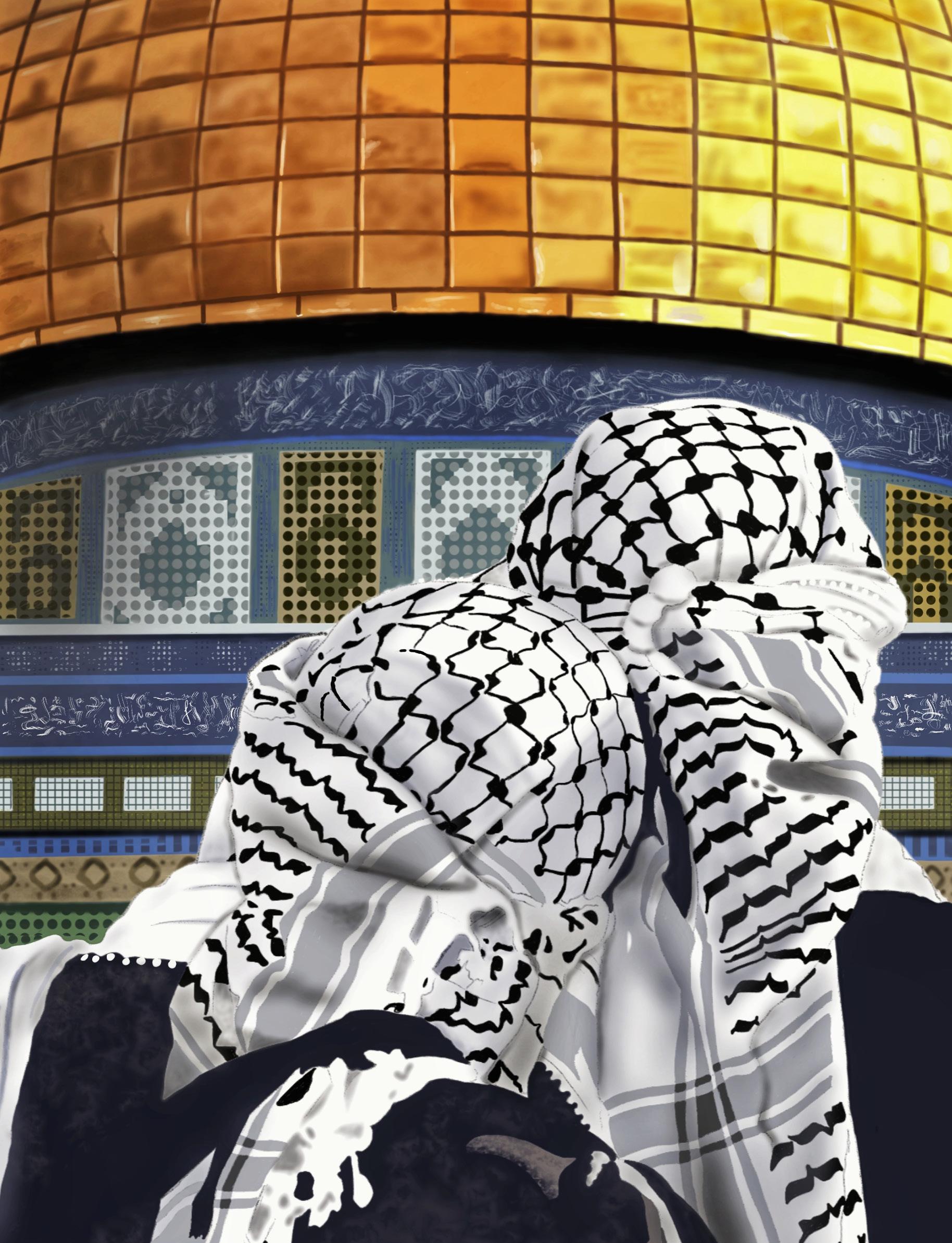
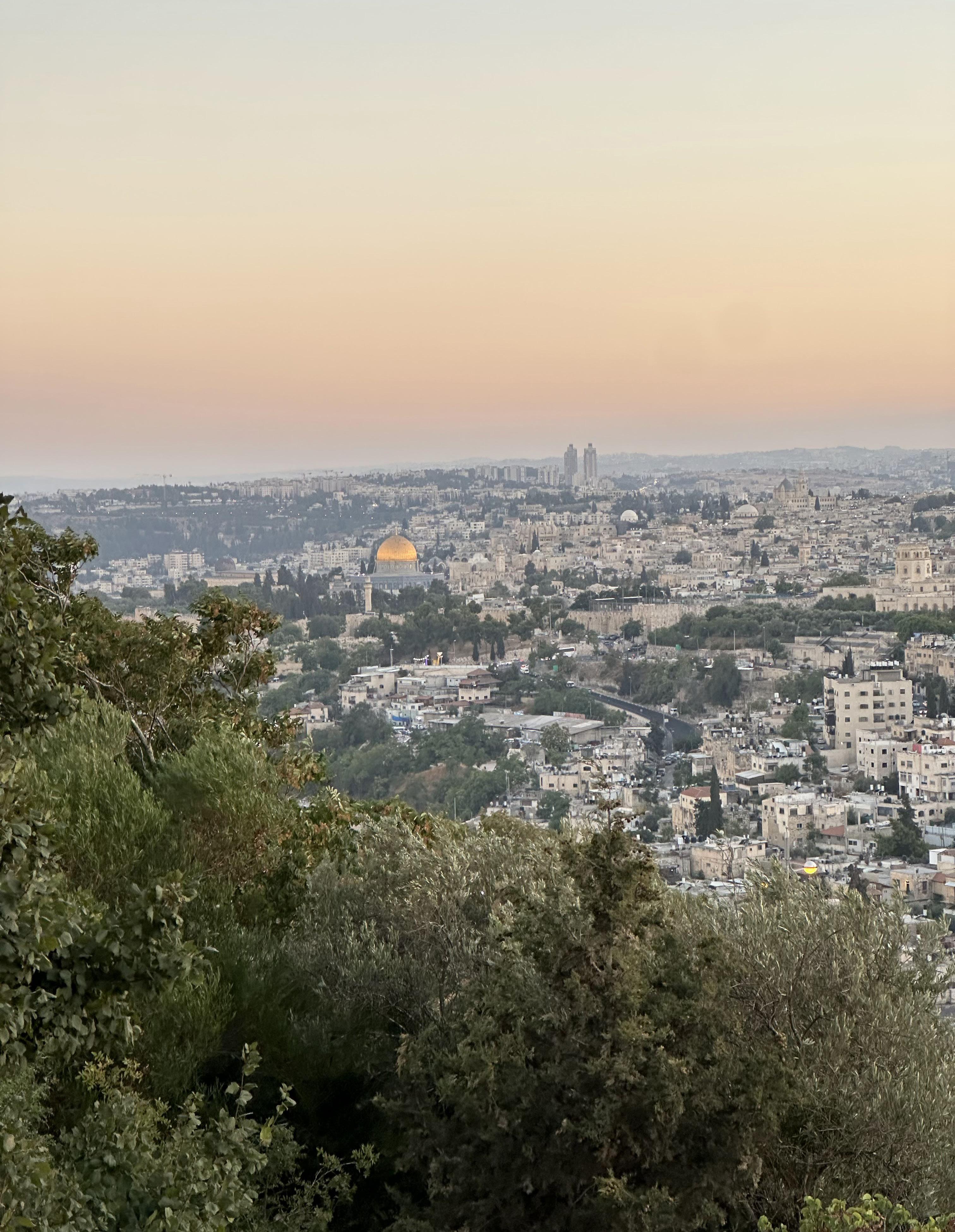
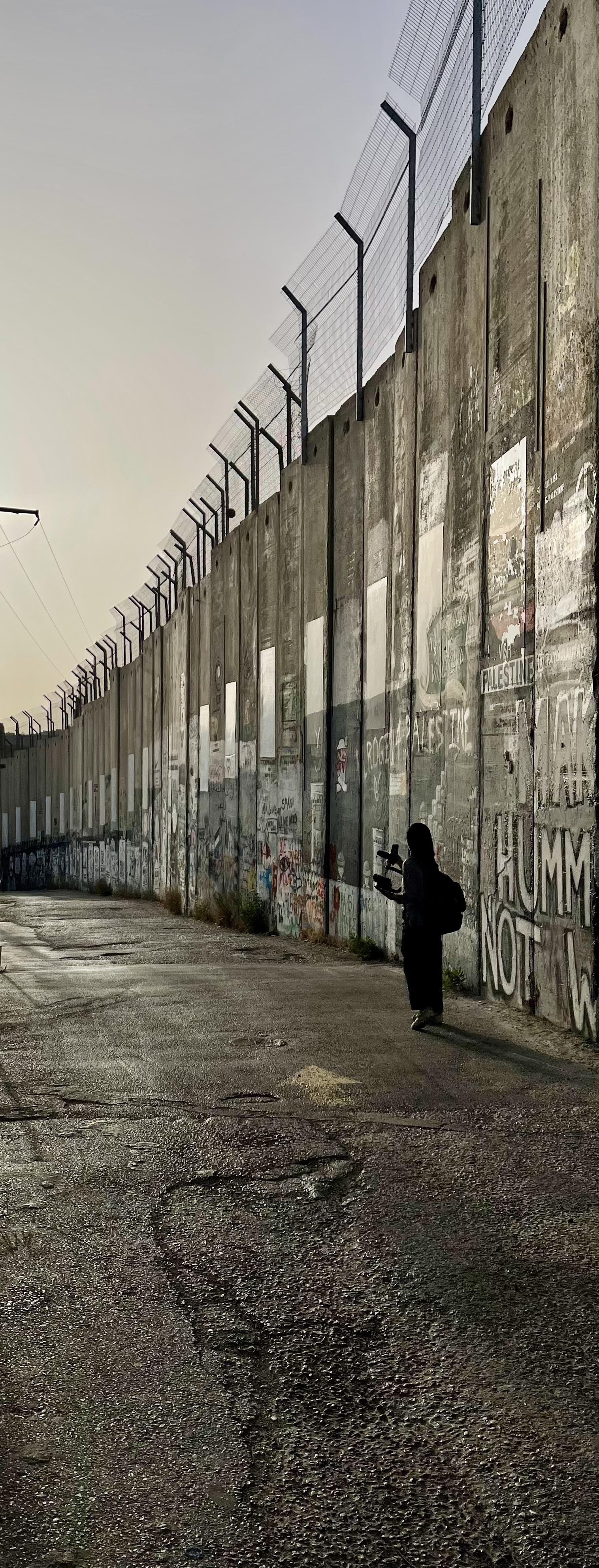
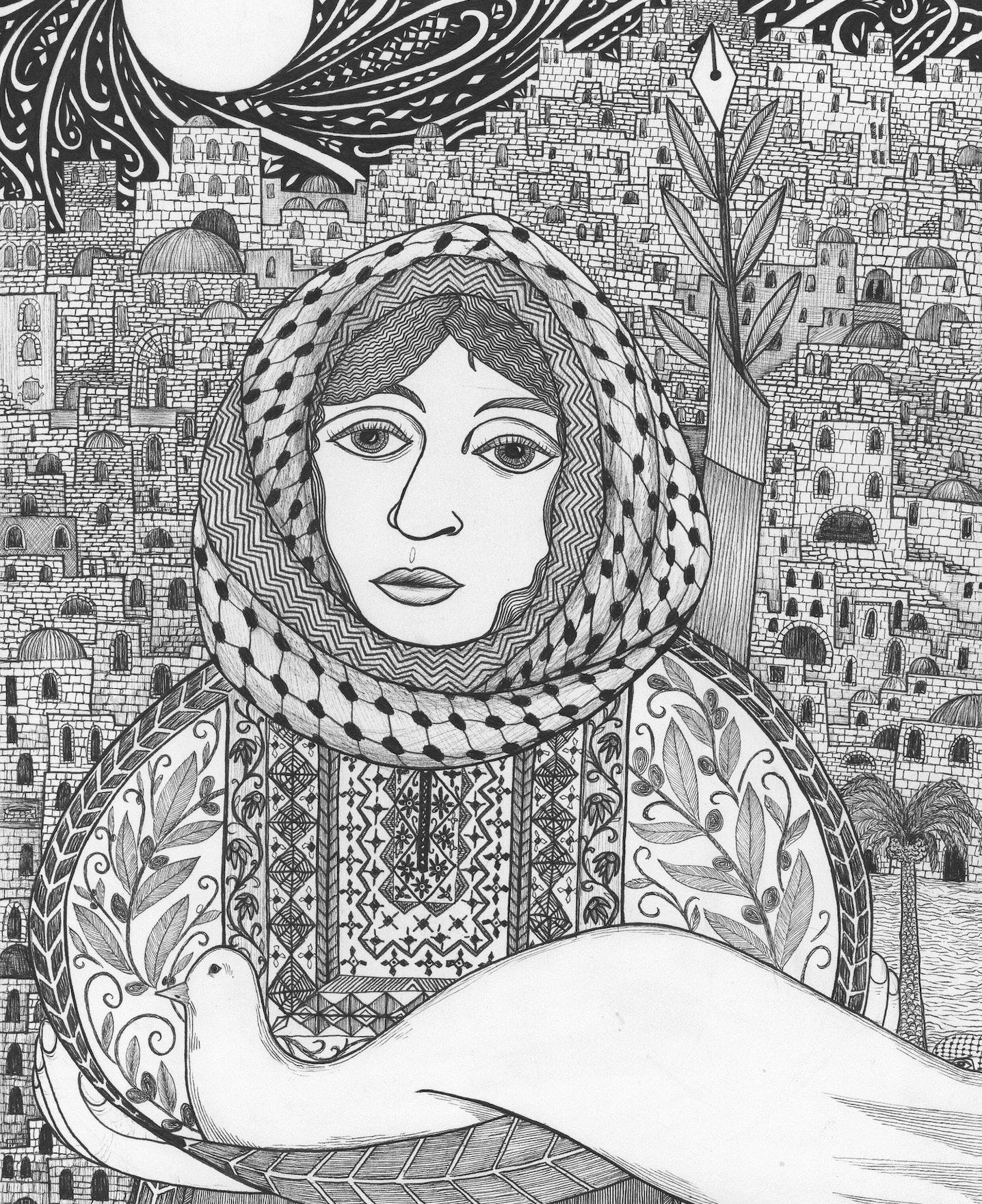
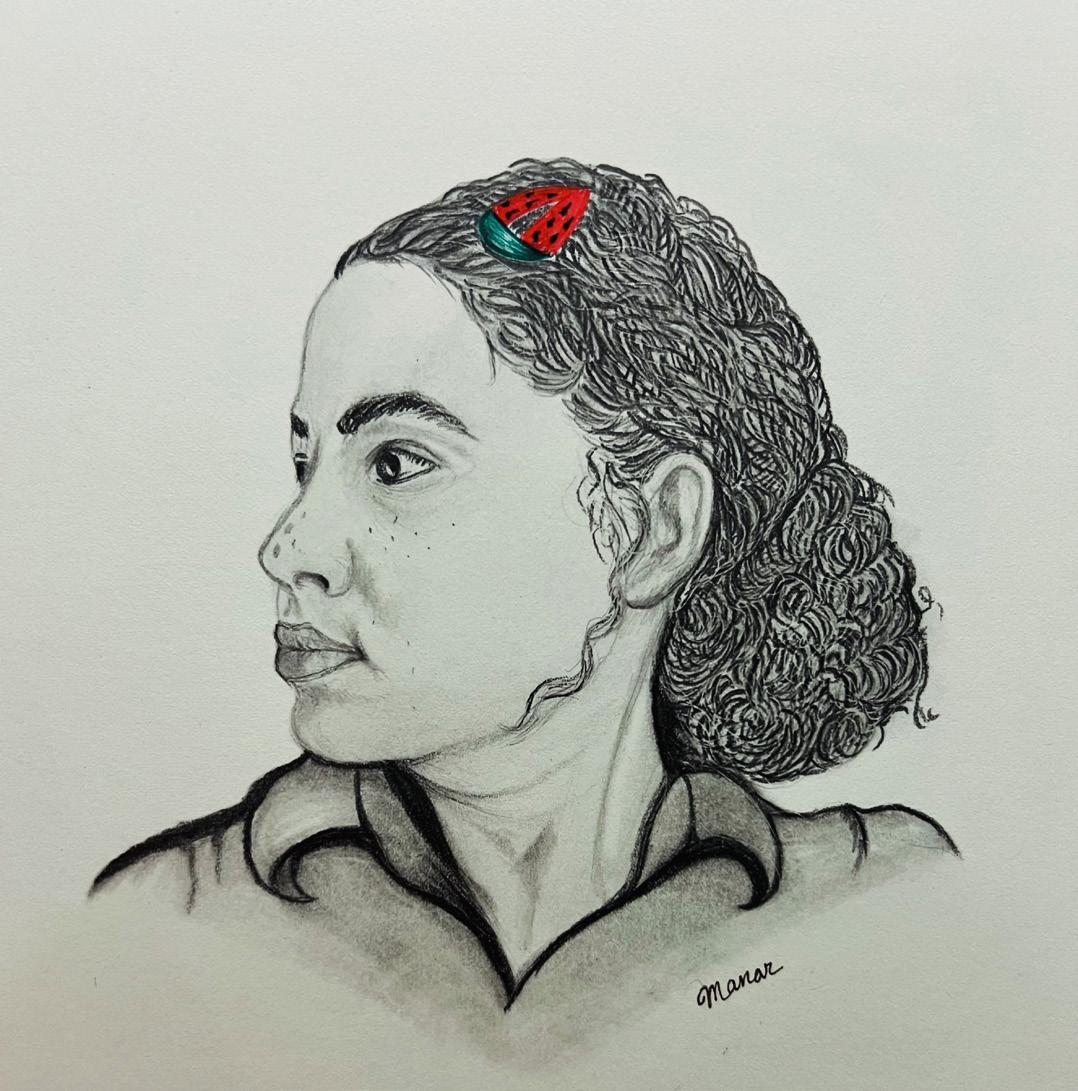
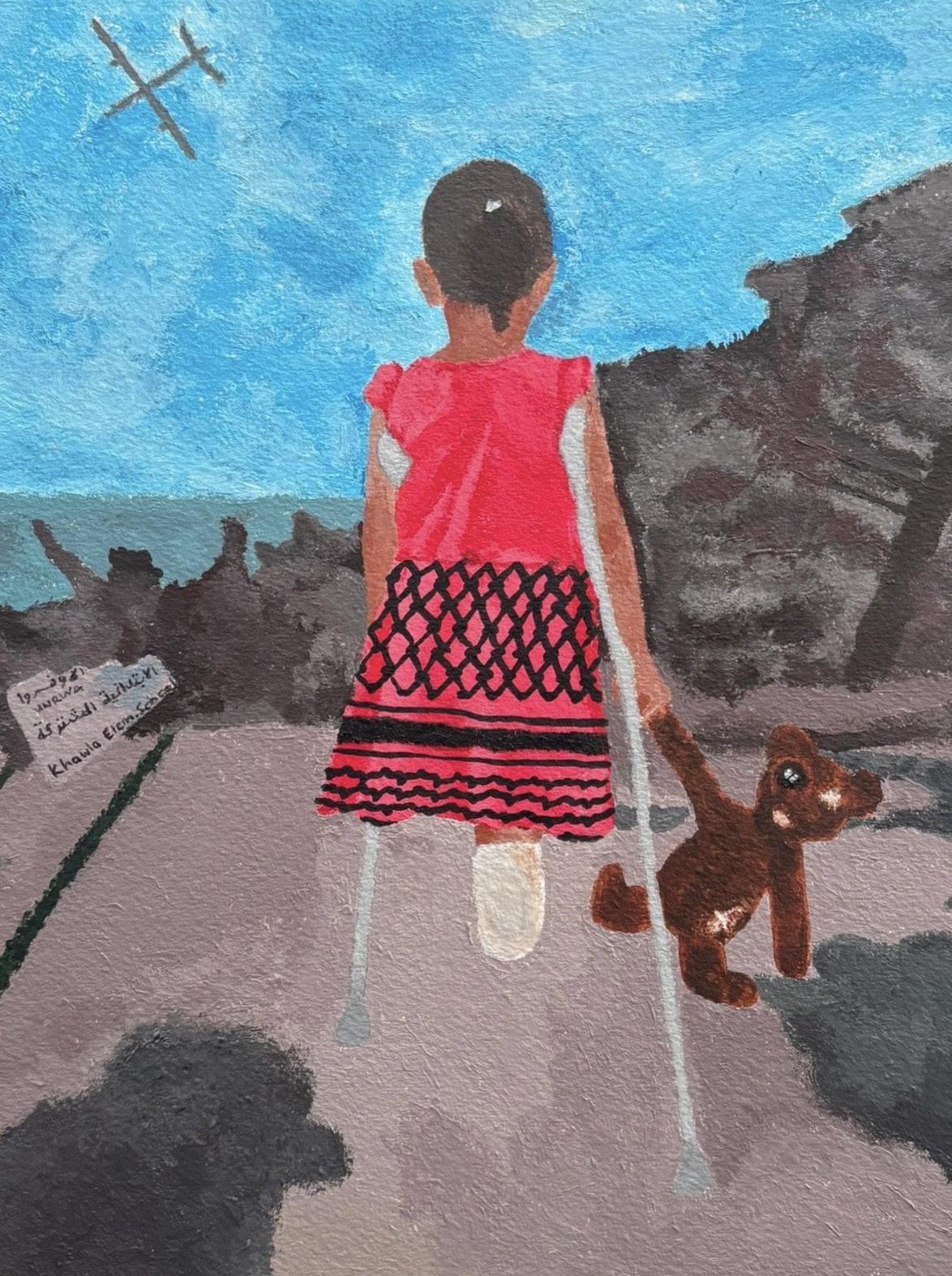
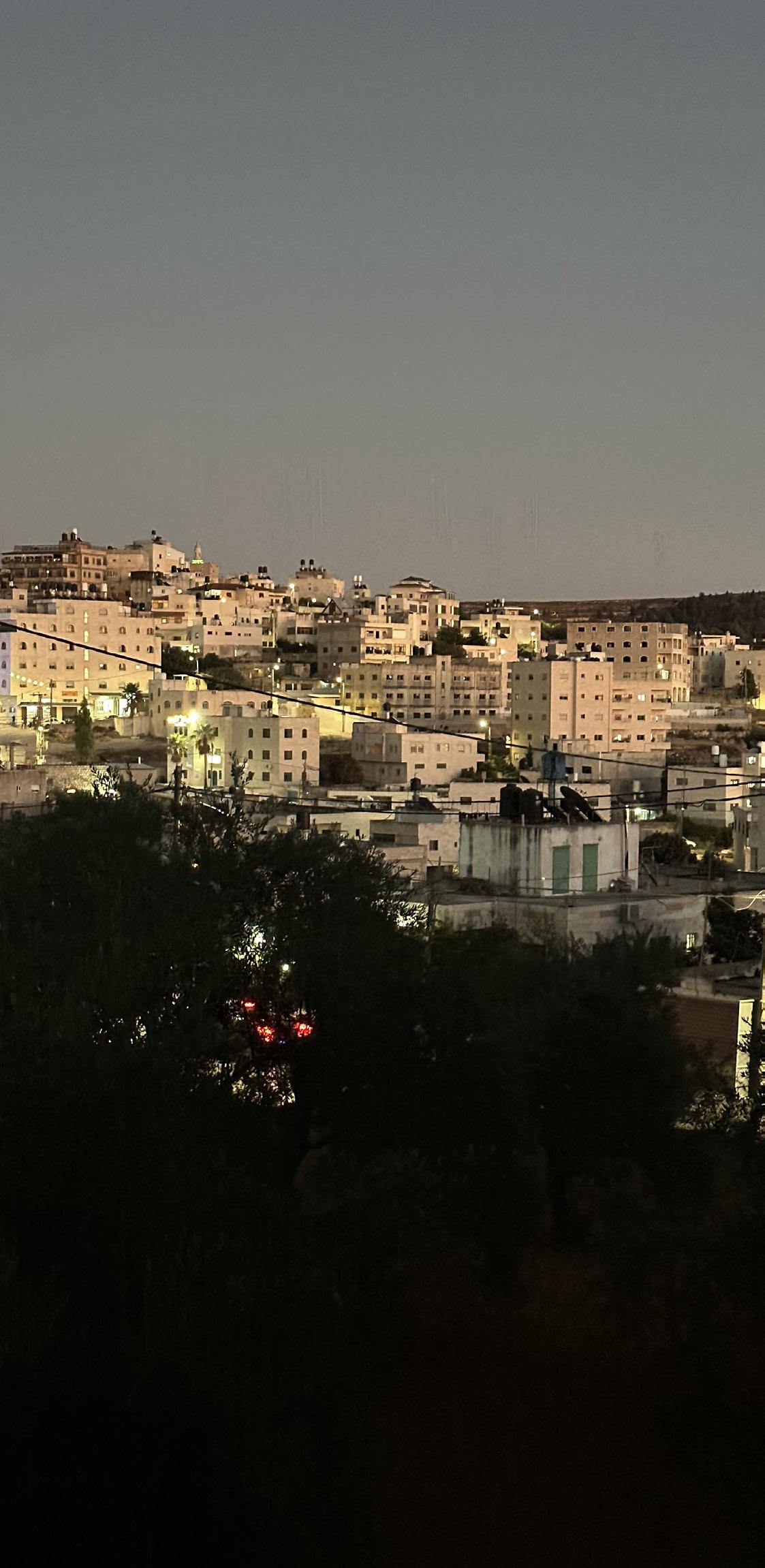
We are honored to thank Ayman Zahdeh for contributing his powerful artwork to this issue’s cover. His image of the Dome of the Rock was chosen to reflect a moment of profound injustice, as this sacred site has been closed to Palestinian Muslims during the holy month of Ramadan. As Al-Aqsa is transformed from a place of gathering into a site of exclusion, this cover stands as a tribute to the steadfastness of Palestinians who continue to pray outside its walls, confronting occupation violence with unwavering resilience.
Ayman is a Palestinian artist born in Bethlehem, whose work spans charcoal and pastel drawings, digital art, street art, and mosaic panel design. His Instagram handle is @aymanzahdeh, a space where his deep connection to Palestine comes to life through every medium he touches. Bethlehem, the city of his birth, carries centuries of resilience, and that spirit is ever present in Ayman’s art. Whether through the raw texture of charcoal, the permanence of mosaic, or the public voice of street art, his creations speak to the steadfastness of a people who refuse to be erased.
973-253-6145
388 Lakeview Ave Clifton, NJ 07011
paccusa.org
info@paccusa.org
Table of Contents
Ten Years of Falastin
By Reem Farhat
By Morad Abdelfattah
Re-member
A Father’s Viewing of the Voice of Hind Rajab By
Leen Amarin
Noorjhan Alam
Hiba Birat
Letter from the Editor in Chief and Palestine Education Director
Dear PACC family,
I am honored to step in at the decade of Falastin, ten years of gathering voices, preserving memory, and creating space for Palestinian storytelling across generations and geographies. This milestone, Volume 10, Issue 1, is not simply a marker of time. It is a testament to the enduring power of Palestinian presence. It is an affirmation that despite ongoing dispossession, despite genocide, despite every attempt to silence Palestinians, creativity is still nurtured. Stories and imagination continue to be told and preserved. It is a testament to one of the largest Palestinian communities in the United States, making a home in New Jersey.
It is only right that this issue is introduced by the founder of Falastin, Reem Farhat, with her piece, “Ten Years of Falastin: What It Means to Make a Home for Palestinian Stories”. Most recently, at our Women’s History Month event, we were also deeply honored to welcome Leqaa Kordia home from ICE detention as our keynote speaker. This panel of women exemplified how intellectual rigor, cultural identity, and a commitment to justice can converge to create meaningful change across fields and generations. Spaces where Palestinians and comrades come together to learn, to grow, and to share ways to support one another are not only a necessity, but a privilege to honor and hold dear. It is in such spaces that projects like Falastin are born and nurtured, for ten years and counting. In that time, we have witnessed unimaginable loss and unimaginable resilience. We have documented struggle and celebrated beauty. Our community has grown, sustained by the trust and creativity of those who have shared their art, their words, and their truth with us.
As a newcomer to this community, I find myself grateful for the opportunity to learn its history, to walk the paths so many have paved, and to be part of something my younger self yearned for. As a new mother, I know that regardless of what the future holds, the work of the young and old in this magazine and this community will be a guiding light for my daughter. To hear these stories, to be among strong women, to grow with a shelf of Falastin issues beside her, that is a privilege I want to nurture for her. As we begin this new decade of Falastin, we turn to you, our community, to help shape what comes next.
This anniversary issue is about honoring where we’ve been, becoming aware of where we are, and dreaming collectively about where we’re going. We want to hear from Palestinians and comrades in the homeland and diaspora—from those who have contributed before and those who have been waiting for the right moment to share their voice.
In
solidarity,
Manar Hussein Editor-in-Chief of Falastin
Ten Years of Falastin: What It Means to Make a Home for Palestinian Stories
By Reem Farhat
In my day job as a journalist, one of my sources recently asked me, “How long have you been doing this for?”
Strangely enough, no one has asked me that in a long time. After taking a pause to think about it, I replied, in a bit of shock, “It’s actually been ten years.”
I have been reporting and telling stories for a decade now, and I have the Palestinian American Community Center and this magazine to thank for that.
My name is Reem Farhat, and when I was 16, I had the honor of co-founding and being the editor in chief of Falastin magazine, and running it with an amazing group of women who are still my closest friends to this day. I’m so humbled and grateful that since then, this magazine has taken a life of its own, run by amazing and talented writers and editors who have nurtured it.
Ten years is a long time, and to have something last this long is an incredible feat that leaves me awed. It also made me quite nostalgic. For me, this magazine is deeply tied to my own personal journey, as a young woman, as a writer, and at the time, as an aspiring journalist. I always wanted to
find a way to carve my own path as a journalist, being Palestinian in this industry has always made me feel like I’m starting off at a disadvantage. But this magazine allowed me to explore my heritage and tell Palestinian stories authentically and unapologetically. And its existence did the same for hundreds (if not thousands) of other Palestinian creatives all over the world.
Ten years later, it feels right to go back to the beginning, back to 2016, when Executive Director Rania Mustafa came to me with the idea to start a literary magazine at the center. I had come to her, excited and nervous, with a notebook in my hand with ideas I had about themes and branding and a title.
I wanted to name it “Falastin” after the Arabic newspaper, which was one of the most influential Arabic newspapers in the British Mandate period. It was first published in 1911, and it’s often cited as one of the many sources of a Palestinian national identity that pre-dated the Palestinian nation state and as a counternarrative to propaganda that Palestinian national identity had no historical basis.
The newspaper simply existing and being called “Falastin” was powerful, because it said we are here, this is who we are, and this is our history. Naming the magazine after the newspaper felt natural, because we saw it as a continuation and evolution of Palestinian storytelling before us. (I hope we don’t get into any copyright trouble for admitting this, but the original logo of the magazine was actually the logo of the newspaper itself.)
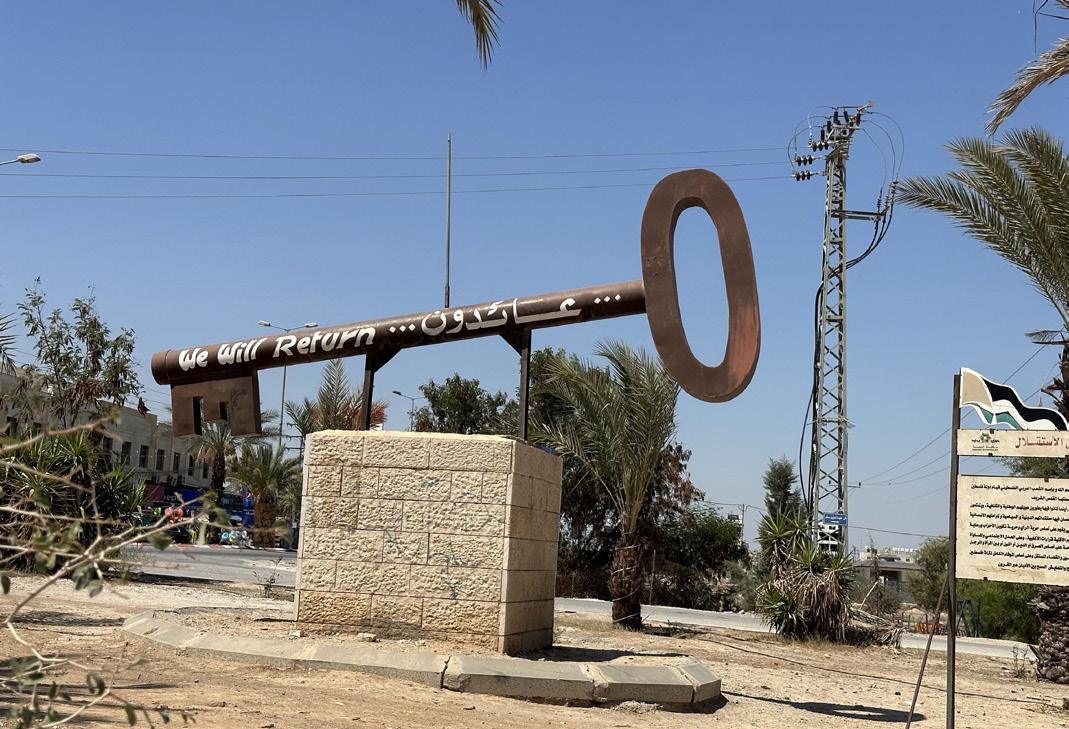
We Will Return
Photo Credit: Bayyan Amer
In my time as editor in chief, I interviewed Palestinian tour guides in the back of buses to Jerusalem, connected with Palestinians all over the world, from Gaza to Italy to Colombia, profiled figures like Marc Lamont Hill and Rashida Tlaib, followed art galleries that have turned into permanent museums, and more. It’s a time in my life I look back to fondly, filled with excitement and adventure and a lot of passion. I was constantly inspired by the Palestinian writers, artists, and poets who shared their words with us, and who relied on us to be trustees of their stories.
When you’re part of a community that is actively being erased, telling stories becomes all that more powerful. The statement is clear: we exist, and we’re not going anywhere. That belief became the driving force behind Falastin.
In the years since we started Falastin, that idea has taken on a deeper meaning. As the years have gone on, and as over 80,000 of our brothers and sisters in Gaza have been killed, telling Palestinian stories
has become more imperative. It’s necessary for our survival. I think of the way we carry those stories with us wherever we go.
How many of us feel like we have a connection to people like Refaat Alareer through his writing? Or even in our own communities. How many people walking through this center have experienced deep grief and loss, but have given those family members new life by making sure they are remembered? How many of us know Gaza by hearing it remembered as a place of joy, and not just one of destruction and war?
When the rubble is cleared and people are back to their homes and Gaza is no longer breaking news, the only thing that will remain are our stories and who we shared them with. This is true for all of Palestine, and will be true for all of history. For a decade, and God willing many more, Falastin has served as a place for these stories to exist forever.
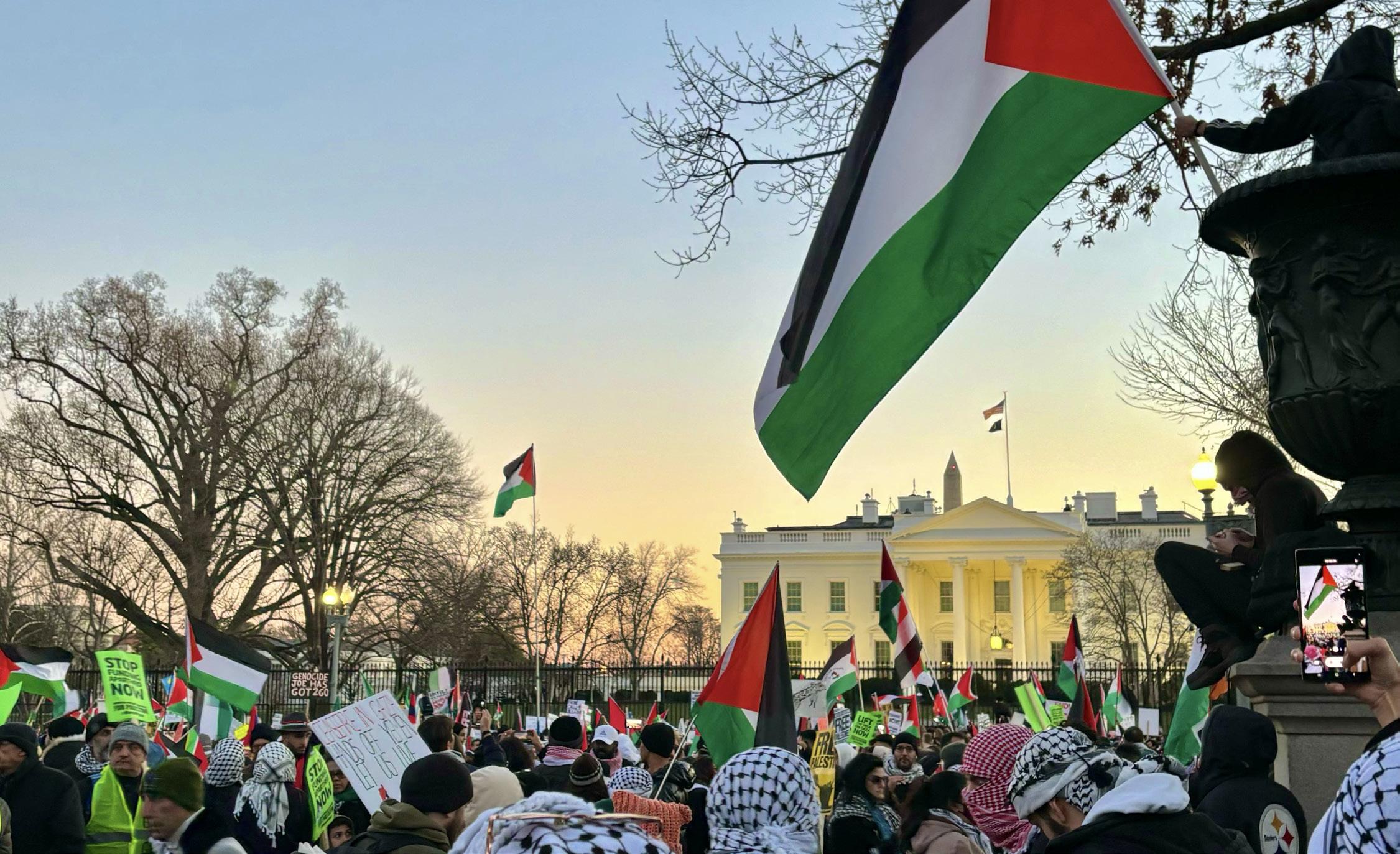
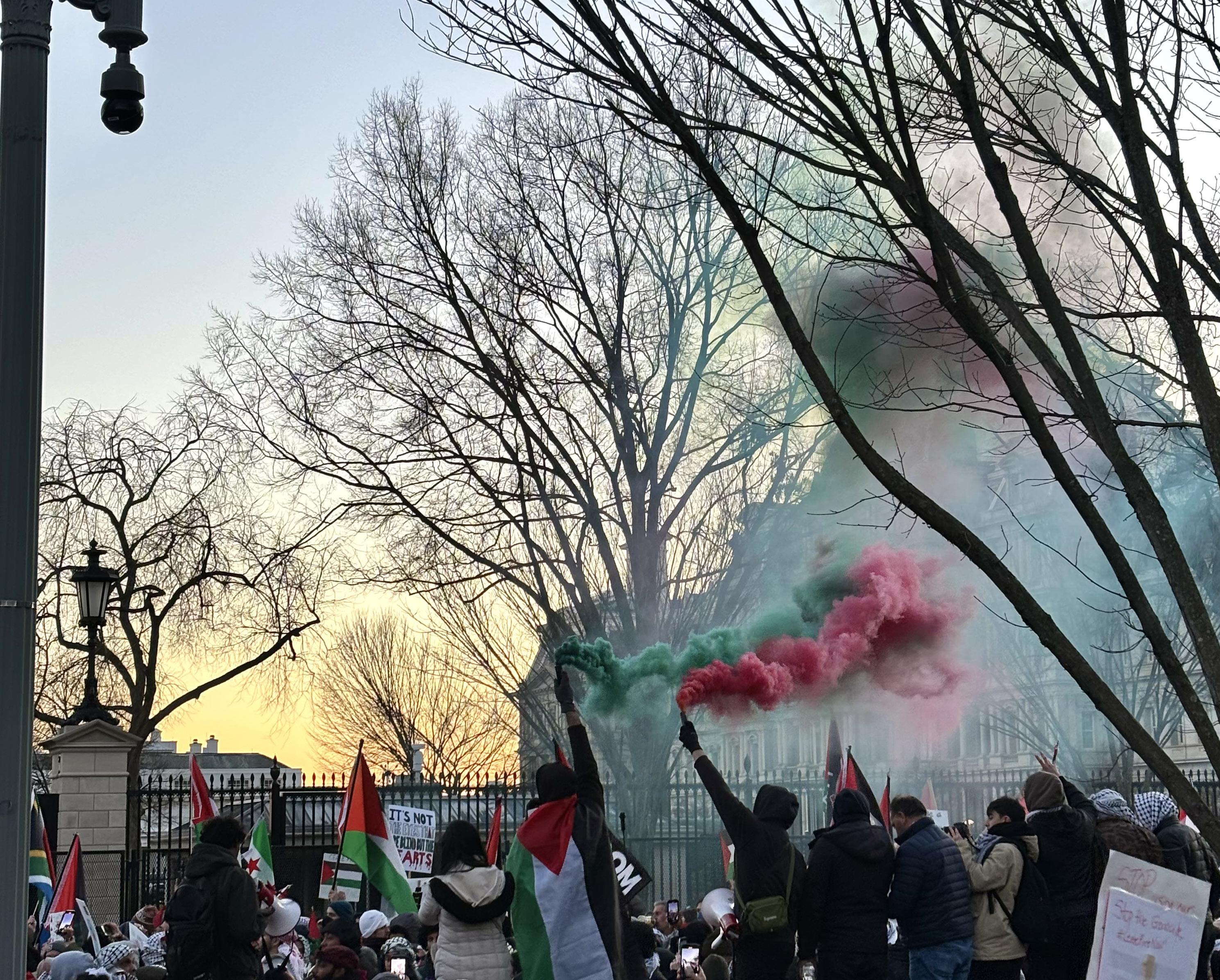
Palestinian Walk to White House Photo Credit: Zoeya Pasha
A Father’s Viewing of the Voice of Hind Rajab
By Morad Abdelfattah (Abu Fihmi)
The Voice of Hind Rajab is not an easy movie to watch. It’s the kind of film that stays with you long after it ends. As a father, it hit me in a very deep and personal way.
The movie tells the story of a young girl caught in the middle of a situation no child should ever experience. There’s no exaggeration, no over the top scenes, just a slow painful reality that unfolds in front of you. What makes it so hard to watch is how this was her reality.
From a father’s point of view, the hardest part is imagining your own child in her place. Her voice, her fear, and her hope that someone will come for her are impossible to ignore. As parents, we spend our lives trying to protect our kids.
This film reminds you how quickly that protection can disappear for some children through no fault of their own.
Although I don’t agree with everything that happened in the movie, I caught myself saying I would have done things differently. But watching it unfold, you realize how fear, panic, and complete helplessness take over. In moments like that, judgment feels easy from the outside, while real choices disappear on the inside.
The movie doesn’t try to shock you. It lets the silence do the work. The waiting, the unanswered calls, and the feeling of time dragging on makes you uncomfortable in the way a film like this should. You’re not watching for entertainment. You’re watching because it is important.
The acting feels honest and raw. Nothing feels forced. The film keeps things simple, which makes the message even stronger. There’s nowhere to look away and that’s the point.
What stayed with me most after watching The Voice of Hind Rajab was the thought that children don’t always understand how genocide or politics unfold. They understand fear. They understand calling out for help. And they trust that adults will do the right thing.
As a father, it wasn’t just the violence that broke me, it was the trust. The trust that adults are supposed to protect children. Knowing she believed she was safe, and realizing there was nothing I could do, is what truly shattered me.
This is a painful but necessary film. It asks you to sit with the reality of what some children go through and not turn away. The Voice of Hind Rajab isn’t something you watch and forget. It’s something you carry with you.
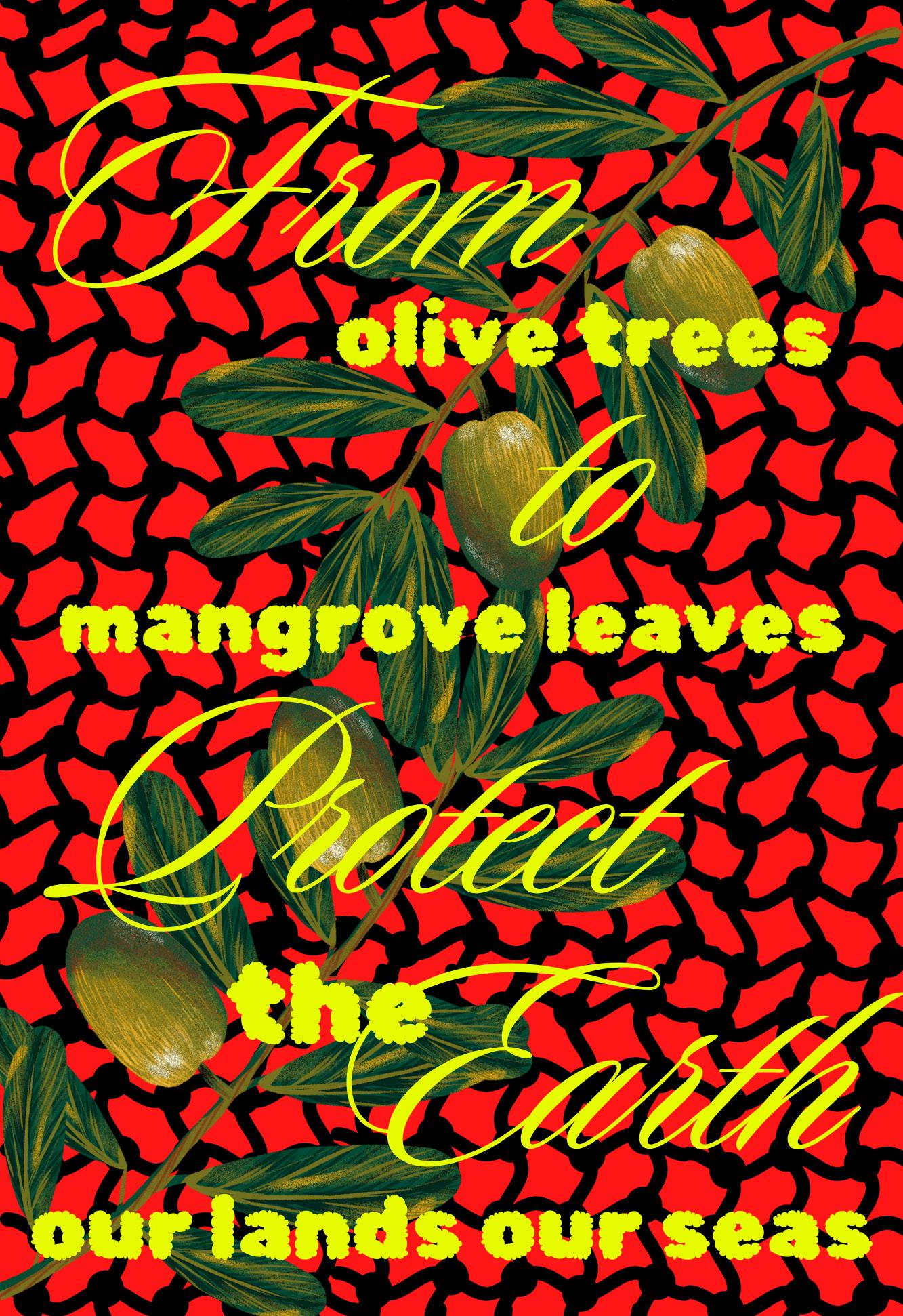
From Olive Trees to Mangrove Leaves
Artwork by: Maia Villalba
Re-member
By Leen Amarin
They destroyed everything:; the people and the rocks.
They destroyed it all; the people and the rocks. Whole lives, whole universes; they destroyed it all. The people and the rocks. They say our bodies are the site of our every experience; the setting in which our lives take place. While I may have always felt distantly tethered to this flesh, I now know it as the site of our collective history.
These aren’t just bricks, rocks, and stones.
These are her bones.
I ache to see her in my smile again. To look down at my working hands and see their rootedness in our soil, our being. What does it mean when the wounds on my body now mirror those carved into our lands? When my heart shatters with every cracked cobblestone, and home turned rubble? When grief consumes all, and life withers with every passing plantcestor?
What does it mean when each tear turns dew on a rose petal? The sweet scent of jasmine swims through the air, and grief turns to momentary relief? When grief takes a breath and turns fire and fury? The other day, I felt my body tremble with grief. The other day, I wept tears into the ocean. No more room left in this rage-stricken body of mine. The other day, I remembered this fury of mine had purpose.
I remember Audre Lorde’s words, “Everything can be used / except what is wasteful / (you will
need/to remember this when you are accused of destruction).”
I heed her warning. For they do not understand what it takes to rebuild. The underworlds of grief we must traverse. The conviction it takes to remember.
Suddenly, I understand why our kin always have pockets full of stone. The truth is that the violence of the empire is not new, nor is the struggle against its reign.
The story of سيزيإ and سيروزوأ reminds us that exile is as ancient as we are. That the power of our grief and conviction re-members us into life. Just as سيزيإ returned home with the bones of her love,
, re-membering the skeleton of his body back to its wholesome shape. The winds of her flapping wings breathing life back into him.
Her legend does not end with her, but is mirrored by the sacred matriarchs of our lineages repeatedly.
Be it Inanna’s solitary descent into the underworld, or Mother Mary’s grief over the murder of her son before he resurrected. Narratives of traversing underworlds of grief to rebirth new worlds in justice and liberation are our ancestral legacies.
I watch videos of our kin in Gaza, and I am reminded that our mothers, our lovers, and our kin continue to collect our bones. Re-membering us into life just as إيزيس did.
For even our tears turn to salt, mud, and creation. But they smile, and their teeth turn jagged edges, sharp bloody steel, and misery.
400 days ago, Bisan posted a clip of a Palestinian man speaking of what he intends to do upon returning home after the ceasefire. His words now remain etched onto my soul, tethering me to every root in our soil.
“If my home is destroyed, with my eyelashes I will reconstruct every column. If my home is destroyed, with my pupils I will build its roof. If my land is razed, with my body I will nourish and revive it.”
The righteous do not pillage and murder for their nation, but die and bleed life into the soil of their homelands.
I carefully place another bone in my pocket. The other is already full with stone. It’s getting harder and harder to re-member what makes us who we are. The dreams they have stolen. I cling to every memory now, the last scraps of a reality I cannot let them conquer. So long as you are with me, they cannot win. So long as I remember, we continue to live.
Key of Quds
Artwork by: @dudavzoom
That life is sacred. Every drop of blood soaked into the earth, an offering. And every tear shed in grief, a spiritual act. They cannot understand that we are of her, and she is ours. That our bodies are one, even the trees know our pain. Every lost home a root unearthed, every snapped branch a torn limb. They beg and plead to hear our story of defeat, but I only sing war call and liberation.
Have you ever heard a tree scream? Like Teita, her voice cracks with power. A thunderstorm to bring the empire to its knees.
We are the children of sadness, and they are the children of delight.
The wellspring of life is not one they understand. That generosity and love are divine.
Continued on next page
We are the children of despair, and despair is the shadow of a god that does not dwell in the hearts of the evil. We are the sullen souls. And sadness is great, small souls cannot contain it. We sigh, and with our sighs rise the whispers of the roses, the rustling of the branches, and the gurgling of the streams. But they laugh, and the fluttering of their laughter mixes with the crushing of skulls, the burning of chains, and the howling of the abyss.
We are the children of grief, and they are the children of delight. But our grief is a bird, and a bird is not a stone. And she soars on the winds of justice, And we become the sky.
I close my eyes again and submit myself to the winds, waves, and the earth. Her voice continues to echo – a victorious beat of liberation. A song that carries us home. Winds, waves, and the earth. Her voice continues to echo – a victorious beat of liberation. A song that carries us home.
Sabr Falasteen
Photo Credit: @BelalLulu
Spare them
By Noorjhan Alam
My children
The ones with bows on their heads, With superheroes on their chests, With biscuits in their hands, With laughter in their bellies;
The ones that cry in the middle of the night Because it’s too dark,
The ones that tug on your shirt at the market With crooked smiles, Rosy cheeks,
Wide eyes, Scared eyesEmpty bellies,
Blood-curdling screams, Open skulls, Stiff bodies,
Cold, Lifeless.
Your childrenSpare them.
Apartheid Wall
Photo Credit: @BelalLulu
Inkifada
Artwork by: @CGazaleh
Bisan, Hakawatiya
Artwork by: Noor MH
Who Killed Safiyya?
By Hiba Birat
Steam was still rising from her cardboard cup of coffee when Safiyya crossed the dreadful threshold of death, leaving behind a massive tangle of thoughts and emotions suspended above the world like a giant question mark.
Life did not grant Safiyya the time to take a clear moral stance on the Epstein files: those that seized the world’s mood like an enormous sheet dropped over nations, carrying with it shock and revulsion. Safiyya had long since decided that the devil who rules the world prefers children at his table, ever since the shelling in her camp harvested all the neighbors’ children. When she passes by the “survivor victims” and greets them with a “good morning,” she whispers to herself, “Where would goodness even come from?” then asks God’s forgiveness: that gentle, kind God, unlike some other people’s God: a psychopathic deity obsessed with children’s limbs and their still-warm blood.
Safiyya had not read Chomsky’s “The Responsibility of Intellectuals” or “Manufacturing Consent”, nor had she been struck with sorrow by his thunderous fall. The world had not collapsed upon her head through the abstract separation of idea from reality; it collapsed, quite literally, brick by brick, when Apache helicopters struck her home with tons of explosives. Along with it fell the conscience of the left, the right, and the complicit center, silent and satisfied, when intellectual propositions proved sterile, incapable of change. She fed those propositions to the fire to warm herself and to cook a tasteless meal to stave her ravenous hunger, recalling only her own name in a single line by Ghassan Kanafani: “The homeland, Safiyya, is that none of this should happen.”
Safiyya skimmed past the news of Maduro’s kidnapping with passing indifference, taken by the ring of the word “Caracas,” just as she had once been taken by “Riviera”: the word that turned the
people of Gaza into well-heeled foreigners stacked into an endless paradise of tattered tents, submerged to their knees in rain and mud. Safiyya does not grasp what the Global South means; she links it to displacement and soot, like the south of the Strip to which she fled a refugee from the lost north. For her, the south means distance from home, a stolen comfort, and an unceasing dream of return. When they told her they would carve up the Strip like they carved up Venezuela, she laughed and said, “But the Strip isn’t round: who gets which slice?”
Safiyya did not dwell long on the rules-based global order now collapsing before the great empires, revealing a multi-polar world that crushes small nations more brutally than its predecessor. Her world had cracked open beneath her feet time and again: when her wounds were stitched without anesthetic or alcohol; when she ate bitter grasses so her stomach would not devour itself; when she drank seawater only to grow thirstier as her intestines twisted in pain. Nothing remained of her old world but a flaking blue sheet of tin with white letters, bleached to the color of dust, spelling UNRWA: used to anchor the door of her tent in the sand, preserving her privacy from strangers’ eyes. Now she fears the wind might carry it off and kill her far from strangers’ eyes as well.
Safiyya does not see the world as a farcical stage whose events are a black comedy. Ever since the puppet theaters of the old courtyard were blown away, along with minarets, church bells, waiting rooms, and food stores, her laughter has turned black. And when she finally crossed the dreadful threshold of death, a hot cup of coffee in her hand, the cause was both absurdly funny and utterly black. The Ministry of Health hesitated over whether to inscribe her name on the lists of martyrs, for those who have died of “over-thinking” in the Strip are too many for records to count, or for the cowardly world to mourn.
Excerpt from “Accountability Denied: International Law and the Occupation of Palestine”
By Barry Mahmoud
This is an excerpt from Barry’s undergraduate thesis during his time at Montclair University.
Israel’s war on Gaza following the events of October 7, 2023—now determined by international bodies to have amounted to genocide—has produced little accountability through the so-called rules-based order of international law.
Throughout the present war, and long before it, Israel has repeatedly violated foundational international legal instruments such as the Genocide Convention and the Rome Statute. Despite these violations, Israel and its leaders have remained shielded from consequences—especially by Western powers—while their mistreatment of the Palestinian people continues unabated.
Artwork by: Zoeya Pasha
In April 2025, Israeli Prime Minister Benjamin Netanyahu traveled to Budapest, Hungary, even as an arrest warrant had been issued against him by the International Criminal Court in November 2024. For Palestinians—who have endured decades of military occupation, settler violence, and campaigns of ethnic cleansing—this moment symbolized more than just diplomatic hypocrisy. It begged a pressing question: How can Israel continue such actions with virtually no repercussions?
This article explores not only Israel’s actions since October 2023, but also its long history of violating international law in the Occupied Palestinian Territory (oPt). It focuses on legal frameworks such as state responsibility, apartheid, and genocide under international law, and examines whether current mechanisms are capable of enforcing accountability. Central to this inquiry is the concept of justice for the Palestinian people—justice that remains elusive under a global system unwilling to uphold its own legal standards.
Under international law, occupation occurs when a state exercises effective control over a territory without sovereign title and without the consent of the local population. This is defined in Article 42 of the Hague Regulations of 1907, and further governed by the Fourth Geneva Convention of 1949.
Since 1967, when Israeli forces took control of the West Bank, including East Jerusalem, and Gaza, the International Committee of the Red Cross has consistently recognized these territories as occupied. As such, Israel bears clear legal responsibilities.
As an occupying power, Israel is required to protect the civilian population, ensure their access to food and medical care, preserve the legal and institutional status quo, and refrain from transferring its own
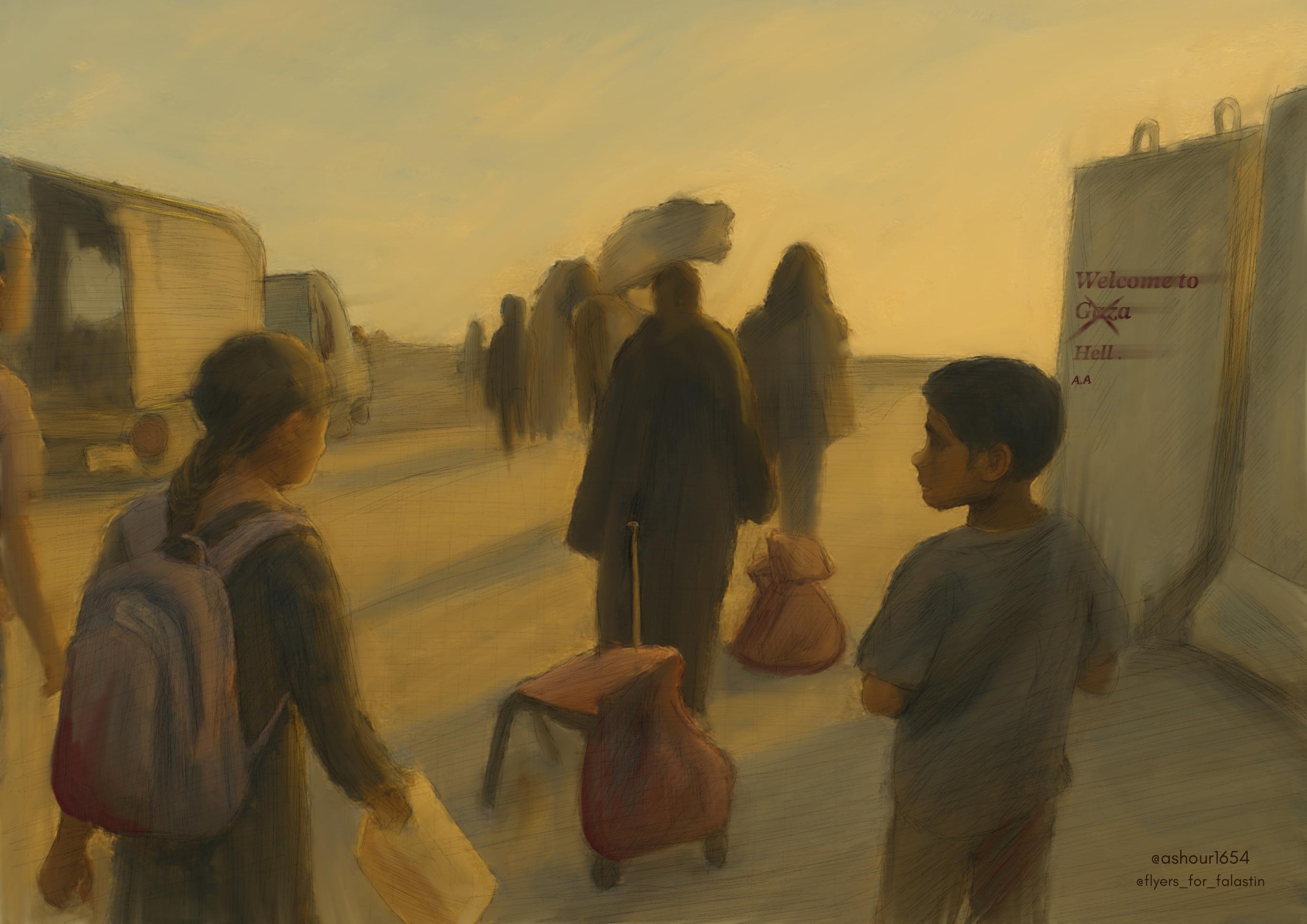
Gaza
Artwork by:
civilian population into the territory it occupies. It must also avoid the destruction of property unless absolutely necessary for military operations and is required to protect the natural environment. These obligations are not optional—they are binding international legal standards.
Yet, the daily reality in Palestine stands in stark contrast to these obligations. Israeli settlement expansion continues in direct violation of international law. The state not only allows settler violence, but enables and protects it. Armed settlers, often accompanied by or acting with the support of the Israeli military, carry out attacks on Palestinian communities.
Homes are torched, olive groves uprooted, families displaced. In international law, settler violence becomes a state-backed crime when the state knowingly allows it to occur and fails to prosecute those responsible. When settlers attack and soldiers stand by—or join in—accountability is no longer a matter of private action, but of state complicity.
In this legal context, the idea of occupation as temporary becomes absurd. Israel’s occupation has lasted nearly six decades and is characterized by annexationist policies, structural violence, and institutionalized discrimination. These actions have led numerous legal scholars and human rights organizations—including Human Rights Watch and Amnesty International—to characterize the regime in Palestine as apartheid: a crime under the Rome Statute and the Apartheid Convention.
Meanwhile in Gaza, Israel’s military operations since October 2023 have drawn global condemnation. Reports from UN bodies, human rights organizations, and international legal experts document patterns of indiscriminate bombing, mass civilian casualties, and the targeting of hospitals, schools, and infrastructure—all of which raise serious questions about genocidal intent. This is not rhetoric; it is legal analysis rooted in evidence, including public statements by Israeli officials, military tactics targeting
civilians, and the systemic destruction of lifesustaining infrastructure. Still, the international community has failed to act decisively. Western states in particular have chosen political alignment over legal obligation, shielding Israel from meaningful accountability.
This selective enforcement undermines not only Palestinian rights but the integrity of international law itself. It sends a dangerous message: that some states are above the law, and some peoples less worthy of its protection. If international law is to have any future, this cannot stand. Justice for Palestinians requires more than symbolic declarations. It requires enforcement.
It demands that third-party states uphold their legal duties—not just to condemn violations, but to take action to prevent and punish them. This includes applying pressure through diplomatic means, ceasing arms sales, supporting international investigations, and standing behind the findings of institutions like the ICJ and ICC.
But legal reform alone is not enough. The failure to hold Israel accountable is not only a legal crisis; it is a moral and political one, rooted in a global order that continues to dehumanize Palestinian lives. Addressing this requires confronting the anti-Palestinian racism embedded in international discourse and practice—a racism that allows prolonged occupation, collective punishment, and ethnic cleansing to persist under the guise of “security.”
True justice will require an intersectional and sustained movement—legal, political, and grassroots—to uphold Palestinian rights, demand state accountability, and restore credibility to international law. Only then can the promises of legal norms—so often invoked and so rarely enforced—begin to mean something for those who have been denied them for far too long.
Against the Weight of Silence
By Zoeya Pasha
Oppression does not announce itself. It arrives dressed as policy, as civility, as a tone you are told to adopt if you want to be heard. It asks you to speak carefully.
To grieve quietly. To prove your pain before it will consider listening.
I was taught that anger discredits truth, that resistance must be respectable, that survival should sound grateful. But history was not built by those who waited to be invited.
Silence has been praised as maturity, but it is also how harm learns to stay.
It is how violence becomes procedural. It is how names disappear without anyone needing to say why.
I have watched words be stripped until they no longer threaten anyoneoccupation softened into conflict, bodies reduced to numbers, grief edited for public comfort.
Do not tell me neutrality is peace. Neutrality is a decision that always sides with power. I stand because kneeling has been mistaken for virtue. Because compliance has been marketed as safety..
Because standing is not always loud. Sometimes it is refusing the script. Sometimes it is naming the wound
after they’ve renamed it acceptable. If my presence disrupts the room, then the room was never built for truth.
If my resistance makes you uncomfortable, then discomfort is doing its job. This is not a performance of courage. This is not a metaphor.
This is the act of staying upright under a system that benefits from my silence. And I will not make myself smaller so injustice can remain intact.
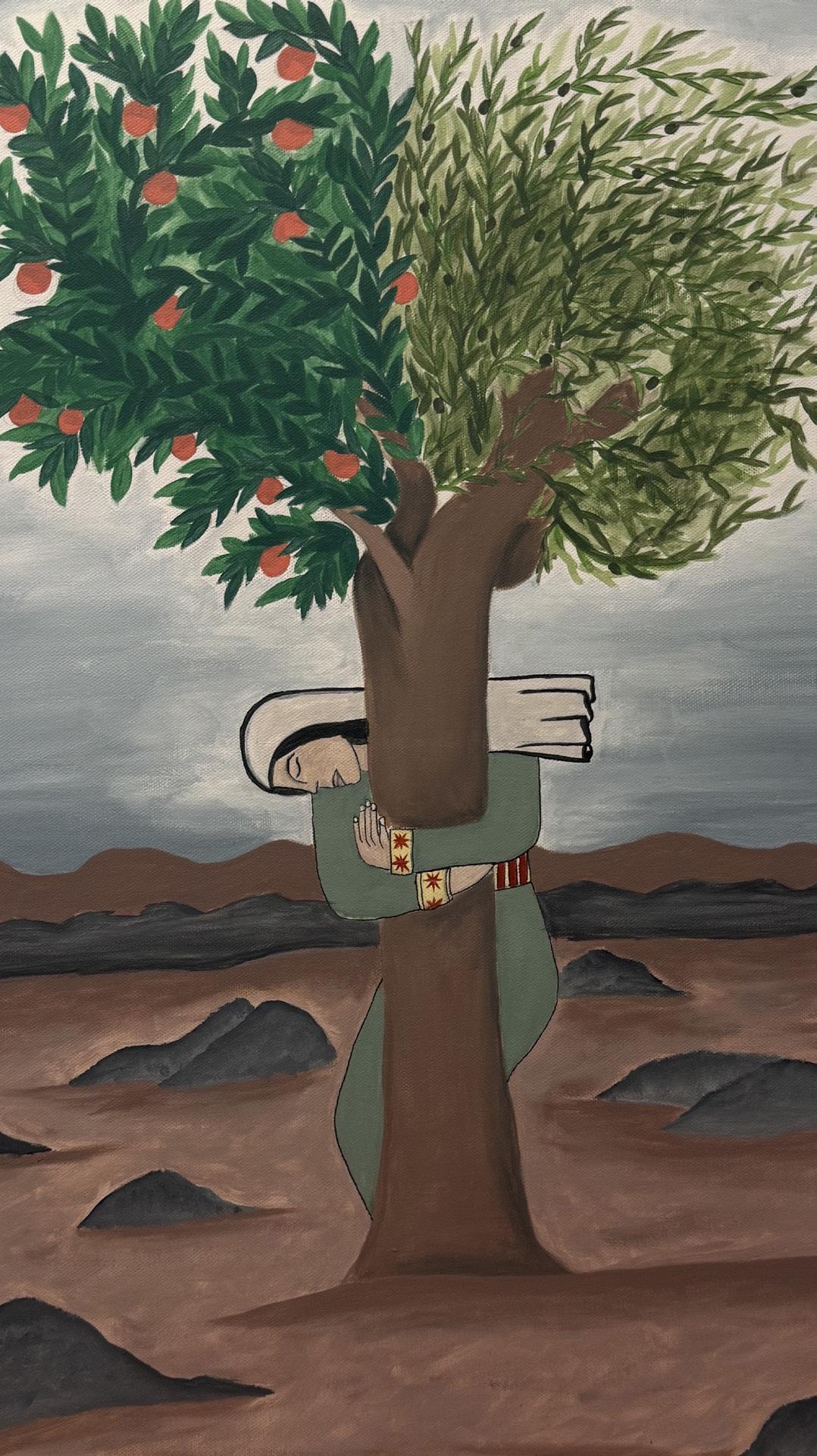
Embracing Roots
Artwork by: Miral Chabayta @miralsgraphics
Palestine in Paterson
By Noah Allison
At first glance, Main Street in Paterson, New Jersey, is indistinguishable from the Garden State’s hundreds of other commercial corridors. Its low-rise built forms comprise an array of low-density commercial and mixed-use buildings with little unifying adornment. Yet, a closer look reveals its distinction. The restaurants, markets, sweet shops, hookah lounges, hair salons, and clothing stores adapting and marking this stretch signal one of the largest Arab and Muslim hubs in the United States.
Situated 15 miles west of New York City, Paterson was founded in 1792 in part by Alexander Hamilton as a predominantly Dutch and English settlement. As one of the first planned industrial towns in North America, Paterson prospered first with its textile and iron mills, and later from its locomotive, machine, and aircraft manufacturing. These opportunities enticed immigrants from around the world, including Irish, German, Italian, and Russian and Eastern European Jews. In the late nineteenth century, Syrian and Lebanese families arrived in Paterson to work in the silk trade.
As the textile economy expanded over the first half of the twentieth century, it attracted other Arab groups, such as Yemenis and Palestinians, as well as
Turkish immigrants. Even as deindustrialization shifted Paterson’s economy toward small-scale food processing, garment, and retail enterprises, its cultural infrastructure, proximity to New York, and relative affordability continued to attract people from the Middle East, as well as Latin America, South Asia, and the Caribbean.
Today, nearly half of Paterson’s 160,000 residents were born outside the United States. Its demographic composition reflects what urban scholars describe as ethnoburbs: suburban clusters of households and businesses comprising diasporic groups with transnational ties. In ethnoburbs, ethnic minorities own a high portion of local businesses and are actively involved in local politics. More often than not, however, immigrants and their descendants working and residing in suburbs are made visible by performing and asserting group expressions in the landscape. Group expressions are particularly prevalent in South Paterson.
Just stroll down Main Street, where one encounters Arabic signage inscribed on the streetscape, interspersed with Turkish, English, Farsi, and Spanish. Business names honor proprietors’ homelands.
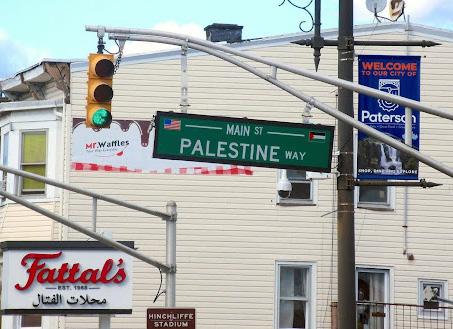
This streetscape has been known as “Little Istanbul” and “Little Ramallah,” but as the Palestinian population in Paterson has grown (10,000–20,000), South Paterson is now most closely associated with Palestine. This is reflected in Palestinian flags displayed throughout the area. In 2022, the city branded it “Little Palestine” and renamed part of Main Street “Palestine Way,” followed by a sister city agreement with Ramallah in 2023.
These branding efforts were not only supported by many of the businesses along the stretch but also made possible by André Sayegh, Paterson’s first Arab American mayor, who is of Lebanese descent, and especially by the not-for-profit Palestinian American Community Center.
For some, Muslim identity has become intertwined
Palestine Way
Photo Credit: Noah Allison
with Paterson that in 2025, Mayor Sayegh called it the fourth holiest city in the world, after Jerusalem, Mecca, and Medina.
While Palestinians are Paterson’s largest Arab group, they are not the city’s largest immigrant population. That belongs to the Spanish-speaking residents from multiple Latin American nations. Their presence is evident just a mile north of “Little Palestine,” where “Peru Square” anchors the largest concentration of Peruvian people outside of Peru.
All the while, “Colombian Corridor” on 21 Avenue similarly reflects the city’s sizable Colombian diaspora, just as “Bangladeshi Boulevard” on
Union Avenue serves as a hub for New Jersey’s vast Bangladeshi population.
In any case, the presence of these ethnic commercial hubs illustrates how multiple groups have carved out spaces by asserting their identities and creating a sense of belonging. And while that should be an essential human right for everyone, in times of war, when territorial sovereignty is on the brink of extinction, centers like “Little Palestine” are more critical than ever.
They are the vital sites where dispossessed groups produce and maintain connections to the tastes, languages, customs, and memories of their homeland.
Palestinian Walk
Photo Credit: Zoeya Pasha
How Strange It Is
By 52
How strange it is
To watch your mother die six times but still breathe
To see your uncles broken and carrying your brother
To watch your sister starved and unable to prosper
Oh mother, i am sorry i don’t have more to say to the living ghosts
Oh brother of mine, please do not forget your studies
Oh sisters, forget your weight and try my cooking
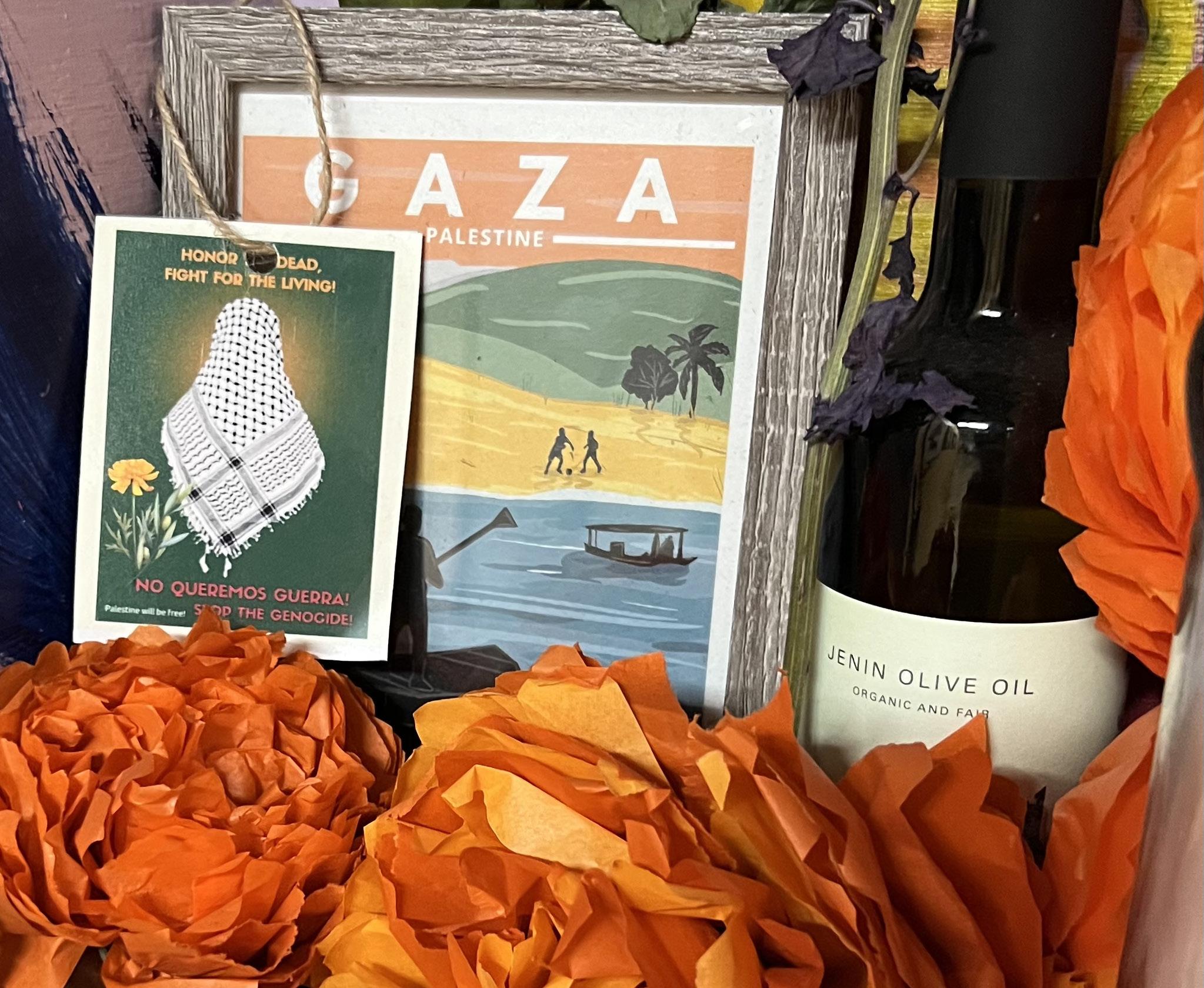
Gaza Ofrenda
Photo Credit: Noor MH
Refaat Alareer Artwork by: @tracychahwan
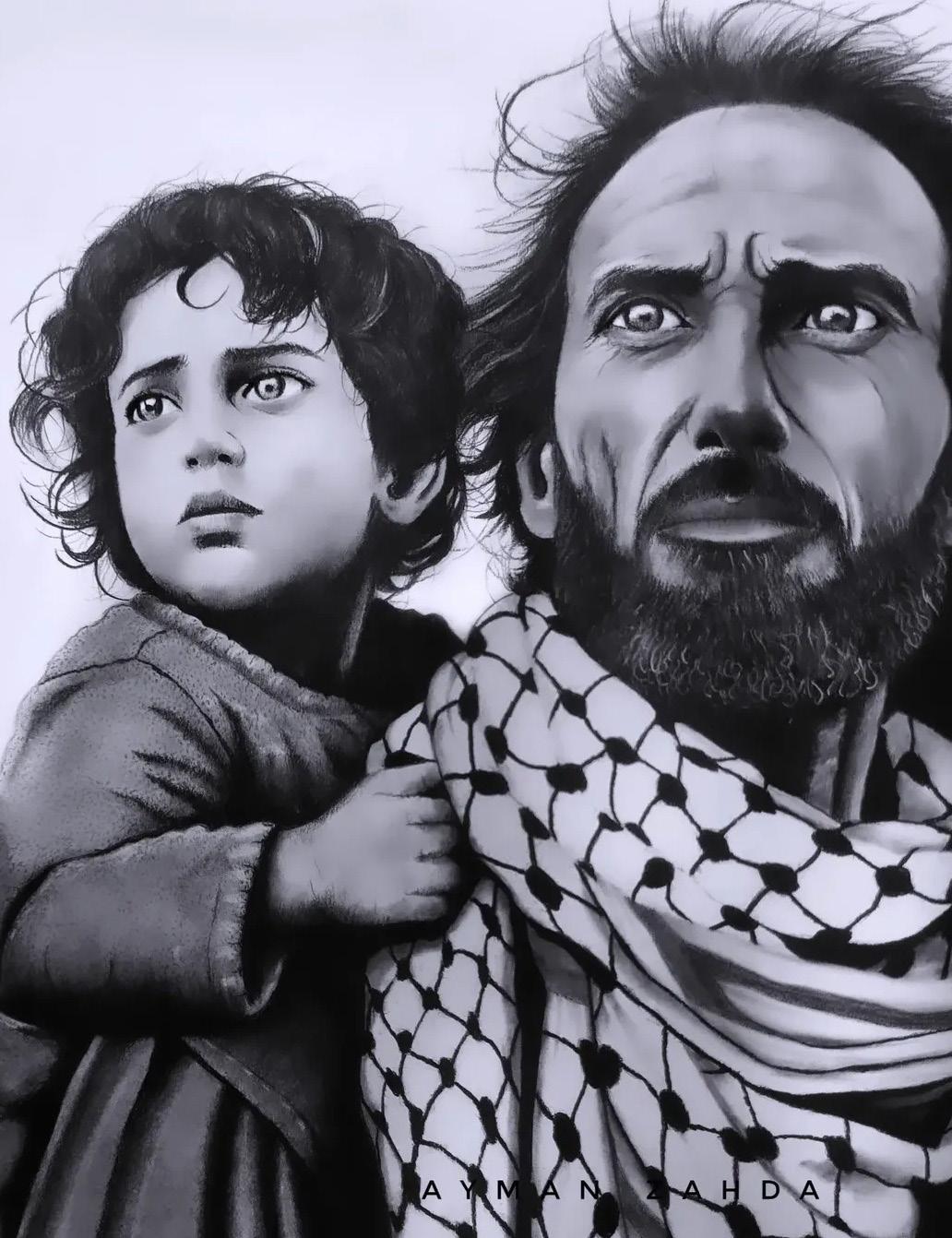
Father and Son
Artwork by: Ayman Zahdeh
With These Hands
By Zain Jazara
With these hands I will mend
Your cracked and aching bones
Stitching heartbreak with ancestors’ thread
Collecting tears in clay jugs
To fill the wells with muddied waters
Of past and future perils
Of cries long forgotten
Your memories the bricks
Foundation of tireless, perilous journeys
Cardamom and thyme infused robbery
The sea’s salt rubbed in sleepy eyes
Home is in the horizon
The sun is beckoning
Lead barrels cold against temples
Of worship and sin
The shore spills new blood with every crashing
Wave of steel and gunpowder
Fighter jets tear at the seams of existence
Ponytails under rubble
The land grasps at children
Pulled through arid cracks
Pouring her gushing tears onto soil
Mother begs the earth to spit back her lungs
Sprout like the new buddings of spring
Prostrating under the godforsaken sky
Only to be swallowed the same
Haven’t you heard?
The earth is housing families now
Shallow graves with nine at a time
Unborn, reborn, young, and old
Hurry, hurry to fight the mold
Is salvation only for those who fold?
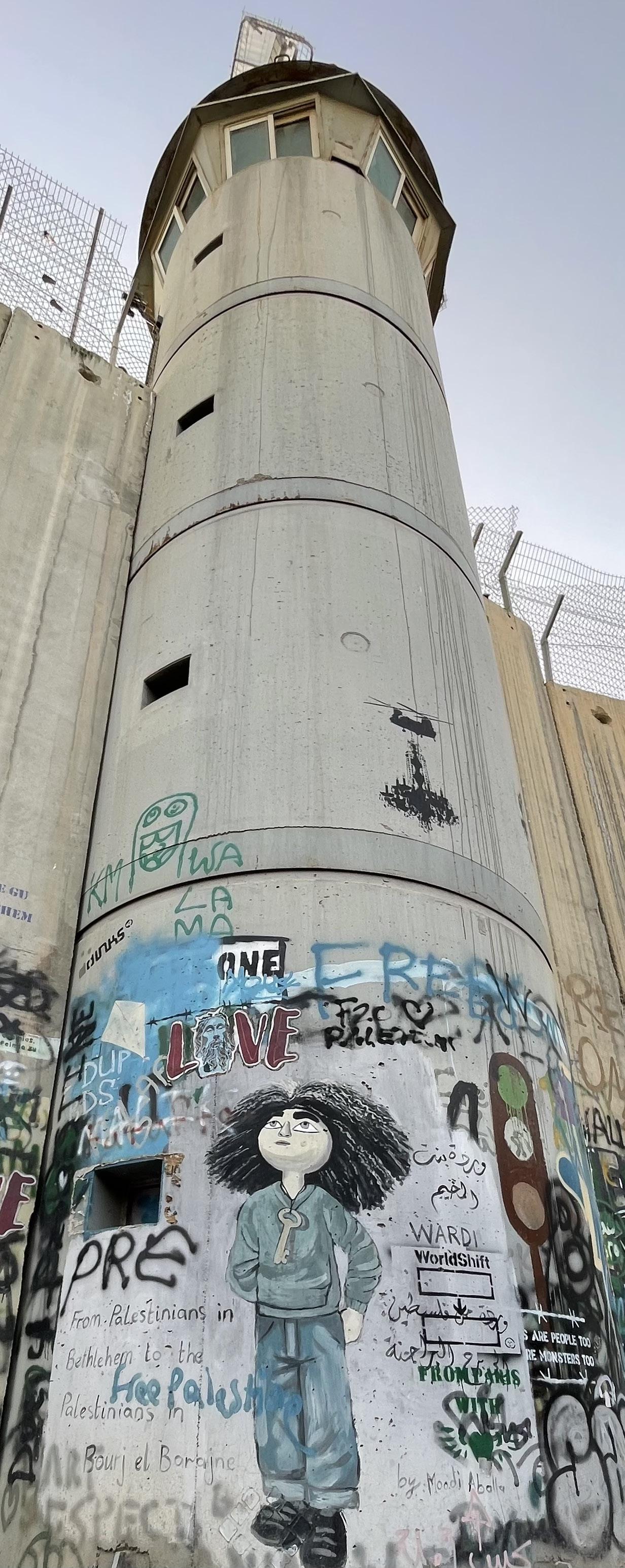
Wall Tower
Photo Credit: @BelalLulu
Unity Against Injustice
By Zoeya Pasha
I wasn’t much of a history person
Until I saw on screen the amount of dead bodies that worsened
Mostly women and children actually, getting killed by bombing annually
Fathers carrying plastic bags of their children’s dead bodies
Reporters documenting misplaced families carrying their life on donkeys
These children wake up to the sound of bombs
While I wake up to the sound of my alarm
These children mourn their families’ killings
While I live happily with my parents and siblings
Those in power turn a blind eye and don’t care
They say it’s just some regular warfare
So the humanity left in this society must unite
Heads bowed in prayer shoulder to shoulder praying deep into the night
History teaches us that strength comes in numbers
An undivided 8 billion people can solve world hunger
Change does not occur from just one person
The key to making an impact as a community is to open-mindedly listen
Hence, we all must join together to unveil the injustices behind the curtain
For a better future, one where the world is just
And all children can walk, laugh, and live without disruption
Al-Jib
Photo Credit: Bayann Amer
The Palestinian Dystopia
By Qamar Bazar
Dalia had tried once, just once, to post a photo of her grandmother holding a ceramic bowl of maqlouba with the caption, “This is Palestinian food.” It was flagged for sensitive content, and the post disappeared within seconds.
Palestine didn’t exist anymore. It is no longer on maps, textbooks, or search engines. If you typed it in, the page blinked once and returned, “Error 404: Location not found.”
Even the word felt dangerous. But the algorithm didn’t delete the sponsored ad beneath it: Try maqlouba! A Middle Eastern twist on TikTok’s trending upside-down dish! Now with saffron rice and roasted pine Nuts!
They wanted the flavor, not the history. Dalia sat cross-legged on the floor, flipping through pages of banned books. Each had sections blacked out of cities, poems, and names. She traced the censored words with her finger to learn what had been erased. Sometimes, she could still see the Arabic letters under the black ink.
She paused on one book, its cover torn. The page inside was blocked out with thick black lines, but she knew it by heart:
“We have on this earth what makes life worth living.” Darwish. The last line had been ripped out entirely.
An old map of Palestine with burnt corners and creased paper lay above her desk. It was the only map that showed her family’s village: Haifa, the city her grandmother was forced to leave barefoot, carrying a silver key wrapped around her neck, tucked beneath her shirt, and a small jar of olives. She had posted a photo of her grandmother’s old house in Haifa. Just the image and one word: Falasteen.
No caption. Just the word.
Dalia stood and placed her finger on the map. Her phone buzzed with another warning.
Content Removed
Your recent post violates community guidelines.
Reason: Unrecognized historical reference (“Falasteen”) She didn’t flinch.
Instead, she walked to the wooden box under her bed. Inside were old cassette tapes, letters, and a packet of dried za’atar. She pulled one of the tapes from its sleeve, marked with her grandmother’s handwriting: “My First Home.”
She pressed play. A soft voice filled the room, humming, then speaking.
“My home was a garden. My garden had seven olive trees. The sky was low, and the moon was kind.”
She closed her eyes and listened.
Then something new.
At the very end of the tape: a click. And a different voice.
“If you’re hearing this, you’re not alone. There are more of us. We remember too.”
Dalia froze.
A name. A message. A location.
She replayed it to make sure she hadn’t imagined it. The voice sounded young, hesitant, but deliberate. It reminded her of herself.
There are more of us. We remember, too.
She wrote the details down on a piece of paper with invisible ink, folded it, and slipped it into her pocket.
Outside, the city was empty. The drones were loud enough to silence everything beneath them.
She stood momentarily, staring at the map of Haifa, circled in red. She didn’t grab her phone. She didn’t check the news. She didn’t say goodbye.
She got dressed and walked out the door. She didn’t know where the path led.
But she knew she wasn’t the only one walking it.
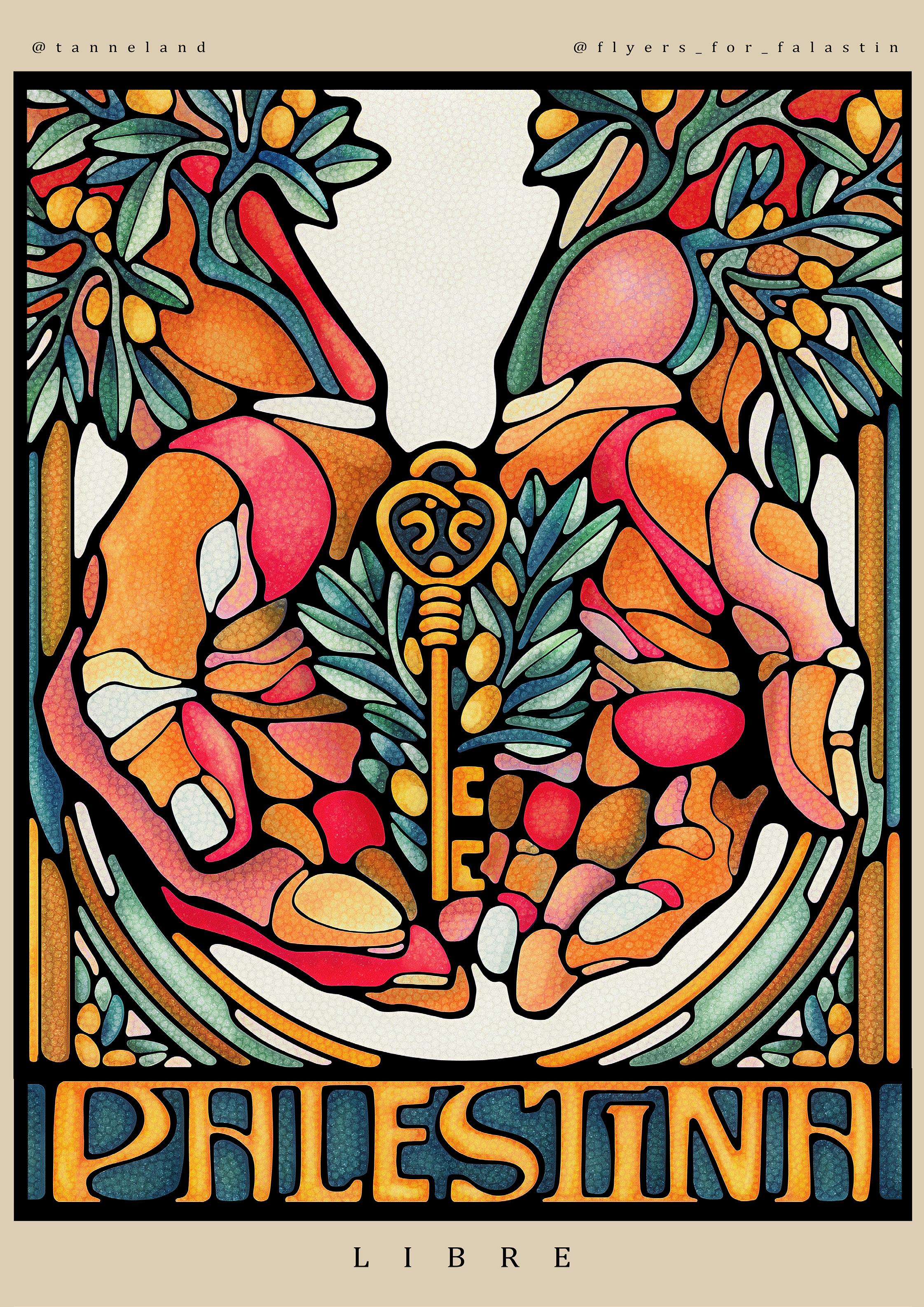
Palestine Libre
Artwork: @tanneland
Rooted in Place, Committed to Community: Raed Odeh and the Choice to Stay.
By Ameera Abouali
In South Paterson, where storefront signs in Arabic line the streets and generations of Palestinian families have built businesses, institutions, and homes, Raed Odeh stands as one of the community’s most profound members.
A respected organizer, businessman, and advocate, Odeh has become a central figure in strengthening civic structure and collective confidence within one of the largest Palestinian-American communities in the United States. But his work is not driven by titles or visibility. It is driven by descent.
Odeh traces his family’s roots back to the 18th century, to the city of Hebron (Al-Khalil) and to the displaced Palestinian village of Agor. Generations later, his fifth grandfather settled in Irtas, a village near Bethlehem (Beit Lahem), where the family’s story continued. For Odeh, that continuity is not abstract history; it is inheritance.
“What motivated me was a desire to understand where I come from, not just names and dates, but the story of our people,” he says of his decision to trace his family tree. “As Palestinians, so much of our history is oral. I felt a responsibility to document it, preserve it, and pass it on to my children.”
In a community shaped by displacement and diaspora, documentation becomes more than curiosity. It becomes preservation.
“When you know your roots, you stand taller,” Odeh reflects. “Our story didn’t start with hardship; it started with generations of dignity, faith, land, and community.”
Researching his ancestry reshaped how he understood himself, not simply as an individual navigating modern American life, but as part of
a historical line. “It grounded me,” he explains. “It reminded me that I am part of something much bigger than myself. When you trace your lineage, you realize you’re carrying generations of sacrifice and resilience.”
That grounding, he says, provided clarity. The elders who came before him endured immense instability, yet they built lives, contributed economically, and protected their identity. “Our grandparents preserved who they were under far more difficult circumstances,” he says. “That gives me strength and clarity about who I am as a Palestinian-American.”
That clarity translated into action. For Odeh, heritage does not end in remembrance; it demands responsibility. “If they preserved their identity under those conditions,” he says, “then we have no excuse not to organize, build institutions, and protect our community here.”
Through his leadership within the South Paterson Business Association and involvement with the Palestinian American Community Center (PACC), Odeh has worked to formalize and strengthen community advocacy. The work is practical and structured: improving public safety, supporting economic development, and coordinating civic engagement.
“Organizing brings discipline and unity,” he says. “South Paterson didn’t grow by accident; it grew because families invested time, money, and effort.”
For years, he explains, progress depended heavily on individual efforts. What was missing was structure. Through organized advocacy, he and others pushed for stronger communication between residents, business owners, and local officials. The results, he says, are visible.
“When people see structure, they gain confidence. When they gain confidence, they invest more.
Organization turns a neighborhood into a respected community.”
But Odeh’s commitment to community work was not formed solely through reflection on ancestry. It was also shaped by trauma.
In an earlier period of his life, he witnessed a member of his community shot and killed in front of him, a moment that forced him to confront both vulnerability and fear. The experience was destabilizing enough that he temporarily left the country, hoping distance might quiet the memory.
“The worst thing that happened,” he recalls, “was witnessing one of our community members get shot and killed in front of my eyes.” Afterward, he left, considering whether starting elsewhere might offer safety and emotional distance. “On my way back, I thought of living somewhere else to take that memory away.”
Instead, he returned to the same streets. What brought him back was not denial of fear, but recognition of responsibility. If this place had become home, then improving it required participation.
“You have to face reality,” he says. “You have to work hard to make sure this is a good, safe environment for your kids, for your family, for your community. If you don’t get involved, then maybe you have to leave and look for a safer environment. I decided to get involved.”
Even now, he admits the internal debate has never entirely disappeared. “I always, every day, think about taking a step back,” he says. “This morning I thought about taking a step back. Yesterday. Last year. Every day.”
Community leadership requires time, energy, and sacrifice. When he first became deeply involved, he was focused on building his business and securing his family’s financial future.
“When you become involved, you have to give a lot of your time and a lot of your energy and attention to the community,” he says. “It’s a huge sacrifice.” Still, he views it as necessary. “I look at it as a good sacrifice.”
Each morning, the doubt competes with memory, memory of those lost, and memory of why he stayed. As he drives through South Paterson, he sees not just storefronts, but generations in motion.
“This is where my kids and family and my grandkids are going to be raised,” he says. “That’s what gives me my energy back, fighting for the existence of the community, fighting for our future.”
For Odeh, the work in New Jersey is inseparable from his vision of Palestine.
“I imagine a Palestine where our children can visit freely and proudly,” he says. “Where they are not defined by conflict, but by culture, education, innovation, and opportunity.”
He envisions a homeland connected to its diaspora, strong in its institutions, and secure in its identity. “I want my children to inherit hope,” he says, “not just memory.”
In tracing his family tree, Raed Odeh anchored himself in the past. In organizing his community, he invests in the present. And in imagining a different future for his children, he carries forward the same continuity his ancestors preserved.
For him, identity is not static. It is built, defended, and organized, generation after generation.