PSYC HO LO GI STS’ ASS OCIATION OF A L BERTA
VOL.37 NO.2 • FALL 2026
RECONCILIATION IN PRACTICE
Transforming Assessment:
Listening & Honouring Indigenous Stories
The Responsibility We Inherited:
Cultural Safety, Bill 13, and Psychology
Lessons from Private Practice:
Improving Access for Indigenous Clients
BOARD OF DIRECTORS President: Stacey Steele, R.Psych President-Elect: Carmen Bellows, R.Psych Past President: Dr. Quintina Bearchief-Adolpho, R.Psych Audit Committee Chair: Chris Pawluk, R. Psych Board Custodian: Rashmani Chakrabarty, R.Psych Members at Large: Dr. Allison McNeil, R.Psych Lisa Kaldenbach, R.Psych Dr. Ruby Sharma, R. Psych Dr. Denise Mannell, R. Psych Dr. Julie Curley, R. Psych
PAA’s Mission To connect and empower psychologists in Alberta. PAA’s Vision One PAA. The trusted home and leading voice of psychologists in Alberta. It is where psychologists belong, network, and shape the future of mental health care. About Psymposium Looking to advertise with us? Visit our website: paa-ab.ca.
PSYMPOSIUM Editorial Editors: Dr. Alana Ireland, R. Psych & Dr. Lily Le, R. Psych Fall Contributing Writers: Matthew Cairns, R. Psych Dr. Harpreet Gill, R. Psych Beverly Keeshig-Soonias, R. Psych Leigh Sheldon, R. Psych Dr. Melissa Tremblay, R. Psych Dr. Gwendolyn D. Villebrun, R.Psych Design and production: Ken Schwanke & Abby Oloriz PAA Psymposium [ISSN 1193-2627] is the official newsletter of the Psychologists’ Association of Alberta. Canadian Publication Mail Product Sales Agreement #40020241. PAA Psymposium is published four times a year (Spring, Summer, Fall, Winter) for the purpose of fostering communication amongst psychologists and supporting the goals of the Association and the profession of psychology. The newsletter is available to all members of the PAA on our website or by subscription, as well as to public subscribers and selected individuals and organizations with interests in the practice of psychology. Except where otherwise indicated, copyright 1998 by the Psychologists’ Association of Alberta are in effect. Permission is granted to reproduce up to 10 copies of any article as it appears in PAA Psymposium, if such reproductions are distributed without profit for educational or research purposes only and properly cite Psymposium and denote PAA copyright. Permission for additional reproductions or reproduction for commercial purposes must be obtained in writing from the Editors. PAA generally welcomes requests to reprint from other professional newsletters. Psymposium is submitted to PsycEXTRA, a database set up by the American Psychological Association, which contains newsletters, policy papers, white papers, fact sheets, reports, magazines. PsycEXTRA is a companion to the American Psychological Association’s scholarly database PsycINFO.
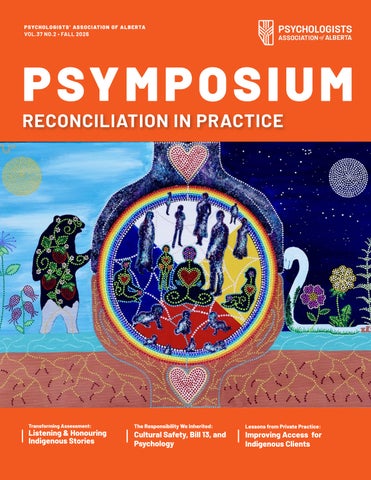
COVER ART: By Karlee Fellner
2 • PSYMPOSIUM FALL 2026
PAA STAFF Chief Executive Officer Dr. Bill Hanson, R. Psych Chief Operating Officer Joanna Leung Director of Professional Affairs Dr. Harpreet Gill, R. Psych Director of Career Affairs Matthew Cairns, R. Psych
Director of Communications & Strategic Engagement Ken Schwanke
Executive Assistant Jiya Juneja
Governance Officer Angela Sargent
Canada Jobs Trainee & Outreach Assistant Aseel Hag Hussein
Professional Guidance Officer Annika Rorem Member Services Officer Emma McGrath
Resource Specialist Abby Oloriz
Features Fall 2026
Except where specifically indicated, the opinions expressed in Psymposium are strictly those of the authors and do not necessarily reflect the opinions of the Psychologists’ Association of Alberta, its officers, directors, or employees. The Psychologists’ Association of Alberta reserves the right to edit all articles and submissions before publication and to decide on the suitability for publication.
Story Behind the 05 The Cover Art
and 08 Decolonization Psychology in Canada:
10
Working with Indigenous Children and Families: The Stories Told Through Assessment
12
14
The Responsibility We Inherited: Reflections on Cultural Safety, Bill 13, and Psychology
Perspectives Editors & CEO
Meaning, Reflection and Practice
16
18
Our Unique Indigenous Worldview and Experience in Psychology in Alberta
Improving Access to Counselling for Indigenous Clients: Lessons from Private Practice
In Training: Career Development, Community, and Reconciliation
04 Letter from the Editors:
06 Notes from the CEO’s Desk:
Reconciliation is an ongoing relational and ethical obligation for which the profession of psychology must remain accountable.
Cultural responsiveness and competence doesn’t depend on someone requiring us to complete a four-hour course. Indeed, it doesn’t reside in stand-alone courses at all.
Beyond Compliance: Psychology’s Responsibility
Cultural Responsiveness isn’t a Specialty - It’s a Foundational Competency and Inextricably Linked to Being a Psychologist
PAA-AB.CA • 3
LETTER FROM THE EDITORS
Beyond Compliance: Psychology’s Responsibility to Reconciliation Dr. Alana Ireland, R. Psych & Dr. Lily Le, R. Psych Editing this issue has required us to think carefully about our role as editors. As non-Indigenous co-editors from different cultural locations, we can be reflexive about our positions and responsibilities, but we cannot claim an understanding grounded in lived experience. As such, we approach this note with humility and a deep appreciation for the authors who were willing to share their knowledge and experiences, some deeply personal. We recognize the generosity and labour this involves, especially within a profession that has too often marginalized Indigenous knowledge or expected Indigenous people to explain their experiences, and to ask our profession to consider its responsibilities more fully.
Dr. Lily Le (she/her) is a Registered Psychologist based in Edmonton, AB. She earned her PhD from the University of Alberta and is CoEditor of Psymposium. She works as a Credentials Specialist with the College of Alberta Psychologists.
Dr. Alana Ireland (she/her) is a Registered Psychologist based in Calgary, AB. She earned her PhD from the University of Calgary and is Co-Editor of Psymposium. She works as an Associate Professor with Athabasca University and in Private Practice at Valeo Well-Being.
its values. It is demonstrated by whether those values alter how we practise and how our institutions operate.
sheds light on how restorying assessment can be powerful for Indigenous children and families. We are introduced to Beverly Keeshig-Soonias, who shares her experiences and perspectives on psychology. Dr. Gwendolyn Villebrun encourages us to think deeply about Bill 13 and how we can continue to remain accountable and responsive, while Leigh Sheldon discusses the need for accessible care and lessons learned as a private practice owner focused on serving Indigenous clients. Matthew Cairns goes on to discuss the relationship between reconciliation and professional development from the perspective of an ally. We are grateful to these authors for sharing their insights, and hope this issue inspires reflection and action for our PAA community.
At the center of this issue of Psymposium is a challenge to psychology as a profession. Our responsibilities to Indigenous Peoples cannot be treated as a specialized area of practice, left to
Ethical responsibility is not established by how clearly a profession declares its values. It is demonstrated by whether those values alter how we practise and how our institutions Indigenous psychologists, or satisfied through a discrete training requirement. They require us to examine psychology’s assumptions about knowledge and expertise, the power attached to our professional roles, and the ways colonial relations continue to be reproduced in contemporary practice and institutions. That examination must include the distance between what our profession says it values and what people experience within psychological services and systems. This responsibility does not disappear when regulatory requirements change, nor can it be met through compliance alone. Ethical responsibility is not established by how clearly a profession declares
Humility, then, cannot mean standing back from responsibility. For those of us who are not Indigenous, recognizing the limits of our understanding cannot become a reason to withdraw or leave this work to Indigenous colleagues and communities. We remain responsible for what we do with what has been shared. Reconciliation is an ongoing relational and ethical obligation for which the profession of psychology must remain accountable. In this issue, we highlight what accountable action toward decolonizing psychology looks like, and the responsibilities, relationships, and limits psychologists need to consider in that work. The contributors invite us to reflect on our practice as people, psychologists, and a profession as a whole. Through her beautiful artwork featured on the cover of this issue, Dr. Karlee Fellner emphasizes how Indigenous ways of practicing and seeing the wholistic person can be healing. Dr. Harpreet Gill outlines what decolonizing psychology can look like in practice through the lens of the four ethical principles. Dr. Melissa Tremblay
Warmly, Alana and Lily l
This responsibility does not disappear when regulatory requirements change, nor can it be met through compliance alone. 4 • PSYMPOSIUM FALL 2026
THE STORY BEHIND THE COVER ART
ᓇᓇᑕᐃᐧᐦᐃᐁᐧᐃᐧᐣ nanâtawihiwêwin — healing By Dr. Karlee Fellner, R. Psych
Euro-Western psychology often asks us to locate distress within the individual: “their” thoughts, behaviours, diagnoses, nervous system, or personal history. Indigenous psychologies begin elsewhere. We understand each person as a person-in-relation— inseparable from family, community, nation, land, cosmos, ancestors, and generations yet to come. We also understand that each person carries the medicine they need to heal and live well, and that their medicine brings healing to their communities and relations. nanâtawihiwêwin depicts this wholistic person-in-relation. At the centre is a person seeking support, surrounded by the relationships that shape and sustain their life. Seven generations of ancestors stand behind them, with seven generations of descendants before them. The four directional quadrants remind us that wellness requires balance among spirit, heart, mind, and body. There is no “mental health” in isolation from the other aspects of being, just as “physical health” cannot be separated from these dimensions. Around them are the land, waters, plants, animals, sun, moon, and stars—living relations and active sources of medicine. Within Indigenous psychologies, what presents in the therapy room is a conversation coming through the web of the self-in-relation. What is often labelled a “symptom” may carry the wisdom of an ancestor, one’s community, a family member, multiple generations, or the land itself. These conversations come forward for healing and balancing. They carry knowledge, love, resistance, survivance, and medicine. When a person opens to and receives that medicine, healing echoes through the web of relationships. These understandings are the deep roots of my practice as a psychologist and of our collective practice at ᒪᐢᑭᐦᑭᕀ maskihkiy wellness. maskihkiy is nêhiyawêwin (Plains Cree) for medicine. Our practice grew from the need for genocide-informed, culturally responsive clinical care that centres Indigenous ways of knowing, being, and doing. We understand each person—including ourselves—as a whole, well human being behind whatever is getting the best of them in this mo-
Therapy is ceremony: a sacred space where stories are witnessed, the body is listened to, and all one’s relations are respected.
ment. Our responsibility as clinicians is to nurture space in which the person-in-relation can track and receive their medicines. Therapy is ceremony: a sacred space where stories are witnessed, the body is listened to, and all one’s relations are respected. In the painting, the hands of helping professionals rise from the earth and hold the person-in-relation with regard, respect, and love. Above them, the hands of the ancestors reach down from the cosmos. The helpers themselves are being helped. We are not meant to do this work alone or through intellect alone. When we approach our work with humility, love, and openness to something beyond ourselves, spirit can move powerfully through the therapeutic relationship. The bear represents Indigenous medicines. The snake, connected to Asklepios, represents the ancient roots of Euro-Western medicine. Neither stands above the other. The snake bows its head in humility. Both carry the diverse landscapes of what is now called Alberta upon their bodies. nanâtawihiwêwin asks psychologists to widen our circle of care—and our reverence and respect for those we serve. Deep healing can emerge when we acknowledge the whole person, the living web to which they belong, and our sacred responsibility to hold that person—and all their relations—with
Dr. Karlee Fellner (iskwew/she/her) is a Registered Psychologist based in Rocky Mountain House, AB. She earned her PhD from University of British Columbia and is okimâw, CEO and founder maskihkiy wellness. She specializes in Indigenous psychotherapy.
Deep healing can emerge when we acknowledge the whole person, the living web to which they belong, and our sacred responsibility to hold that person—and all their relations— with love.
PAA-AB.CA • 5
NOTES FROM THE CEO’S DESK
Cultural Responsiveness isn’t a Specialty–It’s a Foundational Competency and Inextricably Linked to Being a Psychologist By Dr. Bill Hanson, R. Psych Culturally responsive and competent practice cuts across psychological assessment, intervention, consultation, research, supervision and teaching, management, and administration (Rodolfa, Bent, Eisman, Nelson, Rehm, & Ritchie, 2005). It applies to every psychologist in Alberta, regardless of practice setting, theoretical orientation, or career stage. It requires more than knowing about diversity. It also requires an internalized valuing of it.
Providing safe and effective services requires the capacity to hold multiple perspectives and ways of knowing at the same time.
I think of individual and cultural diversity as the steering wheel. As psychologists, we can’t get where we’re going without it or provide safe, effective services to clients. Providing safe and effective services requires the capacity to hold multiple perspectives and ways of knowing at the same time, recognizing that human experience can be understood, for example, quantitatively, qualitatively, and through Indigenous story work. These different lenses need not compete to enrich our understandings; they’re complementary. Again, it’s about valuing and embracing diversity in all forms. I have valued and embraced diversity throughout my 30-year career and, in fact, moved beyond simply valuing diversity towards building understanding and meaningful connections across
Dr. William E. Hanson (he/him) is a Registered Psychologist based in Edmonton, AB. He earned his PhD from Arizona State University and is the CEO of the Psychologists’ Association of Alberta (PAA). He is the Chair of the Council of Professional Associations of Psychology, and a retired professor of psychology.
cultures, communities, and ways of knowing. In the early 2000s, for example, I chaired the University of Nebraska–Lincoln’s Ethnic and Minority Affairs Committee (EMAC), which focused on pluralism, embracing differing worldviews, and action. Later, in 2018, I co-chaired the international Cultivating the Globally Sustainable Self Summit in Banff*, where scholars, practitioners, Indigenous leaders, and others explored beliefs, values, culture, sustainability, and human relationships. One particularly meaningful experience was recognizing Alberta’s Charlene and Wilson Bearhead with an international beliefs and values award (pictured below). This award recognizes individuals whose lives and work translate deeply held beliefs and values into meaningful action and cultivate a more humane, interconnected, and sustainable world. I have co-authored two book chapters related to the Summit in a forthcoming Oxford Press publication. Throughout my career, I have lived by the Plains First Nations proverb: “Give me knowledge, so I may have kindness for all.” Knowledge matters. How it’s acquired matters too. Knowledge can’t come from textbooks alone, or from what we call
Knowledge matters. How it’s acquired matters too. Knowledge can’t come from textbooks alone.
Pictured left to right are: Charlene Bearhead, Dr. Bill Hanson and Wilson Bearhead at the Cultivating the Globally Sustainable Self Summit Series Banff, 2018.
6 • PSYMPOSIUM FALL 2026
“textbook multi/interculturalism.” The research literature underscores the importance of direct cultural exposure and experience. Working with, listening to, and developing genuine relationships with people whose lives and perspectives
differ from one’s own affects how we understand ourselves, others, and the world around us. A former doctoral advisee of mine identified a sense of community and belonging as important factors in understanding clients’ worldviews (Gibbon, 2005). Worldview is best understood as an interconnected set of beliefs, values, experiences, cultural influences, and assumptions through which a person sees themselves, others, and the world. As such, some of the most useful and insightful questions psychologists can ask themselves include: “Who’s in my community?” “Whom do I spend time with?” “Who challenges my assumptions?” “Whose experiences differ from mine?” We can also ask clients the same questions. As I wrote in the 2026 summer issue of Psymposium, “Genuine curiosity about clients’ backgrounds, communities, support systems, and expectations strengthens therapeutic relationships and improves engagement across diverse populations.” In discussions of cultural responsiveness and competence, we often talk about humility, which is essential. In addition to humility, we must also talk about cultural harmony. Harmony does not mean agreement, avoidance of difficult conversations, or minimizing injustice. It means
approaching difference with curiosity, openness, respect, and goodwill and simultaneously remaining ‘in relationship’ with others. I especially want to emphasize curiosity here, in contrast to being closed-minded or vitriolic. The proverbial two-by-four method doesn’t change minds, build competence, or create enduring relationships. As psychologists, we know better than that. Everything discussed in this article relates to the profession. It also relates to Alberta’s Bill 13. Whatever one’s perspective on compelled professional education, removing a regulatory requirement does not remove professional responsibility. Cultural responsiveness and competence doesn’t depend on someone requiring us to complete a four-hour course. Indeed, it doesn’t reside in stand-alone courses at all. At PAA, we’ve incorporated Indigenous-focused training and education into this year’s conference proposals and presentations and future workshops. Additionally, we’ve established an Indigenous Community Fund for members. Consistent with Pillar 4 of PAA’s 2026–2030 Board-approved Strategic Plan, we’ve also established an Indigenous-focused Board
committee to strengthen relationships, learning, accountability, and ultimately reconciliACTION. These are steps, not destinations. Cultural responsiveness and competence can’t be reduced to a regulatory requirement, a workshop, or a political position or statement. It develops through knowledge, experience, relationships, humility, self-reflection, and, I’d argue, harmonious discussions and interactions. Before questioning the motives and intentions of others, perhaps we should first examine our own steering wheel, including our personal and professional communities and reflect on what
* The Cultivating the Globally Sustainable Self Summit in Banff video can be found in the reference link.
PAA-AB.CA • 7
ETHICS CORNER
Decolonization and Psychology in Canada: Meaning, Reflection and Practice By Dr. Harpreet Gill, R. Psych
Decolonization is increasingly part of conversations about psychological education, research, assessment, and practice. Psychologists’ training should involve learning about colonial histories, systemic inequities, culture, power, and ways of knowing that have historically been marginalized or excluded by Western psychology. Yet an important ethical question remains: What are psychologists responsible for doing differently? For Canadian psychologists, this question can be considered through our existing ethical framework. The Canadian Code of Ethics for Psychologists identifies four principles: Respect for the Dignity of Persons and Peoples, Responsible Caring, Integrity in Relationships, and Responsibility to Society (Canadian Psychological Association [CPA], 2017). When read through a decolonial lens, these principles offer more than abstract commitments. They invite reflection on our relationships, responsibilities, professional power, and boundaries. Decolonization in Canada has a particular historical, political, and social context. Although diversity or multiculturalism are important considerations in psychological practice, decolonization is about more than recognizing diversity or multiculturalism. It requires acknowledging the histories and continuing experiences of First Nations, Inuit, and Métis peoples, including the ongoing impacts of settler colonialism.
Dr. Harpreet Gill (she/her) is a Registered Psychologist based in Edmonton, Alberta. She earned her PhD from Punjabi University and currently serves as PAA’s Director of Professional Affairs. In her clinical practice, she brings her commitment to professional standards and patient care through her work specializing in addictions and couples counselling.
8 • PSYMPOSIUM FALL 2026
Ethical humility does not require psychologists to have all the answers; it requires honesty about the limits of our knowledge and a willingness to respond responsibly.
The CPA’s response to the Truth and Reconciliation Commission acknowledged psychology’s responsibilities within Canada’s colonial history and called for changes in psychological education, research, assessment, practice, advocacy, and relationships with Indigenous communities (CPA & Psychology Foundation of Canada, 2018). This requires psychologists to recognize that colonialism did not only disrupt families, communities, languages, lands, cultures, and systems of care. It also established hierarchies about whose knowledge counted. Western understandings of health, pathology, evidence, and intervention acquired institutional authority, while Indigenous understandings of the person, family, community, spirituality, land, healing, and well-being were frequently marginalized. So, what does decolonization in psychology require in practice? Principle I. Respect for the Dignity of Persons and Peoples, provides an important starting point. Psychologists bring specialized scientific and professional knowledge to their work. We should not minimize its value. Yet our clients and communities also bring knowledge, through lived experience, family and community teachings, cultural traditions, spirituality, Elders, Knowledge Keepers, and other sources-that psychologists do not possess. Do we regard clients and communities only as recipients of psychological expertise, or also as legitimate knowledge holders and active participants in the co-construction of knowledge? This is particularly important in work with Indigenous Peoples. Respecting Indigenous knowledges cannot mean extracting a ceremony, teaching, or practice and turning it into another psychological technique. Questions of relationship, community authority, consent, cultural protocol, and ownership matter. In Indigenous contexts, this may require psychologists to consider carefully what role is appropriate rather than assuming that professional expertise gives them authority. At times this may involve providing
guidance; at other times it may mean collaborating, consulting, listening, or recognizing that others hold knowledge and authority that the psychologist does not. This humility can also help psychologists work responsibly with other cultural, spiritual, and religious traditions. Long before psychology became a formal Western discipline, human communities reflected deeply on suffering, selfhood, attention, compassion, meaning, relationships, and human flourishing (VanderWeele, 2017). Different religious traditions around the world contain rich bodies of thought concerning human experience. The point is not to claim that these traditions “discovered” contemporary therapies first. Nor should they be reduced to early versions of CBT, ACT, or mindfulness. Doing so can leave Western psychology as the standard by which other knowledge receives legitimacy. Instead, their existence invites psychologists to ask: What assumptions do I make about where valid knowledge about the human experience comes from? Principle II. Responsible Caring requires psychologists to weigh benefit and harm within a broader ethical context. A decolonial lens expands what we consider when making assessments regarding what is beneficial and what is harmful. Imagine a client experiencing hypervigilance following repeated racism. Psychological assessment may appropriately explore threat perception, avoidance, physiological arousal, and coping. However, there is an ethical difference between helping someone evaluate an inaccurately perceived threat and encouraging them to reinterpret a genuine experience of discrimination as distorted thinking. Responsible Caring therefore extends beyond weighing benefits and harms to include competent, contextually responsive care and reflection on how psychologists’ assumptions may shape clinical interpretations. Similarly, psychological distress among an Indige-
nous client should not automatically be attributed to colonization or intergenerational trauma; doing so can itself become stereotypical. Yet ignoring histories and contemporary realities of colonialism can produce an equally incomplete formulation. Responsible Caring requires psychologists to consider individual experiences alongside cultural and historical context while remaining attentive to the potential harms of both over-attribution omission. Principle III. Integrity in Relationships. As a non-Indigenous psychologist writing about colonization and psychology, I recognize that I am writing from a particular position. I do not speak on behalf of Indigenous peoples or communities or claim expertise in Indigenous ways of knowing. Rather, I am reflecting on the ethical responsibilities of psychologists and what cultural humility requires of those of us who are not Indigenous. This positioning is important when considering Principle III of the Canadian Code of Ethics for Psychologists: Integrity in Relationships. Psychological relationships involve trust, professional responsibility, and power. Psychologists diagnose, assess, document, conduct research, provide expert opinions, and make recommendations that can affect access to care, employment, education, disability supports, legal decisions, and other significant areas of people’s lives. These responsibilities require attention to our assumptions, biases, limits of knowledge, and the ways professional authority shapes our relationships. These considerations are particularly important
when working with Indigenous peoples, given psychology’s relationship with colonial systems. Cultural humility is not the accumulation of enough facts to become an expert on everyone. A psychologist who attends a workshop on Indigenous practices does not become a knowledge keeper. Similarly, reading about Sikh concepts does not make someone an authority on Sikh spirituality. As a Sikh person myself, I am reminded that even within a faith tradition I know personally, there is tremendous variation in how people understand, practice, and relate to their beliefs. Cultural humility therefore requires an ongoing willingness to learn, recognize the limits of our knowledge, listen to individuals and communities, and reflect on how our professional roles and assumptions may shape our work. One of the most responsible statements a psychologist can sometimes make is, “I don’t know enough about this yet.” That admission can be followed by curiosity, collaboration, or referral when appropriate. Ethical humility does not require psychologists to have all the answers; it requires honesty about the limits of our knowledge and a willingness to respond responsibly when those limits become apparent. Principle IV. Responsibility to Society extends psychologists’ responsibilities beyond individual clients to the broader communities and social contexts in which psychological knowledge and practice take place. A decolonizing approach asks us to consider how power shapes whose knowledge is valued, who defines community needs, and who has a voice in
decisions about psychological research and practice. Moving decolonization from principle to action therefore requires psychologists to continually reflect on relationships, responsibilities, and boundaries, including whose knowledge, priorities, and decisions are guiding our work. For Indigenous Peoples, this means building relationships based on respect for Indigenous knowledge, community priorities, and self-determination, rather than assuming that psychologists know what communities need. Meaningful relationships take time and require reciprocity, trust, and attention to the historical and ongoing power imbalances between psychological institutions and Indigenous Peoples. Our responsibility as psychologists, is therefore not simply to include Indigenous perspectives, but to listen, learn, share decision-making, and remain accountable to the communities with whom we work. Rather than asking only, “Do I support decolonization?”, psychologists can ask: “Given my relationships, my professional power, the limits of my knowledge, and the context in which I am practising, what does responsible ethical action require of me here?” That question does not offer a simple checklist. It offers something more consistent with ethical practice: an obligation to keep examining how we know, how we relate, where we hold power, and what responsibilities follow. l
Have an ethical dilemma?
Our Professional Guidance Program can help. » GUIDANCE CONSULTATIONS » ETHICS WORKSHOPS
» WEBINARS & LUNCH N LEARNS » PODCASTS & RESOURCES
BOOK A CONSULT OR LEARN MORE
PAA-AB.CA • 9
INDIGENOUS PERSPECTIVES
Working with Indigenous Children and Families: The Stories Told Through Assessment By Dr. Melissa Tremblay, R. Psych Tân’si! I’m so glad you found your way here. My name is Melissa Tremblay. I am a citizen of the Otipemisiwak Métis Government and a member of the Lac Ste. Anne Métis Community Association. I am also a Registered Psychologist in private practice, an Associate Professor in the School & Clinical Child Psychology Program at the University of Alberta, and an Indigenous Liaison with the Canada FASD Research Network. I have been working with Indigenous children and families in different front-line and research roles for almost 20 years, and I am honored by the opportunity to share some of my learnings and reflections relevant to psychological assessment with children and families in this Psymposium article. Here, I invite you to reflect on stories: those stories that psychologists bring to their work, those that assessments produce, and those told by the children, families, and communities we work with. I welcome you to join me on a journey to consider and reconsider how we might construct assessment stories that are relational, contextual, collaborative, and accountable to the children and families who bring us into their worlds. The Stories Psychologists Bring Before meeting a family for a clinical interview or administering a single assessment measure, we, as psychologists, bring stories into the assessment process. Through an interpretive process, we co-construct meaning alongside children and families, carrying stories that reflect our professional training, theoretical orientations, cultural backgrounds, lived experiences, and assumptions about what counts as “evidence.” For Indigenous children and families, these assumptions can have especially high stakes. The overwhelming majority of our psychological assessment tools and practices have been developed within Euro-Western frameworks that require strict reliance on standardized norms and privilege individual-level explanations of behaviour. As a result, psychologists may interpret the effects of racism, colonialism, poverty, or intergenerational trauma as characteristics of individuals rather than as responses to broader social and structural conditions. For example,
when a child performs inconsistently on measures of attention or academic achievement, we might locate difficulty solely within the child, describing deficits in attention, motivation, or learning, without adequately considering how disruptions in educational opportunity, material circumstances, experiences of racism, or family relationships with school may have shaped the child’s current presentation and their performance during the assessment. Although the scores we arrive at may be accurate, the story we construct around them may be incomplete. The Stories Assessments Produce Conventional psychological assessment often produces stories centered on deficits. When assessment findings are interpreted without considering the structural conditions affecting children and youth’s lives, the result is often a cycle in which young people are labelled as deficient while the systems contributing to those challenges remain invisible. Ball (2021) argues that many children are diagnosed before school entry for difficulties that are deeply connected to social inequities, placing responsibility on children and caregivers rather than acknowledging the broader determinants of health and development. For example, when we describe a child as having poor self-regulation skills, behavioral difficulties, or social-emotional functioning, we potentially obscure experiences such as disrupted relationships, inadequate educational supports, or repeated interactions with systems that have not felt safe or responsive to a child or family. However, psychologists can shift from producing stories of deficiency toward stories of relationship, resilience, context, and possibility. This does not mean ignoring genuine difficulties or abandoning diagnosis where it is helpful. Rather, it means ensuring that assessment tells a fuller story—one that recognizes strengths alongside challenges, situates difficulties within historical and social realities, and honours the relationships, cultural identities, and community resources that support wellbeing. In considering the stories assessments produce,
Dr. Melissa Tremblay (she/her) is a Registered Psychologist in Edmonton, AB. She earned her PhD from the University of Alberta where she is Associate Professor in the School & Clinical Child Psychology Program. She specializes in child and adolescent development; Indigenous mental health and wellbeing.
we can look to the field of education, where many brilliant Indigenous scholars are doing work that psychologists can learn from. Carolyn Roberts (2025) describes restorying as the work of examining the stories that have shaped education and intentionally creating new stories that more fully reflect truth, relationship, and Indigenous perspectives. Roberts reminds us that stories are never neutral—they shape possibilities. Assessment reports do the same. They become enduring narratives that follow children across schools, healthcare systems, and communities. They influence how teachers respond, what services become available, and how children understand themselves. As psychologists, we carry deep
As psychologists, we carry deep responsibility for the narratives our assessments create. responsibility for the narratives our assessments create. If psychologists are committed to doing good work with Indigenous children and families, perhaps our task is not simply to focus on developing cultural competence or adapting assessment tools, but to consider restorying the foundations of assessment itself. Restorying assessment might begin by asking questions about how a child participates and communicates within their family and community, and what their ways of relating might communicate about observation, trust, respect, or the time needed to feel safe in relationship. In this way, we can both identify areas of
Every assessment constructs a narrative that can either reinforce deficit-based understandings or open possibilities for belonging, growth, and self-determination. 10 • PSYMPOSIUM FALL 2026
The Stories Children, Families, and Communities Hold In Psychology’s Response to the Truth and Reconciliation Commission of Canada’s Report (2018), the Canadian Psychological Association and Psychology Foundation of Canada acknowledge that psychological assessment has privileged the knowledge of professionals. The most credible sources of evidence are standardized measures and research evidence based on randomized controlled trials, whereas the lived experiences and cultural knowledge of children, families, and communities are positioned as contextual information. In their work to develop an Indigenous assessment protocol, Boyer and colleagues (2026) invite us to reconsider this hierarchy. Rather than asking how community knowledge can supplement assessment, we might ask how assessment itself might change when lived experience, relationships, hope, resilience, and cultural knowledge are upheld as legitimate forms of evidence. In other words, Boyer and colleagues prompt psychologists to reconsider not only what we assess, but also what we recognize as evidence.
consider what it means to be a good relative offers a helpful way of thinking about the ethical responsibilities of psychologists. Rather than positioning expertise as the defining feature of assessment, this perspective asks how psychologists show up in relationship, with humility, reciprocity, accountability, and care. Being a good relative does not mean abandoning scientific rigour or avoiding difficult conversations. Instead, it means recognizing that psychologists are not only responsible for producing technically sound assessments but
If psychological assessment is an act of storytelling, then it is also an act of relationship. also for considering how their work affects the relationships, identities, and futures of the people they serve. Approaching assessment in this way changes the questions we ask throughout the assessment
process. Rather than asking only, “What diagnosis fits?” or “What intervention is indicated?”, we might also ask: “How can this assessment strengthen this child’s relationships?” “Will this report help this family feel understood?” “Does it honour the strengths, knowledge, and aspirations they shared with me?” These questions shift assessment toward a focus on relational responsibility. Responsible assessment is not about replacing one source of evidence with another. It is about broadening assessment practice beyond what we typically recognize as evidence, and expanding ideas about the knowledges we value. Although standardized measures have value, they represent only one way of knowing. Accountable psychological assessment requires bringing together psychometric evidence, clinical expertise, developmental science, and the lived experiences, cultural knowledge, and aspirations of children, families, and communities. When we broaden the stories we are willing to honor and uplift, we also broaden the possibilities our assessments can create. l
Children and families are experts in their own lives. They understand the relationships, responsibilities, strengths, and challenges that shape everyday development in ways that standardized measures cannot fully capture. Communities similarly hold knowledge about local histories, cultural teachings, kinship systems, language, land, and collective experiences that provide essential context for understanding children’s development. Without these perspectives, psychologists risk constructing narratives that are technically accurate yet fundamentally incomplete. When psychologists meaningfully incorporate the stories of children, families, Elders, Knowledge Keepers, and communities, assessment can become a collaborative process of knowledge co-creation. Moving Forward Roberts (2021) reminds us that education is shaped by the stories we tell about children and what they are capable of becoming. Psychological assessment is no different. Every assessment constructs a narrative that can either reinforce deficit-based understandings or open possibilities for belonging, growth, and self-determination. Restorying assessment is about recognizing that psychological knowledge is most complete when it is held alongside the lived experiences, cultural teachings, and aspirations of children, families, and communities. When psychologists become more attentive to the stories we bring, the stories we produce, and the stories we have yet to hear, assessment itself becomes an opportunity for relationship, understanding, and hope. If psycholoical assessment is an act of storytelling, then it is also an act of relationship. In her beautiful doctoral dissertation regarding the experiences of Indigenous youth and caregivers with psychological assessment, Elizabeth Carlson’s invitation to
PAA-AB.CA • 11
INDIGENOUS PERSPECTIVES
Our Unique Indigenous Worldview and Experience in Psychology in Alberta ABOUT THIS ARTICLE In this article, Beverly Keeshig-Soonias shares her experience as an Anishinaabe registered psychologist and reflects on how Indigenous worldviews shape her understanding of psychological practice. Drawing on her Anishinaabe and Nehiyaw experiences, she explores relationships, responsibilities and boundaries, and the interconnected roles of community, land, language, culture and spirituality in wellbeing. She also considers what these perspectives mean for the profession of psychology in Alberta, including the importance of Indigenous self-determination, distinct Indigenous approaches to research and training, and the ongoing work of reconciliation.
By Beverly Keeshig-Soonias, R. Psych Observations on relationships, responsibility, land and wellbeing and what they mean for psychological practice.
Aaniin. I am named Beverly Keeshig-Soonias. My nation is Anishinaabe, and my community of origin is Neyaashiinigmiing. Both of my parents were registered members of the Chippewas of Nawash Band. My clan dodem is crane. In this way, I introduce myself in an Anishinaabe culturally appropriate manner. In addition, I have lived among the Nehiyawak (Cree) for almost five decades, as the wife of Rodney Soonias. He is a registered member of Red Pheasant Band. During this time, I have lived and worked in the traditional territories of the Anishinaabeg (Saulteaux), Nehiyawak (Cree), Niitsitapi (Blackfoot,) Nakota (Assiniboine), Ktunaxa (Kootenai) and Métis. Therefore, my relationship with the science of Western psychology has been influenced by my Anishinaabe and Nehiyaw worldview. I am appreciative of the opportunity to write about my experience as an Indigenous registered psychologist, in particular, responsible action in psychological practice as it pertains to relationships, responsibilities, and boundaries that come with this work. As I have shared with other psychologists, relationships, responsibilities and boundaries in the Indigenous worldview involve more than a dyad involving a practitioner and a client. Relationships in my worldview may involve many more spiritual entities than are commonly recognized in Western psychology. Responsibility is considered as part of contextual and relational knowledge. Boundaries are experienced as permeable and changeable when considering my interdependence with other spiritual beings. Nations from other lands are experienced as having their own unique stories, experiences and sense of “place”. I grew up in my community of origin experiencing myself involved in an awesome myriad of relational possibilities. These relationships included two-legged beings, plants, animals, fish, birds, stars, planets etc. I learned that “we are all related”. My development as a person involved this sense of community. My sense of identity includes a spiritual, physical, mental and emotional commitment to being in the “right” relationship with all aspects of nature. These relationships and responsibility, rather than
12 • PSYMPOSIUM FALL 2026
rights, led to respect for land, relationship with self and community. Many guiding stories and lived experiences which occurred in my traditional “place” have helped me form a context in which to develop wellbeing. It is for these reasons that I consider the origins of people, their place, and how it has shaped them over time, when walking alongside them toward increased wellbeing. I believe that people from other places of origin are also connected to those lands and have experienced “dis-placement” that affects their self-understanding. Indigenous Experience and Psychology In Canada, part of the lived experience of Indigenous people includes historical, cultural and spiritual relationships that have evolved since contact with non-Indigenous people and their institutions. One of these institutions includes the profession of psychology. The Truth and Reconciliation Commission of Canada’s report (TRC Report, 2015) provided evidence and details of the cultural and physical genocide of Indigenous Peoples in Canada. The Canadian Psychological Association (CPA) responded to the TRC Report in May of 2018 with Psychology’s Response to the Truth and Reconciliation Commission of Canada’s Report. Since that CPA document was shared, much work has been done to develop ethical accountability when working with Indigenous people. As an Indigenous practitioner, I have made some observations which may be knowledge from an Indigenous science perspective but not yet found in a Euro-Canadian science perspective. The practice of psychology needs to maintain distinct Indigenous designations as part of research and training. It is not appropriate nor effective to merge Indigenous practices with general diversity, multicultural, or equity frameworks. Our lived experience comes from our deep connection to Turtle Island (North America) since time immemorial. Our connection to land has sustained communities and shaped our culture. Therefore, our responses to our Indigenous definitions of wellbeing, as community and as spiritual beings, are unique.
My sense of identity includes a spiritual, physical, mental and emotional commitment to being in ‘right’ relationship with all aspects of nature. A stand-alone space is required to respect Indigenous self-determination, governance, and unique definitions of good practice. Our unique cultural interventions are acts of sovereignty. The practice of psychology in Canada has undertaken to support self-determination and sovereignty as its response to the TRC Calls to Action. Land, Language and Relationship Our relationship to land has been uninterrupted in spite of historical attempts to end it. The treaties changed our relationship and responsibilities to land. Practitioners and scholars need to move beyond viewing the Treaties as historical documents. Digging deeper into the meaning and consequences of treaty will help them learn how it has impacted the wellbeing of Indigenous people. Practitioners and scholars need to continue to develop their relationship with the truths and recommendations that came from the TRC Report. We must use the TRC definition of reconciliation—an ongoing process of establishing and maintaining meaningful
relationships—as a guiding framework.
We need to also recognize land as inseparable from Indigenous identity, culture, knowledge and wellbeing. Land is not just a physical context on which interventions may be carried out. Land is our living, spiritual “co-creator”. It contributes to our relationships with wellbeing. It cannot be separated from our wellbeing as part of a desire for resource extraction and growth of wealth. Our Indigenous languages provide ways of expressing and honouring our relationship with land and all other spiritual beings. We do not refer to land as “it” in our Indigenous languages. When we speak of land we mean “her and he” without confining our meaning to binary categories. It is awkward and disquieting to have to call land “it” when we are communicating in English. When we consider our relationship to land in Indigenous terms we open up many possibilities for relationships and responsibilities, and opportunities for increased wellbeing.
Beverly Keeshig-Soonias is an Indigenous Registered Psychologist in Alberta. She has a Law Degree from the University of Saskatchewan and a Masters Degree in Family Therapy from Loma Linda University. She integrates Indigenous principles with kindness and humour when serving Indigenous children, adolescents, families Practitioners and scholars do not need to know how to speak all of our languages but they need to understand how our languages express our world view, our relationship with the Creator, our relationship with other humans, our relationship with other spiritual and therefore sacred beings and our purpose in being. As noted by the CPA’s response to the TRC, practitioners need to challenge conventional/Euro-Canadian ways of researching and defining measures of “evidence” and “best practice”. Thank you for considering these few observations. l
PAA-AB.CA • 13
INDIGENOUS PERSPECTIVES
The Responsibility We Inherited: Reflections on Cultural Safety, Bill 13, and Psychology By Dr. Gwendolyn D. Villebrun, R.Psych
Gwendolyn Villebrun, Ph.D, R.Psych (she/her) is a Registered Psychologist based in Edmonton, AB. She earned her PhD from the University of Alberta where she is Assistant Professor, Counselling Psychology in the Faculty of Education. She specializes in Indigenous resurgence, anticolonial professional psychology training and practice.
When I reflect on Bill 13, I find myself returning to the Truth and Reconciliation Commission and to the responsibility we inherited through that process. More than ten years have passed since the TRC, and this should be a moment when we can look honestly at what we have done, collectively, in the name of reconciliation. Sadly, too much remains unchanged. Indigenous Peoples1 are still not safe in healthcare, and they are still not safe within psychology. I had the honour of serving on the health support team during the Alberta tour of the TRC. It is an experience I return to often because it profoundly shaped me, both personally and professionally. I witnessed people make the brave decision to share their testimony, sometimes privately and sometimes in public. Those who spoke publicly often did so in large rooms filled with hundreds of people. Some were Elders. Some had mobility challenges and were helped onto the stage by loved ones. They sat at a table beneath bright lights, in front of a camera and a microphone, while the Commissioners listened and documented their words. They went there to speak about what happened to them in residential schools. They went there to speak their truth, sometimes for the very first time. I was deeply moved by the honesty, pain, strength, and raw emotion that filled those rooms. People spoke about the abuse they endured, the loneliness they felt, the fear they lived with, and the painful process of returning to their families, communities, and society after being separated from all they had known. Many shared that the coldness of those insti-
14 • PSYMPOSIUM FALL 2026
tutions left them unable to show love or affection, and they spoke about how this affected their relationships with their children and grandchildren. Giving testimony required immense emotional labour that many had carried for years, even decades. I have no doubt that many people left that process exhausted and depleted. Their faces made clear that it was not easy. It took extraordinary courage. And still, they did it. They did it so there would be a record of what happened. They did it so that we, as Canadians, could ensure that such harm does not happen again and so that we could begin to make things right for Indigenous Peoples. They did it for the generations before them who were no longer living, or who could not speak. They also did it for the generations yet to be born. I wish everyone could have attended a TRC hearing and witnessed what I witnessed. Perhaps some of you reading this did. If you had, I believe it would be difficult to accept the premise behind Bill 13: that it is unnecessary for psychologists and other professionals to complete annual Indigenous cultural safety training. Generations of residential schools, along with other colonial and racist systems, have left deep and lasting marks on Indigenous Peoples and their communities. Against that reality, we now find ourselves bound by legislation suggesting that four hours per year of training is too much to ask. It is shameful. As a descendant of three generations of Indian residential school survivors, and as someone who lives with the intergenerational impacts of those experiences, this change to our professional responsibilities has shaken me and I struggle with feeling proud of my identity as a psychologist. When I entered this profession as a young person, I did so with hope and excitement. I wanted to become a psychologist for reasons that may be familiar to many of you: I wanted to help people. But I especially wanted to help Indigenous communities because I knew how often they were neglected within our profession, and I knew the struggles they faced because my family and I had faced them too. I hoped I could become an important bridge, and in many ways, I believe I have been. I am honoured to have served Indigenous families as a counselling psychologist for more than 20 years. Now, as an Assistant Professor, I hope to offer a presence and a voice in training that I did not have when I was a student. And yet, even with these steps forward, it seems as though we slide back. This legislation leads me to question whether the values and ethics we describe as foundational, and that we hold as sacred within our profession, have real meaning when they are tested. I worry about the impact this will have on Indigenous
Peoples and their communities. I worry they will see it as another example of how little we care about them and their safety. I worry they will conclude that we believe the effects of historical and intergenerational trauma belong only to the past. I worry about the fragile trust that may have been built and how easily it can erode. I worry about a slippery slope where government leverage interferes with what we know to be right. Most of all, I worry about those who might have reached out for help, but who may now feel that psychologists are no longer a safe option for them. Like residential schools, the impacts of this legislation can ripple far beyond the moment in which it is passed. But unlike residential schools, we have the ability to interrupt those ripples before they spread further. Despite my strong feelings about where our profession is right now, I am still here. Although worn at times, I continue to do the work because I know it matters. What keeps me going, first and foremost, is my family. My family members, including many who have now passed on, were affected by numerous colonial policies and systems. I do this work for my 92-year-old father, who once told me it took years after residential school for him to feel like a human being again. He shared that he would look in the mirror and speak to his own reflection, saying, “I am a man. I am a man”—a man worthy of living a good life. I am also still here because of every person I witnessed who took those steps onto the TRC stage and bare their innermost selves so that we could do better. I am also doing this work to support our future psychologists, bringing them a perspective that has not been well represented in our profession. As witnesses, and as Canadians, we inherited that responsibility. We must hold ourselves accountable and refuse ignorance or complacency about the legacy of residential schools and other colonial institutions. For me, this means our learning about historical and intergenerational trauma, its ongoing impacts, and the work of culturally safer practice can never be treated as complete. There is no final checkbox, no point at which we can say we have done enough. This learning asks something much deeper of us. It asks for honest self-reflection, humility, and a willingness to acknowledge the harms our profession has caused and continues to cause. It asks us to listen carefully to those we serve, especially when what we hear is difficult. It asks us to take government action to make therapy and other mental health services more accessible and culturally safe for Indigenous Peoples. It asks us to make room for traditional and cultural wisdom that has always carried knowledge about healing, relationship, responsibility, and what it
means to live well. If psychology is to be a profession grounded in ethics and care, then we must be willing to keep learning, keep witnessing, and keep being accountable. That is the work before us. That is the responsibility we inherited. And if we are serious
If psychology is to be a profession grounded in ethics and care, then we must be willing to keep learning, keep witnessing, and keep being accountable. about reconciliation, it is a responsibility we cannot set aside. Bill 13 removes the requirement for regulators to mandate cultural competency, equity, or diversity training. That does not remove our ethical responsibility. Here are some actions that Alberta psychologists can take to ensure that they remain accountable, culturally safe, and responsive: • Learn about the Alberta Psychologists for Ethical and Culturally Responsive Practices Coalition in response to Bill 13: • E-mail: CoalitionAPECRP@gmail.com
• Link to signatory page (online version only) • Continue learning voluntarily: Seek out cultural safety, anti-racism, decolonization, and Indigenous-informed practice training even when it is no longer mandated. Build this learning into your own professional development plan. • Use professional associations to keep the work moving: Ask non-regulatory associations, including the Psychologists’ Association of Alberta, to host, promote, and fund ongoing education on Indigenous cultural safety, decolonization, and ethical practice. • Mentor students and early-career psychologists: Make it clear in training spaces that cultural responsivity cannot be separated from assessment, diagnosis, treatment, or ethics. Advocate for Indigenous perspectives to be meaningfully integrated across psychology training programs. • Support Indigenous-led healing and wellness initiatives: Do not assume what is needed—ask, listen, follow the lead of Indigenous communities, and offer support in ways that strengthen their priorities. • Advocate inside your organization: Identify policies, procedures, and service practices that create barriers for Indigenous peoples, then push for concrete changes such as streamlined intake, flexible scheduling, session extensions, and culturally safer referral pathways. • Learn where existing systems fail Indigenous peoples: Understand the limits of Non-Insured
•
•
•
•
Health Benefits (NIHB), federal trauma-informed programs, and provincial services so you can recognize when people are falling through jurisdictional gaps. Take government action: Write to your MLA and MP. Call for properly funded, culturally safer, trauma-informed mental health services for Indigenous peoples and communities, and for accountability across both provincial and federal systems. Study the TRC and MMIWG Calls to Action and Calls for Justice: Read the reports, testimonies, Calls to Action, and Calls for Justice. Know what is being asked of psychologists—not only in principle, but in practice. Challenge the narrative behind Bill 13: Push back on the idea that a few hours of learning about Indigenous cultural safety is unnecessary or burdensome. Speak with colleagues about the ethical risks of this legislation and the damage it can do to trust with Indigenous communities. Refuse complacency: Hold yourself accountable for learning about the ongoing legacy of residential schools, colonial systems, and systemic racism. Do not wait for a regulator to require this work before doing it.
I am grateful to my father for reading this article and supporting the use of his story for this purpose. l
Other upcoming workshops?
PAA-AB.CA • 15
INDIGENOUS PERSPECTIVES
Improving Access to Counselling for Indigenous Clients: Lessons from Private Practice By Leigh Sheldon, R. Psych As a second-generation descendant of a Residential School Survivor, my understanding of mental health and healing has been shaped by both personal experience and professional practice. Long before I became a psychologist, I experienced firsthand how difficult it could be to find support that felt relevant to my life, my family’s history, and my cultural identity. Over the years, both as a client and as the founder of a private psychology practice focused on providing services for Indigenous peoples, I came to understand that this work needed to look very different from Western counselling. My philosophy is built on expanding access, fostering diverse representation, and providing therapeutic counseling rooted in trust, cultural safety, and mutual respect. I am committed to ensuring care remains affordable and that every patient’s voice is central to their healing journey. Indigenous scholars have long noted that conventional Western approaches to mental health do not always address historical trauma, cultural identity, spirituality, and Indigenous ways of knowing. While Western therapeutic approaches can be valuable, they may be less effective when Indigenous perspectives on wellness and healing are absent (Duran, 2019). Gone and Trimble (2012) identify cultural mismatch, lack of relevance, and failure to address historical and collective trauma as longstanding challenges in mental health service delivery for Indigenous communities. Similarly, Duran (2006, 2019) argues that approaches focused primarily on individual pathology can overlook the spiritual, relational, and historical dimensions of Indigenous experience. When Western worldviews are privileged over Indigenous epistemologies, cultural practices, and healing traditions, this can become a form of epistemic violence, where providers unintentionally impose their own understanding of healing on clients (Duran, 2006). My own experiences, combined with what I have learned through a career focused on providing accessible services for Indigenous clients, have reinforced many of these observations. There needs to be a focus not only on improving accessibility, but how we provide our services. It requires culturally responsive care, Indigenous representation within the mental health workforce, flexible funding structures, and approaches that recognize the realities of historical trauma while creating space for Indigenous ways of knowing, being, and doing. My Personal Journey My interest in Indigenous mental health began long before I entered the profession. When I first sought
16 • PSYMPOSIUM FALL 2026
counselling, I often encountered professionals who had limited knowledge of Residential Schools and intergenerational trauma. More than once, I found myself explaining aspects of Indigenous history before I could even begin talking about my own experiences. While many of those providers were caring and well-intentioned, I did not always feel understood in the ways I needed. They could never address the overwhelming anxiety I had, with talk therapy. As my need for support increased, I realized that Western therapeutic approaches alone were not fully addressing what I was looking for. I wanted to better understand who I was, where I came from, and how my family’s history fit into my own healing journey. Over time, I became more involved in ceremony, cultural teachings, and spiritual practices that had not been accessible to me growing up. Through those experiences, I found hope, belonging, connection, and meaning in ways that traditional therapy had not fully provided. What I struggled to find, however, was a place where those worlds existed together. I wanted support that recognized both the value of psychology and the importance of Indigenous approaches to healing. I wanted to work with professionals who understood what it meant to navigate Western systems while maintaining a connection to Indigenous identity, culture, and community. Looking back, that experience shaped not only my personal journey but also the kind of practice I envisioned to build. Building My Private Practice My private practice was founded in response to many of the gaps I had encountered personally and observed professionally. My goal was to create a practice where Indigenous clients could access psychological services that were both clinically sound and culturally responsive. What began as a small practice quickly grew into something much larger. Shortly after opening, the practice developed a waitlist of approximately two years and received inquiries from Indigenous individuals, families, organizations, and communities seeking support. The demand was impossible to ignore. It became clear that many Indigenous people were actively searching for services that felt relevant to their experiences and reflected their realities. As I listened to clients and community members, I learned what was needed for Indigenous clients. Three themes emerged repeatedly:
Leigh-Anne Sheldon (she/her) is a Registered Psychologist in St. Albert, Alberta. She earned her Master’s from City University of Seattle and is the Founder and CEO of Indigenous Psychological Services. She frequently facilitates training workshops, and specializes in complex trauma and Indigenous counselling.
• Access to funding that would make counselling affordable. • Therapists who can understand Indigenous experiences and historical trauma and how this can have an impact on Mental Health • Counselling approaches that respected Indigenous worldviews and healing practices as part of the therapeutic process. Over time, I realized that improving access is about far more than just a simple counselling session. People can technically have access to a service and still be unable to use it because of cost, transportation barriers, complicated systems, previous negative counselling experiences, or a lack of culturally relevant care. Access is about reducing barriers at every stage of the helping process. Funding Barriers: First Nations and Inuit Health Branch and the Indian Residential Schools Resolution Health Support Program One of the most common barriers I have encountered involves funding. Many Indigenous clients rely on the First Nations and Inuit Health Branch and the Indian Residential Schools Resolution Health Support Program to access psychological services. These programs have played an essential role in helping individuals receive care they otherwise could not afford. At the same time, I have also seen how funding systems can create unexpected challenges for both clients and providers. For instance, administrative tasks like provider approvals, documentation requirements, and reimbursement processes are a necessary part of the work; they can become significant obstacles when they delay access to care. For clients, the challenges can be even greater. Completing paperwork, obtaining approvals, understanding eligibility requirements, or waiting for funding decisions can sometimes feel overwhelming, particularly when
someone is already dealing with trauma, grief, depression, anxiety, or other mental health concerns. Some clients become discouraged by the complexity of the process. Others simply needed support navigating systems that were unfamiliar to them. The intention behind these programs is critically important, and they continue to provide valuable support. At the same time, my experience has taught me that clients and providers are best served when funding processes are transparent, consistent, and responsive to the realities of those seeking care. The Need for Indigenous Representation One of the most consistent messages I have heard throughout my career is the desire for greater Indigenous representation within mental health services. Many clients have told me that they want to work with someone who already understands the impacts of Residential Schools, intergenerational trauma, racism, displacement, and cultural loss. They do not want to spend the first several sessions educating their therapist before they can begin focusing on themselves. This is not to suggest that only Indigenous practitioners can effectively support Indigenous clients. Many non-Indigenous psychologists provide exceptional care and have dedicated themselves to understanding Indigenous histories and experiences. At the same time, representation matters. For some clients, there is comfort in knowing that the person sitting across from them shares a similar cultural background. For others, it is reassuring to see Indigenous people represented within a profession that has historically lacked Indigenous voices. The CPA Task Force Report identified several barriers affecting Indigenous students and professionals, including limited mentorship opportunities, mistrust between Indigenous communities and psychology, and educational pathways that often fail to reflect Indigenous cultures, languages, and knowledge systems (Ansloos et al, 2019). Increasing Indigenous representation ultimately benefits Indigenous communities and strengthens the profession itself. As my practice has grown, supporting Indigenous clinicians, psychologists, counsellors, social workers, students, and interns has become one of the most meaningful parts of my work. Not only do we provide free internships and supervision but we focus on hiring indigenous providers or those that want to specialize with genocide trauma. A Decolonizing Approach to Indigenous Mental Health Throughout my work, I have come to appreciate the importance of a broader understanding of mental health and healing. Starblanket and Legare (2018) describe a decolonizing approach to Indigenous mental health that includes three interconnected
areas also known as decolonizing triad: advocacy, education, and trauma-informed counselling. These three areas have become central to how I think about practice. Advocacy Advocacy is often an important part of working with Indigenous clients. Many people are navigating challenges that extend far beyond what happens in the counselling room. Housing issues, healthcare access, child intervention involvement, educational barriers, legal concerns, and systemic discrimination can all affect wellbeing. There have been many times when supporting a client meant helping them navigate a system that was contributing to stress in their life. In these situations, therapy alone is often not enough. Advocacy helps remove barriers while supporting client autonomy and self-determination. We tend to become the voice for the voiceless. Education Education is another essential component of practice. Some of the most meaningful moments I have witnessed occur when clients begin to understand the impact of trauma on their lives. Learning about attachment, nervous system responses, emotional regulation, relationships, and coping strategies often helps people make sense of experiences they may have blamed themselves for. As well as learning about community resources that can help them. Education can also include conversations about historical trauma, intergenerational healing, Indigenous resilience, community resources, and client rights within psychological services. In my experience, greater understanding often leads to greater choice, confidence, and empowerment. To overcome oppressive systems, historical trauma, and marginalization, Indigenous people need a combination of formal education and cultural reclamation (accessing and practicing their culture). Dr. Laurence J. Kirmayer (2011) shared that overcoming systemic barriers requires bicultural efficacy which is the ability to succeed in mainstream educational systems while connecting to one’s culture. Murray Sinclair’s (2015) messaging always states that even though education got us into this mess, it is education that will get us out. Education is power and can be a powerful resource in the session. Trauma-Informed Counselling Trauma-informed counselling remains central to Indigenous mental health care. In my work, I rarely see trauma as something that affects only an individual. More often, I see people carrying experiences connected to family histories, community histories, and larger historical events. Research on historical trauma has helped us better understand these realities, demonstrating how collective and intergenerational experiences can influence families, relationships, attachment patterns, and wellbeing across generations (Brave Heart, 2003). She defines
historical trauma as a “collective complex trauma that is chronic” can impair family relationships, parenting, and attachment across generations. What I have learned is that healing often begins with relationships. Before interventions, treatment plans, or therapeutic techniques can be effective, people need to feel safe. Indigenous clients frequently tell me they want spaces where they can speak openly without judgment, where their culture is respected, and where their experiences are understood within a broader context. Presenter, Shirely Turcotte (2026, May 1) has stated it is the relationship that will override any therapeutic modality. Research consistently highlights the importance of the therapeutic relationship in positive treatment outcomes. My experience has reinforced this lesson repeatedly. The relationship itself is often where healing begins. Wâhkôhtowin in Plains Cree shares the foundational values of “relationship,” or “interconnectedness,” Lessons Learned and Conclusion One of the most profound lessons I have learned is that people are often looking for much more than symptom reduction. They are looking for connection. They are looking for understanding. They are looking for spaces where culture, identity, family, and lived experience are welcomed as part of healing.
Improving access, then, is not simply about availability. It is about creating conditions where Indigenous people feel safe, understood, and supported.
Improving access, then, is not simply about availability. It is about creating conditions where Indigenous people feel safe, understood, and supported. This requires humility, respect, curiosity, and genuine relationships, as well as recognizing both the ongoing impacts of colonization and the strengths, resilience, healing practices, and knowledge that already exist within Indigenous communities. I believe Western approaches to therapy can be helpful when grounded in relationship, while psychology has much to gain by creating more space for Indigenous perspectives on wellness, healing, and community. Ultimately, services matter, but relationships are foundational. Community can heal, and within Indigenous worldviews, Wâhkôhtowin is key. When safety is in the room, healing can happen. l
PAA-AB.CA • 17
CAREER AFFAIRS
In Training: Career Development, Community, and Reconciliation By Matthew Cairns, R. Psych The Elder couldn’t have been more than five feet tall, but she was steady and rooted with a calm energy. We were preparing for a community circle we were hosting later that day. Her eyes settled on me as she asked directly, “We need a young man to help with smudge. Will you be my helper?” It was a simple question, and of course I said I would be happy to. Her eyes sparkled as she said, “Then you will be my oskâpêwis.” She paused for a beat. “In training,” she added with a laugh. I held the shell as she prepared the medicine for the smudge. She struck the match, and the scent of burning sage filled the air. We stood for a minute as the glowing ember ushered the smoke upward. With a nod from the Elder, she slipped the box of matches into my front shirt pocket and patted it twice. I was off, slowly making my way around the circle as people prepared themselves to participate. That circle was part of my hours as a provisional psychologist in an Indigenous program. The community Elders had given the program the name Mamowichihitowin, a Cree word meaning “all working together.” I am deeply thankful to have spent my formative years in this profession in a program rooted in community, the teachings and guidance of Elders, reciprocity, right relationship, and lessons from the land. That experience has stayed with me, especially the reminder to remain “in training,” and I’ve come to think it applies well beyond that circle. As psychologists, we tend to think of professional development as accumulating knowledge, skills, and judgment. We attend workshops, pursue specialized training, seek supervision, and develop expertise. In my role at PAA, I spend a lot of time
Matthew Cairns, R. Psych (he/him) is a Registered Psychologist based in Jasper, AB. He earned his Master’s at Athabasca University, serves as Director of Career Affairs at PAA and has a small rural private practice. He enjoys working with men, teens, and those new to therapy, with a focus on relationships, community, and personal stories.
18 • PSYMPOSIUM FALL 2026
thinking about career development. How can we help psychologists build their skills and support them at different stages of their career? My experience in the Mamowichihitowin program has shaped how I answer those questions. Professional development isn’t only about what we add to our knowledge. It’s also about being in community and approaching our work with humility. Reconciliation asks us to consider what it might mean to make community and humility part of how we understand professional development. This creates an important tension in how we think about our careers in psychology. We rightly value expertise. People deserve to work with psychologists who have developed the knowledge, skills, and judgment to support them well. Expertise and
Professional development isn’t only about what we add to our knowledge. It’s also about being in community and approaching our work humility are not opposites. Developing expertise also requires recognizing the limits of what we know, remaining open to being taught, and resisting the assumption that professional credentials make us the authority in every context. We often talk about careers in terms of individual achievement, the credentials we earn, the areas in which we specialize, the leadership positions we attain. What if we measured a successful career not only by what we accomplish individually, but by how we contribute to and engage with the communities we’re part of? As a settler on this land, I don’t want to be telling psychologists what reconciliation in career development should look like. This would be antithetical to the core idea of centring humility and community. Instead, I think it is important to listen to the broader conversations about what reconciliation asks of psychology as a profession. Indigenous scholars have challenged psychology to look beyond the services we provide and consider how psychologists themselves are trained and developed. Ansloos et al. (2019) raised questions about representation, curriculum, recruitment, student support, and the
structures of professional training, calling for approaches grounded in meaningful partnership with Indigenous communities, critical reflection, humility, and respect. Fellner et al. (2020) pushes this further, arguing that simply adding Indigenous content to existing training is not enough. Reconciliation also asks psychology to examine power, privilege, colonialism, and our profession’s own participation in colonial systems. The Canadian Psychological Association (2018) echoes many of these themes in its response to the TRC, identifying humility, collaboration, critical reflection, respect, cultural allyship, and social justice as principles to guide the profession. Taken together, these works suggest that reconciliation is not simply another area of knowledge for psychologists to acquire. It asks us to reflect on the assumptions, structures, and relationships that shape our profession, and on how we learn and develop within it. For me, this brings the idea of being “in training” full circle. We never really stop being in training. Our professional development does not end when we complete our degrees, finish our provisional hours, or become experienced psychologists. We continue to learn through relationships with colleagues, mentors, and communities in which we practice. As my role as Director of Career Affairs develops, this question has become increasingly important to me. How can we create a professional community where psychologists are not only encouraged to develop expertise, but also to develop the capacity to listen, to build relationships, and to connect as a community? We are members of a professional community, and that community shapes who we become. As we come together at the PAA conference this fall, I hope we can make space for this kind of professional development alongside the more formal learning. Conferences offer opportunities to gain new knowledge, but they also create space to listen, build relationships, learn from one another, and remember that none of us develops alone. We remain “in training” when we remain connected in community. l
PAA-AB.CA • 19
HONOURING
Truth, Healing and Reconciliation NATIONAL DAY FOR TRUTH AND RECONCILIATION SEPTEMBER 30
LAND ACKNOWLEDGEMENT PAA acknowledges we are on Indigenous land. We do this to strengthen the awareness of the presence, and rights, of all First Peoples. We do this to recognize the history of colonialism and its impact on the Indigenous Peoples of this land. We do this as a transformative act in response to Indigenous erasure. We do this in respect of the need for meaningful change toward reconciliation. And we do this to weave Indigenous presence into our systems and processes. Lands in and around Alberta are traditional meeting and traveling routes for diverse Indigenous peoples, including the Cree, Dene, Stoney-Nakoda-Sioux, Blood, Blackfoot Confederacy Nations, the Métis Nation of Alberta, and many others. Their vibrant histories, languages and cultures continue to influence our vibrant communities, and whose footsteps have marked these lands for centuries. In recognizing the contributions and importance of Indigenous Peoples, we take a necessary small step towards a clear and overt commitment to embody the promises and