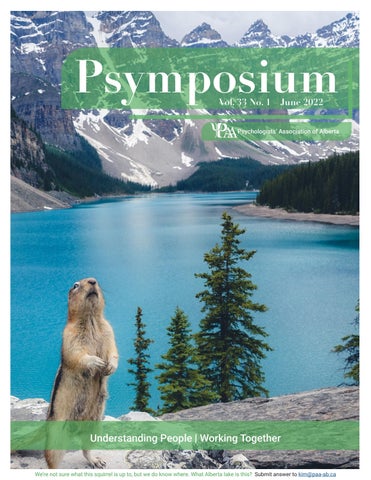
Psymposium Vol. 33 No. 1 – June 2022
Psychologists’ Association of Alberta
Understanding People | Working Together
We’re not sure what this squirrel is up to, but we do know where. What Alberta lake is this? Submit answer to kim@paa-ab.ca
Board of Directors President
Claire Petersen
President-Elect Heather Gower
Past President Nicki Wilson
Treasurer and Provisional Board Representative April Salciano
Board Custodian Mira Singh
Early Career Representative Dr. Sandra Dixon
Student Board Representative Vanessa Siso
Psychologists’ Association of Alberta Suite 101, 1259–91 Street SW Edmonton, AB T6X 1E9 1-888-424-0297 paa@paa-ab.ca www.paa-ab.ca Mission
The mission of the PAA is to advance the sciencebased profession of psychology and to promote the well-being and potential of all Albertans.
Vision
Members at Large
PAA & its members are recognized leaders in enhancing the psychological health of all Albertans.
Tamara Austin Dr. Jacqui Linder Dr. Sally MacLean
Psymposium
Looking to advertise? Visit the PAA website > Classifieds > Advertise With Us.
CEO
Dr. Judi Malone
Stay Connected
Editorial Editor-In-Chief
Dr. Michelle Vandegriend
Contributing Writers Dr. Jon Amundson Tamara Austin Joanna Card Shandra De Clerck Dr. Sandra Dixon Krista Forand Dr. Gina Ko
Andrew Luceno Andrew Nicholson Gwen Randall-Young Dr. Marc Ross Chris Shorrock Dr. Michael Stolte Dr. Michael Zwiers
PAA Psymposium [ISSN 1193-2627] is the official newsletter of the Psychologists’ Association of Alberta. Canadian Publication Mail Product Sales Agreement #40020241. Except where specifically indicated, the opinions expressed in Psymposium are strictly those of the authors and do not necessarily reflect the opinions of the Psychologists’ Association of Alberta, its officers, directors, or employees. The Psychologists’ Association of Alberta reserves the right to edit all articles and submissions before publication and to decide on the suitability for publication. PAA Psymposium is published five times a year (January, March, June, September, November) for the purpose of fostering communication amongst psychologists and supporting the goals of the Association and the profession of psychology. The newsletter is available to all members of the PAA on our website or by subscription, as well as to public subscribers and selected individuals and organizations with interests in the practice of psychology. Except where otherwise indicated, copyright 1998 by the Psychologists’ Association of Alberta are in effect. Permission is granted to reproduce up to 10 copies of any article as it appears in PAA Psymposium, if such reproductions are distributed without profit for educational or research purposes only and properly cite Psymposium and denote PAA copyright. Permission for additional reproductions or reproduction for commercial purposes must be obtained in writing from the Editor-In-Chief. PAA generally welcomes requests to reprint from other professional newsletters. Psymposium is submitted to PsycEXTRA, a database set up by the American Psychological Association, which contains newsletters, policy papers, white papers, fact sheets, reports, magazines. PsycEXTRA is a companion to the American Psychological Association’s scholarly database PsycINFO.
2
www.paa-ab.ca
PAAlberta
@PAAlberta
@psych.assoc.ab
PAA Staff Administration Officer
Vacant Position Email: paa@paa-ab.ca
Governance Officer
Ada Nieminen Email: ada@paa-ab.ca
Communications Officer
Kim Bernard Email: kim@paa-ab.ca
Finance Officer
Joanna Leung Email: joanna@paa-ab.ca
Membership Officer
Simon Mak Email: simon@paa-ab.ca
Career Development Officer Jessica Dubauskas Email: jessica@paa-ab.ca Office Assistant
Jiya Juneja Email: student@paa-ab.ca
Featured Content 7
4
Editor’s Letter
4
Looking for Rural Referral Resources?
5
PAA Research Awards
6
Notes from the CEO’s Desk
8
Board Notes
8
Welcome New Board Member
10
Collaboration
10
Privacy Compliance Fast Facts
11
Welcome New PAA Members
12
2022 Science Fair Award Winners
12
2022 PAA & CAP Joint Town Hall Dates
13
2022 Psychology Month in Alberta
15
Alberta Psychology in the Media
17
CoP and Task Force Leadership
17
PAA Board Meeting Dates 2022
17
Psymposium Trivia
21
Continuing Professional Development
22
Students’ Corner
24
Call for Content: Indigenous Members
New DSM-5-TR Released
24
AGM Reminder
New Kids on the Block
24
PAA Referral Service
24
2022 CPA Conference Registration
Technology in Practice Task Force Is Email Encryption Enough?
9
The Universe Within Transforming Adversarial Attitudes
13
Privacy Compliance for Psychologists in Alberta
14
Ethics – The Impossible Imperative Johnny Depp and Why the Public Figure is Not a License to Rat Pack
16
A Book Review What Happened to You – Conversations on Trauma, Resilience, and Healing by Oprah Winfrey & Bruce D. Perry
18
Anti-Racism and Psychology Racism and Anger
19
Psychology’s Response to the TRC Report - Part 2
20
Exploring Assessment in Professional Psychology
23
Contents
Taboo Topics in Psychotherapy
www.paa-ab.ca
3
Editor’s Letter “I feel an abundance of gratitude that we have a regulated profession dedicated to helping improve the lives of others.”
By Michelle Vandegriend, Ph.D., R. Psych
R
ecently my son, who is 17 years of age and currently exploring post-secondary options, approached me and asked, “mom, what is it like to be a psychologist?” My first response was, “it’s not like what you see in the movies.” I went on to explain that I truly love my job as a psychologist, and I feel an abundance of gratitude that we have a regulated profession dedicated to helping improve the lives of others. In being a counselling psychologist, I feel both inspired and humbled as I get to walk along with clients through their challenges and triumphs. I get to help them create meaningful change and find hope in their lives which can have a positive impact on their own mental and physical health, their relationships, their family, and work place. I also feel an abundance of appreciation for all the vast and diverse directions that one can specialize in, and I began to illustrate to my son just a few of these specializations and sub-specializations. In fact, the American Psychology Association has identified approximately 56 divisions that individuals can study…it was a lengthy conversation. Drawing on recent real-world examples, I explained our role as psychologists during times of world crisis in educating and disseminating information to the public; our role in research and assessing and evaluating public responses; advocating for mental health supports and services; helping to create public polices, and providing counselling services. I’m sure many conversations about career paths will continue to evolve over the course of the next few months…perhaps further inquiries about being a psychologist, which in turn have prompted me to “pause and reflect.” In the meantime, check out the diverse and informative articles from these inspiring psychologists. PAA Member and Psymposium Editor-In-Chief Michelle Vandegriend, Ph.D., R. Psych Certified Gottman Therapist www.stalbertcounselling.com Email: mvandegriend@stalbertcounselling.com
Looking for Rural Referral Resources? Join the discussion and let us know what you’re looking for. With the growth of telepsychology practice, many urban psychologists are connecting with more clients than ever before from rural communities! Connect with other practitioners in the Rural and Northern Community of Practice by logging in to your Collaborate Account. Laura Friesen, Chair of the Rural and Northern Community of Practice, has started a members-only living document for rural referral resources, which can be found in the Community library. Communities of Practice (CoPs) are live on PAA Collaborate, your secure online member portal. Need more members to join your discussion? Have you shared an article or other resource and want to spread the word? Welcome to CoP Highlights, your opportunity to direct Psymposium readers to your CoP to find a relevant discussion, article, link, invitation, or question. Have a CoP highlight to share? Email jessica@paa-ab.ca with your highlight and the name of your CoP.
4
www.paa-ab.ca
PAA Research Awards Psychology students at undergraduate, Master’s, and Ph.D. levels conduct insightful research every year. PAA wants to recognize students of psychology with our three different research awards. These monetary awards are given to the hard-working students whose research is innovative and enlightening in the field of psychology. Thanks also for your 2022 nominations! We look forward to introducing you to this year’s award winners soon.
Carmen Tessier Undergraduate Thesis Research Award
Megan Cowie Masters’ Thesis Research Award
Laura Flanigan Doctoral Dissertation Research Award
Our 2021 Research Awards Recipients!
Paid advertisement
www.paa-ab.ca
5
Notes from the CEO’s Desk “Lies are worse than no comfort at all. Especially to a mind already scorched by the truth.” -Julie Berry
By Dr. Judi L. Malone, PAA CEO Registered Psychologist (AB/AUS)
I
n Alberta, we protect the title Psychologist, yet legislative change for a College of Counsellors has stalled. We are witnessing public institutions and organizations using unclear terms like “Mental Health Therapist” or “Behavioral Specialist.” What is the Difference? Our public education campaign, “Counsellor, Psychologist, Psychiatrist…What’s the Difference?” targets public education and professional protection. One of my favourite narratives of Pierre Berube, former PAA Executive Director, related to physical health. He would ask people: if you broke your leg, would you want to be greeted at the hospital by a “physical health therapist” and not know whether this was a nurse, x-ray technologist, physician, or physiotherapist? PAA Position Statement Mental health counsellors and psychotherapists should be recognized by their professional title. The use of the generic title, “mental health therapist” is a disservice to Albertans. For Albertans Psychology benefits society through our research, teaching, and evidence-based practices. The public can trust psychologists because we are qualified and regulated health professionals who follow a code of ethics that promotes respect for dignity and fair treatment. For our Profession There is public trust and demand for psychologists. What harm can be done to our profession when a member of the public is unsure if they are being treated by a psychologist? In Closing… The use of generic terms is a disservice to the public, as it can create confusion, and it can be used to justify cheaper services that do not actually meet the needs of Albertans. As a proud psychologist, I encourage each of you to advocate against generic professional titles, and to use your professional title, Registered Psychologist. Judi
6
www.paa-ab.ca
Technology in Practice Task Force Is Email Encryption Enough?
“Email security is an essential consideration for all psychologists.”
By Andrew Luceno and Dr. Michael Stolte
C
ybersecurity studies consistently highlight the vulnerability of healthcare providers and how email can be a key entry point for phishing scams and stolen credentials1 2. Let’s consider a few scenarios: 1. A psychologist uses the password “12345678” (the most common password in 2021!)3 to wake their computer from sleep. Their email password is much more secure by comparison, but it is stored in the computer’s memory and does not need to be entered each time the computer wakes from sleep. This presents a vulnerability at the password and physical access levels. 2. A psychologist has a strong password for their laptop and uses hard drive encryption. They have an even stronger work email password, and they need to enter it each time they access their email so that it remains confidential. However, the psychologist is using a free email service (e.g., free version of Gmail) whose transmission is not secure or encrypted. This makes the transmission of personal health information (PHI) vulnerable to “man in the middle” attacks in which hackers intercept data transmitting between email servers. 3. A psychologist pays for an encrypted email service that uses S/MIME certificates. That encryption keeps email messages secure between colleagues who use the same email service and domain (e.g., @paa-ab.ca). This encryption makes “data in transit” secure, however, when the report reaches the client’s email inbox (i.e., different email provider and domain), it is no longer encrypted or secure. Additionally, the email gets downloaded automatically on the client’s computer and is available to anyone who has physical access to that computer. This is a vulnerability with “data at rest” (i.e., once the email
leaves the psychologist’s outbox, weak data storage security presents a vulnerability). 4. A psychologist uses encrypted email. The psychologist also uses a secure message gateway (e.g., Proofpoint) – a platform that provides an extra layer of encryption and security to keep the client’s PHI safe. The email encryption protects against threats of data in transit, while the secure mesage gateway protects against threats to data at rest. Regarding the latter, to review their email from the psychologist, the client would need to log into a secure platform (i.e., using their browser and a strong password). This solution addresses data in transit and data at rest vulnerabilities4. Taken together, email security is an essential consideration for all psychologists, and the nuanced differences with which each clinician uses their email (e.g., for scheduling appointments, transmitting documents) should factor into the decision-making around how to keep clients’ PHI confidential and secure. Joyce, C., Roman, F. L., Miller, B., Jeffries, J., & Miller, R. C. (2021). Emerging cybersecurity threats in radiation oncology. Advances in Radiation Oncology, 6(6), 100796. https:// doi.org/10.1016/j.adro.2021.100796 1
Healthcare’s Email Problem: Insider Threats, Data Retention, Phishing. (2021, May 7). Health IT Security. https:// healthitsecurity.com/features/healthcares-email-probleminsider-threats-data-retention-phishing 2
Here are the most common passwords of 2021. (2021, November 22). ABC4 Utah. https://www.abc4.com/news/techsocial-media/these-are-the-most-common-passwords-of-2021/ 3
Eisenberg, K., Jamieson, T., & Menzez, A. (2022, April 26). Proofpoint Essentials for Email Security (personal communication). 4
www.paa-ab.ca
7
Board Notes
“I pass on the presidential torch to the new incoming President, Claire Petersen.”
By Nicki Wilson, R. Psych
I
t is with a grateful heart that I thank each and every one of our valued members, the PAA staff and our CEO, Dr. Judi Malone. I count it a privilege and an honour to have worked as your President for the last several years. As the expression goes, “parting is such sweet sorrow.” That being said, I am excited to take on my new position as Past President. This new position was officially proclaimed at our Annual General Meeting in September of 2020, and it will allow me to support and mentor those individuals moving onto the Executive Team. It is with excitement that I pass on the presidential torch to the new incoming President, Claire Petersen. Claire has volunteered her time and has been a part of the PAA Board of Directors for the last five years, and she has contributed as the PAA Vice President for the last year. On a final note, a reminder that on-going advocacy for the profession of psychology is critical. As the demand for psychology services continue to increase, perhaps due to the Covid-19 pandemic and the declining stigma around mental health, I encourage each and every one of you to advocate for equal access to psychology services for all Albertans through education with the media, government, and the public. Let us all work together to make access for our services a reality! Once again, thank you for allowing me to be the President of our professional association. May all your futures be full of outstanding achievements. Your President, Nicki M. Wilson M.Sc., R. Psych
Welcome New Board Member Welcome to Mira Singh, R. Psych (AB), who was elected to the PAA Board of Directors beginning May 2022. “I have many goals for how I would like to participate on the PAA Board. I want to use the position to help make mental health services accessible to all Albertans through provincial funding, to reduce stigma surrounding mental health among the public, and to increase public awareness regarding the specific and defining nature of our profession. I find outreach and connection among practitioners to be invaluable. It increases cohesion, mutual support, and a sense of community that I believe is needed at every phase in our career.”
8
www.paa-ab.ca
The Universe Within Transforming Adversarial Attitudes
“How will you become a clear mirror if you resent being polished?” -Rumi
By Gwen Randall-Young, R. Psych
L
ife does have a way of revealing to us where we are tarnished. Situations will trigger places or energy within us that do not feel good. These places are generally associated with the ego aspect of our being. When we feel resentful, competitive, offended, or are being manipulative or dishonest, there is a gut feeling that is unpleasant at best—toxic at worst. Often, our attention is focused on the people or situations that created this feeling in us, which only intensifies the toxicity. It does so because this response takes us into a place of polarity. An adversarial stance requires a judgement about rightness and wrongness. It appears to create winners and losers, but in reality, everyone likely loses.
interpretation of what their behaviour implies, that creates distress. The distress originates within us, even though the trigger for it may be external. Polishing our mirror means clearing away the limited perspectives of ego, so there is room for compassion, understanding and acceptance. It is realizing all of life is a conversation, not a soliloquy.
Polishing our mirrors removes those places of rigidity and allows for more fluidity in our perceptions. Whenever we experience conflict, tension, or disharmony, it is likely that we need to look at ourselves as much as the other. Rather Often, we are aware of a lifetime pattern that seems than resenting the suggestion to repeat itself. People keep treating us in the same from others, or from our unsatisfactory way. Friendships or business deals turn own higher wisdom, that bad. People let us down. We may not realize that the same something needs things happen again and again because we are the same. polishing, we can learn to welcome Imagine we are mirrors. If we are tarnished, we cannot reflect clarity. Nothing beheld by our mirror will look clear, those opportunities, knowing we have or as it really is. The world, as reflected by our mirror, will nothing to lose but always be tainted. If only we could polish it up, restore it a little tarnish—and to its original purity, everything reflected in it would look a lot of clarity to gain. so different. What is it that tarnishes our mirror? The simple answer would be to say anything that is not love tarnishes it. The worst offenders are attitudes of judgement, criticism, separateness, seeing things only from our own point of view, and a need to be right. If we have a problem in our lives, it is interesting to take a step back to see what is really causing our distress. We will find that it is not the external event that is distressing us, but rather our response to it. If someone lets us down, we can see it is not the event itself creating our pain. It is our belief that they should have acted differently, or our
Gwen Randall-Young is an author and awardwinning psychologist. For permission to reprint this article, or to obtain books, CDs or MP3s, visit www.gwen.ca. Follow Gwen on Facebook for inspiration.
www.paa-ab.ca
9
Collaboration Fostering the Profession PAA and our members are committed to maximizing our impact through strategic relationships with other psychology groups, in addition to maintaining a strong relationship with the College of Alberta Psychologists. This includes: American Psychological Association • Dr. Lana Hawkins was elected to the APA Council of Representatives • Robert McGarva as Rural Health Coordinator Representative for Alberta • Dr. Judi Malone as the CESPPA representative for Alberta • Nicki Wilson as Division 31 Representative Canadian Council of Professional Associations of Psychology • Dr. Judi Malone, Alberta Voting Participant • Dr. Sally MacLean, Alberta Participant Observer National Committee on Psychologist Wellness of ACPRO & CPAP
Canadian Psychological Association • Dr. Judi Malone serves on the CPA board representing the provinces Association of Canadian Psychology Regulatory Organizations • Dr. Judi Malone serves as the liaison of the professional associations to ACPRO Alberta Health Services • Dr. Judi Malone participates in the: » AHS Professional Practice Council for Psychology » AHS Clinical Strategic Network for Addiction & Mental Health » Alberta Mental Health Research Hub–Addictions & Mental Health
• Tatiana Lund, Student Volunteer • Dr. Judi Malone, Co-Chair
Privacy Compliance Fast Facts • Privacy compliance protects client records, which are worth approximately $250 on the black market. • Psychologists have the same onus to protect health information as professionals named in the Health Information Act. • Common causes of privacy breaches include: cyber attack, unauthorized access or disclosure, loss of personal information, and giving or sending information to the wrong person. • Email is the #1 cyber attack vector threatening healthcare client privacy. • The right secure messaging service looks and feels like email but protects client information in ways email can’t. Thank you to PAA affinity partner Brightsquid for these facts on privacy compliance.
10
www.paa-ab.ca
Welcome New PAA Members Emily Ackerman
Wardah Elahi
Rebecca Mackey
Taisa Riddell
Omolara Akinpelu
Kristin Falconer
Kristine Mae Mallorca
Krista Roberts
Jenny Al-Adra
Adriana Fernandez
Margaret Marean
Vanessa Ross
Jane Allen
Cristina Fernandez Conde
Carolina Martinez
Heather Ruhl
Leana Allison
Shirley Filipe
Salina Matar
Meagan Schirrmacher
Jaqueline Amorim
Karen Fox
Thomas McConnnell
Ashley Schofield
Mary-Anne Back
Lindsay Friesen
Kayla McLachlan
Daniel Seddon
Juliana Baiochi
Alison Gaffney
Georgia McNeil
Rahul Sharma
Gabrielle Barkman
Sara Galbraith
Stephanie Mendes
Manu Sharma
Roopa Belur
Mattise Gauthier
Khadijah Mohammed
Ella Solin
Kristie Bennett
Grace Gignac
Kathy Muhlethaler
Michael Sornberger
Lyndell Berry
Molly Goodis
Elizabeth Muia
Kirsten Stanton
Carolyn Biron
Erin Gorn
Stas Mureyko
Fiona Steedman
Sacha Bloom
Christina Gray
Melissa Neal
Morgan Stevenson
Emily Boehmer
Michelle Gregg
Daria Nechaieva
Cally Strandquist
Jennifer Bond
Paul Gronnerud
Jacquie Nedohin
Sabrina Stushnoff
Karissa Boynton
Gina Guzman
Kirsten Neprily
Marli Swart
Gary Brown
Julia Hagerty
Stephan Neumair
Sara Taji
Isabel Brun
Jessica Hartel
Sarah Nicholson
Raheleh Tarani
Lisa Burden
Liza Hartling
Artur Nizio
Kirsten Timpany
Drena Burns
Matthew Harvey
Alicia Norman
Siu Keung (Kent) Tsang
Jana-Lynn Caines
Melissa Henderson
Rebecca O’Leary
Jennifer Turner
Lindsay Calderon Urbina
McKenzie Henderson
Carolyn Ogilvie
Amanda Unsworth
Erin Cape
Melissa Hillman
Foluso Ogunribido
Ana Vitisin
Amandeep Chahal
Jill Hrenyk
Marie Olson
Britni Voshell
Vanessa Chen
Allison Ingram
Tania O’Neill
Chantel Wagner
Jasmine Chohan
Alison Isaak
Miranda Parkinson
Kristina Waldmann
Juliana Chukwu
Tanya Jackson
Ingrid Pederson
Amadew Walt
Connie Clough
Georgina Jarvis
Dorothy J. Peters
Tiffany Warren
Carly Colasimone
Andrea Jennyc
Grace Phillips-Mckenzie
Tanya Wasielewski
Kari Cole
Joanna Johns
Myka Piekenbrock
Emily Wasylenko
Carissa Cornfield
Erin Jokuty
Jordanna Pierson
Jacey Weiler
Christine Danyluk
Ashley Jordan
Rebecca Piggott
Shelane Williams
Wendy Davies
Randi Keats
Lindsay Piper
Martin Willms
Erin Davis
Rona Kertesz
Brittany Postill
Laura Wittman
Dana Delorme
William Klinck
Erin Pougnet
Susan Witwicki
Ashlyn Demers
Meisha Kolbuc
Jennifer Pugh
Chelsey Wood
Jose Domene
Nilu Kulatunga
Andrea Dwyer
Laura Labelle
Adrianna RabedaKowalczak
Brittany Dyck
Tara Lavender
Courtney Edwards
Alison Lessard
Vanessa Rankin Stasia Ricketts
www.paa-ab.ca 11
2022 Science Fair Award Winners PAA’s Behavioural Science Award
Edmonton Regional Science Fair – 16 March 2022 Award Winner Project: A Colourful Memory Student: Ishaan Upadhyay School: Aurora Academic Charter School
Calgary Youth Science Fair – 9 April 2022 Project: Music, Mood & Memory Students: Misha Kapadia & Sania Grewal School: Westmount Mid/High School
Edmonton Regional Science Fair – 16 March 2022 Honourable Mention Project The Health Concerns of Sleep Apnea Student: Layal Salame School: Edmonton Islamic Academy
Central Alberta Rotary Science Fair – 26 March 2022 Skyler Herzog, a Grade 7 student from Glendale School, Red Deer, received the PAA award of $100 for “Animal Impact on Human Mental Health.” Skyler also received a Silver Medal in the Secondary School Category and the Rosalyn Cowan Award.
2022 PAA & CAP Joint Town Hall Dates Town Halls offer members the opportunity to connect with PAA CEO Dr. Judi Malone and CAP CEO Dr. Richard Spelliscy. PAA and CAP join in hosting town halls in different communities in Alberta throughout the year. CONNECT WITH PAA AND CAP!
LOCATION:
Medicine Hat Lethbridge
DATE:
October 2022 October 2022
These dates are subject to change. For the most up to date information, visit our Events and Webinars page. For more information, contact: ada@paa-ab.ca.
12
www.paa-ab.ca
Privacy Compliance for Psychologists in Alberta Do you know the current best practices for safeguarding your practice against a privacy breach? PAA affinity partner Brightsquid hosted a webinar created for our members, Privacy Compliance for Psychologists in Alberta. If you missed it, you can still view the recording to: • learn how the Health Information Act (HIA) applies to your practice as a psychologist in Alberta • understand the threats to the privacy of the patient information in your care • learn the current best practices and safeguards you need to protect your patients and your practice from the risk of a privacy breach. Did you know? PAA members get 25% off Brightsquid Secure-Mail. Call us for the discount code.
2022 Psychology Month in Alberta Social Media
PAA Infographics
Throughout the month, PAA celebrated Psychology Month virtually.
Accessing a Psychologist
PAA increased its social media outputs (Instagram, Facebook, Twitter, & LinkedIn) in February. PAA presented Psychology Month Quick Facts highlighting interesting tidbits about the profession, including figures such as Sigmund Freud, locations such as Dalhousie University, techniques such as hypnosis, and fields such as forensic psychology.
February is Psychology Month Other infographics Thank you to everyone who dedicated their time to promote psychology!
Publications Malone, J.L. (2022). February is Psychology Month. In Neighbours of Summerside, 4. PAA. (2022). Accessing Help From Psychologists in Alberta Report. Speakers 12 February: Dr. Ganz Ferrance was interviewed on 630 CHED on removing mask mandates for children. 13 February: Dr. Ganz Ferrance was interviewed on 630 CHED on COVID 19 restrictions lifting. 14 February: Dr. Ganz Ferrance was interviewed on 630 CHED on making decisions best for you regarding the lifting of restrictions. 22 February: PAA and CAP Townhall Hosted by AHS. Presenters were Dr. Judi L Malone (PAA CEO) and Dr. Richard Spelliscy (CAP CEO) with 235 attendees.
www.paa-ab.ca 13
Ethics – The Impossible Imperative Johnny Depp and Why the Public Figure is Not a License to Rat Pack
“In the instances of Amber Heard/ Johnny Depp and Will Smith, we’ve heard much mental health conjecture.” By Dr. Jon Amundson, Ph.D., R. Psych
I
n the press recently, we have been treated to a display of public figures caught up either in the court of public opinion or literally the court.
In the instances of Amber Heard/Johnny Depp and Will Smith, we’ve heard much mental health conjecture. This has ranged from social frame discussion, i.e.) the parameters of such an act, to specific conjecture as to the character, motivation and intentionality of the individuals. This, however, is an old and common phenomenon associated with the health care profession. For example, when Kanye West’s mother died in surgery, Larry King hosted the physician on his show with the patient file and just as they were about to speak, legal representation arrived and stated the obvious. If it went ahead, the full weight of ethics would rain down upon the doctor. And with media shrinks like Dr. Laura and Dr. Phil, conjecture often leads to what we will discuss here as “line crossing.” A few years ago, I wrote on the ethics of media in Psymposium, and our tendency to offer conjecture upon individuals in the public eye. In the case of Donald Trump, mental health professionals openly defied standards of practice in a form of civil disobedience–from his niece, a clinical psychologist, to Brandy Lee, a Yale psychiatrist who published, in defiance of the Goldwater statute, issues related to character/personality. Nonetheless, we should not express psychological opinion on any person we have not specifically provided service
14
www.paa-ab.ca
for, nor without their consent. Social frame evidence is possible where we speak about the general issues related to a matter. For example, I once offered opinion in a murder trial in Edmonton regarding children’s statements relative to recollection and memory: how to weigh and measure the validity of such. I could not speak specifically about the child, nor statements involved, but I could advise a jury or trier of fact what to consider. Again, as a form of civil disobedience, it may be necessary to qualify statements made by others. An example was my involvement in qualifying the statement made by an academic on a series of arsons in Calgary. In a brief shining news moment, the academic opined that the culprit was probably an inadequate, sexually frustrated male who was exercising compensatory masculine aggression. My correction was to introduce social frame evidence regarding base rate and the article stated essentially that “Amundson says bored youth likely culprits,” which to my relief it turned out was correct. One final war story… in a court appearance, I was informed by the patient and legal counsel that consent was withdrawn—unlike what we see today, where some psychologists use consent to deprive the patient of the option to withdraw. In taking the stand, I stated that the patient had withdrawn consent AND could only speak if released through the full weight of the court, whereupon the Justice so ordered, and I sang like a bird! Central then to any role in media ought to be the following provisos: We are admonished in the Canadian Code to provide information to the public which serves the evidence base of the discipline (Responsibility to Society: IV 24.) Nonetheless, we are also reminded in our own standards of practice to refrain from providing any opinion upon an individual without knowledge, consent or as above full weight of the court (Provision of supportable services:6.3 & 6.4.) The takeaway? Between this Scylla and Charybdis situation, help the public appreciate psychological and mental health knowledge, but abjure the spotlight and the desire, often, of the media to draw blood.
Alberta Psychology in the Media Media Engagements
6
January
– April 2022
Media Pieces VIA
THANKS TO
» 630 Ched radio » CTV News Edmonton
» Jessica Heil » Dr. Ganz Ferrance
ON TOPICS INCLUDING » Borderline personality disorder treatment options » Chasing a new year resolution? One psychologist’s advice for success » Pressures around removing mask mandates for children » COVID 19 restrictions lifting » Covid- 19: Is it time for a good cry? » Resolution reboot
Public Speaking Engagements Psychologists
Venue
Dr. Joan Neehall
» Webinar presentation entitled Psychological Coping During a Pandemic for the Workplace to the AHS Infection Control Professionals
Dr. Judi Malone
» Edmonton Sun, Cam Tait: Tips on how to cope during these uncertain times
If you or a colleague are interviewed through any media outlet (newspaper, radio, television), or if you have attended a career fair or public speaking engagement, please advise the PAA office at paa@paa-ab.ca for our report!
Paid advertisement
Own Large Professional OfÞces! Purchase a turnkey commercial condominium: Edmonton 10339 - 106 street. Custom designed for psychological services. Numerous effective soundreduction and air-quality features. Excellent parking. Contact Vince Caputo at NAI Commercial 780 436 7624. www.paa-ab.ca 15
A Book Review What Happened to You – Conversations on Trauma, Resilience, and Healing by Oprah Winfrey & Bruce D. Perry
“I have a sense of connectedness and belonging with other psychologists also working hard to help people deal with the trauma they have survived.”
Reviewed by Chris Shorrock, R. Psych., CSAT
A
s the title suggests, this book discourages asking, “what is wrong with you?” in hopes of better understanding people with trauma. Dr. Perry provides fascinating (and at times horrifying) clinical work, while Oprah Winfrey shares similar stories from guests on her show and in her own life. As I have said before, I really find much more connection to authors in hearing their voices tell their stories; this was especially true for Oprah, and I learned a lot about her. I was especially fortunate to review this work with a group of Medicine Hat psychologists. The first question we considered was whether this is a good recommendation for clients. I found so much trauma in it, especially involving young children, I openly worried; admittedly this could be an abreaction per having my own young children. There seemed consensus this book would not be useful as a “how to” manual for assessing, treating, or reducing trauma, not easily or directly at least. With some interpretation however, there were several times I found myself making changes per listening: Dr. Perry discusses building the infant’s organizing brain through presence, attention and connection with the caregiver. He provides the example of a dad posting on social media about how much he loves his child… who is awake, upset and hungry in the next room (and therefore not experiencing love). Immediately I turned off the audio and went to my children to provide attentive and mutually nurturing time together. Perhaps instead of “how to” the “what” is even more important.
16
www.paa-ab.ca
Our psychologist group’s first discussion concluded questioning “big T” versus “small t” trauma and individual differences. The very next chapter addressed this topic, which I found quite reinforcing. Dr. Perry shares the SAMSA criteria around defining trauma: Event, Experience, Effects. To illustrate, he considers the responses of an adult fire-fighter, a fifth grader, and a first grader to a school fire. He respectively labels these as: resilience-building, acute trauma, and “developing a sensitized stress response system” (13:36). He points to the importance of how much someone’s stress response system is activated, how long it lasts, and whether the events seem predictable and controllable or not. Dr. Perry discusses time in New Zealand with Maori Elder-healers who made no separation between mental health disorders: the problems were all interconnected, resulting from fragmentation and disconnection. I let my colleagues know that whether or not our meeting was going to count towards CCP hours, I was honestly more interested in the connection with them. Perhaps this value is even augmented via cognitive dissonance in not counting required hours. Similar to the elder-healers, I believe I have a sense of connectedness and belonging with other psychologists also working hard to help people deal with the trauma they have survived. Winfrey, O., & Perry, B. (2021). What Happened to You? Conversations on Trauma, Resilience, and Healing. Flatiron Books.
CoP and Task Force Leadership Thank you to all PAA members taking an active role in our Task Forces and Communities of Practice (CoPs), including the following members in leadership roles: Task Force Chairs
CoP Executive Teams
Awards Adjudicating Committee Chair – Dr. Judi Malone
Supervision CoP Chair – Terilyn Pott Moderator – Laura Friesen Publications Officer – Jessica Heil Engagement Officer – Aimee Reimer
PAA Racism in Alberta Psychology Task Force Co-Chairs – Mateo Huezo & Caryn Tong Technology in Practice Task Force Chair – Dr. Michael Stolte PAA – CAP Joint Task Force: Alberta’s Truth & Reconciliation Response No chair specified Mentorship Task Force Board Liaison – Tamara Stuart
Social Justice, Equity & Diversity CoP Chair – Joanna Card Moderator – Emily Wang Public Education & Workplace Wellness CoP Chair – Inverpal Braich Rural & Northern Psychology CoP Chair – Laura Friesen Vice-Chair – Kirsten Timpany Moderator – Terilyn Pott Publications Officer – Laurelle St. Jean
PAA CEO Evaluation Task Force No chair specified
Indigenizing Psychology CoP Chair – Michael Yankowski Vice-Chair – Jasmine Fouillard Moderator – Mark Nicoll Moderator – Kirsty Keys Clinical/Counselling Psychology CoP Chair – Inverpal Braich
PAA Board Meeting Dates 2022 PAA Board of Directors’ upcoming 2022 meeting dates: » 09 September 2022 » 04 November 2022
Psymposium Trivia The question from our 2022 March issue: Q: A:
Do you know where this picture was taken? Hint: a national park. Banff, AB
www.paa-ab.ca 17
Anti-Racism and Psychology Racism and Anger
“The idea to start my podcast was derived from feeling angry about the anti-Asian racism that has been exacerbated during the Covid-19 pandemic.” By Gina Ko, Ph.D., R.Psych
I
am Gina Ko, a Registered Psychologist in Alberta. I am also a producer and host of the podcast, “Against the Tides of Racism.” I interview guests from many walks of life to generate awareness, foster community and create transformation by coming together to lean into the inspiring work of anti-racism. Currently, I see many racialized and minoritized clients in my private practice. Some of them have found me after listening to my podcast and realize I am an ally, co-conspirator, and listener in that they feel heard, validated, and seen. The idea to start my podcast was derived from feeling angry about the anti-Asian racism that has been exacerbated during the Covid-19 pandemic. Last year, the news of a white man in Georgia in a racially-motivated hate crime killing eight people and six of whom were Asian women (Daoyou Feng, 44; Xiaojie Tan, 49; Delaina Hyun Jung Grant, 51; Suncha Kim, 69; Soon Chung Park, 74; and Yong A. Yue, 63)—along with how police officers were complicit in killing George Floyd and Breonna Taylor—was deeply disturbing and anger-provoking, and it prompted me to start something impactful to address racism and systemic racism. Some of my incredibly insightful and resistant podcast guests have shared that they feel angry experiencing, hearing about, and witnessing racism, microaggressions, discrimination, xenophobia, and how it can be awful as anger could lead to rage and impact mental well-being. It is eye-opening and gratitude-inducing when my guests are vulnerable and courageous. Some of them want to learn more about anger, and some would like to put it aside
18
www.paa-ab.ca
to be more constructive. In my response and reflection, I talk about how anger often has a “bad reputation” and is labelled as a “negative emotion” and how anger can serve a purpose, such as standing up against injustice. Anger has also been explained as a secondary emotion whereby sadness, fear, pain, and powerlessness may be underlying anger. In my private practice, I share the anger iceberg with clients and the idea of creative anger (Brown, 2018) to explore what is underneath the iceberg and how anger can be used creatively to effect change. My Asian clients, in particular, are thankful for this psycho-education and reflection as some have had a distant relationship with emotions when they are not talked about and acknowledged when growing up. Many of them speak about an upbringing where their parents are busy working, surviving, and resolving to provide basic needs with little room for emotional connection. Hence, clients in their 20s, 30s, and 40s who are first-generation or second-generation immigrants to Canada may not yet have the awareness and tools to explore emotions such as anger and are on their journey to have a more connected relationship with emotions. The first step is acknowledging that we feel certain emotions, getting to know them, and processing them in helpful ways; I highly recommend doing so with a therapist. References available upon request.
Psychology’s Response to the TRC Report - Part 2 By Tamara Austin M.A. R.Psych; Joanna Card M.Ed. R.Psych; Shandra De Clerck M.Sc. M.A. R.Psych; Krista Forand M.Ed; R.Psych; Andrew Nicholson M.Sc. R.Psych
“Psychological services that are provided to Indigenous people should be rooted in Indigenous languages, traditions, and world views to promote healing and overall well-being.”
T
his is article two in a series by members of the Social Justice, Equity and Diversity Community of Practice (on PAA Collaborate) reflecting on Psychology’s Response to the Truth and Reconciliation Commission of Canada’s Report (2018). The first article acknowledged our unethical conduct towards Indigenous Peoples, past and present. Acknowledgement is only the starting point; this series will explore corrective steps towards ethical practice recommended in the report. We will begin by summarizing six guiding principles for the practice of psychology in general, as outlined in the report. Cultural Allyship The Director of the Diversity Programs at the Mayo Clinic, Nicole Asong Nfonoyim-Hara, defines the act of allyship as “when a person of privilege works in solidarity and partnership with a marginalized group of people to help take down the systems that challenge that group’s basic rights, equal access, and ability to thrive in our society.” When psychologists are unaware of the historical and intergenerational trauma, and the social and cultural context, they are at risk of providing ineffective intervention and traumatizing Indigenous clients. The Canadian Psychology Association (CPA) recommended that cultural allyship should therefore encompass the following elements: “cultural safety and literacy, understanding Indigenous epistemologies, the role of ceremonies, traditions, Indigenous spirituality, the impacts of colonization, the residential school system, the 60’s scoop, the present-day dominant culture, as well as training in deconstructing the cultural assumptions of mainstream psychology.” Humility Psychology as a profession has its roots in Western and colonial ideology, which is biased towards the
perceived superiority and value of that narrow worldview. Psychologists are challenged to actively deconstruct and weed out this toxicity, by taking a stance of humility and respect, in collaboration with Indigenous practices and ways of knowing. Collaboration Before offering psychological services to a community, Elders, healers, and community leaders should be consulted as the experts about what services are needed. Psychologists should subsequently continue to work in a collaborative manner with the community members to understand their world view and needs. It is critical that communities have the opportunity to provide ongoing evaluation and feedback about services provided by psychologists in a way that promotes openness and shared understanding, and ensures no voices or opinions are silenced. Critical Reflection Psychologists need to reflect deeply about the impact of their personal beliefs and experiences, ancestral lineage, and professional biases and privilege. We must actively decolonialize all aspects of our approach and training, and have the courage to allow a different way of knowing and thinking. Respect Psychologists are not only called to respect the individuals with whom they work but should also seek to respect Indigenous culture. Our longstanding lack of understanding of and respect for Indigenous culture has harmed Indigenous clients. Psychologists should respect that Indigenous Peoples have rigorously validated their culture within their own communities, which is grounded in Indigenous ways of knowing. Psychological services that are provided to Indigenous people should be rooted in Indigenous languages, traditions, and world views to promote healing and overall well-being. Read the full article here.
www.paa-ab.ca 19
Exploring Assessment in Professional Psychology New DSM-5-TR Released
“The DSM-5-TR authors and editors have finally considered the impact of racism and discrimination on mental disorders. This includes culture, race, and social determinants of health.” By Dr. Michael Lee Zwiers
W
hile the world was focused on the Covid-19 pandemic, the American Psychiatric Association assembled over 200 specialists to finalize a text revision of the DSM-5. The updated version was released with little fanfare on March 11, 2022. The Text Revision (DSM-5-TR) is primarily intended to update the research literature from the 2013 manual. Although the focus was not on making significant changes to the diagnostic entities and criteria, some changes did emerge. So what exactly does the text revision include? It provides updated sections on associated features, prevalence rates, development and course, risk and prognostic features, cultural considerations, diagnostic markers, suicide risk, and differential diagnosis. This has in turn contributed to over 70 modified criterion sets, with additional clarifications. The Manual also incorporates over 50 coding updates. Some of these had already been released as website updates, but all are now incorporated into the new manual. If you are not familiar with the coding, DSM5 adopted International Classification of Diseases codes (World Health Organization), with the use of a Clinical Modification when the diagnostic entities did not have a good match with the ICD equivalent diagnosis (ICD-10-CM). The review team, led by Dr. Michael First, also updated the manual’s Introduction and guide to responsible use. The DSM5-TR authors and editors have finally considered the impact of racism and
20
www.paa-ab.ca
discrimination on mental disorders. This includes culture, race, and social determinants of health. These contributions were made by two panels: the Ethnoracial Equity and Inclusion Work Group and the Cross-Cutting Culture Review Group. Their work helped to adjust misinformed base rates for some disorders and to ensure the use of more representative studies. Following the release of DSM-5, the APA Board created a Steering Committee to oversee more flexible and rapid revisions of the DSM. In 2017, they opened a portal that allows professionals to submit proposals for revisions. These proposals are then considered by one of five review committees. Since its inception, about 10 new proposals have been received each year. This process led to the adoption of a new condition called Prolonged Grief Disorder. DSM has also introduced additional codes for suicidal behaviour and non-suicidal self injury (important content that was unfortunately bungled in the DSM-5 development). These are not diagnoses, but other conditions that may be a focus of clinical attention. Almost every DSM update has made changes to the conditions that affect children and youth, and DSM-5-TR is no exception. The new DSM has introduced colour to help you navigate its chapters and survive its length (1,050 pages). I am currently preparing a brief update workshop, which I hope to offer online through the PAA. Finally, if you do decide to purchase the new manual, PAA members can get a 5% discount if they order through the PAA website → Membership → Benefits and Services →Login Brothers Canada (scroll down), then follow the links, which will take you to the PAA discount portal. Note: the DSM-5-TR Desk Reference contains only diagnostic criteria sets.
Continuing Professional Development Upcoming EPPP Workshops Demystifying Registration as a Psychologist in Alberta: PAA’s Targeted Career Support Training for Provisionally Registered Psychologists Preparing to pass the EPPP and register as a psychologist in Alberta - with Dr. Thérèse Chevalier Mastering Learning Strategies: Memory Boosting Learning Strategies for the EPPP - with Michele Pentyliuk, M.Ed 2022-09-16 (Calgary) Register 2023-01-20 (Virtual) Register
Co-Sponsored Webinar Want to expand your intercultural competency as a clinician? PAA has partnered with Indigenous Awareness Canada to bring you their training, designed to help non-Indigenous Canadians and Indigenous peoples move toward reconciliation. Part of your fee will go towards PAA’s dedicated reserve fund to support Indigenous psychologists and psychologists in training. Register for Indigenous Awareness Training.
Primers One-hour recorded overview of the topic. Watch anytime, anywhere ($40 + GST). Assessing Perinatal Mental Health– Kristine Aanderson, Mallory Becker & Dr. Gina Wong Trauma & PTSD in First Responder Populations–Dr. Megan McElheran Family Restructuring Therapy–Dr. Stephen Carter Preparing for Cannabis Legalization in Canada: A Psychologists’ Evidence-Based Guide–Dr. Igor Yakovenko Psychology of Cannabis Addiction–Dr. Jonathan Stea DIY Videos for Your Therapy Site or YouTube Channel–Dr. Kyler Shumway The Erupting Addictions Pandemic–Dr. Kevin Alderson The Game of Life: An Introduction to Using Basic Sport Psychology Principles in Clinical Practice–Dr. Caelin White Prescribing Service Dogs or Emotional Support Animals–Kristine Aanderson Psychedelics and Psychedelic-Assisted Therapy–Dr. Megan McElheran
Free Recordings
Asynchronous Webinars
Traumatology 101: Psychology During a Pandemic
Starting and Operating an Independent Professional Practice in Psychology–Dr. Stephen Carter
Pandemic Adaptations Panel: Counselling Psychology Pandemic Adaptations Panel: School Psychology Pandemic Adaptations Panel: Supervision in Psychology
The Weight of the World: Psychologist’s Role in Addressing Client’s Weight-related issues–Dr. Angela Grace Indigenous Awareness Training–Indigenous Awareness Canada
www.paa-ab.ca 21
Students’ Corner Students’ Corner is a section of Psymposium dedicated exclusively to information of particular interest to students. If you have any questions about the information shared here, or if you would simply like to connect, please feel free to email Vanessa Siso, Student Representative on the PAA Board of Directors.
’s at Th
Do you like reading books? Consider checking out Student Book Reviews! For more information, email PAA’s Student Director.
e! m Interested in connecting with other students/provisionals in a forum where all things psychology are up for discussion? Watch our Collaborate & Facebook pages for updates!
Did you know that PAA’s Referral Service can connect you with psychologists who offer sliding scale fees/student discounts for services? Did you know that as a student member, you can access a supervisor list to aid your practicum search? Contact PAA for more information.
MEMBER BENEFITS
22
www.paa-ab.ca
New Kids on the Block A Column for Early Career Psychologists Taboo Topics in Psychotherapy
“If we keep these taboo topics from the light of day, there is more likelihood that they will manifest in unconscious or subconscious ways.” By Dr. Marc Ross (Ph.D. in Education), R. Psych
A
s clinicians, our training involves the development of knowledge, ethics, practice, research and clinical work. Typically, during our studies, we explore the history of psychology, present practices and modalities, interventions, and a host of other important aspects of what it means to be a psychologist. Yet one of the areas that continues to be “overlooked” or “shadowed,” to use psychoanalytic language, are those taboo topics that we find uncomfortable to talk about and address. One of the classic books detailing these taboos and inviting us to understand them and reflect/discuss them more fully in our training and over the course of our careers with colleagues, is titled What Therapists Don’t Talk About and Why. In the book, the authors invite us to reflect on the uncomfortable areas that we might bump into over the course of our careers. Question such as: Have you ever worked with a client whom you experienced as disgusting? Have you ever worked with a client with whom you experienced sexual arousal? Have you ever been significantly afraid of a client? What do you do when you experience moments of hatred or profound anger towards a client? Have you ever had an erotic dream about a client? These questions and numerous others are explored in the book. Ultimately, the invitation is to get serious about these difficult and uncomfortable topics, because if we don’t, we risk hurting ourselves and our clients. If we keep these taboo topics from the light of day, there is more likelihood that they will manifest in unconscious or subconscious ways. For instance, if you have severe frustration or anger toward a client, you might “diagnose them” with something like borderline personality disorder, and not actually understand the relational dynamics and how they might be impacting your assessments. By their very nature, taboo issues like to stay hidden, so what are some clues that something to this effect
is happening? Oftentimes, argue the authors, there will be telltale signs such as repetitive therapy or therapy that has gone adrift; choppy or sloppy record-keeping; a dehumanized client or therapist; avoidance; obsession; interesting slips or meaningful mistakes; fantasies; daydreams; dreams etc. Although it can feel more than a little daunting to approach these subjects, there is liberation in doing so. Interestingly, like therapy itself, the value of confronting hard to approach areas of life, and in this case, the difficulties we often face as therapists, can be quite liberating. By being honest and humble about our own struggles and vulnerabilities, we free ourselves to be better practitioners and support our clients more effectively and ethically. However, in order to open up such vulnerable aspects of being a psychologist, we all need to acknowledge these taboos and be willing to hear each other out as we attempt to wrestle with the denial that is inherently part of “professional practice.” So, a simple place to start: What are you afraid to admit to your colleagues? Feelings of shame and guilt are often a good indicator that something is up!
www.paa-ab.ca 23
Call for Content: Indigenous Members The 2022 September issue of Psymposium will be a Special Edition to mark the National Day for Truth and Reconciliation in Canada, 30 September 2022. PAA welcomes articles by Indigenous psychologists and Indigenous psychologists-in-training on the topic of Psychology with Indigenous people in Alberta: What is Working. Authors might choose to reflect on psychology’s commitment to the calls for action, weaving in ceremony, use of land, the multigenerational impacts on trauma and healing, bringing the past to the present, honouring Indigenous ways of knowing within clinical practice, increasing Indigenous cultural literacy for psychologists and students, or reducing barriers for Indigenous students in studying psychology. Depending on space, about 200 to 500 words of the article will be included within Psymposium’s pages, with a link to the full article online. Submissions are due 07 July. Please contact Kim at kim@paa-ab.ca for submission requirements. We hope to include your voice in this special issue!
AGM Reminder Notice of the annual general meeting of the membership of the Psychologists’ Association of Alberta: The PAA Board of Directors is hereby providing notice pursuant to PAA bylaw 6.3, to call an Annual General Meeting of the membership as follows: Date: Friday 09 September 2022 Time: 12:00 P.M. – 1:00 P.M. Location: Online
PAA Referral Service Are you marketing your private practice effectively? The PAA Referral Service provides the public with the contact information of registered psychologists who match their region/area of expertise. With excellent value for your marketing dollar investment, the Referral Service is an ideal advertising strategy for those in private practice. New feature! Early Career and Provisional members–you are now eligible for the Referral Service too! Already on the Referral Service? Use our series of videos for your marketing purposes. Joining the Referral Service is easy. Log in to the membership portal >Account>Membership>Add-ons. The annual fee is $200.00 plus GST (prorated after 01 May), and you can add a direct link to your website for $53.00 + GST.
From Feb 2022 to April 2022, we averaged
2,133
referrals/month. That’s
72
per day.
2022 CPA Conference Registration CPA2022, 83rd Annual National Convention June 17-19, 2022 in Calgary, AB CPA members will enjoy CPA member pricing. PAA Members who are not CPA members are eligible for a 10% rebate off your registration fee. Visit https://convention.cpa.ca/ or email convention@cpa.ca.