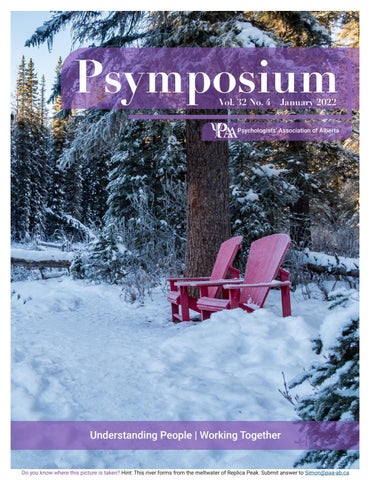
Psymposium Vol. 32 No. 4 – January 2022
Psychologists’ Association of Alberta
Understanding People | Working Together
Do you know where this picture is taken? Hint: This river forms from the meltwater of Replica Peak. Submit answer to Simon@paa-ab.ca
Board of Directors President
Nicki Wilson
President-Elect Claire Petersen
Treasurer
Tamara Stuart
Board Custodian Heather Gower
Provisional Board Representative April Salciano
Early Career Representative Dr. Sandra Dixon
Student Board Representative Vanessa Siso
Members at Large Dr. Sally MacLean Dr. Jacqui Linder Tamara Austin
CEO
Psychologists’ Association of Alberta Suite 101, 1259–91 Street SW Edmonton, AB T6X 1E9 1-888-424-0297 paa@paa-ab.ca www.paa-ab.ca Mission
The mission of the PAA is to advance the sciencebased profession of psychology and to promote the well-being and potential of all Albertans.
Vision
PAA & its members are recognized leaders in enhancing the psychological health of all Albertans.
Psymposium
Dr. Judi Malone
Looking to advertise? Visit the PAA website > Classifieds > Advertise With Us.
Editorial
Stay Connected
Editor-In-Chief
Dr. Michelle Vandegriend
Contributing Writers Dr. Jon Amundson Gwen Randall-Young Dr. Marc Ross Dr. Michael Stolte Dr. Michael Zwiers
PAA Psymposium [ISSN 1193-2627] is the official newsletter of the Psychologists’ Association of Alberta. Canadian Publication Mail Product Sales Agreement #40020241. Except where specifically indicated, the opinions expressed in Psymposium are strictly those of the authors and do not necessarily reflect the opinions of the Psychologists’ Association of Alberta, its officers, directors, or employees. The Psychologists’ Association of Alberta reserves the right to edit all articles and submissions before publication and to decide on the suitability for publication. PAA Psymposium is published five times a year (January, March, June, September, November) for the purpose of fostering communication amongst psychologists and supporting the goals of the Association and the profession of psychology. The newsletter is available to all members of the PAA on our website or by subscription, as well as to public subscribers and selected individuals and organizations with interests in the practice of psychology. Except where otherwise indicated, copyright 1998 by the Psychologists’ Association of Alberta are in effect. Permission is granted to reproduce up to 10 copies of any article as it appears in PAA Psymposium, if such reproductions are distributed without profit for educational or research purposes only and properly cite Psymposium and denote PAA copyright. Permission for additional reproductions or reproduction for commercial purposes must be obtained in writing from the Editor-In-Chief. PAA generally welcomes requests to reprint from other professional newsletters. Psymposium is submitted to PsycEXTRA, a database set up by the American Psychological Association, which contains newsletters, policy papers, white papers, fact sheets, reports, magazines. PsycEXTRA is a companion to the American Psychological Association’s scholarly database PsycINFO.
PAAlberta
@PAAlberta
PAA Staff Administration Officer Natasha Miller Email: paa@paa-ab.ca Governance Officer
www.paa-ab.ca
Ada Nieminen Email: ada@paa-ab.ca
Communications Officer Kim Bernard Email: kim@paa-ab.ca Finance Officer Joanna Leung Email: joanna@paa-ab.ca Membership Officer Simon Mak Email: simon@paa-ab.ca Career Development Officer Jessica Dubauskas Email: jessica@paa-ab.ca Office Assistant
2
@psych.assoc.ab
Jiya Juneja Email: student@paa-ab.ca
Featured Content
Contents
7
4
Editor’s Letter
4
Community of Practice Highlights
5
2022 Awards: Call for Nominations
The Universe Within
5
Welcome New PAA Members
Embracing Struggle
6
Notes from the CEO’s Desk
8
Board Notes
11
Alberta Psychology in the Media
14
CoP and Task Force Leadership
14
Psymposium Trivia
14
PAA Ethics Round Tables
Technology in Practice Task Force Benefits and Risks of Using Mental Health Applications
9
10
Ethics – The Impossible Imperative The Ethics of Self Care
13
Cindy, Thank You For 22 Years!
19
Exploring Assessment in Professional Psychology
15 Differential Diagnosis: Figuring Out What is Going On With Clients 15
21
New Kids on the Block A Column for Early Career Psychologists Making an Appropriate Referral
16
PAA Supervision Course Alberta Psychology Showcase Psychology Month
17 Collaborating 17
2022 PAA & CAP Joint Town Hall Dates
18
PAA Volunteer Spotlight
20
Students’ Corner
22
Recommended Fee Schedule
22
Welcome New Team Member
22
PAA Board Meeting Dates 2022
23
Continuing Professional Development
24
2022 PAA Membership Renewal
24
PAA Referral Service
www.paa-ab.ca
3
Editor’s Letter “Between stimulus and response there is a space. In that space is our power to choose our response. In our response lies our growth and our freedom. ” - Viktor Frankl By Michelle Vandegriend, Ph.D., R. Psych
M
uch change has transpired over the past few years for so many people and in so many different ways. Like myself, you may have paused for a moment and asked, “what the heck just happened over the past couple of years?”, “how did we get here?”, or “where do we go from here?” Change is unavoidable in our lives, but of course how we respond personally in our own lives, as psychologists, and as a profession, provides opportunity for growth. In a 12-year longitudinal study, psychologist Salvatore R. Maddi, Ph.D., and his colleagues at the University of Chicago researched the impact of the Illinois Bell Telephone downsizing from 26,000 employees to approximately half of that in one year. Two-thirds of the employees in the study suffered significant negative impacts on performance levels and experienced a decline in their physical and mental health. The other one-third thrived, however, despite experiencing the same impactful events. Salvatore and his colleagues discovered three significant beliefs or “attitudes” that help individuals turn adversity and change into positive growth: commitment, control and challenge. The Commitment attitude helped individuals strive to be involved in ongoing events, rather than feeling isolated. The Control attitude helped them to try and influence outcomes, rather than succumb to passivity and powerlessness, and the Challenge attitude helped them view positive and/or negative changes as opportunities for new learning (American Psychological Association, December 22, 2003). With February being Psychology Month in Alberta, let’s reflect on what that really means for Albertans today. Together, as a profession, how can we continue to create positive change in our communities, advocate and raise awareness about mental health and the significant role psychologists play, and create improved accessibility to services and resources? In this issue of Psymposium, check out the upcoming and ongoing events, posts, links, resources and materials that can help you stay informed and become involved. Thank you to all our members and all that you do in the service of mental health, Michelle PAA Member and Psymposium Editor-In-Chief Michelle Vandegriend, Ph.D., R. Psych Certified Gottman Therapist www.stalbertcounselling.com Email: mvandegriend@stalbertcounselling.com
Community of Practice Highlights Community of Practice Chair Terilyn Pott posted a new thread in the Supervision Community of Practice where members can post ongoing supervision research opportunities. Check it out to get involved in the study she included, or contribute to the thread to help get the word out about opportunities to enhance supervision research! Communities of Practice (CoPs) are live on PAA Collaborate, your secure online member portal. Need more members to join your discussion? Have you shared an article or other resource and want to spread the word? Welcome to CoP Highlights, your opportunity to direct Psymposium readers to your CoP to find a relevant discussion, article, link, invitation, or question. Have a CoP highlight to share? Email jessica@paa-ab.ca with your highlight and the name of your CoP.
4
www.paa-ab.ca
2022 Awards: Call for Nominations Did you know that in 2021, PAA had a record number of award nominations? The Awards Adjudicating Committee had the pleasure of accepting a nomination for each of nine PAA awards, and the membership had the opportunity to vote on their favourite PAA research poster. We were so pleased to honour these exemplars at PAA’s annual Welcome to the Profession and Awards Celebration in September with help from sponsors BMS and TD Insurance, celebrating the newly registered psychologists in our province and the hard work and dedication it takes to become a fully registered psychologist. Let’s make 2022 another amazing year. PAA recognizes exemplars in categories such as student research awards and lifetime achievement awards. Take a moment to consider who you want to nominate for 2022!
Welcome New PAA Members
Daniel Abilmona
Erin Greenough
Kathryn Maier
Cristina Sherren
Partheeraj Balasubramaniam
Chayse Haldane
Maria Malouf
Noela Shields
Chelsea Hanson
Veronika Markova
Jessca Silva
Polina Hapco
Brenda McCarty
Kristen Silveira
Jesse Howard
Catherine Musgrove
Ishita Singla
Joseph Hoyda
Denim Olson
Leigh Smit
Meghan Ingstrup
Tula Paul
Janaina Spady
Alexander Jackson
Sonya Pittalwala
Tina Marie Steele
Kevin Jones
Tesha Joy Plaza
Sally Stuike
Sarah Karesa
Véronique Poirier
David Tamagi
Jacqueline Kereluik
John Pynn
Nicolette Thiessen
Jamie Knight
Kimberly Quinton
Crystal Vincent
Tracy Knudson
Darcy Raymond
Misha Waheed
Corine Kozuchowski
Freda Reinhart
Diane Walters
Kirstyn Krause
Olivia Reverie
Celine Warawa
Shelley Lebert
Lori-Ann Sacrey
Justine White
Elizabeth LeRoux
Kaitlin Schamber
Erika Wilcox
Jody Cumberbatch Lewis
Jessica Scott
Tsz Fung Yuen
Brittany Li
Sadiya Shah
Oxana Zagreadscaia
Pavan Lilly
Zahra Husseini Shahrestani
Christina Bassett Mary Bihnam Melissa Boyle-White Mark Brechtel Nicole Buffie Alison Byrne Amanda Carbajal Kristin Carpenter Adam Casey Joy Clark Carline Core Elizabeth DeBruyne Gabrielle Desgagne Paige Ethridge Gordon Falk Laura Gall Barbara Garside
www.paa-ab.ca
5
Notes from the CEO’s Desk “We are way past minding the mental health care gap in Canada. It’s time to mend it—for individuals, families, the workplace and all our communities.” -Dr. Karen Cohen, CPA CEO By Dr. Judi L. Malone, PAA CEO Registered Psychologist (AB/AUS)
P
sychology Month in February reminds us that we need to be prepared to mitigate the impending psychological pandemic. Seeing the reality is easy. After all, one in five Albertans (even pre-pandemic, now likely more) will experience psychological distress or illness. But ensuring access is not as easy. Psychologists provide valuable cost-effective services. However, Albertans experience a range of barriers in accessing these services—barriers related to treatment costs, not knowing where to get help, lack of extended health insurance coverage, wait times and more. While we may not be able to foster barrier-free access, a tremendous step forward would be achieving parity in access for psychological health. That is a solution. And we know the actionable recommendations. 1. Fund psychological health on parity with physical health based on burden of disease. 2. Have psychologists advise on how to increase service access for underserved populations. 3. Engage psychologists in targeting accessibility for effective evidence-based services. PAA Position Statement Mental and behavioral health publicly funded services must reach parity with funding for physical health publicly funded services based on the burden of disease. Minimize Economic Barriers The services of psychologists for the assessment and treatment of psychological problems and disorders of Albertans should be covered by the Alberta Health Care Insurance Plan, providing all Albertans with the right to choose private or public services provided by registered psychologists. Alternatively, there should be an assurance of sufficient psychologists within public health care services.
6
Used with permission from @dinosandcomics
policy discussion and decisions. Psychologists occupy critical roles educating on, and advocating for, the psychological needs of all Albertans and have significant expertise in effective and evidence-based services for specific populations. Target Accessibility Psychologists can target how to increase cost-effective and beneficial services in areas with specific accessibility issues and for essential navigation of the current public and private mental health systems. In closing…
Address Specific Population Barriers
When needed, all Albertans, regardless of income, should have access to psychological services. And those services must be provided by regulated health professionals with at least a master’s degree in psychology, counselling, psychotherapy, or clinical social work. Albertans deserve parity.
Increase direct involvement of psychologists in important
Judi
www.paa-ab.ca
Technology in Practice Task Force Benefits and Risks of Using Mental Health Applications
“Navigating the thousands of apps that are available can be a daunting task for the practicing psychologist.”
By Dr. Michael Stolte
M
ental health applications (“apps”) are a technological support that can make a positive difference for clients, provided they are well designed, user-friendly, and utilize evidence-based principles in their application. However, navigating the thousands of apps that are available can be a daunting task for the practicing psychologist. Marshall, Dunstan, and Bartik (2019) acknowledge this challenge in a published review in Professional Psychology: Research and Practice. In this article, they summarize the benefits and risks of mental health applications, the role of regulation, the importance of measuring efficacy and effectiveness, difficulties with research in this area, and the potential benefit of identifying a certification system for applications that meet a minimum criterion for evidence. According to Marshall et al., (2019) potential benefits for increasing use of mental health apps include improved client accessibility, a possibility for client anonymity, opportunities for interactive homework and communication between sessions with a psychologist or other mental health professional, low-cost usage, and less demand on existing resources – particularly for mental health supports that are less complex. Some potential risks include concerns about privacy and confidentiality, the development of applications without expert input, a reliance on technological literacy for effective use, and many mental health applications do not require emergency contacts and are insufficient to deal with more serious concerns such as suicidality or threats to personal safety. Selecting the right app often falls on the treating psychologist. This can be complicated as psychologists
must assess potential benefits and risks when recommending any psychologically-related service to their clients. Psychologists should also seek to maximize treatment effectiveness as a primary consideration. Last spring, as a member of the Technology in Practice Task Force, we were able to meet with one Canadian company, TherappX (https://therappx.com/) that is working towards addressing some of these concerns. Using a proprietary evidence-based rating system, TherappX reviews health care applications and provides numerical and qualitative feedback on user-friendliness, availability, peer-reviewed literature that may support their effectiveness, and other information that may be of benefit to clinicians. Subscribers are then able to search their database and generate a short list of mental health care applications that may be of benefit to their clients. Subscribers are also able to access practice communities to share resources. Though not an endorsement, PAA was able to sign an affinity partnership with TherappX, so that PAA members can access these kinds of tools, so that they, as psychologists, can increase their own confidence on the efficacy and effectiveness of the mental health apps they may recommend. A video introduction is available at https://www.youtube.com/watch?v=_wP1hagA-6U. If psychologists are interested in this service, contact PAA for a discount code to receive a 20% discount at checkout. This year, the TiP Task Force is going to focus more on this area of mental health apps. If you are aware of additional resources or tools for us to look at, please forward to Dr. Michael Stolte, Chair of the TiP Task Force at mstolte@integritypsych.ca.
www.paa-ab.ca
7
Board Notes “These community of practice groups offer members a place to discuss professional practice experiences, issues, and concerns.“ By Nicki Wilson, R. Psych
D
ear Valued Membership,
We would like to remind you of the valuable new program offered to the membership. The PAA Ethics Round Table (PERT) program is a no-cost peer support program developed to enhance ethical professional practice and decision making. These community of practice groups for professional ethics can provide confidential support, education and help circumvent problems in the field of psychology. Within a community of practice, study round tables provide an opportunity for small groups to address complex issues – in this case related to our professional ethics – in a collaborative manner based on a democratic approach to selfeducation. Participants examine the topic of focus from many points of view and identify areas of common ground. Participants emerge with recommendations for action that will benefit the community of practice. All topics will be listed in advance of the round tables and will be specific to professional ethics in psychology. These may include: » Confidentiality and Consent
» Ethical Dilemmas in Clinical Supervision
» Requests to Release File Information
» Duty to Report
» Requests to Release Information – Minors
» Provision of Supportable Services
» Rural and Small Communities of Practice
» Billing Practices/Issues
» Professional Competency
» Termination of Services
» School-Based Psychology Dilemmas
» Record Retention
» Conflict of Interest
» Telepsychology
The round tables, which are offered at minimum monthly, are facilitated by two to three members who are pre-approved expert facilitators, registered psychologists, and PAA members. Provisionally registered, early career, full and life members in practice are eligible to participate in these free round tables. Topics and dates are listed on PAA’s Continuing Professional Development page. Interested members who want to participate may provide topic-specific scenarios for the discussion. Participation will be limited to a maximum of 15 registrants, including facilitators. The PAA is committed to supporting our membership and we encourage our members to take advantage of these and other community of practice groups. Our high professional standards and code of ethics differentiates registered psychologists from other health care providers. These community of practice groups offer members a place to discuss professional practice experiences, issues, and concerns in a safe, respectful, productive, and collaborative manner. Respectfully your President, Nicki M. Wilson M.Sc. R. Psych
8
www.paa-ab.ca
The Universe Within Embracing Struggle
“Ultimately what is significant in life is not what happens, but who we become in relation to what happens.” By Gwen Randall-Young, R. Psych
I
t is common for people to feel betrayed when life experiences are painful. There is a sense either of victimization, unfortunate luck, or bad karma. Pain and suffering are deemed wrong: an aberration from the divine (or our own) plan. Clients often ask me what they are doing wrong – assuming if they were ‘doing it right’, everything would flow according to their desires. Pain in life is normal. Both Jesus and Buddha taught that sorrow and tribulation are part of the human condition. How much better it would be if, when birthing ourselves into this world (or giving birth), we knew unequivocally that while there might be pain and difficulty, we have within us all that we need to survive and thrive. If we knew, at the very core of our being, that we could handle whatever comes our way, we would not spend so much time resisting what is or trying to figure out why it is as it is. Imagine soul is taking ego for a walk through brand new territory. Soul knows the joys and sorrows of the journey. Soul knows life on Earth is a ‘virtual reality’ experience that is temporary, and from which learning and growth evolve. Ego, like the frustrated, impatient child, reacts to everything along the path. It gets excited when the journey is fun and rewarding, but begins to complain when the going gets rough. Soul may wish ego would just relax and absorb the tremendous learning – that ego would trust that soul knew what it was doing in bringing us here. Soul knows pain is not punishment, but a powerful teacher. If we choose to go for the growth, we can allow the pain to teach us to soften our hearts. In accepting the pain, and truly grieving, we allow for letting go, forgiveness and healing. We also gain compassion for the suffering of others. Ultimately what is significant in life is not what happens, but who we become in relation to what happens. Life’s experiences provide the opportunity to release the limited ways of ego. Little by little, the ‘self’ can tune in to the wisdom of the soul. This is evolution of consciousness. Ego may still be triggered by difficulties as it moves along the path, but it learns to listen to encouragement from soul,
and to draw on the strength of soul. In time, with practice, ego can expand its boundaries, and merge with soul. There is no longer a ‘split’, and we are able to accept whatever life brings with grace, and with the trust that no matter how confusing things might seem to us, things are evolving as they should. This does not mean all that happens is good – it means there is good learning to be taken from all that happens. There is no need to resist what challenges us, for it is in embracing the challenge that we find our strength. Gwen RandallYoung is an author and psychotherapist in private practice. For articles, and information about her books, personal growth/hypnosis MP3s/ CDs visit www.gwen.ca.
www.paa-ab.ca
9
Ethics – The Impossible Imperative The Ethics of Self Care
“The professional tends to classify and to specialize, to accept uncritically the ground rules of the environment. The ground rules provided by the mass response of his colleagues serve as a pervasive environment of which he is contentedly unaware.” - Marshall McLuhan By Dr. Jon Amundson, Ph.D., R. Psych
S
elf-care fails for the same reason intervention with agents of social control fails in finding “the” treatment for PTSD, or its prevention. In his book, The Age of Fitness: How the Body Came to Symbolize Success and Achievement, Jurgen Martschukat offers explanation, at least for selfcare. We are repeatedly enjoined to the ethical necessity of self-care it seems and continually thus directed. In Monitor on Psychology, an article titled The ethical imperative of self-care details not only the costs of, but the recipes for, addressing this situation, only one more article in a long line of such. In this article, they speak expansively of the COVID factor, the translation of treatment to media delivery, and the pandemic-specific distress emerging. Of course, they also speak of those factors contributing to “burn-out” and the moralistic demand that psychologists model healthy behaviour and emotion. Finally, there is finger shaking that without self-care you can’t provide good patient care. Then come the usual suggestions like monitor your psycho-social status, drink more water, eat more vegetables, be kind to yourself, be pro-active, mind your
10
www.paa-ab.ca
workload, meditate, get social support, go jogging, and so on. And this is nothing new… nonetheless, as Martschukat suggests, this, as with fitness, exists under the ordinance of a system doomed to fail. In danger of advancing a political agenda, it is necessary to see self-care as doomed through its very promotion. The system promoting self-care is held captive by implicit ideology. Stated more simply, fitness and self-care become yet another “should/must/ought” as defined not only by our profession but societal expectation. While authentic selfcare is an escape from the ideological demands associated with productivity, ascendance, reflective/deliberate exertion, the imperatives of professional practice, and the definition inherent therein of being “good,” it is implicitly based on such. If you are a “good” psychologist, you should do self-care, nesting it within the tautology of the discipline. So, the challenge is how to escape from a system that defines productivity (read professionalism) and then says productivity is perhaps a liability at the threshold and then defines productive ways to be more productive. The “medium is the message” sort of thing… The ethical lesson? Well, rather than trying to get psychologists marching to any particular self-care imperative (“should” meditate, “should” get fit, “should” take time, “should” socialize, and so on) we ought to go and just fetch-up joy! In fact, the checklists and recipes on selfcare are just road maps to where others have found joy. Meditation can become as demanding as case summaries for some folks. Jogging is just something to get over with for others. As Slavoj Zizek has said, “I have no physical fitness whatsoever. I don’t like sport. In my country skiing is popular. I find it nonsense. You climb a mountain and you slide down. Why not stay at the bottom and read a good book?”
Alberta Psychology in the Media Media Engagements
9
Sept 2021
– Nov 2021
Media Pieces
VIA
THANKS TO
» A Resilience Project – podcast » Global News » 630 Ched radio » CTV News Edmonton
» Dr. Jody Carrington » Dr. Brent Macdonald » Dr. Ganz Ferrance » Dr. Judi Malone » Dr. Kerry Bernes
ON TOPICS INCLUDING » Reconnecting kids these days » Alberta’s COVID-19 vaccine after incentive and passport » Tools for tough talks » Thinking long-term in a pandemic » Thanksgiving holiday fatigue, risk of COVID-19 spread » Youth and the pandemic » Life with bipolar disorder » Staying connected through the pandemic » Edmonton Oil Kings supporting Kids Help Phone
PAA Exhibit Event Participants
Dr. Judi Malone
Venue » 15th Annual Pain Society of Alberta: a provincially, nationally, and internationally digital conference with over 1,500 recipients
If you or a colleague are interviewed through any media outlet (newspaper, radio, television), or if you have attended a career fair or public speaking engagement, please advise the PAA office at paa@paa-ab.ca for our report!
Some “thinks” only a psychologist can believe! PAA podcasts by Dr. Jon Amundson have reached over 7,200 downloads! Thanks for tuning in!
Just a few recent topics: •
Talk therapy and the role of the patient
•
Teaching modes in COVID
•
Race metatheory
Visit http://amundson.podbean.com/ for more!
www.paa-ab.ca 11
Cindy, Thank Yo A
fter 22 years of service, Cindy Kennedy, PAA’s Administrative Officer, will begin an exciting stage in her life: retirement! Cindy’s PAA journey began in 2000 when her three kids were old enough to be in school. She was able to ask herself the question “what do I want to be when I grow up?” The answer was to return to the workforce by taking a Microsoft Office Program at Alberta College, which led her to PAA for the required work experience component. For Cindy, work is all about relationships, even from the day she was interviewed for the position by Brenda, who she recognized from the soccer field because their daughters knew each other. At the time, PAA was located in a small office on the fifth floor of the Western Canada Bank on Jasper Ave, where Cindy worked alongside two other office staff. Two part-time executive directors, Dr. Steve Carter and Dr. Bonnie Haave, worked offsite. Cindy recalls the office was quiet initially. “You’d say good morning and not talk with each other much. For a couple months, it drove me crazy until I started a relationship with both of them.” It wasn’t easy without a kitchen or break room, but she eventually forged personal connections. “We started having coffee in the office, and started a ritual where we’d go for lunch every Thursday, which I still miss.” Cindy started on a contract working four days a week, with July and August off. She recalls her stay-at-home mom friends and neighbours asking “how did you get so lucky?” with the ideal job and schedule. Later, when her youngest son was old enough to take the bus home, Cindy requested permanent part-time status with benefits. PAA saw Cindy through many personal milestones: her kids’ high school graduation, the empty nest stage, her daughter’s marriage, the arrival of three grandkids, her husband Doug’s retirement, and even the diagnosis of her mom with Parkinson’s. And PAA evolved over the years too – not just in terms of personnel, when friend and then-CEO Pierre Berube passed
12
www.paa-ab.ca
“After 22 years, I can walk away ‘that was wonderful. It had mean
ou For 22 Years!
saying ning.’ “
“At the end of the day, it’s my relationships with members and staff that have meant the most.”
the torch to Dr. Judi Malone, who has helped shape PAA into the association it is today, but also in terms of technology. These days, Cindy relies daily on the latest technology, but has seen PAA grow from the fax machine and dial-up internet, and recalls when membership renewal was coordinated by snail mail and manual payment processing, with changes noted on a hard copy. “We’d change membership status on a paper ledger and each month you’d mark changes with a pencil.” Cindy embraces technology but wisely. She knows it can inspire an endless race for greater speed. “Sometimes I feel we need to step back. We try to make things go faster, but if we save five minutes, we immediately try to fill that gap with something else.” So yes, change is good, but so is constancy. For example, one of Cindy’s favourite parts of her job has always been getting to know members. “It’s talking with members and feeling like even though they may not know me very well, that I’ve heard stories over the years of what they’ve been doing in their careers. And I loved going to the conference and putting faces to names.” It’s a lesson that sometimes gets lost in the pursuit of change. “I used to go to the bank in person and the tellers would know your name and there was a sense of value in that. There’s value in going yes - I know who you are.” Another thing that has stayed the same over 22 years? “How supportive PAA has been for me. We work hard but we also enjoy each other. I never felt like a number; I felt recognized.” Looking ahead, Cindy’s excited about the next phase in her journey, and joining Doug in retirement. They hope to blaze many trails in their motorhome, and spend more time with family, including three grandkids. It feels like the right time. Retiring is emotional, but “after 22 years, I can walk away saying that was wonderful. It had meaning.” It certainly did. Cindy, you have meant so much to PAA, its members and its staff over the years. Your personal touch makes you special. May that never change!
www.paa-ab.ca 13
CoP and Task Force Leadership Thank you to all PAA members taking an active role in our Communities of Practice and Task Forces, including the following members volunteering for leadership roles: Awards Adjudicating Committee Chair – Dr. Judi Malone
PAA CEO Evaluation Taskforce No chair specified
PAA Racism in Alberta Psychology Taskforce Co-Chairs – Mateo Huezo & Caryn Tong
Supervision CoP Chair – Terilyn Pott Moderator – Laura Friesen
Technology in Practice Task Force Chair – Dr. Michael Stolte PAA – CAP Joint Task Force: Alberta’s Truth& Reconciliation Response No chair specified
Social Justice, Equity & Diversity CoP Chair – James Murch Vice-chair – Joanna Card Moderator – Emily Wang Public Education & Workplace Wellness Chair – Inverpal Braich
Mentorship Task Force Board Liaison – Tamara Stuart
Psymposium Trivia
The question from our 2021 November issue: Q: Do you know where this is? A: Cypress Hills, AB
For members who subscribe to the hard copy of Psymposium, please note a subscription fee change to $65 for the 2022-2023 fiscal year.
PAA Ethics Round Tables Do you encounter ethical challenges in psychological practice? Ever wish you had a group of peers to discuss the scenarios you face? Check our CPD page regularly for new Professional Ethics Round Tables (PERT), free registered sessions where you can connect with your peers on professional ethics topics. Your round table will be hosted by an experienced volunteer facilitator, a PAA member who will guide discussions within your small group session. Come bring your ethics topics to the table!
14
www.paa-ab.ca
PAA Supervision Course Looking for ways to enhance your supervisory practice? PAA is thrilled to partner with Jeff Chang, Ph.D., R. Psych to offer the self-study course Clinical Supervision - Level 1: Foundational Knowledge. This course consists of 10 modules which will provide key foundational knowledge in the area of clinical supervision, in an online self-paced format. You will learn the specific knowledge required for competent supervisory practice, and develop a personal competency enhancement plan. A special thanks to Jane.app for sponsoring Thinkific, the learning management platform that has brought you this new course! The course portal can be found at mypaacourses. ca. Members can email jessica@paa-ab.ca for the members-only discount code or find it in the PAA Collaborate Members Benefits library.
Alberta Psychology Showcase PAA members have a wealth of expertise in science and practice. We want to showcase your work online and in Psymposium. Email Kim@paa-ab.ca and share your recent initiatives. Check future Psymposium issues for this regular feature to stay up to date with research and practice in Alberta psychology. • Implementation Science
• Psychology Performance Art
• Research Projects & Grants
• Therapeutic Tool Development
• Program Evaluations
• Psychological Science Publications
Paid advertisement
Own Large Professional OfÞces!
Purchase a turnkey commercial condominium: Edmonton 10339 - 106 street. Custom designed for psychological services. Numerous effective soundreduction and air-quality features. Excellent parking. Contact Vince Caputo at NAI Commercial 780 436 7624. www.paa-ab.ca 15
Psychology Month
February is Psychology Month, an opportunity for public education on the role that psychology plays in supporting wellness in our lives, schools, and workplaces. Want to get involved? Help us highlight the diversity of our profession and the unique career paths it offers. Submit a video where you share how the profession of psychology became the right path for you. Watch what some of your colleagues did for Psychology Month last year in our Psychology Month playlist on YouTube. Interested? Contact Kim for submission requirements. Submit your video to PAA Submissions – Dropbox. If you’re giving public education presentations, PAA has a PowerPoint on the Psychologically Healthy Workplace you can use as a template. We also have brochures, an 11 x 17 poster from CPAP, display boards and the PAA banner available for members by request at paa@paa-ab.ca. Thank you for helping to showcase what psychology has to offer!
Paid advertisement
16
www.paa-ab.ca
Collaborating Fostering the Profession: Learning–Leading Psychology as a Profession PAA and our members are committed to maximizing our impact through strategic relationships with other psychology groups, in addition to maintaining a strong relationship with the College of Alberta Psychologists. These groups include: American Psychological Association
Canadian Psychological Association
• Dr Lana Hawkins was elected to the APA Council of Representatives • Robert McGarva as Rural Health Coordinator Representative for Alberta • Dr Judi Malone as the CESPPA representative for Alberta • Nicki Wilson as Division 31 Representative Canadian Council of Professional Associations of Psychology • Dr Judi Malone, Alberta Voting Participant • Dr Sally MacLean, Alberta Participant Observer National Committee on Psychologist Wellness of ACPRO & CPAP
• Dr Judi Malone serves on the CPA board representing the provinces Association of Canadian Psychology Regulatory Organizations • Dr Judi Malone serves as the liaison of the professional associations to ACPRO Alberta Health Services • Dr Judi Malone participates in the: » AHS Professional Practice Council for Psychology » AHS Clinical Strategic Network for Addiction & Mental Health » Alberta Mental Health Research Hub–Addictions & Mental Health
• Tatiana Lund, Student Volunteer • Dr Judi Malone, Co-Chair
2022 PAA & CAP Joint Town Hall Dates Town Halls offer members the opportunity to connect with PAA CEO Dr. Judi Malone and CAP CEO Dr. Richard Spelliscy. PAA and CAP join in hosting town halls in different communities in Alberta throughout the year.
LOCATION: CONNECT WITH PAA AND CAP!
AHS Psychology Days Grande Prairie Red Deer Medicine Hat Lethbridge Fort McMurray Lloydminster
DATE:
February 2022 April 2022 May 2022 October 2022 October 2022 November 2022 November 2022
These dates are subject to change. For the most up to date information, visit our Events and Webinars page. For more information, contact: ada@paa-ab.ca.
www.paa-ab.ca 17
PAA Volunteer Spotlight Quality volunteers are the bricks that hold non-profit organizations together. We couldn’t survive without them! In this column, we’ll shine the spotlight on a member who has made a difference! Want to share your story? Contact us at paa@ paa-ab.ca for submission requirements.
Paid advertisement
Connect. Are You With Us? Members of the Psychologists’ Association of Alberta (PAA) can join more than 11,000 psychologists in the largest professional liability program available for psychological practitioners in the country. BMS Canada Risk Services Ltd. (BMS) provides: • Professional Liability (PLI)
• Business Package
• Employment Practices Liability
• Commercial General Liability
• Property & Crime
• Legal Services Package
• Clinic PLI
• Cyber & Privacy Liability
Contact us for a quote today by phone 1-855-318-6038, email psy.insurance@bmsgroup.com or visit our website www.psychology.bmsgroup.com
18
www.paa-ab.ca
Exploring Assessment in Professional Psychology Differential Diagnosis: Figuring Out What is Going On With Clients
“A missed diagnosis could be as detrimental as a mis-diagnosis.”
By Dr. Michael Lee Zwiers
I
have been trained in Jungian therapy, cognitive and behavioural therapies, non-directive counselling, play and expressive arts therapy, hypnosis, group therapy, and family therapy1. Each school or modality takes a different approach to formulating problems and working toward solutions and healing. Whatever theoretical orientation we might use in our work, the art of differential diagnosis is a critical component of our work, and I would argue that it is necessary for success with clients. It provides us with a mental roadmap. In my experience, when clients are not improving in treatment, it often means that something important has been missed with the clinical formulation. I have never regretted conducting a thorough intake assessment, but I have almost uniformly regretted not having conducted a thorough enough initial evaluation, even when clients are coming for short-term therapy. The only exception is when we use a single-session consultation model, where clients come with a specific concern they wish to address, such as test anxiety. In these cases, I always advise them that their ability to benefit from treatment may be impeded by underlying conditions or factors that we have not taken the time to consider. A superficial evaluation can hamstring our efforts. The act of diagnosis requires several steps: 1. considering possible diagnoses (i.e., explanations) 2. ruling out certain diagnoses, and 3. ruling in other diagnoses. The first step requires us to cast a wide net. The second requires us to actively look for evidence against a condition. The third requires us to actively look for evidence in support of a condition. The operational space where we do this mental work is called the differential. It is where we differentiate diagnostic formulations with a specific client
or clients (such as a couple). The art of differential diagnosis is relevant for all theoretical systems, but is best understood when applied to a clearly delineated diagnostic system such as the Diagnostic and Statistical Manual of Mental Disorders – 5th Edition (DSM-5) or the International Classification of Disease – 10th Edition (ICD-10). These systems have carefully categorized diagnostic entities under groupings such as: anxiety, mood, neurodevelopmental, impulsecontrol, sleep, trauma, etc. While the DSM system articulates specific diagnostic criteria to help facilitate the process (i.e., symptoms, behaviours, clusters, timelines, and impairments), ICD relies on a more holistic appreciation of what a particular condition looks like in a typical manifestation. Family therapy expressly aims to understand the broader context of familial and social dynamics and their impact on individuals while frameworks that hyper-emphasize the psychology of the individual (such as the DSM), still require consideration of cultural and societal factors. When we engage in differential diagnosis, it is important to follow some tried and true procedures. I suggest the following six to guide your work: First, we should consider all possibilities. A missed diagnosis could be as detrimental as a mis-diagnosis. When you see your family physician about a sore throat, you don’t want your GP to assume that you have a virus or cold based on statistical probabilities. You want your GP to examine you, to consider all reasonably possible explanations. Click here to access the rest of the article.
1
When I state that I have been trained in an area, this means that I have taken at least one graduate course or equivalent in theoretical training and received at least 100 direct hours of supervision, and a minimum of 400 hours of applied experience.
www.paa-ab.ca 19
Students’ Corner Students’ Corner is a section of Psymposium dedicated exclusively to information of particular interest to students. If you have any questions about the information shared here, or if you would simply like to connect, please feel free to email Vanessa Siso, Student Representative on the PAA Board of Directors.
’s at Th e! m
Do you like reading books? Consider checking out Student Book Reviews! For more information, email PAA’s Student Director.
Did you know that PAA’s Referral Service can connect you with psychologists who offer sliding scale fees/student discounts for services?
Interested in connecting with other students/provisionals in a forum where all things psychology are up for discussion? Watch our Collaborate & Facebook pages for updates on virtual provisional/ student mixers!
Interested in becoming a PAA student leader on your campus? Find out more about our PAA Campus Representative program!
Did you know that as a student member, you can access a supervisor list to aid your practicum search? Contact PAA for more information.
MEMBER BENEFITS
20
www.paa-ab.ca
Did you know that you can access free psychological services with a volunteer psychologist for up to 3 sessions through PAA’s Disaster Response Network?
New Kids on the Block A Column for Early Career Psychologists Making an Appropriate Referral
“Inherent in this discussion is the importance of having a solid network of colleagues and understanding where and how they practice.” By Dr. Marc Ross (Ph.D. in Education), R. Psych
N
umerous are the reasons why a clinician might need to refer a client to another therapist or healthcare professional. Perhaps the person/family might need specialized help that is outside the area of your own competence; maybe the therapeutic relationship is not working/is unsafe or unhealthy; maybe you are too busy or aren’t available to offer the sessions that would be best for the client(s) etc. Whatever the reason, it seems part of an ethical imperative to make a referral appropriately, kindly, and effectively. Probably a good place to start is to be sensitive to the referral process overall. As we know from our experience of undergoing therapy ourselves or helping others in need, it can be a very delicate thing to enter the first interpersonal space with a stranger. Being aware that this is challenging for most people is wise. Practically speaking, it’s important to present some options and a clear rationale to the client when proposing a new clinician, and to be involved with the process of selection. I recently had a distant family relative reach out to me to ask for a referral for a friend of hers who had witnessed a suicide along with her two children. I recommended a particular therapist and explained that I was doing so for three reasons: first, he is a family systems therapist and trained in family therapy; second, he is quite strategic and, while also empathetic, likes to help people achieve specific goals (apparently the friend had seen a couple of other therapists that were too “touchy-feely”); and he was available within the next couple of weeks (this was important because her friend was looking for help as soon as possible). Inherent in this discussion is the importance of having a solid network of colleagues and an understanding of where and how they practice. It’s hard to make a referral if you don’t know anyone to refer to! From specific desires
that clients might be expressing (“I really want to do EMDR with someone who specializes in that approach”), to the practicalities like virtual or local therapy options, we are obliged to be able to send someone in the right direction for appropriate psychological care. Without feeling burdened by this responsibility, we can perhaps view it as an opportunity to think more widely about our profession and collegial space; how it can be harnessed to help those we work with – whether it be directly or more indirectly, as with a referral. Another possible consideration when making a “handoff” is thinking about the placebo effect. We are well aware of the importance of belief and expectation with respect to treatment and its effectiveness, and I can remember several instances where a client has been referred to me with much positive anticipation. In other words, the person referring them, whether it was a friend or another professional, said very positive things about me and my way of engaging with people. Although this is no guarantee of success it can definitely, and did, in these instances, contribute to a positive take-off for the therapeutic work.
www.paa-ab.ca 21
Recommended Fee Schedule
Effective 01 January 2022, the recommended fee schedule will remain unchanged.
2022-2023 PAA Recommended Fee Schedule: Service
Per Session
Individual Therapy/Assessment
$200.00
Couple/Family Therapy/Assessment
$200.00
Group Therapy (per person)
$60.00
Custody/Access & Legal/Forensic Assessment
$300.00
Expert Witness Testimony (half day minimum fee)
$1200.00
Expert Witness Testimony (full day minimum fee)
$2400.00
Consultation/Corporate Services (half day)
$900.00
Consultation/Corporate Services (full day)
$1800.00
• Report writing, telephone consultation, letters & form completion is billed at the rate of the service being provided. • Billing can also occur in 10-minute increments for services done outside the therapy hour such as phone calls, letters & the like calculated at one-fifth the hourly rate for each 10 minutes. Incremental billings are also appropriate for services provided beyond a 50-minute session. • Fees for specialized services & treatments not listed on the above schedule may exceed the current recommended guidelines.
Welcome New Team Member Join us in welcoming Natasha, the newest member of your PAA Staff Team!
My name is Natasha Miller, and I’m excited to be the new Administrative Officer for the Psychologists’ Association of Alberta. I hold a Bachelor of Arts degree in English from Concordia University of Edmonton, and was involved with the Students Union and CUE’s Board of Governors. Together we can create the change to help all Albertans become psychologically healthy. I am looking forward to connecting with you in the future!
PAA Board Meeting Dates 2022 » 04 February 2022 » 07 May 2022 » 09 September 2022 » 04 November 2022 The PAA AGM will be held online 09 September 2022.
22
www.paa-ab.ca
Continuing Professional Development Clinical Supervision Level 1 – Foundational Knowledge In this self-study course, clinical supervisors will learn the foundational knowledge required for competent supervisory practice. Please contact PAA at jessica@paa-ab.ca for the members-only discount.
Co-Sponsored Webinar Want to expand your intercultural competency as a clinician? PAA has partnered with Indigenous Awareness Canada to bring you their training, designed to help non-Indigenous Canadians and Indigenous peoples move toward reconciliation. Part of your fee will go towards PAA’s dedicated reserve fund to support Indigenous psychologists and psychologists in training. Register for Indigenous Awareness Training.
Upcoming In-Person Workshops Trauma & PTSD in First Responder Populations
Parenting Assessments Workshop
With Dr. Megan McElheran
With Ann Marie Dewhurst Ph.D & Ryan Callioux, Barrister & Solicitor
2022-02-25 in Calgary Register
2022-01-20 in Edmonton Register
Primers One-hour recorded overview of the topic. Watch anytime, anywhere ($40 + GST). Trauma & PTSD in First Responder Populations–Dr. Megan McElheran Family Restructuring Therapy–Dr. Stephen Carter Preparing for Cannabis Legalization in Canada: A Psychologists’ Evidence-Based Guide–Dr. Igor Yakovenko Psychology of Cannabis Addiction–Dr. Jonathan Stea DIY Videos for Your Therapy Site or YouTube Channel–Dr. Kyler Shumway The Erupting Addictions Pandemic–Dr. Kevin Alderson The Game of Life: An Introduction to Using Basic Sport Psychology Principles in Clinical Practice–Dr. Caelin White Prescribing Service Dogs or Emotional Support Animals–Kristine Aanderson Psychedelics and Psychedelic-Assisted Therapy–Dr. Megan McElheran
Free Recordings
Asynchronous Webinars
Traumatology 101: Psychology During a Pandemic
Starting and Operating an Independent Professional Practice in Psychology–Dr. Stephen Carter
Pandemic Adaptations Panel: Counselling Psychology Pandemic Adaptations Panel: School Psychology Pandemic Adaptations Panel: Supervision in Psychology
The Weight of the World: Psychologist’s Role in Addressing Client’s Weight-related issues–Dr. Angela Grace Indigenous Awareness Training–Indigenous Awareness Canada (IAC)
www.paa-ab.ca 23
2022 PAA Membership Renewal It will soon be time to renew your membership with PAA! In advance of your renewal, the PAA would like to thank you for your continuing support. PAA membership grants you a range of personal and professional benefits: » Our always-expanding list of CPD offerings » Networking opportunities through Collaborate » Affinity partner benefits » Industry-leading Practice Advisor program » Supervisor list for provisional members » Members’ Magazine Psymposium When renewal opens, renew by 31 March 2022 and be automatically entered to win a discounted registration for a CPD offering in the 2022 membership year! Questions? Contact simon@paa-ab.ca or call 780 424-0294. We look forward to supporting you in 2022!
PAA Referral Service Are you marketing your private practice effectively? The PAA Referral Service provides the public with the contact information of registered psychologists who match their region/area of expertise. With excellent value for your marketing dollar investment, the Referral Service is an ideal advertising strategy for those in private practice. New feature! Early Career and Provisional members–you are now eligible for the Referral Service too! Albertans can find participating psychologists in our online directory, and by calling the Referral Service line. Our Referral Service also appears in our Google business listing. Already on the Referral Service? Use our series of videos for your marketing purposes. Joining the Referral Service is easy. Log in to the membership portal >Account>Membership>Addons. The annual fee is $200.00 plus GST (prorated after 01 May), and you can add a direct link to your website for $53.00 + GST. From Oct to Nov 2021, we averaged
2,295
referrals/month. That’s
107
per day.