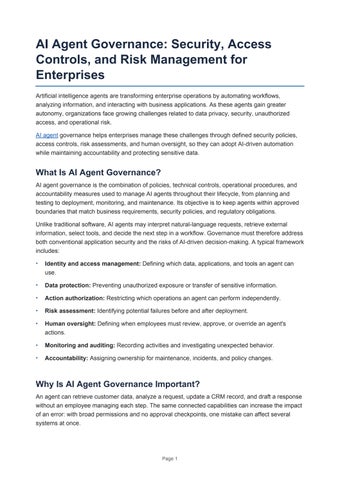
AI Agent Governance: Security, Access Controls, and Risk Management for Enterprises Artificial intelligence agents are transforming enterprise operations by automating workflows, analyzing information, and interacting with business applications. As these agents gain greater autonomy, organizations face growing challenges related to data privacy, security, unauthorized access, and operational risk. AI agent governance helps enterprises manage these challenges through defined security policies, access controls, risk assessments, and human oversight, so they can adopt AI-driven automation while maintaining accountability and protecting sensitive data.
What Is AI Agent Governance? AI agent governance is the combination of policies, technical controls, operational procedures, and accountability measures used to manage AI agents throughout their lifecycle, from planning and testing to deployment, monitoring, and maintenance. Its objective is to keep agents within approved boundaries that match business requirements, security policies, and regulatory obligations. Unlike traditional software, AI agents may interpret natural-language requests, retrieve external information, select tools, and decide the next step in a workflow. Governance must therefore address both conventional application security and the risks of AI-driven decision-making. A typical framework includes: •
Identity and access management: Defining which data, applications, and tools an agent can use.
•
Data protection: Preventing unauthorized exposure or transfer of sensitive information.
•
Action authorization: Restricting which operations an agent can perform independently.
•
Risk assessment: Identifying potential failures before and after deployment.
•
Human oversight: Defining when employees must review, approve, or override an agent's actions.
•
Monitoring and auditing: Recording activities and investigating unexpected behavior.
•
Accountability: Assigning ownership for maintenance, incidents, and policy changes.
Why Is AI Agent Governance Important? An agent can retrieve customer data, analyze a request, update a CRM record, and draft a response without an employee managing each step. The same connected capabilities can increase the impact of an error: with broad permissions and no approval checkpoints, one mistake can affect several systems at once.
Page 1
Governance protects sensitive enterprise data, prevents unauthorized actions, improves reliability and accountability through ownership and audit records, and helps organizations turn legal and regulatory obligations into operational controls. It does not guarantee compliance, but it provides a foundation for showing how risks are assessed and managed.
Key Security Risks •
Prompt injection: Instructions hidden in user input or retrieved content can manipulate an agent. Treat external content as untrusted, restrict tools by task, validate tool arguments, and never rely on prompt-level defenses alone.
•
Excessive permissions: Broad access magnifies the impact of manipulation or error. Apply least privilege and review permissions regularly.
•
Data leakage: Sensitive information can escape through responses, tool outputs, logs, or integrations. Enforce access checks at the data source and limit what is logged.
•
Inaccurate outputs: Misread invoices or unsupported conclusions become costly when agents can act. Use input validation, business-rule checks, transaction limits, and approvals.
•
Insecure integrations: Weak authentication or excessive API permissions extend an agent beyond its intended scope. Give every integration a defined purpose and permission scope.
•
Cascading multi-agent failures: One agent's error can pass downstream. Define which agents may communicate and require independent validation for high-impact actions.
Essential Access Controls •
Least privilege: Give each agent only the permissions needed for its assigned task.
•
Dedicated identities: Avoid shared employee credentials so agent actions can be audited and access revoked quickly.
•
Separate permissions: Distinguish reading, proposing changes, updating records, sending external communications, approving commitments, and changing configurations.
•
Authorization outside the model: The application, not the AI model, should verify permissions and enforce approvals, so unauthorized requests are rejected even if the model is manipulated.
•
Time-limited, scoped access: Use short-lived credentials limited to specific resources, and revoke them when an agent is retired.
How to Build a Governance Framework •
Step 1: Define objectives and boundaries: Document the problem, approved users, data sources, tools, and permitted actions.
•
Step 2: Classify risks: Rate each use case by data sensitivity, autonomy, connected systems, consequences, and reversibility.
Page 2
•
Step 3: Map data flows: Document inputs, tools, outputs, and dependencies to reveal exposure points.
•
Step 4: Set permissions and policies: Enforce rules through application permissions, API authorization, and workflow controls, not prompts alone.
•
Step 5: Test: Cover adverse conditions such as malicious documents, unauthorized tool calls, and unavailable APIs; retest after changes.
•
Step 6: Add human approval: Base review on risk, and give reviewers enough context to make a real decision.
•
Step 7: Monitor: Track failed tool calls, permission denials, unusual access, and policy violations, with the ability to disable an agent quickly.
•
Step 8: Review: Revisit permissions, audit records, and risk assessments periodically.
Human Oversight, Monitoring, and Incident Response Approval should scale with risk. An agent may classify tickets automatically but require an employee to authorize account closures or exceptional compensation. Effective workflows have clear decision criteria, meaningful context for reviewers, appropriate reviewer authority, audit records, and a safe fallback when approval is unavailable. A useful audit trail captures the agent identity, task, tool invocation, authorization result, approval event, and outcome, while respecting data minimization. If an incident occurs, suspend the affected agent or workflow, revoke credentials, identify affected systems and records, review logs, fix the cause, restore service only after validation, and update controls.
Common Mistakes to Avoid •
Granting broad permissions too early.
•
Treating prompt instructions as security controls.
•
Ignoring third-party integrations.
•
Overlooking changes to models, prompts, tools, or permissions after deployment.
•
Failing to assign a clear owner to each production agent.
How Agentic AI Services Fit Into Enterprise Governance Organizations exploring OzaIntel's Agentic AI Services should consider which process the agent will improve, which systems and data it needs, which actions require human approval, and what monitoring, audit, and incident response capabilities are required. Raising these questions early lets governance be built into the architecture instead of added afterward.
Page 3
NIST AI Risk Management Framework The NIST AI Risk Management Framework provides guidance for identifying, assessing, and managing AI risks through four functions: Govern, Map, Measure, and Manage. Enterprises can adapt it to agentic systems by including agent identities, tool permissions, action authorization, and ongoing monitoring in their assessments.
Conclusion AI agent governance helps enterprises manage security risks, protect sensitive data, and maintain control over automated workflows. By integrating governance into AI implementation, businesses can adopt agentic AI services more responsibly, improve operational efficiency, and build secure, reliable AI-driven workflows.
Page 4