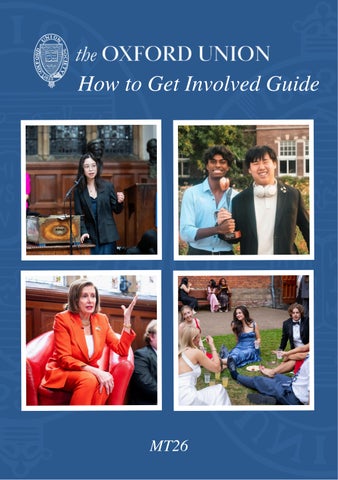
How to Get Involved Guide
MT26
CONTENTS About This Guide Welcome Our History Socials & Facilities Debating in the Chamber Competitive Debating Committees Electoral Officials Appointed Positions Elected Positions Vacation Days Accessibility Jargon Buster Timeline President’s Conclusions
2
3 4 5 6 7 10 11 15 16 17 18 19 20 21 22
ABOUT THIS GUIDE This guide was last produced in 2022, and so as a new group of freshers approaches the Oxford Union Society in Michaelmas 2026, we thought that it was an apt time to produce a new one, to help alleviate some of the mystery and make it easier for you to understand how you can get involved in this very special Oxford institution. Throughout these pages, authored by people in a variety of positions within the Society, you will find important information about the various committees, events and roles of the Union, and how you yourself may get involved in all of it. Our best advice is to throw yourself into it. Come to the debates, watch the speakers, attend the socials; talk to anyone and everyone. You will not be disappointed. There is nowhere else in the world quite like the Oxford Union, where students are entrusted to become custodians of such a historic and globally recognised institution. The available opportunities, and the experiences, are immeasurable. If you love debating, we will see you in the chamber! If you have never debated before, then Beginner’s Squads are waiting for you. If you love logistics and event planning, then you can work alongside the Secretary. If you love literature and academics, the Library Committee meets on Mondays. Alternatively, if you love rules and elections, the Electoral Official side of the Union may be the thing for you! Last, but by no means least, perhaps you love running in elections yourself in which case elected positions are up for grabs… Welcome to the Oxford Union, we are incredibly excited to have you! 3
WELCOME TO THE UNION The Oxford Union Society (‘the Society’) is one of the largest student societies in the world, with an international reach and a two hundred year long history. The conversations we have matter, are listened to, and make an impact. For example, seven Prime Ministers, six British, and one Pakistani, have served as Presidents of the Union. The Union is governed almost entirely by students, with a team of dedicated staff who are the ‘glue’ that hold the Society together day-today. There are so many different ways for you to get involved in the Union, detailed in this guide. Whatever your interests, and whoever you are, there is space for you here. About half of the Committee is elected by the membership every term in Week 7. The other half or so are appointed by the President, with the approval of the Standing Committee (the Society’s governing / management committee). ‘The Committee’ is a colloquial term that covers everyone who has an elected or appointed role each term, and is different from the societies’ various other Committees with specific functions. The primary purpose of the Union is debating. This is captured in our Thursday night formal debates that are watched the world over. We also have excellent competitive debating squads, who even won the World Championships in 2024! We host regular individual speaker events, with some of the most interesting and successful people in the world. Throughout the term, we host popular social events, from pub quizzes to karaoke to international nights. Our termly balls are a key feature of the Oxford social calendar, and are also some of the most affordable balls in Oxford! While this guide is primarily about getting involved in the running of the Union, you should be aware that there are so many ways (from beginners debating to coming to socials) to enjoy the Union without ever taking a role! 4
OUR HISTORY In 1822, twenty-five undergraduates met secretly in a room in Peckwater Quad, Christ Church. They were there to discuss topics forbidden to them by the University of Oxford (matters of State, the monarchy, democracy, and theology). These numbers continued to grow, week by week. By 1823, they had drawn up a charter to establish a new society, independent of the University, which would give every student (regardless of rank or seniority) a place to voice their opinions and hone their rhetorical skills. This strict independence (including financially) from the University continues to this day. Through two centuries, and with contributions by members such as William Gladstone, H. H. Asquith, Harold Macmillan, Ted Heath, Benazir Bhutto, Tariq Ali, and Geraldine Jones, the Oxford Union Society became a fixture of university life, with a tradition of hosting internationally prominent individuals across politics, academia, and popular culture. Today the Union is a social hub, a study space, a place to meet with friends, as well as to see celebrities and luminaries from across every professional sphere. As the Union enters its third century, the same values of free speech and intellectual curiosity that drove twenty-five undergraduates into a secret room in 1822 remain the very pillars that the institution continues to defend. i
5
SOCIALS & FACILITIES Alongside the Library and study rooms, the Union’s discounted members’ Bar is one of the cheapest bars in Oxford. We also provide a snooker room for our members (the only full size tables in the centre of Oxford), and our courtyard is a beautiful space to eat, drink, and socialise - particularly in the summer months. The Union’s Secretary is responsible for organising social events, supported by a Social Events Officer and the wider Committee. The Union has a packed social calendar, with events on most weeks of term. Our termly balls are regularly some of the most affordable balls in Oxford.
6
DEBATING IN THE CHAMBER Every Thursday night in term time, we have our world-famous formal debates in the Chamber. These feature prominent guest speakers, who are often experts in their field or other celebrities. They also, importantly, feature students and this is how you can participate: EMERGENCY DEBATES Starting at 19.45 each week, these are debates on a pressing, topical issue. They are open to all members to attend and speak, with speeches of 2-3 minutes in length. Simply come to the chamber, put your hand up and you might be called by the Chair to speak at the despatch boxes! This is often people’s first experience of debating, so do not worry about not having done anything similar before. It is very common for freshers to speak in Michaelmas.
7
DEBATING IN THE CHAMBER MAIN DEBATES From 20.30 onwards, the main debate (also known as a Public Business Meeting) begins. This is where people will give ‘paper speeches’, known as such because their name is listed on the Order Paper in advance. Paper speeches in Michaelmas 2026 will be given out based on either debating merit or work on Committee. Auditions will be held before each debate. Other members can also participate by participating in the floor debate, where any member called by the Chair can speak on the motion between the paper speakers.
AFTER DEBATES Once the main debate has concluded, debate carries on in the Chamber for those wishing to stay behind. This is on the same motion as the main debate.
Giving a certain number of speeches in the chamber is a requirement for running for election within the society. 8
the Old Library
the Gladstone Room
the Chamber
the Goodman Library
9
COMPETITIVE DEBATING Debate Selection Committee (DSC) oversees the Society’s competitive university debating activities, in which the Union has a long & successful tradition. Oxford are currently European Champions, having won the 2026 tournament. DSC consists of eight voting members who are competitive debaters, and are appointed based on experience. DSC’s members elect the Chair of DSC (CDSC), who serves for up to a year. The CDSC is also a non-voting member of Standing Committee. As well and competing in (and winning!) many University competitions, DSC also run Oxford Schools, the largest schools debating competition in the world. Competitive debaters, and other Union members, can help with running this tournament. The easiest way to get involved in DSC activities is to attend our weekly training sessions! Beginners’ sessions run on Monday evenings during term-time, and we offer Intermediate & Advanced Workshops for more experienced debaters. Additionally, we run several internal tournaments throughout the year, open to members of all experience levels. Join our mailing list to subscribe@maillist.ox.ac.uk.
10
stay
informed:
debate-announce-
COMMITTEES The Society is governed by a number of Committees that meet at various points throughout the week. Members are entitled, and encouraged, to attend any Committee, unless they choose to exclude observers for a particular part of their business. The next few pages detail the various Committees that you can attend, and join! You can request the minutes of any Committee meeting from the Secretary to that Committee, or they should be posted on the noticeboard outside the bar. CONSULTATIVE COMMITTEE Consultative Committee (CC) meets at 13.15 every Monday. Every member of the society is a member of the Consultative Committee. The purpose of CC is to raise concerns and questions to Office Holders and raise suggestions. This is a great way to meet the people involved in running the society. There are also often elections for various positions in CC. CC is chaired by the ‘Chair of Consultative Committee’, who you will often hear referred to as the ‘CCC’, which is one of the most senior positions in the society.
11
COMMITTEES LIBRARY COMMITTEE Library Committee meets at 14.15 every Monday. Every member of the society is eligible to become a member of the Library Committee by attending two meetings of this committee. Society members on undergraduate programs are eligible to become Junior Members and other members (with degrees) of the society are eligible to become Senior Members. The purpose of the Library Committee is to shape the library’s collections by withdrawing and adding books and to address feedback and suggestions of members of the society. The Library Committee is chaired by the Librarian, one of the most senior positions in the society. FINANCE COMMITTEE Finance Committee meets every Monday at 15.15. Their primary purpose is to scrutinise budgets and to work on the Union’s long term financial health. There are three spots for ‘Elected Members’, that anyone can stand for in CC. One of these comes up for election each term, and the position lasts for a year. If you have a background in finance, economics or business, this is the perfect way to get involved! SECRETARY’S COMMITTEE Secretary’s Committee meets at 14.00 every Monday. There are 11 members, elected termly in the main elections in 7th Week. They assist the Secretary and the CCC with the organisation of social and speaker events. Becoming a ‘Seccie’ is most people’s first step on the ladder of the Society’s elections. 12
COMMITTEES ACCESS COMMITTEE Access Committee is responsible for promoting Access initiatives within the Society. In recent years it has recommended the creation of Access memberships, helped produce this guide, introduced prayer mats and much more. If you have any access concerns or recommendations, you are strongly encouraged to bring them to Access Committee! There are four spots for ‘Elected Members’, elected in CC each term. Access is chaired by the Access Officer (mostly known as the ‘Chair of Access’) which is Senior Appointed position. If you have further questions you can email access.chair@oxford-union.org. WINE AND SPIRITS COMMITTEE Wine and Spirits Committee are responsible for management of the Members’ Bar, one of the Union’s greatest assets. Come along if you want to request new drinks, or provide other suggestions for the running of the Bar. It is chaired by the Secretary, and there are three spots for ‘Ratified Members’, that become available on an ad hoc basis.
13
COMMITTEES STANDING COMMITTEE Standing Committee is chaired by the President, and is the Society’s Committee of Management. They are responsible for all things governance - from budgets, to recommending Rules changes and managing contracts. Being on Standing Committee is the highlight of many people’s Union careers. It is excellent real world experience, as you are responsible for governing an institution with large budgets and a number of staff. The Voting Members of Standing Committee are elected in 7th Week, and include the Officers (President, Librarian etc), ExOfficers and six ‘Elected Members’. All members are welcome to attend Standing Committee, which usually meets at 16.00 on Mondays. COMMITTEE TIMINGS The date and times of the various Committees can be found on the noticeboard. Access Committee and Wine and Spirits Committee move each term, but the following Committees have met at the same time for many terms: Consultative Committee - 13.15 on a Monday Secretaries Committee - 14.00 on a Monday Library Committee - 14.15 on a Monday Finance Committee - 15.15 on a Monday Standing Committee - 16.00 on a Monday Debate Selection Committee - 12.00 on a Monday or Wednesday
14
ELECTORAL OFFICIALS The Union’s elections are managed by a team of 20+ Electoral Officials who work to ensure that the Society has free, fair and accessible elections. ‘RO World’ is always looking for new people to join, especially if you have an interest in the Rules or elections! Returning Officer’s Assistants Appointed by the Returning Officer, anyone can become an ROA! They assist the RO and DROs with their duties, helping to count ballots and process nominations. This is the first step on the ladder to becoming a DRO... Deputy Returning Officer After a term or two as an ROA, you might become a DRO. They do the same things as ROAs but with added responsibilities. Deputy Returning Officers also get to vote in the ‘Conclave’, to elect one of themselves to become the Returning Officer. The Returning Officer The Returning Officer is responsible for overseeing the Society’s disciplinary processes, as well as managing the Society’s elections. This is a demanding role with lots of responsobility, but essential to the free and fair function of the Society.
If you are interested in getting involved, please email ro@oxford-union.org. 15
APPOINTED POSITIONS Senior and Junior Appointed are the backbone of the Union, and work to ensure that all events - including socials, speakers and debates - are run effectively. Applications open towards the end of term for the following term. These positions are selected by the incoming President, subject to the ratification of Standing Committee. The application form will be circulated to the mailing list and social media, and some applicants will be invited to a short, relaxed, 10 minute interview. New appointees will receive a Committee induction in 8th Week. As well as Senior and Junior Appointed positions, there are also ‘Temporary Appointed’, which are new roles created term by term. Recent examples include ‘Chief Advisor’, ‘Director of Projects’, ‘Junior Events Officer’ and so on. JUNIOR APPOINTED Press Officers, Sponsorship Officers, Operations Officers, Media Officers, Equalities Officers (Disabilities, Ethnic Minorities, LGBTQIA+, Women and Gender Minorities, Socioeconomic, Graduate, International, Oxford Brookes) and the Schools Outreach Officer. SENIOR APPOINTED Chief of Staff, Director of Press, Chair of Access, Social Media Officer, Social Events Officer, Senior and Junior Welfare Officers.
16
ELECTED POSITIONS The following positions are elected in 7th Week for the next term: President-Elect (who serves as President the term after), Librarian-Elect (who serves as Librarian the term after), Treasurer-Elect (who serves as Treasurer the term after), Secretary, Six Elected Members of Standing Committee, Eleven Elected Members of Secretary’s Committee. Nominations in the Society’s elections open on Friday of 5th Week and close on Friday of 6th Week. Any Life member can stand for election, trying to get people to vote for you is known as ‘hacking’ and people who run in elections as ‘hacks.’
THE OFFICERS The Union’s executive team is made up of the President, Librarian, Treasurer, and Secretary. The President is the Union’s chief executive. They decide the debates, organise invitations, chair Standing Committee, and much more. The Librarian is responsible for individual speaker events, and also chairs Library Committee. The Treasurer is responsible for the finances, though the Union also has a dedicated staff team who work on this too. The Secretary organises social events and takes minutes of Standing Committee and at debate nights.
17
VACATION DAYS Members of Standing Committee, Secretary’s Committee and Appointed Officials are required to work a certain number of days for the Society during the vacation before each term. These are essential to the running of the Society as this is when speaker invitations are sent out. One ‘vac day’ is 10 speaker invitations. The number of vac days required varies depending on which vac it is and your position. The Society provides expenses of £8 per day per person, or £12 if you are an access member. Some Presidents allow vac days to be conducted partially online. Most vac days are done in 9th or 10th Week. VACATION DAY REQUIREMENTS
18
Summer Vac
Christmas /Easter
Secretary’s Committee /Junior Appointed
10
7
Standing Committee /Senior Appointed
15
14
Officers
30
21
ACCESSIBILITY The Union is committed to being as accessible as possible for members and guests. The Chamber, Old Library, Goodman Library, and Bar all have step-free access arrangements. The Chamber has an access bench located near the exit, and spaces can be booked in advance. We are able to make provisions for wheelchairs, guide dogs, and other arrangements as may be necessary. The Chamber also has a hearing aid loop, which can be accessed by switching your hearing aid to ‘T’. There is an accesible bathroom located on the ground floor by the staircase. Regrettably, the age of our buildings means there is no step free access to the upper floors. Members and guests who need access arrangements are encourgaed to contact the Chair of Access at access.officer@oxford-union.org, or the Chair of Consultative Committee (who manages speaker events) at ccc@oxfordunion.org.
19
JARGON BUSTER TSC - the Standing Committee TFC - the Finance Committee GO - General Office PO - President’s Office RO/DRO - Returning Officer/Deputy Returning Officer Hacks - those who run for elected positions Slate - a team of people who run in an election together. There are usually two or three per termly election. PBM - either ‘Private Business Motion’, which is usually a motion to change the Rules, or ‘Public Business Meeting’, the official term for Thursday night debates. Senior Officers - the Senior Librarian and Senior Treasurer are two non-students selected by Standing Committee to oversee governance. They are currently an academic and a solicitor. Junior Officers - the President, President-Elect, Librarian, Librarian-Elect, Treasurer, Treasurer-Elect and Secretary. Point of Information (POI) - a brief interruption to a speech to raise a question. Speakers can deny these.
20
GETTING INVOLVED TIMELINE
Michaelmas 2026
WEEK 1 Election for Secretary to CC - at CC, Monday 13.15. WEEK 2 Election to Finance Committee - at CC, Monday 13.15. WEEK 3 Senior Appointed Applications Open WEEK 5 Junior Appointed Applications Open Election Nominations Open WEEK 6 Election Nominations Close - Friday at 15.00 Election Manifesto scrutiny Last day for Appointed interviews WEEK 7 Election Day - Friday 09.30-20.30 WEEK 8 Elections for Access Committee and CCC - at CC, Monday 13.15 Successful appointed applicants announced
For all elections in Consultative Committee (CC), members must nominate by emailing the Returning Officer before noon on the relevant Monday. 21
PRESIDENT’S CONCLUSION Before you know it you are going to graduate from university and realise that these were some of the best days of your life. You are surrounded by your friends, filled with ambition and the world is at your feet. As far as extra-curriculars go, the Oxford Union is one of the best and most varied ways to both make change and experience a great diversity of work. The magic of the Oxford Union is that it is almost entirely student managed. We own the mistakes we make because it is the price we pay for the responsibilities that we are given. Nowhere else will you be stretched to achieve your potential. From curation, to leadership, to design to debating to budgeting the Oxford Union has something for everyone. I understand how daunting a place it can be and if there is anything at all I can do to help, or even just navigating the labyrinthian network of the Union please do not hesitate to reach out to me if you require any assistance. GARETH LIM, President MT26,
St Peter’s.
22
GARETH LIM, The President
23
Produced by: Zagham Farhan With thanks to: Gareth Lim, Chloe Pomfret, Olivia Sieler, Chris Mentis Cravaris, Richanne Davies, Anita Okunde & Hayden Williams