GAZA BLUEPRINT
Israel’s apparent policy of destruction and disregard for international law in Gaza is being repeated in Lebanon, and once again met with impunity and silence from the international community. Since October 8, 2023, Israel has disproportionately attacked civilian infrastructure, and killed civilians on a mass scale, including aid workers, medics and journalists. Entire communities have been razed to the ground, including throughout the so-called ceasefire, and mass, forced displacement saw one fifth of Lebanon’s entire population flee their homes and villages.
Israel’s modus operandi now seen in Lebanon mirrors its actions during its genocide in Gaza, as do its purported justifications. War crimes and blatant disregard for international humanitarian law and civilian lives and livelihoods that played out in Gaza with such catastrophic consequences are also rolled out across Lebanon.
As the evidence mounts, the international community must learn from its failures to hold Israel accountable. Israel’s conduct in Lebanon shows that if it continues to be allowed to operate with impunity, its violations and atrocities will continue with enormous consequences for millions.
2. TARGETING OF CIVILIANS
On average, Israel killed almost 50 people a day in Lebanon during its 46-day war and injured almost 7,000 more. Among those killed were 177 children and 252 women.
Israel destroyed or damaged at least 40,000 homes, 60 schools, critical power stations and water systems, as well as businesses, farms and key bridges and roads, denying basic services to tens of thousands of people. The reconstruction bill in Lebanon since the war began in 2023 is estimated at $14 billion and rising, with the cost of the latest escalation still to be determined.
Israel attacked sixty-four hospitals and clinics since March, killing over 100 health sector workers, including 12 healthcare workers in a single strike. Five hospitals, including two major referral hospitals in Beirut alone - treating 450 patients and 40 people in intensive care - were issued forced evacuation orders. Ambulances too were targeted, with Israel issuing disturbing warnings, without evidence, that they were being used by Hezbollah for military activities and could therefore be legitimately targeted. In the absence of such evidence, ambulances are still protected under IHL, making such attacks potential war crimes.
Following the US-Iran ceasefire announcement on 8 April 2026 in ten deadly minutes Israel unleashed a massive, coordinated, bombing of more than 100 targets across Lebanon, killing over 300 people and injuring more than 1,500 others, many of whom lived in densely populated neighborhoods in central Beirut. This attack was the country’s single most fatal day since the civil war. The same culture of impunity in Gaza saw healthcare and education and other public services decimated by the Israeli military, as their attacks killed at least 75,000 people and a reported 10,000 more buried under rubble. The UN estimates 88 per cent of Gaza’s schools and 84 per cent of health centers were destroyed. Despite a so-called ceasefire, the genocide in Gaza continues and no-one so far has been held to account for the commission of war crimes.
Israel’s rationale for having killed and injured people in Lebanon echoes that of Gaza –self-defense, pre-emptive attacks or its refusal to acknowledge that many of the people killed and infrastructure destroyed were civilian at all. Israel has provided no evidence that justifies indiscriminate killing and targeting of civilians which, in many cases, are likely to amount to war crimes.
3. MASS FORCED DISPLACEMENT AND THE RAZING OF COMMUNITIES AND VILLAGES
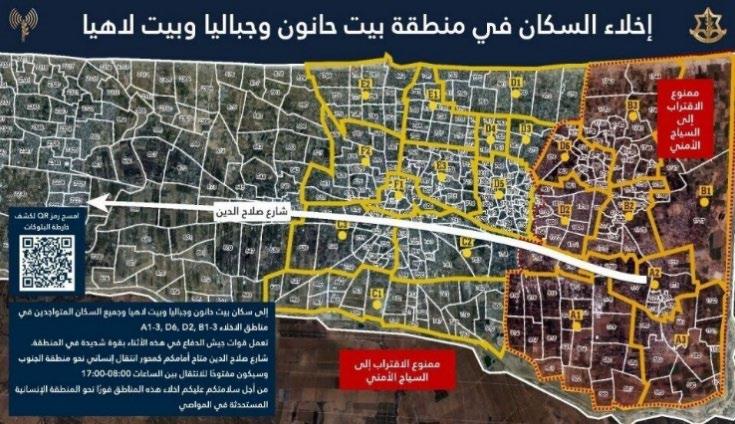
The first mass forced displacement in Gaza, where Israel called for more than one million people to leave their homes, was the largest mass eviction of Palestinians since 1948 and is widely considered to amount to forcible transfer, which is a war crime under international law. This first displacement in October 2023 was the beginning of many for hundreds of thousands of Palestinians in Gaza who were forced to flee their homes and shelters multiple times.
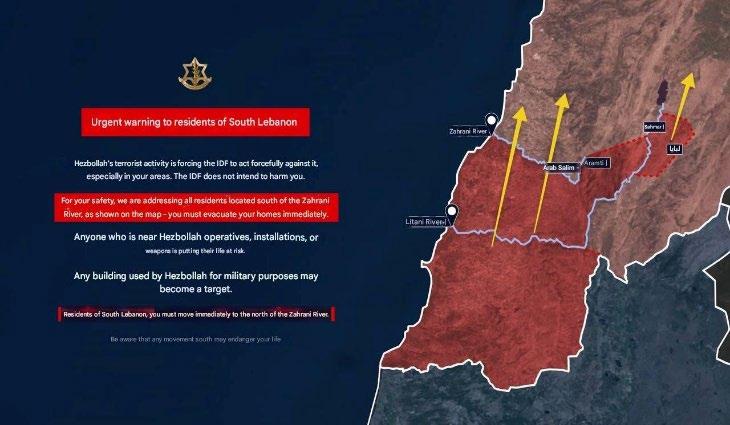
The forced displacement orders in Lebanon are also historic, in terms of their speed and scale. Over 20 per cent of the entire population of Lebanon, 1.3 million people, have been forcibly displaced from their homes and almost 15 per cent of the entire territory fell under Israeli forced displacement orders.
Israel’s strategy of razing entire cities and suburbs, which it rolled out in Gaza including in Rafah, Khan Younis, Abasan and Jabalia Camp, is also being witnessed in Lebanon. In the 2024 war, Israel destroyed 37 villages, most within the three-kilometer buffer zone it created that encroached into Lebanese land. Satellite imagery shows that this deliberate strategy of destroying entire communities continues as Israel carries out large-scale demolitions on an almost daily basis, including in Deir Saryan, a 430-yearold historic village. At least 50 Lebanese villages sit within Israel’s declared “buffer zone” and have been significantly damaged or destroyed, while Israel continues to deny residents their right to return, despite the so-called ceasefire.
5. OCCUPATION AND ANNEXATION
In Gaza and the West Bank, Israel’s escalating violence, annexation, mass displacement, and economic strangulation as well as its 17-year blockade is part of a systemic and brutal occupation. Its military assault, combined with coercive policies, the destruction of civilian infrastructure, and the necessary intention to destroy the Palestinian people in whole or in part, has resulted in an on-going genocide.
Israel’s stated plans to reoccupy Gaza form part of a broader policy that could pave the way for formal annexation, and possibly removal of the Palestinian population of Gaza, which would each be a violation of international law.
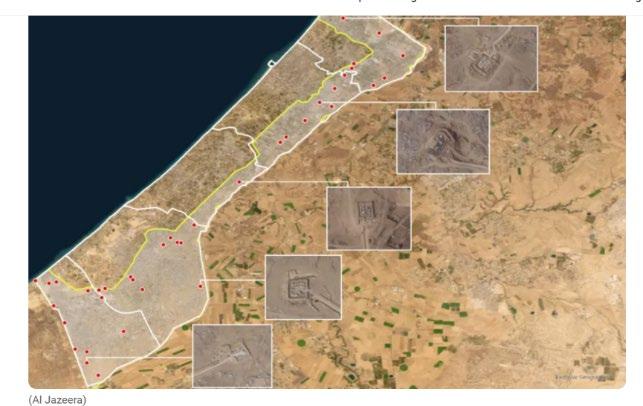
The ever moving and seemingly arbitrary so called “yellow line” demarcation in Gaza has now consumed 58 per cent of the Strip, preventing hundreds of thousands of Palestinians from returning home.
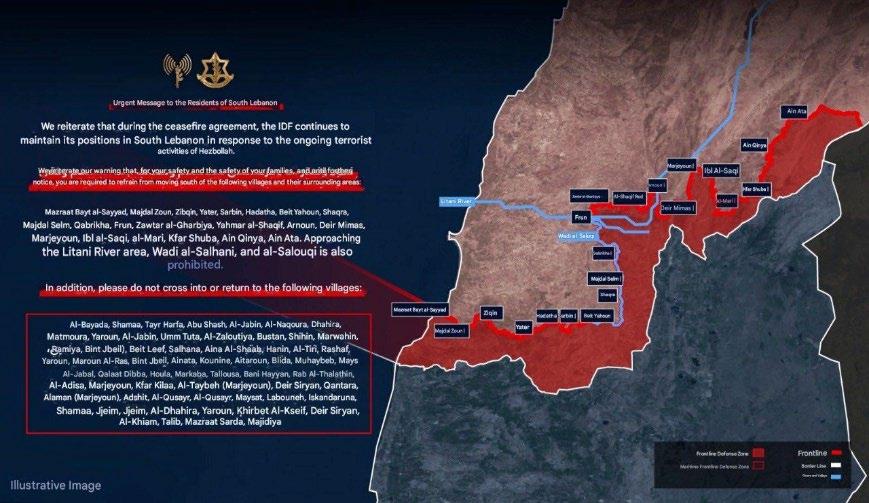
In Lebanon, before the 10-day ceasefire agreement, the Litani river became the equivalent of the ‘yellow line’ in Gaza, with Israel using it to demarcate a “buffer zone” to clear the south of people and their homes. Israel issued many mass forced displacement orders in Lebanon’s south and blew up bridges and roads to sever the south from the north, and to keep Lebanese people away from their land. 110 localities in Lebanon remain under Israel’s forced displacement orders, including 55 villages that fall below the Israeli demarcation.
In the days after the ceasefire agreement in Lebanon, Israel declared another buffer zone, also calling it a ‘yellow-line’, and with it their intentions to remain within this Lebanese land under military control. In the weeks since the deal came into effect Israel has continued to demolish buildings, carry out strikes and prevent the residents from going home.
In Lebanon, Israel announced its intentions to occupy the south of Lebanon and permanently displace hundreds of thousands of residences who were forced to flee, all of which are violations of international humanitarian law (IHL) and human rights law. At least one Israeli government minister and several officials have called for Israeli settlement in Lebanon, while a settler group also reportedly crossed into southern Lebanon in an attempt to start an illegal outpost. This, coupled with the ongoing spread of illegal settlements across the Occupied Palestinian Territory, shows ever-growing tolerance for settlement activity.
This expansion of Israeli occupation and its bombing of Lebanon is inflicting harm and destruction on an already traumatized population who had not yet recovered from the last wave of violence.
6. ECOCIDE AND THE DECIMATION OF AGRICULTURAL LAND
Israel has destroyed almost all of Gaza’s farmland or rendered it inaccessible, flattening greenhouses and buildings, thousands of wells, orchards and more than a million olive trees. This is in addition to the ever-moving “yellow line” in Gaza that has encroached over critical farmlands
Lebanon’s environment minister has accused Israel of committing an ecocide in Lebanon by launching attacks that have caused extensive environmental and agricultural damage, including repeated reports of the unlawful use of white phosphorus.
According to Lebanon’s Ministry of Agriculture, Israel has damaged more than 49,500 hectares of crops and has displaced 76 per cent of Lebanese farmers. The World Bank has estimated damages at $512 million.
Oxfam and ACF research has found that more than 82 per cent of farmers’ organizations interviewed in South Lebanon say that they cannot get enough water to irrigate their crops or water their livestock. Many farming and agricultural communities said they had been unable to access their land because they feared ongoing attacks.
The use of white phosphorus by Israeli forces in southern Lebanon has destroyed farmland, civilian infrastructure, and olive groves, which has severely impacted local livelihoods and food security since October 2023. These attacks have sparked fires, displaced agricultural communities, and created a lasting environmental and economic crisis.
Israel’s use of white phosphorus in populated areas is inherently discriminate against civilians, and so is a violation of international humanitarian law that may amount to a war crime. Ministry of Environment studies have found phosphorus in farmland in the south of the country at more than 400 times pre-war levels, which will have huge ramifications for both food production and significant economic costs. In February 2026, Israel also sprayed high concentrations of glyphosate, a dangerous and highly toxic herbicide used to kill plants, on Lebanese farmland in the south close to the blue demarcation line, which is likely another violation of international law.
7. THIS IS NOT A CEASEFIRE
As in Gaza, the ceasefire in Lebanon exists in name only. Both ceasefires are neither full nor respected and civilians are being killed or injured every day.
In Gaza, more than 850 people have now been killed since the ceasefire. In clear breach of its obligations under international law and in defiance of the Advisory Opinions of the ICJ, Israeli authorities are preventing many humanitarian agencies from accessing Gaza with aid.
In Lebanon too, there has been no real cessation of hostilities, despite the agreement. Israel is violating the ceasefire and international humanitarian law including with airstrikes and occupation, with impunity. In the first four days of the ceasefire agreement between Lebanon and Israel, Israel violated the deal 220 times, and since April 17, almost 600 people have been killed and 10,000 homes damaged or destroyed.
8. ISRAEL’S SONGSHEET
In Gaza Israeli government officials and military personnel have long openly stated their intentions to cause harm and destruction. Not only are the actions of the Israeli military almost identical in Lebanon as they are in Gaza, so are its officials’ public statements.
The pattern of incitement and dehumanizing language, the appetite for a repetition of the levels of destruction in Lebanon and the removal of any restraints are clear in Israel’s rhetoric in its war in Lebanon and in Gaza.
GAZA LEBANON
“Wipe Gaza off the face of the earth.”
Nissim Vaturi, Deputy Speaker of the Knesset October, 2023
“Attack everything… through the air, land… there are no compromises. Gaza will not return to what it was”
Yoav Gallant, Former Minister of Defense October, 2023
“There will be no electricity, no food, no water… We are fighting human animals.”
Yoav Gallant, Former Minister of Defense October, 2023
“Every place from which Hamas operates will turn into ruins.”
Benjamin Netanyahu, Prime Minister October, 2023
“We will not move from the Yellow Line by one millimeter”
Israel Katz, Minister of Defense February, 2026
9. LESSONS LEARNT
"Dahiyeh will resemble Khan Yunis": Bezalel Smotrich, Finance Minister March, 2026
“Up until the Litani [river]. Level all of it. They're all terrorists, no-one is a citizen..."
Ben Muvhar, Israeli regional council official October, 2023
“We will return Lebanon to the Stone Age.”
Yoav Gallant, Former Minister of Defense August, 2023
“The fate of southern Lebanon will be the same as that of Gaza”, Israel Katz, Minister of Defense April, 2026
“This is a security strip ten kilometers deep, which is much stronger, more intense, more continuous and more solid than what we had previously. That is where we are and we are not leaving.”
Benjamin Netanyahu, Prime Minister April, 2026
The stark evidence shows the playbook that Israel used to deliberately destroy Gaza is being used again with full impunity in Lebanon. The international community that has both enabled and ignored Israel’s destruction of Gaza must now use every economic and diplomatic lever at its disposal to end Israel’s impunity and stop further destruction in Lebanon.
Israel’s genocide in Gaza should never have been allowed to happen, yet the same kind of impunity afforded to Israel by the world’s leaders is now enabling Israel’s military campaign in Lebanon and beyond.
The thousands of breaches of international law in Lebanon and across the region must end. The international community’s failure to take bold action in holding actors accountable has led to this point. Further Israeli bombardments and ground invasion will only lead to more killing and suffering, increase humanitarian need, and push people further into poverty, refueling the vicious cycle of violence for generations to come.
OXFAM
Oxfam is a global movement of people fighting inequality to end poverty and injustice. We are working across regions in more than 70 countries, with thousands of partners, and allies, supporting communities to build better lives for themselves, grow resilience and protect lives and livelihoods also in times of crisis. Together, we tackle inequalities to end poverty and injustice, now and in the long term – for an equal future.
Please write to any of the agencies for further information or visit www.oxfam.org
Oxfam America (www.oxfamamerica.org)
Oxfam Aotearoa (www.oxfam.org.nz)
Oxfam Australia (www.oxfam.org.au)
Oxfam-in-Belgium (www.oxfamsol.be)
Oxfam Brasil (www.oxfam.org.br)
Oxfam Canada (www.oxfam.ca)
Oxfam Colombia (www.oxfamcolombia.org)
Oxfam France (www.oxfamfrance.org)
Oxfam Germany (www.oxfam.de)
Oxfam GB (www.oxfam.org.uk)
Oxfam Hong Kong (www.oxfam.org.hk)
Oxfam IBIS (Denmark) (www.oxfamibis.dk)
Oxfam Intermón (Spain) (www.oxfamintermon.org)
Oxfam Ireland (www.oxfamireland.org)
Oxfam Italy (www.oxfamitalia.org)
Oxfam Mexico (www.oxfammexico.org)
Oxfam Novib (Netherlands) (www.oxfamnovib.nl)
Oxfam Québec (www.oxfam.qc.ca)
Oxfam South Africa (www.oxfam.org.za)
KEDV (www.kedv.org.tr)
Oxfam Pilipinas (www.oxfam.org.ph)