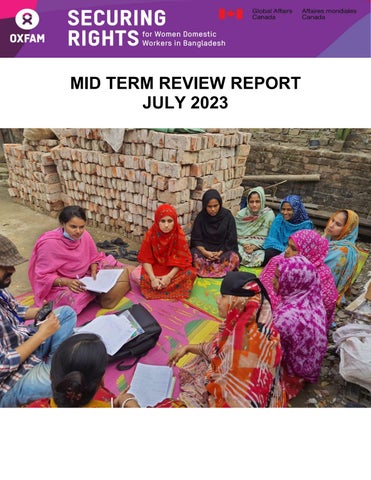
MID TERM REVIEW REPORT JULY 2023
This mid-term review was implemented by Change Initiative in the nine target zones from Dhaka North and Dhaka South City Corporations and in five hubs (Uttar Badda, Hazaribag, Dhanmondi, Mohammadpur and Mirpur) under the supervision of Oxfam in Bangladesh. July 2023 The Study Team from Change Initiative is composed of: Sifat E. Rabbi (Lead Researcher), Samsunnahar Shova (Research Assistant), Zion Rabbi Samaddar (Research Assistant), Rumana Ali (Gender expert), and M Zakir Hossain Khan (Technical Advisor). This mid-term review was conceptualized by Farhana Ahmed (Oxfam in Bangladesh) and Richa Sharma (Oxfam Canada) in collaboration with the project’s partners, including civil society organizations, Under-Privileged Children’s Education Programs Bangladesh (UCEP) and Campaign for Popular Education (CAMPE), a labour institute, Bangladesh Institute of Labour Studies (BILS) and private partners, HelloTask and RedOrange. This is the abridged version of the report, partly copy-edited by Erin MacLeod (consultant). For more information about this study please contact: Oxfam in Bangladesh: Farhana Ahmed, MEL Officer farahmed@oxfam.org.uk Oxfam Canada: Richa Sharma, MEL Officer richa.sharma@oxfam.org Disclaimer: This mid-term review was commissioned by Oxfam for the project, "Securing Rights for Women Domestic Workers in Bangladesh", with financial support from Global Affairs Canada. The findings, interpretations, and conclusions expressed in this work do not necessarily reflect the opinions held by Oxfam or Global Affairs Canada. It should also be noted that the statistics in this report are not comparable to national-level statistics. The mid-term review was conducted with sample groups from specific project areas; thus, the statistics are not coherent with national standardized data. While every attempt has been made to ensure data quality, we recognize that there may be certain limitations in this sense. Neither Oxfam nor Global Affairs Canada can guarantee the precision of the data included in this report.
Midterm Review – Securing Rights
1
Contents TABLES .................................................................................................................................. 4 FIGURES ................................................................................................................................ 4 ABBREVIATIONS AND ACRONYMS ......................................................................................... 5 ACKNOWLEDGEMENTS .......................................................................................................... 6 DEFINITIONS.......................................................................................................................... 7 EXECUTIVE SUMMARY ........................................................................................................... 9 1.
INTRODUCTION ............................................................................................................ 13 1.1 Project Overview .................................................................................................................... 13 1.2 Country Context and Literature review .................................................................................... 14 1.3 Media Monitoring Report ....................................................................................................... 15 1.4 Objectives of the Midterm Report ........................................................................................... 16
2.
METHODOLOGY ............................................................................................................ 16 2.1 Mid-Term Review Approach .................................................................................................... 16 2.2 Feminist Monitoring, Evaluation and Learning ......................................................................... 17 2.3 Mid-Term Review Design ........................................................................................................ 17 2.4 Data Collection Methods......................................................................................................... 18 2.4.1 Primary Sources of Information .................................................................................................................18 2.4.2 Field Data Collection ..................................................................................................................................20 2.4.3 Secondary Sources of Information .............................................................................................................21
2.5 Data Quality, Analysis and Validation ...................................................................................... 21 2.5.1 Data Quality ...............................................................................................................................................21 2.5.2 Analysis ......................................................................................................................................................22 2.5.3 Validation ...................................................................................................................................................22
2.6 Ethical Considerations............................................................................................................. 22 2.7 Challenges and Limitations...................................................................................................... 23 2.8 Facilitators’ Reflections ........................................................................................................... 23
3.
FINDINGS...................................................................................................................... 24 Ultimate Outcome........................................................................................................................ 24 PILLAR 1: Women domestic workers claiming their rights to decent work ...................................... 28 Summary of effectiveness of the interventions under Pillar 1 ...........................................................................28 Summary of relevance of the interventions under Pillar 1 .................................................................................29 Summary of coherence of the interventions under Pillar 1 ................................................................................30 Summary of efficiency of the interventions under Pillar 1 .................................................................................30
Intermediate Outcome 1100 ......................................................................................................... 31 Immediate Outcome 1110 ............................................................................................................ 32
Midterm Review – Securing Rights
2
Case Study: Fatema Begum, HelloTask Platform user ........................................................................................33
Immediate Outcome 1120 ............................................................................................................ 34 Case Study: Mosammat Moyna Begum, Group Leader ......................................................................................36
Challenges identified under Pillar 1 ............................................................................................... 37 PILLAR 2: Raising awareness and recognition of domestic work as decent work ............................. 39 Summary of effectiveness of the interventions under Pillar 2 ...........................................................................39 Summary of relevance of the interventions under Pillar 2 .................................................................................40 Summary of coherence of the interventions under Pillar 2 ................................................................................41 Summary of efficiency of the interventions under Pillar 2 .................................................................................41
Intermediate Outcome 1200 ......................................................................................................... 42 Case Study: Mukta Akter, Experience of Violence ..............................................................................................44
Immediate Outcome 1220 ............................................................................................................ 45 Challenges identified under Pillar 2 ............................................................................................... 53
4.
RECOMMENDATIONS ................................................................................................... 54 Recommendations for remainder of project .................................................................................. 54 Recommendations for future programming .................................................................................. 54
Midterm Review – Securing Rights
3
TABLES Table 1 Pillars and Outcomes of the Securing Rights Project ....................................................14 Table 2: Summary of Primary Data Collection ...........................................................................19 Table 3: Distribution of KIIs Undertaken across Dhaka City ......................................................20 Table 4: Pillar 1 Overview .........................................................................................................28 Table 5: Occupational Skills learned by DWs, DW Y3 Survey, 2022 (n=100) ............................34 Table 6: Pillar 2 Overview .........................................................................................................39
FIGURES Figure 1: Education of DWs from the Year 3 Survey .................................................................20 Figure 2: Employer Perspective on Checking Identification before Employment .......................27 Figure 3: Different forms of violence experienced by the DWs at the workplace, Y3 DW survey (N=43).......................................................................................................................................43 Figure 4: Employers attitudes towards DWs’ rights to different types of leave (n=50) ................45
Midterm Review – Securing Rights
4
ABBREVIATIONS AND ACRONYMS BILS CAMPE CAT4GJO CSO DSK DW DWG DWPWP DWRN FGD FMEAL GAC GBV GDP GoB IDI ILO IVR KII KN MOWCA MTR NSDA OCA OECD-DAC OiB PMF UCEP UNICEF WRO
Bangladesh Institute of Labour Studies Campaign for Popular Education Capacity Assessment Tool for Gender-Just Organizations Civil Society Organization Dushta Shasthya Kendra Domestic Workers Domestic Worker Group Domestic Worker Protection and Welfare Policy Domestic Workers’ Rights Network Focus Group Discussion Feminist Monitoring, Evaluation and Learning Global Affairs Canada Gender-Based Violence Gross Domestic Product Government of the People’s Republic of Bangladesh In-Depth Interview International Labour Organization Interactive Voice Response Key Informant Interview Karmojibi Nari Ministry of Women and Children Affairs Mid-Term Review National Skills Development Agency Oxfam Canada Organisation for Economic Co-operation and Development's Development Assistance Committee Oxfam in Bangladesh Performance Measurement Framework Under-Privileged Children’s Education Programs Bangladesh United Nations Children’s Funds Women’s Rights Organization
Midterm Review – Securing Rights
5
ACKNOWLEDGEMENTS We would like to extend our heartiest gratitude to the respondents who contributed their time and shared information and opinions to undertake this Mid Term Review. We acknowledge the contribution of domestic workers, the wider community, including employers and influencers, local government representatives, law enforcement officials, social workers, legal aid and health service providers, political leaders, representatives of domestic workers organizations, and members of the Domestic Workers’ Rights Network who shared their opinions regarding the constraints and issues concerning the rights and livelihoods of domestic workers. We are grateful to the partners of Securing Rights for their enormous support in conducting the field survey. Last but not the least; the study team would like to express sincere gratitude to the staff members of Oxfam in Bangladesh and Oxfam Canada for their support and cooperation in making it possible to efficiently carry out the review.
Midterm Review – Securing Rights
6
DEFINITIONS The following list of definitions will form the basis for common terminology used in the document. Attitude: An attitude is how a person feels about or judges a certain thing or behaviour. Social norms, morals, religious or family teachings, or experience, among other influences, can shape attitudes. Individuals hold attitudes, whereas social norms are at the group or collective level. Individual attitudes can either follow or deviate from what social norms say. For example: an individual woman might feel that it is important for her to tolerate violence to keep her family together, even though the social norm in her community is that domestic violence is not acceptable.1 Care Work: Care work is at the heart of humanity, as all human beings are dependent on care to survive and thrive. Care work can be paid or unpaid. Decent Work: Decent work sums up the aspirations of people in their working lives. It involves opportunities for work that are productive and deliver fair income, security in the workplace, and social protection for families, as well as better prospects for personal development and social integration, freedom for people to express their concerns, organize and participate in the decisions that affect their lives, and equality of opportunity and treatment for all women and men.2 A continued lack of decent work opportunities, insufficient investments, and under-consumption lead to an erosion of the basic social contract underlying democratic societies. All must share in progress.3 Domestic workers: Domestic workers work for private households, often without clear terms of employment, unregistered and excluded from the scope of labour legislation. Their work may include domestic tasks such as cleaning, cooking, gardening, guarding the house, and driving for the family, as well as taking care of children, elderly, or sick members of a family, and even taking care of household pets. A domestic worker may work on a full- or part-time basis, be employed by a single household or by multiple employers, be residing in the household of the employer (live-in), or be living in his or her own residence (live-out).4,5 Domestic Worker Groups: Groups of domestic workers from a shared region or with shared experiences who are convened to improve coordination, have collective identity, become a support network for one another, and collectively work together to advocate for their rights. Domestic Worker Network: A network that works towards protecting and promoting the rights and dignity of the domestic workers by lobbying with government, influencing, and campaigning using evidence built through undertaking feminist research. The domestic worker network also acts as a facilitator between domestic workers groups and key stakeholders, as well as convening domestic worker for collective advocacy and movement building. Employers: For the purposes of this project, this term refers to any person who primarily manages a domestic worker within the household. 1
Laura Haylock, A Conceptual Framework for the Mid-term Outcome Evaluation of The Gender Justice External Change Goal of the Oxfam Strategic Plan 2013-2019: Attitude, Norms and Behavior Change to end Violence Against Women and Girls/Gender-based Violence, 2016, p. 6. 2 ILO, Decent Work, 2019, https://www.ilo.org/global/topics/decent-work/lang--en/index.htm. 3 UN, Decent Work and Economic Growth: Why it Matters, United Nations Sustainable Develop Goal Knowledge Platform, 2016, https://www.un.org/sustainabledevelopment/wp-content/uploads/2016/08/8_Why-it-Matters_Goal-8_EconomicGrowth_2p.pdf. 4 ILO, Who are Domestic Workers, 2019, https://www.ilo.org/global/docs/WCMS_209773/lang--en/index.htm. 5 Securing Rights updated the reference to this term, to refer to only “live-out” domestic workers in Year 3 of project implementation.
Midterm Review – Securing Rights
7
Influencers: For the purposes of this project, this term will be used to simplify references to policy makers, political leaders, religious and community leaders, non-governmental organization representatives, and educators who act as custodians of customs, practices, and social norms (“norm-setters”) within communities, who shape expectations about appropriate behaviour, and who, as duty bearers, have the power to support implementation of formal and informal practices. Life skills: Life skills enable individuals to effectively deal with the demands of everyday life. They also foster critical thinking about how gender norms and human rights guide interactions with others. Appropriate “life skills” also vary depending on the social norms of a given community. The World Health Organization has identified the following core cross-cultural areas of life skills: decision-making and problem-solving; creative thinking (see also: lateral thinking) and critical thinking; communication and interpersonal skills; self-awareness and empathy; assertiveness and equanimity; and resilience.6 These skills are also recognized by the United Nations Children’s Funds. Norms: Norms are shared beliefs about what is typical and appropriate behaviour in a group. They represent individuals' basic knowledge of what others do and think that they should do.7 Social norms provide the (often unspoken) rules or expectations of behaviour. Social norms apply to a specific “reference group,” which is made up of people whose opinions are important to someone who is making a decision about how to behave. It is a group that a person identifies with or feels close to. Examples include a peer or school group, work colleagues, a community, or expectations of behaviour. Social norms strong influence behaviour through social approval or disapproval.8 Social sanctions – such as stigma, criticism, shaming or teasing, social exclusion, and even violence – may result from not complying with expectations. On the other hand, if a person acts in accordance with social norms, the person feels like they are acting correctly, and are likely to be more accepted, regarded, or included by those around them. Gender-Based Violence: Gender-Based Violence is the use of physical or other types of violence to enforce gender norms, or because of gender identities.9 It includes physical, sexual, and psychological violence within the family and/or community, and violence perpetrated or condoned by the state. Sometimes this is referred to as sexual and gender-based violence. The term gender-based violence includes all forms of violence that are the result of gender criteria (e.g. because the person is a woman, trans-gender, or gay). Wider Community: For the purposes of this project, this term refers to family members of the employer’s household including kids, elders, and other project stakeholders at large. Women’s Rights Organizations: For the purposes of this project, the term refers to autonomous organizations whose mission is to advance women’s rights.
WHO, Partners in Life Skills Education – Conclusions from United Nations Inter-Agency Meeting, 1999, https://www.who.int/mental_health/media/en/30.pdf. 7 , M. Alexander-Scott, E. Bell, J. Holden, DFID Guidance Note: Shifting Social Norms to Tackle VAWG, London, VAWG Helpdesk Department for International Development, DFID, 2016, p.11-12. 8 G. Mackie, F. Moneti, H. Shakya, E. Denny, What are Social Norms? How are They Measured? San Diego, UNICEF and the University of California, 2015, p. 21. 9 WHO, Gender Based Violence, 2016, http://www.who.int/topics/gender_based_violence/en/. 6
Midterm Review – Securing Rights
8
EXECUTIVE SUMMARY Gender is one of the most persistent predictors of poverty and powerlessness in our world today. Oxfam is committed to supporting its partners’ lasting solutions to poverty and injustice by advancing the recognition of domestic work in Bangladesh. Securing Rights of Women Domestic Workers in Bangladesh (hereafter Securing Rights) was initiated in 2019 with the aim to improve the well-being of women domestic workers (DWs) by enabling them to access their rights to engage in “decent work” as defined by the International Labour Organization (ILO). The project, which started in March 2019 and ends in June 2025 was in its fourth year of implementation at the time this mid-term review (MTR) was conducted by the Change Initiative. The project was built on the momentum created by the Government of the People’s Republic of Bangladesh’s approval of the Domestic Worker Protection and Welfare Policy 2015 (DWPWP). The review included participants from each of the five project hubs including Uttar Badda, Hazaribag, Dhanmondi, Mohammadpur, and Mirpur. The participants were 18 to 60-year-old DWs who had completed the Securing Rights skills trainings. In total, data was collected from 80 DWs, and 20 interviews were conducted with project partners, and influencers, including policy makers, union representatives, NGO representatives, law enforcement officials and ward commissioners. This report provides their perspectives as well as the perspectives of DWs’ group leaders and also captures some of the project achievements, contributes to collective learning, identifies challenges and lessons learned, and provides recommendations to achieve the ultimate outcome of the project: increasing the well-being of women DWs in Dhaka, Bangladesh. OVERVIEW OF THE MID-TERM REVIEW PROCESS The MTR was a participatory exercise where consultants worked collaboratively with Oxfam In Bangladesh (OiB), Oxfam Canada (OCA), project partners, and DW representatives to determine what knowledge to collect, how it should be collected, and how knowledge and learning will be analyzed and used. The aim was to engage in a gender transformative approach, keeping in mind the principles of feminist monitoring, evaluation, accountability and learning (FMEAL). 10 This included a focus on gender and power relationship as they are influenced by social, cultural, economic and political structures and relations as well as a direct involvement of participants in Securing Rights at all stages, understanding the diversity and complexity of DWs. An evaluation matrix was developed to identify the questions and sub-questions for information collection considering the Organisation for Economic Co-operation and Development's Development Assistance Committee (OECD-DAC)11 evaluation criteria. Among the six criteria, Effectiveness, Relevance, Coherence and Efficiency were chosen. Secondary review was informed by various project documents including project’s Theory of Change, Project Implementation Plan (PIP), Performance Measurement Framework (PMF), annual and semiannual reports, and survey data. Additionally, the MTR scope and design was determined by feedback received from all project partners in July 2022. Primary qualitative data was collected through Focus Group Discussions (FGDs), Key Informant Interviews (KIIs), In-depth Interviews (IDIs), and video documentaries to capture data related to the learning questions and the PMF indicators. The data were collected from the five hubs of the project and triangulated with various More details on Oxfam Canada’s application of feminist principles applied to MEAL can be found here: https://policypractice.oxfam.org/resources/applying-feminist-principles-to-program-monitoring-evaluation-accountability-an-620318/. 11 See further information about the Organization for Economic Co-operation and Development's Development Assistance Committee (OECD-DAC)’s evaluation criteria here: https://www.oecd.org/dac/evaluation/daccriteriaforevaluatingdevelopmentassistance.htm. 10
Midterm Review – Securing Rights
9
secondary data sources, including a quantitative survey previously conducted by Oxfam (in March-April 2022). The major findings were presented to Oxfam, project partners, and DW representatives for validation during March-April, 2023, and their feedback was incorporated and informed the final analysis of the review findings.
March-April 2022: Year 3 Quantitative Oxfam survey
July 2022: Project partners were asked to provide their feedback on the design of the MTR.
December 2022: Consultants onboarded due to unforeseen delays
January-April 2023: Qualitative review and literature review were designed and conducted. Sedcondary review and primary qualitative data collection.
March-April 2023: Data was presented to Oxfam, project partners, and DW representatives for validation.
FINDINGS Effectiveness Pillar 1: Campaign for Popular Education (CAMPE) developed the training curriculum in collaboration with the National Skills Development Agency (NSDA). Occupational and life skills training were provided to DWs through Under-Privileged Children’s Education Programs Bangladesh (UCEP), and other civil society partners. Occupational skills training topics included the operation of different home appliances and cooking skills. Life skills training provided knowledge of work culture, increased self-esteem and awareness of the DWPWP. The DWs displayed these skills to their employers through demonstration and effective communication, thereby allowing DWs to be more able to claim their rights and negotiate fair pay, leave, working hours and medical allowance. Life skills training has strengthened professional skills, awareness, negotiation abilities, leadership capacity and decision-making skills of DWs. In addition, the introduction of an online job placement platform through HelloTask has opened new work opportunities for DWs. Pillar 2: From a research and advocacy perspective, Securing Rights partner Bangladesh Institute of Labour Studies (BILS) conducted effective activities including policy and evidencebased research such as a study to document the situation for DWs in terms of violence, the findings of which were reported on extensively in the national media. In addition, they established three committees for mobilizing various stakeholders, including the Policy Implementation Committee (PIC), Apex Body, and the Consultative Forum. Communication on issues related to DWs was developed by partner RedOrange, which is effective in reaching the wider community, specifically employers and the government. Social media as well as television commercials were produced, and workshops held alongside government stakeholders. Relevance Pillar 1: Even though the project was designed before COVID-19, it is relevant for the existing context of Bangladesh where DW rights are violated. In addition, the life skill training is particularly relevant for the DWs. Pillar 2: Adding to the relevance of the project was coordination among different partners, who handled different components of the project; this coordination among partners and awareness
Midterm Review – Securing Rights
10
has strengthened over the project duration thus far. Repeated engagement of relevant government stakeholders with the project in the various committees (PIC, Apex Body, Consultative Forum) has contributed in strengthening the policy and monitoring cells responsibilities. However, the increased the number of meetings across the three committees has caused repetition to some extent, and required more time and resources. Oxfam’s Capacity Assessment Tool for Gender Just Organizations (CAT4GJO) and FMEAL training also added more value and relevance to the project. Efficiency Pillar 1: The project has been implemented efficiently in terms of strengthening the capacity of the DWs. Findings of this study identified that due to occupational and life skill trainings their levels of confidence increased, and their ability to efficiently collective bargain also increased. For example, the DWG leaders work as agents to ensure effective and efficient negotiations with employers. The DWG leaders can bargain on behalf of a particular DW. They can consult and bargain for their weekly and monthly leave, seek permission from the employers as well as from the family members to attend training and help if anyone faces any violence at work and family. During COVID-19, the DWG leaders helped group members in receiving incentives/relief from NGOs and others. Pillar 2: Moving forward, this efficiency can be improved through DWGs working jointly with the Domestic Workers Rights Network (DWRN). Coherence Pillar 1: A major outcome of the project intervention regarding GBV is that the DWs learnt how to say ‘No’ to any GBV in the work place and, actions to take in case they experience any harassment or abuse in the workplace. In the baseline, 99% of the surveyed DWs reported that they experienced verbal abuse in the work place. However, findings of the quantitative survey conducted in 2022 revealed that about 31% of the DWs reported that they have experienced verbal/physical abuse at workplace, indicating that the rate of verbal abuse among the trained DWs is getting lower. Pillar 2: All elements of the project are in keeping with gender transformative principles. The participatory process of developing the project as well as continued attention to DW needs means that the project is contributing to an overall better environment for DWs as well as policy change in recognizing domestic work as formal profession. There has been a shift: the training has started to change the mindset of employers; however, more employers need to be engaged in project activities. CHALLENGES AND MITIGATION Challenge Delays in training due to impacts of Covid-19, and challenges in DWs getting 10 days leave from employers DWs unable to complete the NSDA assessment due to lack of literacy Drop outs and double counting
Midterm Review – Securing Rights
Lesson/Mitigation Training has been arranged in two different shifts (morning and evening); DWs have noted they prefer the later shift Complete the assessment through BTEB’s available assessors and other supports as an alternative Need for crosschecking between locations and increased social mobilization
11
Husbands preventing wives from attending training
Social mobilizer and DW group leaders communicate with and persuade husbands
Confusion in use of online job placement platform
Need for further training to address this issue
Lack of employer engagement
Additional employer awareness meetings are necessary
Short time for interventions with policy makers
Policy advocacy should have a long-term scope
Frequent changes in government
Enhanced engagement of all partners alongside ministries at different levels so as to reduce a focus on certain individuals
RECOMMENDATIONS For the remaining duration of Securing Rights • • •
• • • • •
Additional follow-up meeting with DWs post-training to ensure understanding Care arrangements for DWs during training More connection between online platform and other project partners to ensure effective communication and knowledge sharing Further orientation to DWs on the online job placement platform Continuous awareness campaign to change public mindset regarding domestic work Increase engagement of employers by holding more awareness meetings Increase number of trainings for DW spouses and family members by holding more Rapid Care Analysis workshops If possible, the life skill training should be more frequent, with refresher trainings after 3-6 month intervals
Midterm Review – Securing Rights
For a future iteration of Securing Rights • • • • • • • • •
•
Increase awareness of participant needs based on education, economic status, and availability to attend training Address literacy challenge and mismatch of DW literacy level as compared to the literary requirements for certification Revise occupational skill training based on employer and area-specific demands Increased number of employers’ awareness programs Extend length of life skills training Organize a general awareness campaign for husbands Allocate budget for compensating DWG leaders’ activities Increase male engagement Establish a DW Café, with a secretariat in charge of running the café. DWG can continue their activities under the supervision of the secretariat. Policy advocacy should have a long-term scope
12
1. INTRODUCTION 1.1 PROJECT OVERVIEW Securing Rights, locally referred to as the Suniti Project, was initiated in 2019, with the aim to improve the well-being of women domestic workers (DWs) by enabling them to access their rights to engage in “decent work” as defined by the International Labour Organization (ILO). The project, which started in March 2019 and ends in June 2024, was in its fourth year of implementation at the time this mid-term review (MTR) was conducted. The project works with 16,000 women DWs within Dhaka city, as well as employers and influencers (community leaders, private sector, political actors, government officials, youth leaders and other duty bearers). The project engages networks and alliances working on DWs rights including Domestic Workers Rights Network (DWRN), organizations that provide legal and social support and services for women and girls who have experienced violence, public and private life-skills and occupational training support providers, and key government organizations in influencing change. The partner organizations are selected from Women’s Rights Organizations (WROs), Civil Society Organizations (CSOs) and private sector organizations that include private placement agencies and an international communication consulting partner that receives support from Oxfam. Seven organizations are working as project partners in this project implementation process; Bangladesh Institute for Labour Studies (BILS), Campaign for Popular Education (CAMPE), Under-Privileged Children’s Education Programs Bangladesh (UCEP), Dushtha Shasthya Kendra (DSK), Karmojibi Nari (KN), RedOrange and HelloTask. Among those partners, BILS is considered a WRO; UCEP, DSK, KN and CAMPE are CSOs; and RedOrange and HelloTask are two private sector organizations. 12 The project is funded by Global Affairs Canada (GAC). The ultimate outcome (1000) of the project is to increase the well-being of women DWs in Dhaka, Bangladesh, supported by two pillars, as described in Table 1. The project was built on the momentum created by the Government of the People’s Republic of Bangladesh’s (GoB) approval of the Domestic Worker Protection and Welfare Policy (DWPWP). Pillar 1
Intermediate Outcome 1100
Immediate Outcome 1100
Immediate Outcome 1120
Working directly with women domestic workers, domestic worker groups (DWG), and the DWRN to build skills and capacity so that women DWs can claim their rights, especially the right to decent work and living free from violence
Strengthened agency of women DWs to claim and defend their rights in relation to decent employment
Improved professional skills and competencies and formal placement enable women DWs to claim and defend their rights
Improved ability of DWGs to provide services for women DWs and advocate for their rights to live free from violence
12
In the Year 1-3, Nari Maitree was the project implementing partner for life skill training. A partner transition took place in Year 4 and now DSK and KN are playing similar roles.
Midterm Review – Securing Rights
13
Pillar 2
Intermediate Outcome 1200
Immediate Outcome 1210
Immediate Outcome 1220
Supporting WROs to engage in positive norm modelling with the wider society, as well as supports WROs, DWGs, and the DWRN in undertaking action, advancing rights related to recognition of domestic work as decent work (and domestic workers welfare and protection), and advocating for the implementation of related policies
Improved social norms on DW’s rights, including increased recognition of domestic work as formal profession, promoted by policy makers, government, employers, and the wider society
Strengthened capacity of civil society to develop and implement joint action plan and influence the government for the recognition of domestic work as a formal profession
Improved positive attitudes and support of policy makers, employers, and the wider society towards women domestic workers’ rights and entitlements
Table 1 Pillars and Outcomes of the Securing Rights Project
1.2 COUNTRY CONTEXT AND LITERATURE REVIEW Bangladesh is a densely populated country in South Asia. At present, Bangladesh has an estimated population of 163.05 million, up from the 2013 estimate of 156.5 million. This makes Bangladesh the eighth most populous country in the world. At present, there are 10.3 million DWs in the country,13 and at least 80% are women. A large concentration of women work in low-quality, precarious jobs, with over 90% working in the informal economy. In Bangladesh, domestic work is not recognized as a formal profession, and DWs’ rights, including minimum wage, allowances, fixed working hours, leave, and maternity benefits are not recognized. 14 There is also a high prevalence of child labour. 15 Among the country’s total workforce, DWs are considered to be the most disadvantaged group, experiencing poor living conditions, lack of formal education and absence of contracts or labour rights at work. According to the research commissioned by BILS and Oxfam on experiences of GBV by DWs in Bangladesh, it was found that the average monthly income of the DWs is $6616 (average income of live-in DWs is $68 and live-out income is $65). Average monthly income per household is $75 while monthly expenditures are, on average, $134. According to purchasing power parity, about 84% of the DWs live in extreme poverty. Almost 96% of DWs reported that existing wages do not meet their basic needs; wages would need to reach $224-$249.17 Educational qualification and training have a significant impact on DWs’ salary distribution. From a 2015 BILS study18, it has been found that more than 50% of low income DWs have low or no 13
ILO, Labour Force Survey 2017: Bangladesh, 2017, https://www.ilo.org/surveyLib/index.php/catalog/7871. R. Sourav, In Quest of a Legal Framework for Domestic Workers in Bangladesh, Journal of Malaysian and Comparative Law, vol. 41, no. 2, 2014, https://ojie.um.edu.my/index.php/JMCL/article/view/14346/8783. 15 H. Smertnik and S. Bailur, Bangladesh: Domestic workers and ID, Medium, 2019, https://medium.com/caribou-digital/when-idworks-for-women-on-domestic-workers-and-id-in-bangladesh-ff782f24344d. 16 All amounts converted from Bangladeshi taka into Canadian dollars as of August 2023. 17 Oxfam and BILS, Decent work and intersections with VAW/GBV: A Study on Domestic Workers in Bangladesh, 2023. 18 BILS, Understanding the Demand and Supply Chain of Domestic Service Work in Line with the Urban and Rural Linkages, 2015, https://bilsbd.org/wp-content/uploads/2016/03/Domestic-Work-Rural-Urban-Linkage-Study_BILS_OXFAM_May-2015.pdf 14
Midterm Review – Securing Rights
14
educational background, whereas more than 60% of high income DWs have completed at least primary education.19 It has also been observed that DWs who have participated in training tend to have a higher salary range than those who have not received any training for work purposes. DWs do not have any practical and effective legal means to enforce their rights. As a result, they are vulnerable and excluded from justice. Bangladeshi DWs are generally not able to collectively organize and build a united resistance against exploitation and abuse.20,21 The Cabinet of the GoB approved the DWPWP in December 2015, which includes key provisions for worker registration and legal aid. DWs’ earnings are not included in the country's Gross Domestic Product (GDP). There is no authority to monitor the situation of DWs in the protection system. In the DWPWP, all domestic work is considered labour and DWs are ensured their right to access welfare benefits, such as financial support from employers to access health care services when they are sick, and paid maternity leave for four months. The policy indicates that the wages of DWs should be fixed by mutual agreement with employers to safeguard the DWs from being subjected to exploitation, indecent behavior, or physical and mental torture. As the majority of DWs are women, they are vulnerable to various forms of sexual abuse, that they are reluctant to report due to social stigma. Furthermore, workers in various formal sectors are covered by welfare funds, but there is no such fund for DWs. The absence of a trade union is also a significant impediment to ensuring their welfare. Thenational study commissioned by BILS and Oxfam on DWs from multiple geographic areas of Bangladesh identified that about 6.67% of the surveyed employers have in-depth knowledge of the DWPWP, 27% have basic knowledge, while the majority, 66%, have no knowledge. Similarly, all, or nearly all of the surveyed women DWs stated that they have no knowledge of labour laws (96%), of the DWPWP (99%), and of the Domestic Violence (Prevention and Protection) Act 2010 (100%).22 According to the DWRN’s 2006-2011 Activities and Achievement Report,23 the numbers of DWs is on the rise. According to ILO’s Baseline Survey 2006,24 every year a significant number of DWs are killed and face violence, both physical and mental, by their employers. Sometimes they are victims of sexual abuse by male family members. In addition, they are deprived of fair wages, leave, proper rest, medical facilities and many other basic rights. In Bangladesh there are initiatives taken by different trade unions, human rights organizations, professional groups and civil society members to protect DWs from all these violations. But these are scattered and individual initiatives; it remains a necessity to bring efforts together.
1.3 MEDIA MONITORING REPORT In 2019, a total of 20 incidents were reported in connection with violence against DWs in seven national newspapers in Bangladesh. Out of the 20 victims, 11 were adults and 9 were children between 8 to 17 years of age. There were nine incidents of rape, five incidents related to torture 19
Low income DWs have completed low or only class 5 education (up to age 10-11); high income have completed class 8 (primary school). 20 B. Biswas, Employment of domestic workers: social protection and guidelines, in F. Islam, J. Hossain, and A.R. Dey, eds. Opratisthanik Khaat O Sromojibi Manush (Informal Sector and Working People): Essays in Compilation, Dhaka: Partnership of Women in Action and Nagorik Uddyog, 2010, pp. 151-61. 21 A. Hossain, ‘Onanusthanik Khate Niyojito Nari Sramiker Odhikar Surokkhay Trade Union-er Bhumika’ (Role of Trade Union in Protecting the Rights of Informal Sector Female Workers), in F. Islam, J. Hossain, and A.R. Dey, eds. Opratisthanik Khaat O Sromojibi Manush (Informal Sector and Working People): Essays in Compilation, Dhaka: Partnership of Women in Action and Nagorik Uddyog, 2010, pp. 25-32. 22 Oxfam and BILS, Decent work and intersections with VAW/GBV: A Study on Domestic Workers in Bangladesh, 2023 23 BILS, DWRN’s Activities and Achievement Report 2006-2011, 2016, http://bilsbd.org/wp-content/uploads/2016/03/DWRN-AnnualReport-2006-2011.pdf. 24 ILO, Baseline Survey on Child Domestic Labour (CDL) in Bangladesh, 2006.
Midterm Review – Securing Rights
15
(physical and emotional abuse), and six incidents related to homicide.25 In 2020, 44 such incidents were reported; 4 murders and 12 suspicious deaths. Among those, 12 were physically assaulted and 4 suicides resulting from unbearable torture. According to the BILS Media Monitoring Report 2020, others were also humiliated and tortured in different ways. Most reports did not receive proper priority and attention in media, and there was hardly any follow up on the incidents.26 In the absence of a self-help group for DWs, a number of trade-union workers, WROs and rightsbased non-governmental organizations (NGOs) in Bangladesh have developed a two-track strategy: support DWs awareness programs so they can protest against abuse, and improve conditions for DWs in the country.
1.4 OBJECTIVES OF THE MIDTERM REPORT ● ● ● ● ●
Explore and document successful strategies and challenges for DWs to claim and defend their rights in relation to decent employment. Evaluate transformations and focus on employers and relevant influencing stakeholders’ collective learning related to the social norms and values on DWs’ rights. Specify constraints that impede the quality or implementation and suggest time-bound achievable solutions for further successful implementations to reach the projects’ ultimate outcome. Identify best practices from the project partners and highlight replicable lessons and examples. Understand the project implementation challenges and achievements, and evaluate the project responses and adaptations, during the COVID-19 period.
2. METHODOLOGY 2.1 MID-TERM REVIEW APPROACH An evaluation matrix was developed to identify the questions and sub-questions for information collection considering the Organisation for Economic Co-operation and Development's Development Assistance Committee’s (OECD-DAC) evaluation criteria.27 Among the six OECD criteria, Effectiveness, Relevance, Coherence and Efficiency are the four major criteria selected and questions for evaluation are presented below: Effectiveness – is the intervention achieving its objectives? • What early progress has been made by Securing Rights towards achieving intended results by partners? • What are some key challenges faced by the Securing Rights project and partners in their journey towards supporting DWs, and improving social norms on DWs’ rights? And what are strategies adopted to address those challenges? • Which unintended outcomes/results, if any, have arisen from those challenges and setbacks? Relevance – Is the intervention doing the right things? • What are key examples of best practices adopted by the project to support core partners? 25
This is according to the project baseline report, 2019. Ibid. 27 See further information about the OECD-DAC’s evaluation criteria here: https://www.oecd.org/dac/evaluation/daccriteriaforevaluatingdevelopmentassistance.htm. 26
Midterm Review – Securing Rights
16
• What can be done differently? • If project assumptions have changed, or new assumptions have emerged, how should strategies and project activities be adapted for the remaining duration of the project? • How has the project adapted to COVID-19 pandemic, while ensuring progress towards outcomes? Coherence – How well does the intervention fit? • How has the Securing Rights project contributed towards policy change in recognizing domestic work as formal profession? • To what extent has the project contributed towards building an evidence base on women DWs’ experiences of gender-based violence (GBV) within a COVID-19 context? Efficiency – How well are the resources being used? • To what extent has Securing Rights contributed towards strengthening the capacity of DWs and domestic worker groups, considering budgetary constraints, and changes in context?
2.2 FEMINIST MONITORING, EVALUATION AND LEARNING Oxfam's feminist Monitoring, Evaluation, Accountability, and Learning (FMEAL) foundations were used to design and implement this MTR. The following issues and approaches informed the design, implementation, and analysis in the review: 1. FMEAL as an approach • Using strategic feminist language considering DWs and their working environment. • Pragmatic, focusing less on naming and more on the process and principles. 2. Gender and Power Relations Resulting in Social Transformation • Assessing how gender and power relations are influenced by social, cultural, economic, and political structures and institutions. 3. Shifting Power to Participants • Shifting power to participants by including them in various stages of the review process rather than viewing them only as data source. 4. Understand Power Dynamics • Including a gender expert in the MTR who can assess the power dynamics and reflexivity in the review process and sensitize all members of the team over these aspects. 5. Collective Knowledge Generation • Generating collective knowledge that is context driven. 6. “Do No Harm” Policy • Maintaining “Do no harm” steps while collecting and disseminating data. • Making the participant understand where, when, how and why their data will be used for analysis and use of findings and safeguarding their confidentiality. 7. Understand the Diversity and Complexity of DWs • Capturing the diversity and complexity of DW experience with the focus on gendered manifestations of power. • Considering gender norms and hierarchical gender relationships in contextualizing the data.
2.3 MID-TERM REVIEW DESIGN This MTR was a participatory exercise where the consultants worked collaboratively with Oxfam, project partners, and DW representatives to determine what information to collect, how it should be collected, and how knowledge and learning will be analyzed and used.
Midterm Review – Securing Rights
17
To this end, project partners were asked to provide their feedback on the design of the MTR in July 2022. Specifically, they provided their inputs about possible learning questions, the methodologies they would like to explore, their willingness to work with an external consultant, how they would like to use the findings from the learning review, what types of knowledge products they would like to use from this exercise, and how much time they are able to commit. This feedback set the scope and design parameters for the MTR. Due to delays related to project implementation (including partner transitions) and the hiring of the consultants, the MTR was paused between August – November 2022. In December, upon onboarding of the consulting team, a qualitative review was designed and conducted between January to April 2023. A literature review, including media monitoring review, was undertaken to better contextualize review findings. Primary qualitative data was collected from various project stakeholders to capture data related to the learning questions and the PMF indicators. Data gathered were further triangulated with various secondary data sources, including a quantitative survey conducted by Oxfam in March – April 2022. Data was presented to Oxfam, project partners, and DW representatives for validation in April 2023, and their feedback was incorporated and informed the final analysis of the review findings.
2.4 DATA COLLECTION METHODS 2.4.1 PRIMARY SOURCES OF INFORMATION The review included participants from each of the five project hubs including Dhanmondi, Hazaribag, Mirpur, Mohammadpur, and Uttar Badda. Eighty (80) DWs between the ages of 18 to 60 who had completed the Securing Rights skills training participated in the review. Focus Group Discussion (FGD): The goal of the FGDs was to collect data on DWs’ and employers’ perspectives, level of knowledge, and awareness on DWs’ rights. The number of FGDs were dependent on the coverage of the intervention areas. In total, eight FGDs were conducted with DWs who had already received life skills and occupational skills training from the project. Additionally, two FGDs were conducted with the DWG leader and one FGD was conducted with the employers. Each FGD included eight participants (Table 2). In-Depth-Interview (IDIs)/ Case stories: In each hub area, three IDIs were conducted with DWs and one case story was documented. In the IDIs, in-depth narratives regarding different indicators were collected. In contrast, the objective of the case stories was to collect first-person accounts of enjoyment and/or violation of DWs’ rights as per ILO’s categories of decent work: employment opportunities, rights at work, social protection and social dialogue. Particular attention was given to capturing data regarding women’s experiences with any form of violence, and resulting actions, motivations and perceptions (Table 2). The case stories can be found here: https://oxfam.box.com/s/nph9xjhx1wqyyiy5q0ngybt28otyfxby Key Informant Interviews (KII): KIIs using a semi-structured interview checklist were conducted with key stakeholders including project partners, and influencers such as policy makers, political, religious, and community leaders, journalists, government and law enforcement officials, and NGO representatives to collect information about their perspectives
Midterm Review – Securing Rights
18
on DWs’ rights, especially their rights to decent work and life free from violence. A total of 20 KIIs (12 women / 8 men) were conducted (Table 3). Field data collection from Hazaribag, Mirpur, Mohammadpur, and Uttar Badda, 19-26 February 2023
Video Documentaries: Two, three to five-minute-long videos were produced on the two project pillars, including perspectives from diverse stakeholders such as employers, DWs, influencers, and project partners. The films provided the respondents the opportunity to share stories and personal accounts of transformation. Both the videos can be found here: https://oxfam.box.com/s/nph9xjhx1wqyyiy5q0ngybt28otyfxby The two tables below indicate the numbers and types of data collection: Table 2: Summary of Primary Data Collection # participants (Women)
# IDIs (Women)
1
16 8
3 3
# Case Stories (Women) 1 1
DWs
1
8
3
1
Mohammadpur Thana
DWs
2
16
3
1
Mirpur
DWs
2
16
3
1
DWG leaders
2
16
1
8 (7 women / 1 man)
11
88
15
5
Area
Group
# FGDs
Uttar Badda Hazari Bagh Dhanmondi & Kalabagan
DWs
2
DWs
Employers Total
Midterm Review – Securing Rights
19
Table 3: Distribution of KIIs Undertaken across Dhaka City Category Project Partners (DSK, KN, UCEP, CAMPE, BILS, RedOrange, HelloTask) Policymaker Representative of DWRN
#
# of women
# of men
10
5
5
1 1
1 1
Representative of National Domestic Women Workers Union
1
0
1
Representatives of Trade Unions NGO Representatives other than project partners Support Service Provider (Bangladesh National Woman Lawyers’ Association, Radda) Law Enforcement Official
1 1
0 1
1
2
2
1
1
Ward Commissioner (Mirpur and Badda)
2
1
1
Total
20
12
8
All 80 DWs included in this qualitative study were live-out workers and lived in the slums. All participants had received both life skills and occupational skills training from the Oxfam’s partner organizations. Most of them were illiterate and few had learnt to sign their own name after attending the life skill training. In addition, Figure 1 presents the educational profile of the DWs from the Year 3 quantitative survey (n=100) (note that “can sign” means ability to sign one’s name only). Figure 1: Education of DWs from the Year 3 Survey
In percentage
49
25
19 2
Can sign
1
2
primary Junior Higher Completed No education Secondary Secondary 10th class education
2 Others
Level of education
2.4.2 FIELD DATA COLLECTION Recruitment of the Field Personnel Six anthropologists were selected and recruited based on their education and field experiences. Five women and one man were appointed as enumerators. The male data enumerator also contributed as a field supervisor. Training and Field-testing
Midterm Review – Securing Rights
20
A two-day comprehensive qualitative data collection training program was organized for the field personnel in Dhaka. The training was designed to prepare the field personnel for the data collection work, giving them the required knowledge and skills on how to conduct safe and ethical data collection based on Oxfam’s safeguarding policies. Training sessions were conducted by core team members and consisted of lectures, classroom practices, group discussions, and roleplaying. Initially, three separate checklists were designed for FGDs, IDIs and case stories. In addition, a checklist of 10-12 criteria were developed from each KII. The checklist was developed in English and shared with the project partners for their feedback. After receiving the feedback, the tools were finalized and translated into Bangla. Field-testing was done with the FGD checklist under the guidance of the study team and used participants who did not take part in the final study. After primary data collection, enumerators transcribed audio recordings and compiled their field notes into a transcription sheet. All audio recordings were transcribed and all data collected were translated into English. The case stories and video documentary provide context for the findings.
2.4.3 SECONDARY SOURCES OF INFORMATION Numerous secondary sources of information were used to triangulate findings from the primary data. This entails a review of all pertinent project documents, such as the Project Implementation Plan (PIP), baseline report, PMF, yearly and semi-annual reporting for the previous three years, and various internal data tracking and monitoring documents as assessed by Oxfam staff.28 This also included data from a quantitative survey of DWs and employers conducted by Oxfam at the end of the third year of implementation (March-April 2022). This survey included responses from 100 DWs and 50 employers. Additionally, the project's social media campaigns, information products including policy evaluations, best practice films such as the Griho Golpo series, 29 television commercials, and policy assessments produced as part of the project were also included in this assessment. Review of the media coverage of DWs issues from 2015 to 2022 included BILS reports from Years 1-3 as well as coverage of online and offline newspapers of past published media reports on violation as well as promotion of DWs rights.
2.5 DATA QUALITY, ANALYSIS AND VALIDATION 2.5.1 DATA QUALITY During the training of the data enumerators, strong focus was given to data quality and accuracy. The principal investigator was present during KIIs or as part of FGDs and reviewed the transcripts. Based on the timeline of the field data collection, the field team leader updated the core consultant team members on progress and data quality. To ensure data quality, six approaches were considered: reflexivity, transparency, comprehensiveness, responsibility, ethical practice, and systematic procedure. Reflexivity should be considered in qualitative research and the enumerator should keep in mind that they are not imposing their earlier experiences, assumptions and beliefs on the research topic that could influence the findings. Enumerators were guided to be transparent and unbiased during data collection to generate evidence-based information as a 28
Reports included annual reports from 2019-2020, 2020-2021, and 2021-2022; Baseline report; Midyear reports from 2019, 2020, 2021, and 2022; 29 Griho Golpo, was a TV series that highlights the daily lives of women domestic workers in Bangladesh, presented on Channel I in the evenings. Episodes can be seen here: https://www.youtube.com/channel/UClcywEHatIrXgwNij5qmxvA
Midterm Review – Securing Rights
21
norm. The enumerators were also guided to collect sufficient description of the context through a systematic way which referred to comprehensiveness and systematic procedure to ensure data quality. Informed consent was gained from all participants and all involved in the research were aware of the guidelines when handling any personal data.
2.5.2 ANALYSIS Based on the PMF, qualitative data was separated according to the relevant indicators. Initially, content analysis was undertaken to determine the frequency of different identified themes across the data. Then, within the identified themes, a narrative analysis was undertaken. Arguments and propositions were developed. The qualitative data was triangulated with quantitative data to provide a rigorous analysis of key areas identified. Additionally, respondent validation and specific negative cases were cross checked by the core team members. The approaches to qualitative data analysis were: (1) Documentation of the data (2) Organization/categorization of the data into concepts; (3) Connection of the data to show how one concept may influence another; (4) Corroboration/legitimization, by evaluating alternative explanations, dis-confirming evidence, and searching for negative cases; and (5) Reporting the findings. FGD with the Employers in Mirpur (left) and FGD with Group Leaders in Khilgaon (right)
2.5.3 VALIDATION A preliminary findings reflection workshop was held on 9 March 2023. During the workshop, the lead researcher presented the preliminary findings with all project partners and Oxfam, who had the opportunity to validate, reflect and share their feedback on the findings and on the overall structure of the report. A second validation workshop was also undertaken with DWs and their DWG leader (8 women) on 17 April 2023 at DSK’s office. The findings were also validated with the participants through discussion. Key findings from this MTR will also be disseminated to a wider, targeted audience and with other national stakeholders.
2.6 ETHICAL CONSIDERATIONS During this MTR, a feminist lens was applied throughout the process in line with FMEAL foundations. The review followed and implemented the ethical and safety guidelines provided by Oxfam.30 30
Oxfam, Undertaking Research with Ethics, 2012, https://policy-practice.oxfam.org/resources/undertaking-research-with-ethics253032/. Specifically, the following principles were privileged during the data collection process: respect for all participants; transparency; informed consent and right to withdraw consent; protocols for referrals, and or safeguarding; confidentiality and
Midterm Review – Securing Rights
22
2.7 CHALLENGES AND LIMITATIONS This MTR was supposed to be conducted in the third year of implementation. However, unforeseen circumstances, including changes in partners, and delayed project implementation activities as well as delays in the hiring of the consultants pushed the implementation of the MTR from January to April 2023, reducing the amount of time that was available to complete the data collection, transcription and analysis. The Oxfam team conducted a preliminary quantitative survey at the end of year three (March-April 2022) to capture status of various project indicators while awaiting the MTR.
2.8 FACILITATORS’ REFLECTIONS Facilitating the MTR with DWs, employers, influencers, and different project partners was effective in revealing the impact of the intervention particularly on the DWs, in relation to their awareness of rights to welfare and protection, developing their skills by participating in the Securing Rights skills training to better negotiate for decent work and finding suitable employment. The principal investigator accompanied the data enumerators on numerous occasions during primary data collection, talking with DWs and other interviewees. This facilitated identification of any crucial data points and gaps between project beneficiaries and partners. It was an opportunity for two-way learning. Discussing with a range of key actors including project partners, DWGs, DWRN, trade unions, WROs, support service providers and government actors, helped to identify the effectiveness, efficiency, relevance and coherence of the project under the broader OECD criteria. These discussions identified the present implementation status of the DWPWP and what is needed to implement a joint-action plan for its adoption by strengthening the capacity of civil society, WROs, DWGs and DWRN. All participants expressed appreciation for Securing Rights, most remarking that this was a first project in Bangladesh with an explicit focus on DWs. Reflection workshop with partners and Oxfam held on 9 March 2023 (left) and validation workshop with DWG leaders held on 17 April 2023 (right)
anonymity, including anonymizing data; strict adherence to the “Do No Harm” principle; and sensitivity to local cultural norms and contexts.
Midterm Review – Securing Rights
23
IDIs conducted in Mohammadpur (left) and in Mohakhali (right)
3. FINDINGS The theory of change for Securing Rights is strategically designed to address and interact among different outcomes/pillars, which collectively contribute towards the overall project impact. It is important to emphasize that in reality, it is difficult to compartmentalize each pillar, as all are interconnected and contribute in augmenting the results of the other pillar.
ULTIMATE OUTCOME The following provides contextual, qualitative information to inform indicators at the ultimate outcome level, recognizing, however, that significant change at this level is more long term. This section, presently demonstrates that change is occurring and acts as a “pulse check”. Indicator 1000.1: % of project beneficiaries (domestic workers and employers) reporting on well-being of DWs DW satisfaction with salary: In this study, findings revealed that about 40-45 participants from the FGDs and IDIs reported that their salary increased after receiving the training. However, one of the participants from an IDI reported that even though she is satisfied with her present salary, her expectation is much higher. In contrast, four IDI participants mentioned dissatisfaction over their salaries. They believed that their earnings should be much higher than what they now receive. Only four DWs mentioned that they have already started to earn 10,000 BDT monthly, and two DWs mentioned that their monthly income is now more than 10,000 BDT. In the Year 3 survey, it was observed that the current average monthly income of a DW was 4,500 BDT and the average expected salary was around 8,000-10,000 BDT. DWs are receiving their salaries on a regular basis rather than 10 or 15 days late. At present, DWs are paid within 5 days of starting the month. One of the FGD participants mentioned that, "Earlier I worked for 300 BDT instead of 500 BDT. I did whatever the employer asked, but I couldn’t allow that”. One of the IDI participants mentioned that the employers should fix their salary or increase it, considering present levels of inflation. Regarding salary, one of the IDI participants in Kolabagan stated the following: “Now, at least, I know that I have some rights. I didn’t know this before. For example, now I can claim to my employer to increase my salary. Before, I didn’t have courage to say so. Though I could cook before, but now I know how to do it
Midterm Review – Securing Rights
24
in a better way. Now I have confidence. I can raise voice to some extent if I see something wrong happening.” Employers providing DWs with day off per week with no pay cut: About 70 participants from FGDs and IDIs noted that DWs should be given one day of weekly leave with pay. Even if the weekly holiday is fixed on a specific day in the contract, the holiday can be changed according to the convenience of the employer. The days of leave can also be changed according to the needs of the DWs. In that case, the DW has to inform the employer the previous day. Additionally, one of the participants from the IDI reported that she used to enjoy one day leave per month before training. Her employer did not like her having this leave. But, after the training, she talked about her rights with her employer, and now she enjoys four days leave in a month. In her area, all of the live-out DWs now get four days of leave. The respondents also reported that they should receive the leave if they suddenly fall ill. In case of sickness, three IDI participants reported that the employers should provide leave with payment. One of the FGD participants stated the following regarding their weekly leave: “I asked the day before, when I needed it. Then, they permit me to take the leave on the next day.” However, a few of the FGD participants mentioned that they do not receive weekly leave. If a DW takes a day off, she cannot take the next day off for fear of being scolded and having her salary reduced. Even if they want to spend time with their family and children, they don't have that opportunity. If they want leave, a few of the employers ask them to assign another DW before they take the leave. One of the FGD participants stated the following: “After two days off, no matter how long the DW was working, the employers won’t continue.” Maternal leave: The FGD participants learned from the training that maternity leave is four weeks before child birth and eight weeks after child birth (with pay). However, the participants feel that it is difficult for them to claim this benefit as there is no written contract. None of the participants became pregnant and took maternity leave after receiving the training. One of the IDI participants reported that she worked as a DW during her pregnancy with her second child. After six months of her pregnancy she left the job because she could not do the heavy work (laundry, cleaning). Similarly, one of the FGD participants stated that during her pregnancy she was wiping the stairs with pain, yet the employer did not allow her to take leave. One of the FGD participants stated the following: “It is difficult to ensure leave at the households. The garment workers have the choice to enjoy their leave during their pregnancy with pay but this is not possible for us. We have to leave the work, if anyone provides some money (500 BDT, 1000 BDT) happily, then that is all with us. But, in the training we learned that we have to ask for the leave. Still they will not provide the leave. We don’t expect it, even!” Working hours: All participants verbally specified the number of tasks and number of working hours they would work, even if there is no written contract. The DWs began work only after specifying these points verbally. In the Year 3 survey it was found that 62% of the DWs spent 2 to 4 hours in a day for paid work, 28% of them spent 5 to 6 hours and only 10% spent 7 to 8 hours. However, few of the FGD participants expressed their opinion that sometimes they have to work overtime. One of the respondents from the IDIs reported that their tasks are fixed. Another two IDI participants mentioned that if they accomplish any extra work, they receive payment for it. In contrast, another IDI respondent reported that she didn’t get any monetary payment for the extra work she accomplished during the weekends but she received food (like a piece of fish, meat etc.) as extra payment. She could not demand extra payment before the training, but now she has the courage to claim it.
Midterm Review – Securing Rights
25
Break/Rest: Most of the FGD participants expressed their opinion that they do not like to take rest at the workplace, but rather they want to finish their work faster to go and rest at home. However, a few of them mentioned that one-hour rest is given after lunch in the case of a full day's work. In the Year 3 survey, it was found that almost 74% of the 50 employers surveyed strongly agreed that the DWs needed to take rest between different tasks (26% partly agreed with the statement). In contrast, during the MTR, one of the participants from the FGD reported that if they take rest after finishing a task, the employer asked why she was sitting without working. Two IDI participants reported that the working hours should not be more than three to four hours. Additionally, six participants from the IDIs mentioned that they were not allowed any break/rest time during their work. However, two participants reported that when they became very tired their employers let them rest for a few minutes. Two participants mentioned that as live-out DWs, they only took breaks in between completing their work in one house and before starting their work in the second house. Accidents at work: In the case of accident, DWs reported that the employers provide acute support (emergency medical aid), but not extended treatment. In most cases, DWs do not receive any monetary help for injuries. One FGD participants reported that she had an accident at her workplace where her hand was cut while working and the employer gave her 500 BDT. Another participant mentioned that she had back pain and her employer gave her 1500 BDT for the treatment. In contrast, it was also found that one of the participants had an accident while washing the bathroom. She slipped on the floor and lost her teeth. But, the employer didn’t support her. One of the IDI participants reported that if any DWs get injured in their workplace, employers should bear the cost of their treatment or they should pay compensation. Indicator 1000.2: Perspectives of project beneficiaries (DWs and employers) on domestic work being recognized as decent/formal work DW perspectives on people knowing about their profession: Only a few of the FGD participants reported that they like their profession as a DW. A few stated that they had bad experiences with their work. One DW during the IDI noted she feels embarrassed about her work when her son is ashamed to talk about his mother’s work with his school friends. Her relatives do not know she is a DW, they think she works at an office. Another respondent reported that in her neighbourhood, everybody is involved in same occupation, so she is not embarrassed. Her own mother does not want to talk about the profession to anybody, but, she herself, never hides it. One of the FGD participants mentioned that, “The employers do work and we also do work. They are educated so they work in better positions and we are illiterate and we work in the lower positions”. Another FGD participant mentioned that, “there is no difference between great and small jobs, nobody can hate their job. Someone works at the better office, hence we work at their house”. One of the participants reported feeling worried about her daughter’s marriage in the future. She feels that her profession would create problems in arranging a good marriage for her daughter. Another IDI participant mentioned that, “if any misunderstanding happens with neighbours, they easily insult me as I work as a domestic worker”. Letter of employment: Around 75 participants from FGDs and IDIs reported that they usually searched for jobs through peer connections or through conversations with household guards, therefore their contracts were primarily agreed upon verbally. In the Year 3 quantitative survey, all of the surveyed DWs reported that they used verbal contracts. They mentioned that it is easier to get a job through connections as the employers do not want to recruit the DWs without references from other DWs/guards in the locality. Most of the FGD participants reported working for the same employers for a long time. For this reason, they did not feel the need to prepare a
Midterm Review – Securing Rights
26
written contract: “I have been working with my present employers for a long time. That time we made verbal contract. If I take a new house, I will make written contract” (IDI participant). Another IDI participant mentioned that after receiving the training, she took a new job and prepared a written contract for herself: “I work in two houses. I have a written contract with one of these two employers.” Similarly, in the Year 3 survey, it was found that 54% of the employers agreed somewhat that they should maintain a written contract during recruitment. The reason behind such continued practice was explored from a qualitative perspective as part of the MTR. The employers mentioned that they hired DWs by relying on the references. One of the FGD participants stated the following: “Like tenants, if the Government enacts the law of written contract for DW recruitment, then we will also be compelled to do so” (Employer FGD). In terms of official processes around DW hiring, the Year 3 employer survey (n=50) found that 56% of employers strongly agreed that they should check national identity cards or Birth Certificate when hiring DWs (Figure 2). Figure 2: Employer Perspective on Checking Identification before Employment
56%
24%
18%
2% Strongly Disagree
Partly Disagree
Midterm Review – Securing Rights
Partly Agree
Strongly Agree
27
PILLAR 1: WOMEN DOMESTIC WORKERS CLAIMING THEIR RIGHTS TO DECENT WORK Pillar One (Intermediate outcome 1100, and Immediate outcomes 1110 and 1120) focuses on assuring access to support services, knowledge and attitudes on DW rights and entitlements, including recognition of domestic work as formal profession, enhancement of collective bargaining capacity, reduction of violence (in workplace and at home), establishment of placement platforms, analysis of care work, and awareness of relevant policies. At the time of this review, among the targeted 16,000 DWs, 8159 DWs had completed occupational training from UCEP. Table 4: Pillar 1 Overview
Working directly with women DWs, domestic DWGs, and the DWRN to build skills and capacity so that women DWs can claim their rights, especially the right to decent work and living free from violence
Pillar 1
Intermediate & Immediate Outcomes INTERMEDIATE OUTCOME 1100: Strengthened agency of women DWs to claim and defend their rights in relation to decent employment IMMEDIATE OUTCOME 1110: Improved professional skills and competencies and formal placement enable women DWs to claim and defend their rights IMMEDIATE OUTCOME 1120: Improved ability of DWGs to provide services for women DWs and advocate for their rights to live free from violence
Major Interventions Occupational training: change in DW skills from manual to advanced technology. After learning and demonstrating skills, DWs receive appreciation and increased salary from employers. Awareness raising: increased knowledge of norms and labour rights; responding to crisis, GBV, harassment, and injury; DWPWP leading to ability to negotiate pay, hours, etc. Life Skills training: training and follow up meetings have increased confidence among DWs. Their mobility increased and their communication skills are developed. DWs asking to be addressed by their names; behaviour and decision-making changes. Introduction of online job placement platform: Online job platform has opened a new working scope for the DWs. Group development: In target areas, objectives for participants and group numbers were achieved.
SUMMARY OF EFFECTIVENESS OF THE INTERVENTIONS UNDER PILLAR 1 The occupational training is effective for the DWs as they have learnt to operate different home appliances and cooking skills, and there has been a change in their ability to use more technologically advanced household appliances. After learning and demonstrating the skills, the DWs have reported getting appreciation from their employers for their ability to use home appliances in their work. Further, most of the DWs reported that their employers have increased their salary due to learning the proper use of various appliances from the training. By engaging in the life skills trainings, the DWs have also learnt the norms and culture of workplaces and houses, job contracts, working hours, different types of leave (prayer time, weekend, maternal leave, holidays), bonus, handling accidents in the work place, handling family crisis, gender-based violence and sexual harassment, use of 999/109, use of mobile phones and first aid within the work place. The awareness of the DW has increased after receiving the training and a major shift has happened in how they are addressed in their workplaces. Their self-esteem
Midterm Review – Securing Rights
28
has increased and they don’t like to be addressed as “Bua”, but prefer to be addressed by their names. As they are being made aware of the DWPWP 2015, it allows DWs to negotiate with employers regarding their leave, pay, and working hours. There has been an improvement in DWs’ communication skills, enabling bargaining with employers and claiming their rights. However, use of written agreements has not yet been properly practiced by the DWs and the employers. The DW can negotiate these things during negotiation of a verbal contract. They are able to discuss and claim their rights with the employers for annual allowance and medical allowance. Additionally, their behaviors with employers have changed. The attitude, behavior and decision-making ability of DWs have changed. In addition, the DWs have also gained increased awareness on health and hygiene in the home and in the workplace. Finally, the DWs have been introduced to an online job placement platform. As the DWs are not well familiar with this technology, a very limited number of DWs are registered with this platform, with limited uptake. However, this online job platform has opened a new working scope for the DWs.
SUMMARY OF RELEVANCE OF THE INTERVENTIONS UNDER PILLAR 1 Even though the project was designed before COVID-19, it is relevant for the existing context of Bangladesh where DWs’ rights are violated. This project has been designed to ensure the rights of DWs. During the MTR, it was clear that coordination among the different partners was a strength in the project. All the partners worked jointly in different sectors: CAMPE developed the curriculum, UCEP provided occupational training, DSK and KN provided life skills training, BILS provided support to bring DWs rights to the policy level. RedOrange was branding the work and contributing to social media coverage. The collective work embodied in this project can be used as a best practice approach for future projects and should be continued within the Securing Rights project. Due to COVID-19, there were many challenges in project implementation, and adjustments needed to be made to follow the restrictions and guidelines imposed. Frequent online meetings were organized among the partners, as well as training of trainers and other events were held online. UCEP’s activities were halted for two years; once they resumed, they provided training in two shifts, increasing the number of participants from 20 to 25 to fulfill the target. They also reduced the number of holidays. Even during the partner transition period, UCEP continued the training for DWs. During COVID-19, CAMPE was working on curriculum development and HelloTask was engaged in developing the Interactive Voice Response (IVR) software for the online job placement platform. It has been identified that within the existing project design, if possible, the life skills training should be conducted more frequently, and reviewed after three to six-month intervals with a two-day training, which would strengthen DW’s knowledge. In addition, the number of spouse meetings is very limited at present; it is essential to increase the number of meetings/trainings for DWs’ spouses and family members. In this regard, one-day trainings can be extended to add spousal meetings. If possible, the number of Rapid Care Analyses31 should be increased.
31
Rapid Care Analysis is a one-day (half day/two and a half hours) training session attended by both husband and wife after completion of the DW’s occupational and life skill training. In the RCA training, the husband and wife both complete exercises on certain topic (e.g., what does the husband/wife do in the household, how much time does the wife have to spend on unpaid household care, how
Midterm Review – Securing Rights
29
SUMMARY OF COHERENCE OF THE INTERVENTIONS UNDER PILLAR 1 In case of coherence, the project intends to contribute towards policy change in recognizing domestic work as a formal profession. In the Baseline, it was identified that the majority of the DWs didn’t recognize their work as a formal profession as it does not achieve the minimum standards of what DWs themselves perceive as decent work. The key reasons identified were that they have no formal appointment letter, no fixed working hours, no paid sick leave, no standard salary, and the extra burden of work without payment, alongside experiencing verbal and physical abuse at their workplace. At the baseline, only 26% of DWs reported the ability to enjoy one day paid leave. However, findings from the MTR identified that after attending the training most of the participants enjoy a weekly salary and monthly leave, depending on their needs. A major shift happened after receiving the training that is also helping to change the mindset of employers. During the training, DWs are made aware of the DWPWP and learned about their rights. DWs shared their learning about the policy with their employers, helping to raise the awareness of the employer. During the COVID-19 pandemic, due to the strict restriction and social isolation, most of the DWs lost their jobs, and this triggered incidences of GBV. In the Year 3 quantitative survey, 21% of the DWs reported facing domestic violence and/or GBV due to restrictions and income loss. In contrast, in the qualitative survey, findings revealed that most of the participants reported that they didn’t face any GBV during the COVID-19 pandemic. Due to the discrepancy in information between the two surveys, it is hard to quantity or qualify any contribution that the project is having on the reduction of GBV in the work place and at home; however, DWs have an increased awareness regarding GBV and their rights.
SUMMARY OF EFFICIENCY OF THE INTERVENTIONS UNDER PILLAR 1 The project has contributed to strengthening the capacity of the DWs in multiple ways, for instance developing their professional skills, increasing awareness of their rights, improving their negotiation skills, as well as developing their leadership and decision-making power. They now have increased agency in relation to formalizing their jobs and claiming their rights. After being professionally trained, most of the DWs received an increment in their salaries and they have started to bargain and have the courage to negotiate to increase what they earn. Earlier, prior to their training, they felt compelled to agree with whatever the employer offered. This being said, it is still felt that employers should increase salaries further, according to inflation. In this regard, the DWG leaders work as agents for DWs. After receiving the training, in some areas, the DWG leaders assisted in achieving salary increases of 200 BDT more in comparison to other DWs. If employers delay salary payment or deduct salary, the DWG leader usually consults with the employer and negotiates on behalf of that particular DW. This is also the case for weekly and monthly leave, seeking permission from the employers and family members to attend training, and providing assistance if a DW faces any violence at work and at home. As the DWG leaders lead a group of 20 DWs, this creates a sense of strength and unity. This also helps to build confidence and capacity of DWs. During COVID-19, the DWG leaders helped their group members to receive incentives/relief from NGOs and other sources. DWG leaders have several unpaid responsibilities and challenges, but they feel that they receive immense honour from their community because of their holistic endeavors. The leaders do feel, however, that if they were remunerated, it would motivate them to contribute more and it would help to increase their morale. much is the husband assisting, what can be done to reduce this unpaid work load). Findings are analyzed during the next half day. Out of 20 DW groups, one DW from each group attends with their husband for a total of 40 participants.
Midterm Review – Securing Rights
30
INTERMEDIATE OUTCOME 1100 Indicator 1100.132: % of live out women domestic workers seeking support to claim their rights After receiving the four-day life skills development training, the knowledge and awareness regarding the DWs’ rights and entitlements increased among the DWs. The participants mentioned that they learned about norms and culture of the work place, job contracts, working hours, weekend and maternal leave, holidays, bonuses, job preparation, handling accident and incidents at the work place, handling family crisis, GBV, sexual harassment, emergency response, use of mobile phones and first aid. They also learned about the DWPWP 2015. Increased awareness related to these topics further enabled them to claim their rights in the work place. Indicator 1100.233: Level of confidence of live out women domestic workers on their ability to advocate for their rights A major change occurred as a result of the Securing Rights project, as most of the participants reported that they asked their employers to address them by their names. Previously they were addressed as ‘Bua'.34 One FGD participant shared, “I told my work place that if she (employer) addressed me as Bua, I wouldn’t continue working.” Another IDI participant shared, “Before I was called ‘Bua'. Now my employer calls me by my name or ‘apa’35. . . Before I got nervous while talking to anybody. Now I can talk without hesitation and with confidence.” She also reported that although she had some inferiority complex prior to the training, after receiving the training she became confident about her job. In her words, “I earn my living, I don’t ask anything from anybody. I am proud of my work.” In the Year 3 quantitative survey, it was observed that 70% of the DWs fully agreed that they are people of worth and 65% of them reported their belief that they have a number of good qualities. Almost 40% of the DWs reported feeling that they can be leaders like men, and 54% of them felt that they are equal to their husbands/brothers in their family. Similarly, in the qualitative data, most of the participants mentioned that they are capable of “doing anything”. Indicator 1100.3: % of live out women domestic workers who receive support to minimize care burden In addition to domestic work, participants also have their own household chores such as cooking, cleaning, washing clothes, and child care. Most of the FGD participants mentioned that they do not get any support from their husbands. But, sometimes, their mother-in-law or sister-in-law will help them with cooking and child care while they are at work. A few participants also mentioned that their neighbours help them with child care during their work hours. Three of the FGD participants reported that their husbands helped them with household chores. They mentioned that their husbands helped clean the house, pick up children from school, and cook rice when 32 In 2021-2022 Annual report (year 3), GAC approved changes requested for the data source for this indicator, and quantitative data
was collected and reported in the 2022-2023 annual report (Year 4), outside the timeframe of this report. For additional information for this indicator, please see the year 4 annual report. 33 In 2021-2022 Annual report (year 3), GAC approved changes requested for the data source for this indicator, and quantitative data was collected and reported in the 2022-2023 annual report (Year 4), outside the timeframe of this report. For additional information for this indicator, please see the year 4 annual report. 34 Though bua now means “maid servant” and is pejorative, it has origins in Hindi and Urdu meaning, roughly, “aunt”. See here: https://yourcommonwealth.org/social-development/she-is-not-just-a-bua-but-a-valued-worker. 35 Apa means “sister”.
Midterm Review – Securing Rights
31
they returned late from work. Some FGD participants mentioned that their husbands started to help them after they attended the Rapid Care Analysis workshop. In that meeting, their husbands learned how difficult it is for a woman to maintain the household all by herself. Since then, husbands have started to do their own work at home. In the Year 3 survey, findings revealed that only 17% of the DWs’ husbands participated in the Rapid Care Analysis, and, among those participants, 88% of DWs agreed that their husbands changed their behaviour after the workshop.
IMMEDIATE OUTCOME 1110 Indicator 1110.1: Number of trained women domestic workers linked for employment placement Formal/Online job placement Findings revealed that all of the FGD/IDI participants are aware of the online job placement platform, HelloTask. However, most of the DWs are not interested in working with this platform, because of the: • Uncertainty of getting regular work (all participants agreed) • Long distance to work locations with associated transport costs • Workload is heavy and required to be completed within short periods of time • Insecurity of working in different places everyday • Satisfaction with their present job with similar salary In contrast, some FGD and IDI participants reported that HelloTask opens up opportunities. Findings from the IDIs revealed that DWs get higher salary if they get work through HelloTask. However, limited knowledge and technology is a barrier in using this platform. In addition, the IVR of HelloTask made gaining new employment more difficult, as there is no ability to call back if they miss a HelloTask call, ultimately losing out on job opportunities. There is still a lack of understanding on how to utilize HelloTask, as one IDI participant noted: “I have had calls from HelloTask once or twice so far. I was asked to press 1 if I wanted to work, and 2 if I did not. I don’t understand these things. Even during the training they taught us, I didn’t understand anything”. Another IDI respondent reported that she is interested in working with HelloTask as it offers less onerous work for more pay. Two IDI respondents reported that though they appreciate the online job placement, they do not feel it is convenient because it requires costly travel to distant locations, “Sometimes, we receive calls for Mohammadpur, and Mirpur areas, so it is difficult for us to go so far to work due to travel cost.” Employer’s opinions regarding the online platform: Findings revealed that among the eight participants, six had heard of HelloTask. Three of them heard about the services from their DWs and few of them heard about it from other people. However, no one knew about the usage of this service and none of the participants used this service. One of the employers stated that “I found three DWs near my daughter’s house who worked on an hourly basis. DWs received phone calls from the HelloTask Office and the office decides in which house they will work”. In the Year 3 survey, 64% of the employers reported hearing about the online platform, and among them only 22% of the employers hired the DWs from the platform. From the employers FGD, it was identified that they are aware about the difference between trained and non-trained DWs. In this regard, they mentioned that trained DWs understand their work easily, come to work on time, can operate electronic devices (blenders, rice cookers, ovens, washing machines), and are paid according to their skill level.
Midterm Review – Securing Rights
32
CASE STUDY: FATEMA BEGUM, HELLOTASK PLATFORM USER Fatema Begum, aged 38, lives in Sattola Slum in Mohakhali, and has been working as a DW for 30 years. She received training as part of Securing Rights in 2021. She is from Pakistan, where her family resides. They are all DWs. Fatema began working as a live-in DW at the age of 8. Once married, Fatema moved to Bangladesh but was divorced after 3 years. Following her marriage, Fatema worked as a live-out DW and continues to work as such between Pakistan and Bangladesh. She joined Securing Rights in 2020, during COVID-19, when she had no work. She joined as a result of her friend and because she understood she would receive financial compensation (1,400 BDT) for attending the life skills training. During the four-day training, Fatema learnt about her rights and the perceived notion of society based on the types of activities women undertake. She also learned how to use new appliances that she wasn’t previously familiar with, such as a steam mop and fabric steamer. Fatema found it hard to learn in a group as large as 20 participants, and spoke out regarding the attitude and ways of teaching of the facilitators: “if anybody asks something during the training, the trainer should help them to understand without seeming annoyed by the questions; it would be helpful”. In response to the question of the training’s effectiveness, she mentioned that in only a few houses can she use the appliances, but not all houses have those appliances. Fatema has also been working through HelloTask since 4 October 2021 on a monthly contract. She highlighted some of the personal advantages of working through HelloTask in comparison to working independently as a DW or through a broker: • She works 26 days per month and receives 4 days leave. • She receives her salary on time and isn’t required to take on additional work or tasks to receive her pay. If she does undertake extra tasks on the HelloTask platform, she is compensated for it. This was never the case when she worked independently in homes. With the earning from HelloTask, Fatema is in the process of paying back her loan: “I had a loan of 80,000 BDT. I have paid back more than half of the loan while working with HelloTask. I worked with HelloTask side by side with my other regular domestic work”. In response to her opinion regarding steps that should be taken to improve the HelloTask platform, she noted that the salary structure should be revised according to the local rate. For example, in Mogbazar, DWs were paid 1,200 BDT. However, HelloTask paid only 1,000 BDT, as the rates weren’t revised following the initial survey rate conducted. Follow-up of complaints through the HelloTask Platform need to improve as currently, complaints are not addressed: “After calling them 3-4 times, they replied that they will take care the issue. But, truly, they don’t!”
Indicator 1110.2: Perception / level of satisfaction of women domestic workers on the quality of occupational and life skills training provided through partners All of the participants reported that they received a 10-day occupational training from UCEP. The DWs reported that they learned how to operate a rice cooker, induction oven, pressure cooker, coffee maker, toaster, blender, juicer, washing machine, fridge, air conditioning, steam mop, three types of iron (steam, manual, fabric), and room heater. They also learned different types of cooking recipes including noodles, sandwiches, burgers, pizza, porota, roti, puri, Chinese vegetables, cold coffee, tea, ice cream, salad, khichuri, polao, rice, payes, sujir halwa, firni, and
Midterm Review – Securing Rights
33
cake. Similarly, findings from the Year 3 survey also identified that the DWs learned different occupational skills presented in Table 5 below. Table 5: Occupational Skills learned by DWs, DW Y3 Survey, 2022 (n=100)
Occupational Skills learned by DWs
% of DWs with the learned skill
Use of appliances such as microwave, air conditioner, TV, washing machine, cooker, vacuum cleaner, brushes, room heater, toaster, blender
91%
Cooking skills (kala vuna, noodles, cold coffee, sandwich, dal, chicken, Chinese, firni, etc.)
71%
Hygiene, cooking safety, personal protective equipment
22%
Workplace rights (awareness of rights e.g. leave, vacation, salary increases, respect, negotiating with employers)
21%
Confidence, decision-making, communication skills
20%
Women's rights (harassment, violence, safeguarding)
17%
All of the participants reported that the occupational training was effective for them. After receiving the training, DWs also received appreciation from their employers, and are using home appliances at their work and showing these skills. As a result, most of the DWs reported that their employers have increased their salary due to having received training. In this regard, one of the participants mentioned that their skills have helped them to claim their rights and increase their salary. One IDI participants noted: “In the past I didn’t know how to use washing machines or a roti maker. Now I can demand more salary. Those who cannot use these machines are always afraid of using them. One who knows does not have such fear.” An FGD participant noted: "The house where I worked before did not have a washing machine. Later, I said I learned to operate the washing machine. Then, after one week, they brought a new machine and examined whether I could operate it or not and I operated the machine successfully.” Oxfam also conducted a survey with DWs in Year 3 (n=100), on their level of satisfaction with the occupational and life skills training. Findings from this survey demonstrated that almost all the DWs surveyed (99%) rated the occupational skills training as either good or excellent. Similarly, 91% of the DWs surveyed rated the life skills training as either good or excellent.
IMMEDIATE OUTCOME 1120 Indicator 1120.1: % of surveyed live-out women domestic workers reporting on awareness about relevant policies Findings of this study identified that most of the FGD participants mentioned awareness of the policies and that they gained this awareness during the life skills training. From the Year 3 survey, it was found that 96% of the DWs are aware of the DWPWP 2015, with 98% having learned about it during the life skills training, while 67% of DWs are aware of labour laws, and 69% were familiar with the Domestic Violence Act. In contrast, findings from the IDIs revealed that only five participants heard that there were some policies on the rights of DWs, but they didn’t know the details. In this regard, one of the IDI participants stated, “I heard that there was a policy that was prepared in 2015. I heard about it in the training. But, I couldn’t remember anything about what I have heard/learned. But it seemed that this policy hadn’t been passed by the government. I also heard in the training that the employer should inform me one month prior if they wouldn’t continue with me, so I could have time to look for another job in the given time period”.
Midterm Review – Securing Rights
34
Indicator 1120.2: % of domestic workers groups reporting on confidence on their ability to advocate for their rights The DWG leaders play a vital role in providing different services for the DWs and advocating for their rights. DW groups work as a team and promote their activities. One of the participants from the DWG leader’s FGD stated that their main problem is salary negotiation. In areas like Manda and Madartek, the salary is lower than other areas. This participant used to work for 500 BDT for a single task. After the training and understanding the value of their work, they increased their salary by 200 BDT more in comparison to other DWs. Before, if their salary was paid late, sometimes up to 15 days late, they could not say anything due to risk of termination. But now, knowing the demand for their services, they inform their employers to pay within 10 days. Although the situation is not always the same, the employers now inform them in advance if the salary will be late. DWG leaders assist in the negotiation of salaries (amount and timing), as well as weekly and monthly leave. They also work to convince employers to permit DWs to attend trainings. They encourage DWs to attend the monthly meetings and if there is a program, they inform the group members by going to their homes or calling them. If anyone faces domestic violence while receiving training they assist in increasing the husband’s understanding about the outcome of the training. Leaders always keep in touch with group members by phone and are aware of any sickness and needs, assisting group members when necessary. They also confirm the National ID (NID) card of all group members. Regarding services/supports provided by the DWG leaders, one DWG leader shared in an FGD, “Nowadays, without an NID, it is less likely to receive any government assistance. The group members helped to ensure NID cards of the DWG members. We also raise awareness about their rights, to ensure children’s education and how to protect their husbands from addiction.” Another DWG leader shared, “We found out that one of our group participant’s husband hit her on her head. We went to their house and made them understand the issue.” Challenges for DWG leaders The DWG leaders’ FGD revealed that it was very difficult for them to convince the DWs to take part in the trainings. At first, their family members, neighbours and even employers perceived DWs’ skills training negatively. The family members and neighbours of the DWG leaders initially thought that they were assisting with trafficking or organizing people to work for opposition parties and encourage prostitution. Now, the situation has changed and the group leaders feel immense honour in their communities, reflecting in an FGD: "We will continue our activities even if the programme would stop, as this responsibility gave us immense honour”. DWG leaders also feel that they have been able to change the quality of their lives (their clothing, formal language, behaviour, patience) as a result of this role. They are leading groups of 20 DWs. In the future, they think they can continue to support others engaged as DWs. They believe that they have acquired the ability to keep up their work with similar peer groups. Some, however, mentioned specific challenges in an FGD: “Seeing that I organized a meeting with my team at home, my landlord gave me a notice and at one point forced me to leave the house.” Another challenge mentioned was, “If there is a problem between husband and wife, we both can stop and understand. But if you take any action like calling 999 or informing someone influential in the area, who will take responsibility if her husband divorces her?"
Midterm Review – Securing Rights
35
CASE STUDY: MOSAMMAT MOYNA BEGUM, GROUP LEADER Mosammat Moyna Begum, is 35 years of age, having worked as a DW for 11 years, in Khilgaon and Madartek areas, and is currently involved in Securing Rights as a Group Leader after having participated in both life skills and occupational training in 2020. Mosammat was an active participant of the project from the onset; she even shared information with other DWs in her neighbourhood and helped to form a group of 20 DWs to undergo training. This led to her selection as group leader by the project staff, who noted that she is educated (studied until the end of high school) and a good speaker. Her journey as a group leader was not very smooth. Mosammat mentioned two specific incidents. The first incident was when her neighbour saw her gathering DWs, and accused her of trafficking: “why are you gathering women? Are you trying to traffic women out of the country?” Mosammat was shocked and cried after hearing such remarks, as she was born and raised in that neighbourhood, and everyone knew her very well, but still they were doubting her. But, she didn’t let those remarks deter her. The second incident occurred as a result of her political engagement with the opposition party. The local leaders of the ruling party were suspicious of her activities, noting that it was a political movement, so they lodged a complaint against her activities to the local office. The law enforcement officer visited her residence, and enquired about the motives behind her organizing women’s groups and warned her not to do anything that might cause any political unrest in the area. Mosammat informed the project staff regarding the issue, and they went to the police station and clarified the goals and objectives of the project, which included: • ensuring that all DWs are referred to by their names, not by generic term like Bua or Kajer lok. • initiating job contracts between DWs and employers • ensuring the timely payment of their salaries • advocating for leisure and rest during work • advocating for at least one day of rest per work week Mosammat believed that all the above-mentioned goals can be achieved through quick approval of the policy, and through written job agreement between DWs and employers. She also talked about how her involvement in the project brought her personal development. She noted that her verbal communication has improved, allowing her to speak in public: “Before the project, I could not speak well enough; I could not talk over anyone; I could not properly articulate my thoughts. But with the grace of Almighty, I can now talk properly.” Her involvement has allowed her to connect and help to train other DWs and this gave her a sense of being a part of a larger community: “Now we know 10 or 20 DWs more closely, who were not known to each other. Like today, we gather at a place together. Because of this project we were able to get to know each other. Now we can stand by each other. I’m proud to be part of the project.” One of her expectations, and something she hopes would change, is for group leaders to receive remuneration for their efforts. She noted that it was not easy to organize these working women, because all of them had tight schedules both at work and home. She said, “It would be truly motivating for us if we are given the value of our hardship as group leaders. Nowadays none carry even a sack of cotton for free. Without a profit, you can’t even carry cotton. If I put in labour for you, I expect something from you.” She also suggested that more male engagement in the project is needed, especially the engagement of men from local government, like male ward councilors: “It is not easy to get their (local male ward councilor) schedule. We will be stronger if we have men with us. There are female councilors, but women can’t do all the jobs. If men work with women, it will help to strengthen the support and advocacy for DWs, even with just two men to join us, it would be better.”
Midterm Review – Securing Rights
36
CHALLENGES IDENTIFIED UNDER PILLAR 1 The project partners identified various challenges they experienced in implementing the project activities, as described below: •
•
•
•
• •
• •
•
Training module: Module tools are developed mostly in the rich city areas, e.g., Bashundhara, Dhanmondi, Uttara. In this regard, an informant said that “the module designed for DWs is not perfect for them because this standard has been created to fulfill the demand of employers. As a result, there is a gap in DW capacity development, group formation, orientation and life skills”. Use of appliances: Regarding use of appliances, it has been found that DWs are improving their skills through occupational training. Many DWs, however, are not getting the opportunity to use the skills at the household level. Most of the households do not have vacuum cleaners, air conditioning or washing machines. They learn the skills, but due to lack of practice, they forget how to use the appliances. Proper assessment: Assessment of DWs is problematic due to their level of literacy. According to an informant, “to fulfill the requirement of NSDA, the DWs should learn to write narratives regarding the appliances. Even though they can write their name, they fail to write the name of the learning materials. As a result, they fail the assessment of NSDA. Therefore, UCEP, at present, completes the assessment through BTEB's available assessors and other support”. Challenges during COVID-19: Due to COVID-19, several activities were put on hold for two years. For UCEP, Training of Trainers, programming, meetings, observation of important events were all only possible online. At the time of this review, 8,159 DWs have received Occupational training. The group formation has been completed, training 25 DWs per group across five centers in two shifts. According to an informant, “the group formation number has been increased from 20 to 25 to fulfill the target. Holidays are reduced. We did not stop training even during partner transition. The instructional staff made one-toone calls to recruit and bring the beneficiaries back for training”. Group formation: After recruiting DSK as a new project partner, DSK had challenges forming groups to reach their target, as the recruitment process took longer than expected. Opening bkash 36 account: DWs can feel economically empowered resulting from payment of HelloTask in bKash. There was a challenge, however, in that many husbands objected to women opening bKash accounts. According to an informant, “The husband of a DW told her ‘Why should you open your own bkash?’ Or why do you need a separate phone? Many of the DWs are able to deal with these kinds of issues and some of them are not”. Slum Eviction: Sudden slum eviction occurred in January 2023 affecting implementation for the impacted DWs. Some of the DWs reached out to DSK to stop the eviction, however since it was government sanctioned, DSK could not interfere. Increased activity burden: KN felt overburdened by the increased level of activity due to their delayed start to the project. Farhana Afrin Tithi (KN) noted, “due to back log, we are a bit behind due to so many engagements at a time”. The major challenge was to accomplish the project’s earlier unfinished work. Drop outs and double counting: During the handover of the project to KN, there were several DWs who dropped out. Many of them went abroad and many of them returned to their villages. Also, a few of the DWs moved from Mirpur to Vasantek and joined a different
36 A virtual storage of money that can be accessed through one’s mobile phone. After registration, the individual’s mobile number will
be their bKash account number. https://www.bkash.com/en
Midterm Review – Securing Rights
37
• •
DWG. The newly assigned SM didn’t recognize these DWs resulting in some duplication of memberships. Lack of trust: It was difficult to gain the trust of DWs and the new SM needed to visit the intervention area on multiple occasions, to build this trust and to also get to know the older DWs. Challenges with online job placement platform: Even after receiving training on the HelloTask job placement platform, many DWs were confused about how to engage with the IVR system, limiting their use of the platform. Some DWs indicated that they don’t have a personal phone, and can only register with another family member’s phone. Subsequently, they would frequently miss a call from HelloTask, as they would not be available to answer the phone. Additionally, even though the DWs were registered on the platform after verifying their NID card, due to typos in data entry of phone numbers, DWs did not receive any calls for job placement opportunities from the platform. The DWs frequently change their SIM card, and the database is not updated, reflecting their latest contact information. Importantly, several DWs highlighted that they do not want to go to work if the job assigned is outside of their neighborhood, due to high transportation costs. Further, when a DW tries to reach out to get support, she is directed to an automated voice call system, rather than a person – this makes them further lose interest in engaging with the platform.
Midterm Review – Securing Rights
38
PILLAR 2: RAISING AWARENESS AND RECOGNITION OF DOMESTIC WORK AS DECENT WORK This section presents the findings of Pillar 2. Under the second pillar, the project focuses on raising awareness of key stakeholders: project partners, employers, and influencers. The pillar also focuses on working with these key stakeholders towards recognition of domestic work as decent work. This section presents the findings from the project partners on ensuring the DW’s skills and capacity building and assessing the outcomes of domestic work as formal profession. This section also presents the support of WROs, DWGs, and the DWRN in undertaking action, advancing rights related to recognition of domestic work as decent work (and DWs welfare and protection), and advocating for the implementation of related policies. Table 6: Pillar 2 Overview
Supporting WROs to engage in positive norm modelling with the wider society, as well as support WROs, DWGs, and the DWRN in undertaking action, advancing rights related to recognition of domestic work as decent work (and DWs welfare and protection), and advocating for the implementation of related policies
Pillar 2
Intermediate and Immediate Outcomes 1200 INTERMEDIATE OUTCOME 1200: Improved social norms on DWs' rights, including increased recognition of domestic work as formal profession promoted by policy makers, government and employers and the wider society IMMEDIATE OUTCOME 1210: Strengthened capacity of civil society to develop and implement joint action plan and influence the government for the recognition of domestic work as a formal profession IMMEDIATE OUTCOME 1220: Improved positive attitudes and support of policy makers, employers, and the wider society towards women DWs’ rights and entitlements
Major Interventions Policy intervention: BILS conducted policy and evidence-based research, led and supported the formation of 3 committees (PIC, Apex Body and Consultative Forum), and published a “Situation Analysis Book” in 2020 and 2021 focused on reporting of violence against DWs. Curriculum development: CAMPE was responsible for the curriculum development in collaboration with NSDA. Media advocacy: CAMPE and BILS have engaged in advocacy on talk shows and in newspapers, as well as holding a national conference in Sept 2022 (1,000 people, including 500 DWs, government officials and NSD personnel attended), resulting in government commitments. Sensitizing the government: CAMPE formed the Consultative Forum including scholars, retirees, academics, social elite, celebrities, writers and two members of parliament in the interest of converting the DWPWP into law. Communications: RedOrange began a focused Facebook page, developed videos, and produced a television series.
SUMMARY OF EFFECTIVENESS OF THE INTERVENTIONS UNDER PILLAR 2 Under Pillar 2, the project partners contributed on the promotion of domestic work as a formal profession. Each partner contributed individually towards the implementation of the project goal. During the 4 years of interventions, major activities for BILS included policy intervention, and research advocacy and publication. There were 9 activities carried out during this time. They conducted two research studies and were involved in the formation of three committees e.g. Policy Implementation Committee, Apex Body and Consultative Forum. In addition, BILS
Midterm Review – Securing Rights
39
published a ‘Situation Analysis Book’ in 2020 and 2021. Within this, they documented the day-today incidences of violence that had happened to DWs and been published in 14 national newspapers. CAMPE was responsible for the curriculum development in collaboration with NSDA. Along with curriculum development, CAMPE has done media advocacy and programs with BILS, including going on local talk shows. Apart from this, CAMPE has also done some policy advocacy. For example: a National conference was held in September, 2022 with about 1,000 people, including 500 domestic workers, government officials, Planning Minister (Abdul Mannan), and NSD personnel in the audience. According to Rehana Begum (CAMPE), “Working with the government to develop a curriculum for skill development of domestic workers was a major achievement for CAMPE. Earlier, there was no formal training for domestic workers in Bangladesh”. In addition, sensitizing government officials was another achievement for them. CAMPE also formed the Consultative Forum, the main focus of which was to lobby higher levels of the government to convert DWPWP 2015 policy into law. Members of the Consultative Forum included scholarly persons, retirees, academics, social elite and celebrities. Two Members of Parliament are also members of this forum. RedOrange, as a communication partner, contributed to reaching the wider community, including employers. To this end, they created messages based on the target audience and designed various campaigns (for social media) and developed a drama series of 8 episodes, Griho Golpo, which was aired on Channel I. The also produced best practice videos, TV commercials and a video documentary of the project’s successes, and broadcast a radio program with Radio Shadhin where both DWs and employers participated. They held workshops with government ministries (including Human Rights & Bangladesh Commission, MOWCA & Department of Social Services, Labour Ministry, Culture Ministry, Planning Commission and DGFP under Health Ministry.
SUMMARY OF RELEVANCE OF THE INTERVENTIONS UNDER PILLAR 2 A best practice for this project was to work with different partners (e.g., UCEP, DSK, KN, CAMPE, BILS, RedOrange, HelloTask) who handled different components. Due to strong support from the project, coordination among partners and awareness has been increased, with a shared understanding of the common goal to ensure DW rights. Additionally, the engagement of relevant government representatives was strengthened, helping to improve the functionality of their policy and monitoring responsibilities. According to Rehana Begum (CAMPE), “the Secretary of the Ministry of Labour and Employment was very committed to the implementation of the DW policy. Before meeting with the Secretary, this monitoring cell did not sit for frequent meetings. But since the Secretary's workshop with us, these meetings are taking place very often”. Due to there being three different policy committees (PIC, Apex Body, Consultative Forum), the number of meetings increased. This was repetitive to some extent and required more time and resources, according to Yusuf Al Mamun (BILS). A suggestion was that the number of committees be reduced to one single committee for ensuring better communication and strong networking. Oxfam’s Capacity Assessment Tool for Gender Just Organization (CAT4GJO) and FMEAL training added more value to this intervention. During COVID-19, flexible working modes (hybrid of online and offline) developed their IT capacity. In this regard, Al Mamun (BILS) mentioned that, “I learned from this project that research can be done even during COVID-19. We are confident in strategy making to carry forward our activities regardless of the situation”.
Midterm Review – Securing Rights
40
Findings of the study revealed that there is a need to increase the engagement of employers in the project. At present, there is a limited scope for the employers to attend training. This could be a major challenge in the future and could cause conflict, if employers are not aware of the project’s objectives and expected outcomes. Hence, there should be an increase in employer awareness meetings. Rehana Begum (CAMPE) stated that, “the project has a target of 16,000 DWs. Similarly, the number of employers should be increased and sensitized accordingly. Otherwise, the expected outcome will not be achieved by sensitizing one party. Both sides need sensitization”. Due to COVID-19, the project’s implementation has been challenged. To minimize these issues, BILS organized frequent meetings with other partners. The reality of the pandemic meant that Ministry personnel did not want to spend time outside the office and there were distancing restrictions. Therefore, RedOrange designed an alternative plan of meetings with government ministries. They designed four workshops with eight ministries (each workshop with two ministries together). However, much work has been pending for two years due to COVID-19, such as a posttraining best practice video, which has yet to be completed.
SUMMARY OF COHERENCE OF THE INTERVENTIONS UNDER PILLAR 2 There has been some evidence to suggest increased sensitization among the employers. For example, findings from the employer’s survey identified that 62% of the employers strongly agreed that the DWs should get one day off a week; 78% of them strongly agreed regarding their casual leave for personal/family emergencies, 72% of them strongly agreed regarding their paid annual leave and 14% of the employers strongly agreed regarding the paid maternity leave of DWs. These findings indicate that this intervention is having an impact on policy changes in the wider society. The major outcome of Securing Rights around GBV is that DWs learned how to say ‘No’ to GBV in the workplace, and what steps they should take if violence occurs. In the baseline, 99% of DWs reported that they experienced verbal abuse in the workplace. However, findings of the quantitative survey conducted in 2022 revealed that about 31% of the DWs report experiencing verbal/physical abuse in the workplace. The baseline indicted that verbal abuse is higher among the DWs, but the rate of verbal abuse among the trained DWs is reducing. In addition, all of the participants in the qualitative review reported that they do not face any GBV at their workplaces. A small number faced incidences prior to training, but now they have learned how to report it to their employers. The project has contributed to increasing awareness of GBV among trained DWs.
SUMMARY OF EFFICIENCY OF THE INTERVENTIONS UNDER PILLAR 2 Findings of the MTR identified both confidence and capacity to collective bargain due to the occupational and life skills trainings. During project implementation, a new idea emerged: a DW cafe could be established and a temporary secretariat could be established for running the cafe. This would identify responsibilities for DWs as well as other stakeholders and under supervision of the secretariat the DWG can continue their activities. Also, in future, DWGs can work jointly with the DWRN. In this regard, one of the informants stated that DWG leaders can run activities by forming co-operative societies or organizations for the time being, given that presently DWs are not included under Labour laws. The informant also stated that "Once the big platform is created with DWG, they will be ready to receive the next step. But the question is: who will give place to this organization? What will happen to them? Where will they meet? In this case, some NGO should extend a helping hand for their temporary secretariat”.
Midterm Review – Securing Rights
41
INTERMEDIATE OUTCOME 1200 Indicator 1200.1: % of surveyed live out women domestic workers who experience violence in the workplace37 According to the FGD participants, physical violence against DWs has decreased in the last five to ten years. Most of the participants reported that physical violence is very common with the livein DWs, rather than live-out. They feel that they have become much more aware than they were five years ago and they now do not tolerate any form of violence. They learned in their life skills training how to deal with any physical and sexual harassment. All of the FGD participants reported that they have learned to dial 999 or 109 if an incident happens at work. All of the FGD participants agreed that employers have no right to physically assault DWs. If the employer deems work unsatisfactory, they should inform with one-month notice. There should be no physical assault. None of the FGD participants have been physically assaulted at their workplaces and all reported that they feel completely safe at work. The project training indicated that DWs should confirm a woman’s presence before entering the house to ensure safety. If women are absent during their working hours, the DWs should leave the house and come later when the woman family member has returned. This is the general etiquette the DWs learned during the training. One of the FGD participants stated: “If needed, I will work two hours more later, but I won’t work if the female member is not present at home during my working hour”. Findings of the IDIs also revealed that the participants hadn’t experienced any type of physical and sexual violence at their workplace. However, one of them reported that she experienced sexual harassment from her employer before the training. Later, she shared it with her husband and her husband asked her to quit. According to the participant, if this kind of incident happens now (after receiving the training) she would take action. Another IDI participant mentioned her own experience of sexual harassment. However, in this case, the DW informed the family members of the perpetrator indirectly, and then it stopped. Two of the IDI participants noted how two of their neighbours, who are also DWs, experienced sexual harassment, but dialed 999 for help. DWs will work together to act if any of the DWs experience physical violence. However, one of the IDI participants mentioned that many DWs are the victims of violence, especially sexual violence at their workplace. Live-in DWs are particularly vulnerable as they work inside the house and are not allowed to go outside without the permission of employers. So, if they face any kind of physical, mental and verbal abuse, it is hard for them to share with their peers and if the DW is a child, it is even more challenging for them to share what transpired. One of the IDI participants reported that sometimes the employers propositioned DWs. In these cases, the DWs should leave the job immediately if they feel any threat or risk of being victims of sexual violence. She mentioned that, “Respect is more important than money”. DWs learn from the training that if any DW faces sexual violence in their workplace, they should first inform the wife of the perpetrator. If this does not work, they should inform the person through whom they were hired. If this also does not work, they should seek help from police. Two of the IDI participants noted that they should first inform their own husbands/family members if they face sexual harassment at their workplaces, then to the police if necessary. They know the 999 37 This MTR did not include an assessment of Indicator 1210.1. Please refer to project semi-annual and annual reports
for updates on progress made under this indicator. CAT4GJO assessments under indicator 1210.2 are conducted through Oxfam’s capacity assessment process at the baseline and endline of the project.
Midterm Review – Securing Rights
42
helpline, and think that DWs should seek support by dialing it. DWs should work collectively to protest the incidents of violence against DWs. One of the IDI participants also mentioned that if any DW becomes the victim of violence, she should sit with the employer to solve the problem before any outside reporting. Another participant mentioned that if any DW makes any mistake, employers should correct them by explaining their mistakes, not through verbal abuse or physical assault. The following was stated by one of the IDI participants: “Violence is not acceptable whether it is in mental or physical form”. Verbal abuse is commonly faced by DWs as mentioned by the FGD and IDI participants. In the Year 3 survey, 39% of the DWs mentioned about verbal abuse, followed by physical (23%), emotional (22%) (Figure 3). In the GBV study undertaken by BILS, it has been identified that about 66% of live-out DWs experience mental violence, 58% experienced verbal abuse, 18% experienced physical abuse and only 2% of them experienced sexual abuse38. One of the IDI participants reported that she experienced verbal abuse if she broke anything by mistake. The FGD participants also mentioned mental abuse. Mental abuse includes misbehaving with the DWs, disturbing them while working, repeated orders, and threats. In the IDIs, one of the participants identified that mental abuse also referred to lack of freedom in work, unclear instruction, being forced to work, and taking out frustration on DWs. One of the FGD participants reported that she was once locked in the bathroom by her employer because the bathroom was not cleaned properly. This resulted in the DW suffering severe mental illness for a few days. Also, they stated that if anything is lost from the employer’s house, the DWs are first to be suspected. A FGD participant stated that: "When they lift the lid of the food pot and check the food, I feel ashamed to see if I have taken anything." Figure 3: Different forms of violence experienced by the DWs at the workplace, Y3 DW survey (N=43) 39% 23%
22% 8%
8%
8%
4%
3%
Domestic Violence In the Year 3 survey, it was reported that 38% of DWs experienced verbal/physical abuse in their home. Findings of the qualitative study revealed that most of the FGD respondents reported that 38 Oxfam and BILS, Decent work and intersections with VAW/GBV: A Study on Domestic Workers in
Bangladesh, 2023
Midterm Review – Securing Rights
43
they did not face any physical abuse in their home. However, in the IDIs, there were a few cases reported. One of the IDI participants stated that: “It is common to have fighting or arguments in every family. My husband also beats me. He is generally good, but I think he has some mental problem, so he gets angry easily. Now I am used to it. I am not, of course, going to tell everybody. However, if someone is so bad and it is not possible at all to live with him, then one should try to go to her family for help first. If it is not solved then they should go to the police. However, my husband is good in all aspects, though he beats me sometimes.” Another IDI respondent reported that she was the victim of physical violence by her husband before receiving the training. However, after the training, she threatened her husband that if he continues his acts of violence, she will take actions by informing the police and her group leader. In contrast, one of the DWs mentioned that, in the case of domestic violence, it is better not to inform anybody, since it causes family problems.
CASE STUDY: MUKTA AKTER, EXPERIENCE OF VIOLENCE This is a story of a 27-year-old DW from Mirpur Hub who experienced violence at work. The story is provided in her own words. “I studied up to class seven, when my mother died. My father remarried, and my step mother made me work as a DW requiring me to move from Munshiganj to Tejgaon. I got married soon after and moved to Mirpur, but my husband died in 2015. I have two children that I am responsible for, as well as a sister. I continue to work as a DW, splitting my workday at two houses, five hours in one house and two hours in another. Prior to undertaking the training provided by Oxfam, I used to work in a house where I was poorly treated. In one instance, my employer at the time slapped me for breaking a cup by accident. In protest, I broke two additional cups and left. I still needed to earn an income so I went to Oman through a broker to work as a DW. The employer whose home I was working in was very good to me; he helped me a lot financially. The broker did not like that I was being helped financially outside of the broker’s financial payment system, and he became angry and tried to have me provide services in bars, which I did not want to do. But when I tried to stop him, he physically assaulted me and locked me in a room for 14 days. Thankfully, my family in Bangladesh contacted the embassy, and with their help I was able to return home. Upon return home, I resumed the Oxfam training where I learned that I can make my own decisions and even understood that I can negotiate with an employer regarding working hours and pay. Through this training I have been able to get Fridays off, which wasn’t the case before, as employers used to always say: ‘Is it necessary to take leave on Friday? There is so much work on Friday'. Although I haven't used HelloTask yet, I believe through HelloTask I’ll be able to find better employment and fulfill my dreams. I ask Oxfam however to review who attends the trainings, because in some instances, it is landlords who pretend they are DWs who attend the trainings and maybe there is a need for separate trainings, or verification of identities should be taken, so we aren’t taken advantage of.”
Midterm Review – Securing Rights
44
Indicator 1200.2: % surveyed employers reporting good practices in place for their domestic workers Due to delays in quantitative data collection on this indicator driven by change in reference data source, and the limited engagement with employers in this MTR exercise (1 FGD with 8 employers), there was insufficient data at this point in time to provide an accurate representation of progress made under this specific indicator. A thorough assessment for this indicator will be made in future annual reports and the endline. However, progress made under indicators contributing to the intermediate outcome 1200 is captured below.
IMMEDIATE OUTCOME 1220 Indicator 1220.1: Attitudes of employers on women domestic worker rights and entitlements Findings from the employer’s survey identified that 62% of the employers strongly agreed that the DWs should receive one day off per week; 78% of them strongly agreed that DWs should be entitled to casual leave for personal/family emergencies; 72% of them strongly agreed that DWs should be paid annual leave; and 14% of the employers strongly agreed that DWs should have paid maternity leave. Figure 4: Employers attitudes towards DWs’ rights to different types of leave (n=50)
Findings of the MTR identified that even though employers agreed with different paid leave for DWs, this is completely opposite to the reality experienced by DWs. One of the FGD participants
Midterm Review – Securing Rights
45
reported that when she went to her village for Eid holidays, her employer did not pay her for those few days. She also mentioned that most times the employers hire another DW without notice. In the training DWs learned that before recruiting another DW, dismissing an employee or leaving a position, notice of one month must be provided so that employers and DWs have time to adjust to the situation. One of the FGD participants said: “The employer should also be informed regarding the DW’s leave”. Even though the DWs learned about their rights and entitlements from their life skills training, they are still unable to ensure those rights from the employer. As one FGD participant said: “We can claim our rights only if the government recognizes our profession”. Indicator 1220.2: % of employers reporting having in-depth knowledge about relevant polices From the employers’ survey, 84% of employers indicated they were aware of the Bangladesh Labour Law 2006, about 93% of them were aware of the DWPWP and about 77% were aware of the Domestic Violence (Prevention and Protection) Act 2010. However, in the qualitative survey, among the eight FGD participants, only three were aware of the laws and policies focusing on the rights of DWs. One of the employers stated that DWs can take four months maternal leave, one day off in a week, and four days in a month, according to the policy. Regarding the effectiveness of the policy, another employer reported that: "The policy exists but it has not been implemented yet. This policy is not legally obligated at all. Therefore, many people don't even know”. The participant also suggested the following steps to enhance the effectiveness of this policy: (i) passing the DWPWP, and (ii) providing an emergency number for domestic help only. However, employers fear the misuse of the number to harass employers. They feel that if the authorities receive a call from DWs then there should be a proper investigation. If evidence cannot be found, DWs would be punished. If there would be such a law, then there would be a balance between DWs and employers. Indicator 1220.3: Perspectives of influencers on domestic workers rights in action in their community This study captured the perspective of major societal influencers (health support providers, law enforcement, ward counsellors). The role of influencers is growing in terms of claiming rights and protesting violence. This project also engages major influencers for awareness building to improve social norms related to DWs’ rights and to increase recognition of domestic work as formal profession. Policy Maker (Government Official) On the Securing Rights Project In relation to the occupational training, the informant stated that: “Even though DWs cannot use 100% of the technology, they can see the appliances. What can be used in a house, what are the things? How to operate them? This enhances their occupational skills and bargaining power for salaries. And when someone can provide good service, her salary will increase eventually. A demand will be created for her. These things are appreciated. Again, they are going abroad after receiving the training. They are representing us! We should broaden our vision rather than stick
Midterm Review – Securing Rights
46
to domestic work, then there will be a lot of possibilities of earning. And with time, we have to upgrade the scope opening for all.” On the DWPWP 2015 In relation to the alignment of the policy with Labour law, the informant said, “Not everything exists in the Labour law matched with the policies, but many things do that will work to protect the rights of DWs.” In terms of implementation of DWPWP 2015, the informant's recommendation is to form area-wise committees. The committee may include civil society, neighbours and NGOs as helping hands for the government. The informant added that, “Liaisons must be maintained. More importance should be given in place of awareness and sensitization, that would help DWs to organize and share their problems at one place in an area. It can be both parties. If the employer faced any problems then it can also be solved.” Advisor, National Domestic Women Workers Union and Coordinator (DWRN) On Securing Rights and Oxfam The informant was present at the project launch event and at various events implemented by partner organizations. The informant said that, “It is a good program for Oxfam and the partners they have selected are capable in this sector. Under this project, there has been huge, massive mobilization and curriculum development of training modules, as well as a lot of media work to publicize the campaign. Fantastic work is done on various sides. There is no doubt of it and Oxfam has a strong commitment.” Securing Rights is working well. However, the informant feels that there will be a massive response if this project continues. According to the informant, “The limitations of the project are limited funds and limited time. After this project what will happen we don’t know! It is a limitation.” On the DWPWP 2015 The informant claims that the DWPWP is one of the best policies in the world for DWs, developed in light of the ILO Convention 189. The convention was formulated in 2011 and the DWPWP in 2015. As a result, the informant said that the policy was drafted following the convention. The informant claims that the government is certainly aware about DWs. After the formulation of the DWPWP, the entire policy was published several times in Bengali and English newspapers in 2016. However, the informant said that there was no such evidence of policies that have been published and advertised in this form. On the other hand, the informant said that, “The government has announced the monitoring committee. Several meetings were held. But there was no meeting held in the last year and the inspection committee has not been formed yet.” The DWs are aware of the DWPWP due to attending different programs by INGOs and donors. According to the informant, “The weekly one day off has become socially accepted through different programs by different organizations. Bargaining power for wages has been increased and they can claim weekly one day off. However, the major drawbacks are that there is no structural agency developed among the DWs groups. Possibly less than 5% of them are organized in groups. Our main responsibility is to organize them as an association.” The limitation of the DWPWP is that it has not been fully implemented. The informant feels that employers may also form associations or employers' federations after the implementation of the policy in future laws. According to the informant, “Society cannot function without law. In this case the law must be balanced so that everyone can respect that law.”
Midterm Review – Securing Rights
47
Health Service Provider (Radda)39 The informant stated that Securing Rights was started in Baoniyabad in 2019, and the project staff visited Radda within a week of its inception. Following the first visit, the project staff often visited Radda clinic, which was next to the Securing Rights project office. Answering the question of what assistance project staff asked for, the informant said that they asked for an approximate number and types of DWs in Baoniyabad to build a preliminary idea about the locality. Later the project staff learned about the services available in Radda from the respondent and her other colleagues, and began to refer the project beneficiaries to Radda. The informant participated in the stakeholder meeting of the project in 2023. She also attended the coordination meeting held a month before the interview. She added that the coordination meeting was focused on disseminating research findings to various stakeholders in the project. On Securing Rights and Oxfam According to the informant, the effectiveness of the project was as follows: • Making DWs aware of their rights. “The woman who worked at my house has right to have a weekly holiday. They (project beneficiaries) learn it from them (KN). If she (DW) gets sick, she should be paid for the treatment. If I can afford the entire cost, I’ll pay. Otherwise, we should pay whatever we can. Better to contribute. But we (employers) don’t know this, and they (DWs) don’t too.” • Raising awareness and teaching DWs proper codes of conduct and behaviour at their workplace for the sake of safety. For example, a female DW should not work when there are only male household members around. The informant said, “I told my female DW not to work while there are only males around her; rather, she should come later or skip the day. It is not that I don’t trust my (male) family members, but the DW don’t know them, and may feel insecure.” • Raising awareness of different forms of abuse and harassment, and also environmental safety. In particular, she mentioned non-verbal and non-physical abuse and harassment, which could be perpetrated by a mere indecent glance. “How we look at them (DW) is very crucial. A woman can easily comprehend to what extent a look is decent or irritating. So, she should be taught about this matter to be more watchful.” • Focusing also on sensitizing employers on DW rights, safety, and employers’ role. On GBV/domestic violence On domestic abuse among DWs, the informant from Radda stated that despite its downward trend, DWs, garment workers and other women in the area are still victims of domestic violence and more than women of higher socioeconomic backgrounds. According to her, women who were abused by their husbands came to Radda for treatment if needed, but they preferred to be reserved and private on this issue, just as in the case of STIs. The general mindset about their abuse is reflected in the following comment: “When we find out such cases, we try to motivate them (victim of marital abuse) to bring husband here for counseling, so that we can improve their situation. But most women’s response is like – ‘Apa, it’s quite natural for husband to beat us.’” According to the informant, possible contributing factors behind this problem were as follows: • There is marital tension in families derived from husband’s polygamy and extramarital affairs. • Some husbands have drug and/or gambling addictions.
39 Radda MCH-FP Centre Trust is a non- government, non-profit organization focused on maternal and
child health. https://www.raddacentre.org/
Midterm Review – Securing Rights
48
• •
Due to daily hardship and financial insecurity, husbands feel constant pressure, and thus become frustrated. Sometimes women are abused due to being on bad terms with their in-laws.
As for the causes of a declining trend, she pointed out the following causes: • Both women and men know the fact that women can take legal action relatively easily if they wish, especially since they know through media coverage about the rapid and effective execution of the Domestic Violence (Prevention and Protection) Act 2010. • Women know that they do not need to physically go to the police, but they can call 999. In particular, DWs who were trained by KN know this information. It is also mandatory in schools to teach students about Helpline 999 and when to use it. • Now-a-days, women often remind their husbands of the law and its rapid application. Therefore, husbands also think twice before abusing their wives. • Wide-spread circulation via television, radio, internet, government and NGO campaigns create mass awareness about these matters in every corner of Bangladesh. On DWPWP 2015 The Radda informant said that she came to know of the DWPWP at a Securing Rights meeting. She looked forward to seeing official recognition, and believes in its positive impacts on DWs, a professional group who have been neglected for a long time. For her, the most vital element of the policy is the written deed or employment contract between DWs and employers. She believes that the contract will be the bedrock of this policy that will formally protect DWs’ rights. She noted, it would be convenient for employers too, especially in terms of salary, since DWs sometimes raise their salary with very short notice through their informal syndication or network. “Last month I came to know from my DW currently working at my house that their (DWs) (monthly) salary (per work) raised from BDT 800 to BDT 1000. I reminded her that when she started working for me 2 months before, she agreed upon BDT 800 per work. I asked how they raised the salary. She informed that they (DWs) formed a group in this area, and the senior members fixed the rate.” Therefore, written contracts are important for both parties. Talking about the implementation and practicality of this policy, she said, “Personally I already do several things for my DWs that are stated in the policy. I didn’t even know about the policy. I do these out of humanity. But when the policy is finalized, everybody will come to know of this, and everybody will be bound to follow this.” However, she thought that paid maternity leave for four months was more ambitious. She explained, “In Bangladesh, there are many NGOs that don’t provide maternity leave. There are some NGOs that give paid maternity leave for two months. After two months, if she wants additional two months leave, she may be allowed, but without pay. The law is that the organization will allow the employee four months maternity leave with pay, and employ a new staff until the original employee returns after four months. Only international NGOs can afford this. Now compare this to a family. A family will allow the DW a paid four month leave, employ another DW for this period with same amount of salary. Is this possible? I don’t think so. Even I might not afford this.” She pointed out another major problem faced by DWs is pregnancy: many DWs could not continue their previous employment after their pregnancy. She suggested that the policy should assure that DWs return to their previous job after pregnancy. According to the respondent, one of the noteworthy achievements of Securing Rights is as follows: “Through life skill training (Securing Rights) has started to change the mindset of DWs. They are considering them as workers with dignity. They learn that they have rights too. They also understand that they should behave with their employers properly.” However, she hoped that
Midterm Review – Securing Rights
49
the policy would be passed officially as soon as possible. Otherwise, it would be hard for DWs as well as Securing Rights to integrate all the knowledge and learning at household level. Law Enforcement Officer On Securing Rights The law enforcement officer learned about Securing Rights at a training provided by KN. In the meeting, she, along with other attendees, was taught about “how women can be safe at work.” The other attendees were garment workers, delegates from the MOWCA and different NGOs. According to the informant, the ultimate objective of this project is “to improve the standard of living of DWs”. She stated that the training was exclusively for DWs, and she was not invited to them, but that she is usually invited by the local project staff to events where they reported various aspects of project progress. The respondent attended two of such events: “In the first meeting I attended, they discussed with DWs about how to use mobile phones and sim cards, so that they can receive their salary through digitalization. The second one was on how they could improve their living standards.” On GBV/domestic violence While discussing DWs’ experience of violence and harassment at work, she admits that some DWs face such experience even today. Talking about the reasons behind this occurrence, she noted, “Personally I think it happens because there is no written agreement between an employer and a DW. For this lack, we, I mean, employers, get away with crimes they commit against DWs, and so do DWs following crimes they commit.” She gave an example: “I just let a DW go after keeping her under observation for two days. The allegation was that a diamond ring went missing while none but the DW was in the house. We didn’t find anything that proved the DW’s involvement in the crime. The employer might not believe that. This is one of the major reasons that leads to abuse of DWs in their work places. One of the drawbacks from the employer’s side is they seldom share the record of their DWs to us, which makes the situation more difficult for us.” She shared another story of a DW’s physical abuse she had to deal with in recent time. The case was of a live-out DW: “Last year I got a case where the employer struck the DW on her head with a stick. The dispute started with DW’s amount of festival bonus. Both were adamant about their demand. The employer lost control and struck (the DW). Later, after having primary treatment in a local hospital, she complained against the employer. We brought the employer & they negotiated their conditions. The employer had to pay for the DW’s immediate and long-term medical expenses as well as the festival bonus the DW claimed for.” According to the informant, the most common complaints local DWs make are physical abuse and/or additional chores that require hard labour. In these cases, they prefer to negotiate with both parties to take legal steps. Regarding the negative image of police in society and tendency to avoid going to police among low-income groups, the informant believed that such perceptions had changed. She said, “If we connected through 999, we don’t see who is employer or who is DW. We meet both parties, and take actions against who appears to be the perpetrator.” However, she added that violence against DWs is declining. She believes NGOs are playing a decisive role by making both men and women aware of legal and social consequences of violence against women through home visits, meetings, public events, theaters, commercials, and talk shows. NGO field workers also take necessary legal steps on behalf of the victims or advise the victims the required steps to empower local women. This plays a role in increasing the rate of reporting to police.
Midterm Review – Securing Rights
50
On domestic violence against female DWs, she stated that DWs were abused much more by their husbands than by employers or other non-household members. Here she drew another example from her professional life. She said, “Last year a DW from this area rushed into my office, and complained that her ex-husband took her only boy with him. She tried to stop him, but he physically abused her. Police met the ex-husband, brought him and the son to the police station, and handed over the child to his mother. Police found that the husband was already a convict and also a drug addict. Police threatened the man with arrest and court, if he ever stepped into the area, let alone into his ex-wife’s residence.” If DWs need legal assistance, the respondent always refers them to Legal Aid (an NGO), so that these women who have low income can receive necessary and quality legal assistance at no cost. Answering the question of why DWs tend to avoid going to police station, she said, “I believe this trend is due to their lack of education…they don’t realize that laws are very favourable to them.” However, she mentioned that women tended to visit the police station more than men have in the last five or six years. And among those women, 40-60% are from low-income families. She said, “Women from low-income families have become more and more conscious about their rights due to NGO interventions. Therefore, they come to police. Moreover, there are ten female police officers in our station. Hence, women feel more comfortable visiting the police station nowadays.” One of the suggestions the police officer shared is that NGOs should send DWs abroad as migrant workers, because NGOs can be trusted. They can have different modules for DWs who want to go abroad. Another suggestion was to formalize the profession so as to establish DWs’ rights. Female Ward Councilor (Mirpur) On Securing Rights The female ward councilor mentioned that usually she tries to attend all project events if she is invited. Mostly she attended meetings where stakeholders and DWs come together and discuss project progress and possibilities. She said, “Every month I attend events in every ward if I’m invited. I rarely avoid such invitation, because I like to meet people and do something good for people.” She mentioned that she has been involved with this project for four or five years, and from the very beginning, she appreciated the project and its objectives. About the project objectives, she said, “Now what we address our DWs, previously, we address them as Kaajer bua or Kaajer meye. Even today, DW harassment is still taking place. Discrimination against DW is still going on. We are yet to draw an end to this matter. We don’t even count them as human beings. We are meeting, ‘sitting’ all the time. In every meeting we show our oratory. Even you, I mean your organization, also deliver mostly public events. You invite me as a guest, and I also give speeches like – ‘We’ll do this and that, etc.” Ironically, we are yet to reach the bottom of the reality. If we want to address the reality, we need to have a positive mindset towards DWs. We need to rethink how we are looking at DWs.” DWs come to her with complaints about employers, especially when they are ill-treated, harassed, or not given the salary they were promised. In many cases, she meets the employers in person, and resolves the matter through dialogue. When she was asked if any DW ever faced any problem after she visited the employers, such as losing their job or being abused or harassed, she said that she never heard such allegation. She added, “I gave employers warnings in the most decent possible way. I told them – if you behave like this again, you may not find any DWs in this area. I also said – If anything bad happens to her, I’ll personally take necessary legal steps for her. I told them to treat DWs as members of their family. They should give them food, and say ‘Eat it, you work hard for us.” Talking about whether employers try to pay DWs less or not, the counselor
Midterm Review – Securing Rights
51
said, “This was the scenario five or six years ago. Now they have training, none can pay them less. If some try to do so, they leave that job for another. We are depending on their service, so we don’t want to mess with them too.” On written employment contracts, she thought that it would take a significant amount of time for both employers and DWs to be accustomed to this formality. However, she appreciated the step taken. From her personal experience, she said, “I told my newly appointed DW – ‘Listen I teach you all the household chores and cooking techniques, not because you’ll leave me six months later. I’ll let you have 15 days of holidays a year, but you have to be loyal to me and my house.’” She assisted some of her previous female DWs by arranging their marriages, providing educational expenses for their children, finding jobs for their husbands, and even buying a piece of land for them. Overall, she suggested that the project should focus on monitoring, so that project staff can assess whether their training enables DWs to secure their rights or not, and more focus on changing the mindset of the employers; otherwise, training would not bring expected results for DWs. On GBV/domestic violence When the topic of physical and sexual abuse appeared, she started with her observation that in the last ten years physical abuse among DWs has been in a downward trend. Before that she witnessed cases of physical and sexual abuse of DWs along with even two or three murders of DWs. According to her, the factors behind the declining trend of physical and sexual abuse among DWs are ever increasing awareness among people of every sphere of life due to joint effort of national and local government and NGOs and effectiveness or proper implementation of laws regarding violence against women. Male Ward Councilor (Badda) On Securing Rights The Ward Councilor came to know of the project in 2022 when the respective project officer invited him to a project event. He provided his office space for the event, where 50-60 people, mostly DWs who worked and lived in Badda, Gulshan and Banani, attended. As a result of the event, he learned about various aspects of the project and its objectives. According to him, the project was for doing research on DWs. Talking about the project objective, he said, “As far as I know, I may be wrong, this project awakens the DWs, makes DWs aware, mainly by training. We have to keep in mind that it (domestic work) is a job like any other jobs. The project teaches them to realize that they have dignity as workers. It is my profession. Sometimes they are harassed, they are abused. They become aware on these issues. The project also supports DWs in such cases. If they (DWs) get into trouble, they can receive help from them (project staffs). Maybe they (project staffs) provide legal assistance to them (DWs).” On DW Exploitation and Harassment On wage related exploitation and harassment, the informant said that he never had to deal with such incidents. He said that almost all households in Dhaka that could afford a DW employed them, because most household members tended to avoid daily chores that demanded physical labor like cleaning, washing, and often cooking for various reasons. Therefore, DWs are high in demand, and they must be paid with salary or rate that is common for the areas they work in. Due to their high demand, as well as mobile phones in every hand, this job is now easy to find, and DWs can bargain with their employers. Compared to earlier days, domestic work is now relatively
Midterm Review – Securing Rights
52
stable in terms of job availability and wage. He added, “Employers know that if they don’t pay them rightly, they (DWs) will leave the job. And none will do household chores in their absence. We depend on them. So, why would we disturb them?” However, he had to deal with a case once, where the employer (an elderly woman) was the one who was responsible for the situation. She was known as a troublesome and quarrelsome woman. She demanded to pay a DW less than what was fixed while recruiting the DW. After the DW demanded the fixed salary, the employer brought the allegation against the DW claiming that the DW stole her mobile phone. He paid the employer BDT 2,000 for the mobile allegedly stolen by the DW, and only then, the employer paid the DW her full salary. The informant added, “Reputation of an employer is important. If anyone is known as a troublesome person, he or she would have trouble to find a DW. Therefore, we have to be careful.” According to the informant, the main problem DWs are facing is the lack of dignity as workers. Though they may earn salaries, people often look down on them, and therefore, DWs rarely love their profession. They see the profession as a repercussion of their poverty, ill fate and lack of education.
CHALLENGES IDENTIFIED UNDER PILLAR 2 The project partners identified various challenges they experienced in implementing the project activities, as described below: •
•
•
Frequent change in government personnel: The main challenge for BILS is the frequent transfer at senior levels of government officials. Newly assigned government representatives have to be briefed on the whole project and activities. This consumes a vast amount of time and resources. There are also many vacancies in some ministries. According to an informant, “they say there is not enough manpower to engage in the project”. At present, the big issue for the government is to complete the election successfully, scheduled for January 2024. Therefore, issues impacting DWs are a nonpriority due to the political instability and, as a result, it will become difficult to work at the policy level. To minimize this, there is an attempt to engage both senior and junior government personnel in discussions – if any senior authority is transferred then the junior officer can attend the meetings. Lack of engagement from employers: RedOrange identified that while filming with employers, sometimes it is difficult to gain their agreement during the assigned shooting times and after shoots, as suddenly the employer disagrees regarding the airing of documented video material. According to Oindrila Chakraborty (RedOrange), “The employers are not providing time; they are saying not to shoot during the shooting times and they are asking to delete the video after making all the videos.” Duration of the interventions: The major challenge for CAMPE was shorter intervention of the project. In this regard, Rehana Begum (CAMPE) stated that policy advocacy is a long-term process, however due to shorter intervention period for advocacy, it was a great challenge for them. According to the informant, “No matter what we say, the project is there or not; we will continue working. But the truth is it is difficult to work intensively without a project. Working with policy makers is more effective when there is a project running than when there is no project”.
Midterm Review – Securing Rights
53
4. RECOMMENDATIONS RECOMMENDATIONS FOR REMAINDER OF PROJECT •
• •
•
• • •
Follow-up meetings should be organized twice a month, instead of just monthly. Similarly, if possible, the number of meetings for couples or the amount of participation of couples in a meeting should be increased. The Rapid Care Analysis revealed that there are a limited number of DW’s husbands who are getting the chance to participate. If the husbands are not aware of the project, there is also a possibility of domestic violence. The training venue should have a space, and arrangement should be provided, for DW who need to bring their child(ren) with them during the training period, and this should be communicated with the DWs. Regarding job placement, it has been observed that job placement by HelloTask is challenging. HelloTask is struggling to onboard the trained DWs as the DWs are not comfortable with HelloTask’s mode of operations (e.g., computerized operating system, assigned task, payment etc.). The major drawback of HelloTask is that there is a lack of direct connection with the DWs. Initially, HelloTask facilitated the orientation session using their own manpower and resources. HelloTask should start facilitating the orientation session and should encourage the DW on-boarding through sharing information and improved communication. A key limitation of the project is that BILS, CAMPE, and RedOrange are being phased out of Securing Rights. Before their phase out, each partner should have a road map outlining their advocacy work beyond the scope and time of the project. It is encouraging to note that each partner has their own plans of work following Securing Rights to continue advocating for DWs. For example, BILS is actively working towards enacting the DWPWP into law, and CAMPE and RedOrange are working on changing the societal mindset regarding recognition of domestic work as a profession by engaging government and other policy makers. However, to mitigate any potential setbacks, where possible Oxfam should provide ongoing support and continue to engage them to carry out activities until the project ends. This would help to accelerate the achievements of Pillar 2 expected outcomes. Additionally, any remaining activities such as those for RedOrange should be completed within the proposed timeline and before their contract ends. More training is needed on FMEAL among the partners. UCEP’s training manual can be documented in a video format and shared with the DWs Continuous awareness campaigns are crucial in changing the mindset of the general public. Still, there is a tendency in society to blame DWs when GBV or sexual harassment occurs in the workplace. Therefore, employers should be trained simultaneously on how to behave with DWs while they are at work. A professional training for DWs only is not enough to build a professional working environment, hence, formal and regular training should be organized for the employers as well.
RECOMMENDATIONS FOR FUTURE PROGRAMMING Should there be an opportunity for a second iteration of Securing Rights, the following recommendations are proposed: • Partner organizations should be more aware of the participants’ background (e.g., education, economic condition, and availability to attend training) prior to selection. Certification by NSDA is a major challenge due to the DWs literacy levels. In the second
Midterm Review – Securing Rights
54
•
•
•
•
phase of the project, there should be a division in registration based on education (e.g., 10 openings for DWs with low literacy, and 10 for women who have minimum education and want to take on domestic work as a formal profession and would like to work abroad). The duration of the life skill training should be extended for an additional two or three more days, to ensure that the basic education could be taught with other life skills. Life skills training helps build confidence and helps to develop communication skills. It also creates changes in DW standards of living, professional and family life (e.g., attitudes, behaviours, and decision-making abilities). In addition, health education should be incorporated, especially regarding sexually transmitted infections. There are several DWs who proposed conducting trainings in the evening, as they have more time and this would limit the need to seek leave from their employers, which can sometimes be a challenge. Regarding occupational skill training conducted by UCEP, the training module should be revised based on employer feedback and area-specific demands. Otherwise, there could be a possibility of misunderstanding between employers and DWs. DWs can claim more salary after being trained, however, it would be difficult for lower and lower-middle-class working employers to afford the trained DWs. To avoid this conflict, the number of awareness programs for employers should be increased. Presently, the number of awareness programs for employers is very limited. The amount of male engagement should also be increased. A general awareness campaign for husbands could be organized in target areas, so they can be made aware of the Securing Rights projects and its objectives. As per MTR findings, DWs faced difficulties/ misunderstandings with their husbands while attending the training. This could be reduced if the head of the family become aware of the project and its interventions. Additionally, it would also help to build awareness among community members living in the slums. The DWG leaders faced problems when organizing meeting in their communities. Additionally, the project should allocate budget for compensating DWG leaders for their activities. The intervention should be extended and the target group should reach beyond 16,000 DWs. As described by one informant, “it is not possible to change the policy into law based on only 16,000 DWs”.
Midterm Review – Securing Rights
55