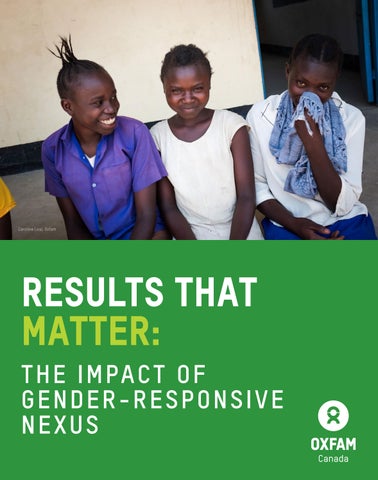
Caroline Leal, Oxfam
RESULTS THAT MATTER: THE I M PA C T O F G EN D E R - R E S PO N S IV E NE X U S
RESULTS THAT MATTER: THE IMPACT OF GENDER-RESPONSIVE NEXUS
1. Introduction Canada has long positioned itself as a champion of peacebuilding, human rights, and international cooperation. Canada’s leadership is needed more than ever. Around the world, armed conflicts, climate disasters and economic disruptions, alongside the rise of anti-rights movements, contribute to devasting impacts on people, especially women and girls. Like other members of the international community, Canada has committed to the Humanitarian-Development-Peace (HDP) triple nexus approach as a pathway towards greater coherence and coordinated efforts by humanitarian, development and peace actors. Gender equality is considered essential to nexus since persistent gender inequalities limit effective international engagement in humanitarian assistance, development actions and peace processes. Working in a more cohesive way across the three pillars, and in close collaboration with local actors, a nexus approach is expected to produce greater and mutually reinforcing impacts, including progress on the Sustainable Development Goals (SDGs), and contribute to longer-term stability for local communities. This briefing offers evidence from Oxfam Canada to show that intentionally integrating gender equality (GE) into nexus contributes to more transformative,1 inclusive and sustainable outcomes for women and for their communities. It argues that investments in gender equality within nexus approaches are critical in protracted crisis and conflict-affected settings to support the goals of long-term sustainability, peace, and community well-being. Canada must continue to honour its commitments to nexus and gender as a key dimension of its foreign policy.
Key links with Canada’s commitments to nexus and gender 2013 Canada is a partner to the global Call to Action on Protection from Gender-Based Violence in Emergencies. 2016 Canada is a signatory to the Grand Bargain to get greater means into the hands of people in need and to improve the effectiveness and efficiency of humanitarian action. 2019 Canada is a signatory to OECD DAC Recommendation on the HumanitarianDevelopment-Peace Nexus which provides a pathway towards greater collaboration and coherence in addressing the underlying causes and drivers of inequalities and fragility. 2017 Canada’s Feminist International Assistance Policy (FIAP) commits to more flexible and predictable funding in response to humanitarian crises, including the use of unearmarked and multiyear funding for longer term crises. 2019
lobal Affairs Canada’s Executive G Committee approves a comprehensive work plan to adopt a Triple Nexus Approach
2021
anada’s commitment to implementation C of the SDGs. The SDGs provide an integrated framework and momentum for the three pillars of the United Nations (humanitarian, development, and peace)
2023 Canada’s Action Plan on Women Peace and Security is Canada’s third action plan on WPS, the first launched in 2010.
2
RESULTS THAT MATTER: THE IMPACT OF GENDER-RESPONSIVE NEXUS
2. Why Invest in Nexus? This section makes the case for why Canada should continue to invest in nexus. It draws on evidence of the transformative impact of a nexus approach from three projects implemented by Oxfam Canada and funded by Global Affairs Canada.
This brief draws on evidence from three standalone gender focused projects using a nexus approach, implemented by Oxfam and local partners and funded by Global Affairs Canada: Women Leading Durable Solutions (WLDS) in Myanmar (2022-2027), Double Nexus Project in Tigray and Amhara, Ethiopia (2022-2024), and Geared for Success (GfS) in South Sudan and Uganda (2022-2027).
IT SUPPORTS LOCALIZATION A nexus approach prioritizes community-driven solutions and local ownership by involving local stakeholders in setting project priorities, ensuring interventions are relevant, appropriate, and sustainable for communities and for women. In Myanmar, Oxfam Canada partners directly with three local women’s organizations to implement the Women Leading Durable Solutions (WLDS) project. Their engagement as project partners ensures they control project resources and make decisions about how these resources are used to address communities’ priorities. Their engagement as project partners also allows them to enhance their organizational capacities thereby contributing to their sustainability.
3 Caroline Leal, Oxfam
RESULTS THAT MATTER: THE IMPACT OF GENDER-RESPONSIVE NEXUS
In Ethiopia, Oxfam Canada focused on nurturing partnerships and allowing support and time for local partners to rebuild. As a result, strong women-led organizations with the capacity to assist in humanitarian and development contexts now exist in Amhara and Tigray and can respond to SGBV, SRHR and protection concerns of vulnerable populations in targeted communities.
IT ADDRESSES THE ROOT CAUSES OF INEQUALITY A nexus approach acknowledges that crises and conflicts often intensify pre-existing gender inequalities, but these inequalities can also be underlying drivers of the fragility itself. Addressing gender inequality and transforming negative gender norms is key to building lasting peace and resilience. In Myanmar, women-led WASH groups supported through WLDS are addressing women’s selfidentified short-term needs for sanitation, personal hygiene and protection, identified through a comprehensive gender-based needs assessment. For example, since 2022, nearly 14,000 households have received dignity kits with underwear, soaps and sanitary pads that were critical items of need identified by community women and girls. At the same time, WASH groups have provided a strategic entry point for working with community members to gain leaders’ and community buy-in for addressing gender inequality. WLDS is contributing to positive shifts in men’s attitudes and behaviours. There is evidence of increased male participation in domestic work, greater acceptance of women’s leadership in the community, and more respectful behaviour toward women. And through leadership training, women and girls now have the confidence to participate in decision-making processes in their communities and are now leading sanitation campaigns and managing water systems in project communities. WLDS activities also engage members from across different communities and provide a rare chance for engagement and relationship building to address underlying causes of conflict. Contributions of WLDS to social cohesion are evident in increased inter-group communication
and cooperation, and enhanced conflict resolution, mutual supports and reduced tension, especially in camp settings and mixed-group activities.
IT BUILDS COMMUNITY RESILIENCE AND SUSTAINABILITY A nexus approach helps communities weather future shocks and sustain progress by strengthening local systems such as education and healthcare, including services related to SRHR and SGBV. For example, in South Sudan and Uganda, Geared for Success (GfS) focused on education and gender equality. The project design is gender transformative across the triple nexus and aligns with national education policies. By providing technical and financial support to CSOs organizations led by refugees and internally displaced people (IDP), Oxfam facilitated community ownership and engagement to strengthen local education systems and advocate for policy reforms at the national level. GfS also trains women in women in refugee- and IDP-led organizations on effective leadership, human rights, peacebuilding and conflict management. GfS capacity strengthening of local CSO ability to promote quality Gender-Responsive education includes working with community members to support positive social norms. Already there is evidence of social attitudes about girls’ access to education shifting in project communities. In Ethiopia, Oxfam and partners have undertaken groundwork to destigmatize SRH and SGBV as a step towards women and girls accessing these services, while working with regional authorities to expand the reach of sustainable services.
IT CONTRIBUTES TO LONGER TERM ECONOMIC, SOCIAL AND POLITICAL STABILITY A nexus approach responds to immediate needs while setting communities up for economic, social and political stability, including their ability to engage effectively as key actors in national recovery strategies. 4
RESULTS THAT MATTER: THE IMPACT OF GENDER-RESPONSIVE NEXUS
The Double Nexus Project in Tigray and Amhara, Ethiopia, stabilized and revitalized pre-existing women’s platforms for economic security, including women’s Self-Help Groups (SHGs). The project connects SHGs directly with existing rural savings and credit cooperatives (RuSACCOs) to include more women in their administration, which were historically male dominated. The project also facilitated formal agreements between the SHGs and RuSACCOs to improve access to capital for women. With access to savings and loans, women have started small businesses and diversified economic activities, while preserving their access to and control over land. Women’s access and control over these resources is having positive impacts on income levels and food security as well as revitalized local economy. Using these embedded community structures roots the project in the community and offers sustainable access to financial services for women’s economic empowerment, with sustainable economic outcomes beyond the project’s end.
IT ADVANCES THE WPS AGENDA The WPS Agenda specifically promotes transformative gender equality and is deeply linked with the HDP nexus. Both seek to address root causes of crisis and conflict by breaking down silos between short-term aid, long-term development and peacebuilding. All three Oxfam Canada projects promote the aims of the WPS Agenda for instance by working to build women’s participation and leadership in decision-making processes, from local governance to national policy, which contributes to better policies and stronger, more inclusive institutions that benefit the entire community. In Myanmar, for example, the WLDS project has led to the increased participation and leadership of adult and young women in community-level governance structures. Importantly, there is greater awareness and recognition of women as leaders by community members. In GFS, activities to strengthen women’s leadership in local organizations have contributed to women becoming more visible in decisionmaking roles in the education sector and in leading peacebuilding (social cohesion) activities in project communities.
IT ADVANCES THE SDGS Crisis modifiers2 (also known as Shock
Responders) are also proving a useful tool in applying a nexus approach and efforts to balance immediate relief needs in crisis and conflict settings with longer term development goals. For example, when communities in Somalia were facing a drought, Oxfam conducted a Rapid Needs Assessment within our Protection Response in Africa project, to determine what community needs were. Oxfam was able to activate this tool to respond to community needs by providing two Unconditional Cash Transfers to 478 households, reaching 2,868 vulnerable women, men, boys and girls. Oxfam Canada values the addition of Crisis Modifiers and Shock Responders in Contribution Agreements with Global Affairs Canada.
By fostering greater coherence and collaboration towards collective outcomes a nexus approach contributes to the achievement of the SDGs. As illustrated above, the three projects are showing outcomes related to multiple SDGs, reinforcing the value of taking a nexus approach. Overall, the evidence from Oxfam Canada’s projects demonstrates that integrating gender into a nexus approach not only meets the critical short-term needs of women and girls in contexts of humanitarian crisis. Taking a nexus approach has proven positive impacts that are transformative for women and girls and are creating the conditions for longer-term peace, security and sustainability for their communities,
5
RESULTS THAT MATTER: THE IMPACT OF GENDER-RESPONSIVE NEXUS
3. Recommendations GOAL 2: ZERO HUNGER Double Nexus Project in Tigray and Amhara, Ethiopia
The evidence from Oxfam Canada and others shows3 that a nexus approach contributes to transformative impact. As such, Oxfam Canada recommends that Global Affairs Canada:
On Nexus Funding/Funding modalities: GOAL 3: GOOD HEALTH AND WELL-BEING Double Nexus Project in Tigray and Amhara, Ethiopia; WLDS, Myanmar
GOAL 4: QUALITY EDUCATION GfS, South Sudan and Uganda
• Continues to invest in HDP nexus • Provides flexible, core and long-term funding for nexus to enable its full potential to be realized
• Explores innovative models to fund HDP nexus, building on GAC’s pilots (such as IHA/bi-lateral funding)
• Continues to include crisis modifiers GOAL 5: GENDER EQUALITY all 3 Oxfam Canada projects
in HDP nexus programming
On Gender Equality GOAL 6: CLEAN WATER AND SANITATION WLDS, Myanmar
GOAL 8: DECENT WORK AND ECONOMIC GROWTH all 3 Oxfam Canada projects
• Continues to promote GBA+ and
intersectional analysis as central to the meaningful integration of gender equality in nexus
• Continues to implement a twin-track
approach4 to nexus and gender Amplify efforts in Canada and globally in support of the WPS Agenda.
GOAL 16: PEACE, JUSTICE AND STRONG INSTITUTIONS all 3 Oxfam Canada projects
For more information on our work and other learning briefs, visit: • Women Leading Durable Solutions (WLDS) • Geared for Success 6
RESULTS THAT MATTER: THE IMPACT OF GENDER-RESPONSIVE NEXUS
7 Caroline Leal, Oxfam
RESULTS THAT MATTER: THE IMPACT OF GENDER-RESPONSIVE NEXUS
Caroline Leal, Oxfam
REFERENCES Canadian CSOs and the Triple Nexus: A review of Canadian CSO experiences in HumanitarianDevelopment-Peace Nexus programming in fragile and conflict-affected countries Aid Watch Canada (2024) G7 Fact Sheet: Promoting Gender Mainstreaming through the Nexus Approach, G7 Hiroshima Summit, May 20, 2023 Gender Equality Across the HumanitarianDevelopment-Peace Nexus, OECD (2021) Making gender-transformative humanitarian action a reality, Oxfam Canada (2023)
1 For Oxfam Canada, ‘Gender transformative’ refers to fundamental change in gender norms and the underlying structural causes of inequality in societies. 2 So-called ‘Crisis Modifiers’ in project budgets allow flexibility of funding and enable a quick response in the event of unforeseen emergencies or circumstances shocks, while protecting project activities and creating greater likelihood that the project can continue its longer-term goals while undertaking crisis response actions. 3 See for example OECD (2022), The Humanitarian-Development-Peace Nexus Interim Progress Review, OECD Publishing, Paris, https:// doi.org/10.1787/2f620ca5-en; Oxfam Gaps and Action Aid (2023) THE HUMANITARIAN-PEACE-DEVELOPMENT NEXUS, Beyond Feminist Foreign Policy, Briefing 4, https://gaps-uk.org/wp-content/ uploads/2023/10/The-Triple-Nexus.pdf 4
twin-track approach to gender equality is a global strategy A mandated in the Beijing Platform for Action (1995) that combines gender mainstreaming with specific, targeted initiatives.
Recommendation on the HumanitarianDevelopment-Peace Nexus, OECD/LEGAL/5019 OECD, DCD (2023)
This learning series is commissioned by Oxfam Canada with financial support from the Government of Canada through Global Affairs Canada. Authors: Carol Miller and Julie Lafreniere. Contributors: Asma Siyala, Kimia Ghomeshi, Sharmin Ahmed, Andrea Szenasi, Waeil Musa (Oxfam Canada). Design: Jenny Walker.
8