THE £6.95 SEPTEMBER 2025 ISSUE 253
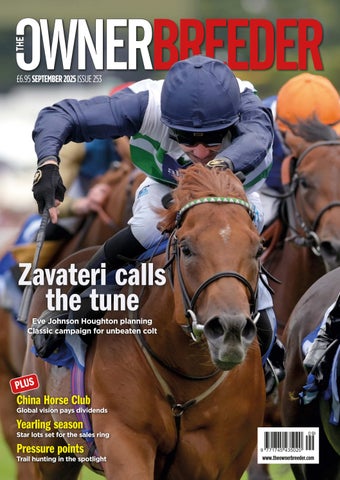
Zavateri calls the tune Eve Johnson Houghton planning Classic campaign for unbeaten colt
PLUS
China Horse Club
Global vision pays dividends
Yearling season
Star lots set for the sales ring
Pressure points
Trail hunting in the spotlight
www.theownerbreeder.com
FRANKEL Galileo - Kind (Danehill)
The most successful active sire of Northern Hemisphere Classic winners MINNIE HAUK
Oaks & Irish Oaks
LAKE VICTORIA Irish 1000 Guineas
SOUL SISTER Oaks
CHALDEAN 2000 Guineas
WESTOVER Irish Derby
NASHWA
Prix de Diane
HOMELESS SONGS Irish 1000 Guineas
HURRICANE LANE Irish Derby & St. Leger
ADAYAR Derby
LOGICIAN St. Leger
ANAPURNA Oaks
SOUL STIRRING
Yushun Himba (Japanese Oaks)
Contact Ed Sackville, Shane Horan or Tom Parry +44 (0)1638 731115 | nominations@juddmonte.co.uk
www.juddmonte.com
Welcome Editor: Edward Rosenthal Bloodstock Editor: Nancy Sexton Design/production: Thoroughbred Group Editorial: 12 Forbury Road, Reading, Berkshire RG1 1SB editor@ownerbreeder.co.uk www.theownerbreeder.com X: @TheOwnerBreeder Instagram: theownerbreeder Advertising: Giles Anderson UK: 01380 816777 IRE: 041 971 2000 USA: 1 888 218 4430 advertise@anderson-co.com Subscriptions: Keely Brewer subscriptions@ownerbreeder.co.uk 01183 385 686 The Owner Breeder can be purchased by non-members at the following rates:
UK Europe RoW
1 Year £60 £90 £120
The Owner Breeder is owned by the Racehorse Owners Association Editorial views expressed in this magazine are not necessarily those of the ROA or TBA Our monthly average readership is 20,000
THE
Racehorse Owners Association Ltd 12 Forbury Road, Reading, Berkshire RG1 1SB Tel: 01183 385680 info@roa.co.uk • www.roa.co.uk
£6.95 SEPTEMBER 2025 ISSUE 253
Zavateri calls the tune Eve Johnson Houghton planning Classic campaign for unbeaten colt
PLUS
China Horse Club
Global vision pays dividends
Yearling season
Star lots set for the sales ring
Pressure points
Trail hunting in the spotlight
www.theownerbreeder.com
Cover: The Eve Johnson Houghton-trained Zavateri, owned by Mick and Janice Mariscotti, wins the Group 2 Vintage Stakes at Goodwood under Charlie Bishop Photo: Bill Selwyn
Edward Rosenthal Editor
All about Eve and her habit of unearthing talent Y earling sales season has arrived – will last year’s epic levels be reached again or even surpassed? Carl Evans marks your card for the autumn’s big auctions (pages 32-36), which will see millions of pounds, guineas and euros invested in the pursuit of top-class bloodstock. Of course, spending huge sums isn’t the only way to try and guarantee a decent racehorse in return. There’s still a place for hard work and clever strategies to gain an advantage in the ring, which is just as well, because the majority of industry players don’t have the kind of money needed to secure a top-ten yearling at Book 1. Eve Johnson Houghton has made her name as a trainer of talented horses which didn’t cost the earth, typified by this month’s cover star, Zavateri. The two-year-old son of Without Parole, bought for 35,000gns at Book 2 last year, is unbeaten in three races for Mick and Janice Mariscotti, looking every inch a contender not just for the end-of-season juvenile championships but for next year’s Classics too. I’ve met plenty of buyers at the sales, many of whom are loath to disclose the secrets to their success. Not so Johnson Houghton. As Marcus Townend discovers (The Big Interview, pages 26-31), the Blewbury trainer is happy to explain how she consistently manages to unearth gems for next to no money. ‘‘You need to look at the stallions that aren’t necessarily hot but have a good record,” she explains. “Quite often a fourth-season stallion would be good. ‘‘They may have had a very good first season and then the second and third seasons haven’t necessarily been as good because people have been waiting to see what the first crop did. Then they get better mares for that one. ‘‘That’s when you can hit them. Quite often, their progeny are not as expensive because they have had those not-so-good crops. But then they have got their best load of mares and they are not overly expensive.
“I must like a horse as an individual. Most of the horses I buy are bought on spec. I might have people I think are going to buy them, but they are not guaranteed to. You try to slot them in the right places and get the right horses with the right people. ‘‘I don’t think I have ever spent over £100,000 on a horse. I would love to. Imagine what I could do with some beautifully-bred horses!’’ Johnson Houghton may not be especially keen on her reputation as a bargain hunter – she is ambitious for better opportunities – but I’d have thought it’s far better to spend less and over-achieve than the other way round.
“I’ve met plenty of buyers who are loath to disclose their sales secrets” The proposed harmonisation of betting tax rates is causing consternation within the racing community, with some forecasts suggesting the sport will be hit to the tune of hundreds of millions should Labour press ahead with its plans, set to be revealed in the autumn statement. As a way of protesting to government, a blank day has been arranged on September 10 – the fixtures originally scheduled have been rearranged – and this ‘strike’ has resulted in coverage across the mainstream media. Our Think Tank jury this month assess the current landscape for those operating towards the grassroots level with so much uncertainty in the sport, and while there is clearly concern, a degree of optimism can also be found within their views (pages 87-88).
THE OWNER BREEDER
1
Contents
September 2025
26
News & Views ROA Leader
Sport unites to make its point
TBA Leader
The genetic diversity debate
Changes
News in a nutshell
News
Edward O'Grady remembered
Breeders' Digest Landmark year for Aga Khan Studs
5
Sales Circuit
7
Dr Statz Stallion performance and gender
8
From Ascot, Goodwood and York
Faces at the Races The Qatar Goodwood Festival
Racing around the World Turkey hoping to regain ground
The Big Interview
With trainer Eve Johnson Houghton
Yearling season
Previewing the autumn's major sales
China Horse Club Teo Ah Khing's global outfit
Point-to-pointing
The amateur sport's link with hunting
2
THE OWNER BREEDER
Sexton Files Young damsires make their mark
12
Features The Big Picture
Record trade at Arqana
Think Tank Operating in a challenging landscape
16 22 24
50 56 58 87
Forum Equine Health Yearlings transitioning from sales to training
ROA Forum Fixture list upgrades to benefit owners
TBA Forum
26
Flat Breeders' Awards Evening winners
32
Bumble Mitchell and Sally Nicholls
38
Planning for life post-racing
44
48
Breeder of the Month Welfare & Aftercare View from Ireland Fillies Bonus Scheme in focus
61 68 78 82 84 85
38
32
12
THE OWNER BREEDER
3
WE’VE GOT YOU COVERED
We know racehorses can be unpredictable. Our Third Party Liability Insurance is here to give you peace of mind. Covering horses in training, going into training, thoroughbred broodmares and homebred youngstock as owners are currently vulnerable to claims even when their horse is in someone else’s possession*.
STOPPED IN YOUR TRACKS? The ROA Raceday Curtailment Scheme will provide a payment of £100 to any members who
Scan QR code to find out more
own at least 51% of a horse that had been due to run at a meeting that is abandoned after at least the first race has taken place*. *Terms and Conditions apply. See roa.co.uk/insurance for more details.
ROA Leader
Charlie Parker President
Sport unites to face down threat of big tax rise B
ritish racing’s response to His Majesty’s Treasury’s (HMT) proposal to look at simplifying the tax rates levied on gambling operators by applying a harmonised, increased rate across both sports betting and online gaming has been coordinated by a group called the Gambling Strategy Committee (GSC). This group has representatives from the BHA senior executive team and Chair, the two large racecourse groups, plus owners and trainers. Whilst the initial response looked at the formal submission to the HMT consultation, as well as the letter writing to MPs and lobbying campaign, the group were keen to keep the issue firmly in view. The #AxeTheRacingTax campaign was launched and in addition the cancellation of racing on a single day, September 10, was discussed. With complete agreement, the GSC developed the concept of a blank day to highlight the disastrous consequences that an increase in sports betting tax could have on the racing industry. There has been extensive coverage of the so called ‘strike’, which has crossed over from the normal industry reporting into the mainstream media, something that very rarely happens. There is no doubt that racing has highlighted its concerns in a coherent and effective way. Our industry is supposed to be highly fragmented and difficult to lead, however this simple idea was conceived by a group representing all sides of the industry and has achieved a major breakthrough. The GSC is also organising an event in Westminster to be held on the blank day, where we hope to engage with a significant number of MPs from all parties to further make our case as strongly as possible. The real damage to the industry would be felt across all aspects and will inevitably impact prize-money contributions. The response to the announcement from the Betting and Gaming Counsel (BGC), the body that represents betting operators, has been interesting. The BGC and its members may be in a difficult predicament; on the one hand they had sought to use racing as a shield to cover the addictive online slot and games that produce a high-margin return for them, that has undoubtedly fueled the huge profits that have recently been announced, whilst at the same time attacking the racing industry for taking a proactive approach to the impending threat. The Chair of the BGC has said that playing an online slot game has the same skill level as picking winners of horse races, a view I and many others would disagree with strongly. I have written often about the need for racing to differentiate itself from online gaming, especially when the problem
gambling statistics show where the real harm is caused. The blank day has highlighted that, for once, we are prepared to stand up and state that betting on horses is a completely different pastime to playing online games and therefore it is sensible to have differing tax rates for what is a much more expensive product. The BHA confirmed at the end of July that Charles Allen will take up his post as the new Chair at the start of this month. There was much speculation prior to this announcement, most of which was incorrect. The ROA supported the appointment, and we have worked through the process to achieve a sensible outcome for all participants.
“We are prepared to stand up and state that betting on horses is a different pastime to playing online games” All four of the BHA’s shareholders have been working on the necessary changes to the Articles of Association to remove the existing right to nominate four directors to the BHA Board. There are several hurdles still to jump, not least finding ‘independent’ replacements, but it is hoped that by the end of the year the transition will have been completed. The key point is that the industry continues to work together to produce the growth strategy so desperately needed while we continue to face various external challenges. We must grow the sport’s revenues and streamline the processes and activities across British racing. The ROA’s focus must be on prize-money, experience and costs – all issues highlighted by owners daily and areas where there is potential to challenge the status quo and drive positive change.
THE OWNER BREEDER
5
LANWADES
Breeding Champions
1984-2025 : Breeders of the winners of over 206 Stakes Races WORLDWIDE 34 Group 1’s • 29 Group 2’s • 42 Group 3’s • 101 Listed
STAFFORDSTOWN SALES YEARLINGS 2025 Selling own or half-brothers to GROUP 1 winners of 17 GROUP 1 races as well as the progeny of mares that have won GROUP 1, GROUP 3 and LISTED Races ALPINISTA (6 x Gr.1 wins)
DURSTON (Gr.1 & Gr.3)
Tattersalls Ireland Sales – 23rd to 24th September 2025
60 Colt OASIS DREAM – MEMORY LANE (With Approval) 286 Colt STUDY OF MAN – VINCITOMNIA (Invincible Spirit) 322 Colt SAXON WARRIOR – ALIZARINE (Sea The Moon) 482 Filly ARDAD – HELVETIQUE (Bobby’s Kitten) Goffs Orby Sales – 29th September to 30th September 2025
17 Colt BAAEED – ALOE VERA (Invincible Spirit) 165 Filly SEA THE STARS – HEAT AND DUST (Oasis Dream) 239 Colt FRANKEL – MADAME CHIANG (Archipenko) 344 Colt SEA THE MOON – RANI OF JHANSI (Invincible Spirit)
ELDAR ELDAROV (2 x Gr.1 Classic wins)
Tattersalls October Sales • Book 1 – 7th to 9th October 2025
11 Colt SIYOUNI – ALBAFLORA (Muhaarar) 16 Colt NEW BAY – ALL AT SEA (Sea The Stars) 20 Colt FRANKEL – ALWILDA (Hernando) GLORIOUS FOREVER (Gr.1)
TIME WARP (3 x Gr.1 wins)
Tattersalls October Sales • Book 2 – 13th to 15th October 2025
556 Colt STUDY OF MAN – ALERTA ROJA (Golden Horn) 654 Colt SEA THE MOON – CARIBANA (Hernando) 865 Colt WOOTTON BASSETT – HERE TO ETERNITY (Stormy Atlantic) 921 Colt STUDY OF MAN – KESARA (Sadler’s Wells) 955 Colt STUDY OF MAN – LEADERENE (Selkirk) 1129 Colt STUDY OF MAN – QUINTADA (Leroidesanimaux) Tattersalls October Sales • Book 3 – 16th to 17th October 2025
ZAAKI (4 x Gr.1 wins)
1352 Colt STUDY OF MAN – ALAMODE (Sir Percy) 1353 Colt STUDY OF MAN – ALBARAKA (Selkirk) 1356 Colt STUDY OF MAN – ALTRA VITA (Animal Kingdom)
www.lanwades.com/sales • for full details
STAFFORDSTOWN i n f o @ l a n w a d e s . c o m • w w w. l a n w a d e s . c o m • Te l : + 4 4 ( 0 ) 1 6 3 8 7 5 0 2 2 2
TBA Leader
Philip Newton Chairman
We need to talk about genetic diversity T
he TBA hosted a successful and well-attended seminar entitled ‘Nature or Nurture’ in July, with informative speakers on several subjects including genetic diversity – an increasing challenge to the thoroughbred herd. It is a fact that with any closed breeding community, genetic compromise becomes an issue as either the population decreases and/or there is an overuse or reliance upon certain sires or sire lines. The thoroughbred (in Britain and beyond) now fits neatly within all parts of that sentence, as a small number of sire lines have held considerable influence over the past 20 years. At the same time, the available gene pool has continued to contract simply due to mare numbers dwindling, while the availability of stallions has declined from more than 300 to just 107 over the past two decades in Britain. Fashion trends, commercial forces and shuttling between the northern and southern hemispheres have delivered increasing book sizes and progeny numbers for the popular stallions, yet others find mares more difficult to come by. As the foal crop continues to fall, the availability of stallions will also decline and so the British breeding industry increases the risk and exposure to a genetic imbalance that if not acted upon will see the potential of us eventually facing the same issues and crises many other breeds have experienced, with the Cleveland Bay being a good example. This breed, once near extinction, is now achieving a slow but steady genetic recovery thanks to dedicated breed management efforts. This recovery involves using a population management tool called SPARKS to analyse pedigrees (mean kinship) and minimise inbreeding. SPARKS helps breeders make informed decisions about matings to maintain genetic diversity, essentially a ‘family tree’ for the breed. This tool analyses pedigrees, sometimes going back 30 generations, to identify potential inbreeding issues and suggests pairings that will help improve genetic diversity. The aim is to mate individuals with similar levels of inbreeding and to preserve the rarer genetic material. Consequently, breeders can access estimated inbreeding coefficients for the potential progeny outcomes of mares they own or manage, when assessed against the entire stallion population. This is a thoroughly responsible and engaged response to an issue that, not followed, could have taken the Cleveland Bay the way of the dodo! For some years, the TBA has been aware of the prospects of the thoroughbred facing similar challenges, with published research also finding that higher levels of inbreeding are associated with mid to late-term pregnancy loss, as well as reduced athletic performance.
Two years ago, a study was commissioned with Nottingham Trent University, supported by Weatherbys, to consider where the thoroughbred might be upon its journey to genetic consequence. You will not be surprised to know that since the 1980s this risk has been steadily increasing; on a scale of 1-10, with one being no risk and ten being an irreversible outcome, Britain is at five on the scale. While there is time to address the increasing problem, the industry must act now, as the pace of compromise increases with large book sizes, fewer mares being bred, and a smaller population of available stallions.
“Without intervention, this will be a severe problem in ten years’ time or possibly much earlier” Without intervention, this will be a severe problem in ten years’ time or possibly much earlier. To that end, James Crowhurst, a TBA Trustee and very experienced veterinarian, together with Victoria Murrell from the TBA office are starting to develop a targeted pilot programme that will involve the use of the SPARKS software that has proved so successful with the Cleveland Bay. The thoroughbred is in a better position than most breeds as we have the General Stud Book as our reference and family tree, so we should get answers sooner. Inevitably, behaviours and practises will have to change – certainly, the breeder of the next 25 years will make different decisions and be asked different questions than we have become used to. However, it is the breeding industry that has bought us to this point, and it is the same industry that must lead away from the prospects of an uncertain future for the thoroughbred. The TBA has been engaged with this issue for some while and now it needs broadening to become an industry initiative. A problem must be recognised and understood first before it can be solved – this is a challenge that affects all of us and we need to talk about it.
THE OWNER BREEDER
7
Changes
Racing’s news in a nutshell
People and business Billy Loughnane
19-year-old records his first Group 1 win on Godolphin’s Rebel’s Romance in the Grosser Preis von Berlin at Hoppegarten.
Sibylle Vogt
Classic-winning rider based in Germany is banned for six months by France Galop after testing positive for metabolites of cocaine at Compiegne in March.
Brian Acheson
Leading jumps owner under the banner of Robcour – owner of Bob Olinger and Teahupoo – buys a stake in French Flat stud Ecurie des Monceaux.
Amer Abdulaziz Salman Founder and CEO of Phoenix Thoroughbreds is jailed for 15 months in the US for money laundering over his role in a £4 billion cryptocurrency fraud.
Ace Stud
Hollie Doyle
John Sheridan
Thurles
Ascot prize-money
Connor Brace
Operation near Newmarket which is home to stallions Shaquille and Soldier’s Call, previously called Dullingham Park Stud, is renamed by owner Yulong.
Racecourse closes with immediate effect following a decision by the Molony family who own the County Tipperary venue, citing increased costs.
Adam Farragher
25-year-old jockey is leaving Britain to continue his career in Australia with Ciaron Maher in Sydney, initially under a 12-month working visa.
Retainer with Imad Al Sagar comes to an end after five years; champion jockey Oisin Murphy will be the owner’s preferred rider moving forward.
King George VI and Queen Elizabeth Stakes will become Britain’s richest ever race with its purse increased to £2 million in 2026, up £500,000 on 2025.
Appointed new General Manager at Fairyhouse, succeeding Peter Roe who stepped down after 15 years to begin a new role with Horse Racing Ireland.
Jump jockey quits the saddle aged 24 to focus on his pre-training business in the Cotswolds. Clients include former boss Fergal O’Brien and Olly Murphy.
Horse obituaries Miko De Beauchene 25 Talented staying chaser, winner of the Welsh Grand National and Grand National Trial at Haydock for owner Andrew Wiles and trainer Robert Alner.
Trueshan 9
Lucinda Russell
Trainer is joined on the licence by Michael Scudamore at her Perthshire base – the duo will oversee a team of around 160 horses for the 2025/26 season.
8
THE OWNER BREEDER
Outstanding stayer for owners the Singula Partnership and trainer Alan King, the winner of two Prix du Cadrans, three Long Distance Cups, a Goodwood Cup and Doncaster Cup. In total he won 16 races and £2 million in prize-money.
Congrats 25
Son of A.P. Indy was a Grade 2 winner on the track and went on to sire fourtime Grade 1 winner Turbulent Descent, also shuttling to Australia.
Specialist thoroughbred insurers
We can tailor-make a policy to your requirements that can include: All Risks of Mortality and Theft, Life-Saving Surgery Fees, First Season Subfertility, Stallion Permanent Disability, Prospective Foal, Care Custody and Control, Unsoundness of Wind, and Transit Insurance.
Contact us to discuss your insurance needs: t: +44 (0)20 7398 4840 e: enquiries@ashbyunderwriting.com w: ashbyunderwriting.com/contact
Ashby Underwriting is a trading name of DUAL Corporate Risks Limited. DUAL Corporate Risks Limited is authorised and regulated by the Financial Conduct Authority under firm reference number 312593. Registered in England and Wales No. 4160680, with its registered offices at: One Creechurch Place, London, EC3A 5AF. David Ashby Europe is a trading name of DUAL Europe GmbH. DUAL Europe GmbH is authorised and regulated by the Cologne Chamber of Industry and Commerce under firm reference number D-W3LU-WJ712-68. DUAL Europe GmbH is registered in Germany – HRB No. 84428 with its registered offices at: Schanzenstraße 36, Building 197, 51063 Köln. DUAL Europe GmbH UK Branch is authorised and regulated by the Financial Conduct Authority under firm reference number 984394. Registered in England and Wales No. BR020989, with its registered offices at: One Creechurch Place, London, EC3A 5AF. 08/25. Ref: 13405-2
Changes
Racehorse and stallion
Movements and retirements
Camille Pissarro Minella Indo
Triple Grade 1 winner for owner Barry Maloney and trainer Henry de Bromhead, defeating stablemate A Plus Tard in the 2021 Cheltenham Gold Cup, is retired aged 12.
Prix du Jockey Club victor is retired after suffering a hairline fracture to his fetlock. The son of Wootton Bassett was also a Group 1 winner at two.
Kabral Du Mathan
Raging Torrent
Diego Velazquez
Serious Contender
Prognosis
Seraph Gabriel
Exciting young hurdler is moved by owners Neil and Alfie Smith to Dan Skelton from Paul Nicholls, who also loses Ginny’s Destiny to Nicky Henderson.
Runner-up to stablemate Lambourn in the Irish Derby leaves Aidan O’Brien having been bought by Far East owners to join Danny Shum in Hong Kong.
Lane’s End Farm in Kentucky secures dual Grade 1-winning son of Maximus Mischief for stallion duties. The four-year-old was retired from racing in July.
Son of Deep Impact, winner of three Grade 2 races in Japan, is retired from racing aged seven and will likely embark on a stallion career.
Frankel colt is bought by Sam Sangster ahead of a stallion career at the National Stud in 2026 and promptly captures the Group 1 Prix Jacques le Marois.
Hong Kong-based David Eustace will take charge of Royal Ascot second along with Listed scorer Glittering Legend and maiden winner Glenderry.
People obituaries Susan Manning 77
Wife of former trainer Bob Manning was an owner with the late Bill Turner. She had a passion for horses from a young age and enjoyed her success with prolific sprinter Bali Royal, victorious at Listed level, and five-time scorer Major Gatsby.
Edward O’Grady 75
Icon of Irish jump racing was champion trainer on four occasions and enjoyed big-race success with the likes of Golden Cygnet and Sound Man.
Alan Bailey 86
Shrewd trainer with an eye for a bargain won two Chester Cups, an Ayr Gold Cup and Victoria Cup during his four decades with a licence.
10
THE OWNER BREEDER
Bill Turner 78
Trainer was known for his handling of two-year-olds, winning the Brocklesby six times. He died from head injuries after being knocked over by a horse at his stable.
EUROPE’S PREMIER YEARLING SALE
GENERATION AFTER GENERATION
2YO
4YO
VENETIAN SUN
OMBUDSMAN
Duchess of Cambridge Stakes, Gr. 2
Prince of Wales’s Stakes, Gr. 1, etc
Albany Stakes, Gr. 3, Royal Ascot
purchased for 340,000 gns
purchased for 240,000 gns
CAMILLE PISSARRO Prix du Jockey Club, Gr. 1 purchased for 1,250,000 gns
3YO
TATTERSALLS
OCTOBER YEARLING SALE
Book 1 October 7 - 9 Book 2 October 13 - 15 Book 3 October 16 - 17
Tattersalls: T: +44 1638 665931 sales@tattersalls.com
Tatts UK_October _2025_A4.indd 1
04/08/2025 12:17
News
Tributes to training icon Edward O’Grady
12
THE OWNER BREEDER
GEORGE SELWYN
E
dward O’Grady, a legendary figure in the National Hunt world, died at the end of July. He was 75. In a career spanning over 50 years, the County Tipperary native sent out over 1,700 winners and was champion jumps trainer in Ireland for four straight seasons between 1977 and 1980. His stable was central to the early endeavours of owner JP McManus – together they plundered some of the biggest prizes on both sides of the Irish Sea after joining forces in the late 1970s. It was O’Grady who supplied McManus’s first Cheltenham Festival winner with Mister Donovan in the 1982 Sun Alliance Hurdle. O’Grady’s father, Willie, was a champion jockey in Ireland in the 1930s who later turned to training. On his death in 1972, Edward took over the licence. He enjoyed 18 victories at the Cheltenham Festival, the first arriving in 1974 with Mr Midland in the National Hunt Chase. Golden Cygnet, winner of the 1978 Supreme Novices’ Hurdle, looked destined to take the division by storm but tragically died a month later when falling in the Scottish Champion Hurdle. Other top-class performers included the half-brothers Nick Dundee and Ned Kelly, who both raced in the Sue Magnier silks, dual Tingle Creek Chase hero Sound Man, Pizarro, partnered by Jamie Spencer to victory in the 2002 Champion Bumper and later a dual Grade 1 victor over fences, and Back In Front, successful in the 2003 Supreme Novices’ Hurdle. He sent out his final winner, Our Soldier under amateur jockey Harry Swan, at Bellewstown on July 5. McManus, speaking to RTE Sport at the Galway Festival after the victory of his hurdler Davy Crockett, said: “He was an amazing trainer, something special. The one thing I have to say about Edward, he was always very good to his staff and very kind to everybody. “I went to him in ‘78. Jack Of Trumps was the second horse I had with him, and he did a great job with him – he won at Punchestown as a five-year-old carrying 12st in the Jameson Gold Cup and we went on that year to win the
Edward O’Grady ruled the Irish training scene in the late 1970s
Galway Plate [with Shining Flame]. “After Fairyhouse in April, after the National, they used to bring some of their future bumper horses, the four-year-olds, and he’d say, ‘We’ve found one for Christmas’ and, true to his word, at Christmas would be when he would next appear. “When Edward fancied a horse, and he gave you the office, you didn’t need to have money, all you needed to have was credit, because you always felt he
would deliver. His record was second to none at that time. He was a great judge of a horse and he’ll be missed.” Eight-time Irish champion jumps trainer Noel Meade said: “The first thing to say is he was a very good trainer. We had our ups and downs – he had his own opinions about things and they weren’t always the same as mine! But we sorted out our differences in recent years and were good friends. He’ll be sadly missed by everyone.”
Stories from the racing world
BHA
Lord Allen becomes BHA Chair
Lord Allen: new chapter at the BHA
The British Horseracing Authority has confirmed that Lord Allen of Kensington will take up the role of BHA Chair on September 1 – three months later than scheduled, having been appointed to the position in November. Concerns over the make-up of the BHA Board delayed his original start date of June 1 and there were doubts over whether all stakeholders were willing to accept his future vision for British racing. On July 28, the BHA Board met in London to consider Lord Allen’s response to submissions from shareholders regarding proposed governance changes. Following these submissions, it was agreed that work would begin towards the establishment of a single independent Board of Directors. This will oversee a single BHA executive led by a Chief Executive.
The incoming Chair and Board will now begin the journey towards creating an independent Board, including experienced individuals from the industry, through a period of transition and subject to ratification by the members. Lord Allen said: “I am delighted we have agreed to a process towards a new independent BHA Board, and I look forward to formally starting in the role. “Horseracing has a strong future. There is work to do, but I am in no doubt as to the passion and commitment of the many thousands of people who make up our industry.” Lord Allen, who has enjoyed a highly successful business career, succeeds Interim Chair David Jones. The post was previously held by the late Joe Saumarez Smith, a popular figure who passed away in February after battling cancer.
REDWELD STABLES Leading the way in stable design
Internal & External Stable Blocks | American Barns | Stable Fronts | Dividers | Doors | Turnkey Solutions Stable Windows | Hayracks | Swivel Feeders | Washbays | Equine Feeding Barriers | Equine Stocks
W: redweld.ie E: info@redweld.ie T: +353 (0)87 9119802
Scan here to visit us
THE OWNER BREEDER
13
News
August brought news of a variety of measures to boost British racing as the 2026 fixture list was revealed, along with the cancellation of all racing on one day as the industry makes its loudest protest yet over the government’s plan to increase the tax rate on sports betting. The blank day, on Wednesday, September 10, has widespread stakeholder support; the BHA hopes it will galvanise the #AxeTheRacingTax campaign and show that the industry is united in its opposition to Labour’s harmonisation proposal. A central focus of the 2026 fixture list is increasing the supply and retention of horses in Britain, which has been losing runners to other jurisdictions that offer better purses and opportunities, namely Australia and Hong Kong. The Levy Board is pumping an extra £4.4 million into prize-money, taking the total up to £77.1m. Developmental races (designed for younger horses) on the Flat and over jumps will be boosted by an increase in total prize-money of at least £3.2m, including £2.5m from the Levy Board. Novice and maiden races on the Flat will be run for at least £10,000, or £8,000 for restricted races, while over jumps, novice and maiden hurdles will offer at least £10,000, with an increased programme of novice chases running for at least £15,000. A new bonus series for point-to-point horses, worth £250,000, aims to protect the pipeline of good National Hunt horses progressing to race under Rules.
BILL SELWYN
Prize-money set to increase in 2026 as blank racing day looms large
The BHA is keen to attract more overseas runners like Nunthorpe heroine Asfoora
Prize-money for the Flat black-type programme will be increased by over £2m to help strengthen Britain’s Pattern races. This includes uplifts for the July Cup, King George VI and Queen Elizabeth Stakes, Sussex Stakes and Juddmonte International – the aim being to attract a greater number of overseas runners. There will also be a trial of earlier finish times at floodlit fixtures during the first nine weeks of the year and greater structure around finish times. Richard Wayman, Director of Racing at the BHA, said: “The 2026 fixture list has been developed with a view to delivering high quality, competitive and engaging racing, which is attractive to those who own, train and run horses in Britain and appeals to the sport’s customers. “As agreed by stakeholders and the Commercial Committee, the approach for 2026 provides a bridge between the current two-year trial of innovations, and
longer-term decisions informed by extensive customer insight about how racing is presented in 2027 and beyond. “While the volume of fixtures will remain similar to 2025, we are investing in a range of measures that seek to increase the number of horses based and being raced in Britain. This includes a particular focus on growing the number of highquality horses – something that is crucial to our global standing as an elite racing and breeding nation. “We’ll be targeting more funding into prize-money and investing in the programme at all levels. There’ll be an emphasis on developmental races and the major contests and headline occasions, especially those in the sport’s shop window.” He continued: “Like other sports, we know that it is our biggest events and best races that have the greatest potential to appeal to new fans. And by making it easier for people to identify these flagship events, we hope to attract the customers and future investment that can, in time, benefit the entire sport. “2026 will include several code breaks to ease the pressure on some of our busiest jockeys, and we will be trialling earlier finishes at floodlit fixtures.” Last month it was revealed that the number of Premier fixtures, which are designed to highlight the best of the sport, would be cut by two thirds to 52 racedays as the BHA admitted the concept had become diluted. In total there will be 1,458 scheduled fixtures in 2026, two less than this year.
Focus on winning with expert racing & bloodstock lawyers We’ll have you on the home straight when it comes to managing your racing & bloodstock interests. For more information visit rwkgoodman.com/ownerbreeder Or speak to our team at enquiries@rwkgoodman.com
Owners & Breeders June 24.indd 1
14
THE OWNER BREEDER
20/05/2024 14:00:30
After his brilliant Goodwood Cup (G1) victory, SCANDINAVIA (USA) heads to the St Leger at Doncaster as a warm favourite to give Justify yet another British Classic win.
SCANDINAVIA (USA) Owners: Michael Tabor, Derrick Smith, and Mrs. John Magnier Breeders: Orpendale/Chelston/Wynatt Trainer: Aidan O’Brien
Find your USBred at the Keeneland September Sale, Sept. 8-20
219159-USBreds-OwnerBreeder.indd 1
8/21/25 12:13 PM
The Big Picture
16
THE OWNER BREEDER
Ascot
Calandagan too classy French racing’s loss is British racing’s gain so far as ace middle-distance performer Calandagan is concerned. His gelded status means he cannot contest races such as the Prix de l’Arc de Triomphe, and his connections have no qualms about sending their four-yearold across the Channel. In the King George VI and Queen Elizabeth Stakes at Ascot, Mickael Barzalona produced the perfect waiting ride, unleashing Calandagan with a furlong to run and edging past tough filly Kalpana, taking the prize by a length for owner Aga Khan Studs and trainer Francis-Henri Graffard (pictured with trophy next to Barzalona). Photos Bill Selwyn
THE OWNER BREEDER
17
The Big Picture
18
THE OWNER BREEDER
Goodwood
Glorious upset Field Of Gold was Juddmonte’s big hope in the Sussex Stakes at the Qatar Goodwood Festival, but the Classic-winning son of Kingman couldn’t produce his best and returned lame. The Ralph Beckett-trained Qirat, acting as a pacemaker for the favourite, found plenty in front under Hong Kong-bound Richard Kingscote and had enough in reserve to defeat Rosallion by a neck at startling odds of 150-1. Photos Bill Selwyn
THE OWNER BREEDER
19
The Big Picture
20
THE OWNER BREEDER
York
Perfect judgement on Ombudsman For much of the Juddmonte International at York, it looked as though Godolphin pacemaker Birr Castle (left) might ‘do a Qirat’ and cause another huge upset in a headline Group 1 contest. Robert Havlin must have been thinking about his winning percentage when he turned into the straight with a massive lead, but William Buick on favourite Ombudsman had him in his sights and picked him off with a furlong to run, eventually pulling clear to defeat old foe Delacroix by three and a half lengths. Photos Bill Selwyn THE OWNER BREEDER
21
Faces at the Races
Photos: Bill Selwyn
QATAR GOODWOOD FESTIVAL
Christophe Soumillon shares a moment with Al Ghadeer, winner of the Qatar International Stakes
Jamie Insole and Jess Stafford
JM Jungle’s Group 2 King George Qatar Stakes success thrilled his connections
17-month-old Dusty Taylor enjoys her first day at the races
Gemma Brooks-Burley and James Burley
Sophie Forsyth (holding trophy) celebrates with her fellow jockeys after victory in the Magnolia Cup
22
THE OWNER BREEDER
Racing around the World BY JAMES BURN
Ambitious Turkey out to regain lost ground on European circuit Turkey this month stages its annual international meeting at Veliefendi racecourse in Istanbul and it might not really have much of an international feel, although those in power are determined to change that. The Topkapi Trophy and Bosphorus Cup do not roll off the tongue like the Derby, Arc or Melbourne Cup, but need little introduction to trainers in Britain with a sense of adventure and willingness to travel horses. William Haggas, Michael Jarvis, Richard Hannon snr and jnr, Kevin Ryan and Andrew Balding have all won the former, while Mick Channon, James Given, Saeed bin Suroor, Hannon jnr and Luca Cumani are on the latter’s honours board. No British-trained runners, however, will head east this month and Ubetterseethis, a useful juvenile for Craig Lidster, was actually the only entry from the UK. He will not make the trip due to logistical reasons, although travel and quarantine issues have largely been resolved. What hasn’t, perhaps in the mind of British trainers at least, is prize-money. According to the Racing Post database, Pressing trousered £416,667 for his victory in the Topkapi Trophy, which is a staggering sum when you consider the magnificent Sea The Stars netted £340,620 in that year’s Juddmonte International Stakes at York. The race this month, which carries Group 3 status and is closed to geldings, is worth around £158,000 with about £90,000 of that going to the winner. Fluctuations in the Turkish economy, the depreciated exchange rate, the global financial downturn and the Covid pandemic have all had an impact, but the Turkish Jockey Club (TJK) says “confidence is being restored” and there are “clear signs of recovery”, while attracting international runners is a “key strategic goal”. “There’s a misconception that racing
24
THE OWNER BREEDER
Veliefendi racecourse welcomed a huge crowd for the Gazi Derby in June
operations in Turkey might be vastly different from systems in places like the UK, France, or Japan,” the TJK outlines. “In reality, the ownership structures, training methods, and raceday protocols are very much in line with global practices. Cultural and operational differences are minimal, and any previous concerns on that front should no longer be seen as barriers. “The focus now is on strengthening international outreach, building partnerships, and making Turkey a more visible and attractive destination for foreign connections. The foundations are in place – what’s needed is simply more engagement and promotion on the global stage.” The ruling body, founded in 1950 and authenticated by the government three years later, describes Turkey as a “major racing country” yet concedes “having
low numbers of international races puts a distance to Turkey’s well-deserved place in the international racing area”. “Currently, the number of races open to international runners is limited, however, starting next year, a broader range of races will be opened up to foreign horses as part of a new internationalisation strategy,” it adds. “This expansion will offer more opportunities for overseas participation across different distances and age categories, further incentivising owners and trainers to target Turkish meetings. “The Club is keen on having many more international runners and races. If we attract more international runners, and they witness Turkish racing’s world-standard quality, Turkey will become a major player in international racing.” That may sound like big talk but it
TJK
TURKEY
can be argued Turkey punches above its weight. In 2005, 1,526 foals were born in the country, but by 2020 that number had increased to 1,967. It was up again to 2,229 a year later and 2,321 newborns arrived in 2022, putting Turkey inside the top ten foal-producing nations. At a time when foal crops are falling all over the world, those figures can be viewed as impressive, while the same can be said for the fact more than 60,000 people attended Veliefendi, which is also a training hub, for Cutha’s Gazi Derby victory this summer – that’s a few more than the 22,312 who visited Epsom on Derby day in June. That comparison might be unfair on British racing as Turkish racegoers are said to follow their French counterparts in cramming in on the big occasions (and the Gazi Derby is their most important race), but staying at home or in betting offices on lesser days. And there are enough fixtures to pick and choose from with ten tracks staging more than 750 meetings in 2024. They featured 6,400 races for thoroughbreds and Purebred Arabians, which make up an important part of the landscape. More than $115 million in prizemoney was on offer last year, which is not shabby set against £188m in Britain, while a six-furlong maiden for two-yearolds at unheralded Elazig racecourse last month boasted a first prize of around £5,157. With owner and breeder premiums to be added on, it is easy to see why Turkey is viewed as lucrative for those able to participate there. In 2024, 687 trainers were licensed alongside 272 jockeys, while the ownership base consists of 2,572 individuals or entities. 3,808 thoroughbreds ran and there were 2,962 Purebred Arabian horses in training. The TJK’s pool or pari-mutuel betting model filters money back to the regulator, although some observers have highlighted how the traditionally high overrounds and takeouts mean punters might not be as well off as others elsewhere in the world. To put things into perspective, there was criticism and scrutiny following the 2015 Grand National that produced an overround of 165 per cent, but when Toormore won the Topkapi Trophy for Hannon jnr later that year, it yielded a whopping 203 per cent, although that figure dropped to 135 for the race, won by Son Of Cooger, 12 months ago. As such, bettors in Turkey seem to
have adjusted their strategies, favouring multiples in the hope of winning big. Fixed-odds betting did start in November, online wagering was expanded recently and a deal struck with Australian betting behemoth Tabcorp and 1/ST Content, an industry giant in the US, meant Turkish racing was broadcast abroad for the first time at the end of last year. Through its betting, the ten racecourses, stud farms, stallions and training and education centres, the TJK is said to provide employment for 240,000 people. It would, however, be rare to see a foreign-bred suffix next to a runner on a domestic racecard as foals from abroad need to be imported within a year of their birth and there are restrictions on owners, but a ‘closedshop’ mentality does not exist when it comes to stallion arrivals.
“A broader range of races will be opened up to foreign horses in 2026” Bred in Canada, Victory Gallop made his name as the horse who denied Real Quiet US Triple Crown glory in the 1998 Belmont Stakes, but he found fame and fortune in his second career as a stallion when he was sold to the TJK ten years after that success. In his new home, he became Turkey’s all-time leading sire, while Paco Boy, Powerscourt and Bushranger are other familiar names to have stood at farms belonging to the TJK, which also housed Authorized, the 2007 Derby hero who fathered dual-Grand National hero Tiger Roll before his switch. He is now in Ireland, but the TJK’s stallion list still includes a Kentucky Derby winner in Super Saver, Elarqam, a son of Frankel out of 1,000 Guineas heroine Attraction, Royal Ascot scorer Profitable and Japanese titan Victoire Pisa, a Dubai World Cup winner who sired the first two home in this year’s Gazi Derby. The organisation’s talent scouts must also be proud of Daredevil, whom they bought before he caught fire as a stallion in the States. A deal was then
agreed for him to return there under the ownership of the TJK, which welcomed him back this year. That arrangement could be considered significant for Turkish racing, which does not really do exports in the same way, for example, Italy has, especially with regard to horsemen. “A Turkish horse absolutely can make an impact abroad and there’s growing belief within the industry that it’s only a matter of time before we see consistent international success,” stresses the TJK. “Turkish breeding and training has developed significantly over the past decade. Investment in quality stallions and broodmares, the rise of modern training facilities and access to international bloodlines have all contributed to a more competitive and capable racehorse population. “The key now is to create more structured opportunities for these horses to travel, race abroad, and gain exposure. With the right support – including logistical planning, strategic placement, and perhaps wildcard entries into international races – there’s no reason why a Turkish-trained horse couldn’t make a mark on the global stage in the near future.” An attachment to horses has long played an important part in Turkish culture, but the TJK is minded to maintain the sport’s relevance. “Considering the number of horses, races, the amount of distributed prize-money and racing’s current popularity, it’s quite clear that racing will still be a major sport in the country, even in the distant future,” it says. “Even though there was a part of society who knew the racing sector closely and identified it as a sport, there was also a part of society considering racing only as a medium for gambling. “However, the Club put major efforts in trying to break this negative approach, emphasising the social characteristics of sports.” Shorter-term goals will focus on improving the accessibility of Turkish racing and attracting those overseas horses, while mid-range objectives include strengthening relationships with other countries and boosting the competitiveness of its product abroad. Longer term, the TJK longs to “produce horses capable of competing and winning at the highest levels abroad, hosting major international racing festivals with broad global participation”. If all that happens, the strength of Turkish racing will no longer be under the radar.
THE OWNER BREEDER
25
The Big Interview
Wonder in WOODWAY Eve Johnson Houghton is enjoying another fine season, bagging big races with horses that didn’t cost the earth and in the handsome form of Zavateri, the Blewbury trainer might have a serious contender for next year’s Classics Words: Marcus Townend • Photos: Bill Selwyn
T
he problem with pulling a rabbit out of a hat more than once is there is a chance that the degree of difficulty starts to become underestimated. When you have done it three times, it begins to look like some form of alchemy is at work. Eve Johnson Houghton’s speciality has become winning races at Royal Ascot with horses that cost pocket money in modern racing terms, but it is not necessarily a reputation she wants to be saddled with. She says: “I have had three Royal Ascot winners. One [2021 Windsor Castle Stakes winner Chipotle] I bought for ten grand, one [2025 Windsor Castle Stakes winner Havana Hurricane] I bought for nine grand and one [2018 Group 1 Queen Anne Stakes winner Accidental Agent] was bought back in for eight grand. No-one wanted him. ‘‘My three Royal Ascot winners have cost under 30 grand between them – that doesn’t mean to say that is all I want. I have just been lucky. Please don’t pigeon-hole me. ‘‘Of course, it’s the dream for everyone to have a Royal Ascot winner. Now some think that they can give me ten grand
and I can get them one, but it doesn’t quite work like that. ‘‘You have to kiss a lot of frogs. You might get your gem, but you get a lot of rubbish with them. I have got some really good horses at the moment although I have never had so many horses that cannot win a race. ‘‘I don’t think I have ever spent over £100,000 on a horse. I would love to. Imagine what I could do with some beautifully-bred horses!’’ The last few words are delivered with a smile and the Johnson Houghton tongue pointing firmly in the direction of her cheek. Yet the reality is that reputations can be hard to shake off and, whether she likes it or not, Johnson Houghton has built up a body of evidence to justify hers as someone who has an in-built metal detector when it comes to finding needles in the equine haystack. Since Royal Ascot, Havana Hurricane, who is owned by Jonny Allison and Tom Cartwright, has been beaten a short head in Newbury’s Super Sprint before being unsuited by rain-softened ground when third in the Richmond Stakes at Glorious Goodwood to take his winnings to over £170,000.
“Imagine what I could do with some beautifullybred horses!”
26
THE OWNER BREEDER
››
Eve Johnson Houghton Stable favourite: Eve Johnson Houghton with talented threeyear-old filly Betty Clover at her Oxfordshire yard
THE OWNER BREEDER
27
The Big Interview ››
Johnson Houghton still emerged from Goodwood with one of the big juvenile prizes thanks to 35,000 guineas purchase Zavateri. The son of Without Parole, who is owned by Mick and Janice Mariscotti, captured his second Group 2 prize when adding the Vintage Stakes to his success in Newmarket’s July Stakes.
“We have got to be very careful what we buy we don’t go for the obvious” They are the latest on a list of value-for-money racehorses that Johnson Houghton has found including Jumby, a 35,000gns pick-up in 2019 whose six wins include the 2022 Group 2 Hungerford Stakes and the 2023 Group 3 John of Gaunt Stakes. The Cheka, who won the 2011 John of Gaunt Stakes and was runner-up to Mayson in the 2012 Group 1 July Cup, cost 58,000gns, 2023 Group 3 Acomb Stakes winner Indian Run was a 75,000gns buy,
Streets Of Gold, who won five races as a two-year-old in 2022 before finishing third in the 2023 Jersey Stakes, cost £27,000 and Rage Of Bamby, winner of this season’s Group 3 Hackwood Stakes at Newbury, cost €35,000. Like Havana Hurricane, both Chipotle and Streets Of Gold are by the late Havana Gold. Johnson Houghton has a profile of a stallion that she likes to follow with her main ally, bloodstock agent Anthony Bromley of Highflyer Bloodstock. Bromley fills the role previously occupied by Johnson Houghton’s late trainer father, Fulke. Johnson Houghton explains: “Dad and
28
THE OWNER BREEDER
Eve Johnson Houghton
Havana Hurricane and Oliver Carmichael lead Airside (Libby Remington-Hutton) and Ohara (Orla Crowther) on the gallops, and below, the trainer with unbeaten star Zavateri and Sophiemorgan Johnstone
I worked the sales well together. We bought horses like [2002 Group 1 Dewhurst Stakes winner] Tout Seul and The Cheka together. ‘‘More recently, I have had Anthony. It took a couple of years for us to get in sync but now we work well together too. ‘‘He knows what I like and I know what he likes. My owners don’t have big money, so we have got to be very careful what we buy. We don’t go for the obvious. ‘‘You need to look at the stallions that aren’t necessarily hot but have a good record. Quite often a fourth-season stallion would be good. ‘‘They may have had a very good first
season and then the second and third seasons haven’t necessarily been as good because people have been waiting to see what the first crop did. Then they get better mares for that one. ‘‘That’s when you can hit them. Quite often, their progeny are not as expensive because they have had those not-sogood crops. But then they have got their best load of mares and they are not overly expensive. ‘‘That is sort of a niche that worked quite well with Havana Gold when we bought Chipotle and Streets Of Gold. ‘‘He did really well with Havana Grey and then the next two years weren’t as
good, so people wrote him off. ‘‘Havana Hurricane is by Havana Gold and again we looked at all Havana Golds. He was just a really big, strong individual. The mare was rated 46. That would normally be a line straight through from me, but there was something about him that I really liked. ‘‘He had a good way of going. He looked through the bridle well and was well put together, so I was willing to take a chance at a price with him. ‘‘I must like a horse as an individual. Most of the horses I buy are bought on spec. I might have people I think are going to buy them, but they are not
THE OWNER BREEDER
29
››
The Big Interview ‘Change is needed and nobody likes change’ Eve Johnson Houghton has welcomed the BHA decision to pump an extra £5 million into prize-money in the biggest races next year as well as boosting the purses of novice and maiden races. Novices and maidens are seen as developmental races with the potential to boost the long-term health of British racing. Johnson Houghton says: ‘‘Much as I don’t want them to be aiming extra prize-money for all the big races because it isn’t going to be going to us little trainers, that is the right place for the extra money to go and there will be a trickle-down effect. ‘‘Hopefully, it will garner more interest and things will get better. A rising tide lifts all ships. If we get it all rising, everyone will benefit. We all need to look at it that way. ‘‘Also, if they make the novices and maidens higher value, people are going to try harder in them. ‘‘I know it’s a subject we are not supposed to talk about, but there are a lot of horses that aren’t necessarily aiming to win their novices and maidens and trying to get a good handicap mark. ‘‘If you make the novices and maidens worth a lot more money, it makes them worth winning.’’ Johnson Houghton sees positives in the confirmation that Lord Allen will take up the position of BHA Chair with his plan to appoint independent directors to the BHA Board. She says: ‘‘Change is needed and nobody likes change. It is going to rock the boat. Some people will like things he does and others won’t. I am hoping it will be good for the sport.
›› guaranteed to. You try to slot them in the
right places and get the right horses with the right people. ‘‘When you are buying horses like that, you have to love them to be able to sell them on. You have to stand behind them and say I bought this horse because of this or that.” With the purchase of Zavateri, there was owner involvement. Johnson Houghton continues: ‘‘The Mariscottis like to come to the sales. Andrew Balding is their number one trainer. He gives them a list of horses he likes and I give them a list. ‘‘If a horse is on both lists, Andrew gets it, which is fine. I am very grateful to be number two trainer! ‘‘We are looking for slightly different horses. He has the longer-term ones and my brief was to find something that could run as a two-year-old with potential. The Mariscottis love to come and look at them and we all have to like them. ‘‘Even if I love a horse, if they don’t like it, we don’t buy it – and it’s the same if Anthony or I don’t like it. If we all do, we set our budget and away we go. We all happened to like this horse.’’ When Havana Hurricane won at Royal Ascot it was an emotional moment for Johnson Houghton, coming four months after her father died.
30
THE OWNER BREEDER
‘‘Independent directors will be good too, so long as they get people in who know about racing. It is all very well having a beautiful view of what should happen, but you need to understand the nuts and bolts of it to make it happen.’’ Johnson Houghton is less positive about the plan to increase the distance of the Windsor Castle Stakes at Royal Ascot next year from five furlong to six furlong as well as alter the eligibility criteria for entries. The changes to the Windsor Castle Stakes, at the behest of the BHA’s Flat Pattern Committee, mean the race will be limited to two-year-olds whose sire won over a minimum of seven furlongs as a two-year-old or a mile as a three-year-old or older. It has been designed with the intention of strengthening the middle-distance and staying divisions. Johnson Houghton adds: “I don’t understand why they are doing it. Havana Hurricane would have been eligible as would Zavateri, so it is not a personal thing. ‘‘I am saying it because I don’t think it is the right thing to do. I firmly believe it is going to attract lesser horses to run in the Windsor Castle Stakes and we already have the Chesham Stakes [over seven furlongs]. ‘‘I don’t think it is right to be restricting championship races – and Ascot is a championship. “I would leave the Windsor Castle Stakes as it is and perhaps change the Roses Stakes [run over five furlongs] at York’s Ebor meeting. It is later in the year and might attract the late developers.”
‘‘I suddenly thought I would love to ring dad now,’’ Johnson Houghton recalls. ‘‘I always used to speak to him on the way back from the races, win, lose or draw. ‘’I just know that the first person I would have rung would have been him. He’d have been so chuffed, and he’d have been here dishing out champagne to the staff! At that moment I really missed him.’’
“The Mariscottis have said Zavateri is not for sale, so fingers crossed” Johnson Houghton became her father’s assistant in 2000. There was a gradual transition in the balance of power until she took over the licence in 2007, when the stable was down to just 17 horses. Johnson Houghton believes it made her father proud that she managed to build up numbers to around the 80 horses
he trained in his glory days when his owners included the Aga Khan, Charles Engelhard and Sheikh Mohammed. Among his best horses were Ribocco and Ribero, who completed the Irish Derby and St Leger double in 1967 and 1968 respectively, outstanding mare Rose Bowl, Habitat, the top miler in Europe in 1969, Ile De Bourbon, winner of the 1978 King George VI & Queen Elizabeth Stakes and Double Form, winner of the King’s Stand Stakes, Haydock Sprint Cup and Prix de l’Abbaye in 1979. Fulke had taken over the licence at Woodway Stables near Blewbury in Oxfordshire from his mother Helen, twin sister of legendary jumps trainer Fulke Walwyn. Helen trained 1956 2,000 Guineas winner Gilles De Retz but because the Jockey Club prevented women from holding a trainer’s licence, the success was officially credited to her assistant, Charles Jerdein. With Johnson Houghton’s mother Gaie being the breeder of 2020 Sussex Stakes winner Mohaather as well as Accidental Agent, the horse named after the exploits of her trainer father John Goldsmith in special operations in the Second World War, it would be easy to assume that Johnson Houghton’s pedigree meant she was destined to train racehorses.
Eve Johnson Houghton
Eve Johnson Houghton is plotting an ambitious campaign for high-class juveniles Havana Hurricane and Zavateri
Yet the woman who rode two winners of the Diamond Stakes at Ascot as an amateur jockey travelled winding lanes rather than motorways to reach the training destination. That includes working in London for two years as an office manager for a marketing company, and later backpacking around Thailand, Malaysia and Singapore before ending up in Australia. At the time, Johnson Houghton says she had ‘‘no interest in being a trainer’’. Returning to Britain, she started working for syndicate manager Henry Ponsonby and riding out for Barry Hills before spending a year working for Fiona Marner at Kingwood Stud in Lambourn. She then joined the late John Hills, staying with him for seven years, first as secretary then assistant trainer, making the leap because “I thought I could do a better job than the person who had been doing it”. Johnson Houghton returned home when her father needed an assistant, but her love of the secluded haven that is
Woodway and the Berkshire Downs is why she threw herself so wholehearted into restoring the stable’s fortunes. As the sun shines down on the Woodway garden and the swallows chatter overhead, it is easy to see why it means so much to Johnson Houghton. ‘‘The place was falling down,” she says. “I put so much money into keeping everything up to date while not losing the character. ‘‘I am the original nepo baby, aren’t I? Who else would get somewhere like this to train? I am lucky – but I do feel responsibility for the place. ‘‘I have always loved Woodway and the Downs. I could almost have lived out in Australia or London, but I couldn’t leave the Downs. I have always been drawn back to it. “It is the most beautiful place. I just feel I need to look after Woodway for whoever has it afterwards. It is just magical.’’ Johnson Houghton is excited about the potential of an unraced Wootton Bassett two-year-old filly called Splish
Splash, sent to her by Anthony and Sonia Rogers out of their 2018 Moyglare Stud Stakes winner Skitter Scatter. Plans for Havana Hurricane and Zavateri have also been made. ‘‘Havana Hurricane is in the Mill Reef Stakes, but we could go back to five furlongs for the Flying Childers Stakes. Maybe that and then the Middle Park,’’ Johnson Houghton says. ‘‘When he came back from Goodwood he had quite a nasty knock. He had bruised a leg quite badly. ‘‘Zavateri will have Classic entries. The National Stakes and then the Dewhurst are the plan. The Mariscottis have said he is not for sale, so fingers crossed, but there have been huge offers for him. ‘‘As they say, what are they going to do, spend the money trying to get another horse like him? We have lucked out.’’ It is a phrase Johnson Houghton uses frequently, but it doesn’t apply to her ability to unearth equine talent. That has happened far too often for it to be simple good fortune.
THE OWNER BREEDER
31
Yearling season
32
THE OWNER BREEDER
High PRESSURE
Hopes will be high that this year’s yearling sales season follows the heady heights of 2024
The 2024 yearling market was one for the ages, with a frenetic top end fuelling records in key areas – will this year’s trade be able to keep up? Words: Carl Evans
GOFFS
D
on’t dilly-dally on the way to the Tattersalls October Yearling Sale Book 1 in Newmarket, for there could be early blockbusters. Lot 15 is a Frankel full-brother to last year’s 4,400,000gns sale-topping filly out of Group 2 winner Aljazzi, while Lot 20 is another son of Juddmonte’s mighty stallion out of Alwilda, the dam of Arc winner Alpinista (also by Frankel) and whose 2024 yearling filly changed hands for 2,500,000gns. Staff from Newsells Park Stud and Staffordstown respectively will be at the Park Paddocks complex from first light to ready this pair of potential stars. They are but two yearlings of intrigue in a catalogue containing 537 lots, an increase of 88 on last year’s recordbreaking sale at which turnover reached nearly 128 million guineas, up a third on the previous year and complemented by average and median prices which soared into new territory at 370,000gns and 250,000gns. Meanwhile, at Goffs in Ireland, this year’s Orby Sale comprises 466 yearlings, 53 fewer than 12 months ago when turnover of just over €51 million was down five per cent, yet some heavyhitting transactions saw the average price rise four per cent to €128,000. Not that the Orby and October Sales are purely about statistics. They are an opportunity to see some strikingly goodlooking future racehorses, to spot some of racing’s most influential players and to analyse their buying preferences. The bidding jousts which ensue are rarely dull. Book 1’s turnover figure could be toppled this year given the catalogue’s
added bulk, albeit the size is merely returning to that offered in the first four years of this decade, and with siblings to 50 Classic or Group/Grade 1 winners and 264 Group or Listed winners there is plenty for buyers, not to mention pedigree connoisseurs, to digest. Horses offered at the auction are eligible for the Tattersalls Book 1 bonus. Twelve months ago, eight Book 1 yearlings made 2,000,000gns or more, and five have full-siblings in this year’s catalogue. In addition to Aljazzi’s and Alwilda’s yearlings, there is a colt (Lot 157) out of Futoon whose Dark Angel filly sold for 2,900,000gns last year, and a Camelot filly (Lot 406) whose full-sister out of Sense Of Style reached the same valuation. Ace racemare Lady Bowthorpe, whose Dubawi colt made 2,000,000gns last year, is represented by his brother (Lot 218) this year. Orby graduates from its Book 1 and 2 auctions can also chase a handy sweetener in the form of the Goffs Two Millions Series. Last year, the Orby contained two horses who made a sevenfigure sum, namely a Frankel colt from Croom House Stud, who was knocked down for €2,000,000, and a daughter of the same sire who left the Staffordstown draft valued at €1,000,000. Godolphin bought both lots, and, while neither has a sibling in this year’s catalogue, two mares who produced top-six horses are represented. Bloomfield, whose Blue Point filly made €850,000, is the dam of a full-brother (Lot 51) consigned by Church View Stables, while Falling Petals’ New Bay filly (Lot 130) from Ballylinch Stud is a half-sister to a Lope De Vega colt who sold for €750,000 in 2024.
THE OWNER BREEDER
33
››
Yearling season Stock from proven mares and stallions will command peak prices, but there will be no less interest in the progeny of first-season sires. If a new sire’s stock is deemed good-looking and athletic, it will fuel interest in their foals who will be offered later in the year. With just 12 Britain or Ireland-based sires to choose from, getting around their stock will not be as arduous as in the past, and it is likely that Shadwell’s Baaeed will top more lists than any other freshman when it comes to viewing their yearlings. He sired 23 catalogued lots in Book 1 – the other newcomers have 26 between them – and 22 in Book 2, plus three in the Orby. Top sprinter Minzaal, also from the Shadwell roster, has six in Book 1, 29 in Book 2, 12 in the Orby and seven in Orby’s Book 2, while Coolmore Stud’s fast and early two-year-old Blackbeard is also well represented with nine and 15 in Books 1 and 2, and 13 and 4 in Orby’s two catalogues. Yearlings by the adored stayer Stradivarius will attract fans, and with two Book 1 lots, three in Book 2 and one at the Orby, his stock will have a rarity value which could help their valuations.
Summer sales a good omen
Willie Bryan: new to Tattersalls Book 1
Time for more Partying
Newsells Park Stud, which led consignors at Book 1 last year, offers a Frankel full-brother out of Aljazzi to the 4,400,000gns top lot at that sale. He is among a draft of 29 from the stud at Book 1 and 31 at Book 2. The mare’s 2024 sale-topper was sold to Amo Racing and has been named Partying, but at the time of going to press had yet to race. Julian Dollar, Newsells Park’s general manager and on the cusp of his 20th year of selling yearlings from the Hertfordshire-based farm, acknowledges
TATTERSALLS
Record-shattering yearling trade at Fasig-Tipton’s Saratoga Sale in early August and Arqana’s subsequent August auction in Deauville were good omens for forthcoming sales offering the cream of Britain and Ireland’s embryonic racers, and with US buyers active in France, the fear of American tariffs affecting trade have been quelled.
American buyers do not scrape the barrel to buy a horse, and so an additional ten or 15 per cent tariff on a choice lot is unlikely to prove a major game-changer. Asked if tariffs and general shipping costs impact trade at auctions such as Books 1, 2 and Orby, BBA Managing Director Kevin Needham says: “At that level, no. It probably affects trade at a lower level.” Regarding the ructions over red tape and costs that arose out of Brexit, Needham says: “It’s stabilised. We’ve sorted the VAT situation in the UK and Ireland has fallen into line. However, we’re stuck with health certificates imposed by the EU – and that hasn’t improved in the past five years – and the French still require carnets [document that allows temporary export and import of goods] which cost £500 minimum.” He adds: “The important thing is to place the right horse in the right sale, and if that means bringing a yearling from Ireland to sell at Tattersalls, that is what vendors will do.”
CARL EVANS
›› New sires, new interest
Graham Smith-Bernal (left) and Julian Dollar of Newsells Park Stud
34
THE OWNER BREEDER
he is in the happy position of being able to offer some lovely lots, yet he sounds a note of caution, when saying: “I’m hoping the market is going to remain buoyant, but I can’t help thinking the comments of Mike Repole will have had some resonance.” Speaking after making some heavy investments at Saratoga, leading US racehorse owner Repole said his country’s racing structure was failing, leading to “an overpriced, exclusive game where the rich get richer and the middle and lower markets die”. In the same vein, but in connection with forthcoming elite yearling sales, Dollar says: “One senses trade will be strong at the top, with new investors, especially from the Middle East, helping to keep momentum going, but it could be soft in the middle to lower end of the market. You have to have top-end horses, and as I say to Graham [Smith-Bernal, the owner of Newsells Park Stud], trade is like a round of golf with some bogeys and some birdies and you hope to finish under par and in front. “In December of the weanling year I make a rough valuation of what I think the horses might make as yearlings, and I’ve learned that the really good ones will make more than you expect and the okay ones will make less. “Last year we had a really strong consignment for Book 1 and the figures were very good, but we take nothing for granted.” That “strong consignment” enabled Newsells Park to trade 26 lots at Book 1 for 17,185,000gns at an average price of nearly 661,000gns, stellar stuff by a stud which has a top-class broodmare band of its own in addition to mares owned by clients. Those patrons include
TATTERSALLS
the father-daughter team of John and Tanya Gunther, who last year sold a colt at Book 2 by their stallion Without Parole – one of four sires standing at Newsells Park – who has turned out to be a rather special two-year-old. Bought for 35,000gns by Mick and Janice Mariscotti through Anthony Bromley of Highflyer Bloodstock and named Zavateri, he is unbeaten in three starts at up to Group 2 level for Eve Johnson Houghton’s stable. This year, the Gunthers are offering Zavateri’s half-sister by Ghaiyyath (Lot 534) at Book 1, and Dollar says: “Ghaiyyath is a solid young stallion whose horses are going to get better with age, as he did. Zavateri’s dam, Zeroua [a granddaughter of brilliant Zarkava], was an inspired purchase by Tanya with help from Mark McStay.” Despite his years of experience, Dollar says: “I learned a lot about horses from Zavateri last year. He was a Christian as a yearling and willing to do everything we asked, but when he arrived at the presale ring he became very stressed and upset. I’ve not seen a horse be so badly affected, and it probably cost him a few potential bidders, but look what he’s done on the racecourse.” Has Aljazzi produced a second consecutive Book 1 sale-topper? Dollar says of her Frankel yearling colt: “He’s a big strong horse with an athletic walk, but he’s a later developing type who, to my eye, will be a ten- to 12-furlong horse. It will be interesting to see how he develops in the lead-up to the sale.” Two other Newsells Park yearlings to note – although you could add plenty more – include a Dubawi half-sister to six winners headed by Arc hero Waldgeist (Lot 508) out of Waldlerche – “one of our
More ammo from Amo?
While Sheikh Mohammed’s Godolphin was leading buyer at last year’s Book 1 (18 lots for 22 million guineas) and Orby (seven lots for €5.27 million), that was not unexpected. Few could have foreseen the impact that Kia Joorabchian of Amo Racing, working in partnerships, would have, for he invested nearly 20 million guineas on 17 horses at Book 1 and was a key underbidder on other lots. He maintained momentum at the recent Arqana August Sale when buying the €3,000,000 top lot, a filly by Night Of Thunder. Bloodstock agent Alex Elliott has become Amo’s front man at auction rings, although he emphasises: “I am just part of a team who buys horses for Amo, and there is important input from Robson [Aguiar], Ben McElroy and Kia himself. This year has been a new start for Amo, which until recently was synonymous with early two-year-olds. At last year’s yearling sales we bought later-developing types, and Kia is realistic
TATTERSALLS
Kia Joorabchian: key to last year’s market
best mares” – and a daughter of Frankel (Lot 411) out of She’s Got You, a stakeswinning half-sister to Without Parole and Tarmarkuz. Without Parole’s full-brother Rebel Red finished second in August’s Grade 1 Sword Dancer Stakes. Other Book 1 yearlings related to high achievers of 2025 include Roundhill Stud’s Ghaiyyath half-sister to Irish 2,000 Guineas and St James’s Palace Stakes winner Field Of Gold (Lot 341), and the Baroda Stud-consigned Too Darn Hot colt (Lot 302), who is a half-brother to nine-time Group 1 winner Via Sistina. Ten years ago, Bobby and Honora Donworth attempted to sell Field Of Gold’s homebred dam Princess De Lune at Book 1, but the daughter of Shamardal was returned to her vendor at 300,000gns, a twist of fate with profitable consequences. Princess De Lune has since become a top-quality breeder, the Donworths having sold three offspring for six-figure sums, headed by Field Of Gold, who made €530,000 as a foal.
This 4,400,000gns Frankel filly headed last year’s record-breaking Tattersalls Book 1 Sale
THE OWNER BREEDER
35
››
Yearling season switch at [Amo Racing’s] Freemason Lodge with Kevin [Philippart De Foy] taking over and getting to know the place. “We didn’t hit the mark with twoyear-olds at Royal Ascot, but Amo won the first Group 1 two-year-old race of the season, the Phoenix Stakes [with Goffs Premier Yearling purchase Power Blue], and we’re in a good position.” Elliott, whose clients also include Valmont and Ralph Beckett, says of his pre-yearling sales season plans: “I’ll look through the catalogues, but when you knuckle down it’s about the physical – a piece of paper doesn’t run – and I always like to find the horse before I start speaking to people, be they owners or trainers. Hopefully a lot of horses are going to be bought, but after last year’s Book 1, we have to expect the market to be strong.” Amo Racing has hopes of more to come from two-year-old winner Ancient Egypt, who was bred by Zhang Yuesheng’s Yulong Investments and consigned last year by David and Tamso Cox’s Baroda Stud. In 2024, it finished second on the list of consignors at both Orby (23 sold for €2,900,000) and Book 1 (16 for close to 6,500,000gns). Manager Padraic Gahan says excellent yearling trade at Saratoga was a good omen for sales that lie ahead, as is success on the track for those owners who will be potential buyers at Tattersalls and Goffs. Speaking ahead of Arqana’s August Yearling Sale in Deauville, he said it too would have a bearing. Baroda is selling the Too Darn Hot half-brother to Via Sistina (Lot 302) on behalf of Yulong, and Gahan said of the colt: “He’s here on the farm and a very obvious one to talk about. The physical matches the pedigree and Too Darn Hot is in a rich vein of form.” Qirat’s 150-1 success in the Sussex Stakes will long be remembered for its shock value, but it will have done no harm to the value of a Baroda-consigned Camelot filly (Lot 40) at Tattersalls from his family. The stud also gets an early feel for the market at the Orby when offering a Teofilo filly as the second lot, and at Book 1 where it consigns a daughter of Frankel as Lot 3. Gahan says of the Frankel: “She’s a half-sister to Derby runner-up Madhmoon and hopefully she will get our sale off to a good start. “We have plenty of sire power among the horses we’re consigning with stallions such as Frankel, Justify, Night Of Thunder, Mehmas, Havana Grey and
36
THE OWNER BREEDER
TATTERSALLS
›› about that, while there has been a trainer
Sheikh Mohammed: major presence
“After last year’s Book 1, we expect the market to be strong” Wootton Bassett. Their progeny are in such demand. At Orby, we have a filly by Wootton Bassett out of the Irish 1000 Guineas winner Hermosa – the dam of this year’s Grand Prix de Paris runnerup Trinity College – and we are also offering two yearlings from the first crop of Baaeed. Our Book 2 consignment includes a Ghaiyyath half-brother to Derby runner-up Ambiente Friendly (Lot 1152) and a Calyx filly (Lot 824) who is a half-sister to Shes Perfect, who was first past the post in the French Guineas.”
Believing in Book 2
Top racing performances reflect well on a consignor, and in that regard Believing has been a fine advertisement for Baroda Stud, which sold the now five-year-old mare for 70,000gns at Book 2 in 2021. Victory at the top level in this year’s Al Quoz Sprint put a seal on Believing’s career and makes her a poster girl for the auction at which she made her public debut, while Ombudsman, Dubai Honour and Romantic Warrior (the earner of a mere £21 million in prize-money) have been other Group 1 winners this year who entered racing via Book 2. The aforementioned unbeaten two-
year-old Zavateri – a 35,000gns Book 2 buy – is doing his bit to maintain the sale’s profile, although he was never going to feature on the top-ten board. A yearling had to make 500,000gns to appear on that list, and there was also a first Book 2 seven-figure sale involving a Kameko colt bought by Godolphin. Highpriced horses pushed the average price into six figures for the first time, while a 92 per cent clearance rate was just what vendors wanted. A total of 812 yearlings have been lined up for Book 2, 39 more than a year ago, and they include full or half-siblings to 206 Group or Listed winners, plus the offspring of 119 Group and Listed-winning mares. At Orby’s Book 2, a cast of 433 lots has been catalogued.
Bryans enter new world
Willie and Mandy Bryan of Shropshire’s Worthen Hall Stables can walk into Doncaster and be a familiar face to staff, other vendors and buyers. Their domain has been the National Hunt game and they are no strangers to a six-figure horse, but in October they join first-time vendors at the October Sales when offering a single yearling at each of the three books. A Mehmas half-sister to top sprinter Oxted out of Charlotte Rosina (Lot 80) is being consigned at Book 1 on behalf of breeder Barry Greening and friends, while at Book 2 they offer a Starman colt (Lot 1338) who was bought as a pinhook for a syndicate run from Worthen Hall. The Bryans did much of the prep work on Charlotte Rosina’s 2024 Blue Point yearling, but he was sent to WH Bloodstock for his appearance at Book 1 where he was sold for 420,000gns. This year the Bryans will take the mare’s latest yearling all the way to the ring – which will include a fairly lengthy walk up from Tattersalls’ EE yard. Willie Bryan, uncle to jockeys Sean and James Bowen, says his own jockey son Josh was a factor in this move into consigning Flat horses. He says: “Josh was with Andrew Balding for seven years and he would tell us which stallions were coming through and which were popular with trainers. Then we started going to sales to match that up with seeing stallions’ progeny. “As with the National Hunt side of our business we didn’t want to do something just to keep us busy, and while this is a new venture we have long specialised in producing foals straight off the mare and conditioning them mentally and physically until they are ready to be sold or go to a trainer.”
Goffs Orby Sale - A4 Owner Breeder Ad (Minnie Hauk).pdf 1 21/08/2025 17:31:05
S M tart on s da y
From Orby
C
M
Y
CM
MY
CMY
K
to Oaks Minnie Hauk went from Orby Sale topper to the brilliant winner of both the English and Irish Oaks, and Yorkshire Oaks.
ORBY SALE 2025 Book 1: Mon 29 - Tues 30 September Book 2: Wed 1 - Thurs 2 October IRELAND
PSRA Licence Number: 001833
CY
China Horse Club
Global AMBITION
Group 1 winners around the world have come the way of the China Horse Club during its relatively short history, making it a truly international force Words: Nancy Sexton
38
THE OWNER BREEDER
At the same time, a run of success highlighted by an involvement in 52 Group/Grade 1 winners has placed it at the top table with an enviable consistency. That has been particularly true this year, with the American arm responsible for Tappan Street, whose defeat of Sovereignty in the Grade 1 Florida Derby in March makes him the only horse to have had the measure of the subsequent Kentucky Derby winner this season, and recent Grade 1 Woody Stephens Stakes winner Patch Adams. In Australia, meanwhile, the 202526 season opens with high hopes for three-year-olds North England and Beadman, both Group 3 winners at two. As for Europe, there are Group 1 aspirations for Survie, who is co-owned
Teo Ah Khing (left) pictured with the Club’s Michael Smith
MICHAEL SMITH
I
nternational vision, ambition and attention to detail; each could be applied as key reasons behind the success of any one of Teo Ah Khing’s high-flying companies. However, it is particularly applicable to his racing vehicle the China Horse Club, which has amassed more achievements in the sport during its relatively short history than some operations achieve in a lifetime. The China Horse Club burst on to the scene in 2013, primarily as a major spending force in the international yearling market. A significant financial outlay isn’t always enough to guarantee success, yet within 12 months there was an indication that his brainchild could well be an exception when it became heavily involved with Australia, whose championship three-year-old season granted Khing the opportunity to lead in an Epsom and Irish Derby winner. Promoted as Asia’s premier lifestyle, business and thoroughbred racing club, the China Horse Club promises its 200-strong membership an elite gateway into the world of horseracing. In the decade or so since then, it has fulfilled that billing with the help of a team that includes Australian representative Michael Smith, agent Matt Houldsworth and Christie DeBernardis in the US. Its participation in Europe has been bolstered by a significant presence in the US, underpinned by the exploits of Justify, its Triple Crown winner who was owned as part of a syndicate of heavyhitters, and Australia, where it is heavily involved in the powerful stallion roster at Newgate Stud Farm.
Group 1 winner State Of Rest, flanked by Teo Ah Khing (pink waistcoat), is one of the European success stories for the China Horse Club
with Gerard Augustin-Normand and was last seen running third in the Pretty Polly Stakes at the Curragh, as well as reflected glory in the Coronation Stakes winner Cercene, who was bred in Ireland by the operation and sold as a yearling to her current connections. Founder of Teo A. Khing Design Consultants, Malaysian-born Khing is also Chairman of Desert Star Holdings Limited and Inner Mongolia Yitai Desert Star Horse Industries. The acclaimed architect was a relative late-comer to racing, his introduction coming when Sheikh Mohammed placed him at the helm of the development of Meydan
racecourse in Dubai. Khing spent seven years on the project, which cost a reported $1.25 billion, and by the time it opened in 2010, had forged his own heightened interest in the sport. Today, the China Horse Club comprises approximately 350-head of stock, as Michael Smith outlines. “There was rapid growth in the beginning as with any new organisation but in the decade since we’ve reached a level of maturity now,” says Smith. “Australia is our largest hub by volume. That’s where we have the most mares, the most stallion equity and most horses in training and of course our
farm, The Chase, is based there. “We have a more boutique group of horses in Europe and a more breedingcentric focus which has produced the likes of Saffron Beach and Cercene, but we are enjoying racing a few more horses like Rose Bloom and Survie in recent years. We have some nice young mares coming through to complement our proven producers. In the US we have a colts’ partnership with WinStar and separate to that a breeding programme that has produced Grade 1 winners such as Valiance and Kimari. “We’re active in every area of the market worldwide – breeding, selling
THE OWNER BREEDER
39
››
China Horse Club ›› and racing. Mr Teo is the visionary
the filly was picked up by her trainer Joseph Murphy for €50,000 when offered through Baroda Stud at the Tattersalls Ireland September Sale, her reasonable valuation most likely dictated by her diminutive stature. “Cercene and the fact she’s by Australia, one of Mr Teo’s first good horses, means a lot to the team,” says Smith. “We sell everything we breed. That way you know you can come and buy our best stock.
“It’s about trying to do it consistently well over a long period of time” “The great thing about selling at auction is everyone sees them and everyone judges them, so it’s a true representation of a horse’s value on that day. “In the case of Cercene, she isn’t very big. But it’s a great story. Joseph Murphy is a trainer who has been working the sales for many years and he comes across a filly like her. The Australias are genuine, tough racehorses and she’s from quite a fast, sharp family, and that’s probably why it’s worked.”
BILL SELWYN
behind the China Horse Club and he attends every sale he can. His attention to detail is first class. Whether it’s strategy, direction or partnerships, he’s very hands on.” High-powered partnerships have been key to the Club since its inception. In Europe, Ballylinch Stud, Baroda Stud and Ecurie des Monceaux hold the bulk of its breeding stock in addition to stallion equity held with Ballylinch and The Aga Khan Studs among others. A select group of horses are raced solely or in different partnerships with the likes of Qatar Racing, David Howden and Augustin-Normand. The American arm features a well documented racing partnership with WinStar Farm in addition to other stallion interests with Taylor Made Farm, Lane’s End Farm and Coolmore. Australia is home to the Newgate colt partnership but there is also the Club’s own farm, The Chase, as well as longterm relationships with other farms. It enjoyed its first major success in November 2013 when Tropaios took the Singapore Gold Cup at Kranji, just seven months after its launch. But it was the Galileo colt Australia, the highlight of an early association with the Coolmore partners, who really set the ball rolling during his championship season in 2014 – all of which makes the emergence of his daughter Cercene as one of the season’s leading fillies particularly welcome. As has been well documented,
Saffron Beach: Group 1 winner was reflective of the Club’s support of New Bay
40
THE OWNER BREEDER
Cercene is one of two stakes horses alongside the classy miler Perotto out of the Acclamation mare Tschierschen, a relation to Mohaather who was purchased as a yearling for €280,000 in 2015. Plenty of business was executed at that time with an eye on the future broodmare band, of which Tschierschen, a maiden winner at Bath for William Haggas, was one. Group 1 producer Falling Petals joined a year later as a four-year-old, not long before Beatrix Potter, then already the dam of Group 1 sprinter Harry Angel. Each mare – like the broodmare band as a whole – has proven invaluable when it comes to supporting the Club’s investment in European stallions, which currently includes Siyouni, New Bay, Havana Grey, Dark Angel, Galiway and State Of Rest, winner of the Prince of Wales’s Stakes at Royal Ascot in the Club’s colours. Indeed, it was Falling Petals who did plenty to aid the early years of New Bay’s stud career by producing his Prix Rothschild and Sun Chariot Stakeswinning daughter Saffron Beach. “You have to enjoy it when you get a good result because so many things need to go right along the way,” says Smith. “It’s about trying to do it consistently well over a long period of time. And the Club is now operating off the back of that longevity, which is something to be proud of.” By its nature as traders, the Club will always offer its best-bred stock, the progeny out of Falling Petals – which have sold for €1.65 million and €750,000 at recent editions of the Goffs Orby Sale – being a case in point. That’s not to say, however, that the China Horse Club silks are a diminishing feature on European racecourses. Survie, trained by Nicolas Clement, has several ambitious targets on her agenda while a step up in class likely beckons for Gladius following his win in a competitive handicap at Goodwood in late July. Gladius, the winner of three of his four starts and another talented one by New Bay, is owned in partnership with David Howden and Qatar Bloodstock. It is a similar scenario in the US, where a partnership with WinStar Farm hit Triple Crown heights with Justify alongside other Grade 1 winners such as Life Is Good, Audible and Yoshida. Justify aside, who was sold in a multi-million dollar deal to stand at Coolmore, a number of those good colts went on to take up residence at WinStar Farm. It remains a mutually
GEORGE SELWYN
Australia: Epsom Derby winner was an early standout for the China Horse Club, racing for a partnership that included the operation
beneficial association. By supporting Kentucky Derby winner Always Dreaming, in whom equity was purchased upon his retirement to stud, the Club bred his best runner, Grade 1 Pennsylvania Derby winner Saudi Crown. Similarly, it campaigned the 2021 Grade 1 Cigar Handicap winner Americanrevolution, the product of another ‘home’ stallion in Constitution. While Constitution continues to ascend up the ladder as an elite Kentucky sire, the group is dipping into the New York stallion market with Americanrevolution, who has been launched at Rockridge Stud. Next on the production line is Life Is Good, whose four Grade 1 wins included the 2021 Breeders’ Cup Dirt Mile, and the record-setting sprinter Nashville. Both have their first yearlings this year. “The Life Is Good yearlings sold really well in Saratoga,” says Smith of the son of Into Mischief who started his stud career at a fee of $100,000. “There was a filly who made $1.05 million to Mike Repole and another two that sold for $550,000 each. He was an extremely fast horse with a very high cruising speed, and he’s very well
bred. We’re offering a lot of yearlings by him in September. There’s a very nice colt out of Caribbean Babe, the dam of Amethyst Stakes winner Bold Discovery. There’s a very good filly out of Just Angelic, who is a Justify half-sister to Harry Angel, and another out of Moonlight Sky, who is a stakesplaced half-sister to our Kentucky Oaks winner Abel Tasman. They’re a good group and we’re excited about them.” Outside of the WinStar umbrella, early investments were also made in Quality Road and Not This Time, two leading Kentucky stallions based at Lane’s End Farm and Taylor Made Stallions respectively. There is also a lone mare situated in Japan with an eye on supporting its dual-surface Grade 1 winner Yoshida, who swapped Kentucky for Darley Japan in 2024. When it comes to Australia, Khing was a major player from an early stage, most notably as part of a colts’ syndicate with Newgate Stud Farm. As such, when the cards fall the right way, there is always a stallion box on hold. Newgate Stud Farm is one of the most impressive success stories of the Australian stallion scene in recent years.
Founded in 2010 by Henry Field, it today stands 16 stallions headed by the statistical freak Extreme Choice, whose challenging fertility issues has failed to prevent him from siring five Group 1 winners from 175 foals. The Club is part of the syndicate behind Extreme Choice as well as his Golden Slipper-winning son Stay Inside, who stands alongside his sire and has his first two-year-olds on the ground. Both were campaigned on the track by variations of the China Horse Club - Newgate syndicate as were fellow Newgate stallions Russian Revolution, now a Group 1-producing sire, and the younger Group 1 winner Ozzmosis. In the case of Ozzmosis, who is about to stand his second season at A$44,000, there’s extra satisfaction in that he’s a top-flight son of Zoustar, the 2024-25 Australian champion sire who is the pride of Widden Stud. “We’ve had a very successful colt syndicate with Newgate Farm for a long time now but we also have stallion interests outside of that and wonderful relationships with a number of farms including Vinery, Widden, Yarraman Park and Rosemont,” says Smith.
THE OWNER BREEDER
41
››
BILL SELWYN
China Horse Club
Cercene (left), bred by the China Horse Club and a daughter of Australia, repels Zarigana to win the Coronation Stakes
››
“One of our most high-profile and significant shareholdings is in Zoustar. We bought into him early on in his stud career and what a marvellous stallion he has turned into. He’s not old at 15. Snitzel died recently and I Am Invincible is in his 20s so as far as leading sires go, he’s in a wonderful position to continue to go from strength to strength. “We bred Ozzmosis by him. He won the Coolmore Stud Stakes for us. He’s got an amazing female family and his first foals are dropping as we speak. He was very popular last year and we supported him strongly. We support all our young stallions. We did the same with Russian Revolution when he went to stud and we bred Communist, who won the Randwick Guineas, by him and [Group 2 winner] Revolutionary Miss, who was a proper Group 1 filly.” The Club’s commitment to Australia is underlined by its ownership of The Chase, a property in the Southern Highlands just south of Sydney where the majority of the Australian broodmare band is stationed. “It’s early days for The Chase but it’s off to a good start,” says Smith. “It’s a beautiful property in the Southern Highlands – it gets a bit more rain than Scone and we have lovely green rolling hills and a cooler climate. “The first foal born on the property
42
THE OWNER BREEDER
[in 2022], an Exceed And Excel filly out of our Group 2 winner Dame Giselle who we raced in partnership with Sir Owen Glenn, sold for a million dollars at the 2024 Inglis Easter Yearling Sale. “The farm is still under development. It was a cattle farm when we bought it. Mr Teo designed the barn and laid out the farm himself. There’s a beautiful old
“He started by winning the Epsom Derby and it hasn’t slowed down” homestead on it and we’ve purchased some more land adjacent to the main farm which continues to be built out.” He adds: “It’s well run for us by Alex Kingston. Good runners are already coming off it – Depth Of Character, from our first crop consigned by the farm, is a Group 2 winner and there are some really promising young horses coming through. It’s early days but we feel there is plenty to look forward to.”
Big investors come and go in this business, and not all last the course. However, Khing’s ambition has been executed to the extent that the China Horse Club’s colours are part of the racing fabric on a worldwide scale. At the time of writing, it was set to be represented in the H. Allen Jerkens Memorial Stakes at Saratoga by Patch Adams. Tappan Street is also back in work at WinStar following the injury that derailed his Classic campaign. Meanwhile, there is more highpowered stock to be offered at the Keeneland September Sale and in Europe, where the likely standout is a full-sister to Saffron Beach set for the Goffs Orby Sale. At the same time, yearlings will be bought; last year’s haul included a Nyquist colt sourced at Keeneland for $1.3 million. “Australia was one of Mr Teo’s first racehorses,” says Smith. “So he started by winning the Epsom Derby and it hasn’t slowed down since then. It’s quite remarkable. Global vision, longterm strategic partnerships and aiming for excellence – that’s what we set out to achieve. If you add in the States and Australia, the China Horse Club has won an Epsom Derby, an American Triple Crown and a Golden Slipper in Australia. That’s hard to do in a lifetime, let alone ten years.”
2025/26 Race Programme BA H R A I N I NTE R N ATION A L TROPH Y: Race | date
Distance
Race value
Bahrain International Trophy (Group 2) Friday 14th November 2025
2000m
$1,000,000 Wednesday 1st October 2025
Closing date for entries
FULL TR AVEL INCENTIVES ARE PROVIDED
BA H R A I N TU R F S E R I E S & PR E M I E R R ACE S : Stabling nominations close on Thursday 6th November 2025 Race | date
Distance Race value
Al Manama Cup Friday 19th December 2025
1000m
$80,000
84-100 3yo+
Al Muharraq Cup Friday 19th December 2025
2000m
$80,000
84-100 3yo+
HH Sh. Khalid bin Hamad Al Khalifa Cup (Listed) Friday 19th December 2025
1600m
$80,000
Listed 3yo+
Conditions
Al Riffa Cup Friday 2nd January 2026
1200m
$80,000
80-100 4yo+
Al Dana Cup Friday 2nd January 2026
1800m
$80,000
80-100 4yo+
PREMIER RACE
South Governorate Cup Friday 2nd January 2026
1400m
$25,000
Domestic Grade 2 4yo+ PREMIER RACE
Al Wasmiya Cup Friday 16th January 2026
1000m
$80,000
Domestic Grade 1 4yo+
Al Adiyat Cup Friday 16th January 2026
1800m
$80,000
Domestic Grade 1 4yo+
Hawar Cup Thursday 29th January 2026
1200m
$80,000
80-100 4yo+
Anchorman Cup Thursday 29th January 2026
2000m
$80,000
80-100 4yo+
The Bahrain Mile Friday 30th January 2026
1600m
$50,000
Domestic Grade 1 4yo+
PREMIER RACE
The Crown Prince’s Cup (Listed) Friday 30th January 2026
2000m
$200,000
Listed 4yo+
PREMIER RACE
Al Sakhir Cup Thursday 19th February 2026
1000m
$80,000
80-100 4yo+
Bahrain Vision Cup Thursday 19th February 2026
1800m
$80,000
80-100 4yo+
HH Sh. Nasser bin Hamad Al Khalifa Cup (Listed) Thursday 19th February 2026
2200m
$135,000
Listed 4yo+
PREMIER RACE
HH Sh. Sheema bint Nasser bin Hamad Al Khalifa Cup Thursday 19th February 2026 1400m
$30,000
Domestic Grade 1 4yo+
PREMIER RACE
Al Fateh Cup Thursday 5th March 2026
$100,000
80-100 4yo+
1200m
The International Handicap Thursday 5th March 2026
2000m
$100,000
80-100 4yo+
The Chairman’s Cup Friday 6th March 2026
1000m
$50,000
Domestic Grade 1 4yo+
PREMIER RACE
Al Methaq Mile (Listed) Friday 6th March 2026
1600m
$120,000
Listed 4yo+
PREMIER RACE
The King’s Cup (Group 3) Friday 6th March 2026
2400m
$400,000
Group 3 4yo+
PREMIER RACE
SHIPPING & STAFF INCENTIVES PROVIDED. CONNEC TIONS OF E ACH HORSE WILL AL SO RECEIVE A $10,000 EXPENSES VOUCHER
FOR FURTHER INFORMATION PLEASE CONTACT:
Adrian Beaumont, International Racing Bureau adrian@irbracing.com | +44 1638 668881 or +44 7808 903158
bahrainturfclub.com
14610 - BTC Full page_Thoroughbred_Owner_and_Breeder Magazine_210x297mm_FINAL.indd 1
21/07/2025 11:41
Point-to-pointing and hunting
Worrying POINTERS
A huntsman looks on at the start of a point-to-point race at Milborne St Andrew
The Labour government’s pledge to abolish trail hunting would have a huge impact on the point-to-point world – so what does the future hold for the amateur sport? Words: Kitty Waddell • Photos: Carl Evans
W
e are staring down the barrel of an outright ban on trail hunting, the country pursuit where hounds follow a pre-laid scent as opposed to a live animal. It is a typically divisive subject and one close to the hearts of a significant portion of the racing fraternity. This time, though, with the head of all hunting and its related activity on the block due to Labour’s manifesto commitment to ban trail hunting “later this year”, as announced on April 1 by Daniel Zeichner, the future of pointto-pointing, as staged by hunts, looks increasingly precarious. With point-to-pointing becoming an ever-more important facet of the UK’s National Hunt scene, both in terms of racing and bloodstock businesses, it is apparent that now is a time at which we must try to answer several questions. Can pointing continue without the foundation of hunts? How could it do so? If it can’t, what will happen to National Hunt racing and bloodstock businesses? In speaking to a number of contributors to point-to-pointing, spanning breeding, training, selling, organising and broadcasting, I have taken a consensus of views to pinpoint the answers. My opening line of enquiry was straightforward: is it possible for pointto-pointing to continue in any capacity without the organisational and financial foundation of a hunt? Chris Barber, the Hereford-based point-to-point trainer, summarised the
44
THE OWNER BREEDER
majority view with his response: “Yes, I think there is a future for pointing without hunting, but on a far smaller scale,” he explains. “If hunting stops, point-to-pointing will be affected in a massive way.” The future for the sport could see new point-to-pointing ‘clubs’ picking up the slack from the disbanded hunt committees. Being realistic, though, if that were to happen, Barber believes “we might have a quarter of the meetings we have now”. Said pointing clubs would, in all likelihood, rely on existing point-to-point committees to carry on, regardless of having a hunt to raise money for, and continuing to run the meetings for the sole purpose of facilitating the racing. Clerk of the Course at Tranwell, the Morpeth Hunt’s (now the newly amalgamated Morpeth West Percy) point-to-point, Ed Dungait says of his committee: “We’re not keeping the point-to-point going because of the hunt, we’re doing it to keep the sport going. If hunting went extinct, but racing continued, we would likely still be putting this on.” Dungait’s view is not, however, necessarily representative of the nation’s hunt point-to-point committees. For context, his meeting, held in Northumberland usually over Easter weekend with an attendance of 600800 racegoers, costs about £19,000 to put on, and brings in around £5,000£6,000 in profit. Their committee of hunt subscribers is fortunate to have a
››
APRH
THE OWNER BREEDER
45
Point-to-pointing and hunting ›› love of racing in common, most of them
having ridden, trained or kept a pointer themselves. However, we cannot assume that all committees have the benefit of this deep-rooted love of racing. Camilla Swift is the secretary of the Surrey Union Hunt, whose ever-popular Peper Harow meeting is held 20 minutes from Guildford and attracts a wealth, as it were, of day-tripping Londoners, whose picnics come complete with caterers and candelabras. Their meeting costs and raises roughly double that of the Morpeth. Swift says: “The point-to-point is run as a fundraiser for the hunt. If the hunt wasn’t there, it would leave the question of ‘why run it?’ “Of course, some people would love to run the point-to-point for the sake of it, but I don’t think there would be enough of them to warrant the effort.” And ‘effort’ it really is. Swift continues: “It is an intensive and quite a stressful job. Would you put yourself through that without a good enough reason? I don’t think that doing it solely to support pointing is enough. If we weren’t doing it for the hunt, we wouldn’t be able to run.” This is where the main sticking point comes into play. The reason that pointto-points can run at all is because of all the hours upon hours of hard work carried out by unpaid volunteers, most of them hunt subscribers, rather than pointing enthusiasts. When I put this fact to Dungait, who had been optimistic about the continuation of his point-to-point, he states: “Yes, without the hunt yielding the volunteers, we wouldn’t survive. We would end up being reliant on other point-to-point committees; everyone would have to help everyone else out, but there would have to be fewer meetings in our area to make that possible.” Peel Bloodstock’s Will Kinsey makes his view on this matter clear: “Point-topoints are very reliant upon the hunts because of all the helpers,” he says. “The hunts generate a community and, therefore, a community spirit. Without those people, you’ve got a problem. And that’s only running the point-to-points, let alone bringing in people to be owners, trainers and jockeys! “The hunts fund all of this and they’re only able to do so because they have so many volunteers who work for free.” Swift suggests the only reliable way to make a continuation of pointing feasible without hunts is “if you used the money raised to pay the volunteers – that might work.” Chris Dawson, proprietor of Nunstainton Stud, says: “I don’t think
46
THE OWNER BREEDER
Chris Barber says point-to-pointing without hunting would be a much-reduced activity
the hunts themselves are probably that keen to run point-to-points. A lot of them just do it because it’s the tradition. They see them as a very hard way of making money. They could run a pleasure ride to raise money for a lot less effort.” In much a similar vein, Swift says of the Peper Harow clientele: “They don’t need the pointing element. They are there for the day out. You could put on some other equestrian event at the site and end up with a similar day.” This does beg the question: is all their hard work warranted if most of those coming through the gates aren’t really engaging with the racing?
Sense of belonging
Regarding the provision of a free workforce to get these fixtures on, reduced in number or otherwise, the Pointing Pointers Podcast creator Ben Atkins is confident that, given a situation where hunting communities are decimated by an outright ban, supporters would be “motivated by the community itself”. He continues: “People want to belong to something. If you take the hunt away, they’ll want to rally around a countryside cause. I believe people would get involved when their hunt-related duties cease. In fact, not having hunting will make some people more available.” Atkins, though a stark hunt supporter, is optimistic about the prospect of pointing taking a further step away from hunting, believing the overall effect
would vastly improve the health of the sport. He explains: “I don’t think getting rid of hunting is necessarily a bad thing for pointing. Currently, every bit of profit made on the day is drained by the hunt – in what other world does that happen? “If the money isn’t immediately leaving the pot [to the hunt], you are able to reinvest in the product. For example, you could buy your own marquee instead of renting it and buy or build better fences.” He adds: “Pointing isn’t going to collapse if hunting does.” Back to the pressing issue of workforce, though, and perhaps unsurprisingly, others were not so optimistic. Being a member of a pointto-point committee is widely felt to be rather a labour of love, a necessary evil even to some, and part and parcel of supporting the hunt that provides its members with action on horseback all winter long. Mark Buchan, former Chairman of the Point-to-Point Owners and Riders Association (PPORA) – “cut me and I bleed point-to-point” – made the point that, in the context of the increasing professionalism of the sport, it is already unsustainable to rely on voluntary work. He says: “Last season I stewarded at nine point-to-points. Sometimes I was driving a couple of hours, at my own expense, to work on the day. While 80% of the participants are amateurs, many of the trainers are doing it for a living now, jockeys are being paid – albeit unofficially – so I wonder, who is the mug here?”
By contrast, stewards in Ireland are paid, though this is in part due to their point-to-points receiving a much greater sum of funds. That is, in itself, a huge issue faced by British point-topoints, and one that, without change, might bring an end to point-to-pointing regardless of a hunting ban. Buchan adds: “It’s an amateur sport, I’m an amateur steward, and I will apply the rules in an amateur fashion – unless I am paid!” As point-to-pointing becomes less ‘amateur’ and, therefore, more expensive to run and in need of an increasingly professionalised stewardship, it is hardly a positive if experienced stewards and other volunteers are already beginning to lose their patience.
Fixtures and funding
It is not only the workers, though, who would benefit from a cash injection. The point-to-point fixture list has already suffered the loss of 60 meetings in the last decade because, simply put by Dawson, “they just can’t make it pay”. Last month the British Horseracing Authority revealed the launch of a new bonus series for point-to-point horses, worth £250,000, to “help maintain the sphere as a developing ground for future stars and enhance the pipeline of good
“The hunts generate a community and a community spirit” National Hunt horses progressing to race under Rules.” But is it enough? Buchan states that “funding is the main issue. In my view it needs to go on to more of an Irish system where – and these are approximate calculations – Irish point-to-pointing gets £3 million a year. That is £1m to the hunts or clubs, £1m for the stewards, and £1m for prize-money. “We get more like £500,000, of which £425,000 goes to the BHA [to govern the sport]. Point-to-points can get some money for the meetings from the Levy Board, but it’s far from the same story as it is across the Irish Sea.” He concludes: “Without more funding form the Levy Board, there is no future for pointing without hunts.” If that is the realistic answer to the
question surrounding point-to-pointing’s future, even despite some optimism and initiative, we must now consider the impact on our bloodstock businesses and wider National Hunt racing scene. Tim Kent, Managing Director of Goffs, does not beat around the bush: an end to pointing would “have a hugely negative impact on the bloodstock market and British National Hunt breeding and racing as a whole.” He continues: “In Ireland, point-topointing is used as a really good method to educate young horses and showcase their ability. We need to be doing more of that over here and not less. “Arguably, we are already at a disadvantage because we don’t have as many opportunities for young horses as they do in Ireland and France. We’re already on the backfoot; if we lose the ability to run horses in point-to-points, we’re even further behind. “There’s a gap in our race programme which is already being filled by French horses. It will just mean that more French horses come over here to fill the racing programme.” He warns: “It will severely disadvantage British breeders, pinhookers and the whole National Hunt breeding industry.” How, then, do breeding industry players feel about this looming black cloud? Kinsey says: “I would be concerned about the knock-on effect to my business. We need as many people as possible buying young horses from us, whether they are professional trainers or point trainers, and we’ve always had an element of reliance on the point-to-point lads to buy our stores.” Similarly, Dawson is alarmed by the anticipated decrease in demand for young National Hunt-bred horses for his business if pointing came to a standstill. That said, he does hold out hope that if pointing could continue to a lesser degree, it might encourage the market down “to a more manageable level”. He says: “Horses became too much money and we, as an industry, have made a rod for our own back. It stops people from reinvesting if they have to pay out too much. “The days where you could spend £80,000 on a store and get £300,000 for it as a pointer are gone. Nowadays your £80,000 store might make £120,000 or £130,000, which – for your risk and the fact that it has to win and stay sound – makes the margins tight for the overall outlay. We need a reality check. If the prices come down, more people might be encouraged to invest.”
Will Kinsey: concerned about the potential impact on his bloodstock business
All in all, this paints a “pretty grim picture” according to Barber, with few realistic ways for point-to-pointing to make it through the mire if we lose hunting for good. Let us not forget, though, that they are not alone in this fight. Polly Portwin, Director of the Campaign for Hunting at the Countryside Alliance, says: “Point-to-pointing and hunting are intrinsically linked. With a significant percentage of point-topointing’s volunteer workforce coming from the hunting community, protecting hunting’s future remains vital to ensure that point-to-pointing doesn’t face even greater challenges than it is currently facing. “Despite the government’s manifesto commitment to ban trail hunting, the Countryside Alliance is campaigning to protect hunts, hounds and the hunting community, and will fight to ensure that any changes in hunting legislation do not threaten the future of hunts and their packs of hounds, nor the future of pointto-pointing, which provides an important source of income for many hunts.” The jury may still be out on whether or not the future is bright, but one thing is certain: National Hunt racing cannot afford to lose point-to-points, and until such a time as the Levy Board increases the amateur sport’s funding, it cannot afford to lose hunting as there is currently no reliable, proven alternative to provide the much-needed cash.
THE OWNER BREEDER
47
Breeders’ Digest
Reflections as Aga Khan Studs enjoys ‘landmark year’
48
THE OWNER BREEDER
ZUZANNA LUPA/AGA KHAN STUDS
I
t’s been a period of sadness at the Aga Khan Studs following the passing of the Aga Khan VI, but there will have been some consolation in the recent relentless run of success on the track, something that he would have undoubtedly been proud of. Calandagan has the look of an important international flagbearer for the green and red, his talent most recently underlined by his win in the King George. Candelari is a leader among the French staying division while among the three-year-olds, Zarigana is a Classic-winning miler and Daryz is a progressive colt with Group 1 ambitions. That’s to go with the threeyear-old Group winners Cankoura, Mandanaba, Midak, Ridari, Sibayan and Zahrann, in addition to the exciting two-year-olds Rayif and Valasara. It’s an impressive collection of horses and one that is typically reflective of the Aga Khan Studs approach, with the group representative of a broad range of stallions and the usual blend of Aga Khan families, some of which have been in the operation’s hands for a century. Its commitment to the sport was emphasised last month by its sponsorship of the Prix Jacques le Marois card at Deauville. Inherited from the Niarchos family, whose support of the Jacques le Marois stretched to almost 40 years, the day appropriately featured a win by its homebred twoyear-old Rayif in the Prix Francois Boutin. The sponsorship comes at an opportune time. As showcased by its current purple patch, the stud is on a particularly firm footing, its powerful broodmare band aided by a stallion roster headed by the leading sires Sea The Stars, Siyouni and Zarak. Siyouni is a product of the Jean-Luc Lagardere stock acquired 20 years ago and has been a real gift to the operation, as Princess Zahra Aga Khan highlighted last month during a press morning at the stud’s French arm Haras de Bonneval. “Each individual purchase for the stud has been important because they have brought new blood into our basic breeding stock,” she said. “And with every acquisition, it brought a different
Princess Zahra Aga Khan: “Siyouni has been a bit of a game-changer for us”
aspect – there were the Classic French bloodlines [such as the Marcel Boussac and Francois Dupre stock] or those with more speed with the Lagardere. “Every time there’s an acquisition it’s an interesting exercise in marrying them and blending them with the older Aga Khan families. “The Lagardere horses have had a rapid impact on the speediness and precocity of our stock. If you look at Siyouni’s descendants, they tend to be precocious and fast. My father always said that he was looking for not just cruising speed but acceleration, and I would say that over time that is proving to be true. For example, if you look at Siyouni’s daughters [Group 1 winners] Tahiyra and Zarigana, they have
inherent speed but also an incredible turn of foot. Siyouni has been a bit of a game-changer for us. He’s brought something completely different to our broodmare band, as have some of the other Lagardere families.” Those families, many of them cultivated by Jean-Luc Lagardere around his bedrock stallion Linamix, provided immediate rewards following their incorporation in 2005. However, if current results are any indication, their importance also grows by the year, with those lines sitting behind the likes of Calandagan, Candelari, Cankoura, Midak and Ridari. Meanwhile, the old families descending from the original fillies purchased by George Lambton on
NANCY SEXTON
Nancy Sexton Bloodstock Editor
Zarkava: the Aga Khan’s champion now lives in retirement at Haras de Saint-Crespin
behalf of Aga Khan III during the 1920s are still going strong; Zarigana, a granddaughter of champion Zarkava, is an 11th generation descendant of the flying filly Mumtaz Mahal, while the highly-tried Listed scorer Surabad descends directly from Goodwood Cup winner Teresina, part of the very first group of fillies purchased in 1920. The overriding sense emanating from last month’s press morning is that it remains very much business as usual. The stud encompasses a broodmare band of approximately 160 split between Ireland and France, with the matings the responsibility of a longserving and tight-knit team. “There are four of us,” said Princess Zahra Aga Khan, alluding to herself,
director and French racing manager Nemone Routh, Irish stud manager Pat Downes and Pierre Gasnier, who succeeded Georges Rimaud as manager of the French division. “We meet for many hours. We have our own breeding theories and analysis of the families. We also have a database but it’s a repository of information – it doesn’t make any decisions or help us take any decision.” She continued: “So far we have not used AI. We might in the future, but at the moment we’re just going on the same theories that my greatgrandfather developed.” Asked what advice she would offer breeders, Princess Zahra added with no hesitation: “Patience. When you look at
a filly like Ridasiyna [the 2012 Prix de l’Opera winner] and her son Ridari [this year’s Prix de Fontainebleau winner], their families haven’t produced much in the last few years. We’re always looking to try something different or work out what might have been done wrong last year or ten years before that. “There are so many variables, from the pedigree to the physical attributes. So it’s about spending the time – it’s really about patience and reflection, and evaluating different aspects of your mare. And sometimes you get good surprises, and that’s always nice to have.” As far as nice results go, 2025 is well on its way to being an annus mirabilis. Speaking before the win of Rayif in the Prix Francois Boutin, Princess Zahra said: “In 2024 we won five Group races and this year we have already won 18, so it’s a landmark year. I’m delighted to see the stable’s success, not just in France but in Ireland and elsewhere. We’ve also seen success with more precocious horses who display more speed.” Expanding further, she said: “I think it’s because for the past 20 years we’ve been using more precocious stallions. And that helps highlight the innate speed of certain Aga Khan families that already had pace. It was just a matter of rekindling the flame. That is not to say that the Aga Khan Studs families were devoid of speed – what we are seeking is not just speed but that turn of foot. “Sometimes it doesn’t work – you take a family with a Classic profile and try to force speed on it, and it doesn’t happen at once. But sometimes it does work. Look at Sonaiyla [a Group 1-placed sprinter by Dark Angel]: she is from a family of 2,400-metre horses, that of Sinndar.” Patience, evaluation and perseverance; such an approach was undoubtedly key in the revival of the stud’s Petite Etoile line. Another flying grey filly, like her fourth dam Mumtaz Mahal three decades before her, she left behind just one daughter in Zahra, whose line is now flourishing thanks to the brilliant Zarkava and her various high-flying progeny, among them Zarak and Zarigana’s dam Zarkamiya. Sadly in this day of commercial breeding, patience does not always marry well against the lure of the sale ring. But it should ring true for any breeder with any respect for its operation. For the Aga Khan Studs, it has served them particularly well over the decades and will continue to do so.
THE OWNER BREEDER
49
Sales Circuit • By Carl Evans
Arqana hosts record trade Reversing a downturn in trade last year, this three-day sale held at Deauville on the Normandy coast returned to form in style. Once private sales had been applied, turnover broke through €60 million for the first time, a rise of 19 per cent, the average gained 23 per cent at €266,576 – which was another new high mark – while the median’s 21 per cent increase to €170,000 was a record equaller for that figure. Four horses were sold for €2m-plus, while a Night Of Thunder filly produced a €3m valuation not seen before at the event. This is a top-end sale, strongly supported by French studs, popular with financially powerful domestic and international buyers and graced by some lovely specimens of the thoroughbred. In other words, the type of bloodstock auction which at present is likely to be well supported by vendors and buyers and will produce figures to please the sales company and its clients who sell. Despite that there is always a sense of pre-sale trepidation, and when day one produced steady but unspectacular trade there may have been a few jitters. The format had returned to a Saturday night opening, rather than a full day 24 hours earlier, so while comparative figures were largely meaningless, a 72 per cent clearance rate was a tad below aspirations. An €800,000 filly from the first crop of Shadwell stallion Baaeed was a strong marker that his stock will
ZUZANNA LUPA/ARQANA
Arqana August Yearling Sale
The latest yearling out of Prudenzia, a filly by Night Of Thunder, set a new record top price
be popular over the coming months, while a Lope De Vega colt joined her as joint-session topper. Both horses were consigned by Ecurie des Monceaux, with the filly joining Al Shira’aa Racing and Godolphin taking the colt. Trade perked up on day two and would rise to a meaty crescendo at the final session. An 85 per cent clearance rate on the Sunday was a pleasing outcome, turnover and average figures improved year on year and a pair of seven-figure lots gave the session some headline grabbers. Coolmore’s MV Magnier and Peter Brant of White Birch Farm teamed up to buy a €2.3m Wootton Bassett colt consigned by Haras Des Capucines on behalf of
Horse to follow A filly who headed trade on day one when selling for €800,000 to Al Shira’aa Racing’s Sheikha Fatima Al Nahyan of the UAE. Her purchase was foaled by the three-time winner Dubai Rose, a half-sister to Classic-placed The Juliet Rose, and hailed from the first crop of Baaeed, a brilliant racehorse who won ten of 11 races and who was adjudged worthy of an £80,000 covering fee when he entered Shadwell’s stallion roster.
breeder Jean-Pierre Dubois, while a telephone bid of €1,250,000 secured a colt by Siyouni out of the good racemare Lightening Pearl, one of the pathfinders on Sheikh Fahad’s journey into racing and breeding. Consigned by Tweenhills, the Gloucestershire stud where the Sheikh’s interest in the sport of kings and queens flourished, the yearling was bought by a group of US owners named American Racing Corporation. On to day three at which it became apparent any yearling with a dam whose name began with the letter ‘P’ was in high-value company. Much of this talent derived from the Zafonic mare Platonic, who was foaled in 1999 at Sara Cumani’s Fittocks Stud out of the good mare Puce. Platonic was sold for 100,000gns as a five-year-old mare to Lady O’Reilly’s Skymarc Farm and Haras Des Monceaux, where she was
Pinhook of the sale
ZUZANNA LUPA/ARQANA
ESAL Bloodstock, an Italian investment agency headed by Fabrizio Alessandrucci, spent €36,000 on a Sioux Nation filly at last year’s Goffs November Foal Sale, but that proved money well spent when she sold at Arqana for €220,000. The buyer was Henry Lascelles.
View from the ground
“I think this is going to be the strongest day.” Anthony Stroud with a prediction for the third and final day. He wasn’t wrong. Kieran Lalor was active for Al Shira’aa
50
THE OWNER BREEDER
soon maintaining the wonderful breeding record of some illustrious ancestors and siblings. The Dansili filly she carried around the ring was named Prudenzia, who won a Listed race and 19 years after
“I was a horse trader before I was a horse trainer, so I’ve had a bit of practice.” Paddy Twomey after buying a Sea The Stars filly for €675,000, the €5,000 element being relevant to his quote, for it was the (miniscule) sum by which he raised the filly’s price before the gavel descended. He was a shrewd and successful trader, which suggests his decision to become a trainer was not made for the fun of it. “I feel slightly sick.” Tweenhills Stud’s David Redvers, enduring the bitter-sweet emotion of selling a horse for a lot of money – in this instance a Siyouni colt for €1.25m – while acknowledging it will be tough to see him race for someone else. “He was as calm as a monk.” Broadhust Agency’s Laurent Benoit complimenting a €300,000 Baaeed colt he bought for Australian racehorse owner Peter Maher.
her birth produced the €1.7m sale topper at this event. That was last year. Roll forward 12 months and her latest yearling, a Night Of Thunder filly from Monceaux, beat that valuation out of sight when selling for €3m to Amo Racing. Bloodstock agent Alex Elliott, representing Amo, said “she’s a collector’s item”, and given her dam’s family that was not hyperbole.
ZUZANNA LUPA/ARQANA
QUOTES OF THE SALE
Godolphin landed this Frankel colt out of Orendina for €2,250,000
That ‘family’ was out in force, for a filly by Dubawi out of Platonic’s granddaughter Paix made €2m when selling to Godolphin, while Platonic’s daughter Prudente was responsible for a Zarak filly bought by One Agency for €1.1m. Completing the millionaires who graced the ring were a €2,250,000 Frankel colt from Haras de Montaigu and sold to Godolphin, and a Camelot colt who left Haras de la Perelle to a bid of €1,200,000 from Magnier and Brant. This one was a first foal out of the winning mare Peinture Secrete from the family of Arc winner and sire Peintre Celebre. In 2024, eight of the top-ten prices were given for fillies, but at the latest edition it was a 50-50 split with colts, and that was not the only egalitarian element. The final day’s haul of seven-figure yearlings reached eight who were sold by five different studs to six different buyers. Seven stallions
could be found on the top-ten board – Wootton Bassett’s name appeared three times, Night Of Thunder twice – while Frankel led sires by aggregate. The Henri Bozo-managed Ecurie des Monceaux maintained its annual position of leading consignor – 36 sold for €17,455,000, which was 29 per cent of the entire sale’s gross – while Godolphin led buyers with eight purchases for a combined total of just over €8m. Kia Joorabchian’s determined bid to place Amo Racing among the sport’s elite was underlined once again by his purchase of four horses for nearly €5m.
Statistics
Sold: 240 (80% clearance) Aggregate: €60,102,000 (+19%) Average: €266,576 (+23%) Median: €170,000 (+21%)
Arqana August Yearling Sale Top lots Sex/breeding
Vendor
F Night Of Thunder - Prudenzia
Monceaux
3,000,000
Price (€)
Buyer Amo Racing Ltd
C Wootton Bassett - High Celebrity
Capucines
2,300,000
MV Magnier/White Birch
C Frankel - Orendina
Montaigu
2,250,000
Godolphin
F Dubawi - Paix
Monceaux
2,000,000
Godolphin
C Siyouni - Lightening Pearl
Tweenhills
1,250,000
American Racing Corp
C Camelot - Peinture Secrete
Perelle
1,200,000
MV Magnier/White Birch
F Wootton Bassett - Right Hand
Monceaux
1,200,000
Al Shira'aa Racing
F Zarak - Prudente
Monceaux
1,100,000
One Agency
C Wootton Bassett - Hidden Breeze
Etreham
900,000
Godolphin
F Night Of Thunder - Stay Home
Etreham
900,000
Amo Racing Ltd
THE OWNER BREEDER
›› 51
Sales Circuit ›› Fasig-Tipton Saratoga A $4.1m Into Mischief colt sold to the Coolmore/White Birch partnership put the cap on a record-breaking 104th edition of this select yearling sale in New York. Turnover which broke the $100m barrier for the first time was 23 per cent ahead of last year’s aggregate – which was a record in itself – and the median price also achieved a new high at $450,000, up six per cent. The average gained 18 per cent at $626,366, while the clearance rate of 88 per cent was the best for more than 40 years. To summarise, it was a stonking two days of selling during which 25 yearlings made $1m or more, an increase of 11 on the previous best set four years earlier. Demand for this particular tranche of top-end American-bred yearlings was fierce and infectious, and follows a trend which has seen old and new faces eager to buy the best of the best at sales around the world. In the US, Donald Trump’s One Big Beautiful Bill Act – only in America under the current President could a document of national importance be given such a title – means that buyers of horses used for business purposes such as racing can write the cost off against tax. When signed into law in July, it was predicted that it would boost yearling sales and it
View from the ground Repole Stables’ 11 buys for $5,410,000 placed it second on the list of purchasers and meant Mike Repole’s post-sale social media post about US racing becoming “an overpriced exclusive game where the rich get richer and the middle and lower market die” carried added clout. No one could accuse him of being a jealous, lower-tier buyer and minor racehorse owner.
FASIG-TIPTON
Yearling Sale
Coolmore and White Birch Farm went to $4.2 million for this Into Mischief colt
certainly did no harm to trade at FasigTipton. The sale topper, who arrived in the ring late into the second session, was foaled by the Don Alberto Corporation’s Grade 2-placed Tapit mare Stellar Sound. Peter Brant of White Birch Farm said Chad Brown would be the colt’s trainer. John Stewart of Resolute Bloodstock was leading buyer with five purchases for a total of $5,425,000. They included another son of Into Mischief who was consigned by Gaineway on behalf of Barbara Banke’s Stonestreet Stables and who made $3m, while agent Donato Lanni landed a $2.9m Gun Runner colt offered by Four Star Sales on behalf of breeders Three Chimneys Farm. Another yearling by Gun Runner – consigned by Lane’s End and bought by agent Boyd Racing – proved the highestvalued filly when knocked down for $2.6m. Three Chimneys Farm’s Gun Runner
took top-sire honours with eight yearlings selling for an average of nearly $1.6m. His fee this year was $250,000. Taylor Made Sales led consignors when parting with 27 yearlings for a total sum of $16,185,000.
QUOTE OF THE SALE
“It’s a crazy market. What cost $2 million last year is costing $3 million this year.” Bloodstock agent Donato Lanni with his summary of FasigTipton’s booming trade.
Statistics Sold: 161 (88% clearance) Aggregate: $100,845,000 (+23%) Average: $626,366 (+18%) Median: $450,000 (+6%)
Fasig-Tipton Saratoga Yearling Sale Top lots Sex/breeding
Vendor
C Into Mischief - Stellar Sound
Hill ‘n’ Dale at Xalapa, agent
4,100,000
Coolmore & White Birch Farm
C Into Mischief - Lady Kate
Gainesway, agent
3,000,000
Resolute Bloodstock
C Gun Runner - Princesa Carolina
Four Star Sales, agent
2,900,000
Donato Lanni, agent
C Gun Runner - America
Stone Farm, agent
2,700,000
Winchell Thoroughbreds LLC
F Gun Runner - Paradise Woods
Lane’s End, agent
2,600,000
Love/Linton, agent
C Into Mischief - I’m A Chatterbox
Warrendale Sales, agent
2,600,000
Spendthrift Farm LLC
52
THE OWNER BREEDER
Price (€)
Buyer
Tattersalls staged its sixth August Online Sale which generated record turnover of nearly 800,000gns, A 61 per cent clearance rate, up two points, included the sale of top lot Cristalino, a three-year-old filly who had been placed once in eight starts for Amo Racing and whose track ability, or lack of it, resulted in her being placed on the market. However, being a Fastnet Rock half-sister to some smart winners and out of a Galileo mare meant she had breeding appeal, and Tally-Ho Stud stepped in to buy her for 80,000gns. Winning three-year-old Chartwell Jock from Andrew Balding’s stable was sold for 43,000gns, while a cull of six horses from Michael O’Leary’s Gigginstown House Stud added 90,000gns to turnover at an average price of 15,000gns. Thoroughbid’s July Sale saw 26 lots offered to the market and 11 find a buyer, headed by a £21,000 transaction involving eight-year-old Are U Wise To That, a four-time winner for Jonjo and AJ O’Neill’s stable. The gelding’s sale accounted for 39 per cent of the event’s £54,000 turnover. Organisers of all online sales would like to see better clearance rates, but vendors appear happy to run with the concept. They are also prepared to use
Dubois dispersal fires up Auctav
Racehorse owner and breeder JeanPierre Dubois of Haras de Beauvoisiniere has added spice to some bloodstock auctions over the years, during which he has offered some quality horses to the market. He tends to place high reserves on each lot, and, despite expressing his desire to wind things down at the age of 85, he was not willing to let horses go cheaply when putting 100 up for sale in a private auction run by Auctav at its Haras de Bois Roussel sales venue in mid-August. Fifty lots did find new homes, generating turnover of some €3,000,000 headed by the €600,000 mare Helenium, a six-year-old daughter of Frankel who was knocked down to Conor Quirke. He was acting for those ambitious breeders, the Mariga family of Coolmara Stables, well known in recent years for their raids on high-quality jumping stock, particularly fillies and mares, and now upping their interest in
the format to put some valuable jewels onto the market, as witnessed by pop-up sales held in July and early August and involving this year’s Prix Jean Prat winner Woodshauna and the German 1,000 Guineas heroine Lady Ilze. Exciting stuff, but neither horse reached their reserve after Lady Ilze, who was offered through Tattersalls, was bought in at 840,000gns and Woodshauna, in whom a 50 per cent share was placed on the GoffsGo platform, remained in single ownership when bidding halted at £910,000. The same colt had been bought by John Stewart of Resolute Racing for £625,000 at the Goffs London Sale before his Prix Jean Prat win. Subsequent to his appearance on GoffsGo he finished third, beaten two lengths, by Sajir in the Prix Maurice de Gheest. Arqana had better luck with a six-figure lot when putting on a pop-up for two-year-old colt Gentlemanlike, a son of Australia. He was initially bought at Deauville in October for €12,000 by owner Igor Endaltsev and then trained by him to win a maiden in impressive style at Chantilly in July. Placed for a second time in Arqana’s hands, he was resold for €250,000 to agent Nicolas Watrigant who was acting for a partnership of French owners.
the Flat game. A half-sister to sire Calyx and carrying a foal by Kingman, Helenium was in foal to the same sire when bought at the Tattersalls December Sale in 2023 for 625,000gns. Another daughter of Frankel, nine-year-old Frisella from the family of Kingman, was sold in foal to Blue Point for €290,000 – Herve Barjot of Pegasus Farm was the buyer. Nicolas de Watrigant of Mandore International spent €260,000 on eight-year-old mare Salerne carrying to Auguste Rodin. Salerne is now the property of Alain Jathiere, who will send her to his stallion Puchkine. Auctav must have been delighted with the outcome, for it was a huge advertisement for the youthful auction house, one that deals primarily in online auctions, and which reported a surge in online accounts in the lead up to the sale. Another French auction, the Arqana Lumet Show of jumping stores, held its eighth edition in July and produced its
TATTERSALLS IRELAND
Online sales round-up
The Tattersalls Ireland July Store sale-topper
first six-figure horse. A two-year-old by Great Pretender out of an unraced Kapgarde mare, the colt was sold to EDC Agency for €100,000. The Lumet Show was founded by David Lumet and held at his farm, so very similar to the Yorton Sale, which takes place at David Futter’s stud in North Wales on September 4 after missing a year. A catalogue of 37 lots, all two-year-olds, has been put together and Goffs UK handles the auction. Twelve months ago, the Goffs Summer Sale made headlines when it produced a world-record auction price for a jumper. The £660,000 paid for five-year-old Walk In The Park gelding Regent’s Stroll – at that point a dual bumper winner for Paul Nicholls’ stable – came amidst a dispersal of highly-desirable jumpers owned by Chris Giles. With all 11 lots finding a buyer, the Giles draft generated £1.9m worth of business, a hefty contribution to total turnover of £3,644,000. Clearouts of such value are the stuff
THE OWNER BREEDER
›› 53
Sales Circuit ››
of dreams for auction houses, but they are fairly rare, and at the latest edition of the sale there were no such gems on offer, despite a ten-lot dispersal of stock owned by the late owner-breeder Niall Farrell. A two-year-old gelded son of Golden Horn proved best of Farrell’s draft when selling for £48,000 to Dan Astbury and Joey Logan. Seven-year-old chaser Bumpy Evans, a horse who proved distinctly modest as a hurdler, found his mojo on Britain’s point-to-point circuit and went on to win four handicap chases for Tim Vaughan’s stable, headed trade when making £60,000 on his way to a berth with Kerry Lee, while racehorse owner Jimmy Fyffe gave £55,000 for the winning chaser Bleu D’Enfer from Stuart Crawford’s Northern Ireland stable. Of the 120 horses offered – 68 fewer than in 2024 – 75 found a buyer at a clearance rate of 62 per cent, producing sales figures well below last year’s bonanza. The two-day Tattersalls Ireland July Store Sale provides vendors with the
final opportunity of the year to sell an unbroken jumper at a specialist auction in Ireland, while also providing a platform to trade a late developer or a horse who missed an earlier target. Add in a number of success stories for horses who have featured in its catalogue and you have plenty of reasons to expect healthy trade. However, the latest edition was further evidence that we are living through a time when lesser horses with weaker pedigrees are proving hard to shift at all auctions. Of 509 offered lots – 70 more than last year – 296 found homes at a disappointing clearance rate of 58 per cent, which was two points down. The bigger catalogue helped turnover gain ten per cent, but the average and median figures showed reverses. Order Of St George is a good pal to this sale, for he has sired the top lot in each of the past two years. One of his sons made €65,000 (a joint record for the event) in 2024 while this year another Order Of St George gelding
took pride of place when selling on day one to point-to-point handler and pinhooker Johnny Fogarty for €55,000. The same stallion was responsible for the session-topper on day two when former jump jockey Darren O’Dwyer produced a bid of €50,000 to secure another son. Both horses were consigned by Niall Bleahen of Liss House. Bleahen had tried to sell the last-named horse at Goffs Spring Sale in Doncaster, but had taken him home when bidding halted at £30,000. The improved valuation, he said, had likely come from the horse filling out after some summer grass. Another highlight on day one was the €52,000 sale of a Harzand gelding who was bought by Brian Lawless with a view to going point-to-pointing. Given the number of point-to-point handlers who attend the July Sale of stores, perhaps a worthwhile bonus or bonus scheme for horses going from the event to take part in that form of racing would be an appropriate carrot?
JOHN GALLAGHER RACING John Gallagher welcomes New Owners to Grove Farm in the Heart of The Cotswolds. Season after season over 80% of racehorses trained by John Gallagher received prize money. We offer Full Professional Racehorse Training and Livery Services including Broodmares, Foals and Advice. Grove Farm is set in 60 acres of beautiful Cotswold Countryside in the triangle made by Stow-on-the-Wold, Moreton-in-Marsh and Daylesford with Daylesford Farm only 4½ miles away. have had racehorses and broodmares with John & Becky for over 20 years now and would never consider sending any of my horses “ Ielsewhere. Besides being hard working, diligent and extremely competent, John possesses the vital ingredient that every owner needs to
find in a trainer - honesty. The yard ensures that owning a racehorse is fun, he is also realistic as to the merits and prospects of any horse in his care. All of my broodmares are with John and Becky and their advice and assistance in potential matings and securing great value nominations has been worth its weight in gold. In short, to any current or potential owner/breeder considering their training or breeding options, I cannot recommend John Gallagher highly enough as their next or first trainer. – Owner, Andrew Bell
” are now in our ninth year at Grove Farm with John and Becky Gallagher. It is a happy yard fostering a good team ethic, with John and “ We his team working hard for each other and the well being of the horses. The outcome of this is that we have had lots of success with John including multiple winners. ” – Mark The LAM Partnership
Grove Farm Chastleton Moreton-in-Marsh Gloucestershire GL56 0SZ
07780 972663 or 01608 674492 • www.gallagherracing.com • john@gallagherracing.com
54
THE OWNER BREEDER
ww
6 Group 1 winners in 2024
Calif
Grosser Dallmayr-Preis, Gr.1, Munich
Tamfana
Sun Chariot Stakes, Gr.1, Newmarket
Gr.1
Gaelic Warrior Arkle Chase, Gr.1, Cheltenham
Assistent
Grosser Preis von Bayern, Gr.1, Munich
Fantastic Moon
Palladium
Deutsches Derby, Gr.1, Hamburg
Grosser Preis von Baden, Gr.1, Baden-Baden
Premier Yearling Sale: 5th September October Mixed Sales: 17th and 18th October
www.bbag-sales.de
Dr Statz
The question of gender
“Night Of Thunder is more likely to get a blacktype filly” active sires, these two are respectively showing the most bias in favour of a specific gender, with Night Of Thunder’s female stakes-horse percentage (24 per cent) almost nine percentage points clear of his male runners’ total (15.1 per cent). Wootton Bassett, meanwhile, has a wider gap in favour of his male runners, which feature 21.5 per cent stakes horses
56
THE OWNER BREEDER
ZUZANNA LUPA/AGA KHAN STUDS
O
ne of the many fascinations of the thoroughbred is the way some stallions have a propensity to supply more stakes horses from one or other gender group. This has always been the case. In the period covering the history of the European Pattern, there have been some outstanding sires of fillies. One of the early ones was Habitat, who delivered top-class fillies such as Marwell, Habibti, Flying Water, Rose Bowl, Sigy and Brocade. As a group they left the distinct impression that Habitat was a fillies’ sire and that fact is hard to counter given that his best colts and geldings were never in the same league. Here’s the thing though: Habitat sired 27 Group-winning colts and 26 Group-winning fillies, so there is no statistical bias in favour of his fillies. This calls into question how we measure a gender bias and suggests that careful consideration should be given to both quality of runner as well as any numerical advantage. There is a fascinating battle being played out at present among two sires at the opposite end of the gender bias scale. Whereas Night Of Thunder is more likely to get a black-type filly, Wootton Bassett overwhelmingly conducts his black-type business through his sons. In fact, among all
Siyouni: productive sire of fillies
compared to his fillies’ 9.6 per cent. The metrics above may present a very clear picture, but it cannot be positively employed when planning matings for the vast majority of breeders. It is far more valuable for buyers of youngstock who at least have all the facts before them when making purchasing decisions. That said, there is always more complexity to any metric and when it comes to gender bias, the complexity usually arrives in the shape of a very talented outlier. Until the end of last season, Night Of Thunder had not sired a Group 1winning male runner. Now he has two with another, in the shape of the William Haggas-trained Group 2 Hungerford Stakes winner More Thunder (Timeform 120p), perhaps already good enough to become a third top-flight scorer for his sire this year. I guess it would be very hard to convince Haggas to go easy on male
SIRES RANKED BY % INCREASE IN FEMALE BLACK-TYPE HORSES Name Night Of Thunder Golden Horn Blue Point Siyouni Olympic Glory Muhaarar Awtaad Dubawi Frankel Havana Grey Too Darn Hot Saxon Warrior Sioux Nation Sea The Stars Sea The Moon Profitable Bated Breath Lope De Vega Gleneagles Raven's Pass Kodi Bear Kodiac Australia Kendargent Showcasing Cotai Glory Holy Roman Emperor Make Believe Footstepsinthesand
Filly/mare BTH 60 32 19 107 18 29 11 189 111 26 15 17 19 113 40 11 39 111 33 35 14
BTH % 24.0 17.9 14.3 20.3 9.0 15.0 10.5 27.5 28.9 16.8 13.5 10.9 12.8 20.8 15.2 6.4 10.7 21.9 15.1 13.7 8.0
Colts/geldings BTH 38 18 10 66 5 18 5 192 118 20 11 11 11 91 29 6 25 117 30 27 8
BTH % 15.1 10.1 6.6 12.7 2.7 8.7 5.0 22.8 24.3 12.3 9.1 6.8 8.9 16.9 11.3 2.9 7.2 18.4 11.8 10.4 5.1
%Diff 8.9 7.8 7.7 7.6 6.3 6.3 5.5 4.7 4.6 4.4 4.4 4.1 4.0 3.9 3.9 3.5 3.5 3.5 3.3 3.2 3.0
109
12.8
98
10.5
2.2
35
13.1
33
11.0
2.1
40
11.6
40
10.4
1.2
45
10.1
45
9.0
1.1
18
10.7
17
9.7
1.0
76
11.9
67
11.2
0.6
13
8.6
13
8.4
0.1
56
9.4
59
9.3
0.1
BILL SELWYN
John Boyce cracks the code
Ombudsman: a valuable male flag-bearer for Night Of Thunder this year
yearlings by Night Of Thunder at the forthcoming yearling sales as he also has Irish Champion Stakes winner Economics in his care. As things stand, Ombudsman (Timeform 130) and Economics (Timeform 126) are Night Of Thunder’s most accomplished Group 1 winners. The existence of these two colts might be enough for some to forego the stats on Night Of Thunder’s male runners but always remember that it is extremely difficult to earn black-type in the first place and that you are more likely to get an ordinary stakes horse long before you get a Group 1 winner, so the metrics still stand and should not be ignored. It can also be noted here that Night Of Thunder has an inbuilt advantage in that the current black-type structure in these parts favours fillies. For instance, we know that in many sectors of racing a filly is twice as likely to earn blacktype as an identically rated colt. Given that fillies have this inbuilt advantage, should we give even more credit to Wootton Bassett? He too has his talented exceptions, none more so than this year’s dual Group 1 scorer Whirl, her sire’s best filly so far with a 122 Timeform mark. The Pretty Polly-Nassau Stakes heroine follows Audarya and Zellie as the third female Group 1 winner for Wootton Bassett, who has 15 male top-flight winners. Like Night Of Thunder, Siyouni’s stakes fillies outscore their male
counterparts, in his case by a score of 20.3 per cent to 12.7 per cent. Zarigana (Timeform 115) is the latest in a long line of Group 1-winning fillies, which now number seven among Siyouni’s total of ten. The likes of Laurens, Mqse De Sevigne, Ervedya and Tahiyra (all rated 120 by Timeform) set the standard for Siyouni fillies, but again it is his three Group 1-winning colts St Mark’s Basilica (Timeform 132), Paddington (128) and Sottsass (127) that top his progeny ratings. Interestingly, Siyouni’s sire Pivotal also showed a filly and mare bias, siring 94 (13.6 per cent) stakes-winning fillies and 59 (8.4 per cent) stakes-
winning colts. The greater opportunities afforded to fillies inevitably means that almost twice as many sires show a slight bias in favour of stakes fillies in their raw data, so the difference needs to be fairly substantial to be classed as significant. Two major stallions that could be classed a better sire of fillies than colts at least by some metrics are Dubawi and Frankel. The difference between their filly and colt stakes horse output is 4.7 and 4.6 percentage points respectively, but it is hard to argue that case given that Dubawi has 37 male Group/Grade 1 winners and 14 filly Group/Grade 1 scorers. Frankel, meanwhile, has an even spread of 17 Group 1-winning fillies and 18 top-flight colts. For the record, it is Frankel who leads all metrics relating to fillies, with 28.9 stakes horses, 20.6 stakes winners, 12.8 per cent Group winners and 4.4 per cent Group 1 winners, followed by Dubawi and Night Of Thunder. And it is Dubawi who heads most of the colt categories. Back to the other end of the scale, we have another Dubawi in New Bay next behind Wootton Bassett with the biggest gulf in favour of his colts and geldings. The Ballylinch Stud stallion has sired 32 (15.2 per cent) male stakes horses and only 11 (5.9 per cent) filly/ mare stakes horses. That trend continues through New Bay’s stakes winners, with 16 male and four female, and also Group winners, with 14 colts versus just a single filly. That filly is none other than Saffron Beach, rated 121 by Timeform and one of New Bay’s tally of three Group/Grade 1 winners.
SIRES OF COLTS AND GELDINGS RANKED BY % INCREASE IN BLACK-TYPE HORSES Name Wootton Bassett New Bay Mehmas Churchill Harry Angel Galiway Teofilo Camelot Zarak Dark Angel Equiano No Nay Never Territories Oasis Dream Kingman
Filly/mare BTH 33 11 31 17 6 8 70 52 22 83 10 53 15 105 79
% 9.6 5.9 10.4 7.6 5.6 5.8 13.9 14.2 15.8 11.1 3.2 15.9 9.3 13.4 20.2
Colts/geldings BTH 81 32 50 29 10 11 81 61 23 117 15 63 21 113 81
% 21.5 15.2 15.5 12.3 9.4 9.2 17.0 17.2 18.7 13.8 5.2 17.1 10.2 13.9 20.6
%Diff 11.9 9.2 5.1 4.7 3.8 3.3 3.1 3.0 2.9 2.7 1.9 1.2 0.9 0.5 0.4
THE OWNER BREEDER
57
Sexton Files
Young damsires starting to show their worth
BILL SELWYN
T
he revival of Australia has been one of the key themes of the Flat season so far, the Epsom and Irish Derby wins of Lambourn and Coronation Stakes victory of his diminutive daughter Cercene the driving forces behind his current seasonal earnings of £2.7 million, which is enough to place him in the top five British and Irish sires and within breathing distance of Frankel in fourth. Both are Group 1-winning and producing sons of Galileo but while it would cost you £350,000 to use Frankel this year, Australia stood most recently for €10,000. Frankel is obviously the superior sire, as underlined by the fact that he was the British and Irish champion of 2021 and 2023 and has close to 170 stakes winners to his credit. He is also an increasingly positive influence as a broodmare sire. That’s not a surprising development given the quality of mares he has covered throughout his stud career. In response, there are already 19 stakes winners in that department for the 17-year-old, 11 of whom have arrived in the current season. They include a pair of Group 1 winners in Lockinge Stakes scorer Lead Artist and Zarigana, who was awarded the Poule d’Essai des Pouliches, alongside the stakes-winning two-year-olds Tadej, Nighttime and Kimi Rey and a pair of homebred Listed winners for Prince AA Faisal’s Nawara Stud in Eydon and Nahraan.
Lazzat: Group 1 winner is an early advertisement for Australia as a broodmare sire
The Kingman - Frankel cross is again proving productive – perhaps understandably given the location of both stallions – yielding Lead Artist, Kimi Rey and Zanzoun, who hasn’t been seen since winning the Nell Gwyn Stakes at Newmarket for Juddmonte. As a result, Frankel heads into late summer having sneaked into the top 15 European broodmare sires, a collection that contains only a select number of active veterans (Dubawi, Oasis Dream, Sea The Stars, Holy Roman Emperor and Kodiac). By its nature, the broodmare sires list focuses on the older and deceased names. So when a younger horse starts to crop up with frequency, then it often
pays to take notice. Australia, who is three years younger than Frankel, is one such horse. Coolmore’s Mark Byrne remarked in the aftermath of Lambourn’s Derby win in the July edition of Owner Breeder that such has been the early success of some of his daughters at stud that they “will shortly command a premium”. Much of that burgeoning reputation rests on Lazzat, this summer’s Queen Elizabeth II Jubilee Stakes winner, and Lockinge Stakes runner-up Dancing Gemini. However, there are also a pair of exciting juveniles in Composing and North Coast, who landed the Silver Flash and Tyros Stakes on the same Leopardstown card in late July. Both are
The rich Juddmonte family that keeps on giving The Aspiring Diva family remains the gift that keeps giving for those associated with it. One of Juddmonte’s most productive lines which stems from its purchase of American Grade 2 winner Queen Of Song for $700,000 in 1989, it hit a rich vein of form last autumn when its descendants included the Arc heroine Bluestocking alongside Merrily and Cathedral, the first two home in the Oh So Sharp Stakes at Newmarket. While Merrily and Cathedral have yet to advertise the Oh So Sharp form to great effect so far this year, the family continues to fill out in other areas.
58
THE OWNER BREEDER
Two major updates were forthcoming in late July courtesy of Qirat, the 150-1 shock winner of the Sussex Stakes, and Sand Gazelle, victorious in the Lyric Fillies’ Stakes at York. The common link in this instance is Aspiring Diva’s Group 1winning daughter Emulous, winner of the 2011 Matron Stakes for Juddmonte and Dermot Weld. The Dansili mare has since etched her name into the history books as the dam of Bluestocking and now boasts a second – albeit surprising – Group 1 winner to her credit in Qirat. “What a mare this has been for us, to come up with Bluestocking and now this fella,” Ralph Beckett told ITV Racing after
the four-year-old gelding had become the fifth Group 1 winner for his sire Showcasing. “She’s been a hole in the wall for us, a cash machine.” Sand Gazelle, meanwhile, is a welcome high-class performer for The Thoroughbred Corporation since its recent return to racing. The Frankel filly is the second foal out of Emulous’ winning daughter Desirous and was bred by Faisal Bin Mishref al Qahtani, who paid 220,000gns for the mare in 2020. Another daughter of Emulous, the unraced Frankel mare War And Piece, is also dam of Cathedral and the fellow Group 3-placed filly Firebird.
Bloodstock world views first foals out of talented mares; Composing, yet another good one for Wootton Bassett, is the first foal out of Australia’s Group 2-winning daughter Epona Plays, while North Coast, another feather in the cap for leading first-crop sire Starman, is the first foal out of US stakes scorer La Australiana. Godolphin’s Words Of Truth was also a winner the following day at Ascot of the traditionally competitive two-yearold maiden on the King George undercard. By Lope De Vega, he is out of Australia’s Group 3-winning daughter Beyond Reason, whose first two foals are the well-rated but short-lived pair Ancient Truth (winner of last year’s Superlative Stakes) and Great Truth. Australia isn’t too dissimilar to Frankel in that his early crops were expensive and well-bred, something that is likely aiding him now as a broodmare sire. However, it probably also helps that his stock are generally sound and goodtempered, both assets that obviously stand broodmares in good stead.
There’s also been a Graded stakesplaced performer in the US in Yougottahavehope (by Twirling Candy) while two-year-old Underwriter has been highly tried this season off the back of his two wins in novice company. A step up in class also likely beckons for Juddmonte’s homebred Kingman colt Publish, who justified short odds to break his maiden at Sandown in July for John and Thady Gosden. In all, it’s a bright start for a stallion who has the added advantage of lacing his progeny with the desired commercial speed.
Never better
That same 2015 intake of sires also contains Kingman, for whom another excellent season is headed by the Classic-winning miler Field Of Gold. There’s plenty to suggest that he should make a mark through his daughters, notably via the strong backing he has received throughout his stud career, in particular from Juddmonte, and he’s duly starting to get going. The first stakes winner arrived last year in the Italian Group 3-winning two-year-old Korisa, a daughter of Kodiac and therefore inbred to Rafha. New Zealand Listed winner Opening Address (by So You Think) subsequently followed ahead of a breakthrough stakes win in late July for the Frankel filly Sand Gazelle in the Lyric Fillies’ Stakes at York. The significance of Juddmonte’s long-term support of Kingman can be gleaned by the fact that Sand Gazelle is the daughter of a half-sister to Matron Stakes winner Emulous, the dam of Arc heroine Bluestocking and shock Sussex Stakes winner Qirat (see panel). Last month, meanwhile, also provided a breakthrough result for another son of Invincible Spirit in Mayson. The July Cup winner, who now stands at Oak Lodge Stud in Ireland, featured as the damsire of Richmond Stakes winner Coppull (by Bated Breath), his first stakes winner in that department. Fittingly, Coppull carries the colours of Mayson’s ownerbreeder David Armstrong. There was a time when Invincible Spirit himself wasn’t entirely convincing
No Nay Never retired to Coolmore in the same year as Australia. Yet despite always being well regarded by breeders, his early crops wouldn’t possess the same firepower. As such, his growing presence as a broodmare sire should be recognised in a positive light; his daughters, the oldest of which are nine and were bred off a €20,000 fee, are already responsible for Big Mojo, the standout performer sired so far by Mohaather who recently supplemented his win in last year’s Molecomb Stakes with a second in the July Cup, and Irish Oaks runner-up Wemightakedlongway, a daughter of Australia.
Aspiring Diva, a 1998-foaled daughter of Distant View and Queen Of Song, was Listed-placed in France for Criquette Head. Emulous was the best of her 12 foals but another daughter, Emulous’ Listed-winning sister Daring Diva, has also done plenty for Juddmonte as the dam of its Ridgewood Pearl Stakes winner Brooch and Listed winner Caponata. In turn, Brooch foaled Juddmonte’s Kentucky Derby winner Mandaloun, now a young stallion at its Kentucky division whose first yearlings sold for up to $1 million at last month’s Fasig-Tipton Saratoga Sale. Safe to say we’re only going to hear more of this family as time goes on.
“At the same time, Kodiac has been quietly ticking away as a damsire”
as a broodmare sire. However, the same can’t be said for his half-brother Kodiac, Kodiac has been a great success story for Tally-Ho Stud, who has developed the son of Danehill from a €3,000 stallion to top two-year-old sire. Speed is his forte, which has made a number of his sons appealing as commercial stallion prospects, and several have gone on to reward their supporters, among them Kodi Bear and Ardad, whose current crop of juveniles (bred the season after the success of his first runners) already includes the stakes winners Tadej and Wor Faayth. At the same time, Kodiac has been quietly ticking away as a damsire, with Charyn and Believing among those to represent him to great effect in recent seasons. And there has been more of the same this year, starting with Believing (Al Quoz Sprint) through to Garden Of Eden (Ribblesdale Stakes). Particularly fruitful was Goodwood week where his daughters supplied Lady Iman, who landed a second Group 3 in the Molecomb Stakes, and Seagulls Eleven, who made all to take the Thoroughbred Stakes. The pair were bred by Tally-Ho, who unsurprisingly wield a great influence over Kodiac’s record as a damsire, whether as the breeders and/or vendors of fellow stakes winners West Acre and Diego Ventura or the home of Mehmas, with whom Kodiac mares have forged such a good association (Believing heads a quartet of stakes winners bred on the cross). The farm also houses Lady Iman’s sire Starman and formerly stood Galileo Gold, sire of Seagulls Eleven, as well as Inns Of Court, whose daughter Tropical Island added to the Kodiac broodmare sire purple patch when the narrow winner of the Corrib Fillies’ Stakes that same week at Galway. Two of the mares in question are well on their way to become goldmines for Tally-Ho. Lady Aria is the dam of West Acre and Lady Iman, between them the winners of four Group races so far this year – quite an achievement for a mare who is still only nine-years-old. A winning half-sister to Windsor Castle Stakes runner-up Union Rose, Lady Aria was a sizeable 160,000gns purchase by the farm as a three-year-old. Not so expensive, however, was Seagulls Eleven’s dam Thrilled, whose second foal was the Prix de l’Abbaye heroine The Platinum Queen. Bred by Tally-Ho, she was sold as a yearling to the Niarchos family for 460,000gns and bought back for €15,000 once her racing career was over.
THE OWNER BREEDER
59
NEW
e m o i b
gut s up
rt po
mic ro
BETTER BIOME
PRE + PRO + POST BIOTICS TARGETED AT Æ Æ Æ Æ Æ Æ Æ Æ
A unique support package (prebiotics, probiotics and postbiotics) for the horse’s microbiome to help promote optimum gut health
Digestive upsets or hind gut acidity Those with loose droppings Those that have been on antibiotics Travelling or competing horses Sick horses or those on box rest Those receiving low amounts of fibre Scouring foals (consult your vet) Underweight horses Baileys Horse Feeds
SCAN FOR INFO
Tel: 01371 850 247
info@baileyshorsefeeds.co.uk
+ Equine Health Managing the transition from yearling sales to training Words: Laura Steley
Striking the right balance
The subject of feeding yearlings during sales prep is often a matter of debate and will differ between individual buyers and the intended racing career. However, the
TATTERSALLS
Y
earlings prepared for the sales ring are often, physically speaking, a far cry from their paddockdwelling peers. In the highly competitive bloodstock world, the top yearling prices go to those with exceptional pedigrees as well as the physical attributes that suggest a future athlete – good topline, optimum condition, athletic build, bright eyes, a gleaming coat, and that intangible ‘presence’ that allows buyers to picture them as precocious two-year-olds. Of course, achieving this ‘ideal’ physical stamp isn’t as easy as it may sound. Many factors will play a role in the chosen sales prep and feeding regime, such as the yearling’s conformation, foaling date, pedigree, current buyer preference and stud manager views. Sales prep will usually commence between eight and 12 weeks prior to the intended sale. This is not a lot of time to achieve the sought after sales-ring look and often results in yearlings receiving excessive calories via high-energy/ high-starch feed, creating a topline based more on the deposition of fat rather than muscle development. Due to the compressed annual calendar of the foaling, covering and sales season, attempting a longer prep period is challenging for many reasons, but it would certainly benefit many horses in the long term. Dr Marga Mas, Head of Veterinary, Equine Health & Performance at Dodson & Horrell, explains: “Having gone through several feed transitions from weaning through to sales prep, adaptation of the yearling’s nutritional strategy is also needed in the after sales period. It can be a stressful time through the combination of a new environment and a new feed plan and training regime designed to develop the skills needed for racing. “Nutritional planning can help offset the impact of post-sales stressors and harness the yearling’s potential to become a sound and successful racehorse.”
Once the hammer goes down, a yearling’s life changes instantly
overarching aim is clear: to deliver the nutrients essential for healthy growth and development without tipping the balance towards excessive calories that promote unnatural growth rates or excessive weight gain. In reality, concentrate feed quantities often increase sharply during this period, sometimes doubling or even tripling from one scoop a day to two or three. Globally, most sales-bound yearlings are presented carrying more condition than their longterm performance needs dictate, as the market often favours a mature, wellmuscled, athletic appearance at auction. As with all these things, there is a point where the balance can be tipped too far, whereby we will do more harm than good. It has been proven that obese yearlings go on to perform substantially less well on the racecourse, concluding that there really is no logical reason that youngstock presented for sale in this manner should be desirable (Brown-Douglas et al., 2009). There has also been a link between high insulin and inadequate cartilage development; this can be controlled by feeding small amounts of starch per feed as well as adding chromium, which has been found to increase glucose
metabolism and in-turn reduces insulin and cortisol levels. Ultimately, if the transition after the sale (whether the yearling is obese or just slightly over conditioned) is not carefully managed, the sudden change in diet and management can compromise both immediate health and future athletic performance.
After the hammer falls
Once the hammer goes down, a yearling’s life changes instantly. In most cases, they will travel to their new yard within hours or days, where they will begin a structured education and conditioning programme. Thoroughbreds are creatures of habit, and abrupt changes in location, handlers, environment, management routines, and diet all create significant stress, both physically and mentally. This upheaval can affect appetite, digestion, temperament, and even susceptibility to injury. Anything that can be done to smooth the transition is worthwhile, not only for the horse’s welfare, but also for the riders and handlers tasked with the delicate process of breaking and early schooling. A key challenge at this stage is that
THE OWNER BREEDER
61
››
new owners or keepers may have no knowledge of the yearling’s previous diet. This makes it vital to introduce/change feed gradually. Sudden ration changes can disrupt gut health and increase the risk of colic or gastric ulcers. Research shows that, beyond weaning, sales prep is one of the highest-risk life stages for developing Equine Gastric Ulcer Syndrome (EGUS), particularly Equine Squamous Gastric Disease (ESGD). Many yearlings will already have some degree of gastric ulceration when they begin pre-training, and the stress of new surroundings and increased work load can exacerbate the problem. The use of digestive enhancers and gut balancers are helpful dietary additions during this period. It can also be advantageous to feed electrolytes to help replace losses from sweating during sales and transport. Often, worming history will be unknown and taking a faecal egg count on arrival is always good practice, with consistent monitoring thereafter. Liz Bulbrook, Director of Nutrition at Baileys Horse Feeds, echoes this, saying: “A diet containing digestive enhancers such as pre, pro and postbiotics helps not only with gut health but also with immune function and overall wellbeing during the challenges of moving to new yards and mixing with horses from other farms.” The foundation of the diet should be high-quality forage, fed at a minimum of 1-1.5% of body weight per day. If the yearling is to be turned away for rest before starting ridden work, good forage, supplemented by a youngstock balancer or a modest amount of concentrate feed, should be sufficient to meet the nutritional needs of the growing horse. Bulbrook continues: “Initially, pre-training diets may focus on slightly lower calorie, lower starch feeds so as to provide slowreleasing, more controllable energy to avoid over-exuberance, especially when initially introducing ground work and long reining, and then the initial experiences of having a rider introduced.” Because these animals will often have been kept on high-calorie sales diets, their body condition should be monitored closely during any rest period, and feed adjusted as necessary to prevent excessive weight loss or gain. Once training begins, feeding strategies must be adapted to meet the demands of increased exercise, mental concentration, and skeletal development.
Growth and development
Although by the sales stage a thoroughbred yearling may have reached
62
THE OWNER BREEDER
BAILEYS HORSE FEEDS
››
Baileys Horse Feeds’ Liz Bulbrook says nutritional support is vital for yearlings
“Vitamin E, selenium and vitamin C should be available within the diet” around 90% of its eventual height, its musculoskeletal system is still undergoing significant development. Mas says: “Whilst growth rate begins to slow down after the 12-month mark, development of muscle fibre diameter remains at its peak up until 18-24 months old.” Bulbrook reiterates: “Many of our yearlings/rising two-year-olds may not actually physically turn two until the spring of their juvenile year. It is therefore essential that the feeding programme needs to satisfy their nutritional requirements to support continued growth and maturation as well as increased exercise requirements.” The horse’s skeleton, muscles, tendons, and ligaments all require high-quality nutrients to mature correctly. Energy demands remain high, and so too does the need for protein – especially essential amino acids – plus minerals such as calcium, phosphorus, copper, and zinc. These are critical for optimal bone density, structural soundness, and long-term durability. Protein plays a central role in muscle growth and repair, with lysine – best
provided through soy – being particularly important. Lysine directly influences muscle fibre formation, repair processes, and overall topline development. Mas elaborates: “Fat cover built in the presales period will be used in part to fuel training, which will allow for some muscle definition – nevertheless, the primary driver of muscle growth is adequate supply of quality protein and essential amino acids to match the increasing training demand. A yearling in pre-training should receive 35-40g of lysine per day, a key amino acid without which muscle growth and repair do not occur – indeed, lysine is used as a marker for quality amongst protein sources.” Bulbrook advises: “Depending on the nature of the yearling and the need for calories, one option would be to remain on feeds designed for rest to moderate work such as a lower starch ration of Racing Light cubes/mixes (fed in the region of 2.5-4 per day depending on the individual) but topped up with a proportion (0.5-0.75 kg) of a ration balancer such as Stud Balancer. This provides quality protein in terms of the amino acids supplied as well as vitamins and minerals such as calcium, phosphorous, zinc and copper etc that support the skeletal bone and tissue development.” It is also important to note that the antioxidants vitamin E, selenium and ideally vitamin C should be readily available within the diet. Antioxidants play a key role during early training, helping combat oxidative stress brought on by increased exercise intensity and environmental change.
Bone health
A prominent change after the sales is the amount of time the horse spends stabled. Increased stabling can lead to bone demineralisation, a process where minerals are lost from the bone matrix, reducing strength and resilience. This raises the risk of developmental orthopaedic diseases such as physitis or osteochondritis dissecans. Developmental orthopaedic disease encompasses a range of skeletal abnormalities that result from disrupted bone development. Alongside management and genetics, nutrition is a key influencing factor. The thoroughbred skeleton adapts positively to loading, meaning weight-bearing exercise stimulates bone mineralisation. For this reason, maintaining some degree of turnout during the early stages of training is highly beneficial. Where turnout is not possible, careful, gradual increases in exercise can
››
D&H-suregrow-A4-25.qxp_Layout 1 20/08/2025 18:10 Page 1
GROW
WITH
Modern Games Mystique
SUREGROW
DEVELOP
James Read, Selwood Bloodstock says it all "D&H Suregrow is a central part of our feeding regime for pregnant mares, foals and yearlings. We have fed the product for a number of years and are delighted at how the youngstock look. It delivers optimal growth and development in the youngstock without them getting too heavy. We even use it during sales prep. I would happily recommend it to other breeders."
E Q U I N E R OYA LT Y For feed advice, please call our helpline team on 01270 782 223 or email helplineenquiries@dodsonandhorrell.com www.dodsonandhorrell.com
+ Equine Health without overloading immature structures. During this phase, ensuring adequate mineral intake is non-negotiable. Too little slows bone growth and repair; too much can be equally harmful, creating imbalances that hinder nutrient absorption. Bulbrook says: “The yearlings skeletal development responds to exercise and bio-mechanical loading, but lean muscle, quality topline and strength requires a combination of exercise and nutritional support.” Recent research from Kentucky Equine Research examined the effect of routine omeprazole use, the only approved treatment for gastric ulcers, on nutrient absorption. The study found that while most nutrients were unaffected, calcium absorption dropped by up to 20 per cent (Pagan et al., 2020). This opens up the discussion of calcium source, and that it does matter during this critical time of development and change. Mas continues: “Because the yearling’s bones undergo substantial remodelling in response to mechanical load during early training, an optimal provision of calcium and phosphorus is essential. A
BILL SELWYN
›› help the skeleton adapt and strengthen
Precocity and performance: Zavateri is thriving during his two-year-old season
thoroughbred in early training has a daily calcium requirement of 40g and 20g of phosphorus (the ratio should be close to 2:1). Another reason why a moderate level of cereal in the diet is critical is because they are rich in phosphorus and poor in calcium, which can create an imbalance and potentially affect skeletal development further down the line.”
Calories versus energy
As the horse moves towards its twoyear-old season, calorie requirements rise. However, how those calories are delivered is critical. Mas explains: “The combination of energy sources in the yearling’s diet can help them develop metabolic adaptations to training, resulting in better performance. Research
O R T
25
N G
S U
P
I
P
R
A
G
YEARS
By Appointment to His Majesty The King Manufacturer of Horse Bedding Bedmax Limited Northumberland
C I N
MAKING BEDDING EVEN BETTER
…purpose-made bedding for breeding winners...
LARGE PINE SHAVINGS
FINE PINE SHAVINGS
MAXIMISING QUALITY • MINIMISING DUST
MAXIMISING QUALITY • MINIMISING DUST
G
B
Bedmax Owner Breeder Half Page Ad 2025.indd 1
64
THE OWNER BREEDER
R
R
T B
E
• Hoof health & support • Hygiene & biosecurity
• Hygiene & biosecurity
bedmaxshavings.com
G
• Respiratory health
• Hoof health & support
• Joint protection
YEARS
IN
PURPOSE MADE FOR YOUR HORSE’S...
PURPOSE MADE FOR YOUR HORSE’S...
• Respiratory health
• Comfort & rest
AKIN
25
D
E
TE
M
TE
YEARS
IN
BED
BED
25
D
G
AKIN G
M
T
Give them the best start in life…
By Appointment to His Majesty The King Equine Bedding Manufacturer Bedmax Limited Northumberland
• Comfort & rest
By Appointment to His Majesty The King Equine Bedding Manufacturer Bedmax Limited Northumberland
• Joint protection
MADE in BRITAIN from renewable UK timber
MADE in BRITAIN from renewable UK timber
bedmaxshavings.com 01668 213467
bedmaxshavings.com 01668 213467
+44 (0) 1668 213467 15/04/2025 11:26
››
US Patent# 12,311,014
M
FOAL
WEAN MASTER
Unique and novel support to transition foals from weaning to full forage diets Weaning triggers the release of stress hormones (catecholamines and glucocorticoids) which may negatively impact a foals neurological system and gastrointestinal tract. Use Mo noShie ld Foal on ce daily to suppor t appet ite in fresh ly wean ed foals. Ireland Rachael Rothwell 00 353 85 862 1963 Kiki Novak M.R.C.V.S. 00 353 85 252 5248
England Samantha Dudley 0044 7931111250
Wales and Scotland Pearce Hughes 0044 7866772478
www.monshieldequine.ie / co.uk | Facebook: MonoShield Equine
FEED YOUR DESIRE TO WIN
NEW
HORSE CARE
MASH A quick soaking, low starch, cereal-grain free, high calorie mash with added RED MILLS Nutrition Care Package
LOW STARCH
SPECIALLY FORMULATED TO SUPPORT
7%
Balanced nutrient intake Hydration and recovery
STOMACH CARE
MUSCLE CARE
MOS
YEAST
FOS
HINDGUT CARE
SKELETAL CARE
Gut motility Certification Mark
Balanced temperament Healthy gastric and hindgut function
Suitable for equines prone to gastric ulcers as part of a balanced diet
HOOF CARE
PART OF
To find out more about our products or nutritional services, contact our specialist equine team:
IRL: Nicole Groyer +353 83 477 3873 UK: Louise Jones +44 7843 349054 Goresbridge, Co. Kilkenny, Ireland. Email: info@redmills.com
CRM Care Mash A4 Ad 2025.indd 1
22/08/2025 13:55
+ Equine Health ›› has shown that high-fibre feed ingredients (soya hulls, beet pulp,
oatfeed) combined with quality oils (linseed, rapeseed, soya) effectively contribute to the provision of energy for training and development, therefore reducing the reliance on cereals. This is important because excess starch intake may lead to issues including gastric ulcers, alterations of the gut microbiome, and sporadic tying up (azoturia) episodes. “In addition, diets with a moderate starch content are less likely to produce or exacerbate fizzy temperament, which can hinder progress by making the yearling less calm and trainable. Oils and rice bran are energy-dense ingredients that not only make up for the calories not coming from cereals but contribute to maintain condition. They also supply omega 3 fatty acids which are essential for the yearling’s overall health.” Lord Carnarvon of Highclere Feeds comments: “One of the advantages of our Oataalin feed product is the inclusion of 25% pelletised alfalfa in the superior rolled oats. Alfalfa is dried Lucerne hay and provides greater buffering capacity than grass forages with its high level of protein and calcium and cell wall compounds such as lignin, which have a greater buffering capacity than grasses and certainly grains such as barley and maize. We have fed Oataalin alongside haylage and with the extra 5% micronized linseed the horses can get a real gleam on their coats.” Even with a higher calorie requirement, good-quality forage and fibre should remain the cornerstone of the ration. Fibre supports gut health, encourages chewing and saliva production, and can help balance behaviour. Bulbrook adds: “Adequate forage is essential not only to ensure that they get digestible fibre for gut health but also supports the transition to a more stabled environment. Chewing creates saliva and saliva acts as a natural buffer against the acids in the stomach, therefore reducing the risks of ulcers and digestive upsets with changes in routine and environment.” While forage alone cannot meet the full nutritional needs of a young horse in work, it reduces the need for large portions of hard feed and helps stabilise digestive function. Highly digestible fibre sources such as alfalfa and soaked beet pulp are especially valuable, providing slow-release energy, maintaining condition, and supporting a healthy hindgut environment. Lord Carnarvon adds: “Our soon-to-be yearling foals have done well on Dengie Alfa-A mixed with oats/Oataalin with a small amount of water and some extra mineral salts. We have found this to be an excellent mix with our Superior oats”.
SUPPLEMENTING FOR SALES SUCCESS FOR Instant and Effective Respiratory Support
AIRVENT LIQUID & GEL
FOR
Vapour releasing gel to open the airways for instant and effective respiratory support
Calm, Focused Performance
NUTRI-CALM LIQUID & GEL A concentrated formula containing L-tryptophan, magnesium and B-vitamins all of which help to promote composure and concentration
Final thoughts
A yearling’s nutritional demands shift dramatically post sale. This short but intense transitional period is fraught with risks, but careful, informed management can greatly improve outcomes. Where possible, maintaining turnout supports both bone development and mental wellbeing. Changes from high turnout time to increased stabling should be made gradually, and training programmes should be built up slowly to allow the horse time to adapt. Careful monitoring of soundness and body condition will help identify any early warning signs so that workloads/nutrition can be adjusted before problems develop. Feeding-wise, the take home message is to provide the highest quality forage possible, in the largest quantities, alongside a concentrate feed formulated specifically for young thoroughbreds during this life stage. Choosing a reputable feed manufacturer, ideally one with access to qualified equine nutritionists, ensures that the horse’s needs are met accurately and consistently. By respecting the horse’s physiological requirements during this challenging stage, we give them the best possible foundation for a sound, successful racing career.
ASK OUR EXPERTS
www.foranequine.com UK: Adam Johnson T: +44 7860 771063 Ire: Nicole Groyer T: +353 83 477 3873 Email: info@foranequine.com
FE Prep Ad 102x297.indd 1
EQUINE SUPPLEMENTS & HEALTHCARE
12:29 THE OWNER BREEDER21/08/2025 67
BILL SELWYN
ROA Forum
British racing is hoping to grow horse and owner numbers while providing a compelling spectacle for fans
Why the 2026 fixture list matters to owners
T
he British Horseracing Authority (BHA) has published the 2026 fixture list, bringing with it a series of measures designed to strengthen racing quality and competitiveness. While it may seem like an administrative update, these changes have real, tangible benefits for owners across the country, writes Louise Norman, ROA Chief Executive. Key positives for owners include: 1. Growing the number of horses raced and retained in Britain – supporting domestic breeding and ownership, and ensuring more horses stay and compete here. 2. Prize-money boost for developmental races on the Flat and over jumps – novice and maiden races will see increased minimum prize-money levels, incentivising ownership and helping offset costs. 3. Investment in headline races – funding uplifts to major Flat blacktype races and other feature races will attract higher-quality fields and showcase the best of British racing. 4. Trial of earlier finishes at floodlit fixtures – a step to support the people delivering the fixture list, improving sustainability for those involved in day-to-day racing operations.
68
THE OWNER BREEDER
These initiatives are underpinned by a £77.1 million funding package from the Horserace Betting Levy Board, including an additional £4.4m in prize-money, with £3.2m targeted at developmental races. A new bonus series for point-to-point horses will also help maintain the pathway for future National Hunt stars. These measures are about more than immediate financial incentives. They are designed to showcase the very best racing, create a compelling ‘shop window’ for fans, and support longterm growth across the sport. Over time, this will benefit all levels of racing, including prize-money, horse retention, and the overall ownership experience together with British racing as a whole. The ROA has been actively involved in these discussions and developments through the Commercial Committee and BHA Board, always ensuring that owners’ voices are represented. As ever, we will continue to advocate for policies that strengthen British racing foremost for owners and the wider industry.
Governance update
At the time of writing, Lord Allen is set to begin his tenure as BHA Chair
on September 1. The ROA, along with members of the Thoroughbred Group, engaged constructively throughout this process and we welcome this announcement as we work through the transition to an independent BHA Board. The sport must now align behind this agreed vision, and the ROA looks forward to supporting and working with Lord Allen as he settles into this pivotal role for British racing.
#AxeTheRacingTax
At the ROA and as owners, we have a vital role to play in protecting the future of our sport. The government’s proposed rise in betting tax threatens racing at every level, which is why the industry is taking unprecedented action with a blackout day on racing on Wednesday, September 10, the first time in modern history that race meetings have been voluntarily cancelled in protest. We encourage all owners to lend their voice by writing to their local MP, urging them to attend the Westminster event on September 10, and sign the #AxeTheRacingTax petition at www. axetheracingtax.com. Finally, as the yearling sales season approaches, we wish consignors and prospective buyers every success in acquiring their future equine stars, and I would like to extend the best of luck to all owners with runners at the autumn fixtures and festivals.
Our contact details:
www.roa.co.uk • 01183 385680 • info@roa.co.uk X-TWITTER@racehorseowners SQUARE-FACEBOOK RacehorseOwnersUK INSTAGRAM Racehorseownersassociation
Bobby heading north of the border The ROA’s Head of Business Development, Bobby Burns (pictured), will be visiting racecourses this September, including in Scotland, to connect with owners and members. Bobby’s diary is filling up fast, and he’d love to meet you. Fixtures that Bobby will be attending are below or visit roa.co.uk/bb to arrange a meeting with him. • Tuesday, September 9 - Ffos Las • Wednesday, September 17 Kelso • Thursday, September 18 - Ayr • Friday, September 19 - Ayr • Sunday, September 21 - Hamilton • Monday, September 22 Hamilton • Wednesday, September 24 Perth • Tuesday, September 30 - Bath
Diary dates DONCASTER ST LEGER FESTIVAL Thursday, September 11 Saturday, September 13 We have partnered with Doncaster racecourse to offer ROA members a superb dining experience in the Home Straight Restaurant. From £219 per person. KIM BAILEY AND MAT NICHOLLS STABLE VISIT in association with Venatour Monday, September 15 Visit Thorndale Farm in the Cotswolds, home to training partners Kim Bailey and Mat Nichols. BRITISH CHAMPIONS DAY Saturday, October 18 We’ve teamed up with Ascot racecourse and British Champions Day to offer ROA members Queen Anne Enclosure tickets at the reduced rate of £25. For further information and to book places see roa.co.uk/events.
The facilities at George Baker’s Downs House stable are second to none
ROA members go behind the scenes at Downs House in Epsom On a glorious summer morning, ROA members enjoyed an exclusive behindthe-scenes visit to George Baker’s historic Downs House, hosted by ROA event partner Ventadour, alongside the ROA’s Sarah Holton. These exclusive visits are one of the many benefits of ROA membership, offering members unique access to some of British racing’s top yards. Set in the heart of Epsom Downs, Downs House has been completely rebuilt in recent years and is now a modern facility stabling 52 horses. Among its impressive features is the largest horsewalker in the UK, a testament to the yard’s commitment to providing top-class training conditions. Assistant trainer Barry Murphy led the group on a guided tour, sharing his in-depth knowledge and answering questions from the enthusiastic visitors.
The morning began in the stables, where members met some of the yard’s current stars, including Bahrain Grade 1 winner Desert Cop, five-time 2025 winner Beauld As Brass, and the hugely popular Get It. The latter added this year’s Wokingham Stakes at Royal Ascot to his Stewards’ Cup success of 2024, underlining his remarkable consistency. The visit continued with members watching second and third lots. Get It, in particular, drew smiles with his famously unhurried approach to the gallops, a deceptive style given the more than £100,000 he has already earned in prize-money this season in the sprinting division. The ROA and its members would like to thank George Baker and his team for their warm welcome, and to Venatour for helping to make this special morning possible.
THE OWNER BREEDER
69
ROA Forum OUR PARTNERS SECTION
BILL SELWYN
The ultimate money-can’t-buy Grand National Festival experience
Enjoy the 2026 Grand National meeting in style with this exclusive Bid to Give prize
This month’s Bid to Give auction offers one ROA member and their guest the chance to enjoy the 2026 Randox Grand National Festival in a way that money simply can’t buy, with a package that combines exclusive access, luxury hospitality, and behindthe-scenes magic. Your incredible itinerary begins
with two tickets to the prestigious Grand National Weights Lunch, where you’ll be among owners, trainers, and racing royalty as the weights for the world’s most famous steeplechase are revealed. On opening Thursday, enjoy two seats at the Racing Welfare Lunch, before returning to Aintree on Grand
National Friday for hospitality with first-class food, drink, and racecourse views. Grand National Day brings the most exclusive element of all — two tickets to the Chairman’s Lunch plus a truly money-can’t-buy commentary box experience during a race, offering you a thrilling insight into the action as it happens. To top it all off, relax in style with a two-night stay at the INNSiDE by Meliá Liverpool in a River View Room (April 9-10, 2026), waking up to stunning views across the Mersey each morning. This sensational package is available only to ROA members through the monthly Bid to Give auction, raising vital funds for Racing Welfare. Your chance to be part of history awaits — bid now and make the 2026 Grand National Festival truly unforgettable. Kindly donated by Aintree racecourse and The Melia. Bidding closes Friday, September 26 at 5pm. Go to www.bidtogive.co.uk to place your bid.
Racing Welfare is launching a new initiative called the Racing Welfare 1% Club, calling on consignors and breeders to nominate one yearling from their draft at the Tattersalls October Yearling Sale and pledging 1% of its sale price to support the charity’s work across British racing. The campaign shines a spotlight on the vital role of stud and breeding staff in preparing horses for the ring and invites those at the forefront of the industry to give back to the people behind the scenes. Dawn Goodfellow, Chief Executive of Racing Welfare, said: “The 1% Club is about unity and collective giving. A small pledge from individuals can have a transformational impact when combined. By pledging 1% of a single sale, vendors
70
THE OWNER BREEDER
TATTERSALLS
Racing Welfare launches the 1% Club
The initiative is focused on the Tattersalls October Yearling Sale
can make a real difference to the lives of those who make it all possible, and we hope that the industry will get behind it.” This initiative offers a simple, highimpact way to support Racing Welfare’s
services for the industry’s people during one of the calendar’s most commercially successful events. To join the 1% Club or find out more, contact Clare Kingston on ckingston@racingwelfare.co.uk.
Whirl: imperious at Goodwood
Over £75 million was wagered on World Pool bets across three days of Glorious Goodwood, with turnover on the first three days of the meeting increasing year-onyear by almost 11%. With partners from 26 jurisdictions all betting into the same pools, Nassau Stakes day (Thursday) was the biggest grossing card, producing turnover of HK$270.8m from World Pool bet types. It is the fifth year that World Pool has been in operation for the first three days of Glorious Goodwood. There were three World Pool Moment of the Day winners at Goodwood – Witness Stand, Qirat and Merchant – with all three winning grooms picking up a cheque for £4,000. Oisin Murphy maintained his lead at the top of the World Pool Jockeys’ Championship on 134.70 points, clear of Richard Kingscote (91.75) and Kieran Shoemark (89.80). James Crespi, Goodwood’s Racecourse Director, said: “We are delighted to see World Pool betting turnover up by over 10% this year. This continued growth highlights the strength of the initiative, which remains a fantastic asset for horseracing. It enables us to reinvest in the sport and ensure our race programme remains as compelling and competitive as possible.”
TATTERSALLS
BILL SELWYN
World Pool turnover at Goodwood grows by 11%
Owners can reclaim VAT on costs such as the purchase of a horse at auction
Could ROA VAT Solution help you recover your racing costs? You could be entitled to reclaim thousands in VAT on your racehorse purchase and ongoing costs through the Racehorse Owners Scheme. The ROA VAT Solution is here to guide you through registration, compliance, and maximising your reclaim. What is the scheme? The scheme enables racehorse owners to reclaim VAT on various costs such as the purchase of the horse, training, veterinary care, entry fees, and transport. Under this scheme, ownership is treated as a business activity. Applying for a new VAT registration If you have bought a horse at the sales, first check that you are eligible to register to reclaim VAT. The ownership entity must: • Own 50% or more of a racehorse intended for British racing; • Appoint a licensed trainer who has care and control of the racehorse and ensure the training agreement is registered with the BHA; • Have a sponsorship agreement in place. Upon successful registration, you may reclaim VAT on: • The purchase price of the horse (if VAT was charged at sale);
• Ongoing expenses, such as training fees, veterinary bills, entry fees, transport, and administration costs. If you have subsequently sold the horse, there are VAT implications you need to be aware of. If you are VAT-registered and sell a horse, VAT must be charged on the sale price and accounted for in your VAT return. The responsibility for correct VAT treatment lies with the ownership entity. A few final tips: • If you intend to register to reclaim VAT, ensure the horse’s sponsorship is registered with the BHA as early as possible. Delays in sponsorship registration may limit the amount of VAT you can reclaim. • Ensure invoices are accounted for in the correct VAT quarter – delaying the reclaim of purchase VAT or declaration of output VAT may result in delays with HMRC. • Contact the ROA VAT Solution for assistance with your VAT. Racehorse VAT can be nuanced – our dedicated VAT team is on hand to offer tailored advice and assistance with new VAT registrations and ongoing compliance. Email vat@roa.co.uk or call 01183 385685 to speak with one of the team today.
THE OWNER BREEDER
71
ROA Forum SHARED OWNERSHIP
Celebrating milestones together Remember when shared ownership meant going into partnership with a small group of friends to buy a horse? Well, the good news is you still can, but nowadays, joining a commercial syndicate or racing club is the path that many people follow and with it come benefits and opportunities that are hard to come by with the traditional model. Most well-run syndicates and racing clubs have refined their model to deliver a brilliant experience to shareholders and members – success on and off the track has led to this type of ownership becoming more popular than ever. Instead of getting together with a small group of friends, syndicates and racing clubs are allowing people to forge new friendships with like-minded individuals and different syndicates and racing clubs have different ownership models to ensure that individuals can secure a shareholding that suits both their available budget and their location. With longevity comes milestones and it is great to see so many shared ownership groups celebrating notable numbers of runners and winners. One organisation brought up a landmark in style in mid-July when
Rage Of Bamby gives Hot To Trot Racing its 100th winner in the Hackwood Stakes
Hot To Trot Racing recorded their 100th victory with Rage Of Bamby, successful in the prestigious Group 3 Hackwood Stakes at Newbury. The Eve Johnson Houghton-trained, Charlie Bishop-ridden winner was a surprise to many of his owners, but aren’t unexpected triumphs always even more exciting? Rage Of Bamby is an example of the tried-and-tested Hot To Trot model, which is based upon leasing well-bred fillies from breeders in the UK and Ireland. The team at Kildaragh Stud in Co Kildare will have been celebrating this success just as much as the Hot To Trot members on and off the course. Hot To Trot was founded in 2011 by
Members of Hot To Trot Racing celebrate at Newbury in July
72
THE OWNER BREEDER
Sam Hoskins and Luke Lillingston and their connections in the industry have allowed them to secure several nice horses for their syndicates. To date, Hot To Trot has been responsible for over 750 runners and each of their syndicates has eighty members owning a minimum of five horses (often six or seven). The success of this model means that Hot To Trot are now able to operate three distinct syndicates, one focused on the jumps and two more on the Flat. As is the case with so many syndicates and racing clubs, Hot To Trot emphasise the social side of the ownership experience, bringing members together for events on and off the racecourse, including visits to overseas meetings, member picnics, lunches and dinners, stud and stable visits, tours and much more. Often, syndicate members derive as much pleasure from these ‘extracurricular’ events as they do from going racing with a runner and they form part of the shared ownership experience. Having such visits and events organised for you, so that you only have to turn up and have fun, is a big reason why many sole owners are adding some shared ownership alongside their existing interests. Congratulations to Hot To Trot on their first 100 winners – here’s to the next 100!
THE RACEGOERS CLUB COLUMN
BILL SELWYN
Tony Wells looks at the racing scene
Qirat denies Rosallion in the Group 1 Sussex Stakes, stunning the crowd at Glorious Goodwood
What soundtrack would you play to the current Flat season? After the huge shocks in the July Cup and Sussex Stakes, I’d suggest ‘The Sound of Silence’ would be most apt. That is what greeted No Half Measures and Qirat as they crossed the line in front in the feature races of the July Festival and Glorious Goodwood. No Half Measures gave former champion jockey Richard Hughes his first Group 1 success when winning Newmarket’s July Cup at a record 66-1. But in hindsight, she was there on merit. Richard said he had worked back from the July Cup after her victory at the previous year’s July Festival. Her running on fifth from a poor draw in the Abbaye showed what she could be capable of over an extra furlong and the market just underestimated her chances. What happened at Goodwood takes a lot more explaining. We assumed Qirat was in the Sussex Stakes as a pacemaker for the redhot favourite, Field Of Gold. But Qirat was gifted an easy lead when fellow pacemaker Serengeti missed the break. After Serengeti had been rushed up to join and then lead Qirat, the rest of the field continued to ignore the pacemakers, with their jockeys preferring to keep an eye on their main market rivals. It subsequently transpired that
Field Of Gold was lame the following day. By the time the other market principals realised the favourite was faltering, Qirat had flown, thus becoming the biggest priced winner of a British Group 1 for over 200 years. I was surprised that the stewards did not interview the jockeys to ask them about the rides they gave their horses. If this had happened in an apprentice race, I’m sure they would have done. So what did the 66-1 and 150-1 winners have in common? They both retained their 100% records at the courses where they achieved their shock victories. Did I back either of them? Of course I didn’t! I attended the July Festival on the Friday and Saturday. My raceday experience on Friday was excellent. Seven of us decided we would give the Rose Terrace a try and we are glad we did – it’s a great facility with elevated views of the racecourse. The food and champagne included with our ticket was excellent and I can highly recommend it. Everyone in our group agreed that we will definitely do it again. In contrast, my experience on Saturday was not first class. I thought the days of WiFi problems on racecourses were behind us. It was extremely disappointing not to be able to access my Racing Post app to keep an eye on all the racing information
and action throughout the day. After all, it was Super Saturday. I have a share in a horse that was running at Ascot that day, so I assumed I would be able to watch it on the TV screens at Newmarket. I assumed wrongly; there were no pictures of racing from Ascot being shown at Newmarket, so I didn’t get to see my horse run until I’d left the course. I thought that the courses involved in the three Super Saturday meetings would promote the day together. I suppose ‘joined-up thinking’ are not words readily associated with racing, particularly when you look at the fixture list. I was at Plumpton last November when all six races had just four runners declared. The combination of three jumps meetings in the south and Midlands on a Monday during a dry spell was the cause. With climate change and a falling foal crop alongside a bloated fixture list, we can expect plenty more small fields and if a repeat of what happened at Plumpton occurs, we shouldn’t be surprised. Everyone in racing knows that we have too many race meetings, but no one is prepared to take the lead and tackle the problem. Maybe the incoming BHA Chief, Lord Allen, will be able to bring about the change that’s needed. I wish him well.
THE OWNER BREEDER
73
ROA Forum
ROXZAN WALMSLEY
Behind the scenes at Ascot: an ROA family day with Racing To School
Karis Teetan presents his goggles to an excited youngster in the Ascot weighing room
On Shergar Cup Saturday I had the pleasure of joining Racing To School at Ascot racecourse with my young family – and what a day it turned out to be, writes Roxzan Walmsley, ROA Financial Controller. We were treated to an exclusive behindthe-scenes tour of the racecourse with Robert Bellamy from the Racing To School team. From the jockeys’ changing rooms to the winners’ podium, the stewards’ room, weighing room and even the stables, we had the rare chance to see the beating heart of Ascot. The children loved trying on jockey silks and getting hands-on with interactive activities, exploring fun facts about racing, racehorses, and the life of a jockey. The
highlight for them was meeting the riders, including Hollie Doyle, Delphine Santiago and Robbie Dolan, along with seeing the horses close up and learning how much care and dedication goes into training both horses and riders. However, it wasn’t just about the jockeys – the day opened our eyes to the wide range of careers within the sport, from stable staff to racecourse teams, all working together to make a raceday happen. Our eight-year-olds were especially taken with the speed and beauty of the horses. By the end of the day, they were buzzing with excitement, imagining their futures as jockeys, owners, or working
somewhere in the racing world. That evening they even went to bed wearing the jockey goggles gifted to them by Hong Kong star Karis Teetan! To top the day off, we even picked a winner in the second-last race before heading home, the perfect end to a wonderful day that has left us all wanting to return. Huge thanks to Racing To School for such an inspiring day. If you get the chance to join one of their events with family, I can’t recommend it enough – it’s the perfect way to connect deeper with our fantastic sport, no matter your age. For more information visit racingtoschool.co.uk.
Thoroughbred Industry Employee Awards: nominations open Nominations are open for the 2026 Thoroughbred Industry Employee Awards, sponsored by Godolphin. The awards recognise and reward the exceptional individuals who care for our horses, support our people and make a positive difference in our local communities. This industry-wide celebration of racing’s workforce sees
74
THE OWNER BREEDER
£128,500 in prize money available to be won across six award categories, with up to £30,000 for the overall winner and their yard or stud. Anyone can nominate, so if you know someone working in a yard or stud that deserves recognition, then nominate them at thoroughbredawards.co.uk.
Three ROYAL ASCOT
Group 1 winners THE ONg LSaYle
Ir ish Ye arlin for Royal A scot Winne rs
2025 DOCKLANDS, QUEEN ANNE STAKES, Gr. 1 purchased for £16,000 TIME FOR SANDALS, COMMONWEALTH CUP, Gr. 1 purchased for €35,000 CERCENE, CORONATION STAKES, Gr. 1 purchased for €50,000
SEPTEMBER
YEARLING SALE PSRA Licence Number 001971
23 - 24 SEPTEMBER 2025 | PART II 25 SEPTEMBER 2025
Tatts Ireland 2025 September Purchaser A4.indd 2
T: +353 1 8864300 tattersalls.ie
21/08/2025 09:01
The business of bloodstock can be as complex as the sport itself. From income tax and VAT to capital gains and inheritance planning, getting it right means working with specialists who understand the industry. At Streets Bloodstock we provide specialist tax and accounting services tailored to thoroughbred breeders, racehorse owners, and bloodstock investors. Whether you need help with: Navigating capital gains and inheritance tax – preserving wealth and succession planning Treatment of VAT – Racehorse Owners VAT Scheme, reclaiming VAT on purchases Structuring your bloodstock business – trade vs. hobby, partnerships and companies Managing international sales and cross border tax We are here to help… matters are as well-managed as your horses. Lushington House 119 High Street Newmarket CB8 9AE info@streetsbloodstock.co.uk www.streetsbloodstock.co.uk
Scan to ask a question or to arrange an appointment
BLOODSTOCK
ADVERTORIAL
A Changing Inheritance Tax Landscape: What Should Bloodstock and Equine Businesses Be Asking? As of 6 April 2026, the Inheritance Tax reliefs long relied upon by equine-centric family businesses—namely Business Property Relief (BPR) and Agricultural Property Relief (APR)—face a profound transformation. No longer a blanket safeguard, the previously unlimited 100% relief is now constrained. What does that mean for those whose lifeblood is in horses, stud farms, and shared equestrian enterprises?
So, What Is Changing? Under the Autumn 2024 Budget reforms, full relief will apply only to the first £1 million of combined APR/BPR-qualifying assets. Any excess will be relieved at just 50%, effectively imposing a 20% IHT rate on values above that threshold. Shares admitted to trading but not listed on a recognised exchange (such as AIM) will receive 50% relief in all cases and do not use the £1m allowance. By contrast, private/unquoted trading company shares (such as small stud or breeding companies) still qualify for 100% relief within the £1m cap, and 50% above it.
What Could This Mean for You? How well do you understand the “tax value” of your bloodstock and estates? If long-standing models assumed full relief, the new cap may dramatically change your planning assumptions. Do your mixed assets include passive or unrelated property (e.g., surplus cash, cottages)? These can jeopardise relief eligibility and may trigger unexpected charges. Have you reviewed existing trusts? Assets settled into trust before 30 October 2024 enjoy a standalone £1 million allowance per trust. For those created after that date, multiple trusts by the same settlor share one allowance—and exit or periodic charges on the 10-year schedule become more complex. When were gifts made? Between 30 October 2024 and 5 April 2026, transitional rules allow for strategic gifting, but if a donor dies within seven years post-transfer, new relief caps may apply.
Is This the Whole Story? For most estates—including farms and bloodstock businesses—the changes may not trigger liability. HMRC estimates that around 2,000 estates—just 0.3% of all UK estates and 4.5% of those paying taxwill pay more IHT in 2026–27. Similarly, the Centre for the Analysis of Taxation reports that 80% of affected farm estates can cover the increased tax from non-farm assets; still, about 70 estates could struggle—40 facing bills exceeding 20% of annual farm income.
What Questions Would a Bloodstock Accountant be Helping You Answer?
Who among you might now fall into that 20% “IHT bracket”? Could heirs be forced to sell prized bloodstock or land to raise tax? Are your wills and succession structures optimised? Since the £1 million allowance is non-transferable to spouses, standard clauses directing assets to surviving partner(s) may now waste relief. The allowance is apportioned across all qualifying APR/BPR assets and can be paid over 10 years interest-free, which may affect succession planning choices. Could life insurance, written in trust and outside of estates, help preserve capital? Might blended planning—through lifetime gifts, refreshed allowances, and timely trust use—protect generational continuity?
Entering the Home Stretch The transitional window ends 5 April 2026—the span between now and then is arguably the most critical planning period for bloodstock enterprises. Note: from 6 April 2030 the £1m allowance will be index-linked to CPI, which may provide limited long-term inflation protection. With some trusts and wills potentially becoming maladapted overnight, the key consideration: what actions must you take before the new regime lands? As an industry attuned to long-term lineage and stewardship, the changing IHT structure prompts a fundamental question: how well prepared are you to preserve the legacy of your stud, stable, or breeding dynasty? Contact details Andrew Diplock Partner andrew.diplock@streets.uk
Telephone 01638 560505
Jennie Brown Tax Partner jennie.brown@streets.uk
TBA Forum
TBA members enjoyed touring the facilities at Culworth Grounds Farm in Northamptonshire
Culworth Farm visit thrills members
T
he first TBA regional day of the year took place at Culworth Grounds Farm in July, where the team pulled out all the stops to give members a memorable and thoroughly enjoyable experience. What makes these events so fascinating is seeing the unique ways individuals approach their work, and Sophie Buckley is a standout example. Drawing on her extensive experience across the equine industry, Sophie brings a unique perspective to the way she runs her stud. The morning began with refreshments before attendees were introduced to the striking El Caballo, handled by Jason Parkin. Sophie spoke about what drew her to the stallion, and with 100 mares covered in both his first and second seasons, the son of Havana Gold has quickly earned favour among breeders seeking a high-quality, good value stallion. Next to parade was a mature Tasleet filly. Sophie detailed her unique
approach to youngstock management, incorporating varied training methods to keep them both mentally and physically fresh, which includes them being led up the gallops by a 17hh hunter. A tour of the barns followed where Sophie explained the operation’s innovative foaling regime. The team uses camera systems that stream live to Costa Rica, allowing round-the-clock monitoring during the season in a surprisingly efficient and cost-effective way. Out in the arena, the resting Silver Sword was enjoying a break from racing, being schooled by a young event rider before his return to Dylan Cunha’s yard. Sophie explained her belief in multi-discipline training, which not only enhances each horse’s performance, but prepares them for future careers once their racing days are over. Then it was time to board a farm shooting lorry for a guided tour of the estate. Although the farm has lost significant land to the HS2 project, the
Buckleys have tackled the challenge with entrepreneurial spirit, adapting and innovating to make the best of the situation. In large, spacious paddocks, attendees were introduced to groups of yearlings that were enjoying their final days of turnout before beginning their sales prep. There was just enough time to visit a group of mares and foals, living out at the second farm, where Jason and the Culworth team showed off five foals by stallions such as Golden Horn, Gleneagles, and of course, El Caballo. As the day drew to a close, the group departed to The Red Lion in Culworth, where a delicious two-course lunch was served, giving our members time to relax and chat. Before heading home Sophie provided goodie bags to the group, which topped off a fabulous day. The TBA would like to thank Sophie and Andrea for hosting such an interesting day and for generously giving up their time to welcome our members.
The Thoroughbred Breeders' Association would like to extend its thanks and gratitude to Ascot Chairman Sir Francis Brooke and the executive for hosting a lunch on the Friday of its King George meeting, which celebrated the winning breeders of this year’s Royal Ascot winners (pictured right).
78
THE OWNER BREEDER
ASCOT
Royal Ascot winning breeders
TBA Flat Breeders’ Awards Evening All the winners from the big night at Chippenham Park on July 9
Julian Dollar of Newsells Park Stud with Godolphin's Carlos Campon Alonso (right)
Godolphin's David Appleton accepts the Barleythorpe Stud Silver Cup from Cheryl Caves
Godolphin's Sam Bullard (left) collects the BBA Silver Cigar Box from Kevin Needham
Whitsbury's Chris Harper (left) collects the Tattersalls Silver Salver from Matthew Prior
Tom Goff (right) accepts the Filly of Merit Award on behalf of George Strawbridge
Juddmonte's Ed Murrell (left) collects the HJ Joel Silver Salver from Barton Stud's Tom Blain
Chasemore Farm's Andrew Black presents the Langham Cup to Deborah O'Brien
Simon Marsh presents the TBA Silver Rose Bowl to Juddmonte's Simon Mockridge (r)
Andrew Devonshire Award winner Julian Richmond-Watson with Philip Newton
Makarova's breeder Jeffrey Hobby (left) with Streets Accountants' Andrew Diplock
New England Stud's Peter Stanley with Stud Employee Award winner Zoe Isaacson
All the winners with their trophies at the TBA Flat Breeders' Awards Evening at Chippenham Park
Dominion Award winner Simon Mockridge (left) with TBA Chairman Philip Newton
THE OWNER BREEDER
79
TBA Forum
July spoils snared by British-breds
80
THE OWNER BREEDER
BILL SELWYN
T
he weather was hot and so too was the action, none more so than at Newmarket’s July Festival, where the main event, the July Cup, provided a memorable victory for all connections after No Half Measures hit the line first. From a deep Mick and Fiona Denniff family, the daughter of former Highclere stallion Cable Bay was bred in partnership between Bumble Mitchell and Sally Nicholls. This was a first top-level win for both the filly and her trainer Richard Hughes. The other Group 1 of the meeting, the Falmouth Stakes, witnessed a win for the older brigade as Cinderella’s Dream captured her second win at the highest level. A day later and fellow Godolphin homebred Saba Desert, a son of Dubawi, followed up a debut Sandown Park novice win with victory in the Superlative Stakes. Carrying the colours of Sheikh Ahmed Al Maktoum, Quddwah, a son of Kingman bred by Godolphin, gained a sixth win in nine starts when easily accounting for nine rivals in the Prix Messidor at Chantilly. That weekend, but at Newmarket, the three-year-old filly Spirited Style, who had won a novice at Haydock Park, took the Aphrodite Stakes, whilst the juvenile Time To Turn captured the Pat Eddery Stakes at Ascot on the final Friday of the month. The month in Britain ends with Goodwood and whilst Juddmonte were victorious in the Sussex Stakes – for the seventh time – it was not with their favoured horse, Field Of Gold. Gelded four-year-old Qirat, a son of Showcasing and a half-brother to last season’s Prix de l’Arc de Triomphe winner Bluestocking, who was put into the race to provide pace for his more fancied owner-mate, was given a superb ride by Richard Kingscote to take the Group 1 prize. There were Listed homebred successes for Dubawi’s son Windlord in the Gala Stakes at Sandown and for Frankel’s daughter Red Letter in the Cairn Rouge Stakes at Killarney. At Goodwood, Kingman’s daughter Tabiti – a Juddmonte homebred – deadheated with John Deer’s homebred Saqqara Sands (Oasis Dream) in the Oak Tree Stakes. Both are trained by Ralph Beckett and for the former this was a second win in the grade, while for the latter it was a maiden Pattern win having broken through at stakes level on
Qirat caused an almighty upset in the Sussex Stakes at Goodwood
her previous start at Carlisle. Highfield Farm’s David and Emma Armstrong have produced plenty of decent winners over the years and have themselves an exciting homebred in the shape of Coppull, a son of Bated Breath, who took top honours in the Richmond Stakes. Witness Stand was a comfortable winner of the Lennox Stakes, his first score in Pattern company. The son of former Juddmonte stallion Expert Eye was bred by Alvediston Stud. At Galway, Tropical Island won the Corrib Fillies Stakes. The four-year-old was bred by Devon-based breeder Richard Tucker, who was also on the stakes scoresheet in America where Almendares, a first-crop son of Havana Grey, won the Wickerr Stakes at Del Mar. Over jumps and the Rabbah Bloodstock-bred Ndaawi, a son of Cracksman, won the Galway Hurdle. Aways from the festival fixtures, Whitsbury Manor Stud bred three stakes winners, each by Havana Grey. Rumstar captured the Charge Stakes at Sandown Park, whilst Holguin took the City Place Stakes and the juvenile Staya won the Dragon Stakes. There was further success for Havana Grey as the Dukes Stud and Overburybred Havana Anna proved best in the Marwell Stakes at Naas. Runner-up the previous month in Group 1 company, Arizona Blaze gained his biggest day thus far in the Sapphire
Stakes on the Curragh. The son of Sergei Prokofiev was bred by Andrew Bengough and Partners. A daughter of Too Darn Hot, Fitzella, bred by Parks Farm Stud, won the Princess Margaret Stakes, whilst in Germany, Santagada took the Hamburger Stuten Meile. In the US, the Farm Cove Thoroughbreds-bred Redistricting, a son of Kingman, won the United National Stakes at Monmouth Park, whilst the Cayton Park Stud homebred Dubawi mare Marksman Queen won the Robert G Dick Memorial Stakes at Del Mar. In Japan, Kingman’s England Eyes landed the Kokura Kinen. She was bred by Hara Reiko Racing Co Ltd. Washington Heights, a son of Washington DC bred by Bearstone Stud, won the City Walls Stakes at York, while Sand Gazelle (Frankel), bred by Faisal Meshrf Al Qahtani, took the Lyric Fillies’ Stakes on the Knavesmire. Prince Faisal’s Nawara Stud homebred Nahraan won the Glasgow Stakes at Hamilton Park and in France, Jane Newett’s homebred Kingman filly Kimi Rey won the Prix Yacowlef. At Bro Park in Sweden, the Shadwellbred Admiral De Vega won the Lelles Open Mile and at Vichy, the A Oldrey and G Hartigan-bred Bullace took the Prix Jacques de Bremond. Results up to and including July 30 and provided by GBRI.
ADAM SMYTH
Cheveley Park Stud played host
The presentations and Q&A sessions are available to view online
‘Nature or Nurture’ seminar sparks debate Nearly 100 TBA members assembled at the Granary Barns in Woodditton for the annual equine health-themed educational event on July 17. This year’s ‘Nature or Nurture’ seminar explored the role of genetics, epigenetics, management practices and the environment in shaping the future prospects of thoroughbreds. TBA Trustee and veterinary consultant James Crowhurst chaired the day’s presentations with Jessica Lawson, Rebecca Mouncey, Niamh Lewis and Andy Dell providing fascinating updates on veterinary projects (some co-funded by the TBA in partnership with the HBLB and
Diary dates Monday, September 1 AGM, Jockey Club Rooms, Newmarket The 108th Annual General Meeting of the Thoroughbred Breeders’ Association will be held from 5.45pm at the Jockey Club Rooms, Newmarket, CB8 8JL. Tuesday, September 23 South east regional day, Epsom Join us for a day that starts off in Epsom at George Baker’s Down House and later an afternoon at Andrew and Jane Black’s Chasemore Farm. Tuesday, October 21 South west regional day, Exeter Start the morning at Polly Gundry’s
Weatherbys) and valuable insight from recently published research. Simon Cooper (Weatherbys) also provided a timeline for the transition from microsatellite to SNPs parentage verification, which will be introduced for all thoroughbreds born in Britain and Ireland in time for the 2027 foaling season. The presentations and Q&A sessions were recorded during the afternoon and are now available to view on TB-Ed (www.tb-ed.co.uk). These are free to view for all TBA members and ACCESS subscribers following initial registration on the platform.
Holcombe Brook before heading to Exeter racecourse for your chance to pose questions to trustees after lunch, all ahead of an afternoon’s racing. Thursday, November 20 Breeders’ Day, Warwick Warwick hosts this day for the second year. Prior to racing the TBA will host a dedicated forum open to both TBA members and any interested non-members, featuring some topical themes, panel sessions and Q&As with the full details to be published in due course. For more information regarding events, as well as to see when regional events have been fixed, either contact the office or check out the regular e-bulletins.
Charlotte Cane visit TBA Chair Philip Newton, CEO Claire Sheppard and veterinary advisor James Crowhurst met with Ely and East Cambridgeshire MP Charlotte Cane at Cheveley Park Stud on August 4. They discussed the importance of the thoroughbred breeding and racing industry to the rural economy and current challenges of the sector including the proposed harmonisation of gambling tax. The TBA would like to thank Chevely Park Stud for hosting the visit, with special thanks to Chris Richardson and the Thompson family.
GBB foal deadline closes this month Stage 1 registrations for the Great British Bonus (GBB) are now open. They close at midnight on September 30 and late entries will not be accepted under any circumstances. Full TBA members can register their fillies for just £275, saving £200 thanks to the exclusive member discount. Discount codes have been sent by post, email and text but do contact the office if you have not received it. Not yet a TBA member but want that discount? If you’ve used a British-based stallion this year or last, you can get £50 off a new TBA membership, bringing the fee down to £175. You’ll receive a GBB discount code, plus access to all the other great member benefits including breeders’ badges, thirdparty insurance, legal and tax advice, and much more. For more information, visit www.greatbritishbonus.co.uk.
THE OWNER BREEDER
81
Breeder of the Month
TATTERSALLS
“It gives all of us small breeders a little encouragement”
Bumble Mitchell: longstanding consignor co-bred July Cup winner No Half Measures with Sally Nicholls
BUMBLE BLOODSTOCK & MRS S NICHOLLS A welcome streak of big-race success for smaller members of the breeding community continued into the summer as No Half Measures sprung a 66-1 surprise in the July Cup at Newmarket. Richard Hughes’ sprinting filly, a £34,000 purchase by the trainer at the 2022 Goffs UK Premier Yearling Sale in Doncaster, entitles honours to be shared by Bumble Mitchell and Sally Nicholls as July’s TBA Breeder of the Month. The pair, who are near-neighbours in the Lincolnshire Wolds, partnered on a few mares including Fascinator, a daughter of Helmet from the family of the spring-heeled Kachy, who was a maiden from three starts. No Half Measures, by Cable Bay, is her second foal and arrived after the prolific sprint handicapper Trilby. Mitchell, the long-standing and popular consignor, takes up the story. “Some friends of mine raced the mare and they wanted a good home for her,” she says. “I’d already sold them a yearling previously that had won races and I’d bought back, so they rang me and asked if I’d like to buy her privately. “I can’t honestly boast about a great skill in all of it but I thought she had every chance and I was always a huge fan of her sire. No Half Measures was a beautiful foal, absolutely lovely.” Mitchell and Nicholls, who runs an organic egg business on her farm, are now operating independently. Along with No Half Measures, who won a Group 3 at Newbury last year, they had also combined to breed the unrelated Perdika, a daughter of Unfortunately who finished second to Highfield Princess in the 2023 Prix de l’Abbaye at Longchamp. Both Perdika and Fascinator are part of an enterprise Nicholls, whose family have had a longstanding interest in the sport, has been developing for the last few years. “It’s very exciting,” Nicholls says. “Once you get going, you’ve got the bug. It’s quite a lot to remember and organise with all the foals and the yearlings, plus the hens as well, but it keeps us out of mischief. “I’ve got some nice mares now and we’ll see how they all go but it’s only this last year or so that we’ve got a few more.”
82
THE OWNER BREEDER
As No Half Measures began to rise through the ranks, landing the Listed Prix Moonlight Cloud at Deauville last August, Nicholls was rewarded with the £130,000 sale of her Showcasing halfsister, named Mystic Veil, to Fawzi Nass and Oliver St Lawrence at Doncaster. Now with a priceless Group 1 update on the page and Perdika also having given birth to her first foal by No Nay Never, Nicholls has an exciting few months to look forward to on and off the track. “It’s all happened quite quickly but Fascinator has a yearling colt by Territories who has gone off to be prepped by Finn Kent before Tattersalls Book 2 and I’ve got another filly out of her by Expert Eye that we’re not racing and will hopefully breed from,” she explains. “We then gave Fascinator the year off but she’s now in foal to Mehmas. “It’s something we’re enjoying. It’s been so nice to see the foals up at home and you just hope the family keeps going on.” Mitchell, who has downsized a little, is not taking the success for granted either, adding: “I’m proud to have been involved with breeding a Group 1 horse here, it’s something I’ve been waiting many years for. “It’s a very hard thing to do for a small breeder and it gives all of us small breeders a little encouragement, doesn’t it? “With both Perdika and No Half Measures, the stud fees were not very big and it shows it can be done. “We’ve seen it happen to other small breeders, such as Kelly Thomas with [Group 1 star-turned-stallion] Vandeek and [Coventry Stakes-winning half-brother] Gstaad. I think especially with sprinters, you’ve got more chance to do it with them.” Mitchell is loathe to blow her own trumpet but with a little persuasion she elaborated on what has been a fine spell. “We have smaller numbers these days but one of my offspring made 180,000gns at the breeze-ups and I’ve been waiting for her to come out and I was rather proud that I had five wins in under a month from four different horses, starting with No Half Measures. “The others obviously weren’t Group horses, but it was a good July. I love going round the mares, and I’m selling foals rather than yearlings, but we’re still trying out there.”
POWERING YOUR WINNERS ◆◆◆◆◆◆◆◆◆◆◆◆◆◆◆◆◆◆◆◆ Anthelia, trained by Rod Millman, winning the Weatherbys Super Sprint at Newbury
“We have been using Spillers for the last five years or so. The horses look and do very well on it. They also have a good range of products that suit many of their individual requirements. We find the representatives very helpful in sorting out feeding problems .” - Rod Millman Charlotte Mitchell (East) charlotte.mitchell@effem.com 07776 248 957
Karon Brown (North & Scotland) karon.brown@effem.com 07860 955 719
www.spillers-feeds.com
Kay Scriven (West & N.I) kay.scriven@effem.com 07817 132 678 ©Mars, 2025.
Welfare & Aftercare
Beyond the finish line: giving your racehorse the best life after racing
84
THE OWNER BREEDER
ROR
A
s an owner, you invest significant care, resources and expertise into selecting and managing your racehorse, working closely with trainers and experts to make informed decisions. Yet too often, planning for life after racing is treated as an afterthought, when in fact the transition is just as important as the start of your horse’s career. Taking a prudent approach means setting aside a contingency fund in advance. Though you may never need it, having a retirement pot ready affords swift access to vet checks, transport, retraining or rehoming via a charity if you choose that route. It’s a best practice that provides peace of mind and ensures the horse’s welfare stays at the fore throughout its life. Once retirement is confirmed, safeguarding your horse with a Non‑Racing Agreement (NRA) is essential. This ensures your horse cannot return to racing under BHA rules. If point‑to‑pointing is a conceivable next step, ensure the NRA is completed accordingly to avoid unintended exclusions. In July this year, Retraining of Racehorses (RoR) and the British Horseracing Authority (BHA) introduced a data-sharing agreement that allows RoR to contact owners when an NRA is signed. Owners are invited to complete a short survey about the horse’s future plans, helping improve traceability across the industry. Once an NRA is signed, there are several rehoming routes to consider. You might transfer the horse directly to a new owner; careful due diligence confirms they have the skills, space and resources to provide proper care. Alternatively, engaging with RoR’s Retrainer Approval Scheme can make a thoughtful and wellsupported transition possible. Gifting your horse to a reputable charity is also an option; however, given limited resources, a realistic donation towards ongoing care is essential to reduce pressure on charitable resources. Irrespective of the path chosen, it’s your responsibility to complete the change of ownership with Weatherbys within the 30-day deadline. Likewise, inviting the new owner to join RoR ensures they can benefit from RoR’s education and participation events, which support lifelong welfare for retired racehorses. Just as finding a racehorse often involves meticulous research, the same
RoR provides guidance on how to best look after former racehorses
standards must apply in securing their next home. A horse placed in a knowledgeable, caring environment is far more likely to flourish. When corners are cut, or support is lacking, the horse may end up in a difficult situation, sometimes requiring expensive retraining, becoming a liability, and potentially sparking adverse welfare or reputational outcomes for the sport. Where a horse’s post‑racing prospects are uncertain, owing to health, behaviour or retraining challenges, RoR’s Retrainer Assessment Programme (RAP), run in partnership with the charity HEROS, provides a structured and compassionate solution. Through RAP, horses undergo a detailed assessment and tailored retraining, helping owners make informed decisions about their futures. One such case concerns a mare who joined RAP in March 2024 after an unfulfilling racing career and uncertainty around her retraining viability. On arrival with HEROS, veterinary evaluation revealed bilateral forelimb lameness, stemming from sore knees and back issues. After a period of rest and turnout, she responded well to retraining, progressing quickly through groundwork to ridden work, thanks to a skilled team including vets, farriers and chiropractors. By August 2024, with appropriate support, she was matched with Kirsty under a lifelong lease model. Kirsty attended an education day focused on areas such as nutrition, first aid and safe handling of ex-racehorses, and after home visits and careful approvals, the mare was
rehomed. By September, she was settled in a loving home with Kirsty, thriving through in‑hand work, hacking, schooling and preparing for pole work. Where uncertainty once prevailed, she now flourishes in a stable, supportive environment That story illustrates the power of due diligence, support and structured programmes such as RAP to transform uncertain futures into success stories. It reminds us that with the right framework, patience and investment, even horses with challenges can go on to lead fulfilling lives. It is vital, too, to be realistic about a horse’s suitability for second careers. Many thoroughbreds go on to thrive in disciplines such as dressage, eventing, hacking or showing; others, due to temperament, physical limitations or behavioural challenges, may struggle. In such cases, and with guidance from your trainer and veterinary surgeon, the most humane decision, however hard, may be euthanasia. Difficult though such decisions are, they are sometimes the kindest choices. Retraining of Racehorses is here to provide practical guidance, connect owners with trusted retrainers, and offer advice tailored to each horse’s needs. By taking a proactive approach to retirement, as detailed above, owners can ensure their racehorses enjoy the same care and consideration in retirement that they did in training. For more information, please visit www.ror.org.uk, email welfare@ror.org.uk or call 01488 648998.
View from Ireland
Boosting fillies: ITBA Bonus Scheme elevating jump racing in Ireland
HEALYS PHOTOS
I
n the ever-evolving world of National Hunt racing, one initiative continues to stand out – the ITBA National Hunt Fillies Bonus Scheme. Now entering its 12th year, this forward-thinking programme is not just about rewarding performance – it is about reshaping the future of Irish-bred fillies in jump racing. Launched in 2013 by the ITBA’S National Hunt Committee, chaired by William Flood, it profoundly reshaped the landscape for Irish National Hunt breeders, owners, and fillies alike. The scheme offers significant financial bonuses to the owners of qualified NH fillies who win designated races. It was a move designed to incentivise ownership, sales demand and investment in NH fillies at a time where demand for them by owners and trainers was notably low. To date, the scheme has paid out over €4 million in bonuses, reflecting its widespread adoption and impact. Eligible fillies (three years old or older, unraced under Rules, and Irishbred) can be entered for a one-off fee of €300. Once entered, they qualify for bonus payouts in numerous designated races including mares-only bumpers, maiden hurdles and beginners’ chases. A select number of mares-only handicap hurdles also have bonuses attached to them for those mares that have not picked up a previous bonus in any of the maiden races as well as also supporting the Connolly’s RED MILLS EBF Auction Race Series. An additional boost was added to the scheme in 2024. Originally, each eligible win earned a €5,000 bonus, but now Irish-bred fillies receive €7,500 for their first eligible victory and any subsequent wins continue to attract €5,000 bonuses, allowing Irish-bred fillies to amass up to €17,500 in deduction-free bonuses. The ITBA has invaluable support in the administration of the scheme from both Horse Racing Ireland and The Irish Field, that further enhances the operational integrity of the initiative. The scheme’s longevity and success have been further bolstered by the financial support of leading sales houses Goffs and Tattersalls Ireland, who came on board in recent years. Their backing not only adds credibility
Six-year-old mare Emily Love won her first bonus at Limerick in May
but also highlights the shared commitment across the industry to promote and sustain the presence of fillies in NH racing. In a significant enhancement this year, the ITBA bonus was extended to the new Irish EBF Academy Hurdle series. Any three-year-old Irish-bred filly that wins one of these Academy races this autumn and was made eligible at the earlier entry date in May 2025, will receive a €7,500 bonus, in addition to continued eligibility for the regular scheme bonuses later in the season, maximising the return potential for early-stage winners. Speaking on the importance and continued success of the scheme, ITBA National Hunt Chairman William Flood said: “The scheme has proven to be a great success for the sector, and we are delighted with how it has continued to strengthen over the last 11 years. “Our National Hunt Committee has worked tirelessly to improve and further develop the scheme with both the recent increased bonus payments
and the addition of the Academy Hurdle Series races. Our National Hunt breeding sector is measured by the quality of our race mares, so it is important to offer this support to owners and breeders.” The ITBA National Hunt Fillies Bonus Scheme stands as a visionary programme in Irish racing – a simple but powerful incentive that uplifts breeders, encourages retention in training, and most importantly strengthens the mare population and enhances the overall quality of National Hunt bloodstock. With continued popularity, expanding coverage year on year, and sustained industry collaboration, it is a rare example of self-help turning into systemic success, one filly at a time. If you are a NH breeder or owner and would like to boost your filly’s future, entries are now open for the 2026 race programme and will close on September 30. For any further information on the scheme contact Danielle Deveney at ITBA or visit www.itba.ie.
THE OWNER BREEDER
85
Get a running start Pedigree
Confirmation
GBB registration
Stage 1 of GBB for 2025 filly foals closes on Tuesday 30th September. Don’t miss out on your opportunity to win up to £100,000 per filly. Register today.
greatbritishbonus.co.uk TBA GBB TOB Mailers A4_Sept.indd 1
Information correct at time of going to press
13/08/2025 11:06
Think Tank Our jury answer the big questions:
With the threat of a betting tax rate hike hanging over racing, how do you assess the current landscape and have you thought about diversifying your business model?
Richard Kent
Group 1-winning breeder at Mickley Stud
“
They reckon we’ve lost 300 breeders in the last year or two, which is worrying. The foal crop is down. But there’s always a positive out of a negative and I hope we’ll have an easier market in which to sell our horses. Breeders have been losing too much money and those at the bottom of the food chain were getting a hammering. Hopefully, [new BHA Chair] Lord Allen will restructure the prize-money and give us all a chance to keep going. Where should the cash go? Grassroots level, 100%. The Juddmonte was worth £1.25 million but there were only six runners. Look at Docklands. He was a £16,000 yearling. We shouldn’t be getting overexcited with high spending by a small number of people. That won’t put bread and butter on the table. The average domestic owner and breeder cannot afford these £100,000 stallions. We need to look after the grassroots side – Chester might run a few 0-65s on a Saturday and you’ll still get a crowd of 20,000. We took 12 yearlings to Doncaster, all produced at a reasonable cost with nothing over a £10,000 stud fee – affordable to an English taxpayer! I think the sales companies need to look more at the individual than the page. Cattle rearing is the most profitable part of the business now. So, we’ve diversified into farming. We’d keep 100 cattle, and I wish I had 200. You can sell the cattle every day of the week when you can’t sell the horses. I love horses, but I can’t keep producing them at a loss. We’re currently on a hard cull and I estimate we’ll cull 10% this year. It’s supply and demand, As for the tax increase, anything that might take money out of the sport is a concern. The landscape’s murky but we have to pull through together to keep the passion going for the next generation.
”
John Gallagher
Trainer and breeder
“
This winter we will look at taking livery from other trainers. We have the room here so that’s one option for us to diversify. We’ve always kept broodmares and in the last few years we’ve ended up having more owner-breeders in the yard. Plenty of owners have seen their mares win with us and then thought it would be nice to breed from them. They take so much enjoyment from watching their horses, from conception to birth, through to the racecourse and hopefully all the way to the winner’s enclosure. It gives them more pleasure than simply backing their horse to win a few quid. We’ll always keep some broodmares, training or not, but I don’t think that will make us our millions! We’re lucky we own our place. If I had to rent my own property, I wouldn’t be able to
carry on training. We have 36 boxes, 60 acres, and plenty of overheads. We worked out that just to stand still on maintenance and everything else it’s nearly £80,000 a year. All our costs are going up but there’s got to be a cut-off point somewhere. We can’t keep passing it on to the owners. The big change I’ve seen over the last five years is the 100-horse trainers in Newmarket and Lambourn having more horses rated around 50. They didn’t used to keep them – now more and more have Class 6 horses. The Racing League is for higher-rated horses – that knocks the smaller trainers out. Why not put on a league for trainers with 20 horses or less? You’d get fuller fields. Racing’s racing at the end of the day. We need an incentive for these owners to keep their horses in training.
”
›› THE OWNER BREEDER
87
Think Tank ››
Dena Merson
Royal Ascot and Cheltenham Festival-winning owner and breeder, and founder of Simply Racing
“
I’m looking at how an increase in the rate could impact the Racing Home project [which supports working parents in horseracing] and other schemes that benefit the welfare of horses and people. It is changing my outlook and now we [Women In Racing] are working on securing non-industry funding for various projects. We’re funded by the Racing Foundation – they have been extremely generous – but have also received funding from FDJ United, which owns Unibet. They have been fabulous for Racing Home and have also supported a study we’re conducting on menopause and women in the industry. I’m concerned about the impact of a tax rate rise as they are a betting company and it might hit their funding ability. The projects we are working on are sustainability and retention projects, because they’re looking after our workforce. If these projects go, you’ll likely have more people leaving the industry because the support won’t be there any longer. On the racing side, I don’t think I’ll ever own a horse in isolation again. Costs are going up, trainers are trying to take on those increases but they’re not able to do so, which means some are going out of business. The ones that survive are going to have to charge significantly more. I’m not willing to pay £90 or £100 a day – I just can’t justify it to myself. But it’s really about economics – how much can a hobby be
a hobby when it’s so expensive to have a horse in training? They used to say it was £16,000 - £20,000 per year; it’s now in the £28,000 - £32,000 bracket. This will make it even worse. There is also talk about wealth taxes and pension taxes – it’s going to have a huge impact. As a result, I’m taking shares in horses with David Menuisier rather than be a sole owner. I’ve got [Cheltenham Festival winner] Slade Steel’s half-sister, who I am going to keep and put in a syndicate. I was in a syndicate before because it was a lot of fun to share the experience with friends. Now it’s hard to ask those friends for 25%, or whatever it is, because there’s so much uncertainty about what the future will look like. My filly is a potentially valuable broodmare – I want to keep her. She’s by Jeu St Eloi and bred for jumping, but I’m going to try and win with her on the Flat first. People will think I’m mad! However, I think the current landscape is making breeders and owners become more imaginative. I would never have considered syndicating her before, but now I’m starting a club that will have her from a yearling all the way through to racing, and then eventually breed from her. Prize-money is under pressure at grassroots level because they’re boosting purses at the top end. It’s important for British racing to remain competitive internationally, but it’s tough at the lower end to be a sole owner now.
”
Bill Farnsworth
General Manager of Musselburgh racecourse
“
We are doing all we can to try and stop the tax rate increase because it won’t be good news for racing. How bad it will be, nobody really knows. We haven’t got a Plan B – we’ve focused our efforts on dealing with our local MP and hoping he will support us in Westminster. Racing isn’t feeling very resilient just now, so this is the last thing we need. Our overhead for running the racecourse is about £2 million a year. We have a wedding here soon, but we’ll only earn a couple of thousand quid – it’s a tiny amount because the competition for weddings is so big. On average we need to make £70,000 or £80,000 per raceday to cover our overheads, so we focus our energy and attention on those racedays because that’s where we make the money. Could we diversify? I don’t think so. We’ve got houses all around us and a golf course in the middle. We’ve got competition from businesses in Edinburgh. Our USP is horseracing. We’re a racecourse and in that respect any tax hike will hit us. We can’t change direction to compensate. Some people think racecourses sit on lots of money but for small independent tracks likes us,
88
THE OWNER BREEDER
that is not true. There’s not a lot of spare flesh on our backs. If it turns out as bad as economists are predicting, it could be the end of some racecourses. We would have to change the business model, look at reducing the number of staff and even losing fixtures that don’t pull their weight. There are things we can do, but they’re not good or positive. We’re basically living hand to mouth and that will be the same for a lot of small independent racecourses. We’re in the process of forming next year’s business plan and budget, based on the status quo continuing. The final draft should be ready at the end of October. We’d have to reconvene and redraw the budget if this tax rise happened. We won’t have a fullyfledged Plan B until we know whether it is coming in.
”
ROA VAT SOLUTION Reclaiming VAT is easier with the ROA VAT Solution. The Racehorse Owners Association team is here to simplify the process, helping you claim back £000s on your racing expenses and giving you more time for the sport you love. Let us take care of the details and make VAT reclaim seamless. For more information contact our team on 01183 385 685 or email vat@roa.co.uk
THE DUBAWI DYNASTY
Go to darleyeurope.com for the latest news and statistics on all the Darley stallions. And don’t miss inspecting their yearlings at the sales…
DYNASTIC... FANTASTIC!
What a season for Darley’s deeply influential supersire.
His sprinter-miler stallion son SPACE BLUES makes the fastest G1 start at stud of any stallion by Dubawi, with Power Blue winning the G1 Phoenix Stakes. The progressive colt clocked the fastest time in the race since it transferred to the Curragh 23 years ago.
G1 Juddmonte International and G1 Prince Of Wales’s hero Ombudsman is Europe’s best older horse. He’s by NIGHT OF THUNDER who’s already had four G1 winners in an exceptional year.
GHAIYYATH, Dubawi’s best yet, is the sire of G1-entered miler Opera Ballo, who won the same Listed race at Newmarket as Baaeed on his way to the top – earning a 122p Timeform rating, the equal of Baaeed.
TOO DARN HOTʼs amazing daughter Fallen Angel wins her third G1, at Deauville… a few days after Tornado Alert beat his elders in the big G1 in Munich. He is hot on Night Of Thunder’s heels with three 2025 G1 winners.
Eight G1s! After the Grosser Preis von Berlin, that’s the extraordinary haul of DUBAWI’s own evergreen middle-distance globetrotter Rebel’s Romance. He’s now won more Group races than any other Godolphin horse, and was bringing up Dubawi’s 250th Black Type win for Godolphin (and 718th in all!).
Dubawi’s lookalike stallion son, and his fastest – the G1 Jubilee winner NAVAL CROWN. One of only three sons of Dubawi with progeny and a G1 win short of a mile (Too Darn Hot and Space Blues are the others): his first yearlings are at the sales.
DAR31620 EURO Owner Breeder Full Page Dubawi Sireline AUG25.indd 1
22/08/2025 10:00