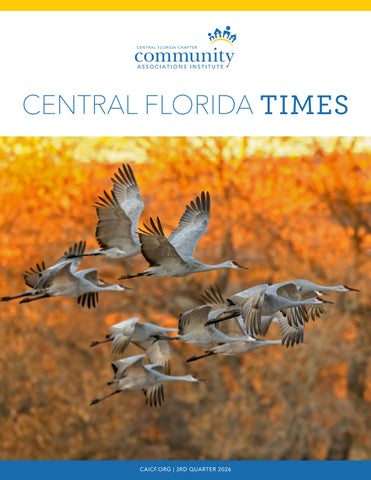
CENTRAL FLORIDA TIMES
CAICF.ORG | 3RD QUARTER 2026
TOPIC
3RD QUARTER 2026
CONTACT INFORMATION
Growing Relationships, Not Just Memberships We continue to celebrate record-breaking membership growth, welcoming new faces, new companies, new community leaders, and new ideas into our Chapter. Every new
P.O. Box 941125 Maitland, FL 32794 www.caicf.org Justine Tucker, CED exdir@caicf.org Membership Manager Tara Ruch membershipmanager@caicf.org
THANK YOU 2026 BOARD OF DIRECTORS!
member strengthens our network and expands the opportunities we have to learn from one another, support one another, and make a lasting impact on the communities we serve. But growth isn’t simply about how many members we have. It’s about what happens when we bring those members together. This year, we’ve continued to introduce new events and experiences designed to create meaningful connections, encourage collaboration, and cultivate positive change within our industry. From education and professional development to networking events and opportunities to simply have fun together, our goal is to create spaces where relationships can grow organically. And they are. We’re watching professional introductions turn into partnerships. We’re seeing members who met through CAI become trusted resources for one another. We’re watching lifelong friendships form, mentorships develop, and people genuinely show up to celebrate and support each other, both professionally and personally. That is what community is all about.
Stefanie Nicholson, CMCA, AMS, PCAM, President Tracy Durham, CMCA, AMS, CFCAM, PCAM, Past President
The stronger the relationships within our Chapter become, the stronger the communities we serve become as well. When managers, business partners, homeowner leaders, and industry professionals come together to exchange knowledge, solve problems, and build trust, that impact reaches far beyond a CAI event. It carries directly into the neighborhoods and communities throughout Central Florida.
Joey Arroyo, LCAM, President-Elect
As we continue breaking records, launching new experiences, and welcoming more
Jackie Swisher, Secretary
makes this Chapter so special: the people.
Leslie A. Ellis, CPA, MSA, CGMA, Treasurer
Thank you to every member who attends an event, welcomes someone new, shares
members into our CAI Central Florida family, I hope we never lose sight of what
their knowledge, volunteers their time, sponsors an experience, makes an introduction, or simply chooses to get involved. You are helping create the culture and community
Stephen Alexander
we are so proud of.
Stacey Loureiro, CMCA, AMS
We’re not just growing our membership. We’re growing relationships, opportunities,
Jarad Pizzuti, Past President Marion McKenzie, LCAM
friendships, and stronger communities… together. And we’re just getting started. With gratitude,
Frank Ruggieri, Esq., Past President
Justine
Matt Vice, Past President
Central Florida Chapter CAI
Justine Tucker, Chapter Executive Director
THANK YOU 2026 SPONSORS!
Diamond Chapter Sponsors
Platinum Chapter Sponsors
Become a Chapter Investor Sponsor!
Gold Chapter Sponsors Silver Chapter Sponsors
It’s the fast track to community association decision-makers! Every member of CAICF enjoys the opportunity of networking with community association decision makers. Becoming a Chapter Sponsor invests in your local Chapter and elevates your brand even more by being continuously recognized at events and through communications. Visit www.caicf. org/investor-sponsors/becomean-investor-sponsor.
3RD QUAR T ER 2026 | CENT RAL FL O R I DA TI ME S
3
FROM THE CHAPTER PRESIDENT
Caring for the People Who Care for our Communities BY STEFANIE NICHOLSON, CMCA, AMS, PCAM SENIOR VICE PRESIDENT, FOLIO ASSOCIATION MANAGEMENT 2026 PRESIDENT, CENTRAL FLORIDA CHAPTER CAI
As
I was thinking about what I wanted to share this issue, I kept coming back to one question: Who takes care of the people who take care of our communities? We spend so much time discussing budgets, reserves, insurance, maintenance, compliance, and legislation. But we don’t spend nearly enough time talking about the people behind all of it. I have been in this industry for a long time, and I know this is not easy work. Volunteer board members finish their workdays and come home to association emails, homeowner concerns, and decisions that affect their neighbors. CAMs balance communities, vendors, financials, meetings, deadlines, and emergencies, along with an inbox that never seems to empty. Business partners answer when something breaks, leaks, or needs to be fixed yesterday. Leaders work to recruit, mentor, and retain good people as expectations continue to grow. Somewhere along the way, I think we started confusing great service with immediate service. There is a difference. We should return calls, answer emails, follow through, and hold ourselves accountable. But excellent service doesn’t mean being available 24 hours a day, and professionalism should never mean accepting disrespect as part of the job. There is an actual person on the other side of that email. One of the things that makes our industry so challenging is also what makes it rewarding: we work where people live. These aren’t just business transactions. Assessments affect household budgets, and maintenance issues affect daily life. Those concerns deserve empathy. But empathy has to go both ways. The manager who hasn’t responded may be handling an emergency. The board member you’re frustrated with may have spent ten unpaid hours trying to solve an association problem. The business partner waiting to give you an answer may need information outside their control. We rarely know 4
C E N T R AL F L O R I D A T I M E S | 3 RD Q U A R TER 2 0 2 6
everything someone else is juggling. Maybe the next big improvement in our industry isn’t another technology, law, or process. Maybe it’s how we treat each other. We need experienced professionals mentoring newcomers, boards and managers setting clear expectations, and business partners treated as part of the team. We need to share knowledge, ask questions, and work through problems together. And we could all get better at recognizing people when things go right, instead of only speaking up when something goes wrong. That brings me to CAI. Of course, CAI provides education, resources, advocacy, and great events. But what makes our Central Florida Chapter special to me has always been the people: volunteer leaders, managers, business partners, and industry professionals willing to share their knowledge and help one another. Sometimes the most valuable thing you leave a CAI event with isn’t something you learned during the program. It’s the phone number of someone you can call six months later and ask, “Have you ever dealt with this before?” Chances are, they have. More importantly, they’re probably willing to help. As your Chapter President, that is the kind of organization I want us to continue building. At our next event, introduce yourself to someone you don’t know. Talk to the new CAM standing off to the side. Thank a volunteer. Recognize a business partner who went above and beyond. Offer to mentor someone. And the next time an email frustrates you, pick up the phone before hitting send. None of these things are complicated, but they matter. We spend every day working to build better communities. Let’s make sure we’re also building a better community for each other. Because at the end of the day, buildings don’t create communities. People do. And we need to take care of our people.
Built for Associations.
Experience, access, and support designed around your needs. Managing a community comes with real responsibility. It requires a banking partner who understands the details, from legislation to budgeting to board transitions. Sunrise brings deep, hands-on experience supporting associations, along with a team that stays actively involved through education, onboarding, and ongoing guidance.
Downtown Orlando 109 E Church St. Orlando, FL 32801 Association Banking Team 407.271.4857
Cocoa Beach 5604 N Atlantic Ave. Cocoa Beach, FL 32931 Association Banking Team 321.328.2211
You’re not just opening an account. You’re gaining a partner who understands how your community operates.
Call us to learn how we support Central Florida associations.
Ormond Beach 299 W Granada Blvd. Suite C Ormond Beach, FL 32174 Association Banking Team 407.625.8783
3RD QUAR T ER 2026 | CENT RAL FL O R I DA TI ME S
5
CHAPTER EVENTS
Calendar of Events More details regarding upcoming events will be posted to caicf.org under the “Events” tab. Check back regularly for the most up-to-date information. CAICF Board Meetings will be held before or after each of the Monthly Meetings. Please be sure to register for all events in advance, as we need an accurate head count for space and food purposes prior to the event. Thank you for your help! •
October 9, 2026: Mustard Seed Volunteer Opportunity
Partner Lantern Sponsors Available for $500 each.
from 10:00 am to 12:00 pm. All volunteers must wear sneakers
Includes logo recognition on all digital event promotions; Social
or tennis shoes as we do not allow crocs, or similar slip-
media sponsor shoutout; and Sponsorship covers 20 Lantern
on shoes, or any open-toe shoes in the warehouse. Lunch
Festival tickets for Community Managers.
to follow! Please bring household items/clothes/furniture donations. Kindly click here to RSVP so we can gather a head
•
December 2, 2026: Coastal White Winter End of Year
count and fill out the Volunteer Application. Please click here
Celebration & Annual Meeting at Paradise Cove from 6:00
to download the PDF of the Volunteer Application.
- 9:00 pm. Get ready to close out 2026 in coastal style at our most festive celebration of the year! We’re bringing winter to
•
October 21, 2026: Family Fall Festival at Southern Hill
the waterfront with an elegant coastal-inspired evening filled
Farms from 3:30 - 7:30 pm. Crisp air, pumpkin spice lattes,
with crisp whites, sparkling details, great music, unforgettable
and all your favorite fall traditions…it’s the perfect time to
experiences, and plenty of opportunities to celebrate the
celebrate together! Join us at our brand-new Fall Family
incredible community we’ve built together. Here’s what we
Festival for an afternoon filled with family-friendly fun,
have in store: Scenic boat rides along the waterfront; Coastal
delicious food, and festive fall memories. Community
cocktails and delicious cuisine; Live entertainment to set
Managers and Homeowner Leaders attend FREE, and this
the mood; Winter-white décor with an elevated coastal
year we’re making it even more special by inviting your entire
twist; Picture-perfect photo opportunities; Managers-Only
family! Bring the kids, grandkids, and even the “grown-up
Scholarship Raffle for a CAI Course. Tickets: Attendee tickets
kids”—there will be activities and entertainment for all ages
include dinner and drink ticket - Business Partner Members:
to enjoy. Business Partners are $35. NON-Member Businesses
$150; CAM & HOL Members (Homeowner Leaders/HOA
are $70. NON-Member CAMS/Homeowner Leaders are $35.
Board Members): $75; Non-Member CAMs & HOL/HOA
Your registration includes: Admission to Southern Hill Farms;
Board Members: $150; Non-Member Businesses: $250; Buy
Dinner; One (1) beer or wine drink ticket; Access to all the
5 Non-Member Business tickets, get 1 FREE! Attire: Guests
festivities, attractions, and family activities throughout the
are encouraged to wear white, ivory, cream, champagne, soft
farm. Whether you’re picking pumpkins, enjoying the fresh fall
coastal blues, or neutral tones. Sponsorship opportunities
air, or making memories with your family and fellow members,
available! Click here for more information and to register!
this is one event you won’t want to miss. Sponsorships available! Click here for more information and to register! •
•
Landing Golf Club in Orlando. Get ready to tee it up, have
November 19, 2026: Monthly Meeting & CEU at the Zoo:
some fun, and end the year on the green! Expect a day packed
Asian Lantern Festival. Registration at 3:00 pm, Program
with golf, networking, friendly competition, great food, prizes,
begins at 3:30 pm and Lantern Festival begins at 6:00 pm. CEU:
and plenty of surprises along the course. And this year, we’re
“From Tension to Teamwork – How to Prevent Board Infighting
turning up the FUN! We’ll be playing a “Bogey Max” format
and Get the Job Done” presented by Patrick J. Burton, Esq.,
to keep the tournament moving and the good times rolling!
Managing Attorney, Community Association Dept. of DiMasi
New This Year: BEST HOLE! Sponsors, this one is for YOU!
Burton, P.A. More and more boards get sidetracked into
We’re officially bringing BEST HOLE to the tournament! This
personality disputes that prevent them from completing
isn’t your average day of golf! Along the way, players can look
meaningful work. This course gives advice on how to cut
forward to: Longest Drive Competition; Closest to the Pin;
through the emotions and get things done for the community.
$5,000 Putting Contest; Golf Ball Cannon; TrackMan; Tons
Pricing: FREE for Manager Members (CAMs) & HOA Board
of Raffle Prizes; Sponsor Activations & Games; Best Hole
Members/Homeowner Leader Members (HOLs); $45 for
Competition. Click here for more information and to register!
Business Partner Members. REGISTER ASAP. Important: No Walk-in Attendees; Registration is Required. Meeting Sponsors: $400 each (2 more available). Three Business 6
C E N T R AL F L O R I D A T I M E S | 3 RD Q U A R TER 2 0 2 6
December 11, 2026: 16th Annual Golf Tournament at Hawks
•
February 26, 2027: CA Day & Trade Show - Registration Opening in October 2026!
3RD QUAR T ER 2026 | CENT RAL FL O R I DA TI ME S
7
EDUCATION
Upcoming Workshops & Education Opportunities COMMUNITY CONNECTIONS WORKSHOP SERIES This series is hosted in partnership by Orange County Neighborhood Services Division and the City of Orlando Office of Communications & Neighborhood Relations. The monthly workshops are free.
» » »
Legislative Updates Saturday, October 10 from 9:00 am - 12:00 pm Internal Operations Center 1: 450 E. South Street, Orlando In this workshop, participants will gain insight into the 2026 legislation updates that impact HOA and Condo associations. Click here to register. Orange County Community Conference Saturday, November 14 from 7:30 am - 2:00 pm Internal Operations Center 1: 450 E. South Street, Orlando The annual Orange County Community Conference provides an opportunity to learn about innovative ways to engage and strengthen neighborhoods. Event offers onsite resource providers, dynamic speakers, relevant workshop topics for residents, voluntary neighborhood organizations, homeowners associations and other community groups. The cost is $10 for early registration ($12 on event day), and attendees will receive a swag bag, event program, giveaways, a light breakfast, snacks and a full lunch. Click here to register for the conference.
» » » » »
developed exclusively for management company executives. October 22-23: M-206: Financial Management (Virtual Course) October 28: The Psychology of Calm: Managing Emotions and Conflict in Community Leadership (Virtual Webinar) November 5-6: M-100: The Essentials of Community Association Management (Live Virtual Course) November 12-13: M-205: Risk Management (Live Virtual Course) November 19-20: M-204: Community Governance (Virtual Course) December 3-4: M-203: Community Leadership (Virtual Course) December 8: Florida CAI Chapters HOA Board Certification (Virtual Course on Zoom at 8:00 a.m.) December 10: Florida CAI Chapters Condo and Co-Op Board Certification (Virtual Course on Zoom at 8:00 a.m.)
Stay on Top of Your Game with Professional Credentials CAI education and credentials help you lead better and achieve your desired business results. Click here to learn more. General Registration Information CAI courses are open to all. Courses are offered in classroom and online formats. Register four weeks in advance for live classroom courses and receive a $25 discount. Seating is limited. Early registration is strongly recommended. Click here to learn more.
CAI EDUCATION CAI offers many online learning opportunities (click on the dates below to register or obtain more information on these Live Virtual Courses) that lead to professional credentials. View the CAI Courses and Online Catalog for additional resources. »
» 8
On Demand: Special Presentation: Understanding the Fannie Mae & Freddie Mac Lender Questionnaires for Community Associations (Virtual Course) October 14-16: CEO-MC Retreat - Annual leadership event
C E N T R AL F L O R I D A T I M E S | 3 RD Q U A R TER 2 0 2 6
Business Partner Essentials The Business Partner Essentials is an online course designed to help CAI-member product and service providers better understand CAI, community associations and the industry at large. Individuals who pass the course and maintain CAI membership earn the CAI Educated Business Partner member distinction. By taking this course, you will distinguish yourself as an Educated Business Partner and can share your accomplishment with your current and potential clients. Click here to learn more.
“Exceptional Service, Quality Results... All Without Compromise.”
communication
Partnership
trust
EXTERIOR PAINTING PRESSURE WASHING SIDEWALK & CURB CLEANING SIDEWALK TRIP HAZARDS STUCCO REPAIRS GUTTER CLEANING ROOF CLEANING ASPHALT Milling, Paving, striping VICEPAINTING.COM AND MORE! 3RD QUAR T ER 2026 | CENT RAL FL O R I DA TI ME S
9
NEW CHAPTER MEMBERS
New and Returning CAICF Chapter Members from June 28, 2026 to September 20, 2026
BUSINESS PARTNER MEMBERS Advanced Environmental Services David Towner Armstrong Reserves, LLC Chris Toll, RS Axel Works Inc Rich Hayne BluSky Michelle Lippai CertaPro Painters of Orlando Kissimmee Pablo Brodsky Charles Taylor Engineering Technical Services LLC Sameer Rampurawala DDS Custom Builders Amy Beth Sullivan Deft Group Jeremiah Kiefer Deft Group Matt Overstreet Elite Exterior Wash 352 Briton Leverette K-Seven Design, Inc. Jason Kubus, RS Robertson Landscape Krista Vaughan Rodney S White CPA Rodney S White Skyterra Contracting Group John Michael Mullen, Jr. SOX Erosion Solutions Jarrod Rino The Falcon Group Marina Tweed 10
BUSINESS PARTNER MEMBERS CONTINUED
MANAGER MEMBERS CONTINUED
Total Property Maintenance & Landscaping Robert Clites
Michael David Nestved
MANAGER MEMBERS
David Zissman
Pedro Alejandro Gutierrez Gherbaz, CMCA, AMS Artemis Lifestyle Services, Inc.
VOLUNTEER LEADER MEMBERS
Maya King Community Management Professionals, Inc. Lourdes Marie Menendez Keystone Property Management Group
Pedro Rodriguez
Great Outdoors Premier RV Community Services, Inc. Lauren Clark Karin Coburn Berry Fisher Marie Moraites Shane Willey
Connie Carraro Yeber Keystone Property Management Group
On Top of the World (Central) Owners Association, Inc. David Fleischmann Patricia Schofield-Vargas
Darcie L Madison, CMCA Leland Management, Inc.
Vista Gardens Joanne Aramini
Jessica Phillips Marriott International, Inc.
Diane Elizabeth Silverstein
Kaitlin Cantillana RealManage Jasmine Colon RealManage Andrew David Johnston RealManage Scott Edward Schaefer, Sr. RealManage Derek Rubino RealManage Elevated Onsite Belinda R Wilhelmson Triad Association Management Beth Conner April Kaiser
C E N T R AL F L O R I D A T I M ES | 3 RD Q U A R TER 2 0 2 6
WANT TO JOIN THE CENTRAL FLORIDA CHAPTER CAI? Homeowners, Community Association Managers, and Business Partners can become members. If you provide products or services to community associations, CAI can give you direct access to thousands of potential customers and provide unique opportunities through networking luncheons, socials, and other great events. Click here to download a PDF of CAI Member Benefits. Your membership total includes membership dues, a mandatory advocacy support fee and an optional donation to the Foundation for Community Association Research. Visit caicf.org/ resources/membership to learn more!
Celebrating 22+ years of meeting the needs of COA/HOA communities CORE SERVICES Stucco & Masonry Repairs & Replacement Siding Repairs & Replacement Exterior Painting Roofing Decks & Balconies Concrete Restoration Corroded Rebar & PostTension Cable Repair Water Management & Slope Correction
EXPERT SERVICES Preliminary Observation Reports Cost Estimating Expert Witness Testimony Mediation & Arbitration Support Destructive Testing Sufficiency of Settlement Analyses Scope of Work Development Reconstruction Planning
Jackie Swisher, Director of Business Development - FL 407.713.3489 jswisher@empireworks.com
FLCertified General & Roofing Contractor CGC057803, CCC1335347 3RD QUAR T ER 2026 | CENT RAL FL O R I DA TI ME S
11
MEMBER ARTICLE
Navigating Hurricane & Flood Claims for Community Associations BY STEVE G. MASON, VICE PRESIDENT OF CONDOMINIUM PARTNERSHIPS ALTIERI INSURANCE CONSULTANTS
H
urricanes and the floods they cause are formidable challenges for community associations, affecting both daily operations and financial stability. When a major storm impacts a property, the immediate priority is safety—securing the site, accounting for residents, and preventing further damage. However, once the storm passes, the focus quickly shifts to navigating the insurance claims process, which can be both time-sensitive and highly technical. One of the most critical aspects of hurricane-related claims is distinguishing between wind-driven damage and flood damage. Most association insurance policies cover wind damage under the property policy, while flood damage is typically covered under a separate flood insurance policy. Properly documenting the cause of loss is essential, as misclassification can lead to delays or denials in coverage. Timely reporting is another key factor. Associations should notify their insurance carriers promptly and begin compiling documentation, including photographs, videos, maintenance records, and prior inspections. Engaging a qualified Public Adjuster can make claims more accurate and effective, as they advocate for the policyholder and manage communications and negotiations with the insurance carrier.
By managing communications and negotiations with the insurance carrier, public adjusters reduce the administrative burden on board members and property managers. Their involvement typically results in more thorough claim submissions, expedites the process, and ensures a proper recovery. Communication plays a vital role throughout the process. Keeping residents informed about damage assessments, repair timelines, and claim progress helps maintain transparency and trust within the community. The public adjuster team at Altieri always provides updates so the association managers have up to date information to relay to the residents.
Steve brings more than 20 years of community association management experience and seven years in property insurance recovery to his role as Vice President of Condominium Partnerships for Altieri Insurance Consultants. His background includes luxury high-rise communities, restoration projects, and insurance claims.
Hiring a public adjuster can be particularly beneficial, as they are the only adjusters who work solely for the policyholder. They expertly identify, document, and value all covered damages, interpret policy details, and help associations understand critical coverage nuances. 12
C E N T R AL F L O R I D A T I M ES | 3 RD Q U A R TER 2 0 2 6
An active CAI volunteer and educator, Steve served as Southeast Florida Chapter President in 2021 and 2022 and currently serves on CAI’s National Business Partners Council. He holds the CMCA, AMS, PCAM, and CIRMS credentials and is a licensed community association manager and public adjuster.
3RD QUAR T ER 2026 | CENT RAL FL O R I DA TI ME S
13
MEMBER ARTICLE
The Harder Right or the Easier Wrong – The 12 Steps BY BETSY BARBIEUX, CAM, CFCAM, CMCA, FLORIDA CAM SCHOOLS 1. Relinquish the Role of “Representative” Accept that you were not elected to represent a specific group of friends or a “constituency.” Your sole mandate is to the corporate entity of the association. Your duty is to protect the property and its collective value, not the interests of a vocal minority. 2. Prioritize the Governing Documents over Personal Opinion The Declaration and Bylaws are the “Constitution” of your community. Even if you personally find a rule—like a restriction on truck parking or a specific paint color—to be outdated, you must enforce it. Fealty to the documents prevents the legal nightmare of selective enforcement. 3. Adopt Financial Realism in Budgeting The “easier wrong” is keeping assessments flat to avoid complaints. The “harder right” is raising assessment amounts to match the reality of 2026 insurance premiums and inflation. A budget is a math problem, not a popularity contest. 4. Commit to the Necessity of Special Assessments When infrastructure fails or reserves are thin, the “harder right” is imposing a special assessment. Deferring critical repairs to “save” 14
C E N T R AL F L O R I D A T I M ES | 3 RD Q U A R TER 2 0 2 6
owners money today only creates a more expensive—and potentially dangerous—catastrophe tomorrow. 5. Enforce Rules Without Social Bias Fining a neighbor for a rules violation is uncomfortable. However, ignoring a violation because the owner is a friend is a breach of your duty. Consistent enforcement is the only way to protect the “uniform scheme” that maintains property values. 6. Standardize ARC Denials When an Architectural Review Committee (ARC) application violates the guidelines, you must deny the modification. It is easier to say “yes” to avoid a confrontation at the pool, but a “no” today prevents a permanent eyesore that affects everyone’s resale value. 7. Execute Mandatory Collections Florida law provides tools to handle delinquencies. The “harder right” is suspending the voting rights of a neighbor who is more than 90 days past due and moving forward with a lien. You are protecting the paying members from subsidizing those who do not contribute. Continued on page 16
interested in getting more involved? join a caicf committee! If you are interested in getting more involved in the Chapter, joining a committee is a great thing to consider. Below are the different committees that we currently have active. Please feel free to contact any of the following committee members to learn more: CA Day/Trade Show Committee Christy Raymon Don Asher & Associates christy@donasher.com
Events Committee Mia Heflin Exclusive Landscaping mheflin@exclusivelandscapingnow.com
Meet the Managers Committee Anita Roberts Premier Association Management anita.roberts@premiermgmtcfl.com
Joey Arroyo Atmos Living joey.arroyo@atmoslivingmg.com Cares Committee John M. Calpey One Florida Bank jcalpey@onefloridabank.com
Gala Committee Joey Arroyo Atmos Living joey.arroyo@atmoslivingmg.com
Membership Outreach Lorelei Andrews Castle Group landrews@castlegroup.com
Golf Tournament Committee Jarad Pizzuti Sihle Insurance Group jpizzuti@sihle.com
Social & Young Professionals Committee Maddy Burger Vice Painting maddy@vicepainting.com
Education Committee Melissa Winter Becker mwinter@beckerlawyers.com
make an impact!
Personalized Representation for Community Associations Collection Services No Fee Billing
■ Contingent Collections
■ Covenants Enforcement
■ Flat Rate Mortgage Foreclosures
■ Flat Rate Violations
■ Free Monthly Status Reports
■ Client Evaluation Proposals ■ No Retainers
(407) 395-4766 • RUGGIERILAWFIRM.COM
3RD QUAR T ER 2026 | CENT RAL FL O R I DA TI ME S
15
MEMBER ARTICLE 8. Maintain the Integrity of the Agenda To comply with Florida’s open meeting provisions for associations, you must stop owners from bringing up items not on the agenda during board business. While it may feel dismissive, it ensures that all owners have proper notice of what the board is discussing and voting on. 9. Formalize Access to Official Records Avoid the “easier wrong” of handing over documents via informal texts or “drive-by” requests. Impose strict policies for record inspections. This ensures the association remains organized, protects privileged information, and follows the statutory 10-business-day response window.
often means choosing expensive, long-term structural integrity over “cosmetic” upgrades that might be more popular with the neighbors but less vital to the building’s survival. 12. Practice Professional Detachment Accept that doing the “harder right” may result in social friction. A successful board member understands that their legacy isn’t being the most liked person in the building but leaving the association in a stronger financial and physical position than they found it.
10. Utilize Management as the Official Buffer When a neighbor corners you with a complex question, the “harder right” is referring them to management rather than giving a personal answer. This ensures the information provided is official, documented, and legally sound, protecting you from personal liability.
Betsy Barbieux, CAM, CFCAM, CMCA, a Professional Development Coach, of Florida CAM Schools, LLC, can be reached at Betsy@FloridaCAMSchools.com, or 352-
11. Protect the Common Elements Above All The core of your duty is to maintain the common property. This
326-8365. For more information, visit floridacamschools. com. Subscribe to CAM Matters™ on YouTube.
SPECIALIZING IN APARTMENTS & CONDOMINIUM COMMUNITIES
STRATUS
ROOFING
www.STRATUSROOFING.com
(407) 625-5866 Our Customers…
What our customers are saying…
“I absolutely would recommend Stratus Roofing to anyone looking to hire a solid, professional roofing company. They are exceptional at producing quality work, consistently meeting or exceeding deadlines, provide hands-on supervision on-site and are a company of absolute integrity.” — Property Manager, Mosaic at Millenia
SHINGLES
METAL
TILE
TPO
PVC
EPDM
Licensed & Insured CCC1326094 | CRC026344 16
C E N T R AL F L O R I D A T I M ES | 3 RD Q U A R TER 2 0 2 6
MODIFIED
REVOLUTIONIZE YOUR SOFTWARE SWITCH TO
Overpaying for your current software? Why?
VMS VMS has has all all the the Features Features you you Rely Rely On On and and More More with with Proven Proven Reliability Reliability and and Innovation Innovation to to Streamline Streamline your Workload your Workload and and Grow Grow your your Business Business
Revolutionize with VMS
~ Open QR to schedule a live demo ~ VillageManagement.com | Sales@TeamSoftOnline.com 3RD QUAR T ER 2026 | CENT RAL FL O R I DA TI ME S
17
MEMBER ARTICLE
Budgeting for Your Building: Waterproofing Essentials BY JILL MURPHY, CONTENT MARKETING MANAGER, VALCOURT GROUP
R
ainfall patterns across many regions are becoming more intense and unpredictable. For property owners and managers, this shift brings a clear message: waterproofing is no longer optional—it’s essential. Without proper waterproofing, your building is at risk of costly water damage, unexpected operational downtime, and significant budgetary strain. That’s why it’s critical to plan ahead by making waterproofing a key line item in your annual property budget. Prioritizing this investment now ensures your building is better protected—no matter what next year’s weather brings.
PROTECT YOUR BUILDING WITH EFFECTIVE WATERPROOFING Waterproofing is more than just a barrier—it’s an investment in your building’s longevity. When you stay ahead of water infiltration, you extend the lifespan of essential building materials while avoiding costly repairs. Think about it: roofs, facades, windows, foundations, balconies, parking garages, planters, plaza decks, expansion joints, and below-grade areas are all vulnerable to water intrusion. Like an offensive line protects a quarterback, waterproofing protects 18
C E N T R AL F L O R I D A T I M ES | 3 RD Q U A R TER 2 0 2 6
your investment by standing strong, blocking potential threats, and ensuring your building stays in top condition. But just like any good offensive line needs regular training and upkeep, your waterproofing system requires routine inspections and maintenance. By staying vigilant and proactive, you can prevent small vulnerabilities from turning into costly disasters that could deplete your budget.
FINANCIAL PITFALLS OF IGNORING WATERPROOFING When you ignore or defer preventative maintenance, you risk derailing your budget by robbing Peter to pay Paul for costly repairs. Take this example from our webinar: what began as a $110,000 repair nearly doubled in cost just two years later to $215,000 simply because the building owner deferred waterproofing needs. Water and other elements will continue to wreak havoc in areas where your building is vulnerable, and the damage increases exponentially. Unfortunately, costly repairs aren’t the only financial pitfall of ignoring waterproofing repairs. Excessive water damage can Continued on page 20
Homeowner Associations Condominiums Construction Real Estate
Ansbacher Law - Orlando Office 300 Colonial Center Pkwy Lake Mary, FL 32746
(407) 675-5092
WWW.ANSBACHER.NET *Attorney Advertising. Ansbacher Law is admitted to practice in Florida.
Creating complete customized insurance programs for community associations. www.assuredpartners.com
NEGAR SHARIFI
Senior Vice President P: (407) 440-0928 negar.sharifi@assuredpartners.com
PHIL MASI
Senior Vice President P: (407) 278-1627 phil.masi@assuredpartners.com
3RD QUAR T ER 2026 | CENT RAL FL O R I DA TI ME S
19
MEMBER ARTICLE advancements in waterproofing membranes to provide a more effective product while enhancing sustainability. Ultimately, you need to align your building’s needs with your budget. For instance, going with higher-end waterproofing products provides enhanced protection and a longer time between reapplications. This will cost more initially but will pay off in the long run. It’s all about allocating budget dollars to provide the most protection and maximize your spending.
MAXIMIZING YOUR BUDGET: PROTECT AND PREVENT Now is the time to start planning your building’s budget for the year ahead. We offer several essential maintenance and preventative projects to protect your property, reduce liabilities, and ensure your budget stays on track next year.
also lead to higher insurance premiums or even denied claims, adding another layer of avoidable stress and strain on your budget. Extensive repair and restoration projects disrupt your operations and may require relocating tenants, missing out on revenue, and other unplanned downtime sure to affect your business operations.
CRAFTING YOUR WATERPROOFING BUDGET: KEY COMPONENTS Crafting your waterproofing budget starts with finding your baseline. From there, you can address your building’s greatest needs that fit your budget and begin a regular cadence for waterproofing maintenance. 1.
2.
3.
4.
20
Inspections and Assessments: Integrating waterproofing into your annual budget begins with an honest assessment of your building’s vulnerabilities to water intrusion. This strategy gives you an opportunity for some quick wins to address the most dire needs while remaining within budget. Routine Maintenance: Waterproofing is not a one-time task. Components require regular inspections and minor touchups. For example, review manufacturer guidelines or consult with your waterproofing contractor on how often to reapply coatings. Emergency Repairs: Even with the best proactive planning, unforeseen issues can arise. Environmental conditions, weather, and pollutants vary from region to region. When these conditions are extreme, they can compromise the integrity of waterproofing products. Upgrades and Improvements: Straight from science fiction or a Marvel movie, robotics and nanotechnologies are driving
C E N T R AL F L O R I D A T I M ES | 3 RD Q U A R TER 2 0 2 6
Smart Moves for Year-end Budget: • Sealants and Caulking: Reapplying these materials is a costeffective way to maintain your building’s integrity. • Painting/Coating: Protect your building’s facade and other vulnerable areas with a fresh coat of paint or protective coating. • Concrete Repairs: Address any cracks or damage in concrete surfaces before they worsen, leading to more extensive and costly repairs. • Facade Assessment: Conduct routine facade assessments to address problems now and avoid expensive repairs later. Investing in these critical projects protects your property, prevents future damage, and ensures value from every dollar of your budget.
Jill Murphy is a content marketing professional with nearly a decade of experience in content strategy and creation. Since joining Valcourt Group in 2023, she has developed educational content and resources to help property managers and building owners navigate waterproofing, restoration, and exterior maintenance. Her background includes marketing campaigns, brand communications, and support for websites and sales initiatives. Jill holds a Bachelor of Science in Nutrition from the University of Texas at Austin and a Business Foundations Certificate from the McCombs School of Business. Contact Valcourt today to learn how we can help you maximize your budget and secure the long-term benefits of comprehensive waterproofing and maintenance for your building.
16 TH ANNUAL
GOLF TOURNAMENT FRIDAY
HAWK’S LANDING GOLF CLUB, ORLANDO
DECEMBER 11 Tournament Entry: CAI Central Florida Member Foursome: Non-Member Foursome:
$700 $850
A portion of this year’s tournament proceeds will benefit The Mustard Seed of Central Florida, supporting their work right here in our local community.
Schedule: 6:15 am | Sponsor Arrival & Setup 7:00 am | Registration
8:00 am | Shotgun Start Lunch & Awards immediately following play
On-Course Highlights: • • • •
Longest Drive Competition Closest to the Pin $5,000 Putting Contest Golf Ball Cannon
• • • •
TrackMan Tons of Raffle Prizes Sponsor Activations & Games Best Hole Competition
SPONSORSHIPS & REGISTRATION Available at caicf.org! 3RD QUAR T ER 2026 | CENT RAL FL O R I DA TI ME S
21
MEMBER ARTICLE
New Mortgage Rules: A Simple Guide for Florida Condo Reserves BY ERIC DIXON, RS, PARTNER AND RESERVE SPECIALIST, FELTEN PROPERTY ASSESSMENT
O
wning a condo in Central Florida comes with shared responsibilities, especially when it comes to saving money for major repairs like roofs, painting, and elevators. This community savings account is called a reserve fund. Recently, the rules about how much money a condo must keep in this account have completely changed. In March 2026, the major organizations that back almost all home loans in the United States, Fannie Mae and Freddie Mac, released strict new guidelines. If your condo association does not follow these new rules, banks will simply stop giving out mortgages to anyone trying to buy a unit in your building. When buyers cannot get home loans, property values drop, and selling your home becomes incredibly difficult. First, it is important to know exactly who this affects. These new federal rules only apply to all Condominium Owners Associations nationwide. If you live in a neighborhood with single-family or townhouse style homes governed by a standard Homeowners Association, you do not need to worry about this. But for condo owners, these changes demand immediate attention because the new national banking rules are actively clashing with Florida’s state laws. The biggest point of confusion right now is a concept called “baseline funding.” Under Florida’s recent safety laws, condo buildings 22
C E N T R AL F L O R I D A T I M ES | 3 RD Q U A R TER 2 0 2 6
with three or more “habitable” stories must complete a Structural Integrity Reserve Study (SIRS) to coincide with a Milestone Inspection and fund the structural health of their building. State law says these 3-story condos must save at least enough money so that the reserve bank account never drops below zero dollars over a 30-year funding period. This is “baseline funding” and what Florida considers the legal minimum for these condo properties. But here is the problem: the federal mortgage lenders say that is not enough. Starting August 3, 2026, Fannie Mae will no longer accept this minimum baseline approach. They view it as entirely too risky. It is important to note these national banking rules apply even to condos that aren’t required by state law to fund Structural Integrity reserves or complete a SIRS. So, what do the federal lenders want instead? If your condo board uses a professional reserve study to prove to the bank that you are saving enough money, the lender will check two things. First, the study must be fresh; completed within the last 36 months. Second, the board must be putting away the highest amount of money recommended in that report. The days of picking the cheapest savings plan just to keep monthly condo dues low are officially over. Federal lenders are overriding Florida’s bare minimums and forcing Continued on page 24
Switching to fiber internet is easier than you think! Our guarantee:
5-star service—Guaranteed speeds and uptime, plus 24/7/365 technical support. White glove support — Stress-free installation, community-friendly construction, resident training, and a dedicated account manager to oversee every phase of your transition. Personalized approach — We provide tailored solutions best suited for your community’s needs. Proven partnership — We’ve earned the trust of 385,000+ community residents and the decision-makers of 500+ communities. Don’t wait to give your community the internet they deserve!
Contact us today for a FREE network evaluation.
Learn more about fiber internet VISIT BLUESTREAMFIBER.COM/PARTNER OR CALL 855-734-2377! Se habla español.
www.castlegroup.com
We Are Castle Group The premier choice for property management, we specialize in serving the finest residential communities. With over 3,000+ dedicated team members, we are the preferred service provider for over 500+ associations. Our philosophy stays the same no matter where we are – putting the resident first. At Castle, we call it Royal Service®. To learn more about how Castle Group can serve your community, request a proposal at www.castlegroup.com/request-a-proposal.
3RD QUAR T ER 2026 | CENT RAL FL O R I DA TI ME S
23
MEMBER ARTICLE
communities to more heavily fund their savings if they want their units to remain attractive to buyers. But what if your condo does not have a fresh reserve study to show the bank? The backup rule is getting much tougher, too. In the past, if a condo didn’t use a reserve study, banks wanted to see that 10% of the community’s total yearly budget was going into the savings account.
15% mark. Finally, condo boards need to reach out to their Reserve Specialist right away. Ask them to consider removing from your reserve study fully- funded reserve plans if the Association is not funding at that level and figure out exactly what the new threshold savings goal should be. Taking these steps now will protect your property value and keep your community running smoothly.
For all loans starting January 4, 2027, that minimum leaps up to 15%. For example, this 15% requirement is calculated as: (Total Budget - Current Reserve Budget) x 0.15. This is a huge jump in required savings. It means a lot less breathing room in the budget, and it leaves zero room for boards to scramble at the last minute. Having worked in this industry in Florida for over a decade, I can tell you that the message from the federal government is loud and clear: a healthy reserve savings account is the ultimate proof that a building is safe and well-managed. Because we are heading into budget planning season right now, condo boards and everyday homeowners need to ask the right questions today.
Eric Travis Dixon, RS (#00462), is a Partner and Reserve Specialist at Felten Property Assessment Team with over 20 years of property operations and a decade of dedicated reserve study experience. He specializes in helping Florida community associations navigate complex statutory compliance, including Structural Integrity Reserve Studies (SIRS) under Chapters 718 and 720. Through
Start by checking the date on your most recent reserve study. If it is older than three years, it is time for an update. Next, look closely at your draft budget for next year and see if your savings meet that new 24
C E N T R AL F L O R I D A T I M ES | 3 RD Q U A R TER 2 0 2 6
precise financial forecasting and capital planning, Eric provides boards with the strategic roadmap needed to safeguard property values and ensure longterm stability.
We’re focused on our communities. Truist Association Services has been enhancing the way property management companies and associations operate for over 35 years. Give us a call today to see how we can help with your payment processing and lending needs, or learn more at Truist.com/AssociationServices. Krissy Cassidy Relationship Manager 941-952-5919 Krissy.Cassidy@Truist.com
Truist Bank, Member FDIC and Equal Housing Lender
. Loans and lines of credit are subject to credit approval. ©2025 Truist Financial Corporation. All rights reserved.
3RD QUAR T ER 2026 | CENT RAL FL O R I DA TI ME S
25
MEET THE MANAGERS - JULY 23, 2026
26
C E N T R AL F L O R I D A T I M ES | 3 RD Q U A R TER 2 0 2 6
THANK YOU
MEET THE MANAGERS SPONSORS AFTER PARTY SPONSORS
360 PHOTO BOOTH SPONSORS
WRISTBAND SPONSORS
DESSERT SPONSORS
3RD QUAR T ER 2026 | CENT RAL FL O R I DA TI ME S
27
MEET THE MANAGERS - JULY 23, 2026
28
C E N T R AL F L O R I D A T I M ES | 3 RD Q U A R TER 2 0 2 6
You’re more than just a community. You’re a vision, a shared lifestyle. At Edison, we believe in turning that vision into reality through Trust, Excellence and Partnership.
Contact Us Today! 407-317-5252 • info@edison-mgmt.com edisonassociationmanagement.com
3RD QUAR T ER 2026 | CENT RAL FL O R I DA TI ME S
29
MEMBER ARTICLE
During Turnover, Don’t Trade Away Unknown Defect Rights for a Quick Fix BY KEEGAN A. BERRY, PARTNER, BALL JANIK LLP
T
urnover (when a community association shifts from developer control to owner control) is one of the most consequential moments in a community’s lifecycle. It is also a time when boards are asked to make fast decisions, often with incomplete information. Increasingly, developers present “standard” turnover documents that include broad releases or settlement language, sometimes packaged with promises to complete a short punch list or to waive an alleged budget shortfall from the developer-control period.
releases often extend well beyond the specific items the developer agrees to address. If the community later discovers systemic issues, the association may find that its remedies are limited to enforcing narrow punch lists while broader defect claims have been contractually surrendered.
Boards should treat any proposed release as a major legal decision, not an administrative formality. A release can waive construction defect claims, known and unknown, before the association has had a meaningful opportunity to investigate. That risk is heightened because many defects are latent. Early symptoms such as minor stucco cracking, intermittent water intrusion, or window leaks can signal larger building-envelope or structural issues that do not fully manifest until later.
1.
Collect and preserve turnover records. Secure plans, specifications, permits, inspection reports, contracts, change orders, warranties, and turnover materials. Documentation gaps can become leverage points for the party that already has the project file.
2.
Engage an independent engineering evaluation. Retain a qualified forensic engineer experienced in communityassociation projects to perform a building-envelope and systems review. For many properties, this includes roofing and waterproofing, stucco and coatings, balconies, doors and windows, drainage and irrigation, mechanical and electrical components, and any structural elements.
WHY RELEASES ARE TEMPTING AND WHY THEY CAN BE DANGEROUS At turnover, new directors are focused on stabilizing operations, collecting records, and addressing resident complaints. A developer’s deal can look like an efficient way to close out open items without special assessments. The problem is that these broad 30
C E N T R AL F L O R I D A T I M ES | 3 RD Q U A R TER 2 0 2 6
A PRACTICAL INVESTIGATION FIRST CHECKLIST Before signing any agreement that includes a release, boards should consider taking the following steps:
Continued on page 31
MEMBER ARTICLE 3.
4.
Understand pre-suit notice obligations. Florida’s construction defect framework requires detailed pre-suit notices and provides an opportunity for inspections and repair proposals. Planning the investigation with that process in mind can avoid missteps and improve the quality of any notice of claim. Map deadlines and avoid “wait and see.” Timing matters, and boards should evaluate potential claims early enough to avoid running into statutes of limitation or repose issues, especially where defects may have been developing for years before they become obvious. CAI-FLA has cautioned boards that SB 360 shortened the statute of repose for construction defect claims to seven years and changed how the clock starts. See CAI-FLA’s legislative summary here. For additional background, the Florida Senate’s bill analysis explains that the seven-year repose period begins to run at the earliest of the listed triggering events, such as issuance of a temporary certificate of occupancy, a certificate of occupancy, a certificate of completion, or abandonment if not completed. The analysis is available here.
mechanisms without giving up unrelated rights. Any release should be narrowly tailored, tied to verified completion, and based on informed decision-making. Turnover should be viewed as the beginning of diligent governance, not the end of the developer’s accountability. A board’s best protection is to investigate first, make informed decisions second, and release claims, if at all, only after the community understands what it is giving up and after review by legal counsel.
Keegan A. Berry is a Partner in Ball Janik LLP’s Orlando office. He is Florida Bar Board Certified in Construction Law and focuses his practice on complex construction
5.
Separate repair negotiations from claim releases. If the developer genuinely wants to address punch list items, boards can often negotiate scopes, timelines, and enforcement
defect and commercial litigation throughout Florida. Ball Janik LLP | info@balljanik.com | 407.455.5664 | www.balljanik.com
3RD QUAR T ER 2026 | CENT RAL FL O R I DA TI ME S
31
MEMBER ARTICLE
The Fundamentals of Effective Association Governance BY JOEL W. MESKIN, ESQ., MANAGING DIRECTOR OF COMMUNITY ASSOCIATION INSURANCE & RISK MANAGEMENT, MCGOWAN PROGRAM ADMINISTRATORS
Y
32
our home in a community association continues to be your castle; however, the castle is subject to conditions and restrictions agreed upon when the unit is purchased and the deed is signed. When governance breaks down, disputes, claims, lawsuits, and financial losses often follow. Understanding the fundamentals of community association governance can eliminate many issues.
Know Your Documents + Applicable Federal, State & Local Laws Every community association operates a framework that includes: • Covenants, Conditions, and Restrictions (CC&Rs) Bylaws – the operating manual. • Board-adopted rules and policies • Understanding what can and cannot be changed, and how to amend and adopt changes is essential for effective governance.
Understanding a Community Association A community association is a not-for-profit business entity created to manage and maintain common interests within a community. When homeowners purchase a property within an association, they agree to comply with the community’s Documents, boardadopted rules, and applicable federal, state and local laws. The most common disputes arise from a lack of understanding of these Documents. Board members and homeowners alike must familiarize themselves with the association’s rules, restrictions, and operational requirements before buying into a community association. Courts will assume that you have read and understood the Documents. Not having read the Documents will not constitute a defense.
The Board’s Primary Responsibility: Protect the Community’s Assets, both Tangible and Intangible Board members are elected volunteer unit owners who must act in the best interests of the association, not individual personal interests.
C E N T R AL F L O R I D A T I M ES | 3 RD Q U A R TER 2 0 2 6
A board’s duty is to: • Protect community assets • Preserve property values • Enhance the long-term association risk management
Continued on page 34
COMMUNITY ASSOCIATION PROGRAM
Experience the Difference of Working with a Florida Based Bank
The CommuniTy Banking SoluTion for CommuniTy aSSoCiaTionS John Calpey
Mary Ann Sheriff
SVP/Business Development
SVP/Market Executive
407-693-0527 (o)
407-693-0606 (o)
407-920-1789 (m)
407-247-4887 (m)
associationservices@onefloridabank.com
ONEFLORIDABANK.COM
3RD QUAR T ER 2026 | CENT RAL FL O R I DA TI ME S
33
MEMBER ARTICLE Clear documentation and consistent processes help reduce misunderstandings and provide important legal protection for the association. Why Board Meetings Matter Board meetings are where governance happens. Not outside the board meeting, not between less than all the board members, not over the phone. Making decisions and forming alliances outside the properly noticed board meeting is a breach of fiduciary duty and can lead to invalid decisions and challenges. Effective meetings should:
Every Board Is the Community’s Risk Manager Risk management is the most important responsibility of any community association board. Risk management includes all the board’s responsibilities. Boards must prepare for both expected and unexpected risks.
•
Encourage participation, giving both board members equal speaking time with predetermined time limits. Strictly enforce in a uniform manner. Stick to the agenda. It is all About fair discussion and decision making.
•
Establish parliamentary procedures like Roberts Rules of Order, even if it feels unnatural in the beginning.
•
Maintain professionalism, civility and avoid reacting when challenging owners rise up and stretch his or her rebel rousing acumen and need to be right. One owner’s concern is another owner’s “so what.”
•
Focus on community business, Avoid neighbor v. neighbor issues. They are rarely an association responsibility. If details bog down meetings, establish a committee to review the bogs and come back with findings and recommend further actions, if appropriate.
•
Provide timely communication to homeowners. Meeting minutes memorialize valuable institutional knowledge that helps future boards make consistent decisions and avoid claims of unequal treatment or discrimination. Minutes should be limited to (1) attendance demonstrating a quorum (2) agenda topics discussed but not the substance, and (3) decisions made and delegated further action. Whether authorized by the documents, or not, extensive notes and recordings are rarely beneficial and can lead to unintended consequences. Board members must review meeting materials in advance. Failure to do so is the biggest cause of unnecessary meeting time. This is other board members and whoever puts the packet together. Continue a meeting where board members are not prepared or there is insufficient. No need to discuss if it will just be discussed later.
Expected Risks Reserve Funding a Requirement not an Option Normal wear and tears, aging infrastructure, and future capital repairs that may be latent. Reserve studies provide guidance for short term and long-term funding. Unexpected Risks and other Risk Transfer Mechanisms These include, but are not limited to flood, wind and hail damage, property damage claims such as fire, liability claims such as slip and falls, and director and officers wrongful acts, and other unforeseen events requiring insurance protection, professional risk management guidance and other risk transfer tools such as indemnification agreements from vendors and professional service providers. Boards needn’t be experts or provide professional services. Boards are authorized to engage experts to assist in evaluations. Board members are protected for alleged wrongful acts in their capacity as a board member, not as a professional. Conduct Board Business Properly Strong governance depends on proper procedures. Boards must: • Review and discuss issues during properly noticed meetings • Make decisions collectively • Clearly document actions and decisions • Delegate authority in writing • Ensure all delegated responsibilities stay within approved authority 34
C E N T R AL F L O R I D A T I M ES | 3 RD Q U A R TER 2 0 2 6
Respect the Board’s Decisions Healthy governance mandates boards to support board decisions once a vote is finalized, even those who were not in the majority. Continued on page 36
FINANCIAL STRENGTH MEETS INDUSTRY EXPERIENCE. At First Citizens Community Association Banking, we understand your unique industry. First Citizens Bank. Forever First.® Denine Barham, VP, Regional Sales Officer denine.barham@firstcitizens.com | 727-432-3311 FIRSTCITIZENS.COM/CAB
© 2025 First-Citizens Bank & Trust Company. All rights reserved. MM#16321
3RD QUAR T ER 2026 | CENT RAL FL O R I DA TI ME S
35
MEMBER ARTICLE Insurance only cover alleged “wrongful acts” committed in their capacity as board members. It does not cover professional liability exposure. Using qualified professionals can: • Improves decision-making using experts. • Reduce liability exposure • Supporting Business Judgment Rule defense Being “penny wise and pound foolish” does not end well. Is not inherently bad, but it requires prudence and the requisite due diligence. Commonly Overlooked Responsibilities Some important governance responsibilities are often overlooked: • Filing required tax returns • Disclosing conflicts of interest • Engage community association attorney to review contracts. If it is a relatively small contract with a definite ending, it could be okay with the proper authority. However, if it is a large amount, or a contract with an indefinite ending, attorney review is critical. • Obtaining proper insurance documentation from contractors is an important risk transfer tool avoiding costly mistakes and protecting the association’s interests and assets.
Undermining the majority can damage trust and potentially create governance and liability issues. Professional disagreement is healthy. Public dysfunction is not. Address Bullying and Disruptive Behavior Immediately Unfortunately, some associations have disruptive attendees and/or “rogue” board members.
Joel W. Meskin, Esq., CIRMS, CCAL Fellow, MLIS, EBP is the Managing Director of Community Association Insurance & Risk Management at McGowan Program
Bullying behavior can: • Undermine governance • Discourage participation • Create unnecessary conflict • Increase legal exposure Boards should address inappropriate conduct promptly seeking legal guidance. Allowing disruptive behavior to continue unchecked can negatively impact the entire community. Failure to address can be tantamount to implicit ratification. Lead to potentially significant liability.
Administrators. He has worked in the industry for over 25 years. First obtained a CA Insurance license in 1981 and Ohio in 2005. Obtained the Management Liability Insurance Specialist Designation (“MLIS”) and began practicing law in 1985 with a primary focus on Insurance coverage and related litigation. Obtained the CAI “CIRMS” designation in 2005. Admitted as a Fellow of the College of Community Association Lawyers (“CCAL”) in 2014. Founding Member of the Foundation for Community Association Research (“FCAR”) Think Tank. On the FCAR Board of Directors, Spent six years on the National CAI Business Partners Council, Chair-Elect and then Chair in his 5th and 6th years. Served the maximum three terms on the National CAI Board of
Rely on Qualified Professionals Board members are volunteers in their capacity as board members, not professionals. Even if certain members professionals, relying on their opinion can lead to uncovered claims and litigation D&O 36
C E N T R AL F L O R I D A T I M ES | 3 RD Q U A R TER 2 0 2 6
Trustees. Obtained the CAI Business Partner Distinction in 2016 and awarded the National CAI Award of Excellence in Chapter Leadership in 2018. Currently on the National CAI Common Ground Editorial Advisory Board. A prolific industry speaker and educator since 2005.
Founded in 1973, our attorneys have always been pioneers, boldly breaking new ground and taking unconventional approaches to tough legal challenges. Today our attorneys have tremendous expertise and depth of strength in Community Association and Construction matters.
Patrick C. Howell
Office Managing Shareholder phowell@beckerlawyers.com
Melissa Winter
Community Association Relationship Manager mwinter@beckerlawyers.com
beckerlawyers.com 407.875.0955
JoAnn Nesta Burnett jburnett@beckerlawyers.com
Florence King florenceking@beckerlawyers.com
S. David Cooper sdcooper@beckerlawyers.com
Elizabeth A. Lanham-Patrie bpatrie@beckerlawyers.com
Aaron K. Crews acrews@beckerlawyers.com
Kaylin Martinelli kmartinelli@beckerlawyers.com
Christine DiFillippo cdfillippo@beckerlawyers.com
K. Joy Mattingly kmattingly@beckerlawyers.com
Joshua S. Fittler jfittler@beckerlawyers.com
Brandon R. McDowell bmcdowell@beckerlawyers.com
Malia-Lyn T. Fushikoshi mfushikoshi@beckerlawyers.com
David M. Milton dmilton@beckerlawyers.com
Yeline Goin ygoin@beckerlawyers.com
Robyn M. Severs rsevers@beckerlawyers.com
Claramargaret H. Groover cgroover@beckerlawyers.com
Gary M. Schaaf gschaaf@beckerlawyers.com
Jake Herrel jherrel@beckerlawyers.com
John W. Windle jwindle@beckerlawyers.com
Scott Kiernan skiernan@beckerlawyers.com
Bradenton | Ft. Lauderdale | Ft. Myers | Ft. Walton Beach | Miami | Naples | Orlando Santa Rosa Beach | Sarasota | Stuart | Tallahassee | Tampa | West Palm Beach
A Proven History of Management Excellence
3RD QUAR T ER 2026 | CENT RAL FL O R I DA TI ME S
37
MEMBER ARTICLE
5 Steps to a Smoother Bank Transition for Associations BY TAMMY ZUKNICK, VICE PRESIDENT, ASSOCIATION BANKING, AMERICAN MOMENTUM BANK
C
hanging banks can feel like a daunting task for community associations and property management companies. Even when a change is necessary — perhaps because of service concerns, a software upgrade or the need for better technology integrations — the process can involve many moving parts. For selfmanaged communities, the process can feel especially overwhelming because board members may be handling the transition alongside their regular volunteer responsibilities. For larger property management companies, the challenge may be scale. Moving dozens or even hundreds of association accounts requires careful planning, clear communication and a detailed process. The good news is that a bank transition does not have to be chaotic. With the right preparation, roadmap and partners, associations and management companies can reduce disruption and avoid common delays. The following five steps can help create a smoother transition to a new bank. 38
C E N T R AL F L O R I D A T I M ES | 3 RD Q U A R TER 2 0 2 6
1. CREATE A DETAILED TRANSITION TIMELINE A successful bank change begins with a clear plan. Before moving accounts, associations should create a transition timeline that identifies each major task, who is responsible for completing it and when it should happen. Important items to include may be communicating the upcoming change to boards, gathering necessary documentation, deciding when to stop check runs, transitioning vendor and utility auto debits, moving owner ACH payments and updating online payment portals. The timeline should also account for internal approvals. Depending on the association’s governing documents and current processes, boards may need to approve the banking change, authorize new signers or take formal action during a meeting. Building in enough time for these steps can help prevent unnecessary delays. Continued on page 39
MEMBER ARTICLE 2. MANAGE SIGNATURE CARD REQUIREMENTS EARLY Signature cards are often among the most time-consuming parts of a bank transition. Community associations typically list board members or officers as authorized signers, and collecting signatures from several people can take longer than expected. To avoid delays, associations should clarify the bank’s signature card requirements early. This includes confirming who must sign, what identification or documentation the bank requires and whether board members can complete signatures electronically, by mail or in person. Board members should receive clear instructions about what they need to do and why it matters. Simple communication, deadlines and reminders can help keep the process moving. Management companies may also benefit from a tracking system that shows which associations have completed their signature cards and which still need attention.
3. REVIEW OPEN LOANS BEFORE MOVING ACCOUNTS Before closing or moving accounts, associations should review any open loans tied to the current banking relationship. Some loans may have deposit relationship requirements, automatic payment arrangements or other terms that a banking change could affect. Associations should make a list of open loans and review the details of each one. Key items include the loan maturity date, whether deposits must remain with the current bank and whether payments are automatically debited from an operating account. If loan payments are on auto debit, move those payments to the new operating account before closing the old account. Missing this step could result in failed payments, late fees or unnecessary administrative issues.
have unique needs, including multiple accounts, board signature requirements, homeowner payment processing, vendor payments and software integrations. If a software upgrade is prompting the change, ask the software provider for a list of integrated partner banks. When interviewing banks, ask about their implementation process, dedicated support and service level expectations. Do they have a plan to streamline the process of moving dozens or hundreds of accounts? How will they assist with signature cards, online banking setup and other transition logistics? Finally, ask for references and check them. Every bank may say it provides strong service, but current clients can offer a clearer picture of the experience. Choosing the right banking partner up front can save significant time and frustration later. Changing banks requires effort, but a well-planned transition can reduce disruption and improve efficiency. With the right timeline, clear communication and an experienced banking partner, associations can move forward with greater confidence and fewer surprises.
®
®
Tammy Zuknick is Vice President of Association Banking at American Momentum Bank. She brings extensive commercial banking experience and has specialized in association banking since 2006. Since joining the bank in 2019, Tammy has worked with association clients throughout Florida, with a focus on Sarasota and Tampa Bay. Her background includes leading association banking divisions,
4. PROPERLY CLOSE FORMER BANK ACCOUNTS
developing lockbox services, and managing client portfolios. She can be
Transferring funds out of an account or bringing the balance to zero does not necessarily close the account. An account may remain open until the former bank receives and processes the required closure documentation. Associations should ask the former bank what is required to close each account. Requirements may include signed forms, written instructions, board authorization or other documentation. Once the requirements are clear, create a process to make sure every account is formally closed. Documentation is important. Keep records showing when the association submitted closure requests and when the bank confirmed the accounts closed. This can help prevent lingering accounts, unexpected fees or confusion during future financial reviews.
reached at tzuknick@americanmomentum.bank and 941-713-8523.
5. CHOOSE THE RIGHT BANKING PARTNER Partnering with a bank that specializes in association banking, like American Momentum Bank, is critical. Community associations 3RD QUAR T ER 2026 | CENT RAL FL O R I DA TI ME S
39
MEMBER ARTICLE
Are Your Reserve Funds Paying for Someone Else’s Mistakes? BY BENJAMIN WEBSTER & JACK TAYLOR, MORGAN & MORGAN BUSINESS TRIAL GROUP
A
reserve study answers one question: what will it cost to replace community assets as they wear out? Reserves are not designed to correct defective design, negligent construction, or professional malpractice. Yet associations routinely spend reserve dollars on repairs that may be the legal responsibility of a developer, contractor, architect, or engineer. For community association managers, distinguishing ordinary deterioration from construction-related failure is worth real money to the communities they serve.
WHEN WEAR AND TEAR ISN’T WEAR AND TEAR Reserve funding assumes components will reach a reasonably expected service life. When roofs fail years ahead of schedule, drainage systems flood repeatedly, structural concrete deteriorates prematurely, or retaining walls shift shortly after construction, the cause may not be age. It may be a latent design or construction defect. The way to find out is an independent engineering investigation, not turnover documents or a developer’s inspection. A qualified forensic engineer can identify defective conditions, evaluate code 40
C E N T R AL F L O R I D A T I M ES | 3 RD Q U A R TER 2 0 2 6
and engineering-practice compliance, and document defects with the specificity a claim requires, documentation that also supports the pre-suit notice process under Chapter 558, Florida Statutes.
TURNOVER IS NOT THE FINISH LINE Associations undertake major capital projects for decades: roof replacements, drainage improvements, seawall repairs, waterproofing, concrete restoration. Contractors the board hires directly, and the architects, engineers, and inspectors who design, specify, or certify that work, may bear responsibility when negligent design, defective workmanship, or inadequate inspection causes premature failure. A reserve-funded repair that itself proves defective creates a second layer of avoidable exposure.
FAMILIARITY IS NOT QUALIFICATION Managers see a related failure point they cannot prevent. The manager solicits qualified bidders; the board awards the work to a Continued on page 42
Planning for the future is complicated. Your reserve study shouldn’t be.
YOUR PROPERTY WELLNESS EXPERTS
We help associations maintain physical and financial health through education, ongoing support, and reserve studies tailored to your community’s unique priorities.
For a reserve study solution that works for you, contact us at reserveadvisors.com or (800) 980-9881.
A TRUSTED PARTNER FOR COMMUNITY ASSOCIATIONS Sherwin-Williams understands the needs of HOAs and has the products and services to ensure long-lasting curb appeal and easy maintenance. From premium paints that provide performance and protection to color design services, on-site assistance, maintenance manuals and more — we’re here to help throughout the state of Florida.
Orlando Metro District Amber Schmidt Community Association Specialist The Sherwin-Williams Company
(352) 504-9079
3RD QUAR T ER 2026 | CENT RAL FL O R I DA TI ME S
41
MEMBER ARTICLE FIVE QUESTIONS BEFORE THE CHECK CLEARS Before recommending a special assessment or authorizing significant reserve spending, ask: 1. Did the component fail significantly earlier than its expected useful life? 2. Does the failure pattern suggest a systemic design or construction issue rather than maintenance? 3. Has an independent forensic engineer evaluated the condition? 4. Was the professional who designed, performed, or inspected the work qualified for this asset type? 5. Could another party bear legal responsibility for some or all of the repair cost?
contractor or design professional a director trusts based on a strong reputation doing that type of work on other types of properties, or that someone else in the community recommended. Experience with single-family homes or commercial buildings does not transfer cleanly to townhome envelopes and shared party walls, community roadway sections, large-scale landscape and irrigation, or engineered stormwater systems. An undersized drainage structure or a misread grading plan does not announce itself at final inspection. It surfaces years later as standing water, pavement failure, or intrusion, long after the reserve schedule absorbed the cost. Managers cannot control the award, but they can control the record: scope issued, qualifications requested, bids presented, basis for selection. When the work fails, that file often separates a recoverable claim from an unrecoverable expense.
These are fiduciary and asset-management questions as much as legal ones. Reserve funds are the collective investment of every owner; spending them to correct someone else’s defective work depletes reserves, accelerates special assessments, and increases future borrowing. Good reserve planning begins with accurate information. Sometimes the most valuable reserve decision is determining whether the repair belongs in the reserve schedule at all. Getting that determination right, before the check clears, is itself part of the board’s fiduciary duty to the ownership.
Benjamin Webster is the Co-Managing Partner of Morgan & Morgan's Business Trial Group and a Florida
MORE THAN ONE CLOCK, AND MORE THAN ONE DEFENDANT Florida’s deadlines are unforgiving. A claim tied to original construction is cut off seven years after the certificate of occupancy, whether or not anyone knew a defect existed, and repairing defective work does not extend that window. But a capital project the association commissions years later is its own improvement, on its own timeline running from its own completion. A defective 2022 roof replacement is not time-barred because the building opened in 2020, yet boards and managers routinely assume it is, writing off claims that are still live.
Bar Board Certified Specialist in Civil Trial Law. His practice focuses on complex commercial, professional liability, and construction-related litigation. Benjamin has recovered tens of millions of dollars for clients through verdicts and settlements and regularly represents property owners, businesses, and community associations in claims arising from defective construction, professional negligence, and other significant financial losses. Jack Taylor is a construction attorney at Morgan & Morgan, representing condominium and homeowners’ associations in complex defect litigation. With a background in engineering, real estate, and project
The most overlooked party may be the engineer who prepared the turnover report. Associations rely on those reports to set reserves and to judge whether pursuing the developer is worth it. If the report understated conditions, the association may have funded someone else’s defects for years, and let the developer’s clock run out while doing it. 42
C E N T R AL F L O R I D A T I M ES | 3 RD Q U A R TER 2 0 2 6
management, Jack brings strategic clarity to cases involving stormwater failures and other construction defects. He leads a focused litigation team, working closely with experts and association boards to deliver hands-on legal strategy from pre-suit notices through trial -protecting communities and property investments across Central Florida.
· Painting · Repairs · Interiors/Exteriors
407.676.1470
www.AllStephens.com
Leave it to Stephens
· Pressure Washing · Industrial Coatings · Pool Deck Restoration
Commercial & Residential • Licensed & Insured 3RD QUAR T ER 2026 | CENT RAL FL O R I DA TI ME S
43
MEMBER ARTICLE
Is Your Concierge Desk Becoming a Lithium-Ion Battery Fire Hazard? BY JEREMIAH KIEFER, FOUNDER/CEO, DEFT GROUP
M
any associations Deft consults with have a room nobody thinks of as a fire hazard: the mailroom, the package closet, the shelf behind the concierge desk. It’s where deliveries pile up faster than residents collect them, and, increasingly, where lithium-ion batteries sit stacked and unattended, sometimes for days. Package-related lithium-ion fires are rising, driven less by any single defective product than by sheer volume. Micromobility devices (E-bikes, e-scooters, and the like), consumer electronics, replacement battery packs, and even vapes now arrive by the truckload. With a single concierge desk now absorbing dozens of parcels a day, it has effectively become a battery warehouse, without any of the fire protection a warehouse would require. In New York City, the country’s most granular fire-cause tracking municipality, lithium-ion fires are reported to have risen nine-fold in five years. Florida and Texas are already living this curve: a scooter battery sparked an evacuation at a Miami Beach condominium, a battery explosion displaced ten residents at a Tallahassee apartment complex, and an E-bike was ruled the cause of an East Austin apartment fire, all within the past year. Each incident above points to the same failure mode Deft documents in our EV Basics & Best Practices Guide in that lithium-ion incidents are chemical, not electrical. They burn longer, resist standard suppression, and can reignite for days, weeks, or even months after appearing extinguished. A package room full of unopened boxes containing damaged or lowquality cells is precisely the “uncontrolled, decentralized risk” our guide flags as harder to manage than a single EV charging station because no one owns it, inspects it, or is charged with reporting it.
»
»
»
»
damaged boxes (crushed, punctured, leaking) to trigger isolation, not just signature and shelving. Get packages out of egress pathways: Our guide is explicit that battery storage should never occupy egress corridors or confined interior spaces. A concierge desk or package room along the building’s primary path of travel is a design flaw to correct, not a convenience to preserve. Train staff to recognize warning signs: Swelling, hissing, odor, or heat from a package are reportable events. Build a simple protocol and post it where deliveries are received. Rethink disposal placement, not just its presence: While retailers are beginning to catch on, they have for years placed battery-disposal receptacles at store entrances for visibility. Borrow the visibility, not the location, keep any quarantine station near staff oversight, never in the building’s sole means of egress. Pre-plan with your local fire department: As with EV charging infrastructure, share your package-room locations so crews know where concentrated battery risk sits before they arrive.
The built environment cannot opt out of e-commerce. It can, however, stop treating the mailroom as a blind spot.
Jeremiah Kiefer is Founder and CEO of Deft Group. A
Here is where resilient governance should start: » Treat package storage like battery storage: Extend your Storage Limitations and Damaged Battery Protocol Policies to incoming parcels. Limit dwell time, and require visibly 44
C E N T R AL F L O R I D A T I M ES | 3 RD Q U A R TER 2 0 2 6
former Executive General Adjuster who settled over 10,000 claims, he now helps community associations identify maintenance priorities, strengthen resilience, and prepare for property losses.
A Community Management Company Built for Communities Scan, Click or Call 407-770-1748
3RD QUAR T ER 2026 | CENT RAL FL O R I DA TI ME S
45
MEMBER ARTICLE
A Violation Notice is Not an Act of War BY DEAN GARROW, LCAM, FOLIO ASSOCIATION MANAGEMENT
I
problem. I was just trying to buy myself a little more time. It worked. Until it didn’t.
Then there was the homeowner who couldn’t store his garbage cans in the garage because it was being used as the headquarters for his Amazon-based shipping business. In a townhome community. You can’t make this stuff up. There are moments when the response in your head and the one that leaves your mouth need to be very different. Mine was: Oh my God. You did not just tell me that.
The response was essentially a generic instruction to submit a photograph once corrected. Technically, there was nothing wrong with it. But it was obvious nobody had really responded to what I had written. That was an eye-opener.
have spent a good portion of my community association career sending violation notices. I am a community association manager and longtime condominium board president. Over the years, I have explained, defended, corrected and closed violations. I’ve also spent more time than I care to admit debating whether something was a weed, a flower, a stain, oxidation or apparently a matter requiring constitutional interpretation.
Recently, however, I got to experience the process from the other side. I received a violation. And I deserved it. Full stop. My old car had left a significant oil stain on my driveway. I knew it was there and should have taken care of it before the violation arrived. So I did what any seasoned community association professional would do. I parked a car over it. Not permanently, of course. I wasn’t denying the stain existed. I was essentially doing the HOA equivalent of lying down in a prime mall parking space during Christmas shopping season while my wife went back to the south overflow lot to get the car we had just hiked over from. I wasn’t solving the 46
C E N T R AL F L O R I D A T I M ES | 3 RD Q U A R TER 2 0 2 6
The damage was beyond cleaning or resealing, so I hired a contractor to replace the affected pavement. I responded through the portal, explained the situation and uploaded the invoice. I wasn’t disputing the violation or asking for special treatment. I just wanted the association to know I was addressing it.
THE VIOLATION IS ROUTINE TO US - IT ISN’T ROUTINE TO THEM For those of us in community association management, violations can become a workflow: Inspect. Photograph. Document. Notify. Reinspect. Close or escalate. But the homeowner isn’t processing hundreds of violations. They’re processing one. And it has their name and address on it. That first interaction matters. Community associations already have a perception problem. Social media is filled with stories of power-hungry HOAs and clipboard-wielding enforcers. Cold, bureaucratic communication doesn’t help. Continued on page 48
Every community management company is unique. Our experts tailor solutions to meet and exceed your needs.
Discover a bank that knows your industry as well as you do and experience the white-glove service you deserve. Explore our high-touch service,
Tyler Morton HOA Sales Support (772) 696-1566 tmorton@allianceassociationbank.com
Paul Knuth
and banking solutions.
Senior Vice President (407) 865-4800 pknuth@allianceassociationbank.com
allianceassociationbank.com
Alliance Association Bank, a division of Western Alliance Bank. Member FDIC.
backed by powerful technology
610 Orange Blossom Drive Winter Haven, FL 33880 407-785-4410 austin@operationpaint.com
3RD QUAR T ER 2026 | CENT RAL FL O R I DA TI ME S
47
MEMBER ARTICLE can prevent ten emails and a disagreement that somehow develops its own attachment folder.
DE-ESCALATION MATTERS MORE THAN EVER A frustrated homeowner can put a violation letter into an AI system and, within seconds, produce a response that sounds considerably more expensive than the violation that started the conversation. I’ve watched an ordinary violation dispute evolve into a substantial records request. At some point you think, How exactly did we get from “please correct the violation” to me calling association counsel about a records inspection? Homeowners have the right to ask questions and inspect records they’re entitled to see. But technology has dramatically shortened the distance between “I don’t think this violation is fair” and “Please preserve all records and correspondence pertaining thereto.” At that point, the driveway is still dirty, but everyone has exhibits.
COMPLIANCE, NOT CONFRONTATION I use a phrase frequently that I think both sides need to hear: A violation notice is not an act of war. It isn’t a declaration that someone is a bad homeowner or a challenge to see who can write the angrier email. It’s notice that a condition needs to be corrected. The goal should be compliance, not confrontation. One of the easiest ways to get there is clarity. Tell the homeowner exactly what the violation is, where it is and what they need to do. Include a photograph when possible. If an application or proof of correction is required, explain how to submit it. Don’t make homeowners search the documents, ask neighbors, post on social media or ask AI what the association probably meant. Give them a clear path to compliance.
READ THE RESPONSE BEFORE RESPONDING This was the biggest lesson from my own violation. Templates and standard procedures are useful. But none replaces actually reading. Consider the difference: “Please submit a photograph once the violation has been corrected.” Versus: “Thank you for the update and for providing the invoice. We have noted that the repair has been scheduled. Once completed, please upload a photograph so we can verify the correction and close the violation.” The administrative result is identical. The emotional result is completely different. The second response says something important: We heard you. That doesn’t weaken the message. It strengthens it.
The best defense against escalation isn’t a scarier letter. It’s making sure we’re right, explaining ourselves clearly and communicating like human beings before everybody starts preparing for trial.
SOMETIMES THE BEST ENFORCEMENT TOOL IS COURTESY My driveway will be repaired. The violation was appropriate, and the association was right to issue it. But receiving it reminded me what this process feels like from the other side of the desk. Consistency, documentation, due process and the governing documents matter. But tone matters, too. A homeowner who feels heard is far more likely to cooperate than one who feels accused. Sometimes the most effective enforcement language isn’t another paragraph from the declaration. Sometimes it’s simply: “Thank you for letting us know.” A violation notice is supposed to correct a problem. It doesn’t have to create another one. And it certainly doesn’t have to be an act of war.
Dean Garrow, LCAM, works with condominium and homeowners associations throughout Central Florida, including new communities transitioning through the development process, and brings the additional perspective of a longtime condominium board president.
And sometimes, when the angry email has already arrived, the best response isn’t another email. Pick up the phone. A friendly conversation - with a smile, because yes, it comes through over the phone - can save a lot of grief. Ten minutes explaining and listening 48
C E N T R AL F L O R I D A T I M ES | 3 RD Q U A R TER 2 0 2 6
He has served on his own association’s board for more many years, including nine years as president. Dean is particularly interested in board education, effective communication and solving association problems before they become association dramas.
REAL BANKERS REAL PEOPLE REAL RELATIONSHIPS Michele Ranalli
Association Banking Relationship Manager mranalli@my100bank.com Tel: 407.371.6815 | Cell: 727.504.4206 MY100BANK.COM/association-banking
A Home BancShares Company (NYSE: HOMB) All loans subject to credit and property approval. Certain transaction fees, limitations and restrictions may apply. Please refer to product ASSOCIATION BANKING terms and conditions or see Bank for details.
3RD QUAR T ER 2026 | CENT RAL FL O R I DA TI ME S
49
LEARN MORE AT CAICF.ORG/RESOURCES/MEMBERSHIP