FALL 2026
A PUBLICATION OF THE OKLAHOMA VISUAL ARTS COALITION
2
F E AT U R E
CONTENTS // Volume 42 No. 1 // FALL 2026
4 6 10 14 20 24
ISSN: 3069-244X
LETTER FROM THE EDITOR // ZOE ELROD FEATURE FORMLESS MATTER: THE ART OF DISORDER // Exploring Gabriel Friedman and Denise Duong’s large-scale sculpture and its meditation on the human desire to create order from chaos OLIVIA DAILEY REVIEW ECHOES OF TIME AND PLACE: CURATING COMMUNITY // Exploring how an exhibition brings generations of Sauk artists together through shared community and visual language ANNA SMIST FEATURE TULSA ARTISTS’ COALITION CELEBRATES 40 YEARS // Tracing four decades of exhibitions and artists that shaped Tulsa’s oldest volunteer-run visual arts organization SALLIE CARY GARDNER PREVIEW AN ETERNAL RETURN IN TULSA // A look at Destiny Green’s photography-based work exploring Chickasaw identity, ancestral traditions and the cyclical nature of cultural connection MOLLY MURPHY ADAMS IN THE STUDIO AMBER ANDERSEN AND THE BEAUTY OF INSECTS // A conversation with Woodward artist Amber Andersen about insects, the natural world and finding wonder in the overlooked KAREN PAUL
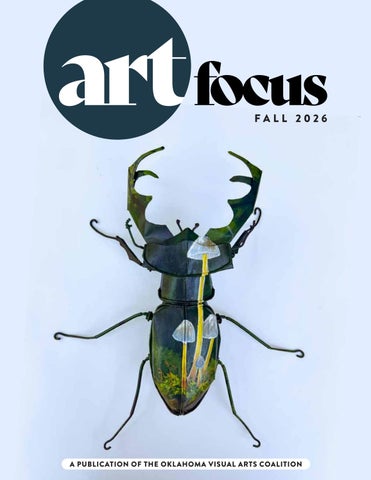
ON THE COVER // Amber Andersen, Metalmorphasis, Not Mushroom for Competitors (collaboration with Joshua Cook), mixed media (aluminum can, wire, other recycled materials, acrylic paint, 10” x 12” x 3”, page 24. MIDDLE // Denise Duong and Gabriel Friedman, Formless Matter and Its Devastating Gestures, 2026, structural steel, eastern red cedar, paint | Photo courtesy of Oklahoma Contemporary, page 6. BOTTOM // Destiny Green, Anoktoklo - Ayoppacha Nokhánglo (Of Two Minds - Happy and Sad A Rhapsody), photography and lens-based artwork | Photo provided by artist, page 20.
ANNUAL SUPPORT FROM:
OKLAHOMA VISUAL ARTS COALITION // PHONE: 405.879.2400 609 W. Sheridan Ave., Oklahoma City, OK 73102 Web // ovac-ok.org Executive Director // Rebecca Kinslow, rebecca@ovac-ok.org Editor // Zoe Elrod, zoeetravers@gmail.com Art Director // Anne Richardson, speccreative@gmail.com Art Focus is a quarterly publication of the Oklahoma Visual Arts Coalition dedicated to stimulating insight into and providing current information about the visual arts in Oklahoma. Mission: Growing and developing Oklahoma’s visual arts through education, promotion, connection, and funding. OVAC welcomes article submissions related to artists and art in Oklahoma. Call or email the editor for guidelines. OVAC welcomes comments. Letters addressed to Art Focus are considered for publication unless otherwise specified. Mail or email comments to the editor at the address above. Letters may be edited for clarity or space reasons. Anonymous letters won’t be published. Please include a phone number.
2024-2025 BOARD OF DIRECTORS // Douglas Sorocco, President, OKC; Jon Fisher, Vice President OKC; Matthew Anderson, Secretary, Tahlequah; Jacquelyn Knapp, Parliamentarian, Chickasha; Marjorie Atwood, Tulsa; Barbara Gabel, OKC; Farooq Karim, OKC; Kathryn Kenney, Tulsa; John Marshall, OKC; Chris Winland, OKC OVAC champions individual artists’ voices and creative expression. The views, positions, or values shared in Art Focus do not necessarily represent those of our Board, staff, donors, or funders. Member Agency of Allied Arts and member of the Americans for the Arts. © 2026, Oklahoma Visual Arts Coalition. All rights reserved. View the online archive at Ovac-OK. org/ArtFocus.
3
LETTER FROM THE EDITOR feels especially important to continue. For many people, public art may be their first Photo by Colby Ballard
introduction to a local artist or the moment that sparks an interest in art they might not otherwise encounter. It can surprise us, challenge us or simply give us something new and beautiful to notice. That’s why I’m particularly excited that this issue features Duong and Friedman’s work through their large-scale outdoor installation Formless Matter and Its Devastating
Gestures
at
Oklahoma
Contemporary. I had the chance to see the work unveiled, and I remember thinking immediately that it was something special. One of the things I love most about Oklahoma’s art scene is this feeling that art truly belongs to all of us.
There is something exciting about seeing artists given the room to work at this scale, and I’m grateful that Oklahoma City gets to experience it and thrilled to share
As many of you have by now heard, Denise Duong and Gabriel Friedman’s public sculpture We Have Arrived was damaged in Oklahoma City’s Asian District. But it was the response that followed that has been a reminder of how deeply public art can matter to a community. Artists, arts organizations, elected officials and residents all came together to support Duong and Friedman and speak to the importance of protecting the art that becomes part of our shared landscape.
writer Olivia Dailey’s work on this piece.
It’s a conversation we began in our Spring Art Focus issue with Erin Schalk’s “Off the Wall: Behind Oklahoma’s Public Art Movement,” and it’s a conversation that
one long argument for why Oklahoma’s
It’s something our local arts scene knows well: this idea of looking out for one another, and it’s something that you’ll see in the story of Tulsa’s oldest volunteer-run visual arts organization. Writer Sallie Gardner’s story on the Tulsa Artists’ Coalition looks at an organization celebrating 40 years of supporting artists, exhibitions and community, largely through the work of volunteers. I sometimes worry that my editor’s letters start sounding like arts community matters, something I fear anyone who is reading this probably already knows. But stories like this make
that argument far better than I ever could. Forty years is a remarkable legacy, and it speaks to what can happen when people are willing to give their time and energy to making space for art. This issue also introduces us to some remarkable individual artists. Amber Andersen’s intricate, nature-inspired work graces our cover, and Karen Paul’s “In the Studio” offers a closer look at the artist behind it. I’ve always been a sucker for insect art, so I was immediately drawn to Andersen’s work. Molly Murphy Adams takes us to Tulsa for a preview of Destiny Green’s Falaháma Bíyyi'ka – Eternal Return, a photographybased exhibition centering Southeastern Native tribal members. Anna Smist also reviews Echoes of Time and Place: Sauk Art and Culture, exploring the work and stories represented in that exhibition. Oklahoma’s art history and its present-day arts community are inseparable from the Native people whose lands we live on and whose artistic traditions continue to thrive. We are honored to feature artists who are carrying those traditions forward. Art everywhere lasts because people make room for it. And so, when I look around and see our fellow neighbors gathering together to raise funds to protect local art, and when I witness four decades of volunteers supporting local art in our state, I can’t help but think that, despite everything, maybe we’ll be okay.
ZOE ELROD is an Oklahoma City-based writer and multimedia storyteller with bylines in KOSU, Make Oklahoma Weirder, Oklahoma Today, Oklahoma City Free Press, etc. Outside of work, she enjoys live music, arts festivals, trips to the movie theater, spending time with her wife and their two dogs, and exploring and uncovering Oklahoma’s iconic and unexpected sides. 4
LETTER FROM THE EDITOR
First American Fine Art & Gifts ExhibitCGallery.com 645 First Americans Blvd. | Oklahoma City | (405) 767-8900 Wednesday–Monday (closed Tuesdays) 10 a.m.-6 p.m.
FORMLESS MATTER: THE ART OF DISORDER // by Olivia Dailey
6
F E AT U R E
Gabriel Friedman and Denise Duong are prolific artists in the Oklahoma City metro area. Their large-scale works can be found on either side of the Scissortail Pedestrian Bridge, in the Capitol Hill neighborhood, in the Asian District’s Military Park, and now through April 26, 2027, in front of Oklahoma Contemporary. Formless Matter and Its Devastating Gestures is on view at the outdoor Campbell Art Park. Featuring a large wooden head emerging from the earth, lying on its side, its hand lining up increasingly sized wire birds, Formless Matter and Its Devastating Gestures is a study of human nature’s inherent need to create order in an entropic world, no matter how fraught or futile, an unavoidable fool’s errand. The gesture the figure is depicting was based on the artists’ daughter, who, at a very early age, would line up items from biggest to smallest. The original drawing of the proposed artwork depicted a longer, slender, more feminine hand, and, while some of those characteristics were lost in the translation from 2D to 3D, and there’s no hair on her head, her size and posture around these little birds evoke a divine goddess. She simultaneously represents innocence and youth, but her scale suggests something
more
powerful,
like
Mother
Nature
herself. Her expression oscillates between sleepy and hyper-focused. The wooden head stands at nearly 13 feet, and the largest bird is 12 feet in diameter. The birds are hollow with benches inside the perimeter, allowing people to walk through them or sit inside to look at the metal drawings dispersed throughout. The scale messes with the viewer’s perception; the birds get progressively smaller towards the looming head, giving an Alice in Wonderland effect. Duong and Friedman connected the massiveness of the concept with the massiveness of the art. The art had to fit the space, but also the meaning. The result feels very collective, representing the universality of the gesture and the human compulsion behind it. We’re all just tiny specks on a big rock in the sky. Denise Duong and Gabriel Friedman, Formless Matter and Its Devastating Gestures, 2026 | Courtesy of the artists
The theme works on many levels. There are details and meanings to be discovered up close. The piece can be understood from a distance, but it takes on a deeper F E AT U R E
7
meaning when examined at eye level. The metal, woven birds are chaotic, made of only organic lines, but also structured, like a house or a cage, which could represent humans’ attempt to exist within the chaos by building on top of it. Initially, the gesture feels pure, but after sitting with it for a longer period of time, zooming into the human psyche and its desire to create order within chaos, the gesture’s meaning becomes heartbreaking or ‘devastating.’ Art itself is another way humans make meaning out of disorder. Duong and Friedman are partners in art and in life. They love to challenge themselves and take on bigger and more complicated projects, this one being their biggest yet. “We put more energy and time into developing the idea than anything we’ve done together,” says Friedman. They conceptualize together but also stay in their lanes and respectfully defer to the other person’s artistry and execution: Duong goes off and paints, and Friedman goes off and builds, then they bring it all together. “We understand each other’s strengths and how to not impose our own ideas on each other,” says Friedman. Duong’s drawings appear in the form of metal outlines scattered inside the four birds and on top of the wooden head. They intend to inspire the hope of dreaming. “Always dream,” says Duong, “In a technologically driven world, we are deprived of daydreaming, which is one of my
to get all the pieces made and assembled. They cleared their schedules and got to work. Friedman hired two shop assistants, Jack Dean and Clint Walker, for a period of time in order to meet the deadline. Between the artists, the museum staff, the sawmillers and sandblasters, Justin Wishon, who did transport and install, and the grandparents helping out with childcare, it was a collective effort of support systems to bring the art to life. “This presentation is especially significant as the first Campbell Art Park installation featuring a local artist, underscoring Oklahoma Contemporary’s commitment to celebrating and elevating the extraordinary creative talent within our own community,” says Riley. The sketches from the proposal were used in the promotional material, and the public responded very positively to the heartfelt, hand-drawn aesthetic as a counter to the commonplace glossy, digitized approach and current AI hellscape. “One of the greatest joys has been watching young children interact with the work,” says Pickett about the public’s reaction to the final results. “Knowing that Gabriel and Denise’s own children inspired its creation makes those moments especially poignant. It is a beautiful reminder that the strongest works of public art do more than transform a landscape. They create space for curiosity, connection, and shared experience across generations.” See Formless Matter and Its Devastating Gestures at the Campbell Art Park now through April 26, 2027.
favorite ideas of being a human. We have the unique ability to get lost in an imaginary world.” On the back of the figure’s head, there is a wide, pie slice cutout with a large, layered mural inside. A robin’s egg blue background against neutral cream and black images of people, flowers, and other figures, in Duong’s distinctive style. The mural represents the woman’s inner world.
OLIVIA DAILEY earned a B.A. in Journalism from the University of Oklahoma. She works as a program manager for a transportation research center in Norman and is a frequent Art Focus contributor.
The project’s proposal was rediscovered when Trent Riley, in his new role as Oklahoma Contemporary’s Executive Director, found the hard copy nearly three years after it was submitted. A few months later, when AnnaVittoria Pickett joined Oklahoma Contemporary as Director of Exhibitions, the artists were approached, and the installation was booked. Duong and Friedman worked on a compressed timeline
8
F E AT U R E
Editor’s Note: As this story goes to press, we’re mindful of the recent fire which damaged We Have Arrived, Denise Duong and Gabriel Friedman’s public sculpture in Oklahoma City’s Asian District. Created to honor Vietnamese refugees and their families, the work has become a meaningful part of the community and is an example of the impact of Duong and Friedman’s work.
ABOVE // Formless Matter architectural sketch: Denise Duong and Gabriel Friedman, Formless Matter and Its Devastating Gestures drawing, 2022. Graphite on paper. Courtesy of the artists; BELOW CLOCKWISE // Denise Duong and Gabriel Friedman, Formless Matter and Its Devastating Gestures will be on view in Campbell Art Park from May 28, 2026, through April 26, 2027; Gabriel Friedman welds a sculptural frame | Courtesy of Oklahoma Contemporary; Denise Duong and Gabriel Friedman | Photo by Beau Brand, Courtesy of the artists; Inside Denise Duong and Gabriel Friedman’s studio | Courtesy of Oklahoma Contemporary
F E AT U R E
9
ABOVE // Opening reception for Echoes of Time and Place: Sauk Art and Culture at the Mabee-Gerrer Museum of Art, Shawnee, Oklahoma on June 6, 2026 | Photo by Christi Wood-Dutro @wyoming307_; BELOW // Dukon Harris (Sac & Fox/Comanche), Sauk Family by the Mississippi River, 2026, moose antler, acrylic paint | Photo by Christi Wood-Dutro @wyoming307_
10
REVIEW
ECHOES OF TIME AND PLACE: CURATING COMMUNITY // by Anna Smist
Group exhibitions bring artists together for a period of time. No artist is intended to stand completely on their own. In Echoes of Time and Place: Sauk Art and Culture, the effect of including a dozen artists from the same community expands each artist’s work beyond the individual to reflect who they are in their larger community. Co-curated by Janae Grass (Sac & Fox/Absentee Shawnee/Mvskoke) and Tony Tiger (Sac & Fox/Seminole/Mvskoke), this contemporary exhibition was on view at the Mabee-Gerrer Museum of Art in Shawnee, Oklahoma from June 6–August 30, 2026. Over 30 works made up the exhibition by artists aged 22-72, who may be self-taught or have varying degrees of artsbased education, and several who had never shown their work professionally before. Through talking to the co-curators and understanding some of their motivations behind the show, it became clear what a unique exhibition this is in being able to bring a community together. The Sac & Fox Nation is one of 39 Tribal Nations currently headquartered in what is now called Oklahoma, while the city of Shawnee is within state-recognized Sac & Fox tribal jurisdiction. Echoes of Time and Place lives out its title by physically traveling to different locations important to Sauk people as its next location is the Dubuque Museum of Art in Dubuque, Iowa. Starting in Oklahoma, however, the exhibition opened to where many Sauk community members live today. Place is also brought to the surface in the exhibition through pieces like Sauk Family by the Mississippi River by Dukon Harris (Sac & Fox/Comanche). Here, Harris paints a Sauk family directly onto a moose antler. The choice of material recalls Sauk ancestral homelands prior to settler encroachment and U.S. federal policies that pushed the Sac & Fox into Oklahoma. While moose are not found in Oklahoma, they
do live in the surrounding Great Lakes area, which is part of Sauk ancestral homelands. Co-curators and artists themselves, Janae Grass–a 2026 THRIVE Grant recipient–and long-established career artist Tony Tiger are no strangers to Oklahoma’s visual arts community. The two have frequented art markets, shown solo exhibitions, and have their work represented in a number of collections across the country. Bringing together a community of contemporary Sauk artists was important to both of them from the beginning as they built this exhibition. When preparing the prospectus, Grass and Tiger discussed the idea of incorporating historical works, but Grass said museums all over are “already doing that.” Centering contemporary artists instead allowed for a different conversation to happen. Curating this show, according to Tiger, came down to “talking to people and finding out what they did.” Assembling a checklist with Sauk artists required the co-curators to know who to reach out to and get introduced to one another. Tiger expressed he was “thankful this project is bringing us together” now. Beadwork, ribbonwork, fingerweaving, and more are represented throughout this exhibition seemingly in equal measure. The multimedia element of the exhibition is a major strength of the show which still conveys cohesiveness as the artists create from a shared visual language. Tiger’s Inter-Tribal with its interlocking floral design and warm colors, for example, neighbors Jessica Moore-Harjo’s I’ll Always Be With You with its tiered steel floral cutouts overlaid on a dozen colors, and both reflect the skills of the artists while also delivering work from a Sauk worldview. Recognizability in Sauk art is something Grass credits to how “Our own people [are] able to hold onto visual
REVIEW
11
ABOVE // Jessica Moore-Harjo (Otoe-Missouria/Osage/Pawnee/Sac & Fox), I’ll Always Be With You, 2026, digital art, stainless steel, antique beads on canvas. Photo by Christi Wood-Dutro @wyoming307_ LEFT // Tony Tiger (Sac & Fox/Seminole/Mvskoke), Inter-Tribal, ink serigraph, acrylic on panel. Photo by Christi Wood-Dutro @wyoming307_
language today” which is “inspiring [her] to keep our visual language alive.” Typically defined by abstract florals, the works immerse viewers into a perspective that is very specific to these artists. The result is an emboldening of the artwork displayed which is valued in the context of its community rather than removed from it. Tiger spoke to what the show means to him as he reflects on his own career. 12
REVIEW
“I don’t see too many shows like this,” he said. Seeing artists who had never shown professionally before respond to their work left a deep impression on Tiger. He said “they were just blown away.” Knitting together generations of Sauk artists in Echoes of Time and Place is especially relevant as Tiger can see Grass carrying something forward from this curatorial experience to the benefit of her career and others. Speaking about Grass, Tiger believes “You’re going to have this knowledge and you’re going to go with it” wherever this experience takes her next. It is impossible to feel lonely when in this exhibition looking around at all these Sauk artists who thought it was important to come together for something like this. As someone who has often been featured as the sole Sauk artist throughout his career or one of very few in exhibitions or markets, Tiger understands how the world, community, and even the legacy of his career is changing things for the next generation. “I can see it now,” he said. Both co-curators have several projects coming up. Janae Grass is a Native Arts + Cultures Foundation 2026 LIFT awardee working on her newest site installation project, and Tony Tiger’s group exhibition Indigenous Impressions: Printmakers from Indian Country, co-curated with Bobby C. Martin (Muscogee Creek), will open November 6 at Exhibit C Gallery in Oklahoma City.
ABOVE // Janae Grass (Sac & Fox/Absentee Shawnee/Mvskoke), Talking with Spirits, 2023, deer hide, commercial leather, cotton glass beads, nickel | Photo by Christi Wood-Dutro @wyoming307_
Anna Smist (Sac & Fox Nation of Oklahoma, Deer Clan) works at First Americans Museum (FAM) as a curatorial assistant. She graduated from Yale College with a degree in history of art and English and is currently pursuing an MFA in cultural administration at the Institute of American Indian Arts (IAIA). REVIEW
13
14
F E AT U R E
TULSA ARTISTS’ COALITION CELEBRATES 40 YEARS // by Sallie Cary Gardner
It’s hard to imagine an arts organization with a more vibrant history, more memorable exhibits, or more fascinating members than the Tulsa Artists’ Coalition, which celebrates its 40th anniversary this fall as the oldest volunteer-run visual arts organization in Tulsa. Although there were times during TAC’s history when there was no money in the bank and no building to call home, TAC has survived and thrived because of the strength of its mission, its long-term board members who watch over its financial health like hawks, and the generous support of Arts District real estate developer and visionary David Sharp.
“Although we only made about $300, we still considered it a success,” Liggett said. Ultimately, the owners of the Miller Building had other plans for it, but TAC moved forward. In August 1986, TAC was incorporated as a 501(c)(3) and began its nomadic years, hosting exhibits wherever TAC leaders could talk someone into letting them use a space.
TAC’s mission is to encourage and support emerging and established contemporary artists, and to foster and develop new forms of multidisciplinary work in Tulsa and
TAC held exhibits at the Southroads Mall, The Galleria on 71st & Lewis, Manion Park Center, and Gold Coast Coffee in Brookside until moving into its present home at 9 E. Reconciliation Way in 1992 in a building owned by David Sharp. It’s impossible to overemphasize Sharp’s influence on TAC and the Arts District. As a young attorney out of the University of Tulsa’s School of Law, Sharp had an affinity for old buildings in what is now the Arts District and
surrounding areas. TAC’s funding comes from members’ dues, art sales, and a few grants, such as one from the Tulsa Arts Alliance. Unlike many arts organizations, with only one exception, TAC hasn’t sought funding from major philanthropists because it has never wanted to have a supporter who influenced its choice of exhibits.
BELOW // TAC’s “blink and you’ll miss it” entrance has remained the same since 1992. Artist J.P. Morrison is shown in the doorway before her first solo show at TAC as a 16-year-old. She now teaches art and exhibits her mixed media works internationally.
Gallery owner Steve Liggett was TAC’s first board president, and entrepreneur Michael Christopher was vice president. Along with others, the two initiated a phone-a-thon in 1986 to determine interest in a new arts organization. Shortly afterward, efforts began to raise money to lease the Miller Building on then Brady Street with a party called “Space Lift Off.” Liggett estimated that a thousand people attended. The party had a huge inflatable sculpture, performance art, dance, poetry readings, and multiple bands. The variety of different types of art would become typical of the early days of TAC, which later emphasized visual art.
OPPOSITE // David Eric Morrison, Peter Loses Wendy. David, the current president of the TAC board. Morrison plans to continue member parties, art talks, and workshops initiated by outgoing president Colleen Stiles. | all photos provided by Tulsa Artists’ Coalition
F E AT U R E
15
ABOVE // TAC’s Pop Up exhibits have become popular in the last two years. The most recent was Everything Must Go by mixed media artist Rochelle Hardman, who is shown talking about her process with a gallery visitor.
ABOVE // Flower Moon Art Show postcard, 2023 featuring the painting Where the Wild Things Are by Alex DeRoin. The Flower Moon Art Show exhibit in October 2023 featured 20 artists who worked on the “Killers of the Flower Moon” movie set in Pawhuska. Some of the works exhibited were created by extras in the movie who took painting and drawing classes during down time on the set. TAC has hosted many exhibits of Native American art since its beginning. BELOW // The line for entrance into the 5x5 Show & Sale wraps around the block on Reconciliation Way. The show is held annually on the first Friday closest to May 5, opens at 5:55 p.m., and works are sold for $55.
hated seeing them being torn down. So he started buying up properties with no idea of what to do with them, but was generous to artists and arts organizations because he didn’t want the area to be overrun with bars. To this day, he is known to say that although he was the person who started what is now known as the Arts District, it’s the artists who have kept it going. Some of the office spaces TAC used for its headquarters before 1992 were a room on the second story of Ziegler’s art supply store and an unused office in a former trucking company which was in what is now Guthrie Green. Its loading docks were used for monthly coffee-house style gatherings of artists who did performance art, played music, and read poetry. The gatherings were called “The Upstairs Underground” and were originated by early board member and musician Ralph Bendel. Long time TAC board treasurer Catherine Wall and Dean
16
Wyatt, who was board president for 16 years, are both CPAs and said there have been times when TAC’s coffers have been so low that they’ve worried about its survival, but starting the 5x5 Show & Sale in 2000 has been a huge help. Wyatt said that TAC’s 5x5 was modeled after OVAC’s 12x12 show, but, because of the small square footage of the gallery, smaller artworks were used. This year, 250 5x5s were collected and sold, the most in a decade. Board member Greg Gray, DO, started the First Friday Arts Crawl in 2007. Dr. Gray owned Bar 209 and had observed that other cities were holding First Friday events. He called then-board president Dean Wyatt, and board member R.C. Morrison, a photographer, and asked to meet with them about starting an art crawl. The next month, the first First Friday Art Crawl took place, with only TAC, and two other art venues open late. Now hundreds of people swarm Reconciliation Way first Fridays to enjoy an evening out.
ABOVE // Edward Mains, an assemblage artist and attorney, and Janice McCormick, editor of TAC’s first newsletter, have been members of TAC since its creation in 1986 and remain active on the board. They’ve been married for 50 years. BELOW // After TAC held two Of Women, By Women exhibits in the late eighties, male artists called for equal time and held the For Men Only exhibit in July 1995 as this postcard promotes. The late Steve Tomlin did the sketch and was a beloved early president of TAC.
Until the blossoming of new art venues in the last five years, TAC was the only place for young and emerging artists to show their works. An exhibit that created a lot of buzz was Of Women, By Women, which was held in 1992 in the lobby of the Trammell Crowe building during TAC’s nomadic years. A board member since 1986, Janice McCormick remembers that three paintings in the show were banned from public viewing and were moved to a storage area that shared a glass wall with employee’s smoke hole. “The irony was that more people probably looked at those paintings during their smoke breaks than they would have when they were hanging in the lobby,” McCormick said. Another groundbreaking show was Eric Humphries’ Painted Atrocities about Tulsa’s race massacre, which Wyatt said was held long before the massacre was part of community conversation. A show that also had Tulsans buzzing in the mid 2000s was “You Can’t Show That in Tulsa,” nicknamed “You Can’t Show TIT,” Wall said. Two long-lasting annual exhibits that Tulsans remember fondly were Twelve Days by Twelve Artists held during the holidays and Embellishments, a fashion show of wearable art that was held for a decade. A key part of TAC’s story was the election of Colleen Stiles as board president in 2022. Stiles coordinated F E AT U R E
ABOVE // In its early years, TAC held board meetings and coffee-house styled gatherings named the “Upstairs Underground” in an unused trucking company which is now Guthrie Green. Most people called the gatherings “dock parties.”
TAC’s branding materials for the first time, including an extensive revamp of its website. “Colleen took what had been a bohemian, bandit organization and made it into a professional organization,” Morrison said.
ABOVE // The two most loyal fans of the 5x5 Show & Sale, Diane Buchner, (left) and Claire Johnson (right) set up camp on the sidewalk outside the TAC gallery on the morning of the show so they will have first dibs on works by their favorite artists. They’ve been doing it for almost all 25 years of the show.
honor to help ensure that same sense of opportunity and community continues for the next generation of artists,” Morrison said. TAC’s chances for another forty years—or more—of continuing to help artists be artists are looking good.
Stiles also reintroduced member events, such as workshops, art talks, and parties. Some former TAC members who had let their membership lapse rejoined just to attend the parties. Stiles’ successor David Morrison started as president in July. Morrison is a librarian whose mixed-media art is sought after in Oklahoma City as well as Tulsa. “For me, TAC was the first place where I realized that I belonged in the larger conversation about art. It’s an
A postcard promoting TAC’s 5 x 5 Show & Sale in 2001, the second year it was held. It’s TAC’s only fundraiser.
18
F E AT U R E
SALLIE CARY GARDNER is a writer and storyteller based in Tulsa. She’s a member of the Tulsa Artists’ Coalition board and a competitive storyteller. She won second place in the Ok So 12th Annual Grand Slam held in May at the Cain’s Ballroom and third place in the 2023 Grand Slam. You can watch her stories on Instagram @the.story.lady and her YouTube and Facebook videos at: The Story Lady - Sallie Gardner.
19
AN ETERNAL RETURN IN TULSA // by Molly Murphy Adams
Living Arts Gallery in Tulsa, Oklahoma will feature work by photography-based artist Destiny Green (Chickasaw Nation) for a two-week exhibition titled Falaháma Bíyyi’ka – Eternal Return in the West End Gallery December 4-19. Green shares two distinct but related bodies of work focused on the cyclical nature of her reconnecting with Chickasaw culture, art, people, and legacies. The Portrait Series is a group of thoughtful black and white portraits of Southeastern Native tribal members who are bearers of incho’wa, or ancestral tattoos. The Gorget Series is comprised of digital compositions centering figures evoking historic poses and motifs in highly stylized images. Both series are examples of photography as a restorative medium in the hands of a culturally attuned photographer who centers consent and community over extraction and subjectification. Green specifically refers to all the subjects of portraits as participants to ensure that the language used to describe her work preserves the mutuality of the process. The Portrait Series began as a commemoration, recording, and celebration of the revival of southeastern tattoo traditions. The 20”x 16” prints present the image to the viewer on a human scale creating a sense of engagement. The rich black and white tonal quality evokes film noir and a 1930s aesthetic while the calm and engaging demeanor of the participants invites the viewer to look closely at their bodies and the designs of the incho’wa, keeping the dynamic mutual and balanced. The invitation of the images is to look closely at the skin, tattoos, and the bodies of the participants without voyeurism or objectification. In the portrait Erica Eppler, the incho’wa bearer gazes directly out from the dark background with hands held gently to the chest to show the delicate tattooed lines
20
PREVIEW
across the fingers in a gesture of both reverence and benediction. This dynamic of sharing or presenting on the participants’ terms is maintained by nuances of expression and context set up deliberately by Green working closely with the participants to create a balance of intimacy and boundary. Green begins with dialogue within the community, asking formally and informally for introductions to bearers of incho’wa and their community connections to culture. By beginning with community vetting and then progressing to making and preserving the image of the bearer, Green’s process relies on photographer and sitter working as equal participants. The final stage has further unseen participants in the form of the Chickasaw community in the past, present, and future. Green’s work emphasizes this cyclical nature of time, knowledge, action, and meaning in all her work. “The conversations always begin with how a participant is connected with their community,” Green says of her process. “I establish a dialogue based on the revitalization of Southeastern tattooing practices.” She further elaborates on the relationship between the designs, the bearers and the community. “The portraits show the ancestral markings, but the documentation is a means by which we remember the people themselves,” Green says. “The markings do not exist without the person, and the person exists within a community.” The practice of body adornment by tattooing for Indigenous people was near universal and deeply meaningful in precontact eras but gradually diminished in use as assimilation and punitive colonial policy reduced the application of cultural practices. Recent efforts to
Destiny Green, photography and lens-based artwork | All photos provided by artist
Brit Reed
Brittany Postoak
Christian Lindley
Dustin Mater
Erica Eppler
Faithlyn Seawright
Gabby Nucosee
Kyra Hornbuckle
Sophie Mater
Tom Farris
Trinity Welch
PREVIEW
21
Destiny Green, Tobach (Becoming), photography and lens-based artwork | Photo provided by artist
revitalize and connect to historic practices have resulted in a resurgence of incho’wa. This resurgence requires a renewal of protocols between the knowledge keepers and makers of tattoos and the bearers of incho’wa and is present in this photography series as community witness. With the documentation of the incho’wa in portraits and the display in this exhibition, the process is brought full circle and stays in motion renewing that commitment to making, bearing, and witnessing identity. The Gorget Series is a group of large-scale digital compositions featuring female protagonists in narrative scenarios. These large-scale prints are a more immersive experience at about 30”x30” with minimal frames. Each work features photos of one or more people in stylized poses invoking a narrative that seems paused in action with figures appearing disconnected from real space. The clothing and adornment are both historic and modern and posed in a manner referencing historic Chickasaw art forms. The round and oval shapes of each composition reflect the Chickasaw motif of the gorget, a form of personal adornment worn on the chest, historically made from shell or later metal and carved with low relief outlined figures and geometric designs. Each gorget would contain a small element of a narrative, a starting point or call back to a larger idea that is central to the worldview of the Chickasaw people. The modern interpretations by Green are bounded with geometric line work and pattern taken directly from historic carving and pottery sources from precontact southeastern cultural material. The edited images of figures have been altered, collaged, and rearranged to create self-contained narratives in a 22
PREVIEW
circular composition encouraging the viewer to engage with the image in a circular rather than linear pattern. The circular compositions recall and are inspired by historic Chickasaw gorgets, and the geometric borders and elements add a sense of physicality blurring the distinction of image and object. The circular format provides a nonlinear narrative style where time and stories cycle through endlessly with the retelling, remembering, and reproducing on physical art forms. The circular design echoes the pattern of ceremonial and social dance with the counter clock rotation embodied in the dancing at stomp dances in Chickasaw communities. The gorget motif starts as a stylistic choice but reveals layered implications as a means of learning about Indigenous ways of thinking and the worldview of historic Chickasaw artists. In this series, Green shares her process of rediscovering a connection with the internal mind of her ancestors through pattern, design, and philosophy.
MOLLY MURPHY ADAMS (Oglala Lakota descendant) was born in Montana and earned a bachelor’s degree in fine art from The University of Montana and a master’s in art history from Oklahoma State University. She has made Tulsa her home for more than fifteen years while working as an exhibiting artist, art appraiser, art historian, and beadworker in her Indigenous community. Murphy Adams focuses on Indigenous beadwork in her many roles as a researcher, teacher, and community maker.
Destiny Green, photography and lens-based artwork | All photos provided by artist
Fochik Imihoo II (Wives of Stars)
Fochik Imihoo (Wives of Stars)
Anoktoklo - Ayoppacha Nokhánglo (Of Two Minds - Happy and Sad A Rhapsody)
Chinokfónkhataa (Do You Remember)
Ihoo Oshta Holítto’pa’ (Four Precious) Holy Women Matrilineal Descent
Yanhat Salhpokonnahmat Ihoo Pisalitok (I Saw a Woman in My Feverish Dream)
PREVIEW
23
IN THE STUDIO: AMBER ANDERSEN AND THE BEAUTY OF INSECTS // by Karen Paul
In the world of Woodward artist Amber Andersen, the
I love insects so much! I’m in multiple entomology groups
natural world of insects, fungi, and natural elements is a
online, and everyone is always sharing great information.
place of softness, magic, and excitement. Andersen joined
Once I find something new, I do a deep dive and learn
us to discuss her love of insects, her work and what’s next
everything I can.
on the horizon. For someone who isn’t familiar with your work, can you describe
opposed to the world as a whole?
it in a couple of sentences?
In the last two or three years, I’ve been focusing mostly
I would say that my work is representational of life in a
on Oklahoma native insects. I do think it’s important
natural environment, especially insects, and the way that
to appreciate them. Painting them in a way that makes
they interact with the world. It is typically quite lush, and
them feel approachable and appreciated can begin the
bold in color. It feels like an adult I Spy page.
conversation in another person’s own mind and spark the
Your work has an ethereal, dreamy quality, regardless of scope, scale or type of insects you’re painting.
wonder that leads to curiosity, understanding, and then appreciation. It starts a domino effect.
I think that might be a translation thing. For me, the
You’ve built some amazing new collaborations. Can you tell us a
natural world is a place of awe, and I feel full of wonder
little about what’s next?
and excitement about everything I find there. When it gets
I have met and befriended another insect artist named
translated through my eye, it comes out having a magical
Joshua Cook whose art practice is called Metalmorphosis.
quality. I think that comes from the way that I push colors.
He uses all recycled materials — aluminum cans, wire
I do a lot of blues and purples in the shadows, and I think
and things like that. When you meet another bug artist,
that’s the technical reason why it feels so ethereal, but I do
you can’t not work together! I asked him if he would like
try and capture the softness and the magic of what I see.
to collaborate. He does some sculpting, and I paint the
Can you talk a little bit about the range of things you create? Often artists will be very narrowly focused, only doing butterflies of a certain type, or paintings of a specific scale. You cover a wide range of insects and paint everything from 2” works to murals. Insects in general are so fascinating. I’m very passionate about learning and exploring them. There are, I think, more beetle species in the world than there are, like, all of the other species of mammals or something like that. It’s absurd when you think about just how many insects there are. It becomes this never-ending dictionary of bugs that I can get excited about and portray.
24
How much of what you create exists in your backyard, as
sculptures. We initially created three small collaborations, and people loved them. Now, we have a shared exhibition planned this December at the Plains Indians and Pioneers Museum in Woodward. In October, I have an exhibition called Close Wilderness at MAINSITE Contemporary Art in Norman. It is all watercolors of insects in their natural environment. One of the paintings that I’m most excited to show is called What Remains. It features two endangered American burying beetles, which are native to Oklahoma. Something like 80 or 90 percent of their habitat has been lost to urbanization. They’re a type of carrion beetle. In this work, they are on top of a European starling, which is an invasive species. Starlings are one of
People might be surprised to learn that you don’t have an
the most invasive species in the world. The painting is a
entomology or science degree. How do you learn so much
cheeky thing about the invasive species being dead, and
detailed information?
its remains becoming food. The title is also a play on words
IN THE STUDIO
ABOVE // Amber Andersen, Cicada Cadence (collaboration with Sophy Tuttle), exterior latex paint on brick, 18’ x 32’; BELOW LEFT // Amber Andersen, Veiled Moonlight, 9” x 12”, watercolor; BELOW RIGHT // Amber Andersen, Admiral, watercolor, 4” x 6”
IN THE STUDIO
25
ABOVE // Amber Andersen, Preying Patience, acrylic paint, 5.5” x 8.5” LEFT // Looking for Light, 4” x 8” BELOW LEFT // Papilion Paradise, acrylic paint, 8” x 9”
because it is bird remains, but the beetle population remains too. What do you want people to know about the next phase of your creative work? I’m grateful for everything that has happened so far. It feels like I’m being handed a surprise of some sort and I’m excited to see whatever form it takes. I’m ready to spread my creative tendrils throughout the country. There’s so much I haven’t uncovered and I can’t wait to explore it.
Amber Andersen’s exhibition, Close Wilderness, will run Oct. 9 through Nov. 13, 2026 at MAINSITE Contemporary Art in Norman. You can also find her on multiple social media platforms @amberandersenart.
KAREN PAUL is a fifth-generation Oklahoman, photographer and writer. She has been writing for Art Focus for more than 15 years. You can find her online at karenpaulok.com. 26
TOP // Amber Andersen, Flight of Cecropia, watercolor, 3” x 4”; RIGHT // Amber Andersen, Be Still, watercolor; ABOVE // Amber Andersen, Floating in the Cosmos, watercolor, 8” x 10”
IN THE STUDIO
27
609 W. Sheridan Ave. Oklahoma City, OK 73102 Visit ovac-ok.org to learn more.
DEPTH SPACE A
N
D
On display September 22 - December 12 Opening Reception September 24, 5:30 - 7:30 PM 1400 Classen Drive, Oklahoma City, OK 73106
Non Profit Org. US POSTAGE PAID Oklahoma City, OK Permit No. 113