UCLA'S QUEER NEWSMAGAZINE
SPRING 2014
TA B L E O F C O N T E N T S 3 Letter From the Editor news / p o l i ti c s 4 Casting Away Gender 5 Outside the Binary
2
a&e
/
6 9
Gay-Listers Queer Lit Summer Reading
featur e
10
Trans*Scripts
more n e ws / p o l i ti c s
14 15
The Pink Tide The New Lesbian
dating
16
The Real Vagina Monologues
a&e
18
Queers of Fortune
quiz
19
I'm Coming Out
o p i ni o n
OutWrite is UCLA’s queer and ally newsmagazine. OutWrite, formerly called TenPercent, was established in 1979 and was the first LGBT collegiate newsmagazine in the nation. OutWrite is an alternative multi-platform media outlet that deals with the issues that matter to young, engaged Queer or LGBT-identified individuals, both at UCLA and beyond. By illuminating topics that are not covered by the mainstream media, and by doing so with a distinctive, frank, passionate and progressive voice, we strive to engage our community and serve their needs through dialogue and active expression. The UCLA Communications Board has a media grievance procedure for resolving grievances against any of its media. For a copy of the complete procedure, contact UCLA Student Media at 310. 825. 2787. Copyright 2011 ASUCLA Communications Board
let te r f rom the editor
L
ast quarter, I participated with the other Student Media editorin-chiefs, along with members of the President’s Office and the Office of Residential Life in a Community Townhall. The purpose of the townhall was to reach out to the campus, to improve the quality of our content from the needs of the students whom we serve. My colleagues and I heard many wonderful suggestions and ideas to better cover the issues students are interested in, and two stood out quite clearly to me. One was the suggestion to cover more trans and genderqueer issues, and the other desire to see more stories about student experiences. To meet these suggestions, one of our writers, Alejandra Rodriguez, interviewed students, who identify as trans and genderqueer. We wanted to bring the issues affecting the trans community, by their own voice. One of the interviewees, Nami, says it all: “The T isn’t silent.” This article desires to prove the need to hear the voice of UCLA’s trans community. We, as OutWrite, will function as the medium for the voice of these marginalized students, to improve the campus for the Queer community. There should be no doubt that these issues need to be discussed. Recently, the UC system released the results of a survey of each university’s campus climate. The report reveals the exclusion and discrimination felt by the genderqueer and trans communities on campus, by admission of the identities in question. These results should be known, so that the campus may make progress to rectify their exclusion and discrimination. We desire to voice these results and watch the progress occur. OutWrite defines itself by the power of its voice and the need to give agency to those who normally don’t possess it. Our managing editor, Kayla Vernon Clark, discusses the power of one’s voice, and the political strengths it possesses in her artciel regarding the manner of celebrites coming out recently. We at OutWrite wish to use our voice to maintain the same political statement in our stories. So please, turn the page, learn from the experiences and beliefs of the students we interviewed and wish to represent.
www.outwritenewsmag.org facebook.com/outwritenewsmag @outwritenewsmag
EDITOR-IN-CHIEF Bryan Platz MANAGING EDITOR Kayla Vernon-Clark WRITERS Kayla Vernon-Clark Evan Moffitt Jill Parker Bryan Platz Alejandra Rodriguez DESIGNER Gabriel Hongsdusit ILLUSTRATOR Gabriel Hongsdusit COPY EDITOR Kayla Vernon Clark COVER MODEL Jawhara Tariq PHOTOGRAPHER Vince Goh PRINTED BY International Daily News
Interested in contributing to the Queer community at UCLA? OUTWrite is looking for writers, designers, illustrators, and photographers to join our staff ! Contact us for more info.
This magazine was made possible with the support of Campus Progress, a project of the Center for American Progress, online at CampusProgress.org
Enjoy!
3
ne ws / p olitics
CASTING AWAY GENDER
HIJRAS GAIN OFFICIAL RECOGNITION AS INDIA'S THIRD GENDER BY BRYAN PLATZ | EDITOR-IN-CHIEF | BPLATZ@MEDIA.UCLA.EDU
O
n April 15, 2014, India’s Supreme Court recently ruled in favor of recognizing transgender as a third official gender. The subcontinent has now joined neighboring countries Nepal and Bangladesh in the legal recognition of genders outside of the traditional binary. The ruling institutes a third gender option on all official documents, such as birth certificates, passports and driving licenses. It applies both to individuals who demonstrate gender characteristics other than their assigned sex, such as use of opposite gendered clothing, as well as those individuals who have gained physical characteristics of the opposite sex. "It is the right of every human being to choose their gender," the Supreme Court noted during its ruling according to BBC News. This statement presents the ruling as a clear acknowledgement of gender identities outside of the gender binary. Furthermore, the court related gender choice as a human right, thereby humanizing trans and non-binary communities. Such a powerful statement still has yet to be made in most of the world’s countries, including the United States. The court’s ruling not only allows individuals to identify outside of the binary, but also constitutes institutional support to end discrimination against these individuals within the country’s borders. A further court order provides quotas in jobs and education for those identifying as the third gender, along with other minority populations. The court also ordered inclusion for the those identifying as the third gender in state and federal welfare programs, including education and healthcare. The court ruling began as a petition submitted by a group of trans and nonbinary individuals who argued that their community was discriminated against both economically and socially. The group further asserted that their non-legal status made jobs and education inaccessible and condoned hate crimes. Through their petition, the community called for action against the injustices that the trans community in India faces. “Transgenders are also citizens of India,” answered the court. “The spirit of the Constitution is to provide equal opportunity to every citizen to grow and attain their potential, irrespective of caste, religion or gender.” Many of the 2 million trans folk in India not only
4
© CC 2006 Johanan Ottensooser "Hijras in Bangalore"
face discrimination every day because of their gender identity but also frequently live in conditions of poverty and social isolation. Institutional healthcare also become inaccessible to trans folk in the country, as (until this ruling?) hospitals were previously allowed to refuse admittance on the sole basis of gender identity. India now joins Nepal and Bangladesh in legally recognizing a third gender, countries that did so in 2007 and 2013 respectively. These neighboring countries share a similar cultural identity: a hijra. A hijra refers to a trans individual, although a common misconception limits this cultural identity to individuals assigned male at birth, who identify as female. The hijra community actually contains far more diversity, including members who identify as male, female and outside the binary. While public perception often views hijras as only individuals designated as male at birth, the third gender identity encompasses both these inidiviuals, as well as those designated female at birth, who identify other than their assigned gender. Despite the landmark decision of the court, India does not possess liberalism regarding the entire Queer spectrum. Early in December 2013,
India reversed a 2009 Delhi High Court ruling that overturned the criminalization of consensual samesex intercourse. The reversal reestablished a colonial era law, punishable by a ten-year jail sentence. Similar to the Supreme Court ruling, the reestablishment of the law came to fruition by petitions from various political and religious groups. This pattern of effective petitions indicates the tendency of the Supreme Court to follow the desires of its citizens. The new court order allows for individuals who identify outside of the binary to identify as the third gender, but it is unknown if the government will allow for identification beyond birth designations in favor of the opposite sex. While the court order demonstrates progress in overcoming the gender binary, it still lacks the flexibility to meet the wide spectrum of gender identification. Yet, this court action proves far more powerful, than anything done for trans* individuals in the United States, despite our growing acceptance of same sex relations.
news / politics
OUTSIDE THE BINARY QUEER ISSUES IN UCLA'S CAMPUS CLIMATE
BY BRYAN PLATZ | EDITOR-IN-CHIEF | BPLATZ@MEDIA.UCLA.EDU
D
o you have a boyfriend?” Questions such as these may seem harmless, but to someone whose partner may not identify as a man (or as a woman), they might be terrifying. Assumptions embedded in questions like these may act as microaggressions for students to whom they cannot apply. Specifically, students who identify outside of the gender binary— as Genderqueer or Trans, for example—are often subjected to uncomfortable social interactions due to the strict imposition of the gender binary. One of the most alarming findings in the survey was the number of students who experience exclusion, intimidation or hostility on a day-to-day basis: a full quarter of the surveyed responses described these experiences. Queer or LGBT respondents reported these occurrences more often than any other group. In terms of comfort, Transgender, Genderqueer and female students all reported greater discomfort with the overall campus climate than, especially, cis men on campus. Half of all Transgender and Genderqueer respondents reported these incidences. Transgender and Genderqueer respondents
also predominantly believed these experiences of hostility and exclusion occurred due to their gender identity: exactly 91%of Transgender students and 79% of Genderqueer-identified students. These high percentages indicate the campus continues to practices discrimination against students who do not identify within the gender binary. Students outside of the gender binary are subjected to far greater hostility, suggesting the well-being of the students depends on the social adherence to the gender binary. UCLA’s Genderqueer-identified respondents reported greater discomfort than any other gender identity populations, especially regarding group settings such as departments, schools, and clinical environments. Sixty-two percent of Genderqueer respondents reported exclusion based on gender identity. With more than half of the identified respondents experiencing exclusion, the prejudice faced by non-binary students and staff on campus becomes inarguable. Clearly the campus climate demands adherence to. the gender binary. The prevalence of this binary excludes individuals outside of it, so that social situations often exist as exclusionary
spaces for Genderqueer individuals. This affects how Genderqueer students participate in group dynamics, possibly damaging their social lives. Only half of Genderqueer and Transgender respondents described classroom climate as welcoming in stark contrast to the three quarters of cis respondents who reported the same. These numbers demonstrate that Genderqueer and Transgender students not only experience exclusion, but also oftentimes lack a positive academic environment. Queer identified respondents also reported about the lack of representation within faculty and staff on campus. Three quarters of Transgender students, and about half of both Genderqueer and LGBT students reported not having staff with whom they identify. The lack of Queer representation contributes to the unwelcoming environment of the campus, as many students frame their place on campus by way of authority figures such as professors and other staff. Yet while gender minorities may not receive the greatest acceptance, students identifying outside of heternormative sexual orientation often reported positive experiences. Respondents who identied as LGBT expressed similar comfort levels regarding overall climate to their heterosexual counterparts, both in classroom and work settings. Three quarters of LGBT-identified and heterosexual-identified respondents alike reported a welcoming classroom climate. This positive environment with regards to sexual orientation indicates the Queer community should begin to focus on issues related to gender identity and expression, in addition to sexual orientation. The student population proves by the positive experiences of identified students, the campus generally accepts and welcomes students identifying as a Queer sexual orientation. Though this positivity, the campus community should supplement acceptance for Queer students by involving more education and programing for the alternative gender identities. Surveys such as one dealing with campus climate have invaluable potential to aid the creation of a more inclusive and enjoyable campus experience for students. It allows the community to isolate populations in need of greater agency on campus and to pinpoint the current failures of the system. In terms of the Queer community, non-binary-identified students still require greater agency and support to improve their experiences on campus.
5
a&e
/ opinion
GAY-LISTERS
BY KAYLA VERNON-CLARK MANAGING EDITOR| KAYLAVC@GMAIL.COM
O
ops! I Lost My Pants…In the Limo with My GF” reads one of TMZ’s most recent headlines regarding Michelle Rodriguez’s recent outing with girlfriend Cara Delevigne. It is one of many headlines that have surrounded this now public relationship between the actress and fashion’s favorite It Girl, and one of an increasing number of headlines surrounding queer relationships. In the wake of more celebrities coming out than ever before, and in entirely new ways, the discourse around being gay in Hollywood has in the last couple of years begun to shift. Where once coming out demanded neon lights and a loudspeaker, the past few years have proved it can often happen as quietly as a whisper. In a 2012 Entertainment Weekly article, a quintessential piece in the new discourse
6
surrounding coming out, Harris discusses “the new blink-and-you’ll-miss-it style” of coming out as an “important hallmark of changing times.” He shares this in common with others celebrating this new form of coming out, because it implies the world must no longer be arranged every time a person utters the words “I’m gay.” Loudspeakers no longer need to shift tectonic plates to make room for every queer person who announces themselves. There seems space enough already for the softness of a dependent clause. Such appears to be true in cases like Jim Parsons’, who came out briefly and without incident in 2012. In an interview with the Times, he remarked that his part in “The Normal Heart” “resonated with him on a few levels,” given that he is “gay and in a 10-year
relationship.” The waves this statement made were minimal and apparently without incident. His place on one of TV’s most popular comedies, Big Bang Theory, does not seem to have been noticeably affected by the admission. Like Parsons, Zachary Quinto’s coming out experience came in the form of a casual sidenote, and also in relationship to a character role. Quinto mentioned without warning in a 2012 New York magazine interview that he could “as a gay man” identify with the themes embedded within Angels in America. Coming out was never the crux of his statement; it was sidelined as a mere dependent clause, mentioned casually and without pretext. He told no one of his intentions—not his friends, not his family, not his management. It happened, casually and without a bang. When asked later if he felt it
had impacted his career, he answered that in his opinion it had not. Of course, regardless of the softness of his admission, his sexuality very quickly became global news. It may not become the cover of newspapers or the most prominent headline, but it spread quickly and insistently, much to Quinto’s surprise. Despite this surprise, when asked to contextualize his motivation for coming out, he told ABC News, “In light of Jamey [Rodemeyer]’s death – it became clear to me in an instant that living a gay life without publicly acknowledging it is simply not enough to make any significant contribution to the immense work that lies ahead on the road to complete equality.” Where actors in the past have claimed
a desire for privacy to keep questions of their sexuality at bay, Quinto has come to terms with a fact that applies to anyone of a minority sexuality: it is a political act. There is no choice in the matter. To identify as anything other than heterosexual is inherently to be political. It is not a question of an individual’s politics, but it is very indicative of the politics of the culture. But Quinto’s reply also highlights something important: children are still dying. Queer individuals continue to commit suicide at a much higher rate than their heterosexual counterparts. And though the discourse surrounding coming out makes mention that it has become casual, that it is implied to mean less, to off-handedly dismiss it also diminishes
the continued political value of these moments. Casual or not, front page or merely a remark made in paragraph two, queer identity has value for the people who continue to feel alone—or worse. In a culture so obsessed with celebrity, where headlines around Justin Bieber continue to dominate over the riots in Ukraine and the loss of human lives, it is important to understand the weight celebrities are given, for better or for worse. Things are getting better. The world is changing, and there is room for optimism. But to focus too intently on the way coming out does not warrant the controversy it once did is to overlook some of the more basic facts about the industry at present. Here are some of those facts: twenty-two
© CC 2009 lincolnblues "Oscar"
7
© CC 2006 Sean Russell "Hollywood Sign"
straight actors have won Oscars for playing queer place if people were less horrible to each other.” characters. Only twice have queer identified But there was unquestionably build up to the actors—Angelina Jolie and Sir John Gielgud— reveal she made five minutes into her speech. ever themselves won. Only three queer “I am here because I am gay,” she said, and identified actors have ever been nominated, the standing ovation, lasting for thirty seconds, including Sir Ian McKellen. Queer characters could not have been more deafening. The may have carved out standing ovation and the tears "...actual queer something of a place at the in Page’s eyes as she struggled Academy Awards, but actual individuals to withhold her emotion, said: queer individuals continue this has not stopped mattering. to be sidelined in favor continue to be This is bravery. This is of an industry dominated strength. This is the other side sidelined in favor by white, heterosexual, of a struggle. This matters. cisgender actors. And Page’s follow up of an industry Most recently and statement said as much, when perhaps most interestingly, dominated she declared, “I suffered for Ellen Page added herself years because I was scared to by white, to the ranks of out queer be out. My spirit suffered, my actors at HRC’s Time to heterosexual, mental health suffered, and my Thrive Conference—with relationship suffered. And I’m cisgender actors." much more of a bang than standing here today, with all of a whisper. Though her you, on the other side of that speech discussed HRC’s work, and the powerful pain.” strength of people in the room in combatting This is not simply a decision that she made; homophobia that, for one, renders children this is an act of bravery against a system that without hope. She suggested, simply but willed her to be a silent. This is a powerful powerfully, that “the world would be a better statement against a world of institutionalized
8
homphobia that told her it would be safer, better, if she kept her mouth shut. And, with a bang, she refused. The danger of the current discourse surrounding modern coming out is that it threatens to gloss over its importance for the sake of progress. It threatens to erase the systems still in place that maintain homophobia and heteronormativity alike. 2014 may be better than the years that have come before it, but for every celebrity that comes out there are more teenagers in the world with a little bit more hope. Maybe, somewhere in the world, a scared thirteen year old girl read Quinto’s article and thought, I can do this. Maybe, somewhere in the world, a seventeen year old boy will watch Ellen Page’s speech—a speech which gained a million views in less than twenty-four hours, which became viral as soon as it hit YouTube—and think, Maybe I can make it to the other side, too. The world is less terrible than it used to be. But if we want it to keep becoming less terrible, these are the moments that count.
a&e
BY KAYLA VERNON-CLARK | MANAGING EDITOR | KAYLAVC@GMAIL.COM
THE SUMMER WE GOT FREE
MIA MCKENZIE (2013)
Mia McKenzie’s novel has received overwhelming critical acclaim for good reason. The complex, powerful, intricate story of seventeen year old Ava Delaney begins with an event that leads her family to be isolated from the rest of their community, beginning a coming-of-age story that does justice to this complicated, intersectional nature of a young woman of color and the queer love story that unfolds, but is also more than either of these. Dangerous, overwhelming, and absolutely unstoppable, this story is a must-read.
EVERY DAY
DAVID LEVITHAN (2012) This Young Adult novel explores the possibility of an individual who every day takes over a different person’s body for twenty-four hours, without one to call their own and without any agency over the process. The story begins when A falls in love with a teenage girl for the first time, discovering what it means to discover the kind of attachment he cannot afford. Levithan raises interesting questions over the very frameworks of gender and sexuality through a character who identifies with neither.
LINE AND ORBIT
SUNNY MORAINE AND LISA SOEM (2013) Set in the future, this novel revolves around Adam Yuga, a man who is on the verge of having everything only to discover he is in possession of a genetic flaws—unacceptable in a world where they have all but been eradicated. Full of interesting characters, a beautiful engagement with the scifi genre, and an unfolding gay romance, Line and Orbit offers a story that will be difficult for anyone to put down.
REDEFINING REALNESS: MY PATH TO WOMANHOOD, IDENTITY, LOVE & SO MUCH MORE
JANET MOCK (2014)
Mock’s remarkable memoir documents her coming-of-age story as a multiracial, lower-middle class, transgender teenager on a journey of self-discovery and growing up. Mock pulls no punches; her story seeks both to challenge and affirm, and her perspective is one that has been both incredibly lacking and incredibly necessary.
FORSAKING MAGIC
JULIAN NORWOOD (2014) Forsaking Magic is set in a world where some of the population is born with magic each year, which they must manage and maintain in order to avoid public disapproval. Norwood’s tale becomes a question of identity, both in terms of magic as metaphor and in terms of the realization of a trans identity; supernatural and real intertwine in this novel in a way that promises an enjoyable, engaging read.
9
f e at ure
q u e e r spaces
/
feat ur e
TRANSCRIPTS BY ALEJANDRA RODRIGUEZ | STAFF WRITER | ALIRA0115@YAHOO.COM
10
NAMI, GRADUATE STUDENT
F
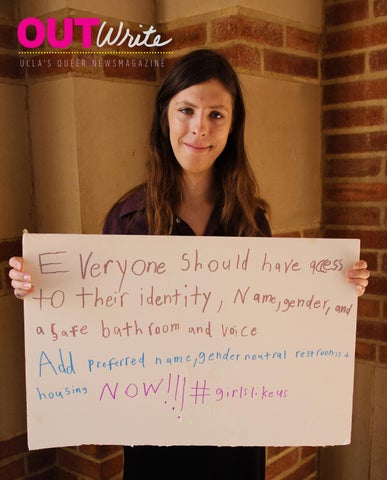
or many of UCLA’s non-binary and trans-identified students, campus housing is a nightmare. The housing system makes it very difficult for these students to feel comfortable or safe. Marcel Vargas, a third year, genderfluid/gendernuetral-identified transfer student—meaning that at times they feel male, at others female, and at still others a mixture of both or neither at all—expressed his own anger regarding the housing policies UCLA offers to trans and non-binary individuals. With regard to dorm life for trans and non-binary students, Marcel explained, “It’s honestly pretty degrading to, like, try and go through housing here as a trans student because they’ll say you either have to find a roommate, which means you have to be out to someone else, or you will have to live with someone of your assigned gender at birth, which is really frustrating. They’re not accommodating at all, they only have one LGBT floor on campus and it’s really expensive, so not only is it transphobic, but it’s classist. How are low income trans people suppose to afford more expensive housing? Just so they can have their own private bathroom and pee in peace.” Marcel here describes some crucial issues
that trans-identified individuals face on a daily basis: the use of bathrooms and the possibility of an unsafe living space. Many other trans and non-binary students agree that finding gender-neutral bathrooms on campus is a very difficult task. Nami, a graduate student who identifies as a transgender woman, agrees that there are problems with bathrooms and housing at UCLA: “There are people who really don’t feel comfortable using a gendered bathroom, there aren’t a whole lot [of gender neutral bathrooms] anyway. With housing, I haven’t had problems but a lot of undergraduates, I’ve heard, have trouble with the policy for gender accommodations and feeling like they have access to a room that they feel fits their gender identity.” Although Nami says that she hasn’t personally had negative housing experiences, she does acknowledge that living on campus is very expensive. Furthermore, Marcel explains what it means for trans students to be addressed by a name with which they do not feel comfortable, such as a birth name: “Preferred names, like on bruin cards and stuff, they refuse to do anything about that. And that can be really frustrating because it’s like you go to class and the professor will be reading the roster
"...They're not accomodating at all, They only have one LGBT floor on campus and it's really expensive, so not only is it transphobic, but it's classist...." and they’ll read out your birth name and it’s really awkward because you have to say like, ‘Oh I prefer to be called so and so.’ And you could out yourself in front of the entire classroom. It’s really degrading.” UCLA’s policy of providing only birth names for bruin cards and rosters is unsettling, at best, and quite possibly dangerous. Marcel remarks, “Other UC’s do it (like UC Irvine), why not UCLA? It saves so much trouble, it saves so much embarrassment, so much
11
12
alienation.” Even outside of school, trans individuals who seek to change their legal name and/or legal gender face daunting, expensive, time-consuming processes. Many trans and non-binary students feel that the burden is placed primarily on their shoulders, especially with regard to educating themselves and others on topics such as trans identities or the transition process. Most are forced to seek out the entirety of this information for themselves with little to no outside help. Often it is the stories of other trans-identified folks that help to provide this education. Nami believes that UCLA could better accommodate trans and non-binary students by creating a space where they feel comfortable, which involves education about the issues that surround the community. She believes that one of the biggest problems with tolerance and acceptance of trans folks is the lack of education; education is key. She believes faculty and staff should be more aware and accepting of everyone’s gender identities.
Similarly, Marcel feels that “[UCLA] should do a sensitivity training (similar to the alcohol training). I think if they can put an effort to prevent alcohol poisoning, then they can make an effort to preventing transphobia and I think they can do it with a lot of different things, like racism, sexism, or homophobia.” Clearly, UCLA is not doing enough to accommodate their transgender students. Even though both Nami and Marcel argue that UCLA needs to improve its position with regard to trans rights and better accommodate its students, they both agree that the LGBT Resource Center is probably one of the only safe spaces on campus. Though neither believe it to be perfect, both find themselves most comfortable there. Marcel shares, “I like the LGBT center. I feel like that’s the only space on campus or maybe any space I go to that I feel comfortable. I feel like it’s a no questions asked kind of space, which is really important for me.” Nami says that she would like UCLA
to push for a more inclusive and educated environment in all spaces; the LGBT center is only one space, and it is important to have more. Both Nami and Marcel agree that it is the university’s responsibility to provide much greater awareness of trans and nonbinary identities and to thus to make every space safer As a school that uses the word “diversity” in every advertising brochure, and finds itself consistently ranked among the highest LGBTfriendly universities nationwide, it is time UCLA be made accountable. This university needs to understand that “friendly” is not defined by encouraging students to live in fear of stepping inside a bathroom, and it is certainly not defined by the forcible stripping away of its students’ identities.
13
mor e n e ws / politics
THE PINK TIDE BY EVAN MOFFITT | STAFF WRITER | EPMOFFITT@GMAIL.COM
A
pink tide has been sweeping red states across the nation. Key victories for marriage equality in five of the most conservative states in the U.S. have been won in the last few months alone, and the current shows no signs of yielding. In Salt Lake County, Utah on December 20th, marriage licenses were issued to same-sex couples hours after a federal judge ruled that the state’s amendment restricting marriage to one man and one woman violated the Equal Protection Clause of the 14th Amendment to the United States Constitution. At the time of Judge Robert Shelby’s ruling, the Utah law was the only other voterapproved amendment banning same-sex marriage to be struck down, after California’s Proposition 8 was voided by the Supreme Court last year. The celebrations came to a halt less than two weeks later, when on January 6th the Supreme Court issued a stay on the ruling until the Utah Attorney General could appeal the decision. The stay cast the marriages of over 1,000 couples into “legal limbo”, the state in which they remain today. Nevertheless, many couples—Anderson and Ferguson included— plan to apply for health insurance, file joint tax returns, and take advantage of the other legal benefits enjoyed by married couples. On January 14th, one week after the Supreme Court’s announcement, another federal judge—this time in Oklahoma— declared that state’s ban on same-sex marriage in violation of federal law. “The amendment is an arbitrary, irrational exclusion of just one class of Oklahoma citizens from a governmental benefit,” wrote Judge Terrence C. Kern. One the nation’s reddest states, Oklahoma is the second—and far from the last— conservative stronghold this year to have its antigay laws declared unconstitutional. A mere month later, a federal judge in Texas struck down a statewide ban on samesex marriage there, declaring that the law deprived gay and lesbian couples of the right to marry and demeaned their relationships for no legitimate reason. Texas, one of the largest and most conservative
14
states in the country, is perhaps the last place where proponents of marriage equ a l it y expected to make gains. Attorney General and Republican gubernatorial candidate Greg Abbott has announced plans to appeal the decision, which has been stayed pending legal action by the Perry Administration. Nevertheless, Abbott conceded that the case would likely go straight to the U.S. Court of Appeals or the Supreme Court. Two days after the Texas decision, on the eve of Valentine’s Day, a federal judge joined the pink tide and threw out Virginia’s same-sex marriage ban with even stronger language than her predecessors. “Our Constitution declares that all men are created equal. Surely this means all of us,” wrote Judge Arenda L. Wright Allen.
The Virginia lawsuit was filed by Theodore B. Olson and David Boies, the same lawyers who successfully contested Prop 8 at the Supreme Court and famously faced off against each other in the 2001 Bush v. Gore trial.
Opponents of the decision have vowed to appeal on behalf of the state, and Judge Allen has issued a stay until the appeal can be made. If the Court of Appeals upholds her ruling, similar statewide amendments could topple, unleashing a domino effect across the South, from West Virginia to South Carolina. Fast on the heels of Judge Allen, U.S. District Judge John G. Heyburn II ruled from his bench in Louisville that the state of Kentucky must recognize the marriages of gays and lesbians who wed in other states, striking down a key part of a statewide constitutional ban. Although he did not rule on the legality of the ban within the state of Kentucky, supporters of marriage equality say the ruling is a significant step forward for a traditionally conservative state. Judge Heyburn’s ruling initiated a contentious debate between top-ranking members of the Kentucky state government. Attorney General Conway announced tearfully at a news conference that he would not appeal the decision. “I would be defending discrimination,” Conway said. “The United States Constitution is designed to protect everybody’s rights, both the majority and the minority groups.” Minutes after his announcement, Democratic Governor Steven L. Beshear declared that he would hire outside council to defend Kentucky’s constitutional ban on same-sex marriage. The ban was approved by 75 percent of voters in 2004. The legal battle for equality has only just begun in Louisville, but it is one case among many destined for the Supreme Court, where—should it be taken up by the nine justices—it could lead to the abolition of all statewide bans on same-sex marriage in the country. Conservatives in these five red states may be fighting to roll back the pink tide, but the rapid changes within the legal system are a clear sign that the end of one important piece in the long struggle for equal rights may be closer than many anticipated.
more news / politics
THE NEW LESBIAN BY GABBY JUAREZ | STAFF WRITER | JUAREZ.GABRIELLE@YAHOO.COM
T
here are some days I want to dress boyish and other days I want to dress girly. It all depends on my mood. Butch and fem are really stereotypical,” said Catherine Duran. Queer women often classify each other as either butch and/or fem. Both these terms signify a bisexual, lesbian, and/or a questioning woman’s ownership to sexually based and culturally assigned labels. These labels reaffirm stereotypes and consequently influence an individual’s identity. When interviewing and conversing with UCLA 's bisexual, lesbian and questioning (BLQ) population, and with general Los Angeles Queer women, I found both a loyalty to and departure from the binding labels. Although terms such as butch and femme provided solidarity for previous Queer women, many BLQ women find themselves uncomfortable with the constricting nature of these terms, as they are fundamentally heteronormative. Describing women within strict labels both counteracts our all-inclusive aim and stunts the development of the lesbian, bisexual, and questioning community as a whole. “Butch/femme is depersonalizing and could
potentially cause distress about the ‘need’ to categorize yourself,” said Molly Howland. Constructed labels define what is masculine and what is feminine, but these terms become misleading or intertwined. Through lesbian stereotypes such as hair length and clothing style, sexually based categories are built solely on the notion of physical appearance. “The society sees a lesbian couple and we all usually think the one with the shorter hair is the pants in the relationship. You’re only basing this on their appearance. They can look butch, but than their personality is feminine,” said Diana Nguyen. In order to gain more leverage on this issue, and this question in particular, I asked several gay, bisexual, and/or questioning women to comment on what the label fem and butch means to them. While questioning over 40 UCLA and LA women I found several key similarities. Almost three quarters of the respondents do not identify as butch or femme, and almost all respondents considered the labels constricting. Yet, more than half of the respondents used these labels to describe other women. Most of
the respondents also expressed interest in the use of more labels, to better describe the rich diversity among Queer women. One person claimed, “I don't think labels are necessary. In fact I think all labels need to be done away with. And I do mean all labels as in: gender labels, race labels, etc. I think labels are detrimental and people should just be considered people.” One anonymous survey respondent stated, “It is important to remember that not everything has to fit within those two categories.”
"...the society sees a lesbian couple and we all usually think the one with the shorter hair is the pants in the relationship." UCLA student Patricia St. Peter jokingly commented, “I don't think there should be any labels. If you like pussy, you like pussy.” Both fem and butch labels do not fully capture an individual’s entire identity. Being butch or femme should not be viewed as two completely entities but merely as a representation of someone’s adherence or denial to cultural heteronormitivity. With postmodern notions of masculinity and femininity disintegrating more Queer women begin to find these binaries unrelated. Queer women are not concerned with butch/femme labels anymore but instead, find the terms fem and butch outdated and constricting. Many Queer women find that more labels need to be integrated in the BLQ community. Now the lesbian community is challenging notions of masculinity and femininity and beginning to redefine what it means to be Queer. Evident from opinions given, what the fem/butch represents today is a stepping-stone to a new identity.
© CC 2006 McBeth "Dykes on Bikes"
15
THE REAL VAGINA MONOLOGUES HOW TO NAVIGATE YOUR LESBIAN RELATIONSHIP BY GABBY JUAREZ & JILL PARKER | STAFF WRITERS | JUAREZ.GABRIELLE@YAHOO.COM, JCPARKER@UCLA.EDU
DOS BOIL YOUR STRAP ON: Strap on’s are a great way to enhance your sex but without prior knowledge of how to clean your strap on this instrument of pleasure can soon turn into an unwanted doctors visit. Strap on’s, like any other sex toy, should be properly cleaned and washed. Simply rinsing your strap on with soap and water does not eliminate you or your partner’s left over bacteria. Certain sexually transmitted infections such as human papillomavirus (HPV), bacterial vaginosis and trichomonas can spread by not boiling your strap on for at least 7-10 minutes.
PAY ATTENTION TO THE RED FLAGS Nothing is worse than finding out the girl you’re dating is a crazy lesbian. Most lesbians, and people in general, ignore the red flags in order to maintain their glorified preconception of their partner. If she hooks up with another girl, hooks up with your friend, manipulates you to do things that you aren’t comfortable with, dislikes your family/ friends, is unstable, or is flat out rude, do not ignore it. Red flags are there for a reason. Even though it’s hard to move on, get out of a potentially disruptive relationship rather than to ignore these signs.
LEARN HOW TO WORK HER VAGINA Women’s vaginas are extremely different. While one girl may be stimulated by eating out, another girl may prefer fingering, strap on sex etc. Vaginas are extremely diverse, but one main thing to know is that the clitoris, the only organ in the human body devoted solely to sensory pleasure, boasts about 8,000 different nerve endings. For some women, direct contact with the clitoris can be sensory overload, and even painful. While the clitoris is often described as a "magic button", the button doesn't work the same way in every woman. Remember to be patient and learn your girlfriend’s vagina and clitoris. The vagina is sacred and should thus be treated with the utmost care and understanding.
PAY FOR YOUR DATE If you ask a girl on a date, most likely, you also have to wine and dine her. In the lesbian community it’s okay to be confused on who should pick up the check. After all we have been taught, from a very early age, that men are responsible for our security. In the case of two women if you initiate the date, you should pay for her as well.
16
SYNC UP WITH YOUR GIRLFRIEND'S PERIOD CYCLE: The biggest clitorference for lesbians is when your girlfriend, sex buddy, or date has their period. Of course you can have period sex, but most of the lesbians would prefer to stay away from this. Avoid this red dilemma by spending a lot of time with your partner.
DONTS
BUY A STRAP ON EARLY IN YOUR RELATIONSHIP Sometimes it can be tempting to make impulse decisions that lead to more responsibility than the relationship might be ready for. Buying a strap on with your girlfriend is a joint investment and implies intent on staying together for a while. The worst thing to do is rush into a relationship, buy an expensive strap on, and break up the next week. Some couples clean their strap on after the end of their relationship, but sometimes there is no way to wash away the association of your ex.
dating
GET STUCK IN THE CAVE: Have you ever noticed that some couples start spending more and more time together until suddenly no one knows what is going on in either of their lives anymore? In relationships, it’s important to spend a lot of time with your loved one, but be sure you don’t neglect your friends, family, and other people and obligations you have in your life. Life is about balance.
BE AFRAID TO SAY WHAT YOU WANT IN BED: Everybody likes it different; we all come from different stages of experience and comfort. Eeveloping sexual chemistry with someone new can take a minute. It can be awkward to break the news that you may not like something they are doing in bed, or that you prefer an alternative method. It doesn’t have to be. Don’t hold back; say what you want! If you’re into something more non-traditional, you never know if your partner will be into it to unless you bring it up. Speaking up is the key to optimizing the sex life of you and your partner(s).
ASSUME BUTCH/FEMME STEREOTYPES: Nobody likes being pegged to a stereotype, and assumptions about sexuality, gender, and identity are not kosher. If you meet a girl who you perceive to be butch, femme, chapstick, or anything else, be careful not to assume her internal identity. No one likes to be told what they are, so be sure to make sure you’re not speaking for someone else when you assert the masculinity/femininity of their appearance.
PUSH YOUR LGBT ACTIVISM ON YOUR DATE/GIRLFRIEND If activism is your thing, that’s great! Queers and allies who use their voice affect social change in amazing ways. However, just because you participate in activism for social rights, doesn’t mean your date or girlfriend feels the same way. Everybody has different priorities, strengths, and interests. She may have her own reasons for wanting to stay out of that sphere; you should respect that.
UHAUL We’ve all heard the jokes about Uhauling lesbians. Of course we don’t want to perpetuate stereotypes, but lezbereal, this is a common mistake among the community. Moving in together can seem like a great idea. However, at this age, any couple moving in together should take into account the amount of commitment and responsibility this will bring to the relationship. Living together comes with the establishment of boundaries. Sharing a financial responsibility is serious, and once you are living together you find yourself doing things like buying groceries together and dividing chores. These responsibilities can add up and take a toll on a relationship that may not yet be strong enough to withstand it.
WHIP OUT YOUR STRAP ON IN THE MIDDLE OF SEX: The most important things in a healthy sex life is open communication and comfort. If you are sleeping with someone new and you haven’t discussed your limits of comfort, it’s not a good idea to whip out your strap on in the middle of things. No one likes to feel pressured and in situations like this, people can be so thrown off that they feel obligated to say yes to something they may or may not be entirely comfortable with.
17
QUEERS OF FORTUNE Can you guess the queer celebrity? ELLEN DEGENERES
GEORGE TAKEI
FRANK OCEAN
MICHELLE RODRIGUEZ
TOM DALEY
LAVERNE COX
ANDERSON COOPER
MICHAEL SAM
Pictures courtesy of Associated Press
1 2 3 4
This quirky and enthusiastic talk show host began her career as a stand-up comedian and actress. She came out as a lesbian during the first of her two sitcoms, with a mild re-creation on the show, with Oprah Winfrey as her therapist. This journalist and television personality hails from the Vanderbilt family. This openly gay journalist hosts his own news show, although he is known to take to the field for breaking news coverage. This former college football player held a defensive position for the Missouri Tigers. This player, if accepted in the NFL, will be the first openly gay football player. This trans* actress began her career working on reality television such as I Want to Work For Diddy. With her reality show TRANSform Me, she became the first African American trans* individual to produce and star in her own television show. She currently stars in the Netflix hit Orange is the New Black.
5 6 7 8
This Olympic diver and television personality was the youngest competitor outside of swimming. During the 2012 Summer Olympics, he received a bronze medal in the 10 meter platform, after which he starred in his own reality television show. This actress and screenwriter is known for her portrayal of strong female characters in actionthemed movies. Entertainment Weekly has labeled her the most successful Latina actress in pop culture. This Japanese-American actor has shifted from his sci-fi television roles to becoming a gay rights activist, active in state and local governments. He has garnered a following from younger generations, due to his successful and popular Facebook page. This singer-songwriter and rapper began his career ghostwriting for artists such as Justin Bieber and John Legend. He first discussed his attraction to men in a letter he posted on his Tumblr page.
Answer Key: 1. Ellen DeGeneres 2. Anderson Cooper 3. Michael Sam 4. Laverne Cox 5. Tom Daley 6. Michelle Rodriguez 7. George Takei 8. Frank Ocean
18
quiz
I'M COMING OUT WHICH CELEBRITY COMING OUT WOULD YOU PERFORM?
4
Where would you like to go eat on a Friday night? A. A restaurant culturally relevant to me B. Somewhere chosen on a whim
2
A. A realistic romantic comedy B. A thriller with twists and turns
C. A restaurant I have been hesitant to explore
C. An emotional drama
D. My favorite restaurant, because it's MY fav
D. A fun filled musical
5
What kind of books do you enjoy reading? A. A book with characters I relate to B. Whichever book looks interesting at the moment
3
What kind of movies do you enjoy watching?
How would you tell a close friend their partner has been cheating on them? A. Tell them during an appropriate or related moment
C. A book that empowers me
B. Tell them as a side line, to play it down
D. My own novel; who else could live up to me?
C. Emotionally confess it to them and give my immediate support
What would you do if you saw a passerby bullying a stranger?
D. Immediately text it to them, I love my gossip
6
A. I would intervene, because I wouldn’t want to be bullied either B. I would intervene, because it is the right thing to do C. I would intervene and then try to teach the bully to
C. Determined
D. Nothing, it's not happening to me
IF YOU CHOSE MOSTLY
THE JIM PARSONS aka "The Related Conversation Shift"
Coming out for you most likely occurred due to a related conversation topic beforehand. Your coming out occurred because it was relevant in the moment, demonstrating a belief that coming out should not be as serious as it once was. Due to the calm manner of your coming out, you most likely will not notice any difference in your everyday life.
A. Relatable B. Unexpected
better themselves
A
How would your friends describe you?
D. Outgoing
, YOUR COMING OUT SHOULD BE:
B THE ZACHARY QUINTO
aka "The Unexpected Dependent Clause" Your coming out happened essentially on a whim, warning neither friends nor family. Perhaps, this coming out occurred due to an epiphany in the moment, demonstrating your thoughtful personality. Despite you spontaneity, you are still quite aware of the difficulties and power of coming out, and the unexpected nature of your coming out makes waves and its own type of statement
C THE ELLEN PAGE aka "The Public Emotional Confession"
Coming out must have been difficult for you, due to the pain that you associate with the closet. Yet, your emotional coming out makes a statement: that this pain still exists for other such as yourself. Your coming out demonstrates that you have a sense of justice and purpose. You probably will become an activist to cultivate your sense of purpose.
Pictures courtesy of Associated Press
1
D THE LANCE BASS aka "The Magazine Cover"
You’re Queer. You’re here. And you need to say it on a magazine cover. Your outgoing personality and tendency for the dramatic would have you come out publicly and proudly. While your coming out may be overly public, you lack political intentions in your outing, as you are more concerned with your own out status rather than others.
19
LAVENDER
GRADUATION June 14, 2014 1:00 pm - 3:00 pm Korn Convocation Hall
Graduates
Volunteers
Awards & Scholarships
Friends & Family of Graduates
Sign up to participate in this year’s Lavender Graduation!
Has someone inspired you this year? Nominate them for an award! Need money? Apply for an LGBTQA scholarship!
Please volunteer to help at the Lavender Graduation ceremony!
Dedicate a page in the program booklet to your special grad!
APPLY AND LEARN MORE AT WWW.LGBT.UCLA.EDU/LAVGRAD.HTM UCLA LGBT CAMPUS RESOURCE CENTER | STUDENT ACTIVITIES CENTER B36 (310) 206-3628 | UCLALAVGRAD@GMAIL.COM | WWW.LGBT.UCLA.EDU 20