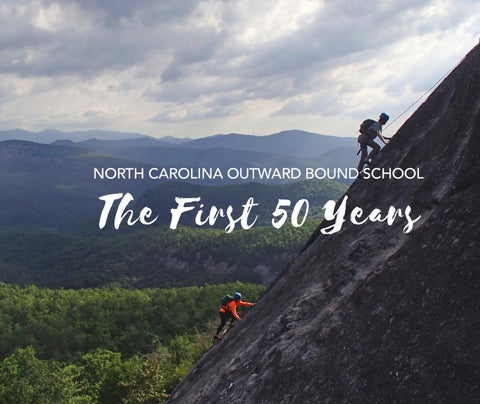
NORTH CAROLINA OUTWARD BOUND SCHOOL
The First 50 Years
NORTH CAROLINA OUTWARD BOUND SCHOOL
The First 50 Years In Celebration of the 50th Anniversary of North Carolina Outward Bound School
NORTH CAROLINA OUTWARD BOUND SCHOOL
This book is dedicated to the amazing staff, students, board members and supporters who made the last 50 years possible. We wouldn’t be here without you!
FOREWORD REFLECTIONS ON OUTWARD BOUND | Henry Davis McHenry Jr. What does the world most desperately need now? The term “Outward Bound” designates the moment when a ship leaves the protection of the harbor for the open ocean, with its rigors, its challenges, and its unforeseen beauties. In 1941, young British seamen needed to survive being torpedoed by German U-Boats. The older sailors, experienced with adversity and danger, were coping better with wartime conditions than those who hadn’t experienced great challenge. Renowned educator Kurt Hahn – himself a German recently escaped from the Nazis – developed programs to instill in these younger seamen greater self-reliance and spiritual tenacity in the service of their country and their comrades. Today, the conlicts between and within countries occur not only in open belligerence, but by the failure of national and international institutions to provide an infrastructure for generating common ground among us. Outward Bound’s mission is to provide experiences that bring our students to live in the world with ive traits of character: enterprising curiosity, undefeatable spirit, tenacity in pursuit, readiness for sensible self-denial, and above all, compassion. When we live these traits—experience them together as we encounter challenge and adversity and unexpected opportunity—what springs up between us is common ground. On an Outward Bound course: because we meet physical and mental challenges beyond the horizon of our self-concept, we seek further self-expansions, stretching to attain new capacities; because we master progressively more dificult skills in service of the common need, we gain conidence in our abilities to solve problems; because we invent together new solutions to problems encountered in unfamiliar settings, we aim for our best selves, revering craftsmanship and meticulous care for others;
because we train our resources, our initiative, and our endurance, sharing in adversity and failure as well as success, we act with respect and generosity in service to our fellow travelers; because we taste relection in solitude, we seek to minimize enervating distractions from our purposes; and because we adventure together with strangers in small groups, we support and respect differences among us, honoring the shared commitment to achieve more than any of us thought possible. After the Outward Bound experience, students return to a world that seems charged with a new voltage. Opportunities for leadership appear where before there was drudgery; new possibilities for contribution to others build vibrancy in local communities; delight in the fullness of experience ills the heart. On this common ground a new social compact might renovate our lives.
ACKNOWLEDGMENTS This book stands upon the shoulders of the students, staff, board and supporters who together have woven the 50-year story we tell now. We give special thanks to Dan and Diane Meyer and Dan Madden for their original inspiration in creating the 1973 book, “To Know by Experience�; and to photographers Russ Taylor, Daniel Rice, Dan Madden, Barry Jones, Saul Rosen and many others for providing a unique look into the magic of an Outward Bound course.
“There is more in us than we know. If we can be made to see it perhaps for the rest of our lives we will be
unwilling to setle for les.� Kurt Hahn
A NOTE FROM THE EXECUTIVE DIRECTOR Within these pages lies a small glimpse of the challenge, triumph, beauty, commitment and joy that students and staff experience on a North Carolina Outward Bound School course. The “magic” of the experience is known only to those who open themselves to the process of discovery and dig deeply to unearth a potential—suspected perhaps, but untapped. What people carry with them following a course is personal, shared only with crewmates in the moment, and relected upon individually over time. The rich and colorful 50-year history of programs at the North Carolina Outward Bound School started at the Table Rock Base Camp in 1967. This book contains images and anecdotes representing the diversity of our course areas and programs over the decades. Students and staff of all backgrounds and ages are our story. Together they have created this chronicle of a remarkable educational organization. There is no doubt that the school has changed lives, birthed careers and passions, and impacted tens of thousands of people. I hope this book inspires you to dig deeply and to relect on your experience with North Carolina Outward Bound School.
Whitney H. Montgomery NCOBS Executive Director 2007 - Present
Photo credit: John Cole, Outward oundTrust
The Story OF OUTWARD BOUND
O
utward Bound, as we have come to know it today,
began somewhat humbly with the opening of Gordonstoun School in Scotland in 1933 with only three students. It was here that Kurt Hahn, a German-born educator, nurtured the philosophies and principles he had irst developed at the Salem School in Germany, which he founded in 1920. According to Hahn, the mission of the Salem School was “to train citizens who would not shirk from leadership and who could, if called upon, make independent decisions, put right action before expediency, and the common cause before personal ambition.” At Salem and Gordonstoun, Hahn ensured that training for character, leadership, and service shared equal emphasis with traditional academics.
When war began in Europe in 1939, so did the next step in the evolution of Outward Bound. Sir Lawrence Holt, a parent of a Gordonstoun student who owned a large merchant shipping company, insisted that incomplete training was the cause of so many young seamen’s unnecessary deaths in the Battle of the Atlantic.
“I would rather entrust the lowering of a life-boat in the mid-Atlantic to a sail-trained octogenarian than to a young sea technician who is competently trained in the modern way but has never been sprayed by salt water.” Sir Lawrence Holt
Hahn and Holt recognized that these young seamen needed to learn the will to survive, rather than simply the skills to survive. Together, they created a one-month curriculum that immersed young men in adventurous outdoor situations to help them develop conidence, perseverance, and camaraderie with their peers. Above all, the program was designed to foster the discovery that they were far more capable and resilient than they realized. Hahn and Holt established this new program in Aberdovey, Wales, and named it Outward Bound—the nautical term to describe a ship leaving the safety of its harbor to head for the open seas. The training at Aberdovey was less training for the sea than through the sea. The distinction— training through rather than for—is at the essence of the Outward Bound program dynamic. The sea, mountains and desert provide training that no traditional institute or school can offer. These epic landscapes, in tandem with Outward Bound’s approach of discovery through challenge, teach the skills necessary for survival and the demands of life. For the new school, Hahn forged a mission true to his enduring commitment to experiential education: “to impel young people into valueforming experiences and to ensure the survival Photos: Left Page (Top) Kurt Hahn, Founder of the Outward Bound Program (Bottom) Aberdovey 1953. Photo credit Ralph Brough, Outward Bound Trust; Right Page (Top) Aberdovey 1958. Photo credit Duncan McLennan, Outward Bound Trust (Middle) Aberdovey 1948. Photo credit John Cole, Outward Bound Trust (Bottom) Moray Sea School 1950. Photo credit Outward Bound Trust
Photos: (Let) An instructor flashes the Aldis lamp and two boys watch intently for answering signals from the Warspite ketch. Photo credit: John Morgan and Outward Bound Trust (Right) Students on a 24 hour sail on the 80 ton ketch, Warspite, in 1951. Photo credit: Brain Ellis and Outward Bound Trust (Bottom) The Warspite Bell in its current home at the Table Rock Base Camp
The Warspite Bell In the spring of 1967, North Carolina Outward Bound School was given a beautiful brass bell from Outward Bound United Kingdom’s chartered sailing ship, the Warspite. This unique git represents the common themes shared by all Outward Bound schools to harness the formative power of the seas, mountains and other landscapes as a vessel for self-discovery. “The Warspite, an 80-ton ship, was a stout, able vessel of good sailing qualities. She began life as the yacht Bluebird on the register of the Royal Yacht Squadron. She served during the 1939-45 war, ater which she was bought by the Marine Society and converted into a 12-berth sea-going school-ship. She was chartered to the Outward Bound Sea School at Aberdovey for a shilling a year.” David James, prior Outward Bound staf member. Today, the Warspite Bell occupies a place of honor at NCOBS’ Table Rock Base Camp, where its clear, resounding tone regulates the daily routine and serves as a reminder of our common ties to the call of Outward Bound internationally.
of these qualities: an enterprising curiosity, an undefeatable spirit, tenacity in pursuit, a readiness for sensible self-denial, and, above all, compassion.� Since 1941, Outward Bound has evolved and adapted its programs and venues, but never departed from Hahn’s original mission and experiential pedagogy. In addition to traditional wilderness courses, Outward Bound programs are now offered in classrooms and urban centers and include special populations such as inner-city youth, struggling teens, teachers, families, military veterans, and corporate teams. Now, more than 75 years after its inception, Outward Bound schools in over 30 countries on six continents worldwide, prepare people to take on challenges and achieve more than they thought possible.
Photos: Left Page (Top) Certificate of completion, Aberdovey 1954. Photo Credit Brian Ellis, Outward Bound Trust. (Bottom) Daily Routine, Aberdovey 1957. Photo Credit Seve Eldford, Outward Bound Trust. (Full Page) Kayaking instruction, Ullswater. Photo Credit Outward Bound Trust
The Beginning OF NORTH CAROLINA OUTWARD BOUND
“
Y
oung people today need authentic adventure,”
said Josh Miner in a 1964 article in the Princeton Alumni News. The article, which inspired many that year, highlighted Miner‘s efforts to introduce a unique experiential education methodology called Outward Bound to the U.S. While Outward Bound had existed for many years overseas, in 1964 it was just beginning to make an appearance in America. Outward Bound wilderness schools had opened in Colorado and Minnesota and a third was nearing completion in Maine. Miner’s work to introduce Outward Bound founder Kurt Hahn’s inspirational views on education intrigued many at the time – and in North Carolina, none so much as Marjorie Buckley.
After researching Outward Bound, Buckley, who was working at The North Carolina Fund at the time, soon became the driving force for the founding of the North Carolina Outward Bound School (NCOBS). By the end of 1965, Buckley had assembled a board of directors for NCOBS who convened in December to select a site for the irst base camp. Despite earlier hopes to establish a seafaring school on Bald Head Island near the Cape Fear River, the group instead chose the Linville Gorge Wilderness in the Pisgah National Forest. By the summer of 1967, the irst crews of young men were hiking into the Blue Ridge Mountains from the Table Rock Base Camp. Since then, NCOBS has broadened its programs to include students of all genders, ages and backgrounds including veterans, teachers, and at-risk and high-achieving youth. The School has also expanded its program locations to include areas in North Carolina’s mountain and coastal regions, Florida’s waterways and Patagonia in South America. Now, 50 years and more than 160,000 alumni later, NCOBS looks toward the next half century of impact, as we serve more students than ever before with high quality programs that change lives and equip future leaders to address the challenges of their time with courage and compassion. Photos: (Left Page) The Princeton Alumni Weekly Article that prompted the creation of the North Carolina Outward Bound School. (Right Page) Table Rock, 1971.
“ Not until 1985 did I learn about “sacred space,” but that day in 1965, looking for the North Carolina Outward Bound School’s irst base camp, I experienced it. Table Rock – what an ordinary name – illed the sky and the soul.
“ I should think of compassion and self-reliance and service when Outward Bound irst comes to mind but I think of Table Rock. I am beginning to like its name because it is so ordinary that I can fancy that its power is a secret.” Marjorie Buckley on searching for the irst base camp
NORTH CAROLINA OUTWARD BOUND SCHOOL
The First 50 Years
What You Can Expect Dan Meyer, A Letter to Students from Former Executive Director (1971-1976) The expression “Outward Bound” signiied that moment a ship left its moorings and committed itself to the open sea, with its unknowns, its hazards and its adventure. It was a recurring demonstration of man’s nobility—of his desire to seek and determine his own destiny no matter what the challenge. And that, in a nutshell, is what our school is all about. Our purpose is to have you leave those comfortable moorings of home, friends and routine, and risk the dificult and unfamiliar in search of a better understanding of your own resources and capabilities. You’ll be asked to face challenges which will demand more of you than you expect of yourself. You’ll be in situations where you will have to rely on others for your own well-being. And, you’ll be asked to care for and help others when the going gets hard for them. You can expect to be doing rather than watching; acting rather than talking. You can expect to try without worry of failing for we demand only that you try. YOU tell US how well you did. You can expect to be hot, cold, wet, hungry, tired, sore and happy. And when you’ve inished, you can expect to know from experience rather than wonder or doubt.
Why Outward Bound? Murray Durst, Former Executive Director (1968-1969) Because our society is becoming more and more complex and appears to be debilitating the human spirit; Because it is easier to repress than to solve problems; Because we are killing that very environment which sustains us in life; Because all of us are losing a sense of compassion for one another; Because life abounds but most of us never see it, and: Because life is not full of kicks but there has to be some kick in life if it is worth living.
I will now talk of my life in two eras— before Outward Bound and after Outward Bound
Chandler
First Course For Women Over 30 Crew Journal Entry, 1977 The pain of waking up with a body throbbing because of physical exhaustion was experienced by all of us this morning. We move slowly and without much spirit but begin to get it together. It looks like rain so we all prepare as best we can because we are back to the rocks for rappelling and more climbing today. Rappelling proves to be an exhilarating experience for most. After that hard irst step off the edge it’s just a free ride down and what a thrill! Amazingly enough we are in control of the
ropes and so ourselves. I’m watching the rain clouds darken the sky and crossing my ingers they’ll pass by. Claudette did the most remarkable thing on those rocks. That lady who is terriied every time she has to walk across a log over a creek, panicked at the thought of the rappel, chickened out after 30 minutes of being tied in on belay and then went off by herself for a few minutes. When she came back - by damn she did it! The control and courage she showed was an inspiration.
“I didn’t just survive in the mountains-
I thrived there.” Meridith
Instructing My First Course
Deb Caughron, Former Instructor and Board Member, A Relection On the Crew Journal My irst course as a new assistant instructor in the summer of 1983 had an inauspicious beginning. Program Director Mike Fischesser had put me with a sweet fellow who I knew would gently help me navigate the steep learning curve of leading students through the rigors of an Outward Bound course. Shortly before pre-course planning, my co-instructor injured his ankle and I was hastily paired with the fearsome Ken Peeples. Ken had the reputation of being a gifted facilitator and a tough character. As we planned, he kept calling me “kid” and I stopped just short of calling him “sir.” I was terriied to be working my irst course with a legend. I had spent a lot of time in the mountains, but I was very nervous about going into the ield with a crew of 12 young men and women for whom I was partly responsible. I was not yet comfortable with map and compass and still in awe of the mysteries and challenges associated with being an Outward Bound Instructor. I was pleasantly surprised when Ken asked me to write down three things I was most comfortable teaching. Hmmm… Packing a backpack? Camp craft? Doctoring blistered feet? He looked at my list through mirrored sunglasses and said, “OK, kid, I’ll teach these and you’ll do the rest.” Wait… what? Had this man never heard of compassion? Ken, who would become my mentor and friend, held me to it and taught me more in my irst 23 days than I learned in my irst full year in the ield.
Compasion Dave Genova, Former Instructor (1978-2009) Compassion is the well-spring from which we derive our relevance as a school. It is the encouragement that a tired and sore belayer gives to a determined climber. It is the tear in the eye of a ifteen-year-old student who is leaving the room of an elderly stroke victim after iguring out how to communicate by squeezing each other’s hand. It is the smile on the face of the semester course participants, as they wave goodbye to the Miccosukee or Chilean children that they have spent the day with. It is the power and sense of accomplishment felt by the crew member who has just unloaded a heavy truck tire from the top of their pack after lugging it out of the Linville Gorge wilderness area. It is the smile on the face of the young backpacker who removes a caterpillar from the path so it won’t be crushed by the heavy boots. It is the encouragement that people give to one another during the twelvemile Personal Challenge Event. In all of these examples, the common thread is compassion in action. If we are successful as educators and as a school, it is because since 1967 we have continued to ind a way to help our students nurture their innate ability as human beings to care and to act.
“I will no longer say I am tired, for I know what it’s like to hike for ifteen hours straight.
I will never say I am lonely, for I spent forty-eight hours by myself in the wilderness.
I will never say I can’t, because I can and I did.”
Elizabeth Grough
Untitled Geoffrey Schutte, Alumnus Give me an hour: And I can talk of seeing the sun fall, then rise And I will tell you of that beauty. I can tell you of anchors and belays and reading rivers, Sending off a swing and putting up a tarp. I might even talk of nature and love and tomorrow. Give me a week: And I might speak of gifts, my own insight… I might speak of my body, my itness, my health And the cornerstones of self awareness. Give me a year: And I will talk of true nature, More trips, Expeditions. I might speak of discovery, a new person, Live changes (I might be reminiscent) And I shall remember fondly of days, cold nights, Old places (a ire!) But if you ask for the truth, then give me a lifetime. I’ll not give you faces nor names, nor even a day. Nothing left: a journal? A photo? Old letters, a pin? Mere elements, mere nothing but memory. What I can give you is this: Purpose…an eye glimmer…a track redeined.
50 Days That Changed My Life Kate Mosher, Alumna
On the irst night of my course, it was pouring rain. My pack felt like it weighed 500 pounds and my body was screaming at me to STOP hiking, drop the pack, and give up. As I hiked through the dark with a group of perfect strangers, I could not help but think, “what have I done?” However, there was something oh too familiar to that little voice inside of me, shouting to give up and go home. I realized it was the same voice that started me on this journey in the irst place – whispering that there was something more, something meaningful for me to discover – and although I was scared, in pain, and most of all confused, I needed to stay the course.
“I haven’t taken a shower in 20 days, my hair is greasy and my face is broken out,
but I se more beauty in myself right now than I ever have before.”
Sarah
The Chimneys: An Appreciation Michael Follo, Former NCOBS Director of Education (2010-2016) The magic of Outward Bound can happen at any time and any place on a wilderness course. In my experience, however, there is no better place to see Outward Bound’s mission come to life than at the Chimneys on the eastern edge of the Linville Gorge. Standing atop the Chimneys, students and instructors are treated to one of the most spectacular views in the eastern United States. To the west lie the Linville Gorge, the Gold Coast, and beyond, the Black Mountain Range and Mount Mitchell, the highest peak east of the Mississippi. To the north rises the iconic prism of Table Rock, with Grandfather, Beech, and Roan Mountains in the distance. On more than a dozen wilderness courses over my 5+ years as NCOBS Director of Education, I had a front row seat at the top of the Chimneys as lives were changed, challenges met, and the most profound personal discoveries made. I was privileged to witness instructors model the Four Pillars—Physical Fitness, Self-Reliance, Craftsmanship, and above all, Compassion—as they set up a rappel and helped countless students overcome their fears, trust their belayer, and take that irst step over the edge. I saw teachers, with streaming tears and legs that couldn’t stop shaking, suddenly realize that their fear was no different than that of their students when asked to stand at the front of the classroom and solve a math problem, give a presentation, or conjugate a verb in Latin. I saw other teachers light up with joy at the discovery of a new passion or previously unrecognized ability. Invariably, after a day at the Chimneys, every one of these teachers returned to their schools with renewed self-conidence and a deeper understanding of the importance of challenge, perseverance, and above all, compassion, in their classrooms.
“I tried as hard as I could, I laughed as hard as I could, I had as much fun as I could, I learned as much as I could, I ate as much as I could, I cried as much as I could, I gave as much as I could, I got as much as I could.
And as much as I could was always more than I thought it could be.�
Mat
Homeward Bound David, Alumnus
Today marks day 50 of my 50-day NCOBS Instructor Development Course. As I’m sure you can probably guess, I’m experiencing a wide variety of emotions as I approach my departure. Leading up to this course I was at a crossroads in my life and the only thing that made even a little bit of sense was following my passion for the outdoors. Relecting back to day one on course to now, I am excited to say that this course has changed my life. Changed my life in the sense that I now know what I am capable of and I believe in myself. I have been given a sense of purpose
and direction in my life. The group of guys and girls on this trip each had an impact on me individually, but the most important aspect of it was the time I spent in such a positive community. This course has led to genuine self-discovery and I am so grateful to have been given the opportunity to do this course. This course has become my comfort zone and going home feels a little bit like the unknown, so as I prepare to go Outward Bound I will take what I have learned on this course and apply it to my everyday life.
Val
So go. Go because you need a break from work. Go because you want to unplug. Go because you’ve never spent the night in the woods, or because it makes you nervous. Go because you used to love the outdoors as a kid or because you lost some part of you and might ind it again. Go because you want to talk or stop talking. But GO!
Val
Everglades Wildernes Writing Expedition Alexandra, Everglades Wilderness Writing Expedition, 2014 I can’t take it!! I HATE IT!! I hate the lights, I hate the streets, I hate the noise, the radio felt like hell in the car, the water in the shower I just took was too clear and not salty at all, I miss eating with everyone, I miss you guys! I miss the hugs and the smiles. I miss the frustration and the impatience in your faces, all that was okay because we knew that in the end we are together and nobody would ever be left behind. I miss you and it’s been only a couple hours. I miss the smell of nature; I miss the stars!!! I miss the air and the hot sun on my skin, I miss paddling and I miss your voices!! I miss every single one of you! I miss writing with you and sharing everything! I miss the Everglades! I miss my wilderness family!
“I can’t tell you how this fear conquering thing has changed my life! Not that I’m going to jump out of an airplane or anything, but I just have a new sense of inner conidence that I didn’t have before. I’m different with my students now. I feel more grounded in my own abilities and I really think they sense that; there’s a peace in my classroom that I can’t really explain.”
Educator Program Alum
Solo
Taylor Sinason, Alumna We had the strongest winds I’d ever see, due to a hurricane hitting the North Carolina coast. After setting up my solo site, I paced. I stood up and sat down. I did push ups and yoga and tried my best to calm my busy mind. Finally, I simply laid down amongst the fallen leaves and pine needles. The sky was blue, cloudless. Trees danced around me, and I listened to them creak and groan as the wind whistled and whirred. The air was autumn crisp. My senses were illed, and I was at peace. For the irst time in roughly 35 days, I was alone. I built altars out of bits of nature and honored the woods that had become my home. At night my dreams were illuminated by the full moon. Words lowed freely into my journal, words to myself and to others. Everything I’d learned in the days leading up to this articulated itself with perfect diction. For the irst time, I asked myself what I stood for and knew the answer.
“Though much is taken, much abides; We are not now that strength which in old days Moved earth and heaven, that which we are, we are; One equal temper of heroic hearts, Made weak by time and fate, but strong in will
To strive, to sek, to find, and not to yield.� Alfred Lord Tennyson
Compiled by Nicole Fava
NORTH CAROLINA OUTWARD BOUND SCHOOL