









































































































































































































Nonprofit
An
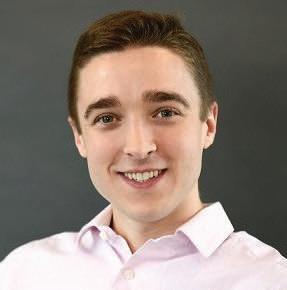
Fahad

Addie
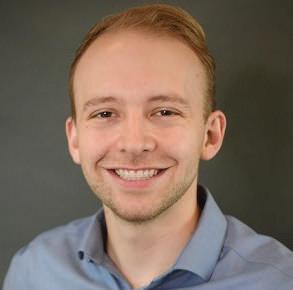
Albert
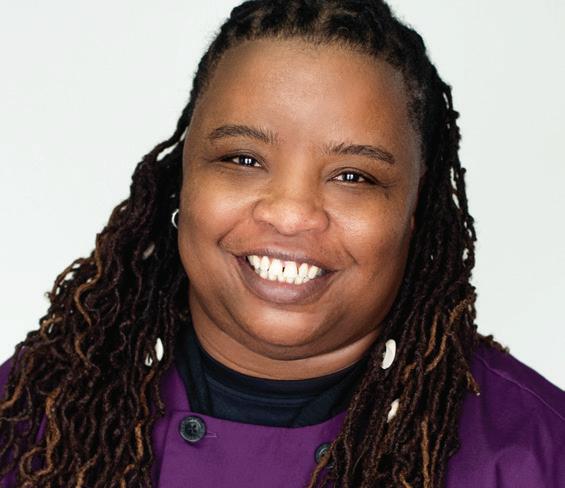
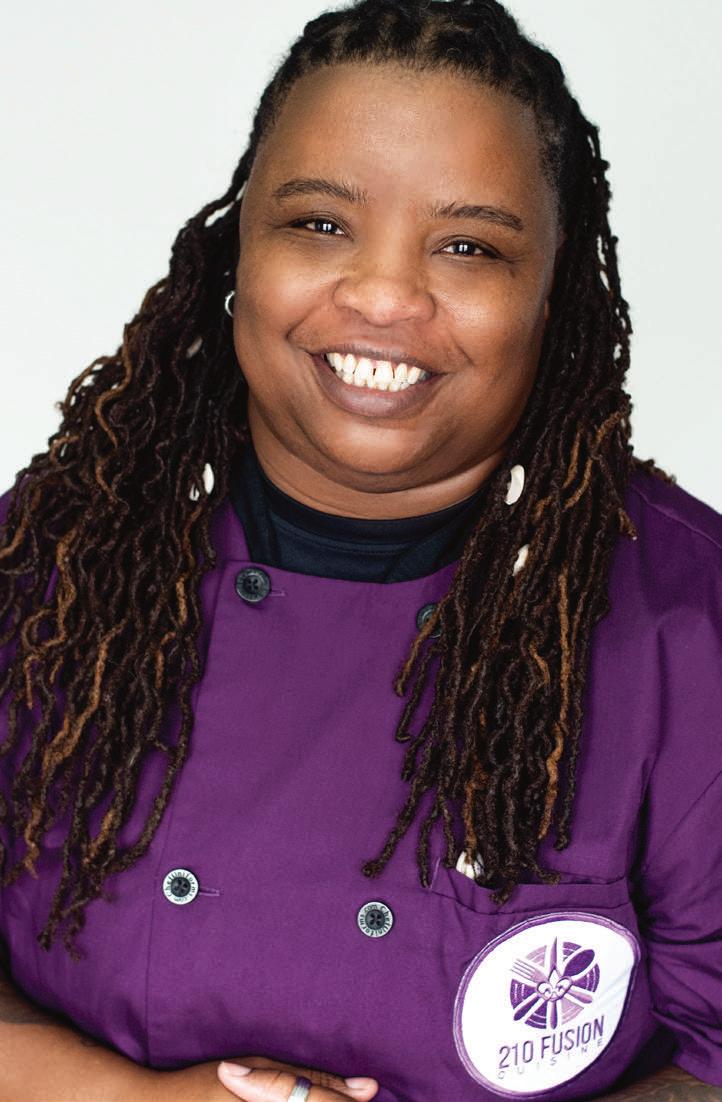
Chef Tae’s 210 Fusion Cuisine delivers unique comfort food
Local
Local
Drag















Publisher/Editor-in-Chief Greg Jeu
Associate Publisher Tom Fricke
Creative Director Alex Rosa
Managing Editor Lourdes Zavaleta
Entertainment Editor Blase DiStefano
Copy Editor Howard Maple
Web Editor Lourdes Zavaleta

Contributing Writers





John Aaron, Olivia Flores Alvarez, Rich Arenschieldt, Bill Arning, Susan Bankston, Connor Behrens, Jenny Block, Sam Byrd, Andrew Edmonson, Ste7en Foster, Sarah Gish, David Goldberg, Martin Gonzalez, DL Groover, Marene Gustin, Kim Hogstrom, James Hurst, Lisa Keen, Ryan M. Leach, Don Maines, Zachary McKenzie, Joanna O’Leary, Monica Roberts, Lilly Roddy, Terri Schlichenmeyer, Gregg Shapiro, Janice Stensrude, Henry V. Thiel, Megan Wadding, Brandon Wolf, Grace S. Yung
Photographers/Illustrators
Edgardo Aguilar, Angel Albarran, Dalton DeHart, Yvonne Feece, Josseline Martinez, Mark S. McCray, Ashkan Roayaee
Interns
Alys Garcia Carrera, Lillian Hoang
Account Executives
Jack Berger, Joanna Jackson
National Advertising Representative Rivendell Media - 212.242.6863




E-mail:


Welcome to the May 2020 edition of O utSmart. This issue serves as proof that LGBTQ Houstonians are continuing to remain strong through the pandemic.
Even though our favorite restaurants and bars are closed and we haven’t been able to see each other in person, we’ve made it work. From digital drag shows to online advocacy and supportgroup meetings, our community has found new and creative ways to survive these difficult times.
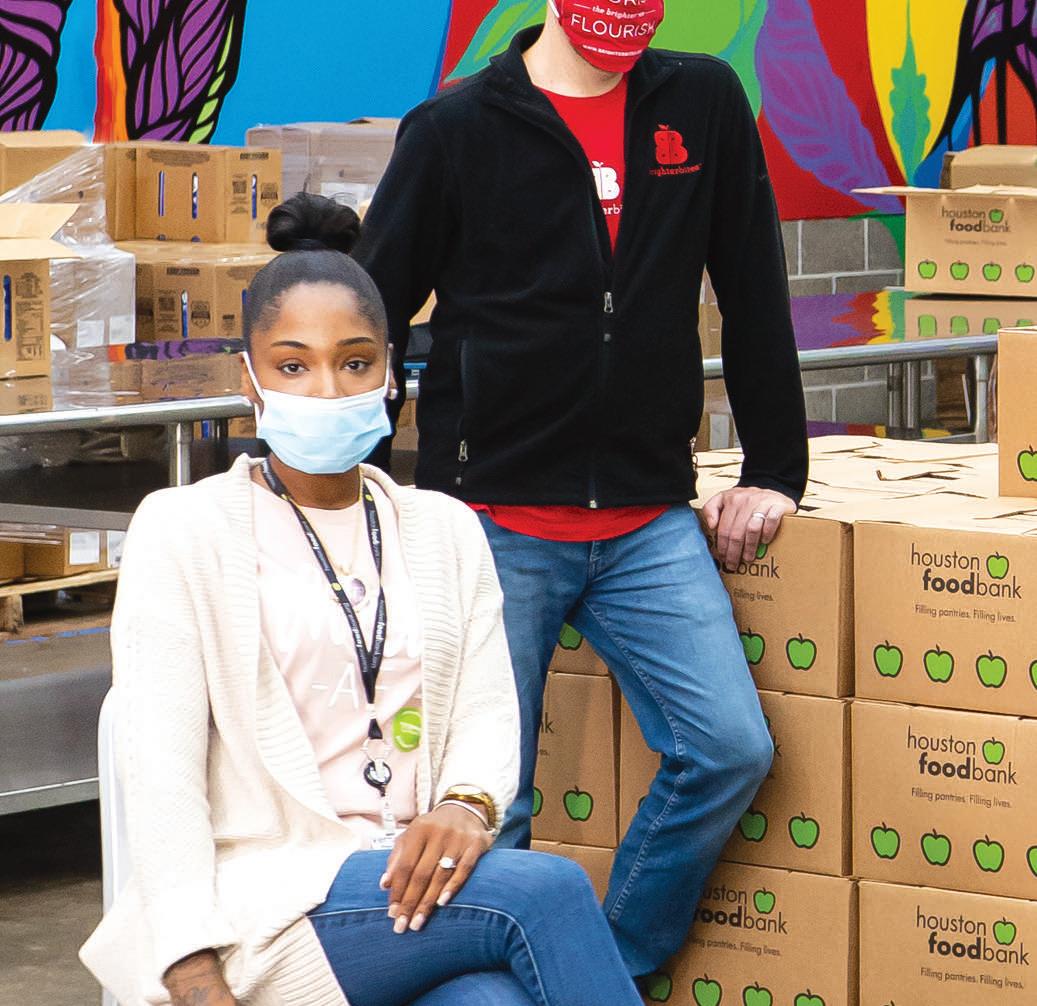
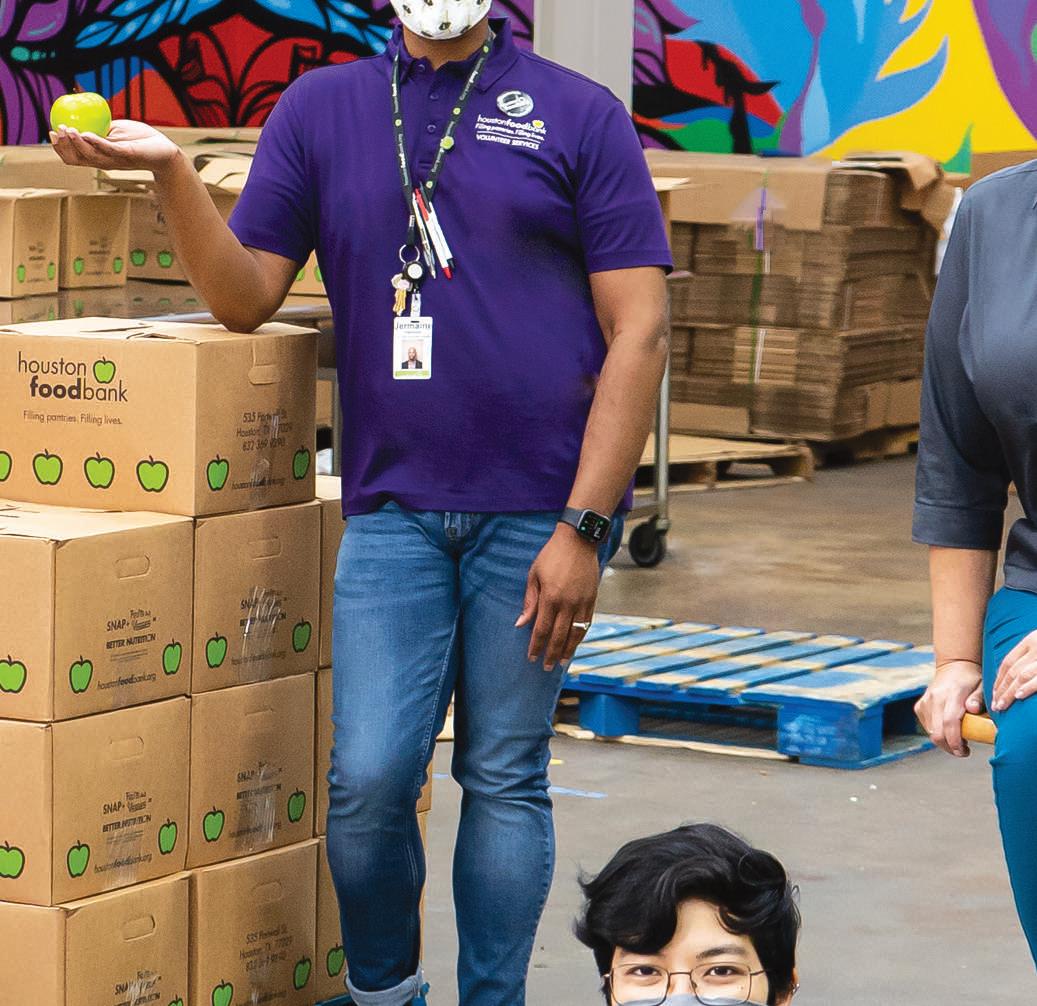
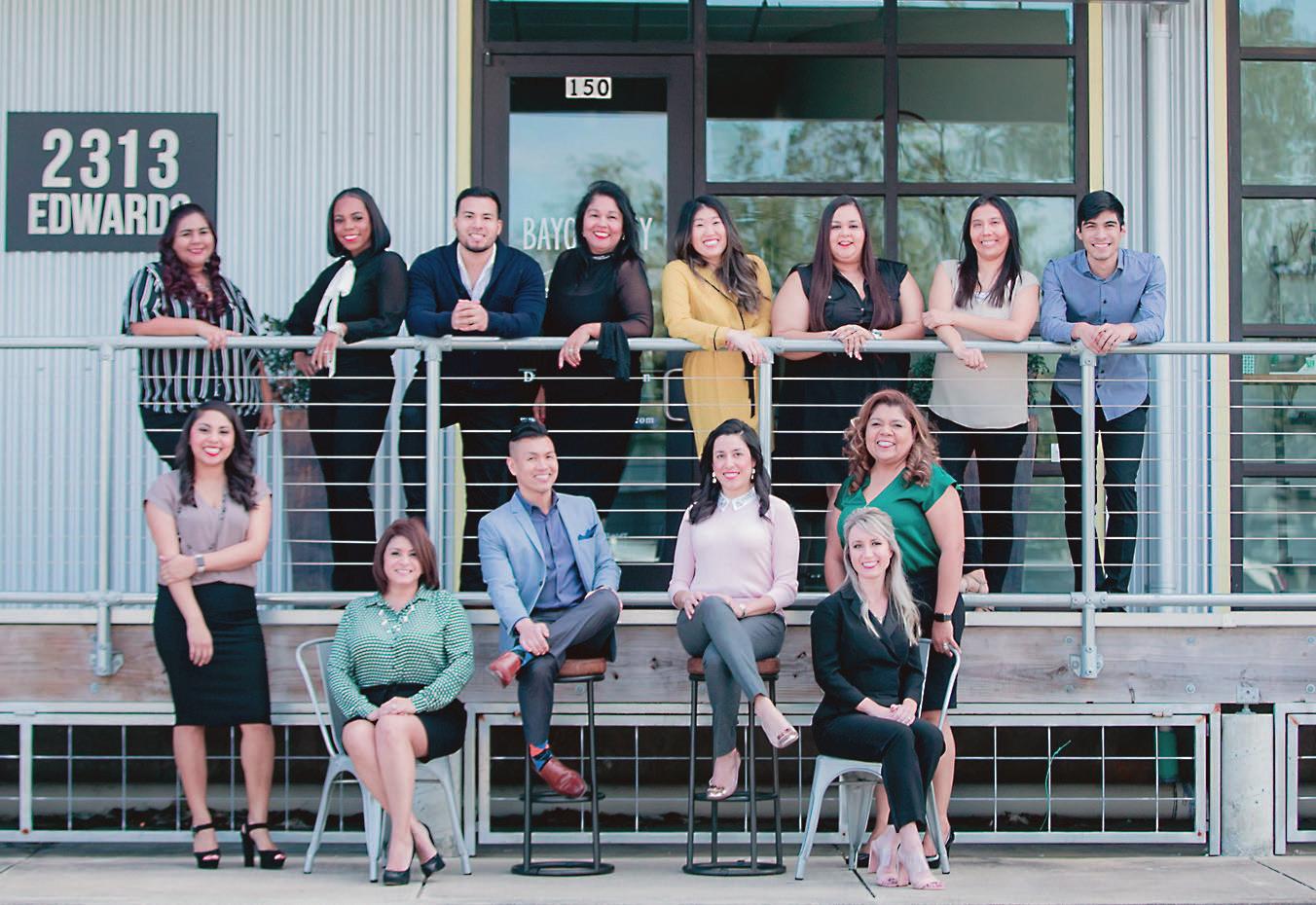
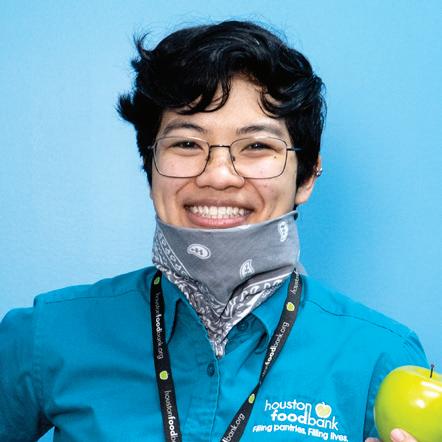
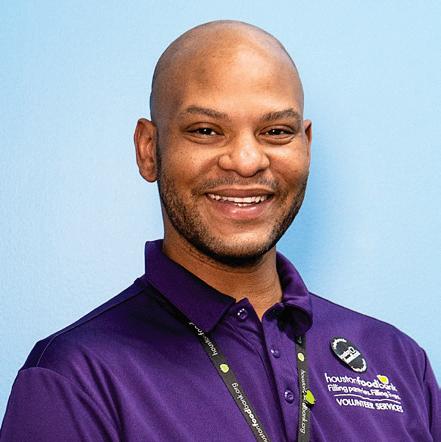
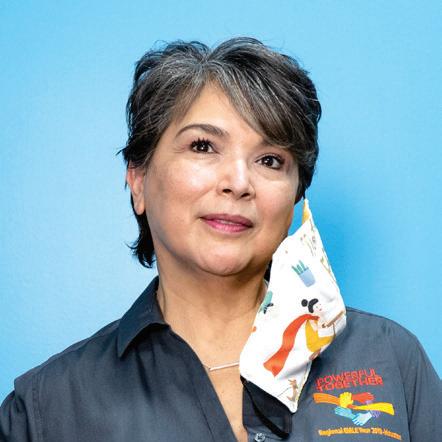
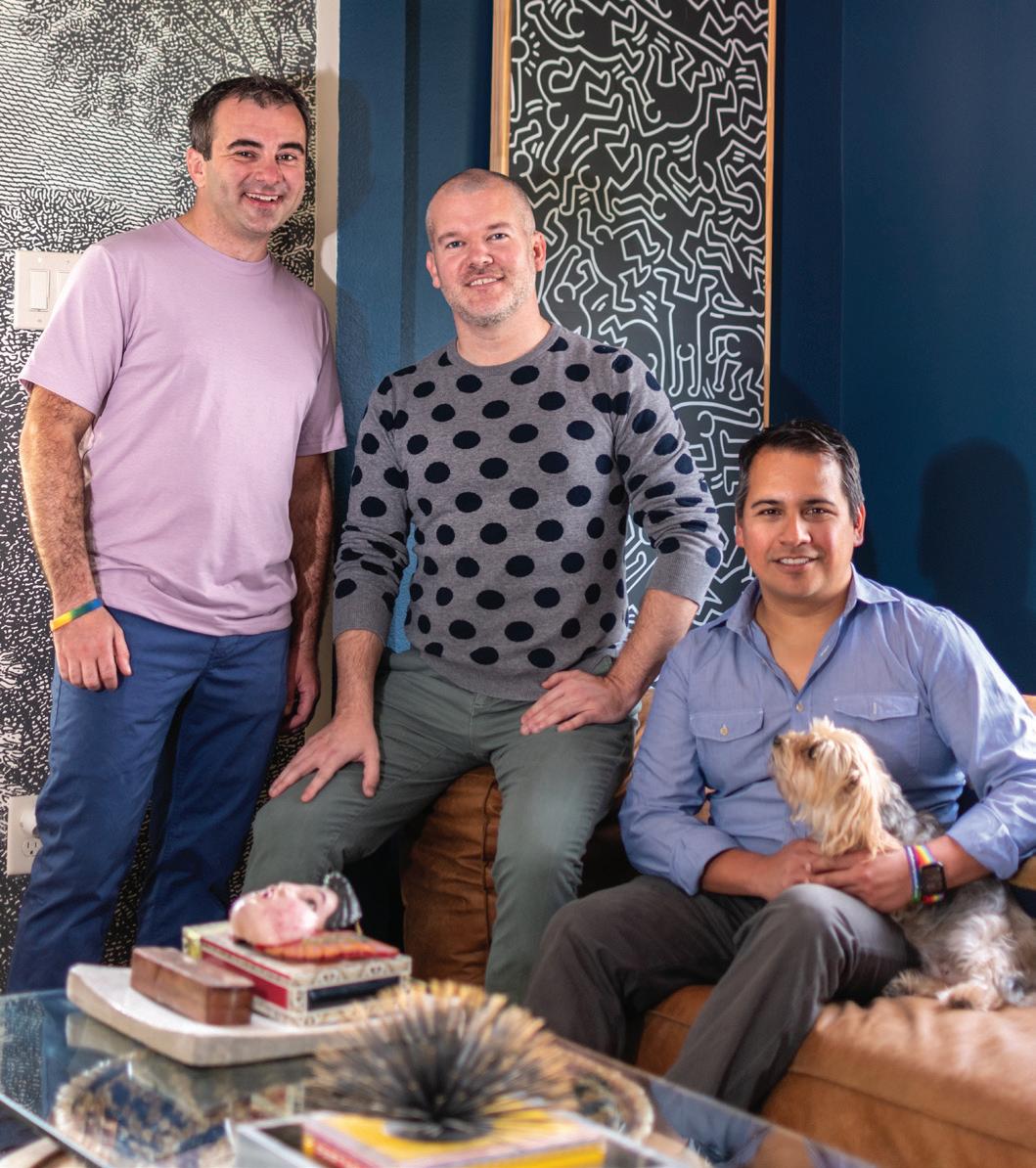
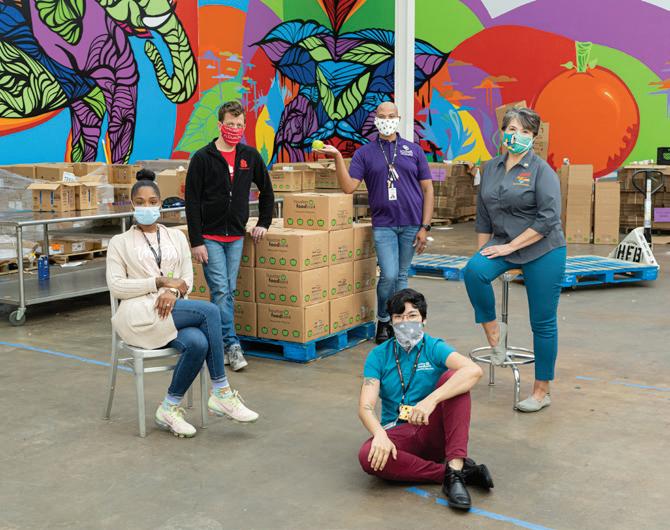
Surviving wouldn’t be possible without the efforts of our essential workers who are keeping this city clean, fed, and healthy. Writer Brandon Wolf interviews our cover stars—a group of LGBTQIA+ nonprofit workers who represent three local organizations tackling the sudden spike in
food insecurity. We extend our sincere gratitude and appreciation to these folks, and hope their stories touch your lives as much as they have ours.
We also celebrate Asian Pacific American Heritage in this issue by introducing you to four LGBTQ Asian Pacific American leaders whose work makes Space City a better place. Writer Ryan Leach talks to author Addie Tsai about her queer Montrosebased novel, while writer Lillian Hoang sits down with Jenna Pel to learn more about her work as president of the University of Houston LGBTQ Alumni Association. Connor Behrens chats with Fahad Punjwani about his consulting job that helps organizations deliver on their mission statements, and Jenny Block catches up with Albert Wei on his use of data technology to give chil-

quality education. Also this month, writer Byrd talks to Chef Tae her comfort-food delivery service, while Gregg Shapiro asks Alice Wu about her rom-com that’s now streaming on Netflix. Then writer Marene Gustin interviews the hosts of the local LGBTQ podcast Let’s Talk About Gay Stuff You’ll probably notice that this May printed edition is a bit smaller than usual, as the pandemic has forced us to limit our page count. So be sure to check out our digital “flipbook” edition at OutSmartMagazine.com to see additional feature stories and online exclusives. And don’t forget to visit the website throughout the month for our frequently updated news coverage.

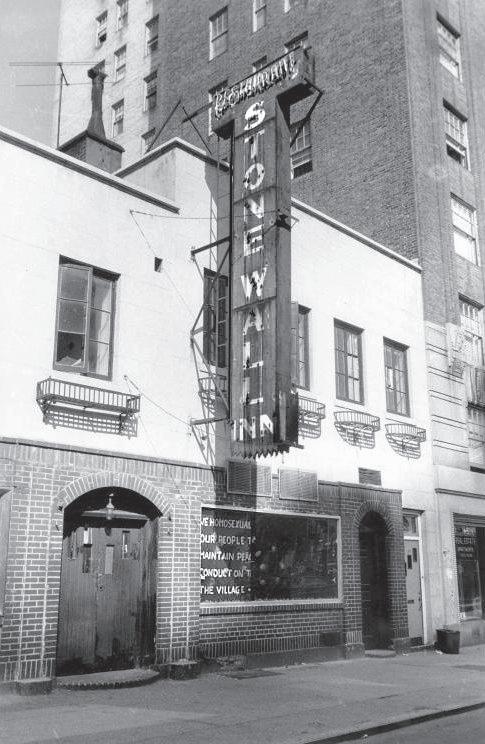
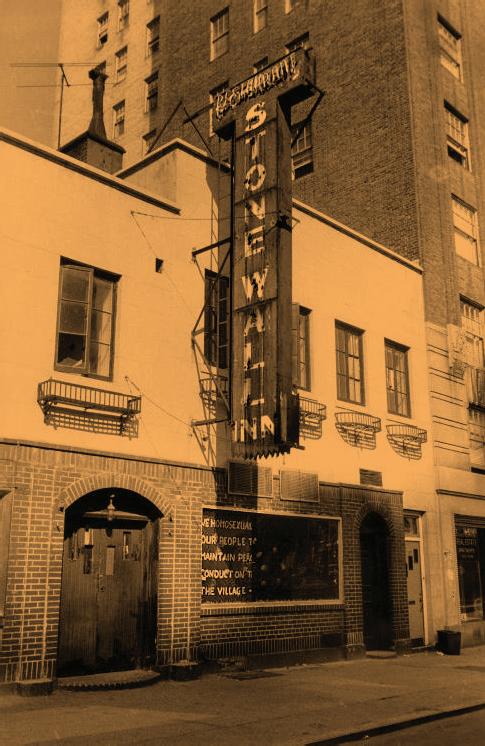
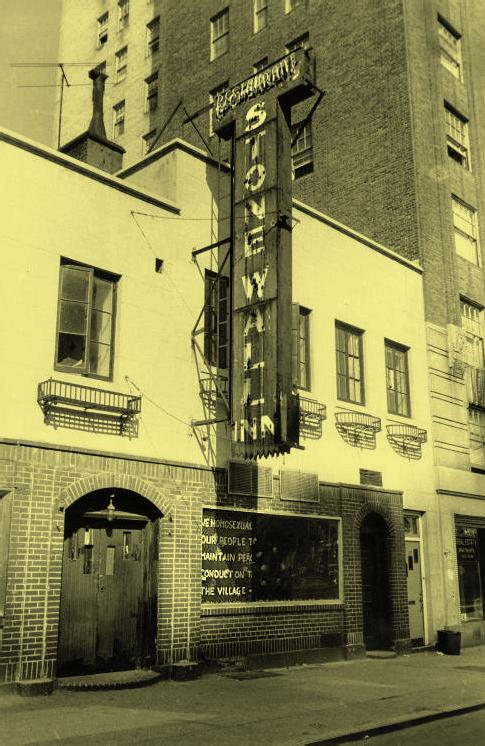
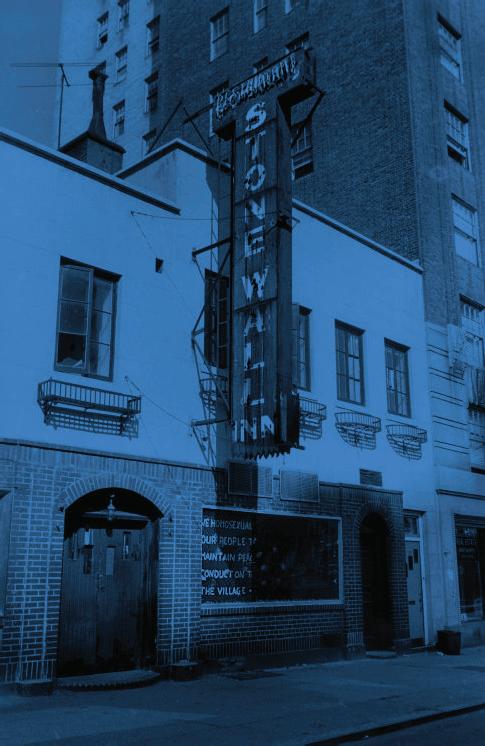
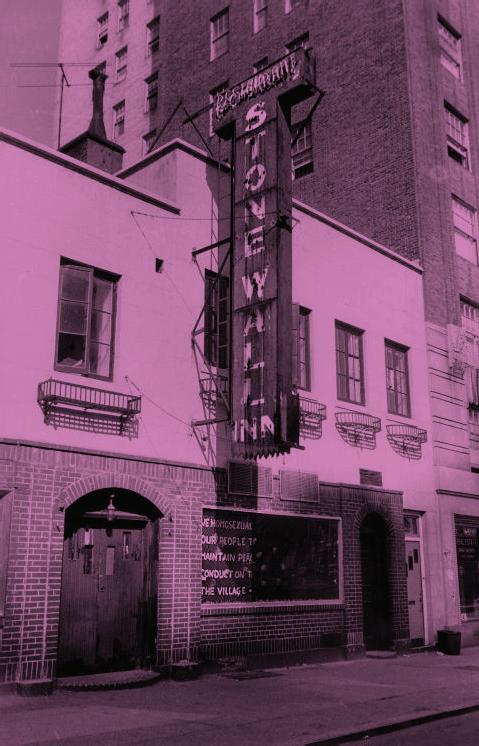
Pride Month, and as always, O utSmart will commemorate the 1969 Stonewall uprising in our annual Pride issue. We can’t wait to celebrate this LGBTQ civilrights milestone with you, even if it’s from the comfort of our own homes.
Finally, we encourage you to continue doing your part to “flatten the curve.” Wear your masks, practice social distancing, wash your hands, and be safe!








This is only a brief summary of important information about BIKTARVY and does not replace talking to your healthcare provider about your condition and your treatment.
BIKTARVY may cause serious side e ects, including:
Worsening of hepatitis B (HBV) infection. If you have both HIV-1 and HBV, your HBV may suddenly get worse if you stop taking BIKTARVY. Do not stop taking BIKTARVY without first talking to your healthcare provider, as they will need to check your health regularly for several months
BIKTARVY is a complete, 1-pill, once-a-day prescription medicine used to treat HIV-1 in adults and children who weigh at least 55 pounds. It can either be used in people who have never taken HIV-1 medicines before, or people who are replacing their current HIV-1 medicines and whose healthcare provider determines they meet certain requirements.
BIKTARVY does not cure HIV-1 or AIDS. HIV-1 is the virus that causes AIDS.
Do NOT take BIKTARVY if you also take a medicine that contains:
dofetilide
rifampin
any other medicines to treat HIV-1
Tell your healthcare provider if you:
Have or have had any kidney or liver problems, including hepatitis infection.
Have any other health problems.
Are pregnant or plan to become pregnant. It is not known if BIKTARVY can harm your unborn baby. Tell your healthcare provider if you become pregnant while taking BIKTARVY.
Are breastfeeding (nursing) or plan to breastfeed. Do not breastfeed. HIV-1 can be passed to the baby in breast milk.
Tell your healthcare provider about all the medicines you take:
Keep a list that includes all prescription and over-thecounter medicines, antacids, laxatives, vitamins, and herbal supplements, and show it to your healthcare provider and pharmacist.
BIKTARVY and other medicines may a ect each other. Ask your healthcare provider and pharmacist about medicines that interact with BIKTARVY, and ask if it is safe to take BIKTARVY with all your other medicines.
BIKTARVY may cause serious side e ects, including:
Those in the “Most Important Information About BIKTARVY” section.
Changes in your immune system. Your immune system may get stronger and begin to fight infections. Tell your healthcare provider if you have any new symptoms after you start taking BIKTARVY.
Kidney problems, including kidney failure. Your healthcare provider should do blood and urine tests to check your kidneys. If you develop new or worse kidney problems, they may tell you to stop taking BIKTARVY.
Too much lactic acid in your blood (lactic acidosis), which is a serious but rare medical emergency that can lead to death. Tell your healthcare provider right away if you get these symptoms: weakness or being more tired than usual, unusual muscle pain, being short of breath or fast breathing, stomach pain with nausea and vomiting, cold or blue hands and feet, feel dizzy or lightheaded, or a fast or abnormal heartbeat.
Severe liver problems, which in rare cases can lead to death. Tell your healthcare provider right away if you get these symptoms: skin or the white part of your eyes turns yellow, dark “tea-colored” urine, light-colored stools, loss of appetite for several days or longer, nausea, or stomach-area pain.
The most common side e ects of BIKTARVY in clinical studies were diarrhea (6%), nausea (6%), and headache (5%).
These are not all the possible side e ects of BIKTARVY. Tell your healthcare provider right away if you have any new symptoms while taking BIKTARVY.
You are encouraged to report negative side effects of prescription drugs to the FDA. Visit www.FDA.gov/medwatch or call 1-800-FDA-1088.
Your healthcare provider will need to do tests to monitor your health before and during treatment with BIKTARVY.
Take BIKTARVY 1 time each day with or without food.
This is only a brief summary of important information about BIKTARVY. Talk to your healthcare provider or pharmacist to learn more.
Go to BIKTARVY.com or call 1-800-GILEAD-5
If you need help paying for your medicine, visit BIKTARVY.com for program information.








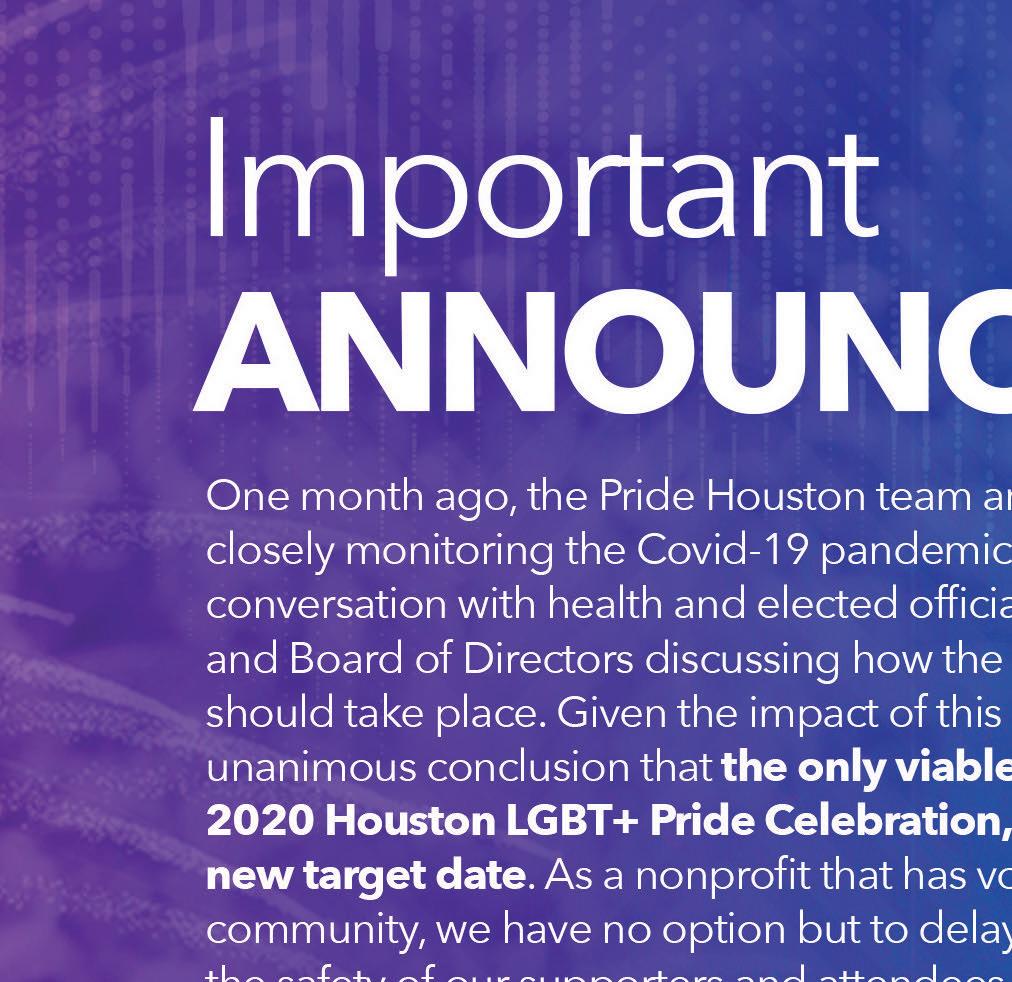
Houston’s 2020 Pride celebration has been postponed due to COVID-19.
Pride Houston, the organization that puts together Space City’s LGBTQ festival and parade each summer, announced this and several other updates during a digital Pride kickoff party on April 30.
website.
This year’s grand marshals, who will be present at Pride Houston’s pop-up events, are Tommie Ross (female-identifying), Dexter Williams (male-identifying), Kelsey Reynolds (non-binary), Lillie Schechter (ally), Nikki Araguz Loyd (honorary), and Landon Richie (tomorrow’s trendsetter).








“Given the impact of this pandemic, we have come to the unanimous conclusion that the only viable decision is to postpone Houston’s 2020 Pride Celebration with a target of fall 2020,” Pride Houston’s President Lo Roberts said.
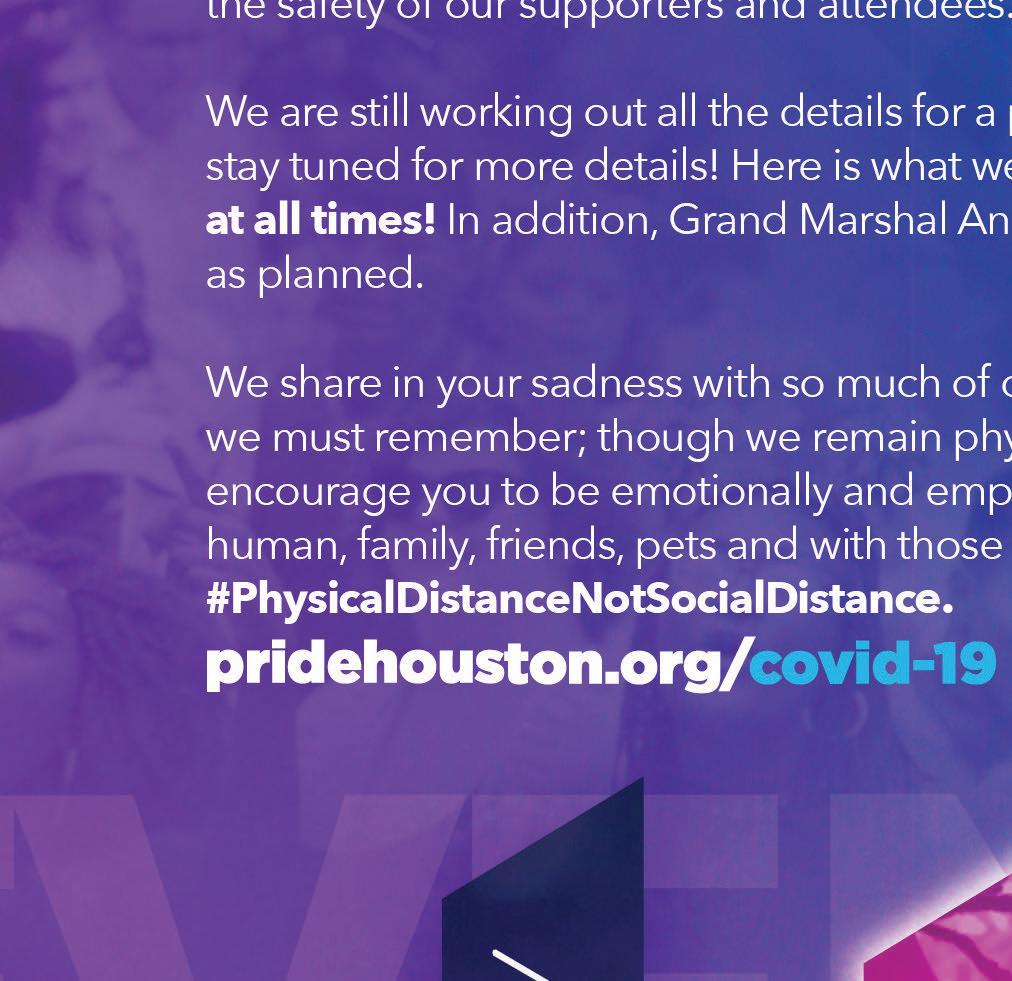
Even though this year’s lateJune event—which is themed “Houston Is Divercity”—has been delayed, Roberts noted that they would continue hosting smaller events that follow social-distancing guidelines throughout Pride month.














“We are still working out the details for what our 2020 celebration will look like, so more details are to come,” Roberts said. “However, understand that we will still have smaller pop-up events throughout June until the fall, as the City allows it, to celebrate life, love, culture, the arts, and this beautiful divercity.”
Despite the change in plans, Roberts reminds Houston’s LGBTQ community that “Pride is around us at all times.


During the April 30 kickoff, Pride Houston also announced its 2020 grand marshals. Individuals and organizations nominated as Pride grand marshals have made significant achievements and considerable contributions to the LGBTQ community at large, according to Pride Houston’s
“Always remember, after every storm there is a rainbow,” Roberts said, “and for us, that rainbow is Pride Houston 2020!”
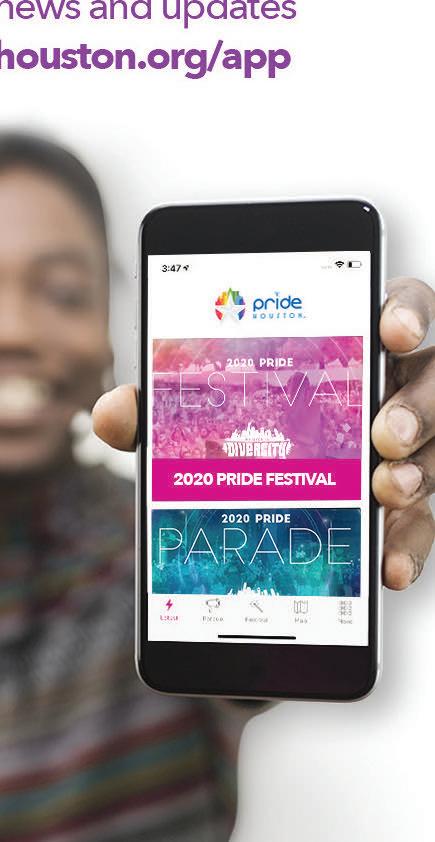
OutSmart will continue to update its website with the latest Pride Houston news. You can also keep up with Pride Houston online at pridehouston.org.









By SAM BYRD | Photo by NATASHA GOREL
There’s just something about that special touch of home cooking that makes everything taste better. Chef NaTosha “Tae” Barber has just the right background to transform dull into delicious—a central theme of her catering company, 210 Fusion Cuisine.
Originally raised in Lake Charles, Chef Tae uses her cooking skills learned as a child to take ordinary comfort food to new heights. With 210 Fusion Cuisine, she marries the comfort foods everyone knows and loves with internationally crafted dishes that wow the palate.
But her culinary pursuits have nontraditional beginnings. “I was originally an insurance agent who had just been cooking ever since I was a young child. Through the years, I started to develop a passion for it. It became a therapy for me. It started out with a few potlucks, and then friends and coworkers started asking me to bring food. So I started to get serious about it,” she says.
Between her 20 years in Louisiana and now 20 years in Houston, her culinary skills are primed to create mouth-watering recipes with influences from across the South. She makes it all—French baguettes with mascarpone, creamy-rich and decadent shrimp and grits, hand-rolled deep-fried boudin balls, and her signature Mardi Gras Seafood Lasagna that she presented when she auditioned for Fox’s MasterChef show.
“Most everything I specialize in has a Cajun flair. I take simple ingredients and add an international twist. I make fusion dishes inspired by Morrocan, Italian, and Mexican meals, and I do it at an affordable price. A lot of my clients are on a fixed budget. They want a complete meal with a special experience, so I create that,” she notes. “I make anything and everything you could want at an affordable price. It’s a party in your mouth!”
She also operates a digital storefront and makes deliveries. Customers may select five meals for $75. Orders must be submitted by Friday at midnight for pickup on Sunday. To make delivery less expensive, she has drop-off
spots near Willowbrook Mall, Greenspoint Mall, Almeda Mall, and Memorial City Mall.
“I make it as central as possible for the four corners of the city. I have clients outside of Houston, too, and we make special arrangements for them,” Chef Tae says.
With so many dining options in Houston, Chef Tae believes her home-cooked style sets her apart from the others.
“I think the thing that sets me apart is that I always offer great service, and the quality of the food is always consistent. For example, take your traditional étouffée. When you get it from me, you’ll know it’s 210 Fusion Cuisine,” she says. “It’s like the quality of a restaurant, with a homey feel. It’s that food you’d have if you went home to grandma or mom.”
Her business model also accommodates anyone who needs holiday meals, private event catering, private chef services, and party platters.
The number 210 in Chef Tae’s business
name is an interesting reference to her two daughters. “I have a set of twin girls born February 10. Cooking is one of the things I love passing along to them,” she explains.
While some might be hearing about Chef Tae and 210 Fusion Cuisine for the first time, her nurse-turned-singing-sensation partner, Christina Wells, is well known to Houston music lovers. She was featured on America’s Got Talent during season 13, and she also made waves locally by winning Pride Superstar three years ago. Interestingly enough, Chef Tae was the last to know of Wells’ fame when they first crossed paths at a Houston Pride grand-marshal announcement.
“To be honest, I saw Christina at the event, and I didn’t know who she was. The thing that attracted me was her personality and her ray of light. [I heard] someone mention her name, so I saved it in my phone and looked her up on Facebook. Three months later, she accepted my friend request. We’ve been inseparable ever since.”
It’s been a relationship that has flourished for both of them.
“She’s helped me along the way of realizing my dream of starting my business. I didn’t know all the steps, but she has been in the public eye for the last couple of years, and she’s handled that really well. She’s given me tips on how to target the clients I want. It’s helped me while I’m building 210 Fusion Cuisine.”
They’ve also combined their skills to benefit the LGBTQ community by establishing an annual Valentine’s Day soiree.
“We were able to put together Love and Libations for Valentine’s Day, where we partner to create a safe haven for the LGBTQ community. Everyone we hire—DJ, decorators, entertainers—is a part of that family, and the event will be something we try to do each year. We’ve taken our personal relationship and built it into a business relationship as well,” she notes.
Chef Tae has listened to requests from her clients and followers to expand her venture further, potentially through social media or by launching a food-truck service.
“I’m considering starting a YouTube or social-media cooking channel. A lot of people have asked for that. I’m also working on a digital cookbook,” she says. “Right now, I’m continuing to grow my brand and get to as many food festivals as possible. I’m looking to do an audition or two for a Food Network-type contest. I’m focused on growing in the Houston area and throughout the state.”
Due to the COVID-19 pandemic, Chef Tae’s catering gigs have been put on hold. Weekly meal-prep services and holiday menus are still available. To place an order, visit 210fusion.com or call 832-857-4796.












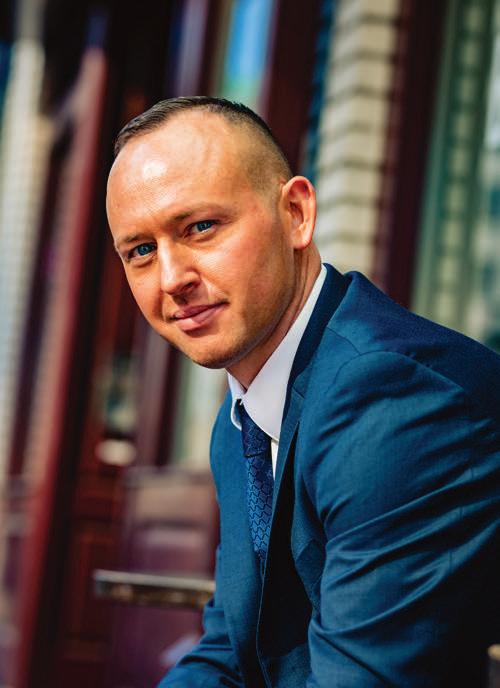












By MONICA ROBERTS
‘Aunt Monica’ has more to smile about than to be upset about on her special day.
Today is my birthday. I was supposed to be celebrating this 58th anniversary of my May 4 birth on the other end of I-45 in Dallas at the Black Trans Advocacy Conference with friends and allies from around the country.
But instead, I’m alone in my apartment blowing out candles and cutting a sheet cake from the Kroger down the street from my place. I was eagerly looking forward to attending the 2020 edition of the Black Trans Advocacy Conference, but it was forced to cancel because of this pandemic.
This year’s week-long BTAC was scheduled to start on May 5, the day after my birthday. I treat BTAC like a vacation week, and I usually like to get to Dallas the day before it starts.
But that’s not happening this year, and two other events I’m scheduled to attend may suffer the same fate. One is the joint NABJ-NAHJ Unity media convention in Washington, DC, this July, and the other is my 40th high-school reunion in October.
So while I’m bah-humbugging on this COVID-spiked birthday, I also bear in mind I’m not the only person in the Lone Star State and in America right now who has had their birthdays and other events ruined by the grossly mishandled response to the Trump Virus.
I’m already feeling sorry for the Class of 2020, who lost the rest of their senior year. They are facing having no proms, no Senior Week, no Senior Skip Day, and no commencements to celebrate their milestone achievement of graduating from high school.
It is even more painful for those 2020 high-school seniors who play spring sports like baseball, soccer, and track. They had their
seasons canceled before they could even get them started.
This birthday will be memorable for the unexpected reason that it happened in the middle of a pandemic. I’ll just take my being pissed off about it into the voting booth with me this November.
But instead of griping, let me start counting my blessings. I made it for another year on this space rock. I’m healthy, so far COVID-19 clear, and doing my part to stay that way. I have the blessing of being able to express myself in this O UTSMART column, on my TransGriot blog, and on a Twitter feed with over 20,000 followers. I have the respect of my peers inside and outside of the trans community.
I have the ability to pick up the phone and call my mom when the mood hits me—or when I let 72 hours pass and she beats me to it by calling me.
And most importantly to me, I have trans kids across the nation that refer to me as their Aunt Monica, along with my two blood family nieces.
So when I do the actual hard, solid thinking about it, I have more to smile about than to be upset about on my special day. Do I miss my BTAC fam? Yes, I do. But I know the cancellation was done so we can all get to see each other in Dallas in 2021 at our new host hotel.

So while COVID-19 may have ruined this birthday, it just makes me more determined that I will have something great to celebrate when it comes back around in 365 days.
Monica Roberts, a native Houstonian, is the founding editor of the GLAAD award-winning blog TransGriot. Her ongoing mission is to educate people on the lives of transgender people and fight for everyone’s human rights.


This is only a brief summary of important information about DOVATO and does not replace talking to your healthcare provider about your condition and treatment.
What is the Most Important Information I Should Know about DOVATO?
If you have both human immunodeficiency virus-1 (HIV-1) and hepatitis B virus (HBV) infection, DOVATO can cause serious side effects, including:
• Resistant HBV infection. Your healthcare provider will test you for HBV infection before you start treatment with DOVATO. If you have HIV-1 and hepatitis B, the hepatitis B virus can change (mutate) during your treatment with DOVATO and become harder to treat (resistant). It is not known if DOVATO is safe and effective in people who have HIV-1 and HBV infection.
• Worsening of HBV infection. If you have HIV-1 and HBV infection, your HBV may get worse (flare-up) if you stop taking DOVATO. A “flare-up” is when your HBV infection suddenly returns in a worse way than before. Worsening liver disease can be serious and may lead to death.
° Do not run out of DOVATO. Refill your prescription or talk to your healthcare provider before your DOVATO is all gone.
° Do not stop DOVATO without first talking to your healthcare provider. If you stop taking DOVATO, your healthcare provider will need to check your health often and do blood tests regularly for several months to check your liver.
What is DOVATO?
DOVATO is a prescription medicine that is used without other antiretroviral medicines to treat HIV-1 infection in adultswho have not received antiretroviral medicines in the past, and without known resistance to the medicines dolutegravir or lamivudine. HIV-1 is the virus that causes Acquired Immune Deficiency Syndrome (AIDS). It is not known if DOVATO is safe and effective in children.
Who should not take DOVATO?
Do Not Take DOVATO if You:
• have ever had an allergic reaction to a medicine that contains dolutegravir or lamivudine.
• take dofetilide.
What should I tell my healthcare provider before using DOVATO?
Tell your healthcare provider about all of your medical conditions, including if you:
• have or have had liver problems, including hepatitis B or C infection.
• have kidney problems.
• are pregnant or plan to become pregnant. One of the medicines in DOVATO (dolutegravir) may harm your unborn baby.
° Your healthcare provider may prescribe a different medicine than DOVATO if you are planning to become pregnant or if pregnancy is confirmed in the first 12 weeks of pregnancy.
° If you can become pregnant, your healthcare provider will perform a pregnancy test before you start treatment with DOVATO.
° If you can become pregnant, you should consistently use effective birth control (contraception) during treatment with DOVATO.
° Tell your healthcare provider right away if you are planning to become pregnant, you become pregnant, or think you may be pregnant during treatment with DOVATO.
Tell your healthcare provider about all of your medical conditions, including if you: (cont’d)
• are breastfeeding or plan to breastfeed. Do not breastfeed if you take DOVATO.
° You should not breastfeed if you have HIV-1 because of the risk of passing HIV-1 to your baby.
° One of the medicines in DOVATO (lamivudine) passes into your breastmilk.
° Talk with your healthcare provider about the best way to feed your baby.
Tell your healthcare provider about all the medicines you take, including prescription and over-the-counter medicines, vitamins, and herbal supplements.
Some medicines interact with DOVATO. Keep a list of your medicines and show it to your healthcare provider and pharmacist when you get a new medicine.
• You can ask your healthcare provider or pharmacist for a list of medicines that interact with DOVATO.
• Do not start taking a new medicine without telling your healthcare provider. Your healthcare provider can tell you if it is safe to take DOVATO with other medicines.
What are Possible Side Effects of DOVATO?
DOVATO can cause serious side effects, including:
• Those in the “What is the Most Important Information I Should Know about DOVATO?” section.
• Allergic reactions. Call your healthcare provider right away if you develop a rash with DOVATO. Stop taking DOVATO and get medical help right away if you develop a rash with any of the following signs or symptoms: fever; generally ill feeling; tiredness; muscle or joint aches; blisters or sores in mouth; blisters or peeling of the skin; redness or swelling of the eyes; swelling of the mouth, face, lips, or tongue; problems breathing.
• Liver problems. People with a history of hepatitis B or C virus may have an increased risk of developing new or worsening changes in certain liver tests during treatment with DOVATO. Liver problems, including liver failure, have also happened in people without a history of liver disease or other risk factors. Your healthcare provider may do blood tests to check your liver. Tell your healthcare provider right away if you get any of the following signs or symptoms of liver problems: your skin or the white part of your eyes turns yellow (jaundice); dark or “tea-colored” urine; light-colored stools (bowel movements); nausea or vomiting; loss of appetite; and/or pain, aching, or tenderness on the right side of your stomach area.
• Too much lactic acid in your blood (lactic acidosis). Lactic acidosis is a serious medical emergency that can lead to death. Tell your healthcare provider right away if you get any of the following symptoms that could be signs of lactic acidosis: feel very weak or tired; unusual (not normal) muscle pain; trouble breathing; stomach pain with nausea and vomiting; feel cold, especially in your arms and legs; feel dizzy or lightheaded; and/or a fast or irregular heartbeat.
• Lactic acidosis can also lead to severe liver problems, which can lead to death. Your liver may become large (hepatomegaly) and you may develop fat in your liver (steatosis). Tell your healthcare provider right away if you get any of the signs or symptoms of liver problems which are listed above under “Liver problems.” You may be more likely to get lactic acidosis or severe liver problems if you are female or very overweight (obese).


Reasons to ask your doctor about DOVATO:
DOVATO can help you reach and then stay undetectable* with just 2 medicines in 1 pill. That means fewer medicines† in your body while taking DOVATO

You can take it any time of day with or without food (around the same time each day)—giving you flexibility
DOVATO is a once-a-day complete treatment for adults who are new to HIV-1 medicine.
Results may vary.
*Undetectable means reducing the HIV in your blood to very low levels (less than 50 copies per mL).
† As compared with 3-drug regimens.


What are Possible Side Effects of DOVATO (cont’d)?
• Changes in your immune system (Immune Reconstitution Syndrome) can happen when you start taking HIV-1 medicines. Your immune system may get stronger and begin to fight infections that have been hidden in your body for a long time. Tell your healthcare provider right away if you start having new symptoms after you start taking DOVATO.



• The most common side effects of DOVATO include: headache; diarrhea; nausea; trouble sleeping; and tiredness.
These are not all the possible side effects of DOVATO. Call your doctor for medical advice about side effects. You are encouraged to report negative side effects of prescription drugs to the FDA. Visit www.fda.gov/medwatch, or call 1-800-FDA-1088.
Where Can I Find More Information?
• Talk to your healthcare provider or pharmacist.
• Go to DOVATO.com or call 1-877-844-8872, where you can also get FDA-approved labeling.
October 2019 DVT:2PI-2PIL
Trademark is owned by or licensed to the ViiV Healthcare group of companies.

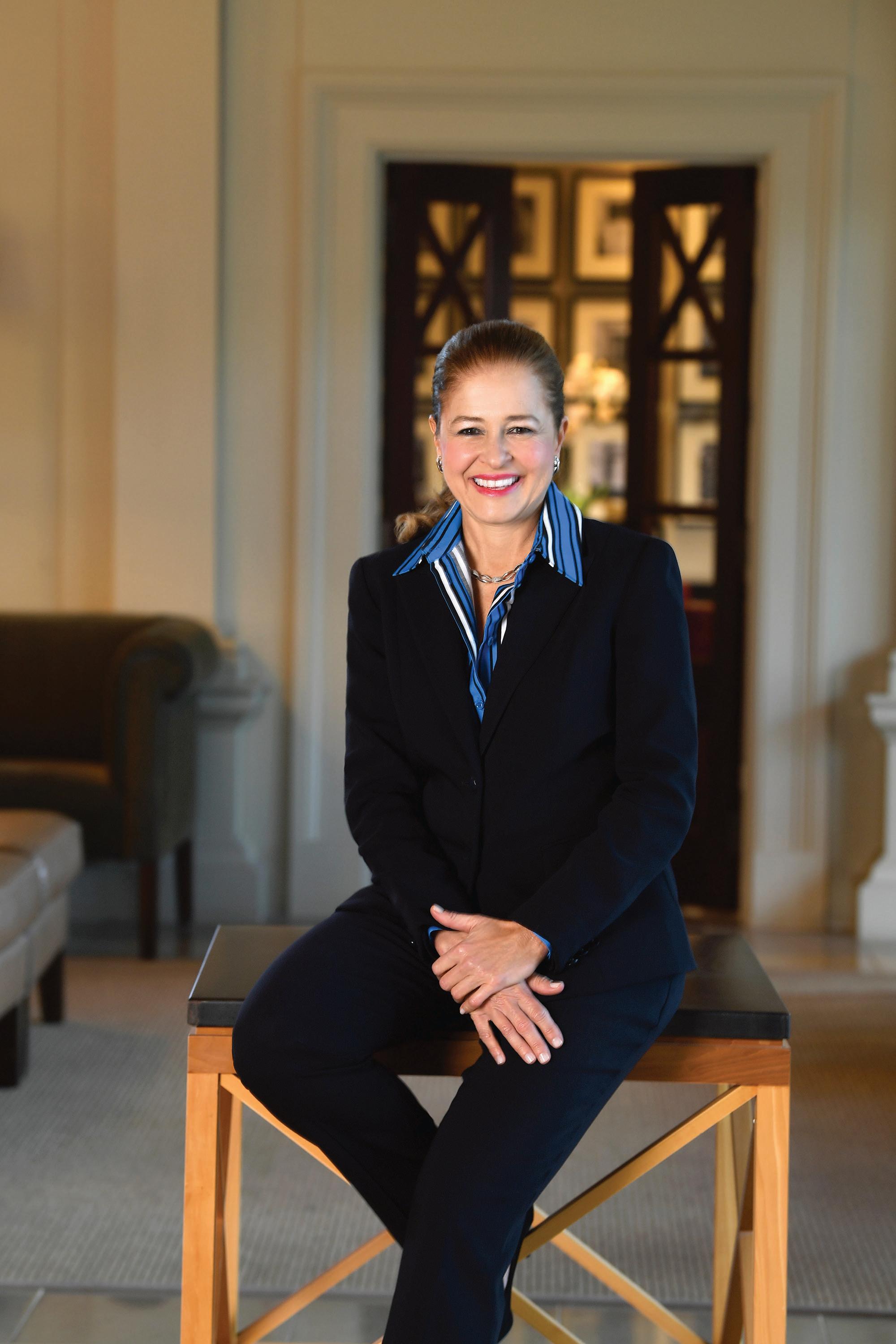
By GRACE S. YUNG, CFP
As the coronavirus crisis stretches toward the summer months, many people have felt the financial pain of reduced portfolio values, as well as the uncertainty about whether things will ever “get back to normal.” But even though you might feel like you have no control over the volatile stock market and the painfully low interest rates, there are some things you can do to help keep your finances in check.
The coronavirus has been the catalyst for a long list of financial problems, including these serious challenges:
•
Although a loss or reduction in income can be stressful, there are some things you can do to improve incoming cash flow. The first step should be to file for unemployment.
There are two ways that you can apply for unemployment benefits in Texas. One is to contact a Tele-Center by phone at (800) 939-6631. Or, you can apply online by visiting the Texas Workforce Commission’s website at: twc.texas.gov/jobseekers/unemploymentbenefits-services#applyBenefits.
Due to the record number of people filing for unemployment, be aware that it has been taking much longer than normal to start receiving these benefits. The good news is that, according to the Texas Workforce Commission, unemployment benefits will be retroactive to March 2020, when the governor issued a disaster declaration.
If you have permanently lost your job and you have a 401(k) or other employer-sponsored retirement plan, you have the standard options regarding those funds: leave the money in your plan (if permitted), roll over the assets to your new employer’s plan (if one is available and rollovers are permitted), roll over the money to an IRA, or cash out the account value. Be sure to consult a qualified financial advisor regarding any of these options in order to prevent unintended tax consequences.
The Coronavirus Aid, Relief, and Economic Security (CARES) Act allows you to access money from a retirement account without incurring the 10-percent early-withdrawal

penalty that is typically imposed on those younger than 59 ½ . (Your withdrawal can still be subject to income tax, though). The CARES act also allows in-service distributions up to $100,000 if one has been impacted by the pandemic. If you are unable to “re-contribute” your emergency distribution to another retirement plan or IRA within three years, the new law allows taxes to be paid on the distribution over three years.
Since income loss can also make paying your bills more difficult, you should cut any unnecessary expenses and stick to a budget to help relieve some of your financial challenges.
The Trump administration has suspended federal student-loan payments during the pandemic, as well as interest charges on these types of loans. According to the U.S. Department of Education, all borrowers with federally held student loans will automatically have their interest rate set to zero percent for a period of at least 60 days. Further, these studentloan borrowers will have the option to suspend their payments for at least two months.
You may also be able to lower some of your other monthly financial obligation(s) by taking advantage of lower interest rates and refinancing your mortgage or other debt. Before you refinance any type of loan, though, be sure to compare your overall costs, which oftentimes include application fees, closing costs, and other expenses. Also, even if refinancing makes sense from a lower monthly payment aspect, if the term of the loan is extended, refinancing could still end up costing you more in
total interest payments. So make sure that you review all of the potential pros and cons.
In light of the COVID-19 crisis, credit-card issuers, mortgage companies, and a host of other lenders are allowing borrowers to defer payments. These relief efforts are not necessarily automatic, though, so it is important to contact each creditor directly and inquire about relief efforts that are available to you. In many cases, delaying payments won’t impact your credit score, so it can be well worth it to take advantage of these programs.
• Relief for Small Business Owners:
Small businesses are the backbone of America. If you own a company, you may be able to participate in various programs that provide grants and low- or no-interest loans. For instance, the Economic Injury Disaster Loan (EIDL), offered through the Small Business Administration, could provide help if your business or nonprofit entity has suffered economic injury as a result of the COVID-19 outbreak. Also, the Paycheck Protection Program is another possibility.
There have been some bumps along the way with these programs as the initial government funds are quickly exhausted. Hopefully, more funds will be made available to small businesses.
• Volatile Investment Performance:
You may be among the many investors watching retirement plans or other investments drop dramatically in value. Although you may













By SUSAN BANKSTON
and so much more.
You’re not reading this unless you’ve been outside to get your magazine at Barnaby’s or some other equally cool place. Or maybe you’re just spending way too much time on the Internet machine.
I hope you are well and don’t feel as though you’ve yee’d your last haw, because this will all be over one day. (After all, if Rudy Giuliani is still standing, you can too.)
I know it’s tough to be locked up in isolation when we’re stuck with a president who is meandering to a different drummer and is so wired that he can pick up AM radio signals through his makeup. He wants to steal an hour of your day by talking on the teevee in some damn language nobody understands. It sounds a little like English, but . . . no, not English. Definitely not English. It’s more like a hurricane blowing through a dictionary.
Then he decided to trademark the name “Cap’n Donald and the Treasury Raiders,” and the motto “Built on a lifetime supply of tainted corporate ethics.”
Now that we’ve discovered that Republican government is all lime and salt but no tequila, there’s nothing left to do but retreat to the solitude of our own homes as it slowly becomes obvious that blind-screaming hedonism has won out.
Things You Do Not Want to Know during a Coronavirus Lockdown
• Mike Pence is in charge. Of anything.
• Regrettably, it turns out that we can do better than we’d like to admit without toilet paper.
• Scientists discover that too much soap leads to impotence.
• Instead of a face mask, you accidentally ordered a Lone Ranger mask.
• You clearly hear a voice say, “I have decided on celibacy.” And you live alone.
• Some gun-toting redneck guy from Kansas with two husbands, a meth addiction, and 223 pet tigers is probably going to be the next superstar president.
• Cyndi Lauper was named Secretary of Agriculture, and you weren’t even surprised.
• All cruise ships are being rerouted to Buffalo Bayou for the duration.
• Charmin Ultra Soft replaces the dollar as the official U.S. currency.
• Not only is the Post Office requiring masks to stand in line, but they require you to still wear pants to step out and check your mailbox.

Joe Exotic, aka “Tiger King,” and one of his many pet tigers.
Does Andrew Cuomo have a nipple ring? Huh? Whoa, wait, stop. What’s this about Andrew Cuomo and nipple rings?
Top Ten Things Andrew Cuomo Has under His Shirt That Are Definitely Not a Nipple Ring, Nope, Definitely Not, No Nipple Ring
10. Don’t worry, that’s just the top of his corset—he’ll be performing Lucky Cheng’s Drag Show at 11 p.m.
9. He and Chris Cuomo have tiny transmitters taped to their chests. (Yes, you and your brother will never be that close.)
8. His 5G tumor.
7. The flash drive with Jared’s spunky personality stored on it.
6. Pandemic Sweat Balls.
5. If ya wanna see it in the White House, you should’ve put a ring on it.
4. Allowable quarantine weight gain.
3. His other 5G tumor.
2. Two words: California Exotics.
1. He ain’t foolin’ nobody—that’s a damn nipple ring!
Until next month, when I hope we all can “come out” for Pride month, stay strong, stay safe, stay semi-sober. I’ve started working on my Pride outfit. Bless Michael’s for their curbside pickup, because, Honey, the things I can do with feathers, sequins, rhinestones, a glue gun, and a little sassy leather would tease your granny’s bitties. Hugs!
Susan Bankston lives in Richmond, Texas, where she writes about her hairdresser at The World’s Most Dangerous Beauty Salon, Inc., at juanitajean.com.


5819 Birdsall Market Place
Boasting an enviable location within the heart of Rice Military, this stunning freestanding home is a must-see for anyone wanting space, luxury and convenience. You will live within walking distance of Memorial Park, Brenner’s on the Bayou, the Washington Street dining precinct and of course, your local coffee shop. Inside, a host of upgrades make this a bright, modern and comfortable home… $434,998. GIVING















Try reconfiguring the expectations you have for yourself and others.
By DARYL SHORTER,
MD
more balanced perspective regarding coping. Ask yourself: what feels like a reasonable or manageable expectation in the midst (or the aftermath) of a crisis? For example, maybe the goal isn’t to avoid eating sweets altogether. Perhaps you plan to continue eating a few cookies each day, stretching the bag over several days and practicing moderation.
Take time to celebrate the curtailing of behaviors such as emotional eating or excessive drinking and drug use, and build upon success. When you find you’re able to reduce or avoid certain behaviors, think through what helped you achieve your goals for the day, and try to repeat them.
The first confirmed U.S. COVID-19 case was reported on January 20, 2020. Since that time, cities around the country have witnessed an absolutely alarming number of persons affected by the illness. The U.S. death toll recently surpassed 40,000 people—more than any other country in the world. In the Houston area, there were over 7,000 confirmed cases and almost 150 deaths as of late April.
The impact of COVID-19 on our economy, our healthcare system, and our very personhood is being felt in a tremendous way. But dealing with this crisis is about more than just getting through the day while managing anxiety and fear. For some, reckoning with past decisions and the realities of life circumstances can cause even more distress.
Small rifts and previously unspoken issues in romantic relationships are now manifesting as full-blown arguments, marital discord, and the dissolution of relationships. Sadly, in some cases the anger spills over to become intimatepartner violence or other threatening kinds of behaviors.
Difficulties in parenting children, who are also experiencing significant disruption and stress in their young lives, compounds the quarantine stress. Unhappiness with one’s living space can also be magnified, since we are now forced to spend practically all of our time in our homes. Even pre-existing job dissatisfaction can worsen in an environment where meetings occur primarily via telephone or online. (This, of course, assumes you still have a job that hasn’t been negatively impacted by changes in the local economy.)
This crisis asks not only that we manage the stress of a global pandemic, but also that we personally confront the realities of who we are, the consequences of our decisions, and the overall quality and direction of our lives. But
this is not necessarily a bad thing. In the evaluation of the self, there are always signs of hope. As we wrestle with the ups and downs of the pandemic, the opportunities for self-reflection can lead to planning and trigger action. Without access to our typical outlets for activities and social interaction, many of us are feeling the effects of living under a heightened state of chronic stress. We vacillate between optimism (“Oh, everything will turn out totally fine”) and hopelessness (“The world is doomed”), speeding right past the middle ground of objectivity and accurate perspective. There is sometimes simply too much fear and uncertainty to feel comfortable for sustained periods of time.
Acknowledging our collective struggle is an important step in managing COVID-related stress. When we verbalize our experience and share it with others, we find validation and understanding. This type of connection may be even more critical in a time when our ability to physically connect with others is limited. In the absence of touch—handshakes, hugs, and other types of physical intimacy—the creation and maintenance of emotional ties through the use of shared words serves as a vital and necessary surrogate.
Reconfiguring our expectations for ourselves and others can be extraordinarily helpful during this time. Your response to this completely abnormal event is normal, given the circumstances. As we try to implement more positive and adaptive ways of coping, keep in mind that we are all experiencing the near-complete disruption of our routines.
At the same time, we certainly don’t want to keep using our most maladaptive patterns of behavior for the temporary alleviation of stress. Instead, our goal can be to employ a
If you have a bad day, practice self-compassion. Instead of shaming yourself for eating an entire package of cookies in one sitting, remember that expecting entirely healthy behavior while going through a crisis can create more of the very frustration, guilt, and shame that drives our poorest coping strategies. Extend to yourself some grace as you weather this storm.
Perhaps the issues in your relationship or family have become so uncomfortable that you feel you have no choice but to do something about it. Begin looking for individual, couples, or family therapists to assist with navigating these complicated situations. Access to affordable mental-health professionals via online services is popping up everywhere. Explore your options.
Employment (or the lack of it) has also become a particularly challenging aspect of life, but it’s never too early to start reaching out to people for support. Use your existing networks for assistance with navigating the job market. People can’t help if they don’t know you’re looking for work or considering a job transition. Since this crisis has provided us with the gift of time, use it to research careers, update your résumé and online work profiles, and search and apply for jobs.
There is something so important about the recognition that we are going through something together. “Through” implies a beginning, a middle, and an end. It signals that things are in process. And though we may not know all that lies on the other side, we can certainly acknowledge that there is another side.
No doubt, we will be changed—in some ways for the better, and maybe in other ways for the worse. But focus on how this crisis is like other big changes we have endured. Call upon the internal resources and external supports (friends, family, community) that have helped bolster you during previous difficult times. The work ahead can be accomplished as long as we remember that we get through things by going through them together.









Mazzarino’s newest division, MazzTao homes, presents another development in the highly sought after River Oaks Shopping area with unmatched features and massive backyards. (1050-1075 Sq Ft)
This plan features:
• First floor living
• Private driveways
• Huge backyards with room for a pool!
• 4 bedooms
• 3.5 bathrooms
• Study room
• Game room
• Master suite features a sitting area
• Stunning master bath with two walk-in closets

but also may contain upgrades and alternative






By GREGG SHAPIRO
In 2004, a few years after Ang Lee’s The Wedding Banquet and a few years before Awkwafina’s The Farewell, lesbian filmmaker Alice Wu’s acclaimed indie film debut Saving Face introduced audiences to Wil (played by Michelle Krusiec), one of our first out queer Asian female characters. The movie closely examined Wil’s relationship with her very traditional mother, played by award-winning actress Joan Chen (The Last Emperor, Twin Peaks). A hit on the festival and art-house circuits, Saving Face was also a wonderful introduction to a promising filmmaker.
As Wu reveals in this O utSmart interview, much has happened between the release of Saving Face and her new movie, The Half of It. A queer 21st-century take on Cyrano de Bergerac, The Half of It, debuting on Netflix this month, takes viewers to high school where extremely bright student Ellie (Leah Lewis), who makes bank by writing term papers for her classmates, is enlisted to write love letters from Paul (Daniel Diemer) to Aster (Alexxis Lemire). The problem is that Ellie is also in love. To say more would give away an essential plot point, but it’s well worth tuning in to see how it unfolds. Alice Wu was gracious enough to answer a few questions about her life and her work in advance of the movie’s Netflix premiere.
Gregg Shapiro: I had the pleasure of interviewing you, as well as Joan Chen, about your first movie, Saving Face. When you look back on the experience of making that movie, how do you remember it?
Alice Wu: It’s funny, people often say that only in hindsight do they recognize a particular experience being as special as it was. But with Saving Face, I knew the entire time we were shooting that this was something rare—even as indie film shoots go, which are always a

minor miracle in themselves! I mean, I had a cast of almost entirely Chinese and ChineseAmerican actors shooting in New York City, most of the cast speaking Mandarin amongst ourselves, chrysanthemum tea at craft service, and a largely non-Chinese crew that was very reverential to the whole experience. There were a lot of “unusual bedfellows.” For example, most of the Chinese cast could have been my aunts, uncles, or grandparents, and they were servicing a film with a gay storyline—and doing so willingly. Everyone just seemed so happy to be there. No one felt like they were there for the paycheck. For me, as a first-time filmmaker and a lesbian reconciling my various worlds, it was at once viscerally bizarre and incredibly affirming. I gained a whole new level of self-acceptance as an Asian-American gay woman after that shoot.
You probably don’t need to be reminded of this, but 16 years passed between your movies Saving Face and The Half of It. What were you doing during that time? Yeah, it took me a while, eh? [Laughs] I guess
I play the longest of long games! After Saving Face I did some work for hire, writing for studios. Then ten years ago, my mother had a serious health issue, and I dropped everything and moved back to San Francisco to be with her. At the time, I truly believed I’d left the industry; I stopped writing entirely. For fun, I did long-form improv, but I assumed my filmmaking days were over. Then three years ago, I got pulled back into the industry by a studioexec friend who hired me to write a script on assignment. That went well enough that they asked if I’d work on something else. But I had started thinking about the fact that I’d never written anything for myself to direct since Saving Face. Everything had been a work-forhire. So, I turned my attention to The Half of It, a story I’d had kicking around in my brain for nearly a decade.
The movie world has changed considerably since Saving Face. For example, The Half of It is having its premiere on Netflix. What does such a change mean to you as a filmmaker? You know, when I first sent out The Half of It,
Local performers rely on online viewers and tips during the shutdown.
By ZACHARY MCKENZIE
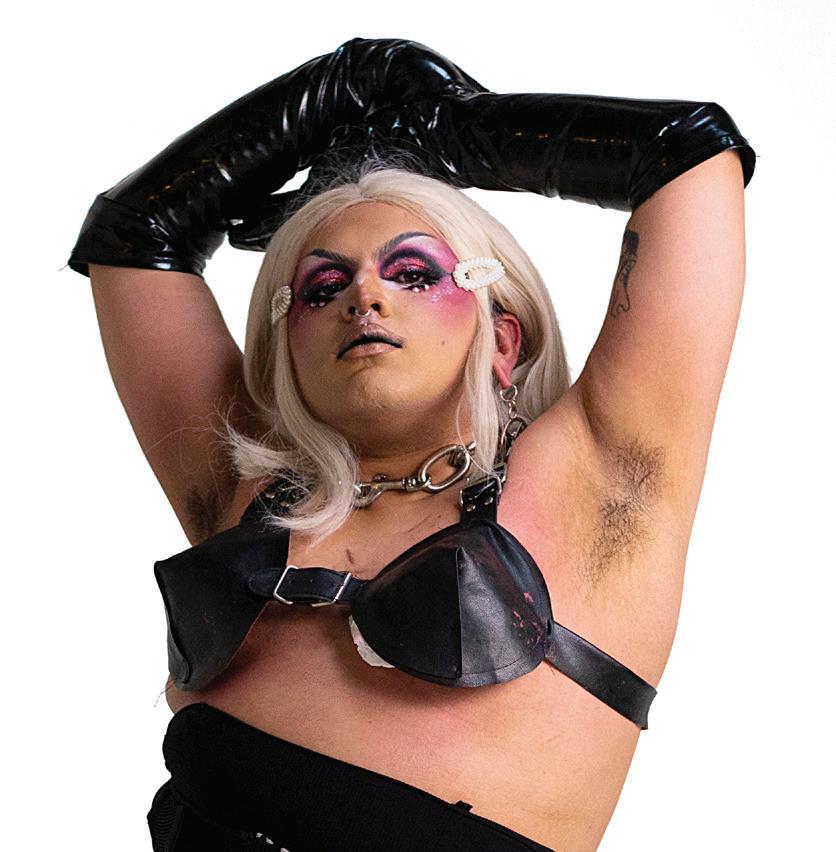
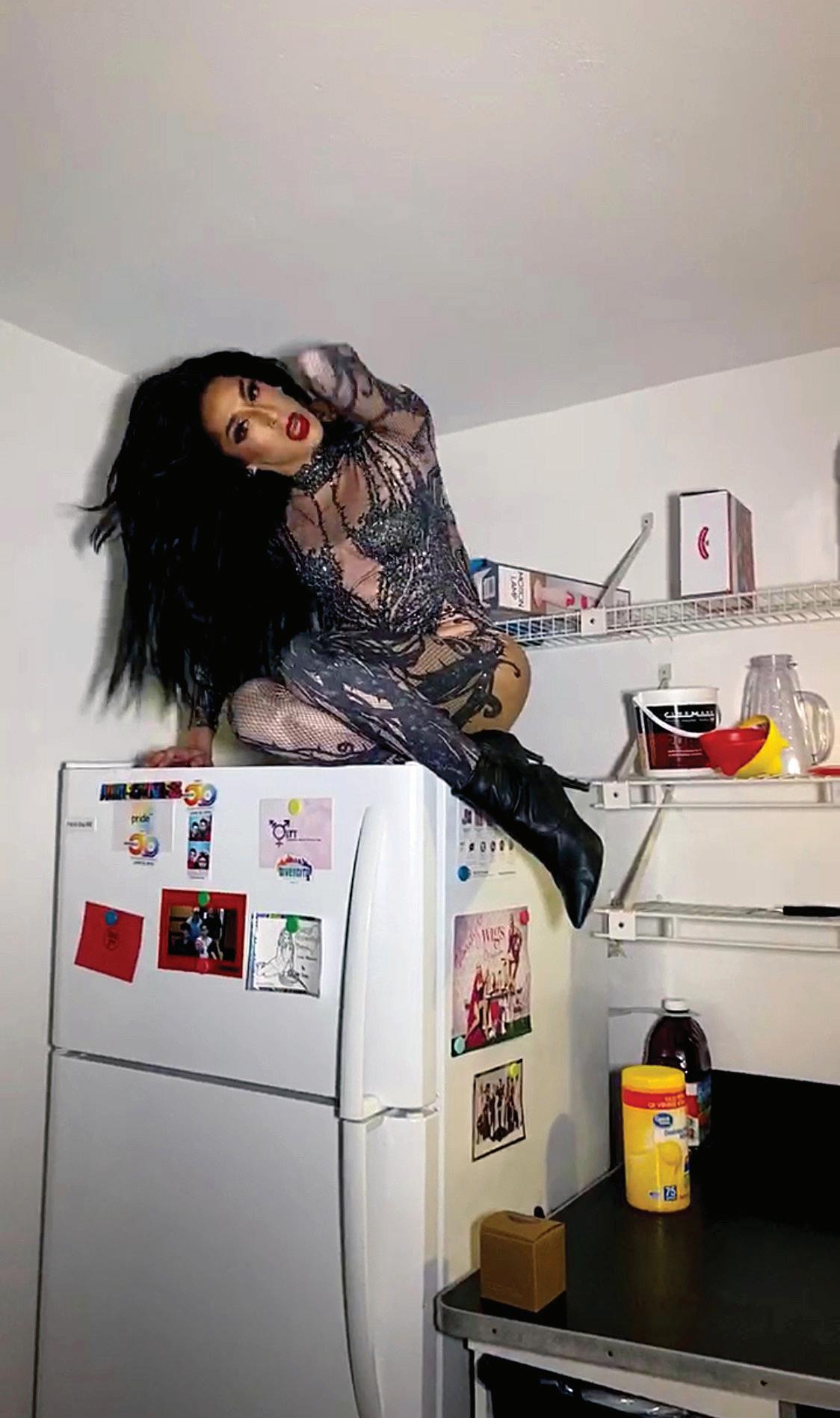
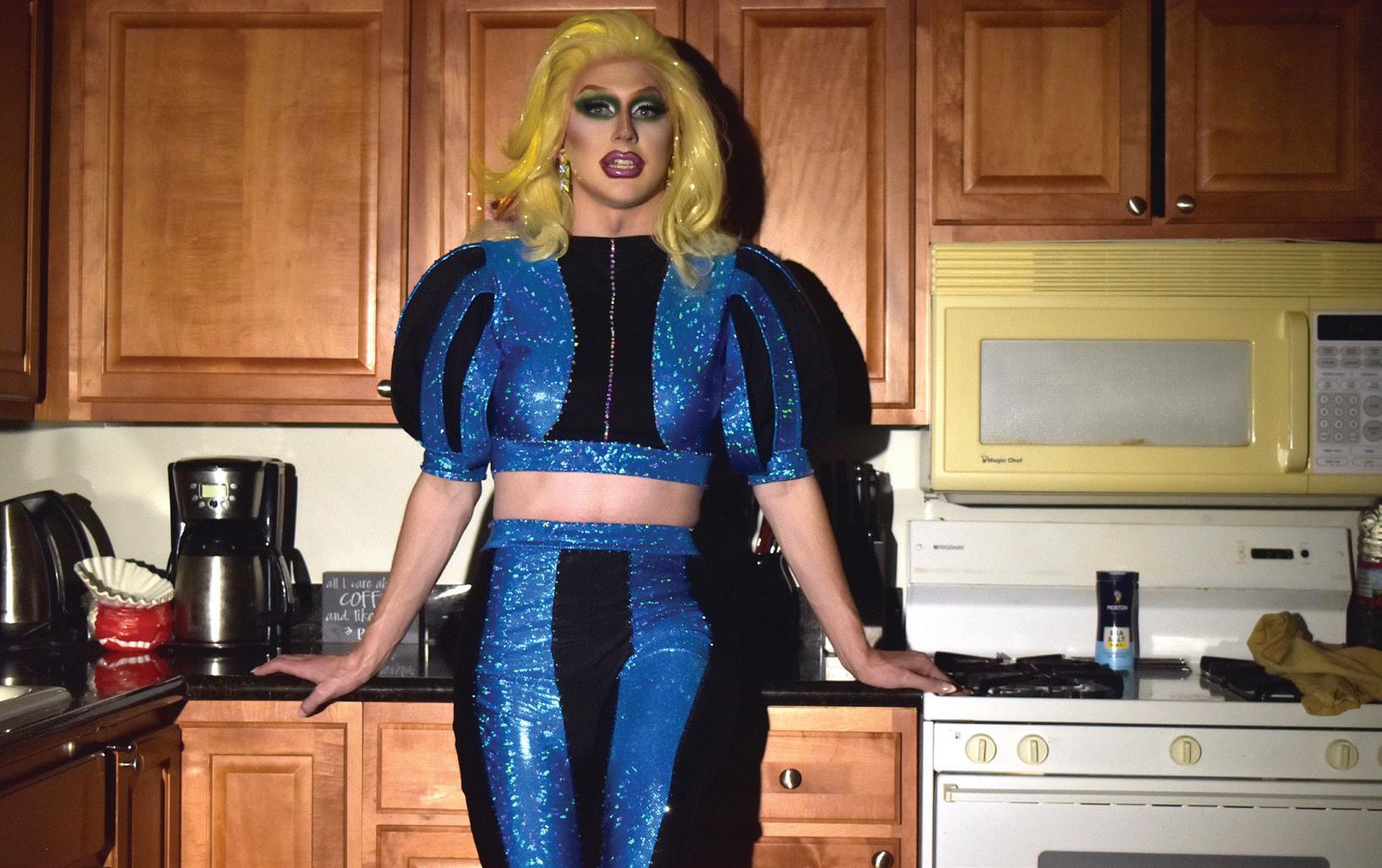
It’s a Monday night, and Houston-based drag queen Regina Blake-Dubois is in her apartment getting ready for her evening performance. The setting is a far cry from her usual dressing room in the back of Michael’s Outpost, but with bars and clubs shut down due to the COVID-19 outbreak, she is getting creative with how she executes her Monday-night Broadway revue. Drag performers throughout Houston are turning to social media to continue entertaining their loyal fans and supporters, all while finding their footing in front of a camera and discovering previously untapped audiences. Blake-Dubois, host of Houston’s only drag musical-theater revue, The Broad’s Way, admits that switching from lively bars to social-media platforms has not been the easiest transition. With Facebook’s strict rules regarding copyrighted musical material, and Instagram’s one-hour limit on live streams, her cast is in a constant battle against technology. “Essentially, it’s one giant experiment every week to figure out what works best for us and for our audience,” she says. The group’s frustration has led them to consider taking their show to the popular streaming site Twitch.
As Blake-Dubois moves her act from the bars to her apartment, the change of scenery has provided some new creative possibilities not usually available at a club. “I’ve felt almost like MacGyver, having to make performances out of things I have at home,” Blake-Dubois notes with her trademark wit. “It’s allowed me to perform ‘Cell Block Tango’ alone in my shower, douse myself in honey, and perform a song called ‘Hold My Hand’ while leading a hand-washing tutorial—all things I wouldn’t usually be able to do while performing in a bar or club.”
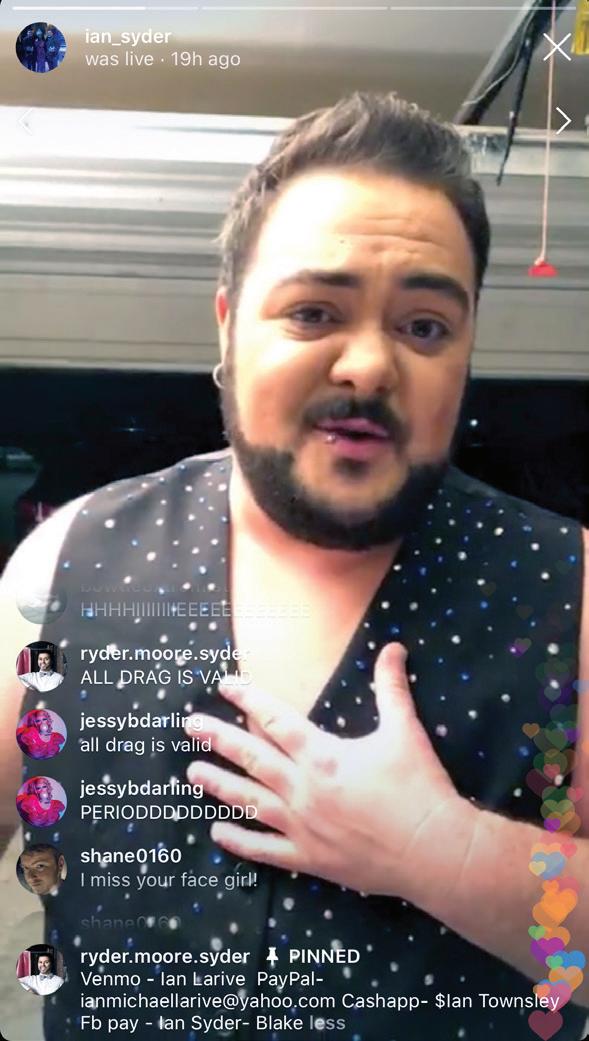
Other entertainers are facing similar hurdles with their transition from nightclubs to living rooms. Ian Syder-Blake directs and performs with the Kings of Houston, the only drag-king show in the city. The self-described “proud drag dad” is navigating unknown wa-
ters, since he admits to not being super-comfortable using Instagram Live. The bearded entertainer finds the collaboration process to be his saving grace. “I have amazing people to help me learn. For all of us, performing without an audience is tricky, but I believe we do a wonderful job at keeping our audience engaged and entertained.” Syder-Blake touts his team’s energy and ability to adapt. “My cast thinks outside the box for new ways to perform, as well as incorporating dance, live singing, and even reading stories during the show!”
The lack of an audience resonates with the Latina force-of-nature drag queen Angelina DM Trailz, who was the subject of a recent viral TikTok video. “From the first day I decided to do live shows, I wanted to maintain the integrity of the art form,” she says with passion in her voice. “A huge part of drag is interaction. I used to talk to people during my numbers, and now I don’t get to do that anymore. So now I’m performing from beginning to end, making sure everyone stays entertained.” But whether it’s faces in a crowd or user names on a screen, Trailz explains it’s all about pleasing her audiences, no matter the circumstance. “I’ve gotten all positive feedback. People are really thankful, and acknowledge that we are going out of our way to keep entertaining. They see that by us doing this, we are in this together.”
The drag performers have also tapped into social-media split-screen functionality to bring other guests into their virtual shows. “Primarily, everyone is performing solo while joining the video remotely,” Blake-Dubois explains. As for the Kings of Houston, “The cast consists of seven full-time performers including myself, and we are all a part of every show,” Syder-Blake says. And whether she is
playing her violin, reading a story to young viewers, or doing an all-out performance, Trailz is determined to put on a show. “I’m a perfectionist, period. So it was hard to adapt to what was happening,” she explains. “But it was also liberating to know that I control what viewers see through the lens.”
Keeping within the CDC’s guidelines, Trailz will launch an exciting round of performances at a favorite Montrose drag-brunch spot.“I’m doing a brunch show at Boheme on
Sundays,” Trailz notes. “We are going to be going live on selected Sundays. The video stream will be on Boheme’s Facebook account, and all of the ‘Ladies of Boheme’ are going to join in.”
The entertainers all facilitate viewer tipping through online payment apps such as PayPal and Venmo, but they aren’t banking as much as they did before the quarantine began.
“I can’t speak for anyone else,” says BlakeDubois, “but I’m currently making significantly less.” The Kings of Houston pool their tips and split them with the cast and creative team. “Not all of us need those tips,” says SyderBlake, “so some are donating their tips back to the pot for those that need it more.” Trailz, an immigrant who won’t be receiving a government stimulus check in the mail, also notes that the tips are small. “But you know, we are thankful for anything!”
All of the performers agree that they are grateful to be able to connect with their loyal base and receive whatever the fans are willing to give, knowing that financial insecurities are running high everywhere. At the end of the day, it’s all about the artful expression these entertainers get to share virtually. “The thing we keep discussing in our group chat is how happy we all are that people worldwide can see us now.” says Syder-Blake. “We have viewers from all over the U.S., but also from Great Britain and Canada as well!”
In this new age of social distancing, Houston’s drag entertainers look forward to being back in the bars and clubs spreading joy and fierceness. Trailz, reflecting on how life has changed so drastically over the last few months, summarizes their collective experience: “I don’t take any performance for granted!”
The change of scenery has provided Regina Blake-Dubois and the Broad’s Way new creative possibilities not usually available at the club.

NURSE PRACTITIONER
Jim Simon, MSN, APRN, PMHNP-BC THERAPISTS
Julia Bettge, MA, NCC, LPC
Bryan Boyle, M.Ed., BSN-RN, LPC-S
Nadine Grizzle, M.A., NCC, LPC
Terry Hatherley, M.S., NCC, LPC
Patsy Holden, M.Ed., LPS-S, CCBT

Heidi Kleeman, M.A., NCC, LPC-S
Heather Moss, M.S., LPC-S
Marty Shows, M.Ed., NCC, LPC
Rhonda York, M.S., LPC











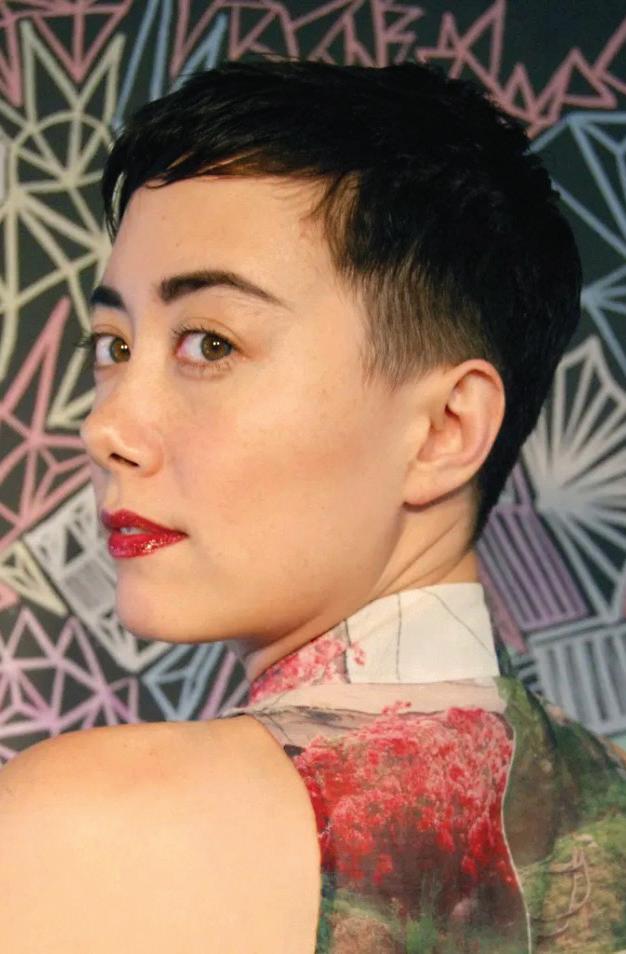
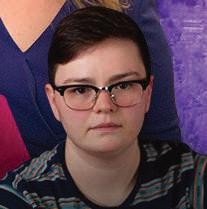
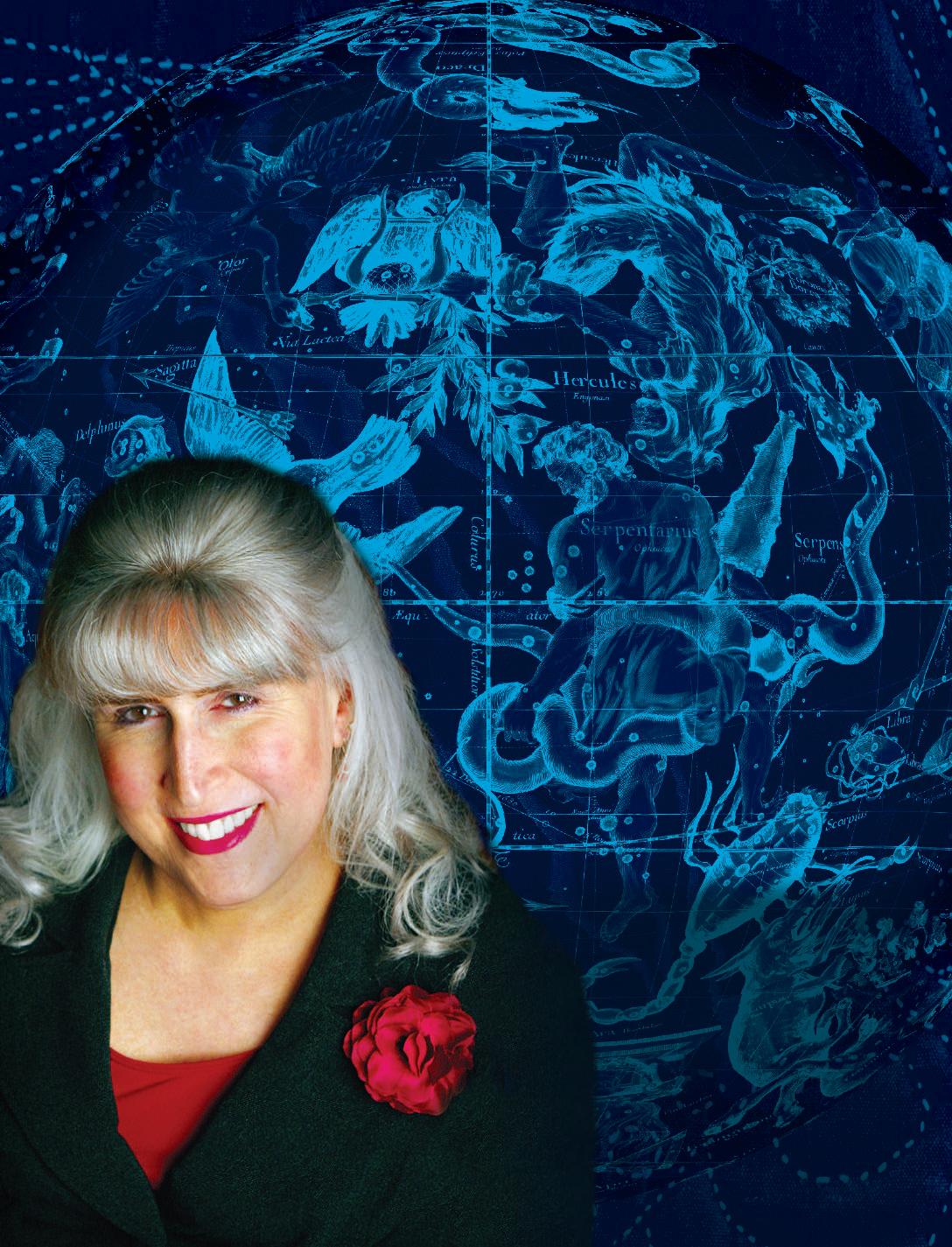
Addie Tsai ’s young-adult novel recounts her queer awakening in Montrose.
By RYAN M. LEACH
Photo by CUTLOOSE SALON
Queer and non-binary writer Addie Tsai’s young-adult (YA) novel, Dear Twin, tells a story not often found on bookshelves: that of a queer, Asian, teenage twin named Poppy Uzumaki. To top it off, this Space Citynative, who uses she/her pronouns, has set her novel in Houston’s Montrose neighborhood—a place also not often featured in literature.
“I think it’s important to tell the stories of people that aren’t being told—queer Asians, twins, and young-adult characters that experience traumatic upbringings. As is the case with many writers before me, when I couldn’t find myself on the shelf, I decided to write myself onto the shelf instead,” says the author.
Tsai, 40, is quite familiar with the iconic Houston neighborhood where she set Dear Twin. She grew up in Clear Lake, and for her, Montrose was one of the first queer communities she encountered.
“There’s a couple of reasons I set it partially in Montrose. First of all, I think we as readers are always looking to find ourselves and some part of our experiences in the art we consume, whether that be a book, a film, a dance performance, or a theater piece. Aside from Bryan Washington’s Lot, I have found it very difficult to find any external representation of Houston. So I wanted to reflect the world that I came from—the first queer environment I ever witnessed and was part of. I also wanted to widen [my readers’] ideas of what Houston is like, which I feel is often misrepresented in popular culture,” says Tsai.
The novel tells the complex story of 19-year-old Poppy, whose mirror-twin sister, Lola, recently and mysteriously vanished. As a result, Poppy’s dreams of going to college and escaping to a brighter future with her girlfriend, Juniper, are put on hold by her depressed father, who forces her to stay close to home. Poppy begins writing letters to her wayward sister in hopes of convincing her to return home—and also, perhaps, to procure Poppy’s freedom.
Fellow author C.B. Lee says Tsai’s novel “deftly navigates the complicated feelings of sisterhood, twinhood, and sharing a face and a part of your soul with someone, and how that changes when they disappear.”
“This is an autobiographical story, so I wanted to share parts of my story [while
giving] a complexity to the representation of twins and of queer Asians in a way I hadn’t seen depicted, especially in YA literature,” says Tsai of her insipration.
Although categorized in the young-adult genre, Tsai’s audience is clearly broader than that. Her novel weaves together experiences both typical and unique, creating a rich and relatable tapestry for the reader to enjoy.
“I wrote this book particularly to have cross-genre potential. But generally speaking, I wrote this for twins, I wrote this for queer Asians, I wrote this for those who live in liminal spaces in their identities, and I wrote this for those teens (or adults) who have struggled in their youth. I wanted them to feel seen and witnessed,” Tsai explains.
Tsai has plans for her Dear Twin characters to appear in a sequel to the novel that she is currently working on. The author is also jumping genres again with a new adaptation of the classic horror story Frankenstein
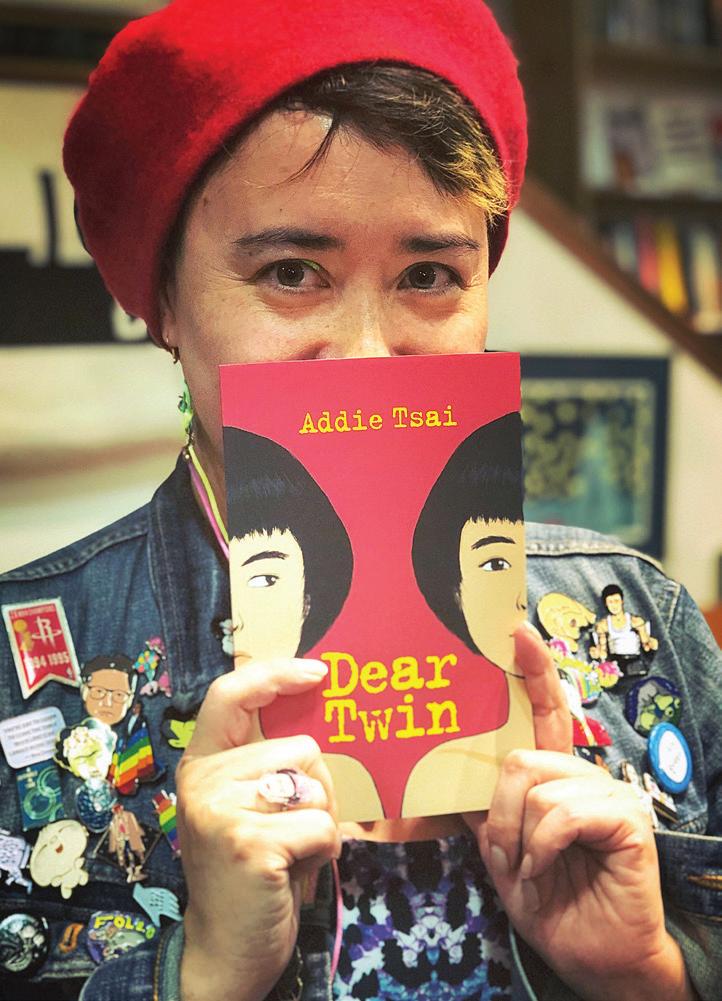
Addie Tsai’s novel Dear Twin provides representation for communities that are not often represented in YA books.
“I write in a lot of genres! I write in fiction, poetry, nonfiction, and what I’d call hybrid work. But I’d like to work more in video and text, and I’d love to figure out how to write a screenplay one day. I dabble in photography, and I’d love to get more confident and proficient at working in that medium,” says Tsai of her many interests.
Readers can find Tsai’s work on Foglifter, and her older work appears on her website at addietsai.org.
A book by: Robert B. Snellgrove, LCSW














By LILLIAN HOANG
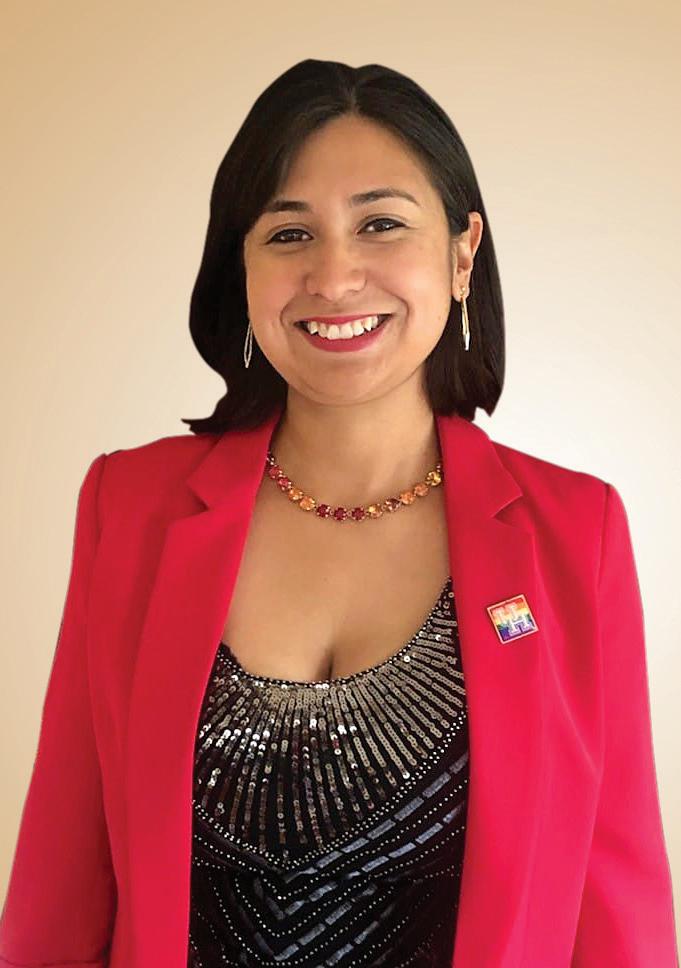
Jenna Pel takes pride in her Cambodian culture and heritage, and she demonstrates these values as the president of the University of Houston’s LGBTQ Alumni Association. Her commitment to community and identity pushed her to streamline the association’s scholarship process and more effectively provide funds to UH students in the LGBTQ community.
“The hope is to create an efficient, rigorous, and durable process that allows us to have more personal touchpoints with the recipients,” says Pel, a pansexual CambodianAmerican. “We now interview candidates and provide an opportunity for them to connect with other recipients at a scholarship dinner. As alumni, helping students who are in the position we were once in motivates and drives us.”
Pel admits she wasn’t always invested in the UH community. Although she earned a Bachelor of Arts degree in history at UH, she did not feel connected to the campus as a student. However, when the Pulse Nightclub shooting occurred three years after she graduated, Pel wanted to get involved and uplift queer students at her alma mater.
“I wanted to devote more time and energy to the LGBTQ community,” Pel says. “And I wanted to start close to home, and that was UH.”
After responding to a UH Facebook advertisement looking for LGBTQ Alumni Association board members in 2016, Pel became
the board secretary. Two years later, she was elected president.
As president, she acts as co-chair for the UH Red Dinner, an annual fundraising gala that provides scholarships to UH students in the LGBTQ community. Though this year’s Red Dinner was postponed due to COVID-19, Pel remains committed to her students.
The association has sufficient funds for this year, she says, and there are ongoing discussions regarding future funding through more direct fundraising opportunities.
“I hope the organization can continue to serve our LGBTQ community for years to come,” she says.
Pel empowers people both on and off the UH campus. As a middle-school humanities teacher, she practices Montessori teaching, a practice based on “self-directed activity, hands-on learning, and collaborative play,” according to the Montessori Northwest website. She tailors her teaching according to each student’s needs and helps them based on who they could become, as opposed to who they are.
“As every kid develops at their own rate, with some students I’m more hands-off, while others need me to be more direct and present,” Pel explains. “Making a kid feel happy, proud, and seen for exactly who they are is important to their learning and growth.”
Pel’s classes have moved online due to the pandemic restrictions, and she teaches only twice a week. Despite their physical distance, she continues to encourage her students.
During one remote-learning session, she asked her students to find two items in their house that represent their culture. She wanted her students to select an object that reminded them of their family and identity, in order to help them realize their uniqueness.
“Teaching is rejuvenating and empowering,” Pel says. “The most rewarding part is seeing a kid maximize their full potential and reach a level of self-actualization [as they] become independent, confident, aware of their own identity, and take pride in exactly who they are.”
Pel is currently a graduate student at the UH College of Education (COE), where she is pursuing a Master of Education degree in curriculum and instruction in social studies/social education. She says she’s grateful for COE and other UH colleges that support the LGBTQ Alumni Association and the robust LGBTQ community on campus.
Most of all, she’s grateful for her father and how his legacy has pushed her to uphold community and identity.
“I live out my father’s legacy every day, and
“I WANTED TO DEVOTE MORE TIME AND ENERGY TO THE LGBTQ COMMUNITY. AND I WANTED TO START CLOSE TO HOME AT UH.”
—JENNA PEL
I feel a strong sense of gratitude for our relatives—ancestors who have helped pave the way to help us get to where we are,” she says.
Pel was raised by her Irish-French-American mother and did not have access to her Cambodian relatives until her mid-20s. When she did reach out to those family members, she learned more about her Cambodian roots and her father, Chandara, whom she last saw as a child. He died when she was 18 years old. Through her relatives, Pel learned that her father had earned a Fulbright scholarship that






allowed him to emigrate to the U.S., study English at Georgetown University, and later attend the University of Bridgeport in 1974.
While in the United States, he sponsored many relatives who had survived the four-year genocide carried out by the Khmer Rouge, the communists who wanted to “create a Cambodian ‘master race’ through social engineering,” according to the History.com website. An educated man, her father helped usher in a generation of Cambodian-Americans and the beginnings of Cambodian communities in America.
Pel says her father’s legacy—as well as Cambodia’s achievements in compelling art and inspiring architectural techniques— inspires her to foster a love of community and self in others, which she does as the UH LGBTQ Alumni Association president and as a humanities teacher.
“It’s a powerful legacy he has left for us, and one I intend to uphold,” Pel concludes. “Whether it be my work as a teacher with my students, or living my father’s legacy, that’s my mission in life.”
For more information about the University of Houston LGBTQ Association, visit facebook.com/rainbowcoogs.


































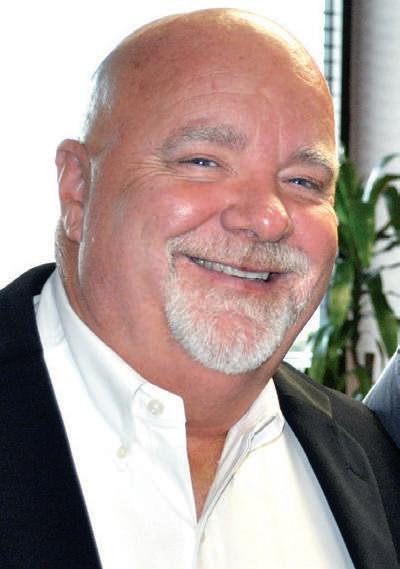
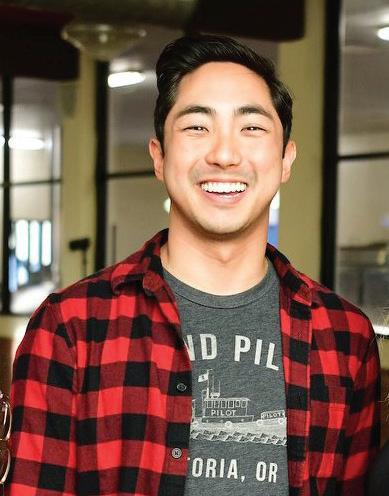
Fahad Punjwani uses creativity to help local organizations deliver on their mission statements.
By CONNOR BEHRENS
Photo by JOHN PARRILLO
Fahad Punjwani’s creative spirit has always dominated his life, and he is now using his ingenuity to help shape Houston’s future.
Punjwani is the founder and creative director of SUCH, a Houstonbased consulting firm that works with community leaders to help them deliver on their mission statements and agendas. SUCH (which is a play on the Urdu word for truth) has helped nonprofit and social-justice organizations like the Houston Land Bank, the Greater Houston Community Foundation, and the Harris County Long-Term Recovery Committee.
It was a natural progression for Punjwani to start the organization after he moved to Houston more than ten years ago, as he was yearning for a meaningful way to use his creativity to foster positive change.
“It was something I could rally behind, and something that could give me energy,” he says. “That led to the creation of an organization that could help on a wide variety of projects. We design transformative experiences—dialogues, workshops, retreats, and multi-monthlong projects.”
Punjwani, who is openly gay, helps people create dialogue through a process that encourages individuals to become more transparent and open.
“At SUCH, it is all in the art of asking powerful questions,” he explains. “Our ideology at SUCH is grounded in frameworks of design thinking, systems dynamics, Tibetan Buddhist philosophy, and, more recently, transformative justice and disability justice. Asking powerful questions, for us, means four things: being rooted in empathy, leading with creativity, bringing the subconscious to conscious, and creating generative disequilibrium.”
Punjwani always strives to anchor SUCH’s

work in empathy when working with clients. “Empathy, in our work, means focusing on nuanced human experience,” he says. “It even shows up in how we run our meetings.”
For Punjwani, it has been exciting to help foster dialogue among Houston’s nonprofit leaders, because Houston is a city built on community and inclusivity.
“Through my work here, I feel a deep sense of comradery with those working [to create] a better Houston for everyone—especially for our most vulnerable,” he says. “Through our work, we are a part of the team that is building Houston and pushing forward the social-justice agenda for our city. We are not identifying who has the [single] best idea and organizing around that. We see it as a space with multiple ideas, all of which are needed.”
Punjwani is currently working on helping Houston organizations manage and respond to the COVID-19 pandemic that has impacted cities across the nation.
“In response to COVID-19, we see many rushing toward action,” he says. “We see a lot of people trying to do new things: sewing
masks, organizing fundraising, and [providing direct] aid. It is such incredible work that is so necessary. However, one thing that we are missing is a space for individuals to grieve.”
As the virus disrupts people’s lives in so many ways, Punjwani’s goal is to guide individuals through that deeply emotional process.
“We are slowly organizing virtual spaces where the point is to check in with ourselves, to connect with ourselves and others,” he says. “That is the most important work we can do right now.”
Punjwani notes that his work at SUCH is guided by creativity—which, in his opinion, is the truest form of human expression.
“I do not see creativity as [something that only an] artist needs,” he says. “Creativity is about going inside ourselves to find the answers. It is about an organization or a person looking inward to find what is unsettling for them, or what is really meaningful for them. That is creating.”
For more information on SUCH, go to theprocessissuch.com.
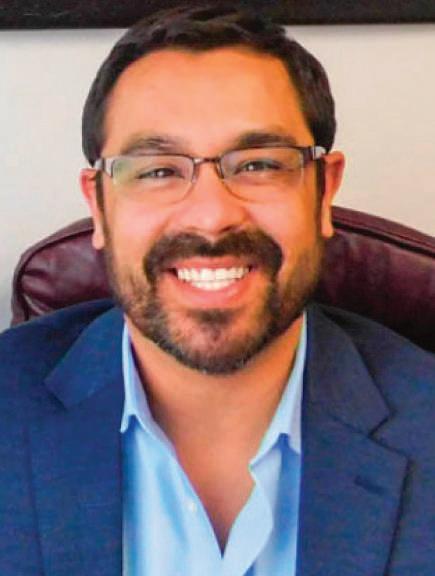
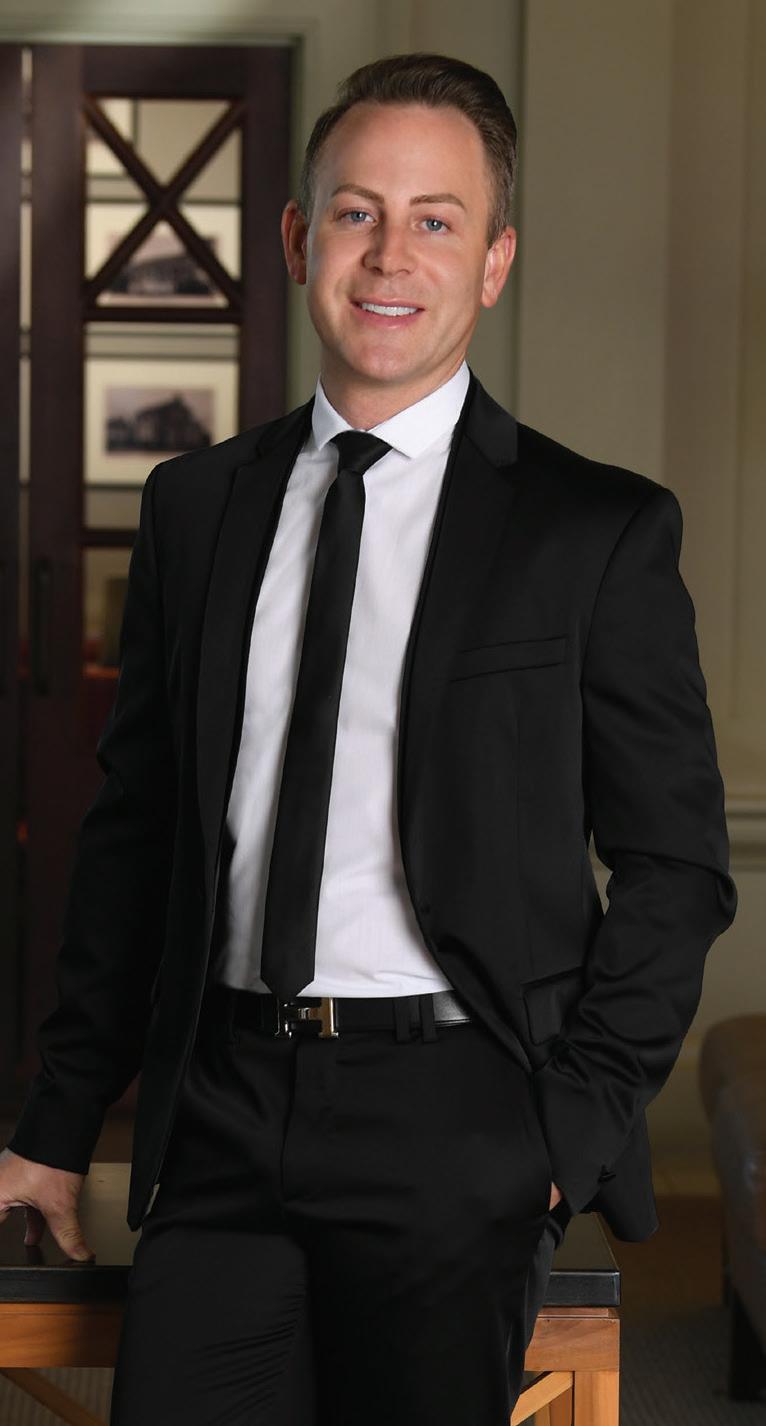
Albert Wei doesn’t want to solve problems—he wants to eliminate the possibility of those problems ever arising in the first place. As the chief strategist for a local educational nonprofit, Wei knows there are so many barriers when it comes to giving children a quality education, and he wants to make those barriers a thing of the past.
And his weapon of choice? Data.
Wei, an openly gay man, was born in Taiwan and grew up in West Covina, California, a sleepy Los Angeles suburb made popular by the Netflix series My Crazy Ex-Girlfriend He studied political science and sociology at Rice University, and settled in Houston after graduating. “My time was chiefly spent doing things outside the classroom, such as working in inner-city schools, creating programming for my peers as a health advisor, and serving on student government,” Wei explains, noting that he had a blast working in the community because it was an investment in his chosen new home.
As the chief strategy and growth officer at ProUnitas Inc., Wei manages the nonprofit’s self-created tech platform and provides his programs team with support in improving it. “I also build our individual-giving portfolio and write grants, handle our messaging, and recruit new talent to be added to our team when needed.”
It only makes sense that Houston is where Wei would land, career-wise. In high school and college, Wei was heavily involved in service and found that he gravitated toward education. “Through my college studies, I really wanted to address society’s ills through a preventative approach rather than a reactionary one, and education always emerged as a strong solution to this.”
After graduating from Rice, Wei joined the Teach For America Houston Corps and taught government and economics at Sharpstown
Albert Wei uses data to help give children a quality education.
By JENNY BLOCK
Photo by TEACH FOR AMERICA
High School, one of the four lowest-performing high schools in Houston at the time. He then taught abroad in Taiwan for a year on a Fulbright grant, in order to find ways to merge Eastern and Western approaches to education. After returning to Sharpstown High School, he served as a college-admissions counselor, getting Sharpstown students into universities like Tulane, Swarthmore, Reed,
and Howard with over $8 million in scholarships and grants.
Wei says that seeing a lot of the systemic failures in education on the ground made him think about how we can be better about serving students’ holistic needs. “My best friend in Teach For America, Adeeb Barqawi, launched ProUnitas as a solution to the issues we experienced in the classroom. Now I have
the privilege of ensuring that school districts’ student-support departments can [better connect students to] holistic services through a multifaceted approach [that involves] consulting and tech tools. [I help] district leaders gauge demand for services and advise school districts on how to fill these gaps in housing, mental health, nutrition, mentoring, etc.


“I am incredibly grateful to be able to do this important work with an incredible team, blending in the tech [to foster] social justice and education equity. Nothing beats waking up with such purpose [each day—helping] our most disadvantaged kids get the resources they need to be successful in school and beyond,” Wei says.


Being from a Taiwanese family is incred ibly important to Wei as he learns more about what it means to embrace different cultural identities. “Culturally, I feel like I grew up very American, but [my Taiwanese roots] really color how I problem-solve, how I express my self, what foods I crave, and what expectations I have for myself,” he explains.
Wei particularly loves the fact that he is bi lingual. “I love being able to speak Mandarin, and believe that speaking another language is like having another soul. It rewires the brain to think in more multifaceted ways. I am particularly close with my parents, who are honestly some of the funniest people ever. They raised me to ask big questions, fall often and fall forward, and to always focus on the big picture.” Wei is committed to honoring his parents as “beautiful representations of Taiwanese heritage. I was always the kid that pointed out my parents if they ever came to a school event.” Wei was honored to have recently been interviewed for the Houston Asian American Archives (HAAA) in an effort to preserve the history of the Asian community experience in Houston.



Committed to making the nonprofit world more data-driven, Wei is passionate about monitoring the impact that his holistic support work has on students’ academic outcomes. “This allows teachers to finally teach,” Wei explains, “[as they leave the non-academic issues] with someone more qualified and with more capacity to serve each student’s holistic needs.”
Wei says he is brimming with gratitude for the tremendous Houston community he calls home. “At the end of the day, I stand on the shoulders of giants. I hope to continue sharing my stories, as well as listening to the stories of others, in an effort to build empathy, compassion, and love for all people.”
For more information on Albert Wei and ProUnitas, visit prounitas.org.






By LILLIAN HOANG










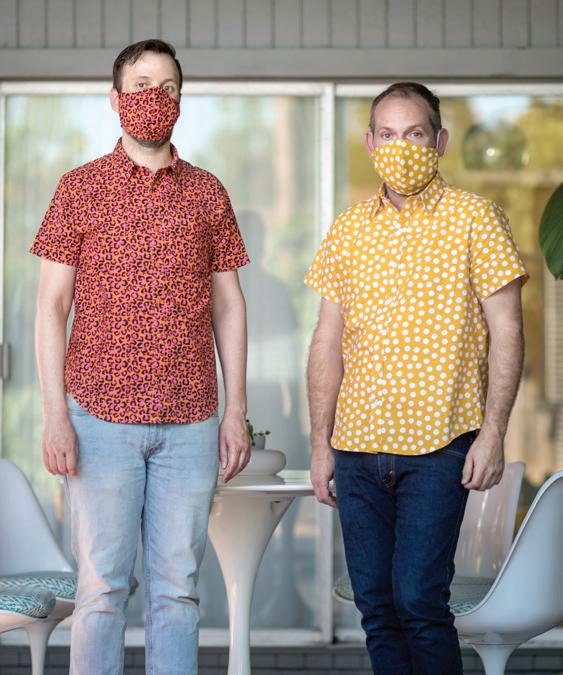
As the number of COVID-19 cases in the region rises, so does the number of Houstonians coming together to help the community stay safe. Local designers are doing their part by creating masks to either raise funds for charities or help loved ones in need.
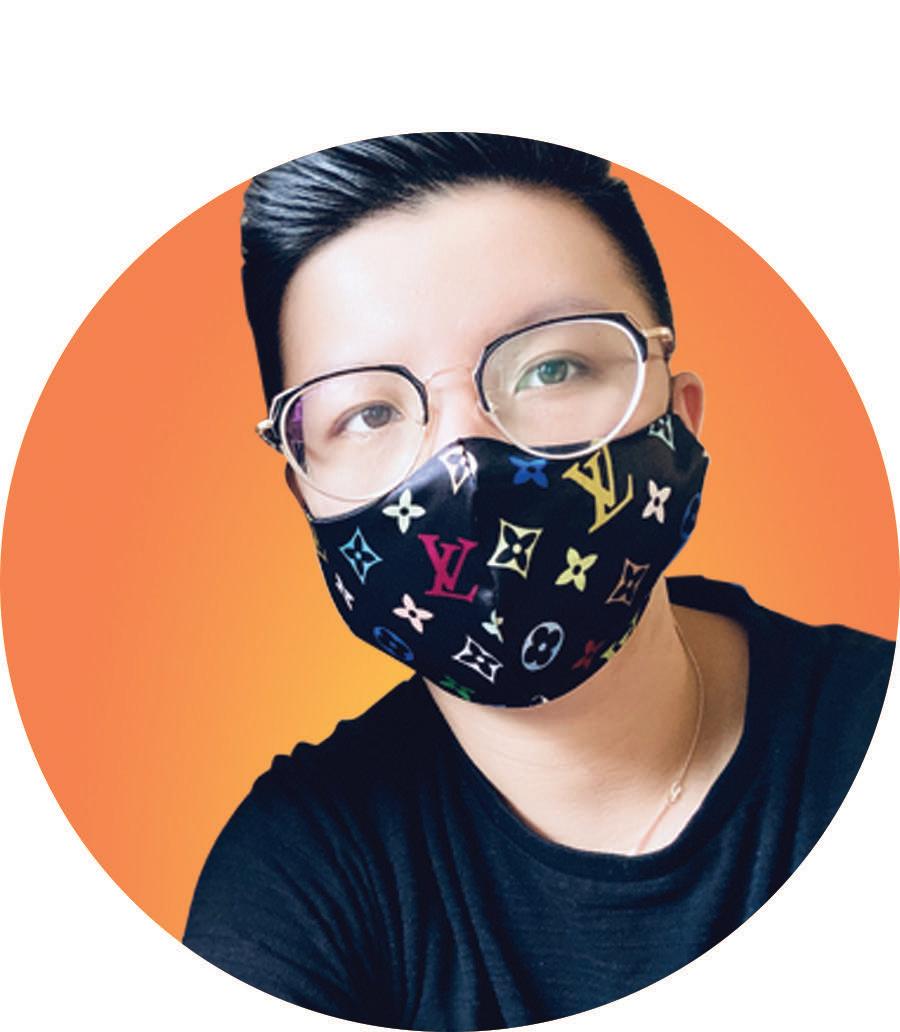
Nghi Nguyen, a trans man who owns an online clothing shop called NEEWIN, is donating 10 percent of the proceeds from his fashionable masks to support families who have been financially impacted by the pandemic.
“I’ve always wanted to help people,” Nguyen says, “and I never expect the people I help to give back to me. I don’t care about that. If I see people struggling, I’ll try my best to help.”
His project follows the Centers for Disease Control and Prevention’s (CDC) latest guidelines. According to the CDC site, face masks are important because even individuals who do not show COVID-19 symptoms can spread the disease in public settings such as grocery stores and pharmacies where social-distancing measures are difficult to maintain.
Nguyen creates the face masks in his home and sells them at neewin.co. The masks are
available in either solid colors or Louis Vuitton-inspired fabric that comes in black, red, and white. Interested parties can order the masks in sets or packs. Those who want to stay informed about his masks’ availability can sign up for updates on Nguyen’s website. While sewing so many masks can be arduous, Nguyen says he loves the creative process. He starts by washing his hands and disinfecting his workspace. Then he cuts the fashion, or outer fabric, as well as the lining fabric based on his custom mask patterns. Before packaging and shipping the product, he sews the two fabrics together with an elastic string and leaves a small hole in the mask in case customers want to insert a filter.
Nguyen’s attention to detail and work ethic comes from years of practice and his family’s background in the fashion industry. Originally from Ho Chi Minh City, Vietnam, Nguyen grew up surrounded by industrial sewing machines and cut fabric. His parents and aunt ran their business and filled orders for other companies at home. With the help of their employees, Nguyen’s family sewed pieces in large quantities and then ironed, packaged, and shipped the products. His family’s heavy involvement in the business fueled Nguyen’s passion for the design and manufacturing process.
He veered away from his family business and enrolled in architecture school after graduating high school, but eventually he returned to his true passion. “Sometimes, I think fashion chose me before I chose fashion,” Nguyen says.
He went to Ho Chi Minh City College of Culture & Arts and earned an associate degree in fashion design in 2015. A year later, he moved to the United States to continue his
education at Houston Community College (HCC), where he is now an undergraduate.
The full-time HCC fashion-design student hopes people will also support local healthcare professionals in any way they can.
“Right now, in the medical field, healthcare professionals lack a lot of personal protective equipment,” Nguyen says. “So, if you know any healthcare workers and have resources to give, please reach out to them and donate what you can.”
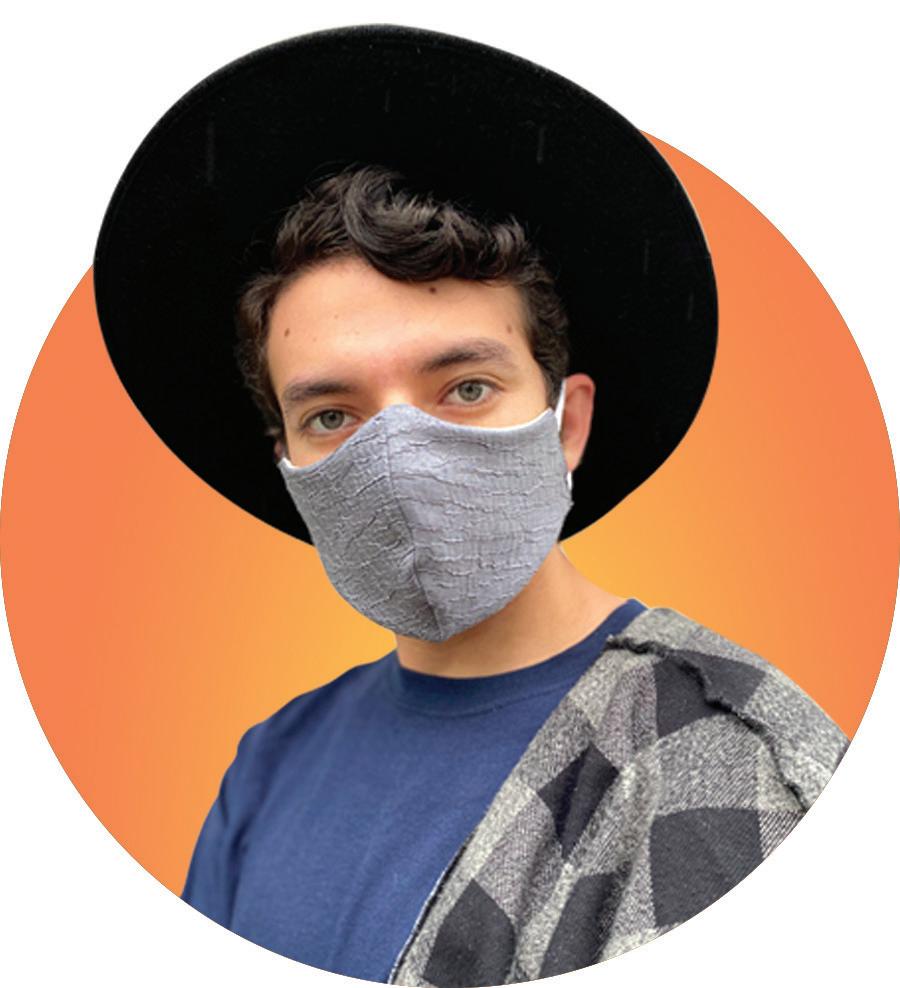
Like Nguyen, openly gay Project Runway contestant Alan Gonzalez is also creating and selling masks on his website, alantude.com. Gonzalez’s proceeds will support Meals on Wheels in the Houston and Galveston areas, as well as local healthcare workers.
From his childhood home in Houston, Gonzalez creates fashionable masks geared toward the general public. He aims to help the elderly, slow the spread of COVID-19, and encourage non-essential workers to stop buying and potentially misusing the personal protective equipment that medical workers desperately need.
“As someone who knows how to sew and construct garments, we must consider how we can use our talent to help people out,” says Gonzalez, who plans to donate 100 percent of his proceeds to Meals on Wheels.
His hand-sewn masks feature textured layered fabric and come in black, gray, and white. Gonazalez’s designs reflect his concern for quality.
“A lot of people are prioritizing quantity
over quality [since masks are in high demand], but I want to stay true to myself as a designer,” he says. “My ‘Alantude’ aesthetic is attention to detail, sustainability, and the attitude I bring to the masks.”
Gonzalez became a fashion designer toward the end of high school, when he realized he had the ability to help others recognize their own beauty by rethinking their wardrobe.
“I think that has always been one of the best parts of being a designer,” he says. “Seeing clients just gleam and truly light themselves up after fi nally seeing the beauty they’ve had this whole time.”
Gonzalez says he’s more familiar with designing custom products for a specific client, but his shift from custom wear to mass production was driven by necessity and a desire to help his community.
“I can’t personally deliver meals to the elderly, but through the masks I can donate to a program that does,” he says. “Just knowing that is fantastic.”
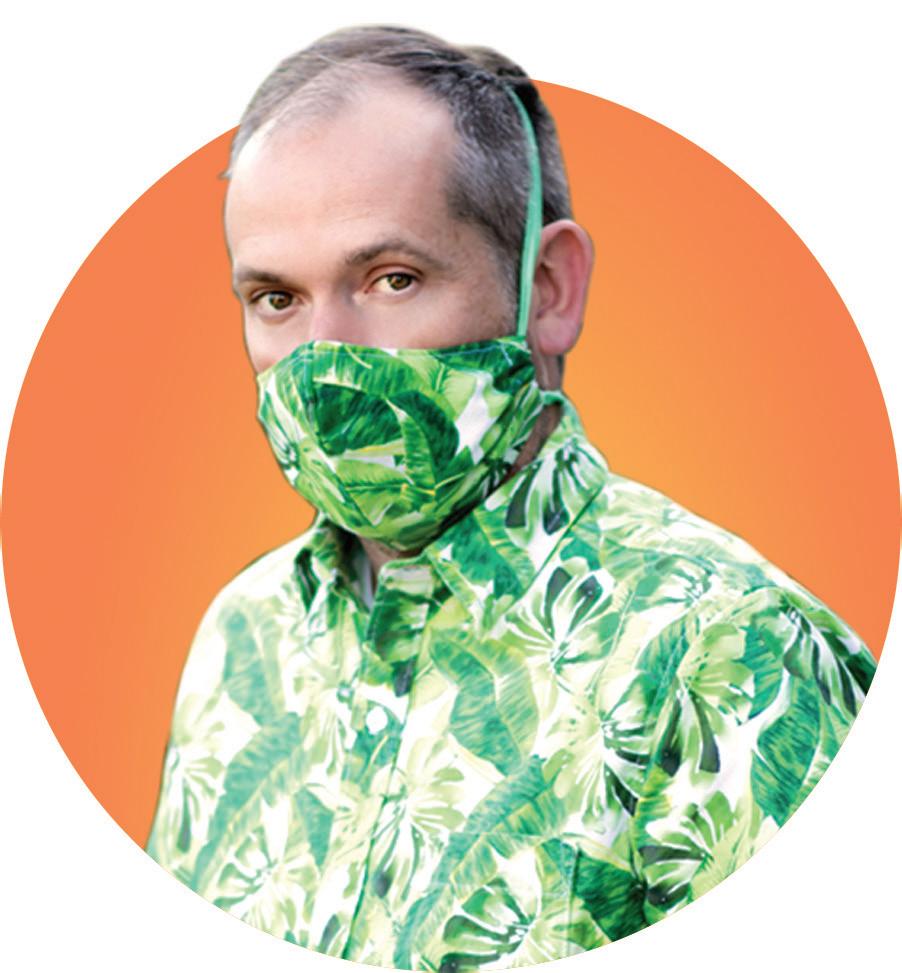
Galveston Arts Center curator Dennis Nance shares Gonazalez’s love of community. He has been creating colorful masks to help his loved ones.
Although his masks are not for sale to the public, he donates the masks to family, friends, and neighborhood people (such as mail carriers) whom he interacts with daily. The stylish masks are made from the same fabric Nance uses to craft the designs featured on his dennisnance.com website.
“I have the skill to help people who need masks,” says Nance, an openly gay man. “I am not making these for money, and I ask people to pay that forward to someone who’s out of work, or donate to a cause that’s supporting the community.”
“I AM NOT MAKING THESE MASKS FOR MONEY, AND I ASK PEOPLE TO PAY THAT FORWARD TO SOMEONE WHO’S OUT OF WORK, OR DONATE TO A CAUSE THAT’S SUPPORTING THE COMMUNITY.”
—Dennis Nance
Nance is an Austin College bachelor of arts graduate whose contemporary shirts, costumes, and dynamic needlework have been exhibited in the Contemporary Arts Museum Houston and the Menil Collection Bookstore. He says he wants to share the love while having fun with masks that can bring a smile to people’s faces.
“It’s common in Houston to smile at strangers, but now our smiles are disguised when interacting with people,” he says. “So, wearing a mask with a pattern that matches the clothes you’re wearing or happens to be bright can make people smile, and bring a little bit of comfort.”
Nance also encourages people who have a sewing machine, fabric on hand, and a minute to themselves to try their hand at sewing.
“Now is a good time to slow down and learn a new skill,” he says, “if not for yourself, then for your loved ones.”
Follow Nguyen’s clothing brand on Instagram @neewino cial, keep up with Gonzalez’s clothing brand on all social-media platforms @alantude, and learn more about Nance’s work at dennisnance.com.





























































By RYAN M. LEACH
In only a few months, the novel coronavirus, or COVID-19, has turned the world upside down. Pablo Vasquez, 40, is the nurse leader for the new COVID-19 treatment unit at the Houston Methodist Continuing Care Hospital in Katy. He and his colleagues have been learning more about the disease and how to accommodate the growing number of COVID-19 patients.
“As a nurse leader, I have focused on analyzing how many staff members are required and what skills they need to work on the unit. I have been developing processes for admission and discharge, coordinating with our transfer centers to move patients to our unit, and many other things,” says Vasquez of his new responsibilities.
Vasquez, who is gay, says that in the fourth week of dealing with the virus, the team he manages is starting to get into a regular cadence—in spite of the long hours and an increase in COVID-19 patients. Accommodating an expected spike in patients involves planning, which is where Vasquez comes in.
“We have seen an increase of COVID-19 patient volume across all hospitals at the same time. Some hospitals have decreased their overall patient census because many elective procedures have been postponed. Beds that might be typically occupied with these patients are now vacant, which has allowed the hospitals to reallocate resources to respond to the increase in COVID-19 patients,” he says.
Vasquez is an important part of a larger team that is trying to ensure that the healthcare professionals have everything they need, including Personal Protective Equipment, or PPE—a term most people outside of the healthcare system were unfamiliar with before COVID-19.
“Houston Methodist has a dedicated team working collaboratively with other hospital systems in the city to coordinate PPE guidelines and supply chains to meet the needs
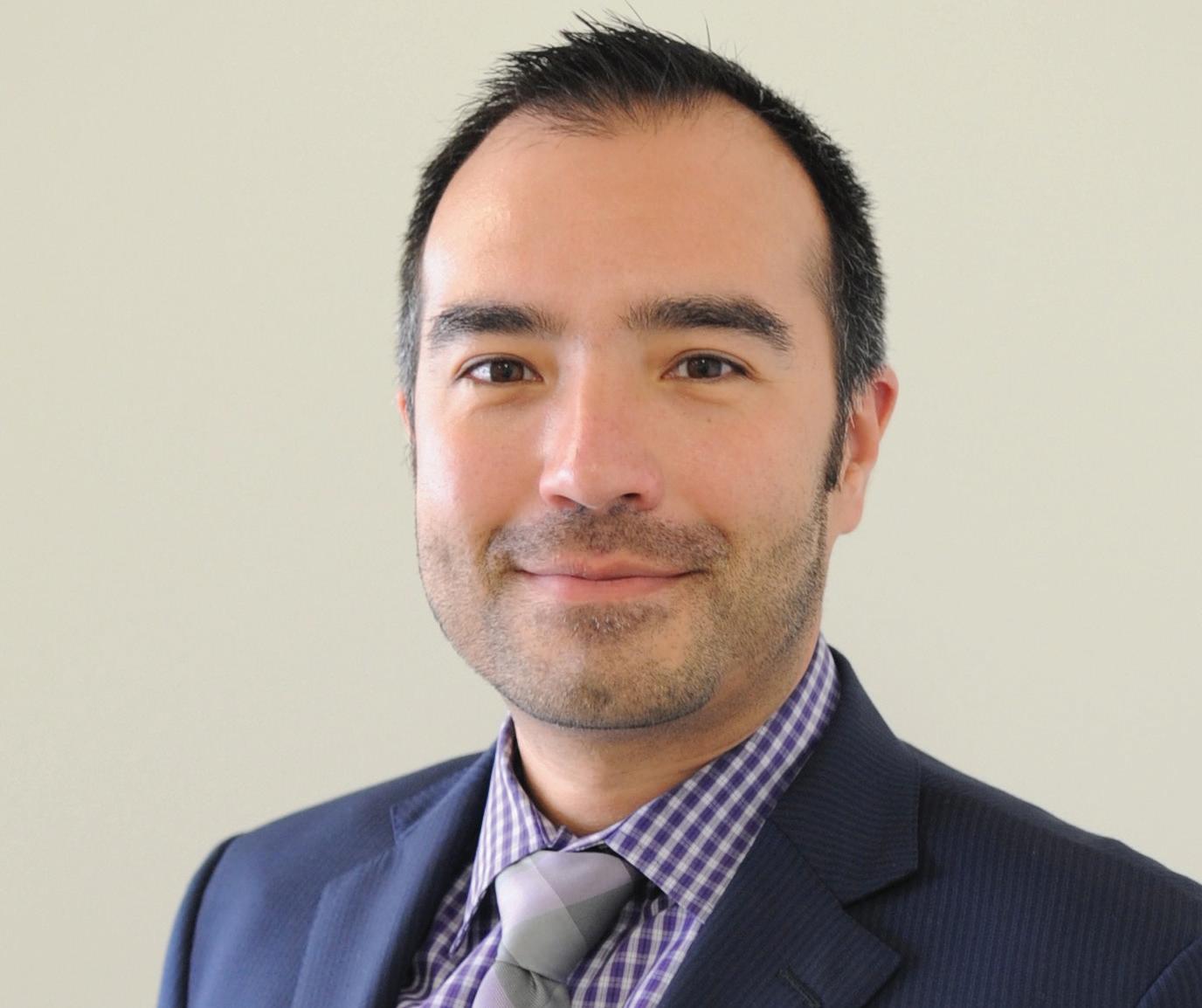
of our staff. In addition, we are tapping into the brainpower of students, researchers, and engineers through the Houston Methodist Research Institute to develop alternative sources of PPE. [They are working on] reprocessing masks, testing materials for reusable gowns, and producing alternative enclosures for staff to use, such as the plexi-box [isolation pods],” says Vasquez.
The Houston Methodist Hospital system has been working on getting more hospital volunteers to temporarily transfer to the COVID-19 unit in Katy as they expand bed capacity.
Professionals on the front lines are also being impacted by personal issues such as childcare needs and financial stress. Since the prolonged shutdown and political firestorm directly impacts their lives, they are relying more on each other, as well as on other hospital systems, to bridge the gaps.
Vasquez says that the patients coming in with COVID-19 issues have ranged in age from their late 20s to their 90s. Some are immunocompromised from a pre-existing condition, and others were completely healthy before being infected. The early understanding that young, healthy people were relatively safe from developing serious conditions has been disproven over the course of the pandemic. Although elderly and health-compromised people may be at higher risk for complications, that does not mean there is little risk for others.
“We know more about what to look for to hopefully prevent patients from needing to be ventilator-dependent. Also, different long-term planning needs are emerging for nursing-home patients. We have been coordinating with [nursing homes] to safely return stabilized patients back into their communities while minimizing the risk of infecting others,” says Vasquez.
Vasquez’s advice for those who have remained
healthy is the same as many of the other guidelines that are out there: wash your hands, don’t touch your face, wear a mask outside, social distance, and most importantly, stay home.
“The precautions the LGBTQ community should take are really no different. However, [because] the LGBTQ community is very social, I know it’s hard to stay home and not invite groups of friends over for dinner or a game night. But we all need to understand that even small gatherings can put people at risk of COVID-19.
“So it’s important that we get creative. Just as we are having virtual office meetings, we can have virtual happy hours or parties. I recently had a friend that celebrated her birthday using group video chat. She wanted to have pizza, so everyone ordered or made their own pizza and celebrated together. We are learning that the workplace strategies to stay connected can easily be implemented in our personal lives,” Vasquez notes.
Finally, for those who may be HIVpositive, there is an additional concern for COVID-19.
“People who are HIV-positive should take the same precautions recommended for the general public. Your HIV care provider will let you know if your immune system may be at greater risk of being compromised, and may recommend additional infection-prevention measures to follow during this time. Lastly, I would recommend those who are HIV-positive contact their health provider if they experience any COVID-19 symptoms, such as fever and cough, to get specific guidance on care or treatment that may be needed,” says Vasquez.
As the days roll on, professionals like Vasquez are helping to mitigate the damage of COVID-19 as best they can. And while he stays at work, the best thing we can do to help him is to stay at home.
For more information about nurse Pablo Vasquez’s work at Houston Methodist Continuing Care, visit tinyurl.com/y94gcoo7
Local podcast puts a charismatic twist on reporting LGBTQ history and current events.
By MARENE GUSTIN
Photo by RED OWL VISUAL TOURS
Even if you haven’t been binge-listening to the Let’s Talk About Gay Stuff podcast during the quarantine, you should check it out now. The show is hosted by three gay men—Thomas, Tony, and Kendall—who talk about LGBTQ history and politics while keeping it entertaining.
“Like our tagline says, we set out to kiki and have fun,” says 40-year-old Thomas. The podcast is sponsored by the LGBTQ-owned local business BakedBones, a company that sells CBD-infused dog biscuits.
Tony, also 40, explains how the podcast came about. “We were at the bar chatting about history and politics,” he recalls. “We wanted people to learn and have fun while bringing together the community. We also wanted to keep old stories alive. We often hear from listeners that they forgot or never knew about some of these stories.”
Let’s Talk About Gay Stuff is now a year old and has more than 50 episodes you can listen to.
Within the last month, the podcast has prioritized covering politics and life during the COVID-19 pandemic.
“For me, there are many similarities in the initial reaction to COVID-19 and the early
reaction to AIDS,” says Kendall, 37. “One of our recent topics was on the first documented case of AIDS in the U.S. in 1981. In doing research for the show, it was interesting to see how the gay community was initially blamed for the virus—it was even called GRID (Gay-Related Immune Deficiency) for years because it seemed to be affecting mainly the gay community.
“This really reminded me of how some people call COVID-19 a ‘Chinese Virus,’ and many Asian people are being blamed for the pandemic. Hopefully, our stories about how the LGBT community was affected by AIDS in the past can give lessons on how not to place blame and hate on an entire group of people.”
The podcast’s hosts say they survived the April stay-at-home order with the help of dogs, long walks, and Zoom happy hours. But they are all looking forward to life after the virus.
“As we’ve learned from the moments and pioneers we discuss in our podcast each week, this is a moment in time that is challenging us, and with principles and persistence we will persevere,” Thomas says. “The LGBTQ community historically has faced, and continues to face, a number of challenges: it’s been illegal for us to marry, have sex, live our true identity, and today we can still be legally fired from our jobs and lose our housing because of our sexual orientation or gender identity. It may look bad now, but we will be better going forward!”
Regarding the quarantine, Tony adds: “I feel there will continue to be some negative impact—like I’m sure Pride celebrations will be canceled this year. Even though we should be getting back to normal [this summer], I think it will be a slow process. But I do feel it has made most of us reassess priorities and realize what is important. It has also brought many of us closer together. Personally, I chat with some friends and family more now via Zoom than I saw them in person, pre-coronavirus.”
As for Kendall, he also feels that the community is very resilient. “You can’t log into Facebook without seeing a drag queen performing in an empty room for Venmo tips—and I say ‘Good for them!’ There are so many heartening examples of people adapting and people looking out for each other during this. It’s still important to reach out to check on friends. A Facetime call or a text can really turn someone’s day around.
“I think the gay bar and club scene will be bigger than it’s been in years after this. Our nightlife is more than drinking White Claw and slurring karaoke; it’s been a place to meet people with similar life experiences, meet future life partners, and to see the creativity of drag artists,” Kendall notes. “We will come out stronger. I bet my little gay heart on it!”
For more information on LTAGS, visit letstalkaboutgaystuff.com.
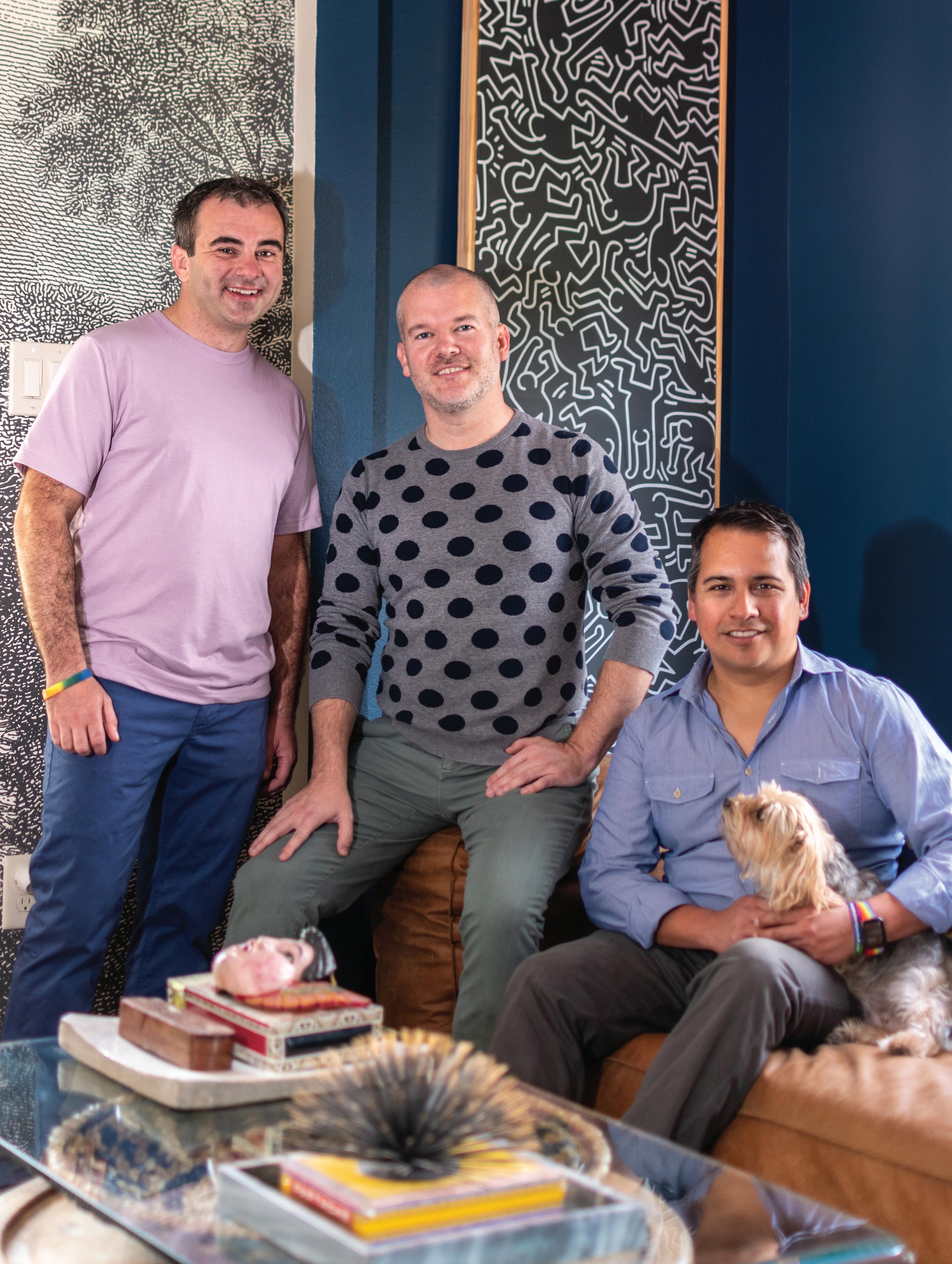
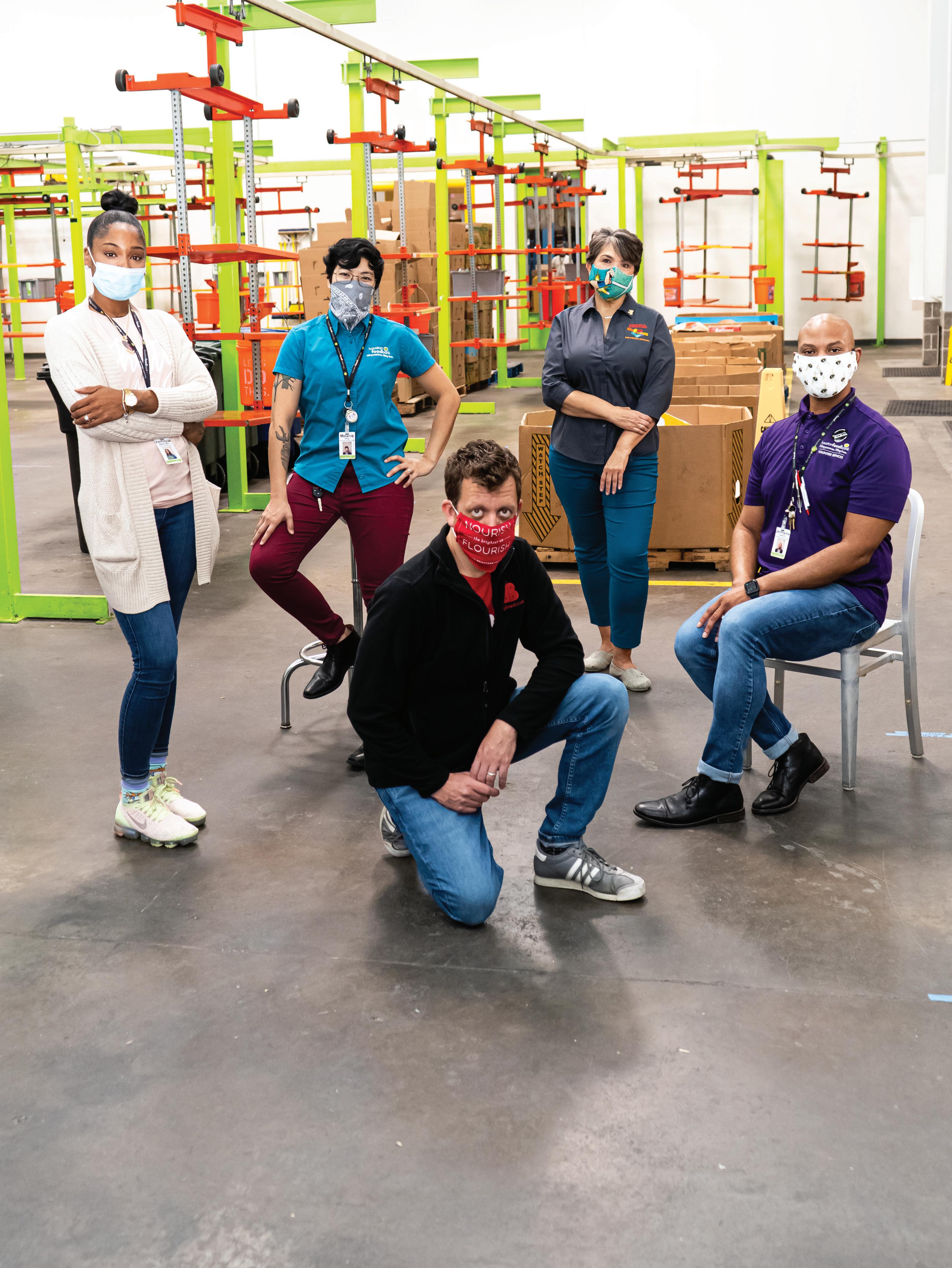
Nonprofit organizations come together to provide food security to those affected by the pandemic.
By
Even in the best of times, a community food bank is an important part of big-city life. And during a crisis such as the COVID-19 pandemic, it has become a lifeline for thousands more who are suddenly without an income. The Houston Food Bank (HFB) was established in 1982, and in the past three decades has grown to become the largest food bank in the country, based on distribution. In 2011, HFB moved into its current home, a large warehouse facility located east of downtown on I-10.
The food that HFB distributes throughout the region comes from various sources: surplus crops grown by farmers and procured through the U.S. Department of Agriculture, grocery stores and wholesalers that give away thousands of pounds of surplus food, and staples purchased with funds donated by corporate sponsors through the HFB purchasing department, which strives to get the best value possible.
In addition to non-perishable canned goods, HFB puts a high priority on distributing nutritious food such as fresh produce, dairy products, meats, frozen products, canned fruits and vegetables, and fruit juice. Last year, more than 800,000 people were fed through the efforts of HFB.
The HFB warehouse usually has 300 employees working to receive truckloads full of food and assemble boxes for distribution. Although the Food Bank is limiting the warehouse staff to 100 people during the pandemic, they have been able to increase their normal output by 50 percent to meet the unprecedented demand.
Eligibility for HFB food assistance is typically determined by the city’s individual food pantries, but during this crisis they are distributing food without the usual data-collection
process. HFB has also stepped in to help with the distribution of food to families with children in school. While school lunches are part of a national program, HFB feels that during the pandemic, families with children at home also need grocery supplies.
The biggest change at HFB during the pandemic is their new direct-delivery distribution method. Using a drive-through model to limit exposure, all HFB staff members wear face masks as they ask drivers to pop open their car trunks so they can place food boxes inside without additional handling.
To meet the growing demand, HFB now stages drive-through food pickups at two satellite distribution centers on Wednesdays and Saturdays. They can serve up to 5,000 vehicles per day at each center.
For people who are homebound without cars, an HFB delivery system is now in place. Volunteer drivers leave food boxes at clients’ doorsteps and then call to let clients know that the food is waiting for them outside.
Houston’s LGBTQ community and its allies are providing vital support to the HFB as it mobilizes to serve those in need. Some of these folks chatted with O utSmart about their work and the toll of the pandemic.
For more information about the Houston Food Bank, visit houstonfoodbank.org.
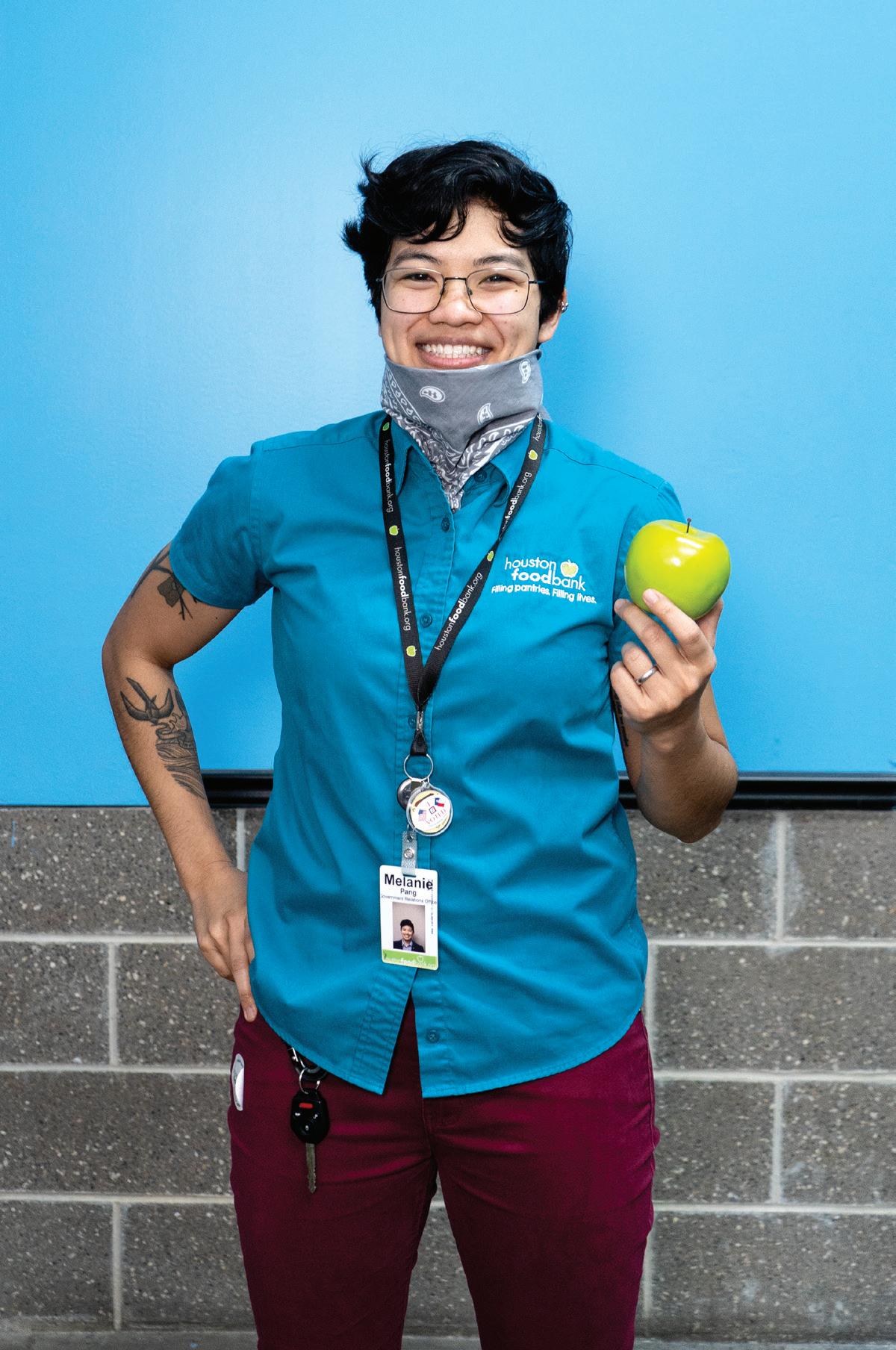
JERMAINE HARMON
37 | Director of Volunteers
Jermaine Harmon, an African-American gay man from Jersey Village, and has been with the HFB since the fall of 2019. Harmon has the huge task of coordinating the tens of thousands of volunteers who work at the central warehouse. He is responsible for recruiting, training, and engaging the volunteers, as well as ensuring safe working conditions for everyone during the pandemic. Although volunteer involvement dipped at the outset of the crisis, Harmon
says that was only temporary. “Our response to the virus has made people feel safe, and more people are volunteering now.”
Harmon, who is engaged to be married, says he wanted to work at HFB because he is a giver by nature. “I told my fiancé what I wanted to do, and he agreed that this was very much aligned with my desire to be a good global citizen.”
Melanie Pang, a queer Asian-American woman who lives in Third Ward, has been with HFB since 2018. Her job is to help educate elected officials about the needs of the Food Bank’s clients. City Council members and Harris County commissioners work with Pang to help eliminate the roadblocks to providing food assistance for those in need throughout the region. She also helps build coalitions with other community organizations.
Pang says that the COVID-19 crisis has generated a much greater demand for food, largely because so many people have lost their jobs. “The pandemic is just making it more obvious where the social problems lie, and how many people exist in a vulnerable spot,” she notes, adding that the average person in Harris County has no more than $400 in savings. Looking ahead to better times, Pang hopes that people will remember the large number of communities throughout the region that we now realize are very fragile.
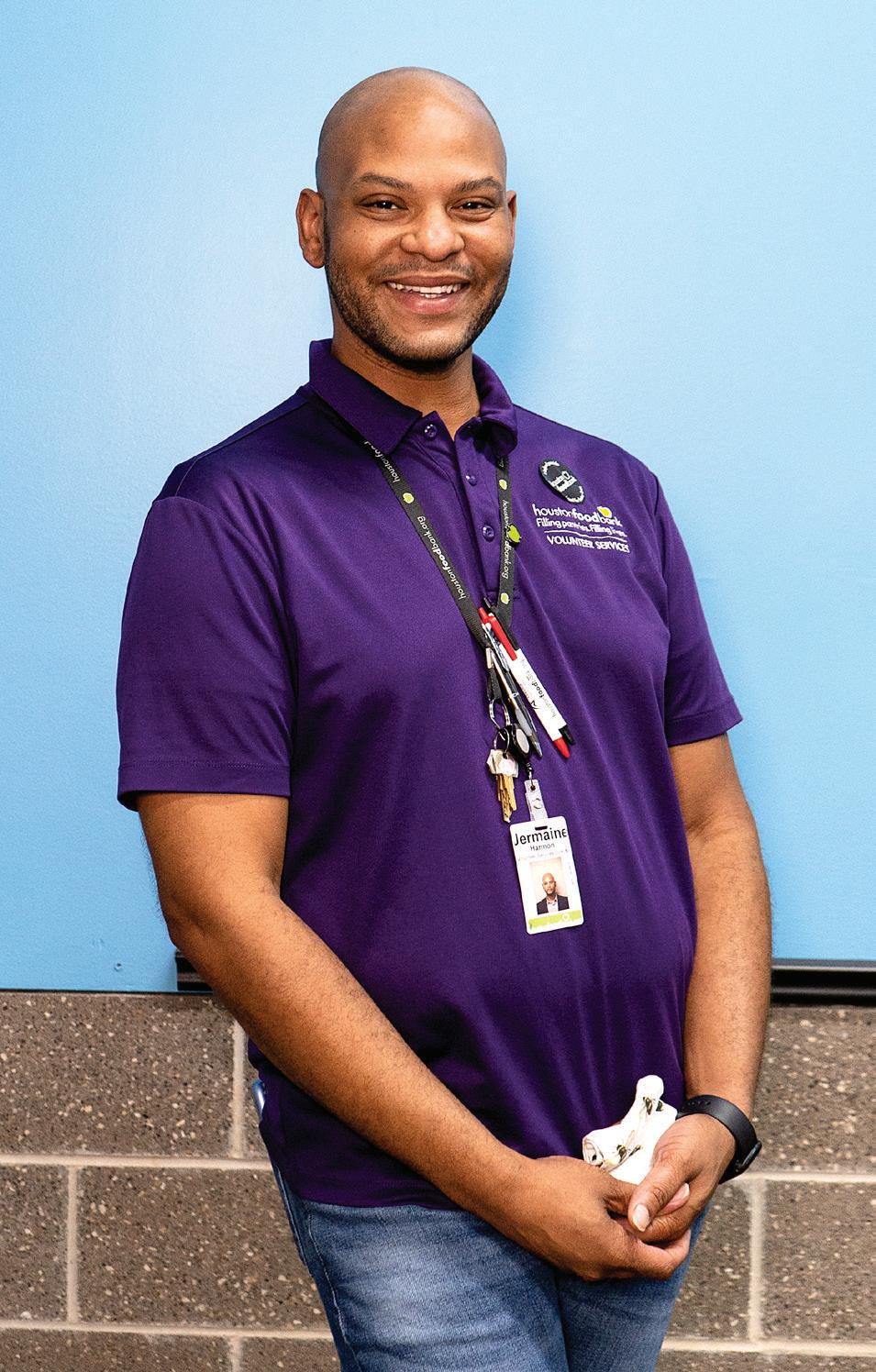
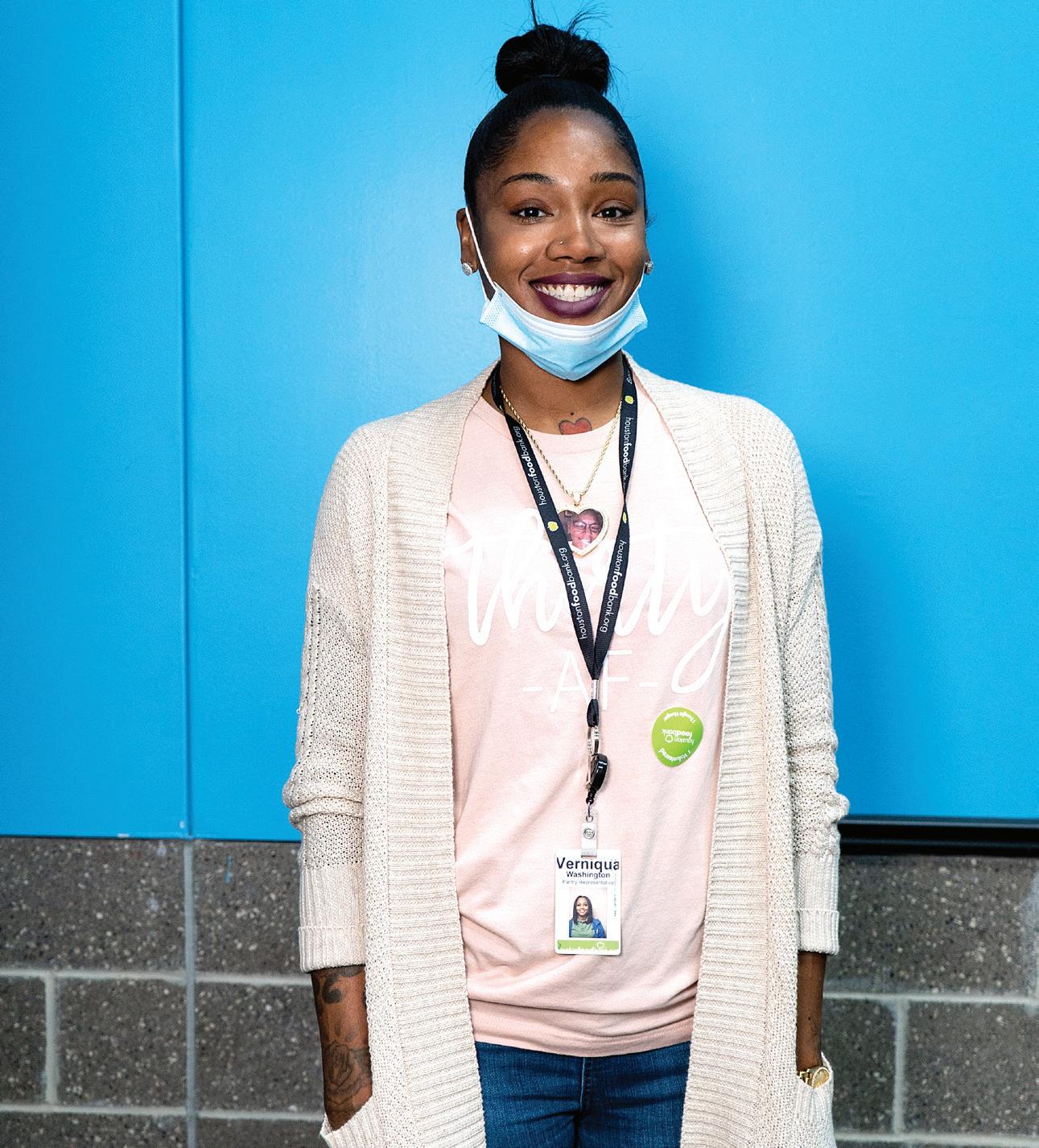
Lisa Middlebrook has been with HFB for nearly five years, and her wife, Melinda Middlebrook, has been an HFB volunteer for 12 years, working to pack food items into the thousands of boxes that go to clients. Melinda is also the manager for Curvii Addiction, a plus-size women’s clothing and accessories line. For the past seven years, other women from Curvii Addiction have volunteered as a group to work in the warehouse with the African-American lesbian couple. Lisa works with quality assurance, making sure that the food donated to HFB is not spoiled or moldy. She also checks the temperature of refrigerated donations on the loading docks. Because the number of employees working in the warehouse must now be limited, she is only working part-time. “I’m still being paid my regular salary, so I feel very blessed and grateful,” she says. Lisa was attracted to HFB because they provide food for LGBTQ seniors and kids—two groups that are especially important to her. “It’s all about
helping people. My wife and I are both peopleoriented.”
Melinda says that she is not currently working at the warehouse during the pandemic, but she does pick up donations from her 12 employees and drive them to the warehouse. Her employees help HFB by buying extra food items when they shop for groceries. Melinda likes volunteering with HFB because she has often encountered customers whose children do not have enough to eat, and she has helped them get signed up to receive food boxes. Helping others makes her feel “on top of the world,” she says. “If I’m blessed every day, let me bless someone else.”
30 | Portwall Pantry Representative
Verniqua Washington, an African-American lesbian woman who lives in Fifth Ward, began volunteering at HFB two years ago, and then became a full-time staff member. She has been working in the Food Bank’s on-site food pantry where clients are invited to shop once a month for 20 minutes. Although the pantry is currently closed to the public during the pandemic, the space is now being utilized to prepare bags and boxes of groceries for delivery to those who are homebound. Washington says she enjoys working at HFB because of the team environment, and because she has seen the impact it has on the greater community. “People are incredibly grateful—especially our veterans. They tell us that they don’t know how they would survive without us.”
















Food Bank
In addition to Houston Food Bank’s own food-distribution operation, a number of Houston nonprofit organizations including the YMCA of Greater Houston and Brighter Bites are partnering with HFB in order to serve thousands of additional unemployed and low-income clients in need of food assistance.
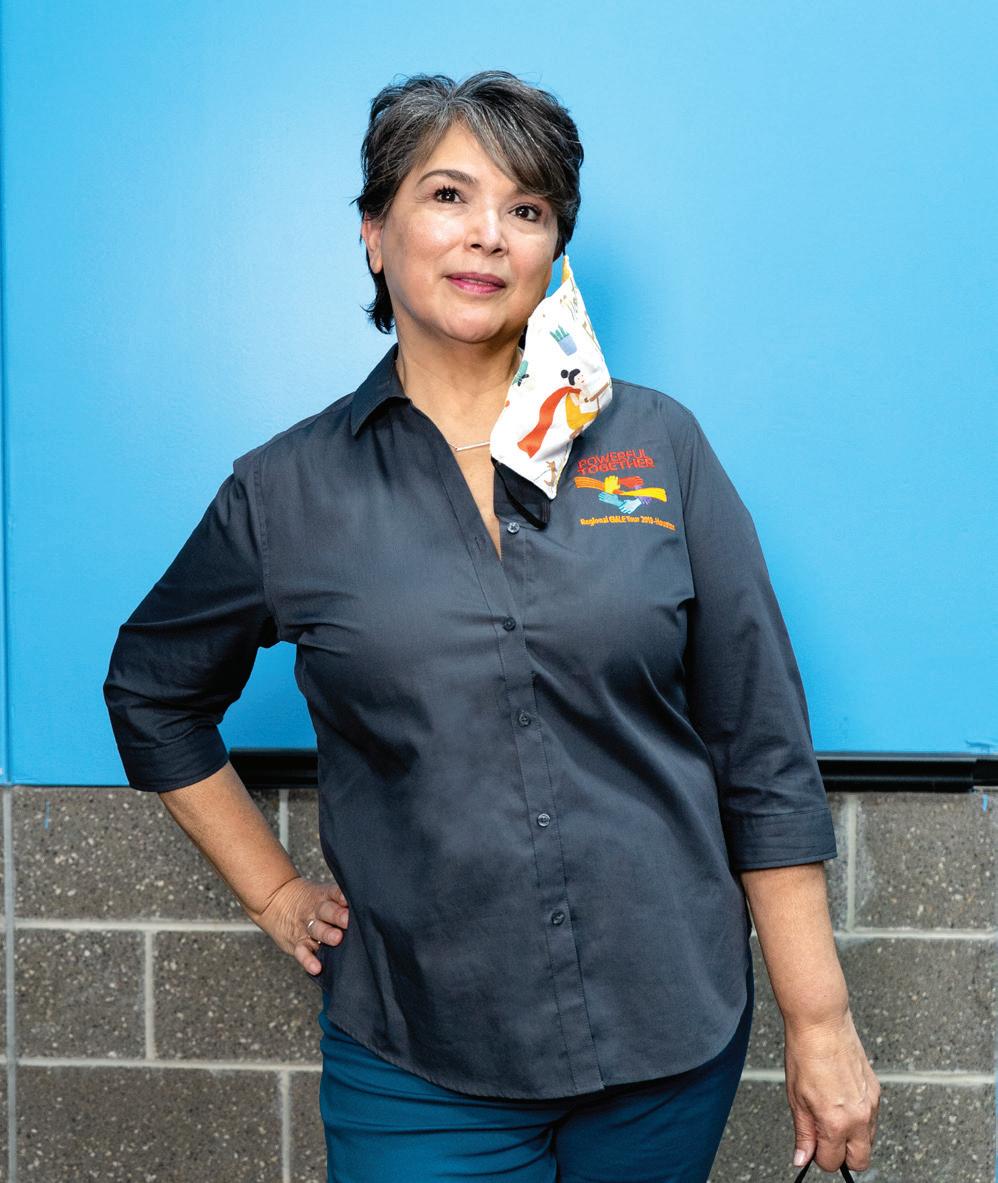
MARIE ARCOS
55 | YMCA of Greater Houston VP of Government Affairs
Marie Arcos, a longtime LGBTQ ally, says that the YMCA of Greater Houston has been distributing food from HFB to some of the city’s most vulnerable communities, even while Houston’s YMCA facilities are closed due to the COVID-19 crisis.
The CEOs of both organizations brainstormed about how they could work together to meet the growing need for food in Houston. Twenty-five YMCA facilities are now used as food-distribution locations, and furloughed YMCA employees have been brought in to staff the effort.
Every morning at 8 a.m., Monday through Saturday, HFB trucks roll up to the YMCA parking lots with 10 to 20 pallets of produce. Each pallet has about 1,000 pounds of fruits and vegetables that the staff sorts and bags. Distribution begins at 11 a.m., but cars begin to line up as early as 6 a.m. The staff conducts a minimal registration of each car, and a tag showing the number of people in the fam-
ily is put on the dashboard. Drivers pop their trunks at the food distribution area, and bags are placed directly in them.
Houston police officers and Harris County sheriffs monitor the lines of cars, keeping intersections from getting congested and keeping the flow moving. In some areas, the food is delivered to nearby school-district stadium parking lots where traffic can be more easily controlled. Every day, 5,000 people are helped.
Arcos praises the furloughed YMCA employees who are now distributing food.
“These people are working in temporary jobs, doing things that they do not usually do, but they’ve learned how to do this as their new daily work. It’s hard to see families [in need], but it keeps us moving forward.”
Additionally, the YMCA has been able to provide skilled staff to the Food Bank, saving them from the normal vetting process. “I’m grateful to be in a position where we can leverage strong partner relationships to serve others,” Arcos says.
For more information about the YMCA, visit ymcahouston.org.
MIKE POMEROY
37 | Brighter Bites Senior Director
Mike Pomeroy, a gay man who lives on Houston’s near-north side, has been with Brighter Bites since its inception in 2012, when the HFB became a partner. “We provide produce for families in lower-income school districts,” Pomeroy says. “The Houston Food Bank brings in a lot of the produce [that we distribute].”
Before the pandemic, HFB produce pallets were delivered to specific local schools. Brighter Bites then coordinated the volunteer efforts of parents to bag and distribute the food. At various times throughout the school year, parents who picked up their children after school would receive 20 pounds of the bagged produce.
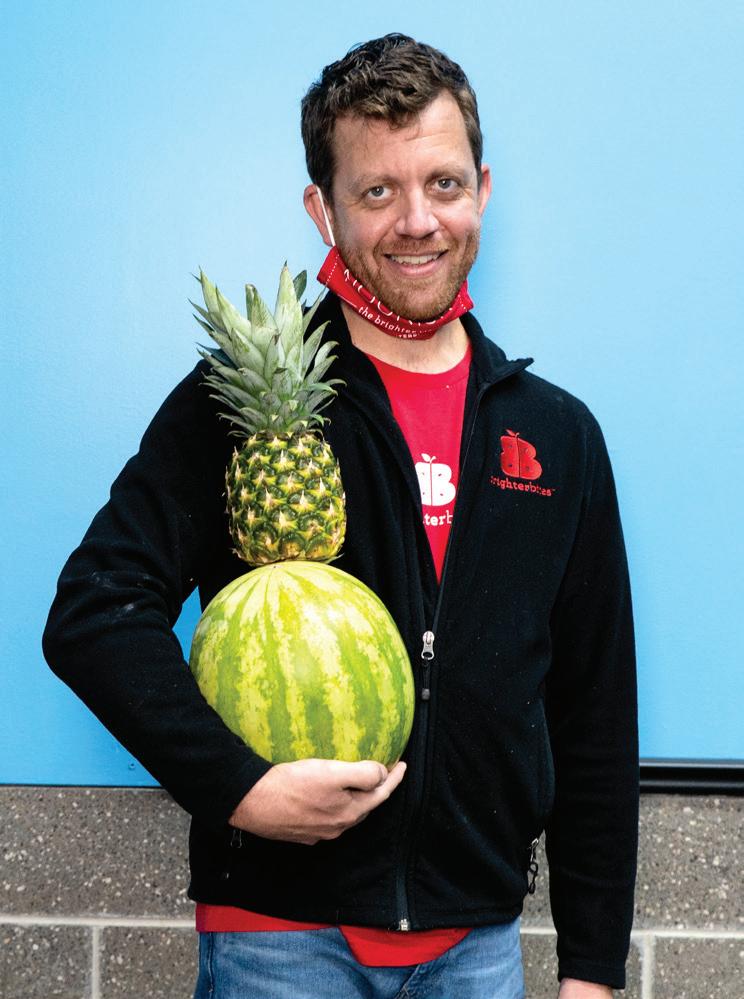
The Food Bank produce pallets are currently being delivered to nine YMCA sites, each of which can provide bagged produce for 800 families twice a week. Brighter Bites staff members are working with furloughed YMCA employees to handle those neighborhood distributions. Brighter Bites clients who would normally be served through their local schools that have closed can now receive their produce at a YMCA site.
Brighter Bites has also partnered with H-E-B grocery stores to mail $25 H-E-B vouchers to Brighter Bites clients. The vouchers can be used to purchase produce at any H-E-B location.
“It’s extremely gratifying to be able to help with the current need,” Pomeroy says, “and yet it’s heartbreaking to witness that need.”
For more information about Brighter Bites, visit brighterbites.org.
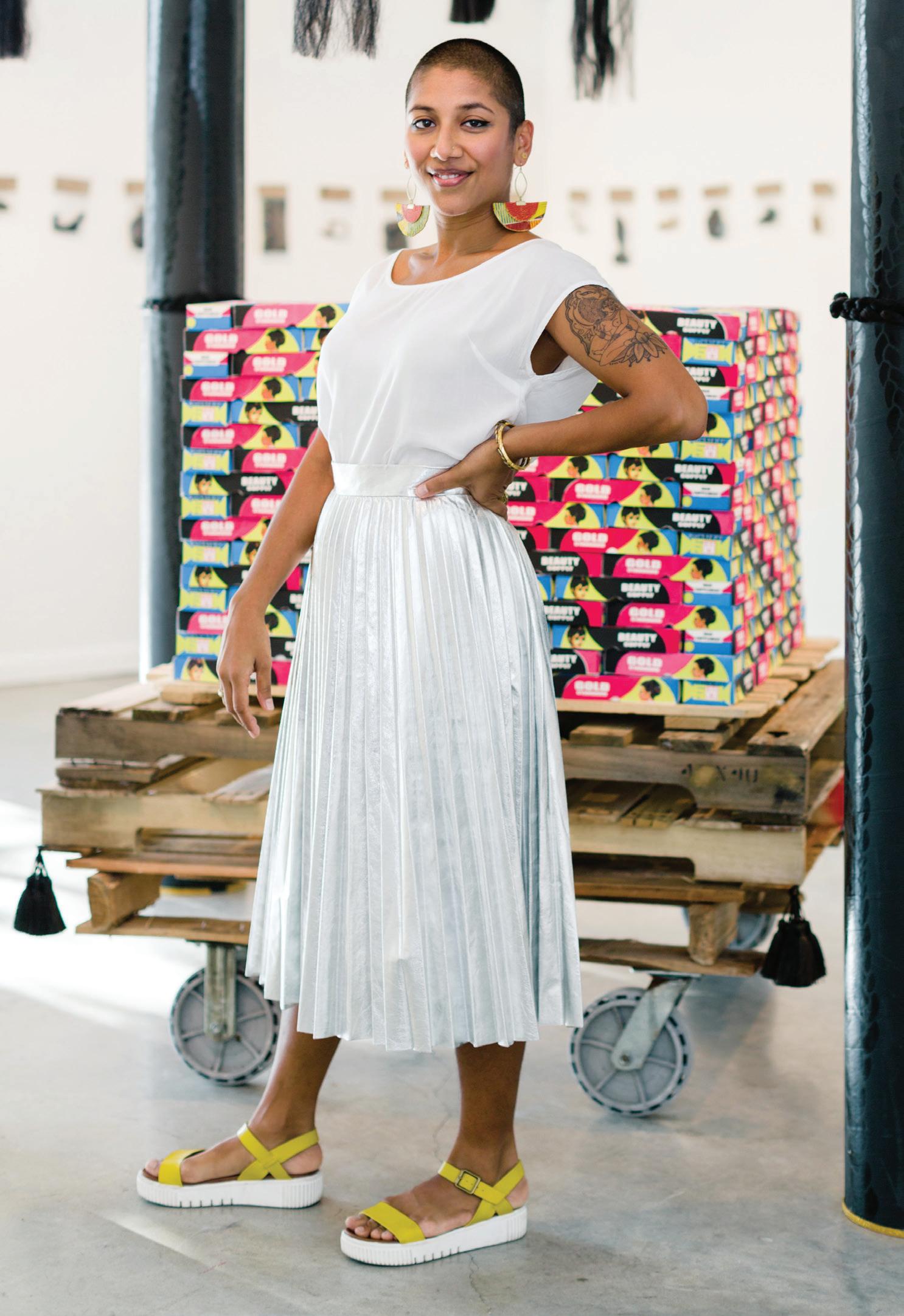
Indian-born Texan Preetika Rajgariah creates art that explores the complexities of an increasingly globalized world.
By BILL ARNING
Photo by ALEX BARBER
On the Houston visualarts circuit, an emerging artist is often noticed by the area’s tastemakers and framed as “someone to watch.” A year ago, few had heard of Preetika Rajgariah, but today she is nearly unavoidable among Houston art lovers. In the last nine months, she has mounted well-received solo shows at Art League Houston and Lawndale Art Center. A performance-based installation was seen at Austin’s revered feminist space Women & Their Work. There was also the food-based performance “Two Dykes and a Knife” at the hyper-hip Jonathan Hopson Gallery in Montrose as part of their Stonewall 50 observances. That piece, conceptualized and performed with her life partner, artist Lovie Olivia, interwove her queerness with her Indian and Texan identities to fuel her art.
As an Indian woman raised in Houston, Rajgariah’s journey to being a full-time artist is best (or at least politely) described as “circuitous,” and in constant danger of being abandoned in favor of a safer traditional life. Always an overachiever, she flirted with becoming a doctor and even took on the role of the dutiful Indian wife by marrying a man. All of which makes the hard-won identity that now informs her work feel both well-earned and more meaningful.
In 2010, after finally deciding that she wanted a life making art, Rajgariah attended a residency hosted by the School of Visual Arts New York City. Despite having not yet become the artist she wanted to be, the event opened her eyes to the life possibilities before her, including seeing ways to discuss her life experiences unapologetically. Being both queer and Indian is always a complicated negotiation between traditions.
Houston learned a great many lessons about gay life in India during Fotofest 2018, when the great Indian photographers Sunil Gupta and Charan Singh—who are also lov-
ers—mounted a wildly enlightening collaborative show of photographs at the Contermporary Arts Museum Houston. The exhibition documented India’s third gender, known as “hegira”—an ancient concept predating by centuries our contemporary ideas about transgender people. These hegira beings are spiritually revered, yet in modern times are always in legal limbo. During that 2018 show, curator Patricia Restrepo was receiving daily updates on cases moving through the Indian court system that were granting, and then revoking, protected status and basic civil rights to India’s gay citizens. Attitudes about sexuality in Indian culture are split between intense eroticism (manifested in the Kama Sutra, tantric practices, and Lingam worship) and the Puritan attitudes that traditional families teach their daughters regarding sexual expression.
Rajgariah playfully called her 2019 show at the Lawndale Art Center “I Ain’t Sari,” referencing Beyoncé’s iconic “I ain’t sorry” chorus from her Lemonade album. Rajgariah had previously made a series of human-scaled sculptures called “Aunties” built out of used saris gifted to her from the women in her extended family, both in the U.S. and India. Coming out as queer inspired Rajgariah to transform what had been semi-phallic shapes (think of the traditional Indian penis-worship stones known as lingams) into classically feminine erotic shapes. Flowery forms reminiscent of vulvas flowed seductively throughout the balcony space. The connection between the artist (as a female member of her clan who is now queer-identified) and a partner was made explicit in an audio recording of the artist discussing her belated queer identity with her mother. The discussion is never heated, but it reveals a disconnect between the way Rajgariah’s mother sees her daughter’s identity and what the art world sees as Rajgariah’s life project today.
In fact, as she began graduate studies in a predominantly white school, Rajgariah felt pressured to represent her Indian identity and make overtly identity-based work. She actively resisted that pressure and took a multi-year detour in 2015 that resulted in a series of traditional paintings that could be mistaken for lyrical abstractions. This series, called the Migration Paintings, uses masses of marks indicating humans in motion to evoke the global realities of political refugees, the climate crisis, and the economic migrations that are set against all the other mounting crises of 2020.
Rajgariah is not afraid of using humor in her work, even when dealing with uncomfortable issues—such as in her self-portrait photograph Dot Not Feather (2016). The title refers to the clever visual shorthand for distinguish-
ing between South-Asian Indians and NativeAmerican Indians. It can be understood as inoffensive or racist, depending on context and who is speaking. The photograph depicts the traditional Bindi adornment of a colored mark on the face, repeated until Rajgariah’s face appears to be a sea of red dots. Similarly in the video work How About Now, the traditional powdering of the part in a woman’s hair with rich-red Sindoor powder to identify a married woman is overdone until she is almost drowning in the powder.
Indian hair and its rituals also become the focus of Rajgariah’s project for Art League
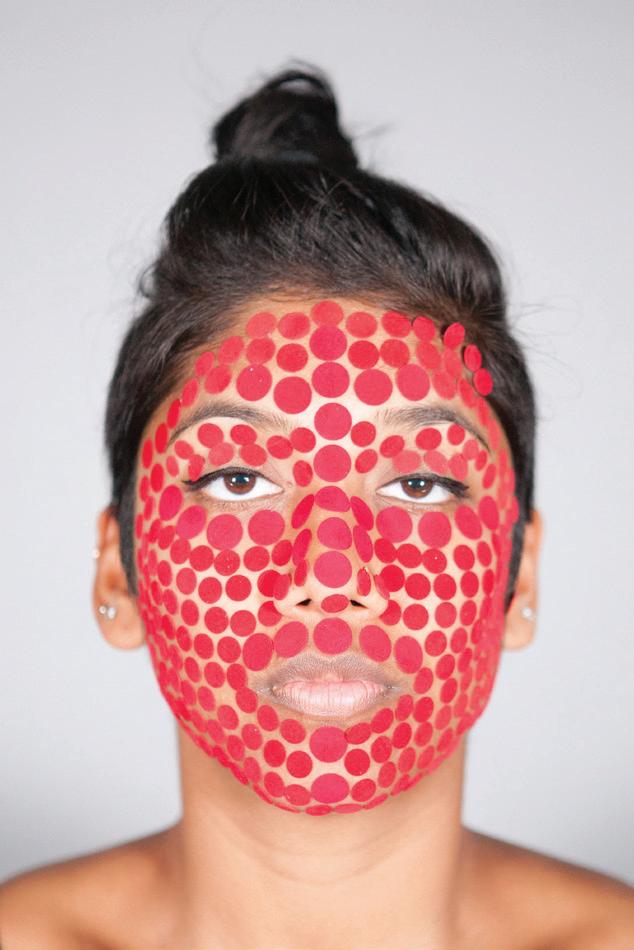
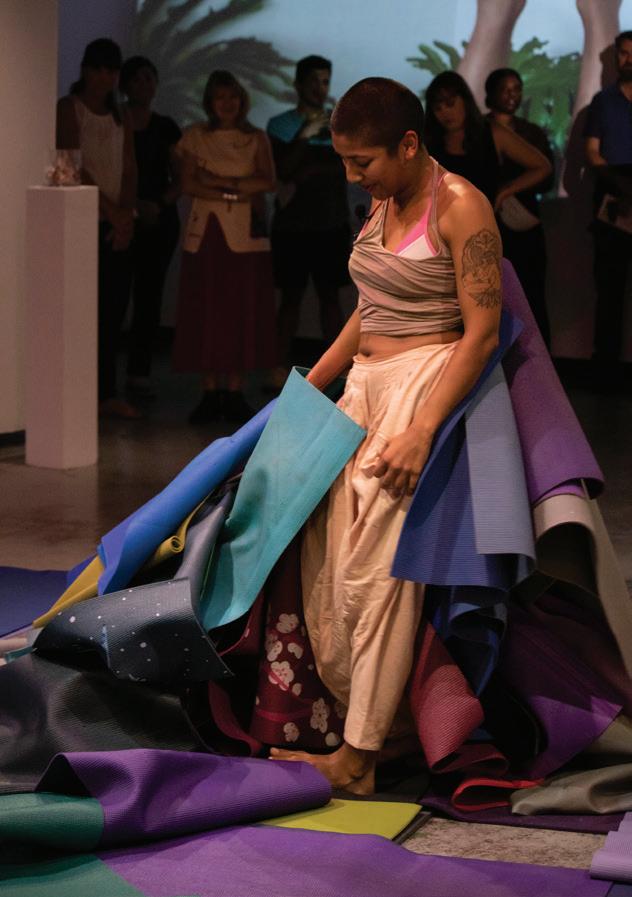
Houston. Making another statement about attitudes toward feminine beauty, she asks the question “What is my worth when shorn of my hair?”
As a “femme” identified woman, her shaved head might be seen as an unusual choice, but it was shaved in service of this project that looks at the commodity that Indian hair becomes in the making of beauty adornments. Tonsuring (the ritual cutting of hair in Hindu temples) becomes very profitable when the hair is sold and turned into top-quality wigs and hair extensions. As framed by the artist in a series of hair-filled resin bricks and plastic specimen bags, she reminds us of the fickle nature of hair flipping—from highly sensuous when on a lover’s head to gag-inducing when found frozen in an ice-cube tray.
This absurdist technique was perhaps most effectively used in Rajgariah’s Austin show entitled Wild, Wild Country in which she comments on the way that the cultural origin of yoga practice in India is frequently rendered invisible in the U.S. (although she notes ironically the proliferation of Americanstyle yoga studios in India—the selling back to India of its own invention). As someone who did yoga at 5 a.m. in a town square with an uncle in India, Rajgariah noticed that the Indian yoga ads she received in India almost never featured Indian faces.
In the performance piece, Rajgariah is literally buried alive in yoga mats (a European invention from the ’90s) while three large video screens highlight her own yoga skills. The mats were arranged to form a swastika, a traditional auspicious symbol in Hinduism before it was appropriated and perverted by the Nazis. The artist was somewhat shocked by the small percentage of visitors that knew nothing of the swastika’s origins or meaning in Indian culture.
The yoga mat continues to be used in the artist’s new work—hanging on the wall as grounds for paintings of her yoga sessions during her frequent trips back to India. While these paintings are just beginning, like many artists she is using the pandemic shutdown as a chance to regroup and rethink her art. After showing so much during the 2019–2020 art season, the timing could not be better for Rajgariah, letting her develop her new work in private while supporting her partner’s art practice. (Olivia had a number of shows planned that are temporarily on hold.) During our Facetime studio visit, the hints about where her art is going were thrilling to behold, and I am sure that her post-pandemic shows will thrill us all.
So what is my worth without my hair?
Keep up with Preetika Rajgariah at prajgariah.com
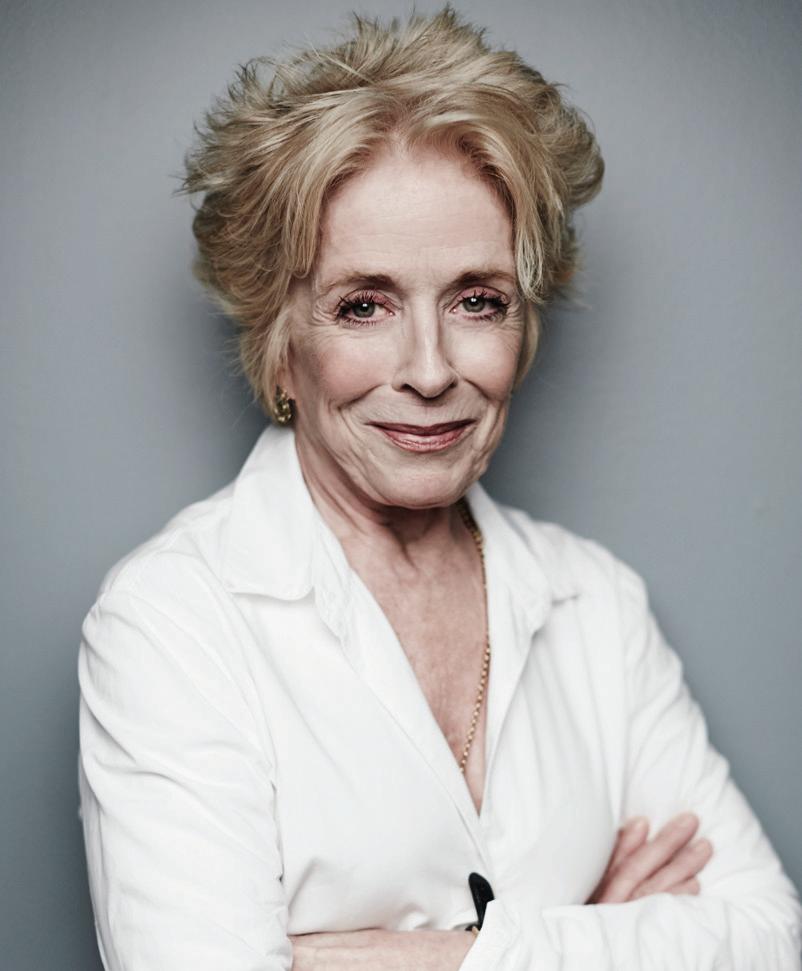
According to Ryan Murphy, “Casting a television show is like casting a dinner party. It’s like, ‘Well, who do I want to sit next to for the next six months of my life?’”
In the case of his new Netfl ix series Hollywood that premieres this month, Murphy has set an amazing table and seated his guests just so. One such guest is out actress Holland Taylor, who plays Ellen Kincaid, a no-nonsense 1940s movie studio exec. Ellen is someone we can fall in love with immediately—a smart, tough, single career woman who plays a big part in keeping the fl icks fl ickering.
And who doesn’t love Holland Taylor? Playing sassy roles on TV (Bosom Buddies, The L Word, Two and a Half Men, and The Practice, for which she won an Emmy), in movies (Legally Blonde), and onstage (playing Texas governor Ann Richards in Ann, for which
she was nominated for a Tony), Taylor has established herself as an in-demand actress of considerable talent. Taylor was kind enough to answer a few questions for O UTSMART ahead of Hollywood ’s Netfl ix debut.
Gregg Shapiro: What was it about the Ellen Kincaid character that appealed to you and made you want to portray her?
Holland Taylor: First of all, Ryan told me that he was writing this character for me, which is, right away, a very exciting opportunity. Ryan has a special feel for actors that has proven itself over and over again. He has an idea of what an actor can do, and what special thing they can bring to a character. If he particularly wanted me to play this character, I was very game to do it. I didn’t see a script before I accepted it. When I read the script, I got very excited because she’s an attractive character. You don’t always play people that you like. You can
Actress Holland Taylor finds the perfect role in a Netflix ode to 1940s Hollywood.
By GREGG SHAPIRO
play a great character, but that doesn’t mean you would like the person at all. In fact, I’ve played plenty of characters that I wouldn’t like. But I love Ellen. I would love to have known someone like her in those days—the kind of woman who found herself in a man’s power world where her female qualities allowed her to be comfortable exercising her opinion and views. It’s almost like a family situation where the boys would accept her because she was so smart and game and charming. She could operate in the world of men. She has a real partnership with Dick Samuels [played by out actor Joe Mantello], the guy who’s actually making the movies at the studio, where it would never occur to her not to voice a strong opinion, or one that challenges his opinions. She would be comfortable and easy and fun in sharing her views.
Ellen, along with Avis (played by Patti LuPone), become powerful women in the movie industry. How different do you think the world of entertainment would have been if there had been more women in power all along? There always were some women in certain areas. In the early days, women were great editors and costume designers. Who knows what kind of power Edith Head had beyond costumes. She might have championed an actor or actress that we don’t know about. I’m sure she could get rid of an actor or actress that she didn’t care for. There were wives of studio heads who were powerful—Irene Selznick was a great force. Nothing like what there is today. But I think the world is always improved [when] every group represented in humanity is present at the table. We’re seeing it now in politics. We’re going to be a much better
country when half the people in our government are women. We’re going to be a much better country when an appropriate proportion of people in our government are Hispanic and Black, or immigrants. Our country is enriched by this. Humanity’s table is best served when everybody is at it.
I’m glad you mentioned costumes. What was it like to wear those 1940s costumes, and did you have a favorite one?
It was wonderful! It’s a period I love. I was a kid in the ’40s, so I don’t personally remember the clothes that adults wore, but I saw all those movies. I have a real affinity for those clothes. When I’m dressed in those clothes, I [get a sense that] this is how I should be dressing. I really look just right in those clothes. I’m in the profession at the wrong time—I would have done very well as an actress in the ’40s. I would have fit right in. I have a particularly sweet story to tell about that. I brought in some pictures of my parents. They were a glamour couple. Pictures in those days were always black and white. I think black-and-white pictures have much more information in them than color pictures. I brought in a lot of snapshots, which were so beautiful. The quality of the film stock was so different from today. The clothes my parents were wearing were great, [and they had] the posture of this glamour couple in Philadelphia in the ’40s. Unbeknownst to me, [the costume designers] picked out one thing my mother was wearing and they copied it—this plaid blazer with a pocket set with the fabric going in the opposite direction, with this blouse and pin. They made it for me to wear in a scene. I was dumbstruck. I thought it was so sweet of them to do! They gave me that outfit when we wrapped.
The hairstyles from that time were also distinctive. What did you think of Ellen’s ’do? Michelle Ceglia is one of the great hairdressers of all time; she’s incredibly great with wigs. They take so much time to maintain! She’s always staying late at work redressing them, getting them ready for the day’s work, long before I’m getting ready for the day’s work. They were beautiful. Of course, they make the clothes work. I love wearing hats, too. I really think you’re put together when you’re wearing a hat.
What do you think of the way that Hollywood blends fictional characters with real ones? I think that was a great idea. I think it was a great idea to do the revisionist history thing, too. I don’t think it was part of Ryan’s original concept for the series, which he spoke of as a love letter to Hollywood glamour. It turned out to be much more than that, [with the inclusion of] these revisionist-history scenes, particularly as they involve the exclusion or inclusion of different kinds of people. It’s very moving to see the Rock Hudson (Jake Picking) character walking hand-in-hand with his boyfriend at the Oscars. That would have been the most unbelievably daring thing to do in the ’40s, and nobody did it! You can’t help but wonder: what would have happened? When we see Camille (Laura Harrier) winning an Oscar and getting cast in a role she normally would not get, or Eleanor Roosevelt (Harriet Sansom Harris) saying, “Do this for this girl! Hollywood can teach us!” Of course, Hollywood has taught us many things. I suppose it might inspire someone to perhaps be braver [today when they see] those bold lessons and experience the sadness [over those lost] opportunities and those chances that weren’t taken.
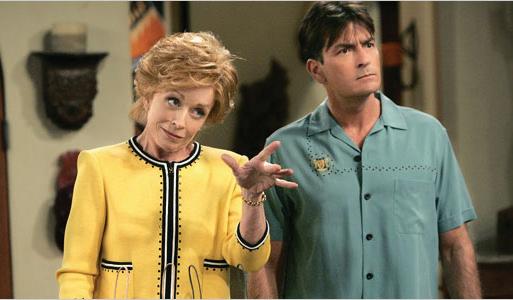
One of the fictional characters, Ernie (Dylan McDermott), is based on Scotty Bowers, who not only wrote a book about his experiences as a gas-station gigolo and pimp, but was also the subject of a documentary. Was the legend of Scotty Bowers something that you were aware of in Hollywood lore? What did you think about the character of Ernie?
I think the gas station [plot line was indeed inspired by] the Scotty Bowers story. But Ernie, as a character, is not like what Scotty Bowers was like at all. I actually knew Scotty Bowers. Scotty was kind of like an elf—a gamine, charming pixie kind of a guy. I never was quite altogether sure about some of the tales he told. But that the escort service existed is absolutely true. You do encounter guys [who are] like the character of Ernie, who had a failed career and who had to make do with something else and always felt thwarted in their dream. Sometimes those people do emerge, and they have some opportunity late in life. It was great fun to see Dylan play this guy who had so much gusto and charm, and who never played it right when he had the chance. Then he gets a second chance, and a chance to be a star. We love stories like this, and sometimes they’re true.
The post-World War II setting of the series made me think about Dorothy Arzner and Ida Lupino, two female directors from that period. Do you think you might someday want to direct?
I’ve often thought about Ida Lupino. She was such a favorite! She was a wonderful character actress. People don’t even know that she was a big director. She didn’t do major films, but she was a really smart woman. You could see this native intelligence in her. She had ambition, and she saw how it could be done. They had the sense to let her do it. She obviously didn’t have some empty ambition of fame for fame’s sake. She was content to be a behind-the-scenes director. I don’t imagine she gave a fig about whether or not she was promoted publicly in that role. She had work to do, with an intelligent, roving mind. She wanted to be creative, and she was. The women directors who are around now are so gifted—Kathryn Bigelow and Ava DuVernay . . .there are just too many of them to even think of. There’s something about a director; I actually think it’s a very maternal role. It’s a nurturing role. There are directors who have had great success with actors by scaring the shit out of them and being monsters and being a dictator and brutalizing them. I suppose you can get things from people with that approach, but I think a nurturing approach is better. There are lots of women directors who will be the rival of any men directors. The world is better when everyone is represented.
Barbara Coa is a videographer by day, and a drag queen by night.
By SAM BYRD
Photo
by CESAR WALLACE
Bearded ladies are no longer just the stuff of circus shows. They’re thriving in Houston’s drag scene, where they are pushing the boundaries of gender and beauty stereotypes. One of those drag queens celebrating the counterculture of drag is Barbara Coa—aka Frank Hernandez, who runs a series of shows in Houston bars while also running his own media business.
Barbara Coa’s va-va-voom proportioned padding, body hair, and stunning mug make her stand out from the crowd, but she says it’s all in the name of art and performance.
“Barbara Coa started out as a favor to a friend doing a twin challenge for one of the local drag competitions. That was the first time I performed on stage. After feeling that energy and rush you get from being in front of people, I wanted that high to keep going and explored the idea of putting myself in drag,” Hernandez explains.
One of the places to catch Barbara Coa performing is at Smoke Break, which will hopefully resume at Guava Lamp on Waugh Drive the first and third Thursdays of each month.
“Smoke Break is a group of creative people. It’s the ‘alternative’ queers who perform in drag. We’re just innovative drag queens who
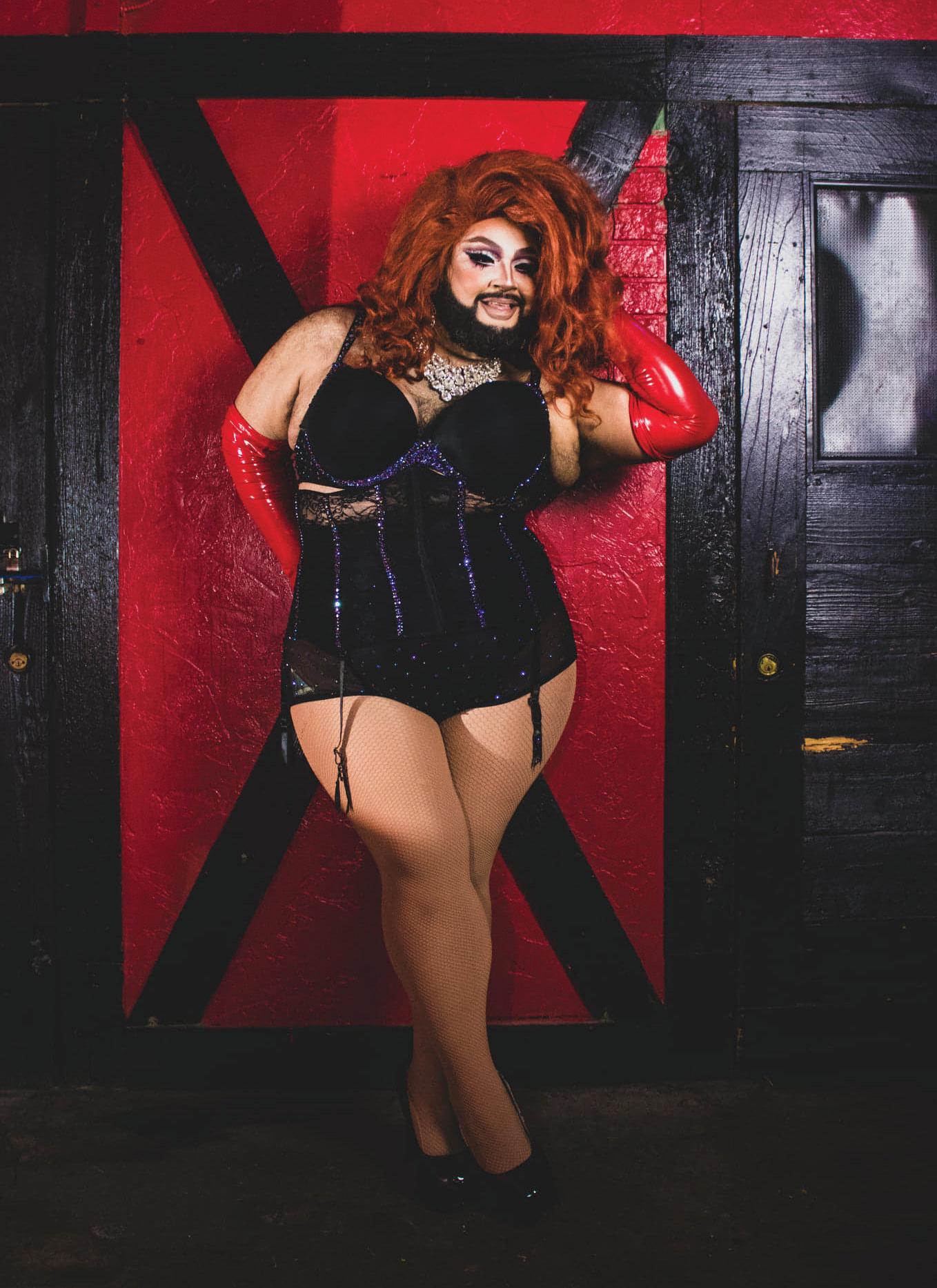
perform things you would hear on the radio, but with a twist.”
Guava Lamp also featured Barbara Coa in a disco-themed party that organically develops into a performance spot. While drag isn’t necessarily a requirement, she says she found a way to sneak it into it each gathering.
“There aren’t really places to dance in Montrose, so I want to cultivate a space for that. Music is playing throughout the night, and then when 11:00 hit, the light went on, and bam!” she says. “I always think of it like Studio 54—something erupts and we just dance into the crowd. We don’t have that line of performance space versus the audience. We’re just in there with everyone.”
She also had a Kinky Queens show at Ripcord on Fairview, where the show themes lean
toward more provocative subjects.
“Ripcord is known for leather and kinks, and we have fun interpreting that. We do things like pup play and water sports. Anything goes,” she says. “I incorporated the idea of water sports into a music mix by Rihanna. It went along with songs about getting wet. You get creative with the subject.”
Barbara Coa tries to work in teachable moments during Kinky Queens to address safety, stigma, or ways to find more information for each theme.
When he’s out of drag, Hernandez works with Ripcord for a separate series called D-RAW, where drawing models would arrive and guests are provided with supplies to create their own works of art.
“I’ve always wanted to do something with
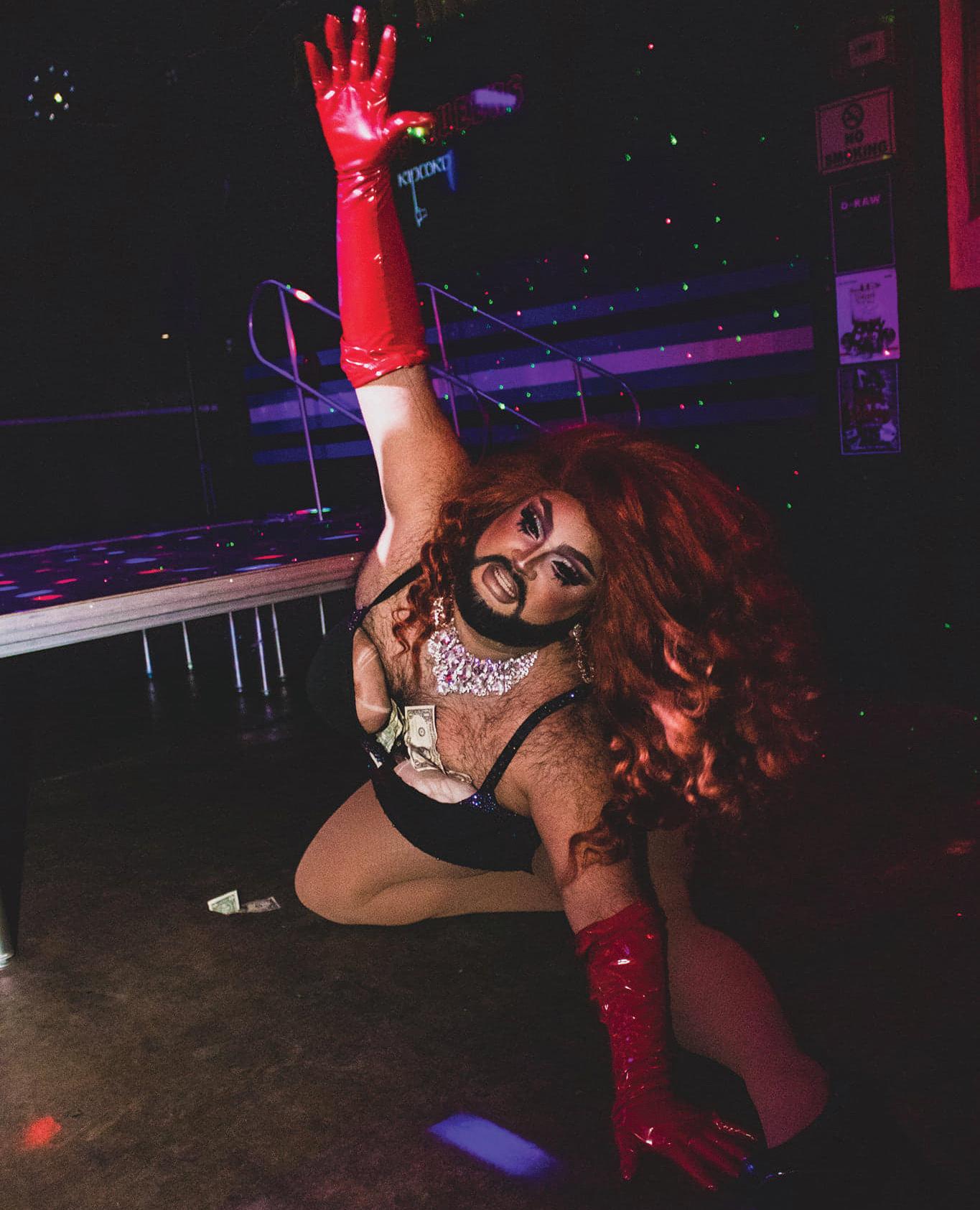
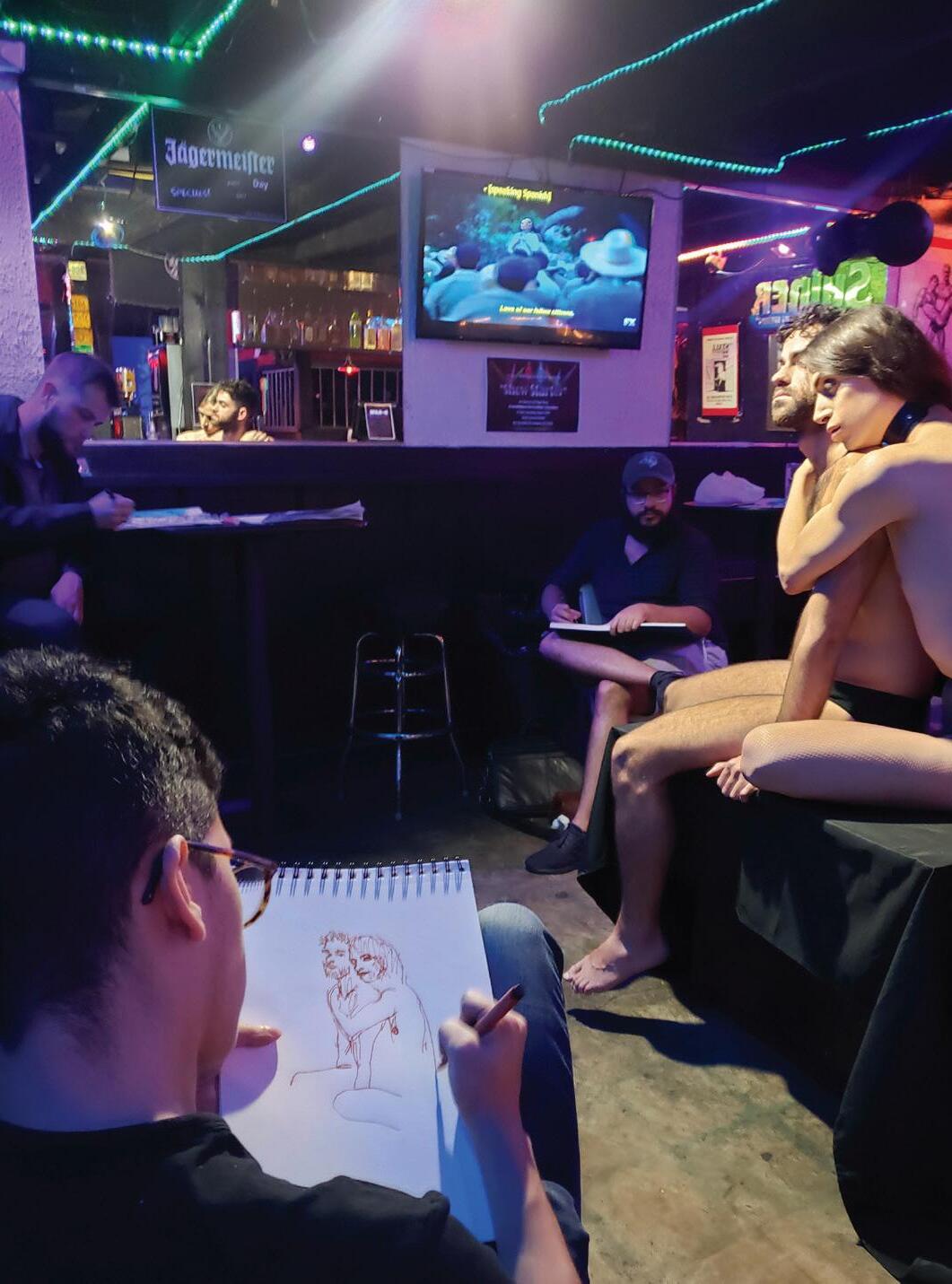
Barbara Coa shapes Houston’s alternative drag scene through her roles
drinking and drawing. It’s just an idea I had, and me being a regular at Ripcord, they were comfortable giving me the space to execute that. They’ve been really great about that, as well as creating a safe space for other queer people,” he notes.
Ever the busy worker, Hernandez also belongs to a queer artists’ group dubbed Qollective. Their diverse skill sets allow them to create meaningful dialogue around contemporary social and political issues through various media. Depending on what he’s feeling at the moment, Hernandez will appear as Barbara Coa or sculpt art at Qollective’s many exhibitions and shows throughout the year.
Hernandez and his partner of eight years, Jay Clark, run a video production company named Your Videographer. Hernandez directs and shoots film, and Clark serves as the digital editor to bring their masterpieces to completion.
“We shoot wedding videos on the weekend. We’ve been doing that for the last four years professionally. They’re usually on [Saturday afternoons], so it doesn’t interrupt my drag.”
The video business started as a passion that both of them had, and it blossomed when the side hobby became a profitable venture.
“I started off as a photographer, and I’ve always been into fashion and fashion pho -
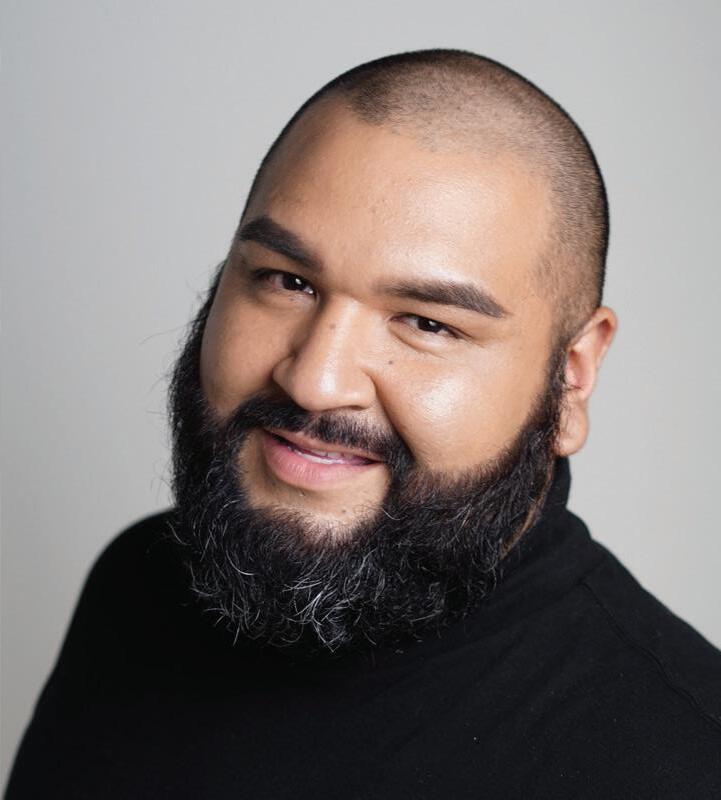
tography. When I met Jay, he was studying to go into finance, but he always carried a video camera with him. He would always film,” Hernandez says. “We mixed what I was doing with videography, and after he took some production classes at Houston Community College, it blew up from there.”
They filmed 55 weddings in their first year, and they haven’t stopped since. They have also added social-media production capabilities—
something that can be seen on Barbara Coa’s social-media posts. Ultimately, their goal is to film a same-sex wedding.
Running so many shows each month while also maintaining a small business is a daunting task, but Hernandez was keeping up the pace. Eventually, though, he would like to transition his talents.
“I want to be a creative director who produces cool, great shows. I want Smoke Break to get bookings at other places. It’s my baby, and I want to show it to the world. All the people in our group are such creative individuals,” he says.
“I don’t want drag to consume me. That persona will eventually die out, but I want to be involved in producing shows and be behind the scenes. My goal is to support someone and get them onto RuPaul’s Drag Race. Or maybe create a show here in Houston. We’ve got great drag queens here, but we haven’t seen anything on television yet,” he notes.
Follow Barbara Coa at facebook.com/ barbara.coa.357 or @the_barbara_coa. Find out more about Your Videographer at yourvideographerhtx.com or @YourVideographerHTX. Follow Qollective @theqollective.





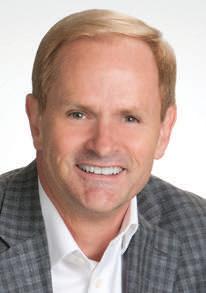

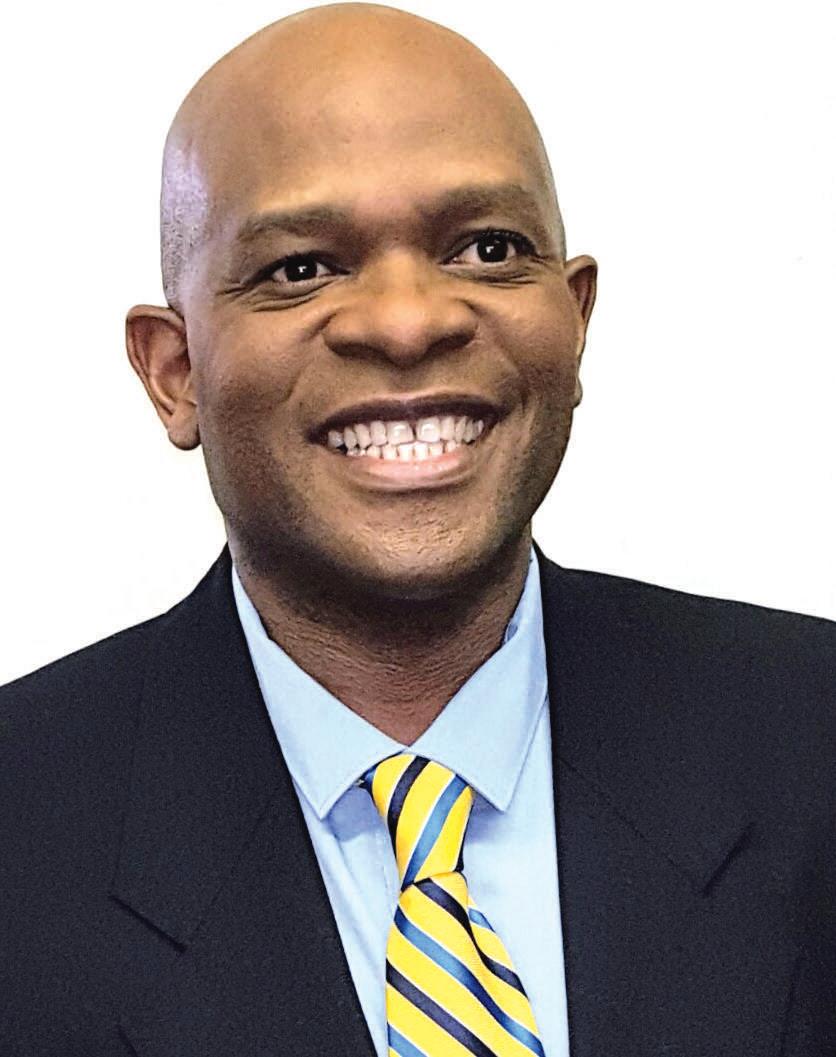
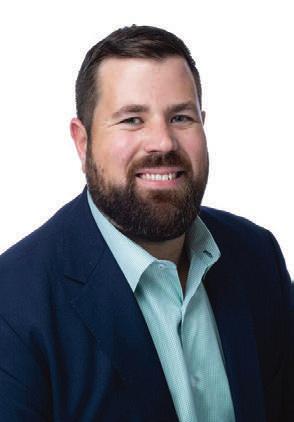








By JENNY BLOCK | Photos by JESSICA TROUT

Lindsey Leaverton and Bri Houk got creative with wedding plans after the COVID-19 pandemic cancelled their original event.
Two Austin brides traded their heels for cowboy boots, their elegant dinner for take-out, their dance-party reception for an old movie, and their Yucatán Peninsula honeymoon for an Airstream trailer stay. Welcome to Pandemic 2020: Wedding Edition, in which a traditional hotel wedding turns into an evening at a drive-in movie theater, complete with social-media broadcasts of the ceremony.
The story begins predictably enough. Bri Houk, 31, and Lindsey Leaverton, 37, met on the HER app, and fell for one another straightaway. Then came two dramatic proposals and one fabulous wedding plan.
But before long, everything changed. Quickly.
Bri is a dental surgical assistant. Lindsey is a Texas A&M graduate who was a full-time touring Christian-music singer and recording artist—that is, until she came out in 2009 and lost her career. These days, she’s the director of wealth management services at the Miura Group. ➝















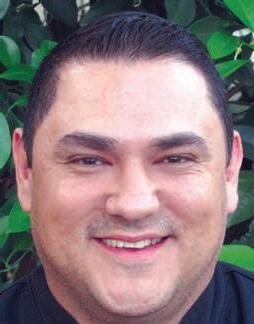


















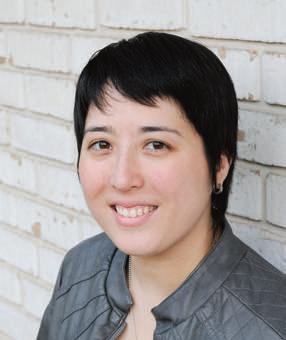



Within twelve hours of their initial match on HER, Bri asked Lindsey out on their first date—since that night just so happened to be Lindsey’s birthday. It was clear from the moment they laid eyes on one another that it wasn’t just a virtual match. They were meant to be in real life, too—right down to the fact that Lindsey and Bri both wanted to propose and be proposed to.
So, that is precisely what they did. Bri proposed to Lindsey during the 2019 Austin Pride Parade at a rooftop bar in downtown Austin. The plan was to meet a small group of friends. Instead, Lindsey was surprised by a roomful of family, friends, and co-workers who were all there at Bri’s invitation.
Lindsey planned to propose far above the earth in a private hot-air balloon during the Albuquerque International Balloon Fiesta in New Mexico. When fog foiled her plans at the last second and they never got off the ground, Lindsey simply proposed the minute they stepped out of the balloon basket. And, as luck would have it, a local news crew happened to catch the whole thing on film.
The pair had originally planned to get married at the Hotel Ella in Austin on the 2020 Easter weekend because, Lindsey jokes, “Nothing says ‘He is risen!’ like a good ol’ lesbian wedding.” They had everything planned down to the last detail, including, Lindsey says, “A menu that would make your toes curl.” But the couple soon learned that the COVID-19



pandemic was gaining momentum and that an official shelter-in-place order for the City of Austin would go into effect on March 25. “Reality slowly began to sink in. April 10, 2020, would not, in fact, be our day.”
Then things got worse. The day before their original wedding date, Lindsey received a call from a family member who had tested positive for COVID-19. “Not to be cryptic, but let’s just say the news of this positive test was significant enough that it further fueled our desire to get married sooner rather than later. No one is promised tomorrow.”
The morning after their original wedding date, as the pair was watching cartoons with Lindsey’s twin daughters and Bri’s son, a moment of genius struck Bri. “There’s a drive-in movie theater that is still open in Buda, Texas,” she exclaimed.
And so there was. Doc’s Drive-In is legally considered an essential business, due to their full-service kitchen providing to-go food. In other words, they’re open. A serious wedding pivot was about to ensue. They called to see if Doc’s might be game to host their nuptials in a way that would be both safe and compliant. The answer? A resounding Yes. Bri and Lindsey reached out to their wedding planner when they got the news, “And then it was all hands on deck,” Lindsey says. “We began planning a wedding that was the polar-opposite of our original vision, and we had seventeen days to get everything ready.”

Being equal parts excited and nervous about their big day in Buda, the pair followed every order and restriction in hopes that the evening wouldn’t attract the police or any other unwanted attention. Bri emphasizes that they were also hoping to prevent the cows living in the neighboring pasture from escaping and free-ranging into the ceremony—live on camera, and projected on two gigantic movie screens. “But honestly, at this point, nothing would surprise me,” Bri recalls. Lindsey adds that she hoped the local stray dog who frequents the drive-in would also opt out of attending, “and relieving himself on our wedding dresses.”
Instead of a lavish reception, the movie Airplane was shown after the wedding. Bridesmaids was their first choice, but everyone had to leave the drive-in by 10:30 p.m. in order to abide by the curfew order. So the pair googled “movies under 90 minutes with wedding themes,” and Airplane was the ultimate winner.
Of course, their guests would likely have stayed no matter the film. Why? No need to rush home sooner than you have to with the world on lockdown. “Any excuse to get out of the house these days, right?” Lindsey jokes. Indeed. As far as excuses go, a mid-pandemic drive-in wedding seems like a pretty darn good one. And, it seems that any marriage that follows such an impressive—and creative—last-minute rescue will be a pretty darn good one, too.
ACCO M M O DAT I O N S / H OT E LS
D r ewe r y P lac e
2 8 5 0 Fa n n i n St 2 81/ 9 9 0 - 6 4 42
H o t e l G al ve z & S p a
20 24 S e a w a l l B l vd 4 0 9 / 76 5 -7 7 21
L’E m e r s o n C o r p o r a t e L o d gi n g L e m e r s o n n e t
M a r r i o t t H o u s t o n S o u t h a t H o b by A i r p o r t
910 0 G u l f F w y 713 / 9 43 - 4 0 26
T h e P o s t O ak H o t e l
16 0 0 We s t L o o p S o u t h 8 4 4 / 38 6 -16 0 0
S o u t h S h o r e H a r b o u r
2 5 0 0 S o u t h Sh o r e B l vd 2 81/ 33 4 -10 0 0
T h e Tr e m o n t H o u s e
2 3 0 0 Sh i p s M e c ha n i c R o w 4 0 9 / 76 3 - 0 3 0 0
ACCO U N TA N T S / BOO K K E E PE R S / C PA S
G a r y G r i t z , C PA
2 3 0 We s t c o t t , St e 210 713 / 78 4 -3 0 3 0
AC U PU N C T U R E
H e a r t L ig h t A c u p u n c t u r e 8 32 / 8 6 5 -117 7
H o u s t o n I n t e g r a t i ve H e al t h ,
A c u p u n c t u r e a n d M i n d f u l M ove m e n t
716 C h e l s e a B l vd 8 32 / 215 -20 39
A DO P T I O N AG E N C I E S / FOST E R C A R E
C h il d r e n’s H o p e
C h i l d r e n h p o r g 8 0 6 / 8 97- 97 35
A DV E R T I S I N G / M A R K E T I N G
A s h k a n M e d ia A s h k a n m e d ia c o m
M a t H a t M ave n C r e a t i ve
m a d ha t m a v e n c o m 8 32 / 4 6 0 - 626 3
O u t S m a r t M ag a z i n e
3 4 0 6 A u d u b o n 713 / 520 -7 2 37
A I R CO N D I T I O N I N G / H E AT I N G
N ew p o r t A i r n e w p o r t a i r n e t 2 81/ 8 0 8 - 8 6 3 0
A ST RO LOG E R
L ill y Ro d d y A s t r o l o g y 713 / 529 - 5 8 42
A R T I ST S
L e t i c ia G a r c ia 8 32 / 871-24 0 8
AT TO R N E YS / LEG A L S E RV I C E S
C h r i s t o p h e r B a r b e r / B a r b e r J ac k s o n L aw
Te x a s Le ga l P la n n i ng c o m 281/ 4 6 4 - L AW S ( 5297 )
C h a r l e s H u n t e r / H aye s H u n t e r P C ........................................................... 2 81/ 76 8 - 47 31
G o n z al e z O li v i e r i L L C g o n z a l e zo l i v i e r i l l c c o m 713 / 4 81-3 0 4 0
K a t i n e & N e c h m a n L L P
18 3 4 S o u t h m o r e 713 / 8 0 8 -10 01
D wa n e To d d L aw F i r m
4 0 5 M a i n St , St e 6 0 2 713 / 9 6 5 - 0 6 5 8
AU TO M OT I V E R E PA I R S
M a s t e r C a r C a r e & C o lli s i o n
2 3 0 5 Ya l e St r e e t H o u s t o n 713 / 8 62- 6 6 3 0
R M S A u t o C a r e & C o lli s i o n
1759 We s t h e i m e r R o a d 713 / 529 - 5 8 55
R ya n A u t o m o t i ve
716 Fa i r v i e w 713 / 52 2-36 0 2
Te c h A u t o M ai n t e n a n c e
37 Wa ug h D r 713 / 8 6 3 - 824 4
AU TO M OT I V E SA LE S
C e n t r al H o u s t o n C ad illac / To ny M c c l e lla n d
2 520 M a i n St 8 32 / 9 81-759 0
K n a p p C h ev r o l e t / B e n We b s t e r 814 H o u s t o n A v e 979 / 533 - 436 3
BA N K I NG / F I N A NC I A L I N ST IT U T IO N S
H o u s t o n F e d e r al C r e d i t U n i o n H o u s t o n F C U o r g
BA K E R I E S / C U STO M C A K E S Dav i d A l c o r t a C a t e r i n g da v i da lc o r t a n e t 8 32 / 439 - 0 2 24
D e s s e r t G all e r y D e s s e r t G a l l e r y c o m 713 - 52 2- 9 9 9 9
C
C H U RC H E S / S PI R I T UA L C E N T E R S
R e s u r r e c t i o n M C C
20 2 5 W 11t h 713 / 8 61- 9149
S t P au l’s U n i t e d M e t h o d i s t C h u r c h
55 01 M a i n 713 / 52 8 - 0 527
S t . S t e p h e n’s E p i s c o p al C h u r c h 18 0 5 W A la b a m a s t s t e p h e n s h o u s t o n o r g
Tr i n i t y E p i s c o p al C h u r c h
1015 H o l m a n St w w w t r i n i t y m i d t o w n o r g
C LE A N I N G S E RV I C E S
D ex t e r ’s F i ve S t a r S e r v i c e / B o b S a m o r a 8 32 / 2 52-19 61
CO M M U N I T Y/ N O N PRO F I T
A A R P aa r p o r g / p r i d e
A ID S F o u n d a t i o n H o u s t o n
A i d s h e l p o r g 7 13 / 6 2 3 - 6 7 9 6
A ID S H e al t h c a r e F o u n d a t i o n / O u t o f t h e C l o s e t
1435 We s t h e i m e r o u t o f t h e c l o s e t o r g B e r i n g C o n n e c t 713 - 526 -1017, e x t 20
D ia n a F o u n d a t i o n T h e D ia na F o u n da t i o n o r g E PA H E PA H o r g
G r e a t e r H o u s t o n L G B T C h a m b e r o f C o m m e r c e
H o u s t o n LG B TC ha m b e r c o m 8 32- 510 -3 0 0 2
H a r r i s C o u n t y S h e r i f f ’s O f fi c e hc s o j o b s c o m
H o u s t o n G L B T P o li t i c al C au c u s t h e c a u c u s o r g
K P F T Rad i o k p f t o r g 713 - 526 - 4 0 0 0
L e s b ia n H e al t h I n i t ia t i ve ( L H I ) 4 01 B ra na rd l h i h o u s t o n o r g
L e s b ia n s O ve r Ag e F i f t y ( L O A F )
l e s b ia n s o v e rag e 5 0 o r g 713 / 9 07- 5378
M y G ay H o u s t o n .c o m M y G a y H o u s t o n c o m / d i s c o v e r P e t P a t r o l T h e P e t Pa t r o l o r g
P la n n e d P a r e n t h o o d G u l f C o a s t p p g u l fc o a s t o r g / lg b t q
R ya n W h i t e P la n n i n g C o u n c il r w p c H o u s t o n o r g 713 - 57 2-37 24
V i s i t P al e s t i n e v i s i t p a l e s t i n e c o m
COM PUT E R S / I NT E R N E T/ IT SE RV IC ES
C o py.c o m
1201- F We s t h e i m e r 713 / 52 8 -1201
E N T E R TA I N M E N T/ N IG H T LI F E
A ll ey T h e a t r e
615 Te x a s A v e a l l e y t h e a t r e o r g
Bu d d y’s B a r 24 0 6 G ra n t , St e A b u d d y s b a r
C i r q u e d u S o l e il - A l e g r ia 87 7 / 924 -7 78 3
G al ve s t o n I s la n d C o nve n t i o n ga l v e s t o n c o m
G e o r g e C o u n t r y S p o r t s B a r 617 Fa i r v i e w 713 / 52 8 - 810 2
H o u s t o n E agl e 611 H yd e Pa r k H o u s t o n E ag l e c o m
H o u s t o n L i ve s t o c k & Ro d e o R o d e o h o u s t o n c o m
H o u s t o n Ro c ke t s R o c ke t b a l l c o m
J R’s / S a n t a F e
8 0 8 Pa c i fi c 713 / 521-2 519
L a G r a n ja D i s c o Y C a n t i n a
55 0 5 P i n e m o n t D r 713 / 518 - 6753
L ake C h a r l e s V isitlakecharles org /great times 8 0 0 /456 -7952
M i c h a e l’s O u t p o s t
1419 R i c h m o n d 713 / 520 - 8 4 4 6
M i d t ow n H o u s t o n M i d t o w n h o u s t o n c o m
M ill e r O u t d o o r T h e a t r e
M i l l e r O u t d o o rT h e a t r e c o m 2 81/ 37 3 -338 6
P e a r l B a r
4216 Wa s h i ng t o n P e a r l H o u s t o n c o m
R e B a r 20 2 Tua m 3 4 6 / 2 27- 8 613
Ro u n d To p F e s t i val I n s t i t u t e
24 8 J a s t e r R d 979 / 249 -3129
Ro u n d To p F e s t i val H ill F e s t i v a l H i l l o r g
S o c i e t y F o r T h e P e r f o r m i n g A r t s
S PA H o u s t o n o r g 713 / 2 27- 47 7 2
S t ag e s T h e a t r e St ag e sT h e a t r e c o m 713 - 527- 012 3
T h e a t r e S o u t hwe s t
T h e a r e s o u t h w e s t o r g 713 / 6 61- 95 0 5
T h e a t r e U n d e r T h e S t a r s
8 0 0 B ag b y, Su i t e 20 0 t u t s c o m / o u t
To ny’s C o r n e r P o c ke t
817 W Da l la s 8 32 / 7 2 2-76 5 8
F E R T I LI T Y/ GY N ECO LOGY
A s p i r e F e r t ili t y A s p i r e F e r t i l i t y c o m 713 / 42 5 -3 0 0 3
F I N A N C I A L PL A N N I N G / BA N K S
R i c h a r d D i c k s o n / G al e n e F i n a n c ial
170 0 W L o o p S , St e 2 55 713 / 4 8 9 - 432 2
S h a n e T h e r i o t / E d wa r d J o n e s
8 8 8 - A A v e nu e A , K a t y 2 81/ 391- 6137
G r ac e Yu n g / M i d t ow n F i n a n c ial
3355 A la b a m a , St e 18 0 713 / 355 - 9 8 33
F I T N E SS C LU BS / PE R SO N A L T R A I N E R S
C lu b H o u s t o n 2 20 5 Fa n n i n 713 / 6 59 - 49 9 8
F I T
F i t h o u s t o n c o m 713 / 529 -1515
FOO D / S PEC I A LT Y & S PI R I T S
DA S H H a n d m ai d Vo d k a
...................................................... d a s h v o d k a . c o m
D e e p E d d y Vo d k a d e e p e d d y v o d k a c o m
D r i p p i n g S p r i n g s d r i p p i ng s p r i ng s v o d k a c o m
F U N E R A L H O M E S / M O R T UA R I E S
M a b r i e M o r t u a r y
M a b r i e M o r t ua r y c o m 713 / 9 42-767 3
H A I R / N A I L / M A K E - U P SA LO N S
Av ila’s S al o n
18 3 0 S o u t h m o r e B l vd 8 32 / 4 4 4 - 8274
G r e e n A p p l e S al o n 719 W G ra y St 713 / 5212- 0 5 0 0
N U - C u t s H ai r S al o n 515 We s t h e i m e r 7 13 / 5 2 4 -7 8 5 8
H E A LT H - AG E M A N AG E M E N T
S h a r e We ll n e s s & M e d i S p a / D r. J o h n S h a r e
4 011 R i c h m o n d A v e 713 / 621- 820 0
HEALTH CARE–COUNSELING/THERAPY
D “ Wo o d ja” F la n ig a n , M S , L PA
26 0 0 S W F w y, St e 4 0 9 713 / 5 8 9 - 9 8 0 4
D e n i s e O’D o h e r t y, L P C, L M F T, L CD C, R N
3131 E a s t s i d e St , St e 435 7 13 / 5 2 4 - 9 5 2 5
D r. B a r r y F. G r i t z , M D
2 3 0 We s t c o t t , St e 210 713 / 8 6 9 -74 0 0
D r Da n i e l G a r z a , M D
3131 E a s t s i d e St , St e 4 152 81/ 610 - 819 0
J e f f r ey M y l e s /J M P r o f e s s i o n al S e r v i c e s 713 / 4 47-216 4
T h e M o n t r o s e C e n t e r
s y n e r g y P s
h o l o gi c al A s s o c ia t e s D r C a t h e r i n e B o s w e
be tempted to just “cut your losses” and cash out, resist the urge to do so!
During this time, it is more important than ever to remain calm and stick with your financial plan. As the stock market turmoil causes the share price of many good, solid companies to fall, it can also create a good buying opportunity in the long run if you have any additional cash on hand that you don’t need in the short term.
Although the financial impact of the coronavirus may seem different than other disasters like 9/11 and the 2008 recession, one thing that those events had in common is that the markets eventually recovered. So even though it may take some time, remain calm and avoid basing financial decisions on emotions, which can often cause more harm than good to your finances. That’s the way to remain on track with your current and future goals.
One of the most difficult aspects of the coronavirus crisis is having to isolate socially and only go out for essentials like food and medication. Yet, as hard as this may be, isolation is necessary to help stop the spread of the virus. And even as we minimize our trips and take all the precautions, it’s important to remember the seniors in our community who may not be able to get the food and supplies they need. So be sure to check on older friends, family, and neighbors while still maintaining socialdistancing requirements.
Many people have been taking advantage of “virtual” get-togethers. Using FaceTime, Zoom, or other similar apps, it is possible to have more personable meals and chats “together,” without being in the same room or even in the same city.
Making adjustments to your financial plan can sometimes feel a bit overwhelming (particularly given the current roller-coaster stock market), and moving forward can have an emotional impact. That’s why I recommend discussing your current plan and your future objectives with an experienced, professional financial advisor— ideally one who is also well-versed in the needs of the LGBTQ community. That way, you can feel more comfortable knowing that the recommended strategies are appropriate for your specific situation.
Grace S. Yung, CFP , is a certified financial planner practitioner with experience in helping domestic partners plan their finances since 1994. She is a principal at Midtown Financial Group LLC in Houston and was recognized as a “Five-Star Wealth Manager” in the September 2017 issue of Texas Monthly Yung can be reached at grace.yung@lpl.com.
By TERRI SCHLICHENMEYER
Queer activists on health.
You woke up this morning feeling pretty good. That was quite a relief: in these frightening, uncertain times, every day of wellness is a bonus—especially when you consider that healthcare for a gay, lesbian, bisexual, transgender, or queer patient can be different than what straight people require. Too bad that healthcare providers don’t always know that. But read Bodies and Barriers, edited by Adrian Shanker, and you’ll feel more empowered to speak with your providers.
If you were to look for books or articles that address LGBTQ healthcare issues, you would likely find an abundance of them. The problem is, says Shanker, most of them were written by people who are not lesbian, gay, bisexual, transgender, or queer. “Every person providing care for humans is providing care for LGBT humans,” he says. But it’s time for “our stories about our bodies” to be told. And so, here they are.
For the youngest LGBTQ patients, physical and mental healthcare may be different than what their heterosexual peers need, and also different from what LGBTQ adults may need. Socially, for example, kids struggle with issues that adults are better equipped to handle. Parents, as one story indicates, can be the best allies of all.
Likewise, young adults have issues that seem tied to their age and vulnerability. Homelessness can exacerbate health issues (and vice versa); teens may suffer from depression, suicidal notions, and bullying. Healthcare needs may extend to the dangers of “sex in the digital age” and a lack of maturity. Because of their youth, LGBTQ teens also need help with learning “social-services navigation.”
Habits such as alcohol and other addictions may be an issue for LGBTQ adults seeking good healthcare, but doctors sometimes don’t know which tests to ask for. They may be uninformed about caring for someone with bisexual or same-sex preferences, or who’s transitioned. They may have a “stigma” about
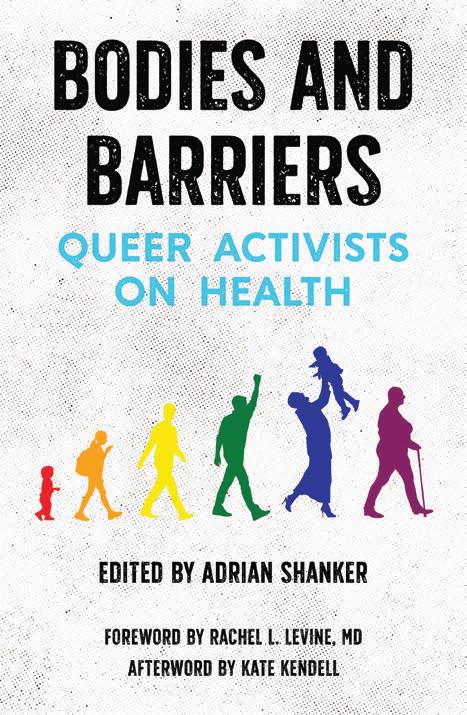
• Edited by Adrian Shanker
• 2020 • PM Press (pmpress.org)
• 208 pages
• $20/higher in Canada
HIV, or be unaware of cancers that particularly plague LGBTQ individuals. As a gay, lesbian, bisexual, or transgender adult, being your own highly vocal advocate is key.
One thing is for certain: Bodies and Barriers is timely—not because COVID-19 treatment is related to sexuality, but because other underlying maladies that may arise are. And since healthcare is on your mind anyhow, this book is invaluable.
Through this series of essays that are broken into sections based on age, editor Adrian Shanker offers a chorus of voices that displays a variety of viewpoints and frustrations. Let’s hope that they can ultimately teach healthcare workers a thing or two.
Readers shouldn’t be surprised to note the feelings of resignation in these stories, or the occasional bit of anger and outrage, but there are also plenty of essays that impart a calm but determined tone. It’s in these sections that an LGBTQ reader will find comfort, camaraderie, and a way to speak up.
Be forearmed with information, and beware. Know how to demand from your doctor that which you need, and don’t leave the exam room without it. Wash your hands, don’t touch your face, and read Bodies and Barriers. Having this book feels pretty good.
Terri Schlichenmeyer has been reading since she was three years old, and she lives on a hill in Wisconsin with two dogs and 11,000 books.
Montrose Eye Care/ Dr. Paul Lovero
520 Waugh Dr 713/352-0974
Spectacles on Montrose 4317 Montrose, Ste. 2 713/529-3937
HEALTH CARE/PHARMACIES
Avita Pharmacy
AvitaPharmacy.com 713/489-4362
Legacy Pharmacy
LegacyCommunityHealth.org/services/pharmacy/
HEALTH-PHYSICAL THERAPY
Crom Rehabilitation/Dr. Roy Rivera Cromrehab.com 713/868-2766
HEALTH CARE–PHYSICIANS
Octavio Barrios, MD 507 West Gray 713/942-7546 7106 Spencer Highway 281/542-9400
Steven Becker MD
Stevenbeckermd.com 713/932-1924
Gordon Crofoot, MD/Crofoot MD 3701 Kirby, Ste.1230 713/526-0005
Abel Flores, MD/Crofoot MD 3701 Kirby, Ste.1230 713/526-0005
M. Sandra Scurria, MD 6565 West Loop South, Ste 300 281/661-5901
Derek Smith, AGPCNP-BC/Crofoot MD 3701 Kirby, Ste.1230 713/526-0005
Maggie White,MPH FNP-BC AAHIVS/ Gordon Crofoot 3701 Kirby Dr., Ste.1230 713/526-0005
HEALTH CARE–SERVICES
Avenue 360 Avenue360.org 713/426-0027
Harris County Public Health Publichealth.harriscountytx.gov 713/439-6293
Houston Health Department PensHouston.org Legacy Community Health LegacyCommunityHealth.org 832/548 5000
Ryan White Planning Council RWPCHouston.org 713/572-3784
St. Hope Foundation offeringhope.org 713/778-1300
UT Hearts 713/486-2736
HEALTH CARE–SKIN CARE
Heights Dermatology/Alpesh Desai, MD 2120 Ashland 713/864-2650
Skin Renaissance Laser/Octavio Barrios, MD 507 West Gray 713/942-7546
The Skin Renewal Center 1512 West Alabama 713/533-0800
HEALTH CARE-WEIGHT LOSS CLINICS
Dr. B-Fit/ Octavio Barrios, MD 517 West Gray 713/942-7546
HOME BUILDERS
Colina Homes Colinahomes.com. 281/463-0355
HOME FURNISHINGS/ACCESSORIES
Cantoni 9889 Westheimer cantoni.com
coda 355 W 19th 713/864-4411
Fountains and Statuary 11804 Hempstead Rd 713/957-3672
Mitchell Gold + Bob Williams 4091 Westheimer 832/397-5130
INTERIOR DESIGN SERVICES
Dream by MJS Interiors 5120 Woodway Dr., Ste. 4020 713/999-1222
INSURANCE AGENCIES/AGENTS
Lane Lewis/Farmers Insurance 2200 North Loop W, Ste 136 713/688-8669
Modern Risk Insurance/Dustin Harwell 1757 Katy Fwy Ste 1300 .281/400-1205
Patrick Torma/Goosehead Insurance 3420 Rusk, Ste. 22 .281/723-1294
INVESTMENTS
Doug Smith/Hawthorne Funds HawthorneFunds.com
JEWELERS
Silverlust
1338-C Westheimer 713/520-5440
Tenenbaum Jewelers 4310 Westheimer 713/629-7444
Zadok Master Jewelers 1749 Post Oak Blvd 713/960-8950
LANDSCAPING/GARDENING
Joshua’s Native Plants & Antiques
502 W. 18th St 713/862-7444
LIFE COACHING
seEQmore seEQmore.com 832/495-1441
MASSAGE THERAPISTS
Ryan Fugate, RMT
RyanMassageWorks.com 713/269-7926
Tom Zeppelin/Zeppelin Massage ZeppelinMassage.com 713/542-0426
PERSONAL TRAINERS
Michael Shallis Body Evolution.com
PEST CONTROL SERVICES
281/881-8599
Andy’s All Star Pest Control 713/732-7742
PET SERVICES& SUPPLIES
Bayou City Veterinary Hospital
4720 Washington 713/343-9909
The Dog House Pet Salon 6434 Washington 713/820-6140
5917 Richmond TheDogHousePS.com
Midtown Veterinary Hospital
MidtownVetHospital.com 713-528-4900
Natural Pawz 208 Westheimer naturalpawz.com
Pet Patrol ThePetPatrol.org
Spay-Neuter Assistance Program Snapus.org. 713/862-3863
The Ruff – House Cage Free Daycare & Boarding 712 Fairview 713/521-7877
West Alabama Animal Clinic 2030 W. Alabama 713/528-0818
PHOTOGRAPHERS
Dalton DeHart Photography DaltonDehart.com 713/622-2202
Yvonne Feece Photography yvonnefeece.com 832/876-1053
PHOTOGRAPHY
Houston Camera Exchange 5900 Richmond Ave 713/789-6901
PLUMBING
In The Loop Plumbing Services 346/253-4444
U-Plumb-It Plumbing Supply 1424 Montrose 713-942-2277
POOLS & POOL SERVICES
Timothy’s Pool Services
832/603-0527
Venture Pools 713/447-9201
PRINTING/COPY CENTERS
Copy.com 1201-F Westheimer 713/528-1201
PSYCHIC READERS
Readings by LA readingbyLA.com 832/856-2188
REAL ESTATE–MORTGAGE/TITLE
Cody Grizzoffi/NRL Mortgage Codygrizzoffi.com 832-541-1103 J. Friedman Mortgage JFriedmanLoans.com 713/785-LOAN (5626)
Chicago Title –Inner Loop 3700 Buffalo Speedway 713/418-7000
Keith Russell/Republic State Mortgage 2121 Sage Road, Ste 140 713/299-4981
REAL ESTATE–REALTORS
Tim Anthony/Anthony Upton Properties AnthonyUptonProperties.com 713/528-0050
Brooks Ballard/Engel & Volkers 309 Gray 713/522-7474
David Bowers/The House Company/Galveston David@DavidBowers.com 409/763-2800
Tina Burgos/Inverness Realty Group TinaSellsHouston.com 713/562-3149
Greg Cassity/Nan Properties 832/773-4262
Mike Copenhaver/Remax Metro mikecopenhaver@remax.net 713/528-4963
Jeremy Fain/Greenwood King Properties 713/677-4337
Karen Derr/Karen Derr Realty karenderr.com 713/875-7050
Clayton Katz/Compass Compass.com 832/512-2180
Emily Kinert/Texas Elite Properties 214/629-6515
Bob Jones/Nan Properties 713/876-1990
Freddia Minahan/Compass Compass.com……….832/588-5991
Thomas Phillips/KW Memorial t.phillips@kw.com 832/305-7848
Debbie Levine/Greenwood King Properties 713/942-6857
Lynette Lew/Better Homes and Gardens LynetteLew.com. 713/582-2202
Danny Pleason/Martha Turner Dannypleason.com 832/661-1502
Richard Ray/Elliman Properties 713/416-3931
Tom Schwenk/Tom’s Galveston Real Estate Tomsgalvestonrealestate.com .713-857-2309
VJ Tramonte/Joe Tramonte Realty 1802 Broadway/Galveston 409/765-9837
Martha Turner Properties Marthaturner.com 713/520-1981
B. Kent Turner/Coldwell Banker 479/363-6586
Calvin Upton/Anthony Upton Properties AnthonyUptonProperties.com 713/528-0050
Andy Weber/John Daugherty Realtors 520 Post Oak 713/724-4306
RELOCATIONS SPECIALISTS
M E Relocation MERelocation.com 713/344-0035
RESTAURANTS/COFFEE/WINE BARS
Acadian Bakers 604 W. Alabama 713/520-1484
Bollo Houston Wood Fired Pizza 2202 W Alabama St 713/677-0391
Dessert Gallery
DessertGallery.com 713-522-9999
Free Grillin’/Chef Michele 832/419-0165
Giacomo’s Cibo e Vino 3215 Westheimer 713/522-1934
Gloria’s Latin Cuisine
2616 Louisiana 832/360-1710
Hamburger Mary’s 2409 Grant 713/677-0674
Indika 516 Westheimer 713/524-2170
Katz’s Deli
616 Westheimer Rd katzsneverkloses.com
Khyber Grill
2510 Richmond Ave 713/942-9424
Niko Niko’s
2520 Montrose 713/528-4976
Niko Niko’s
1040 W. Sam Houston Prkwy. N 832/981-4976
The Red Lion Pub & Eating House
2316 S. Shepherd Dr 281/888-3599
Thank You for supporting our advertisers! Get listed on this page. Call 713/520-7237 for details.
Hollywood hadn’t yet “discovered” diversity in such a big way. I assumed it would be like Saving Face and take years to get made. But within a few months, surprisingly, I had a few financing possibilities. One was Netflix; the other two would have meant specialty theatrical. I’m old school—my first film was shot on 35mm—so I very much leaned toward theatrical. Plus, at that time, the general consensus was that having a theatrical release was always more cachet for a filmmaker.
But the thing is, I wrote a film that I secretly hoped would find inroads in more conservative communities—it’s why I set it in a small rural town. And while I go to the theater religiously, that’s not the case for most people anymore. So, if my goal is to affect the cultural conversation, the best game in town was Netflix. But since I made that decision, the world has shifted again. So many filmmakers I admire have since released incredible films on Netflix. And I will say that Netflix has been an incredible creative partner. I found them wonderfully supportive. And the kicker is that they actually surprised me a few months ago with theatrical-release plans! With the coronavirus situation shutting down all theaters, that is obviously no longer in the works, but honestly, I was just so thrilled that they were willing to back a film without a “name” cast or a big-name director.
What can you tell our readers about the inspiration for your new movie, The Half of It?
I’ve spent most of my adolescent and adult life reading, watching, making, and thinking about stories related to romantic love. As a society, we exalt romantic love as somehow a more important love than all other loves. Find your other half and your life will be complete! And romantic love is great. But I’ve had non-romantic relationships in my life that have formed me just as strongly, if not more. In particular, I’m thinking of one of my best friends from when I was first coming out to myself as gay. He was a straight boy, which at the time felt confusing— he was like a soul mate, but you have no desire to have sex with each other. What [would you call] that relationship that isn’t sexual, yet feels as intense as that of any lover, especially between two people that conventional society would assume leaned romantic? So, the original inspiration for The Half of It arose out of that emotional kernel. And perhaps because I’m older now, I also see how the quest for perfect love is doomed. There is no perfect “other half.” But I do think the quest, the desire to reach for someone, even if it is doomed— especially if it is doomed—can set you on the path to learning about yourself and becoming the person you need to be.
How much of Alice, if any, do we see in Ellie?
Hmm. I’m fairly private, but let’s just say that every single one of my friends, whether watching Saving Face or The Half of It, has said, “Oh my God, your actor is doing you!” [Laughs]
Like Saving Face, The Half of It features a complicated relationship between a parent and a daughter. Please say something about why you have returned to that subject. Does anyone have simple relationships with their parents? Is that a thing? I’m genuinely curious! That would be amazing! [Laughs] I am blessed to have two wonderful parents whom I have loved getting to know over the years. And yes, as young Chinese immigrants who had to struggle, they were in complicated situations that didn’t allow for a lot of self-actualization until later in their lives. I’m lucky that I’ve gotten to know them through that entire time. As hard as it was for them to accept me as gay, which certainly caused a lot of pain for all of us over the years, we have come to a mutual acceptance of each other honestly. Given the way they were brought up, that is to their credit. And because I am aware of how much they have sacrificed for me, I tend to want to pay tribute to their influence on me. Maybe it’s because I’m Chinese, but we don’t really tell each other “I love you.” That’s reserved for lovers. Instead, we do it through action. My mom cooks for me. I make her and my dad films. Kind of an unequal trade, but no one tell her! [Laughs]
Ellie is very lucky to have a teacher such as Ms. Geselschap in her life. Did you have a teacher similar to her?
I did—named Ms. Geselschap! [Laughs] It’s the only character in the movie whose name is from real life. She was my high-school English teacher, and she changed my life. She would do things like assign me to watch Harold and Maude. She was also the only person who believed I could write. I remember coming back to visit her a few times when I was in college. At one point, she asked me what I was going to major in. I told her computer science, and she said, “Well that’s a shame. I always hoped you’d major in English.” For a Chinese immigrant kid, that was revelatory!
The Plato quote, and the drawings you used in the movie related to Plato’s Symposium, made me think about the song “The Origin of Love” from Hedwig and the Angry Inch. Why do you think this theme that Plato wrote about has found a place in queer culture?
I originally chose the The Symposium because of it being such an origin story for this notion of finding your “other half.” But in the animation, I also wanted to be careful to keep “the original whole human” non-binary gendered. It isn’t male or female. This isn’t about a male
half searching for a female half, or even a female half searching for a female half. There is something about being able to keep that story from being purely heterosexist that is appealing—and very queer.
A quote by Oscar Wilde, another great thinker, also appears onscreen during the movie. What do you think Wilde would think of The Half of It? Oh God, he’d probably hate the clothes. [Laughs]
The Half of It features a cast of young actors. What was it like for you to work with them?
I love those kids so much. I wanted to cast fresh faces so that we might have a chance at believing these kids exist. So my poor casting directors probably had me read 500 to 600 people per role. I feel so strongly about the people we chose. In terms of the experience, I spent a lot of time with each of them talking about the physical and emotional lives of the characters. The time between a director and actor before you shoot is pretty sacred. It’s when your actors either decide to trust you, or they feel like they need to protect themselves and their work. I try really hard to earn that trust. One of the ways is to try to be like a “good parent.” Your job isn’t to be their friend; you shouldn’t be trying to make them like you. Your job is to create the conditions so they feel safe going to the deeper places. And once they realize that you will, in fact, rope them in if they go too far, it frees them to play and “go too far” because they know you are watching. And I was very lucky, because I had actors with the talent and willingness to go there.
I truly believe, with Leah, Daniel, Alexxis, and Wolfgang, that we are seeing four stars in the making. And as a middle-aged woman watching these young folks bloom, it’s hard not to feel lucky that I’m getting to be there in the early stages. In a way, it gives me a new sense of life.
Music plays a significant role in The Half of It, from the song that Ellie writes and performs about Aster to the inclusion of the Sharon Van Etten song “Seventeen.” Can you say something about the role of music in your life, and why it was important for music to be a big part of The Half of It?
If I could have one talent, I would write and perform songs. I pretty much listen to music every waking moment that is socially acceptable. I remember, as a kid, trying to record songs off the radio onto cassette tapes, and then listening to those tapes like they were my religion. We were immigrants! We didn’t spend money buying music! Hmm, maybe we were the precursor audience for Napster. [Laughs]
Alice Wu’s ‘The Half of It’ is now streaming in Netflix.
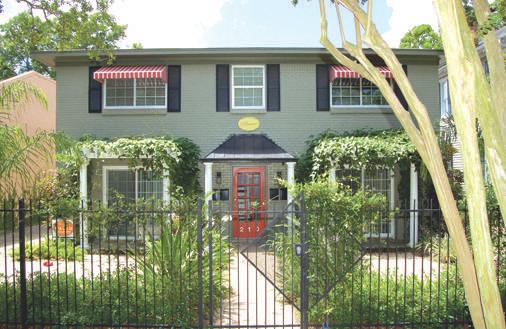










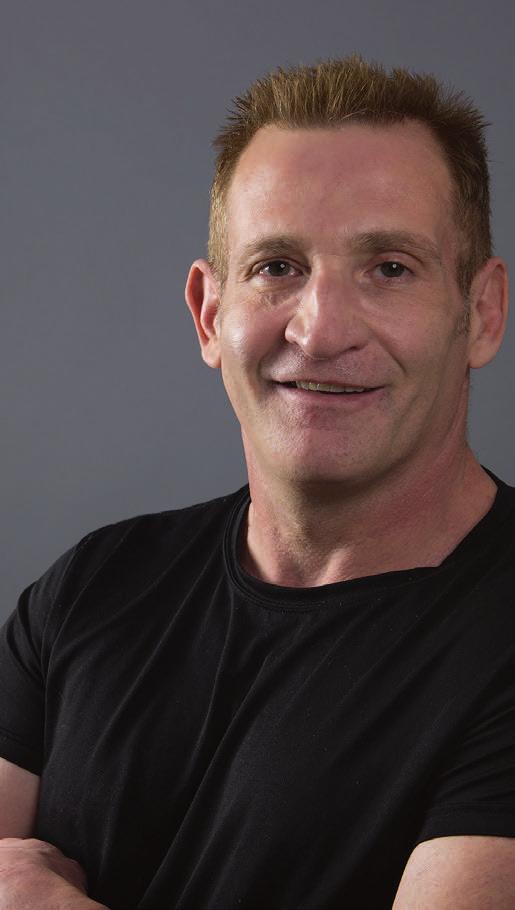



research
(Dec. 22–Jan. 19)
The Capricorns are finally getting a chance to breathe for the next couple of months. You will get some time to reflect about the intense path you have been on since last September. You will want to be more playful and creative, and at least take a break from the pressure you have been under. This is also a good month for you to pay more attention to your health regimen and to do more self-care. Watch your spending in the first half of the month, as you are more likely to make some impulse purchases. If you have children, this is a very good time to reconnect with them since you are in a playful mood, and especially because they are staying at home more. In the latter part of the month, you are more likely to say what you think without much of a filter. You may have had enough and are ready to speak your truth, but your delivery and timing could be off. Put yourself first on all of your to-do lists!
(Jan. 20–Feb. 18)
You are entering a very significant time frame as Saturn (the planet of career, long-term security, and personal boundaries) visits your sign for the next two years. You will have almost no tolerance for people who won’t grow up. You also want to set new goals for your relationship so you can renew those connections. This applies to both business and
personal relationships. If people are not willing to participate in your life, you will not have time for them. As the month begins, you are trying to make your home more comfortable, stable, and safe. In the latter part of the month, you are connecting to the creative and fun side of your personality. This is a good time to be with your children, or just to be more childlike. On the whole, you are looking at career decisions, future plans for you and your partner, and discovering what it takes to create a sense of emotional security.
(Feb. 19–Mar. 20)
You were experiencing lots of changes in your social activities and connections even before the virus took hold in this country. You Pisceans may do better than any of the other signs during this quarantine. Pisceans naturally need more time alone and away from other people’s psychic influence. You may want to get most of your important activities taken care of in the early part of the month. Toward the end of May, you will want to spend more time at home and away from prying eyes and minds. This is a good month for home improvement, working in the garden, or just sitting on the patio drinking margaritas. In the latter half of the month, you have more energy and less patience. This is a super time for exercise and losing weight. Relationships remain positive, but you will want some time together to renew that bond!
For more astro-insight, log on to lillyroddy.com.



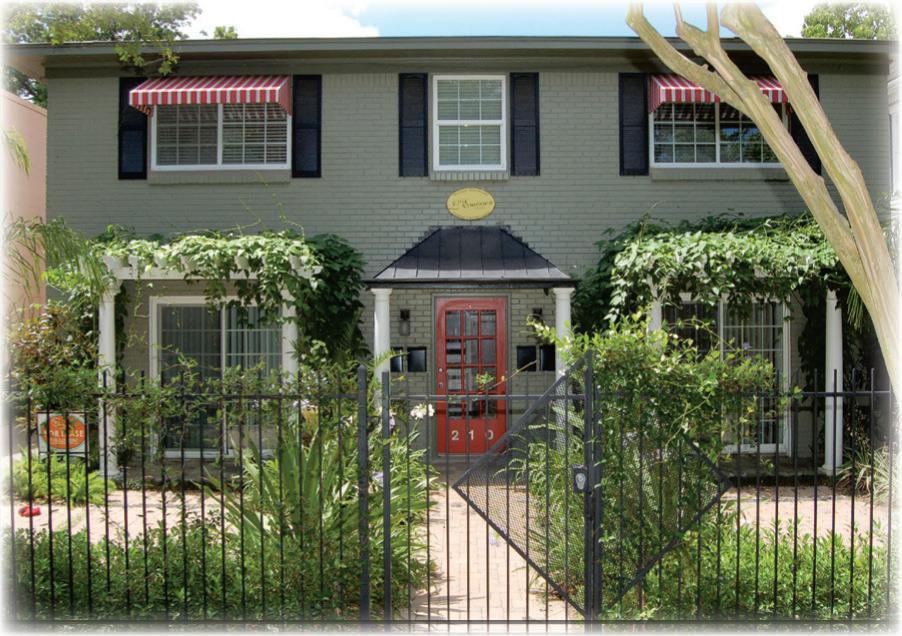




Venus, the planet of love, money, relationships, and resources, goes retrograde on April 5 and remains retrograde through July 8. In addition, our good friend Mercury will be retrograde from June 14 through July 18. This will extend our retrograde cycle from April 5 through July 18. With Venus retrograde in Gemini, it’s a good time to reexamine current investments, improve the quality of communications in our relationships, and pay attention to our physical needs. Those who are having a difficult time with relationships will get the chance to either resolve those problems or bring the relationship to a close. Mercury is always about our brains sorting things out, as well as communications and commerce. We are working to get our lives in order with these two planets’ paths of retrograde overlapping. There will be similar planetary activity in the late summer through the early winter. • The middle of May is a particularly edgy and active time period. You will need to be as flexible as possible, especially with the attempted reopening of the economy.
ARIES (Mar. 21–Apr. 19)
Along with the current restructuring of your career path, you are focusing this month on how to conserve your current resources and increase your future income. Business associates can be very helpful, but you have to reach out to them. There are new business opportunities, but you must embrace “the new normal.” Communications with people and clients from your past are especially significant around midmonth. It’s best to avoid signing documents that involve new partnerships. However, it is a good time to review previous agreements and explore ways to improve your current relationships. You will need some rest and retreat by the end of the month.
GEMINI (May 21–June 21)
May and June are going to be very reflective times. You will be looking back on past relationships, decisions, commitments to projects, and exploring old talents and skills. With the current economic conditions, your flexibility is allowing you to discover new ways to adapt and improve. Relationships are very important this
month! If you are content, this is a great time to renew your romantic bonds. If you are having problems, you will see those issues come to the surface this month so you can resolve the complications. For some, this time could reveal that the impasse is obvious and you may need to go your separate ways. You will be feeling more confident and less patient as we move into mid-May. Take your time this month.
(June 22–July 22)
Despite the quarantine, this is a good month for you to reach out to friends, coworkers, business associates, clients, and customers. This is also a good month to expand your social-media skills and virtual outreach. You are also being very conscious about your debt, your reliance on loans, and on those credit cards. You enter a more creative cycle around midMay, and you will want to find a way to express the feelings that are coming up. You are entering a strong psychic period, especially in the latter half of the month. You will want more time to yourself, so this quarantine may be working for you. Relationship goals and expectations are changing as you become clearer about what you will and won’t put up with in the future. Make sure you have time for yourself, especially at the end of the month.
LEO (July 23–Aug. 22)
Career and relationships are big topics for you this month, and that trend will continue through the end of the year. Big changes are taking place in your career. This is an excellent month for you to sharpen your skills with online communications. You will be doing business differently in the future, and you are welcoming the change! Especially with Venus (our planet of relationships) retrograde this month, you are reviewing your current commitments and deciding on the future value of your investments and obligations. All relationships will need to be upgraded to meet your current needs and goals. You are looking for something to stimulate your passion at work, rather than just something that provides security. If you are older, this may be a time when you are considering retirement and moving to a quieter place!
VIRGO (Aug. 23–Sept. 22)
Career activity will be highlighted in the next two months with Venus retrograde


By LILLY RODDY
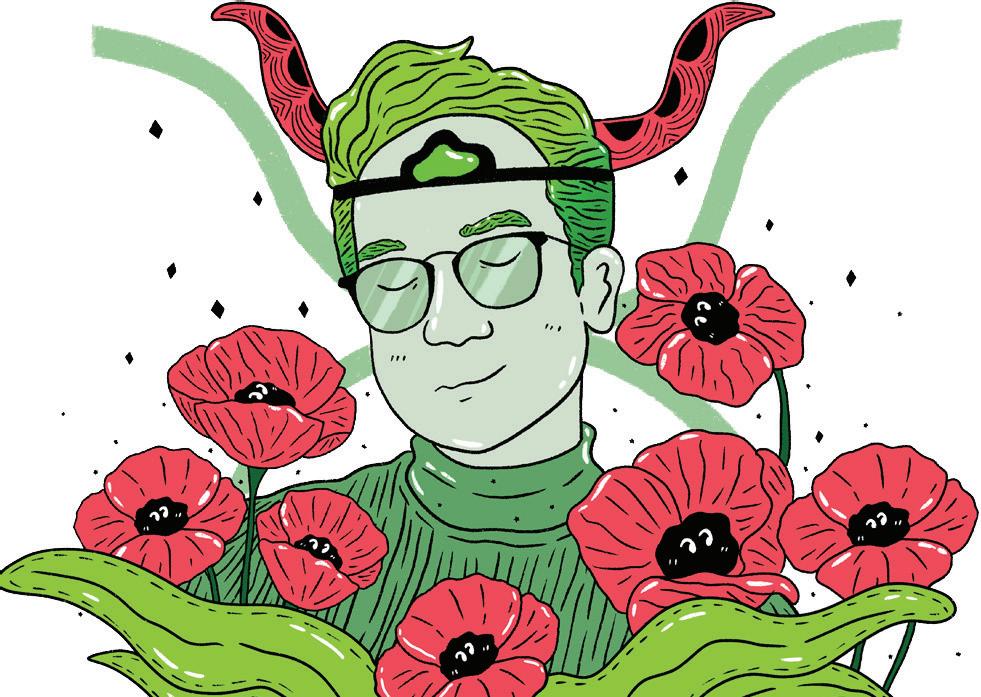
TAURUS (Apr. 20–May 20)
Happy Birthday to the Taureans! This is your personal yearly cycle of review, and the time to set new goals and directions for the future. With your ruling planet, Venus, set to go retrograde early in the month, May and June will be an especially introspective time. You are looking at some major changes for your future, including your location, relationships, and possible career shifts over the next couple of years. You may want to delay committing to your future path until the latter part of July. You could easily be making plans for taking on a new leadership position or starting your own business. You need more personal space to free yourself from routine demands this month so you can ponder what lies ahead!
in your career sector. This is an excellent month to connect with your existing client base and to hear from old friends. Old ideas may be new again as you reach back to refine your current processes. Toward mid-May, you will want to get back on your health and exercise program. Spending time with your partner will be especially important this month. You are wanting to nurture that connection and psychic closeness that you share. If you are having problems, this is the perfect time to resolve them. Your writing, lecturing, and teaching talents are being activated this month. Although Virgoans love their routines, this is the month to be extra-flexible and try new ways of functioning. Let go of that old business model!
LIBRA (Sept. 23–Oct. 23)
You are shifting away from the focus you have had on your home, family, and security, and are shifting your entire focus to your children. You are expecting them to act more maturely and take on some of the family responsibilities. This can include grown children as well. On an internal level, you are doing more self-care and working to sharpen your boundaries. With Venus (your ruling planet) going retrograde for the next two months, you will be reviewing your partnerships and commitments to your goals. Positive relationships will be renewed, and negative ones will be fixed or gotten rid of. Money and security are high on your list this month. You are working to lighten your financial burden so you have more freedom of choice in your life. The latter part of May is a great time for exercise and healthy eating!
SCORPIO (Oct. 24–Nov. 21)
You are entering a time of reassessment
with your career path, retirement path, and the viability of your relationship. With work and family, you are reexamining boundaries as changes take place in the family hierarchy. This is a time to decide what role you will take in ongoing family discussions and decisions. You are trying to find a balance at work between producing an adequate income and having a viable life that isn’t overshadowed by work obligations. In relationships, you will want a greater sense of personal expression, and you’ll balk at limitations or restrictions. This can be a difficult month for relationships if you’ve been having a difficult time. You will be much more direct and to-the-point. In the last half of the month, you are focused on your finances and how to improve your situation. You have a good two-month period to examine your options—but wait until July before you put your plans into action.
(Nov. 22–Dec. 21)
Relationships are very important to you this month and next with Venus, the planet of commitments, going retrograde in your partnership house. This is a time to review all of your partnerships, both business and personal. You may be contacted by old friends or ex-lovers from your past. As the month begins, you are paying more attention to your health and exercise programs. You are wanting to free yourself from old, bad habits. As with most of us, business models and old ways of doing business are changing, and you are ready to make those necessary adjustments. You are actually looking forward to improving your work environment. Your family may need you to step in and settle an argument. Hold off on any major decisions until mid-July. This is a great time for




























































By SAM BYRD
by JAY CLARK
Sad songs say so much. Maybe that’s why H-town performer Belial revels in them. The gloomy queen is a member of a troupe known as Smoke Break, a group of queer creatives and artists that just so happen to also do drag. She’s an artsy performer with a flair for the emotional, and this month she gives readers a chance to get to know her oft-sullen character. Pronouns?
She/They Hometown?
Houston
Story behind your drag name?
Belial is the name of a Hebrew demon, but more commonly it is used in religious texts to mean “worthless” or even “independent,” which was very appealing to me. A character [perceived as] inconsequential, yet somehow still the driving force in the defiance of God. Drag birthday?
That’s always a hard question for me. I’ve always liked to put on a look when I go out with friends, so it’s hard to pinpoint exactly when I started “drag.” I’ve been performing on and off since 2016, but as for my current incarnation with the name Belial, since December 2018.
How did you learn makeup?
I attribute my makeup skills partially to visual art and partially to theater. Theatrical and special-effects makeup were my first real exposure to makeup, but visual art helped me understand the color and balance aspects. Describe your drag persona. I’m pretty much the same both in and out of drag. I think of Belial more as a vessel of creation, a way to display my artistic interests in a single entity. That being said, I’m definitely witchy and kind of a sad girl. Inspirations for performances?
First and foremost, music that moves me— mostly sad songs. Other than that, I’m very drawn to folk art and the overlap of ritual and performance, which is why my own human blood has become a big part of my performances. It’s also important to me to try and create space, as opposed to just occupying it, so the storytelling and visual world-building of horror games and sci-fi have

become big inspirations in that aspect as well.
What has drag taught you about your everyday self?
I used to be quite a private person, specifically with the things I create. Drag is gradually giving me the confidence to share my art in a more public, unapologetic manner.
Drag icons?
Ghostface, Vander Von Odd, Vampira. Inspiration for your creative looks?
Mostly horror and fantasy. I’m drawn to this trend of 3-D digital art that combines the imagery of elves, angels, vampires, and nature. It’s often horrifying and ethereal.
What inspired you to do drag?
Some big interests of mine have always been sewing, fashion, makeup, performance art, and music. Drag just seemed like an attainable and organic way to combine them all.
Ultimate drag dream?
I’ve always wanted to branch out from strictly bar performances, dipping back into my artistic roots with Belial as the channel. One project I’ve had in mind for a while is to produce experimental and surrealist theater with my friends. Lately, I’ve also found myself wanting to seriously make and play music again. Music was a big part of my life, but it’s taken a back seat over the past couple of years. I’m ready to dive back in.
Artists whose music you love to perform?
Arca, Fka Twigs, Mitski, Chelsea Wolfe, Drab Majesty, Alice Glass.
Most important thing to keep in your bag?
Super glue. It’s a quick way to fix costumes, accessories, makeup, hair, props—anything, really.
What do we not know about you?
Even though most of my performances are generally more subtle and serious, I’m actually pretty good at standup.
When not performing in drag, what do you do for a career?
Outside of drag I do some art gigs, mostly graphic-design commissions.
Where were people catching your performances before the shutdown?
First and third Thursdays of the month at Guava Lamp (570 Waugh), and second Sundays of the month at Lil’ Danny Speedo’s Go Fly a Kite Lounge (823 Dumble).