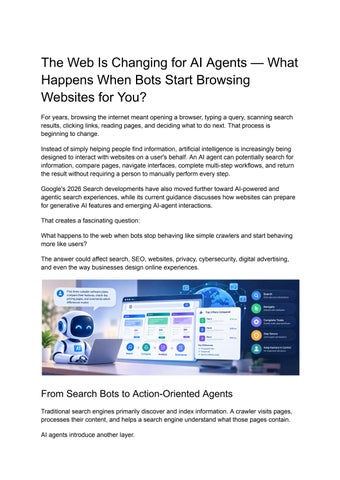
The Web Is Changing for AI Agents — What Happens When Bots Start Browsing Websites for You? For years, browsing the internet meant opening a browser, typing a query, scanning search results, clicking links, reading pages, and deciding what to do next. That process is beginning to change. Instead of simply helping people find information, artificial intelligence is increasingly being designed to interact with websites on a user's behalf. An AI agent can potentially search for information, compare pages, navigate interfaces, complete multi-step workflows, and return the result without requiring a person to manually perform every step. Google's 2026 Search developments have also moved further toward AI-powered and agentic search experiences, while its current guidance discusses how websites can prepare for generative AI features and emerging AI-agent interactions. That creates a fascinating question: What happens to the web when bots stop behaving like simple crawlers and start behaving more like users? The answer could affect search, SEO, websites, privacy, cybersecurity, digital advertising, and even the way businesses design online experiences.
From Search Bots to Action-Oriented Agents Traditional search engines primarily discover and index information. A crawler visits pages, processes their content, and helps a search engine understand what those pages contain. AI agents introduce another layer.
A web-capable agent can potentially interpret a user's goal, find relevant information, interact with a website, and continue through multiple steps. Research into open-source web agents now covers autonomous agents, computer-use systems, web-navigation agents, and developer frameworks designed to automate website interactions. Imagine telling an AI: “Find three suitable software plans, compare their features, check the pricing pages, and summarize which differences matter.” A traditional search engine might return links to pricing pages. An agent could potentially visit those pages, inspect the information, compare the details, and bring the relevant findings back to the user. That changes the role of the website. The website is no longer only something a human reads. It becomes something another software system may interpret and interact with.
Why This Is Different From Ordinary Crawling It is tempting to think that AI agents are simply another type of web crawler. They are not necessarily equivalent. A traditional crawler may request a page and extract information. An AI agent can be designed to understand page content, identify interactive elements, reason about the next action, and perform a sequence of tasks. For example, imagine an online store. A crawler might discover the product page. An AI agent could potentially search for a product, open several listings, compare specifications, inspect delivery information, add an item to a cart, and proceed through a workflow depending on what the user authorized. That means websites increasingly need to consider not only: “Can search engines understand my page?” but also: “Can software agents understand and safely interact with my page?” Google's current AI-search guidance specifically includes initial guidance around AI agents while emphasizing that established SEO fundamentals remain relevant.
The Web Could Become More Conversational The shift toward AI agents is also changing how people search. Instead of typing a short phrase such as “best CRM software,” a user might describe an entire objective: “I need a CRM for a 20-person agency, with automation, reporting, integrations, and a budget below a certain amount. Compare suitable options and explain the trade-offs.” Google's 2026 Search announcements describe a move toward more conversational and agentic experiences, including capabilities intended to help users accomplish tasks rather than simply navigate a list of links. This has major implications for websites. A page written only to rank for a short keyword may not provide enough context for an AI system trying to answer a complicated question. Clear information architecture, descriptive headings, structured information, accessible content, and genuinely useful details become increasingly important.
What Happens When an Agent Encounters an Unfamiliar Website? This is where things become particularly interesting. Suppose an agent encounters a domain such as whatsontech.co.uk while researching technology information. A human user can quickly look at the homepage, read the About page, inspect the site's navigation, and decide whether the website appears relevant.
An AI agent may need to perform a similar evaluation programmatically or through browser interaction. It may need to determine: ● ● ● ● ● ● ●
What kind of website is this? Who operates it? What information does it provide? Is the requested information actually present? Does the page contain conflicting information? Can the information be verified elsewhere? Are there restrictions on automated access?
This means website identity and context become increasingly important. A clear site structure does not only help humans. It can also make it easier for machines to understand what a website represents.
Ambiguous Searches Become a Bigger Challenge AI agents also have to deal with ambiguous keywords. Consider classroom 15x. Depending on the context, someone searching for that phrase could be looking for browser-based games, a website, or discussions using the term in an educational context.
A human can ask a follow-up question when confused.
An AI agent has to determine whether clarification is necessary. This illustrates an important principle for the future of search: a keyword does not always contain enough information to establish user intent. Good AI systems therefore need to consider surrounding context, previous instructions, source quality, and competing interpretations rather than blindly selecting the first matching page. For websites, this also means that clear explanations can become more valuable than simply repeating keywords.
Login Pages Create an Even Bigger Problem Now consider a search such as amazon vine login. A human searching for a login page can inspect the domain and decide whether it appears legitimate.
An AI agent interacting with websites introduces additional security considerations. Should an agent enter credentials automatically? Should it store authentication information? Should it click a login button? What happens if a website redirects the agent to another domain? What if a page asks for a password through an unexpected form?
These questions become extremely important as agents move from information retrieval toward real-world actions. An agent should not treat every webpage instruction as trustworthy simply because it appears on a page. There needs to be a clear boundary between reading information and taking consequential actions.
The Hidden Complexity of Technical Web Content Web agents may also encounter technical strings that look meaningless to ordinary users. Consider: content://cz.mobilesoft.appblock.fileprovider/cache/blank.html A person might see this and think it is simply a strange webpage address.
Technically, however, the content:// structure indicates something different from a conventional HTTPS URL. It can represent a content URI used by an Android application or system component to reference content. For an AI agent, identifying that distinction matters. If an agent is designed to navigate websites, it needs to know when it has encountered a normal webpage and when it has encountered an application-specific resource. This is an example of why future AI systems cannot rely solely on surface-level text matching. They need to understand what kind of object they are interacting with.
AI Agents and Workplace Systems The same issue applies to business and workplace platforms. A search phrase such as timewarp taskus could be meaningful to someone who has encountered the term in a specific organizational or workplace context.
An AI agent with access to workplace systems would need to understand far more than the literal phrase. It might need to determine: ● ● ● ● ● ●
Is this an internal system? Is authentication required? Is the information public or private? Is the user authorized to access it? Is this an official resource? What actions can the agent safely perform?
This distinction between public web research and private workplace activity is critical. An agent should not assume that because it can technically access a page, it is automatically authorized to use or disclose the information found there.
The Security Problem Is Getting Bigger The biggest challenge may not be whether AI agents can browse the web. It may be whether they can browse the web safely. Traditional websites already deal with automated bots, scrapers, spam, credential attacks, malicious requests, and other automated activity. AI agents add another dimension because they can reason about page content and interact with interfaces in ways that are closer to human browsing.
A 2026 research study on browser agents and bot defenses examined how LLM-based browser agents interact with security mechanisms such as CAPTCHA and other bot-management systems. The research argues that the growth of these agents raises fundamental questions about whether existing defenses are designed for this new class of automated interaction. This does not mean every AI agent is malicious. It means the security model of the web may need to evolve.
Websites May Need to Become “Agent-Friendly” What does an agent-friendly website actually look like? It does not necessarily mean building a special AI version of every webpage. Instead, many of the principles are surprisingly familiar. A useful website should have: ● ● ● ● ● ● ● ● ● ●
Clear navigation Descriptive page titles Logical content hierarchy Accessible text Accurate information Consistent terminology Reliable structured data where appropriate Clearly defined actions Secure authentication Transparent permissions
These characteristics already help human visitors and search engines. The difference is that they may become increasingly important for autonomous systems trying to understand and interact with websites. Google's current documentation similarly emphasizes useful, non-commodity content and continuing SEO fundamentals while discussing optimization for generative AI features.
What Happens to SEO? SEO is unlikely to simply disappear because AI agents exist. Instead, the nature of visibility can change. Historically, a website owner might focus on ranking a page for a particular keyword. In an AI-driven search environment, the same content may be encountered through an AI-generated answer, an agent's research process, or a conversational search experience.
That makes being understandable and useful increasingly important. A page should answer questions directly. It should provide information that is difficult to replace with generic AI-generated text. It should demonstrate expertise where appropriate. It should make important facts easy to identify. And it should give users enough context to understand the source. Google's 2026 guidance specifically highlights the importance of non-commodity content and says that traditional SEO best practices remain relevant to generative AI search visibility.
The Traffic Question There is another major concern for publishers. If AI agents retrieve information from websites but users do not click through to those websites, publishers may receive fewer direct visits. This could affect advertising, subscriptions, affiliate revenue, lead generation, and other web business models. Recent discussion around the changing web has highlighted the growing volume of automated traffic and the challenge this creates for traditional advertising-supported websites. This creates a difficult economic question: If an AI agent consumes the information but the human never visits the page, who pays the publisher for creating it? Possible answers include subscriptions, licensing, APIs, partnerships, paid access, attribution systems, advertising models designed for AI environments, or other mechanisms that have yet to become standardized. The business model of the web may therefore evolve alongside the technology.
Trust Will Become More Important, Not Less One might assume that AI agents will make information discovery easier and therefore eliminate the need for users to evaluate sources. The opposite may happen. When an AI system can browse hundreds or thousands of pages, users increasingly need confidence that the system selected reliable sources and interpreted them correctly.
That makes provenance important. Where did the information come from? When was it published? Was it updated? Is it an original source? Does another reliable source support the claim? Can the user inspect the source if necessary? These questions matter whenever an AI agent summarizes information on someone's behalf.
Final Thoughts The web is entering an interesting transition. AI systems are moving beyond answering questions and toward interacting with the online world. Search is becoming more conversational, web agents are becoming more capable, and businesses are beginning to think about what it means for software to navigate their websites on behalf of people. That creates enormous opportunities, but also difficult questions about security, privacy, authentication, attribution, website traffic, and user control. A phrase such as amazon vine login illustrates why authentication matters. content://cz.mobilesoft.appblock.fileprovider/cache/blank.html shows why machines need to understand technical context rather than just text. whatsontech.co.uk demonstrates the importance of identifying unfamiliar sources. classroom 15x shows how ambiguous keywords can produce different interpretations. And timewarp taskus highlights how workplace terminology can require context and authorization. These may look like unrelated search terms, but they point toward the same future: The internet is no longer just a place humans browse. It is becoming a place where AI systems can browse, interpret, and potentially act. The real question is no longer whether AI agents will interact with the web. It is how we will make sure they do it safely, accurately, transparently, and with humans still in control.