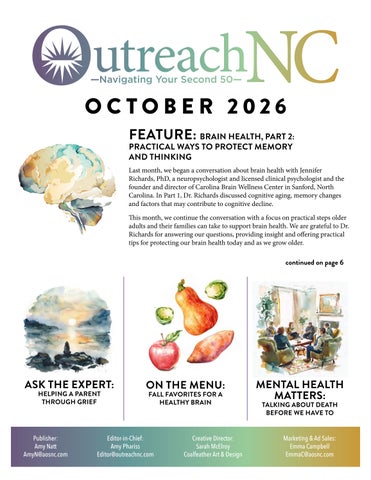
OC TOBE R 2026 FEATURE: BRAIN HEALTH, PART 2:
PRACTICAL WAYS TO PROTECT MEMORY AND THINKING
Last month, we began a conversation about brain health with Jennifer Richards, PhD, a neuropsychologist and licensed clinical psychologist and the founder and director of Carolina Brain Wellness Center in Sanford, North Carolina. In Part 1, Dr. Richards discussed cognitive aging, memory changes and factors that may contribute to cognitive decline. This month, we continue the conversation with a focus on practical steps older adults and their families can take to support brain health. We are grateful to Dr. Richards for answering our questions, providing insight and offering practical tips for protecting our brain health today and as we grow older.
continued on page 6
ASK THE EXPERT: HELPING A PARENT THROUGH GRIEF
Publisher: Amy Natt AmyN@aosnc.com
ON THE MENU: FALL FAVORITES FOR A HEALTHY BRAIN
Editor-in-Chief: Amy Phariss Editor@outreachnc.com
Creative Director: Sarah McElroy Coalfeather Art & Design
MENTAL HEALTH MATTERS: TALKING ABOUT DEATH BEFORE WE HAVE TO
Marketing & Ad Sales: Emma Campbell EmmaC@aosnc.com OCTOBER 2026 - 1
OCTOBER 2022 - 2
Well, it’s official: fall is here. I had my first pumpkin-spiced latte jus ture dipped low enough to merit a fleece.
LETTER FROM THE EDITOR
Amy Phariss, Editor-in-Chief, OutreachNC | editor@outreachnc.com
LETTER FROM THE EDITOR
Don’t worry. It was decaf. Amy Phariss, Editor-in-Chief, OutreachNC | editor@outreachnc.com October has a way of inviting reflection. We hope everyone is thoughtfully and slowly checking off boxes on your to-do lists as we shift seasons (or thoughtfully ignoring to-do lists and enjoying cooler weather) and launch fully into fall.
In our feature on brain health, Dr. Jennifer Richards returns for Part 2 of our conversation, offering practical ways to support memory and cognitive wellness through movement, sleep, nutrition, hearing care, social connection and thoughtful medication management. We appreciate Dr. Richard’s insight, strategies and even book recommendations. In this month’s Ask the Expert column, AOS Care Management Lead Care Manager Jennifer Tyner writes about grief and loss, with guidance on how to support a loved one who is struggling with guilt or the feeling that they should have done more before someone died. Sometimes the most meaningful thing we can offer is not an answer, but a willingness to listen.
In Mental Health Matters, we explore grief, death and how to prepare for both with certified Thantologist Gail Rubin. Through Death Cafés, Mortality Movies and humor, Rubin creates space for conversations many of us tend to avoid. Rubin is hosting a Death Cafe at the Whispering Pines Community Building from 3:00-
5:00PM October 23 and a Moratalie Movereminders Matinee of change October is on a gentle month. There are constant thelucky, Sunrise Theater Saturday, October 24, 2026. weatare toward eachonother. We have lingering conversations o The Mortality Movie event will feature the 1971 cult We zip our j the flames flicker. Smoke dances around us in a circle. classic comedy Harold and Maude. It will take place at In 1:00 this p.m. month’s feature,are we’re starting an important conversatio and tickets $12.50. care community for ourselves a loved one? In On the Menu, we return toor brain health withFox fall-Hollow Senio Robin Hutchings making this decision inspired recipesoffers basedinside on theperspective MIND diet,forproving
brain still look and taste like regarding In that Ask nourishing the Expert, the Amy Nattcan answers a reader’s question comfort food. away without any estate planning. Without a will or access to impo Finally, we close with Robert Frost’s “October,” a poem Physical therapist Sara Morrison Body that captures theDr. fleeting beauty of of theTotal season andTherapy asks and W potential diagnostic tools used in physical therapy to help diagnose us, in its own quiet way, to notice what is passing while these differ from what other doctor’s offices may offer. it istools still here.
I’mPerhaps going to agree with Nathaniel Hawthorne this issue: month, who wro that is the thread running through this paying attention. To our health. To the people we love. I cannot to waste anything so precious as autumnal suns To the endure conversations we’ve been putting off. And to the spent almost all in, thebefore daylight hours in the open air. season we are it changes again. Here’s to you enjoying the Octoberinsunshine, falling I hope find something these pages that leaves and dayligh encourages you to pause, reflect and take care.
facebook.com/ag
instagram.com/a
FOLLOW US!
Keep up with all things ONC by following us on social media. @Aging Outreach Services
The Experts in Aging We
@Aging Outreach Services We are passionate about helping older Home is Where the Heart Is... adults navigate the and with the right care, it’s where you can staycomfortably, safely, and independently! many challenges Let us refer private-duty caregivers who will work of aging. according to your needs and schedule.
@Aging Outreach Services
Whether you need a few hours of daily personal care or
Agethethe Wayof 24-hour Youcare,Choose extra security our large pool of
pre-screened caregivers can accommodate your needs.
Schedule a consultation TODAY! 910.692.0683 AOSNC.com
2 - OCTOBER 2026
910.692.0683 | info@AOSNC.com
Independent Living • Assisted Living • Skilled Nursing • Rehabilitation
LISTEN TO YOUR HEART YOU’LL LOVE WHAT YOU HEAR.
Living your best life never gets old
910.537.5426 QuailHavenVillage.com
Retirement Living Options offered by Liberty Senior Living
126088 quail haven album ad-outreach nc.indd 1
6/22/26 2:42 PM
OCTOBER 2026 - 3
ASK THE EXPERT: HELPING A PARENT THROUGH GRIEF
Jennifer Tyner, AOS Care Management, Lead Care Manager | jennifert@aoscaremanagement.com Q: My father recently died, and my mother keeps saying she should have done more for him before he passed. I try to reassure her, but nothing I say seems to help. What can I do? A: This is a great question, and it’s one we get a lot. Grief shows up in so many ways for all of us, and your mom is experiencing a particularly painful loss. One of the most important things you can do is listen. When someone is grieving, our instinct is often to try to make the pain go away. We want to reassure them, correct their thinking or remind them of everything they did for the person they lost. While those responses come from a caring place, sometimes we need space to express what we’re feeling before we’re ready to hear anything else. This might be where your mom is at right now. If your mother says she feels she didn’t do enough, let her talk about that feeling. You don’t necessarily have to agree with her in order to acknowledge what she’s experiencing and how she’s feeling. It’s hard when it’s your own parent, but letting your mom speak freely can help lighten the emotional toll for her. Also, remember that everyone grieves differently, and grief doesn’t always look the way we expect it to. Someone who has handled previous losses relatively well may have a much stronger reaction to the death of a spouse. Grief may appear as sadness, anger, guilt,
exhaustion, withdrawal or changes in appetite and daily routines. Acknowledging and normalizing those reactions can be very helpful. Grief is a normal response to loss, and there is no single “right” way to experience it. At the same time, pay attention to how your mother is functioning over time. If several months pass and her grief remains overwhelming or seems to be getting worse rather than gradually becoming more manageable, additional support can help. Pay attention to signs such as crying most of the time, persistent anger, withdrawing from friends and activities, a significant decrease in appetite or no longer participating in the parts of life that were previously important to her. These are signs that the grief your mom is experiencing has become what we call “complicated” or “prolonged” grief, and professional support can be helpful. If you become concerned, you can encourage your mom to talk with a counselor, her doctor or another professional who can help determine what kind of support may be useful. She might benefit from medication to help her through this time, or she might find solace in a support group of other spouses going through similar loss. It’s also important to help her reconnect with the support systems already around her. Depending on what feels comfortable to her, that might be friends, family members, a faith community, a pastor or other spiritual leader, a grief support group or her primary care provider. Religious traditions and familiar rituals can also provide comfort and structure for some people after a loss. In fact, many people find that faith and cultural traditions are most helpful in these times of life. Finally, remember that you don’t have to become your mother’s only source of support. Helping her build a wider circle of people and resources benefits both of you. You can love her, listen to her and walk alongside her without feeling responsible for taking away her grief.
4 - OCTOBER 2026
Grief can’t always be fixed. Sometimes the most meaningful thing we can offer is a safe place for someone to feel it.
14 - OCTOBER 2023
Gray Matter WORLD-CLASS CARE Games Solutions CLOSE TO HOME.
11th Annual FUNDRAISER
Thank you
to all who supported!
Your donations allow us to Accessible Communication provide a a Captions! variety of services to with older adults, focusing on those with dementia, including direct care grants, personalized music players, companion pets, resources, and education.
800.733.5357 carolinaeye.com RESOURCES. EXPERIENCE. SOLUTIONS.
We’re here to help you navigate all things aging! www.AOSNC.com
info@AOSNC.com | 910.692.0683 The need for funds and community support is year- round. We invite Relay youConference to include AOS &Captioning Friends Care in your end-of-year donations.
Relay Conference Captioning (RCC) service is available for aosfcare.org/donations individuals who have a hearing loss or a speech disability to actively participate in teleconference calls or webinars by reading live captions on their laptop, mobile device or tablet.
ALL DONATIONS To inquire, ARE TAX-DEDUCTIBLE.
contact kim.m.calabretta@t-mobile.com or visit relaync.com/rcc
Find current & previous issues of OutreachNC Read the latest from our blog Join our free digital mailing list Sign up for home delivery of OutreachNC Explore our Resources tab for community events, support groups, and more... OCTOBER 2026 - 5
Brain Health
PRACTICAL WAYS TO PROTECT MEMORY AND THINKING
by Amy Phariss
continued from page 1 ONC: Many seniors are taking multiple medications. According to Duke University School of Medicine, nearly 1 in 3 seniors is taking five medications or more. Can medications affect memory or thinking? Dr. Richards: Yes. Medications can absolutely affect thinking, especially in older adults. Some medications can cause sedation, slowed processing, confusion, balance problems or memory inefficiency. This is especially true when multiple medications are taken together. Medications that can sometimes affect cognition include benzodiazepines, some sleep medications,
6 - OCTOBER 2026
certain bladder medications, some pain medications, muscle relaxers and medications with anticholinergic effects. This does not mean a person should stop a medication suddenly. It means medication review is important. I also caution patients about over-the-counter “memory” supplements, including products such as Prevagen and other supplements marketed for brain health, memory or focus. Dietary supplements are not reviewed by the FDA for effectiveness before they are sold, and many products marketed for memory do not have strong evidence showing that they improve thinking or prevent cognitive decline.
RATHER THAN SPENDING MONEY ON UNPROVEN PRODUCTS, PATIENTS ARE USUALLY BETTER SERVED BY FOCUSING ON THE STRATEGIES WE KNOW MATTER FOR BRAIN HEALTH, SUCH AS ADDRESSING HEARING LOSS, IMPROVING SLEEP, STAYING PHYSICALLY AND SOCIALLY ACTIVE, MANAGING VASCULAR RISK FACTORS AND TREATING MOOD OR ANXIETY SYMPTOMS WHEN PRESENT. I often recommend that older adults periodically review all prescription medications, over-the-counter medications and supplements with their primary care provider or pharmacist. The goal is not to stop medications without guidance, but to make sure the medication list is accurate, each medication is still needed, doses remain appropriate with age and there are no interactions or side effects that could be affecting memory, balance, sleep or alertness. ONC: We’ve talked a lot about how we can prevent cognitive decline as individuals. What can families do to support a loved one in preventing decline? Dr. Richards: Families play a major role.
ONE OF THE MOST HELPFUL THINGS FAMILIES CAN DO IS SUPPORT INDEPENDENCE WITHOUT IGNORING RISK. That means allowing the person to keep doing what they can safely do, while adding structure and oversight where needed. For example, a loved one may still be able to use a calendar, help organize medications, participate in meal planning or attend appointments, but someone else may need to verify that medications are taken correctly, appointments are attended, bills are paid and medical recommendations are followed. Families can also support brain health by encouraging hearing evaluation, physical activity, social engagement, good sleep routines, medical follow-up and treatment of depression or anxiety.
IT IS IMPORTANT TO AVOID ARGUING ABOUT MEMORY MISTAKES. INSTEAD, USE EXTERNAL SUPPORTS: WRITTEN REMINDERS, PILL ORGANIZERS, SHARED CALENDARS, SIMPLIFIED ROUTINES AND FEWER DISTRACTIONS. When there are safety concerns, such as driving problems, medication errors, scams, falls or poor judgment, those should be addressed directly and compassionately. The goal is not to take away autonomy unnecessarily. The goal is to preserve safety, dignity and as much independence as possible. ONC: Finally, if you could write a prescription for preventing cognitive decline and promoting brain health, what would it be? If I were writing a brain health prescription, it would look like this: Move your body regularly. Physical activity is one of the strongest brain health tools we have. Meta-analytic research has found that higher physical activity is associated with lower dementia risk, and exercise may support the brain through improved blood flow, reduced inflammation, better vascular health and increased neurotrophic factors that support brain cell health. A practical goal is at least 150 minutes per week of moderate-intensity aerobic activity, such as brisk walking, along with strength training at least two days per week and balance and flexibility work. Treat hearing loss. Get hearing checked and use hearing aids or assistive devices if recommended. Hearing treatment is low-risk and may reduce cognitive load, improve communication and help preserve social engagement. Protect sleep. Address insomnia, sleep apnea, pain, nighttime urination and medications that interfere with sleep. Manage vascular risk factors. Blood pressure, diabetes, cholesterol, atrial fibrillation, smoking and weight all matter for brain health. What is good for the heart and blood vessels is good for the brain.
OCTOBER 2026 - 7
HELPFUL RESOURCES FOR PATIENTS AND FAMILIES
Review medications. Ask your provider or pharmacist whether any medication could affect memory, alertness, balance or fall risk.
National Institute on Aging Cognitive Health and Older Adults
Stay socially connected. Social isolation is not good for the brain. Meaningful connection matters.
Alzheimer’s Association 10 Healthy Habits for Your Brain Brain Health National Institute on Deafness and Other Communication Disorders Age-Related Hearing Loss Hearing Loss Association of America ACHIEVE Study Hearing Loss and Dementia CDC STEADI Older Adult Fall Prevention Health in Aging Foundation / American Geriatrics Society Harvard T.H. Chan School of Public Health MIND Diet Overview Sleep Foundation Sleep Hygiene Psychology Today Therapist Finder
8 - OCTOBER 2026
Keep learning. Choose activities that are mentally engaging, varied and enjoyable. Eat for brain and heart health. A Mediterranean-style or MIND-style diet is a good starting point. In observational research, high adherence to the MIND diet was associated with up to a 53% lower risk of Alzheimer’s disease, and even moderate adherence was associated with about a 35% lower risk.
ANOTHER MIND DIET STUDY FOUND THAT STRONGER ADHERENCE WAS ASSOCIATED WITH SLOWER COGNITIVE DECLINE, EQUIVALENT TO BEING ABOUT 7.5 YEARS YOUNGER COGNITIVELY.
The MIND diet emphasizes leafy greens, other vegetables, berries, nuts, beans, whole grains, fish, poultry and olive oil, and limits butter and margarine, cheese, red meat, fried and fast food, pastries and sweets. Treat mood and anxiety. Depression, anxiety, grief and chronic stress can all affect attention, memory, processing speed, motivation and overall cognitive efficiency. These symptoms can also lead people to withdraw from the very activities that help protect brain health, including physical activity, social connection, cognitive stimulation and meaningful daily routines. Treating mood and anxiety is not only important for emotional well-being; it can also help people stay engaged in the behaviors and relationships that support long-term brain health. Use supports early. Calendars, routines, pillboxes, written instructions and caregiver involvement are not signs of failure. They are tools that help people function better. Use community resources. For Moore County residents, the Moore County Senior Enrichment Center can be an excellent place to support several brain health goals at once, including exercise, social connection, cognitive activity, education and community engagement.
RECOMMENDED READING For readers who want to continue learning after our conversation about brain health, Dr. Richards recommends these books as helpful resources on memory, healthy aging, sleep, nutrition and caring for loved ones experiencing cognitive changes. Keep Sharp: Build a Better Brain at Any Age by Sanjay Gupta, M.D. The MIND Diet by Maggie Moon, M.S., R.D. The Alzheimer’s Action Plan by P. Murali Doraiswamy, M.D., and Lisa P. Gwyther, M.S.W. The 36-Hour Day by Nancy L. Mace and Peter V. Rabins Why We Sleep by Matthew Walker, Ph.D.
The Senior Enrichment Center offers activities and programming for Moore County residents age 50 and older. This kind of setting can be especially helpful because brain health is not supported by one activity alone; it is supported by staying physically active, socially connected, mentally engaged and involved in meaningful routines. Moore County Department of Aging / Senior Enrichment Center 8040 U.S. 15-501, West End, NC 27376 910-947-4483
OCTOBER 2026 - 9
MENTAL HEALTH MATTERS: TALKING ABOUT DEATH BEFORE WE HAVE TO
Amy Phariss, LCMHC, Clarity Counseling, Southern Pines, NC For most of us, life requires quite a bit of planning. We plan for graduations, weddings, retirement and vacations. We make lists before trips, organize financial documents and talk with our families about where we might live as we get older. We plan to have babies and one day send them to college. We manage our investment portfolios and plan what we’ll do with the money when the time comes to enjoy it. Yet there’s one event every one of us will eventually face that many families rarely discuss (let alone plan for) at all. Death. For Gail Rubin, CT, talking about death is not morbid. In fact, she believes becoming more comfortable with mortality can help us make better decisions, support the people we love and perhaps even live more fully while we are here. Rubin is an author, speaker and death educator who describes herself, with characteristic humor, as the “Doyenne of Death.” She is also a Certified in Thanatologist, or CT, which is a professional in the study of death, dying and bereavement. Thanatology encompasses the physical process of dying, as well as grief, mourning, cultural practices, family experiences and the many ways human beings respond to mortality. Rubin has spent years finding creative ways to make these conversations less intimidating, from books and presentations to Death Cafés and what she calls
“Mortality Movies,” which use familiar films and television programs as a springboard for discussing end-of-life issues. Rubin is a pioneering death educator who uses humor to make funeral planning and conversations about mortality more approachable. Her path into the field began, appropriately enough, with writing. After planning her own wedding, Rubin wrote newspaper columns about the milestones of life— births, weddings and funerals. She quickly discovered that funerals generated the greatest interest. “Funerals are the parties no one wants to plan,” she says. Eventually, she pursued certification in thanatology and built a career around helping people talk about what so many of us would prefer to avoid. But her understanding of death is not only theoretical and academic. During one 24-month period, Rubin experienced eight deaths among people she loved. The losses began when her husband entered the hospital for what was expected to be routine prostate surgery and died three weeks later. Four months later, her father died. More losses followed. The experience reinforced something she already taught professionally: even when we understand death intellectually, grief can still overwhelm us.
“THAT’S THE THING ABOUT GRIEF,” RUBIN SAYS. “IT DOESN’T GO AWAY. IT CAN REALLY SNEAK UP ON YOU.” It also reinforced for her the importance of having conversations about death before a family is forced to have them. Don’t Wait for a Crisis Rubin prefers to work with people long before a serious illness or death is imminent. “When you wait until someone is at death’s door, it makes it harder,” she says.
10 - OCTOBER 2026
Fear, exhaustion, anticipatory grief and the practical demands of caregiving can make conversations about end-of-life wishes even more difficult. When families discuss those subjects earlier, however, there is time to think, ask questions—and even laugh.
Rubin experienced the value of preparation after her husband died. Even though they had discussed his wishes and had important information organized, there were still decisions to make, bills to address and the details of a funeral to manage. “I don’t know how people who haven’t pre-planned can do this,” she says. Knowing what her husband wanted didn’t eliminate grief, but it did eliminate some uncertainty. Families may want to begin with seemingly simple questions. Would you prefer burial or cremation? If you choose cremation, what would you like done with your ashes? Are there religious traditions that matter to you? Who should make medical decisions if you cannot speak for yourself?
Tyler Moore Show episode “Chuckles Bites the Dust.” The episode centers around the unexpected death of a clown and Mary’s attempts to remain appropriately serious—until she begins laughing uncontrollably at his funeral. “You can watch it with your family,” Rubin says. “You will laugh uproariously.” That laughter, she believes, can help make a difficult topic safer to approach. Rubin uses the same philosophy in her Mortality Movies programs, where participants watch films or clips that explore death, grief, funerals and end-of-life decisions and then discuss what they have seen. A fictional character’s dilemma can be easier to talk about than asking a parent directly, “What do you want us to do when you die?”
Rubin often hears a common response: “I don’t care. I’ll be dead.”
The movie creates distance. It gives families somewhere to begin.
Her answer is practical.
A Café Where Death Is on the Menu
“That’s not very helpful for your loved ones who will be holding the box, as it were.”
Death Cafés offer another opportunity to talk.
Four Conversations Worth Having Rubin says conversations about mortality frequently fall into four broad areas: financial, material, medical and spiritual. The financial questions include wills, trusts, accounts and who will be responsible for handling financial matters. The material questions concern our possessions: the house, furniture, family heirlooms, photographs and all the “stuff ” accumulated during a lifetime. The medical conversation asks what kind of treatment a person would or would not want and, importantly, who should speak on that person’s behalf if he or she becomes unable to make decisions.
The Death Café movement began in London in 2011, developed by Jon Underwood and Sue Barsky Reid from the ideas of Swiss sociologist Bernard Crettaz. Since then, Death Cafés have been held around the world. The concept is remarkably simple: people gather, often with food and drink, and talk about death. “You get together. You eat; you drink, and you talk,” Rubin says. “You can have an open conversation.” It is not grief therapy, and there is no prescribed conclusion participants are expected to reach. The purpose is conversation. That distinction may be exactly why events such as Death Cafés and Rubin’s Mortality Movies can be useful.
Then there are spiritual questions. What do we believe about death? What religious or cultural practices are meaningful to us? What kind of funeral, memorial or ritual would feel appropriate?
Death is one of the few experiences that every human being shares, yet it remains one of the subjects we are most reluctant to discuss.
Families do not have to settle every question during one solemn conversation around the kitchen table.
It cannot eliminate grief.
In fact, Rubin recommends something considerably less intimidating. Watch television. Movies Can Open the Door One of Rubin’s favorite examples is the classic Mary
Talking about it cannot prevent loss. But it may allow families to know one another’s wishes, address important decisions before a crisis and make an inevitable part of life a little less frightening. And sometimes the first step toward having a difficult conversation is simply giving ourselves permission to begin. OCTOBER 2026 - 11
ON THE MENU:
Fall Favorites for a Healthy Brain
Cooler weather often brings comfort foods back to the table, but comfort food can still support brain health. In our feature on brain health, Dr. Jennifer Richards encourages readers to follow the MIND diet for brain health. The MIND diet emphasizes a pattern of eating rich in vegetables, whole grains, beans, berries, nuts, fish, poultry and olive oil. It was developed specifically with healthy brain aging in mind and borrows from both the Mediterranean and DASH eating patterns. Fortunately, fall ingredients fit beautifully into that approach. Squash, apples, leafy greens, beans, walnuts, whole grains and warming spices can all become part of satisfying seasonal meals. Preparing brain healthy meals is one small way we have agency over our health and wellbeing!
APPLE-WALNUT OVERNIGHT OATS Serves 2 Ingredients 1 cup old-fashioned rolled oats 1 cup unsweetened milk of choice 1 small apple, diced 1/4 cup chopped walnuts 1 tablespoon chia seeds 1/2 teaspoon cinnamon Pinch of nutmeg 1 teaspoon maple syrup, optional 1/2 cup blueberries or mixed berries, fresh or frozen Directions 1.
Combine oats, milk, half of the apple, walnuts, chia seeds, cinnamon and nutmeg in a covered container. Refrigerate overnight. 2. In the morning, divide between two bowls and top with the remaining apple and berries. 3. Add a small drizzle of maple syrup if desired. Why it fits: Oats provide whole grains, walnuts provide nuts and healthy fats, and berries are one of the fruits specifically emphasized in the MIND eating pattern.
12 - OCTOBER 2026
HARVEST LENTIL & BUTTERNUT SQUASH SOUP Serves 6 Ingredients 2 tablespoons olive oil 1 medium onion, diced 2 carrots, chopped 2 celery stalks, chopped 2 cloves garlic, minced 3 cups peeled and cubed butternut squash 1 cup dried brown or green lentils, rinsed 1 14-ounce can no-salt-added diced tomatoes 6 cups low-sodium vegetable or chicken broth 1 teaspoon dried thyme 1/2 teaspoon rosemary 1/2 teaspoon black pepper 3 cups chopped kale or spinach 1 tablespoon lemon juice Directions 1.
Heat olive oil in a large pot over medium heat. Add onion, carrots and celery and cook until softened, about 5 to 7 minutes. 2. Add garlic, squash, lentils, tomatoes, broth, thyme, rosemary and pepper. Bring to a boil, then reduce heat and simmer for about 30 minutes, or until the lentils and squash are tender. 3. Stir in the kale and cook another 3 to 5 minutes, until wilted. Finish with lemon juice. 4. Serve with a slice of whole-grain bread and top with freshly grated parmesan cheese, which we believe goes with just about any soup, save perhaps gazpacho! Why it fits: This bowl combines beans or legumes, vegetables, leafy greens and olive oil—several foods emphasized in the MIND diet.
MAPLE-DIJON SALMON WITH BRUSSELS SPROUTS AND SWEET POTATOES Serves 4 Ingredients 4 salmon fillets, about 4 to 5 ounces each 1 pound Brussels sprouts, trimmed and halved 2 medium sweet potatoes, cut into 1-inch cubes 3 tablespoons olive oil, divided 1 tablespoon Dijon mustard 2 teaspoons pure maple syrup 1 tablespoon lemon juice 1 clove garlic, minced Black pepper to taste 2 tablespoons chopped walnuts, optional Directions 1. Heat oven to 425°F. 2. Toss the Brussels sprouts and sweet potatoes with 2 tablespoons olive oil and black pepper. Spread on a large sheet pan and roast for about 20 minutes. 3. Meanwhile, whisk together the remaining tablespoon olive oil, Dijon mustard, maple syrup, lemon juice and garlic. 4. Move the vegetables to the sides of the pan and add the salmon. Brush the salmon with the maple-Dijon mixture. 5. Return the pan to the oven and roast for another 10 to 12 minutes, or until the salmon flakes easily and the vegetables are tender. 6. Sprinkle with chopped walnuts before serving, if desired. Why it fits: The MIND pattern encourages fish at least weekly, primarily uses olive oil as an added fat and emphasizes vegetables and nuts.
October Robert Frost 1874 – 1963
O hushed October morning mild, Thy leaves have ripened to the fall; To-morrow’s wind, if it be wild, Should waste them all. The crows above the forest call; To-morrow they may form and go. O hushed October morning mild, Begin the hours of this day slow, Make the day seem to us less brief. Hearts not averse to being beguiled, Beguile us in the way you know; Release one leaf at break of day; At noon release another leaf; One from our trees, one far away; Retard the sun with gentle mist; Enchant the land with amethyst. Slow, slow! For the grapes’ sake, if they were all, Whose leaves already are burnt with frost, Whose clustered fruit must else be lost— For the grapes’ sake along the wall.
OCTOBER 2026 - 13
i� FreeDailyCrosswords.com
GRAY MATTER GAMES DO ACROSS-----------�
ACROSS 1) Cutting comments 22) Still in its packaging 1) original Cutting comments 6) Impressive degree, briefly 26) "Buffalo" Bill 6) Impressive degree, briefly 9) Monthly bill, for many 27) Some farm females bill, for many 9) Monthly 14) "Nixon In China," for one 29) Singer14) DiFranco "Nixon In China," for one 15) Bit of deception 31) Bowling green? 15) Bit of deception 16) Barbecuer's cover-up 32) Anything a list 16)on Barbecuer's cover-up 17) Type of battery 33) Emulate 17)a tide Type of battery 18) Priestly garb 35)_-Cola18) Priestly garb 19) Butcher's stock in trade 36) Certain Jamaican fruitstock in trade 19) Butcher's 20) Tough chances for outfielders 37) Some British transports 20) Tough chances for 23) "If all_ fails ... " 38) Everyday outfielders 24) Expulsion from office 39) Pulling even with 23) "If all_ fails ..." 25) Rocks in a bar 40) Possessed 24) Expulsion from office 28) Comment from Homer Simpson 44) Places of residence 29) "When We Were Kings" hero 45) Barely25) beatRocks in a bar 28) Comment from Homer 30) Finish a Big Gulp 46) Talking points 32) Absurd 48) OklahomaSimpson athlete 34) Assistant 49) Chant29) "When We Were Kings" 35) Like an equivocal sword? 50) Debonair hero Finish a Big Gulp 41) Shrek, e.g. 53) Kind of30) wave 32) Absurd 42) "Summer of '69" singer Adams 54) Hold responsible 34) Assistant 43) Forcefully urgent 56) Take cover 35) Like an equivocal sword? 4 7) Performed 57) Divulge a secret 48) "Dear" man 58) Not outgoing 51) Prepare to fire 59) Little piggy 52) A B vitamin KITCHEN PREP 54) _ fide 1 2 3 4 5 55) Butcher's tool 14 58) Sedate 60) Actress Lupino 17 61) Hawaiian island 62) Multitude or throng 20 63) Elevator unit 64) Words of agreement on Sundays 23 65) Toadies' chorus 66) Cunning 28 67) Bed on board DOWN 1) Ordered around 2) Early NASA program 3) Hotdog topper, sometimes 41 4) Knee steadier 5) Dress in India 43 6) Tormenting incessantly 7) Some things to climb 51 8) Accounting minuses 9) Smartphone feature 10) Impressionist 11) South American capital city 12) He had a salty wife 62 13) Annapolis grad's rank, briefly 21) Baseball legend Ryan 65
14 - OCTOBER 2026
41) Shrek, e.g. 42) "Summer of '69" singer Adams 43) Forcefully urgent 47) Performed 48) "Dear" man 51) Prepare to fire 52) A B vitamin 54) _ fide 55) Butcher's tool 58) Sedate 60) Actress Lupino 61) Hawaiian island 62) Multitude or throng 63) Elevator unit 64) Words of agreement on Sundays 65) Toadies' chorus 66) Cunning 67) Bed on board
B Timoth E. Parker 10
11
12
13
1) 2) 3) 4) 5) 6) 7) 8) 9) 10) 11) 12) 13) 21) 22) 26) 27) 29) 31) 32) 33) 35) 36) 37) 38) 39) 40) 44) 45) 46) 48) 49) 50) 53) 54) 56) 57) 58) 59)
19) Butcher's stock in trade 20) Tough chances for outfielders 23) "If all_ fails ..." 24) Expulsion from office 25) Rocks in a bar 28) Comment from Homer Simpson 29) "When We Were Kings" hero 30) Finish a Big Gulp 32) Absurd 34) Assistant 35) Like an equivocal sword?
Gray Matter Games Solutions
54) _ fide 55) Butcher's tool 58) Sedate 60) Actress Lupino 61) Hawaiian island 62) Multitude or throng 63) Elevator unit 64) Words of agreement on Sundays 65) Toadies' chorus 66) Cunning 67) Bed on board
KITCHEN PREP
L B
C
2 31
I
A
1-1 y
5b I 0 5,. p p I 60 1 A I D 0 R D E
t:
E 5 E 5
E R 5
L 0 w I D
4c L A M Jl \I �
6
�
E
3c 31.J 3,. T 4b G R E
6
1 1 1 1 gc A � l E 1 ll p R 0 N 1 M E A T 5
7H D I E
0 L A
L
B Timoth E. Parker
a
2 B A 3R 4B 55 1 b p E R A
1
6
5
y
9) Smartphone fe 10) Impressionist 11) South America 12) He had a salty 13) Annapolis grad 21) Baseball legen 22) Still in its orig 26) "Buffalo" Bill 27) Some farm fem 29) Singer DiFranc 31) Bowling green 32) Anything on a 33) Emulate a tide 35)_-Cola 36) Certain Jamaic 37) Some British t 38) Everyday 39) Pulling even w 40) Possessed 44) Places of resid 45) Barely beat 46) Talking points 48) Oklahoma athl 49) Chant 50) Debonair 53) Kind of wave 54) Hold responsib 56) Take cover 57) Divulge a secr 58) Not outgoing 59) Little piggy
N A 0 C K A N A I M E N 5 E R T H
OCTOBER 2026 - 15
IF YOUR GOAL IS TO STAY IN YOUR HOME...
24-hour care
16 - OCTOBER 2026