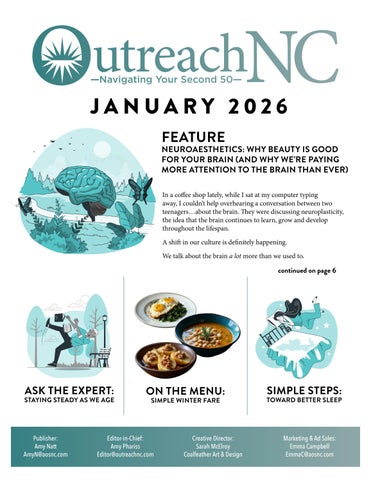
JANUARY 2026 FEATURE
NEUROAESTHETICS: WHY BEAUTY IS GOOD FOR YOUR BRAIN (AND WHY WE’RE PAYING MORE ATTENTION TO THE BRAIN THAN EVER) In a coffee shop lately, while I sat at my computer typing away, I couldn’t help overhearing a conversation between two teenagers…about the brain. They were discussing neuroplasticity, the idea that the brain continues to learn, grow and develop throughout the lifespan. A shift in our culture is definitely happening. We talk about the brain a lot more than we used to.
continued on page 6
ASK THE EXPERT:
STAYING STEADY AS WE AGE
Publisher: Amy Natt AmyN@aosnc.com
ON THE MENU: SIMPLE WINTER FARE
Editor-in-Chief: Amy Phariss Editor@outreachnc.com
Creative Director: Sarah McElroy Coalfeather Art & Design
SIMPLE STEPS:
TOWARD BETTER SLEEP
Marketing & Ad Sales: Emma Campbell EmmaC@aosnc.com JANUARY 2026 - 1
LETTER FROM THE EDITOR OCTOBER 2022 - 2 LETTER FROM THE EDITOR
Amy Phariss, Editor-in-Chief, OutreachNC | editor@outreachnc.com
Amy Phariss, Editor-in-Chief, OutreachNC | editor@outreachnc.com Well, it’s official: fall is here. I had my first pumpkin-spiced latte jus January often arrives quietly. After the pace and new low monthly recipe column, On the Menu, tureOur dipped enough to merit a fleece. brightness of the holidays, the beginning of a new year focuses on straightforward cooking with familiar Don’t worry. It This was decaf. can feel slower, dimmer, and more inward. Rather than ingredients. month’s selections are simple, rushing toward change, this issue invites a different warming, nourishing dishes meant to be used and is anot gentle month. Thereoccasions. are constant reminders of change approach—one rooted in attention, steadiness, and care October enjoyed, saved for special we are lucky, toward each other. We have lingering conversations o for both our inner and outer environments. theFinally, flames we flicker. SmokeSimple dancesSteps, around us inmonthly a circle. We zip our j introduce a new January’s feature article explores neuroaesthetics, column centered on small, realistic actions to support In everyday this month’s feature,For we’re starting an important conversation the growing field that looks at how our surroundings well-being. January, we begin with simple care community for ourselves a loved one? Fox Hollow Senio influence the brain, mood, and nervous system. From steps toward better sleep—anorarea that affects nearly Robin Hutchings offers inside perspective for making this decision light and color to texture and space, this research helps every part of health and daily life. explain why small changes in our environment can have In Ask the Expert, Amy Natt answers a reader’s question regarding As we move into the new year, our hope is that this a meaningful impact on how we feel, especially as we away without estate planning. Without a will orthat access to impo issue offers any something steady and useful—ideas age. meet you whereDr. youSara are Morrison and support the season Physical therapist of Total Body you’re Therapy and W In Ask the Expert, AOS Care Management Care in. Thank you for reading, and for beginning 2026 with diagnose potential diagnostic tools used in physical therapy to help Manager Ashley Culbreth talks to readers about falls us. tools In thediffer words of Rainer Mariadoctor’s Rilke (who is always these from what other offices may offer. and stability. She offers important and practical tips for good for a thoughtful quote): maintaining confidence and independence. Her insights I’m going to agree with Nathaniel Hawthorne this month, who wro offer clear information and thoughtful guidance around I cannot endure to waste anything so precious as autumnal suns balance, awareness, and prevention. spent almost all the daylight hours in the open air. You’ll also find the debut of The Seasonal Shift: Here’s to enjoying the October sunshine, falling leaves and daylight Winter, a quarterly checklist designed to help you gently adjust to the rhythms of the season. This is not a Warmly, list of resolutions or goals, but a simple tool for noticing facebook.com/ag what might need more attention—or less—during the instagram.com/a winter months.
And now we welcome the new year, full of things that have never been.
FOLLOW US!
The Experts in Aging We
Keep up with all things ONC by following us on social media. @Aging Outreach Services
We are passionate @Aging Outreach Services about helping older adults navigate the many challenges of aging. Stay positive while you recuperate. . . @Aging Outreach Services
Age the Way You Choose
utilize our pool of carefully screened private-duty caregivers for the support you need.
910.692.0683 910.692.0683 | info@AOSNC.com
2 - JANUARY 2026
AOSNC.com
The first Accredited Caregiver Registry in North Carolina.
NEW NAME.
Same Trusted Care. Introducing Charter Senior Living of Fox Hollow. Formerly Fox Hollow Senior Living, our name has changed, but our commitment to area families has not. The same caring team, intimate setting and trusted Assisted Living and Memory Care you know is now backed by the strength and experience of Charter Senior Living.
Call 910.348.5036 to schedule a visit today. 190 Fox Hollow Ct | Pinehurst, NC 28374 Assisted Living | Memory Care
JANUARY 2026 - 3
ASK THE EXPERT: STAYING STEADY AS WE AGE Ashley Culbreth, AOS Care Management Care Manager | AshleyC@AOSNC.com Q: I’ve had a few near-falls lately, but I can’t pinpoint why. It just feels like suddenly, my balance is off. What can I do to feel more stable?
Movement also plays a big role in keeping balanced. Exercises that focus on strength, posture, and body awareness can help. Things like:
A: If you’ve had a few near-falls recently and can’t explain why, you’re not imagining things—and you’re definitely not alone. Many people notice moments of unsteadiness that seem to come out of nowhere. One minute you’re walking along just fine, and the next you’re catching yourself or grabbing onto something.
•
Yoga or Pilates, which build core strength and improve balance
•
Gentle strength training for the legs and hips
•
Balance exercises, even for a few minutes a day
•
Working with a physical therapist who specializes in balance
The good news is there are a lot of practical things you can do to feel steadier and more confident. One of the easiest things you can do is be open to using support when you need it. Tools like a cane or walker aren’t a sign that something is “wrong.” They’re just ways to add stability and reduce the risk of falling, especially if you’re feeling tired, moving through unfamiliar spaces, or noticing more frequent wobbles. A lot of people say that using support actually helps them relax, which improves balance even more.
4 - JANUARY 2026
You don’t have to do anything big or intense. Small, regular movement helps train your body, and movement can also help your body get back into balance if you lose your balance. This happens to all of us, at any age, and we can always improve and make balance better.
14 - OCTOBER 2023 Also, look at what else might be adding to a balance issue. Balance changes can sometimes be things you wouldn’t necessarily think about, like:
Gray Matter All Things Aging Podcast! Games Solutions • Vision changes or an outdated glasses prescription •
Inner ear issues
•
Blood pressure dropping when you stand up too quickly
•
Medication side effects or interactions
•
Dehydration or low energy
Checking in with your doctor is always a good first step. It can help give you clarity about what’s going on. Sometimes a small change can make a big difference. Your environment matters, too. Even people with good strength can feel unsteady in spaces that aren’t set up well. A few simple changes can help: •
Make sure your home is well lit, especially hallways and bathrooms
•
Clear walkways and reduce clutter
•
Remove loose rugs or use non-slip backing
•
Wear supportive shoes indoors instead of socks Accessible Communication or slippers that slide. Some people keep a pair of with Captions! “inside shoes” they wear just inside.
When your surroundings are calmer and easier to move through, your body doesn’t have to work as hard to stay balanced. If these almost-falls are happening more often, or if you’re noticing dizziness, numbness, or weakness, that’s a good reason to get extra support sooner rather than later. A physical therapist can assess how you move, identify areas that need strengthening, and give you specific exercises that fit your body and lifestyle. The most important thing to remember is that feeling unsteady doesn’t mean you’re headed toward a fall. It’s information. It’s your body asking for a little more Relay Conference Captioning support, attention, or strength. Relay Conference Captioning (RCC) service is available for
With the right combination of loss movement, medical individuals who have a hearing or a speech disability to guidance, practical adjustments, many feel activelyand participate in teleconference calls orpeople webinars by readingand livemore captions on their again. laptop, Paying mobile device or tablet. steadier confident attention now can help you stay active, independent, and safe To inquire, contact kim.m.calabretta@t-mobile.com moving forward.
Lifestyle
Healthcare Planning
Resources
Subscribe to our channel today! @AllThingsAging
RESOURCES. EXPERIENCE. SOLUTIONS.
We’re here to help you navigate all things aging! www.AOSNC.com
info@AOSNC.com | 910.692.0683 Find current & previous issues of OutreachNC Read the latest from our blog Join our free digital mailing list Sign up for home delivery of OutreachNC Explore our Resources tab for community events, support groups, and more...
or visit relaync.com/rcc
JANUARY 2026 - 5
Neuroaesthetics INSIGHTS FROM LOCAL FAITH LEADERS by Amy Phariss
WHY BEAUTY IS GOOD FOR YOUR BRAIN (AND WHY WE’RE PAYING MORE ATTENTION TO THE BRAIN THAN EVER) by Amy Phariss continued from page 1 We hear about brain health on the news. We see colorful brain scans in magazines. Doctors talk about memory, stress, trauma, and nervous system regulation in ways they never did before. Words like neuroplasticity, dopamine, and the nervous system have quietly entered everyday conversations. This growing fascination with the brain isn’t a trend—it’s based on new discoveries and scientific abilities. For the first time in human history, we can actually see the brain at work. And what we’re seeing is changing how we understand health, aging, and something we’ve always known intuitively: beauty matters. SEEING THE BRAIN CHANGED EVERYTHING For most of history, the brain was a mystery. We knew it was important, but we couldn’t watch it function in real time. We had ideas of how it worked, but many of those ideas have proven either false or limited. These ideas began to change with the development of modern brain imaging tools like MRI and functional MRI (fMRI).
6 - JANUARY 2026
These scans let scientists observe which parts of the brain “light up” when we think, feel, listen to music, remember the past, or experience pleasure. With these scans, things that once seemed abstract—like stress, joy, or beauty—have become visible. We can literally see how the brain responds (in real time) to watching a movie, seeing the sunset or sitting in a cluttered mess.
emotional changes, and for good reason—our brains do change with age.
This visibility changed the conversation we have about not only the brain but what the brain responds to and how it responds.
Brain scans show that when older adults engage with music, nature, or visually pleasing spaces, stress-related brain activity decreases while areas associated with pleasure, calm, and reflection become more active. In research conducted with people living with dementia, spending time in art museums can actually promote feelings of wellbeing. According to research conducted in 2014, “…in a study with people with dementia and their caregivers, viewing traditional and contemporary galleries, both art sites promoted well-being, including positive social impact and cognitive enhancement” (Mastandrea et al. 2019).
When researchers began studying what happens in the brain during positive experiences, they noticed something surprising: beauty wasn’t neutral. It wasn’t “just nice.” It created real, measurable changes in brain activity and stress response. That realization helped give rise to a field called neuroaesthetics. WHAT IS NEUROAESTHETICS, IN PLAIN LANGUAGE? Neuroaesthetics studies how the brain responds to beauty. Beauty is defined by researchers as, “…a property or value of an object, natural scene, or person which engenders a physiological and psychological experience of pleasure and satisfaction”(Comfort & Freitas, 2022).
But here’s the encouraging part: aging brains remain responsive. They continue to adapt. And they respond especially well to supportive environments.
In other words, beauty doesn’t stop working on the brain as we age. It becomes more important and creates measurable change in cognition and mood. BEAUTY SENDS A MESSAGE OF SAFETY TO THE BRAIN
•
Listening to music you love
One of the most important discoveries in neuroscience is that the brain is constantly scanning for safety or threat. Loud noise, clutter, harsh lighting, and chaos can quietly signal danger—even if we don’t consciously feel afraid.
•
Looking at art or meaningful photographs
Beauty does the opposite.
•
Spending time in nature
•
Being in spaces that feel calm, warm, and comfortable
When we experience something harmonious or soothing, the brain receives a simple message: you’re okay. Heart rate slows. Breathing becomes easier. Muscles relax. Stress hormones drop.
This includes experiences like:
Using brain scans and physiological measurements, scientists can now see how these experiences affect areas of the brain related to emotion, memory, meaning, and stress regulation. And the findings are consistent: beauty helps the brain regulate itself. WHY THIS MATTERS MORE AS WE AGE As we get older, we become more aware of our brains. We pay closer attention to memory, focus, sleep, and mood. Many people worry about cognitive decline or
This is especially helpful for older adults, whose nervous systems may be more sensitive to overstimulation. Calm, orderly, aesthetically pleasing environments reduce the amount of work the brain has to do just to feel settled. MUSIC, MEMORY, AND THE BRAIN ON IMAGING SCANS One of the most striking uses of brain imaging has been in the study of music.
JANUARY 2026 - 7
When people listen to familiar music, scans show widespread brain activation—including areas connected to emotion, movement, and memory. Even in people with Alzheimer’s disease, music often activates networks that remain intact long after other memories fade. This explains why a song from long ago can: •
Instantly lift mood
•
Bring back memories
•
Create emotional connection
•
Reduce agitation or anxiety
Music doesn’t ask the brain to work harder. It helps the brain work more smoothly. Music can also be beneficial in aiding with sleep, something many seniors struggle with. Researcher Darina Petrovsky, Ph.D., R.N., of Rutgers University notes, “If you’re listening to something with fewer beats per minute, your heartbeat, your brain activity, and your breathing rate will gradually match those musical characteristics and bring your arousal state down”
8 - JANUARY 2026
(National Institute on Aging, 2023). Imagine the relief from agitation if, instead of listening to a news report of the demise of Western civilization, we instead listened to a calming music playlist. Our heartbeats would decrease, and our sense of agitation will come down. We sleep better, feel calmer and move through the day with less agitation and more appreciation….for beauty. NATURE, THE BRAIN, AND WHAT THE SCANS REVEAL Brain imaging has also helped explain why nature feels so restorative. When people view natural scenes, activity in brain regions associated with stress and rumination decreases. Attention becomes more relaxed but focused. The brain enters a state of gentle alertness rather than tension. This is one reason why time outdoors—or even near a window with trees—can improve sleep, mood, and clarity.
Our brains evolved in nature. Scans suggest they still recognize it as home. And for many of us, home is associated with peace, with a sense that things are okay. It is familiar and comforting. Nature is not only beautiful. It soothes our brains and calms our nervous systems, which means we can literally take a deep breath. WHY OUR CULTURAL FOCUS ON THE BRAIN IS A GOOD THING Our growing interest in the brain reflects something important and hopeful: We’re moving away from viewing health as “just physical” and beginning to understand how deeply connected everything is—mind, body, environment, and experience. Neuroaesthetics fits perfectly into this shift. It shows us that what we surround ourselves with matters. That beauty supports brain health. What we’ve intuitively known all along has been shown to be scientifically true: small, everyday experiences can make a meaningful difference in how we feel, what we think, how our body responds and how we experience the world and each other. This is especially important for seniors, caregivers, and communities supporting older adults. Creating calming, beautiful environments isn’t about luxury—it’s about holistic, overall care and wellbeing. BRINGING THIS KNOWLEDGE INTO DAILY LIFE You don’t need brain scans to benefit from neuroaesthetics. You already know what feels good to your nervous system. Simple practices help: •
Playing music you enjoy daily
•
Spending time near natural light
•
Reducing clutter and visual noise
•
Keeping meaningful items nearby
•
Creating calm, comfortable spaces
These choices help the brain stay regulated and resilient.
A FINAL THOUGHT The more we learn about the brain, the more we realize how responsive it is—to stress, to care, and to beauty. These are things we can often control, in a world that so often feels beyond control. We have some control over what we listen to, what we choose to look at, the feel of the sheets we purchase or the clothing we wear, how much time we spend in nature and in beautiful places. We have much more control, in fact, than we may realize. Neuroaesthetics reminds us that beauty isn’t frivolous. It’s functional. It supports emotional balance, cognitive health, and overall wellbeing— at every stage of life. We’re paying more attention to the brain now because we finally can see it. And what we’re seeing confirms something deeply human: beauty helps us heal, regulate, and thrive—no matter our age. References: Brody, B. (2025). How clutter can affect your health. WebMD. DOI: https://www.webmd.com/balance/ss/ slideshow-clutter-affects-health Comfort, W. E., & Freitas, A. L. (2022). The neuroscience of beauty. In P. S. Boggio, T. S. H. Wingenbach, M. L. da Silveira Coêlho, et al. (Eds.), Social and affective neuroscience of everyday human interaction: From theory to methodology (Chapter 4). Springer. https://doi. org/10.1007/978-3-031-08651-9_4 Mastandrea, S., Fagiolo, S., and Biasi, V. (2019). Art and psychological well-being: Linking the brain to the aesthetic emotion. Front. Psychol., 03 April 2019 Sec. Perception Science. Vol. 10 - 2019 | https://doi. org/10.3389/fpsyg.2019.00739 National Institutes of Health. 2023. Could “musical medicine” influence healthy aging? DOI: https://www. nia.nih.gov/news/could-musical-medicine-influencehealthy-aging Woods, T. (2024). How beautiful things make our lives better: Aesthetic experiences make us happier. Psychology Today. DOI: https://www.psychologytoday. com/us/blog/science-of-choice/202110/how-beautifulthings-make-our-lives-better JANUARY 2026 - 9
SIMPLE STEPS: TOWARD BETTER SLEEP
Amy Phariss, LCMHC, Clarity Counseling NC
Sleep affects nearly everything—our mood, memory, balance, and ability to cope with stress. Still, many people struggle with sleep, especially as we get older. Instead of chasing perfect sleep or complicated routines, it often helps to focus on a few small, steady changes.
BETTER SLEEP DOESN’T USUALLY COME FROM DOING MORE. IT COMES FROM DOING A LITTLE LESS, A LITTLE EARLIER, AND A LITTLE MORE CONSISTENTLY. Here are a few simple things that can help. Keep a Regular Rhythm Our bodies like predictability. Going to bed and waking up at roughly the same time each day—even on weekends— helps the brain know when it’s time to wind down and when it’s time to be alert. This doesn’t have to be exact. Even a one-hour window can make a difference. If sleep has been irregular, start by choosing a consistent wake-up time rather than focusing on bedtime. Morning light helps reset the body’s internal clock. Dim the Evening Bright light tells the brain to stay awake. In the evening, lowering lights can gently signal that the day is ending. Switching from overhead lighting to lamps, or using warmer bulbs, can help the body begin to settle. This small environmental change can be more effective than trying to “force” sleep. Create One Calming Habit You don’t need a long bedtime routine. One simple, repeatable habit is enough. This could be reading a few pages of a book, stretching gently, listening to quiet music, or having a warm drink.
10 - JANUARY 2026
The key is repetition. When the brain begins to associate that habit with rest, it becomes easier to relax. Watch the Late Afternoon Caffeine can linger in the body longer than we expect. For some of us, even coffee or tea in the early afternoon can affect sleep. If falling asleep is difficult, try limiting caffeine after lunch and notice whether that makes a difference. Be curious instead of judgmental, so you’re not creating more anxiety, which affects sleep, too. Just notice if limiting caffeine helps. Large or heavy meals late in the evening can also disrupt sleep. Keeping dinners simple and earlier, when possible, can help the body rest more comfortably and fall asleep with less to digest (literally). Get Some Daylight Daytime light—especially in the morning—supports better sleep at night. Even a short walk outside or sitting near a window can help regulate sleep rhythms. This doesn’t require exercise or effort, just exposure. Some experts also suggest morning light without sunglasses for best results. Let Go of Perfect Sleep Not every night will be a good night.
WORRYING ABOUT SLEEP OFTEN MAKES IT HARDER TO REST. If you wake during the night, try not to watch the clock. Quiet breathing, soft thoughts, or simply resting can still be restorative. Sleep improves when we treat it as something we support, not something we control. One Thing to Try Choose just one small change this week—dimming lights earlier, waking at the same time each day, or adding a calming habit before bed. Small, steady steps often lead to the biggest improvements over time. Sometimes, it really is the simple things that make the difference.
THE SEASONAL SHIFT: WINTER
DAILY RHYTHM
With a new year upon us, it’s easy to begin lists, goals and resolutions. We want to get busy making changes, building new habits and engaging again with the world – after holiday festivities, travel and family bonding.
I created one predictable daily anchor (tea, walk, reading, music)
We have so much to do.
I simplified at least one routine
But winter is not a season of acceleration. It’s a season of conservation, quiet adjustment, and creating environments—inside and out—that support rest. It’s a season to pause and take a breath.
I adjusted expectations rather than forcing motivation
Here is a simple, gentle checklist to consider as we move through winter and prepare for spring. Feel free to add your own suggestions, aligning with your goals and values around rest and renewal.
BODY AWARENESS I paid attention to signs of fatigue rather than ignoring them I chose warmth, nourishment, and comfort when needed
ENVIRONMENT & SENSORY CALM
I respected rest as necessary, not indulgent
I softened lighting in at least one space I use daily
REFLECTION QUESTIONS
I reduced visual clutter in one small area
(Optional—choose one or two to journal or sit with)
I added something comforting (lamp, throw, plant, meaningful object)
What does my body seem to need more of this season?
PACE & ENERGY
Where can I simplify without losing what matters?
I allowed my pace to slow without labeling it as “unproductive”
What expectations no longer fit the season I’m in?
I reduced at least one optional obligation I honored lower energy days without pushing through them
What feels grounding right now? What would it look like to move through winter without rushing it?
JANUARY 2026 - 11
ON THE MENU:
Simple Winter Fare Early winter is a good time to cook simply and cook well. This month’s recipes focus on warmth, balance, and ingredients that hold up in colder months. They’re practical dishes meant to be used, not saved for special occasions. White Bean & Rosemary Soup A steady, warming staple for cold days Beans, broth, and herbs are grounding, affordable, and easy on digestion. This is the kind of soup that tastes better the next day. Ingredients 2 cans cannellini beans, drained and rinsed 1 small onion, finely chopped 2 cloves garlic, minced 4 cups chicken or vegetable broth 1 sprig fresh rosemary (or ½ tsp dried) and one sprig of fresh thyme, tied with twine into a bundle for easy removal Olive oil Salt and black pepper Instructions 1. Sauté onion in olive oil over medium heat until soft. 2. Add garlic and cook 30 seconds. 3. Add beans, broth, and herbs. Simmer 15–20 minutes. 4. Remove thyme sprig. Lightly mash some of the beans for texture. 5. Season with salt and pepper. Notes Feel free to add in crumbled sausage or diced ham for added protein. This soup is as versatile as it is simple. Serve with a crusty bread and topped with freshlygrated parmesan cheese, if you’ve got it on hand and at the ready.
12 - JANUARY 2026
Savory Eggs with Greens A solid, no-nonsense breakfast Warm, protein-forward, and adaptable. A good way to start the day when it’s cold and dark outside. Ingredients 2 eggs
WORLD-CLASS CARE CLOSE TO HOME.
A handful of spinach or kale Olive oil or butter Salt and pepper Grated cheese (we love parmesan or smoked gouda) – optional Instructions 1. Sauté greens briefly in olive oil or butter until just wilted. 2. Push greens to the side of the pan and add eggs. 3. Cook to preference. Season with salt and pepper.
800.733.5357 carolinaeye.com
4. Grate cheese over top or fold in with eggs at the end. Add salsa, hot sauce, or leftover vegetables if you like. We may have served it with a side of leftover pears from dessert the night before (see pear recipe below). Baked Pears with Honey & Walnuts Simple, warm, and quietly satisfying Pears are at their best in winter. Baking brings out sweetness without needing much else. Ingredients 2 ripe pears, halved and cored
Music
can name the unnameable and communicate the unknowable. - LEONARD BERNSTEIN
1–2 tbsp honey Handful of chopped walnuts Cinnamon (optional) or nutmeg (just a dash will do) Instructions 1. Heat oven to 375°F. 2. Place pears cut-side up in a baking dish. 3. Drizzle with honey, sprinkle with walnuts and cinnamon.
It has always been universally understood that listening to favorites is enjoyable and can lift one’s mood. However, during the past few years we’ve come to better understand that therapeutic value music can have on those with dementia. For qualified individuals, AOS & Friends Care offers a program which provides a music player loaded with personalized songs.
4. Bake 25–30 minutes until tender.
a
lp?
tC
an
He
Wh
Serve with yogurt or a small scoop of vanilla ice cream. We’ve been known to add a handful of homemade granola as well, creating something just shy of a crumble.
To learn more about the Personal Music Player and other AOS & Friends Care programs/services:
o W E Do T
910.585.6757 info@aosfcare.org www.aosfcare.org www.facebook.com/AOSFriendsCare
JANUARY 2026 - 13
i � FreeDailyCrosswords.com
DO GRAY ACROSS-----------� MATTER GAMES
ACROSS 1) Hardly worth millions 5) Type of warming 11) Something fishy 14) Bullets and bombs, briefly 15) Oxygen-dependent bacterium 16) Web address 17) Creating a ruckus 19) Bell and Kettle, e.g. 20) Sets of rabbit ears 21) Baby-bottle feature 23) Serena, to Venus 24)_Aviv 25) Maine tree 26) Air Force One is one 27) Snip 28) Nostril 32) French love 35) Delhi dress 36) Carpe __ 37) Be unacquainted with 40) Canvas bag 41) Shopping center? 42) Armed adversary 43) Unpleasant person 44) Speaker systems, briefly 45) No longer active, in the mil. 46) Air freshener's target 48) Gross minus expenses 49) Three-time Frazier foe 52) Dangerous compound in Agent Orange 55) Like dachshunds 57) Motel relative 58) Last day on the calendar 60) Catchall abbreviation 61) Bent and twisted, as a tree 62) Black American cuckoos 63) It gets socked 64) It can cause burnout 65) Gasp for air, like a dog DOWN 1) "Legal" and "medic" beginnings 2) One from Muscat 3) Leaves out on purpose 4) Valentine's Day flower 5) Fish-eating sea bird 6) Within the law 7) "The Lord of the Rings" army members 8) Constrictor 9) From the beginning, in Latin 10) Russian revolutionary leader 11) Beef cut 12) Spoken aloud 13) "May I get you anything_?"
14 - JANUARY 2026
18) Apprentice 1) Hardly worth millions 22) Necklace 5) type Type of warming 25) Cat sounds 11) Something fishy 26) Singles player of old 14) Bullets and bombs, briefly 27) Sidewalk eateries Oxygen-dependent 29) White15) House gofer bacterium 30) Five hundred sheets of paper Web address 31) A ward16) for TV programming 32) Tiny colonizers 17) Creating a ruckus 33) Apollo19) destination Bell and Kettle, e.g. 34) Preminger or Bismarck 20) Sets of rabbit ears 35) Vow 21) Baby-bottle feature 38) Foe 23)partner Serena, to Venus 39) Greeter's 24)_Aviv 45) Makes restitution 25) Maine tree 47) Car blemishes 48) Winter songs 26) Air Force One is one 49) Football 27)variety Snip 50) "Rosemary's Baby" author 28) Nostril 51) i.e., for long 32) French love 52) Popular New Year's resolution 35) dress 53) " _ each life,Delhi some rain ... " 36) Carpe __ 54) "Measure twice, cut_" Be unacquainted with 55) Harp's37) old cousin 56) "Quickly!" acronym 59) Major conflict
FAMILY FIRST 2
14
17 20
23
37 40 43
57
60 63
3
4
6
40) Canvas bag 41) Shopping center? 42)Armed adversary 43) Unpleasant person 44) Speaker systems, briefly 45) No longer active, in the mil. 46)Air freshener's target 48) Gross minus expenses 49) Three-time Frazier foe 52) Dangerous compound in Agent Orange 55) Like dachshunds 57) Motel relative 58) Last day on the calendar 60) Catchall abbreviation 61) Bent and twisted, as a tree 62) BlackAmerican cuckoos 63) It gets socked 64) It can cause burnout 65) Gasp for air, like a dog
7
8
9
10
1) 2) 3) 4) 5) 6) 7)
8) 9) 10) 11) 12) 13) 18) 22) 25) 26) 27) 29) 30) 31) 32) 33) 34) 35) 38) 39) 45) 47) 48) 49) 50) 51) 52) 53) 54) 55) 56) 59)
20) Sets of rabbit ears 21) Baby-bottle feature 23) Serena, to Venus 24)_Aviv 25) Maine tree 26)Air Force One is one 27) Snip 28) Nostril 32) French love 35) Delhi dress 36) Carpe __ 37) Be unacquainted with
52) Dangerous compound in Agent Orange 55) Like dachshunds 57) Motel relative 58) Last day on the calendar 60) Catchall abbreviation 61) Bent and twisted, as a tree 62) BlackAmerican cuckoos 63) It gets socked 64) It can cause burnout 65) Gasp for air, like a dog
Gray Matter Games Solutions
FAMILY FIRST
1P 20 30 4R 1
A MM 0 RA I
-�-�--��-B Hen 5G
6L 70 BB 9A 1l
E R 0 B
1
Quarters
1R 1b 1E lJ R L 1
M AS p L
NT
I EM
DAM
T
NA R L
VE I S
'" 0
T R ES
NT
�
9) From the be 10) Russian rev 11) Beef cut 12) Spoken alou 13) "May I get 18)Apprentice 22) Necklace ty 25) Cat sounds 26) Singles play 27) Sidewalk ea 29) White Hous 30) Five hundre 31)Award for T 32) Tiny coloni 33)Apollo dest 34) Preminger o 35) Vow 38) Foe 39) Greeter's pa 45) Makes resti 47) Car blemish 48) Winter song 49) Football va 50) "Rosemary' 51) i.e., for long 52) Popular Ne 53) "__ each 54) "Measure tw 55) Harp's old c 56) "Quickly!" 59) Major confl
Simplify your life.
Call us to see how to simplify your tomorrow today. 910.537.6812
QuailHavenVillage.com
© 2025 Quail Haven Village
Life at Quail Haven Village is filled with all the things you want to do, and none of the things you’d rather not. Indulge and enjoy, and rest assured that continuing care is in place should it be needed in the future.
INDEPENDENT LIVING | ASSISTED LIVING S K I L L E D N U R S I N G | R E H A B I L I TAT I O N A Life Plan Community by Liberty Senior Living
125168 quail haven village simplify ad-outreach nc.indd 1
JANUARY 2026 - 15 10/2/25 11:45 AM
IF YOUR GOAL IS TO STAY IN YOUR HOME...
24-hour care
16 - JANUARY 2026