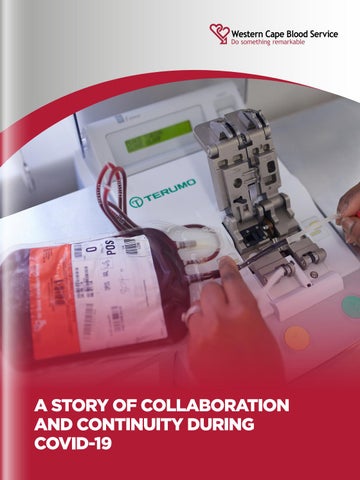
A STORY OF COLLABORATION AND CONTINUITY DURING COVID-19
WESTERN CAPE BLOOD SERVICE
Banking on
Blood South Africa’s Western Cape Blood Service continues to collect, process and deliver life-saving blood products to public and private healthcare providers in spite of the challenges presented by the coronavirus pandemic Writer: Tom Wadlow | Project Manager: Callam Waller
HEALTHCARE
T
Note: The photos in this article were taken prior to the coronavirus outbreak. The wearing of masks is now mandatory.
he mind boggles when looking at statistics relating to blood. The fuel that keeps us alive, the human body manufactures around 17 million red blood cells per second, with a single unit of blood containing 2.4 trillion of these cells. It is estimated that blood accounts for roughly seven percent of the bodyweight of an average person, adults containing around five litres of blood inside their bodies. A small part of that, 0.02 percent, is pure gold. A complex and intriguing part of our makeup, enduring heavy losses of blood can be fatal, making a reliable and safe supply of blood a critical part of any healthcare system and hospital network. In South Africa, there are two major bodies responsible for the provision of blood to medical institutions and healthcare providers, with most of the country covered by the South African National Blood Service. In the west of the country, the Western Cape Blood Service (WCBS) is responsible for collecting, processing, testing and distributing blood products in the Western Cape province. And it is here that Dr Greg Bellairs presides as CEO. “A fundamental duty of any blood service is to provide blood products to patients in hospitals timeously, safely and consistently. Without blood, many patients would otherwise die,” he says. “Blood products are critical in many clinical situations – for example, trauma, surgery, and treatment of leukaemia.” Bellairs goes on to explain the transfusion process and how WCBS fits into this lifesaving series of events. “It starts with a treating clinician ordering the blood products required for the patient, and submitting an order form and blood sample to the blood bank,” he continues. “Blood products are selected and matched for the patient – a process called crossmatching, which ensures 3
A partnership built Since 2016 Roche Diagnostics has been a proud partner of the Western Cape Blood Service (WCBS); helping them deliver the safest blood products and efficient service to the people of the Western Cape.
WCBS is established.
Closely involved with the first heart transplant that took place at Groote Schuur Hospital.
A new laboratory facility is set up to facilitate testing blood for HIV infection.
Introduces the latest technology to test donated blood – Nucleic Acid Testing (NAT).
1938
1967
1985
2005
Roche is founded in Basel, Switzerland and since then has grown into one of the world's leading healthcare companies.
1896
Roche enters the diagnostics market.
1968
Roche launches the world’s first HIV-1 test.
1985
Roche introduces Nucleic Acid Testing (NAT). Today Roche is a global leader in NAT.
1998
on saving lives As a global leader in diagnostics, Roche is dedicated to helping save patients’ lives by delivering state-of-the-art solutions to aid in the protection of the world’s blood and plasma supply from infectious diseases.
WCBS partners with Roche Diagnostics for serological blood screening.
Roche Diagnostics and WCBS further solidify their partnership with the introduction of the high volume cobas® e801 module for serological blood screening, making WCBS the first blood service in Africa to implement this technology.
Successful validation followed by second line testing for HBeAg and Anti-HBe.
Linked for Life.
2016
2018
2019
2020
We look forward to an exciting partnership together with the WCBS and commit to continuously deliver excellence, safety and life-saving innovation. Source: www.wcbs.org.za | www.roche.com Published and Distributed by: Roche Diagnostics (Pty) Ltd. | Hertford Office Park | Building E 90 Bekker Road | Vorna Valley | Midrand | South Africa MC-ZA-00238 | 10/2020
WESTERN CAPE BLOOD SERVICE
THE BLOOD PORTFOLIO Broadly speaking, blood products are divided into the following categories: • Red cell products – to restore oxygen-carrying capacity in patients who have low haemoglobin levels usually following extensive blood loss or due to severe anaemia • Plasma products – to restore blood clotting proteins, for example after a massive haemorrhage • Platelet products – to normalise patients’ platelet counts (platelets pay a critical role in early blood clotting and maintaining haemostasis), for example in patients who have had a massive haemorrhage, or who have insufficient platelets due to bone marrow malignancies and while undergoing bone marrow transplantation
6
that the products are compatible with the patient’s blood type. “After crossmatching, blood products are issued in a specialised container which we call a hamper, designed to keep them at a specific optimal temperature during transport to the hospital and, ultimately, to the patient’s bedside for transfusion by clinical staff.” Transporting the precious cargo is WCBS’s fleet of around 80 vehicles. Operating the vehicle fleet and other vital frontline and back office functions are a team of 530 staff members, the service being headquartered in Cape Town with regional offices in the smaller towns of Paarl, Worcester and George. While much of the processing and testing work is centralised in Cape Town, blood is collected across the length and breadth of the Western Cape from fixed site donation clinics, mobile clinics and even pop-up caravan and bus facilities. The province itself is home to 6.6 million people, and around 72,000 of them are voluntary blood donors who between them donate around
156,000 units of whole blood and 4,000 units of single-donor platelets a year. This donation pool supplies eight blood banks which provide blood products to 140 state and private hospitals on a 24-seven, 365 days a year basis. A further 102 emergency blood banks are situated in the hospitals themselves, these being stocked with group O blood, from what are known as universal donors. Today’s operation is a far cry from the organisation which was established in 1938 at Groote Schuur Hospital. Back then, only 200 donors were on the books and an average of 30 transfusions a month were being carried out, although the practice was in its infancy during the 1930s. The process was also entirely different. The donors themselves would transfer blood directly to the recipient with just a screen separating them, a key series of turning points arriving in the 1940s when new premises were found and mobile units established, enabling a wider scouting mission for donors across the Western Cape.
Now you can tell your exclusive story... FREE exclusive article in Africa Outlook magazine
FREE independent brochure from the article
FREE social media & networking opportunities
FREE exclusive article in Africa Outlook magazine
FREE independent brochure from the article
FREE social media & networking opportunities
...within our new Industry Spotlight series. Industry bodies and associations can now enjoy exciting opportunities
every month in Africa Outlook magazine with the introduction of its new Industry Spotlight series. With a monthly coverage of over 185,000 readers, your organisation can take advantage of exposure in Africa Outlook with a FREE article and FREE digital brochure, as well as access to further digital and print-based marketing tools. To share in this unrivalled opportunity, contact one of our project managers today!
w w w. a f r i c a o u t l o o k m a g . c o m
Banking on
Issue 85
www.africaoutlookmag.com/work-with-us BLOOD How South Africa’s Western Cape Blood Service continues to collect, process and deliver life-saving blood products
We never forget that behind every specimen there’s a real person waiting for critical test results - which is why we never stop working to deliver accurate, efficient, and reliable instruments, easy-to-use technology, and continuous collaboration to ensure your lab is delivering exceptional patient care. Our solutions for Clinical Laboratories, Blood Banks and Donor Centers are built on comprehensive platforms, with standardization across:
The Total Lab Solution Instrumentation • Technology • Training • Quality • Efficiency
Small Hospital
Medium Hospital
Large Hospital
Stat Lab VITROS® Automation Solutions
ORTHO Optix™ in development/currently not available. Instrument availability is subject to fulfillment of regulatory requirements in each market. © Ortho Clinical Diagnostics, 2020 | PR-10221
Because Every Step and Every Aspect of Your Lab Impacts Patient Care Our innovative waterless technology powers our clinical testing solutions since 1978. Our VITROS® Systems, which test blood for diseases, conditions and substances, do not require water or drains to operate, helping our customers reduce their environmental footprint. Each VITROS® System alone saves hospitals 170,000L of purified water a year per analyzer, enough for a family of 4 to survive on for 20 years.
Ortho Care. Industry-Leading Approach to Service and Support Merged Reality
The Technology
Enables Ortho to “touch” your
With first-in-class technology, the Smart
analyzer without coming on site.
Service app arms our Ortho Care teams with
Technical solution specialists
analyzer intelligence in the palm of their hand.
and field engineers can show a
Ortho Field Engineers have the information
resolution, not just describe it, even
they need to quickly and completely resolve
thousands of miles away eliminating
issues, giving you faster resolution and
the need for an on-site visit.
improved reliability.
Country
Ortho Distributor
Name & Email
Phone
Botswana
The Scientific Group
Hilin Christians (hilinc@Ascendismedical.com)
+27833024910
Ethiopia
Diverse Electro Medical
Paulos Hailu (paul.wolde05@gmail.com)
+251911414774
Ghana
Alos Paraklet
Bismark Boateng (alosparakletgh@gmail.com)
+233249506745
Kenya
Crown Healthcare
Benson Kuria (benson.kuria@crownkenya.com)
+254725171527
Liberia
Sisie Choi
Sisie Choi (choisisie@gmail.com)
Mozamique
The Scientific Group
Hilin Christians (hilinc@Ascendismedical.com)
+27833024910
Namibia
The Scientific Group
Hilin Christians (hilinc@Ascendismedical.com)
+27833024910
Nigeria
LaVita Healthcare
Gbenga akujuobi (drgbengalavitagroup@gmail.com)
+2348080282865
South Africa
The Scientific Group
Hilin Christians (hilinc@Ascendismedical.com)
+27833024910
Swaziland
The Scientific Group
Hilin Christians (hilinc@Ascendismedical.com)
+27833024910
Tanzania
The Scientific Group
Hilin Christians (hilinc@Ascendismedical.com)
+27833024910
Uganda
Crown Healthcare Uganda - Clinical Chem
Paul Githinji (paul@crownafrica.com)
+256782516635
Uganda
MHS Microhaem Scientific Services IH
John Bosco (johnbosco@microhaem.co.ug)
+256781047030
Zambia
The Scientific Group
Hilin Christians (hilinc@Ascendismedical.com)
+27833024910
Zimbabwe
The Scientific Group
Hilin Christians (hilinc@Ascendismedical.com)
+27833024910
If you are interested in becoming an Ortho Clinical Diagnostics Distributor in Africa please contact: helen.brown@orthoclinicaldiagnostics.com
67%
Remote Resolution Rate* We resolve most issues without dispatching a field engineer.
30%
Improvement in Reliability* We continue to reinvest in our products, technology, and people to give you solutions you can depend on. *Data on file.
WESTERN CAPE BLOOD SERVICE It wasn’t until 2019 that the nonprofit organisation’s name evolved from the Western Province Blood Transfusion Service to the Western Cape Blood Service, the decision taken to reflect the geographical area of operation and fact that the group does not itself transfuse blood.
RESPONDING TO A CRISIS This year, the onset of the coronavirus pandemic has presented an altogether unique set of circumstances for the service.
LEADERSHIP FOCUS DR GREG BELLAIRS Greg Bellairs qualified as a medical doctor at the University of Cape Town in 1990. Over the next decade, he worked in trauma and emergency medicine, and anaesthesiology in both the United Kingdom and South Africa. In 2000 he completed an MBA at the University of Cape Town’s Graduate School of Business and co-founded a barrier surgical textile company thereafter. Bellairs then decided he wanted to remain involved with clinical medicine as well as develop further managerially, and he joined WCBS in 2002 in the position of Medical Officer and was promoted to Administrative Director/CFO in 2008. In 2011 he completed the Postgraduate Diploma in Transfusion Medicine at the University of Free State, and was appointed as CEO/Medical Director of WCBS in 2012.
10
Bellairs explains that the COVID-19 outbreak has impacted WCBS across its three strategic pillars: namely sufficiency of blood supply; safety across donations, products and the working environment; and financial and operational sustainability. Commenting on the first two of these, he adds: “Blood donations have been significantly impacted by COVID-19, as well as the various degrees of lockdown imposed over recent months. With restrictions imposed on people travelling, blood donors have been assured that travel for blood donation is allowed. “WCBS also needed to provide a safe environment for blood donation, which included increasing the spacing between donation chairs and beds, amending blood donation clinic workflows, providing PPE for staff
and donors, enhanced sanitisation procedures, and more. “As we collect significant amounts of blood from schools, universities, and corporate clinics, the closure of these and restrictions on visitors markedly reduced opportunities to collect blood. Adjusted blood collection strategies included convening more clinics, for example at shopping malls, as people still needed to continue to shop for food, as well as clinics in residential areas. In addition, donors were redirected to these clinics by the call centre, SMS, website and email.” Despite the clear and obvious challenges faced, WCBS was able to collect enough blood throughout the peak of the COVID-19 crisis, even though stocks were lower than the organisation usually strives for (five days of each blood type).
“AT THE HEIGHT OF RESTRICTIONS, AND DURING THE PERIOD WHEN ALCOHOL WAS BANNED AND ELECTIVE SURGERY CURTAILED TO FREE UP HOSPITAL BEDS FOR COVID-19 PATIENTS, THE VOLUMES OF BLOOD PRODUCTS SOLD WERE REDUCED BY AT LEAST 30 PERCENT”
A
global leader of in vitro diagnostics for over 80 years, our purpose is simple: to improve and save lives with diagnostics. It’s what defines us. Ortho Clinical Diagnostics delivers the high-quality in vitro diagnostic solutions that give healthcare professionals around the world the information they need to make treatment decisions sooner. We serve the global Transfusion Medicine community with donor screening and blood typing solutions to help ensure every patient receives blood that is safe and the right unit. We also bring sophisticated information management, testing technologies, automation and interpretation tools to clinical laboratories worldwide to help them run more efficiently and ensure exceptional patient care. Being considerate of the earth and its resources is a longstanding commitment of Ortho Clinical Diagnostics. We are committed to operating in a manner that supports the environmental health of the communities in which we operate and the sustainability of the planet. In our operations, we focus our environmental efforts on reducing waste and energy consumption while generating clean energy at our global facilities; and incorporating environmentally-friendly practices into our product manufacturing and packaging. Protecting the environment and advancing sustainability go handin-hand with our purpose of improving and saving lives through diagnostics.
WATER INITIATIVES Our innovative waterless technology powers our clinical testing solutions since 1978. Our VITROS® Systems, which test blood for diseases, conditions and substances, do not require water or drains to operate, helping our customers reduce their environmental footprint. Each VITROS® System alone saves hospitals 170,000 litres of purified water a year per analyser, enough for a family of four to survive on for 20 years.
WASTE INITIATIVES We have recycled 400 tonnes of medical waste into plastic construction materials and our facilities alone have saved 125 millions of litters of water per year since 2015.
ENERGY INITIATIVES Our on-site solar panels and co-generation units offset enough energy to power 875 typical homes every year.
Our VITROS® Systems, which test blood for diseases, conditions and substances, do not require water or drains to operate, helping our customers reduce their environmental footprint. Through our dry technology, Ortho has helped hospitals around the world save millions of litres of fresh water. It’s why you can find our systems on aircraft carriers and humanitarian aid ships, and in remote areas.
+649 082 008 | helen.brown@orthoclinicaldiagnostics.com www.orthoclinicaldiagnostics.com
WESTERN CAPE BLOOD SERVICE
This is some feat given that staffing levels were also markedly affected. WCBS lost many working hours due to employees either contracting the virus or having to isolate themselves – fortunately, the organisation has
THE WCBS MISSION “Western Cape Blood Service is a non-profit regional health organisation, dedicated to collecting blood from voluntary blood donors, and providing the safest blood products and efficient service to the community, while operating at the highest professional and ethical standards and remaining a viable organisation.”
14
suffered zero coronavirus fatalities and was able to plug the resourcing gap to ensure seamless continuity of service. Another interesting nuance of the pandemic period has been the demand for blood and subsequent impact on sales and revenue. “Blood usage varied significantly depending on the degree of lockdown,” Bellairs explains. “At the height of restrictions, and during the period when alcohol was banned and elective surgery curtailed to free up hospital beds for COVID-19 patients, the volumes of blood products sold were reduced by at least 30 percent. “As restrictions were lifted, sales improved but remained lower than originally expected. In South Africa, trauma is influenced by the availability and use of alcohol – and we saw evidence of this when alcohol became available, as blood usage increased.” More recent weeks have seen sales normalise, but WCBS is still
feeling the impact of several months of reduced income, a period which meant that expenses were reassessed, down-managed, and all non-essential expenditure was curtailed. Bellairs adds: “We were fortunate to have sufficient reserves to weather the financial storm, and the early uncertainty levels, which were high, have been replaced by recent experience demonstrating that although sales and income were reduced, we now know to what extent, and are able to anticipate the impacts of later waves of the pandemic. “Despite our financial challenges, we recognise that we are fortunate to operate in the healthcare space, which somewhat insulated us from the financial devastation faced by organisations which could not operate at all during the lockdown. “One of our core goals was to not retrench any staff, and to pay everyone in full – we were able to achieve this.”
Time Matters When You Have a Sepsis!
S
epsis is a complex and severe syndrome associated with a dysregulated immune response to infection. It is a global health crisis that every year affects around 50 million people worldwide, and at least 11 million die. Depending on country, mortality varies between 15 and 50 percent. At least two million sepsis deaths are estimated to occur in Africa each year. These statistics, however, are presumed to be gross underestimates, because in Africa sepsis is rarely diagnosed, reported, or registered as cause of death. Patients with sepsis most often enter the hospital through the emergency department, and clinicians often use white blood cell (WBC) counts to help identify sepsis, but changes in WBC alone have limited utility for sepsis diagnosis and delayed detection can impact adverse outcomes. Many surviving patients suffer from the consequences of sepsis for the rest of their lives. Early detection in emergency department and appropriate therapeutic intervention can increases the likelihood of survival for patients with sepsis. The hematology laboratory has a vital role to play in rapidly identifying septic patients or those who are at high risk of developing sepsis. Recently, a new sepsis biomarker, Monocyte Distribution Width (MDW), which is based on monocytes’ variability in sepsis, became available on a routine hematology analyser DxH900 from Beckman Coulter. The analyser characterises cells in their near-native state to enable measurement of small changes in cell morphology that occur at the onset of sepsis. The performance
Beckman Coulter South Africa, Jhb
|
of this early sepsis indicator demonstrated in large clinical trials and received FDA 510(k) clearance in April 2019. The clinical trial was conducted by Dr. Crouser, a researcher and a leader of the sepsis detection and treatment program at the Ohio State University’s East Hospital, Columbus, OH and his team to assess the monocyte distribution width parameter as a sepsis biomarker. The large multicenter study concluded that “in conjunction with the WBC, as components of the CBC with differential, the performance of MDW further improves and is predicted to enhance healthcare decisions relating to the early detection and treatment of sepsis in the ED.”1 This year, Beckman Coulter has expanded its partnership with Biomedical Advanced Research and Development Authority (BARDA) to study the use of the unique sepsis diagnostic biomarker (MDW) in COVID-19 patients. The aim of the new study is to optimise a machine-learning based sepsis diagnostic and prediction algorithm to determine whether the test can aid in the detection of sepsis in coronavirus (COVID-19) patients, regardless of whether it is bacterial or viral induced. 1. Crouser ED, Parrillo JE, Seymour C, et al. Monocyte distribution width, a novel indicator of Sepsis-2 and Sepsis-3 in high risk emergency department patients. Crit Care Med. 2019;47(8):1018–25.
T +27 11 564 3000
|
www.beckmancoulter.com
WESTERN CAPE BLOOD SERVICE
ILEX South Africa “Do Something Remarkable” – the motto which Western Cape Blood Services lives by, is seen in their actions to donors and patients every day. During these times of unknown WCBS has been remarkable in its commitment to donors and patients. We and our partners (Grifols, CERUS, Fresenius Kabi and Hologic) are proud to be associated with WCBS and its remarkable service to blood transfusion. Starting with Nucleic Acid Testing through Grifols, then Pathogen Inactivation through CERUS, we have expanded our product representation with Fresenius Kabi blood transfusion products in the region. Expanding our portfolio allows us to supply a full donor to patient solution for blood transfusion services in Africa.
THE POWER OF PARTNERSHIP Another key observation illuminated by the pandemic has been the critical nature of WCBS’s supply chain and network of partnerships. The CEO is quick to acknowledge the role each supplier and partner plays towards the organisation reaching its objectives, be they producers of blood collection bags or manufacturers of testing reagents which help ensure
THE WCBS VISION “To maintain a blood service that is appropriate to the needs of the South African Community. To be prepared to extend the service to provide for wider regional or national needs and to provide leadership in transfusion practice.”
16
blood is safe for transfusion. Many of its suppliers are multinational companies which operate with local footprints, while a large number of the products used across both consumable and capital categories are specialised and imported, and hence subject to currency volatility. It makes for a complex picture, one which Bellairs says became even more complicated thanks to the arrival of COVID-19. “We were worried about the impact on security of supplies, with borders being shut and logistics operations swamped, as well as many other customers in our field seeking to increase their holdings of critical equipment,” he says. “We asked some suppliers to increase their locally held stock levels to mitigate risk of running out, and we also increased our stock holdings of certain items, for instance from two months of supply to four or even six months.
Due to worldwide travel, pathogens which until recently were unknown in certain regions are now of great concern in blood transfusion and for patients receiving blood products. Many of the diseases that these pathogens can cause are not commonly diagnosed in the newly-affected countries and as a result detection is difficult. Pathogen inactivation, a proactive approach, addresses a broad spectrum of pathogens, reduces the need for new testing, and maintains blood continuity and availability even during a pandemic. As one of the greatest medical advances, blood transfusion in the future will become even more of a personalised and precision medicine as new cellular therapeutics and risk reduction methods are implemented. As a dynamic partner, ILEX provides solutions that create value for blood transfusion services in Africa.
www.ilex.co.za
Supporting Blood Transfusion Services now and into the Future Collection – Processing – Testing – Patient COLLECTION Blood bags, Apheresis equipment, Sealers, Hemoglobin testing, Red Cell Collection, Transportation Systems PROCESSING Pathogen Inactivation, Component Processing, Filters TESTING Nucleic Acid Testing, Viral Load Determination, Laboratory Information Systems PATIENT Blood bags, filters, product transportation systems
ILEX - for Innovation Tel: +27-11-804-4004 | Fax: +27-11-804-1120 E-mail: mail@ilex.co.za | sales@ilex.co.za
www.ilex.co.za
WESTERN CAPE BLOOD SERVICE
BLOOD BASICS Blood is a complex component of the human anatomy. Here is a rundown of some of the basics: • Every person belongs to one of eight blood types or sub-types which derive from the four larger ABO blood groups – A, B, AB and O. The Rhesus system further divides these groups into positive and negative, leaving eight in total: O-, O+, B-, B+, A-, A+, AB- or AB+ • ABO blood grouping is determined by the correlation of visible clumping in mixtures of plasma, the liquid component of blood, and the red cells, which carry oxygen • Not all blood types are compatible. For example, if a blood group A patient is given blood group B, the anti-B antibodies in their plasma will destroy the red cells in the transfused blood • Blood group O individuals are known as universal donors and are therefore the most sought after by bodies such as WCBS. They lack A and B blood group antigens which makes it possible for their blood to be given to all ABO types • AB+ blood group individuals are known as universal recipients, meaning they can receive all ABO blood types • Some individuals are born with rare blood types, making them difficult to match to regular blood groups
18
“With many long-term relationships with our suppliers in place, and due to the fact that security of supply is in both parties’ interests, we successfully navigated the highest level of lockdown and at no stage were inadequate supplies of consumables a threat to ongoing operations.” At the other end of the chain, customer relationships have also been in the spotlight. Again, WCBS holds long-established, well-developed partnerships with both public and private medical providers/insurers, with each sector accounting for roughly half of the service’s revenue. “When we have problems, they are usually quite easy to resolve,” Bellairs continues. “Although due to the impacts of COVID-19 on the local economy, we do anticipate increasing difficulty in managing bad debt, as well as a migration of insured patients to the state sector, which could put extra strain on income. “In addition, as the exchange rate worsens, this will drive up costs of those items which are sourced internationally, which can be mitigated in the short-term by forward covering US dollar-based purchases.”
SAFEGUARDING THE FUTURE As the conversation moves towards what lies ahead for WCBS and the future of the organisation, it quickly becomes clear that education and staff development form an important part of ensuring an ongoing success story. Here, Bellairs outlines the crucial work of the Learning & Development Department, a body which provides in-house training and organises external learning activities for colleagues. All technical and medical staff are required to participate in regular education exercises, with continuous professional development another key priority. “It is important for staff to stay abreast of new developments – often through peer-reviewed publications
COURIERIT At Courierit, we believe it’s not just about blood. It’s about saving our Nation. The Western Cape has been the epicentre of the coronavirus with the infection rate just under Gauteng, which accounts for the highest number of confirmed cases in South Africa. The current pandemic has placed considerable strain on our medical institutions and medical staff. The efficient transportation of blood to various medical facilities has become a pertinent factor in the ability of medical personnel’s capability to save lives. Courierit has been the official carrier of the Western Cape Blood Service for over a decade. The decision to entrust Courierit with the mammoth task of transporting the precious cargo was largely attributed to the Company’s extensive portfolio of working with various departments within the public sector, including the Department of Health, The Western Cape Department of Education and South African National Blood Association. Courierit earned its reputation of being the preferred last mile service provider for various organs of state based on its strict health and safety measures and security protocols. Courierit remains committed to our partnerships and will continue to improve our service offering. We have heightened our health and safety protocols to ensure that this precious cargo remains safe from the risk of contamination. The No Touch Delivery Initiative, in which customers are required to use the unique one-time pin as a means of validating their consignment, eliminates the need for any contact between the courier and the client. This highlights the brands commitment to protect its clients as well as employees.
www.ewaybill.co.za
WESTERN CAPE BLOOD SERVICE and in-house research projects, and studying evolving technologies,” the CEO adds. “This is often prompted by evolutions or revolutions in the offerings from suppliers, and the changes in the regulatory and operational environment which require constant training and development.” Further, WCBS offers financial support to students in the form of bursaries, students who are then offered employment on successful completion of their studies. Existing staff are also supported either financially or operationally with postgraduate learning. Away from WCBS, many staff undertake research studies with their results often presented at national or international gatherings of experts, in some cases going on to be published in industry journals. Indeed, every other year Western Cape Blood Service involves itself in the South African National Blood Transfusion Congress, an event organised and hosted by the South African Society for Blood Transfusion. It is an important date in the WCBS diary, the next instalment slated for August 2021 in Durban. “This four-day event showcases expert invited international and local speakers, local research presentations, and a comprehensive trade exhibition,” Bellairs says. “The congress provides a
worthwhile opportunity for any people from blood services or related fields in Africa to attend, learn, and network with like-minded professionals.” It is a forum through which to explore and discover new ideas, something which the CEO is eager to accelerate over the course of the next year or so at WCBS. For example, in the area of distribution, it is looking into the idea of using smart fridges which will enable clinicians to order compatible blood for patients remotely, while plans to increase the availability of returnable products in order to reduce waste are also afoot. Drones are another exciting avenue of exploration. Here, WCBS is working with the South African National Blood Service on overcoming the various logistical challenges found in some areas of the Western Cape. This all feeds into the overarching objective for Bellairs – to fulfil demand for blood products in line with population growth in the coming years. “Growth in terms of demand for blood products is a factor of population size and burden of disease,” he explains. “The population of the province is increasing at approximately three percent per year, and demand for blood products and related services increases at a similar rate.
The Scientific Group The Scientific Group is a clinical diagnostic and life science company with 35 years’ experience in the professional sales and service of instruments, reagents and consumables in the scientific and diagnostic healthcare industries throughout Africa. The Scientific Group and WCBS have a longstanding relationship spanning over 15 years. It was initiated with the automation of the Donor Blood Grouping Laboratory which evolved in the automation of the pre analytics of this laboratory. The classic tube technique methodology was in use across all blood banks and in 2005 The Scientific Group introduced full automation to the blood banks with column agglutination technology from Ortho Clinical Diagnostics. The roll out of fully automated and semiautomated systems from Ortho Clinical Diagnostics commenced in 2006 at the seven blood banks across the Western Cape region. Over the last 14 years automated blood group testing systems have been replaced as well as updated with the revolutionary technologies from Ortho Clinical Diagnostics. The implementation of automated systems into the blood banks benefited the organisation by offering traceability of results and optimizing the laboratory’s efficiency. The Scientific Group is also the proud distributor of Angelantoni, an international leader in the manufacturing of cold and cryogenic equipment. The Plasmafrost (blast freezer) range was first installed in the main Processing Lab of WCBS in January 2017 and has since then grown to several other sites in South Africa. In 2019, we proudly launched the revolutionary Hemosafe (automated and computerised blood bank refrigerator) range at the South African Blood Congress. Being the pioneer of Automation in South Africa, WCBS has been instrumental in the success of The Scientific Group and its partners.
tsgenquiries@ascendismedical.com
20
Bringing Innovation to Africa.
Distributor of ALS and Ortho Clinical Diagnostics:
ASCENDIS MEDICAL – THE SCIENTIFIC GROUP TELEPHONE: +27 11 568 9047 ENQUIRIES: tsgenquiries@ascendismedical.com tsgtechnical@ascendismedical.com
Stand 208 C, Paddock lane, Boundary Park, Cnr Malibongwe Drive and Epsom Avenue, Northriding, Randburg, 2162, South Africa
WESTERN CAPE BLOOD SERVICE
HemoCue HemoCue, the innovators of Hb POC testing, has been providing lab-accurate point of care testing solutions worldwide for close on 40 years, and has been present in South Africa for more than 20 years. At HemoCue SA, we bring together a comprehensive range of equipment, consumables, technical expertise and consultative services to best suit your point-of-care testing requirements. With our dedicated service and support team, a selection of training and technical support alternatives available across all nine provinces of South Africa, you can rely on us as your trusted (POCT) partner. With HemoCue South Africa, experience comes included.
www.hemocue.co.za
“Patient blood management is focussed on ensuring that when blood products are requested, they are clinically indicated and that all alternatives have been considered. This may soften demand going forward, and other opportunities are in the pipeline, like the collection of source plasma for the production of plasma-derived medical products.” From an operational perspective, WCBS is exploring how it can reduce waste and improve efficiencies in blood component processing and laboratory testing areas – it is currently three years into a lean management programme, an initiative which the CEO says has yielded promising results so far. Improving the donor experience is another priority and a factor which could lead to greater volumes of blood entering the system. Bellairs reveals that WCBS is planning to enable screening and completion of self-exclusion forms online, improving the 22
overall donor experience. Such developments leave him optimistic about what lies ahead. The conversation closes by looking back at the lessons learned from the COVID-19 crisis, and the undoubted positives that have emerged from what has been a tremendously difficult situation for not just the Western Cape, but the whole of South Africa. “It already appears that we have passed the peak of infections, although there are risks of second and later waves,” Bellairs says. “The impacts will be felt for many years to come, as the local economy has been deeply affected – jobs have been lost, and companies have closed. “However, a positive outcome has been the development of healthcare capacity, and the relationships between the state and private healthcare providers have been strengthened considerably, hopefully moving us towards a stronger, more collaborative healthcare system.
“The challenges going forward will be the funding of healthcare, and sustaining the enhanced healthcare capability we have seen function so effectively in recent months to manage COVID-19. “In addition, rather than being disrupted by COVID-19, we are now working in a new normal with the virus. It is now routine for everyone to wear face masks, everywhere, and follow the other universal precautions. Businesses, communities, and individuals have adapted to the ‘new normal’ and creative ways have been found to continue operations safely and sustainably.”
WESTERN CAPE BLOOD SERVICE Tel: +27 (0) 21 507 6300 info@wcbs.org.za www.wcbs.org.za
hemocue.co.za
HEALTHCARE
Your Trusted Local Partner Solutions for Accuracy, Performance and Convenience HemoCue has been a global leader in Hb Point-of-Care Testing (POCT) for close to 40 years committed to delivering high quality POCT for hemoglobin, glucose, urine albumin, HbA1c, total and differential white blood cell count. Conveniently portable, our range of analyzers gives you uncompromising accuracy in screening for anemia, infections, diabetes and more – even in the most remote locations. Explore our world of quality, accuracy and trust.
Innovative Insurance solutions adapted to suit you and your unique circumstances.
T +27 21 712 6686 E mailin@intasure.co.za WWW.INTASURE.CO.ZA
23
WESTERN CAPE BLOOD SERVICE Western Cape Blood Service Old Mill Road, Pinelands, 7530 Tel: +27 (0) 21 507 6300 info@wcbs.org.za www.wcbs.org.za