VICTORY FARMS FOOD & DRINK
THE
AQ UAC U LT U R E
A N SW E R
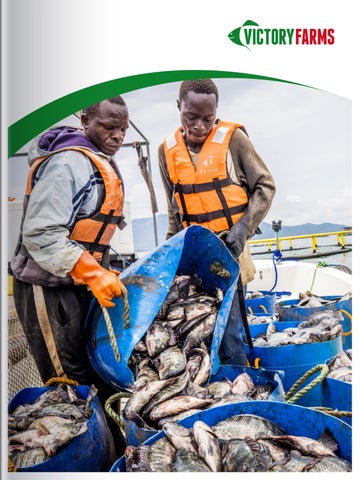
For the African continent, aquaculture is the future of protein. Scaling a platform with sustainability and community values at its core, we take a dive into tilapia producer, Victory Farms, with Founder and Group CEO, Joseph Rehmann Writer: Phoebe Harper | Project Manager: Kyle Livingstone
2 | Africa Outlook issue 97
The African diet is getting a fraction of the attention that it deserves, given the impact that it’s likely to have.” Africa faces a food dilemma. As the continental population doubles, and disposable income continues to rise, the availability of wild caught fish, a critical element of the diet for many,
is diminishing. Consequently, the whole country is shifting to a diet that primarily consists of hoofed animals or resorting to cheaper plant-based protein due to affordability. This lack of attention concerns both press and media coverage, but critically, also the financial investment required to effect change.
“This continent’s diet will become one of, if not the, biggest contributors to climate change.” For Joseph Rehmann, Founder and Group CEO of tilapia producer, Victory Farms, the unsustainable nature of a diet reliant on hoofed animals is obvious. Indeed, it was this very quandary that led Rehmann to found Victory
Farms, as what he describes as “a protein platform” centred on aquaculture that delivers essential nourishment in a sustainable way. “Victory Farms is a platform where we’re trying to make protein affordable and available for the mass African market, whilst creating a net positive impact for the environment.” Africa Outlook issue 97 | 3
VICTORY FARMS FOOD & DRINK
“ W E H O P E TO B E CO M E T H E F I R ST C A R B O N N E G AT I V E F I S H P L AT F O R M I N T H E W O R L D ” – J O S E P H R E H M A N N , F O U N D E R A N D G R O U P C E O , V I C T O R Y FA R M S
Rehmann brings to his operation a rich career background, defined by the intersection between food, sustainability and investment. He was initially introduced to the freshwater fish of tilapia whilst working for a food-focused private equity fund, then owned by Cargill, to evaluate potential acquisition investments in Ghana. A three-month due diligence assignment soon transformed into a tenure of more than three years, with Rehmann taking over as Chief Financial Officer. “I became extremely passionate about what the future of protein is going to look like in sub-Saharan Africa.” Although primarily a tilapia farming operation, this side of the business occupies roughly a third of the Victory 4 | Africa Outlook issue 97
Farms workforce. Aside from this, the company runs an extensive climatefriendly cold chain that distributes product into market trading hot spots throughout Kenya and has recently been making moves into feed production. As you might expect from Africa’s fastest-growing fish platform, expansion is very much on the agenda for Victory Farms. But as of today, its operational footprint is primarily in Kenya, with 55 branches selling fish to 12 counties across the country. “We have also just set up operations in Rwanda and are in the process of doing the same in Tanzania. We’ll be selling fish there before the end of the year,” Rehmann shares. Producing fish mainly in western Kenya, production and distribution
now also extends to Rwanda. But arguably the most exciting development for Victory Farms at present is the ongoing construction of a feed milling operation, a joint venture project that brings together Victory Farms’ aquaculture expertise and its partners’ knowledge in animal feed production.
CONQUERING CARBON NEGATIVITY “Our goal is to be carbon negative, but we’re not there yet,” states Rehmann. Nevertheless, major strides are being made on Victory Farms’ journey towards this environmental goal. As an energy-intensive process, especially in milling and production, fish feed currently represents the
distribute Aqua Feeds at the now jointly owned Nairobi Aqua Feeds Plant under Skretting® and Unga’s Fugo® brands. Tunga Nutrition (U) Limited on the other hand will make use of Unga’s dormant flour mill in Kampala, converting it to a state-of-the-art Feed Mill to produce animal feeds and concentrates, working closely with Trouw Nutrition. Tunga Nutrition is Joint Venture Company between Nutreco International BV and Unga Group PLC’s, two indirect subsidies; Unga Farm Care (EA) limited in Kenya, and Unga Millers (U) Limited in Uganda. The name ‘Tunga’ is a Swahili word meaning “to compose”.
Unga Farm Care (EA) Limited is the region’s leading manufacturer and marketer of a broad range of quality animal nutrition and health products. Skretting is a world leader in the manufacture and supply of aquaculture feeds, making us an essential link in the feed-to-food chain. Unga and Skretting have been working together since 2017.
Two separate entities were formed – Tunga Nutrition (K) Limited working directly with Skretting to manufacture and
Tunga Nutrition is a major supplier of Victory Farms for – among others – our products Optiline and Nutra.
When tilapia eggs hatch, the larvae rely on the yolk sac to provide the nutritional needs before they begin feeding. The larvae are vulnerable to starvation and need to feed continuously during this period. In nature, there isn't always a constant supply of feed and many fry will die during this first stage of life. In hatcheries however, sufficient amounts of high quality starter feeds can be continuously supplied. Feed production techniques allow us to produce feeds with properties that fit specific life stage needs. The slow sinking Nutra crumbles give all fry an equal opportunity to feed.
• Optimal dietry digestible protein and energy levels
Optiline provides state-of-the-art nutrition; allowing for high fish performance, highest feed efficiency and lowest FCR. Feed formulation of Optiline ensures an optimised digestible nutrient, digestible energy and raw material digestibility specifically designed for the digestive system of tilapia. This is to ensure flexible raw material use and provide a consistent quality product. In addition, when feeding Optiline there will be lower nutrient discharge and lower impact on fish environment.
• Faster tilapia growth
To learn more about us or our products, go to
www.skretting.com/en-gm/tunga or scan the QR code.
• High larval survival • Uniform pellet particle size and high water stability
• Lower FCR • Lower production costs • Lower environmental impact
VICTORY FARMS FOOD & DRINK
6 | Africa Outlook issue 97
VICTORY FARMS FOOD & DRINK
FEEDING FOR PROSPERITY Novatek Animal Feeds is the largest animal feed producer in Zambia and has been in operation since 2008. With two production facilities, one located in the capital city Lusaka and the other on the Copperbelt Province, Mpongwe, Novatek is strategically located with a large retail and distribution network to serve farmers all over Zambia. Novatek strive to be the leading supplier of technologically advanced animal feed products in Zambia and is also the only feed producer with an ISO 22 000 Food Safety Management System Certification.
Quality feed for Africa
from Africa
NOVATEK AQUAFEEDS Novatek Animal Feeds Zambia produces a variety of fish feeds products that ranges from hatchery to out-grower feeds and includes crumbles and pellets for both ponds and cage systems. We supply fish feeds to most of the southern African countries and East Africa such as Kenya at Victory Farms, Rwanda, Uganda, Congo DR and Tanzania. We are also commencing delivery of our fish feeds into West Africa, especially for the Catfish to be accompanied by Tilapia. Our fish feeds are certified under DQS Quality Systems and ISO 22 000. Feel free to reach out to us and we will be glad to do business with you.
We are here to serve you.
Contact us: National Sales Manager: +260978 779 017, +260971 252 522 salesmanager@novatek.co.zm
largest contributor to the company’s carbon footprint. “Estimates vary, but we believe that it’s as high as 70-80 percent of our total emissions,” he explains. To counteract this, the new feed mill is a revolutionary step forward as an operation that will be run on 100 percent renewable energy. “As far as we know, we are building the world’s first completely off-grid and 100 percent renewable energy fish feed mill,” Rehmann tells us proudly. Leveraging solar power in the daytime, and geothermal at night, it will be entirely off-grid. “We won’t be relying on any grid power, which is a little scary! But this forces us to stay true to our plans.” Numerous other projects are underway in this regard, such as the successful rollout of Victory Farms’ zero plastic waste distribution model, first to attain carbon neutrality and then on to full negativity. But in terms
of magnitude, the impact of the new feed mill is truly the pièce de résistance. Hand in hand with Victory Farms’ pledge to attain carbon negativity, are its commitments to biodiversity. The company has recently completed a one-year preliminary study undertaken by the Kenya Marine Fisheries Institute and Conservation International, spanning the one-kilometre stretch of ‘Conservation Zone’ within Lake Victoria that the company manages with the local community. With the study identifying the return of a number of critically endangered species to the area, including two kinds of fish that were thought to be extinct, the Conservation Zone has been proven as a biodiversity hotbed. “Our hypothesis was that we could work with local communities to create a biodiversity-positive zone, but now it’s been verified by two notable
parties,” shares Rehmann. Victory Farms will continue to work on this zone, and identify further areas where the same efforts can be undertaken. On land, Victory Farms is engaged in multiple rewilding efforts, again working hand in hand with local communities to nurture the reintroduction of indigenous species. “When we set up our programme for the rewilding of indigenous species, we had such a fantastic response. So many people signed up, because they want to see this happen, but they just don’t have the financial ability to do much about it,” he comments. Due to the popularity of the programme – which so far has witnessed a huge impact on local birdlife, the health of the monitor lizard population, and has even seen a new family of hippos settling into the area – Victory Farms has begun its community engagement initiative Africa Outlook issue 97 | 7
VICTORY FARMS FOOD & DRINK
to support rewilding of surrounding land plots not directly owned by the company. “It has all been incredibly encouraging to see. There’s this huge
misunderstanding that the local community doesn’t care about nature returning to the area, but of course they do, they just haven’t had the means.”
VICTORY FARMS AND THE WAR ON PLASTICS e W v “ a t h s u j y l d e f h s i n o e h t a o r g t i m a on c r i e t u z bs a rl tp w i d .ledom In eht s,e rfhsyit udl,nesim ractnxiseht ysairvoj mf s y r e t u l d a n i r p e l b o a m u . s e nr c o i - t ls ga n W ip d s tu o a l h c i d r d n a e h t n u o m a f o e .t s a w y t r i e n a d r s o c i t x e e t W n “ a w o t h g i l a h t n o e i ma r g f i m a e l g n i s e c u t s l a e d p o m s i y l a t o . elbis oItp ko t suylhg o rwstae yote,lnpomihtcadnrgim t sa wy ksir n i , eg hn ti gu eb w o n s l a ’ t i r y e l c t a h s ’ t i e h t r l e b d o m – h t o b m r f , e v li atd cn e p ms r a o n i v s m r e t ” f o . n t i s o c u d e r
8 | Africa Outlook issue 97
DELIVERING LOCAL VALUE This role of environmental stewardship as custodians of its nearby surroundings translates to Victory Farms’ emphasis on delivering local value. With a primarily localised workforce, the farm’s operations are intrinsically linked to the socioeconomic development of the communities that surround it. “We have been extremely intentional around job creation,” shares Rehmann. “It goes against the western playbook on how to build a business!” The company represents a wide and varied stakeholder group, which he describes as “the opposite of a monolithic group”, comprising a
VICTORY FARMS FOOD & DRINK
diverse host of perspectives. Despite this diversity, local job creation is a common thread of concern. “One central takeaway you’ll find is that every stakeholder group highly values well-paying jobs. A job at Victory Farms provides a reliable income, and pays on average significantly higher than what a normal job in the area does, and we’re probably the only formal sector job in these surroundings which brings a host of benefits, such as healthcare,” he elaborates. As a result of this emphasis, Victory Farms follows a considered approach to investment, prioritising protection of local jobs and livelihoods, instead of chasing technological innovation. Rehmann highlights the company’s processing division, which currently employs roughly 150 people, an overwhelming majority of whom are local women.
“If we were to invest in the latest technologies – automated processing, weighing, sorting and packaging, etc, we could reduce that number to about 20 people.
“I accept that automation is the future, but we don’t have to do that with the stage we’re at today. For at least another generation, the benefit to the local community is worth the Africa Outlook issue 97 | 9
VICTORY FARMS FOOD & DRINK
administrative effort of employing people.” Whilst also giving the workforce time to adapt and move with the company as it gradually embraces technological innovation in the future, the main reasoning behind this is keeping costs in the local communities. “If we buy an advanced piece of equipment for example, that cost might go to Norway. But if we employ 150 local women – the cost of which would be roughly the same – that spending stays within the local community and goes into empowering them to create better livelihoods.”
FUTURE HORIZONS With such laudable environmental and social commitments at the fore, the future is exciting at Victory Farms. “We have grown faster than any other tilapia platforms on the continent. Although we’re not the largest, when we look forward, we believe that we can continue to accelerate that growth,” Rehmann shares confidently.
Expansion remains strategic within this growth ambition, pursuing markets that promise great opportunity. The move into Rwanda has proved to be one such example. Although a far smaller market, compared to Uganda, the population faces a significant deficit in animal protein in their diet. Tilapia holds the answer. In a similar vein, growth is also being pursued in both the Democratic Republic of Congo (DRC) and Burundi. “There is a lot of investment and aid donations being directed into these geographies to improve nutrition outcomes. 10 | Africa Outlook issue 97
“ W E ’ R E W R I T I N G T H E P L AY B O O K F O R T H E FUTURE OF TILAPIA PRODUCTION” – J O S E P H R E H M A N N , F O U N D E R A N D G R O U P C E O , V I C T O R Y FA R M S
“The beauty of aquaculture is that once we make the fish available, and affordable, thousands of local traders get involved to deliver the product to those in need.” Rwanda has proven a receptive and welcoming market for Victory Farms, receiving significant support from the local government to encourage its efforts on Lake Kivu. Meanwhile, in Tanzania, Victory Farms is well-placed within a predominantly fish-eating culture that is now threatened with a drastic decline in wild catch - a trend that Kenya saw decades ago. “The majority of Tanzanians – and it’s almost 50 million – consume fish, but with the collapse of the wild populations of fish, many have had to
resort to hoofed animals. “We’re optimistic that Tanzania represents a very underserved fisheating culture where we can come in and supply the very fish that can no longer be caught wild or fished artisanally,” he surmises. By setting an exemplary business model built on the pillars of social engagement and environmental restoration – both of which are not only sustainable but also scalable – Victory Farms continues to exert what Rehmann describes as “positive pressure” for other industry players to follow its lead. “Our sights are set on scaling to become the largest tilapia producer globally. The ambition remains strong, but it’s equally ambitious as during
our first five years when we hoped to become an African leader.” It is fair to say that although not the largest, this goal has been truly accomplished, as Victory Farms continues to keep Africa in good health with a sustainable protein source as the foundation. “We’re writing the playbook for the future of tilapia production.”
VICTORY FARMS KENYA Tel: + 254 797.736.164 Olgao@victoryfarmskenya.com www.victoryfarmskenya.com Africa Outlook issue 97 | 11
VICTORY FARMS KENYA 319 Nyari West Drive Nairobi, Kenya Tel: + 254 797.736.164 Olgao@victoryfarmskenya.com www.victoryfarmskenya.com
PRODUCED BY AFRICA OUTLOOK MAGAZINE