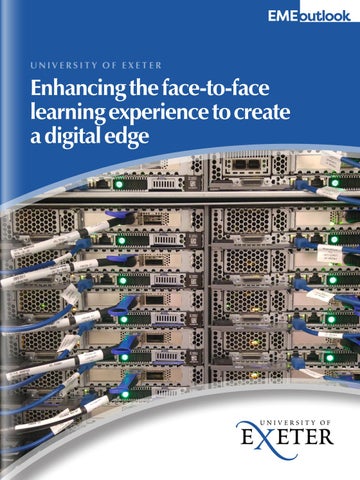
UNIVERSITY OF EXETER
Enhancing the face-to-face learning experience to create a digital edge
U N I V E R S I T Y
2
O F
WWW.EMEOUTLOOKMAG.COM
E X E T E R
T
E
C
H
N
O
L
O
G
EME
Y
MAKING THE
EXCEPTIONAL
HAPPEN
ince receiving its Charter and full University status in 1955, the University of Exeter has evolved into one of the UK’s leading academic institutions; diversifying and expanding in line with the most contemporary of trends, technologies and demands in order to remain a consistently relevant and thriving option for both national and international students. Joining the prestigious Russell Group of research-led establishments in 2009 affirmed this dedication to modernity and innovation, and in no way is this better demonstrated than through its commitment to technology over the decades. In recent years, this has culminated in a series of significant investments in the University’s IT infrastructure, specifically targeted at optimum performance across computing in research; in particular, focusing on areas of electromagnetic materials, nanomaterials and graphene. “We have, in-house, all the stateof-the-art materials, nanofabrication and characterisation facilities required by our researchers and students,” affirms and introduces the University of Exeter’s Chief Information and Digital Officer, Alan Hill. “This includes e-beam lithography, thin film
As one of the UK’s leading higher education institutions, The University of Exeter’s appeal as a centre of learning is established, but it is its technological prowess that continues to drive its role as a centre of global research Writer: Matthew Staff Project Manager: Jamie Sutherland
deposition, plasma-etching systems, and associated photonic laboratories; through to a suite of 3D printers and fully-equipped microwave and acoustics laboratories. This work has been directly supported by our Zen supercomputer and Beowulf clusters.” Mirroring the growth of the institution’s technological prowess has been the size of the University itself; four campuses now making up the entire offering. Across each campus, a series of significant investments have been made in recent years.
“At the Falmouth campus a £30 million investment was made in 2013 to create the Environment and Sustainability Institute, which delivers cutting-edge, inter-disciplinary environmental research and innovative business practices; while in 2016 a £50 million investment created the Living Systems Institute (LSI), a worldclass, next generation, collaborative research community to revolutionise the diagnosis and treatment of illnesses,” Hill continues. “The LSI will enable our researchers across mathematics, biology, evolutionary genetics, biochemistry, and physics to work in combination to generate new knowledge.”
Chief Information and Digital Officer
WWW.EMEOUTLOOKMAG.COM
3
High impact transformation in Education with Microsoft Services Today’s world reects a brand new reality: technology is ubiquitous, with friction-free access to digital services. This enables new ways to engage students, empower educators & researchers, optimise institutions and reimagine teaching & learning. Capitalising on this phenomenon is key to innovation and growth.
Microsoft Services: empowering customers to accelerate business value imagined and realised from their digital experiences.
U N I V E R S I T Y
O F
E X E T E R
High quality research labs, bioimaging facilities, physics spaces, and high performance computing further enables the LSI to be a hub for the analysis of the precise operation of living systems and once again epitomises the University’s drive to achieve productive and sustainable results for both students and wider industry. Hill adds: “The world-class academics, facilities, and students can make a real difference to businesses and we provide skilled support to make sure that solutions are tailored to the needs of the business and deliver optimum results. “For research, recent results place the University of Exeter 16th nationally for world-leading publications. This
level of investment enables the University to meet its strategic vision of “Making the exceptional happen”.”
Isca
and by investing significant sums in this on-site facility it demonstrates a strategic level of commitment to high performance computing in support of research and education. “It represents a £3 million investment by the University, designed to serve the advanced computing requirements of all research disciplines. Isca combines a traditional computing cluster with a virtualised cluster environment, providing a range of node types in a single machine, and as such is the first of its kind in a UK University.”
As a globally-recognised centre of research excellence, the University is especially renowned for its collaborations with, and impacts on, areas including astrophysics, healthcare, biotech, culture, government, advanced engineering, data science, energy, mining, the environment, and food security. Supporting research into all of these facets in the past few months has been a recently acquired state-of-the-art The student experience supercomputer named ‘Isca’. Of course, such innovation and Hill explains: “Isca is housed in our technological intelligence in an recently modernised data centre, academic domain would have been unthinkable upon the University of Exeter’s inception in 1955 when just four faculties of arts, science, social studies and law were offered; or even through the fast-developing Overseas projects are particularly popular 1960s which saw the unveiling of Professor Tim Frayling is using Isca in his role as its postgraduate medical school. Professor of Human Genetics at the University of Exeter However, since the arrival of Professor Medical School to investigate type 2 diabetes and Sir Steve Smith in 2002, the University’s obesity. He says: “Scientists have spent the past 10 years pace of progression has accelerated making steady progress to increase our understanding of the dramatically and the evolution of its research base has encapsulated this genetic variation that influences all human traits; including birth mission most aptly. weight, obesity, smoking addiction, male baldness, cancer, diabetes, As Hill details, a key to this concerted Alzheimer’s disease, and many others. expansion and diversification of “We’ve done this by pooling genetic data from hundreds of studies academic influence has been the around the world - each of a few hundred to a few thousand strategic partnerships entered into with equally market-leading entities. individuals - to generate total sample sizes of a few hundred “Collaboration is at the heart of thousand. Now that we have the UK Biobank data (500,000 research and education and to support records), we can perform analyses, that previously took a few years, this, the University has invested in a few days.” in Microsoft Office 365 and the collaboration tools such as Sharepoint, Teams and One Drive for Business,” he confirms to this end. “This can be used effectively to support international collaboration, which is so important in achieving world-class research. A direct impact of this is to help prepare students for the changing workplace where collaboration is vital and automation is increasingly seen in business models.
Isca Case Study
6
WWW.EMEOUTLOOKMAG.COM
P
lease meet Ella. Ella is a Microsoft UK Apprentice currently enjoying her time as a valued member of the devices team at the world-renowned tech pioneer. Having previously declined two university placements in preference of grasping this opportunity, Ella serves as an example of an emerging trend in the tech world, as well as of Microsoft’s continued appeal as an employer and partner. This isn’t to say that the notion of university education is dying out, however; rather that Microsoft is bridging the gap between on-thejob learning and academia through carefully constructed relationships with institutions such as the University of Exeter. It is recognised that professionals with relevant technological skills will enjoy high-value, high-growth employment, and the transformation journey being undertaken by many universities must support this change in focus areas. Consequently, the University of Exeter has taken significant steps to establish the institution as a transformation leader, with Microsoft at its side. Digital transformation in education Digital transformation revolves around driving technology and new ways of working into the lifeblood of a university to both disrupt and influence positive change. The instilment of 21st Century skills, enhanced wellbeing, enriched community engagement,
and optimised admin efficiency is compounded by excellent research facilitation to truly capitalise on the service provider-university relationship. Microsoft subsequently addresses not just the student element, but also the teaching, administration and post-education facets of university life through its transformation services; leveraging the belief that universities’ value increase by emulating the business world. The offering, in essence: is not just technology for people to use, but to make people useful; is not just technology that people are made to use, but love to use; and is not just technology for technology’s sake, but true empowerment. Microsoft Services To fully realise this ethos, Microsoft is redoubling its higher education strategic focus; by investing in fullstructure, local, account-aligned teams in addition to its global centre of excellence which comprises highly experienced CTO-level personnel tasked with enabling transformation where it matters most: the student, lecturers, learning materials, and culture. Microsoft Services is eager to invest in tight collaborations with selected universities that are prime for transformation, such as in Exeter; adopting an approach to co-create a voyage towards quantifiable, highimpact, high-value outcomes.
An efficient, holistic and effective technology framework shapes such a plan before encouraging partners to take ownership of the strategy in line with their own educational and business goals; Microsoft all the while remaining on hand to flexibly upgrade, fine-tune or amend the chosen systems and technologies as the journey progresses. Ultimately, business transformation can be overwhelming, and Microsoft continues to help navigate these complexities towards quick and significant victories on the way to longer-term transformations. If you are planning such a transformation, then ask yourself these questions? Does senior leadership endorse your transformational aspirations and timelines? Do Microsoft technologies underpin substantial areas of your business? Are you keen to engage in a partnership with Microsoft (and selected Gold-Partners) backed by senior stakeholders to achieve high-impact, high-value, transformational success? If the answer is ‘yes’ to all three, then please contact Microsoft Services: msukservices@microsoft.com
msukservices@microsoft.com www.microsoft.com/services
U N I V E R S I T Y
O F
E X E T E R
“The IT department is poised and ready to respond, but to also act as a catalyst for change.”
“Digital and IT services play a significant part in the student experience.”
“We have also invested in ‘back office’ systems for our student information system, HR and finance in order to automate and modernise in the most efficient way. These systems of record form the basis on which we set out to build a more differentiated approach that builds on the uniqueness of the University of Exeter.” Connecting the data in the aforementioned systems to the powerful WSO2 open source integration layer, enables new services to be created at pace; inevitably a benefit for students whose advanced education lifecycle lasts just three-four years in most cases. “Digital and IT services play a significant part in the student experience,” Hill notes before discussing some of most significant enablers on offer at the University of Exeter. “The lecture capture capability is used to automatically record academic presentations and content. This can be viewed later by students to support their understanding and revision. A recent change of supplier to Panopto has created a cloud-based service that has seen a significant increase in viewings equivalent to 50 views per student over a year. “This is set to grow and is already becoming an area to consider for further enhancement. Students view these videos in the Moodle virtual learning environment, which holds all the information and content for their courses.”
Digital edge
“In the future, we would expect to be an IT organisation that focuses primarily on delivering digital services that are palpably delivering value to academics and students.”
8
WWW.EMEOUTLOOKMAG.COM
In the day-to-day life of the student, there is a web and mobile app named iExeter, that gives them the information they need for their activities, while emails and timetables are easily accessible alongside a record of their grades, café opening times, maps, transport information, sports centre availability, etc as part of this ExLibris platform. Used, on average, eight times a day by every student, iExeter serves as
T
E
C
H
N
O
L
O
G
Y
EME
Preparing students for changing workplace environments
attract the very best talent. “For the future, we are focusing on moving more services to the cloud; improving data analytics as a way to improve student success; expanding virtual reality in different subjects; and focusing hard on the overall student experience whenever they interact with the digital services,” Hill concludes as he glances towards the next stage of development. “In the future, we would expect to be an IT organisation that focuses primarily on delivering digital services that are palpably delivering value to academics and students. Hardware, network 2D and 3D simulation of a young star (Pratt et al. 2017, A&A, 604, 125) and storage will be streamlined yet another significant digital channel high-profile relationships with industry and delivered mainly by suppliers emphasising the role that digitalisation heavyweights, provides the University to provide a resilient and secure plays in higher education. with a “digital edge” in the most digital environment that just works. “We are actively optimising our “We have built research power of eras. supplier network so that we can focus significantly over the past few years, “The IT department is poised and on digital service integration and work ready to respond, but to also act as supported by Exeter IT, and with an to create a differentiating ‘digital edge’ a catalyst for change,” Hill states. equal focus on education and learning, over our competitors,” Hill affirms. we will create the ‘digital edge’ that “This requires a modernisation of the “Supporting these digital services is a technology platforms and a change to enhances the face-to-face learning high bandwidth network with in-depth the organisational structure and skills experience and directly contribute to expertise supplied by Axians; and high that are needed. making the exceptional happen.” quality Wi-Fi coverage for all campuses “Tackling this, while ensuring and residences.” business as usual is not impaired, is Ultimately, this combination of always going to be a challenge, but it is internal technological knowhow and absolutely necessary if the University is entrepreneurial ambition, paired with to deliver real value and to continue to
WWW.EMEOUTLOOKMAG.COM
9
The University of Exeter Mail Room, The Old Library Prince of Wales Road Exeter, Devon UK EX4 4SB T: 01392 661000
www.exeter.ac.uk
www.outlookpublishing.com